Category: Planning

Open the Time Capsule: The Great Recession of 2008

Go Lean Commentary

Time Capsule Pic 1Picture this: one week after the greatest threats to the global financial system, since the Great Depression. You cut out and store – for safe keeping in a “virtual time capsule”, (see Appendix A) – a newspaper commentary and subsequent review/analysis of that crisis. It’s time now to open that capsule! Why so early? Why only after 6 years? So that this analysis would serve as a course correction. Those placing the time-capsule, hoped for a different result.

This is the scenario depicted in the foregoing news article. It was published on September 23 in 2008; 8 days after Lehman Brothers filed the largest Bankruptcy in world history – signaling the peak of the financial crisis, the precipice of a total system failure. The book Go Lean … Caribbean is based on that premise, declaring that a crisis is a terrible thing to waste”, quoting noted Economist Paul Romer’s assessment that the Great Recession would be a crisis for the modern world. The book posits that the Caribbean, with its parasite economy, is still in that crisis – no noticeable recovery.

A joke lampooning economists declares “that an economist is an expert who will know tomorrow why the things he predicted yesterday didn’t happen today”.CU Blog - Open the Time Capsule - The Great Recession of 2008 - Photo

So now, this review/analysis of a 6 year old newspaper editorial from a Guest Columnist, the focus of which was to an audience in the Bahamas; (but this is equally representative of the entire Caribbean):

It is the assessment by the publishers of Go Lean that the foregoing analysis was spot on!

It describes the new normal, a term cementing the truths that the economic realities that suddenly emerged in 2008 would thereafter remain as the norm. This has proven to be the case. The foregoing writer lamented that his government appeared to be using the same set of tools to fix a new vehicle with all different parts, and they pondered why the vehicle would not repair (recover) and get going. The writer concluded that the stewards of the economy needed to prepare a 20 year plan to navigate his country among the new realities facing the world. But he doubted that such a plan would emerge.

By: Craig Butler

I know what you must be thinking. ‘The new normal’, what in heaven’s name is he talking about? Well, the other day I was in Florida listening to talk radio.

There was a director from the International Monetary Fund, an economics professor, and a few others. They were talking about the global economy and what the future holds. The professor was the one who used the ‘new normal’ phrase and he did so in reference to the high prices that we are experiencing worldwide.

He said that, as he did not expect a significant strengthening of the dollar any time soon; coupled with the fact that the price of oil was likely to remain high and the war in Iraq was ongoing, he believed that the current high prices are going to be the norm.

Most of the panelists agreed that some experts have given folks a false sense of security by suggesting that prices will come back down once the price of oil drops. But all on the panel were of the view that the price of oil will never again be under $90 to $100 per barrel.

This was partly based on the weak dollar and partly on our dependency on fossil fuels and the lack of resolve shown by politicians to fully develop alternatives. They also noted that the oil lobby was one of the most powerful in Washington, which was a leading factor in the stalled development of renewable energy.

And the price of breadbasket items and other basics has not been helped by climatic change, which has led to falls in wheat and rice production over the last few years. Add to this the diversion of corn for use as a fuel (ethanol), and we have the new normal.

My views tend to be conservative so my first reaction was that these are some leftwing liberal nuts talking. However, on reflection much of what was said is correct.

Why should we expect to see a reduction in the price of oil? Producers are making so much money it’s not realistic to think they would relinquish that. And the high price affects so many other industries that have had to pass on these increases to the consumer. Just look at the airlines. And all the solutions being put forward to wean us off our dependency on oil will take at least five years to have any kind of impact.

The panel went on to say that there will be a widening of the income gap – something we are already seeing in the Bahamas. Many people who I know in the middle class are struggling so much that they can now be classified as the working poor.

I say that because they are now living from pay cheque to pay cheque. All their savings have been depleted; and things that they once could afford are out of the question now.

Think about it – how many of the people you know around you have their houses in foreclosure; have lost their car to the bank; have had to take their children out of private school; or have been unable to take a vacation this year?

Look in the newspaper this week and I’m sure one of the leading commercial banks will have a double page ad featuring distressed properties. The other week two banks had ads back to back.

I have written before about misguided priorities and how, despite all that is going on, we still prefer the materialistic rather than seek what is important.

I remember from my youth a song by Eddie Minnis called the ‘Finance Man’. I loved that song, and the words to one of the verses bears repeating: ‘See him there he poor as me and you but he driving round in Malibu. His car sleeps in the road at night, Lord you know that just ain’t right, He is living in the hands of the finance man…’

I apologize to brother Eddie if I did the lyrics an injustice. But it demonstrates how we have lived on credit for a long time. We have maintained a lifestyle well beyond our means without a thought as to what might happen in hard times.

As a lawyer I can see first hand what has happened to many in the middle class. You see, it was important for them to have the grand house with the two European cars parked in the garage, kids in the best schools and all the trappings that went along with it. And I will be the first to say that there is nothing wrong with wanting to attain your desires.

However, the bank loans were in many instances predicated on both the husband and wife maintaining $50,000 a year salaries, as well as some creative financing to help the couple get the loan.

Now that many offshore companies have closed or downsized, one of those pay cheques has disappeared and so has the dream, because the severance package is not going to last long and there is a distinct shortage of similar jobs available.

So what we are facing here is now being experienced all over the world. The radio panel noted that there will have to be a reclassification of the status of many people as the poor are going to be poorer, the middle class are going to be the new poor and only the very rich will be able to sustain themselves.

Dark days are ahead, and this means we need our politicians to get their collective heads out of their rear ends and devise a comprehensive plan for the next 25 years that takes all of the current factors into consideration and ensures our viability.

But there I go dreaming again – most of the time they can hardly get out of their own way let alone see past the next general election. So lets wait for the eventual anarchy that is to follow.

*****

Craig Butler studied law at the University of Wolverhampton, England, and at the Norman Manley Law School in Jamaica. He also has a degree in economics from Rollins College in Florida. Mr Butler’s column runs in the Nassau Guardian, the Bahamas, on Mondays and he also hosts a weekly political talk show on Bahamas’ Island FM.

He is the grandson of Sir Milo Butler, the first governor-general of an independent Bahamas. He blogs at Bahamapundit and can be reached at cfmilobutler@hotmail.com.

The New Black Magazine – Online Source – Tuesday, September 23, 2008 –http://www.thenewblackmagazine.com/view.aspx?index=1596 

Flash forward 6 years later; lo and behold, the book Go Lean … Caribbean is proffered as that plan, a roadmap to navigate today’s troubling economic waters and offer solutions. The book calls for the introduction and implementation of the Caribbean Union Trade Federation (CU), a super-national administration, for the 30 member-states that constitute the Caribbean region. The book posits that the problems of the Caribbean are too big for any one member-state to tackle alone. That rather, there needs to be a methodical leveraging of the 42 million people that populate these island/coastal states. With such numbers come economies-of-scale, and the benefits of these 3 prime directives:

• Optimization of the economic engines so as to grow the regional economy to $800 Billion and create 2.2 million new jobs.

• Establishment of a security apparatus (with prosecutorial powers for economic crimes) so as to mitigate the eventual emergence of “bad actors”.

• Improve Caribbean governance.

These prime directives recognize that the change the region needs starts first with re-thinking community ethos and economic engines. Early in the book, an economic interdependence is pronounced, (Declaration of Interdependence – Page 13) with these statements:

xxiv. Whereas a free market economy can be induced and spurred for continuous progress, the Federation must install the controls to better manage aspects of the economy: jobs, inflation, savings rate, investments and other economic principles. Thereby attracting direct foreign investment because of the stability and vibrancy of our economy.

xxv. Whereas the legacy of international democracies had been imperiled due to a global financial crisis, the structure of the Federation must allow for financial stability and assurance of the Federation’s institutions. To mandate the economic vibrancy of the region, monetary and fiscal controls and policies must be incorporated as proactive and reactive measures. These measures must address threats against the financial integrity of the Federation and of the member-states.

The book identifies a number of new community ethos to forge change in the region and to harvest the benefits of the new global marketplace. From the ethos, comes the solutions – for example, sharing!

Six years ago, the columnist in the foregoing article could only envision his country, Bahamas, seeking solutions alone. This roadmap, on the other hand, seeks solutions as a confederated region, a group of partners. This will mean speaking with one voice, acting together as the CU; the 30 member-states will have far greater weight and influence than acting individually. Benefits will flow from this economies-of-scale, like a Group Purchasing Organization (GPO) to negotiate value and savings.

The CU roadmap drives change among the economic, security and governing engines. These solutions are as new community ethos, strategies, tactics, implementations and advocates; as follows:

Community Ethos – Lean Operations – GPO’s Page 24
Community Ethos – Ways to Improve Negotiations Page 32
Community Ethos – Ways to Impact Turn-arounds Page 33
Community Ethos – Ways to Improve Sharing Page 35
Strategy – Agents of Change – Globalization Page 57
Strategy – Agents of Change – Climate Change Page 57
Tactical – Confederating a permanent union Page 63
Implementation – Ways to Pay for Change – GPO’s Page 101
Implementation – Foreign Policy Start-up Initiatives Page 102
Implementation – Ways to Improve Energy Usage Page 113
Implementation – Ways to Better Manage Debt Page 114
Implementation – Ways to Benefit from Globalization Page 119
Planning – Ways to Improve Trade – GPO’s Page 128
Planning – Lessons Learned from 2008 Page 136
Advocacy – Ways to Grow the Economy Page 151
Advocacy – Ways to Create Jobs Page 152
Advocacy – Ways to Control Inflation Page 153
Advocacy – Ways to Better Manage ForEx Page 154
Advocacy – Reforms for Banking Regulations Page 199
Advocacy – Battles in the War on Poverty Page 222
Advocacy – Ways to Help the Middle Class Page 223

Change has come to the Caribbean; the world is different. It’s not the world before 2008, but rather a new world shaped by 2008. This is illustrated as a moving freight train. It cannot – must not – be stopped. Everyone must get “on board”, or get “run over”.

Appendix A: How to Create a Time Capsule

A time capsule can be as simple as a shoe box full of items reserved (or even forgotten) somewhere. Other time capsules may need to last a very long time, in which case a strong stainless steel container is recommended, with a proper seal. Keep in mind that creating a capsule for unveiling at some future date is really a two sided adventure involving both you and those who will uncover it once again. Make sure that the items you select will add the element of surprise and discovery for those who open this curious treasure chest of history. Learn how to make a time capsule that will be sure to please and surprise whoever opens it. (http://www.wikihow.com/Create-a-Time-Capsule; retrieved May 5, 2014).

Download the book Go Lean … Caribbean – now!!!

Share this post:
, , , ,

Abused wives find help by going to ‘Dona Carmen’

Go Lean Commentary

AbuseThe issue in the below news article is related more to human rights, than to feminism. This story is being brought into focus in a consideration of the book Go Lean … Caribbean. The book serves as a roadmap for the introduction and implementation of the Caribbean Union Trade Federation (CU), for the economic optimization in the region.

How does this story relate?

The roadmap posits that the economy of the Caribbean is inextricably linked to the security of the Caribbean. While the security scope of the CU is mostly focused on the “bad actors” that might emerge to exploit the new Caribbean economic engines and successes, the book is not quiet on what may be considered traditional crime-and-punishment issues. While the subject of domestic violence falls on the member-state side of the separation-of-powers divide, the CU will entail a jurisdiction of monitoring and metering (ratings, rankings, service levels, etc) local governments and their delivery of the Social Contract. For this reason, there is a 3rd focus of the CU prime directive, to optimize the region’s governing engines.

An underlying mission of the CU is to dissuade further human flight and incentivize repatriation of the far-flung Diaspora. Many who had fled previously obtained refugee status due to the abuse and persecution from domestic perpetrators. These issues must be addressed and targeted for solutions and reconciliations.

In fact, the foregoing article refers to the new enforcements introduced in Brazil in a 2006 law. That’s was just 8 years ago. (A similar Domestic Violence law was enacted in the Bahamas in 2008). A survey of other Latin American countries unveils even more new laws recently enacted in the Caribbean, Central and South America. Change has finally come.

Change has come to the Caribbean, but as the roadmap depicts, the problem of domestic violence (a human rights abuse) had persisted long before, and is thusly rooted in a community ethos. An ethos that must be uprooted and replaced with a new, progressive spirit, even within the public service entities, whose job it is to “serve & protect”. This is the new lean Caribbean!

This is reflected in the foregoing article with the principal character Dona Carmen, which is not even her real name, but more of an elevated title for her respected role in the community.

Title: Abused wives find help by going to ‘Dona Carmen’
By: Dom Phillips

CAMPINAS, Brazil — With her husband out of earshot, Queze Vicente told the story of the night he came at her with two knives in his hand.

“He was drinking,” she said outside their one-room shack in a roadside slum near an airport here. “We fought. And I had to go to Dona Carmen.”

Everyone in their community knows who Dona Carmen is and her method for getting abusive husbands in line. They call it “the discipline,” and it includes a sex strike.

For 15 days, husbands who hit their wives are also banned from drinking in the local bar and playing soccer on the local field. And any man who helps an offender violate the rules is also subject to the sex strike.

Abused by her husband and saddened by the abuse all around her, Dona Carmen talked 12 local women into adopting the punishment routine. Two years later, the women and most of the men say it works.

“Everyone thinks it is good,” said Vicente’s husband, Renato. “There are no more fights.”

The abuse in this community, a corner of the slum called Menino Chorão, or Crybaby Boy, was not unlike what many Brazilian women experience. In a survey conducted by the Patrícia Galvão Institute, which works on women’s rights and communication issues, 54 percent of Brazilians said they knew a woman who had been attacked by a partner and 70 percent said they believed Brazilian women suffered more violence at home than in public spaces.

But change is slowly coming to this most macho of societies as activists such as Dona Carmen try to help women find new ways to combat domestic abuse.

“This is a theme that permeates the whole of society,” said Julio Neto, a professor at Campinas State University whose department recently sponsored a forum at which Dona Carmen spoke. “Every Brazilian knows cases of violence against women.”

Neto said the women in the group were forced to act because the state was not protecting them. “If they call the police, the police don’t go.” He said he did not condone cases in which some women had beaten up male offenders but that he supported “the discipline.”

“It is very original. I think in this sense, it is marvelous,” he said.

Dona Carmen, whose real name is Maria de Sousa, commands respect within her group: the fact that she is addressed as “Dona” — roughly equivalent to “madame” — is evidence of that.

Like most of her neighbors, she is from Brazil’s poorer, more traditional northeast. For 13 years, she was married to a man who beat her persistently. One attack when she was five months pregnant caused her to miscarry twins. “My whole body had purple bruises from the beating he gave me,” she said.

She arrived in the southeastern city of Campinas from her native Fortaleza eight years ago when a woman she had met tricked her with a promise of work and a place to live. As a result, she said, she spent 40 days in a brothel but escaped and did not have to work as a prostitute.

“I was desperate to get a job,” said de Sousa, who has four children and now works in a kitchen at an advertising agency.

‘Still a lot to do’

Before Brazil introduced a domestic violence law in 2006, some offenders were able to get off with fines or even by donating food baskets.

The law is named for Maria da Penha, a biochemist whose husband shot her while she was asleep in 1983, leaving her paraplegic, and then tried to electrocute her. After almost two decades of legal maneuvering, he was finally jailed in 2002 and served 16 months in closed prison and three more years in semi-open prison.

Da Penha fought hard for his imprisonment and campaigned for the law. “I was revolted with the sexism of the Brazilian judiciary,” she said, talking by phone from Fortaleza, where she runs an educational institute.

The law set up special courts and police departments to deal with crimes against women, and stricter punishments. A special hotline was also set up to deal with cases of domestic abuse.

Da Penha, 67, said there has been major progress, but that these resources are still lacking in smaller towns and cities.

“Women who are victims of violence are slowly losing the shame they had to talk about this,” she said. “Sexual equality is being conquered little by little, but there is still a lot to do.”

Despite the tougher punishments for offenders, rates of violence against women remain high. In the first six months of 2013 alone, the hotline received 306,201 calls, of which 12.3 percent were reports of violence

Between 2009 and 2011, 16,900 women were murdered in Brazil because of “gender conflict” — a rate of 5.8 per 100,000 women, according to government statistics. In the United States in 2011, that rate was 1.17 per 100,000, according to the Violence Policy Center, based in Washington.

Brazilian women suffer inequality in other areas as well. In the World Economic Forum’s 2013 Global Gender Gap report, Brazil placed 62nd in a list of 136 countries. In terms of wage equality, it came in 117th.

Lieli Loures, 35, an activist in São Paulo, said the Maria da Penha law was a watershed moment for Brazil, and that a grass-roots feminist movement is growing. “I perceive a change,” she said. “Feminism is only beginning to be known.”

Ongoing debate
In Crybaby Boy, the debate continued in the front yard of the small brick house where Maria Santos, 34 — one of women in Dona Carmen’s group — lives with her husband, Adelmo, 31.

“We joke that the women are in charge here,” she said.

“We have to respect the rights of women,” he said. “But in the same way, we have to respect the rights of men.”

Then he lowered his voice to a whisper: “The women here want to be the man. They can’t.”

But Geraldo da Cruz, 62, said most men back the scheme. “Everything organized is better, right? Important.”

Source: Washington Post – Online News Source – April 25, 2014 –http://www.washingtonpost.com/world/the_americas/in-the-corner-of-a-brazilian-slum-abused-wives-find-help-by-going-to-dona-carmen/2014/04/25/afbb7d1a-c68d-11e3-8b9a-8e0977a24aeb_story.html

The Go Lean roadmap posits that every woman has a right to a violence-free existence, in the family and in society; it is reprehensible that in so many Caribbean/Latin countries women are still viewed as lesser beings that can be abused at the whim of men, as was evident in the foregoing news article. This type of thinking is still prevalent; not just in Brazil; (notice this related Bahamas story)

What should be done to mitigate these bad practices? How does the Go Lean roadmap address this issue?

There are strategic, tactical and operational advocacies presented in the Go Lean roadmap so as to ensure victims are protected and perpetrators are held accountable for their actions:

• The CU will therefore work with governmental and non-governmental organizations (NGO’s) to fulfill their charters to aid victims and legislate for changes.

• The CU will also fund the full vertical eco-system so that law enforcement (and/or social work) agencies can institute Special Victims Units and counseling services. The roadmap posits that even one person, an advocate, can make a difference (Page 122) in forging change in society.

• Facilitate community messaging to instill/persuade an enlightened value system for men and women; helping men curb aggressive behavior (like anger management training) and empowering women to live successful lives and seek recourse against abusers if needed.

• Oversee the internal affairs/military justice of security agencies to ensure the integrity of the justice institutions. (Deficiency in this area is a Failed–State Indicator).

While the CU does not have sovereignty (a deputized agency only), it can still provide support services to ensure compliance. In addition to monitoring and metering, the CU can also provide ratings, funding, training, intelligence gathering, and cross border (fugitive) law enforcement.

The solutions to effect change in the region are detailed in this book Go Lean … Caribbean as community ethos, strategies, tactics, implementations and advocates; as follows:

Community Ethos – Privacy –vs- Public Protection Page 23
Community Ethos – Whistleblower Protection Page 23
Community Ethos – Witness Security Page 23
Community Ethos – Anti Bullying & Mitigations Page 23
Community Ethos – Light Up the Dark Places Page 23
Community Ethos – Minority Equalizations Page 24
Community Ethos – Reconciliations Page 34
Strategy – Rule of Law –vs- Vigilantism Page 49
Separation of Powers – CariPol Page 77
Implementation – Reason to Repatriate Page 118
Ways to Improve Failed-State Indices Page 134
Ways to Better Manage the Social Contract Page 170
Ways to Impact Justice Page 177
Ways to Remediate and Mitigate Crime Page 178
Ways to Improve Gun Control Page 179
Ways to Improve Intelligence Gathering Page 182
Ways to Improve Communications Page 186
Ways to Impact the Prison Industrial Complex Page 211
Ways to Impact Foundations Page 219
Ways to Protect Human Rights Page 220
Ways to Empower Women Page 226
Ways to Impact Youth Page 227
Ways to Impact Persons with Disabilities Page 228

The goal is to make the Caribbean a better place to live work and play; with justice for all, regardless of gender. This is not politics; not feminism versus traditional family values. This is just right!

Share this post:
, , ,
[Top]

Ghost ships – Autonomous cargo vessels without a crew

Go Lean Commentary

Ghost ships - Autonomous cargo vessels without a crewLife imitates art! Art imitates life!

The forgoing article gives the impression of science fiction: The Matrix movie trilogy or The Terminator movie series. Imagine an industrial development with a heavy concentration of robotic installations. This is the future that is being planned, developed and tested now. The experience of the last 100 years is that those doing the planning, developing and testing for futuristic technologies are the ones that profit most from the economic gains. This has been true for both Japan and Silicon Valley.

The book, Go Lean … Caribbean, extolls this principle that R&D (research and development) activities are necessary to profit from advantages in technology. We want to do R&D here in the Caribbean. This is a mandate for the Caribbean Union Trade Federation (CU). This book serves as a roadmap for the introduction and implementation of the CU. This technocracy will assume oversight to optimize the region in the areas of:

(1) economics

(2) security

(3) lean government

This vision of an autonomous maritime eco-system, as depicted in the foregoing article, cannot be considered without a super-national infrastructure for these above 3 areas. The Go Lean roadmap presents the CU’s prime directives, which in total will provide comprehensive solutions for economic incentives, a security apparatus (Naval Authority and Intelligence Gathering), and lean governmental coordination to launch these initiatives.

*** Autonomous cargo vessels could set sail without a crew under the watchful eye of captains in shore-based simulators ***

Military drones already fly frequent missions and civilian operations using unmanned aircraft are coming. Driverless cars are clocking up thousands of test miles. So why not let remote-controlled ships set sail without a crew? Indeed, the maritime industry has started to think about what would be required to launch a latter-day Marie Céleste.

Ships, like aircraft and cars, are increasingly controlled by electronic systems, which makes automation easier. The bridges of some modern vessels are now more likely to contain computer screens and joysticks than engine telegraphs and a giant ship’s wheel. The latest supply ships serving the offshore oil and gas industry in the North Sea, for instance, use dynamic positioning systems which collect data from satellites, gyrocompasses, and wind and motion sensors to automatically hold their position when transferring cargo (also done by remote control) to and from platforms, even in the heaviest of swells.

However, as is also the case with pilotless aircraft and driverless cars, it is not so much a technological challenge that has to be overcome before autonomous ships can set sail, but regulatory and safety concerns. As in the air and on the road, robust control systems will be needed to conform to existing regulations.

The maritime industry is interested in crewless ships for two reasons. The first is safety. Most accidents at sea are the result of human error, just as they are in cars and planes. So, if human operators are replaced by sophisticated sensors and computer systems, autonomous vessels should, in theory, make shipping safer.

The second reason is, of course, cost. It is becoming increasingly difficult to sign up competent crew prepared to spend months away at sea. Moreover, some voyages are likely to get even longer for ships carrying non-urgent cargo. By some accounts, a 30% reduction in speed by a bulk carrier can save around 50% in fuel. This means slower steaming could provide big savings in fuel costs, but it would be at the expense of increased expenditure on crew for these longer voyages, both in wages and for the “hotel” facilities required on board. Removing the crew, though, also removes the need for their accommodation and its associated equipment, like heating and plumbing. And that provides room to carry more cargo.

Ahoy there!

The transition to unmanned ships could take place in steps, says Oskar Levander, head of engineering and technology for the marine division of Rolls-Royce. Crews would be reduced as some functions are moved onshore, such as monitoring machinery. (The engines on jet aircraft are already overseen by ground stations.) This could be followed by some watch-keeping and navigation duties. Experienced crew might be put on board when ships leave or enter port, just as pilots are to navigate. And a small maintenance crew could be kept for the voyage until remote-control systems prove themselves. A fleet of autonomous ships could also sail in convoy with a manned vessel in the lead (as illustrated above).

The onshore control rooms would keep an eye on ships thanks to live data transmitted from vessels, including video and infra-red images. Object-recognition software, combined with radar, would further automate the process. If an alarm was raised the skeleton crew on board could be alerted or the control room take charge, probably from a bridge in a simulator. Rolls-Royce already operates virtual ships’ bridges, with 360º views, for the training of officers and crew. These are realistic enough to make landlubbers feel seasick.

Using onshore control rooms and simulators a team of ten land-based captains could operate 100 or so ships, reckons Mr. Levander. The captains could commute from home for their shifts just as the pilots who fly military drones do. Passenger ships are likely to remain crewed, however. Trained personnel are needed to manage evacuation procedures, and in any case passengers are unlikely to want robots and vending machines attending to their needs.

The slower-sailing bulk carriers could be the first ships to be automated, according to the Maritime Unmanned Navigation through Intelligence in Networks (MUNIN) project, a European Union initiative backed by a number of industrial organisations. Like others, it says the ability of drone ships to detect other vessels and take avoiding action will be crucial, but possible with advanced technology and improved backup systems.

Rules of the sea

With a captain technically in command—even though he is based in an onshore control room—MUNIN thinks the legal and practical challenges of meeting maritime rules could be met. Radio messages from other ships, along with those from coastguards and port authorities, could be automatically routed to the shore captain. Something similar is being proposed for autonomous civil drones, with ground-based pilots responding to communications and air-traffic control instructions as if they were in the cockpit.

In many ways automating a ship should be a lot easier than automating aircraft, Mr. Levander believes. For a start, if something did go wrong, instead of falling out of the sky a drone ship could be set by default to cut its engines and drop anchor without harming anyone. As for piracy, with no crew to be taken hostage it would be much easier for the armed forces to intervene. Of course, more modern pirates might try to hack their way into the controls of an autonomous ship to take command. Which is why encrypted data communication is high on the maritime industry’s list of things to do before ghostly vessels ply the trade routes.

Firstly, the Caribbean Sea is 1,063,000 square miles. This landscape, except for forecasted tropical storms, allows for the perfect testing grounds. The geography of the CU’s 30 member-states thereby includes thousands of islands, (the Bahamas alone advertises 700 islands in their archipelago). The Go Lean roadmap calls for establishing an Exclusive Economic Zone (EEZ) for these seas.

Secondly, the CU has the human capital to engage this type of endeavor. There are many well-trained professionals in the maritime arts and sciences. Plus, this endeavor transmits the “siren call” to youthful aspirants, empowering immigrants and, skilled repatriates. This will grow the labor pool for this industry.

Thirdly, the CU already envisions a massive deployment of ship-building prowess with its incubation of shipyards and related industries (Page 209). Plus, with federally regulated ferry boats, part of the Union Atlantic Turnpike system, the required model (funding/investments/capital) and eco-system will be in place.

Though not written with this particular initiative in mind, the Go Lean roadmap anticipates such opportunities, as pronounced in the Declaration of Interdependence, (Pages 12 & 14):

xvi. Whereas security of our homeland is inextricably linked to prosperity of the homeland, the economic and security interest of the region needs to be aligned under the same governance. Since economic crimes, including piracy and other forms of terrorism, can imperil the functioning of the wheels of commerce for all the citizenry, the accedence of this Federation must equip the security apparatus with the tools and techniques for predictive and proactive interdictions.

xxvii. Whereas the region has endured a spectator status during the Industrial Revolution, we cannot stand on the sidelines of this new economy, the Information Revolution. Rather, the Federation must embrace all the tenets of Internet Communications Technology (ICT) to serve as an equalizing element in competition with the rest of the world. The Federation must bridge the digital divide and promote the community ethos that research/development is valuable and must be promoted and incentivized for adoption.

xxx. Whereas the effects of globalization can be felt in every aspect of Caribbean life, from the acquisition of food and clothing, to the ubiquity of ICT, the region cannot only consume, it is imperative that our lands also produce and add to the international community, even if doing so requires some sacrifice and subsidy.

The CU mission is to implement the complete eco-system to deliver on market opportunities as sampled in the foregoing article. There are many strategies, tactics, implementations and advocacies that will facilitate this readiness; detailed here:

Community Ethos – Money Multiplier Page 22
Community Ethos – Job Multiplier Page 22
Community Ethos – Lean Operations Page 24
Community Ethos – Return on Investments Page 24
Impact the Future Page 26
Help Entrepreneurship Page 28
Promote Intellectual Property Page 29
Impact Research and Development Page 30
Ways to Improve Negotiations Page 32
Separation of Powers – Naval Authority Page 75
Separation of Powers – Emergency Mgmt. Page 76
Security Initiatives at Start-up Page 103
Start-up Benefits from the EEZ Page 104
Steps to Implement Self-Governing Entities Page 105
Reasons to Repatriate to the Caribbean Page 118
Ways to Benefit from Globalization Page 119
Ways to Improve Trade Page 128
Ways to Create Jobs Page 152
Ways to Improve Governance Page 168
Foster Empowering Immigration Page 174
Foster Cooperatives Page 176
Improve Homeland Security Page 180
Ways to Mitigate Terrorism Page 181
Improve Intelligence Gathering & Analysis Page 182
Better Manage Natural Resources Page 183
Ways to Improve for Natural Disasters Page 184
Ways to Foster Technology Page 197
Ways to Improve Transportation Page 205
Ways to Develop Ship-Building Page 209

The world is preparing for the change of more autonomous systems to do the heavy-lifting of industrial engagements. A new ethos to prepare for change has now come to the Caribbean. The people of the region are urged to “lean-in” for this change. As described in the book Go Lean … Caribbean, the benefits of this roadmap are too alluring to miss out: emergence of an $800 Billion single market economy, 2.2 million new jobs and relevance on the world scene for R&D.

Download the Book- Go Lean…Caribbean Now!!!

Share this post:
, , , ,
[Top]

The Pope as a ‘Turnaround CEO’ – The Francis effect

Go Lean Commentary

Every Caribbean country elevates and respects the Christian celebration of Easter. On this occasion, we consider a review of the Roman Catholic leader, Pope Francis, and his management style in relation to a ‘Turnaround CEO’. (Technically, the Pope is a CEO, and a King; see VIDEO in the Appendix).

Pope Francis

The subject of religion is very important to the SFE Foundation, publishers of the book Go Lean … Caribbean. While the foundation is apolitical and religiously neutral, it does draw insight from the underlying guide that Pope Francis embraces, the Holy Bible. In fact, Go Lean features an advocacy applying the insight from the Bible on economic and governing matters:

10 Lessons from the Bible – Page 144.

As for this ‘Turnaround CEO’, Jorge Bergoglio of RC Global (RC = Roman Catholic), assumes this position at a time of crisis (of faith) for his organization, the Church. There are lessons and application here for the object of devotion for the SFE Foundation, turn-around for the Caribbean, since this region is also in crisis! (Also, a crisis of faith, in which people are quick to flee their beloved homelands for distant shores).

***About to take over a crisis-ridden company with a demoralised workforce? Turn to this Roman case study***
Business schools regularly teach their students about great “turnaround CEOs” who breathe new life into dying organisations: figures such as IBM’s Lou Gerstner, Fiat’s Sergio Marchionne and Apple’s Steve Jobs. Now Harvard Business School needs to add another case study: Jorge Bergoglio, the man who has rebranded RC Global in barely a year.

When Pope Francis celebrated his first Easter as CEO, just after being appointed, the world’s oldest multinational was in crisis. Pentecostal competitors were stealing market share in the emerging world, including in Latin America, where Francis ran the Argentine office. In its traditional markets, scandals were scaring off customers and demoralising the salesforce. Recruitment was difficult, despite the offer of lifetime employment in a tough economy. The firm’s finances were also a mess. Leaked documents revealed the Vatican bank as a vortex of corruption and incompetence. The board was divided and weak. Francis’s predecessor, Benedict XVI, was the first Pope to resign for 600 years, amid dark rumours that the founder and chairman, a rarely seen elderly bearded figure whose portrait adorns the Sistine boardroom, had intervened.

Operating Prophet
In just a year, the business has recovered a lot of its self-confidence. The CEO is popular: 85% of American Catholics—a tough audience—approve of him. Footfall in RC Global’s retail outlets is rising again. The salesforce now talks about a “Francis effect”. How has a [70 year old] Argentinian succeeded in galvanising one of the world’s stodgiest outfits? Essentially by grasping three management principles.

The first is a classic lesson in core competences. Francis has refocused his organisation on one mission: helping the poor. One of his first decisions was to forsake the papal apartments in favour of a boarding house which he shares with 50 other priests and sundry visitors. He took the name of a saint who is famous for looking after the poor and animals. He washed and kissed the feet of 12 inmates of a juvenile-detention centre. He got rid of the fur-trimmed velvet capes that Popes have worn since the Renaissance, swapped Benedict’s red shoes for plain black ones and ignored his fully loaded Mercedes in favour of a battered Ford.

This new focus has allowed the company to spend fewer resources on ancillary businesses, such as engaging in doctrinal disputes or staging elaborate ceremonies. The “poor-first strategy” is also aimed squarely at emerging markets, where the potential for growth is greatest but competition fiercest.

Along with the new strategic focus, the Pope is employing two management tools to good effect. One is a brand repositioning. He clearly continues to support traditional teaching on abortion and gay marriage, but in a less censorious way than his predecessors (“Who am I to judge?” he asked of homosexuals). The other is a restructuring. He has appointed a group of eight cardinals (“the C8”) to review the church’s organisation and brought in McKinsey and KPMG (“God’s consultants”) to look at the church’s administrative machinery and overhaul the Vatican bank.

Will it work? Established critics, notably the corporate raider Lou Siffer, maintain it is all incense-smoke and mirrors. Others insist that more sweeping change, including a bigger role for women, is needed. The chairman’s attitude is unknown. Some analysts interpret the absence of plagues of boils and frogs as approbation; others point out that He moves in mysterious ways, his wonders to perform.

The Economist Magazine – Retrieved Apr 19th 2014 from: http://www.economist.com/news/leaders/21600980-about-take-over-crisis-ridden-company-demoralised-workforce-turn-roman-case

The foregoing article identified the Pope’s 3 management principles:

  1. Re-focusing on Core Competence
  2. Brand Re-positioning
  3. Restructuring

The book Go Lean … Caribbean serves as a roadmap for change in the Caribbean, with the introduction and implementation of the Caribbean Union Trade Federation (CU). It identifies the same 3 management principles (and then more), for contending with the crises that befalls the Caribbean member-states. Specifically the above 3 principles are identified, qualified and proposed with these detailed pages from the book:

  1. Strategy – What are we best at doing? (Page 58)
  2. Ways to Better Manage Image (Page 133)
  3. Ways to Impact Turn-arounds (Page 33); Re-boot Freeport (Page 112); Re-boot Cuba (Page 236); Re-boot Haiti (Page 238); Re-boot Jamaica (Page 239)

What are the management training and influences of Pope Francis? Is he influenced by his successful accomplishment of other crisis?

In an earlier article on the accomplishments of Pope Francis, the same Economist magazine (March 8, 2014 edition) associated Pope Francis management style with Peronist philosophies:

The political landscape of Francis’s homeland, however, offers a more accurate, and nuanced, understanding of his views. For most of his life Argentina has plotted a kind of third way between Marxism and liberalism—albeit one with disastrous political and economic results. “[Francis] only knows one style of politics,” says a diplomat accredited to the Holy See. “And that is Peronism.”

The creed bequeathed by Argentina’s former dictator, General Juan Perón, with its “three flags” of social justice, economic independence and political sovereignty, has been endlessly reinterpreted since. Conservatives and revolutionaries alike have been proud to call themselves Peronist. But at its heart it is corporatist, assigning to the state the job of resolving conflicts between interest groups, including workers and employers. In that respect it resembles fascism and Nazism—and also Catholic social doctrine.

The Pope’s Peronist side shows in his use of a classic populist technique: going over the heads of the elite to the people with headline-grabbing gestures and comments. And it is visible in his view of political economy, which also has much in common with post-Marxist protest movements such as Occupy Wall Street, the Spanish indignados and Italy’s Five Star Movement.

“While the earnings of a minority are growing exponentially, so too is the gap separating the majority from the prosperity enjoyed by the happy few,” he has written. “This imbalance is the result of ideologies which defend the absolute autonomy of the marketplace and financial speculation. Consequently, they reject the right of states, charged with vigilance for the common good, to exercise any form of control.”

(http://www.economist.com/news/international/21598677-how-modest-canny-man-approaching-complex-task-leading-roman-catholic)

Conversely, consider the management influences of the architects of the Go Lean roadmap. Are they influenced by successful management of other crises?

The answer is a resounding Yes! At the outset of the book (Page 8), the publishers are identified and qualified with these statements:

The peak day of the recent global financial crisis was September 15, 2008. On this day, Wall Street giant Lehman Brothers filed for bankruptcy protection, and eventual dissolution, after succumbing to the weight of over-leverage in mortgage-backed securities. There is an old observation/expression that states that “there are 3 kinds of people in the world, those who make things happen, those who watch things happen and those who wonder ‘what happened?’“ Principals of SFE Foundation were there in 2008 … engaged with Lehman Brothers (and subsequently BearStearns and JPMorganChase); on the inside looking out, not the outside looking in. Understanding the anatomy of the modern macro economy, allows the dissection of the processes and the creation of viable solutions.

The Pope wants errant members of his flock, the Catholic Church, to return to worship in the pews and at the altars of local parishes. The same as he assumes an oversight position to turn-around “the fortunes” of RC Global – the Catholic Church, so too the CU, following the Go Lean roadmap, has to assume oversight of much of the Caribbean economic, security and governing functionality.

In summary, this plan’s execution will make the Caribbean, a better place to live, work and play.

Change has come to the Caribbean. There is a new vehicle for turning-around the region’s economic, security and governmental drivers. The people and institutions are urged to “lean-in” for this change. The benefits: emergence of an $800 Billion regional economy, 2.2 million new jobs and the lure for millions of Diaspora members to set their sights on a return to their homelands. 🙂

Download the book Go Lean … Caribbean – now!

———

Appendix – VIDEO: Vatican City Explained – https://youtu.be/OPHRIjI3hXs


Share this post:
, , ,
[Top]

Financial Crisis Jokes

SmileThe book, Go Lean…Caribbean, serves as a roadmap for the implementation of the Caribbean Union Trade Federation (CU). This is a very sober and serious quest.

But it should be fun too!

This is embedded in the tagline for the CU: to make the Caribbean a better place to live, work and play.

In this vein, we present these Financial Crisis Jokes:

Q: How do you define optimism?

A: A banker who irons five shirts on a Sunday.

Q: What’s the difference between a banker and a large pizza?

A: The pizza can still feed a family of four.

As a surprise, a chief exec’s wife pops by his office. She finds him in an unorthodox position, with his secretary sitting in his lap. Without hesitation, he starts dictating: ‘. . . and in conclusion, gentlemen, credit crunch or no credit crunch, I cannot continue to operate this office with just one chair.’

Q: Why have real estate agents stopped looking out of the window in the morning?

A: Because otherwise they’d have nothing to do in the afternoon.

Q: What do you call five hedge fund managers at the bottom of the ocean?

A: A good start.

Q: What’s the difference between an investment banker and a pigeon?

A: The pigeon is still capable of putting down a deposit on a new Ferrari.

The credit crunch has helped me get back on my feet. The car’s been repossessed.

Q: What do you say to a hedge fund manager who can’t sell anything?

A: Quarter-pounder with fries, please.

Overheard in a NYC bar: ‘This credit crunch is worse than a divorce. I’ve lost half my net worth and I still have a wife.’

The bank returned a check to me this morning, stamped: ‘insufficient funds.’ Is it them or me?

A director decided to award a prize of $100 for the best idea of saving the company money during the credit crunch. It was won by a young executive who suggested reducing the prize money to $50.

Q: What’s the capital of Iceland?

A: About $3.50.

A man went to his bank manager and said: ‘I’d like to start a small business. How do I go about it?’ ‘Simple,’ said the bank manager. ‘Buy a big one and wait.’

Money talks. Trouble is, mine knows only one word: ‘Goodbye.’

A young man asked an elderly rich man how he made his money. ‘Well, son, it was 1932. The depth of the Great Depression. I was down to my last penny, so I invested that penny in an apple. I spent the entire day polishing the apple and, at the end of the day, I sold that apple for ten pennies. ‘The next morning I bought two apples, spent the day polishing them and sold them for 20 pennies. I continued this for a month, by which time I’d accumulated a fortune of $1.37. ‘Then my wife’s father died and left us $2 million.’

Q: What have an Icelandic bank and an Icelandic streaker got in common?

A: They both have frozen assets.

A reporter asked President Bush about his thoughts on the credit crunch. “Credit Crunch is ok”, he retorted, “but I really like Coco Puffs”.

If you don’t eat out as often as you used to it’s a recession. If you find yourself eating out more often, only it’s out of dumpsters, it’s a depression.

 Now Back to Work!!

Download the Book- Go Lean…Caribbean Now!!!

Share this post:
,
[Top]

How Nigeria’s economy grew by 89% overnight

Go Lean Commentary

Nigeria EconomyThese words jump off the page in reviewing the foregoing article:

Nigeria has a deserved reputation for corruption, so a skeptic might think the doubling of its economy a result of fiddling the numbers.

The publishers of the book Go Lean…Caribbean are among the skeptics.

The measurement of Gross Domestic Product (GDP) is a very important function for the governing authorities of any state. This point is strongly advocated in the Go Lean book, serving as a roadmap for the introduction and implementation of both the Caribbean Union Trade Federation (CU) and the independent, yet aligned Caribbean Central Bank (CCB). These institutions depend on (and will ensure) accurate GDP calculations.

What is so wrong with an 89% overnight GDP jump? Isn’t a jump in GDP indicative of successful economic policies for a country’s administration? Yes!

But 89% is beyond common sense and sensibilities! See the full news article, here:

ON SATURDAY, April 5th, South Africa was Africa’s largest economy. The IMF put its GDP at $354 billion last year, well ahead of its closest rival for the crown, Nigeria. By Sunday afternoon that had changed. Nigeria’s statistician-general announced that his country’s GDP for 2013 had been revised from 42.4 trillion naira to 80.2 trillion naira ($509 billion). The estimated income of the average Nigerian went from less than $1,500 a year to $2,688 in a trice. How can an economy grow by almost 90% overnight?

Nigeria has a deserved reputation for corruption, so a skeptic might think the doubling of its economy a result of fiddling the numbers. In fact it is the old numbers that are dodgy. An economy’s real growth rate is typically measured by reference to prices in a base year. In Nigeria the reference year for the old estimate of GDP was 1990. The IMF recommends that base years be updated at least every five years. Nigeria left it far too long; as a result, its old GDP figures were hopelessly inaccurate.

The new figures use 2010 as the base year. Why was the upgrade so big? To come up with an estimate of GDP, statisticians need to add together estimates of output from a sample of businesses in every part of the economy, from farming to service industries. The weight they give to each sector depends on its importance to the economy in the base year. A snapshot of Nigeria’s economy in 1990 gave little or no weight to fast-growing parts of the economy such as mobile telephony or the movie industry. At the time the state-owned telephone company had a few hundred thousand customers. Today the country has 120m mobile-phone subscriptions. On the old 1990 figures, the telecoms sector was less than 1% of GDP; it is now almost 9% of GDP. Motion pictures had not shown up at all in the old figures, but the industry’s size is now put at 1.4% of GDP. Nigeria’s number-crunchers have improved the gathering of statistics in other ways. The old GDP figures were based on an estimate of output. The new figures are cross-checked against separate surveys of spending and income. The sample on which the data are based has increased from around 85,000 establishments to 850,000. Only businesses with a fixed location are included: the traders who weave precariously between the traffic are not captured. Even so, many small businesses are now part of the GDP picture.

Of course, Nigerians are no richer than they were on Saturday night. The majority of the country’s 170m people live on less than a dollar a day. What the revised GDP figures show is that its economy is far more than just an oil enclave, exporting crude to pay for imported goods from richer countries. The oil industry’s share of GDP is now put at just 14%, compared with 33% according to the old figures. Manufacturing is much larger than previously thought. Services are booming. It is still a tough place in which to do business. But any company or investor who wants exposure to Africa’s fast-growing markets cannot afford to pass the continent’s largest economy by.
Source: The Economist Magazine – Retrieved 04/08/2014 from:  http://www.economist.com/blogs/economist-explains/2014/04/economist-explains-2

According to the foregoing article, the current GDP determination may be correct, while the previous GDP figures may be wrong. A better approach may have been to correct and methodically adjust the base year (1990) slowly over a period of some years.

Why is accurate GDP so important? The lessons from Greece (years: 2000-2010) are too vivid! GDP growth measures success in economic engines. From a Central Bank perspective, the measure of GDP contributes to the determination of the money supply (M0 and M1). Too much currency in circulation can result in devaluation. This fate has been the affliction for many Caribbean member-states. The book describes the dilemma of currency/economic mis-management and their impact on Caribbean society; this is one of the “push” factors contributing to human flight; (Anecdote 16 – Caribbean Currencies, Page 149). Assuaging further human flight/brain drain is a prime directive of the Go Lean roadmap for the CU. This point is pronounced in the opening Declaration of Interdependence – Page 13:

xxiv. Whereas a free market economy can be induced and spurred for continuous progress, the Federation must install the controls to better manage aspects of the economy: jobs, inflation, savings rate, investments and other economic principles. Thereby attracting direct foreign investment because of the stability and vibrancy of our economy.

The Go Lean roadmap calls for confederating all 30 member-states of the Caribbean, despite their language and legacy, into an integrated Single Market, with a unified currency, Caribbean Dollar (C$). The end result after 5 years, not overnight, would be the growth in GDP from $378 Billion (per 2010) to $800 Billion. This growth is based on new jobs, industrial output and lean operational efficiency, not fiddling with the accounting numbers.

The book posits that the adoption of electronic payment systems by the governing entities (e-Government – Page 168), and fostering Electronic Commerce (Page 198) will Mitigate Black Markets (Page 165), thus reducing the guesswork of statistical abstracts. Thus, the CU will be able to better Measure the Progress (Page 147) of the Go Lean roadmap, and make the required course correction; this is a path to indisputable success.

Download the free e-Book of Go Lean … Caribbean – now!

Share this post:
, ,
[Top]

Grenada PM Urges CARICOM on ICT

Go Lean Commentary

CU Blog - Grenada PM Urges CARICOM on ICT - PhotoIt’s “Better in the Bahamas” – Tagline. But don’t bring your mobile phone!

The publisher of the book Go Lean…Caribbean, SFE Foundation, is a Think Tank/Community Development Foundation, constituted with members of the Caribbean Diaspora. They frequently travel throughout the region. The dilemma cited in the below news article, mobile roaming fees, has personal application for the SFE Foundation, (and all those who live, work and play in the Caribbean).

One director, while visiting the Bahamas, incurred mobile roaming charges in excess of $650 for doing … nothing; no phone calls, no text messages, no internet browsing. The reason was later explained by his US-based mobile carrier that the smart-phone was on! The pinging/synchronizing to the cellular towers generated those charges. So the subscriber got no benefit, but still incurred an exorbitant bill. This experience is not isolated; it has been reported time and again, especially by cruise ship passengers.

How’s that for extending hospitality to our guests and visitors?!

A mobile phone is ubiquitous in North America and Europe, the source of most Caribbean tourists. In addition, many people use their mobile devices for non-connected functions: camera, calendar, address book and even as a watch, to tell time. Imagine the shock and bad “after taste” for visiting the Caribbean and receiving a $600 phone bill for doing … nothing. See article here:

By: The Caribbean Journal Staff
Continuing his push for information and communication technology (ICT) development in the region, Grenada Prime Minister Dr. Keith Mitchell urged CARICOM heads of government to enhance the region’s ability to compete on the “global stage.”

Mitchell, addressing the CARICOM Heads of Government meeting at the Buccament Bay hotel in St Vincent, outlined a five-pronged plan for ICT development.

The Prime Minister’s five priority areas for ICT development included a single CARICOM ICT space; “bringing technology for the people,” cyber security, mobilization of resources and “developing the CARICOM digital agenda 2025.”

Mitchell holds the responsibility for ICT in CARICOM.

“Of course at the lowest denominator this must translate to job creation for a significant larger percentage of our citizens which ultimately will lead to a prosperous society with corresponding consequences of crime reduction and allow our citizens to live meaningful lives,” Mitchell said. “At the member state level, this requirement is well understood and there is sufficient evidence to support that leaders have positioned ICT as a development priority for their country.”

It’s the latest call for technological development in the region. Mitchell made headlines last year for urging the elimination of mobile roaming fees in the region, a call which was soon followed by Digicel’s announcement that it would be abolishing them.

“We observe that there exist intrinsic barriers to ICT infusion and adoption in countries referred to as Small Island Developing States (SIDS),” Mitchell said. “It would be terribly remiss if we do not amplify the ICT barriers as having equal, if not more urgency, than the environmental, economic and social vulnerabilities already identified and articulated for discussion.”
Source: Caribbean Journal – Regional Online News Source; retrieved 03/10/2014 from: http://www.caribjournal.com/2014/03/10/grenada-pm-urges-caricom-on-ict/

Regional coordination and promotion of Internet and Communications Technologies (ICT) is a critical mission and motivation of the Caribbean Union Trade Federation (CU). The book, Go Lean…Caribbean, serves as a roadmap for a methodical implementation of the CU over a 5 year time-span. The roadmap commences with a Declaration of Interdependence. In Verse XXVII (Page 14) it pronounces:

Whereas the region has endured a spectator status during the Industrial Revolution, we cannot stand on the sidelines of this new economy, the Information Revolution. Rather, the Federation must embrace all the tenets of Internet Communications Technology (ICT) to serve as an equalizing element in competition with the rest of the world. The Federation must bridge the digital divide and promote the community ethos that research/development is valuable and must be promoted and incentivized for adoption.

In line with the foregoing article, the Go Lean roadmap details many of the precepts of the Single ICT Space and the vision of the Grenada Prime Minister, the Committee Head for CARICOM Technology matters. The book features direct advocacies to:

• Help Entrepreneurship (Page 28)

• Promote Intellectual Property (Page 29)

• Bridge the Digital Divide (Page 31)

• Impact Social Media (Page 111)

• Foster Technology (Page 197)

• Foster Electronic Commerce (Page 198)

All in all, the roadmap posits that this plan can create 2.2 million new jobs.

How? When? “Go Lean…Caribbean” provides the turn-by-turn directions!

Single ICT Space

The initiative of a single ICT space for CARICOM calls the Caribbean member-states “to figure out how to leverage ICT as a platform for regional development” and that “the key recommendation of the Regional Digital Development Strategy is that we seek to transform ourselves from 15 sovereign states to a Single ICT Space.” – Grenada Prime Minister Dr. Keith Mitchell.

The Single ICT space initiative will aim to complement the flagship regional programme, the CARICOM Single Market and economy (CSME). Suggested characteristics of the Single ICT Space include: consistent rules across the Region, a single mobile numbering plan and consequent removal of roaming charges for intra-regional calls, and CARICOM Copyrights which could foster renewed entrepreneurship and innovation.

Considerable benefits are expected to be realised if a single ICT space can be established. In addition to improved economies of scale and scope, a single ICT space can lead to a more coherent approach in addressing a broad range of ICT-related issues in the region, which is urgently needed. More importantly, if done correctly, increased competitiveness and growth in the individual countries and the region as a whole could also eventuate.

At this 25th Inter-Sessional Meeting of the Conference in St. Vincent & the Grenadines, Dr. Ralph Gonsalves, Prime Minister of St. Vincent said that a Roadmap towards unveiling the Single Information Communication Technology ICT Space as the digital layer of the CARICOM Single Market and Economy (CSME) over the next two years would be developed and presented to the Heads of Government Meeting in July 2015. This roadmap would include elements such as spectrum management, bringing technology to the people and transforming them to digital citizens, diaspora re-engagement, cyber security and public-private partnerships. Developing a Single CARICOM ICT Space to enhance the environment for investment and production was identified as one of the key areas that the Community should undertake in the short-term to become competitive. As envisioned by its framers, the Single ICT Space will encompass the management of Regional information, human resources, legislation and infrastructure in the sector to elicit maximum benefit for the Region’s populace.

The Single ICT space and the Region’s Digital Agenda 2025 will be constructed on the foundation of the Regional Digital Development Strategy (RDDS) which was approved in 2013, and will also have inputs from the Commission on the Economy and the Post-2015 Agenda.

Download the book Go Lean … Caribbean now!

=================

Appendix – References:

• Caribbean Community Secretariat Press Release: http://www.caricom.org/jsp/pressreleases/press_releases_2014/pres49_14.jsp

• Wikipedia treatment for subject CariCom Single ICT space. Retrieved April 7, 2014 from: http://en.wikipedia.org/wiki/Caribbean_Community#Single_ICT_Space

Download the Book- Go Lean…Caribbean Now!!!


Share this post:
, ,
[Top]

Barbados Central Bank records $3.7m loss in 2013

Go Lean Commentary

Barbados MoneyHow does a Central Bank lose money? This seems plausibly impossible.

Without detailing the anatomy of the banking system, here are a few facts that make this foregoing news article so inconceivable. A Central Bank compels a reserve requirement from all commercial banks within its jurisdiction. So for every $100 in deposits, a commercial bank would have to leave a secured amount, say $12 on hand at the Central Bank. The commercial bank can thusly only loan the residual $88 in this example. Control (raising/lowering) that reserve requirement percentage rate is how Central Banks control the money supply, interest rates and inflation – the economy.

So with no effort, a Central Bank gets a slice of every deposit in its jurisdiction, a country. This role/responsibility is so important that many view the Chairman of the US Central Bank, the Federal Reserve, as the most powerful man in the country; even more so than the President.

So despite all this power, how can a Central Bank possibly lose money?

A Central Bank also has the ability to create “money from thin air”, by buying and selling treasury bonds on the securities markets. This too is a method for Central Banks to control the money supply. An accounting entry on the ledger creates the liquidity to buy bonds (increase money supply) or sell bonds (contract the money supply).

With this system in place, a Central Bank prints and issues the hard currency for a country. For them to lose money gives the impression that their currency has no/little value.

Imagine, the Governors/Directors of the Central Bank of Barbados are to be considered the stewards of Barbados’s economy…and they posted a loss for fiscal 2013! (The Bible analogy of “the blind leading the blind” comes to mind!)

BRIDGETOWN, Barbados, Thursday April 3, 2014, CMC – The Central Bank of Barbados (CBB) says it recorded a loss of BDS$3.7 million (One BDS dollar = US$0.50 cents) last year as it focused on restoring macroeconomic stability to the domestic economy.

The CBB in its 2013 annual report submitted to the govern-ment on Monday said that while its operating costs were largely unchanged, “the continuing weak investment climate for the low-risk securities that the Bank is permitted to hold continued to depress income.

“The Bank is reviewing options to contain expenditure over the medium term,” it added.

In its report, the CBB said that it focused on restoring macro-economic stability to the domestic economy as a weak performance of the key export sectors together with significantly lower foreign capital inflows constrained economic growth prospects.

“These developments placed pressure on foreign reserves, triggering a major policy adjustment to contain the erosion of the reserves, sustain the exchange rate anchor, reduce the fiscal deficit and slow the growth of Government debt.”

The CBB said the primary tool of policy was fiscal consolidation, reflected in increased taxation and expenditure-reducing measures.

“At the same time, the Bank continued to encourage the revitalisation of economic activity through growth in the tourism, agro-processing, international business and financial services, and alternative energy industries. “

It said that given the challenges facing the economy, the CBB stepped up its engagement with its stakeholders through a number of initiatives including presentations by internationally renowned speakers.

The CBB said in 2013 it introduced a new interest rate policy framework, designed to rationalise the process for adjustment of domestic interest rates.

“The policy permits virtual liberalisation of the minimum deposit rate, apart from ordinary savings accounts of individuals and non-profit organisations. This allows financial institutions to now set other deposit rates, while continuing to set lending rates.

“The policy also provides for intervention of the Bank in the Treasury Bill market, with the Treasury Bill rate now being used as a basis for determining rates for long term securities, along a notional yield curve which the Central Bank publishes.“

The Central Bank of Barbados said that the financial system remained stable during 2013 with banks profitable and well- capitalised.

It said the Financial Services Commission, which oversees the regulation of non- bank financial institutions, signed a memorandum of understanding with the Central Bank aimed at strengthening the monitoring of the financial system.

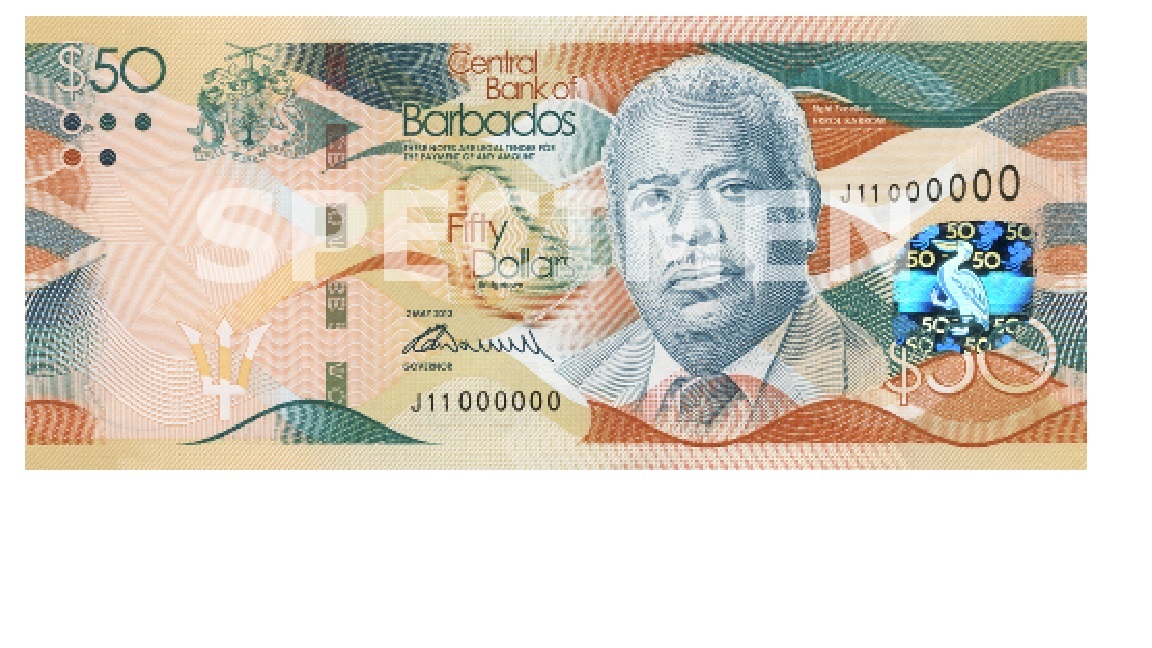
The CBB said for the first time in its 40-year history it has completely overhauled the design of the Barbados’ bank notes.

“In the past, only minor modifications had been made to the original series. The new series issued on June 4, 2013 replaced old and worn-out notes and there are enhanced security features that will make the new notes difficult to counterfeit and easier for the public to authenticate.”

The foregoing news article aligns with the prime directive of the book Go Lean … Caribbean to re-boot the economic engines of the Caribbean. The book narrates, thru anecdotes and statistical abstracts, the pain and suffering of previous mis-management of Caribbean currencies. The book then asserts that any regional effort to optimize the economy must be partnered with technocratic management of monetary affairs. As such, the book serves as a roadmap for the introduction and implementation of both the Caribbean Union Trade Federation (CU) and the independent, Caribbean Central Bank (CCB).

Before addressing the technical issues, the CU assumes a sentinel position to cautiously protect and promote image and branding of Caribbean people, culture and systems of commerce. The foregoing headline is a “call to arms” for this mission.

Monetary and currency issues are intertwined with any discussion of elevating the Caribbean’s economy. This issue is explored in full details in the book, commencing with the roadmap focus of the Declaration of Interdependence, pronouncing the need for astute management of the money supply with these statements (Page 13 & 14) respectively:

xxi. Whereas the legacy of international democracies had been imperiled due to a global financial crisis, the structure of the Federation must allow for financial stability and assurance of the Federation’s institutions. To mandate the economic vibrancy of the region, monetary & fiscal controls and policies must be incorporated … [to] address threats against the financial integrity of the Federation and member-states.

xxix. Whereas all Caribbean democracies depend of the free flow of capital for municipal, public and private financing, the institutions of capital markets can be better organized around a regional monetary union. The Federation must institute the controls to insure transparency, accounting integrity and analysis independence of the securities markets, thereby shifting the primary source of capital away from foreign lenders to domestic investors, comprising institutions and individuals.

The roadmap is to confederate all the 30 member-states of the Caribbean, despite their language and legacy, into an integrated “single market”, with a unified currency, Caribbean Dollar (C$). This follows the model of the European Union and the European Central Bank with the world’s strongest currency, the Euro.

The book maintains that the security of the Caribbean is inextricably linked to the economy of the Caribbean; as such there is the need for federal oversight, monitoring and mitigations of threats, risks and casualties for the integrated market and the related systems of commerce.

These above comments address the “coulda-woulda-shoulda” aspects of the foregoing news article. The Go Lean roadmap also brings a sense of reality to the focus of economic empowerment in the Caribbean. This means that “it is what it is”. So why did the Central Bank of Barbados post a $3.7 Million loss for 2013?

This requires a sober assessment; the managers for the bank are duly qualified. Dr. DeLisle Worrell was appointed as Governor of the Central Bank on November 1, 2009. He is an acclaimed Economist, author and professor; he is a subject-matter-expert (SME) for small island economics, having authored a book entitled SMALL ISLAND ECONOMIES; he is a technocrat!

The foregoing article alludes that the loss was due to the volatility of foreign exchange (Fx) management. It is these kinds of issues that the Go Lean roadmap targets for mitigation and better management. The book posits that the problems of Caribbean currencies are too big for any one member-state to resolve, that the best solution is to confederate the 30 member-states, and their Central Banks, into a “single market” Central Bank for the unified C$ currency – a cooperative of banks. Since the Barbados dollar alone cannot garner the volumes for respect and participation in the international Fx markets, this SMALL ISLAND ECONOMY must “fend for its life” as best it can, buying and selling US dollars in the open market to control the amount/value of the Barbadian dollar. This process is “hit-and-miss”. For 2013, it was a “miss”!

The strategies, tactics, implementations for the Caribbean Union Trade Federation & Caribbean Central Bank management of the economy are detailed in the Go Lean roadmap. Here are sample selections from the book:

Separation-of-Powers: Central Bank – Currency Printing/Engraving Page 73
Separation-of-Powers: Depository Insurance & Regulatory Authority Page 73
Separation-of-Powers: Securities Exchange Regulatory Agency Page 74
Separation-of-Powers: Emergency Management Page 76
10 Ways to Better Manage Debt Page 114
10 Ways to Promote Independence Page 120
10 Ways to Model the EU Page 129
10 Lessons Learned from 2008 Page 135
10 Ways to Control Inflation Page 153
10 Ways to Better Manage Foreign Exchange Page 154
10 Ways to Mitigate Black Markets Page 165
10 Ways to Foster Cooperatives Page 176
10 Reforms for Banking Regulations Page 199
10 Ways to Impact Wall Street Page 200

Download the Book- Go Lean…Caribbean Now!!!


Share this post:
, , ,
[Top]

CXC and UK publisher hosting CCSLC workshops in Barbados

Go Lean Commentary

images“Fattening frogs for snakes” – Jamaican expression.

As a region the Caribbean have invested much time, talents and treasuries for the education of our youth. Hooray for our efforts! This is an honorable commitment and those laboring in this profession, as depicted in the foregoing news article, should be duly recognized and applauded.

But…

… “do what we’ve always done, and we get what we always got” – Old Adage.

For far too often, the Caribbean has been grooming and preparing their young people to contribute and enhance the society… of other countries. And thus the intersection of the two expressions above, and this imagery: “sacrificing our babies on the altar of global trade”. See a related news story here:

BRIDGETOWN, Barbados — Over 50 secondary school teachers in Barbados stand to benefit from a series of workshops to be hosted by the Caribbean Examinations Council (CXC) and UK-based publisher Nelson Thornes on 7 and 8 April 2014 in Barbados.

The four workshops will be hosted over the two days and will focus on English and mathematics for the Caribbean Certificate of Secondary Level Competence (CCSLC).

The workshops will be facilitated by Novelette McLean-Francis, senior education officer responsible for linguistics in the ministry of education, Jamaica, and a published author; and Grace Smith, a Barbadian educator and one of the authors of the CCSLC mathematics text.

Two workshops will be hosted each day and teachers from the 22 public secondary schools in Barbados are expected to attend.

Registrar Dr. Didacus Jules stated, “These CCSLC workshops are very timely as over the next four weeks CXC is working with the United Kingdom National Academic Recognition Information Centre (UK NARIC) to benchmark CCSLC with similar qualifications internationally.”

“Ensuring that teachers are well equipped to deliver the CCSLC programme effectively will impact positively on students’ performance and on the benchmarking exercise,” Jules noted.

“Nelson Thornes, part of Oxford University Press, is delighted to be running the workshops for teachers across Barbados for the CCSLC qualification,” Sarah Townsend, Caribbean marketing campaign manager with Oxford University Press Education Division said. “Our aim is to provide a full understanding of the syllabus and what is expected in classrooms. Alongside this, teachers will gain valuable knowledge of how the texts came together and the authors’ experience of being involved in the teaching of CCSLC.”

“Working in conjunction with CXC and the ministry of education, we have invited teachers to attend one of the sessions for either mathematics or English, and we hope to be able to fully support them in their on-going quest of teaching CCSLC English and mathematics,” Townsend explained.

The Caribbean Certificate of Secondary Level Competence was introduced to schools in Barbados in September 2013.
Source: Caribbean News Now Online News Site; posted April 3, 2014; retrieved April 4, 2014 from: http://www.caribbeannewsnow.com/barbados.php?news_id=20558&start=0&category_id=26

CU Blog - CXC and UK publisher hosting CCSLC workshops in Barbados - Photo 2This subject matter aligns with the prime directive of the book Go Lean … Caribbean to re-boot the economic engines of the Caribbean to assuage the human flight problem that has afflicted so many Caribbean communities, for more than 50 years. The book, serving as a roadmap for the introduction and implementation of the Caribbean Union Trade Federation (CU) posits that education has been a failure for this region. Almost everywhere else education dynamics elevate a society, raising GDP by 1 percent for every additional (aggregate) year of schooling. But this is not true for the Caribbean; even though the educated population have fostered their abilities there, they have “taken their talents to South Beach”; and South Bronx; and South Toronto; and South London; and the South Paris, etc.

So education and economics must be intertwined. This is explored in full details in the book. This roadmap provides turn-by-turn directions for escalating educational resources (and results) in the region. As a planning tool, the roadmap commences with a Declaration of Interdependence, pronouncing regional integration (Page 12) as the approach to elevate educational opportunities:

xxi. Whereas the preparation of our labor force can foster opportunities and dictate economic progress for current and future generations, the Federation must ensure that educational and job training opportunities are fully optimized for all residents of all member-states, with no partiality towards any gender or ethnic group. The Federation must recognize and facilitate excellence in many different fields of endeavor, including sciences, languages, arts, music and sports. This responsibility should be executed without incurring the risks of further human flight, as has been the past history.

This optimization will apply to all levels of instructions: primary, secondary and tertiary.

The strategy is to confederate all the 30 member-states of the Caribbean, despite their language and legacy, into an integrated “single market”. Tactically, this will allow a separation-of-powers between the member-states governments (including their education proxies) and federal agencies, allowing the type of third party regional oversight as identified in the foregoing article, with entities like the United Kingdom National Academic Recognition Information Centre and Oxford University Press. Notice the leanings of those organizations: British. Instead, the Go Lean roadmap advocates the multi-lingual educational guidance for English, Dutch, French and Spanish all under CU federal administration.

Under this roadmap, the CariCom-backed Caribbean Examinations Council (CXC) would be integrated into a CU Cabinet Department of Education; this is detailed in the book (Page 85). Most importantly the roadmap recognizes that there are the costs dynamics for education, so the funding mechanisms are fully explored in 10 Ways to Pay for Change (Page 101).

Why is the expectation for education success so different in Go Lean…Caribbean compared to the status quo? Why haven’t the strategies and tactics described in this roadmap been employed by the member-states already?

Quite simply, the book posits that the problems for the Caribbean are too big for any one member-state to solve alone; there must be a regional solution! The problem of human flight/brain drain is described as resulting from “push-and-pull” factors. So the required solution is more than just a few bright ideas, taught in a workshop; there is the need for a new eco-system.

Go Lean … Caribbean introduces that eco-system, as a roadmap to make the Caribbean a better place to live, work, learn and play.

No more “fattening frogs for snakes”!

🙂

Download the book Go Lean … Caribbean – now!

Share this post:
, , , ,
[Top]

CARICOM Chairman to deliver address on reparations

Go Lean Commentary

Slave ShipThe book Go Lean … Caribbean aligns with one objective depicted in the below news article: to reconcile the flawed economic policies of the past and lean-in for the optimization of the Caribbean future. Beyond this stance, the book deviates from these advocates calling for reparations from the colonial powers that participated in the slave trade, slavery or colonial suppression of the indigenous people.

Reparations stress at its root, a sense of entitlement to other people’s resources. The book, on the other hand, serves as a roadmap for the regional integration of the 42 million people and 30 member states of the Caribbean with the implementation of the Caribbean Union Trade Federation (CU). This roadmap advocates the reconciliation of the economic and security engines to grow the region’s economy from $378 Billion (2010) to $800 Billion in a 5 year time span.

NEW YORK, United States, Friday March 28, 2014, CMC – Chairman of the Caribbean Community (CARICOM) grouping, Prime Minister Dr. Ralph Gonsalves of St. Vincent and the Grenadines will address an international forum in reparations in the United States next month.

Gonsalves will deliver the feature address at the April 19 forum titled “Revitalizing the Reparations Movement,” organized by the New York-based Institute of the Black World 21st Century (IBW).

IBW described Gonsalves as “one of the leading voices in the Americas demanding that the former European colonial powers pay reparations to Caribbean and South American countries for centuries of African enslavement, native genocide and colonial exploitation”.

The forum will be held in collaboration with the Center for Inner City Studies and the Samuel DeWitt Proctor Conference.

IBW said among the specially invited guests will be Detroit’s congressman John Conyers, Sr., dean of the US Congressional Black Caucus, and sponsor of HR-40, the Reparations Study Bill and Louis Farrakhan, leader of the Nation of Islam.

“A primary goal of the forum is to revitalize the reparations movement in the USA by revisiting the Durban Resolution on the Trans-Atlantic Slave Trade, presenting an update on HR-40 and examining the status of CARICOM’s reparations initiative,” IBW said.

“We are delighted and honored to have Prime Minister Gonsalves keynote this critical forum on reparations, a subject of fundamental historical justice that is near and dear to the hearts of Black people around the world,” said IBW’s president Dr. Ron Daniels.

Director of Chicago’s Inner City Studies, Dr. Conrad Worrill, said “our ancestors will be pleased that the reparations movement is being re-energized from the Caribbean islands”.

“In demanding reparations, CARICOM is vindicating the vestiges of the Trans-Atlantic slave trade,” he added.

CARICOM leaders at their inter-sessional summit in St, Vincent and the Grenadines earlier this month discussed the reparation issue and hope to have a meeting with European leaders in June.

The leaders unanimously adopted a 10-point plan that would seek a formal apology for slavery; debt cancellation from former colonizers, such as Britain,

France, Spain and the Netherlands; and reparation payments to repair the persisting “psychological trauma” from the days of plantation slavery.

The Go Lean roadmap commences with this ideal embedded in the Declaration of Interdependence, pronouncing as follows, (Page 10):

As the colonial history of our region was initiated to create economic expansion opportunities for our previous imperial masters, the structures of government instituted in their wake have not fostered the best systems for prosperity of the indigenous people. Despite this past, we thrust our energies only to the future, in adapting the best practices and successes of the societies of these previous imperial masters and recognizing the positive spirit of their intent and vow to learn from their past accomplishments and mistakes so as to optimize the opportunities for our own citizenry to create a more perfect bond of union.

The subject matter of reparation is polarizing, based on assumptions that the Caribbean is comprised of mostly African or Ameri-Indian peoples. While many CARICOM states do possess a majority Black population, this is not so within the larger Caribbean, of whom the CU confederates. There are also large populations of European (White) ethnicities, Indian, and Chinese descendants that should also unite.

— UPDATE (Sep 30, 2015) – See VIDEO in the Appendix regarding the UK Prime Minister’s recent visit to Jamaica

There is a benefit, however, that can be garnered from compensatory talks with European nations, that of making “Aid” more empowering. The roadmap details an advocacy on the roles and responsibilities of fostering International Aid (Page 115). So while the political leaders of the CARICOM may be exerting energies to “guilt” these Europeans leaders to “pay up”, the CU Trade Federation will instead work to improve trade and re-boot the economic engines of the region.

It is a known fact that most of the resources of the European powers are tied to the strength of their economies, not the reserves gathered up from centuries of exploiting African slaves and their descendants. The country with the largest reserves is the USA; but their gold in Fort Knox is only estimated at $800 Billion, while their economy is $16 Trillion of GDP output … annually. So reparation is not a winning formula; it assumes some abundant stockpile of savings. This is a flawed logic and strategy. On the other hand, the Caribbean needs to create 2.2 million new jobs; this is only possible with the turn-around strategies as detailed in the roadmap of Go Lean … Caribbean.

So as a policy decision for the economic strategies of the region, the Go Lean book and movement recommends:

    Re-boot – Yes!
    Reparations – No!

Download the free e-Book of Go Lean … Caribbean – now!

———

Appendix VIDEO – Slavery Reparations Dominate David Cameron’s Jamaica Visit – https://youtu.be/al453a8rLy8

Published on Sep 30, 2015 – UK Prime Minister David Cameron’s visit to Jamaica was overshadowed by slavery reparation calls, which he rejected. The legacy of slavery is still ever-present for 14 Caribbean countries calling on their former colonial masters to pay billions in reparations.
Share this post:
, ,
[Top]