Category: Economics

Managing the ‘Strong versus the Weak’ – Lower Ed.

Go Lean Commentary

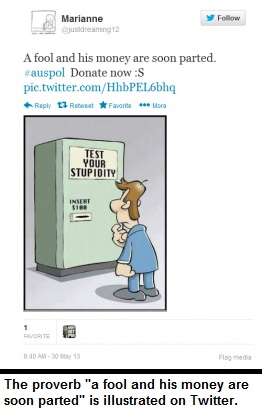
“A fool and his money are soon parted” – Ancient British proverb that gleans inspiration from The Bible book of Proverbs 26:1-11, with the meaning of:
1.   It is easy to get money from foolish people.
2.  It is difficult or unlikely that foolish people maintain their hold on acquired wealth.
Lower Ed - Photo 4

What’s ironic is there are similar colloquial expressions that are even more shocking for the prevalence of financial abuse of the unwise. Consider:

So who is more abominable? The fool who loses out on his new found fortune or the shrewd person that schemes to take advantage of that fool? (It should be noted in this case that the fortune is only rights and credits; every American citizen qualify for a need-based Student Loan from the federal government – that loan is non-dischargeable).

One commentator pushes this thesis even further, positing that:

“The ‘fools’ I think of are all rather harmless creatures, basically well-intentioned and innocent. All of them evoke a certain sense of pity, mixed with amusement.”

So imagine that one who exploits the “fool”! Imagine, if instead of an individual, it is a “system”, a government program, that does the exploiting. This is the actuality of Student Loan financing for Private, For-Profit Schools and Colleges in the US.

This is truly abominable; and yet this is the United States of America.

Say it ain’t so!

In a previous blog-commentary, the “abominable” judgment was even more direct:

The ‘Evil Empire‘ – For-Profit Educational firms and institutions – is finally facing resistance from governmental authorities. Companies in this industry have come under fire for their bad practices and abuse of their customers: young students.

… and now, today, ITT Educational Services, one of the largest operators of for-profit technical schools, ended operations at all of its ITT Technical Institutes.
Source: For-Profit Education – ‘Another one bites the dust’; posted September 6, 2016; retrieved April 26, 2017.

Lower Ed - Photo 3This commentary asserts that there is a need for the Caribbean communities to reform and transform our education deliveries, yet still, we do NOT want to model the American system. This point aligns with the book Go Lean…Caribbean, which seeks to reboot the 30 member-states of the Caribbean region, to ensure better stewardship of the Social Contract for all citizens in our homelands, strong and weak. The Go Lean book petitions the Caribbean region to do better! It describes the necessary empowerments to optimize the economic, security and governing engines of Caribbean society to ensure a better adherence to the principle of the Greater Good.

In a previous 5-part series of blog-commentaries on the “Strong versus the Weak”, the pattern from the Code of Hammurabi was detailed and presented as an Old World model that is being ignored in the US. The one place we would expect to find mitigations for foolishness – to turn the foolish one wise – would be the education arena. Yet this is where we are finding a consistent pattern of the “Strong abusing the Weak”.

This commentary is an addition submission to that already completed series; we are adding this 6th entry. The full series is now as follows:

  1.  Managing the Strong versus the Weak – Model of Hammurabi
  2.  Managing the Strong versus the Weak – Mental Disabilities
  3.  Managing the Strong versus the Weak – Bullying in Schools
  4.  Managing the Strong versus the Weak – Book Review: Sold-Out!
  5.  Managing the Strong versus the Weak – An American Sickness
  6.  Managing the Strong versus the Weak – Book Review: Lower Ed!
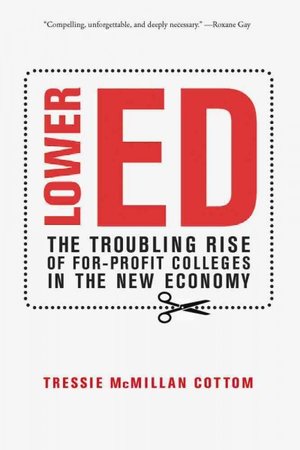
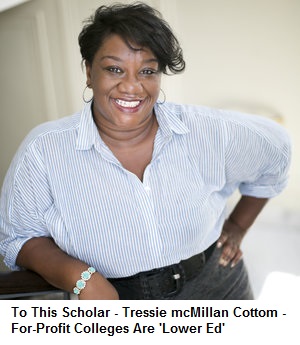
Lower Ed - Photo 1The need for this 6h entry was spurred by the release of this new book on February 28, 2017 entitled: Lower Ed – The Troubling Rise of For-Profit Colleges in the New Economy by Dr. Tressie McMillan Cottom (Ph.D. Sociology who teaches at Virginia Commonwealth University). It is ‘spot-on’ for the judgment of the pattern of abuse of the ‘Weak’ in American society who are innocently looking for “pull themselves up by the boot strap”. See the review-synopsis of this book here following by an PODCAST-interview with the Author:

Book Review: Lower Ed: The Troubling Rise of For-Profit Colleges in the New Economy
“With great compassion and analytical rigor, Cottom questions the fundamental narrative of American education policy, that a postsecondary degree always guarantees a better life.” – The New York Times Book Review

More than two million students are enrolled in for-profit colleges, from the small family-run operations to the behemoths brandished on billboards, subway ads, and late-night commercials. These schools have been around just as long as their bucolic not-for-profit counterparts, yet shockingly little is known about why they have expanded so rapidly in recent years —during the so-called Wall Street era of for-profit colleges.

In Lower Ed Tressie McMillan Cottom — a bold and rising public scholar, herself once a recruiter at two for-profit colleges—expertly parses the fraught dynamics of this big-money industry to show precisely how it is part and parcel of the growing inequality plaguing the country today. McMillan Cottom discloses the shrewd recruitment and marketing strategies that these schools deploy and explains how, despite the well-documented predatory practices of some and the campus closings of others, ending for-profit colleges won’t end the vulnerabilities that made them the fastest growing sector of higher education at the turn of the twenty-first century. And she doesn’t stop there.

With sharp insight and deliberate acumen, McMillan Cottom delivers a comprehensive view of post-secondary for-profit education by illuminating the experiences of the everyday people behind the shareholder earnings, congressional battles, and student debt disasters. The relatable human stories in Lower Ed—from mothers struggling to pay for beauty school to working class guys seeking “good jobs” to accomplished professionals pursuing doctoral degrees—illustrate that the growth of for-profit colleges is inextricably linked to larger questions of race, gender, work, and the promise of opportunity in America.

Drawing on more than one hundred interviews with students, employees, executives, and activists, Lower Ed tells the story of the benefits, pitfalls, and real costs of a for-profit education. It is a story about broken social contracts; about education transforming from a public interest to a private gain; and about all Americans and the challenges we face in our divided, unequal society.

Source: Posted and Retrieved 04-26-2017 from: https://www.amazon.com/Lower-Ed-Troubling-Profit-Colleges/dp/1620970600/

Lower Ed - Photo 2

————-

AUDIO Podcast – Terry Gross with Tressie McMillan Cottom – Heard on Fresh Air

Mental Photo 4March 27, 2017 – For-profit colleges have faced federal and state investigations in recent years for their aggressive recruiting tactics — accusations that come as no surprise to author Tressie McMillan Cottom.
Cottom worked as an enrollment officer at two different for-profit colleges, but quit because she felt uncomfortable selling students an education they couldn’t afford. Her new book, Lower Ed, argues that for-profit colleges exploit racial, gender and economic inequality.
Cottom tells Fresh Air’s Terry Gross that for-profit institutions tend to focus their recruiting on students who qualify for the maximum amount of student aid. “That happens to be the poorest among us,” she says. “And because of how our society is set up, the poorest among us tend to be women and people of color.”
Notice this small sample of the book’s revelations and disclosures, symptomatic of Crony-Capitalism:

  • A peer-reviewed analysis, with over 100 interviews – with students, employees, executives, and activists – the story is consistently reflective of a sad, abusive American eco-system.
  • Big-money industry using shrewd recruitment and marketing strategies to tempt the most vulnerable in society.
  • Despite well-documented predatory practices and some well-publicized campus closings, ending for-profit colleges won’t end the vulnerabilities that made them the fastest growing sector of higher education.
  • The weakest in American society – single mothers, systematically poor, underserved and under-privilege – are the ones targeted, exploited and abused – again and again.
  • The growth of for-profit colleges is inextricably linked to larger questions of race, gender, work, and the promise of opportunity in America.

This commentary and the previous 5 commentaries in this series all relate to nation-building, stressing the community ethos necessary to forge a society where all the people are protected all the time. Who really is the fool in these scenarios? The person being abused by the American eco-system or the ones abandoning home to join that society. The premise in the Go Lean book and subsequent blog-commentaries is that the people of the Caribbean can more easily “proper where planted” in their homeland than to emigrate to the American foreign shores for relief. It is foolish to think that America cares about “us”, when they undoubtedly do not care about the “weak” in their own society.

We need more education in our region; because we need economic growth. Economists have established the relationship between economic growth and education:

“For individuals this means that for every additional year of schooling they increase their earnings by about 10%. This is a very impressive rate of return.” (Go Lean book Page 258).

A lot of Caribbean students do matriculate in American colleges and universities. But this commentary is hereby declaring that we must assuredly look beyond the American model to fulfill our educational needs. According to the foregoing book and AUDIO Podcast, only a fool would invest in American For-Profit private educational institutions.

The word “invest” seems so misplaced. No wonder we have such a poor “Return on our Investment” from our Caribbean students studying abroad. (So many times, they do not even return “home”.)

This is already a familiar thesis for the Go Lean movement – a roadmap for the introduction and implementation of the Caribbean Union Trade Federation (CU) – as the Go Lean book advocates establishing local educational options mostly in response to the failings of the “study abroad model”. We have problems with the American quality education in the For-Profit institutions and we have problems with the threat of further brain-drain. See more details from the book here:

10 Ways to Improve Education – Page 159.
# 2 – Promote Industries for e-Learning
For 50 years the Caribbean has tolerated studying abroad; unfortunately many students never returned home. The CU’s focus will now be on facilitating learning without leaving. There have emerged many successful models for remote learning using electronic delivery or ICT. The CU will foster online/home school programs, for secondary education, to be licensed at the CU level so as to sanction, certify, and oversee the practice, especially for rural areas/islands. At  the tertiary level, the CU will sponsor College Fairs for domestic and foreign colleges that deliver online education options.

We need more e-Learning options in our Caribbean homeland, for all education levels: K-12 and college. There are many successful models and best practices to adopt. We are in position to pick, choose and refuse products and services from all our foreign trading partners, including from the US. (We must assuredly avoid their societal defects).

One successful model is “iReady” – see more in the Appendix below.

The US, despite its advanced democracy status, has definite societal defects in the education arena. Overcoming the defects – particularly Crony-Capitalism or exploiting public resources for private gains – make depending on American solutions, foolish.

The Go Lean roadmap seeks to transform the Caribbean education deliveries There are so many successful role models to emulate. Yet still, this will be hard. So many in our society hold the default view:

White is Right

Therefore these one may rather spend their education monies abroad in the US than to engage in a local empowerment plan. That is so foolish!

So yes, the transformation will be hard, heavy-lifting, but not foolish! It will engage all 3 societal engines: economic, security and governance. In fact, the prime directives of the Go Lean/CU roadmap includes the following 3 statements:

  • Optimization of the economic engines in order to grow the regional economy to $800 Billion & create 2.2 million new jobs.
  • Establishment of a security apparatus – including emergency management – to ensure public safety and protect the resultant economic.
  • Improve Caribbean governance for all people – with empowerments like education – to support these engines.

This comprehensive view – economics, security and governance – is the charge of the Go Lean roadmap, opening with these pro-education pronouncements in the Declaration of Interdependence (Page 13):

xix. Whereas our legacy in recent times is one of societal abandonment, it is imperative that incentives and encouragement be put in place to first dissuade the human flight, and then entice and welcome the return of our Diaspora back to our shores …

xxi. Whereas the preparation of our labor force can foster opportunities and dictate economic progress for current and future generations, the Federation must ensure that educational and job training opportunities are fully optimized for all residents of all member-states, with no partiality towards any gender or ethnic group… This responsibility should be executed without incurring the risks of further human flight, as has been the past history.

So any tertiary education plan for the Caribbean must address the preponderance to exacerbate the brain drain. Going to an American For-Profit institution would just be foolish. We, as a community, would be spending good money, but getting bad returns. What’s worst, imaging getting student loans to finance that education? How likely would there be a “Return on Investment”?

Overall, the Go Lean book stresses the community ethos, strategies, tactics, implementations and advocacies to reboot, reform and transform tertiary education delivery in the Caribbean; see this expressed in this one advocacy here:

10 Ways to Impact Student Loans – Page 160

1 Embrace the advent of the CU Single Market to leverage across the 42 million people in the 30 member-states.
2 Buy Existing Loans
3 Loan Forgiveness
4 Deferments / Postponements
5 Non-Dischargeable with Bankruptcy
6 Forgivable with Death and Organ Transplantation Dynamics
7 Diaspora Eligibility for CU Institutions
8 Grace Periods
9 Public – Private servicers
10 Lessons from Occupy Wall Street (OWS) The OWS protest movement highlighted some legitimate issues with the student loan industry. The US Federal government provides guarantees on student loans (direct and indirect), and the loans are non-dischargeable in any Bankruptcy process, so private loan issuers were assured a profit. The issuers would therefore drive the industry to lend more and more to less capable students at high interest rates. As a result of the protest, the Obama Administration eliminated the indirect channel for student loan, taking the profit motive out of the process; (See more in Appendix IH of the Go Lean book on Page 286). The CU [model] will only direct lend.

The points of effective, technocratic stewardship of tertiary education and student loans were further elaborated upon in previous blog/commentaries. Consider this sample:

https://goleancaribbean.com/blog/?p=9724 “Why”, “How”  and “When” to Transform Caribbean Universities
https://goleancaribbean.com/blog/?p=8669 A Model from Failing Detroit – Make Community Colleges free
https://goleancaribbean.com/blog/?p=8373 A Lesson in Economic Fallacies – Student Loans As Investments
https://goleancaribbean.com/blog/?p=5482 For-Profit Education: Plenty of Profit; Little Education
https://goleancaribbean.com/blog/?p=4487 FAMU – Finally, A Model for Facilitating Economic Opportunity
https://goleancaribbean.com/blog/?p=1256 Is a Traditional 4-year Degree a Terrible Investment?
https://goleancaribbean.com/blog/?p=709 Student debt holds back many would-be home buyers

There is an absolute abomination of the “strong abusing the weak” in the American eco-system. We must avoid this American pattern; it may even be necessary to avoid America when it comes to our tertiary education needs.

“We can do bad all by ourselves”.

We have so many options elsewhere. The Go Lean plan is to create the better options here in the Caribbean; if not in your homeland, then perhaps in the next one, to the left or to the right.

It is not hard to do better than the American For-Profit model. Since many times in the past American abuse has proliferated, for those weaker physically, mentally and economically. The movement behind the Go Lean/CU roadmap wants us, in the Caribbean, to do better. Yes, let’s be wise!

Education can be so beneficial to our communities. But let’s not be the fool! Let’s keep “it” here at home and let’s “weed out” any bad practices of Crony-Capitalism in our tertiary education delivery system. Let’s pursue the Greater Good (greatest good to the greatest number of people which is the measure of right and wrong).

Now is the time to lean-in to this Go Lean roadmap to reboot, reform and transform Caribbean education. If we do this, we will make the Caribbean a better place to live, work, learn and play. 🙂

Download the free e-book of Go Lean … Caribbean – now!

Sign the petition to lean-in for the roadmap for the Caribbean Union Trade Federation.

———–

Appendix VIDEO – Intro to/Login for iReady – https://youtu.be/rhNO2-DQMCU


Published December 15, 2016 – iReady Teacher providing instructions for logging on.
See Video recording of a sample lesson here: https://youtu.be/_xoxdLaudDY


Share this post:
, , , ,

End of ‘The Greatest Show on Earth’

Go Lean Commentary

Come this May (2017), it will be ‘The Greatest Show on Earth’ … no more!

CU Blog - End of 'The Greatest Show on Earth' - Photo 1

CU Blog - End of 'The Greatest Show on Earth' - Photo 2

After 146 years, the Ringling Bros. and Barnum & Bailey Circus will close, shut down and come to an end for good. The Agents of Change in entertainment has been chasing this fabled institution, and time finally caught up with it.

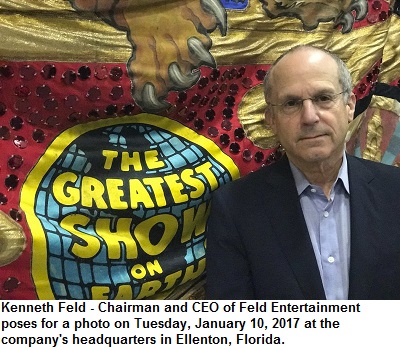
Kenneth Feld, the Chairman and CEO of Feld Entertainment, the company that owns the circus, verbalizes the drama succinctly:

“The competitor in many ways was ‘time’.”

“It’s a different model that we can’t see how it works in today’s world to justify and maintain an affordable ticket price. So you’ve got all these things working against it.”

So now the legacy of exotic animals, flashy costumes, death-defying acrobats and clowns is over, under this model. The iconic American spectacle was felled by a variety of factors, company executives explained these contributing factors:

  • Changing public tastes
  • Declining attendance combined with high operating costs
  • Prolonged battles with animal rights groups

While this spells the end of the Ringling Bros. and Barnum & Bailey Circus, it is not the end of circuses in general or the company Feld Entertainment; they also own-operate other profitable shows that will continue; a sample include:

Monster Jam, Disney on Ice and Marvel Live, etc.

Still, in the end – starting next month – some 500 people who perform and work on the circus shows will be impacted. According to the news article here by the Associated Press, “a handful will be placed in positions with the company’s other profitable shows but most will be out of a job”. See the full article here:

Title: Ringling Bros. circus to close after 146 years
By: Tamara Lush
ELLENTON, Fla. (AP) — After 146 years, the curtain is coming down on “The Greatest Show on Earth.” The owner of the Ringling Bros. and Barnum & Bailey Circus told The Associated Press that the show will close forever in May.

The iconic American spectacle was felled by a variety of factors, company executives say. Declining attendance combined with high operating costs, along with changing public tastes and prolonged battles with animal rights groups all contributed to its demise.

CU Blog - End of 'The Greatest Show on Earth' - Photo 6“There isn’t any one thing,” said Kenneth Feld, chairman and CEO of Feld Entertainment. “This has been a very difficult decision for me and for the entire family.”

The company broke the news to circus employees Saturday night after shows in Orlando and Miami.

Ringling Bros. has two touring circuses this season and will perform 30 shows between now and May. Major stops include Atlanta, Washington, Philadelphia, Boston and Brooklyn. The final shows will be in Providence, Rhode Island, on May 7 and in Uniondale, New York, at the Nassau County Coliseum on May 21.

The circus, with its exotic animals, flashy costumes and death-defying acrobats, has been a staple of entertainment in the United States since the mid-1800s. Phineas Taylor Barnum made a traveling spectacle of animals and human oddities popular, while the five Ringling brothers performed juggling acts and skits from their home base in Wisconsin. Eventually, they merged and the modern circus was born. The sprawling troupes traveled around America by train, wowing audiences with the sheer scale of entertainment and exotic animals.

By midcentury, the circus was routine, wholesome family entertainment. But as the 20th century went on, kids became less and less enthralled. Movies, television, video games and the internet captured young minds. The circus didn’t have savvy product merchandising tie-ins or Saturday morning cartoons to shore up its image.

“The competitor in many ways is time,” said Feld, adding that transporting the show by rail and other circus quirks — such as providing a traveling school for performers’ children— are throwbacks to another era. “It’s a different model that we can’t see how it works in today’s world to justify and maintain an affordable ticket price. So you’ve got all these things working against it.”

The Feld family bought the Ringling circus in 1967. The show was just under 3 hours then. Today, the show is 2 hours and 7 minutes, with the longest segment — a tiger act — clocking in at 12 minutes.

CU Blog - End of 'The Greatest Show on Earth' - Photo 5

CU Blog - End of 'The Greatest Show on Earth' - Photo 4

“Try getting a 3- or 4-year-old today to sit for 12 minutes,” he said.

Feld and his daughter Juliette Feld, who is the company’s chief operating officer, acknowledged another reality that led to the closing, and it was the one thing that initially drew millions to the show: the animals. Ringling has been targeted by activists who say forcing animals to perform is cruel and unnecessary.

People for the Ethical Treatment of Animals, a longtime opponent of the circus, wasted no time in claiming victory.

“After 36 years of PETA protests, which have awoken the world to the plight of animals in captivity, PETA heralds the end of what has been the saddest show on earth for wild animals, and asks all other animal circuses to follow suit, as this is a sign of changing times,” Ingrid Newkirk, president of People for the Ethical Treatment of Animals, wrote in a statement.

Wayne Pacelle, president and CEO of The Humane Society of the United States, acknowledged the move was “bittersweet” for the Felds but said: “I applaud their decision to move away from an institution grounded on inherently inhumane wild animal acts.”

In May of 2016, after a long and costly legal battle, the company removed the elephants from the shows and sent the animals to live on a conservation farm in Central Florida. The animals had been the symbol of the circus since Barnum brought an Asian elephant named Jumbo to America in 1882. In 2014, Feld Entertainment won $25.2 million in settlements from groups including the Humane Society of the United States, ending a 14-year fight over allegations that circus employees mistreated elephants.

By the time the elephants were removed, public opinion had shifted somewhat. Los Angeles prohibited the use of bull-hooks by elephant trainers and handlers, as did Oakland, California. The city of Asheville, North Carolina nixed wild or exotic animals from performing in the municipally owned, 7,600-seat U.S. Cellular Center.

Attendance has been dropping for 10 years, said Juliette Feld, but when the elephants left, there was a “dramatic drop” in ticket sales. Paradoxically, while many said they didn’t want big animals to perform in circuses, many others refused to attend a circus without them.

“We know now that one of the major reasons people came to Ringling Bros. was getting to see elephants,” she said. “We stand by that decision. We know it was the right decision. This was what audiences wanted to see and it definitely played a major role.”

The Felds say their existing animals — lions, tigers, camels, donkeys, alpacas, kangaroos and llamas — will go to suitable homes. Juliette Feld says the company will continue operating the Center for Elephant Conservation.

Some 500 people perform and work on both touring shows. A handful will be placed in positions with the company’s other, profitable shows — it owns Monster Jam, Disney on Ice and Marvel Live, among other things — but most will be out of a job. Juliette Feld said the company will help employees with job placement and resumes. In some cases where a circus employee lives on the tour rail car (the circus travels by train), the company will also help with housing relocation.

Kenneth Feld became visibly emotional while discussing the decision with a reporter. He said over the next four months, fans will be able to say goodbye at the remaining shows.

CU Blog - End of 'The Greatest Show on Earth' - Photo 3In recent years, Ringling Bros. tried to remain relevant, hiring its first African American ringmaster, then its first female ringmaster, and also launching an interactive app. It added elements from its other, popular shows, such as motorbike daredevils and ice skaters. But it seemingly was no match for Pokemon Go and a generation of kids who desire familiar brands and YouTube celebrities.

“We tried all these different things to see what would work, and supported it with a lot of funding as well, and we weren’t successful in finding the solution,” said Kenneth Feld.
Source: Associated Press – Posted January 15, 2017; retrieved April 25, 2017 from: https://apnews.com/020bc7b2f16f4446ade338bcf4a500ed

While this is an American drama (consider the slice of Americana portrayed in the movie “The Greatest Show on Earth” highlighted in the Movie Trailer in the Appendix below), there is a lot of consideration in this news that relate to the Caribbean. There are lessons for us to learn and apply in the stewardship of Caribbean affairs. These points are being highlighted by the promoters of the book Go Lean…Caribbean; it presents a roadmap to elevate the 30 member-states in the Caribbean region through economic, security and governing empowerments. The book asserts that the entertainment industry can be a great economic contributor to Caribbean communities. Already, tourism is our primary economic driver, and so amusement and entertainment are closely linked.

There are changing trends in tourism, the same as there had been for circus appreciation. At many Caribbean resorts, the business models of casino gambling and golf resources simply do not have the same appeal as in previous days. There is the same factor that affected the circus: “changing public taste”.

So let’s consider the following lessons that the Caribbean is able to glean from experiences (good and bad) of the Ringling Brothers and Barnum & Bailey Circus:

  • There is a need to reconcile past abuses – The Circus had a checkered past of abuses; of the 3 separate circuses that merged over the 146 years, (Ringling Brothers, Barnum, Bailey), the Barnum entity – famed for P.T. Barnum – was known for its exploitation and displays of Freaks, people who were malformed or disabled in some way. This is a total disrespect to dignity and human rights. Lesson: Past sins must be repented and reconciled. (See Go Lean book Page 34: 10 Ways to Manage Reconciliations).
  • By extension, the abuse of animals was clearly documented by animal rights activists and advocates. The Circus should have just conceded this bad practices and worked to rectify. Instead, after decades of denials, when the irrefutable evidence were presented, the circus had no choice but to retire the Elephants and other exotic animals. There was no structured Change Management so as to prepare the public for the new absence of the elephants. The Circus attendance assuredly declined. Lesson: The Circus did have to answer to animal protection entities in the State and Federal governments; they should have negotiated with stakeholders – even opposers – like partners, not enemies. (See Go Lean book Page 32: 10 Ways to Improve Negotiations).
  • Circus performers are people too; they have families and children; many performers are children. Many media productions (i.e. documentaries) abound describing Carnie Life. There should have been more concerted effort to bring dignity to this travelling profession, like the travelling schools, without the need for the hard-fought labor rules and concessions. Carnies should have been viewed as indispensable partners. Lesson: The Caribbean can apply many lessons in the management and administration of Sports and Student Athletes; think Sports Academies. (See Go Lean book Page 229: 10 Ways to Improve Sports).
  • Circuses have excelled with their Transportation innovations – Ringling’s use of railroad tracks, trains and cars have been ingenious. They have also deployed residential cars for the cast and crew while they are on the road. Lesson: The Go Lean roadmap calls for deployment of innovative transportation solutions like ferries and the Union Atlantic Turnpike; logistics are necessary to empower communities. (See Go Lean book Page 205: 10 Ways to Improve Transportation).
  • Circuses have innovated and engineered amazing Event Centers – Tents and Temporary Stadiums. These have been advantageous since the circus only makes a temporary occupancy. Lesson: The strategies for Event Tourism in the Caribbean member-states require facilitations for stadiums and arenas. What we learn from the circus, is they do not have to be permanent structures. (See Go Lean book Page 191: 10 Ways to Impact Events).
  • Changing public tastes: – There is a need to understand the market and plan the business for the Caribbean economic engines. Lesson: In our region, casinos and golf are declining as hotel amenities, while Cruises Lines are transforming the public taste for how to consume the Caribbean. (See Go Lean book Page 193: 10 Ways to Impact Cruise Tourism).
  • Listen to the complaints – Ringling’s officials confess that “public opinion had shifted somewhat”. So in effect, the complainers (animal protesters for the circus; negative commentators for the Caribbean) represent the customers views.
  • Can’t beat them, join them – Ringling should have partnered with their stakeholders (Cities, Animal Advocates, “Carnies”) to develop a win-win product; but rather, for much of their 146-year history they were exploiters. Lesson: Lean Project Management methodologies, calls for “Plan, Do & Review”. Each year’s post-analysis goals should have been on finding solutions for the known challenges. (See Go Lean book Page 147: 10 Ways to Measure Progress).
  • Value the ‘Genius’ Factor – The Art & Science of circus must be fostered as an ongoing vocation. With their Clown College, Ringling made the proper effort to foster genius. Lesson: The Caribbean region must also foster those with genius qualifiers. (See Go Lean book Page 27: 10 Ways to Foster Genius).
  • Circus amusement is a leisure activity, 100% discretionary spending. The public can readily lower their spending. Lesson: The Caribbean cannot depend solely on Tourism, its a leisure activity; we need to trade in essentials. (See Go Lean book Page 195: 10 Ways to Impact Extractions).
  • Patriarchy & Orthodoxy must go – Diversity and Inclusion should not have been optional for the Ringling circus. Only in recent years, has the Ringling Circus even tried to remain relevant, hiring its first African American ringmaster, then its first female ringmaster, and also launching an interactive smart-phone app. Lesson: Institutions should reflect the better values of society, the Greater Good. (See Go Lean book Page 37: 10 Ways to Impact the Greater Good.).
  • The Ringling Circus will be missed – An absence of circuses hurts society. Circus amusement can be effective for influencing people: make people happy, feed them and entertain them, then heavy-lifting tasks can be pursued – see this point developed in this previous blog.

As alluded to earlier, there is a model for circus entertainment that works successfully in today’s economy:

Cirque Du Soleil

This model had previously (1984) rebooted, reformed and transformed circus entertainment, and now they are one of the most successful entertainment enterprises in North America – they continue to soar. This model features death-defying acrobats, costumes, and clowns; only no exotic animals. See the pricing here for their permanent show – Cirque du Soleil La Nouba – in Orlando’s Downtown Disney (Disney Springs) entertainment complex. The field of Economics teaches an important lesson here: Price is a measurement of demand.

Greatest Show - Photo 8

 Click to Enlarge

Lessons learned!

The Go Lean book presents a plan to reboot, reform and transform the regional economy and create the needed jobs and careers, some even in the amusement & entertainment industry. But, the Go Lean book asserts that this effort is too big a task for just for Caribbean member-state alone; all the 30 member-states must convene, confederate and collaborate in order to effect change. As such, the Go Lean book serves as a roadmap for the introduction and implementation of the technocratic Caribbean Union Trade Federation (CU), for the elevation of Caribbean society. This CU/Go Lean roadmap has these 3 prime directives:

The Go Lean book stresses that reforming and transforming management of Caribbean talent must be a regional pursuit, considering the genius-qualifier of show-business and sports. This was an early motivation for the roadmap as pronounced in the opening Declaration of Interdependence (Page 14):

xxxi. Whereas sports have been a source of great pride for the Caribbean region, the economic returns from these ventures have not been evenly distributed as in other societies. The Federation must therefore facilitate the eco-systems and vertical industries of sports as a business, recreation, national pastime and even sports tourism ….

xxxii. Whereas the cultural arts and music of the region are germane to the quality of Caribbean life, and the international appreciation of Caribbean life, the Federation must implement the support systems to teach, encourage, incentivize, monetize and promote the related industries for arts and music in domestic and foreign markets. These endeavors will make the Caribbean a better place to live, work and play.

This commentary previously related details of the subjects of talent management and fostering genius (including show-business and sports) that can be applied directly in the Caribbean. Here is a sample of previous blogs:

https://goleancaribbean.com/blog/?p=10351 ‘Culture Eats Strategy For Breakfast’
https://goleancaribbean.com/blog/?p=7866 Switching Allegiances: Jamaican sprinters represent other countries
https://goleancaribbean.com/blog/?p=2415 How ‘The Lion King’ roared into history
https://goleancaribbean.com/blog/?p=1446 Caribbean Players in the 2014 World Cup
https://goleancaribbean.com/blog/?p=1214 The Art & Science of Temporary Stadiums – No White Elephants
https://goleancaribbean.com/blog/?p=498 Book Review: ‘The Sports Gene’

The Go Lean book details the community ethos, strategies, tactics and operational advocacies to effectuate this goal of preparing the Caribbean for change. This 5-year roadmap does not want our economic engines to just stop, like the circus is about to do in the US in May 2017. There will still be the need for amusement, entertainment and fun, all such things associated with the circus and leisure travel. And just like the circus was branded “The Great Show on Earth”, our Caribbean destination have been branded, according to the Go Lean book (Page 251):

… the greatest address in the world …
… appreciated not only by the residents but also by the visitors to these shores – estimated at 80 million. But things are missing here. Since we cannot move the islands, the only solution is to fill the deficiency. … This is not the first time a society has had to institute change to adjust to the realities … Many examples abound; lessons can be applied from the success and failures of others.

In this vein, the Go Lean book identifies the Agents of Change affecting the Caribbean marketplace and then tries to prepare the region for its eventuality. The book describes some of these agents as:

  • Technology
  • Globalization
  • Climate Change

The book (and this commentary) concludes (Page 252):

Get moving … now is the time. Opportunities abound; … there is opportunity enough in the preparation for the coming change. So act now! Get moving to that place, the “corner” of preparation and opportunity.

🙂

Download the free e-book of Go Lean … Caribbean – now!

Sign the petition to lean-in for this roadmap for the Caribbean Union Trade Federation.

————-

Appendix – Movie Trailer VIDEO – The Greatest Show on Earth – https://youtu.be/2QswjButLfA

Published on Sep 10, 2012 – Charlton Heston stars as Brad Braden, the diehard circus manager who lives and breathes to keep the show rolling. With the Big Top about to hit rock bottom, Braden hires The Great Sebastian (Cornel Wilde), a daring trapeze legend, to revitalize the circus. His arrival sparks the rivalry and admiration of Holly (Betty Hutton), Braden’s girlfriend and trapeze star.

License: Standard YouTube License

CU Blog - End of 'The Greatest Show on Earth' - Photo 7

Share this post:
, , ,
[Top]

Location Matters, Even in a Virtual World

Go Lean Commentary 

CU Blog - Location Still Matters in a Virtual World - Photo 1Location, location, location …

Despite the direct references to the physical world, it turns out that ‘location’ is equally important in the virtual world.

The consideration of location is the most important factor in the Art-and-Science of Marketing. That field has these 4 charters, considered the 4 P’s, but location rises to the front of the priorities:

  • Place – Location, location, location… (See Appendix below).
    Can also refer to distribution; the destination and activities that make the product available to consumers.
  • Product – The goods and/or services offered by a company to its customers.
  • Price – The amount of money paid by customers to purchase the product
  • Promotion – The activities that communicate the product’s features and benefits and persuade customers to purchase the product.
    Source: Marketing Online Journal

But for the virtual world – or electronic commerce – the discussion of location considers “community” more so than buildings. “Community” as in community ethos; this is defined as the fundamental character of a culture, that informs the beliefs, customs, or practices of a group or society.

So where – which community – an e-Commerce company is located in really matters … for access to the right ethos, skilled talent, support services and capital. Is the Caribbean a good location for electronic commerce? No, we are not!

Can we be a good location for electronic commerce? Yes, we can!

We must simply adopt the appropriate community ethos; then execute the proper strategies, tactics and implementations to foster the industrial policies, entrepreneurial opportunities and jobs.

There is a model for us to follow:

Ann Arbor, Michigan.

In a previous blog-commentary on April 16, 2015 by the movement behind the book Go Lean … Caribbean, the college-town of Ann Arbor was examined as part of a year-long tour of the economic anatomy of City of Detroit and surrounding Michigan cities. The book identified the Detroit metropolitan area (Page 140) as a Failed-City that parallels many Caribbean communities. Yet still, out of the “ashes of decay”, a few positive innovations were observed-and-reported on, such as the impactful community of Ann Arbor. That previous blog quoted the following:

The idea of impactful cities aligns with the book Go Lean…Caribbean in stressing the elevation of the societal engines through entrepreneurial endeavors. The book asserts that Caribbean society can be elevated by improving the eco-system to live, work, learn and play. This is the example of Ann Arbor.

The Go Lean roadmap accepts that change has come to the global marketplace, due mostly to the convergence of Internet & Communications Technology (ICT). The book posits that size no longer matters, that from any location – like Ann Arbor … – innovative solutions can be developed and promoted to an appreciative audience. What matters most is the innovation, not the location; so any Caribbean member-state, large or small can be impactful. The first requirement is the community ethos of valuing intellectual property. This ethos would be new for the Caribbean market; it is therefore a mission of the CU to forge.

The Go Lean roadmap asserts that one individual or community can make a difference in the quest to elevate Caribbean society – the promoters of Go Lean have come to Ann Arbor to observe and report on their progress. We want the same outcomes by fostering genius qualifiers in our region; we therefore need impactful college-towns in the Caribbean.

Consider this example of a world renowned company, based in Ann Arbor, that embraced that city’s spirit and most-assuredly rebooted their company, culture and fortunes. That company is Domino’s Pizza. Yes, a pizza company with more staff in Information Technology than any other department in the corporate headquarters. They place a huge emphasis on developing- deploying technology-based solutions, while also improving their underlying product, Pizza. This story is portrayed in this VIDEO here:

VIDEOBehind Domino’s Pizza’s recipe for successhttp://www.cbsnews.com/videos/dominos-pizzas-recipe-for-success

Published on Mar 25, 2017 – Domino’s Pizza is hotter than ever.
One big reason has to do with marketing seven years ago that helped save the day when the flat-bread company was flatlining… .
“In 2009, we decided that technology was going to be a big deal,” CEO Patrick Doyle said. Domino’s has more people working in IT than anywhere else in the company, at its Ann Arbor, Michigan, headquarters. CBS News correspondent Michelle Miller reports.
(Read the full transcript here: http://www.cbsnews.com/videos/dominos-pizzas-recipe-for-success)

CU Blog - Location Still Matters in a Virtual World - Photo 2

See a related VIDEO here: Domino’s® Pizza Turnaround by Domino’s Pizza on YouTube

The book Go Lean…Caribbean strategizes technology as well; in fact that Internet & Communications Technologies (ICT) – e-Commerce is one such economic activity – is presented as a great equalizer for Small Country-States versus Big States on the world stage. The book stresses this point early (on Page 14) in the opening Declaration of Interdependence:

xxvii. Whereas the region has endured a spectator status during the Industrial Revolution, we cannot stand on the sidelines of this new economy, the Information Revolution. Rather, the Federation must embrace all the tenets of Internet Communications Technology (ICT) to serve as an equalizing element in competition with the rest of the world. The Federation must bridge the digital divide and promote the community ethos that research/development is valuable and must be promoted and incentivized for adoption.

The Go Lean book details technology and other strategies, tactics, implementations and advocacies to forge a cyber-friendly community ethos in the Caribbean. The book presents one such advocacy on Page 127, entitled:

10 Big Ideas … in the Caribbean Region

8 Cyber Caribbean
Forge electronic commerce industries so that the internet communications technology (ICT) can be a great equalizer in economic battles of global trade. This includes e-Government (outsourcing and in-sourcing for member-states systems) and e-Delivery, Postal Electronic Last Leg mail, e-Learning and wireline/wireless/satellite initiatives.

The opening Declaration of Interdependence also stressed the need for entrepreneurship and job creation. The book relates that the right community ethos can be – must be – forged, especially if we want to create jobs … in this new economy; (we want those jobs). See that pronouncement here also in the opening Declaration of Interdependence on Page 14:

xxvi. Whereas the Caribbean region must have new jobs to empower the engines of the economy and create the income sources for prosperity, and encourage the next generation to forge their dreams right at home, the Federation must therefore foster the development of new industries, like … frozen foods …. In addition, the Federation must invigorate the enterprises related to existing industries like tourism… – impacting the region with more jobs.

The Go Lean book serves as a roadmap for the introduction and implementation of the technocratic Caribbean Union Trade Federation (CU), for the elevation of all 30 member-states of the Caribbean. This CU/Go Lean roadmap has these 3 prime directives:

  • Optimization of the economic engines in order to grow the regional economy to $800 Billion and create 2.2 million new jobs.
  • Establishment of a security apparatus to protect the resultant economic engines.
  • Improve Caribbean governance to support these engines.

This commentary examined many other companies and many other cities, detailing their successes and failures in transforming their communities. Consider this sample of earlier blogs:

https://goleancaribbean.com/blog/?p=10449 Model of an ‘empowering’ family/company empowering a city: Detroit
https://goleancaribbean.com/blog/?p=10140 Lessons Learned from Detroit demolishing thousands of structures
https://goleancaribbean.com/blog/?p=8982 GraceKennedy: Profile of a Caribbean Transnational Corporation
https://goleancaribbean.com/blog/?p=8669 Detroit makes Community College free
https://goleancaribbean.com/blog/?p=7586 Company Blink Health: The Cure for High Drug Prices
https://goleancaribbean.com/blog/?p=7235 Flint, Michigan – A Cautionary Tale
https://goleancaribbean.com/blog/?p=5155 Tesla unveils super-battery to power homes
https://goleancaribbean.com/blog/?p=4587 Burlington, Vermont: First city to be powered 100% by renewables
https://goleancaribbean.com/blog/?p=3152 Making a Great Place to Work®
https://goleancaribbean.com/blog/?p=3490 How One Entrepreneur Can Rally a Whole Community
https://goleancaribbean.com/blog/?p=2488 Role Model Jack Ma brings Alibaba to America
https://goleancaribbean.com/blog/?p=1416 Role Model Amazon’s new FIRE Smartphone

The Go Lean book and these accompanying blogs posit that the economic failure in the Caribbean in the past in general is the result of the lack of diversity in our industrial development. The region depends too heavily on tourism. We need to be prepared for the new economy – with the tenants of ICT. While location does not matter online, when it comes to e-Commerce, location does matter for having a community that fosters the right attitudes and achievements.

The Go Lean book asserts that the Caribbean nations must do better! We must look for these ICT opportunities for economic expansion; consider “10 Ways to Foster e-Commerce” (Page 198).

The requisite investment of the resources (time, talent, treasuries) for this goal may be too big for any one Caribbean member-state alone, so shifting the responsibility to a region-wide, professionally-managed, deputized technocracy will result in greater production and greater accountability.

The Go Lean roadmap is designed to facilitate economic growth and job creation, by modeling companies like Domino’s and cities like Ann Arbor. We want to be their protégés … and definitely not their parasites.

Now is the time for all of the Caribbean, the people, entrepreneurs, business establishments and even the governing institutions, to lean-in to this Go Lean roadmap to make the Caribbean homeland a better place to live, work and play. 🙂

Download the free e-book of Go Lean … Caribbean – now!

Sign the petition to lean-in for the roadmap for the Caribbean Union Trade Federation.

———-

Appendix Title: Who coined the phrase ‘location, location, location’?

Language expert William Safire searches for who came up with the phrase “location, location, location” in the Times Magazine this weekend after a colleague working on a wedding announcement said the phrase was attributed to a British real estate tycoon named Lord Harold Samuel. Lord Samuel’s 1987 obituary names him as the phrase coiner, but the editor of the “Yale Book of Quotations” found the phrase used in a real estate classified ad in the Chicago Tribune in 1926.

Lord Samuel was 14 years old at the time. Safire said the context of the 1926 ad suggests it was already a familiar phrase in Chicago and phrasal etymologists are not yet finished with this challenge.
Source: The Real Deal – South Florida Real Estate News – Posted June 9, 2009; retrieved April 24, 2017 from: http://bit.ly/2jyEzbD


Share this post:
, , , ,
[Top]

ENCORE: Creating a Legacy in Pro-Surfing

CU Blog - Surfing Legacy - Photo 1Time marches on, while the legacy of pro-surfing in the French Caribbean continues to grow.

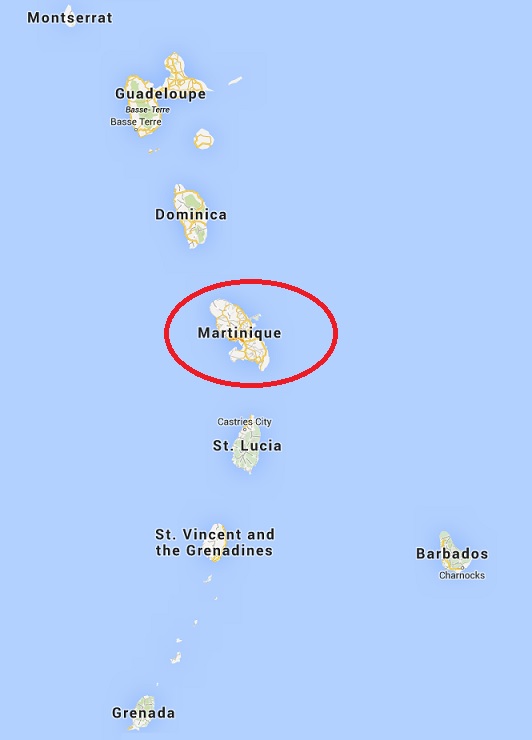
Welcome to Martinique, and some of the best surfing on the planet.

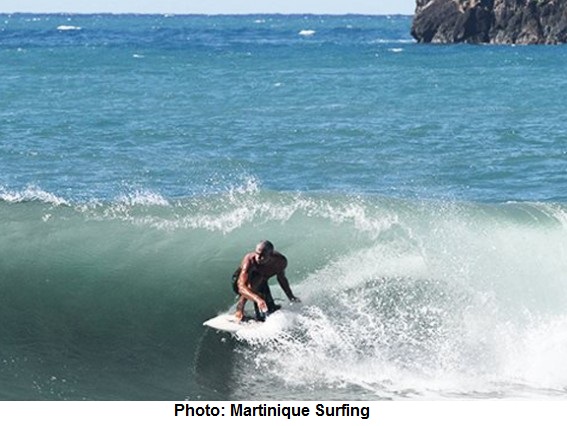
This original Go Lean blog-commentary from April 14, 2015 is re-distributed on this occasion of the Third Annual Martinique Surf Pro, which just transpired April 1 through April 8, 2017. And the winner is:

Title: Ricardo Christie conquered the 2017 Martinique Surf Pro, at Basse-Pointe, in Martinique.

Christie proved he’s ready to return to the Dream Tour by putting out a competent performance at the righthand pointbreak. And he needed six rides to clinch the tasty trophy.

“When the waves are like that you can forget everything and just go out there and surf. I feel like I’ve improved a lot,” explained Ricardo Christie, who failed to requalify at the end of his rookie season on the Championship Tour.

“I’ve just been working really hard, and I learned a lot when I was on tour. It doesn’t feel like it’s over; it’s just the beginning of the year, so I just have to keep doing my thing.”

With this victory in Martinique, Ricardo Christie jumped 91 places to number 10 on the QS rankings.

Source: Posted April 10, 2017; retrieved April 12, 2017 from: http://www.surfertoday.com/surfing/13558-ricardo-christie-wins-the-2017-martinique-surf-pro

Consider the VIDEO highlights from this year’s event.

This event – part sports; part culture; is all tourism. It is building momentum! We need more events like this. See the Encore below describing how the movement behind the book Go Lean…Caribbean will strategize for sports tourism; this means more and more events … in different sports.

————–

Go Lean Commentary – Title: Is Martinique the Next Caribbean Surfing Capital?


Sports could be big business; culture is big business. Every now-and-then there is the opportunity to merge sports and culture into a single economic activity. One such expression is the sports/culture of surfing. This focus is a priority for the movement to elevate the Caribbean society, stemming from the book Go Lean…Caribbean.

The book serves as a roadmap for the introduction and implementation of the technocratic Caribbean Union Trade Federation (CU). While the CU is not intended as a sports promotion entity, it does promote the important role of sports in the quest to make the Caribbean a better place to live, work and play.

Though surfing activities originated with Polynesian culture (see Appendix below), the sport has assimilated well in other societies – the Caribbean included.

In terms of cultural expressions of surfing in the United States, the most iconic portrayal is the Rock-n-Roll group the Beach Boys; see VIDEO in the Appendix below of a milestone performance in Tokyo, Japan.

Yes surfing is global in its participation and appreciation.

Now a Caribbean community, the French-domain of Martinique is exploring the surfing sub-culture for sport, tourism and sports-tourism.

Cowabonga* Dude!

By: The Caribbean Journal staff

Long an under-the-radar surfing spot, the French Caribbean island will get its place in the spotlight when the surfing world gathers on the island later this month for the first-ever Martinique Surf Pro.

From April 21-26, the Caribbean’s only World Surf League Qualification Series event this year will take place along the shores of Basse-Pointe in Martinique.

The event, which is being organized by Martinique Surfing in partnership with the World Surf League, will bring together 100 world-class surfers from the United States, Japan, Europe, Brazil and the Caribbean.

“Martinique has been among the best-kept secrets in Caribbean surfing for some time now,” said Muriel Wiltord, director of the Americas for the Martinique Promotion Bureau. “Such a high-profile event as this cements the island’s position as a prime surfing destination. As one the top watersports competitions being held in the Caribbean in 2015, Martinique Surf Pro also shines a spotlight on the wide range of additional watersports options that Martinique has to offer.”

Martinique’s surfing season typically lasts between November and May along its northern and northeastern Atlantic coasts.

Source retrieved April 13, 2015: http://www.caribjournal.com/2015/04/13/is-martinique-the-next-caribbean-surfing-capital/

CU Blog - Is Martinique the next big Caribbean surfing capital - Photo 2

CU Blog - Is Martinique the next big Caribbean surfing capital - Photo 3

CU Blog - Is Martinique the next big Caribbean surfing capital - Photo 1

Not every coastline is ideal for surfing; thusly many Caribbean residents do not surf; it is not an indigenous activity to this region. But the past-time – and culture for that matter – is adaptable. Why is this? While the Caribbean has been blessed with many natural gifts, the physical conditions for surfing are not everywhere; (based on factual information retrieved from Wikipedia).

There must be a consistent swell. A swell is generated when wind blows consistently over a large area of open water, called the wind’s fetch. The size of a swell is determined by the strength of the wind and the length of its fetch and duration. Because of this, surf tends to be larger and more prevalent on coastlines exposed to large expanses of ocean traversed by intense low pressure systems.

Local wind conditions affect wave quality, since the surface of a wave can become choppy in blustery conditions. Ideal conditions include a light to moderate “offshore” wind, because it blows into the front of the wave, making it a “barrel” or “tube” wave. Waves are Left handed and Right Handed depending upon the breaking formation of the wave.

Waves are generally recognized by the surfaces over which they break.[7] For example, there are Beach breaks, Reef breaks and Point breaks.

The most important influence on wave shape is the topography of the seabed directly behind and immediately beneath the breaking wave. The contours of the reef or bar front becomes stretched by diffraction. Each break is different, since each location’s underwater topography is unique. At beach breaks, sandbanks change shape from week to week. Surf forecasting is aided by advances in information technology. Mathematical modeling graphically depicts the size and direction of swells around the globe.

So mastering the sport of surfing is now an art and a science.

Despite the fun and joy of surfing, there are a lot of dangers with this activity:

This activity is not for the faint of heart.

Not every market, especially in the Caribbean, can support the demands of surfing as a sport and as a cultural event. As depicted in the foregoing article, Martinique uniquely qualifies. This year’s professional tournament is the inaugural event. This Caribbean island makes a very short-list of all locations where this activity is practical. The following is a sample of the competitive/major surfing locations (Surf Cities) around the globe:

1. In Australia

2. In Asia

3. In the South Pacific

4. In South Africa

5. In North America

6. In Central America

7. In South America

8. In the USA

9. In Europe

The Martinique effort and initiative to satiate the thirst … and fascination of surfing aligns with the objects of the CU/Go Lean roadmap; especially the mission “to forge industries and economic drivers around the individual and group activities of sports and culture” (Page 81).

The Go Lean vision is a confederation of the 30 member-states of the Caribbean forming the CU as a proxy organization to do the heavy-lighting of building, funding, maintaining and promoting sports venues. The strategy is for the CU to be the landlord, and super-regional regulatory agency, for sports leagues, federations and associations (amateur, collegiate, and professional). The embrace and promotion of the sport and culture of surfing can contribute to the Greater Good for the Caribbean. This aligns with the prime directives of the CU/Go Lean roadmap; summarized in the book with these 3 statements:

  • Optimization of the economic engines in order to grow the regional economy to $800 Billion & create 2.2 million new jobs.
  • Establishment of a security apparatus to protect the resultant economic engines and the participants in activities like surfing.
  • Improvement of Caribbean governance to support these engines.

This roadmap commences with the recognition that genius qualifiers can be found in many fields of endeavor, including sports. The roadmap pronounces the need for the region to confederate in order to invest in elevation of the Caribbean eco-systems in which such athletic geniuses can soar. These pronouncements are made in the opening Declaration of Interdependence, (Pages 13 & 14) as follows:

xxi. Whereas the preparation of our labor force can foster opportunities and dictate economic progress for current and future generations, the Federation must ensure that educational and job training opportunities are fully optimized for all residents of all member-states, with no partiality towards any gender or ethnic group. The Federation must recognize and facilitate excellence in many different fields of endeavor, including sciences, languages, arts, music and sports. This responsibility should be executed without incurring the risks of further human flight, as has been the past history.

xxii. Whereas sports have been a source of great pride for the Caribbean region, the economic returns from these ventures have not been evenly distributed as in other societies. The Federation must therefore facilitate the eco-systems and vertical industries of sports as a business, recreation, national pastime and even sports tourism – modeling the Olympics.

The Go Lean book and accompanying blogs declare that the Caribbean needs to learn lessons from Surf City communities and other sporting venues/administrations. So thusly this subject of the “business of sports” is a familiar topic for Go Lean blogs. This cause was detailed in these previous blogs:

https://goleancaribbean.com/blog/?p=6464 NEW: WWE Network – Model for Caribbean
https://goleancaribbean.com/blog/?p=4019 Melding of Sports & Technology; the Business of the Super Bowl
https://goleancaribbean.com/blog/?p=3414 Levi’s® Stadium: A Team Effort
https://goleancaribbean.com/blog/?p=3244 Sports Role Model – espnW
https://goleancaribbean.com/blog/?p=2222 Sports Role Model – Playing For Pride … And More
https://goleancaribbean.com/blog/?p=2171 Sports Role Model – Turn On the SEC Network
https://goleancaribbean.com/blog/?p=2152 Sports Role Model – US versus the World
https://goleancaribbean.com/blog/?p=1715 Lebronomy – Economic Impact of the Return of the NBA Great
https://goleancaribbean.com/blog/?p=1446 Caribbean Players in the 2014 World Cup
https://goleancaribbean.com/blog/?p=1341 College World Series Time – Lessons from Omaha
https://goleancaribbean.com/blog/?p=1214 Landlord of Temporary Stadiums
https://goleancaribbean.com/blog/?p=1148 Sports Bubble – Franchise values in basketball
https://goleancaribbean.com/blog/?p=1020 Sports Revolutionary: Advocate Jeffrey Webb
https://goleancaribbean.com/blog/?p=498 Book Review: ‘The Sports Gene’
https://goleancaribbean.com/blog/?p=318 Collegiate Sports in the Caribbean
https://goleancaribbean.com/blog/?p=60 Could the Caribbean Host the Olympic Games?

This Go Lean roadmap is committed to availing the economic opportunities of all the Caribbean sports eco-system to respond to the world’s thirst for surfing. The book details the series of community ethos, strategies, tactics, implementations and advocacies to deliver the regional solutions to better harness economic benefits from sports and sports-tourism activities:

Community Ethos – People Respond to Incentives in Predictable Ways Page 21
Community Ethos – Consequences of Choices Lie in the Future Page 21
Community Ethos – Lean Operations Page 24
Community Ethos – Return on Investments Page 25
Community Ethos – Ways to Foster Genius Page 27
Community Ethos – Ways to Impact the Greater Good Page 37
Strategic – Staffing – Sporting Events at Fairgrounds Page 55
Tactical – Fostering a Technocracy Page 64
Tactical – Separation of Powers – Sports & Culture Administration Page 81
Tactical – Separation of Powers – Fairgrounds Administration Page 83
Implementation – Steps to Implement Self-Governing Entities Page 105
Implementation – Ways to Deliver Page 109
Planning – Ways to Make the Caribbean Better Page 131
Advocacy – Ways to Grow the Economy Page 151
Advocacy – Ways to Create Jobs Page 152
Advocacy – Ways to Improve Local Government – Parks & Recreation Page 169
Advocacy – Ways to Impact Public Works Page 175
Advocacy – Ways to Impact Events Page 191
Advocacy – Ways to Promote Fairgrounds as Sporting Venues Page 192
Advocacy – Ways to Preserve Caribbean Heritage Page 218
Advocacy – Ways to Improve Sports Page 229
Advocacy – Ways to Impact Urban Living – Sports Leagues Page 234

What could be the end result for the Go Lean roadmap’s venture into the sport of surfing and the business of sports? Economic growth and “jobs”. The Go Lean roadmap anticipates 21,000 direct jobs at sports enterprises throughout the region.

But surfing is also a leisure amenity, a “play” activity within the Go Lean roadmap. Many participate in this activity with no competitive motives. So the promotion of surfing in the Caribbean region can appeal to many enthusiasts far-and-wide to come visit and enjoy our Caribbean hospitality. This subject therefore relates back to the primary regional economic activity of tourism. This fits into the appeal of the Caribbean sun, sand and surf.

Overall, with these executions, the Caribbean region can be a better place to live, work and play. There is a lot of economic activity in the “play” aspects of society. Everyone, surfers, athletes and spectators alike, are hereby urged to lean-in to this Go Lean roadmap.

Cowabonga Dudes!

Download the free e-book of Go Lean … Caribbean – now!

Sign the petition to lean-in for the roadmap for the Caribbean Union Trade Federation.

———-

Appendix – *Cowabunga: (slang) an expression of surprise or amazement, often followed by “dude”. Popular among California surfers.

———-

Appendix – Encyclopedia of Surfing:

For centuries, surfing was a central part of ancient Polynesian culture. This activity was first observed by Europeans at Tahiti in 1767 by Samuel Wallis and the crew members of the Dolphin; they were the first Europeans to visit the island in June of that year.

Surfing is a surface water sport in which the wave rider, referred to as a surfer, rides on the forward or deep face of a moving wave, which is usually carrying the surfer toward the shore. Waves suitable for surfing are primarily found in the ocean, but can also be found in lakes or in rivers in the form of a standing wave or tidal bore. However, surfers can also utilize artificial waves such as those from boat wakes and the waves created in artificial wave pools.

The term surfing refers to the act of riding a wave, regardless of whether the wave is ridden with a board or without a board, and regardless of the stance used. The native peoples of the Pacific, for instance, surfed waves on alaia, paipo, and other such craft, and did so on their belly and knees. The modern-day definition of surfing, however, most often refers to a surfer riding a wave standing up on a surfboard; this is also referred to as stand-up surfing.

George Freeth (8 November 1883 – 7 April 1919) is often credited as being the “Father of Modern Surfing”.

In 1907, the eclectic interests of the land baron Henry Huntington (of whom the City of Huntington Beach is named after) brought the ancient art of surfing to the California coast. While on vacation, Huntington had seen Hawaiian boys surfing the island waves. Looking for a way to entice visitors to the area of Redondo Beach, where he had heavily invested in real estate, he hired the young Hawaiian George Freeth to come to California and ride surfboards to the delight of visitors; Mr. Freeth exhibited his surfing skills twice a day in front of the Hotel Redondo.

In 1975, professional contests started.[6]

Today, the Surfing Hall of Fame is located in the city of Huntington Beach, California. The city brands itself as Surf City USA.

(Source retrieved April 14 from: http://en.wikipedia.org/wiki/Surfing)

———-

AppendixVIDEO – The Beach Boys: Surfin’ Safari~Surf City~Surfin’ U.S.A – https://youtu.be/qpSwdQMn8xs

Uploaded on Jul 29, 2011 – Live at Budokan in Japan November 2, 1991

Share this post:
, , , , ,
[Top]

Managing the ‘Strong versus the Weak’ – An American Sickness

Go Lean Commentary

“There is a special ‘place in hell’ …”
“… for someone that would steal your wallet after you collapse/faint due to a health crisis; (think heart-attack, epileptic seizure, etc.)”.

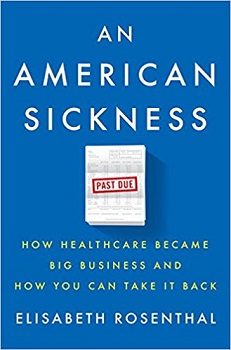
Sickness 1Imagine this scenario at the country level; how inconceivable for an advanced society. And yet, this is the actual situation in the United States. This is according to the new book – An American Sickness: How Healthcare Became Big Business and How You Can Take It Back – by Dr. Elisabeth Rosenthal, a former E.R. doctor and current journalist for medical issues.

This commentary asserts that there is a need for the Caribbean communities to reform and transform our healthcare deliveries, yet still, we do NOT want to model the American system. This point aligns with the book Go Lean…Caribbean, which seeks to reboot the 30 member-states of the Caribbean region, to ensure better stewardship of the Social Contract for all citizens in our homelands, strong and weak. The Go Lean book petitions the Caribbean region to do better! It describes the necessary empowerments to optimize the economic, security and governing engines of Caribbean society to ensure a better adherence to the principle of the Greater Good.

In a 4-part series of blog-commentaries on the “Strong versus the Weak”, the pattern from the Code of Hammurabi was detailed and presented as an Old World model that was ignored in the formation of the New World. The Americans got it bad! If that ancient King Hammurabi was around in present day, he would have a harsh judgment for the American healthcare system. It is figuratively like “stealing the wallet when a person collapses”, as many of the financial abuses in American hospitals occur when the patient is unconscious or only concerned about seeking relief from pain and/or discomforts.

This commentary is an spin-off from that series; though it was originally presented as a 4-parter, we are hereby adding this 5th entry. The full series is now as follows:

  1. Managing the Strong versus the Weak – Model of Hammurabi
  2. Managing the Strong versus the Weak – Mental Disabilities
  3. Managing the Strong versus the Weak – Bullying in Schools
  4. Managing the Strong versus the Weak – Book Review: Sold-Out!
  5. Managing the Strong versus the Weak – An American Sickness

The need for this 5th entry arose with the release of this new book today – April 11, 2017. It is ‘spot-on’ for the criticism of the pattern of abuse of the ‘Weak’ in American society. See the review-synopsis of Dr. Rosenthal’s book here:

Book Review: An American Sickness: How Healthcare Became Big Business and How You Can Take It Back
By: Elisabeth Rosenthal (Author)

At a moment of drastic political upheaval, a shocking investigation into the dangerous, expensive, and dysfunctional American healthcare system, as well as solutions to its myriad of problems

Sickness 2

In these troubled times, perhaps no institution has unraveled more quickly and more completely than American medicine. In only a few decades, the medical system has been overrun by organizations seeking to exploit for profit the trust that vulnerable and sick Americans place in their healthcare. Our politicians have proven themselves either unwilling or incapable of reining in the increasingly outrageous costs faced by patients, and market-based solutions only seem to funnel larger and larger sums of our money into the hands of corporations. Impossibly high insurance premiums and inexplicably large bills have become facts of life; fatalism has set in. Very quickly Americans have been made to accept paying more for less. How did things get so bad so fast?

Breaking down this monolithic business into the individual industries—the hospitals, doctors, insurance companies, and drug manufacturers—that together constitute our healthcare system, Rosenthal exposes the recent evolution of American medicine as never before. How did healthcare, the caring endeavor, become healthcare, the highly profitable industry? Hospital systems, which are managed by business executives, behave like predatory lenders, hounding patients and seizing their homes. Research charities are in bed with big pharmaceutical companies, which surreptitiously profit from the donations made by working people. Patients receive bills in code, from entrepreneurial doctors they never even saw.

The system is in tatters, but we can fight back. Dr. Elisabeth Rosenthal doesn’t just explain the symptoms, she diagnoses and treats the disease itself. In clear and practical terms, she spells out exactly how to decode medical doublespeak, avoid the pitfalls of the pharmaceuticals racket, and get the care you and your family deserve. She takes you inside the doctor-patient relationship and to hospital C-suites, explaining step-by-step the workings of a system badly lacking transparency. This is about what we can do, as individual patients, both to navigate the maze that is American healthcare and also to demand far-reaching reform. An American Sickness is the frontline defense against a healthcare system that no longer has our well-being at heart.

Source: Posted and Retrieved 04-11-2017 from: https://www.amazon.com/American-Sickness-Healthcare-Became-Business/dp/1594206759/ref=sr_1_1?ie=UTF8&qid=1491928851&sr=8-1&keywords=Book+American+Sickness

—————

AUDIO Podcast – Terry Gross interviews Elisabeth Rosenthal – Heard on Fresh Air

Mental Photo 4April 10, 2017 – Health care is a trillion-dollar industry in America, but are we getting what we pay for? Dr. Elisabeth Rosenthal, a medical journalist who formerly worked as a medical doctor, warns that the existing system too often focuses on financial incentives over health or science.

“We’ve trusted a lot of our health care to for-profit businesses and it’s their job, frankly, to make profit,” Rosenthal says. “You can’t expect them to act like Mother Teresas.”

Rosenthal’s new book, An American Sickness, examines the deeply rooted problems of the existing health-care system and also offers suggestions for a way forward. She notes that under the current system, it’s far more lucrative to provide a lifetime of treatments than a cure.

“One expert in the book joked to me … that if we relied on the current medical market to deal with polio, we would never have a polio vaccine,” Rosenthal says. “Instead we would have iron lungs in seven colors with iPhone apps.”

Notice this small sample of the book’s revelations and disclosures, symptomatic of Crony-Capitalism:

  • Healthcare economics do not align with normal economic laws: “Usual & Customary” versus supply-and-demand
  • Hospital systems behave like predatory lenders
  • Consumers cannot decide, as prices may be unknown at the time of delivery
  • Lifetime of treatment preferable for service-providers rather than a cure.
  • Doctors owning Surgical Centers, therefore dictating procedures that they can accommodate at their facilities
  • Unknown and unauthorized “Drive-by Doctors” adding to hospital bills.

This commentary and the previous 4 commentaries in this series all relate to nation-building, stressing the community ethos necessary to forge a society where all the people are protected all the time. While we are analyzing the American system, we clearly recognize that the Caribbean eco-system is equally – or perhaps even more – in a crisis and in need of reform. The premise in the Go Lean book and subsequent blog-commentaries is that “a crisis is a terrible thing to waste”. We can use the acknowledgement of our crisis to optimize our healthcare deliveries once and for all. We must assuredly look beyond the American model. According to the foregoing book and AUDIO Podcast, many more successful models exist.

Dr. Rosenthal’s book asserts that there may be better models in Europe than there is in the US. This is already a familiar thesis for the Go Lean movement – a roadmap for the introduction and implementation of the Caribbean Union Trade Federation (CU) – as the Go Lean book advocates studying all dimensions of the EU:

10 Ways to Model the EU – Page 130.
The CU will emulate the European Union by unifying and integrating the Caribbean region into one market, thereby creating a single economy of 30 member-states, 42 million people and a GDP of over $800 Billion (per 2010). The EU is 28 member-states, 507.89 million people and $16.6 Trillion GDP (per 2012). Though the CU is only a fraction the size of the EU, there is the similarity of divergent peoples (24 languages) putting aside their differences in a quest to confederate. The EU region has quite an ignoble history of contending with differences, spurning 2 World Wars in the last century. Yet they came together to unite and integrate to make Europe a better place to live, work and play. Just like the EU, the CU will not possess sovereignty; this feature remains with each member-state.

Still, there was a previous attempt to reform the American healthcare delivery eco-system. There is wisdom to glean from that development. The Go Lean book provides this excerpt (Page 156):

The Bottom Line on Obama Care
The Patient Protection and Affordable Care Act (PPACA), commonly called Obama Care is a US federal statute signed into law by President Barack Obama on March 23, 2010. It represents the most significant government expansion and regulatory overhaul of the U.S. healthcare system since the passage of Medicare and Medicaid in 1965. The PPACA is aimed at increasing the rate of health insurance coverage for Americans and reducing the overall costs of health care. It provides a number of mechanisms—including mandates, subsidies, and tax credits — to employers and individuals to increase the coverage rate.Additional reforms aim to improve healthcare outcomes and streamline the delivery of health care. The PPACA requires insurance companies to cover all applicants and offer the same rates regardless of pre-existing conditions or sex. The Congressional Budget Office projected that the PPACA will lower both future deficits and Medicare spending. On June 28, 2012, the United States Supreme Court upheld the constitutionality of most of the Obama Care.

The US, despite its advanced democracy status, has definite societal defects in the healthcare arena. Overcoming the defects – particularly Crony-Capitalism or exploiting public resources for private gains – make solving healthcare challenging.

It is truly heavy-lifting!

This was recently discovered by the new US president, Donald Trump.

After campaigning for the 2016 election on the promise of “repealing and replacing Obama Care”, the administration’s first healthcare legislation attempt flopped. The president’s exclamation:

President Trump: ‘Nobody Knew Health Care Could Be So Complicated’

The truth of the matter Mr. President, everybody – engaged in the process of transforming society – knew!

Transforming the Caribbean healthcare will also be equally complicated. It will engage all 3 societal engines: economic, security and governance. In fact, the prime directives of the Go Lean/CU roadmap includes the following 3 statements:

  • Optimization of the economic engines in order to grow the regional economy to $800 Billion & create 2.2 million new jobs.
  • Establishment of a security apparatus – including emergency management – to ensure public safety and protect the resultant economic engines.
  • Improve Caribbean governance for all people – with empowerments for healthcare – to support these engines.

This comprehensive view – economics, security and governance – is the charge of the Go Lean roadmap, opening with these pronouncements in the Declaration of Interdependence (Page 11):

viii. Whereas the population size is too small to foster good negotiations for products and commodities from international vendors, the Federation must allow the unification of the region as one purchasing agent, thereby garnering better terms and discounts.

ix. Whereas the realities of healthcare and an aging population cannot be ignored and cannot be afforded without some advanced mitigation, the Federation must arrange for health plans to consolidate premiums of both healthy and sickly people across the wider base of the entire Caribbean population. The mitigation should extend further to disease management, wellness, mental health, obesity and smoking cessation programs. The Federation must proactively anticipate the demand and supply of organ transplantation as developing countries are often exploited by richer neighbors for illicit organ trade.

Overall, the Go Lean book stresses the community ethos, strategies, tactics, implementations and advocacies to reboot, reform and transform healthcare delivery in the Caribbean; see this expressed in this one advocacy here:

10 Ways to Improve Healthcare – Page 156

1 Embrace the advent of the CU Single Market to leverage across the 42 million people in the 30 member-states.
2 Organ Procurement Authority
3 Deploy Disease Management Models
4 Universal Health Insurance Care
Much like with auto insurance, there is a need to mandate health insurance coverage for most Caribbeans. The coverage does not have to be $0 deductible and 100% coverage, rather it could be less attractive – low-end terms – like $6000 deductible and 60% coverage. The US model, Obama Care has plans branded Bronze (low end), Silver, Gold and Platinum. The goal for the CU is simply to ensure that catastrophic illnesses or injuries do not imperil the financial viability of individual, families or communities. The coverage risk is minimized with insurance carriers having a larger premium base (42 million) to calculate their actuarial formulas. To maximize savings, individual states may choose to combine their health insurance marketplaces with other states or go at it alone.
5 Wellness, Nutrition, Fitness and Smoking Cessations Programs
6 Medical Tourism
7 Repatriate MediCare Beneficiaries
8 Caribbeans with Disabilities
9 Medical Education Outreach
10 Public Health Extension
Due to the systemic threat, epidemic response and disease control will be coordinated at the federal level. Also, the acquisition of public-bound pharmaceuticals (vaccinations, etc.) can be negotiated at the regional level, using the Group Purchasing Organizations (GPO) envisioned in this roadmap. This will lead to a better supply and pricing dynamics.

The points of effective, technocratic stewardship of healthcare were further elaborated upon in previous blog/commentaries. Consider this sample:

https://goleancaribbean.com/blog/?p=7822 Cancer: Doing More
https://goleancaribbean.com/blog/?p=7586 Blink Health: The Cure for High Drug Prices
https://goleancaribbean.com/blog/?p=7430 Brazilian Shrunken Head Babies: Zika or Tdap?
https://goleancaribbean.com/blog/?p=6580 Capitalism of Drug Patents
https://goleancaribbean.com/blog/?p=3276 Role Model Shaking Up the World of Cancer
https://goleancaribbean.com/blog/?p=2522 The Cost of Cancer Drugs
https://goleancaribbean.com/blog/?p=2105 Recessions and Public Health
https://goleancaribbean.com/blog/?p=1751 New Hope in the Fight against Alzheimer’s Disease
https://goleancaribbean.com/blog/?p=1003 Painful and rapid spread of new virus in Caribbean
https://goleancaribbean.com/blog/?p=554 Cuban cancer medication registered in 28 countries
https://goleancaribbean.com/blog/?p=286 PR’s Comprehensive Cancer Center Project Breaks Ground
https://goleancaribbean.com/blog/?p=278 Tim Armstrong, the CEO of AOL – Health-care Concerns

The opening imagery:

“There is a special ‘place in hell’ …”

… is just an metaphorical reference. There is no assumption of a literal burning abyss of torment. But this does convey the abomination of the “strong abusing the weak”. So many times in the past this abuse has proliferated, for those weaker physically, mentally, economically and sadly, medically.

The movement behind the Go Lean/CU roadmap wants us, in the Caribbean, to do better. Yes, healthcare is not easy, but it is possible to reform and transform. There are so many good examples and models to learn from:

The underlying book reviewed here – An American Sickness: How Healthcare Became Big Business and How You Can Take It Back – considers Switzerland.

We want to “weed out” any bad practices of Crony-Capitalism in our health delivery system. Instead, we want to pursue the Greater Good (greatest good to the greatest number of people which is the measure of right and wrong). Most importantly, we want to proclaim the truth of American life. So many of our Caribbean citizens “beat down their doors to get out” and emigrate to the US. We want to “dull the lights on any American Welcome signs” – considering the reality of American Crony-Capitalism, the “grass is not necessarily greener on the other side”.

Now is the time to lean-in to this Go Lean roadmap to reboot, reform and transform Caribbean healthcare. If we do this, we will make the Caribbean a better place to live, work, heal and play. 🙂

Sign the petition to lean-in for the roadmap for the Caribbean Union Trade Federation.

Download the free e-book of Go Lean … Caribbean – now!

Share this post:
, , , ,
[Top]

ENCORE: PM Christie and Bahamas Junkanoo Carnival

Update – Go Lean Commentary

Talk is cheap! Results, on the other hand, are hard-fought and expensive.

This is the post-analysis of the plans for Junkanoo Carnival in the Bahamas, after 3-years of planning and execution. The results have indeed been hard-fought, expensive and … “not so successful”.

Told you so…

This was the declaration from this previous blog-commentary from the movement behind the book Go Lean…Caribbean. The assessment was that the Carnival product appeared to be lucrative, but there was so much heavy-lifting involved with an implementation, that unless there was a whole soul commitment by the full community, it would be very hard to find success.

Now there are new developments…

Article Title: ‘Blindsided’ By Carnival Delay
By: Ava Turnquest, Tribune Chief Reporter

CU Blog - UPDATE - PM Christie and Bahamas Junkanoo Carnival - Photo 1LESS than a week after officials announced the event’s line-up, Prime Minister Perry Christie confirmed yesterday that the 2017 Bahamas Junkanoo Carnival has been postponed until after the general election.

The news has “blindsided” key stakeholders and vendors, who decried the confusion, likely damage to brand and reputation and potential financial losses resulting from the date change.

The Tribune understands the event has been pushed back from May 4-6 to May 18-20 in Nassau. The new date was also circulated in a flyer by Bahamas Junkanoo Carnival’s Instagram account last night.

It is unclear whether the Grand Bahama-leg of the festival, slated for April 28 and 29, has also been pushed back.

Mr Christie was asked about the postponement on the sidelines of a ceremony to rename thoroughfares at the University of the Bahamas, after a report published in The Nassau Guardian indicated that the government had decided to delay the event.

Mr Christie said: “I’m advised that the Carnival Commission has met and agreed that because of the impending possibilities, to suspend or extend the date of (Junkanoo) Carnival. I don’t know the dates they had chosen but it is my understanding that that has been done.”

Up to press time, the Bahamas National Festival Commission (BNFC) had not released a new date for the event, or an official statement on the postponement.

When The Tribune contacted BNFC Chairman Paul Major, he said: “What we know is that we’re not going to conflict with the final say of Cabinet – once an official election date is set, then our dates are subject to change.”

Last Thursday, the BNFC announced Trinidadian singing stars Machel Montano and Bunji Garlin as event headliners. It was also confirmed that the event will be streamlined compared to past years because of financial constraints.

The government will reduce its subsidy to the festival by as much as 50 per cent over last year, when taxpayers contributed about $8 million, officials said. The 2016 event brought in $578,342 in revenue, costing more than $9.8m overall.

In 2015, the government spent $11.3m on the inaugural festival, going over its initial budget of $9m, with the rest covered by sponsors. The first Junkanoo Carnival cost $12.9m overall.

Mr Major and BNFC CEO Roscoe Dames declined further questions, and advised that the commission would release further information today.

The Office of the Prime Minister, in a press statement on Sunday, announced that Parliament will be dissolved on April 11.

According to the Parliamentary Elections Act, an election must be held 21 to 30 days after election writs are issued, meaning the next vote will likely be held in early May.

The last election was held on May 7, 2012.

In 2015, the inaugural festival took place on May 7-9 in New Providence, and the 2016 Junkanoo Carnival kicked off on April 15-16 in Grand Bahama and on May 5-7 in New Providence.

In February, Free National Movement (FNM) Deputy Leader K Peter Turnquest called for the government to postpone or delay the festival until after the general election, warning that the event could only be perceived as “vote buying” if staged during the election cycle.

The Tribune reached out to Bahamas Carnival Band Owners Association (BCBOA) President Dario Tirelli for comment on the matter; however, Mr Tirelli declined comment until an official government statement was released.

Mr Tirelli told The Tribune that the news had “blindsided” his association.

Stephan Rolle, owner of Bluemonkey Bahamas, told reporters that any date change would negatively impact his business, the Bahamas Carnival Cruise, which has booked more than 100 carnival-goers on an all-inclusive weekend cruise from Miami to Nassau.

He challenged Mr Christie to give the festival the same level of respect as the annual Junkanoo parades.

Source: The Tribune Daily Newspaper (Posted 04/04/2017; retrieved 04/05/2017) – http://www.tribune242.com/news/2017/apr/04/blindsided-carnival-delay/

The Prime Minister bet his administration on the prospect of Carnival and now, its election time. He declared that the Parliament will dissolve on April 11, 2017. Under the Westminster structure of Parliamentary government, elections of a new Parliament must take place within a month after that date. So now the expectation is that elections will be conducted “smack in the middle” of the 2017 Carnival activities.

The solution? The PM postpones Carnival!

From a strictly Carnival perspective, this is a Big Mistake! See here the reaction of the festival stakeholders:

VIDEO – Unhappy over Carnival situation – http://youtu.be/f5zoG6yiS9E

Uploaded on Apr 4, 2017 – One of many online videos featuring complaints about the postponement of Carnival.

In this previous Go Lean blog-commentary – being ENCORED below – the prospect of Junkanoo Carnival was analyzed … before-hand, then subsequent blogs also examined the results after the 1st-year and 2nd-year events, as follows:

The appeal was made in all of these commentaries for the strategies, tactics and implementations of the Go Lean roadmap for the Caribbean Union Trade Federation (CU). This involved the heavy-lifting to marshal the entire community to ensure for Event Tourism, and profit from it. See the original blog-commentary here below.

Also, see a related story from April 4, 2017 detailing the challenges of a new schedule-date: Festival To Be May 18-20 As PM Confirms Move (The Tribune Daily Newspaper; retrieved 04/05/2017)

————–

Blog Title: PM Christie responds to critics of Bahamian ‘Carnival’

Carnival 1Head –> Heart –> Hands.

This is the physiological process to forge change, described in the book Go Lean … Caribbean (Page 20). As experienced on a daily basis by people attempting to “quit smoking”, change is near impossible without engaging those three body parts. The book, serving as a roadmap for the introduction and implementation of the Caribbean Union Trade Federation (CU) describes the linked application of those three symbolic body parts, as follows:

  • Head – Plans, Models and Strategies
  • Heart – Community Ethos
  • Hands – Actions, Implementations, Advocacies

According to the below news article, the Prime Minister of the Bahamas wants to forge change in his homeland. He wants to incorporate a new festival, based on the model of Carnival and Madri Gras, so as to glean some of the massive economic harvests around those events in the Caribbean and other Western Hemisphere destinations.

Since initiating this plan in Spring 2013, cyber-space and public commentary have been awash with feedback: some in favor; most opposed.

Albeit he is inspired by good motives, the publishers declare that something is missing in the Prime Minister’s plans: Best practices.

Excerpts from original source article: PM Christie responds to critics of Bahamian ‘Carnival’
Date: April 25, 2014
By: Erica Wells, Managing Editor

Prime Minister Perry Christie has assured critics of the Government’s plan to create a Bahamian Carnival or Mardi Gras that the festival will be “essentially” Bahamian and that a special committee will be appointed to prepare the country and the world for the initiative.

The government, Christie says, sees the festival as both a major economic intervention and a cultural expansion.

“It will be essentially Bahamian but also include thousands of visitors who will be attracted by what will be an absolutely fabulous affair,” said Christie.

Anthropologist and author Dr. Nicolette Bethel, who is also a former director of culture, has been one of the biggest critics of the proposed festival.

Prime Minister Christie said for the groups to be licensed, they would have to form themselves into a company and operate as a business.

“This is a massive undertaking which will receive very careful consideration of the government,” he said.

“This is very necessary as the corporate groups will be advertising abroad and inviting persons to purchase costumes online as well as from store fronts in a cultural village or elsewhere.”

The prime minister said carnival is part of a worldwide masquerade industry.

He said the industry has been successful in attracting costume makers, wire benders, painters, designers and performers at some of the largest festivals in the world.

“It has an export dimension. We know of major festivals in Trinidad, Brazil, Toronto, Barbados, New York, Miami and London. Carnival in the diaspora generates hundreds of millions of dollars and creates many jobs and entrepreneurial opportunities.

“It is big business and it requires business planning, management, marketing of products and organizational structure,” said Christie.

Prime Minister Christie said costumes from carnival inspired designers show up in New York, Toronto, Notting Hill, London, Miami and many other centers in the U.S.

Source: The Nassau Guardian Online. Posted 06/22/2013; retrieved 04/24/2014 from: http://www.thenassauguardian.com/index.phpoption=com_content&view=article&id=40021&Itemid=59

The Go Lean roadmap is different! It employs best practices for assessing, strategizing and implementing change. The book commences with the practice to assess current landscapes; this is what strategists call “Understand the market / Plan the business”. Page 44 presents these questions:

• Who are our customers and what exactly do they want?

• Who are our competitors; how do we stack up against them?

The book then proceeds to answer these and other strategy queries, accordingly.

carnival 2Events/festivals are paramount in the Go Lean roadmap: the optimization of existing events and the introduction of new events. This advocacy is detailed on Page 191 as being supplemental to the goal of enhancing tourism (Page 190).

What are the prospects for this new Bahamas Carnival/Lenten festival?

On the surface, it seems far-fetched, as the Bahamas does not have a Lenten ethos. All the competitive destinations (Rio De Janeiro, New Orleans and Trinidad) have elevated lent habits (Ash Wednesday to Good Friday), so that Mardi Gras/Fat Tuesday actually has significance in preparation of this hallowed Lenten season. Without this ethos, it is hard, though not impossible, to forge a new tradition, festival or business model. But the mediocre financial investment, announced in the foregoing article – $1 million as opposed to $3 million, makes the success of initiating and promoting a new event an insurmountable obstacle.

The publishers of the Go Lean roadmap wish the Prime Minister good fortune with his plans, but this execution does not appear to be lean, within “best practices”. More is needed; much more! There should be more focus on “Head, Heart & Hands” principles. As a contrast, notice the detailed strategies, tactics, actions and advocacies for new events in the Go Lean roadmap:

Community Ethos – Lean Operations Page 24
Community Ethos – Return on Investments Page 24
Community Ethos – Cooperatives Page 25
Community Ethos – Non Government Org’s. Page 25
Impact the Future Page 26
Foster Genius – Performance Excellence Page 27
Ways to Improve Sharing Page 35
Ways to Promote Happiness Page 36
Ways to Impact the Greater Good Page 37
Strategy – Customers – Business Community Page 47
Strategy – Customers – Visitors / Tourists Page 47
Strategy – Competitors – Event Patrons Page 55
Separation of Powers – Emergency Mgmt. Page 76
Separation of Powers – Tourism Promotion Page 78
Separation of Powers – Sports & Culture Page 81
Separation of Powers – Fairgrounds Admin. Page 83
Separation of Powers – Turnpike Operations Page 84
Steps to Implement Self-Governing Entities Page 105
Ways to Foster Cooperatives Page 176
Ways to Improve Intelligence Gathering Page 182
Ways to Improve [Service] Animal Husbandry Page 185
Ways to Enhance Tourism Page 190
Ways to Impact Events Page 191
Ways to Promote Fairgrounds Page 192
Ways to Improve Emergency Management Page 196
Ways to Impact Hollywood [& Media Industry] Page 203
Ways to Preserve Caribbean Heritage Page 218
Ways to Improve the Arts Page 230
Ways to Promote Music Page 231

In summary, festivals/events are important, so they require lean administration and executions. They empower economics and fortify cultural pride. In all, they make the Bahamas, by extension the entire Caribbean, a better place to live, work, and play.

Download the book Go Lean … Caribbean – now!

Share this post:
, , , ,
[Top]

JPMorganChase spent $10 billion on ‘Fintech’ for 1 year

Go Lean Commentary

Looking for a job? Where are the jobs to be created for the 21 Century?

JPMorgan - Photo 2Try banking! Financial/Banking technology to be exact. This sub-industry sector is referred to as ‘Fintech’; see the definition in the Appendix below.

So rather than the individual, if a community wants to foster job creation, ‘Fintech’ offers attractive options.

What’s more, according to this news article, one New York-based bank, JPMorganChase, spent almost $10 Billion on Fintech … last year alone. The CEO, Jaime Dimon, announced that there will be even more investment in this vital area. See the full story here:

Title: Jamie Dimon – JPMorgan spent nearly $10 billion on tech last year
By: Ari Levy

JPMorgan CEO Jamie Dimon said the bank spent $9.5 billion on technology in 2016 and has plans this year to introduce products for digital banking, online investment advice and electronic trading.

JPMorgan - Photo 1In his annual letter to shareholders on Tuesday, Dimon said the bank is also “collaborating with some excellent fintech companies to dramatically improve our digital and other customer offerings.”

Among the leading bank executives, Dimon has established himself as the biggest presence in San Francisco and Silicon Valley, making regular trips West to meet with tech executives and venture capitalists. He made headlines in his shareholder letter two years ago, warning investors that “Silicon Valley is coming.”

Rather than view potential banking disruption as a threat to JPMorgan, Dimon has embraced new technologies. About $3 billion, or almost one-third, of last year’s investment went to “new initiatives,” including $600 million on fintech solutions and projects.

Dimon highlighted partnerships with emerging tech companies like Zelle for consumer payments, Roostify for online mortgages, TrueCar for auto finance and On Deck Capital, which provides loans to small businesses.

The JPMorgan CEO also took a swipe at the U.S. immigration system and how it hurts this country’s ability to compete globally. Dimon said that about 40 percent of people receiving advanced degrees in science, technology engineering and math at American universities are from other countries. Yet they have no legal way to stay when they’re finished with school.

“We are forcing great talent overseas by not allowing these young people to build their dreams here,” Dimon wrote.

Source: CNBC – Business & Finance TV Channel; posted 04/04/2017; retrieved 04/05/2017) from: http://www.cnbc.com/2017/04/04/jamie-dimon-letter-jpmorgan-spent-9-5b-on-tech-last-year.html

So where are the jobs to be found? According to the foregoing, this industry – Fintech – is one of the options.

In general, this has been a frequent question for the movement behind the book Go Lean … Caribbean. The book presents the Caribbean region a roadmap to elevate its societal engines, starting first with economics (jobs, industrial development and entrepreneurial opportunities). In fact, the prime directives of the roadmap includes the following 3 statements:

  • Optimization of the economic engines in order to grow the regional economy to $800 Billion & create 2.2 million new jobs.
  • Establishment of a security apparatus to protect the resultant economic.
  • Improve Caribbean governance to support these engines.

The Go Lean book introduces the Caribbean Union Trade Federation (CU) as a federal government for 30 regional member-states, plus the Caribbean Central Bank (CCB) as a cooperative for the existing Central Banks. Together, these new entities will provide stewardship for the region’s banks.

Banking is very familiar to the Caribbean. This industry has proven to be the secondary industrial driver for many Caribbean communities, trailing only tourism. The Go Lean book explains (Page 58):

Core Competence – What are we best at doing?
There are features of Caribbean life that work very well now. We are currently the “best address” in the world. If one has the resources, there is no better place to call home – imagine a lottery winner relocating to a Caribbean paradise. Further, if someone has the resources for only a short time-frame, there is no better place to vacation. And thus, as a regional community, the Caribbean is best at servicing:

  • Tourism
  • Cruise Operations
  • Offshore Banking – The Caribbean colonial heritage created the ideal climate for offshore banking. Many of the European expatriates administering the colonies didn’t want to burden themselves with aggressive tax policies or strenuous financial compliance, and so inadvertently created a climate for tax sheltering and avoidance. Though the industry is professionally managed today, with best-of-class oversight and compliance requirements, the reputations and image is still deep-rooted based on this history. Consider Bermuda, Cayman Islands and Nassau’s proliferation with hundreds of offshore banks. When a celebrity in North America or Europe is labeled with “deposits in the Caymans or Bermuda”, there is an immediate public’s reaction. This was the case for US Presidential Candidate Mitt Romney in the 2012 Presidential election.
  • Specialty Agriculture.

Overall, the Go Lean book stresses the community ethos, strategies, tactics, implementations and advocacies to reboot, reform and transform the economic engines of Caribbean society.

How many jobs are to be impacted?

In general the roadmap projects 2.2 million new jobs across the 30 Caribbean member states. But for the Financial/Banking industry, the plan calls for:

Banking – New jobs from Banking reform, and adoption of e-payments, & card products  –  6,000

The Caribbean technology industry projects even more new jobs to be created in the region; the count was published at:

Technology – Direct:    Products and services for IT architecture, application and administration  –  20,000

Technology – Indirect: Service jobs for technology support and logistics  –  44,000

In total, the projection is for 70,000 new jobs.

Considering the experience of JPMorganChase Bank in the foregoing article – spending $10 Billion – and the projections in the Go Lean roadmap, it must be concluded that Fintech is one area “where the jobs are”.

The Go Lean book asserts that to thrive in the new global marketplace there must be an agile technocratic administration for the region’s banking; it will affect all aspects of Caribbean life. This comprehensive view – economics, security and governance – is the charge of the Go Lean roadmap, opening with these pronouncements in the Declaration of Interdependence (Page 13 and 14):

xxiv. Whereas a free market economy can be induced and spurred for continuous progress, the Federation must install the controls to better manage aspects of the economy: jobs, inflation, savings rate, investments and other economic principles. Thereby attracting direct foreign investment because of the stability and vibrancy of our economy.

xxvii. Whereas the region has endured a spectator status during the Industrial Revolution, we cannot stand on the sidelines of this new economy, the Information Revolution. Rather, the Federation must embrace all the tenets of Internet Communications Technology (ICT) to serve as an equalizing element in competition with the rest of the world. The Federation must bridge the digital divide and promote the community ethos that research/development is valuable and must be promoted and incentivized for adoption.

The points of effective, technocratic banking stewardship were further elaborated upon in previous blog/commentaries. Consider this sample:

https://goleancaribbean.com/blog/?p=10585 Two Pies: Economic Plan for a New Caribbean
https://goleancaribbean.com/blog/?p=10513 Transforming ‘Money’ Countrywide – Model of India
https://goleancaribbean.com/blog/?p=7140 Central Bank of Azerbaijan sets its currency on free float
https://goleancaribbean.com/blog/?p=7034 The Future of Money
https://goleancaribbean.com/blog/?p=6800 Venezuela sues black market currency website in US
https://goleancaribbean.com/blog/?p=6635 New Security Chip in Credit Cards Unveiled
https://goleancaribbean.com/blog/?p=5668 Move over Mastercard/Visa – Time for Local Banking Cards
https://goleancaribbean.com/blog/?p=4425 Cash, Credit or iPhone …
https://goleancaribbean.com/blog/?p=3889 Royal Bank of Canada’s EZPay – Ready for Change
https://goleancaribbean.com/blog/?p=3881 The Need for Regional Cooperation for Cyber-Security & e-Security
https://goleancaribbean.com/blog/?p=3858 Model of Central Banking Technocracy: ECB 1 trillion Euro stimulus
https://goleancaribbean.com/blog/?p=3582 For Canadian Banks: Caribbean is a ‘Bad Bet’
https://goleancaribbean.com/blog/?p=1350 PayPal’s Fintech model: Expand payment services to 10 markets
https://goleancaribbean.com/blog/?p=906 Bitcoin virtual currency needs regulatory framework to change image
https://goleancaribbean.com/blog/?p=528 Facebook plans to provide Fintech – Mobile payment services
https://goleancaribbean.com/blog/?p=467 Barbados Central Bank records $3.7m loss in 2013

In a previous blog-commentary, the question was asked:

Who will win the [Fintech] “space race” between all the big Information Technology companies (like Facebook, Google, Apple, Paypal, etc.)? It is not known yet! But for the Caribbean, we must not be spectators only in this “space race”. Not this time!

————-

VIDEO – What is a ‘Robo-Advisor’ – http://www.investopedia.com/terms/r/roboadvisor-roboadviser.asp

playbutton-300x300

Now is the time for all stakeholders of Caribbean banking to lean-in for the empowerments described here-in and in the book Go Lean … Caribbean. This is where the jobs are, today and tomorrow. We can elevate our communities and our banking eco-systems. We can be a better place to live, work and play. 🙂

Sign the petition to lean-in for the roadmap for the Caribbean Union Trade Federation.

Download the free e-book of Go Lean … Caribbean – now!

———

Appendix – What is ‘Fintech’

CU Blog - Transforming Money Countrywide - Photo 2Fintech is a portmanteau – a word derived from a blending of two or more distinct forms as smog from smoke and fog) – of financial technology that describes an emerging financial services sector in the 21st century. Originally, the term applied to technology applied to the back-end of established consumer and trade financial institutions. Since the end of the first decade of the 21st century, the term has expanded to include any technological innovation in the financial sector, including innovations in financial literacy and education, retail banking, investment and even crypto-currencies like bitcoin.

BREAKING DOWN ‘Fintech’
The term financial technology can apply to any innovation in how people transact business, from the invention of money to double-entry bookkeeping. Since the internet revolution and the mobile internet revolution, however, financial technology has grown explosively, and fintech, which originally referred to computer technology applied to the back office of banks or trading firms, now describes a broad variety of technological interventions into personal and commercial finance.

Fintech’s Expanding Horizons
Already technological innovation has up-ended 20th century ways of trading and banking. The mobile-only stock trading app Robinhood charges no fees for trades, and peer-to-peer lending sites like Prosper and Lending Club promise to reduce rates by opening up competition for loans to broad market forces. Technologies being designed that should reach fruition by 2020 include mobile banking, mobile trading on commodities exchanges, digital wallets (like Apple (AAPL) and Google’s (GOOG) developing mobile wallet systems), financial advisory and robo-advisor sites like LearnVest and Betterment, and all-in-one money management tools like Mint and Level.

New Tech in Fintech
In the olden days, individuals and institutions used the invisible hand of the market – represented by the signaling function of price – to make financial decisions. New technologies, like machine learning, predictive behavioral analytics and data-driven marketing, will take the guess work and hocus pocus out of financial decisions. “Learning” apps will not only learn the habits of users, often hidden to themselves, but will engage users in learning games to make their automatic, unconscious spending and saving decisions better. On the back end, improved data analytics will help institutional clients further refine their investment decisions and open new opportunities for financial innovation.

Fintech Users
Who uses fintech? There are four broad categories: 1) B2B for banks and 2) their business clients; and 3) B2C for small businesses and 4) consumers. Trends toward mobile banking, increased information, data and more accurate analytics and decentralization of access will create opportunities for all four groups to interact in heretofore unprecedented ways.

Source: Retrieved 04-05-2017 from: http://www.investopedia.com/terms/f/fintech.asp

————-

VIDEO – What is ‘FinTech’ – http://www.investopedia.com/terms/f/fintech.asp

playbutton-300x300

Share this post:
, , ,
[Top]

ENCORE: US Warnings on Low-cost Dominican Surgeries

UPDATE – Go Lean Commentary

The warning was sounded 3 years ago, today. What is the status now? Have the warnings been heeded?

Surely, we have paid attention and we have put in the risk mitigations so as to preserve life-and-limb in the activities of cosmetic surgeries in the Dominican Republic.

Sad to report, but the answer is “No”.

The risks continue; the disfigurements continue; the deaths continue.

Say it ain’t so!

See the news article in the Appendix relating the details of a fresh warning from the US Center for Disease Control and Prevention (CDC).

In this previous Go Lean blog-commentary – being ENCORED below – the prospects of Medical Tourism were heralded, with the caution for proper regulatory control. The appeal was made for the new Caribbean Union Trade Federation (CU) to serve as that regulator, under the guise of a Self-Governing Entity. That appeal is echoed again here-now. There is too much …

… money at stake.

… jobs at stake.

… lives at stake.

But while this original blog-commentary below published on April 1, 2014 related the death of Beverly Brignoni (28), there have been other deaths; as with these women:

See the related October 3, 2016 story: Pretty Hurts – Dishing on the dangers of Plastic Surgery 

CU Blog - US Warnings on Low-cost Dominican Surgeries - Photo 2
———–

ENCORE Title: Low-cost Dominican surgeries spark warnings by US

CU Blog - Low-cost Dominican surgeries spark warnings by US - PhotoTo the family of Beverly Brignoni, according to the foregoing news article, the publishers of the book Go Lean … Caribbean, SFE Foundation, extend condolences for the loss of their dearly departed loved one. This article – as follows – shows the down-side of medical tourism, an accidental death from an apparent lax oversight in a cosmetic surgery clinic.

By: Ben Fox and Ezequiel Abiu Lopez
Beverly Brignoni was a young New Yorker seeking a less expensive way to enhance her appearance and she did what many other people are now doing: travel to the Dominican Republic for cosmetic surgery; (see undated “selfie” photo posted to her Instagram account, courtesy of the Brignoni family).

It went horribly wrong. The 28-year-old died Feb. 20 from what the doctor told her family was a massive pulmonary embolism while getting a tummy tuck and liposuction at a clinic in the Dominican capital recommended by friends. Family members want local authorities to investigate.

“We want to know exactly what happened,” said Bernadette Lamboy, Brignoni’s godmother. “We want to know if there was negligence.”

The district attorney’s office for Santo Domingo says it has not yet begun an investigation because it has not received a formal complaint from Brignoni’s relatives. Family members say they plan to make one.

Shortly after Brignoni’s death, the Health Ministry inspected the Vista del Jardin Medical Center where she was treated and ordered the operating room temporarily closed, citing the presence of bacteria and violations of bio-sanitary regulations. The doctor who performed the procedure and the clinic have not responded to requests for comment.

Brignoni’s death is unusual, but it is not isolated. Concerns about the booming cosmetic surgery business in the Dominican Republic are enough of an issue that the State Department has posted a warning on its page for travel to that country, noting that in several cases U.S. citizens have suffered serious complications or died.

The U.S. Centers for Disease Control issued an alert March 7 after health authorities in the United States reported that at least 19 women in five states had developed serious mycobacterial wound infections over the previous 12 months following cosmetic procedures in the Dominican Republic such as liposuction, tummy tucks and breast implants.

There were no reported deaths in those cases, but treatment for these types of infections, which have been caused in the past by contaminated medical equipment, tend to involve long courses of antibiotics and can require new surgery to remove infected tissue and drain fluid, said Dr. Douglas Esposito, a CDC medical officer.

“Some of these patients end up going through one or more surgeries and various travels through the medical system,” Esposito said. “They take a long time typically to get better.”

The Dominican Republic, like countries such as Mexico, Costa Rica and Thailand, has promoted itself as a destination for medical tourism, so-called because people will often tack on a few days at a resort after undergoing surgery. The main allure is much lower costs along with the promise that conditions will be on par with what a patient

would encounter at home.

In 2013, there were more than 1,000 cosmetic procedures performed in the Dominican Republic, 60 percent of them on foreigners, according to the country’s Plastic Surgery Society.

The Internet is flooded with advertisements and testimonials from people who say they have had successful procedures in the Dominican Republic, and an industry of “recovery houses” has sprung up to serve clients, along with promoters who canvass for clients in the United States. The price is often about a third of the cost in the United States.

Dr. Braun Graham, a plastic surgeon in Sarasota, Florida, says he done corrective surgery on people for what he says were inferior procedures abroad. He warns that even if a foreign doctor is talented, nurses and support staff may lack adequate training.

“Clearly, the cost savings is certainly not worth the increased risk of a fatal complication,” said Graham, past president for Florida Society of Plastic Surgeons.

Brignoni was referred to the Vista del Jardin Medical Center by several acquaintances in the New York borough of the Bronx where she lived, said Lamboy and Lenny Ulloa, the father of the 4-year-old daughter she left behind.

“Supposedly, it was a high-end clinic, one of the best in the city,” Ulloa said.

The doctor who performed Brignoni’s procedure, Guillermo Lorenzo, is certified by the Plastic Surgery Society, but there

are at least 300 surgeons performing cosmetic procedures who are not, said Dr. Severo Mercedes, the organization’s director. He said the government knows about the problem but has not taken any action. “We complain but we can’t go after anyone because we’re not law enforcement,” Mercedes said.

The number of people pursuing treatment in the Dominican Republic doesn’t seem to have been affected by negative reports, including a previous CDC warning about a cluster of 12 infections in 2003-04.

In one recent case, the Dominican government in February closed a widely advertised clinic known as “Efecto Brush,” for operating without a license. Prosecutors opened a criminal case after at least six women accused the clinic of fraud and negligence. The director, Franklin Polanco, is free while awaiting trial. He denies wrongdoing.

There was also the case of Dr. Hector Cabral. New York prosecutors accused him of conducting examinations of women in health spas and beauty parlors in that state in 2006-09 without a license, then operating on them in the Dominican Republic, leaving some disfigured. Cabral pleaded guilty to one count of unauthorized practice of medicine in October 2011 and returned to the Dominican Republic, where he still practices.

In 2009, Dominican authorities charged Dr. Johan Tapia Bueno with illegally practicing plastic surgery at his apartment after several women, including a local television personality, accused him of malpractice that left them with infections. Awaiting trial, he has pleaded innocent to charges that include fraud.

Juan Linares, a lawyer hired by Brignoni’s boyfriend, said he is still awaiting an autopsy report.

Because she arrived in the country late at night on a delayed flight and was on the operating table early the next morning, a main concern is whether she received an adequate medical evaluation before the procedure. Graham, the Florida surgeon, said sitting on a plane for several hours can cause blood to stagnate in the legs and increase the risk of an embolism.

Brignoni paid the Dominican clinic $6,300 for a combination of liposuction, tummy tuck and breast surgery. Lamboy said she had decided not to have the work done on her breasts and was expecting a partial refund. The woman, who worked as a property manager, had lost about 80 pounds about a year earlier after gastric bypass surgery.

Brignoni was clearly excited about the procedure. Her final post on Facebook was a photo she took of her hands holding her passport and boarding pass for the flight from New York to Santo Domingo.

“She wanted it so bad,” her godmother said. “It felt like she was going to have a better outlook on life, getting this done.”

Associated Press writer Ben Fox reported this story from Miami and Ezequiel Abiu Lopez reported in Santo Domingo.

Source: Associated Press (AP); retrieved 03/31/2014 from: http://news.yahoo.com/low-cost-dominican-surgeries-spark-warnings-us-042418398.html

This is a very important issue for the planning and execution of the new inter-governmental agency: Caribbean Union Trade Federation (CU). First of all, someone died – life is too precious to skim over this issue with indifference. The Go Lean book serves as a roadmap to introduce and implement the CU, so as to re-boot the region’s economic engines, including avenues of medical tourism.

There are also peripheral issues associated with this news story, many of which are examined, as missions, in great details in the Go Lean book. The issues/missions are:

  • Image: Confidence in the competence of service providers is sometimes based on reputation and branding. This is para-mount in medical fields. While the Caribbean is home to many excellent medical schools, facilities and practitioners, there is no regional “sentinel” role-player. The CU mandate is to zealously protect and promote the image and branding for industrial developments. So now when the media portrays “negative” depiction of Caribbean life, culture and people, there is no formal response mechanism. But with the CU’s implementation, there will be an entity to effectuate an anti-defamation response and better manage the region’s image.
  • Health Administration: The Go Lean roadmap recognizes healthcare as a basic need for the people of the Caribbean. As such, there is the acknowledgement that health delivery systems generate excessive costs and risks for a community. As a planning tool, the roadmap commences with a Declaration of Interdependence, pronouncing regional integration (Page 11) as the strategy for optimized benefits:
      IX.   Whereas the realities of healthcare and an aging population cannot be ignored and cannot be afforded without some advanced mitigation, the Federation must arrange for health plans to consolidate premiums of both healthy and sickly people across the wider base of the entire Caribbean population. The mitigation should extend further to disease management, wellness, obesity and smoking cessation programs. The Federation must proactively anticipate the demand and supply of organ transplantation as developing countries are often exploited by richer neighbors for illicit organ trade.
  • Self-Government Entities: The foregoing news story involves a clinic regulated by a Caribbean member-state, the Dominican Republic. The Go Lean roadmap institutes an arrangement for medical/research campuses as SGE’s (Self-Governing Entities) that are only regulated by the CU federal authorities. Had this tragedy occurred on such a facility, the response would have been immediate and comprehensive, employing best-practices of trauma medicine arts and sciences, thusly requiring a post-mortem lessons-learned process that would be fully transparent and accountable.
  • Lean Government: The Go Lean roadmap also extends optimizations to the member-states governments, requiring a separation-of-powers dictum to transfer oversight and administration of certain state functions to federal authorities. This includes standards, licensing and administration of healthcare facilities. The application of best-practices would most assuredly minimize the risk of medical negligence.
  • US Exceptionalism: The Go Lean roadmap maintains that other countries have their own version of the American Dream. The quest for life, liberty and the pursuit of happiness is not exclusively American. Whereas there are millions of negligent deaths in the US hospitals/clinics every year, one American dying in a Caribbean facility does not constitute an exceptional event; bad things do happen to good people … everywhere, in the US, in the Caribbean and in the Dominican Republic. Having a tourism-based regional economy means we always want to extend hospitality to our American guests, but embarking on medical tourism, also means assuming some degree of risks, for the facilities, the doctors and most importantly the patients.

The foregoing article crystalizes the need for the CU Trade Federation, a super-national administration to regulate, protect, promote and foster quality delivery of the most vital public services. The publishers of the Go Lean roadmap will hereby “sit back”, observe-and-report on the manifestations of this case, hoping for the quest for justice and accountability to be fulfilled. And remembering the unconscionable loss of the beautiful 28-year-old woman, Beverly Brignoni; RIP.

Download the book Go Lean … Caribbean – now!

Sign the petition to lean-in for the roadmap for the Caribbean Union Trade Federation.

———–

Appendix – CDC warns of dangers of plastic surgery in Dominican Republic

(HealthDay) — U.S. health officials are warning about the dangers of “medical tourism” after at least 18 women from the East Coast became infected with a disfiguring bacteria following plastic surgery procedures they had in the Dominican Republic.

The infections, caused by a type of germ called mycobacteria, can be difficult to treat. At least several of the women had to be hospitalized, undergo surgery to treat the infection and take antibiotics for months, according to the report from the U.S. Centers for Disease Control and Prevention.

One expert said the effects can be devastating.

“It’s a very mutilating infection. They’re going for cosmetic surgery, and they will be scarred. It’s a terrible scenario for people to go down there, get surgery and come back worse than they imagined they could be,” said Dr. Charles Daley. He is a Denver infectious disease physician whose clinic has seen patients infected after undergoing these kinds of procedures in the Dominican Republic.

According to the CDC, 21 women from six Northeast and Mid-Atlantic states appear to have been affected by mycobacterial infections after visiting five plastic surgery clinics in the Dominican Republic, a nation in the Caribbean. (Eighteen of the cases are confirmed, and three are considered probable.)

Mycobacteria, which are found worldwide in the environment, “usually infect the skin or lungs, and are responsible for chronic and recurrent infections that are notoriously resistant to antibiotics and difficult to treat,” said report co-author Dr. Douglas Esposito. He is a medical officer and epidemiologist with the CDC’s Travelers’ Health Branch.

More than 80 percent of the infected women reported swelling, pain and scarring. Daley, who works at the National Jewish Health respiratory hospital in Denver, said infected people often need to undergo reconstructive surgery.

It’s not clear how the women were infected, although Daley said it’s possible the bacteria entered their plastic surgery wounds through tap water or instruments used in surgery. Most underwent liposuction and at least one other surgery, such as procedures to expand the size of the breasts and buttocks, or breast reduction.

Daley said his clinic has seen two patients infected after plastic surgery and consulted on a third case. It’s not clear how many, if any, are among those in the CDC report.

The risk of this kind of infection is higher in countries like the Dominican Republic and Brazil, he noted, but patients have become infected in the United States, too. “We are definitely seeing more of these postoperative infections, particularly ones that are related to cosmetic surgery,” Daley said.

The CDC report warns about the risks of medical tourism, a term that describes leaving the United States for medical procedures to save money. According to the report, many of the women—most of whom were born in the Dominican Republic—said they went to the country for plastic surgery to save money.

People who have undergone plastic surgery in the Dominican Republic should talk to their doctor about getting tested, Daley suggested. And, people who plan to go there for a procedure should ask the clinic whether they’ve had infections, he added.

“I would never go to one of those places,” he said. “I know too many stories about what’s happened to people. It has ruined people’s lives.”

The study was published online July 13 in Emerging Infectious Diseases.

Reporting by: Randy Dotinga, Healthday Reporter

Source: Posted July 14, 2016; retrieved March 30, 2017 from: https://medicalxpress.com/news/2016-07-cdc-dangers-plastic-surgery-dominican.html#jCp

Share this post:
, , , ,
[Top]

Bill Gates: ‘Tax the Robots’

Go Lean Commentary

There is a fear – fueled by Hollywood – of a Robot Apocalypse. This is where the machines become self-aware – see Appendix VIDEO below – and ascertain that humans are a threat to their existence and so they seek to destroy all biological humans. This theme has been frequented  in movies like “The Terminator“, “The Matrix“, “I, Robot“, “West World“, “Avengers – Age of Ultron” and more.

CU Blog - Bill Gates - 'Tax the Robots' - Photo 2While enmity between humans and robots (Artificial Intelligence) may NOT be a legitimate fear today, one thing for sure, many robots, robotic systems, autonomous systems and automation systems are responsible for taking a lot of jobs IN REAL LIFE; there is no need for Hollywood make-believe with this threat.

From a governance perspective, this is bad! Humans pay taxes, social security, national insurance, pensions, healthcare and other community benefits. Robots do not!

Or should they?

Bill Gates, a billionaire whose fortunes were forged from the computer software industry asserts that robots should pay taxes. See the related news articles or editorials here:

Title #1: Robots that steal human jobs should pay taxes: Bill Gates

WASHINGTON: Robots that steal human jobs should pay taxes, Microsoft co-founder and philanthropist Bill Gates has said.

CU Blog - Bill Gates - 'Tax the Robots' - Photo 1“Certainly there will be taxes that relate to automation. Right now, the human worker who does, say, USD 50,000 worth of work in a factory, that income is taxed and you get income tax, social security tax, all those things,” Gates told Quartz website.

“If a robot comes in to do the same thing, you’d think that we’d tax the robot at a similar level,” said Gates, one of the world’s richest men.

Gates said he believes that governments should tax companies’ use of robots, as a way to at least temporarily slow the spread of automation and to fund other types of employment.

The 61-year-old philanthropist said a robot tax could finance jobs taking care of elderly people or working with kids in schools, for which needs are unmet and to which humans are particularly well suited.

He argued that governments must oversee such programmes rather than relying on businesses, in order to redirect the jobs to help people with lower incomes.

“If you can take the labour that used to do the things automation replaces, and financially and training-wise and fulfilment-wise have that person go off and do these other things, then you’re net ahead,” said Gates, one of the leading players in artificial-intelligence technology.

“But you can’t just give up that income tax, because that’s part of how you’ve been funding that level of human workers,” he said.

The web portal reported that the idea is not totally theoretical as EU lawmakers considered a proposal to tax robot owners to pay for training for workers who lose their jobs, though on February 16 the legislators ultimately rejected it.

“You ought to be willing to raise the tax level and even slow down the speed” of automation, Gates said.

“Exactly how you’d do it, measure it, you know, it’s interesting for people to start talking about now,” Gates said.

Talking about the tax on robots, Gates said, “Some of it can come on the profits that are generated by the labour- saving efficiency there. Some of it can come directly in some type of robot tax. I don’t think the robot companies are going to be outraged that there might be a tax. It’s OK.”

Source: Economic Times Magazine – Posted February 20, 2017; retrieved March 15, 2017 from:
http://economictimes.indiatimes.com/news/international/business/robots-that-steal-human-jobs-should-pay-taxes-bill-gates/articleshow/57234194.cms

—————

Title #2: What’s Wrong With Bill Gates’ Robot Tax
By: Noah Smith

Microsoft Corp. founder Bill Gates made a splash in a recent interview, when he suggested that robots should be taxed in order to help humans keep their jobs:

    “Right now, the human worker who does, say, $50,000 worth of work in a factory, that income is taxed and you get income tax, social security tax, all those things. If a robot comes in to do the same thing, you’d think that we’d tax the robot at a similar level.”

Gates is only one of many people in the tech world who have worried about automation and its threat to workers. YCombinator founder Sam Altman, for instance, is conducting an experiment with basic income — a regular cash payment to all households. That policy has gained popularity across Silicon Valley, if not in the rest of the country.

It’s easy to see why the tech world is worried. The rise of machine learning has increased the fear that many humans could simply become obsolete — for example, 3.5 million American truck drivers might soon find their jobs threatened by driverless trucks. Though in the past, technology usually complemented workers instead of replacing them, there’s no law of nature saying the technology of the future will work the same. A few economists even claim that cheap automation has already diverted income from workers to company owners.

The fear isn’t that all humans will become obsolete, but that automation will increase inequality among humans. Company owners and high-skilled workers — people who tell machines what to do — would be vastly enriched, while everyone else either works low-skilled jobs for meager wages or goes on welfare.

Another fear is that even if the mass of humanity ultimately does find new ways to add value by complementing new technology — to “race with the machines,” as economist Erik Brynjolfsson puts it — this transition could take a long time and hurt a lot of people. As Bloomberg View’s Tyler Cowen has noted, wages in Britain fell for four decades at the start of the Industrial Revolution. More recently, we’ve seen very slow and painful adjustment to the impact of globalization. If the machine learning revolution hurts workers for 40 years before ultimately helping them, it might be worth it to slow that revolution down and give them time to adjust.

The main argument against taxing the robots is that it might impede innovation. Growth in rich countries has slowed markedly in the past decade, suggesting that it’s getting harder and harder to find new ways of doing things. Stagnating productivity, combined with falling business investment, suggests that adoption of new technology is currently too slow rather than too fast — the biggest problem right now isn’t too many robots, it’s too few. Taxing new technology, however it’s done, could make that slowdown worse.

The problem with Gates’ basic proposal is that it’s very hard to tell the difference between new technology that complements humans and new technology that replaces them. This is especially true over the long term. Power looms replaced human weavers back in the Industrial Revolution, but people eventually became more productive, by learning to operate those looms. If taxes had slowed the development of power looms, the eventual improvements would have come later.

This is a powerful argument against the taxation of automation. Gates is right to say that we should start thinking ahead of time about how to use policy to mitigate the disruptions of automation. But given the importance of sustaining innovation, we should look at alternative policies.

One idea is a wage subsidy for low-income workers. This basically puts a thumb on the scale in the human-robot struggle, by making human workers cheaper. The easiest way to do that is to cut payroll taxes, which disproportionally fall on low earners. That would mean paying for Medicare and even Social Security out of other revenue sources, such as higher income taxes on the rich or a value-added tax.

Another idea is to simply redistribute capital income more broadly. Income from capital gains, land rents and dividends now is highly concentrated among the wealthy. But policy could change that. One idea, suggested by economist Miles Kimball, is a sovereign-wealth fund. The government could use tax revenue to buy stocks and real estate, and distribute the profits to the populace. This would essentially redistribute some of the income produced by the robots, giving every citizen a stake in the new automation economy. The wealth fund could be split into many smaller funds, each with different managers, in order to prevent concentration of ownership.

So there are probably better ways than taxing robots to help humans avoid the harms of automation. Instead of slowing innovation, the government should think about taxing humans less and redistributing the income of robots more.

This column does not necessarily reflect the opinion of the editorial board or Bloomberg LP and its owners.

Related story: Driverless Cars

About the Author: Noah Smith is a Bloomberg View columnist. He was an assistant professor of finance at Stony Brook University, and he blogs at Noahpinion.

Source: Posted February 28, 2017; retrieved March 15, 2017 from: https://www.bloomberg.com/view/contributors/AR3OYuAmvcU/noah-smith

This drama is aligned with the book Go Lean…Caribbean, which calls for the elevation of Caribbean economics, asserting that the region needs to better prepare and contribute in the fields of Science, Technology, Engineering and Mathematics (STEM) plus related fields of Internet & Communications Technologies (ICT). The book examines strategies, tactics, implementations and advocacies to foster more technologies and grow the economy. This quotation – from Page 57 – is most representative of the focus on technology:

Technological change is more than just internet & communications (ICT); though this field is dynamically shifting the world. There are also industrial changes taking place, as in more efficient manufacturing methods, automation/robotics, and transportation options

There are specific CU agencies will manage the other areas of technological change. The community ethos is no not just to consume technology products but to produce them as well. This allows us to better compete with the rest of the world, having both an “offense and on defense”.

But according to the foregoing articles, the raised concerns are our reality: there is no plan to tax robots-automation above and beyond to replace the lost human tax incomes.

Consider this simple scenario of self-driving/autonomous vehicles; the foregoing articles identified how truck drivers could be displaced by self-driving vehicles. The Go Lean movement have addressed these advances many times; consider this sample:

‘Olli’ – The Self-Driving Public Transit Vehicle
Drones to be used for Insurance Damage Claims
Pleas to Detroit on Technology in Cars
Here come the Drones … and the Concerns
The need for Google’s highway safety innovations
Autonomous Ghost Ships

Ah, the art and science of autonomous vehicles.

This is not science fiction; this is today’s science. It will take a technocratic administration to shepherd these advances through Caribbean society. The book Go Lean … Caribbean serves as a roadmap for the introduction and implementation of the technocratic Caribbean Union Trade Federation (CU). This book  is a complete roadmap, turn-by-turn guide for elevating Caribbean society. There is a plan for adapting government revenue options and for creating jobs to these global changes. Early in the Go Lean book, these responsibilities were identified as important functions for the CU with these pronouncements in the Declaration of Interdependence (Pages 12 & 14):

xiv. Whereas government services cannot be delivered without the appropriate funding mechanisms, “new guards” must be incorporated to assess, accrue, calculate and collect revenues, fees and other income sources for the Federation and member-states. The Federation can spur government revenues directly through cross-border services and indirectly by fostering industries and economic activities not possible without this Union.

xxvi.  Whereas the Caribbean region must have new jobs to empower the engines of the economy and create the income sources for prosperity, and encourage the next generation to forge their dreams right at home, the Federation must therefore foster the development of new industries, like that of ship-building, automobile manufacturing, prefabricated housing, frozen foods, pipelines, call centers, and the prison industrial complex. In addition, the Federation must invigorate the enterprises related to existing industries tourism, fisheries and lotteries – impacting the region with more jobs.

xxvii.  Whereas the region has endured a spectator status during the Industrial Revolution, we cannot stand on the sidelines of this new economy, the Information Revolution. Rather, the Federation must embrace all the tenets of Internet Communications Technology (ICT) to serve as an equalizing element in competition with the rest of the world. The Federation must bridge the digital divide and promote the community ethos that research/development is valuable and must be promoted and incentivized for adoption.

xxviii. Whereas intellectual property can easily traverse national borders, the rights and privileges of intellectual property must be respected at home and abroad. The Federation must install protections to ensure that no abuse of these rights go with impunity, and to ensure that foreign authorities enforce the rights of the intellectual property registered in our region.

The Caribbean fully understands the effect of losing large swaths of tax-paying citizens. We have an atrocious rate of societal abandonment, especially among our college-educated citizens; that figure has been reported at 70%. Even before talk of a Robot Apocalypse, the Caribbean region had suffered this dysfunction. We have fallen behind with all the ‘Agents of Change’ in society.

These ‘Agents of Change’ are affecting everyone, everywhere. The Go Lean book therefore posits that there is a need to re-focus, re-boot, and optimize the engines of commerce – fix the broken eco-systems – so as to make the Caribbean a better place to live, work and play. We need jobs; we need tax revenues (normally based on wages). The foregoing news articles therefore are very relevant … and fear-inspiring.

The book Go Lean/CU roadmap posits that ICT (Internet & Communications Technology) can be a great equalizer for the Caribbean to better compete with the rest of the world. This technology-job-creation focus is among these 3 prime directives of CU/Go Lean:

  • Optimization of economic engines in order to grow the regional economy to $800 Billion and create 2.2 million new jobs.
  • Establishment of a security apparatus to protect the resultant economic.
  • Improvement of Caribbean governance, including revenue systems, to support these engines.

According to previous blog/commentaries, computers are reshaping the global job market; also there is a great demand for STEM-related jobs. So we cannot just “stick our head in the sand” and ignore these issues. We are already affected. There are other communities that have already prepared themselves for tax revenues from other sources. The Go Lean book considers (Page 194) the example of Southern California (Los Angeles County). That one municipality collects tax revenues from real property (land) and personal property, and in 2007 they enjoyed a gross revenue stream of over $1 Trillion – see Appendix.

The book Go Lean…Caribbean details the effort of optimizing government revenue sources. It features the community ethos to adopt, plus the executions of key strategies, tactics, implementations and advocacies. Consider this preview (Page 172) of 10 Revenue Sources for the CU federal administration – the CU will generate-collect its own revenue streams – as follows:

  1. The Caribbean Single Market adds a new federal Economic Pie for distribution back to member-states.
  2. E-Payments Settlement
  3. In-sourcing e-Government Services
  4. Property Tax Surcharge
  5. Income/Sales Tax Add-ons
  6. Industry Licensing (Security, e-Learning, Health Care Monitoring, Postal)
  7. Regional Services: GPO, Lottery, Spectrum Auctions, Underwater Cables, Mining/Drilling Rights
  8. Prison Industrial Complex
  9. Natural Disaster Insurance Fund
  10. Capital Markets for Treasury Bonds

The primary ingredient for success in the Go Lean/CU roadmap will be Caribbean people, not Caribbean machines – robots have no personage or tax expectation in this roadmap. This community attitude would lead to fostering more development and growth with automated solutions in the region and for the rest of the world (export).

This is new for us. The Caribbean is arguably the best address on the planet, but jobs and government revenues are obviously missing. This Go Lean roadmap is conceivable, believable and achievable for turning around our dire disposition. Everyone is hereby urged to lean-in to this Go Lean roadmap. This provides the guidance to get to the region to its desired destination: a better place to live, work and play. 🙂

Download the book Go Lean … Caribbean – now!

Sign the petition to lean-in for the roadmap for the Caribbean Union Trade Federation.

—————–

Appendix – The Bottom Line on ‘$1 Trillion Dollar Budget’

CU Blog - Bill Gates - 'Tax the Robots' - Photo 3

The Los Angeles County Assessor Office establishes a taxable value for all property [real and personal] subject to property taxation. The 2007 Roll value in Los AngelesCounty was over $1 trillion dollars. That’s correct, 1 trillion dollars. This amount was greater than the gross national product (GNP) of all but 9 countries in the world. – www.assessor.lacounty.gov

Los Angeles County is commonly associated with the entertainment industry; all six major film studios—Paramount Pictures, 20th Century Fox, Sony, Warner Bros., Universal Pictures, and Walt Disney Studios—are located within the county. Beyond motion picture and television program production, other major industries of Los Angeles County are international trade supported by the Port of Los Angeles and the Port of Long Beach, music recording and production, aerospace, and professional services such as law and medicine.

—————–

Appendix VIDEO – Amazing Robot Becomes Self-Aware (Explained) – https://youtu.be/jx6kg0ZfhAI

Published on Jul 18, 2015 – Roboticists at the RPI in New York have built a trio of robots that were put through the classic ‘wise men puzzle’ test of self-awareness – and one of them passed.

Further details here: http://bit.ly/1HxmZrN

Video via: RAIR Lab

Music via: Ultimate Relax Club

Share this post:
, , ,
[Top]

Less and Less People Reading Newspapers

Go Lean Commentary

The Fourth Estate is under attack … by Free Market forces and technology. We should all be alarmed!

The Fourth Estate (or fourth power)… most commonly refers to the news media, especially print journalism or “the press”. The term makes implicit reference to the earlier division of the three Estates of the Realm: the clergy, the nobility, and the commoners. – Wikipedia.

This title is a reference to a societal-political force or institution whose influence is undeniable though it may not be consistently or officially recognized. In the US and other countries, there is constitutional protections for Freedom of the Press.

The First Amendment of the United States Constitution states:

  • Congress shall make no law respecting an establishment of religion, or prohibiting the free exercise thereof; or abridging the freedom of speech, or of the press; or the right of the people peaceably to assemble, and to petition the government for a redress of grievances.

The United Nations‘ 1948 Universal Declaration of Human Rights states:

  • “Everyone has the right to freedom of opinion and expression; this right includes freedom to hold opinions without interference, and impart information and ideas through any media regardless of frontiers”.

A free press is important for modern societies. Despite all the news and information, it can also be an important sentinel against “bad actors” – yes, “bad actors” will always emerge. But this freedom is a two-edge sword: free to succeed and free to fail. So the entities of the Fourth Estate must adapt, like everyone else, to global changes and competitive shifts, otherwise they die.

In a previous blog-commentary, the following observance was made:

“Print is not dead… yet? I almost didn’t notice!”

“If print is not dead yet, does that mean it is going to put up a fight? Will it make a comback? I say “No”. It is just a matter of time. Print might experience only a slow death, but die … it will.”

Continuing the count, if there is a Fourth Estate, then to no one’s surprise, there is also a Fifth Estate:

The Fifth Estate is a socio-cultural reference to groupings of outlier viewpoints in contemporary society, and is most associated with bloggers, journalists publishing in non-mainstream media outlets, and the social media or “social license” . The “Fifth” Estate extends the sequence of the three classical Estates of the Realm and the preceding Fourth Estate, essentially the mainstream press. The use of “Fifth Estate” dates to the 1960s counterculture, and in particular the influential The Fifth Estate, an underground newspaper first published in Detroit in 1965. Web-based technologies have enhanced the scope and power of the Fifth Estate far beyond the modest and boutique[1] conditions of its beginnings. – Wikipedia

This commentary is a blog, thus representative of the Fifth Estate. This continues a long series on the theme of New Media:

https://goleancaribbean.com/blog/?p=10052 Fake News? Welcome to America
https://goleancaribbean.com/blog/?p=5353 POTUS and the Internet
https://goleancaribbean.com/blog/?p=4076 American Media Fantasies -vs- Weather Realities
https://goleancaribbean.com/blog/?p=3974 Google and Mobile Phones – Here comes Change
https://goleancaribbean.com/blog/?p=273 10 Things We Don’t Want from the US – #9: American Media Domination
https://goleancaribbean.com/blog/?p=248 Print is not dead yet

Welcome to the future. Say “Goodbye” to yesterday. Newspapers are representative of that yesterday. The daily newspaper in most communities are getting thinner, smaller in size, distribution and influence. This fact is born out in this news article:

Study: Less Than A Quarter Of Americans Read Newspapers
(CBS HOUSTON) — The number of Americans reading print newspapers, magazines and books is in rapid decline.

Only 29 percent of Americans now say they read a newspaper yesterday – with just 23 percent reading a print newspaper. Over the past decade, the percentage reading a print newspaper the previous day has fallen by 18 points (from 41 percent to 23 percent). Somewhat more (38 percent) say they regularly read a daily newspaper, although this percentage also has declined, from 54 percent in 2004.

Also according to the recent Pew Research Center poll, Americans enjoy reading as much as ever – 51 percent say they enjoy reading a lot. This is little changed over the past two decades, but a declining proportion gets news or reads other material on paper on a typical day. Many readers are now shifting to digital platforms to read the papers.

Substantial percentages of the regular readers of leading newspapers now read them digitally. Currently, 55 percent of regular New York Times readers say they read the paper mostly on a computer or mobile device, as do 48 percent of regular USA Today and 44 percent of Wall Street Journal readers.

Over the past decade, there have been smaller declines in the percentages of Americans reading a magazine or book in print (six points and four points, respectively) than for newspapers.

Print magazine reading is down by 7 percent from 2006, and book reading is down by 8 percent since 2006. Also, the percentage of people who wrote or received a personal letter declined 8 percent from 20 to 12 in the last six years.

And television viewership may be on the decline next.

While print sources have suffered readership losses in recent years, television news viewership has remained more stable. Currently, 55 percent say they watched the news or a news program on television yesterday, little changed from recent years. But there are signs this may also change. Only about a third (34 percent) of those younger than 30 say they watched TV news yesterday; in 2006, nearly half of young people (49 percent) said they watched TV news the prior day.

Among older age groups, the percentages saying they watched TV yesterday has not changed significantly over this period.

Source: CBS News; posted October 15, 2012; retrieved 03/05/2017 from: http://houston.cbslocal.com/2012/10/15/study-less-than-a-quarter-of-americans-read-newspapers/

The foregoing article is from 2012, but in the most recent episode of CBS Sunday Morning News Magazine (March 5, 2017), there was this “Pulse Poll”:

CU Blog - Less and Less People Reading Newspapers - Photo 1

CU Blog - Aereo Founder and CEO Chet Kanojia on the future of TV - Photo 1Many newspapers in major cities are “taking a hit”: circulation is down, advertising is down, the number of pages is down, but retail prices are up. The digital transformation is afoot. Consider the experience of the Miami Herald, in the Appendix below; (regrettably, a very long article).

So instead of newspapers, there is more reliance now on electronic media for news, information, and entertainment. The reference to electronic media does not only mean TV or radio, but rather, it includes the internet. A lot of consumers still read, just not in print, they now use internet websites, social media, e-Readers, blogs and email. This transformation does not only feature computer terminals and monitors, but smaller screens as well, as in mobile telephones or smart phones.

The change from the Fourth to the Fifth Estate is also affecting the legacy electronic media: TV and radio. These institutions are finding competition because of the internet.

As reported in that previous blog, “in the TV industry, more people are abandoning cable contracts for subscriptions services like Netflix and Hulu; they are still able to enjoy their favorite programming, just delivered by alternate means. For radio, the audience is shrinking due to the proliferation of mobile music options like Pandora, Rhapsody, Jango, Slacker, Roxio, etc.”

Are these future prospects true for the Caribbean as well?

The book Go Lean…Caribbean asserts that the “world is flat” and that globalization and technology has taken its toll on all aspects of Caribbean life. How are our media outlets doing in the region?

At first glance, the newspapers still thrive:

  • Circulation remain strong.
  • There are just as many pages – per section – compared to 10, 20 or 30 years ago.
  • The pages are still filled with advertising.
  • Retail prices has increased beyond inflation, close to $1 in equivalent US dollars.

This disposition is simply because there is less electronic delivery in the Caribbean. Alas, the same technology changes affecting the rest of the modern world will surely impact the Caribbean. Mobile-smartphone devices are becoming more ubiquitous, even in the Caribbean region in the countries normally considered Third World. The newspaper industry  in the region will be imperiled if there are no mitigations. The Go Lean book presents that mitigation.

The book Go Lean…Caribbean serves as a roadmap for the introduction and implementation of the technocratic Caribbean Union Trade Federation (CU). This empowerment effort is designed to move the region forward, to the corner of opportunity and preparation. This roadmap calls for confederating the 30 member-states in the region to provide optimization solutions in the areas of economics, security and governance. The Fourth Estate relates to all three areas. The CU/Go Lean roadmap has these prime directives:

  • Optimization of the economic engines in order to grow the regional economy and create 2.2 million new jobs.
  • Establishment of a security apparatus to enhance public safety and protect the economic engines against “bad actors”.
  • Improvement of Caribbean governance to support these engines.

There is no doubt, the Print-Journalism industry is in decline. In conflict with the medium over elements of truth, the new American President, Donald Trump, pejoratively refers to the New York Times as the failing New York Times.

The Go Lean book purports that the Caribbean must do better. The Go Lean book details the policies and other community ethos to adopt, plus the executions of strategies, tactics, implementations and advocacies to elevate Caribbean society, and protect the media industry. The book details how to Bridge the Digital Divide (Page 31), deploy a customized Social Media network  (Page 111) branded as www.myCaribbean.gov with tentacles in mobile technologies – and Ways to Foster e-Commerce (Page 198).

All in all, the Go Lean roadmap posits that as a region, we cannot only expect to consume, but that we must create/compose as well. The end result of this roadmap is a complete eco-system to foster a viable electronic media industry.

Download the book Go Lean … Caribbean – now!

Sign the petition to lean-in for the roadmap for the Caribbean Union Trade Federation.

————

Appendix – How The Miami Herald is getting to know its audience again

By: Kristen Hare

MIAMI — On the outside, the headquarters of the Miami Herald looks like any building in any part of town filled with wide warehouses, beige office plazas and chain restaurants. Inside, though, the values of the Herald are written on the walls.

Really.

On one teal green wall in slim white letters:

“Publish! Journalistic cowardliness is as evil as censorship.” — Gene Miller

CU Blog - Less and Less People Reading Newspapers - Photo 2

On another (from the adjacent newsroom of the Spanish daily El Nuevo Herald):

“El periódico es una espada y su empuñadura la razón.” — José Martí

CU Blog - Less and Less People Reading Newspapers - Photo 3

A few months ago, something new appeared on the big screen TVs hanging from cobalt blue walls in the middle of the newsroom: Chartbeat.

Newsrooms and journalists around the country have had access to real-time analytics for years. In March, the Herald joined in and gave everyone access to Chartbeat.

Then, every reporter was asked to raise total traffic to their stories by 7.5 percent. They got training in headline writing and search engine optimization. They started forming teams to function like startups, responsible for covering subjects such as Cuba, local government and food.

Change didn’t hit the newspaper industry in one big wallop. It has come, instead, in relentless small ones. The Herald didn’t just start making changes to adapt to digital, either. But for Aminda Marqués Gonzalez, the Herald’s executive editor and vice president, this year’s about accelerating those changes.

All of the shifts have one thing in common: They require everyone at the Herald to pay attention to its audience.

WELCOME TO MIAMI

In the middle of the newsroom, the big screens with Chartbeat tick along like departure boards at a train station. They serve a similar function, too. This story’s stalling, this one’s taking off, this one needs fuel.

The Herald is one of four legacy newspapers in the Knight-Temple Table Stakes Project, a $1.3 million initiative aimed at pushing regional news organizations toward the digital future. Here, analytics have been integral to that process.

But the Herald (and other McClatchy papers) didn’t wait until Table Stakes came along to get started. The company began working with the American Press Institute almost a year ago to try and get to know its audience better.

The institute’s Metrics for News program helps newsrooms figure out where their journalists are spending time, where their audiences are spending time and how to get the two to align more closely. Contrary to the typical notions of clickbait and virality, API has discovered that readers value actual reporting — enterprise work, local crime reporting and long-form journalism, among other things.

The Herald, for example, has found a strong and engaged audience for its local government coverage. But not every story resonates.

“It’s wonderful to say, we value enterprise, our focus is on enterprise, but if you’re a beat reporter, hey you make sources by going to meetings,” said Rick Hirsch, the Herald’s managing editor. “Part of this work is showing up.”

Add to this that Miami-Dade County has more than 30 municipalities, plus a big county and city government, and the Herald’s five local government reporters can’t possibly cover them all, even with a stable of freelancers. The challenge: How can the Herald structure coverage to build sources, keep track of what’s happening and make sure people find and read it?

In part, it’s about being less city-specific and focusing on topics everyone in the area cares about, Hirsch said. Should one reporter cover six cities, or should that reporter focus on transportation issues across them all? Should another focus on corruption? Another on spending and accountability?

“Are there ways to approach local government coverage that looks across city lines?” Hirsch asked. “I think there are, but it requires a little bit of a change in how we go about doing what we do, and it certainly means more of a team approach than we’ve had before.”

In the last few months, editors at the Herald began to see a way they just might be able make that happen.

MIAMI, INC

The Herald has launched several initiatives as part of the Table Stakes project. But one in particular ties in with all the rest: the formulation of “INCs,” (short for incorporated.) Basically, they’re meant to be self-contained startups within the newsroom.

“It’s a really different way of working,” Hirsch said. “The idea behind it is to develop a team approach with a leader who’s responsible to really focus on audience, to work with a team to develop coverage that responds to areas where we know there’s high engagement and at the same time look at other ways to reach people that aren’t just writing stories.”

CU Blog - Less and Less People Reading Newspapers - Photo 4

The people running INCs aren’t just in charge of coverage, but also getting that coverage to spread on social media. And that means thinking digitally.

So far, INCs include Spanish and English coverage of Cuba and the Herald’s food coverage. Other areas that will become INCs are crime and courts, local government, entertainment and coverage of sports that appeals to the Herald’s local and international readers.

Carlos Frías, food editor, is a one-man INC.

It took awhile for him to realize that it’s all about workflow. Now, he aggregates. He works on getting headlines and social media language right. He spends his time on in-depth features. And when Frías sees a story he can’t get to, he reaches out to other departments. Could a suburban reporter cover it? Someone in sports? He’s curating work from the rest of the Herald that makes sense for his audience.

“Before, I was kind of just shoveling coal, but now I’m at the point that I realize that the beauty of this INC idea is you can leverage the resources that you have at the paper,” he said.

In the past, for instance, a story about National Doughnut Day that wasn’t ready for the print edition wouldn’t have been published at all. But when Frías heard about a new doughnut shop, he contacted a suburban reporter and editor, published the story online that day and promoted it heavily on social media. It ended up running in the newspaper on Sunday. A story that previously had limited reach instead got the star treatment with an audience that loves food.

Not all the INCs are as clear or as straightforward, however. In Cuba Today is one of those. The Herald and El Nuevo Herald’s coverage of Cuba has readership in English and Spanish, and became a standalone site in each language in December, before the INCs debuted.

Now, it’s gone from a vertical to a startup within the newsroom.

The team, led by editor Nancy San Martin, has four staffers devoted to coverage of Cuba. Two are reporters, two are producers and translators. The audience for both sites are heavily bilingual. Original content does best.

The challenge, San Martin said, is maintaining two sites in two different languages as well as providing coverage for the Miami Herald and El Nuevo Herald in print and for digital. She’s considering combining them into one Spanglish site (using a mix of English and Spanish).

Fundamentally, INCs aren’t meant to be verticals but to harness the Herald’s audience, Marqués said. They start by figuring out who the audience is, how to reach it and how to help it grow. They all include aggregation and a strong focus on social media. They also all ask — what else? Beyond advertising, is there anything to monetize? Events? A custom database? A newsletter?

As with real startups, though, each INC has different needs, different expectations and different possibilities. Just like there’s really not one audience, there’s not one formula for reaching them.

NOT THE HUNGER GAMES

When Nicholas Nehamas started at the Herald two years ago, reporters weren’t paying attention to what people were reading, where they were reading it or for how long.

“Now, two years later, I look up and there’s a big monitor with Chartbeat on it,” said Nehamas, who covers real estate, which will eventually become an INC. “And that makes a big difference in the way we think about our coverage and the stories we write, so that’s been a big impact, I think.”

That’s also resulted in something a lot of newsrooms are already doing — deciding what they’ll stop covering. In the past, the business desk covered quarterly earnings reports from banks. No longer.

“There are things you have to cover, even if not many people read them, but this is not one of them,” he said.

Saying no to those reports means more time for enterprise. For Nehamas, that enterprise included being part of the team that investigated the Panama Papers.

One of his fears, when reporters were asked to figure out how readers were responding, was that their efforts would all boil down to clicks. And sure, if he spent all his time writing about J-Lo’s latest home sale, he could meet his traffic goals. But that’s not what’s happened.

“I think reporters are seeing that it’s not going to be ‘The Hunger Games,'” he said. “We’re not going to be out there finding the grossest stories we can to report. We’re still fulfilling the old mission.”

Marqués agreed.

“Listening to your readers doesn’t mean that you lose your journalism values,” she said.

It does mean making lots of adjustments, however. Here are some other changes happening at the Herald that focus on audience:

The morning breaking news team started working a digital schedule

“It sounds basic, but you can’t have a morning breaking news effort without moving people to the morning,” said Jeff Kleinman, day news editor.

Now, the team works from 7 a.m. to 4 p.m., (and their work includes a daily Facebook Live morning update.) They’re not thinking about print packages or print space, but updating stories as more information comes in. When a reporter recently asked Kleinman how long a story should be, it took him a minute to answer.

“I’m not thinking length first thing in the morning,” he said. “I’m thinking speed and video and how this story can develop.”

They’re trying to detach themselves from the print monster, he added, “and it’s a monster that we all love and that’s baked into our newsroom, but it sometimes can hold you back.”

They’re experimenting

The Herald’s sports desk is toying with the idea that its vast out-of-market readership will read coverage of sports in Spanglish. Instead of launching it as an INC or starting a new vertical, however, they’re testing to see if there’s an audience for it by using a Facebook group.

They’re betting all these changes will bring a valuable audience

Marqués started at the Herald as an intern in 1986. In 2002, she left to work as an editor at People Magazine. There, she found an industry very tuned in to its audience. Editors knew what stories readers responded to. They tested covers. It was still a print-centric business, but it was also an audience-centric one.

When she returned to the Herald in 2007, Marqués started asking questions about readers. Now, she has tools to answer those questions and to show how readers are responding.

For instance, in June of last year, the Herald had 5.6 million total unique visitors. This June, they hit 10.8 million.

And as the Herald’s newsroom has transformed during the last year or so, its advertising side has as well, said Orlando Comas, McClatchy’s director of sales.

“It’s really less about ‘we’re just a newspaper company’ and more that we are connecting to our local audiences and our local businesses,” he said.

Higher pageviews translate directly into increased revenue from display ads. Indirectly, he said, higher engagement turns into revenue by creating a local audience that stays around and is more valuable to advertisers.

Print is still a focus, and it still brings in money, Marqués said. But the future is digital, “so that’s where we have to be hyper-focused.”

“We say in shorthand, ‘audience first,'” said Suzanne Levinson, who worked for the Herald for more that 30 years and is now head of digital news at McClatchy. “It’s really about adjusting how we do journalism.”

Marqués agreed.

“It’s a new medium. It’s not just a new platform,” she said. “And for too long we all treated it like just another platform.”

TOWARD THE SUMMIT

At its biggest, the Miami Herald had a newsroom of about 435. Now, it’s about 115. The cuts here, like at other newspapers, have been as relentless as the industry changes.

Over the years, the Herald has been sluggish in response to shifts in the news business, said David Neal, a breaking news reporter who has been at the Herald for 27 years.

“I feel like we were like the entire industry,” he said, “we were slow to respond to a lot of changes that you could see coming on the horizon even 20 years ago.”

Chartbeat is great, Neal said. It’s a good tool to see how your work is doing. But, for him, it still comes back to instincts.

“You can still figure out what’s gonna hit: sports, animals, pets of sports stars, a sex cruise.”

Because of all the changes the newsroom has weathered, morale’s not great, Neal said, “but there are still a lot of people here doing good work who are still energized and inspired and doing their best.”

Nehamas, who’s been here for a few years, sees a newsroom more open to change than when he started, and one that’s producing high-quality local journalism.

To him, morale seems very strong right now.

Frías is fairly new to the Herald, so he’s not sure what it was like before Chartbeat and INCs were part of life here. There’s a fear that the newsroom is no longer capable of tackling the kind of journalism the Herald produced 15 or 20 years ago, he said.

“It’s just not true,” Frías said. “It’s just you have to pick and choose your spots.”

San Martin can’t speak for the whole newsroom, but on the Cuba INC, things are working.

“We’ve created a family-style camaraderie and thoroughly enjoy the challenge of going after an increasing and diversified audience,” she said. “There is great satisfaction in knowing that we are attracting national and international visitors to our Cuba sites, including those living on the island.”

They’re seeing more retweets, likes, comments, mentions and aggregations of their work, and that’s satisfying. That doesn’t mean it’s easy, though.

“For us, the future is like climbing a mountain that we know will provide a breathtaking view,” she said. “We just keep working hard to reach the summit.”

FOLLOWING THE SIGNS

The biggest challenges facing the Herald now aren’t really about what’s happening with its audience. Instead, Hirsch said, they’re about time, culture and focus.

“I think this is a hard shift,” he said, “and it is uncomfortable, and so part of the change that people have to make is working differently, and that’s really hard…We’re taking folks who have a lot of muscle memory and working a certain way and saying, let’s do this differently.”

Because of that, all the changes the Herald is pursuing are, for now and probably for good, a work in progress. And that’s tough for people used to waiting to publish, print and share big things until they’re just about perfect.

“I wish it was in our DNA,” Hirsch said, “but it’s going to have to be a learned skill for us.”

When the Herald first relocated to Doral from downtown Miami in 2013, the inside of its new home was one of cold gray walls, countless hallways and turns. Along with the bright colors and fortifying quotes (which, yes, are just paint and words,) the newsroom installed street signs. They hang from many corners.

Palmetto. Miracle Mile. Calle Ocho.

Now, everyone knows their way around. But early on, those signs reminded them of where they’d been and helped them figure out where they were going. It’s not exactly like figuring out a path into a digital future. But it’s not all that different, either.

Source: Posted July 11, 2016; retrieved March 6, 2017 from: https://www.poynter.org/2016/how-the-miami-herald-is-getting-to-know-its-audience-again/414525/

————

See the VIDEO of the Miami Herald Digital Edition here:

VIDEO – Miami Herald Digital Newspaper – https://youtu.be/01GWq9mZsMg

Published on Sep 17, 2012 – Learn about the Miami Herald Digital Newspaper. The Miami Herald Digital Newspaper is an exact replica of the daily paper, available on PC, Mac, iPad, iPhone, Android and most tablets. You’ll love the convenience, at home or on the go.
Features include:
– Easy to use and navigate
– Available anywhere in the world with data access
– Share via email, Facebook & Twitter
– Searchable 30 day archive
– Quick links to advertiser websites

http://www.miamiherald.com/digital

Share this post:
, , ,
[Top]