Category: Government

California Secession? W.T.H.!!

Go Lean Commentary

What the Hell!?!? Are they for real?!

CU Blog - California Secession - W.T.H. - Photo 1

This is the disgust. The rule of the majority is not absolute. That would be Fascist! Pure majority rule declares that “we can win any vote, so we can do whatever we want”.

The contrast is a Constitutional Democracy. This is where constitutional protections (rights, privileges, entitlements, etc.) are guaranteed, despite majority or minority status. This is the governmental attribute of the United States and many countries in the Caribbean. So what is a minority to do if they are persecuted by the majority in the US?

  • Lawsuits – for court orders to enforce rights
  • Lobbying Legislatures – to enact statures that reflect constitutional rights
  • Protests – to demand rights

… and …

  • Secession

Secession? What the Hell (WTH)!?

That is a different option.

So is this real? Unfortunately, yes. See the full news article here:

Title: Backers of California Seceding From the U.S. Get a Go-Ahead
Sub-title: Group, energized by Donald Trump’s election, can start collecting signatures, but a ‘Calexit’ would require amending the nation’s Constitution

CU Blog - California Secession - W.T.H. - Photo 2

Demonstrators protest against President Donald Trump’s crackdown on ‘sanctuary cities’ outside the City Hall in Los Angeles on Jan. 25. Photo: Ringo Chiu/Zuma Press

By Alejandro Lazo

Jan. 28, 2017 12:58 p.m. ET

CU Blog - California Secession - W.T.H. - Photo 3SAN FRANCISCO—California secession dreamers can begin collecting signatures to place a  nationhood proposal on the November 2018 ballot, after language for the measure was approved this week by the state’s attorney general.

The notion of a “Calexit”—a highly improbable idea that would require an amendment to the U.S. Constitution—gained popularity on social media following President Donald Trump’s unexpected victory in November, mostly as a humorous expression of opposition to the new president, whose policies are at odds with the liberal state.

The measure would strike a line from the state Constitution describing California as “an inseparable part of the United States of America” and set up an election, on March 5, 2019, asking the question, “Should California become a free, sovereign and independent country?”

Proponents of the measure, a group called “Yes California“, have until July 25 to gather 585,407 signatures for the measure. Even if they manage that feat, which is usually accomplished by hiring an army of signature-gatherers, the effort faces larger hurdles.

A number of states have had individual secession movements in recent years, including Texas and Hawaii, but the Supreme Court has ruled the U.S. Constitution doesn’t have a process for states to exit from the union.

But that history hasn’t dissuaded some Californians from toying with the notion. The “Yes California” effort began in 2014 and the idea was discussed more widely on social media under the hashtag #Calexit following November’s election. The state voted overwhelmingly for Democrat Hillary Clinton against Mr. Trump.

“This idea was born a couple of years ago—it hasn’t been a response to Donald Trump, though we have found new support as a result of his election,” said “Yes California” cofounder Louis Marinelli, in a telephone interview from Yekaterinburg, Russia, where he lives and works teaching English as a second language. “We are really excited about the idea that this is starting to catch on.”

Mr. Marinelli was once a social conservative and activist with the anti-gay marriage group National Organization for Marriage, but said he had a change of heart, turning liberal. Mr. Marinelli said he voted for Mr. Trump in November because he felt a Trump victory would galvanize voters in the state and advance the cause for California independence.

Supporters such as Mr. Marinelli talk up the state’s large economy and independent political culture. The state has already set itself up as an adversary to Mr. Trump. State leaders have vowed to defend California’s policies on immigration, climate change and health care, often citing California’s powerful economy and status as the nation’s most populous state.

California had a gross domestic product of $2.5 trillion in 2015, which would make it the world’s sixth-largest economy if it were its own country, according to figures released last year by the California Department of Finance’s Economic Research Unit. Studies have found that California receives less in federal funding than it sends to the federal government in tax revenue, mostly because of its sizable population of high-income earners.

Even if Californians were to vote for independence, the effort would face enormous obstacles. Congress would have to approve a constitutional amendment, which requires a two-thirds vote by each chamber of Congress, or a vote by two-thirds of the states to call a constitutional convention, and then ratification by three-quarters of the states.

An analysis of the measure by California’s independent legislative analyst also found that the fiscal impact of the measure could be large. “Assuming that California actually became an independent nation, the state and its local governments would experience major, but unknown, budgetary impacts,” according to the analysis.

A separate California group that began in 2015 is seeking to register enough voters under the “California National Party” so that it can begin running candidates in local races who are supportive of a withdrawal. That group hopes to build support for secession over time, through elected leaders, and it isn’t supporting the ballot measure.

But leaders of both secession movements say their efforts are serious, and not simply a political statement. “It is a lot likelier than people think,” said Jay Rooney, a spokesman for the National party. “It’s certainly as likely as Donald Trump becoming president.”

Write to Alejandro Lazo at alejandro.lazo@wsj.com
Source: Wall Street Journal January 28, 2017 from: http://www.wsj.com/amp/articles/backers-of-california-seceding-from-the-u-s-get-a-go-ahead-1485626281

See the related story here:

Trump’s Threat to Take Federal Funding Away From Sanctuary Cities May Have Started Fight He Can’t Win
Posted January 27, 2017, By CNN WIRE
Source: http://ktla.com/2017/01/27/trumps-threat-to-take-federal-funding-away-from-sanctuary-cities-may-have-started-fight-he-cant-win/
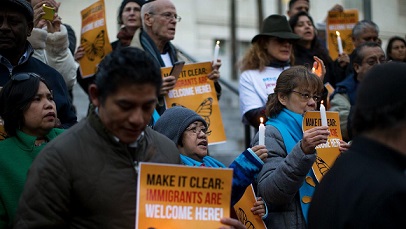
Secession as a dissent strategy has not been deployed successfully since 1861, when the dissension over slavery was so polarizing that there was no hope for peaceful reconciliation.

The most significant and notable events related to secession of states, and the initiation of the American Civil War occurred between November 6, 1860 and April 15, 1861. On November 6, 1860, Abraham Lincoln wins the 1860 presidential election to become the 16th President on a platform that includes the prohibition of slavery in new states and territories.[233] Lincoln won all of the electoral votes in all of the free states (except in New Jersey where he won 4 votes and Stephen A. Douglas won 3). By the time Lincoln was inaugurated on March 4, 1861, 7 southern states had already seceded and the President of the Confederate States of America was already inaugurated. – Sourced from Wikipedia.

Can secession be used again to protest the mandates of the majority – California -vs- the full United States. If this is earnestly pursued in California, it will definitely get the attention of the rest of the country and also the world. (If constituted a separate country, California would be the 6th largest economy in the world – by GDP, just ahead of France).

All in all, it is apparent that the 45th President, Donald Trump, has to preside over a divided nation. The 16th President did not want a division in his day, so he  bargained, cajoled and proposed compromises to his opposition. Trump may have to ‘take a page out of that book’ from Lincoln.

This is perhaps what California is hoping for with the secession talk-action! See the VIDEO here debating the viability of this CalExit move:

VIDEO – Can California Actually Secede From The U.S.?https://youtu.be/gBWbfudLwtE

Published on Nov 18, 2016 – With the election of Donald Trump, calls for California to secede have grown strong. So how realistic is a Calexit?

Learn More:
CNN: What history says about ‘Calexit’
http://www.cnn.com/2016/11/11/opinion…

Yes California: The 2019 #Calexit Independence Referendum
http://www.yescalifornia.org/

New York Times: California Today: Secessionist Groups Seize the Moment
http://www.nytimes.com/2016/11/10/us/…

This is an American drama … worth watching in the next days, weeks, months and years. But reforming or transforming California or America is out of scope for the movement behind the book Go Lean…Caribbean; our focus is the Caribbean only.

The Go Lean book serves as a roadmap for the introduction and implementation of the Caribbean Union Trade Federation (CU), a technocratic federal government to administer and optimize the economic, security, and governing engines of the 30 Caribbean member-states. In fact the prime directives of the roadmap is identified with the following 3 statements:

  • Optimization of the economic engines in order to grow the regional economy to $800 Billion & create 2.2 million new jobs.
  • Establishment of a security apparatus to protect the resultant economic engines.
  • Improve Caribbean governance to support these engines.

The book asserts that many of the Caribbean member-states are dysfunctional and as a result many citizens have fled their homelands – this is a secession of sorts. Consider Puerto Rico, the island’s population as of 2010 was 3,725,789, while the Diaspora population across the US totaled 4,623,716. That an entire nation in absentia.

In general, the Caribbean population is 42 million, with a large Diaspora (estimated up to 25 million); many who have pledged not to return (for permanent residency) until their homeland breaks from the legacy of ineffectual governing systems, failing economic engines and inadequate security provisions.

These failing member-states is the focus of the Go Lean book, but there is mention of one city, Freeport/Lucaya, the 2nd City in the Bahamas. This town is the epitome of a dysfunctional community . They can benefit from a parallel secession strategy as that of California in the foregoing. This was the recommendation to Freeport in a previous blog-commentary, to consider a public referendum to weigh different secession options from the national government in Nassau. Freeport needs more autonomy for any chance of success.

The Go Lean recommendation is the secession option of incorporating a municipal city – with an autonomous parliament – and then become a Self-Governing Entity (SGE) of the CU.

By petitioning for autonomy, California in the US and Freeport in the Bahamas gets more audience for its grievances.

This is how a minority group can get a bigger-better addressing of issues in a country, “leave”, threaten to leave or negotiate to avert leaving. Sometimes, leaving involves secession.

This was also the experience for Scotland in the United Kingdom, as related in a previous blog-commentary.

There are a lot of lessons – from the worldwide struggle – to reform and transform communities. The underlying spirit behind a secession movement should be to make life better for a minority group who do not have the votes to effect change through the election process. This is one way to “appoint new guards” for governance. This was specified in the opening Declaration of Interdependence at the outset of the Go Lean book (Page 12):

xi. Whereas all men are entitled to the benefits of good governance in a free society, “new guards” must be enacted to dissuade the emergence of incompetence, corruption, nepotism and cronyism at the peril of the people’s best interest. The Federation must guarantee the executions of a social contract between government and the governed.

xxxiii. Whereas lessons can be learned and applied from the study of the recent history of other societies, the Federation must formalize statutes and organizational dimensions to avoid the pitfalls of [failing] communities … On the other hand, the Federation must also implement the good examples learned from [successful] developments/communities …

Thank you for the lesson California … and Scotland.

The Go Lean roadmap posits that the challenges in the US may yield a lot more lessons for our Caribbean region. We will be watching. We will “observe and report” on their strengths and weaknesses. Then apply the models effectively here at home. This is the quest of the Go Lean roadmap: to make our Caribbean homeland a better place to live, work and play. 🙂
Share this post:
, , ,

Waging a Successful War on ‘Terrorism’

Go Lean Commentary

“The first casualty when war comes is truth” – US Senator Hiram Warren Johnson (1918).

In the United States, the War on ‘Terrorism’ was declared after the World Trade Center Attacks in September 2001. The war is still waging … some 16 years later. This is the third Commander-in-Chief (President) to lead the American effort; (George W. Bush, Barack Obama and Donald Trump). Now, the lines are starting to blur in terms of who are the enemies and who are the allies.

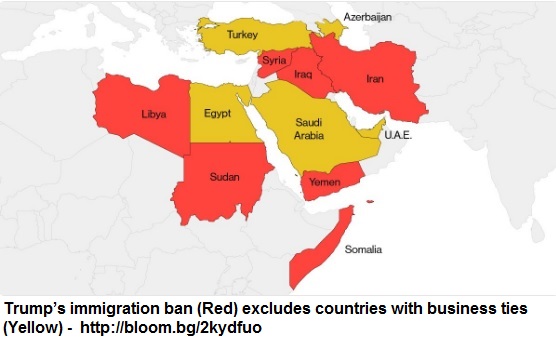
During the first week of the new Trump administration, the new President issued an Executive Order – fulfilling a campaign promise – banning all immigrants from certain Muslim-majority countries. This is purportedly in conjunction with the ongoing War on ‘Terror’. The problem is that the cited countries have not been the source of the terrorist activities that have attacked the US. The targeting seem arbitrary. We must consider the truth; see the news article and photo/map of this story here:

Title: These Countries with Business Links to Trump Aren’t Part of His Immigration Ban
By: Joseph Hincks

CU Blog - War on 'Terrorism' - Photo 1

A little over a year ago, then-Republican presidential candidate Donald Trump called for a “total and complete shutdown of Muslims entering the United States,” until the country’s leadership could “figure out what is going on.”

Along the campaign trail, he modified this blanket ban to a suspension of “immigration from terror-prone regions, where vetting cannot safely occur,” which he promised to enact during his first 100 days in office.

And now, a week into Trump’s presidency, he has tried to make good on that promise—or, at least, partly so. A draft proposal of an executive order obtained by Bloomberg News reportedly shows that Trump is poised to suspend all entry to the U.S. from seven Muslim-majority countries.

Notably missing from the blacklist, however, are several Muslim-majority countries where Trump has business dealings, according to Bloomberg.

The news organization has put together a map of the proposed suspensions, with the Muslim-majority countries where Trump has business interests—Egypt, Saudi Arabia, Turkey, and Azerbaijan—rendered in yellow.

While Muslim-majority countries such as Oman, Qatar, Kuwait, and others are not included on the list, the omission of Turkey and Egypt may be argued as being seen at odds with Trump’s definition. Both Turkey and Egypt endured high-profile terror attacks in 2016.

The President has positions in two companies that may be related to business in Egypt, and has previously praised the country’s autocratic leader, Abdel Fattah al-Sisi. In Turkey, Trump has a licensing deal to use his name on two luxury towers in Istanbul.

Source: Fortune Magazine Online Site; posted January 27, 2017; retrieved January 29, 2017 from: http://fortune.com/2017/01/27/donald-trump-muslim-immigration-ban-conflict/

Such a bold move – based on mis-truths – elicits response, feedback and uproar from opposition and pundits alike. In one such salvo on Saturday January 28th, a Security Analyst (with TV News Network MSNBC), Malcolm Nance, identified that terrorists are sourced in many countries around the world, not just the banned 7 and including places like the Caribbean.

Wait, what?!?! Such a scandalous accusation!

This brings to mind a previous blog-commentary by the promoters of the book Go Lean … Caribbean, describing the reality of the terrorism-threat in the Caribbean:

ISIS reaches the Caribbean Region

The Caribbean member-states are all atwitter about such associations. The region’s governments asserts that they are partners in the ‘War on Terror’ and not accessories to any Bad Actors. Consider the formal response from the Bahamas in the Appendix A below.

But truth be told, the US – and other advanced democracy countries – are very alarmed with their Caribbean partners; we have so many societal defects that exacerbate the global attempts to mitigate terrorism. Consider this list of security-based societal defects:

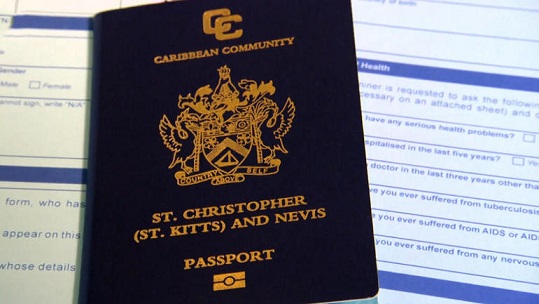
1.  Indiscriminant Citizenship By Investment Program – see the CBS 60 Minutes story about Passports for Sale even to Terror Suspects featured in this previous blog. Can terrorists hide their identity with a passport from a Caribbean member-state? Can we do better going forward?CU Blog - War on Rent - Photo 3
CU Blog - War on 'Terrorism' - Photo 22.  US PATRIOT Act – Managing ‘the Need and the Greed’ with this law. The measure allowed US authorities to have purview on foreign bank accounts in cooperative countries. This is where the Caribbean member-states were given the opportunity to demonstrate that they were willing to mitigate terrorism. Cooperation with these measures – see Appendix B below – jeopardized the Offshore Banking industry in the region. Can terrorists use our “banking in the shadows” to facilitate their malice? The historicity of the Offshore Banking Regulatory changes were detailed in the Go Lean book (Pages 321 – 326). Consider this sample from Page 321:

“In 2001 the development of standards in the fight against terrorism financing was added to the mission of the FATF [(Financial Action Task Force … on Money Laundering)]. In October 2001 the FATF issued the Eight Special Recommendations to deal with the issue of terrorism financing. The continued evolution of money laundering techniques led the FATF to revise the FATF standards comprehensively in June 2003. In October 2004 the FATF published a Ninth Special Recommendations, further strengthening the agreed international standards for combating money laundering and terrorism financing”.

3.  Aversion to Digital Dragnets – The cutting edge technologies to capture meta-data or actual cell phone contents have been frowned on in the Caribbean; in a 2011 WikiLeaks dissemination, whistleblower Edward Snowden revealed that the Bahamas cooperates with US official and records all cell phone calls. This disclosure was assailed as an Abuse of Power. But we must admit, this is an abuse of American power on the Caribbean homeland. Issues abound that need to be addressed and settled. The societal defect is that we are expecting others (the US in this case) to take the lead for our own security. Can we better prepare our own security apparatus for our own security needs? See VIDEO here relating the Privacy Concerns of dragnets.
VIDEO – USA Today: Digital Dragnet – Police Scoop Up Cell Phone Data – https://www.occupycorporatism.com/digital-dragnet-dhs-police-stingray-trackers/

Posted December 9, 2013 – Systems like the “Stingray” allow law enforcement entities to “tap into cellphone data in real time . . . capturing information about thousands of cellphone users at a time, whether they are targets of an investigation or not”.
4.  Monitoring for threats (Weapons of Mass Destruction) – like Nuclear weapons. In the Caribbean, the “Sum of our Greatest Fear” is a terrorist detonating a dirty (nuclear) bomb in an unsecured island community. This is not just something we can complain about, no, we must prepare. There is an international accord that affords a solution, through the US. This is addressed in the discussion of the NEST program (Nuclear Emergency Support Team) in Appendix C below. We can facilitate our own arrangement, with US cooperation. We can mount sensors and monitoring equipment; we can grant access and enable the NEST inspectors in our domain.
CU Blog - War on 'Terrorism' - Photo 3

How we receive, perceive and retrieve security mitigations indicates the impact of our societal defects. Without firing one shot, the Caribbean is able to help or hurt the War Against ‘Terrorism’ with our societal defects. This is commentary 4 of 4 from the movement behind the Go Lean book on the subject of Caribbean societal defects. So how do we move our communities from the deficient-defective status quo to our targeted destination: “a better (safer) place to live, work and play”? By waging war on our defects. All of these commentaries detail that effort, for the following defects:

  1. Waging a Successful War on Orthodoxy
  2. Waging a Successful War on Stupidity
  3. Waging a Successful War on Rent
  4. Waging a Successful War on ‘Terrorism’

These commentaries draw reference to the Go Lean book, as it details the quest to reform and transform the Caribbean; it features a how-to guide and roadmap for elevating the region’s societal engines for (1.) economics, (2.) security and (3.) governance. Strategies, tactics and implementations for the War Against Terrorism have relevance for all these three spheres of society.

The book Go Lean … Caribbean serves as a roadmap for the introduction and implementation of the Caribbean Union Trade Federation (CU) to elevate the region’s societal engines of economics, security and governance. With a brand name like Trade Federation, obviously the primary focus is on economics, but the book asserts (Page 23) that peace, security and public safety must be tantamount to economic prosperity; that bad things will happen to good people and so the community needs to be prepared to contend with the risks that can imperil the homeland. The Go Lean book therefore serves as a roadmap for full Caribbean integration, with the motivation for Greater Good. In all, the Go Lean roadmap has these 3 prime directives:

  • Optimization of the economic engines in order to grow the regional economy and create new jobs.
  • Establishment of a homeland security apparatus to ensure public safety and to protect the resultant economic engines of the Caribbean region.
  • Improvement of Caribbean governance to support these engines.

The priority on homeland security was pronounced early in the Go Lean book with the opening Declaration of Interdependence (Page 12) that claims:

x. Whereas we are surrounded and allied to nations of larger proportions in land mass, populations, and treasuries, elements in their societies may have ill-intent in their pursuits, at the expense of the safety and security of our citizens. We must therefore appoint “new guards” to ensure our public safety and threats against our society, both domestic and foreign. The Federation must employ the latest advances and best practices … to assuage continuous threats against public safety.

xi. Whereas all men are entitled to the benefits of good governance in a free society, “new guards” must be enacted to dissuade the emergence of incompetence, corruption, nepotism and cronyism at the peril of the people’s best interest. The Federation must guarantee the executions of a social contract between government and the governed.

xii. Whereas the legacy in recent times in individual states may be that of ineffectual governance with no redress to higher authority, the accedence of this Federation will ensure accountability and escalation of the human and civil rights of the people for good governance, justice assurances, due process and the rule of law. As such, any threats of a “failed state” status for any member state must enact emergency measures on behalf of the Federation to protect the human, civil and property rights of the citizens, residents, allies, trading partners, and visitors of the affected member state and the Federation as a whole.

xvi. Whereas security of our homeland is inextricably linked to prosperity of the homeland, the economic and security interest of the region needs to be aligned under the same governance. Since economic crimes, including … forms of terrorism, can imperil the functioning of the wheels of commerce for all the citizenry, the accedence of this Federation must equip the security apparatus with the tools and techniques for predictive and proactive interdictions.

The Caribbean appointing these “new guards” will include many strategies, tactics and implementations considered “best-practices” in the War Against Terror.

The CU would be established by the sovereign powers of the 30 Caribbean member-states to empower the region with economic, security and governing tools and techniques. This includes a Security / Defense Pact (Armed Forces) with a fully-empowered Naval Force and Expeditionary Marine (ground) Forces. The Security Pact is about action, not attitude; but the right societal attitude (weeding out societal defects) is important, critical even.

Societal defects are destructive and self-defeating for the interior of our communities. But in the case of security gaps, far-away communities can be imperiled as well. The War on Terrorism is fought by many stakeholders on many different ‘battlefields’.  Consider airport screening; once every passenger has been screened for weapons and explosives, the plane is considered “sanitized” and can then enter any airspace with a presumed label of “safe-and-secured”. Poor security executions in the Caribbean can therefore impact the public safety of far-away places. So our defects can result in bad cause-and-effect for other (innocent) people.

This is the attitude – community ethos – that we must adopt, that our battles in the War Against Terror can help/hurt the rest of the world. “Community Ethos” is defined here as:

“… the fundamental character or spirit of a culture; the underlying sentiment that informs the beliefs, customs, or practices of a group or society; dominant assumptions of a people or period practices of a group or society; dominant assumptions of a people or period”.

The Go Lean book details the series of community ethos, strategies, tactics, implementations and advocacies to wage a successful ‘War on Terrorism’; this includes proactive and reactive public safety/security measures in the Caribbean region:

Community Ethos – Economic Systems Influence Individual Choices Page 21
Community Ethos – Consequences of Choices Lie in Future Page 21
Community Ethos – Privacy –vs- Public Protection Page 23
Community Ethos – Intelligence Gathering Page 23
Community Ethos – Whistleblower Protection Page 23
Community Ethos – “Crap” Happens Page 23
Community Ethos – Cooperatives Page 25
Community Ethos – Ways to Manage Reconciliations Page 34
Community Ethos – Ways to Improve Sharing Page 35
Community Ethos – Ways to Promote Happiness Page 36
Community Ethos – Ways to Impact the Greater Good Page 37
Strategy – Vision – Confederating a non-sovereign permanent union Page 45
Tactical – Fostering a Technocracy Page 64
Tactical – Separation of Powers – Coast Guard & Naval Authorities Page 75
Tactical – Separation of Powers – Ground Militia Forces Page 75
Tactical – Separation of Powers – Emergency Management Agency Page 76
Tactical – Separation of Powers – CariPol: Marshals & Investigations Page 75
Implementation – Ways to Pay for Change Page 101
Implementation – Start-up Foreign Policy Initiatives Page 102
Implementation – Start-up Security Initiatives Page 103
Implementation – Ways to Foster International Aid Page 115
Planning – 10 Big Ideas – #3: Consolidated Homeland Security Pact Page 130
Planning – Ways to Make the Caribbean Better Page 131
Planning – Ways to Improve Failed-State Indices – Escalation Role Page 134
Planning – Lessons from the American West – Needed Law & Order Page 142
Planning – Lessons from Egypt – Law & Order for Tourism Page 143
Advocacy – Ways to Grow the Economy – Quick Disaster Recovery Page 151
Advocacy – Ways to Improve Governance Page 168
Advocacy – Ways to Better Manage the Social Contract Page 170
Advocacy – Ways to Impact Justice – Policing/Supporting the Police Page 177
Advocacy – Ways to Reduce Crime – Regional Security Intelligence Page 178
Advocacy – Ways to Improve Homeland Security Page 180
Advocacy – Ways to Mitigate Terrorism Page 181
Advocacy – Ways to Improve Intelligence Gathering & Analysis Page 182
Advocacy – Reforms for Banking Regulations – Offshore Banking Reforms Page 199
Advocacy – Ways to Impact Wall Street – Downplay Lawless Impressions Page 200
Advocacy – Ways to Impact Main Street Page 201
Advocacy – Ways to Protect Human Rights – Watchful World Page 220
Appendix ZD – Offshore Tax & Financial Services Industry Developments Page 321
Appendix ZE – Offshore Tax & Financial Services Industry – Bahamas Example Page 322

Other subjects related to security and governing empowerments for the region’s defense have been blogged in other Go Lean…Caribbean commentaries, as sampled here:

https://goleancaribbean.com/blog/?p=9974 Lessons Learned from Pearl Harbor
https://goleancaribbean.com/blog/?p=9072 Securing the Homeland – On the Ground
https://goleancaribbean.com/blog/?p=9070 Securing the Homeland – From the Seas
https://goleancaribbean.com/blog/?p=9068 Securing the Homeland – From the Air
https://goleancaribbean.com/blog/?p=7119 Security Role Model for the Caribbean: African Standby Force
https://goleancaribbean.com/blog/?p=6720 A Lesson in History – During the Civil War: Fighting for Our Own Cause
https://goleancaribbean.com/blog/?p=6103 Sum of All Fears – ‘On Guard’ Against Deadly Threats
https://goleancaribbean.com/blog/?p=5183 A Lesson in History – Cinco De Mayo and Mexico’s Security Lapses
https://goleancaribbean.com/blog/?p=5002 Managing a ‘Clear and Present Danger’
https://goleancaribbean.com/blog/?p=4809 Americans arrest 2 would-be terrorists – a Clear and Present Danger
https://goleancaribbean.com/blog/?p=4360 Dreading the ‘Caribbean  Basin Security Initiative’
https://goleancaribbean.com/blog/?p=3881 Intelligence Agencies to Up Cyber Security Cooperation
https://goleancaribbean.com/blog/?p=1965 America’s Navy – 100 Percent – Model for Caribbean
https://goleancaribbean.com/blog/?p=1554 Status of Forces Agreement = Security Pact
https://goleancaribbean.com/blog/?p=1076 Trinidad Muslims travel to Venezuela for Jihadist training
https://goleancaribbean.com/blog/?p=809 Muslim officials condemn abductions of Nigerian girls
https://goleancaribbean.com/blog/?p=535 Remembering and learning from Boston
https://goleancaribbean.com/blog/?p=273 10 Things We Want from the US – #4: Pax Americana

An effort to provide better security solutions in the Caribbean should be welcomed here.

The new Caribbean must foster good security habits … and ‘War against Bad Ones’ – societal defects. This is how to secure our homeland: monitor for threats, gather intelligence, investigate incidences, police communities, arm a defense apparatus and prepare for the worst.

This level of response is new … for our region; we normally sit back and let someone else do the heavy-lifting for security. But it is time now to grow up and secure our own communities and our economic engines.

All Caribbean stakeholders are therefore urged to lean-in to this roadmap, to this conceivable, believable and achievable plan to make the Caribbean a better place to live, work and play. 🙂

Download the book Go Lean … Caribbean – now!

———–

Appendix A – Statement By The Bahamas Ministry of Foreign Affairs

On Reported ‘Terrorism Threat From The Bahamas’

28 January 2017

For Immediate Release

Today on MSNBC Cable News, on a show hosted by Joy-Ann Reid, a guest Malcolm Nance, a reported expert in security and terrorism, made the following statement:

” We [ the United States] have not banned terrorists from Brazil. ISIS has dozens of members from Brazil or Trinidad or The Bahamas who have more terrorists members than any of those other countries.”

In today’s atmosphere, the video clip is being spread around at a clipped pace.

Upon hearing the report, the Minister of Foreign Affairs Fred Mitchell spoke with the Prime Minister, the National Security Minister, the Head of SIB in the Royal Bahamas Police Force. all of whom are responsible for the country’s national security and they have no knowledge of any such terrorists or group of terrorists or any individual terrorist that is related to ISIS or any other terrorist organization in The Bahamas.

In speaking with ZNS TV news this evening, the Minister said the report is rubbish.

He indicated that the U S Mission in the United States has been asked to reach out to US counterparts, to MSNBC and the Mr. Nance himself to find out what the source of the allegation is. The Mission has been asked to ask for a retraction forthwith.

Source: Retrieved January 29, 2017 from: http://www.thebahamasweekly.com/publish/bis-news-updates/Bahamas_Gov_t_responds_to_MSNBC_regarding_reported_terrorism_threat_from_The_Bahamas52287.shtml

———–

Appendix B – USA Patriot Act

The USA PATRIOT Act is an Act of Congress that was signed into law by President George W. Bush on October 26, 2001.[1] With its ten-letter abbreviation (USA PATRIOT) expanded, the full title is “Uniting and Strengthening America by Providing Appropriate Tools Required to Intercept and Obstruct Terrorism Act of 2001”.[2]

On May 26, 2011, President Barack Obama signed the PATRIOT Sunsets Extension Act of 2011, a four-year extension of three key provisions in the USA PATRIOT Act:[3] roving wiretapssearches of business records, and conducting surveillance of “lone wolves”—individuals suspected of terrorist-related activities not linked to terrorist groups.[4]

Following a lack of Congressional approval, parts of the Patriot Act expired on June 1, 2015.[5] With the passage of the USA Freedom Act on June 2, 2015, the expired parts were restored and renewed through 2019.[6] However, Section 215 of the law was amended to stop the National Security Agency (NSA) from continuing its mass phone data collection program.[6] Instead, phone companies will retain the data and the NSA can obtain information about targeted individuals with permission from a federal court.[6]

From broad concern felt among Americans from both the September 11 attacks and the 2001 anthrax attacks, Congress rushed to pass legislation to strengthen security controls.

Acts amended Electronic Communications Privacy Act
Computer Fraud and Abuse Act
Foreign Intelligence Surveillance Act
Family Educational Rights and Privacy Act
Money Laundering Control Act
Bank Secrecy Act
Right to Financial Privacy Act
Fair Credit Reporting Act
Immigration and Nationality Act of 1952
Victims of Crime Act of 1984
Telemarketing and Consumer Fraud and Abuse Prevention Act

Title III: Anti-money-laundering to prevent terrorism

Title III of the Act, titled “International Money Laundering Abatement and Financial Anti-Terrorism Act of 2001,” is intended to facilitate the prevention, detection and prosecution of international money laundering and the financing of terrorism. It primarily amends portions of the Money Laundering Control Act of 1986 (MLCA) and the Bank Secrecy Act of 1970 (BSA). It was divided into three subtitles, with the first dealing primarily with strengthening banking rules against money laundering, especially on the international stage. The second attempts to improve communication between law enforcement agencies and financial institutions, as well as expanding record keeping and reporting requirements. The third subtitle deals with currency smuggling and counterfeiting, including quadrupling the maximum penalty for counterfeiting foreign currency.

Restrictions were placed on accounts and foreign banks. It prohibited shell banks that are not an affiliate of a bank that has a physical presence in the U.S. or that are not subject to supervision by a banking authority in a non-U.S. country. It also prohibits or restricts the use of certain accounts held at financial institutions.[47] Financial institutions must now undertake steps to identify the owners of any privately owned bank outside the U.S. who have a correspondent account with them, along with the interests of each of the owners in the bank. It is expected that additional scrutiny will be applied by the U.S. institution to such banks to make sure they are not engaging in money laundering. Banks must identify all the nominal and beneficial owners of any private bank account opened and maintained in the U.S. by non-U.S. citizens. There is also an expectation that they must undertake enhanced scrutiny of the account if it is owned by, or is being maintained on behalf of, any senior political figure where there is reasonable suspicion of corruption.[48]Any deposits made from within the U.S. into foreign banks are now deemed to have been deposited into any interbank account the foreign bank may have in the U.S. Thus any restraining order, seizure warrant or arrest warrant may be made against the funds in the interbank account held at a U.S. financial institution, up to the amount deposited in the account at the foreign bank.[49]

Source: Retrieved January 29, 2017 from: https://en.wikipedia.org/wiki/Patriot_Act

———–

Appendix C – Nuclear Emergency Support Team

The Nuclear Emergency Support Team (NEST) (formerly known as the Nuclear Emergency Search Team) is a team of scientists, technicians, and engineers operating under the United States Department of Energy‘s National Nuclear Security Administration (NNSA). Their task is to be “prepared to respond immediately to any type of radiological accident or incident anywhere in the world”.[1]

History

Concerns over scenarios involving nuclear accidents or incidents on American soil are not recent. As early as the 1960s, officials were concerned that a nuclear weapon might be smuggled into the country, or that an airplane carrying a nuclear weapon might crash and contaminate surrounding areas.[2] In late 1974, President Gerald Ford was warned that the FBI received a communication from an extortionist wanting $200,000 (equivalent to $971,000 in 2016) after claiming that a nuclear weapon had been placed somewhere in Boston. A team of experts rushed in from the United States Atomic Energy Commission but their radiation detection gear arrived at a different airport. Federal officials then rented a fleet of vans to carry concealed radiation detectors around the city but forgot to bring the tools they needed to install the equipment. The incident was later found to be a hoax. However, the government’s response made clear the need for an agency capable of effectively responding to such threats in the future. Later that year, President Ford created the Nuclear Emergency Search Team (NEST), which under the Atomic Energy Act is tasked with investigating the “illegal use of nuclear materials within the United States, including terrorist threats involving the use of special nuclear materials”.[1]

One of its first responses was in Spokane, Washington on November 23, 1976. An unknown group called the “Days of Omega” had mailed an extortion threat claiming they would explode radioactive containers of water all over the city unless paid $500,000 (equivalent to $2,104,000 in 2016). Presumably, the radioactive containers had been stolen from the Hanford Site, less than 150 miles (240 km) to the southwest. Immediately, NEST flew in a support aircraft from Las Vegas and began searching for non-natural radiation, but found nothing. No one ever responded, despite the elaborate instructions given, or made any attempt to claim the (fake) money, which was kept under surveillance. Within days, the incident was deemed a hoax, though the case was never solved. To avoid panic, the public was not notified until a few years later.[3][4]

Today

According to the Bulletin of the Atomic Scientists, NEST has the ability to deploy as many as 600 people to the scene of a radiological incident, though deployments do not usually exceed 45 people.[5] NEST has a variety of equipment (weighing up to 150 tons) and has the support of a small fleet of aircraft which includes four helicopters and three airplanes, all outfitted with detection equipment.

When an airborne response to an incident is underway, the Federal Aviation Administration grants NEST flights a higher control priority within the United States National Airspace System, designated with the callsign “FLYNET”.

Since 1975, NEST has been warned of 125 nuclear terror threats and has responded to 30. All have been false alarms.

Source: Retrieved January 29, 2017 from: https://en.wikipedia.org/wiki/Nuclear_Emergency_Support_Team


Share this post:
, , ,
[Top]

Waging a Successful War on Rent

Go Lean Commentary

‘Rent’ is a 4-letter word …

… in the field of Economics.

This is not referring to the positive action of paying for the monthly expense for a house or an apartment, but rather the bad practice of extracting uncompensated value from others without making any contribution – getting something for nothing.

With such a simple definition, the assumption would be that ‘rent’ is unwelcomed and marginalized in society. And yet, for the Caribbean, this bad practice proliferates.

“Say it ain’t so…”

Unfortunately, there is plenty “rent-seeking” in the Caribbean. If we want to reform and transform our society – we do – there is a need to “Wage War” against this bad practice of rent-seeking.

CU Blog - War on Rent - Photo 1

The movement behind the book Go Lean … Caribbean describes rent-seeking as a societal defect … in the Caribbean, and most other societies. It is destructive and self-defeating. In a previous blog-commentary, this defective practice was fully dissected, detailed and dismissed as behavior we want to weed out of Caribbean society.

How?

First we start by recognizing that there is a problem:

“There is rent-seeking in our communities”.

Now we can arm ourselves for battle in this War Against Rent. This is an important first step in reforming and transforming our regional society. This is commentary 3 of 4 from the movement behind the Go Lean book on the subject of Caribbean societal defects. So how do we move our communities from the deficient-defective status quo to our targeted destination: “a better place to live, work and play”? By waging war on our defects. All of these commentaries detail that effort, for the following defects:

  1. Waging a Successful War on Orthodoxy
  2. Waging a Successful War on Stupidity
  3. Waging a Successful War on Rent
  4. Waging a Successful War on ‘Terrorism’

These commentaries draw reference to the Go Lean book, as it details the quest to transform the Caribbean; it features a how-to guide and roadmap for elevating the region’s societal engines for economics, security and governance. Rent-seeking can, and have, penetrated all these three spheres of society.

In the previous commentary on ‘Stupidity’, it was established that when stupid policies-practices persist in a society, it is usually because “someone is profiting” in the shadows. Rent-seeking on the other hand, tends to be “out in the open”, i.e. guaranteed gratuities at a restaurant/bar. Both stupidity and rent-seeking are therefore tied to Crony-Capitalism: the abuse of public funds for private gain.

Consider these details of rent-seeking in the economics, security and governing societal engines:

Economics
Gratuity              . 18 percent guaranteed
Sharing Economy AirBnB and Uber examples
Security
Bribery/Graff   . An obvious crime
Traffic Cameras Electronic surveillance used to auto-generate traffic tickets
Governance
Citizenship For Sale $100,000 fees for … doing nothing – See VIDEO in the Appendix.
Disclosures           . Follow the money‘; many politicians enter public service with modest incomes, but become wealthy while in office, despite only moderate government paychecks.
Fuel Taxes             . Dissuade Green Alternatives and e-Cars. “Invention, the Mother of Necessity” is discouraged because the government wants it’s guaranteed revenues.

The movement behind the Go Lean book seeks to reform and transform the economic engines of the Caribbean by being technocratic in applying best practices from the field of Economics. Rent-seeking is distinguished in economic theory from profit-seeking, in which entities seek to extract value by engaging in mutually beneficial transactions.[6] Profit-seeking in this sense is the creation of wealth, while rent-seeking is the use of social institutions such as the power of government to redistribute wealth among different groups without creating new wealth.[7] For the Caribbean elevation quest, we see the defects; we see the destructive rent-seeking practices; and we now know how to supplant them. This intent is declared at the outset of the book with this Declaration of Interdependence (Page 10) for the region to work in unison to remediate the broken systems of commerce:

Preamble: As the colonial history of our region was initiated to create economic expansion opportunities for our previous imperial masters, the structures of government instituted in their wake have not fostered the best systems for prosperity of the indigenous people. Despite this past, we thrust our energies only to the future, in adapting the best practices and successes of the societies of these previous imperial masters and recognizing the positive spirit of their intent and vow to learn from their past accomplishments and mistakes so as to optimize the opportunities for our own citizenry to create a more perfect bond of union.

So how exactly do we supplant rent-seeking practices in the Caribbean? Foster best practices for economics and governance.

There is an implied Social Contract in every expression of governance everywhere, where “citizens surrender some of their freedoms and submit to the authority of the State in exchange for protection of remaining rights” (Page 170). In modern societies, there is a role for governments and a role for commercial entities. This was the assertion of the father of modern economists, Adam Smith, that the “division of functions” between governments and commerce should be carefully regulated to keep free enterprise operating “freely”; governments should limit their deliveries in commerce. The Go Lean book relates this (Page 67) as follows:

CU Blog - War on Rent - Photo 2Adam Smith, the 18th century Scottish political economics pioneer, is best known for his classic work: An Inquiry into the Nature and Causes of the Wealth of Nations (1776), usually abbreviated as The Wealth of Nations. This book is considered the first modern work of economics, and he is thusly cited as the “father of modern economics”, even today, and among the most influential thinkers in the field of economics. Through reflection over the economics at the beginning of the Industrial Revolution the [Wealth of Nations] book touches upon broad topics as the division of labor, productivity and free markets.

Smith attacked most forms of government interference in the economic process, including tariffs, arguing that these create inefficiency and high prices in the long run. It is believed that this theory, laissez-faire economic philosophy, influenced government legislation in later years.

Smith advocated a government that was active in sectors other than the economy. He advocated public education for poor adults, a judiciary, and a standing army—institutional systems not directly profitable for private industries.

So according to a scholar in economics from 240 years ago, the cause of Caribbean rent-seeking is governmental interference and the solution is a governmental “pull back”.

This is how to wage war against ‘rent’.

Look back at the foregoing list of Caribbean rent-seeking activities; and consider here how we can mitigate:

  • How much tips/gratuity should waiters/waitresses receive when they serve tables? The experience is that they always receive more that government-mandated 18% when the service is good. The incentive to provide good service is lost when the gratuity is guaranteed by government policy.
  • In other markets, the “Sharing Economy” has spurred the economy in creative ways: 1. AirBnB has created opportunities for festivals to absorb bigger crowds than hotel capacity; 2. the presence of Uber has forced taxicabs to become more efficient with smartphone apps and have created prospects for any restaurant to now offer delivery.
  • Fuel tax dependency in the Caribbean keeps electricity costs high; the average is US$0.35/kWh, one of the highest in the world. Green Energy alternatives have been avoided, even discouraged, despite an abundance of sun and wind resources; with these mitigations, the cost for electricity can be lowered to US$0.088/kWh.
  • Traffic Light Cameras will be a new deployment in the region. When these are implemented, they must be regulated at the government level. The government should never be the service provider but rather the escalation authority. It would be rent-seeking to just sit back and collect traffic fines … uncontested. Everything at a traffic light is not always “black-and-white or red-and-green”; there are scenarios with breakdowns and pedestrians that must be accounted with allowances.
  • Passports For Sale – This is indefensible; to tarnish the Caribbean Image for “30 Pieces of Silver”, sorry, make that $100,000. See VIDEO in the Appendix below.
  • CU Blog - War on Rent - Photo 3

The Go Lean book serves as a roadmap for the introduction and implementation of the Caribbean Union Trade Federation (CU). The CU is designed to be a technocratic intergovernmental entity that shepherds the Caribbean region. The goal is to reboot and optimize the region’s economic, security and governing engines. Optimization would entail weeding out any rent-seeking practice.

As previously detailed:

“Rent-seeking can prove costly to economic growth; high rent-seeking activity makes more rent-seeking attractive because of the natural and growing returns that one sees as a result of rent-seeking. Thus organizations value rent-seeking over productivity. In this case there are very high levels of rent-seeking with very low levels of output. Rent-seeking may grow at the cost of economic growth because rent-seeking by the state can easily hurt innovation. Ultimately, public rent-seeking hurts the economy the most because innovation drives economic growth.”[19]

“Government agents may initiate rent-seeking – such agents soliciting bribes or other favors from the individuals or firms that stand to gain from having special economic privileges, which opens up the possibility of exploitation of the consumer.[20] It has been shown that rent-seeking by a bureaucracy can push up the cost of production of public goods.[21] It has also been shown that rent-seeking by tax officials may cause loss in revenue to the public [treasury].”[8]

The Go Lean/CU roadmap employs some counter-tactics; consider the “Separation-of-Powers between CU federal agencies and Caribbean member-state governments”; so the limitations of national laws in a member-state would not override the CU. The CU‘s technocratic practices would directly apply to the installation of Exclusive Economic Zones (EEZ) and Self-Governing Entities (SGE); these operate in controlled bordered territories like campuses, industrial parks, research labs and industrial plants. Lastly, there is the power of “peer pressure” to reform the member-states. When progress is made by one Caribbean state, this would incline the others to follow suit. In total, the Go Lean/CU roadmap will employ strategies, tactics and implementations to impact its prime directives; identified with the following 3 statements:

  • Optimization of the economic engines in order to grow the regional economy to $800 Billion & create 2.2 million new jobs.
  • Establishment of a security apparatus to ensure public safety assurances and protect the region’s economic engines.
  • Improvement of Caribbean governance to support these engines.

The Go Lean roadmap seeks to “Wage War against Rent” by optimizing the entire Caribbean economic eco-system with the adoption of best practices for commerce and governance. This vision is defined early in the book (Page 12) in the following pronouncements in the Declaration of Interdependence:

xi. Whereas all men are entitled to the benefits of good governance in a free society, “new guards” must be enacted to dissuade the emergence of incompetence, corruption, nepotism and cronyism at the peril of the people’s best interest. The Federation must guarantee the executions of a social contract between government and the governed.

xii. Whereas the legacy in recent times in individual states may be that of ineffectual governance with no redress to higher authority, the accedence of this Federation will ensure accountability and escalation of the human and civil rights of the people for good governance, justice assurances, due process and the rule of law. As such, any threats of a “failed state” status for any member state must enact emergency measures on behalf of the Federation to protect the human, civil and property rights of the citizens, residents, allies, trading partners, and visitors of the affected member state and the Federation as a whole.

In order to make the Caribbean a better place to live, work and play the people of the region must change their attitudes about elements of their society – elements that are in place and elements missing. This is referred to as “Community Ethos”, defined as:

“the fundamental character or spirit of a culture; the underlying sentiment that informs the beliefs, customs, or practices of a group or society; dominant assumptions of a people or period practices of a group or society; dominant assumptions of a people or period”.

Rent-seeking is one of the negative community ethos – societal defects – that must be weeded out of the Caribbean. This ethos stems from an attitude of entitlement; to get something … for almost nothing. The Caribbean was colonized originally with this type of community ethos; a previous blog/commentary related this:

Most of the property and indigenous wealth of the Caribbean region is concentrated amongst the rich, powerful and yet small elite; an oligarchy. Many times these families received their property, corporate rights and/or monopolies by Royal Charter from the European monarchs of ancient times. These charters thus lingered in legacy from one generation to another … until …

The Go Lean book presents a roadmap on how to optimize the economic engines without continuing rent-seeking practices. The book stresses key community ethos, strategies, tactics, implementations and advocacies necessary to transform and turn-around the eco-systems of Caribbean society. These points are detailed in the book as follows:

Community Ethos – Deferred Gratification Page 21
Community Ethos – Return on Investments Page 24
Community Ethos – Ways to Impact the Future Page 26
Community Ethos – Ways to Impact the Greater Good Page 37
Strategy – Vision – Confederate all 30 member-states/ 4 languages into a Single Market Page 45
Tactical – Separation-of-Powers – CU Federal Government versus Member-State Governance Page 71
Implementation – Ways to Pay for Change – Award exploratory rights in exclusive territories Page 101
Implementation – Start-up Benefits from the Exclusive Economic Zone (EEZ) Page 104
Planning – 10 Big Ideas – #3: Proactive Anti-crime Measures Page 127
Planning – Ways to Improve Trade Page 128
Advocacy – Ways to Grow the Economy – Protect Property Rights Page 151
Advocacy – Ways to Create Jobs Page 152
Advocacy – Ways to Improve Governance Page 168
Advocacy – Ways to Better Manage the Social Contract Page 170
Advocacy – Ways to Impact Main Street Page 201

In considering this economic history, the CU/Go Lean roadmap distinguishes rent-seeking from profit-seeking:

  • Profit is Good!
  • Rent is Bad!

The new Caribbean must foster good economic habits … and abandon bad ones. This is how to grow the economy: create jobs; create businesses; retain people; foster new opportunities, learn from past mistakes and accomplishments.

This is new …

All Caribbean stakeholders are urged to lean-in to this roadmap/plan for change … and empowerment. This plan is conceivable, believable and achievable. 🙂

Download the book Go Lean … Caribbean – now!

———–

Appendix VIDEO – CBS 60 Minutes: Passports For Sale – http://www.cbsnews.com/videos/passports-for-sale/

Posted January 1, 2017 – Steve Kroft reports on how cash-starved countries [in the Caribbean] offer citizenship for a price, creating ways to ease travel for foreigners, including those running from the law.

Share this post:
, ,
[Top]

Farewell to Obama and to ‘Wet Foot/Dry Foot’

Go Lean Commentary

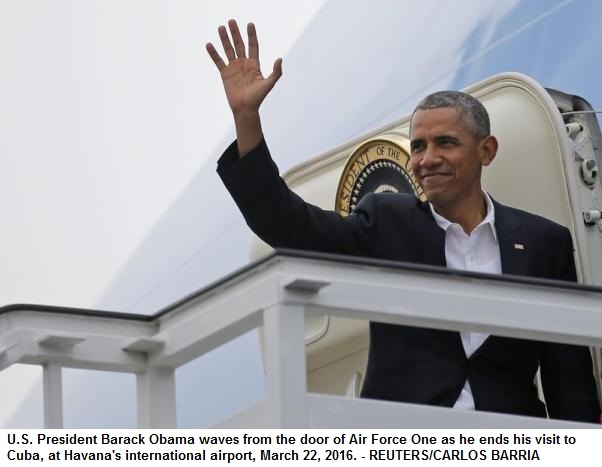
This is a Red Letter Day in the affairs of the United States of America: it is the inauguration of the 45th President, Donald J. Trump. Out with the old, in with the new. The old, Barack Obama, bid farewell to the American Halls of Power; but he bid farewell too, to one of the most egregious immigration policies in the history of civilization: ‘Wet Foot / Dry Foot’ policy for Cuban migrants.

Good  riddance to a bad policy!

Many people have died trying to flee Cuba, (Haiti too); see the “Bad Old Days” in Appendix B VIDEO.

CU Blog - Farewell to Obama and to 'Wet Foot-Dry Foot' - Photo 1Obama disbanded this executive policy – instituted by the 42nd President Bill Clinton – as one of his final acts, before his term ended. Yippee, Mr. Obama. This ‘Wet Foot / Dry Foot’ was indefensible. It portrayed the impression that the American homeland was the panacea of Caribbean (and/or Cuban) ills, and if one was lucky enough to put their ‘Dry Foot’ down on American soil, they were blessed; if their ‘Wet Foot’ never touched American soil, then they’d be cursed to a substandard Caribbean existence. Plus, with the Cuban exclusivity, this policy put a wedge among Caribbean people in general: Yes to Cubans; no to Haitians, Dominicans, Jamaican or any other regional citizens.

Now, all of the Caribbean can be treated the same and as one, by the American legal-governmental institutions.

We are the same!

We could be one!

Caribbean leaders must do the heavy-lifting to reform and transform the Caribbean member-states to fix our eco-systems, to make our homeland a better place to live, win and play. This is the purpose of the book Go Lean…Caribbean, to serve as a roadmap for elevating Caribbean society, for all 30 member-states (Cuba et al). The book does not ignore the subject of immigration and refugees. In fact the roadmap provides perhaps the ultimate resolution to this perplexing problem, that of a regional entity providing a regional solution.

We must give Caribbean citizens every reason to want to stay, rather than the status quo, where they are willing to risk life-and-limb (for themselves and their children) to get out and get to the US. This is the sad-and-bad reality that is depicted in this news article here:

Title: Cubans amass at Mexico-Texas border after ‘wet foot/dry foot’ change
By: Rick Jervis, USA TODAY Daily Newspaper

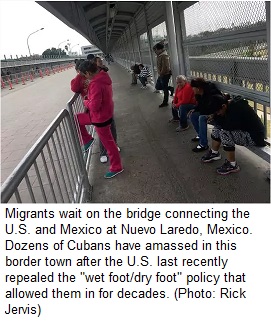
CU Blog - Farewell to Obama and to 'Wet Foot-Dry Foot' - Photo 2NUEVO LAREDO, Mexico — Joel Gonzalez was midway across the narrow pedestrian bridge connecting the U.S. and Mexico at this border crossing when U.S. border guards waved him back to Mexico.

A U.S. policy that for decades awarded Cubans like Gonzalez, 31, automatic amnesty was repealed the day before. His dream of a new life in America instantly vanished.

“You feel this weight in your chest,” he said, recalling that day last week. “You have these ideas about the future, all these thoughts in your head. To get so close and have your dream of freedom taken from you is very hard.”

Gonzalez and dozens of other Cubans have been amassing at this crossing since the Obama administration ended the so-called “wet foot/dry foot” policy on Jan. 12. The rule, created by President Clinton in 1995, allowed most Cubans who touched U.S. soil to stay in the country, while those intercepted at sea were returned to Cuba. Those who remained in the U.S. for one year were allowed to apply for legal permanent residence.

CU Blog - Farewell to Obama and to 'Wet Foot-Dry Foot' - Photo 3Cuban officials have long denounced the rule, saying it incentivizes Cubans to leave the communist island. Other critics say while the policy was put in place to help Cubans fleeing political persecution, many instead used it for economic betterment in recent years.

The new policy forces Cubans to apply for visas in their home country or face deportation if they enter illegally, just like migrants from other countries. About 20,000 U.S. visas are awarded in Cuba each year.

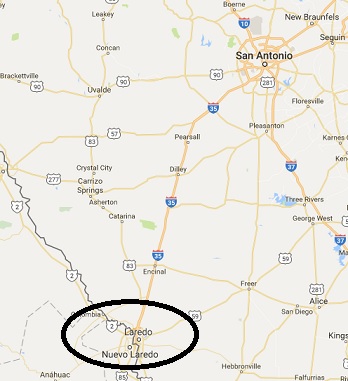
Despite the shift, Cubans continue to arrive at this border crossing, just across the Rio Grande from Laredo, Texas. Around 120 Cubans are now in this Mexican border town, according to local estimates, staying at churches or in migrant centers. Many, like Gonzalez, say they won’t leave.

“In Cuba, if you think differently from the system, you’re marked,” said Gonzalez, a systems engineer. “You don’t get jobs, you don’t get opportunity. If you’re against the system, there’s no way to survive.”

The repeal of wet foot/dry foot is the latest in a series of efforts by President Obama, beginning in late 2014, to end five decades of isolation with Cuba. President-elect Donald Trump, however, has said he may renegotiate the accords.

Sensing a change was imminent as relations warmed between Washington and Havana, thousands of Cubans rushed to enter the U.S. last year. Overall, 56,406 Cubans entered the U.S. via ports of entry in fiscal year 2016, more than double the number who arrived in 2014, according to a study by the Pew Research Center.

The change in U.S. policy will likely improve relations between the two countries and could force Cuban officials to focus on improving conditions, rather than simply allowing the disaffected to flee, said Ted Piccone, a senior fellow at the Brookings Institution who studies Cuba.

“The safety valve – of exporting unhappy Cubans who could cause trouble – just got smaller,” he said.

Some Cubans at Nuevo Laredo said they hoped Trump would reverse the repeal. But that may be wishful thinking, Piccone said, given Trump’s tough stance on illegal immigration.

Some arriving here now left the island months ago, well before the policy change. Each morning, they gather at the intersection of Avenida 15 de Julio and Avenida Vincente Guerrero, within sight of the U.S., sharing the latest news and debating the next move.

Idania Laurencio Fernandez, 44, left Cuba in mid-October for the small South American country of Guyana. From there, she traveled to Brazil, trekked through jungles, sailed up the Amazon River, traveled across nine countries in Central and South America and spent 12 days in an immigration detention center in Tapachula, Mexico, before being able to leave for Nuevo Laredo.

She arrived Jan. 13, the day after the policy was repealed. She said she planned to stay until something changes, fearing repercussions if she returned to Cuba. “We can’t go back,” Fernandez said. “I’m persona non grata in Cuba.”

Fernandez said she hopes her predicament sheds light on what she described as a worsening situation on the island, where the average worker earns $20 a month and dissension isn’t tolerated. “Obama doesn’t understand,” she said. “He let himself be fooled. The Cubans in Cuba know the reality.”

As a worker in the service industry in Varadero, one of Cuba’s most popular tourist beach destinations, Manuel Reyes, 37, said he was earning a decent living. But the island’s lack of basic rights and stagnant economic growth was suffocating, he said. He was denied visas to the U.S. and Canada and tried leaving Cuba three times on homemade rafts but was forced back each time due to mechanical failures.

Finally gaining a Mexico visa, he flew to Monterrey on Jan. 12 and arrived at the Nuevo Laredo border crossing early the next morning. Dreams of joining friends in Miami or Las Vegas came to an abrupt end when he learned of the changed policy.

Like most others gathered here, Reyes said he’s not leaving. He sleeps at a local church and prays each day for a reversal in U.S. policy.

“We’re going to stay firm. We have a lot of faith,” he said. “And there are many more Cubans coming.”

CU Blog - Farewell to Obama and to 'Wet Foot-Dry Foot' - Photo 4

Related stories:

Obama ends ‘wet foot, dry foot’ policy for Cubans

Cuban-Americans at odds over ‘wet foot, dry foot’ repeal

In final days, Obama administration signs law enforcement pact with Cuba

On 2nd anniversary, Cubans race to sign U.S. contracts to secure opening

Source: Posted Jan. 19, 2017; retrieved Jan 20, 2017 from: http://www.usatoday.com/story/news/nation/2017/01/19/cubans-texas-border-wet-foot-dry-foot/96770142/

One person can disrupt the lives of so many people … in the Caribbean.

The ‘Wet Foot / Dry Foot’ policy was initiated by Presidential Executive Order – by Clinton.

The ‘Wet Foot / Dry Foot’ policy was canceled by Presidential Executive Order – by Obama.

So the new president – Donald Trump – can readily re-institute a ‘Wet Foot / Dry Foot’ policy again.

Please, Mr. President Trump, do not do it!

We do not need to send the wrong message to people in the Caribbean that it is OK to take to the High Seas and endanger their lives, or their children lives. We also do not need to incite Smugglers and Human Traffickers – see Appendix A VIDEO – to entice Caribbean citizens to flee their homeland. The cancellation of the ‘Wet Foot / Dry Foot’ policy takes away the incentive, inducement and rationale for migrating in the first place.

Why do people want to leave their Caribbean homes?

Two factors: “Push” and “Pull”. These factors highlight reasons that people want to flee “home” and seek “refuge” in foreign countries. “Refuge” is an appropriate word; because of societal defects, many from the Caribbean must leave as refugees – think LGBTDisabilityDomestic-abuseMedically-challenged – for their life, liberty and pursuit of happiness. In addition, the lure of a more prosperous life in the US (and other destinations) drive the “pull” side of the equation, making most people emigrating economic refugees.

A key problem with this ‘Wet Foot / Dry Foot’ migration policy is that it echoes a bad and wrong message, that some Caribbean people are “Less Than“, and the rest of the people are worth even less than that.

The book Go Lean … Caribbean posits that the region should be “mad as hell and refuse” to accept the continuation of any image defying immigration policy. As a people, we must not tolerate just any standards; we must stand for something more and better. We must fight for change … with revolutionary fervor.

Another dire consequence of the ‘Wet Foot / Dry Foot’ policy is that it hardened the attitudes of other Caribbean countries in the middle of migrant source countries (like Cuba and Haiti) and their American destination. The Bahamas, in particular in the Caribbean, had been “in the way” and have thusly developed harsh attitudes and treatment of Cuban and Haitian refugees. This country have changed their constitution to tighten their immigration policy to end the automatic birthright citizenship for children of illegal immigrants; this is the provision:

The Bahamas no longer automatically grants citizenship to people born in its homeland, as was the case for all citizens born before Independence in 1973. There are now special provisos that applies when one parent is or is not a Bahamian citizen; many of these provisos are gender-biased.

Other countries that have been in the way” include Mexico and Guyana.

The Caribbean member-states are badly in need of remediation, to lower the “push and pull” factors that drive so many to risk their ‘life and limb’, and those of their children, to take flight to where “Wet Foot / Dry Foot” would matter. How can we reform and transform? While this is easier said than done, the Go Lean book and blogs posit that the effort is less to cure the Caribbean homeland than to thrive as an alien in a foreign land. So this is the quest of the Go Lean roadmap, to make the Caribbean homeland a better place to live, work and play for its 42 million residents across the 30 member-states. The Go Lean book serves as a roadmap for the introduction and implementation of the technocratic Caribbean Union Trade Federation (CU), which would apply best-practices for community empowerment. This roadmap has these 3 prime directives, proclaimed as follows:

  • Optimization of the economic engines in order to grow the regional economy to $800 Billion & create 2.2 million new jobs.
  • Establishment of a security apparatus to protect the resultant economic engines.
  • Improve Caribbean governance, with consideration for minority equalization, to support these engines.

How exactly can the CU impact Cuba and Haiti, the most troubled countries in the region and the primary sources of migrants? The book relates the strategy that was successful in the history of post-war Europe, the Marshall Plan. The Go Lean book details the Caribbean Marshall Plan (roadmap) for Cuba and Haiti, and other failing Caribbean communities.

The related subjects of rebooting European and Caribbean societal engines have been frequently blogged on by the Go Lean promoters, as sampled here:

https://goleancaribbean.com/blog/?p=9813 Fidel Castro Is Dead; Now What for Cuba?
https://goleancaribbean.com/blog/?p=9487 10 Things We Want from Europe and 10 Things We Do Not Want
https://goleancaribbean.com/blog/?p=6563 Lessons from Iceland – Model of Recovery
https://goleancaribbean.com/blog/?p=5733 Better than America? Yes, We Can!
https://goleancaribbean.com/blog/?p=3473 Haiti’s Caracol Industrial Park – a preview of a Self-Governing Entity
https://goleancaribbean.com/blog/?p=3455 Restoration of Diplomatic Relations with Cuba – Need for Re-boot Now
https://goleancaribbean.com/blog/?p=3090 Introduction to Europe – All Grown Up
https://goleancaribbean.com/blog/?p=2907 Local Miami Haitian leaders protest Bahamian ‘Bad’ immigration policy
https://goleancaribbean.com/blog/?p=2809 A Lesson in History: Economics of East Germany
https://goleancaribbean.com/blog/?p=2330 ‘Raul Castro reforms not enough’, Cuba’s bishops say
https://goleancaribbean.com/blog/?p=1531 A Lesson in History: 100 Years Ago Today – World War I
https://goleancaribbean.com/blog/?p=1433 Caribbean 70% brain drain to foreign shores
https://goleancaribbean.com/blog/?p=1014 All is not well in the sunny Caribbean
https://goleancaribbean.com/blog/?p=599 Ailing Puerto Rico open to radical economic fixes
https://goleancaribbean.com/blog/?p=273 10 Things We Want from the US and 10 Things We Do Not Want

The Go Lean book details a series of community ethos, strategies, tactics, implementations and advocacies to optimize the “push/pull” factors that send Caribbean citizens to the High Seas to flee their homeland:

Community Ethos – Economic Systems Influence Choices & Incentives Page 21
Community Ethos – Consequences of Choices Lie in the Future Page 21
Community Ethos – Anti-Bullying and Mitigation Page 23
Community Ethos – Minority Equalization Page 24
Community Ethos – Ways to Impact the Future Page 26
Community Ethos – Ways to Manage Reconciliations Page 34
Community Ethos – Ways to Impact the Greater Good Page 37
Strategy – Vision –  Integrate region into a Single Market Economy Page 45
Strategy – Agents of Change – Globalization Page 57
Tactical – Separation of Powers – Department of Homeland Security Page 75
Implementation – Ways to Foster International Aid Page 115
Planning – 10 Big Ideas … in the Caribbean Region – Haiti & Cuba Page 127
Planning – Ways to Ways to Model the EU – From Worst to First Page 130
Planning – Reasons Why the CU Will Succeed – Germany Reconciliation Model Page 132
Planning – Ways to Improve Failed-State Indices – Cuba & Haiti on the List Page 134
Planning – Lessons from East Germany – European post-war rebuilding Page 139
Planning – Lessons from the US Constitution Page 145
Planning – Lessons from Canada’s History Page 146
Advocacy – Ways to Grow the Economy Page 151
Advocacy – Ways to Create Jobs Page 152
Advocacy – Ways to Better Manage the Social Contract Page 172
Advocacy – Ways to Foster Empowering Immigration – Case Study of Indian Migrants Page 174
Advocacy – Ways to Impact Justice Page 178
Advocacy – Ways to Impact the Diaspora Page 217
Advocacy – Ways to Protect Human Rights Page 220
Advocacy – Ways to Re-boot Cuba Page 236
Advocacy – Ways to Impact the Dominican Republic Page 237
Advocacy – Ways to Re-boot Haiti Page 238
Advocacy – Ways to Re-boot Jamaica Page 239
Appendix – Puerto Rico Migrations to New York Page 303

All of the Caribbean needs to deal with our domestic issues … now! We do not need the good fortune of putting ‘Dry Foot’ on US soil. We need to just work to fix our home. This is the purpose of the Go Lean book, to show how … to minimize the push-pull factors leading to societal abandonment.

The Go Lean/CU roadmap has proposed the solutions: assembling of many regional organization and institutions to engage reboot strategies, tactics and implementations.

Now is the time for all of the Caribbean to learn the lessons from other societies. The Go Lean book posits that the Caribbean is in a serious crisis, but asserts that this crisis would be a terrible thing to waste. The people and governing institutions of Cuba, Haiti and the entire Caribbean region are hereby urged to lean-in for the empowerments described in the book Go Lean … Caribbean. The Caribbean should be the greatest address on the planet. People should be dying to get in, not dying to get out. It is time to reboot and turn-around our fortunes.

Let’s do this … right, just us, with no American interference – no ‘Wet Foot/Dry Foot’ – just Caribbean solutions.

Farewell Obama and farewell to ‘Wet Foot/Dry Foot’. 🙂

Download the book Go Lean … Caribbean – now!

—————

Appendix A VIDEO – U.S. Upgrades Cuba’s Ranking on Human Trafficking List https://youtu.be/JPkuw4ak9eM

Published on Jul 28, 2015 – The U.S. State Department government upgraded Cuba’s ranking in its Human Trafficking list. According to Washington, Cuba has made significant progress in combatting sex and human trafficking and now stands at midlevel in the annual list. teleSUR http://multimedia.telesurtv.net/v/us-…

  •  Category: News & Politics
  • License: Standard YouTube License

—————

Appendix B VIDEO – Bad Old Days: Cuban Human Traffickinghttps://youtu.be/CTwMouJKL38

Published on Oct 23, 2013 – Latest news across Belize; source: http://edition.channel5belize.com/

  • Category: News & Politics
  • License: Standard YouTube License


Share this post:
, ,
[Top]

Day of Reckoning for NINJA Loans

Go Lean Commentary

Be not deceived … whatsoever a man soweth, that shall he also reap. – King James Version – The Bible

It is time for the Day of Reckoning for one of the players in the recent housing bubble and financial crisis, referred to as the Great Recession of 2008. Industry stakeholders had been “skimming of the public coffers for mortgage guarantees and giving unwise mortgages to people who had what was considered NINJA qualification:

  • No Income
  • No Job & Assets

LB 1Such activities in the retail mortgage industry, plus bad practices in the wholesale lending, credit ratings and mortgage-back securities industries had congealed to form a “perfect storm” for disaster in the financial markets (Wall Street, et al) in the US and around the world.

Many innocent people lost fortune and faith in the American eco-system. There had to be an accounting of the “sins and sinister plots”; there had to be a Day of Reckoning. That day came for one Michigan-based (Detroit area) company, United Shore Financial Services. See the full story here:

Title: United Shore Agrees to $48M Settlement with DOJ
By: Jacob Passy

CU Blog - Day of Reckoning for NINJA Loans - Photo 1United Shore Financial Services, a Troy, Mich.-based lender, has agreed to pay $48 million to settle allegations that it violated the False Claims Act.

The Department of Justice alleged that USFS did not comply with certain origination, underwriting and quality control requirements while participating in the Federal Housing Administration’s direct endorsement lender program. Consequently, the Department of Housing and Urban Development insured hundreds of loans that UnitedShore approved that should not have been eligible for FHA coverage, subsequently taking losses due to claims on those loans.

“USFS acknowledged that it failed to comply with FHA underwriting and quality control requirements, resulting in improperly originated mortgages,” John Vaudreuil, a U.S. attorney for the Western District of Wisconsin said in a news release. “While USFS deserves credit for acknowledging and resolving its conduct, that conduct not only resulted in substantial losses of public funds, but also put Wisconsin homeowners at risk of losing their homes or ruining their credit.”

United Shore, which is both a retail lender and the parent of United Wholesale Mortgage, did not immediately respond to a request for comment.

In particular, the DOJ said that UnitedShore admitted to pressuring underwriters to approve FHA mortgages under a compensation plan that tied pay to the percentage of loans approved. United Shore also falsely certified that direct endorsement underwriters reviewed appraisal reports prior to mortgages being approved for FHA insurance; under the DEL program, the FHA does not review that lenders are complying with the agency’s requirements.

The DOJ also identified other issues with UnitedShore’s compliance practices. The lender allegedly did not provide senior management with “meaningful information” regarding quality control findings. Additionally, UnitedShore did not meet HUD’s self-reporting requirements, only self-reporting three loans to the department despite quality control reviews finding hundreds of FHA-insured loans that were materially deficient at issuance.

The alleged activities occurred between from 2006 through 2011. The DOJ also said that United Shore “made certain discretionary distributions to a shareholder in the company” after the federal government began investigating the company in January 2014.
Source: National Mortgage News – Industry Trade Journal; posted 12/28/2016; retrieved 01/18/2017 from: http://www.nationalmortgagenews.com/news/compliance-regulation/united-shore-agrees-to-48m-settlement-with-doj-1093769-1.html

This story aligns with the book Go Lean…Caribbean; it serves as a roadmap to introduce and implement the technocratic Caribbean Union Trade Federation (CU) and Caribbean Central Bank (CCB) for better stewardship of the Caribbean banking eco-system, to ensure the economic failures of the past do not re-occur in the Caribbean. The book was inspired by the events of 2008, by people engaged in the mortgage-housing-investments industries. These ones engaged in the post-mortem analysis – dissection of the crisis – of all the bad community ethos, strategies, tactics and implementations leading up to 2008 and saw the need for this Day of Reckoning.

The goal of this roadmap is to apply the lessons-learned from 2008 in the stewardship of the economic engines in the Caribbean region. It turns out that we were affected by 2008 as well; we were devastated by the elasticity in the global markets.

Welcome to the Caribbean’s Day of Reckoning!

The Caribbean economy is a parasite of the US and so when the American market “catches a cold, we sneeze”. (This is referred to as “financial contagions”). We can – we must – do better and guide our own economy away from American dependence to a regional interdependence.

We are on the way…

With the proposal for the CARICOM Single Market & Economy (CSME), a more integrated region is expected to emerge with greater linkages among the member-states of the economic union. Issues of financial contagions will now have to be a constant concern for a regional sentinel. The Go Lean roadmap calls for the deployment of the Caribbean Central Bank as that sentinel, to proactively and reactively shepherd the financial institutional processes (wholesale and retail). We do not want to “get caught with our pants down” in our region. We do not want government loan guarantees for mortgagors that have NINJA qualifiers. (That money would be better placed in more substantial investments in Caribbean people and processes). The lesson from 2008 is to follow the money and discern those who profited from this bad behavior; see the VIDEO in the Appendix below.

Mortgages with a government-guarantee stamp of approval are readily sold in the secondary markets. Bad actors are able to glean quick profits from loan origination fees and then “wash their hands” of any inherent risk from deficient payment collection. (See the VIDEO in the Appendix below). This was the direct charge against United Shore Financial Services in the forgoing article: “[funding] hundreds of FHA-insured loans that were materially deficient at issuance”.

Bad actors … profiting from existing supplies of capital!?!?

This is so familiar! The Go Lean book details (Page 23):

… history teaches that with the emergence of new economic engines, “bad actors” will also emerge thereafter to exploit the opportunities, with good, bad and evil intent. A Bible verse declares: “What has been will be again, what has been done will be done again; there is nothing new under the sun” – Ecclesiastes 1:9 New International Version.

This roadmap for Caribbean integration declares that peace, security and public safety is tantamount to economic prosperity. This is why an advocacy for the Greater Good must be championed as a community ethos. A prime precept is that it is “better to know than to not know” – this implies that privacy is secondary to security. A secondary precept is that bad things will happen to good people and so the community needs to be prepared to contend with the risks that can imperil the homeland.

The prime directive of the Go Lean/CU/CCB roadmap is to optimize economic, security and governing engines to impact the Caribbean’s Greater Good, for all stakeholders: residents, visitors, bank depositors and mortgage-holders. This need was pronounced early in the Go Lean book, in the Declaration of Interdependence – (Page 13):

xxv.  Whereas the legacy of international democracies had been imperiled due to a global financial crisis, the structure of the Federation must allow for financial stability and assurance of the Federation’s institutions. To mandate the economic vibrancy of the region, monetary and fiscal controls and policies must be incorporated as proactive and reactive measures. These measures must address threats against the financial integrity of the CU and of the member-states.

The foregoing news article shows the type of functions executed by technocratic financial regulators: monitoring risks, policing the industry stakeholders, and reckoning bad practices. The “bad actor” in the article – United Shore Financial Services – had their Day of Reckoning.

The related subjects of banking oversight and optimizing financial governance have been a frequent topic for blogging by the Go Lean promoters, as sampled here:

For Canadian Banks: Caribbean is a ‘Bad Bet’
Christmas presents (2015) for American Banks
Bad Actors profiting from a supply of capital in private education
Too Big To Fail – Caribbean Version
5 Steps of a Bubble – Learning to make a resilient economy
Canadian Imperial Bank of Commerce failing investment in FirstCaribbean Bank
Bitcoin needs regulatory framework to change ‘risky’ image
Open the Time Capsule: The Great Recession of 2008
What Usain Bolt can teach banks about financial risk
Barbados Central Bank records $3.7m loss in 2013
US Federal Reserve Releases Transcripts from 2008 Meetings
Dominica raises EC$20 million on regional securities market
Fractional Banking System – How to Create Money from Thin Air
Book Review: ‘Wrong – Nine Economic Policy Disasters and What We Can Learn…’
10 Things We Want from the US – # 2: American Capital
The Erosion of the Middle Class

All the Caribbean has experienced economic dysfunction due to the 2008 Global Financial Crisis. In line with the foregoing news article, the Go Lean roadmap seeks to mitigate bad behavior from bad actors like United Shore Financial Services in our local region. The book details the many infrastructural enhancements/advocacies to the region’s financial eco-system; to facilitate efficient management of the economy, and policing of this important financial/banking industry-sector:

Ethos-Strategy-Tactics-Implementation-Advocacy

Page

Anecdote – Caribbean Single Market & Economy

15

Anecdote – Puerto Rico – “The Greece of the Caribbean”

18

Confederating Non-Sovereignty Inter-Governmental Entity

45

Facilitate Currency Union/Co-op of Caribbean Dollar

45

Fostering a Technocracy

64

Caribbean Central Bank

73

Deposit Insurance Regulations

73

Securities Regulatory Authority

74

Modeling the European Union / Central Bank

130

Lessons from 2008

136

Anecdote – Caribbean Currencies

149

Growing the Economy

151

Better Manage Foreign Exchange

154

Improve Credit Ratings

155

Improve Housing – Mortgage Standards Enforcement

161

Foster Cooperatives

176

Banking Reforms

199

Wall Street – Capital/Securities Market

200

Impact the Diaspora

219

Impact Retirement – Need for Savings

221

Help the Middle Class

223

Appendix – Credit Reporting and Ratings Good Governance

276

There is no doubt that there has been previous corruption of the American financial eco-system. They have “made themselves sick; given themselves colds”, and yet we, in the Caribbean, “have had to sneeze”. We hope that the new oversight methodology in the US is more effective for managing their stakeholders. But management of the US is out-of-scope for the movement behind the Go Lean book; our focus is limited strictly to the Caribbean economy. So now is the time for change to a new regulatory regime here in our region; now is the time for new stewards of the Caribbean economy, security and governing engines. It’s time for the CU/CCB. We must prove that we have learned from the bad American past. A lot is at stake: our financial security; our future.

We urge all stakeholders – residents, mortgage-holders, mortgage lenders, banks – to lean-in to this Go Lean roadmap to elevate Caribbean society. The destination is common and desired for all Caribbean men, women and children: a better place to live, work and play. 🙂

Download the book Go Lean … Caribbean – now!

———

Appendix VIDEO – NINJA Loans: The Big Shorthttps://youtu.be/os1Etuv_gDE

Published on Apr 27, 2016 – Clip from Academy Award Winning Best Picture “The Big Short”.

  • Category: People & Blogs
  • License: Standard YouTube License


Share this post:
, , ,
[Top]

ENCORE: Looking Back at the Obama Years

Just one more week and the Obama years will be over. (The new President – Donald J. Trump – will be inaugurated on January 20, 2017).

  • This is good …
  • This is bad …

Barack H. Obama has been transformational as the 44th President of the United States. He has truly impacted American society, but the Caribbean, not so much. This was the theme of the previous blog-commentary (from March 31, 2016) that detailed Obama’s bad consequences on the Caribbean. See here:

===================

Title: Obama – Bad For Caribbean Status Quo

Go Lean Commentary

CU Blog - Obama - Bad For Caribbean Status Quo - Photo 2Yes, Barack Obama was elected in 2008 as the first Black President of the United States, with his campaign of “Hope and Change”. While one would think that would be good for all Black (African-American) people in the US – and around the world – alas, that has not been the case. It is the conclusion of many commentators and analysts that Obama has not been able to do as much for his race as he would like, nor his race would like. (Obama himself has confessed this). Or that another White person may have been able to do more for the African American community.

This seems like a paradox!

Yet, it is what it is. The truth of the matter is that race still plays a huge decision-making factor in all things in America. This reality has curtailed Obama in any quest to do more for his people.

This is the assessment by noted commentator and analyst, Professor Michael Eric Dyson, in his new book “The Black Presidency: Barack Obama and the Politics of Race in America“. Professor Dyson points out some actual events during the Obama presidency and concludes that a White President would have been more successfully championing certain race-related causes. (Think: the Black Lives Matter movement was ignited during the Obama presidency).

VIDEO – Michael Eric Dyson on Democracy Now – https://youtu.be/F7Uo06_NfCw

Published on Feb 3, 2016 – http://democracynow.org – As the 2016 presidential race heats up and the nation marks Black History Month, we turn to look back on President Obama’s legacy as the nation’s first African-American president. Georgetown professor Michael Eric Dyson has just published a new book titled The Black Presidency: Barack Obama and the Politics of Race in America. From the protests in Ferguson to the church shooting in Charleston, South Carolina, to the controversy over the arrest of Harvard professor Henry Louis Gates, Michael Eric Dyson explores how President Obama has changed how he talks about race over the past seven years.

Democracy Now! is an independent global news hour that airs weekdays on nearly 1,400 TV and radio stations Monday through Friday. Watch the live-stream 8-9AM ET: http://democracynow.org.

The summary is that White Privilege still dominates in America. See the review of this book in Appendix A below.

This conclusion aligns with the assertions of the book Go Lean…Caribbean, and many aligned blog submissions, that America is not the ideal society for Caribbean citizens to seek for refuge, that rather Caribbean people can exert less effort to reform and transform their homelands than trying to prosper in this foreign land. The conclusion is the priority should be on a local/regional quest to prosper where planted in the Caribbean. This is a mission of the Go Lean…Caribbean movement, to lower the push and pull factors that lead many in the Caribbean to flee their tropical homes. Highlighting and enunciating the truths of American “Race Reality” aligns with that mission. We must lower the “pull” factors!

It is this commentary’s conclusion that Obama has been a good president for American self-interest. (The economy has recovered and rebounded from the “bad old days” of the 2008 financial crisis).

It is also this commentary’s conclusion that Obama has been a bad president for the Caribbean status-quo! His administration has brought ” change” to many facets of Caribbean life – good, bad and ugly, as follows:

  • Consider the good: The American re-approachment to Cuba – under Obama – is presenting an end to the Cold War animosity of these regional neighbors – Cuba’s status quo is changing. A bad actor from this conflict, former Cuban President Fidel Castro, just penned his own commentary lamenting Obama’s salesmanship in his recent official visit to Cuba on March 15; see Appendix B.
  • Consider the bad:
    • (A) The US has doubled-down on globalization, forcing countries with little manufacturing or agricultural production to consume even more and produce even less; a lose-lose proposition.
    • (B) The primary industry in the Caribbean – tourism – has experienced change and decline as a direct result of heightened income inequality in the US, the region’s biggest source of touristic visitors; now more middle class can only afford cruise vacations as opposed to the more lucrative (for the region) stop-overs.
    • (C) The secondary industry in the Caribbean – Offshore Banking – has come under fire from the US-led Organization for Economic Cooperation & Development (OECD) to deter offshore banking growth; the industry, jobs and economic contributions have thusly receded.
  • Consider the ugly: Emigration of Caribbean citizens to the US has accelerated during this presidency, more so than any other time in American-Caribbean history. Published rates of societal abandonment among the college educated classes have reported an average of 70 percent in most member-states, with some countries (i.e. Guyana) tallying up to 89 percent.

The Caribbean status quo has changed. It is now time for a Caribbean version of “hope and change”.

This book Go Lean…Caribbean serves as a roadmap for the introduction and implementation of the Caribbean Union Trade Federation (CU). This roadmap presents “hope and change” for empowering the Caribbean region’s societal engines: economic, security and governance. In fact, the following are the prime directives of the roadmap:

  • Optimization of the economic engines in order to grow the regional economy to $800 Billion & create 2.2 million new jobs.
  • Establishment of a security apparatus to protect the resultant economic engines.
  • Improve Caribbean governance to support these engines.

A mission of the CU is to minimize the push and pull factors that lead so many Caribbean citizens to migrate to foreign lands – to America; and also to invite the Diaspora living there to repatriate home. The argument is that America is not the most welcoming for the Black and Brown populations of the Caribbean. Let’s work to prosper where planted at home.

Yes, there are societal defects in the Caribbean, as there are defects in America. But the defects in America are greater: institutional racism and Crony-Capitalism. Though it is heavy-lifting, it is easier to reform and transform the Caribbean.

The reference sources in the Appendices relate that the Obama effect is changing the status quo … in America … and the Caribbean.

This issue of reducing the societal abandonment rate and encouraging repatriation has been a consistent theme of Go Lean blogs entries; as sampled here:

https://goleancaribbean.com/blog/?p=7628 ‘A Change Is Gonna Come’
https://goleancaribbean.com/blog/?p=7204 ‘The Covenant with Black America’ – Ten Years Later
https://goleancaribbean.com/blog/?p=7151 The Caribbean is Looking for Heroes … ‘to Return’
https://goleancaribbean.com/blog/?p=7412 The Road to Restoring Cuba
https://goleancaribbean.com/blog/?p=7151 The Caribbean is Looking for Heroes … ‘to Return’
https://goleancaribbean.com/blog/?p=6016 Hotter than July – Still ‘Third World’ – The Need for Cooling …
https://goleancaribbean.com/blog/?p=5784 The Need for Human Rights/LGBT Reform in the Region
https://goleancaribbean.com/blog/?p=4613 ‘Luck of the Irish’ – Lessons from their Past, Present and Future
https://goleancaribbean.com/blog/?p=4447 Probe of Ferguson, Missouri exposes Institutional Racism

All in all, the roadmap commences with the recognition that all the Caribbean is in crisis, with its high abandonment rate. These acknowledgements are pronounced in the Declaration of Interdependence (Page 13). The statements are included as follows:

xix.   Whereas our legacy in recent times is one of societal abandonment, it is imperative that incentives and encouragement be put in place to first dissuade the human flight, and then entice and welcome the return of our Diaspora back to our shores. This repatriation should be effected with the appropriate guards so as not to imperil the lives and securities of the repatriated citizens or the communities they inhabit. The right of repatriation is to be extended to any natural born citizens despite any previous naturalization to foreign sovereignties.

xx.   Whereas the results of our decades of migration created a vibrant Diaspora in foreign lands, the Federation must organize interactions with this population into structured markets. Thus allowing foreign consumption of domestic products, services and media, which is a positive trade impact. These economic activities must not be exploited by others’ profiteering but rather harnessed by Federation resources for efficient repatriations.

The Go Lean roadmap lists the following details on the series of community ethos, strategies, tactics, implementations and advocacies necessary to effectuate the “hope and change” in the Caribbean region to mitigate the continued risk of emigration and the brain drain. The list is as follows:

Community Ethos – Economic Systems Influence Individual Choices Page 21
Community Ethos – Job Multiplier Page 22
Community Ethos – Lean Operations Page 24
Community Ethos – Return on Investments Page 24
Community Ethos – Ways to Impact the Future Page 26
Community Ethos – Ways to Help Entrepreneurship Page 28
Strategic – Vision – Integrated Region in a Single Market Page 45
Strategic – Vision – Agents of Change Page 57
Tactical – Fostering a Technocracy Page 64
Tactical – Growing to $800 Billion Regional Economy Page 67
Tactical – Separation of Powers Page 71
Implementation – Ways to Pay for Change Page 101
Implementation – Ways to Deliver Page 109
Implementation – Reasons to Repatriate Page 118
Planning – Big Ideas for the Caribbean Region Page 127
Planning – Lessons Learned from the US Constitution Page 145
Advocacy – Ways to Grow the Economy Page 151
Advocacy – Ways to Create Jobs Page 152
Advocacy – Ways to Improve Governance Page 168
Advocacy – Ways to Impact the Diaspora Page 217
Appendix – Source of 2.2 Million New Jobs Page 257

The  Go Lean roadmap allows for the Caribbean region to deliver success, to mitigate the risk of further push and pull. The world in general and the Caribbean in particular needs to know the truth of life in America for the Black and Brown populations. This heavy-lifting task is the mission of the CU technocracy.

Now is the time for all of the Caribbean, the people and institutions, to lean-in for the “hope and change” that is the Caribbean Union Trade Federation. Yes, we can … make this region a better place to live, work and play. 🙂
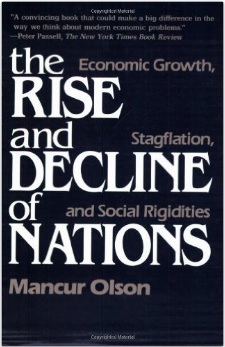
Download the free e-Book of Go Lean … Caribbean – now!

————–

Appendix A

Book Review: ‘The Black Presidency: Barack Obama and the Politics of Race in America’ By Michael Eric Dyson. 346 Pages. Houghton Mifflin Harcourt. $27. ISBN 978-0544387669
Review By: N. D. B. Connolly

CU Blog - Obama - Bad For Caribbean Status Quo - Photo 3What happens when the nation’s foremost voice on the race question is also its most confined and restrained? Michael Eric Dyson raises this question about President Obama in his latest book, “The Black Presidency: Barack Obama and the Politics of Race in America.” The book inspires one to raise similar questions about Dyson himself. For, while hardly restrained, Dyson appears noticeably boxed in by the limitations placed on celebrity race commentators in the Age of Obama.

Readers will recognize Dyson’s practiced flair for language and metaphor as he makes an important and layered argument about American political culture and the narrowness of presidential speech. The book argues that Americans live under a black presidency — not so much because the president is black, but because Obama’s presidency remains bound by the rules and rituals of black respectability and white supremacy. Even the leader of the free world, we learn in Dyson’s book, conforms principally to white expectations. (Dyson maintained in the November issue of The New Republic that Hillary Clinton may well do more for black people than Obama did.) But Obama’s presidency is “black” in a more hopeful way, too, providing Americans with an opportunity to better realize the nation’s democratic ideals and promises. “Obama’s achievement gestures toward what the state had not allowed at the highest level before his emergence,” Dyson writes. “Equality of opportunity, fairness in democracy and justice in society.”

A certain optimism ebbs and flows in “The Black Presidency,” but only occasionally does it refer to white Americans’ beliefs about race. Far more often, Dyson hangs hope on Obama’s impromptu shows of racial solidarity. One such moment was the president’s remarks after the 2009 arrest of the Harvard professor Henry Louis Gates Jr. (who was arrested trying to get into his own home). Another was Obama’s public identification with Trayvon Martin. Both acts may have been politically risky, but they also greatly heartened African- Americans. Hope builds, and by book’s end, readers find a chapter-long celebration of the president’s soaring invocations of “Amazing Grace” during last year’s memorial service for the slain parishioners of EmanuelA.M.E.Church. For Dyson, the eulogy at Emanuel seems to serve as a sign of grace that black America may still yet enjoy from the Obama White House.

Its cresting invocations of hope aside, the book ably maintains a sharp critical edge. Dyson uncovers a troubling consistency to the president’s race speech and shows that in spite of Obama’s reliance on black political networks and black votes during his meteoric rise, the president chose to follow a governing and rhetorical template largely hewed by his white predecessors. As both candidate and president, Obama’s speeches have tended to allay white guilt. They have scolded ­African-American masses for cultural pathology and implied that blacks were to blame for lingering white antipathy. Obama’s speeches have also often consigned the worst forms of racism and anti-black violence to the past or to the fringes of American political culture. One finds passive-voice constructions everywhere in Obama’s race talk, as black folk are found suffering under pressures and at the hands of parties that go largely unnamed. “Obama is forced to exaggerate black responsibility,” Dyson advances, “because he must always underplay white responsibility.”

Critically, Dyson contends that the president’s tepid anti-racism comes from political pragmatism rather than a set of deeper ideological concerns. “Obama is anti-ideological,” Dyson maintains, and that is “the very reason he was electable.”

That characterization, however, overlooks how liberal pragmatism functions as ideology. What’s more, it ignores the marginalization and violence that black and brown people often suffer — at home and abroad — whenever moderates resolve to “get things done.” If the Obama era proved anything about liberalism, it’s that there remains little room for an explicit policy approach to racial justice — even, or perhaps especially, under a black president. As Obama himself explains to Dyson: “I have to appropriate dollars for any program which has to go through ways and means committees, or appropriations committees, that are not dominated by folks who read Cornel West or listen to Michael Eric Dyson.”

Upon a careful reading of Dyson’s book, loss seems always to arrive on the heels of hope. As we might expect, the author explores Obama’s estrangement from the Rev. Jeremiah Wright in 2008. He also attends to his own very public and more recent split from Cornel West. But even beyond these signal episodes, “The Black Presidency” is suffused with a bittersweet tone about relationships strained. President Obama seems to leave a host of people and political commitments at the White House door as he conforms to the racial demands of a historically white office. Even Dyson seems unaware of all the ways in which “The Black Presidency,” as a book, both explicates and illustrates how the Obama administration leaves black folk behind.

All but the last two of the book’s eight chapters begin with the author placing himself in close and often luxurious proximity to Obama. The repetition has the literary effect of a Facebook feed. Here is Michael at Oprah’s sumptuous California mansion during a 2007 fund-raiser, sharing a joke with Barack and Chris Rock. Here is Michael on the private plane and in the S.U.V., giving the candidate tips on how to use a “ ‘blacker’ rhetorical style” during his debate performances against a surging Hillary Clinton. Here he is in the V.I.P. section of the 50th-anniversary ceremony for the March on Washington and, yet again, at the White House Correspondents’ Association dinner. Through these and similar moments, Dyson projects his status and, in ways less clear, his authority. Dyson knows Obama, the reader is assured, because he has kept his company. He has swapped playful taunts and bro-hugs with the president; he has been intimate, one might say, with history.

Moments like these have a secondary effect. They illuminate a tension cutting through and profoundly limiting “The Black Presidency” as a work of political commentary. Regardless of who Michael Eric Dyson may have been to Obama the candidate, Dyson now has barely any access to Obama the president. Time and circumstance have rendered Dyson, the man and the thinker, increasingly irrelevant to Obama’s presidency. He can be at the party, but not at the table.

Perhaps worse in relation to the book’s stated aim to be the first full measure of Obama and America’s race problem, Dy­son, the author, has none but only the smallest role to play in assessing and narrating Obama’s legacy. When Bill Clinton decided to chronicle his own historic turn in the White House, he called on Taylor Branch and recorded with the historian some 150 hours of interviews over 79 separate sessions. Dyson, in 2015, gets far shabbier treatment. Chapter 5, “The Scold of Black Folk,” opens: “I was waiting outside the Oval Office to speak to President Obama. I had a tough time getting on his schedule.” In response to Dyson’s request for a presidential audience, the White House offered the author 10 whole minutes. By his own telling, Dyson “politely declined” and pressed Obama’s confidante, Valerie Jarrett, to remember his long history with and support of the president. “I eventually negotiated a 20-minute interview that turned into half an hour.” It appears to be the only interview Dyson conducted for the book.

In the end, “The Black Presidency” possesses a loaves-and-fishes quality. Drawing mostly on the news cycle, close readings of carefully crafted speeches and a handful of glittering encounters, Dyson has managed to do a lot with a little. The book might well be considered an interpretive miracle, one performed in fealty and hope for a future show of presidential grace, either from this president or, should she get elected, the next one.

Source: http://www.nytimes.com/2016/02/07/books/review/the-black-presidency-barack-obama-and-the-politics-of-race-in-america-by-michael-eric-dyson.html. Posted February 2, 2016; retrieved March 29, 2016.

————–

Appendix B

Title: Cuba’s Fidel Castro knocks sweet-talking Obama after ‘honey-coated’ visit
By: Marc Frank

U.S. President Barack Obama waves from the door of Air Force One in HavanaHavana – Retired leader Fidel Castro accused U.S. President Barack Obama of sweet-talking the Cuban people during his visit to the island last week and ignoring the accomplishments of Communist rule, in an opinion piece carried by all state-run media on Monday.

Obama’s visit was aimed at consolidating a detente between the once intractable Cold War enemies and the U.S. president said in a speech to the Cuban people that it was time for both nations to put the past behind them and face the future “as friends and as neighbors and as family, together.”

“One assumes that every one of us ran the risk of a heart attack listening to these words,” Castro said in his column, dismissing Obama’s comments as “honey-coated” and reminding Cubans of the many U.S. efforts to overthrow and weaken the Communist government.

Castro, 89, laced his opinion piece with nationalist sentiment and, bristling at Obama’s offer to help Cuba, said the country was able to produce the food and material riches it needs with the efforts of its people.

“We don’t need the empire to give us anything,” he wrote.

Asked about Fidel Castro’s criticisms on Monday, White House spokesman Josh Earnest said the Obama administration was pleased with the reception the president received from the Cuban people and the conversations he had with Cuban officials.

“The fact that the former president felt compelled to respond so forcefully to the president’s visit, I think is an indication of the significant impact of President Obama’s visit to Cuba,” Earnest said.

After the visit, major obstacles remain to full normalization of ties between Cuba and the United States, with no major concessions offered by Cuba on rights and economic freedom.

“The president made clear time and time again both in private meetings with President Castro, but also in public when he delivered a speech to the Cuban people, that the U.S. commitment to human rights is rock solid and that’s not going to change,” Earnest said.

Fidel Castro took power in a 1959 revolution and led the country until 2006, when he fell ill and passed power to his brother Raul Castro. He now lives in relative seclusion but is occasionally heard from in opinion pieces or seen on television and in photos meeting with visiting dignitaries.

The iconic figure’s influence has waned in his retirement and the introduction of market-style reforms carried out by Raul Castro, but Fidel Castro still has a moral authority among many residents, especially older generations.

Obama did not meet with Fidel Castro during his three-day visit, nor mention him in any of his public appearances. It was the first visit of a sitting U.S. president for 88 years.

Fidel Castro blasted Obama for not referring in his speech to the extermination of native peoples in both the United States and Cuba, not recognizing Cuba’s gains in health and education, and not coming clean on what he might know about how South Africa obtained nuclear weapons before apartheid ended, presumably with the aid of the U.S. government.

“My modest suggestion is that he reflects (on the U.S. role in South Africa and Cuba’s in Angola) and not now try to elaborate theories about Cuban politics,” Castro said.

Castro also took aim at the tourism industry in Cuba, which has grown further since Obama’s rapprochement with Raul Castro in December 2014. He said it was dominated by large foreign corporations which took for granted billion-dollar profits.

(Reporting by Marc Frank; Additional reporting by Doina Chiacu in Washington; Editing by Bill Rigby)

Share this post:
, , , ,
[Top]

Lessons Learned: Detroit demolishes thousands of structures

Go Lean Commentary

Lights, camera, action …

That expression is used to initiate a filming session on a movie set. It is symbolic of manifestation; “coming to a head” after a long series of planning steps.

“You have planned the work; now its time to work the plan”.

Engage!

This book Go Lean…Caribbean – published in November 2013 – analyzed the once-great-but-now-distressed City of Detroit (Michigan, USA); it embedded the lessons learned from Detroit in a page entitled:

10 Lessons Learned from Detroit (Page 140)

Afterwards, the book’s publishers went to Detroit (for almost 1 & 1/2 years) to “observe and report” on the turn-around and rebirth of the city. The motivation was that the Caribbean region could learn a lot from the strategies, tactics and implementations to mitigate this community’s “Failed-State/Failed-City” status. The recommendation of the book and countless blogs – 34 not including this submission – was always the same that Detroit can benefit by engaging in a demolition of so many of its blighted buildings. This is described as exercising the mastery of destruction arts and sciences – salvage, removal, recycle, redevelopment, rebirth, reboot and “right-sizing”.

Those pleas have been heard: Detroit has now commenced the recommended action of demolishing structures. See a full news article relating this here:

Title: Detroit demolishes thousands of structures; many more to go
By: Corey Williams

cu-blog-detroit-demolishes-thousands-of-structures-photo-1

cu-blog-detroit-demolishes-thousands-of-structures-photo-5

cu-blog-detroit-demolishes-thousands-of-structures-photo-4

————————
DETROIT (AP) — Remnants of the roof and walls creaked, groaned and then crumpled to the ground Wednesday from what once was an industrial building that covered an entire city block, likely the last structure demolished this year under Detroit’s massive blight elimination program.

Blows from an excavator methodically destroyed a portion of what had been a 60,000-square-foot building on Cloverdale Avenue in a west side neighborhood of homes, auto repair shops and other light industrial buildings.

When leveled, the structure that a local resident said had once housed an industrial laundry or dry cleaners, will mark about 3,130 structures cleared in 2016 and about 10,700 — mostly houses — razed since 2014. The vast majority are owned by the city’s Land Bank Authority.

But the city has a long way to go. A blight task force in 2014 said 40,000 needed to be torn down and 38,000 others were falling apart in one of the nation’s poorest major cities that emerged in December 2014 from the largest municipal bankruptcy in U.S. history.

Many blocks have more abandoned houses and empty lots than lived-in homes, a result of the exodus of whites and much of the black middle class from the city. About 1.8 million people lived in Detroit in the 1950s. Fewer than 700,000 currently call Detroit home, according to the U.S. Census.

Mayor Mike Duggan has said the mass demolitions are necessary for Detroit to attract families to city neighborhoods and stop decades of population loss.

“I’m so excited about this,” said an almost gleeful Sandra Pickens as the excavator clawed at brick and wood.

Pickens is president of the Littlefield Community Association. The neighborhood group met over the summer with Duggan about the empty building and other concerns.

“This was an eyesore for us,” she told The Associated Press Wednesday. “I’ve seen people come and dump things here; come in at night and steal the beams. We shouldn’t have anything looking like this.”

Mike Douglas works in a muffler shop on Cloverdale. He remembers the neighborhood and small businesses in the area as “thriving” 20 or so years ago. He believes the building across the street has been empty a dozen or so years.

The area had “deteriorated to the point that we were having a tough time actually keeping our business here,” said Douglas, 55.

By removing dangerous buildings and empty houses, safety and quality of life in Detroit is improved, according to Fire Investigations Division Capt. Winston Farrow.

“It eliminates the opportunities for criminals to set fires in vacant houses,” Farrow said. “The problem was more just the sheer numbers of dwellings that we had.”

The average sale prices of over 100 houses sold in the city also has increased over the past three years, according to the Land Bank.

The problems haven’t been resolved completely, “but it’s much better,” said Linda Smith, a blight task force co-chair and executive director of a nonprofit that builds homes in Detroit and provides resources to city residents.

“Maintaining and securing all of the homes that need some work done to them is the next step,” Smith said.

Not everyone is as optimistic.

“You can tear down a house on one block and go back several months later and where houses were occupied (they) are now abandoned and need to be demolished,” said Sheila Dapremont, owner of Detroit demolition company 3D Wrecking.

“It just seems like it never ends,” she said.

On average, it costs Detroit $12,616 to knock down a house. More than $128 million in federal funds over the past three years have helped pay for the work. Another $130 million was approved this year.

About $40 million in the city’s general fund has been set aside for demolitions.

Federal funding was temporarily halted earlier this year and resumed after an audit determined demolition costs above a federal cap of $25,000 per house were redistributed to 350 other properties to have those houses appear to meet the cap. Amounts over the cap should have been billed to the city. The city says controls have since been tightened.

—-

Detroit Demolition Tracker: http://www.detroitmi.gov/demolition

Despite these events being in Detroit and not the Caribbean, the foregoing can still impact the Greater Good for the Caribbean. It provides us an exact role model of what to do … and not do. Lessons learned …

The Go Lean book serves as a roadmap for the introduction and implementation of the Caribbean Union Trade Federation (CU) to elevate Caribbean society. Detroit is not in scope for this effort, but as detailed in a previous blog-commentary, an examination of the details of Detroit can be productive for the Caribbean effort. The Go Lean roadmap therefore has these 3 prime directives:

  • Optimization of the economic engines in order to grow the regional economy to $800 Billion GDP and create 2.2 million new jobs.
  • Establishment of a security apparatus to protect the resultant economic engines.
  • Improve Caribbean governance to support these engines.

Early in the Go Lean book, the point of lessons from Detroit was pronounced in the opening Declaration of Interdependence (Page 14), with this opening statement:

xxxiii. Whereas lessons can be learned and applied from the study of the recent history of other societies, the Federation must formalize statutes and organizational dimensions to avoid the pitfalls of communities like … Detroit…

As a “failed-city”, Detroit has suffered abandonment; first “white flight”, then eventually everyone else; (the population peak was 1,849,568 in 1950, but only 713,777 in 2010). The need for demolition is tied to the fact that many of the buildings from that population peak were still standing in the city, though now blighted.

According to the foregoing article, the city has more to do to right-size to an optimized city. The city’s disposition is still dire (brain drain, unemployment, urban blight and acute hopelessness); but there is hope for a better future. This is very familiar for Caribbean communities. This is why the study of Detroit is such an ideal model for the Caribbean.

Previous Go Lean blogs highlighted some specific lessons from Detroit and other nearby Michigan cities, as sampled in this detailed list here:

Detroit makes Community College free
An Ode to Detroit – Good Luck on Trade!
Beware of Vulture Capitalists
Detroit giving schools their ‘Worst Shot’
Flint, Michigan – A Cautionary Tale
Secrecy, corruption and conflicts in State governance
Before and After Photos of Detroit’s Transformation
Education & Economics: Welcoming Obama to Detroit
Ann Arbor: Model for ‘Start-up’ Cities
Big Salt: Short-term Benefit; Long-term Damage
NEXUS: Facilitating Detroit-Windsor Commerce
M-1 Rail: Alternative Motion in the Motor City
JP Morgan Chase $100 million Detroit investment

The foregoing news article (and VIDEO in the Appendix below) relates more to the art and science of destruction-recycling than it does to Detroit. This has also been a consistent theme for the Go Lean movement. Consider these previous blog-commentaries that advocated developing business models around destruction/recycling/turn-around:

A Lesson in ‘Garbage’
Where the Jobs Are – Entrepreneurism in Junk
Where the Jobs Are – One Scenario: Ship-breaking
‘Only at the precipice, do they change’

The CU/Go Lean effort is focused on forging change in the region; this does not start with the demolition process, rather it starts with attitudes and motivations to reject the status quo. This positive attitude is defined in the Go Lean book as the community ethos for “turn-around”. Here is a sample of the text relating to turn-around practice (Page 33):

… dispositions of abandoned buildings in the member-states still relate to CU missions, as in the protection of image (“psychological trauma” is inflicted daily on neighbors of abandoned structures) and the quest for beauty. While beauty, aesthetics and preservation may be paramount for communities, these should only be a concern after basic needs are satisfied – housing is a basic need. The economics of housing can be impacted with the over-supply of abandoned buildings, as it brings the value down for other properties, and sends out the false vision, like Detroit’s abandoned structures, that just a “little rehab” and their new manifestations will be readily available. Learning from Detroit, it is more beneficial to raze abandoned buildings and build anew turn-around, rather than considering restoration or preservation.

Accordingly, demolition of blighted buildings can reinvigorate a community. The building materials can be re-purposed. Bricks can simply be re-used; scrap metal can be recycled; the wood can grind down to chip/saw-dust; concrete can grind down to sand-fill; and on and on.

  • Imagine the jobs.
  • Image the restoration, the renewal, the refresh … in the community.
  • Even the newly-razed land-lots can be put into service as community gardens; or just left as vacant land-lots, therefore posing no risk or dangers to the community – see VIDEO below.

The book details other ethos to adopt, plus the executions of the following strategies, tactics, implementations and advocacies to impact the reboot and turn-around of Caribbean communities:

Community Ethos – Deferred Gratification Page 21
Community Ethos – People Respond to Incentives Page 21
Community Ethos – Job Multiplier Page 22
Community Ethos – Light Up the Dark Places Page 23
Community Ethos – “Crap” Happens Page 23
Community Ethos – Lean Operations Page 24
Community Ethos – Return on Investments (ROI) Page 24
Community Ethos – Ways to Impact the Future Page 26
Community Ethos – Ways to Help Entrepreneurship Page 28
Community Ethos – Ways to Impact a Turn-Around Page 33
Community Ethos – Impact the Greater Good Page 37
Strategy – Customers – Foreign Direct Investors Page 48
Tactical – Fostering a Technocracy Page 64
Tactical – Modeling Post WW II Germany – Reboot with Marshall Plan Page 68
Tactical – Modeling Post WW II Japan – Reboot with no Marshall Plan Page 69
Separation of Powers – Public Works & Infrastructure Page 82
Separation of Powers – Housing and Urban Authority Page 83
Implementation – Ways to Pay for Change Page 101
Implementation – Ways to Re-boot Freeport – Sample Failed City Page 112
Planning – Ways to Improve Failed-State Indices Page 132
Planning – Lessons Learned from 2008 Page 136
Planning – Lessons from Detroit Page 140
Advocacy – Ways to Grow the Economy Page 151
Advocacy – Ways to Create Jobs Page 152
Advocacy – Ways to Improve Local Government Page 169
Advocacy – Ways to Better Manage the Social Contract Page 170
Advocacy – Ways to Reboot Cuba Page 226
Advocacy – Ways to Reboot Haiti Page 238
Advocacy – Ways to Reboot Jamaica Page 239

The foregoing news article aligns with the publishers of the Go Lean book for the purpose of empowering and rebooting economic engines. The roadmap calls for the heavy-lifting of working with individuals, families, communities and nation-states to turn-around and reboot the region’s future prospect. There is the need for this re-boot so as to make the Caribbean better.

The Caribbean is arguably the best address on the planet, but there is a lot missing; like Detroit we have blight and urban decay (with dangerous buildings). So the example from Detroit is a good model to reboot the societal engines in our region. There are benefits to demolition, but there is also the need for caution. Crony-Capitalism can easily seep in to exploit public funds for private gain. So there are security and governing concerns as well. See the photos here of the Detroit Demolition Tracker, attempting to provide transparency for better governance.

cu-blog-detroit-demolishes-thousands-of-structures-photo-2

cu-blog-detroit-demolishes-thousands-of-structures-photo-3

The Go Lean roadmap provides a complete plan to reboot Caribbean economic-security-governing engines. The region is hereby urged to lean-in to this roadmap, to make the homeland a better place to live, work and play. 🙂
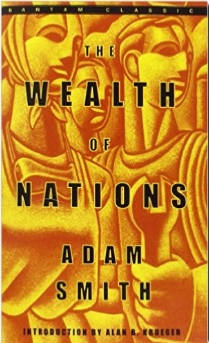
Download the book Go Lean … Caribbean – now!

————

Appendix VIDEO – Watch Detroit Demolish 2 Houses in 2 Minuteshttps://youtu.be/ML5l8GrJEe0

Published on Jul 6, 2016 – Watch the time lapse video of two demolitions in Detroit. For more information, visit detroitmi.gov/demolition.

Share this post:
, ,
[Top]

How to make sense of 2016

Go Lean Commentary

The year 2016 is coming to a close. In retrospect, it has been a “year of living dangerously”.

So much of the institutional progress that have been made in past decades have come under “protest” this year – think alphabetical organizations that promote integration like the UN, EU, IMF, OECD, etc. – and think globalization / trade pacts (NAFTA, TPP, CBI, etc.).

It is that bad! All aspects of Caribbean life has become dysfunctional: economics, security and governance. Here are some snippets from this Caribbean Yearbook; (this is just a sample in chronological order):

Surely, it is the conclusion of most that 2016 has yielded a bitter harvest.

This assessment is presented by the publishers of the book Go Lean … Caribbean. This 370-page publication asserts that the Caribbean region is in crisis but alas, a “crisis is a terrible thing to waste”.

What does this mean? Here goes…

The conclusion is that from the “ashes of 2016”, the Phoenix – symbolic for the Caribbean community – can rise and create a Way Forward.

This is not just true in the Caribbean, but for most of the world as well. It is possible to make sense of this tumultuous year. See this point developed in this editorial-article in The Economist magazine, here:

Title: How to make sense of 2016
Sub-title: Liberals lost most of the arguments this year. They should not feel defeated so much as invigorated

cu-blog-how-to-make-sense-of-2016-photo-1For a certain kind of liberal, 2016 stands as a rebuke. If you believe, as The Economist does, in open economies and open societies, where the free exchange of goods, capital, people and ideas is encouraged and where universal freedoms are protected from state abuse by the rule of law, then this has been a year of setbacks. Not just over Brexit and the election of Donald Trump, but also the tragedy of Syria, abandoned to its suffering, and widespread support—in Hungary, Poland and beyond—for “illiberal democracy”. As globalisation has become a slur, nationalism, and even authoritarianism, have flourished. In Turkey relief at the failure of a coup was overtaken by savage (and popular) reprisals. In the Philippines voters chose a president who not only deployed death squads but bragged about pulling the trigger. All the while Russia, which hacked Western democracy, and China, which just last week set out to taunt America by seizing one of its maritime drones, insist liberalism is merely a cover for Western expansion.

Faced with this litany, many liberals (of the free-market sort) have lost their nerve. Some have written epitaphs for the liberal order and issued warnings about the threat to democracy. Others argue that, with a timid tweak to immigration law or an extra tariff, life will simply return to normal. That is not good enough. The bitter harvest of 2016 has not suddenly destroyed liberalism’s claim to be the best way to confer dignity and bring about prosperity and equity. Rather than ducking the struggle of ideas, liberals should relish it.

Mill wheels

In the past quarter-century liberalism has had it too easy. Its dominance following Soviet communism’s collapse decayed into laziness and complacency. Amid growing inequality, society’s winners told themselves that they lived in a meritocracy—and that their success was therefore deserved. The experts recruited to help run large parts of the economy marvelled at their own brilliance. But ordinary people often saw wealth as a cover for privilege and expertise as disguised self-interest.

After so long in charge, liberals, of all people, should have seen the backlash coming. As a set of beliefs that emerged at the start of the 19th century to oppose both the despotism of absolute monarchy and the terror of revolution, liberalism warns that uninterrupted power corrupts. Privilege becomes self-perpetuating. Consensus stifles creativity and initiative. In an ever-shifting world, dispute and argument are not just inevitable; they are welcome because they lead to renewal.

What is more, liberals have something to offer societies struggling with change. In the 19th century, as today, old ways were being upended by relentless technological, economic, social and political forces. People yearned for order. The illiberal solution was to install someone with sufficient power to dictate what was best—by slowing change if they were conservative, or smashing authority if they were revolutionary. You can hear echoes of that in calls to “take back control”, as well as in the mouths of autocrats who, summoning an angry nationalism, promise to hold back the cosmopolitan tide.

Liberals came up with a different answer. Rather than being concentrated, power should be dispersed, using the rule of law, political parties and competitive markets. Rather than putting citizens at the service of a mighty, protecting state, liberalism sees individuals as uniquely able to choose what is best for themselves. Rather than running the world through warfare and strife, countries should embrace trade and treaties.

Such ideas have imprinted themselves on the West—and, despite Mr Trump’s flirtation with protectionism, they will probably endure. But only if liberalism can deal with its other problem: the loss of faith in progress. Liberals believe that change is welcome because, on the whole, it is for the better. Sure enough, they can point to how global poverty, life expectancy, opportunity and peace are all improving, even allowing for strife in the Middle East. Indeed, for most people on Earth there has never been a better time to be alive.

Large parts of the West, however, do not see it that way. For them, progress happens mainly to other people. Wealth does not spread itself, new technologies destroy jobs that never come back, an underclass is beyond help or redemption, and other cultures pose a threat—sometimes a violent one.

If it is to thrive, liberalism must have an answer for the pessimists, too. Yet, during those decades in power, liberals’ solutions have been underwhelming. In the 19th century liberal reformers met change with universal education, a vast programme of public works and the first employment rights. Later, citizens got the vote, health care and a safety net. After the second world war, America built a global liberal order, using bodies such as the UN and the IMF to give form to its vision.

Nothing half so ambitious is coming from the West today. That must change. Liberals must explore the avenues that technology and social needs will open up. Power could be devolved from the state to cities, which act as laboratories for fresh policies. Politics might escape sterile partisanship using new forms of local democracy. The labyrinth of taxation and regulation could be rebuilt rationally. Society could transform education and work so that “college” is something you return to over several careers in brand new industries. The possibilities are as yet unimagined, but a liberal system, in which individual creativity, preferences and enterprise have full expression, is more likely to seize them than any other.

The dream of reason

After 2016, is that dream still possible? Some perspective is in order. This newspaper believes that Brexit and a Trump presidency are likely to prove costly and harmful. We are worried about today’s mix of nationalism, corporatism and popular discontent. However, 2016 also represented a demand for change. Never forget liberals’ capacity for reinvention. Do not underestimate the scope for people, including even a Trump administration and post-Brexit Britain, to think and innovate their way out of trouble. The task is to harness that restless urge, while defending the tolerance and open-mindedness that are the foundation stones of a decent, liberal world.

Source: Publish Date 12-24-2016; retrieved from: http://www.economist.com/news/leaders/21712128-liberals-lost-most-arguments-year-they-should-not-feel-defeated-so-much?cid1=cust/ednew/n/bl/n/20161220n/owned/n/n/nwl/n/n/NA/8415420/n

The foregoing article depicts that the magazine, The Economist, believes …

… “in open economies and open societies, where the free exchange of goods, capital, people and ideas is encouraged and where universal freedoms are protected from state abuse by the rule of law.”

Ditto for the movement behind Go Lean … Caribbean.

For the Caribbean, we now need a new way, a new year. We are looking forward to 2017.

The foregoing article is being brought into focus in a consideration of the Go Lean book; which serves as a roadmap for the introduction and implementation of the technocratic Caribbean Union Trade Federation (CU), for the elevation of Caribbean society. This CU/Go Lean roadmap has these 3 prime directives:

  • Optimization of economic engines in order to grow the regional economy to $800 Billion and create 2.2 million new jobs.
  • Establishment of a security apparatus to protect the resultant economic engines.
  • Improvement of Caribbean governance to support these engines.

The Go Lean book (Page 3), though written in 2013, makes the assertion that the Caribbean is in crisis. The book details that there is something wrong in the homeland, that while it is the greatest address in the world, instead of the world “beating a path” to these doors, the people of the Caribbean have “beat down their doors” to get out.

Why do people leave such an idyllic place? The book identifies a series of reasons, classified as “push and pull” factors. They are economic (jobs and entrepreneurial shortages), security deficiencies and governing misgivings.

The Go Lean book does not ignore these “push and pull” factors that cause our Caribbean people to flee. The book stresses (early at Page 13) the need to be on-guard for “push” factors in these Declaration of Interdependence statements:

xix. Whereas our legacy in recent times is one of societal abandonment, it is imperative that incentives and encouragement be put in place to first dissuade the human flight, and then entice and welcome the return of our Diaspora back to our shores. This repatriation should be effected with the appropriate guards so as not to imperil the lives and securities of the repatriated citizens or the communities they inhabit. The right of repatriation is to be extended to any natural born citizens despite any previous naturalization to foreign sovereignties.

xxi. Whereas the preparation of our labor force can foster opportunities and dictate economic progress for current and future generations, the Federation must ensure that educational and job training opportunities are fully optimized for all residents of all member-states, with no partiality towards any gender or ethnic group. The Federation must recognize and facilitate excellence in many different fields of endeavor, including sciences, languages, arts, music and sports. This responsibility should be executed without incurring the risks of further human flight, as has been the past history.

xxvi. Whereas the Caribbean region must have new jobs to empower the engines of the economy and create the income sources for prosperity, and encourage the next generation to forge their dreams right at home, the Federation must therefore foster the development of new industries, like that of ship-building, automobile manufacturing, prefabricated housing, frozen foods, pipelines, call centers, and the prison industrial complex. In addition, the Federation must invigorate the enterprises related to existing industries like tourism, fisheries and lotteries – impacting the region with more jobs.

This commentary previously related details of Caribbean dysfunction and how to effectuate a turn-around in the region’s societal engines. Here is a sample of such earlier blog-commentaries:

https://goleancaribbean.com/blog/?p=7179 How to Effectuate Change in Crime Fight? Change Leaders
https://goleancaribbean.com/blog/?p=7056 ‘Necessity is the Mother of Invention’
https://goleancaribbean.com/blog/?p=6563 Lessons from Iceland – Model of Recovery
https://goleancaribbean.com/blog/?p=5695 Repenting, Forgiving and Reconciling the Past
https://goleancaribbean.com/blog/?p=3929 Recipe for Successful Turn-arounds: Add Bacon to Eggs
https://goleancaribbean.com/blog/?p=3915 ‘Change the way you see the world; you change the world you see’
https://goleancaribbean.com/blog/?p=3662 Migrant flow into US from Caribbean spikes
https://goleancaribbean.com/blog/?p=2547 Miami’s Success versus Caribbean Failure
https://goleancaribbean.com/blog/?p=1596 Book Review: ‘Prosper Where You Are Planted’
https://goleancaribbean.com/blog/?p=841 Having Less Babies is Bad for the Economy
https://goleancaribbean.com/blog/?p=623 ‘Only at the precipice, do they change’

A turn-around of our failing societal engines is essential for the Way Forward.

Way Forward – an action, plan etc. that seems a good idea because it is likely to lead to success; i.e.:

  • A way forward lies in developing more economic links.
  • This treatment may be the way forward for many inherited disorders.

Source: Retrieved December 22, 2016 from: http://www.ldoceonline.com/dictionary/a-the-way-forward

An example of a Way Forward is the following VIDEO, highlighting the emergence of digital technologies as the lifeblood of today’s cities. They are applied widely in industry and society, from information and communications technology (ICT) to the Internet of Things (IoT), in which objects are connected to the Internet. As sensors turn any object into part of an intelligent urban network, and as computing power facilitates analysis of the data these sensors collect, elected officials and city administrators can gain an unparalleled understanding of the infrastructure and services of their city. However, to make the most of this intelligence, another ingredient is essential: citizen engagement. Thanks to digital technologies, citizens can provide a steady flow of feedback and ideas to city officials.

————————————— Start VIDEO Here —————————————————-

VIDEO Title: Economist Intelligence Unit (EIU) – http://link.brightcove.com/services/player/bcpid4855923448001?bckey=AQ~~,AAABDH-R__E~,dB4S9tmhdOoLUuQl3WENJQVceD9z2lER&bctid=5114134376001

See the highlights from the Empowering Cities research and hear how the City of Pittsburgh is using digital technology to put citizens in control in this short video, featuring EIU contributor Sarah Murray and Pittsburgh’s chief innovation and performance officer, Debra Lam.
find out how global businesses and citizens envision smart cities

Read the full report to find out how global businesses and citizens envision smart cities, with insights from 20 leading experts. Download the Whitepaper here.

—————————————- End VIDEO Here —————————————————-

This study by The Economist Intelligence Unit (EIU), investigates how citizens and businesses in 12 diverse cities around the world – Barcelona, Berlin, Buenos Aires, Chicago, London, Los Angeles, Mexico City, New York City, Rio de Janeiro, Shanghai, Singapore and Toronto – envision the benefits of smart cities.

For the Caribbean, we must succeed in our own action plan – Go Lean roadmap – for cities and communities so as to dissuade our own people from giving up and abandoning their native homelands. While no society is perfect, nor fully optimized, some countries have been better than others. Many countries in North America and Western Europe have become lands of refuge for our Caribbean Diaspora.

The Go Lean book and accompanying blogs posit that it will take less effort to remediate the Caribbean than to fix some other part of the planet. This is the charge of the Go Lean…Caribbean roadmap, to do the heavy-lifting, to implement the organization dynamics to impact Caribbean society here-now and make this region a better place to live, work and play. The following are the community ethos, strategies, tactics and operational advocacies to effectuate this goal:

Community Ethos – People Respond to Incentives Page 21
Community Ethos – Economic Systems Influences Choices & Incentives Page 21
Community Ethos – The Consequences of Choice Lie in the Future Page 21
Community Ethos – Job Multiplier Page 22
Community Ethos – Minority Equalization Page 24
Community Ethos – Lean Operations Page 24
Community Ethos – Ways to Impact the Greater Good Page 37
Strategy – Vision – Make the Caribbean the Best Address on the Planet Page 45
Strategy – Mission – Repatriate Diaspora Page 46
Strategy – Mission – Dissuade Human Flight/“Brain Drain” Page 46
Tactical – Separation of Powers – Union versus Member-States Page 71
Implementation – Assemble CariCom, Dutch, French, Cuba and US Territories Page 95
Implementation – Enact Territorial Compacts for PR & the Virgin Islands Page 96
Implementation – Ways to Pay for Change Page 101
Implementation – Steps for Self-Governing Entities – Laboratories for fresh policies Page 105
Implementation – Ways to Deliver Page 109
Implementation – Reasons to Repatriate Page 118
Implementation – Ways to Benefit from Globalization Page 119
Implementation – Ways to Promote Independence Page 120
Planning – 10 Big Ideas for the Caribbean Page 127
Planning – Lessons Learned from 2008 Page 136
Advocacy – Ways to Grow the Economy Page 151
Advocacy – Ways to Create Jobs Page 152
Advocacy – Ways to Improve Governance Page 168
Advocacy – Ways to Improve Homeland Security Page 180
Advocacy – Ways to Impact the Diaspora Page 217
Advocacy – Ways to Preserve Caribbean Heritage Page 218
Advocacy – Ways to Impact Urban Living Page 236
Advocacy – Ways to Impact US Territories Page 244
Appendix – Interstate Compacts for Puerto Rico and the USVirgin Islands Page 278

This Go Lean movement asserts that the current year (2016) was not so redeeming. We must do better… going forward, with our own Way Forward. From Day One/Step One, the roadmap calls for positive change; then it provides turn-by-turn directions for what-how-when-where-why to remediate, mitigate and empower our region forward.

Other communities will be making their own mitigation to make 2017 a better year (than 2016); our Caribbean will be in competition with them, in competition with rest of the world. Considering this competition as a race, we realize that we are behind, trailing our competitors. We have acute deficiencies in our societal engines: economics, security and governance. We must now fix these, so as to dissuade people from leaving their native homelands.

There are many empowerments that our Caribbean region needs to implement to mitigate bad years like 2016. But truth be told, 2016 was not as bad at 2008 – that year was so dire that it inspired the creation of this Go Lean roadmap. Many countries in North America and Western Europe have already applied their formal turn-around from 2008 and now enjoy productive economies; (i.e. Iceland is complaining about their 2% unemployment rate).

While the Caribbean have many problems to mitigate, our biggest crisis stem from the fact that so many of our citizens have fled their Caribbean homelands for foreign shores.

So the quest to fix the Caribbean, though noble, is easier said than done; but it is conceivable, believable and achievable! Now is the time for all of the Caribbean, the people and governing institutions, to lean-in to this Way Forward, the Go Lean … Caribbean roadmap. 🙂

Download the book Go Lean … Caribbean – now!

Share this post:
,
[Top]

Fake News? Welcome to America

Go Lean Commentary

American media lives in a land of fantasy.

Consider these Fake News instances:

cu-blog-fake-news-welcome-to-america-photo-1

cu-blog-fake-news-welcome-to-america-photo-2

This is probably true of their news output because so many of the corporate structures that own non-fiction news operations also own fiction-based media operations. Consider these examples of same ownership:

Fox News 21st Century Fox Movie Studio
NBC News / CNBC / MSNBC Universal Pictures
CBS News Simon-Shuster Book Publishing
ABC News Disney Studios; Pixar; Marvel Studios; LucasFilms;
Touchstone Pictures
Cable News Network (CNN) Warner Brothers Movie Studio

No doubt, this fact – knowing where the bread is buttered – contributes to the duality and duplicity of these corporate citizens.

Now there is a new phenomenon in the world of media duality and duplicity: Fake News.

This is more malicious than initial appearances. See/hear the full story here in this Podcast and the subsequent VIDEO:

Title: How Fake News Spreads & Why People Believe It

Published December 14, 2016 – Buzzfeed News’ media editor, Craig Silverman, dissects how false stories during the presidential campaign were spread on Facebook and monetized by Google Ad Sense. Also, critic at-large John Powers shares six things he loved this year that he didn’t get around to reviewing.

—————

VIDEO – The onslaught of fake news – http://www.cbsnews.com/videos/the-onslaught-of-fake-news/

Posted December 18, 2016 (9:53 minutes) – In these partisan, high-tech times, are the news stories we Americans read, see, and hear fact or fiction? Senior correspondent Ted Koppel examines the landscape of lies and slander disguised as news stories, spread via social media, that bear little relation to facts. (VIDEO plays best in Internet Explorer).

Fake News appear to just be another example of American Crony-Capitalism where they exploit the public good for private gain. Media has frequently been  used to exploit the people. This commentary previously detailed the focus on fantasy as opposed to the vital facts of weather reporting.

Weather information is vital in different situations; think hurricanes. But news and information is vital everyday, rain or shine. So a situation where Fake News may thrive would be counterproductive to society. Many Americans — 62 percent to be exact — get some news from social media, according to the Pew Research Center. Of that group, 18 percent say they do so “often”.

This consideration aligns with the book Go Lean…Caribbean; this book serves as a roadmap for the introduction and implementation of the technocratic Caribbean Union Trade Federation (CU). This empowerment effort represents a change for the region, calling on all 30 member-states in the region to confederate and provide their own solutions in the areas of economics, security and governance. News and information relates to all three areas. The CU/Go Lean roadmap has these prime directives:

  • Optimization of the economic engines in order to grow the regional economy to $800 Billion GDP and create 2.2 million new jobs.
  • Establishment of a security apparatus to enhance public safety and protect the resultant economic engines against “bad actors”.
  • Improvement of Caribbean governance to support these engines.

The new emergence of Fake News seems apropos for the American eco-system, where fame seems more important than facts and style more important than substance:

Fame or infamy, either one is preferable to being forgotten – Hollywood Actress Lauren Bacall – Go Lean book Page 194.

This is a time when the American eco-system appears to be dysfunctional and filled with bad intent. No wonder the American eco-system is transforming from industrial to consumer, with trade deficits with all the industrial giants in the world; think Germany, Japan, South Korea and China.

The Caribbean is looking, listening and learning from the American model. We do NOT want to follow suit!

Yes, we want to develop our own social media – site: www.myCaribbean.gov – but with better rules for minimizing Fake News compared to the current American examples. Notice the mitigation now been deployed by Facebook & Google in the link here:

http://www.nbcnews.com/tech/tech-news/facebook-google-crack-down-fake-news-advertising-n684101

cu-blog-fake-news-welcome-to-america-photo-3The book Go Lean…Caribbean asserts that the Caribbean region must not allow the US to take the lead for our own nation-building, that American capitalistic interest tends to highjack policies intended for the Greater Good. This assessment is logical considering that the 2016 Presidential Election may have been a victim of this systemic disinformation. This is an issue of security.

This broken system in America does not have to be modeled in the Caribbean. Change has now come. The driver of this change is technology and globalization. The Go Lean roadmap provides turn-by-turn directions on how to forge this change in the region for a reboot of these Caribbean societal systems, including media institutions. This roadmap is thusly viewed as more than just a planning tool, pronouncing this point early in the Declaration of Interdependence (Page 13) with this statement:

xvi.    Whereas security of our homeland is inextricably linked to prosperity of the homeland, the economic and security interest of the region needs to be aligned under the same governance. Since economic crimes…can imperil the functioning of the wheels of commerce for all the citizenry, the accedence of this Federation must equip the security apparatus with the tools and techniques for predictive and proactive interdictions.

The Go Lean book purports that the Caribbean can – and must – do better. The vision of the CU is a confederation of the 30 member-states of the Caribbean to do the heavy-lifting of optimizing economic-security-governing engines. The  Go Lean book details the policies and other community ethos to adopt, plus the executions of the following strategies, tactics, implementations and advocacies to elevate Caribbean society, and mandate a society based on truth:

Community Ethos – Deferred Gratification Page 21
Community Ethos – Consequences of Choices Lie in the Future Page 21
Community Ethos – Privacy versus Public Protection Page 23
Community Ethos – Whistleblower Protection Page 23
Community Ethos – Light Up the Dark Places Page 23
Community Ethos – Anti-Bullying and Mitigation Page 23
Community Ethos – Intelligence Gathering Page 23
Community Ethos – Lean Operations Page 24
Community Ethos – Ways to Improve Sharing Page 35
Community Ethos – Ways to Impact the Greater Good Page 37
Strategy – Agents of Change – Technology Page 57
Strategy – Agents of Change – Globalization Page 57
Tactical – Separation of Powers – Emergency Management – Notifications Page 75
Tactical – Separation of Powers – Communications and Media Authority Page 79
Implementation – Security Initiatives at Start-up Page 103
Implementation – Ways to Impact Social Media Page 111
Implementation – Ways to Impact Elections Page 116
Implementation – Ways to Benefit from Globalization Page 119
Planning – Lessons Learned from 2008 – Lax Regulations Page 136
Advocacy – Ways to Grow the Economy Page 151
Advocacy – Ways to Create Jobs Page 152
Advocacy – Ways to Improve Governance Page 169
Advocacy – Ways to Better Manage the Social Contract Page 171
Advocacy – Ways to Impact Justice Page 177
Advocacy – Ways to Improve Homeland Security Page 180
Advocacy – Ways to Improve Intelligence Gathering & Analysis Page 182
Advocacy – Ways to Improve Communications Page 186
Advocacy – Ways to Foster Technology Page 197
Advocacy – Ways to Foster e-Commerce Page 198
Advocacy – Ways to Impact Main Street Page 201
Advocacy – Ways to Impact Hollywood – Media Industrial Complex Page 220

The foregoing Audio-Podcast and VIDEO relate the serious concern for Caribbean planners. While the US is the world’s largest Single Market economy, we want to only model some of the American example. We would rather foster a business climate to benefit the Greater Good, not just some special interest group.

There are many Go Lean blog commentaries that have echoed this point, addressing the subject of the Caribbean avoiding American consequences. See sample here:

https://goleancaribbean.com/blog/?p=9648 Bad American Model – Public Schools for Black-and-Brown
https://goleancaribbean.com/blog/?p=9646 Bad American Model – American Vices. Don’t Follow!
https://goleancaribbean.com/blog/?p=9626 Bad American Model – Marginalizing Our Vote
https://goleancaribbean.com/blog/?p=9038 Charity Management: The Need for Self-Rule
https://goleancaribbean.com/blog/?p=6893 American Meteorologists Views On Climate Change
https://goleancaribbean.com/blog/?p=5482 American For-Profit Education: Plenty of Profit; Little Education
https://goleancaribbean.com/blog/?p=4076 American Media Fantasies -vs- Weather Realities
https://goleancaribbean.com/blog/?p=2338 How Caribbean can Mitigate the Dreaded ‘Plutocracy’
https://goleancaribbean.com/blog/?p=2259 The Criminalization of American Business
https://goleancaribbean.com/blog/?p=1143 Health-care fraud in America; Criminals take $272 billion a year
https://goleancaribbean.com/blog/?p=273 10 Things We Don’t Want from the US – American Self-Interest Policies

The book Go Lean…Caribbean posits that many problems of the region are too big for any one member-state to solve alone, but that we do not need American leadership, rather instead, we need the technocracy of the CU Trade Federation. The purpose this roadmap is to make our Caribbean homeland a better place to live, work, and play. Fake News does not fit into that vision, though it is inevitable if we allow online media to be molded by the American example. We do not want to be America; we want to be better.

We also do not want China’s internet policing models; this is too restrictive and too little regard for the freedom of the press. We want the provisions and benefits as described in the Go Lean book. This posits that to succeed as a society, and to succeed in our regional deployment of social media, the Caribbean must not only consume, but must also create, produce, and distribute intellectual property products and services. We need to be motivated for the Greater Good.

We do need regional oversight and regulation … for our airwaves and broadband networks, but not too heavy and not too light.

May this bad history of Fake News in America in 2016 be a cautionary tale for the Caribbean. A tale of how not to proceed.

Lesson learned! 🙂

Download the book Go Lean … Caribbean – now!


Share this post:
, , , ,
[Top]

Integration Plan for Greater Caribbean Prosperity

Go Lean Commentary

cu-blog-integration-plan-for-greater-caribbean-prosperity-photo-2

“Muddling Through” …

… this is the assessment from the below news article, assessing what the Caribbean’s economic prospects would be if the current administrative processes and current economic roadmap were to continue.

Yet, this commentary asserts that the Caribbean’s economic engines are in crisis… but that this crisis would be a terrible thing to waste. Therefore there is the urgent need to reform and transform the societal engines so as to obtain greater Caribbean prosperity.

This subject – how to get greater Caribbean prosperity – is the theme of this commentary and this news article (and VIDEO) here:

Title: Report outlines scenarios for greater Caribbean prosperity
WASHINGTON, United States (CMC) — A new report has underscored how more integration and better governance “hold the key” to greater prosperity in Latin America and the Caribbean.

cu-blog-integration-plan-for-greater-caribbean-prosperity-photo-1The report commissioned by the Inter-American Development Bank (IDB) non-profit Atlantic Council describes a baseline “business as usual” scenario that would see 57 million more Latin Americans and Caribbean citizens joining the middle class over the coming 14 years, assuming that the governments continue largely on their current course.

Titled “Latin America and the Caribbean 2030: Future Scenarios” the report was discussed by IDB  President Luis Alberto Moreno and the Atlantic Council’s Jason Marczak with representatives of the business, academic and diplomatic communities.

The IDB said annual gross domestic product (GDP) growth rate in this scenario would be 2.4 percent, slightly outperforming the US growth rate of 2.2 percent.

The region would face growing challenges in the areas of income distribution, demographic changes and climate change impacts, the IDB said.

However, the report indicates that global and regional trends, combined with ambitious domestic reforms, could put Latin America and the Caribbean on a path toward faster growth and prosperity.

It offers positive scenarios in which the region embraces better governance and more integration, leading to a doubling of infrastructure investments, big reductions in homicides and less tax evasion, among other pluses.

On the other hand, less optimistic scenarios based on a more fragmented region forecast continued high crime, more political instability, low productivity, dependence on commodity exports, and difficulties in attracting foreign investments, the IDB said.

“Latin America and the Caribbean 2030: Future Scenarios,” written by Marczak, and Peter Engelke, of its Strategic Foresight Initiative, outlines several alternative scenarios as to how the region could unfold.

“Muddling Through” the base-case scenario, shows what current trends point to modest economic fortunes and relatively stable democracies.

Among its findings, the middle class increases to 345 million people by 2030.

“Governance on the Rise or an Illicit World Afloat” looks at the potential for qualitative jumps in governance on the heels of active citizen engagement and digital revolutions or, alternatively, the potential for corruption scandals, transnational crime and weakened rule of law.

With better governance, the IDB said regional economy grows by an additional seven to 10 per cent. But foreign direct investment shrinks by more than 50 per cent in a scenario of growing crime and impunity.

“Toward Integration or Fragmentation Prevails” foresees what could happen if countries cooperate in making investments and joint policies in finance, labour markets, energy, infrastructure and education.

In a contrasting scenario, the IDB said some countries may be “pulled toward different economic poles, making the region less coherent than ever”.

“The future holds great promise but also the risk of great uncertainty. Looking to 2030, middle-class growth, stronger economies, healthier people, and greater security will come only through a call to action today,” Marczak said.
Source: Jamaica Gleaner – Daily Newspaper; posted 12/02/2016; retrieved 12/13/2016 from: http://www.jamaicaobserver.com/news/Report-outlines-scenarios-for-greater-Caribbean-prosperity

————

VIDEO – Latin America and the Caribbean 2030: Future Scenarios – https://youtu.be/tgfc_QDhd-4

Published on Dec 6, 2016 – Inter-American Development Bank – Strategic foresight is critical to moving a country or region in the right direction. Leaders nearly everywhere in the world are overwhelmed by the crush of events, focusing their attention on the present rather than the long term. Latin America and the Caribbean is no different, and a new report by the Atlantic Council and commissioned by the IDB explores the future scenarios that will shape the public policy debate in the region in the next 15 years.

The foregoing article summarizes that greater prosperity can be had by embracing regional integration; as sampled here:

… more integration and better governance “hold the key” to greater prosperity.

So what will be the embraced choice of Caribbean stakeholders? Do you want to “muddle through” or do you want greater prosperity?

Duh!!!

(See the full report in the link in the Appendix below).

This has been the assertion all along – that interdependence and regional integration is better than the status quo – by the movement behind the book Go Lean…Caribbean, and all of its many aligning blog-commentaries. This aligns with the African proverb:

If you want to go fast, go alone. If you want to go far, go together.

This book Go Lean… Caribbean serves as a roadmap for the introduction and implementation of the technocratic Caribbean Union Trade Federation (CU), a graduated iteration of previous regional integration efforts for the democracies and territories in and around the Caribbean Sea. The following 3 prime directives are explored in full details in the roadmap:

  • Optimization of the economic engines in order to grow the regional economy to $800 Billion & create 2.2 million new jobs.
  • Establishment of a security apparatus to protect the resultant economic engines.
  • Improve Caribbean governance to support these engines.

This roadmap seeks to reboot the regional engines so as to reform and transform Caribbean society.

All in all, the book and accompanying blogs declare that the proposed CU Trade Federation is an expression successful integration. It calls for all of the Caribbean, all 30 member-states need to confederate, collaborate, and convene for solutions to the dysfunctional societal eco-systems. This is expressed as a pronouncement in the opening Declaration of Interdependence, (Page 11) with the following statement:

While our rights to exercise good governance and promote a more perfect society are the natural assumptions among the powers of the earth, no one other than ourselves can be held accountable for our failure to succeed if we do not try to promote the opportunities that a democratic society fosters.

The vision is for a confederation of the 30 member-states of the Caribbean into an integrated Single Market ; this means the Dutch, English, French and Spanish speaking territories. This also includes the US territories of Puerto Rico and the US Virgin Islands. Tactically, the CU allows for a separation-of-powers between the member-state governments and the new federal agencies.

The Caribbean member-states have a lot of the same problems as other regions around the world – think income distribution, demographic changes and climate change impacts – the best practice for mitigating these problems is to integrate regional neighbors. These problems tend to be too big for any one member-state to contend with alone.

According to the foregoing, in addition to assuaging the negatives, there is the positive result of growing the economy by numbers like “seven to 10 per cent” annually. This point also aligns with the Go Lean book (Page 67), which asserted that the Caribbean Single Market can enjoy hyper-growth, with compounded figures like:

Year 1

Year 2

Year 3

Year 4

Year 5

Total

20%

20%

15%

15%

12%

113%

The Go Lean book details these series of community ethos, strategies, tactics, implementations and advocacies designed to facilitate the delivery of the regional solutions; see here:

Anecdote – Caribbean Single Market & Economy Page 15
Community Ethos – Money Multiplier Page 22
Community Ethos – Job Multiplier Page 22
Community Ethos – Lean Operations Page 24
Community Ethos – Cooperatives Page 25
Community Ethos – Ways to Impact the Future Page 26
Community Ethos – Ways to Impact the Greater Good Page 37
Strategic – Vision – Integrated Region in a Single Market Page 45
Strategic – Vision – Agents of Change Page 57
Tactical – Confederating a Non-sovereign Union Page 63
Tactical – Fostering a Technocracy Page 64
Tactical – Growing to $800 Billion Regional Economy Page 67
Tactical – Separation of Powers Page 71
Anecdote – Turning Around CariCom – the Single Market Page 92
Anecdote – “Lean” in Government Page 93
Implementation – Ways to Pay for Change Page 101
Implementation – Foreign Policy Initiatives at Start-up Page 102
Implementation – Security Initiatives at Start-up Page 103
Implementation – Ways to Deliver Page 109
Planning – Big Ideas for the Caribbean Region Page 127
Planning – Ways to Model the EU Page 130
Advocacy – Ways to Grow the Economy Page 151
Anecdote – Governmental Integration: CariCom Parliament Page 167
Advocacy – Ways to Improve Governance Page 168
Advocacy – Ways to Foster Cooperatives Page 176
Advocacy – Ways to Improve Homeland Security Page 180

Due to the many failures in the Caribbean region, many people have fled to find refuge in foreign countries, resulting in a debilitating brain drain. While the Caribbean needs its people, these people need a better Caribbean society – more prosperous.

The Go Lean roadmap for the CU stresses the need for a fully integrated Caribbean Single Market. The foregoing article recommends accelerating the implementation of the CU so as to bring forth the benefits of the regional integration effort. The people needs the Single Market and the Single Market needs the people.

This is the consistent theme – to dive deeper in the waters of an integrated Single Market – in so many previous Go Lean blog-commentaries; see sample here:

https://goleancaribbean.com/blog/?p=9487 Things We Want from Europe: Model of an Integrated Economy
https://goleancaribbean.com/blog/?p=8351 A Lesson in Economic Fallacies – Independence: Hype or Hope
https://goleancaribbean.com/blog/?p=7929 Chambers’ Strategy: A Great Role Model for Caribbean Integration
https://goleancaribbean.com/blog/?p=7896 Caribbean Integration Model for Disaster Relief
https://goleancaribbean.com/blog/?p=7789 Caribbean Integration Model for Global Trade
https://goleancaribbean.com/blog/?p=7749 Caribbean Integration Model for Regional Elections
https://goleancaribbean.com/blog/?p=7601 Caribbean Integration Model for Caribbean Sovereign Debt
https://goleancaribbean.com/blog/?p=7586 Caribbean Integration Model to Cure High Drug Prices
https://goleancaribbean.com/blog/?p=7327 Caribbean Integration Model for Disease Control
https://goleancaribbean.com/blog/?p=7103 Caribbean Integration Model for Mitigating Climate Change
https://goleancaribbean.com/blog/?p=6399 Caribbean Integration Model for Mitigating Income Inequality
https://goleancaribbean.com/blog/?p=6341 Caribbean Integration Model for Tourism Stewardship
https://goleancaribbean.com/blog/?p=6103 Caribbean Integration Model to Mitigate Deadly Threats
https://goleancaribbean.com/blog/?p=1193 EU Willing to Fund Study on Discontinuing Caribbean Integration
https://goleancaribbean.com/blog/?p=833 European Integration Currency Model: One Currency

Now is the time for all of the Caribbean – the people and governing institutions – to lean-in for the Caribbean integration re-boot, this Caribbean Union Trade Federation. We no longer want to just “muddle through”; now is the time to make this region more prosperous, a better place to live, work and play. 🙂
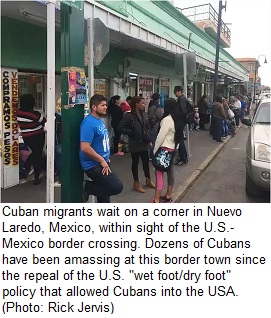
Download the book Go Lean … Caribbean – now!

———-

Appendix Reference

Download the full report – Latin America and the Caribbean 2030: Future Scenarios here:

http://www.atlanticcouncil.org/images/publications/Final_LAC2030-Report.pdf

Share this post:
,
[Top]