Category: Industries

A Lesson in History – Rockefeller’s Pipeline

Go Lean Commentary

This book Go Lean…Caribbean was written in 2013 in Omaha, Nebraska, in the shadow of one of the world’s richest men, Warren Buffett. The book posits that location is very important for the proper perspective when developing an empowerment plan. The book quotes the Bible scripture at Proverbs 22:29: “Have you beheld a man skillful in his work? Before kings is where he will station himself”. (Page 137). If this was the time of the Roman Empire, an empowerment roadmap like Go Lean would have to be written in Rome.

On the other hand, if this roadmap was written in 1885, at the start of the American Industrial domination, the author would have to be in the shadow of Industrialist John D. Rockefeller in New York City. See VIDEO below.

The Go Lean book posits that one person can make a difference and positively impact their society; so the book advocates for a community ethos of investment in the “gifts” that individuals “bring to table”. The book identifies the quality of geniuses and relates worthwhile returns from their investments. This mode of study allows us to consider this example of contributions from the industrial role model of Mr. Rockefeller and his prudent implementation of pipelines:

JCU Blog - A Lesson in History - Rockefeller Pipeline - Photo 1ohn Davison Rockefeller, Sr. (July 8, 1839 – May 23, 1937) was an American business magnate and philanthropist. He was a co-founder of the Standard Oil Company, which dominated the oil industry and was the first great U.S. business trust. Rockefeller revolutionized the petroleum industry, and along with other key contemporary industrialists such as Andrew Carnegie, defined the structure of modern philanthropy. In 1870, he co-founded Standard Oil Company and actively ran it until he officially retired in 1897.[3]

Rockefeller founded Standard Oil as an Ohio partnership with his brother William along with Henry Flagler, Jabez A. Bostwick, chemist Samuel Andrews, and a silent partner, Stephen V. Harkness. As Kerosene and Gasoline grew in importance, Rockefeller’s wealth soared and he became the world’s richest man and the first American worth more than a billion dollars.[a] Adjusting for inflation, he is often regarded as the richest person in history.[4][5][6][7]

His fortune was mainly used to create the modern systematic approach of targeted philanthropy. He was able to do this through the creation of foundations that had a major effect on medicine, education and scientific research.[8] His foundations pioneered the development of medical research and were instrumental in the eradication of hookworm and yellow fever.

Rockefeller was also the founder of both the University of Chicago and RockefellerUniversity and funded the establishment of Central Philippine University in the Philippines. He was a devoted Northern Baptist and supported many church-based institutions. Rockefeller adhered to total abstinence from alcohol and tobacco throughout his life.[9] He was a faithful congregant of the Erie Street Baptist Mission Church, where he taught Sunday school, and served as a trustee, clerk, and occasional janitor.[10][11] Religion was a guiding force throughout his life, and Rockefeller believed it to be the source of his success. Rockefeller was also considered a supporter of capitalism based in a perspective of social Darwinism, and is often quoted saying “The growth of a large business is merely a survival of the fittest”.[12][13]
Wikipedia Online Encyclopedia  (Retrieved October 18, 2014) –
http://en.wikipedia.org/wiki/John_D._Rockefeller

Living for almost 98 years and accumulating vast wealth, Mr. Rockefeller was highly accomplished. He was an early adoptor of Kerosene oil and earned his initial fortune by fostering entrepreneurship and Research & Development (R&D) around the then-cutting-edge product; see VIDEO below. One accomplishment that aligns with this Go Lean roadmap is Mr. Rockefeller’s strategic, tactical and operational applications of pipelines; see Appendix below. He used pipelines to spur his production, acquire raw materials, deliver finished goods to customers, mitigate against threats, and neutralize competition and opposition.

The book Go Lean … Caribbean also asserts that pipelines can be strategic, tactical and operationally efficient for building community wealth in the Caribbean region. They can mitigate challenges from Mother Nature, create jobs and grow the economy at the same time. The book purports that a new technology-enhanced industrial revolution is emerging, in which there is more efficiency for installing-monitoring-maintaining pipelines. Caribbean society must participate in these developments, in order to “survive with the fittest”. This point is pronounced early in the book with this Declaration of Interdependence (Page 14), with these statements:

xxvi.      Whereas the Caribbean region must have new jobs to empower the engines of the economy and create the income sources for prosperity, and encourage the next generation to forge their dreams right at home, the Federation must therefore foster the development of new industries, like that of … pipelines …

xxvii.      Whereas the region has endured a spectator status during the Industrial Revolution, we cannot stand on the sidelines of this new economy, the Information Revolution. Rather, the Federation must embrace all the tenets of Internet Communications Technology (ICT) to serve as an equalizing element in competition with the rest of the world. The Federation must bridge the digital divide and promote the community ethos that research/development is valuable and must be promoted and incentivized for adoption.

This book Go Lean… Caribbean, serves as a roadmap for the introduction and implementation of the technocratic Caribbean Union Trade Federation (CU) to elevate the 30 Caribbean member-states. This Federation will assume jurisdiction for the 1,063,000 square-mile Caribbean Sea, in an Exclusive Economic Zone. This approach allows for cooperation and coordination for pipelines among the member-states; this will thusly effectuate change in the region by allowing these 3 prime directives:

  • Optimization of the economic engines in order to grow the regional economy to $800 Billion GDP and create 2.2 million new jobs.
  • Establishment of a security apparatus to protect the resultant economic engines.
  • Improve Caribbean governance to support these engines.

The subject of pipelines has been addressed and further elaborated upon in these previous blog/commentaries:

https://goleancaribbean.com/blog/?p=1817 Caribbean grapples with intense new cycles of flooding & drought
https://goleancaribbean.com/blog/?p=1516 Floods in Minnesota, Drought in California – Why Not Share?

The Go Lean book itself details the economic principles and community ethos to adopt, plus the executions of strategies, tactics, implementations and advocacies to forge pipelines, Research & Development and industrial growth in the Caribbean:

Economic Principles – People Choose because Resources are Limited Page 21
Economic Principles – All Choices Involve Costs Page 21
Economic Principles – People Respond to Incentives Page 21
Economic Principles – Economic Systems Influence Individual Choices Page 21
Economic Principles – Voluntary Trade Creates Wealth Page 21
Community Ethos – Job Multiplier Page 22
Community Ethos – “Crap” Happens Page 23
Community Ethos – Lean Operations Page 24
Community Ethos – Return on Investments (ROI) Page 24
Community Ethos – Cooperatives Page 25
Community Ethos – Ways to Help Entrepreneurship Page 28
Community Ethos – Ways to Promote Intellectual Property Page 29
Community Ethos – Ways to Impact Research & Development Page 30
Community Ethos – Ways to Improve Negotiations Page 32
Community Ethos – Impact the Greater Good Page 37
Anecdote – Pipeline Transport – Strategies, Tactics & Implementations Page 43
Strategy – Vision – Confederating 30 Member-states in a Union Page 45
Strategy – Agents of Change – Technology Page 57
Tactical – Fostering a Technocracy Page 64
Tactical – Growing Economy – New High Multiplier Industries Page 68
Separation of Powers – Interstate Commerce Administration Page 79
Separation of Powers – Interior Department – Exclusive Economic Zone Page 82
Implementation – Assemble – Pipeline as a Focused Activity Page 96
Implementation – Ways to Pay for Change Page 101
Implementation – Benefits from the Exclusive Economic Zone Page 104
Implementation – Ways to Develop a Pipeline Industry Page 107
Implementation – Ways to Deliver Page 109
Planning – 10 Big Ideas – Pipeline Projects Page 127
Planning – Ways to Improve Interstate Commerce Page 129
Planning – Lessons from New York City Page 137
Planning – Lessons from Omaha Page 138
Advocacy – Ways to Grow the Economy Page 151
Advocacy – Ways to Create Jobs Page 152
Advocacy – Ways to Better Manage the Social Contract – Infrastructure Page 170
Advocacy – Ways to Ways to Impact Public Works – Ideal for Pipelines Page 175
Advocacy – Ways to Foster Cooperatives Page 176
Advocacy – Ways to Better Manage Natural Resources – Water Resources Page 183
Anecdote – Caribbean Industrialist & Entrepreneur Role Model Page 189
Advocacy – Ways to Impact Extractions – Pipeline Strategy Alignment Page 195
Advocacy – Ways to Improve Emergency Management Page 196
Advocacy – Ways to Foster Technology Page 197
Advocacy – Ways to Impact Wall Street – Adopt Advanced Financial Products Page 200
Advocacy – Ways to Improve Monopolies – Foster Cooperatives Page 202
Advocacy – Ways to Improve Transportation – Pipeline Options Page 205
Appendix – Interstate Compacts Page 278
Appendix – Pipeline Maintenance Robots Page 283

The economic principles of pipelines are sound. Pipelines can be used to bring resources from a source to a destination in a steady consistency, fulfilling the economic supply-demand conundrum. The Go Lean roadmap envisions pipelines solutions for resources like water, natural gas, electricity cables, and telecommunication cables – above ground and underwater.

We have the pipeline example of the prudence and success of one of the world’s richest men (ever) as a model, that of John D. Rockefeller. He also provides a role model for us in the Caribbean in other endeavors of life:

Research & Development (Kerosene & Gasoline)
Cooperatives & Trusts
Creative Financing & Securities Oversight
Fostering Genius
Philanthropic Foundations
Educational Empowerments
Spiritual Guidance

The contributions of a committed person can be impactful indeed in this vision for the elevation and empowerment of the Caribbean homeland. The Go Lean … Caribbean roadmap invites these contributions; (the roadmap mitigates the threats of corporate abuse of a plutocracy). Like Mr. Rockefeller’s model describes, we also invite pipelines, with their strategic, tactical and operational implementations. With the right applications from people, tools and techniques any movement can have an impact in a changing society.

Change has come to the Caribbean. Everyone is hereby urged to lean-in to this roadmap to make the Caribbean a better place to live, work and play. 🙂

Download the book Go Lean…Caribbean now!

———

Video: Rockefeller’s Standard Oil

John D. Rockefeller built an oil empire by guaranteeing a uniform quality for his Standard Oil Kerosene – History Channel.

http://www.history.com/topics/john-d-rockefeller/videos/rockefellers-standard-oil

—————————————————————————————-

APPENDIX – Rockefeller and his Pipeline Reality

In 1877, Standard Oil clashed with the Pennsylvania Railroad, its chief hauler. Rockefeller had envisioned the use of pipelines as an alternative transport system for oil and began a campaign to build and acquire them.[40]

At this stage the company did not actually drill for oil; it merely refined it. In 1879 an association of producers completed the Tidewater Pipeline, running from oil fields in Bradford to the Reading Railroad at Williamsport, Pennsylvania. This innovation demonstrated that crude oil could be shipped cheaply over long distances by pipeline – much more cheaply than by rail, in fact. Standard Oil quickly responded by beginning construction of its own network of pipelines, [installing over 4,000 miles]. Before Tidewater, Standard Oil had made good profits refining oil in Cleveland and other points and shipping it by rail. But the cost-efficiency of pipeline transport made it imperative to ship crude oil to shipping points and refine it there.[39]

The railroads, seeing Standard’s incursion into the transportation and pipeline fields, struck back and formed a subsidiary to buy and build oil refineries and pipelines.[41] Standard countered and held back its shipments and, with the help of other railroads, started a price war that dramatically reduced freight payments and caused labor unrest as well. Rockefeller eventually prevailed and the railroad sold all its oil interests to Standard. But in the aftermath of that battle, in 1879 the Commonwealth of Pennsylvania indicted Rockefeller on charges of monopolizing the oil trade, starting an avalanche of similar court proceedings in other states and making a national issue of Standard Oil’s business practices.[42]

Monopoly – Cause and Effect
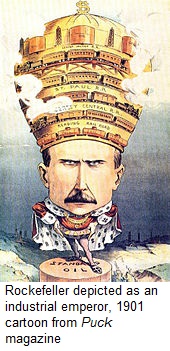
CU Blog - A Lesson in History - Rockefeller Pipeline - Photo 2Standard Oil gradually gained almost complete control of oil refining and marketing in the United States through horizontal integration. In the Kerosene industry, Standard Oil replaced the old distribution systems with its own vertical system. It supplied Kerosene by tank cars that brought the fuel to local markets, and tank wagons then delivered to retail customers, thus bypassing the existing network of wholesale jobbers.[43] Despite improving the quality and availability of Kerosene products while greatly reducing their cost to the public (the price of Kerosene dropped by nearly 80% over the life of the company), Standard Oil’s business practices created intense controversy; [this is typical plutocratic behavior]. Standard’s most potent weapons against competitors were underselling, differential pricing, and secret transportation rebates.[44] The firm was attacked by journalists and politicians throughout its existence, in part for these monopolistic methods, giving momentum to the antitrust movement. By 1880, according to the New York World newspaper, Standard Oil was “the most cruel, impudent, pitiless, and grasping monopoly that ever fastened upon a country.”[45] To the critics Rockefeller replied, “In a business so large as ours….. some things are likely to be done which we cannot approve. We correct them as soon as they come to our knowledge.”[45]

At that time, many legislatures had made it difficult to incorporate in one state and operate in another. As a result, Rockefeller and his associates owned dozens of separate corporations, each of which operated in just one state; the management of the whole enterprise was rather unwieldy. In 1882, Rockefeller’s lawyers created an innovative form of corporation to centralize their holdings, giving birth to the Standard Oil Trust.[46] The “trust” was a corporation of corporations, and the entity’s size and wealth drew much attention. Nine trustees, including Rockefeller, ran the 41 companies in the trust.[46] The public and the press were immediately suspicious of this new legal entity, but other businesses seized upon the idea and emulated it, further inflaming public sentiment. Standard Oil had gained an aura of invincibility, always prevailing against competitors, critics, and political enemies. It had become the richest, biggest, most feared business in the world, seemingly immune to the boom and bust of the business cycle, consistently racking up profits year after year.[47]

Standard Oil’s vast American empire included 20,000 domestic wells, 4,000 miles of pipeline, 5,000 tank cars, and over 100,000 employees.[47] Its share of world oil refining topped out above 90% but slowly dropped to about 80% for the rest of the century.[48] In spite of the formation of the trust and its perceived immunity from all competition, by the 1880s Standard Oil had passed its peak of power over the world oil market. Rockefeller finally gave up his dream of controlling all the world’s oil refining, he admitted later, “We realized that public sentiment would be against us if we actually refined all the oil.”[48] Over time foreign competition and new finds abroad eroded his dominance. In the early 1880s, Rockefeller created one of his most important innovations. Rather than try to influence the price of crude oil directly, Standard Oil had been exercising indirect control by altering oil storage charges to suit market conditions. Rockefeller then decided to order the issuance of certificates against oil stored in its pipelines. These certificates became traded by speculators, thus creating the first oil-futures market which effectively set spot market prices from then on. The National Petroleum Exchange opened in Manhattan in late 1882 to facilitate the oil futures trading.[49]

The invention of the light bulb gradually began to erode the dominance of Kerosene for illumination. But Standard Oil adapted, developing its own European presence, expanding into natural gas production [and distribution] in the U.S., then into Gasoline for automobiles, which until then had [only] been considered a waste product.[52]

In 1887, Congress created the Interstate Commerce Commission which was tasked with enforcing equal rates for all railroad freight, but by then Standard Oil depended more on pipeline transport.[54]

– (Retrieved October 18, 2014 from: http://en.wikipedia.org/wiki/John_D._Rockefeller)

Cited References:
a.      Fortune Magazine lists the richest Americans not by the changing value of the dollar but by percentage of GDP: Rockefeller is credited with a Wealth/GDP of 1/65.
———–
3.             “John D. and Standard Oil”. Bowling   GreenStateUniversity. Retrieved 2008-05-13.
4.             “The Richest Americans”. Fortune (CNN). Retrieved May 6, 2010.
5.             “Top 10 Richest Men of All Time”. AskMen.com. Retrieved 2007-05-29.
6.             “The Rockefellers”. PBS. Retrieved 2007-05-29.
7.             “The Wealthiest Americans Ever”. The New York Times. July 15, 2007. Retrieved 2007-07-17.
8.             Fosdick, Raymond Blaine (1989). The story of the Rockefeller Foundation. Transaction Publishers.
9.             Martin, Albro (1999), “John D. Rockefeller”, Encyclopedia Americana Page 23
10.         Chernow, Ron (1998). Titan: The Life of John D. Rockefeller, Sr. Random House, Page 52.
11.         “The 9 most amazing facts about John D. Rockefeller”. Oil Patch Asia.
12.         Richard Hofstadter et al. Sep 1, p. 45.
13.         Schultz, Duane P; Schultz, Sydney Ellen, A History of Modern Psychology, p. 128
———–
39.         Enclycopedia.com Online Resource. “Standard Oil Company – Pipelines. Retrieved October 19, 2014 from: http://www.encyclopedia.com/topic/Standard_Oil_Company.aspx
40.         Chernow 1998, p. 171.
41.         Segall, Grant (2001). John D. Rockefeller: Anointed With Oil. OxfordUniversity Press., p. 57.
42.         Segall 2001, p. 58.
43.         Chernow 1998, p. 253.
44.         Chernow 1998, p. 258.
45.         Segall 2001, p. 60.
46.         Segall 2001, p. 61.
47.         Chernow 1998, p. 249.
48.         Segall 2001, p. 67.
49.         Chernow 1998, p. 259.
50.         Chernow 1998, p. 242.
51.         Chernow 1998, p. 246.
52.         Segall 2001, p. 68.
53.         Segall 2001, pp. 62–63.
54.         Rockefeller, John D (1984) [1909]. Random Reminiscences of Men and Events. New York: Sleepy Hollow Press and Rockefeller Archive Center, Page 48.

Share this post:
, , , ,

A Lesson in History – Concorde SST

Go Lean Commentary

CU Blog - A Lesson in History - Concorde SST - Photo 130 years go by so fast…

In the 1970’s, when the Concorde Supersonic Transport (SST) jets were designed, developed and deployed, with a 30 year life-span, that time seemed so far off. But that time has now come and gone. Yes, cutting-edge has an expiration date.

It is difficult to think, now in 2014, that 1970’s technologies may still be cutting-edge, except that there are no other Supersonic Transport vehicles for civilian use today. So despite all the scientific and technological advances in the last 40 years, in this area, the world has gone backwards.

There are a lot of lessons here for us to consider with the history of the Concorde, taking into account that the SST had commercial applications, safety concerns and governing issues. This subject therefore parallels with the book Go Lean… Caribbean. The following is the historic reference of the Concorde:

CU Blog - A Lesson in History - Concorde SST - Photo 2Aérospatiale-BAC Concorde is a retired turbojet-powered supersonic passenger airliner or supersonic transport. It is one of only two SSTs to have entered commercial service; the other was the Tupolev Tu-144; (built by the Soviet Union under the direction of the Tupolev design bureau, headed by Alexei Tupolev; their prototype first flew on 31 December 1968 near Moscow, two months before the first flight of Concorde. The Tu-144 first went supersonic on 5 June 1969, and on 26 May 1970 became the first commercial transport to exceed Mach 2). The Concorde was jointly developed and produced by France-owned Aérospatiale and the British Aircraft Corporation (BAC) under an Anglo-French treaty. First flown in 1969, the Concorde entered service in 1976 and continued commercial flights for 27 years.

Reflecting the treaty between the British and French governments which led to the Concorde’s construction, the name Concorde is from the French word concorde, which has an English equivalent, concord. Both words mean agreement, harmony or union.

The Concorde needed to fly long distances to be economically viable; this required high efficiency. (Turbojets were found to be the best choice of engines.[68] The engine used was the twin spool Rolls-Royce/Snecma Olympus 593, a development of the Bristol engine first used for the Avro Vulcan bomber, and developed into an afterburning supersonic variant for the BAC TSR-2 strike bomber.[69] Rolls-Royce’s own engine proposed for the SST aircraft at the time of Concorde’s initial design was the RB.169 [70]). Among other destinations, the Concorde flew regular transatlantic flights from London Heathrow and Paris-Charles de Gaulle Airport to New York JFK, Washington Dulles and Barbados in the Caribbean; it flew these routes in less than half the time of other airliners. Only 20 aircraft were ever built, so the development of Concorde was a substantial economic loss; Air France and British Airways also received considerable government subsidies to purchase them.

While commercial jets took eight hours to fly from New York to Paris, the average supersonic flight time on the transatlantic routes was just under 3.5 hours. The Concorde’s maximum cruising altitude was 60,000 feet, (while subsonic airliners typically cruise below 40,000 feet), and an average cruise speed of Mach 2.02, about 1155 knots (2140 km/h or 1334 mph), more than twice the speed of conventional aircraft.[107]

The Concorde’s drooping nose, enabled the aircraft to switch between being streamlined to reduce drag and achieve optimum aerodynamic efficiency, and not obstructing the pilot’s view during taxi, takeoff, and landing operations. Due to the high angle of attack, the long pointed nose obstructed the view and necessitated the capability to droop to ensure visibility and FAA approval in the US.

The Concorde was retired in 2003 due to a general downturn in the aviation industry after the aircraft’s only crash in 2000 (killing 113 people onboard and on the ground), the 9/11 terrorist attacks in 2001, and a decision by Airbus (the successor firm of Aerospatiale) and BAC, to discontinue maintenance support.[5]
Wikipedia Online Encyclopedia (Retrieved October 13, 2014) –
http://en.wikipedia.org/wiki/Concorde

See the foregoing VIDEO for a synopsis of the Concorde’s 27-year history:

Video Title – Concorde: 27 Supersonic Years:

This review of the historicity of the Concorde is more than just an academic discussion; the aircraft was always presented as a glimpse into the future.  Likewise, the book Go Lean…Caribbean is future-focused, aspiring to economic principles that dictate that “consequences of choices lie in the future”. The book serves as a roadmap for the introduction and implementation of the technocratic Caribbean Union Trade Federation (CU). This confederation effort (aligning many former colonies of the same sponsoring countries of Great Britain and France that designed, developed and deployed the Concorde SST project) will spur a lot of technologically-driven industrial developments.

CU Blog - A Lesson in History - Concorde SST - Photo 4

What have we learned from the 27-year history of the Concorde, in terms of economics, security and governing lessons? How will these lessons help us today?

  • Crisis is a terrible thing to waste – The end of World War II saw an immediate clash and conflict between Soviet-backed communist countries versus Western democracies. There was an “arms and space” race. The Anglo-Franco treaty to design-develop the Concorde was a manifestation of that competition. While the US invested in supersonic technology for military applications, the Anglo-Franco treaty allowed for a civilian application, and exploitation of a populous market for those with capitalistic adherence. The Go Lean roadmap posits that the Caribbean is also in a crisis (on the losing end of globalization, advancing technology and economic dysfunction). The CU will incubate and foster industrial policy to better explore science, technology, engineering and mechanical (STEM) initiatives. With 80 million annual visitors across 30 different member-states, (many of them islands), we have the overall need for air transport solutions and a built-in market acceptance.
  • Promote opportunities for Research & Development – As far back as October 1956, the UK’s Ministry of Supply asked key Subject Matter Experts to form a new study group, the Supersonic Transport Advisory Committee or STAC,[12] with the explicit goal of developing a practical SST design and finding industry partners to build it. The ethos expressed by this specialty group foresaw that huge economic and security benefits could yield by developing cutting-edge solutions in the air-transport industry space . The Go Lean roadmap posits that appropriate investments must be prioritized for new industrial solutions, such as with Information & Communications Technologies. The Go Lean book posits that large states or small ones can have a “level-playing field” by exploring innovative solutions for the New Economy.
  • New “community ethos” can be adopted by the general public – The Concorde aircraft was regarded by many people as an aviation icon and an engineering marvel. During flight testing of the pre-production SST aircraft, it visited a number of “allied” foreign countries. It was not uncommon for ten-mile traffic jams to build up around airports as crowds of a hundred thousand and more gathered to look over the aircraft that was designed to bring faster-than-sound flight within reach of anyone with the price of a plane ticket.[25] The CU will employ messaging and image management to forge new attitudes about technology, R&D, entrepreneurship, intellectual property and STEM initiatives in the region.
  • Negotiate as partners not competitors – France had 3 nationally supported companies (state-owned Sud Aviation and Nord-Aviation, plus private firm Dassault Group) in the aero-space industry, but no jet-engine solution. The British company Rolls Royce had demonstrated great market leadership with jet engines. A collaboration was apropos. The CU maintains that, negotiation is an art and a science. More can be accomplished by treating negotiating counterparts as a partner, rather than not an adversary.
  • Cooperatives and sharing schemes lighten burdens among partners – In 1967, at the start of the new Anglo-Franco consortium, there was the intent to produce one long-range and one short-range SST version. However, prospective customers showed no interest in the short-range version and it was dropped.[25] The consortium secured orders (i.e., non-binding options) for over 100 of the long-range version from the major airlines of the day: Pan Am, BOAC, and Air France were the launch customers, with six Concordes each. Other airlines in the order book included Panair do Brasil, Continental Airlines, Japan Airlines, Lufthansa, American Airlines, United Airlines, Air India, Air Canada, Braniff, Singapore Airlines, Iran Air, Olympic Airways, Qantas, CAAC (China), Middle East Airlines, and TWA.[25][30][31] At the time of the first flight (1969) the options list contained 74 orders from 16 airlines. The important function for the CU in these cooperative initiatives is command-and-control. For the Concorde project the labor of up to 50,000 (including sub-contractors and suppliers) people had to be efficiently coordinated. The CU will employ cooperatives and sharing schemes for limited scopes within the prime directives of optimizing the economic, security and governing engines.
  • Bureaucratic response to crisis impede progress – At the end of the pre-production trials, there were orders for 74 aircrafts for 16 airlines, but in the end only 20 Concorde jets were ever manufactured. What happened? Geo-political crisis. Concorde SSTs required more fuel usage compared to subsonic aircrafts. The 1970’s saw a number of crises involving steeply rising oil prices (OPEC, Iran Revolution, etc.)[148] and new wide-body aircrafts, such as the Boeing 747, had recently made subsonic aircrafts significantly more efficient and presented a low-risk option for airlines.[50]. The governmental bureaucracy of the two national governments impeded tactical responses and adjustments to these agents-of-change, resulting in cancellation of unfulfilled orders … and also any continuous technological upgrades to the SST program. “There have always been those who want to go faster and those who think the present speed (of ox-cart, stagecoach, sailing ship) was fast enough”.[25] The Go Lean roadmap calls for the establishment of Self-Governing Entities (SGE), regulated at the federal level, to facilitate R&D in industrial settings. Under this scheme, government negotiation is only required at the outset/initiation; no further bureaucratic stalemates beyond the start-up. Tactically, SGE’s  can nimbly adapt to the demands of the global marketplace. This is the manifestation of a lean technocracy.
  • “Crap” Happens – While the Concorde had initially held a great deal of customer interest, the project was hit by a large number of order cancellations. There was a crash of the competing Soviet Tupolev Tu-144 at the Paris Le Bourget air show in 1973; this shocked potential buyers, and public concern over the environmental issues presented by supersonic aircrafts. Also, the issue of sonic booms and takeoff-noise pollution produced a shift in public opinion of SSTs. By 1976 only four nations remained as prospective buyers: Britain, France, China, and Iran.[43] But only Air France and British Airways (the successor to BOAC) ever took up their orders, with the two governments taking a cut of any profits made.[44] The United States cancelled the Boeing 2707, its rival supersonic transport program, in 1971. Observers have suggested that opposition to the Concorde on grounds of noise pollution had been encouraged by the United States Government, as it lacked its own competitor.[45] The US, India, and Malaysia all ruled out Concorde supersonic flights over the noise concern, although some of these restrictions were later relaxed.[46][47] This lesson constitutes the security scope of the Concorde SST historic consideration. The Go Lean roadmap anticipates that things would go wrong, and plans for risk mitigations in advance. This includes man-made, industrial and natural disasters. In addition, there is the governance plan for the CU to have jurisdiction over the region’s aviation regulations – much like the FAA (Federal Aviation Admin.) in the US.
  • CU Blog - A Lesson in History - Concorde SST - Photo 3Consider the Greater Good – In the end, the realization of a noise pollution threat never materialized with Concorde SSTs – more fear than actualization. A progressive path forward from 1976 should have resulted in even faster supersonic transportation options at cheaper prices by today, 40 years later. Author and Professor Douglas Ross characterized restrictions placed upon Concorde operations by President Jimmy Carter’s administration (1977 – 1981) as having been an act of protectionism for American aircraft manufacturers.[48] To the contrary, the Caribbean need policies for the Greater Good. With island tourism being the primary economic driver in the region, we need proactive air-transport solutions to facilitate visitors’ easy access to Caribbean hospitality. The Greater Good philosophy is directly quoted as: “It is the greatest good to the greatest number of people which is the measure of right and wrong”. The CU/Go Lean roadmap calls for a number of measures that strike directly at this Greater Good mandate.

The related subjects of technology-bred innovations and history lessons have been a frequent topic for Go Lean blog/commentaries, as sampled here:

https://goleancaribbean.com/blog/?p=2480 A Lesson in History: Community Ethos of WW II
https://goleancaribbean.com/blog/?p=1568 Airline Lesson: Dutch airline angers Mexico soccer fans
https://goleancaribbean.com/blog/?p=1531 A Lesson in History: 100 Years Ago Today – World War I
https://goleancaribbean.com/blog/?p=1487 Aeronautics Lesson: Here come the Drones … and the Concerns
https://goleancaribbean.com/blog/?p=673 Transport Lesson: Autonomous cargo vessels without a crew
https://goleancaribbean.com/blog/?p=308 Community Ethos: CARCIP Urges Greater Innovation
https://goleancaribbean.com/blog/?p=254 Airline Lesson: Air Antilles Launches new St. Maarten Service
https://goleancaribbean.com/blog/?p=235 Economic Reality: Tourism’s changing profile

The purpose of the Go Lean roadmap is to shift the downward trends in the Caribbean today, to reverse course and elevate Caribbean society. The CU, applying lessons from the Concorde history, has prime directives proclaimed as follows:

  • Optimization of the economic engines in order to grow the regional economy to $800 Billion & create 2.2 million new jobs.
  • Establishment of a security apparatus to protect the resultant economic engines.
  • Improve Caribbean governance to support these engines.

While the Go Lean book is not written as an analysis of the Concorde, the following detail considerations of community ethos, strategies, tactics, implementations and advocacies in the book are still helpful to empower Caribbean society:

Community Ethos – Economic Systems Influence Choices & Incentives Page 21
Community Ethos – Consequences of Choices Lie in the Future Page 21
Community Ethos – “Crap” Happens Page 23
Community Ethos – Ways to Impact the Future Page 26
Community Ethos – Ways to Improve Negotiations Page 32
Community Ethos – Ways to Manage Reconciliations Page 34
Community Ethos – Ways to Improve Sharing Page 35
Community Ethos – Ways to Impact the Greater Good Page 37
Strategy – Vision –  Integrate region into a Single Market Economy Page 45
Strategy – Agents of Change – Technology Page 57
Strategy – Agents of Change – Globalization Page 57
Tactical – Separation of Powers – Department of State – SGE Administration Page 80
Tactical – Separation of Powers – Transportation Department – Aviation Admin Page 84
Implementation – Ways to Pay for Change Page 101
Implementation – Foreign Policy Initiatives at Start-up Page 102
Implementation – Security Initiatives at Start-up Page 103
Implementation – Steps to Implement Self-Governing Entities Page 105
Implementation – Ways to Deliver Page 109
Implementation – Ways to Benefit from Globalization Page 119
Planning – Ways to Ways to Model the EU Page 130
Planning – Ways to Better Manage Image Page 133
Planning – Lessons Learned from the defunct West Indies Federation Page 134
Planning – Lessons from Detroit Page 140
Advocacy – Ways to Grow the Economy Page 151
Advocacy – Ways to Create Jobs Page 152
Advocacy – Ways to Foster Cooperatives Page 176
Advocacy – Ways to Enhance Tourism in the Caribbean Region – Air Lifts Page 190
Advocacy – Ways to Market Southern California – Transportation Options Page 194
Advocacy – Ways to Foster Technology Page 197
Advocacy – Ways to Improve Transportation Page 205

The image of the Concorde was that of cutting-edge technology for its entire 27-year run. But cutting-edge does have an expiration date; so there must be the culture of continuous enhancing and upgrading any cutting-edge innovation. This is true in the new world of Internet Communications Technologies (ICT), where innovations emerge every year; sometimes even a few times during the year. The battleground has changed, from the Concorde’s frontier of aero-space to the ever-changing frontiers of cyber-space. The Go Lean movement asserts that the culture/attitude/ethos, to be constantly innovative, is most crucial in this new economy, where the only constant is change itself.

Now is the time for all of the Caribbean to learn the lessons from the 27-year history of the Concorde. The people and governing institutions of the region are hereby urged to lean-in for the empowerments described in the book Go Lean … Caribbean. This is a big deal for the region; the current economic engines need technology-based innovations in general, and air transport solutions in particular. This is one way we can make our homeland a better place to live, work, and play. 🙂

Download the free e-Book of Go Lean … Caribbean – now!

—————————–

Referenced Sources:
5.     “UK | Concorde grounded for good”. BBC News. 2003-04-10. Retrieved 2013-06-15.
12.   Conway, Eric (2005). High-Speed Dreams: NASA and the Technopolitics of Supersonic Transportation, 1945–1999. JHU Press. Page 39.
25.   “Early History.” concordesst.com. Retrieved 8 September 2007.
30.   “Aerospace: Pan Am’s Concorde Retreat”. Time, 12 February 1973. 12 February 1973.
31.   “Vertrag mit Luken”. Der Spiegel. 13 March 1967. Retrieved 6 November 2012.
43.   “Concordes limited to 16”. Virgin Islands Daily News, 5 June 1976.
44.    “Payments for Concorde”. British Airways. Retrieved 2 December 2009.
45.   Lewis, Anthony (12 February 1973). “Britain and France have wasted billions on the Concorde”. The New York Times, 12 February 1973.
46.   “Malaysia lifting ban on the use Of its Airspace by the Concorde”. The New York Times, 17 December 1978. 17 December 1978. Retrieved 30 June 2011.
47.   “News from around the world”. Herald-Journal, 13 January 1978. Retrieved 30 June 2011.
48.  Ross, Douglas (March 1978). The Concorde Compromise: The Politics of Decision-making. Bulletin of the Atomic Scientists. p. 46.
49.  Marston, Paul (16 August 2000). “Is this the end of the Concorde dream?”. London: Daily Telegraph, 16 August 2000.
50.   Ross, Douglas (March 1978). The Concorde Compromise: The Politics of Decision-making. Bulletin of the Atomic Scientists, pp. 47–49.
68.   Birtles, Philip. Concorde, pp. 62–63. Vergennes, Vermont: Plymouth Press, 2000.
69.   “Rolls Royce Olympus history.” wingweb.co.uk. Retrieved 15 January 2010.
70.   Aero Engines 1962, Flight International, 28 June 1962: 1018
107. Schrader, Richard K. (1989). Concorde: The Full Story of the Anglo-French SST. Kent, UK: Pictorial Histories Pub. Co., p. 64.
148. B.CAL drops Concorde plans but asks for Hong Kong licence. Flight International Magazine, posted 30 June 1979, p. 2331.

Share this post:
, , ,
[Top]

More Business Travelers Flock to Airbnb

Go Lean Commentary

The internet has changed everything.

…especially in the hospitality industry. (Remember Travel Agents?!)

The book and accompanying blog/commentaries for Go Lean…Caribbean posit that the Sharing Economy can emerge more fully in the Caribbean. The Internet & Communications Technology (ICT) provides the tools and techniques. Visitors/tourists will be able to easily search and book houses, condominiums and apartments by connecting directly to the homeowner. This will be a win-win for the homeowner and their guests.

CU Blog - More Business Travelers Flock to Airbnb - Photo

This change is ecstasy for some, but agony for others.

Navigating the world of change is a mission of the Go Lean book. The book posits that the Bed & Breakfast (B&B) industry has evolved with the emerging internet culture and now allow families to share their high-end homes with strangers (and business travelers), in lieu of resort properties (Page 35). This development, like many agents-of-change, brings winners and losers. Hotel room nights and collection of municipal hotel taxes can all be imperiled if this ICT-Sharing development proceeds unchecked. This is why Go Lean promotes “sharing” as a community ethos, so as to mitigate the perils of this industry. We need online sharing tools to target the Caribbean, especially during the peaks of event tourism (festivals, carnivals, fairs). But we need our hotel taxes too.

The challenge with the Sharing Economy, for room rentals and many other areas of life, is one-step forward-two steps-backwards.

See the foregoing news article and the following VIDEO, that depicts the emergence of the company Airbnb:

Video Source: NBC News TODAY Show (Retrieved October 8, 2014)

Corporate travelers are getting creative, using the Internet and home rental sites like Airbnb to find alternative housing rather than checking into hotels. NBC’s Joe Fryer reports. http://on.today.com/2x9Sicg

————–

Title: Democratizing the Sharing Economy – The Center for Popular Economics
By: Anders Fremstad

The internet has sharply reduced the cost of peer-to-peer transactions.  In the 1990s and 2000s, Craigslist and eBay made it much easier to buy and sell secondhand goods, and these sites now facilitate over a million transactions a day.  More recently, online platforms associated with the “sharing economy” are helping friends, neighbors, and even strangers borrow, lend, and rent goods.  Travellers can reserve a spare room through Airbnb or find a free place to crash on Couchsurfing.  People can find a ride on Uber or rent a neighbor’s car on RelayRides.  Neighbors can increasingly borrow tools, gear, and appliances free-of-charge on NeighborGoods, Sharetribe, and similar sites.

Most observers celebrate how the sharing economy lowers the cost of accessing goods, but there is a growing debate over how these online platforms should be regulated.  Unfortunately, this debate ignores how many of the fundamental problems with the sharing economy arise from its corporate nature.  The solution may not be to simply regulate the corporate sharing economy but to also democratize the sharing economy by empowering the people who use these platforms to determine how they work.

Source: http://www.populareconomics.org/democratizing-the-sharing-economy/  Posted 06-24-2014; retrieved 10-10-2014

The book serves as a roadmap for the introduction and implementation of the technocratic Caribbean Union Trade Federation (CU). The roadmap posits that many issues and challenges for a Sharing Economy can only be managed with feasible economies-of-scale. The CU market size of 30 member-states and 42 million people will allow for the leverage to consolidate, collaborate and confederate the organizational dynamics to tackle these issues.

The book Go Lean…Caribbean anticipates the compelling issues associated with room sharing in the emerging new economy.

The book asserts that before the strategies, tactics and implementations of the roadmap can be deployed, the affected communities must first embrace a progressive community ethos. The book defines this “community ethos” as the fundamental character or spirit of a culture; the underlying sentiment that informs the beliefs, customs, or practices of society; dominant assumptions of a people or period. The Go Lean book stresses that the current community ethos must change and the best way to motivate people to adapt their values and priorities is in response to a crisis. The roadmap recognizes this fact with the pronouncement that the Caribbean is in crisis, and that “a crisis is a terrible thing to waste”. The region is devastated from external factors: global economic recession, globalization and rapid technology changes.

Cause and effect!

The Go Lean roadmap promotes development activity for the new ICT global economy, first in the anticipation and then in response of the demands of the Sharing Economy. Even if there is no international trade realization, these developments are needed for the integrated domestic “Single Market”. The roadmap incubates these industrial initiatives to promote the practice:

  • Caribbean Cloud – The Go Lean roadmap calls for the establishment of the Caribbean Cloud, an online community and social media initiative dubbed as myCaribbean.gov. This effort will be exerted by the Caribbean Postal Union (CPU) so as to impact allCaribbean stakeholders: residents, businesses, Diaspora, trading partners, visitors – a universe of 150 million people. TheCaribbean region accommodates 80 million visitors every year. The strategy of maintaining contact with previous visitors steadily increases the universe … and potential customer-base.
  • Mobile Applications – The Go Lean roadmap defines the mastery of time-&-space as strategic for succeeding in mobile apps development and deployment for the region (Page 35). Products like AirBnB and competitors, master mobile apps so that dynamic decisions and impulse buying can be exploited on behalf of touristic properties. Imagine a customer seeing an advertising billboard for a Caribbean resort in a North American city, in the middle of a snow storm, at the moment the desire to partake of Caribbean hospitality may be a great inclination.

The book asserts that to adapt to the new Sharing Economy, there must be a new internal optimization of the region’s strengths. This is defined in the following statement of the opening Declaration of Interdependence (Page 14):

xxvii. Whereas the region has endured a spectator status during the Industrial Revolution, we cannot stand on the sidelines of this new economy, the Information Revolution. Rather, the Federation must embrace all the tenets of Internet Communications Technology (ICT) to serve as an equalizing element in competition with the rest of the world. The Federation must bridge the digital divide and promote the community ethos that research/development is valuable and must be promoted and incentivized for adoption.

Something old, something new, something borrowed, something blue – Old Adage regarding marriage and weddings.

The quest to elevate Caribbean society includes embracing the “New Economy” and also optimizing ongoing economic engines; in this case tourism. This can be likened to a marriage. The CU will employ technologically innovative products and services to marry the “New Economy” with the “Old Economy”. This impact is pronounced in the CU‘s prime directives, identified with the following 3 statements:

  • Optimization of the economic engines in order to grow the regional economy to $800 Billion & create 2.2 million new jobs.
  • Establishment of a security apparatus to protect the resultant economic engines.
  • Improve Caribbean governance to support these engines.

The subject in this blog/commentary, of focusing on the intersection of the “Old Economy” with the “New Economy”, the 100-year old tourism product with the brand new internet, is a big challenge, requiring brand new leadership. This Agent-of-Change is impacting all aspects of commerce in the modern world, including the tourism product.

This subject of “New Economy’s” shared hospitality services has been previously covered in these Go Lean blogs, highlighted here in the following samples:

https://goleancaribbean.com/blog/?p=1364 Car-Sharing Uber Demonstrations Snarl Traffic from London to Berlin
https://goleancaribbean.com/blog/?p=486 Incubator firm (Temasek) backs Southeast Asia cab booking app GrabTaxi

In line with the foregoing article and VIDEO, the Go Lean book details the applicable community ethos, strategies, tactics, implementation and advocacies as a roadmap to foster this change/empowerment in the region for the Sharing Economy and to impact the tourism product:

Community Ethos – Ways to Impact the Future Page 26
Community Ethos – Ways to Help Entrepreneurship Page 28
Community Ethos – Promote Intellectual Property Page 29
Community Ethos – Ways to Bridge the Digital Divide Page 31
Community Ethos – Ways to Improve Sharing Page 35
Strategy – Confederate 30 Caribbean Member-States Page 45
Strategy – Customers – Citizens, Diaspora and Visitors Page 47
Strategy – Agents of Change – Technology Page 57
Tactical – Separation of Powers – Caribbean Cloud Page 74
Tactical – Separation of Powers – Caribbean Postal Union   (CPU) Page 78
Implementation – Year 1 / Assemble Phase – Establish CPU Page 96
Implementation – 10 Trends in Implementing Data Centers Page 106
Implementation – Improve Mail Services – Electronic Supplements Page 108
Implementation – Ways to Impact Social Media Page 111
Advocacy – Ways to Benefit from Globalization – Level Playing Field with ICT Page 129
Advocacy – Ways to Grow the Economy Page 151
Advocacy – Ways to Create Jobs Page 152
Advocacy – Revenue Sources for Regional Administrations Page 172
Advocacy – Ways to Enhance Tourism Page 190
Advocacy – Ways to Impact Events Page 191
Advocacy – Ways to Market Southern California Page 194
Advocacy – Ways to Foster Technology Page 197
Advocacy – Ways to Foster e-Commerce Page 198
Advocacy – Ways to Impact Main Street Page 201
Advocacy – Ways to Promote Call Centers Page 212
Advocacy – Ways to Impact the Diaspora Page 217
Appendix – Urban Bicycle Sharing Model Page 352

The roadmap posits that the CU will foster and incubate the Shared Economy and the Mobile Apps industry, thereby forging entrepreneurial incentives and jobs. Under the right climate, innovations can thrive. We need that climate here in the Caribbean; we must remain competitive, as a people and as a tourism market. As related in the foregoing article and VIDEO, the general market is embracing the Shared Economy.

The world has changed!

This change can be good. We can make the Caribbean, a better place to live, work and play.

Download the book Go Lean … Caribbean – now!

Share this post:
, , ,
[Top]

Role Model Jack Ma brings Alibaba to America

Go Lean Commentary

The Chinese company Alibaba Group is another model for the Caribbean Postal Union (CPU): our logistics solution for delivering the mail … and modern commerce – 21st Century trade – to the Caribbean region.

The US Postal Service (USPS) is not the model for the Caribbean. The book Go Lean…Caribbean describes the USPS as a failing enterprise (Page 99). Alibaba, on the other hand, just went public on the New York Stock Exchange (NYSE), raising $25 Billion in the first week.

CU Blog - Role Model Jack Ma brings Alibaba to America - Photo 1Alibaba Group Holding Limited is a publicly traded Hangzhou-based group of Internet-based e-commerce businesses, including business-to-business online web portals, online retail and payment services, a shopping search engine and data-centric cloud computing services. The group began in 1999 when Jack Ma founded the website Alibaba.com, a business-to-business portal to connect Chinese manufacturers with overseas buyers. In 2012, two of Alibaba’s portals handled 1.1 trillion yuan ($170 Billion) in sales.[13] The company primarily operates in the People’s Republic of China (PRC), and at closing time, on the date of its historic initial public offering (IPO), 19 September 2014, Alibaba’s market value was measured as US$231 Billion.[14]. Analysts says that performance marketing will play a key role in meeting the financial markets’ expectations of such market valuation [15]

In September 2013, the company sought an IPO in the United States after a deal could not be reached with Hong Kong regulators.[16] Planning occurred over 12 months before the company’s market debut in September 2014. The NYSE Alibaba ticker symbol is “BABA.N”, while the pricing of the IPO initially raised US$21.8 billion,[17][14] which later increased to US$25 billion, making it the largest IPO in history.[18] However, buyers weren’t purchasing actual shares in the group, since China forbids foreign ownership, but rather just shares in a Cayman Islands shell corporation.[19]

Alibaba’s consumer-to-consumer portal Taobao Marketplace, similar to US-based eBay.com, features nearly a billion products and is one of the 20 most-visited websites globally. The Group’s websites accounted for over 60% of the parcels delivered in China by March 2013,[13] and 80% of the nation’s online sales by September 2014.[14] Alipay, an online payment escrow service, accounts for roughly half of all online payment transactions within China.[20]

Alipay.com is a third-party online payment platform with no transaction fees.[1] It was launched in China in 2004 by Alibaba Group and its founder Jack Ma. According to analyst research report, Alipay has the biggest market share in China with 300 million users and control of just under half of China’s online payment market in February 2014. According to Credit Suisse, the total value of online transactions in China grew from an insignificant size in 2008 to around RMB 4 trillion (US$660 billion) in 2012.[2]

Alipay provides an escrow service, in which consumers can verify whether they are happy with goods they have bought before releasing money to the seller. This service was offered for what the company says are China’s weak consumer protection laws, which have reduced consumer confidence in C2C (Consumer-to-Consumer) and even B2C (Business-to-Consumer) quality control.

The company says Alipay operates with more than 65 financial institutions including Visa and MasterCard[3] to provide payment services for Taobao and Tmall as well as more than 460,000 Chinese businesses. Internationally, more than 300 worldwide merchants use Alipay to sell directly to consumers in China. It currently supports transactions in 12 foreign currencies.

The payment methods are MasterCard, Visa, Boleto Bancário, Transferência Bancária, Maestro, WebMoney, and QIWI Кошелек as of May 2014.[4]

The PBOC (People’s Bank of China), China’s central bank, issued licensing regulations in June 2010 for third-party payment providers. It also issued separate guidelines for foreign-funded payment institutions. Because of this, Alipay, which accounts for half of China’s non-bank online payment market, was restructured as a domestic company controlled by Alibaba CEO Jack Ma in order to facilitate the regulatory approval for the license.[5] The 2010 transfer of Alipay’s ownership was controversial, with media reports in 2011 that Yahoo! and Softbank (Alibaba Group’s controlling shareholders) were not informed of the sale for nominal value. Chinese business publications Century Weekly criticised Ma, who stated that Alibaba Group’s board of directors was aware of the transaction.[6] The incident was criticized in foreign and Chinese media as harming foreign trust in making Chinese investments.[7] The ownership dispute was resolved by Alibaba Group, Yahoo!, and Softbank in July 2011.[8]

In 2013 Alipay launched a financial product platform called Yu’ebao.[9] As of June 2013 the company still had what it called “a minor paperwork problem” with the China Securities Regulatory Commission, but the company said that they planned to expand the product while these are sorted out.[10]
Wikipedia Online Encyclopedia – Retrieved October 2, 2014
http://en.wikipedia.org/wiki/Alipay

Source References:

  1. Zhe, Sun (Jan 2012). “From Stall to Mall”. News China.
  2. John Watling (14 February 2014). “China’s Internet Giants Lead in Online Finance”. The Financialist. Credit Suisse. Retrieved 15 February 2014.
  3. “About Alipay”. Alipay. Retrieved 10 October 2013.
  4. https://alipay.alibaba.com/checkout.htm (free registration required)
  5. Wang, Shanshan (27 May 2011). “Alipay Awarded Third-Party Payment License”. Caixin Online.
  6. “How Jack Ma’s Mistake Damaged China’s Market”. Caixin Online. 14 June 2011.
  7. “Jack Ma Talks To China Entrepreneur Magazine About The Alipay Case (UPDATED)”. DigiCha. 6 July 2011. Retrieved 10 October 2013.
  8. Rusli, Evelyn M. (29 July 2011). “Yahoo and Alibaba Resolve Dispute Over Alipay”. DealBook.
  9. Chohan, Usman W. “Financial Innovation in China: Alibaba’s Leftover Treasure – 余额宝”. McGillUniversity. Retrieved 14 May 2014.
  10. Hsu, Alex (27 June 2013). “Alipay’s Issue with CSRC Only a Paperwork Problem; Alipay Will Continue to Expand Yu E Bao”. BrightWire News.

Alibaba’s 2013 revenues amounted to USD 7.5 billion[11] with 22,000 employees (March 2014).[12] This Alibaba model relates to the Caribbean in so many ways, including the fact that it is a Cayman Islands incorporated business entity.

If the CPU can duplicate some of Alibaba’s success, that would be a win-win. The focus of the CPU is not just postal mail, but rather logistics. Alibaba does so much more than just sell Chinese manufactured goods online, it facilitates a complete eco-system for Small-Medium-Enterprises (SME’s) to thrive: finding customers for their wares and collecting payments. (The end result is the generation of $170 billion in commerce). We need that functionality in the Caribbean. Alibaba is therefore a good model, not just for the CPU but the entire Caribbean Union Trade Federation (CU). The book Go Lean…Caribbean, serves as a roadmap for the introduction and implementation of the technocratic CU.

Alibaba was the brainchild of just one person, Jack Ma.

This VIDEO demonstrates an additional theme from the Go Lean book, that one person can make a difference in transforming society:

VIDEO: CBS News 60 Minutes – (Posted 09-28-2014) –
http://www.cbsnews.com/news/alibaba-chairman-jack-ma-brings-company-to-america/

(VIDEO plays best in Internet Explorer).

Jack Ma and Alibaba have greatly impacted Chinese society, elevating the economic engines. This result synchronizes with the Go Lean roadmap for elevating Caribbean society. The CU will employ technologically innovative products and services to impact its prime directives; identified with the following 3 statements:

  • Optimization of the economic engines in order to grow the regional economy to $800 Billion & create 2.2 million new jobs.
  • Establishment of a security apparatus to protect the resultant economic engines.
  • Improve Caribbean governance to support these engines.

The Go Lean roadmap seeks to change the entire eco-system of Caribbean commerce and the interaction with postal operations. This vision is defined early in the book (Page 12 & 14) in the following pronouncements in the Declaration of Interdependence:

xv. Whereas the business of the Federation and the commercial interest in the region cannot prosper without an efficient facilitation of postal services, the Caribbean Union must allow for the integration of the existing mail operations of the governments of the member-states into a consolidated Caribbean Postal Union, allowing for the adoption of best practices and technical advances to deliver foreign/domestic mail in the region.

xxvii. Whereas the region has endured a spectator status during the Industrial Revolution, we cannot stand on the sidelines of this new economy, the Information Revolution. Rather, the Federation must embrace all the tenets of Internet Communications Technology (ICT) to serve as an equalizing element in competition with the rest of the world. The Federation must bridge the digital divide and promote the community ethos that research/development is valuable and must be promoted and incentivized for adoption.

Email and text messages have replaced “snail” mail in advanced economy countries for personal written communications. Electronic Bill Presentation & Payments (EBP&P) schemes are transforming business-to-consumer interactions, and electronic funds transfer/electronic commerce is the norm for payments. So ICT must be a prominent feature of any Caribbean empowerment plan. This is why creating the CPU and the Caribbean Cloud is “Step One, Day One” in the Go Lean roadmap. This is the by-product of assembling regional organs into a single entity with multilateral cooperation and a separation-of-powers (Page 71). The roadmap also includes establishment of the Caribbean Central Bank (CCB), as a cooperative among existing Central Banks, and its facilitation of electronic payments schemes so as to enable the region’s foray into electronic commerce and trade marketplaces, as depicted with the Alibaba/Alipay model in the foregoing article and VIDEO.

The Go Lean book details a series of community ethos, strategies, tactics, implementations and advocacies to foster the best practices for the delivery of the CPU and trade marketplaces in the Caribbean region:

Community Ethos – Deferred Gratification Page 21
Community Ethos – Economic Principles – All Choices Involve Costs Page 21
Community Ethos – Economic Principles – People Respond to   Incentives Page 21
Community Ethos – Economic Principles – Economic Systems Influence   Choices Page 21
Community Ethos – Economic Principles – Voluntary Trade Creates Wealth Page 21
Community Ethos – Economic Principles – The Consequence of Choice Lie   in Future Page 21
Community Ethos – Job Multiplier Page 22
Community Ethos – Lean Operations Page 24
Community Ethos – Cooperatives Page 25
Community Ethos – Ways to Impact the Future Page 26
Community Ethos – Ways to Help Entrepreneurship Page 28
Community Ethos – Promote Intellectual Property Page 29
Community Ethos – Ways to Bridge the Digital Divide Page 31
Strategy – Agents of Change – Technology Page 57
Strategy – Agents of Change – Globalization Page 57
Tactical – Fostering a Technocracy Page 64
Tactical – How to Grow the Economy to $800 Billion – ‘East Asian Tigers’ Model Page 67
Tactical – Separation of Powers – Postal Services Page 78
Tactical – Separation of Powers – Interstate Commerce Administration Page 79
Implementation – Year 1 / Assemble Phase – Establish CPU Page 96
Implementation – Anecdote – Mail Services – US Dilemma Page 99
Implementation – Ways to Pay for Change – Group Purchasing Organizations (GPO) Page 101
Implementation – Ways to Optimize Mail Service & myCaribbean.gov Marketplace Page 108
Implementation – Ways to Deliver Page 109
Implementation – Ways to Impact Social Media Page 111
Implementation – Ways to Benefit from Globalization Page 119
Planning – Ways to Improve Trade – GPO’s Page 128
Planning – Ways to Improve Interstate Commerce Page 129
Advocacy – Ways to Grow the Economy Page 151
Advocacy – Ways to Create Jobs Page 152
Advocacy – Ways to Mitigate Black Markets Page 165
Advocacy – Ways to Foster Cooperatives Page 176
Anecdote – Caribbean Industrialist – Role Model Butch Stewart Page 189
Advocacy – Ways to Foster Technology – Incubators Strategy Page 197
Advocacy – Ways to Foster e-Commerce Page 198
Advocacy – Reforms for Banking Regulations Page 199
Advocacy – Ways to Impact Wall Street Page 200
Advocacy – Ways to Impact Main Street Page 201

According to the foregoing article, trade business models can be very successful as a strategy to grow the regional economy. Increased trade will undoubtedly mean increased job opportunities. The CU/CPU/CCB/Go Lean plan is to foster and incubate key industries for this goal, incorporating many of the best practices as related in the foregoing article and VIDEO; imagine a Caribbean-based marketplace – www.myCaribbean.gov – with 150 million subscribers (Page 74). Alibaba is now worth over US$231 Billion, though it is a recent start-up. This is a role model for the CU/CPU/CCB/Go Lean roadmap to follow, a methodical start-up with technocratic efficiency.

Now is the time for all of the Caribbean, the people and governing institutions (like Postal Operations), to lean-in for the changes in the book Go Lean … Caribbean. This is a Big Idea for the region, that of a Cyber Caribbean effort (Page 127), in which trade marketplaces play a major role. This roadmap is not just a plan for delivering the mail; it is also the delivery of the hopes and dreams of generations of Caribbean stakeholders; it is about delivering the future: a better place to live, work and play.  🙂

Download the book Go Lean … Caribbean – now!

———————————

Appendix – Commentary References:

11. “Ali Group’s revenue in 2011 amounted to $ 2.8 billion over 40% profit margin”. Sohu.com – Chinese Internet Search Engine . Retrieved 2012-06-07 from: http://it.sohu.com/20120607/n344991768.shtml.

12. “Alibaba group FAQs”. Retrieved 2012-06-07 from: http://www.alibabagroup.com/en/about/faqs.

13. “E-commerce in China: The Alibaba phenomenon”. The Economist. Retrieved 23 March 2013 from: http://www.economist.com/news/leaders/21573981-chinas-e-commerce-giant-could-generate-enormous-wealthprovided-countrys-rulers-leave-it.

14. Lianna B. Baker, Jessica Toonkel, Ryan Vlastelica (19 September 2014). “Alibaba surges 38 percent on massive demand in market debut“. Reuters. Retrieved 20 September 2014 from: .

15. “How Alibaba can double sales“. Retrieved 30 September 2014.

16. “U.S. to get coveted Alibaba IPO after Hong Kong talks founder“. Reuters. 25 September 2013. Retrieved 26 September 2013 from: .

17. “IPO launch of Alibaba pushed back by a week“. China National News. 1 September 2014. Retrieved 1 September 2014.

18. Picker, Leslie; Chen, Lulu Yilun (22 September 2014). “Alibaba’s Banks Boost IPO Size to Record of $25 Billion“. Bloomberg. Retrieved 23 September 2014.

19. Solomon, Steven Davidoff (May 6, 2014). “Alibaba Investors Will Buy a Risky Corporate Structure“. New York Times (Dealbook blog).

20. “Alibaba: The world’s greatest bazaar“. The Economist. Retrieved 23 March 2013.


Share this post:
, , , ,
[Top]

How ‘The Lion King’ roared into history

Go Lean Commentary

There is money in the ‘Arts’.

One “Broadway” musical play, The Lion King has made $6.21 billion. That is significant. In fact that is a record, according to the foregoing news article:

By: Alison Boshoff

CU Blog - How the Lion King roared into history - Photo 1Title: How The Lion King roared into history: As show is crowned biggest box office earner ever, the secrets of its success emerge

Hakuna Matata!

Sir Elton John has long observed that The Lion King musical ‘is a law unto itself’ — and how so.

After more than a decade of performances in cities all over the world, it was confirmed this week that the stage show is the biggest beast in the jungle.

The Lion King — based on the 1994 Disney film of the same name — has taken more money at the box office than any other production in history.

Since its first night on Broadway in 1997, the show has made more than £3.8 billion ($6.21 billion) in ticket sales alone.

Not only has it conquered the stage, it has massively out-earned every cinema release — including blockbusters such as James Cameron’s Avatar, which took a mere £1.7 billion ($2.78 billion) globally after its 2009 release.

A further fortune has been made in souvenir T-shirts, posters and the rest. At the last count, there were eight different cast recordings of the show’s songs on sale.

Featuring music by Sir Elton John and lyrics by Sir Tim Rice, The Lion King opened in Minneapolis in July 1997 before moving to Broadway in November that year.

CU Blog - How the Lion King roared into history - Photo 2It arrived at the Lyceum Theatre in London’s West End in October 1999 and currently takes more than £30 million ($49 million) a year in the UK.

A STORY WITH BITE

The musical tells the story of Simba, a lion cub born on the Serengeti who runs away from his pride when his father Mufasa dies.

Aided by his friends, he must defeat his evil uncle Scar, who engineers Mufasa’s death in a stampede and convinces Simba he was to blame, to reclaim his rightful position as king.

THE MAGIC FORMULA

According to music historian Cary Ginell, the musical is a ‘spectacle that satisfies’ on many different levels.

‘For the kids, it’s the visual elements, the colours, the costumes and the puppetry,’ he says. ‘For the adults, it’s Hamlet.’

Many have noted the parallels between Disney’s and Shakespeare’s plots, which both feature a murdered king avenged by his rightful heir.

GOING GLOBAL

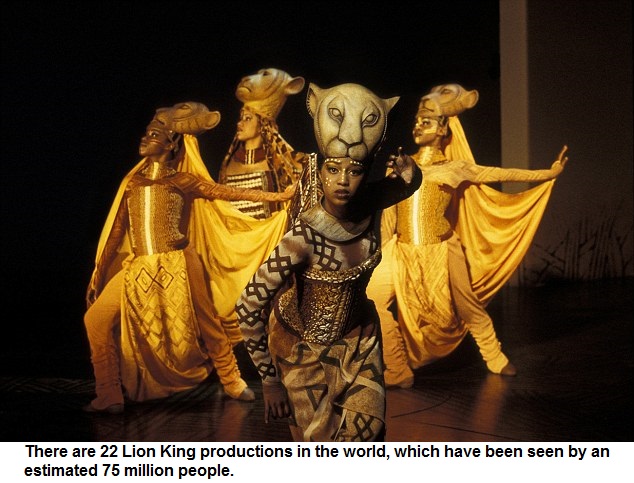
Disney says that the 22 Lion King productions around the world have been seen by an estimated 75 million people. That’s the entire population of the United Kingdom, plus the population of Belgium.

Last year, it was the highest-grossing musical on the New York stage, and it retains its number-one position so far in 2014. It has always been a sell-out in London.

MONEY MATTERS

Disney dipped its toe in the water with a Broadway version of its Oscar-winning Beauty And The Beast before pouring an estimated £6.5 million ($10.62 million) into staging The Lion King — the most expensive show ever staged.

THE STAGE GURU

CU Blog - How the Lion King roared into history - Photo 4In a colossal creative gamble, Disney hired Julie Taymor, an avant garde director who had trained in mime in Paris and spent years studying Japanese and Indonesian theatre.

Taymor thought the film ‘superficial’. She said: ‘I had to make The Lion King my own. Otherwise it’s a Disney product and I don’t like the way Disney looks.’

WE NEED A HEROINE!

Taymor’s great visual innovation was using puppetry, masks and mechanical headpieces to portray the animals. When the lions cry, they pull rolls of white silk from their masks’ eye holes; the actors playing giraffes walk on stilts.

The drought that ravages the savannah is illustrated by a dwindling waterhole — a circle of silvery material that shrinks as it is pulled across the stage.

There were other changes, too: the stage production has more songs than the film; and Rafiki, the baboon with mystic powers, became a ‘she’, as Taymor felt that the film lacked a leading female character.

CU Blog - How the Lion King roared into history - Photo 3A STAMPEDE FOR SEATS

In the immediate aftermath of its Broadway debut, there were reports of pushy New York parents putting their children’s names down for theatre tickets years in advance.

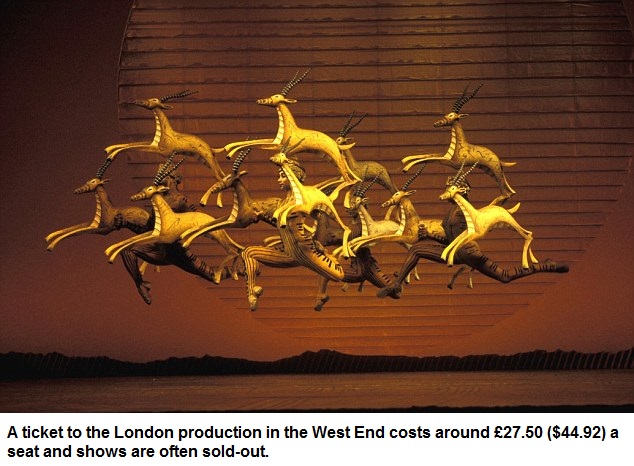
At one point seats were reselling for up to ten times their face value. Things have since calmed down, but a ticket to the London production costs at least £27.50 ($44.92) a seat.

THE CRITICS’ VERDICT

‘Visually breathtaking,’ said the New York Times. ‘Pure, exhilarating theatre, unlike anything ever seen on Broadway,’ cheered USA Today.

But not everyone was convinced. One critic who saw the show open in London’s West End wrote that once the last Zulu drum had fallen silent, a tiny part of him was left whispering: ‘So what?’

Catch it immediately, he said, thinking it was not destined to run and run. Oops.

And the late, great Sheridan Morley opined: ‘A lot of people say, “This is not real theatre. It’s theatre by way of the movies, or by way of the theme park.” It’s Disneyfication, if you like.’

STARS IN THEIR AISLES

Celebrities including Dame Judi Dench, Dame Shirley Bassey, model Claudia Schiffer and former Spice Girl Geri Halliwell attended the opening night in London.

All said that they had been moved to tears and ovations. Dame Judi said afterwards: ‘I don’t want to be in any play in the future where an elephant doesn’t walk down the aisle.’

But the show has not brought in big-name stars to fill seats, instead relying on talented ensemble casts.

SPOOKING THE PHANTOM

Even though twice as many paying punters have seen Andrew Lloyd Webber’s long-running The Phantom Of The Opera, The Lion King’s steeper ticket prices and larger theatres mean its earnings are greater.

THAT’S ENOUGH, ZAZU

Zazu the hornbill’s big musical number, The Morning Report, was cut from the show in 2010, making the show nine minutes shorter.

ELTON’S CASH COW

No one will say how much Sir Elton was paid for licensing his melodies for The Lion King film — such as the hit Can You Feel The Love Tonight — to be used in the stage version.

What can be noted is that pre-Lion King his annual income was said to stand at around £12 million ($19.6 million) a year. More recently, Forbes magazine put it at £48 million ($78.4 million) a year.

ONCE MORE WITH FEELING

Buoyed by The Lion King’s success, Sir Elton was then involved in two musicals: Aida, which had minor success, and Lestat, based on Anne Rice’s gothic novels about an 18th-century nobleman turned vampire. That was a thumping disaster and closed after 39 performances in 2005.

He stepped back into the world of musical theatre that year with the hugely popular Billy Elliot — though he did tell an interviewer in 2011: ‘Just between you, me and the gatepost, I’m not really a lover of musicals.’

MAN BEHIND THE MUSIC

The show is completed by the music of South African composer Lebo M, who was exiled to America in 1979 after student riots in Soweto.

He told the South Bank Show: ‘The Lion King is not necessarily political, but I could relate to the life of Simba, a young cub who grows up in exile and goes back to fight for his country.’
The Daily Mail – London’s Daily Newspaper (Posted September 23, 2014) – http://www.dailymail.co.uk/tvshowbiz/article-2767423/How-Lion-King-roared-history-As-crowned-biggest-box-office-earner-secrets-success.html

This news story aligns with the book Go Lean…Caribbean in stressing the economic impact of artistic and entertainment endeavors. The book asserts that Caribbean society can be elevated by improving the eco-system to live, work and play. Broadway-style theatrical productions come under the category of “play”.

The book Go Lean…Caribbean strives to accomplish this elevation vision by serving as a roadmap for the introduction and implementation of the technocratic Caribbean Union Trade Federation (CU). There is a lot involved in this vision; the prime directives are stated as follows:

  • Optimization of the economic engines in order to grow the regional economy to $800 Billion & create 2.2 million new jobs.
  • Establishment of a security apparatus to protect the resultant economic engines.
  • Improve Caribbean governance to support these engines.

“Art imitates Life and Life imitates Art” – Literary expression.

There is another message from this commentary/blog, that one person, a role model, can make a difference in transforming society. The Go Lean roadmap stresses the mission of creating jobs in the areas of Science, Technology, Engineering and Medicine (STEM), but it also recognizes that many people show ‘genius qualifiers’ in unrelated areas: music, visual arts, performing arts, sports and theatrical endeavors. This point is pronounced early in the following statements in the book’s Declaration of Interdependence (Page 14):

xxi. Whereas the preparation of our labor force can foster opportunities and dictate economic progress for current and future generations, the Federation must ensure that educational and job training opportunities are fully optimized for all residents of all member-states, with no partiality towards any gender or ethnic group. The Federation must recognize and facilitate excellence in many different fields of endeavor, including sciences, languages, arts, music and sports. This responsibility should be executed without incurring the risks of further human flight, as has been the past history.

xxxii. Whereas the cultural arts and music of the region are germane to the quality of Caribbean life, and the international appreciation of Caribbean life, the Federation must implement the support systems to teach, encourage, incentivize, monetize and promote the related industries for arts and music in domestic and foreign markets. These endeavors will make the Caribbean a better place to live, work and play.

There are economic and image considerations with this subject. The Go Lean book accepts that “show business” can have an impact on society and the world, as also depicted in the foregoing article. Already, this commentary has analyzed the Broadway play “Motown, The Musical” and contributions of role model Berry Gordy.

The Go Lean roadmap accepts that change has come to “show business” (Music, Film, Visual Art and Theater). This is due mostly to the convergence of technology (the internet to be exact). The book posits that [market] “size no longer matters”, that content can be created in any location in the world and then distributed to an appreciative audience anywhere. The first requirement is the community ethos of valuing Intellectual Property. This ethos would be new, a change, for the Caribbean.

Today, most Intellectual Property is consumed digitally with a lot of retailing via the World-Wide-Web. This changed landscape now requires new tools and protections, like electronic payment systems, digital rights management and Performance Rights Organizations. The Go Lean/CU roadmap details these solutions. With these efforts and investments, the returns will be undeniable.

To harvest these investment returns, there is the need for some technocratic facilitations. The book posits that this burden is too big for any one Caribbean member-state, and thus the collaboration efforts of the CU is necessary, as the strategy is to confederate all the 30 member-states of the Caribbean despite their language and legacy, into an integrated “single market”. This will allow for better leverage of the consumer market for the consumption of media.

The CU is designed to do the heavy-lifting of organizing Caribbean society. The following list details the ethos, strategies, tactics, implementations and advocacies to foster a similar successful path like The Lion King on the world stage:

Community Ethos – Forging Change Page 20
Community Ethos – Lean Operations Page 24
Community Ethos – Return on Investments Page 24
Community Ethos – Ways to Foster Genius Page 27
Community Ethos – Help Entrepreneurship Page 28
Community Ethos – Promote Intellectual Property Page 29
Anecdote – Valedictorian Experience Page 38
Strategy – Strategy – Caribbean Vision Page 45
Strategy – Agents of Change – Globalization Page 57
Separation of Powers – Central Bank – Electronic Payment Deployments Page 73
Tactical – Separation of Powers – Patents & Copyrights Office Page 78
Separation of Powers – Culture Administration Page 81
Planning – Ways to Make the Caribbean Better Page 131
Planning – Lessons Learned from New York City Page 137
Advocacy – Ways to Grow the Economy Page 151
Advocacy – Ways to Create Jobs Page 152
Advocacy – Education – Performing Arts Schools Page 159
Advocacy – Reforms for Banking Regulations Page 199
Advocacy – Ways to Impact Hollywood Page 203
Advocacy – Ways to Improve the Arts Page 230
Advocacy – Ways to Promote Music Page 231
Advocacy – Impact Urban Living – Art & Theaters Page 234
Appendix – New York / Broadway / Theater Jobs Page 277
Appendix – Caribbean Music Genres Page 347
Appendix – Protecting Music Copyrights Page 351

Considering the experience of Julie Taymor in the foregoing article, the Go Lean roadmap asserts that one man, or woman, can make a difference in the quest to elevate Caribbean society. We want to foster any ‘genius qualifiers’ found within the region. This refers to “on stage/on camera” talent and behind-the-scenes talent, like Ms. Taymor.

The Go Lean/CU roadmap represents the change that has come to the Caribbean. The people, institutions and governance of the region are all urged to “lean-in” to this roadmap for change. We know there is a “new” Julie Taymor somewhere in the Caribbean member-states, waiting to be fostered.

This will not be the first time a Caribbean artist has impacted the world with his/her artistic contributions. We have the proud legacy of Bob Marley and his musical genius. His songs are sung and hummed around the world:

i.e. Song: One Love – “Let’s get together and feel alright”

He is so recognizable that he is considered an icon.

The movie and Broadway play, The Lion King, is also iconic… and impactful. Consider the experience of this “Cast” flash-mob / song-and-dance depicted in this video:

THE LION KING Australia: Cast Sings Circle of Life on Flight Home from Brisbane
https://www.youtube.com/watch?v=wgSLxl1oAwA

Download the book Go Lean … Caribbean – now!

Share this post:
, , , , ,
[Top]

Corporate Tax Dodging – Transfer Policing

Go Lean Commentary

Bermuda, Bahama … come on pretty mama” – List of fun-spots from the lyrics of the song “Kokomo” by the Beach Boys. (See Appendix & VIDEO below).

“Bermuda, Luxembourg and Ireland” – List of countries from the foregoing article that facilitate tax dodging and evading schemes by corporations in Big Economy countries.

Somehow this just seems wrong!

It seems even worst to be on this latter list.

This is not the Caribbean that we want to bequeath to our children. (According to previous blog commentaries, the children have also voted to divorce themselves of their Caribbean heritage).

The following article depicts the great lengths that “tax dodgers” go through to avoid their social responsibilities…and then use the Caribbean as “partners in crime”.

Subtitle: Big Economies take aim at the firms running circles around their taxmen

POLITICIANS in the rich world like to splutter about the ever more elaborate dodges that big multinational firms undertake to minimise their tax bills. But doing something about them is trickier. America’s Congress is struggling to agree on ways to stop companies “inverting”—switching domicile to reduce tax bills (see article). The European Union is locked in a protracted debate about whether the favourable treatment that some of its members give to particular forms of corporate revenue are tantamount to illegal subsidies. So the news that the world’s biggest economies have agreed on a plan to limit “base erosion and profit shifting” in corporate tax is something of a watershed.

It has become the norm for multinationals to park themselves or large chunks of their assets—especially intangible ones, such as rights to royalties—in low- or no-tax places such as Bermuda, Luxembourg and Ireland. The wiliest, including Apple, have even discovered ways to re-route funds so as to render income stateless. These transactions are generally legal, or at least exploit grey areas in the tax codes of the countries concerned. But they appear unfair to many in these fiscally strained times, not least because they are beyond the reach of small, domestic firms.

CU Blog - Corporate Tax Dodging - Transfer policing - Photo 1It is only natural that companies take advantage of the gaps. They plough huge resources into doing so, viewing cutting-edge tax arbitrage as a competitive advantage. One study estimated that the resulting tax avoidance could amount to a quarter of total corporate profit-tax receipts in rich countries, and more in poor ones. In truth, the extent of the fleecing is unclear. Corporate tax receipts as a share of GDP, although volatile, do not appear to have declined markedly in the past decade. As a share of profits, however, they have fallen steeply (see chart), though that is partly due to declining rates.

In 2012 the G20, a club of the world’s biggest economies, called on the OECD*, a similar grouping which has long overseen international tax standards, to seek consensus on ways to close the loopholes. Its members have agreed on one set of proposals, released this week, and are working on another. The G20 will formally approve the OECD’s plan at a summit in Australia on September 20th. All told, 44 countries accounting for 90% of the world economy are on board.

The proposals aim to reduce the discrepancy, for many firms, between where they do most of their business and where they pay most of their taxes. One target is “transfer pricing”, the rates that subsidiaries of a single firm charge each other for goods and services. By setting these high, firms can spirit profits out of the countries where they do most of their business to tax havens where they locate their intangibles. The proposals would also clamp down on “treaty shopping”, arrangements through which firms obtain benefits from a tax treaty despite not being resident in either country that is party to it.

Another measure attempts to end the absurd practice of “hybrid mismatches”, whereby companies claim double deductions by classifying financial instruments as debt in some countries and equity in others. In a genuine coup, all members will share basic information about multinationals (such as assets, sales, profits and employees), giving authorities a better chance of spotting tax dodging.

In some areas, consensus could not be reached or is slow to emerge. There was, for instance, no agreement on restricting the use of “patent boxes”, favourable tax regimes for patented inventions and other innovations. In a win for America, the countries agreed not to treat e-commerce as a distinct sector, subject to special “Google taxes”, although they did undertake to study the digital economy’s impact on taxes further. The second set of proposals, expected late next year, is unlikely to include anything much more concrete on this. It will, however, tackle a number of other thorny issues, such as the rampant use of intra-group loans to “strip” earnings out of higher-tax countries.

The chief complaint against the OECD’s approach is that it eschews more radical reforms, such as divvying up taxing rights among countries according to the proportion of a firm’s sales or staff located there. Sol Picciotto of Lancaster University and the Tax Justice Network, an NGO, calls the reforms “a patch-up job” that maintains the “fiction” that subsidiaries charge each other market prices and does little for the poor African countries that are among the main victims of profit-shifting. Jeffrey Owens, a former head of the OECD’s tax division, applauds his former employer’s work but thinks policymakers could struggle to keep up as location becomes an ever-fuzzier concept in business.

Moreover, much of what has been agreed requires the amending of laws and treaties. The risk is that countries implement only the bits that suit them. It remains to be seen how Britain, for instance, will square its official support for the project with its desire to be the most tax-competitive nation in the G20. It offers an alluring patent box and generous treatment of interest and has enthusiastically cut its corporate tax rate, to 20%. America often drops multilateral initiatives in favour of its own preferences.

Small wonder, then, that only 23% of the 3,000 firms surveyed recently by Grant Thornton, an accountancy, expect the proposals to win global approval. And even if they do, the next step is even harder: making sure the multinationals’ supremely inventive lawyers and accountants do not find a way around them.
The Economist Magazine (Posted 09-20-2014) –
http://www.economist.com/news/finance-and-economics/21618911-big-economies-take-aim-firms-running-circles-around-their-taxmen-transfer?fsrc=nlw|hig|18-09-2014|53552127899249e1cc9ea210|NA

*OECD = Organization of Economic Cooperation & Development

The book Go Lean…Caribbean asserts that governments need to collect their taxes, plain and simple. The Social Contract with their citizens requires that they collect revenues so as to render services on behalf of their people. The less tax revenues, the less services that can be rendered. When this trending continues, the destination takes on a “failed-state status”. Unfortunately, the Caribbean region is far too familiar with this “failed-state status”. So  cooperating with foreign companies looking to continue tax dodging practices would be counter-productive – a negative community ethos that we would want to avoid.

The Go Lean book purports that the Caribbean can – and must – do better.

This book, Go Lean… Caribbean, serves as a roadmap for the introduction and implementation of the technocratic Caribbean Union Trade Federation (CU), which represents change for the region. The CU/Go Lean roadmap has 3 prime directives:

  • Optimization of the economic engines in order to grow the regional economy.
  • Establishment of a security apparatus to protect the resultant economic engines against “bad actors”.
  • Improve Caribbean governance to support these engines.

The Go Lean roadmap provides turn-by-turn directions on how to forge a change in the region’s community ethos to encourage honest/moral business practices and a level-playing field.  There is this established business axiom: “there are two certainties: Death and Taxes”. This roadmap thusly views the moral obligation to facilitate government tax deliverables, pronouncing this point early in the Declaration of Interdependence (Page 12) with these statements:

xiv.      Whereas government services cannot be delivered without the appropriate funding mechanisms, “new guards” must be incorporated to assess, accrue, calculate and collect revenues, fees and other income sources for the Federation and member-states. The Federation can spur government revenues directly through cross-border services and indirectly by fostering industries and economic activities not possible without this Union.

The Caribbean have for far too long looked for opportunities on the grey-side of international laws. The foregoing article relates the business historicity of booking Intellectual Property rights royalties and other intangible assets in off-shore locales:

“These transactions are generally legal, or at least exploit grey areas in the tax codes of the countries concerned. But they appear unfair …”

Rather than being complicit in these “grey” activities, indicative of a “parasite” mentality, this roadmap now projects that it is past the time to “straighten up and fly right”. The Go Lean book, and accompanying blog commentaries, go even deeper in describing a “parasite” status that proliferates the Caribbean disposition.

Change has now come to the Caribbean. Rather than a “parasite” ethos, the Go Lean movement calls for a protégé ethos. This shift is now in progress. The Go Lean book (Pages 199, 321 – 326) describes the reform developments in the Offshore Tax & Financial Services industries, in moving the industries from Black List to White List status.

There are many Go Lean blog commentaries that have echoed this point, addressing the change for the Caribbean to shift from “parasite” to protégé:

https://goleancaribbean.com/blog/?p=2207 Hotels Parasite Policies are making billions from added fees
https://goleancaribbean.com/blog/?p=1984 Casinos Failing Business Model
https://goleancaribbean.com/blog/?p=1869 Senate Bill targets cowardly companies that move overseas
https://goleancaribbean.com/blog/?p=623 Only at the precipice, do they change
https://goleancaribbean.com/blog/?p=451 CARICOM Chairman to deliver address on reparations – Parasitical
https://goleancaribbean.com/blog/?p=273 10 Things We Want from the US – Free Market

Change is coming throughout the world, a by-product of globalization. It will not be tolerated for one country to exploit tax loopholes in other countries. This intolerance for “parasites” is not just among the publishers of Go Lean. While this movement anticipates change and then prepares the Caribbean for it, there is an international parallel effort. The G20, a club of the world’s biggest economies, has called on the OECD to oversee international tax standards, to seek consensus on ways to close the tax loopholes. The foregoing article relates that its members have agreed on one set of proposals; so far  44 countries, accounting for 90% of the world economy, are on board for the proposals.

How about for the Caribbean? It is only a matter of time for some international corporate tax reforms to take root. How will those changes affect the Offshore Financial industries and the practice of allowing companies to run circles around tax rules by using “Black List” countries?  The fact that these questions have to be considered demonstrate the need for a more “White List” community/business ethos. These questions should be moot! Never mind the answers.

Debate Over!

The Go Lean book purports that the Caribbean can – and must – do better. The roadmap for the CU is a confederation of the 30 member-states of the Caribbean to do the heavy-lifting of optimizing economic-security-governing engines. The Go Lean book details the community ethos to adopt, plus the executions of the following strategies, tactics, implementations and advocacies to change Caribbean society:

Community Ethos – Deferred Gratification Page 21
Community Ethos – Consequences of Choices Lie in the Future Page 21
Community Ethos – Whistleblower Protection Page 23
Community Ethos – Intelligence Gathering Page 23
Community Ethos – Lean Operations Page 24
Community Ethos – Ways to Help Entrepreneurship Page 28
Community Ethos – Ways to Promote Intellectual Property Page 29
Community Ethos – Ways to Impact Research & Development Page 30
Community Ethos – Ways to Impact the Greater Good Page 37
Strategy – Agents of Change – Technology Page 57
Strategy – Agents of Change – Globalization Page 57
Tactical – How to Grow to a $800 Economy – Trade and Globalization Page 70
Tactical – Separation of Powers – Securities Exchange Regulatory Agency Page 74
Tactical – Separation of Powers – Trade Anti-Trust Regulatory Commission Page 77
Tactical – Separation of Powers – Patent, Standards, and Copyrights Office Page 78
Implementation – Trade Mission Offices Objectives Page 117
Implementation – Ways to Benefit from Globalization Page 119
Planning – Ways to Improve Trade Page 128
Planning – Ways to Make the Caribbean Better Page 131
Advocacy – Ways to Grow the Economy Page 151
Advocacy – Ways to Create Jobs Page 152
Advocacy – Ways to Improve Governance Page 169
Advocacy – Ways to Better Manage the Social Contract Page 171
Advocacy – Ways to Impact Justice Page 177
Advocacy – Ways to Improve Intelligence Gathering & Analysis Page 182
Advocacy – Reforms for Banking Regulations Page 199
Advocacy – Ways to Impact Wall Street Page 200
Advocacy – Ways to Impact Main Street Page 201
Advocacy – Ways to Impact the One Percent Page 224
Advocacy – Ways to Impact … – Bottom Line on the OECD Page 240
Appendix – Offshore Tax & Financial Services Industry Developments Page 321
Appendix – Offshore Tax & Financial Services Industry – Bahamas Example Page 322

The book Go Lean…Caribbean posits that many problems of the region are too big for any one member-state to solve alone, that there is the need for the technocracy of the Caribbean Union Trade Federation. The purpose of this Go Lean/CU roadmap is to make the Caribbean homeland, a better place to live, work and play. We want to be on the list of fun places to PLAY, as conveyed by the below Beach Boys song, not on the list of the “grey”/shady places to WORK.

We do want to be on the consciousness of the rest of the world. We want them envious of our lifestyle and desirous to sample this imagery:

That’s where you wanna go
to get away from it all
Bodies in the sand,
tropical drink melting in your hand
We’ll be falling in love
to the rhythm of a steel drum band

Now is the time for all of the Caribbean, the people and governing institutions, to lean-in for the changes described in the book Go Lean … Caribbean.

Download the e-Book of Go Lean … Caribbean – free … now!

———————————–

Appendix – Song Lyrics for “Kokomo” by the Beach Boys

Aruba, Jamaica, ooh I wanna take ya
Bermuda, Bahama, come on pretty mama
Key Largo, Montego,
baby why don’t we go,
Jamaica

Off the Florida Keys
there’s a place called Kokomo
That’s where you wanna go
to get away from it all
Bodies in the sand,
tropical drink melting in your hand
We’ll be falling in love
to the rhythm of a steel drum band
Down in Kokomo

[Chorus:]
Aruba, Jamaica, ooh I wanna take you to
Bermuda, Bahama, come on pretty mama
Key Largo Montego,
baby why don’t we go
Ooh I wanna take you down to Kokomo,
we’ll get there fast
and then we’ll take it slow
That’s where we wanna go,
way down in Kokomo.

Martinique, that Monserrat mystique…

We’ll put out to sea
and we’ll perfect our chemistry
By and by we’ll defy
a little bit of gravity
Afternoon delight,
cocktails and moonlit nights
That dreamy look in your eye,
give me a tropical contact high
Way down in Kokomo

[Chorus]

Port au Prince, I wanna catch a glimpse…

Everybody knows a little place like Kokomo Now if you wanna go to get away from it all
Go down to Kokomo

[Chorus]

—————

YouTube Video: https://www.youtube.com/embed/_wHiliL4He4


Share this post:
, , , , , ,
[Top]

Welcoming the Dreaded ‘Plutocracy’

Go Lean Commentary

 Plutocracy 2

It is not nice to be called a plutocracy, it’s almost considered a derogatory term – see Appendix below. It simply refers to the undue influence that a super-rich minority group can have on a nation.

The dread of plutocracies is not new, societies have contended with them since the dawn of civilization (Ancient Greece and Rome). Many countries in the Caribbean had de facto plutocracies during their colonial years (Montserrat, Belize and the Bahamas’s Bay Street Boys come to mind), just as a natural off-shoot from a mono-industrial economy (sugar, coffee, tobacco planters). Considering existing plutocracies today, like the City of London and Wall Street, we see that an appropriate strategy can allow a society to “bottle the plutocratic concept” and use it for good.

There is currency to this discussion. Award winning documentary film-maker Ken Burns is debuting his new production on The Roosevelts on PBS in the United States, starting tonight (Sunday September 14, 2014). When we consider the lives and advocacies of Theodore, Franklin and Eleanor Roosevelt, we see that there was a consistent urging to take on big business/special interest (plutocratic endeavors) to benefit the working-class man/woman of America. The following is the synopsis of the documentary:

Plutocracy 1The Roosevelts: An Intimate History chronicles the lives of Theodore, Franklin and Eleanor Roosevelt, three members of the most prominent and influential family in American politics. It is the first time in a major documentary television series that their individual stories have been interwoven into a single narrative.  This seven-part, fourteen hour film follows the Roosevelts for more than a century, from Theodore’s birth in 1858 to Eleanor’s death in 1962. Over the course of those years, Theodore would become the 26th President of the United States and his beloved niece, Eleanor, would marry his fifth cousin, Franklin, who became the 32nd President of the United States. Together, these three individuals not only redefined the relationship Americans had with their government and with each other, but also redefined the role of the United States within the wider world. The series encompasses the history the Roosevelts helped to shape: the creation of National Parks, the digging of the Panama Canal, the passage of innovative New Deal programs, the defeat of Hitler, and the postwar struggles for civil rights at home and human rights abroad. It is also an intimate human story about love, betrayal, family loyalty, personal courage and the conquest of fear.

A film by Ken Burns. Written by Geoffrey C. Ward. Produced by Paul Barnes, Pam Tubridy Baucom and Ken Burns.

The Roosevelts airs for a week starting September 14, 2014.

http://www.pbs.org/kenburns/films/the-roosevelts

The idea of “bottling” plutocratic institutions for the Greater Good is a “big idea” in the book Go Lean…Caribbean. How exactly is this envisioned? The answer provided in the book is that of Self-Governing Entities (SGE).

The Go Lean book delves into this approach of inviting the super-rich to establish industrial parks, corporate campuses and research parks in bordered territories in the Caribbean. These entities would be governed solely by the technocratic Caribbean Union Trade Federation (CU). The Go Lean book serves as a roadmap for the introduction and implementation of the CU and SGE’s.

The approach of the Go Lean roadmap is not to punish the super-rich for their success nor cower to any special interests group at the expense of the greater population.

Too bad this approach has not been employed in the US.

Many previous Go Lean blog/commentaries stressed the changes on American society (and by extension, other communities including the Caribbean) due to plutocratic abuses of corporations, super-rich individuals/institutions and special-interest groups, especially since 2008. The following sample applies:

https://goleancaribbean.com/blog/?p=2259 The Criminalization of American Business
https://goleancaribbean.com/blog/?p=2183 A Textbook Case of Price-gouging
https://goleancaribbean.com/blog/?p=2126 Where the Jobs Are – Computers Reshaping Global Job Market
https://goleancaribbean.com/blog/?p=1869 Senate bill targets companies that move overseas
https://goleancaribbean.com/blog/?p=926 Conservative heavyweights have solar industry in their sights
https://goleancaribbean.com/blog/?p=789 America’s War on the Caribbean
https://goleancaribbean.com/blog/?p=782 Open the Time Capsule: The Great Recession of 2008
https://goleancaribbean.com/blog/?p=546 Book Review: ‘The Divide’ – American Injustice in the Age of the Wealth Gap
https://goleancaribbean.com/blog/?p=273 10 Things We Want from the US and 10 Things We Don’t Want from the US: American Capital – Yes; Quantitative Easing – No.
https://goleancaribbean.com/blog/?p=242 The Erosion of the Middle Class

The charter of the CU, on the other hand, is to pursue the Greater Good for all of the Caribbean, to make the region a better place to live, work and play. This Go Lean roadmap aligns this charter with the following 3 prime directives:

  • Optimization of the economic engines in order to grow the regional economy to $800 Billion & create 2.2 million new jobs.
  • Establishment of a security apparatus to protect the resultant economic engines.
  • Improve Caribbean governance to support these engines.

The book describes the CU as a technocratic administration with 144 different missions to elevate the Caribbean homeland. The underlying goal to regulate the regional economy, and solicit (super-rich) investors, is stated early in the book with this pronouncement in the opening Declaration of Interdependence (Page 13):

xxiv. Whereas a free market economy can be induced and spurred for continuous progress, the Federation must install the controls to better manage aspects of the economy: jobs, inflation, savings rate, investments and other economic principles. Thereby attracting direct foreign investment because of the stability and vibrancy of our economy.

The Go Lean…Caribbean book challenges the reader, and the Caribbean as a whole, to create a structure that would be inviting to the super-rich and their resources. The SGE concept is a creative approach for that goal, but it is not so revolutionary – similar concepts already exists. Some examples of SGE-like structures are the city-states of Hong Kong, Liechtenstein (Europe), Vatican City (Italy), Panama City Zone (during the 20th Century, alluded to in the foregoing documentary synopsis) and many Free Trade Zones operating throughout the world.

The Go Lean/CU roadmap constitutes change for the Caribbean. The goal is to structure SGE’s at the federal level only, so as to incentivize the super-rich to consider this region. The plan calls for a Special Liaison Group within the CU Department of State just for the One Percent. Already this population enjoys the Caribbean for play, the plan now is to invite them to live and work in the region as well.

The Go Lean roadmap highlights the required community ethos, plus the execution of strategies, tactics, implementation and advocacies to construct the climate for the promotion of “plutocracies in a bottle”. The following is a sample of these specific details from the book:

Community Ethos – Economic Principles – People Respond to Incentives in Predictable Ways Page 21
Community Ethos – Economic Principles – Economic Systems Influence Individual Choices Page 21
Community Ethos – Economic Principles – Voluntary Trade Creates Wealth Page 21
Community Ethos – Economic Principles – Job Multipliers Page 22
Community Ethos – Security Principles – Privacy versus Public Protection Page 23
Community Ethos – Security Principles – Whistleblower Protection Page 23
Community Ethos – Security Principles – “Crap” Happens Page 23
Community Ethos – Governing Principles – Minority Equalization Page 24
Community Ethos – Governing Principles   – Lean Operations Page 24
Community Ethos – Governing Principles – Return on Investments Page 24
Community Ethos – Ways to Foster Genius Page 27
Community Ethos – Ways to Help Entrepreneurship Page 28
Community Ethos – Ways to Impact Research & Development Page 30
Community Ethos – Ways to Improve Negotiations Page 32
Community Ethos – Ways to Impact the Greater Good Page 37
Strategy – Vision – Confederation   of the 30 Caribbean Member-States into a   Single Market Page 45
Strategy – Mission – Invite empowering immigrants to help us move our society and economy Page 46
Strategy – Mission – Customers (Subjects/Citizens) – Foreign Direct Investors Page 48
Tactical – Confederating a Permanent Union Page 63
Tactical – Fostering a Technocracy Page 64
Tactical – How to Grow the Economy to $800 Billion – US Example of Economic Bubbles Page 69
Tactical –  Separation of Powers: – State Department – Special Interest Group Page 80
Tactical –  Separation of Powers: – State Department – Self Governing Entities Page 80
Implementation – Assemble Existing Regional Organizations into CU Page 96
Implementation – Ways to Pay for Change – SGE Licenses Page 101
Implementation – Steps to Implement Self-Governing Entities Page 105
Implementation – Ways to Deliver Page 109
Implementation – Trade Mission Objectives Page 117
Planning – 10 Big Ideas for the Caribbean Region – Self Governing Entities Page 127
Planning – Ways to Improve Trade – Trade Missions Page 131
Planning – Lessons Learned from 2008 Page 136
Advocacy – Ways to Grow the Economy Page 151
Advocacy – Ways to Create Jobs Page 152
Advocacy – Ways to Foster Empowering Immigration – SGE Labor Rules Page 174
Advocacy – Ways to Market Southern California Page 194
Advocacy – Ways to Impact Wall Street Page 200
Advocacy – Ways to Help the Middle Class Page 223
Advocacy – Ways to Impact the One Percent Page 224
Appendix – Job Multipliers Page 259
Appendix – List of One Percent Billionaires and Giving Pledge Signatories Page 292

Allowing a super-rich minority to wield unchecked influence could be destructive to a society – the rich would get richer while the poor gets poorer. But the structure of SGE’s would allow the participation of the super-rich class in a manner that would not foster conflict with democratic principles – of the people, by the people, for the people.

Imagine a parade of workers entering an industrial park in the morning, then returning to their individual communities in the evening. This is the exact model of the City of London, described in the Appendix below. This model creates direct jobs on the SGE campuses/parks and a multiplier-effect for indirect jobs in the neighboring communities.

“Keep your friends close and your enemies closer” – Old adage.

While the Go Lean book details these specifics, it also stands “on guard” as a Sentinel against possible abuses and threats to the economic/financial eco-systems. There it is: “plutocracy in a bottle”.

“Tame the market’s excesses” – Theodore Roosevelt.

According to the referenced documentary, the Presidency of Theodore Roosevelt made great gains in curtailing the market excesses of that day; (there was a Depression in the 1870’s and Recession in the 1890’s). The oil industry and railroads were dominated by a small number of individuals. This Roosevelt Administration presided over a divestiture of Standard Oil and the railroad barons.

In addition, the Presidency of Franklin Roosevelt also made great gains in curtailing the market excesses of Wall Street and the Big Banks, the dysfunctional source of the Great Depression (1929 – 1933). The New Deal initiatives balanced the scales of justice for rich versus poor Americans.

Is the US a plutocracy today? Not technically, but the trending has been leaning in that direction, especially with the downward pressures on the middle classes.

The purpose of this commentary is not to assess and fix the challenges of an America plutocracy trend, but rather to identify, qualify and propose arrangements for Direct Foreign Investments in the Caribbean without creating the dreaded plutocracy. The Go Lean book declares that the Caribbean can “count on the greedy to be greedy”, (Page 26).

Opportunities will abound in this new Caribbean … for the rich, the poor, and the middle classes. Everyone is urged to lean-in to this regional empowerment roadmap, to “go lean“. Everyone can contribute to make the Caribbean a better place to live, work and play. 🙂

Download the book Go Lean … Caribbean – now!

———————–

Appendix – Plutocracy Definition and Relevance

Retrieved from Wikipedia Online Encyclopedia; 09/14/2014: http://en.wikipedia.org/wiki/Plutocracy

Plutocracy defines a society or a system ruled and dominated by the small minority of the wealthiest citizens. The first known use of the term was in 1652.[1] Unlike systems such as democracy, capitalism, socialism or anarchism, plutocracy is not rooted in an established political philosophy. The concept of plutocracy may be advocated by the wealthy classes of a society in an indirect or surreptitious fashion, though the term itself is almost always used in a pejorative sense.[2]

The term plutocracy is generally used as a pejorative to describe or warn against an undesirable condition.[3][4] Throughout history, political thinkers such as Winston Churchill, 19th-century French sociologist and historian Alexis de Tocqueville, 19th-century Spanish monarchist Juan Donoso Cortés and today Noam Chomsky have condemned plutocrats for ignoring their social responsibilities, using their power to serve their own purposes and thereby increasing poverty and nurturing class conflict, corrupting societies with greed and hedonism.[5][6]

Examples

Examples of plutocracies include the Roman Empire, some city-states in Ancient Greece, the civilization of Carthage, the Italian city-states/merchant republics of Venice, Florence, Genoa, and pre-World War II Empire of Japan (the Zaibatsu).

One modern, formal example of what some critics have described as a plutocracy is the City of London.[7] The City (not the whole of modern London but the area of the ancient city, about 1 sq mile or 2.5 km2, which now mainly comprises the financial district) has a unique electoral system for its local administration. More than two-thirds of voters are not residents, but rather representatives of businesses and other bodies that occupy premises in the City, with votes distributed according to their numbers of employees. The principal justification for this arrangement is that most of the services provided by the Corporation are used by the businesses in the City. In fact about 450,000 non-residents constitute the city’s day-time population, far outnumbering the City’s 7,000 residents.[8]

Modern politics

Historically, wealthy individuals and organizations have exerted influence over the political arena. In the modern era, many democratic republics permit fundraising for politicians who frequently rely on such income for advertising their candidacy to the voting public.

Whether through individuals, corporations or advocacy groups, such donations are often believed to engender a cronyist or patronage system by which major contributors are rewarded on a quid pro quo basis. While campaign donations need not directly affect the legislative decisions of elected representatives, the natural expectation of donors is that their needs will be served by the person to whom they donated. If not, it is in their self-interest to fund a different candidate or political organization.

While quid pro quo agreements are generally illegal in most democracies, they are difficult to prove, short of a well-documented paper trail. A core basis of democracy, being a politician’s ability to freely advocate policies which benefit his or her constituents, also makes it difficult to prove that doing so might be a crime. Even the granting of appointed positions to a well-documented contributor may not transgress the law, particularly if the appointee appears to be suitably qualified for the post. Some systems even specifically provide for such patronage.

United States

Some modern historians, politicians and economists state that the United States was effectively plutocratic for at least part of the Gilded Age and Progressive Era periods between the end of the Civil War until the beginning of the Great Depression.[9][10][11][12][13][14] President Theodore Roosevelt became known as the “trust-buster” for his aggressive use of United States antitrust law, through which he managed to break up such major combinations as the largest railroad and Standard Oil, the largest oil company.[15]According to historian David Burton, “When it came to domestic political concerns, TR’s Bete Noire was the plutocracy.[16] In his autobiographical account of taking on monopolistic corporations as president, TR recounted:

’’ …we had come to the stage where for our people what was needed was a real democracy; and of all forms of tyranny the least attractive and the most vulgar is the tyranny of mere wealth, the tyranny of a plutocracy.’’[17]

The Sherman Antitrust Act had been enacted in 1890, with large industries reaching monopolistic or near-monopolistic levels of market concentration and financial capital increasingly integrating corporations, a handful of very wealthy heads of large corporations began to exert increasing influence over industry, public opinion and politics after the Civil War. Money, according to contemporary progressive and journalist Walter Weyl, was “the mortar of this edifice”, with ideological differences among politicians fading and the political realm becoming “a mere branch in a still larger, integrated business. The state, which through the party formally sold favors to the large corporations, became one of their departments.”[18]

In his book The Conscience of a Liberal, in a section entitled The Politics of Plutocracy, economist Paul Krugman says plutocracy took hold because of three factors: at that time, the poorest quarter of American residents (African-Americans and non-naturalized immigrants) were ineligible to vote, the wealthy funded the campaigns of politicians they preferred, and vote buying was “feasible, easy and widespread”, as were other forms of electoral fraud such as ballot-box stuffing and intimidation of the other party’s voters.[19]

Post World War II

In modern times, the term is sometimes used pejoratively to refer to societies rooted in state-corporate capitalism or which prioritize the accumulation of wealth over other interests. According to Kevin Phillips, author and political strategist to U.S. President Richard Nixon, the United States is a plutocracy in which there is a “fusion of money and government.”[20]

Chrystia Freeland, author of Plutocrats: The Rise of the New Global Super-Rich and the Fall of Everyone Else,[21] says that the present trend towards plutocracy occurs – and is self-justified – because the rich feel “[their] own personal self-interest is in the interests of everybody else.”[22][23]

Some researchers have said the US may be drifting towards a form of oligarchy, as individual citizens have less impact than economic elites and organized interest groups upon public policy.[24] A study conducted by political scientists Martin Gilens (Princeton University) and Benjamin Page (Northwestern University), which was released in April 2014,[25] stated that their “analyses suggest that majorities of the American public actually have little influence over the policies our government adopts.” that Gilens and Page do not characterize the US as an “oligarchy” or “plutocracy” per se; however, they do apply the concept of “civil oligarchy” as used by Jeffrey A. Winters[26] with respect to the US.

Most recently, Jeffrey Winters has posited a comparative theory of “Oligarchy,” in which the wealthiest citizens – even in a “civil oligarchy” like the United   States – dominate policy concerning crucial issues of wealth- and income-protection.[27]

On August 13, 2014, on Al Jazeera, in response to questions related to US responses to the Israeli/Gaza situation, professor Noam Chomsky of MIT effectively repeated the quote on American public influence over policies. When questioned further, he suggested that significant amounts of research indicated that the US was in effect a plutocracy.

As a propaganda term

In the political jargon and propaganda of Fascist Italy, Nazi Germany and the Communist International, western democratic states were referred to as plutocracies, with the implication being that a small number of extremely wealthy individuals were controlling the countries and holding them to ransom.[28][29] Plutocracy replaced democracy and capitalism as the principal fascist term for the United States and Great Britain during the Second World War.[29] For the Nazis, the term was often a code word for “the Jews”.[29]

Cited References

  1. “Plutocracy”. Merriam Webster. Retrieved 13 October 2012.
  2. “The study of attitudes is reasonably easy […] it’s concluded that for roughly 70% of the population – the lower 70% on the wealth/income scale – they have no influence on policy whatsoever. They’re effectively disenfranchised. As you move up the wealth/income ladder, you get a little bit more influence on policy. When you get to the top, which is maybe a tenth of one percent, people essentially get what they want, i.e. they determine the policy. So the proper term for that is not democracy; it’s plutocracy.” Extract from the transcript of a speech delivered by Noam Chomsky in Bonn, Germany, at DW Global Media Forum, 15 August 2013.
  3. Fiske, Edward B.; Mallison, Jane; Hatcher, David (2009). Fiske 250 words every high school freshman needs to know. Naperville, Ill.: Sourcebooks. p. 250. ISBN 1402218400.
  4. Coates, ed. by Colin M. (2006). Majesty in Canada: essays on the role of royalty. Toronto: Dundurn. p. 119. ISBN 1550025864.
  5. Conservative thinkers: from John Adams to Winston Churchill. New Brunswick, New Jersey: Transaction Publishers. 2006. pp. 19–68. ISBN 1412805260.
  6. Toupin, Alexis de Tocqueville; edited by Roger Boesche; translated by James; Boesche, Roger (1985). Selected letters on politics and society. Berkeley: University of California Press. pp. 197–198. ISBN 0520057511.
  7. The medieval, unaccountable Corporation of London is ripe for protest, The Guardian, retrieved 01/11/2011 from: http://www.guardian.co.uk/commentisfree/2011/oct/31/corporation-london-city-medieval.
  8. René Lavanchy (12 February 2009). “Labour runs in City of London poll against ‘get-rich’ bankers”. Tribune. Retrieved 14 February 2009 from: http://www.tribunemagazine.org/2009/02/labour-runs-in-city-of-london-poll-against-‘get-rich’-bankers/.
  9. Pettigrew, Richard Franklin (2010). Triumphant Plutocracy: The Story of American Public Life from 1870 to 1920. Nabu Press. ISBN 1146542747.
  10. Calvin Reed, John (1903). The New Plutocracy. Kessinger Publishing, LLC (2010 reprint). ISBN 1120909155.
  11. Brinkmeyer, Robert H. (2009). The fourth ghost: white Southern writers and European fascism, 1930-1950. Baton Rouge: Louisiana State University Press. p. 331. ISBN 0807133833.
  12. Allitt, Patrick (2009). The conservatives: ideas and personalities throughout American history. New Haven: Yale University Press. p. 143. ISBN 0300118945.
  13. Ryan, foreword by Vincent P. De Santis; edited by Leonard Schlup, James G. (2003). Historical dictionary of the Gilded Age. Armonk, N.Y.: M.E. Sharpe. p. 145. ISBN 0765603314.
  14. Conservative thinkers: from John Adams to Winston Churchill. New Brunswick, New Jersey: Transaction Publishers. 2006. p. 103. ISBN 1412805260.
  15. Schweikart, Larry (2009). American Entrepreneur: The Fascinating Stories of the People Who Defined Business in the United   States. AMACOM Div American Mgmt Assn.
  16. David Henry Burton: Theodore Rooselvelt, American Politician, An Assessment, Fairleigh Dickinson Univ Press, 1997
  17. Theodore Roosevelt: Theodore Roosevelt: an autobiography. New York, Macmillan, 1913
  18. Bowman, Scott R. (1996). The modern corporation and American political thought: law, power, and ideology. University Park, Pa.: Pennsylvania State University Press. pp. 92–103. ISBN 0271014733.
  19. Krugman, Paul (2009). The conscience of a liberal ([Pbk. ed.] ed.). New York: Norton. pp. 21–26. ISBN 0393333132.
  20. Transcript. Bill Moyers Interviews Kevin Phillips. NOW with Bill Moyers 4.09.04 | PBS. Retrieved from http://www.pbs.org/now/transcript/transcript_phillips.html.
  21. Freeland, Chrystia (2012). Plutocrats: the rise of the new global super-rich and the fall of everyone else. New York: Penguin. ISBN 9781594204098. OCLC 780480424.
  22. National Public Radio (October 15, 2012) “A Startling Gap Between Us And Them In ‘Plutocrats'”. Retrieved from: http://www.npr.org/2012/10/15/162799512/a-startling-gap-between-us-and-them-in-plutocrats
  23. See also the Chrystia Freeland interview for the Moyers Book Club (October12, 2012) Moyers & Company Full Show: Plutocracy Rising. Retrieved from: http://billmoyers.com/episode/full-show-plutocracy-rising/
  24. Piketty, Thomas (2014). Capital in the Twenty-First Century. Belknap Press. ISBN 067443000X p. 514: “the risk of a drift towards oligarchy is real and gives little reason for optimism about where the United States is headed.”
  25. Gilens & Page (2014) Testing Theories of American Politics: Elites, Interest Groups, and Average Citizens, Perspectives on Politics,PrincetonUniversity. Retrieved 18 April 2014.
  26. Winters, Jeffrey A. “Oligarchy” CambridgeUniversity Press, 2011, p. 208-254
  27. Gilens & Page (2014) p. 6
  28. http://www.marxists.org/history/etol/newspape/fi/vol02/no02/editors2.htm
  29. Blamires, Cyprian; Jackson, Paul (2006). World fascism: a historical encyclopedia, Vol. 1. ABC-CLIO. p. 522. ISBN 978-1-57607-940-9.


Share this post:
, , ,
[Top]

What’s In A Name…

Go Lean Commentary

What Name

Joe versus Jose; Emily versus Lakisha [a] – race still matters very much in the US labor market. So says the following VIDEO from NBC News The Today Show and the research in the appendix below.

Title: What’s in a name when you apply for a job?
By: NBC News – The Today Show

A man named Jose spent six fruitless months looking for work online. But when he dropped the “s” from his name and applied as “Joe,” the job offers started coming in.
NBC News – The Today Show – September 4, 2014 –
http://www.today.com/video/today/55986337#55986337

One would think that such a racially-charged society was only representative of the America of old; that now America has transformed, to the point that the President is of African-American descent. But it must be concluded that the more things change, the more they remain the same.

The issue in the foregoing news article/VIDEO relates to the lure of America as a destination for Caribbean immigrants. This is the labor market that new arrivals would have to navigate. Perhaps the shining light of that Welcome Sign should be dulled a little.

The story in the VIDEO, and the research in the Appendix, is being brought into focus in a consideration of the book Go Lean … Caribbean. The book serves as a roadmap for the introduction and implementation of the technocratic Caribbean Union Trade Federation (CU), for the economic optimization in the region. One mission of the roadmap is to minimize the “push-and-pull” factors that contribute to the alarmingly high societal abandonment rate of Caribbean citizens – one report reflects a 70% brain drain rate.

This blog/commentary also infers one additional issue, that of job creation. The Go Lean book posits that when the economic engines are not sufficient that people will flee, abandon their homelands, despite the love of family, friends and culture and endure all obstacles to secure a better livelihood. This has been the reality for all of the Caribbean, even the American member-states (Puerto Rico & Virgin Islands). If only, there would be a better option for the Caribbean?

Go Lean…Caribbean presents that option!

This CU/Go Lean roadmap provides the turn-by-turn details with the following 3 prime directives:

  • Optimization of the economic engines in order to grow the regional economy to $800 Billion & create 2.2 million new jobs.
  • Establishment of a security apparatus to protect the resultant economic engines.
  • Improve Caribbean governance to support these engines.

The roadmap posits that the United States of America should not be viewed as the panacea for Caribbean ailments; that when the choices of a challenge is “fight or flight” that Caribbean society must now consider the “fight” options. (No violent conflict is being advocated, but rather a strenuous effort, heavy-lifting, to compete and win economic battles).

As related in the foregoing article/VIDEO, America is not so welcoming a society for the “Black and Brown” populations from the Caribbean – and yet they come, there are in the USA and their numbers cannot be ignored. Here is the need for the heavy-lifting, to effect change to dissuade further brain drain and in reverse to incentivize repatriation. While not ignoring the “push” reasons that cause people to flee, the book stresses (early at Page 13) the need to be on-guard for this fight in the following pronouncements in the Declaration of Interdependence:

xix.      Whereas our legacy in recent times is one of societal abandonment, it is imperative that incentives and encouragement be put in place to first dissuade the human flight, and then entice and welcome the return of our Diaspora back to our shores. This repatriation should be effected with the appropriate guards so as not to imperil the lives and securities of the repatriated citizens or the communities they inhabit. The right of repatriation is to be extended to any natural born citizens despite any previous naturalization to foreign sovereignties.

xx.      Whereas the results of our decades of migration created a vibrant Diaspora in foreign lands, the Federation must organize interactions with this population into structured markets. Thus allowing foreign consumption of domestic products, services and media, which is a positive trade impact. These economic activities must not be exploited by others’ profiteering but rather harnessed by Federation resources for efficient repatriations.

xxi.      Whereas the preparation of our labor force can foster opportunities and dictate economic progress for current and future generations, the Federation must ensure that educational and job training opportunities are fully optimized for all residents of all member-states, with no partiality towards any gender or ethnic group. The Federation must recognize and facilitate excellence in many different fields of endeavor, including sciences, languages, arts, music and sports. This responsibility should be executed without incurring the risks of further human flight, as has been the past history.

xxvi.      Whereas the Caribbean region must have new jobs to empower the engines of the economy and create the income sources for prosperity, and encourage the next generation to forge their dreams right at home, the Federation must therefore foster the development of new industries, like that of ship-building, automobile manufacturing, prefabricated housing, frozen foods, pipelines, call centers, and the prison industrial complex. In addition, the Federation must invigorate the enterprises related to existing industries like tourism, fisheries and lotteries – impacting the region with more jobs.

This commentary previously related details of the Caribbean Diaspora experience, the “push-and-pull” factors in the US, and our region’s own job-creation efforts. Here is a sample of earlier Go Lean blogs:

https://goleancaribbean.com/blog/?p=2025 Caribbean Jobs – Attitudes & Images of the Diaspora
https://goleancaribbean.com/blog/?p=1896 American “Pull” Factors – Crisis in Black Homeownership
https://goleancaribbean.com/blog/?p=1698 American “Pull” Factors – STEM Jobs Are Filling Slowly
https://goleancaribbean.com/blog/?p=1596 Book Review: “Prosper Where You Are Planted”
https://goleancaribbean.com/blog/?p=1433 Caribbean loses more than 70 percent of tertiary educated to brain drain
https://goleancaribbean.com/blog/?p=1296 Remittances to Caribbean Increased By 3 Percent in 2013
https://goleancaribbean.com/blog/?p=1256 Traditional 4-year College Degree are Terrible Investments for the Caribbean Region
https://goleancaribbean.com/blog/?p=599 Ailing Puerto Rico Open to Radical Economic Fixes To Keep Citizens At Home
https://goleancaribbean.com/blog/?p=623 Book Review: “The Divide – American Injustice in the Age of the Wealth Gap”
https://goleancaribbean.com/blog/?p=273 10 Things We Don’t Want from the US – Discrimination of Immigrations
https://goleancaribbean.com/blog/?p=209 Muhammad Ali and Role Model/Advocate Kevin Connolly – Demanding Equal Rights in America’s Supreme Court

For the Caribbean Diaspora, fleeing from their homelands to reside in the US is akin to “jumping from the frying pan into the fire”. While we may not be able to change American society, we can – no, we must – impact our own society. How? What? When? Why? All of these questions are valid, because the answers are difficult. The Go Lean book describes the solution as heavy-lifting.

This is the charge of the Go Lean…Caribbean roadmap: to do the heavy-lifting, to implement the organizational dynamics to impact Caribbean society here and now. The following are the community ethos, strategies, tactics and operational advocacies to effectuate this goal:

Community Ethos – Deferred Gratification Page 21
Community Ethos – People Respond to Incentives Page 21
Community Ethos – Economic Systems Influences Choices & Incentives Page 21
Community Ethos – The Consequences of Choice Lie in the Future Page 21
Community Ethos – Job Multiplier Page 22
Community Ethos – Minority Equalization Page 24
Community Ethos – Lean Operations Page 24
Community Ethos – Ways to Foster Genius Page 27
Community Ethos – Ways to Impact the Greater Good Page 37
Strategy – Vision – Make the Caribbean the Best Address   on Planet Page 45
Strategy – Mission –   Repatriate Diaspora Page 46
Strategy – Mission –   Dissuade Human Flight/“Brain Drain” Page 46
Tactical – Separation of Powers – Department of Labor – Equal Opportunities Page 89
Implementation – Ways to Deliver Page 109
Implementation – Reasons to Repatriate Page 118
Implementation – Ways to Benefit from Globalization Page 119
Planning – Ways to Better Manage Image Page 133
Planning – Lessons from the US   Constitution Page 145
Advocacy – Ways to Grow the Economy Page 151
Advocacy – Ways to Create Jobs Page 152
Advocacy – Ways to Impact Labor Unions Page 164
Advocacy – Ways to Impact the Diaspora Page 217
Advocacy – Ways to Preserve Caribbean Heritage Page 218
Advocacy – Ways to Impact US Territories Page 244
Appendix – Analysis of Caribbean Diaspora by Country of   Residence Page 267
Appendix – Analysis of Caribbean Emigration Page 269
Appendix – Puerto Rican Population in the US Page 304

The scope of this roadmap is to focus on the changes we have to make in the Caribbean, not the changes for American society. Our success is conceivable, believable and achievable.  The Caribbean can be the world’s best address. Now is the time for all of the Caribbean, the people and governing institutions, to lean-in to this Go Lean … Caribbean roadmap.

This is a big deal for the region. This roadmap is not just a plan, its a prescription. We want the current Jose’s and Lakisha’s to fully “be all they can be”, here at home in the Caribbean. Let’s show America, and the world in general, that our homeland, is the best place to live, work and play, no matter our name.

Download the book Go Lean … Caribbean – now!

———————–

Appendix a: Emily versus Lakisha

The following is the summary/introduction of a landmark study conducted by academicians in 2004:

We study race in the labor market by sending fictitious resumes to help-wanted ads in Boston and Chicago newspapers. To manipulate perceived race, resumes are randomly assigned African-American or White-sounding names. White names receive 50 percent more callbacks for interviews. Callbacks are also more responsive to resume quality for White names than for African-American ones. The racial gap is uniform across occupation, industry, and employer size. We also find little evidence that employers are inferring social class from the names. Differential treatment by race still appears to be prominent in the U.S. labor market.

Marianne Bertrand and Sendhil Mullainathan (2004). “Are Emily and Greg More Employable than Lakisha and Jamal? A Field Experiment on Labor Market Discrimination”; The American Economic Review. Published September 2004. Retrieved September 4, 2014 from http://www.jstor.org/stable/3592802?origin=JSTOR-pdf

Share this post:
, ,
[Top]

Hotels are making billions from added fees

Go Lean Commentary

CU Blog - Hotels are making billions from added fees - Photo 1

The attack on the middle class continues…

The foregoing news article/VIDEO relates to the middle class in the US. Normally this would not be an issue for the Caribbean to consider except this story is relating the pressures on the customer base that the region relies on for its primary economic driver: tourism.

Plus most Caribbean resorts also apply a “resort fee”.

By: NBC News – The Today Show
How hotels are making billions from added fees – http://www.today.com/video/today/55935286#55935286
Hotels are taking a page from the airline industry, and it’s costing consumers a lot more. The fees added up to $2.5 billion just last year. NBC’s Kerry Sanders reports.

This subject is pivotal in the roadmap for elevation of the Caribbean economy, which maintains that tourism will continue to be the primary economic driver in the region for the foreseeable future. The book Go Lean…Caribbean calls for the elevation of Caribbean society, to re-focus, re-boot, and optimize all the engines of commerce so as to make the Caribbean a better place to live, work and play. The Caribbean has become a playground for the US. So we cannot, indeed we must not ignore the middle class.

What is important in this discussion is the functionality of economic planning. Already the attacks on the middle class has shrunk their disposable income, retirement savings and buying power. We need to continue to monitor the progress of this economic group. This effort (the foregoing VIDEO and the Appendix) is an iteration in this monitoring charter.

The Great Recession came and went. The US lost $11 Trillion in the crisis, then gained $13.5 Trillion in the recovery (Go Lean book Page 69). Unfortunately the ones that lost are not the ones that gained. The world has changed; the middle class has shrunk, the poor has expanded, and the One Percent has expanded in affluence and influence.

So the markets that Caribbean tourism planners cater to have now changed. The Great Recession should have been a lesson enough for the Caribbean to develop a more resilient economy, to be nimble in strategies, tactics and implementation. Unfortunately, the experience (and the following list) shows that the planners are repeating the same mistakes and following the same bad American model. The following are resort fees of what are considered the best properties in the Caribbean, according to the US-based cable TV Travel Channel (http://www.travelchannel.com/interests/beaches/articles/top-10-caribbean-resorts):

Preface: Top 10 Caribbean Resorts

Welcome to paradise. We’re counting down Caribbean resorts with crystal-clear waters, powder-soft sands, sumptuous settings and world-class accommodations. These aren’t your average cookie-cutter beachfront hotels either. These Caribbean hot spots rank among the most luxurious and lavish in the world:

Resort Property

Resort Fee

1

Hyatt Regency, Aruba Resort & Casino

– $0.00 –

2

CaneelBay, St. John, US Virgin Island

10% Service Fee

3

Parrot Cay By Como, Providenciales, Turks and Caicos Islands

– $0.00 –

4

Little Dix Bay, Virgin Gorda, British Virgin Islands

$32.00

5

Beaches Turks & Caicos Resort and Spa, Providenciales

All   Inclusive

6

Ritz-Carlton St. Thomas, St. Thomas, US Virgin Islands

$62.00

7

Four Seasons Resort, Pinney’s Beach, Charlestown, Nevis

$33.85 + $20.00

8

Atlantis, ParadiseIsland, Nassau, Bahamas

$20.70 – $65.95

9

Sandy Lane, St. James, Barbados

– $0.00 –

10

Hotel Maroma, Cancun, Mexico St. Regis Bahia Beach Resort, Puerto Rico

$60.00

According to the foregoing VIDEO and article in the Appendix, there are major issues in the acceptance of hotel resort fees. In the US, complaints have been made to the Federal Trade Commission (FTC), the US watchdog for deceptive business practices. Despite some queries, there has been no definitive regulatory action.

CU Blog - Hotels are making billions from added fees - Photo 2We must do better in the Caribbean. The fear is that these practices may lead more to embrace “cruises” as their mode for enjoying Caribbean shores. This may be how the US middle class “plays” in the Caribbean.

What is wrong with cruises? Nothing … per se. We welcome all visitors that come to the region. As it is, the Go Lean book describes 80 million visitors annually. If there is a preference though, we would choose air-hotel packages as opposed to cruise options. The Go Lean book details that cruise passengers average $237/day in spending while on a cruise ship. Unfortunately, the majority (80%) of that money is spent with the foreign-based cruise line, not in the destination; the port cities get trinkets ($20 – $30 per day) in port-side souvenirs and tours.

Resort hotels in the Caribbean generate a lot of economic activities down the line: airports, taxis, restaurants, casinos, shopping, etc. The strategy employed by cruise lines is to embed most of all these activities on the ship. This difference is not ignored in the Go Lean consideration of Caribbean commerce (Page 61).

This book Go Lean… Caribbean, serves as a roadmap for the introduction and implementation of the technocratic Caribbean Union Trade Federation (CU). The CU/Go Lean roadmap has 3 prime directives:

  • Optimization of the economic engines in order to grow the regional economy to $800 Billion and create 2.2 million new jobs.
  • Establishment of a security apparatus to protect the resultant economic engines and marshal against economic crimes.
  • Improve Caribbean governance to support these engines.

Early in the book, the responsibility of monitoring and managing economic trends were identified as a crucial role of the CU; these statements were pronounced in the Declaration of Interdependence (Pages 13) as follows:

xxiv. Whereas a free market economy can be induced and spurred for continuous progress, the Federation must install the controls to better manage aspects of the economy: jobs, inflation, savings rate, investments and other economic principles. Thereby attracting direct foreign investment because of the stability and vibrancy of our economy.

xxv.  Whereas the legacy of international democracies had been imperiled due to a global financial crisis, the structure of the Federation must allow for financial stability and assurance of the Federation’s institutions. To mandate the economic vibrancy of the region, monetary and fiscal controls and policies must be incorporated as proactive and reactive measures. These measures must address threats against the financial integrity of the Federation and of the member-states.

The Caribbean tourism resort properties depend on their resort amenities. This commentary previously related details of the changing macro-economic factors (like demographics) that are currently affecting the region’s resorts, including amenities like golf and casinos:

https://goleancaribbean.com/blog/?p=1984 Casinos Changing/Failing Business Model
https://goleancaribbean.com/blog/?p=1943 The Future of Golf; Vital for   Tourism
https://goleancaribbean.com/blog/?p=782 Open/Review the Time Capsule: The Great Recession of 2008
https://goleancaribbean.com/blog/?p=273 10 Things We Want from the US and 10 Things We Don’t Want from the US – # 2: Tourists
https://goleancaribbean.com/blog/?p=242 The Erosion of the Middle Class
https://goleancaribbean.com/blog/?p=235 Tourism’s changing profile

Accordingly the tourist industry needs to be cognizant of the changing landscape in world economics; they need to minimize the downward pressure on their product. There needs to be a promoter for Caribbean commerce and a Sentinel for Caribbean image.

Who is up for this challenge? Not the FTC; despite having two Caribbean territories within its scope (Puerto Rico & US Virgin Islands), this agency has “fallen asleep at the switch” in its duty to regulate the markets and mandate a level-playing-field. For the Caribbean (region as a whole) we must perform this function on our own.

This roadmap posits that the Caribbean must not allow the US to lead for our own nation-building. We must step up and step forward for ourselves. We have the means and the methods to better ensure a quality experience to our hotel/resort visitors. The roadmap calls for oversight by an Interstate Commerce Administration within the Commerce Department of the CU. But there is no need for Caribbean hoteliers to fear! This agency will be more of a partner/promoter than that of a regulator. The plan is simple: require non-optional resort fee pricing to be fully disclosed as part of the base hotel rate. Then ensure a level-playing-field for all market participants.

This strategy, tactic and implementation features the heavy-lifting of Caribbean economic reform/reboot. Caribbean tourism is in need of this reform/reboot to attract and return visitors to our shores to enjoy our hospitality. But the interest of our visitors must also be protected, they are also stakeholders in the Caribbean reboot effort. The Go Lean… Caribbean book details the community ethos to adopt to proactively mitigate the dire effects of the changed demographic landscape, plus the executions of these additional strategies, tactics, implementations and advocacies:

Community Ethos – Economic Principle – People Respond to Incentives Page 21
Community Ethos – Economic Principle – Economic Systems Influence Individual Choices Page 21
Community Ethos – Job Multiplier Page 22
Community Ethos – Lean Operations Page 24
Community Ethos – Ways to Impact the Greater Good Page 37
Strategy – Vision – Best Address on the Planet Page 45
Tactical – Fostering a Technocracy Page 64
Tactical – Trade and Globalization Page 70
Separation of Powers – Sports and Culture Administration Page 81
Implementation – Ways to Pay for Change Page 101
Implementation – Ways to Deliver Page 109
Implementation – Ways to Impact Social Media Page 111
Implementation – Ways to Benefit from Globalization Page 119
Planning – Ways to Make the Caribbean Better Page 131
Planning – Lessons Learned from 2008 Page 136
Advocacy – Ways to Grow the Economy Page 151
Advocacy – Ways to Create Jobs Page 152
Anecdote – Butch   Stewart – Sandals Resorts Growth in   Tourism – Responding to  Guests Needs Page 189
Advocacy – Ways to Enhance Tourism Page 190
Advocacy – Ways to Impact Cruise Tourism Page 193
Advocacy – Ways to Foster Technology Page 197
Advocacy – Ways to Foster e-Commerce Page 198
Advocacy – Ways to Help the Middle Class Page 223
Advocacy – Ways to Impact the One Percent Page 224

The book Go Lean…Caribbean purports that the Caribbean is the greatest address in the world and sets on a roadmap to extend the invitation of Caribbean hospitality to not just Americans, but also the rest of the world. In order to appeal to the global market, this roadmap, posits that regional tourism stakeholders must traverse the changing landscape, in which some of the agents-of-change are technology and globalization.

The plan also calls for establishing Trade Mission Offices in divergent cities like Spain and Tokyo for outreach to Mid & Far Eastern markets.

The issues in the foregoing news stories emerged mostly because of the different experiences in booking hotel rooms online and then engaging the resort properties at check-in/check-out.  The roadmap advocates the art and science of using Internet & Communications Technologies and Social Media for bookings, and also for the advertising and selling of Caribbean culture and amenities. The plan is also to monitor and track comments/complaints from online postings – many have complained about being “nickeled-and-dimed” in hotels due to various resort/amenity fees.

With this roadmap, the people (and governing institutions) of the Caribbean step up and declare that we have learned from the lessons of the past; we have streamlined our products/services and we are ready to be the best address for the world to visit, even for those among the middle classes. The Caribbean therefore prepares for a better future, one in which the world recognizes that we are the best place to live, work and play.

Download the book Go Lean … Caribbean – now!

—————————————————————————

APPENDIX

Title: News Article: Resort Fees Explained: How to Spot (and Avoid) Them on Your Next Trip
Source: http://www.huffingtonpost.com/shermans-travel/resort-fees_b_4098716.html

Ah, those pesky resort fees. We’ve all encountered them in our travels, lurking on our hotel bills.

They’ve been around since the 1990s when they were generally utilized to pay for the upkeep of high-end facilities at upscale resorts; the beach clubs and tennis courts, for example. However, in the last five years or so, more and more hotels have been tacking on these annoying — and often spendy — extra charges for considerably lower-end facilities. For example, almost every explanation of these fees we’ve encountered includes such uninspiring “perks” as a newspaper and local phone calls.

According to research by Bjorn Hanson, divisional dean of the PrestonRobertTischCenter for Hospitality, Tourism, and Sports Management at New YorkUniversity, the U.S. hotel industry collected approximately $1.55 billion in fees and surcharges in 2009. Not all of which were resort fees, but you can see how fees and extras add up. Here’s a breakdown of these fees, how they work, when they’re charged, and how you can avoid them.

What is a Resort Fee?

A resort fee is a (usually unadvertised) mandatory fee tacked onto a nightly room rate. Fees can be as low as $3.50 per night at the Clarion Inn & Suites at International Drive, Orlando (they call this one a “safe fee”), to as much as $60 per night for the St. Regis Bahia Beach Resort, Puerto Rico.

A resort fee is almost always a fixed rate that is paid per room, per night, however some of the perks that come with the fee are only good for one person; like the one mai tai per day, per room offered by the Waikiki Beach Resort & Spa ($25 a day), or at Bally’s Las Vegas, where rooms sleep up to four people, but the $18 resort fee only allows two people access to the fitness center.

The things included in your fees run the gamut from the sublime ($25 resort fee applied towards some services at The Spa at the Trump Hotel, Las Vegas) to the ridiculous. Notary service at the Mirage Las Vegas ($25), anyone? But generally, the fee includes amenities such as WiFi, shuttle service, a newspaper, and the in-room phone.

Who Charges a Resort Fee?

You’ll find resort fees are most prevalent in a few specific destinations: Las Vegas, the Caribbean, Florida, and Hawaii. In Las Vegas, you’ll be hard pressed to find a hotel that does not charge a resort fee. The few that haven’t charged a fee in the past – such as Ceasar’s, which even launched a Facebook page at one point that asked visitors to “join the fight against Las Vegas resort fees” — are steadily jumping onto the resort fee bandwagon. From the point of view of the hotel, this is understandable. Why miss out on the extra cash that everyone else is already getting?

A few ski resorts also add resort fees, One   Ski Hill Place in Breckenridge, Colorado, for example, charges $30 a night, and the Viceroy Snowmass, also in Colorado, charges $16 a night.

How Do You Know if Your Hotel Charges a Resort Fee?

Read the fine print before you book. Resort fees tend to be hidden from advertised rates – the rationale presumably being that the site can lure guests in with low room rates before hitting them with an extra fee later. Say you’re searching for a hotel in Las Vegas on a third-party web site. You might see a good deal pop up like this one we found: The Palms Casino Resort for $67 on October 22. However, it’s not until you get to the booking page that you see the resort fee listed ($20 per night); bundled together with the taxes.

Several hotels hide the resort fee from their advertised room rates until you are ready to book; and even then they often do not include the fee in the reservation total, instead running a strip of (literally) fine print saying something like “rate and total room rates do not include the daily resort fee of $22 or applicable taxes.” (That’s taken from the Hard Rock Hotel and Casino, Las Vegas). You usually end up handing over the money at check-in or check-out.

While there’s often an element of surprise with resort fees, hotels have at least become more upfront about them since the FTC sent a letter to 22 hotel operators last year warning that their online rates may have been deceptive and in violation of FTC regulations. If you are still unsure, don’t hesitate to call the hotel before booking to ask exactly how much you will be paying, and for what.

Do You Have to Pay It?

The short answer is yes. There are a few resources available if you’re looking for more detail about resort fees. VegasChatter, for example, keeps an up-to-date list of Las Vegas hotels not charging resort fees (it contains only 11 hotels). There’s also no harm in trying to get the fees waived, especially if you advise management that you have no intention of using the facilities, or if you don’t want a newspaper or WiFi. This is more likely to be successful if you have status with the hotel’s loyalty program, which brings us to our final point…

Do You Earn Points on Resort Fees?

No. The extra money you are paying per night does not go toward your loyalty program status – even more reason to read the fine print, and keep yourself informed.

By
Karen Dion.

Share this post:
, , , ,
[Top]

Students developing nail polish to detect date rape drugs

Go Lean Commentary

CU Blog - Students developing nail polish to detect date rape drugs - Photo

It’s back to school time! For K-12 and colleges. At the tertiary level, it’s time again for all the good, bad and ugly of the college experience.

The issue in the foregoing news article/VIDEO relates more to the ugly side of the college experience, especially for young girls on and near college campuses – sexual violence. But this issue is bigger than just college, date-rape, and university mitigations, this is about human rights.

By: NBC News – The Today Show
A group of male students at North Carolina State University is taking on a problem on campus, developing a nail polish that changes color to indicate the presence of date-rape drugs. NBC’s Gabe Gutierrez reports, as follows:


NBC News – The Today Show – August 26, 2014 –
http://www.today.com/video/today/55935260#55935260

This story is being brought into focus in a consideration of the book Go Lean … Caribbean. The book serves as a roadmap for the introduction and implementation of the technocratic Caribbean Union Trade Federation (CU), for the economic optimization in the region. How does this story relate?

Education
College Campuses
Justice Systems – Bad Actors
Women Rights
The Greater Good

This CU/Go Lean roadmap has 3 prime directives:

  • Optimization of the economic engines in order to grow the regional economy.
  • Establishment of a security apparatus to protect the resultant economic engines.
  • Improve Caribbean governance to support these engines.

The roadmap posits that the economy of the Caribbean is inextricably linked to the security of the Caribbean. The security scope of the CU is mostly focused on the “bad actors” that might emerge to exploit the new Caribbean economic engines. The book also focuses on traditional crime-and-punishment issues. The subject of date rape and sexual violence falls on the member-state side of the separation-of-powers divide, the CU does retain jurisdiction on Self-Governing Entities (SGE’s). A growth strategy of the roadmap is to invite, foster and incubate academic institutions to the region under the SGE scheme. The CU will also feature a jurisdiction of monitoring and metering (ratings, rankings, service levels, etc) the delivery of local governments in their execution of the Social Contract. For these reason, 3-prong focus of the CU prime directive is apropos: economic, security and governing engines.

Change has come to the Caribbean, but as the roadmap depicts, the problem of sexual violence (a human rights abuse) had persisted long before, so there is the need to mitigate recidivism in the region. Who are those most at risk for this behavior, and their victims? What efforts can be implemented to mitigate and protect our citizens, especially young innocent girls, venturing into the brave new world to foster their education and impact their communites.

Remember Natalee Holloway? (See the consideration on Page 190 of the Go Lean book).

“Serve and protect”. This is the new lean Caribbean!

The Go Lean roadmap posits that every woman has a right to a violence-free existence, on campus, in the family and in society; it is reprehensible that in so many Caribbean/Latin countries women are still viewed as lesser beings that can be abused at the whim of men.

What should be done to mitigate these bad practices? How does the Go Lean roadmap address this issue?

The solution in the foregoing VIDEO is “a good start”.

We made this issue personal, and interviewed a College Counselor for Freshman Women in one tertiary school in the Bahamas. (See Appendix).

There needs to be more research and development of more solutions.

This is the charge of the Go Lean…Caribbean roadmap: embrace R&D as a community ethos so as not to accept the status quo – keep moving forward. There are more ethos, strategies, tactics and operational advocacies presented in the Go Lean roadmap as well, so as to ensure that those vulnerable are protected and perpetrators are held accountable for their actions. The following are samples (with page numbers) from the book:

Community Ethos – Privacy –vs- Public Protection Page 23
Community Ethos – Whistleblower Protection Page 23
Community Ethos – Intelligence Gathering Page 23
Community Ethos – Witness Security Page 23
Community Ethos – Anti Bullying & Mitigations Page 23
Community Ethos – Light Up the Dark Places Page 23
Community Ethos – Minority Equalizations Page 24
Community Ethos – Impacting the Greater   Good Page 34
Strategy – Rule of Law –vs- Vigilantism Page 49
Separation of Powers – CariPol Page 77
Implementation – Ways to Pay for Change Page 101
Implementation – Steps to Implement SGE’s Page 105
Ways to Improve Education Page 159
Ways to Better Manage the Social Contract Page 170
Ways to Impact Justice Page 177
Ways to Remediate and Mitigate Crime Page 178
Ways to Improve Gun Control Page 179
Ways to Improve Intelligence Gathering Page 182
Ways to Improve Communications Page 186
Ways to Enhance Tourism – Mitigate Economic Crimes Page 190
Ways to Impact the Prison Industrial Complex – Recidivism Page 211
Ways to Impact Foundations Page 219
Ways to Protect Human Rights Page 220
Ways to Empower Women Page 226
Ways to Impact Youth Page 227
Ways to Impact Persons with Disabilities Page 228

In addition, many related issues/points were elaborated in previous blogs, sampled here:

https://goleancaribbean.com/blog/?p=1634 Book Review: ‘Chasing Youth Culture and Getting It Right’
https://goleancaribbean.com/blog/?p=809 Muslim officials condemn abductions of Nigerian girls
https://goleancaribbean.com/blog/?p=695 Brazil’s abused wives find help by going to ‘Dona Carmen’
https://goleancaribbean.com/blog/?p=392 Jamaica to receive World Bank funds to help in crime fight

For the CU’s deployment of SGE’s, we are front-and center in monitoring, managing and mitigating the issues in this foregoing article/VIDEO. For the Caribbean member-states in general, while the CU does not have sovereignty (its a deputized agency only), it can still provide support services to ensure compliance, accountability and service-level assurances. Yes, in addition to monitoring and metering, the CU can also provide ratings, funding, training, intelligence gathering, and cross border (fugitive) law enforcement.

The goal is simply to make the Caribbean a better place to live work, learn and play; with justice for all, regardless of gender. Simple goal, but heavy-lifting in the execution.

To the Caribbean communities, we say: “Bring it!”

This is not politics or feminism; this is law-and-order. This is just right!

Download the book Go Lean … Caribbean – now!

——————————————————————

Appendix – Interview

Camille Russell-Smith (CRS) is employed at the College of the Bahamas as a Counselor in the Counseling and Health Services Department. She pays it forward. One task among her duties that grabbed our attention is the “Violence in Interpersonal Relationships” workshops she conducts each semester for incoming freshmen.

Here is the interview with the Go Lean…Caribbean publishers (GLC):

GLC: In this day and age, do you find that it is difficult to reach young men and young women on proper behavior with regards to date-acquaintance-rape threats and risks?

CRS: Definitely a challenge exists in getting young people to realize proper attitudes they must have towards each other in order to foster healthy relationships It is important to raise their awareness of how they can easily abuse the rights of others. Further it is important to remind all students, particularly women, of the need to be ever vigilant, not to assume that a friend-date-acquaintance will respect their rights and not take advantage of any vulnerabilities.

GLC: Is there an ongoing problem on your campus with date- acquaintance rape?

CRS: There have been some related incidents between students of the College, though not necessarily on campus. However, I continue to counsel young women on the fallout and consequences of what happens when they go out at night. What I worry about the most is the fact that so many women believe that the rape may be their fault, for example if they went to a bar, but told their family/friends that they were going somewhere benign, like the library. However, the penalty for lying is definitely not being raped.

GLC: How do you hope to mitigate these threats?

CRS: Education, awareness, advocacies. But it is hard. I am going against a “tidal wave” in the other direction. The music, videos, images in the media, makes many young men feel as if they have some sense of entitlement. Then many women feel as if they can only be accepted if they allow, tolerate sexually abusive behavior without “making waves”.

GLC: How do you feel about the innovations in this foregoing VIDEO?

CRS: This innovation of a chemical that can detect the presence of a date-rape drug is a good start. We need more such innovations. The special glass, as mentioned in the foregoing article, sounds like another good innovation. I can imagine that other such developments will come soon.

GLC: What hope do you see for the future in our communities regarding these kinds of attitudes that can lead to unhealthy relationships?

CRS: We need to get our communities to the point that it is commonly accepted that “no means no”. Also, that those prosecuted for sex crimes would not be cuddled or excused and most importantly that women that report crimes would not be shunned. We can be successful. The acceptance in the community has changed regarding domestic violence and I believe that acceptance of date-acquaintance-rape will change also.

GLC: Thank you for your insights. Any final words?

CRS: We must do this. We must try to change our country and the Caribbean region as a whole. There are far too many “old views, old habits, and old philosophies” in our communities where some men think they can ignore the rights of women. Let’s please fix this…once and for all.

Share this post:
, , , , ,
[Top]