Month: March 2014

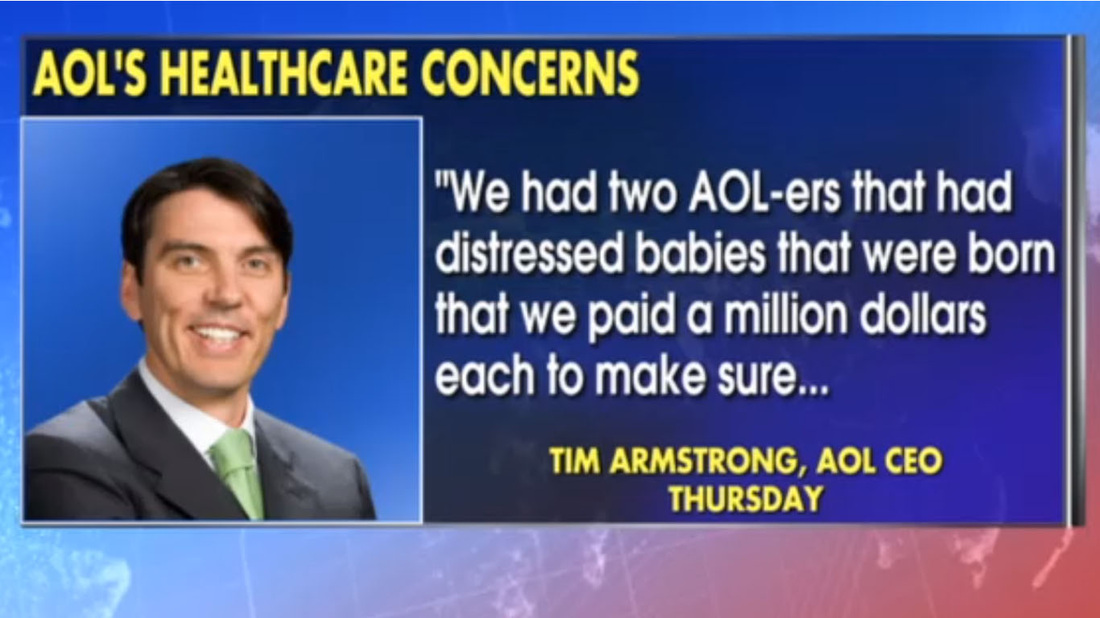
Tim Armstrong, the CEO of AOL – Health-care Concerns

Go Lean Commentary

Medical Management Services_AOL InsuranceIn the forgoing article, Tim Armstrong, the comments of the CEO of America Online (AOL) resulted in outcry around the country! There were allegations of scapegoats, privacy violations and various sins in making this announcement. What gives this CEO the right to highlight these families’ struggles? Well, can you say two million dollars? This man is not a Director of a Hospital refusing care. No, he is the CEO of the company paying the bills. Two million dollars taken out of the budget and the CEO cannot comment on it? Why are his actions being chastised?

By: Michael F. Cannon, Contributor

Unless you’ve been living under a rock, you’ve heard about AOL CEO Tim Armstrong’s strikingly insensitive comments about why the company is cutting its retirement benefits:

“As a C.E.O. and as a management team, we had to decide, do we pass the $7.1 million of Obamacare costs to our employees? Or do we try to eat as much of that as possible and cut other benefits?…”

“Two things that happened in 2012”, he continued, “we had two AOL-ers that had distressed babies that were born that we paid a million dollars each to make sure those babies were OK in general. And those are the things that add up into our benefits cost. So when we had the final decision about what benefits to cut because of the increased healthcare costs, we made the decision, and I made the decision, to basically change the 401(k) plan”.

Perhaps Armstrong felt commendations were in order. After all, the company’s health plan did pay a ton of money to keep those kids alive. Not as much as his annual salary, but still. And though you could be forgiven for missing it, he was actually announcing he had decided not to drop AOL’s “distressed babies” benefit.

But it’s hard to muster an “Attaboy!” when Armstrong is effectively blaming extremely premature infants, who are clinging desperately to life, for the cuts he chose to make in his employees’ retirement benefits. We’re still paying to keep these precious little angels alive, he assured his employees. But if any of you are mad about your pay cut, you know who to blame.

One of those babies has a mommy who wasn’t about to take that lying down.

In October 2012, only five months pregnant, Deanna Fei went into labor. Her daughter arrived via caesarian section weighing only 1 pound, 9 ounces, and spent the next three months in a neo-natal intensive care unit. Fei, a novelist, wrote at Slate about the anguish she and her family endured.

She also had choice words for her husband’s boss.

“Let’s set aside the fact that Armstrong—who took home $12 million in pay in 2012—felt the need to announce a cut in employee benefits on the very day that he touted the best quarterly earnings in years,” she wrote. It was “a cruel violation” to make her child “a scapegoat for cutting benefits.”

There was “the whiff of judgment in Armstrong’s statement, as if we selfishly gobbled up an obscenely large slice of the collective health care pie” when in fact “we experienced exactly the kind of unforeseeable, unpreventable medical crisis that any health plan is supposed to cover. Isn’t that the whole point of health insurance?”

“While he’s at it, why not call out the women who got cancer? The parents of kids with asthma?”

I’m totally with Fei. I still remember the panic I felt when our first child (41 weeks) took about one minute to start breathing on his own and our second (37.5 weeks) was born a little too pale. I cannot imagine visiting my child every day in a NICU for three months, much less the added trauma that mommies suffer in those cases. And I would be just as outraged by the indignity of having my spouse’s employer use our experience as a scapegoat, or claim that we are indirectly responsible for someone else’s pay cut.

Fei and her family owe no one an apology. Full stop. They paid their premiums. They used their coverage for its intended purpose. Their situation is exactly why health insurance exists.

It is also possible to sympathize with Armstrong. He has a duty to AOL shareholders to keep the company profitable. Part of that responsibility is to decide how much to pay AOL employees – and how to divide that sum among salary, health benefits, retirement benefits, and other forms of compensation. Someone’s going to be angry at him no matter what he decides. And in this case, he decided not to let those cuts fall on health benefits. Assuming he’s doing right by AOL’s shareholders, who probably include many AOL employees, he owes no one an apology for his $12 million salary. To be sure, he owes Fei and her family an apology – which he has issued and she has accepted.

How did we get to this point, where Fei’s husband’s boss knows how much it cost to save their baby’s life and can telegraph that figure to his coworkers and the world? Where an offhand comment by your employer can add to your grief by exposing your family’s medical history to your coworkers, and possibly make you a target of resentment?

The answer is that even before ObamaCare, America has had a health care sector dominated by government involvement. Yes, this capitalist’s insensitive comments are an example of government failure.

Ninety percent of Americans with private health insurance get that coverage through an employer. This state of affairs wasn’t brought to you by the free market. In a market where we all get to make our own choices, what responsible parent in their right mind would voluntarily choose for their family a type of health insurance that disappears when you get sick and cannot work anymore? Or when the factory closes? A type of health insurance where, if you have a high-cost condition, you are more likely to end up uninsured than if you bought coverage directly from an insurance carrier?

The reason more than 100 million Americans make the otherwise irrational decision to enroll in an employer-sponsored plan is that around 70 years ago, the federal government created an enormous tax preference for those plans that is not available if you buy more secure coverage directly from an insurer on the “individual” market. The upshot of that tax preference is that if consumers purchase health insurance themselves, they can spend up to twice as much for the same coverage. Economists have chronicled how the tax exclusion for employer-sponsored health insurance increases health care spending and thus the cost of health insurance, as well as how it reduces consumers’ health insurance choices. Yet the federal government makes it economically rational for 90 percent of consumers to purchase an inferior product that creates so many harmful effects.

Another harmful effect of this government policy is that the Tim Armstrongs of the world have far too much (read: any) influence over your family’s health insurance and medical decisions. (What if Armstrong had chosen to pare back AOL’s distressed-baby benefit?) They also end up knowing far too much (read: anything) about your family’s most emotionally difficult moments.

I won’t pretend private health insurance companies aren’t also obligated to serve shareholders or always have their customers’ best interests at heart. But how often do you hear the CEOs of insurance companies publicly say the sort of boneheaded thing Armstrong did? Not very. Even though they have to make comparable tradeoffs between covered benefits, affordable premiums, and profits, they don’t do what Armstrong did. They’re in the business, so they know better. When insurance companies say boneheaded things about their high-cost customers, they tend to do so quietly. You know, in internal memoranda. If I’m overlooking instances of insurance company executives doing what Armstrong did, please let me know in the comments.

Even if the CEO of, say, Aetna mentions they had a couple of million dollar babies last year, it wouldn’t expose those families the way it does when CEOs say it about their company-sponsored health plans. If everyone were making their own coverage choices, your coworkers would have no idea where you buy your health insurance unless you wanted them to know. And that’s as it should be. You would also have the option of leaving Aetna for another carrier that wasn’t so boneheaded, or if only because you don’t like the tradeoffs they are making between benefits, premiums, and profitability. Switching health plans is much harder when it might require switching jobs.

The federal government has let this boneheaded tax preference for employer-sponsored health insurance sit undisturbed for seven decades, even as it led to privacy violations and fueled the problem of pre-existing conditions. That should make us even more wary of the government’s latest brilliant health care idea.

How long will it take Congress to fix the more boneheaded elements of ObamaCare? Seventy years? More?

Source: http://www.forbes.com/sites/michaelcannon/2014/02/10/aol-chief-tim-armstrongs-insensitivity-argues-against-obamacare-not-for-it/

As the chief executive of the company, it was his job to pursue what he thought was in the best interest of the company. Would it have been preferred that instead, he simply laid-off some employees?

Many people were upset over his choice of the word “distressed babies”. Was he wrong? These babies were born early (pre-mature), with a $2 million price tag. And those bills were paid.

Had this been Joe-the-Plumber complaining that he lost his job because two distressed babies cost the company two million dollars, he would have gotten national sympathy and the news would have been about the failure of health care or Obama Care more exactly. Instead, this discussion is about the CEO of America Online. This is a BIG company, BIG business, BIG money – and so, this is a BIG deal.

From the perspective of the roadmap for this implementation of the Caribbean Union Trade Federation, this issue of Tim Armstrong-AOL-Health-Plan is also a BIG opportunity.

Something is wrong in this whole scenario!

It is “off-whack & off-kilter” that it costs families and communities so much for healthcare. There is no way we can afford this kind of price dynamics in the Caribbean. Nor do we want to leave our pregnant mothers and premature babies completely abandoned. No one wants to have a society like that. If so, there will be no opportunity to invite the Diaspora back home, nor dissuade families from abandoning their Caribbean homeland for foreign shores – the “push-and-pull” factors would be too great.

So where emotions may trump economics, economics are not eliminated just because we have emotional leanings. The article portrays the economic truths: “the tradeoffs … between benefits, premiums, and profitability.”

The Go Lean…Caribbean roadmap posits that the member-states need a larger pool for health insurance benefits, premiums, and profitability. The market size of 42 million is a viable solution. Plus new financial products like re-insurance sidecars in an energized securities/capital market, thanks to the Caribbean Dollar and a technocratic Caribbean Central Bank.

The roadmap also calls for strategic and tactical solutions for big money treatments, like cancer, by facilitating medical research campuses and medical tourism under the guise of Self-Governing Entities.

Lastly, the Go Lean roadmap promotes the practice of predictive wellness programs and disease management schemes, tackling head-on the root causes of so many medical distress and costs enablers.

Download the book, Go Lean … Caribbean and add your commentary.

Share this post:
,

10 Things We Want from the US and 10 Things We Don’t Want from the US

Go Lean Commentary

There are things we, in the Caribbean want, and things we do not want from the United States of America. Here is a laundry list of the Good and the Bad and how the roadmap to elevate Caribbean society, the book Go Lean…Caribbean, describes how the lessons will be applied in the implementation of the Caribbean Union Trade Federation (CU):

American Imports

What we want

10 GOOD Things We Want from the US
10 BAD Things We Don’t Want from the US
1
Free Market – In pursuit of the American Dream
100 years ago there was great debate in terms of the best governmental system for mankind: communism or capitalism. After 75 more years, that debate was over! Communism had proven ineffectual. Free Market capitalism as exercised in the US, in pursuit of the American Dream to elevate one’s standing in life, is what the Caribbean region needs, wants and deserves.
The Go Lean roadmap extols a Caribbean dream; that in addition to synchronizes with the American version also has additional advocacies like repatriation to the islands.
Strategic Interest Prioritization – Or Lack There of
The US is now the only remaining super power, but they only exert their “muscles” when their own strategic interests are involved. So after the promise of “never again”, after the Nazi Holocaust, the world found the US “sitting idle” as other genocides/ethnic cleansings transpired, as in Cambodia, Bosnia and Rwanda. Why this inaction? Simple: there was no strategic US interest.
The Go Lean roadmap advocates that despite the two US Territories (Puerto Rico & USVI), the Caribbean must forge law-and-order and plan/allow for its own priorities.
2
Tourists
Tourism is still the primary economic driver for the Caribbean region. While there is a lot of competition in the domestic US and internationally, the Caribbean continues to make the case that its region is the best tourist destination in the world. The region wants to continue to appeal to Americans of all demographic persuasions to come visit the islands for stay-overs (land-based hotels) and/or cruise ships. We want to forge vacation options and traffic for the upper, middle and lower classes of American society.
The CU forges plans, advocacies and re-boots to further enhance the Caribbean tourism product array.
Partisan Politics
In 2013, the US Government almost came to a grinding halt on two occasions; due to an impasse in raising the sovereign debt limit and a failure to pass a budget by the end of the fiscal year. The reason for these failures in delivering governmental obligations was partisan politics. Factions in the Republican Party were determined not to give in to the continuation of certain Democratic Party policies. These polar oppositions preferred to default on debt payments or shut down the government than to compromise from their positions.
The Go Lean roadmap dictates certain automatic provisions (budgets) to assuage legislative deadlocks.
3
Capital
There are many Financial Centers around the world (London, Zurich, Hong Kong, etc.) but none with the liquidity like Wall Street. They have the capital the Caribbean needs for Direct Foreign Investments. After the 2008 Financial Crisis, the US Federal Reserve Banks have maintained a policy of flooding the money supply to keep the cost of capital (borrowing) low.
The Go Lean roadmap calls for the emergence of the Caribbean Dollar (C$) managed by a technocratic Caribbean Central Bank. This structure allows for more liquidity in the existing stock exchanges in the regions. A strong regional currency will also mitigate primary cause for prior emigration.
Quantitative Easing – De-Americanize World Money
It’s a standard accepted practice not to overstate the money supply and that this practice results in de-valuing currencies. But the US feels that this policy does not apply to them. To offset the 2008 Credit Crunch, the Federal Reserve instituted a policy of Quantitative Easing and set the Discount Rate to near zero so that banks could get access to almost-free Central Bank money. The end result now is that the Euro, which started in 1999 pegged E$1.17-to-1 with the US dollar, now trades for at E$1.36.
Imagine a savings account established in 1999 losing 19% of value just sitting idle. The C$ plan is modeled on the Euro.
4
Pax Americana
Pax Americana is not a “de jure” policy of the US government, but rather a “de facto” policy. The spirit of the Monroe Doctrine is still imbued in US foreign policy. This implies that any European aggression in the Americas is an affront to the US. Practically, the US strong military ensures peace in the region. There is no need for massive military output by Caribbean states.
The CU roadmap includes Cuba into the brotherhood of a Caribbean Confederacy. Previous expressions of Pax Americana have resulted in a trade embargo for Cuba.
2nd Amendment
The “right to bear arms” has a personal application beyond the country’s entitlement to maintain a militia. This “right” has been interpreted in a manner in which any normal “man” can get possession of guns and other armament. This proliferation of guns in society results in the highest rate of gun violence in the world, even an unconscionable rate of school shootings.
The Go Lean roadmap purports that this status has also caused discord – a gross abuse and availability of illegal guns – in bordering communities of Mexico, and Caribbean states of the Bahamas, and the DR. This propels our gun-related crime.
5
Intelligence Gathering
After the September 11 Terrorist attacks the US ramped up its deployment of Intelligence Gathering capabilities. These systems allow for more predictive modeling and better tracking of suspects and threats.
The CU maintains the example of the investigation of the April 2013 Boston Marathon Bombings region – arrests were made in 48 hours – is a successful model to copy.
Privacy Violations
In the name of security, the US surveillance apparatus has been heavy-handed. They have even eavesdropped on phone calls for foreign heads of states visiting the UN, without search warrants from official courts. (One report and confession found the US spying on the Bahamas). The average law-abiding citizen should not have to worry about an over-reaching security watch dog.
The CU envisions a balanced Intelligence Gathering goal.
6
Crime Watch Initiatives
“If you see something, say something” – is the mantra of the crime and terror awareness movement in the US. This involves the verticals from crime watch to public CATV.
The Go Lean roadmap provides comprehensive anti-crime and anti-terror measures, both the systems, personnel and funding to effectuate this change.
Criminal Organizations – RECO
The US is the single largest economy in the world. As a result of this success, “bad actors” have also emerged.
The CU recognizes that the history of US organized criminal organizations running rampart in Cuba is a risk to be mitigated for future Caribbean societies. The roadmap is to monitor and assuage all enterprise criminal activities.
American Imports (cont’d)
10 Things We Want from the US
10 Things We Don’t Want from the US
7
Melting Pot Societies
The Latin term “E pluribus unum” or “Out of many, one”is a phrase on the official Seal of the United States. Though this was never codified by law, this phrase is a de facto motto of the US. This corresponds with actual history as immigration was always a constant feature. The US always benefited with empowering immigrants impacting the economic engines of the country. There are many industries where the “best of the best” try to work their way to the US; consider the broad examples of Wall Street or Hollywood and the specific example of German aero-space engineer Wernher von Braun, who inspired & aided US Space efforts and the quest for a man on the Moon.
The CU represent 30 member-states and 4 languages so any hope for a successful union depends of successful “melting pots” in our region.
Discrimination of Immigrants
Hazing and discrimination seem to have been a rite of passage for every immigrant group’s experience as they have emerged in the US. This was the experience for the Irish, Italian, Jewish, Puerto Rico, Cuban, and other communities, no matter the time frame (1800’s, 1900’s and 2000’s). Why should hazing be experienced, when there is economic value to immigrant populations?
The CU posits that empowering immigrants should be invited and accommodated; the local communities should plan and facilitate the impact of changes: language translations, Diaspora retailing and cultural sensitivity training. There is also the inevitable refugee inclusion that all successful societies must allow for, though not planned nor invited. These can be distributed among the region.
8
Family Holiday Re-unification
The busiest travel day of the year in the US is the Wednesday before Thanksgiving; the 2nd busiest day is the following Sunday. Obviously American families place a high priority on coming together for holiday festivities. Though not as extreme, this pattern is repeated for other holidays like Christmas, Easter and family reunions.
The CU advocates “push and pull” factors of family reunification throughout the Go Lean roadmap. Plus, the transportation solutions enable more easy access.
Family Abandonment
Senior Living Facilities are a big industry in the US. This is due to the family habit of abandoning elderly parents to the care of professional strangers. The Caribbean way traditionally is to house their Senior Citizens with families, whether the economics apply or not.
The CU has a prime directive to encourage repatriation back to the Caribbean homeland and assuage societal abandonment. Frankly, senior citizens should avoid the cold climates of North American and EU Diaspora cities.
9
Media Arts – Film, TV, Stage, Music, e-Games
While prospects for many traditional 20th Century industries (factories, auto, steel, mining) have declined in the US due to the competitive imbalance of globalization, media continues to flourish. In 2011 the global box office amassed $32.6 billion in revenues. Hollywood continues to be a growing and impactful economic engine. Broadway saw $11.2 billion that year, while music and other media continued to enjoy strong numbers. US Media Arts have become more than just past-time, it’s a sustainable lifestyle.
The CU roadmap posits that art and music can drive big economic returns as long as the complete eco-system is there to identify, foster & compensate stakeholders.
Cultural Neutralizations – Domination of airwaves
There are other cultures than just American. If not abated, the American media will dominate and neutralize the airwaves. Caribbean culture should be preserved and promoted. With American media comes American values, and these may not always advocate what’s best for Caribbean life. Consider consumerism, proliferation of guns and drugs, societal abandonment, language assimilation and other social ills.
The CU roadmap makes comparison to cultural protectionism as employed in France versus the free market approach in the US. While France doesn’t lead many of the world’s media output, they have maintained their unique culture. This propels their tourism – 25 million visitors to Paris.
10
Sports Professionalism
The American leagues for Baseball, Football, Basketball, Hockey, Soccer and even their Olympic models inspire athletes that they can earn a living based on their talents, disciplines and abilities. There are many levels for the American sports world, so even if money is not the object, other benefits, like educational scholarships and civic pride, can often provide positive impacts on society. The quadrennial Olympics are more successful today because of the Americanization of the business models of these events; which is heavy on media, sponsorships and free-market ticket sales.
The Go Lean roadmap includes a comprehensive sport promotion and administration apparatus within the CU Cabinet level State Department.
Win at all costs ethic
There is a worldwide movement to curb the sport world of performance enhancing drugs. Many of the recent advances in the “outlaw” industry have emerged from the US (i.e. BALCO, HGH, PEDS, etc.). This scourge is part of the “win at all costs” ethos that American sports seem to foster. This attitude also relates to the treatment of the retired athletes; this refers to the abandonment of expended athletes, once they are perceived to offer no further contributions.
The Go Lean roadmap calls for rebooting sports administration, including the establishment of an Anti-Doping agency within the CU Trade Federation to elevate regulation and enforcement to the federal level. Other benefits of the regional focus will include better oversight of sports academies, agents and leagues.

A large number of Caribbean people live abroad, in the Diaspora. They live in places like the US, Canada, the UK and Europe. This commentary is Part 1 of 4 in a series examining the destinations of this Caribbean Diaspora. The full series is as follows:

  1. 10 Things We Want from the US and 10 Things We Do Not Want
  2. 10 Things We Want from Canada and 10 Things We Do Not Want
  3. 10 Things We Want from the UK and 10 Things We Do Not Want
  4. 10 Things We Want from Europe and 10 Things We Do Not Want

Everyone is urged to lean-in to the roadmap to introduce and implement the Caribbean Union Trade Federation (CU).

Download the book Go Lean … Caribbean – now!

Share this post:
, , , , ,
[Top]

Air Antilles Launches St. Maarten Service

Go Lean Commentary

This below news article is good news for the Caribbean region. A new airline option has stepped in to fill the void.

Express

See the news story here:

By the Caribbean Journal staff:

Air Antilles Express has launched its first-ever service between St. Maarten and Pointe-a-Pitre, Guadeloupe.

The service could provide a boost for Guadeloupe’s bid to attract more tourists from the United States market, as St Maarten is a major hub for flights from the United States.

The thrice-weekly service is being operated on Thursdays, Saturdays and Sundays. Air Antilles Express made its first flight between the two Caribbean destinations last week. The St Maarten-Guadeloupe service is part of a wider expansion for the company across the region.

The regional carrier launched another new flight out of Guadeloupe at the end of last year, serving Antigua.
Source: Caribbean Journal Online News Source (Retrieved 02/11/2014) –  http://www.caribjournal.com/2014/02/11/air-antilles-express-launches-guadeloupe-st-maarten-service/

This foregoing article is just the “tip of the iceberg”; this is the latest development in a long string of eruptions in the Caribbean Air Travel space. The first eruption was November 2011 when AMR Corporation filed for Chapter 11 bankruptcy reorganization. AMR Corporation, the Fort Worth, Texas based airline holding company was the parent company of American Airlines, American Eagle and Executive Airlines, the Puerto Rico based regional American Eagle carrier for the Caribbean. Executive/ American Eagle ceased operation on March 31 2013, leaving a gap of service for the Eastern Caribbean islands.

Change had come to the airline industry. American was the last of the remaining legacy airlines in the US to file for bankruptcy; the prior business model had become unsustainable for every American carrier. Along the way, AMR “spun off” all American Eagle regional carriers including Executive Airlines, shedding the debt and union contracts as a weight off its bottom-line. This step was too little, too late. Despite US$ 24.855 billion in revenues for 2012 and $4 billion in cash, the company still posted losses of $1.876 billion. The merger of AMR with US Airways Group on December 9, 2013 form the new entity, American Airlines Group, and a new lease on life. But still, there is no Eastern Caribbean resurrection!

The book Go Lean … Caribbean serves as a roadmap to navigate the changed landscape of the globalized air transport industry. It pronounces that change has come to the Caribbean and despite due warning the region is not prepared. The Go Lean roadmap portrays the need for regional integration, administration, and promotion for Caribbean air carriers. The book posits that transportation and logistics empowers the economic engines of a community. The above news article/Press-Release definitely asserts this premise. There must be air carrier solutions to service the transportation and tourism needs of the Caribbean islands. There is the expectation that air travel will continue to grow and impact Caribbean society – thus the need for more regional coordination. New models are detailed in the book in which tourism can be enhanced with “air lifts” to facilitate Caribbean events.

Now, for much of the Caribbean, air service is the only viable transportation option, but this Go Lean roadmap introduces the Caribbean Union Trade Federation (CU) and its Union Atlantic Turnpike initiative (Page 205) to offer more transportation solutions (ferries, toll roads, railways, and pipelines) to better facilitate the efficient movement of people and cargo.

Air Antilles Express is based at Pointe-à-Pitre International Airport in Guadeloupe. It is a regional airline operating scheduled and seasonal services in the French Antilles (Caribbean). The airline began operations in December 2002 owned by the Dubreuil Group, the same as French Guiana based Air Guyane Express, using the same call signs, IATA (3S) and ICAO (GUY).

This carrier’s strategy, tactical and operational plan is to fill some of the gap left from the American Eagle absence, as follows:

Air Antilles Express –Destinations*
American Eagle – Puerto Rico Hub Destinations*
Antigua
Antigua
British Virgin Islands – Tortola
Dominican Republic
  • Punta Cana (July–August only)
  • La Romana (July–August only)
  • Santo Domingo
Dominican Republic
  • Punta Cana
  • Santiago
  • Santo Domingo
French Guiana
Dominica
Guadeloupe
Guadeloupe
Martinique
Martinique
Saint Barthélemy
St Maarten
Saint Kitts and Nevis
St Maarten
Saint Lucia
U.S. Virgin Islands
  • Saint Croix
  • Saint Thomas

Information is retrieved from Wikipedia on February 11, 2014

Everyone is encouraged to lean-in to the best-practices and empowerments defined in the Go Lean book.
🙂

Download the book Go Lean … Caribbean now!!!

Share this post:
, ,
[Top]

Print is not dead yet

Go Lean Commentary

high-volume-offset-printing-presses-40462-6118919

… well actually, one person’s opinion:

Print is not dead… yet? I almost didn’t notice!

If print is not dead yet, does that mean it is going to put up a fight? Will it make a comeback? I say “No”. It is just a matter of time. Print might experience only a slow death, but die … it will.

This is just an opinion of an Caribbean Diaspora member living in the US, who rarely buys newspapers and magazines only occasionally. But this does not mean that I’m ignorant of the news or the latest going-ons. I am completely up-to-date. Obviously I rely more on the electronic media for information, and entertainment.

The reference to electronic media does not only mean TV or radio. Rather the internet. A lot of consumers still read, just not in print, they now use internet websites, e-Readers, blogs and email. Even the radio and TV media is finding competition because of the internet. In the TV industries, more people are abandoning cable contracts for subscriptions services like Netflix and Hulu; they are still able to enjoy their favorite programming, just delivered by alternate means. For radio, the audience is shrinking due to the proliferation of mobile music options like Pandora, Rhapsody, Jango, Slacker, Roxio, etc.

The rate of change is fast!

I just started using the internet, email and Facebook two years ago. I’m obviously a late bloomer. During this time, I have not utilized any postal mail to connect with my Caribbean family. Instead of the weeks it took for a letter to arrive; I now connect in seconds.

I am not the only one. – SFE Foundation Stakeholder Leonora Hall. 

Truly, you are “not the only one“! Change has come…to America and other countries. According to the American Library Association, in a 2008 report  it stated that:

68% of Americans carry a library card, but they rarely use them to borrow books (print), but rather to use audio books, podcasts, digital references, and to consume computer time. They reported that since 2006 they have seen increases in internet usage (68%) for using email, chat, and IM; e-Books (52%); video (49%) and online instruction courses 43%). – (http://www.marketingvox.com/online-offerings-rise-at-us-libraries-68-of-americans-have-library-cards-041431/)

As stated in the below article, there is still a lot of upside to print, compared to electronic alternatives. A paper book is still a better experience compared to an e-Reader. But truth be told, there are no Research & Development (R&D) trying to make paper books better, but plenty of R&D activity for e-Readers. The article relates:

Title: Print is Not Dead Yet
By: Chandi Perera, CEO, Typéfi*

One of the earliest citations of the phrase “print is dead” comes from the 1984 movie Ghostbusters, but almost 30 years later, print is certainly not dead. Print publishing still drives on average 80% of revenues and close to 100% of the profits for general trade publishers. But among reference and science, technical and medical (STM) publishers, digital publishing was embraced quickly and openly at the expense of print.

Commercial digital products from large reference publishers started in the 1980s, and PDF was adopted as the preferred format for STM publishing in the 1990s. Digital-only publications were well-accepted by the turn of this century, and the PDF still holds unquestioned dominance. Digital production and distribution addressed a number of such publishers’ pain points, but print still maintains advantages for large trade publishers.

Take information that is published regularly, as in journals, or that must be kept up to date, like encyclopedias. Such information needs to be disseminated as quickly as possible. Print publications necessarily take longer to be produced and delivered than digital equivalents. But fiction titles, such as the Harry Potter series or The Da Vinci Code, have no information currency or updating requirements. Print still works for these books.

What about physical production and distribution costs? A typical reference or STM publisher could save tens to hundreds of dollars per unit by eliminating printing and mailing costs. For weekly journals this would be as high as $50-$100 per subscriber. The incentive to save on such costs is quite significant for publications containing information that is only valid for a limited time. However, large efficient trade publishers spend less than $2 to print and distribute a typical trade fiction book. Not much cost incentive for change there.

Or look at digital formats. STM publishers often use the same PDF file for both print and digital distribution. Trade digital delivery channels do not generally use PDF files, so a trade publisher needs to create an e-book file in addition to the print file. Complicating matters further, there are over 30 different popular device types, apps or file formats in use in the global publishing market. A publisher can achieve a basic level of compliance from creating one EPUB file and converting to other formats. But to take advantage of e-book device features for an exceptional reading experience, a publisher must invest in creating a dedicated file optimized for each device. The costs of doing this are substantial and in many cases are levels of magnitude above the print production cost.

Accessibility is one of the biggest advantages… of digital publishing from an STM reader’s perspective. With the rise of networked computers and the internet, readers no longer had to go to the library to access a publication. By the late 1980s most professional scientists had a networked desktop computer to access STM publications–usually for free as their institutional library would hold the subscription.

Accessibility is also a major advantage for digital trade publications. No longer will airline passengers have to settle for what the airport bookshop is selling before boarding the flight. They can purchase and download from online catalogs. However, unlike PDFs on desktops, the devices used to access this content are not ubiquitous, cheap (for the reader) or interchangeable.

In today’s e-book market, content purchased from some channels is only readable in devices linked in those channels. It is difficult for all but the most technically savvy to transfer a large iBooks collection to a Kindle or Samsung Galaxy device, and vice versa.

On the other hand, PDF provides a dependable rendering format for scholarly publications, regardless of technology upgrades and platform changes. The PDF user experience for reference and STM publications is no worse than the print product experience. Users could still do all they did with the traditional print product, with some added advantages , and none of the disadvantages (even on-screen reading, as many readers still print out the PDF for reading on paper).

But in trade publishing, the user experience of e-books is very different from print and varies from device to device; in almost all cases devices are more complex to use than a simple book. Even on popular devices like the Kindle, navigating through a book is cumbersome, unlike “flicking” back and forth. Even with perceived benefits like resizable text and backlit displays, it takes significantly more effort to use an e-book reader than a book.

Until there is more standardization of format, portability of libraries, and the reading experience is as good as, or better than, a physical book across devices, and until the cost and revenue equation makes sense for the publisher, print will have a long life yet in trade publishing. Nevertheless, there are many ventures seeking these outcomes, and technologies being developed to deliver them. Overall, digital publishing has a bright future.
Source: *Typéfi produces automated composition solutions for print and web. Visit http://www.Typéfi.com.
See http://www.oecd.org/internet/ieconomy/

CU Blog - Print is Dead - Photo 2

This commentary therefore concurs with the article’s conclusion: Overall, digital publishing has a bright future.

Are these future prospects true for the Caribbean as well? The book Go Lean…Caribbean serves as a roadmap to elevate the Caribbean economic, security and governance engines. The book asserts that the “world is flat” and the globalization has taken its toll on Caribbean consumerism. This indicates that we must plan for more and more electronic consumption of news and information. But with electronic delivery come the need for electronic payment systems, and thus the Go Lean roadmap is to establish the complete eco-system so that all of the Caribbean can more easily consume electronic media content legitimately. The roadmap also calls for the deployment of more libraries into the communities so as to facilitate the need for internet connectivity.

Lastly, the Go Lean roadmap posits that as a region, we cannot only expect to consume, but that we must create/compose as well. The end result of this roadmap is a complete eco-system to foster a viable media industry.

We can do this. We must do this!

Download the Book Go Lean … Caribbean – Now!!!

Share this post:
, , ,
[Top]

The Erosion of the Middle Class

Go Lean Commentary

Middle ClassAs for the direct issues in this article, the experience has been the same in the Caribbean. The high-end tourist resorts have flourished since the Great Recession, while properties catering to the general middle class have floundered. The one exception being the emergence of the cruise industry as a viable vacation option for the general American population. The CU therefore plans to empower the industry directly, and to elevate the cruise industry’s impact on Caribbean society.

New York Times, February 2, 2014 – In Manhattan, the upscale clothing retailer Barneys will replace the bankrupt discounter Loehmann’s, whose Chelsea store closes in a few weeks. Across the country, Olive Garden and Red Lobster restaurants are struggling, while fine-dining chains like Capital Grille are thriving. And at General Electric, the increase in demand for high-end dishwashers and refrigerators dwarfs sales growth of mass-market models.

As politicians and pundits in Washington continue to spar over whether economic inequality is in fact deepening, in corporate America, there really is no debate at all. The post-recession reality is that the customer base for businesses that appeal to the middle class is shrinking as the top tier pulls even further away.

If there is any doubt, the speed at which companies are adapting to the new consumer landscape serves as very convincing evidence. Within top consulting firms and among Wall Street analysts, the shift is being described with a frankness more often associated with left-wing academics than business experts.

“Those consumers who have capital like real estate and stocks and are in the top 20 percent are feeling pretty good,” said John G. Maxwell, head of the global retail and consumer practice at PricewaterhouseCoopers.

In response to the upward shift in spending, PricewaterhouseCoopers clients like big stores and restaurants are chasing richer customers with a wider offering of high-end goods and services, or focusing on rock-bottom prices to attract the expanding ranks of penny-pinching consumers.

“As a retailer or restaurant chain, if you’re not at the really high level or the low level, that’s a tough place to be,” Mr. Maxwell said. “You don’t want to be stuck in the middle.”

Although data on consumption is less readily available than figures that show a comparable split in income gains, new research by the economists Steven Fazzari, of Washington University in St. Louis, and Barry Cynamon, of the Federal Reserve Bank of St. Louis, backs up what is already apparent in the marketplace.

In 2012, the top 5 percent of earners were responsible for 38 percent of domestic consumption, up from 28 percent in 1995, the researchers found.

Even more striking, the current recovery has been driven almost entirely by the upper crust, according to Mr. Fazzari and Mr. Cynamon. Since 2009, the year the recession ended, inflation-adjusted spending by this top echelon has risen 17 percent, compared with just 1 percent among the bottom 95 percent.

More broadly, about 90 percent of the overall increase in inflation-adjusted consumption between 2009 and 2012 was generated by the top 20 percent of households in terms of income, according to the study, which was sponsored by the Institute for New Economic Thinking, a research group in New York.

The effects of this phenomenon are now rippling through one sector after another in the American economy, from retailers and restaurants to hotels, casinos and even appliance makers.

For example, luxury gambling properties like Wynn and the Venetian in Las Vegas are booming, drawing in more high rollers than regional casinos in Atlantic City, upstate New York and Connecticut, which attract a less affluent clientele who are not betting as much, said Steven Kent, an analyst at Goldman Sachs.

Among hotels, revenue per room in the high-end category, which includes brands like the Four Seasons and St. Regis, grew 7.5 percent in 2013, compared with a 4.1 percent gain for midscale properties like Best Western, according to Smith Travel Research.

While spending among the most affluent consumers has managed to propel the economy forward, the sharpening divide is worrying, Mr. Fazzari said.

“It’s going to be hard to maintain strong economic growth with such a large proportion of the population falling behind,” he said. “We might be able to muddle along — but can we really recover?”

Mr. Fazzari also said that depending on a relatively small but affluent slice of the population to drive demand makes the economy more volatile, because this group does more discretionary spending that can rise and fall with the stock market, or track seesawing housing prices. The run-up on Wall Street in recent years has only heightened these trends, said Guy Berger, an economist at RBS, who estimates that 50 percent of Americans have no effective participation in the surging stock market, even counting retirement accounts.

Regardless, affluent shoppers like Mitchell Goldberg, an independent investment manager in Dix Hills, N.Y., say the rising stock market has encouraged people to open their wallets and purses more.

“Opulence isn’t back, but we’re spending a little more comfortably,” Mr. Goldberg said. He recently replaced his old Nike golf clubs with Callaway drivers and Adams irons, bought a Samsung tablet for work and traded in his minivan for a sport utility vehicle.

And while the superrich garner much of the attention, most companies are building their business strategies around a broader slice of affluent consumers.

At G.E. Appliances, for example, the fastest-growing brand is the Café line, which is aimed at the top quarter of the market, with refrigerators typically retailing for $1,700 to $3,000.

“This is a person who is willing to pay for features, like a double-oven range or a refrigerator with hot water,” said Brian McWaters, a general manager in G.E.’s Appliance division.

At street level, the divide is even more stark.

Sears and J. C. Penney, retailers whose wares are aimed squarely at middle-class Americans, are both in dire straits. Last month, Sears said it would shutter its flagship store on State Street in downtown Chicago, and J. C. Penney announced the closings of 33 stores and 2,000 layoffs.

Loehmann’s, where generations of middle-class shoppers hunted for marked-down designer labels in the famed Back Room, is now being liquidated after three trips to bankruptcy court since 1999.

The Loehmann’s store in Chelsea, like all 39 Loehmann’s outlets nationwide, will go dark as soon as the last items sell. Barneys New York, which started in the same location in 1923 before moving to a more luxurious spot on Madison Avenue two decades ago, plans to reopen a store on the site in 2017.

Investors have taken notice of the shrinking middle. Shares of Sears and J. C. Penney have fallen more than 50 percent since the end of 2009, even as upper-end stores like Nordstrom and bargain-basement chains like Dollar Tree and Family Dollar Stores have more than doubled in value over the same period.

Competition from online giants like Amazon has only added to the problems faced by old-line retailers, of course. But changes in the restaurant business show that the effects of rising inequality are widespread.

A shift at Darden, which calls itself the world’s largest full-service restaurant owner, encapsulates the trend. Foot traffic at midtier, casual dining properties like Red Lobster and Olive Garden has dropped in every quarter but one since 2005, according to John Glass, a restaurant industry analyst at Morgan Stanley.

With diners paying an average tab of $16.50 a person at Olive Garden, Mr. Glass said, “The customers are middle class. They’re not rich. They’re not poor.” With income growth stagnant and prices for necessities like health care and education on the rise, he said, “They are cutting back.” On the other hand, at the Capital Grille, an upscale Darden chain where the average check per person is about $71, spending is up by an average of 5 percent annually over the last three years.

LongHorn Steakhouse, another Darden chain, has been reworked to target a slightly more affluent crowd than Olive Garden, with décor intended to evoke a cattleman’s ranch instead of an Old West theme.

Now, hedge fund investors are pressuring Darden’s management to break up the company and spin out the more upscale properties into a separate entity.

“A separation could make sense from a strategic perspective,” Mr. Glass said. “Generally, the specialty restaurant group is more attractive demographically.”
Source: Retrieved March 21, 2014 from: https://www.nytimes.com/2014/02/03/business/the-middle-class-is-steadily-eroding-just-ask-the-business-world.html

This issue of income inequality has been covered widely in the book, Go Lean … Caribbean. The reality of the middle class is that their numbers represent too many of the population to ignore. To foster growth in the economy, there must be growth for the middle class, or something amazing happens: people leave. This is the experience of so many in the Caribbean Diaspora. If despite the adherence of best practices (education, law-abiding, savings-and-investments), the average middle class family cannot obtain societal progress and contentment, they will simply relocate. For the Dutch and French Caribbean, this relocation eventuality has resulted in emigration to The Netherlands and France; for the American Caribbean territories, the emigration has resulted in the abandonment of the islands for the US mainland. For example, Puerto Rico has 4.7 million people living in the US mainland (compared to 3.9 million on the island) identifying themselves with a Puerto Rican heritage. The ratio is the same for the US Virgin Islands. The English-speaking Caribbean has many expatriates that have abandoned their island homes for foreign shores, often in England, Canada and the US. The region’s Diaspora is estimated at 10 million.

The Go Lean roadmap advocates a 10-Step approach to elevate the middle class of Caribbean society. This advocacy championed the belief that the “American” Dream is viable for other locations as well. So a balance must be carefully maintained for the CU efforts to impact an achiever class versus efforts of egalitarianism. We want to raise all the poor to middle class status (egalitarian in theory), and all the middle class to wealthy – One Percent – status, but that’s not what happens in reality. Achievers will always emerge ahead of their peers. The CU posits that there should be no impediments to this emergence, rather excellence should be fostered and even incubated. With this roadmap, the Caribbean can be a better place for all to live, work and play.

Download the free e-book of Go Lean … Caribbean – now!

Share this post:
, , ,
[Top]

Tourism’s changing profile

Go Lean Commentary

ctdc.015The experiences in the Caribbean correspond to the observations of this article. Change has come to the Caribbean. Tourism continues to be the primary economic driver in the region; this is a static fact for the last 50 years, even though the dynamics of this industry is in constant flux. The Go Lean … Caribbean roadmap depicts that 4 major change agents have impacted this industry: technology, demographics, globalization, and climate change. This article affirms these issues.

Unfortunately the Caribbean region has not always planned for changes or adapted to them. There is still the expectation that the tourists visiting the islands would be North American or Western European and that the standard languages of Dutch, English, French and Spanish would suffice. Alas, this article depicted that the profile of modern tourism reflect a more global reach. Therefore, Caribbean communities must prepare for this change. They must accomodate the need for language translations, community education and racial/ethnic tolerance.

By: Lyndon Thompson

Tourism has shown remarkable staying power in recent years. Despite political instability, wars, natural disasters and a global financial crisis, the industry keeps getting up for another round. Japan is good example. After the 2011 earthquake and Fukushima nuclear accident, the number of visitors to the country plunged. But in 2013 more than 9 million tourists visited the country, a record high.

International tourist arrivals generally surpassed 1 billion in 2012 and are forecast to reach 1.8 billion by 2030. OECD countries account for nearly 60% of international tourist arrivals, but a shift in the global economy promises to change this picture somewhat as people in emerging economies travel more than before. Today, China spends eight times more on tourism than it did 12 years ago. Chinese tourists spent US$102 billion in 2012, a 37% increase over the previous year and more than any other country.

Russians are also more footloose, and rank fifth in terms of spending on outbound tourism. The number of tourists from India has also doubled since 2006. The UN World Tourism Organization estimates that by 2030, overall annual growth in outbound tourism will amount to 17 million in the Asia-Pacific region, 16 million in Europe, 5 million in the Americas, and a combined 5 million in Africa and the Middle East.

Emerging economies are drawing in more tourists, too. Over the next 15 years, the share of arrivals in emerging economies will increase by 4.4% annually, double the rate of arrivals in advanced economies, with South Asia topping the list. North America, on the other hand, will slip to the bottom.

Tourism directly accounts for 4.2% of GDP, 5.9% of employment and 21% of exports of services in OECD countries, enough for governments bruised by the financial crisis to see the industry as a catalyst for growth. They are becoming more dynamic, bringing in new business models and cutting red tape. They are shortening waiting times by offering online visa applications and automatic border checks, too: Turkey, for instance, introduced e-visa applications in 2013, reducing the need for tourists to queue on arrival.

The profile of today’s travelers differs sharply from that of their predecessors. Demographically, tourists are older–23% aged 55 or above–and more frugal, preferring shorter trips closer to home. Geographically, they tend to live in emerging economies rather than in developed ones. Most holidays are now booked online instead of through travel agencies. The holidays sought are often far off the beaten track and focus on a theme: adventure, culture and heritage, or food and wine. New niche markets have arisen, such as “diaspora”, gay and lesbian holidays, humanitarian tourism to work for good causes, and tourism for medical treatments.

Two other trends in tourism are also worth noting. First there is risky “dark tourism”, from hiking in Afghanistan to hunting pirates off the Somali coast, or even photographing conflict zones in Syria. This fashion should not be confused with the rather more solemn “memorial tourism”, which promotes trips to the scenes of great tragedies and wars, such as Ground Zero in New York, Auschwitz in Poland and war cemeteries across Europe.

With 2014 marking the 100th anniversary of the outbreak of the First World War, expect a rise in “memorial tourism” in the year ahead, particularly in Flanders in Belgium and the Somme region of France. In Japan there is a proposal to build a tourists’ village near the Fukushima nuclear plant, with fortified hotels to shield guests against any elevated radiation, the aim being to remind future generations of the 2011 tragedy there.

Such emotionally challenging trips allow travelers to reflect on the follies of humankind and the vulnerability of life. They can also serve to bond people together and build co-operation against future conflicts. Rather than an escape, they echo what the writer Samuel Johnson saw as the true reason for travelling: “to regulate imagination by reality, and instead of thinking how things may be, to see them as they are.”

Source: www.oecd.org/cfe/tourism/

The book Go Lean … Caribbean purports that the Caribbean is the greatest address in the world. In order to appeal to the global market, the book, as a roadmap, posits that regional tourism stakeholders must engage these other ethnic populations. The roadmap advocates the use of Internet Communications Technologies and Social Media for bookings, and to sell the attractions of Caribbean culture and amenities. The plan also calls for establishing Trade Mission Offices in divergent cities like Spain and Tokyo for outreach to Mid & Far Eastern markets.

The Go Lean roadmap also advocates 10-Step approaches for elevating events and fairgrounds in the region. The tactical approach is for a technocratic Trade Federation that would finance and construct facilities and amenities as amusement parks, arenas, stadia & other venues structure as Self- Governing Entities. These bordered grounds would be independent of actual member-state governments.

This magazine article was published in the OECD Observer “e-Zine”. This online journal is the public relations arm of the OECD – Organization of Economic Cooperation and Development – an international economic organization of 34 countries founded in 1961 to stimulate economic progress and world trade. It is a forum of countries committed to democracy and the free-market economy, providing a platform to compare policy experiences, seek answers to common problems, identify good practices, and co-ordinate domestic and international policies of its members. The OECD promotes policies designed to …
1). Achieve the highest sustainable economic growth and employment and a rising standard of living, while maintaining financial stability, and thus to contribute to the development of the world economy;
2). Contribute to sound economic expansion in Member as well as nonmember countries in the process of economic development; and
3). Contribute to the expansion of world trade on a multilateral, nondiscriminatory basis in accordance with international obligations.
Source: www.oecd.org/about/ (Retrieved November 2013).

Download the Book – Go Lean…Caribbean Now!!!

Share this post:
, ,
[Top]

Egalitarianism versus Anarchism

imgres

Go Lean Commentary

This book Go Lean … Caribbean presents the two sides of the debate on “egalitarianism”: catering to the Least Common Denominator (LCD) or elevating the achievers. Let’s expand that discussion here. For the first argument, an essay by Gary Hull (Ayn Rand Institute) in Capitalism magazine which stipulates:

Egalitarianism claims only to want an “equality” in end results, hates the exceptional man who, through his own mental effort, achieves that which others cannot… In an attempt to “dumb down” all students to the lowest common denominator, today’s educators no longer promote excellence and students of superior ability… Imagine the following Academy Award ceremony. There are no awards for best picture or best actor. Instead, every picture gets a certificate and every actor receives a prize. That is not an awards ceremony, you say? So it isn’t. But it is an egalitarian’s dream — and an achiever’s torment. Talent and ability create inequality… To rectify this supposed injustice, we are told to sacrifice the able to the unable. Egalitarianism demands the punishment and envy of anyone who is better than someone else at anything. We must tear down the competent and the strong – raze them to the level of the incompetent and the weak… What would happen to a Thomas Edison today? If he survived school with his mind intact, he would be shackled by government regulators. His wealth would be confiscated by the IRS. He would be accused of ‘unfair competition’ for inventing so many more products than his competitors.[a]

On the other hand, Alexander Berkman argued the contrast:

…equality does not mean an equal amount but equal opportunity… Do not make the mistake of identifying equality in liberty with the forced equality of the convict camp. True anarchist equality implies freedom, not quantity. It does not mean that every one must eat, drink, or wear the same things, do the same work, or live in the same manner. Far from it: the very reverse in fact… Individual needs and tastes differ, as appetites differ. It is equal opportunity to satisfy them that constitutes true equality… Far from leveling, such equality opens the door for the greatest possible variety of activity and development. For human character is diverse.[b]

urlThe Go Lean book serves as a roadmap for the introduction and implementation of the Caribbean Union Trade Federation (CU). The book embraces both sides of this debate; on the one hand, as a federal entity, the CU will ensure equal access to regional opportunities to any petitioner; this is Egalitarian in nature. On the other hand, this Go Lean/CU roadmap posits the community ethos that one person can make a difference, and can impact the region for the Greater Good. The CU will foster the unique contributions of the achiever. This meritocracy leaning comes down on the Anarchist side of the debate.

In this vein, the following missions, aligned by Anarchist and Egalitarian, are elaborated in the Go Lean book:

Anarchist – leaning advocacies
Egalitarian – leaning advocacies
Fostering Genius
Bridge the Digital Divide
Help Entrepreneurship
Manage Reconciliations
Promote Intellectual Property
Improve Sharing
Fostering a Technocracy
Impact the Greater Good
Delivering More with Less
Impact Social Media
– Lean Project Management methodologies
Impact Entitlements
Improve Leadership
Battles against Poverty
Impact Beauty Pageants
Protect Human Rights
Impact Lotteries
Help the Middle Class
Impact Retirement
Improve Elder-Care
Impact the One Percent
Promoting Independence
Improve Sports
Improve Education
Improve the Arts
Empower Women
Promote Music
Impact Youth
Impact Persons with Disabilities

The Go Lean book is published by a movement seeking to make the Caribbean a better homeland to live, work and play. There can be no strict adherence to either egalitarianism or anarchism; the optimal society must reflect a perfect balance of both.

All in all, the Egalitarian versus Anarchist debate may now be considered anachronistic. This may have been a valid 1913 argument, but for 2013 (publication date of the Go Lean book)  it is “null-and-void”, irrelevant even. After 100 years of bad history – 2 World Wars and a Capitalism-versus-Communism schism – we must simply apply the lessons learned.  Today, we must consider all best practices, and embrace all tools, techniques and talents for success. The people of the Caribbean deserve the best of the best, despite whatever philosophical leanings.

Download the book Go Lean … Caribbean – now!

—————

Appendix – Citations

a. Egalitarianism: The New Torture Rack, by Gary Hull, Ayn Rand Institute, January 11, 2004

b. Alexander Berkman- Prison Memoirs of an Anarchist. Mother Earth Publishing 1912 – What is Anarchism? pp. 164-5


Share this post:
, ,
[Top]

John McPhee – LCD versus an Entrepreneurial Ethos

Go Lean Commentary

The book Go Lean … Caribbean is more than just a publication, it is a movement. This movement is designed to elevate the Caribbean’s economic, security and governing engines. The book serves as roadmap for the introduction and implementation for the Caribbean Union Trade Federation (CU). As such, we are proud to feature role models – institutions, companies and individuals – that extoll the values, community ethos, that we hold dear. This role model, John McPhee, is a prime example.

Among the many community ethos, strategies, tactics, implementation and advocacies in the book is the proposal for the consolidation and integration of the region’s Taxi & Limousine Regulatory Commissions. The book posits that many of the initiatives envisioned for the region are too big an undertaking for any one Caribbean member-state alone; therefore the roadmap call for this functionality to be consolidated and integrated into CU oversight.

plid_2291_ii_cancun.guide.getting.around.taxis_1_2_article_full_2John McPhee is on the frontline of Bahamian tourism – he is a taxi driver. But to call him just a taxi driver would be an insult; it would expose a blatant ignorance. John McPhee is the anti-taxi driver; he “zigs” while everyone else “zags”. The industry for taxi drivers is based on the Lowest Common Denominator (LCD); John, on the other hand, rises above the fray, he stands out like a stalk of wheat in a field of weeds. He drives a Chrysler Town & Country mini-van for its roominess, durability and fuel efficiency. (The is the same vehicle class as the Nissan NV200 depicted in Appendix-VIDEO below and on Page 328 of the Go Lean book).

Mr. McPhee also accepts credit cards. This is an anomaly among taxi drivers in the Bahamas.

Lastly, he arranges appointments and delivers on schedule. He is the walking embodiment of the vision for the Caribbean Union’s Taxi & Limousine Commission.

John McPhee delivers on a business model that can be profitable, efficient, and effective (as frontline ambassadors) for forging change in a region too accustomed to the status quo (failure); a region with governmental policies designed to benefit the LCD and thus they miss out on victories that one champion can achieve. This is the winning model of both the industrial and information revolutions, where individuals, entrepreneurs and industrialists transformed society with their innovations. John McPhee represents that new corps of Caribbean entrepreneurs.

In a person-to-person interview, recorded in the Go Lean book at Page 39, these were his responses:

What are the details of your project?

A Cashless Payment System for Taxi Cabs. This will allow for passengers to pay their fare by means of any major credit/debit cards. Considering the reality of The Bahamas where many citizens, even in the middle class, do not possess credit cards, the target market will be tourists, and the corporate sector. This service should empower taxi drivers to have a competitive advantage over their peers. This project’s goal is to have 50 cars within a fleet, and to provide all of their dispatch services.

Who are the competitors of this service?

There is the Bahamas Taxi Union, a cooperative among individual taxi drivers. Then there are other private entities like H. Forbes Charters and other similar companies.

Why did you not leave, like the many before you?

The Bahamas can still be a land of opportunity. This is what the people here deserve. This is a small country, I should be a big fish in this small pond, but I’m not. If I’m not the head-of-the class here, how can I expect to succeed as a small fish in a big pond somewhere else. So I do not intend to leave.

How do you feel about Bahamian/Caribbean Security?

A lot is lacking here. All citizens can easily be in danger of the pervasive crime and violence.

How do you feel about Bahamian/Caribbean Economy?

Even more is lacking. This country is not suited to encourage entrepreneurism. Economic growth is only going to come from the private sector, not the government. For the private sector to flourish there must be the appropriate structure, incentives and economic drivers. These ingredients are not here now. For my project, I had to sue the government agency (Taxi Commission) to force their hand in doing the right thing. The governing principle used here follows the policy of egalitarianism. This sounds good on paper, equal opportunity for all, but in practice, it’s a disservice for job creation. Catering to the LCD sets the bar low. Excellence does not emerge from that.

What areas are you most disappointed in when considering the last 20 years?

There is a trend towards social equality, which is good if the equal status is a high standard of living and high moral fortitude. But instead, there seems to be a steady decline in all aspects of Bahamian life in which we are all becoming equally mediocre, inadequate. This indicates a fault in leadership; there is a lack of vision and no plan to elevate, if not for all the people, then at least for an achiever class.

What do you want to see in The Bahamas in … 5 years?

Turn-around from the current path, otherwise there will be a collapse of the middle class.

What do you want to see in The Bahamas in … 10 years?

All societies must innovate, or be overrun with innovations from abroad. If the current trend continues, there will be a disenfranchisement of Bahamians in their own country.

What do you want to see in The Bahamas in … 20 years?

I want to see a social and political revolution; the status quo cannot continue. While a revolution denote a quick sudden change, perhaps an evolution (slow, steady and consistent) is better. But we must start now, by first abandoning these LCD policies and expectations.

What features of North American/Europe would you like to see here?

In addition to a NATO-like force, the Caribbean should be more connected/integrated; there should be a central trading/purchasing entity to represent the entire region.

Where do you consider to be the best place to live?

Canada. They seem open to growth, inviting foreign nationals. There is a common language – but respect for minorities – and plenty of opportunities in the areas that entrepreneurs seek.

How would you feel if your children emigrate?

Being a husband and father, I fear that my son will one day leave. He will need such a move to soar in his endeavors. If that happens, while we will miss him, we will simply accept and support him.

Download the book Go Lean … Caribbean – now!

————
Appendix – VIDEO: New York Proclaims “Hail Yes!” as First Nissan NV200 Taxicab Hits the Streets of Manhattan – https://youtu.be/za1xO3WcnQs

Published on Oct 29, 2013 – NEW YORK (October 29, 2013) — A new era in public transportation has begun with the Nissan NV200 taxi now in service on the streets of New York City. The meter on the first NV200 taxi fare officially kicked-off at JFK International Airport on October 23, dropping its inaugural passenger near 13th Street and 6th Avenue in Manhattan. Mr. Ranjit Singh, an owner/operator of Medallion No. 7F20, took delivery of his NV200 taxi from Koeppel Nissan in Queens on October 18.
AMC131029102.
 
Share this post:
, , , ,
[Top]

Role Model: Kevin Connolly – Advocate for Muhammad Ali

Go Lean Commentary

This story-line is retrieved from the movie “Muhammad Ali’s Greatest Fight” (2013). See the summary here:

muhammad-ali-jpgIn 1964, world champion boxer Muhammad Ali requested exemption from the military draft based on his religious beliefs. His request was denied and when he subsequently refused induction into the army, he was convicted and sentenced to 5 years imprisonment. His case eventually works itself up the Supreme Court. In their first conference after the case is presented, the justices decide by majority vote (5 to 3) to uphold the conviction and Justice John Harlan is tasked with preparing the majority opinion. He assigns one of his clerks, Kevin Connolly, to prepare a first draft but try as he might [Mr. Connolly] believes that the decision is wrong. His draft argues for overturning the conviction… eventually Justice Harlan agrees with him. The Justice must now find a way to convince his colleagues.
Source: IMDB – http://www.imdb.com/title/tt2061756/?ref_=nv_sr_2

The review of this movie –  The Atlantic Magazine – adds great insight and perspective. Consider here:

In 1960 Cassius Clay burst onto the scene – and burst is about the only word to describe it – he was an 18-year-old amateur boxer who lit up the Summer Olympics in Rome with his brashness and youthful exuberance, to say nothing of his breathtaking ability. (He easily captured the light heavyweight gold medal.) Clay turned pro a few months after the Olympics, and within two years, he became more of a media star than the reigning heavyweight champion, Floyd Patterson, or Patterson’s successor, Sonny Liston. From the beginning he transcended boxing, making bold predictions – usually correct – about what round he would stop his opponents in; his hilarious doggerel poetry was recited by school kids who had never seen a boxing match. He cut a record (a cover of Ben E. King’s “Stand By Me”), appeared in a movie (as a heavyweight contender who knocks out Anthony Quinn in the opening moments of Requiem for a Heavyweight) and, in February of 1964, shocked everyone but himself by whipping the fearsome Sonny Liston, a 7-1 favorite for the heavyweight title. Within days of his victory, though, he created an even bigger shock when he announced that he had become a Black Muslim and changed his name to Muhammad Ali. And that was just the beginning.

In 1965, he failed a mental aptitude test for the draft. But early in 1966 the war in Vietnam was escalating and resistance to it was gathering momentum, so the standards for induction were lowered and Ali was classified as eligible for the draft. His lawyer presented a letter to the draft board requesting deferment as a conscientious objector. Three days later, the request was denied, and in 1967 he was arrested, convicted of draft evasion, and stripped of his heavyweight title by New York and other powerful state athletic commissions. In 1971, his appeal was heard by the U.S. Supreme Court. Opinion polls at the time (1971) indicated that the vast majority of older whites believed Ali should have been sent to jail, while an overwhelming number of blacks and younger white college students, many of whom had gone to see Ali on one of his campus appearances, vehemently supported his anti-war stance. Public sentiment about Ali pretty much followed the same lines as public opinion on the war in Vietnam, and as more people turned against the war, more supporters flocked to Ali’s corner.

The Justices reviewing this matter included Thurgood Marshall, as the only black justice on the court at the time. But Justice Marshall recused himself from the case, having been the Solicitor General on Ali’s earlier conviction. [(The Solicitor General is required to argue in front of the court on behalf of “The People”)]. Justice Harlan, the responsible party for communicating the majority decision, delegated this task to Kevin Connolly, his chief clerk; [(the Justices are allowed up to 4 Clerks to do the heavy-lifting of researching and composing opinions on before of their legal “masters”)]. Mr. Connolly was convincingly idealistic in this case; his dogged pursuit of justice helped turn the Court’s decision around.

At the time Justice Harlan, who was dying of cancer and would resign from the Court later that year, became finally convinced of the sincerity of Ali’s religious and anti-war beliefs and, against the wishes of his close friend Chief Justice Burger, shifted his vote to even the balance at 4 to 4. [(There was no further testimony from Ali or supporters, just the ruminated logic of the clerk Connolly and the appeal of a better nature)]. He eventually made such a convincing argument to the other conservatives on the court that the decision became unanimous (8 to 0, with an abstaining Justice Marshall).
Source: Extractions from Allen Barra, The Atlantic Magazine. Posted October 4, 2013; retrieved February 14, 2014 from: http://www.theatlantic.com/entertainment/archive/2013/10/muhammad-alis-most-formidable-opponent-was-the-us-supreme-court/280280/

The advocate in this drama is Kevin Connolly, the chief clerk for Supreme Court Justice Harland. His steadfast commitment to justice prevailed, in the end. He saw the miscarriage of justice in the un-balanced application of the law for religious/conscientious objections for White ministers as opposed to Black Muslim adherents of faith. He wielded his influence on his boss, Justice Harland, who then influenced the remaining court – one man made a difference on this court, and eventually the world.

The book Go Lean … Caribbean serves as a roadmap for the introduction and implementation of the Caribbean Union Trade Federation (CU). The book posits that one person can make a difference in the Caribbean; that there are many opportunities where one champion can elevate society. In fact the book is a collection of 144 different advocacies, so there is inspiration for the Kevin Connolly’s and Muhammad Ali’s of the region to make their mark in many different fields of endeavor. The roadmap specifically encourages the region to foster the genius potential (Page 27) in their communities, forge leadership skills (Page 171) and pursue the Greater Good (Page 37). With the participation of many advocates on many different paths for progress, the Caribbean can truly become a better place to live, work and play.

Download the book Go Lean … Caribbean – now!

Share this post:
, , ,
[Top]

6.5M Earthquake Shakes Eastern Caribbean

Go Lean Caribbean

The below news article highlights the regional threat of the active fault line (the Lesser Antilles subduction zone, also known for volcanoes) in the Eastern Caribbean basin. Notice that the countries affected are of American, Dutch, English and French legacies. In addition, there has been a number of small quakes in Puerto Rico in the last month.

Without a doubt, the Caribbean has to be on guard for danger from seismic activities. Plus, with constant threats during the annual hurricane season, there is a need for a full-time sentinel to monitor, mitigate and manage the risks of natural disasters in the region. This is the mandate for the Caribbean Union Trade Federation (CU). The Go Lean … Caribbean roadmap describes the CU’s prime directives as empowering the region’s economic engines, providing security assurances and preparing/responding to natural disasters.
BLOG Map Earthquake

A 6.5-magnitude earthquake northeast of Barbados caused shaking across the Eastern Caribbean early Tuesday morning, according to the United States Geological Survey. The quake, which occurred 172 kilometres |northeast of Barbados, struck at around 5:27 AM local time.

The University of the West Indies Seismic Research Centre also recorded the quake as having a magnitude of 6.5 on the Richter scale. The quake was felt across the region, with weak |shaking felt as far north as Philipsburg, St Maarten and light to moderate shaking from |Martinique all the way down to Grenada.

The most reports of shaking were felt in Martinique, which was about 128 kilometres directly west of the quake’s epicentre, along with Barbados. There were not any reports of damage or injuries, although authorities in Martinique were recommending “extreme caution” in coastal areas, according to reports. Other countries that felt shaking included St Lucia, Dominica, St Vincent and the Grenadines, Guadeloupe, Trinidad and even Venezuela. It was the second 6.5-magnitude earthquake in the region in just over a month, following a similarly-sized quake in near Puerto Rico in January.

It was the strongest quake in that portion of the region since 2007, when a 7.3-magnitude quake struck near Martinique. As a point of reference, the earthquake in 2010 in Haiti was a |7.0-magnitude on the Richter scale. The 2007 Martinique quake had been the largest in the |region since a 6.9-Magnitude tremblor near Antigua in 1974.
Source: Caribbean Journal Online (Retrieved 02/18/2014) –
http://www.caribjournal.com/2014/02/18/6-5m-earthquake-shakes-eastern-caribbean-from-martinique-to-grenada/

The book details the aftermath of the 2010 Haiti Earthquake as an indictment for the region’s lack of planning/response. What’s more the book, as a roadmap, posits that there is the threat of even more earthquakes along the Enriquillo fault line.

Earthquakes are Mother Nature’s fury 100%; there is no way to prevent them, only plan for their eventuality. Unfortunately the Caribbean region has not planned accordingly, despite due warning. Despite the constant threats for disasters, we have failed! There is no integrated agency to monitor and manage these threats. Yes, there is the US Geological Services, but this agency’s American priorities may not align with the priorities of the Caribbean people as a whole.

The roadmap does implement an integrated agency. Without this implementation, the region can only beg for help. Lastly, the Go Lean roadmap advocates a 10-Step approach to outgrow the statue of a perennial beggar for International Aid. The Caribbean, by the end of this roadmap, should at last be a better place to live, work and play.

Download the free e-Book of Go Lean … Caribbean – now!

Share this post:
,
[Top]