Tag: Civil Rights

State of the Union – Annexation: French Guiana

Go Lean Commentary

CU Blog - State of the Union - Annexation - French Guiana - Photo 0

There is the Big Dogthe Alpha – and then there are the other dogs. While this is just nature, it also applies to the societal developments. In the Caribbean region, for example, there is the Big Dog of the United States of America dominating the region? Who is next? The British and …

The French.

This does not refer to just these French Caribbean islands, but rather the whole Republic of France, in which these Caribbean member-states are considered Overseas Departments (administrative sub-sets of the national government); see census numbers here:

Member –State Land Area (Mile2) Population GDP Millions GDP Per Capita
Guadeloupe 1,628 405,000 $6,169 $21,780
Martinique 1,128 402,000 $9,610 $24.118
Saint Barthélemy 21 8,938 $255 $37,000
Saint Martin 53 35,925 $599 $20,600
French Guiana 32,253 250,109 $4,900 $20,000
Republic of France 248,573 66,991,000 $2,833,000 $43,652

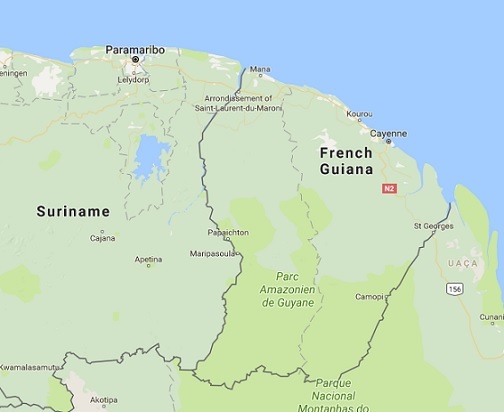
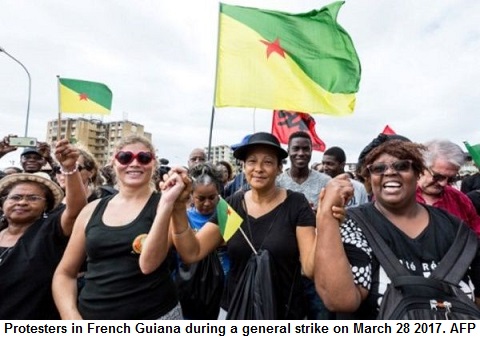
There is one French territory in this region that is NOT included in the roadmap for Caribbean confederation, as described in the book Go Lean … Caribbean. This refers to French Guiana, the territory on the mainland of South America, adjacent to Suriname; see photo above.

While the US is Number 1 in the world for Single Market economies, the French is shortly behind; (UK #9; France #10; The Netherlands #28). In the Caribbean, the French structure calls for the administrative designation of an overseas departments that have identical powers to those of the regions of metropolitan France. (This is different than overseas collectivities which is the particular status of Saint Barthélemy and Saint Martin). As integral parts of the French Republic, an overseas department is represented in the National AssemblySenate and Economic and Social Council, elect a Member of the European Parliament (MEP), and use the Euro as their currency.

So nowadays, Guiana is fully integrated in the French central state; they are even a part of the European Union, and its official currency is the Euro. The region is the most prosperous territory in all of South America with the highest GDP per capita.[2] A large part of Guiana’s economy derives from the presence of the Guiana Space Centre, now the European Space Agency‘s primary launch site near the equator. As elsewhere in France, the official language is French, but each ethnic community has its own language, of which Guianan Creole is the most widely spoken.

French Guiana and the European Space Agency were prominently featured in the Go Lean book – Page 105; see Appendix below – as a model for Self-Governing Entities (SGE). The hope – as expressed in the book – was that this territory would someday join the regional neighborhood.

French Guiana is complete administratively, but still features a lot of societal defects – not colonial de jure; but colonial de facto. It is the opinion of this Go Lean commentary, that this homeland needs … its neighbors: regional integration, which is the best strategy for anti-colonialism. See this VIDEO and news article here, highlighting the blatant discord there in that territory:

VIDEO – French Guiana Marches Against Colonialism – https://videosenglish.telesurtv.net/player/653436/french-guiana-marches-against-colonialism/?aspectratio=auto

General Strike and National Protest on March 28, 2017

———-

Opinion Article – How Racism Hampers Health Care in French Guiana
By: Estelle Carde

Limited access to health care is exacerbated by everyday discrimination based on ethnicity and national origin.
Oft-overlooked French Guiana, one of France’s five overseas departments, has suddenly captured international media attention. And the news from this small South American territory is not good.

Crime, overcrowding in schools and hospitals, unemployment, the cost of living and slums have reached alarming levels.

Citizen discontent led to a massive demonstration this March, the most intense such strike since 2009. Demonstrators are asking for a $US2.7 billion emergency aid package from the French government to assist in the territory’s social and economical crisis.

CU Blog - State of the Union - Annexation - French Guiana - Photo 2

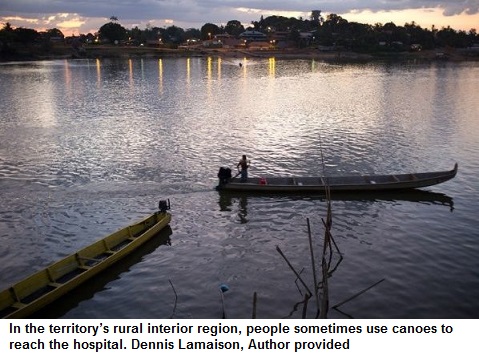
Health care is a particular concern in the former penal colony of 276,000 people. Hospitals are under-staffed and technical facilities are lacking. In some areas, the nearest hospital is a two-day canoe trip away.

CU Blog - State of the Union - Annexation - French Guiana - Photo 1

The recent deaths of five premature babies from infection at Cayenne hospital, in the capital, have heightened concerns.

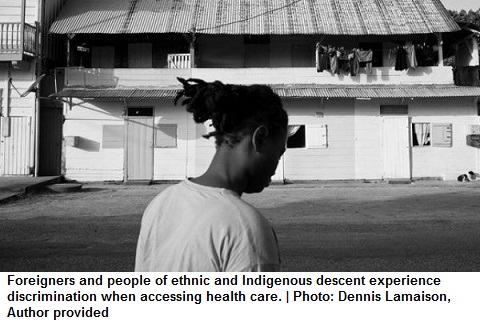
But there’s one critical health care-related issue that almost no one is talking about: racism. In a diverse territory comprised of people of European, African, Asian and Indigenous descent and a growing immigrant population, limited access to health care is exacerbated by everyday discrimination based on ethnicity and national origin.

Too many foreigners?
Foreign-born residents of French Guiana are among those impacted by discrimination in the health-care system.

Though socioeconomically the territory lags severely behind the rest of France, French Guiana constitutes a regional haven of wealth whose attractiveness has grown since the 1960s. Today, more than one in three inhabitants is born abroad. People from Suriname, Brazil and Haiti represent the largest immigrant groups.

This “tidal wave” of immigration is often cited as the main cause of French Guiana’s current socioeconomic crisis, even in some French political circles. The discriminatory behaviours that sometimes result from such widespread immigrant-blaming may be only thinly veiled.

State health office assistants might apply stricter conditions than legally necessary to those seeking medical benefits. Some, for instance might ask the foreign-born applicants to give proof of longer residency than required by law, thinking that it will discourage them from settling in the territory.

The same arguments are, in fact, used to justify similar discriminatory practices against immigrants in mainland France, too. But in Guiana they are more openly displayed.

Ethnic categorizations
Immigrants are not the only group that experiences discrimination in accessing health care in French Guiana. Members of minority populations, whether they are French or not, can also be affected.

This is partly because in French Guiana, people commonly use ethnicity to identify themselves and others. Creole, Maroon, Amerindian, Hmong, Chinese or French Métropolitains (mainlanders) are frequently invoked categories.

Under French law, the government cannot collect data or use it based on ethnicity. But in Guiana such usage goes back to the territory’s early times as a slave colony.

And, of course, each grouping comes with its stock of stereotypes: “Maroons are child-like”, for instance, or “Hmongs are disciplined” and “Amerindians drink their dole money”.

But these assumptions are not set in stone. Because they serve to justify power relations between groups, they tend to change with the ethnic identity of the speaker. This social dynamic plays out in French Guiana’s health-care system.

In Saint-Laurent-du-Maroni, French Guiana’s second largest city, Maroons – the descendants of escaped former slaves – are the majority population and therefore the largest group of health-care users. Health-care professionals, on the other hand, are primarily Creoles or French mainlanders.

CU Blog - State of the Union - Annexation - French Guiana - Photo 3

These professionals often point to the Maroon people’s history to explain certain patient behaviours. In the 18th and 19th centuries, slaves who escaped from plantations would hide in the forest, creating communities that remained more or less isolated from coastal Guianese society for almost 200 years.

In 1969, the large territory they still occupy – mainly tropical forests in the country’s interior – was finally integrated into the Department of Guiana. At that point, they began to gain access to French citizenship and public services such as education and health.

Doctors, nurses and other health professionals readily highlight these facts to explain Maroons’ difficulties in accessing treatment, inferring that they are not yet used to doing things “the Western way.”

‘Them’ and ‘us’
Such references to historical facts are charged with connotations. Some Creole professionals suggest that Maroon people are undeserving of care because they only had to “leave their forest” to access to such services. Contrasting that status with their own position as “Guianese taxpayers” who fund these services, some may use this as justification to refuse Maroon people help in accessing treatment.

This attitude can be better understood considering the Creole people’s own history in French Guiana. Their process of accessing civil rights was slow and gradual. Social empowerment came only at the tail end of a gradual Westernisation process that began with slavery in the 17th century.

After emancipation and the granting of French citizenship in 1848, this population slowly rose to local economic and political power, spurred along by Guiana’s transformation into a French department (1946) and a national policy of decentralisation (1982).

Now hard-won Creole dominance is threatened by Maroon people, who recently obtained the same civil rights as them, and whose numbers have surpassed their own numbers in the Western part of Guiana.

Health professionals from the French mainland, for their part, tend to emphasise the “cultural differences” of these “new citizens”. They cite, for example, the “traditional” way in which Maroons transmit information (watching without asking questions) and their way of “living in the moment” to explain their apparent inability to request health coverage prior to needing treatment.

This tendency to highlight cultural differences can also end up amounting to discrimination because it overshadows systemic failures that do impact access to health care, such as the lack of health coverage offices in the country’s rural inland regions. This tendency is more present among professionals who have been in Guiana for just a few months and who readily admit to being allured by the very different culture of this “exotic” overseas corner of France.

Discriminatory behaviours among health professionals therefore exacerbate the failures of the ailing health-care system now under protest by Guianese demonstrators. Foreigners and Maroon people are the first victims of administrative failures due to their vulnerable socioeconomic status. They are also worst hit by geographical obstacles because they represent a majority of inhabitants in the territory’s remote rural areas.

But this accumulation of racist, economic and geographical inequalities is no accident. It is the result of centuries of history of Guianese society.

Source: TeleSur Media Network – Published April 13, 2017; retrieved July 26, 2017 from: http://www.telesurtv.net/english/opinion/How-Racism-Hampers-Health-Care-in-French-Guiana-20170413-0007.html

——-

Translated from the French by Alice Heathwood for Fast for Word.

Estelle Carde is a professor of Sociology of Health at Université de Montréal.

This article was originally published on The Conversation. Read the original article.

RELATED:
Guiana Workers ‘Toughen Up’ Mobilizations Against French State 
This theme – “All is not well in the Caribbean” – aligns with the movement behind the book Go Lean … Caribbean, where the assertion is that the problems facing the Caribbean region are too big for any one member-state alone. There needs to be a regional solution. The book posits that shifting the help-seeking responsibility to a region-wide, professionally-managed, deputized technocracy will result in greater production and greater accountability. This deputized agency is the Caribbean Union Trade Federation (CU). The Go Lean book serves as a roadmap for the introduction and implementation of the CU.

This commentary is a follow-up to the 5-part series on the subject of the State of the Caribbean Union. Our Caribbean region is unique in that there are 4 different languages and 5 colonial legacies, spread across 30 member-states and 42 million people. The goal is to execute the 5-year plan of the roadmap and then add a 31st member: French Guiana. Based on the dispositions in the foregoing VIDEO and news-opinion article, French Guiana can use the Go Lean empowerments NOW! That land is suffering from many of the same dysfunctions that plague the rest of the Caribbean and the neighboring states of Suriname and Guyana. There might be the need to act NOW to seek refuge and relief.

The other 5 entries in the series are as follows:

Just the phraseology “Caribbean Union” assumes a collective collaboration of all the territories that identify with Caribbean culture; there is the need for better local stewardship. This Go Lean effort is a confederation of sovereign and non-sovereign territories, as is the case for French Guiana. There is no need for independence, as the authority of these territories can still be deputized into the CU as an umbrella intergovernmental organization. In total, the Go Lean/CU roadmap will employ strategies, tactics and implementations to impact its prime directives; identified with the following 3 statements:

  • Optimization of the economic engines in order to grow the regional economy to $800 Billion & create 2.2 million new jobs.
  • Improvement of Caribbean governance to support these engines, including a “Separation-of-Powers between CU federal agencies and Caribbean member-state governments”; so the limitations of national laws in a member-state does not have to override the CU. A CU constitution would apply to the installation – and continuation – of Exclusive Economic Zones (EEZ) and Self-Governing Entities (SGE) that operate in controlled bordered territories like campuses, industrial parks, research labs and industrial plants.

The Go Lean/CU roadmap always anticipated the French Caribbean territories. This theme was detailed in previous Go Lean blog-commentaries; consider this sample:

https://goleancaribbean.com/blog/?p=12466 Managing Volcanoes in the French Caribbean – Martinique and Guadeloupe
https://goleancaribbean.com/blog/?p=10554 Welcoming the French in Formal Integration Efforts
https://goleancaribbean.com/blog/?p=10043 Caribbean Integration Plan for Greater Prosperity
https://goleancaribbean.com/blog/?p=7834 French Caribbean ready for the Martinique Surf Pro
https://goleancaribbean.com/blog/?p=382 Guadeloupe, Martinique, St Maarten Join the Association of Caribbean States

Now the status of the French Caribbean is indistinguishable from colonial status. All authority still rest in Paris. But there is an opportunity for more (and better) autonomous governance in the region. As depicted in these previous commentaries, this opportunity is extended for the French Caribbean to align with the rest of the Caribbean region to adopt strategies, tactics and implementations to assuage the societal dysfunctions … together.

This quest of optimizing the entire Caribbean economic-security-governance eco-system is more than just a dream; this was the motivation for the origins of the Go Lean movement. This vision is defined early in the book (Pages 12 & 13) in the following pronouncements in the Declaration of Interdependence:

ix. Whereas the realities of healthcare and an aging population cannot be ignored and cannot be afforded without some advanced mitigation, the Federation must arrange for health plans to consolidate premiums of both healthy and sickly people across the wider base of the entire Caribbean population. The mitigation should extend further to disease management, wellness, mental health, obesity and smoking cessation programs. …

xi. Whereas all men are entitled to the benefits of good governance in a free society, “new guards” must be enacted to dissuade the emergence of incompetence, corruption, nepotism and cronyism at the peril of the people’s best interest. The Federation must guarantee the executions of a social contract between government and the governed.

xii. Whereas the legacy in recent times in individual states may be that of ineffectual governance with no redress to higher authority, the accedence of this Federation will ensure accountability and escalation of the human and civil rights of the people for good governance, justice assurances, due process and the rule of law. As such, any threats of a “failed state” status for any member state must enact emergency measures on behalf of the Federation to protect the human, civil and property rights of the citizens, residents, allies, trading partners, and visitors of the affected member state and the Federation as a whole.

xxii. Whereas the heritage of our lands share the distinction of cultural tutelage from European and American imperialists that forged their tongues upon our consciousness, it is imperative to form a society that is neutral and tolerant of the mother tongue influences of our people to foster efficient and effective communications among our citizens.

xxiii. Whereas many countries in our region are dependent Overseas Territory of imperial powers, the systems of governance can be instituted on a regional and local basis, rather than requiring oversight or accountability from distant masters far removed from their subjects of administration. The Federation must facilitate success in autonomous rule by sharing tools, systems and teamwork within the geographical region.

xxiv. Whereas a free market economy can be induced and spurred for continuous progress, the Federation must install the controls to better manage aspects of the economy: jobs, inflation, savings rate, investments and other economic principles. Thereby attracting direct foreign investment because of the stability and vibrancy of our economy.

The Go Lean book posits that the inefficient Caribbean communities – French Guiana included – can be reformed and transformed if they adopt the community ethos, strategies, tactics, implementations and advocacies as depicted in the Go Lean roadmap. The book provides 370-pages of turn-by-turn instructions on “how” so as to reboot, reform and transform the societal engines of Caribbean society. For one, the strategy calls for the implementation of Self-Governing Entities like the European Space Agencies and many more industrial sites – i.e. 10 Steps to Implement Self-Governing Entities on Page 105 of the book.

The effort of the Go Lean roadmap is not “stuck” on Caribbean geography; rather we are committed to Caribbean culture. As such we confederate with territories not only in the Caribbean Sea but also those in the Atlantic Ocean (Bahamas, Bermuda and the Turks & Caicos Islands), on the Central American mainland (Belize) and the South American mainland (Guyana, Suriname and now French Guiana). All of this constitutes the Caribbean homeland.

Together, Caribbean stakeholders can succeed in efforts to improve; to end the parasite status with European capitals (and Washington) and instead exert our autonomy as mature democracies. We can be protégés instead of parasites.

Yes, we can … reform and transform our homeland to make it a better place to live, work and play. 🙂

Download the book Go Lean … Caribbean – now!

Sign the petition to lean-in for this roadmap for the Caribbean Union Trade Federation.

———–

Appendix – The Bottom Line on the French Guiana Space Center

The European Space Agency (ESA) is an intergovernmental organization of 20 member states, dedicated to the exploration of space. Established in 1975 and headquartered in Paris, France, ESA has a staff of more than 2,000 with an annual budget of about US$5.51 billion (2013). ESA’s space flight program includes human spaceflight, mainly with the International Space Station program, the launch and operations of unmanned exploration missions to other planets and the Moon, Earth observation, science, telecommunication as well as maintaining a major spaceport, the Guiana Space Center (CSG) at Kourou, French Guiana, and designing launch vehicles. The main European launch vehicle, Ariane 5 is operated through Arianespace with ESA sharing in the costs and further developing this launch vehicle.

The CSG has been operational since 1968; it is particularly suitable as a location for a spaceport as it fulfills the two major geographical requirements:

• it is quite close to the equator, so that the spinning earth can impart some extra velocity to the rockets for free when launched eastward, and

• it has uninhabited territory (in this case, open sea) to the east, so that lower stages of rockets and debris from launch failures cannot fall on human habitations.

CSG is the spaceport used by the ESA to send supplies to the International Space Station using the Automated Transfer Vehicle. Commercial launches are bought also by non-European companies. ESA pays two thirds of the spaceport’s annual budget and has also financed the upgrades made during the development of the Ariane launchers.

Source: Go Lean … Caribbean book (Page 105).
Share this post:
, , , ,

State of the Union: Deficient ‘Westminster System’

Go Lean Commentary

CU Blog - State of the Union - Westminster States - Photo 4

The issue of governance is very important to understanding the State of the Caribbean Union. In many countries, governance is just one of the factors that dictate success or failure for homeland’s societal engines. But in the Caribbean, it is “#1 … with a Bullet”. The government is normally the largest employer, largest educator, largest infrastructure builder and the only security option.

  • Good governance = Good societal progress
  • Poor governance = Failed-State

The most common form of governance in all of the Caribbean is the Westminster System. This is due to the many British legacies among the member-states (18 of 30 feature a British constitutional heritage, only Guyana has reformed). See details of Westminster here:

Title: Westminster System

The Westminster system is a parliamentary system of government modelled after that which developed in the United Kingdom. This term comes from the Palace of Westminster, the seat of the British parliament. The system is a series of procedures for operating a legislature. It is used, or was once used, in the national legislatures and subnational legislatures of most former British Empire colonies upon gaining responsible government,[1][2] beginning with the first of the Canadian provinces in 1848 and the six Australian colonies between 1855 and 1890.[3][4][5] However, some former colonies have since adopted either the presidential system (Nigeria for example) or a hybrid system (like South Africa) as their form of government.
CU Blog - State of the Union - Westminster States - Photo 1

CU Blog - State of the Union - Westminster States - Photo 2

CU Blog - State of the Union - Westminster States - Photo 3

Characteristics
A Westminster system of government may include some of the following features:

  • sovereign or head of state who functions as the nominal or legal and constitutional holder of executive power, and holds numerous reserve powers, but whose daily duties mainly consist of performing ceremonial functions. Examples include Queen Elizabeth II, the governors-general in Commonwealth realms, or the presidents of many countries, and state or provincial governors in federal systems. Exceptions to this are Ireland and Israel, whose presidents are de jure and de facto ceremonial, and the latter possesses no reserve powers whatsoever.
  • head of government (or head of the executive), known as the prime minister (PM), premier, or first minister. While the head of state appoints the head of government, constitutional convention suggests that a majority of elected Members of Parliament must support the person appointed.[6] If more than half of elected parliamentarians belong to the same political party, then the parliamentary leader of that party typically is appointed.[6] An exception to this was Israel, in which direct prime-ministerial elections were made in 19961999 and 2001.
  • An executive branch led by the head of government usually made up of members of the legislature with the senior members of the executive in a cabinet adhering to the principle of cabinet collective responsibility; such members execute executive authority on behalf of the nominal or theoretical executive authority.
  • An independent, non-partisan civil service which advises on, and implements, decisions of those ministers. Civil servants hold permanent appointments and can expect merit-based selection processes and continuity of employment when governments change.[7]
  • parliamentary opposition (in a multi-party system) with an official Leader of the Opposition.
  • A legislature, often bicameral, with at least one elected house – although unicameral systems also exist; legislative members are usually elected by district in first-past-the-post elections (as opposed to country-wide proportional representation). Exceptions to this include New Zealand, which changed in 1993 to use mixed-member proportional representationIsrael, which has always used country wide proportional representation; and Australia, which uses preferential voting.
  • lower house of parliament with an ability to dismiss a government by “withholding (or blocking) Supply” (rejecting a budget), passing a motion of no confidence, or defeating a confidence motion. The Westminster system enables a government to be defeated or forced into a general election independently.
  • A parliament which can be dissolved and snap elections called at any time.
  • Parliamentary privilege, which allows the legislature to discuss any issue it deems relevant, without fear of consequences stemming from defamatory statements or records thereof
  • Minutes of meetings, often known as Hansard, including an ability for the legislature to strike discussion from these minutes
  • The ability of courts to address silence or ambiguity in the parliament’s statutory law through the development of common law. Another parallel system of legal principles also exists known as equity. Exceptions to this include India, Quebec in Canada, and Scotland in the UK amongst others which mix common law with other legal systems.

Most of the procedures of the Westminster system originated with the conventions, practices, and precedents of the Parliament of the United Kingdom, which form a part of what is known as the Constitution of the United Kingdom. Unlike the uncodified British constitution, most countries that use the Westminster system have codified the system, at least in part, in a written constitution.

However, uncodified conventions, practices, and precedents continue to play a significant role in most countries, as many constitutions do not specify important elements of procedure: for example, some older constitutions using the Westminster system do not mention the existence of the cabinet or the prime minister, because these offices were taken for granted by the authors of these constitutions. Sometimes these conventions, reserve powers, and other influences collide in times of crisis and in such times the weaknesses of the unwritten aspects of the Westminster system, as well as the strengths of the Westminster system’s flexibility, are put to the test. As an illustrative example, in the Australian constitutional crises of 1975 the Governor-General of Australia, Sir John Kerr, dismissed Prime Minister Gough Whitlam on his own reserve-power authority and replaced him with opposition leader Malcolm Fraser.

Operation
The pattern of executive functions within a Westminster System is quite complex. In essence, the head of state, usually a monarch or president, is a ceremonial figurehead who is the theoretical, nominal or de jure source of executive power within the system. In practice, such a figure does not actively exercise executive powers, even though executive authority may be exercised in their name.

The head of government, usually called the Prime minister or Premier, will ideally have the support of a majority in the responsible house, and must in any case be able to ensure the existence of no absolute majority against the government. If the parliament passes a resolution of no confidence, or refuses to pass an important bill such as the budget, then the government must either resign so that a different government can be appointed or seek a parliamentary dissolution so that new general elections may be held in order to re-confirm or deny the government’s mandate.

Executive authority within a Westminster System is essentially exercised by the Cabinet, along with more junior ministers, although the head of government usually has the dominant role within the ministry. In the United Kingdom, the sovereign theoretically holds executive authority, even though the Prime Minister of the United Kingdom and the Cabinet effectively implement executive powers. In a parliamentary republic like India, the President is the de jure executive, even though executive powers are essentially instituted by the Prime Minister of India and the Council of Ministers. In Israel, however, executive power is vested de jure and de facto in the cabinet, and the President of Israel is de jure and de facto a ceremonial figurehead.

As an example, the Prime Minister and Cabinet (as the de facto executive body in the system) generally must seek the permission of the head of state when carrying out executive functions. If, for instance the British Prime Minister wished to dissolve parliament in order for a general election to take place, the Prime Minister is constitutionally bound to request permission from the sovereign in order to attain such a wish. This power (along with others such as appointing ministers in the government, appointing diplomats, declaring war, and signing treaties, for example) is known as the Royal Prerogative, which in modern times is exercised by the sovereign solely on the advice of the Prime Minister. Since the British sovereign is a constitutional monarch, he or she abides by the advice of his or her ministers, except when executing reserve powers in times of crisis.

This custom also occurs in other Westminster Systems in the world, in consequence from the influence of British colonial rule. In Commonwealth realms such as Canada, Australia and New Zealand, the Prime Minister is obligated to seek permission from the Governor-General when implementing executive decisions, in a manner similar to the British practice. An analogous scenario also exists in Commonwealth republics, such as India or Trinidad and Tobago, where there is a President, though not in Israel or Japan, where the respective prime ministers have the full legal power to implement executive decisions, and presidential (in Israel) or imperial (in Japan) approval is not required.

The head of state will often hold meetings with the head of government and cabinet, as a means of keeping abreast of governmental policy and as a means of advising, consulting and warning ministers in their actions. Such a practice takes place in the United Kingdom and India. In the UK, the sovereign holds confidential weekly meetings with the Prime Minister to discuss governmental policy and to offer her opinions and advice on issues of the day. In India, the Prime Minister is constitutionally bound to hold regular sessions with the President, in a similar manner to the aforementioned British practice. In essence, the head of state, as the theoretical executive authority, “reigns but does not rule”. This phrase means that the head of state’s role in government is generally ceremonial and as a result does not directly institute executive powers. The reserve powers of the head of state are sufficient to ensure compliance with some of their wishes. However, the extent of such powers varies from one country to another and is often a matter of controversy.

Such an executive arrangement first emerged in the United Kingdom. Historically, the British sovereign held and directly exercised all executive authority. George I of Great Britain (reigned 1714 to 1727) was the first British monarch to delegate some executive powers to a Prime Minister and a cabinet of the ministers, largely because he was also the monarch of Hanover in Germany and did not speak English fluently. Over time, arrangement continued to exercise executive authority on the sovereign’s behalf. Such a concept was reinforced in The English Constitution (1876) by Walter Bagehot, who emphasised the “dignified” and “efficient” aspects of government. In this sense Bagehot was stating that the sovereign should be a focal point for the nation, while the PM and cabinet actually undertook executive decisions.

There are important rules and responsibilities associated with the “Role of the head of state”

Source: Retrieved July 14, 2017 from Wikipedia Online Encyclopedia: https://en.wikipedia.org/wiki/Westminster_system  

Westminster is good … sometimes, but Westminster is mostly bad!

Westminster does not allow for the needed responsiveness; it does not feature a direct election of the Head of Government by the general population; but rather, it includes electing Members of Parliament (MP) from individual districts, and then the MP’s elect their leader. The party leader with the majority in Parliament is appointed Prime Minister, Premier, First or Chief Minister – First Among Equals; see Appendix A. This means less accountability and responsiveness to the citizens not in the constituency of the MP that is selected as Prime Minister.

Under this Westminster scheme, since this Head of Government is NOT elected by the majority of population, this one can be susceptible to a minority group – his/her constituents – over the Greater Good. Plus, this Head of Government can also reign in more than one branch of government. This one is the leader of the party with the majority of seats in Parliament, so this means that he/she leads the legislature; he/she forms the Cabinet, so he leads the Executive Branch. This leader holds sway on the candidates for the party and the selections of the elected ministers to the Cabinet. Lastly, this one appoints the Judges, so he/she wields power over the judiciary as well. The ideal separation-of-powers between government branches is deficient, defective and thus embeds failure on the countries societal engines.

Absolute power …

It is the assessment for the movement behind the book Go Lean…Caribbean that Westminster is dysfunctional … for the accountability and responsiveness for administering the Caribbean homeland. As a result of the deficiencies of Westminster, many countries have evolved and reformed their governance; they have abandoned Westminster; see list in Appendix B.

On the other hand, it is the assessment of this movement that since the Westminster System allows the concentration of power to only one person, the Prime Minister, it is easier to reform and transform a country. There is only the need to reach (influence, lobby and persuade) that one person. It is therefore easier for change and empowerment to take place, but still we recommend the member-states of the Caribbean region reform, transform and conform … to a new standard of governance.

This subject of governing systems is analyzed in the book Go Lean…Caribbean. This book provides an assessment of the Caribbean today, drawing reference to its historic past. From the origins of colonialism, the region traversed the historic curves of social revolution and evolution. The Go Lean book – available to download for free – serves as a roadmap for the introduction and implementation of the technocratic Caribbean Union Trade Federation (CU), for the elevation of Caribbean society – for all member-states. This CU/Go Lean roadmap endorses a system of better governance, with these 3 prime directives:

  • Optimization of the economic engines in order to grow the regional economy to $800 Billion and create 2.2 million new jobs.
  • Establishment of a security apparatus to ensure public safety and protect the resultant economic engines.
  • Improve Caribbean governance to support these engines, including a true separation-of-powers between the member-states and CU federal agencies.

The book stresses that reforming and transforming the Caribbean societal engines must be a regional pursuit. This was an early motivation for the roadmap, as pronounced in the opening Declaration of Interdependence (Pages 12 – 13):

xi. Whereas all men are entitled to the benefits of good governance in a free society, “new guards” must be enacted to dissuade the emergence of incompetence, corruption, nepotism and cronyism at the peril of the people’s best interest. The Federation must guarantee the executions of a social contract between government and the governed.

xvi. Whereas security of our homeland is inextricably linked to prosperity of the homeland, the economic and security interest of the region needs to be aligned under the same governance. Since economic crimes … can imperil the functioning of the wheels of commerce for all the citizenry, the accedence of this Federation must equip the security apparatus with the tools and techniques for predictive and proactive interdictions.

xxiv. Whereas a free market economy can be induced and spurred for continuous progress, the Federation must install the controls to better manage aspects of the economy: jobs, inflation, savings rate, investments and other economic principles. Thereby attracting direct foreign investment because of the stability and vibrancy of our economy.

This commentary is 3 of 5 in an occasional series on the State of the Caribbean Union. Surely, a malfunctioning state of governance throughout the entire region must have some common traits. These have been assessed in the Go Lean book and the technocratic solutions provided there-in. The full entries of all the blog-commentaries in this series are as follows:

  1. State of the Caribbean Union – Lacking Hope and Change
  2. State of the Caribbean Union – Dysfunctional Spanish Caribbean
  3. State of the Caribbean Union – Deficient Westminster System
  4. State of the Caribbean Union – Unstable Volcano States
  5. State of the Caribbean Union – Self-Interest of Americana

As related in the first submission in this series, the young people in the region need the vision of “something better” or Hope and Change in order to be inspired to participate in the future of this homeland. We cannot have a future without these young people, so these solutions – strategies, tactics and implementations – are not optional.

Hope for the future! This is a consistent theme from the Go Lean movement. Consider these previous blog-commentaries:

https://goleancaribbean.com/blog/?p=11759 Understand the Market, Plan the …
https://goleancaribbean.com/blog/?p=10629 Stay Home! A Series on Why and How to Keep Our Youth Home
https://goleancaribbean.com/blog/?p=10554 State of French Caribbean
https://goleancaribbean.com/blog/?p=7198 State of the Caribbean Union
https://goleancaribbean.com/blog/?p=4263 State of Aruba and Dutch Caribbean’s Economy
https://goleancaribbean.com/blog/?p=1634 Chasing Youth Culture and Getting It Right

The Go Lean book provides 370-pages of turn-by-turn instructions on “how” to adopt new community ethos, plus the strategies, tactics, implementations and advocacies to execute so as to reboot, reform and transform the societal engines of Caribbean society. For one, the recommendation is to reform and transform Caribbean governance, to evolve from the dysfunctions of Westminster and adapt a more enlightened Strong Executive (Presidential) structure (Page 72).

See the contrast portrayed here in this related VIDEO:

VIDEO – Parliamentary vs. Presidential Democracy Explained – https://youtu.be/4quK60FUvkY

Published on May 7, 2015 – The two main systems of democratic government, Presidential vs. Parliamentary, explained.
Free audiobook: http://www.audibletrial.com/TheDailyC…
Subscribe to The Daily Conversation: https://www.youtube.com/TheDailyConve…

At one point, the US used a version of Westminster – during the bad old days of the United States of America under the Articles of Confederation (1781–1789) – but this country evolved … and now feature one of the most responsive and accountable forms on government on the planet. In addition to the US, there are many other countries – consider Appendix B – that have evolved; some have rebooted and some have adapted a hybrid system of Westminster and the Presidential system.

In the Caribbean, we can do better! We do not have to be America; we can be better!

There is an aspect of the Westminster System that is embedded in the Go Lean roadmap, where the separation-of-powers provision parallels to the “Reserve Powers” of Westminster. These “Reserve Powers” ensure compliance with the tenants of state constitutions and treaties. These powers allow the CU to serve as a deputized entity for member-state governance; consider the justice scenarios requiring Commissions of Inquiries.

Yes, it is possible to reform and transform the Caribbean member-states that employ the deficient Westminster System. We can do better; we can make our homeland a better place to live, work and play. 🙂

Download the free e-Book of Go Lean … Caribbean – now!

Sign the petition to lean-in for this roadmap for the Caribbean Union Trade Federation.

———–

Appendix A – First Among Equals

The status of the Prime Minister has been described as primus inter pares: Latin for “first among equals.” This concept defines not only the prime minister’s relationship with Cabinet, but also, in a sense, his or her relationship with the public in our modern democratic society. Drawing on a wide variety of documents and artifacts, this site explores five main themes (see the menu at left) relating to Canada’s prime ministers. The site examines our leaders’ political careers as well as their private lives. It also sheds light on Canadians’ perceptions of our prime ministers.

From Macdonald to Harper, our political leaders are twenty-two individuals who have made a difference, shaping Canada’s identity, sometimes in profound ways.

Source: Retrieved July 15, 2017 from: https://www.collectionscanada.gc.ca/primeministers/index-e.html

———–

Appendix B – Countries That Abandoned Westminster

The Westminster system was adopted by a number of countries which subsequently evolved or reformed their system of government departing from the original model. In some cases, certain aspects of the Westminster system were retained or codified in their constitutions. For instance South Africa and Botswana, unlike Commonwealth realms or parliamentary republics such as India, have a combined head of state and head of government but the President remains responsible to the lower house of parliament; it elects the President at the beginning of a new Parliament, or when there is a vacancy in the office, or when the sitting President is defeated on a vote of confidence. If the Parliament cannot elect a new President within a short period of time (a week to a month) the lower house is dissolved and new elections are called.

  • The Union of South Africa between 1910 and 1961, and the Republic of South Africa between 1961 and 1984. The 1983 constitution abolished the Westminster system in South Africa.
  • Newfoundland gave up self-government in 1934 and reverted to direct rule from London. Use of the Westminster system resumed in 1949 when Newfoundlandbecame a province of Canada.
  • Rhodesia between 1965 and 1979, and Zimbabwe between 1980 and 1987. The 1987 constitution abolished the Westminster system.
  • Nigeria following the end of British colonial rule in 1960, which resulted in the appointment of a Governor-General and then a President, Nnamdi Azikiwe. The system ended with the military coup of 1966.
  • Ceylon between 1948 and 1972, and Sri Lanka from 1972 until 1978 when the constitution was remodelled into an Executive presidential system.
  • Burma following independence in 1948 until the 1962 military coup d’état.
  • Ghana between 1957 and 1960.
  • Tanganyika between 1961 and 1962.
  • Sierra Leone between 1961 and 1971.
  • Uganda between 1962 and 1963.
  • Kenya between 1963 and 1964.
  • Malawi between 1964 and 1966.
  • The Gambia between 1965 and 1970.
  • Guyana between 1966 and 1980.
  • Fiji between 1970 and 1987.
  • Japan between 1890 and 1947, under the Meiji Constitution the Diet of Japan was a bicameral legislature modelled after both the German Reichstag and the Westminster system.[11] Influence from the Westminster system remained in Japan’s Postwar Constitution.[12][13][14]

Source: Retrieved July 14, 2017 from: https://en.wikipedia.org/wiki/Westminster_system#Former_countries

Share this post:
, , , ,
[Top]

A Lesson in History – ‘4th of July’ and Slavery

Go Lean Commentary 

CU Blog - A Lesson in History - Slavery and the 4th of July - Photo 1Today is a special day in the United States, it is the 241st anniversary of their Declaration of Independence from Great Britain on July 4, 1776. This day will be celebrated all over the country with parades, picnics, music and fireworks.

The celebrations of this day is a BIG deal!

What is buried in this annual celebration is the stark and sharp contrast on the different sides in the conflict of July 4, 1776. There were the British loyalists on one hand and those seeking freedom from the British, the patriots, on the other hand; see the opposing sides here:

Title #1: What two sides emerged in response to the Declaration of Independence? What did each side favor?

Answer:
The Patriots and Loyalists; Patriots favored independence and Loyalists favored staying as a British colony.

Explanation:
Tensions were simmering prior to the start of the Revolution, and the Declaration of Independence, signed in 1776 formally broadcasted to all that the United States was a new and independent nation. This led to two factions being formed: Patriots and Loyalists.

Patriots believed that the United States should be an independent nation separate from Britain. They felt that they were being treated unfairly as a colony and that their basic rights were being trampled upon. It was their view that the time for compromises was over and that the colonies needed to leave the British Empire.

Loyalists thought that the colonies were better off staying with England. Some did this out of loyalty for the king, but others feared instability and anarchy in the event of a change in government. In addition, many feared that the economic fallout with the mother country would destabilize the American economy.

All in all, these were the two groups that were formed, and as you know, the Patriots emerged as successful and formed a new nation.

Source: Retrieved July 4, 2017 from: https://socratic.org/questions/what-two-sides-emerged-in-response-to-the-declaration-of-independence-what-did-e

The patriots get to celebrate the 4th of July every year. But as there were 2 sides of this conflict, we sometimes forget the loyalists side of the conflict. They did not simply go away; they remained vocal and loyal to the Britain’s Crown.

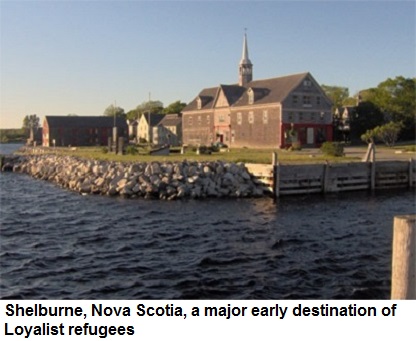
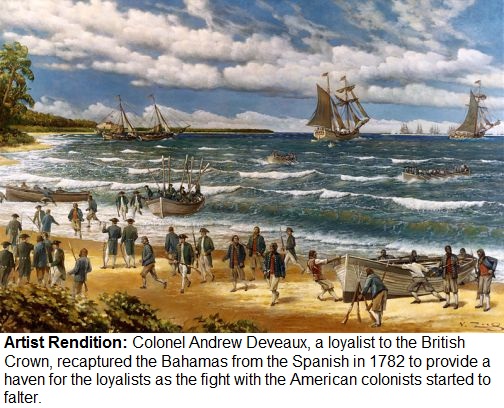
The category of loyalists have a big bearing on the history of the Caribbean. Of the 30 member-states that caucus as the Caribbean, 18 of them have British heritage. Many of these were impacted by the American Declaration of Independence; many loyalists fled America and relocated to these British West Indies. Consider these notes:

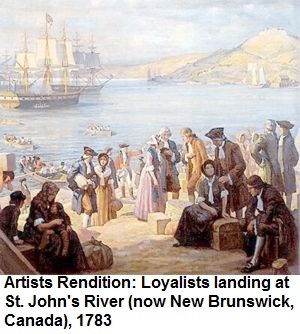
When their cause was defeated, about 15% of the Loyalists (65,000–70,000 people) fled to other parts of the British Empire, to Britain itself, or to British North America (now Canada). …

CU Blog - A Lesson in History - Slavery and the 4th of July - Photo 3a

CU Blog - A Lesson in History - Slavery and the 4th of July - Photo 2a

CU Blog - A Lesson in History - Slavery and the 4th of July - Photo 2b

The wealthiest and most prominent Loyalist exiles went to Great Britain to rebuild their careers; many received pensions. Many Southern Loyalists, taking along their slaves, went to the West Indies and the Bahamas, particularly to the Abaco Islands. – Source: Wikipedia

CU Blog - A Lesson in History - Slavery and the 4th of July - Photo 3b

Great Britain also responded … formally. See details of the response here:

Title #2: The British Reply

When Great Britain first received the Declaration of Independence, the country was silent. To them, this was another annoyance from the colonies. The colonists had sent previous letters to King George III that had been ignored, but this was the first time that they had declared themselves free from Great Britain. You know how you feel when a little child continues to ask you for the same thing over and over again, and eventually, you stop listening? This was how King George III viewed the colonies. They were a nuisance, but relatively harmless. Or so he thought.

The government hired John Lind, an English politician and pamphleteer, to write a rebuttal to the declaration. He wrote Answer to the Declaration of the American Congress, a reply that tried to pick apart the Declaration of Independence. Lind focused on the issue of slavery, saying that the colonists were actually angry that King George III had offered freedom to the slaves. Lind even mocked the writers for stating, ‘All men are created equal…’, yet they allowed slavery. Of course, all of this was just a distraction. The colonists really paid no attention to the pamphlet.

Following this, King George III officially declared the colonies to be in a state of rebellion. By August of 1776, the King ordered troops to the colonies.

Once the Revolutionary War began, the citizens of Great Britain became more concerned about the colonies and their fight for independence. In October, King George III addressed Parliament, hoping to ease some of the concerns. He opened the address wishing that he could inform them that the troubles were at an end and that the people had ‘recovered from their delusion’ and ‘returned to their duty.’ However, the colonists continued to fight and even ‘openly renounced all allegiance to the Crown.’ King George III accused the colonists of treason, but reassured the Parliament that England was still united.

The King ended his address singing his own praises saying, ‘No people ever enjoyed more Happiness, or lived under a milder Government, then those now revolted Provinces.’ Everything that the colonies have—their land, sea, wealth, and strength—was because of him. His desire was to return the colonies as a part of the British Empire and end the war.

As we know, King George III’s desire to end the war and keep the colonies did not go as planned. The Revolutionary War, the war for American Independence, continued until 1783, ending with more than 50,000 deaths, and the colonies freed as a new country, the United States of America.

Source: Retrieved July 4, 2017 from: http://study.com/academy/lesson/british-reply-to-the-declaration-summary-analysis.html

As related, slavery was not the cause of the US War of Independence … entirely. But the notion that “all men are created equal” was a laughable American hypocrisy. The continuation of slavery in the wake of a trend of liberalism in England became a boiling point of contention. In fact as reported here, many African Americans – 12,000 or so – fled to the side of the British for the promise of freedom:

Title #3: Slavery and Black Loyalists

As a result of the looming crisis in 1775 the Royal Governor of Virginia, Lord Dunmoreissued a proclamation that promised freedom to servants and slaves who were able to bear arms and join his Loyalist Ethiopian Regiment. Many of the slaves in the South joined the Loyalists with intentions of gaining freedom and escaping the South. About 800 did so; some helped rout the Virginia militia at the Battle of Kemp’s Landing and fought in the Battle of Great Bridge on the Elizabeth River, wearing the motto “Liberty to Slaves”, but this time they were defeated. The remains of their regiment were then involved in the evacuation of Norfolk [(Virginia)], after which they served in the Chesapeake area. Eventually the camp that they had set up there suffered an outbreak of smallpox and other diseases. This took a heavy toll, putting many of them out of action for some time. There was a slave by the name of Boston King who joined the Loyalists and wound up catching smallpox. Boston King and other soldiers who were sick were relocated to a different part of the camp so that they did not contaminate the healthy soldiers. The survivors joined other British units and continued to serve throughout the war. Black colonials were often the first to come forward to volunteer and a total of 12,000 African Americans served with the British from 1775 to 1783. This factor had the effect of forcing the rebels to also offer freedom to those who would serve in the Continental Army; however, such promises were often reneged upon by both sides.[31]

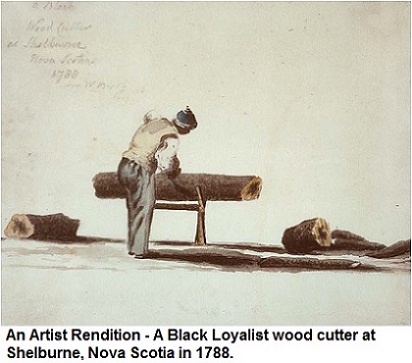
African Americans who gained their freedom by fighting for the British became known as Black Loyalists. The British honored the pledge of freedom in New York City through the efforts of General Guy Carleton who recorded the names of African Americans who had supported the British in a document called the Book of Negroes which granted freedom to slaves who had escaped and assisted the British. About 4,000 Black Loyalists went to the British colonies of Nova Scotia and New Brunswick, where the British promised them land. They founded communities across the two provinces, many of which still exist today. Over 2,500 settled in Birchtown, Nova Scotia, instantly making it the largest free black community in North America. However, the inferior grants of land they were given and the prejudices of white Loyalists in nearby Shelburne who regularly harassed the settlement in events such as the Shelburne Riots in 1784, made life very difficult for the community.[32] In 1791 Britain’s Sierra Leone Company offered to transport dissatisfied black Loyalists to the British colony of Sierra Leone in Africa, with the promise of better land and more equality. About 1,200 left Nova Scotia for Sierra Leone, where they named the capital Freetown.[32] After 1787 they became Sierra Leone’s ruling elite. About 400 to 1,000 free blacks who joined the British side in the Revolution went to London and joined the free black community of about 10,000 there.

Source: Retrieved July 4, 2017 from: https://en.wikipedia.org/wiki/Loyalist_(American_Revolution)#Slavery_and_Black_Loyalists

Wow, what a notion! An argument can be made that for the Black population – the majority ethnicity for 29 of the 30 Caribbean member-states – their celebration of the 4th of July should have been … for the other side!

Intriguing!

This is the lesson in history for the Caribbean; American historic accomplishments are NOT historic accomplishments for the majority of Caribbean people. Poor race relations tarnished so much of American history, that the country continues with this societal defect … even to this day.

This lesson from America’s initiation is presented by the movement behind the book Go Lean…Caribbean – available to download for free – which serves as a roadmap for the introduction and implementation of the technocratic Caribbean Union Trade Federation (CU), for the elevation of Caribbean society – for all member-states. This book features a declaration of its own, a Declaration of Interdependence (Pages 10 – 13):

Preamble: When, in the course of human events, it becomes necessary for one people to unite with others so as to connect them together to collaborate, confederate and champion the challenges that face them, we the people of Caribbean democracies find it necessary to accede and form a confederated Union, the Caribbean Union Trade Federation, with our geographic neighbors of common interest.

While the laws of nature and of nature’s God entitle us to form a society and a brotherhood to foster manifestations of our hopes and aspirations and to forge solutions to the challenges that imperil us, decent respect to the opinions of mankind requires that we declare the causes which imperil us and incite us to unite to assuage our common threats.

And while our rights to exercise good governance and promote a more perfect society are the natural assumptions among the powers of the earth, no one other than ourselves can be held accountable for our failure to succeed if we do not try to promote the opportunities that a democratic society fosters.

As the history of our region and the oppression, suppression and repression of its indigenous people is duly documented, there is no one alive who can be held accountable for the prior actions, and so we must put aside the shackles of systems of repression to instead formulate efficient and effective systems to steer our own destiny. …

xi. Whereas all men are entitled to the benefits of good governance in a free society, “new guards” must be enacted to dissuade the emergence of incompetence, corruption, nepotism and cronyism at the peril of the people’s best interest. The Federation must guarantee the executions of a social contract between government and the governed.

xvi. Whereas security of our homeland is inextricably linked to prosperity of the homeland, the economic and security interest of the region needs to be aligned under the same governance. Since economic crimes … can imperil the functioning of the wheels of commerce for all the citizenry, the accedence of this Federation must equip the security apparatus with the tools and techniques for predictive and proactive interdictions.

xxiv. Whereas a free market economy can be induced and spurred for continuous progress, the Federation must install the controls to better manage aspects of the economy: jobs, inflation, savings rate, investments and other economic principles. Thereby attracting direct foreign investment because of the stability and vibrancy of our economy.

The Go Lean book provides 370-pages of turn-by-turn instructions on this roadmap, on “how” to adopt new community ethos, plus the strategies, tactics, implementations and advocacies to execute so as to reboot, reform and transform the societal engines of Caribbean society. This CU/Go Lean roadmap has these 3 prime directives:

  • Optimization of the economic engines in order to grow the regional economy to $800 Billion and create 2.2 million new jobs.
  • Establishment of a security apparatus to ensure public safety and protect the resultant economic engines.
  • Improve Caribbean governance to support these engines, including a separation-of-powers between the member-states and CU federal agencies.

“Lessons in History” are a familiar theme for these Go Lean blog-commentaries; consider this sample of previous submissions:

https://goleancaribbean.com/blog/?p=12274 A Lesson in History – Spanish Caribbean
https://goleancaribbean.com/blog/?p=11870 A Lesson in History – Indian Termination Policy
https://goleancaribbean.com/blog/?p=10933 A Lesson in History – White is Right – Not!
https://goleancaribbean.com/blog/?p=10733 150 Years of Historically Black Colleges & Universities
https://goleancaribbean.com/blog/?p=9151 The New Smithsonian African – American Museum
https://goleancaribbean.com/blog/?p=8767 A Lesson in History – Haiti 1804
https://goleancaribbean.com/blog/?p=7769 History’s Effect of the Current Caribbean Disposition
https://goleancaribbean.com/blog/?p=7738 A Lesson in History – Legacy of the Buffalo Soldiers
https://goleancaribbean.com/blog/?p=5695 A Lesson in History – Repenting, Forgiving and Reconciling the Past
https://goleancaribbean.com/blog/?p=4971 A Lesson in History – Royal Charters: Truth & Consequence
https://goleancaribbean.com/blog/?p=451 CariCom position on Slavery/Colonization Reparations

There are so many lessons that we, in the Caribbean, can learn from this history of the initiation of the United States; the role of slavery was integral to the whole fabric of American society. Repercussions and consequences of this societal defect reverberated from those events in July 1776 right down to our day. In many ways, these repercussions and consequences are responsible for our region’s poor performance in our economic, security and governing engines. Our society was created as parasites of the American- European (British) eco-system, rather than protégés  of these advanced economies.

It is time for this disposition to end! It is not 1776 anymore; we must make the societal progress that 241 years of lessons should have taught us. America has reformed and transformed … some, but still needs more progress. But our goal is not to reform and transform America; our target is the Caribbean … only. We hereby urge everyone in the region – people, institutions and governments – to lean-in to this Go Lean roadmap.

We can do this, we can declare our interdependence and make our homeland a better place to live, work and play. 🙂

Download the free e-Book of Go Lean … Caribbean – now!

Sign the petition to lean-in for this roadmap for the Caribbean Union Trade Federation.

Share this post:
, ,
[Top]

State of the American Union – Indian Termination Policy

Go Lean Commentary

When Christopher Columbus discovered the New World on his initial voyage in 1492, he brought along with him Benedictine Priests as missionaries for any native people encountered.

Encounter they did!

From this start, the quest to assimilate native people (dubbed “Indians” by all European colonizers) – to make them civilized Christians – had started in earnest and didn’t end until …

… what time is it? 🙁

CU Blog - State of the American Union - Indian Termination Policies - Photo 2

CU Blog - State of the American Union - Indian Termination Policies - Photo 3

CU Blog - State of the American Union - Indian Termination Policies - Photo 4

The experience of European colonizers versus indigenous tribes is similar throughout the New World, but the historic model of the quest to assimilate native people is best represented by the American experience. There were the colonial efforts and early American efforts – make that wars – but eventually there was a compromise for the “White” people to co-exist with the native people, to grant them “tribal sovereignty”. This quest is codified in the American Constitution and further expanded in the Tenth Amendment (Bill of Rights); see this quotation here:

It may be noted that while Native American tribal sovereignty is partially limited as “domestic dependent nations,” so too is the sovereignty of the federal government and the individual states – each of which is limited by the other. The will of the people underlies the sovereignty of both the U.S. federal government and the states, but neither sovereignty is absolute and each operates within a system of dual sovereignty. According to the reservation clause of the Tenth Amendment, the federal state possesses only those powers delegated to it by the Constitution (expressly or implicitly), while all other powers are reserved to the individual states or to the people. For example, the individual states hold full police powers. On the other hand, the individual states, like the Indian tribes, cannot print currency or conduct foreign affairs, or exercise other powers assigned by the Constitution to the federal state. Viewed in this light, tribal sovereignty is a form of parallel sovereignty[1] within the U.S. constitutional framework, constrained by but not subordinate to other sovereign entities. – Source: Wikipedia

The book Go Lean…Caribbean – available to download for free – details a study of the Native American efforts to preserve and elevate their society while amongst the general American population. They failed (and continue to fail) miserably. The US has a long bad history of ethnic genocide and discrimination – see the VIDEO in Appendix B below – this had been the State of their American Union.

The Go Lean book asserts that there are lessons from Indian Reservations for the Caribbean region to learn and apply in our efforts to elevate our Caribbean region. The Go Lean book serves as a roadmap for the introduction and implementation of the technocratic Caribbean Union Trade Federation (CU), for the elevation of Caribbean society – for all member-states. A CU mission is to integrate resources to field a confederated response to economic challenges and security threats. This strategy was not applied by the Indian-Native American tribes during their history. After losing many one-on-one battles against the stronger US Army; they were forced into treaties that relegated them to these Reservations.

The official American policy did not stop with Reservations; it migrated to an Indian Termination Policy – an attempt to assimilate Native American people into mainstream society, into the American Union. See more here:

Indian Termination was the policy of the United States from the mid-1940s to the mid-1960s.[1] It was shaped by a series of laws and policies with the intent of assimilating Native Americans into mainstream American society. Assimilation was not new. The belief that indigenous people should abandon their traditional lives and become “civilized” had been the basis of policy for centuries. But what was new was the sense of urgency, that with or without consent, tribes must be terminated and begin to live “as Americans”.[2] To that end, Congress set about ending the special relationship between tribes and the federal government. The intention was to grant Native Americans all the rights and privileges of citizenship, reduce their dependence on a bureaucracy whose mismanagement had been documented, and eliminate the expense of providing services for native people.[3]

In practical terms, the policy ended the U.S. government’s recognition of sovereignty of tribes, trusteeship over Indian reservations, and exclusion of state law applicability to native persons. From the government’s perspective Native Americans were to become taxpaying citizens, subject to state and federal taxes as well as laws, from which they had previously been exempt.[4]

From the native standpoint, Northern Cheyenne former U.S. Senator from Colorado Ben Nighthorse Campbell said of assimilation and termination in a speech delivered in Montana[5]:

    “If you can’t change them, absorb them until they simply disappear into the mainstream culture. …In Washington’s infinite wisdom, it was decided that tribes should no longer be tribes, never mind that they had been tribes for thousands of years.” – Ben Nighthorse Campbell, Opening Keynote Address.

The policy for termination of tribes collided with the Native American peoples’ own desires to preserve native identity, reflected in an activism that increased after World War II and survived through the anti-collectivism era of Joseph McCarthy. The termination policy was changed in The Sixties and rising activism resulted in the ensuing decades of restoration of tribal governments and increased Native American self-determination.

See the links to the detailed Table of Contents on the Indian Termination Policy in Appendix A below.

The Go Lean book posits that if the Native American tribes were able to integrate and consolidate to one unified effort they would have been so much more successful. This is not our contention alone.

Today – May 22, 2017 – marks the 75th birthday of the late Native American Activist Richard Oakes; this is the Google Doodle in his honor. His quest was to unite all Native American tribes in their struggle for civil rights. This was a noble gesture on his part, worthy of his devotion and sacrifice; (he was assassinated on September 20, 1972).

CU Blog - State of the American Union - Indian Termination Policies - Photo 1

See the related VIDEO here:

VIDEO – Activist Richard Oakes delivers the Alcatraz proclamation – http://www.express.co.uk/life-style/science-technology/807660/richard-oakes-activist-biography-death-michael-morgan-assassination-google-doodle

Richard Oakes has been honoured with a special Google Doodle – today May 22, 2017 – which shows him alongside three locations that defined his life and legacy.

The illustration features the Mohawk Indian reservation in Akwesasne – where Oakes was born, Alcatraz Island – where he launched a 19-month occupation, and Pit River – where he helped to recover tribal land.

The book Go Lean … Caribbean has a similar quest as the foregoing activist and advocacy, for the 30 member-states of the Caribbean region to convene, collaborate and confederate. There are many benefits to flow from such an unification effort.

These benefits are pronounced in the Go Lean/CU roadmap as the prime directives, with these 3 statements:

  • Optimization of the economic engines in order to grow the regional economy to $800 Billion and create 2.2 million new jobs.
  • Establishment of a security apparatus to ensure public safety and protect the resultant economic engines.
  • Improvement of Caribbean governance to support these engines, including a separation-of-powers between the member-states and CU federal agencies.

The Go Lean book stresses that reforming and transforming the Caribbean societal engines must be a regional pursuit. This was an early motivation for the roadmap, as pronounced in the opening Declaration of Interdependence (Pages 12 – 14):

xi. Whereas all men are entitled to the benefits of good governance in a free society, “new guards” must be enacted to dissuade the emergence of incompetence, corruption, nepotism and cronyism at the peril of the people’s best interest. The Federation must guarantee the executions of a social contract between government and the governed.

xvi. Whereas security of our homeland is inextricably linked to prosperity of the homeland, the economic and security interest of the region needs to be aligned under the same governance. Since economic crimes … can imperil the functioning of the wheels of commerce for all the citizenry, the accedence of this Federation must equip the security apparatus with the tools and techniques for predictive and proactive interdictions.

xxiv. Whereas a free market economy can be induced and spurred for continuous progress, the Federation must install the controls to better manage aspects of the economy: jobs, inflation, savings rate, investments and other economic principles. Thereby attracting direct foreign investment because of the stability and vibrancy of our economy.

xxxiii. Whereas lessons can be learned and applied from the study of the recent history of other societies, the Federation must formalize statutes and organizational dimensions to avoid the pitfalls of communities like East Germany, Detroit, Indian (Native American) Reservations, Egypt and the previous West Indies Federation. On the other hand, the Federation must also implement the good examples learned from developments/communities like New York City, Germany, Japan, Canada, the old American West and tenants of the US Constitution.

The Go Lean book provides 370-pages of turn-by-turn instructions on “how” to adopt new community ethos, plus the strategies, tactics, implementations and advocacies to execute so as to reboot, reform and transform the societal engines of Caribbean society.

Consider this one chapter … where the Go Lean book fully detailed the lessons learned from Native American Reservations; see  these headlines from Page 141:

10 Lessons from Indian Reservations

1

Lean-in for Caribbean Integration
The CU treaty calls for the unification of the 30 member-states in a Single Market of 42 million people. The CU mission is to integrate resources to field a confederated response to economic challenges and security threats. This strategy was not applied by the Indian tribes. After losing many one-on-one battles against the stronger US Army; they were forced into treaties that relegated them to Reservations. While the CU gets its legal authority through national treaties, these can be counted as assets (strengths), guaranteeing specific rights and privileges, rather than weaknesses. The synergy from inter-tribe cooperation was never a feature of Indian life – no benefits from brotherhood and confederation. US integration of multiple cultures led to economic prosperity, while the Reservations never enjoyed the American Dream.

2

Image Management

3

Heritage As Hostage
More than 80 years after the [original 1890] battle, beginning on February 27, 1973, Wounded Knee [Creek on the Lakota Pine Ridge Indian Reservation] was the site of another incident, a 71-day standoff between militants of the American Indian Movement (AIM) — who had chosen the site for its symbolic value — and federal law enforcement officials. The legacy of the 1890 massacre had lingered up to that point, and continues even now. The Lakota strategized their engagement in the US as if they are Prisoners-of-War rather than full American citizens. The lesson for the CU is to facilitate the future, not burden children with anguish against past sins.

4

Sovereignty – Subject Only to Congress
All Indian Reservations were codified by treaties with the US federal government. This allows semi-autonomousjurisdiction from any domicile State. This is the basis for the establishment of casino gambling on reservations, though not legal in that state. The CU advocates the establishment of Self Governing Entities that are regulated only by the CU.

5

Casinos – Managed by Gaming Professionals

6

Economic Empowerment – Audacity of Hope
Treaties (and subsequent statues) between Reservation tribes and federal government have strived for new economic empowerments: fishing, hunting, some tribes have even begun herding buffalo and catching wild salmon for market.

7

Alcoholism – Absence of Hope
Reservations suffer from a disproportionately high rate of poverty and alcoholism – a continuing problem since founding. These are symptoms of the hopelessness that stems from societal isolation. Some tribes now try to police alcohol on and off the Reservation. The CU accepts that Prohibition tactics do not work and it dissuades economics, like tourism.

8

Brain Drain – Absence of Hope
Reservations have historically been economically depressed, with minimal job prospects. The end result, like the CU, people leave/flee. [For example,] today, one half of all identified Lakota live off the Reservation (55,000 of 103,255 from 1990 census).

9

Reservation Health and Suicides – Absence of Hope
The population on Reservations, like Pine Ridge, SD [in South Dakota], has among the shortest life expectancies (male: 47 years; female: 52) in the Western Hemisphere. The infant mortality rate is five times the US national average, and sadly, the suicide rate for adolescents is four times the national average. The CU mitigation is to promote a better place to live/work/ play.

10

Entitlements – Absence of Hope
Reservations residents are entitled to a share of tribal revenues from gaming, hunting and other economic activities. Plus with additional federal benefits, there is a weakened, work ethic. The CU advocates “work-fare” over welfare.

The Go Lean movement (book and preceding blog-commentaries) relates that cultures and countries are not guaranteed to survive: many native tribes and cultures have been assimilated. In fact, in a recent blog it was detailed how the Central Pacific island-nation of Kiribati is on course to lose all of its land territory due to global warming and the resultant higher sea-levels. They have thusly used their national treasuries to buy land elsewhere (Fiji) with the intent of relocating their people there. This will undoubtedly result in all new children being awarded Fiji birth certificates; and after 2 – 3 generations, the original culture of Kiribati will be extinct, lost to time and tides.

The book Go Lean…Caribbean and accompanying blogs have asserted that without remediation and mitigation efforts, there is no guarantee that countries and/or cultures can survive. The book therefore urges the Caribbean region to act! Already, the English-speaking nations have lost 70 percent of the tertiary educated populations to the Brain Drain, while the US Territories experience an even higher rate of societal abandonment. The Dutch and French Caribbean countries, with their automatic EU citizenship status have the same cultural extinction concerns. Notice these points further developed in these previous blogs:

https://goleancaribbean.com/blog/?p=11858 Welcome to Kiribati – Say “Hello” and “Goodbye”
https://goleancaribbean.com/blog/?p=10554 Welcoming the French to these Cultural Extinction Concerns
https://goleancaribbean.com/blog/?p=7151 The Caribbean is Looking for Heroes … ‘to Return’
https://goleancaribbean.com/blog/?p=4613 Lessons from Ireland – Diaspora Past, Present and Future
https://goleancaribbean.com/blog/?p=4551 US Territories – Between a ‘rock and a hard place’
https://goleancaribbean.com/blog/?p=4263 The State of Aruba’s Economy
https://goleancaribbean.com/blog/?p=4185 Caribbean Ghost Towns: It Could Happen…Again
https://goleancaribbean.com/blog/?p=2818 DR President Medina on the economy: ‘God will provide’
https://goleancaribbean.com/blog/?p=2602 Guyana and Suriname Wrestle With High Rates of Suicides
https://goleancaribbean.com/blog/?p=1433 Region loses more than 70% of tertiary educated to Brain Drain

Henry Ford Quote - Vanity of Government EntitlementsThe foregoing is a true and accurate history of the United States of America. Considering their treatment of Native Americans, there should be no rush for the Black-and-Brown of the Caribbean to seek refuge in the US. The book Go Lean posits that fleeing the Caribbean homeland  equates to “jumping from the frying-pan into the fire”. What’s more, the Go Lean book asserts – in the quest to lower the rate of societal abandonment – that it is easier to remediate social defects in the Caribbean homeland than to attempt to remediate the American eco-system. The “grass is not greener on the other side”.

We must learn from the experiences of the Native American Tribes and Reservations – in the US and other countries – and reboot our homeland to reform and transform our societal engines, to avoid any possible cultural termination-extinction fate.

We hereby urge all Caribbean stakeholders –governments and people (residents and Diaspora) – to lean-in to this Go Lean roadmap to continue to accentuate our culture. We must work against extinction and societal abandonment by making our homeland a better place to live, work and play. 🙂

Download the free e-book of Go Lean … Caribbean – now!

Sign the petition to lean-in for this roadmap for the Caribbean Union Trade Federation.

————–

Appendix A – Indian Termination Policy Contents

[The detailed content on the Indian Termination Policy is catalogued as follows:]

Source: Wikipedia Online Encyclopedia; retrieved May 22, 2017 from: https://en.wikipedia.org/wiki/Indian_termination_policy

————–

Appendix B VIDEO – The Tragedy of Wounded Knee  https://youtu.be/0EdRT56WK7Q

Uploaded on Jan 22, 2011 – Not even the powers of the Ghost Dance could save the victims of the Wounded Knee Massacre.

  • Category: Education
  • License: Standard YouTube License


Share this post:
, ,
[Top]

Blog # 600 – State of Caribbean Union: Hope and Change

Go Lean Commentary

Here’s a fact of life: Young people always need Hope and Change.

To ensure this, there have been protest movements – around the world  – in recent times where young people have engaged to get attention, to foment their prospects for Hope and Change. Consider:

  • Arab Spring – Young people in one Arab & North African country after another stood-up in protest of their political & economic status quo.
  • Occupy Wall Street – Young people in the US complained in enduring street and sleep-in protests outside Wall Street.

The book Go Lean…Caribbean – available to download for free – chronicled the rise of these protest movements (Pages 143, 160, 200 & 224). It showed how people at the grass-roots level are able to effect change on the policies and priorities of their country. This is the bottoms-up strategy for forging change; there is also the top-down strategy: getting the political leaders to propose new legislation. Both approaches could be effective in the quest to elevate the 30 member-states in the Caribbean region. The State of our Caribbean Union is that we are in crisis; we must reform and transform our region; it is not optional; it must be done in order to offer Hope and Change to the young people of the Caribbean.

The book states this urgency in the opening (Page 3):

CU Blog - State of Caribbean Union - Hope and Change - Photo 1Our youth, the next generation, may not be inspired to participate in the future workings of their country; they may measure success only by their exodus from their Caribbean homeland.

Nine years ago (2008), young voters in the US thronged rapturous rallies for then-presidential-candidate Barack Obama. Then again, early in the 2016 Presidential campaign, young people flocked to candidate Bernie Sanders. Despite the end-result, the natural idealism of youth always looks for political expression. Usually …

Currently, there is no grass-roots change-protest movement in the Caribbean – this is the State of the Caribbean Union. There needs to be … such a movement! This is according to this commentator-columnist scanning this region’s political landscape. See his strong urging here:

Title: Why the concerns of Caribbean youth matter
By: David Jessop

In much of the world, young people feel economically marginalized, politically alienated and in a struggle against insecurity and inequity.

In the Caribbean, it is little different. Lack of opportunity, the absence of generational change, high levels of unemployment, discrimination based on gender or sexual orientation, and the slow pace of change, are abiding aspects of the lives of many in the younger generation.

However, unlike their counterparts in other regions of the world, where frustration with the political class and anger with the old order have led to new political movements and protest, no similar region-wide or sustained manifestation of dissent has occurred. Instead, in recent years, protests have been limited and disconnected.

Part of the answer as to why this should be seems to lie in the Caribbean’s smallness and fragmentation. While life in micro-states offers proximity to political and economic opportunity, size also imposes limits on dreams and aspiration. When set alongside the seemingly boundless prospects for material gain in North America and US cultural penetration, the same smallness is almost guaranteed to heighten frustration with the slow pace of national development.

The consequence is a sense of disillusion among many young people, and a desire by many of the best, brightest and better educated to seek avenues of escape to other parts of the world.

Dr Terri-Ann Gilbert Roberts, a UWI/SALISES research fellow who was recently nominated by Caribbean youth to be the UN secretary general’s youth envoy, and who is engaged in research, policy and programme formulation on issues affecting children and youth, speaks with knowledge of the topic.

She believes that while young people in the Anglophone Caribbean may not express their frustrations in traditional highly-visible ways, their concerns are palpable, and can be seen and heard in their online and offline conversations in their communities, and in student and youth organisation debates.

She says that the reason that the views of Caribbean youth do not manifest themselves in large-scale anti-government street protests of the type seen in other parts of the Americas, is not because young people do not share the same concerns about their future, the inclusiveness of Caribbean society, or the accountability of public officials. Instead, she believes that because the Anglophone Caribbean has relatively stable democratic traditions, freedom of expression, a free press, and smallness, young people feel that that their shared concerns are known, but are not adequately addressed.

She argues that because “many young people have lost confidence in the capacity of formal governance processes and structures to address their concerns”, they “question the practical value of investment in large-scale protests in which their voices may be ignored and their actions will not influence change”.

While others believe that the absence of protest in the region is a good thing and reflects the homogeneous nature of Caribbean society, the absence of any real basis for public dialogue with those who may lead or vote for tomorrow’s Caribbean, says much about the region’s malaise, and more importantly its future development.

In common with other societies, many in the older generation in the Caribbean seem to want to hold on to the past and the status they have achieved, sometimes making it seem that all that matters is the jealous guarding of privilege.

Unfortunately, this has resulted in an absence of progress, and bestows legitimacy on defending the political and economic status quo. The consequence is that many nations and regional structures remain locked into thinking that is well past its sell by date, whether it be in relation to politics, the public sector, or business. The effect is to create responses that are inward looking, deeply protective, and lacking leadership, or ambition when it comes to the future for the young. It is reflected in the falling youth voter numbers in many Caribbean nations.

Dr Gilbert-Roberts argues that these frustrations have resulted in a clear majority of Caribbean young people refocussing on what she describes as “self-regulated, constructive and pragmatic spaces for online and offline dialogue” to form a basis for their everyday politics.

Putting this another way, she says that, in the Caribbean, young people are now seeking change in those parts of society over which they have power and influence. She cites as the political expression of this, youth movements in some parts of the region that are calling for public transparency and accountability that seek to audit government processes rather than make generic criticisms of government; environmental clubs; youth clubs that offer homework programmes for children; and offers of peer counselling and mentorship.

There are of course regional variations.

In the Dominican Republic, there is generational mobility but this largely only applies to the well-educated sons and daughters of the elite and the county’s expanding professional classes. In Cuba, its government has belatedly recognised the need to make strenuous efforts to include young people who want more in the way of personal freedoms and materially, while keeping the country’s social gains.

In other parts of the region there are exceptional, often female free thinkers in politics and business. There are young entrepreneurs in the services sector and agriculture who see Caribbean opportunity in new ways. There are very able individuals who in private acknowledge they would seek positions of leadership if politics was less tribal. And there are also large numbers of young men who feel uncertain about their place in society and feel threatened.

Dr Gilbert-Roberts, and others who prefer to speak off the record, observe that the level of frustration may now be growing faster than the capacity of youth groups to respond to the needs in their communities.

“We are already seeing increasing numbers of peaceful civil society protests involving young people: for example, marches in Jamaica against violence against children and women, alongside more disruptive protests, for example in Dominica in relation to oppositional politics… If and when these youth movements join up, and connect with the broader frustrations of other segments of the society, we will begin to see new and more visible forms of expression which could also become catalysts for change,” she observes.

Addressing youth alienation, declining educational standards, and the glass ceiling on aspiration, requires high level leadership and action. If the concerns of the region’s young people are not recognised and embraced by its political and business class, change and new thinking could well be driven by unmanaged events.

About the Author: David Jessop is a consultant to the Caribbean Council and can be contacted at
david.jessop@caribbean-council.org. Previous columns can be found at www.caribbean-council.org
Source: Caribbean News Network – Posted May 13, 2017; retrieved May 16, 2017 from: http://www.caribbeannewsnow.com/headline-Commentary%3A-The-View-from-Europe%3A-Why-the-concerns-of-Caribbean-youth-matter-34441.html

It is important to glean these main points from this foregoing article by David Jessop (Caribbean Council Consultant), to better understand the State of the Caribbean Union and the lack of Hope and Change aspirations here:

  • The Caribbean status quo is failing from the perspective of young people – there is a “glass ceiling of aspiration”:
    • Lack of opportunity
    • Absence of generational change
    • High levels of unemployment
    • Discrimination based on gender or sexual orientation
    • Slow pace of change
  • Other regions – i.e. Arab Spring – have active or recent political movements and protests
  • Caribbean youth do complain … in small voice and online
  • The smallness of most of the Caribbean member-states lead to fragmentation and disunity
  • Entrenched leaders want to conservatively hold on to the status privilege
  • There is a foundation for change: democratic institutions, freedom of speech and press; even small starts in Cuba.
  • These ones are challenging orthodoxy, particularly many female free thinkers in politics, business and entrepreneurism.
  • But young people seem settled on only changing the periphery: demanding transparency, accountability and audits
  • There is the need for more disruptive transformation: “out with the old; in with the change”.

These main points of the foregoing article correspond to the Go Lean movement, the original book and blog-commentaries, especially among the last 100 or so, the most recent milestone. This submission is a new milestone; this is blog-commentary # 600. These prior entries posit that the Caribbean status quo is truly in crisis, and that any alternative destination (North America or Western Europe) is not a fitting refuge for the Caribbean Black-and-Brown.

Really, the assertion is that the best option for Hope and Change in the Caribbean is to work to reform and transform the Caribbean, all 30 member-states for the full population of 42 million people. (This is the quest of the Go Lean movement, to forge a Single Market and a technocratic government for the 30 Caribbean member-states). Consider these consistent themes from these previous blog-commentary samples:

The Go Lean book and accompanying blogs studied the good, bad and ugly lessons from a number of communities around the world – see the most recent American protest movement in the Appendix VIDEO below – and then presented a plan to grow the Caribbean regional economy, create jobs, secure the homeland and optimize governance.

CU Blog - State of Caribbean Union - Hope and Change - Photo 2

CU Blog - State of Caribbean Union - Hope and Change - Photo 3

CU Blog - State of Caribbean Union - Hope and Change - Photo 4

Yes, we can.

But the Go Lean book asserts that this effort is too big a task for just one Caribbean member-state alone, so the book urges all 30 member-states to convene, confederate and collaborate in order to effect change. As such, the Go Lean book serves as a roadmap for the introduction and implementation of the technocratic Caribbean Union Trade Federation (CU), for the elevation of Caribbean society – for all member-states. This CU/Go Lean roadmap has these 3 prime directives:

  • Optimization of the economic engines in order to grow the regional economy to $800 Billion and create 2.2 million new jobs. (The issue of jobs alone is paramount to any Hope and Change movement in the region).
  • Establishment of a security apparatus to ensure public safety and protect the resultant economic engines.
  • Improve Caribbean governance to support these engines, including a separation-of-powers between the member-states and CU federal agencies.

The book stresses that reforming and transforming the Caribbean societal engines must be a regional pursuit. This was an early motivation for the roadmap, as pronounced in the opening Declaration of Interdependence (Pages 11 – 14):

viii. Whereas the population size is too small to foster good negotiations for products and commodities from international vendors, the Federation must allow the unification of the region as one purchasing agent, thereby garnering better terms and discounts.

xi. Whereas all men are entitled to the benefits of good governance in a free society, “new guards” must be enacted to dissuade the emergence of incompetence, corruption, nepotism and cronyism at the peril of the people’s best interest. The Federation must guarantee the executions of a social contract between government and the governed.

xii. Whereas the legacy in recent times in individual states may be that of ineffectual governance with no redress to higher authority, the accedence of this Federation will ensure accountability and escalation of the human and civil rights of the people for good governance, justice assurances, due process and the rule of law. As such, any threats of a “failed state” status for any member state must enact emergency measures on behalf of the Federation to protect the human, civil and property rights of the citizens, residents, allies, trading partners, and visitors of the affected member state and the Federation as a whole.

xvi. Whereas security of our homeland is inextricably linked to prosperity of the homeland, the economic and security interest of the region needs to be aligned under the same governance. Since economic crimes … can imperil the functioning of the wheels of commerce for all the citizenry, the accedence of this Federation must equip the security apparatus with the tools and techniques for predictive and proactive interdictions.

xxiv. Whereas a free market economy can be induced and spurred for continuous progress, the Federation must install the controls to better manage aspects of the economy: jobs, inflation, savings rate, investments and other economic principles. Thereby attracting direct foreign investment because of the stability and vibrancy of our economy.

xxvi.Whereas the Caribbean region must have new jobs to empower the engines of the economy and create the income sources for prosperity, and encourage the next generation to forge their dreams right at home, the Federation must therefore foster the development of new industries, like that of ship-building, automobile manufacturing, prefabricated housing, frozen foods, pipelines, call centers, and the prison industrial complex. In addition, the Federation must invigorate the enterprises related to existing industries like tourism… – impacting the region with more jobs.

The Go Lean book accepts that the current (failing) State of the Caribbean Union does not have to be a permanent disposition. Under the Go Lean roadmap, a 5-year plan, we can do better; all of the Caribbean can do better. This roadmap (370-page book) provides the “how”, the turn-by-turn details of the community ethos to adopt, plus the strategies, tactics, implementations and advocacies to execute so as to reboot, reform and transform the societal engines of Caribbean society.

This commentary is 1 of 5 in a non-sequential series on the State of the Caribbean Union. This series depicts the dysfunctional and defective state of affairs (economics, security and governance) throughout the entire region; there are some common traits. These have been assessed by the Go Lean movement. The full entries of all the blog-commentaries in this series are as follows:

  1. State of the Caribbean Union – Lacking Hope and Change
  2. State of the Caribbean Union – Dysfunctional Spanish Caribbean
  3. State of the Caribbean Union – Deficient  Westminster System
  4. State of the Caribbean Union – Unstable Volcano States
  5. State of the Caribbean Union – Self-Interest of Americana

Can we change the State of the Caribbean Union? Yes, we can. We need our own Hope and Change movement … anew … here at home. We need to make our homeland a better place to live, work and play. 🙂

Download the free e-book of Go Lean … Caribbean – now!

Sign the petition to lean-in for the roadmap for the Caribbean Union Trade Federation.

————-

Appendix VIDEO – Trump inspires grassroots protest movement – http://www.cnn.com/videos/politics/2017/02/03/trump-grassroots-protest-movement-todd-tsr-dnt.cnn

Posted February 3, 2017 – CNN’s Brian Todd reports on the surge of anti-Trump protests across the United States. – Source: CNN

Share this post:
, , ,
[Top]

Forging Change: Collective Bargaining

Go Lean Commentary

Want to re-negotiate? You must be prepared to  give the other party something they don’t currently have:

To the Caribbean Cruise industry, we present you: a Single Market of 42 million consumers.

CU Blog - Forging Change - Consuming Cruises - Photo 1

These 42 million people were always there, just not considered potential customers for the Cruise Line Industry. But money is money; it still spends the same way.

This seems so familiar!

This feels like the Southern US during the days of Jim Crow Racial Segregation. The US States practicing these policies where the “best place to live” if you were White. The Black people were there, facilitating and supporting commerce and industry, but were not supposed to be seen; they were 2nd Class citizens … in their own country. The Merchants wanted their money, just not their presence.

If you were Black and wanted to get lunch from a cafeteria, you had to “Go outback and get brown bag food from the kitchen”, while White customers got the hospitality of in-store dining.

Same money; different respect. The protests against this blatant wrong practice galvanized the US and the Civil Rights movement. See photos here:

CU Blog - Forging Change - Consuming Cruises - Photo 3

CU Blog - Forging Change - Consuming Cruises - Photo 2

CU Blog - Forging Change - Consuming Cruises - Photo 4

See the news article in the Appendix below, commemorating the 50th Anniversary of the Civil Rights Struggles of the early 1960’s. It has been 53 years now, since the abolition of this bad policy with the Civil Rights Act of 1964. This history is sitting here as a teaching moment for us in the Caribbean:

Has our region learned any lessons from this history?

It can be concluded that the answer is “No”! We have tolerated an unjust system here in our region in which the 42 million residents in the Caribbean have been treated as 2nd Class citizens … in their own countries regarding local cruise consumption.

Fact:
If you’re a Caribbean citizen and you want to take a Caribbean cruise, you have to fly to Miami, Ft. Lauderdale, Tampa, Port Canaveral, Baltimore, New York or Puerto Rico to originate the cruise, even though the ships itinerary may come right to your Caribbean port. This means you Nassau, Montego Bay, Grand Cayman, St Thomas, St. Martin and others.

Welcome to 1960’s … redux!

There is the need to forge change in the Caribbean; the same as there was the need to forge change in 1960’s America. Consuming cruises is just one of the challenges that we have to contend with in our region. This is reflective of the disrespect that exists in our society. We have dysfunctions in our economics, security and governing engines. We are 2nd class citizens on the world stage! We have the greatest address on the planet – demonstrated in that 80 million tourists consume our marketplace every year, 10 million via cruises – and yet our own people have to break down the doors to get out to find the respectful life that they need, want and deserve in foreign countries.

Enough! Time to change … here … now! But how?

This is the quest of the movement behind the book Go Lean…Caribbean. It presents a roadmap to change – to elevate – Caribbean society by rebooting the economic, security and governing engines in the 30 member-states that constitute the Caribbean. The book opens with the thesis (Page 3) that the problems of the Caribbean are too big for any one member-state to tackle alone. Cruise vacations are not one of our biggest problems, but the issues here-in are indicative of the lack of respect we have in our region and as a region of 30 separate entities. We need the change of being considered one entity; we need Collective Bargaining. Yes, it makes us more formidable in our negotiations with the Cruise Lines, but as stated in the opening, it also brings something new to the table that the Cruise Lines do not currently have: our 42 million local consumers.

According to a previous Go Lean blog-commentary, this could be a win-win for all stakeholders connected to the cruise tourism eco-system:

Some of the most popular cruise destinations include the Bahamas, Jamaica, Cayman Islands and Saint Martin. Alone, these port cities/member states cannot effect change on this cruise line industry. But together, as one unified front, the chances for success improves exponentially. The unified front is the Caribbean Union Trade Federation (CU). The term Union is more than a coincidence; it was branded as such by design. The Go Lean book serves as a roadmap for the introduction and implementation of the CU.

The vision of this integration movement is for the region to function as a Single Market. The quotation from the Go Lean book continues in advocating that the Caribbean member-states (independent & dependent) lean-in to this plan for confederacy, convention and collaboration. This is Collective Bargaining 101. From the outset, the book recognized the significance of our exercising authority over the Caribbean Seas. This point was pronounced in the opening Declaration of Interdependence (Page 11):

    v. Whereas the natural formation of our landmass and coastlines entail a large portion of waterscapes, the reality of management of our interior calls for extended oversight of the waterways between the islands. The internationally accepted 12-mile limits for national borders must be extended by International Tribunals to encompass the areas in between islands. The individual states must maintain their 12-mile borders while the sovereignty of this expanded area, the Exclusive Economic Zone, must be vested in the accedence of this Federation.

The confederacy goal entails accepting that there is interdependence among the Caribbean member-states. Implementation-wise, this shifts the responsibility for cruise line negotiations to a region-wide, professionally-managed, deputized technocracy that can result in greater production and greater accountability.

So this is one strategy for forging change in our region, in this case: collective bargaining, on behalf of the 42 million consumers in the Caribbean. This is a continuation of the various strategies, tactics and implementations that have been considered for forging change here in the homeland. These have been identified in a series of previous Go Lean blog-commentaries over the past 2 & 1/2 years, this is the tenth submission. These were presented as follows, in reverse chronological order:

  1. Forging Change – Collective Bargaining (Today)
  2. Forging Change – Addicted to Home (April 14, 2017)
  3. Forging Change – Arts & Artists (December 1, 2016)
  4. Forging Change – Panem et Circenses (November 15, 2016)
  5. Forging Change – Herd Mentality (October 11, 2016)
  6. Forging Change – ‘Something To Lose’ (November 18, 2015)
  7. Forging Change – ‘Food’ for Thought (April 29, 2015)
  8. Forging Change – Music Moves People (December 30, 2014)
  9. Forging Change – The Sales Process (December 22, 2014)
  10. Forging Change – The Fun Theory (September 9, 2014)

This commentary is urging Caribbean stakeholders to come together – to collaborate, convene and confederate – to better negotiate with Third Parties to forge change and impact the people that live, work and play here in the Caribbean.

This quest is conceivable, believable and achievable. Look at this news article here that depicts that one Cruise Line (Tropicana Cruises) and one port city (Port Castries, St. Lucia) who have implemented a strategy of local consumption. (The arrangement exists for other ports as well, as in Trinidad).

Title: New cost effective way for St. Lucians to cruise the Caribbean 

Saint Lucians now have a cost effective way to cruise the Caribbean.

Minister in the Office of the Prime Minister with responsibility for tourism, Hon. Dominic Fedee, was on hand to greet the crew of the MV Adriana for its maiden call to Port Castries.

Accompanied by the Executive Chairperson of the Saint Lucia Tourist Board (SLTB) Agnes Francis, the minister said he was pleased at what this new development means for the people of Saint Lucia.

“Saint Lucians will now have a chance to board a cruise from Port Castries without having to fly to any destination or any other home port but right here from Saint Lucia,” he said.

Owner of the MV Adriana Captain Sergey Poniatovsky gave a background to the rationale of the visa-free Caribbean cruise.

“This ship is very unique, it is not like any other cruise ship. The ship is specifically for Caribbean islands, it is like a discovery vessel, with a family and private yacht atmosphere. We have an incredible itinerary which allows people living within these West Indies to have a synergy between islands. We have the opportunity to show each island nation as a destination and bring families together.”

In addition to touring the ship, the minister and the ship captain exchanged gifts to mark the momentous occasion.

Information on the MV Adriana Caribbean cruise can be found at the Saint Lucia Tourist Board and local travel agents.
Source: St Lucia Times Daily Newspaper – Posted March 30, 2017; retrieved April 27, 2017 from: https://stluciatimes.com/2017/03/30/new-cost-effective-way-st-lucians-cruise-caribbean

CU Blog - Forging Change - Consuming Cruises - Photo 0

This quest for collective bargaining (negotiations) is both an art and a science. The Go Lean book describes this fact in a chapter on negotiations entitled  (Page 32):

10 Ways to Improve Negotiations

#2 – Bargain from Position of Strength
For the CU, negotiation is an art and a science. As a technocratic institution representing the economic integration of the region, we must project the Single Market as bigger than initial appearances. The CU represents 42 million people in 30 member-states, with a GDP of over $800 Billion, but also some 8 million [to 20 million] engaged members of the Caribbean Diaspora, scattered throughout the US, Canada and EU countries. There are also many visitors, one estimate is at 80 million yearly. The economic opportunities, catering to this market, can be quite enormous, once properly exploited.

What is the art?

The fact that different people get different results from negotiations is indicative of the fact that not all people are Negotiating Artist.

Sounds familiar?

This was the campaign line from Donald J. Trump, the 45th President of the United States. Previously as a successful business man and media star, he was proud of his artistic accomplishment in the arena of negotiations. His co-wrote this book to this effect:

Book title: “The Art of the Deal”

President Donald J. Trump lays out his professional and personal worldview in this classic work—a firsthand account of the rise of America’s foremost deal-maker.

CU Blog - Forging Change - Consuming Cruises - Photo 5

“I like thinking big. I always have. To me it’s very simple: If you’re going to be thinking anyway, you might as well think big.”—Donald J. Trump

Here is Trump in action—how he runs his organization and how he runs his life—as he meets the people he needs to meet, chats with family and friends, clashes with enemies, and challenges conventional thinking. But even a maverick plays by rules, and Trump has formulated time-tested guidelines for success. He isolates the common elements in his greatest accomplishments; he shatters myths; he names names, spells out the zeros, and fully reveals the deal-maker’s art. And throughout, Trump talks—really talks—about how he does it. Trump: The Art of the Deal is an unguarded look at the mind of a brilliant entrepreneur—the ultimate read for anyone interested in the man behind the spotlight.
Source: Amazon.com retrieved April 27, 2017 from: https://www.amazon.com/Trump-Art-Deal-Donald-J/dp/0399594493

What about the science?

Nobel Prize Winner John F. Nash (1928 – 2015) is best known for his landmark work in applying science to the process of collective bargaining and negotiations (Game Theory). He was the subject character in the Hollywood movie: A Beautiful Mind; see Movie Trailer in the Appendix VIDEO. These encyclopedia details relate:

He was a mathematician who made fundamental contributions to game theorydifferential geometry, and the study of partial differential equations.[2][3] Nash’s work has provided insight into the factors that govern chance and decision-making inside complex systems found in everyday life.

His theories are widely used in Economics. Serving as a Senior Research Mathematician at Princeton University during the latter part of his life, he shared the 1994 Nobel Memorial Prize in Economic Sciences with game theorists Reinhard Selten and John Harsanyi. …

Nash earned a Ph.D. degree in 1950 with a 28-page dissertation on Non-cooperative Games.[13][14] His thesis contained the definition and properties of the [now widely accepted] Nash Equilibrium.

—–

The Nash equilibrium – a subset of game theory – is a solution concept of a non-cooperative game involving two or more players in which each player is assumed to know the equilibrium strategies of the other players, and no player has anything to gain by changing only his or her own strategy.[1] If each player has chosen a strategy and no player can benefit by changing strategies while the other players keep theirs unchanged, then the current set of strategy choices and the corresponding payoffs constitutes a “Nash Equilibrium”. The Nash equilibrium is one of the foundational concepts in game theory. The reality of the Nash Equilibrium of a game can be tested using experimental economics methods.

Stated simply, Amy and Phil are in Nash Equilibrium if Amy is making the best decision she can, taking into account Phil’s decision while Phil’s decision remains unchanged, and Phil is making the best decision he can, taking into account Amy’s decision while Amy’s decision remains unchanged. Likewise, a group of players are in Nash equilibrium if each one is making the best decision possible, taking into account the decisions of the others in the game as long as the other party’s decision remains unchanged.

Applications
Game theorists use the Nash equilibrium concept to analyze the outcome of the strategic interaction of several decision makers. In other words, it provides a way of predicting what will happen if several people or several institutions are making decisions at the same time, and if the outcome depends on the decisions of the others. The simple insight underlying John Nash’s idea is that one cannot predict the result of the choices of multiple decision makers if one analyzes those decisions in isolation. Instead, one must ask what each player would do, taking into account the decision-making of the others.

Nash equilibrium has been used to analyze hostile situations like war and arms races[2] (see prisoner’s dilemma), and also how conflict may be mitigated by repeated interaction (see tit-for-tat). It has also been used to study to what extent people with different preferences can cooperate (see battle of the sexes), and whether they will take risks to achieve a cooperative outcome (see stag hunt). It has been used to study the adoption of technical standards,[citation needed] and also the occurrence of bank runs and currency crises (see coordination game). Other applications include traffic flow (see Wardrop’s principle), how to organize auctions (see auction theory), the outcome of efforts exerted by multiple parties in the education process,[3] regulatory legislation such as environmental regulations (see tragedy of the Commons),[4] analysing strategies in marketing[5] and even penalty kicks in football [(soccer)] (see matching pennies).[6]
Source: Retrieved April 27, 2017 from https://en.wikipedia.org/wiki/John_Forbes_Nash_Jr.; https://en.wikipedia.org/wiki/Nash_equilibrium

The Caribbean Union Trade Federation (CU) is presented in the Go Lean book as a technocratic organization, where best-practices (art) and scientific methods are the norm. The book features the following chapter (Page 64):

Fostering a Technocracy

#1 – Lean-in for the Caribbean Single Market.
This treaty calls for a technocratic confederation of the Caribbean region into a single market of 30 member-states and 42 million people. The term technocracy was originally used to designate the application of the scientific method to solving social & economic problems, in counter distinction to the traditional political or philosophic approaches. The CU must start as a technocratic confederation – a Trade Federation – rather than evolving to this eventuality due to some failed-state status or insolvency.

The art-and-science of negotiation is part-and-parcel of the heavy-lifting the Go Lean movement envisions for the Caribbean technocracy. Considering the natural law: “Reap what you sow”, we should be able to generate the benefits anticipated in the stated prime directives, identified with the following 3 statements:

  • Optimization of the economic engines in order to grow the regional economy to $800 Billion & create 2.2 million new jobs.
  • Establishment of a security apparatus to protect the resultant economic engines.
  • Improvement of Caribbean governance to support these engines.

Underlying to this issue of collective bargaining and negotiation is the quest to forge changes in the cruise industry – jobs and commerce are at stake. The Go Lean movement has frequently blogged on issues and efforts related to improving the cruise eco-system for the region. Consider these samples:

https://goleancaribbean.com/blog/?p=6635 New Security Chip in Credit Cards Unveiled
https://goleancaribbean.com/blog/?p=5993 Carnival to ban carry-on bottled beverages
https://goleancaribbean.com/blog/?p=5307 Cruise Passengers and Violent Crime Warnings
https://goleancaribbean.com/blog/?p=5210 Cruise Ship Commerce – Getting Ready for Change
https://goleancaribbean.com/blog/?p=4639 Tobago: A Model for Cruise Tourism
https://goleancaribbean.com/blog/?p=3889 Electronic Payments– Ready for Change in Cruise Commerce
https://goleancaribbean.com/blog/?p=3225 Regional aviation dysfunction leading to more cruise traffic

The elevation of cruise commerce in the region is one of 144 missions within the Go Lean roadmap. The book details the applicable community ethos, strategies, tactics, implementation and advocacies to succeed in these efforts. The Go Lean book explains that the benefits of this roadmap will not just happen, we must act; we must change and adapt to the changing world. The Cruise Line industry must also change, but we must present the end-result of these changes as win-win for all regional stakeholders.

In the end, the changes will be for the better; for the Greater Good and to promote a better partnership for all cruise industry stakeholders. These efforts will make Caribbean ports-of-call a better destination to live, work and play. 🙂

Download the free e-book of Go Lean … Caribbean – now!

Sign the petition to lean-in for the roadmap for the Caribbean Union Trade Federation.

————-

Appendix Title: Key Clubs and the Slow Death of Restaurant Segregation

Soon after President Johnson signed the Civil Rights Act of 1964 into law on July 2, hundreds of restaurants across the South integrated.

I wrote about some of them in a recent Garden & Gun feature:

On July 3, Cafe du Monde, the coffee and beignet stand in the French Quarter of New Orleans, served its first black customers without incident. On July 5, the Sun and Sand motel in Jackson, Mississippi, served its first black dining room client, but closed the swimming pool.

Dozens more refused to desegregate. In the years after, the names of those restaurant owners became infamous:  McClung in Alabama. Bessinger in South Carolina. Boyd in Georgia.

Their stories of defiance have long fascinated me.

One of the longest-running standoffs occurred in Shaw, Mississippi, where Dinty Moore owned and operated the Shady Nook. Over the course of a fifty-two year career, Dinty Moore, who died in 1984, never served a black man or woman in his restaurant’s dining room.

For an Oxford American column, published in 2000, I spoke with his son, Dana Moore:

“I talked to daddy about that back when the law was passed,” Dana told me. “I was serving in the legislature then and it seemed like everybody was looking for a way around the law. Things were different then. Daddy was thinking about making the café into a private club like some places were doing. I advised him that if he did, he needed to do it legally, to incorporate and get chartered as a bona fide private club. Next thing I knew, he was selling keys to the place for a dollar apiece and calling it the Shady Nook Key Club.”

Soon thereafter, the front door to the green masonry building was locked for good and a one-way mirror was installed so that Dinty Moore could see out but no one could see in. A door key or a smiling white face became the coin of the realm for those seeking admittance to the Shady Nook.

In this moment when we justly celebrate how far we have come since 1964, it’s also important to recognize that the struggle for equal access to public accommodations didn’t end on July 2 of that year.
Source: Posted July 1, 2014; retrieved April 27, 2017 from: https://www.southernfoodways.org/directors-cut-key-clubs-and-the-slow-death-of-restaurant-segregation/

—————

Appendix VIDEO – A Beautiful Mind Movie (2001) Official Trailerhttps://youtu.be/YWwAOutgWBQ

Share this post:
, , , ,
[Top]

Managing the ‘Strong versus the Weak’ – Lower Ed.

Go Lean Commentary

“A fool and his money are soon parted” – Ancient British proverb that gleans inspiration from The Bible book of Proverbs 26:1-11, with the meaning of:
1.   It is easy to get money from foolish people.
2.  It is difficult or unlikely that foolish people maintain their hold on acquired wealth.

Lower Ed - Photo 4

What’s ironic is there are similar colloquial expressions that are even more shocking for the prevalence of financial abuse of the unwise. Consider:

So who is more abominable? The fool who loses out on his new found fortune or the shrewd person that schemes to take advantage of that fool? (It should be noted in this case that the fortune is only rights and credits; every American citizen qualify for a need-based Student Loan from the federal government – that loan is non-dischargeable).

One commentator pushes this thesis even further, positing that:

“The ‘fools’ I think of are all rather harmless creatures, basically well-intentioned and innocent. All of them evoke a certain sense of pity, mixed with amusement.”

So imagine that one who exploits the “fool”! Imagine, if instead of an individual, it is a “system”, a government program, that does the exploiting. This is the actuality of Student Loan financing for Private, For-Profit Schools and Colleges in the US.

This is truly abominable; and yet this is the United States of America.

Say it ain’t so!

In a previous blog-commentary, the “abominable” judgment was even more direct:

The ‘Evil Empire‘ – For-Profit Educational firms and institutions – is finally facing resistance from governmental authorities. Companies in this industry have come under fire for their bad practices and abuse of their customers: young students.

… and now, today, ITT Educational Services, one of the largest operators of for-profit technical schools, ended operations at all of its ITT Technical Institutes.
Source: For-Profit Education – ‘Another one bites the dust’; posted September 6, 2016; retrieved April 26, 2017.

Lower Ed - Photo 3This commentary asserts that there is a need for the Caribbean communities to reform and transform our education deliveries, yet still, we do NOT want to model the American system. This point aligns with the book Go Lean…Caribbean, which seeks to reboot the 30 member-states of the Caribbean region, to ensure better stewardship of the Social Contract for all citizens in our homelands, strong and weak. The Go Lean book petitions the Caribbean region to do better! It describes the necessary empowerments to optimize the economic, security and governing engines of Caribbean society to ensure a better adherence to the principle of the Greater Good.

In a previous 5-part series of blog-commentaries on the “Strong versus the Weak”, the pattern from the Code of Hammurabi was detailed and presented as an Old World model that is being ignored in the US. The one place we would expect to find mitigations for foolishness – to turn the foolish one wise – would be the education arena. Yet this is where we are finding a consistent pattern of the “Strong abusing the Weak”.

This commentary is an addition submission to that already completed series; we are adding this 6th entry. The full series is now as follows:

  1.  Managing the Strong versus the Weak – Model of Hammurabi
  2.  Managing the Strong versus the Weak – Mental Disabilities
  3.  Managing the Strong versus the Weak – Bullying in Schools
  4.  Managing the Strong versus the Weak – Book Review: Sold-Out!
  5.  Managing the Strong versus the Weak – An American Sickness
  6.  Managing the Strong versus the Weak – Book Review: Lower Ed!

Lower Ed - Photo 1The need for this 6h entry was spurred by the release of this new book on February 28, 2017 entitled: Lower Ed – The Troubling Rise of For-Profit Colleges in the New Economy by Dr. Tressie McMillan Cottom (Ph.D. Sociology who teaches at Virginia Commonwealth University). It is ‘spot-on’ for the judgment of the pattern of abuse of the ‘Weak’ in American society who are innocently looking for “pull themselves up by the boot strap”. See the review-synopsis of this book here following by an PODCAST-interview with the Author:

Book Review: Lower Ed: The Troubling Rise of For-Profit Colleges in the New Economy
“With great compassion and analytical rigor, Cottom questions the fundamental narrative of American education policy, that a postsecondary degree always guarantees a better life.” – The New York Times Book Review

More than two million students are enrolled in for-profit colleges, from the small family-run operations to the behemoths brandished on billboards, subway ads, and late-night commercials. These schools have been around just as long as their bucolic not-for-profit counterparts, yet shockingly little is known about why they have expanded so rapidly in recent years —during the so-called Wall Street era of for-profit colleges.

In Lower Ed Tressie McMillan Cottom — a bold and rising public scholar, herself once a recruiter at two for-profit colleges—expertly parses the fraught dynamics of this big-money industry to show precisely how it is part and parcel of the growing inequality plaguing the country today. McMillan Cottom discloses the shrewd recruitment and marketing strategies that these schools deploy and explains how, despite the well-documented predatory practices of some and the campus closings of others, ending for-profit colleges won’t end the vulnerabilities that made them the fastest growing sector of higher education at the turn of the twenty-first century. And she doesn’t stop there.

With sharp insight and deliberate acumen, McMillan Cottom delivers a comprehensive view of post-secondary for-profit education by illuminating the experiences of the everyday people behind the shareholder earnings, congressional battles, and student debt disasters. The relatable human stories in Lower Ed—from mothers struggling to pay for beauty school to working class guys seeking “good jobs” to accomplished professionals pursuing doctoral degrees—illustrate that the growth of for-profit colleges is inextricably linked to larger questions of race, gender, work, and the promise of opportunity in America.

Drawing on more than one hundred interviews with students, employees, executives, and activists, Lower Ed tells the story of the benefits, pitfalls, and real costs of a for-profit education. It is a story about broken social contracts; about education transforming from a public interest to a private gain; and about all Americans and the challenges we face in our divided, unequal society.

Source: Posted and Retrieved 04-26-2017 from: https://www.amazon.com/Lower-Ed-Troubling-Profit-Colleges/dp/1620970600/

Lower Ed - Photo 2

————-

AUDIO Podcast – Terry Gross with Tressie McMillan Cottom – Heard on Fresh Air

Mental Photo 4March 27, 2017 – For-profit colleges have faced federal and state investigations in recent years for their aggressive recruiting tactics — accusations that come as no surprise to author Tressie McMillan Cottom.
Cottom worked as an enrollment officer at two different for-profit colleges, but quit because she felt uncomfortable selling students an education they couldn’t afford. Her new book, Lower Ed, argues that for-profit colleges exploit racial, gender and economic inequality.
Cottom tells Fresh Air’s Terry Gross that for-profit institutions tend to focus their recruiting on students who qualify for the maximum amount of student aid. “That happens to be the poorest among us,” she says. “And because of how our society is set up, the poorest among us tend to be women and people of color.”

Notice this small sample of the book’s revelations and disclosures, symptomatic of Crony-Capitalism:

  • A peer-reviewed analysis, with over 100 interviews – with students, employees, executives, and activists – the story is consistently reflective of a sad, abusive American eco-system.
  • Big-money industry using shrewd recruitment and marketing strategies to tempt the most vulnerable in society.
  • Despite well-documented predatory practices and some well-publicized campus closings, ending for-profit colleges won’t end the vulnerabilities that made them the fastest growing sector of higher education.
  • The weakest in American society – single mothers, systematically poor, underserved and under-privilege – are the ones targeted, exploited and abused – again and again.
  • The growth of for-profit colleges is inextricably linked to larger questions of race, gender, work, and the promise of opportunity in America.

This commentary and the previous 5 commentaries in this series all relate to nation-building, stressing the community ethos necessary to forge a society where all the people are protected all the time. Who really is the fool in these scenarios? The person being abused by the American eco-system or the ones abandoning home to join that society. The premise in the Go Lean book and subsequent blog-commentaries is that the people of the Caribbean can more easily “proper where planted” in their homeland than to emigrate to the American foreign shores for relief. It is foolish to think that America cares about “us”, when they undoubtedly do not care about the “weak” in their own society.

We need more education in our region; because we need economic growth. Economists have established the relationship between economic growth and education:

“For individuals this means that for every additional year of schooling they increase their earnings by about 10%. This is a very impressive rate of return.” (Go Lean book Page 258).

A lot of Caribbean students do matriculate in American colleges and universities. But this commentary is hereby declaring that we must assuredly look beyond the American model to fulfill our educational needs. According to the foregoing book and AUDIO Podcast, only a fool would invest in American For-Profit private educational institutions.

The word “invest” seems so misplaced. No wonder we have such a poor “Return on our Investment” from our Caribbean students studying abroad. (So many times, they do not even return “home”.)

This is already a familiar thesis for the Go Lean movement – a roadmap for the introduction and implementation of the Caribbean Union Trade Federation (CU) – as the Go Lean book advocates establishing local educational options mostly in response to the failings of the “study abroad model”. We have problems with the American quality education in the For-Profit institutions and we have problems with the threat of further brain-drain. See more details from the book here:

10 Ways to Improve Education – Page 159.
# 2 – Promote Industries for e-Learning
For 50 years the Caribbean has tolerated studying abroad; unfortunately many students never returned home. The CU’s focus will now be on facilitating learning without leaving. There have emerged many successful models for remote learning using electronic delivery or ICT. The CU will foster online/home school programs, for secondary education, to be licensed at the CU level so as to sanction, certify, and oversee the practice, especially for rural areas/islands. At  the tertiary level, the CU will sponsor College Fairs for domestic and foreign colleges that deliver online education options.

We need more e-Learning options in our Caribbean homeland, for all education levels: K-12 and college. There are many successful models and best practices to adopt. We are in position to pick, choose and refuse products and services from all our foreign trading partners, including from the US. (We must assuredly avoid their societal defects).

One successful model is “iReady” – see more in the Appendix below.

The US, despite its advanced democracy status, has definite societal defects in the education arena. Overcoming the defects – particularly Crony-Capitalism or exploiting public resources for private gains – make depending on American solutions, foolish.

The Go Lean roadmap seeks to transform the Caribbean education deliveries There are so many successful role models to emulate. Yet still, this will be hard. So many in our society hold the default view:

White is Right

Therefore these one may rather spend their education monies abroad in the US than to engage in a local empowerment plan. That is so foolish!

So yes, the transformation will be hard, heavy-lifting, but not foolish! It will engage all 3 societal engines: economic, security and governance. In fact, the prime directives of the Go Lean/CU roadmap includes the following 3 statements:

  • Optimization of the economic engines in order to grow the regional economy to $800 Billion & create 2.2 million new jobs.
  • Establishment of a security apparatus – including emergency management – to ensure public safety and protect the resultant economic.
  • Improve Caribbean governance for all people – with empowerments like education – to support these engines.

This comprehensive view – economics, security and governance – is the charge of the Go Lean roadmap, opening with these pro-education pronouncements in the Declaration of Interdependence (Page 13):

xix. Whereas our legacy in recent times is one of societal abandonment, it is imperative that incentives and encouragement be put in place to first dissuade the human flight, and then entice and welcome the return of our Diaspora back to our shores …

xxi. Whereas the preparation of our labor force can foster opportunities and dictate economic progress for current and future generations, the Federation must ensure that educational and job training opportunities are fully optimized for all residents of all member-states, with no partiality towards any gender or ethnic group… This responsibility should be executed without incurring the risks of further human flight, as has been the past history.

So any tertiary education plan for the Caribbean must address the preponderance to exacerbate the brain drain. Going to an American For-Profit institution would just be foolish. We, as a community, would be spending good money, but getting bad returns. What’s worst, imaging getting student loans to finance that education? How likely would there be a “Return on Investment”?

Overall, the Go Lean book stresses the community ethos, strategies, tactics, implementations and advocacies to reboot, reform and transform tertiary education delivery in the Caribbean; see this expressed in this one advocacy here:

10 Ways to Impact Student Loans – Page 160

1 Embrace the advent of the CU Single Market to leverage across the 42 million people in the 30 member-states.
2 Buy Existing Loans
3 Loan Forgiveness
4 Deferments / Postponements
5 Non-Dischargeable with Bankruptcy
6 Forgivable with Death and Organ Transplantation Dynamics
7 Diaspora Eligibility for CU Institutions
8 Grace Periods
9 Public – Private servicers
10 Lessons from Occupy Wall Street (OWS) The OWS protest movement highlighted some legitimate issues with the student loan industry. The US Federal government provides guarantees on student loans (direct and indirect), and the loans are non-dischargeable in any Bankruptcy process, so private loan issuers were assured a profit. The issuers would therefore drive the industry to lend more and more to less capable students at high interest rates. As a result of the protest, the Obama Administration eliminated the indirect channel for student loan, taking the profit motive out of the process; (See more in Appendix IH of the Go Lean book on Page 286). The CU [model] will only direct lend.

The points of effective, technocratic stewardship of tertiary education and student loans were further elaborated upon in previous blog/commentaries. Consider this sample:

https://goleancaribbean.com/blog/?p=9724 “Why”, “How”  and “When” to Transform Caribbean Universities
https://goleancaribbean.com/blog/?p=8669 A Model from Failing Detroit – Make Community Colleges free
https://goleancaribbean.com/blog/?p=8373 A Lesson in Economic Fallacies – Student Loans As Investments
https://goleancaribbean.com/blog/?p=5482 For-Profit Education: Plenty of Profit; Little Education
https://goleancaribbean.com/blog/?p=4487 FAMU – Finally, A Model for Facilitating Economic Opportunity
https://goleancaribbean.com/blog/?p=1256 Is a Traditional 4-year Degree a Terrible Investment?
https://goleancaribbean.com/blog/?p=709 Student debt holds back many would-be home buyers

There is an absolute abomination of the “strong abusing the weak” in the American eco-system. We must avoid this American pattern; it may even be necessary to avoid America when it comes to our tertiary education needs.

“We can do bad all by ourselves”.

We have so many options elsewhere. The Go Lean plan is to create the better options here in the Caribbean; if not in your homeland, then perhaps in the next one, to the left or to the right.

It is not hard to do better than the American For-Profit model. Since many times in the past American abuse has proliferated, for those weaker physically, mentally and economically. The movement behind the Go Lean/CU roadmap wants us, in the Caribbean, to do better. Yes, let’s be wise!

Education can be so beneficial to our communities. But let’s not be the fool! Let’s keep “it” here at home and let’s “weed out” any bad practices of Crony-Capitalism in our tertiary education delivery system. Let’s pursue the Greater Good (greatest good to the greatest number of people which is the measure of right and wrong).

Now is the time to lean-in to this Go Lean roadmap to reboot, reform and transform Caribbean education. If we do this, we will make the Caribbean a better place to live, work, learn and play. 🙂

Download the free e-book of Go Lean … Caribbean – now!

Sign the petition to lean-in for the roadmap for the Caribbean Union Trade Federation.

———–

Appendix VIDEO – Intro to/Login for iReady – https://youtu.be/rhNO2-DQMCU


Published December 15, 2016 – iReady Teacher providing instructions for logging on.
See Video recording of a sample lesson here: https://youtu.be/_xoxdLaudDY


Share this post:
, , , ,
[Top]

‘Loose Lips Sink Ships’ – Leaders Undermine Tourism

Go Lean Commentary 

Loose Lips - Photo 2Loose lips sink ships …

… this is an American-English idiom meaning “beware of unguarded talk”. The phrase originated on propaganda posters during World War II.[4]  There are similar expressions in other cultures:

The British equivalent used “Careless Talk Costs Lives“, and variations on the phrase “Keep mum“,[5] while in neutral Sweden the State Information Board promoted the wordplay “en svensk tiger” (the Swedish word “tiger” means both “tiger” and “keeping silent”), and Germany used “Schäm Dich, Schwätzer!” (English: “Shame on you, blabbermouth!”).[6]
Source: Retrieved 04-07-2017 from: https://en.wikipedia.org/wiki/Loose_lips_sink_ships

Despite the land or the language, the thought is the same: Inappropriate talk can undermine societal engines.

Today, there is no war in the Caribbean, but we do have battles. We have trade wars and economic struggles to try and maintain our way of life and to improve it. For so many of our countries, tourism is the primary economic driver – our regional ship – we have to be on guard and aware of any kind of disparaging talk that can undermine the appeal of our destinations.

The United States is suffering the dire consequence of “loose lips sinking ships” right now. The new President – Donald Trump – has made disparaging remarks about certain foreign groups, and then introduced policies that reinforce his disdain for these foreigners.

As a result, more and more foreigners are refusing to come to the US for leisure travel. See the full article here:

Loose Lips - Photo 1

Title: NYC Expects fewer tourists, blames Trump

NYC & Company, New York’s tourism marketing organization, revised its 2017 travel forecast, stating that it expects 300,000 fewer international visitors than last year “in light of the recent travel ban and related rhetoric.”

“These updated figures take into account changing attitudes about travel and access to the U.S. since the previous forecast was announced in October 2016, prior to the new administration,” NYC & Company said in a statement issued on Tuesday. “This is the first drop in visitation since the start of the recession in 2008.”

The city anticipates that domestic visitation will remain strong, projected to increase to 49.3 million visitors this year, which would actually result in an overall visitor increase, from 60.7 million to 61.7 million.

“But, it’s important to note that it takes the spending power of four domestic visitors to equal what a single international visitor spends,” NYC & Company stated.

With the updated forecast, NYC & Company announced a new international communications and marketing campaign titled “New York City — Welcoming the World.” Beginning in March, the campaign will feature outdoor media valued at nearly $3 million targeting international source markets the United Kingdom, Mexico, Germany, and Spain, with more markets pending. International partners, including tour operators and airlines, are expected to help further the effort through their own channels and assets.

“The goal of the campaign is to reassure international travelers who may feel deterred about traveling to the U.S. and ensure them that New York City’s experiences and values remain the same and all are welcome,” the destination marketing organization stated.

The revised 2017 travel forecast was produced by the organization’s longtime data provider, Tourism Economics, an Oxford Economics Company.

USA
Interest in travel to the US has “fallen off a cliff” since Donald Trump’s election, according to travel companies who have reported a significant drop in flight searches and bookings since his inauguration and controversial travel ban.

Data released this week by travel search engine Kayak reported a 58% decline in searches for flights to Tampa and Orlando from the UK, and a 52% decline in searches for Miami. Searches for San Diego were also down 43%, Las Vegas by 36% and Los Angeles 32%.

Though flight prices are holding firm (they usually take weeks rather than days to adjust to consumer trends), Kayak has identified a knock-on effect on average hotel prices. It found prices in Las Vegas are down by 39% and New York City by 32%.
Source: Travel Trade Outbound Scandinavia; posted 03/05/2017; retrieved 04/07/2017 from: http://www.ttoscandinavia.com/expects-fewer-tourists-blames-trump/

————

See the related VIDEO in the Appendix below.

Nobody wants to spend their money in a place where they are not welcomed.

This lesson must be learned in the Caribbean. We have the same threats afoot. Unlike the US, who has the leverage and surety of “richest Single Market economy in the world” to absorb the fall, the Caribbean member-states are mostly Third World and failing. This movement has previous detailed how societal deficiency has resulted in a Brain Drain among the educated classes in the Caribbean homeland – all due to “push and pull” reasons. Yet, some leaders – Christian pastors in this case – have proclaimed, in a signed petition to this new American President, a heightened level of disdain for certain American tourists. They are protesting the US Human Rights agenda to seek relief for Caribbean populations with affinity for persons ascribing to the Lesbian, Gay, Bisexual and Trans-Gender (LGBT) lifestyles.

Rather than love and leisure … in the Caribbean, these community leaders are projecting “a climate of hate”.

So sad!

See the details on the signed petition in the Appendix below; advocating against liberal LGBT policies.

In general, neutralizing the anti-LGBT attitudes has been an ongoing theme for the movement behind the book Go Lean … Caribbean. The book presents the Caribbean region a roadmap to elevate all societal engines, including economics, homeland security and governance. In fact, the prime directives of the roadmap includes the following 3 statements:

  • Optimization of the economic engines in order to grow the regional economy to $800 Billion & create 2.2 million new jobs.
  • Establishment of a security apparatus to ensure public safety for all and protect the resultant economic engines.
  • Improve Caribbean governance for all people, even minority groups, to support these economic and security engines.

The Go Lean book introduces the Caribbean Union Trade Federation (CU) as an intergovernmental agency for 30 regional member-states, to provide a better – technocratic – stewardship for the regional economy.

But we need all community stakeholders to “not sink ships” with their unbridled hatred and disdain for people who may look, act and speak differently than them.

This is the hallmark of hospitality! See the full definition of “hospitality” here:

Etymology
Derives from the Latin hospes,[5] meaning “host”, “guest”, or “stranger”. Hospes is formed from hostis, which means “stranger” or “enemy” (the latter being where terms like “hostile” derive). By metonymy the Latin word ‘Hospital’ means a guest-chamber, guest’s lodging, an inn.[6] Hospes is thus the root for the English words “host” (where the p was dropped for convenience of pronunciation), hospitality, hospice, hostel and hotel.

Historical practice
In ancient cultures hospitality involved welcoming the stranger and offering him food, shelter, and safety.[7]
Source: Retrieved April 7, 2017 from https://en.wikipedia.org/wiki/Hospitality.

The Art and Science of Tourism – especially for American visitors – is very important to Caribbean communities. The related industrial activities bind all societal engines together. The Go Lean book explains (Page 190) that many enhancements are to be implemented under this roadmap:

10 Ways to Improve Tourism – Page 190

1 Lean-in for the CU to leverage a regional footprint for tourism promotion and infrastructure. The full scale of 30 member-states and 42 million people allows for expanded trade treaties with other countries and regional blocs to target markets and languages.
2 Special Festival Events
3 Fairgrounds/Amusement Parks Empowerment Zones
4 Dynamic Sea-lifts / Air lifts
5 Excess Inventory Auction
6 Medical Tourism
7 Eco-Tourism Promotions Board
8 Sports Tourism
9 Cruise Line Passenger Smart Card Currency
10 Tourist Hate Crime Sentence ExtenderAny crime against a tourist gets a “hate” crime designation that results in extended sentences. These types of crimes (petty misdemeanors to felonies like kidnapping) come under the category of economic crimes that are marshaled by the CU. (The 2005 Aruba case of Natalee Holloway shows the need for heightened attention. The investigation escalated to the Dutch National Police and the US FBI, but only after devastating effects on tourism bookings, for subsequent years).

Overall, the Go Lean book stresses the community ethos, strategies, tactics, implementations and advocacies to reboot, reform and transform the economic engines of Caribbean society.

There are a lot of new jobs that are at stake with the successful implementation of this Go Lean/CU roadmap. How many are projected?

In general the roadmap projects 2.2 million new jobs across the 30 Caribbean member states. But for the Tourism-related industries, the plan calls for:

Tourism – New markets, opening new opportunities and new traffic; sharing  –  30,000

Cruise Tourism – Jobs from increased functionality of e-Payments of cruise passengers  –  800

Events Tourism – Festivals and other event staff at CU Fairgrounds – 9,000

Fairgrounds – Direct & in-direct maintenance/support jobs at CU Fairgrounds – 10,000

World Heritage Sites/Eco-Tourism – Direct and indirect jobs for managing, promoting UNESCO sites   – 1,000

In total, the projection is for 50,800 new tourism-related jobs. This constitutes the “ship” that community leaders can “sink” with their “loose lips”.

The Go Lean book asserts that to thrive in the new global marketplace there must be an agile technocratic administration for the region’s tourism eco-systems; it will affect all aspects of Caribbean life. This comprehensive view – economics, security and governance – is the charge of the Go Lean roadmap, opening with these pronouncements in the Declaration of Interdependence (Page 11 – 13):

iv. Whereas the natural formation of the landmass is in a tropical region, the flora and fauna allows for an inherent beauty that is enviable to peoples near and far. The structures must be strenuously guarded to protect and promote sustainable systems of commerce paramount to this reality.

xii. Whereas the legacy in recent times in individual states may be that of ineffectual governance with no redress to higher authority, the accedence of this Federation will ensure accountability and escalation of the human and civil rights of the people for good governance, justice assurances, due process and the rule of law. As such, any threats of a “failed state” status for any member state must enact emergency measures on behalf of the Federation to protect the human, civil and property rights of the citizens, residents, allies, trading partners, and visitors of the affected member state and the Federation as a whole.

xxiv. Whereas a free market economy can be induced and spurred for continuous progress, the Federation must install the controls to better manage aspects of the economy: jobs, inflation, savings rate, investments and other economic principles. Thereby attracting direct foreign investment because of the stability and vibrancy of our economy.

The points of effective, technocratic stewardship of tourism were further elaborated upon in previous blog/commentaries. Consider this sample:

https://goleancaribbean.com/blog/?p=11208 Bahamas flawed model for Event Tourism – Junkanoo Carnival
https://goleancaribbean.com/blog/?p=11033 Dominican Republic’s flawed model for Medical Tourism
https://goleancaribbean.com/blog/?p=10585 Two Pies: Economic Plan for a New Caribbean
https://goleancaribbean.com/blog/?p=7977 Transformations: Perfecting Our Core Competence
https://goleancaribbean.com/blog/?p=7834 Martinique: Model for Sports Tourism
https://goleancaribbean.com/blog/?p=7628 ‘Make happy those who are near, and those who are far will come’
https://goleancaribbean.com/blog/?p=7327 Zika – A 4-Letter Word for Caribbean Tourism
https://goleancaribbean.com/blog/?p=7082 The Art and Science of ‘Play’
https://goleancaribbean.com/blog/?p=7034 The Future of Money for Tourism Commerce
https://goleancaribbean.com/blog/?p=6385 Wi-Fi Hot Spots Run By Hackers Are Targeting Tourists
https://goleancaribbean.com/blog/?p=6341 Tourism Commerce Administration and Coordination
https://goleancaribbean.com/blog/?p=5307 Crime Warnings for a Tourists to a Caribbean Member-State
https://goleancaribbean.com/blog/?p=5210 Cruise Ship Commerce – Getting Ready for Change
https://goleancaribbean.com/blog/?p=4145 Model of Monument and Eco-Tourism
https://goleancaribbean.com/blog/?p=4058 Bad Image in New York Times Hurts Caribbean Tourism
https://goleancaribbean.com/blog/?p=3225 Caribbean less competitive due to increasing aviation taxes
https://goleancaribbean.com/blog/?p=1984 Casinos Changing/Failing Business Model
https://goleancaribbean.com/blog/?p=235 Tourism’s changing profile

In a previous blog-commentary, the dynamic of Christian leadership in the Caribbean was fully explored:

Religious orthodoxy is responsible for a lot of harm in the world, and in the Caribbean. The Go Lean movement (book and blogs) have identified the foregoing defects, many bad values, attitudes and community ethos. The Caribbean region needs to desist and make amends of these practices. We need to pursue an alternative ethos, the Greater Good. The book defines this (Page 37) as follows:

    “It is the greatest good to the greatest number of people which is the measure of right and wrong”. –  Jeremy Bentham (1748-1832)

The Go Lean book (Page 20) and movement advocates the community ethos of the Greater Good for all of the Caribbean. The movement wants to help reform and transform the Caribbean. We see the defects; we recognize that status quo, including the root causes and orthodoxy of many of our influences; we perceive the harmful effects. Still, we don’t want to ban religion; we simply want a clear ‘Separation of Church and State’, because … we must not favor any one religion.

A “Separation of Church and State” is the standard in the advanced democracies; this is now embedded in the implied Social Contract. The Go Lean book defines (Page 170) the Social Contract as follows:

    “Citizens surrender some of their freedoms and submit to the authority of the State in exchange for protection of remaining natural and legal rights”.

The movement behind the Go Lean book hereby makes this urging to the Caribbean Pastors who signed the below petition to President Trump:

We urge you to follow the mandates of your founder and leader, Jesus Christ, when he urged the Apostle Simon-Peter:

  • Jesus asked a second time, “Simon son of John, do you love Me?” “Yes, Lord,” he answered, “You know I love You.” Jesus told him, “Shepherd My sheep”. – June 21:16 Berean Study Bible 

You are hereby admonished to support your flock that is in your care … and leave Foreign Policy alone. Your “going beyond the things that are written” actually hurts your flock by undermining their economic interests. Please, please “stay in your lane”.

Learn lessons from the  bad example of Donald Trump and American tourism … in the foregoing.

Now is the time for all of the Caribbean – the people and leaders – to lean-in for the empowerments described here-in and in the book Go Lean … Caribbean. This is about jobs and community welfare today and more so tomorrow; we need better engines to make our region more prosperous. We can elevate our communities and our tourism!

It is conceivable, believable and achievable to make the Caribbean a better place to live, work and play. 🙂

Sign the petition to lean-in for the roadmap for the Caribbean Union Trade Federation.

Download the free e-book of Go Lean … Caribbean – now!

———–

Appendix – Petition Letter to President Trump

Loose Lips - Photo 3

Click on the Photo to Enlarge

The full letter and petition signatures can be viewed here:

https://world.wng.org/sites/default/files/assets/Caribbean%20church%20leaders%20letter%20to%20President%20Trump.pdf

———–

Appendix VIDEO – Tourists Avoiding USA Because Of Donald Trump, Costing Us Billions – https://youtu.be/kHD73jSM5Rs

Published on Apr 3, 2017 – Experts had predicted that Trump’s Muslim Ban would cost the United States tons of money in declining tourism, but what they didn’t count on were the number of people who refuse to travel to the U.S. just because Trump is the new president.  As it turns out, nobody wants to visit a country that is ruled by a hatemonger, and analysts are now referring to the decline in travel to the U.S. as the “Trump Slump.” Ring of Fire’s Farron Cousins discusses this.

Link – https://www.salon.com/2017/03/31/trum…

Spread the word! LIKE and SHARE this video or leave a comment to help direct attention to the stories that matter. And SUBSCRIBE to stay connected with Ring of Fire’s video content!

Watch America’s Lawyer featuring Mike Papantonio on RT: https://www.rt.com/shows/americas-law…

Order Mike Papantonio’s novel Law and Disorder today: https://www.amazon.com/Law-Disorder-M…

Follow more of our stories at http://www.TROFIRE.com

Subscribe to our podcast: http://www.ROFPodcast.com

Support Ring of Fire by subscribing to our YouTube channel: https://www.youtube.com/user/golefttv…

Be sociable! Follow us on:
Facebook: http://www.facebook.com/RingofFireRadio
Twitter: http://www.twitter.com/RingofFireRadio
Google+: http://plus.google.com/11841583157319…
Instagram: https://www.instagram.com/ringoffiren…

Share this post:
, ,
[Top]

White is Right – Not!

Go Lean Commentary

White Supremacy has been “weighed in the balance and found to be wanting“, invalid and fallacious.

US-RACE-PROTEST

Yet still, in many circles around the world in general and the Caribbean in particular, there is the impression that “White is Right“.

Why does this fallacy proliferate and how can we dispel this false notion?

The origins are tied to a religious orthodoxy. In a previous blog-commentary, it was related that the Universal Catholic Church …

… permitted trade with Barbary merchants, in which foodstuffs would be given in exchange for slaves who could then be converted to Christianity.[11] This was the de jure authorization of the Slave Trade.

From this origin, the foundation of the New World was established.

All stakeholders have now renounced this history. It is accepted that “Whiteness” is only a social construct, a product of a bad history in social development;  (see the AUDIO-PODCAST in the Appendix below). Though it is a different world today, some things still linger; think Colorism where “White is Right” on one end of the spectrum, while all things non-White is … “Less Than“.

One more lingering item is language. The 5 major languages in the New World are English, Dutch, French, Portuguese and Spanish – all from previous European colonizers. One other language not listed above but that held sway over the New World was the “dead language” of Latin. This was the ancient language of the Roman Empire, as described here:

Undoubtedly, Latin is the language that has the most longevity in the Roman Liturgy: It has been in use for over sixteen centuries, that is to say, from the time when the official liturgical language of the Church went from Greek to Latin – a change completed under Pope Damasus (+384). The official liturgical books of the Roman Rite are still published in Latin today (editio typica). – Vatican Office of Liturgical Celebrations
CU Blog - White is Right - Not! - Photo 1

So “White is Right” was a natural extension from all the religious activities that transpired in the dead language of a European culture, White Romans. To the simple mind, this logic flowed:

Language is White

God is White

White must be Right

This orthodoxy or liturgy continued, with Latin as the only language of the Roman Catholic Church … until 1963.

What happened then and why is it deemed that this change actually changed the world? See the full article here on the Second Vatican Council, informally known as “Vatican II”; this addressed relations between the Catholic Church and the modern world[3]:

Title: Vatican II Changed The Catholic Church — And The World
By: John Pope, Religion News Service

CU Blog - White is Right - Not! - Photo 3Fifty years ago on Thursday (Oct. 11), hundreds of elaborately robed leaders strode into St. Peter’s Basilica in a massive display of solemn ecclesiastical pomp. It signaled the start of a historic three-year assembly that would change the way members of the world’s largest Christian denomination viewed themselves, their church and the rest of the world.

It was the first day of the Second Vatican Council, more popularly known as Vatican II, which was designed to assess the church’s role in a rapidly changing world. Leading the prelates was Pope John XXIII, who said frequently that he convened the council because he thought it was time to open the windows and let in some fresh air.

For many Catholics, the air came in at gale force.

As a result of Vatican II, priests started celebrating Mass in the language of the countries in which they lived, and they faced the congregation, not only to be heard and seen but also to signal to worshippers that they were being included because they were a vital component of the service.

“It called for people not to have passive participation but active participation,” said New Orleans Archbishop Gregory Aymond, who chairs the Committee on Divine Worship for the U.S. Conference of Catholic Bishops. “Prayer is not supposed to be a performance. We’re supposed to be actively participating.”

CU Blog - White is Right - Not! - Photo 2The changes didn’t stop when Mass ended. As time went by, many nuns shucked their voluminous habits in favor of clothes similar to those worn by the people they served. And men and women in religious orders started taking on causes, even risking arrest, when they spoke out in favor of civil rights and workers’ rights and against the war in Vietnam.

Such changes represented an about-face from the church’s defensive approach to the world before Vatican II, said Christopher Baglow, a theology professor at Notre Dame Seminary in New Orleans.

“It wasn’t that the church wasn’t committed to human dignity before Vatican II,” he said. “With Vatican II, the church began to look closely at the ways with which modern thinkers tended to promote human dignity and showed how they and the Gospels are complementary.”

With Vatican II, the Catholic Church sent out the message that it was part of the modern world, said Thomas Ryan, director of the Loyola Institute for Ministry. “Not against, not above, not apart, but in the modern world,” he said. “The church sought to engage, not condemn.”

The council documents say there must be a conversation between the church and the world, Aymond said.

    “The church, by its teaching and by its discipleship, has something to say to the world. At the same time, the world is saying something to the church.”
    “We can’t just say we’re not going to be involved in these conversations,” he said. “As the church, we have to be in conversation with others who agree and disagree with us.”

This shift included the Catholic Church’s attitude toward other religions. Before Vatican II, Catholics weren’t supposed to visit other denominations’ houses of worship. “Catholics looked down on other religions and thought of them as condemned to hell,” Ryan said.

But one document from the council acknowledged that these disparate faiths had a common belief in God, said Ryan, who described it as nothing less than “a revolutionary approach.”

Perhaps the biggest of these changes came in the church’s approach to Judaism. Before Vatican II, Jews were stigmatized as the people who killed Jesus Christ. That changed with the council, when the Catholic Church acknowledged its Jewish roots and Jews’ covenant with God, Ryan said.

    “It had the effect that the sun has when it comes up and interrupts the night,” said Rabbi Edward Cohn of New Orleans’ TempleSinai, whose best friend as a child had to get permission from the archbishop to attend Cohn’s bar mitzvah. “It was no less dramatic than that. It provided an entirely new day. It changed everything.”

Not all the changes brought about by Vatican II have been welcomed, and many would say there haven’t been enough changes regarding the status of women. This spring, the Vatican orthodoxy watchdog launched a full-scale overhaul of the largest umbrella group of American nuns, accusing the group of taking positions that undermine church teaching and promoting several “radical feminist themes” that are incompatible with Catholic teachings.

Although Vatican II was a catalyst for a great deal of change, it didn’t happen in a bubble, Aymond said. The 1960s was a decade of change, with protests against racism, war, sexual behavior, the status quo and authority in general.

    “If that’s going on in the world and in society, that’s bound to affect the church because we’re both a divine and a human institution,” Aymond said.
    “Vatican II isn’t about replacing what the church is,” said Baglow, the theologian at Notre Dame Seminary. “It’s about helping it be more vitally what God intended it to be in the first place.”

(John Pope writes for The Times-Picayune in New Orleans.)

Source: HuntingtonPost Posted Oct 12, 2012; retrieved March 19, 2017 from: http://www.huffingtonpost.com/2012/10/11/vatican-ii-catholic-church-changes_n_1956641.html

Accordingly, it took something drastic to force this change on Christian (Catholic) society. Such an entrenched society would need a revolution to change.

As detailed in the book Go  Lean…Caribbean (Page 241Bottom Line on European Colonialism) the revolutionary event was World War II – upheaval of the European continent (mostly Christian nations), plus 55 million deaths. That global war was a watershed event that led to revolutionary change amongst the European powers – and their overseas territories – including their religious institutions. The changes included:

  • Decolonization
  • Human Rights Empowerments
  • Religious Orthodoxy Neutralization

These changes brought implementation challenges; many of which we are still contending with. These efforts belie Caribbean society. Our focus in this commentary is the historicity of the Second Vatican Council and its effect on the “White is Right” fallacy. See this excerpt here from Wikipedia:

The Vatican II formally opened under the pontificate of Pope John XXIII on 11 October 1962 and closed under Pope Paul VI on the Feast of the Immaculate Conception on 8 December 1965.

CU Blog - White is Right - Not! - Photo 4 the most important and essential message of the council is “the Paschal Mystery as the center of what it is to be Christian and therefore of the Christian life, the Christian year, the Christian seasons”.[5] Other changes which followed the council included the widespread use of vernacular languages in the Mass instead of Latin, the subtle disuse of ornate clerical regalia, the revision of Eucharistic prayers, the abbreviation of the liturgical calendar, the ability to celebrate the Mass versus populum (with the officiant facing the congregation), as well as ad orientem (facing the “East” and the Crucifix), and modern aesthetic changes encompassing contemporary Catholic liturgical music and artwork. Many of these changes remain divisive among the Catholic faithful.[6]

Of those who took part in the council’s opening session, four have become popes: Giovanni Battista Cardinal Montini, who on succeeding John XXIII took the name Pope Paul VI; Bishop Albino Luciani, the future John Paul I; Bishop Karol Wojtyła, who became John Paul II; and Joseph Ratzinger, present as a theological consultant, who became Benedict XVI.[7][8][9]

The consequences from Vatican II were impactful!

Consider this one quotation regarding the Second Vatican Council recommendation henceforth related to the horrors of war:

In addition to general spiritual guidance, the Second Vatican Council produced very specific recommendations, such as in the document Gaudiem et Spes: “Any act of war aimed indiscriminately at the destruction of entire cities of extensive areas along with their population is a crime against God and man himself. It merits unequivocal and unhesitating condemnation.”[48]

The concept or fallacy of “White is Right” was never an agenda item of Vatican II. The same as White Supremacy was never an official doctrine of the Church, only a bad community ethos among its adherents. The Go Lean book defines “community ethos” as …

… the fundamental character or spirit of a culture; the underlying sentiment that informs the beliefs, customs, or practices of a group or society; the dominant assumptions of a people or period.

It is possible to “weed out” bad community ethos and debunk societal fallacies. Notice here, how these previous blog-commentaries have detailed how to “weed out” some identified bad community ethos:

https://goleancaribbean.com/blog/?p=10629 Learning from the Bad Ethos of McCarthyism
https://goleancaribbean.com/blog/?p=10532 Learning from Bad Stereotypes
https://goleancaribbean.com/blog/?p=10222 Waging a Successful War on ‘Terrorism’
https://goleancaribbean.com/blog/?p=10220 Waging a Successful War on Rent
https://goleancaribbean.com/blog/?p=10218 Waging a Successful War on Stupidity
https://goleancaribbean.com/blog/?p=10216 Waging a Successful War on Orthodoxy
https://goleancaribbean.com/blog/?p=5529 American Defects: Inventory of Crony-Capitalism
https://goleancaribbean.com/blog/?p=5527 American Defects: Racism – Not Over!
https://goleancaribbean.com/blog/?p=3780 No Sacrifice; No Victory

Debunking fallacies has also been a frequent past-time for the Go Lean movement; consider these previous blog-commentaries depicting this theme:

https://goleancaribbean.com/blog/?p=8381 Economic Fallacy – Casino Currency – US Dollars?
https://goleancaribbean.com/blog/?p=8379 Economic Fallacy – Self-regulation of the Centers of Economic Activity
https://goleancaribbean.com/blog/?p=8377 Economic Fallacy – Phillips Curve: Fallacy of Minimum Wage
https://goleancaribbean.com/blog/?p=8373 Economic Fallacy – Student Loans As Investments
https://goleancaribbean.com/blog/?p=8370 Economic Fallacy – Austerity: Dangerous Idea?
https://goleancaribbean.com/blog/?p=8351 Economic Fallacy – Independence: Hype or Hope

There are a lot of manifestations from the bad “White is Right” ethos.

Two momentous expressions are presented here: 1. Housing Discrimination and 2. White Flight.

  • Housing Discrimination – Many urban communities suffered from a legacy of racial segregation; as those patterns started to breakdown after World War II and minorities integrated previous White neighborhoods, there were many upheavals and protests. See this sample blog-commentary highlighting the bad trend in American northern cities. In addition, the experience was the same for many Caribbean immigrants to European cities; see a previous blog-commentary here with that theme.
  • White Flight – Decolonization meant a lot of countries that were previously ruled by White minorities came suddenly under a Black-or-Brown majority rule. Many dysfunctions ensued. See this sample blog-commentary highlighting the lessons-learned from Zimbabwe and South Africa. Zimbabwe ascended to majority-rule in 1980; there was an immediate movement of nationalization – forfeiting and seizing commercial farms and mines. This turned out disastrously for this country. Next door in South Africa, the strategy, tactics and implementation was different. This latter country ascended to majority rule in 1994; the first President there, Nelson Mandela saw the futility of this nationalization strategy amongst the precedent African nations that sought independence, so he pursued an alternate approach to assuage White Flight and keep the capital and skilled labor in the country. But the continuation of the status quo of the White minority permeated the White is Right ethos. This sample blog-commentary depicted how majority rule therefore brought no revolutionary change for the average man there in South Africa.

Considering these case studies, we see lessons from history; we get a new appreciation for best-practices in “weeding out” bad community ethos … in the Caribbean region. This is the quest of the Go Lean book, to serve as a roadmap for the introduction and implementation of the technocratic Caribbean Union Trade Federation (CU); to spearhead the elevation of Caribbean society. The book seeks to reboot the region’s economic, security and governing engines, hypothesizing that the European colonial stewards did not have societal efficiency in mind when they structure administrations of the individual “overseas territories” in this region; (many times, their attitudes reflected the defective White Supremacy fallacy).

In general, the Go Lean/CU will employ better strategies, tactics and implementations to impact its prime directives; identified with the following 3 statements:

  • Optimization of the economic engines in order to grow the regional economy to $800 Billion & create 2.2 million new jobs.
  • Establishment of a security apparatus to protect the resultant economic engines and mitigate internal and external threats.
  • Improve Caribbean governance to support these engines.

The Go Lean book, all 370 pages, stresses key community ethos, strategies, tactics, implementations and advocacies necessary to transform and turn-around the eco-systems of Caribbean society. Imagine the messaging campaigns.

The Go Lean roadmap seeks to empower and elevate Caribbean societal engines. It is out-of-scope to impact the Vatican and the religious orthodoxy of Europe; our focus is only here at home in the Caribbean. Already we are advocating for the Greater Good ethos as opposed to orthodoxy. Our former European colonial masters now realize the futility of the actions of their ancestors and predecessors who advocated for White Supremacy and White is Right; They are now battling to try and weed-out the last vestiges of racism and ethnic supremacy in their society.

In conclusion, “White is NOT Right“. There is good and bad in every ethnicity.

The quest of the Go Lean movement is just to move forward, not to prosecute any “bad actors” from previous generations. We cannot go back in time, so we do not want to be shackled to the past. Instead, we want to move forward. Our 21st century quest is to do the heavy-lifting to “weed out” the bad, and bring on the good – the Greater Good – to make our Caribbean region a better place to live, work and play.  We urged everyone in the Caribbean to lean-in to this roadmap for change. 🙂

Download the book Go Lean … Caribbean – now!

Sign the petition to lean-in for the roadmap for the Caribbean Union Trade Federation.

————-

Appendix AUDIO-VIDEO – What Is Whiteness? –  https://the1a.org/segments/2017-02-27-what-is-whiteness/

 What Is Whiteness?

Posted Feb 27 2017 – Biological races do not exist. So why do we continue to rely on race as a key defining factor in our society? A new crop of scholars and artists have turned their attention to examinations of those who identify as white. We talk with some of them about what “whiteness” is — and isn’t — and what the dangers are in the context of a renewed call for white supremacy in America.

Guests

  • Sandra Kim founder of Everyday Feminism and Compassionate Activism.
  • Tim Wise anti-racism activist; author, “Dear White America: Letter to a New Minority” and “White Like Me: Reflections on Race from a Privileged Son.”
  • Mat Johnson associate professor of English at the University of Houston; author of “Pym” and “Loving Day.”
  • Carol Anderson professor of African-American Studies at Emory University; author of “White Rage: The Unspoken Truth of Our Nation’s Divide.”
  • LeRonn P. Brooks Assistant Professor of Africana Studies at Lehman College and Curator for Claudia Rankine’s The Racial Imaginary Institute.
Share this post:
, , ,
[Top]

Trump’s Vision of the Caribbean: Yawn

Go Lean Commentary

Advice: When people tell you who they are, listen to them.

CU Blog - Trump's Vision of the Caribbean - Photo 1The new American President, Donald Trump, has announced, proclaimed and repeated that he is “for America First”. Yet the rest of the world seems to be surprised when he promotes policies that ignores, disregards and denigrates foreign people and countries; i.e. banning travel from 7 Muslim countries.

Come on people, the man said who he was and what is important to him. Why are we now surprised with stories like this, it is like he “yawns” at previous American empowerments that affected us in the Caribbean and Latin America – see the following article:

Title: Trump’s Big F-U To The Caribbean, Latin American
By:NAN Editorial Team

News Americas, NEW YORK, NY, Fri. Mar. 17, 2017: Donald Trump released his first “budget blueprint” Thursday morning, providing the clearest glimpse yet at his administration’s war on the so-called “administrative state.” He once again proved his administration cares nothing about the Americas – Latin America or the Caribbean – or the world for that matter. Here are a few big F-U’s from Trump that will see drastic cuts if this budget ever gets green lighted.

1: Cuts to fighting drug trafficking in Latin America & the Caribbean

The administration’s budget proposal calls for some US $1.3 billion in cuts to the US Coast Guard to eliminate its top counter-terrorism unit, the Maritime Security Response Team, and all of its regional Maritime Safety and Security Teams. This means fewer assets to interdict all suspected smuggling boats and to disrupt drug trafficking at sea in the Caribbean, especially.

2: The Inter-American Foundation

Donald Trump has sliced away US $22 million from The Inter-American Foundation which funds grass-roots groups and nongovernmental organizations (NGOs) in Latin America and the Caribbean.

3: The U.S. Trade and Development Agency

Some $60 million is being cut from the U.S. Trade and Development Agency, which works atpromoting U.S. exports in the Americas and the world and works to do things such as improve transportation infrastructure and otherwise facilitate trade in dozens of countries.

4: The Overseas Private Investment Corporation

The Overseas Private Investment Corporation promotes U.S. economic investment in the Americas and other developing nations by working with private partners but its budget of $83 million has been swiped away.

5: The Global Climate Change Initiative

The Global Climate Change Initiative that was aimed at supporting climate change fight globally per the Paris climate agreement has been wiped away.

6: The Emergency Refugee and Migration Assistance Fund

Gone in the wind will be the US $70 million that allows the US President to “provide humanitarian assistance for unexpected and urgent refugee and migration needs worldwide.”

7: Cuts To The State Department’s Bureau of International Organization Affairs

There is a 50 percent cut to the U.S. funding for the State Department’s Bureau of International Organization Affairs, which pays U.S. dues to the United Nations, the OAS and other international and regional groups, according to news reports disclosed by Foreign Policy magazine. The United States currently contributes $50 million a year to the OAS budget which will now mean a drastic cut to that organization’s budget.

Source: News America Now – posted-retrieved March 17, 2017 from: http://www.newsamericasnow.com/trumps-big-f-u-to-the-caribbean-latin-american/

———

About News America Now

News Americas Now is a daily newswire covering the Americas  – the Caribbean and Latin America and its Diasporas – whose content is syndicated across 21 plus news sites including on the Caribbean Today in Florida and on Irie Jam radio in New York City – the media company’s headquarters.

It is owned by Hard Beat Communications, a global media company with over a decade of experience on the Caribbean, Caribbean Diaspora and Latin American markets.

News Americas Now  and its 20 affiliated sites is the largest dedicated Caribbean news network covering the Caribbean, Caribbean Diaspora and Latin America news, business, travel, politics and executive interviews.

So Donald Trump’s America has it’s own priorities, and its not the Caribbean.

Charity begins at home – Old Adage

The policies of Donald Trump is consistent in being nonchalant towards other causes, not just Caribbean issues. He “yawns” at more than just our priorities. Consider this headline:

Trump To Planet: Drop Dead – see excerpt in the Appendix below.
CU Blog - Trump's Vision of the Caribbean - Photo 2

The days of a Good Neighbor policy emanating from Washington towards Latin America and the Caribbean appears to be over, at least for this administration.

This foregoing article relates to the ongoing theme from the publishers of the book Go Lean…Caribbean, that of America’s War on the Caribbean. Our goal and aspiration is for Caribbean people to take the lead ourselves for Caribbean elevation.

America has problems and challenges. It is only understandable that political leaders may be focusing on empowerments to help the American homeland first. This commentary had previously detailed some of the societal  threats; see this list that corresponds with Donald Trump’s 2016 campaign platform:

Jobs Loss of Jobs-Taxes to ‘Robots’ and Automation
Trade An Ode to Detroit – Good Luck on Trade!
Making America Great Going from ‘Good to Great’
Incomes Mitigating Income Inequality
ISIS Americans arrested for aiding ISIS
Climate Denial Capitalism -vs- the Climate
Winning Again The Erosion of the Middle Class

In addition, the Go Lean movement has previously detailed the American societal defects – institutional racism and Crony-Capitalism. Donald Trump, had previously been known to instigate racial hatred and business-wise, to be an abusive capitalist himself.

Therefore his first budget proposal, laying out his priorities, should be no surprise.

Expecting a liberal immigration policy for Caribbean people into the US?

Don’t count on it!

Really don’t! The US should not be the panacea for Caribbean ills. We have our own issues, problems and challenges that we need to deal with. This has been a consistent theme for the Go Lean book, which posits that one of the greatest threats to Caribbean society is the atrocious emigration rates. We have a high abandonment rate of our citizens to countries in North America (US & Canada) and Western Europe – especially among our professional classes.

Unfortunately, the leanings of Caribbean people to emigrate is still acute. The reasons why our people leave are identified as “Push” and “Pull”; they are fleeing from “home” and seeking “refuge” in countries like the US. “Refuge” is a good word; because of the many societal defects – the issues, problems and challenges referred above – many in the Caribbean must leave as refugees – think LGBTDisabilityDomestic-abuseMedically-challenged – for their life, liberty and pursuit of happiness. On the other hand, the lure of a more prosperous life in foreign countries, drive the “pull” side of the equation; these ones “pulled” are to be considered economic refugees.

See the VIDEO in the Appendix below regarding Caribbean expectations for immigration to the American mainland.

What parasites we are in the Caribbean!

The book Go Lean…Caribbean aspires to economic principles that dictate that “consequences of choices lie in the future”. America has to deal with the consequences of its electoral choice; and we in the Caribbean have to deal with ours – we must have our own vision … and values. This book serves as a roadmap for the introduction and implementation of the technocratic Caribbean Union Trade Federation (CU). The goal is to confederate the 30 member-states in the region to form a federal government and effect a turn-around in our  region. We should not leave it up to our colonial masters – or the American Super Power – to assuage our problems. We need our own expression of governance, to “formulate efficient and effective systems to steer our own destiny” (Page 10).

The Go Lean roadmap seeks to optimize the Caribbean governance. This vision is defined early in the book (Page 12) in the following pronouncements in the Declaration of Interdependence:

xi. Whereas all men are entitled to the benefits of good governance in a free society, “new guards” must be enacted to dissuade the emergence of incompetence, corruption, nepotism and cronyism at the peril of the people’s best interest.  The Federation must guarantee the executions of a social contract between government and the governed.

xii. Whereas the legacy in recent times in individual states may be that of ineffectual governance with no redress to higher authority, the accedence of this Federation will ensure accountability and escalation of the human and civil rights of the people for good governance, justice assurances, due process and the rule of law. As such, any threats of a “failed state” status for any member state must enact emergency measures on behalf of the Federation to protect the human, civil and property rights of the citizens, residents, allies, trading partners, and visitors of the affected member state and the Federation as a whole.

The purpose of the Go Lean roadmap is to turn-around the Caribbean in general; we have our own threats and societal defects. The CU thusly has these 3 prime directives, proclaimed as follows:

  • Optimization of the economic engines in order to grow the regional economy to $800 Billion & create 2.2 million new jobs.
  • Establishment of a security apparatus to ensure public safety and protect the resultant economic engines.
  • Improve Caribbean governance to support these engines.

Yes, empowerments in the security and governing spheres are equally important as economic ones. This focus is wise in the era of Donald Trump as he has expressed – and so far followed through on – an intent to deport our emigrants more readily that run afoul of “the law”. We now have to be prepared “for some bad hombres” coming back home involuntarily.

We repeat the opening “Advice”: When people tell you who they are, listen to them. Prepare accordingly!

The Go Lean book details the community ethos to adopt, plus the strategies, tactics, implementations and advocacies to execute to empower all the factions in the Caribbean region. Consider this sample:

Community Ethos – Ways to Impact the Future Page 26
Community Ethos – Ways to Impact the Greater Good Page 37
Strategy – Vision –  Integrate region for Economics & Security Page 45
Implementation – Security Initiatives at Start-up Page 103
Implementation – Ways to Deliver Page 109
Implementation – Ways to Promote Independence Page 120
Planning – Ways to Make the Caribbean Better Page 131
Advocacy – Ways to Mitigate Terrorism Page 181
Advocacy – Ways to Preserve Caribbean Heritage Page 218

Caribbean people do not have a voice nor a vote in Washington. We are only spectators!

The Go Lean/CU goal is to reform and transform our own society, not America. We no longer want to be considered parasites of the American eco-system, we want to be protégés. In fact, we want to be better than America. Yes, we can.

We hereby urge everyone in the Caribbean – people, institutions and governments – to lean-in to this Go Lean roadmap. It is time now to reboot our society. We must do the heavy-lifting ourselves, and not leave it up to any American decision-maker. This is what we all want: a new Caribbean that is a better homeland to live, work and play. 🙂

Download the book Go Lean … Caribbean – now!

Sign the petition to lean-in for the roadmap for the Caribbean Union Trade Federation.

——————

Appendix – Climate Schmimate – Trump To Planet: Drop Dead 😀

By: Doktor Zoom –  November 10, 2016

Donald Trump has big plans for America. He’s going to make all of us who are already rich even richer and more prosperous, and the only price we have to pay is four to eight more years of delay in doing something about global warming, which isn’t merely a Chinese plot to keep America from competing, but is also a complete hoax perpetrated by scientists for nefarious motives. What, you never heard of evil scientists who want to rule the world? There’s one bit of good news in all this: The rest of the nations who have signed on to the Paris Climate Agreement still plan to go ahead with reducing their carbon outputs, even as the nation that supposedly leads the world in science turns itself over to leadership by a party that doesn’t believe in science anymore — at least, not in science that you can’t drop from fighter jets on some “ay-rabs”.

Read more at https://wonkette.com/608451/trump-to-planet-drop-dead-d#rXqky6KLulRg7UiG.99

——————

Appendix VIDEO – In-Depth Trump and Caribbean Immigration – https://youtu.be/tKvfVQFkY30

Published on Jan 31, 2017 – CEEN Caribbean News discusses with Immigration Attorney, Wayne Golding on US President Donald’s Trumps Policy and its impact on Caribbean Immigration


Share this post:
, ,
[Top]