Tag: Transform

Caribbean ‘Pride’ – “Can we all just get along” – Encore

Here is a hardball question for the Caribbean:

Can we all just get along? – Rodney King 1993; on the occasion of L.A. Riots after the acquittal of police officers who beat him.

Here’s a softball question:

Can we welcome 3 million tourists for just this one weekend?

This is the cultural and economic reality taking place this weekend. New York City (NYC) is commemorating the 50th Anniversary of the Stonewall Riots – today is the exact date. Yes, NYC went from oppression and intolerance to acceptance and celebration; even now enjoying 3 million additional visitors for this commemoration.

Title: Stonewall Riots
The Stonewall riots (also referred to as the Stonewall uprising or the Stonewall rebellion) were a series of demonstrations by members of the gay (LGBT) community against an excessive and violent police raid that began in the early morning hours of June 28, 1969, at the Stonewall Inn in the Greenwich Village neighborhood of Manhattan, New York City. They are widely considered to constitute the most important event leading to the gay liberation movement[1][2][3][4] and the modern fight for LGBT rights in the United States.[5][6]

Gay Americans in the 1950s and 1960s faced an anti-gay legal system. Early homophile groups in the U.S. sought to prove that gay people could be assimilated into society, and they favored non-confrontational education for homosexuals and heterosexuals alike. The last years of the 1960s, however, were very contentious, as many social/political movements were active, including the civil rights movement, the counterculture of the 1960s, and the anti-Vietnam War movement. These influences, along with the liberal environment of Greenwich Village, served as catalysts for the Stonewall riots.

Very few establishments welcomed openly gay people in the 1950s and 1960s. Those that did were often bars, although bar owners and managers were rarely gay. At the time, the Stonewall Inn was owned by the Mafia.[8][9][10] It catered to an assortment of patrons and was known to be popular among the poorest and most marginalized people in the gay community: drag queens, transgender people, effeminate young men, butch lesbians, male prostitutes, and homeless youth. Police raids on gay bars were routine in the 1960s, but officers quickly lost control of the situation at the Stonewall Inn. Tensions between New York City police and gay residents of Greenwich Village erupted into more protests the next evening, and again several nights later. Within weeks, Village residents quickly organized into activist groups to concentrate efforts on establishing places for gays and lesbians to be open about their sexual orientation without fear of being arrested.

After the Stonewall riots, gays and lesbians in New York City faced gender, race, class, and generational obstacles to becoming a cohesive community. Within six months, two gay activist organizations were formed in New York, concentrating on confrontational tactics, and three newspapers were established to promote rights for gays and lesbians. Within a few years, gay rights organizations were founded across the U.S. and the world. On June 28, 1970, the first gay pride marches took place in New York, Los Angeles, San Francisco,[11] and Chicago commemorating the anniversary of the riots. Similar marches were organized in other cities. Today, LGBT Pride events are held annually throughout the world toward the end of June to mark the Stonewall riots.[12] The Stonewall National Monument was established at the site in 2016.[13] 


Source:
Retrieved June 28, 2019; see the full encyclopedic reference at: https://en.wikipedia.org/wiki/Stonewall_riots
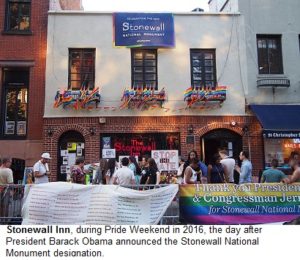
So, they learned “to get along”.

And now they are laughing “all the way to the bank” …

VIDEO – Pride, passion, progress: Inside Stonewall’s impact 50 years later – https://www.today.com/video/pride-passion-progress-inside-stonewall-s-impact-50-years-later-62866501801

Posted June 28, 2019 – As New York City preps to celebrate World Pride this weekend, NBC’s Joe Fryer goes inside The Stonewall Inn, the historic landmark that sparked the modern movement for LGBTQ rights. He hears from those who took part in the uprising 50 years ago.

There is a lesson here for us in the Caribbean.

We have a long way to go for some of our communities in the Caribbean to be a more tolerant society. But we must walk-trot-run this journey; we must reflect a more pluralistic democracy; we must learn to “live and let live”.

And if we want to double-down on tourism – we do – then we cannot invite people to enjoy our hospitality but then condemn them – in words and actions – for their lifestyle choices.

This – 50th Anniversary of Stonewall – is not our first close-examination of the toleration of the Caribbean or visiting LGBT community. In fact, now is a good time to Encore the blog-commentary from July 2, 2015 lamenting the harsh treatment in Jamaica for their LGBT citizens.

See a related news-commentary here:

Title: Stonewall 50: Don’t Forget the Black & Brown LGBTQ Struggle
Sub-title: Black queer and transgender people have always had to remind the rest of the community of [their] prominence —despite the fact that the movement was co-led by [them] since the beginning.
Source: https://www.thedailybeast.com/stonewall-50-dont-forget-the-black-and-brown-lgbtq-struggle

The world have adopted a more tolerant stance – so must we in the Caribbean. See that Encore here as follows:

————-

Go Lean CommentaryBuggery in Jamaica – ‘Say It Ain’t So’!

This commentary has asserted that the Caribbean region can be a better society than the United States of America. Yes, we can!

But to  even start the discussion, we must first:

Live and let live!

t So - Photo 3The topic of intolerance has been acute in the news as of late. We have the extreme example of the Islamic State in Iraq and Syria (ISIS) beheading non-Muslims because… well, just because. And the example of the US legalizing Gay Marriage may be considered too tolerant for some people’s good taste.

Where does the Caribbean fit in this discussion?

If ISIS is one end of a scale and Gay Marriage in America is another end, then one Caribbean member-state, Jamaica, would be closer to …

ISIS!

Yes, it is that bad. Say it ain’t so.

See Appendix-VIDEO’s below …

While this commentary directly targets Jamaica, the majority of the countries and overseas territories of the former British Empire, still criminalize sexual acts between consenting adults of the same sex and other forms of sexual orientation, gender identity and expression. This has been described as being the result of “the major historical influence” or legacy of the British Empire. In most cases, it was former colonial administrators that established anti-gay legislation or sodomy acts during the 19th century; see Appendix below. The majority of countries then retained these laws following independence.[1][2].

There is an effort now to transform society in Jamaica (and other countries) in this regards. There are Gay Pride Activities being planned for this Summer of 2015. See the relevant news article here:

Title: J-FLAG Is Planning Gay Pride Activities, But No Parade For August – Exec
Source: Jamaica Gleaner Daily Newspaper Online Site; posted June 30, 2015; retrieved from: http://jamaica-gleaner.com/article/news/20150630/j-flag-planning-gay-pride-activities-no-parade-august-exec  

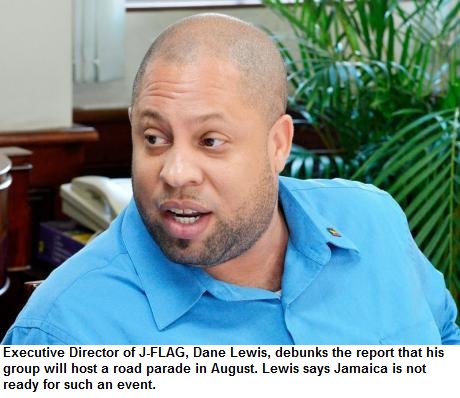
Local gay lobby, J-FLAG, is refuting reports that it will host a road parade in August when the group plans to have a series of gay pride activities.

Social media has been abuzz since yesterday following a report that the group would host a parade, similar to what is done in the United   States and other countries.

However, executive director of J-FLAG, Dane Lewis, says the report is wrong, adding that Jamaica is not ready for such an event.

Meanwhile, he says the group is planning a week-long series of activities starting on Emancipation Day, August 1, to mark growing tolerance for members of the lesbian, gay, bisexual, and transgender (LGBT) community.

Some years ago, an attempt to host a gay parade was thwarted after anti-gay supporters reportedly planned attacks against marchers.

Jamaica is accused of being one of the most homophobic places on earth.

Last week, the US government released a report noting that anti-gay laws and the dancehall culture are responsible for perpetuating homophobia in Jamaica.
Additional reference sources: http://jflag.org/

t So - Photo 1
———–

VIDEO: Executive Director of JFLAG, Dane Lewis: “We Are Jamaicans” – https://youtu.be/sJ-17R5DCoI


Published on Jan 17, 2013 – “We Are Jamaicans” is funded with the kind support of the Caribbean Vulnerable Communities Coalition (CVC) through its Global Fund Vulnerablised Project.
Building a diverse society is not easy. The book Go Lean … Caribbean describes the challenge as heavy-lifting. Though the US had failed at this challenge, it proudly boasts that it got better with every generation. The Caribbean on the other hand, leaves much to be desired in terms of the willingness to change and keep pace with progressive societies. (Now the US, Canada, Ireland and other countries have legalized Gay Marriage).

In a previous blog-commentaries, this defect – Homosexual Intolerance – was listed among the blatant human rights abuses in the region.

This is an important consideration for the planners of Caribbean empowerment. The Caribbean, a region where unfortunately, we have NOT … tried to be as tolerant as may be required, expected and just plain moral.

We must do better!

The book Go Lean … Caribbean asserts that Caribbean society’s prosperity has been hindered with a high abandonment rate – reported at 70% for educated classes region-wide, but an even higher 85% in Jamaica. The primary mission of the Go Lean book is to “battle” against the “push-and-pull” factors that draw so many of our Caribbean citizens away from their homelands to go to more progressive countries.

The Go Lean book campaigns to lower the “push” factors!

The purpose of the Go Lean book is to fix the Caribbean; to be better. The Go Lean book serves as a roadmap for the introduction and implementation of the technocratic Caribbean Union Trade Federation (CU) to pursue the quest to elevate the Caribbean region through empowerments in economics, security and governance. It is the assertion that Caribbean citizens can stay home and effect change in their homelands more effectively than going to some foreign countries to find opportunities for life, liberty and the pursuit of happiness. The book therefore asserts that the region can turn-around from failing assessments by applying best-practices, and forging new societal institutions to impact the Greater Good for all the Caribbean. This point was pronounced in the opening Declaration of Interdependence (Pages 10 – 14) with these acknowledgements and statements:

xi.   Whereas all men are entitled to the benefits of good governance in a free society, “new guards” must be enacted to dissuade the emergence of incompetence, corruption, nepotism and cronyism at the peril of the people’s best interest. The Federation must guarantee the executions of a social contract between government and the governed.

xii. Whereas the legacy in recent times in individual states may be that of ineffectual governance with no redress to higher authority, the accedence of this Federation will ensure accountability and escalation of the human and civil rights of the people for good governance, justice assurances, due process and the rule of law. As such, any threats of a “failed state” status for any member state must enact emergency measures on behalf of the Federation to protect the human, civil and property rights of the citizens, residents, allies, trading partners, and visitors of the affected member state and the Federation as a whole.

xxxiii. Whereas lessons can be learned and applied from the study of the recent history of other societies, the Federation must formalize statutes and organizational dimensions to avoid the pitfalls of communities like … Egypt. On the other hand, the Federation must also implement the good examples learned from developments/ communities like New York City, … Canada, … and tenants of the US Constitution.

The CU/Go Lean vision to elevate Caribbean society must also consider the issue of image. There is the need for a sentinel role for Caribbean image, as there are a lot of times that Caribbean life and people are denigrated in the media: news, film, TV, books, magazines. It’s unfortunate when we are guilty of scathing allegations. The Go Lean roadmap calls for the CU to assume a role of protecting and projecting positive Caribbean images. The plan is to use cutting edge delivery of best practices; the applicable CU agencies will employ strategies, tactics and implementations to impact the Go Lean prime directives; identified with the following 3 statements:

  • Optimization of the economic engines in order to grow the regional economy to $800 Billion & create 2.2 million new jobs.
  • Establishment of a security apparatus to protect the resultant economic engines and mitigate challenges/threats to public safety for all citizens… LGBT or straight.
  • Improvement of Caribbean governance to support these engines.

Jamaica has a failing economy.

Jamaica’s primary economic driver is tourism. So …

t So - Photo 2

Is the Caribbean ready for this economic activity? A bridge too far, too soon?
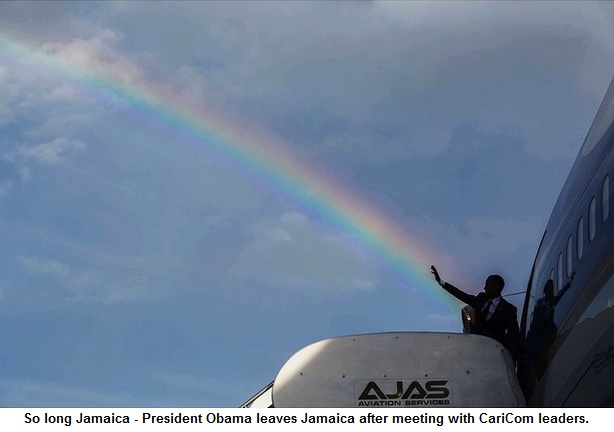
t So - Photo 4Jamaica has a long way to go; the country has been described by some Human Rights groups as the most homophobic place on Earth because of the high level of violent crime directed at LGBT people; (Padgett, Tim: “The Most Homophobic Place on Earth?”Time Magazine posted 12 April 2006). The United States Department of State said that in 2012, “homophobia was [unacceptably] widespread in the country” (2012 Country Reports on Human Rights Practices: Jamaica, Bureau of Democracy, Human Rights and Labor, U.S. Department of State, pages 20-22). As depicted in the VIDEO below, even President Obama indicted the island on a recent official State Visit.

Why is this country’s homophobia so acute compared to other countries? For one, they have held on emphatically to the British Laws on Buggery – see Appendix below – from their colonial days; even though the host country of England has already abandoned the laws (in 1967).

Jamaica is partying like it’s 1899!

This is therefore a matter of community ethos. The Go Lean book defines community ethos as the fundamental character or spirit of a culture; the underlying sentiment that informs the beliefs, customs, or practices of a group or society; the dominant assumptions of a people or period. This tropical paradise of Jamaica, as defined in the foregoing news article and VIDEO continues to spur bad attitudes, bad ideas, bad speech and bad actions towards the LGBT community. This is unbecoming of a progressive society in 2015.

Alas, this is a crisis…for victims and their loved ones. The Go Lean book posits that this crisis can be averted, that the crisis is a “terrible thing to waste”. The Go Lean roadmap seeks to optimize the eco-systems for Jamaica and the entire Caribbean. The book stresses new community ethos, strategies, tactics, implementations and advocacies necessary to transform and turn-around the eco-systems of the regional society. These points are detailed in the book as follows:

Who We Are – SFE Foundation – Comprised of Caribbean Diaspora Page 8
Community Ethos – Economic Principles – Economic Systems Influence Individual Choices Page 21
Community Ethos – Economic Principles – Consequences of Choices Lie in the Future Page 21
Community Ethos – Governing Principles – Lean Operations Page 24
Community Ethos – Ways to Impact the Future Page 26
Community Ethos – Ways to Promote Happiness Page 36
Community Ethos – Ways to Impact the Greater Good Page 37
Strategy – Vision – Confederate all 30 member-states into a Single Market Page 45
Strategy – Mission – Build and foster local economic engines Page 45
Strategy – Mission – Repatriate the Diaspora, even Minorities like those of the LGBT community Page 46
Tactical – Ways to Foster a Technocracy Page 64
Tactical – Growing the Economy to $800 Billion GDP Page 68
Tactical – Separation-of-Powers – CU Federal Government versus Member-State Governance Page 71
Anatomy of Advocacies – Examples of Individuals Who Made Impact Page 122
Planning – 10 Big Ideas – Homeland Security Pact Page 127
Planning – Ways to Make the Caribbean Better Page 131
Planning – Ways to Improve Failed-State Indices – Minority and Human Rights Page 134
Planning – Lessons Learned from US Constitution – Equal Protection for all Minorities Page 145
Advocacy – Ways to Grow the Economy Page 151
Advocacy – Ways to Create Jobs Page 152
Advocacy – Ways to Improve Governance – For All Citizens Page 168
Advocacy – Ways to Better Manage the Social Contract – Security against “Bad Actors” Page 170
Advocacy – Ways to Impact Justice – Internal Affairs Reporting Line Page 177
Advocacy – Ways to Remediate and Mitigate Crime – Hate Crime Qualifiers Page 178
Advocacy – Ways to Improve Homeland Security Page 180
Advocacy – Ways to Mitigate Terrorism – Consider Bullying as Junior Terrorism Page 181
Advocacy – Ways to Impact Youth – Collaborating with Foundations Page 218
Advocacy – Ways to Re-boot Jamaica Page 239
Advocacy – Ways to Impact British Territories Page 245

Looking at the disposition of the island nation of Jamaica’s, we see that its societal engines are failing.

Could the investment in the diversity of its people be at the root of the problem?

The failing indices and metrics of Jamaica have been considered in previous blog/commentaries; see sample here:

https://goleancaribbean.com/blog/?p=4840 Jamaican Poll: ‘Bring back the British!’
https://goleancaribbean.com/blog/?p=3694 Looking for a job in Jamaica, go to Canada
https://goleancaribbean.com/blog/?p=2830 Jamaica’s Public Pension Under-funded
https://goleancaribbean.com/blog/?p=392 Jamaica to receive World Bank funds to help in crime fight
https://goleancaribbean.com/blog/?p=313 What’s Holding Back Jamaica’s Reforms

The Go Lean roadmap seeks to empower and elevate Caribbean societal engines to make Jamaica, and the rest of the Caribbean, better places to live, work and play … for all citizens, including the LGBT communities.

Most of the Jamaican Diaspora that has abandoned the island now lives in the US, Canada or the UK. Their new home-communities are more tolerant societies of their LGBT neighbors.

Perhaps, there is some correlation.

This commentary is not urging the abandonment of the Judeo-Christian moral code; Jesus Christ instructed to “let them be” at Luke 22:51 (The Message Translation). Rather this commentary urges tolerance and moderation: Live and let live!

Fight the hate!

Yes, we can … do this. Yes, we must do this. 🙂

Download the book Go Lean … Caribbean – now!
———–

Appendix VIDEO: US President Obama’s LGBT comments at Youth Leaders Town Hall – https://youtu.be/636mgw1THpc?t=5m1s


Published on Apr 9, 2015 – President Obama delivers remarks and answers questions at a town hall with Young Leaders of the Americas at University of the West Indies in Kingston, Jamaica. April 9, 2015.
———–

Appendix VIDEO: Gay rights in Jamaica – https://youtu.be/_nSgMGoBAmU

playbutton-300x300

———–

Appendix – Encyclopedic Reference: Buggery in English Common Law

The British English term buggery is very close in meaning to the term sodomy, often used interchangeably in law and popular speech. It may also be a specific common law offenceencompassing both sodomy and bestiality.

In English law “buggery” was first used in the Buggery Act 1533, while Section 61 of the Offences against the Person Act 1861, entitled “Sodomy and Bestiality”, defined punishments for “the abominable Crime of Buggery, committed either with Mankind or with any Animal”. The definition of “buggery” was not specified in these or any statute, but rather established by judicial precedent.[1] Over the years the courts have defined buggery as including either [of these]:

  1. anal intercourse or oral intercourse by a man with a man or woman[2] or
  2. vaginal intercourse by either a man or a woman with an animal,[3]

But [no other] form of “unnatural intercourse”[4] [was defined], the implication being that anal sex with an animal would not constitute buggery. Such a case has not, to date, come before the courts of a common law jurisdiction in any reported decision. However, it seems highly improbable that a person would be exculpated of a crime associated with sex with animals only by reason of the fact that penetration involved the anus rather than the vagina. In the 1817 case of Rex v. Jacobs, the Crown Court ruled that oral intercourse, even with an underage and/or non-consenting person, did not constitute buggery or sodomy.[4]

At common law consent was not a defence[5] nor was the fact that the parties were married.[6] In the UK, the punishment for buggery was reduced from hanging to life imprisonment by the Offences against the Person Act 1861. As with the crime of rape, buggery required that penetration must have occurred, but ejaculation is not necessary.[7]

Most common law jurisdictions have now modified the law to permit anal sex between consenting adults.[8] Hong Kong did so retroactively in 1990, barring prosecution for “crimes against nature” committed before the Crimes (Amendment) Ordinance 1990 entered into force except those that would still have constituted a crime if they had been done thereafter. In England and Wales, homosexual buggery was decriminalised in 1967 with an age of consent at 21 years, whereas all heterosexual intercourse had an age of consent at 16 years. The Sexual Offences Act 2003 did not fully remove buggery as a concept in United Kingdom law, as the previous law is retained for complainants (consensual or “pseudo-consensual”) under the age of 16, or 18 with regards to an adult perceived to be in a “position of trust”. As the law stands, buggery is still charged, exclusively regarding “pseudo-consensual” anal intercourse with those under 16/18, because children cannot legally consent to buggery although they may appear to do so. Rape is charged when the penetration is clearly not consensual. Buggery with an animal is still unlawful under Section 69 of the Sexual Offences Act 2003.

In the Republic of Ireland, the Criminal Law (Sexual Offences) Act 1993 abolished the offence of “buggery between persons”.[9] For some years prior to 1993, criminal prosecution had not been made for buggery between consenting adults. The 1993 Act created an offence of “buggery with a person under the age of 17 years”,[10] penalised similar to statutory rape, which also had 17 years as the age of consent. The Criminal Law (Sexual Offences) Act 2006 replaced this offence with “defilement of a child”, encompassing both “sexual intercourse” and “buggery”.[11] Buggery with an animal is still unlawful under Section 69 of the Sexual Offences Act 2003. In 2012 a man was convicted of this offence for supplying a dog in 2008 to a woman who had intercourse with it and died.[12]

Etymology – The word bugger and buggery are still commonly used in modern English as a mild exclamation. “Buggery” is also synonymous with anal sex.

The word “bugger” was derived, via the French bougre, from Bulgar, that is, “Bulgarian”, meaning the medieval Bulgarian heretical sect of the Bogomils, which spread into Western Europe and was claimed by the established church to be devoted to the practice of sodomy.[13] “Buggery” first appears in English in 1330, though “bugger” in a sexual sense is not recorded until 1555.[14]

(Source: https://en.wikipedia.org/wiki/Buggery)
Share this post:
, , , ,

‘Free Market’ Versus … Common Pool Resources

Go Lean Commentary

Socialism-Communism – a reference to any heavy-handed centrally controlled governance – is one way to govern the natural resources for the betterment of the people. But after 100 years of failed experimentations, the conclusion is valid that socialistic-communistic practices are defective and deficient. We do not want this – any further – in the Caribbean.

[Pure] Capitalism, on the other hand, provides a few models for managing natural resources to help the national economy; think leases, exploration rights and exclusive franchises. Ancient European powers had their track records of Papal Charters and Royal Charters. Among Republican governments, the American experience is most noted for anecdotes of the government extending exploration rights to private institutions and individuals: think mines and oil fields. (Or development rights like railroads). After hundreds of years of exploitation and abuse, Crony-Capitalistic practices have emerged as an “Enemy of the [Common] People.

What we want is simpler policies and practices intended for the Greater Good. (This ethos was defined by Jeremy Bentham, who lived 1748 – 1832, as: “the greatest good to the greatest number of people which is the measure of right and wrong”).
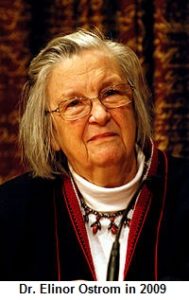
This was the academic challenge: devising a better way to manage a country’s natural resources. The best answer thus far:

The Commons.

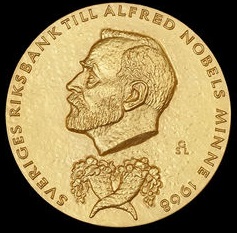
… and this turned out to be the culmination of one woman’s work; and she won the Nobel Prize for it. (To this date, she remains the only woman to ever win the Nobel Prize in Economics.[5]). See VIDEO here:

VIDEO – Elinor Ostrom on managing “Common Pool” Resources – https://youtu.be/D1xwV2UDPAg


OECD

Published on Jun 28, 2011 –
Elinor Ostrom, Nobel laureate in economic sciences, talks about managing “common pool” resources like forests or fisheries, where one person’s use means less is available for others.

Category: News & Politics

Well done, Dr. Elinor Ostrom. Her life’s work was proving to the world that there is a better way to manage Common Pool Resources without government or private control – think: no Socialism and no Crony-Capitalism. This summation was provided in the book Go Lean … Caribbean under the advocacy title “10 Ways to Better Manage Natural Resources“. The book (Page 183) first states this definition of Common Pool Resources:

The Bottom Line on Common Pool Resources

The 2009 Nobel Prize winning economist Elinor Ostrom (1933 – 2012), a Political Science Professor at Indiana University, received the award for her landmark work on the management of common pool resources. Her analysis of economic governance, especially the commons, showed how groups work together to manage common resources such as water supplies, fish and lobster stocks, and pastures through collective property rights. She showed that common pool resources can be effectively managed collectively, even without government or private control, as long as those using the resource are physically close to it and have a relationship with each other. Because outsiders and government agencies don’t understand local conditions or norms, and lack relationships with the community, they may manage common resources poorly. By contrast, insiders who are given a say in resource management will self police to insure that all participants follow the community’s rules.

——–
The Go Lean book asserts that there are best-practices that we can adopt in the Caribbean to make our homeland a better place to live, work and play.

There are a lot of Natural Resources that must be managed in the Caribbean region, consider: the 1,063,000 square miles of the Caribbean Sea, the waterways between the islands, the river borders with foreign countries, etc.. Most importantly, there is the need to manage the Fish & Seafood Stock in the region. This is one of the foremost reasons that the member-states of the region need to confederate a super-national agency in the first place. The Go Lean book introduces the technocratic Caribbean Union Trade Federation (CU) for this purpose. The problem in this region is the same problem as in most other regions of the world; this is what the academic exercises were trying to address:

It was long unanimously held among economists that natural resources that were collectively used by their users would be over-exploited and destroyed in the long-term. Elinor Ostrom disproved this idea by conducting field studies on how people in small, local communities manage shared natural resources, such as pastures, fishing waters, and forests. She showed that when natural resources are jointly used by their users, in time, rules are established for how these are to be cared for and used in a way that is both economically and ecologically sustainable.[26]

We, the Caribbean, need to double-down in our economic engines and manage Common Pool Resources better. This theme is embedded throughout the 370 pages of the Go Lean book. See the multiple references here:

Separation of Powers – F. Interior Department
This Department in the Executive Branch manages the physical terrain of the Caribbean, in  conjunction with, and on behalf of the member-states. This governance is vital in facilitating the economic interest in the region, as many people are engaged in occupations and livelihoods involving the “land, and the seas”…. This Department manages the oversight of this “common” territory. In addition, this Agency will have to work with foreign entities in the management of common pool resources, like water rights, river ecosystems in Guyana, Suriname and Belize where they are bordered by other (bigger) countries.
Page 82
Separation of Powers – J. Agriculture and Fisheries Department
This Department in the Executive Branch coordinates the region efforts in agriculture, agri-business and fisheries. These endeavors will be executed in collaboration and on behalf of the CU member-states. The CU will take the lead in facilitating the food supply and distribution systems to ensure the region can feed itself, more from local production and less from trade….Many of the member-states get 90% (or more) of their food supplies from imports; even fish from Alaska. This department will coordinate the CU‘s implementation of agri-business investments to generate more regional options for food production: common grazing lands, cooperatives (co-ops), farm credit, fisheries oversight, canaries, aqua-culture endeavors, etc.There is the need for strenuous regional management regarding natural resources like fish stock. There are breeds of seafood germane to Caribbean culture that are becoming more and more endangered every year. This includes lobster, conch, flying fish and grouper. … This motivation is one of the prime directives for petitioning the UN for the Exclusive Economic Zone of the Caribbean Sea, the space between the islands.

In many ways, this office is to be managed like a Project Management Office, coordinating one region-wide project after another. This department will also oversee the common pool resources for the region. This will include fish stock and common grazing lands.

Page 88
Advocacy – 10 Lessons from the American West

# 5 – Common Pool Resources: Water / Public Works

There were many environmental deterrents to conquering the West. There is actually a continental divide in North America in which minimal rain falls west of that divide; the western states were not sustainable for large populations.

Over the years, the US Army Corps of Engineers created canals, dams, reservoirs, irrigation, water pipelines and other measures, in multi-state compacts. The CU must also engineer multi-state public works projects to improve economies.

Page 142
Advocacy – 10 Ways to Better Manage Natural Resources

# 1 – Lean in for the Caribbean Union Trade Federation (CU) treaty.
This treaty allows for the unification of the region into one market, thereby integrating to a single economy of 30 member-states… . The region needs joint management of the common pool of natural resources, and this one of the foremost reasons for confederating the CU. First it garners international support for the UN petition for an Exclusive Economic Zone in and near the Caribbean Seas. The CU’s representation of a Single Market allows for effective negotiations with foreign parties – the islands will no longer be viewed as inconsequential. The CU’s Separation-of-powers mandate is germane for managing the local needs of the region’s common resources; it allows for closer oversight of local regulators, but with CU principles.

Page 183
Advocacy – 10 Ways to Improve Fisheries

# 3 – Common Pool Resources (Lobster, Conch, Grouper, Flying Fish)

Though the waters between the islands may be uninhabited, their resources can still be depleted. The CU will govern the common pool resources to promote the sustainability of fish stock. Fishing for lobster, conch, grouper, “flying fish” and other species must be controlled, with limited harvesting seasons, otherwise there will be none for future generations.

Page 210
Advocacy – 10 Ways to Impact Rural Living

# 3 – Common Pool Resources Oversight and Management

The CU will exercise eminent domain to buy a lot of “crown” land, and the Exclusive Economic Zone, to promote as common pool resources (farming, fishing, and mining). This ownership allows for the implementation of proper oversight rules, with local coordination, and best practices.

Page 235

——–
This vision for technocratic management for Common Pool Resources completes this series on Free Markets Versus… . There is wisdom to this strategy of managing natural resources on a local level, by people close to the target. Dr. Ostrom presented a lot of lessons in her writings and advocacies. This submission, 6-of-6 of the full series, completes this consideration; the full catalog is as follows:

  1. Free Market Versus: Communism – Can they both co-exist?
  2. Free Market Versus: China – Two systems at play in ‘Words and Actions’
  3. Free Market Versus: Socialism – Prevalent in the Caribbean
  4. Free Market Versus: Cooperatives
  5. Free Market Versus: Labor Unions – Junior Communists?
  6. Free Market Versus: Common Pool Resources – Simpler Cooperation

In this series, reference is made to the need for a comprehensive roadmap for elevating the societal engines of the Caribbean member-states. We need the intended community of communism and the Greater Good of Socialism, but with none of the trappings that come with those systems. For managing the natural resources of a country, there is an alternative way, a better way, and that is the approach and strategies of Common Pool Resources. This approach is both an art and a science.

This theme – fostering better management of natural resources – aligns with many previous Go Lean commentaries; see a sample list here:

https://goleancaribbean.com/blog/?p=16000 Good Governance for Local Economic Empowerment
https://goleancaribbean.com/blog/?p=15359 Industrial Reboot – Fisheries 101
https://goleancaribbean.com/blog/?p=12724 Lessons from Colorado: Water Management Arts & Sciences
https://goleancaribbean.com/blog/?p=12230 Commerce of the Seas – Extraction Realities
https://goleancaribbean.com/blog/?p=4700 Rare Earths: Managing for the new ‘Gold Rush’
https://goleancaribbean.com/blog/?p=3594 Lessons Learned from Queen Conch – Regional Reality

The stewards for a new Caribbean, the movement behind the Go Lean book, present many testimonies of the life work of Economists. This is just a sample list of some that we have featured in the past:

Dr. Elinor Ostrom is in this class of fame and infamy. Regrettably, she passed in 2012, after leaving a legacy for others to benefit from; we are forever grateful for her contributions to the field of Economics and Common Pool Resources. May we all pay more than the usual attention to her productions.
We urge all Caribbean stakeholders to lean-in to Dr. Ostrom work, and to the Go Lean roadmap for optimizing Caribbean economics, security and governance. We can … do better in making our homelands better places to live, work and play.  🙂

About the Book
The book Go Lean…Caribbean serves as a roadmap for the introduction and implementation of the technocratic Caribbean Union Trade Federation (CU), for the elevation of Caribbean society – for all member-states. This CU/Go Lean roadmap has these 3 prime directives:

  • Optimization of the economic engines in order to grow the regional economy to $800 Billion & create 2.2 million new jobs.
  • Establishment of a security apparatus to ensure public safety and protect the resultant economic engines.
  • Improve Caribbean governance to support these engines, including a separation-of-powers between the member-states and CU federal agencies.

The Go Lean book provides 370-pages of turn-by-turn instructions on “how” to adopt new community ethos, plus the strategies, tactics, implementations and advocacies to execute so as to reboot, reform and transform the societal engines of Caribbean society.

Download the free e-Book of Go Lean … Caribbean – now!

Who We Are
The movement behind the Go Lean book – a non-partisan, apolitical, religiously-neutral Community Development Foundation chartered for the purpose of empowering and re-booting economic engines – stresses that reforming and transforming the Caribbean societal engines must be a regional pursuit. This was an early motivation for the roadmap, as pronounced in the opening Declaration of Interdependence (Pages 11 – 13):

iv. Whereas the natural formation of the landmass is in a tropical region, the flora and fauna allows for an inherent beauty that is enviable to peoples near and far. The structures must be strenuously guarded to protect and promote sustainable systems of commerce paramount to this reality.

xi. Whereas all men are entitled to the benefits of good governance in a free society, “new guards” must be enacted to dissuade the emergence of incompetence, corruption, nepotism and cronyism at the peril of the people’s best interest. The Federation must guarantee the executions of a social contract between government and the governed.

xvi. Whereas security of our homeland is inextricably linked to prosperity of the homeland, the economic and security interest of the region needs to be aligned under the same governance. Since economic crimes … can imperil the functioning of the wheels of commerce for all the citizenry, the accedence of this Federation must equip the security apparatus with the tools and techniques for predictive and proactive interdictions.

xxiv.  Whereas a free market economy can be induced and spurred for continuous progress, the Federation must install the controls to better manage aspects of the economy: jobs, inflation, savings rate, investments and other economic principles. Thereby attracting direct foreign investment because of the stability and vibrancy of our economy.

Sign the petition to lean-in for this roadmap for the Caribbean Union Trade Federation.

Share this post:
, ,
[Top]

‘Free Market’ Versus … Cooperatives – Simple Solution

Go Lean Commentary

Can we all just get along?! – Rodney King 1993; on the occasion of L.A. Riots after the acquittal of police officers who beat him.

This should be more than just a complaint, it should be a prescription. A prescription for economic empowerment as well as social harmony. In fact, one of the original motivations for communism was a supposed camaraderie and fraternity among its adherents. In fact, this expression for Brotherhood is usually interchangeable for “fellow communists”:

Com·rade, noun

  1. a person who shares in one’s activities, occupation, etc.; companion, associate, or friend.
  2. a fellow member of a fraternal group, political party, etc.
  3. a member of the Communist Party or someone with strongly leftist views.

Source: Retrieved June 22, 2019 from: Dictionary.com

Is it possible to “get along” and have camaraderie without the communism? Yes, indeed! At the heart of the word communism is the verb “commune”, this means “to converse or talk together, usually with profound intensity, intimacy, etc.; interchange thoughts or feelings”. There is also a substitutable concept and simple solution: a cooperative:

Cooperative, Adjective – working or acting together willingly for a common purpose or benefit.

Cooperative, Noun – a jointly owned enterprise engaging in the production or distribution of goods or the supplying of services, operated by its members for their mutual benefit, typically organized by consumers or farmers.

See VIDEO here:

———–

VIDEO – What is a Co-operative? – https://youtu.be/90FL_bBE4mw

Co-operatives UK
Published on Jun 20, 2015
– Co-operatives give people control over things that matter to them. There are nearly 7,000 independent co-operatives working across the economy. They contribute £37 billion to the British economy and are owned by 15 million people across the country.

The 2013 book Go Lean…Caribbean – a roadmap for the implementation for the technocratic Caribbean Union Trade Federation (CU) – presented a comprehensive view of Cooperatives. These were presented as necessary organizational expressions that the Caribbean must adopt. See this definition here (Page 25):

Governing Principles – Cooperatives
As a governing entity the CU will structure many cooperative endeavors to marshal economic and homeland security benefits for the region. (While cooperatives advocate the practice of sharing, this roadmap is not proposing any redistribution of existing Caribbean wealth). For example, the CU will aggregate business incubators into networks, similar to cooperatives, as this is a successful practice in Europe. These networks share best practices and can spread new methodologies and systems across a regional footprint. The CU will task utility cooperatives with the delivery of some public utilities, even a proposed regional power grid will operate as a cooperative. This strategy shares the cost of the installation across the full co-op membership (in this case, the 30 member-states).

So the Caribbean can abide by Free Market economic principles and still have cooperatives. With this strategy, we “can all get along”, come together and work towards common goals.

Yes, we can …

There is wisdom to this strategy of coming together and working towards a common goal. This is the continuation of series on Free Markets Versus…; this submission is entry 4-of-6 of the full series cataloged as follows:

  1. Free Market Versus: Communism – Can they both co-exist?
  2. Free Market Versus: China – Two systems at play in ‘Words and Actions’
  3. Free Market Versus: Socialism – Prevalent in the Caribbean
  4. Free Market Versus: Cooperatives
  5. Free Market Versus: Labor Unions – Junior Communists?
  6. Free Market Versus: Common Pool Resources – Simpler Cooperation

In this series, reference is made to the need for a comprehensive roadmap for elevating the societal engines of the Caribbean member-states. We have many role models of communities around the world embracing formal cooperatives so as to leverage the high costs of societal investments; we can look, listen and learn from these accomplishments. This is the focus of this commentary, and for the Go Lean book; the book presents one advocacy (Page 176) specifically focused on cooperatives, entitled: “10 Ways to Foster Cooperatives“. These “10 Ways” include the following highlights, headlines and excerpts:

1 Lean-in for the Caribbean Single Market – Ratify treaty for the CU.
The CU in effect represents a cooperative with the unification of the region into a single market of 42 million people across 30 member-states with a GDP of $800 Billion (2010 figures). Following the Rochdale principles, the CU will structure other cooperative endeavors to marshal the economic and homeland security interest of the region.
2 Consumer Cooperatives
3 Worker Cooperatives
4 Purchasing Cooperatives
The CU will function as a Group Purchasing Organization (GPO), an entity created to leverage the purchasing power of a group of institutions to obtain discounts from vendors based on the collective buying power of the members. In effect, the CU will aggregate the unified market to minimize costs of necessary purchases – an efficient use of supply and demand.
5 Cooperative Banking

The Caribbean Central Bank (CCB) is a cooperative among the region’s Central Banks. The CCB will be the sole controlling agent of the monetary policies for the Caribbean Dollar and aggregate currency printing and coin-pressing.

6 Housing Cooperatives

These legal entities rents out the real estate they own to their own members, allowing for the pooling of the members’ resources so that their buying power is leveraged, thus lowering the cost per member in all the services and products associated with home ownership. The members, through their elected representatives, can also screen and select who may live in the cooperative. The CU endorses this scheme for adult housing (60+ years) for repatriation of the Diaspora.

7 Agricultural Cooperatives
8 Utility Cooperatives
9 Mutual Education
10 Mutual Insurance and Risk Management

The Go Lean book doubles-down on the concept of cooperatives for societal deliveries in the region. For example, there is the recommendation for fomenting and strengthening the non-government organization (NGO) referred to as the Caribbean Hotel & Tourism Association. See this except from an anecdote in the book (Page 60):

By: Caribbean News Now – (excerpt) – Published on August 31, 2010
MONTEGO BAY, Jamaica — Caribbean Hotel and Tourism Association President Josef Forstmayr has called for urgent action by all Caribbean governments for a sustainable cooperative marketing and promotion fund and regional integration and removal of barriers for intra-Caribbean travel.

This theme – fostering cooperatives for the economic, security and governing empowerments in the region – aligns with previous Go Lean commentaries; see a sample list here:

https://goleancaribbean.com/blog/?p=16172 Bad example for failed Agricultural Cooperative – Jonestown, Guyana
https://goleancaribbean.com/blog/?p=15858 A Media Network and Cooperative Vision for a New Caribbean
https://goleancaribbean.com/blog/?p=15662 Urban Cooperatives – Manifesting High-Tech Neighborhoods
https://goleancaribbean.com/blog/?p=15521 Caribbean Disunity and for the Need Tourism Cooperatives
https://goleancaribbean.com/blog/?p=11544 Forging Change: Collective Bargaining & Cooperatives
https://goleancaribbean.com/blog/?p=7991 Transformations: Caribbean Postal Union, actually a Cooperative
https://goleancaribbean.com/blog/?p=7384 Oil Refineries – A Model of a Purchasing and Utility Cooperative
https://goleancaribbean.com/blog/?p=7034 Caribbean Central Bank Cooperative – The Future of Money
https://goleancaribbean.com/blog/?p=6016 A Refigeration Cooperative – Yes, we can … ‘Stay Cool’

The stewards for a new Caribbean, the movement behind the Go Lean book, want to pronounce the significance of the alphabet letter ‘C‘ to all Caribbean stakeholders.

This episode is brought to you by the Letter ‘C‘ – Familiar promotion from the TV Show Sesame Street.

This  discussion on Free Market alternatives started with a consideration of Communism; now we are considering Cooperatives. The assertion is that we can have the needed Community and Camaraderie without the perils of communism. This strategy will also bring these other benefits:

  • Collaboration.
  • Confederation.
  • Cooperation.
  • Collusion.

See the Appendix VIDEO for further elaborations on the merits of Cooperatives.

Yes, the letter ‘C‘, and the adoption of these C-word concepts is the Way Forward for the Caribbean; this is how we can make our homeland a better place to live, work and play. 🙂

About the Book
The book Go Lean…Caribbean serves as a roadmap for the introduction and implementation of the technocratic Caribbean Union Trade Federation (CU), for the elevation of Caribbean society – for all member-states. This CU/Go Lean roadmap has these 3 prime directives:

  • Optimization of the economic engines in order to grow the regional economy to $800 Billion and create 2.2 million new jobs.
  • Establishment of a security apparatus to ensure public safety and protect the resultant economic engines.
  • Improve Caribbean governance to support these engines, including a separation-of-powers between the member-states and CU federal agencies.

The Go Lean book provides 370-pages of turn-by-turn instructions on “how” to adopt new community ethos, plus the strategies, tactics, implementations and advocacies to execute so as to reboot, reform and transform the societal engines of Caribbean society.

Download the free e-Book of Go Lean … Caribbean – now!

Who We Are
The movement behind the Go Lean book – a non-partisan, apolitical, religiously-neutral Community Development Foundation chartered for the purpose of empowering and re-booting economic engines – stresses that reforming and transforming the Caribbean societal engines must be a regional pursuit. This was an early motivation for the roadmap, as pronounced in the opening Declaration of Interdependence (Pages 12 – 13):

xi. Whereas all men are entitled to the benefits of good governance in a free society, “new guards” must be enacted to dissuade the emergence of incompetence, corruption, nepotism and cronyism at the peril of the people’s best interest. The Federation must guarantee the executions of a social contract between government and the governed.

xvi. Whereas security of our homeland is inextricably linked to prosperity of the homeland, the economic and security interest of the region needs to be aligned under the same governance. Since economic crimes … can imperil the functioning of the wheels of commerce for all the citizenry, the accedence of this Federation must equip the security apparatus with the tools and techniques for predictive and proactive interdictions.

xxiv. Whereas a free market economy can be induced and spurred for continuous progress, the Federation must install the controls to better manage aspects of the economy: jobs, inflation, savings rate, investments and other economic principles. Thereby attracting direct foreign investment because of the stability and vibrancy of our economy.

Sign the petition to lean-in for this roadmap for the Caribbean Union Trade Federation.

————-

Appendix VIDEO – How to stop poverty: start a worker-owned cooperative | Jim Brown | TEDxTuscaloosa – https://youtu.be/LFyl0zz2yqs

TEDx Talks
Published on Jul 7, 2015
– Why is chronic poverty tolerated in America? Is our economic system flawed? Through personal stories and insights, University of Alabama professor J. Palmer (Jim) Brown explores the problem of poverty and advocates a solution in worker ownership and cooperation.

Jim Brown is a social entrepreneur and clinical professor at the University of Alabama. His research focuses on innovation and entrepreneurship. He studied at Cal Poly and MIT prior to a long career in industry. In addition to teaching, Mr. Brown has an extensive consulting background in business startups and operations improvement. His work with non-profit companies and people in poverty led him to co-found The Moses Project, an organization dedicated to the promotion of worker-owned cooperatives in Alabama.

This talk was given at a TEDx event using the TED conference format but independently organized by a local community. Learn more at http://ted.com/tedx


Share this post:
, ,
[Top]

‘Free Market’ Versus … Socialism – Very Prevalent in the Caribbean – Encore

Socialism and dependency seems to go hand-in-hand.

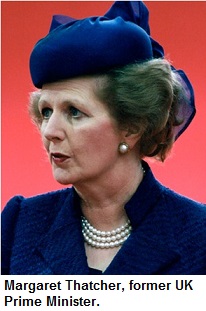
The problem with socialism is that you eventually run out of other peoples’ money. – Margaret Thatcher 

There are 18 dependent member-states in the Caribbean region.

Then when it comes to Charity Management, we seem to not be able to grow-up and manage our own affairs.

Do you see the trend?

No self-sufficiency … and we have now ran out … of other people’s money.
We need to talk; this is not working; we need to start seeing other people.

I know you love me, but I want, need and deserve better.

It would be such a humorous story, if this boy-meets-girl-boy-loses-girl anecdote was only fictional. But, it is real, and it is us in the Caribbean losing the love and livelihood of our Diaspora, those that have emigrated away.  🙁

So we must contemplate the economic stewardship that exists in our Caribbean region; we must look at the attributes of the competing homelands that have lured away our people and we must do better / be better. That competing attribute is not the Democratic Socialism precepts where we are counting on Other People’s Money. No, it is the full embrace of Free Market economic principles.

This is the purpose and scope of this current series for the month of June 2019; see the catalog here of our submissions:

  1. Free Market Versus: Communism – Can they both co-exist?
  2. Free Market Versus: China – Two systems at play in ‘Words and Actions’
  3. Free Market Versus: Socialism – Prevalent in the Caribbean
  4. Free Market Versus: Cooperatives
  5. Free Market Versus: Labor Unions – Junior Communists?
  6. Free Market Versus: Common Pool Resources – Simpler Cooperation

In this series, reference is made to the need for a comprehensive roadmap for elevating the societal engines of the Caribbean member-states. The book Go Lean…Caribbean – a roadmap for the implementation for the technocratic Caribbean Union Trade Federation (CU) – asserts that we must reform and transform to have any hope of retaining our young people in the region; the book states (Page 3):

Our youth, the next generation, may not be inspired to participate in the future workings of their country; they may measure success only by their exodus from their Caribbean homeland.

This is entry 3-of-6 for this academic-yet-energetic series. In the first submission, the history of Free Market versus Communism was traced. It was concluded that:

After some debate – 100 years – the judgment is that Free Market economies are more prosperous than centrally controlled economies, think Communist states. Even Russia, the former Head of the communist-bloc Union of Soviet Socialist Republics has transformed and is now a Free Market country.

We lament that so many of the 30 Caribbean member-states have married themselves to left-leaning economic-political systems or worse have not even tried to exert economic independence at all. See these details here:

Left-Leaning Socialist Extremes Colonial Dependencies
Antigua & Barbuda – does not even allow private property ownership on the island of Barbuda. British Overseas Territories (6)
Grenada – Flirted with Marxism that lead to an invasion by Eastern Caribbean & American forces to quell a military coup in 1983 Dutch Overseas Territories (6)
Guyana – doubled-down on extreme socialism to where they invited the People Temple to commune there in 1978. The resulting atrocities of over 900 deaths remain a “black-eye” on Caribbean governance. French Overseas territories (4)
Cuba – After 60 years of a failed communist revolution, the country’s infrastructure is still stuck on 1959. Half of the natural citizens have fled in that time. 2 US Territories of Puerto Rico and the US Virgin Islands

This is not our first close-examination of Caribbean socialism. In fact, now is a good time to Encore the blog-commentary from October 12, 2017 lamenting a new round of Caribbean leaders begging colonial masters for undeserved bail-outs and hand-outs. See that Encore here as follows:

====================================

Go Lean Commentary – Caribbean proposes new US-Caribbean trade initiative

The problem with socialism is that you eventually run out of other peoples’ money. – Margaret Thatcher CU Blog - Caribbean Island proposes new US-Caribbean trade initiative - Photo 1

Many Caribbean member-states feature a governmental structure of democratic socialism; (see Appendix below).

In some places, socialism is a bad word – think Venezuela – but other states feature an advanced prosperous country despite the socialism tag – think Canada. In general, socialism can be depicted as a scale with leftist communism on one end and right-wing capitalism on the other end. The observation and analysis of these varying states during good times and bad times is that the left-leaning socialism countries tend to suffer from a lot of societal abandonment, especially when things go bad, for the reason as described by Margaret Thatcher above. (Consider for example, the Caribbean island of Barbuda, before their recent disaster, there was no private land-ownership).

So many Caribbean member-states have “run out of other people’s money”, thus ensuring a crisis. Alas, this …

… crisis is a terrible thing  to waste – American Economist Paul Romer

The crisis in the Caribbean region right now is in response to Hurricanes Irma and Maria in September 2017 that have devastated many islands – think Puerto Rico, Barbuda and Dominica. It is a good time to re-think the affinity for democratic socialism. These natural disasters are forcing our region to re-think one of the hallmarks of capitalism; our policies on …

… Trade; American Trade to be exact.

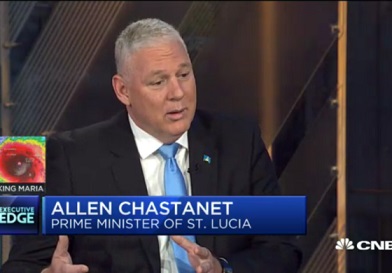
Yet still, it becomes obvious what the problem is for so many Caribbean member-states, they seem to “just” want to spend other people’s money rather than do the heavy-lifting – Big Deal – of growing their own economy/wealth. Notice this theme in the news article here from the St. Lucia Times daily newspaper regarding the urgings of their Prime Minister Allen Chastanet:

Title: Prime Minister Chastanet proposes new US-Caribbean trade initiative

CU Blog - Caribbean Island proposes new US-Caribbean trade initiative - Photo 2On the side-lines of the UN General Assembly in New York, Prime Minister Allen Chastanet has been speaking to the American business network CNBC.

Prime Minister Chastanet discussed the recent hurricanes that have devastated parts of the Caribbean, rebuilding the Caribbean and Caribbean – US relations.

He said recent events have showed that the Caribbean needs to diversify in terms of its sources of food, pointing to a shutdown of the American hub for several days.

“The support has had to come from the south because while we were going through this, you had two hurricanes heading up north. And literally Miami was on a shutdown. So unfortunately the American hub got shutdown almost for ten days out of Miami.  And so it really has shown us that we need to diversify ourselves a bit and maybe look a bit more to Panama in terms of supplies of food,” Chastanet.

Chastanet said the resilience of the Caribbean is very strong and the region will band together to recover from the disasters.

Chastanet proposed the establishment of a new private sector led initiative what would allow US companies to invest in St Lucia tax free and have their resources sent back home without facing heavy US government taxes.

He said there are great investment opportunities in the Caribbean for American companies.

“Can we not get an incentive, and that’s what we’re in discussions with the US about, that if US companies invest into the Caribbean, that those investments in our books are always tax free that the US allow those funds to be repatriated back into the US tax-free, only on those investments. So 1, it accomplishes getting the funds back into the United States of America. It creates an avenue for the private sector to participate in this growth and brings a lot of money to the table, Chastanet said.

Prime Minister Chastanet is expected to address the UN General Assembly today.

Source: Posted September 21, 2017; retrieved October 11, 2017 from: https://stluciatimes.com/2017/09/21/prime-minister-chastanet-proposes-new-us-caribbean-trade-initiative

As related, the Prime Minister of St. Lucia – also Chairman of the Organization of Eastern Caribbean States and a governing stakeholder of CariCom – wants to “count America’s money”! He is lobbying for a law – in the US – in which American investors will have tax concessions on their tax obligations to the US Treasury. (There would be no benefit to the US in this scheme).

He is the Chief Executive of a Caribbean member-state urging the US government to skip on their revenue collections so as to benefit the Caribbean; in effect he is “counting” America’s government revenues. See the full interview in the Appendix VIDEO below.

It should be noted that there is no such bill in the US Congress proposing these measures; so this is not lobbying. Rather the imagery of this whole appeal is just that of a foreign Head of Government begging for money with a sign that reads:

“Will NOT work for food”.

CU Blog - OECS diplomat has dire warning for Caribbean countries - Photo 3

No, this is not the branding or image we should want to project to the watching world. But rather, the Honorable Prime Minister’s earlier words reflect the ethos we really need to portray:

Chastanet said the resilience of the Caribbean is very strong and the region will band together to recover from the disasters.

Rather than looking to the US to solve our problems, we want to band together – an interdependence – and work for our own remediation. This is the theme of the book Go Lean…Caribbean and the accompanying blog-commentaries. “Band together” should have been the only appeal at the United Nations. These words should have been echoed in public forums and private discussions with other Caribbean leaders. The Go Lean movement describes this “banding” as a confederation of the 30 Caribbean member-states, including the 2 US Territories of Puerto Rico and the US Virgin Islands. This formation of a Single Market and accompanying Security Pact would usher in the economic empowerments and security/emergency optimization that the region needs.

The book Go Lean…Caribbean – available to download for free – serves as a roadmap for the introduction and implementation of this confederation, the technocratic Caribbean Union Trade Federation (CU). This complex organization structure is designed for the elevation of Caribbean society – for all member-states. This CU/Go Lean roadmap has these 3 prime directives:

  • Optimization of the economic engines in order to grow the regional economy to $800 Billion and create 2.2 million new jobs.
  • Establishment of a security apparatus to ensure public safety and protect the resultant economic engines.
  • Improve Caribbean governance to support these engines, including a separation-of-powers between the member-states and CU federal agencies. This includes Self-Governing Entities, bordered campuses that practice pure capitalism.

The book stresses that reforming and transforming the Caribbean societal engines can be successful, but only if it is a regional pursuit – all the member-states band together. This was an early motivation for the roadmap, as pronounced in the opening Declaration of Interdependence (Pages 12 – 13):

i.   Whereas the earth’s climate has undeniably changed resulting in more severe tropical weather storms, it is necessary to prepare to insure the safety and security of life, property and systems of commerce in our geographical region. As nature recognizes no borders in the target of its destruction, we also must set aside border considerations in the preparation and response to these weather challenges.

xi. Whereas all men are entitled to the benefits of good governance in a free society, “new guards” must be enacted to dissuade the emergence of incompetence, corruption, nepotism and cronyism at the peril of the people’s best interest. The Federation must guarantee the executions of a social contract between government and the governed.

xvi. Whereas security of our homeland is inextricably linked to prosperity of the homeland, the economic and security interest of the region needs to be aligned under the same governance. Since economic crimes … can imperil the functioning of the wheels of commerce for all the citizenry, the accedence of this Federation must equip the security apparatus with the tools and techniques for predictive and proactive interdictions.

xxiv. Whereas a free market economy can be induced and spurred for continuous progress, the Federation must install the controls to better manage aspects of the economy: jobs, inflation, savings rate, investments and other economic principles. Thereby attracting direct foreign investment because of the stability and vibrancy of our economy.

Our appeal to the PM of St. Lucia and to the leaders of all the other member-states:

This is not our first hurricane nor will it be our last. We must recover from these ones and be prepared for others, a lot more of them. “Begging” should not be our recovery plan!

On the other hand, the Go Lean book provides 370-pages of turn-by-turn instructions on “how” to adopt new community ethos, plus the strategies, tactics, implementations and advocacies to execute so as to reboot, reform and transform the societal engines of Caribbean society.

The branding of the CU is a Trade federation, so there is emphasis for optimizing trade for the Caribbean region. Yes, there is tactical plan to establish trade routes beyond Miami-to-the-Caribbean. The Go Lean roadmap posits that with the close proximity of Trinidad to the South American country of Venezuela (7 miles), there could be an elaborate network of transportation options to facilitate the shipment of goods (and passengers) into the Singe Market.

This roadmap is a Big Deal / Big Idea for the Caribbean region; in many ways, the community commitment for the Caribbean may be similar to the American commitment in the 1960’s to Go to the Moon. The Go Lean book relates this on Page 127:

The Bottom Line on Kennedy’s Quest for the Moon
On 25 May 1961, US President John F. Kennedy announced his support for the American Space program’s “Apollo” missions and redefined the ultimate goal of the Space Race in an address to a special joint session of Congress:

  • “I believe that this nation should commit itself to achieving the goal, before this decade is out, of landing a man on the moon and returning him safely to the earth”.

His justification for the Moon Race was both that it was vital to national security and that it would focus the nation’s energies in other scientific and social fields.

This quest was succeeded. At 10:56 pm EDT, on 20 July 1969, the first human (American Astronaut Neil Armstrong) ventured out of the Apollo 11 landing craft and set foot on the Moon declaring: “one small step for man, one giant leap for mankind“.

Other countries have had subsequent moon landings.

Can we get the support of the Prime Minister of St. Lucia and the other Heads of Government throughout the whole region for our “Moon Shot” equivalent, our Big Deal / Big Idea? This is the actual title of one advocacy in the Go Lean book. Consider the specific plans, excerpts and headlines here from Page 127, entitled:

10 Big Ideas … in the Caribbean Region

1

Lean-in for the Caribbean Single Market
The CU is a big idea for the Caribbean, our parallel of the American “moon quest”, allowing for the unification of theregion into one market of 42 million people. This creates the world’s 29th largest economy, based on 2010 figures.The pre-ascension GDP figures are actually less that $800 Billion, but the aggregation into a Single Market willmanifest the economic “catch-up” principle, in 5 years. Further, after 10 years the CU’s GDP should double andrank among the Top 20 or G20 nations.

2

Currency Union / Single Currency

3

Defense / Homeland Security Pact

4

Confederation Without Sovereignty

5

Four Languages in Unison

6

Self-Governing Entities (SGE)

7

Virtual “Union Atlantic Turnpike” Operations
Ferries, Causeways/Bridges, Pipelines, Tunnels, Railways and limited access highways will function as “blood vessels to connect all the organs” within the region, thus allowing easier transport of goods and people among the islands and the mainland states (Belize, Guyana or Suriname) – See Appendix IC Alaska Marine Highway [on Page 280].

8

Cyber Caribbean
Forge electronic commerce industries so that the Internet Communications Technology (ICT) can be a great equalizer in economic battles of global trade. This includes e-Government (outsourcing and in-sourcing for member-states systems) and e-Delivery, Postal Electronic Last Leg mail, e-Learning and wireline/wireless/satellite initiatives.

9

e-Learning – Versus – Studying Abroad

10

Cuba & Haiti

There have been a number of blog-commentaries by the Go Lean movement that highlighted the art and science of optimizing our eco-system for “Trade and Transport”. See a sample list here:

https://goleancaribbean.com/blog/?p=13140 Region-wide Industrial Reboot of Caribbean Pipelines
https://goleancaribbean.com/blog/?p=12322 Ferries 101 – Launch of a Region-wide Inter-Island Ferry System
https://goleancaribbean.com/blog/?p=9179 The Vision of Ferries for Snowbirds to Head South
https://goleancaribbean.com/blog/?p=4897 Plan for Natural Gas Distribution for Caribbean Consumption
https://goleancaribbean.com/blog/?p=3225 Caribbean is Less Competitive Due to Increasing Aviation Taxes
https://goleancaribbean.com/blog/?p=829 Facilitating Trade with Trucks and Trains
https://goleancaribbean.com/blog/?p=673 Future Model: Ghost Ships – Autonomous Cargo Vessels

In summary, it is only logical to expect any stewards of society to “corral” the resources, assets and people of the community to effect change, to elevate. On the other hand, it is not logical to expect others to do it for us. This is a child’s expectation for his/her parents. This is inappropriate for independent Caribbean member-states. The aforementioned Economist, Paul Romer, asserted the appropriate strategic plan:

“Economic growth occurs whenever people take resources and re-arrange them in ways that are more valuable”.

Obviously, this economist was advocating a capitalist agenda, in contrast to the democratic socialism practice in the region.

There is only a 7-mile strait between the Caribbean island Trinidad of and its southern neighbor. It is only logical to consider that trade route when the northern route – Miami – is impeded. Such a tactical plan will allow for resiliency for post-disaster scenarios. A potpourri of transportation options – Union Atlantic Turnpike – to facilitate interstate commerce among the islands and coastal states is a better plan than begging for other people’s money.

To all you Caribbean leaders: Do not be surprised when a hurricane hits. Count on it! There will be more … such scenario’s. Climate Change is undeniable! Destructive storms will manifest! Bad actors will emerge. There is a need for security empowerments along with economic empowerments. The economic solution for the Caribbean cannot be: Counting other people’s money.

Now is the time for all of the Caribbean – the leaders and the people – to lean-in for the empowerments described here in the book Go Lean…Caribbean. It is conceivable, believable and achievable to prosper ourselves where planted here in the region; to reform and transform and make our own homeland a better place to live, work and play. 🙂

Download the free e-Book of Go Lean … Caribbean – now!

Sign the petition to lean-in for this roadmap for the Caribbean Union Trade Federation.

———–

Appendix VIDEO – Saint Lucia PM Allen Chastanet: Caribbean Needs To Diversify Search For Relief | CNBC – https://youtu.be/asg87s29c4E

Published on Sep 20, 2017 – Allen Chastanet, Prime Minister of Saint Lucia, talks about rebuilding the hard-hit Caribbean after recent storms left the islands devastated. Also Prime Minister Chastanet addresses insurance coverage.

———–

Appendix – Democratic Socialism

Democratic socialism is a political ideology that advocates political democracy alongside social ownership of the means of production, often with an emphasis on democratic management of enterprises within a socialist economic system.

Democratic socialists see capitalism as inherently incompatible with the democratic values of liberty, equality and solidarity; and believe that the issues inherent to capitalism can only be solved by superseding private ownership with some form of social ownership. Ultimately, democratic socialists believe that reforms aimed at addressing the economic contradictions of capitalism will only cause more problems to emerge elsewhere in the economy, that capitalism can never be sufficiently “humanized” and that it must therefore ultimately be replaced with socialism.[1][2]

Democratic socialism is distinguished from both the Soviet model of centralized socialism and from social democracy, where “social democracy” refers to support for political democracy; the nationalization and public ownership of key industries but otherwise preserving and strongly regulating, private ownership of the means of production; regulated markets in a mixed economy; and a robust welfare state.[3] The distinction with the former is made on the basis of the authoritarian form of government and centralized economic system that emerged in the Soviet Union during the 20th century,[4] while the distinction with the latter is made on the basis that democratic socialism is committed to systemic transformation of the economy while social democracy is not.[5]

The term “democratic socialism” is sometimes used synonymously with “socialism” and the adjective “democratic” is often added to distinguish it from the LeninistStalinist and Maoist types of socialism, which are widely viewed as being non-democratic in practice.[6]

Democratic socialism is not specifically revolutionary or reformist, as many types of democratic socialism can fall into either category, with some forms overlapping with social democracy, supporting reforms within capitalism as a prelude to the establishment of socialism.[7] Some forms of democratic socialism accept social democratic reformism to gradually convert the capitalist economy to a socialist one using pre-existing democratic institutions, while other forms are revolutionary in their political orientation and advocate for the overthrow of the bourgeoisie and the transformation of the capitalist economy to a socialist economy.[8]

Relation to economics

Democratic socialists have espoused a variety of different socialist economic models. Some democratic socialists advocate forms of market socialism where socially-owned enterprises operate in competitive markets and in some cases are self-managed by their workforce. On the other hand, other democratic socialists advocate for a non-market participatory economy based on decentralized economic planning.[38]

Democratic socialism has historically been committed to a decentralized form of economic planning opposed to Stalinist-style command planning, where productive units are integrated into a single organization and organized on the basis of self-management.[39]

Contemporary proponents of market socialism have argued that the major reasons for the failure (economic shortcomings) of Soviet-type planned economies was the totalitarian nature of the political systems they were combined with, lack of democracy and their failure to create rules for the efficient operation of state enterprises.[40]

Source: Retrieved October 11, 2017 from: https://en.wikipedia.org/wiki/Democratic_socialism

CU Blog - Caribbean Island proposes new US-Caribbean trade initiative - Photo 3

CU Blog - Caribbean Island proposes new US-Caribbean trade initiative - Photo 4

Share this post:
, ,
[Top]

Blog # 900 – 2020: Where Vision is Perfected

Go Lean Commentary

Do “you” have 20/20 vision?

20/20 vision is a term used to express normal visual acuity (the clarity or sharpness of vision) measured at a distance of 20 feet. If you have 20/20 vision, you can see clearly at 20 feet what should normally be seen at that distance. If you have 20/100 vision, it means that you must be as close as 20 feet to see what a person with normal vision can see at 100 feet.

So do “you”?

I am not talking to you the reader, rather “you” the community; (with a focus on the Caribbean). Do we have clarity and sharpness in the execution of our societal deliveries? Unfortunately, for the 30 member-states of the Caribbean, the answer is an undisputed “No”. We have the greatest address on the planet and yet our societal engines (economics, security and governance) are so dysfunctional that our people are “beating down the doors” to get out. In a recent blog-commentary from the movement behind the 2013 book Go Lean…Caribbean, this historic fact was enunciated:

“The Caribbean region has exported more of its people than any other region of the world since the abolition of slavery in 1834. While the largest Caribbean immigrant sources to the U.S. are Cuba, the Dominican Republic, Jamaica and Haiti, U.S. citizen migrants also come from Puerto Rico and the U.S. Virgin Islands.”

The same as vision can be corrected with glasses and lenses, community vision or planning can also be perfected with reboots and turn-around activities. Our current vision is bad, we need correction. We cannot see (nor seem to care about) all of our citizens that are fleeing the homeland and looking for refuge elsewhere. Yes, we need to correct our vision; we need to get back to 20/20 …

… we need to see clearly. See this quest as messaged by a Caribbean musical artist in the VIDEO here:

VIDEO – Jimmy Cliff – I Can See Clearly Now (Video Version) – https://youtu.be/MrHxhQPOO2c

JimmyCliffVEVO
Published on May 3, 2014 – Watch the official music video for “I Can See Clearly Now” performed by Jimmy Cliff Music video by Jimmy Cliff performing I Can See Clearly Now. (C) 1993 Sony BMG Music Entertainment #JimmyCliff#ICanSeeClearlyNow#Vevo#Reggae#OfficialMusicVideo

  • Category: Music
  • Writers: Johnny Nash
  • Licensed to YouTube by: SME; PEDL, LatinAutor, LatinAutor – Warner Chappell, ASCAP, IMPEL, UBEM, Warner Chappell, Wixen Music Publishing, and 11 Music Rights Societies

2020 is not just a reference to vision; it is also the next year on our calendar. This intersection allows us to use the actuality of 2020 to perfect our vision for Caribbean planning. Perfecting our vision to 20/20 would mean executing better on the 3 C’s – conceiving, communicating and compelling – the plans, strategies, tactics and implementations.

We are already pursuing these activities! While we are planning for the new year – 2020 – we have already published this Go Lean book and distributed it widely in the Caribbean region for the quest of forging change-correction in the Caribbean vision. We have also promoted the book aggressively by publishing related blog-commentaries. While the book was published in November 2013, the commentaries started in February 2014. Now we are up to a new milestone:
This submission is blog-commentary # 900.

These prior entries are all categorized and tagged for different subject areas. A “Vision 2020” presentation is all associated with Planning activities. Of these 900 blogs, the number tagged with a Planning category is (as of this publication date): 125

The Go Lean movement, introducing the Caribbean Union Trade Federation (CU), is bent on planning or presenting a new Vision for the year 2020. 2020 is a milestone in a lot of ways: new decade, new generation, even a new census (from an American perspective).

Many others are thinking New Vision for 2020.

Do a quick search for “2020 Vision Plan “on Google, and you will get some amazing results; see this sample here (retrieved June 6, 2019):

https://www1.nyc.gov/site/planning/plans/vision-2020-cwp/vision-2030-cwp.page NYC Comprehensive Waterfront Plan: Vision 2020 – NYC.gov
The NYC Comprehensive Waterfront Plan aims at making New York City’s 520 miles of waterfront accessible, active, and resilient. This plan provides a vision for the city’s waterfront for the next decade and beyond. The plan will be released  by the end of 2020.
https://www.njit.edu/2020vision/plan-success/ 2020 Vision: A Plan for Success
New Jersey Institute of Technology strategic plan studies the college’s potential to achieve important goals for students, learning, & research.
https://www.charlottecentercity.org/center-city-initiatives-2/plans/2020-vision-plan/ Center City 2020 Vision Plan – Charlotte Center City Partners
Center City 2020 Vision Plan Charlotte’s Center City has undergone dramatic growth and change over the past decade. From the development of new cultural ..
http://www.buffalo.edu/ub2020.html UB 2020: University at Buffalo’s strategic plan
UB 2020 is UB’s far-reaching vision for our continued growth as a world-class public research university.
https://www.sandiegounified.org/vision-2020-and-mission-statement Vision 2020 & Mission Statement – San Diego Unified School District
A community-based school reform plan that engages all parents, staff, students and community members. It will result in a high level of confidence in public schools to develop a world-class school system for all of students. It culminates with graduation of the Class of 2020.
https://www.who.int/blindness/partnerships/vision2020/en/ VISION 2020 for World Health Organization
VISION 2020 is a global initiative that aims to eliminate avoidable blindness as a public health issue by the year 2020. VISION 2020 is a partnership that provides guidance, technical and resource support to countries that have formally adopted its agenda.

Reform and transform …

… seems to be a consistent theme among these preceding samples.

For this effort to reform and transform the Caribbean, we are in good company, for the act of planning is a noble pursuit; it is both an art and a science. See how the Go Lean book presented these 21 Advocacies under the category of Planning for a new Caribbean (Page 124):

  1. 10 Big Ideas for the Caribbean Region
  2. 10 Ways to Improve Trade
  3. 10 Ways to Improve Interstate Commerce
  4. 10 Ways to Model the EU
  5. 10 Ways to Make the Caribbean Better
  6. 10 Reasons Why the CU Will Succeed
  7. 10 Ways to Better Manage Image
  8. 10 Ways to Improve Failed-State Indices
  9. 10 Lessons Learned from the W.I. Federation
  10. 10 Lessons Learned from 2008
  11. 10 Lessons from New York City
  12. 10 Lessons from Omaha
  13. 10 Lessons from East Germany
  14. 10 Lessons from Detroit
  15. 10 Lessons from Indian Reservations
  16. 10 Lessons from the American West
  17. 10 Lessons from Egypt
  18. 10 Lessons from the Bible
  19. 10 Lessons from the US Constitution
  20. 10 Lessons from Canada’s History
  21. 10 Ways to Measure Progress

This is what planning is all about: learning from the past and preparing for the future; perfecting the vision. The Go Lean book opens the Planning section with the Biblical quotation from Proverbs 29:18:

“Where there is no vision, the people perish…”.

This theme – perfecting the planning process – aligns with many previous Go Lean commentaries; see a sample list here:

https://goleancaribbean.com/blog/?p=17358 Marshall Plan 4-Part Series – Ideal for Caribbean Application
https://goleancaribbean.com/blog/?p=17135 Way Forward 6-Part Series – Hope for Change in the Homeland
https://goleancaribbean.com/blog/?p=13952 Welcoming a Caribbean Intelligentsia for Planning the Plan
https://goleancaribbean.com/blog/?p=10043 Integration Plan for Greater Caribbean Prosperity
https://goleancaribbean.com/blog/?p=1470 COB Master Plan 2025 – Reach for the Lamp-Post

“Reach for the stars” – Old Saying reflecting a grandiose vision-plan.

Surely, planning is something that keeps us striving to be better. We want to do more for 2020.

But we do not have to wait until the Year 2020. We can do more now! We urge everyone to lean-in to this Go Lean roadmap … now.

Vision is where it begins. This depicts a journey, which is appropriate for our consideration, because the destination of our roadmap is simple: a better place to live, work and play. 🙂

About the Book
The book Go Lean…Caribbean serves as a roadmap for the introduction and implementation of the technocratic Caribbean Union Trade Federation (CU), for the elevation of Caribbean society – for all member-states. This CU/Go Lean roadmap has these 3 prime directives:

  • Optimization of the economic engines in order to grow the regional economy to $800 Billion & create 2.2 million new jobs.
  • Establishment of a security apparatus to ensure public safety and protect the resultant economic engines.
  • Improve Caribbean governance to support these engines, including a separation-of-powers between the member-states and CU federal agencies.

The Go Lean book provides 370-pages of turn-by-turn instructions on “how” to adopt new community ethos, plus the strategies, tactics, implementations and advocacies to execute so as to reboot, reform and transform the societal engines of Caribbean society.

Download the free e-Book of Go Lean … Caribbean – now!

Who We Are
The movement behind the Go Lean book – a non-partisan, apolitical, religiously-neutral Community Development Foundation chartered for the purpose of empowering and re-booting economic engines – stresses that reforming and transforming the Caribbean societal engines must be a regional pursuit. This was an early motivation for the roadmap, as pronounced in the opening Declaration of Interdependence (Pages 12 – 14):

xi. Whereas all men are entitled to the benefits of good governance in a free society, “new guards” must be enacted to dissuade the emergence of incompetence, corruption, nepotism and cronyism at the peril of the people’s best interest. The Federation must guarantee the executions of a social contract between government and the governed.

xvi. Whereas security of our homeland is inextricably linked to prosperity of the homeland, the economic and security interest of the region needs to be aligned under the same governance. Since economic crimes … can imperil the functioning of the wheels of commerce for all the citizenry, the accedence of this Federation must equip the security apparatus with the tools and techniques for predictive and proactive interdictions.

xxiv. Whereas a free market economy can be induced and spurred for continuous progress, the Federation must install the controls to better manage aspects of the economy: jobs, inflation, savings rate, investments and other economic principles. Thereby attracting direct foreign investment because of the stability and vibrancy of our economy.

xxxiii. Whereas lessons can be learned and applied from the study of the recent history of other societies, the Federation must formalize statutes and organizational dimensions to avoid the pitfalls of [bad] communities … [and to] implement the good examples learned from [good] developments/
communities … .

Sign the petition to lean-in for this roadmap for the Caribbean Union Trade Federation.

Share this post:
, ,
[Top]

Dealing with Hurricane Season 2019 … and beyond

Go Lean Commentary

Welcome to Hurricane Season 2019.

I wish I could say it will be uneventful. I can’t …

Just the opposite, scientists have told us that as the earth’s atmosphere heats more and more, that Climate Change-fueled events will only worsen and worsen. So far, Spring 2019 has been proof positive. We have seen floods, tornadoes, unusual wintry weather, etc. As reported in a previous blog-commentary, the planet must prepare to “rinse and repeat“.

June 1st is the official start of the Atlantic Hurricane Season, so every year at this time we have to start dealing with the realities of hurricanes and Caribbean life. The 2013 book Go Lean…Caribbean (Page 10) declares that we need “to provide new guards for our future security”. This is not our first year planning for and dealing with Hurricane Season; nor will it be our last. “This” is our new reality. The book relates on Page 11:

Whereas the earth’s climate has undeniably changed resulting in more severe tropical weather storms, it is necessary to prepare to insure the safety and security of life, property and systems of commerce in our geographical region. As nature recognizes no borders in the target of its destruction, we also must set aside border considerations in the preparation and response to these weather challenges.

This theme – planning for and dealing with Hurricane Season – aligns with many previous Go Lean commentaries; see here, this consideration from recent years:

https://goleancaribbean.com/blog/?p=15012 Hurricane Season 2018 and Puerto Rico continued sufferings
https://goleancaribbean.com/blog/?p=12068 Hurricane Season 2017 and ‘Climate Change’ Abatement

Dealing with Hurricane Seasons must include more than just naming hurricanes or responding to the storms’ devastation; we must also mitigate the threat of Climate Change and do our share to reduce global warming. Yes, we must!

Why?

Because we are responsible for the causes of Climate Change; so says this recent report; consider the story here:

Title: 99.9999% chance humans are causing global warming, and other science-based facts on Climate Change for Earth Day
By: Doyle Rice and Elizabeth Weise

Climate change is real and increasingly a part of our daily lives. New research and studies out in just the past six months highlight the latest facts about the human-caused shift to our global weather systems and its effects on our planet.

First among them, there’s no longer any question that rising temperatures and increasingly chaotic weather are the work of humanity. There’s a 99.9999% chance that humans are the cause of global warming, a February study reported. That means we’ve reached the “gold standard” for certainty, a statistical measure typically used in particle physics.

The mechanism is well understood and has been for decades. Humans burn fossil fuels such as oil, coal and gas, which release carbon dioxide (CO2), methane and other gases into the Earth’s atmosphere and oceans. CO2 is the greenhouse gas that’s most responsible for warming.

Study lead author Benjamin Santer of the Lawrence Livermore National Laboratory in Livermore, California, told Reuters that “the narrative out there that scientists don’t know the cause of climate change is wrong.”

Hottest on record
The past five years have been the five warmest since record-keeping began in the late 1800s. The Earth has experienced 42 straight years (since 1977) with an above-average global temperature, according to the National Oceanic and Atmospheric Administration.

Based on five separate data sets that keep track of the Earth’s climate, the global average temperature for the first 10 months of 2018 was about 1.8 degrees above what it was in the late 1800s. That was when industry started to emit large amounts of greenhouse gases into the atmosphere.
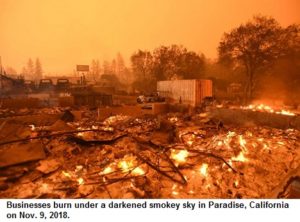

Australia experienced record summer heat in January of this year. The town of Port Augusta reached the hottest day since record-keeping began in 1962 with a temperature of 121, according to the Guardian.

The heat was so intense it caused bats to fall from trees, according to the Australian Broadcasting Corporation.

Carbon dioxide up 46%
Increasing amounts of carbon dioxide and other gases being released into the atmosphere by industry, transportation and energy production from burning fossil fuels are enhancing what’s known as the planet’s natural greenhouse effect.

Carbon dioxide is the most prevalent among all greenhouse gases produced by human activities, attributed to the burning of fossil fuels.

The atmospheric carbon dioxide level for March was 411.97 parts per million and continue to rise. It has now reached levels in the atmosphere not seen in 3 million years.

That’s an increase of 46% from just before the Industrial Revolution in the 1800s, when CO2 levels were around 280 parts per million. Levels began to rise when humans began to burn large amounts of fossil fuels to run factories and heat homes, releasing CO2 and other greenhouse gasses into the atmosphere.

Scientists say to keep a livable planet, we need to cut the level to 350 parts per million.

Rising seas
A consequence of higher temperatures is the melting of the polar ice caps, which is causing sea levels to rise. The world’s oceans have risen about an inch in the past 50 years due to melting glaciers alone, a study published this month in the journal Nature found.

The Earth’s glaciers are now losing up to 390 billion tons of ice and snow per year, the study suggests.

Global warming has caused over 3 trillion tons of ice to melt from Antarctica in the past quarter-century and tripled ice loss there in the past decade, another study, released in June, said.

More: Life after solving climate change: Not mud huts and gruel but clean air and warm homes

Source: Posted for “Earth Day 2019” on April 22, 2019; retrieved June 1, 2019 from: https://www.yahoo.com/now/earth-day-2019-high-temperatures-131301815.html

99.9999% is a special number! It is near to Six Sigma – process which 99.9999998% of products manufactured are statistically expected to be free of defects (3.4 defects per million). So this near sign of operational perfection means that it is “on us”. If we accept that us humans are the cause of Climate Change, then that means that us humans can stop the bad actions and do good ones. As reported here previously, we only have until 2030 as a fix window to try to effect change; (after that, there is no hope for a turn-around):

[A report from the] UN Intergovernmental Panel on Climate Change (IPCC) … asserts that if there are no mitigations [by 2030], then the catastrophic future that we all dread will be unavoidable. Life may continue on the planet, but the status quo would be no more. …

After [2030], there may not be any turning back from a Greenhouse planet. Once we accept this fact – the eventuality of the Climate Change Catastrophe – only then can we start to make efforts to address the truth: our “house is on fire”. …

Fixing Climate Change in the US or Canada is out-of-scope for this Go Lean movement; but we still need them to act. We also need Europe, China, India – all Big Polluters – and all countries of the world to act. We must stand on soap boxes, podiums and stages and tell the world – everyone must listen; we must make them listen. This is now everyone’s job, everyone’s responsibility. …

There is … a roadmap [for] reforming and transforming the Caribbean’s societal engines to abate Climate Change; [it] is possible; it is conceivable, believable and achievable.

The current US President, Donald Trump, is not a partner in the effort to abate Climate Change. He is a denier! He is also undermining legitimate scientific efforts – see Appendix VIDEO.

The start of Hurricane Season 2019 reminds us to recommit to the urgency to mitigate and remediate Climate Change. While we must Go Green here in the Caribbean, we must do more too. We must urge the rest of the world to Go Green. Otherwise, our small tropical islands will be the first to become extinct. It is that serious!

Let’s lean-in to this Go Lean roadmap to effect change here in the homeland and then lets urge the rest of the world to also do more. Yes, we can make a difference here in the homeland and around the world. 🙂

About the Book
The book Go Lean…Caribbean serves as a roadmap for the introduction and implementation of the technocratic Caribbean Union Trade Federation (CU), for the elevation of Caribbean society – for all member-states. This CU/Go Lean roadmap has these 3 prime directives:

  • Optimization of the economic engines in order to grow the regional economy to $800 Billion & create 2.2 million new jobs.
  • Establishment of a security apparatus to ensure public safety and protect the resultant economic engines.
  • Improve Caribbean governance to support these engines, including a separation-of-powers between the member-states and CU federal agencies.

The Go Lean book provides 370-pages of turn-by-turn instructions on “how” to adopt new community ethos, plus the strategies, tactics, implementations and advocacies to execute so as to reboot, reform and transform the societal engines of Caribbean society.

Download the free e-Book of Go Lean … Caribbean – now!

Who We Are
The movement behind the Go Lean book – a non-partisan, apolitical, religiously-neutral Community Development Foundation chartered for the purpose of empowering and re-booting economic engines – stresses that reforming and transforming the Caribbean societal engines must be a regional pursuit. This was an early motivation for the roadmap, as pronounced in the opening Declaration of Interdependence (Pages 12 – 13):

xi. Whereas all men are entitled to the benefits of good governance in a free society, “new guards” must be enacted to dissuade the emergence of incompetence, corruption, nepotism and cronyism at the peril of the people’s best interest. The Federation must guarantee the executions of a social contract between government and the governed.

xvi. Whereas security of our homeland is inextricably linked to prosperity of the homeland, the economic and security interest of the region needs to be aligned under the same governance. Since economic crimes … can imperil the functioning of the wheels of commerce for all the citizenry, the accedence of this Federation must equip the security apparatus with the tools and techniques for predictive and proactive interdictions.

xxiv. Whereas a free market economy can be induced and spurred for continuous progress, the Federation must install the controls to better manage aspects of the economy: jobs, inflation, savings rate, investments and other economic principles. Thereby attracting direct foreign investment because of the stability and vibrancy of our economy.

Sign the petition to lean-in for this roadmap for the Caribbean Union Trade Federation.

—————-

Appendix VIDEO – Climate Change: Why Trump’s panel on climate science is controversial – https://www.usatoday.com/videos/news/2019/02/27/climate-change-why-trumps-panel-climate-science-controversial/2998078002/

Posted February 26, 2019 – President Trump’s pick for leading a climate change panel is notorious for denying the science behind human-caused global warming. We dive into the counter-arguments on climate change. USA TODAY.

Share this post:
, ,
[Top]

Changing the Culture & Currency of Commerce

Go Lean Commentary

Change is hard!

It does not just happen – in the positive direction – by itself. Someone (or some group) has to make it happen; they inspire it, communicate it and compel it to manifest. This is especially true of “commerce”.

commerce
noun 2. the exchange or buying and selling of commodities on a large scale involving transportation from place to place.
Usage example: a major center of commerce; interstate commerce

We want to change Caribbean commerce. We want to make it Bigger, Better and Faster.

  • Bigger – Yes, we want to go from local markets to a regional Single Market. Imagine all 30 Caribbean member-states with 42 million people and the potential to produce $800 Billion in GDP.
  • Better – Free Market would be better for Caribbean economics as opposed to the restricted controls of extreme socialism; think Cuba. Yet, many other member-states have policies and practices that are socialistic in their priorities; i.e. Antigua & Barbuda does NOT allow for private property ownership on Barbuda. (This smells like communism).
  • Faster – We want more and more electronic commerce options. This means a comprehensive Marketplace & Social Media (www.myCaribbean.gov) plus the delivery-logistics options of the optimized Caribbean Postal Union (CPU), a subset of the Caribbean Union Trade Federation (CU).

Forging change in Caribbean commerce will require a change in culture … and currency.

Culture
The current Caribbean culture for “commerce” is bad! A previous blog-commentary vividly described this definition of culture:

This definition of culture refers to community ethos; this is defined in the book Go Lean … Caribbean (Page 20) as …

… the fundamental character or spirit of a culture [group or community], the underlying sentiment that informs the beliefs, customs, or practices of a group or society; the dominant assumptions of a people or period.

Culture allows “you” to overcome obstacles; endure the heavy-lifting of a turn-around; invest in future success based on promising talents; stay the course of a roadmap, rather than “giving up” and fleeing for the appearance of greener pastures elsewhere. Culture dictates devoting “blood, sweat and tears” to a community cause, to give a full measure of devotion. We can learn so much by examining organizations and communities of great accomplishments.
In another previous blog-commentary, it was detailed how one Caribbean member-state, the US Virgin Islands, suffers from higher consumer prices due to the challenging logistics of island life … plus the bad community ethos of rent-seeking. So implementing an e-Commerce eco-system should have a positive impact on reducing the cost of living for all citizens.

Currency
The Caribbean currency also needs attention. For the 30 member-states in the region, there are many different currencies: local dollars (i.e. Bahamas, Barbados, Cayman, Cuba, Dominican Republic, Jamaica and Trinidad), sub-regional dollars (Eastern Caribbean) and International Reserve monies (Euros and US dollars). The attention that the new Caribbean needs is a new currency for its commercial activities, especially e-Commerce.


Welcome to the Caribbean Dollar (C$).

As related in yet another previous blog-commentary

… the book Go Lean … Caribbean proposed a monetary-currency (Caribbean Dollar or C$) solution involving a cooperative of the Central Banks already in the region, dubbed the Caribbean Central Bank (CCB). …. There is already currency interdependence for many member-states [with the sub-regional currency and the International Reserve currencies]. …

Now, we can launch our own crypto-currency and electronic payments, clearing and settlements from this strong foundation. The missing ingredient, Trust, would be fulfilled.

Rolling out a regional currency will be a Big Idea and Big Undertaking. The book states (Page 127):

Currency Union / Single Currency
Apolitical technocratic monetary control, by the Caribbean Central Bank (CCB), and foreign trade with a globally respected currency allows for the methodical growth of the Caribbean economy without the risk of hyper-inflation and/or currency devaluations. The CU/CCB trades in Caribbean Dollars (C$) of which the currency’s reserves are a mixed-basket of strong foreign currencies: US Dollars, Euro, British Pound and Japanese Yen.

For us in the Caribbean to transform to a digital currency will require country-wide implementations. Fortunately, other countries have done this already … successfully. We would need to study (look, listen and learn) their experiences, good and bad. Consider the experience of the European country of Italy and their autonomous region/island of Sardinia:

VIDEO – Sardinia’s virtual currency – https://youtu.be/6qqKvctFZt0


CBS Sunday Morning
Published on Aug 6, 2017 – On the island of Sardinia, thousands of firms are not using traditional money to buy, sell, or pay salaries. They use Sardex, a virtual currency that allows businesses to earn and spend without relying on the Euro, or on banks that wouldn’t lend. Seth Doane reports on how the Mediterranean island is creating a new kind of wealth.

Subscribe to the “CBS Sunday Morning” Channel HERE: http://bit.ly/20gXwJT
Get more of “CBS Sunday Morning” HERE: http://cbsn.ws/1PlMmAz
Follow “CBS Sunday Morning” on Instagram HERE: http://bit.ly/23XunIh
Like “CBS Sunday Morning” on Facebook HERE: http://on.fb.me/1UUe0pY
Follow “CBS Sunday Morning” on Twitter HERE: http://bit.ly/1RquoQb
Get the latest news and best in original reporting from CBS News delivered to your inbox.
Subscribe to newsletters HERE: http://cbsn.ws/1RqHw7T
Get your news on the go! Download CBS News mobile apps HERE: http://cbsn.ws/1Xb1WC8
Get new episodes of shows you love across devices the next day, stream local news live, and watch full seasons of CBS fan favorites anytime, anywhere with CBS All Access. Try it free!
http://bit.ly/1OQA29B

“CBS Sunday Morning” features stories on the arts, music, nature, entertainment, sports, history, science, Americana and highlights unique human accomplishments and achievements. Check local listings for CBS Sunday Morning broadcast times.

———

Title: Italy’s B2B cashless Sardex currency set to take on the world

Directors of Sardex, a regional mutual credit network encompassing several thousand small and medium-sized businesses on the Italian island of Sardinia, are thinking big — even globally — but moving cautiously.

By: Nils Zimmermann

The basic idea behind Sardinia’s business-to-business (B2B) electronic credit system is a simple one, even if its execution is somewhat more complex.

The country’s first regional currency, Sardex, gives several thousand participating small- and medium-sized enterprises (SMEs) the opportunity to participate in a system of mutual credit and do business with other local companies.

Sardex’s business development team recruits a balanced portfolio of carefully screened Sardinian SMEs, such as electricians, plumbers, glaziers, carpenters, retailers, café owners, farmers, or small manufacturing businesses, to participate in the Sardex business network. Participating SMEs pay a flat annual fee to join. Once members, they gain access to new prospective customers and suppliers.

See the remaining of the article in the Appendix below.

The lessons-learned from the experiences of Sardinia are concise: currency and credit can be fostered regardless of the support of Big Banks or existing capital. This theme also aligns with previous Go Lean commentaries; see a sample list here:

https://goleancaribbean.com/blog/?p=16848 Two Pies: Economic Plan for a new Caribbean
https://goleancaribbean.com/blog/?p=16530 International efforts to de-Americanize the world’s economy
https://goleancaribbean.com/blog/?p=16210 Mitigating the Real Threat of Currency Assassins
https://goleancaribbean.com/blog/?p=15923 Industrial Reboot – Payment Cards 101
https://goleancaribbean.com/blog/?p=14248 Leading with Money Matters – Almighty Dollar vs Caribbean Dollars
https://goleancaribbean.com/blog/?p=13744 Rebooting Caribbean Economics: The Quest for a ‘Single Currency’
https://goleancaribbean.com/blog/?p=8704 Lessons from MetroCard – Model for the Caribbean Dollar
https://goleancaribbean.com/blog/?p=7034 The Future of Mobile Money Payment Systems

These previous commentaries all depict that it is conceivable, believable and achievable for the banking stakeholders in the Caribbean to deploy a new currency regime. In order to consider an e-Commerce culture, we must have the banking products in place … first. These innovations will bring so many benefits that we must embark on the roadmap to manifest these changes. We have already started … with the planning. Just notice these last 4 blog-commentaries published by the Go Lean movement:

Continuity of Business: Learning from Instagram’s system failures e-Commerce sites require good management to maintain systems up-time and to minimize downtime.
Wal-Mart now doing ‘Next Day’ deliveries Optimal logistics allow e-Commerce merchants to optimize the shopping experience.
Bad Ethos Retarding ‘New Commerce’ Bad government policy can curtail e-Commerce progress. For restaurants, a mandatory gratuity policy on take-out orders is just plain rent-seeking, a bad ethos.
Moving Forward with Transportation Solutions The Caribbean does not have the highway networks to facilitate cheap shipping options, but we can deploy a network of ferries in our Union Atlantic Turnpike scheme.

This commentary now – Culture and Currency – completes this series on the preparation for e-Commerce in the Caribbean. This whole collection depicts the heavy-lifting that regional stakeholders must do. Let’s lean-in for this effort. This is how we can make our homeland a better place to live, work and play. 🙂

About the Book
The book Go Lean…Caribbean serves as a roadmap for the introduction and implementation of the technocratic Caribbean Union Trade Federation (CU), for the elevation of Caribbean society – for all member-states. This CU/Go Lean roadmap has these 3 prime directives:

  • Optimization of the economic engines in order to grow the regional economy to $800 Billion & create 2.2 million new jobs.
  • Establishment of a security apparatus to ensure public safety and protect the resultant economic engines.
  • Improve Caribbean governance to support these engines, including a separation-of-powers between the member-states and CU federal agencies.

The Go Lean book provides 370-pages of turn-by-turn instructions on “how” to adopt new community ethos, plus the strategies, tactics, implementations and advocacies to execute so as to reboot, reform and transform the societal engines of Caribbean society.

Download the free e-Book of Go Lean … Caribbean – now!

Who We Are
The movement behind the Go Lean book – a non-partisan, apolitical, religiously-neutral Community Development Foundation chartered for the purpose of empowering and re-booting economic engines – stresses that reforming and transforming the Caribbean societal engines must be a regional pursuit. This was an early motivation for the roadmap, as pronounced in the opening Declaration of Interdependence (Pages 12 – 13):

xi. Whereas all men are entitled to the benefits of good governance in a free society, “new guards” must be enacted to dissuade the emergence of incompetence, corruption, nepotism and cronyism at the peril of the people’s best interest. The Federation must guarantee the executions of a social contract between government and the governed.

xvi. Whereas security of our homeland is inextricably linked to prosperity of the homeland, the economic and security interest of the region needs to be aligned under the same governance. Since economic crimes … can imperil the functioning of the wheels of commerce for all the citizenry, the accedence of this Federation must equip the security apparatus with the tools and techniques for predictive and proactive interdictions.

xxiv. Whereas a free market economy can be induced and spurred for continuous progress, the Federation must install the controls to better manage aspects of the economy: jobs, inflation, savings rate, investments and other economic principles. Thereby attracting direct foreign investment because of the stability and vibrancy of our economy.

Sign the petition to lean-in for this roadmap for the Caribbean Union Trade Federation.

————–

Appendix – Italy‘s B2B cashless Sardex currency set to take on the world Cont’d

Marketing help
All Sardex members have access to a searchable database of all the network’s members. They can post trade offers on Sardex’s web platform, and they’re encouraged to look for business opportunities within the network. Many join WhatsApp or Telegram groups comprising hundreds of members, to stay in touch and make each other aware of offers.

In addition, Sardex employs deal brokers whose job is to identify possible trading opportunities within the network. The brokers call up business owners to suggest deals, for example, by proposing plumbers, electricians, and builders they could cooperate with on a local construction project.

New business
“The point of Sardex is to facilitate new sales that would otherwise not occur, and make use of idle capacity,” said Giovanni Dini, who works on Sardex’s research and development team. “By joining Sardex, a participating SME should see growth in its transaction volume with other Sardinian businesses.”

Each new member’s annual fee is individually negotiated, and amounts to a small fraction of its estimated underutilized business capacity.

A mutual credit club
Members avoid paying each other for goods and services through normal financial channels. Instead of using cash, bank transfer, or standard credit cards to settle transactions, the euro-denominated amount (1 SRD equals €1, $1.16) can be recorded as a debt the buyer owes the Sardex network, not the seller. The seller, in turn, records a credit to their Sardex account. This credit is, in effect, a debt owed by Sardex to the seller.

In this way, Sardex members can buy and sell from each other even if they’re cash-strapped, or have difficulty gaining bank credit. As an added benefit, there is no interest charged or paid on Sardex account balances.

Participants are expected to keep their Sardex account level within individually agreed maximum credit or debt levels —usually a few thousand Euros. Members must buy as well as sell, and the net amount of credit or debt on purchases and sales made on their Sardex account should net to zero over the course of a year.

Limits on transaction volume
There are limits to the volume of trade a Sardex member can or should do, as a proportion of its total business volume. “We recommend no more than 30 percent of the total,” Dini told DW. “Most of that should be additional transactions, i.e., sales that would not have been made if the business hadn’t been a member of the Sardex network.”

A key reason for the 30 percent limit: Value-added taxes continue to be due on all transactions, and taxes are only payable in conventional bank Euros or in cash. If a business were to do 100 percent of its trade in Sardex credits, it would end up owing a lot of Euros to the Italian treasury, but would have no Euros in the bank to pay its taxes.

Tourism, construction and retail are among the sectors most active within the network.

Growing business volume
Dini said the total volume of business in Sardex credits transacted on Sardinia in 2016 was just over €67 million ($87 million). In 2017, it was nearly €81 million.

Those numbers don’t include transactions in 11 additional regions of Italy where Sardex has initiatied B2B credit clubs within the past couple of years, all of them using the same web- and app-based credit circuit technology platform Sardex developed for Sardinia, but each running its own separate regional B2B credit circuit. Veneto, Marche, and Lombardy are among the 11 regions.

“We’re looking at enabling interregional trade as well, i.e., transactions between credit circuit members from different regions,” Dini said.

“We have to be careful,” Dini added, “our top priority is increasing within-region trade. Sardex was founded as an instrument to stimulate jobs and trade within Sardinia, one of Italy’s economically depressed regions. If we open interregional trade too much, we’ll end up reproducing the same imbalances in trading relationships that already exist, with some regions being big net exporters and others running up debts as net importers.”

Is small beautiful?
In each region, Sardex has partnered with a local entrepreneur to run credit-club recruitment and operations. Transaction volumes outside Sardinia totalled €14 million in 2016; they nearly doubled to €26 million in 2017.

Given that Italy’s GDP in 2017 was about €1.72 trillion, these numbers are tiny in comparison. But members of one of these regional B2B credit clubs can see meaningful benefits at their own scale of activity, for example, a tradesman or tour operator might see an extra €30,000 a year in transactions.

Sardex had signed up a total of 3,896 SMEs as full members as of June 2018. The total SME membership for all 12 regional networks was 8,512. After Sardex, the top three regional networks at present are Marchex with 1,010 B2B members (2013 start), Linx with 894 (2015 start), and Venetex with 514 members (2016 start), respectively in the Marche, Lombardy and Veneto regions.

National and international interest
The Sardex model has been successful enough that it has attracted attention from all over Europe, and even beyond: “We’ve had non-government organisations, entrepreneurs, regional and municipal governments, and even one national government come to us and express interest in setting up a mutual credit network using our platform,” Dini said.

But Sardex’s founders and managers are moving carefully, to avoid over-extending their capacities, and to ensure that they have thoroughly worked out all aspects of the business on Sardinia first, the researcher and developer added.

The importance of the man on the ground
Some of the regional credit circuits Sardex has set up with partners in other regions are doing better than others. According to Dini, the most progress has been made in Italian regions which are already relatively prosperous, such as the Veneto and Marche regions.

Factors driving a regional network’s success, according to Dini, include, “the skill of the partner team on the ground, their dedication, and their luck. They need a good pitch for recruiting new members, they need to know their territory well, they need good salespeople.”

In addition, it makes a difference how big a region’s pool of SMEs is, Lombardy or Veneto have multiple times more businesses than Sardinia or other southern Italian regions, which makes member recruitment easier.

“The online credit circuit platform itself is only one element for building a successful mutual credit network,” Dini emphasised. “Going out and recruiting new members face-to-face, teaching them how to use the platform effectively, providing effective deal-brokerage services — these are essential too.”

Sardex has indicated it’s in touch with entrepreneurs in Germany and elsewhere to discuss the possibility of setting up a regional B2B credit circuit there as well, and the company hopes to be able to announce its first step beyond Italy sometime in early 2019.

“We’re seeing that our B2B credit circuit model is interesting to entrepreneurs in prosperous regions too, not only to businesses in economically depressed regions.”

Source: Deutsche Welle – German Business News Site – Posted September 5, 2018; retrieved May 25, 2019 from:  https://www.dw.com/en/italys-b2b-cashless-sardex-currency-set-to-take-on-the-world/a-45300395

———

Read more: Sardex: a model B2B credit club gives hope to Italy’s SMEs

Share this post:
, , , ,
[Top]

Wal-Mart now doing ‘Next Day’ deliveries

Go Lean Commentary

Wal-Mart, the Big-Box store, is now doing Next Day deliveries.

This is earth-shattering news! See the VIDEO here and the full story in the Appendix below.

VIDEO – Wal-Mart rolls out free next-day delivery service – https://finance.yahoo.com/video/walmart-rolls-free-next-day-132555700.html

The whole business model of Big-Box was bringing the customer to one destination, where they can find so many things in one place. Now, instead of the customer coming to the Big-Box, Wal-Mart – America’s largest employer – is coming to the customer.

The retail landscape is undergoing change; this is the actuality of the Retail Apocalypse as we have described in this previous commentary:

The underlying issue with the Retail Apocalypse is not the demand for retail products, it is the supply. Consumers are still demanding and consuming fashion and commodities, just not at shopping malls; e-Commerce is “all the rage”.

In a David versus Goliath analogy, Wal-Mart would be Goliath. (Amazon is equally giant-sized as an e-Commerce offering).

The Empire Strikes Back
The Retail Apocalypse change in this case is the Internet or e-Commerce (Electronic Commerce). But in the Appendix article, we see that the biggest brick-and-mortar retailer – the Empire: Wal-Mart – is striking back. They are using their Big-Box reality to foster an advantage for their business operations. This could be good for consumer choice. It is definitely good for modeling and learning-lessons for the Caribbean.

The topic of Big-Box is familiar for the movement behind the book Go Lean…Caribbean; it includes this excerpt (Page 201):

The Bottom Line on Big-Box Stores

A big-box store (also supercenter, superstore, or megastore) is a physically large retail establishment, usually part of a chain. The term sometimes also refers, by extension, to the company that operates the store. The store may sell general dry goods in which case it is a department store, or may be limited to a particular specialty (such establishments are often called “category killers”) or may also sell groceries. Typical architectural characteristics include the following:

  • Large, free-standing, rectangular, generally single-floor structure built on a concrete slab. The flat roof and ceiling trusses are generally made of steel, the walls are concrete block clad in metal or masonry siding.
  • The structure typically sits in the middle of a large, paved parking lot, sometimes referred to as a “sea of asphalt.” It is meant to be accessed by vehicle, rather than by pedestrians.
  • Floor space several times greater than traditional retailers in the sector, providing for a large amount of merchandise; in North America, generally more than 50,000 square feet, sometimes approaching 200,000 square feet. In cities, like London, where space is at a premium, stores are more likely to have two-plus floors [and smaller numbers overall].

Commercially, big-box stores can be broken down into two categories: general merchandise (examples include Wal-Mart and Target), and specialty stores (such as Menards, Barnes and Noble, or Best Buy) which specialize in goods within a specific range, such as hardware, books, or electronics. In recent years, many traditional retailers – such as Tesco and Praktiker – have opened stores in the big-box-store format in an effort to compete with big-box chains, which are expanding globally.

Some worry about the economic impact of big-box retailers on established downtown merchants or the sprawl-inducing impacts on character of such developments, as these stores are associated with heavy traffic near the stores.

This Big-Box retail concept is not just limited to the US mainland. Many of the Big-Box players have locations in many other countries …

… including the Caribbean. Wal-Mart’s Caribbean locations are only in Puerto Rico:

Source: https://corporate.walmart.com/our-story/our-locations#/united-states/puerto-rico

The business model prescribed in the Go Lean book envisions more of such installments in the Self-Governing Entities spread throughout the region; the book serves as a roadmap for the introduction and implementation of the technocratic Caribbean Union Trade Federation (CU), for the elevation of Caribbean economic engines. The book states (Page 234):

Self-Governing Entities
The CU will promote and administer all self-governing entities (SGE) throughout the region. This refers to scientific labs, industrial parks, commercial campuses, experimental hospitals, and even foreign bases. These facilities will not be subject of the laws of the local states of their address, [but] rather CU [federal regulations tied to different standards:] international, foreign sovereignty, or maritime laws; but depend on the local infrastructure to provide basic needs. Thereby creating jobs and economic activity.

Some mixed-use urban initiatives envisioned by the CU include: Main Street / Downtown Developments …

The Go Lean book also provides for effective strategies, tactics and implementations so as to be better in competition with Big-Box stores. See this excerpt here (Page 201):

Big-Box Competition: Cooperatives
The strategy of Big-Box stores is volume discounts. They purchase merchandise in bigger volumes that thereby garner bigger discounts from manufacturers. To compete against this reality, Main Street businesses need the benefits of aggregation and sharing their burdens with aligned firms. The formal Cooperatives movement allows such benefits.

Big-Box Competition: e-Commerce
Electronic commerce holds the promise of “leveling the playing field” so that small merchants can compete against larger merchants. To facilitate e-Commerce, purchased merchandise must get to their destinations as efficiently as possible. The CU’s implementation of the Caribbean Postal Union allows for better logistics for package delivery.

The Go Lean book (Page 57) has identified these trends – Globalization and Technology – as Agents of Change but it can frankly be described as Agents of Disruption or Agents of Destruction. For downtown merchants, Big-Box stores are disrupting their business models. For Big-Box merchants, e-Commerce is disrupting their business models. No matter your station on the retail industry vertical, there will always be competition and Agents of Disruption to contend with.

The lesson-learned for the planners for a new Caribbean is to always be On Guard for competition and to respond accordingly, with the best-practices for strategies, tactics and implementations. This is the Way Forward for retail operations in the Caribbean region. The roadmap describes how an optimized postal operation can be leveraged across 42 million people in the 30 Caribbean member-states, then we would be able to better deploy our e-Commerce offerings. The book states (Page 198):

Regional Postal Services – CPU
The CU will assume the responsibility for mail services in the region; (all member-state postal employees will become federal civil servants). The embrace of the Caribbean Postal Union allows for parcel mail to be optimally shipped and delivered throughout the region, with Customs considerations in place. The CPU will therefore ensure the fulfillment side of e-commerce, even allowing for computer applications for printing electronic stamps/barcodes for value savings.

This theme – fostering an e-Commerce eco-system – aligns with previous blog-commentaries; see these Amazon lessons here:

https://goleancaribbean.com/blog/?p=12291 Amazon’s e-Commerce – The Retailers’ Enemy
https://goleancaribbean.com/blog/?p=1416 Amazon’s Smartphone model for e-Commerce

We need to be On Guard for other disruptions as well. The Caribbean is losing in competition with the rest of the world. We continue to lose our young people to foreign shores. One report has listed the abandonment rate at 70 percent of the tertiary-educated population; many times, the expatriates leave seeking jobs and other economic opportunities. This is not a sustainable reality for us. We must do better.

Consider this Wal-Mart story and the lessons we glean; with more e-Commerce and delivery offerings, we can create jobs and grow our economy right here at home. This will help us make our homeland a better place to live, work and play.  🙂

About the Book
The book Go Lean…Caribbean serves as a roadmap for the introduction and implementation of the technocratic Caribbean Union Trade Federation (CU), for the elevation of Caribbean society – for all member-states. This CU/Go Lean roadmap has these 3 prime directives:

  • Optimization of the economic engines in order to grow the regional economy to $800 Billion & create 2.2 million new jobs.
  • Establishment of a security apparatus to ensure public safety and protect the resultant economic engines.
  • Improve Caribbean governance to support these engines, including a separation-of-powers between the member-states and CU federal agencies.

The Go Lean book provides 370-pages of turn-by-turn instructions on “how” to adopt new community ethos, plus the strategies, tactics, implementations and advocacies to execute so as to reboot, reform and transform the societal engines of Caribbean society.

Download the free e-Book of Go Lean … Caribbean – now!

Who We Are
The movement behind the Go Lean book – a non-partisan, apolitical, religiously-neutral Community Development Foundation chartered for the purpose of empowering and re-booting economic engines – stresses that reforming and transforming the Caribbean societal engines must be a regional pursuit. This was an early motivation for the roadmap, as pronounced in the opening Declaration of Interdependence (Pages 12 – 13):

xi. Whereas all men are entitled to the benefits of good governance in a free society, “new guards” must be enacted to dissuade the emergence of incompetence, corruption, nepotism and cronyism at the peril of the people’s best interest. The Federation must guarantee the executions of a social contract between government and the governed.

xv. Whereas the business of the Federation and the commercial interest in the region cannot prosper without an efficient facilitation of postal services, the Caribbean Union must allow for the integration of the existing mail operations of the governments of the member-states into a consolidated Caribbean Postal Union, allowing for the adoption of best practices and technical advances to deliver foreign/domestic mail in the region.

xxiv.  Whereas a free market economy can be induced and spurred for continuous progress, the Federation must install the controls to better manage aspects of the economy: jobs, inflation, savings rate, investments and other economic principles. Thereby attracting direct foreign investment because of the stability and vibrancy of our economy.

Sign the petition to lean-in for this roadmap for the Caribbean Union Trade Federation.

—————

Appendix – Walmart launches free next-day delivery with no membership fee
By: Julia La Roche, Yahoo Reporter

Walmart (WMT) just upped the stakes in the shipping wars with its latest offering — free next-day delivery with no membership fee.

Shoppers on Walmart.com can access NextDay delivery via a stand-alone function where they can browse up to 220,000 of the most commonly purchased items, everything from diapers to cleaning products to toys and electronics.


“Think of things like Bounty paper towels, some of our Great Value paper lunch plates, flushable wipes, diapers, dog food. Everything from that to a Little Tikes toy set,” Janey Whiteside, Walmart’s chief customer officer, told Yahoo Finance. “It’s a combination of items that you forget that you need and you need them in a rush. If I’m a busy mom and I look at the diary and realize that tomorrow I have a kid’s birthday party and I’ve forgotten to buy a present, there are things in there for that. There are consumable items. You’ll see a range of things that we know the customers are looking for.”

Orders of $35 and up are eligible for NextDay delivery, and the offering will debut in Phoenix and Las Vegas before expanding to Southern California.

“It will roll out gradually over the coming months, with a plan to reach approximately 75% of the U.S. population this year, which includes 40 of the top 50 major U.S. metro areas,” Marc Lore, CEO of Walmart e-Commerce U.S., wrote in a blog post.

In the blog, Lore said the service “isn’t just great for customers, it also makes good business sense.”

“Contrary to what you might think, it will cost us less – not more – to deliver orders the next day,” he wrote.

The reason it won’t cost as much is that the items will ship from one fulfillment center nearest the customer, he explained.

“This means the order ships in one box, or as few as possible, and it travels a shorter distance via inexpensive ground shipping. That’s in contrast to online orders that come in multiple boxes from multiple locations, which can be quite costly,” Lore wrote.

That said, some are still skeptical about the expense associated with the new offering.

“My reaction is that it’s awesome for customers. For you and me, it’s great. We get more options, and it’s going to be faster to get anything we order,” Sucharita Kodali, a retail analyst at Forrester, told Yahoo Finance, before adding, “Is it great in the long-term from an expense standpoint? Is this the most efficient way? I think that question hasn’t been answered.”

Walmart’s NextDay lets customers shop up to 220,000 of the items most frequently purchased items, ranging from diapers and laundry detergent to toys and electronics.

Kodali doesn’t think shoppers are likely to turn down free, expedited shipping.

“The shopper doesn’t value it for what it is — an incredibly expensive endeavor,” Kodali said.

To Walmart’s credit, though, she said the retailer is approaching it in a “smart way,” by launching in a couple of cities with a finite number of eligible items and a threshold of $35.

“[They’re] trying not to lose their shirt while doing it,” she said, later adding, “All of those are incredibly important to making it successful.”

King Kong v. Godzilla
Walmart’s move is helpful in the “King Kong versus Godzilla fight” Walmart is in with Amazon, Kodali added.

In late April, Amazon (AMZNsaid it would spend $800 million in the second quarter to speed up its delivery to one day from two for all its Amazon Prime members. Presently, the e-commerce giant offers free two-day shipping and same-day delivery on $35 orders for eligible items in specific areas. A Prime membership costs $119 per year.

Shortly after the Amazon news broke, Walmart hinted at its future plans around delivery.

“Both retailers are climbing up the next rung of immediacy. It’s another form of convenience,” Laura Kennedy, a vice president at Kantar Consulting, said. “Not every shopper is going to need it or think it’s the most convenient option.”

Forrester’s Kodali sees Walmart’s move as more about maintaining wallet-share and not surrendering that opportunity to Amazon.

“I think that’s really the crux of what this is,” she said.

What’s more, there’s also the potential for Walmart to attract a different shopper from that core shopper.

Kodali believes that Walmart’s online grocery pickup and delivery, especially with the convenience and broad organic offering, has already broadened the retailer’s appeal. The new NextDay offering is billed as a “complement” to Walmart’s same-day grocery delivery, which is expected to reach 1,600 stores by year-end.

“This has the ability to broaden the appeal. It’s all about incremental new customers,” Kodali said.

Julia La Roche is a finance reporter at Yahoo Finance. Follow her on Twitter.

Source: Yahoo Finance – May 14, 2019; retrieved May 22, 2019 from: https://finance.yahoo.com/news/walmart-free-next-day-delivery-040200955.html?.tsrc=notification-brknews

Share this post:
, ,
[Top]

Bad Ethos Retarding ‘New Commerce’

Go Lean Commentary

Unlike most places, the Bahamas mandates that restaurants charge 18% gratuity … even for take-out operations. This is extreme, as gratuity is universally accepted as remuneration for the Wait Staff. But when the mode of operation is “take-out”, gratuity is superfluous – there is no Wait Staff.
Further, this “take-out gratuity” it is an example of …

rent-seeking – extracting uncompensated value from others without making any contribution – getting something for nothing.

To mandate gratuity under this extreme is really a bad community ethos – fundamental character or spirit of a culture; the underlying sentiment that informs the beliefs, customs, or practices of a group or society.

Remember, this old maxim:

The chickens have come home to roost
This expression was renewed by Malcolm X after the assassination of President John F. Kennedy, The adage dates back to at least 1810 when the English poet Robert South wrote, “Curses are like young chickens; they always come home to roost”. From an agricultural expression, it is true, domesticated foul may wander about all day – think Free Range – but in the evening, they do return to their default nesting location, the hen-house. This saying is comparing a person’s evil or foolish deeds to chickens. If a person does wrong, the “payback” might not be immediate. But at some point, at the end of the day, those “chickens” will come home to roost. “One has to face the consequences of one’s past actions”.

The lesson-learned is simple: we are NOT entitled to other people’s money.

Now, there is a New Economy, the bad attitudes about other people’s money have repercussions and consequences. Foolish policies like mandatory gratuity on take-out dinning are not tolerated under the New Economy regime. Places like the Bahamas – and other Caribbean member-states – must reform and transform.

The New Economy has brought forward a “Sharing Eco-System” in which industrial trends like ride-sharing, home-sharing and delivery assignments have emerged. There is now the concept of “ghost” restaurants – delivery services only; see details in the Appendices below.

Welcome to the Gig Economy.

Want a piece of this?
End mandatory gratuity on Restaurant Take-out activities!

All of these developments have created new jobs, new businesses and new opportunities. If we want a piece of this New Economy, then we have to adapt; we must rid ourselves of the bad community ethos and adopt some new ones. This theme – positioning our society for the New Economy – aligns with previous commentaries; see a sample list here:

https://goleancaribbean.com/blog/?p=17040 Uber: A Better ‘Mousetrap’
https://goleancaribbean.com/blog/?p=13916 Model of ‘Gig Economy’ – Mother’s Love in Haiti
https://goleancaribbean.com/blog/?p=10220 Waging a Successful War on Rent
https://goleancaribbean.com/blog/?p=8262 UberEverything in Africa – Model of ‘Gigs’
https://goleancaribbean.com/blog/?p=7646 Going from ‘Good to Great’
https://goleancaribbean.com/blog/?p=5542 Economic Principle: Bad Ethos of Rent-Seeking
https://goleancaribbean.com/blog/?p=2571 More Business Travelers flock to Airbnb

The Caribbean region must prepare and foster opportunities and dictate economic progress, so we must “weed out” bad practices and/or “rent” in our community ethos; instead we must pursue better ethos, as in the Greater Good. The book  Go Lean…Caribbean defines this attribute as follows (Page 37):

“The greatest good to the greatest number of people which is the measure of right and wrong”. – Jeremy Bentham (1748 – 1832).

There are repercussions and consequences of bad community ethos.  For one, people feel cheated, they leave-flee-abandon their homeland!

People may love their homeland, but seek refuge in more progressive societies, on foreign shores. The reasons why people leave in the first place have been identified as “Push and Pull”:

  • “Push” refers to the reasons people who feel compelled to leave, to seek refuge in a foreign land. “Refuge” is an appropriate word; because of societal defects – like unearned entitlements – many from the Caribbean must leave as refugees – think DisabilityDomestic-abuseMedically-challenged and LGBT – for their life, liberty and pursuit of happiness.
  • “Pull”, on the other hand refers to the lure of a more prosperous life abroad; many times our people are emigrating to communities where there are less rent-seeking and Crony-Capitalism practices.

If only we can mitigate these “push and pull” factors, then we can dissuade our societal abandonment and have a chance of reforming and transforming our societal engines in the homeland. Having an entitled attitude towards other people’s money is a bad attitude. The reality of the New Economy is premised on good business values and good societal values: Win-Win.

A Win-Win for Caribbean stakeholders is the motive for this movement behind the Go Lean book. We want to change – reform and transform – our Caribbean society by optimizing the eco-systems for economics, security and governance.

Yes, we can …

… it is heavy-lifting, but conceivable, believable and achievable that we can make changes and succeed in elevating our communities. This is about bad attitudes and bad habits. We have seen this before. The Go Lean book relates (Page 20):

Change is not easy …

Just ask anyone attempting to quit smoking. Not only are there physiological challenges, but psychological ones as well, to the extent that it can be stated with no uncertainty that “change begins in the head”. In psycho-therapy the approach to forge change for an individual is defined as “starting in the head” (thoughts, visions), penetrating the heart (feelings, motivations) and then finally manifesting in the hands (actions). This same body analogy is what is purported in this book for how the Caribbean is to embrace change – following this systematic flow:

  • Head – Plans, models and constitutions
  • Heart – Community Ethos
  • Hands – Actions, Reboots, and Turn-arounds

Leaning in and going lean for Caribbean regional integration hereto requires engaging all three body parts, figuratively speaking, none more important than the heart. The people of the Caribbean must change their feelings about elements of their society – elements that are in place and elements missing. This is referred to as “Community Ethos”.

Let’s get started. Let’s quit smoking, rent-seeking and all other bad habits and practices. This is how we can make our homeland a better place to live, work and play. 🙂

About the Book
The book Go Lean…Caribbean serves as a roadmap for the introduction and implementation of the technocratic Caribbean Union Trade Federation (CU), for the elevation of Caribbean society – for all member-states. This CU/Go Lean roadmap has these 3 prime directives:

  • Optimization of the economic engines in order to grow the regional economy to $800 Billion & create 2.2 million new jobs.
  • Establishment of a security apparatus to ensure public safety and protect the resultant economic engines.
  • Improve Caribbean governance to support these engines, including a separation-of-powers between the member-states and CU federal agencies.

The Go Lean book provides 370-pages of turn-by-turn instructions on “how” to adopt new community ethos, plus the strategies, tactics, implementations and advocacies to execute so as to reboot, reform and transform the societal engines of Caribbean society.

Download the free e-Book of Go Lean … Caribbean – now!

Who We Are
The movement behind the Go Lean book – a non-partisan, apolitical, religiously-neutral Community Development Foundation chartered for the purpose of empowering and re-booting economic engines – stresses that reforming and transforming the Caribbean societal engines must be a regional pursuit. This was an early motivation for the roadmap, as pronounced in the opening Declaration of Interdependence (Pages 12 – 13):

xi. Whereas all men are entitled to the benefits of good governance in a free society, “new guards” must be enacted to dissuade the emergence of incompetence, corruption, nepotism and cronyism at the peril of the people’s best interest. The Federation must guarantee the executions of a social contract between government and the governed.

xvi. Whereas security of our homeland is inextricably linked to prosperity of the homeland, the economic and security interest of the region needs to be aligned under the same governance. Since economic crimes … can imperil the functioning of the wheels of commerce for all the citizenry, the accedence of this Federation must equip the security apparatus with the tools and techniques for predictive and proactive interdictions.

xxi. Whereas the preparation of our labor force can foster opportunities and dictate economic progress for current and future generations, the Federation must ensure that educational and job training opportunities are fully optimized for all residents of all member-states, with no partiality towards any gender or ethnic group. The Federation must recognize and facilitate excellence in many different fields of endeavor, including sciences, languages, arts, music and sports. This responsibility should be executed without incurring the risks of further human flight, as has been the past history.

xxiv.  Whereas a free market economy can be induced and spurred for continuous progress, the Federation must install the controls to better manage aspects of the economy: jobs, inflation, savings rate, investments and other economic principles. Thereby attracting direct foreign investment because of the stability and vibrancy of our economy.

xxvi.  Whereas the Caribbean region must have new jobs to empower the engines of the economy and create the income sources for prosperity, and encourage the next generation to forge their dreams right at home, the Federation must therefore foster the development of new industries, like that of ship-building, automobile manufacturing, prefabricated housing, frozen foods, pipelines, call centers, and the prison industrial complex. In addition, the Federation must invigorate the enterprises related to existing industries like tourism, fisheries and lotteries – impacting the region with more jobs.

Sign the petition to lean-in for this roadmap for the Caribbean Union Trade Federation.

——————

Appendix – What Are Ghost Restaurants?

If you’re tuned into restaurant trends, you may have heard of ghost restaurants. These new types of foodservice establishments are increasing in popularity as more and more restaurateurs decide to depart from traditional brick-and-mortar establishments and focus on delivery instead. If you want to learn more about what ghost restaurants are, how they work, and how you can start a successful one, keep reading.

What Is a Ghost Restaurant?
A ghost restaurant, also known as a virtual restaurant or delivery-only restaurant, is a foodservice establishment that offers take-out only. These “ghostly” eateries don’t have a storefront, so customers can’t come to pick up their own food. Ghost restaurants deliver food directly to their patrons, often through the use of third-party delivery services.

Mostly Made-to-Order
Generally, virtual restaurants function just like traditional restaurants, in that customers’ food is prepared once they order it. As a result, many establishments offer a lot of customization options for their menu items.

Where Do Ghost Restaurants Work Best?
This type of foodservice model is especially great for high-rent areas. Instead of hoping to find a prime location to draw foot traffic, restaurateurs can establish their virtual restaurant in any neighborhood they see fit, so long as their delivery service can easily access customers.

Making the Most of Their Space
Many popular fast-casual establishments in cities are bound by the requirement for seating and waiting space, even though a large percentage of their customers aren’t dining in. So, offering only delivery helps virtual restaurants avoid the problem of underutilized space.

Advantages of Ghost Restaurants
Here are some things that ghost restaurants can do that traditional eateries can’t:

  • Flexibility of concept: Being app- or web-based means that you can change your menu whenever you like, without having to worry about updating signage or printed materials.
  • Adjustable menu: If an ingredient becomes too expensive or is no longer accessible in your area, you can easily swap out your menu items to suit what is available to you.
  • Smaller financial investment: Think about all the expensive elements that don’t apply to virtual restaurants: decor, signage, dinnerware, and additional staff members to serve as servers or hosts.
  • Opportunity for experimentation: Ghost restaurants are the perfect opportunity to experiment with new concepts, because you can easily scrap ideas that aren’t working.

What Is a Ghost Restaurant Kitchen Like?
In virtual restaurants, the kitchen is where a lot of your investment goes. Because you don’t have to allow square footage for a dining area, you have much more room to customize your kitchen space. Depending on your budget, you can opt for some specialized cooking equipment that you probably never had room for in a traditional restaurant.

Using One Kitchen for Several Concepts
You can even own multiple ghost restaurants and operate them out of the same kitchen. Especially if your menus have ingredient overlap, you can prepare food for two separate concepts in one efficient space.

Source: Retrieved May 21, 2019 from: https://www.webstaurantstore.com/blog/2348/what-are-ghost-restaurants.html

————–

Appendix VIDEO – How Ghost Restaurants are Changing the Food Industry – https://youtu.be/59sPK73YjA0

Cheddar
Published on Feb 23, 2019 –
With the rise of delivery services has come the rise of Ghost Restaurants which will cook your food and deliver it, but you’d never be able to order “for here”.

Subscribe to Cheddar on YouTube: http://chdr.tv/subscribe

Connect with Cheddar!
On Facebook: http://chdr.tv/facebook
On Twitter: http://chdr.tv/twitter
On Instagram: http://chdr.tv/instagram
On Cheddar.com: http://chdr.tv/cheddar

Share this post:
, , ,
[Top]

Moving Forward with Transportation Solutions

Go Lean Commentary

Its been 150 years exactly …
… we cannot just let that milestone for the Union Pacific Railroad go by without some acknowledgement … and reflection.  This history is more than just the story of a train, or a company; its an economic solution, one that was the inspiration for study and modeling, while the writers were in Omaha, Nebraska composing the 2013 book Go Lean…Caribbean. See this excerpt:

The Bottom Line on the Union Pacific Railroad
The Union Pacific Railroad, headquartered in Omaha, Nebraska, is the largest railroad network in the US. It has more than 44,000 employees, more than 8,000 locomotives, and runs on 31,900 route-miles in 23 states west of Chicago and New Orleans. The original company, prior to later uniting with the Central Pacific Railroad, was incorporated on July 1, 1862 under an act of Congress entitled Pacific Railroad Act of 1862. The act was approved by President Abraham Lincoln and it provided for the construction of railroads from the Missouri River to the Pacific as a war measure for the preservation of the Union. It was constructed westward from Council Bluffs, Iowa (across the Missouri from Omaha) to meet the Central Pacific line, which was constructed eastwardly from San Francisco Bay. The two lines were joined together at Promontory Summit, Utah, fifty three miles west of Ogden on May 10, 1869, hence creating the first transcontinental railroad in North America. – Book Go Lean…Caribbean Page 205.

The Union Pacific Railroad and the City of Omaha was featured in the Go Lean book as a model for the transportation solutions that would allow the Caribbean region to better move people and goods around the member-states.

There was a lot of fanfare, celebration, pomp-and-pageantry this month for the 150th anniversary. See the news report in this company-produced VIDEO here and in the related article in the Appendix below:

VIDEO – Union Pacific’s Transcontinental Railroad Completion 150th Anniversary Celebration – https://youtu.be/ZOWoPuVSbY0

Union Pacific
Published on May 17, 2019
– Reflections of Union Pacific’s celebration May 9, 2019, marking the 150th anniversary of the transcontinental railroad’s completion.

Yes, there is the need for transportation solutions in the Caribbean. Our failings – unaffordable to bring stay-over tourists to our shores and excessive costs of imported goods – have imperiled our progress in so many ways. We have consistently reported this theme in previous Go Lean commentaries; see a sample list here:

https://goleancaribbean.com/blog/?p=16645 Bad Partners – Cruise Lines Interactions
https://goleancaribbean.com/blog/?p=14767 Caribbean less competitive due to increasing aviation taxes
https://goleancaribbean.com/blog/?p=14761 Flying the Caribbean Skies – New Regional Options
https://goleancaribbean.com/blog/?p=12959 The Defective Shipping Law ‘Jones Act’ needs to be scraped
https://goleancaribbean.com/blog/?p=12322 Ferries 101: Economics, Security and Governance
https://goleancaribbean.com/blog/?p=12146 Commerce of the Seas – Shipbuilding Model – We need Ferries
https://goleancaribbean.com/blog/?p=9179 Snowbirds Tourism – On the 1st day of Autumn, time to head South
https://goleancaribbean.com/blog/?p=6867 How to address high consumer prices: A Ferry Transport System

The book Go Lean … Caribbean, serves as a roadmap for the introduction and implementation of the technocratic Caribbean Union Trade Federation (CU), to facilitate a connected and integrated Single Market. This reality would mandate that we connect all the communities; the same as blood vessels would connect all the organs of a single “body”. Other Single Markets around the world have efficient transportation solutions; think rails and highways in the US and in Western Europe. The book features this one advocacy (Page 205) for implementing Caribbean transportation solutions. This advocacy is entitled: “10 Ways to Improve Transportation“. These “10 Ways” include the following highlights, headlines and excerpts:

1 Lean-in for the Caribbean Single Market – Ratify treaty for the CU.
Embrace the advent of the Caribbean Single Market & Economy Initiative of the Caribbean Union Trade Federation (CU). This will allow for the unification of 42 million people into one market, creating the demand to better move people and goods among the region and import-export to/from other regions. The CU will allow for the emergence of capital markets to sell municipal bonds for Transportation Authorities to raise project funds, as was the case for the Union Pacific Railroad. Bonds are ideal as their long term nature is ideal for slow harvesting returns from transportation solutions.
2 Turnpike: Pneumatic Capsule Pipeline (PCP)

The “Union Atlantic” Turnpike, (modeled after the Union Pacific efforts in the US from 1862), is a big initiative of the CU to logistically connect all CU member-states for easier transport of goods and passengers. The Turnpike is virtual; made up of many physical transportation modes envisioned for the region: Pipeline, Ferry, Highways, and Railroad.

PCP refers to large pneumatic tubes that can handle containers and trailers through underwater, under-ground and above-ground pipelines powered by magnetic levitation systems (ILM). This is modeled, after the freight PCP project envisioned for New York City [187], and the English Channel Tunnel for passengers and cargo.

The CU will construct underwater tunnels for narrow straits in the region, like the 7 miles between Trinidad & Venezuela.

3 Turnpike: Ferries

For the most part, the CU member-states are islands thereby allowing for a viable means of transportation via sea navigation. By deploying ferries, the CU facilitates passenger travel for business and leisure, (see model [of Ferry operations in] Appendix IC on Page 280).

4 Turnpike: Land Highways
5 Turnpike: Railroads
6 Aviation Coordination, Promotion and Safety Regulations
The CU mandate is to facilitate the region’s economics through transportation solutions. Aviation plays a key role, and so there is the need for regional coordination and promotion of the region’s domestic and foreign air carriers. The CU will execute these functions along with Air Traffic Control and Safety regulations, thus mirroring both the FAA & National Transportation Safety Board (NTSB) in the US. The CU will be vested with subpoena and prosecutorial powers.
7 CNG Public Buses and Electric Street Cars with Handicap Access
8 Taxi Administration: Emission-free Inducements & Electronic Payments Systems (EPS)
9 Local Automaker(s)
10 Bicycle Friendly

According to the Go Lean book, the foregoing VIDEO, and the article in the Appendix below, the Union Pacific Railroad was more than just a railroad, it was a transportation and technology eco-system that transformed the American continent. This was a manifestation of the technology of the day, the best-of-the-best of the machinery and methods that defined the greatest industrial might in the history of modern man. The Go Lean book states (Page 57) this succinct reflection on transport technology:

Technological change is more than just [today’s] internet & communications (ICT); though this field is dynamically shifting the world. There are also industrial changes taking place, as in more efficient manufacturing methods, automation-robotics, and transportation options … in response to Climate Change. For example, the CU envisions the supply and demand for Fast Ferries in the region. The modern offerings allow for 40 – 50 (nautical) mph speeds on calm waters. There are many CU destinations that can be serviced within 2 – 3 hours using this mode. This effort will be championed by the CU Turnpike initiative.

The review of the history of the Union Pacific Railroad has done one more thing:

Provide a glimpse of a Caribbean version of a transformative transportation solution. (Consider the Canadian ferry example in the photo here).

Today, the Caribbean is 30 separate and distinct lands with 42 million people; we are 30 separate and distinct member-states; but instead, we need to be one community, a Single Market. Transportation can foster and furnish the needed unity in our neighborhood; this is how we can move forward in our quest to elevate the societal engines: economics, security and governance. This point was eloquently detailed in a previous blog-commentary:

The roadmap calls for the CU to navigate the changed landscape of the globalized air transport industry. There is the need for regional integration, administration, and promotion for Caribbean air travel among local and foreign carriers. The book posits that transportation and logistics empower the economic engines of a community. There must be air carrier solutions to service the transportation and tourism needs of the Caribbean islands. This point is fully appreciated by Caribbean tourism stakeholders; the book relates that the region’s Hotel and Tourism Association channel the vision of Robert Crandall, former Chairman of American Airlines, who remarked at a Caribbean Hotel and Tourism Investment Conference in May 2010 that the region is uniquely dependent on tourism:

    “Everyone involved in travel and tourism knows that our [airline] industry is immensely important to the world economy, generating and supporting – either directly or indirectly – about one in eleven jobs worldwide. Here in the Caribbean, it is even more important. On a number of islands, travel and tourism accounts for more than 50% of all employment, and on some islands for more than 75%. Overall, about 20% of Caribbean employment is travel and tourism dependent – something on the order of 2.5 million jobs.” – Book ‘Go Lean … Caribbean’ – Page 60.

Go Lean asserts that air travel options must be optimized to impact Caribbean society – thus the need for more regional coordination, regulation and promotion of the Caribbean’s aviation industry. New models are detailed in the book in which tourism can be enhanced with “air lifts” to facilitate Caribbean events, and “Air Bridges” to allow for targeting High Net Worth markets. This roadmap also introduces the Union Atlantic Turnpike to offer more transportation solutions (ferries, toll roads, railways, and pipelines) to better facilitate the efficient movement of people and cargo.

Yes, we can …

A more connected region is conceivable, believable and achievable. This is how we can make our homeland a better place to live, work and play. 🙂

About the Book
The book Go Lean…Caribbean serves as a roadmap for the introduction and implementation of the technocratic Caribbean Union Trade Federation (CU), for the elevation of Caribbean society – for all member-states. This CU/Go Lean roadmap has these 3 prime directives:

  • Optimization of the economic engines in order to grow the regional economy to $800 Billion & create 2.2 million new jobs.
  • Establishment of a security apparatus to ensure public safety and protect the resultant economic engines.
  • Improve Caribbean governance to support these engines, including a separation-of-powers between the member-states and CU federal agencies.

The Go Lean book provides 370-pages of turn-by-turn instructions on “how” to adopt new community ethos, plus the strategies, tactics, implementations and advocacies to execute so as to reboot, reform and transform the societal engines of Caribbean society.

Download the free e-Book of Go Lean … Caribbean – now!

Who We Are
The movement behind the Go Lean book – a non-partisan, apolitical, religiously-neutral Community Development Foundation chartered for the purpose of empowering and re-booting economic engines – stresses that reforming and transforming the Caribbean societal engines must be a regional pursuit. This was an early motivation for the roadmap, as pronounced in the opening Declaration of Interdependence (Pages 12 – 13):

xi. Whereas all men are entitled to the benefits of good governance in a free society, “new guards” must be enacted to dissuade the emergence of incompetence, corruption, nepotism and cronyism at the peril of the people’s best interest. The Federation must guarantee the executions of a social contract between government and the governed.

xvi. Whereas security of our homeland is inextricably linked to prosperity of the homeland, the economic and security interest of the region needs to be aligned under the same governance. Since economic crimes … can imperil the functioning of the wheels of commerce for all the citizenry, the accedence of this Federation must equip the security apparatus with the tools and techniques for predictive and proactive interdictions.

xxiv. Whereas a free market economy can be induced and spurred for continuous progress, the Federation must install the controls to better manage aspects of the economy: jobs, inflation, savings rate, investments and other economic principles. Thereby attracting direct foreign investment because of the stability and vibrancy of our economy.

Sign the petition to lean-in for this roadmap for the Caribbean Union Trade Federation.

————

Appendix – Title: Golden Spike 150th Anniversary – 1869 – Omaha, NE

The communities of Council Bluffs, Iowa, and Omaha, Nebraska, would forever be changed by a single decision made by President Abraham Lincoln in 1863. That was the year the president named Council Bluffs as the eastern terminus for Union Pacific, altering that community and Omaha — and, in fact, every community — along the railroad’s western path.
Despite this presidential declaration, there were other forces at play. Union Pacific’s first vice president and general manager, Thomas C. “Doc” Durant, used his influence to make Omaha — and not Council Bluffs, Iowa — the actual starting point. Union Pacific marked the occasion with a groundbreaking ceremony at the Omaha settlement in Nebraska Territory Dec. 2, 1863. A lack of funding delayed the project’s beginning for a short while, but on July 10, 1865, the first rail was finally laid. In 1872, the two communities were united for the first time when a railroad bridge was completed across the Missouri River.

The railroad’s effect on both communities has been extraordinary. Council Bluffs grew from a small, isolated Missouri River town to Iowa’s fifth largest city. The same robust growth has taken place in Omaha. Settlers and immigrants poured into the area beginning more than a century ago, and today this vibrant city has a population of nearly 500,000. This growth was spurred in great part by the passage of the Homestead Act in 1862, and the transcontinental railroad’s completion in 1869. Omaha has been Union Pacific’s operational headquarters since the 1860s, and its 19-story headquarters in the downtown area employs nearly 4,000 employees. Omaha also is home to UP’s Harriman Dispatching Center, one of the country’s largest and most technologically advanced dispatching facilities.

Source: Retrieved May 18, 2019 from: https://www.up.com/goldenspike/omaha-promontory.html

Share this post:
, , ,
[Top]