Tag: Civil Rights

A Lesson in History – During the Civil War: Principle over Principal

Go Lean Commentary

Where do you consider to be home? How far are you willing to go to protect/defend that home?

Dating back to the Magna Carta, a concept emerged in jurisprudence in which a man’s home was considered his castle, and should thusly be vigorously defended – Stand Your Ground. For this reason foreign occupying armies have always encountered vicious insurgencies from citizens of a homeland.

The movement and underlying book Go Lean … Caribbean posits that it is better to “prosper where planted“, that natives of a land are willing to shed blood, sweat and tears to sustain their homelands. This is one additional reason to discourage emigration, brain drain and societal abandonment.

Even the Bible speaks of this paradigm in the Gospel account by John in Chapter 10, verses 11 – 13 as follows:

11“I am the good shepherd; the good shepherd lays down His life for the sheep. 12“He who is a hired hand, and not a shepherd, who is not the owner of the sheep, sees the wolf coming, and leaves the sheep and flees, and the wolf snatches them and scatters them. 13“He flees because he is a hired hand and is not concerned about the sheep.…

There is an important lesson to learn in considering the history of the American Civil War. The war was fought over the issue of slavery. This was an ugly institution for those condemned as slaves. In the United States, that ugly disposition extended beyond the slaves themselves to the entire Black race. Though individuals could be set free, laws in the country could push them back into slavery without any due process. This was the case with the “Fugitive Slave Act of 1850”. Any Black person could be detained as a runaway slave and returned to any alleged Slave Master in the South; no matter any proof or the truth, or lack there of. In many jurisdictions, a Black man could not even testify against white people. (This was the basis for the autobiographical book – by Solomon Northup – and movie “12 Years A Slave” – see trailer in the Appendix-VIDEO A below).

To be Black in the America of those days, one “could not win, could not break-even and could not get out of the game”. There was no neutral destination in America. The optimal option was the only option, to work towards the end of slavery.

For this reason many Blacks joined the war effort, at great sacrifice to themselves and their community. This was a matter of principle! There is an important lesson for the Caribbean from this history:

CU Blog - A Lesson in History - During the Civil War - Principle not Principal - Photo 2The 54th Regiment Massachusetts Volunteer Infantry was an infantry regiment that saw extensive service in the Union Army during the American Civil War. The regiment was one of the first official African-American units in the United States during the Civil War.[1] The regiment was authorized in March 1863 by the Governor of Massachusetts, John A. Andrew. Commanded by Colonel Robert Gould Shaw, it was commissioned after the passage of the Emancipation Proclamation.[2] Secretary of War Edwin M. Stanton decided white officers would be in charge of all “colored” units.[3] Andrew selected Robert Gould Shaw to be the regiment’s colonel and Norwood Penrose Hallowell to be its lieutenant colonel.[2] https://en.wikipedia.org/wiki/54th_Massachusetts_Infantry_Regiment retrieved October 14, 2015.

The Civil War was fought between 1861 and 1865; 625,000[5] Americans died…on both sides (365,000 total dead [4] on the Union side; 260,000 total dead on the Confederacy side). This spilled blood was a great sacrifice and should not be forgotten or undervalued. The vast majority of the deaths were White people. As many died, their surviving family members assigned blame to those of the Black community, as depicted here:

In July 13 – 16, 1863, African Americans on the New York City’s waterfront and Lower East Side were beaten, tortured, and lynched by white mobs angered over conscription for the Union war effort. [20] These mobs directed their animosity toward blacks because they felt the Civil War was caused by them. However, the bravery of the 54th would help to assuage anger of this kind…

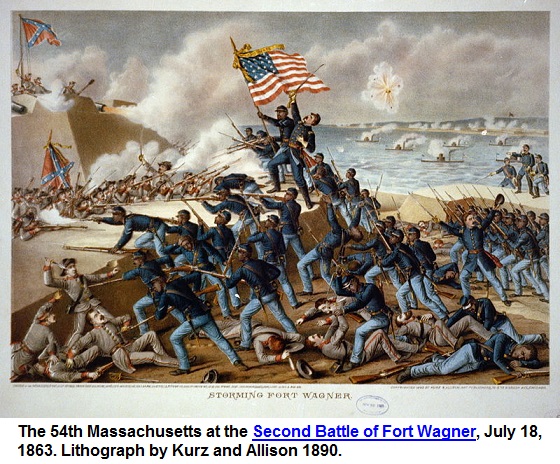
CU Blog - A Lesson in History - During the Civil War - Principle not Principal - Photo 1The regiment gained recognition on July 18, 1863, when it spearheaded an assault on Fort Wagner near Charleston, South Carolina. 272 of the 600 men who charged Fort Wagner were “killed, wounded or captured.”[18] At this battle Colonel Shaw was killed, along with 29 of his men; 24 more later died of wounds, 15 were captured, 52 were missing in action and never accounted for, and 149 were wounded. The total regimental casualties of 272 would be the highest total for the 54th in a single engagement during the war. Although Union forces were not able to take and hold the fort (despite taking a portion of the walls in the initial assault), the 54th was widely acclaimed for its valor during the battle, and the event helped encourage the further enlistment and mobilization of African-American troops, a key development that President Abraham Lincoln once noted as helping to secure the final victory. This drama was portrayed in the 1989 Motion Picture “Glory“; see 2-minute clip in the VIDEO B below.
The Civil War is being commemorated now, at the 150th Anniversary of its conclusion. But there is no need for “pomp and circumstance” in acknowledging these events in the “rear view” mirror of history. There is only the need to look and learn, as there are lessons for the Caribbean to consider in its application of daily life. This commentary is 2 of 3 considering lessons that are especially apropos for application in the Caribbean region of 2015. The lessons are cataloged as follows:

  1. Before the War: Human Rights Cannot Be Compromised
  2. During the War: Principle over Principal – Boycott Over a Difference in Pay
  3. After the War: Birth Right – Assigning Same Value to All Life

During the Civil War, as in any war, soldiers get paid. But the societal defects of racism was so acute in the US that even this administrative action was fraught with dysfunction; the encyclopedic reference continues:

The enlisted men of the 54th were recruited on the promise of pay and allowances equal to their white counterparts. This was supposed to amount to subsistence and $14 a month.[22] Instead, they were informed upon arriving in South Carolina, the Department of the South would pay them only $7 per month ($10 with $3 withheld for clothing, while white soldiers did not pay for clothing at all).[23] Colonel Shaw and many others immediately began protesting the measure.[24] Although the state of Massachusetts offered to make up the difference in pay, on principle, a regiment-wide boycott of the pay tables on paydays became the norm.[25]

CU Blog - A Lesson in History - During the Civil War - Principle not Principal - Photo 3After Shaw’s death at Fort Wagner, Colonel Edward Needles Hallowell – his lieutenant and brother of the first Lieutenant Colonel Hallowell – took up the fight to get back full pay for the troops.[26]

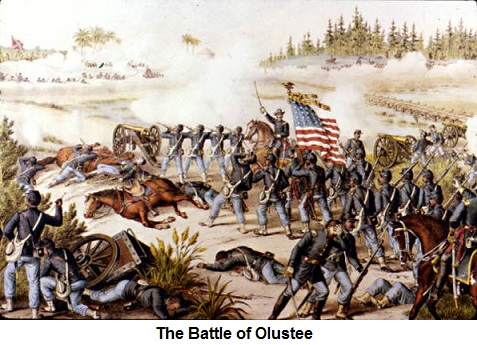
Refusing their reduced pay became a point of honor [(principle)] for the men of the 54th. In fact, at the Battle of Olustee, when ordered forward to protect the retreat of the Union forces, the men moved forward shouting, “Massachusetts and Seven Dollars a Month!”[2]

The Congressional bill, enacted on June 16, 1864, authorized equal and full pay to those enlisted troops who had been free men as of April 19, 1861. Of course not all the troops qualified. Colonel Hallowell, a Quaker, rationalized that because he did not believe in slavery he could therefore have all the troops swear that they were free men on April 19, 1861. Before being given their back pay the entire regiment was administered what became known as “the Quaker oath.”[26] Colonel Hallowell skillfully crafted the oath to say: “You do solemnly swear that you owed no man unrequited labor on or before the 19th day of April 1861. So help you God.”[26][28]
The book Go Lean…Caribbean and accompanying blogs provide lessons from history in considering the American Civil War. The Caribbean region has a debilitating societal abandonment rate; (70 percent of college educated had fled for foreign shores). The region needs a National Sacrifice ethos, where their own citizens sacrifice blood, sweat and tears on behalf of their homelands. Only then will people be less prone to abandon their homes; they will stake claim to principle over principal (money).

Early in the Go Lean book, this need for careful review of the history of slavery was acknowledged and then placed into perspective with this pronouncement (Declaration of Interdependence – Page 10):

As the history of our region and the oppression, suppression and repression of its indigenous people is duly documented, there is no one alive who can be held accountable for the prior actions, and so we must put aside the shackles of systems of repression to instead formulate efficient and effective systems to steer our own destiny.

As the colonial history of our region was initiated to create economic expansion opportunities for our previous imperial masters, the structures of government instituted in their wake have not fostered the best systems for prosperity of the indigenous people.

So the consideration of the Go Lean book, is to identify and correct any bad community ethos (fundamental spirit of our culture) and to foster positive community ethos (such as National Sacrifice and “Principle over Principal”). This point was also pronounced in the opening Declaration of Interdependence (Page 12 – 13) with these statements:

xvi. Whereas security of our homeland is inextricably linked to prosperity of the homeland, the economic and security interest of the region needs to be aligned under the same governance. Since economic crimes, including piracy and other forms of terrorism, can imperil the functioning of the wheels of commerce for all the citizenry, the accedence of this Federation must equip the security apparatus with the tools and techniques for predictive and proactive interdictions.

xix. Whereas our legacy in recent times is one of societal abandonment, it is imperative that incentives and encouragement be put in place to first dissuade the human flight, and then entice and welcome the return of our Diaspora back to our shores. This repatriation should be effected with the appropriate guards so as not to imperil the lives and securities of the repatriated citizens or the communities they inhabit. The right of repatriation is to be extended to any natural born citizens despite any previous naturalization to foreign sovereignties.

This Declaration of Interdependence opens the Go Lean…Caribbean book. The book serves as a roadmap for the introduction and implementation of the technocratic Caribbean Union Trade Federation (CU) to spearhead the elevation of Caribbean society. The book advocates learning lessons from many events and concepts in history, from as far back as the patriarchal Bible times, to as recent as the Great Recession of 2008. The roadmap seeks to reboot the region’s economic, security and governing engines to ensure that all Caribbean stakeholders have the opportunity for life, liberty and the pursuit of happiness with no abusive exploitation of any ethnic group. There is room for all people in the region to elevate and be elevated.

In this vein, the Go Lean roadmap seeks to employ “best-practices” with entitlements, labor, human rights and social safety nets to impact the CU prime directives; identified with the following 3 statements:

  • Optimization of the economic engines in order to grow the regional economy to $800 Billion & create 2.2 million new jobs.
  • Establishment of a security apparatus to protect the resultant economic engines and ensure the respect of human rights and public safety.
  • Improve Caribbean governance to support these engines.

The Caribbean is in crisis!

Alas, the Go Lean book asserts that a “crisis is a terrible thing to waste” and thereafter stresses the community ethos, strategies, tactics, implementations and advocacies to reboot, transform and turn-around the eco-systems of Caribbean society. These points are detailed in the book as follows:

Community Ethos – Deferred Gratification Page 21
Community Ethos – Economic Principles – People Choose Page 21
Community Ethos – Economic Principles – People Respond to Incentives in Predictable Ways Page 21
Community Ethos – Economic Principles – The Consequences of Choices Lie in the Future Page 21
Community Ethos – Governing Principles – Lean Operations Page 24
Community Ethos – Governing Principles – Cooperatives Page 25
Community Ethos – Ways to Impact the Future Page 26
Community Ethos – Ways to Impact a Turn-Around Page 33
Community Ethos – Ways to Improve Sharing Page 35
Community Ethos – Ways to Promote Happiness Page 36
Community Ethos – Ways to Impact the Greater Good Page 37
Strategy – Vision – Confederate 30 Member-States Page 45
Strategy – Mission – Enact a Defense Pact to Defend the Homeland Page 45
Strategy – Mission – Keep the next generation at home Page 46
Tactical – Confederating a Permanent Union Page 63
Tactical – Fostering a Technocracy Page 64
Implementation – Assemble – Incorporating all the existing regional organizations Page 96
Implementation – Ways to Pay for Change Page 101
Implementation – Security Initiatives at Start-up Page 103
Implementation – Ways to Deliver Page 109
Implementation – Reasons to Repatriate to the Caribbean Page 118
Planning – 10 Big   Ideas for the Caribbean – Confederation Without Sovereignty Page 127
Planning – Ways to Make the Caribbean Better Page 131
Advocacy – Ways to Grow the Economy Page 151
Advocacy – Ways to Create Jobs Page 152
Advocacy – Ways to Better Manage the Social Contract Page 170
Advocacy – Ways to Manage Federal Civil Service – Guaranteed Fair Treatment Page 173
Advocacy – Ways to Improve Homeland Security Page 181
Advocacy – Ways to Impact the Diaspora Page 217
Advocacy – Ways to Preserve Caribbean Heritage Page 218
Advocacy – Ways to Protect Human Rights Page 220
Advocacy – Ways to Impact Youth – Incentivize Prosperity at Home Page 227

There are other lessons for the Caribbean to learn from considering history; the following previous blog/commentaries have been detailed and considered:

https://goleancaribbean.com/blog/?p=6531 A Lesson in History – Book Review of the ‘Exigency of 2008’
https://goleancaribbean.com/blog/?p=6189 A Lesson in History – ‘Katrina’ is helping today’s crises
https://goleancaribbean.com/blog/?p=5183 A Lesson in History – Cinco De Mayo
https://goleancaribbean.com/blog/?p=5123 A Lesson in History – Royal Charter: Zimbabwe -vs- South Africa
https://goleancaribbean.com/blog/?p=5055 A Lesson in History – Empowering Families
https://goleancaribbean.com/blog/?p=4971 A Lesson in History – Royal Charter: Truth & Consequence
https://goleancaribbean.com/blog/?p=4935 A Lesson in History – The ‘Grand Old Party’ of American Politics
https://goleancaribbean.com/blog/?p=4720 A Lesson in History – SARS in Hong Kong
https://goleancaribbean.com/blog/?p=4166 A Lesson in History – Panamanian Balboa
https://goleancaribbean.com/blog/?p=2809 A Lesson in History – Economics of East Berlin
https://goleancaribbean.com/blog/?p=2670 A Lesson in History – Rockefeller’s Pipeline
https://goleancaribbean.com/blog/?p=2585 A Lesson in History – Concorde SST
https://goleancaribbean.com/blog/?p=2480 A Lesson in History – Community Ethos of WW II Detroit
https://goleancaribbean.com/blog/?p=2297 A Lesson in History – Booker T versus Du Bois
https://goleancaribbean.com/blog/?p=1531 A Lesson in History – 100 Years Ago Today – World War I
https://goleancaribbean.com/blog/?p=789 A Lesson in History – America’s War on the Caribbean

The Go Lean roadmap seeks to empower and elevate Caribbean societal engines, identifying the required community ethos. The ethos associated with populations that have endured change – National Sacrifice – is an expression of deferred gratification, choosing to focus more on the future than on the present, or the past. We should show proper application for the sacrifices these ones have endured. Such gratitude makes our community better, more resilient and more long-suffering.

We need more of this Principle over Principal!

No appreciation, no sacrifice; no sacrifice, no victory. It is that simple!

Now is the time to lean-in to this roadmap for Caribbean change, as depicted in the book Go Lean…Caribbean. All the mitigations and empowerments in this roadmap require people to fight for their homeland. This ethos will help forge change for the Greater Good. We need sacrifice; we need victories!

(This commentary is not advocating sacrificing the  Caribbean’s young men – and women – on the altar of some God of War. Nor is this a call for a revolt against the governments, agencies or institutions of the Caribbean region, but rather a petition to fight for change through the peaceful optimization of the economic, security and governing engines in the region).

Our quest is simple, learn from history and work to make the Caribbean region a better place to live, work and play. 🙂

Download the book Go Lean … Caribbean – now!

———–

Appendix VIDEO A – Movie Trailer: 12 Years A Slavehttp://www.imdb.com/video/imdb/vi302032921/

Retrieved October 14, 2015 – In the antebellum United States, Solomon Northup, a free black man from upstate New York, is abducted and sold into slavery.

———–

Appendix VIDEO B – Movie Clip Gloryhttps://youtu.be/q7qwqVbZSqE

Retrieved October 14, 2015 – Robert Gould Shaw leads the US Civil War’s first all-black volunteer company, fighting prejudices of both his own Union army and the Confederates.

Share this post:
, , , ,

A Lesson in History – Before the Civil War: Compromising Human Rights

Go Lean Commentary

Despite the fact that there are historic events, many times “deniers” of the facts emerge. For example, the Nazi Holocaust: deniers exist even today of the actuality of the events or the 6 million Jews slaughtered in German Concentration Camps. Another major event before this was the American Civil War. Deniers abounded to the point that in many schools in the Jim Crow South, that event was taught as the “War of Northern Aggression” and the cause of “slavery” was supplanted for States’ Rights.

The pain of this academic dishonesty is not just the de-valuing of all the human sacrifices, but most importantly, the failure to learn and apply good lessons.

When someone denies an event, they cannot learn from the experiences.

Without a doubt, a Civil War was fought in the United States of America between 1861 and 1865; 625,000[5] Americans died…on both sides (365,000 total dead [4] on the Union side; 260,000 total dead on the Confederacy side). This blood should not be forgotten. There are lessons to learn from this history. This commentary is 1 of 3 considering lessons that are especially apropos for application in the Caribbean region of 2015. The lessons are cataloged as follows:

  1. Before the War: Human Rights Cannot Be Compromised
  2. During the War: Principle over Principal – Boycott Over a Difference in Pay
  3. After the War: Birth Right – Assigning Same Value to All Life

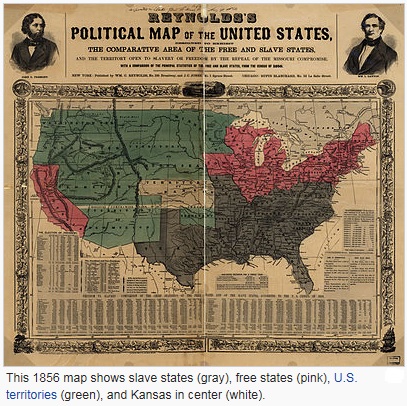
Since the early colonial period in America, slavery had been a part of the socio-economic system of British North America and was recognized in the Thirteen Colonies at the time of the United StatesDeclaration of Independence (1776). Since then, events and statements by politicians and others brought forth differences, tensions and divisions between the people of the slave states of the Southern United States and the people of the free states of the Northern United States (including Western states) over the topics of slavery. The large underlying issue from which other issues developed was whether slavery should be retained and even expanded to other areas or whether it should be contained and eventually abolished. Over many decades, these issues and divisions became increasingly irreconcilable and contentious.[1] But that last decade was pivotal; see encyclopedia reference here and VIDEO below:

CU Blog - A Lesson in History - Before the Civil War - Human Right Not Compromise - Photo 3Events in the 1850s culminated with the election of the anti-slavery-expansion Republican Abraham Lincoln as President on November 6, 1860. This provoked the first round of state secessions as leaders of the Deep South cotton states were unwilling to remain in a second class political status with their way of life threatened by the President himself. Initially, the seven Deep South states seceded, with economies based on cotton (then in heavy European demand with rising prices). They were Alabama, Florida, Georgia, Louisiana, Mississippi, South Carolina and Texas. After the Confederates attacked and captured Fort Sumter, President Lincoln called for volunteers to march south and suppress the rebellion. This pushed the four other Upper South States (Virginia, North Carolina, Tennessee, and Arkansas) also to secede. These states completed the formation of the Confederate States of America. Their addition to the Confederacy insured a war would be prolonged and bloody because they contributed territory and soldiers. – https://en.wikipedia.org/wiki/Timeline_of_events_leading_to_the_American_Civil_War retrieved October 14, 2015.

The Civil War is being commemorated now, at the 150th Anniversary of its conclusion. But there is no need for “pomp and circumstance” in acknowledging these events in the “rear view” mirror; as this was an American crisis. There is only the need to look and learn, as there is this one poignant lesson for Caribbean consideration:

    With a roaring institution of slavery, there was no premise for a concept of human rights. Without a commonality on the understanding and acceptance of human rights, differences will always be irreconcilable and contentious.

Before the Civil War, both sides continued to propagate one compromise after another. While neither side wanted the bloodshed of war, the compromises were just exercises in futility because at the root, there was no commonality on human rights. Notice this application in considering this one episode of Pre-War deliberation:

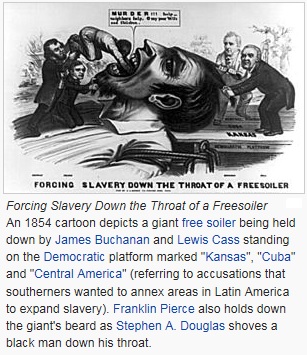
The Kansas–Nebraska Act of 1854 created the territories of Kansas and Nebraska, opening new lands for settlement, and had the effect of repealing the Missouri Compromise of 1820 by allowing white male settlers in those territories to determine through popular sovereignty whether they would allow slavery within each territory. The act was designed by Democratic Senator Stephen A. Douglas of Illinois. The initial purpose of the Kansas–Nebraska Act was to open up many thousands of new farms and make feasible a Midwestern Transcontinental Railroad. The popular sovereignty clause of the law led pro- and anti-slavery elements to flood into Kansas with the goal of voting slavery up or down, leading to Bloody Kansas[1]; (a series of violent political confrontations involving anti-slavery Free-Staters and pro-slavery “Border Ruffians”, taking place in the Kansas Territory and neighboring towns in the state of Missouri between 1854 and 1861). This Kansas–Nebraska Act used popular sovereignty so as to ignore the failures of the previous compromises. The Kansas–Nebraska Act divided the nation and pointed it toward civil war.[41] The turmoil over the act split both the Democratic and Whig parties and gave rise to the Republican Party, which split the United States into two major political camps, North (Republican) and South (Democratic). – Source: https://en.wikipedia.org/wiki/Kansas%E2%80%93Nebraska_Act retrieved October 14, 2015.
CU Blog - A Lesson in History - Before the Civil War - Human Right Not Compromise - Photo 2

The book Go Lean…Caribbean and accompanying blogs provide lessons from history in considering the American Civil War. The Caribbean has had Civil Wars and Revolutions; (think Haitian Revolution of 1791 and the Cuban Revolution of 1959). The book assessed the economic disposition of the region and then strategized how to elevate the societal engines. Among its many missions, the book advocates one simple way to grow the economy: concentrate on the basic needs of food, clothing and shelter. When analyzing clothing options, the book leans on the lessons from the pre-Civil War American South, where Cotton was King. This point was detailed in the book on Page 163:

The Bottom Line on King Cotton
The Southern United States had ideal conditions to grow cotton; the prospects where so successful, 60% of US exports, that they sought to have a world monopoly. They devoted the most valuable land and slave labor to this cause, even in place of necessities like food. They had the supply system optimized and they were willing to go to war to preserve the status quo. On the demand side, the Industrial Revolution brought innovations like mechanized spinning/weaving to Europe. This forged a vibrant apparel industry and revolutionized the world economy. Cotton was King. The term King Cotton was a slogan around 1860–61 to support secession from the United States, arguing that cotton exports would make an independent Confederate States of America economically prosperous, and – more importantly – force Great Britain and France to support the Confederacy in a Civil War. But the Union blockaded the South’s ports and harbors and shut down over 95% of cotton exports. Since the Europeans had hoarded large stockpiles of cotton, they were not injured by the boycott — the value of their stockpiles went up. So cotton production shifted to other locations in the world, like India (up 700%), Egypt and Argentina. King Cotton failed to save the South, their economy nor Confederacy.
CU Blog - A Lesson in History - Before the Civil War - Human Right Not Compromise - Photo 1

Early in the Go Lean book, this need for careful review of history was acknowledged and then placed into perspective with this pronouncement (Declaration of Interdependence – Page 10):

As the history of our region and the oppression, suppression and repression of its indigenous people is duly documented, there is no one alive who can be held accountable for the prior actions, and so we must put aside the shackles of systems of repression to instead formulate efficient and effective systems to steer our own destiny.

As the colonial history of our region was initiated to create economic expansion opportunities for our previous imperial masters, the structures of government instituted in their wake have not fostered the best systems for prosperity of the indigenous people.

So the consideration of the Go Lean book, as related to this subject is one of community ethos, defined in the book (Page 20) as the fundamental character or spirit of our culture; our underlying sentiment that informs our beliefs, customs, or practices; dominant assumptions of us, the Caribbean as a people.

    Do we now have a common premise, a concept of human rights?

This commentary, and the underlying Go Lean book asserts the answer is “No“! As a region, the Caribbean is doing particularly bad.

This point was pronounced in the opening Declaration of Interdependence (Page 12) with these acknowledgements and statements:

xii. Whereas the legacy in recent times in individual states may be that of ineffectual governance with no redress to higher authority, the accedence of this Federation will ensure accountability and escalation of the human and civil rights of the people for good governance, justice assurances, due process and the rule of law. As such, any threats of a “failed state” status for any member state must enact emergency measures on behalf of the Federation to protect the human, civil and property rights of the citizens, residents, allies, trading partners, and visitors of the affected member state and the Federation as a whole.

xiii. Whereas the legacy of dissensions in many member-states (for example: Haiti and Cuba) will require a concerted effort to integrate the exile community’s repatriation, the Federation must arrange for Reconciliation Commissions to satiate a demand for justice.

Continuing with the lessons from the American Civil War, we see that the US never accepted a common definition of human rights until … the United Nations was established (1945) and eventually codified a Human Rights Declaration for them … and the rest of the world in 1948. In the meanwhile, Blacks in the US continued to suffer – despite the abolition of slavery – with pains associated with a Peonage system, Jim Crow and blatant discriminatory practices. The oppression, suppression and oppression of Blacks (and other minorities) in the US meant that America was not a welcoming land for people of color.

Considering the Caribbean homeland, to apply lessons learned from the build-up of the American Civil War we must first accept as common: the basics of human rights.

The Go Lean book asserts the UN Declaration of Human Rights (Page 220) which provides this definition:

… standards of human behavior that are protected as legal rights in municipal and international law.[2] They are commonly understood as inalienable[3] fundamental rights “to which a person is inherently entitled simply because she or he is a human being.”[4]

This declaration aligns with the quest of the Go Lean…Caribbean book. The book serves as a roadmap for the introduction and implementation of the technocratic Caribbean Union Trade Federation (CU) to spearhead the elevation of Caribbean society. The book advocates learning lessons from many events and concepts in history, from as far back as the patriarchal Bible times, to as recent as the Great Recession of 2008. The roadmap simply seeks to reboot the region’s economic, security and governing engines to ensure that Caribbean stakeholders (citizens, guest-workers and visitors) have the opportunity for life, liberty and the pursuit of happiness. As gleaned from this lesson in history, without that common acceptance of human rights, this quest is easier said than done.

The planners of the new Caribbean, the promoters of the Go Lean book, hereby urge all in the Caribbean to make this declaration.

Just say it!

In general, the Go Lean roadmap posits that the hope for any permanent change in the Caribbean must start with this declaration and the underlying community ethos that promotes it: the Greater Good. With that in place, other progress – the needed societal elevation – can begin. The Go Lean roadmap seeks to employ “best-practices” with better strategies, tactics and implementations to impact the CU prime directives; identified with the following 3 statements:

  • Optimization of the economic engines in order to grow the regional economy to $800 Billion & create 2.2 million new jobs.
  • Establishment of a security apparatus to protect the resultant economic engines and ensure the respect of human rights and public safety in all member-states.
  • Improve Caribbean governance to support these engines.

The Go Lean book stresses key community ethos, strategies, tactics, implementations and advocacies necessary to transform and turn-around the eco-systems of Caribbean society. These points are detailed in the book as follows:

Community Ethos – Economic Principles – Economic Systems Influence   Individual Choices Page 21
Community Ethos – Economic Principles – Consequences of Choices Lie in   the Future Page 21
Community Ethos – Governing Principles – Lean Operations Page 24
Community Ethos – Ways to Impact the Future Page 26
Community Ethos – Ways to Manage   Reconciliations Page 34
Community Ethos – Ways to Impact the Greater Good Page 37
Strategy – Vision – Confederate all 30   member-states/ 4 languages into a Single   Market Page 45
Strategy – Mission – Build and foster local economic engines Page 45
Tactical – Ways to Foster a Technocracy Page 64
Tactical – Growing the Economy – Post   WW II European Marshall Plan Model Page 68
Tactical – Separation-of-Powers – CU Federal Government versus Member-State Governance Page 71
Implementation – Assemble All Regionally-focus Organizations of All Caribbean Communities Page 96
Implementation – Ways to Better Manage Debt Page 114
Planning – 10 Big Ideas – Single Market / Currency Union Page 127
Planning – Ways to Model the new European Union Page 130
Planning – Ways to Make the Caribbean Better Page 131
Planning – Ways to Improve Failed-State Indices – Minority and Human Rights Page 134
Planning – Lessons Learned from the previousWest Indies Federation Page 135
Planning – Lessons Learned from 2008 – Optimizing Economic-Financial-Monetary Engines Page 136
Planning – Lessons Learned New York City – Managing   as a “Frienemy” Page 137
Planning – Lessons Learned from Omaha – Human Flight Mitigations Page 138
Planning – Lessons Learned from East Germany – Bad Examples for Trade & Security Page 139
Planning – Lessons Learned from Detroit – Turn-around from Failure Page 140
Planning – Lessons Learned from Indian Reservations – See Photo Page 141
Planning – Lessons Learned from the American West – How to Win the Peace Page 142
Advocacy – Ways to Grow the Economy Page 151
Advocacy – Ways to Create Jobs Page 152
Advocacy – Ways to Improve Governance Page 168
Advocacy – Ways to Better Manage the Social Contract Page 170
Advocacy – Ways to Improve Homeland Security Page 180
Advocacy – Ways to Better Manage Natural Resources Page 183
Advocacy – Ways to Preserve Caribbean   Heritage Page 218
Appendix – Failed-State Index for Uneven Economic Development Page 272
Appendix – European Shuffling in the Guianas – Historic Timeline Page 307

There are other lessons for the Caribbean to learn from considering history; the following previous blog/commentaries have been detailed and considered:

https://goleancaribbean.com/blog/?p=6531 A Lesson in History – Book Review of the ‘Exigency of 2008’
https://goleancaribbean.com/blog/?p=6189 A Lesson in History – ‘Katrina’ is helping today’s crises
https://goleancaribbean.com/blog/?p=5183 A Lesson in History – Cinco De Mayo
https://goleancaribbean.com/blog/?p=5123 A Lesson in History – Royal Charter: Zimbabwe -vs- South Africa
https://goleancaribbean.com/blog/?p=5055 A Lesson in History – Empowering Families
https://goleancaribbean.com/blog/?p=4971 A Lesson in History – Royal Charter: Truth & Consequence
https://goleancaribbean.com/blog/?p=4935 A Lesson in History – The ‘Grand Old Party’ of American Politics
https://goleancaribbean.com/blog/?p=4720 A Lesson in History – SARS in Hong Kong
https://goleancaribbean.com/blog/?p=4166 A Lesson in History – Panamanian Balboa
https://goleancaribbean.com/blog/?p=2809 A Lesson in History – Economics of East Berlin
https://goleancaribbean.com/blog/?p=2670 A Lesson in History – Rockefeller’s Pipeline
https://goleancaribbean.com/blog/?p=2585 A Lesson in History – Concorde SST
https://goleancaribbean.com/blog/?p=2480 A Lesson in History – Community Ethos of WW II in Detroit
https://goleancaribbean.com/blog/?p=2297 A Lesson in History – Booker T versus Du Bois
https://goleancaribbean.com/blog/?p=1531 A Lesson in History – 100 Years Ago Today – World War I
https://goleancaribbean.com/blog/?p=789 A Lesson in History – America’s War on the Caribbean

The Go Lean roadmap seeks to empower and elevate Caribbean societal engines. It is out-of-scope to impact America (beyond the Diaspora living there); our focus is only here at home.

A lot of the pain related in this history stem from the flawed structure of colonialism. Though there is a movement to extract reparations from former colonizers, that effort is not supported by the Go Lean movement for the Caribbean.

It is NOT for the Greater Good.

It is what it is! The current assessment of the Caribbean region is dire, but yet remediation, reboot and turn-around is possible.

Our quest is simple, learn from history and work to make the Caribbean region a better place to live, work and play.  🙂

Download the book Go Lean … Caribbean – now!

———–

Appendix VIDEO – The Path to Civil War – http://www.history.com/topics/american-civil-war/american-civil-war-history/videos/us-inches-closer-to-war

The election of Abraham Lincoln was a tipping point on the path to Civil War. In the wake of Southern secession, would the new president defend the U.S. forts in rebel territory?

Share this post:
, , , ,
[Top]

‘Good Hair’ and the Strong Black Woman

Go Lean Commentary

“[A] comedian and daytime talk-show host apologized for suggesting that kinky hair was worthless.”

Those words were not perceived as funny; they were hurtful…but very much en vogue; (this was back in 2013). The overall consensus in the African-American community is that “Black Hair” is … not preferred.

Nappy head, kinky head, picky head, peasy head…

For a non-Black person to refer to a Black person as such, it is a curse word, beyond an insult.

Enough already …

“Say it loud, I’m Black and I’m proud” – James Brown song 1968

This scenario depicts a dichotomy in the Black community, especially among women. The ethnic group prides itself on it proud heritage of Strong Black Women, and yet there is this unspoken rejection of Black Hair. This is sad!

Yet, it is what it is!

The book Go Lean … Caribbean makes an assessment of the economic, security and government issues of the Caribbean, then presents strategies, tactics and implementations to elevate these engines. But one might argue:

“The issue of hair styles and hair texture is not economics”.

Or is it? See this quotation here:

“The Black Hair business is a $9 Billion business” – Movie Good Hair (2009) – see Appendix VIDEO below.

The issue of Black Hair is an issue of image. The Go Lean book depicts that image is very impactful in the management of Caribbean economic and cultural affairs (Page 133). (29 of the 30 Caribbean member-states have a majority non-White population – Saint Barthélemy is the sole exception).

Caribbean image is in crisis! Already, Go Lean blog-commentary have addressed the image issues related to the Dreadlocks hairstyle and the default assumption of a person sporting this hairstyle is that they are from the Caribbean, and of a “lesser statue”.

The issues raised in this news article about Sheryl Underwood shows that Black Hair, in general and in specific is an “open festering wound” that needs to be assuaged in all the African New World Diaspora. See the article here (from the site Root.com*):

Title: Sheryl Underwood on Her Natural-Hair Comments: I Understand Why I Was Called an Uncle Tom
Sub-title: The comedian and daytime talk-show host apologized for suggesting that kinky hair was worthless.
By: Diana Ozemebhoya Eromosele

CU Blog - Hair and the Strong Black Woman - Photo 1Posted September 17 2015 – It’s not often that someone says she completely understands why she was called an Uncle Tom and a coon. People usually try to flip the script and suggest that African Americans—the ones usually lobbing those insults—are playing the race card and being hypersensitive about issues.

Comedian Sheryl Underwood did no such thing on Monday’s episode of the talk show The Talk, where she is a co-host. Back in 2013, she made a joke about how she didn’t understand why Heidi Klum saved her biracial children’s hair. Underwood was suggesting that kinky hair was bad, had no value and wouldn’t be of any use—so why save it?

“Why would you save Afro hair? You can’t weave in Afro hair!” Underwood joked. She got dragged through these Internet streets—badly.

On Monday’s episode, she debuted her own kinky hair—a short, curly Afro—and apologized profusely for her earlier comments.

“I made some statements that were not only wrong, but they hurt our community […] black people are very sensitive about a discussion about our hair,” Underwood said. She said she felt especially bad because she identifies as a “very proud black woman.”

“The way the joke came out offended my people and my community, which was not my intent,” she continued.

Underwood went on to describe the reaction she got from black people about her comments: “There was a lot of backlash. A lot of people said that I was an Uncle Tom […] I was a coon. I could understand that kind of language being used because people were hurt.”

Underwood explained that she’s very aware of how insensitive her comments were, given the negative stereotypes about kinky hair and the fact that black women are not encouraged to rock their natural coils.

“There is a responsibility to being on TV. There’s a cultural responsibility. The way we got images out there—there’s no need for me to do something that causes more damage to us,” she said.

The entire ordeal compelled Underwood to go on a journey of self-discovery for a year. “I cut my hair off. I cut the perm out. I still wear wigs because I like variety, but what I really wanted to do was engage women,” she said. Underwood said she also reached out to natural-hair bloggers to continue the conversations that the incident sparked.

Diana Ozemebhoya Eromosele is a staff writer at The Root and the founder and executive producer of Lectures to Beats, a Web series that features video interviews with scarily insightful people. Follow Lectures to Beats on Facebook and Twitter.
Source: The Root* – Online Site for African-American News, Opinion and Culture – Retrieved 09-18-2015 from: http://www.theroot.com/blogs/the_grapevine/2015/09/watch_sheryl_underwood_on_her_natural_hair_comments_i_understand_why_i_was.html

VIDEO – Sheryl Underwood Apologizes For Black Hair Remarks – https://youtu.be/lcZklCaWDd4

Published on Sep 18, 2015 – The Talk co-host explains why she feels ready to display her real hair, as well as her need to apologize to her community and to viewers.

The book Go Lean … Caribbean recognizes that image is an important intangible factor that must be managed to optimize value of Caribbean contributions – Black and Brown. As such the book is submitted as a complete roadmap to advance the Caribbean economy and culture with the introduction and implementation of the Caribbean Union Trade Federation (CU). The CU will be the sentinel for Caribbean “Image”. While the African-American community is out-of-scope for Go Lean planners, we accept that the US is home to a vast majority of our own Diaspora. And despite the history of North-South pressure on styles-taste-trends, the Caribbean has been successful to forge style-taste-trends in a South-North manner. Just consider the life work of these Caribbean role models:

The CU strives to improve the community ethos of the Caribbean people. This is described as:

“the fundamental character or spirit of a culture; the underlying sentiment that informs the beliefs, customs, or practices of a group or society; dominant assumptions of a people or period; practices of a group or society; dominant assumptions of a people or period” – Go Lean…Caribbean Page 20.

Natural Black Hair - GirlA discounted view of Black Hair is a bad ethos – plain and simple! This should not be tolerated, especially coming from the Black community itself. Look at this photo here; there is no way this is not beautiful!

Alas, the Go Lean book presents role models, samples and examples of single issue advocacies and advocates. This roadmap (Page 122) shows that one person and/or one cause can be impactful and change society.

In the Black community, the issue of Black Hair has transformed society before. Remember the Afro, Black Power, Afrocentrism? All of these values were ubiquitous at one point (1970’s) and then slowly, the style-taste-trend shifted. Perhaps its time now to shift it again. We have strong reasons to do so:

$9 Billion!

That is the “why”. As for the “how” …

The CU/Go Lean roadmap strives to improve image & impressions that the world gets of Caribbean life/people. The roadmap has a heavy focus on media. The plan calls for consolidating the 42 million residents of the region, despite the 4 languages, into a Single Market. This size allows for some leverage and economies-of-scale, fostering a professional media industry, and allowing the CU to electronically send our culture (and values) to the rest of the world. Our target first would be the 10 million-strong Caribbean Diaspora; then eventually the rest of the world. We must control the image and impressions that the world gets of Caribbean life and people.

The Go Lean … Caribbean book introduces the CU to assume the Sentinel role, to take oversight of much of the Caribbean economic, security and governing functionality. This roadmap will definitely promote the Caribbean as a better place to live, work and play. As a result, the opinions of the world towards Caribbean hair – dreadlocks, Afro hair, nappy head, kinky head, picky head, peasy head – will heightened.

In the end, this is about more than image, as jobs and trade are at stake; jobs in the Caribbean homeland, jobs in the foreign locations for the Diaspora, and trade of hard-earned currency for vanity products like fake hair and styling-products.

Change has come to the Caribbean. The people, institutions and governance of region are all urged to “lean-in” to this roadmap for change. We need to educate and persuade people – everywhere –that there is excellence among Caribbean people, despite their hairstyle.

The art-and-science of image management is among the community ethos, strategy, implementations and advocacies the the CU must master to elevate the Caribbean community. These individual roles-and-responsibilities are detailed in the book; see this sample listing here:

Community Ethos – Ways to Impact the Future Page 26
Community Ethos – Ways to Foster Genius Page 27
Community Ethos – Ways to Impact Turn-Arounds Page 33
Community Ethos – Ways to Manage Reconciliations Page 34
Community Ethos – Impact the Greater Good Page 37
Strategy – Caribbean Core Competence Page 58
Tactical – Forging an $800 Billion Economy – Trade and Globalization Page 70
Tactical – Separation of Powers – Tourism and Film Promotion Page 78
Tactical – Separation of Powers – Communications and Media Page 79
Tactical – Separation of Powers – Truth & Reconciliation   Commissions Page 90
Implementation – Ways to Impact Social Media – Managing Image Online Page 111
Implementation – Trade Mission Objectives – World Outreach Page 116
Implementation – Ways to Benefit from Globalization – Exporting Media Productions Page 119
Anatomy of Advocacies – Models of Individuals Making an Impact to their Community Page 122
Advocacy – Ways to Better Manage Image Page 133
Advocacy – Improve Failed-State Indices – Assuaging the Negatives Page 134
Advocacy – Ways to Grow the Economy Page 151
Advocacy – Ways to Improve Leadership Page 171
Advocacy – Ways to Improve Communications Page 186
Advocacy – Ways to Enhance Tourism – Creating a Demand, Not Dread of Caribbean Culture Page 190
Advocacy – Ways to Market Southern California – A Critical Market for Image Page 194
Advocacy – Ways to Impact Hollywood Page 203
Advocacy – Ways to Preserve Caribbean Heritage Page 218
Advocacy – Ways to Ways to Protect Human Rights – Weeding-out Prejudices Page 220
Advocacy – Ways to Improve the Arts – Humanities Affect the Heart Page 230

These previous blog/commentaries drilled deeper on this quest to forge change in a community … through image and media; consider these cases:

https://goleancaribbean.com/blog/?p=6202 ‘Concussions’ – The Movie; The Cause
https://goleancaribbean.com/blog/?p=5964 Movie Review: ‘Tomorrowland’ – ‘Feed the right wolf’
https://goleancaribbean.com/blog/?p=5733 Better than America? Yes, We Can!
https://goleancaribbean.com/blog/?p=5098 Forging Change – ‘Food’ for Thought
https://goleancaribbean.com/blog/?p=4506 Colorism in Cuba, the Caribbean … and Beyond
https://goleancaribbean.com/blog/?p=3999 Sir Sidney Poitier – ‘Breaking New Ground’
https://goleancaribbean.com/blog/?p=3568 Forging Change: Music Moves People
https://goleancaribbean.com/blog/?p=3512 Forging Change: The Sales Process
https://goleancaribbean.com/blog/?p=2726 Caribbean Role Model for the Arts/Fashion – Oscar De La Renta: RIP
https://goleancaribbean.com/blog/?p=2291 Forging Change: The Fun Theory
https://goleancaribbean.com/blog/?p=1909 Role Model Berry Gordy – Changing more than just “Motown”
https://goleancaribbean.com/blog/?p=1037 Humanities Advocate – Maya Angelou – Reaching the Heart
https://goleancaribbean.com/blog/?p=866 Caribbean Music Man: Bob Marley – The legend lives on!
https://goleancaribbean.com/blog/?p=857 Considering the Image Issues of the Dreadlocks Hairstyle

The beauty of the Strong Black Woman should be their strength, and their femininity, and their blackness. There is no need to be ashamed or to mask this. Afro is not bad. Afro is just a diverse option among a diverse people.

The “Afro” is not the quest and the cause of the CU/Go Lean roadmap. But if/when we succeed at our quest – whose prime directives are listed here – all social-cultural dictates will be easier to institute. The directives are summarized as follows:

  • Optimization of the economic engines in order to grow the regional economy to $800 Billion & create 2.2 million new jobs.
  • Establishment of a security apparatus to protect the resultant economic engines.
  • Improvement of Caribbean governance to support these engines.
Once “we” fix home, then we can reach out to fix the world. There is the need to change the image of “Black Hair” on the world stage; not the change of hairstyles, but rather changes to the world’s impression of the hairstyle. It is Good Hair.

There is reason to believe that these empowerment efforts can be successful. The Go Lean roadmap conveys how single causes/advocacies have successfully been forged throughout the world (Page 122). We, in the Caribbean, can do the same; we can succeed in improving the Caribbean image and the image of Black Hair. 🙂

Download the book Go Lean … Caribbean – now!

———

P.S.  Full Disclosure: This blogger has two daughters with Black Hair.

———

Appendix – * The Root.com

“The Root” is the premier news, opinion and culture site for African-American influencers. Founded in 2008, under the leadership of Dr. Henry Louis Gates Jr., The Root provides smart, timely coverage of breaking news, thought-provoking commentary and gives voice to a changing, more diverse America. Visit us at www.theroot.com, on Twitter @TheRoot247 and on Facebook.

See other references to other works by Dr. Henry Louis Gates in Appendix B of this commentary: https://goleancaribbean.com/blog/?p=2907

———

Appendix VIDEO – Movie Trailer Good Hairhttp://www.imdb.com/video/imdb/vi3611230745/?ref_=tt_ov_vi

Comedian Chris Rock explores the wonders of African-American hairstyles.
“Chris Rock, a man with two daughters, asks about good hair, as defined by Black Americans, mostly Black women. He visits Bronner Brothers’ annual hair convention in Atlanta. He tells us about sodium hydroxide, a toxin used to relax hair. He looks at weaves, and he travels to India where tonsure ceremonies produce much of the hair sold in America. A weave is expensive: he asks who makes the money. We visit salons and barbershops, central to the Black community. Rock asks men if they can touch their mates’ hair – no, it’s decoration. Various talking heads (many of them women with good hair) comment. It’s about self-image. Maya Angelou and Tracie Thoms provide perspective”. – Written by <jhailey@hotmail.com>

Share this post:
, , , , ,
[Top]

Innovative Partnership Aids Farm Workers

Go Lean Commentary

“We used to own our slaves, now we just rent them” – Quotation from a farmer in 1960 CBS Documentary

This reminds us of a common expression:

The more things change, the more they remain the same.

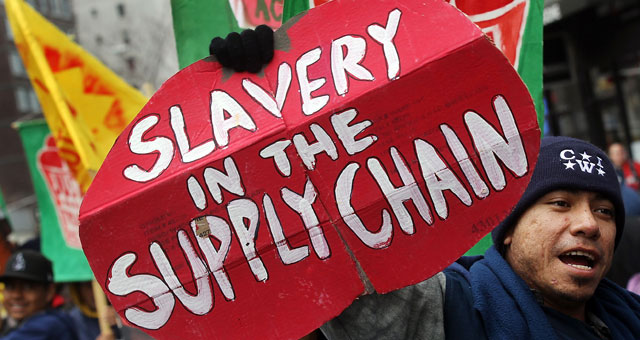
CU Blog - Innovative Partnership Aids Farm Workers - Photo 4In the landmark 1960 Documentary by famed TV Journalist Edward R. Morrow, the conclusion was that American Agricultural Interest would always seek some scheme for cheap labor. That even though slavery had been abolished for 100 years, there were still labor practices that were tantamount to modern-day slavery.

So sad! American society hadn’t reformed.

How about now, 55 years later?

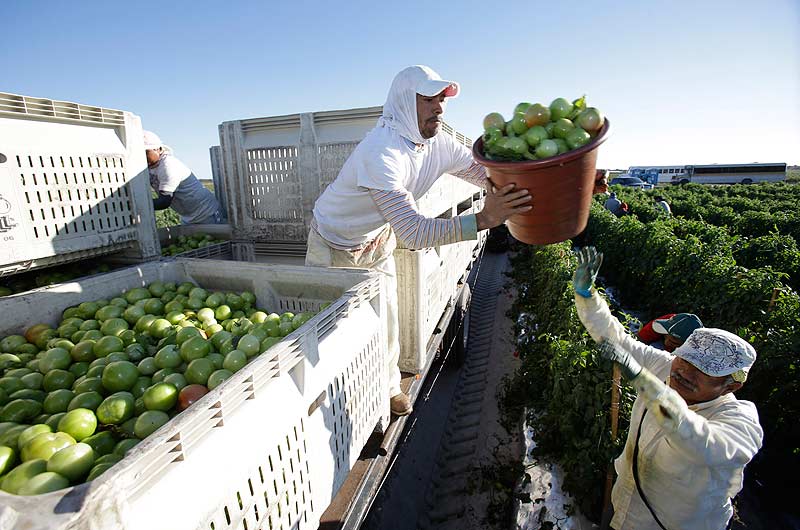
Truthfully, despite this innovative partnership here to aid farm workers, there has only been small progress forward for a journey of thousands of miles. Just consider this latest CBS News story/VIDEO here:

VIDEOCBS News – Posted 08-09-2015; retrieved 08-11-2015  from: http://www.cbsnews.com/videos/innovative-partnership-aids-farm-workers/

August 9, 2015 – For decades, the tomato farms in South Florida have been known for their awful working conditions, but things are changing thanks to some unlikely partners. Mark Strassmann reports on how a coalition of migrant farm workers and some of the nation’s biggest tomato buyers are helping improve working conditions and raise pay. (VIDEO plays best in Internet Explorer).

Welcome to the America of 1865, 1960 and 2015.

CU Blog - Innovative Partnership Aids Farm Workers - Photo 1

Only now after decades, American society is finally reporting progress for the conditions of migrant farm workers. Too little, too late!

Perhaps the American shores should not be the destination for Latin American Migrant Farm Labor. This is definitely the position of the book Go Lean … Caribbean. The publishers of the Go Lean book campaign that it would be better for Caribbean citizens (subset of Latin America) to remain in their homeland and work to remediate conditions there, than to migrate to American destinations looking for better labor options. (Previously the same futility had been detailed regarding a Jamaican-Canadian Labor Exchange program). Considering the statistics and anecdotal evidence in the foregoing VIDEO, these 2 conclusions appear indisputable:

Considering this reality, it is sad that the eco-systems of Caribbean society are failing so that now many Caribbean citizens still long for the opportunity to emigrate to the United States. There have been many that have taken to the seas on risky vessels to reach this land of their dreams. Many Caribbean member-states (St Vincent, Puerto Rico, US Virgin Islands, etc.) have lost more than half of their populations to foreign shores. While others have lost more than 70 percent of their college educated populations. This situation is so impactful that now 1 out of 11 Black persons in the US is now of Caribbean (or African) descent, and these numbers are only expected to grow. This is a crisis for the Caribbean.

The reasons for this Caribbean crisis are identified as “push-and-pull”. Failures in our society are so acute that many feel compelled to seek their future abroad. While this is “push”, the “pull” refers to the propaganda and image that American life is better – the “place to be”.

CU Blog - Innovative Partnership Aids Farm Workers - Photo 2

Hopefully this commentary succeeds in dispelling this mis-information that life in the American Migrant Labor eco-system is better than enduring Caribbean society. This is one of the motives of this commentary; another motive is to highlight the success of Farm Labor Reform Advocates, in this case the #FairFoods movement; this innovative partnership to aid farm workers. CU Blog - Innovative Partnership Aids Farm Workers - Photo 3

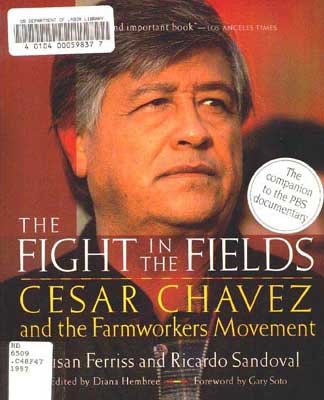
This cause and campaign is not unfamiliar to the Go Lean movement. The Go Lean book had identified another effective advocate in the farm labor movement: Cesar Chavez of the 1960’s/1970’s United Farm Workers Union movement. (In many ways, #FairFoods stands on the shoulders of the late-great Cesar Chavez).  The book relates (Page 122) this summary of the historicity of Cesar Chavez:

CU Blog - Innovative Partnership Aids Farm Workers - Photo 5

Chavez (1927 – 1993) was an American farm worker, labor leader and civil rights activist, who co-founded the National Farm Workers Association (later the United Farm Workers Union (UFW)). He became the best known Latino American civil rights activist, and was strongly promoted by the American labor movement, which was eager to enroll Hispanic members. His public-relations approach to unionism and aggressive but nonviolent tactics made the farm workers’ struggle a moral cause with nationwide support. By the 1970s, his tactics had forced growers to grant respect to migrant workers, and recognize the UFW as the bargaining agent for 50,000 field workers in California & Florida.

There is now new update on the national appreciation and societal impact of Cesar Chavez:

Chavez is buried at the National Chavez Center, on the headquarters campus of the United Farm Workers of America at 29700 Woodford-Tehachapi Road in the Keene community of unincorporated Kern County, California.[36][37] He received belated full military honors from the US Navy at his graveside on April 23, 2015, the 22nd anniversary of his death.[38]

The efforts of this commentary is not to reform America, but to reform the Caribbean. The Go Lean book serves as a roadmap for the introduction and implementation of the technocratic Caribbean Union Trade Federation (CU). While the branding Trade connotes economics, the roadmap also addresses labor and justice assurances. In fact, the Go Lean roadmap has these 3 prime directives:

  • Optimization of the economic engines in order to grow the regional economy and create 2.2 million new jobs.
  • Establishment of a security apparatus to protect the resultant economic engines and the Caribbean homeland against abuse from “bad actors” in society.
  • Improvement of Caribbean governance to support these engines, including a separation-of-powers between CU agencies and member-state governments.

The goal of the Go Lean roadmap therefore is to forge a better society, to make the Caribbean a better place to live, work and play. By optimizing our justice and labor institutions, we would lower our own “push” factors. These requirements were pronounced at the outset of the Go Lean book, in the Declaration of Interdependence (Page 12) with these statements:

xi. Whereas all men are entitled to the benefits of good governance in a free society, “new guards” must be enacted to dissuade the emergence of incompetence, corruption, nepotism and cronyism at the peril of the people’s best interest. The Federation must guarantee the executions of a social contract between government and the governed.

xxi. Whereas the legacy in recent times in individual states may be that of ineffectual governance with no redress to higher authority, the accedence of this Federation will ensure accountability and escalation of the human and civil rights of the people for good governance, justice assurances, due process and the rule of law. As such, any threats of a “failed state” status for any member state must enact emergency measures on behalf of the Federation to protect the human, civil and property rights of the citizens, residents, allies, trading partners, and visitors of the affected member state and the Federation as a whole.

How can the Caribbean be different than the United States in the pursuit of labor justice?

The CU/Go Lean roadmap seeks to apply best-practices in labor regulations; we do not want to repeat America’s mistakes; we have enough “push” reasons to contend with already.

This review of American Farm Labor past-and-present also helps with the “pull factors. We see a more accurate portrayal of American values. The Go Lean book cites the historic example and abuses of the Peonage system that emerged in the Southern US after the Civil War (Page 211). It was obvious that many “bad actors” in American society wanted cheap labor even though slavery had just been outlawed in the country. With the realities of migrant farm workers and their need for civil rights, obviously, there remains factions in the American Agriculture eco-system that have not matured in their appreciation of the working classes. This class of people have still “not overcome”.

Welcome to America … a land of two destinations: richer or poorer.

To all those in the Caribbean desiring to emigrate to the US, we urge you to take heed: the “grass is not greener” on that other side! This point was highlighted in other Go Lean…Caribbean commentary, as sampled here:

https://goleancaribbean.com/blog/?p=6089 American Jobs – Futility of Minimum Wage
https://goleancaribbean.com/blog/?p=5597 American Wage-Seeking – Market Forces -vs- Collective Bargaining
https://goleancaribbean.com/blog/?p=5238 American Crony-Capitalism – Prisoners for Profit
https://goleancaribbean.com/blog/?p=5210 Cruise Ship Labor-Practices – Getting Ready for Change
https://goleancaribbean.com/blog/?p=4278 American Businesses Try to Stave-off Brain Drain as Boomers Retire
https://goleancaribbean.com/blog/?p=3694 Jamaica-Canada employment program try to pump millions into local economy

The book Go Lean … Caribbean details these strategies, tactics, implementations and advocacies to elevate Caribbean society, mitigating the “push” reasons:

Community Ethos – Deferred Gratification Page 21
Community Ethos – Economic Principle – Economic Systems Influence Choices & Incentives Page 21
Community Ethos – Consequences of Choices Lie in the Future Page 21
Community Ethos – Job Multiplier Page 22
Community Ethos – Whistleblower Protection Page 23
Community Ethos – Anti-Bullying and Mitigation Page 23
Community Ethos – Lean Operations Page 24
Community Ethos – Cooperatives Page 25
Community Ethos – Ways to Impact the Future Page 26
Community Ethos – Ways to Foster Genius – Leadership Skills Page 27
Community Ethos – Ways to Improve Negotiations Page 32
Community Ethos – Ways to Impact the Greater Good Page 37
Strategy – Mission – Education Without Further Brain Drain Page 46
Tactical – Fostering a Technocracy Page 64
Tactical – Tactics to Forge an $800 Billion Economy – High Multiplier Industries Page 70
Tactical – Separation of Powers – Justice Department – Trade Anti-Trust Regulatory Commission Page 77
Tactical – Separation of Powers – Labor Department – Labor Relations Board Page 89
Implementation – Ways to Pay for Change Page 101
Implementation – Ways to Deliver Page 109
Implementation – Ways to Foster International Aid Page 115
Planning – Ways to Improve Trade Page 128
Advocacy – Ways to Create Jobs Page 152
Advocacy – Ways to Better Manage Food Consumption – Optimizing Agriculture Supply Chain Page 162
Advocacy – Ways to Impact Labor Markets and Unions Page 164
Advocacy – Ways to Improve Governance Page 168
Advocacy – Ways to Better Manage the Social Contract Page 170
Advocacy – Ways to Improve Leadership Page 171
Advocacy – Ways to Foster Cooperatives Page 176
Advocacy – Ways to Impact Justice Page 177
Advocacy – Ways to Foster Technology Page 197
Advocacy – Ways to Impact Foundations Page 219
Advocacy – Ways to Battle Poverty – Third World Realities Page 222
Advocacy – Ways to Help the Middle Class Page 223
Advocacy – Ways to Impact Youth – Incentivizing STEM Careers Page 227
Appendix – Growing 2.2 Million Jobs in 5 Years Page 257
Appendix – Job Multipliers Page 259

The Go Lean roadmap asserts to all those desiring to flee to the US: America is not so alluring … from a labor justice perspective, especially if you’re poor, Black-and-Brown. The admonition: Lower the “pull” factors for Coming to America.

There is the need for new jobs; exporting workers for seasonal agricultural harvests had been a popular strategy. This Go Lean roadmap though takes an alternate approach; it creates local jobs; high paying, career-enhancing ones. The Go Lean book pronounces this need in the opening Declaration of Interdependence (Page 14):

xxvi.  Whereas the Caribbean region must have new jobs to empower the engines of the economy and create the income sources for prosperity, and encourage the next generation to forge their dreams right at home, the Federation must therefore foster the development of new industries … – impacting the region with more jobs.

More jobs would help to lower “push” factors. We must do this; address all possible “push” factors. The region must address its issues, as to why its population is so inclined to emigrate; this is the purpose of the Go Lean roadmap. It features the assessments, strategies, tactics and implementations to make the Caribbean a better place to live, work and play.

Now is the time for the Caribbean region to lean-in for the empowerments described in the book Go Lean … Caribbean. The benefits of this roadmap are too alluring to ignore: emergence of our own $800 Billion (GDP) economy, 2.2 million new jobs, new industries, new services and optimized justice institutions.

The end result of the Go Lean roadmap – after the defined 5 year plan – is to lower both the “push” and the “pull” factors. Instead we want to incentivize our citizens to remain home, participate in new job initiatives and to prosper here where we are planted. 🙂

Download the book Go Lean … Caribbean – now!

Share this post:
, , , ,
[Top]

Socio-Economic Change: The Demographic Theory of Elderly Suicide

Go Lean Commentary

CU Blog - Socio-Economic Change and Demographic Theory of Elderly Suicide - Photo 2This purpose of the book Go Lean … Caribbean is to elevate the economic engines in the region. However, these commentaries have focused, numerous times on social and socio-economic issues; in this case, focus is given to the threat of suicides.

This seems out-of-scope!

The book and accompanying blogs posit that socio- economic factors must be accounted for in the roadmap to optimize and improve this society. In fact, the book lists 144 missions for the imminent Caribbean Union Trade Federation (CU), but one of them is an advocacy against suicides. This is identified on Page 36 under the title:

10 Ways to Promote Happiness … in the Caribbean Region

On the surface, it would appear as if promoting happiness would be so easy to do in the region of the world that is arguably “the greatest address on the planet”. Yet, the country with the highest suicide rate has been identified as Caribbean member-state Guyana.

This does not compute! Such a crisis amidst such beauty! The conclusion in the book is that the deficiency – contributing to suicides – is economic, jobs in particular. As the book declares that a man/woman needs three things to be happy:

  1. something to do,
  2. someone to love, and
  3. something to hope for.

The Go Lean roadmap does feature – in its scope – the societal deficiencies that could propel an increase in suicides. This is highlighted by the CU’s prime directives, as described by these statements:

  • Optimization of the economic engines in order to grow the regional economy to $800 Billion & create 2.2 million new jobs.
  • Establishment of a security apparatus to protect the resultant economic engines and mitigate challenges/threats to ensure public safety for the region’s stakeholders.
  • Improvement of Caribbean governance, including a separation-of-powers with member-states, to support these engines.

This commentary is not a re-harsh of the same suicide-driving issues as previously addressed, but rather an exploration of the socio-economic issues associated with the elderly in society. This commentary is the 2nd in a 3-part series on the art-and-science of analyzing socio-economic changes; other commentaries depict …

1. the manifestation of socio-economic changes in everyday life – values, habits and nuances, looking across a timeline from the 1960’s versus today and also …

3. the use-and-abuse of economic impact analyses on community investments.

Within this series, the field of socio-economics is defined as the social science that studies how economic activity affects and is shaped by social processes. In general it analyzes how societies progress, stagnate, or regress because of the local, regional or global economy. This commentary though, considers an academic study that examined the demographic population of the elderly and summarized that the logical conclusions of the root causes of suicide are different for this population. Consider the Abstract, here, of the Research Paper from the University of Nairobi (Kenya):

Title: Towards a Socio-Economic and Demographic Theory of Elderly Suicide: A Comparison of 49 Countries at various stages of development
By: Kiemo, Karatu
(Source: University of Nairobi (Kenya) Academic Research; Posted (2004; Retrieved 10-15-2014 from: http://erepository.uonbi.ac.ke/handle/11295/55260)

Abstract: D. Cowgill found out that the role and status of the elderly declined with modernization, but in contradiction G. Hammarström found out that what actually affected the role and status of the elderly during modernization was the rate at which modernization occurred.

From current studies, it can be insinuated that the transformation from socialist to market economies has too affected the role and status of the elderly adversely. In all, the social condition following on the above changes in productive, organizational and demographic structures connects with what E. Durkheim found to cause imbalance in social integration, and therefore could aggravate elders’ rate of suicide.

Using data from 49 developing and developed countries for the period around 1995, elderly suicide rates and elderly/non-elderly suicide ratio are examined in light of the extent and direction of socio-economic development; and in light of the extent of demographic transition and elderly population’s gender structure. Results show that the direction of socioeconomic change impacts differentially on elderly suicide rates, the rates in regressing economies being appreciably higher than in progressing economies. However, the impact of socio-economic trends on the elderly/non-elderly suicide ratio was not clear-cut.

The extent of socio-economic change impacts differentially on elderly suicide rates, the distribution being curvilinear (inverted-U functional) rather than Cowgill’s linear hypothesis. The extent of socioeconomic change also impacts differentially on elderly/non-elderly suicide ratio in an inverse correlation rather than Cowgill’s hypothesized positive correlation. Whereas the results failed to conform to the structuration of Cowgill’s modernisation theory, the theory is deemed substantively relevant especially in explaining the extent to which the status of being elderly aggravates suicide in the context of contemporary developing countries.

In this regard, Riley’s concept of age-integration seems more appropriate than Durkheim’s social integration in explaining how older age aggravates suicide in an especial manner. The thesis in this study is that elderly suicide is a function of age-related role and status and regulated by dynamics of socio-economic and demographic structures. Culture too seems to play some role that is yet to be determined.

———

Full Study: http://erepository.uonbi.ac.ke:8080/xmlui/handle/123456789/55260

CU Blog - Socio-Economic Change and Demographic Theory of Elderly Suicide - Photo 1The Go Lean roadmap does not ignore the needs of the elderly, nor any mental health needs of the Caribbean community. Rather, the roadmap calls for the establishment of a regional sentinel, a federal Health Department, to monitor, manage and mitigate public health issues in the region, including mental health with the same prioritization (cancer, trauma, virus, immunizations).

The University of Nairobi study hypothesizes that the elderly tend to be more affected when society experiences rapid change! This is an acute alarm for the CU/Go Lean planners, as the roadmap does call for near-hyper-growth in a short period of 5 years. Therefore, this foregoing article calls for the region to double-down on its efforts to ensure the health mitigations are in place for this vulnerable group. The need for this awareness was identified early in the Go Lean book, in the opening pronouncement in the Declaration of Interdependence (Page 11), as follows:

ix.  Whereas the realities of healthcare and an aging population cannot be ignored and cannot be afforded without some advanced mitigation, the Federation must arrange for health plans to consolidate premiums of both healthy and sickly people across the wider base of the entire Caribbean population. The mitigation should extend further to disease management, wellness, mental health, obesity and smoking cessation programs.

The University of Nairobi study is a classic exercise in this field of socio-economics. The goal of a socio-economic study is generally to bring about socio-economic development, usually by improvements in metrics such as GDP, life expectancy, literacy, levels of employment, etc.  In many cases, socio-economists focus on the social impact of some sort of economic change. Examples of causes of socio-economic impacts include new technologies such as cars or mobile phones, changes in laws, changes in the physical environment (such as increasing crowding within cities), and ecological changes (such as prolonged drought or declining fish stocks). These may affect patterns of consumption, the distribution of incomes and wealth, the way in which people behave (both in terms of purchase decisions and the way in which they choose to spend their time), and their overall quality of life.

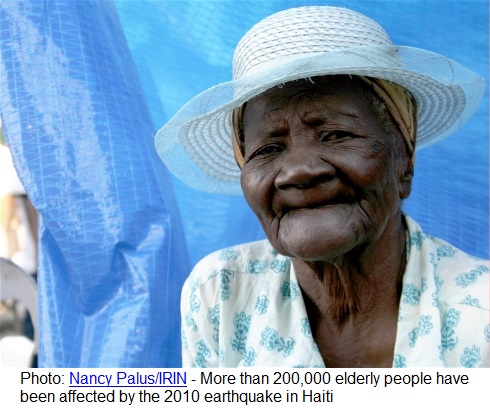
The Go Lean … Caribbean roadmap constitutes a change for the region, a plan to consolidate 30 member-states into a Trade Federation with the tools/techniques to bring immediate change to the region to benefit one and all member-states. The roadmap calls for the coordination of the region’s (mental) healthcare needs at a CU federal agency. Though there is a separation-of-powers mandate between the member-states and federal agencies, the CU can still wield influence in this area due to funding accountabilities, (strings attached). The Go Lean roadmap details a monitoring and metering responsibility between the CU and the member-states; so there will be some federal compliance and regulatory oversight. This empowerment would also allow for better coordination with international stakeholders – like the World Health Organization (WHO) – and non-governmental organizations (NGOs) – there are many that cater to the needs of the elderly, just consider the VIDEO in the Appendix below.

For the Caribbean, we will not want our elderly population “checking out” from society! We love them too much and they have endured far more that they should have; see VIDEO below. The “happiness mandate” identified at the start, is presented in the book as a “community ethos” (Page 20), the definition of which follows here:

… the fundamental character or spirit of a culture; the underlying sentiment that informs the beliefs, customs, or practices of a group or society; the dominant assumptions of a people or period.

The book details that there must first be adoption of such a community ethos plus the executions of the following strategies, tactics, implementations and advocacies to impact the region’s public health:

Community Ethos – Deferred Gratification Page 21
Community Ethos – Economics Influence Choices Page 21
Community Ethos – Privacy versus Public Protection Page 23
Community Ethos – “Crap” Happens Page 23
Community Ethos – Lean Operations Page 24
Community Ethos – Cooperatives Page 24
Community Ethos – Non-Government Organizations Page 25
Community Ethos – Ways to Improve Sharing Page 35
Community Ethos – Ways to Promote Happiness Page 36
Community Ethos – Impact the Greater Good Page 37
Strategy – Vision – Confederate 30 Member-States Page 45
Strategy – Mission – Reform our Health Care Response Page 47
Strategy – Agents of Change – Aging Diaspora Page 57
Tactical – Fostering a Technocracy Page 64
Separation of Powers – Department of Health Page 86
Implementation – Ways to Deliver Page 109
Planning – Ways to Model the EU Page 130
Planning – Ways to Make the Caribbean Better Page 131
Planning – Ways to Measure Progress Page 148
Advocacy – Ways to Grow the Economy Page 151
Advocacy – Ways to Improve Healthcare Page 156
Advocacy – Ways to Impact Cancer Page 157
Advocacy – Ways to Better Manage the Social Contract Page 170
Advocacy – Ways to Foster Cooperatives Page 176
Advocacy – Ways to Improve Emergency Management Page 196
Advocacy – Ways to Improve Elder-Care Page 225
Appendix – Disease Management – Healthways Model Page 300
Appendix – Trauma Center Definitions Page 336

This Go Lean book asserts that there is a direct correlation of physical/mental health issue with the economy. This viewpoint has been previously detailed in Go Lean blog/commentaries, as sampled here:

Book Review: ‘The Protest Psychosis’
Guyana and Suriname Wrestle With High Rates of Suicides
Public Health Economics – The Cost of Cancer Drugs
Antibiotics Misuse Associated With Obesity Risk
Recessions and Public Health in the Caribbean Region
New Hope in the Fight Against Alzheimer’s Disease

There is a place in the new Caribbean for the elderly populations. Granted, they may not be candidates for the highly-sought, high-multiplier STEM (Science, Technology, Engineering and Mathematics) jobs, but nonetheless they are stakeholders in the Go Lean mission. Love of neighbor – the Greater Good – is why we do what we do!

This issue of suicide among the elderly, as discussed in the foregoing article is indicative of the need for better stewardship of the economy, security and governing engines in the Caribbean. This makes the region a better place to live, work, and play – for all: young and old.

🙂

Download the book Go Lean … Caribbean – now!

————-

Appendix VIDEO – “Honor the Elderly” (The Forgotten Ones)  – https://youtu.be/PZvnJv4CZQ8

Uploaded on Nov 5, 2009 – We must honor the elderly! We must treat the elderly with dignity, love and respect. How we treat the elderly is a reflection of who we are. We should treat them the way we would want to be treated when we grow old and feeble. Many elderly are full of wisdom and we can learn valuable lessons from them.
Music:  “On The Other Side Of Jordan” by Rabbit Easter Band (Google PlayeMusicAmazonMP3)

Share this post:
, , , , , ,
[Top]

Socio-Economic Change: Illustrations That Perfectly Show How Society Has Changed

Go Lean Commentary

Be careful what you wish for; it just might come true. – Old Adage

This statement is a reporting of facts. In fact, this statement can be defined as a law. The law of the socio-economic dynamic. The definition of socio-economics (or social economics) is the social science that studies how economic activity affects and is shaped by social processes. In general it analyzes how societies progress, stagnate, or regress because of the local, regional or global economy.

This commentary is the 1st of a 3-part series; the other considerations relate to …

2. the high suicide rate among the elderly, and …

3. the economic impact studies to justify public financing of private enterprises.

Over the past half century, the economic structures of many North American and Western European countries have changed dramatically, a mostly upward trajectory (growth) with occasional dips (recessions). During this same past half century, the economics of many Caribbean countries have also changed dramatically, but mostly towards poor or regressive conditions. This fact has forced a brain drain among many of the member-states’ professional classes.

This [brain drain] reality is a socio-economic dynamic; it was the motivation for the publishing of the book Go Lean…Caribbean in the first place. It describes the current assessments of the region and then communicates a vision to elevate the Caribbean’s 30 member-states and 42 million people into a Single Market economy. The goal is to create 2.2 million new jobs and grow the region to $800 Billion GDP. This vision is embedded in the following statements in the opening Declaration of Interdependence (Page 13) for these member-states:

xix. Whereas our legacy in recent times is one of societal abandonment, it is imperative that incentives and encouragement be put in place to first dissuade the human flight, and then entice and welcome the return of our Diaspora back to our shores. This repatriation should be effected with the appropriate guards so as not to imperil the lives and securities of the repatriated citizens or the communities they inhabit. The right of repatriation is to be extended to any natural born citizens despite any previous naturalization to foreign sovereignties.

xx. Whereas the results of our decades of migration created a vibrant Diaspora in foreign lands, the Federation must organize interactions with this population into structured markets. Thus allowing foreign consumption of domestic products, services and media, which is a positive trade impact. These economic activities must not be exploited by others’ profiteering but rather harnessed by Federation resources for efficient repatriations.

xxi. Whereas the preparation of our labor force can foster opportunities and dictate economic progress for current and future generations, the Federation must ensure that educational and job training opportunities are fully optimized for all residents of all member-states, with no partiality towards any gender or ethnic group. The Federation must recognize and facilitate excellence in many different fields of endeavor, including sciences, languages, arts, music and sports. This responsibility should be executed without incurring the risks of further human flight, as has been the past history.

xxiv.  Whereas a free market economy can be induced and spurred for continuous progress, the Federation must install the controls to better manage aspects of the economy: jobs, inflation, savings rate, investments and other economic principles. Thereby attracting direct foreign investment because of the stability and vibrancy of our economy.

xxv.  Whereas the legacy of international democracies had been imperiled due to a global financial crisis, the structure of the Federation must allow for financial stability and assurance of the Federation’s institutions. To mandate the economic vibrancy of the region, monetary and fiscal controls and policies must be incorporated as proactive and reactive measures. These measures must address threats against the financial integrity of the Federation and of the member-states.

Another dynamic has been the advancement and assimilation of technology. This acknowledgement was also pronounced in the opening Declaration of Interdependence (Page 14):

xxvii. Whereas the region has endured a spectator status during the Industrial Revolution, we cannot stand on the sidelines of this new economy, the Information Revolution. Rather, the Federation must embrace all the tenets of Internet Communications Technology (ICT) to serve as an equalizing element in competition with the rest of the world. The Federation must bridge the digital divide and promote the community ethos that research/development is valuable and must be promoted and incentivized for adoption.

As these changes took hold of society, the social effects on people, families, traditions, habits and values have been drastic; a lot has changed over the past decades. How can this be conveyed graphically? The following – funny and enlightening illustrations – give an accurate depiction of society’s changes – then and now.

16 Illustrations That Perfectly Show How Society Has Changed

CU Blog - Socio-Economic Change - Illustrations That Perfectly Show How Society Has Changed - Photo 1
CU Blog - Socio-Economic Change - Illustrations That Perfectly Show How Society Has Changed - Photo 2
CU Blog - Socio-Economic Change - Illustrations That Perfectly Show How Society Has Changed - Photo 3
CU Blog - Socio-Economic Change - Illustrations That Perfectly Show How Society Has Changed - Photo 4
CU Blog - Socio-Economic Change - Illustrations That Perfectly Show How Society Has Changed - Photo 5
CU Blog - Socio-Economic Change - Illustrations That Perfectly Show How Society Has Changed - Photo 6
CU Blog - Socio-Economic Change - Illustrations That Perfectly Show How Society Has Changed - Photo 7
CU Blog - Socio-Economic Change - Illustrations That Perfectly Show How Society Has Changed - Photo 8
CU Blog - Socio-Economic Change - Illustrations That Perfectly Show How Society Has Changed - Photo 9
CU Blog - Socio-Economic Change - Illustrations That Perfectly Show How Society Has Changed - Photo 10
Illustrations 11
CU Blog - Socio-Economic Change - Illustrations That Perfectly Show How Society Has Changed - Photo 12
CU Blog - Socio-Economic Change - Illustrations That Perfectly Show How Society Has Changed - Photo 13
CU Blog - Socio-Economic Change - Illustrations That Perfectly Show How Society Has Changed - Photo 14
CU Blog - Socio-Economic Change - Illustrations That Perfectly Show How Society Has Changed - Photo 15
CU Blog - Socio-Economic Change - Illustrations That Perfectly Show How Society Has Changed - Photo 16
(Source: Brain Jet Daily Cerebral Stream – Ad-supported Online Site – Retrieved July 15, 2015 from: http://www.brainjet.com/random/19913/then-and-now-16-illustrations-that-perfectly-show-how-society-has-changed#slide/1)

Change is afoot!

Among the changes – to people, families, traditions, habits and values – is the socio-economic effects of the Caribbean brain drain, estimated at 70%. This is a crisis!

This is a consistent theme in the Go Lean book; it describes “push and pull” of societal change; it posits that life in North American and Western European countries serve as a “pull” factor for many Caribbean communities. Plus, the failing economic conditions further “push” many citizens away. To alleviate this crisis, there is the need to counter-defend with purposeful change of our own for the region. The Go Lean book serves as a roadmap to elevate the economics of the region; and it clearly describes the impact on other societal engines: security and governance. Everyone feels the change; it is like a moving locomotive, “you can’t stop the beat; you can’t stop the motion of the ocean”. This is also the moving imagery depicted in the VIDEO below.

The Go Lean roadmap is a planning tool for the strategic, tactical, and operational empowerments that needs to be implemented to keep pace with the world’s Agents of Change: Technology, Aging Diaspora, Globalization and “Climate Change”. The purpose of the book therefore is to position the region at the corner of preparation and opportunity, so as to benefit from change. We have many needs – economic, security and governance – to avert this societal abandonment trend. The book / roadmap is for the introduction and implementation of the Caribbean Union Trade Federation (CU), a super-national institution with federal powers to forge change in the Caribbean community. One mission is to dissuade further human flight/brain drain. (An additional mission is to incentivize the repatriation of the Caribbean Diaspora).

The following details from the book Go Lean … Caribbean are the assessments, community ethos, strategies, tactics, implementations and advocacies prescribed to manifest the elevation of Caribbean economy, society and life:

Assessments of Caribbean Communities – English, French, Dutch, and Spanish states Page 15
Community Ethos – Security Principles Page 23
Community Ethos – Economic Principles Page 21
Community Ethos – Governing Principles Page 24
Community Ethos – Ways to Impact the Future Page 26
Community Ethos – Ways to Impact Turn-Arounds Page 33
Community Ethos – Ways to Impact the Greater Good Page 37
Strategy – Vision – Confederate all 30 Member-States into a Single Market Page 45
Strategy – Mission – Repatriating Caribbean Diaspora Page 46
Strategy – Mission – Dissuade further Brain Drain Page 46
Tactical – Fostering a Technocracy Page 64
Tactical – Separation of Powers with Caribbean Member-states Page 71
Implementation – Assemble all Member-States Page 96
Implementation – Ways   to Pay for Change Page 101
Implementation –Reasons to Repatriate Page 118
Planning – Ways to Make the Caribbean   Better Page 131
Planning – Ways to Better Manage Image Page 133
Advocacy – Ways to Grow the Economy Page 151
Advocacy – Ways to Create Jobs Page 152
Advocacy – Better Manage the Social Contract Page 170
Advocacy – Ways to Foster Technology Page 197
Advocacy – Impact the Diaspora Page 217
Advocacy – Ways to Preserve Caribbean Heritage Page 218
Advocacy – Ways to Protect Human Rights Page 220

Many Caribbean citizens love their homeland but the realities of flawed economics will always cause a brain drain. This flight-abandonment creates the need for a societal reboot in the economics, security and governing engines. This is the quest of the Go Lean…Caribbean roadmap, to reboot these societal engines; employing best-practices and better strategies, tactics and implementations to impact its prime directives; identified with the following 3 statements:

  • Optimization of the economic engines in order to grow the regional economy to $800 Billion & create 2.2 million new jobs.
  • Establishment of a security apparatus to protect the resultant economic engines and mitigate challenges/threats to ensure public safety for the region’s stakeholders.
  • Improvement of Caribbean governance, including a separation-of-powers with member-states, to support these engines.

The same as the foregoing illustrations, there are many Go Lean blog commentaries that have detailed the anatomy of change in the Caribbean. Our changes – to systems, people and institutions – have not always been positive, or beneficial. Here is a sample of related commentaries, grouped by the recognizable categories in the illustrations:

  • Transforming Change
  • Internet & Communications Technology
  • Toleration of Minority Classes

Transforming Change

https://goleancaribbean.com/blog/?p=5695 Repenting, Forgiving and Reconciling the Past
https://goleancaribbean.com/blog/?p=5088 Immigrants account for 1 in 11 Blacks in USA
https://goleancaribbean.com/blog/?p=5123 A Lesson in History – Royal Charter: Zimbabwe -vs- South Africa
https://goleancaribbean.com/blog/?p=5098 Forging Change – ‘Food’ for Thought
https://goleancaribbean.com/blog/?p=4840 Jamaican Poll: ‘Bring back the British!’
https://goleancaribbean.com/blog/?p=3834 State of the Caribbean Union
https://goleancaribbean.com/blog/?p=3568 Forging Change: Music Moves People
https://goleancaribbean.com/blog/?p=3512 Forging Change: The Sales Process
https://goleancaribbean.com/blog/?p=3455 Restoration of Diplomatic Relations with Cuba
https://goleancaribbean.com/blog/?p=2291 Forging Change: The Fun Theory
https://goleancaribbean.com/blog/?p=1433 Caribbean loses more than 70 percent of tertiary educated to brain drain
https://goleancaribbean.com/blog/?p=1309 5 Steps of a Bubble
https://goleancaribbean.com/blog/?p=248 Is “Print” dead? Maybe soon! The Transforming Change in Media

Internet & Communications Technology

https://goleancaribbean.com/blog/?p=5840 Computer Glitches Disrupt Business As Usual
https://goleancaribbean.com/blog/?p=5668 Move over Mastercard/Visa – New Payment Systems in the Caribbean
https://goleancaribbean.com/blog/?p=5648 Changes in Music Retailing – Online and Mobile
https://goleancaribbean.com/blog/?p=5435 China Internet Policing – Model for Caribbean
https://goleancaribbean.com/blog/?p=4381 Net Neutrality: It Matters Here …
https://goleancaribbean.com/blog/?p=3974 Google and Mobile Phones – Here comes Change
https://goleancaribbean.com/blog/?p=3915 ‘Change the way you see the world; you change the world you see’
https://goleancaribbean.com/blog/?p=1416 The Amazon Model for Caribbean Empowerment
https://goleancaribbean.com/blog/?p=1092 The Aereo Case Study and the future of TV
https://goleancaribbean.com/blog/?p=308 CARCIP – Regional Initiatives to Urge Greater Caribbean Innovation

Toleration of Minority Classes

https://goleancaribbean.com/blog/?p=5784 Buggery in Jamaica – ‘Say It Ain’t So’!
https://goleancaribbean.com/blog/?p=5720 Disability Advocacy: Reasonable Accommodations
https://goleancaribbean.com/blog/?p=5527 American Defects: Racism – Is It Over?
https://goleancaribbean.com/blog/?p=5333 Racial Legacies: Cause and Effect
https://goleancaribbean.com/blog/?p=5183 A Lesson in History – Cinco De Mayo and the Mexican Model
https://goleancaribbean.com/blog/?p=4613 A Lesson in History – The ‘Luck of the Irish’; Past, Present & Future
https://goleancaribbean.com/blog/?p=4551 US Territories – Between a ‘rock and a hard place’
https://goleancaribbean.com/blog/?p=2633 Book Review: ‘The Protest Psychosis’
https://goleancaribbean.com/blog/?p=2547 Miami’s Success versus Caribbean Failure
https://goleancaribbean.com/blog/?p=809 Muslim officials condemn abductions of Nigerian girls
https://goleancaribbean.com/blog/?p=789 America’s War on the Caribbean
https://goleancaribbean.com/blog/?p=546 Book Review: ‘The Divide’
https://goleancaribbean.com/blog/?p=341 US slams Caribbean Human Rights practices
https://goleancaribbean.com/blog/?p=209 Case Study: Muhammad Ali –vs- the United States

There are many societal defects in the Caribbean region; we need effective strategies, tactics and implementation to effect turn-around.

The needs of Caribbean community cannot be casually dismissed. As crises ensue, people respond; they make choices: fight or flight.

We must do better than our prior track record. We can “rock with the changes” in society. Though this effort is not easy, rather heavy-lifting, the adoption and application of best-practices can yield beneficial results – the returns are worth the investment.

“You can’t stop a locomotive as it comes speeding down the track; yesterday is history and it’s never coming back. But tomorrow is a brand new day and it doesn’t know White or Black” – see VIDEO in the Appendix below.

This is the goal of the Go Lean roadmap: to help make the Caribbean a better place to live, work and play. 🙂

Download the free e-Book of Go Lean … Caribbean – now!

————-

Appendix VIDEO – You Can’t Stop The Beat! – https://youtu.be/ovLKUoMqPSg

A VIDEO of the finale of the movie Hairspray (2007) … ENJOY Edna & Tracy Turnblad, Link Larkin, Penny Pingleton, Velma & Amber Von Tussle, Motormouth Maybelle, Corny Collins and other characters, as they drive home the important moral lesson of accepting change.

Share this post:
, , , ,
[Top]

Buggery in Jamaica – ‘Say It Ain’t So’!

Go Lean Commentary

This commentary has asserted that the Caribbean region can be a better society than the United States of America. Yes, we can!

But to  even start the discussion, we must first:

Live and let live!

t So - Photo 3The topic of intolerance has been acute in the news as of late. We have the extreme example of the Islamic State in Iraq and Syria (ISIS) beheading non-Muslims because… well, just because. And the example of the US legalizing Gay Marriage may be considered too tolerant for some people’s good taste.

Where does the Caribbean fit in this discussion?

If ISIS is one end of a scale and Gay Marriage in America is another end, then one Caribbean member-state, Jamaica, would be closer to …

ISIS!

Yes, it is that bad. Say it ain’t so.

See Appendix-VIDEO’s below …

While this commentary directly targets Jamaica, the majority of the countries and overseas territories of the former British Empire, still criminalize sexual acts between consenting adults of the same sex and other forms of sexual orientation, gender identity and expression. This has been described as being the result of “the major historical influence” or legacy of the British Empire. In most cases, it was former colonial administrators that established anti-gay legislation or sodomy acts during the 19th century; see Appendix below. The majority of countries then retained these laws following independence.[1][2].

There is an effort now to transform society in Jamaica (and other countries) in this regards. There are Gay Pride Activities being planned for this Summer of 2015. See the relevant news article here:

Title: J-FLAG Is Planning Gay Pride Activities, But No Parade For August – Exec
Source: Jamaica Gleaner Daily Newspaper Online Site; posted June 30, 2015; retrieved from: http://jamaica-gleaner.com/article/news/20150630/j-flag-planning-gay-pride-activities-no-parade-august-exec  

Local gay lobby, J-FLAG, is refuting reports that it will host a road parade in August when the group plans to have a series of gay pride activities.

Social media has been abuzz since yesterday following a report that the group would host a parade, similar to what is done in the United   States and other countries.

However, executive director of J-FLAG, Dane Lewis, says the report is wrong, adding that Jamaica is not ready for such an event.

Meanwhile, he says the group is planning a week-long series of activities starting on Emancipation Day, August 1, to mark growing tolerance for members of the lesbian, gay, bisexual, and transgender (LGBT) community.

Some years ago, an attempt to host a gay parade was thwarted after anti-gay supporters reportedly planned attacks against marchers.

Jamaica is accused of being one of the most homophobic places on earth.

Last week, the US government released a report noting that anti-gay laws and the dancehall culture are responsible for perpetuating homophobia in Jamaica.
Additional reference sources: http://jflag.org/

t So - Photo 1
———–

VIDEO: Executive Director of JFLAG, Dane Lewis: “We Are Jamaicans” – https://youtu.be/sJ-17R5DCoI


Published on Jan 17, 2013 – “We Are Jamaicans” is funded with the kind support of the Caribbean Vulnerable Communities Coalition (CVC) through its Global Fund Vulnerablised Project.

Building a diverse society is not easy. The book Go Lean … Caribbean describes the challenge as heavy-lifting. Though the US had failed at this challenge, it proudly boasts that it got better with every generation. The Caribbean on the other hand, leaves much to be desired in terms of the willingness to change and keep pace with progressive societies. (Now the US, Canada, Ireland and other countries have legalized Gay Marriage).

In a previous blog-commentaries, this defect – Homosexual Intolerance – was listed among the blatant human rights abuses in the region.

This is an important consideration for the planners of Caribbean empowerment. The Caribbean, a region where unfortunately, we have NOT … tried to be as tolerant as may be required, expected and just plain moral.

We must do better!

The book Go Lean … Caribbean asserts that Caribbean society’s prosperity has been hindered with a high abandonment rate – reported at 70% for educated classes region-wide, but an even higher 85% in Jamaica. The primary mission of the Go Lean book is to “battle” against the “push-and-pull” factors that draw so many of our Caribbean citizens away from their homelands to go to more progressive countries.

The Go Lean book campaigns to lower the “push” factors!

The purpose of the Go Lean book is to fix the Caribbean; to be better. The Go Lean book serves as a roadmap for the introduction and implementation of the technocratic Caribbean Union Trade Federation (CU) to pursue the quest to elevate the Caribbean region through empowerments in economics, security and governance. It is the assertion that Caribbean citizens can stay home and effect change in their homelands more effectively than going to some foreign countries to find opportunities for life, liberty and the pursuit of happiness. The book therefore asserts that the region can turn-around from failing assessments by applying best-practices, and forging new societal institutions to impact the Greater Good for all the Caribbean. This point was pronounced in the opening Declaration of Interdependence (Pages 10 – 14) with these acknowledgements and statements:

xi.   Whereas all men are entitled to the benefits of good governance in a free society, “new guards” must be enacted to dissuade the emergence of incompetence, corruption, nepotism and cronyism at the peril of the people’s best interest. The Federation must guarantee the executions of a social contract between government and the governed.

xii. Whereas the legacy in recent times in individual states may be that of ineffectual governance with no redress to higher authority, the accedence of this Federation will ensure accountability and escalation of the human and civil rights of the people for good governance, justice assurances, due process and the rule of law. As such, any threats of a “failed state” status for any member state must enact emergency measures on behalf of the Federation to protect the human, civil and property rights of the citizens, residents, allies, trading partners, and visitors of the affected member state and the Federation as a whole.

xxxiii. Whereas lessons can be learned and applied from the study of the recent history of other societies, the Federation must formalize statutes and organizational dimensions to avoid the pitfalls of communities like … Egypt. On the other hand, the Federation must also implement the good examples learned from developments/ communities like New York City, … Canada, … and tenants of the US Constitution.

The CU/Go Lean vision to elevate Caribbean society must also consider the issue of image. There is the need for a sentinel role for Caribbean image, as there are a lot of times that Caribbean life and people are denigrated in the media: news, film, TV, books, magazines. It’s unfortunate when we are guilty of scathing allegations. The Go Lean roadmap calls for the CU to assume a role of protecting and projecting positive Caribbean images. The plan is to use cutting edge delivery of best practices; the applicable CU agencies will employ strategies, tactics and implementations to impact the Go Lean prime directives; identified with the following 3 statements:

  • Optimization of the economic engines in order to grow the regional economy to $800 Billion & create 2.2 million new jobs.
  • Establishment of a security apparatus to protect the resultant economic engines and mitigate challenges/threats to public safety for all citizens… LGBT or straight.
  • Improvement of Caribbean governance to support these engines.

Jamaica has a failing economy.

Jamaica’s primary economic driver is tourism. So …

t So - Photo 2

Is the Caribbean ready for this economic activity? A bridge too far, too soon?

t So - Photo 4Jamaica has a long way to go; the country has been described by some Human Rights groups as the most homophobic place on Earth because of the high level of violent crime directed at LGBT people; (Padgett, Tim: “The Most Homophobic Place on Earth?”Time Magazine posted 12 April 2006). The United States Department of State said that in 2012, “homophobia was [unacceptably] widespread in the country” (2012 Country Reports on Human Rights Practices: Jamaica, Bureau of Democracy, Human Rights and Labor, U.S. Department of State, pages 20-22). As depicted in the VIDEO below, even President Obama indicted the island on a recent official State Visit.

Why is this country’s homophobia so acute compared to other countries? For one, they have held on emphatically to the British Laws on Buggery – see Appendix below – from their colonial days; even though the host country of England has already abandoned the laws (in 1967).

Jamaica is partying like it’s 1899!

This is therefore a matter of community ethos. The Go Lean book defines community ethos as the fundamental character or spirit of a culture; the underlying sentiment that informs the beliefs, customs, or practices of a group or society; the dominant assumptions of a people or period. This tropical paradise of Jamaica, as defined in the foregoing news article and VIDEO continues to spur bad attitudes, bad ideas, bad speech and bad actions towards the LGBT community. This is unbecoming of a progressive society in 2015.

Alas, this is a crisis…for victims and their loved ones. The Go Lean book posits that this crisis can be averted, that the crisis is a “terrible thing to waste”. The Go Lean roadmap seeks to optimize the eco-systems for Jamaica and the entire Caribbean. The book stresses new community ethos, strategies, tactics, implementations and advocacies necessary to transform and turn-around the eco-systems of the regional society. These points are detailed in the book as follows:

Who We Are – SFE Foundation – Comprised of Caribbean Diaspora Page 8
Community Ethos – Economic Principles – Economic Systems Influence Individual Choices Page 21
Community Ethos – Economic Principles – Consequences of Choices Lie in the Future Page 21
Community Ethos – Governing Principles – Lean Operations Page 24
Community Ethos – Ways to Impact the Future Page 26
Community Ethos – Ways to Promote Happiness Page 36
Community Ethos – Ways to Impact the Greater Good Page 37
Strategy – Vision – Confederate all 30 member-states into a Single Market Page 45
Strategy – Mission – Build and foster local economic engines Page 45
Strategy – Mission – Repatriate the Diaspora, even Minorities like those of the LGBT community Page 46
Tactical – Ways to Foster a Technocracy Page 64
Tactical – Growing the Economy to $800 Billion GDP Page 68
Tactical – Separation-of-Powers – CU Federal Government versus Member-State Governance Page 71
Anatomy of Advocacies – Examples of Individuals Who Made Impact Page 122
Planning – 10 Big Ideas – Homeland Security Pact Page 127
Planning – Ways to Make the Caribbean Better Page 131
Planning – Ways to Improve Failed-State Indices – Minority and Human Rights Page 134
Planning – Lessons Learned from US Constitution – Equal Protection for all Minorities Page 145
Advocacy – Ways to Grow the Economy Page 151
Advocacy – Ways to Create Jobs Page 152
Advocacy – Ways to Improve Governance – For All Citizens Page 168
Advocacy – Ways to Better Manage the Social Contract – Security against “Bad Actors” Page 170
Advocacy – Ways to Impact Justice – Internal Affairs Reporting Line Page 177
Advocacy – Ways to Remediate and Mitigate Crime – Hate Crime Qualifiers Page 178
Advocacy – Ways to Improve Homeland Security Page 180
Advocacy – Ways to Mitigate Terrorism – Consider Bullying as Junior Terrorism Page 181
Advocacy – Ways to Impact Youth – Collaborating with Foundations Page 218
Advocacy – Ways to Re-boot Jamaica Page 239
Advocacy – Ways to Impact British Territories Page 245

Looking at the disposition of the island nation of Jamaica’s, we see that its societal engines are failing.

Could the investment in the diversity of its people be at the root of the problem?

The failing indices and metrics of Jamaica have been considered in previous blog/commentaries; see sample here:

https://goleancaribbean.com/blog/?p=4840 Jamaican Poll: ‘Bring back the British!’
https://goleancaribbean.com/blog/?p=3694 Looking for a job in Jamaica, go to Canada
https://goleancaribbean.com/blog/?p=2830 Jamaica’s Public Pension Under-funded
https://goleancaribbean.com/blog/?p=392 Jamaica to receive World Bank funds to help in crime fight
https://goleancaribbean.com/blog/?p=313 What’s Holding Back Jamaica’s Reforms

The Go Lean roadmap seeks to empower and elevate Caribbean societal engines to make Jamaica, and the rest of the Caribbean, better places to live, work and play … for all citizens, including the LGBT communities.

Most of the Jamaican Diaspora that has abandoned the island now lives in the US, Canada or the UK. Their new home-communities are more tolerant societies of their LGBT neighbors.

Perhaps, there is some correlation.

This commentary is not urging the abandonment of the Judeo-Christian moral code; Jesus Christ instructed to “let them be” at Luke 22:51 (The Message Translation). Rather this commentary urges tolerance and moderation: Live and let live!

Fight the hate!

Yes, we can … do this. Yes, we must do this. 🙂

Download the book Go Lean … Caribbean – now!
———–

Appendix VIDEO: US President Obama’s LGBT comments at Youth Leaders Town Hall – https://youtu.be/636mgw1THpc?t=5m1s


Published on Apr 9, 2015 – President Obama delivers remarks and answers questions at a town hall with Young Leaders of the Americas at University of the West Indies in Kingston, Jamaica. April 9, 2015.
———–

Appendix VIDEO: Gay rights in Jamaica – https://youtu.be/_nSgMGoBAmU

playbutton-300x300

———–

Appendix – Encyclopedic Reference: Buggery in English Common Law

The British English term buggery is very close in meaning to the term sodomy, often used interchangeably in law and popular speech. It may also be a specific common law offenceencompassing both sodomy and bestiality.

In English law “buggery” was first used in the Buggery Act 1533, while Section 61 of the Offences against the Person Act 1861, entitled “Sodomy and Bestiality”, defined punishments for “the abominable Crime of Buggery, committed either with Mankind or with any Animal”. The definition of “buggery” was not specified in these or any statute, but rather established by judicial precedent.[1] Over the years the courts have defined buggery as including either [of these]:

  1. anal intercourse or oral intercourse by a man with a man or woman[2] or
  2. vaginal intercourse by either a man or a woman with an animal,[3]

But [no other] form of “unnatural intercourse”[4] [was defined], the implication being that anal sex with an animal would not constitute buggery. Such a case has not, to date, come before the courts of a common law jurisdiction in any reported decision. However, it seems highly improbable that a person would be exculpated of a crime associated with sex with animals only by reason of the fact that penetration involved the anus rather than the vagina. In the 1817 case of Rex v. Jacobs, the Crown Court ruled that oral intercourse, even with an underage and/or non-consenting person, did not constitute buggery or sodomy.[4]

At common law consent was not a defence[5] nor was the fact that the parties were married.[6] In the UK, the punishment for buggery was reduced from hanging to life imprisonment by the Offences against the Person Act 1861. As with the crime of rape, buggery required that penetration must have occurred, but ejaculation is not necessary.[7]

Most common law jurisdictions have now modified the law to permit anal sex between consenting adults.[8] Hong Kong did so retroactively in 1990, barring prosecution for “crimes against nature” committed before the Crimes (Amendment) Ordinance 1990 entered into force except those that would still have constituted a crime if they had been done thereafter. In England and Wales, homosexual buggery was decriminalised in 1967 with an age of consent at 21 years, whereas all heterosexual intercourse had an age of consent at 16 years. The Sexual Offences Act 2003 did not fully remove buggery as a concept in United Kingdom law, as the previous law is retained for complainants (consensual or “pseudo-consensual”) under the age of 16, or 18 with regards to an adult perceived to be in a “position of trust”. As the law stands, buggery is still charged, exclusively regarding “pseudo-consensual” anal intercourse with those under 16/18, because children cannot legally consent to buggery although they may appear to do so. Rape is charged when the penetration is clearly not consensual. Buggery with an animal is still unlawful under Section 69 of the Sexual Offences Act 2003.

In the Republic of Ireland, the Criminal Law (Sexual Offences) Act 1993 abolished the offence of “buggery between persons”.[9] For some years prior to 1993, criminal prosecution had not been made for buggery between consenting adults. The 1993 Act created an offence of “buggery with a person under the age of 17 years”,[10] penalised similar to statutory rape, which also had 17 years as the age of consent. The Criminal Law (Sexual Offences) Act 2006 replaced this offence with “defilement of a child”, encompassing both “sexual intercourse” and “buggery”.[11] Buggery with an animal is still unlawful under Section 69 of the Sexual Offences Act 2003. In 2012 a man was convicted of this offence for supplying a dog in 2008 to a woman who had intercourse with it and died.[12]

Etymology – The word bugger and buggery are still commonly used in modern English as a mild exclamation. “Buggery” is also synonymous with anal sex.

The word “bugger” was derived, via the French bougre, from Bulgar, that is, “Bulgarian”, meaning the medieval Bulgarian heretical sect of the Bogomils, which spread into Western Europe and was claimed by the established church to be devoted to the practice of sodomy.[13] “Buggery” first appears in English in 1330, though “bugger” in a sexual sense is not recorded until 1555.[14]

(Source: https://en.wikipedia.org/wiki/Buggery)

Share this post:
, , , , , ,
[Top]

Better than America? Yes, We Can!

Go Lean Commentary

Is America the “Greatest Country in the World”?

Perhaps this was arguable in the past? Today? Hardly … see VIDEO here; (excuse the profanity):

VIDEO: America, the Greatest? –


Published on Oct 21, 2012 – Jeff Daniels, who portrays news anchor Will McAvoy in the HBO Series “The Newsroom”, delivered a stunning, hard-hitting, accurate, and intelligent monologue/response when asked why America is the greatest country in the world. A sobering outlook on the state of the USA. (CAUTION ON THE ADULT LANGUAGE).

Even in the past when the “Greatest” label was arguable, it didn’t apply to everyone! America was the Greatest Country, maybe, if you were:

White, Anglo-Saxon, Rich, Male and Straight

But if you were any of the following, then God help you:

Black
Brown – Hispanic
Native American
Jewish
Catholic
Woman
Gay
Persons with Disabilities (Physical or Mental)
Slavic – Eastern European
Muslim
Communists
Atheist
Poor

CU Blog - Better than America - Yes We Can - Photo 2Yes, building a multi-cultural society is not easy. The book Go Lean … Caribbean describes the challenge as heavy-lifting. America has failed at this challenge, hands-down. In previous blog- commentaries, many defects of American life were detailed, (including the propensity for Crony-Capitalism). See the list of defects here: Housing, education, job hunting, prisons, drug crime prosecutions, and racial profiling.

But despite this list and the reality of this subject, America tries …

This is an important consideration for the planners of Caribbean empowerment. The Caribbean, a region where unfortunately, we have NOT … tried.

The social science of Anthropology teaches that communities have two choices when confronted with endangering crises: fight or flight. The unfortunate reality is that we have chosen the option of flight; (we have no ethos for fighting for our homeland).

The book Go Lean … Caribbean asserts that no society can prosper with a high abandonment rate – reported at 70% for educated classes. The primary mission of the Go Lean book is to “battle” against the “push-and-pull” factors that draw so many of our Caribbean citizens away from their homelands to go to the US. While we cannot change/fix America, we can…

Lower the “push” factors!

The purpose of the Go Lean book is to fix the Caribbean, to be better than America. The Go Lean book serves as a roadmap for the introduction and implementation of the technocratic Caribbean Union Trade Federation (CU) to pursue the quest to elevate the Caribbean region through empowerments in economics, security and governance. It is the assertion that Caribbean citizens can stay home and effect change in their homelands more effectively than going to America to find the “Greatest Country in the World”. The book therefore asserts that the region can turn-around from failing assessments by applying best-practices, and forging new societal institutions to impact the Greater Good for all the Caribbean. This point was pronounced in the opening Declaration of Interdependence (Pages 10 – 14) with these acknowledgements and statements:

xi.   Whereas all men are entitled to the benefits of good governance in a free society, “new guards” must be enacted to dissuade the emergence of incompetence, corruption, nepotism and cronyism at the peril of the people’s best interest. The Federation must guarantee the executions of a social contract between government and the governed.

xii. Whereas the legacy in recent times in individual states may be that of ineffectual governance with no redress to higher authority, the accedence of this Federation will ensure accountability and escalation of the human and civil rights of the people for good governance, justice assurances, due process and the rule of law. As such, any threats of a “failed state” status for any member state must enact emergency measures on behalf of the Federation to protect the human, civil and property rights of the citizens, residents, allies, trading partners, and visitors of the affected member state and the Federation as a whole.

xxxiii. Whereas lessons can be learned and applied from the study of the recent history of other societies, the Federation must formalize statutes and organizational dimensions to avoid the pitfalls of communities like … Detroit, Indian (Native American) Reservations… On the other hand, the Federation must also implement the good examples learned from developments/ communities like New York City, … Canada, the old American West and tenants of the US Constitution.

This is the quest of Go Lean…Caribbean roadmap, to reboot the region’s societal engines; employing best-practices and better strategies, tactics and implementations to impact its prime directives; identified with the following 3 statements:

  • Optimization of the economic engines in order to grow the regional economy to $800 Billion & create 2.2 million new jobs.
  • Establishment of a security apparatus to protect the resultant economic engines and mitigate challenges/threats to the region’s public safety.
  • Improvement of Caribbean governance to support these engines.

The Go Lean book stresses key community ethos, strategies, tactics, implementations and advocacies necessary to transform and turn-around the eco-systems of Caribbean society. These points are detailed in the book as follows:

Community Ethos – Economic Principles – Economic Systems Influence Individual Choices Page 21
Community Ethos – Economic Principles – Consequences of Choices Lie in the Future Page 21
Community Ethos – Governing Principles – Lean Operations Page 24
Community Ethos – Ways to Impact the Future Page 26
Community Ethos – Ways to Promote Happiness Page 36
Community Ethos – Ways to Impact the Greater Good Page 37
Strategy – Vision – Confederate all 30 member-states/ 4 languages into a Single Market Page 45
Strategy – Mission – Build and foster local economic engines Page 45
Tactical – Ways to Foster a Technocracy Page 64
Tactical – Growing the Economy to $800 Billion GDP Page 68
Tactical – Separation-of-Powers – CU Federal Government versus Member-State Governance Page 71
Implementation – Assemble All Regionally-focus Organizations of All Caribbean Communities Page 96
Planning – 10 Big Ideas – American Model: Kennedy’s Quest for the Moon Page 127
Planning – Ways to Make the Caribbean Better Page 131
Planning – Lessons Learned New York City – Managing as a “Frienemy” Page 137
Planning – Lessons Learned from Detroit – Turn-around from Failure Page 140
Planning – Lessons Learned from Indian Reservations – Pattern of Ethnic Oppression Page 141
Planning – Lessons Learned from the American West – How to Win the Peace Page 142
Planning – Lessons Learned from the US Constitution – America Tries – Each Generation Improves Page 145
Advocacy – Ways to Grow the Economy Page 151
Advocacy – Ways to Create Jobs Page 152
Advocacy – Ways to Improve Governance Page 168
Advocacy – Ways to Better Manage the Social Contract Page 170
Advocacy – Ways to Impact Justice Page 177
Advocacy – Ways to Improve Homeland Security Page 180
Advocacy – Ways to Preserve Caribbean Heritage Page 218

The threats of the repressive American past have not always been domestic; there have been times when American dysfunction have reached across borders, including Caribbean countries, and disrupted the peace and progress. This is an important lessons for the Caribbean to learn from considering the history of “American Greatness”; the following previous blog/commentaries apply:

https://goleancaribbean.com/blog/?p=5506 Edward Snowden Case Study: One Person Making a Difference
https://goleancaribbean.com/blog/?p=4166 A Lesson in History: Panamanian Balboa
https://goleancaribbean.com/blog/?p=789 A Lesson in History: America’s War on the Caribbean

The Go Lean roadmap seeks to empower and elevate Caribbean societal engines to make us better than the American eco-system. Tall order?

Yes, we can!

According to the foregoing VIDEO (and the Appendix below), other communities have done it. Consider Europe, all grown up now.

We can apply these models and lessons from these societies to obtain success. This vision is conceivable, believable and achievable!

Yes we can … make the Caribbean region a better place to live, work and play.  🙂

Download the free e-Book of Go Lean … Caribbean – now!

———

Appendix VIDEO – Comedic Commentary – Bill Maher: America Isn’t #1 – https://youtu.be/T8UqdPKbpWM

Uploaded on Jul 11, 2009 – Bill Maher rants on America letting people know we need to reclaim that title and to quit replying on old adages.
Share this post:
, , , , , ,
[Top]

Role Model Iris Adderley – Disability Advocate: Reasonable Accommodations

Go Lean Commentary/Interview

Travel away from your children for an extended time period and you would notice something amazing: Change.

It turns out that change is constant; children grow. But you have to take a step back to notice the difference.

CU Blog - Anecdote - Iris Adderley - Photo 1This is the experience of Disability Advocate Iris Adderley. She is a proud Bahamian – oldest child with 10 siblings who mostly all still live in the Bahamas – who served her country well; especially during the early days of nation-building (independence status was obtained in 1973). In a job assignment with the Bahamas Ministry of Tourism, Ms. Adderley spent many years abroad (Coral Gables, FL and Dallas, TX) promoting the Bahamas around the world as a tourist and convention destination. She was continuously called upon to sell a vision of the Bahamas that she discovered later to be out-dated, and irrelevant. The country had changed … and even declined, it seemed, in her absence.

Ms. Adderley returned to the Bahamas in the year 2000, but not to the homeland she had left behind, rather to this newly changed community. The changes were not all good. To complicate matters, she was now returning as a quadriplegic, a permanent disability.

Ms. Adderley endured a life-threatening car accident in Metropolitan Dallas in 1982, where she lived and worked for her Ministry of Tourism assignment. But she does not consider her injury as a national sacrifice. It was just “time and unforeseen occurrence” befalling her; (see Bible reference of Ecclesiastes 9:11 in the Appendix below). This taught her a very important lesson that everybody is  vulnerable to injury and illness and can be rendered disabled. This new reality became her new advocacy, a quest to make sure people with disabilities have equal rights and opportunities to contribute to society. (This quest also applies as a population ages, the prevalence of disabilities increases proportionally; think Diabetes amputations, Hip replacements, etc.).

This conclusion aligns with the book Go Lean…Caribbean, that with just a reasonable accommodation, persons with disabilities can live a full and engaging life … and help to elevate their communities and make “home” better places to live, work and play.

What reasonable accommodations?

For starters, Ms. Adderley expressed that if her injury had occurred in her Caribbean homeland that she would now be dead!

The world is better … that she has survived.

The Go Lean book serves as a roadmap for the introduction and implementation of the technocratic Caribbean Union Trade Federation (CU). The CU is designed to elevate the region’s economic, security and governing societal engines. This includes healthcare. The CU roadmap calls for improvements to the region’s emergency management apparatus. There is a plan to deploy a network of 6 cutting-edge Trauma Centers throughout the Caribbean. With this mitigation and remediation, the region can more competently respond to trauma emergencies, like life-threatening auto accidents.

It is only reasonable to expect that Caribbean society would have caught up to finally being able this deliver on the social contract at this level, considering that Ms. Adderley trauma transpired 33 years ago.

Unfortunately, the experiences of so many in the Bahamas, specifically and the Caribbean as a whole, is that these countries are structured only for the lowest common denominator (LCD); anyone one with needs above-and-beyond this LCD level is just “out-of-luck”.

This is unacceptable … and unreasonable for Caribbean contributors like Iris Adderley. This is also unacceptable … and unreasonable for the planners of the new Caribbean. We must deliver better on the social contract, the implied covenant where citizens surrender some of their freedoms and submit to the authority of the State in exchange for protection of remaining natural and legal rights. Blatant failures on the delivery of this social contract lead to an undesirable destination: abandonment!

Ms. Adderley lived in the most advanced country in the world, in the US State of Texas. She would have been excused if she wanted to remain there for her sustained existence, considering her health disposition. But she showed a national sacrifice ethos and repatriated back to her Caribbean homeland. This is heroic!

In a structured interview, Iris Adderley made the following contributions to this discussion of the roadmap to elevate her community:

CU Blog - Anecdote - Iris Adderley - Photo 2

Bold = Author

What are the details of your advocacy?

There should be a stronger manifestation of “Human” and “Woman’s” rights in the Bahamas. It is deplorable that the country is so deficient in these offerings. Earlier in my career, I took the assignment in Dallas so as to leave the Coral Gables Office of the Ministry of Tourism because the spirit of gender discrimination was just so acute. I felt I could make a bigger impact in a more reasonable environment. I was proven correct and did indeed have a greater impact professionally there. Returning to the Bahamas in 2000 I wanted to nurture that same advocacy at home, but this time with a supplemental agenda for persons with disabilities.

What are your responsibilities now?

I serve as a Consultant at the Disability Affairs Division of the Ministry of Social Services and Community Development. I help to guide public policy to benefit those with disabilities in the country, even blending my prior role as a Tourism promoter by trying to create a great environment for persons with disabilities to come visit our shores and enjoy our hospitality.

What would you do if your project had 50% more funding?

Create rehabilitation centers, if not throughout the whole country, then at least in the capital city of Nassau. Persons with disabilities need help and support to get back to the point where they can contribute to society. Increased funding would allow more cultural education to message that persons with disabilities have the same rights in any society, to be more inclusive of the day-to-day affairs.

What do you want to see in The Bahamas in … 5 years?

More fulfilment of Sir Lynden’s Vision; (the first and longest-serving Prime Minister after majority rule, Sir Lynden O. Pindling). The young people need to know who we are as a people, where we came from and that we were a nation of beautiful, strong black people.

I want to see Bahamians own more of the Bahamas. This means diversifying from the main industries of tourism and financial services; all we’re doing there is servicing other people’s assets; we are not really owning or creating anything.

What do you want to see in The Bahamas in … 20 years?

The Bahamas needs a National Strategic Plan. This needs to reflect the values and best-practices that have been honed from experiences from around the world. The Bahamas has a global Diaspora – mostly of an elderly disposition now – their participation should be invited.

What features of North America/Europe would you like to see here?

The social safety nets (health, schools, food for the poor) are to be admired, especially in many European countries. Those communities extend themselves to care for their elderly, poor, sick and disabled citizens.

How would you feel if your children emigrate?

Though I don’t have any children directly, I’m blessed with many nieces, nephews and loving family members. So many of them are bright young all-stars and go-getters, studying abroad in colleges and universities. Unfortunately, far too often, these ones are not setting their sight on a return home to the Bahamas. Some would even rather go to a Latin American country than to come back here to the Bahamas. This is sad, as it does not reflect the great sacrifices that so many in the previous generations made to forge opportunities for this next generation.

Where do you consider to be the best place to live?

At one point, my answer would have been the Bahamas; but I’ve gotten to see the real country as it exists today; this is not what we sold to tourists in promotions and advertisements. The country has changed … downward. Instead of our next generation offering reassurance and hope, I am more troubled at their lack of proper training. We cannot expect greatness from the status quo of most of this generation today..

What areas are you most disappointed in when considering the last 20 years?

The lack of discernment is especially disappointing. Many times the wise course is presented to Bahamians, but they seem to like to ignore wisdom and instead proceed down a destructive path. I guess the proverb is true: “A prophet is not accepted at home”.

Your wisdom is discerned here Ms. Adderley!

The points from this Disability Advocate align with the CU/Go Lean roadmap. Our directive is similar: to elevate Caribbean society, including those persons with physical disabilities. The declarative statements of the prime directive are as follows:

  • Optimization of the economic engines in order to grow the regional economy.
  • Establishment of a security apparatus to prepare and protect stakeholders for natural, man-made and incidental emergencies.
  • Improvement of Caribbean governance to support these engines.

The book posits that one person, despite their field of endeavor, can make a difference in the Caribbean, and its impact on the world; that there are many opportunities where one champion, one advocate, can elevate society. In this light, the book features 144 different advocacies, one specifically for Persons with Disabilities (Page 228). We need advocates, vanguards and sentinels like Iris Adderley to ensure equal opportunities for all these relevant stakeholders.

The Go Lean roadmap specifically encourages the region, to lean-in to elevate society with these specific community ethos, strategies, tactics, implementations and advocacies:

Community Ethos – Economic Principles – Economic Systems Influence   Individual Choices Page 21
Community Ethos – Governing Principles – Minority Equalization Page 24
Community Ethos – Governing Principles – Lean Operations Page 24
Community Ethos – Governing Principles – Return on Investments Page 24
Community Ethos – Ways to Promote Happiness – Gerontology/Aging Factors Page 36
Community Ethos – Ways to Impact the Greater Good Page 37
Strategy – Vision – Confederate all 30 Member-states Page 45
Strategy – Mission – Repatriate the Diaspora,   young and old …even those disabled Page 46
Anatomy of Advocacies – Examples   of Individuals Who Made Impact Page 122
Planning – 10 Big Ideas – Homeland Security Pact Page 127
Planning – Ways to Improve Failed-State Indices – Minority and Human Rights Page 134
Planning – Lessons from US Constitution – Equal Protection for all Minorities Page 139
Advocacy – Ways to Improve Healthcare – Caribbean [Persons] with Disabilities Page 156
Advocacy – Ways to Improve Governance – For All Citizens Page 168
Advocacy – Ways to Better Manage the Social Contract – Medical / Heath Endeavors Page 170
Advocacy – Ways to Impact Justice – Ensure Rights for the Disabled Classes Page 177
Advocacy – Ways to Remediate and Mitigate Crime – Hate Crime Qualifiers Page 178
Advocacy – Ways to Impact Homeland Security – Emergency Management Page 180
Advocacy – Ways to Improve Emergency Management – Trauma Art & Science Page 182
Advocacy – Ways to Foster Technology – e-Government Interfaces & Services Page 197
Advocacy – Ways to Protect Human Rights – Caribbean [Persons] with Disabilities Page 220
Advocacy – Ways to Improve Elder-Care – Caribbean [Persons] with Disabilities Page 225
Advocacy – Ways to Empower Women Page 226
Advocacy – Ways to Impact Persons with Disabilities – ‘Americans with Disabilities Act’ Model Page 228
Appendix – Trauma Center Definitions Page 336

The Caribbean region wants a more optimized society … for all citizens. We want to mitigate human rights and civil rights abuses, and empower all for a better life, liberty and the pursuit of happiness.

The Go Lean book posits that economic measures and security measures must be in tandem for any societal empowerment effort. According to the foregoing interview/profile, after 30 years, our region is still behind with regards to servicing the needs of one specific minority group: persons with disabilities. We must do better!

Early in the book, the pressing need to optimize facilitations for this population group was pronounced in the Declaration of Interdependence (Pages 11 – 13), with these opening statements:

ix. Whereas the realities of healthcare and an aging population cannot be ignored and cannot be afforded without some advanced mitigation, the Federation must arrange for health plans

xi. Whereas all men are entitled to the benefits of good governance in a free society, “new guards” must be enacted to dissuade the emergence of incompetence, corruption, nepotism and cronyism at the peril of the people’s best interest. The Federation must guarantee the executions of a social contract between government and the governed.

xvi. Whereas security of our homeland is inextricably linked to prosperity of the homeland, the economic and security interest of the region needs to be aligned under the same governance.  the accedence of this Federation must equip the security apparatus with the tools and techniques for predictive and proactive interdictions.

xviii. Whereas all citizens in the Federation member-states may not have the same physical abilities, reasonable accommodations must be made so that individuals with physical and mental disabilities can still access public and governmental services so as to foster a satisfactory pursuit of life’s liberties and opportunities for happiness.

The Go Lean book explicitly acknowledges that optimizing the needs of persons with disabilities is not easy; this requires strenuous effort, heavy-lifting. These persons with disabilities normally are not able to contribute as much to Caribbean society as they draw on the public resources. This is unfortunate! Other societies have provided great models and amenities for facilitating fuller lives for those with disabilities: motorized wheelchairs, cars equipped with hand controls, Braille and TeleType (TTY and/or TDD) devices. This is the quest of the CU/Go Lean roadmap to engage more people – even those persons with disabilities – into this effort to optimize Caribbean society. More innovations are forthcoming; see VIDEOs in the Appendix. This vision is only reasonable, but prudent, as this population can generate a positive Return on Investment (ROI); as demonstrated by Iris Adderley in the foregoing interview.

Many subjects related to this profile of role model Iris Adderley have been blogged in previous Go Lean…Caribbean commentary; they are sampled here:

https://goleancaribbean.com/blog/?p=5002 Managing a ‘Clear and Present Danger’
https://goleancaribbean.com/blog/?p=4308 911 – Emergency Response Empowerments for the Caribbean
https://goleancaribbean.com/blog/?p=4278 Businesses Try to Stave-off Brain Drain as Boomers Age, Retire
https://goleancaribbean.com/blog/?p=3780 National Sacrifice – The Missing Ingredient
https://goleancaribbean.com/blog/?p=341 American Human Rights Leaders Slams Caribbean Poor Record

The CU/Go Lean roadmap is designed to empower and enhance the economic engines for the full participation and benefit of all Caribbean people. This includes the number of citizens that may have some physical challenges (deaf, blind, lame/mobility, etc.) or mental challenges. The CU’s vision is that this population group represents a critical talent pool that is under-served and underutilized; they are therefore included in the Go Lean roadmap. Tactically there is the call for a Caribbean [Persons] with Disabilities (CDA) provision to be embedded in the Caribbean Union confederation treaty; the request is to have the edict of reasonable accommodations legally embedded in statures.

In addition to the economic missions, the CU treaty would also address security needs, with the mission to fortify homeland security and to mitigate societal threats and risks, including a solution for emergency management and medical trauma arts and sciences.

Lastly, the CU treaty addresses remediation for regional governance. The local governments are thusly spurred to adapt and enforce access standards for all public edifices and private structures providing commerce to the general public. This reasonable accommodations mandate is modeled after the Americans with Disabilities Act (ADA) feature in US federal law.

This roadmap is a fully comprehensive plan with consideration to all aspects of Caribbean life. All stakeholders – citizens, businesses, and institutions – are hereby urged to lean-in to this roadmap.

Yes, with all “hands on deck”, persons with disabilities as well, the Caribbean can truly become a better place to live, work and play. 🙂

Download the book Go Lean … Caribbean – now!

———–

Appendices

1. Additional information on Iris Adderley: http://www.tribune242.com/news/2013/oct/22/iris-adderley-tireless-advocate-people-disabilitie/

2. Bible Reference – Ecclesiastes 9:11:
“I have seen something further under the sun, that the swift do not always win the race, nor do the mighty win the battle, nor do the wise always have the food, nor do the intelligent always have the riches, nor do those with knowledge always have success, because time and unexpected events overtake them all.” — New World Translation

3. VIDEO – Hugh Herr: The new bionics that let us run, climb and dancehttps://youtu.be/CDsNZJTWw0w

Published on Mar 28, 2014 – Hugh Herr is building the next generation of bionic limbs, robotic prosthetics inspired by nature’s own designs. Herr lost both legs in a climbing accident 30 years ago; now, as the head of the MIT Media Lab’s Biomechatronics group, he shows his incredible technology in a talk that’s both technical and deeply personal — with the help of ballroom dancer Adrianne Haslet-Davis, who lost her left leg in the 2013 Boston Marathon bombing, and performs again for the first time on the TED stage.

4. VIDEO‘Terminator’ arm is world’s most advanced prosthetic limbhttps://youtu.be/_qUPnnROxvY

Published on Nov 5, 2012 – A father who lost his arm in an accident six years ago has been given a new lease of life by a hi-tech bionic hand which is so precise he can type again. Nigel Ackland, 53, has been fitted with the Terminator-like carbon fibre mechanical hand which he can control with movements in his upper arm. The new bebionic3 myoelectric hand, which is also made from aluminium and alloy knuckles, moves like a real human limb by responding to Nigel’s muscle twitches. Incredibly, the robotic arm is so sensitive it means the father-of-one can touch type on a computer keyboard, peel vegetables, and even dress himself for the first time in six years.
More info about this amazing prosthetic can be found here http://bebionic.com

5. VIDEO – Berkeley Bionics: Introducing eLEGS – https://youtu.be/WcM0ruq28dc

Published on October 13, 2011 – Berkeley Bionics has rebranded. The company is now known as Ekso Bionics and eLEGS has become Ekso. To clarify, the device is an exoskeleton and the brand of the exoskeleton is Ekso, by Ekso Bionics.

Share this post:
, , , , , , ,
[Top]

Repenting, Forgiving and Reconciling the Past

Go Lean Commentary

CU Blog - Repenting, Forgiving and Reconciling the Past - Photo 2Christendom has a sullied past!

This is well represented in the historicity of the Spanish Inquisition (see Appendix * below), the campaign by the Roman Catholic Church to weed out the Jews and Muslims in Spain! This bad history of ethnic cleansing was at its worst in the 15th Century. See the tongue-in-cheek comedy VIDEO in the Appendix.

How does a community repent, forgive and reconcile from such a bad legacy?

Easier said than done!

For starters, do not proceed as if the events never happened. This is the lesson now being learned in modern day Spain. See the news article here:

Title: Ancient Spanish Village Is No Longer Named ‘Kill Jews’
(Source: Huffington Post – Online News Site; posted: 06/22/2015; retrieved 06/27/2015 from: http://www.huffingtonpost.com/2015/06/22/castrillo-matajudios-name-change_n_7636368.html)

SPAIN-RELIGION-HISTORY-JUDAISM

MADRID (AP) — The tiny Spanish village of Castrillo Matajudios — which means “Camp Kill Jews” — on Monday officially changed its name back to Castrillo Mota de Judios (“Jews’ Hill Camp”) following a referendum and regional government approval.

The village, with about 50 inhabitants, voted to change the name in 2014 after the mayor argued that the term was offensive and that the village should honor its Jewish origins.

Documents show the villages’ original name was “Jews’ Hill Camp” and that the “Kill Jews” name dates from 1627, after a 1492 Spanish edict ordering Jews to become Catholics or flee the country. Those who remained faced the Spanish inquisition, with many burned at the stake.

The name change was approved by the regional government of Castilla y Leon and published in the region’s official gazette.

Although Jews were killed in the area, researchers believe the village got its recent name from Jewish residents who converted to Catholicism and wanted to reinforce their repudiation of Judaism to convince Spanish authorities of their loyalty.

Others suspect the change may have come from a slip of the pen.

Although no Jews live in the village today, many residents have ancient Jewish roots and the town’s official shield includes the Star of David.

Spain’s lower house of parliament this month approved a law setting a citizenship path for the descendants of Jews who were forced to flee the country centuries ago.

Spain also has an ancient southeastern town called Valle de Matamoros, which translate as “Kill Muslims Valley.” The town has said it has no plans to change its name. Matamoros is also a surname in Spain.

There is a need to reconcile a lot of bad episodes in Caribbean history. Think:

  • Haiti
  • Cuba
  • Guyana’s border with Venezuela
  • Belize’s border with Guatemala

The book Go Lean…Caribbean posits that any attempt at unification of the Caribbean 30 member-states region must consider the ancient and modern conflicts some member-states have with others. The book serves as a roadmap for the introduction and implementation of the Caribbean Union Trade Federation (CU). A mission of the roadmap is to reverse the societal abandonment and invite the repatriation of the Diaspora by flashing the “Welcome Home” signs. But “old parties” returning can also open “old wounds”. Therefore an additional mission is to facilitate formal reconciliations, much like the model in South Africa with their Truth & Reconciliation Commissions (TRC). This mission will assuage these Failed-State indicators and threats (Page 272):

  • “Revenge seeking” groups
  • Group Grievances

The foregoing article depicts a bad episode in history and the best-practices to repent, forgive and reconcile.

The approach is simple, correct the bad “community ethos” from the past. The Go Lean  book defines “Community Ethos” as the fundamental character or spirit of a culture; the underlying sentiment that informs the beliefs, customs, or practices of a group or society; the dominant assumptions of a people or period. The Spanish town in the foregoing article continued to laud the bad actions of “killing Jews” by the continued use of that name. Though none of the villains or victims are alive today, it is just a bad spirit to imbrue from one generation to another. This town name “Camp Kill Jews” is such a bad image to uphold.

The CU/Go Lean vision to elevate Caribbean society must consider the issue of image. There is the need for a sentinel role for Caribbean image, as there are a lot of times that Caribbean life and people are denigrated in works of media arts: film, TV, books, magazines. The Go Lean roadmap calls for the CU to assume that role. Using cutting edge delivery of best practices, the CU will employ strategies, tactics and implementations to impact its prime directives; identified with the following 3 statements:

  • Optimization of the economic engines in order to grow the regional economy to $800 Billion & create 2.2 million new jobs.
  • Establishment of a security apparatus to protect the resultant economic engines.
  • Improvement of Caribbean governance to support these engines.

The Go Lean book speaks of the Caribbean as in crisis and posits that this crisis can be averted, that it is a “terrible thing to waste”. The Go Lean roadmap seeks to optimize the entire Caribbean economic/security/governance eco-system. This vision is defined early in the book (Page 12) in the following pronouncements in the Declaration of Interdependence:

xi. Whereas all men are entitled to the benefits of good governance in a free society, “new guards” must be enacted to dissuade the emergence of incompetence, corruption, nepotism and cronyism at the peril of the people’s best interest. The Federation must guarantee the executions of a social contract between government and the governed.

xii. Whereas the legacy in recent times in individual states may be that of ineffectual governance with no redress to higher authority, the accedence of this Federation will ensure accountability and escalation of the human and civil rights of the people for good governance, justice assurances, due process and the rule of law. As such, any threats of a “failed state” status for any member state must enact emergency measures on behalf of the Federation to protect the human, civil and property rights of the citizens, residents, allies, trading partners, and visitors of the affected member state and the Federation as a whole.

xiii. Whereas the legacy of dissensions in many member-states (for example: Haiti and Cuba) will require a concerted effort to integrate the exile community’s repatriation, the Federation must arrange for Reconciliation Commissions to satiate a demand for justice.

The Go Lean book details a lot more, a series of assessments, community ethos, strategies, tactics, implementations and advocacies to optimize the image of the Caribbean region:

Community Assessment – Dutch Caribbean – Integration & Secessions Page 16
Community Assessment – French Caribbean – Organization & Discord Page 17
Community Ethos – Economic Systems Influence Choices & Incentives Page 21
Community Ethos – People Respond to Incentives Page 21
Community Ethos – Consequences of Choices Lie in the Future Page 21
Community Ethos – Ways to Impact Turn-Arounds Page 33
Community Ethos – Ways to Manage Reconciliations Page 34
Community Ethos – Ways to Promote Happiness Page 36
Community Ethos – Ways to Impact the Greater Good Page 37
Strategy – Vision – Confederating a Non-Sovereign Union of 30 Member-states Page 45
Strategy – Mission – Keep the next generation at home; Repatriate Diaspora Page 46
Tactical – Separation of Powers – State Department – Economic & Diplomatic Relations Page 80
Tactical – Separation of Powers – Judiciary – Truth & Reconciliation Courts Page 90
Implementation – Foreign Policy Initiatives at Start-up – Relationships with South & Central American Neighbors Page 102
Implementation – Ways to Deliver Page 109
Implementation – Reasons to Repatriate Page 118
Anatomy of Advocacies Page 122
Planning – Ways to Improve Image Page 133
Planning – Improve Failed-State Indices Page 134
Advocacy – Ways to Grow the Economy Page 151
Advocacy – Ways to Better Manage the Social Contract Page 170
Advocacy – Ways to Impact Justice – Truth & Reconciliation Commissions Page 177
Advocacy – Ways to Impact Hollywood – Controlling Image Page 203
Advocacy – Ways to Preserve Caribbean Heritage Page 218
Advocacy – Ways to Protect Human Rights – Reconciliations Page 220
Advocacy – Ways to Re-boot Cuba – Reconciliations Page 236
Advocacy – Ways to Re-boot Haiti – Reconciliations Page 238
Advocacy – Ways to Impact The Guianas – Venezuelan Foreign Policy Synchronizations Page 241
Advocacy – Ways to Impact Belize – Guatemala Grand Bargain Page 242
Appendix – Failed State Indicators & Definitions Page 271
Appendix – Dominican Republic’s Trujillo Regime – Ethnic Cleansing Page 306

The foregoing news article conveys that many Spanish/European communities had not come to grips with their discriminatory past.  So there is the need for outreach. This relates to anti-Semitism and the historic abuses cast on the Jewish people. For the African Diaspora, the majority population of 29 of the Caribbean member-states, the experience is even more egregious.  (French territory St. Barthélemy is the sole demographic exception).

Now is the time for all of the Caribbean, the people and governing institutions, to lean-in for the empowerments described in the book Go Lean … Caribbean. There is reason to believe that these empowerment efforts can be successful. The Go Lean roadmap conveys how single causes/advocacies have successfully been forged throughout the world (Page 122 – Anatomy of Advocacies). We can succeed here as well.

(This movement does not campaign for reparations from slavery nor colonization).

The CU will address past, present and future challenges of human rights abuses and defamation to the Caribbean image.

The Caribbean can succeed in the advocacy to improve the Caribbean image in the region and around the world. There are previous blog commentaries that delve into aspects of Caribbean image:

https://goleancaribbean.com/blog/?p=4971 A Lesson in History – Royal Charter: Truth & Consequence
https://goleancaribbean.com/blog/?p=4058 Bad Image: New York Times Maledictions on The Bahamas
https://goleancaribbean.com/blog/?p=2547 Image: Miami’s Success versus Caribbean Failure
https://goleancaribbean.com/blog/?p=2025 Caribbean Jobs – Attitudes & Images of the Diaspora
https://goleancaribbean.com/blog/?p=1847 Good Image – Declared “Among the best in the world”
https://goleancaribbean.com/blog/?p=1568 Bad Image/Bad Tweet: Dutch airline angers Mexico soccer fans
https://goleancaribbean.com/blog/?p=857 Caribbean Image: Dreadlocks

The foregoing consideration helps us to appreciate that reconciliation is possible only when the persons doing the wrong accept the forgiveness being offered and repents for what they have done. We applaud the tiny Spanish village of Castrillo Matajudios for showing the world their “Mea Culpa”; this is the best-practice for reconciliation.

This is now a new ethos for the Caribbean, to reconcile conflicts from the past; to repent, forgive and hopefully forget the long history of human rights abuses from the past. All of this effort, heavy-lifting, will make the region a better place to live, work and play. We urge all to lean-in to this roadmap.

Download the book Go Lean … Caribbean – now!

————–

Appendix * – Spanish Inquisition

The Tribunal of the Holy Office of the Inquisition (Spanish: Tribunal del Santo Oficio de la Inquisición), commonly known as the Spanish Inquisition (Inquisición española), was established in 1478 by Catholic Monarchs Ferdinand II of Aragon and Isabella I of Castile. It was intended to maintain Catholic orthodoxy in their kingdoms and to replace the Medieval Inquisition, which was under Papal control. It became the most substantive of the three different manifestations of the wider Christian Inquisition along with the Roman Inquisition and Portuguese Inquisition.

The Inquisition was originally intended in large part to ensure the orthodoxy of those who converted from Judaism and Islam. This regulation of the faith of the newly converted was intensified after the royal decrees issued in 1492 and 1501 ordering Jews and Muslims to convert or leave Spain.

Various motives have been proposed for the monarchs’ decision to found the Inquisition such as increasing political authority, weakening opposition, suppressing conversos, profiting from confiscation of the property of convicted heretics, reducing social tensions, and protecting the kingdom from the danger of a fifth column (clandestine activities involving acts of sabotage, disinformation, or espionage executed within defense lines by secret sympathizers of an external force).

The body was under the direct control of the Spanish monarchy. It was not definitively abolished until 1834, during the reign of Isabella II, after a period of declining influence in the previous century.

The Spanish Inquisition is often cited in literature and history as an example of Catholic intolerance and repression. Modern historians have tended to question earlier and possibly exaggerated accounts concerning the severity of the Inquisition. Although records are incomplete, estimates of the number of persons charged with crimes by the Inquisition range up to 150,000, with 2,000 to 5,000 people executed.

(Source: https://en.wikipedia.org/wiki/Spanish_Inquisition)

————–

Appendix VIDEO – Movie: History of the World Part 1 Inquisition Scenehttps://youtu.be/5ZegQYgygdw

Published on Dec 8, 2012 – From Mel Brooks’ “History of the World Part 1”. This is a comedic parody, with song-and-dance!
Category: Entertainment; License: Standard YouTube License

Share this post:
, , , , , , , ,
[Top]