Tag: History

A Lesson in History – Rockefeller’s Pipeline

Go Lean Commentary

This book Go Lean…Caribbean was written in 2013 in Omaha, Nebraska, in the shadow of one of the world’s richest men, Warren Buffett. The book posits that location is very important for the proper perspective when developing an empowerment plan. The book quotes the Bible scripture at Proverbs 22:29: “Have you beheld a man skillful in his work? Before kings is where he will station himself”. (Page 137). If this was the time of the Roman Empire, an empowerment roadmap like Go Lean would have to be written in Rome.

On the other hand, if this roadmap was written in 1885, at the start of the American Industrial domination, the author would have to be in the shadow of Industrialist John D. Rockefeller in New York City. See VIDEO below.

The Go Lean book posits that one person can make a difference and positively impact their society; so the book advocates for a community ethos of investment in the “gifts” that individuals “bring to table”. The book identifies the quality of geniuses and relates worthwhile returns from their investments. This mode of study allows us to consider this example of contributions from the industrial role model of Mr. Rockefeller and his prudent implementation of pipelines:

JCU Blog - A Lesson in History - Rockefeller Pipeline - Photo 1ohn Davison Rockefeller, Sr. (July 8, 1839 – May 23, 1937) was an American business magnate and philanthropist. He was a co-founder of the Standard Oil Company, which dominated the oil industry and was the first great U.S. business trust. Rockefeller revolutionized the petroleum industry, and along with other key contemporary industrialists such as Andrew Carnegie, defined the structure of modern philanthropy. In 1870, he co-founded Standard Oil Company and actively ran it until he officially retired in 1897.[3]

Rockefeller founded Standard Oil as an Ohio partnership with his brother William along with Henry Flagler, Jabez A. Bostwick, chemist Samuel Andrews, and a silent partner, Stephen V. Harkness. As Kerosene and Gasoline grew in importance, Rockefeller’s wealth soared and he became the world’s richest man and the first American worth more than a billion dollars.[a] Adjusting for inflation, he is often regarded as the richest person in history.[4][5][6][7]

His fortune was mainly used to create the modern systematic approach of targeted philanthropy. He was able to do this through the creation of foundations that had a major effect on medicine, education and scientific research.[8] His foundations pioneered the development of medical research and were instrumental in the eradication of hookworm and yellow fever.

Rockefeller was also the founder of both the University of Chicago and RockefellerUniversity and funded the establishment of Central Philippine University in the Philippines. He was a devoted Northern Baptist and supported many church-based institutions. Rockefeller adhered to total abstinence from alcohol and tobacco throughout his life.[9] He was a faithful congregant of the Erie Street Baptist Mission Church, where he taught Sunday school, and served as a trustee, clerk, and occasional janitor.[10][11] Religion was a guiding force throughout his life, and Rockefeller believed it to be the source of his success. Rockefeller was also considered a supporter of capitalism based in a perspective of social Darwinism, and is often quoted saying “The growth of a large business is merely a survival of the fittest”.[12][13]
Wikipedia Online Encyclopedia  (Retrieved October 18, 2014) –
http://en.wikipedia.org/wiki/John_D._Rockefeller

Living for almost 98 years and accumulating vast wealth, Mr. Rockefeller was highly accomplished. He was an early adoptor of Kerosene oil and earned his initial fortune by fostering entrepreneurship and Research & Development (R&D) around the then-cutting-edge product; see VIDEO below. One accomplishment that aligns with this Go Lean roadmap is Mr. Rockefeller’s strategic, tactical and operational applications of pipelines; see Appendix below. He used pipelines to spur his production, acquire raw materials, deliver finished goods to customers, mitigate against threats, and neutralize competition and opposition.

The book Go Lean … Caribbean also asserts that pipelines can be strategic, tactical and operationally efficient for building community wealth in the Caribbean region. They can mitigate challenges from Mother Nature, create jobs and grow the economy at the same time. The book purports that a new technology-enhanced industrial revolution is emerging, in which there is more efficiency for installing-monitoring-maintaining pipelines. Caribbean society must participate in these developments, in order to “survive with the fittest”. This point is pronounced early in the book with this Declaration of Interdependence (Page 14), with these statements:

xxvi.      Whereas the Caribbean region must have new jobs to empower the engines of the economy and create the income sources for prosperity, and encourage the next generation to forge their dreams right at home, the Federation must therefore foster the development of new industries, like that of … pipelines …

xxvii.      Whereas the region has endured a spectator status during the Industrial Revolution, we cannot stand on the sidelines of this new economy, the Information Revolution. Rather, the Federation must embrace all the tenets of Internet Communications Technology (ICT) to serve as an equalizing element in competition with the rest of the world. The Federation must bridge the digital divide and promote the community ethos that research/development is valuable and must be promoted and incentivized for adoption.

This book Go Lean… Caribbean, serves as a roadmap for the introduction and implementation of the technocratic Caribbean Union Trade Federation (CU) to elevate the 30 Caribbean member-states. This Federation will assume jurisdiction for the 1,063,000 square-mile Caribbean Sea, in an Exclusive Economic Zone. This approach allows for cooperation and coordination for pipelines among the member-states; this will thusly effectuate change in the region by allowing these 3 prime directives:

  • Optimization of the economic engines in order to grow the regional economy to $800 Billion GDP and create 2.2 million new jobs.
  • Establishment of a security apparatus to protect the resultant economic engines.
  • Improve Caribbean governance to support these engines.

The subject of pipelines has been addressed and further elaborated upon in these previous blog/commentaries:

https://goleancaribbean.com/blog/?p=1817 Caribbean grapples with intense new cycles of flooding & drought
https://goleancaribbean.com/blog/?p=1516 Floods in Minnesota, Drought in California – Why Not Share?

The Go Lean book itself details the economic principles and community ethos to adopt, plus the executions of strategies, tactics, implementations and advocacies to forge pipelines, Research & Development and industrial growth in the Caribbean:

Economic Principles – People Choose because Resources are Limited Page 21
Economic Principles – All Choices Involve Costs Page 21
Economic Principles – People Respond to Incentives Page 21
Economic Principles – Economic Systems Influence Individual Choices Page 21
Economic Principles – Voluntary Trade Creates Wealth Page 21
Community Ethos – Job Multiplier Page 22
Community Ethos – “Crap” Happens Page 23
Community Ethos – Lean Operations Page 24
Community Ethos – Return on Investments (ROI) Page 24
Community Ethos – Cooperatives Page 25
Community Ethos – Ways to Help Entrepreneurship Page 28
Community Ethos – Ways to Promote Intellectual Property Page 29
Community Ethos – Ways to Impact Research & Development Page 30
Community Ethos – Ways to Improve Negotiations Page 32
Community Ethos – Impact the Greater Good Page 37
Anecdote – Pipeline Transport – Strategies, Tactics & Implementations Page 43
Strategy – Vision – Confederating 30 Member-states in a Union Page 45
Strategy – Agents of Change – Technology Page 57
Tactical – Fostering a Technocracy Page 64
Tactical – Growing Economy – New High Multiplier Industries Page 68
Separation of Powers – Interstate Commerce Administration Page 79
Separation of Powers – Interior Department – Exclusive Economic Zone Page 82
Implementation – Assemble – Pipeline as a Focused Activity Page 96
Implementation – Ways to Pay for Change Page 101
Implementation – Benefits from the Exclusive Economic Zone Page 104
Implementation – Ways to Develop a Pipeline Industry Page 107
Implementation – Ways to Deliver Page 109
Planning – 10 Big Ideas – Pipeline Projects Page 127
Planning – Ways to Improve Interstate Commerce Page 129
Planning – Lessons from New York City Page 137
Planning – Lessons from Omaha Page 138
Advocacy – Ways to Grow the Economy Page 151
Advocacy – Ways to Create Jobs Page 152
Advocacy – Ways to Better Manage the Social Contract – Infrastructure Page 170
Advocacy – Ways to Ways to Impact Public Works – Ideal for Pipelines Page 175
Advocacy – Ways to Foster Cooperatives Page 176
Advocacy – Ways to Better Manage Natural Resources – Water Resources Page 183
Anecdote – Caribbean Industrialist & Entrepreneur Role Model Page 189
Advocacy – Ways to Impact Extractions – Pipeline Strategy Alignment Page 195
Advocacy – Ways to Improve Emergency Management Page 196
Advocacy – Ways to Foster Technology Page 197
Advocacy – Ways to Impact Wall Street – Adopt Advanced Financial Products Page 200
Advocacy – Ways to Improve Monopolies – Foster Cooperatives Page 202
Advocacy – Ways to Improve Transportation – Pipeline Options Page 205
Appendix – Interstate Compacts Page 278
Appendix – Pipeline Maintenance Robots Page 283

The economic principles of pipelines are sound. Pipelines can be used to bring resources from a source to a destination in a steady consistency, fulfilling the economic supply-demand conundrum. The Go Lean roadmap envisions pipelines solutions for resources like water, natural gas, electricity cables, and telecommunication cables – above ground and underwater.

We have the pipeline example of the prudence and success of one of the world’s richest men (ever) as a model, that of John D. Rockefeller. He also provides a role model for us in the Caribbean in other endeavors of life:

Research & Development (Kerosene & Gasoline)
Cooperatives & Trusts
Creative Financing & Securities Oversight
Fostering Genius
Philanthropic Foundations
Educational Empowerments
Spiritual Guidance

The contributions of a committed person can be impactful indeed in this vision for the elevation and empowerment of the Caribbean homeland. The Go Lean … Caribbean roadmap invites these contributions; (the roadmap mitigates the threats of corporate abuse of a plutocracy). Like Mr. Rockefeller’s model describes, we also invite pipelines, with their strategic, tactical and operational implementations. With the right applications from people, tools and techniques any movement can have an impact in a changing society.

Change has come to the Caribbean. Everyone is hereby urged to lean-in to this roadmap to make the Caribbean a better place to live, work and play. 🙂

Download the book Go Lean…Caribbean now!

———

Video: Rockefeller’s Standard Oil

John D. Rockefeller built an oil empire by guaranteeing a uniform quality for his Standard Oil Kerosene – History Channel.

http://www.history.com/topics/john-d-rockefeller/videos/rockefellers-standard-oil

—————————————————————————————-

APPENDIX – Rockefeller and his Pipeline Reality

In 1877, Standard Oil clashed with the Pennsylvania Railroad, its chief hauler. Rockefeller had envisioned the use of pipelines as an alternative transport system for oil and began a campaign to build and acquire them.[40]

At this stage the company did not actually drill for oil; it merely refined it. In 1879 an association of producers completed the Tidewater Pipeline, running from oil fields in Bradford to the Reading Railroad at Williamsport, Pennsylvania. This innovation demonstrated that crude oil could be shipped cheaply over long distances by pipeline – much more cheaply than by rail, in fact. Standard Oil quickly responded by beginning construction of its own network of pipelines, [installing over 4,000 miles]. Before Tidewater, Standard Oil had made good profits refining oil in Cleveland and other points and shipping it by rail. But the cost-efficiency of pipeline transport made it imperative to ship crude oil to shipping points and refine it there.[39]

The railroads, seeing Standard’s incursion into the transportation and pipeline fields, struck back and formed a subsidiary to buy and build oil refineries and pipelines.[41] Standard countered and held back its shipments and, with the help of other railroads, started a price war that dramatically reduced freight payments and caused labor unrest as well. Rockefeller eventually prevailed and the railroad sold all its oil interests to Standard. But in the aftermath of that battle, in 1879 the Commonwealth of Pennsylvania indicted Rockefeller on charges of monopolizing the oil trade, starting an avalanche of similar court proceedings in other states and making a national issue of Standard Oil’s business practices.[42]

Monopoly – Cause and Effect
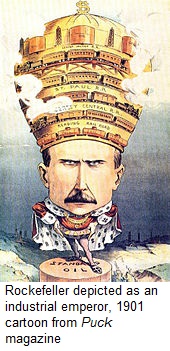
CU Blog - A Lesson in History - Rockefeller Pipeline - Photo 2Standard Oil gradually gained almost complete control of oil refining and marketing in the United States through horizontal integration. In the Kerosene industry, Standard Oil replaced the old distribution systems with its own vertical system. It supplied Kerosene by tank cars that brought the fuel to local markets, and tank wagons then delivered to retail customers, thus bypassing the existing network of wholesale jobbers.[43] Despite improving the quality and availability of Kerosene products while greatly reducing their cost to the public (the price of Kerosene dropped by nearly 80% over the life of the company), Standard Oil’s business practices created intense controversy; [this is typical plutocratic behavior]. Standard’s most potent weapons against competitors were underselling, differential pricing, and secret transportation rebates.[44] The firm was attacked by journalists and politicians throughout its existence, in part for these monopolistic methods, giving momentum to the antitrust movement. By 1880, according to the New York World newspaper, Standard Oil was “the most cruel, impudent, pitiless, and grasping monopoly that ever fastened upon a country.”[45] To the critics Rockefeller replied, “In a business so large as ours….. some things are likely to be done which we cannot approve. We correct them as soon as they come to our knowledge.”[45]

At that time, many legislatures had made it difficult to incorporate in one state and operate in another. As a result, Rockefeller and his associates owned dozens of separate corporations, each of which operated in just one state; the management of the whole enterprise was rather unwieldy. In 1882, Rockefeller’s lawyers created an innovative form of corporation to centralize their holdings, giving birth to the Standard Oil Trust.[46] The “trust” was a corporation of corporations, and the entity’s size and wealth drew much attention. Nine trustees, including Rockefeller, ran the 41 companies in the trust.[46] The public and the press were immediately suspicious of this new legal entity, but other businesses seized upon the idea and emulated it, further inflaming public sentiment. Standard Oil had gained an aura of invincibility, always prevailing against competitors, critics, and political enemies. It had become the richest, biggest, most feared business in the world, seemingly immune to the boom and bust of the business cycle, consistently racking up profits year after year.[47]

Standard Oil’s vast American empire included 20,000 domestic wells, 4,000 miles of pipeline, 5,000 tank cars, and over 100,000 employees.[47] Its share of world oil refining topped out above 90% but slowly dropped to about 80% for the rest of the century.[48] In spite of the formation of the trust and its perceived immunity from all competition, by the 1880s Standard Oil had passed its peak of power over the world oil market. Rockefeller finally gave up his dream of controlling all the world’s oil refining, he admitted later, “We realized that public sentiment would be against us if we actually refined all the oil.”[48] Over time foreign competition and new finds abroad eroded his dominance. In the early 1880s, Rockefeller created one of his most important innovations. Rather than try to influence the price of crude oil directly, Standard Oil had been exercising indirect control by altering oil storage charges to suit market conditions. Rockefeller then decided to order the issuance of certificates against oil stored in its pipelines. These certificates became traded by speculators, thus creating the first oil-futures market which effectively set spot market prices from then on. The National Petroleum Exchange opened in Manhattan in late 1882 to facilitate the oil futures trading.[49]

The invention of the light bulb gradually began to erode the dominance of Kerosene for illumination. But Standard Oil adapted, developing its own European presence, expanding into natural gas production [and distribution] in the U.S., then into Gasoline for automobiles, which until then had [only] been considered a waste product.[52]

In 1887, Congress created the Interstate Commerce Commission which was tasked with enforcing equal rates for all railroad freight, but by then Standard Oil depended more on pipeline transport.[54]

– (Retrieved October 18, 2014 from: http://en.wikipedia.org/wiki/John_D._Rockefeller)

Cited References:
a.      Fortune Magazine lists the richest Americans not by the changing value of the dollar but by percentage of GDP: Rockefeller is credited with a Wealth/GDP of 1/65.
———–
3.             “John D. and Standard Oil”. Bowling   GreenStateUniversity. Retrieved 2008-05-13.
4.             “The Richest Americans”. Fortune (CNN). Retrieved May 6, 2010.
5.             “Top 10 Richest Men of All Time”. AskMen.com. Retrieved 2007-05-29.
6.             “The Rockefellers”. PBS. Retrieved 2007-05-29.
7.             “The Wealthiest Americans Ever”. The New York Times. July 15, 2007. Retrieved 2007-07-17.
8.             Fosdick, Raymond Blaine (1989). The story of the Rockefeller Foundation. Transaction Publishers.
9.             Martin, Albro (1999), “John D. Rockefeller”, Encyclopedia Americana Page 23
10.         Chernow, Ron (1998). Titan: The Life of John D. Rockefeller, Sr. Random House, Page 52.
11.         “The 9 most amazing facts about John D. Rockefeller”. Oil Patch Asia.
12.         Richard Hofstadter et al. Sep 1, p. 45.
13.         Schultz, Duane P; Schultz, Sydney Ellen, A History of Modern Psychology, p. 128
———–
39.         Enclycopedia.com Online Resource. “Standard Oil Company – Pipelines. Retrieved October 19, 2014 from: http://www.encyclopedia.com/topic/Standard_Oil_Company.aspx
40.         Chernow 1998, p. 171.
41.         Segall, Grant (2001). John D. Rockefeller: Anointed With Oil. OxfordUniversity Press., p. 57.
42.         Segall 2001, p. 58.
43.         Chernow 1998, p. 253.
44.         Chernow 1998, p. 258.
45.         Segall 2001, p. 60.
46.         Segall 2001, p. 61.
47.         Chernow 1998, p. 249.
48.         Segall 2001, p. 67.
49.         Chernow 1998, p. 259.
50.         Chernow 1998, p. 242.
51.         Chernow 1998, p. 246.
52.         Segall 2001, p. 68.
53.         Segall 2001, pp. 62–63.
54.         Rockefeller, John D (1984) [1909]. Random Reminiscences of Men and Events. New York: Sleepy Hollow Press and Rockefeller Archive Center, Page 48.
Share this post:
, , , ,

Book Review: ‘The Protest Psychosis’

Go Lean Commentary

Life, liberty and the pursuit of happiness…

These words are from the US Declaration of Independence,  but how many actually believe these words apply to all Americans? This important part of this very important American document is not exclusively American; it is reflected repeatedly in values from the Enlightenment Era (1650 to 1700) that became fundamental to a lot of protest movements around the world. This is also true of the movement to protest the status quo in the Caribbean region today. This movement is underpinned by the book Go Lean … Caribbean in its efforts to elevate Caribbean society.

Many times protesters have been viewed as insane by contemporaries and especially their adversaries. This oppositional practice was far too common in the US during the slavery era, and just recently during the Civil Rights Movement in the latter half of the 20th Century. This was the point of the book The Protest Psychosis: How Schizophrenia Became a Black Disease” by Professor Jonathan Metzl. This review paragraph summarizes the book:

A powerful account of how cultural anxieties about race shaped American notions of mental illness The civil rights era is largely remembered as a time of sit-ins, boycotts, and riots. But a very different civil rights history evolved at the Ionia State Hospital for the Criminally Insane in Ionia, Michigan. In “The Protest Psychosis“, psychiatrist and cultural critic Jonathan Metzl tells the shocking story of how schizophrenia became the diagnostic term overwhelmingly applied to African American protesters at Ionia–for political reasons as well as clinical ones. Expertly sifting through a vast array of cultural documents, Metzl shows how associations between schizophrenia and blackness emerged during the tumultuous decades of the 1960s and 1970s – and he provides a cautionary tale of how anxieties about race continue to impact doctor-patient interactions in our seemingly postracial America.
http://www.alibris.com/search/books/isbn/9780807001271?qwork=#search-anchor
- Photo 3

From this historic perspective, there are many lessons to consider for the Caribbean empowerment effort.

The Caribbean is not detached from the underlying narrative of The Protest Psychosis book; this region benefited greatly from the US Civil Rights Movement. Though there may not have been many sit-ins, protest marches (a la the “March on Washington”) in the Caribbean, there was a natural spin-off. All of the Caribbean have a majority Black population (except for one, the French Caribbean island of Saint Barthélemy), that were suppressed, repressed and oppressed until the Civil Rights Movement and De-colonization-Majority Rule Movements manifested. There is the need now for a new protest movement. The Caribbean status quo still reflects economic suppression, repression and oppression; the societal abandon rate is so abominable that 70 percent of college educated citizens leave, resulting in a debilitating brain drain.

  • Will the demands to change Caribbean society today require “psychotic” protests?
  • Will a conservative population or empowered governing elite emerge to halt change and demand that the status quo continue unabated?
  • Who will be the new champions of change this time?
  • Will their advocacy be so impassioned that their motives and actions will be labeled as deranged or insane?

Insanity and Schizophrenia are all serious subjects within the field of mental health, not to be taken lightly. Imagine then, the weight of authority thrust upon the diagnosis of a Clinical Psychiatrist when he or she labels some protester with these diagnoses. Imagine too, how such protests can be undermined just by tossing around these labels. This is a serious issue that requires some sober reflection.

Sober reflection is the appropriate descriptor of the following podcast, a 30-minute interview with the author of the referenced book.

The book review follows:

Book Review Podcast Presented by: Lynne Malcolm
Title: The Protest Psychosis: How Schizophrenia Became a Black Disease.
By: Professor Jonathan Metzl

Psychiatrist Jonathan Metzl treats people in the clinic whose lives are afflicted by severe psychosis. But he also documents an explosive ‘other’ history of schizophrenia, and what he sees as its transformation from a diagnosis of feminine docility or creative eccentricity, to one given to angry black men during the civil rights era. You’ll never see medicine and the mind in quite the same light again.

About the Presenter: Lynne Malcolm

- Photo 1Lynne Malcolm is passionate about people and their personal experience and when she least expected it – she discovered the power of radio to tell their stories. She is also Executive Producer of RN’s (Radio National) Science Unit.

Lynne has received a number of awards for her work in radio including Bronze & Gold Medals in the New York Radio Festivals International Awards, the Michael Daley Award for Journalism in Science, finalist status in the Eureka Awards. She has also won 2 Mental Health Services media achievement awards for All in the Mind, one in 2007 for her series on schizophrenia, and one in 2013 for 2 programs on youth mental health.

Lynne is delighted to be hosting All In the Mind because she finds the workings of the human mind and how that affects our lives endlessly fascinating.
All In The Mind – Radio National, Australia Broadcast Corporation Saturday 1 May 2010 1:00PM
http://www.abc.net.au/radionational/programs/allinthemind/the-protest-psychosis/3041652

Podcast: http://youtu.be/9zc0mI5HgF8

This consideration of such sober topics aligns with the book Go Lean… Caribbean. The book addresses many serious aspects of Caribbean life.  While the Go Lean book is not a reference source for science, mental health or psychiatry, it does glean from “social science” concepts in communicating the plan to elevate Caribbean society. The book serves as a roadmap for the introduction and implementation of the technocratic Caribbean Union Trade Federation (CU). The complete prime directives are described as:

  • Optimize the economic engines of the Caribbean to elevate and grow the regional economy to $800 Billion.
  • Establish a security apparatus to protect the resultant economic engines.
  • Improve Caribbean governance to support these engines.

The Go Lean … Caribbean roadmap constitutes a change for the region, a plan to consolidate 30 member-states into a Trade Federation with the tools/techniques to bring immediate change to the region to benefit one and all member-states. The ethos to effectuate this change in the region will require courage, advocacy and passion. It is our sincere hope that these attributes will not be considered “crazy or insane”.

This vision may seem “insane” to some.

The Go Lean roadmap immediately calls for the establishment of a federal Health Department with some oversight over the region’s mental health administrations – due to funding, ratings and rankings. The focus on mental health will be as stern as all other health concerns (cancer, trauma, virus, immunizations). This direct correlation of mental health issues with the economy has been previously detailed in Go Lean blog/commentaries, as sampled here:

Guyana Wrestles With High Rate of Suicides
Recessions and Public Health in the Caribbean Region

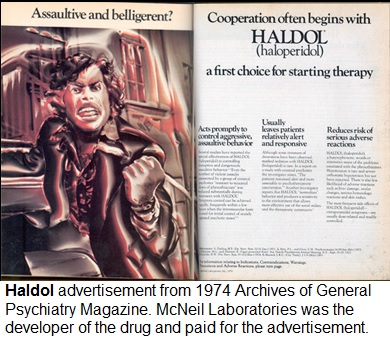
In addition, Big Pharmaceutical companies had some vested interest in the mis-diagnosis of psychotic drugs; this familiar malpractice has been the subject of a previous blog. (See Haldol photo/advertising above).

The Go Lean roadmap calls for the immediate coordination of the region’s healthcare needs. This point is declared early in the Go Lean book, commencing with this opening pronouncement in the Declaration of Interdependence (Page 12), as follows:

ix.  Whereas the realities of healthcare … cannot be ignored and cannot be afforded without some advanced mitigation, the Federation must arrange for health plans to consolidate premiums of both healthy and sickly people across the wider base of the entire Caribbean population. The mitigation should extend further to disease management, wellness, mental health, obesity and smoking cessation programs.

The foregoing Book Review recited a dysfunction in the US during the Civil Rights Movement of blatantly labeling everyone desirous of social change as just being schizophrenic/insane. This was an abuse of the Psychiatric profession and the Hippocratic oath (for Doctors to do no harm).  Schizophrenia is a serious disorder. This was barely understood until recently in medical science history. See the VIDEO clip (below) from the movie: “A Beautiful Mind”.

We have the need for protest movements in the Caribbean now. But we also need to be technocratic in the management of our mental health needs – no blatant assignment of labels just to “shoo” away protesters or Advocates for change. The Go Lean book details the community ethos to forge change; plus the executions of the following strategies, tactics, implementations and advocacies to impact the region’s healthcare to ensure no abuse of the mental health process:

Assessment – Caribbean Single Market & Economy Page 15
Assessment – Dutch Caribbean – Integration & Secessions Page 16
Assessment – French Caribbean – Organization & Discord Page 17
Assessment – Puerto Rico – The Greece of the Caribbean Page 18
Community Ethos – Security Principles – Privacy versus Public Protection Page 23
Community Ethos – Security Principles – Anti-Bullying and Mitigation Page 23
Community Ethos – Security Principles – “Crap” Happens Page 23
Community Ethos – Governing Principles – Lean Operations Page 24
Community Ethos – Governing Principles – Cooperatives Page 24
Community Ethos – Governing Principles – Non-Government Organizations Page 25
Community Ethos – Ways to Impact the Future Page 26
Community Ethos – Ways to Foster Genius Page 27
Community Ethos – Ways to Promote Happiness Page 36
Community Ethos – Impact the Greater Good Page 37
Strategy – Vision – Confederate 30 Member-States Page 45
Strategy – Mission – Reform   our Health Care Response Page 47
Strategy – Agents of Change – Aging Diaspora Page 57
Tactical – Fostering a Technocracy Page 64
Tactical – How to Grow the Economy to $800 Billion Page 67
Separation of Powers – Department of Health Page 86
Implementation – Ways to Deliver Page 109
Planning – Ways to Make the Caribbean Better Page 131
Planning – Ways to Improve Failed-State Indices Page 134
Planning – Lessons from Indian Reservations – Hopelessness & Mental Health Page 148
Advocacy – Ways to Grow the Economy Page 151
Advocacy – Ways to Improve Healthcare Page 156
Advocacy – Ways to Better Manage the Social Contract Page 170
Advocacy – Ways to Foster Cooperatives Page 176
Advocacy – Ways to Improve Emergency Management – Trauma Medicine Page 196
Advocacy – Ways to Impact the Prison Industrial Complex Page 211
Advocacy – Ways to Improve Elder-Care Page 225
Advocacy – Ways to Empower Women Page 226

Caribbean society is now imperiled; it is in crisis due to deficiencies in economics, security and governance. It should be considered insanity for people to just apathetically accept the status quo. Apathy should not be an option; the options should be “fight or flight”. But far too often, “flight” was selected.

Change has now come to our region; everyone should engage! There is the need for a permanent union to provide efficient stewardship for Caribbean economy, security and governing engines. The Go Lean…Caribbean posits that there are problems, agents of change, that are too big for just any one member-state to tackle alone, there must be a regional solution. This multi-state technocratic administration of the CU may be our best option.

The foregoing article/AUDIO podcast, the Book Review on The Protest Psychosis alludes that 1-out-of-every-100 persons are afflicted with Schizophrenia and related issues (depression and anxiety disorders). The commonly accepted fact is that brain chemistry changes in a lot of people (men and women) as they age, or women enduring child birth or menopause. So many people are affected – perhaps one in every family. Monitoring, managing and mitigating the issues of mental health impacts the Greater Good – the greatest good for the greatest number of people.

The people and institutions of the region are hereby urged to lean-in to this Go Lean roadmap. We can make the Caribbean a better homeland to live, work and play. 🙂

Download the free e-Book of Go Lean … Caribbean – now!

————-

Video: Selected Scenes of Schizophrenia from the movie “A Beautiful Mind”- https://www.youtube.com/watch?v=Yqj1DhUKJco

- Photo 2

Share this post:
, , , , ,
[Top]

A Lesson in History – Concorde SST

Go Lean Commentary

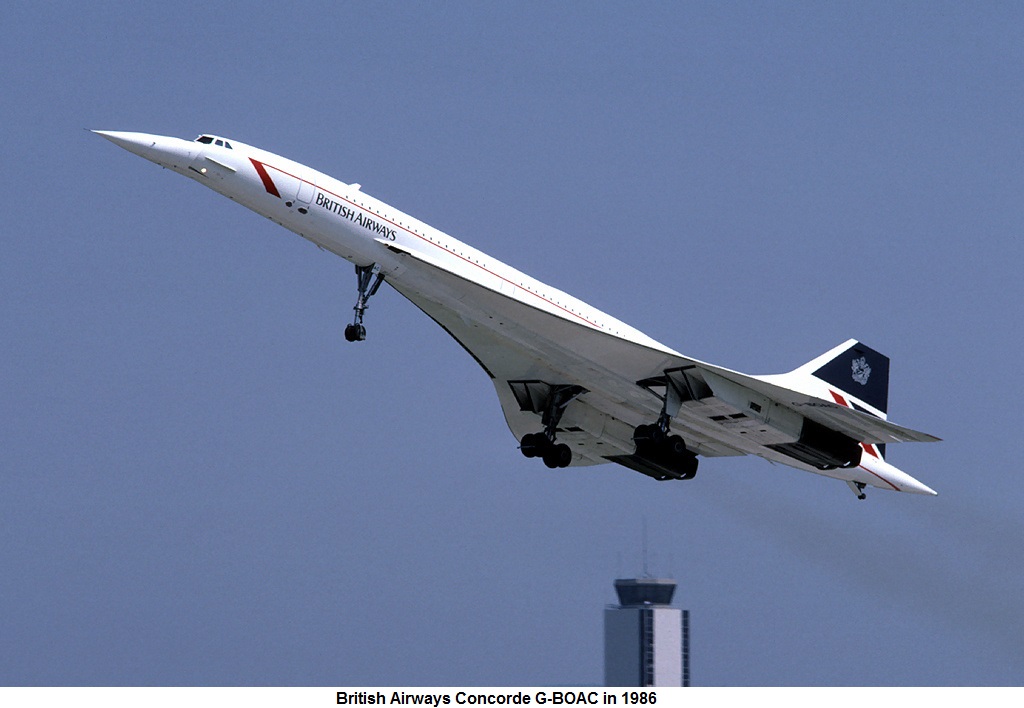
CU Blog - A Lesson in History - Concorde SST - Photo 130 years go by so fast…

In the 1970’s, when the Concorde Supersonic Transport (SST) jets were designed, developed and deployed, with a 30 year life-span, that time seemed so far off. But that time has now come and gone. Yes, cutting-edge has an expiration date.

It is difficult to think, now in 2014, that 1970’s technologies may still be cutting-edge, except that there are no other Supersonic Transport vehicles for civilian use today. So despite all the scientific and technological advances in the last 40 years, in this area, the world has gone backwards.

There are a lot of lessons here for us to consider with the history of the Concorde, taking into account that the SST had commercial applications, safety concerns and governing issues. This subject therefore parallels with the book Go Lean… Caribbean. The following is the historic reference of the Concorde:

CU Blog - A Lesson in History - Concorde SST - Photo 2Aérospatiale-BAC Concorde is a retired turbojet-powered supersonic passenger airliner or supersonic transport. It is one of only two SSTs to have entered commercial service; the other was the Tupolev Tu-144; (built by the Soviet Union under the direction of the Tupolev design bureau, headed by Alexei Tupolev; their prototype first flew on 31 December 1968 near Moscow, two months before the first flight of Concorde. The Tu-144 first went supersonic on 5 June 1969, and on 26 May 1970 became the first commercial transport to exceed Mach 2). The Concorde was jointly developed and produced by France-owned Aérospatiale and the British Aircraft Corporation (BAC) under an Anglo-French treaty. First flown in 1969, the Concorde entered service in 1976 and continued commercial flights for 27 years.

Reflecting the treaty between the British and French governments which led to the Concorde’s construction, the name Concorde is from the French word concorde, which has an English equivalent, concord. Both words mean agreement, harmony or union.

The Concorde needed to fly long distances to be economically viable; this required high efficiency. (Turbojets were found to be the best choice of engines.[68] The engine used was the twin spool Rolls-Royce/Snecma Olympus 593, a development of the Bristol engine first used for the Avro Vulcan bomber, and developed into an afterburning supersonic variant for the BAC TSR-2 strike bomber.[69] Rolls-Royce’s own engine proposed for the SST aircraft at the time of Concorde’s initial design was the RB.169 [70]). Among other destinations, the Concorde flew regular transatlantic flights from London Heathrow and Paris-Charles de Gaulle Airport to New York JFK, Washington Dulles and Barbados in the Caribbean; it flew these routes in less than half the time of other airliners. Only 20 aircraft were ever built, so the development of Concorde was a substantial economic loss; Air France and British Airways also received considerable government subsidies to purchase them.

While commercial jets took eight hours to fly from New York to Paris, the average supersonic flight time on the transatlantic routes was just under 3.5 hours. The Concorde’s maximum cruising altitude was 60,000 feet, (while subsonic airliners typically cruise below 40,000 feet), and an average cruise speed of Mach 2.02, about 1155 knots (2140 km/h or 1334 mph), more than twice the speed of conventional aircraft.[107]

The Concorde’s drooping nose, enabled the aircraft to switch between being streamlined to reduce drag and achieve optimum aerodynamic efficiency, and not obstructing the pilot’s view during taxi, takeoff, and landing operations. Due to the high angle of attack, the long pointed nose obstructed the view and necessitated the capability to droop to ensure visibility and FAA approval in the US.

The Concorde was retired in 2003 due to a general downturn in the aviation industry after the aircraft’s only crash in 2000 (killing 113 people onboard and on the ground), the 9/11 terrorist attacks in 2001, and a decision by Airbus (the successor firm of Aerospatiale) and BAC, to discontinue maintenance support.[5]
Wikipedia Online Encyclopedia (Retrieved October 13, 2014) –
http://en.wikipedia.org/wiki/Concorde

See the foregoing VIDEO for a synopsis of the Concorde’s 27-year history:

Video Title – Concorde: 27 Supersonic Years:

This review of the historicity of the Concorde is more than just an academic discussion; the aircraft was always presented as a glimpse into the future.  Likewise, the book Go Lean…Caribbean is future-focused, aspiring to economic principles that dictate that “consequences of choices lie in the future”. The book serves as a roadmap for the introduction and implementation of the technocratic Caribbean Union Trade Federation (CU). This confederation effort (aligning many former colonies of the same sponsoring countries of Great Britain and France that designed, developed and deployed the Concorde SST project) will spur a lot of technologically-driven industrial developments.

CU Blog - A Lesson in History - Concorde SST - Photo 4

What have we learned from the 27-year history of the Concorde, in terms of economics, security and governing lessons? How will these lessons help us today?

  • Crisis is a terrible thing to waste – The end of World War II saw an immediate clash and conflict between Soviet-backed communist countries versus Western democracies. There was an “arms and space” race. The Anglo-Franco treaty to design-develop the Concorde was a manifestation of that competition. While the US invested in supersonic technology for military applications, the Anglo-Franco treaty allowed for a civilian application, and exploitation of a populous market for those with capitalistic adherence. The Go Lean roadmap posits that the Caribbean is also in a crisis (on the losing end of globalization, advancing technology and economic dysfunction). The CU will incubate and foster industrial policy to better explore science, technology, engineering and mechanical (STEM) initiatives. With 80 million annual visitors across 30 different member-states, (many of them islands), we have the overall need for air transport solutions and a built-in market acceptance.
  • Promote opportunities for Research & Development – As far back as October 1956, the UK’s Ministry of Supply asked key Subject Matter Experts to form a new study group, the Supersonic Transport Advisory Committee or STAC,[12] with the explicit goal of developing a practical SST design and finding industry partners to build it. The ethos expressed by this specialty group foresaw that huge economic and security benefits could yield by developing cutting-edge solutions in the air-transport industry space . The Go Lean roadmap posits that appropriate investments must be prioritized for new industrial solutions, such as with Information & Communications Technologies. The Go Lean book posits that large states or small ones can have a “level-playing field” by exploring innovative solutions for the New Economy.
  • New “community ethos” can be adopted by the general public – The Concorde aircraft was regarded by many people as an aviation icon and an engineering marvel. During flight testing of the pre-production SST aircraft, it visited a number of “allied” foreign countries. It was not uncommon for ten-mile traffic jams to build up around airports as crowds of a hundred thousand and more gathered to look over the aircraft that was designed to bring faster-than-sound flight within reach of anyone with the price of a plane ticket.[25] The CU will employ messaging and image management to forge new attitudes about technology, R&D, entrepreneurship, intellectual property and STEM initiatives in the region.
  • Negotiate as partners not competitors – France had 3 nationally supported companies (state-owned Sud Aviation and Nord-Aviation, plus private firm Dassault Group) in the aero-space industry, but no jet-engine solution. The British company Rolls Royce had demonstrated great market leadership with jet engines. A collaboration was apropos. The CU maintains that, negotiation is an art and a science. More can be accomplished by treating negotiating counterparts as a partner, rather than not an adversary.
  • Cooperatives and sharing schemes lighten burdens among partners – In 1967, at the start of the new Anglo-Franco consortium, there was the intent to produce one long-range and one short-range SST version. However, prospective customers showed no interest in the short-range version and it was dropped.[25] The consortium secured orders (i.e., non-binding options) for over 100 of the long-range version from the major airlines of the day: Pan Am, BOAC, and Air France were the launch customers, with six Concordes each. Other airlines in the order book included Panair do Brasil, Continental Airlines, Japan Airlines, Lufthansa, American Airlines, United Airlines, Air India, Air Canada, Braniff, Singapore Airlines, Iran Air, Olympic Airways, Qantas, CAAC (China), Middle East Airlines, and TWA.[25][30][31] At the time of the first flight (1969) the options list contained 74 orders from 16 airlines. The important function for the CU in these cooperative initiatives is command-and-control. For the Concorde project the labor of up to 50,000 (including sub-contractors and suppliers) people had to be efficiently coordinated. The CU will employ cooperatives and sharing schemes for limited scopes within the prime directives of optimizing the economic, security and governing engines.
  • Bureaucratic response to crisis impede progress – At the end of the pre-production trials, there were orders for 74 aircrafts for 16 airlines, but in the end only 20 Concorde jets were ever manufactured. What happened? Geo-political crisis. Concorde SSTs required more fuel usage compared to subsonic aircrafts. The 1970’s saw a number of crises involving steeply rising oil prices (OPEC, Iran Revolution, etc.)[148] and new wide-body aircrafts, such as the Boeing 747, had recently made subsonic aircrafts significantly more efficient and presented a low-risk option for airlines.[50]. The governmental bureaucracy of the two national governments impeded tactical responses and adjustments to these agents-of-change, resulting in cancellation of unfulfilled orders … and also any continuous technological upgrades to the SST program. “There have always been those who want to go faster and those who think the present speed (of ox-cart, stagecoach, sailing ship) was fast enough”.[25] The Go Lean roadmap calls for the establishment of Self-Governing Entities (SGE), regulated at the federal level, to facilitate R&D in industrial settings. Under this scheme, government negotiation is only required at the outset/initiation; no further bureaucratic stalemates beyond the start-up. Tactically, SGE’s  can nimbly adapt to the demands of the global marketplace. This is the manifestation of a lean technocracy.
  • “Crap” Happens – While the Concorde had initially held a great deal of customer interest, the project was hit by a large number of order cancellations. There was a crash of the competing Soviet Tupolev Tu-144 at the Paris Le Bourget air show in 1973; this shocked potential buyers, and public concern over the environmental issues presented by supersonic aircrafts. Also, the issue of sonic booms and takeoff-noise pollution produced a shift in public opinion of SSTs. By 1976 only four nations remained as prospective buyers: Britain, France, China, and Iran.[43] But only Air France and British Airways (the successor to BOAC) ever took up their orders, with the two governments taking a cut of any profits made.[44] The United States cancelled the Boeing 2707, its rival supersonic transport program, in 1971. Observers have suggested that opposition to the Concorde on grounds of noise pollution had been encouraged by the United States Government, as it lacked its own competitor.[45] The US, India, and Malaysia all ruled out Concorde supersonic flights over the noise concern, although some of these restrictions were later relaxed.[46][47] This lesson constitutes the security scope of the Concorde SST historic consideration. The Go Lean roadmap anticipates that things would go wrong, and plans for risk mitigations in advance. This includes man-made, industrial and natural disasters. In addition, there is the governance plan for the CU to have jurisdiction over the region’s aviation regulations – much like the FAA (Federal Aviation Admin.) in the US.
  • CU Blog - A Lesson in History - Concorde SST - Photo 3Consider the Greater Good – In the end, the realization of a noise pollution threat never materialized with Concorde SSTs – more fear than actualization. A progressive path forward from 1976 should have resulted in even faster supersonic transportation options at cheaper prices by today, 40 years later. Author and Professor Douglas Ross characterized restrictions placed upon Concorde operations by President Jimmy Carter’s administration (1977 – 1981) as having been an act of protectionism for American aircraft manufacturers.[48] To the contrary, the Caribbean need policies for the Greater Good. With island tourism being the primary economic driver in the region, we need proactive air-transport solutions to facilitate visitors’ easy access to Caribbean hospitality. The Greater Good philosophy is directly quoted as: “It is the greatest good to the greatest number of people which is the measure of right and wrong”. The CU/Go Lean roadmap calls for a number of measures that strike directly at this Greater Good mandate.

The related subjects of technology-bred innovations and history lessons have been a frequent topic for Go Lean blog/commentaries, as sampled here:

https://goleancaribbean.com/blog/?p=2480 A Lesson in History: Community Ethos of WW II
https://goleancaribbean.com/blog/?p=1568 Airline Lesson: Dutch airline angers Mexico soccer fans
https://goleancaribbean.com/blog/?p=1531 A Lesson in History: 100 Years Ago Today – World War I
https://goleancaribbean.com/blog/?p=1487 Aeronautics Lesson: Here come the Drones … and the Concerns
https://goleancaribbean.com/blog/?p=673 Transport Lesson: Autonomous cargo vessels without a crew
https://goleancaribbean.com/blog/?p=308 Community Ethos: CARCIP Urges Greater Innovation
https://goleancaribbean.com/blog/?p=254 Airline Lesson: Air Antilles Launches new St. Maarten Service
https://goleancaribbean.com/blog/?p=235 Economic Reality: Tourism’s changing profile

The purpose of the Go Lean roadmap is to shift the downward trends in the Caribbean today, to reverse course and elevate Caribbean society. The CU, applying lessons from the Concorde history, has prime directives proclaimed as follows:

  • Optimization of the economic engines in order to grow the regional economy to $800 Billion & create 2.2 million new jobs.
  • Establishment of a security apparatus to protect the resultant economic engines.
  • Improve Caribbean governance to support these engines.

While the Go Lean book is not written as an analysis of the Concorde, the following detail considerations of community ethos, strategies, tactics, implementations and advocacies in the book are still helpful to empower Caribbean society:

Community Ethos – Economic Systems Influence Choices & Incentives Page 21
Community Ethos – Consequences of Choices Lie in the Future Page 21
Community Ethos – “Crap” Happens Page 23
Community Ethos – Ways to Impact the Future Page 26
Community Ethos – Ways to Improve Negotiations Page 32
Community Ethos – Ways to Manage Reconciliations Page 34
Community Ethos – Ways to Improve Sharing Page 35
Community Ethos – Ways to Impact the Greater Good Page 37
Strategy – Vision –  Integrate region into a Single Market Economy Page 45
Strategy – Agents of Change – Technology Page 57
Strategy – Agents of Change – Globalization Page 57
Tactical – Separation of Powers – Department of State – SGE Administration Page 80
Tactical – Separation of Powers – Transportation Department – Aviation Admin Page 84
Implementation – Ways to Pay for Change Page 101
Implementation – Foreign Policy Initiatives at Start-up Page 102
Implementation – Security Initiatives at Start-up Page 103
Implementation – Steps to Implement Self-Governing Entities Page 105
Implementation – Ways to Deliver Page 109
Implementation – Ways to Benefit from Globalization Page 119
Planning – Ways to Ways to Model the EU Page 130
Planning – Ways to Better Manage Image Page 133
Planning – Lessons Learned from the defunct West Indies Federation Page 134
Planning – Lessons from Detroit Page 140
Advocacy – Ways to Grow the Economy Page 151
Advocacy – Ways to Create Jobs Page 152
Advocacy – Ways to Foster Cooperatives Page 176
Advocacy – Ways to Enhance Tourism in the Caribbean Region – Air Lifts Page 190
Advocacy – Ways to Market Southern California – Transportation Options Page 194
Advocacy – Ways to Foster Technology Page 197
Advocacy – Ways to Improve Transportation Page 205

The image of the Concorde was that of cutting-edge technology for its entire 27-year run. But cutting-edge does have an expiration date; so there must be the culture of continuous enhancing and upgrading any cutting-edge innovation. This is true in the new world of Internet Communications Technologies (ICT), where innovations emerge every year; sometimes even a few times during the year. The battleground has changed, from the Concorde’s frontier of aero-space to the ever-changing frontiers of cyber-space. The Go Lean movement asserts that the culture/attitude/ethos, to be constantly innovative, is most crucial in this new economy, where the only constant is change itself.

Now is the time for all of the Caribbean to learn the lessons from the 27-year history of the Concorde. The people and governing institutions of the region are hereby urged to lean-in for the empowerments described in the book Go Lean … Caribbean. This is a big deal for the region; the current economic engines need technology-based innovations in general, and air transport solutions in particular. This is one way we can make our homeland a better place to live, work, and play. 🙂

Download the free e-Book of Go Lean … Caribbean – now!

—————————–

Referenced Sources:
5.     “UK | Concorde grounded for good”. BBC News. 2003-04-10. Retrieved 2013-06-15.
12.   Conway, Eric (2005). High-Speed Dreams: NASA and the Technopolitics of Supersonic Transportation, 1945–1999. JHU Press. Page 39.
25.   “Early History.” concordesst.com. Retrieved 8 September 2007.
30.   “Aerospace: Pan Am’s Concorde Retreat”. Time, 12 February 1973. 12 February 1973.
31.   “Vertrag mit Luken”. Der Spiegel. 13 March 1967. Retrieved 6 November 2012.
43.   “Concordes limited to 16”. Virgin Islands Daily News, 5 June 1976.
44.    “Payments for Concorde”. British Airways. Retrieved 2 December 2009.
45.   Lewis, Anthony (12 February 1973). “Britain and France have wasted billions on the Concorde”. The New York Times, 12 February 1973.
46.   “Malaysia lifting ban on the use Of its Airspace by the Concorde”. The New York Times, 17 December 1978. 17 December 1978. Retrieved 30 June 2011.
47.   “News from around the world”. Herald-Journal, 13 January 1978. Retrieved 30 June 2011.
48.  Ross, Douglas (March 1978). The Concorde Compromise: The Politics of Decision-making. Bulletin of the Atomic Scientists. p. 46.
49.  Marston, Paul (16 August 2000). “Is this the end of the Concorde dream?”. London: Daily Telegraph, 16 August 2000.
50.   Ross, Douglas (March 1978). The Concorde Compromise: The Politics of Decision-making. Bulletin of the Atomic Scientists, pp. 47–49.
68.   Birtles, Philip. Concorde, pp. 62–63. Vergennes, Vermont: Plymouth Press, 2000.
69.   “Rolls Royce Olympus history.” wingweb.co.uk. Retrieved 15 January 2010.
70.   Aero Engines 1962, Flight International, 28 June 1962: 1018
107. Schrader, Richard K. (1989). Concorde: The Full Story of the Anglo-French SST. Kent, UK: Pictorial Histories Pub. Co., p. 64.
148. B.CAL drops Concorde plans but asks for Hong Kong licence. Flight International Magazine, posted 30 June 1979, p. 2331.

Share this post:
, , ,
[Top]

Miami’s Success versus Caribbean Failure

Go Lean Commentary

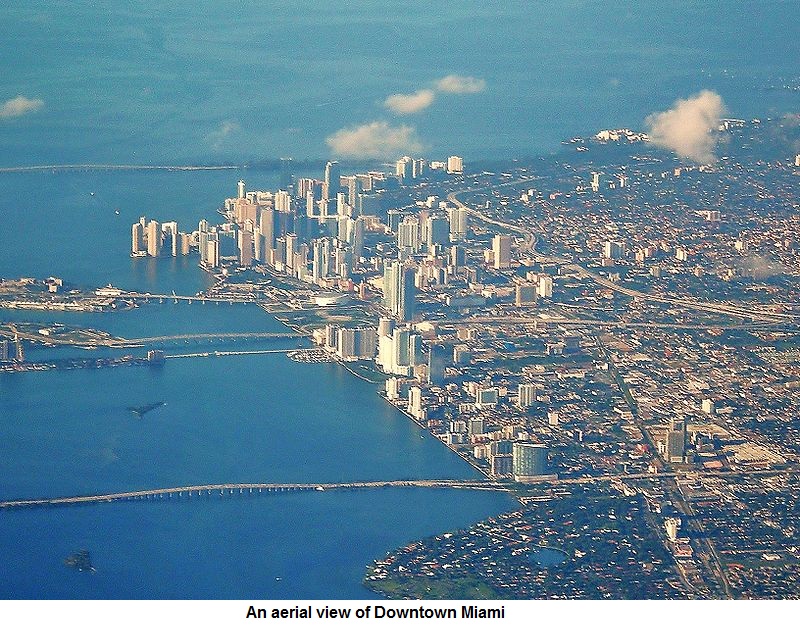
The Greater Miami Metropolitan Area has provided refuge to many of the Caribbean Diaspora.

Thank you Miami.

But make no mistake: Miami has benefited as well.

s Success versus Caribbean Failure - Photo 1

This fact is based on a proven economic principle that growth in population means growth in the economy. In parallel, declines in populations could lead to declines in economic growth. This point was vividly depicted in this previous blog commentary: Having Less Babies is Bad for the Economy; with this quoted reference:

We tend to think economic growth comes from working harder and smarter. But economists attribute up to a third of it to more people joining the workforce each year than leaving it. The result is more producing, earning and spending. – http://www.huffingtonpost.com/2014/05/07/birth-rate-economy_n_5281597.html

According to the below article (Appendix and VIDEOS below), the Miami Metropolitan Area has benefited greatly from the infusion of Caribbean refugees into its population. The benefits to the metropolitan area have been economic, cultural and also in governing leadership. This brings to the fore a compelling mission of the book Go Lean…Caribbean, to elevate Caribbean society so as to encourage the repatriation of the Diaspora back to their homelands.

Title: South Florida Caribbean’s – November 2006
The Caribbean Island Nations, has an overall population of over 40 million.

In the US, they number over 25 million (Strategy Research Corporation). The Caribbean population in the U.S. Diaspora has grown by over 6.4 million in the last decade.

SOUTH FLORIDA CARIBBEANS – November 2006
• An estimated 400,000 Caribbean nationals live in South Florida.

• More than 92,000 Jamaicans live in BrowardCounty and more than 32,000 Jamaicans live in Miami-Dade.

• Haitians make up the second-largest ethnic group in Miami-DadeCounty —109,817 — after Cubans, and are second to Jamaicans in Broward with 88,121.

North Miami, Dade County, Florida according to the 2000 census, has a population of 60,036 and is home to 18,656 Haitians, the most of any city in the county.

As at May 4, 2007 there are 10 Haitian elected officials now serving in the Florida Legislature and Miami-Dade municipalities. Another Haitian politician, North Miami Beach Councilman John Patrick Julien, won the primary but faces a runoff May 15, 2007 with developer Gary Goldman.

• Broward County added more new black residents (92,378) than any other county between 2000 and 2005, while Miami-Dade County added about 10,528, The surge is driven by Caribbeans.
• Broward’s black population grew 22 percent from 2000 to 2005; 34 percent among Caribbeans.
• Broward, Miami-Dade and Palm Beach counties are home to about one-fifth of the 785,771 Jamaicans living in the  United States.

Just as we argue that Cubans go to Miami and Mexicans to Texas for geographic and cultural blending in, we can make the same argument for West Indians in South Florida. It’s a natural habitat.”

SOURCE: U.S. Census
Editors note: The above figures are very conservative
Caribbean Business Community (North America) Inc.  (Retrieved 10-10-2014) –
http://www.caribbeanbusinesscommunity.com/newsletters/caribbeans_abroad.html

The book Go Lean…Caribbean champions the causes of retaining Caribbean citizens in the Caribbean, and inviting the Diaspora back to their homelands. These intentions were pronounced early in the book with these statements in the Declaration of Interdependence (Pages 13):

xix.      Whereas our legacy in recent times is one of societal abandonment, it is imperative that incentives and encouragement be put in place to first dissuade the human flight, and then entice and welcome the return of our Diaspora back to our shores. This repatriation should be effected with the appropriate guards so as not to imperil the lives and securities of the repatriated citizens or the communities they inhabit. The right of repatriation is to be extended to any natural born citizens despite any previous naturalization to foreign sovereignties.

xx.      Whereas the results of our decades of migration created a vibrant Diaspora in foreign lands, the Federation must organize interactions with this population into structured markets. Thus allowing foreign consumption of domestic products, services and media, which is a positive trade impact. These economic activities must not be exploited by others’ profiteering but rather harnessed by Federation resources for efficient repatriations.

Looking at this quest from the point-of-view of Miami introduces a paradox: Miami’s success versus Caribbean failure.

According to Miami’s history, the metropolitan area has benefited, population-wise, with every Failed-State episode in the Caribbean. This is describing a win-lose scenario, where the Caribbean losses resulted in Miami’s gains. The following list describes the Caribbean countries that experienced near-Failed-State status, detailed in the Go Lean book, that effected change (growth) in Miami:

Cuba (Page 236)
Dominican Republic (Pages 237, 306)
Haiti (Page 238)
Jamaica (Page 239)
Trinidad (Page 240)
US Territories – Puerto Rico & US Virgin Islands (Page 244)
British Caribbean Territories (Page 245)
Dutch Caribbean Territories (Page 246)
French Caribbean Territories (Page 247)

s Success versus Caribbean Failure - Photo 2

With Miami’s location at the bottom of the Florida peninsula, it protrudes into the tropics – 50 miles West from the Bahamas and 90 miles North from Cuba. For the local community, this Caribbean proximity was perceived as a disadvantage, a misfortune, but the Caribbean infusion instead has proven to be an asset, a win for Miami. As many Caribbean member-states flirted with failure, Miami succeeded, despite being on the frontlines and having to absorb many incoming refugees.

But now, change has now come to the Caribbean … as detailed in the Go Lean book.

The Go Lean book serves as a roadmap for the introduction and implementation of the technocratic Caribbean Union Trade Federation (CU) to bring positive change. The CU‘s prime directives are identified with the following 3 statements:

  • Optimization of the economic engines in order to grow the regional economy to $800 Billion & create 2.2 million new jobs.
  • Establishment of a security apparatus to protect the resultant economic engines.
  • Improve Caribbean governance to support these engines.

Will these changes reverse the patterns of success for Miami? Will more for Caribbean member-states mean less for Miami? Will Cuba’s return to democracy cause a crash for the Cuban-American investments in Miami? Will a stabilization of Haiti finally shift the successes of Haitian-Americans back to their homeland? Will an end of Caribbean Sclerosis (economic dysfunction) finally mean the English-speaking Caribbean will abandon Miami as their destination of hopes-and-dreams (see Appendix and VIDEOS below)? Will a successful execution of the Go Lean roadmap reverse the patterns of success for Miami? These ill-fated scenarios do not have to be the conclusion. The Go Lean roadmap for an elevated Caribbean, can be a win-win for Miami and the Caribbean.

The Go Lean book defines “luck” as the intersection of preparation and opportunity (Page 3). With the execution of the Go Lean roadmap, the change that comes to the Caribbean, and accompanying success should not mean failure for Miami. No, Miami can get “lucky” … purposely, with these impending changes. With Miami’s physical location it can continue to facilitate a lot of  trade and logistics for the Latin America and Caribbean region.

The Go Lean roadmap calls for elevating the Caribbean’s GDP from $378 Billion (2010) to $800 Billion. The Miami community can benefit from this regional growth, with some shrewd strategies on their part. (The Go Lean roadmap includes shrewd strategies for elevating the Caribbean, not Miami).

Caribbean stakeholders are hereby urged to lean-in to the community ethos, shrewd strategies, tactics, implementations and advocacies to finally re-boot Caribbean society; as detailed in the book Go Lean…Caribbean, sampled here:

Assessment – Anecdote – Caribbean Single Market & Economy Page 15
Assessment – Anecdote – Dutch Caribbean – Integration & Secessions Page 16
Assessment – Anecdote – French Caribbean – Organization & Discord Page 17
Assessment – Anecdote – Puerto Rico – The Greece of the Caribbean Page 18
Community Ethos – Economic Systems Influence Individual Choices & Incentives Page 21
Community Ethos – Voluntary Trade Creates Wealth Page 21
Community Ethos – Consequences of Choices Lie in the Future Page 21
Community Ethos – Minority Equalization Page 24
Community Ethos – Lean Operations Page 24
Community Ethos – Return on Investments Page 24
Community Ethos – Ways to Impact Turn-Arounds Page 33
Community Ethos – Ways to Manage Reconciliations Page 34
Community Ethos – Ways to Impact the Greater Good Page 37
Strategic – Vision – Integrating Region in to a Single Market Page 45
Strategic – Agents of Change – Globalization Page 57
Tactical – $800 Billion Economy – How and When Page 67
Tactical – Separation of Powers – State Department – Culture Administration Page 81
Implementation – Ways to Pay for Change Page 101
Implementation – Foreign Policy Initiatives at Start-up Page 102
Implementation – Ways to Deliver Page 109
Implementation – Trade Mission Objectives Page 117
Implementation – Reasons to Repatriate Page 118
Implementation – Ways to Benefit from Globalization Page 119
Planning – 10 Big Ideas – Cuba/Haiti Page 127
Planning – Ways to Make the Caribbean Better Page 131
Planning – Ways to Improve Failed-State Indices Page 134
Advocacy – Ways to Grow the Economy Page 151
Advocacy – Ways to Impact the Diaspora Page 217
Advocacy – Ways to Preserve Caribbean Heritage Page 218
Advocacy – Ways to Improve the Arts Page 230
Advocacy – Ways to Promote Music Page 231

This commentary previously featured subjects related to the Caribbean Diaspora in the Greater Miami Metropolitan Area. The following is a sample:

‘Raul Castro reforms not enough’, Cuba’s bishops say
Continued Discrimination for Latins/Caribbeans in Job Markets
Miami’s Caribbean Marketplace Re-opens
Caribbean loses more than 70 percent of tertiary educated to brain drain
Miami Sports – Franchise Values and Sports Bubbles in Basketball
eMerge conference aims to jump-start Miami tech hub

Today, Miami is a better place to live, work and play … due in many ways to the contributions of the Caribbean Diaspora. The Cuban, Dominican and Afro-Caribbean (Haitian, Jamaican, Bahamian) communities dominate the culture of South Florida, resulting in a distinctive character that has made Miami unique as a travel/tourist destination; see VIDEOS below that vividly describe the positive input of the Caribbean culture on Miami:

Video Title: The Miami Sound Machine – https://www.youtube.com/watch?v=CZkjeJKBI0M:

This is now a new day for the Caribbean; with the empowerments identified, qualified and proposed in the Go Lean book, the region will also be a better place to live, work and play. We urge all to lean-in to this roadmap, those residing in the region and the Diaspora, especially those in Miami.

The Caribbean and Miami. This can be a win-win!

Video Title: Miami-Broward Carnival – https://youtu.be/aT4hU85-lOk:

Download the book Go Lean … Caribbean – now!

—————

APPENDIX – Miami Demographic Analysis – http://en.wikipedia.org/wiki/Miami_metropolitan_area

Demographics

Miami Metropolitan Area Historical population
Census Pop.  
1900 4,955
1910 17,510 253.4%
1920 66,542 280.0%
1930 214,830 222.8%
1940 387,522 80.4%
1950 693,705 79.0%
1960 1,497,099 115.8%
1970 2,236,645 49.4%
1980 3,220,844 44.0%
1990 4,056,100 25.9%
2000 5,007,564 23.5%
2010 5,564,635 11.1%

Ethnicity:
The racial makeup of population of the Miami Area [5,334,685] as of 2010 [43]:

  • White: 70.3% [3,914,239]
    • White Non-Hispanic: 34.8% [1,937,939]
    • White Hispanic: 35.2% [1,976,300]
  • Black or African American (many from the Caribbean): 21% [1,075,174]
  • Native American: 0.3% [16,108]
  • Asian: 2.3% [125,564]; (0.7% Indian, 0.5% Chinese, 0.3% Filipino, 0.2% Vietnamese, 0.1% Korean, 0.1% Japanese, 0.4% Other Asian)
  • Pacific Islander: 0.0% [2,356]
  • Other races: 3.5% [197,183]
  • Two or more races: 2.5% [140,000]
  • Hispanic or Latino of any race were 41.6% [2,312,929] of the population

The city proper is home to less than one-thirteenth of the population of South Florida. Miami is the 42nd most populous city in the United States. [But] the Miami Metropolitan Area, which includes Miami-Dade, Broward and Palm Beach counties, had a combined population of more than 5.5 million people, ranked seventh largest in the United States,[44] and is the largest metropolitan area in the Southeastern United States. As of 2008, the United Nations estimates that the Miami Urban Agglomeration is the 44th-largest in the world.[45]

The 2010 US Census file for “Hispanic or Latino Origin” reports[46] that: 34.4% of the population had Cuban origin, 8.7% South American ( 3.2% Colombian), 7.2% Nicaraguan, 5.8% Honduran, and 2.4% Dominican origin. In 2004, the United Nations Development Program (UNDP) reported that Miami had the highest proportion of foreign-born residents of any major city worldwide (59%), followed by Toronto (50%).

As of 2010, there were 183,994 households of which 14.0% were vacant.[47] As of 2000, 26.3% had children under the age of 18 living with them, 36.6% were married couples living together, 18.7% have a female head of household with no husband present, and 37.9% were non-families. 30.4% of all households were made up of individuals and 12.5% had someone living alone who was 65 years of age or older. The average household size was 2.61 and the average family size was 3.25. The age distribution was 21.7% under the age of 18, 8.8% from 18 to 24, 30.3% from 25 to 44, 22.1% from 45 to 64, and 17.0% who were 65 years of age or older. The median age was 38 years. For every 100 females there were 98.9 males. For every 100 females age 18 and over, there were 97.3 males.

In 2009, the median income for a household in the city was $29,812, and the median income for a family was $33,814. The per capita income for the city was $19,846. About 21.7% of families and 26.3% of the population were below the poverty line.

In 1960, non-Hispanic whites represented 80% of Miami-Dade county’s population.[48] In 1970, the Census Bureau reported Miami’s population as 45.3% Hispanic, 32.9% non-Hispanic White, and 22.7% Black.[49] Miami’s explosive population growth has been driven by internal migration from other parts of the country, primarily up until the 1980s, as well as by immigration, primarily from the 1960s to the 1990s. Today, immigration to Miami has slowed significantly and Miami’s growth today is attributed greatly to its fast urbanization and high-rise construction, which has increased its inner city neighborhood population densities, such as in Downtown, Brickell, and Edgewater, where one area in Downtown alone saw a 2,069% increase in population in the 2010 Census. Miami is regarded as more of a multicultural mosaic, than it is a melting pot, with residents still maintaining much of, or some of their cultural traits. The overall culture of Miami is heavily influenced by its large population of Hispanics and blacks mainly from the Caribbean islands.

Source References:
43. American FactFinder, United States Census Bureau and Housing Narrative Profile: 2005. Factfinder.census.gov. Retrieved November 8, 2011.

44. “Annual Estimates of the Population of Metropolitan and Micropolitan Statistical Areas: April 1, 2000 to July 1, 2009” (XLS). 2009 Population Estimates. United States Census Bureau, Population Division. March 19, 2010. Retrieved October 18, 2010. 

45. “Table A.12. Population of urban agglomerations with 750,000 inhabitants or more in 2005, by country, 1950–2015” (PDF). World Urbanization Prospects: The 2005 Revision. United Nations Department of Economic and Social Affairs/Population Division. Retrieved January 1, 2008. 

46. “Race and Hispanic or Latino Origin: 2010 more information 2010 Census Summary File 1”. American FactFinder. US Census Bureau. Retrieved 2014-08-18. 

47. American FactFinder, United States Census Bureau. “Miami city, Florida – Census 2010:Florida – USATODAY.com –”. USA Today. Retrieved January 12, 2012. 

48. Demographic Profile, Miami-Dade County, Florida 1960–2000 ” (PDF). Miamidade.gov.

49. “Florida – Race and Hispanic Origin for Selected Cities and Other Places: Earliest Census to 1990”. U.S. Census Bureau. Retrieved April 21, 2012.

Share this post:
, , , , , ,
[Top]

A Lesson in History – Community Ethos of WW II

Go Lean Commentary

The publishers of the book Go Lean…Caribbean want to forge change in the Caribbean. Is it possible to change the attitudes of an entire community, country or region? Has that ever been done before for an entire community? When?

Yes, and yes. 1942…

The book relates a great case study, that of the history of the United States during World War II, where the entire country postponed immediate gratification, endured hard sacrifices, and became convinced that their future (after the war) would be better than their past (before the war).

The foregoing article is a scholarly work on that subject, the events of 1942, and the subsequent years of World War II.

Title: The Auto Industry Goes to War

CU Blog - A Lesson in History - Community Ethos of WW II - Photo 1

Did the U.S. manufacture of automobiles come to a halt during World War II?

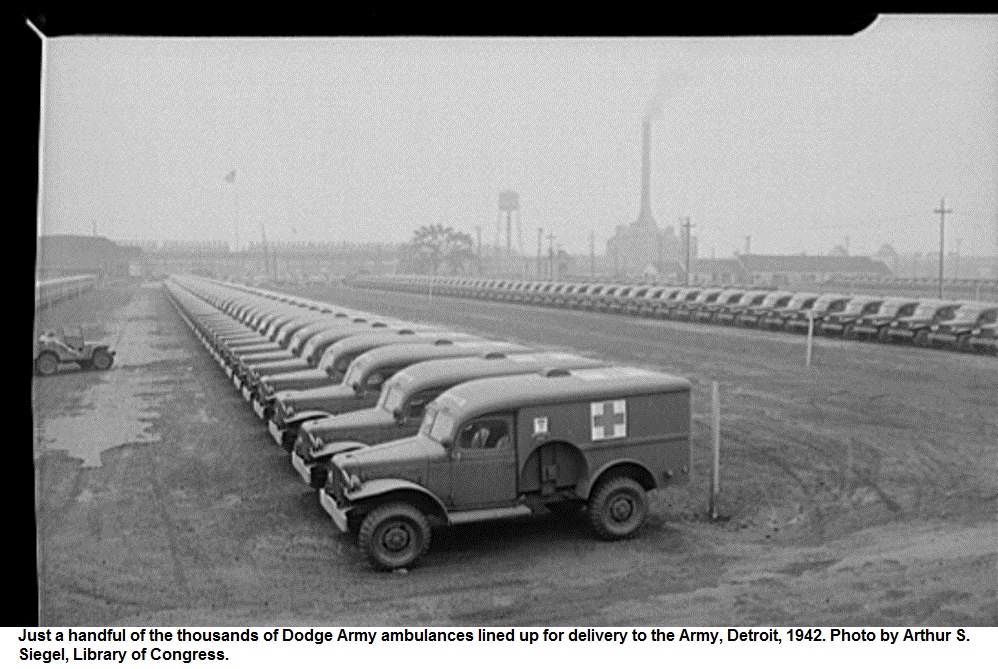
Yes, it halted completely. No cars, commercial trucks, or auto parts were made from February 1942 to October 1945.

On January 1, 1942, all sales of cars, as well as the delivery of cars to customers who had previously contracted for them, were frozen by the government’s Office of Production Management. As a temporary measure, local rationing boards could issue permits allowing persons who had contracted for cars before January 1st to secure delivery.

President Roosevelt established the War Production Board on January 16, 1942. It superseded the Office of Production Management. The WPB regulated the industrial production and allocation of war materiel and fuel. That included coordinating heavy manufacturing, and the rationing of vital materials, such as metals, rubber, and oil. It also established wage and price controls.

All manufacturers ended their production of automobiles on February 22, 1942. The January 1942 production quota had been a little over 100,000 automobiles and light trucks. The units manufactured at the beginning of February would bring up the total number of vehicles in a newly established car stockpile to 520,000. These would be available during the duration of the war for rationed sales by auto dealers to purchasers deemed “essential drivers.”

Representatives from the auto industry formed the Automotive Council for War Production in April 1942, to facilitate the sharing of resources, expertise, and manpower in defense production contracting.

The auto industry retooled to manufacture tanks, trucks, jeeps, airplanes, bombs, torpedoes, steel helmets, and ammunition under massive contracts issued by the government. Beginning immediately after the production of automobiles ceased, entire factories were upended almost overnight. Huge manufacturing machines were jack hammered out of their foundations and new ones brought in to replace them. Conveyors were stripped away and rebuilt, electrical wires were bundled together and stored in the vast factory ceilings, half-finished parts were sent to steel mills to be re-melted, and even many of the dies that had been used in the fabrication of auto parts were sent to salvage.

The government’s Office of Price Administration imposed rationing of gasoline and tires and set a national speed limit of 35 mph.

By April 1944, only 30,000 new cars out of the initial stockpile were left. Almost all were 1942 models and customers required a permit to make the purchase. The Office of Price Administration set the price. The government contemplated rationing used car sales as well, but that was finally deemed unnecessary. The government estimated that about a million cars had been taken off the road by their owners, to reserve for their own use after the war.

In the autumn of 1944, looking then toward the end of the war, Ford, Chrysler, Nash, and Fisher Body of General Motors received authorization from the War Production Board to do preliminary work on experimental models of civilian passenger cars, on condition that it not interfere with war work and that employees so used be limited to planning engineers and technicians. Limits were also set on the amount of labor and materials the companies could divert to this.

During the war, the automobile and oil companies continued to advertise heavily to insure that the public did not forget their brand names. Companies also were proud to proclaim their patriotic role in war production, and their advertisements displayed the trucks, aircraft, and munitions that they were making to do their part in combat.

In addition, auto advertisements encouraged the public to patronize local auto dealers’ service departments so that car repairs could help extend the lives of the cars their customers had bought before the war. In the last couple of years of the war, the auto companies also used their advertisements to heighten public anticipation of the end of the war and the resumption of car and truck manufacturing, with advertising copy such as Ford’s “There’s a Ford in Your Future.”

About the Author

CU Blog - A Lesson in History - Community Ethos of WW II - Photo 2
Historian John Buescher is an author and professor who formerly headed Tibetan language broadcasts at Voice of America. His Ph.D. is from the University of Virginia and he has published extensively on the history of Tibetan and Indian Buddhism and on the history of 19th-century American spiritualism.

Bibliography
a. John Alfred Heitmann, The Automobile and American Life. Jefferson, NC: McFarland, 2009. pp. 119-130.
b. James J. Flink, The Automobile Age. Cambridge: MIT Press, 1988. pp. 275-76.
c. Automobile Manufacturers Association, Freedom’s Arsenal: The Story of the Automotive Council for War Production. Detroit: Automobile Manufacturers Association, 1950.
Teaching History.org – National History Education Clearinghouse (Retrieved 09/29/2014) –
http://www.teachinghistory.org/history-content/ask-a-historian/24088

This relates a commitment so vital to a community that everyone was willing to sacrifice and lean-in for the desired outcome. This requires effective messaging.

The book Go Lean…Caribbean serves as a roadmap for the introduction and implementation of the Caribbean Union Trade Federation (CU); an initiative to bring change, empowerment, to the Caribbean region; to make the region a better place to live, work and play. This Go Lean roadmap also has initiatives to foster a domestic (region-wide) automotive industry. So there are a lot of benefits to glean by studying the American track record, even the periods of halted production. The Go Lean book posits that permanent change for Caribbean society will only take root as a result of adjustments to the community attitudes, the national spirit that drives the character and identity of its people. This is identified in the book as “community ethos”.

The purpose of the book/roadmap though is not just the ethos changes, but rather the elevation/empowerment of Caribbean society. In total, the Caribbean empowerment roadmap has these 3 prime directives:

  • Optimization of the economic engines in order to grow the regional economy to $800 Billion & create 2.2 million new jobs.
  • Establishment of a security apparatus to protect the resultant economic engines.
  • Improve Caribbean governance and industrial policies to support these engines.

The roadmap details the following community ethos, plus the execution of these strategies, tactics, implementation and advocacies to forge the identified permanent change in the region:

Community Ethos – Deferred Gratification Page 21
Community Ethos – Economic Principles – People Choose Page 21
Community Ethos – Economic Principles – People Respond to Incentives in Predictable Ways Page 21
Community Ethos – Economic Principles – The Consequences of Choices Lie in the Future Page 21
Community Ethos – Governing Principles – Lean Operations Page 24
Community Ethos – Governing Principles – Cooperatives Page 25
Community Ethos – Ways to Impact the Future Page 26
Community Ethos – Ways to Help Entrepreneurship Page 28
Community Ethos – Ways to Impact Research & Development Page 30
Community Ethos – Ways to Impact Turn-Arounds Page 33
Community Ethos – Ways to Improve Sharing Page 35
Community Ethos – Ways to Promote Happiness Page 36
Community Ethos – Ways to Impact the Greater Good Page 37
Strategy – Vision – Confederate 30 Member-States Page 45
Strategy – Mission – Foster New Industries Page 46
Tactical – Confederating a Permanent Union Page 63
Tactical – Fostering a Technocracy Page 64
Implementation – Ways to Pay for Change Page 101
Implementation – Ways to Deliver Page 109
Planning – 10 Big Ideas for the Caribbean Page 127
Planning – Ways   to Make the Caribbean Better Page 131
Planning – Reasons   Why the CU Will Succeed Page 132
Planning – Lessons   Learned from 2008 Page 136
Advocacy – Ways to Grow the   Economy Page 151
Advocacy – Ways to Create Jobs Page 152
Advocacy – Ways   to Improve Communications Page 186
Advocacy – Ways   to Develop Auto Industry Page 206
Advocacy – Ways   to Preserve Caribbean Heritage Page 218

Previously Go Lean blog/commentaries have considered historic references and stressed fostering the proper and appropriate community ethos for the Caribbean to prosper. The following sample applies:

https://goleancaribbean.com/blog/?p=2297 A Lesson in History – Booker T   versus Du Bois – to Change a Bad Community Ethos
https://goleancaribbean.com/blog/?p=2201 Changing Bad Community Ethos – Students   Developing Nail Polish to Detect Date Rape Drugs
https://goleancaribbean.com/blog/?p=1918 Philadelphia Freedom – Some Restrictions Apply – One   Community’s Constant Quest to Change
https://goleancaribbean.com/blog/?p=1531 A Lesson in History: 100 Years Ago   Today – World War I – Cause and Effect in Community Ethos
https://goleancaribbean.com/blog/?p=841 Having   Less Babies is Bad for the Economy?
https://goleancaribbean.com/blog/?p=623 Only   at the Precipice, Do Communities Change
https://goleancaribbean.com/blog/?p=353 Book Review: ‘Wrong – Nine   Economic Policy Disasters and What We Can Learn…’
https://goleancaribbean.com/blog/?p=228 Egalitarianism versus Anarchism – Community   Ethos Debate

All in all, there is a certain community ethos associated with populations that have endured crises. It is a focus on the future, a deferred gratification as investment for future returns. These attributes have been promoted by the Go Lean book as necessary traits to forge change in the Caribbean region. We need our own Caribbean flavor of this community ethos, in our manifestation of industrial policy.

The world was at the precipice, near implosion, in 1942 (World War II) … (and again in 2008 during the Great Recession). In order to endure the crises, many people had to endure sacrifice; but the entire community had to adopt the community ethos of deferred gratification. The industrial policy adjusted accordingly, with little objection from the public in general. A lot of good came from these sacrifices.

There are lessons for the Caribbean today to consider from the development of industrial policy in US history during World War II:

• Priorities can change in times of crisis. A crisis is a terrible thing to waste.

• Having a domestic manufacturing industry gives control of domestic production capability.

• Efficiency and effectiveness in one industry can be transferred to other industries; it is disciplined competence that is the real asset.

• Lowest cost is not the only criteria for providing out-sourced contracts.

• Limited raw materials are valuable, even as recycled materials.

• Effective Command-and-Control accentuates front-line effectiveness – Lean operational principles.

• Interdependence with partners can avoid crisis in the first place, and mitigate the damage from realized threats.

Now the Caribbean is in crisis, still reeling from 2008; we must endure, we must sacrifice and we must defer gratification. Now is the time to lean-in to this roadmap for Caribbean change, as depicted in the book Go Lean…Caribbean. We cannot afford to standby and watch our world implode. This was the case in 1942 and again in 2008. We must have a hand in our own destiny; an integrated (Single) market of 42 million people is large enough to be consequential in world negotiations.

We urge all Caribbean stakeholders (residents, Diaspora, governmental leaders, visitors, investors, etc.) to lean-in to this roadmap for change. 🙂

Download the book Go Lean … Caribbean – now!


Share this post:
, , , ,
[Top]

How ‘The Lion King’ roared into history

Go Lean Commentary

There is money in the ‘Arts’.

One “Broadway” musical play, The Lion King has made $6.21 billion. That is significant. In fact that is a record, according to the foregoing news article:

By: Alison Boshoff

CU Blog - How the Lion King roared into history - Photo 1Title: How The Lion King roared into history: As show is crowned biggest box office earner ever, the secrets of its success emerge

Hakuna Matata!

Sir Elton John has long observed that The Lion King musical ‘is a law unto itself’ — and how so.

After more than a decade of performances in cities all over the world, it was confirmed this week that the stage show is the biggest beast in the jungle.

The Lion King — based on the 1994 Disney film of the same name — has taken more money at the box office than any other production in history.

Since its first night on Broadway in 1997, the show has made more than £3.8 billion ($6.21 billion) in ticket sales alone.

Not only has it conquered the stage, it has massively out-earned every cinema release — including blockbusters such as James Cameron’s Avatar, which took a mere £1.7 billion ($2.78 billion) globally after its 2009 release.

A further fortune has been made in souvenir T-shirts, posters and the rest. At the last count, there were eight different cast recordings of the show’s songs on sale.

Featuring music by Sir Elton John and lyrics by Sir Tim Rice, The Lion King opened in Minneapolis in July 1997 before moving to Broadway in November that year.

CU Blog - How the Lion King roared into history - Photo 2It arrived at the Lyceum Theatre in London’s West End in October 1999 and currently takes more than £30 million ($49 million) a year in the UK.

A STORY WITH BITE

The musical tells the story of Simba, a lion cub born on the Serengeti who runs away from his pride when his father Mufasa dies.

Aided by his friends, he must defeat his evil uncle Scar, who engineers Mufasa’s death in a stampede and convinces Simba he was to blame, to reclaim his rightful position as king.

THE MAGIC FORMULA

According to music historian Cary Ginell, the musical is a ‘spectacle that satisfies’ on many different levels.

‘For the kids, it’s the visual elements, the colours, the costumes and the puppetry,’ he says. ‘For the adults, it’s Hamlet.’

Many have noted the parallels between Disney’s and Shakespeare’s plots, which both feature a murdered king avenged by his rightful heir.

GOING GLOBAL

Disney says that the 22 Lion King productions around the world have been seen by an estimated 75 million people. That’s the entire population of the United Kingdom, plus the population of Belgium.

Last year, it was the highest-grossing musical on the New York stage, and it retains its number-one position so far in 2014. It has always been a sell-out in London.

MONEY MATTERS

Disney dipped its toe in the water with a Broadway version of its Oscar-winning Beauty And The Beast before pouring an estimated £6.5 million ($10.62 million) into staging The Lion King — the most expensive show ever staged.

THE STAGE GURU

CU Blog - How the Lion King roared into history - Photo 4In a colossal creative gamble, Disney hired Julie Taymor, an avant garde director who had trained in mime in Paris and spent years studying Japanese and Indonesian theatre.

Taymor thought the film ‘superficial’. She said: ‘I had to make The Lion King my own. Otherwise it’s a Disney product and I don’t like the way Disney looks.’

WE NEED A HEROINE!

Taymor’s great visual innovation was using puppetry, masks and mechanical headpieces to portray the animals. When the lions cry, they pull rolls of white silk from their masks’ eye holes; the actors playing giraffes walk on stilts.

The drought that ravages the savannah is illustrated by a dwindling waterhole — a circle of silvery material that shrinks as it is pulled across the stage.

There were other changes, too: the stage production has more songs than the film; and Rafiki, the baboon with mystic powers, became a ‘she’, as Taymor felt that the film lacked a leading female character.

CU Blog - How the Lion King roared into history - Photo 3A STAMPEDE FOR SEATS

In the immediate aftermath of its Broadway debut, there were reports of pushy New York parents putting their children’s names down for theatre tickets years in advance.

At one point seats were reselling for up to ten times their face value. Things have since calmed down, but a ticket to the London production costs at least £27.50 ($44.92) a seat.

THE CRITICS’ VERDICT

‘Visually breathtaking,’ said the New York Times. ‘Pure, exhilarating theatre, unlike anything ever seen on Broadway,’ cheered USA Today.

But not everyone was convinced. One critic who saw the show open in London’s West End wrote that once the last Zulu drum had fallen silent, a tiny part of him was left whispering: ‘So what?’

Catch it immediately, he said, thinking it was not destined to run and run. Oops.

And the late, great Sheridan Morley opined: ‘A lot of people say, “This is not real theatre. It’s theatre by way of the movies, or by way of the theme park.” It’s Disneyfication, if you like.’

STARS IN THEIR AISLES

Celebrities including Dame Judi Dench, Dame Shirley Bassey, model Claudia Schiffer and former Spice Girl Geri Halliwell attended the opening night in London.

All said that they had been moved to tears and ovations. Dame Judi said afterwards: ‘I don’t want to be in any play in the future where an elephant doesn’t walk down the aisle.’

But the show has not brought in big-name stars to fill seats, instead relying on talented ensemble casts.

SPOOKING THE PHANTOM

Even though twice as many paying punters have seen Andrew Lloyd Webber’s long-running The Phantom Of The Opera, The Lion King’s steeper ticket prices and larger theatres mean its earnings are greater.

THAT’S ENOUGH, ZAZU

Zazu the hornbill’s big musical number, The Morning Report, was cut from the show in 2010, making the show nine minutes shorter.

ELTON’S CASH COW

No one will say how much Sir Elton was paid for licensing his melodies for The Lion King film — such as the hit Can You Feel The Love Tonight — to be used in the stage version.

What can be noted is that pre-Lion King his annual income was said to stand at around £12 million ($19.6 million) a year. More recently, Forbes magazine put it at £48 million ($78.4 million) a year.

ONCE MORE WITH FEELING

Buoyed by The Lion King’s success, Sir Elton was then involved in two musicals: Aida, which had minor success, and Lestat, based on Anne Rice’s gothic novels about an 18th-century nobleman turned vampire. That was a thumping disaster and closed after 39 performances in 2005.

He stepped back into the world of musical theatre that year with the hugely popular Billy Elliot — though he did tell an interviewer in 2011: ‘Just between you, me and the gatepost, I’m not really a lover of musicals.’

MAN BEHIND THE MUSIC

The show is completed by the music of South African composer Lebo M, who was exiled to America in 1979 after student riots in Soweto.

He told the South Bank Show: ‘The Lion King is not necessarily political, but I could relate to the life of Simba, a young cub who grows up in exile and goes back to fight for his country.’
The Daily Mail – London’s Daily Newspaper (Posted September 23, 2014) – http://www.dailymail.co.uk/tvshowbiz/article-2767423/How-Lion-King-roared-history-As-crowned-biggest-box-office-earner-secrets-success.html

This news story aligns with the book Go Lean…Caribbean in stressing the economic impact of artistic and entertainment endeavors. The book asserts that Caribbean society can be elevated by improving the eco-system to live, work and play. Broadway-style theatrical productions come under the category of “play”.

The book Go Lean…Caribbean strives to accomplish this elevation vision by serving as a roadmap for the introduction and implementation of the technocratic Caribbean Union Trade Federation (CU). There is a lot involved in this vision; the prime directives are stated as follows:

  • Optimization of the economic engines in order to grow the regional economy to $800 Billion & create 2.2 million new jobs.
  • Establishment of a security apparatus to protect the resultant economic engines.
  • Improve Caribbean governance to support these engines.

“Art imitates Life and Life imitates Art” – Literary expression.

There is another message from this commentary/blog, that one person, a role model, can make a difference in transforming society. The Go Lean roadmap stresses the mission of creating jobs in the areas of Science, Technology, Engineering and Medicine (STEM), but it also recognizes that many people show ‘genius qualifiers’ in unrelated areas: music, visual arts, performing arts, sports and theatrical endeavors. This point is pronounced early in the following statements in the book’s Declaration of Interdependence (Page 14):

xxi. Whereas the preparation of our labor force can foster opportunities and dictate economic progress for current and future generations, the Federation must ensure that educational and job training opportunities are fully optimized for all residents of all member-states, with no partiality towards any gender or ethnic group. The Federation must recognize and facilitate excellence in many different fields of endeavor, including sciences, languages, arts, music and sports. This responsibility should be executed without incurring the risks of further human flight, as has been the past history.

xxxii. Whereas the cultural arts and music of the region are germane to the quality of Caribbean life, and the international appreciation of Caribbean life, the Federation must implement the support systems to teach, encourage, incentivize, monetize and promote the related industries for arts and music in domestic and foreign markets. These endeavors will make the Caribbean a better place to live, work and play.

There are economic and image considerations with this subject. The Go Lean book accepts that “show business” can have an impact on society and the world, as also depicted in the foregoing article. Already, this commentary has analyzed the Broadway play “Motown, The Musical” and contributions of role model Berry Gordy.

The Go Lean roadmap accepts that change has come to “show business” (Music, Film, Visual Art and Theater). This is due mostly to the convergence of technology (the internet to be exact). The book posits that [market] “size no longer matters”, that content can be created in any location in the world and then distributed to an appreciative audience anywhere. The first requirement is the community ethos of valuing Intellectual Property. This ethos would be new, a change, for the Caribbean.

Today, most Intellectual Property is consumed digitally with a lot of retailing via the World-Wide-Web. This changed landscape now requires new tools and protections, like electronic payment systems, digital rights management and Performance Rights Organizations. The Go Lean/CU roadmap details these solutions. With these efforts and investments, the returns will be undeniable.

To harvest these investment returns, there is the need for some technocratic facilitations. The book posits that this burden is too big for any one Caribbean member-state, and thus the collaboration efforts of the CU is necessary, as the strategy is to confederate all the 30 member-states of the Caribbean despite their language and legacy, into an integrated “single market”. This will allow for better leverage of the consumer market for the consumption of media.

The CU is designed to do the heavy-lifting of organizing Caribbean society. The following list details the ethos, strategies, tactics, implementations and advocacies to foster a similar successful path like The Lion King on the world stage:

Community Ethos – Forging Change Page 20
Community Ethos – Lean Operations Page 24
Community Ethos – Return on Investments Page 24
Community Ethos – Ways to Foster Genius Page 27
Community Ethos – Help Entrepreneurship Page 28
Community Ethos – Promote Intellectual Property Page 29
Anecdote – Valedictorian Experience Page 38
Strategy – Strategy – Caribbean Vision Page 45
Strategy – Agents of Change – Globalization Page 57
Separation of Powers – Central Bank – Electronic Payment Deployments Page 73
Tactical – Separation of Powers – Patents & Copyrights Office Page 78
Separation of Powers – Culture Administration Page 81
Planning – Ways to Make the Caribbean Better Page 131
Planning – Lessons Learned from New York City Page 137
Advocacy – Ways to Grow the Economy Page 151
Advocacy – Ways to Create Jobs Page 152
Advocacy – Education – Performing Arts Schools Page 159
Advocacy – Reforms for Banking Regulations Page 199
Advocacy – Ways to Impact Hollywood Page 203
Advocacy – Ways to Improve the Arts Page 230
Advocacy – Ways to Promote Music Page 231
Advocacy – Impact Urban Living – Art & Theaters Page 234
Appendix – New York / Broadway / Theater Jobs Page 277
Appendix – Caribbean Music Genres Page 347
Appendix – Protecting Music Copyrights Page 351

Considering the experience of Julie Taymor in the foregoing article, the Go Lean roadmap asserts that one man, or woman, can make a difference in the quest to elevate Caribbean society. We want to foster any ‘genius qualifiers’ found within the region. This refers to “on stage/on camera” talent and behind-the-scenes talent, like Ms. Taymor.

The Go Lean/CU roadmap represents the change that has come to the Caribbean. The people, institutions and governance of the region are all urged to “lean-in” to this roadmap for change. We know there is a “new” Julie Taymor somewhere in the Caribbean member-states, waiting to be fostered.

This will not be the first time a Caribbean artist has impacted the world with his/her artistic contributions. We have the proud legacy of Bob Marley and his musical genius. His songs are sung and hummed around the world:

i.e. Song: One Love – “Let’s get together and feel alright”

He is so recognizable that he is considered an icon.

The movie and Broadway play, The Lion King, is also iconic… and impactful. Consider the experience of this “Cast” flash-mob / song-and-dance depicted in this video:

THE LION KING Australia: Cast Sings Circle of Life on Flight Home from Brisbane
https://www.youtube.com/watch?v=wgSLxl1oAwA

Download the book Go Lean … Caribbean – now!

Share this post:
, , , , ,
[Top]

‘Raul Castro reforms not enough’, Cuba’s bishops say

Go Lean Commentary

s bishops say - Photo 1

“Too little, too late.”

This seems to be the verdict of the observers in the foregoing news article on the subject of Cuba’s societal reforms. As a summary, Raul Castro serves as the President of Cuba, succeeding his brother, Fidel. The old economic models instituted by Fidel no longer work – the world has changed – so Raul has applied some reforms to alleviate the Failed-State status.

It is easy to criticize Cuba from afar, from outside looking in, so instead this commentary features the criticism from within, from stakeholders with some leadership, albeit religious, among the Cuban people. The below article highlights the assessment of the Roman Catholic Bishops serving the country:

HAVANA (AFP) —Cuba’s Roman Catholic bishops pressed the Americas’ only Communist government to deepen economic reforms and hinted at a desire for political opening in a document obtained by AFP Wednesday.

In a country with a centrally planned economy where opposition political parties remain outlawed, the Church is the only sizeable non-state actor that has an ongoing dialogue with President Raul Castro’s government.

And in its Pastoral Plan for 2014-2020, the first such document since Argentine-born Pope Francis’s papacy began last year, the bishops were blunt.

The government’s limited “economic reforms have not jump-started the economy in such a way that all Cuba’s people can feel,” the document reads in part.

During the more than five decades that the Communist government has been in power, health care, education and sports “experienced major progress” but are now “stagnant and in some cases in decline,” the document said, referring to what the government sees as its key achievements.

Castro — who replaced his brother, longtime president Fidel Castro who stepped aside in 2006 for health reasons — has ruled out the idea of any political opening.

And on the economic front, he has refused to embrace market economics as China or Vietnam have.

Instead, the former military chief has cut the government payroll and allowed more categories of self-employment.

But the cash-strapped economy depends heavily on Venezuela’s economic aid, and has no access to international loans. Most Cubans earn the equivalent of $20 a month.

“Despite the changes there have been,” the bishops said, “we sense that many citizens urgently want deeper and more appropriate reforms implemented to solve pressing problems generated by their being overwhelmed, plagued by uncertainly and worn out.”

While not aggressive, the document is more frank than some in the past which came as bishops were planning visits to Cuba by former and more conservative popes John Paul II in 1998 and Benedict XVI in 2012.

The new document broached the issue of political opening saying that many Cubans want their state to be “less bureaucratic and more participatory.”

Some “others who do not accept that way of thinking… are confusing the meaning of nationhood with an ideology, or with a party,” the document said.

“Dialogue among the various groups that make up our society is the only path toward achieving and maintaining social transformations that happen in Cuba,” the bishops said.

While Cubans’ everyday concerns have begun to emerge in the island’s state-run media and many political prisoners have been freed, new dissident arrests and violent attacks against them “continue to be worrisome and not constructive,” they added.

The bishops also reiterated longstanding opposition to the US trade embargo against Cuba in place for more than four decades.
Yahoo Online News Source (Posted and retrieved 09-11-2014) –
http://news.yahoo.com/raul-castro-reforms-not-enough-cubas-bishops-222531446.html

The issue of Cuba is very important from a macro Caribbean perspective. Theirs is a big island in the middle of the region and they possess a large population, the biggest in the Caribbean, 11,236,444 people as of 2010. Any plan to empower the Caribbean cannot be credible if it ignores Cuba. But there is the reality of the US Trade Embargo against Cuba. The US will not negotiate, bargain or trade with this country. So any viable plan must therefore emerge independent of the United States.

Here is that plan: the book Go Lean…Caribbean declares an interdependence with Cuba. The book serves as a roadmap for the introduction and implementation of the technocratic  Caribbean Union Trade Federation (CU). This is a super-national federal government to administer and optimize the economic/security/ governing engines of the region’s 30 member-states – including Cuba.

At the outset, the Go Lean roadmap recognizes the value of significance of Cuban reconciliation into any Caribbean integration with this statement in the Declaration of Interdependence (Page 12):

xiii. Whereas the legacy of dissensions in many member-states (for example: Haiti and Cuba) will require a concerted effort to integrate the exile community’s repatriation, the Federation must arrange for Reconciliation Commissions to satiate a demand for justice.

The foregoing article recognized the fact that Raul Castro implemented economic, security, and governing reforms, to a failed consequence. This was inevitable! Go Lean takes a different approach. The book posits that the problems of Cuba, or the entire Caribbean for that matter, are too big for any one member-state to address alone, that there must be a regional solution, one agnostic of the colonial, language or political differences of the individual countries.

This is a tall-order; this is heavy-lifting.

The book maintains that confederating with Cuba is a “Big Idea” for the Caribbean. It therefore provides the turn-by-turn directions for elevating Cuban society and reconciling the 55 year-old rift in US-Cuban relations.

The premise of this roadmap is that Cuban President Raul Castro has announced that he will retire in 2017. We welcome a post-Castro Cuba.

This commentary is not the first to focus on Cuba. Previous blogs featured many subjects of Cuba’s eventual integration into the Caribbean brotherhood. See these points in the sample here:

https://goleancaribbean.com/blog/?p=1847 Cuban Cigars – Declared “Among the best in the world”
https://goleancaribbean.com/blog/?p=1609 Cuba mulls economy in Parliament session
https://goleancaribbean.com/blog/?p=789 America’s War on the Caribbean
https://goleancaribbean.com/blog/?p=554 Cuban cancer medication registered in 28 countries
https://goleancaribbean.com/blog/?p=436 Cuba Approves New “Law on Foreign Investment”

The book Go Lean … Caribbean purports that anyone named “Castro” administering Cuba would be a guaranteed deterrent for international cooperation; especially so in American circles, and even more abhorrent in the Miami Cuban Exile community. But 2017 is not far away. Go Lean is the planning, with the community ethos, strategies, tactics, implementations and advocacies to finally reform Cuba, and include “her” in the Caribbean brotherhood. See book samples here:

Community Ethos – Deferred Gratification Page 21
Community Ethos – Economic Systems Influence Individual Choices & Incentives Page 21
Community Ethos – Voluntary Trade Creates Wealth Page 21
Community Ethos – Lean Operations Page 24
Community Ethos – Return on Investments Page 24
Community Ethos – Cooperatives Page 25
Community Ethos – Non-Government Organizations (NGOs) Page 25
Community Ethos – Ways to Manage Reconciliations Page 34
Community Ethos – Ways to Impact the Greater Good Page 37
Strategic – Vision – Integrating Region in to a Single Market Page 45
Strategic – Core Competence – Specialty Agriculture Page 58
Tactical – Fostering a Technocracy Page 64
Tactical – Separation of Powers – Office of Trade Negotiations Page 80
Tactical – Separation of Powers – Federal Courts – Truth & Reconciliation Commissions Page 90
Implementation – Assemble & Create Super-Regional Organs to represent all Caribbean Page 96
Implementation – Ways to Pay for Change Page 101
Implementation – Foreign Policy Initiatives at Start-up Page 102
Implementation – Ways to Deliver Page 109
Implementation – Ways to Benefit from Globalization Page 119
Planning – 10 Big Ideas – Cuba Page 127
Planning – Ways to Improve Failed-State Indices Page 134
Planning – Lessons Learned from the Bible Page 143
Advocacy – Ways to Grow the Economy Page 151
Advocacy – Ways to Ways to Improve Governance in the Caribbean Region Page 168
Advocacy – Ways to Impact the Diaspora Page 217
Advocacy – Ways to Impact Foundations Page 219
Advocacy – Ways to Re-boot Cuba Page 236

The foregoing article addresses reform in Cuba from the point-of-view of religious leaders, the Roman Catholic Church. This is welcomed! While Go Lean is a roadmap for economic empowerment, it does highlight the wisdom gleaned from a study of the Bible. But, the CU declares a religious-neutral stance and invites participation from many aspects of society, including religious groups, civic agencies, social charities, foundations and other non-governmental organizations.

The roadmap is especially inviting to the Caribbean Diaspora; it presents a plan for the contribution of their time, talents and treasuries in the elevation of the entire region.

There will be the need for reconciliation of this Diaspora class, especially in Cuba. We invite that now!

This is a new day, it’s time now for change in Cuba and throughout the rest of the region. It is time to make the Caribbean a better place to live, work and play.

Cuba será libre!

Download the book Go Lean … Caribbean – now!

Share this post:
, , ,
[Top]

A Lesson in History – Booker T versus Du Bois

Go Lean Commentary

2008 was a big year …

… in the history of mankind, the United States of America and the lessons learned for application in the Caribbean. This has been a familiar theme for the publishers of the book Go Lean…Caribbean; this theme has been exhausted in the book (Page 136) and in countless blog/commentaries (see list below). 2008 was only 6 years ago; that is considered recent; how inspiring could the lessons be with just a 6-year look-back? In answering, there is the need to go back even further, not to 2008, but back to the America of 1908, even more exacting to 1901; (the year Booker T. Washington was invited to the White House).

This was the strong point made by one of the key players in American history for 2008: John McCain, the Republican Nominee for US President against the eventual winner Barack Obama. In his concession speech on November 4, 2008, he painted a (word) picture of a landscape of America transcending over the past 100 years.

See the VIDEO here, now:

Video: John McCain 2008 Concession Speech
https://www.youtube.com/watch?v=bss6lTP8BJ8


A comment on this VIDEO in February 2014 truly capsulated the significance of this speech:

“One the most gracious and powerful speeches ever made. It deserves to go into the pantheon of great orations made by the likes of Winston Churchill, Martin Luther King, Jawaharlal Nehru and others” – Ravi Rajagopalan.

CU Blog - A Lesson in History - Booker T versus DuBois - Photo CombinedThe transcript from this video gives us the platform for the deep appreciation for our lesson in history: Booker T. Washington versus W.E.B. Du Bois. (See Appendix below).

Both men were very important in the history of civil rights for African-Americans. They both wanted the same elevation of their community in American society, but they both had different strategies, tactics and implementations.

Washington’s biggest legacy is the Tuskegee University (Tuskegee Institute in his day). Du Bois’s legacy stems from his co-founding the NAACP (National Association for the Advancement of Colored People).

The conclusion from the above VIDEO, as stated by John McCain is that the journey for full citizenship for African-Americans took 100 years from the time of the Washington / Du Bois chasm. No matter the detailed approach, 100 years is still 100 years.

From the point of view of the Caribbean and the publishers of Go Lean…Caribbean, we side with both civil rights leaders in aspirations, but lean towards Booker T. Washington in strategies. Underlying to Mr. Washington’s advocacy, was for the Black Man to remain in the South, find a way to reconcile with his White neighbors and to prosper where he was planted.

The Caribbean has the same conundrum! Rather than fleeing our southern homes for northern opportunities, we advocate reconciling our conflicts, and managing the crises in our region so as to work out an effective future for all Caribbean people today, and tomorrow for our youth. (We also advocate a reconciliation of the past).

The book Go Lean…Caribbean serves as a roadmap for the introduction and implementation of the Caribbean Union Trade Federation (CU); an initiative to bring change, empowerment, to the Caribbean region; to make the region a better place to live, work and play. This Go Lean roadmap also has these 3 prime directives:

  • Optimization of the economic engines in order to grow the regional economy to $800 Billion & create 2.2 million new jobs.
  • Establishment of a security apparatus to protect the resultant economic engines.
  • Improve Caribbean governance to support these engines.

The book describes the CU as a technocratic administration with 144 different missions to elevate the Caribbean homeland. The underlying goal is stated early in the book with this pronouncement in the opening Declaration of Interdependence (Page 12):

xii. Whereas the legacy in recent times in individual states may be that of ineffectual governance with no redress to higher authority, the accedence of this Federation will ensure accountability and escalation of the human and civil rights of the people for good governance, justice assurances, due process and the rule of law…

Change has come to the Caribbean. But as depicted in the foregoing VIDEO, we will not have to wait 100 years, we will effectuate this change now. The Go Lean book declares that for permanent change to take place, there must first be an adoption of new community ethos, the national spirit that drives the character and identity of its people. This is what was missing in 1908 Black America. This point of community ethos is therefore our biggest lesson in the consideration of this history.

The Go Lean roadmap was constructed with these additional community ethos in mind, plus the execution of strategies, tactics, implementation and advocacies to forge the identified permanent change in the region. The following is a sample of these specific details from the book:

Community Ethos – Deferred Gratification Page 21
Community Ethos – Economic Principles – People Choose Page 21
Community Ethos – Economic Principles – All Choices Involve Costs Page 21
Community Ethos – Economic Principles – People Respond to Incentives in Predictable Ways Page 21
Community Ethos – Economic Principles – Economic Systems Influence Individual Choices Page 21
Community Ethos – Economic Principles – The Consequences of Choices Lie in the Future Page 21
Community Ethos – Security Principles – Anti-Bullying and Mitigation Page 23
Community Ethos – Governing Principles – Minority Equalization Page 24
Community Ethos – Governing Principles – Lean Operations Page 24
Community Ethos – Ways to Impact the Future Page 26
Community Ethos – Ways to Foster Genius Page 27
Community Ethos – Ways to Help Entrepreneurship Page 28
Community Ethos – Ways to Promote Intellectual Property Page 29
Community Ethos – Ways to Impact Research & Development Page 30
Community Ethos – Ways to Manage Reconciliations Page 34
Community Ethos – Ways to Improve Sharing Page 35
Community Ethos – Ways to Promote Happiness Page 36
Community Ethos – Ways to Impact the Greater Good Page 37
Anecdote – LCD versus an Entrepreneurial Ethos Page 39
Strategy – Vision – Confederation   of the 30 Caribbean Member-States into a Single Market Page 45
Strategy – Mission – Celebrate the Music, Sports, Art, People and Culture of the Caribbean Page 46
Tactical – Confederating a Permanent Union Page 63
Tactical – Fostering a Technocracy Page 64
Tactical – Separation of Powers: Federal Administration versus Member-States Governance Page 71
Implementation – Ways to Pay for Change Page 101
Implementation – Ways to Deliver Page 109
Planning – 10 Big Ideas for the Caribbean Region Page 127
Planning – Ways to Make the Caribbean Better Page 131
Planning – Ways to Better Manage Image Page 133
Planning – Lessons Learned from 2008 Page 136
Advocacy – Ways to Grow the Economy Page 151
Advocacy – Ways to Create Jobs Page 152
Advocacy – Ways to Improve Education Page 159
Advocacy – Ways to Improve Governance in the Caribbean Region Page 168
Advocacy – Ways to Better Manage the Social Contract Page 170
Advocacy – Ways to Mitigate Terrorism Page 181
Advocacy – Ways to Improve Communications Page 186
Advocacy – Ways Impact the Diaspora Page 217
Advocacy – Ways to Preserve Caribbean Heritage Page 218
Advocacy – Ways to Improve the Arts Page 230
Advocacy – Ways to Promote Music Page 231

There are other lessons for the Caribbean to learn from this consideration. The “clash and conflict” of the Booker T. Washington camp versus the W.E.B. Du Bois camp caused enmity in Black America since 1908 and continues even today. While some modern labeling may be “Old-School versus Nu School”, “Hip-Hop versus Bourgeois” , “Black Nationalists versus Accommodationists”, even “Thugs versus ‘Acting White'”, the underlying conflict is a  “deep divide”, a consistent reflection of two different approaches competing for dominance in the Black community.

Whereas life imitates art and art imitates life, this conflict was artfully depicted in the 1984 film A Soldier Story, directed by Norman Jewison, based upon playwright Charles Fuller’s Pulitzer Prize-winning Off-Broadway production A Soldier’s Play (1981). The movie was nominated for three Academy Awards (Best Picture, Supporting Actor – Adolph Caesar, and Best Screenplay Adaptation – Charles Fuller). See the VIDEO excerpt here:

A Solider’s Story: “The Day Of The Geechie Is Gone”
https://www.youtube.com/watch?v=CMk_16hT8Tk

A previous Go Lean blog/commentary identified this same conflict as Egalitarianism versus Anarchism.

Other blog/commentaries stressed related issues, such as learning from 2008 and the history of America’s 20th Century race relations. The following sample applies:

https://goleancaribbean.com/blog/?p=2222 Sports Role Model – Playing For Pride … And More
https://goleancaribbean.com/blog/?p=1918 Philadelphia Freedom – Some Restrictions Apply
https://goleancaribbean.com/blog/?p=1596 Book Review: ‘Prosper Where You Are Planted’
https://goleancaribbean.com/blog/?p=1531 A Lesson in History: 100 Years Ago Today – World War I
https://goleancaribbean.com/blog/?p=1037 Humanities & Civil Rights Advocate Maya Angelou – R.I.P.
https://goleancaribbean.com/blog/?p=789 America’s War on the Caribbean
https://goleancaribbean.com/blog/?p=782 Open the Time Capsule: The Great Recession of 2008
https://goleancaribbean.com/blog/?p=378 Fed Releases Transcripts from 2008 Meetings
https://goleancaribbean.com/blog/?p=341 Hypocritical US slams Caribbean human rights practices

Are the issues in this commentary strictly a historic reference? Unfortunately not! The opening VIDEO saw a conciliatory John McCain congratulating the newly elected President Barack Obama. The audience continued to “boo” time and again. This response was indicative of an continuing uneasiness in America’s race relations. This point is effectively made by another commentator, (YouTube Screen Name “eddude08”, posted January 2014) to the above John McCain YouTube VIDEO:

The crowd at John McCain’s concession speech said it all. While the noble Arizona Senator was committed to ending his campaign with grace and dignity, few knew at the time that [his Vice-Presidential Nominee] Sarah Palin had the audacity to prepare her own concession speech that night. Every time the Senator from Arizona would mention the newly elected Black President, the crowd erupted with boos. While mass media portrayed a nation wrapped in joy and celebration, anger and fear was well felt in the Heartland. John McCain, one of the greatest Senators of a generation, would be the sole man responsible for bringing a radical and unstoppable element into American politics. Sarah Palin’s nomination set the stage for political domination by a minority that had long been shunned by the mainstream.

Within Obama’s first year of presidency, the number of anti-government militias quadrupled. Within his first term, the nation witnessed the greatest number of legislative filibusters by any congress in the history of the country. 5 years into his presidency, he presided over the most ineffective Congress in American history. even with the deaths of 20 children in a mass shooting [in Newtown, Connecticut], conspiracy theories flourished and the people became distorted, millions of armed citizens convinced their weapons were needed for an inevitable clash with their government. A grassroots movement called the Tea Party became hijacked, fused with an established political party, what was a movement to stop the emerging fascism in the United States became the main force of recruitment for it. The nations budget and credit standing became fair game to advance political ideologies. America’s politics so radicalized a woman named Christine O’Donnell became a Senate nominee [in Delaware in 2010]. Even victims of hurricanes, even [in] the great states of New York and New Jersey could not be spared in the new age of American politics. Glenn Beck [(Political Commentator on cable channel FOX News)] became a national figure, and corporations were declared citizens.

A truly new America was emerging, and nothing would be able to stop what had become inevitable.

Is it the same America of 1908? Perhaps! The point from a Caribbean perspective is “the more things change, the more they remain the same”. We have problems in the Caribbean to contend with, many of which we are failing miserably. But our biggest crisis stems from the fact that so many of our citizens have fled their Caribbean homelands for foreign (including American) shores.

The purpose of this commentary is not to fix America, it is to fix the Caribbean. But the push-and-pull factors are too strong coming from the US. We must lower the glimmering light, the “pull factors”, that so many Caribbean residents perceive of the “Welcome” sign hanging at American ports-of-entry. A consideration of this commentary helps us to understand the DNA of American society: un-reconciled race relations in which Black-and-Brown are still not respected.

The logical conclusion: stay home in the Caribbean and work toward improving the homeland. The US should not be the panacea of Caribbean hopes and dreams.

Booker T. Washington advocated this strategy: prosper where you’re planted.

After 100 years, and despite an African-American President, we must say to Mr. Booker T. Washington: We concur!

Download the book Go Lean … Caribbean – now!

————————————————–

Appendix – Black America in 1908 – The Way Forward

Conditions were not good for the 4 million Black population in the Southern US after the Civil War. The blatant racism brought oppression, suppression and repression. Mob violence and injustice, even lynchings, became commonplace upon this American population. As lynchings in the South reached a peak in 1895, Booker T. Washington gave a speech in Atlanta that made him nationally famous. The speech called for black progress through education and entrepreneurship. His message was that it was not the time to challenge Jim Crow segregation and the disfranchisement of black voters in the South. Washington mobilized a nationwide coalition of middle-class blacks, church leaders, and white philanthropists and politicians, with a long-term goal of building the community’s economic strength and pride by a focus on self-help and schooling.

Washington’s 1895 Atlanta Exposition address was viewed as a “revolutionary moment”[17] by both African Americans and Whites across the country. At the time W. E. B. Du Bois supported him, but they grew apart as Du Bois sought more action to remedy disfranchisement and improve educational opportunities for Blacks. After their falling out, Du Bois and his supporters referred to Washington’s speech as the “Atlanta Compromise” to express their criticism that Mr. Washington was too accommodating to white interests.

Washington advocated a “go slow” approach to avoid a harsh white backlash.[17] The effect was that many youths in the South had to accept sacrifices of potential political power, civil rights and higher education.[18] His belief was that African Americans should “concentrate all their energies on industrial education, and accumulation of wealth, and the conciliation of the South.”[19] Washington valued the “industrial” education, as it provided critical skills for the jobs then available to the majority of African Americans at the time, as most lived in the South, which was overwhelmingly rural and agricultural. He thought these skills would lay the foundation for the creation of stability that the African-American community required in order to move forward. He believed that in the long term, “blacks would eventually gain full participation in society by showing themselves to be responsible, reliable American citizens.” His approach advocated for an initial step toward equal rights, rather than full equality under the law, gaining economic power to back up black demands for political equality in the future.[20] he believed that such achievements would prove to the deeply prejudiced white America that African Americans were not “‘naturally’ stupid and incompetent.”[21]

Well-educated blacks in the North, [of which Du Bois was most iconic], advocated a different approach, in part due to the differences they perceived in opportunities. Du Bois wanted blacks to have the same “classical” liberal arts education as upscale whites did, along with voting rights and civic equality, the latter two elements granted since 1870 by constitutional amendments after the Civil War. He believed that an elite, which he called the Talented Tenth, would advance to lead the race to a wider variety of occupations.[22] Du Bois and Washington were divided in part by differences in treatment of African Americans in the North versus the South; although both groups suffered discrimination, the mass of blacks in the South were far more constrained by legal segregation and exclusion from the political process. Many in the North rejected to being ‘led’, and authoritatively spoken for, by a Southern accommodationist strategy which they considered to have been “imposed on them [Southern blacks] primarily by Southern whites.”[23] Historian Clarence E. Walker wrote that, for white Southerners:

“Free black people were ‘matter out of place’. Their emancipation was an affront to southern white freedom. Booker T. Washington did not understand that his program was perceived as subversive of a natural order in which black people were to remain forever subordinate or unfree.”[24]

Both Washington and Du Bois sought to define the best means to improve the conditions of the post-Civil War African-American community through education.

Blacks were solidly Republican in this period, having gained emancipation and suffrage with the President Lincoln and his party. Southern states disfranchised most blacks and many poor whites from 1890–1908 through constitutional amendments and statutes that created barriers to voter registration and voting, such as poll taxes and literacy tests. By the late nineteenth century, Southern white Democrats defeated some biracial Populist-Republican coalitions and regained power in the state legislatures of the former Confederacy; they passed laws establishing racial segregation and Jim Crow. In the border states and North, blacks continued to exercise the vote; the well-established Maryland African-American community defeated attempts there to disfranchise them.

CU Blog - A Lesson in History - Booker T versus DuBois - Photo 3Washington worked and socialized with many national white politicians and industry leaders. He developed the ability to persuade wealthy whites, many of them self-made men, to donate money to black causes by appealing to values they had exercised in their rise to power. He argued that the surest way for blacks to gain equal social rights was to demonstrate “industry, thrift, intelligence and property.”[25] He believed these were key to improved conditions for African Americans in the United States. Because African Americans had only recently been emancipated and most lived in a hostile environment, Washington believed they could not expect too much at once. He said, “I have learned that success is to be measured not so much by the position that one has reached in life as by the obstacles which he has had to overcome while trying to succeed.”[15]

Along with Du Bois, Washington partly organized the “Negro exhibition” at the 1900 Exposition Universelle in Paris, where photos of Hampton Institute’s black students were displayed. These were taken by his friend Frances Benjamin Johnston.[26] The exhibition demonstrated African Americans’ positive contributions to United States’ society.[26]

Washington privately contributed substantial funds for legal challenges to segregation and disfranchisement, such as the case of Giles v. Harris, which was heard before the United States Supreme Court in 1903.[27] Even when such challenges were won at the Supreme Court, southern states quickly responded with new laws to accomplish the same ends, for instance, adding “grandfather clauses” that covered whites and not blacks.
Wikipedia Online Encyclopedia – Retrieved 09/09-2014 from:
http://en.wikipedia.org/wiki/Booker_T._Washington

Cited References:

15. Harlan, Louis R (1972), Booker T. Washington: volume 1: The Making of a Black Leader, 1856–1901 , the major scholarly biography
17.   Bauerlein, Mark (Winter 2004), The Journal of Blacks in Higher Education 46, JSTOR, p. 106.
18.   Pole, JR (Dec 1974), “Review: Of Mr. Booker T. Washington and Others; The Children of Pride”, The Historical Journal 17 (4) , p. 888.
19.   Du Bois, WEB (1903), The Souls of Black Folk, Bartleby ., pp. 41–59.
20.   Pole, JR (Dec 1974), “Review: Of Mr. Booker T. Washington and Others; The Children of Pride”, The Historical Journal 17 (4) , p. 107.
21.   Crouch, Stanley (2005).  The Artificial White Man: Essays on Authenticity, Basic Books, p. 96.
22.   Du Bois, WEB (1903), The Souls of Black Folk, Bartleby ., p. 189.
23.   Pole, JR (Dec 1974), “Review: Of Mr. Booker T. Washington and Others; The Children of Pride”, The Historical Journal 17 (4) , p. 980.
24.   Walker, Clarence E (1991), Deromanticising Black History, The University of Tennessee Press, p. 32 .
25.   Harlan, Louis R (1972), Booker T. Washington: volume 1: The Making of a Black Leader, 1856–1901 , the major scholarly biography, p. 68.
26.   Maxell, Anne (2002), “Montrer l’Autre: Franz Boas et les sœurs Gerhard”, in Bancel, Nicolas; Blanchard, Pascal; Boëtsch, Gilles; Deroo, Eric; Lemaire, Sandrine, Zoos humains. De la Vénus hottentote aux reality shows, La Découverte, pp. 331–39, in part. p. 338
27.   Harlan, Louis R (1971), “The Secret Life of Booker T. Washington”, Journal of Southern History 37 (2). Documents Booker T. Washington’s secret financing and directing of litigation against segregation and disfranchisement.


Share this post:
, , ,
[Top]

Sports Role Model – Playing For Pride … And More

Go Lean Commentary

These blog/commentaries started in March 2014. But this source article was published on November 15, 2013. It never seemed appropriate to reach back and feature this article – until now. This marks the occasion of a Black College Football Game (Classic) being staged in Nassau, Bahamas on September 13, 2014 in the new Thomas A. Robinson National Stadium.

CU Blog - Playing For Pride - Photo 3

 CU Blog - Playing For Pride - Photo 2

The foregoing article was adapted from the book by Samuel G. Freedman, Breaking the Line: The Season in Black College Football That Transformed the Sport and Changed the Course of Civil Rights. (It is available at www.samuelfreedman.com and at bookstores nationwide).

Title: Playing for Pride
By: Samuel G. Freedman

The yearly gridiron matchup known as the ORANGE BLOSSOM CLASSIC helped to even the playing field for black players, coaches and fans. But it was about so much more than football.

The calendar of Black America includes several specific holidays. Juneteenth, celebrated every June 19, honors the day the Union Army liberated slaves in Texas following the end of the Civil War. Kwanzaa, beginning on Dec. 26, is a seven-day festival of African heritage. On Dec. 31, which is called watch night, churches hold worship services to commemorate the way their forebears had stayed up all night awaiting the issuance of the ­Emancipation Proclamation on January 1, 1863.

And for a 30-year heyday beginning in the late 1940s, the Orange ­Blossom Classic football game and festival in Miami was the most important annual sporting event and the largest annual gathering of any kind for black Americans. For most of those years, more than 40,000 spectators attended the game in the Orange Bowl stadium, while tens of thousands more thronged to marching-band parades. Black tourists flocked to the hotels, restaurants and clubs of Miami’s Overtown and Liberty City neighborhoods. Pro-football scouts with binoculars, Ray-Bans and stingy-brim hats elbowed their way along the sidelines to scout prospects.

While the Orange Blossom Classic lives only in memory now — it served as the de facto black college championship until 1978 and was still played sporadically until 2004; it was ultimately the unexpected casualty of racial integration in sports and in society — its spirit persists in the dozens of “Classics” played between football teams from ­historically black colleges and universities (HBCUs). There are 37 on the schedule this season, and several of the most famous are coming up. Florida A&M University plays Bethune-Cookman University on Nov. 23 (2013) in the Florida Classic in Orlando, Fla., and Grambling State University faces Southern University and A&M College in the Bayou Classic on Nov. 30 (2013) in New Orleans. [2014 games are scheduled for the same corresponding weekends].

Football, though, is only part of a Classic. Marching bands, step shows, networking, gospel concerts and shopping excursions are all parts of the experience. These Classics continue to draw crowds as large as 70,000 for the on-field rivalry and a broader sense of affirmation.

“Historically speaking, there were not always so many opportunities for African-Americans to socialize in public,” says Todd Boyd, a University of Southern California professor who specializes in race and popular culture. “So the opportunities that did exist often took on added significance. Yet over time, the events became part of a larger tradition. I think the games now have a nostalgic feel. So it’s all about tradition and ritual once again.”

As sporting event and communal celebration, the Orange Blossom Classic rose as an answer to invisibility, the kind Ralph Ellison famously rendered in his novel, Invisible Man. In 1937, when Miami opened the Orange Bowl stadium, a public facility built with public funds, it excluded blacks from all but one section of the eastern end zone. No integrated football team was permitted onto the gridiron until the Nebraska Cornhuskers played Duke in the 1955 Orange Bowl. Blacks were barred from participating in any of the pageants and events related to the bowl game, much as they were barred from patronizing the resort hotels in Miami Beach. The black maids and janitors and cooks and bellhops who comprised the ­human infrastructure of those establishments had to obtain identification­ cards from the police. Even the black performers who drew the crowds — Sammy Davis Jr., Nat King Cole, Ella Fitzgerald — were forbidden from staying in the hotels where they entertained.

During the 1930s, Miami blacks began their own competitor to the Orange Bowl festivities, which they called the Coconut Festival. It had its own beauty queen, its own parade and its own football game, played in Dorsey Park, a segregated square block named for Miami’s first black millionaire. The Coconut Festival game, though, lacked much football pizzazz. That’s where J.R.E. Lee Jr., the son of Florida A&M University’s president, came in.

Even before Lee, black colleges had sought to create their own version of season-ending bowl games. In the 1920s, Lincoln University and Howard University began playing annually in the self-proclaimed Football Classic of the Year, and Tuskegee University met Wilberforce University yearly at Soldier Field in the Midwest Chicago Football Classic. Inspired by these ­examples, Lee conceived a “Black Rose Bowl,” naming it the Orange Blossom Classic. In the first game, in 1933, Florida A&M beat Howard by a score of 9-6 before 2,000 spectators at a blacks-only ballpark in Jacksonville, Fla. For the next 13 years, the contest migrated among the Florida cities of Jacksonville, Orlando and Tampa, becoming an itinerant attraction that gradually built its audience and reputation.

Then, in 1947, Lee linked the game’s fortunes to the Coconut Festival’s and settled it in Miami. Miami had the largest stadium in Florida. Miami also had the greatest concentration of media anywhere in the state. And Miami, as it entered the postwar boom, was beginning to shake off its rigid segregation, largely owing to the influx of Jews from the North, most of them either tacitly or actively supportive of civil rights.

The very first Classic game in Miami made racial history. For the first time, black fans were permitted to sit in the main stands of the Orange Bowl. And when a Florida A&M Rattler receiver named Nathaniel “Traz” Powell caught a 45-yard pass to break a 0-0 tie with Hampton Institute, he became the first black man to score a touchdown on the Orange Bowl’s previously whites-only gridiron. Powell had grown up in Miami as the son of a laundress and a laborer at the city’s incinerator. For years to come, blacks around the state would speak about his touchdown as if he’d been Rosa Parks refusing to surrender her seat.

The civil rights analogy was apt. Black colleges and their football teams operated in a kind of parallel universe during the segregation era. Even as they sent hundreds of players into the pros, the mainstream media rarely covered the schools. The proliferation of sports-focused talk radio and cable TV was decades away. So Jake Gaither, Florida A&M’s legendary coach, set about raising the Orange Blossom Classic to the status of a de facto black championship. Year in and year out, his Rattlers ranked near the top. And because Florida A&M hosted the Orange Blossom Classic, Gaither invited the strongest possible opponent.

As a result, the Orange Blossom Classic far outdrew the University of Miami’s football games and, later, those of the new National Football League (NFL) franchise, the Miami Dolphins. In Black America, it supplanted the Negro League All-Star game as the biggest single event. Florida A&M’s renowned “Marching 100” band pranced in two parades, one through the black neighborhoods and the other downtown, each drawing thousands upon thousands of spectators.

One year, comedian Nipsey Russell joined the Rattlers on their sideline; another time it was Sammy Davis Jr. All week long, the streets of Overtown and LibertyCity were “crowded like the state fair, music pouring out of doorways,” as one participant remembers. At the Zebra Lounge and the Hampton House, in the Harlem Square Club and the Rockland Palace and all along the stretch of Northwest Second Street called the Great Black Way, stars of jazz, soul and rhythm and blues headlined. Women spent a year’s savings on their Orange Blossom dresses, and beauty salons stayed open all night to handle the demand. When the parties ended near daybreak, people went their ways for breakfast before a sunrise snooze.

“The Classic was bigger than the Fourth of July,” says Marvin Dunn, author of the history book Black Miami in the Twentieth Century. “It was a black thing, and it was well done, and it added to the sense of pride. Even if you didn’t go to the game, you’d have all these people massed along the parade route. And the clothes — you had to get a new suit, a new dress for the Classic. There was not a seat to be had in a barber shop.”

No game brought more luster and historical significance than the 1967 matchup between Florida A&M and Grambling. They were the two greatest black college teams with the two greatest black college coaches (Jake Gaither and Eddie Robinson, respectively) and the two finest quarterbacks to play at each school (Ken Riley and James Harris, respectively). Robinson very deliberately was developing Harris to break the quarterback color line in the pros, to forever lay to rest the canard that no black man was smart enough to play that most intellectual of positions. As Leon Armbrister, the sports columnist of The Miami Times, the city’s weekly black newspaper, exalted, “The selection of Grambling adds Super Bowl status to the Classic.”

In many ways, the Orange Blossom Classic in 1967 also embodied the recent progress in race relations. The Grambling and Florida A&M teams both stayed in integrated hotels on Miami Beach. The P. Ballantine & Sons Brewing Company sponsored a tape-delayed broadcast of the game on television stations in Atlanta, Philadelphia, Washington, D.C., and New York. Buddy Young, the first black executive in the NFL’s front office, provided the on-air commentary. The local publicity for the game was handled by Julian Cole, a transplanted Jew who counted the ritziest Miami Beach hotels among his clients.

The Orange Blossom Classic’s souvenir program featured advertisements from major national companies, including Humble Oil, Prudential Insurance and RC Cola. Coca-Cola sponsored a float carrying the Grambling College queen and her court in the pregame parade. The celebrities in attendance included the first wave of black executives hired by corporations in search of black consumers. Pepsi-Cola, the leader in the field, dispatched its vice president for special markets, Charles Dryden, a bona fide war hero as one of the Tuskegee Airmen. Greyhound sent Joe Black, the former Brooklyn Dodgers pitcher, who recently had been ­appointed the bus company’s vice president of special markets. F.W. Woolworth, a company trying to repair a reputation damaged by its segregated lunch counters in Southern cities, dispatched Aubrey Lewis, a former Notre Dame football star and FBI agent it recently had hired as an executive recruiter.

The competitive tension built as the game approached. As Grambling ran through its practice session at a junior college, two busloads of Florida A&M players arrived. They jogged around the field, chanting, “It’s so hard to be a Rattler,” before haughtily driving off. Grambling’s Eddie Robinson, incensed, told his team, “The peace dove flies out the window tomorrow!” At a pregame banquet, he had to remind his players not to start jawing at the Florida A&M team, saying, “Take it out on the field.”

On the night of Dec. 2, 1967, before more than 40,000 spectators, Grambling and Florida A&M produced a classic for the Classic. The game went down to the final play, with the Tigers holding off a final drive by the Rattlers to win 28-25. Florida A&M compiled 396 yards of total offense, slightly more than Grambling’s 382. James Harris threw for 174 yards, and Ken Riley nearly matched him, with 110 yards passing and 62 more rushing.

CU Blog - Playing For Pride - Photo 1The scouts certainly noticed. Harris, then a junior, would be drafted by the NFL’s Buffalo Bills in January 1969. He went on to become the first black quarterback to regularly start in the NFL, leading the Los Angeles Rams to the conference title game twice in the mid-1970s. Every black quarterback to follow, from Doug Williams and Warren Moon to Russell Wilson and Robert Griffin III, came through the door that James Harris opened. As for Ken Riley, he was moved to cornerback in the NFL and had an illustrious 15-year career with the Cincinnati Bengals. Even now, 30 years after retiring, he ranks fifth in NFL history in career interceptions.

In the aftermath of the 1967 Orange Blossom Classic, Grambling was able to bring black college football to the nation as a whole. The following September, the Tigers played Morgan State before a sold-out crowd in Yankee Stadium in a fundraising game for the National Urban League, a prominent civil-rights organization. That example inspired the dozens of black-college classics being played today, keeping a precious thread of prideful history unbroken.
——
SAMUEL G. FREEDMAN is a professor at Columbia University’s Graduate School of Journalism and a New York Times columnist.

The foregoing article depicts reality for the Black American population for much of the 20th Century. Despite the differences in population, cultural heritage and language, much of the historical experiences were parallel in the Caribbean until majority rule and/or de-colonization came to fruition in these tropical homelands.

This foregoing article therefore relates to more than just sports, but history, culture and civil rights cause-and-effect. The foregoing therefore harmonizes with the book Go Lean…Caribbean which also stresses the need to Transform Sports and Change the Course of Civil Rights but this time for the Caribbean region. The Go Lean book studies the assessment of the 30 Caribbean member-states and posits that the region is in crisis, with the societal engines at the precipice due the an unsustainable rate of human flight. The African-American experience in the US has thusly improved over the last century, the current US President Barack Obama is of African-American descent; the dreaded co-existence (segregation) of Blacks along side Whites is no longer the status quo; their community is more color-blind. This creates strong motivation for Caribbean residents to consider an American migration. In fact 70% of the Caribbean college-educated population, some from American HBCU’s as depicted in the foregoing article, have abandoned their homeland and live abroad, mostly in the US.

The City of Miami, prominently featured in the foregoing article is largely comprised of the Caribbean Diaspora. (In the interest of full disclosure, this Go Lean blogger attended one of the schools prominently featured in this foregoing article, Florida A&M University, and separately lived in Miami for 17 years).

The underlying issue in this consideration is sports and the game of (American) football.  A compelling mission of the Go Lean book is to foster the eco-systems for sports enterprises in the region. The book posits that sports, collegiate sports included, can impact a community’s economics and surely its pride.

An important mission of this Go Lean message is to simply lower the “push and pull” factors that lead many to abandon their Caribbean homeland for American shores. The “pull” factors were miniscule in the mid-20th Century; Caribbean citizens of Black and Brown heritage may not have found the (southern) US so welcoming. But times have changed, and the minority experience in America is different; more enticing and appealing to Caribbean citizens seeking to relocate.

While the Caribbean may not have the sports business eco-system, we do have the underlying assets: athletes. The Caribbean supplies the world, including American colleges (NCAA), with the best-of-the-best in the sports genres of basketball, track-and-field, FIFA-soccer and a few football players (NCAA & NFL). The Go Lean book recognizes and fosters the genius qualifiers of many Caribbean athletes.

The Go Lean goal now is to foster the local eco-system in the homeland so that  those with talent would not have to flee the region to garner successful returns on their athletic investments.

The Go Lean book serves as a roadmap for the introduction and implementation of the Caribbean Union Trade Federation (CU), a technocratic federal government to administer and optimize the economic/security/ governing engines of the region’s 30 member-states. At the outset, the roadmap recognizes our crisis and the value of sports in the roadmap, with these statements in the Declaration of Interdependence (Page 13 & 14):

xix.    Whereas our legacy in recent times is one of societal abandonment, it is imperative that incentives and encouragement be put in place to first dissuade the human flight, and then entice and welcome the return of our Diaspora back to our shores. This repatriation should be effected with the appropriate guards so as not to imperil the lives and securities of the repatriated citizens or the communities they inhabit. The right of repatriation is to be extended to any natural born citizens despite any previous naturalization to foreign sovereignties.

xxvi. Whereas the preparation of our labor force can foster opportunities and dictate economic progress for current and future generations, the Federation must ensure that educational and job training opportunities are fully optimized for all residents of all member-states, with no partiality towards any gender or ethnic group. The Federation must recognize and facilitate excellence in many different fields of endeavor, including sciences, languages, arts, music and sports. This responsibility should be executed without incurring the risks of further human flight, as has been the past history.

xxxi. Whereas sports have been a source of great pride for the Caribbean region, the economic returns from these ventures have not been evenly distributed as in other societies. The Federation must therefore facilitate the eco-systems and vertical industries of sports as a business, recreation, national pastime and even sports tourism – modeling the Olympics.

The Go Lean roadmap calls for the market organizations to better garner the economic benefits of sports. One of the biggest contributions the CU will make is the facilitation of sports venues: arenas and stadia. Sports can be big business! But even when money is not involved, other benefits abound: educational scholarships, fitness/wellness, disciplined activities for the youth, image, and pride. No doubt an intangible yet important benefits is depicted in this Go Lean roadmap, that of less societal abandonment. A mission of the CU is to reduce the brain drain and incentivize repatriation of the Diaspora.

Another area of the Go Lean economic empowerment roadmap that relates to the foregoing article is the strategy is to create a Single (Media) Market to leverage the value of broadcast rights for the region, the resultant consolidated market would cover 30 member-states, 4 languages and 42 million people. The successful execution of this strategy will elevate the art, science and genius of sport enterprises in the region. Now is the time for all of the Caribbean to lean-in to the following community ethos, strategies, tactics, implementations and advocacies detailed in the book Go Lean … Caribbean to re-boot the delivery of the regional solutions to elevate the Caribbean region through sports:

Community Ethos – Deferred Gratification Page 21
Community Ethos – Economic Principle – Consequences of Choices Lie in the Future Page 21
Community Ethos – Return on Investments Page 24
Community Ethos – Ways to Impact the Future Page 26
Community Ethos – Ways to Foster Genius Page 27
Community Ethos – Ways to Impact the Greater Good Page 37
Strategy – Vision – Make Caribbean The Best Place to Live, Work and Play Page 46
Strategic – Staffing – Sporting Events at Fairgrounds Page 55
Tactical – Fostering a Technocracy Page 64
Tactical – Separation of Powers – Sports & Culture Administration Page 81
Tactical – Separation of Powers – Fairgrounds Administration Page 83
Implementation – Steps to Implement Self-Governing Entities (Fairgrounds) Page 105
Implementation – Ways to Deliver Page 109
Planning – Ways to Make the Caribbean Better Page 131
Planning – Ways to Better Manage Caribbean Image Page 133
Advocacy – Ways to Grow the Economy Page 151
Advocacy – Ways to Impact Hollywood Page 203
Advocacy – Ways to Impact the Diaspora Page 217
Advocacy – Ways to Improve Sports Page 229

With some measure of success, we should be able to reduce the “push and pull” factors that lead many to abandon the Caribbean region in the first place. We want our athletes to transform their sports and change our society, not some distant land.

Other subjects related to the sports world and it’s impact on society have been blogged in other Go Lean…Caribbean commentaries, as sampled here:

Date Published Blog Subject / Link
August 24 Sports Role Model – The SEC Network for College Sports Broadcasting
June 23 Caribbean Players Impact on the 2014 World Cup
June 22 Caribbean Crisis: More than 70 Percent of Tertiary- Educated Abandon Region
May 27 Sports Revolution for Advocate Jeffrey Webb
March 24 Collegiate Sports in the Caribbean
March 24 10 Things We Want from the US – #10 Sports Professionalism
March 21 Muhammad Ali and Advocate Kevin Connolly – Changing Society

The Caribbean has the capacity to be the best address on the planet, but there are certain missing features, such as intercollegiate athletics… and jobs. Why else would citizens choose to abandon their beloved homeland if not for the greater economic opportunities abroad. The foregoing article reminds us of the evolutionary nature of change, thereby aligning with this Go Lean…Caribbean roadmap. This effort is bigger than college sports; this is about Caribbean life; we must elevate our own society. The CU is the vehicle for this change, detailed here with the following 3 prime directives:

  • Optimization of the economic engines in order to grow the regional economy to $800 Billion & create 2.2 million new jobs.
  • Establishment of a security apparatus to protect the resultant economic engines.
  • Improve Caribbean governance to support these engines.

With the Go Lean roadmap, the people and institutions of the Caribbean can easily envision major sporting events like the Orange Blossom Classic of bygone days, having similar impact on society beyond the playing field. Sports can have that effect; we must therefore not ignore its significance and contributions.

The purpose of this roadmap is to make the Caribbean homeland, a better place to live, work and play. Sports falls under the “games people play” category. With the CU oversight on the economy, security and governing engines, our community can take time to play. As the Bible book of Ecclesiastes (Chapter 3 verses 1 – 8 of Young’s Literal Translation) relates, there is a right time, a season for “everything under the sun”:

  1. To everything — a season, and a time to every delight under the heavens:
  2. A time to bring forth, And a time to die. A time to plant, And a time to eradicate the planted.
  3. A time to slay, And a time to heal, A time to break down, And a time to build up.
  4. A time to weep, And a time to laugh. A time to mourn, And a time to skip [about].
  5. A time to cast away stones, And a time to heap up stones. A time to embrace, And a time to be far from embracing.
  6. A time to seek, And a time to destroy. A time to keep,  And a time to cast away.
  7. A time to rend, And a time to sew. A time to be silent, And a time to speak.
  8. A time to love, And a time to hate. A time of war, And a time of peace.

There was a time for the Orange Blossom Classic, for its impact on American society; there was also a time for the Classic to pass on, where it would no longer be required to showcase African-American athletic talent. The same applies for the Caribbean. Now is the time for all the Caribbean to lean-in for this roadmap to transform sports and changed the course of Caribbean society. Now is the season to Go Lean.

Download the free e-Book of Go Lean … Caribbean – now!

Share this post:
, , , , , ,
[Top]

America’s Navy – 100 Percent – Model for Caribbean

Go Lean Commentary

“Can’t we all just get along”. – Rodney King 1993

If only life could be that simple. Unfortunately, we do not “just all get along”. There is often conflict in the world and if we do not do something positive to aid in this process, then chaos results.

This subsequent VIDEO harmonizes with the book Go Lean…Caribbean which posits that “bad actors” will always emerge in times of economic prosperity to exploit opportunities, with bad or evil intent (Page 23).

It is what it is!

VIDEO – Always defending, always on watch, protecting our freedoms whenever and wherever they are needed. America’s Navy – A Global Force For Good – https://youtu.be/TiQODFm3IFg

This commercial/VIDEO speaks of the “call to serve”; this is extremely important that someone “answers that call”; and be On Guard to protect the homeland and home seas. In an alternate commercial/VIDEO, it magnified how the US Navy also boasted these 4 percentage numbers:

70% – of the Earth covered by water
80% – of all people that live near the water
90% – of trade that travels by water
100% – percentage of time to be On The Watch and On Guard

(For the Caribbean, all of these above metrics are near 100%).

The US Navy does ensure the Greater Good in a lot of situations. For example, the Navy ensures secure passage of oil tankers through such threatening places as the Suez Canal and the Strait of Hormuz. The threat? For one, Iran has mined the Strait of Hormus (through which a majority of the world’s oil passes) and has threatened to blockade it, but its the US Navy preventing such action.

This US Navy consideration is relevant for the Caribbean to consider; not only for the fact that two Caribbean member-states, Puerto Rico and the US Virgin Islands, commits human capital to the American Armed Forces, but also because there is a parallel need for a powerful naval “force for good” in the region. The overriding theme of the foregoing VIDEO is that “freedom is not free” and that security forces must be put in place to ensure security. The security forces for the Caribbean must therefore be from … the Caribbean. We do not want to be parasites, but rather protégés of the US Navy, and those of other territorial powers: British, Dutch, France.

CU Blog - America's Navy - 100 Percent - Model for Caribbean - Photo 3

CU Blog - America's Navy - 100 Percent - Model for Caribbean - Photo 4

CU Blog - America's Navy - 100 Percent - Model for Caribbean - Photo 1

CU Blog - America's Navy - 100 Percent - Model for Caribbean - Photo 2

The book Go Lean…Caribbean posits that the region must prepare its own security apparatus for its own security needs. So the request is that all Caribbean member-states authorize a regional naval force to execute the security scope on the sovereign waters and territories in the region and for the Exclusive Economic Zone (EEZ) of the Caribbean Sea. This would be part and parcel of a Status of Forces Agreement (SOFA) signed with the 30 Caribbean member-states. The security goal is for public safety! This goal is detailed in the Go Lean book as it serves as a roadmap for the introduction and implementation of the technocratic Caribbean Union Trade Federation (CU). So the CU would be set to optimize Caribbean society through economic empowerment, and the aligning security dynamics. In fact, the Go Lean roadmap has these 3 prime directives:

  • Optimization of the economic engines in order to grow the regional economy to $800 Billion & create 2.2 million new jobs.
  • Establishment of a security apparatus to protect the resultant economic engines.
  • Improve Caribbean governance to support these engines.

Security/Defense policy for the Caribbean must be vastly different than that of the US Navy. There is no quest for world peace, or domination. Though we must be on guard against military intrusions like terrorism and piracy, we mostly have to contend with threats that may imperil the region’s economic engines, like tourism and fisheries. This includes man-made and natural concerns like narco-terrorism, enterprise corruption (human trafficking), oil/chemical spills, hurricanes, and earthquakes/tsunamis. For this purpose, the Go Lean roadmap calls for the establishment of the Caribbean Navy. While the US Coast Guard has a scope and agenda for all the US waterscapes/waterways, the CU Navy focus will only be the Caribbean, so the US Coast Guard will be able to shift its attention and resources else where.

So if there is the US Navy and the US Coast Guard already, why is their also a need for the Caribbean Navy? Simple! The US Navy and US Coast Guard report to American authorities. The CU Navy, on the other hand, will report to a Caribbean Commander-in-Chief and be held accountable to the Caribbean people. This point is pronounced early in the book with the Declaration of Interdependence (Page 12) that claims:

x.   Whereas we are surrounded and allied to nations of larger proportions in land mass, populations, and treasuries, elements in their societies may have ill-intent in their pursuits, at the expense of the safety and security of our citizens. We must therefore appoint “new guards” to ensure our public safety and threats against our society, both domestic and foreign. The Federation must employ the latest advances and best practices … to assuage continuous threats against public safety.

xvi. Whereas security of our homeland is inextricably linked to prosperity of the homeland, the economic and security interest of the region needs to be aligned under the same governance. Since economic crimes, including piracy and other forms of terrorism, can imperil the functioning of the wheels of commerce for all the citizenry, the accedence of this Federation must equip the security apparatus with the tools and techniques for predictive and proactive interdictions.

The Caribbean appointing “new guards”, or a security pact to ensure public safety is not so new an endeavor, as there are prior instances of this type of engagement in the region. There is an existing security pact, Regional Security System (RSS), for 5 Eastern Caribbean countries; but they have no ships – or any other naval/aviation resources for that matter. In effect, this RSS security pact would “bring a knife to a gun figh'”. The Go Lean roadmap however calls for a permanent professional Navy with the necessary Air Force, ground/Marine troops, intelligence gathering & analysis agency, and unified command-and-control for efficient coordination – even for all visiting allies. This CU Homeland Security Force would get its legal authorization from the Status of Forces Agreement instituted within the CU treaty enhancements.

Drones - Weather

CU Blog - America's Navy - 100 Percent - Model for Caribbean - Photo 5

CU Blog - America's Navy - 100 Percent - Model for Caribbean - Photo 7

CU Blog - America's Navy - 100 Percent - Model for Caribbean - Photo 6

This Status of Forces Agreement would be “Step One, Day One” in the Go Lean roadmap. The Go Lean book also details a series of community ethos, strategies, tactics, implementations and advocacies to provide increased public safety & security in the Caribbean region:

Economic Principle – Consequences of Choices Lie in Future Page 21
Community Ethos – Privacy –vs- Public Protection Page 23
Community Ethos – Intelligence Gathering Page 23
Community Ethos – “Crap” Happens Page 23
Community Ethos – Minority Equalization Page 24
Community Ethos – Cooperatives Page 25
Community Ethos – Ways to Manage Reconciliations Page 34
Community Ethos – Ways to Improve Sharing Page 35
Community Ethos – Ways to Impact the Greater Good Page 37
Tactical – Confederating a non-sovereign union Page 63
Tactical – Fostering a Technocracy Page 64
Tactical – Separation of Powers – Homeland Security Page 75
Implementation – Ways to Pay for Change Page 101
Implementation – Start-up Foreign Policy Initiatives Page 102
Implementation – Start-up Security Initiatives Page 103
Implementation – Start-up Benefits from the Exclusive Economic Zone (EEZ) Page 104
Implementation – Ways to Foster International Aid Page 115
Planning – Ways to Make the Caribbean Better Page 131
Planning – Ways to Improve Failed-State Indices Page 134
Planning – Lessons Learned from the West Indies (WI) Federation – WI Regiment Page 135
Planning – Lessons from East Germany Page 139
Advocacy – Ways to Grow the Economy Page 151
Advocacy – Ways to Improve Governance Page 168
Advocacy – Ways to Better Manage the Social Contract Page 170
Advocacy – Ways to Improve Leadership Page 171
Advocacy – Ways to Impact   Justice Page 177
Advocacy – Ways to Reduce Crime Page 178
Advocacy – Ways to Improve for Gun Control Page 179
Advocacy – Ways to Improve Homeland Security Page 180
Advocacy – Ways to Mitigate Terrorism Page 181
Advocacy – Ways to Improve Intelligence Gathering/Analysis Page 182
Advocacy – Ways to Improve for Natural Disasters Page 184
Advocacy – Ways to Impact Extractions Page 196
Advocacy – Ways to Improve Fisheries Page 210
Advocacy – Ways to Protect Human Rights Page 220
Appendix – Analysis/Chapters of the Book The Art of War Page 327

Other subjects related to security empowerments for the region have been blogged in other Go Lean…Caribbean commentary, as sampled here:

https://goleancaribbean.com/blog/?p=1554 Status of Forces Agreement = Security Pact
https://goleancaribbean.com/blog/?p=1531 A Lesson in History: 100 Years Ago – World War I
https://goleancaribbean.com/blog/?p=1487 Here come the Drones … and the Concerns
https://goleancaribbean.com/blog/?p=1076 Trinidad Muslims travel to Venezuela for jihadist training
https://goleancaribbean.com/blog/?p=960 NSA records all phone calls in Bahamas, according to Snowden
https://goleancaribbean.com/blog/?p=809 Muslim officials condemn abductions of Nigerian girls
https://goleancaribbean.com/blog/?p=789 America’s War on the Caribbean
https://goleancaribbean.com/blog/?p=392 Jamaica to receive World Bank funds to help in crime fight
https://goleancaribbean.com/blog/?p=341 US slams Caribbean human rights practices
https://goleancaribbean.com/blog/?p=273 10 Things We Want from the US and 10 Things We Don’t Want …

Bad actors will always emerge…

Accepting this premise means preparing the necessary counter-measures. The model of the American Navy gives the Caribbean a template of how, what, when and why. We must stand-up and be counted in the defense and security of our own homeland.

Protégés, not parasites!

This security is necessary to make the Caribbean homeland, a better place to live, work and play. The stakeholders of the region need these assurances. The stakeholders? 42 million residents, 10 million itinerant Diaspora, and 80 million tourists, (with 10 million on cruise ships). All of these stakeholders deserve someone, some force, watching and dedicated to the Caribbean … 100 percent.

Download the book Go Lean … Caribbean – now!

Share this post:
, , , , , ,
[Top]