Tag: Model

Lessons Learned from 2008: Still Recovering

Go Lean Commentary

“Count on the Greedy to be Greedy” – Book: Go Lean…Caribbean Page 26

When policies are put in place that allow greedy people – bad actors – to continue unabated, bad things happen … to the bad actors and to society in general. This reality is something that stewards of every society must contend with. Every community is required to implement public safety provisions – at great expense. But the lesson is undisputed: whatever law enforcement costs, pales in comparison to lawlessness.

This actuality applies all the more so to economic crimes and misdeeds; this was definitely true with all the economic crimes leading up to the Great Recession of 2008 – lost of net worth estimated at $11 Trillion. And yet, the US is throwing out much of the wisdom gleaned after 2008. There is the trend now to undo a lot of the reforms that were implemented after the Financial Crisis – to de-fang the Dodd-Frank regulations. This is unwise! The regulations that were imposed are designed to mitigate the risk of subsequent economic meltdowns.

History does repeat itself.

Before the Great Recession of 2007 – 2009, there was the Great Depression of 1929 – 1933. A lot of lessons were learned in its aftermath and new regulations instituted; these protected the American economy – from Bad Actors – for more than 60 years. One regulation was Glass-Steagall. The Go Lean book relates this summary:

The Bottom Line on Glass-Steagall
Glass–Steagall legislation is four provisions of the US Banking Act of 1933 that limited commercial bank securities activities & affiliations between commercial banks and securities firms. The entire Banking Act of 1933 is often referred to as the Glass–Steagall Act.Starting in the early 1960s, federal banking regulators interpreted provisions of the Glass–Steagall Act to permit commercial banks and especially commercial bank affiliates to engage in an expanding list and volume of securities activities. [Slowly over the decades, more provisions were chipped away]. By the time Glass–Steagall was repealed officially through the Gramm–Leach–Bliley Act of 1999 (GLBA), many commentators argued Glass– Steagall was already “dead”. These commentators have stated that the GLBA’s repeal of the affiliation restrictions of the Glass–Steagall Act was an important cause of the 2008 financial crisis. Some critics of that repeal argue it permitted Wall Street investment banking firms to gamble with their depositors’ money that was held in affiliated commercial banks.

It is now 10 years after the peak day of the 2008 Financial Crisis. We all now have an expanded vocabulary with phrases like “Too Big to Fail”. This theory in economics – that asserts that certain corporations, particularly financial institutions, are so large and so interconnected that their failure would be disastrous to the greater economic system [1] – transcends to other aspects of society, like government. The contention is that “Too Big to Fail” institutions must be supported by the people – their government – when these institutions face potential failure. Otherwise, things go from bad to worse.

For the Great Recession of 2008, the Caribbean did experience the “worse”.

Even now, many of our economies are still recovering. (Many aspects of modern life is still reeling – see Appendix A).

This is because our primary economic driver is tourism; and the primary source of Caribbean tourists had been the countries at the epicenter of the Financial Crisis (North America and Western Europe).

This commentary completes the series relating the Lessons Learned from 2008.  This entry – 4 of 4 from the movement behind the book Go Lean … Caribbean – is in consideration of the post-2008 recovery and reconciliation since that Financial Crisis. Our parasitic condition was exposed during this crisis; we now want to do better, and be better.

The commentaries in the series are cataloged as follows:

  1. Lessons Learned from 2008 – The Long View – ENCORE
  2. Lessons Learned from 2008 – Too Big to Fail –vs- Too Small to Thrive
  3. Lessons Learned from 2008 – Righting The Wrong – ENCORE
  4. Lessons Learned from 2008 – Still Recovering

All of these commentaries relate to “how” the stewards for a new Caribbean can shepherd the economic engines of the region to apply the economic best-practices to finally make progress, think: diversification. The book quotes the convenient timing:

A crisis is a terrible thing to waste – Page 8

The book Go Lean…Caribbean serves as a roadmap to implement the technocratic Caribbean Union Trade Federation (CU) and aligning institutions, like the Caribbean Central Bank (CCB). These are designed to provide better economic stewardship, to ensure that failures of the past do not re-occur. There is the need for a regional sentinel (watch dog and attack dog); we do not want to just sound the alarm; we also want to effect change by employing strategies, tactics and implementations.

This is an example of a Watch Dog, the group FocusEconomics – see Appendix B VIDEO; they monitor the economic activity in the Latin America & Caribbean region and report to their clients accordingly. This is their summary of the full Caribbean region:

Strong fixed investment and spillovers from the expansion in the U.S. economy.

FocusEconomics do not rate each of the 30 Caribbean member-states, just a select few. This group of professional economists recognize that the Caribbean region has been burdened with repercussions from the Great Recession, and declare that only now is the recovery starting to take hold. See here, a sample of their projections for 2018 and beyond:

Belize FocusEconomics panelists expect GDP to expand 1.9% in 2018; continuing the recovery trend in the last 5 years: 2013: 1.6; 2014: 1.7; 2015: 1.8; 2016: 1.8; 2017: 1.9
Source: https://www.focus-economics.com/countries/belize
Dominican Republic FocusEconomics panelists expect GDP growth of 5.2% in 2018; continuing the recovery trend in the last 5 years: 2013: 4.9; 2014: 7.6; 2015: 7.0; 2016: 6.6; 2017: 4.6
Source: https://www.focus-economics.com/countries/dominican-republic
Haiti Reconstruction efforts should continue to drive growth rates, but political instability risks derailing the outlook. Haiti is vulnerable to the ending of the Temporary Protected Status for Haitians in the U.S. starting in July 2019, which will hit remittance inflows. FocusEconomics panelists foresee growth of 2.1% in 2018, which is down 0.1 percentage points from last month’s forecast. The panel expects the economy to expand 2.8% in 2019. The last five years recorded these growth rates: 2013: 4.2; 2014: 2.8; 2015: 1.2; 2016: 1.5; 2017: 1.2
Source: https://www.focus-economics.com/countries/haiti
Jamaica Moderating growth but still robust global economic activity and a pickup in mining output are expected to drive growth this year and the next. Panelists expect GDP growth of 1.9% in 2018, up 0.3 percentage points from last month’s forecast, and 2.2% in 2019. The last five years recorded these growth rates: 2013: 0.5; 2014: -0.7; 2015: 0.9; 2016: 1.4; 2017: 0.5
Source: https://www.focus-economics.com/countries/jamaica
Puerto Rico Due to a low base effect from last year’s dismal economic performance (i.e. Hurricane Maria) and the stimulus received from federal disaster relief funding, the economy is likely to grow in FY 2019. Our panelists forecast that GNP will expand 4.3% in FY 2019, and 2.9% in FY 2020. The last five years recorded these growth rates: 2013: -0.1; 2014: -1.8; 2015: -0.8; 2016: -1.3; 2017: -2.4
Source: https://www.focus-economics.com/countries/puerto-rico
Trinidad and Tobago Growth should accelerate in 2018 and over the following few years as new gas projects come online; these which should also support recovery in the non-oil economy. FocusEconomics panelists expect growth of 1.4% this year, and 2.0% in 2019. The last five years recorded these growth rates: 2013: 2.7; 2014: -0.6; 2015: -0.6; 2016: -2.3; 2017: NA
Source: https://www.focus-economics.com/countries/trinidad-tobago

Considering these assessments, there is no doubt about the Caribbean’s economic disposition: we are parasites of the US economy, not protégés. Our primary activity for our service based economy is tourism – catering to North American snowbirds; those escaping harsh winters during the peak months. Their leisure is our business; our business is their leisure.

The prime directive of the CU/CCB roadmap is to optimize the economic engines of the region to elevate the economies from the parasite status to starting the journey to become protégés. This need was pronounced early in the Go Lean book, in the opening Declaration of Interdependence – (Page 13) – with these statements:

xxiv. Whereas a free market economy can be induced and spurred for continuous progress, the Federation must install the controls to better manage aspects of the economy: jobs, inflation, savings rate, investments and other economic principles. Thereby attracting direct foreign investment because of the stability and vibrancy of our economy.

xxv.   Whereas the legacy of international democracies had been imperiled due to a global financial crisis, the structure of the Federation must allow for financial stability and assurance of the Federation’s institutions. To mandate the economic vibrancy of the region, monetary and fiscal controls and policies must be incorporated as proactive and reactive measures. These measures must address threats against the financial integrity of the CU and of the member-states.

The Go Lean book – available to download for free – provides 370-pages of turn-by-turn instructions on “how” to adopt new community ethos, plus the strategies, tactics, implementations and advocacies to execute so as to reboot, reform and transform the societal engines of Caribbean society. We never want to be in such a vulnerable position again, as we were in 2008, and the years thereafter. We must have technocratic oversight of the systems of commerce so that we can finally enjoy some diversification. This is perhaps the biggest-best lesson to glean from the 2008 crisis. But there are more lessons too; in fact, there is an advocacy in the book that relates specifically to lessons from that crisis. Consider the specific summaries, excerpts and headlines from the book on Page 136 entitled:

10 Lessons Learned from 2008

1 Lean-in for the Caribbean Single Market
This treaty unifies the region into a single economy of 30 countries, for 42 million people and a GDP of over $800 Billion. The neighbor to the northwest of the Caribbean, the US, is a unified economy of 50 states & 300 million people; they are the best example of economic prosperity in history. But the US suffered an economic “blood-bath” in the 2008 Great Recession; they lost $11 Trillion in net worth, mostly due to mortgage-based securities (MBS). Many lessons abound. The danger stemmed from banks initiating bad mortgages, then packaging them on the capital market for sale (globally) as bonds with no outsiders discerning the strength, or weakness, of the underlying mortgage assets.
2 Wall between Commercial and Investment Banking
3 Lax Oversight – NINJA Loans
In the aftermath of the Great Recession, there were many “autopsies” and post-mortem analysis on the root-causes and systemic risks. Most blamed the lax oversight in the housing and mortgage industries, where there were sub-prime mortgages jokingly described as NINJA loans (No-Income-No-Job-no-Assets). Many legislators attempted to return to some of the common sense provisions that protected the economy for the 65 years of “Glass-Steagall”; there were all these failed bills: the “Banking Integrity Act of 2009”, “SAFE Banking Act of 2010”, and the Return to Prudent Banking Act of 2011. A softer banking reform did pass, Dodd–Frank Wall Street Reform and Consumer Protection Act (2010).
4 Volcker Rules
The Dodd-Frank Act included the Volcker Rule, which among other things limited proprietary trading by banks and their affiliates. This proprietary trading ban prevents commercial banks and their affiliates from acquiring non-governmental securities with the intention of selling those securities for a profit in the near term. Some have described the Volcker Rule, particularly its proprietary trading ban, as a return to some prudence of “Glass-Steagall”, as “Glass–Steagall Lite”.
5 Credit Rating Reporting – Institutional and Individual
6 Opinions: Disclosure Requirement
7 Derivatives: As Insurance Product, Should Have Reserves
8 Leverage – Common Sense Restraints
Banking risk is managed by controlling leverage, the magnifying factor compared to equity that borrowing money allows for a bank. Banking regulations best practices keeps leverage amount near 12-to-1. In 2008, Lehman Brothers leverage rate was pegged at 31-to-1; the more they borrowed the less capital equity they featured, so profits, and losses, were magnified. The mortgage crisis led to Lehman Brothers massive losses, then bankruptcy; the US largest at $691 Billion.
9 Consumer Protections
10 Systemic Risk – Economic Security
The CU will monitor and mitigate systemic risks in the financial systems because failure can be cascading. This area, financial markets oversight, is where laissez-fare government oversight should end – economic security is too vital.

2008 was a giant mess for the US. We want to learn and apply lessons from their experiences. But truthfully, we have no power there. We have no vote and no voice to change them. We can only protect ourselves from their abusive activities; (the abuse to the American-self and the interconnected world). The bad trend of America stripping the new financial protections has begun – already after less than 10 years. This has been addressed in prior Go Lean commentaries; see a sample here:

https://goleancaribbean.com/blog/?p=8379 Fallacy of Going back to Self-Regulation of Economic Centers
https://goleancaribbean.com/blog/?p=7601 Returning to the Abusive Policies of Debt
https://goleancaribbean.com/blog/?p=3397 Christmas Present for the Banks – Rolling back some of Dodd-Frank
https://goleancaribbean.com/blog/?p=2259 Lax Regulation and Prosecutors again ,,, for American Business

So if we cannot change America, all we can do to prepare for the worst. We must first diversify our economy away from America First; we must no longer be parasites. The related subjects of rebooting the Caribbean economy – starting first by diversifying away from tourism – has been a frequent topic for Go Lean blog-commentaries; see a sample here:

https://goleancaribbean.com/blog/?p=15346 Industrial Reboot – A Series on Diversified Jobs
https://goleancaribbean.com/blog/?p=14242 Leading with Money Matters – Follow the Jobs
https://goleancaribbean.com/blog/?p=10585 Two Pies: Economic Plan for a New Caribbean
https://goleancaribbean.com/blog/?p=833 One currency, divergent economies

This is the quest of the Go Lean/CU roadmap, to reboot the societal engines of the region, the member-states individually and the region as a whole – in a Single Market. The roadmap details these 3 prime directives:

This is the quest for the Caribbean region, it is not unrealistic. It is conceivable, believable and achievable. Now is the time to lean-in to this roadmap for the CU. This is how we can make the the Caribbean homeland a better place to live, work and play. 🙂

Download the free e-Book of Go Lean … Caribbean – now!

Sign the petition to lean-in for this roadmap for the Caribbean Union Trade Federation.

—————

Appendix A – Opinion: We’re Measuring the Economy All Wrong
Sub-title: The official statistics say that the financial crisis is behind us. It’s not.
By: David Leonhardt
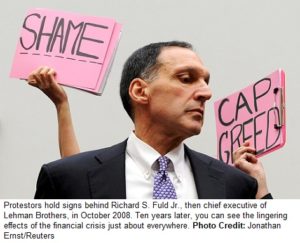
Ten years after the collapse of Lehman Brothers, the official economic statistics — the ones that fill news stories, television shows and presidential tweets — say that the American economy is fully recovered.

The unemployment rate is lower than it was before the financial crisis began. The stock market has soared. The total combined output of the American economy, also known as gross domestic product, has risen 20 percent since Lehman collapsed. The crisis is over.

But, of course, it isn’t over. The financial crisis remains the most influential event of the 21st century. It left millions of people — many of whom were already anxious about the economy — feeling much more anxious, if not downright angry. Their frustration has helped create a threat to Western liberal democracy that would have been hard to imagine a decade ago. Far-right political parties are on the rise across Europe, and Britain is leaving the European Union. The United States elected a racist reality-television star who has thrown the presidency into chaos.

Look around, and you can see the lingering effects of the financial crisis just about everywhere — everywhere, that is, except in the most commonly cited economic statistics. So who are you going to believe: those statistics, or your own eyes?

Over the course of history, financial crises — and the long downturns that follow — have reordered American society in all sorts of ways. One of those ways happens to involve the statistics that the government collects. Crises have often highlighted the need for new measures of human well-being.

The unemployment rate was invented in the 1870s in response to concerns about mass joblessness after the Panic of 1873. The government’s measure of national output, now called G.D.P., began during the Great Depression. Senator Robert La Follette, the progressive hero from Wisconsin, introduced the resolution that later led to the measurement of G.D.P., and the great economist Simon Kuznets, later a Nobel laureate, oversaw the first version.

Almost a century later, it is time for a new set of statistics. It’s time for measures that do a better job of capturing the realities of modern American life.

As a technical matter, the current batch of official numbers are perfectly accurate. They also describe some real and important aspects of the American economy. The trouble is that a handful of statistics dominate the public conversation about the economy despite the fact that they provide a misleading portrait of people’s lives. Even worse, the statistics have become more misleading over time.

The main reason is inequality. A small, affluent segment of the population receives a large and growing share of the economy’s bounty. It was true before Lehman Brothers collapsed on Sept. 15, 2008, and it has become even more so since. As a result, statistics that sound as if they describe the broad American economy — like G.D.P. and the Dow Jones industrial average — end up mostly describing the experiences of the affluent.

The stock market, for example, has completely recovered from the financial crisis, and then some. Stocks are now worth almost 60 percent more than when the crisis began in 2007, according to a inflation-adjusted measure from Moody’s Analytics. But wealthy households own the bulk of stocks. Most Americans are much more dependent on their houses. That’s why the net worth of the median household is still about 20 percent lower than it was in early 2007. When television commentators drone on about the Dow, they’re not talking about a good measure of most people’s wealth.
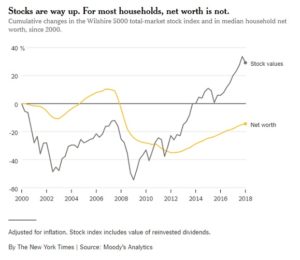
The unemployment rate has also become less meaningful than it once was. In recent decades, the number of idle working-age adults has surged. They are not working, not looking for work, not going to school and not taking care of children. Many of them would like to work, but they can’t find a decent-paying job and have given up looking. They are not counted in the official unemployment rate.

All the while, the federal government and much of the news media continue to act as if the same economic measures that made sense decades ago still make sense today. Habit comes before accuracy.

Fortunately, there is a nascent movement to change that. A team of academic economists — Gabriel Zucman, Emmanuel Saez and Thomas Piketty (the best-selling author on inequality) — has begun publishing a version of G.D.P. that separates out the share of national income flowing to rich, middle class and poor. For now, its data is published with a lag; the most recent available year is 2014. But the work is starting to receive attention from other academics and policy experts.

In the Senate, two Democratic senators, including Chuck Schumer, the party leader, have introduced a bill that would direct the federal government to publish a version of the same data series. Heather Boushey, who runs the Washington Center for Equitable Growth, told me that it could be the most important change in economic data collection in decades.

Source: New York Times – Posted September 15, 2018; retrieved September 20, 2018 from: https://www.nytimes.com/2018/09/14/opinion/columnists/great-recession-economy-gdp.html

—————-

Appendix B VIDEO – About FocusEconomics – https://youtu.be/L2Ys5GH_tmw

Published on Aug 2, 2018 – FocusEconomics is a leading provider of economic analysis and forecasts for 127 countries in Africa, Asia, Europe and the Americas, as well as price forecasts for 30 key commodities. The company is supported by an extensive global network of analysts.

Since its launch in 1999, FocusEconomics has established a solid reputation as a reliable source for timely and accurate business intelligence among Clients from a variety of industries, including the world’s major financial institutions, multinational companies and government agencies.

Source: Retrieved September 19, 2018 from: https://www.focus-economics.com/about-us

Share this post:
, ,

Lessons Learned from 2008: Too Big to Fail –vs- Too Small to Thrive

Go Lean Commentary

It is now 10 years later. The world is remembering the Financial Crisis of 2008.

This is the anniversary of the peak day, that of Lehman Brothers bankruptcy filing on September 15, 2008. The world has endured a lot since that time, we have looked, listened and learned. We have even added some new phraseology to our vocabulary; think …

… “Too Big to Fail”, a theory in economics that asserts that certain corporations, particularly financial institutions, are so large and so interconnected that their failure would be disastrous to the greater economic system, and that they therefore must be supported by government when they face potential failure.[1] .

“Too Big to Fail” was a Big Deal. This is more than just an academic discussion – see AUDIO Podcast below. In 2008 the biggest impact of the global financial contagions was the dilution of net worth for the citizens of the affected countries: US, Canada and Western Europe. These economies are the primary source of Caribbean tourists; since tourism is the primary economic driver, this was a real problem for the pocketbooks of every individual and institution in the region.

This is the continuation of a series of commentaries relating the Lessons Learned from 2008.  This one – entry 2 of 4 in this series from the movement behind the book Go Lean … Caribbean – is in consideration of the “economic chaos” that led-up to the 2008 Financial Crisis and the contrast between “Too Big to Fail” and “Too Small to Thrive”. Due to the contagions of 2008, the Caribbean also had economic collapse, but not because our banks are too big; rather they are too small – think parasite attached to a sick host – they have no leverage or shock-absorption from servicing the full region.

The commentaries in the series are fully cataloged as follows:

  1. Lessons Learned from 2008 –The Long View – ENCORE
  2. Lessons Learned from 2008 – Too Big to Fail –vs- Too Small to Thrive
  3. Lessons Learned from 2008 – Righting The Wrong – ENCORE
  4. Lessons Learned from 2008 – Still Recovering

All of these commentaries relate to “how” the stewards for a new Caribbean can shepherd the economic engines of the region to apply the best-practices to finally make progress; move forward, not stand still and not go backwards.

The book Go Lean…Caribbean serves as a roadmap to implement the technocratic Caribbean Union Trade Federation (CU) and Caribbean Central Bank (CCB) to provide better economic stewardship, to ensure that failures of the past do not re-occur.

What economic failures?

In a previous Go Lean blog-commentaries, it was detailed how our region has had to endure financial crises; yes this includes the Too Big to Fail collapse in the US but also home-grown ones in our neighborhood. The financial system we live in today has been transformed because of the impact and consequence of previous crises. So the banks that have the Too Big to Fail designation now get additional protection and can thusly grow – with less regard to risk. And grow, they have!

NEW YORK – MARCH 24: (FILE PHOTO) The JP Morgan Chase building is seen March 24, 2008 in New York City. The banking giant posted a $2.7 billion profit in the second quarter July 16, 2009, a 36% jump from 2008. Revenues were up 39%, at $25.62 billion. (Photo by Chris Hondros/Getty Images)

This was the summary from this news article/PODCAST here, where it explains that “just six banks now manage more than half the assets in the whole banking industry”. In fact, one sample bank, JPMorganChase, now manages US$2.8 trillion in assets; that’s more than the gross domestic product of Canada, Italy or Brazil. Listen to the PODCAST here and see that full transcript in the Appendix below:

Audio-Podcast– Once “too small to thrive,” now some banks are “too big to fail” –https://play.publicradio.org/api-2.0.1/d/podcast/marketplace/segments/2018/09/11/mp_20180911_seg_19_64.mp3

So how and why did community banking become national banking or global banking? One word: Consolidation. The foregoing PODCAST quotes:

“There’s been a tremendous amount of consolidation during the last four decades,” … “The American banking system went from about 13 or 14,000 commercial banks four decades ago down to closer to 5,000 now.”

This is the advocacy for the Caribbean, here in the Go Lean book. The strategy is for all the 30 member-states in the region to consolidate, collaborate and confederate to form a Single Market economy. The regional leverage allows for more growth because of a larger, stronger market. This consolidation – across 30 countries of 5 different colonial legacies and 4 languages – is for banking as well. This is to be shepherded by the CCB, a formal cooperative (collusion) of all the Central Banks in the region. The CCB will be ready for the heavy-lifting of this regional stewardship.

Without this cooperative, we will never have “Too Big to Fail”, instead we will only have “Too Small to Thrive”.

So imagine 1 currency, the Caribbean Dollar! Imagine the proliferation and liquidity of vibrant Capitals/Securities Market.

Welcome to the new Caribbean economy.

Here is where the Lessons from 2008 weigh heavy. A consolidated, integrated banking system will mean more linkages among the member-states of a new economic union. So the issue of financial contagions among these linked communities will now be a constant concern – so there must be a constant sentinel: the Caribbean Central Bank.

The prime directive of the CU/CCB roadmap is to optimize the economic engines of the region despite the reality of financial contagions. This need was pronounced early in the Go Lean book, in the Declaration of Interdependence – (Page 13):

xxv. Whereas the legacy of international democracies had been imperiled due to a global financial crisis, the structure of the Federation must allow for financial stability and assurance of the Federation’s institutions. To mandate the economic vibrancy of the region, monetary and fiscal controls and policies must be incorporated as proactive and reactive measures. These measures must address threats against the financial integrity of the CU and of the member-states.

The foregoing PODCAST relates the peril associated with banks only tied to a mono-industrial local economy; this quotation:

… Texas, where oil was king in the ‘80s. Texas had more banks than any other state. Regional banks, like those in Texas, were not diversified. They were tied to the local economy. So when the price of oil fell to $10 a barrel, hundreds of Texas banks failed.

The foregoing PODCAST helps us to appreciate the regional vision: We do NOT want to be “Too Small to Thrive”, but we do not want to grow to be “Too Big to Fail” either. There must be a happy medium, a “Goldilocks” destination.

VIDEO – Goldilocks and the Three Bears – https://youtu.be/PGI-4MrC_b8

TheLearningStation – Kids Songs and Nursery Rhymes

Published on Jul 8, 2016 – Your children will love this popular children’s fairy tale, “Goldilocks and the Three Bears” song and story! Goldilocks and the Three Bears is from the CD and CD Download “La Di Da, La Di Di, Dance with Me.” “La Di Da, La Di Di, Dance with Me”.

CD Download: http://store.learningstationmusic.com…

“La Di Da, La Di Di, Dance with Me” CD http://store.learningstationmusic.com…  

The Go Lean book provides 370-pages of turn-by-turn instructions on “how” to adopt new community ethos, plus the strategies, tactics, implementations and advocacies to execute so as to reboot, reform and transform the societal engines of Caribbean society … including banking and monetary control. We must have the technocratic bank supervision and oversight: assessing risk factors, monitoring risks, managing leverage and regulating industry performances.  There is an advocacy in the book that relates specifically to bank supervision; consider the specific plans, excerpts and headlines from the book on Page 199 entitled:

10 Reforms for Banking Regulations

1 Lean-in for the Caribbean Single Market
This treaty allows for the unification of the region into one market, creating a single economy of 30 member-states, 42 million people and the GDP impact of over $800 Billion. In addition, the CU treaty creates a security apparatus to defend against regional threats and systemic risks. When it comes to banking, without proper oversight, the financial systems can imperil the region’s economic security. Deficient oversight can also foster an environment for lawlessness with bad actors exploiting the lack of controls for money laundering, tax evasion and even funding terrorists. Many countries in the region have (had) a vibrant offshore banking industry. But with international reforms from the OECD (an arm of the IMF), US Treasury/Justice Departments, and other institutions, there has been external and internal pressure to reform the industry to curb illegal activities and cooperate more with cross border investigations. … The CU economic and security reboot will bring the balanced oversight, plus added protections like deposit insurance.
2 Foreign Currency Considerations
The Caribbean Dollar (C$) will be traded in the international market, so the need for various currencies will be minimized. Domestic currency devaluations were among the Failed-State indices that drove a lot of Caribbean citizens to emigrate. The reforms associated with securing the new regional currency, C$, is therefore vital. For example, all casinos in the region will be expected to “game” in Caribbean dollars.
3 Debit Cards & e-Government Disbursements
4 e-Purse and Internet Commerce
5 NFC and Mobile Payment Systems
6 Mortgage Banking
7 Credit Card Banking
8 Fair Credit Reporting
9 Fair Collection Practices
10 Bankruptcy Reform

The related subjects of banking oversight and optimizing  financial governance have been a frequent topic for Go Lean blog-commentaries; see a sample here:

Leading with Money Matters – The Almighty Dollar
Failure to Launch – Economics: The Quest for a ‘Single Currency
West African Case Study: ECOWAS to Launch ‘Single Currency’
Transforming ‘Money’ Countrywide
European Central Bank launch 1 Trillion Euro Stimulus
For Canadian Banks: Caribbean is a ‘Bad Bet’
5 Steps of a Bubble – Learning to make a resilient economy
Canadian Imperial Bank of Commerce failing investment in FirstCaribbean Bank
Barbados Central Bank records $3.7m loss in 2013
Dominica raises EC$20 million on regional securities market

The 2008 Great Recession / Financial Crisis exposed the trappings of the interconnected global economy. If we, in the Caribbean, are going to “play in this sandbox” – transact in this marketplace – then we must be prepared and On Guard, for the risks, threats and dangers.

Big Hairy Audacious Goal (BHAG)!

We were not prepared in 2008! We were Too Small to Thrive.

We must be ready now … and going forward! We must learn and apply this lesson from 2008.

This is the quest of the Go Lean/CU/CCB roadmap, to elevate the societal engines of the region, the member-states individually and the Single Market as a whole. Yes, we can! The roadmap details these 3 prime directives:

This quest is the BHAG for the Caribbean region, but it is conceivable, believable and achievable. Now is the time for change; time for all regional stakeholders, individuals and institutions, creditors and debtors, to lean-in to this roadmap for the CU and CCB.

The functioning of this roadmap is complex and complicated, requiring heavy-lifting. But the destination of this roadmap is simple: a better place to live, work and play. 🙂

Download the free e-Book of Go Lean … Caribbean – now!

Sign the petition to lean-in for this roadmap for the Caribbean Union Trade Federation.

——————–

APPENDIX – Once “too small to thrive,” now some banks are “too big to fail”
By: Sabri Ben-Achour

The idea behind “too big to fail,” of course, is that some institutions are just so massive and interconnected that their failure would mean disaster for the economy.

And today? Lots of firms seem to fit that classification.

Let’s just take JPMorgan Chase. It manages $2.8 trillion. That’s more than the gross domestic product of Canada, Italy or Brazil. Just six banks manage more than half the assets in the whole banking industry. Most of them would be considered too big to fail.

There was a time when banks were small and plentiful.

“At the all-time peak in the United States, around 1921 or 1922, there were 31,000 or 32,000 banks,” said Richard Sylla, New York University financial historian and professor emeritus.

The Great Depression wiped out thousands of banks, but for about 40 years after that, the number was stable. Until it wasn’t.

“There’s been a tremendous amount of consolidation during the last four decades,” Sylla said. “The American banking system went from about 13 or 14,000 commercial banks four decades ago down to closer to 5,000 now.”

One reason there were so many banks is because state laws ensured it. Federal law left the regulation of bank branches up to states. Different states had different rules, and rules within states could be pretty restrictive.

“For most of American history, banks were not able to cross state lines,” said Frederic Mishkin, Columbia University professor of banking and financial institutions. “In some states you could only have only one branch.”

Some banks lobbied for it to be this way, Mishkin said.

“This actually was a way for banks to not be as competitive, and particularly if you’re a bank in one state you don’t want to have people from other states come in and take away some of your business. So you’ll fight like hell to keep them out,” he said.

Just because there were a lot of banks back in the ‘70s and ‘80s does not mean they were good banks.

“I lived in Chicago in the 1980s, and the service was just horrendous because the competition was just terrible,” Mishkin said. “I had a case where they had a check that that was forged. They cashed it and they’re supposed to give me the money back. I never got it back. So it was a different world.”

But the real problem for banks of that era was that because they were small, they were fragile, said Robert Hendershott, hedge fund portfolio manager and Santa Clara University associate professor of finance. “Having tens of thousands of tiny little banks is economically insane,” he said. “It is not an efficient way to organize a banking system.”

Today we talk about banks being too big to fail, but back then they had the opposite problem.

“The U.S. banking industry was too small to thrive,” Hendershott said.

He points to Texas, where oil was king in the ‘80s. Texas had more banks than any other state. Regional banks, like those in Texas, were not diversified. They were tied to the local economy. So when the price of oil fell to $10 a barrel, hundreds of Texas banks failed. The number of banks in the United States also shrank during the thrift crisis in the late ‘80s and the recession in the early ‘90s.

It’s at this point that Congress started to take notice, and in 1994, it passed the Interstate Banking and Branching Efficiency Act.

“That was where Congress tore down all the barriers and banks became free to merge and grow across state lines,” Hendershott said.

And that is exactly what banks did. Through the Great Recession, banks consolidated even further as some failed and were bought up by others. And more banks went from “too small to thrive” to “too big to fail.”

This story is part of Divided Decade, a yearlong series examining how the financial crisis changed America. 

Source: Posted September 11, 2018; retrieved September 17, 2018 from: https://www.marketplace.org/2018/09/11/economy/divided-decade/once-too-small-thrive-now-some-banks-are-too-big-fail

Share this post:
, , ,
[Top]

Blog # 800 – An Inconvenient Truth – Caribbean Version

Go Lean Commentary

There was a film released in 2006 entitled An Inconvenient Truth. This capped the campaign by former US Vice-President Al Gore (1993-2001) to educate citizens about global warming; this was a comprehensive slide show that he estimated to have given more than a thousand times.  This film was part documentary and part prophecy. When asked of the need for a sequel, Co-Producer Laurie David responded:

“God, do we need one, everything in that movie has come to pass. At the time we did the movie, there was Hurricane Katrina; now we have extreme weather events every other week. The update has to be incredible and shocking.”[149]

Incredible and shocking is also our Inconvenient Truth for the Caribbean. The prophecy highlighted in that 2006 documentary manifested in the Caribbean in the years since. There was a sequel to that original film, the 2017 An Inconvenient Sequel: Truth to Power. The tagline for the movie was:

Fight like your world depends on it.

See a Trailer of the sequel in Appendix B below.

Here is where we are in the Caribbean – our world depends on our fighting to assuage the great threats to our society. These are defined in the book Go Lean…Caribbean – available to download for free. The book serves as a roadmap for the introduction and implementation of the technocratic Caribbean Union Trade Federation (CU), for the elevation and protection of Caribbean society – for all member-states.

In the book, the threats are described as Agents of Change (Page 57), none more challenging than Climate Change for us:

  • Climate Change – This issue is a major concern for the whole world, but particularly impactful on the Caribbean. There is some debate as to the causes of Climate Change, but no question as to its outcome: temperatures are rising, droughts prevail, and most devastating, hurricanes are more threatening. The CU roadmap must address the causes of Climate Change and most assuredly its consequences. The CU federal government must therefore advocate systems and schemes for a lower carbon footprint. Notwithstanding, the CU must implement recovery measures to respond, react and rebuild from the ever-more-devastating hurricanes.
  • Technology – Internet & Communications Technologies (ICT) is dynamically shifting the world. There are also industrial changes taking place, as in more efficient manufacturing methods, automation/robotics, and transportation options … in response to Climate Change, i.e. Green Energy options.
  • Aging Diaspora – Those that expatriated in the 1950’s and 1960’s now comprise an aging Diaspora – with the desire to return to the “town of their boyhood”. With inadequacies to prepare and respond to natural disasters, the repatriations may not happen.
  • Globalization – We are competing against a “flat” world. Any one country can provide a competitive delivery of the needs and wants of any other society, no matter where they are located physically.

*************

Inconvenient Truth 1

What is inconvenient is that we do not have a partner in the United States of America. We must raise the mantle ourselves and fight for our own cause. President Trump has wiped out all Global Climate Change initiatives by the US federal government. So this government is headed by someone that does not even believe the scientific certainty of Climate Change.

This actuality was boldly lamented in the book, in the opening Declaration of Interdependence (Page 11):

i. Whereas the earth’s climate has undeniably changed resulting in more severe tropical weather storms, it is necessary to prepare to insure the safety and security of life, property and systems of commerce in our geographical region. As nature recognizes no borders in the target of its destruction, we also must set aside border considerations in the preparation and response to these weather challenges.

Inconvenient Truth 2

Natural Disaster preparation and response is reflective of our priorities. Hurricane Maria exposed the deficiency among the American stakeholders. Puerto Rico got no love from Washington; even in death the misery was understated, under-valued and undercounted. Despite this bad report, President Trump continues to defend his administration actions, despite irrefutable evidence to the contrary; see article in Appendix A.

Our other colonial legacies were equally unprepared:

The Go Lean book asserts that the full region of 30 member-states must come together – ourselves – to optimize the societal engines of economics, security and governance. We have delivered a “day late and a dollar short” on so many mitigations – consider our Catastrophic Risk Insurance Funds.

Inconvenient Truth 3

Rising Sea Levels may cover the coral islands.

The geology of the Caribbean has resulted inn 2 kinds of islands: Volcanic versus Coral (Reef). The volcanic islands tend to be mountainous, while coral islands tend to be flat. Climate Change have a real devastating effects on coral islands. Already the Pacific island-nation of Kiribati is facing extinction from high sea-level rise. This same fate awaits many Caribbean member-states. This is why many Caribbean states are members of the formal SIDS (Small Islands Development States).

Inconvenient Truth 4

Seaweed is not so innocent. The beautiful beaches are no longer “so beautiful” without strenuous re-engineering, This is a direct result of Climate Changehttps://stluciatimes.com/2018/03/04/fisheries-department-supports-sargassum-cleanup/

Inconvenient Truth 5

Our Diaspora is not returning. The original implied contract was for Caribbean citizens to emigrate abroad then come back home for retirement. Due to societal defects, many of the Diaspora are not returning; even to support their elderly parents; rather, they have been bringing their elderly to the foreign destinations. There is also a Climate Change angle, winters in northern locations – think: Canada – is milder due to global warming.

Inconvenient Truth 6

We are doubling-down on economic failure.

The primary economic engine in the Caribbean region is based on tourism. There is the need to diversify; yet the member-states have been doubling-down on the failing business models in tourism rather than investing in better models. Consider the example of resort-casino gambling.

Inconvenient Truth 7

We are doubling-down on our societal defects and hate.

Our people leave their Caribbean homes for “Push” and “Pull” reasons. “Pull” refers to the lure that life is better abroad, but “push” refers to the societal defects that drive people away to seek refuge. The Caribbean region does not embrace the “live and let live” ethos, so minority groups have experienced a Climate of Hate.

This is inconvenient and sad!

***********

These Inconvenient Truths are consistent for the movement behind the Go Lean book. The original book, and subsequent blog-commentaries, detailed the assessment in current Caribbean society, and then advocated for a new Caribbean – with new community ethos, strategies, tactics and implementations.

This submission is a new milestone; this is blog-commentary # 800.

These prior entries posit that the Caribbean status quo is truly in crisis. Alas, this crisis is a terrible thing to waste. Let’s reform and transform now! Yes, we can!

This is the quest of the Go Lean movement, to forge a Single Market and a technocratic government for the 30 Caribbean member-states. But the Go Lean book asserts that this effort is too big a task for just for Caribbean member-state alone, so the book urges all 30 member-states to convene, confederate and collaborate in order to effect change. This CU/Go Lean roadmap has these 3 prime directives:

  • Optimization of the economic engines in order to grow the regional economy to $800 Billion and create 2.2 million new jobs. (The issue of jobs alone is paramount to any Hope and Change movement in the region).
  • Establishment of a security apparatus to ensure public safety and protect the resultant economic engines.
  • Improve Caribbean governance to support these engines, including a separation-of-powers between the member-states and CU federal agencies.

The book stresses that reforming and transforming Caribbean communities must be a regional pursuit. This was an early motivation for the roadmap, as pronounced in the opening Declaration of Interdependence (Pages 11 – 14):

xi. Whereas all men are entitled to the benefits of good governance in a free society, “new guards” must be enacted to dissuade the emergence of incompetence, corruption, nepotism and cronyism at the peril of the people’s best interest. The Federation must guarantee the executions of a social contract between government and the governed.

xii. Whereas the legacy in recent times in individual states may be that of ineffectual governance with no redress to higher authority, the accedence of this Federation will ensure accountability and escalation of the human and civil rights of the people for good governance, justice assurances, due process and the rule of law. As such, any threats of a “failed state” status for any member state must enact emergency measures on behalf of the Federation to protect the human, civil and property rights of the citizens, residents, allies, trading partners, and visitors of the affected member state and the Federation as a whole.

xvi. Whereas security of our homeland is inextricably linked to prosperity of the homeland, the economic and security interest of the region needs to be aligned under the same governance. Since economic crimes … can imperil the functioning of the wheels of commerce for all the citizenry, the accedence of this Federation must equip the security apparatus with the tools and techniques for predictive and proactive interdictions.

xxiv. Whereas a free market economy can be induced and spurred for continuous progress, the Federation must install the controls to better manage aspects of the economy: jobs, inflation, savings rate, investments and other economic principles. Thereby attracting direct foreign investment because of the stability and vibrancy of our economy.

The Go Lean book accepts that the Caribbean region – all 30 member-states – is currently at a Failing disposition. But we can do better and be better. First, we must acknowledged our Inconvenient Truths.

And then work or fight towards reforming and transforming our society. Our world depends on it!

This is hard, heavy-lifting, but this roadmap is conceivable, believable and achievable. Let’s get started. Let’s make our homeland a better place to live, work and play. 🙂

Download the free e-book of Go Lean … Caribbean – now!

Sign the petition to lean-in for this roadmap for the Caribbean Union Trade Federation.

—————–

Appendix A – Trump questions Puerto Rico death toll, prompting San Juan mayor to call him ‘delusional’ and ‘paranoid’

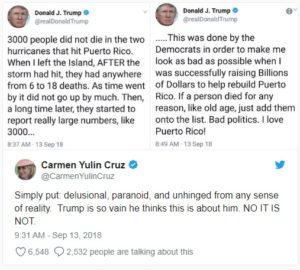
WASHINGTON – President Donald Trump on Thursday questioned a report putting the death toll from last year’s catastrophic hurricane in Puerto Rico at nearly 3,000. He also called the new estimate an effort by Democrats to discredit him.

San Juan’s mayor described the president’s claim as “delusional” and even prominent Republicans such as House Speaker Paul Ryan distanced themselves from Trump’s tweets about Puerto Rico.

“This was done by the Democrats in order to make me look as bad as possible when I was successfully raising Billions of Dollars to help rebuild Puerto Rico,” Trump wrote on Twitter. “If a person died for any reason, like old age, just add them onto the list. Bad politics. I love Puerto Rico!”

Trump’s comments, which come as his administration prepares for Hurricane Florence to hit the East Coast, led both Democratic and Republican lawmakers to weigh in countering his claim. When Hurricane Maria hit Puerto Rico last year, it devastated homes and infrastructure and left large swaths of the territory without power for months.

Ryan, pressed by reporters on Trump’s tweet, said he disagreed with the president but would not comment on whether he thought Trump should apologize.

Ryan said he had  “no reason to dispute” the findings of a study commissioned by Puerto Rico’s government that put its death toll at nearly 3,000 people.

“Those are just the facts of what happens when a horrible hurricane hits an isolated place like an island,” Ryan said when asked about Trump’s tweet.

Sen. Marco Rubio, a Florida Republican who has been outspoken on the government’s response to the storm, lamented in a tweet that the deaths had become political. He repeated the study’s findings that 3,000 more people died on the island after the hurricane than during comparable periods.

“Both Fed & local gov made mistakes,” Rubio wrote. “We all need to stop the blame game & focus on recovery, helping those still hurting & fixing the mistakes.”

Florida Gov. Rick Scott, a Republican and early Trump supporter, said he disagreed with the president.

“I’ve been to Puerto Rico 7 times & saw devastation firsthand,” Scott, now a candidate for Senate, posted on Twitter. “The loss of any life is tragic; the extent of lives lost as a result of Maria is heart wrenching. I’ll continue to help PR.”

Ron DeSantis, a former Republican congressman running for governor in Florida, also disputed Trump’s assertion. “He doesn’t believe any loss of life has been inflated,” spokesman Stephen Lawson said in an emailed statement.

As his team braces for Hurricane Florence, Trump has praised his administration’s responses to deadly storms – including in Puerto Rico.

San Juan mayor Cruz responded, …

“Simply put: delusional, paranoid, and unhinged from any sense of reality.”

“Trump is so vain he thinks this is about him. NO IT IS NOT,” Cruz wrote on Twitter.

Puerto Rico Gov. Ricardo Rosselló said he “strongly denounced” what he described as questioning the impact of the storm for political purposes.

“The victims and the people of Puerto Rico do not deserve to have their pain questioned,” he said in a statement. “It is not time to deny what happened, it is time to make sure that it does not happen again.”

Democrats on Capitol Hill blasted Trump.

“Only Donald Trump could see the tragedy in Puerto Rico and conclude that he is the victim,” said Sen. Ed Markey, D-Mass. “May God bless the souls of the nearly 3,000 Americans that died in Puerto Rico and may he take pity on your soul Mr. President.”

Without mentioning Trump by name, Rep. Sheila Jackson Lee, D-Texas, a member of the House Committee on Homeland Security, slammed the “cavalier” tweeting about the number of deaths in Puerto Rico.

“You have lost compassion for people who are diverse,” she said.

Trump’s Thursday morning tweets focused on a George Washington University study released last month that examined the toll from Hurricane Maria. From September 2017 to February 2018, 2,975 people died, according to that study, which was commissioned by Puerto Rico’s government.

Late Thursday, deputy press secretary Hogan Gidley pushed back on criticism of the Trump’s response to Maria in a statement, saying the administration provided “unprecedented support to Puerto Rico.” Gidley said Cruz and the “liberal media” have tried to “exploit the devastation by pushing out a constant stream of misinformation and false accusations.”

In addition to force of the hurricane itself, many people in Puerto Rico died because disease and infection due to the lack of electricity and drinkable water on the island. The storm destroyed homes and and crippled roads, bridges, and hospitals.

George Washington University said Thursday it stands by the methodology used in the report and said the work was conducted with “complete independence and freedom from any kind of interference.”

“We are confident that the number – 2,975 – is the most accurate and unbiased estimate of excess mortality to date,” the school said in a statement.

Trump also took heat after he visited Puerto Rico in the aftermath of the Sept. 20, 2017, storm. The president tossed paper towels to Puerto Rican residents at a local relief center, angering storm victims and others who saw his actions as insensitive.

After his tweets Thursday, Democrats accused Trump of minimizing the death toll for callous political reasons.

Andrew Gillum, the Democratic candidate for governor in Florida, slammed Trump’s tweet.

“No death is partisan and our brothers and sisters in Puerto Rico deserved better from @realDonaldTrump before, during, and after the hurricane.”

The House Democratic Caucus tweeted that Trump “won’t acknowledge the thousands of Americans who died on his watch,” and added, “Even worse, Republicans have no interest in holding this administration accountable and ensuring that Congress is prepared to respond to these disasters.”

A report released this summer by the Federal Emergency Management Agency identified deficiencies in the administration’s response, including that the agency was not adequately staffed heading into the hurricane season. In the months leading up to Maria’s approach, FEMA had 10,683 people on hand, about 86 percent of the agency’s target, the report found.

The report found that the island itself was not prepared for such a storm, which contributed to widespread loss of power and communications – hampering the response.

A Government Accountability Office report last week confirmed many of those findings, and also noted that 54 percent of the FEMA workers deployed last year were serving in a role they were not qualified to perform. Staffing shortfalls complicated many aspects of the response, including the effort to move people into temporary housing in the mainland, the GAO found.

“The 2017 hurricanes and wildfires highlighted some longstanding issues and revealed other emerging response and recovery challenges,” the report said.

Source: USA Today newspaper – Posted September 13, 2018; retrieved September 14, 2018 from: https://www.usatoday.com/story/news/politics/2018/09/13/donald-trump-without-evidence-questions-puerto-rico-death-toll/1288118002/

—————–

Appendix B VIDEO – An Inconvenient Sequel: Truth To Power (2017) – Official Trailer – https://youtu.be/huX1bmfdkyA

Published on Mar 28, 2017 – Watch the new trailer for An Inconvenient Sequel: Truth to Power, the sequel to An Inconvenient Truth. In theatres July 28, 2017. #BeInconvenient

Climate Changes, Truth Does Not.

A decade after AN INCONVENIENT TRUTH brought Climate Change into the heart of popular culture, comes the riveting and rousing follow-up that shows just how close we are to a real energy revolution. Vice President Al Gore continues his tireless fight traveling around the world training an army of climate champions and influencing international climate policy. Cameras follow him behind the scenes – in moments both private and public, funny and poignant — as he pursues the inspirational idea that while the stakes have never been higher, the perils of Climate Change can be overcome with human ingenuity and passion.

Official Movie Site: http://www.inconvenientsequel.com/

Facebook: https://www.facebook.com/AnInconvenie…

Twitter: https://twitter.com/aitruthfilm

Instagram: https://www.instagram.com/aninconveni…

Share this post:
, , ,
[Top]

Naomi Osaka’s recipe for success: Caribbean Meld

Go Lean Commentary

There is actually a recipe for success on the world stage, one that has just been applied by tennis superstar Naomi Osaka in winning the 2018 US Open over fan-favorite Serena Williams. The recipe:

Meld Caribbean distinctiveness with that of other cultures.


Wait what?!

This sounds so familiar, even fictionalized! Those who are fans of the science fiction franchise Star Trek will remember the mantra of the cybernetic life form “The Borg”. Their announcement when attacking potential victims were as follows:

”We are the Borg. Lower your shields and surrender your ships. We will add your biological and technological distinctiveness to our own. Your culture will adapt to service us. Resistance is futile.” – Source

This is “Art imitating Life”! We see this recipe at work with this new sports champion and beneficiary of this international melding: Naomi Osaka.

She is a professional tennis player who represents Japan internationally. She is the first Japanese citizen to winGrand Slam singles tournament, defeating Serena Williams in the final of the 2018 US Open.[6] Osaka has reached a career-high world ranking of No. 7.[4] She was born to a Haitian father, Leonard “San” François, and a Japanese mother, Tamaki Osaka .[7]

This story, beyond its relevance to sports, has a Caribbean relevance because of Osaka’s parentage. The meld – noun/verb: blend – had produced an end-product that has accomplished more than any one component has accomplished on its own. Osaka is the first Japanese citizen to win a Grand Slam event, and needless-to-say, the first Haitian.  It has not been easy:

In racially homogeneous Japan, Osaka is considered hāfu, which is Japanese for biracial.[10] Her Japanese grandfather was furious when he found out that her mother was romantically involved with a black man. As a result of the interracial relationship, her mother did not have contact with her family for over ten years.[8] In a 2016 interview, Osaka said: “When I go to Japan, people are confused. From my name, they don’t expect to see a black girl.”[11]Wikipedia

This biography provides a lesson-learned for the rest of the Caribbean, and the world for that matter:

  • To our Caribbean brothers and sisters, we entreat you to embrace pluralism; good things come from the embrace of our differences.
  • To the rest of world, we declare that the Caribbean identity is not “Less Than”. We bring a strength of character and ethos that adds value and elevates any community where we meld.

If we can successfully meld and conquer a challenge on the world stage, how much more so can we meld our distinctiveness here at home or in our regional neighborhood to accomplish greater feats. This is the message of the movement behind the book Go Lean…Caribbean, which asserts that great Caribbean progress is in store when we meld – integrate, collaborate and confederate. The book – available to download for free – serves as a roadmap for the introduction and implementation of the technocratic Caribbean Union Trade Federation (CU), for the elevation of Caribbean society – for all member-states.

This CU/Go Lean roadmap has these 3 prime directives:

  • Optimization of the economic engines in order to grow the regional economy to $800 Billion and create 2.2 million new jobs. There are many industrial expressions that we will have to make in order to reach these goals, including the facilitation of the Art & Science of Sports.
  • Establishment of a security apparatus to ensure public safety and protect the resultant economic engines.
  • Improve Caribbean governance to support these engines, including a separation-of-powers between the member-states and CU federal agencies.

The book stresses that reforming and transforming the Caribbean societal engines must be a regional pursuit. This was an early motivation for the roadmap, as pronounced in the opening Declaration of Interdependence (Pages 12 – 14):

xi. Whereas all men are entitled to the benefits of good governance in a free society, “new guards” must be enacted to dissuade the emergence of incompetence, corruption, nepotism and cronyism at the peril of the people’s best interest. The Federation must guarantee the executions of a social contract between government and the governed.

xvi. Whereas security of our homeland is inextricably linked to prosperity of the homeland, the economic and security interest of the region needs to be aligned under the same governance. Since economic crimes … can imperil the functioning of the wheels of commerce for all the citizenry, the accedence of this Federation must equip the security apparatus with the tools and techniques for predictive and proactive interdictions.

xxiv. Whereas a free market economy can be induced and spurred for continuous progress, the Federation must install the controls to better manage aspects of the economy: jobs, inflation, savings rate, investments and other economic principles. Thereby attracting direct foreign investment because of the stability and vibrancy of our economy.

xxxi. Whereas sports have been a source of great pride for the Caribbean region, the economic returns from these ventures have not been evenly distributed as in other societies. The Federation must therefore facilitate the eco-systems and vertical industries of sports as a business, recreation, national pastime and even sports tourism …

The Go Lean book provides 370-pages of turn-by-turn instructions on “how” to adopt new community ethos, plus the strategies, tactics, implementations and advocacies to execute so as to reboot, reform and transform the societal engines for all member-states in the Caribbean region.

The story of Naomi Osaka is about more than just her heritage. She is an excellent athlete of her own making. It takes blood, sweat and tears to excel at the highest level of her sport. For Osaka to beat Serena Williams – earning $3.8 million – that was no fluke; that was the full measure of her athletic prowess; that was heavy-lifting. Even now, all the attention is on Serena losing, rather than Osaka winning; see the VIDEO here and the related story in the Appendix below:

VIDEO – US Open Highlights – https://nyp.st/2CM60t5

Published September 8, 2018 – Serena has mother of all meltdowns in US Open final loss.

Heavy-lifting in sports is a familiar theme for this Go Lean movement; we recognize that there could be more economic rewards if the regional stewards do a better job of facilitating a viable sports eco-system – we have few expressions of professional sports and no intercollegiate system in the region. We have previously elaborated on how the Art & Science of sports can be used to help elevate our societal engines. Re-consider these previous blog-commentaries:

https://goleancaribbean.com/blog/?p=11287 Creating a legacy in pro-Surfing
https://goleancaribbean.com/blog/?p=8495 Basketball Great and Caribbean Role Model: Tim Duncan
https://goleancaribbean.com/blog/?p=7866 Caribbean Track & Field Athletes monetize their talents “elsewhere”
https://goleancaribbean.com/blog/?p=1446 Caribbean Players in the World Cup
https://goleancaribbean.com/blog/?p=1020 Advocates and Revolutionaries for Caribbean Sports

So how can we foster more people in our Caribbean region to be like Naomi Osaka, people who can help to elevate our society and the global image of Caribbean contributions to the world? The Go Lean book addressed this question; within its 370-pages of instructions for impacting society, in the specific details for fostering more world-class athletes. Consider the summaries, excerpts and headlines from this one advocacy in the book on Page 229 entitled:

10 Ways to Improve Sports

1 Lean-in for the Caribbean Single Market
This will allow for the unification of the region of 30 member-states into a single market of 42 million people and a GDP exceeding $800 Billion (per 2010). This market size and multi-lingual realities allows for broadcasting rights with SAP-style language options for English, Spanish, French and Dutch. This makes the region attractive for media contracts for broadcast rights, spectrum auctions and sports marketing. The Olympics have demonstrated that sports can be profitable “big business”, and a great source of jobs and economic activity. The CU will copy the Olympic model, and harness the potential in many other sporting endeavors, so as to make the region a better place to live, work and play.
2 CU Games
Promote the CU Games, every 2 years, as the ascension of the CARIFTA Games for Amateur and now Professional Athletes. The CU Games Administration will also partner with all National Olympic Committees. This administration applies to feeder games, trials and qualification events. The ultimate goal is to field a world-class competitive Olympic Team representing the entire Caribbean. While the CARIFTA Games are for track-and-field events only, the CU Games will resemble a mini-Olympics with multi-sports (boxing, football/soccer, tennis, volleyball, sailing, baseball/softball, etc.)
3 Fairgrounds as Sport Venues
The CU Fairgrounds (managed by the Interior Department) will have the infrastructure to fund, build and maintain sports arenas and “stadiums” (stadia) in local markets. The mantra is “build it and they will come”, so the CU building and managing world-class sport facilities will result in a more organized industry and the emergence of vertical markets.
4 Regulate Amateur, Professional & Academically-Aligned Leagues
5 Establish Sports Academies
6 “Super” Amateur Sport Association
7 Regulator/Registrar of Scholar-Athletes – Assuage Abandonment
8 Sports Tourism
9 Professional Agents and Player Management Oversight (a la Bar/Lawyer Associations).
10 Impanel the CU Anti-Doping Agency

Congratulation Naomi Osaka!

… and thank you … for making it easier for us to impress on the world that Caribbean-anything is not “Less Than”. That argument is now easier to make.

It is now also easier to convey the message that “Yes, we can” forge a “pluralistic” democracy and make our homeland a better place to live, work and play. 🙂

Download the free e-Book of Go Lean … Caribbean – now!

Sign the petition to lean-in for this roadmap for the Caribbean Union Trade Federation.

—————–

Appendix – It’s shameful what US Open did to Naomi Osaka
Opinion by: Maureen Callahan

Naomi Osaka, 20 years old, just became the first player from Japan to win a Grand Slam.

Yet rather than cheer Osaka, the crowd, the commentators and US Open officials all expressed shock and grief that Serena Williams lost.
Osaka spent what should have been her victory lap in tears. It had been her childhood dream to make it to the US Open and possibly play against Williams, her idol, in the final.

It’s hard to recall a more unsportsmanlike event.

Here was a young girl who pulled off one of the greatest upsets ever, who fought for every point she earned, ashamed.

At the awards ceremony, Osaka covered her face with her black visor and cried. The crowd booed her. Katrina Adams, chairman and president of the USTA, opened the awards ceremony by denigrating the winner and lionizing Williams — whose ego, if anything, needs piercing.

“Perhaps it’s not the finish we were looking for today,” Adams said, “but Serena, you are a champion of all champions.” Addressing the crowd, Adams added, “This mama is a role model and respected by all.”

That’s not likely the case now, not after the world watched as Serena Williams had a series of epic meltdowns on the court, all sparked when the umpire warned her: No coaching from the side. Her coach was making visible hand signals.

“I don’t cheat to win,” Williams told him. “I’d rather lose.”

She couldn’t let it go, going back multiple times to berate the umpire. At one point she called him a thief.

“You stole a point from me!” she yelled.

After her loss, Williams’s coach admitted to ESPN that he had, in fact, been coaching from the stands, a code violation. The warning was fair.

Everything that followed is on Williams, who is no stranger to tantrums. Most famously, she was tossed from the US Open in 2009 after telling the line judge, “I swear to God I’ll take the f—king ball and shove it down your f—king throat.” John McEnroe was taken aback. Even Williams’s mother, Oracene Price, couldn’t defend her daughter’s outburst.

“She could have kept her cool,” Price said.

On Saturday, she also could have tried to be gracious in defeat. No matter how her fans try to spin this, Williams was anything but. Upon accepting her finalist award, she gave parsimonious praise to her competitor while telling the crowd she felt their pain.

“Let’s try to make this the best moment we can,” she said in part, “and we’ll get through it . . . let’s not boo anymore. We’re gonna get through this and let’s be positive, so congratulations, Naomi.”

Osaka accepted her trophy while choking back tears. She never smiled. When asked if her childhood dream of playing against Williams matched the reality, she politely sidestepped the question.

“I’m sorry,” Osaka said. “I know that everyone was cheering for her and I’m sorry it had to end like this.”

She turned to Williams. “I’m really grateful I was able to play with you,” Osaka said. “Thank you.” She bowed her head to Williams, and Williams just took it — no reciprocation, no emotion.

Osaka, a young player at the beginning of her career, showed grit, determination and maturity on that court and off.

She earned that trophy. Let’s recall that this wasn’t Osaka’s first victory over Williams — she beat Williams back in March, causing a hiccup in that great comeback narrative.

Osaka earned her moment as victor at the US Open, one that should have been pure joy. If anything was stolen during this match, it was that.

Source: New York Post Newspaper – Posted September 8, 2018; retrieved September 12, 2018 from: https://nypost.com/2018/09/08/its-shameful-what-us-open-did-to-naomi-osaka/

Share this post:
, , ,
[Top]

Manifesting High-Tech Neighborhoods

Go Lean Commentary

Previously … we said:

“Build it and they will come”.

Now … we are saying:

Get out of the way and ‘they’ will come and build it.

It could be that simple – there are players who want the opportunity to test their theories, manifest their visions and explore their ideas. They will come to you and build High-Tech neighborhoods, but only if you let them, not trample on their sensibilities and not block their progress.

Are you willing to cooperate in a climate like that? Can you “live and let live”?

The answer is not so obvious. A lot of people treasure their independence. They are willing to endure whatever disposition in life as long as they “do it their way”. This is why Self-Governing Entities are so critical in this plan for a new Caribbean.

Self-Governing Entities (SGE), as defined in the book Go Lean … Caribbean, allows communities to apply changes to a limited geographic area. (Truth be told, it is hard to change whole countries; it is easier to change just a small area at a time).

The Go Lean book serves as a roadmap for the introduction and implementation of the technocratic Caribbean Union Trade Federation (CU), for the elevation of Caribbean society – for all member-states, bottoms-up neighborhood by neighborhood. The book defines SGE’s as follows (Page 30):

Self-Governing Entities
The CU will promote and administer all Self-Governing Entities (SGE) throughout the region. This refers to scientific labs, industrial parks, commercial campuses, experimental hospitals, and even foreign bases. These facilities will not be subject to the laws of the local states of their address, rather CU, international, foreign sovereignty, or maritime laws, thus spurring [Research & Development or] R&D.

Who will be the owners/investors of the Self-Governing Entities that embark in the new Caribbean?

Many candidates abound! Here is one example. Here is Google – and their subsidiary Sidewalk Labs – as they engage their test-plan and manifest their vision for a limited urban area … in Toronto, Canada. See the full story here:

Title: Google’s parent company just reached an agreement with Toronto to plan a $50 million high-tech neighborhood
By: Leanna Garfield

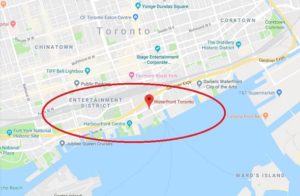
  • On Tuesday (07/31/2018) morning, Waterfront Toronto’s board unanimously agreed to work with Sidewalk Labs to develop a 12-acre swath of the city into a high-tech neighborhood.
  • Sidewalk Labs, the urban-innovation arm of Google’s parent company, Alphabet, had committed $10 million for the planning process, and an additional $40 million in investment has now been unlocked. The entire development is expected to cost at least $1 billion.
  • The company has been quiet about the exact plans for the neighborhood, but its CEO, Dan Doctoroff, has spoken about how urban environments could be improved through self-driving cars, machine learning, high-speed internet, and embedded sensors that track energy usage.

——————

Sidewalk Labs — the urban-innovation arm of Google’s parent company, Alphabet — just got the green light to plan a high-tech neighborhood on Toronto’s waterfront.

On Tuesday morning, the board of Waterfront Toronto, the organization administering revitalization projects along the Canadian city’s waterfront, unanimously agreed to work with the company to design the neighborhood. Final approval to physically develop the plans is likely to happen next year.


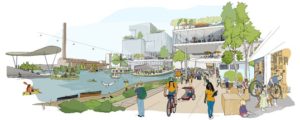
Called Quayside, the neighborhood will be designed to prioritize “sustainability, affordability, mobility, and economic opportunity,” according to Sidewalk Labs. The city of Toronto and Sidewalk Labs call the larger project “Sidewalk Toronto.”

Sidewalk had already committed $10 million for the planning process, and an additional $40 million in investment was unlocked with the board’s approval. The entire 12-acre development, however, is expected to cost at least $1 billion, The Wall Street Journal estimated.

The agreement “lays out a path towards a transparent, collaborative partnership with Waterfront Toronto and the people of Toronto,” Josh Sirefman, Sidewalk Labs’ head of development, told Business Insider in a statement. “We look forward to working together to develop a groundbreaking plan to improve the lives of people living in Toronto and cities like it around the world.”

The company has been quiet about the exact plans for the neighborhood, but Sidewalk Labs’ CEO, Dan Doctoroff, has spoken about how urban environments could be improved through self-driving cars, machine learning, high-speed internet, and embedded sensors that track energy usage.

“We are excited to take this next step with Sidewalk Labs to set the stage for a transformational project on the waterfront that addresses many critical urban issues faced by Toronto and other cities around the world,” Waterfront Toronto tweeted Tuesday.

Based on 2017 renderings, it looks as if Sidewalk Labs wants Quayside to be a mixed-use, pedestrian-friendly neighborhood. The preliminary illustrations include bike-share systems, apartment housing, bus lines, and parks.

The project has been in the works for more than a year. In March 2017, Sidewalk Labs responded to Toronto’s request for proposals to redevelop the waterfront parcel. The planning process kicked off with a community town-hall meeting in November where residents discussed their thoughts and concerns about the project.

Business Insider previously reported that locals had expressed worries that Quayside could become a “new Silicon Valley,” bringing issues like gentrification, higher housing prices, and income inequality.

The plan-development agreement became public on Tuesday afternoon after Waterfront Toronto and Sidewalk Labs signed the deal.
Source: Business Insider Magazine – posted July 31, 2018; retrieved September 6, 2018 from: https://www.businessinsider.com/google-sidewalk-labs-toronto-neighborhood-2018-7?utm_content=buffer2ecae

From the Caribbean to Google: “We want some of that!

It is our hope that with the appropriate governmental structure in place, Google (Alphabet) may bring some of those investment dollars – see related Appendix VIDEO – to our Caribbean shores. This type of investor was an early motivation for this roadmap for regional cooperation and confederation, as pronounced in the opening Declaration of Interdependence (Pages 13):

xxiv. Whereas a free market economy can be induced and spurred for continuous progress, the Federation must install the controls to better manage aspects of the economy: jobs, inflation, savings rate, investments and other economic principles. Thereby attracting direct foreign investment because of the stability and vibrancy of our economy.

Following and studying the machinations of the Google company/enterprise is a good idea. This company “puts its money where its mouth is”. We have previously identified these Research & Development efforts that have manifested over the years:

https://goleancaribbean.com/blog/?p=3974 Google and Mobile Phones – Here comes change
https://goleancaribbean.com/blog/?p=1743 Google and Novartis to develop ‘smart’ contact lens
https://goleancaribbean.com/blog/?p=1277 The need for highway safety innovations – here comes Google

In a previous Go Lean blog-commentary, it was related how it is much easier to reform and transform a country by focusing on families, neighborhoods and cities. Do this again and again, and the whole nation, even the region is transformed.

Imagine Caribbean islands and coastal states with SGE’s peppered throughout the region. This is the new Caribbean that is being presented: reforming and transforming the full region, one neighborhood at a time. Imagine too, if the transformations are technological: electric street cars, self-driving vehicles, high-speed internet, and smart energy systems.

The Art & Science of cities is very important for this Go Lean roadmap to elevate Caribbean society. The Go Lean book applied detailed analyses of a number of cities (Caribbean city: Freeport, Bahamas; American cities: New York City; Omaha, Nebraska; Detroit, Michigan; Los Angeles City-County), then proceeded to detail the needed strategies, tactics and implementation to reform Caribbean urban areas. In fact, the CU/Go Lean roadmap has these 3 prime directives:

  • Optimization of the economic engines in order to grow the regional economy to $800 Billion and create 2.2 million new jobs. This roadmap calls for Self-Governing Entities, even in urban area, so as to optimize industrial policy.
  • Establishment of a security apparatus to ensure public safety and protect the resultant economic engines. Urban areas always have additional protections compared to rural areas.
  • Improve Caribbean governance to support these engines, including a separation-of-powers between the member-states and CU federal agencies. SGE’s are managed only at the federal level, but there must be negotiations with local/municipal governments.

The Go Lean book provides 370-pages of turn-by-turn instructions on “how” to adopt new community ethos, plus the strategies, tactics, implementations and advocacies to execute so as to reboot, reform and transform the societal engines of Caribbean society … including the urban communities. There is even one advocacy that relates specifically to urban optimization; consider the specific plans, excerpts and headlines from the book on Page 234 entitled:

10 Ways to Impact Urban Living

1 Lean-in for the Caribbean Single Market
This treaty allows for the unification of the region into one market, thereby expanding to an economy of 30 countries, 42 million people and a GDP of over $800 Billion (according to 2010 metrics). The mission of the CU is to enhance the economic engines of the region, fostering institutions like capital markets, secondary mortgage funds and consumer credit reporting. These initiatives will facilitate local governments and town-planning efforts by providing the financing vehicles, and eco-system, for the real estate developers and municipal governments to predict the supply-and-demand..
2 Self-Governing Entities

The CU will promote and administer all self-governing entities (SGE) throughout the region. This refers to scientific labs, industrial parks, commercial campuses, experimental hospitals, and even foreign bases. These facilities will not be subject of the laws of the local states of their address, rather CU, international, foreign sovereignty, or maritime laws; but depend on the local infrastructure to provide basic needs. Thereby creating jobs and economic activity.

3 Proximity to Healthcare
4 Online Education Facilitation
5 Optimizing Transportation Options

The CU will spearhead transportation solutions for intra-city transit, so as to assuage urban traffic congestion. This will include rail options such as above-ground light-rail and street cars on the major arterial roads. The development of toll roads, with price-traffic elasticity, is a basic CU strategy for urban transportation infrastructure. So too, is bicycle options; the CU will foster local deployments of bicycle paths, dedicated lanes and on-demand bike sharing/rental programs; (see Appendix ZU). Bike Sharing is a synergistic solution for health/wellness and transportation. A lot of urban areas in the Caribbean region are old cities, designed centuries ago; therefore they have small quaint streets – perfect for bicycling.

6 In-sourcing
7 Service Continuity – ITIL
8 Financial Guarantees
9 Big Data Analysis

The CU’s embrace of e-Government and e-Delivery models allows for a lot of data to be collected and analyzed so as to measure many aspects of Caribbean life, including: trade, economic, consumption, societal values and macro-performance, and media consumption. This way, “course adjustments” can be made to strategic and tactical pursuits.

10 Legislative Oversight

In addition to the book, previous Go Lean commentaries related details of urban life and how best-practices can be applied so as to make the Caribbean homeland a better place to live, work and play. Here is a sample of previous blogs:

https://goleancaribbean.com/blog/?p=11386 Making Better Cities
https://goleancaribbean.com/blog/?p=8573 Build a Street Car System and Harvesting the Growth
https://goleancaribbean.com/blog/?p=6016 Model of Urban Solutions – Cooperative Refrigeration
https://goleancaribbean.com/blog/?p=4587 Burlington, Vermont: First city to be powered 100% by renewables
https://goleancaribbean.com/blog/?p=3641 ‘We Built This City …’
https://goleancaribbean.com/blog/?p=3326 M-1 Rail: Alternative Motion in the Motor City
https://goleancaribbean.com/blog/?p=1731 Ode to Omaha, a Model City
https://goleancaribbean.com/blog/?p=1596 Book Review: ‘Prosper Where You Are Planted’

The Go Lean book and these accompanying blogs posit that economic success can be forged by doubling-down on R&D in Caribbean cities. We can improve one urban neighborhood at a time. Before we know it, we have changed the whole region.

We can do better, than our Status Quo.

There are many role models to follow.

The foregoing example – Google-Sidewalk Labs in Toronto, Canada – is a manifestation that the change we seek is conceivable, believable and achievable. Yes, we can … make our homelands better places to live, work and play. 🙂

Download the free e-book of Go Lean … Caribbean – now!

Sign the petition to lean-in for this roadmap for the Caribbean Union Trade Federation.

—————–

Appendix VIDEO – Inside the construction project promising to transform Toronto’s waterfront – https://youtu.be/PAgTA6tQdZs

CityNews Toronto
Published on Jun 27, 2018 – It’s a $1.25 billion multi-year project that promises to transform how Torontonians live, work and play along the waterfront. Tina Yazdani checks in on the creation of a new shoreline and flood protection system in the Portlands.

Share this post:
, ,
[Top]

‘Freedom of Speech’ has consequences

Go Lean Commentary

Freedom of Speech is not so absolute!

There are consequences to speech – think: defamation, libel and slander – and so there is the need for some curtailment. One cannot just say anything they want about a person or product and not expect some consequences. There is the classic “Fire in a Crowded Theater” scenario.

The intent is the key.

If one says “fire”, knowing full well that there is no fire, he-she may only want to rile people up and make them stampede; then there may be legal consequences. One can be charged with inciting a riot, willful disregard to safety, depraved indifference or manslaughter.

This is serious … in the physical world.

How about the virtual world?

Same rules … and consequences apply. Now we have medical doctors and clinicians on guard about negative comments-reviews-ratings from patients and customers. See the VIDEO & news story of this threat here:

VIDEO – Surgeon: Online posts were part of patient’s ‘obsession over 10 years’ – https://www.usatoday.com/videos/news/health/2018/07/16/surgeon-online-posts-were-part-patients-obsession-over-10-years/788794002/

—————

Title: Doctors, hospitals sue patients who post negative comments, reviews on social media

By: Jayne O’Donnell and Ken Alltucker

CLEVELAND – Retired Air Force Colonel David Antoon agreed to pay $100 to settle what were felony charges for emailing his former Cleveland Clinic surgeon articles the doctor found threatening and posting a list on Yelp of all the surgeries the urologist had scheduled at the same time as the one that left Antoon incontinent and impotent a decade ago.

He faced up to a year in prison.

Antoon’s 10-year crusade against the Cleveland Clinic and his urologist is unusual for its length and intensity, as is the extent to which Cleveland Clinic urologist Jihad Kaouk was able to convince police and prosecutors to advocate on his behalf.

Antoon’s plea deal last week came as others in the medical community aggressively combat negative social media posts, casting a pall over one of the few ways prospective patients can get unvarnished opinions of doctors.

Among recent cases:

  • Cleveland physician Bahman Guyuron sued a former patient for defamation for posting negative reviews on Yelp and other sites about her nose job. Guyuron’s attorney Steve Friedman says that although the First Amendment protects patients’ rights to post their opinions, “our position is she did far beyond that (and) deliberately made false factual statements.”  A settlement mediation is slated for early August, and a trial is set for late August if no agreement is reached.
  • Jazz singer Sherry Petta used her own website and doctor-rating sites to criticize a Scottsdale, Arizona, medical practice over her nasal tip surgery, laser treatment and other procedures. Her doctors, Albert Carlotti and Michelle Cabret-Carlotti, successfully sued for defamation. They won a $12 million jury award that was vacated on appeal. Petta claimed the court judgment forced her to sell a house and file bankruptcy. The parties would not discuss the case and jointly asked for it to be dismissed in 2016 but declined to explain why.
  • A Michigan hospital sued an elderly patient’s two daughters and a granddaughter over a Facebook post and for picketing in front of the hospital they said mistreated the late Eleanor Pound. The operator of Kalkaska Memorial Health Center sued Aliza Morse, Carol Pound and Diane Pound for defamation, tortious interference and invasion of privacy.

Petta’s attorney, Ryan Lorenz, says consumers need to know there can be consequences if they post factually incorrect information. Lorenz, who has represented both consumers and businesses on cases involving online comments, says consumers are allowed to offer opinions that do not address factual points.

“Make sure what you are saying is true – it has to be truthful,” he says.

“It would be great if the regulators of hospitals and doctors were more diligent about responding to harm to patients, but they’re not, so people have turned to other people,” says Lisa McGiffert, former head of Consumer Reports’ Safe Patient Project. “This is what happens when your system of oversight is failing patients.”

As doctors and hospitals throw their considerable resources behind legal fights, some patients face huge legal bills for posting critiques and other consumers face their own challenges trying to get a straight story.

Experts say doctors take on extra risk when they resort to suing a patient.

Doctors typically can’t successfully sue third-party websites such as Yelp that allow consumer comments, but they can sue patients over reviews.

Even so, “you can win (a case) and still not win,” says Eric Goldman, a professor at Santa Clara University’s law school.

Goldman, who has tracked about two dozen cases of doctors suing patients over online reviews, says physicians rarely win the cases and sometimes must pay the patients’ legal fees.

Physician-patient confidentiality rules complicate options for doctors, Goldman says, but they can respond to factually incorrect reviews if the patient agrees to waive confidentiality and publicly discuss the case.

The comments challenged legally are typically those that were left online. Many medical review sites will remove posts they deem offensive or threatening to doctors, as many of Antoon’s or other Kaouk patients’ were. Yelp removes reviews only if they violate the consumer website’s terms of service.

Patients should first bring up complaints directly to the doctor or other medical provider, says Edward Hopkins, an attorney who represented Carlotti, Cabret-Carlotti and their medical practice for part of the case. Other options could include reporting a doctor to state oversight agencies, consulting with an attorney or filing complaints with a state attorneys’ general office.

Advocacy or obsession?

By the time he was arrested last December, Antoon had tried most every option with very little success.

Along the way, Antoon became a patient advocate – volunteering with Consumer Reports’ Safe Patient Project and HealthWatch USA – and advising others who say they were harmed by Kaouk and the Cleveland Clinic.

Cleveland Clinic, one of the top-rated hospitals in the country, has an aggressive legal department. Kaouk and the clinic prevailed in malpractice and fraud cases filed by Antoon and other patients who claimed they were harmed.

Matthew Donnelly, Cleveland Clinic’s deputy chief legal officer, attended Antoon’s criminal hearing in November.

To Kaouk, a decade of negative reviews on social media led to what he considered an escalation when Antoon sent him several emails, including one with a link to an article about a Chinese crackdown on research fraud that could include the death penalty if people were injured or killed.

The day before Antoon posted on Yelp in November, Kaouk was granted a civil stalking protective order against Antoon, which barred him from contacting the doctor.

“What would be next – showing up at my door?” Kaouk said in court. “That’s what we feared.”

In his posts and emails, Antoon documented alleged issues, including Kaouk and the urology department’s lack of credentials to use the robotic device in his surgery. He sent records to the Centers for Medicare and Medicaid Services (CMS), claiming they showed Kaouk was not present in the operating room during his surgery despite his insistence that only Kaouk could perform the surgery.

The Ohio Medical Board closed its investigation into Kaouk after five years without reprimanding him in any way. Antoon’s complaints to CMS temporarily put the hospital’s $1 billion annual Medicare reimbursement at risk.

Antoon’s claims were rejected, and Kaouk was not held liable for the surgery that left Antoon impotent and incontinent.

Along with more than $40,000 defending himself against the criminal charges, Antoon spent almost two days in jail. He had to post $50,000 bond in Shaker Heights and again in Cleveland’s Cuyahoga County after the case was transferred there.

It’s common “for someone in a position of wealth, power and money to go after someone like David to silence critics,” says Antoon’s attorney, Don Malarcik. “That happens often and it happened here.”

Hospitals, including the Cleveland Clinic, combat negative comments with their own rating systems, which let them “control their message,” McGiffert says.

Some comments posted by Antoon and Dan Galliano, another patient who claimed he was injured, disappeared from the websites RateMDs and Vitals, as shown in screenshots Antoon took right after they were posted.

Cleveland Clinic spokeswoman Eileen Sheil says it posts all the government-required satisfaction survey responses patients fill out about doctors on its ratings site, once at least 30 are received. Comments aren’t edited.

Sheil says Cleveland Clinic will request comments to be removed from other sites when they violate the sites’ terms of service.

RateMDs did not respond to requests for comment. Vitals spokeswoman Rosie Mattio says the site has a care team that will investigate reviews it is contacted about.

“While we will not pull down a necessarily negative review, we will remove the review if we find that it violates our terms and includes material that is threatening, racist or vulgar,” Mattio says.

Navigating Yelp

On Yelp, business owners can flag a review to be removed for violation of Yelp’s terms of services. Yelp reviews flagged comments and removes those that include hate speech or a conflict of interest or that are not based on a commenter’s firsthand experience.

The website doesn’t intervene over factual disputes, Yelp spokeswoman Hannah Cheesman says. Instead, it classifies consumer reviews as “recommended” or “not currently recommended” based on an automated software review.

If Yelp’s software detects multiple reviews from the same IP address or biased reviews from a competitor or disgruntled employee, it puts the comment in the not-recommended category. Consumers can still view such reviews by clicking on another page, but those comments are not factors in Yelp’s five-star rating system.

McGiffert has long advocated for a federal database where people could report medical errors and infections. Unless that happens, online review sites – including hospitals’ own and ones that will remove some reviews doctors object to – are among the only places patients can find physician reviews.

Doctors such as Kaouk suggest they are the ones who are disadvantaged.

“It is something that if anybody would look just by Googling my name online, you would see what he has written about me,”  Kaouk says of Antoon.

O’Donnell reported from Cleveland and McLean, Virginia. Alltucker reported from McLean.
Source: USA Today Daily Newspaper – Published July 18, 2018; Retrieved September 5, 2018
https://www.usatoday.com/story/news/politics/2018/07/18/doctors-hospitals-sue-patients-posting-negative-online-comments/763981002/ 

Can they – medical doctors and clinicians who shun negative comments-reviews-ratings – or should they regulate other people’s opinions? This is a BIG deal to contend with, as this issue reflects the current state of Internet Communications Technologies (ICT).

This is the world of New Media; the internet has supplanted all Old Media options, we need to settle this debate sooner, rather than later. While the debate in the foregoing article may be an American drama, the issue is with the World Wide Web.

This is a familiar theme for the movement behind the book Go Lean…Caribbean – available to download for free. Previously this site has presented blog-commentaries that highlight the need for better Internet Stewardship in the Caribbean Cloud. Those submissions presented some comprehensive ideas. See here:

https://goleancaribbean.com/blog/?p=14811 “Loose Lips Sink Ships” – Leaders Undermine College Enrollment

Freedom of Speech exercised wrongly could result in less economic activity. This is what is happening in the US, under President Trump, fewer international students are considering, applying and attending American universities. This is a lesson learn for the dangers of Hate Speech.

https://goleancaribbean.com/blog/?p=11224 “Loose Lips Sink Ships” – Leaders Undermine Tourism

Freedom of Speech exercised wrongly could result in less tourism. If leaders make Hate Speech, then fewer people may want to come visit. This is what is happening in the US, under President Trump.

https://goleancaribbean.com/blog/?p=10052 Fake News? Welcome to America

With tabloid journalism and Fake News, the American eco-system features Freedom of False Speech; so mis-information is easily spread. This distortion of truth is not the model for us in the Caribbean.

https://goleancaribbean.com/blog/?p=5435 China Internet Policing – Model for Caribbean

Someone needs to be watching the e-Store. China’s approach is that they actually “police” the internet within their borders. A bridge too far? Perhaps, but there is no debate that there is some need to regulate speech on the internet. It cannot just be the Wild Wild West.

https://goleancaribbean.com/blog/?p=5353 POTUS and the Internet
The President of the United States started using the internet as a freeform communications to his citizens – this turned ugly fast; hate speech proceeded immediately towards Obama.
https://goleancaribbean.com/blog/?p=4793 Truth in Commerce – Learning from Yelp

The e-Commerce site for rating retailers, Yelp, has often been hijacked by Bad Actors to undermine businesses for their own nefarious motives or just out of depraved indifference.

https://goleancaribbean.com/blog/?p=4673 Review “Merchants of Doubt” Documentary

There is a professional industry whose purpose is to conduct disinformation campaigns, plant seeds of doubt and even declare outright lies as dissenting views. These are Bad Actors.

The Go Lean book serves as a roadmap for the introduction and implementation of the technocratic Caribbean Union Trade Federation (CU), for the elevation of Caribbean society – for all member-states. Internet & Communications Technology is expected to be a major factor in this roadmap – ‘the great equalizer’. This CU/Go Lean roadmap has these 3 prime directives:

  • Optimization of the economic engines in order to grow the regional economy to $800 Billion and create 2.2 million new jobs. ICT strategies, tactics and implementations are paramount in delivering economic empowerments.
  • Establishment of a security apparatus to ensure public safety, ensure justice institutions and protect the resultant economic engines. ICT strategies, tactics and implementations are important in optimizing security provisions, imagine intelligence gathering and analyzing systems.
  • Improve Caribbean governance to support these engines, including a separation-of-powers between the member-states and CU federal agencies. E-Government will be the hallmark of the CU technocracy, so ICT strategies, tactics and implementations are paramount in delivering better governance.

The requisite investments to deploy the latest-greatest strategies, tactics and implementations in the art and science of ICT are too big for any one Caribbean member-state alone. So the Go Lean book stresses that reforming and transforming the Caribbean societal engines must be a regional pursuit. This was an early motivation for the roadmap, as pronounced in the opening Declaration of Interdependence (Pages 12 – 14):

xi. Whereas all men are entitled to the benefits of good governance in a free society, “new guards” must be enacted to dissuade the emergence of incompetence, corruption, nepotism and cronyism at the peril of the people’s best interest. The Federation must guarantee the executions of a social contract between government and the governed.

xvi. Whereas security of our homeland is inextricably linked to prosperity of the homeland, the economic and security interest of the region needs to be aligned under the same governance. Since economic crimes … can imperil the functioning of the wheels of commerce for all the citizenry, the accedence of this Federation must equip the security apparatus with the tools and techniques for predictive and proactive interdictions.

xxiv. Whereas a free market economy can be induced and spurred for continuous progress, the Federation must install the controls to better manage aspects of the economy: jobs, inflation, savings rate, investments and other economic principles. Thereby attracting direct foreign investment because of the stability and vibrancy of our economy.

xxvii. Whereas the region has endured a spectator status during the Industrial Revolution, we cannot stand on the sidelines of this new economy, the Information Revolution. Rather, the Federation must embrace all the tenets of Internet Communications Technology (ICT) to serve as an equalizing element in competition with the rest of the world. The Federation must bridge the digital divide and promote the community ethos that research-development is valuable and must be promoted and incentivized for adoption.

The Go Lean book provides 370-pages of turn-by-turn instructions on “how” to adopt new community ethos, plus the strategies, tactics, implementations and advocacies to execute so as to reboot, reform and transform the societal engines of Caribbean society. One advocacy presented in the book – 10 Ways to Improve Communications (Page 186) – focuses on the “art and science” of media (communications). The following tidbits are retrieved from that page:

# 3 – Media Industrial Complex
The CU will oversee the radio spectrum used for radio, television and satellite communications. The radio spectrum must be regulated on a regional level, because the islands are so close to each other and foreign states, that there must be coordination of the common resource pool – the spectrum is limited. This FCC-style (USA) oversight will also extend to internet broadband (wireless & wire-line) governance. With the CU’s financial reforms, the emergence of card-based and e-payment systems will allow for the full exploitation of the media business models. Also, the CU, through licensing, can mandate a certain amount of programming of the educational, inspirational and public service variety.

The Bottom Line on Old Media versus New Media
The internet and mobile communications has changed the modern world; many industries that once flourished (music retailers, travel agencies, book sales, line telephone companies), now flounder. Media distribution via the internet or mobile devices are referred to as “new media”, while old distribution channels like newspapers, magazines, TV and radio are referred to as “old media”. The mainstream (“old”) media is pivotal for “freedom of the press” as they are effective at standing up to big institutions like governments and corporations. The art of “good” journalism requires the deeper pockets that mainstream media bring to the market, but old media is dying financially. New media, on the other hand, is an aggregation of mainstream media. With the ubiquity of new media devices, people have freer, easier access and more options to news and information. On the plus side, there is now a greater diversity of ideas and viewpoints, on the minus side, with too many options, people tend to isolate their news consumption to only the views they want to hear. As new media matures, it is expected that it will take over the social responsibilities of old media, adopt the best practices of journalism, like fact checking (with the ease of information retrieval online), and finally return the industry to financial viability.

In summary, there are 2 Take-aways from this commentary:

(1) While there is  “Freedom of Speech”, there is no freedom from the consequences of speech.

(2) While there is “Freedom of the Press”, if the press is profit-oriented then popularity may be a greater priority than truth.

These dictate that there must be a stronger need for accuracy, integrity and professionalism in the age of New Media – disinformation can cause a lot of harm, fast.

There are lessons for the Caribbean to learn from other lands – America, China, and others. China is heavy-handed with their policing of media outlets, including online. This is definitely a bridge too far … for us in the Caribbean! India, though has a great model of a Chief Grievance Officer.

The Caribbean, sitting on the border with the United States of America allows us to look-listen-learn from the American experience. Our conclusion: We do not want to be America … we want to be better.

Yes, we can … get this right, and make our homeland a better place to live, work and play. 🙂

Sign the petition to lean-in for this roadmap for the Caribbean Union Trade Federation.

Share this post:
, , ,
[Top]

Ready for Football 2018? – ENCORE

Are you ready for some football?

Ready of not, here it comes!

  • Friday Night Lights – A reference to High School Football, starts in earnest today.
  • College Football – This is Week 1 of 14 of the 2018 season, starting today.

  • National Football League (NFL) – The 16 week season starts on Sunday September 9, 2018; it will then be followed with a 5 week playoff, capped by SuperBowl LIII in the Mercedes-Benz Stadium in Atlanta on February 3, 2019.

This commentary has frequently focused on this American past time. We have highlighted the “art and science” of the sport, the business and the pride.

But there is one caution that we feel the need to constantly remind the Caribbean eco-system about when it comes to American football; this is the very real threat with Concussions.

Every year, month and week that goes by, we learn more and more about the dangers of Concussions and the dreaded disease Chronic Traumatic Encephalopathy (CTE). We are learning now that the onslaught of this affliction is so much worse than originally thought:

Title: 99 Percent Of Studied NFL Brains Diagnosed With CTE, Researchers Say
Sub-title: The numbers are only slightly lower among college football players, too.
By: Maxwell Strachan and Travis Waldron
A new study out of Boston diagnosed a startlingly high percentage of deceased NFL players with chronic traumatic encephalopathy (CTE), and the numbers don’t get much better when you move on down to college players.

Researchers from VA Boston Healthcare System (VABHS) and Boston University School of Medicine looked at the brains of 202 deceased American football players. All told, the researchers found 87 percent of the players to have CTE, a degenerative brain disease commonly found in athletes and military veterans with a history of head trauma.

Among NFL players, that percentage shot all the way up to 99 percent. In fact, only one of the 111 deceased NFL players analyzed did not have CTE.

“It is no longer debatable whether or not there is a problem in football; there is a problem,” Ann McKee, director of BU’s CTE Center, said in a statement. ”[I]t is time to come together to find solutions,”

But it’s not just NFL players who are at risk. Among college football players involved in the study, 91 percent were diagnosed with CTE. Even among those subjects that only played high school football, 21 percent were found to have CTE.

See the full article here: HuffPost Sport – published July 25, 2017; retrieved August 31, 2018 from: https://www.huffingtonpost.com/entry/nfl-cte-99-percent_us_5977621ce4b0e201d5786da9

Today – August 31, marks the exact 3rd anniversary of the publication of a landmark blog-commentary on Concussions. It is only apropos to Encore that 2015 blog now.

See the Encore of that previous blog here-now:

—————

Go Lean Commentary – ‘Concussions’ – The Movie; The Cause

“Are you ready for some football?” – Promotional song by Hank Williams, Jr. for Monday Night Football on ABC & ESPN networks for 22 years (1989 – 2011).

This iconic song (see Appendix) and catch-phrase is reflective of exactly how popular the National Football League (NFL) is in the US:

“They own an entire day of the week”.

- The Movie; The Cause - Photo 2So says the new movie ‘Concussions’, starring Will Smith, referring to the media domination of NFL Football on Sundays during the Autumn season. The movie’s script is along a line that resonates well in Hollywood’s Academy Award balloting: “David versus Goliath”; “a small man speaking truth to power”.

In the case of the NFL, it is not just about power, it is about money, prestige and protecting the status quo; the NFL is responsible for the livelihood of so many people. The book Go Lean … Caribbean recognized the importance of the NFL in the American lexicon of “live, work and play”; it featured a case study (Page 32) of the NFL and it’s collective bargaining successes (and failures) in 2011. An excerpt from the book is quoted as follows:

Football is big business in the US, $9 billion in revenue, and more than a business; emotions – civic pride, rivalries, and fanaticism – run high on both sides.

Previous Go Lean commentaries presents the socio-economic realities of much of the American football eco-system. Consider a sample here:

Socio-Economic Impact Analysis of [Football] Sports Stadiums
Watch the Super Bowl … Commercials
Levi’s® NFL Stadium: A Team Effort
Sports Role Model – College Football – Playing For Pride … And More
Sports Role Model – Turn On the SEC Network
Collegiate Sports in the Caribbean – Model of NCAA
10 Things We Want from the US: #10 – Sports Professionalism
10 Things We Don’t Want from the US: #10 – ‘Win At All Costs’ Ethos

While football plays a big role in American life, so do movies. Their role is more unique; they are able to change society. In a previous blog / commentary regarding Caribbean Diaspora member and Hollywood great, Sidney Poitier, it was declared that …

“Movies are an amazing business model. People give money to spend a couple of hours watching someone else’s creation and then leave the theater with nothing to show for the investment; except perhaps a different perspective”.

Yes, movies help us to glean a better view of ourselves … and our failings; and many times, show us a way-forward.

These descriptors actually describe the latest production from Hollywood icon Will Smith (the former Fresh Prince of Bel-Air). This movie, the film “Concussion”, in the following news article, relates the real life drama of one man, Dr. Bennet Omalu, a Nigerian-born medical doctor – a pathologist – who prepared autopsies of former players that suffered from football-related concussions. He did not buckle under the acute pressure to maintain the status quo, and now, he is celebrated for forging change in his adopted homeland. This one man made a difference. (The NFL is now credited for a Concussion awareness and prevention protocol so advanced that other levels of the sport – college, high schools and Youth – are being urged to emulate).

See news article here on the release of the movie:

Title: ‘Concussion’: 5 Take-a-ways From Will Smith’s New Film

Will Smith, 46, is definitely going to get a ton of Oscar buzz portraying Dr. Bennet Omalu in the new film “Concussion.” NFL columnist Peter King of Sports Illustrated got an exclusive first peek at the trailer and it has been widely shared on social media since. And it’s very chilling.

- The Movie; The Cause - Photo 1

Here are five take-aways and background you need to know before checking out the clip:

1 – It’s Based on a True Story

Omalu is the forensic pathologist and neuropathologist who discovered chronic traumatic encephalopathy in football players who got hit in the head over and over again, according to the Washington Post.

In the clip, he says repetitive “head trauma chokes the brain.”

Omalu was one of the founding members of the Brain Injury Research Institute in 2002. He conducted the autopsy of Pittsburgh Steelers center Mike Webster, played by David Morse in the film, which led to this discovery.

2 – Smith’s Version of Omalu’s Accent Is Spot On

Omalu is from Nigeria and Smith has been known to transform completely for a role. He was nominated for an Oscar for 2011’s “Ali,” playing the legendary Muhammad Ali.

For comparison, here’s Omalu’s PBS interview from 2013.

3 – Smith Is a Reluctant Hero

“If you don’t speak for them, who will,” Gugu Mbatha-Raw, who plays Prema Mutiso in the film, tells Smith’s character.

He admits he idolized America growing up and “was the wrong person to have discovered this.”

4 – Alec Baldwin and Luke Wilson

“Concussion” brought in some heavyweights for this movie. Baldwin plays Dr. Julian Bailes, who advises Omalu, and Wilson, who will reportedly play NFL Commissioner Roger Goodell, according to IMDB. There’s no official word on this. He’s seen at a podium in the trailer, but doesn’t speak.

5 – “Tell the Truth”

Smith captures Omalu’s passion to have the truth told about this injury and disease.

“I was afraid of letting Mike [Webster] down. I was afraid. I don’t know. I was afraid I was going to fail,” Omalu told PBS a couple years back.

———-

VIDEO Link: http://www.imdb.com/title/tt3322364/?ref_=nv_sr_1


Will Smith stars in the incredible true David vs. Goliath story of Dr. Bennet Omalu, the brilliant forensic neuropathologist who made the first discovery of CTE, a football-related brain trauma, in a pro player.

The subject of concussions is serious – life and death. Just a few weeks ago (August 8), an NFL Hall-of-Fame inductee was honored for his play on the field during his 20-year professional career, but his family, his daughter in particular, is the one that made his acceptance / induction speech. He had died, in 2012; he committed suicide after apparently suffering from a brain disorder – chronic traumatic encephalopathy (CTE), a type of chronic brain damage that has also been found in other deceased former NFL players[4] – sustained from his years of brutal head contacts in organized football in high school, college and in his NFL career. This player was Junior Seau.

- The Movie; The Cause - Photo 3a

- The Movie; The Cause - Photo 3b

Why would there be a need for “David versus Goliath”; “a small man speaking truth to power”? Is not the actuality of an acclaimed football player committing suicide in this manner – he shot himself in the chest so as to preserve his brain for research – telling enough to drive home the message for reform?

No. Hardly. As previously discussed, there is too much money at stake.

These stakes bring out the Crony-capitalism in American society.

The book Go Lean…Caribbean (and subsequent blog/commentaries) relates many examples of cronyism in the American eco-system. There is a lot of money at stake. Those who want to preserve the status quo or not invest in the required mitigations to remediate concussions will fight back against any Advocate promoting the Greater Good. The profit motive is powerful. There are doubters and those who want to spurn doubt. “Concussions in Football” is not the first issue these “actors” have promoted doubt on. The efforts to downplay concussion alarmists are from a familiar playbook, used previously by Climate Change deniers, Big Tobacco, Toxic Waste, Acid Rain, and other dangerous chemicals.

This Go Lean book serves as a roadmap for the introduction and implementation of the technocratic Caribbean Union Trade Federation (CU). Sports are integral to the Go Lean/CU roadmap. While sports can be good and promote positives in society, even economically, the safety issues must be addressed upfront. This is a matter of community security. Thusly, the prime directives of the CU are described as:

  • Optimize the economic engines of the Caribbean to elevate the regional economy to grow to $800 Billion and create 2.2 million new jobs, including sports-related industries with a projection of 21,000 direct jobs at Fairgrounds and sports enterprises.
  • Establish a security apparatus to protect the people and economic engines.
  • Improvement of Caribbean governance to support these economic and security engines.

The CU/Go Lean sports mission is to harness the individual abilities of athletes to not just elevate their performance, but also to harness the economic impact for their communities. So modern sports endeavors cannot be analyzed without considering the impact on “dollars and cents” for stakeholders. This is a fact and should never be ignored. There is therefore the need to carefully assess and be on guard for crony-capitalistic influences entering the decision-making of sports stakeholders. The Go Lean book posits that with the emergence of new economic engines, “bad actors” will also emerge thereafter to exploit the opportunities, with good, bad and evil intent”. These points were pronounced early in the opening Declaration of Interdependence (Page 12 &14):

x. Whereas we are surrounded and allied to nations of larger proportions in land mass, populations, and treasuries, elements in their societies may have ill-intent in their pursuits, at the expense of the safety and security of our citizens. We must therefore appoint “new guards” to ensure our public safety and threats against our society, both domestic and foreign. The Federation must employ the latest advances and best practices of criminology and penology to assuage continuous threats against public safety.

xi. Whereas all men are entitled to the benefits of good governance in a free society, “new guards” must be enacted to dissuade the emergence of incompetence, corruption, nepotism and cronyism at the peril of the people’s best interest. The Federation must guarantee the executions of a social contract between government and the governed.

xvi. Whereas security of our homeland is inextricably linked to prosperity of the homeland, the economic and security interests of the region needs to be aligned under the same governance. Since economic crimes … can imperil the functioning of the wheels of commerce for all the citizenry, the accedence of this Federation must equip the security apparatus with the tools and techniques for predictive and proactive interdictions.

xxxi. Whereas sports have been a source of great pride for the Caribbean region, the economic returns from these ventures have not been evenly distributed as in other societies. The Federation must therefore facilitate the eco-systems and vertical industries of sports as a business, recreation, national pastime and even sports tourism …

The Go Lean book envisions the CU – a confederation of the 30 member-states of the Caribbean chartered to do the heavy-lifting of empowering and elevating the Caribbean economy – as the landlord of many sports facilities (within the Self-Governing Entities design), and the regulator for inter-state sport federations. The book details the economic principles and community ethos to adopt, plus the executions of strategies, tactics, implementations and advocacies to optimize sports enterprises in the Caribbean:

Community Ethos – Deferred Gratification Page 21
Economic Principles – People Respond to Incentives in Predictable Ways Page 21
Economic Principles – Economic Systems Influence Individual Choices / Incentives Page 21
Economic Principles – The Consequences of Choices Lie in the Future Page 21
Economic Principles – Job Multiplier Page 22
Community Ethos – Security Principles – Whistleblower Protection Page 23
Community Ethos – Security Principles – Light-Up the Dark Places Page 23
Community Ethos – Security Principles – “Crap” Happens Page 23
Community Ethos – Governing Principles – Lean Operations Page 24
Community Ethos – Ways to Impact the Future Page 26
Community Ethos – Ways to Promote Happiness – Mitigate Suicide Threats Page 36
Community Ethos – Impact the Greater Good Page 37
Strategy – Vision – Confederating 30 Member-States into a Single Market Page 45
Strategy – Vision – Foster Local Economic Engines for Basic Needs Page 45
Strategy – Mission – Prepare for Natural Disasters Page 45
Strategic – Staffing – Sporting Events at Fairgrounds Page 55
Strategy – Agents of Change – Climate Change Page 57
Strategy – Agents of Change – Globalization Page 57
Tactical – Confederating a Permanent Union Page 63
Tactical – Fostering a Technocracy Page 64
Tactical – Separation of Powers – Sports & Culture Administration Page 81
Tactical – Separation of Powers – Fairgrounds Administration Page 83
Tactical – Separation of Powers – Health Department – Disease Management Page 86
Implementation – Assemble Regional Organs into a Single Market Economy Page 96
Implementation – Steps to Implement Self-Governing Entities – Sports Stadia Page 105
Implementation – Security Initiatives at Start-up – Unified Command & Control Page 103
Implementation – Industrial Policy for CU Self Governing Entities Page 103
Implementation – Ways to Deliver – Project Management/Accountabilities Page 109
Anatomy of Advocacies – Examples of Individuals Who Made Impact Page 122
Planning – Ways to Make the Caribbean Better Page 131
Advocacy – Ways to Grow the Economy Page 151
Advocacy – Ways to Create Jobs Page 152
Advocacy – Ways to Improve Governance Page 168
Advocacy – Ways to Better Manage the Social Contract Page 170
Advocacy – Ways to Promote Fairgrounds Page 192
Advocacy – Ways to Improve Emergency Management – Trauma Arts & Sciences Page 196
Advocacy – Ways to Improve Sports Page 229
Advocacy – Ways to Impact Urban Living – Sports Leagues Page 234

The Go Lean book and accompanying blogs declare that the Caribbean needs to learn lessons from other communities, especially when big money is involved in pursuits like sports. These activities should be beneficial to health, not detrimental. So the admonition is to be “on guard” against the “cronies”; they will always try to sacrifice public policy – the Greater Good – for private gain: profit.

Let’s do better. Yes, the Caribbean can be better than the American experiences.

The design of Self-Governing Entities allow for greater protections from Crony-Capitalistic abuses. While this roadmap is committed to availing the economic opportunities of sports and accompanying infrastructure, as demonstrated in the foregoing movie trailer, sport teams and owners can be plutocratic “animals” in their greed. We must learn to mitigate plutocratic abuses. While an optimized eco-system is good, there is always the need for an Advocate, one person to step up, blow the whistle and transform society. The Go Lean roadmap encourages these role models.

Bravo Dr. Bennet Omalu. Thank you for this example … and for being a role model for all of the Caribbean.

RIP Junior Seau.

Now is the time for all of the Caribbean, the people and governing institutions, to lean-in for the empowerments described in the book Go Lean … Caribbean. This roadmap will result in more positive socio-economic changes throughout the region; it will make the Caribbean a better place to live, work and play.   🙂

Download the free e-Book of Go Lean … Caribbean – now!

——-

Appendix VIDEO: Hank Williams Jr. – Are You Ready for Some Footballhttps://youtu.be/K8LLKO0-PAE

Uploaded on May 28, 2011 – Official Music Video


Share this post:
, , , , , ,
[Top]

Message to Federal Workforce for Labor Day: “No, on that raise” – ENCORE

In the US, today kicks-off Labor Day holiday weekend. The head of the Federal Government, President Donald Trump, sends out a message to the millions of federal employees:
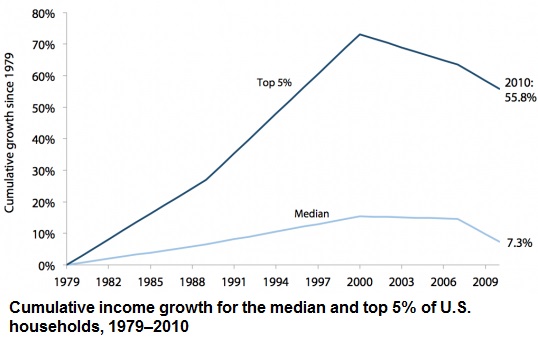
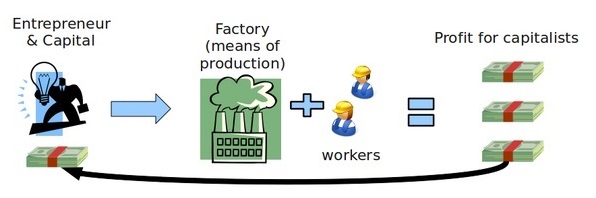
Remember that raise you were approved for?

Nevermind!

This is true! This is happening! Actually, this is “Not happening”! See the story & VIDEO here as reported by the American news outlet CNN:

Title: Trump cancels pay raises for federal employees 
Washington (CNN) – President Donald Trump told lawmakers on Thursday he wants to scrap a pay raise for civilian federal workers, saying the nation’s budget couldn’t support it.

In a letter to House and Senate leaders, Trump described the pay increase as “inappropriate.”

    “We must maintain efforts to put our Nation on a fiscally sustainable course, and Federal agency budgets cannot sustain such increases,” the President wrote. An across-the-board 2.1% pay increase for federal workers was slated to take effect in January. In addition, a yearly adjustment of paychecks based on the region of the country where a worker is posted — the “locality pay increase” — was due to take effect.

Trump said both increases should no longer happen.

See the full article, posted and retrieved August 31, 2018 here: https://www.cnn.com/2018/08/30/politics/trump-cancels-federal-employee-pay-raises/index.html

This is just a reminder to all Caribbean people who want to emigrate to the US looking for better labor opportunities. The reminder: “The Grass is Not Greener on the American side“. Let’s work to make the Caribbean homeland a better place to live, work and play.

Labor Day is a day set aside to honor workers. It is not just an American tradition. No, many countries have an equivalent of Labor Day. Many of the historicity of these movements were tied to labor unions.

More than 80 countries celebrate International Workers’ Day on May 1 – the ancient European holiday of May Day.

Consider this Encore of the blog-commentary from June 18, 2015, discussing the trends in the labor markets, which depict a decline of collective bargaining:

==================

Title: Economic Principle: Wage-Seeking – Market Forces -vs- Collective Bargaining

Go Lean Commentary

The field of Economics is unique! We all practice it every day, no matter the level of skill or competence. There is even the subject area in basic education branded Home Economics, teaching the students the fundamentals of maintaining, supporting and optimizing a home environment. Most assuredly, economics is an art and a science, albeit a social science.

In a previous blog/commentary, Scotman’s Adam Smith was identified as the father of modern macro-economics. Though he lived from 1723 to 1790, his writings defined advanced economic concepts even in this 21st Century. His landmark book An Inquiry into the Nature and Causes of the Wealth of Nations qualified the divisions of income into these following categories: profit, wage, and rent.[4] We have previously explored profit-seeking (a positive ethos that needs to be fostered in the Caribbean region) and rent-seeking (a negative effort that proliferates in the Caribbean but needs to be mitigated), so now the focus of this commentary is on the activity of wage-seeking, and the concepts of governance and public choice theory to allow for maximum employment.

This is hard! Change has come to the world of wage-seekers – the middle classes are under attack; the labor-pool of most industrialized nations have endured decline, not in the numbers, but rather in prosperity. While wage-earners have not kept pace with inflation, top-earners (bonuses, commissions and business profits) have soared; (see Photo).

CU Blog - Economic Principles - Wage-Seeking - Market forces -vs- Collective Bargaining - Photo 2As a direct result, every Caribbean member-state struggles with employment issues in their homeland. In fact, this was an initial motivation for the book Go Lean…Caribbean, stemming from the fall-out of the 2008 Great Recession, this publication was presented as a roadmap for the introduction and implementation of the Caribbean Union Trade Federation (CU) to elevate the economic, security and governing engines of the Caribbean region to create 2.2 million new jobs, despite global challenges.

Needless to say, the global challenge is far more complex than Home Economics. The Go Lean book describes the effort as heavy-lifting; then proceeds to detail the turn-by-turn directions of a roadmap to remediate and mitigate wage-seeking.

The roadmap channels the Economic Principles and best-practices of technocrats like Adam Smith and 11 other named economists, many of them Nobel Laureates. A review of the work of these great men and woman constitute “Lessons in Economic Principles”. Why would these lessons matter in the oversight of Caribbean administration? Cause-and-effect!

Profit 4The root of the current challenge for wage-seekers is income equality; and this is bigger than just the Caribbean. It is tied to the global adoption of globalization and technology/ automation – a product of global Market Forces as opposed to previous Collective Bargaining factors. This relates back to the fundamental Economic Principle of “supply-and-demand”; but now the “supply” is global. This photo/”process flow” here depicts the ingredients of Market Forces. When there is the need for labor, the principle of comparative analysis is employed, and most times the conclusion is to “off-shore” the labor efforts, and then import the finished products. This is reversed of the colonialism that was advocated by Adam Smith; instead of the developed country providing factory labor for Third World consumption, the developed nation (i.e. United States) is now in the consumer-only role, with less and less production activities, for products fabricated in the Third World. This reality is not sustainable for providing prosperity to the middle classes, to the wage-seekers.

As a community, we may not like the laws of Economics, but we cannot ignore them. The Go Lean book explains the roles and significance of Economic Principles … with this excerpt (Page 21):

While money is not the most important factor in society, the lack of money and the struggle to acquire money creates challenges that cannot be ignored. The primary reason why the Caribbean has suffered so much human flight in the recent decades is the performance of the Caribbean economy. Though this book is not a study in economics, it recommends, applies and embraces these 6 core Economic Principles as sound and relevant to this roadmap:

  1. People Choose: We always want more than we can get and productive resources (human, natural, capital) are always limited. Therefore, because of this major economic problem of scarcity, we usually choose the alternative that provides the most benefits with the least cost.
  2. All Choices Involve Costs: The opportunity cost is the next best alternative you give up when you make a choice. When we choose one thing, we refuse something else at the same time.
  3. People Respond to Incentives in Predictable   Ways: Incentives are actions, awards, or rewards that determine the choices people make. Incentives can be positive or negative. When incentives change, people change their behaviors in predictable ways.
  4. Economic Systems Influence Individual Choices and Incentives: People cooperate and govern their actions through both written and unwritten rules that determine methods of allocating scarce resources. These rules determine what is produced, how it is produced, and for whom it is produced. As the rules change, so do individual choices, incentives, and behavior.
  5. Voluntary Trade Creates Wealth: People specialize in the production of certain goods and services because they expect to gain from it. People trade what they produce with other people when they think they can gain something from the exchange. Some benefits of voluntary trade include higher standards of living and broader choices of goods and services.
  6. The Consequences of Choices Lie in the Future: Economists believe that the cost and benefits of decision making appear in the future, since it is only the future that we can influence. Sometimes our choices can lead to unintended consequences.

Source: Handy Dandy Guide (HDC) by the National Council on Economic Education (2000)

The Go Lean book describes the end result of the application of best-practices in this field of economics over the course of a 5-year roadmap: the CU … as a hallmark of technocracy. But the purpose is not the edification of the region’s economists, rather to make the Caribbean homeland “better places to live, work and play” for its citizens. This branding therefore puts emphasis on the verb “work”; the nouns “jobs” and “wages” must thusly be a constant focus of the roadmap.

Brain Drain 70 percent ChartThis Go Lean book declares that the Caribbean eco-system for job-creation is in crisis … due to the same global dilemma. The roadmap describes the crisis as losing a war, the battle of globalization and technology. The consequence of the defeat is 2 undesirable conditions: income inequality and societal abandonment, citizens driven away to a life in the Diaspora. This assessment currently applies in all 30 Caribbean member-states, as every community has lost human capital to emigration. Some communities, like Puerto Rico and the US Virgin Islands have suffered with an abandonment rate of more than 50% and others have watched more than 70% of college-educated citizens flee their community for foreign shores. Even education is presented as failed investments as those educated in the region and leave to find work do not even return remittances in proportion to their costs of development. (See Table 4.1 in the Photo)

The Go Lean book therefore posits that there is a need to re-focus, re-boot, and optimize the labor/wage-seeking engines so as to create more jobs with livable wages. Alas, this is not just a Caribbean issue, but a global (i.e. American) one as well. See the following encyclopedic references for wage-seeking and Collective Bargaining to fully understand the complexities of these global issues:

Encyclopedia Reference #1: Wage-Seeking
(Source: https://en.wikipedia.org/wiki/Wage)

A wage is monetary compensation paid by an employer to an employee in exchange for work done. Payment may be calculated as a fixed amount for each task completed (a task wage or piece rate), or at an hourly or daily rate, or based on an easily measured quantity of work done.

Wages are an example of expenses that are involved in running a business.

Payment by wage contrasts with salaried work, in which the employer pays an arranged amount at steady intervals (such as a week or month) regardless of hours worked, with commission which conditions pay on individual performance, and with compensation based on the performance of the company as a whole. Waged employees may also receive tips or gratuity paid directly by clients and employee benefits which are non-monetary forms of compensation. Since wage labour is the predominant form of work, the term “wage” sometimes refers to all forms (or all monetary forms) of employee compensation.

Determinants of wage rates
Depending on the structure and traditions of different economies around the world, wage rates will be influenced by market forces (supply and demand), legislation, and tradition. Market forces are perhaps more dominant in the United States, while tradition, social structure and seniority, perhaps play a greater role in Japan.[6]

Wage Differences
Even in countries where market forces primarily set wage rates, studies show that there are still differences in remuneration for work based on sex and race. For example, according to the U.S. Bureau of Labor Statistics, in 2007 women of all races made approximately 80% of the median wage of their male counterparts. This is likely due to the supply and demand for women in the market because of family obligations. [7] Similarly, white men made about 84% the wage of Asian men, and black men 64%.[8] These are overall averages and are not adjusted for the type, amount, and quality of work done.

Real Wage
The term real wages refers to wages that have been adjusted for inflation, or, equivalently, wages in terms of the amount of goods and services that can be bought. This term is used in contrast to nominal wages or unadjusted wages. Because it has been adjusted to account for changes in the prices of goods and services, real wages provide a clearer representation of an individual’s wages in terms of what they can afford to buy with those wages – specifically, in terms of the amount of goods and services that can be bought.

See Table of European Model in the Appendix below. (The European Union is the model for the Caribbean Union).

———-

Encyclopedia Reference #2: Collective Bargaining
(Source: https://en.wikipedia.org/wiki/Collective_bargaining)

WPR: Marches & PicketsCollective Bargaining is a process of negotiation between employers and a group of employees aimed at reaching agreements to regulate working conditions. The interests of the employees are commonly presented by representatives of a trade union to which the employees belong. The collective agreements reached by these negotiations usually set out wage scales, working hours, training, health and safety, overtime, grievance mechanisms, and rights to participate in workplace or company affairs.[1]

The union may negotiate with a single employer (who is typically representing a company’s shareholders) or may negotiate with a group of businesses, depending on the country, to reach an industry wide agreement. A collective agreement functions as a labor contract between an employer and one or more unions.

The industrial revolution brought a swell of labor-organizing in [to many industrialized countries, like] the US. The American Federation of Labor (AFL) was formed in 1886, providing unprecedented bargaining powers for a variety of workers.[11] The Railway Labor Act (1926) required employers to bargain collectively with unions. While globally, International Labour Organization Conventions (ILO) were ratified in parallel to the United Nations efforts (i.e. Declaration of Human Rights, etc.). There were a total of eight ILO fundamental conventions [3] all ascending between 1930 and 1973, i.e. the Freedom of Association and Protection of the Right to Organise Convention (1949).

The Go Lean book presents a roadmap on how to benefit from the above Economic Principles – and how to empower communities anew – in the midst of tumultuous global challenges. This roadmap addresses more than economics, as there are other areas of societal concern. This is expressed in the CU charter; as defined by these 3 prime directives:

  • Optimization of economic engines in order to grow the regional economy to $800 Billion and create 2.2 million new jobs.
  • Establishment of a security apparatus to protect the resultant economic.
  • Improvement of Caribbean governance to support these engines.

Early in the Go Lean book, the responsibility to create jobs was identified as an important function for the CU with these pronouncements in the Declaration of Interdependence (Pages 14):

xix.  Whereas our legacy in recent times is one of societal abandonment, it is imperative that incentives and encouragement be put in place to first dissuade the human flight, and then entice and welcome the return of our Diaspora back to our shores.

xxi.  Whereas the preparation of our labor force can foster opportunities and dictate economic progress for current and future generations, the Federation must ensure that educational and job training opportunities are fully optimized for all residents of all member-states, with no partiality towards any gender or ethnic group. The Federation must recognize and facilitate excellence in many different fields of endeavor, including sciences, languages, arts, music and sports. This responsibility should be executed without incurring the risks of further human flight, as has been the past history.

xxiv. Whereas a free market economy can be induced and spurred for continuous progress, the Federation must install the controls to better manage aspects of the economy: jobs, inflation, savings rate, investments and other economic principles. Thereby attracting direct foreign investment because of the stability and vibrancy of our economy.

xxvi.  Whereas the Caribbean region must have new jobs to empower the engines of the economy and create the income sources for prosperity, and encourage the next generation to forge their dreams right at home, the Federation must therefore foster the development of new industries, like that of ship-building, automobile manufacturing, prefabricated housing, frozen foods, pipelines, call centers, and the prison industrial complex. In addition, the Federation must invigorate the enterprises related to existing industries tourism, fisheries and lotteries – impacting the region with more jobs.

According to an article from the Economic Policy Institute, entitled The Decline of Collective Bargaining and the Erosion of Middle-class Incomes in Michigan by Lawrence Mishel (September 25, 2012), the challenges to middle class income are indisputable, and the previous solution – Collective Bargaining – is no longer as effective as in the past. (The industrial landscape of Michigan had previously been identified as a model for the Caribbean to consider). See a summary of the article here (italics added) and VIDEO in the Appendix:

In Michigan between 1979 and 2007, the last year before the Great Recession, the state’s economy experienced substantial growth and incomes rose for high-income households. But middle-class incomes did not grow. The Michigan experience is slightly worse than but parallels that of the United States as a whole, where middle-class income gains were modest but still far less than the income gains at the top. What the experience of Michiganders and other Americans makes clear is that income inequality is rising, and it has prevented middle-class incomes from growing adequately in either Michigan or the nation.

The key dynamic driving this income disparity has been the divergence between the growth of productivity—the improvement in the output of goods and services produced per hour worked—and the growth of wages and benefits (compensation) for the typical worker. It has been amply documented that productivity and hourly compensation grew in tandem between the late 1940s and the late 1970s, but split apart radically after 1979. Nationwide, productivity grew by 69.1 percent between 1979 and 2011, but the hourly compensation of the median worker (who makes more than half the workforce but less than the other half) grew by just 9.6 percent (Mishel and Gee 2012; Mishel et al. 2012). In other words, since 1979 the typical worker has hardly benefited from improvements in the economy’s ability to raise living standards and, consequently, middle-class families’ living standards have barely budged since then. This phenomenon has occurred across the nation, including in Michigan.

This divergence between pay and productivity and the corresponding failure of middle-class incomes to grow is strongly related to the erosion of collective bargaining. And collective bargaining has eroded more in Michigan than in the rest of the nation, helping to explain Michigan’s more disappointing outcomes.

Research three decades ago by economist Richard Freeman (1980) showed that collective bargaining reduces wage inequality, and all the research since then (see Freeman 2005) has confirmed his finding. Collective bargaining reduces wage inequality for three reasons. The first is that wage setting in collective bargaining focuses on establishing “standard rates” for comparable work across business establishments and for particular occupations within establishments. The outcome is less differentiation of wages among workers and, correspondingly, less discrimination against women and minorities. A second reason is that wage gaps between occupations tend to be lower where there is collective bargaining, and so the wages in occupations that are typically low-paid tend to be higher under collective bargaining. A third reason is that collective bargaining has been most prevalent among middle-class workers, so it reduces the wage gaps between middle-class workers and high earners (who have tended not to benefit from collective bargaining).

Collective bargaining also reduces wage inequality in a less-direct way. Wage and benefit standards set by collective bargaining are often followed in workplaces not covered by collective bargaining, at least where there is extensive coverage by collective bargaining in particular occupations and industries. This spillover effect means that the impact of collective bargaining on the wages and benefits of middle-class workers extends far beyond those workers directly covered by an agreement.

Source: http://www.epi.org/publication/bp347-collective-bargaining/

The siren call went out 20 years ago, of the emergence of an “Apartheid” economy, a distinct separation between the classes: labor and management. Former US Secretary of Labor Robert Reich (1993 – 1997 during the Clinton Administration’s First Term) identified vividly, in this 1996 Harvard Business Review paper, that something was wrong with the U.S. economy then; (it is worst now):

CU Blog - Economic Principles - Wage-Seeking - Market forces -vs- Collective Bargaining - Photo 3That something is not the country’s productivity, technological leadership, or rate of economic growth, though there is room for improvement in all those areas. That something is an issue normally on the back burner in U.S. public discourse: the distribution of the fruits of economic progress. For many, the rise in AT&T’s stock after it announced plans [on January 3, 1996] to lay off 40,000 employees crystallized the picture of an economy gone haywire, with shareholders gaining and employees losing as a result of innovation and advances in productivity.

Has the distribution of the benefits of economic growth in the United States in fact gone awry? Is the nation heading toward an apartheid economy—one in which the wealthy and powerful prosper while the less well-off struggle? What are the facts? What do they mean? Are there real problems—and can they be solved?

Deploying solutions for the problem of income equality in the Caribbean is the quest of the Go Lean/CU roadmap. The book identified Agents of Change (Page 57) that is confronting the region, (America as well); they include: Globalization and Technology. A lot of the jobs that paid a “living wage” are now being shipped overseas to countries with lower wage levels, or neutralized by the advancement of technology. Yes, computers are reshaping the global job market, so even Collective Bargaining may fail to counter any eventual obsolescence of wage-earners, their valuation and appreciation; (see Encyclopedic Article # 2). The Go Lean book, and previous blog/commentaries, therefore detailed the campaign to not just consume technology, but to also innovate, produce and distribute the computer-enabled end-products. Therefore industries relating to STEM (Science, Technology, Engineering and Mathematics/Medicine) are critical in the roadmap. Not only do these careers yield good-paying direct jobs, but also factor in the indirect job market, and the job-multiplier rate (3.0 to 4.1) for down-the-line employment (Page 260) opportunities.

The Go Lean… Caribbean book details the creation of 2.2 million new jobs for the Caribbean region, many embracing ICT/STEM skill-sets. This is easier said than done, so how does Go Lean purpose to deliver on this quest? By the adoption of certain community ethos, plus the executions of key strategies, tactics, implementations and advocacies. The following is a sample from the book:

Assessment – Puerto Rico – Extreme Unemployment – The Greece of the Caribbean Page 18
Community Ethos – Deferred Gratification Page 21
Community Ethos – Job Multiplier Page 22
Community Ethos – Anti-Bullying and Mitigation Page 23
Community Ethos – Lean Operations Page 24
Community Ethos – Return on Investments Page 24
Community Ethos – Ways to Impact the Future Page 26
Community Ethos – Ways to Foster Genius Page 27
Community Ethos – Ways to Help Entrepreneurship Page 28
Community Ethos – Ways to Promote Intellectual Property – Key to ICT Careers Page 29
Community Ethos – Ways to Impact Research and Development – Germaine for STEM jobs Page 30
Community Ethos – Ways to Close the Digital Divide – Vital for fostering ICT careers Page 31
Strategy – Mission – Education Without Further Brain Drain Page 46
Strategy – Agents of Change – Technology Page 57
Strategy – Agents of Change – Globalization Page 57
Tactical – Fostering a Technocracy Page 64
Tactical – Tactics to Forge an $800 Billion Economy – East Asian Tigers Model Page 69
Tactical – Tactics to Forge an $800 Billion Economy – High Multiplier Industries Page 70
Tactical – Tactics to Forge an $800 Billion Economy – Trade and Globalization Page 70
Tactical – Separation of Powers – Commerce Department – Patents & Copyrights Page 78
Implementation – Steps to Implement Self-Governing Entities – As Job-creating Engines Page 105
Implementation – Ways to Benefit from Globalization – Technology: The Great Equalizer Page 119
Planning – Ways to Improve Trade Page 128
Planning – Ways to Model the EU Page 130
Planning – Lessons Learned from 2008 – Income Equality Now More Pronounced Page 136
Advocacy – Ways to Grow the Economy Page 151
Advocacy – Ways to Create Jobs Page 152
Advocacy – Ways to Improve Education – e-Learning Options Page 159
Advocacy – Ways to Impact Labor Markets and Unions – Collective Bargaining Best-Practices Page 164
Advocacy – Ways to Foster Empowering Immigration – STEM Resources Page 174
Advocacy – Ways to Foster Technology – Credits, Incentives and Investments Page 197
Advocacy – Ways to Foster e-Commerce – Optimize Remittance Methods Page 198
Advocacy – Ways to Help the Middle Class – Exploit Globalization Page 223
Appendix – Growing 2.2 Million Jobs in 5 Years Page 257
Appendix – Job Multipliers – Direct & Indirect Job Correlations Page 259
Appendix – Emigration Bad Example – Puerto Rican Population in the US Mainland Page 304

The CU will foster job-creating developments, incentivizing many high-tech start-ups and incubating viable companies. The primary ingredient for CU success will be Caribbean people, so we must foster and incite participation of many young people into fields currently sharing higher job demands, like ICT and STEM, so as to better impact their communities. A second ingredient will be the support of the community – the Go Lean movement recognizes the limitation that not everyone in the community can embrace the opportunity to lead in these endeavors. An apathetic disposition is fine-and-well; we simply must not allow that to be a hindrance to those wanting to progress – there are both direct jobs and indirect jobs connected with the embrace of ICT/STEM disciplines. The community ethos or national spirit, must encourage and spur “achievers” into roles where “they can be all they can be”. Go Lean asserts that one person can make a difference … to a community (Page 122).

Other subjects related to job empowerments for wage-seekers in the region have been blogged in other Go Lean…Caribbean commentaries, as sampled here:

https://goleancaribbean.com/blog/?p=4240 Immigration Policy Exacerbates Worker Productivity Crisis
https://goleancaribbean.com/blog/?p=3694 Jamaica-Canada employment programme pumps millions into local economy
https://goleancaribbean.com/blog/?p=3473 Haiti to Receive $70 Million Grant to Expand Caracol Industrial Park to Create Jobs and Benefit from Globalization
https://goleancaribbean.com/blog/?p=3446 Forecast for higher unemployment in Caribbean in 2015
https://goleancaribbean.com/blog/?p=3164 Michigan Unemployment Model – Then and Now
https://goleancaribbean.com/blog/?p=2857 Where the Jobs Are – Entrepreneurism in Junk
https://goleancaribbean.com/blog/?p=2800 The Geography of Joblessness
https://goleancaribbean.com/blog/?p=2750 Disney World’s example of Self Governing Entities and Economic Impacts of 70,000 jobs; 847,000+ Puerto Ricans now live in the vicinity.
https://goleancaribbean.com/blog/?p=2126 Where the Jobs Are – Computers Reshaping Global Job Market
https://goleancaribbean.com/blog/?p=2025 Where the Jobs Are – Attitudes & Images of the Caribbean Diaspora in US
https://goleancaribbean.com/blog/?p=2003 Where the Jobs Are – Ship-breaking under the SGE Structure
https://goleancaribbean.com/blog/?p=1698 Where the Jobs Are – STEM Jobs Are Filling Slowly
https://goleancaribbean.com/blog/?p=1683 Where the Jobs Were – British public sector now strike over ‘poverty pay’
https://goleancaribbean.com/blog/?p=1214 Where the Jobs Are – Fairgrounds as SGE & Landlords for Sports Leagues
https://goleancaribbean.com/blog/?p=273 10 Things We Don’t Want from the US – Job Discrimination of Immigrations

The Caribbean is arguably the best address on the planet, but “man cannot live on beauty alone”, there is the need for a livelihood as well. This is the challenge, considering the reality of unemployment in the region; the jobless rate among the youth is even higher.

The crisis of income inequality for the US is a direct result of free trade agreements, like NAFTA, and China’s Preferential Trading Status. Despite this status, we can benefit from the realities of globalization; jobs are being moved to conducive locations with lower labor costs.  We should invite these investors to look for cheaper labor options, here in the Caribbean region (Haiti, Dominican Republic, Jamaica, etc.). This is the same reality as in Europe with different wage levels for the different countries (see Appendix below); the Caribbean also has these wage differences.

The Go Lean roadmap seeks to foster higher-paying job options: Call Centers, Offshore Software Development Centers, R&D Medical campuses, light-manufacturing and assembly plants for “basic needs” products (food, clothing shelter, energy, and transportation) for Caribbean consumption. This is the successful model of Japan, China and the “East Asia Tigers” economies; these are manifestations of effective Economic Principles.

The Go Lean book therefore digs deeper, providing turn-by-turn directions to get to the desired Caribbean results: a better place to live, work and play. 🙂

Download the free e-Book of Go Lean … Caribbean – now!

————-

Appendix – List of European countries by average wage (USA & Japan added for comparison)

(Source: https://en.wikipedia.org/wiki/List_of_European_countries_by_average_wage)

2014 Annual values (in national currency) for a family with two children with one average salary, including tax credits and allowances.[1] Net amount is computed after Taxes, Social Security and Family Allowances; the result is provided in both the National Currency and the Euro, if different. The table, sorted from highest Net amount to the lowest, is presented as follows:

State Gross Net (Natl. Curr) Net (Euro)
Switzerland 90,521.98 86,731.20 71,407.21
Luxembourg 54,560.39 52,041.36 52,041.36
Norway 542,385.96 415,557.87 49.,741.20
Denmark 397,483.78 289,292.48 38,806.20
Iceland 6,856,099.69 5,872.114.66 37,865.07
UNITED STATES 56,067 45,582 37,671
Sweden 407,974.45 335,501.45 36,874.37
Netherlands 48,855.70 36,648.71 36,648.71
United Kingdom 35,632.64 28,960.38 35,925.65
Belgium 46,464.41 35,810.55 35,810.55
Italy 41,462.67 24,539.93 35,539.93
Germany 45,952.05 36,269.23 35,269.23
France 38,427.35 30,776.75 34,776.75
Ireland 34,465.85 34,382.63 34,382.63
Austria 42,573.25 33,666.04 33,666.04
Finland 42,909.72 32,386.59 32,386.59
JAPAN 4,881,994.24 4,132.432.02 29,452.16
Spain 26,161.81 22,129.78 22,129.78
Greece 24,201.50 17,250.24 17,250.24
Slovenia 17,851.28 15,882.53 15,882.53
Portugal 17,435.71 15,140.25 15,140.25
Estonia 12,435.95 11,176.87 11,176.87
Czech Republic 312,083.83 306,153.76 11,118.31
Slovakia 10,342.10 9,778.16 9,778.16
Poland 42,360.01 34,638.77 8,278.27
Hungary 3,009,283.93 2,530.280.97 8,196.30
Turkey 28,370.00 21,072.12 7,250.00

————-

Appendix VideoCollective Bargaining and Shared Prosperity: Michigan, 1979 – 2009 http://youtu.be/PcT4jK89JmE

Published on September 27, 2012 – This VIDEO depicts the positive effects of Collective Bargaining on the quest for income equality in the US State of Michigan; and the sad consequence of the widening income inequality when Collective Bargaining is less pervasive.
This reflect the “Observe and Report” functionality of the Go Lean…Caribbean promoters in the Greater Detroit-Michigan area.

Share this post:
, , ,
[Top]

Caribbean Unity? Religion’s Role: False Friend

Go Lean Commentary

Fool me once, shame on you. Fool me twice, shame on me.

There is no way to miss this; the dread of “pedophile priests” is in the news … again:

The Pope apologizes for the abuse afflicted on victims by thousands of pedophile priests, just in Pennsylvania, after a Grand Jury handed down indictments for the accused priests and the administrators in the cover-up.
“The heart-wrenching pain of these victims, which cries out to heaven, was long ignored, kept quiet or silenced”. – Pope Francis


– (Source: https://en.wikipedia.org/wiki/Grand_jury_investigation_of_Catholic_Church_sexual_abuse_in_Pennsylvania)

This is such a Big Story – see VIDEO in the Appendix below – there is even a request for the Pope to resign. Stay tuned to new developments on this “hot issue”; more and more revelations and upheavals are expected to emerge.

While this issue originated in the US State of Pennsylvania, there are many implications for the Caribbean. This is the same church that sanctioned and authorized the Slave Trade in the first place; (Pope Innocent VIII back in 1491). All of this history – then and now – forces us to ask these questions:

  • What role has the Church had on Caribbean life?
  • Has the Church been a uniting force … for good in the Caribbean?

These are important questions for the Caribbean. This commentary presents the thesis that the Church – the various religion organizations – have been a False Friend for integration, consolidation and collaboration among the Caribbean member-states.

Wait, what?!

The 30 member-states that constitute the political Caribbean have these colonial legacies and predominant religions:

Dutch-speaking – 3 Netherlands Dutch Reform – Protestantism
English-speaking – 18 England – Great Britain – United Kingdom Anglican – Protestantism
French-speaking – 5 France Catholicism
Spanish-speaking – 3 Cuba, Dominican Republic & Puerto Rico Catholicism
American Territories – 2 Puerto Rico & US Virgin Islands Protestantism

Notice this list, both the English and Dutch Caribbean feature a “nationalistic” Church as the predominant religion.

It has long been established that just because these member-states are “Christian”, does not make them “Brothers”. Many wars have been fought in Christian lands where nationalism overrode religious affinity – members of the same faith have fought against each other. Even more animosity have existed in contrasting religious sects: i.e. Catholics versus Protestants.

This reality directly contradicts the statures, principles and spirit of the teachings of the founder of Christianity, Jesus Christ:

35 By this all will know that you are my disciples—if you have love among yourselves.”+ – John 13:35 NWT

This is the assertion (Page 20) of the movement behind the book Go Lean … Caribbean that the Greater Good should be the community ethos – underlying sentiment that informs the beliefs, customs, or practices – that is promoted in the region; that it can be pursued despite any religiosity. This book defines this Greater Good community ethos as follows:

“It is the greatest good to the greatest number of people which is the measure of right and wrong”. Jeremy Bentham (1748-1832)

This is the “why”; now the “how”.

The Go Lean book serves as a roadmap for the introduction and implementation of the Caribbean Union Trade Federation (CU), an intergovernmental entity to empower all 30 Caribbean member-states – both Catholic and Protestants territories. This would constitute a new regime for the region; one that is apolitical and religiously-neutral. We must not favor one religion over another. Rather, we must insist on a clear “Separation of Church and State”, because we have so many different churches in so many States. As related in the foregoing: the Churches will not be a model of behavior and character development. Our ideals must be Greater.

A “Separation of Church and State” mantra is embedded in the implied Social Contract. The Go Lean book defines (Page 170) the Social Contract as follows:

“Citizens surrender some of their freedoms and submit to the authority of the State in exchange for protection of remaining natural and legal rights”.

Some Caribbean countries rely on Churches to deliver specific social services: education, welfare, disaster recovery, etc. But under the Go Lean roadmap, religious institutions will be recognized, respected and defined as Non-Government Organizations (NGO), nothing more … nothing less. Caribbean integration – all the language groups in all 30 member-states operating as one Single Market – is the priority and this priority would facilitate a more efficient delivery of the Social Contract.
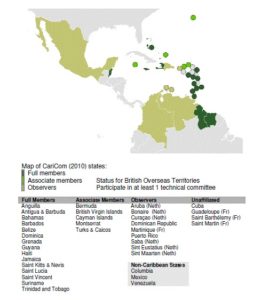
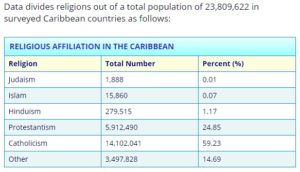
The purpose of this commentary is to lament the inadequacies in the Caribbean region, due to our lack of unity or disunity. This completes this series of commentaries on the absurdity of the premise that “there is some Caribbean unity” – what a joke! This submission is 4 of 4 from the Go Lean movement. The consistent theme from the full series is that the full Caribbean – all 30 member-states – have never been able to convene, collude, consolidate, collaborate and confederate. As a result our community have never thrived; and now only barely survive; we are flirting with Failed-State status.

What a joke our disposition has become. This has been declared in all the commentaries in this series, cataloged as follows:

  1. Caribbean Unity? – Tourism Missteps
  2. Caribbean Unity? – Ross University Saga
  3. Caribbean Unity? – No Freedom of Movement in/out of French Antilles
  4. Caribbean Unity? – Religion’s Role: False Friend

All of these commentaries relate to “how” the stewards for a new Caribbean can finally foster unity in this region. There had been previous attempts at regional integration, all with the same language/heritage grouping. Now, there is the need to recognize the deterrents to regional unity – religious and national alignment – and finally make progress.

God is Good!

The Church? Not so much! The Church must not be a priority! They have been False Friends to the Caribbean. This commentary is not advocating for a God-less society, just a religiously neutral one.

Today, there is the Caribbean Community or CariCom; it is not enough. It includes all the English-speaking territories, plus Haiti and Suriname. But that is only 20 member-states – in a Full or “Associated Member” status. “We” need universal participation for all neighbors in the neighborhood. This means you:

  • Cuba
  • French Caribbean
  • US Virgin Islands
  • Puerto Rico (Currently Observer status only)
  • Dominican Republic (Currently Observer status only)
  • Dutch Caribbean (Currently Observer status only)

These countries must be welcomed into the full brotherhood of an integrated Caribbean, despite any differences in religious affinity. That separation is very important; there are so many other issues at stake; think: economics, security (justice) and governance. The Go Lean/CU roadmap stresses the strategies, tactics and implementations to impact these societal engines. In fact, these statements are identified as the prime directives for the roadmap:

  • Optimize the economic engines in order to grow the regional economy to $800 Billion & create 2.2 million new jobs.
  • Establish a security apparatus to protect the resultant economic engines, plus ensure public safety and justice institutions.
  • Improve Caribbean governance to support these engines, including a separation-of-powers between the member-states and CU federal agencies, plus even oversight for NGO’s.

These prime directives transcend religions, languages or culture. They are designed to just deliver … on the empowerments that the homeland needs. The approach is to move the Caribbean region to a Single Market. CariCom started this vision, but failed to deliver on it. As related in the first commentary in this series, this new CU regime embraces the spirit of CariCom – the need for integration – but with a stronger foundation, one that includes all the neighbors in the neighborhood.

The book Go Lean…Caribbean – available to download for free – opened with the assessment that the challenges belying the Caribbean are Too Big for anyone one member-state alone – there must be regional solutions. Thusly, the book calls for a regional interdependence. This need was pronounced in the opening Declaration of Interdependence (Pages 11 – 13):

vi. Whereas the finite nature of the landmass of our lands limits the populations and markets of commerce, by extending the bonds of brotherhood to our geographic neighbors allows for extended opportunities and better execution of the kinetics of our economies through trade. This regional focus must foster and promote diverse economic stimuli.

viii. Whereas the population size is too small to foster good negotiations for products and commodities from international vendors, the Federation must allow the unification of the region as one purchasing agent, thereby garnering better terms and discounts.

x. Whereas we are surrounded and allied to nations of larger proportions in land mass, populations, and treasuries, elements in their societies may have ill-intent in their pursuits, at the expense of the safety and security of our citizens. We must therefore appoint “new guards” to ensure our public safety and threats against our society, both domestic and foreign. …

xi. Whereas all men are entitled to the benefits of good governance in a free society, “new guards” must be enacted to dissuade the emergence of incompetence, corruption, nepotism and cronyism at the peril of the people’s best interest. The Federation must guarantee the executions of a social contract between government and the governed.

xvi. Whereas security of our homeland is inextricably linked to prosperity of the homeland, the economic and security interest of the region needs to be aligned under the same governance. Since economic crimes … can imperil the functioning of the wheels of commerce for all the citizenry, the accedence of this Federation must equip the security apparatus with the tools and techniques for predictive and proactive interdictions.

xxiv. Whereas a free market economy can be induced and spurred for continuous progress, the Federation must install the controls to better manage aspects of the economy: jobs, inflation, savings rate, investments and other economic principles. Thereby attracting direct foreign investment because of the stability and vibrancy of our economy.

The Go Lean book provides 370-pages of turn-by-turn instructions on “how” to adopt new community ethos, plus the strategies, tactics, implementations and advocacies to execute so as to transform the Caribbean region into a Single Market with 30 different member-states, all striving for a “better society”. That “better society” is one that pursues the Greater Good. Consider the Chapter excerpts and headlines from this sample on Page 37 entitled:

10 Ways to Impact the Greater Good

1 Lean-in for Caribbean Integration
In addition to economic empowerment, this treaty calls for a collective security pact of the member-states so as to ensure homeland security, law-and-order, and assuage against systemic threats. It is an economic and historical fact that security solutions must accompany economic engines; otherwise any well-intentioned plans will be quickly defeated. As stated in scripture: “the love of money is the root of evil”. The community ethos for the CU therefore is for the greater good, at all costs.
2 Economic & Enforcement Openness
3 Reconciling the Poor/Black Experience
4 Public Relations – Messaging Against “Rats” (Snitches)
5 Focus on Justice
The CU will push a community ethos for justice and the rule of law, not “honor among thieves”. This will be fomented by the CU practice of transparency and accountability (including legislative oversight).  The many CU institutions for justice will be required to publish milestones and accomplishments so as to engender public trust and confidence.
6 Intelligence Gathering versus  Privacy
7 Military Deployments – Embedded Journalists
Since there are security threats for the region there is the need for a military apparatus. But to instill public confidence, the CU defense agencies will allow embedded journalists, even though their publications/broadcasts may be deferred.
8 Military Justice
9 Image Management
10 Foundation [and NGO] Alignment
There are many causes and advocacies that align with philanthropic foundations, NGOs and Not-For-Profits. The CU will liaison with these organizations, give them support and cooperation to pursue the greater good goals for the public.

The Caribbean must foster a better homeland that transcends the False Friends of the Church and other hypocrisies. Religion does have an effect on our culture and society, so we must pay more than the usual attention to their developments. Considering the lessons being learned from the pedophile priest crisis, we must also hold religious organizations – and NGO’s – accountable for their actions and violations of justice norms and requirements.

This Go Lean movement has previously detailed many related issues and advocacies for this kind of Truth and Reconciliation mandate in our region; consider this sample of previous blog-commentaries:

https://goleancaribbean.com/blog/?p=14482 International Women’s Day – Protecting Rural Women
https://goleancaribbean.com/blog/?p=13299 Making a Pluralistic Democracy – Respecting Diwali
https://goleancaribbean.com/blog/?p=11224 ‘Loose Lips Sink Ships’ – Fanatical Theologians Undermine Tourism
https://goleancaribbean.com/blog/?p=10216 Waging a Successful War on Orthodoxy
https://goleancaribbean.com/blog/?p=9766 Rwanda’s Catholic bishops apologize for genocide
https://goleancaribbean.com/blog/?p=5695 Repenting, Forgiving and Reconciling the Past
https://goleancaribbean.com/blog/?p=4971 A Lesson in Church History – Royal Charters: Truth & Consequence
https://goleancaribbean.com/blog/?p=809 Muslim Officials condemn abduction of Nigerian girls
https://goleancaribbean.com/blog/?p=631 The Pope as a Turnaround CEO – The Francis Effect

Christianity does not complete the religious landscape for the Caribbean. There are other faiths:

Source: Retrieved August 30, 2018 from: http://caribya.com/caribbean/religion/

The Caribbean is unique in that it has forged its own brand of religions:

  • Rastafarianism – The black power movements of the early 1900s helped launch a completely different kind of religion. Based on Christianity and the King James Bible, Rastafarian beliefs also include the worship of Ras (meaning Prince) Tafari of Ethiopia.
  • Creole Religions – The two best-known forms of these Creole religions are Voodoo and Santería. These were most often practiced on French and Spanish islands where Roman Catholicism was the religion of the whites. Other creole faiths/practices include Regla de Palo, Abakuá Secret Society, Espiritismo, Obeah, Myal, and Quimbois. These latter ones, Obeah, Myal, and Quimbois are Afro-Caribbean Creolized forms of witchcraft and healing practices. Ashanti and other linguistically united tribes were brought to the Caribbean as slaves almost exclusively by the British – the French and Spanish thought these Africans to be more likely to rebel. This means that these spiritual practices were performed almost exclusively on British islands, though Quimbois was a popular practice on Martinique and Guadeloupe.

These Afro-Caribbean Creolized forms of religious practices also have disruptive affects on regional unity.

In summary, religion have not been and cannot be the unifying force for the Caribbean; it must be something else.

We present the community ethos of the Greater Good. This is the best way to reform and transform the Caribbean’s societal engines to better allow for our pluralistic realities. This is the quest of the Go Lean roadmap.

All Caribbean stakeholders – church-goers and secularist alike – are urged to lean-in to this roadmap for change … and empowerment. We can make our region a better place to live work and play. 🙂

Download the e-Book of Go Lean … Caribbean – now!

Sign the petition to lean-in for this roadmap for the Caribbean Union Trade Federation.

—————–

Appendix VIDEO – Former Vatican official calls for Pope Francis to resign – http://www.foxnews.com/world/2018/08/28/pope-francis-facing-calls-to-resign-sexual-abuse-scandal-exposes-rifts-in-vatican.html

Posted August 28, 2018 – Former Archbishop Carlo Maria Vigano claims the pope knew about sexual abuse allegations against American Cardinal Theodore McCarrick; Bryan Llenas reports.

Share this post:
, ,
[Top]

Caribbean Unity? Need French Antilles

Go Lean Commentary

Bedrock, Baby!

This is the lesson being learned in San Francisco for the new Salesforce Tower: If you’re going to build a skyscraper, make sure it has a good foundation. While a building can go up with a weak foundation, there will be structural problems along the way. See Appendix VIDEO for the story of the Millennium Tower sinking, and leaning.

This is an important lesson for the Caribbean; there is a need for integration, consolidation and collaboration among the Caribbean member-states. But, we need a good foundation; we need full participation from all the neighbors (Dutch, English, French and Spanish speaking islands). Just look at this photo here, depicting that the French Antilles territories of Guadeloupe and Martinique are “next door” to English-speaking Caribbean island nation-states:

(The island of Saint Martin is shared as a French territory and Dutch territory – this is considered a legal condominium; St Bartholomew is also on the list of current French Caribbean islands; but French Guiana – on the South American mainland next to Suriname completes the list of French territories; Haiti gained independence from France in 1804).

This is the assertion of the movement behind the book Go Lean … Caribbean. This book declares that Caribbean regional governance is deficient and inadequate; there must be a regional integration that integrates the entire region. Yes, the existing Caribbean Community (CariCom) integration effort without the French territories is like building a skyscraper on a shaky foundation. What a skyscraper really needs is: Bedrock, Baby!


What Caribbean integration really needs is: Complete participation of all the neighbors in the neighborhood.

This is the purpose of this commentary, to lament the inadequacies because of Caribbean disunity. This is the continued focus of this series of commentaries on the joke (absurdity) of the premise that there is some Caribbean unity; this is a mirage. This submission is 3 of 4 from the Go Lean movement. The urging is that the full Caribbean – all 30 member-states – must confederate and consolidate; otherwise our communities will not thrive, maybe, not even survive. The assessment is that the prior attempts of nation-building – without some sort of alliance – is just a joke!

The other commentaries in the series are cataloged as follows:

  1. Caribbean Unity? What a joke – Tourism Missteps
  2. Caribbean Unity? – Ross University Saga
  3. Caribbean Unity? – No Freedom of Movement in/out of French Antilles
  4. Caribbean Unity? – Religion’s Role: False Friend

All of these commentaries relate to “how” the stewards for a new Caribbean can finally foster unity in this region. The previous formal exercises in regional integration were flawed at the foundation; this includes the current Caribbean Community or CariCom plus the previous attempt among the English-speaking islands: the disastrous West Indies Federation, and the attempt in the Dutch-speaking islands, the now-defunct Netherlands Antilles. These many iterations ignored the bedrock foundational principle of: Liberty, Equality and Fraternity.

Those 3 principles sound familiar …

Yes, they are the values of the French Revolutionary movement. This is relevant because the French are also among the World Powers that discovered, exploited and colonized the Caribbean. To this day, they claim the afore-mentioned 4 territories in the region.

This commentary is not a criticism of the French eco-system or history, except for calling out their failure to integrate with their Caribbean neighbors. The country of France was always front-and-center in the enlightenment movement as their Declaration of the Rights of the Man and of the Citizen of 1789, together with Magna Carta, the English Bill of Rights, and the United States Bill of Rights, inspired in large part the 1948 United Nations Universal Declaration of Human Rights.[4]

Human rights – or Liberty, Equality and Fraternity – does not fit the description of colonies in these French Antilles. They are being administered remotely from Metropolitan France (Paris) rather than exercising autonomy to partner with their next door neighbors. As a result of this failing, we have no Freedom of Movement between the French Antilles and their neighbors – but there is Freedom of Movement in the European Union (and the Schengen Area). See the plight highlighted in this news story:

Title # 1: Dominican family facing expulsion from Martinique
A Dominican family of nine have been threatened with expulsion from Martinique, one year after fleeing there in the aftermath of hurricane Maria, local news reports have said.

The family, seven children and their parents, have been asked to leave Martinique this Thursday, August 16, 2018, according to Martinique 1Ere.

The online publication said the Dominican immigrants have all been living at the home of the children’s grandmother in the community of Prêcheur.

However,  since arriving in Martinique the visitors could not obtain a residence permit and must leave Martinique for their native Dominica, Martinique 1Ere reported.

The Mayor of the area,  Marcellin Nadeau, is reportedly opposed to the expulsion and has cited the historical links of the community with Dominicans.

Hurricane Maria blasted across Dominica on the night of September 18, 2017, with torrential rain and gusts of some 160 mph.

Damage to the Island was estimated at over $EC 2 billion and some one fifth of the population is said to have sought refuge in other countries in the aftermath of the storm.
Source: St. Lucia Times – posted August 15, 2018; retrieved August 29, 2018 from: https://stluciatimes.com/2018/08/15/dominican-family-facing-expulsion-from-martinique/

—————-

Title # 2: Martinique: Supporters mobilise against expulsion of Dominican family
Residents of the community of Prêcheur in Martinique Friday morning began mobilising to prevent the expulsion of a Dominican family, local news reports say.

The nine Dominicans had sought refuge in the French overseas territory following the passage of Hurricane Maria, which devastated Dominica last year.

According to Martinique 1 Ere, since 6:30 Friday morning, several inhabitants of Prêcheur, began mobilising to prevent the departure of Durand family.

The family, seven children and their parents, had been living with the children’s grandmother in Martinique for the past year.

They were due to leave Martinique Friday because they do not have a residence permit.

Local news reports said the family made several attempts to obtain the permit but failed to do so.

They were originally due to leave on Thursday, August 16, but the authorities gave them a few more hours to prepare for their departure, it was reported.

Residents of the community where the visitors have been staying have stated their intention to block access to the port at Fort de France to prevent the Dominicans from leaving, Martinique 1 Ere has reported.

The online publication quoted lawyer, Camille Célénice, as saying that a request for a residence permit must be filed Friday morning in the presence of the Mayor of  Prêcheur, Marcellin Nadeau.

Nadeau is reported to be opposed to the move to expel the Dominican family, citing the historical links of the town with its neighbours from Dominica.
Source: St. Lucia Times – posted August 17, 2018; retrieved August 29, 2018 from: https://stluciatimes.com/2018/08/17/martinique-supporters-mobilise-against-expulsion-of-dominican-family/

It is apparent from this article, that refuge-seekers from hurricane-damaged areas seek refuge in their neighborhoods, first. It is only logical that displaced people will only want to move the shortest distances possible. If your island is only 40 miles away, then despite the divergent colonial heritage, that proximity overrides any cultural affinity.

Culture can move and adapt to a land; a land cannot move and adapt to a culture.

The Go Lean book serves as a roadmap for the introduction and implementation of the Caribbean Union Trade Federation (CU), an intergovernmental entity to empower all of the Caribbean member-states – the independent and dependent territories. This new regime for the Caribbean needs the islands in the French Antilles. But, the French Antilles need the CU, too. Accordingly, there is a lot of discord in those lands; see this opening anecdote from the Go Lean book on Page 17:

Anecdote # 3

French Caribbean – Organization & Discord

The terms French Caribbean, French West Indies or French Antilles all refer to the five territories currently under French sovereignty in the Antilles islands and related areas of the Caribbean. There are two organizational types:

1. Overseas departments are constituencies of France that are outside metropolitan France. They have the same political status as metropolitan departments. As integral parts of France and the European Union, overseas departments are represented in the National Assembly, Senate, and Economic and Social Council, vote to elect European Parliament (MEP), and also use the Euro as their currency. Under the 1946 Constitution of the Fourth Republic, the French colonies were defined as overseas departments. Since 1982, following the French government’s policy of decentralization, overseas departments have elected regional councils with powers similar to those of the regions of metropolitan France. As a result of a constitutional revision that occurred in 2003, these regions are now to be called overseas regions; though there is no difference in relevance or function.

o Guadeloupe (Basse-Terre & Grande-Terre); plus dependencies: Les Saintes, Marie-Galante, La Désirade
o Martinique
o French Guiana – actually on the South America mainland

2. Overseas collectivities are first-order administrative divisions of France. These constitute some former French overseas territories and other French overseas entities with a particular status, all of which became collectivities by constitutional reform on 28 March 2003. For the Caribbean, they include:

o Saint Martin – the northern part of the island shared with a Dutch Territory
o Saint Barthélemy

There is recent history of discord in the French Caribbean. Saint Barthélemy has a more developed and prosperous economy than its previous administrative “big brother” Guadeloupe. Duty-free port attractions, retail trade, high-end tourism and its luxury hotels/villas have increased that island’s standard of living for its citizens, even exceeding metropolitan France. Plus, unlike most Caribbean islands, the population of Saint “Barths” is mostly of European ancestry. With the 2003 constitutional reforms, the populations of the French territories of Saint Barthélemy and Saint Martin were given the choice to remain within France or alter their status; they voted in favor of secession from Guadeloupe and to form separate overseas collectivities of France. In July 2007, these island communes were officially detached from Guadeloupe and became two separate French overseas collectivities with their own local administration and own deputies in the French National Assembly and Senate.

There is also discord in Guadeloupe and Martinique. The average salary in Guadeloupe is lower than in mainland France while the unemployment and poverty rates on both islands are double those found in metropolitan France; these islands suffered the 2nd and 3rd highest unemployment rates in the European Union (2007), and #1 in youth unemployment.

In January/February 2009, an umbrella group of approximately fifty labor unions and other associations called for a €200 ($260 USD) monthly pay increase for Guadeloupe and Martinique’s low income workers. The protesters had proposed that authorities “lower business taxes as a top up to company finances” to pay for the €200 pay raises. Employers and business leaders in Guadeloupe had said that they could not afford the salary increase. The strike lasted 44 days, during the high season, and escalated to “the verge of revolt”, finally ending with an accord in March 2009 in which the French government agreed to raise the salaries of the lowest paid by the requested €200 and granted the petitioners top 20 demands. Tourism suffered greatly during this time and affected the 2010 tourist season as well; the islands were believed to have lost millions of dollars in tourism revenues due to cancelled vacations and closed hotels. The strikes exposed deep ethnic, racial, and class tensions and disparities – discord – within the French Caribbean territories.

<—————————->

Hurricanes are a serious threat for Caribbean life. This is true for the French Caribbean as well. There is nothing that Paris can do to eliminate the threat! (Notwithstanding the COP 21 Paris Accords to mitigate Greenhouse Gases to retard the effects of Climate Change).

All the Caribbean must band together to cope. This includes all islands of all colonial heritage. This was the opening declaration in the Go Lean book (Page 5), quoting the lyrics of the popular 1970 song “Lean On Me”:

Second Verse
If there is a load you have to bear
That you can’t carry
I’m right up the road
I’ll share your load
If you just call me

The current governance in the Caribbean is inadequate for dealing with the challenges of Climate Change; this is affecting all facets of our society: economics, security and governance. Rather than an intra-island focus, all these lands need to look to the full region and then convene, consolidate, collude, confederate and collaborate with each other to make the homelands better places to live, work and play. A regional construct is the focus of the technocratic CU; it is designed to shepherd the economic engines, while also guarding against all security challenges – including preparation and response for natural disasters.

The Go Lean/CU roadmap will employ strategies, tactics and implementations to impact its prime directives; identified with the following 3 statements:

This directive transcends national borders, languages or culture. It just delivers …

This was always the hope for the Caribbean Single Market and Economy (CSME), the initiative spurred by CariCom; but it never delivered. This new regime embraces the spirit of CariCom – the need for integration – but with an execution foundation that goes down to the bedrock.

The book Go Lean…Caribbean – available to download for free – opened with an honest assessment there must be a regional interdependence. This assessment was pronounced in the opening Declaration of Interdependence (Pages 12 – 13):

i. Whereas the earth’s climate has undeniably changed resulting in more severe tropical weather storms, it is necessary to prepare to insure the safety and security of life, property and systems of commerce in our geographical region. As nature recognizes no borders in the target of its destruction, we also must set aside border considerations in the preparation and response to these weather challenges.

xi. Whereas all men are entitled to the benefits of good governance in a free society, “new guards” must be enacted to dissuade the emergence of incompetence, corruption, nepotism and cronyism at the peril of the people’s best interest. The Federation must guarantee the executions of a social contract between government and the governed.

xvi. Whereas security of our homeland is inextricably linked to prosperity of the homeland, the economic and security interest of the region needs to be aligned under the same governance. Since economic crimes … can imperil the functioning of the wheels of commerce for all the citizenry, the accedence of this Federation must equip the security apparatus with the tools and techniques for predictive and proactive interdictions.

xxiv. Whereas a free market economy can be induced and spurred for continuous progress, the Federation must install the controls to better manage aspects of the economy: jobs, inflation, savings rate, investments and other economic principles. Thereby attracting direct foreign investment because of the stability and vibrancy of our economy.

The Go Lean book provides 370-pages of turn-by-turn instructions on “how” to adopt new community ethos, plus the strategies, tactics, implementations and advocacies to execute so as to transform the Caribbean society, even the French Antilles. Consider the Chapter excerpts and headlines from this sample on Page 239 entitled:

10 Ways to Impact French Territories

1 Lean-in for Caribbean Integration
The CU will allow for the unification of the region into one market, thereby creating a single economy of 30 member-states for 42 million people with the scale to effect change; the CU does not involve sovereignty. The treaty includes the French Overseas Territories of Guadeloupe, Martinique, Saint Martin and Saint Barthélemy, but not French Guiana initially. Though France is one of the biggest economies, French economic prosperity has not always extended to these islands
2 Trading Partners based on Nature not Politics
One original motive of French colonialism was the facilitation of trade. That need is even more pronounced now. But with the changes of globalization, technology and the demographic regionalization it is more fitting to trade with neighbors, based on natural location, rather than political alignment. The CU extends that push with this Trade Federation.
3 Homeland Security Pact – NATO style
4 Disaster Preparation & Response
Mother Nature, and the reality of hurricanes, plays no favorites for one island versus another due to political alliance. The CU will better plan/prepare/respond, with a professional Emergency Management Agency and recover with elite financial products (i.e. reinsurance sidecars) powered by capital markets to restore economic engines in the islands.
5 Caribbean Dollar and the Caribbean Central Bank
6 Emigration Circuit Breaker
7 EU Participants
8 Cruise Line Collective Bargaining
9 Paris Hand-off / Proxy
10 Host Country Entitlements

The Caribbean must foster a better homeland that allows for Free Movement of People … and also better disaster preparation and response. This Go Lean movement has previously detailed many related issues and advocacies for the French Caribbean and their full participation in this regional construct; consider this sample of previous blog-commentaries:

https://goleancaribbean.com/blog/?p=13319 Making a ‘Pluralistic Democracy’ – Freedom of Movement
https://goleancaribbean.com/blog/?p=12581 State of the Union – Annexation: French Guiana
https://goleancaribbean.com/blog/?p=11287 Creating a Legacy in Pro-Surfing in Martinique
https://goleancaribbean.com/blog/?p=10554 Welcoming the French
https://goleancaribbean.com/blog/?p=10043 Caribbean Integration Plan for Greater Prosperity
https://goleancaribbean.com/blog/?p=382 Guadeloupe, Martinique, St Maarten Join the ACS

The reasons why people abandon a beloved homeland is due to 2 reasons: “push” and “pull” factors. “Push” would refer to the resultant deficient infrastructure forcing stakeholders to abandon the community, and “pull” would refer to the perception that there are better economic opportunities elsewhere. The French Antilles have many of the same problems as the rest of the Caribbean. Societal defects abound, to the point that many of the people – and institutions – flee their homelands. This is true even more so right after a disastrous storm – a “push” factor. In the foregoing news articles, the displacement drama was associated with the aftermath of Category 5 Hurricane Maria in Dominica. Since all Caribbean member-states are “in the same boat”, all territories-countries should “pick up an oar” and collaborate on solutions.

(The absolute latest news on this Dominican family: Stay of Execution on Deportation –  https://stluciatimes.com/2018/08/29/martinique-decision-pending-on-expulsion-of-dominican-family/).

In summary, the Go Lean roadmap seeks to reboot and relaunch the integration effort. But this time, with all Caribbean member-states (30), not just the English-speaking, but partnering with the French Antilles and Spanish-speaking states as well. Due to our Climate Change realities, our region must reform and transform the Caribbean’s societal engines so as to better allow for our tropical realities.

Let’s be better – together.

All Caribbean stakeholders – including European governments (i.e. France and The Netherlands) – are urged to lean-in to this roadmap for change … and empowerment. We need “all hands on deck” to make this region a better place to live work and play. 🙂

Download the book Go Lean … Caribbean – now!

Sign the petition to lean-in for this roadmap for the Caribbean Union Trade Federation.

—————-

Appendix VIDEO – The Leaning Tower of San Francisco – https://youtu.be/qKtlZc-u9TU

Published on November 5, 2017 – The Millennium Tower opened to great acclaim with high-priced, posh apartments. But those accolades and property values are sinking, along with the building’s foundation. No Bedrock! Jon Wertheim reports.

See full story here: https://www.cbs.com/shows/60_minutes/video/nn9f_o573SfUTgnxuseZn5qbLYNtHCQI/the-leaning-tower-of-san-francisco/

Share this post:
, , , ,
[Top]