Tag: Transform

ENCORE: Hurricane Categories – The Science

Go Lean Commentary

Category 5

… that term has become one of the most dreaded phases in modern times in the Western Hemisphere, and especially in the Caribbean.

A Category 5 Hurricane – with its maximum sustained winds in excess of 156 miles per hour – is the Sum of All of Our Fears and a Clear & Present Danger. (See the full list of their historicity in the Appendix below). The most powerful one on record featured 215 mph winds – Hurricane Patricia – was just recently in October 2015 off the coast of Mexico.

Hurricanes – tropical cyclones in the Atlantic Ocean and Eastern Pacific Ocean – are the exclusive brand for the Northern Hemisphere. Considering the rotation of the earth, the majority travel East to West, from Africa over to North America. That’s the majority; but the minority is nothing to ignore either.  These can start in the Caribbean Sea or the Gulf of Mexico and travel at will: north, south, east, or west.

Welcome to our Caribbean, the greatest address on the planet!

Hurricanes are our reality. A hurricane is a meteorological phenomena that cannot be ignored; its science is a marvel.

Hurricanes are scientifically measured by the Saffir–Simpson scale. This scale was developed in 1971 by civil engineer Herbert Saffir and meteorologist Robert Simpson, who at the time was director of the U.S. National Hurricane Center (NHC).[1] The scale was introduced to the general public in 1973,[2] and saw widespread use after a new Director Neil Frank replaced Mr. Simpson in 1974 at the helm of the NHC, as a tribute to Mr. Simpson.[3]

See full details on this hurricane scale here:

Title: Saffir–Simpson Scale
The Saffir–Simpson hurricane wind scale, formerly the Saffir–Simpson hurricane scale (SSHS), classifies hurricanes –Western Hemisphere tropical cyclones that exceed the intensities of tropical depressions, and tropical storms – into five categories distinguished by the intensities of their sustained winds. To be classified as a hurricane,  a tropical cyclone must have maximum sustained winds of:

  • 74–95 mph –  Category 1.
    cu-blog-hurricane-categories-the-science-photo-1
  • 96–110 mph – Category 2.
    cu-blog-hurricane-categories-the-science-photo-2
  • 111–129 mph – Category 3.
    cu-blog-hurricane-categories-the-science-photo-3
  • 130–156 mph – Category 4.
    cu-blog-hurricane-categories-the-science-photo-4
  • ≥ 157 mph – Category 5.
    cu-blog-hurricane-categories-the-science-photo-5

So the highest classification in the scale, Category 5, is reserved for storms with winds exceeding 156 mph (70 m/s; 136 kn; 251 km/h). [There have been a number of these since 1924. See full list in the Appendix below].

The classifications can provide some indication of the potential damage and flooding a hurricane will cause upon landfall.

Officially, the Saffir–Simpson hurricane wind scale is used only to describe hurricanes forming in the Atlantic Ocean and northern Pacific Ocean east of the International Date Line. Other areas use different scales to label these storms, which are called “cyclones” or “typhoons“, depending on the area.

There is some criticism of the SSHS for not taking rain, storm surge, and other important factors into consideration, but SSHS defenders say that part of the goal of SSHS is to be straightforward and simple to understand.
Source: Wikipedia Online Reference – Retrieved October 7, 2016 from: https://en.wikipedia.org/wiki/Saffir%E2%80%93Simpson_scale
We are thankful to these two pioneering scientists, Mr. Saffir and Mr. Simpson; they lived full and impactful lives – R.I.P..

Mr. Simpson died on December 18, 2014 at age 102.

Mr. Saffir died on November 21, 2007 at age 90.

These scientists have given us the numbers 1 through 5 to indicate an extent of our misery. But misery is more than just a number. Misery is an experience; an unpleasant one. See here the VIDEO visually depicting damage along the Saffir-Simpson scale:

VIDEO – Why Hurricane Categories Make a Difference – https://youtu.be/lqfExHpvLRY

Published on Aug 8, 2013 – During a hurricane you usually hear meteorologists refer to its intensity by categories. If you don’t know the difference between a category 1 and a category 5 hurricane, The Weather Channel meteorologist Mark Elliot breaks it down for you.

Hurricanes are reminders that “Crap Happens“. They affect the everyday life for everyday people. This discussion is presented in conjunction with the book Go Lean … Caribbean. It addresses the challenges facing life in the Caribbean and then presents strategies, tactics and implementations for optimizing the regional community.

Hurricanes are a product of ‘Mother Nature’ – natural disasters – but communities can be more efficient and effective in mitigating the risks associated with these natural disasters (hurricanes, earthquakes, volcanoes, floods, forest fires, etc.). In addition, there are bacterial & viral pandemics. Lastly, there are industrial incidents (chemical & oil spills) and other man-made disasters: i.e. terrorism-related events.

The Go Lean book asserts that bad things (and bad actors), like hurricanes, will always emerge to disrupt the peace and harmony in communities. Crap Happens … therefore all Caribbean member-states need to be “on guard” and prepared for this possibility. The Go Lean book (Page 23) prepares the Caribbean for many modes of “bad things/actors” with proactive and reactive mitigations. This point is pronounced early in the book with the opening Declaration of Interdependence (Page 12) that claims:

i. Whereas the earth’s climate has undeniably changed resulting in more severe tropical weather storms, it is necessary to prepare to insure the safety and security of life, property and systems of commerce in our geographical region. As nature recognizes no borders in the target of its destruction, we also must set aside border considerations in the preparation and response to these weather challenges.

ii. Whereas the natural formation of the landmass for our lands constitutes some extreme seismic activity, it is our responsibility and ours alone to provide, protect and promote our society to coexist, prepare and recover from the realities of nature’s occurrences.

x. Whereas we are surrounded and allied to nations of larger proportions in land mass, populations, and treasuries, elements in their societies may have ill-intent in their pursuits, at the expense of the safety and security of our citizens. We must therefore appoint “new guards” to ensure our public safety and threats against our society, both domestic and foreign. The Federation must employ the latest advances and best practices … to assuage continuous threats against public safety.

xii. Whereas the legacy in recent times in individual states may be that of ineffectual governance with no redress to higher authority, the accedence of this Federation will ensure accountability and escalation of the human and civil rights of the people for good governance, justice assurances, due process and the rule of law. As such, any threats of a “failed state” status for any member state must enact emergency measures on behalf of the Federation to protect the human, civil and property rights of the citizens, residents, allies, trading partners, and visitors of the affected member state and the Federation as a whole.

xvi. Whereas security of our homeland is inextricably linked to prosperity of the homeland, the economic and security interest of the region needs to be aligned under the same governance. Since economic crimes, including piracy and other forms of terrorism, can imperil the functioning of the wheels of commerce for all the citizenry, the accedence of this Federation must equip the security apparatus with the tools and techniques for predictive and proactive interdictions.

So the Go Lean book relates that the Caribbean must appoint “new guards”, or a security apparatus, to ensure public safety and to include many strategies, tactics and implementations considered “best-practices” for Emergency Management (Preparation and Response). We must be on a constant vigil against these “bad actors”, man-made or natural. The Go Lean book serves as a roadmap for the introduction and implementation of the technocratic Caribbean Union Trade Federation (CU).

The Go Lean/CU roadmap has a focus of optimizing Caribbean society through economic empowerment, and homeland security. Emergency preparedness and response is paramount for this quest. In fact, the Go Lean roadmap has the following 3 prime directives:

  • Optimization of the economic engines in order to grow the regional economy to $800 Billion & create 2.2 million new jobs.
  • Establishment of a security apparatus – a new guard – to protect the resultant economic engines and the Caribbean homeland.
  • Improvement of Caribbean governance to support these engines.

The CU would serve as the “new guard“, a promoter and facilitator of all the Emergency Management agencies in the region. The strategy is to provide a Unified Command and Control for emergency operations to share, leverage and collaborate the “art and science” of this practice across the whole region.

The regional vision is that all Caribbean member-states empower a CU Homeland Security force to execute a limited scope on their sovereign territories. The legal basis for this empowerment is a Status of Forces Agreement (SOFA), embedded in the CU treaty from Step One/Day One. The CU Trade Federation would lead, fund and facilitate the Emergency Management functionality under the oversight of a regionally elected Commander-in-Chief for the CU.

As cited above, the Caribbean is the “greatest address on the planet”, but there is risk associated with living deep in a tropical zone. With the reality of Climate Change, we must not be caught unprepared.

In our immediate past, the Caribbean region has failed at the need for readiness and response. We have even failed to properly coordinate the “cry for help” and the collection of international-charitable support. We have suffered dire consequences as a result: loss of life, damage to property, disruption to economic systems, corruption … and abandonment. Many of our citizens have fled their Caribbean homeland, as a result, after each natural disaster. We have even created Ghost Towns.

We want something better, something more. We want our people to prosper where they are planted in the Caribbean. So as a community, we must provide assurances. No assurance that there will be no hurricanes, but rather the assurance that we can respond, recover, repair and rebuild:

“Yes, we can … “.

The Go Lean book details the series of community ethos, strategies, tactics, implementations and advocacies to provide the proactive and reactive public safety/security in the Caribbean region:

Community Ethos – Economic Systems Influence Individual Choices Page 21
Community Ethos – Consequences of Choices Lie in Future Page 21
Community Ethos – “Crap” Happens Page 23
Community Ethos – Cooperatives Page 25
Community Ethos – Ways to Impact the Future Page 26
Community Ethos – Ways to Improve Sharing Page 35
Community Ethos – Ways to Promote Happiness Page 36
Community Ethos – Ways to Impact the Greater Good Page 37
Strategy – Vision – Confederating a non-sovereign permanent union Page 45
Strategy – Agents of Change – Climate Change Page 57
Tactical – Fostering a Technocracy Page 64
Tactical – How to Grow the Economy – Recover from Disasters Page 70
Tactical – Separation of Powers – Homeland Security Department Page 75
Tactical – Separation of Powers – Emergency Management Agency Page 76
Tactical – Separation of Powers – Meteorological and Geological Service Page 79
Implementation – Ways to Pay for Change Page 101
Implementation – Start-up Homeland Security Initiatives Page 103
Implementation – Ways to Re-boot Freeport Page 112
Implementation – Ways to Foster International Aid Page 115
Planning – 10 Big Ideas – #3: Consolidated Homeland Security Pact Page 130
Planning – Ways to Make the Caribbean Better Page 131
Planning – Ways to Improve Failed-State Indices – Escalation Role Page 134
Advocacy – Ways to Grow the Economy – Quick Disaster Recovery Page 151
Advocacy – Ways to Improve Governance Page 168
Advocacy – Ways to Better Manage the Social Contract Page 170
Advocacy – Ways to Improve Homeland Security Page 180
Advocacy – Ways to Improve Intelligence Gathering & Analysis Page 182
Advocacy – Ways to Improve for Natural Disasters Page 184
Advocacy – Ways to Improve for Emergency Management Page 196
Advocacy – Ways to Impact Wall Street – Adopt Advanced Recovery Products Page 200

Other subjects related to Emergency Management, Homeland Security and governing empowerments for the region have been blogged in other Go Lean…Caribbean commentaries, as sampled here:

https://goleancaribbean.com/blog/?p=9070 Securing the Homeland – From the Seas
https://goleancaribbean.com/blog/?p=9038 Doing Better with Charity Management
https://goleancaribbean.com/blog/?p=7896 The Logistics of Disaster Relief
https://goleancaribbean.com/blog/?p=7449 The Art and Science of Emergency Management
https://goleancaribbean.com/blog/?p=7327 Zika – An Epidemiology Crisis – A 4-Letter Word
https://goleancaribbean.com/blog/?p=7235 Flint, Michigan – A Cautionary Tale
https://goleancaribbean.com/blog/?p=6893 A Meteorologist’s View On Climate Change
https://goleancaribbean.com/blog/?p=6563 Lessons from Iceland – Model of Recovery
https://goleancaribbean.com/blog/?p=6189 A Lesson in History – Hurricane ‘Katrina’ is helping today’s crises
https://goleancaribbean.com/blog/?p=4741 Vanuatu and Tuvalu Cyclone – Inadequate response to human suffering
https://goleancaribbean.com/blog/?p=2614 The ‘Great ShakeOut’ Earthquake Drill / Planning / Preparations
https://goleancaribbean.com/blog/?p=2397 Stopping a Clear and Present Danger: Ebola
https://goleancaribbean.com/blog/?p=1817 Caribbean grapples with intense new cycles of flooding & drought

The Caribbean is on the frontline of this battle: man versus Climate Change. While we are not the only ones, we have to be accountable and responsible for our own people and property. The book Go Lean…Caribbean posits that this “Agent of Change” is too big for just any one member-state to tackle alone, that there must be a regional solution; and presents this roadmap.

Climate Change has produced winners (consider northern cities with milder than normal winters) and losers. The Caribbean has found itself on the losing side. This means life-and-death for the people and the economic engines of the Caribbean communities.

While hurricanes are our reality, there is a science to these meteorological phenomena, and an art to our response. We can plan, monitor, alert, prepare and recover. We can do it better than in the recent past. We can provide assurances that “no stone” will be unturned in protecting people, property and systems of commerce. The watching world – our trading partners – needs this assurance!

The people and institutions of the region are therefore urged to lean-in to this Go Lean roadmap to make the Caribbean a better, safer, place to live, work and play. This plan is conceivable, believable and achievable. Yes, we can. 🙂

Download the book Go Lean … Caribbean – now!

Sign the petition to lean-in for this roadmap for the Caribbean Union Trade Federation. 


————–

Appendix – List of Category 5 Atlantic Hurricanes

Storm
name

Season

Dates as a
Category 5

Time as a
Category 5 (hours)

Peak one-minute
sustained winds

Pressure

mph

km/h

hPa

inHg

Matthew 2016 September 30 – October 1 6 160 260

934

27.58

Felix 2007 September 3–4† 24 175 280

929

27.43

Dean 2007 August 18–21† 24 175 280

905

26.72

Wilma 2005 October 19 18 185 295

882

26.05

Rita 2005 September 21–22 24 180 285

895

26.43

Katrina 2005 August 28–29 18 175 280

902

26.64

Emily 2005 July 16 6 160 260

929

27.43

Ivan 2004 September 9–14† 60 165 270

910

26.87

Isabel 2003 September 11–14† 42 165 270

915

27.02

Mitch 1998 October 26–28 42 180 285

905

26.72

Andrew 1992 August 23–24† 16 175 280

922

27.23

Hugo 1989 September 15 6 160 260

918

27.11

Gilbert 1988 September 13–14 24 185 295

888

26.22

Allen 1980 August 5–9† 72 190 305

899

26.55

David 1979 August 30–31 42 175 280

924

27.29

Anita 1977 September 2 12 175 280

926

27.34

Edith 1971 September 9 6 160 260

943

27.85

Camille 1969 August 16–18† 30 175 280

900

26.58

Beulah 1967 September 20 18 160 260

923

27.26

Hattie 1961 October 30–31 18 160 260

920

27.17

Carla 1961 September 11 18 175 280

931

27.49

Janet 1955 September 27–28 18 175 280

914

27.0

Carol 1953 September 3 12 160 260

929

27.43

“New England” 1938 September 19–20 18 160 260

940

27.76

“Labor Day” 1935 September 3 18 185 295

892

26.34

“Tampico” 1933 September 21 12 160 260

929

27.43

“Cuba–Brownsville” 1933 August 30 12 160 260

930

27.46

“Cuba” 1932 November 5–8 78 175 280

915

27.02

“Bahamas” 1932 September 5–6 24 160 260

921

27.20

San Felipe II-“Okeechobee” 1928 September 13–14 12 160 260

929

27.43

“Cuba” 1924 October 19 12 165 270

910

26.87

Reference=[1] †= Attained Category 5 status more than once

Source: Retrieved October 7, 2016 from https://en.wikipedia.org/wiki/List_of_Category_5_Atlantic_hurricanes

Share this post:
, , , ,

Bahamian Diaspora: Not the ‘Panacea’

Go Lean Commentary

We wish the best to the new Prime Minister of the Bahamas, Dr. Hubert A. Minnis, whose government came to power on May 10, 2017. He was thrust into power by a mandate of the Bahamian people; their demand for a change.

CU Blog - Understand the Market, Plan the ... - Photo 2But we take issue with Dr. Minnis looking to the Bahamian Diaspora as the panacea, the “cure-all” for that change; it is a flawed strategy. There is no “there” there. See the news article of his remarks to the Bahamian Diaspora in Atlanta in the Appendix below.

This has been a consistent theme from the movement behind the book Go Lean … Caribbean. The criticism has been leveled against every Caribbean member-state hoping that their Diaspora – those who had fled, being “pushed” or “pulled” away from their homeland –  would invest back in their country. This strategy double-downs on the failure of why the Diaspora left in the first place. A previous commentary explained:

The subtle message to the Caribbean population is that they need to leave their homeland, go get success and then please remember to invest in us afterwards.

… It is so unfortunate that the people in the Caribbean are beating down the doors to get out of their Caribbean homeland, to seek refuge in these places like the US, Canada and Western Europe. And yet it seems like the Chief Executive of this Caribbean country is encouraging more of it – there is a similar sentiment in the rest of the Caribbean member-states. As a result, we have such a sad state of affairs for our Caribbean eco-system as we are suffering from a bad record of societal abandonment.

See the Appendix VIDEO where the functionality of the Diaspora is discussed as a Caribbean standard.

The book Go Lean…Caribbean – available to download for free – serves as a roadmap for the introduction and implementation of the technocratic Caribbean Union Trade Federation (CU), for the elevation of Caribbean society – for all member-states. The book asserts that the region must work to hold on its populations – especially the professional classes – not see them leave for foreign shores. To accomplish this objective, this CU/Go Lean roadmap presents these 3 prime directives:

  • Optimization of the economic engines in order to grow the regional economy to $800 Billion and create 2.2 million new jobs.
  • Establishment of a security apparatus to ensure public safety and protect the resultant economic engines.
  • Improvement of Caribbean governance to support these engines, including a separation-of-powers between the member-states and CU federal agencies.

The book aligns with the Prime Minister (PM) of the Bahamas in its desire to reform and transform Caribbean communities and attract more Direct Foreign Investors. While the PM’s scope is only the 320,000 population of the Bahamas, the CU/Go Lean roadmap targets all 30 member-states and their 42 million people. That different scope requires different strategies. By doing a better job of leveraging the size of the whole regional market, a lot of new solutions – size does matter – come to the fore; consider one example:

Media products would have an enlarged market size of 42 million in-country and the 20 million Diaspora.

Catering to the full size of a Caribbean Single Market is better than catering to the Diaspora of one particular country; this can reform and transform all Caribbean societal engines.

Yes, there is a panacea of Caribbean ills; but it is not the Diaspora alone; it is an interdependence of the Caribbean member-states; (including in-country populations and regional Diasporas). This was an early motivation for the CU/Go Lean roadmap, as pronounced in the opening Declaration of Interdependence (Pages 12 – 13) of the book:

xi. Whereas all men are entitled to the benefits of good governance in a free society, “new guards” must be enacted to dissuade the emergence of incompetence, corruption, nepotism and cronyism at the peril of the people’s best interest. The Federation must guarantee the executions of a social contract between government and the governed.

xix. Whereas our legacy in recent times is one of societal abandonment, it is imperative that incentives and encouragement be put in place to first dissuade the human flight, and then entice and welcome the return of our Diaspora back to our shores. This repatriation should be effected with the appropriate guards so as not to imperil the lives and securities of the repatriated citizens or the communities they inhabit. The right of repatriation is to be extended to any natural born citizens despite any previous naturalization to foreign sovereignties.

xx.  Whereas the results of our decades of migration created a vibrant Diaspora in foreign lands, the Federation must organize interactions with this population into structured markets. Thus allowing foreign consumption of domestic  products, services and media, which is a positive trade impact. These economic activities must not be exploited by others’ profiteering but rather harnessed by Federation resources for efficient repatriations.

xxiv. Whereas a free market economy can be induced and spurred for continuous progress, the Federation must install the controls to better manage aspects of the economy: jobs, inflation, savings rate, investments and other economic principles. Thereby attracting direct foreign investment because of the stability and vibrancy of our economy.

The Go Lean book provides 370-pages of turn-by-turn instructions on “how” to adopt new community ethos, plus the strategies, tactics, implementations and advocacies to execute so as to reboot, reform and transform the regional collective of Caribbean society.

There is a place for the Diaspora, but it must be the collective Diaspora. Economies-of-scale and regional leverage applies there too, as the total Caribbean Diaspora as been estimated at 10 to 20 million people. Why so vast a range in the count?

That is the problem with Diasporas. Their loyalty – and that of their progeny – shifts to their residential country. See how this thesis has been developed in other blog-commentaries with this sample:

https://goleancaribbean.com/blog/?p=11420 ‘Black British’ avoiding the Caribbean ‘Less Than’ Label
https://goleancaribbean.com/blog/?p=10820 Miami: Dominican’s ‘Home Away from Home’
https://goleancaribbean.com/blog/?p=10657 Stay Home! Outreach to the Diaspora – Doubling-down on Failure
https://goleancaribbean.com/blog/?p=10494 Ending the American Military Draft – Sent a ‘Welcome Sign’
https://goleancaribbean.com/blog/?p=9219 ‘Time to Go’ – When Progeny No Longer Identifies Culture
https://goleancaribbean.com/blog/?p=7866 Switching Allegiances: Athletes representing other countries
https://goleancaribbean.com/blog/?p=2547 Miami’s Success versus Caribbean Failure

As related in these submissions, growing the Diaspora is bad for the Diaspora and bad for the Caribbean. The Diaspora should not be viewed as the panacea for Caribbean ills. No, the quest must be to make the homeland a better place to live, work and play so that our citizens do not leave – prosper where planted – and join the Diaspora in the first place. 🙂

Download the free e-book of Go Lean … Caribbean – now!

Sign the petition to lean-in for this roadmap for the Caribbean Union Trade Federation. 

————

Appendix: Bahamian Diaspora to be mobilized, says Minnis

CU Blog - Bahamian Diaspora - Not the Panacea - Photo 1ATLANTA, Georgia – Prime Minister, Dr. Hubert A. Minnis on Saturday encouraged the international Bahamian Diaspora to “consider new investment opportunities in The Bahamas” in areas ranging from tourism, to aquaculture, to the maritime sector.”

Minnis said the Bahamian Diaspora is a “major talent and investment pool that The Bahamas must tap into”.

The prime minister said his administration intends to help create a global network of Bahamians to help boost national development and to create a 21st century Bahamas.

“I invite my fellow Bahamians overseas, those of you of Bahamian heritage, and friends of The Bahamas, to consider new investment opportunities in The Bahamas in areas ranging from tourism, to aquaculture, to the maritime sector,” Minnis said.

“The Bahamas has a highly favorable investment regime. We are cutting the red tape and too often long waiting times for international investment projects to be vetted and approved.

“Like other countries that have successfully done so, my government will cultivate and utilize the energy of the Bahamian Diaspora,” Dr. Minnis said. “Working with our foreign missions, we will create a database of Bahamians overseas who the country may tap into as potential investors and consultants.

“For example, if there is not a domestic Bahamian consultant available in a given area, the priority will be to locate a Bahamian overseas, instead of first using a non-Bahamian consultant.”

Prime Minister Minnis said his administration is also giving consideration to the establishment of an overseas council of the Bahamian Diaspora, that will utilize social media and a dedicated website to help to produce a database and platform for communication of Bahamians overseas.

The prime minister said such a council could also promote investment and job opportunities for Bahamians wishing to return to and/or work in The Bahamas.

“The council may also promote ways that Bahamians overseas can network and help with educational and community-minded projects that will benefit The Bahamas, especially young Bahamians,” Minnis said.

Addressing a cocktail reception for Bahamians living in Atlanta and “friends of the Bahamian Diaspora”, Minnis said the government of The Bahamas has undertaken a program of long-term, economic growth in order to reduce unemployment and to move the Bahamian economy onto a more sustainable path since coming to office on May 10, 2017.

Minnis told attendees that his administration is also dedicated to stabilizing public finances, reforming government and addressing official corruption.

The program of reform and transformation, Minnis said, includes new thinking about the role of government “as we create new and innovative partnerships for national development”.

Minnis also invited those in attendance to consider lending their talents and resources in areas such as youth development and community service.

“God has blessed The Bahamas with many gifts. As a people we have always been blessed with an abundance of talent way beyond our relatively small population. This includes the Bahamian Diaspora,” Minnis added.

Source: Posted and retrieved September 4, 2017 from: http://www.thenassauguardian.com/index.php?option=com_content&view=article&id=75958&Itemid=2

———–

Appendix VIDEO – CBNS101: Caribbean Diaspora – https://youtu.be/bnizsn7pdW0


Published on Apr 19, 2013 – Courtman, Sandra. Beyond the blood, the beach & the banana: new perspectives in Caribbean studies. Kingston: Ian Randle, 2004. Print. 

Harney, Stefano. Nationalism and identity: culture and the imagination in a Caribbean diaspora. Kingston [Jamaica: University of the West Indies ;, 1996. Print. 


Mohammed, Jennifer. Caribbean Studies: Caribbean Advanced Proficiency Examination (CAPE) : for self-study and distance learning. S.l.: [Caribbean Examinations Council (CXC)], 2004.

  • Category: Education
  • License: Standard YouTube License
Share this post:
, ,
[Top]

Hurricane Andrew – 25 Years of Hoopla

Go Lean Commentary

Want to rumble? Want a piece of this?

Surely anyone vying for a leadership role in the Caribbean must be prepared for a fight. A fight with “Mother Nature”.

Expect to lose!

CU Blog - Hurricane Andrew - 25 Years of Hoopla - Photo 1

CU Blog - Hurricane Andrew - 25 Years of Hoopla - Photo 2

This was the contention from this previous blog-commentary on August 28, 2015, on the 10th anniversary commemorating 2005’s Hurricane Katrina:

Title: A Lesson in History – ‘Katrina’ is helping today’s crises
Welcome to the Caribbean  …

… the greatest address on the planet?!?!

Why would anyone campaign to assume the stewardship of this archipelago of islands?

This is the “siren song” of the book Go Lean … Caribbean. The publishers … are petitioning for a leadership role in the economic, security and governing engines of the region. Why?

There is no insanity! This is an expression of love for the homeland. The 30 member-states of the Caribbean are home to 42 million people, and a Diaspora of 10 million; plus 80 million visitors annually.

This is the greatest address on the planet!

Plus, everywhere has natural disasters to contend with. This fact relates to rich countries and poor alike. For example, take the United States; they are the richest Single Market economy in the world and yet their coastal city of New Orleans Louisiana (NOLA) was devastated by Hurricane Katrina 10 years ago … to the day (August 29, 2005). Their riches did not spare their devastation, nor did the riches facilitate best-practices in terms of response, relief and rebuilding. New Orleans is marking the anniversary of Katrina’s devastation and the lessons learned from the aftermath.

Remembering Hurricane Andrew

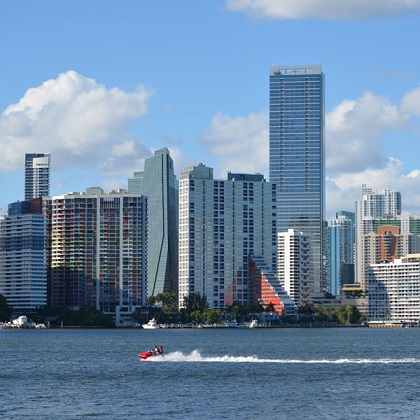
Now it is the time to remember a different, earlier storm, as it is the 25th anniversary of August 24, 1992 when Hurricane Andrew devastated the Caribbean region and the Greater Miami area; think almost $30 Billion in damages after 65 fatalities in the region. (This writer endured Andrew as a Miami resident). There are even more lessons to consider, contemplate and correlate to Caribbean stakeholders. As previously detailed, Miami has a pivotal connection with the Caribbean; as our member-states fail more and more, Miami becomes the beneficiary of our human and capital flight:

Miami’s Success versus Caribbean Failure

The “hoopla“ – historicity and actuality – of storms like Hurricane Andrew and Katrina reminds us …

… that Climate Change cannot be ignored. Even though there are deniers of any man-made causes, the reality of these storms challenge the realities of Caribbean life.

See this theme portrayed here in this current news article from USA Today, an American daily newspaper:

Title: In booming South Florida, another Hurricane Andrew could be a $300 billion catastrophe

CU Blog - Hurricane Andrew - 25 Years of Hoopla - Photo 3MIAMI — Twenty-five years ago this month, Hurricane Andrew unleashed its Category 5 wrath on South Florida, sending a catastrophic reminder about the dangers of living in the heart of “hurricane alley.”

But drive along any coastline in Florida today and you’ll find construction cranes as plentiful as palm trees as developers rush to build high-rises in the most beautiful, and vulnerable, corners of the state.

Florida has improved standards for new construction to prevent the level of damage wrought by hurricanes, but an Andrew-like storm hitting downtown Miami and its ever-growing collection of sparkling skyscrapers could exact a hefty price: $300 billion, according to one insurance underwriter.

“And that number doesn’t include loss of taxes or tourism,” said Monica Ningen, chief property underwriter for the U.S. and Canada for Swiss Re, one of the largest reinsurance companies in the world.

In the 25 years since Andrew made landfall on Aug. 24, 1992, nearly 1 in 10 homes built in the United States were built in Florida, according to an analysis of building permits conducted for USA TODAY by the real estate web site Trulia. That’s second only to Texas.

The trend is even more pronounced for larger condo buildings. Florida accounts for 11.5% of new residential buildings with at least five residences over the past 25 years, trailing only Texas’ 12.7%, according to the Trulia analysis.

“We’re like lemmings going to the sea, except that we build condos, hotels, and houses,” said Richard Olson, director of the International Hurricane Research Center at Florida International University.

The dangers of Florida’s post-Andrew growth is clearly illustrated in a report from Swiss Re that examined Florida’s vulnerability to hurricanes.

Andrew caused $24.5 billion in insured property damage when it hit the working class suburb of Homestead about 20 miles south of downtown Miami, becoming the most expensive catastrophe in U.S. history. Since then, Miami-Dade County’s population has increased by more than a third. Now, if a similar storm hit the same spot, Swiss Re estimates it would cause closer to $60 billion in insured damage.

High-rise condos could be Florida’s weak spot

Part of the reason for those massive numbers is the explosion of high-rise condos throughout the state.

Florida toughened up its building codes after Andrew and saw good results with the spate of four hurricanes that struck the state in 2004. But in 2005, Hurricane Wilma revealed a glaring weakness.

Wilma, as a Category 2 hurricane, was far weaker than Andrew when it crossed over Miami, but its 100 mph winds shattered windows throughout downtown. One reason: Wind speeds grow drastically the higher you go.

Wilma’s 75 mph winds on the ground grew to 115 mph on the 30th floor, according to a hurricane wind model created by Florida International University in Miami. No condos collapsed, but the window failures caused massive damage.

“The structure looks great from the outside, and yet, the building has to be gutted because of the water damage inside,” said Shahid Hamid, director of the Laboratory for Insurance, Financial and Economic Research at FIU.

Price of paradise

So with a catastrophic risk looming, why do Floridians continue to build such high structures right on the coast?

For developers, the answer is simple.

“Anybody that owns a piece of property should be able to do what they like with it, as long as they’re complying with the laws,” said Jeremy Stewart, a Crestview, Fla., developer and chairman of the Florida Home Builders Association.

CU Blog - Hurricane Andrew - 25 Years of Hoopla - Photo 4But developers aren’t just interested in the principles of individual freedom or property rights, says Craig Fugate, the former head of the Federal Emergency Management Agency. It comes down to money, Fugate says.

With each new glass-covered skyscraper that goes up along Florida’s coasts, developers reap a windfall of profits. The money drives businesses and puts taxes into government coffers.

Real estate attorneys, realtors, agents, architects, and contractors all get a piece. Every new condo that goes up in Pensacola or Tampa or Jacksonville means more tax revenues for those city governments. Florida is one of seven states that doesn’t collect personal income tax, so real estate taxes and fees included in every home purchase are critical to keep the state’s finances afloat.

Fugate said that has created a “vicious cycle” of transactions that the state has grown to rely on.

“Our economy is building houses, apparently,” said Fugate, who lives in northern Florida and used to run the state’s emergency management division before heading up FEMA. “Our bias now seems to be to the benefit of the transaction, not the homeowner.”

Some city leaders say it’s not that nefarious. In Miami Beach, the tourist mecca that is at the front line of Florida’s battles against climate change, leaders say the tax revenues from new developments are the only way they can afford to make the long-term improvements to gird the barrier island from rising water.

The city is in the midst of a $500 million project to raise roads, raise seawalls and install 80 pumps to push out floods that occur even on sunny days.

New York and New Jersey received billions in federal funding following Superstorm Sandy, just as New Orleans did following Hurricane Katrina. But since a hurricane hasn’t hit Miami and Miami Beach directly in decades, they are left to improve their infrastructure mostly on their own.

“On the one hand, we have to be responsible with our development,” said Miami Beach City Manager Jimmy Morales. “But on the other hand, we need that revenue. We’ve got to figure out how to pay for all that.”

Then there’s the way residents ponder the question. Ask Floridians why they’re willing to endure the threat of hurricanes and they’ll usually give some version of the same answer: They raise their arms and say, “Look around.”

Maria Lopez, 38, moved out of her home in Little Havana just outside downtown Miami 10 years ago as the rent increased and the neighborhood endured more and more flooding. Lopez said she never even considered leaving the city or the state, opting instead to find a home in nearby Liberty City that was elevated to avoid flooding and built to hurricane-proof building codes.

Lopez, a customs broker with two young sons, loves “the food, the culture, the climate.” But, she says, “You just have to know that a hurricane can hit.”

James Murley, the chief resilience officer for Miami-Dade County, agreed, saying the dangers of hurricanes and sea level rise are simply the price of living in paradise, just as Californians are willing to deal with the occasional earthquake.

“You have to live with the risk,” he said. “Why are they still building in San Francisco? Why are they still building in Los Angeles? They’re on established fault lines. Communities that have a history, they’re going to grow one way or the other.”

Grow smarter or inland?

With no slowdown in sight, experts say Florida has two remaining choices: grow farther from the coast or grow smarter.

Jean-Pierre Bardet, dean of the college of engineering at the University of Miami, said the only way that developers will stop building skyscrapers right along the water will come down to money.

Florida’s building codes have made construction more expensive over the years. And some developers have gone beyond those codes to create safer, and costlier, buildings.

For example, many new high-rises in Florida don’t have a street-level entrance for pedestrians. They begin with several floors of parking on the ground floors, then a lobby higher up, topped off by apartments or offices. That means only cars parked at those levels will be damaged if a hurricane pushes in storm surge or rising sea levels create more regular flooding.

Those kinds of measures are expensive, though, and Bardet said their prices will only increase as the projects become harder to engineer.

“The economic consideration will be what puts the brakes on this expansion,” he said.

Some cities and counties, including St. Petersburg, Palm Beach County and Miami, are taking a “smart growth” approach by hiring “resilience officers” or “sustainability managers” who devise growth plans that account for the potential environmental impacts of climate change.

James Cloar, an urban development consultant and former chairman of the Urban Land Institute Tampa Bay, said the people in those positions need broad power to control how a city grows.

“These offices are being created with good intentions, but I don’t think universally they’re at the level that they need to be,” he said.

Jane Gilbert, who became the city of Miami’s first chief resilience officer in 2015, said it’s been tough to persuade everyone of the value of such planning, but some government officials and private developers do see a long-term benefit.

“Luckily we have some progressively-minded developers, architects and land-use attorneys that get it,” she said. “(They understand) that if we don’t start building with a long term view, their investments are at risk.”

More: As Hurricane Andrew memories fade, Florida weakens building codes

More: ‘Extremely active’ hurricane season now likely, federal forecasters say

Source: Retrieved August 24, 2017 from: https://www.usatoday.com/story/news/2017/08/22/hurricane-cost-florida/560846001/

———-

VIDEO – Hurricane Season is getting more intense – https://usat.ly/2utG8JA

Posted August 22, 2017 – Forecasters at the National Oceanic and Atmospheric Administration have upped their predictions of the number of and severity of upcoming storms during hurricane season. Newslook.

The book Go Lean…Caribbean – available to download for free – serves as a roadmap for the introduction and implementation of the technocratic Caribbean Union Trade Federation (CU), for the elevation of Caribbean society, to better respond, relieve and rebuild from devastating hurricanes in all the 30 member-states in the region.

Remember? We cannot win in a battle with “Mother Nature”; we can only respond, relieve and rebuild.

This CU/Go Lean roadmap therefore has these 3 prime directives:

  • Optimization of the economic engines in order to grow the regional economy to $800 Billion and create 2.2 million new jobs.
  • Establishment of a security apparatus to ensure public safety and protect the resultant economic engines.
  • Improve Caribbean governance to support these engines, including a separation-of-powers between the member-states and CU federal agencies.

The book stresses that the problems of the Caribbean are too big for any one member-state alone to contend with, that reforming and transforming the Caribbean societal engines – to mitigate the risks of disasters – must be a regional pursuit. This was an early motivation for the roadmap, as pronounced in the opening Declaration of Interdependence (Pages 12 – 13):

i.  Whereas the earth’s climate has undeniably changed resulting in more severe tropical weather storms, it is necessary to prepare to insure the safety and security of life, property and systems of commerce in our geographical region. As nature recognizes no borders in the target of its destruction, we also must set aside border considerations in the preparation and response to these weather challenges.

xi. Whereas all men are entitled to the benefits of good governance in a free society, “new guards” must be enacted to dissuade the emergence of incompetence, corruption, nepotism and cronyism at the peril of the people’s best interest. The Federation must guarantee the executions of a social contract between government and the governed.

xvi. Whereas security of our homeland is inextricably linked to prosperity of the homeland, the economic and security interest of the region needs to be aligned under the same governance. Since economic crimes … can imperil the functioning of the wheels of commerce for all the citizenry, the accedence of this Federation must equip the security apparatus with the tools and techniques for predictive and proactive interdictions.

xxiv. Whereas a free market economy can be induced and spurred for continuous progress, the Federation must install the controls to better manage aspects of the economy: jobs, inflation, savings rate, investments and other economic principles. Thereby attracting direct foreign investment because of the stability and vibrancy of our economy.

The Go Lean book provides 370-pages of turn-by-turn instructions on “how” to adopt new community ethos, plus the strategies, tactics, implementations and advocacies to execute so as to reboot, reform and transform the societal engines of Caribbean society. The book details that the CU will implement an optimized Emergency Management scheme to provide better stewardship for the region’s preparation and response to natural disasters; (in addition to hurricanes, there is the need to monitor and manage earthquakesvolcanoes, floods and droughts in the regions).  In addition, the CU will assume jurisdiction for the Caribbean Sea, the 1,063,000 square-mile international waters, as an Exclusive Economic Zone. These preparations and mitigations will allow for better cooperation, collaboration and equalization in the region.

This commentary has previously detailed other discussions related to managing Caribbean society’s preparation and response to hurricanes; see sample here:

https://goleancaribbean.com/blog/?p=12068 Trump Denies ‘Climate Change’ and Ends Federal Abatements
https://goleancaribbean.com/blog/?p=11442 Caribbean Roots: Al Roker – ‘Climate Change’ Defender
https://goleancaribbean.com/blog/?p=9455 Fix ‘Climate Change’ – Yes, We Can
https://goleancaribbean.com/blog/?p=9334 Hurricane Categories – The Science
https://goleancaribbean.com/blog/?p=7896 The Logistics of Disaster Relief
https://goleancaribbean.com/blog/?p=7449 ‘Crap Happens’ – So What Now?
https://goleancaribbean.com/blog/?p=4741 Vanuatu and Tuvalu – Inadequate response to post-storm suffering
https://goleancaribbean.com/blog/?p=2465 Book Review: ‘This Changes Everything: Capitalism vs. the Climate’
https://goleancaribbean.com/blog/?p=1817 Caribbean grapples with intense new cycles of flooding & drought

Hurricane Andrew was not the first, nor the last hurricane to devastate the tropical region. Truth be told, this is a product of Climate Change. Though there are deniers of any man-made causes, the actuality of these storms is the new Caribbean reality.

It is what it is!

Yet still, with better stewardship and shepherding, our communities can be better and do better. We urge all Caribbean stakeholders to lean-in to this Go Lean roadmap to make our homeland a better place to live, work and play. 🙂

Download the free e-Book of Go Lean … Caribbean – now!

Sign the petition to lean-in for this roadmap for the Caribbean Union Trade Federation.

Share this post:
, , , ,
[Top]

Slave Trade – International Day of Rememberance – ENCORE

Today – August 23 – is a BIG day in Caribbean history; it is the “International Day for Remembrance of the Slave Trade and its Abolition“.

CU Blog - Encore - International Day of Remembrance for the Slave Trade - Photo 1

Yes, that is a real thing!

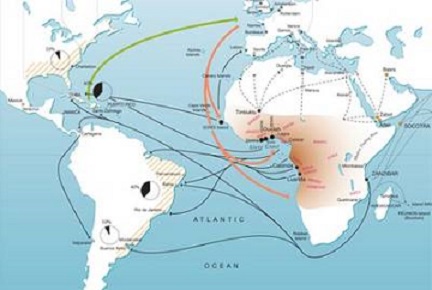
Not only was the Slave Trade a real thing, but so too this Remembrance. In fact the United Nations Educational Scientific and Cultural Organization (UNESCO) had actually commissioned an artist – Rodney Leon, an American architect of Haitian descent – to erect a monument, at the UN’s New York Headquarters, to highlight these 3 elements:

  • FIRST ELEMENT: “Acknowledge the tragedy” is a three dimensional map inscribed on the interior of the memorial. This map highlights the African continent at the centre of the slave trade and illustrates the global scale, complexity and impact of the triangular slave trade.
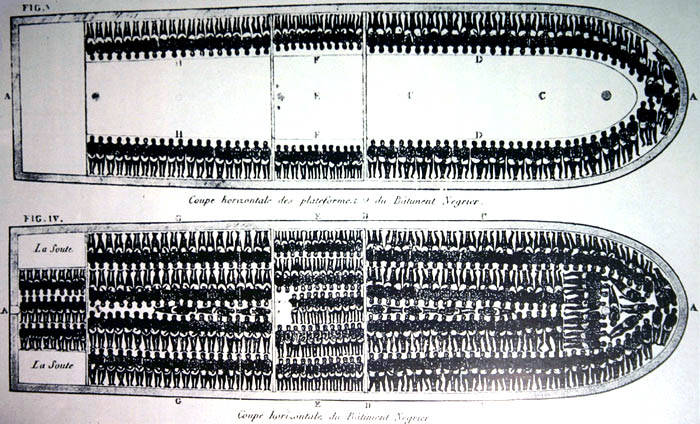
  • SECOND ELEMENT: “Consider the legacy” features a full-scale human replica carved out of black Zimbabwean granite. This element illustrates the extreme conditions under which millions of African people were transported during the middle passage. The sculpture represents the spirit of the men, women and children who lost their lives in the transatlantic slave trade.
  • THIRD ELEMENT: “Lest we forget” is a triangular reflecting pool where visitors can honour the memory of the millions of souls that were lost.

Source retrieved August 23, 2017 from: http://www.unesco.org/new/en/unesco/events/prizes-and-celebrations/celebrations/international-days/slave-trade-and-its-abolition-2017/the-ark-of-return-memorial/

The Memorial can be visited at:

      United Nations Visitors Plaza
      1st Avenue and 46th Street
      New York, NY 10017

———

VIDEO – The Ark of Return – https://youtu.be/sqeMLnxHmy4

Published on Jul 20, 2015 – United Nations – After winning a design competition sponsored by UNESCO in 2013, Rodney Leon’s masterpiece, the Ark of Return, which is the Permanent Memorial in honour of the Victims of Slavery and the Transatlantic Slave Trade, was officially unveiled in New York on 25th March 2015.

Category: News & Politics

License: Standard YouTube License

This commemoration is presented with an Encore of the blog-commentary from this day last year (2016) which detailed: “A Lesson in History – Haiti 1804“. This day in 1791 – when Haiti’s slave rebellion began – turns out to be a BIG day in that country’s history as well. See the Encore here:

—————————–

Go Lean Commentary – A Lesson in History – Haiti 1804

There are important lessons to learn from history. This commentary considers one particular lesson: the repercussions and consequences from Slavery and the Slave Trade.

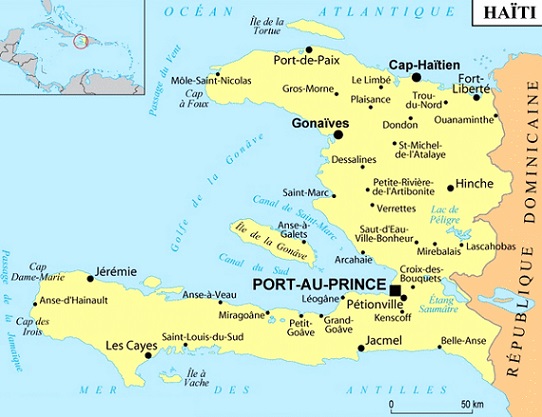
CU Blog - A Lesson in History - Haiti 1804 - Photo 3Today – August 23 – is the official commemoration of the Slave Trade, as declared by UNESCO (United Nations Educational Scientific and Cultural Organization). It measures the date that the 1791 Slave Rebellion in Haiti commenced.

“All of humanity is part of this story, in its transgressions and good deeds” – Irina Bokova, UNESCO Director-General

This is a very important lesson that we glean from this history, no matter our race or homeland. Let’s consider this lesson from the perspective of the Caribbean and for the benefit of Caribbean elevation.

In jurisprudence, there is the concept of felony murder.

… if a perpetrator robs a liquor store and the clerk has a heart-attack and dies, that perpetrator, once caught is tried for felony murder. The definition is the consequence of death in the act of committing a felony. What’s ironic is this charge would also apply if its a co-perpetrator that dies of the heart-attack rather than a victim-clerk.

This justice standard also applies with family discipline. If/when a child is being naughty and accordingly a sibling is unintentionally hurt, the naughty behavior will almost always be punished for the injury, because it was linked to the bad behavior.

A lesson learned from family discipline; and a lesson learned from criminal law. All of these scenarios present consequences to bad, abusive behavior. This sets the stage for better understanding of this important lesson from the international history of the year 1804. After 200 years of the Slave Trade, repercussions and consequences were bound to strike. This happened in the Caribbean country of Haiti. The following catastrophic events transpired in the decade leading up to 1804:

        • 1791 Slave Rebellion – See Appendix A below – A direct spinoff from the French Revolution’s demand for equality
        • Leadership of Louverture – As Governor-General, Toussaint Louverture sought to return Haiti to France without Slavery.
        • Resistance to Slavery – The French planned and attempted to re-instate Slavery
        • Free Republic – The first Black State in the New World
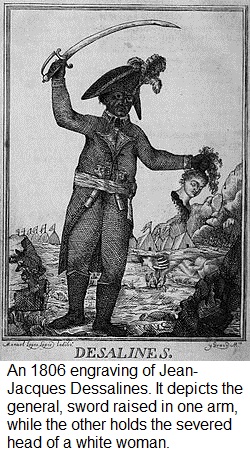
        • 1804 Massacre of the French – See Appendix B below – An illogical solution that killing Whites would prevent future enslavement. 

Make no mistake, the Massacre of 1804 – where 3,000 to 5,000 White men, women and children were killed – was a direct consequence of Slavery and the Slave Trade.

See VIDEO here of a comprehensive TED story:

VIDEO – The Atlantic Slave Trade: What too few textbooks told you – https://youtu.be/3NXC4Q_4JVg

Published on Dec 22, 2014 – Slavery has occurred in many forms throughout the world, but the Atlantic slave trade — which forcibly brought more than 10 million Africans to the Americas — stands out for both its global scale and its lasting legacy. Anthony Hazard discusses the historical, economic and personal impact of this massive historical injustice.
Lesson by Anthony Hazard, animation by NEIGHBOR.
View full lesson: http://ed.ted.com/lessons/the-atlanti…

  • Category – Education
  • License – Standard YouTube License

The review of the historic events is more than just an academic discussion, the book Go Lean…Caribbean aspires to economic principles that dictate that “consequences of choices lie in the future”. The book serves as a roadmap for the introduction and implementation of the technocratic Caribbean Union Trade Federation (CU). Haiti – the poorest country in the Western Hemisphere – is one of the 30 member-states for this Caribbean confederacy.

The people of the Caribbean need to understand the cause of this country’s decline and dysfunction; and by extension, the cause of dysfunction for the rest of the Caribbean. It is tied to the events of 1804. How will this lesson help us today?

        • Reality of the Legacy – The new Black State of Haiti was censored, sanctioned and scorned upon by all European powers (White people). According to a previous blog-commentary, to finally be recognized, France required the new country of Haiti to offset the income that would be lost by French settlers and slave owners; they demanded compensation amounting to 150 million gold francs. After a new deal was struck in 1838, Haiti agreed to pay France 90 million gold francs (the equivalent of €17 billion today). It was not until 1952 that Haiti made the final payment on what became known as its “Independence Debt”. Many analysts posit that the compensation Haiti paid to France throughout the 19th century “strangled development” and hindered the “evolution of the country”. The CU/Go Lean book assessed the near-Failed-State status of Haiti – “it is what it is”; Haiti is as bad as advertised – and then strategized solutions to reboot the economic-security-governing engines of this Republic.  
        • Security assurances must be enabled to complement economics objectives – Slavery was introduced to the New World as an economic empowerment strategy, though it was flawed in its premise of oppressing the human rights of a whole class of humans. The only way to succeed for the centuries that it survived was with a strong military backing – fear of immediate death and destruction. The CU/Go Lean premise is that economics engines and security apparatus must work hand-in-hand. This is weaved throughout the roadmap.
        • Minority Equalization – The lessons of slavery is that race divides societies; and when there is this division, there is always the tendency for one group to put themselves above other groups. Many times the divisions are for majority population groups versus minorities. If the planners of the new Caribbean want to apply lessons from Slavery’s history, we must allow for justice institutions to consider the realities of minorities. The CU security pact must defend against regional threats, including domestic terrorism. This includes gangs and their junior counterparts, bullies. The CU plans for community messaging in the campaign for anti-bullying and mitigations.
        • Reconciliation of issues are not optional, more conflict will emerge otherwise – The issues that caused division in Haiti where not dealt with between 1791 and 1803. A “Great Day of Reckoning” could not be avoided. The Natural Law instinct was to avenge for past atrocities – “an eye for an eye”. The CU/Go Lean roadmap accepts that an “eye for an eye” justice stance would result in a lot of “blindness”; so instead of revenge, the strategy is justice by means of Truth & Reconciliation Commissions – a lesson learned from South Africa – to deal with a lot of the  latent issues from the last Caribbean century (i.e. Cuba, Haiti, Dominican Republic, etc).

The purpose of the Go Lean roadmap is to turn-around the downward trends in the Caribbean today, to reverse course and elevate Caribbean society. The CU, applying lessons from best-practices, has prime directives proclaimed as follows:

        • Optimization of the economic engines in order to grow the regional economy to $800 Billion & create 2.2 million new jobs.
        • Establishment of a security apparatus to protect the resultant economic engines.
        • Improve Caribbean governance to support these engines.

The Go Lean book details a series of assessments, community ethos, strategies, tactics, implementations and advocacies to empower all the factions in the Caribbean region:

Community Ethos – Deferred Gratification Page 21
Community Ethos – Economic Systems Influence Choices & Incentives Page 21
Community Ethos – Consequences of Choices Lie in the Future Page 21
Community Ethos – “Crap” Happens Page 23
Community Ethos – Minority Equalization Page 24
Community Ethos – Ways to Impact the Future Page 26
Community Ethos – Ways to Manage Reconciliations Page 34
Community Ethos – Ways to Improve Sharing Page 35
Community Ethos – Ways to Promote Happiness Page 36
Community Ethos – Ways to Impact the Greater Good Page 37
Strategy – Vision –  Integrate region for Economics & Security Page 45
Strategy – Agents of Change – Globalization Page 57
Tactical – Separation of Powers – Department of Homeland Security Page 75
Tactical – Separation of Powers – Department of Justice Page 77
Implementation – Assemble Existing Super-national Institutions Page 96
Implementation – Ways to Pay for Change Page 101
Implementation – Foreign Policy Initiatives at Start-up Page 102
Implementation – Security Initiatives at Start-up Page 103
Implementation – Ways to Deliver Page 109
Implementation – Ways to Promote Independence Page 120
Planning – Ways to Make the Caribbean Better Page 131
Planning – Ways to Improve Failed-State Indices Page 134
Planning – Lessons from the US Constitution Page 145
Advocacy – Ways to Grow the Economy Page 151
Advocacy – Ways to Create Jobs Page 152
Advocacy – Ways to Better Manage the Social Contract Page 170
Advocacy – Ways to Foster Cooperatives Page 176
Advocacy – Ways to Impact Justice Page 177
Advocacy – Ways to Improve Homeland Security Page 180
Advocacy – Ways to Mitigate Terrorism Page 181
Advocacy – Ways to Protect Human Rights Page 220
Advocacy – Battles in the War on Poverty Page 222
Advocacy – Ways to Re-boot Haiti Page 238

Why bother with all this dark talk about Slavery and the Slave Trade?

UNESCO has provided a clear answer for this question with this declarative statement:

Ignorance or concealment of major historical events constitutes an obstacle to mutual understanding, reconciliation and cooperation among peoples. UNESCO has thus decided to break the silence surrounding the Slave Trade and Slavery that have concerned all continents and caused the great upheavals that have shaped our modern societies.

The subject of Slavery and the Slave Trade relates to economic, security and governing functioning in a society. The repercussions and consequences of 1804 lingers down to this day. There have been a number of blog-commentaries by the Go Lean promoters that have developed related topics. See a sample list here:

https://goleancaribbean.com/blog/?p=8724 Remembering African Nationalist Marcus Garvey: Still Relevant Today
https://goleancaribbean.com/blog/?p=7682 Frederick Douglass – Pioneer & Role Model for Single Cause: Abolition
https://goleancaribbean.com/blog/?p=7221 Street naming for Martin Luther King reveals continued racial animosity
https://goleancaribbean.com/blog/?p=5695 Repenting, Forgiving and Reconciling the Past Bad Deeds
https://goleancaribbean.com/blog/?p=5123 A Lesson in History – Royal Charters: Zimbabwe -vs- South Africa
https://goleancaribbean.com/blog/?p=4971 A Lesson in History – Royal Charters: Truth & Consequence
https://goleancaribbean.com/blog/?p=451 CariCom position on Slavery/Colonization Reparations

This commentary purports that there have been watershed events in history since the emergence of the slave economy. They include:

  • 1804 – Haiti’s Massacre of White Slave Advocates
  • 1861 – US Civil War – A Demonstration of the Resolve of the “Pro” and “Anti” Slavery Camps
  • 1914 – World War I: “Line in the Sand”
  • 1948 – United Nations Declaration of Human Rights

No doubt the Massacre of 1804 was a crisis. It was not wasted; it was used in a good way to escalate the abolition of the Slave Trade in 1807. It was also used in a bad way to justify further oppression of the African Diaspora in the New World.

A pivotal year.

Let’s learn from this year of 1804; and from the repercussions and consequences from that year. In many ways, the world has not moved! Racism and the suppression of the African race lingers … even today … in Europe and in the Americas.

Our goal is to reform and transform the Caribbean, not Europe or America. We hereby urge everyone in the Caribbean – people, institutions and governments – to lean-in to this Go Lean roadmap. It is time now to move. We must get the Caribbean region to a new destination, one where opportunity meets preparation. This is the destination where the Caribbean is a better homeland to live, work and play. 🙂

Download the book Go Lean … Caribbean – now!

—————

Appendix A Title: International Day for the Remembrance of the Slave Trade and its Abolition 2016

— Message from Irina Bokova, Director-General of UNESCO —

CU Blog - A Lesson in History - Haiti 1804 - Photo 1In the night of 22 to 23 August 1791, men and women, torn from Africa and sold into slavery, revolted against the slave system to obtain freedom and independence for Haiti, gained in 1804. The uprising was a turning point in human history, greatly impacting the establishment of universal human rights, for which we are all indebted.

The courage of these men and women has created obligations for us. UNESCO is marking International Day for the Remembrance of the Slave Trade and its Abolition to pay tribute to all those who fought for freedom, and, in their name, to continue teaching about their story and the values therein. The success of this rebellion, led by the slaves themselves, is a deep source of inspiration today for the fight against all forms of servitude, racism, prejudice, racial discrimination and social injustice that are a legacy of slavery.

The history of the slave trade and slavery created a storm of rage, cruelty and bitterness that has not yet abated. It is also a story of courage, freedom and pride in newfound freedom. All of humanity is part of this story, in its transgressions and good deeds. It would be a mistake and a crime to cover it up and forget. Through its project The Slave Route, UNESCO intends to find in this collective memory the strength to build a better world and to show the historical and moral connections that unite different peoples.

In this same frame of mind, the United Nations proclaimed the International Decade for People of African Descent (2015-2024). UNESCO is contributing to it through its educational, cultural and scientific programmes so as to promote the contribution of people of African descent to building modern societies and ensuring dignity and equality for all human beings, without distinction.
Source: Retrieved August 23, 2016 from: http://www.unesco.org/new/en/unesco/events/prizes-and-celebrations/celebrations/international-days/slave-trade-and-its-abolition/

Slave Ship

—————

Appendix B Title: 1804 Haiti Massacre

The 1804 Haiti Massacre was a massacre carried out against the remaining white population of native Frenchmen and French Creoles (or Franco-Haitians) in Haiti by Haitian soldiers by the order of Jean-Jacques Dessalines who had decreed that all those suspected of conspiring in the acts of the expelled army should be put to death.[1] Throughout the nineteenth century, these events were well known in the United States where they were referred to as “the horrors of St. Domingo” and particularly polarized Southern public opinion on the question of the abolition of slavery.[2][3]

The massacre, which took place in the entire territory of Haiti, was carried out from early February 1804 until 22 April 1804, and resulted in the deaths of between 3,000 and 5,000 people of all ages and genders.[4]

Squads of soldiers moved from house to house, torturing and killing entire families.[5] Even whites who had been friendly and sympathetic to the black population were imprisoned and later killed.[6] A second wave of massacres targeted white women and children.[6]

Writers Dirk Moses and Dan Stone wrote that it served as a form of revenge by an oppressed group that exacted out against those who had previously dominated them.[7]

Aftermath
By the end of April 1804, some 3,000 to 5,000 people had been killed[23] and the white Haitians were practically eradicated. Only three categories of white people, except foreigners, were selected as exceptions and spared: the Polish soldiers who deserted from the French army; the little group of German colonists invited to Nord-Ouest (North-West), Haiti before the revolution; and a group of medical doctors and professionals.[14] Reportedly, also people with connections to officers in the Haitian army were spared, as well as the women who agreed to marry non-white men.[23]

Dessalines did not try to hide the massacre from the world. In an official proclamation of 8 April 1804, he stated, “We have given these true cannibals war for war, crime for crime, outrage for outrage. Yes, I have saved my country, I have avenged America”.[14] He referred to the massacre as an act of national authority. Dessalines regarded the elimination of the white Haitians an act of political necessity, as they were regarded as a threat to the peace between the black and the colored. It was also regarded as a necessary act of vengeance.[23]

Dessalines was eager to assure that Haiti was not a threat to other nations and that it sought to establish friendly relations also to nations where slavery was still allowed.[26]Dessalines’ secretary Boisrond-Tonnerre stated, “For our declaration of independence, we should have the skin of a white man for parchment, his skull for an inkwell, his blood for ink, and a bayonet for a pen!”[27]

In the 1805 constitution, all citizens were defined as “black”,[28] and white men were banned from owning land.[23][29]

The 1804 massacre had a long-lasting effect on the view of the Haitian Revolution and helped to create a legacy of racial hostility in Haitian society.[28]

At the time of the civil war, a major reason for southern whites, most of whom did not own slaves, to support slave-owners (and ultimately fight for the Confederacy) was fear of a genocide similar to the Haitian Massacre of 1804. This was explicitly referred to in Confederate discourse and propaganda.[30][31]

The torture and massacre of whites in Haiti, normally known at the time as “the horrors of St. Domingo“, was a constant and prominent theme in the discourse of southern political leaders and had influenced American public opinion since the events took place.
Source: Retrieved August 22, 2016 from: https://en.wikipedia.org/wiki/1804_Haiti_massacre

CU Blog - A Lesson in History - Haiti 1804 - Photo 2


Share this post:
, , ,
[Top]

Lessons from Colorado: Legalized Marijuana – Heavy-lifting!

Go Lean Commentary

“Rocky Mountain High … Colorado” – Song verbiage from John Denver’s Rocky Mountain High – see Appendix A

CU Blog - Lesson from Colorado - Legalized Marijuana - Photo 1

This is a familiar refrain from a familiar song; a folk rock song written by John Denver and Mike Taylor about Colorado, and is one of the two official state songs of Colorado;[1] recorded by Denver in 1972, it went to #9 on the US Hot 100 in 1973; (source: Wikipedia). The song also made #3 on the Easy Listening chart …

But in 2017, the phrase “Rocky Mountain High” has a total different meaning, because the State of Colorado has since legalized recreational use of marijuana.

This is not an easy topic; this is heavy …

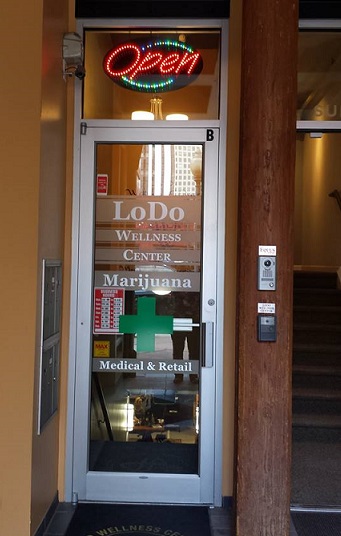
There are so many lessons we can learn from the debate, legalization, implementation, regulation and societal repercussions of this product in this State. All in all, it is heavy-lifting. This is the theme of this series of commentaries of lessons that have been learned by Caribbean stakeholders visiting, observing and reporting on the US State of Colorado. (All non-encyclopedic photos in this commentary were snapped in Colorado by Bahamian student Camille Lorraine).

We have so much in common and so much in contrast. One commonality to consider is how Colorado is now associated with marijuana consumption. See Appendix B VIDEO below.

“Welcome to our club”! This has always been the image of Caribbean people and culture – think: Rasta Man smoking Ganja; (marijuana is called ganja in Sanskrit and other modern Indo-Aryan languages.[173]).

Don’t like the imagery, reputation or sullied practice? Then welcome to societal development 2017; welcome to heavy-lifting.

This commentary continues the 5-part series on the subject of Lessons from Colorado. There are so many lessons that we must consider from this land-locked US State; good ones and bad ones. In fact, the full list of 5 entries are detailed as follows:

  1. Lessons from Colorado – Common Sense of Eco-Tourism
  2. Lessons from Colorado – Legalized Marijuana: Heavy-lifting!
  3. Lessons from Colorado – How the West Was Won
  4. Lessons from Colorado – Water Management Art & Science
  5. Lessons from Colorado – Black Ghost Towns – “Booker T. turning in his grave”

The book Go Lean…Caribbean calls for the elevation of Caribbean society, to re-focus, re-boot, and optimize all the societal engines so as to make the Caribbean a better place to live, work and play.  The movement behind this book wants to do the heavy-lifting to reform and transform Caribbean society. So we must tackle these “heavy” issues that others may just want to brush aside. As goes Colorado, soon the rest of the US – 4 states currently support recreational use of marijuana; many others support medical marijuana; in total 28 states will have some kind of legalization on the books).

“Marijuana legalization is now the norm for 40 percent of the American population.”

It is only a matter of time – considering American tourism, trade and Caribbean students matriculating in the US – when this debate comes to our door in the Caribbean.

Oops, too late!

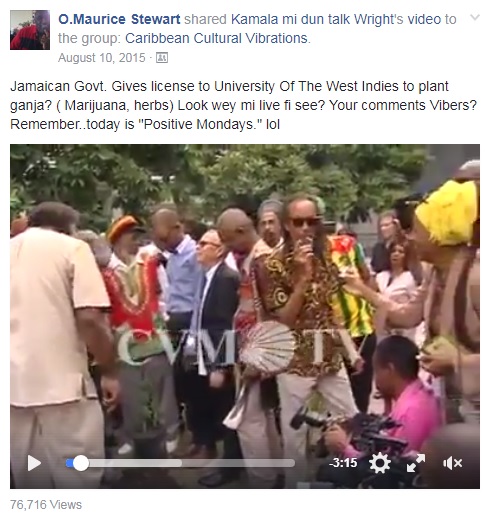
According to social media sites, there is already an outcry for regional leaders to consider some form of legalization or decriminalization in the Caribbean.

CU Blog - Lesson from Colorado - Legalized Marijuana - Photo 0

This issue has previously been addressed by planners of a new Caribbean stewardship – see here:

https://goleancaribbean.com/blog/?p=9646 ‘Time to Go’ – American Vices, i.e. Marijuana. Don’t Follow!
https://goleancaribbean.com/blog/?p=1386 Puff Peace – The Debate  for Marijuana in Jamaica

The book Go Lean…Caribbean – available to download for free – serves as a roadmap for the introduction and implementation of the technocratic Caribbean Union Trade Federation (CU), for the elevation of Caribbean society – for all member-states. This CU/Go Lean roadmap has these 3 prime directives:

  • Optimization of the economic engines in order to grow the regional economy to $800 Billion and create 2.2 million new jobs.
  • Establishment of a security apparatus to ensure public safety and protect the resultant economic engines.
  • Improve Caribbean governance to support these engines, including a separation-of-powers between the member-states and CU federal agencies.

The book stresses that reforming and transforming the Caribbean societal engines must be a regional pursuit. This was an early motivation for the roadmap, as pronounced in the opening Declaration of Interdependence (Pages 12 – 13):

xi. Whereas all men are entitled to the benefits of good governance in a free society, “new guards” must be enacted to dissuade the emergence of incompetence, corruption, nepotism and cronyism at the peril of the people’s best interest. The Federation must guarantee the executions of a social contract between government and the governed.

xvi. Whereas security of our homeland is inextricably linked to prosperity of the homeland, the economic and security interest of the region needs to be aligned under the same governance. Since economic crimes … can imperil the functioning of the wheels of commerce for all the citizenry, the accedence of this Federation must equip the security apparatus with the tools and techniques for predictive and proactive interdictions.

xxiv. Whereas a free market economy can be induced and spurred for continuous progress, the Federation must install the controls to better manage aspects of the economy: jobs, inflation, savings rate, investments and other economic principles. Thereby attracting direct foreign investment because of the stability and vibrancy of our economy.

The Go Lean book provides 370-pages of turn-by-turn instructions on “how” to adopt new community ethos, plus the strategies, tactics, implementations and advocacies to execute so as to reboot, reform and transform the societal engines of Caribbean society. According to that previous blog-commentary:

There are moral, religious, legal and psychological (treatment) issues associated with this topic; and there is history – good and bad. Any jurisdiction decriminalizing the use of marijuana has to contend with the previous messaging to the community of: “Just say no to drugs”.

The [Go Lean] book asserts that before the strategies, tactics, implementations and advocacies of a roadmap to elevate a society can be deployed, the affected society must first embrace a progressive community ethos. The book defines this “community ethos” as the fundamental character or spirit of a culture; the underlying sentiment that informs the beliefs, customs, or practices of society; dominant assumptions of a people or period. Think of the derivative term: “work ethic”.

Marijuana is a mood-altering drug; it has negative effects, one being preponderance for apathy, to tune out of any active engagement. In the US, even in the states where marijuana is legal, most firms/governments still screen staffers (new hires and veterans) and ban consumption of the drug. The reason is simple: Apathy does not make for industriousness. So this issue/drug presents a conundrum for the CU. The mission to grow the economy, promote industriousness, foster new jobs and new industries is pronounced early in the roadmap, detailed in the Declaration of Interdependence (Page 14) with this statement:

    xxvi. Whereas the Caribbean region must have new jobs to empower the engines of the economy and create the income sources for prosperity, and encourage the next generation to forge their dreams right at home, the Federation must therefore foster the development of new industries … In addition, the Federation must invigorate the enterprises related to existing industries … impacting the region with more jobs.

So to all you Caribbean stakeholders clamoring to follow Colorado’s lead … into the heavy-lifting of legalized marijuana use, we ask this one question:

Are you ready for this?

CU Blog - Lesson from Colorado - Legalized Marijuana - Photo 2

CU Blog - Lesson from Colorado - Legalized Marijuana - Photo 3

Thank you Colorado, for your fine role model. You have provided guidelines and learned-lessons that we can apply in our own jurisdictions. We learn that there are “pros” and “cons” to this controversial issue. Colorado authorities report that for 2016, they transacted over $1.1 Billion in marijuana sales for recreational and medicinal purposes; the State have collected $141 million in taxes, licenses and fees. The repercussions and consequences of legalized marijuana have not just been economic benefits, there have been public safety (security) incidents as well. Consider these headlines:

The Go Lean movement, as stewards of a new Caribbean, must answer the same question:

Are we ready?

No, our communities and societal engines (economics, security and governance) are NOT ready!

Yes, we accept the challenge; we hereby urge all Caribbean stakeholders – governments, law enforcement agencies, social and civic agencies – to lean-in to this Go Lean roadmap for how to make our Caribbean homeland a better place to live, work and play.

Our judgment now is that the Caribbean is not ready to sanction recreational marijuana use, but still …

… it is what it is.

We must be prepared and “on guard” for “bad actors” (and foreigners) to exploit the demand for this activity in our community. We are not trying to be Colorado, or to be America; no, we are trying to be better. 🙂

Download the free e-Book of Go Lean … Caribbean – now!

Sign the petition to lean-in for this roadmap for the Caribbean Union Trade Federation.

—————–

Appendix A – John Denver – Rocky Mountain High – https://youtu.be/eOB4VdlkzO4


Published on Apr 5, 2013 – John Denver’s official audio for ‘Rocky Mountain High’. Click to listen to John Denver on Spotify: http://smarturl.it/JohnDenverSpotify?…

As featured on The Essential John Denver. Click to buy the track or album via iTunes: http://smarturl.it/EssentialJD?IQid=J…
Google Play: http://smarturl.it/RMHGPlay?IQid=John…
Amazon: http://smarturl.it/EJDAmazon?IQid=Joh…

More from John Denver
Take Me Home, Country Roads: https://youtu.be/1vrEljMfXYo
Leaving On A Jet Plane: https://youtu.be/SneCkM0bJq0
Sunshine On My Shoulders: https://youtu.be/diwuu_r6GJE

More great 70s videos here: http://smarturl.it/Ultimate70?IQid=Jo…

Follow John Denver
Website: http://johndenver.com/
Facebook: https://www.facebook.com/JohnDenver
Twitter: https://twitter.com/johndenvermusic
Subscribe to John Denver on YouTube: http://smarturl.it/JohnDenverSub?IQid…
———
Lyrics:
He was born in the summer of his 27th year, coming home to a place he’d never been before.
He left yesterday behind him, you might say he was born again,
you might say he found a key for every door.
When he first came to the mountains, his life was far away on the road and hanging by a song.
But the string’s already broken and he doesn’t really care,
it keeps changing fast, and it don’t last for long.

And the Colorado Rocky Mountain high, I’ve seen it raining fire in the sky.
The shadows from the starlight are softer than a lullaby.
Rocky Mountain high, Colorado. Rocky Mountain high.

  • Category: Music
  • License: Standard YouTube License

—————–

Appendix B – Legalized: A Year In The Life Of Colorado’s Legal Weed Experiment | NBC News – https://youtu.be/B1cyfObqehI

Published on Nov 9, 2016 – Election night 2016 was a big night for the marijuana legalization movement as multiple states passed measures including recreations initiatives in California and Massachusetts. This piece documented the first year of Colorado’s legal weed experiment.

» Subscribe to NBC News: http://nbcnews.to/SubscribeToNBC
» Watch more NBC video: http://bit.ly/MoreNBCNews

NBC News is a leading source of global news and information. Here you will find clips from NBC Nightly News, Meet The Press, and our original series Debunker, Flashback, Nerdwatch, and Show Me. Subscribe to our channel for news stories, technology, politics, health, entertainment, science, business, and exclusive NBC investigations.

Connect with NBC News Online!
Visit NBCNews.Com: http://nbcnews.to/ReadNBC
Find NBC News on Facebook: http://nbcnews.to/LikeNBC
Follow NBC News on Twitter: http://nbcnews.to/FollowNBC
Follow NBC News on Google+: http://nbcnews.to/PlusNBC
Follow NBC News on Instagram: http://nbcnews.to/InstaNBC
Follow NBC News on Pinterest: http://nbcnews.to/PinNBC

Legalized: A Year In The Life Of Colorado’s Legal Weed Experiment | NBC News

Share this post:
, ,
[Top]

Back to the Future: Textbooks or Tablets in School?

Go Lean Commentary

CU Blog - Textbooks or Tablets in School - Photo 1Its back-to-school time … again.

That there – what you just did: reminiscing about your own back-to-school experiences – that is the problem. You see, we cannot project “our” back-to-school visuals on today’s students.

  • The world has changed;
  • Schools have to change;
  • Students have to change; and yes …
  • We – parents – must change too.

We have said it repeatedly in these commentaries: the Caribbean is “partying like it’s 1999” when in truth the world’s academic competition is clocking in at 2017.

Don’t believe it?

Look at all those high school students that graduated from their Caribbean high schools in 2017, 2016, 2015, etc.. Where are they now? For far too many Caribbean communities, a majority of those graduates have abandoned their Caribbean homes. Why? Our inability to compete.

So it should not be “Back to school” or “back to the status quo”, rather it should be …

“Back to the Future”.

The Caribbean must now transform to become a community that they have never been before; a community only envisioned for the future.

The future is now! Even textbooks are so “Old School”, while e-Textbooks are so new …

CU Blog - Textbooks or Tablets in School - Photo 2

This is the debate right now: Should schools continue to distribute textbooks or deploy tablets or PC’s (personal computers) for students’ course work?

This is a debate … everywhere – even here in the Caribbean – see this news article here from the local St Lucia Times Daily Newspaper:

News Article: Textbooks or Tablets in School?

(By Marie Miguel) There is a huge debate going on in schools all across the country. It is not about violence, bullying, drugs, or similar issues. The debate is whether schools should continue using text books or switch to using computer tablets. There are many good arguments on both sides, but the fact is, schools are doing it anyway, regardless of what the parents want. Of course, you have the choice whether to sign the paper saying it is alright for your child to use a tablet and be on the internet. However, if you do not sign that paper, your child will not get the same education as the rest of the class. The world has gone digital and there isn’t a whole lot you can do about it.

The Pros and Cons of Tablets in School
Here are some of the pros and cons of tablets in the classroom:

Pros

  • According to the United States Department of Education, students learn 30-80% faster with tablets.
  • A tablet can hold hundreds of books on one device as well as homework, files, and communication with the teachers. This means no more heavy backpacks or lost books.
  • E-books are up to 60% cheaper than printed books.
  • Children scored 30% higher on tests using a tablet rather than a textbook.
  • Tablets have interactive features that textbooks do not have such as a search function, highlighters, and a built-in dictionary and thesaurus.
  • Learning technology skills are important for their future.
  • Tablets can be automatically updated.
  • Students and schools save money on paper, pencils, and other items that tablets do not need.
  • Files on the tablet can be transferred to other electronic devices and portable data recorders. That means no more lost homework.
  • Students enjoy learning on tablets more than with textbooks so they learn more.

Cons

  • There are medical consequences with using tablets such as neck pain, back pain, carpal tunnel syndrome, dry eyes, blurred vision, headaches, and eye strain.
  • Textbooks are five times cheaper than tablets, including training teachers and buying software.
  • Tablets have a lot of distractions such as games, email, apps, and other websites the children can get onto instead of doing their work or listening to the teacher.
  • The brain is able to comprehend more when reading printed text rather than digital text. In fact, on average, people read digital text up to 30% slower than printed text.
  • Many students do not have (or cannot afford) sufficient internet service to use their tablets at home. That means homework is not going to get done.
  • Repairing a tablet costs a great deal more than fixing a book.
  • Textbooks do not get malware, spyware, freeze, crash, and cannot get hacked.
  • Tablets need to be charged and cannot last a whole school day.
  • Students are able to cheat or use shortcuts to do their schoolwork.
  • Some textbooks are still not available in digital format.

Time for a Solution
Many parents just do not want their children to use the internet. Some have never had the opportunity to experience the technological advances that are available to their children or they just do not understand. These feelings of inadequacy can make parents angry and ill-equipped to make a good decision for their children. Other parents are computer savvy but do not think their child is ready for the internet. It is important for these parents to have someone to talk to that understands these issues and can help them realize the benefits of letting their children learn computer skills. There are licensed professionals that parents and their children can talk to or chat with online or over the phone. Together they may be able to come to some kind of compromise that works out well for everyone.

Source: St Lucia Times – Daily Newspaper (Posted 08-03-2014) from:  https://stluciatimes.com/2017/08/03/textbooks-tablets-school

In a previous Go Lean commentary, it was detailed how a related issue, textbooks pricing, reflects American Capitalism – not free market economics – whereby the College Textbook industry is known for their abuses and classic Crony-Capitalism, (where public policy is set to benefit private parties). That commentary explained that since many college expenses are subsidized by governments (federal and state) by means of grants or low-interest, deferred student loans, the marketplace knows that governmental entities will pay…unconditionally, so textbook prices go up … and up.

So how do we move the community forward into the future while also being “on guard” for Crony-Capitalistic abuses?

As related in that commentary from August 25, 2014, the book Go Lean…Caribbean asserts that the Caribbean region must not allow the US to take the lead for our own nation-building, that American capitalistic interest tends to hijack policies intended for the Greater Good. The recommended strategy is to leverage the needs of all 30 countries (42 million people & 4 languages) with Group Purchasing and fully embrace e-Learning (e-Books and tablets).

This book, Go Lean… Caribbean – available to download for free – serves as a roadmap for the introduction and implementation of the Caribbean Union Trade Federation (CU), which represents change for the region. The CU/Go Lean roadmap has 3 future-focused prime directives:

  • Optimization of the economic engines – and the educational apparatus – in order to grow the regional economy and create 2.2 million new jobs.
  • Establishment of a security apparatus to protect the resultant economic engines.
  • Improve Caribbean governance – including primary, secondary and tertiary school administrations plus Group Purchasing Organizations – to support these engines.

The Go Lean roadmap provides turn-by-turn directions on how to leverage Group Purchasing and to elevate the Caribbean’s tertiary education systems as a whole. This roadmap is presented as a planning tool, pronouncing the collaborative benefits of a unified educational agenda with these early statements in the opening Declaration of Interdependence (Page 12 & 14):

viii. Whereas the population size is too small to foster good negotiations for products and commodities from international vendors, the Federation must allow the unification of the region as one purchasing agent, thereby garnering better terms and discounts.

xi. Whereas all men are entitled to the benefits of good governance in a free society, “new guards” must be enacted to dissuade the emergence of incompetence, corruption, nepotism and cronyism at the peril of the people’s best interest. The Federation must guarantee the executions of a social contract between government and the governed.

xix. Whereas our legacy in recent times is one of societal abandonment, it is imperative that incentives and encouragement be put in place to first dissuade the human flight, and then entice and welcome the return of our Diaspora back to our shores

xxi.  Whereas the preparation of our labor force can foster opportunities and dictate economic progress for current and future generations, the Federation must ensure that educational and job training opportunities are fully optimized for all residents of all member-states, with no partiality towards any gender or ethnic group. The Federation must recognize and facilitate excellence in many different fields of endeavor, including sciences, languages, arts, music and sports. This responsibility should be executed without incurring the risks of further human flight, as has been the past history.

xxvii.  Whereas the region has endured a spectator status during the Industrial Revolution, we cannot stand on the sidelines of this new economy, the Information Revolution. Rather, the Federation must embrace all the tenets of Internet Communications Technology (ICT) to serve as an equalizing element in competition with the rest of the world. The Federation must bridge the digital divide and promote the community ethos that research/development is valuable and must be promoted and incentivized for adoption.

The Go Lean book posits that even though education is a vital ingredient for Caribbean economic empowerment, there has been a lot of flawed decision-making in the past, both individually and community-wise. The vision in the Go Lean/CU roadmap is that of a confederation of the 30 Caribbean member-states doing the heavy-lifting of optimizing economic and education policies. The Go Lean book details those future-focused policies; and other ethos to adopt, plus the executions of the following strategies, tactics, implementations and advocacies to impact the tertiary education in the region:

Community Ethos – Deferred Gratification Page 21
Community Ethos – People Respond to Incentives Page 21
Community Ethos – Job Multiplier Page 22
Community Ethos – Lean Operations – Group Purchase Organizations Page 24
Community Ethos – Return on Investments (ROI) Page 24
Community Ethos – Ways to Impact the Future Page 26
Community Ethos – Ways to Foster Genius Page 27
Community Ethos – Ways to Promote Intellectual Property Page 29
Community Ethos – Ways to Close the Digital Divide Page 31
Community Ethos – Ways to Improve Sharing – Purchasing Cooperatives Page 35
Community Ethos – Ways to Impact the Greater Good Page 37
Strategy – Agents of Change – Technology Page 57
Strategy – Agents of Change – Globalization Page 57
Tactical – Separation of Powers – Education Department Page 85
Tactical – Separation of Powers – Labor Department – On Job Training Page 89
Implementation – Ways to Benefit from Globalization Page 119
Advocacy – Ways to Grow the Economy Page 151
Advocacy – Ways to Create Jobs Page 152
Advocacy – Ways to Improve Education Page 159
Advocacy – Ways to Impact Student Loans Page 160
Advocacy – Ways to Improve Governance Page 169
Advocacy – Ways to Foster Cooperatives Page 176
Advocacy – Ways to Improve Libraries Page 187
Appendix – Education and Economic Growth Page 258
Appendix – Measuring Education Page 266
Appendix – New Student Loan Scandal – Bad American Example Page 286
Appendix – India’s $35 Tablet– Good Model-Example Page 296

This is the assertion of the Go Lean book (Page 31): if there is a choice or debate between Textbooks versus Tablets, choose Tablets. This quest should be pursued aggressively by Caribbean stakeholders, welcoming any help from global foundations:

The Bottom Line on One Laptop Per Child (OLPC)
OLPC is a project supported by the Miami-based “One Laptop per Child Association” (OLPCA) and the Cambridge, MA-based OLPC Foundation (OLPCF), two U.S. non-profit organizations set up to oversee the creation of affordable educational devices for use in the developing world. The project was originally founded by MIT Professor Nicholas Negroponte and funded by member organizations like AMD, Chi Mei, eBay, Google, Marvell, News Corporation, Nortel, RedHat, & Quanta. In the first years of the project, the Association managed development and logistics, and the Foundation managed fundraising such as the Give One Get One campaign. In 2010 the Association set up a new office in Miami under Rodrigo Halaby, and currently oversees deployment and support for their XO-1.5 laptop and its successors, and country partnerships. The foundation, led by now Chairman Nicholas Negroponte, currently oversees development of future software and hardware, including the ARM based OLPC XO-1.75 laptop ($180) and the OLPC XO-3 tablet ($100).

Information on the official site of OLPC indicates that as of 2011 there were about over 2.4 million XO laptops delivered.

The Go Lean roadmap calls for bridging the Digital Divide and aligning with many not-for-profit foundations, of domestic and foreign sources. For example, the One Laptop Per Child movement – identified above – offers $200 laptops (or cheaper) for Third World countries. In addition, there are now $35 tablets emerging from India (Page 296Appendix OC). The plan is for the CU to steer foundations and philanthropic causes to impact this mission, to equip/train low-income Caribbean residents for computerized terminals and access.

CU Blog - Textbooks or Tablets in School - Photo 3

Tablets and e-Books should be all the rage. See here for the 8 Best Tablets for Students for 2017:

VIDEO – 8 Best Tablets For Students 2017 – https://youtu.be/7XqZIeDC-lU

Published on May 17, 2017
CLICK FOR WIKI ►► https://wiki.ezvid.com/best-tablets-f…
Please Note: Our choices for this wiki may have changed since we published this review video. Our most recent set of reviews in this category, including our selection for the year’s best tablet for students, is exclusively available on Ezvid Wiki.
Tablets for students included in this wiki include the dell venue 8 7000, amazon fire hd 8, lenovo tab 10, lg electronics g pad ii, microsoft surface pro 4, apple ipad pro, samsung galaxy tab s3, and asus zenpad z580c.
Most Recent Picks: https://wiki.ezvid.com/best-tablets-f…

The foregoing news article and VIDEO relate to topics that should be of serious concern for Caribbean planners. We want to foster an education agenda that propels the Caribbean’s best interest. We do not want to be parasites of the American hegemony; we want to be better. While the US is the world’s largest Single Market economy, we only want to model some of their examples.

Most importantly, we want our students to study at home, primarily, or at worst, remain in the region. This minimizes the risks of matriculating abroad and never returning – a frequent Caribbean dilemma.

All of these educational issues have been addressed in previous Go Lean blog-commentaries; consider this sample here:

https://goleancaribbean.com/blog/?p=11054 American Bad Model: Lower Ed!
https://goleancaribbean.com/blog/?p=10845 American Good Example: College Sports
https://goleancaribbean.com/blog/?p=10733 American Experiences: 150 Years of HBCU’s
https://goleancaribbean.com/blog/?p=9751 Where the Jobs Are – Animation and Game Design
https://goleancaribbean.com/blog/?p=8669 Detroit makes Community College free
https://goleancaribbean.com/blog/?p=2126 Where the Jobs Are – Computers Reshaping Global Job Market
https://goleancaribbean.com/blog/?p=9724 Bahamas Welcomes the New University
https://goleancaribbean.com/blog/?p=1698 STEM Jobs Are Filling Slowly
https://goleancaribbean.com/blog/?p=1470 College of the Bahamas Master Plan 2025 – Reach for the Lamp-Post
https://goleancaribbean.com/blog/?p=1433 Caribbean loses more than 70 percent of tertiary educated to brain drain
https://goleancaribbean.com/blog/?p=459 CXC and UK textbook publisher hosting CCSLC workshops in Barbados

The book Go Lean…Caribbean posits that many problems of the region – education, a most prominent issue – are too big for any one member-state to solve alone, that there is the need for the leverage of a wider Caribbean confederacy. The purpose of this Go Lean/CU roadmap is to make the Caribbean homeland, a better place to live, work, learn and play. This effort is more than academic, more than just future scheming; no, this must be a plan for today.

We first employ e-Learning … and all of its related arts and sciences. And do it now!

We need to better compete with the world; education and e-learning could be the great equalizer. The book projects a Cyber Caribbean (Page 127):

Forge electronic commerce industries so that the internet communications technology (ICT) can be a great equalizer in economic battles of global trade. This includes e-Government (outsourcing and in-sourcing for member-states systems) and e-Delivery, Postal Electronic Last Leg mail, e-Learning and wireline/wireless/satellite initiatives.

Strategically, the Go Lean roadmap posits that to succeed in the global marketplace, the Caribbean region must not only consume but rather also create, produce, and distribute intellectual property. So subjects like tablets and e-books are germane for our considerations. Tactics like Group Purchasing (GPO) makes it efficient and effective to minimize the associated costs of educating the general population, and specific learning needs.

These are hallmarks of the CU technocracy: policies that reflect a future-focus.

Now is the time for all of the Caribbean, the people and school administrations, to lean-in for the changes described in the book Go Lean…Caribbean. 🙂

Sign the petition to lean-in for this roadmap for the Caribbean Union Trade Federation.

Download the book Go Lean … Caribbean – now!

Share this post:
, , ,
[Top]

‘If it is going to be, it starts with me’

Go Lean Commentary

“If it is going to be, it starts with me” – Self-Help Mantra

This has become a common rallying cry for Social Justice advocates – see Appendix A below. It is a very simple, yet powerful concept; it asserts:

Want to change the world, first change yourself, then work on changing your community and your country!

This theme is sang in songs – consider Appendix B and this song here by Michael Jackson, the Late-Great King of Pop. He said the same, but in a more melodious tune:

I’m starting with the man in the mirror. I’m asking him to change his ways; and no message could be any clearer: If you want to make the world a better place, take a look at yourself and make a change.

VIDEO – Michael Jackson – Man In The Mirror (Official Video) – https://youtu.be/PivWY9wn5ps

Published on Oct 2, 2009

In keeping with the lyrical message of “Man in the Mirror,” which was strongly identified with Michael Jackson and reflective of his own philosophies, the short film features powerful images of events and leaders whose work embodies the song’s message to”make that change.” Rolling Stone praised the short film in 2014 as “a powerful statement to deliver to personality-driven MTV.”

Written by Siedah Garrett and Glen Ballard
Produced by Quincy Jones for Quincy Jones Productions
Co-Produced by Michael Jackson for MJJ Productions, Inc.
From the album Bad, released August 31, 1987
Released as a single January 16, 1988

THE SHORT FILM
Director: Don Wilson

Michael Jackson’s short film for “Man in the Mirror” was the third of nine short films produced for recordings from Bad, one of the best-selling albums of all time. The “Man in the Mirror” single hit No. 1 in four countries in 1988, topping the charts in the United States, Italy, Belgium and Poland and reaching Top 5 in Canada, Ireland and New Zealand. In the U.S., “Man in the Mirror” was the fourth of five consecutive No. 1 singles from one album on the Billboard Hot 100-making Michael the first artist to achieve this milestone.

“Man in the Mirror,” written by Siedah Garrett (Michael’s duet partner on “I Just Can’t Stop Loving You”) and Glen Ballard, is one of only two songs on Bad not written by Michael Jackson and, even though it wasn’t a song he wrote himself, it was a message that was strongly identified with him and reflective of his own philosophies, as demonstrated through his actions and expressed in some of his own lyrics. “‘Man in the Mirror’ has a great message,” he wrote in his 1988 memoir Moonwalk. “I love that song. ..Start with yourself. Don’t be looking at all the other things. Start with you. That’s the truth.” A review of Bad in Rolling Stone in 1987 called the song “among the half dozen best things Jackson has done.”

In contrast to Michael’s other short films of the Bad era, “Man of the Mirror” tells a story not through performance, but through powerful images of oppression, homelessness, hunger, police brutality and other ills of the world, as well as events and leaders of the 20th century whose work is reflective of the song’s message to “make that change.”

Follow the Official Michael Jackson Accounts:
Facebook – http://smarturl.it/mj_facebook?IQid=y…
Twitter – http://smarturl.it/mj_twitter?IQid=yt…
Spotify – http://smarturl.it/mj_spotify?IQid=yt…
Newsletter – http://smarturl.it/mj_newsletter?IQid…
YouTube – http://smarturl.it/mj_youtube?IQid=yt…
Website – http://smarturl.it/mj_website?IQid=yt…

  • Category: Music
  • License: Standard YouTube License

Changing one-self; changing the community and changing the world; these are great aspirations! This is such a familiar theme for the movement behind the book Go Lean … Caribbean. In a previous blog-commentary, the point was elaborated that if you “change the way you see the world; you change the world you see”. But that thesis was related to technology and Augmented Reality Holograms; in this commentary however, the focus is strictly on Self-Help, for oneself and the community.

There is the need to help Caribbean communities.

The 30 member-states of the Caribbean region are all in dire straits; some are even flirting with Failed-States status – think: Puerto Rico Bankruptcy, Spanish Caribbean territorial abandonment, deficient Westminster structures, unstable volcanic states, etc.. Our communities are plagued with defects and dysfunctions in the economic, security and governing engines of society. But these can be remediated; the Go Lean movement posits that the entire region can be reformed and transformed, however that effort is described as heavy-lifting.

Yes, the societal defects of the Caribbean can be fixed – remediated and mitigated – but “if it is going to be, it starts with me”; it is necessary for all stakeholders to engage in the effort to turn-around the Caribbean. To forge change, the region must consider top-down and bottoms-up approaches, so we need the multitude of Caribbean people (bottoms-up) and politicians and community leaders (top-down) to lean-in to this quest to turn-around the community. Yes, it starts with “me”, as in everyone.

The quest to turn-around the Caribbean is detailed in the book Go Lean…Caribbean – available to download for free – which serves as a roadmap for the introduction and implementation of the technocratic Caribbean Union Trade Federation (CU), for the elevation of Caribbean society – for all 30 member-states. This CU/Go Lean roadmap has these 3 prime directives:

  • Optimization of the economic engines in order to grow the regional economy to $800 Billion and create 2.2 million new jobs.
  • Establishment of a security apparatus to ensure public safety and protect the resultant economic engines.
  • Improve Caribbean governance to support these engines, including a separation-of-powers between the member-states and CU federal agencies.

The book stresses that reforming and transforming the Caribbean societal engines must be a regional pursuit. This was an early motivation for the roadmap, as pronounced in the opening Declaration of Interdependence (Pages 12 – 13):

xi. Whereas all men are entitled to the benefits of good governance in a free society, “new guards” must be enacted to dissuade the emergence of incompetence, corruption, nepotism and cronyism at the peril of the people’s best interest. The Federation must guarantee the executions of a social contract between government and the governed.

xvi. Whereas security of our homeland is inextricably linked to prosperity of the homeland, the economic and security interest of the region needs to be aligned under the same governance. Since economic crimes … can imperil the functioning of the wheels of commerce for all the citizenry, the accedence of this Federation must equip the security apparatus with the tools and techniques for predictive and proactive interdictions.

xxiv. Whereas a free market economy can be induced and spurred for continuous progress, the Federation must install the controls to better manage aspects of the economy: jobs, inflation, savings rate, investments and other economic principles. Thereby attracting direct foreign investment because of the stability and vibrancy of our economy.

The Go Lean book provides 370-pages of turn-by-turn instructions on “how” to adopt new community ethos, plus the strategies, tactics, implementations and advocacies to execute so as to reboot, reform and transform the societal engines of Caribbean society.

You must be the change you want to see in the world – Mahatma Gandhi.

CU Blog - 'If it is going to be it starts with me' - Photo 2

This quotation from Mahatma Gandhi relates to the theme of this commentary: “if it is going to be, it starts with me”.

Yes, the Revival the Caribbean needs must start with me! See song in Appendix B.

Other communities have successfully reformed and transformed; we can as well. This point has been conveyed in many previous blog-commentaries; consider this sample:

https://goleancaribbean.com/blog/?p=12322 Lesson from Canada – Ferries help Economics, Security & Governance
https://goleancaribbean.com/blog/?p=11386 Building Better Cities
https://goleancaribbean.com/blog/?p=10513 Lesson from India – Transforming ‘Money’ Countrywide
https://goleancaribbean.com/blog/?p=6563 Lessons from Iceland – Model of Recovery
https://goleancaribbean.com/blog/?p=4587 Burlington, Vermont: First city to be powered 100% by renewables
https://goleancaribbean.com/blog/?p=3490 How One Entrepreneur Can Rally a Whole Community
https://goleancaribbean.com/blog/?p=3326 M-1 Rail: Alternative Motion in the MotorCity
https://goleancaribbean.com/blog/?p=1918 Philadelphia Freedom – We can Look, Listen and Learn
https://goleancaribbean.com/blog/?p=1731 Lesson from Omaha – One Person Forging Change
https://goleancaribbean.com/blog/?p=1596 ‘Prospering Where … Planted’

This is not just idle talk. No, it is a viable plan – a roadmap – that is a conceivable, believable and achievable. The Go Lean book offers the turn-by-turn directions for strategies, tactics and implementations. So with the commitment of time, talent and treasuries of everyone in the Caribbean – or maybe just 1 person: “me” or “you” –  we can succeed in making our homeland a better place to live, work and play. 🙂

Download the free e-Book of Go Lean … Caribbean – now!

Sign the petition to lean-in for this roadmap for the Caribbean Union Trade Federation.

———-

Appendix A – PhD Dissertation

If It’s to Be, It Starts With Me!

The Bidirectional Relation between Goals and the Self

Inaugural-Dissertation

zur Erlangung der Doktorwürde der
Philosophischen Fakultät II

Der Julius-Maximilians – University of Würzburg

URL: https://opus.bibliothek.uni-wuerzburg.de/files/3501/PetraMarkelDissertation.pdf

———-

Appendix B VIDEO – Tim Timmons – Starts With Me – https://youtu.be/pslWA2VRmxg  

Published on Apr 29, 2013 – Download the song now: http://hyperurl.co/2fmddf

Subscribe: http://hyperurl.co/ilhqdq

Share this post:
, ,
[Top]

The Wait Ended – This Day Last Year – ENCORE

Time flies … when you’re having fun – Old Adage

This has been the case in the last 12 months. On  this day – July 27 – in 2016, the facility to download the book Go Lean … Caribbean finally became available.

Hip Hip Hooray!

We have not stood still since then. We have re-published the main Go Lean website into all 4 Caribbean languages – Dutch, English, French and Spanish – and published 180 more blog-commentaries.

Here below is an Encore of that original blog-commentary that announced the functionality to download the e-Book.

——————

Go Lean Commentary

“Now I tired waiting”.

Book CoverThe book Go Lean … Caribbean is now available to download as an e-Book … for free.

Get the e-Book here NOW!

What is the big deal?

Well, this book purports to be the answer … for what ails the Caribbean.

The book asserts that the Caribbean is in crisis; that the region of 42 million people in the 30 member-states is dysfunctional … to the point of flirting with Failed-State status. It is that serious!

The book posits that one identifying symptom is the high societal abandonment rate. The countries of the Caribbean region are experiencing a brain drain where 70 percent – on the average – of the tertiary-educated have fled for foreign shores.

70% …
… this is no way to nation-build.

Brain Drain 70 percent ChartThese alarming abandonment rates have been communicated to the governments and leaders of the region and yet still, the problem persists. They have not taken action to curb the problem.

Comes now the book Go Lean…Caribbean. This serves as a roadmap for the introduction and implementation of the technocratic Caribbean Union Trade Federation (CU). This 370-page publication presents the solutions for all the region, all the 4 language groups (Dutch, English, French and Spanish) by describing 144 different missions to elevate the economic, security and governing engines of the region. This is a serious answer to a serious crisis.

This book is published by a community development foundation made up of mostly Caribbean Diaspora. These ones have grown tired of waiting.

“Now I tired waiting”?
I’ve come to fix the …

This familiar refrain in the Caribbean has been repeated time and again, even sang in melody and rhyme. See/listen here, the classic Calypso song from the legendary Mighty Sparrow (and the lyrics in the Appendix below):

VIDEOMighty Sparrow – Mr. Walker – https://youtu.be/i5d9WzncTew

Published on Oct 22, 2012 – This song describes a frustrated man who was promised to marry a  “not so beautiful” woman, but who was more prosperous economically than himself. This is presented here as a metaphor, of the frustration of waiting for change and finally taking positive action to effect the change oneself.
Album : Party Classics. 1986
All ownership belong to the copyright holder. There is no assumption of infringement here.

The Caribbean Diaspora – living abroad in the US, Canada and Western Europe – were always taught to believe that the Caribbean is the greatest address on the planet, and yet it was essential that they leave to forge an existence elsewhere. They have endured in these foreign lands, but they are still only alien residents.  It is not home!

If only there were some solutions for their homeland?

Solutions for the Caribbean are the prime directives of the Go Lean/CU roadmap; just consider these:

  • Optimization of the economic engines in order to grow the regional economy to $800 Billion & create 2.2 million new jobs.
  • Establishment of a security apparatus to ensure public safety and protect the resultant economic engines.
  • Improve Caribbean governance to support these engines.

Puerto Rico Flag

The quest of the Go Lean/CU roadmap is direct: to make the Caribbean a better place to live, work and play. The book presents how this quest is conceivable, believable and achievable. It posits that the foundation is now in place, and we only need some technocratic deliveries to move the Caribbean member-states from the current status quo to the new destination: a better homeland. This presents a solution where our youth will no longer have to leave, and our older generations can relish a return back home.

“Now I tired waiting”, I come to fix … “the situation”. We now present you the “fix”!

🙂

Download the e-Book of Go Lean … Caribbean – free … now!

———–

Appendix – Lyrics: Mighty Sparrow – Mr. Walker

She ugly yes, but she wearing them expensive dress
The People say she ugly, but she father full a money
Oh Lord Mamma, woy woy

Good morning Mister Walker
I come to see your daughter
Oh, Mister Walker!
I come to see your daughter
Sweet Rosemarie, she promise she gone marry me
And now I tired waiting!
I come to fix the wedding

After the wedding day, I don’t care what nobody say
Everytime I take a good look at she face I see a bankbook
Oh Lord Mamma, woy woy

Good morning Mister Walker
I come to see your daughter
Hmm, Mister Walker!
I come to see your daughter
Sweet Rosemarie, she promise she gone marry me
And now I tired waiting!
I come to fix the wedding, woy

Apart from that, they say how she so big and fat
When she dress they tantalize she, saying monkey wearing mini
Oh Lord Mamma, woy woy

Good morning Mister Walker
I come to see your daughter
Oy, Mister Walker!
I come to see your daughter
Sweet Rosemarie, she promise she gone marry me
And now I tired waiting!
I come to fix the wedding, Hmm

All I know, is I don’t intend to let she go
Cause if she was a beauty, nothing like me could get she
Oh Lord Mamma, woy woy

Good morning Mister Walker
I come to see your daughter
Oy, Mister Walker!
I come to see your daughter
Sweet Rosemarie, she promise she gone marry me
And now I tired waiting!
I come to fix the wedding, oh

Source: Retrieved July 27, 2016 from: http://www.lyricsmode.com/lyrics/m/mighty_sparrow/mr_walker.html

Share this post:
, , , ,
[Top]

State of the Union – Annexation: French Guiana

Go Lean Commentary

CU Blog - State of the Union - Annexation - French Guiana - Photo 0

There is the Big Dogthe Alpha – and then there are the other dogs. While this is just nature, it also applies to the societal developments. In the Caribbean region, for example, there is the Big Dog of the United States of America dominating the region? Who is next? The British and …

The French.

This does not refer to just these French Caribbean islands, but rather the whole Republic of France, in which these Caribbean member-states are considered Overseas Departments (administrative sub-sets of the national government); see census numbers here:

Member –State Land Area (Mile2) Population GDP Millions GDP Per Capita
Guadeloupe 1,628 405,000 $6,169 $21,780
Martinique 1,128 402,000 $9,610 $24.118
Saint Barthélemy 21 8,938 $255 $37,000
Saint Martin 53 35,925 $599 $20,600
French Guiana 32,253 250,109 $4,900 $20,000
Republic of France 248,573 66,991,000 $2,833,000 $43,652

There is one French territory in this region that is NOT included in the roadmap for Caribbean confederation, as described in the book Go Lean … Caribbean. This refers to French Guiana, the territory on the mainland of South America, adjacent to Suriname; see photo above.

While the US is Number 1 in the world for Single Market economies, the French is shortly behind; (UK #9; France #10; The Netherlands #28). In the Caribbean, the French structure calls for the administrative designation of an overseas departments that have identical powers to those of the regions of metropolitan France. (This is different than overseas collectivities which is the particular status of Saint Barthélemy and Saint Martin). As integral parts of the French Republic, an overseas department is represented in the National AssemblySenate and Economic and Social Council, elect a Member of the European Parliament (MEP), and use the Euro as their currency.

So nowadays, Guiana is fully integrated in the French central state; they are even a part of the European Union, and its official currency is the Euro. The region is the most prosperous territory in all of South America with the highest GDP per capita.[2] A large part of Guiana’s economy derives from the presence of the Guiana Space Centre, now the European Space Agency‘s primary launch site near the equator. As elsewhere in France, the official language is French, but each ethnic community has its own language, of which Guianan Creole is the most widely spoken.

French Guiana and the European Space Agency were prominently featured in the Go Lean book – Page 105; see Appendix below – as a model for Self-Governing Entities (SGE). The hope – as expressed in the book – was that this territory would someday join the regional neighborhood.

French Guiana is complete administratively, but still features a lot of societal defects – not colonial de jure; but colonial de facto. It is the opinion of this Go Lean commentary, that this homeland needs … its neighbors: regional integration, which is the best strategy for anti-colonialism. See this VIDEO and news article here, highlighting the blatant discord there in that territory:

VIDEO – French Guiana Marches Against Colonialism – https://videosenglish.telesurtv.net/player/653436/french-guiana-marches-against-colonialism/?aspectratio=auto

General Strike and National Protest on March 28, 2017

———-

Opinion Article – How Racism Hampers Health Care in French Guiana
By: Estelle Carde

Limited access to health care is exacerbated by everyday discrimination based on ethnicity and national origin.
Oft-overlooked French Guiana, one of France’s five overseas departments, has suddenly captured international media attention. And the news from this small South American territory is not good.

Crime, overcrowding in schools and hospitals, unemployment, the cost of living and slums have reached alarming levels.

Citizen discontent led to a massive demonstration this March, the most intense such strike since 2009. Demonstrators are asking for a $US2.7 billion emergency aid package from the French government to assist in the territory’s social and economical crisis.

CU Blog - State of the Union - Annexation - French Guiana - Photo 2

Health care is a particular concern in the former penal colony of 276,000 people. Hospitals are under-staffed and technical facilities are lacking. In some areas, the nearest hospital is a two-day canoe trip away.

CU Blog - State of the Union - Annexation - French Guiana - Photo 1

The recent deaths of five premature babies from infection at Cayenne hospital, in the capital, have heightened concerns.

But there’s one critical health care-related issue that almost no one is talking about: racism. In a diverse territory comprised of people of European, African, Asian and Indigenous descent and a growing immigrant population, limited access to health care is exacerbated by everyday discrimination based on ethnicity and national origin.

Too many foreigners?
Foreign-born residents of French Guiana are among those impacted by discrimination in the health-care system.

Though socioeconomically the territory lags severely behind the rest of France, French Guiana constitutes a regional haven of wealth whose attractiveness has grown since the 1960s. Today, more than one in three inhabitants is born abroad. People from Suriname, Brazil and Haiti represent the largest immigrant groups.

This “tidal wave” of immigration is often cited as the main cause of French Guiana’s current socioeconomic crisis, even in some French political circles. The discriminatory behaviours that sometimes result from such widespread immigrant-blaming may be only thinly veiled.

State health office assistants might apply stricter conditions than legally necessary to those seeking medical benefits. Some, for instance might ask the foreign-born applicants to give proof of longer residency than required by law, thinking that it will discourage them from settling in the territory.

The same arguments are, in fact, used to justify similar discriminatory practices against immigrants in mainland France, too. But in Guiana they are more openly displayed.

Ethnic categorizations
Immigrants are not the only group that experiences discrimination in accessing health care in French Guiana. Members of minority populations, whether they are French or not, can also be affected.

This is partly because in French Guiana, people commonly use ethnicity to identify themselves and others. Creole, Maroon, Amerindian, Hmong, Chinese or French Métropolitains (mainlanders) are frequently invoked categories.

Under French law, the government cannot collect data or use it based on ethnicity. But in Guiana such usage goes back to the territory’s early times as a slave colony.

And, of course, each grouping comes with its stock of stereotypes: “Maroons are child-like”, for instance, or “Hmongs are disciplined” and “Amerindians drink their dole money”.

But these assumptions are not set in stone. Because they serve to justify power relations between groups, they tend to change with the ethnic identity of the speaker. This social dynamic plays out in French Guiana’s health-care system.

In Saint-Laurent-du-Maroni, French Guiana’s second largest city, Maroons – the descendants of escaped former slaves – are the majority population and therefore the largest group of health-care users. Health-care professionals, on the other hand, are primarily Creoles or French mainlanders.

CU Blog - State of the Union - Annexation - French Guiana - Photo 3

These professionals often point to the Maroon people’s history to explain certain patient behaviours. In the 18th and 19th centuries, slaves who escaped from plantations would hide in the forest, creating communities that remained more or less isolated from coastal Guianese society for almost 200 years.

In 1969, the large territory they still occupy – mainly tropical forests in the country’s interior – was finally integrated into the Department of Guiana. At that point, they began to gain access to French citizenship and public services such as education and health.

Doctors, nurses and other health professionals readily highlight these facts to explain Maroons’ difficulties in accessing treatment, inferring that they are not yet used to doing things “the Western way.”

‘Them’ and ‘us’
Such references to historical facts are charged with connotations. Some Creole professionals suggest that Maroon people are undeserving of care because they only had to “leave their forest” to access to such services. Contrasting that status with their own position as “Guianese taxpayers” who fund these services, some may use this as justification to refuse Maroon people help in accessing treatment.

This attitude can be better understood considering the Creole people’s own history in French Guiana. Their process of accessing civil rights was slow and gradual. Social empowerment came only at the tail end of a gradual Westernisation process that began with slavery in the 17th century.

After emancipation and the granting of French citizenship in 1848, this population slowly rose to local economic and political power, spurred along by Guiana’s transformation into a French department (1946) and a national policy of decentralisation (1982).

Now hard-won Creole dominance is threatened by Maroon people, who recently obtained the same civil rights as them, and whose numbers have surpassed their own numbers in the Western part of Guiana.

Health professionals from the French mainland, for their part, tend to emphasise the “cultural differences” of these “new citizens”. They cite, for example, the “traditional” way in which Maroons transmit information (watching without asking questions) and their way of “living in the moment” to explain their apparent inability to request health coverage prior to needing treatment.

This tendency to highlight cultural differences can also end up amounting to discrimination because it overshadows systemic failures that do impact access to health care, such as the lack of health coverage offices in the country’s rural inland regions. This tendency is more present among professionals who have been in Guiana for just a few months and who readily admit to being allured by the very different culture of this “exotic” overseas corner of France.

Discriminatory behaviours among health professionals therefore exacerbate the failures of the ailing health-care system now under protest by Guianese demonstrators. Foreigners and Maroon people are the first victims of administrative failures due to their vulnerable socioeconomic status. They are also worst hit by geographical obstacles because they represent a majority of inhabitants in the territory’s remote rural areas.

But this accumulation of racist, economic and geographical inequalities is no accident. It is the result of centuries of history of Guianese society.

Source: TeleSur Media Network – Published April 13, 2017; retrieved July 26, 2017 from: http://www.telesurtv.net/english/opinion/How-Racism-Hampers-Health-Care-in-French-Guiana-20170413-0007.html

——-

Translated from the French by Alice Heathwood for Fast for Word.

Estelle Carde is a professor of Sociology of Health at Université de Montréal.

This article was originally published on The Conversation. Read the original article.

RELATED:
Guiana Workers ‘Toughen Up’ Mobilizations Against French State 

This theme – “All is not well in the Caribbean” – aligns with the movement behind the book Go Lean … Caribbean, where the assertion is that the problems facing the Caribbean region are too big for any one member-state alone. There needs to be a regional solution. The book posits that shifting the help-seeking responsibility to a region-wide, professionally-managed, deputized technocracy will result in greater production and greater accountability. This deputized agency is the Caribbean Union Trade Federation (CU). The Go Lean book serves as a roadmap for the introduction and implementation of the CU.

This commentary is a follow-up to the 5-part series on the subject of the State of the Caribbean Union. Our Caribbean region is unique in that there are 4 different languages and 5 colonial legacies, spread across 30 member-states and 42 million people. The goal is to execute the 5-year plan of the roadmap and then add a 31st member: French Guiana. Based on the dispositions in the foregoing VIDEO and news-opinion article, French Guiana can use the Go Lean empowerments NOW! That land is suffering from many of the same dysfunctions that plague the rest of the Caribbean and the neighboring states of Suriname and Guyana. There might be the need to act NOW to seek refuge and relief.

The other 5 entries in the series are as follows:

Just the phraseology “Caribbean Union” assumes a collective collaboration of all the territories that identify with Caribbean culture; there is the need for better local stewardship. This Go Lean effort is a confederation of sovereign and non-sovereign territories, as is the case for French Guiana. There is no need for independence, as the authority of these territories can still be deputized into the CU as an umbrella intergovernmental organization. In total, the Go Lean/CU roadmap will employ strategies, tactics and implementations to impact its prime directives; identified with the following 3 statements:

  • Optimization of the economic engines in order to grow the regional economy to $800 Billion & create 2.2 million new jobs.
  • Improvement of Caribbean governance to support these engines, including a “Separation-of-Powers between CU federal agencies and Caribbean member-state governments”; so the limitations of national laws in a member-state does not have to override the CU. A CU constitution would apply to the installation – and continuation – of Exclusive Economic Zones (EEZ) and Self-Governing Entities (SGE) that operate in controlled bordered territories like campuses, industrial parks, research labs and industrial plants.

The Go Lean/CU roadmap always anticipated the French Caribbean territories. This theme was detailed in previous Go Lean blog-commentaries; consider this sample:

https://goleancaribbean.com/blog/?p=12466 Managing Volcanoes in the French Caribbean – Martinique and Guadeloupe
https://goleancaribbean.com/blog/?p=10554 Welcoming the French in Formal Integration Efforts
https://goleancaribbean.com/blog/?p=10043 Caribbean Integration Plan for Greater Prosperity
https://goleancaribbean.com/blog/?p=7834 French Caribbean ready for the Martinique Surf Pro
https://goleancaribbean.com/blog/?p=382 Guadeloupe, Martinique, St Maarten Join the Association of Caribbean States

Now the status of the French Caribbean is indistinguishable from colonial status. All authority still rest in Paris. But there is an opportunity for more (and better) autonomous governance in the region. As depicted in these previous commentaries, this opportunity is extended for the French Caribbean to align with the rest of the Caribbean region to adopt strategies, tactics and implementations to assuage the societal dysfunctions … together.

This quest of optimizing the entire Caribbean economic-security-governance eco-system is more than just a dream; this was the motivation for the origins of the Go Lean movement. This vision is defined early in the book (Pages 12 & 13) in the following pronouncements in the Declaration of Interdependence:

ix. Whereas the realities of healthcare and an aging population cannot be ignored and cannot be afforded without some advanced mitigation, the Federation must arrange for health plans to consolidate premiums of both healthy and sickly people across the wider base of the entire Caribbean population. The mitigation should extend further to disease management, wellness, mental health, obesity and smoking cessation programs. …

xi. Whereas all men are entitled to the benefits of good governance in a free society, “new guards” must be enacted to dissuade the emergence of incompetence, corruption, nepotism and cronyism at the peril of the people’s best interest. The Federation must guarantee the executions of a social contract between government and the governed.

xii. Whereas the legacy in recent times in individual states may be that of ineffectual governance with no redress to higher authority, the accedence of this Federation will ensure accountability and escalation of the human and civil rights of the people for good governance, justice assurances, due process and the rule of law. As such, any threats of a “failed state” status for any member state must enact emergency measures on behalf of the Federation to protect the human, civil and property rights of the citizens, residents, allies, trading partners, and visitors of the affected member state and the Federation as a whole.

xxii. Whereas the heritage of our lands share the distinction of cultural tutelage from European and American imperialists that forged their tongues upon our consciousness, it is imperative to form a society that is neutral and tolerant of the mother tongue influences of our people to foster efficient and effective communications among our citizens.

xxiii. Whereas many countries in our region are dependent Overseas Territory of imperial powers, the systems of governance can be instituted on a regional and local basis, rather than requiring oversight or accountability from distant masters far removed from their subjects of administration. The Federation must facilitate success in autonomous rule by sharing tools, systems and teamwork within the geographical region.

xxiv. Whereas a free market economy can be induced and spurred for continuous progress, the Federation must install the controls to better manage aspects of the economy: jobs, inflation, savings rate, investments and other economic principles. Thereby attracting direct foreign investment because of the stability and vibrancy of our economy.

The Go Lean book posits that the inefficient Caribbean communities – French Guiana included – can be reformed and transformed if they adopt the community ethos, strategies, tactics, implementations and advocacies as depicted in the Go Lean roadmap. The book provides 370-pages of turn-by-turn instructions on “how” so as to reboot, reform and transform the societal engines of Caribbean society. For one, the strategy calls for the implementation of Self-Governing Entities like the European Space Agencies and many more industrial sites – i.e. 10 Steps to Implement Self-Governing Entities on Page 105 of the book.

The effort of the Go Lean roadmap is not “stuck” on Caribbean geography; rather we are committed to Caribbean culture. As such we confederate with territories not only in the Caribbean Sea but also those in the Atlantic Ocean (Bahamas, Bermuda and the Turks & Caicos Islands), on the Central American mainland (Belize) and the South American mainland (Guyana, Suriname and now French Guiana). All of this constitutes the Caribbean homeland.

Together, Caribbean stakeholders can succeed in efforts to improve; to end the parasite status with European capitals (and Washington) and instead exert our autonomy as mature democracies. We can be protégés instead of parasites.

Yes, we can … reform and transform our homeland to make it a better place to live, work and play. 🙂

Download the book Go Lean … Caribbean – now!

Sign the petition to lean-in for this roadmap for the Caribbean Union Trade Federation.

———–

Appendix – The Bottom Line on the French Guiana Space Center

The European Space Agency (ESA) is an intergovernmental organization of 20 member states, dedicated to the exploration of space. Established in 1975 and headquartered in Paris, France, ESA has a staff of more than 2,000 with an annual budget of about US$5.51 billion (2013). ESA’s space flight program includes human spaceflight, mainly with the International Space Station program, the launch and operations of unmanned exploration missions to other planets and the Moon, Earth observation, science, telecommunication as well as maintaining a major spaceport, the Guiana Space Center (CSG) at Kourou, French Guiana, and designing launch vehicles. The main European launch vehicle, Ariane 5 is operated through Arianespace with ESA sharing in the costs and further developing this launch vehicle.

The CSG has been operational since 1968; it is particularly suitable as a location for a spaceport as it fulfills the two major geographical requirements:

• it is quite close to the equator, so that the spinning earth can impart some extra velocity to the rockets for free when launched eastward, and

• it has uninhabited territory (in this case, open sea) to the east, so that lower stages of rockets and debris from launch failures cannot fall on human habitations.

CSG is the spaceport used by the ESA to send supplies to the International Space Station using the Automated Transfer Vehicle. Commercial launches are bought also by non-European companies. ESA pays two thirds of the spaceport’s annual budget and has also financed the upgrades made during the development of the Ariane launchers.

Source: Go Lean … Caribbean book (Page 105).

Share this post:
, , , ,
[Top]

Transformation: Rock-n-Roll Dethroned by Hip-Hop

Go Lean Commentary

The only constant is change itself!

CU Blog - Rock-n-Roll Dethroned by Hip-Hop - Photo 1

There are champions and there are challengers. When an old champion is surpassed by a young challenger, it is only a matter of time for the young to become old and another generation of challengers appears on the scene.

Just wait!

This scenario has happened again; this time in the world of consumed music: Rock-n-Roll is King … no more. The young upstart that took the throne in 1964 has now been supplanted by the new upstart Hip-Hop or Rap music; see story in Appendix below. Now the declaration can be:

… rap music is here to stay.

The qualitative evidence of this fact has been obvious to me for at least 20 of the last 40 years.  But this study does more than just vindicate those of us who study rap music in the academy: it also validates the extraordinary cultural influence of what Bakari Kitwana has defined as the hip-hop generation: those of us born between the mid-1960s and the mid-1980s who have been wrestling with the rise of neoliberalism, the consequences of the prison-industrial complex and the withering effects of globalisation in the post-civil rights era. That struggle has, to some extent at least, has been articulated through rap music itself.

The key piece of information “discovered” by Mauch et al [(The Evolution of Popular Music: 1960-2010 by Matthias MauchRobert M. MacCallumMark LevyArmand M. Leroi)] is that there were three major influential shifts in popular music in that 50-year period. One, in 1964, related to the decline of popular jazz/blues forms and the rise of rock music; one in 1983, reflected the emergence of pop/stadium rock; the final, most pronounced shift came in 1991, with the popular emergence of rap music.  This final shift falls within the period known to scholars of hip-hop culture as the Golden Era; [where songs about fighting power structures could be as popular as songs that degrade women]. – The Guardian Newspaper posted May 8, 2015; retrieved July 25, 2017

CU Blog - Rock-n-Roll Dethroned by Hip-Hop - Photo 2

This development is presented by the movement behind the book Go Lean…Caribbean. The book – available to download for free – tracks the Agents of Change that have impacted the Caribbean region and declares that:

  • Change is Good
  • Change is Bad
  • Change is Constant

The book urges a Caribbean audience – in the homeland and in the Diaspora – to better prepare for change, to act and move to the corner where opportunity meets preparation. This is how to generate “luck”; this is how to get to the conclusion: “Change is Good”, as opposed to the disposition of “Change is Bad”. Unfortunately for the Caribbean, we have only experienced the bad consequences of change.

We have not been ready. Going forward … let’s do better.

The intersection of music and change is familiar to this Go Lean movement; consider these previous blog-commentaries:

https://goleancaribbean.com/blog/?p=8619 This Day In History: Jamaican Innovation for Hip-Hop
https://goleancaribbean.com/blog/?p=3568 Forging Change: Music Moves People

The Go Lean book provides turn-by-turn directions on “how” to do better in an atmosphere of intense change. It serves as a roadmap for the introduction and implementation of the technocratic Caribbean Union Trade Federation (CU), for the elevation of Caribbean society – for all member-states.

In a previous blog commentary from this Go Lean movement, it was reported that …

Over the past half century, the economic structures of many North American and Western European countries have changed dramatically, a mostly upward trajectory (growth) with occasional dips (recessions). During this same past half century, the economics of many Caribbean countries have also changed dramatically, but mostly towards poor or regressive conditions. This fact has forced a brain drain among many of the member-states’ professional classes.

As these changes took hold of society, the social effects on people, families, traditions, habits and values have been drastic; a lot has changed over the past decades.

So change has taken root! We see a parallel: Hip-Hop is now King, the reigning Champion in American music consumption (see sample in the VIDEO below) … while the Caribbean has been beset by these Agents of Change:

  • Globalization
  • Technology
  • Climate Change
  • Aging Diaspora

Music change; people change; values change; demographics change; society change!

Among the changes – to people, families, traditions, habits and values – is the effect on the Caribbean brain drain, estimated at 70% on the tertiary-educated population. This is a crisis for our region!

This is the consistent theme in the Go Lean book and blogs; they describe the “push and pull” factors of societal change; these sources posit that life in North American communities (and Western European) serve as a “pull” factor for many Caribbean communities. Plus, the resultant failing economic conditions in the homeland further “push” many citizens away. Bad changes create repercussions of more bad changes.

To alleviate this crisis, there is the need to counteract with purposeful change. The Go Lean book serves as a roadmap to elevate the economics of the region; and it clearly describes the impact on other societal engines: security and governance. The Go Lean/CU roadmap therefore has these 3 prime directives:

  • Optimization of the economic engines in order to grow the regional economy to $800 Billion and create 2.2 million new jobs.
  • Establishment of a security apparatus to ensure public safety and protect the resultant economic engines.
  • Improve Caribbean governance to support these engines, including a separation-of-powers between the member-states and CU federal agencies.

The Go Lean book stresses that reforming and transforming the Caribbean societal engines must be a regional pursuit. This goal was an early motivation for the roadmap, as pronounced in the opening Declaration of Interdependence (Pages 12 – 13):

xi. Whereas all men are entitled to the benefits of good governance in a free society, “new guards” must be enacted to dissuade the emergence of incompetence, corruption, nepotism and cronyism at the peril of the people’s best interest. The Federation must guarantee the executions of a social contract between government and the governed.

xvi. Whereas security of our homeland is inextricably linked to prosperity of the homeland, the economic and security interest of the region needs to be aligned under the same governance. Since economic crimes … can imperil the functioning of the wheels of commerce for all the citizenry, the accedence of this Federation must equip the security apparatus with the tools and techniques for predictive and proactive interdictions.

xxiv. Whereas a free market economy can be induced and spurred for continuous progress, the Federation must install the controls to better manage aspects of the economy: jobs, inflation, savings rate, investments and other economic principles. Thereby attracting direct foreign investment because of the stability and vibrancy of our economy.

Within these 370-pages of turn-by-turn instructions in the Go Lean book are the details of “how” to adopt new community ethos, plus “how” to execute new strategies, tactics, implementations and advocacies so as to reboot, reform and transform the societal engines of Caribbean communities. There is a parallel with the emergence of Hip-Hop and managing societal change:

Hip-hop and it don’t stop.

VIDEO – Rapper’s Delight – Sugarhill Gang – https://youtu.be/63Q6FO0CKT4

Published on Jun 14, 2014 – I said a hip hop / Hippie to the hippie / The hip, hip a hop, and you don’t stop, a rock it out / Bubba to the bang bang boogie, boobie to the boogie…

Rapper’s Delight” is a hip-hop song released in September 1979 by The Sugarhill Gang, and produced by ex-Mickey and Sylvia member Sylvia Robinson.

While it was not the first single to include rapping, it is generally considered to be the song that introduced hip hop music to audiences in the United States and around the world (and the very first full-length rap song, which featured rapping parts throughout the entire song, unlike the first single). And for that reason, many refer to Rapper’s Delight as the first official rap song regardless. The song is ranked number 251 on the Rolling Stone magazine’s list of The 500 Greatest Songs of All Time and number 2 on VH1‘s 100 Greatest Hip-Hop Songs. It is also included in NPR‘s list of the 100 most important American musical works of the 20th century. It was preserved into the National Recording Registry by the Library of Congress in 2011.[2] Songs on the National Recording Registry are “culturally, historically, or aesthetically significant.”[3]Source: Retrieved July 25, 2017 from: https://en.wikipedia.org/wiki/Rapper%27s_Delight

Change is like a bull; we have to “take the bull by the horn”. If Hip-Hop is not your favorite musical genre, it does not mean it will go away. This too is a constant! One generation never likes the music of the next generation:

“Turn off that noise”!

We can turn down, or turn off the music, but we cannot turn off Change. It’s a constant. We need to Rock with it! We must simply do the work – heavy-lifting as it might be – to adapt to change.

This Go Lean plan is conceivable, believable and achievable. We can transform … and make our homeland a better place to live, work and play. 🙂

Download the book Go Lean … Caribbean – now!

Sign the petition to lean-in for this roadmap for the Caribbean Union Trade Federation.

———–

Appendix – Hip hop dethrones rock as most consumed music genre in the U.S., Nielsen Music stats reveal

By: Veronica Harris , New York Daily News

Hip hop and it don’t stop.

For the first time ever, hip hop is the most consumed music genre in the U.S., Forbes reports, using numbers Nielsen Music recently released in a mid-year report.

While rock has long ruled, holding the top genre spot since Nielsen began to measure music consumption in the U.S. in 1991, the tables have turned, with R&B/hip hop now surpassing the popularity of rock and pop.

For the first six months of 2017, R&B/hip hop was responsible for 25.1% of all music consumption in the country, while rock claimed 23%. Hip hop also leads in digital song sales and on-demand streaming.

“It’s been an action-packed start to the year, with records broken, chart history made, and several categories growing quickly,” Nielsen stated.

Analysts at Forbes magazine believe the increasing popularity of R&B/hip hop is due to its influence on streaming services. The genre is as popular as rock and pop combined on Spotify and Apple Music.

Out of the 10 most consumed albums in the U.S. for the six-month period between January and June of this year, six were R&B/hip hop, according to Nielsen. Kendrick Lamar topped that list with his album, “DAMN.,” with nearly 1.8 million listeners. Drake’s record-breaking album, “More Life,” is the third most consumed album, with nearly 1.7 million listeners.

Hip hop was king of the song charts, too. Migos’ “Bad and Boujee” had the second-highest amount of streams in that six-month period, nearly 650 million. Seven other rap songs also made that list.

Source: Posted Tuesday, July 18, 2017; retrieved July 25, 2017 from: http://www.nydailynews.com/life-style/hip-hop-dethrones-rock-most-consumed-music-genre-u-s-article-1.3336085


Share this post:
, ,
[Top]