Tag: Transform

Switching Allegiances: Jamaican sprinters move on to represent other countries

Go Lean Commentary

“I’m going to take my talents to South Beach”.

CU Blog - Lebronomy - Economic Impact of the Return of the NBA GreatThese words – The Decision – proved to be among the most dramatic quotations in American Sports for the new 21st Century. These words were spoken by basketball superstar LeBron James in July 2010. He had been frustrated with the team management inefficiency in his hometown of Cleveland, Ohio where he played for the NBA’s Cleveland Cavaliers from 2003 to 2010. At the time of this utterance, he had elected to “opt-out” of his contract with the Cavaliers and become a free agent. After being aggressively recruited by a number of teams – including the incumbent club in Cleveland – he decided to join the NBA franchise in South Florida (South Beach), the Miami Heat.

For the fans in Cleveland, this was a betrayal! They asserted that he switched allegiances in taking his talents to South Beach.

This perceived act of betrayal is considered a “stab in the heart” for a community that loves its local athletes. While this foregoing anecdote is an American drama, the Caribbean island of Jamaica can relate and empathize with Cleveland. Or better stated, the community of Cleveland can empathize with Jamaica as the same anecdotes are being related there, again and again with their World-Class Track-and-Field athletes.

Consider these related news articles of events transpiring in the last year:

Title: Switching Allegiances: One More Jamaican Sprinter Moves On To Represent Another Country
By: Blogger – StephanieK
CU Blog - Switching Allegiances - Jamaican Sprinters - Photo 1Winston Barnes – in focus in the photo here – a former sprinter from Jamaica College, will now be representing Turkey in athletic competitions. Barnes, who will be known as Emre Zafer Barnes, joined three other Jamaican sprinters who decided to switch their allegiance to compete for various Arab countries. Former Wolmer’s Boys’ sprinter Jacques Harvey made the switch to Turkey earlier and is now known as Jak Ali Harvey. Following Jamaica’s Olympic Games, Shericka Williams, silver medalist, Andrew Fisher and Kemarley Brown all asked to move on to Bahrain, planning to represent that country at the 2016 Olympics in Brazil.

According to Commonwealth Games 100-metre champion Kemar Bailey-Cole, Jamaica could lose even more of its top athletes to countries who are willing to provide the financial support lacking from the Jamaica Athletics Administrative Association (JAAA), corporate Jamaica, and the government.
Source:  Jamaicans.com – Online Community – Retrieved 04-25-2016 from: http://jamaicans.com/one-more-jamaican-sprinter-moves-on/

——————————-

Title: Three Jamaican Athletes Plan to Represent Bahrain
July 22, 2015 – Three of Jamaica’s top athletes will be switching their allegiance from the island to the country of Bahrain, announced Dr. Warren Blake, the president of the Jamaica Athletics Administrative Association (JAAA). Shericka “Wire” Williams, 2008 Olympic 400-meter silver medallist, and sprinters Kemarley Brown and Andrew Fisher, submitted applications to the JAAA with the intention of competing for Bahrain.

The athletes said it has become difficult to represent Jamaica and want the chance to represent Bahrain as they consider moving to that country and becoming citizens. Williams received a silver medal for Jamaica at the Berlin world Championships in 2009, while Fisher is the latest Jamaican to run under the 10-second barrier. Brown also clocked below that mark with a personal best on July 20 of 9.93 seconds.
Source: Retrieved 04-25-2016 from: http://jamaicans.com/top-7-jamaican-caribbean-news-stories-for-the-week-ending-july-24th-2015/#ixzz46n7Z3doE

The decisions of these Jamaican athletes relate to the drama of Cleveland-Miami in 2010. The book Go Lean … Caribbean reported on these 2010 events, as follows (Page 42):

The National Basketball Association (NBA) franchise: Miami Heat is the league champion for the last 2 consecutive seasons; (composed November 2013). This is their 3rd championship, having won, in 2006, 2012, and 2013, to date. It is felt that this team can win many more. In fact, brewing some controversy when the team was assembled by the General Manager in 2010, one of the superstar players, LeBron James, pronounced that this team was built for multiple championships; the actual number: “not one, not, two, not three, not four, not five …”

Those words incited disgust from everyone…other than Miami Heat fans. But the team has lived up to its bragging and boasting, by succeeding to reach the Championship series (NBA Finals) all three years [to date] since the group was assembled.

The recent history of this Miami Heat drama does relate to the Caribbean and this roadmap for economic integration. First, with its base in Miami, Florida, it possesses the largest pocket of Caribbean Diaspora. So in many ways, the Miami Heat is the “home team” of the Caribbean.

This foregoing news articles also align with the Go Lean book in that it serves as a roadmap for the introduction and implementation of the Caribbean Union Trade Federation (CU). The Go Lean roadmap only has one interest in this subject of sports, fostering the economic opportunities that can be forged by professionalizing a regional sports eco-system. Dysfunction in this regards is exactly the issue in Jamaica today and why these athletes are “taking their talents to …” foreign shores.

This Go Lean roadmap assesses that not just Jamaica, but all of the Caribbean is in crisis. This is why athletes with any ability must seek refuge and opportunities in foreign lands. So this roadmap provides solutions to optimize the region’s economic, security and governing engines. The roadmap provides the facilitation to grow a professional, collegiate and amateur sports eco-system. Many times, the missing ingredients for organized sports are the facilities: stadia, arenas and playing fields. A previous blog-commentary reported that the sports eco-system void maybe considered as bigger than just sports, it is “life and death”. But the roadmap posits that sports, even though it is just “extra-curricular”, does bring benefits. In fact, Go Lean book (Page 229) quotes the Bible scripture at 1 Timothy 4:8 “For bodily exercise is profitable for a little …”.

Caribbean people are identified with excellence in sports; maybe even defined as geniuses. See the VIDEO here of a talented 10-year-old Jamaican football (soccer) sensation; his aspiration is to play professionally … in Europe in the future.

VIDEO – 10 year-old Jamaican Prodigy Brian Burketthttps://youtu.be/YJChu-Rwez0

Published on December 30, 2014 – Brian Burkett is a self motivated boy who has a dream to play football at the highest level in the world. His talent is immaculate for his age along with his love for the game. Brian started playing at age 3 and have grown in passion and discipline to learn more about the game.

While Caribbean athletic talent is recognized around the world, there is not enough economic rewards at home for these ones with genius abilities. These ones must leave their beloved homelands to maximize their talents and earn a living from them. (This also applies to matriculating college student-athletes).

Previous blogs established that sports genius alone will never yield the sought-after result of World-Class excellence, there is the need for skilled training, coaching with best-practices and an internal drive. In so many ways, this parallels the current effort to reboot the Caribbean economic engines: nature (birth-right) is critical, but training, experience, coaching and the technocratic application of best-practices are also needed to forge change. The most important though is the internal drive; first and foremost, this is identified in the roadmap as “community ethos”.

The Go Lean roadmap recognizes many different kinds of athletics, team sports and individual event. The unique “genius” qualifier is highlighted at the outset of the Go Lean book, in the Declaration of Interdependence (Pages 12 & 14), as follows:

xxi. Whereas the preparation of our labor force can foster opportunities and dictate economic progress for current and future generations, the Federation must ensure that educational and job training opportunities are fully optimized for all residents of all member-states, with no partiality towards any gender or ethnic group. The Federation must recognize and facilitate excellence in many different fields of endeavor, including sciences, languages, arts, music and sports. This responsibility should be executed without incurring the risks of further human flight, as has been the past history.

xxxi. Whereas sports have been a source of great pride for the Caribbean region, the economic returns from these ventures have not been evenly distributed as in other societies. The Federation must therefore facilitate the eco-systems and vertical industries of sports as a business, recreation, national pastime and even sports tourism – modeling the Olympics.

The book Go Lean … Caribbean highlights the community ethos, plus the strategies, tactics, implementation and advocacies to optimize the sports eco-system in the region; it posits that success is to be found at the intersection between opportunity and preparation. The following list shows samples from the book that detailed these points:

Community Ethos – People Respond to Incentives in Predictable Ways Page 21
Community Ethos – Consequences of Choices Lie in the Future Page 21
Community Ethos – Lean Operations Page 24
Community Ethos – Return on Investments Page 25
Community Ethos – Ways to Foster Genius Page 27
Community Ethos – Ways to Impact the Greater Good Page 37
Strategic – Staffing – Sporting Events at Fairgrounds Page 55
Tactical – Fostering a Technocracy Page 64
Tactical – Separation of Powers – Sports & Culture Administration Page 81
Tactical – Separation of Powers – Fairgrounds Administration Page 83
Implementation – Steps to Implement Self-Governing Entities (SGE) Page 105
Implementation – Ways to Deliver Page 109
Planning – Ways to Make the Caribbean Better Page 131
Advocacy – Ways to Grow the Economy Page 151
Advocacy – Ways to Create Jobs Page 152
Advocacy – Ways to Improve Local Government – Parks & Recreation Page 169
Advocacy – Ways to Impact Public Works Page 175
Advocacy – Ways to Impact Events Page 191
Advocacy – Ways to Promote Fairgrounds as Sporting Venues Page 192
Advocacy – Ways to Preserve Caribbean Heritage Page 218
Advocacy – Ways to Improve Sports Page 229
Advocacy – Ways to Impact Urban Living – Sports Leagues Page 234

The Go Lean book and accompanying blogs declare that the Caribbean needs to learn lessons from these Track-and-Field athletes taking their talents to other markets … elsewhere. This commentary is about the business of sports; and this subject is a familiar topic for the Go Lean movement, as was detailed in these previous blogs:

https://goleancaribbean.com/blog/?p=6464 WWE Network – Model for Caribbean
https://goleancaribbean.com/blog/?p=6202 ‘Concussions’ – The Movie; The Cause
https://goleancaribbean.com/blog/?p=5921 Socio-Economic Change: Impact Analysis of SGE’s
https://goleancaribbean.com/blog/?p=4879 Martinique – The New Caribbean Surfing Capital
https://goleancaribbean.com/blog/?p=4019 Melding of Sports & Technology; the Business of the Super Bowl
https://goleancaribbean.com/blog/?p=3414 Levi’s® Stadium: A Team Effort
https://goleancaribbean.com/blog/?p=3244 Sports Role Model – espnW
https://goleancaribbean.com/blog/?p=2222 Sports Role Model – Playing For Pride … And More
https://goleancaribbean.com/blog/?p=2171 Sports Role Model – Turn On the SEC Network
https://goleancaribbean.com/blog/?p=2152 Sports Role Model – US versus the World
https://goleancaribbean.com/blog/?p=1715 Lebronomy – Economic Impact of the Return of the NBA Great
https://goleancaribbean.com/blog/?p=1446 Caribbean Players in the 2014 World Cup
https://goleancaribbean.com/blog/?p=1341 College World Series Time – Lessons from Omaha
https://goleancaribbean.com/blog/?p=1214 Landlord of Temporary Stadiums
https://goleancaribbean.com/blog/?p=1148 Sports Bubble – Franchise values in basketball
https://goleancaribbean.com/blog/?p=1020 Sports Revolutionary: Advocate Jeffrey Webb
https://goleancaribbean.com/blog/?p=498 Book Review: ‘The Sports Gene’
https://goleancaribbean.com/blog/?p=318 Collegiate Sports in the Caribbean
https://goleancaribbean.com/blog/?p=60 Could the Caribbean Host the Olympic Games?

The end result for the Go Lean roadmap’s venture into regional sport professionalization is economic growth and “jobs” here at home. The Go Lean roadmap anticipates 21,000 direct jobs at sports enterprises throughout the region, not including the athletes.

CU Blog - Switching Allegiances - Jamaican Sprinters - Photo 2The benefits of the Go Lean roadmap are too alluring to ignore: emergence of an $800 Billion economy, 2.2. million new regional jobs, new industries, services and finally opportunities for the sports-playing youth of the Caribbean . The roadmap even extends an invitation to the Diaspora (and their legacies) to repatriate from North American, European and Middle-Eastern/Arab countries. This will help to preserve Caribbean culture here … in the Caribbean.

As for the latest developments of the opening anecdote of LeBron James and the Cleveland-Miami drama: after 4 years in Miami and 2 championships, he repatriated to Cleveland; (see photo above) … with a new resolve to bring a championship to Cleveland. In this vein, his quest – now fulfilled – serves as a role model for Caribbean athletes: excelling at home is “so much sweeter” than on the road. This is the precept to prosper where planted. 🙂
Download the book Go Lean … Caribbean – now!

Share this post:
, , , , , ,

PC industry swoons …

Go Lean Commentary

“Live by the sword, die by the sword” – Matthew 26:52; The Bible CU Blog - Aereo Founder and CEO Chet Kanojia on the future of TV - Photo 1

The history of the Personal Computer (PC) industry is synonymous with change. The product and industry came along and force change everywhere on everything; not just on businesses, but for families and households as well. Just consider this photo here. All of these transformations happened because of the ubiquity of personal computers … and the internet.

The trend of upward mobility in the PC industry started 35 years ago. The IBM PC, running Microsoft’s MS-DOS operating system – was introduced in 1981. In fact, due to the impact of the PC, Time Magazine named the computer as Man of the Year in 1982.

CU Blog - PC industry swoons - Photo 2

Like most trends, this product has had an arc, a bell-curve per se; but now the curve is trending downward. The PC is being out-maneuvered in transforming society by alternate concepts transforming PC’s. The truth is, businesses and consumers want solutions, more so than technology. So whatever new function or application can perform better than the old function or application will get traction. This aligns with an old business adage:

Build a better mousetrap and the world will beat a path to your door.

This adage has been a “battle cry” since the Industrial Revolution; even more so now in the Information Revolution. The battle is …

  • Man versus machine: Man loses!
  • Old machine versus new machine: Old machine loses.
  • For the jobs of the men (and women) associated with the old machines and old technologies, they continue to lose.

This point also aligns with the book Go Lean…Caribbean which prepares the Caribbean economic, security and governing engines to better anticipate and respond to transformational changes in Internet & Communications Technologies (ICT). The book asserts that the Caribbean region has been losing the battle of globalization and technology. The consequences of our defeat is the abandonment of our people. The assessment of all 30 Caribbean member-states is that every community has lost human capital to emigration; people are moving to where the jobs are; many times the new jobs are tied to innovative companies in the technology industries. This is why so many of our region’s college-educated citizens (more than 70 percent) have fled their homelands for foreign shores.

The below news article asserts that change in the ICT industries goes both ways for the industry players: trends come and go; markets will be up and down. The PC, which has been a great trendsetter is now getting trumped by other trendsetters: mobile devices, tablets and cloud computing. See related stories here:

Title #1: Intel to cut up to 12,000 jobs as PC industry swoons
By: Narottam Medhora
CU Blog - PC industry swoons - Photo 1(Reuters) – Intel Corp said on Tuesday it would cut up to 12,000 jobs globally, or 11 percent of its workforce, as it refocuses its business towards making microchips that power data centers and Internet connected devices and away from the declining personal computer industry it helped found.

Tech companies including the former Hewlett Packard Co and Microsoft Corp have reorganized in the face of the PC industry decline. Many new tech users around the world turn to mobile phones for their computing needs, and corporations increasingly rely on big machines rather than desktop models to run their businesses. Global personal computer shipments fell 11.5 percent in the first quarter, tech research company IDC said on Monday.

Intel, the world’s largest chipmaker, lowered its revenue forecast for the year. It now expects revenue to rise in mid-single digits, down from its previous forecast of mid- to high-single digits.

Intel’s shares were down 2.2 percent at $30.90 in extended trading.

Most of Intel’s factories are in the United States, although it did not identify where cuts would be focused geographically. It said it would record a pretax restructuring charge of $1.2 billion in the second quarter and expected annual savings of $1.4 billion per year starting mid-2017. (http://bit.ly/1WDPfBm)

The company also said Chief Financial Officer Stacy Smith will move to a new role leading sales, manufacturing and operations. Intel said it would begin a formal search process for a new CFO.

Smith said that Intel now expects the PC market to decline by a percentage in the high single digits in 2016 versus a prior forecast of a mid single-digit decline. Declines in China and other emerging markets are also leading to greater than anticipated reductions in worldwide PC supply chain inventory, Intel Chief Executive Brian Krzanich said on a conference call.

“PC demand, at least in the eyes of Intel, is expected to be weaker than the industry originally anticipated,” said Angelo Zino, an equity analyst at S&P Capital Global Market Intelligence.

He added that although the industry has already seen some of the weakness experienced by Intel, the company’s comments dashed any hope of recovery.

The Santa Clara, California-based company has been focusing on its higher-margin data center business as it looks to reduce its dependence on the slowing PC market. Intel has also made inroads into the mobile devices market, although competitors Qualcomm Inc and Samsung Electronics Co dominate there.

Intel said in a statement the job cuts would be carried out by mid-2017 and the restructuring would “accelerate its evolution from a PC company to one that powers the cloud and billions of smart, connected computing devices.”

Sales of products for the data center and the Internet of things accounted for 40 percent of revenue and the majority of operating profit, it added.

Raymond James analyst Hans Mosesmann, who rates Intel “under perform” said the problems leading to the job cuts were likely more about Intel than the broader tech industry.

“The bigger issue is the restructuring and will it be enough for the company to properly adapt to a changing environment where cloud and IoT competitive dynamics are quite different,” Mosesmann added.

On a per share basis, the company earned 42 cents per share, in the first quarter, up from 41 cents a year earlier.

Net revenue rose to $13.70 billion from $12.78 billion.

Non-GAAP net revenue came in at $13.80 billion, compared with analysts’ average estimate of $13.83 billion, according to Thomson Reuters I/B/E/S. Adjusted earnings of 54 cents per share topped Wall Street forecasts of 48 cents.

Up to Tuesday’s close, Intel’s shares had fallen 8.4 percent this year, compared with a slight gain in the broader semiconductor index <.SOX>.

(Reporting by Narottam Medhora in Bengaluru and Peter Henderson in San Francisco; Editing by Sriraj Kalluvila and Diane Craft)
Source: Reuters News Service – Retrieved 04-19-2016 from: https://www.yahoo.com/news/intel-cut-12-000-jobs-pc-industry-swoons-001010341–finance.html

——————————

Title #2: Intel and Microsoft face different challenges in shifts to cloud
By: Sarah McBride
CU Blog - PC industry swoons - Photo 3SAN FRANCISCO (Reuters) – Financial results from Microsoft Corp and Intel Corp this week brought into sharp relief the challenges the onetime PC partners face as they shift more of their emphasis to cloud computing.

Microsoft has seen strong long-term growth in parts of its cloud business, a combination of services and software catering to corporations moving computing functions to remote data centers run by outside providers.

While revenue for its flagship cloud services business Azure more than doubled last quarter, the company said in Thursday’s earning report, the “intelligent cloud” division that includes it saw just 3 percent revenue growth in the period. And operating profits for the division dropped by 14 percent, in part reflecting non-cloud products included under its umbrella, such as traditional server software.

Chipmaker Intel has a less clear path to growth for its cloud operations, and investors have remained skeptical.

The company’s  share price is down about 1 percent over the last year, as software maker Microsoft’s stock rose about 30 percent. Microsoft’s market capitalization of around $440 billion is almost three times Intel’s at $151 billion, compared to about double five years ago.

“Wintel” computers running Windows on Intel chips dominated the personal-computing era, which is slowly ending as more people turn to mobile phones for computing needs and corporations deemphasize desktops. Both Intel and Microsoft, run by relatively new CEOs Brian Krzanich and Satya Nadella, are betting their businesses on the cloud.

Graphic on Intel and Microsoft market value: http://fingfx.thomsonreuters.com/gfx/rngs/1/1368/2143/e2jq021kfn46.htm

At Intel, in a quarter where the company announced plans to cut 12,000 jobs as it shifts away from the PC, data-center business revenue rose 9 percent to $4 billion. That segment includes the chips powering cloud data centers, where the company says it is doing well.

“There’s this perception that Microsoft is more on the cusp and benefiting from this (cloud) trend,” said Dan Morgan, a fund manager at Synovus Trust Co who holds both companies in his portfolio. “Intel is still more drowned out,” meaning not as high-profile.

Microsoft’s best-known play in the cloud is Azure, a set of services for computing and storage as well as tools for software developers.

Azure is gaining ground on Amazon’s AWS unit, the industry heavyweight in cloud computing services. Azure commands about 10 percent of the $23 billion market, estimates Synergy Research, compared with AWS’ 31 percent.

Intel has done well in its category, dominating the market for processor chips that are the brains of data center computers, but the business faces major pressures.

Much of the difference in the companies’ fortunes boils down to Microsoft’s fundamental business as a software company versus Intel’s as a hardware company, said Nick Sturiale, a venture capitalist at Ignition Partners.

Clients are spending an ever-larger part of their technology budget on software, according to research firm Gartner. And Intel’s customer base for data-center chips is consolidating into a few big companies, including Facebook, Google, Amazon and Microsoft itself, from a much wider group.

“The cloud vendors are brutal price negotiators and have more power over Intel,” said Sturiale. Average prices of data center chips fell 3 percent in the last quarter, although Intel said that reflected the fact that cheaper chips were gaining ground the fastest.

Intel could suffer as big data-center builders like Facebook increasingly design their own data-center hardware. So far, Intel has held its own, but one day its customers could extend their cost-cutting to chips.

In a call this week with analysts, Krzanich said Intel’s “top to bottom” understanding of the cloud-based data center and keen eye on competitors would help it stay ahead.

“Always paranoid about the competition, always driving,” he said.

“And you know that we live or die by the performance of our product.”

Intel makes other promising products, including chips for Internet-connected devices known as the Internet of Things. If a blockbuster consumer or business product in that market comes along, those chips could take off.

And Microsoft may be overemphasizing how far it has come. Much of its “intelligent cloud” business comprises software for traditional on-premises servers and other businesses with little to do with the cloud. A spokeswoman said the segment’s name “is to align to the ambition” of building the cloud.

Microsoft also is good at playing up its cloud business. In its January earnings call with investors, the term “cloud” came up 59 times. In Intel’s call this week, it came up 11 times.

(Reporting by Sarah McBride,; additional reporting by Noel Randewich; editing by Andrew Hay)
Source: Posted April 22, 2016 from: https://www.yahoo.com/news/intel-microsoft-face-different-challenges-shifts-cloud-010342392–finance.html?ref=gs

See VIDEO‘s of both Intel and Microsoft’s “Cloud” offering in the Appendices below.

Considering the trends in the foregoing articles – tablets, mobile and web-enabled virtual devices (cloud computing) – the Go Lean book posits that there is a need for the Caribbean to be agile or lean to optimize to benefits from the ever-changing technology industry-space. This requires the stakeholders in the region to re-focus and re-boot the regional engines of commerce so as to benefit from these innovations – keep pace – and to create jobs. These two assignments are among the missions of the Go Lean book, blogs and movement.

The book Go Lean… Caribbean, serves as a roadmap for the introduction and implementation of the technocratic Caribbean Union Trade Federation (CU) with the charter to facilitate jobs in the region. The book posits that ICT (Internet & Communications Technology) can be a great equalizer for the Caribbean to better compete with the rest of the world. The book thereafter details the prime directives (3) of the roadmap:

  • Optimization of economic engines in order to grow the regional economy to $800 Billion and create 2.2 million new jobs.
  • Establishment of a security apparatus to protect the resultant economic engines.
  • Improve Caribbean governance to support all these engines.

Early in the Go Lean book, the mission to create jobs and keep pace with technology was identified as important functions for the CU with these pronouncements in the Declaration of Interdependence (Pages 14):

xxvi.  Whereas the Caribbean region must have new jobs to empower the engines of the economy and create the income sources for prosperity, and encourage the next generation to forge their dreams right at home, the Federation must therefore foster the development of new industries, like that of ship-building, automobile manufacturing, prefabricated housing, frozen foods, pipelines, call centers, and the prison industrial complex. In addition, the Federation must invigorate the enterprises related to existing industries tourism, fisheries and lotteries – impacting the region with more jobs.

xxvii. Whereas the region has endured a spectator status during the Industrial Revolution, we cannot stand on the sidelines of this new economy, the Information Revolution. Rather, the Federation must embrace all the tenets of Internet Communications Technology (ICT) to serve as an equalizing element in competition with the rest of the world. The Federation must bridge the digital divide and promote the community ethos that research/development is valuable and must be promoted and incentivized for adoption.

xxviii. Whereas intellectual property can easily traverse national borders, the rights and privileges of intellectual property must be respected at home and abroad. The Federation must install protections to ensure that no abuse of these rights go with impunity, and to ensure that foreign authorities enforce the rights of the intellectual property registered in our region.

xxx.  Whereas the effects of globalization can be felt in every aspect of Caribbean life, from the acquisition of food and clothing, to the ubiquity of ICT, the region cannot only consume, it is imperative that our lands also produce and add to the international community, even if doing so requires some sacrifice and subsidy.

According to the foregoing articles, changes in computing trends are reshaping the global ICT industry; and the job market is being affected, for better and for worse. The Go Lean book identified that tablet devices must be part-and-parcel to any technology empowerment plan, it detailed the possibilities of deploying low-cost tablets ($35) throughout the Caribbean region.

CU Blog - PC industry swoons - Photo 4

The Aakash UbiSlate 7Ci is a super-cheap tablet that will attempt to connect every student in India to the Internet. Educators have long hoped that cheap computing devices could bridge the global information divide, but previous attempts have been dogged by disappointing performance, lack of Internet access, and financial barriers. The latest version of India’s $35 tablet comes equipped with WiFi and has an optional upgrade ($64) of a cellular Internet package of $2/month for 2 GB of data… – Go Lean … Caribbean (Page 296).

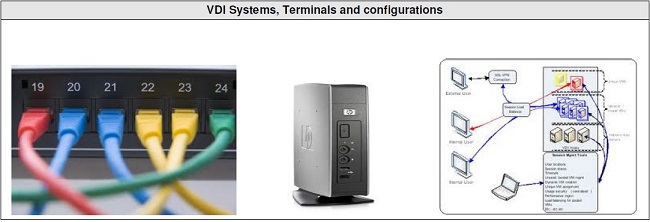
Likewise, the Go Lean book identified the emergence of cloud computing. The roadmap detailed a strategy of forging a Cyber Caribbean with many outsourcing/in-sourcing deployments, plus the assembly of the Caribbean Postal Union (CPU) to consolidate and integrate the region’s postal operations into a 21st Century model, including all the tenets of ICT: email, social media (www.myCaribbean.com), e-Government, etc.. The roadmap there-in describes the role of Virtual Desktop Infrastructure (VDI) as an alternative to expensive Personal Computer installations for corporate and institutional (government and NGO) applications. See a specific reference from the book here:

CU Blog - PC industry swoons - Photo 5
Virtual Desktop Infrastructure (VDI) is a desktop-centric service that hosts user desktop environments on remote servers and/or blade PCs, which are accessed over a network using a remote display protocol. A connection brokering service is used to connect users to their assigned desktop sessions. For users, this means they can access their desktop from any location, without being tied to a single client device. Since the resources are centralized, users moving between work locations can still access the same desktop environment with their applications and data. For IT administrators, this means a more centralized, efficient client environment that is easier to maintain and able to respond more quickly to the changing needs of the user and business
… – Go Lean … Caribbean (Page 295).

The Go Lean book details how jobs are to be created in this new world of cyclical technology trends and in the new Caribbean. The book asserts that certain industries are better than others for generating multiple indirect jobs down the line for each direct job on a company’s payroll. Industries relating to STEM (Science, Technology, Engineering and Mathematics) fields have demonstrated high job-multiplier rates of 3.0 to 4.1 factors (Page 260). In total, the book details the creation of 2.2 million new jobs for the Caribbean region, many embracing ICT skill-sets, by adopting certain community ethos, plus the executions of key strategies, tactics, implementations and advocacies. The following is a sample from the book:

Community Ethos – Deferred Gratification Page 21
Community Ethos – Economic Principle – Economic Systems Influence Choices & Incentives Page 21
Community Ethos – Economic Principle – Voluntary Trade Creates Wealth Page 21
Community Ethos – Consequences of Choices Lie in the Future Page 21
Community Ethos – Job Multiplier Page 22
Community Ethos – Lean Operations Page 24
Community Ethos – Ways to Impact the Future Page 26
Community Ethos – Ways to Foster Genius Page 27
Community Ethos – Ways to Help Entrepreneurship Page 28
Community Ethos – Ways to Promote Intellectual Property Page 29
Community Ethos – Ways to Impact Research & Development Page 30
Community Ethos – Ways to Bridge the Digital Divide Page 31
Strategy – Mission – Education Without Further Brain Drain Page 46
Tactical – Fostering a Technocracy Page 64
Tactical – Tactics to Forge an $800 Billion Economy – High Multiplier Industries Page 70
Tactical – Separation of Powers – Commerce Department – Postal Services/CPU Page 78
Implementation – Trends in Implementing Data Centers Page 106
Implementation – Ways to Improve Mail Service – Caribbean Postal Union Page 108
Implementation – Ways to Impact ICT and Social Media Page 111
Planning – Ways to Improve Trade – e-Commerce to Streamline a Bigger Regional Market Page 128
Advocacy – Ways to Grow the Economy Page 151
Advocacy – Ways to Create Jobs Page 152
Advocacy – Ways to Improve Education – e-Learning Options Page 159
Advocacy – Ways to Foster Technology Page 197
Advocacy – Ways to Foster e-Commerce Page 198
Appendix – Growing 2.2 Million Jobs in 5 Years Page 257
Appendix – Job Multipliers Page 259
Appendix – Virtual Desktop Infrastructure Page 295
Appendix – India’s $35 Tablet Page 296

As depicted in the foregoing news articles, the current trending with ICT innovation nullifies location. The innovations need not come from Silicon Valley – a region just south of San Francisco, California, they can easily come from any beach in the Caribbean.

The Caribbean is arguably the best address on the planet – definitely the best beaches – but jobs are missing. We can fill the void the same way other communities are jockeying to fill the void: innovations for ICT. The Go Lean roadmap posits that we can get the needed innovation from our own people, rather that watching our prospective innovators “take their talents to South Beach”, or South Toronto, or South London or South of San Francisco (Silicon Valley).

The Go Lean/CU roadmap is designed to foster job-creating developments in the Caribbean region. This requires a full-vertical strategy: identifying human resources, developing the skill-sets, incentivizing high-tech start-ups and incubating viable companies. These points have been detailed in many previous Go Lean blog-commentaries; consider this sample:

https://goleancaribbean.com/blog/?p=7806 Skipping School to become Tech Giants
https://goleancaribbean.com/blog/?p=6422 Microsoft Pledges $75 million for Kids in Computer Science
https://goleancaribbean.com/blog/?p=6341 The new Tourism Stewardship: e-Commerce
https://goleancaribbean.com/blog/?p=6151 3D Printing: Here Comes Change
https://goleancaribbean.com/blog/?p=5840 Security Concerns: Computer Glitches Disrupt Business As Usual
https://goleancaribbean.com/blog/?p=5435 China Internet Policing – Model for Caribbean
https://goleancaribbean.com/blog/?p=4793 Truth in Commerce – Learning from Yelp
https://goleancaribbean.com/blog/?p=4381 Net Neutrality: It Matters Here …in the Caribbean
https://goleancaribbean.com/blog/?p=3974 Google and Mobile Phones – Here comes Change
https://goleancaribbean.com/blog/?p=3915 Microsoft’s new Hologram systems – Changing the World View
https://goleancaribbean.com/blog/?p=3881 Intelligence Agencies to Up Cyber Security Cooperation
https://goleancaribbean.com/blog/?p=3187 Robots help Amazon tackle Cyber Monday
https://goleancaribbean.com/blog/?p=2126 Computers Reshaping Global Job Market
https://goleancaribbean.com/blog/?p=689 ‘eMerge’ Conference aims to jump-start Tech Hub
https://goleancaribbean.com/blog/?p=308 CARCIP – CariCom Initiative – Urges Greater Innovation

The primary ingredient for a Caribbean ICT strategy need only be Caribbean people, and the community “will” to engage. This is conceivable, believable and achievable. The Go Lean roadmap describes the need to reform and transform this community “will” as community ethos – national spirit – to spur achievement in this ICT industry space.

We can do this – here at home.

The roadmap goes further and provides the turn-by-turn directions to get “us” to the desired location: a better place to live, work and play. 🙂

Download the book Go Lean…Caribbean now!

————

Appendix VIDEO – Why Intel Cloud Technology – https://youtu.be/P5h1KMk-8Qo

Published on Jan 10, 2014 – Customers want to know what is inside their cloud. This animation provides an overview of the Intel Cloud Technology program, which provides users assurances that their cloud service provider is running on the latest Intel Xeon Processor-based servers, which means taking advantage of technologies including Intel Turbo Boost Technology, Intel TXT, Intel AVX, and Intel AES-NI. Intel Cloud Technology helps increase performance, reduce completion time, and enhance security. Learn more at http://intel.ly/1gpFL5PSubscribe now to Intel on YouTube: http://bit.ly/1BZDtpf
About Intel:
Intel, the world leader in silicon innovation, develops technologies, products and initiatives to continually advance how people work and live. Founded in 1968 to build semiconductor memory products, Intel introduced the world’s first microprocessor in 1971. This decade, our mission is to create and extend computing technology to connect and enrich the lives of every person on earth.
Connect with Intel:

Visit Intel WEBSITE: http://intel.ly/1WXmVMe

————

Appendix VIDEO – Microsoft Cloud: Empowering Businesshttps://youtu.be/HZChlynmtgc

Published on Jan 18, 2016 – See how The Microsoft Cloud is helping businesses around the world scale, connect, transform and reinvent.

Share this post:
, , ,
[Top]

Skipping School to become Tech Giants

Go Lean Commentary

How can we mold young minds for career success?

Apparently, there is more than one way; (notwithstanding starting early). Yes, there is college, but there is another way too: entrepreneurship. Think Bill Gates, Steve Jobs, and Mark Zuckerberg. These ones are notorious for their billionaire success, despite not finishing college.

CU Blog - Skipping School to become Tech Giants - Photo 1Some people think that a 4-year college degree may NOT be entirely essential for career success; these ones say: “there is an alternate path” for success for an individual career and for their community; (some even claim that a 4-year degree may be a bad investments for students).

So there are parallel paths. Let’s consider: education -vs- entrepreneurship …

Many claim that the underlying goal for molding young minds should not be education, but rather competition … with the rest of the world. The question could therefore be codified as: “Is a 4-year college degree necessary for our community to better compete with the world?”

This is a tough one (question), in which there are no easy answers.

The book Go Lean…Caribbean embarks on the quest to elevate the Caribbean societal engines (economics, security and governance); it presents options with education and with entrepreneurship. The book immediately rails against the education status quo; it stakes the claim that Caribbean tertiary education eco-system needs to be reformed and transformed, asserting that the status quo has not served the region as well as expected. Truth is, traditional college education paths may be considered disastrous for the Caribbean region in whole, and for each specific country in particular. Why?

Students leave to study …

… and do not necessarily return. They are “gone and forgotten”*; they run-off with their community investments with little chance for any “return”. (* = Many Caribbean graduates only return for family visits and festivals).

Normally, college education is great for the individual. The Go Lean book relates how economists have established that every additional year of schooling increases a student’s earning potential by about 10% (Page 258). Yet for our Caribbean communities as a whole, the end-result has been different – bad – ending in our incontrovertible brain drain.

How bad?

Previous blogs on this same subject matter have detailed the dysfunction; one example is the report that 70 percent of the tertiary-educated population in the Caribbean has fled. What’s worst in these reports, is the fact that these emigrants have taken their Caribbean-funded education and skill-sets with them; even taking any hope for collecting student loans, thereby imperiling future generations of scholars from their own benefits of a college education.

So education is not the champion – for nation-building – that we would expect. There is room for a challenger-contender. Consider this VIDEO here (and transcript in the Appendix), of young ones quitting college or never enrolling, to pursue entrepreneurial endeavors in the technology space. These ones are being fostered, prodded and nurtured; as related here:

VIDEO – Skipping School to become Tech Giants – http://www.cbsnews.com/videos/investing-in-college-dropouts-with-big-ideas

(VIDEO plays best in Internet Explorer).

The Go Lean movement – book and blogs – asserts that change must come to the region in response to the debilitating status quo in Caribbean life. The book refers to these change factors as Agents of Change, including technology and globalization. The best strategy for contending with both technology and globalization change is to not only consume; communities must develop, innovate and produce as well. The Go Lean book posits therefore that Caribbean regional shepherds should invest in (better) higher education and entrepreneurial options. The bottom-line motive should be the Greater Good.

This book Go Lean book serves as a roadmap for the introduction and implementation of the Caribbean Union Trade Federation (CU). This represents change for the region. The CU/Go Lean roadmap has 3 prime directives:

  • Optimization of the economic engines – including educational empowerments and entrepreneurial incubators – in order to grow the regional economy and create 2.2 million new jobs.
  • Establishment of a security apparatus to protect the resultant economic engines.
  • Improve Caribbean governance to support these engines.

The book relates that forging technology genius is a direct product of perspiration and inspiration. Perspiration as in the training and education needed to excel in this field; and inspiration as in the spark of innovation that is required to conceive, compose and construct competitive products pertaining to hardware, software and communication systems.

The Go Lean roadmap provides turn-by-turn directions on how to foster genius and how to reform the Caribbean tertiary education eco-systems. As a planning tool, the roadmap commences with a Declaration of Interdependence, pronouncing the approach of regional integration (Page 12 & 14) as a viable solution to elevate the opportunities in the region:

xix.  Whereas our legacy in recent times is one of societal abandonment, it is imperative that incentives and encouragement be put in place to first dissuade the human flight, and then entice and welcome the return of our Diaspora back to our shores

xxi.  Whereas the preparation of our labor force can foster opportunities and dictate economic progress for current and future generations, the Federation must ensure that educational and job training opportunities are fully optimized for all residents of all member-states, with no partiality towards any gender or ethnic group. The Federation must recognize and facilitate excellence in many different fields of endeavor, including sciences, languages, arts, music and sports. This responsibility should be executed without incurring the risks of further human flight, as has been the past history.

xxvii.  Whereas the region has endured a spectator status during the Industrial Revolution, we cannot stand on the sidelines of this new economy, the Information Revolution. Rather, the Federation must embrace all the tenets of Internet Communications Technology (ICT) to serve as an equalizing element in competition with the rest of the world. The Federation must bridge the digital divide and promote the community ethos that research/development is valuable and must be promoted and incentivized for adoption.

xxx.   Whereas the effects of globalization can be felt in every aspect of Caribbean life, from the acquisition of food and clothing, to the ubiquity of ICT, the region cannot only consume, it is imperative that our lands also produce and add to the international community, even if doing so requires some sacrifice and subsidy.

The Go Lean book focuses primarily on economic issues, and it recognizes that computer hardware, software and communications systems are the future direction for consumer, corporate and industrial developments. This is where the new jobs are to be found. If we want to arrest societal abandonment occurring in our communities, we must create jobs. The Go Lean roadmap describes the heavy-lifting for people, organizations and governments to foster genius and forge technological innovations here at home in the Caribbean; (i.e. start early).

This commentary is not advocating a practice of “skipping school to rush to try and become tech giants”. But rather, it is advocating education reform, abandoning failed practices, like study abroad and adopting new ones, like e-Learning solutions. After which there should be an effort to provide entrepreneurial incubators to foster more business start-ups.

The Go Lean book posits that education and entrepreneurism are vital advocacies for Caribbean economic empowerment. But there have been flawed decision-making in the past, both individually and community-wise, and so we are now playing catch-up with the rest of the world. Whether we want it or not, there is a competition; globalization features trade wars; wars feature battles; battles feature champions. The vision of the CU is a confederation of the 30 member-states of the Caribbean to do the heavy-lifting of championing better educational and entrepreneurial policies.

The book details those policies; and other ethos to adopt, plus the executions of the following strategies, tactics, implementations and advocacies to impact the Greater Good for the region:

Community Ethos – Deferred Gratification Page 21
Community Ethos – People Respond to Incentives Page 21
Community Ethos – Job Multiplier Page 22
Community Ethos – Lean Operations Page 24
Community Ethos – Return on Investments – ROI Page 24
Community Ethos – Ways to Impact the Future Page 26
Community Ethos – Ways to Foster Genius Page 27
Community Ethos – Ways to Help Entrepreneurship Page 28
Strategy – Agent of Change – Technology Page 57
Strategy – Agent of Change – Globalization Page 57
Tactical – Separation of Powers – Education Department Page 85
Tactical – Separation of Powers – Labor Department Page 89
Implementation – Ways to Impact Social Media Page 111
Advocacy – Ways to Grow the Economy Page 151
Advocacy – Ways to Create Jobs Page 152
Advocacy – Ways to Improve Education Page 159
Advocacy – Ways to Improve Governance Page 169
Advocacy – Ways to Better Manage the Social Contract Page 171
Advocacy – Ways to Foster Cooperatives Page 176
Advocacy – Ways to Improve Libraries Page 187
Advocacy – Ways to Foster Technology Page 197
Advocacy – Ways to Foster e-Commerce Page 198
Appendix – Education and Economic Growth Page 258

Now is the time for all of the Caribbean, the people and governing institutions, to lean-in for the changes described in the book Go Lean … Caribbean. We welcome entrepreneurism and we welcome education; these two activities can be concurrent and complementary. But we need to break from the old-bad practices (i.e. study abroad) and engage new-better practices (i.e. incubators).

So we encourage all young people to get advanced education, but to do it at home. And we encourage all with entrepreneurial dreams to pursue them … here at home.

The new jobs that our region need must come from these initiatives. Let’s get started!  🙂

Download the book Go Lean…Caribbean now!

————–

APPENDIX – Story Transcript: Skipping School to become Tech Giants

A select group of whiz kids seems to be thriving despite having dropped out of college. All any of them seems to need is a high-tech idea, a sofa to sleep on … plus a $100,000 grant. John Blackstone explains:

When brothers Kieran and Rory O’Reilly were both accepted to Harvard, their parents marked the accomplishment with new license plates: One read “2 N HRVD”; the other, “HARVRD 2.”

“They might change it to ‘2 DROPOUTS,'” said Rory.

They both quit Harvard as undergrads two years ago. They were just 18 and 19 when they moved to San Francisco with big hopes, and almost nothing else.

“Three bags of clothes — every day we would take it, move from hotel to hotel,” said Rory.

“I remember our bank account was always negative $66, because that’s the overdraft fee,” said Kieran.

They’re now living IN their office. “Every single day our mom tries to call us or send food,” Rory said.

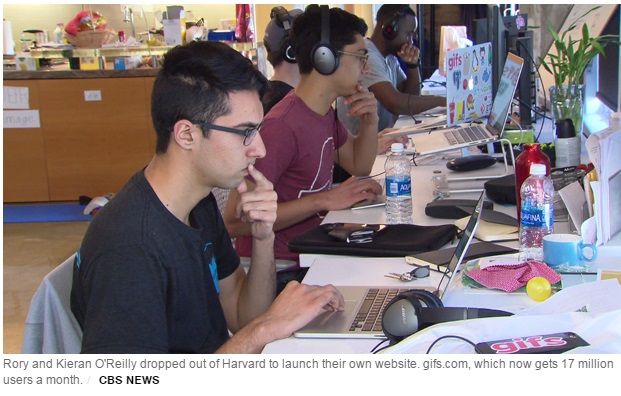
They’ve created a website, gifs.com, a tool for re-editing online videos. Seventeen million people in the past month have used it.

The O’Reillys are on a path made famous by some of the tech industry’s biggest names: Jobs, Gates, Zuckerberg.

“People that drop out of Harvard, maybe the Bill Gateses of the world, the Zuckerbergs, they’re the people that are really changing the entire world, in my opinion,” said Rory. “And yeah, I’m glad to be a part of that.”

The O’Reillys are “part of that” partly because Peter Thiel, one of the billionaire founders of PayPal, gave them $100,000 each.

Thiel started his surprising giveaway five years ago, offering $100,000 to kids who quit college to “build new things.”

Jack Abraham is executive director of the Thiel Fellowship, which distributes the money to 20 new dropouts each year. And what is he encouraging? “If you have a great idea, the time to pursue it is now,” Abraham said. “We also hope to show society that this is an alternate path that people can and should consider and take.”

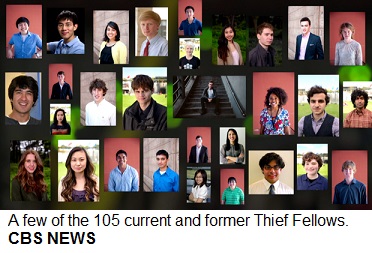
Abraham says the 105 current and former Thiel Fellows have created more than 1,000 jobs and raised $330 million from investors.

CU Blog - Skipping School to become Tech Giants - Photo 2

Only eight have returned to college.

The selection committee is now sorting through 5,000 applications for this year’s 20 fellowships. Most of the applicants would have much better odds getting into the Ivy League.

“It breaks my heart when some of the most promising students don’t fulfill their potential because they’re chasing rainbows,” said Vivek Wadhwa, a fellow at StanfordUniversity, who has been a critic of the Thiel Fellowship from the beginning.”

“It’s like what happens in Hollywood: You have tens of thousands of young people flocking to Hollywood thinking that they’re gonna become a Brad Pitt or an Angelina Jolie; they don’t,” said Wadhwa.

“They don’t become billionaires. There haven’t been many Mark Zuckerbergs after Mark Zuckerberg achieved success.”

And Wadhwa says there is little evidence the Thiel dropouts are doing much that isn’t already being done in Silicon Valley.”Everyone does the same thing: It’s social media, it’s photo sharing apps. Today it’s sharing economy,” Wadhwa said. “It’s ‘Me, too,’ ‘More of the same.'”

But 19-year-old Conrad Kramer and 21-year-old Ari Weinstein were convinced they had a new idea, so when they were awarded Thiel Fellowships in 2014, they both walked away from MIT to work full-time on their app, called Workflow.

“There are some opportunities that come up that you would regret turning down,” Kramer said. “Workflow was definitely one of those.”

“It’s kind of like making your own apps that save you time,” Weinstein said.

When Workflow launched, it was the number one bestseller on Apple’s App Store — and has since won several awards.

They’ve just hired their newest employee, Tim Hsia, a graduate of Stanford’s business and law schools and an Army vet. He’s 33-years-old and says he doesn’t mind taking orders from a teenage boss.

“I’m learning so much because they have such a wealth of experience despite their age,” Hsia said. “In Silicon Valley it’s about meritocracy of ideas. And so if you have a good idea, everyone’s always receptive to listen to it.”

Zach Latta found many people were willing to listen — leaving high school to move to San Francisco on his own, to start a non-profit called Hack Club.

He recalled that when he moved to the city at age 16, “I’d showed up at a gym one day with some friends, and they turned me away at the door because I had to be 18.”

Now he is 18 and works full-time helping high school students learn to code.

“I feel challenged in every single day,” Latta said. “And I think I’m learning as much as I’ve ever been while being happy.”

For now these wannabe tech titans live modestly in homes they share with several others, or in offices that also provide a place to sleep. Instead of meals, some drink Soylent — Silicon Valley’s version of fast food. It apparently contains all the nutrients necessary to stay alive, in a bottle.

“Yeah — breakfast, lunch, snack, dinner,” said Latta.

They are building their companies with money from investors who seem to care little whether they graduated from college.

“It’s actually kind of a badge of honor here, dropping out,” said 23-year-old Stacey Ferreira. She’s dropped out of NYU — twice! The first time she saw a tweet from Richard Branson, the founder of the Virgin Group, offering to meet anyone who gave $2,000 to his charity.

She borrowed the money and met him. She was 18 and starting her first business.

“And make a long story short, he and two of his buddies ended up investing $1.2 million in our business that summer,” Ferreira told Blackstone.

Two years later, she sold that company, MySocialCloud, for a hefty profit, and returned to NYU. But then she had another big idea that couldn’t wait.

“If you can create your own job, why wouldn’t you just do that and not get stuck paying student loans for the rest of your life?” Ferreira said.

Instead of student loans, she has $100,000 from Peter Thiel. She’s working on an app called Forrge that aims to create an on-demand marketplace for hourly workers.

She’s hoping that dropping out of NYU again will pay off again.

Blackstone asked, “Is there a lesson in your story for other young people?”

“Yeah, I think the biggest lesson to learn is just take risks,” Ferreira said.

“What’s the worst that can happen to you when you take the risk?”

“For me, the worst that can happen is I move home and sleep on my parent’s couch for a couple months, until I figure it out,” Ferreira replied.

For more info:


Share this post:
, , ,
[Top]

An Ode to Detroit – Good Luck on Trade!

Go Lean Commentary

It’s now time to say “goodbye and good luck” to the City of Detroit with these passing words, lessons and advice …

A commonly accepted economic principle declares that “Voluntary Trade Creates Wealth”.

Really? The City of Detroit, Michigan seems to have not “gotten the memo”.

The actual principle is summarized in the book Go Lean … Caribbean (Page 21) as follows:

Voluntary Trade Creates Wealth – People specialize in the production of certain goods and services because they expect to gain from it. People trade what they produce with other people when they think they can gain something from the exchange. Some benefits of voluntary trade include higher standards of living and broader choices of goods and services.

Detroit is branded the Motor City or Motown for being the capital of the American Automotive industry, (all the Big 3 car-makers – General Motors, Ford and Chrysler – are based in this metropolitan area). From a trade perspective, automobiles are among the most successful American exports. According to this simple logic  – trade creates wealth and Detroit is home to one of America’s best trade products – there should be win-win for all stakeholders in the vertical automotive industry, including the local communities. Right?

Not quite! This is NOT the reality.

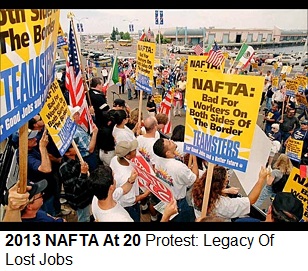
CU Blog - An Ode to Detroit - Good luck on Trade - Photo 1

CU Blog - An Ode to Detroit - Good luck on Trade - Photo 2

This article below, just in time for the US presidential elections – posted on March 8, 2016 – and the arrival of the main candidates for the Democratic and Republican nominations, reveal the truth of life in today’s Detroit … and the dire consequence of free trade:

The City of Detroit has gone from one of the country’s richest in the 1960s to one of the poorest [today].

The once-thriving automotive hub is pocked by blighted homes and crime and has more children living in extreme poverty than any of the nation’s 50 largest cities. Manufacturing job losses devastated neighboring communities, sowing more than 20 years of resentment among white, working-class Democrats over the North American Free Trade Agreement.
Source: MSN Social Media Site; (posted 03-08-2016; retrieved April 9, 2016) .

The publishers of the Go Lean book have been in Detroit to “observe and report” on the turn-around and rebirth of the once-great-but-now-distressed city and its nearby communities; (we have also considered the dysfunction of Flint and the promise of Ann Arbor). There have been so many lessons to learn from Michigan: good, bad and ugly. Consider this sample here conveyed in previous blogs/commentaries:

https://goleancaribbean.com/blog/?p=7601 Beware of Vulture Capitalists
https://goleancaribbean.com/blog/?p=7268 Detroit giving schools their ‘Worst Shot’
https://goleancaribbean.com/blog/?p=7235 Flint, Michigan – A Cautionary Tale
https://goleancaribbean.com/blog/?p=6965 Secrecy, corruption and ‘conflicts of interest’ pervade state governments
https://goleancaribbean.com/blog/?p=6609 Before and After Photos Showing Detroit’s Riverfront Transformation
https://goleancaribbean.com/blog/?p=6269 Education & Economics: Welcome to Detroit, Mr. President
https://goleancaribbean.com/blog/?p=6022 Caribbean Diaspora in Detroit … Celebrating Heritage
https://goleancaribbean.com/blog/?p=5597 The Dire Strait of Unions and Collective Bargaining
https://goleancaribbean.com/blog/?p=5055 A Lesson from an Empowering Family in Detroit
https://goleancaribbean.com/blog/?p=4913 Ann Arbor: Model for ‘Start-up’ Cities
https://goleancaribbean.com/blog/?p=4476 De-icing Detroit’s Winter Roads: Impetuous & Short Term
https://goleancaribbean.com/blog/?p=3713 NEXUS: Facilitating Detroit-Windsor Cross-Border Commerce
https://goleancaribbean.com/blog/?p=3326 M-1 Rail: Alternative Motion in the Motor City
https://goleancaribbean.com/blog/?p=3311 Detroit to exit historic bankruptcy
https://goleancaribbean.com/blog/?p=3164 Michigan Unemployment – Then and Now
https://goleancaribbean.com/blog/?p=2480 A Lesson in History: Community Ethos of WW II
https://goleancaribbean.com/blog/?p=1656 Blue is the New Green – Managing Michigan’s Water Resources
https://goleancaribbean.com/blog/?p=970 JP Morgan Chase’s $100 million Detroit investment – Not just for the Press

The full news article from the MSN Social Media Site is embedded here, retrieved from – http://www.msn.com/en-us/news/politics/michigan-a-critical-showdown-for-sanders-to-mount-comeback/ar-BBqsehO?li=BBnb7Kz&ocid=ieslice:

Title: Michigan ‘a critical showdown’ for Sanders to mount comeback
By: Heidi M. Przybyla

CU Blog - An Ode to Detroit - Good luck on Trade - Photo 3The State of Michigan could be Bernie Sanders’ last, best chance to challenge Hillary Clinton’s hold on the Democratic presidential race.

The Midwestern industrial state, which holds its primary Tuesday [(March 8, 2016)], is the ideal audience for Sanders’ campaign message about “unfair” trade agreements, income inequality and a “rigged economy.”

“This is ground zero for trade,” said Rep. Debbie Dingell, D-Mich. “People are frustrated. It’s been almost 15 years, and they’re not better off than they were,” said the first-term Democrat, who is backing Clinton.

Yet Clinton has consistently led in polls — a Monmouth University Poll out Monday showed her up 13 points. “If he can’t win in Michigan, where can he win besides these small caucus states?” said Susan Demas, publisher of Inside Michigan Politics, a political analysis newsletter. Sanders campaign manager Jeff Weaver is calling Michigan “a critical showdown.”

Mississippi also holds a primary on Tuesday, and Clinton is favored there.

The city of Detroit has gone from one of the country’s richest in the 1960s to one of the poorest.  The once-thriving automotive hub is pocked by blighted homes and crime and has more children living in extreme poverty than any of the nation’s 50 largest cities. Manufacturing job losses devastated neighboring communities, sowing more than 20 years of resentment among white, working-class Democrats over the North American Free Trade Agreement.

Sanders is hitting Clinton hard on the trade issue, including a recent ad picturing abandoned homes and factories. NAFTA was championed by her husband, former president Bill Clinton, though the former first lady is trying to distance herself from a number of those policies.

Michigan could expose some of Clinton’s longer-term vulnerabilities. Some of the state’s most powerful unions, including the Teamsters, the AFL-CIO and the United Auto Workers, traditional Democratic allies, haven’t endorsed a candidate. Many union rank-and-file backed her husband in 1992 and 1996 but are now supporting Sanders or Republican front-runner Donald Trump.

“She’s also competing with Donald Trump, who’s made this a strong issue and not backed down on the currency trade issue,” said Dingell. “There’s a lot of pent-up anger, and Donald Trump let’s them release it,” she said.

Sanders may be indirectly helping Trump. At campaign rallies, he has repeatedly slammed Clinton on trade, listing it as a key area where they disagree. Sanders says he led opposition to NAFTA and permanent normal trade relations with China, which he says resulted in the loss of millions of middle-class jobs and “a race to the bottom.” His campaign, in a March 3 news release, dubbed Clinton the “outsourcer-in-chief.”

Clinton has been trying to distance herself from the 1990s-era policy. In the Flint debate, she tried to distinguish her record from that of her husband’s.  As a senator, she voted against a Central American trade agreement, the only multinational pact that came before her, she said. More recently, she’s come out against the Trans-Pacific Partnership.

Nearing closer to the nomination, Clinton has begun to discuss the role Sanders would need to play in unifying the party. During a town hall forum Monday in Grand Rapids, she talked extensively about how she encouraged her voters to back Barack Obama in 2008.

“I had a lot of passionate supporters who did not feel like they wanted to support then-Sen. Obama. I worked as hard as I could. I nominated him at the convention. I made the case, because he and I shared a lot of the same views,” she said.

“We have differences, but those differences pale in comparison to what we see going on with the Republicans right now,” said Clinton.

Clinton’s supporters acknowledge a Michigan loss is unlikely to deter Sanders. Several testy exchanges in the Flint debate highlighted festering tensions between the two, and Sanders is flush with campaign donations to keep him going.

“I think Hillary Clinton will win Michigan,” said Dingell. “But I think Sen. Sanders plans on staying in this race for a while.”

Contributing writer: Nicole Gaudiano

News Update: Senator Bernie Sanders won the Michigan Democratic primary.

There is a strong current against free trade deals in big industrial cities in the American north. At this juncture (April 9, 2016), Bernie Sanders has won the last 7 state primaries with his “unfair trade” message:

  • Idaho
  • Utah
  • Alaska
  • Hawaii
  • Washington
  • Wisconsin
  • Wyoming

But chances are, these trade agreements will not disappear, even under a new president – to be elected later this year. (Listen to the related AUDIO podcast in the Appendix below).

These free trade agreements are ratified treaties with other countries that are not so easily dismantled. Plus, the US business interest has proven to be formidable in their obstructionism to radical changes to their status quo.

The Go Lean movement asserts that there is a Crony-Capitalistic influence in the US that creates a societal defect for forging change. In this case, trade deals like NAFTA allow big corporations to shift labor costs to alternate locales with lower payroll costs. This commentary has related that the money motivation with this strategy may be too much to overcome in the America of 2016.

Good luck to Detroit.

Hope and Change? Not here, not now.

The book Go Lean… Caribbean urges Caribbean citizens not to be swayed by the false perception of refuge in America. The grass is NOT greener on this side.

Yes, the status quo in the overall US is better than the status quo in the Caribbean, but change is afoot. This movement – book and blogs – posits that it is easier to reform and transform the Caribbean member-states than to attempt to change America. The Go Lean book serves as a roadmap for the introduction and implementation of the technocratic  Caribbean Union Trade Federation (CU). This represents a confederation of the 30 member-states of the Caribbean region, including the US Territories (2): Puerto Rico and the US Virgin Islands); the French Territories (5); 6 Dutch Territories constituted as 1 member; British Overseas Territories (5) and independent states and Republics (17).

This CU/Go Lean roadmap extols a priority of trade in the execution of its prime directives. Economic stability and progress is fundamental to forging an elevated society. As observed in Detroit, dysfunction in a community’s economic engine, brings about dysfunction in other facets of societal life. This explains why Detroit is also plagued with rampant crime. (During the course of the Go Lean movement’s observing-and-reporting on Detroit, there were some acute criminal activities, like the one case where a mother was adjudicated for killing and storing 2 dead children in her kitchen freezer). Likewise, the City has been plagued with one instance after another of ineffectual governance or municipal corruption. (A recent ex-Mayor – Kwame Kilpatrick – lingers in federal prison on federal corruption convictions). This is why the CU prime directives feature economics, security and governance, as defined by these 3 statements here:

  • Optimize the Caribbean economic engines of the region to grow the GDP of the economy to $800 billion and create 2.2 million new jobs.
  • Establish a security apparatus to protect the resultant economic engines in the Caribbean.
  • Improve Caribbean governance – including municipal, state and federal administrations – to support these engines.

The Go Lean roadmap seeks to reform the Caribbean, not the City of Detroit nor America. The roadmap opens with the call for the consolidation of trade negotiation for the region – treating everyone as equals. This point is echoed early, and often, in the book, commencing with these opening pronouncements in the Declaration of Interdependence (Pages 11 – 14), as follows:

viii.   Whereas the population size is too small to foster good negotiations for products and commodities from international vendors, the Federation must allow the unification of the region as one purchasing agent, thereby garnering better terms and discounts.

xi.   Whereas all men are entitled to the benefits of good governance in a free society, “new guards” must be enacted to dissuade the emergence of incompetence, corruption, nepotism and cronyism at the peril of the people’s best interest. The Federation must guarantee the executions of a social contract between government and the governed.

xvi. Whereas security of our homeland is inextricably linked to prosperity of the homeland, the economic and security interest of the region needs to be aligned under the same governance. Since economic crimes … can imperil the functioning of the wheels of commerce for all the citizenry, the accedence of this Federation must equip the security apparatus with the tools and techniques for predictive and proactive interdictions.

xxiv. Whereas a free market economy can be induced and spurred for continuous progress, the Federation must install the controls to better manage aspects of the economy: jobs, inflation, savings rate, investments and other economic principles. Thereby attracting direct foreign investment because of the stability and vibrancy of our economy.

xxx. Whereas the effects of globalization can be felt in every aspect of Caribbean life, from the acquisition of food and clothing, to the ubiquity of ICT, the region cannot only consume, it is imperative that our lands also produce and add to the international community, even if doing so requires some sacrifice and subsidy.

The Go Lean roadmap therefore constitutes a change for the Caribbean. This provides the tools/techniques to bring immediate elevation to the region to benefit one and all member-states. The book details the community ethos to forge such change; plus the executions of the following strategies, tactics, implementations and advocacies to make the changes permanent:

Community Ethos – Deferred Gratification Page 21
Community Ethos – Economic Systems Influence Individual Choices Page 21
Community Ethos – Voluntary Trade Creates Wealth Page 21
Community Ethos – Lean Operations Page 24
Community Ethos – Return on Investments Page 24
Community Ethos – Cooperatives Page 24
Community Ethos – Ways to Improve Negotiations Page 30
Community Ethos – Impact the Greater Good Page 37
Strategy – Unified Region in a Single Market Economy Page 45
Strategy – Customers – The Business Community Page 47
Strategy – Agents of Change – Globalization Page 57
Tactical – Confederating a Permanent Union Page 63
Tactical – Fostering a Technocracy Page 64
Tactical – Growth Approach – Trade and Globalization Page 70
Tactical – Separation of Powers – Interstate Commerce Admin Page 79
Tactical – Separation of Powers – Office of Trade Negotiations Page 80
Implementation – Ways to Pay for Change Page 101
Implementation – Foreign Policy Initiatives at Start-up Page 102
Implementation – Ways to Deliver Page 109
Implementation – Trade Mission Office Objectives Page 116
Planning – Ways to Improve Trade Page 128
Planning – Ways to Improve Interstate Commerce Page 129
Planning – Lessons Learned from Detroit Page 140
Advocacy – Ways to Grow the Economy Page 151
Advocacy – Ways to Create Job Page 152
Advocacy – Ways to Improve Housing – Lesson from Detroit to raze Dilapidated housing Page 161
Advocacy – Ways to Improve Governance Page 168
Advocacy – Ways to Improve Local Government Page 169
Advocacy – Ways to Better Manage the Social Contract Page 170
Advocacy – Ways to Foster Cooperatives Page 176
Advocacy – Ways to Impact Main Street Page 201

The issues in this commentary are important for the development of Caribbean region. There is the need to fully participate in trade agreements; it is the only way to fully compete in a globalized marketplace. But there is the need for a new regulatory regime for the Caribbean market, as free market dynamics are normally based on supply-and-demand. The Caribbean member-states, with their small population and market-sizes have not been able to compete with the voluminous demand nor voluminous supply of some of the bigger countries (i.e. China, India, EU, the US, etc). The consolidated CU market would be different … and better!

The Go Lean book is a detailed turn-by-turn, step-by-step roadmap for how to lean-in to a new trade regime. We now urge everyone in the region – all stakeholders: citizens, visitors, direct foreign investors, trading-partners, business establishments – to lean-in to this roadmap. With this plan, we would have reason to believe in “Hope and Change” for the Caribbean region, for it to be a better place to live, work and play.

So as we move onto another American locale (Miami) for final preparation for an eventual repatriation, here’s our advice to the Caribbean Diaspora living in Detroit: Go home and help with this Go Lean roadmap to elevate the Caribbean …

… and to the people of Detroit, we say: Good luck. We invite you too, to come and visit us in  the Caribbean … often. 🙂

Download the book Go Lean…Caribbean now!

————-

APPENDIX – AUDIO Podcast: Free Trade On The Campaign Trail – http://www.npr.org/podcasts/510053/on-point-with-tom-ashbrook#

Posted March 8, 2016 – From Trump to Sanders, free trade is getting a thumping on the campaign trail. Could, would the United States really turn it around? Plus: inspecting stalled millennial wage growth.

Share this post:
, , , ,
[Top]

Being Lean: Asking the Question ‘Why’ 5 Times

Go Lean Commentary

“The Caribbean is arguably the greatest address on the planet”, as declared in the book Go Lean…Caribbean. (This “greatest” attribute is defined for terrain, culture and hospitality). Yet the region has an unconscious-able brain drain rate, where 70 percent of the tertiary-educated population has fled.

Why!?

This question has been asked repeatedly! Many times the published answers are really describing the symptoms and not the root-causes. In the end, the answer is not so easy! The Go Lean book defines it as heavy-lifting. The Go Lean approach is an examination of the word “Lean”. In the book the word is presented as a noun, a verb and an adjective; all inclusive of the agile concept. The lean/agile concept is an understanding that value is a derived-result from a continuously optimizing key process, that repeats as a cycle .. again and again.

The Go Lean book (Page 4) relates that …

… lean thinking changes the focus of management from optimizing separate technologies, assets, and vertical departments to optimizing the flow of products and services through entire value streams that flow horizontally across technologies, assets, and departments to customers.

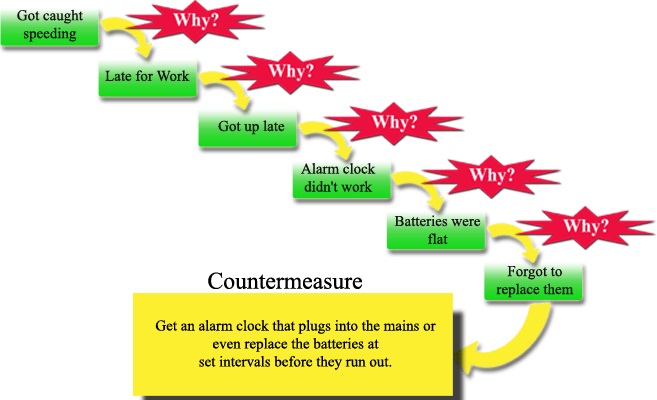
One expression of the lean methodology that can be used to dissect/”add value” to the key question (” Why such a high brain drain rate”) in this commentary is the iterative interrogative technique: 5 Why’s. See details of this agile-lean technique below. Using this technique, the 5 Why’s needs to be extended to 7 actual Why questions, as follows:

Problem: Why do Caribbean citizens abandon their homelands?

  1. “Push and Pull” reasons. “Push”, as in people fleeing to find refuge and “pull” in the perception (though false) that life is better on foreign shores. Why?
  2. Societal defects – in the region – are so acute. Why?
  3. Societal engines (responsible for economics, security & governance) not optimized. Why?
  4. Colonial Masters did not engage best-practices. Why?
  5. Foreign Policy in the colonies was to just keep them dependent. Why?
  6. Colonizers promoted home country commerceMercantilism; slavery in the colonies, but not at home (i.e. Serfism, French Revolution). Why?
  7. European Community Ethos: OK to exploit African Race as declared by Pope Innocent VIII.

s - Photo 1

s - Photo 2

See the encyclopedic details and a related VIDEO here:

Reference Title: 5 Whys
Source: 
Wikipedia Online Encyclopedia – Retrieved 04/07/2016 from: https://en.wikipedia.org/wiki/5_Whys

5 Whys is an iterative interrogative technique used to explore the cause-and-effect relationships underlying a particular problem.[1] The primary goal of the technique is to determine the root cause of a defect or problem by repeating the question “Why?” Each question forms the basis of the next question. The “5” in the name derives from an empirical observation on the number of iterations typically required to resolve the problem.

The technique was formally developed by Sakichi Toyoda and was used within the Toyota Motor Corporation during the evolution of its manufacturing methodologies. In other companies, it appears in other forms. Under Ricardo Semler, Semco practices “three whys” and broadens the practice to cover goal setting and decision making.[2]

Not all problems have a single root cause. If one wishes to uncover multiple root causes, the method must be repeated asking a different sequence of questions each time.

The method provides no hard and fast rules about what lines of questions to explore, or how long to continue the search for additional root causes. Thus, even when the method is closely followed, the outcome still depends upon the knowledge and persistence of the people involved.

—–

The questioning for this example could be taken further to a sixth, seventh, or higher level, but five iterations of asking why is generally sufficient to get to a root cause. The key is to encourage the trouble-shooter to avoid assumptions and logic traps and instead trace the chain of causality in direct increments from the effect through any layers of abstraction to a root cause that still has some connection to the original problem. Note that, in this example, the fifth why suggests a broken process or an alterable behaviour, which is indicative of reaching the root-cause level.

It is interesting to note that the last answer points to a process. This is one of the most important aspects in the 5 Why approach – the real root cause should point toward a process that is not working well or does not exist.[3] Untrained facilitators will often observe that answers seem to point towards classical answers such as not enough time, not enough investments, or not enough manpower. These answers may be true, but they are out of our control. Therefore, instead of asking the question why?, ask why did the process fail?

A key phrase to keep in mind in any 5 Why exercise is “people do not fail, processes do”.

Rules of performing “5 Whys”

In order to carry out the 5-Why analysis properly, following advices should be kept:

  1. It is necessary to engage the management in 5 Whys standard in the company. For the analysis itself, remember about right working group. Also consider facilitator presence for more difficult topics.
  2. Use paper or whiteboard instead of computers.
  3. Write down the problem and make sure that all people understand it.
  4. Distinguish causes from symptoms.
  5. Take care of the logic of cause-and-effect relationship.
  6. Make sure that root causes certainly lead to the mistake by reversing the sentences created as a result of the analysis with the use of expression “and therefore”.
  7. Try to make our answers more precise.
  8. Look for the cause step by step. Don’t jump to conclusions.
  9. Base on facts and knowledge.
  10. Assess the process, not people.
  11. Never leave “human error”, “worker’s inattention”, etc. as the root cause.
  12. Take care of the atmosphere of trust and sincerity.
  13. Ask the question “why” until the root cause is determined, i.e. such cause the elimination of which will cause that the error will not occur again.[7]

Criticism

While the 5 Whys is a powerful tool for engineers or technically savvy individuals to help get to the true causes of problems, it has been criticized … as being too basic a tool to analyze root causes to the depth that is needed to ensure that they are fixed.[8] Reasons for this criticism include:

  • Tendency for investigators to stop at symptoms rather than going on to lower-level root causes.
  • Inability to go beyond the investigator’s current knowledge – cannot find causes that they do not already know.
  • Lack of support to help the investigator ask the right “why” questions.
  • Results are not repeatable – different people using 5 Whys come up with different causes for the same problem.
  • Tendency to isolate a single root cause, whereas each question could elicit many different root causes.

These can be significant problems when the method is applied through deduction only. On-the-spot verification of the answer to the current “why” question before proceeding to the next is recommended to avoid these issues. In addition, performing logical tests for necessity and sufficiency at each level can help avoid the selection of spurious causes and promote the consideration of multiple root causes.[9]

s - Photo 3

————————

VIDEO – 5 Whys Root Cause Analysis Problem Solving Tool–Video Training – https://youtu.be/zvkYFZUsBnw

Uploaded on Jul 23, 2009 – The 5 Whys (Free 6-Page PDF at http://www.velaction.com/5-whys/ ) is one of the simplest problem solving tools used in Lean manufacturing and Lean offices. This presentation shows how to use the 5 Whys, and what to watch out for. Created and presented by Jeff Hajek of Velaction Continuous Improvement.
Category: How to & Style
License: Standard YouTube License

Wow, the root cause “Why Caribbean citizens abandon their homelands” is tied to the community ethos and embedded racial inequalities in the ancient European world. Now that we know – thanks to the iterative interrogative technique – we can deploy new community ethos plus new strategies, tactics, implementations and advocacies to turn-around Caribbean failings into opportunities for success.

The Go Lean book identifies Toyota Motor Company as a role model for deploying agile/lean methodologies in delivering quality. Quality delivery is a mission of the Go Lean movement. The book serves as a roadmap for the introduction and implementation for the technocratic Caribbean Union Trade Federation (CU). As a federal government, there will be the need to employ agile/lean methodologies to ensure that a small organizational footprint can provide the facilitations to enhance the region’s economic, security and governing engines. For a regional population of 42 million, the plan is to only engage 30,000 federal civil servants, but with a lot of systems and agile methodologies. That is lean!

By being lean, the stewards of this new Caribbean can fulfill the Go Lean vision: a better region to live, work and play. In the end, we would dissuade the brain drain, and then eventually invite the Diaspora to return, to repatriate to their ancestral homelands.

The Go Lean book was constructed with community ethos – national spirit that drives the character and identity of its people – in mind, plus the execution of strategies, tactics, implementation and advocacies to keep the regional government lean. The following is a sample of these specific details from the book:

Preface – Use of “Lean” in the Public Sphere Page 4
Community Ethos – Deferred Gratification Page 21
Community Ethos – Economic Principles – Economic Systems Influence Individual Choices Page 21
Community Ethos – Economic Principles – The Consequences of Choices Lie in the Future Page 21
Community Ethos – Governing Principles – Lean Operations Page 24
Community Ethos – Ways to Impact the Future Page 26
Community Ethos – Ways to Help Entrepreneurship – Incubators Page 28
Community Ethos – Ways to Impact Research & Development Page 30
Community Ethos – Ways to Improve Sharing Page 35
Community Ethos – Ways to Promote Happiness Page 36
Community Ethos – Ways to Impact the Greater Good Page 37
Strategy – Mission – Build and foster local economic engines Page 45
Tactical –  Separation of Powers: Federal Administration versus Member-States Governance Page 71
Implementation – Ways to Pay for Change Page 101
Implementation – Reasons to Repatriate to the Caribbean Page 118
Planning – Ways to Make the Caribbean Better Page 131
Advocacy – Ways to Grow the Economy Page 151
Advocacy – Ways to Create Jobs Page 152
Advocacy – Ways to Improve Governance in the Caribbean Region Page 168
Advocacy – Ways to Better Manage the Social Contract Page 170
Advocacy – Ways to Improve Leadership Page 171
Advocacy – Ways to Manage Federal Civil Service Page 173
Advocacy – Ways to Impact the Diaspora Page 217
Advocacy – Ways to Preserve Caribbean Heritage Page 218

The Go Lean roadmap presents the CU as a real organizational structure. So all the references in the foregoing encyclopedic reference regarding agile-lean organizations, enterprises, companies and/or firms could apply directly and indirectly to the CU Trade Federation. Yet, the federal agencies and civil servants are not the only focus of the Go Lean/CU roadmap. The prime directives of this roadmap is to reach out into the community and impact the societal engines in these ways:

  • Optimization of the economic engines in order to grow the regional economy to $800 Billion & create 2.2 million new jobs.
  • Establishment of a security apparatus to protect the resultant economic engines.
  • Improve Caribbean governance to support these engines.

Previously, Go Lean blogs detailed other opportunities to deploy agile methodologies. Consider this sample:

https://goleancaribbean.com/blog/?p=7646 Methodology for going from ‘Good to Great
https://goleancaribbean.com/blog/?p=6921 “Live. Work. Play. Repeat” – Need for Agile Rewards program
https://goleancaribbean.com/blog/?p=6016 Case Study of a Lean Utility to Assuage Excessively Hot Weather
https://goleancaribbean.com/blog/?p=3956 Art and Science of Collaboration
https://goleancaribbean.com/blog/?p=3152 The formal process of Making a Great Place to Work®
https://goleancaribbean.com/blog/?p=915 Go Green Caribbean – Pursuits for Lean energy in the region

The message to the people of the Caribbean region is that the Caribbean’s past is not to be the Caribbean’s future. The catalyst for change in the Caribbean is the CU. This “heavy-lifting” task to implement agile/lean methodologies in the Caribbean is the charter of the CU technocracy.

Now is the time for all Caribbean stakeholders – residents, Diaspora, businesses and institutions – to lean-in for the optimizations and empowerments described in the book Go Lean … Caribbean. Yes, we can make the region a better homeland to live, work and play. 🙂

Download the book Go Lean … Caribbean – now!

Share this post:
,
[Top]

Lessons from Regional Elections

Go Lean Commentary

Imagine spending $5.3 Billion dollars to buy a “service” and then the logistics fail in the final delivery.

Unfortunately, this can describe the election process in the United States. In 2008, according to the book Go Lean…Caribbean, that amount of money was spent on the Presidential campaign. Surely those spending that money, wanted to have their candidates win. It would be so unfortunate that when Election Day finally comes around that the delivery – balloting – is flawed:

  • hanging chads
  • long lines
  • computer glitches
  • incorrect registration
  • wrong polling stations
  • absentee ballots
  • provisional ballots
  • photo ID

These and many other issues persist…

… the biggest problem being voter apathy, especially among the young.

With this greatest threat – voter apathy – that $5.3 Billion investment (for 2008, even though more have been spent in 2012 and the current 2016 campaign) maybe in jeopardy. “Say it ain’t so”…

Here come the solutions. Perhaps technology offers some mitigation to these risks. Consider this:

Question: Will US citizens be able to cast their vote online during the 2016 presidential election?

Answer: Probably not on a mass scale. Currently, Alaska is the only state that allows any eligible voter to vote electronically.

It is unlikely that this will become commonplace across the country in the next two years.

However, perhaps this will change over time if online security measures improve and as popular opinion changes. Among all age groups, Millennials tend to be more interested in online voting.

By: Steve Johnston, (Worked on Political Campaigns and in Congress) Written 11 Feb 2015 ; retrieved April 4, 2016 from: https://www.quora.com/Will-US-citizens-be-able-to-cast-their-vote-online-during-the-2016-presidential-election

Online voting seems so logical. What are the obstacles? Why not now? Who is doing it? When will the US (as the world’s leading democracy) see this utility?

What?
Why?
Who?
When?

These are powerful questions; appropriate ones considering that “power” is the commodity at stake.

Consider this article here based on 2012, that answers a lot of these questions:

Article #1 Title: Why you can’t vote online yet
By: Julianne Pepitone

CNNMoney (New York) – Online voting is taking off in local elections, particularly overseas. But Americans shouldn’t expect to vote for the president on their laptop or iPad anytime soon.

The battle over whether to digitize the voting process has become a full-blown war in the United States, even as countries like Canada, Norway and Australia have increasingly adopted online systems. Proponents say going digital will boost voter turnout, while naysayers cite hacking and other security threats as risks too great to overcome in the near future.

“It’s such a different world than it was 20 years ago, and yet very little has changed in our voting process,” says Rob Weber, a former IT professional at IBM (IBM), who started the blog Cyber the Vote in 2010.

Like many supporters of online voting, Weber points out that many young Americans don’t vote. Bringing the voting process to a format they’re familiar with — a website on a PC, tablet, or even a mobile phone — would overcome the “enthusiasm gap,” he believes.

But that argument hasn’t been enough to bring online voting into the mainstream. For that, Weber places the blame squarely on election officials whom he says aren’t interested in changing the status quo.

“They find online voting culturally distasteful,” Weber says. “They bring up theoretical hacking situations in order to make people afraid of the concept of change. And unfortunately it works.”

Security researchers don’t think those concerns are merely theoretical. Michael Coates, chair of the Open Web Application Security Project (OWASP) and director of security assurance at Firefox maker Mozilla, says hackers will attack anything worth hacking.

“It’s guaranteed that such a system [online voting] would be attacked, for sure,” Coates says. “All important systems, from financial to government, face skilled hackers. There are security flaws in every system; it’s a matter of how you detect and respond to them.”

Home PCs, in particular, are susceptible to a myriad of cyberattacks that could be used to alter a user’s vote.

“Until we can reliably foil malware and viruses — and who knows when that will be — it’s hard to consider a system in which we vote from our home computers,” Coates says.

Such issues have felled some past attempts at online voting in the United States.

In 2004, the military began testing the Secure Electronic Registration and Voting Experiment (SERVE), which would have let service members stationed overseas vote online in the general election. But Deputy Defense Secretary Paul Wolfowitz scrapped the plan after government-commissioned studies warned of extensive security flaws.

Another oft-cited failure came in 2010, when Washington, D.C., conducted a pilot project to allow overseas or military voters to download and return absentee ballots over the Internet. Before opening the system to real voters, D.C. invited the public to evaluate whether the system could be hacked.

It was. Within 36 hours of going live.

A University of Michigan team “found and exploited a vulnerability that gave us almost total control of the server software, including the ability to change votes and reveal voters’ secret ballots,” professor J. Alex Halderman later wrote in a blog post about the hack.

Halderman termed the system “brittle” and proclaimed online voting too dangerous to implement anytime soon.

“It may someday be possible to build a secure method for submitting ballots over the Internet, but in the meantime, such systems should be presumed to be vulnerable based on the limitations of today’s security technology,” he wrote.

Such high-profile debacles are a difficult obstacle for online voting companies like Everyone Counts, says CEO Lori Steele.

“The problem with the D.C. hacking is that it was a less-than-mediocre system run by people who had no experience,” Steele says. “When people use it as an example, it’s like, c’mon — those issues were all security 101.”

Bad PR for any online voting attempt undermines the entire cause, Steele says. Still, California-based Everyone Counts has run online elections for local and municipal contests in U.S. locations including West Virginia, Honolulu, El Paso, Chicago and Washington state, in addition to the United Kingdom and Australia.

CU Blog - Lessons from Regional Elections - Photo 4Everyone Counts uses “military-grade encryption” for its ballots, and can also provide a paper trail for clients who want it, Steele says. A “transparent code” policy allows any client to inspect the company’s source code.

While Steele admits that online voting, like any system, is susceptible to attacks, she thinks the sheer number of devices in the wild would make it difficult for would-be hackers to hit their targets.

“They don’t know which PCs or tablets or phones will be used for voting,” Steele says. “Plus, people talk about paper being the Holy Grail of security, but that is so far from reality.”

The biggest limitation of paper ballots was on display last week, when Hurricane Sandy decimated parts of the northeastern United States. The storm’s destruction cut many voters off from their scheduled polling station.

On Saturday, New Jersey announced that displaced storm victims will qualify as “overseas voters,” meaning they are eligible to vote via e-mail or fax.

“The storm was awful, but it could serve as a wider reminder that we need to reform the system,” says Michelle Shafer, director of communications at Scytl USA.

Scytl’s Spanish parent company has conducted online voting in over 30 countries worldwide. In the U.S., it’s slowly gaining steam. The company has completed online “ballot delivery” — digitally delivering a paper-ballot-like form that voters can fill out and submit — in six U.S. states. Those digital ballots are typically used by military members and overseas residents. It has also run direct online voting for local elections in West Virginia, Florida and Alaska.

“I don’t think we’ll be voting online by [2016’s general election], but my hope is that we’ll continue to take slow and measured steps toward that eventuality,” she adds.

While the United States takes it slow, countries like Canada and Norway continue to expand online voting.

Dean Smith, president and founder of Canada’s leading online-voting firm, Intelivote, says the divide between his home country and the United States is vast. Popular Canadian labor unions have used online voting for years — which means users have grown accustomed to the process — and the country’s ballots tend to be far less complex than those in the United States.

“In general, people here see the benefits of online voting and there’s an acceptance,” Smith says of Canada. “The U.S. would be a great coup, but there are so many academics who made their name by being naysayers. There’s so much fighting about it. Right now, we don’t need the additional problems.”

Source: http://money.cnn.com/2012/11/06/technology/innovation/online-voting-election/ Posted November 6, 2012; retrieved April 4, 2016

VIDEO – How Your Vote Can Be Hacked – http://money.cnn.com/video/technology/2012/10/31/ts-voting-machine-hack.cnnmoney/

The experience in the US is that the politicians do not always represent the majority of the people, but rather the majority of the passionate. This country thusly provides good, bad and ugly examples as lessons for us in the Caribbean, where we do have our own challenges. Many times for Caribbean elections, there is the need for international monitors to observe and report on the fairness of our balloting. In the last few months, there have been elections in numerous Caribbean member-states, i.e. Jamaica and Haiti; (in fact every country must re-vote in 4 – 5 years). These have been fraught with contention and controversy.

We need to be better and do better. Facilitating an efficient election need not be “rocket science”.

The book Go Lean … Caribbean asserts that the current system for Federal campaigns and elections in the US is not the model that the Caribbean would want to emulate – we must do even better than our American counterparts.  This book relates that $5.3 Billion was spent for the 2008 US Federal Elections (Page 116), a lot of it contributed by corporations and Political Action Committees (PACs) so as to peddle influence. Then when the voter turn-out is discouraged or suppressed because of any lack of efficiency, this results in even more influence, as now only the passionate will participate in the election process, as most other people cannot tolerate the dysfunction. Consider the example in the Appendix below of long voting lines in Arizona, suppressing the vote – people cannot wait around for 5 hours – especially in the minority communities.

The model sought for the Caribbean is to facilitate the polling of every vote for everyone wanting to participate in the political process, no matter who they are, where they are, what they are voting for or when they vote. Yes, this means local polling stations in convenient places (private/public) – like the shopping mall example in these photos.

CU Blog - Lessons from Regional Elections - Photo 1 CU Blog - Lessons from Regional Elections - Photo 2 CU Blog - Lessons from Regional Elections - Photo 3

The Go Lean book serves as a roadmap for the introduction and implementation of the technocratic Caribbean Union Trade Federation (CU). It advocates learning lessons from other societies so as to optimize the societal engines of economics, security and governance. Elections are an expression of all three of these branches of society. It should be about the people and their will, not about the power and retaining it. This book, roadmap and movement therefore advocates the CU being deputized/in-sourced to facilitate elections, including online, electronic systems in physical polling and absentee balloting – i.e. Diaspora.

The lesson from regional elections, like Arizona in the Appendix and Florida in the photos, is that the election process must submit to a higher oversight. For the member-states in the US, that oversight is wielded by the US federal government (Executive Branch – Department of Justice – and the Courts). We need similar oversight in the Caribbean; this is embedded in the roadmap for the CU Federation, our regional federal government. Despite our region’s size (only 42 million people in 30 member-states), we can do better than our American neighbors in the election-campaign process. We can be a protégé, not just an American parasite.

The CU’s prime directive, elevating the Caribbean’s economic-security-governing engines, recognizes that the changes the region needs must start first with the adoption of new community ethos and controls: the people need to feel empowered, that  their voice and votes count, no matter their ethnicity, language or minority status. Early in the book, this need was pronounced in the opening Declaration of Interdependence  (Page 12) with these statements:

xi.  Whereas all men are entitled to the benefits of good governance in a free society, “new guards” must be enacted to dissuade the emergence of incompetence, corruption, nepotism and cronyism at the peril of the people’s best interest. The Federation must guarantee the executions of a social contract between government and the governed.

xii. Whereas the legacy in recent times in individual states may be that of ineffectual governance with no redress to higher authority, the accedence of this Federation will ensure accountability and escalation of the human and civil rights of the people for good governance, justice assurances, due process and the rule of law. As such, any threats of a “failed state” status for any member state must enact emergency measures on behalf of the Federation to protect the human, civil and property rights of the citizens, residents, allies, trading partners, and visitors of the affected member state and the Federation as a whole.

The Go Lean book, and previous blog/commentaries, stressed the key community ethos, strategies, tactics, implementation and advocacies necessary to effect change in the region, to improve the oversight of the governing process. They are detailed as follows:

Community Ethos – Economic Principles Page 21
Community Ethos – Security Principles – Private Interest –vs- Public Protection Page 23
Community Ethos – Security Principles – “Light Up Dark Place” Page 23
Community Ethos – Governing Principles – Lean Operations Page 24
Community Ethos – Ways to Impact the Future – Give the Youth a Voice & Vote Page 26
Community Ethos – Impact Research and Development – Develop Technology Page 30
Community Ethos – Ways to Impact Turn-around Page 33
Community Ethos – Ways to Impact the Greater Good Page 37
Strategy – Mission – Embrace the advances of technology Page 47
Strategy – CU Stakeholders to Protect – Diaspora Page 47
Tactical – Separation-of-Powers – Secretary of State – Elections Bureau Page 80
Anecdote – Turning Around CARICOM – Deputized for election oversight Page 92
Implementation – Assemble Caribbean Election Oversight as Cooperative Page 96
Implementation – Assemble Constitutional Convention – Start of federal elections Page 97
Implementation – Ways to Impact Elections Page 116
Planning – 10 Big Ideas – Cyber Caribbean Page 127
Planning – Ways to Improve Failed-State Indices – Election Outsourcing Page 134
Planning – Lessons Learned from US Constitution Page 145
Planning – Ways to Measure Progress Page 147
Advocacy – Ways to Grow the Economy Page 151
Advocacy – Ways to Foster Technology – Heavy focus on systems Page 197
Advocacy – Ways to Foster e-Commerce Page 198
Advocacy – Ways to Promote Contact Centers – Big Data Analysis Page 212

The points of effective, technocratic regional oversight and stewardship were further elaborated upon in these previous blog/commentaries:

https://goleancaribbean.com/blog/?p=7646 Going from ‘Good to Great’
https://goleancaribbean.com/blog/?p=7528 Sample Vision of 1 City, Freeport, as a Self-Governing Entity
https://goleancaribbean.com/blog/?p=7204 ‘The Covenant with Black America’ – Ten Years Later
https://goleancaribbean.com/blog/?p=6965 Secrecy, corruption and conflicts of interest pervade state governments
https://goleancaribbean.com/blog/?p=6937 Women in Politics – Yes, They Can!
https://goleancaribbean.com/blog/?p=5353 POTUS and the Internet
https://goleancaribbean.com/blog/?p=4935 A Lesson in History – the ‘Grand Old Party’
https://goleancaribbean.com/blog/?p=3397 Bankers Campaign Contributions-Lobbying End Game
https://goleancaribbean.com/blog/?p=356 The Use & Abuse of Statistics in Politics

If we want to make our homeland a better place to live, work and play then we must learn/apply lessons from other communities and societies. We can protect the right to vote and give all people a voice by implementing technologically advanced electoral solutions. We can learn from Arizona and do better. Let’s not be blinded to the truth:

Opinion: “In the US, there are 2 main political parties: one with the population (Democrats), and one with the passion (Republicans)”. The Republicans depend on vote suppression tactics (i.e. Voter ID requirements) to win elections – it is not how much support one have, it is how many turn up to vote. Online voting would scare these stakeholders. So the other lesson we can learn and apply from places like Canada, Norway and Australia, is to deploy the online voting, and let the “chips fall where they may”; parties will simply adjust, the people’s voices will be heard and the leaders – survival of the fittest – will respond in kind.

We must look beyond the US for protégé models. We must do better; we must be better!

The Go Lean movement advocates being a protégé, not parasite, of our North American and European trading partners. These places are “frienemies” of the Caribbean now; we get our tourism from these source countries, yes, but we also lose our emigrants to them as well – the Caribbean brain drain is estimated at 70 percent. We must now seek out solutions that encourage participation in the nation-building process. We have no other choice, the alternative is more abandonment of our society.

This is the purpose of the Go Lean roadmap, to provide a turn-by-turn direction to accomplish the needed turn-round. The Go Lean roadmap does not seek to change America and their voting strategies and systems; our only focus is to change the Caribbean. Yes, we can! 🙂

Download the free e-Book of Go Lean … Caribbean – now!

————-

Appendix -Article (#2): The DOJ Is Investigating Arizona’s Election Mess
By: Samantha Lachman, Staff Reporter and Ryan J Reilly, Senior Justice Reporter

People wait to vote in U.S. presidential primary election outside polling site in ArizonaWASHINGTON — The federal government is investigating Arizona’s most populous county after its dramatic decrease in voting sites led to long lines during the state’s primary last month.

Elizabeth Bartholomew, communications manager for the the Recorder’s Office in MaricopaCounty, said the office received a letter from the Justice Department’s Civil Rights Division on Friday. Bartholomew said the feds want specific data about the office’s reason for cutting the number of polling places. She said the office “absolutely” plans to cooperate with the investigation and to provide federal officials with the requested information in the coming weeks.

“We have no problem cooperating with them, so we should have that over to them over the next couple of weeks,” she told The Huffington Post on Monday.

The county cut its voting sites from 200 during the 2012 presidential primary to just 60 for this year’s March 22 primary. Some Arizona voters reported waiting in line for five hours to cast their ballot, long after the GOP race was called for reality television star Donald Trump and the Democratic primary was called for former Secretary of State Hillary Clinton.

Maricopa County Recorder Helen Purcell (R), who is in charge of the county’s elections, partially blamed “the voters, for getting in line,” but later admitted that the county made “bad decisions” and “miscalculated” how many voting sites it would need.

County officials argued earlier this year that having fewer sites would save money. Purcell recommended that the county’s Board of Supervisors reduce the number of polling sites because her office suspected more people would vote early by mail. However, fewer people voted by mail than the office had predicted.

The county probably wouldn’t have been able to cut as many polling places as it did if the full force of the Voting Rights Act was still in effect; the Supreme Court gutted the landmark civil rights legislation in a controversial 5-4 decision in 2013. Before that ruling, states with a long history of racial discrimination, such as Arizona, were required to get permission from the DOJ or in federal court to change their election procedures or laws. States asking for approval of their proposed election changes had to show that such measures wouldn’t leave voters of color worse off.

But, as Phoenix Mayor Greg Stanton (D) pointed out in a letter asking the DOJ to investigate the county, Maricopa “distributed fewer polling locations to parts of the county with higher minority populations.”

Stanton wrote that Phoenix, a majority-minority city, had one polling place for every 108,000 residents, while predominantly white communities hosted more polling sites for significantly smaller populations.

Arizona Gov. Doug Ducey (R) said in a statement after the primary that he wanted election officials to investigate why lines outside polling places were so long. He called for making the state’s primaries open, rather than closed, so independent voters could participate, without mentioning that the state should allocate more funds to open more polling sites.

Lines weren’t the only problem in Maricopa, however. Some voters reported that the county had switched their party registration, possibly due to a computer glitch. Thousands of voters were forced to cast provisional ballots as a result.
Source: Huffington Post Online News; posted and retrieved 04/04/2016 from: http://www.huffingtonpost.com/entry/justice-department-arizona_us_5702b720e4b083f5c6085933
Aligning VIDEO: https://youtu.be/y_6kaWYjwCk

Share this post:
, , ,
[Top]

Obama – Bad For Caribbean Status Quo

Go Lean Commentary

CU Blog - Obama - Bad For Caribbean Status Quo - Photo 2Yes, Barack Obama was elected in 2008 as the first Black President of the United States, with his campaign of “Hope and Change”. While one would think that would be good for all Black (African-American) people in the US – and around the world – alas, that has not been the case. It is the conclusion of many commentators and analysts that Obama has not been able to do as much for his race as he would like, nor his race would like. (Obama himself has confessed this). Or that another White person may have been able to do more for the African American community.

This seems like a paradox!

Yet, it is what it is. The truth of the matter is that race still plays a huge decision-making factor in all things in America. This reality has curtailed Obama in any quest to do more for his people.

This is the assessment by noted commentator and analyst, Professor Michael Eric Dyson, in his new book “The Black Presidency: Barack Obama and the Politics of Race in America“. Professor Dyson points out some actual events during the Obama presidency and concludes that a White President would have been more successfully championing certain race-related causes. (Think: the Black Lives Matter movement was ignited during the Obama presidency).

VIDEO – Michael Eric Dyson on Democracy Now – https://youtu.be/F7Uo06_NfCw

Published on Feb 3, 2016 – http://democracynow.org – As the 2016 presidential race heats up and the nation marks Black History Month, we turn to look back on President Obama’s legacy as the nation’s first African-American president. Georgetown professor Michael Eric Dyson has just published a new book titled The Black Presidency: Barack Obama and the Politics of Race in America. From the protests in Ferguson to the church shooting in Charleston, South Carolina, to the controversy over the arrest of Harvard professor Henry Louis Gates, Michael Eric Dyson explores how President Obama has changed how he talks about race over the past seven years.

Democracy Now! is an independent global news hour that airs weekdays on nearly 1,400 TV and radio stations Monday through Friday. Watch the live-stream 8-9AM ET: http://democracynow.org.

The summary is that White Privilege still dominates in America. See the review of this book in Appendix A below.

This conclusion aligns with the assertions of the book Go Lean…Caribbean, and many aligned blog submissions, that America is not the ideal society for Caribbean citizens to seek for refuge, that rather Caribbean people can exert less effort to reform and transform their homelands than trying to prosper in this foreign land. The conclusion is the priority should be on a local/regional quest to prosper where planted in the Caribbean. This is a mission of the Go Lean…Caribbean movement, to lower the push and pull factors that lead many in the Caribbean to flee their tropical homes. Highlighting and enunciating the truths of American “Race Reality” aligns with that mission. We must lower the “pull” factors!

It is this commentary’s conclusion that Obama has been a good president for American self-interest. (The economy has recovered and rebounded from the “bad old days” of the 2008 financial crisis).

It is also this commentary’s conclusion that Obama has been a bad president for the Caribbean status-quo! His administration has brought ” change” to many facets of Caribbean life – good, bad and ugly, as follows:

  • Consider the good: The American re-approachment to Cuba – under Obama – is presenting an end to the Cold War animosity of these regional neighbors – Cuba’s status quo is changing. A bad actor from this conflict, former Cuban President Fidel Castro, just penned his own commentary lamenting Obama’s salesmanship in his recent official visit to Cuba on March 15; see Appendix B.
  • Consider the bad:
    • (A) The US has doubled-down on globalization, forcing countries with little manufacturing or agricultural production to consume even more and produce even less; a lose-lose proposition.
    • (B) The primary industry in the Caribbean – tourism – has experienced change and decline as a direct result of heightened income inequality in the US, the region’s biggest source of touristic visitors; now more middle class can only afford cruise vacations as opposed to the more lucrative (for the region) stop-overs.
    • (C) The secondary industry in the Caribbean – Offshore Banking – has come under fire from the US-led Organization for Economic Cooperation & Development (OECD) to deter offshore banking growth; the industry, jobs and economic contributions have thusly receded.
  • Consider the ugly: Emigration of Caribbean citizens to the US has accelerated during this presidency, more so than any other time in American-Caribbean history. Published rates of societal abandonment among the college educated classes have reported an average of 70 percent in most member-states, with some countries (i.e. Guyana) tallying up to 89 percent.

The Caribbean status quo has changed. It is now time for a Caribbean version of “hope and change”.

This book Go Lean…Caribbean serves as a roadmap for the introduction and implementation of the Caribbean Union Trade Federation (CU). This roadmap presents “hope and change” for empowering the Caribbean region’s societal engines: economic, security and governance. In fact, the following are the prime directives of the roadmap:

  • Optimization of the economic engines in order to grow the regional economy to $800 Billion & create 2.2 million new jobs.
  • Establishment of a security apparatus to protect the resultant economic engines.
  • Improve Caribbean governance to support these engines.

A mission of the CU is to minimize the push and pull factors that lead so many Caribbean citizens to migrate to foreign lands – to America; and also to invite the Diaspora living there to repatriate home. The argument is that America is not the most welcoming for the Black and Brown populations of the Caribbean. Let’s work to prosper where planted at home.

Yes, there are societal defects in the Caribbean, as there are defects in America. But the defects in America are greater: institutional racism and Crony-Capitalism. Though it is heavy-lifting, it is easier to reform and transform the Caribbean.

The reference sources in the Appendices relate that the Obama effect is changing the status quo … in America … and the Caribbean.

This issue of reducing the societal abandonment rate and encouraging repatriation has been a consistent theme of Go Lean blogs entries; as sampled here:

https://goleancaribbean.com/blog/?p=7628 ‘A Change Is Gonna Come’
https://goleancaribbean.com/blog/?p=7204 ‘The Covenant with Black America’ – Ten Years Later
https://goleancaribbean.com/blog/?p=7151 The Caribbean is Looking for Heroes … ‘to Return’
https://goleancaribbean.com/blog/?p=7412 The Road to Restoring Cuba
https://goleancaribbean.com/blog/?p=7151 The Caribbean is Looking for Heroes … ‘to Return’
https://goleancaribbean.com/blog/?p=6016 Hotter than July – Still ‘Third World’ – The Need for Cooling …
https://goleancaribbean.com/blog/?p=5784 The Need for Human Rights/LGBT Reform in the Region
https://goleancaribbean.com/blog/?p=4613 ‘Luck of the Irish’ – Lessons from their Past, Present and Future
https://goleancaribbean.com/blog/?p=4447 Probe of Ferguson, Missouri exposes Institutional Racism

All in all, the roadmap commences with the recognition that all the Caribbean is in crisis, with its high abandonment rate. These acknowledgements are pronounced in the Declaration of Interdependence (Page 13). The statements are included as follows:

xix.   Whereas our legacy in recent times is one of societal abandonment, it is imperative that incentives and encouragement be put in place to first dissuade the human flight, and then entice and welcome the return of our Diaspora back to our shores. This repatriation should be effected with the appropriate guards so as not to imperil the lives and securities of the repatriated citizens or the communities they inhabit. The right of repatriation is to be extended to any natural born citizens despite any previous naturalization to foreign sovereignties.

xx.   Whereas the results of our decades of migration created a vibrant Diaspora in foreign lands, the Federation must organize interactions with this population into structured markets. Thus allowing foreign consumption of domestic products, services and media, which is a positive trade impact. These economic activities must not be exploited by others’ profiteering but rather harnessed by Federation resources for efficient repatriations.

The Go Lean roadmap lists the following details on the series of community ethos, strategies, tactics, implementations and advocacies necessary to effectuate the “hope and change” in the Caribbean region to mitigate the continued risk of emigration and the brain drain. The list is as follows:

Community Ethos – Economic Systems Influence Individual Choices Page 21
Community Ethos – Job Multiplier Page 22
Community Ethos – Lean Operations Page 24
Community Ethos – Return on Investments Page 24
Community Ethos – Ways to Impact the Future Page 26
Community Ethos – Ways to Help Entrepreneurship Page 28
Strategic – Vision – Integrated Region in a Single Market Page 45
Strategic – Vision – Agents of Change Page 57
Tactical – Fostering a Technocracy Page 64
Tactical – Growing to $800 Billion Regional Economy Page 67
Tactical – Separation of Powers Page 71
Implementation – Ways to Pay for Change Page 101
Implementation – Ways to Deliver Page 109
Implementation – Reasons to Repatriate Page 118
Planning – Big Ideas for the Caribbean Region Page 127
Planning – Lessons Learned from the US Constitution Page 145
Advocacy – Ways to Grow the Economy Page 151
Advocacy – Ways to Create Jobs Page 152
Advocacy – Ways to Improve Governance Page 168
Advocacy – Ways to Impact the Diaspora Page 217
Appendix – Source of 2.2 Million New Jobs Page 257

The  Go Lean roadmap allows for the Caribbean region to deliver success, to mitigate the risk of further push and pull. The world in general and the Caribbean in particular needs to know the truth of life in America for the Black and Brown populations. This heavy-lifting task is the mission of the CU technocracy.

Now is the time for all of the Caribbean, the people and institutions, to lean-in for the “hope and change” that is the Caribbean Union Trade Federation. Yes, we can … make this region a better place to live, work and play. 🙂

Download the free e-Book of Go Lean … Caribbean – now!

————–

Appendix A

Book Review: ‘The Black Presidency: Barack Obama and the Politics of Race in America’ By Michael Eric Dyson. 346 Pages. Houghton Mifflin Harcourt. $27. ISBN 978-0544387669
Review By: N. D. B. Connolly

CU Blog - Obama - Bad For Caribbean Status Quo - Photo 3What happens when the nation’s foremost voice on the race question is also its most confined and restrained? Michael Eric Dyson raises this question about President Obama in his latest book, “The Black Presidency: Barack Obama and the Politics of Race in America.” The book inspires one to raise similar questions about Dyson himself. For, while hardly restrained, Dyson appears noticeably boxed in by the limitations placed on celebrity race commentators in the Age of Obama.

Readers will recognize Dyson’s practiced flair for language and metaphor as he makes an important and layered argument about American political culture and the narrowness of presidential speech. The book argues that Americans live under a black presidency — not so much because the president is black, but because Obama’s presidency remains bound by the rules and rituals of black respectability and white supremacy. Even the leader of the free world, we learn in Dyson’s book, conforms principally to white expectations. (Dyson maintained in the November issue of The New Republic that Hillary Clinton may well do more for black people than Obama did.) But Obama’s presidency is “black” in a more hopeful way, too, providing Americans with an opportunity to better realize the nation’s democratic ideals and promises. “Obama’s achievement gestures toward what the state had not allowed at the highest level before his emergence,” Dyson writes. “Equality of opportunity, fairness in democracy and justice in society.”

A certain optimism ebbs and flows in “The Black Presidency,” but only occasionally does it refer to white Americans’ beliefs about race. Far more often, Dyson hangs hope on Obama’s impromptu shows of racial solidarity. One such moment was the president’s remarks after the 2009 arrest of the Harvard professor Henry Louis Gates Jr. (who was arrested trying to get into his own home). Another was Obama’s public identification with Trayvon Martin. Both acts may have been politically risky, but they also greatly heartened African- Americans. Hope builds, and by book’s end, readers find a chapter-long celebration of the president’s soaring invocations of “Amazing Grace” during last year’s memorial service for the slain parishioners of EmanuelA.M.E.Church. For Dyson, the eulogy at Emanuel seems to serve as a sign of grace that black America may still yet enjoy from the Obama White House.

Its cresting invocations of hope aside, the book ably maintains a sharp critical edge. Dyson uncovers a troubling consistency to the president’s race speech and shows that in spite of Obama’s reliance on black political networks and black votes during his meteoric rise, the president chose to follow a governing and rhetorical template largely hewed by his white predecessors. As both candidate and president, Obama’s speeches have tended to allay white guilt. They have scolded ­African-American masses for cultural pathology and implied that blacks were to blame for lingering white antipathy. Obama’s speeches have also often consigned the worst forms of racism and anti-black violence to the past or to the fringes of American political culture. One finds passive-voice constructions everywhere in Obama’s race talk, as black folk are found suffering under pressures and at the hands of parties that go largely unnamed. “Obama is forced to exaggerate black responsibility,” Dyson advances, “because he must always underplay white responsibility.”

Critically, Dyson contends that the president’s tepid anti-racism comes from political pragmatism rather than a set of deeper ideological concerns. “Obama is anti-ideological,” Dyson maintains, and that is “the very reason he was electable.”

That characterization, however, overlooks how liberal pragmatism functions as ideology. What’s more, it ignores the marginalization and violence that black and brown people often suffer — at home and abroad — whenever moderates resolve to “get things done.” If the Obama era proved anything about liberalism, it’s that there remains little room for an explicit policy approach to racial justice — even, or perhaps especially, under a black president. As Obama himself explains to Dyson: “I have to appropriate dollars for any program which has to go through ways and means committees, or appropriations committees, that are not dominated by folks who read Cornel West or listen to Michael Eric Dyson.”

Upon a careful reading of Dyson’s book, loss seems always to arrive on the heels of hope. As we might expect, the author explores Obama’s estrangement from the Rev. Jeremiah Wright in 2008. He also attends to his own very public and more recent split from Cornel West. But even beyond these signal episodes, “The Black Presidency” is suffused with a bittersweet tone about relationships strained. President Obama seems to leave a host of people and political commitments at the White House door as he conforms to the racial demands of a historically white office. Even Dyson seems unaware of all the ways in which “The Black Presidency,” as a book, both explicates and illustrates how the Obama administration leaves black folk behind.

All but the last two of the book’s eight chapters begin with the author placing himself in close and often luxurious proximity to Obama. The repetition has the literary effect of a Facebook feed. Here is Michael at Oprah’s sumptuous California mansion during a 2007 fund-raiser, sharing a joke with Barack and Chris Rock. Here is Michael on the private plane and in the S.U.V., giving the candidate tips on how to use a “ ‘blacker’ rhetorical style” during his debate performances against a surging Hillary Clinton. Here he is in the V.I.P. section of the 50th-anniversary ceremony for the March on Washington and, yet again, at the White House Correspondents’ Association dinner. Through these and similar moments, Dyson projects his status and, in ways less clear, his authority. Dyson knows Obama, the reader is assured, because he has kept his company. He has swapped playful taunts and bro-hugs with the president; he has been intimate, one might say, with history.

Moments like these have a secondary effect. They illuminate a tension cutting through and profoundly limiting “The Black Presidency” as a work of political commentary. Regardless of who Michael Eric Dyson may have been to Obama the candidate, Dyson now has barely any access to Obama the president. Time and circumstance have rendered Dyson, the man and the thinker, increasingly irrelevant to Obama’s presidency. He can be at the party, but not at the table.

Perhaps worse in relation to the book’s stated aim to be the first full measure of Obama and America’s race problem, Dy­son, the author, has none but only the smallest role to play in assessing and narrating Obama’s legacy. When Bill Clinton decided to chronicle his own historic turn in the White House, he called on Taylor Branch and recorded with the historian some 150 hours of interviews over 79 separate sessions. Dyson, in 2015, gets far shabbier treatment. Chapter 5, “The Scold of Black Folk,” opens: “I was waiting outside the Oval Office to speak to President Obama. I had a tough time getting on his schedule.” In response to Dyson’s request for a presidential audience, the White House offered the author 10 whole minutes. By his own telling, Dyson “politely declined” and pressed Obama’s confidante, Valerie Jarrett, to remember his long history with and support of the president. “I eventually negotiated a 20-minute interview that turned into half an hour.” It appears to be the only interview Dyson conducted for the book.

In the end, “The Black Presidency” possesses a loaves-and-fishes quality. Drawing mostly on the news cycle, close readings of carefully crafted speeches and a handful of glittering encounters, Dyson has managed to do a lot with a little. The book might well be considered an interpretive miracle, one performed in fealty and hope for a future show of presidential grace, either from this president or, should she get elected, the next one.

Source: http://www.nytimes.com/2016/02/07/books/review/the-black-presidency-barack-obama-and-the-politics-of-race-in-america-by-michael-eric-dyson.html. Posted February 2, 2016; retrieved March 29, 2016.

————–

Appendix B

Title: Cuba’s Fidel Castro knocks sweet-talking Obama after ‘honey-coated’ visit
By: Marc Frank

U.S. President Barack Obama waves from the door of Air Force One in HavanaHavana – Retired leader Fidel Castro accused U.S. President Barack Obama of sweet-talking the Cuban people during his visit to the island last week and ignoring the accomplishments of Communist rule, in an opinion piece carried by all state-run media on Monday.

Obama’s visit was aimed at consolidating a detente between the once intractable Cold War enemies and the U.S. president said in a speech to the Cuban people that it was time for both nations to put the past behind them and face the future “as friends and as neighbors and as family, together.”

“One assumes that every one of us ran the risk of a heart attack listening to these words,” Castro said in his column, dismissing Obama’s comments as “honey-coated” and reminding Cubans of the many U.S. efforts to overthrow and weaken the Communist government.

Castro, 89, laced his opinion piece with nationalist sentiment and, bristling at Obama’s offer to help Cuba, said the country was able to produce the food and material riches it needs with the efforts of its people.

“We don’t need the empire to give us anything,” he wrote.

Asked about Fidel Castro’s criticisms on Monday, White House spokesman Josh Earnest said the Obama administration was pleased with the reception the president received from the Cuban people and the conversations he had with Cuban officials.

“The fact that the former president felt compelled to respond so forcefully to the president’s visit, I think is an indication of the significant impact of President Obama’s visit to Cuba,” Earnest said.

After the visit, major obstacles remain to full normalization of ties between Cuba and the United States, with no major concessions offered by Cuba on rights and economic freedom.

“The president made clear time and time again both in private meetings with President Castro, but also in public when he delivered a speech to the Cuban people, that the U.S. commitment to human rights is rock solid and that’s not going to change,” Earnest said.

Fidel Castro took power in a 1959 revolution and led the country until 2006, when he fell ill and passed power to his brother Raul Castro. He now lives in relative seclusion but is occasionally heard from in opinion pieces or seen on television and in photos meeting with visiting dignitaries.

The iconic figure’s influence has waned in his retirement and the introduction of market-style reforms carried out by Raul Castro, but Fidel Castro still has a moral authority among many residents, especially older generations.

Obama did not meet with Fidel Castro during his three-day visit, nor mention him in any of his public appearances. It was the first visit of a sitting U.S. president for 88 years.

Fidel Castro blasted Obama for not referring in his speech to the extermination of native peoples in both the United States and Cuba, not recognizing Cuba’s gains in health and education, and not coming clean on what he might know about how South Africa obtained nuclear weapons before apartheid ended, presumably with the aid of the U.S. government.

“My modest suggestion is that he reflects (on the U.S. role in South Africa and Cuba’s in Angola) and not now try to elaborate theories about Cuban politics,” Castro said.

Castro also took aim at the tourism industry in Cuba, which has grown further since Obama’s rapprochement with Raul Castro in December 2014. He said it was dominated by large foreign corporations which took for granted billion-dollar profits.

(Reporting by Marc Frank; Additional reporting by Doina Chiacu in Washington; Editing by Bill Rigby)

Share this post:
, , , ,
[Top]

ENCORE: In honor of “International Women’s Day” – #OneDayIWill!

This Go Lean blog-commentary from November 14, 2015 is re-distributed on this occasion of International Women’s Day – originally called International Working Women’s Day. This is celebrated on March 8 every year. (See more details at Wikipedia). Google gave it a great honor this year, with this VIDEO here – https://youtu.be/ztMIb6nEeyg:

See the original blog here …

———-

Go Lean Commentary

CU Blog - Women in Politics - Yes, They Can - Photo 4

The Caribbean member-states, despite their differences, (4 languages, 5 colonial legacies, terrain: mountains -vs- limestone islands), have a lot in common. Some similarities include:

  • Lack of equality for women compared to men.
  • The government is the largest employer.

So the reality of Caribbean life is that while the governmental administrations are not fully representative of the populations, they are responsible for all societal engines: economy, security and governance.

This is bad and this is good! Bad, because all the “eggs are in the same basket”. Good, because there is only one entity to reform, reboot and re-focus.

So how do we seriously consider reforming government in the Caribbean?

  • Start anew.
  • Start with politics and policy-makers.
  • Start with the people who submit for politics, to be policy-makers.
  • Start with people who participate in the process.

Considering the status-quo of the region – in crisis – there is this need to start again. But this time we need more women.

Consider Canada!

(The City of Detroit is across the river from Windsor, Ontario, Canada. The publishers of the book Go Lean…Caribbean are here to “observe and report” the turn-around and rebirth of the once-great-but-now-distressed City of Detroit and its metropolitan area. This proximity also allows us to observe-and-report on Detroit’s neighbor: Canada).

The Canadian political landscape can serve as a great role model for the Caribbean; (its a fitting role model for Detroit too). Consider these articles on Canada’s recent national elections:

News Article #1 Title: 50% population, 25% representation. Why the parliamentary gender gap?

CU Blog - Women in Politics - Yes, They Can - Photo 1A record 88 women were elected in the 2015 federal election, up from 76 in 2011. The increase represents a modest gain in terms of representation, with women now accounting for 26 per cent of the seats in the House. The following feature — which was initially published before the election — examines the gender imbalance in Canadian politics.

Canadian women held just one-quarter of the seats in the House of Commons when the writ dropped back in August. This figure places us 50th in a recent international ranking of women in parliaments.

The 41st Canadian Parliament featured 77 women MPs, with a record 12 female ministers in Prime Minister Stephen Harper’s cabinet.

The NDP’s success in Quebec during the 2011 federal election largely triggered the uptick in the number of women in Parliament, with the proportion rising to 25 per cent from 22 per cent in the 2008 election.

In spite of this, a large gender gap persists after decades of relative stagnation in Canada’s House of Commons. Women comprise just 33 per cent of the candidates from the five leading parties in this election.

“There is no doubt that in the old democracies, including Canada, there is stagnation,” said Drude Dahlerup, a political scientist from the University of Stockholm who has consulted in countries such as Tunisia and Sierra Leone on gender equality in parliament.

“We have this perception that gender equality should come naturally. Our research shows that is not necessarily a fact.”

Old democracies don’t favour ‘gender shocks’
There is significant growth in women representatives in what Dahlerup calls “fast-track” countries — places that have experienced recent conflict or are a new democracy.

In fact, some of the countries outpacing Canada in terms of parliamentary gender equality include Rwanda, Bolivia, Iraq and Kazakhstan.

Newer democracies like Bolivia can experience a gender shock as it did in an October 2014 election, rising from 22 per cent to 53 per cent women in the lower house.

Older democracies take the incremental approach, which is slower and involves grappling with the conventions of older institutions.

Does the electorate share some of the blame?
Despite what some term as a patronizing treatment in the public sphere it appears that gender is not a chief concern for voters.

Sylvia Bashevkin, a political scientist from the University of Toronto, looked at the negative effects of underrepresentation for women in her 2009 book Women, Power, Politics: The Hidden Story of Canada’s Unfinished Democracy and found a persistent marginalization of women’s contributions to politics in the media and public sphere.

“There’s a certain stream of gender stereotyping that still colours our discussions of public leadership that often tends to trivialize the contributions of women by paying particular attention to things like their appearance, speaking style or their personal lives rather than positions on policy.”

According to a recent poll, party loyalty factors far outweigh individual factors such as gender. In fact, respondents said women often tend to represent leadership qualities the voting public admires. The online Abacus survey was conducted in December 2014 and included a sample size of 1,438 Canadians.

“The argument is that [women] tend to be more community focused… and that they tend on average to be more honest and trustworthy than male politicians,” said Bashevkin.

The core of the issue comes back to the political parties and their nominations processes, says Melanee Thomas, a political scientist from the University of Calgary.

“We can find no evidence that voters discriminate against women candidates. We did find considerable evidence that party [nomination committees] were more likely to discriminate against women candidates,” said Thomas.

Thomas’s 2013 research with Marc André Bodet of LavalUniversity looked at district competitiveness. They found that women were more likely to be chosen as nominees in areas considered strongholds for other parties.

Where women are involved in the party nomination process, Thomas also said, more women are recruited to run for that nomination. Former MP and deputy prime minister Sheila Copps agrees.

“People try to replicate themselves and their social circle is usually very like-minded. I probably recruited more women in my time because it’s human nature,” said Copps.

Copps played a role in pitching the concept of a gender target of 25 per cent to former prime minister Jean Chrétien in 1993.

The target concept relies on the ability of the party leader to appoint women nominees required to meet the target.

Former prime minister Paul Martin opted to not have a target for women in the federal Liberal Party for 2004 while Stéphane Dion increased the target to 30 per cent in 2008.

Liberal Leader Justin Trudeau is running with an open nomination policy for the upcoming election, although this has caused some recent controversies. Ultimately, women comprised 31 per cent of the Liberal candidates.

The NDP has internal mechanisms to attempt to foster diversity. They say they have “parity policies,” that aim for gender diversity in the party structure, leadership and delegates.” It also insists that ridings must provide documentation of efforts to search for a woman or minority candidate before selecting a white male. When the final candidate list was released, the NDP touted a record proportion of 43 per cent women candidates.

Under the leadership of Prime Minister Stephen Harper, the Conservative Party holds that the matter should be left up to the local riding associations to determine. After running only 38 women candidates in 2006 the party’s figure spiked quickly in 2008 to 63 candidates. In 2015, 66 women, representing 20 per cent of the Conservatives roster of candidates, are in the running.

Read the whole story here: CBC News Site retrieved 11/13/2013 from: http://www.cbc.ca/news2/interactives/women-politics/

VIDEO 1 – Canada’s First Woman MP Agnes Macphail – https://youtu.be/0ALgilFMkug

Published on Sep 11, 2014 – Canada’s first female MP takes up the cause of Canadian penal system reform (1935).

————-

VIDEO 2 – MacPhail’s Successors – https://youtu.be/fyK7C6DA9lI

Published on Oct 21, 2015 – Political Scientist Sylvia Bashevkin reviews Canada’s gender facts: 50% population, 25% representation Why the parliamentary gender gap?

————

News Article #2 Title: New PM unveils cabinet that looks ‘like Canada’
Sub-title: Justin Trudeau’s younger, more diverse team comprises old-guard Liberal politicians and newcomers, half of them women.

CU Blog - Women in Politics - Yes, They Can - Photo 2

Justin Trudeau has been sworn in as Canada’s new prime minister, appointing a cabinet that he says looks “like Canada”.

The 43-year-old Liberal party leader, who swept to power in a general election two weeks ago to end nearly a decade of Conservative rule, took the oath on Wednesday and promised big changes as he introduced a younger, more diverse cabinet.

Most of the new ministers are between the ages of 35 and 50, while half of them are women – in line with Trudeau’s campaign pledge.

Asked why gender balance was important, Trudeau’s response was: “Because it’s 2015.

“Canadians from all across this country sent a message that it is time for real change, and I am deeply honoured by the faith they have placed in my team and me.”

The new cabinet includes a mix of old-guard Liberal politicians with many newcomers.

Among them is Indian-born Harjit Sajjan, a former Canadian soldier and Afghanistan war veteran who was named as Canada’s new defence minister.

He was Canada’s first Sikh commanding officer and received a number of recognitions for his service, having been deployed to Kandahar, Afghanistan, and Bosnia-Herzegovina.

Sajjan, a lieutenant-colonel in Canada’s armed forces, will oversee an anticipated change in Canada’s military involvement in the battle against the Islamic State of Iraq and the Levant (ISIL) fighters in Syria and Iraq.

Read the whole story here: http://www.aljazeera.com/news/2015/11/canada-pm-trudeau-diverse-women-cabinet-151105062433796.html posted November 5, 2015 by Al Jazerra News Service; retrieved November 13, 2015

This is not just a case for feminism. The issues in the foregoing news articles relate to policy-making participation and optimization, more than they relate to feminism. This story is being brought into focus in a consideration of the book Go Lean … Caribbean. The book serves as a roadmap for the introduction and implementation of the technocratic Caribbean Union Trade Federation (CU), for the societal elevation in the region. This roadmap calls for a fuller participation from women as stakeholders.

How do the foregoing stories relate to the Caribbean? The book relates that Canada (Page 146) has always provided a great role model for the Caribbean to consider for empowerment and elevation of our society. That country is a “friend” of the Caribbean; but it is also a competitor; a “frienemy” of sorts. How are we competing? What is our rate of participation of women in politics? See CHART here:

CHART – Caribbean Women Political Participation

Member-states

Women Eligible To Vote*

Women Eligible for Office*

Number of Legislators#

Number of Women Legislators#

Percentage

Anguilla

1951

1951

11

2

18.18%

Antigua and Barbuda

1951

1951

19

3

15.79%

Aruba

1949

1949

21

7

33.33%

Bahamas

1961

1961

38

5

13.16%

Barbados

1950

1950

30

5

16.67%

Belize

1954

1954

31

1

3.23%

Bermuda

1943

1943

36

8

22.22%

British Virgin Islands

1951

1951

15

3

20.00%

Cayman Islands

1959

1959

18

2

11.11%

Cuba

1934

1934

612

299

48.86%

Dominica

1951

1951

22

3

13.64%

Dominican Republic

1942

1942

183

38

20.77%

Grenada

1951

1951

16

5

31.25%

Guadeloupe (Fr)

1945

1945

41

11

26.83%

Guyana

1953

1945

65

18

27.69%

Haiti

1950

1950

95

4

4.21%

Jamaica

1944

1944

63

7

11.11%

Martinique (Fr)

1945

1945

41

14

34.15%

Montserrat

1951

1951

9

2

22.22%

Netherlands Antilles (Ne)^

1949

1949

150

56

37.33%

Puerto Rico

1920

1920

51

6

11.76%

Saint Barthélemy (Fr)

1945

1945

19

5

26.32%

Saint Kitts and Nevis

1951

1951

15

2

13.33%

Saint Lucia

1924

1924

18

3

16.67%

Saint Martin (Fr)

1945

1945

23

7

30.43%

Saint Vincent

1951

1951

23

3

13.04%

Suriname

1948

1948

51

13

25.49%

Trinidad and Tobago

1946

1946

42

12

28.57%

Turks and Caicos Islands

1951

1951

15

5

33.33%

US Virgin Islands

1920

1920

15

5

33.33%

TOTAL

1788

554

30.98%

^ Includes: Bonaire, Curaçao, Saba, Sint Eustatius, Sint Maarten
* – The Women Suffrage Timeline: http://womensuffrage.org/?page_id=69
# – Women in National Parliaments (2015) retrieved October 29, 2015 from: http://www.ipu.org/wmn-e/classif.htm

The Go Lean book advocates for more women in position of authority and decision-making in the new Caribbean.

CU Blog - Women in Politics - Yes, They Can - Photo 5

Why is this necessary?

Simple: With 50% of the population, there is the need for 50% of the representation; (this is the target). The foregoing CHART, however shows a different reality. These facts align with the Go Lean book’s quest to elevate Caribbean society.

Among the crises that the region contends with is human flight, the brain drain or abandonment of the highly educated citizenry. Why do they leave? For “push-and-pull” reasons!

“Push” refers to deficient conditions at home that makes people want to flee. “Pull” refers to better conditions abroad that appeals to Caribbean residents. They want that better life.

An underlying mission of the CU is to dissuade this human flight (and incentivize repatriation of the far-flung Diaspora). Canada is one of those refuge countries; a large number of Caribbean Diaspora live there. This country does a better job of facilitating participation from women in the political process. In competition of the Caribbean versus Canada, the Caribbean needs to do better.

For this lofty goal, of which we are failing, we can learn from Canada – our competitor – and follow their lead!

Change has come to the Caribbean. As the roadmap depicts, there is the need to foster more collaboration and optimization in the region’s governing eco-system. This involves including all ready, willing and abled stakeholders, men or women. In the Summer 2015 Blockbuster Movie Tomorrowland, the main character Frank Walker – played by George Clooney – advised the audience hoping to impact their communities for change:

“Find the ones who haven’t given up. They are the future”.

Women participating more readily in the political process can help a community.

CU Blog - Women in Politics - Yes, They Can - Photo 3

This has been proven true. Consider the example of Rwanda. (The country first on the above list). This country has endured a lot (Genocide in the 1990’s between Hutu and Tutsi tribes). Now, despite being a poorer African country, they have healed a lot of social issues. They now have many women in policy-making roles; and they have  transformed their society and now feature a great turn-around story. See details here:

Since 2000 Rwanda’s economy,[51] tourist numbers,[52] and Human Development Index have grown rapidly;[53] between 2006 and 2011 the poverty rate reduced from 57% to 45%,[54] while life expectancy rose from 46.6 years in 2000[55] to 59.7 years in 2015.[56] 

Following the 2013 election, there are 51 female deputies,[78] up from 45 in 2008;[79] as of 2015, Rwanda is one of only two countries with a female majority in the national parliament.[80]
(Source: https://en.wikipedia.org/wiki/Rwanda#CITEREFCJCR2003 retrieved November 13, 2015.)

The Go Lean roadmap posits that every woman has a right to work towards making their homeland a better place to live, work and play. The book details the following community ethos, strategies, tactics, implementations and advocates to impact our homeland:

Community Ethos – Deferred Gratification Page 21
Community Ethos – Economic Systems Influence Individual Choices Page 21
Community Ethos – Consequences of Choices Lie in the Future Page 21
Community Ethos – Minority Equalizations Page 24
Strategy – Fix the broken systems of governance Page 46
Tactical – Separation of Powers – Member-states versus CU Federal Government Page 71
Implementation – Reason to Repatriate Page 118
Planning – Lessons Learned from the previous West Indies Federation – Canada’s Support Page 135
Planning – Lessons from Canada’s   History Page 146
Advocacy – Ways to Better Manage the Social Contract Page 170
Advocacy – Ways to Impact the Diaspora – Page 218
Advocacy – Ways to Impact Foundations – NGO’s for Women Causes Page 219
Advocacy – Ways to Protect Human Rights – Women’s Rights Page 220
Advocacy – Ways to Improve Elder-Care – Needs of Widows Page 225
Advocacy – Ways to Empower Women Page 226
Advocacy – Ways to Impact Youth – Steering Young Girls to STEM Careers Page 227
Advocacy – Ways to Impact Persons with Disabilities Page 228

There are serious issues impacting the Caribbean; these must be addressed . Since many of these issues affect women, it is better to have women as stakeholders, as policy-makers and as politicians.

Many of these issues have been addressed in previous Go Lean blog/commentaries, as sampled here:

https://goleancaribbean.com/blog/?p=6836 Empowering Role Model – #FatGirlsCan
https://goleancaribbean.com/blog/?p=6722 A Lesson in History on Birthright Mandates from the US Civil War
https://goleancaribbean.com/blog/?p=6434 ‘Good Hair’ and the Strong Black Woman
https://goleancaribbean.com/blog/?p=5720 Role Model and Disability Advocate: Reasonable Accommodations
https://goleancaribbean.com/blog/?p=5648 Role Model Taylor Swift – Wielding Power in the Music Industry
https://goleancaribbean.com/blog/?p=3490 One Woman – Role Model Rallying a Whole Community
https://goleancaribbean.com/blog/?p=3244 Sports Role Model – espnW – Network for Women
https://goleancaribbean.com/blog/?p=3078 Honoring Women Victims – Bill Cosby Accusers’ Case Study
https://goleancaribbean.com/blog/?p=1918 Philadelphia Spirit Empowered Women and Other Causes
https://goleancaribbean.com/blog/?p=1037 Role Model & Humanities Advocate – Maya Angelou – R.I.P.
https://goleancaribbean.com/blog/?p=809 Case Study: Bad Treatment of Women – Abductions of Nigerian girls
https://goleancaribbean.com/blog/?p=695 Case Study: Abused wives find help by going to ‘Dona Carmen’

Politics represent the power of the people. Women represent 50% of the population; to engage the population, we must engage women. But, we need the women to engage as well, to lean-in, to this roadmap to elevate their societal engines (economy, security and governance). The goal of the Go Lean roadmap is to make the Caribbean a better place to live work and play; for all, regardless of gender.

This is not politics. This is not feminism. This is simply a quest for “better”. 🙂

Download the book Go Lean … Caribbean – now!

Share this post:
, , , , ,
[Top]

Pre-Fab Housing and Elder-Care Conjunction

Go Lean Commentary

Food, clothing and shelter …

CU Blog - Pre-Fab Housing and Elder-Care Conjunction - Photo 1… these are undeniable and undisputable classifications of basic needs. (Some societies add energy as an additional basic need). When economies get warped and twisted, the recommendation is always to return focus back to these basics so as to jump-start an economic reboot by optimizing the commerce engines delivering these basics.

So a consideration of housing solutions, that requires local jobs/fabrication and satisfies Elder-Care is a study in economic kinetics. Every community needs housing … for their seniors. This is just a basic fact of life: old age and illness … befall us all.

Just because an abled-bodied person has a house, it does not make it ideal when the circumstances change to “less than able”, or disabled, or differently-abled. Yet, disabilities are a reality … everyday: Just keep living.

This consideration is very appropriate for the Caribbean. We have some societal defects: consider our abandonment rate, especially among the younger generation, due mainly to a lack of economic opportunities, at home. Assuredly, they emigrate for refuge abroad, and then remit funds back to their Caribbean homelands, often to support their aging parents. These ones have the need for Elder-Care; but Elder-Care consists of more than remittances; many times, it includes nursing.

Providing housing, Elder-Care and nursing can be an economic conjunction, an activity at an intersection. The book Go Lean … Caribbean asserts that “luck” is the intersection of preparation and opportunity; that economic growth can be gained simply by positioning at that intersection and exploiting the opportunities.

Exploit … economics …

That sounds like a formula for “greed”. But alas, in this case, greed is good! In this case, greed is motivated by the ethos of the Greater Good, that is a solution that can provide the most good to the most number of people. This solution of facilitating a housing solution specifically designed for Elder-Care would benefit so many: elders, builders, nurse practitioners/clinicians, local family, Diasporic family, public health deliveries and the overall economy.

Win, win …

See a sample of the relevant solution here, in this article and accompanying VIDEOs:

Title: These Backyard “Granny Pods” Could be the Solution to Nursing Homes
By: David Wolfe (see profile in Appendix)
Since the age of 20, I had known that I would be the one to take care of my aunt when she got older. I love her dearly, but my family enjoys our space. It has always been a stressful notion of what we are going to do once it is time to take care of her, with both of us being so independent, sharing our home was never an option while a nursing home also does not feel right. I had no idea that a solution was already out there.

These “Granny Pods” are specially built with the safety of a senior in mind. They include a small kitchen, bedroom, and bathroom all designed to house safely a senior. The bathrooms are handicap accessible with railing and safety features built in.

The kitchen includes a microwave, small refrigerator, and a pill dispenser. The microwave could be unplugged and used as an electromagnetically-insulated safe container for supplements. A BerryBreeze refrigerator purifier could be put in the small refrigerator. The pill dispenser could be filled with capsules of supplements, superfoods, and superherbs. Everything is conveniently located and safe to reach.

The safety features for these little homes are fantastic. They include webcams for monitoring by family members and a padded floor! Padded floor is great on joints. Also, they protect older relatives from a fall. One can be comfortable having their family member spending time in these homes.

Talk about high tech! These pods utilize small robotic features that can monitor vital signs. In addition, they can filter the air for contaminants while sending alerts reminding when to take supplements, superfoods, and superherbs. Communication is a breeze with high-tech video and text cell technology incorporated. If anything were to go wrong, these pods have alert systems to notify caregivers as well.

With three models thus far to choose from, you are sure to pick the right one for your loved one. Knowing that your family member will have a safe space that is close by is worth everything.

Check them out at their website MedCottages and/or Facebook/MEDCottages

CU Blog - Pre-Fab Housing and Elder-Care Conjunction - Photo 3

CU Blog - Pre-Fab Housing and Elder-Care Conjunction - Photo 4

CU Blog - Pre-Fab Housing and Elder-Care Conjunction - Photo 5

CU Blog - Pre-Fab Housing and Elder-Care Conjunction - Photo 2

———

VIDEO – THESE BACKYARD “GRANNY PODS” COULD BE THE SOLUTION TO NURSING HOMES – https://youtu.be/r08e7eZl-AQ

Published on Feb 25, 2016 – Move Grandma and/or Grandpa into a “Granny Pod”. http://www.davidwolfe.com/backyard-gr
Category: Education
License: Standard YouTube License

———–

VIDEO – The Backyard Nursing Home – https://youtu.be/5RnY5CSwO9E

Uploaded on Jul 18, 2010 – In the future, you may not have to go far to care for aging loved ones. Whit Johnson has a first look at the MedCottage which could be a new option for caring for the elderly in your backyard.
Category: News & Politics
License: Standard YouTube License

Using the foregoing model, the Caribbean can create its own solutions to the impending crisis with Elder-Care housing. This has always been in the plan (roadmap); the book serves as a roadmap for the introduction and implementation of the Caribbean Union Trade Federation (CU), with a charter to elevate Caribbean society, using Pre-Fab housing as one of 144 missions. The book highlights the CU’s prime directives, as described by these statements:

  • Optimization of the economic engines in order to grow the regional economy to $800 Billion & create 2.2 million new jobs.
  • Establishment of a security apparatus to protect the resultant economic engines and mitigate challenges/threats to ensure public safety for the region’s stakeholders (residents, visitors, trading partners, Diaspora, etc.).
  • Improvement of Caribbean governance, including a separation-of-powers with member-states, to support these engines.

The Go Lean roadmap, and the foregoing article, calls for the region to double-down its efforts to ensure a quality delivery for Elder-Care and healthcare. The need for this awareness was identified in early in the Go Lean book, in the opening pronouncement in the Declaration of Interdependence (Page 11), as follows:

ix.  Whereas the realities of healthcare and an aging population cannot be ignored and cannot be afforded without some advanced mitigation, the Federation must arrange for health plans to consolidate premiums of both healthy and sickly people across the wider base of the entire Caribbean population. The mitigation should extend further to disease management, wellness, mental health, obesity … programs.

The Go Lean … Caribbean roadmap constitutes a change for the region, a plan to consolidate 30 member-states into a Trade Federation with the tools/techniques to bring immediate change to the region to benefit one and all member-states. The roadmap calls for coordination of the region’s healthcare needs at a CU federal agency. Though there is a separation-of-powers mandate between the member-states and federal agencies, the CU can still wield influence in this area due to funding accountabilities – strings attached – monitoring and metering responsibility between the CU and the member-states. So there will be some federal compliance and regulatory oversight. This empowerment would also allow for better coordination with non-governmental organizations (NGOs) and international stakeholders.

The book details the community ethos needed to effect change in this area, plus the executions of the following strategies, tactics, implementations and advocacies to impact the region’s Elder-Care, Healthcare and Housing solutions:

Community Ethos – Deferred Gratification Page 21
Community Ethos – Economics Influence Choices Page 21
Community Ethos – People Choose Page 21
Community Ethos – All Choices Involve Costs Page 21
Community Ethos – Lean Operations Page 24
Community Ethos – Cooperatives Page 24
Community Ethos – Non-Government Organizations Page 25
Community Ethos – Impact the Greater Good Page 37
Strategy – Vision – Confederate 30 Member-States Page 45
Strategy – Mission – Reform our Health Care Response Page 47
Strategy – Agents of Change – Aging Diaspora Page 57
Tactical – Fostering a Technocracy Page 64
Separation of Powers – Department of Health Page 86
Implementation – Ways to Deliver Page 109
Planning – Ways to Make the Caribbean Better – Improve First Responder Solutions Page 131
Advocacy – Ways to Create Jobs Page 152
Advocacy – Ways to Improve Healthcare Page 156
Advocacy – Ways to Better Manage the Social Contract Page 170
Advocacy – Ways to Foster Cooperatives Page 176
Advocacy – Ways to Improve Intelligence Gathering & Analysis – First Responders Page 182
Advocacy – Ways to Improve Emergency Management – First Responders Page 196
Advocacy – Ways to Foster Technology Page 197
Advocacy – Ways to Develop a Pre-Fab Housing Industry Page 207
Advocacy – Ways to Improve Elder-Care – Including Oversight of First Responders Page 225
Appendix – New Jobs: 10,000 Gerontology related jobs Page 257
Appendix – Sample Pre-fab Homes, with Photos Page 289
Appendix – Disease Management – Healthways Model Page 300

This Go Lean book asserts that there is a direct correlation of healthcare (physical, mental, preventative, wellness, pharmaceuticals, etc.) and the economy. This viewpoint has been previously detailed in Go Lean blog/commentaries, as sampled here:

Blink Health: The Cure for High Drug Prices
Zika – A 4-Letter Word
Capitalism of Drug Patents
Socio-Economic Change: The Demographic Theory of Elderly Suicide
Book Review: ‘The Protest Psychosis’
Public Health Economics – The Cost of Cancer Drugs
Antibiotics Misuse Associated With Obesity Risk
Recessions and Public Health in the Caribbean Region
New Hope in the Fight Against Alzheimer’s Disease
Business Opportunities from Comprehensive Cancer/Medical Centers

The Go Lean roadmap encourages the inclusion of more senior citizens, not less. In addition to retaining our seniors, we also want to encourage the repatriation of our Diaspora and invite other seniors to enjoy our hospitality. Granted, caring for older people is not easy, but no effort to reform and transform the Caribbean is going to be easy. The Go Lean book, describes it as heavy-lifting. But do it we must! For the love … of our senior citizens, and the accompanying jobs and economic growth.

All of this is for the Greater Good and for our own good. A measurement of a great society is how well we care for our senior citizens. This concept is from the Bible:

The form of worship that is clean and undefiled from the standpoint of our God and Father is this: to look after orphans and widows in their tribulation …- James 1:27 – New World Translation

Pre-fab housing solutions are conceivable, believable and achievable. Considering the foregoing article, photos and VIDEO‘s, the Caribbean can and must foster our own solutions. But we have the constant threats of hurricanes, so our pre-fab structures must feature mitigations for storm resistance. The plausible options are depicted in great details in the Go Lean book (Page 207).

Everyone in Caribbean – people, institutions, governments – are hereby urged to lean-in to the Go Lean roadmap for regional, societal empowerment.  🙂

Download the book Go Lean … Caribbean – now!

———

Appendix – About David Wolfe

David “Avocado” Wolfe is the rock star and Indiana Jones of the super-foods and longevity universe. The world’s top CEOs, ambassadors, celebrities, athletes, artists, and the real superheroes of this planet—Moms—all look to David for expert advice in health, beauty, herbal-ism, nutrition, and chocolate!

David is the celebrity spokesperson for America’s #1 selling kitchen appliance: the NUTRiBULLET™ and for www.LongevityWarehouse.com. He is the co-founder of TheBestDayEver.com online health magazine and is the visionary founder and president of the non-profit The Fruit Tree Planting Foundation charity (www.ftpf.org) with a mission to plant 18 billion fruit, nut, and medicinal trees on planet Earth.

With over 22 years of dedicated experience and having hosted over 2750 live events, David has led the environmental charge for radiant health via a positive mental attitude, eco-community building, living spring water, and the best-ever quality organic foods and herbs.

David champions the ideals of spending time in nature, growing one’s own food, and making today the best day ever. He teaches that inspiration is found in love, travel, natural beauty, vibrant health, and peak-performance.

David has circumnavigated the Earth for decades seeking out the world’s purest foods and waters and leading adventure retreats (please see www.davidwolfeadventures.com).
Source: http://www.davidwolfe.com/about/

Share this post:
, , , , ,
[Top]

Going from ‘Good to Great’

Go Lean Commentary

caribbean_viewThe Caribbean is arguably the greatest address on the planet.

So declares the book Go Lean…Caribbean. This not only refers to terrain, but also culture (music, food, festivals, fun, etc.) and hospitality. Despite these arguable facts, the societal engines in the Caribbean (economy, security, and governance) are NOT great; in some cases, they may not even be considered “good”, as we do feature a few Failed-States in the region.

For the sake of this commentary, we give every Caribbean member-state a scholarship and assume they are “good”. Now how do we go from “Good to Great”?

The book Go Lean…Caribbean represents a quest to make the Caribbean a Great place to live, work and play. But there is actually a formula to making a society (or company/organization) great, as opposed to just being good. Below is the book review and accompanying VIDEO of the landmark publication by writer – see Appendix – and management consultant Jim Collins:

Book Title: Good to Great: Why Some Companies Make the Leap … and Others Don’t
Executive Summary

CU Blog - Going from Good to Great - Photo 1Jim Collins, already established as one of the most influential management consultants, further established his credibility with the wildly popular Good to Great: Why Some Companies Make the Leap…and Others Don’t, originally published in 2001. The book went on to be one of the bestsellers in the genre, and it is now widely regarded as a modern classic of management theory.

Collins takes up a daunting challenge in the book: identifying and evaluating the factors and variables that allow a small fraction of companies to make the transition from merely good to truly great. ‘Great,’ an admittedly subjective term, is operationally defined according to a number of metrics, including, specifically, financial performance that exceeded the market average by several orders of magnitude over a sustained period of time. Using these criteria, Collins and his research team exhaustively catalogued the business literature, identifying a handful of companies that fulfilled their predetermined criteria for greatness. Then, the defining characteristics that differentiated these ‘great’ firms from their competitors were quantified and analyzed.

The resulting data are presented in Good to Great in compelling detail. Over the course of 9 chapters, Collins addresses a number of management, personnel, and operational practices, behaviors, and attitudes that are both conducive and antithetical to the good-to-great transition. One overarching theme that links together virtually all of Collins’ arguments is the need to define a narrowly focused objective and field of competency and then focus all of the company’s resources toward that area of strength. Repeatedly, Collins warns that straying too far from a company’s established strengths is inimical to the attainment of greatness. Finally, Collins links the findings of Good to Great to the conclusions he reached in his previous book, Built to Last, which focused on the factors that define companies that survive in the long-term, meshing both sets of results into an overarching framework for enduring success.

Chapter Summaries

Chapter 1: Good is the Enemy of Great

The first chapter of the book lays out the criteria that Collins and his research team used in selecting the companies that served as the basis of the meta-analysis that provided the findings set forth in the book. The most important factor in the selection process was a period of growth and sustained success that far outpaced the market or industry average. Based on the stated criteria, the companies that were selected for inclusion were Abbott, Fannie Mae, Circuit City, Gillette, Kimberly-Clark, Kroger, Nucor, Philip Morris, Pitney Bowes, Walgreens, and Wells Fargo.

Collins also offers a few of the most significant findings gleaned from the study. Of particular note are the many indications that factors such as CEO compensation, technology, mergers and acquisitions, and change management initiatives played relatively minor roles in fostering the Good to Great process. Instead, Collins found that successes in three main areas, which he terms disciplined people, disciplined thought, and disciplined action, were likely the most significant factors in determining a company’s ability to achieve greatness.

Chapter 2: Level 5 Leadership

In this chapter, Collins begins the process of identifying and further explicating the unique factors and variables that differentiate good and great companies. One of the most significant differences, he asserts, is the quality and nature of leadership in the firm. Collins goes on to identify “Level 5 leadership” as a common characteristic of the great companies assessed in the study. This type of leadership forms the top level of a 5-level hierarchy that ranges from merely competent supervision to strategic executive decision-making.

By further studying the behaviors and attitudes of so-called Level 5 leaders, Collins found that many of those classified in this group displayed an unusual mix of intense determination and profound humility. These leaders often have a long-term personal sense of investment in the company and its success, often cultivated through a career-spanning climb up the company’s ranks. The personal ego and individual financial gain are not as important as the long-term benefit of the team and the company to true Level 5 leaders. As such, Collins asserts that the much-touted trend of bringing in a celebrity CEO to turn around a flailing firm is usually not conducive to fostering the transition from Good to Great.

Chapter 3: First Who, Then What

The next factor that Collins identifies as part of the Good to Great process is the nature of the leadership team. Specifically, Collins advances the concept that the process of securing high-quality, high-talent individuals with Level 5 leadership abilities must be undertaken before an overarching strategy can be developed. With the right people in the right positions, Collins contends that many of the management problems that plague companies and sap valuable resources will automatically dissipate. As such, he argues, firms seeking to make the Good to Great transition may find it worthwhile to expend extra energy and time on personnel searches and decision-making.

Collins also underscores the importance of maintaining rigorousness in all personnel decisions. He recommends moving potentially failing employees and managers to new positions, but not hesitating to remove personnel who are not actively contributing. He also recommends that hiring should be delayed until an absolutely suitable candidate has been identified. Hewing to both of these guidelines, Collins claims, will likely save time, effort, and resources in the long-term.

Chapter 4: Confront the Brutal Facts (Yet Never Lose Faith)

Another key element of some companies’ unique ability to make the transition from Good to Great is the willingness to identify and assess defining facts in the company and in the larger business environment. In today’s market, trends in consumer preferences are constantly changing, and the inability to keep apace with these changes often results in company failure. Using the example of an extended comparative analysis of Kroger and A & P, Collins observes that Kroger recognized the trend towards modernization in the grocery industry and adjusted its business model accordingly, although doing so required a complete transformation of the company and its stores. A & P, on the other hand, resisted large-scale change, and thus guaranteed its own demise.

Collins outlines a four-step process to promote awareness of emerging trends and potential problems: 1) Lead with questions, not answers; 2) Engage in dialogue and debate, not coercion; 3) Conduct autopsies without blame; and 4) Build red flag mechanisms that turn information into information that cannot be ignored.

Chapter 5: The Hedgehog Concept (Simplicity Within the Three Circles)

In this chapter, Collins uses the metaphor of the hedgehog to illustrate the seemingly contradictory principle that simplicity can sometimes lead to greatness. When confronted by predators, the hedgehog’s simple but surprisingly effective response is to roll up into a ball. While other predators, such as the fox, may be impressively clever, few can devise a strategy that is effective enough to overcome the hedgehog’s simple, repetitive response.

Similarly, Collins asserts, the way to make the transformation from Good to Great is often not doing many things well, but instead, doing one thing better than anyone else in the world. It may take time to identify the single function that will be a particular firm’s “hedgehog concept,” but those who do successfully identify it are often rewarded with singular success. In order to help expedite this process, Collins suggests using the following three criteria: 1) Determine what you can be best in the world at and what you cannot be best in the world at; 2) Determine what drives your economic engine; and 3) Determine what you are deeply passionate about.

Chapter 6: A Culture of Discipline

Another defining characteristic of the companies that Collins defined as great in his study was an overarching organizational culture of discipline. He is quick to point out that a culture of discipline is not to be confused with a strict authoritarian environment; instead, Collins is referring to an organization in which each manager and staff member is driven by an unrelenting inner sense of determination. In this type of organization, each individual functions as an entrepreneur, with a deeply rooted personal investment in both their own work and the company’s success.

Although this discipline will manifest itself in a high standard of quality in the work that is produced by managers and employees alike, its most significant outcome will be an almost fanatical devotion to the objectives outlined in the “hedgehog concept” exercises. Disciplined workers will be better equipped to hew to these goals with a single-minded intensity that, according to Collins, will foster the transformation from merely Good to Great. In addition, the author asserts, it is important that within this overarching culture of discipline, every team member is afforded the degree of personal empowerment and latitude that is necessary to ensure that they will be able to go to unheard-of extremes to bring the firm’s envisioned objectives into existence.

Chapter 7: Technology Accelerators

Today, many businesses have come to depend upon technology to increase efficiency, reduce overhead, and maximize competitive advantage. However, Collins cautions that technology should not be regarded as a potential panacea for all that ails a company. The folly of this kind of thinking was revealed in the aftermath of the crash of the tech bubble in the early 2000s. The market correction threw into sharp relief the differences between sustainable uses of the Internet to extend established businesses and ill-planned, unviable online start-ups.

Collins contends that the good-to-great companies approach the prospect of new and emerging technologies with the same prudence and careful deliberation that characterizes all of their other business decisions. Further, these companies tend to apply technology in a manner that is reflective of their “hedgehog concepts” — typically by selecting and focusing solely upon the development of a few technologies that are fundamentally compatible with their established strengths and objectives. Collins characterizes the ideal approach to technology with the following cycle: “Pause — Think — Crawl — Walk — Run.”

Chapter 8: The Flywheel and the Doom Loop

In this chapter, Collins describes two cycles that demonstrate the way that business decisions tend to accumulate incrementally in either an advantageous or a disadvantageous manner. Both, the author emphasizes, accrue over time. Despite the popular misperception that business success or failure often occurs suddenly, Collins asserts that it more typically occurs over the course of years, and that both only transpire after sufficient positive or negative momentum has been accrued.

Collins describes the advantageous business cycle that, in some cases, can foster the transition from Good to Great as “the flywheel effect.” By making decisions and taking actions that reinforce and affirm the company’s “hedgehog” competencies, executives initiate positive momentum. This, in turn, results in the accumulation of tangible positive outcomes, which serve to energize and earn the investment and loyalty of the staff. This revitalization of the team serves to further build momentum. If the cycle continues to repeat in this manner, the transition from Good to Great is likely to transpire. In contrast, the doom loop is characterized by reactive decision-making, an overextension into too many diverse areas of concentration, following short-lived trends, frequent changes in leadership and personnel, loss of morale, and disappointing results.

Chapter 9: From Good to Great to Built to Last

In the concluding chapter of Good to Great, Collins makes a connection between this book and his previous work, Built to Last, which represented the findings of a six-year study into the factors that determined whether a new company would survive in the long-term. First and foremost, Collins contends that companies need a set of core values in order to achieve the kind of long-term, sustainable success that may lead to greatness. Companies need to exist for a higher purpose than mere profit generation in order to transcend the category of merely good. According to Collins, this purpose does not have to be specific — even if the shared values that compel the company toward success are as open-ended as being the best at what they do and achieving excellence consistently, that may be sufficient as long as the team members are equally dedicated to the same set of values.

Although many of the conclusions of both of the books overlap, Collins notes that Good to Great should not be seen as the follow-up to Built to Last, which focuses on sustaining success in the long-term. Instead, Good to Great actually functions as the prequel to Built to Last. First, a company should focus on developing the foundation that is necessary to work toward greatness. Then, they can begin to apply the principles of longevity that are set forth in Built to Last.
Source: Wikipedia Online Encyclopedia’s Wiki-Summaries – Retrieved 03/02/2016 –
http://www.wikisummaries.org/Good_to_Great:_Why_Some_Companies_Make_the_Leap…_and Others_Don’t

————————

VIDEO: Video Review for ‘Good To Great by Jim Collins’https://youtu.be/Yk7bzZjOXaM

Published on Aug 16, 2013 – Employee Engagement with http://callibrain.com

This is video review for the book Good To Great by Jim Collins, produced by Callibrain, employee engagement through social collaboration and execution discipline.
To buy the book click here – http://www.amazon.com/Good-Great-Comp
Category: Education
License: Standard YouTube License

CU Blog - Going from Good to Great - Photo 2The talk of societal greatness is en vogue right now. This is election season in the United States and one candidate for President, Donald J. Trump, pledges to “Make America Great Again”; see photo here.

Greatness also aligns with other empowerment efforts, like the advocacy championed by the Great Place to Work® Institute.

The book Go Lean … Caribbean stresses the need to create a great society of all of the Caribbean. It serves as a roadmap for the introduction and implementation for the technocratic Caribbean Union Trade Federation (CU). As a federation or federal government, there will be the need to pursue greatness organizationally to benefit all stakeholders (residents, Diaspora, visitors, trading partners, etc.). There is also the need to employ and empower a Civil Service workforce; this labor pool is projected to be only 30,000 people, thusly embracing lean (or agile) delivery methodologies. So all the references in the foregoing regarding organization, enterprise, company and/or firm could apply directly and indirectly to the CU Trade Federation.

Yet, these federal civil servants are not the only focus of the Go Lean/CU roadmap. The prime directives of this roadmap covers these 3 focus areas:

  • Optimization of the economic engines in order to grow the regional economy to $800 Billion & create 2.2 million new jobs.
  • Establishment of a security apparatus to protect the resultant economic engines.
  • Improve Caribbean governance to support these engines.

With the success of this roadmap, the Caribbean region will be enabled to go from Good to Great! With confidence now, we can truly declare that “A Change Is Gonna Come“.

But any change must be permanent! The Go Lean book declares that for permanent change to take place, there must first be an adoption of new community ethos, the national spirit that drives the character and identity of its people. The roadmap was constructed with the following community ethos in mind, plus the execution of strategies, tactics, implementation and advocacies to move from Good to Great. The following is a sample of these specific details from the book:

Community Ethos – Deferred Gratification Page 21
Community Ethos – Economic Principles – Economic Systems Influence Individual Choices Page 21
Community Ethos – Economic Principles – The Consequences of Choices Lie in the Future Page 21
Community Ethos – Governing Principles – Lean Operations Page 24
Community Ethos – Ways to Impact the Future Page 26
Community Ethos – Ways to Foster Genius Page 27
Community Ethos – Ways to Help Entrepreneurship – Incubators Page 28
Community Ethos – Ways to Impact Research & Development Page 30
Community Ethos – Ways to Improve Sharing Page 35
Community Ethos – Ways to Promote Happiness Page 36
Community Ethos – Ways to Impact the Greater Good Page 37
Anecdote – LCD versus an Entrepreneurial Ethos Page 39
Strategy – Mission – Build and foster local economic engines Page 45
Tactical – Confederating a Permanent Union Page 63
Tactical –  Separation of Powers: Federal Administration versus Member-States Governance Page 71
Implementation – Ways to Pay for Change Page 101
Planning – Ways to Make the Caribbean Better – Live, Work and Play Empowerments Page 131
Advocacy – Ways to Grow the Economy Page 151
Advocacy – Ways to Create Jobs Page 152
Advocacy – Ways to Improve Governance in the Caribbean Region Page 168
Advocacy – Ways to Better Manage the Social Contract Page 170
Advocacy – Ways to Improve Leadership Page 171
Advocacy – Ways to Manage Federal Civil Service Page 173
Advocacy – Ways to Improve Communications – Improve the Messaging Page 186
Advocacy – Ways Impact Main Street Page 201
Advocacy – Ways to Preserve Caribbean Heritage Page 218
Advocacy – Ways to Protect Human Rights Page 220
Advocacy – Ways to Help the Middle Class Page 223
Advocacy – Ways to Improve Urban Living Page 234
Advocacy – Ways to Improve Rural Living Page 235

The Go Lean/CU roadmap identifies, qualifies and proposes the establishment of technocratic administration throughout the region to impact all societal engines.

Previously, Go Lean blogs commented on developments – in the public sector and also with industrial and entrepreneurial endeavors – showing the success of aspiring to be better and do better. Consider this sample:

Blink Health: The Cure for High Drug Prices
Oil Refineries – Strategy for Advanced Economics
Addressing and Fixing High Consumer Prices
Movie Review: ‘Tomorrowland’ – ‘Feed the right wolf’ in Society
Better than America? Yes, We Can!
‘Change the way you see the world; you change the world you see’
How One Entrepreneur Can Rally a Whole Community
Making a Great Place to Work®
Book Review: ‘Prosper Where You Are Planted’
Book Review: ‘Citizenville – Take the Town Square Digital and Reinvent Government’

Now is the time for all Caribbean stakeholders, employees in the public and private sectors, to lean-in to this regional solution – the Go Lean roadmap – for the Caribbean to go from Good to Great. While a good homeland may seem satisfactory, we now see that satisfactory is not good enough – we lose too many of our citizens as they flee to foreign shores for refuge.

The desired destination is not “good”, but rather “great”. We want to make the Caribbean a Great place to live, work and play.   🙂

Download the book Go Lean … Caribbean – now!

———-

Appendix – Bibliography of Jim Collins

Share this post:
,
[Top]