Tag: Transform

ENCORE: Thanksgiving and American Commerce – Past, Present and Amazon

Go Lean Commentary

This commentary – from December 3, 2014 – was re-distributed on the occasion of the American Holiday Thanksgiving for 2015, as it is applicable for any Thanksgiving any year. Be thankful people; be festive and most important, be safe!

———

To understand American commerce, one must learn the BIG shopping “days of the week” – Friday, Saturday, Monday, Tuesday, as follows:

    • Black Friday – This is the Friday following the Thanksgiving Day holiday in the US (the fourth Thursday of November). Since the early 2000’s, it has been regarded as the beginning of the Christmas shopping season, and most major retailers open very early and offer promotional sales. Black Friday is not a public holiday, but some states observe “The Day After Thanksgiving” as a holiday for state government employees, sometimes in lieu of another federal holiday such as Columbus Day.[5] Many non-retail employees and schools have both Thanksgiving and the day after off, followed by a weekend, thereby increasing the number of potential shoppers. In 2014, $50.9 billion was spent during the 4-day Black Friday weekend. While approximately 133 million U.S. consumers shopped during the same period.[6]
    • Small Business Saturday – This refers to the Saturday after Thanksgiving during one of the busiest shopping periods of the year. First observed in 2010, it is a counterpart to Black Friday and Cyber Monday, which feature big box retail and e-commerce stores respectively. By contrast, Small Business Saturday encourages holiday shoppers to patronize brick-and-mortar businesses that are small and local. Small Business Saturday is a registered trademark of American Express Corporation. Small Business Saturday UK began in the UK in 2013 after the success of Small Business Saturday in America.[7]
    • Cyber Monday – This is a marketing term for the Monday after the Thanksgiving holiday. The term was created by marketing companies to persuade people to shop online. The term made its debut on November 28, 2005, in a Shop.org press release entitled “‘Cyber Monday Quickly Becoming One of the Biggest Online Shopping Days of the Year”.[2] According to the Shop.org/Bizrate Research 2005 eHoliday Mood Study, “77 percent of online retailers said that their sales increased substantially on the Monday after Thanksgiving, a trend that is driving serious online discounts and promotions on Cyber Monday this year (2005)”. In 2014, Cyber Monday online sales grew to a record $2.68 billion, compared with last year’s $2.29 billion. However, the average order value was $124, down slightly from 2013’s $128.[3] The deals on Cyber Monday are online-only and generally offered by smaller retailers that cannot compete with the big retailers. Black Friday generally offers better deals on technology; with nearly 85% more data storage deals than Cyber Monday. The past Black Fridays saw far more deals for small appliances, cutlery, and kitchen gadgets on average than Cyber Monday. Cyber Monday is larger for fashion retail. On the past two Cyber Mondays, there was an average of 45% more clothing deals than on Black Friday. There were also 50% more shoe deals on Cyber Monday than on Black Friday.[4] Cyber Monday has become an international marketing term used by online retailers in Argentina, Canada, Chile, China, Colombia, Denmark, Germany, Ireland, Uganda, Japan, Portugal, Sweden and the United Kingdom.
    • Giving Tuesday – refers to the Tuesday after Thanksgiving. It is a movement to create a national day of giving at the beginning of the Christmas and holiday season. Giving Tuesday was started in 2012 by the “92nd Street Y” (Young Men’s and Young Women’s Hebrew Association in New York, NY) and the United Nations Foundation as a response to commercialization and consumerism in the post-Thanksgiving season (Black Friday and Cyber Monday).[8][9] This occasion is often stylized as #GivingTuesday for purposes of hashtag activism.

That’s a lot of commerce … and philanthropy too!

This encyclopedic discussion is necessary for the Caribbean to model the best-practices of American commerce. The focus of this commentary is the role of one company in the pantheon of Cyber Monday, Amazon. This firm has previously been featured in a Go Lean blog, and is identified as a model for Caribbean logistics, our means for delivering the mail; this is the vision for the Caribbean Postal Union (CPU).

The focus of the book Go Lean…Caribbean and the CPU is not just postal mail, but rather logistics. Mail requires logistics, but logistics encompasses so much more than just mail. So we would want to model a successful enterprise in this industry space, like Amazon, not just another postal operation, like the US Postal Service (Page 99).

Amazon provides a good example of lean technocratic efficiency. So Amazon is a good model, not just for the CPU but the entire Caribbean Union Trade Federation (CU). The Go Lean book, serves as a roadmap for the introduction and implementation of the technocratic CU.

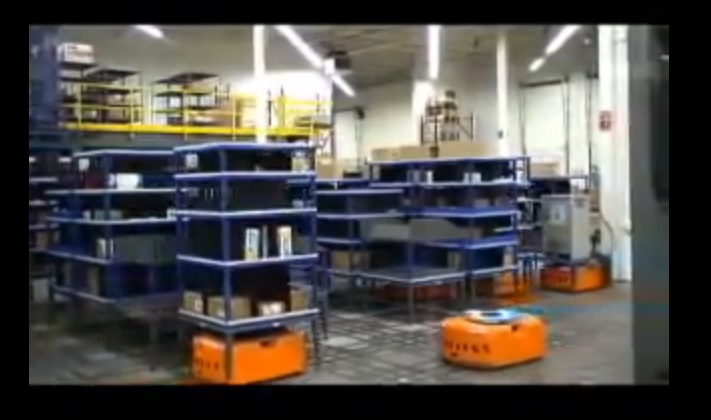
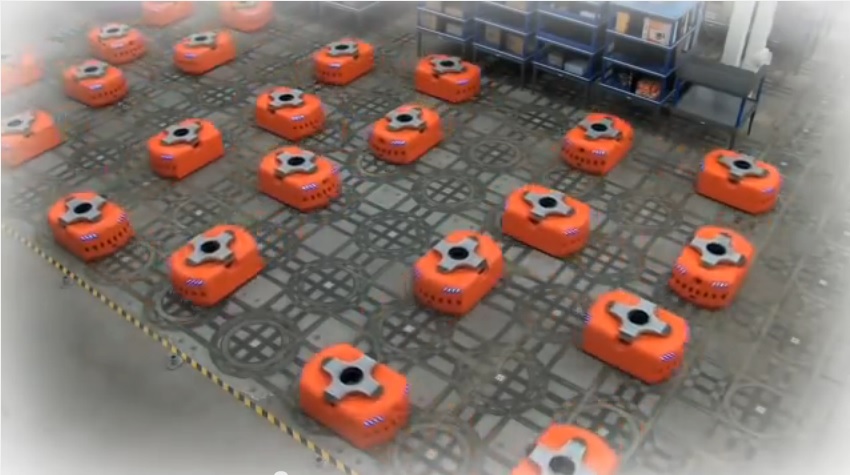
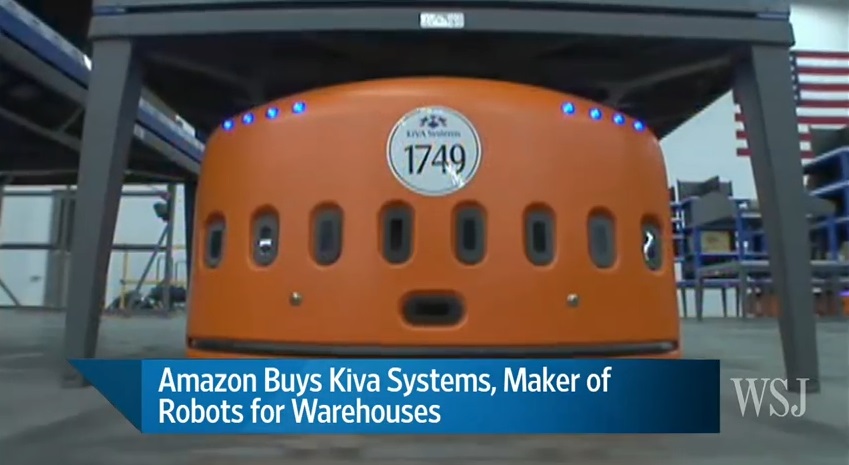
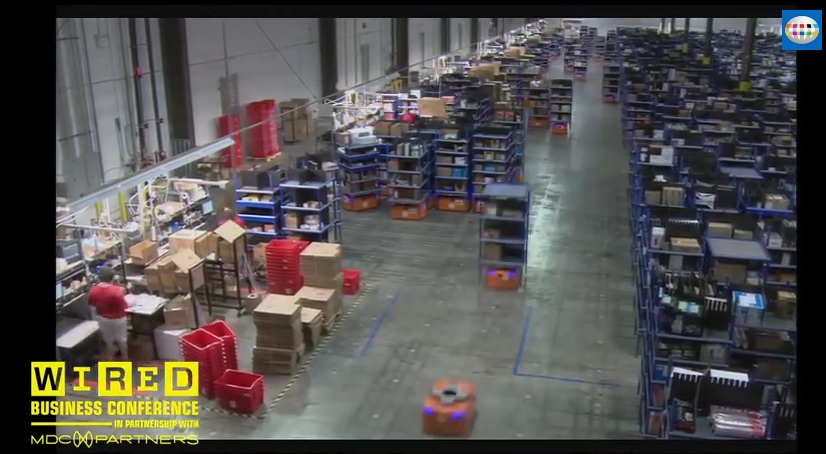
One reason why Amazon is modeled for their lean stature is their use of automation. This following VIDEO depicts the creative solution of using robots to facilitate logistics in a warehouse environment:

VIDEO: Robots help Amazon tackle Cyber Monday – http://www.cbsnews.com/videos/robots-help-amazon-tackle-cyber-monday/

December 1, 2014 – Cyber Monday is the biggest sales day of the year for online retail giant, Amazon. Last year, Amazon customers ordered 426 items every second on Cyber Monday, and this year that number is expected to grow. In addition to the 80-thousand seasonal workers they employ to fulfill orders, thousands of robots also crawl the warehouse floors. CNET.com’s KaraTsuboi takes us inside an Amazon fulfillment center to watch the robots in action. (VIDEO plays best in Internet Explorer).

Lean, automation, robotics, technocratic …

… welcome to the new Caribbean.

This is the mission of Go Lean roadmap, to elevate the economic engines of Caribbean society; industrial policy plays a key role in this roadmap. The region needs the jobs, so we need job creators: companies. These companies, or better stated, Direct Foreign Investors, need a pro-innovation environment to deploy their automated solutions. The Go Lean roadmap allows the structure of Self-Governing Entities (SGE) to incentivize industrial developments in the region. It is the expectation that robots and automated systems will flourish. The independence of the SGE structure neutralizes conflicts with “labor”.

Related issues have previously been detailed in these Go Lean commentaries listed here:

Disney World – Successful Role Model of a SGE
Using SGE’s to Welcome the Dreaded ‘Plutocracy’
Where the Jobs Are – Ship-breaking under SGE Structure
Fairgrounds as SGE and Landlords for Sports Leagues
Puerto Rico’s Comprehensive Cancer Center Project Breaks Ground – Model of Medical SGE

In addition to the roadmap encouraging robotic automation, the CU will directly employ such technologically innovative products and services to impact its own prime directives; the CPU is such a reflection; more automation and less labor. The CU’s prime directives are identified with the following 3 statements:

  • Optimization of the economic engines in order to grow the regional economy to $800 Billion & create 2.2 million new jobs.
  • Establishment of a security apparatus to protect the resultant economic engines.
  • Improve Caribbean governance to support these engines.

The CPU features economic, security and governing concerns.

The Go Lean roadmap seeks to change the entire eco-system of Caribbean logistics and resulting commerce – the interaction with postal operations. This vision is defined early in the book (Page 12 & 14) in the following pronouncements in the Declaration of Interdependence:

xv. Whereas the business of the Federation and the commercial interest in the region cannot prosper without an efficient facilitation of postal services, the Caribbean Union must allow for the integration of the existing mail operations of the governments of the member-states into a consolidated Caribbean Postal Union, allowing for the adoption of best practices and technical advances to deliver foreign/domestic mail in the region.

xxvii. Whereas the region has endured a spectator status during the Industrial Revolution, we cannot stand on the sidelines of this new economy, the Information Revolution. Rather, the Federation must embrace all the tenets of Internet Communications Technology (ICT) to serve as an equalizing element in competition with the rest of the world. The Federation must bridge the digital divide and promote the community ethos that research/development is valuable and must be promoted and incentivized for adoption.

Amazon is not our only example. A previous blog/commentary identified Chinese company Alibaba as a fitting role model for Caribbean consideration. There are so many best-practices around the world for the region to study and glean insights and wisdom from. The successful application of this roadmap will foster such best-practices for the delivery of the CPU logistics in the Caribbean. The wisdom the Go Lean book gleans are presented as a series of community ethos, strategies, tactics, implementations and advocacies; a detailed sample is listed as follows:

Community Ethos – Deferred Gratification Page 21
Community Ethos – People Respond to Incentives Page 21
Community Ethos – Job Multiplier Page 22
Community Ethos – Intelligence Gathering Page 23
Community Ethos – Lean Operations Page 24
Community Ethos – Ways to Impact the Future Page 26
Community Ethos – Ways to Foster Genius Page 27
Community Ethos – Ways to Help Entrepreneurship Page 28
Community Ethos – Promote Intellectual Property Page 29
Community Ethos – Ways to Bridge the Digital Divide Page 31
Community Ethos – Ways to Improve Sharing Page 35
Strategy – Customers – Citizens and Member-states Governmental Page 47
Tactical – Separation of Powers – Postal Services Page 78
Tactical – Separation of Powers – Interstate Commerce Administration Page 79
Implementation – Year 1 / Assemble Phase – Establish CPU Page 96
Anecdote – Implementation Plan – Mail Services – US Dilemma Page 99
Implementation – Steps to Implement Self-Governing Entities Page 105
Implementation – Improve Mail Services – Electronic Supplements Page 108
Implementation – Ways to Deliver Page 109
Planning – 10 Big Ideas for the Caribbean Region Page 127
Advocacy – Ways to Improve Interstate Commerce Page 129
Advocacy – Ways to Grow the Economy Page 151
Advocacy – Ways to Create Jobs Page 152
Advocacy –Ways to Improve Governance Page 168
Advocacy – Ways to Foster Technology Page 197
Advocacy – Ways to Foster e-Commerce Page 198
Advocacy – Ways to Promote Call Centers Page 212
Advocacy – Ways to Impact Urban Living Page 234

Following the Amazon’s example (and Alibaba’s example) will spur the Caribbean to embrace more robotic technologies. This field is new, fresh and ready for innovation. There is a level-playing-field for any innovator to earn market share. The underlying company in the foregoing VIDEO is Kiva Systems – a Massachusetts based company that manufactures mobile robotic fulfillment systems.[10][11] They rolled out a great product, then “Lo-and-behold”, they were acquired by a major e-Commerce company. Today, they are a subsidiary of Amazon, yet their material-handling systems are currently used by many other retailers including: The Gap, Walgreens, Staples, Gilt Groupe, Office Depot, Crate & Barrel, Saks 5th Avenue, and more.[12]
CU Blog - Robots help Amazon tackle Cyber Monday - Photo 3

CU Blog - Robots help Amazon tackle Cyber Monday - Photo 2

CU Blog - Robots help Amazon tackle Cyber Monday - Photo 1

CU Blog - Robots help Amazon tackle Cyber Monday - Photo 4

This commentary therefore features the subjects of commerce, logistics and entrepreneurship. The Caribbean can emulate this model from Amazon. The biggest ingredient missing in the region is the ‘will’. But the ‘will’ can be fostered anew in the Caribbean. This is the heavy-lifting for the CU, instituting such new community ethos.

Now is the time for all of the Caribbean, the people and governing institutions, to lean-in for the empowerments in the book Go Lean … Caribbean. This is a Big Idea for the region; that of a Cyber Caribbean, in which Cyber Mondays may become a big deal for our region – not only as consumers, but producers as well. Therefore, this roadmap is not just a plan for delivering the mail/packages, but rather a plan for delivering the future.

We must employ whatever tools and techniques, robotics included, to make the region a better homeland to live, work and play.

Does “play“include Robots? Yes, indeed. Consider this fun VIDEO here. 🙂

Supplemental VIDEO – The “Nutcracker” performed by Dancing Kiva Order Fulfillment Robots: http://youtu.be/Vdmtya8emMw

Download the book Go Lean … Caribbean – now!

————

AppendixSource References:

2. “‘Cyber Monday’ Quickly Becoming One of the Biggest Online Shopping Days of the Year”. Shop.org.
3. “Fundivo – Cyber Monday Statistics”. Fundivo.
4. “What’s the difference between Black Friday and Cyber Monday?”. Mirror.co.uk. Mirror.co.uk. Nov 28, 2013. Retrieved 2014-11-25.
5. “Pima County in Arizona Replaces Columbus Day with Black Friday”. BestBlackFriday.com. 2013-08-07.
6. “”Fundivo – Black Friday Statistics””. Fundivo.
7. Small Business Saturday Hailed as Success. The Telegraph. 8 December 2013″. Telegraph.co.uk. 8 December 2013. Retrieved 2 December 2014.
8. Fox, Zoe (October 23, 2012). “6 Inspiring Organizations Joining in #GivingTuesday”. Retrieved February 15, 2014.
9. “#GivingTuesday: About”. Giving Tuesday. Retrieved February 15, 2014.
10. http://www.kivasystems.com/about-us-the-kiva-approach/
11. http://www.boston.com/business/technology/innoeco/2012/03/amazon_buys_warehouse_robotics.html
12. http://www.kivasystems.com/about-us-the-kiva-approach/history/

Share this post:
, , , , , ,

Forging Change: ‘Something to Lose’

Go Lean Commentary

“You cannot miss something you never had” – Wise expression.

Not only is this expression thought-provoking, but also prophetic. The motives of the movement behind the book Go Lean…Caribbean is to forge change in the Caribbean. Plain and simple! The people, policies and processes from the book wants to elevate Caribbean life to a level that the people may not now appreciate, because they cannot “miss something that they never had”.

The book presents a plan to …

  • reboot economic engines (create 2.2 million new jobs, improved healthcare, facilitate new educational and entrepreneurial opportunities, stabilize a regional currency),
  • optimize the security apparatus (anti-crime and public safety), and
  • facilitate accountable governance for all citizens (including minority factions).

CU Blog - Forging Change - Something to Lose - Photo 5

CU Blog - Forging Change - Something to Lose - Photo 4

CU Blog - Forging Change - Something to Lose - Photo 1

CU Blog - Forging Change - Something to Lose - Photo 2

The region has never had this before, not even in the days of colonialism. With this acknowledgement, it is understandable that many may not “buy-in” to these Go Lean empowerments – they may not know what they are missing. But they do know what a better life would look like. They get such a view from these sources:

  • There is the media penetration in the Caribbean, portraying life in optimized societies abroad.
  • There are students matriculating abroad, who then may NOT want to return to our shores after their studies.
  • There are the tourists/visitors who interact with our citizens and describe their lives in their homelands.
  • There is the Diaspora that have left, many times as the only hope for work, and then repatriate monies to support their family.

Caribbean residents may not have had certain features, like the advanced societies in the US, Canada and Western Europe, but they do know how other people thrive in those other lands. They want that for themselves. This constitutes the “pull” factors that contribute to the high abandonment rate (drawn from “push-and-pull” references): life abroad on foreign shores may appeal to them more so than their homeland.

The book serves as a roadmap for the introduction and implementation of the technocratic Caribbean Union Trade Federation (CU) as a vehicle to make the region a better place to live, work and play. The vision is that of a Single Market of the 30 member-states, 4 language groups and 42 million people; this scope and leverage from this integration is such as has never actuated in the Caribbean before – the people cannot miss this vision because they have never seen it here.

So just how do we get the required buy-in? How do we get the populations to embrace, accept, commit and engage this vision of an elevated society that they may not have ever seen in their homeland before? How do we forge this change?

One approach to forging this change is to give the people something to lose.

This point was vocalized dramatically in the movie The Fast and the Furious Part Five with this dialogue:

VIDEO – Fast Five Joaquim de Almeida Speech – https://youtu.be/OucccI1pcFw

Uploaded on Jan 15, 2012 – Joaquim de Almeida talks about the Portuguese discoveries in Brazil …
This is art imitating life and life imitating art.

There is nothing nefarious or malevolent about the Go Lean roadmap. The efforts to forge change in the region are not intended for any one person or organization to wrestle power or the elevation of any one leader. The roadmap features only one objective: the Greater Good. This is defined in the book (Page 37) by Jeremy Bentham (1748 – 1832) a British philosopher, jurist, and social reformer as …

… “the greatest good to the greatest number of people which is the measure of right and wrong”.

This vision sounds good! What is there to lose?

The fact is that this vision is only on paper. The reality in the region is far different; the member-states are in crisis. In addition to the constant lure of foreign “pulls”, there is the definitive societal “push”. So many deficiencies in the Caribbean are driving people to abandon their beloved homeland and live in the Diaspora; one report asserts 70% for the college-educated classes have already left. The opportunity costs of NOT engaging the Go Lean roadmap is too great!

If we leave well enough alone, we will not be well enough!

The book describes the CU as a hallmark of a technocracy. This relates to “doing the right things and getting things done”. The term technocracy was originally used to designate the application of the scientific method to solving social and economic problems. The CU will start as a technocratic confederation – a Trade Federation – rather than evolving to this eventuality.

CU Blog - Forging Change - Something to Lose - Photo 3The roadmap must bring benefits to the region … quickly: improved economics, improved healthcare, improved education, introduction of a stable currency, improved security, improved governance, etc.. This is a Big Deal. The book likens this quest to the American effort in the 1960’s to “put a man on the man” (Page 127). As explained by the then-President of the United States, John F. Kennedy:

“I believe that this nation should commit itself to achieving the goal, before this decade is out, of landing a man on the moon and returning him safely to the earth”. His justification for the Moon Race was both that it was vital to national security and that it would focus the nation’s energies in other scientific and social fields.

As depicted in the foregoing VIDEO, there must be something for the people of the Caribbean to lose; their hope must be on the continuation of the benefits flowing from the CU. The Go Lean book declares that before any permanent change can take root in the Caribbean that there must be an adoption of new community ethos, the national spirit that drives the character and identity of its people. We must therefore use effective and efficient drivers to forge this change.

The Go Lean book – published in November 2013 – presented a two-prong approach: Top-Down and Bottoms-Up. The Top-Down plan called for engaging the politicians and community leaders to capitulate to this roadmap; while the Bottoms-Up plan called for engaging the full universe of Caribbean people: residents (42 million), Diaspora (10 million), trading-partners and visitors (80 million) to demand the empowerments of the CU/Go Lean roadmap. The verb for all these stakeholders is to “lean-in”, that is to embrace the values, hopes and dreams of this optimization plan.

Over the years, the Go Lean blog-commentaries have previously identified a number of alternate strategies to effectively forge change in the region. These were presented as follows:

The book and accompanying blogs all accept that forging this change will be an up-hill battle. But this heavy-lifting will be worth it in the end, as the Caribbean empowerment roadmap has these 3 prime directives:

  • Optimization of the economic engines in order to grow the regional economy to $800 Billion & create 2.2 million new jobs.
  • Establishment of a security apparatus to protect the resultant economic engines and ensure better public safety for stakeholders of the Caribbean.
  • Improvement of Caribbean governance to support these engines.

The roadmap was constructed with these motivations in mind: the community ethos to foster, plus the execution of strategies, tactics, implementation and advocacies to forge the identified permanent change in the region. The following is a sample of these specific details from the book:

Community Ethos – Deferred Gratification Page 21
Community Ethos – Economic Principles – People Choose Page 21
Community Ethos – Economic Principles – People Respond to Incentives in Predictable Ways Page 21
Community Ethos – Economic Principles – Economic Systems Influence Individual Choices Page 21
Community Ethos – Economic Principles – The Consequences of Choices Lie in the Future Page 21
Community Ethos – Governing Principles – Minority Equalization Page 23
Community Ethos – Governing Principles – Lean Operations Page 24
Community Ethos – Governing Principles – Cooperatives Page 25
Community Ethos – Ways to Impact the Future Page 26
Community Ethos – Ways to Help Entrepreneurship Page 28
Community Ethos – Ways to Promote Intellectual Property Page 29
Community Ethos – Ways to Impact Research & Development Page 30
Community Ethos – Ways to Bridge the Digital Divide Page 31
Community Ethos – Ways to Impact Turn-Arounds Page 33
Community Ethos – Ways to Improve Sharing Page 35
Community Ethos – Ways to Promote Happiness Page 36
Community Ethos – Ways to Impact the Greater Good Page 37
Strategy – Vision – Confederate 30 Member-States Page 45
Strategy – Mission – Stabilize and Fortify the Currency of the Region Page 46
Tactical – Confederating a Permanent Union Page 63
Tactical – Fostering a Technocracy Page 64
Implementation – Ways to Pay for Change Page 101
Implementation – Ways to Deliver Page 109
Planning – 10 Big Ideas for the Caribbean Region Page 127
Planning – Ways to Make the Caribbean Better Page 136
Planning – Reasons Why the CU Will Succeed Page 137
Advocacy – Ways to Grow the Economy Page 151
Advocacy – Ways to Create Jobs Page 152
Advocacy – Ways to Improve Healthcare Page 156
Advocacy – Ways to Improve Education Page 159
Advocacy – Ways to Improve Governance Page 168
Advocacy – Ways to Remediate and Mitigate Crime Page 178
Advocacy – Improve Homeland Security Page 180
Advocacy – Ways to Improve Communications – Community Messaging Page 186
Advocacy – Ways to Preserve Caribbean Heritage Page 218

The quest to change the Caribbean will require convincing people; they must get the message: there is much to lose for not enacting this roadmap, and even more to lose to discontinuing, once started. The empowerments in this commentary and in the Go Lean book, must be permanent changes.

This is heavy-lifting, but worth all the effort. The end-result should be a better homeland to live, work and play. 🙂

We encourage all of the Caribbean to lean-in now, to Go Lean.   🙂

Download the book Go Lean … Caribbean – now!


Share this post:
, , , ,
[Top]

Women in Politics – Yes, They Can!

Go Lean Commentary

CU Blog - Women in Politics - Yes, They Can - Photo 4

The Caribbean member-states, despite their differences, (4 languages, 5 colonial legacies, terrain: mountains -vs- limestone islands), have a lot in common. Some similarities include:

  • Lack of equality for women compared to men.
  • The government is the largest employer.

So the reality of Caribbean life is that while the governmental administrations are not fully representative of the populations, they are responsible for all societal engines: economy, security and governance.

This is bad and this is good! Bad, because all the “eggs are in the same basket”. Good, because there is only one entity to reform, reboot and re-focus.

So how do we seriously consider reforming government in the Caribbean?

  • Start anew.
  • Start with politics and policy-makers.
  • Start with the people who submit for politics, to be policy-makers.
  • Start with people who participate in the process.

Considering the status-quo of the region – in crisis – there is this need to start again. But this time we need more women.

Consider Canada!

(The City of Detroit is across the river from Windsor, Ontario, Canada. The publishers of the book Go Lean…Caribbean are here to “observe and report” the turn-around and rebirth of the once-great-but-now-distressed City of Detroit and its metropolitan area. This proximity also allows us to observe-and-report on Detroit’s neighbor: Canada).

The Canadian political landscape can serve as a great role model for the Caribbean; (its a fitting role model for Detroit too). Consider these articles on Canada’s recent national elections:

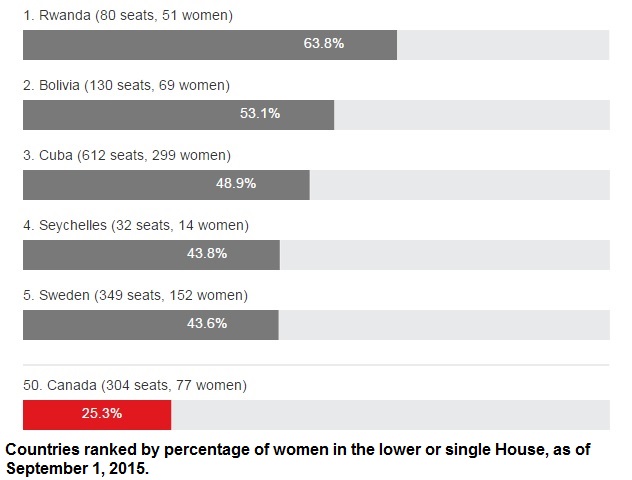
News Article #1 Title: 50% population, 25% representation. Why the parliamentary gender gap?

CU Blog - Women in Politics - Yes, They Can - Photo 1A record 88 women were elected in the 2015 federal election, up from 76 in 2011. The increase represents a modest gain in terms of representation, with women now accounting for 26 per cent of the seats in the House. The following feature — which was initially published before the election — examines the gender imbalance in Canadian politics.

Canadian women held just one-quarter of the seats in the House of Commons when the writ dropped back in August. This figure places us 50th in a recent international ranking of women in parliaments.

The 41st Canadian Parliament featured 77 women MPs, with a record 12 female ministers in Prime Minister Stephen Harper’s cabinet.

The NDP’s success in Quebec during the 2011 federal election largely triggered the uptick in the number of women in Parliament, with the proportion rising to 25 per cent from 22 per cent in the 2008 election.

In spite of this, a large gender gap persists after decades of relative stagnation in Canada’s House of Commons. Women comprise just 33 per cent of the candidates from the five leading parties in this election.

“There is no doubt that in the old democracies, including Canada, there is stagnation,” said Drude Dahlerup, a political scientist from the University of Stockholm who has consulted in countries such as Tunisia and Sierra Leone on gender equality in parliament.

“We have this perception that gender equality should come naturally. Our research shows that is not necessarily a fact.”

Old democracies don’t favour ‘gender shocks’
There is significant growth in women representatives in what Dahlerup calls “fast-track” countries — places that have experienced recent conflict or are a new democracy.

In fact, some of the countries outpacing Canada in terms of parliamentary gender equality include Rwanda, Bolivia, Iraq and Kazakhstan.

Newer democracies like Bolivia can experience a gender shock as it did in an October 2014 election, rising from 22 per cent to 53 per cent women in the lower house.

Older democracies take the incremental approach, which is slower and involves grappling with the conventions of older institutions.

Does the electorate share some of the blame?
Despite what some term as a patronizing treatment in the public sphere it appears that gender is not a chief concern for voters.

Sylvia Bashevkin, a political scientist from the University of Toronto, looked at the negative effects of underrepresentation for women in her 2009 book Women, Power, Politics: The Hidden Story of Canada’s Unfinished Democracy and found a persistent marginalization of women’s contributions to politics in the media and public sphere.

“There’s a certain stream of gender stereotyping that still colours our discussions of public leadership that often tends to trivialize the contributions of women by paying particular attention to things like their appearance, speaking style or their personal lives rather than positions on policy.”

According to a recent poll, party loyalty factors far outweigh individual factors such as gender. In fact, respondents said women often tend to represent leadership qualities the voting public admires. The online Abacus survey was conducted in December 2014 and included a sample size of 1,438 Canadians.

“The argument is that [women] tend to be more community focused… and that they tend on average to be more honest and trustworthy than male politicians,” said Bashevkin.

The core of the issue comes back to the political parties and their nominations processes, says Melanee Thomas, a political scientist from the University of Calgary.

“We can find no evidence that voters discriminate against women candidates. We did find considerable evidence that party [nomination committees] were more likely to discriminate against women candidates,” said Thomas.

Thomas’s 2013 research with Marc André Bodet of LavalUniversity looked at district competitiveness. They found that women were more likely to be chosen as nominees in areas considered strongholds for other parties.

Where women are involved in the party nomination process, Thomas also said, more women are recruited to run for that nomination. Former MP and deputy prime minister Sheila Copps agrees.

“People try to replicate themselves and their social circle is usually very like-minded. I probably recruited more women in my time because it’s human nature,” said Copps.

Copps played a role in pitching the concept of a gender target of 25 per cent to former prime minister Jean Chrétien in 1993.

The target concept relies on the ability of the party leader to appoint women nominees required to meet the target.

Former prime minister Paul Martin opted to not have a target for women in the federal Liberal Party for 2004 while Stéphane Dion increased the target to 30 per cent in 2008.

Liberal Leader Justin Trudeau is running with an open nomination policy for the upcoming election, although this has caused some recent controversies. Ultimately, women comprised 31 per cent of the Liberal candidates.

The NDP has internal mechanisms to attempt to foster diversity. They say they have “parity policies,” that aim for gender diversity in the party structure, leadership and delegates.” It also insists that ridings must provide documentation of efforts to search for a woman or minority candidate before selecting a white male. When the final candidate list was released, the NDP touted a record proportion of 43 per cent women candidates.

Under the leadership of Prime Minister Stephen Harper, the Conservative Party holds that the matter should be left up to the local riding associations to determine. After running only 38 women candidates in 2006 the party’s figure spiked quickly in 2008 to 63 candidates. In 2015, 66 women, representing 20 per cent of the Conservatives roster of candidates, are in the running.

Read the whole story here: CBC News Site retrieved 11/13/2013 from: http://www.cbc.ca/news2/interactives/women-politics/

VIDEO 1 – Canada’s First Woman MP Agnes Macphail – https://youtu.be/0ALgilFMkug

Published on Sep 11, 2014 – Canada’s first female MP takes up the cause of Canadian penal system reform (1935).

————-

VIDEO 2 – MacPhail’s Successors – https://youtu.be/fyK7C6DA9lI

Published on Oct 21, 2015 – Political Scientist Sylvia Bashevkin reviews Canada’s gender facts: 50% population, 25% representation Why the parliamentary gender gap?

————

News Article #2 Title: New PM unveils cabinet that looks ‘like Canada’
Sub-title: Justin Trudeau’s younger, more diverse team comprises old-guard Liberal politicians and newcomers, half of them women.

CU Blog - Women in Politics - Yes, They Can - Photo 2

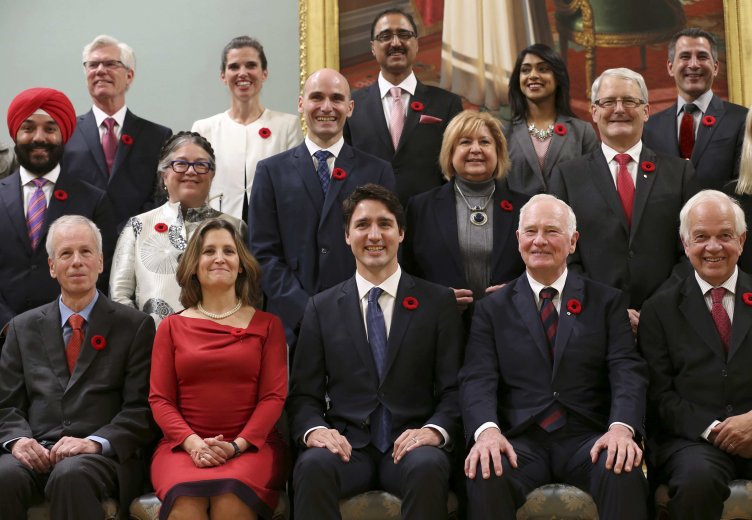
Justin Trudeau has been sworn in as Canada’s new prime minister, appointing a cabinet that he says looks “like Canada”.

The 43-year-old Liberal party leader, who swept to power in a general election two weeks ago to end nearly a decade of Conservative rule, took the oath on Wednesday and promised big changes as he introduced a younger, more diverse cabinet.

Most of the new ministers are between the ages of 35 and 50, while half of them are women – in line with Trudeau’s campaign pledge.

Asked why gender balance was important, Trudeau’s response was: “Because it’s 2015.

“Canadians from all across this country sent a message that it is time for real change, and I am deeply honoured by the faith they have placed in my team and me.”

The new cabinet includes a mix of old-guard Liberal politicians with many newcomers.

Among them is Indian-born Harjit Sajjan, a former Canadian soldier and Afghanistan war veteran who was named as Canada’s new defence minister.

He was Canada’s first Sikh commanding officer and received a number of recognitions for his service, having been deployed to Kandahar, Afghanistan, and Bosnia-Herzegovina.

Sajjan, a lieutenant-colonel in Canada’s armed forces, will oversee an anticipated change in Canada’s military involvement in the battle against the Islamic State of Iraq and the Levant (ISIL) fighters in Syria and Iraq.

Read the whole story here: http://www.aljazeera.com/news/2015/11/canada-pm-trudeau-diverse-women-cabinet-151105062433796.html posted November 5, 2015 by Al Jazerra News Service; retrieved November 13, 2015

This is not just a case for feminism. The issues in the foregoing news articles relate to policy-making participation and optimization, more than they relate to feminism. This story is being brought into focus in a consideration of the book Go Lean … Caribbean. The book serves as a roadmap for the introduction and implementation of the technocratic Caribbean Union Trade Federation (CU), for the societal elevation in the region. This roadmap calls for a fuller participation from women as stakeholders.

How do the foregoing stories relate to the Caribbean? The book relates that Canada (Page 146) has always provided a great role model for the Caribbean to consider for empowerment and elevation of our society. That country is a “friend” of the Caribbean; but it is also a competitor; a “frienemy” of sorts. How are we competing? What is our rate of participation of women in politics? See CHART here:

—————

CHART – Caribbean Women Political Participation

Member-states

Women Eligible To Vote*

Women Eligible for Office*

Number of Legislators#

Number of Women Legislators#

Percentage

Anguilla

1951

1951

11

2

18.18%

Antigua and Barbuda

1951

1951

19

3

15.79%

Aruba

1949

1949

21

7

33.33%

Bahamas

1961

1961

38

5

13.16%

Barbados

1950

1950

30

5

16.67%

Belize

1954

1954

31

1

3.23%

Bermuda

1943

1943

36

8

22.22%

British Virgin Islands

1951

1951

15

3

20.00%

Cayman Islands

1959

1959

18

2

11.11%

Cuba

1934

1934

612

299

48.86%

Dominica

1951

1951

22

3

13.64%

Dominican Republic

1942

1942

183

38

20.77%

Grenada

1951

1951

16

5

31.25%

Guadeloupe (Fr)

1945

1945

41

11

26.83%

Guyana

1953

1945

65

18

27.69%

Haiti

1950

1950

95

4

4.21%

Jamaica

1944

1944

63

7

11.11%

Martinique (Fr)

1945

1945

41

14

34.15%

Montserrat

1951

1951

9

2

22.22%

Netherlands Antilles (Ne)^

1949

1949

150

56

37.33%

Puerto Rico

1920

1920

51

6

11.76%

Saint Barthélemy (Fr)

1945

1945

19

5

26.32%

Saint Kitts and Nevis

1951

1951

15

2

13.33%

Saint Lucia

1924

1924

18

3

16.67%

Saint Martin (Fr)

1945

1945

23

7

30.43%

Saint Vincent

1951

1951

23

3

13.04%

Suriname

1948

1948

51

13

25.49%

Trinidad and Tobago

1946

1946

42

12

28.57%

Turks and Caicos Islands

1951

1951

15

5

33.33%

US Virgin Islands

1920

1920

15

5

33.33%

TOTAL

.

.

1788

554

30.98%

^ – Includes: Bonaire, Curaçao, Saba, Sint Eustatius, Sint Maarten
* – The Women Suffrage Timeline: http://womensuffrage.org/?page_id=69
# – Women in National Parliaments (2015) retrieved Oct. 29, 2015 from: http://www.ipu.org/wmn-e/classif.htm

—————

The Go Lean book advocates for more women in position of authority and decision-making in the new Caribbean.

CU Blog - Women in Politics - Yes, They Can - Photo 5

Why is this necessary?

Simple: With 50% of the population, there is the need for 50% of the representation; (this is the target). The foregoing CHART, however shows a different reality. These facts align with the Go Lean book’s quest to elevate Caribbean society.

Among the crises that the region contends with is human flight, the brain drain or abandonment of the highly educated citizenry. Why do they leave? For “push-and-pull” reasons!

“Push” refers to deficient conditions at home that makes people want to flee. “Pull” refers to better conditions abroad that appeals to Caribbean residents. They want that better life.

An underlying mission of the CU is to dissuade this human flight (and incentivize repatriation of the far-flung Diaspora). Canada is one of those refuge countries; a large number of Caribbean Diaspora live there. This country does a better job of facilitating participation from women in the political process. In competition of the Caribbean versus Canada, the Caribbean needs to do better.

For this lofty goal, of which we are failing, we can learn from Canada – our competitor – and follow their lead!

Change has come to the Caribbean. As the roadmap depicts, there is the need to foster more collaboration and optimization in the region’s governing eco-system. This involves including all ready, willing and abled stakeholders, men or women. In the Summer 2015 Blockbuster Movie Tomorrowland, the main character Frank Walker – played by George Clooney – advised the audience hoping to impact their communities for change:

“Find the ones who haven’t given up. They are the future”.

Women participating more readily in the political process can help a community.

CU Blog - Women in Politics - Yes, They Can - Photo 3

This has been proven true. Consider the example of Rwanda. (The country first on the above list). This country has endured a lot (Genocide in the 1990’s between Hutu and Tutsi tribes). Now, despite being a poorer African country, they have healed a lot of social issues. They now have many women in policy-making roles; and they have  transformed their society and now feature a great turn-around story. See details here:

Since 2000 Rwanda’s economy,[51] tourist numbers,[52] and Human Development Index have grown rapidly;[53] between 2006 and 2011 the poverty rate reduced from 57% to 45%,[54] while life expectancy rose from 46.6 years in 2000[55] to 59.7 years in 2015.[56] 

Following the 2013 election, there are 51 female deputies,[78] up from 45 in 2008;[79] as of 2015, Rwanda is one of only two countries with a female majority in the national parliament.[80]
(Source: https://en.wikipedia.org/wiki/Rwanda#CITEREFCJCR2003 retrieved November 13, 2015.)

The Go Lean roadmap posits that every woman has a right to work towards making their homeland a better place to live, work and play. The book details the following community ethos, strategies, tactics, implementations and advocates to impact our homeland:

Community Ethos – Deferred Gratification Page 21
Community Ethos – Economic Systems Influence Individual Choices Page 21
Community Ethos – Consequences of Choices Lie in the Future Page 21
Community Ethos – Minority Equalizations Page 24
Strategy – Fix the broken systems of governance Page 46
Tactical – Separation of Powers – Member-states versus CU Federal Government Page 71
Implementation – Reason to Repatriate Page 118
Planning – Lessons Learned from the previous West Indies Federation – Canada’s Support Page 135
Planning – Lessons from Canada’s   History Page 146
Advocacy – Ways to Better Manage the Social Contract Page 170
Advocacy – Ways to Impact the Diaspora – Page 218
Advocacy – Ways to Impact Foundations – NGO’s for Women Causes Page 219
Advocacy – Ways to Protect Human Rights – Women’s Rights Page 220
Advocacy – Ways to Improve Elder-Care – Needs of Widows Page 225
Advocacy – Ways to Empower Women Page 226
Advocacy – Ways to Impact Youth – Steering Young Girls to STEM Careers Page 227
Advocacy – Ways to Impact Persons with Disabilities Page 228

There are serious issues impacting the Caribbean; these must be addressed . Since many of these issues affect women, it is better to have women as stakeholders, as policy-makers and as politicians.

Many of these issues have been addressed in previous Go Lean blog/commentaries, as sampled here:

https://goleancaribbean.com/blog/?p=6836 Empowering Role Model – #FatGirlsCan
https://goleancaribbean.com/blog/?p=6722 A Lesson in History on Birthright Mandates from the US Civil War
https://goleancaribbean.com/blog/?p=6434 ‘Good Hair’ and the Strong Black Woman
https://goleancaribbean.com/blog/?p=5720 Role Model and Disability Advocate: Reasonable Accommodations
https://goleancaribbean.com/blog/?p=5648 Role Model Taylor Swift – Wielding Power in the Music Industry
https://goleancaribbean.com/blog/?p=3490 One Woman – Role Model Rallying a Whole Community
https://goleancaribbean.com/blog/?p=3244 Sports Role Model – espnW – Network for Women
https://goleancaribbean.com/blog/?p=3078 Honoring Women Victims – Bill Cosby Accusers’ Case Study
https://goleancaribbean.com/blog/?p=1918 Philadelphia Spirit Empowered Women and Other Causes
https://goleancaribbean.com/blog/?p=1037 Role Model & Humanities Advocate – Maya Angelou – R.I.P.
https://goleancaribbean.com/blog/?p=809 Case Study: Bad Treatment of Women – Abductions of Nigerian girls
https://goleancaribbean.com/blog/?p=695 Case Study: Abused wives find help by going to ‘Dona Carmen’

Politics represent the power of the people. Women represent 50% of the population; to engage the population, we must engage women. But, we need the women to engage as well, to lean-in, to this roadmap to elevate their societal engines (economy, security and governance). The goal of the Go Lean roadmap is to make the Caribbean a better place to live work and play; for all, regardless of gender.

This is not politics. This is not feminism. This is simply a quest for “better”. 🙂

Download the book Go Lean … Caribbean – now!

Share this post:
, , , , ,
[Top]

Live. Work. Play. Repeat.

Go Lean Commentary

CU Blog - Live. Work. Play. Repeat - Photo 3It’s time to go back to school, advanced Business School that is, and glean some wisdom from the structured marketing strategy called Loyalty programs. These are designed to encourage customers to continue to shop at or use the services of establishments associated with each program.[1]

There are large numbers of such programs in existence covering most types of business, (airlines: frequent flyer, hotels: frequent guest, car rental: frequent renters, restaurants: frequent diners, etc.), each one having varying features, and reward schemes. See Appendix B for details on airlines’ frequent-flyer programs.

Taking a page from this retail marketing eco-system …

… there is a need for a frequent-flyer-style loyalty program in the Caribbean to incentivize repeat business-activity in almost all regional economic engines.

This commentary asserts that a frequent-flyer-miles-style program can be structured in the Caribbean to “spread the wealth” from peak to non-peak seasons. More points can be accumulated by consuming hospitality in the slow season and less points are accumulated for consuming hospitality in the peak/high season. (See Appendix C for Spirit Airlines Model).

This strategy can also be applied with locations …

… more points can be accumulated for hospitality in the lessor-known, lesser-frequented destinations. (See Appendix D for a glimpse of the Hotwire / HotDollars program).

The book Go Lean…Caribbean calls for the elevation of Caribbean society; to re-focus, re-boot, and optimize all the engines of commerce so as to make the Caribbean a better place for these categories of vital activities: live, work and play.  Loyalty programs can be used to incentivize all of these aspects of this roadmap. The tourism industry is categorized as “play”. The book posits that the region can experience even more growth than the estimated 80 million people that visit our shores annually. This can also apply to more spending from the visitors as well.

The Go Lean book is written to employ the best-practices of economic principles. Therefore, these fundamental principles – as related in the book (Page 21) are paramount:

People Respond to Incentives in Predictable Ways: Incentives are actions, awards, or rewards that determine the choices people make. Incentives can be positive or negative. When incentives change, people change their behaviors in predictable ways.

Economic Systems Influence Individual Choices and Incentives: People cooperate and govern their actions through both written and unwritten rules that determine methods of allocating scarce resources. These rules determine what is produced, how it is produced, and for whom it is produced. As the rules change, so do individual choices, incentives, and behavior.

The Go Lean book considers the Agent of Change (Page 57) of technology and its effect on the Caribbean’s biggest economic driver “tourism”. The end-results of loyalty program will have far-reaching effects on this travel/tourism industry.

Technology, the Internet-Communications-Technology (ICT), social media account management & marketing …

… the stewardship of Caribbean tourism must truly adapt, evolve and transform to lead and keep pace with this dynamic world; see sample VIDEO in Appendix A.

This commentary relates to more than just tourism and the visiting tourists. Considering applications for “live”, “work”, and “play”, we see that there are also many opportunities to apply incentives for Caribbean citizens who live in the homeland.

The Go Lean book identifies an Agent of Change in the vast field of technology. The technological advances with cutting-edge financial products allow loyalty programs to be forged to incentivize a lot of good behavior and to dissuade bad behavior. Consider these “live” and “work” examples:

CU Blog - Live. Work. Play. Repeat - Photo 1“Live” – Tax Payments – This is not a welcome activity for anyone, thusly taxing authorities provide range of dates for tax obligations to be paid; (in the US, the Federal Income Tax deadline is April 15; payments/refunds can start on February 1st). A loyalty scheme can easily be introduced to award miles-points for early payers and refund recipients that purposefully claim their refunds later in the time window. This practice will maximize cash flow for the authorities while commending good behavior with preferable things they may want after completing obligation they must endure.

“Live” – Energy Efficiency – Positive activities like installing Green Energy alternatives (solar panels/water heaters, hybrid/electric automobiles, etc.) can be incentivized by awarding “double miles” or “eco-points”. Rather than acquiring some chattel goods, the rewards in this case could simply be privileges, like riding in carpool lanes alone.

“Live” – Education – e-Learning enrollment can result in immediate and deferred mileage credit for Caribbean students. (Thus discouraging further brain drain consequences).

“Work” – Taking jobs in rural/desolate communities or working from home is positive behavior that can be further incentivized with “double miles”-like promotions.

“Work” – Working or volunteering for Not-for-Profit agencies should also be encouraged, incentivized and rewarded.

“Work” – Take-Your-Daughter-To-Work Day is a good practice to instill career goals in young girls. Rewards should follow.

There are a lot of opportunities where loyalty program rules can transform society. Consider the practice of “gifting” miles. One person can earn the miles, but then share them with another party and even gift them to a charitable organization or a person directly. This strategy allows for a nimble, technocratic administration of loyalty programs to incentivize good behavior and dissuade bad practices.

Loyalty programs embedded in societal engines are transforming …

Could the current tourism administrations in the Caribbean master the complexities of this technology-bred strategy for elevating the region’s “play” economic engines? Hardly!

How about for regional administrators for the other activities, “live” and “work”? Again, hardly!

This “new-fangled” world requires “new-fangled” leaders. Visionaries. Technocrats.

The book Go Lean…Caribbean and the underlying movement seeks to re-boot the strategies and tactics of tourism marketing for the entire Caribbean region. The book asserts Caribbean member-states must expand and optimize their tourism outreach and use innovative products like excess inventory and loyalty rewards. However the requisite investment of the resources (time, talent, treasuries) for this goal may be too big for any one Caribbean member-state alone. So the Go Lean book campaigns to shift the responsibility to a region-wide, professionally-managed, deputized technocracy, the Caribbean Union Trade Federation (CU). The book serves as a roadmap for the introduction and implementation of the CU.

The goal of the CU is to bring the proper tools and techniques – electronic commerce, Internet Communications Technologies (ICT), visionary marketing, agile management – to the Caribbean region to optimize the stewardship of the economic, security and governing engines.  The book posits that the economy can be induced and spurred for continuous progress, with technocratic management and stewardship of a Single Market. This would be better than the status quo. As conveyed here in this commentary, and in previous commentaries, the publishers of the book Go Lean…Caribbean convene the talents and skill-sets of movers-and-shakers in electronic commerce so as to forge the best tools and techniques for advanced product marketing like loyalty program.

Change has come to the region. This book Go Lean… Caribbean provides the needed details. Early in the book, the optimization and best-practices was highlighted as a reason the Caribbean region needed to unite, integrate and confederate to a Single Market. These pronouncements were included in the opening Declaration of Interdependence (Pages 11 – 14):

iv.  Whereas the natural formation of the landmass is in a tropical region, the flora and fauna allows for an inherent beauty that is enviable to peoples near and far. The structures must be strenuously guarded to protect and promote sustainable systems of commerce paramount to this reality.

vi.  Whereas the finite nature of the landmass of our lands limits the populations and markets of commerce, by extending the bonds of brotherhood to our geographic neighbors allows for extended opportunities and better execution of the kinetics of our economies through trade. This regional focus must foster and promote diverse economic stimuli.

xiv.  Whereas a free market economy can be induced and spurred for continuous progress, the Federation must install the controls to better manage aspects of the economy: jobs, inflation, savings rate, investments and other economic principles. Thereby attracting direct foreign investment because of the stability and vibrancy of our economy.

xxvii. Whereas the region has endured a spectator status during the Industrial Revolution, we cannot stand on the sidelines of this new economy, the Information Revolution. Rather, the Federation must embrace all the tenets of Internet Communications Technology (ICT) to serve as an equalizing element in competition with the rest of the world. The Federation must bridge the digital divide and promote the community ethos that research/development is valuable and must be promoted and incentivized for adoption.

The Go Lean… Caribbean book wisely details the community ethos to adopt to proactively facilitate digital campaigns for the changed landscape; plus the executions of the following strategies, tactics, implementations and advocacies:

Community Ethos – Deferred Gratification Page 21
Community Ethos – Economic Principle – People Respond to Incentives Page 21
Community Ethos – Economic Principle – Economic Systems Influence Individual Choices & Incentives Page 21
Community Ethos – Economic Principle – Consequences of Choices Lie in the Future Page 21
Community Ethos – Lean Operations Page 24
Community Ethos – Return on Investments (ROI) Page 24
Community Ethos – Ways to Impact the Future Page 26
Community Ethos – Ways to Foster Genius – Literary, Art and Music in Graphic Design Page 27
Community Ethos – Impact Research & Development – Including ICT Page 30
Community Ethos – Ways to Improve Sharing – Data / Social Network Page 35
Community Ethos – Ways to Impact the Greater Good Page 37
Strategy – Vision – Integrate Region in a Single Market Page 45
Strategy – Mission – Build   and Foster Local Economic Engines Page 45
Strategy – Mission – Exploit   the Benefits of Globalization in Trade-Tourism Page 46
Tactical – Fostering a Technocracy Page 64
Tactical – Growing the Economy to $800 Billion – Trade and Globalization Page 70
Tactical – Website www.myCaribbean.gov for Caribbean stakeholders – Tourists Page 74
Tactical – Separation of Powers – Tourism Promotions and Administration Page 78
Implementation – Integrate All Caribbean Websites to www.myCaribbean.gov Portal Page 97
Implementation – Ways to Pay for Change Page 101
Implementation – Ways to Deliver Page 109
Implementation – Ways to Impact Social Media – www.myCaribbean.gov Portal Page 111
Planning – 10 Big Ideas – Cyber Caribbean Page 127
Planning – Ways to Make the Caribbean Better Page 131
Planning – Ways to Better Manage Image – Digital Media Presence Page 133
Planning – Lessons Learned from 2008 – Tourism & Economy Went Bust Page 136
Planning – Lessons Learned from Egypt – Lack of Tourism Stewardship Page 143
Advocacy – Ways to Measure Progress – Mining www.myCaribbean.gov Portal Data Page 147
Advocacy – Ways to Grow the Economy Page 151
Advocacy – Ways to Foster Cooperatives Page 176
Advocacy – Ways to Improve Communications – Internet & Social Media Marketing Page 186
Advocacy – Ways to Enhance Tourism – Excess Inventory Marketing Page 190
Advocacy – Ways to Impact Events – Sharing Economy Page 191
Advocacy – Ways to Market Southern California Page 194
Advocacy – Ways to Foster Technology Page 197
Advocacy – Ways to Foster e-Commerce Page 198
Advocacy – Ways to Preserve Caribbean Heritage – Cyber-Caribbean Image/Media Page 218
Advocacy – Ways to Impact Urban Living Page 234
Advocacy – Ways to Impact Rural Living Page 235

The CU seeks to foster internet-communications-technologies (ICT) to aid-and-abet tourism and other economic activities. This includes all supporting functions before, during and after visitors come to our shores – accumulating reward miles-points creates an account-holder status – see Appendix D – with the need for monthly e-statements. This is a forceful example of how a technocratic effort by regional administrators can enhance the Caribbean product offerings online. This is heavy-lifting; but this hard-work is worth the effort. The Returns-on-Investment is assured!

In previous Go Lean blogs, related points of the Technology Agents of Change affecting the tourism product offering have been detailed; see sample here:

https://goleancaribbean.com/blog/?p=6385 Wi-Fi Hot Spots Run By Hackers Are Targeting Tourists
https://goleancaribbean.com/blog/?p=6341 Tourism Stewardship — What’s Next?
https://goleancaribbean.com/blog/?p=6016 Hotter than July – Mitigating Excessive Heat with Systems
https://goleancaribbean.com/blog/?p=5840 Computer Glitches Disrupt Business For United Airlines & Others
https://goleancaribbean.com/blog/?p=5210 Cruise Ship Commerce – Getting Ready for Change
https://goleancaribbean.com/blog/?p=4793 Truth in Electronic Commerce – Learning from Yelp
https://goleancaribbean.com/blog/?p=4639 Tobago: A Model for Cruise Tourism
https://goleancaribbean.com/blog/?p=3225 The need to optimize Caribbean aviation policies
https://goleancaribbean.com/blog/?p=2571 Internet Commerce meets Sharing Economy: Airbnb
https://goleancaribbean.com/blog/?p=1364 Uber’s Emergence Transforming Cities
https://goleancaribbean.com/blog/?p=273 10 Things We Want from the US – # 2: Tourists
https://goleancaribbean.com/blog/?p=235 Tourism’s changing profile

The Caribbean must lean-in to these new business models to incentivize good behavior, for tourism and other aspects of Caribbean affairs. People will respond with the proper inducements. So imagine the universe of 130 million people all tuned-in – to the www.myCaribbean.gov portal – and responding to the appropriate prodding.

This is referred to as “Unified Command-and-Control”. Caribbean benevolent stewards can “push a few buttons” and millions of people respond, for the Greater Good. This is an exciting perspective. Let’s do it!

This is the charge of the Go Lean roadmap: incentivize the people to do more of the right thing. With the empowerments and elevations portrayed in the roadmap we can succeed in making Caribbean region a better place for citizens and tourists alike to live, work, play and repeat.  🙂

Download the book Go Lean … Caribbean – now!

———–

Appendix A – VIDEO – Capital One Venture® – Jennifer Garner – Ticked Off Traveler – https://youtu.be/7uwYGXqPguU

Published on Sep 15, 2015 – Trying to use your airline credit card miles shouldn’t be frustrating! With the Capital One Venture card, you can fly on any airline any time, then use your miles to cover the cost. Learn more: http://www.capitalone.com/credit-card

————

Appendix B – Frequent-Flyer Programs

A Frequent-Flyer Program (FFP) is a loyalty program offered by an airline. Many airlines have frequent-flyer programs designed to encourage airline customers enrolled in the program to accumulate points (also called miles, kilometers or segments) which may then be redeemed for air travel or other rewards. Points earned under FFPs may be based on the class of fare, distance flown on that airline or its partners, or the amount paid. There are other ways to earn points. For example, in recent years, more points have been earned by using co-branded credit and debit cards than by air travel. Another way to earn points is spending money at associated retail outlets, car hire companies, hotels or other associated businesses. Points can be redeemed for air travel, other goods or services, or for increased benefits, such as travel class upgrades, airport lounge access, or priority bookings.

Frequent-flyer programs can be seen as a certain type of virtual currency, one with unidirectional flow of money to purchase points, but no exchange back into money.[1]

The very first modern frequent-flyer program was created in 1972 by Western Direct Marketing, for United Airlines. It gave plaques and promotional materials to members. In 1979, Texas International Airlines created the first frequent-flyer program that used mileage tracking to give ‘rewards’ to its passengers, while in 1980 Western Airlines created its Travel Bank, which ultimately became part of Delta Air Lines’ program upon their merger in 1987.[2][3] American Airlines’ AAdvantage program launched in 1981 as a modification of a never-realized concept from 1979 that would have given special fares to frequent customers. It was quickly followed later that year by programs from United Airlines (Mileage Plus) and Delta Air Lines (SkyMiles), and in 1982 from British Airways (Executive Club).[4]

Credit card purchases
Many credit card companies partner with airlines to offer a co-branded credit card or the ability to transfer points in their loyalty program to an airline’s program. Large sign-up bonuses and other incentives have been common. Accruing points via credit cards bonuses and spending allows infrequent travelers to benefit from the frequent flyer program.

With a non-affiliated travel rewards credit card a card-member can buy a positive-space ticket considered “revenue” class, which can earn the passenger points with the airline flown.[11]

Redemption
After accumulating a certain number of points, members then use these points to obtain airline tickets. However, points only pay for the base fare, with the member still responsible for the payment of mandatory taxes and fees.

Source: https://en.wikipedia.org/wiki/Frequent-flyer_program retrieved November 11, 2015.

———–

Appendix C – Spirit Airlines

CU Blog - Live. Work. Play. Repeat - Photo 2

———–

Appendix D – Hotwire / HotDollars

What are HotDollars?
HotDollars can be used for any hotel, flight, or Hotwire Hot Rate rental car booking on Hotwire. Each HotDollar is equivalent to one U.S. dollar and is available for one year from the date of issuance. For more information, please see the HotDollars section of our Hotwire Travel Products Rules and Restrictions.

To use your HotDollars, simply sign in by clicking, “My Account.” Then, during checkout, choose HotDollars as your payment method.

Share this post:
, , , ,
[Top]

Role Model – #FatGirlsCan

Go Lean Commentary

So let’s test your political correctness (PC):

Is it proper to refer to individuals as “disabled people”?

… or as “persons with disabilities”?

Get it!?!? The PC is to recognize the whole person and then acknowledge the physical challenge.

But even now this is outdated … it’s so 2014. Now, the proper labeling is “differently-abled”.

Being PC is hard-work! This is the America of 2015. But consider the alternative, the America of yesteryear, where it was the greatest country in the world … if you were: White, Anglo-Saxon, Rich, Male, Straight, and “Right-sized”.

Anything/anyone else and … it was “God help you”.

This commentary aligns with the book Go Lean…Caribbean, which campaigns for a reasonable accommodation so that persons in the Caribbean that are differently-abled can live a full and engaging life … and help to elevate their communities and make their homelands better places to live, work and play.

This difference also includes “fat”.

This is a sober issue because many persons that are overweight, fat or obese are faced with serious challenges (scorn, discrimination, glares, prejudice, body-shaming and outright animosity) in society. And many times their challenge starts “in the mirror”. There is a lot that can be done and a lot that needs to be done for overweight, fat or obese persons, but it must start with self-advocacy and then, the whole society can be urged to change.

This is the cause of one advocate Jes Baker; she is a mastermind, author, blogger, champion and Militant Baker. Those of us that are looking, listening, learning, lending-a-hand and leading can greatly benefit by considering her as a Role Model.

Consider this account (Book Review, article and VIDEO) of her story:

Book Review:  Things No One Will Tell Fat Girls: A Handbook for Unapologetic Living  … By Jes Baker

CU Blog - Book Review - #FatGirlsCan - Photo 3“Things No One Will Tell Fat Girls” is a manifesto and call to arms for people of all sizes and ages. With her trademark wit, veteran blogger and advocate Jes Baker calls people everywhere to embrace a body-positive worldview, changing perceptions about weight, and making mental health a priority.

Alongside notable guest essayists, Jes shares personal experiences paired with in-depth research in a way that is approachable, digestible, and empowering. “Things No One Will Tell Fat Girls” is an invitation to reject fat prejudice, fight body-shaming at the hands of the media, and join this life-changing movement with one step: change the world by loving your body.

Among the many “Things No One Will Tell Fat Girls” that you don’t want to miss:

1. It’s Possible to Love Your Body (Today. Now.)
2. You Can Train Your Brain to Play Nice
3. Your Weight Is Not a Reflection Of Your Worth
4. Changing Your Tumblr Feed Will Change Your Life
5. Salad Will Not Get You to Heaven
6. Cheesecake Will Not Send You to Hell

If you’re a person with a body, this book is for you.

Source: http://www.amazon.com/Things-One-Will-Tell-Girls/dp/1580055826/ retrieved October 28, 2015

———-

First Person Anecdote: #FatGirlsCan blogger urges ‘girls of all sizes’ to love their bodies
By: Jes Baker

(Source: http://www.today.com/health/fatgirlscan-blogger-urges-girls-all-sizes-love-their-bodies-t52581)

CU Blog - Book Review - #FatGirlsCan - Photo 1A little more than two years, I was struggling after a horrible breakup and feeling quite low. I believed that I would never find a partner who loved me and loved my body.

I thought that someone would simply put up with how I looked. I also felt like only certain people could love a fat girl; there were just some people I could never date. I channeled those feelings into a blog post and began feeling more empowered.

Over the years as I continued blogging and speaking all over the country about body image, I realized the flaws behind my thinking—and I realized that societal norms inspired many of these thoughts. That idea that fat girls remain unlovable is just a lie.

Everyone deserves to be love and accepted.

And, fat girls can have authentic, sexy, enduring love.

The idea behind that blog eventually became part of an idea for my book, Things No One Will Tell Fat Girls. It’s full of things I wish I had learned a lot earlier in life and info I hope will help other women.

While it is a book about fat girls from a fat girl’s perspective I believe the message remains basic — and it’s one I hope that resonates with everyone.

We need to accept ourselves in our bodies.

CU Blog - Book Review - #FatGirlsCan - Photo 2There are so many bodies and so many people struggling with how they look in those bodies. I want fat girls to accept that fat is just an unbiased word to describe how a person looks. But I also want skinny girls to feel good about how they look, too, no matter how many times someone sneers at them to eat a hamburger.

As part of the social media campaign associated with the book, we developed a hashtag #FatGirlsCan and a trailer to accompany it. The hashtag encourages women to show visually what fat girls can do. There are fat girls whitewater rafting, rock climbing, practicing yoga, running marathons, wearing horizontal stripes, and so many other things. This was really incredible. I was never expecting to feel so inspired by seeing women doing things some of which I’m afraid to do. I know I can swim, dance, and ride a bike, but I don’t trust my body enough to rock climb or whitewater rafting.

Loads and loads of women have sent in pictures of themselves in love — all types of partners and all types of love. That feels like really powerful imagery.

Loving our bodies can really change the world.

When we liberate ourselves from our physical oppression then we are free to live our incredible lives. We become kinder to ourselves and to others. This book is for fat girls because that is who I am.

But it’s also for girls of all sizes told that they cannot do something because of how they look. Acceptance remains incredibly important and with that we can do so much more.

We can change society.

Related Article: ‘Just go for it’: 4 tips about self-acceptance from ‘Big Gal Yoga’
Tips:

    1. Don’t put your life on hold until you have the ‘perfect’ body
    2. Really look at your body
    3. Don’t let negative comments get to you
    4. Try New Things

———-

VIDEO– NBC Today Show – Chew the “Fat” – http://on.today.com/1HaBzDq

Published on October 28, 2015 – Jes Baker is blogger and mastermind behind the Militant Baker. She is a body image advocate, a fat model, and author of the new book, “Things No One Will Tell Fat Girls.” Jes shares her inspiration for why we all need to accept ourselves in our bodies.

That last sentence from the foregoing article is paramount: “We can change society”.

Yes, we can! All of us …

The Go Lean book posits that one person, despite their field of endeavor/advocacy, can make a difference in the Caribbean, and its impact on the world; that there are many opportunities where one champion can elevate society. In this light, the book features 144 different advocacies, one specifically for Persons with Disabilities (Page 228). We need advocates, vanguards and sentinels to ensure equal opportunities for all these relevant stakeholders. We even welcome those champions that may be overweight! #FatGirlsCan … and we welcome “Fat Men” too.

Make no mistake, obesity is unhealthy. But the individual must still be valued. They have human rights!

The Go Lean book serves as a roadmap for the introduction and implementation of the technocratic Caribbean Union Trade Federation (CU). The CU is designed to elevate the region’s economic, security and governing societal engines. This includes healthcare. We recognize the societal threats of obesity; we are not condoning bad eating habits nor bad diets. Just the opposite, this Go Lean/CU movement and underlying book, addresses the ailments tied to obesity and seeks to assuage it, including the psychological dimensions. But the roadmap starts first with this “frank and earnest” assessment of reality:

It is what it is.

There are “fat” people in the Caribbean and we need them too, to be involved in the empowerment plan to elevate our society. We need them to work to lower their perceived health risk and improve their wellness. We cannot impact their lives without their motivation and participation. They are different, yes, but differently-abled!

The CU/Go Lean roadmap has a singular directive, a prime directive: to make the Caribbean a better place to live, work and play for all stakeholders, including persons with physical disabilities and those differently-abled. The declarative statements of this prime directive are as follows:

  • Optimization of the economic engines in order to grow the regional economy to $800 Billion GDP and create 2.2 million new jobs.
  • Establishment of a security apparatus to prepare and protect stakeholders for natural, man-made and incidental emergencies.
  • Improvement of Caribbean governance to support these engines.

The Go Lean book relates a common crisis; that the whole region must integrate to streamline delivery systems for improved healthcare and wellness. There is the need to encourage healthy eating, assuage obesity, optimize the food supply and promote better self-esteem. But many of these mitigations are too big for any one member-state alone. From the outset, the book reported this requirement as a pronouncement in the opening Declaration of Interdependence (Page 11):

ix. Whereas the realities of healthcare and an aging population cannot be ignored and cannot be afforded without some advanced mitigation, the Federation must arrange for health plans to consolidate premiums of both healthy and sickly people across the wider base of the entire Caribbean population. The mitigation should extend further to disease management, wellness, mental health, obesity and smoking cessation programs. The Federation must proactively anticipate the demand and supply of organ transplantation as developing countries are often exploited by richer neighbors for illicit organ trade.

The pressing need to optimize facilitations for all population groups – abled and challenged – was also pronounced in the Declaration of Interdependence (Pages 13), with this statement:

xviii. Whereas all citizens in the Federation member-states may not have the same physical abilities, reasonable accommodations must be made so that individuals with physical and mental disabilities can still access public and governmental services so as to foster a satisfactory pursuit of life’s liberties and opportunities for happiness.

The Go Lean roadmap specifically encourages the region, to lean-in to elevate society for all stakeholders – abled and challenged – with these specific community ethos, strategies, tactics, implementations and advocacies:

Community Ethos – Economic Principles – Economic Systems Influence Individual Choices Page 21
Community Ethos – Governing Principles – Minority Equalization Page 24
Community Ethos – Governing Principles – Lean Operations Page 24
Community Ethos – Governing Principles – Return on Investments Page 24
Community Ethos – Ways to Promote Happiness – Minority Rights Page 36
Community Ethos – Ways to Impact the Greater Good Page 37
Strategy – Vision – Confederate all 30 Member-states Page 45
Strategy – Mission – Repatriate the Diaspora, young and old …even those disabled Page 46
Anatomy of Advocacies – Examples of Individuals Who Made Impact Page 122
Planning – 10 Big Ideas – Homeland Security Pact Page 127
Planning – Ways to Improve Failed-State Indices – Minority and Human Rights Page 134
Planning – Lessons from US Constitution – Equal Protection for all Minorities Page 139
Advocacy – Ways to Improve Governance – For All Citizens Page 168
Advocacy – Ways to Better Manage the Social Contract – Medical / Heath Endeavors Page 170
Advocacy – Ways to Impact Justice – Ensure Rights for   the Disabled Classes Page 177
Advocacy – Ways to Remediate and Mitigate Crime – Protect Minority Classes Page 178
Advocacy – Ways to Impact Homeland Security – Emergency Management Page 180
Advocacy – Ways to Foster Technology – e-Government Interfaces & Services Page 197
Advocacy – Ways to Protect Human Rights – Caribbean [Persons] with Disabilities Page 220
Advocacy – Ways to Improve Elder-Care – Caribbean [Persons] with Disabilities Page 225
Advocacy – Ways to Empower Women Page 226
Advocacy – Ways to Impact Youth Page 227
Advocacy – Ways to Impact Persons with Disabilities – Americans with Disabilities Act Model Page 228

The Caribbean region wants a more optimized society … for all citizens. We want to mitigate human rights and civil rights abuses, and empower all for a better life, liberty and the pursuit of happiness. This quest, for differently-abled persons, is not easy, it requires strenuous effort, heavy-lifting. These persons may not be able to contribute as much to Caribbean society as they draw from public resources. But they can engage more fully, and contribute more with the proper support systems. The mission to “help them help us” is only reasonable; it can generate a Return on Investment (ROI); as conveyed in the foregoing book review/article/VIDEO. Plus everyone needs the encouragement and confidence portrayed by that Role Model and Advocate Jes Baker.

Go Girl!

Many related subjects have been blogged in previous Go Lean…Caribbean commentaries; they are sampled here:

https://goleancaribbean.com/blog/?p=6819 The … Downside of the ‘Western’ Diet
https://goleancaribbean.com/blog/?p=5720 Role Model and Disability Advocate: Reasonable Accommodations
https://goleancaribbean.com/blog/?p=5098 Forging Change – ‘Food’ for Thought
https://goleancaribbean.com/blog/?p=2105 Recessions and Physical/Mental Public Health
https://goleancaribbean.com/blog/?p=278 Regional Health-care Concerns: The need for a “larger pool” of partakers

The CU/Go Lean roadmap is designed to empower and enhance the economic engines for the full participation and benefit of all Caribbean people, including the differently-abled ones. The CU’s vision is that this population group represents a critical talent pool that is underserved and underutilized. There is therefore a call for a Caribbean [Persons] with Disabilities (CDA) provision to be embedded in the CU confederation treaties; modeled after the Americans with Disabilities Act (ADA).

This roadmap is a fully comprehensive plan with consideration to all aspects of Caribbean life for all stakeholders: citizens, businesses, and institutions. All are hereby urged to lean-in to this roadmap. Yes, with all “hands on deck”, including the differently-abled, the Caribbean can truly become a better place to live, work and play.  🙂

Download the free e-book of Go Lean … Caribbean – now!

Share this post:
, , , , ,
[Top]

The Academic Downside of ‘Western’ Diets

Go Lean Commentary

“You are what you eat”. – Old Adage

Western Diet 1This rule appears to be true not just for the individual, but for the community as well. According to this subsequent news article, communities suffer in their academic performance where a larger percentage of adolescents are obese or eat poorly. So this is not just a micro problem, but a macro one as well.

This is an important consideration, not just for health care or wellness, but for educational concerns and community competitiveness as well.

The publishers of the book Go Lean…Caribbean seeks to elevate Caribbean communities by optimizing the societal engines for economics, security and governance – these are identified as our prime directives. It has long been accepted that education reform – as a subset of economics – would be inclusive of this effort, but now it looks like optimizing the Caribbean diet must also be part-and-parcel of this quest.

It goes without saying that academic competitiveness would affect a community’s economic dispositions. But it may be judged as “a stretch” to liken food choices as an important economic concern, but if the above adage is to be considered factual, then yes, we are what we eat. According to the following story, the Western Diet – inclusive of the Caribbean – has a serious academic downside. See the full story here:

Title: The Academic Downside Of ‘Western’ Diets
By: Sam P.K. Collins

Proponents of healthier school lunches have one more reason to frame the issue as a public health matter. A new study suggests that the “Western” diet — defined as selections of red meat, sugary desserts, high-calorie food, and refined grains — may be detrimental to a child’s cognitive development, ultimately hampering their academic performance.

Researchers polled more than 2,800 adolescents about their dietary choices and examined their standardized test scores. Once they controlled for variations in body mass index readings and physical activity levels, they found that students who ate mostly vegetables and whole grains scored an average of 7 percent higher in mathematics, writing, and reading compared to their counterparts who ate a “Western” diet.

“Adolescence is a sensitive period for brain development and a vulnerable time of life with respect to nutrition. Therefore, public health policies and health promotion programs should rigorously target the issue of food intake during this stage of individual development,” the study read. “To date, this is one of the few studies to report on the associations between dietary patterns and academic performance; therefore, more prospective studies are required to support our findings.”

The study, published in a recent issue of Nutrients journal, followed a separate experiment in which the same research group gave an older group of youth computerized cognitive exams. Teens who had a “Western” diet more than likely skipped breakfast frequently. Researchers said that doing so delayed development of reasoning and learning skills. Studies conducted in Canada, Sweden, and Iceland at the turn of the decade also linked fruits, vegetables, and milk to higher academic achievement among teens.

MapThese findings come amid exploding rates of childhood obesity and increased scrutiny of the fast food industry. While the Centers for Disease Control and Prevention say that eating fast food sporadically doesn’t result in nutrition deficiency, the government agency warns the high-sugar, high-salt meals found at popular fast food franchises can cause memory loss and slow brain development in children. Those meals lack calcium, iron, Vitamin C, and zinc — nutrients that experts say help stimulate cognitive development.

Research has shown that a healthy morning meal in tandem with physical activity can increase a child’s brain activity and improve their disposition toward school. Such thinking has compelled efforts to revamp nutritional standards and expand access to healthy school meals.

The Healthy, Hunger-Free Kids Act, up for reauthorization this year, sets policy for the United States Department of Agriculture’s food programs. Since the law’s passage, more than $385 million in locally grown produce has entered the nation’s cafeterias. More than one million students across the country have benefited — eating not only healthy breakfasts and lunches, but also nutritious dinners, as part of an after-school snack component of the program.

Decades prior, the status quo disadvantaged children of color and those living in low-income areas with subpar education systems. Without nearby sources of healthy food, youngsters living in food deserts — urban enclaves where it’s difficult to purchase affordable or high-quality food — often depend on fast food and corner store offerings for sustenance. The fast food industry’s aggressive marketing tactics in those areas, as outlined in a recent Arizona State University study, don’t make it easier to encourage healthy food choices.

While opponents of Healthy, Hunger-Free Kids Act argue that students aren’t responding positively to menu changes, data compiled in the recent years paints a different picture. A 2014 Harvard survey, for example, found that students are eating 16 percent more vegetables and 23 percent more fruit with their lunch. The University of Connecticut’s Rudd Center for Food Policy & Obesity also found that students discarded their lunches less often under the new nutrition standards.

“We encourage Congress to reauthorize the Healthy, Hunger-Free Kids Act, which, since its implementation, has changed how school districts prepare foods ensuring that district funding for federal school meal and child nutrition programs meet more nutritious meal guidelines and restricts the serving of fatty and non-nutritious foods and beverages, including vending machines,” The Monitor’s editorial staff wrote on Tuesday.

“This measure, we believe, has dramatically altered the conversation about foods in American schools for the better. And we want to see this discussion continue in the right direction and not allow children to revert back to bad eating habits,” the editorial continued.

The controversy around the “Western” diet isn’t limited only to students’ academic performance. Earlier this year, scientists attributed those food choices to the development of colon cancer in a study where a group of African Americans and South Africans switched diets for 10 days. The experiment, in part, opened conversations about the potentially dire health effects of a high-fat, high sugar diet.
Source: Think Progress Digital Magazine – (Posted 09/29/2015; retrieved 10/27/2015) – http://thinkprogress.org/health/2015/09/29/3706900/western-diet-low-cognition/

There are some strong points being made in this article:

Adolescence is a sensitive period for brain development and a vulnerable time of life with respect to nutrition.

… and …

We want to see this discussion continue in the right direction and not allow children to revert back to bad eating habits.

These points helps us to appreciate the gravity of this issue. This constitutes the heavy-lifting that the Go Lean book posits that is necessary to elevate Caribbean society.

Why so hard?

The Go Lean roadmap seeks to have the Caribbean do even better than the American model reported here. We do not want to follow the American food standards (Standard American Diet = SAD); we want to exceed it.

We recognize that it is a heavy-lifting task. There are so many societal defects in the region and we need effective strategies, tactics and implementation just to effect a turn-around. But now, to try and do even better than the American eco-system, when it comes to food seems like such a “tall order”.

It is not!

As previously discussed, the American eco-system is plagued with societal defects; one in particular: Crony-Capitalism. The Greater Good for so many aspects of American life has been hijacked for the private gains of special interest groups. In this case, the indictment is on Big Agra or more specifically, the agribusiness concerns as they fight common sense food labeling efforts, induce so much steroids in meat production and exacerbate greenhouse gases. These ones prove to be “bad actors” despite any promotion of up-building community values. They even bully family farmers to crowd out the wholesale markets for larger and larger shares, see VIDEO in the Appendix below. Lastly, they engage in abusive labor practices with large portions of their labor force – migrant workers.

The book Go Lean…Caribbean serves as a roadmap for the introduction and implementation of the Caribbean Union Trade Federation (CU), a confederation of all 30 member-states in the region. This effort is an initiative to bring change and empowerment to the Caribbean region, to make the region a better place to live, work, learn, heal and play even better than our American neighbors enjoy. The book recognized the significance of our culture. This is why a discussion on food choices and diet is such a significant topic. “We are what we eat” and food defines our culture. From the outset, the book reported this pronouncement in the opening Declaration of Interdependence (Page 14):

xxxii.    Whereas the cultural arts … of the region are germane to the quality of Caribbean life, and the international appreciation of Caribbean life, the Federation must implement the support systems to teach, encourage, incentivize, monetize and promote the related industries … These endeavors will make the Caribbean a better place to live, work and play.

The book asserts that Crony-Capitalism is not the only option. We can enjoy the foods of our dynamic cultures and build up our economy at the same time. This is not a binary issue. We can have great food, healthy options and still support jobs and other economic activities. This fact was also pronounced in that opening Declaration of Interdependence (Page 14):

xxvi.    Whereas the Caribbean region must have new jobs to empower the engines of the economy and create the income sources for prosperity, and encourage the next generation to forge their dreams right at home, the Federation must therefore foster the development of new industries, like that of … frozen foods … impacting the region with more jobs.

xxx.    Whereas the effects of globalization can be felt in every aspect of Caribbean life, from the acquisition of food and clothing, to the ubiquity of ICT, the region cannot only consume, it is imperative that our lands also produce and add to the international community, even if doing so requires some sacrifice and subsidy.

The Go Lean movement, in presenting an empowerment roadmap for the region hereby examines the reality and consequences of food and diet in the day-to-day affairs of Caribbean people. While we do not want to endanger personal freedoms, there must be a set of community values that are promoted. These are defined in the underlying Go Lean book as “community ethos” or the fundamental character or spirit of a culture; the underlying sentiment that informs the beliefs, customs, or practices; dominant assumptions of a people.

This is the quest of the Go Lean roadmap; to impact the Caribbean region in a comprehensive manner, starting with the values, or what’s in our heart, and then to elevate society with the execution of our prime directives, defined with these 3 statements:

  • Optimization of the economic engines in order to grow the regional economy to $800 Billion GDP and create 2.2 million new jobs.
  • Establishment of a security apparatus to protect the resultant economic engines.
  • Improvement of Caribbean governance, including a separation-of-powers with the member-states, to support these engines.

The book describe the CU as a hallmark of a technocracy, a commitment to efficiency and effectiveness. Yet still there is the commitment to fun, happiness, beauty, art and self-actualization of our culture. The Go Lean roadmap was constructed with the community ethos in mind to forge change, plus the execution of related strategies, tactics, implementations and advocacies to make the change permanent. The following is a sample of these specific details from the book:

Community Ethos – Deferred Gratification Page 21
Community Ethos – Economic Principles – People Choose Page 21
Community Ethos – Economic Principles – People Respond to Incentives in Predictable Ways Page 21
Community Ethos – Economic Principles – The Consequences of Choices Lie in the Future Page 21
Community Ethos – Governing Principles – Lean Operations Page 24
Community Ethos – Ways to Impact the Future Page 26
Community Ethos – Ways to Impact Research & Development – Nouvelle Caribbean Cuisine Page 30
Community Ethos – Ways to Impact Turn-Around Page 33
Community Ethos – Ways to Promote Happiness – Promotion of Domestic Cultural Institutions Page 36
Community Ethos – Ways to Impact the Greater Good Page 37
Strategy – Mission – Build and foster local economic engines to satiate food needs Page 45
Strategy – Mission – Celebrate the Culture and Cuisine of the Caribbean Page 46
Strategy – Customers – Outreach to Caribbean Diaspora Page 47
Strategy – Agents of Change – Globalization Page 57
Tactical –   Confederating a Permanent Union Page 63
Tactical – Fostering a Technocracy Page 64
Tactical – Creating   $800 Billion Economy – New High Multiplier Industries – Frozen Foods Page 70
Tactical – Separation of Powers – Department of State – Culture Administration Page 81
Tactical – Separation of Powers – Department of Education – Regional Directives Page 85
Tactical – Separation of Powers – Food / Nutritional Administrations Page 87
Tactical – Separation of Powers – Agriculture & Fisheries Licensing – Inspections Page 88
Tactical – Separation of Powers – Farm & Marine Credit – Economic Influence Page 88
Implementation – Ways to Pay for Change Page 101
Implementation – Ways to Deliver Page 109
Implementation – Ways to Benefit from Globalization – Dynamics of Food Supply Page 119
Implementation – Ways to Promote Independence – Food Interdependence Page 119
Planning – 10 Big Ideas for the Caribbean Region – 4 Languages & Culture in Unison Page 127
Planning – Ways to Improve Trade – Diaspora Marketing Page 128
Planning – Ways to Make the Caribbean Better Page 136
Advocacy – Ways to Grow the Economy Page 151
Advocacy – Ways to Create Jobs Page 152
Advocacy – Ways to Impact Cancer – Promote Wellness – Better Diets Page 157
Advocacy – Ways to Better Manage Food Consumption Page 162
Advocacy – Ways to Improve Communications – Public Broadcasting of “Sound-bites” Page 186
Advocacy – Ways to Impact Events – Food Festivals Page 191
Advocacy – Ways to Develop Frozen Foods Page 208
Advocacy – Ways to Improve Fisheries Page 210
Advocacy – Ways to Preserve Caribbean Heritage – Promote Culture Page 218
Advocacy – Ways to Improve the Arts Page 230
Advocacy – Ways to Impact Urban Living – Promotion of Farmers Markets Page 234
Advocacy – Ways to Impact Rural Living – Agricultural Co-existence Mandate Page 235

This roadmap wants to change the Caribbean diet plan, branded Nouvelle Caribbean Cuisine: more fiber, less fats; more green vegetables, less processed food; no more “SAD”. We must start this in the schools so as to effect the habits of our youth.

The hope is that when they grow-up they will not depart from those new values. This is a basic premise in Judeo-Christian religious doctrine; as stated here in the Bible:

Train up a child in the way he should go, And even when he is old he will not depart from it. – Proverbs 22:6 (ASV)

We have so many reasons to lean-in to the ethos, values and principles of this Go Lean roadmap. But according to the foregoing news article, we should also have academic motivations. Our children will not advance (academically) as well as they should, or as other regions do around the world.

Education is presented as a priority for every government in the Caribbean member-states; it is our only hope of competing on the world stage. (Globalization is presented in the Go Lean book as an agent-of-change, so we cannot opt-out of the competition). It is time to “put our money where our mouth is”; or better stated, “to put in our mouths where we hope to get our money”.

Education policy has been a prominent topic for the Go Lean movement. We have detailed education policies, strategies and tactics in many previous Go Lean blog/commentaries. See sample here:

https://goleancaribbean.com/blog/?p=6269 Education & Economics: US President Efforts to Reform
https://goleancaribbean.com/blog/?p=5482 For-Profit Education: Plenty of Profit; Little Education
https://goleancaribbean.com/blog/?p=5423 Extracurricular Music Programs Boost Students
https://goleancaribbean.com/blog/?p=4913 Ann Arbor: Model for ‘Start-up’ Cities
https://goleancaribbean.com/blog/?p=4572 Role Model: Innovative Educator Ron Clark
https://goleancaribbean.com/blog/?p=4487 FAMU is No. 3 for Facilitating Economic Opportunity
https://goleancaribbean.com/blog/?p=1256 Is a Traditional 4-year Degree a Terrible Investment?

As depicted by the S.A.D. references, the Go Lean expectation is not to allow the American eco-system to lead the Caribbean’s reform efforts. The plan is for more of the Caribbean food supply to originate locally and to institute some new standards: Nouvelle Caribbean Cuisine. The Caribbean succeeded before in forging great culinary traditions based on the best-practices of the time in the past, (think the abundance of seafood recipes), we can do this again with a focus on the future.

While this plan is conceivable, believable and achievable, it can also be delicious. 🙂

Everyone is urged to lean-in for the empowerments in the Go Lean roadmap.

Download the book Go Lean … Caribbean  – now!

———

Appendix VIDEO – John Oliver Commentary on Chicken Production – https://youtu.be/X9wHzt6gBgI

Published on May 17, 2015 – John Oliver explains how chicken farming can be unfair, punishing, and inhumane. And not just for the chickens! Pardon the coarse language.


Share this post:
, , , , ,
[Top]

A Lesson in ‘Garbage’

Go Lean Commentary

“I’ve recently been placed in charge of garbage … so when you think of garbage, think of me”. – Dialogue from 1988 Movie “Coming to America“; see Appendix VIDEO below.

- Photo 4Garbage has often played a role in movements and revolutions for societal change. For example, Martin Luther King had gone to Memphis, Tennessee in support of African-American Garbage Workers protesting for higher wages and better working conditions when he was gunned down on April 4, 1968. That action transformed America and modern society throughout the world. See the story relating this here: http://www.atu900.org/memphis-sanitation-workers/.

Perhaps the business of ‘garbage’ can transform society … once again. This time in the Caribbean.

“One man’s trash is another man’s treasure”.

The book Go Lean…Caribbean posits that there is a need to re-focus, re-boot, and optimize the engines of commerce, security and governance so as to make the Caribbean a better place to live, work and play for all. The art-and-science of garbage (solid waste) collection affects all 3 areas.

The Go Lean book calls for the optimization of these 3 engines (economic, security and governing) for the Caribbean region:

  • Economics – Jobs, business models, industrial neighborhoods constitute the economic dimensions of this industry. Overall the roadmap calls for the optimization of the economic engines in order to grow the regional economy to $800 Billion GDP and create 2.2 million new jobs. The art-and-science of garbage collection have often involved a substantial labor force. Due to the undesirable nature of the work (outdoor, odor, unclean conditions), these jobs have often paid a premium compared to other manual labor jobs. Now there is the chance to employ more automation.
  • Security – Public Health issues are involved in the disposal of garbage in any community; there is the need for technocratic deliveries of this feature of the Social Contract. Historically the garbage collection industry have attracted organized crime figures; bullies abound. There is therefore the constant need to monitor and mitigate these risks and threats on the community and public safety.
  • Governance – Garbage collection is always in the sphere of government, even though many municipalities may outsource to service providers with contracts of different length and dimensions. Corruption (briberies, kickbacks, etc.) have often been associated with such contracts. There is therefore the need to optimize governmental engines in the execution of this required municipal service.

This commentary therefore recommends the adoption of more automated garbage collection systems in the Caribbean region. This does not refer to a complete robotic, cybernetic or cyborg system, but rather systematic tools to aid productivity for a minimal staff – do more with less. See the recommended “systems” here:

Encyclopedic Reference: Garbage trucks
Garbage truck or dustcart refers to a truck specially designed to collect municipal solid waste and haul the collected waste to a solid waste treatment facility such as a landfill. Other common names for this type of truck include trash truck in the United States, and rubbish truck, bin wagon, dustbin lorry, bin lorry or bin van elsewhere. Technical names include waste collection vehicle and refuse collection vehicle. These trucks are a common sight in most urban areas.

There are 3 primary types of waste collection vehicles:

Secondarily, these types of trucks are also deployed: Pneumatic collection, Grapple trucks, and Roll-offs. [Our focus is on the Side Loaders:]

Side loaders
Side loaders are loaded from the side, either manually, or with the assistance of a joystick-controlled robotic arm with a claw, used to automatically lift and tip wheeled bins into the truck’s hopper. Lift-equipped trucks are referred to as automated side loaders, or ASL’s. Similar to a front-end loader, the waste is compacted by an oscillating packer plate at the front of the loading hopper which forces the waste through an aperture into the main body and is therefore compacted towards the rear of the truck.[6] An Automated Side Loader only needs one operator, where a traditional rear load garbage truck may require two or three people,[7] and has the additional advantage of reducing on the job injuries due to repetitive heavy lifting. Due to these advantages, ASL’s have become more popular than traditional manual collection. Typically an Automated Side Loader uses standardized wheeled carts compatible with the truck’s automated lift.[8]

Source:Wikipedia Online Encyclopedia – Retrieved 10-22-2015 from: https://en.wikipedia.org/wiki/Garbage_truck#Side_loaders

[Automated garbage collection require that residents ([the public)] collaborate by lining up domestic garbage bins at the road side – on the correct day. Collaboration (sharing) is therefore a required community ethos.]

- Photo 1- Photo 2- Photo 3
<<< Sample-Example Photos from Miami-Dade County, Florida >>>>

This is such a big deal that the term “heavy-lifting” would even be appropriate.

This is a matter of community ethos, defined as the fundamental character or spirit of a culture; the underlying sentiment that informs the beliefs, customs, or practices; dominant assumptions of a people. The key community ethos in this case is the new [professional] practice of turn-around strategies. The Go Lean book (Page 33) defines “turn-around” as including recycling and demolitions. Recycling revenues can thus offset garbage collection costs; as metals (and other materials) can be salvaged as “scrap”; even rubber and plastic have prospects for recycling, resulting in minimal garbage/waste to be buried in landfills. (This business model of Automated Side Loading – or ASL – systems specifies a larger staff at solid waste processing/sorting centers).

With the current community ethos, and politics, there is no way that such systems, as depicted in the foregoing source, can be introduced in the Caribbean region. But if given a chance, these deployments can facilitate a big “turn-around” – identified as a new community ethos. This new focus on the “turn-around” community ethos appears on the surface to be a win-win for all involved, but a more careful examination highlights some serious economic, security and governing obstacles/issues; such as:

  1. Jobs will be loss – traditionally only one driver/operator is assigned to a truck.
  2. Residents may not cooperate – the garbage canisters have to be moved out to the street edge.
  3. Unorganized Addresses/routing – Trucks must work in routes; canisters must be labeled by address.

The book Go Lean…Caribbean, serves as a roadmap for the introduction and implementation of the technocratic Caribbean Union Trade Federation (CU) with the charter to facilitate jobs in the region and to optimize security and governing engines. Addressing these above 3 issues, the Go Lean/CU roadmap provides these solutions:

Jobs
Early in the Go Lean book, the responsibility to create jobs was identified as an important function for the CU with this pronouncement in the Declaration of Interdependence (Pages 14):

xxvi.  Whereas the Caribbean region must have new jobs to empower the engines of the economy and create the income sources for prosperity, and encourage the next generation to forge their dreams right at home, the Federation must therefore foster the development of new industries… In addition, the Federation must invigorate the enterprises related to existing industries … – impacting the region with more jobs.

The Go Lean book also details the principle of job multipliers, how certain industries are better than others for generating multiple indirect jobs down the line for each direct job on a company’s payroll. The Go Lean… Caribbean book details the creation of 2.2 million direct/indirect jobs in the region during the 5-year roadmap, including income from entrepreneurial hustles. (This business model from ASL systems specifies a larger staff at solid waste processing/sorting centers).

The subject of job creation – not an easy topic as governmental administrations always pursue this goal – has been directly addressed and further elaborated upon in these previous blog/commentaries:

https://goleancaribbean.com/blog/?p=6680 Vegas Casinos Create New Jobs By Betting on Video Games
https://goleancaribbean.com/blog/?p=6089 Where the Jobs Are – Futility of Minimum Wage
https://goleancaribbean.com/blog/?p=4240 Immigration Policy Exacerbates Worker Productivity Crisis
https://goleancaribbean.com/blog/?p=3694 Jamaica-Canada employment program pumps millions into local economy
https://goleancaribbean.com/blog/?p=3050 Obama’s immigration tweaks leave Big Tech wanting more
https://goleancaribbean.com/blog/?p=2857 Where the Jobs Are – Entrepreneurism in Junk
https://goleancaribbean.com/blog/?p=2800 The Geography of Joblessness
https://goleancaribbean.com/blog/?p=2126 Where the Jobs Are – Computers Reshaping Global Job Market
https://goleancaribbean.com/blog/?p=2003 Where the Jobs Are – One Scenario (Ship-breaking)
https://goleancaribbean.com/blog/?p=1698 Where the Jobs Are – STEM Jobs Are Filling Slowly
https://goleancaribbean.com/blog/?p=1596 Book Review: ‘Prosper Where You Are Planted’

Residential Assimilation
How to sell an idea to the whole population, to get them to assimilate new directives and mandates? This need was addressed even in the theme of this roadmap to elevate Caribbean society, with the word: “lean“. The word is presented as a noun, a verb and an adjective. For this commentary, we consider the definition as a verb. The people and institutions are urged to lean-in (incline in opinion, taste, or desire) and embrace the values, hopes and dreams of this roadmap, this integrated brotherhood of neighbors.

This urging is a methodical process. The CU will expand the Media Industrial Complex (broadcast, internet streaming, print, school/youth indoctrination, etc.) in the region so as to communicate, induce, influence and incentivize good behavior, preferred habits and best-practices. Consider for example, how mobile phones have easily been assimilated in the region. This is not just a product of good marketing and advertising, but the obvious appreciation of better products; better “mousetraps”.

The subject of forging change in the region has been directly addressed and further elaborated upon in these previous blog / commentaries:

https://goleancaribbean.com/blog/?p=5964 Forging Change: ‘Feed the right wolf’
https://goleancaribbean.com/blog/?p=5098 Forging Change: ‘Food’ for Thought
https://goleancaribbean.com/blog/?p=3974 Forging Change: Case Study of Google and Mobile Phones
https://goleancaribbean.com/blog/?p=3915 Forging Change: ‘Changing the way you see the world’
https://goleancaribbean.com/blog/?p=3568 Forging Change: Music Moves People
https://goleancaribbean.com/blog/?p=3512 Forging Change: The Sales Process
https://goleancaribbean.com/blog/?p=2291 Forging Change: The Fun Theory
https://goleancaribbean.com/blog/?p=623 Only at the precipice, do they change

Address Organization
As depicted in the foregoing photos, there is a basic infrastructure that must be in place for the societal change that is being advocated in this commentary, that of employing Automated Side Loading (ASL) garbage trucks/collection. The change is: street names and house numbers.

Despite how simple this might appear, this standard is not normal for all of the Caribbean. While Puerto Rico and the US Virgin Island utilize the US Postal Service (USPS) and their addressing standards (think Zip Codes), this is not the case for the other 28 Caribbean member-states.

The quest of the Go Lean is therefore simple in this regards: to re-boot mail operations for the region by introducing and implementing the Caribbean Postal Union (CPU). This agency will NOT be modeled after the USPS, but rather the CPU will embrace the better models in logistics (Amazon, Alibaba, etc.). Mail delivery and garbage collection all require optimized address organization and route logistics.

The subject of optimizing Caribbean logistics has been directly addressed and further elaborated upon in these previous blog / commentaries:

https://goleancaribbean.com/blog/?p=3187 Robots help Amazon tackle Cyber Monday
https://goleancaribbean.com/blog/?p=2488 Role Model Jack Ma brings Alibaba to America
https://goleancaribbean.com/blog/?p=1416 Amazon’s new FIRE Smartphone

While the book was not written with garbage collection in mind, the principles there in applies to most industries and domestic endeavors. As such, the adoption of these new community ethos, plus the executions of the following strategies, tactics, implementations and advocacies will foster the elevation of Caribbean society in general; and the “turn-around” industries specifically:

Community Ethos – Deferred Gratification Page 21
Economic Principles – People Choose because Resources are Limited Page 21
Economic Principles – All Choices Involve Costs Page 21
Economic Principles – People Respond to Incentives Page 21
Economic Principles – Economic Systems Influence Choices & Incentives Page 21
Economic Principles – Voluntary Trade Creates Wealth Page 21
Community Ethos – Job Multiplier Page 22
Community Ethos – Lean Operations Page 24
Community Ethos – Return on Investments (ROI) Page 24
Community Ethos – Cooperatives Page 25
Community Ethos – Ways to Impact   the Future Page 26
Community Ethos – Ways to Help Entrepreneurship Page 28
Community Ethos – Ways to Impact   Research & Development (R&D) Page 30
Community Ethos – Ways to Impact   Turn-Around: Recycling and Demolition Industries Page 33
Community Ethos – Ways to Improve Sharing Page 35
Community Ethos – Ways to Impact the Greater Good Page 37
Strategy – Mission – Foster Local Economic Engines. Page 45
Tactical – Fostering a Technocracy Page 64
Tactical – Tactics   to Forge an $800 Billion Economy – High Multiplier Industries Page 70
Tactical – Separation of Powers – Depart of Justice – CariPol Investigations Page 77
Tactical – Separation of Powers – Caribbean Postal Union Page 78
Tactical – Separation of Powers – Self-Governing Entities Page 80
Implementation – Ways to Pay for Change – SGE Licenses Page 101
Implementation – Steps to Implement Self-Governing Entities Page 105
Implementation – Ways to Deliver Page 109
Planning – 10 Big Ideas – Self-Governing Entities Page 127
Planning – Ways to Improve Trade Page 128
Planning – Ways to Make the Caribbean Better Page 131
Advocacy – Ways to Grow the Economy Page 151
Advocacy – Ways to Create Jobs Page 152
Advocacy – Ways to Improve Governance – More e-Government and e-Delivery Options Page 168
Advocacy – Ways to Improve Local   Government Page 169
Advocacy – Ways to Better Manage the Social Contract Page 170
Advocacy – Ways to Foster Cooperatives Page 176
Advocacy – Ways to Impact Main Street Page 201
Advocacy – Ways to Impact Urban Living – Ideal for City Grid-routes Page 234
Advocacy – Ways to Impact Rural Living – Ideal for Land-fills Page 235
Appendix – Job Multipliers Page 259

The CU will foster industrial developments in support of local economies. This is part of the art-and-science of “turn-around” industries. These efforts are ideal for the Go Lean roadmap’s plan for Self-Governing Entities, which are bordered grounds set aside from local municipal authorities and governed at the federal level only. While these industrial developments may more preferably feature sites like high-tech R&D campuses, medical parks, and technology bases, they can also include low-tech options like recycling facilities, scrap-metal junkyards and landfills. So the Go Lean roadmap covers high-tech jobs in the STEM (Science, Technology, Engineering and Mathematics) fields and also Blue Collar dirty jobs. There is room for all in the new Caribbean.

Everyone in the Caribbean is hereby urged to lean-in to this roadmap for change, residents and governments alike. The Go Lean/CU promoters will push hard (messaging) for the needed changes, employing both bottoms-up and top-down strategies. This commentary also advocates working to get the community ethos to take hold; all this earnest effort will be a waste unless people are moved to change … permanently. So we must use all effective tools – best-practices – to forge the required change.

This serious role of garbage collection is therefore an example of heavy-lifting for the Go Lean movement.

The quest to change the Caribbean is more complex than just picking up the trash. But our communities’ willingness to adapt to these changes, is indicative of the willingness to adapt to other societal changes. This is how to re-boot the Caribbean. This is the mandate of the Go Lean roadmap: to elevate the region, to make our homelands a better place to live, work and play. 🙂

Download the free e-Book of Go Lean … Caribbean – now!

———-

Appendix VIDEO: Coming To America Garbage  – https://youtu.be/RVVhvr_PXG4

Published on Sep 12, 2014 – Movie: Coming to America; Category: People & Blogs; License: Standard YouTube License. See trailer of the movie here: https://youtu.be/PWMJRzg8Smc

Share this post:
, , , ,
[Top]

Vegas Casinos Place Bets on Video Games

Go Lean Commentary

Numbers don’t lie!

Especially if those numbers are the balance statements of bank accounts. Either one has the money, or they don’t.

Increasingly in the casino/gaming industries, the money is not there.

Why?

Despite the fact that the “house” always wins, the number of gamblers have declined! It is what it is!

  • 87% of Baby-Boomers gamble when visiting Las Vegas
  • 78% of Generation X-ers gamble when visiting Las Vegas
  • 63% of Millenials gamble when visiting Las Vegas

The following news article/VIDEO depicts that change is afoot. There are less and less gamblers participating in “games of chance” at casinos. These establishments can complain or change along with the demographics. This VIDEO portrays an attempt for Las Vegas casinos to change, to adapt to the indisputable societal factors. See VIDEO here:

VIDEO Title: Vegas casinos place bets on video game gambling http://www.cbsnews.com/videos/vegas-casinos-place-bets-on-video-game-gambling/

October 7, 2015 – Casino revenue on the Las Vegas strip dropped nearly 5 percent in August [2015]. That’s the third straight month of declines. This comes as Sin City tries to lure the next generation of gamblers. While slot machines are still one of the world’s best moneymakers, casinos are having a tough time getting young people to sit down at them. Ben Tracy reports on what casinos have planned to appeal to millennials. (VIDEO plays best in Internet Explorer).

Vegas Casino 1

Vegas Casino 2This is a very important issue for Caribbean consideration, as casino gambling has often been associated with Caribbean resorts. Even now there are new casino projects under development. In a previous blog, this commentary posited that “doubling down” the bet on casinos was a flawed strategy for the region’s governments and business institutions.

Alas, there is the potential for a lot of money to still be made in the casino/gaming industries if only the product can evolve to keep pace with the changing demographics of the marketplace.

Enter “technology-based” games.

This article aligns with the book Go Lean…Caribbean, which calls for the elevation of Caribbean economics and an embrace of more technology. This book serves as a roadmap for the introduction and implementation of the technocratic Caribbean Union Trade Federation (CU) to better manage change and emerging technology in the Caribbean region. This is a big deal for the Caribbean, as technology (internet and communications technologies) is being pitched in the Go Lean roadmap as an equalizing element for the Caribbean region in competition with the rest of the world. This hope was identified early in the Go Lean book (Page14) in the following pronouncements in the Declaration of Interdependence:

xxvii. Whereas the region has endured a spectator status during the Industrial Revolution, we cannot stand on the sidelines of this new economy, the Information Revolution. Rather, the Federation must embrace all the tenets of Internet Communications Technology (ICT) to serve as an equalizing element in competition with the rest of the world. The Federation must bridge the digital divide and promote the community ethos that research/development is valuable and must be promoted and incentivized for adoption.

The Go Lean book posits that there is a need to re-boot and optimize the engines of commerce so as to make the Caribbean a better place to live, work and play. The tourism product, the mainstay of Caribbean economy, used to depend on certain amenities (i.e. Golf) that have now come under attack by the social and demographic changes depicted in the foregoing VIDEO. It so appears that the future for Caribbean commerce in the hospitality and gaming industries will not only depend on factors like “sun, sand, surf and smiles”, but now also on “systems”.

This is a changed world and changed marketplace. Likewise, our communities must change to keep pace … and get ahead!

The Go Lean book also addresses the realities of gambling, in that it advocates the adoption of a regional lottery for all 30 member-states of the Caribbean.

The Go Lean/CU roadmap seeks to elevate all of Caribbean society, including the “games people play” to remain competitive and consequential in the future. This is a matter of technology, education, marketing, planning, and econometrics. This is the heavy-lifting of shepherding a progressive region of 42 million people, 10 million Diaspora, 80 million tourists, and 4 language groups across 30 member-states. The CU’s charter is to effectuate progress in this region with these 3 prime directives:

  • Optimization of the economic engines in order to grow the regional economy to $800 Billion and create 2.2 million new jobs.
  • Establishment of a security apparatus to protect the resultant economic engines and marshal against economic crimes.
  • Improve Caribbean governance to support these engines.

The foregoing article-VIDEO helps us to appreciate that there will be sustained economic activity in the gambling-gaming industries; a tourism industry mainstay in the Caribbean. This means future jobs. The quest to create the jobs (and work force) for the near-future is paramount in the Go Lean roadmap. Early in the book, the responsibility to monitor, manage, and plan for new jobs were identified as an important function for the CU with this pronouncement in the same Declaration of Interdependence (Pages 13):

xxvi. Whereas the Caribbean region must have new jobs to empower the engines of the economy and create the income sources for prosperity, and encourage the next generation to forge their dreams right at home, the Federation must therefore foster the development of new industries… In addition, the Federation must invigorate the enterprises related to existing industries like tourism… – impacting the region with more jobs.

The Caribbean must contend with the challenges of demographic change. There are 3 kinds of people in the world:

  • Those who make things happen
  • Those who watch things happen
  • Those who wonder “what happened?”

Whereas, this latter description may have been our disposition in the past, we can no longer afford this status. Our situation is quite dire now, as we have lost vast numbers of our populations to societal abandonment because as a community, we have failed to keep pace of change. Our society is now in desperate need of reform and reboot to insulate from many demographic changes. On the one hand, we must diversify our economy and avail other high job-multiplier industries, away from tourism, but on the other hand, we must double down in the tourism product, as the economic principles of “supply and demand” just cannot be ignored. (During the winter months, our Caribbean destinations are the “best addresses on the planet”).

The Go Lean… Caribbean book details this quandary. It qualifies the community ethos to adopt to diversify our economy and proactively mitigate the dire effects of the changed demographic landscape; plus the executions of the following strategies, tactics, implementations and advocacies:

Community Ethos – Economic Principle – People Respond to Incentives Page 21
Community Ethos – Economic Principle – Consequences of Choices Lie in   the Future Page 21
Community Ethos – Job   Multiplier Page 22
Community Ethos – Lean Operations Page 24
Community Ethos – Return on Investments (ROI) Page 24
Community Ethos – Ways to Impact the Future Page 26
Community Ethos – Ways to Foster Genius – STEM Career Options Page 27
Community Ethos – Ways to Help Entrepreneurship – Incubators Role Page 28
Community Ethos – Ways to Promote Intellectual Property Page 29
Community Ethos – Ways to Impact Research & Development Page 30
Community Ethos – Ways to Bridge the   Digital Divide Page 31
Community Ethos – Ways to Impact the Greater Good Page 37
Strategy – Vision – Best Address on the Planet Page 45
Strategy – Vision – Integrate Region in a Single Market Page 45
Strategy – Mission – Embrace the Advances of Technology & Incentivize Participation Page 46
Tactical – Fostering a Technocracy Page 64
Tactical – Tactics to Forge an $800 Billion Economy Page 67
Tactical – Separation of Powers Page 71
Implementation – Ways to Deliver Page 109
Planning – Ways to Make the Caribbean Better Page 131
Planning – Lessons Learned from 2008 Page 136
Advocacy – Ways to Grow the Economy Page 151
Advocacy – Ways to Create Jobs Page 152
Advocacy – Ways to Enhance Tourism Page 190
Advocacy – Ways to Impact Events Page 191
Advocacy – Ways to Foster Technology Page 197
Advocacy – Ways to Foster e-Commerce Page 198
Advocacy – Ways to Impact the Lottery – Regional Caribbean Option Page 213

This commentary is not advocating betting on casino gambling, (this practice is considered a vice), but rather betting on technology.

The Go Lean/CU roadmap calls for fostering industrial developments to aid tourism, incorporating best practices and quality assurances to deliver the best experience in the world. This must also include creating technology products to make gaming more appealing for the millennial generations. The realities of technology is that these developments can be produced anywhere in the world. So why not here? We have a lot at stake already.

If we successfully incubate a gaming technology industry here at home, we would create jobs right here at home. If, on the other hand, if we incubate gaming technology and the world is not receptive to our creations, we would have still created a workforce with very marketable skills, looking for opportunities to ply their trade. This is win-win! The Caribbean “house” will only win.

This commentary has previously related details of the changing macro-economic factors that affect where and how jobs are created. The following are samples of earlier Go Lean blogs:

https://goleancaribbean.com/blog/?p=6089 Where the Jobs Are – Futility of Minimum Wage
https://goleancaribbean.com/blog/?p=4240 Immigration Policy Exacerbates Worker Productivity Crisis
https://goleancaribbean.com/blog/?p=3694 Jamaica-Canada employment program pumps millions into local economy
https://goleancaribbean.com/blog/?p=3050 Obama’s immigration tweaks leave Big Tech wanting more
https://goleancaribbean.com/blog/?p=2857 Where the Jobs Are – Entrepreneurism in Junk
https://goleancaribbean.com/blog/?p=2800 Where the Jobs Are Not – The Geography of Joblessness
https://goleancaribbean.com/blog/?p=2126 Where the Jobs Are – Computers Reshaping Global Job Market
https://goleancaribbean.com/blog/?p=2003 Where the Jobs Are – One Scenario (Shipbreaking)
https://goleancaribbean.com/blog/?p=1698 Where the Jobs Are – STEM Jobs Are Filling Slowly
https://goleancaribbean.com/blog/?p=1596 Book Review: ‘Prosper Where You Are Planted’

According to the foregoing VIDEO, there is new hope for casino gambling, based on technology. For a community, this is not a gamble; this is a sure bet; by embracing technology, the Caribbean region will surely win. This position is based on some reliable economic principles, the principles of money multipliers and job multipliers:

Casinos can create money “from thin air”, getting cash while giving nothing in return (Page 22). As for job multipliers, this principle explains how certain industries are better than others for generating multiple indirect jobs down the line for each direct job on a company’s payroll. (.i.e. The automotive manufacturing industry was a choice selection with a job-multiplier rate of 11 – Page 260).

So this advocacy to embrace gaming technology is more than a bet; it’s a sure formula for success. This is a “play” that the Caribbean must make and cannot lose. The “house” always wins.

The Caribbean can be the best destination on the planet, a better place to live, work and play. 🙂

Download the free e-book of Go Lean … Caribbean – now!

Share this post:
, , , ,
[Top]

Cuba to Expand Internet Access

Go Lean Commentary

News Flash: The Caribbean member-states are not as advanced as other North American locations (US & Canada) or many Western European countries.

Duh! Obvious, right?!

We (the Caribbean) have not all fully embraced all that is modern, like the internet in its many modes … broadband, Wi-Fi, satellite and mobile utilities. Some countries are worse than others in this regards. In some places, there may be no internet access at all.

The assertion in the book Go Lean…Caribbean, is that any plan to reboot Caribbean economics, security and governance must include promotion and regulation of Internet and Communications Technologies (ICT) as well. This Go Lean book serves as a roadmap for the introduction and implementation of the technocratic Caribbean Union Trade Federation (CU) to facilitate the growth, stewardship and oversight of ICT and electronic commerce in a regional Single Market.

CU Blog - Cuba to Expand Internet Access - Photo 1

This ad-supported news VIDEO here reports on one of our worst cases, Cuba:

VIDEOhttps://screen.yahoo.com/cuba-expand-internet-access-112000709.html

Posted on October 12, 2015 – Cuba has announced plans to expand internet access by adding Wi-Fi capacity to dozens of state-run internet centers and more than halving the cost that users pay for an hour online.

(Press || PAUSE || to STOP the continuous VIDEO).

Cuba’s lack of ICT infrastructure is understandable, considering the historicity of that island nation. (Though change is imminent!)

What’s frightening though is that ALL of the Caribbean is just a natural disaster away from also “going dark” on the internet. Imagine a hurricane, or an earthquake, or even a volcano! And yet different Caribbean member-states have been affected by these disasters … just recently.

This commentary is therefore a melding of ICT, economics, security and governance. This is a big deal for the Caribbean, as the internet is being pitched in the Go Lean roadmap as an equalizing element for the Caribbean region in competition with the rest of the world. So the internet is slated to deliver more than just email messages, but rather, to deliver the Caribbean’s future.

With the internet as the delivery vehicle, there must now be oversight and promotion for this information super-highway. Too much – as in the future for our children – is at stake.

This Go Lean roadmap calls for the heavy-lifting of building Caribbean communities, of shepherding important aspects of Caribbean life, including telecommunication policies across member-state borders. In fact, the roadmap has these 3 prime directives:

  • Optimization of the economic engines in order to grow the regional economy to $800 Billion & create 2.2 million new jobs.
  • Establishment of a security apparatus – including an emergency management apparatus – to protect the resultant economic engines.
  • Improvement of Caribbean governance to support these engines, utilizing a separation-of-powers with member-states.

These prime directives will elevate Caribbean society, above and beyond what any one member-state can do alone. This is the prospect of a unified effort, a leveraged Single Market. This reality was identified early in the Go Lean book (Pages 13 & 14) in the in the following pronouncements in the Declaration of Interdependence:

xvi.    Whereas security of our homeland is inextricably linked to prosperity of the homeland, the economic and security interest of the region needs to be aligned under the same governance. … [The] accedence of this Federation must equip the security apparatus with the tools and techniques for predictive and proactive interdictions.

xxvii. Whereas the region has endured a spectator status during the Industrial Revolution, we cannot stand on the sidelines of this new economy, the Information Revolution. Rather, the Federation must embrace all the tenets of Internet Communications Technology (ICT) to serve as an equalizing element in competition with the rest of the world. The Federation must bridge the digital divide and promote the community ethos that research/development is valuable and must be promoted and incentivized for adoption.

So what exactly can be promoted here and now to elevate the Caribbean region’s ICT infrastructure above and beyond what the member-states can do themselves, independently? Or more so, what can be accomplished for ICT infrastructure during times of distress?

This following news article identifies an effort by the social media giant Facebook, to employ internet access by satellite when land-lines are unavailable, or not even installed. See the story here, considering that this solution would be perfect for the Caribbean:

Title: Facebook to launch satellite to expand Internet access in Africa

(Source retrieved October 12, 2015 from: http://news.yahoo.com/facebook-launch-satellite-expand-internet-access-africa-224718015–finance.html)

(Reuters) – Facebook Inc said it would launch a satellite in partnership with France’s Eutelsat Communications to bring Internet access to large parts of sub-Saharan Africa.

A Facebook logo is displayed on the side of a tour bus in New York's financial districtThe satellite, part of Facebook’s Internet.org platform to expand internet access mainly via mobile phones, is under construction and will be launched in 2016, the companies said on Monday. (http://on.fb.me/1JPiTZC)

The satellite, called AMOS-6, will cover large parts of West, East and Southern Africa, Facebook Chief Executive Mark Zuckerberg said in a Facebook post.

“To connect people living in remote regions, traditional connectivity infrastructure is often difficult and inefficient, so we need to invent new technologies,” Zuckerberg said.

The Internet.org platform offers free access to pared-down web services, focused on job listings, agricultural information, healthcare and education, as well as Facebook’s own social network and messaging services.

Growth in the number of people with access to the Internet is slowing, and more than half the world’s population is still offline, the United Nations Broadband Commission said last month.

Facebook has nearly 20 million users in major African markets Nigeria and Kenya, statistics released by it showed last month, with a majority using mobile devices to access their profiles.

The company opened its first African office in Johannesburg in June.

Tech news website The Information reported in June that Facebook had abandoned plans to build a satellite to provide Internet service to continents such as Africa. (http://bit.ly/1JPiVkn)

(Reporting by Sai Sachin R in Bengaluru; Editing by Don Sebastian)

Related: Facebook Will Help To Bring Internet Access To U.N. Refugee Camps, Mark Zuckerberg Says

This issue of internet deployment and governance has been a frequent topic for Go Lean commentaries. Other blog-commentaries on this subject have detailed the full width-and-breath of preparing Caribbean society for the diverse economic, security and governing issues of managing ICT as a utility in this new century. See sample blogs here:

https://goleancaribbean.com/blog/?p=6385 Wi-Fi Hot Spots Run By Hackers Are Targeting Tourists
https://goleancaribbean.com/blog/?p=6341 The Need for Online Tourism Marketing Stewardship
https://goleancaribbean.com/blog/?p=5435 China Internet Policing – Model for Caribbean
https://goleancaribbean.com/blog/?p=5353 US Presidential Politics and the Internet
https://goleancaribbean.com/blog/?p=4793 Online reviews – like Yelp and Angie’s List – can wield great power for services marketed, solicited and contracted online.
https://goleancaribbean.com/blog/?p=4381 Net Neutrality – The need for Caribbean Administration of the Issue.
https://goleancaribbean.com/blog/?p=4337 Crony-Capitalism Among the Online Real Estate Industry
https://goleancaribbean.com/blog/?p=3881 European and North American Intelligence Agencies to Ramp-up Cyber Security Cooperation
https://goleancaribbean.com/blog/?p=906 Bitcoin e-Payments needs regulatory framework to manage ‘risky’ image
https://goleancaribbean.com/blog/?p=308 Caribbean Communications Infrastructure Program (CARCIP) and the Caribbean Telecommunications Union (CTU) urges greater innovation and protection.

These commentaries demonstrate that there is the need for a technocratic governing body to better facilitate and promote the internet in the Caribbean, for commerce, security and government applications. The CU is designed to provide that governance and promotion. Successful execution of the CU/Go Lean roadmap will result a surge in internet/online activity and transactions; as there is the plan to deploy schemes for e-Commerce (Central Bank adoption of Electronic Payment systems) and a Facebook-style social media network www.myCaribbean.gov; (administered by the regional Caribbean Postal Union).

The Go Lean book details the community ethos, plus the execution of related strategies, tactics, implementations and advocacies to facilitate this ICT vision. The following is a sample of these specific details from the book:

Community Ethos – Deferred Gratification Page 21
Community Ethos – Economic Principles – People Choose Page 21
Community Ethos – Economic Principles – People Respond to Incentives in Predictable Ways Page 21
Community Ethos – Economic Principles – The Consequences of Choices Lie in the Future Page 21
Community Ethos – Governing Principles – Lean Operations Page 24
Community Ethos – Governing Principles – Return on Investments Page 24
Community Ethos – Ways to Impact the Future Page 26
Community Ethos – Ways to Foster Genius Page 27
Community Ethos – Ways to Promote Intellectual Property Page 29
Community Ethos – Ways to Impact Research & Development Page 30
Community Ethos – Ways to Bridge the Digital Divide Page 31
Community Ethos – Ways to Improve Sharing Page 35
Community Ethos – Ways to Impact the Greater Good Page 37
Strategy – Vision – Confederate 30 Member-States into a Single Market Page 45
Strategy – Mission – Embrace the Advances of Technology Page 46
Strategy – Agents of Change – Technology Page 57
Strategy – Agents of Change – Climate Change Page 57
Tactical – Fostering a Technocracy Page 64
Tactical – Separation of Powers – Caribbean Central Bank Page 73
Tactical – Separation of Powers – Caribbean Postal Union Page 78
Tactical – Separation of Powers – Communications and Media Authority Page 79
Implementation – Ways to Pay for Change Page 101
Implementation – Ways to Deliver Page 109
Implementation – Reasons to Repatriate to the Caribbean Page 118
Planning – 10 Big Ideas for the Caribbean Region – Cyber-Caribbean Page 127
Planning – Ways to Make the Caribbean Better Page 136
Planning – Reasons Why the CU Will Succeed Page 137
Advocacy – Ways to Grow the Economy Page 151
Advocacy – Ways to Create Jobs Page 152
Advocacy – Ways to Improve Education – Promotion of   e-Learning Page 159
Advocacy – Ways to Improve Governance – e-Government & e-Delivery Deployments Page 168
Advocacy – Ways to Better Manage the Social Contract – Technology/Efficiencies Page 170
Advocacy – Ways to Improve Communications – Regulate Cross-Border Broadband and WiFi Modes Page 186
Advocacy – Ways to Foster Technology – Intellectual Property Protections Page 197
Advocacy – Ways to Foster e-Commerce – e-Payments & Wifi Facilitations Page 198
Advocacy – Ways to Impact Main Street – Wifi & Mobile Apps: Time and Place Page 201
Advocacy – Ways to Improve Monopolies – Utilities to Oversee ICT/New Media Page 202
Advocacy – Ways to Impact the Youth – Foster Work Ethic for ICT Page 227
Advocacy – Ways to Impact Urban Living – Broadband for Work-at-Home Page 234
Advocacy – Ways to Impact Rural Living – Ideal for Satellite Deployment Page 235

While the Go Lean book focuses primarily on economic issues, it also recognizes that technology is paramount.

We must nurture growth in this industry space – Cyber Space – for the Caribbean’s present and future dispositions.

The returns on our investments will be garnered by our children.

For example:

Imagine no need to go abroad to college because access is enabled for any college/university of choice by logging on to the internet.

We must welcome this change!

The Go Lean book describes the effort to create this reality as heavy-lifting, and then urges all to lean-in to this roadmap.

This urging is repeated here again. All Caribbean stakeholders (people, organizations and governments) are urged to lean-in to this roadmap. This is conceivable, believable and achievable. We can do this … and make the region a better place to live, work and play.  🙂

Download the book Go Lean…Caribbean now!

Share this post:
, , , ,
[Top]

Before and After Photos Showing Detroit’s Riverfront Transformation

Go Lean Commentary

“Even a broken clock is right twice a day” – Old Adage.

This is the experience in Detroit today. This city has endured the worst-of-the-worst in urban dysfunction and yet, there are still a few things that they are doing right, that we in the Caribbean can benefit by studying their model, both the failures and  successes.

The publishers of the book Go Lean…Caribbean are here to “observe and report” the turn-around and rebirth of the once-great but now distressed City of Detroit. The book posits that the Caribbean can learn a lot from the strategies, tactics and implementations to mitigate this community’s “failed-state” status. In the Caribbean region, we have a number of “failed-states”, real and presumed.

In a previous blog/commentary the unifying powers of art and culture were related; referring to Miami and the events associated with Art Basel. A direct quotation was:

“the community rallies around art creating a unique energy. And art ‘dynamises’ the community, in a very unique way”.

The book Go Lean…Caribbean stated the quest to make the Caribbean region a better place to live, work and play. It identified areas of paramount importance like economics, security and governance; then it drilled deeper to assert that pursuits like the arts (fine, visual, performing, music, sculptures, structures, etc.) and beauty can have a unifying effect on communities; see VIDEO below.

The book relates that the arts and beautification can have a positive influence on any community, including the Caribbean. It is no doubt that the tourism product in the region thrives because of the beauty of the islands; not just the natural or pristine beauty, but also the developments (resort hotels) and cultural icons. This is best demonstrated with the cruise industry, the ports-of-call in highest demand are the ones with the most culture to showcase passengers.

This is a parallel lesson being gleaned from Detroit.

The City of Detroit is revitalizing its downtown riverfront, and the downtown riverfront is revitalizing Detroit. See the article and photos here:

Title: 6 Before And After Photos Show You Just How Far The Detroit Riverfront Has Come

s Riverfront Transformation - Photo 1

We’re big fans of the Detroit RiverWalk. Whether it is walking our dogs, enjoying the boats or talking with the people, the Detroit riverfront is a gem that has been reclaimed from heavy industry that blocked access to one of the city’s greatest attractions, the river.

They’re taking the initiative west to Rosa Parks, and near these photos private development is picking up. It’s great to see so much green that everyone will be able to use in the city. Below are photos of what they have already done that gets us excited about the future, courtesy of the Detroit Riverfront Conservatory, and above and the last photo were views we took.

s Riverfront Transformation - Photo 2s Riverfront Transformation - Photo 3s Riverfront Transformation - Photo 4s Riverfront Transformation - Photo 5s Riverfront Transformation - Photo 6s Riverfront Transformation - Photo 7

Also, The West RiverWalk is now open! It spans west of the Central Business District from near the Riverfront Apartments to Rosa Parks Boulevard. See here:

There’s still more work to do, obviously. Detroit is a city with a myriad of challenges that all of us are slogging through together. But sometimes it’s good to have perspective and remember just how far we’ve come.

s Riverfront Transformation - Photo 8
Source: Daily Detroit Online Magazine – (Posted October 3, 2014; retrieved October 1, 2015) – http://www.dailydetroit.com/2014/10/03/these-6-before-after-photos-show-you-just-how-far-the-detroit-riverfront-has-come/

——

Consider sample comments on this website about this photo spread:

Dan Pustulka Oct 3, 2014 at 2:31 pm

Nobody has seen a greater community with such drive and determination. It (Detroit) has never been as bad as people always said. I’ve been downriver my whole life. I never gave up, as so many before, and hopefully, after me. The Motor City is a part of me, living proof that when rock bottom comes, we pull out. We survive. That little flower growing in the sidewalk crack, that many of our nation has forgotten years ago, has turned into a field, of hope, dreams, and prosperity. It’s been accomplished through us, of People, who stand today, and have stood together and pushed, pulled, fought and lost, but together as a community, we have told the world we are NOT gone, and do not plan on leaving anytime soon.

Jeff Oct 4, 2014 at 7:58 am

Meh, does planting flowers stop violent crimes? I’ll pass.

In response to “Jeff” above, the following Replies were posted:

Matt Oct 5, 2014 at 8:15 am  It does. Done in the right way, it does.

tracey Oct 5, 2014 at 10:05 am  Yes, I think planting flowers does, eventually, lead to ending violent crimes. It’s a start to bring more people, business, jobs, activity to the area. It’s a move in a positive direction, and people who have no hope or vision for Detroit should “pass”. Thanks for realizing that. Take your negativity elsewhere.

mckillio Oct 5, 2014 at 7:23 pm   Actually, I bet there is a strong correlation.

Jeremy Dec 31, 2014 at 10:19 am  Its called the Broken Windows Theory. It states that maintaining the upkeep and appearance of an urban setting, and curtailing small crimes such as vandalism creates an atmosphere of order lawfulness that can discourage larger crimes from taking place. Basically, when things look like shit people treat them that way. But when things look like somebody cares about them, people are less likely to commit crimes in that place, because they believe that their wrongdoings are more likely to be noticed and confronted.

Jessica Jan 16, 2015 at 3:40 pm  Actually the violent crime was down 15% in 2014 according to an annual national study shown on Channel 4 news. I live in the heart of the city. It’s changed dramatically just in the past few years.

——

VIDEO – “City Of Design” Is A Visual Feast Of Detroit’s Best Beats & Imageryhttps://vimeo.com/140651533

The City of Detroit is making progress, in one district at least. But the entire city is still in crisis, despite emerging from Bankruptcy on December 10, 2014, a process that started in July 2013. The city became the largest U.S. municipality to seek bankruptcy protection in the Federal Courts. The city’s financial dysfunction is equally matched with physical dysfunction as there is an abundance of urban blight and decay. The Go Lean book cited the example of this city as an exercise in futility – crying out for turn-around – with all the abandoned buildings. A direct quotation (Page 33) from the related chapter in the book stated:

The Bottom Line on Detroit Urban Decay
For Detroit, a steady population collapse over 5 decades has resulted in large numbers of abandoned homes and commercial buildings, and areas of the city that has been hit hard by urban decay. In a New York Times Magazine article, published on November 9, 2012 it was disclosed that there were 70,000 abandoned buildings. Much of the recent attention being showered upon Detroit comes, in no small measure, is due to the city’s blight. For example, the Michigan Central Station is perhaps the best-known Detroit ruin — a towering 18-story Beaux-Arts train station with a lavish waiting room of terrazzo floors and 50-foot ceilings, built in 1913 by the same architectural firms that designed New York’s Grand Central — modeled after the Baths of Caracalla (Rome, Italy). After the station closed in 1988, a developer talked about turning the building into a casino; the current owner, proposed selling the station to the city in a plan to turn the place into police headquarters and police museum. Mostly, though, the owner has allowed the station to molder, sitting some 1.5 miles from the high-rises of downtown, Michigan Central looms like a Gothic castle over its humbler neighbors on Michigan Avenue. It’s hard not to think of it as an epic-scale  disaster that seems engineered to illustrate man’s folly — as if the Titanic, after sinking, had washed ashore and been beached as a warning.

This urban dysfunction is just one of the reasons a study of Detroit is so cautionary for the Caribbean. We have many communities within the Caribbean’s 30 member-states with similar urban blight, societal abandonment and acute hopelessness. We must now echo this same retort:

‘Only at the precipice, do they change’

Detroit Photo 9

According to the foregoing news article & photos, the limited area of Detroit’s Riverfront is crawling back from the precipice.

Hooray! (This appeals to tourists to the area; see VIDEO above).

This story aligns with the book Go Lean…Caribbean in stressing the economic benefits of employing a turn-around strategy.

“Out with the old; in with the new”

A renewed commitment to beautification and public art (structures, sculpture, etc.) can dynamise a community, even if just for a limited area.

The book Go Lean…Caribbean serves as a roadmap for the introduction and implementation of the technocratic Caribbean Union Trade Federation (CU). A mission of this Go Lean/CU roadmap is to promote a turn-around in many Caribbean communities. There should be a stark difference in comparing the Caribbean “before” and “after”.

How?

There is a lot involved in this quest. The book describes it as “heavy-lifting”. It involves rebooting the 3 main engines of Caribbean society; this is declared in the book as prime directives, detailed as follows:

  • Optimization of the economic engines in order to grow the regional economy to $800 Billion & create 2.2 million new jobs.
  • Establishment of a security apparatus to protect the resultant economic engines.
  • Improvement of Caribbean governance to support these engines.

These missions are pronounced early in the book as the necessary rationale for integrating the 30 member-states in the region into a Single Market. This need has been echoed throughout the Caribbean region. It is fully accepted that the member-states cannot endured the harsh challenges of nation-building alone. They need help! The Go Lean book asserts that the region needs to get the help from each other, pronouncing this Declaration of Interdependence (Page 10 – 14):

Preamble: While the laws of nature and of nature’s God entitle us to form a society and a brotherhood to foster manifestations of our hopes and aspirations and to forge solutions to the challenges that imperil us … no one other than ourselves can be held accountable for our failure to succeed if we do not try to promote the opportunities that a democratic society fosters.

xi. Whereas all men are entitled to the benefits of good governance in a free society, “new guards” must be enacted to dissuade the emergence of incompetence, corruption, nepotism and cronyism at the peril of the people’s best interest. The Federation must guarantee the executions of a social contract between government and the governed.

xii. Whereas the legacy in recent times in individual states may be that of ineffectual governance with no redress to higher authority, the accedence of this Federation will ensure accountability and escalation of the human and civil rights of the people for good governance, justice assurances, due process and the rule of law. As such, any threats of a “failed state” status for any member state must enact emergency measures on behalf of the Federation to protect the human, civil and property rights of the citizens, residents, allies, trading partners, and visitors of the affected member state and the Federation as a whole.

xxi. Whereas the preparation of our labor force can foster opportunities and dictate economic progress for current and future generations, the Federation must ensure that educational and job training opportunities are fully optimized for all residents of all member-states, with no partiality towards any gender or ethnic group. The Federation must recognize and facilitate excellence in many different fields of endeavor, including sciences, languages, arts, music and sports. This responsibility should be executed without incurring the risks of further human flight, as has been the past history.

xxxii. Whereas the cultural arts and music of the region are germane to the quality of Caribbean life, and the international appreciation of Caribbean life, the Federation must implement the support systems to teach, encourage, incentivize, monetize and promote the related industries for arts and music in domestic and foreign markets. These endeavors will make the Caribbean a better place to live, work and play.

xxxiii. Whereas lessons can be learned and applied from the study of the recent history of other societies, the Federation must formalize statutes and organizational dimensions to avoid the pitfalls of communities like … Detroit…

The promoters of the Go Lean book (and movement) have come to Detroit to observe-and-report on the progress of this metropolitan area. We want to learn from this city and enable better outcomes in the Caribbean. This point have been frequently conveyed in previous blogs/commentaries. Consider this sample here:

https://goleancaribbean.com/blog/?p=6269 Education & Economics: Welcome to Detroit, Mr. President
https://goleancaribbean.com/blog/?p=6022 Caribbean Diaspora in Detroit … Celebrating Heritage
https://goleancaribbean.com/blog/?p=5597 The Dire Straits of the Unions and Collective Bargaining
https://goleancaribbean.com/blog/?p=5055 A Lesson from an Empowering Family of Detroit
https://goleancaribbean.com/blog/?p=4913 Ann Arbor: Model for ‘Start-up’ Cities
https://goleancaribbean.com/blog/?p=4476 De-icing Detroit’s Winter Roads: Impetuous and Short-sighted
https://goleancaribbean.com/blog/?p=3713 NEXUS: Facilitating Detroit-Windsor Cross-Border Commerce
https://goleancaribbean.com/blog/?p=3326 M-1 Rail: Alternative Motion in the Motor City
https://goleancaribbean.com/blog/?p=3311 Detroit to exit historic bankruptcy
https://goleancaribbean.com/blog/?p=3164 Michigan Unemployment – Then and Now
https://goleancaribbean.com/blog/?p=2480 A Lesson in History: Community Ethos of WW II
https://goleancaribbean.com/blog/?p=1909 Role Model Berry Gordy – No Town Like Motown
https://goleancaribbean.com/blog/?p=1656 Blue is the New Green – Managing Detroit’s Water Resources
https://goleancaribbean.com/blog/?p=970 JPMorganChase’s $100 million Detroit investment is not just for Press/PR

The CU is designed to do the heavy-lifting of organizing Caribbean society to benefit from the lessons from Detroit. The Go Lean book details the community ethos to adopt, plus the executions of the following strategies, tactics, implementations and advocacies to impact the rebirths, reboots and turn-around of Caribbean communities:

Community Ethos – Deferred Gratification Page 21
Community Ethos – People Respond to Incentives Page 21
Community Ethos – Job Multiplier Page 22
Community Ethos – Light Up the Dark Places Page 23
Community Ethos – “Crap” Happens Page 23
Community Ethos – Lean Operations Page 24
Community Ethos – Return on Investments (ROI) Page 24
Community Ethos – Ways to Impact the Future Page 26
Community Ethos – Ways to Help Entrepreneurship Page 28
Community Ethos – Ways to Impact a Turn-Around Page 33
Community Ethos – Impact the Greater Good Page 37
Strategy – Customers – Foreign Direct Investors Page 48
Tactical – Fostering a Technocracy Page 64
Tactical – Modeling Post WW II Germany – Marshall Plan Page 68
Tactical – Modeling Post WW II Japan – with no Marshall Plan Page 69
Separation of Powers – Public Works & Infrastructure Page 82
Separation of Powers – Housing and Urban Authority Page 83
Implementation – Ways to Pay for Change Page 101
Implementation – Ways to Re-boot Freeport – A Sample Caribbean city needing turn-around Page 112
Planning – Ways to Improve Failed-State Indices Page 132
Planning – Lessons Learned from 2008 Page 136
Planning – Lessons Learned from Detroit Page 140
Advocacy – Ways to Grow the Economy Page 151
Advocacy – Ways to Create Jobs Page 152
Advocacy – Ways to Improve Local Government Page 169
Advocacy – Ways to Better Manage the Social Contract Page 170
Advocacy – Ways to Better Manage Natural Resources Page 183
Advocacy – Ways to Enhance Tourism Page 190
Advocacy – Ways to Impact the Diaspora Page 217
Advocacy –Ways to Preserve Caribbean Heritage Page 218
Advocacy – Ways to Impact Urban Living Page 234

This commentary posits that change will come to Detroit, (many previous Go Lean blog-commentaries have reported that the change is now afoot) and also that changes need to come to the Caribbean. We need to observe-and-report on Detroit; we can apply the lessons – the good, bad and ugly – for optimization in our Caribbean homeland, especially under the scheme of a Single Market. With the integration of 42 million people (10 million Diaspora and 80 million visitors) in the 30 member-states we will be able to do so much more than Detroit has ever accomplished.

Plus, our natural beauty is incomparable – “the best address on the planet”.

Let’s do this! Let’s make our homeland a better place to live, work and play.

Everyone in the region is urged – the people, institutions and governance – to “lean-in” to this roadmap for change.  🙂

Download the free e-Book of Go Lean … Caribbean – now!

Share this post:
, , ,
[Top]