Tag: Model

Economic Principle: Profit-Seeking – When ‘Greed is Good’

Go Lean Commentary

1776 was a very good year…

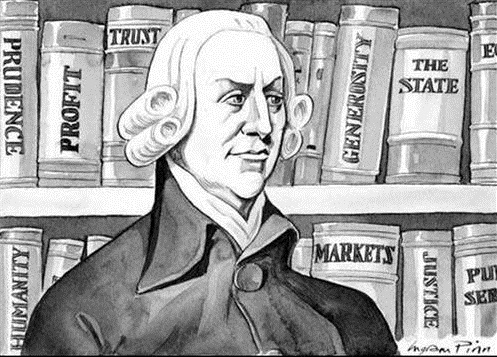
Profit-Seeking - 1… not just because the 13 original British colonies declared their independence as the United States of America, but also the publication of the landmark book on Economic Principles, An Inquiry into the Nature and Causes of the Wealth of Nations by Adam Smith, the 18th century Scottish political economics pioneer. The publication is cited as a reference source in the book Go Lean…Caribbean – a roadmap for the introduction and implementation of Caribbean Union Trade Federation (CU) to elevate the economic, security and governing engines of the Caribbean region. A relevant quote from the Go Lean book follows (Page 67):

… usually abbreviated as “The Wealth of Nations“, this book is considered the first modern work of economics, and [Smith] is thusly cited as the “father of modern economics”, even today, and among the most influential thinkers in the field of economics. Through reflection over the economics at the beginning of the Industrial Revolution the book touches upon broad topics as the division of labor, productivity and free markets.

Smith attacked most forms of government interference in the economic process, including tariffs, arguing that these create inefficiency and high prices in the long run. It is believed that this theory, laissez-faire economic philosophy, influenced government legislation in later years.

Smith advocated a government that was active in sectors other than the economy. He advocated public education for poor adults, a judiciary, and a standing army—institutional systems not directly profitable for private industries.

The “Invisible Hand” is a frequently referenced theme from Smith’s book. He refers to “the support of domestic industry” and contrasts that support with the importation of goods. Neoclassical economic theory has expanded the metaphor beyond the domestic/foreign manufacture argument to encompass nearly all aspects of economics. The “invisible hand” of the market is a metaphor now to describe the self-regulating behavior of the marketplace. … 
Profit 2

Adam Smith’s writings qualified many rules of economics, in particular the divisions of income into profit, wage, and rent.[4] In a previous commentary the concept of rent-seeking was fully explored.; also the global challenges of wage-seeking have been fully detailed in another commentary. Now, this commentary is about profit, and the concepts of governance and public choice theory, allowing for the pursuit of profit. Where there is the pursuit of profit, there is invariably a focus on greed. For the purpose of elevating the Caribbean economy, greed is good! (In this case “greed” is not being defined as excess, but rather the natural desire to possess wealth, goods, or objects of abstract value with the intention to keep it for one’s self. The dreaded excess of “greed”, on the other hand, is a “vice” that must be cautiously monitored and curtailed, i.e. Crony-Capitalism). See VIDEO in the Appendix below.

Profit 3

Actor Michael Douglas as Wall Street Corporate Raider Gordon Gekko in the 1987 film

The Caribbean features mixed economies, wherein greed or profit plays a pivotal motivator. A mixed economy is an economic system that is variously defined as containing a mixture of markets (profit-seeking) and economic planning, in which both the private sector and the State direct the economy; or as a mixture of free markets with economic interventionism.[1] Most mixed economies can be described as market economies with strong regulatory oversight and governmental provision of public goods. That “public good” is what Adam Smith focused on for the role of government – non-profit-seeking activities – that they should concentrate on the public availability and distribution of the non-excludable and non-rivalrous materials that satisfies human wants (infrastructure, education, judiciary, security, etc.) and are not directly profitable for private industries.

Economies ranging from the United States[3][4] to Cuba[5] – in effect all of the Caribbean – have been catalogued as mixed economies. Around the world, the most prosperous countries with the highest average standard of living tend to have mixed economic systems with democratically elected governments. Thusly, this consideration on the Economic Principles of Profit, as follows, is important for the roadmap to elevate Caribbean economies:

Encyclopedia Reference: Profit (Economic)
Source: https://en.wikipedia.org/wiki/Profit_(economics)
In classical economics, profit is the return to an owner of capital goods or natural resources in any productive pursuit involving labor, or a return on bonds and money invested in capital markets.[3]

Related concepts include profitability and the profit motive, which is the motivation of firms to operate so as to maximize their profits. Mainstream microeconomic theory posits that the ultimate goal of a business is to make money. Stated differently, the reason for a business’s existence is to turn a profit. The profit motive is a key tenet of rational choice theory, or the theory that economic agents (actors or decision makers in some aspect of the economy) tend to pursue what is in their own best interests. Accordingly, businesses seek to benefit themselves and/or their shareholders by maximizing profits. In general the basic premise of rational choice theory is that aggregate social behavior results from the behavior of individual actors, each of whom is making their individual decisions.

Profit 4

Government intervention
Often, governments will try to intervene in uncompetitive markets to make them more competitive. Antitrust or competition laws were created to prevent powerful firms from using their economic power to artificially create the barriers to entry they need to protect their economic profits.[7][8][9] This includes the use of predatory pricing toward smaller competitors.[6][9][10] With lower barriers, new firms can enter the market, making the long run equilibrium much more like that of a competitive industry, with no economic profit for firms.
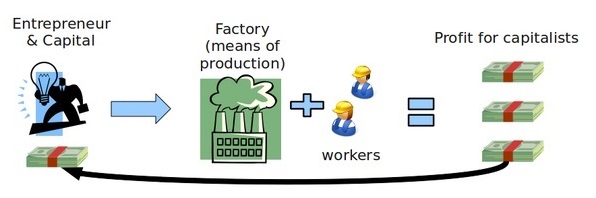
(This consideration aligns with alternate Economic Principles regarding sources of income; other commentaries detailed the concepts of rent-seeking and wage-seeking).

This historic information regarding Economist Adam Smith is important in understanding the “Lessons in Economic Principles”. These lessons matter in assessing today’s Caribbean status and fate, as there is the need for the optimal balance of “free market” versus “interventionism”. The Go Lean book explains the significance of Economic Principles with this excerpt (Page 21):

While money is not the most important factor in society, the lack of money and the struggle to acquire money creates challenges that cannot be ignored. The primary reason why the Caribbean has suffered so much human flight in the recent decades is the performance of the Caribbean economy. Though this book is not a study in economics, it recommends, applies and embraces these 6 core economic principles as sound and relevant to this roadmap:

  1. People Choose: We always want more than we can get and productive resources (human, natural, capital, etc.) are always limited. Therefore, because of this major economic problem of scarcity, we usually choose the alternative that provides the most benefits with the least cost.
  2. All Choices Involve Costs: The opportunity cost is the next best alternative you give up when you make a choice. When we choose one thing, we refuse something else at the same time.
  3. People Respond to Incentives in Predictable   Ways: Incentives are actions, awards, or rewards that determine the choices people make. Incentives can be positive or negative. When incentives change, people change their behaviors in predictable ways.
  4. Economic Systems Influence Individual Choices and Incentives: People cooperate and govern their actions through both written and unwritten rules that determine methods of allocating scarce resources. These rules determine what is produced, how it is produced, and for whom it is produced. As the rules change, so do individual choices, incentives, and behavior.
  5. Voluntary Trade Creates Wealth: People specialize in the production of certain goods and services because they expect to gain from it. People trade what they produce with other people when they think they can gain something from the exchange. Some benefits of voluntary trade include higher standards of living and broader choices of goods and services.
  6. The Consequences of Choices Lie in the Future: Economists believe that the cost and benefits of decision making appear in the future, since it is only the future that we can influence. Sometimes our choices can lead to unintended consequences.
    Source: Handy Dandy Guide (HDC) by the National Council on Economic Education (2000)

The Go Lean book presents a roadmap on how to better benefit from these economic principles – and how to increase profit-seeking opportunities in the Caribbean member-states and for the region as a whole. While “rent-seeking” – seeking to increase one’s share of existing wealth without creating new wealth – is a negative ethos, “profit-seeking” – the end product of investing in new opportunities – can be positive. The absence of profit-seeking is an absence of prosperity. Every Caribbean community suffers from an acute problem of societal abandonment. Those most capable of creating opportunities of prosperity, the educated classes, have mostly fled these lands, despite being labeled “the best address on the planet”. Why?

When people love their homelands yet begrudgingly leave, the defects – deficient economic opportunities – must be addressed. Caribbean member-states have tried, strenuously, over the decades, to diversify their economies; yet the preponderance of evidence point to adoption of “rent-seeking” in the region rather than the required profit-seeking. The requisite investment of the resources (time, talent, treasuries) for the goal of economic optimization may be too big for any one Caribbean member-state to conduct alone. Rather there is the need for a regional technocratic solution.

The Caribbean needs the evolutionary spirit (for one generation to do better than the previous one) of “profit-seeking” or “greed”. As portrayed in the VIDEO:

“Greed, for the lack of a better word, is good!” [Thus says the fictitious character in below VIDEO]. “Greed clarifies, cuts through and captures the essence of the evolutionary spirit. Greed in all of its forms – greed for life, greed for money, greed for love, knowledge has marked the upward surge of mankind; and greed will not only save [this company] but the other malfunctioning corporation called the USA”.

Posted commentary by Screen Name “fh downtheline”on the below VIDEO:

There is a better word than “greed” for this application. It may be “hunger”. Hunger is more present [in the Caribbean] and thusly more important than greed. Hunger keeps people hunting for progress. While greed ends up destroying the value of that progress. “Hunger” would refer to more than just food or economic dimension, but rather there is a hunger for knowledge, hunger for scientific thought. While “greed” says “I want” this, “Hunger” says “I need” this!

“Profit-seeking” is also a better word than “greed”; it too conveys the same concept as the definition above.

The consideration of the Go Lean book, as related to this subject is one of governance, the need for technocratic stewardship of the regional Caribbean society. This point was also pronounced in the opening Declaration of Interdependence (Pages 12 – 14) with these acknowledgements and statements:

xi.   Whereas all men are entitled to the benefits of good governance in a free society, “new guards” must be enacted to dissuade the emergence of incompetence, corruption, nepotism and cronyism at the peril of the people’s best interest. The Federation must guarantee the executions of a social contract between government and the governed.

xii. Whereas the legacy in recent times in individual states may be that of ineffectual governance with no redress to higher authority, the accedence of this Federation will ensure accountability and escalation of the human and civil rights of the people for good governance, justice assurances, due process and the rule of law. As such, any threats of a “failed state” status for any member state must enact emergency measures on behalf of the Federation to protect the human, civil and property rights of the citizens, residents, allies, trading partners, and visitors of the affected member state and the Federation as a whole.

xxiv.  Whereas a free market economy can be induced and spurred for continuous progress, the Federation must install the controls to better manage aspects of the economy: jobs, inflation, savings rate, investments and other economic principles. Thereby attracting direct foreign investment because of the stability and vibrancy of our economy.

xxvi.  Whereas the Caribbean region must have new jobs to empower the engines of the economy and create the income sources for prosperity, and encourage the next generation to forge their dreams right at home, the Federation must therefore foster the development of new industries, like that of ship-building, automobile manufacturing, prefabricated housing, frozen foods, pipelines, call centers, and the prison industrial complex. In addition, the Federation must invigorate the enterprises related to existing industries like tourism, fisheries and lotteries – impacting the region with more jobs.

This Go Lean book serves as a roadmap for the introduction and implementation of the technocratic Caribbean Union Trade Federation (CU) to provide better stewardship for the 30 member-states of the Caribbean region. The CU is motivated by positive community ethos, designed to elevate Caribbean society and the economic opportunities there in. In general, the Go Lean roadmap stresses key community ethos, strategies, tactics, implementations and advocacies necessary to transform and turn-around the eco-systems of Caribbean society. These points are detailed in the book as follows:

Community Ethos – Deferred Gratification Page 21
Community Ethos – Return on Investments Page 24
Community Ethos – Ways to Impact the Future – Count on the Greedy to be greedy Page 26
Community Ethos – Ways to Help Entrepreneurship – Fostering Incubators Page 28
Community Ethos – Ways to Impact the Greater Good Page 37
Strategy – Vision – Confederate all 30 member-states / 4 languages into a Single Market Page 45
Tactical – $800 Billion Economy – How and When – Adam Smith Case Study Page 67
Tactical – Fostering High Job Multiplier Industries Page 70
Tactical – Separation-of-Powers – CU Federal Government versus Member-State Governance Page 71
Implementation – Ways to Pay for Change – Award exploratory rights in exclusive territories Page 101
Planning – 10 Big Ideas – #3: Proactive Anti-crime Measures Page 127
Planning – Ways to Improve Trade Page 128
Planning – Ways to Improve Interstate Commerce Page 129
Planning – Ways to Make the Caribbean Better Page 131
Advocacy – Ways to Grow the Economy Page 151
Advocacy – Ways to Create Jobs Page 152
Advocacy – Ways to Improve Education – Online Job Training Page 159
Advocacy – Ways to Improve Governance Page 168
Advocacy – Ways to Better Manage the Social Contract Page 170
Advocacy – Ways to Better Manage Natural Resources Page 183
Advocacy – Reforms for Banking Regulations – Tools to Stimulate/Control the Economy Page 199
Advocacy – Ways to Impact Wall Street Page 200
Advocacy – Ways to Impact Main Street Page 201
Advocacy – Ways to Battle Poverty – Entrepreneurial Values Page 222
Appendix – Job Multipliers Page 259

In considering this economic history, the CU/Go Lean roadmap is motivated to create value for Caribbean communities, to foster good economic habits and principles. In general, the CU/Go Lean roadmap employs better strategies, tactics and implementations to impact its prime directives; identified with the following 3 statements:

  • Optimization of the economic engines in order to grow the regional economy to $800 Billion & create 2.2 million new jobs.
  • Establishment of a security apparatus to protect the resultant economic engines and mitigate internal and external threats.
  • Improvement of Caribbean governance – federal, national, municipal and corporate – to support these engines.

As defined in previous blog/commentaries, the CU/Go Lean roadmap asserts best-practices for proper stewardship for regional, national, municipal, and corporate governance. One strategy advocated is to better grow/control the money supply. The end-product should be the creation of new jobs, wealth, trade networks, plus develop new products and services, and an educated society.

New jobs need not only originate from the big corporate entities; that is the multi-national corporations that are traded on Wall Street or the 9 stock exchanges in the Caribbean region. No, rather small-to-medium enterprises (SME) – and even the self-employment “hustle” – will play a role in the economic optimization process. These points were detailed in these previous commentaries:

https://goleancaribbean.com/blog/?p=3490 How One Entrepreneur Can Rally a Whole Community
https://goleancaribbean.com/blog/?p=2857 Where the Jobs Are – Entrepreneurism in Junk – the “Hustle” Ethos
https://goleancaribbean.com/blog/?p=1325 Puerto Rico Governor Signs Bill on SME’s
https://goleancaribbean.com/blog/?p=398 Self-employment on the rise in the Caribbean –  the “Hustle” Ethos
https://goleancaribbean.com/blog/?p=214 LCD versus an Entrepreneurial/”Hustle” Ethos

Adherence to economic principles/best-practices, such as profit-seeking, would help us make our Caribbean community better to live, work and play. We need to optimize the “invisible hand” of the market to incentivize, retain and repatriate Caribbean “free market” enterprises. Everyone in the region – the people, entrepreneurs, business owners and governmental institutions – are all urged to lean-in to this roadmap to elevate the Caribbean economic engines. 🙂

Download the book Go Lean … Caribbean – now!

———–

Appendix VIDEO: Gordon Gekko “Greed is Good” – https://youtu.be/PF_iorX_MAw
Uploaded on Dec 9, 2011 – Gordon Gekko, principal character in 1987 movie “Wall Street”, *unknowningly* describes the problems facing today’s private sector, while blasting the bureaucracy responsible for said problems in the first place. A classic speech, both in film and, also, within economic thought.
Share this post:
, , , ,

Economic Principle: Bad Ethos of Rent-Seeking

Go Lean Commentary

Imagine a person making a resolution to improve their health…
… but they smoke cigarettes.

The expectation first would be:

Quit smoking!

One does not have to be a medical doctor, a PhD or a genius to glean this logic. It is now just common sense. Alas, common sense is not so common!

This commentary is not about smoking. It is about economics and public choice theory; see VIDEO’s below. In particular this commentary is about the bad Economic Principle referred to as “rent-seeking”. (This aligns with alternate Economic Principles regarding sources of income; other commentaries detailed the concepts of profit-seeking and wage-seeking). This is a big deal! Imagine a government public health department gifting cigarettes to people as a public health policy. Yes, it is that bad! This is the formal definition of “rent-seeking”:

CU Blog - Economic Principle - Bad Ethos of Rent-Seeking - Photo 1Rent-seeking is an attempt to obtain economic rent (i.e., the portion of income paid to a factor of production in excess of that which is needed to keep it employed in its current use) by manipulating the social or political environment in which economic activities occur, rather than by creating new wealth. Rent-seeking implies extraction of uncompensated value from others without making any contribution to productivity. The classic example of rent-seeking, according to Nobel Laureate Economist Robert Shiller, is that of a feudal lord who installs a chain across a river that flows through his land and then hires a collector to charge passing boats a fee (or rent of the section of the river for a few minutes) to lower the chain. There is nothing productive about the chain or the collector. The lord has made no improvements to the river and is helping nobody in any way, directly or indirectly, except himself. All he is doing is finding a way to make money from something that used to be free.[5]

“Finding a way to make money from something that used to be free”! How evasive is this practice? How can we identify it and how can we stop it?

The Caribbean is in crisis! Surveying the economic landscape of the region, we see a preponderance of rent-seeking as public policy in one member-state after another; see international Examples below. Alas, the book Go Lean…Caribbean, quoting famed economist Paul Romer (Page 8), declares that a crisis is a terrible thing to waste. Currently the region features unsustainable societal abandonment rates, exhaustive unemployment rates and near-Failed-State statuses.

The premise in this commentary is not an easy one. Just like it is common sense for a smoker to quit in order to preserve health/wellness, it is hereby acknowledged that this is “easier said than done”. Common sense is not so common! This heady discussion of advanced concepts in economics is an example of the heavy-lifting required to elevate Caribbean society.

The Go Lean book seeks to reboot and reform the economic engines of the Caribbean by being technocratic in applying best practices from the field of Economics. This intent is declared at the outset of the book with this Declaration of Interdependence (Page 10) for the region to work in unison to remediate the broken systems of commerce:

Preamble: As the colonial history of our region was initiated to create economic expansion opportunities for our previous imperial masters, the structures of government instituted in their wake have not fostered the best systems for prosperity of the indigenous people. Despite this past, we thrust our energies only to the future, in adapting the best practices and successes of the societies of these previous imperial masters and recognizing the positive spirit of their intent and vow to learn from their past accomplishments and mistakes so as to optimize the opportunities for our own citizenry to create a more perfect bond of union.

One of the basis of understanding this complex economic subject of “rent-seeking” is the review of the book The Rise and Decline of Nations by Economist Mancur Olson; in this publication, the writer traced the historic consequences of rent-seeking. He argued that the extremes of laissez-faire (the traditional economic philosophy in North American economies) and a command socialist economy (popular in Europe) would avoid rent-seeking, while a mixed economy would be subject to it.  Dr. Olson claimed two distinct groups (actors) with separate agendas: an encompassing organization with the broader social collective interest, versus the narrower distributional coalition – the special interest – who would naturally be a rent-seeking group that would slow down economic growth. See this detailed encyclopedic definition of the width-and-breadth of rent-seeking, here:

Encyclopedia Reference: Rent-Seeking
Source: http://en.wikipedia.org/wiki/Rent-seeking

In the field of Economics and public choice theory – the application of economic thinking to political issues – “rent-seeking” is seeking to increase one’s share of existing wealth without creating new wealth. The effects of these efforts are reduced economic efficiency [in the community] through poor allocation of resources, reduced actual wealth creation, lost government revenue, and increased income inequality,[1] and, potentially, national decline.

Attempts at capture of regulatory agencies to gain a coercive monopoly can result in advantages for the rent-seeker in the market while imposing disadvantages on competitors. (The term regulatory capture directly refers to a form of political corruption that occurs when a regulatory agency, created to act in the public interest, instead advances the commercial or special concerns of interest groups that dominate the industry or sector it is charged with regulating). The term “rent-seeking” itself is attributed to Economist Gordon Tullock in its modern sense with political connotation but with antecedents and common sense back to Ricardo.[2]

The idea of rent-seeking was developed by Gordon Tullock in 1967.[2] The expression rent-seeking was coined in 1974 by former World Bank Chief Economist Anne Krueger.[3] The word “rent” does not refer here to payment on a lease but stems instead from Adam Smith‘s division of incomes into profit, wage, and rent.[4] The origin of the term refers to gaining control of land or other natural resources.

Georgist economic theory – economic value derived from natural resources should belong equally to all residents of a community – describes rent-seeking in terms of land rent, where the value of land largely comes from government infrastructure and services (e.g. roads, public schools, maintenance of peace and order, etc.) and the community in general, rather than from the actions of any given landowner, in their role as mere titleholder. This role must be separated from the role of a property developer, which need not be the same person, and often is not.

In many market-driven economies, much of the competition for rents is legal, regardless of the harm it may do to an economy. However, some rent-seeking competition is illegal – such as bribery, corruption, smuggling, and even black market deals.

Rent-seeking is distinguished in economic theory from profit-seeking, in which entities seek to extract value by engaging in mutually beneficial transactions.[6] Profit-seeking in this sense is the creation of wealth, while rent-seeking is the use of social institutions such as the power of government to redistribute wealth among different groups without creating new wealth.[7] In a practical context, income obtained through rent-seeking may contribute to profits in the standard, accounting sense of the word.

Examples
An example of rent-seeking in a modern economy is spending money on political lobbying for government benefits or subsidies in order to be given a share of wealth that has already been created, or to impose regulations on competitors, in order to increase market share.

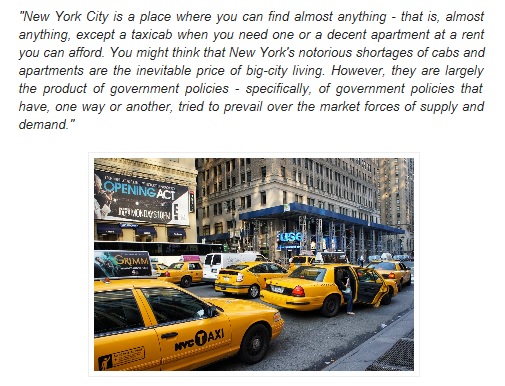
CU Blog - Economic Principle - Bad Ethos of Rent-Seeking - Photo 3A famous example of rent-seeking is the limiting of access to lucrative occupations, as by medieval guilds or modern state certifications and licensures. Taxi licensing is a commonly-referenced example of rent-seeking. To the extent that the issuing of licenses constrains overall supply of taxi services (rather than ensuring competence or quality), forbidding competition by livery vehicles, unregulated taxis and/or illegal taxis renders the (otherwise consensual) transaction of taxi service a forced transfer of part of the fee, from customers to taxi business proprietors. [Labor unions also fit the definition of rent-seeking].

The concept of rent-seeking would also apply to corruption of bureaucrats who solicit and extract ‘bribe’ or ‘rent’ for applying their legal but discretionary authority for awarding legitimate or illegitimate benefits to clients.[8] For example, tax officials may take bribes for lessening the tax burden of the tax payers; [and politicians take campaign contributions].

Regulatory capture is a related concept which refers to collusion between firms and the government agencies assigned to regulate them, which is seen as enabling extensive rent-seeking behavior, especially when the government agency must rely on the firms for knowledge about the market. Studies of rent-seeking focus on efforts to capture special monopoly privileges such as manipulating government regulation of free enterprise competition.[9] The term monopoly privilege rent-seeking is an often-used label for this particular type of rent-seeking. Often-cited examples include a lobby that seeks economic regulations such as tariff protection, quotas, subsidies,[10] or extension of copyright law.[11] Anne Krueger concludes that, “empirical evidence suggests that the value of rents associated with import licenses can be relatively large, and it has been shown that the welfare cost of quantitative restrictions equals that of their tariff equivalents plus the value of the rents” [12]

CU Blog - Economic Principle - Bad Ethos of Rent-Seeking - Photo 4Economists have argued that innovation in the financial industry is often a form of rent-seeking.[13][14] [A common everyday examples in American life would be: Wall Street on the ‘right’ and labor unions on the ‘left’].

[A local example stems from the Bahamas 2nd city of Freeport. That city provides a monopoly to the local petroleum retailing company, Freeport Oil Company, Limited (FOCOL). On one occasion that retailer limited gasoline purchases to the more expensive premium option only, as opposed to the standard choices; see story here: http://www.tribune242.com/news/2013/aug/02/focol-comes-under-fire-grand-bahama-residents/]

Possible consequences
From a theoretical standpoint, the moral hazard of rent-seeking can be considerable. If “buying” a favorable regulatory environment seems cheaper than building more efficient production, a firm may choose the former option, reaping incomes entirely unrelated to any contribution to total wealth or well-being. This results in a sub-optimal allocation of resources – money spent on lobbyists and counter-lobbyists rather than on research and development, on improved business practices, on employee training, or on additional capital goods – which retards economic growth. Claims that a firm is rent-seeking therefore often accompany allegations of government corruption, or the undue influence of special interests.[18]

Rent-seeking can prove costly to economic growth; high rent-seeking activity makes more rent-seeking attractive because of the natural and growing returns that one sees as a result of rent-seeking. Thus organizations value rent-seeking over productivity. In this case there are very high levels of rent-seeking with very low levels of output. Rent-seeking may grow at the cost of economic growth because rent-seeking by the state can easily hurt innovation. Ultimately, public rent-seeking hurts the economy the most because innovation drives economic growth.[19]

Government agents may initiate rent-seeking – such agents soliciting bribes or other favors from the individuals or firms that stand to gain from having special economic privileges, which opens up the possibility of exploitation of the consumer.[20] It has been shown that rent-seeking by bureaucracy can push up the cost of production of public goods.[21] It has also been shown that rent-seeking by tax officials may cause loss in revenue to the public exchequer.[8]

Mancur Olson traced the historic consequences of rent seeking in The Rise and Decline of Nations. As a country becomes increasingly dominated by organized interest groups, it loses economic vitality and falls into decline. Olson argued that countries that have a collapse of the political regime and the interest groups that have coalesced around it can radically improve productivity and increase national income because they start with a clean slate in the aftermath of the collapse. An example of this is Japan after World War Two. But new coalitions form over time, once again shackling society in order to redistribute wealth and income to themselves. However, social and technological changes have allowed new enterprises and groups to emerge in the past.[22]

A study by economists David Laband and John Sophocleus in 1988[23] estimated that rent-seeking had decreased total income in the US by 45 percent. Both economists William Dougan and Tullock affirmed (1991) the difficulty of finding the cost of rent-seeking. Rent-seekers of government-provided benefits will in turn spend up to that amount of benefit in order to gain those benefits, in the absence of, for example, the collective-action constraints highlighted by Olson.

Nobel Prize-winning Economist Joseph Stiglitz has argued that rent-seeking contributes significantly to income inequality in the United States through lobbying for government policies that let the wealthy and powerful get income, not as a reward for creating wealth, but by grabbing a larger share of the wealth that would otherwise have been produced without their effort.[26][27] (See related VIDEO here). Economists Thomas Piketty, Emmanuel Saez, and Stefanie Stantcheva (2011) had analyzed international economies and their changes in tax rates to conclude that much of income inequality is a result of rent-seeking among wealthy tax payers.[28]

This historic information is being considered in conjunction with the book Go Lean…Caribbean; a publication designed to elevate the region’s economy (create 2.2 million new jobs), security and governing engines. The book features a roster call for some All-stars of the field of Economics; (1700s, 1800s, 1900s & today). Consider this list of those quoted directly:

Paul Romer 1955 – Page 8
Adam Smith 1723 – 1790 Page 67
Arthur Okun 1928 – 1980 Page 153
James M. Buchanan 1919 – 2013 Page 169
Elinor Ostrom 1933 – 2012 Page 183
Norman Girvan 1941 – 2014 Page 255
Alfred Marshall 1842 – 1924 Page 258
Jacob Mincer 1922 – 2006 Page 258
Gary Becker 1930 – 2014 Page 258
John Geanakoplos 1955 – Page 276
David Hume 1711 – 1776 Page 318
John Maynard Keynes 1883 – 1946 Page 318

CU Blog - Economic Principle - Bad Ethos of Rent-Seeking - Photo 2

A review of the work of these great men and woman constitute “Lessons in Economic Principles”. Why would these lessons matter in assessing today’s Caribbean status and fate?

The Go Lean book explains the significance of Economic Principles with this excerpt (Page 21):

While money is not the most important factor in society, the lack of money and the struggle to acquire money creates challenges that cannot be ignored. The primary reason why the Caribbean has suffered so much human flight in the recent decades is the performance of the Caribbean economy. Though this book is not a study in economics, it recommends, applies and embraces these 6 core economic principles as sound and relevant to this roadmap:

  1. People Choose: We always want more than we can get and productive resources (human, natural, capital) are always limited. Therefore, because of this major economic problem of scarcity, we usually choose the alternative that provides the most benefits with the least cost.
  2. All Choices Involve Costs: The opportunity cost is the next best alternative you give up when you make a choice. When we choose one thing, we refuse something else at the same time.
  3. People Respond to Incentives in Predictable Ways: Incentives are actions, awards, or rewards that determine the choices people make. Incentives can be positive or negative. When incentives change, people change their behaviors in predictable ways.
  4. Economic Systems Influence Individual Choices and Incentives: People cooperate and govern their actions through both written and unwritten rules that determine methods of allocating scarce resources. These rules determine what is produced, how it is produced, and for whom it is produced. As the rules change, so do individual choices, incentives, and behavior.
  5. Voluntary Trade Creates Wealth: People specialize in the production of certain goods and services because they expect to gain from it. People trade what they produce with other people when they think they can gain something from the exchange. Some benefits of voluntary trade include higher standards of living and broader choices of goods and services.
  6. The Consequences of Choices Lie in the Future: Economists believe that the cost and benefits of decision making appear in the future, since it is only the future that we can influence. Sometimes our choices can lead to unintended consequences.
    Source: Handy Dandy Guide (HDC) by the National Council on Economic Education (2000)

In psycho-therapy the approach to forge change for an individual is defined as “starting in the head (thoughts, visions), penetrating the heart (feelings, motivations) and then finally manifesting in the hands (actions). The people of the Caribbean must change their feelings about elements of their society – elements that are in place and elements missing. This is referred to as “Community Ethos”, defined as: “the fundamental character or spirit of a culture; the underlying sentiment that informs the beliefs, customs, or practices of a group or society; dominant assumptions of a people or period; practices of a group or society; dominant assumptions of a people or period.

Rent-seeking is not one of the community ethos that is being urged for the Caribbean; just the opposite, it is a bad ethos to avoid!

VIDEO – The Rent Seeking of Both Left and Right – https://youtu.be/OqrDkegqyDo

Published on Jun 22, 2012 – For an alternative to our anti-democratic system check out Jim Rogers latest project to create a system that will hold politicians feet to the fire, and to put shackles on lobbyists so that they can no longer control the system. One day we might have a system that’s controlled by the people and is for the people.
This is an idea put forth for Americans but it can easily work in any other part of the world.

This bad ethos stems from an attitude of entitlement; to get something … for almost nothing. The Caribbean was colonized originally under this community ethos; a previous blog/commentary related how Papal Bulls and Royal Charters enabled entities to exploit Caribbean markets and trade with very little investment of their own. A direct quote from that commentary relates:

Most of the property and indigenous wealth of the Caribbean region is concentrated amongst the rich, powerful and yet small elite; an oligarchy. Many times these families received their property, corporate rights and/or monopolies by Royal Charter from the European monarchs of ancient times. These charters thus lingered in legacy from one generation to another … until …

The Go Lean book presents a roadmap on how to benefit from the above economic principles – and how to empower communities anew – without continuing rent-seeking practices. (For this reason this commentary opposes reparations for slavery and colonialism).

The consideration of the Go Lean book, as related to this subject is one of governance, (national, municipal and corporate governance), the need for technocratic stewardship of the regional Caribbean society. This point was also pronounced in the opening Declaration of Interdependence (Page 12) with these acknowledgements and statements:

xi.   Whereas all men are entitled to the benefits of good governance in a free society, “new guards” must be enacted to dissuade the emergence of incompetence, corruption, nepotism and cronyism at the peril of the people’s best interest. The Federation must guarantee the executions of a social contract between government and the governed.

xii. Whereas the legacy in recent times in individual states may be that of ineffectual governance with no redress to higher authority, the accedence of this Federation will ensure accountability and escalation of the human and civil rights of the people for good governance, justice assurances, due process and the rule of law. As such, any threats of a “failed state” status for any member state must enact emergency measures on behalf of the Federation to protect the human, civil and property rights of the citizens, residents, allies, trading partners, and visitors of the affected member state and the Federation as a whole.

xxxiii. Whereas lessons can be learned and applied from the study of the recent history of other societies, the Federation must formalize statutes and organizational dimensions to avoid the pitfalls of communities like East Germany, Detroit . On the other hand, the Federation must also implement the good examples learned from developments/communities like … Germany, [and] Japan .

This Go Lean book serves as a roadmap for the introduction and implementation of the technocratic Caribbean Union Trade Federation (CU) to provide better stewardship for the 30 member-states of the Caribbean region. The CU is motivated by the positive community ethos of the Greater Good!

In general the Go Lean roadmap stresses key community ethos, strategies, tactics, implementations and advocacies necessary to transform and turn-around the eco-systems of Caribbean society. These points are detailed in the book as follows:

Community Ethos – Deferred Gratification Page 21
Community Ethos – Return on Investments Page 24
Community Ethos – Ways to Impact the Future Page 26
Community Ethos – Ways to Impact the Greater Good Page 37
Strategy – Vision – Confederate all 30 member-states/ 4 languages into a Single Market Page 45
Tactical – Fostering a Technocracy – Economists are Technocrats Page 64
Tactical – Growing to $800 Billion GDP – Adam Smith Case Study: Father of Modern Economics Page 67
Tactical – Separation-of-Powers – CU Federal Government versus Member-State Governance Page 71
Implementation – Ways to Pay for Change – Award exploratory rights in exclusive territories Page 101
Implementation – Start-up Benefits from the Exclusive Economic Zone (EEZ) Page 104
Planning – 10 Big Ideas – #3: Proactive Anti-crime / Corporate Governance Measures Page 127
Planning – Ways to Improve Trade Page 128
Planning – Ways to Make the Caribbean Better Page 131
Planning – Lessons Learned from 2008 – Glass-Steagall Case Study Page 136
Advocacy – Ways to Grow the Economy – Government’s Role: Protect Property Rights Page 151
Advocacy – Ways to Create Jobs – 2.2 Million New Jobs Page 152
Advocacy – Ways to Improve Governance Page 168
Advocacy – Ways to Better Manage the Social Contract Page 170
Advocacy – Ways to Better Manage Natural Resources Page 183

In considering this economic history, the CU/Go Lean roadmap is motivated to create value for Caribbean communities, not skim off the top with rent-seeking practices. The mandate is simple:

Foster good economic habits; abandon bad habits.

(At one point, smoking was encouraged, but now it is universally assailed; this demonstrates that communities can mature).

This is not common ground; this is a higher ground!

With the proper stewardship, we can create jobs, value, wealth,  trade networks, an educated society, plus develop new products and services that the world demands. Adherence to these best-practices – and aversion to bad community ethos like rent-seeking – would help us make our Caribbean community better to live, work and play. 🙂

Download the book Go Lean … Caribbean – now!

————–

Appendix VIDEO: Public Choice – Rent Seeking – https://youtu.be/4H2TicrHC8I

Uploaded on Mar 1, 2007 – based on the textbook “Microeconomics for MBAs”

Share this post:
, , , , ,
[Top]

American Defects: Inventory of Crony-Capitalism

Go Lean Commentary

The American Dream: You have to be asleep to believe it!

Thus the conclusion of famed comedian and society commentator, the late George Carlin*; see VIDEO in the Appendix below; (excuse the graphic profanity).

This conclusion also aligns with the familiar consideration of the planners for a new Caribbean society, the movement behind the book Go Lean … Caribbean and accompanying blogs.

CU Blog - American Defects - Inventory of Crony-Capitalism - Photo 1

The American Dream tends to be a nightmare for Caribbean citizens of Black and Brown ethnic persuasions that emigrate there. And yet, the Go Lean book relates that these people of the Caribbean have “beat down their doors” to get out of their beautiful homelands to live, work and play in America.

The book relates the reason for this societal abandonment as “push-and-pull”:

“pull factors” – alluring economic opportunities awaiting a life in America
“push factors” – lack of economic prospects in the Caribbean homeland.

The mission of the Go Lean movement is to minimize these “push and “pull” factors. This commentary today is one of two considerations on the folly of leaving the Caribbean for American shores.

The Go Lean book serves as a roadmap for the introduction and implementation of the technocratic Caribbean Union Trade Federation (CU). This roadmap seeks to reboot the region’s economic, security and governing engines; employing better strategies, tactics and implementations to impact its prime directives; identified with the following 3 statements:

  • Optimization of the economic engines in order to grow the regional economy to $800 Billion & create 2.2 million new jobs.
  • Establishment of a security apparatus to protect the resultant economic engines.
  • Improvement of Caribbean governance to support these engines.

Previous blog/commentaries have asserted that the American Dream is a nightmare for Americans as well. That this “Land of the Free and Home of the Brave” is often a sandbox for the rich and the powerful. This is qualified in the manifested threat of Crony-Capitalism.

This commentary therefore is a running inventory list of all the Crony-Capitalism models that proliferate in the Unites States of America:

 Models of American Crony-Capitalism detailed in Go Lean…Caribbean blog/commentaries:

Big Defense Many theorists indicate that the “follow the money” approach reveals the Military Industrial Complex work to undermine peace, so as to increase   defense spending for military equipment, systems and weapons.
Big Media Cable companies conspire to keep rates high; kill net neutrality; textbook publishers practice price gouging; Hollywood insists on big tax breaks/ subsidies for on-location shooting.
Big Doubters There are professionals who work to undermine the Greater Good by spewing doubt on scientifically-established causes; consider Climate Change, Tobacco and Concussions.
Big Oil While lobbying for continuous tax subsidies, the industry have colluded to artificially keep prices high and garner record profits ($38+ Billion every quarter).
Big Box Retail chains impoverish small merchants on Main Street with Antitrust-like tactics, thusly impacting community jobs. e-Commerce, an area of many   future prospects, is the best hope of countering these bad business tactics.
Big Pharma Chemo-therapy cost $20,000+/month; and the War against Cancer is imperiled due to industry profit insistence.
Big Tobacco Cigarettes are not natural tobacco but rather latent with chemicals to spruce addiction.
Big Agra Agribusiness concerns exacerbate greenhouse gases, bully family farmers and crowd out the market. Plus they fight common sense food labeling efforts and engage in abusive labor practices with migrant workers.
Big Data Brokers for internet and demographic data clearly have no regards to privacy concerns.
Big Banks Wall Street’s damage to housing and student loans are incontrovertible.
Big Weather Overblown hype of “Weather Forecasts” to dictate commercial transactions, while ignoring the responsibilities and realities of Climate Change.
Big Real Estate Preserving MLS for Real Estate brokers only, forcing 6% commission rates, when the buyers and sellers can meet without them.
Big Salt Despite the corrosiveness of salt on roads and the environment, it is the only tactic used to de-ice roads. Immediately after the weather warms, the roads must be re-constructed, thus ensuring a continuous economic cycle.
Big Energy The For-Profit utility companies always lobby against regulations to “clean-up” fossil-fuel (coal) power plants or block small “Green” start-ups from sending excess power to the National Grid. Their motive is to preserve their century-long monopoly and their profits.
Big Legal Even though it is evident that the promotion of Intellectual Property can help grow economies, the emergence of Patent Trolling parties (mostly   lawyers) is squashing innovation. These ones are not focused on future innovations, rather just litigation. They go out and buy patents, then look for anyone that may consume any concepts close to those patents, then sue for settlements, quick gains.
Big Cruise Cruise ships are the last bastion of segregation with descriptors   like “modern-day-slavery” and “sweat-ships”. Working conditions are poor and wages are far below anyone’s standards of minimum. Many   ship-domestic staff are “tip earners”, paid only about US$50 a month and expected to survive on the generosity of the passengers’ gratuity. The industry staff with personnel from Third World countries, exploiting those with desperate demands. Nowhere else in the modern world is this kind of job discrimination encouraged, accepted or tolerated.
Big Jails The private prison industry seem motivated more by profit than by public safety. They attempt to sue state governments when their occupancy levels go too low; a reduction in crime is bad for business.
Big Auto Automakers, like General Motors (GM), conspired with oil and tire companies to eliminate streetcars in cities all across America. The conspiracy was to create an inferior urban transportation (bus) system that would drive the demand for automobiles. The end result was a guarantee of sales of tires, gasoline for these industry stakeholders
Big Housing The American legacy is one of the institutional segregation in American cities. The practice was administered by real estate agents and housing   officials executing policies to elevate property values and generational wealth for White families at the expense of a life of squalor for Non-Whites.
Big Charities Big Not-For-Profit organizations that fleece the public under the guise of charities but retain vast majorities of the funding as administrative costs, thusly benefiting mostly the charities’ executives and staff rather than the intended benefactors.
Big Education For-Profit schools make a lot of profit while providing very little education to its customers: students. They charge tuition amounts higher than public colleges, while providing educational programs of little value and repute. The issue underpinning this dilemma is the easy availability of guaranteed student loans from the US federal government. The Crony in this case is a direct consequence of a rich pool of federal monies.
Big Music The music business is a bad business. Many in the industry exploit artists for their genius but fail to pay for their talent via legal loopholes. The latest case is that of Apple Music launching a new streaming service, where they choose to not bill the end-customer during the 3-month trial period so they also choose not to pay the artists. This is a clear disrespect of intellectual property, as if the music creation has no value.
Big Interchange The Mastercard/Visa interchange is a monopolistic collusion that ensures transaction fees remain high with no competitive downward pressure. They get a slice of every Mastercard/Visa debit and credit transaction.
Big Sports Public financing of sports stadiums to benefit private owners of sport teams many times abuses the finances of communities, who may then struggle or shortchange vital services in order to service the debt/bond obligations for the stadiums.
Big Hair The media has dictated what is beautiful in America and is making women comply…at all cost. Systematic messaging that Black Hair is less than preferred has resulted in a US$9 Billion industry for Black Women and their fake hair, weaves and chemical products.
Big Lobby Big Business lobby with their money to dictate their priorities, despite conflicts-of-interest for elected officials, at the expense of the Greater Good.
Big Labor The H-1B program allows for foreign workers to be imported only if no local resources are available. This process is so corrupted! American corporations bring in STEM resources from countries like India and pay them less, after having American workers train them. Both the American and foreign workers are abused in the process.
Big Shipping Jones Act mandates that for a ship to go from one US port to another US port it must be American-made and American flagged. This protectionism guarantees excessive shipbuilding profits and a small number of shipping options for US Territories, so high consumer prices.

Follow the money …

The Caribbean must do better! And we must dissuade our citizens from emigrating to this broken American eco-system.

The Go Lean roadmap provides turn-by-turn directions on rebooting Caribbean society, the economic, security, and governing engines for each member-state and the region as a whole. (America is out-of-scope for our efforts). The roadmap features mitigations and remediation to lower the “push” factors so that Caribbean citizens do not feel the need to flee their homelands.

This is easier said than done. As a planning tool, the roadmap commences with a Declaration of Interdependence, pronouncing the dread of threats of the Caribbean Brain Drain (Page 13):

xix.    Whereas our legacy in recent times is one of societal abandonment, it is imperative that incentives and encouragement be put in place to first dissuade the human flight, and then entice and welcome the return of our Diaspora back to our shores.

The book also acknowledges that all the reasons for societal flight may not be economic; sometimes there are security concerns as well. So this consideration, plus an aversion to local Crony-Capitalistic practices, is front-and-center in the same Declaration of Interdependence (Page 12):

xvi.    Whereas security of our homeland is inextricably linked to prosperity of the homeland, the economic and security interest of the region needs to be aligned under the same governance. Since economic crimes … can imperil the functioning of the wheels of commerce for all the citizenry, the accedence of this Federation must equip the security apparatus with the tools and techniques for predictive and proactive interdictions.

Even a benign reason like education is factored in the Go Lean roadmap, recognizing that educational engagements may send good students/citizens to a “land of no return”. The opening Declaration of Interdependence therefore pronounces this requirement on Page 13:

xxi.    Whereas the preparation of our labor force can foster opportunities and dictate economic progress for current and future generations, the Federation must ensure that educational and job training opportunities are fully optimized for all residents of all member-states, with no partiality towards any gender or ethnic group This responsibility should be executed without incurring the risks of further human flight, as has been the past history.

The Caribbean is urged to do better. We can reboot and reform our society. We can succeed in elevating our communities and dissuading our most precious resources – our people – from abandoning our beautiful homeland.

The “grass is not greener on the other side”; America should not be the destination of our hopes and dreams. We can work on our Caribbean Dreams right here at home.

The people and governing institutions in the region are all urged to lean-in for the empowerments described in the book Go Lean … Caribbean. Let us all work to make our homeland better places to live, work, and play. 🙂

Download the book Go Lean … Caribbean – now!

————

Appendix * – George Denis Patrick Carlin[1] (May 12, 1937 – June 22, 2008)

He was an American comedian, social critic, actor, and author. Carlin was noted for his “black comedy” and his thoughts on politics, the English language, psychology, religion, and various taboo subjects. Carlin and his “Seven dirty words” comedy routine were central to the 1978 U.S. Supreme Court case F.C.C. v. Pacifica Foundation, in which a 5–4 decision affirmed the government’s power to regulate indecent material on the public airwaves.

He is widely regarded as one of the most important and influential stand-up comedians: One newspaper called Carlin “the dean of counterculture comedians.”[2] In 2004, Carlin was placed second on the Comedy Central [Cable Network] list of the 100 greatest stand-up comedians, ahead of Lenny Bruce and behind Richard Pryor.[3] The first of his 14 stand-up comedy specials for [cable channel] HBO was filmed in 1977. From the late 1980s, Carlin’s routines focused on sociocultural criticism of modern American society. He often commented on contemporary political issues in the United States and satirized the excesses of American culture. He was a frequent performer and guest host on [TV show] The Tonight Show during the three-decade Johnny Carson era, and hosted the first episode of [sketch-comedy show] Saturday Night Live for broadcast network NBC]. His final HBO special, “It’s Bad for Ya”, was filmed less than four months before his death. In 2008, he was posthumously awarded the Mark Twain Prize for American Humor.

Source: http://en.wikipedia.org/wiki/George_Carlin

————

Appendix VIDEO – George Carlin ~ The American Dream- https://youtu.be/acLW1vFO-2Q

Excuse the profanity!

Share this post:
, , ,
[Top]

American Defects: Racism – Is It Over?

Go Lean Commentary

In November 2008, a Black Man – Barack Obama – was elected to the Presidency of the United States of America.

Yes, we can! – Campaign slogan for Obama’s 2008 Presidential campaign.

Surely that is an indication that “racism is over” in America?

Far from it!

CU Blog - American Defects - Racism - Is It Over - Photo 1

While the blatant racist attitudes and actions may now be considered politically incorrect, the foundations of institutional racism have become even more entrenched. Welcome to America 2015! This commentary today is one of two considerations on the folly of local citizens – the Black and Brown populations – leaving the Caribbean for American shores.

Consider this VIDEO here of a frank and earnest confession of a White American acknowledging the racial divide:

Appendix VIDEO: Is Racism Over Yethttps://youtu.be/h_hx30zOi9I

These issues: housing, education, job hunting, prisons, drug crime prosecutions, racial profiling and others are addressed here in this foregoing VIDEO. They are also important considerations for the planners of Caribbean empowerment. America is a “frienemy” for us! We are trading partners; we are aligned; we are allies; many of us live in America; studied in America; but we have to compete to dissuade our young people from setting their sights on American shores as a refuge and destination of their hopes and dreams. Yet the book Go Lean … Caribbean asserts that no society can prosper with a high abandonment rate – reported at 70% for educated classes. Therefore we must “battle” against the “push-and-pull” factors that draw many Caribbean citizens away to the US.

The Go Lean book pursues the quest to elevate the Caribbean region through empowerments in economics, security and governance. Since 29 of the 30 Caribbean member-states (“St. Barths” is the only exception) have majority Black population, the book pushes further on this subject of racism, positing that it is easier for Caribbean citizens to stay home and effect change in their homelands than to go to America and try to remediate that society. The book therefore asserts that the region can turn-around from failing assessments by applying best-practices, and forging new societal institutions to impact the Greater Good for all the Caribbean.

This consideration of the Go Lean book is one of technocratic stewardship of the regional Caribbean societal engines: economy, security and governance. This point of the current disposition of racism and this quest to improve was pronounced in the opening Declaration of Interdependence (Pages 10 – 14) with these acknowledgements and statements:

Preamble:  As the history of our region and the oppression, suppression and repression of its indigenous people is duly documented, there is no one alive who can be held accountable for the prior actions, and so we must put aside the shackles of systems of repression to instead formulate efficient and effective systems to steer our own destiny.

xi.   Whereas all men are entitled to the benefits of good governance in a free society, “new guards” must be enacted to dissuade the emergence of incompetence, corruption, nepotism and cronyism at the peril of the people’s best interest. The Federation must guarantee the executions of a social contract between government and the governed.

xii. Whereas the legacy in recent times in individual states may be that of ineffectual governance with no redress to higher authority, the accedence of this Federation will ensure accountability and escalation of the human and civil rights of the people for good governance, justice assurances, due process and the rule of law. As such, any threats of a “failed state” status for any member state must enact emergency measures on behalf of the Federation to protect the human, civil and property rights of the citizens, residents, allies, trading partners, and visitors of the affected member state and the Federation as a whole.

xxxiii. Whereas lessons can be learned and applied from the study of the recent history of other societies, the Federation must formalize statutes and organizational dimensions to avoid the pitfalls of [other] communities.

This is the quest of Go Lean…Caribbean. The book and accompanying blog/commentaries advocate learning lessons from many events and concepts from history and the present; from as far back as the patriarchal Bible times, to best-practices today employed by communities around the world that have successfully turned-around their societies. (Think: post-World War II in Germany and Japan; plus post-Apartheid in South Africa). The Go Lean book serves as a roadmap for the introduction and implementation of the technocratic Caribbean Union Trade Federation (CU). This roadmap seeks to reboot the region’s economic, security and governing engines; employing better strategies, tactics and implementations to impact its prime directives; identified with the following 3 statements:

  • Optimization of the economic engines in order to grow the regional economy to $800 Billion & create 2.2 million new jobs.
  • Establishment of a security apparatus to protect the resultant economic engines and mitigate challenges/threats to regional Justice Institutions.
  • Improvement of Caribbean governance to support these engines.

The Go Lean book stresses key community ethos, strategies, tactics, implementations and advocacies necessary to transform and turn-around the eco-systems of Caribbean society. These points are detailed in the book as follows:

Community Ethos – Economic Principles – Economic Systems Influence Individual Choices Page 21
Community Ethos – Economic Principles – Consequences of Choices Lie in the Future Page 21
Community Ethos – Governing Principles – Lean Operations Page 24
Community Ethos – Ways to Impact the Future Page 26
Community Ethos – Ways to Manage Reconciliations – South Africa’s Model Page 34
Community Ethos – Ways to Impact the Greater Good Page 37
Strategy – Vision – Confederate all 30 member-states/ 4 languages into a Single   Market Page 45
Strategy – Mission – Build and foster local economic engines Page 45
Tactical – Ways to Foster a Technocracy Page 64
Tactical – Growing the Economy – Post WW II European Marshall Plan Model Page 68
Tactical – Growing the Economy – Post WW II Japan’s Turn-around Model Page 68
Tactical – Separation-of-Powers – CU   Federal Government versus Member-State Governance Page 71
Implementation – Assemble All Regionally-focus Organizations of All Caribbean Communities Page 96
Implementation – Ways to Better Manage Debt Page 114
Anatomy of Advocacies – One   Person can make a difference! Page 122
Planning – 10 Big Ideas – Single   Market / Currency Union Page 127
Planning – Ways to Model the new   European Union Page 130
Planning – Ways to Make the Caribbean Better Page 131
Planning – Ways to Improve Failed-State Indices – Minority and Human Rights Page 134
Planning – Lessons Learned from the previous West Indies Federation Page 135
Planning – Lessons Learned from 2008 – Optimizing Economic-Financial-Monetary Engines Page 136
Planning – Lessons Learned New York City – Managing as a “Frienemy” Page 137
Planning – Lessons Learned from Omaha – Human Flight Mitigations Page 138
Planning – Lessons Learned from East Germany – Bad Examples for Trade & Security Page 139
Planning – Lessons Learned from Detroit – Turn-around from Failure Page 140
Planning – Lessons Learned from Indian Reservations – Pattern of Ethnic Oppression Page 141
Planning – Lessons Learned from the American West – How to Win the Peace Page 142
Advocacy – Ways to Grow the Economy Page 151
Advocacy – Ways to Create Jobs Page 152
Advocacy – Ways to Improve Governance Page 168
Advocacy – Ways to Better Manage the Social Contract Page 170
Advocacy – Ways to Impact Justice Page 177
Advocacy – Ways to Improve Homeland Security Page 180
Advocacy – Ways to Preserve Caribbean Heritage Page 218
Appendix – Failed-State Index for Uneven Economic Development Page 272

There are other lessons for the Caribbean to learn from considering the history of race/ethnic relations; the following previous blog/commentaries apply:

https://goleancaribbean.com/blog/?p=5333 A Lesson in History: Legacies – Cause and Effect
https://goleancaribbean.com/blog/?p=4935 A Lesson in History: the ‘Grand Old Party’ of American Politics
https://goleancaribbean.com/blog/?p=4166 A Lesson in History: Panamanian Balboa
https://goleancaribbean.com/blog/?p=2809 A Lesson in History: Economics of East Berlin
https://goleancaribbean.com/blog/?p=2480 A Lesson in History: Community Ethos of WW II
https://goleancaribbean.com/blog/?p=2297 A Lesson in History: Booker T versus Du Bois
https://goleancaribbean.com/blog/?p=1531 A Lesson in History: 100 Years Ago Today – World War I
https://goleancaribbean.com/blog/?p=789 A Lesson in History: America’s War on the Caribbean

The Go Lean roadmap seeks to empower and elevate Caribbean societal engines. It is out-of-scope to impact America; our focus is only here in our homeland.

Other communities have done this … to success. Consider Europe; they have come a long way with race/ethnic relations. Even now they are desperately battling to weed-out the last vestiges of racism and ethnic supremacy in their society.

We can apply these lessons … from history and from the present day, for great impact in our Caribbean homelands.

Yes we can … make the Caribbean region a better place to live, work and play. 🙂

Download the book Go Lean … Caribbean – now!

Share this post:
, , ,
[Top]

Role Model: Edward Snowden – One Person Making a Difference

Go Lean Commentary

Edward Snowden: Friend or Foe?

Snowden Photo 1This will be a subject of debate for the weeks, months, years and decades to come.

What is not debatable is the fact that he has been impactful. Yes, one man has made a difference.

The publishers of the book Go Lean…Caribbean recognize the contributions that Edward Snowden has made to the discussions of democratic principles: privacy versus security. The book serves as a roadmap for the introduction and implementation of the Caribbean Union Trade Federation (CU). The CU seeks to empower a security apparatus for the Caribbean region. The issues of data monitoring and eavesdropping will be a big consideration here as well. We thank Mr. Snowden for bringing many of these issues to the fore; as the Go Lean roadmap also seeks to employ leading edge technologies to interdict domestic and foreign threats that may imperil Caribbean societal engines – without an “abuse of power”. We therefore want to study the dramatic events of this episode so as to apply best-practices in the formation of our own administration.

See the following news article (and VIDEO in the Appendix below) that summarizes the Snowden drama into 8 lessons:

Title: The Snowden Effect: 8 Things That Happened Only Because Of The NSA Leaks
One year ago Thursday, one of the most consequential leaks of classified U.S. government documents in history exploded onto the world scene: The first story based on documents from former National Security Agency (NSA) contractor Edward Snowden was published. Americans finally knew the spy agency was sucking up virtually all of the data about who they called and when.

What followed was a torrent of articles based on the Snowden documents, as well as political and diplomatic reaction. Public debate was transformed by a new level of knowledge about the NSA — which Snowden himself said was mission accomplished. And in some modest ways Congress, companies and other countries also took concrete action. Here are the most consequential reactions to Snowden’s leaks.

1. Director of National Intelligence James Clapper had to admit he lied to Congress.
Three months before the Snowden leaks began, Sen. Ron Wyden (D-Ore.) asked the nation’s top intelligence official if the NSA collected data on millions, or hundreds of millions, of Americans.

“No, sir,” Clapper replied. “Not wittingly.”

By that point, of course, the NSA had quite wittingly been running a massive bulk telephone metadata collection program for years. The government had repeatedly asked a secret surveillance court for permission to do so, and it deemed every American’s phone record “relevant” to terrorism in the process.

Wyden fumed in secret about Clapper’s lie — but felt he could not reveal it because the metadata collection program was classified. That all changed after the publication of the first story on June 5, 2013, based off a Snowden leak.

Days later, Clapper gave the most halfhearted, or perhaps least forthcoming, admission that he had lied: “I responded in what I thought was the most truthful, or least untruthful manner by saying no.”

2. The House passed a bill (ostensibly) meant to stop bulk collection of phone metadata.
Americans were furious about the NSA’s sweeping phone metadata collection program. Even the man who wrote the original Patriot Act, Wisconsin Republican Rep. James Sensenbrenner, said the program went too far.

So last month the House passed a bill that its sponsors said would end bulk collection. Whether it actually does is a matter of dispute, since the White House and the spy agencies appear to have stripped out many of its toughest provisions. But its passage is nonetheless a clear signal that nobody in Congress wants to look like they’re doing nothing about the NSA.

3. A federal judge said the NSA phone surveillance program is unconstitutional.
In December, U.S. District Court Judge Richard Leon issued a ruling in a lawsuit against the NSA program that said its technology was “almost-Orwellian” and that James Madison “would be aghast.”

Because other judges in other districts have found differently — one in Manhattan dismissed an American Civil Liberties Union lawsuit citing the threat of terrorists’ “bold jujitsu” — the program still stands. And it had previously been approved, though behind closed doors, by the special Foreign   Intelligence Surveillance Court. But with Leon’s ruling on the books, the program could eventually wind up before the Supreme Court.

4. Tech companies finally got serious about privacy.
Big tech players had been paying lip service for years to the idea that they protect their customers’ privacy. But after the Snowden revelation that the NSA was accessing company servers via its PRISM program, privacy suddenly became a very tangible good. Cloud providers stand to lose $35 billion over the next three years in business with foreign customers afraid of storing their data with U.S. companies.

So the companies are responding by adding encryption measures such as Transport Layer Security. Google even announced on Tuesday that it is testing a new extension for the Chrome browser that could make encrypting email easier.

5. Britain held its first-ever open intelligence hearing.
If you thought intelligence oversight was weak in the United States, you won’t believe how it works with our closest ally. The powerful British spy agencies MI5 and GCHQ had never faced a public hearing in front of Parliament until Snowden’s stories dropped.

The November hearing was hardly confrontational. But it was a step forward for a country that has generally reacted to the Snowden leaks with little more than a shrug. And that step matters for Americans as well: In April, The Intercept revealed that the GCHQ had secretly asked for “unsupervised access” to the NSA’s data pools.

6. Germany opened an investigation into the tapping of Chancellor Angela Merkel’s cell phone.
The revelation that the NSA was monitoring the German chancellor’s cell phone came as a surprise to her — and to Senate Intelligence Chairwoman Dianne Feinstein (D-Calif.). Merkel was so outraged that she reportedly compared the surveillance to that of the Stasi, the former East German spy agency. (And she would know, having grown up in East Germany.)

On Wednesday, GermanFederalProsecutorHaraldRangeannounced that he is opening an investigation into the monitoring of Merkel’s phone calls. The investigation is proof positive that the Snowden leaks have frayed some U.S. diplomatic relations, but also that people the world over are starting to take surveillance seriously.

7. Brazil scotched a $4 billion defense contract with Boeing.
In another example of soured relations abroad, Brazil gave a massive fighter jet contract to Saab instead of the American company Boeing. Opinions varied as to how much that had to do with Snowden’s leaks, with one government source telling Reuters that he “ruined it for the Americans.” One analyst believed, however, that the Boeing jet simply cost too much.

The jet aside, Brazilian President Dilma Rousseff was clearly steamed, taking to the podium at the U.N. General Assembly to denounce the surveillance on her. Snowden’s leaks also helped propel the passage of an Internet bill of rights meant to protect privacy in the South American nation.

8. President Barack Obama admitted there would be no surveillance debate without Snowden.
In a major speech in January, Obama said he was “not going to dwell on Mr. Snowden’s actions or his motivations.” But he essentially acknowledged that the roiling, yearlong debate over surveillance would not have happened without him.

“We have to make some important decisions about how to protect ourselves and sustain our leadership in the world, while upholding the civil liberties and privacy protections that our ideals — and our Constitution — require,” Obama said.

The secretive Foreign Intelligence Surveillance Court also nodded toward the “considerable public interest and debate” that Snowden’s leaks created. And even Clapper acknowledged, “It’s clear that some of the conversations this has generated, some of the debate, actually needed to happen.”

The surveillance court finally started publicly posting some filings from its major cases. And in further acknowledgement of the need for a debate, the NSA and other agencies have posted declassified files to a new intelligence Tumblr — revealing for the first time aside from Snowden’s leaks documentary evidence of the inner workings of mass surveillance.
Source: Huffington Post Online News Source; posted June 5, 2015; retrieved June 7, 2015 from: http://www.huffingtonpost.com/2014/06/05/edward-snowden-nsa-effect_n_5447431.html

s Difference - Photo 2An important consideration related to Mr. Snowden is the priority on human/civil rights. The motive for mass surveillance from the US Patriot Act was national security, but in its execution, it became abusive to human and civil rights. That is the formula for tyranny! Yet the authorities refused to “stop, drop and roll”; there was no remediation.

The Patriot Act went into effect in 2001 (effective for 4 years), then re-authorized in 2005 and 2011 (for 4 years only) with little debate. But thanks to one man, Edward Snowden, the 2015 renewal was stalled, debated, re-visited, re-considered and eventually defeated. People asked questions, challenged disclosures, protested and resolved … to do better.

One man … made a difference!

This one man impacted his country … and the whole world.

“The only thing necessary for the triumph of evil is for good men to do nothing” – Edmund Burke; 1729 – 1797; an Irish statesman, member of the British Parliament and supporter of the American Revolution.

Edmund Burke! Edward Snowden! These two men – one from history and another of contemporary times – have more in common than what may have been obvious. Another expression Edmund Burke is credited for, is perhaps more apropos:

“People crushed by laws, have no hope but to evade power. If the laws are their enemies, they will be enemies to the law; and those who have most to hope and nothing to lose will always be dangerous”.

There is now a new security monitoring legislative provision!  Credit or not, this is a direct impact of the actions of Edward Snowden! This law allows for security monitoring, without the privacy violations. (The USA Freedom Act was passed on June 2, 2015 with a new expiration of 2019;[5] however, Section 215 of the law was amended to stop the NSA from continuing its mass phone data collection program.[6]). This end-product is better all around. In fact, “a White House investigation found that the prior NSA program may have never stopped a single terrorist attack”. This new provision is an elevation for society.

Like Edward Snowden’s advocacy, the prime directive of the book Go Lean…Caribbean is to elevate society, but instead of impacting America, the roadmap focus is the Caribbean. In fact, the declarative statements are as follows:

  • Optimization of the economic engines in order to grow the regional economy.
  • Establishment of a security apparatus to protect the resultant societal engines again foreign and domestic threats.
  • Improvement Caribbean governance – with appropriate checks-and-balances – to support these engines.

Edward Snowden is hereby recognized as a role model that the Caribbean can emulate. (He disclosed that telephone data for one Caribbean member-state, the Bahamas, was also being collected and analyzed by the NSA). He has provided a successful track record of forging change, resisting the “abuse of power”, managing crises to successful conclusions and paying forward the benefits for a tyranny-free society to all peoples; see his letter in the Appendix. The Go Lean book relates that Caribbean member-states do have a tyrannical past, considering examples of Cuba (236), Haiti (238), and the Dominican Republic (306).

The book posits that one person, despite their field of endeavor, can make a difference in the Caribbean, and its impact on the world; that there are many opportunities where one champion, one advocate, can elevate society. In this light, the book features 144 different advocacies, so there is inspiration for the “next” Edward Snowden or Edmund Burke to emerge and excel right here at home in the Caribbean. We need vanguards and sentinels against the dreaded “abuse of power”.

The roadmap specifically encourages the region, to lean-in to open advocacy with these specific community ethos, strategies, tactics, and implementations:

Community Ethos – Security Principles – Privacy vs Public Protection Page 23
Community Ethos – Security Principles – Whistleblower Protection Page 23
Community Ethos – Security Principles – Anti-Bullying and Mitigation Page 23
Community Ethos – Security Principles – Intelligence Gathering Page 23
Community Ethos – Governing Principles – Minority Equalization Page 24
Community Ethos – Governing Principles – Lean Operations Page 24
Community Ethos – Ways to Promote Intellectual Property Page 31
Community Ethos – Ways to Impact the Greater Good Page 37
Strategy – Vision – Confederate all 30 Member-states Page 45
Strategy – Mission – Enact a Security Apparatus Against Threats Page 45
Strategy – Mission – Protect Homeland with Anti-crime   Measures Page 45
Anatomy of Advocacies – Examples of Individuals Who Made Impact Page 122
Planning – 10 Big Ideas – Defense / Homeland Security Pact Page 127
Planning – Ways to Improve Failed-State Indices Page 134
Planning – Lessons from East Germany – Bad Checks-and-Balances Page 139
Advocacy – Ways to Improve Governance Page 168
Advocacy – Ways to Better Manage the Social Contract Page 170
Advocacy – Ways to Improve Leadership Page 171
Advocacy – Ways to Impact Justice Page 177
Advocacy – Ways to Remediate and Mitigate Crime Page 178
Advocacy – Ways to Impact Homeland Security Page 180
Advocacy – Ways to Mitigate Terrorism Page 181
Advocacy – Ways to Improve Intelligence Gathering & Analysis Page 182
Advocacy – Ways to Foster Technology Page 197
Advocacy – Ways to Protect Human Rights Page 220

The Caribbean region wants a more optimized security apparatus.

The region wants to mitigate human rights and civil rights abuses; in general all “abuse of power”.

This book posits that “bad actors” – even tyrants – will emerge to exploit inefficient economic, security and governing models.  Early in the book, the pressing need to streamline protections – for citizens and institutions – was pronounced in the Declaration of Interdependence (Page 12), with these opening statements:

x. Whereas we are surrounded and allied to nations of larger proportions in land mass, populations, and treasuries, elements in their societies may have ill-intent in their pursuits, at the expense of the safety and security of our citizens. We must therefore appoint “new guards” to ensure our public safety and threats against our society, both domestic and foreign.

xvi. Whereas security of our homeland is inextricably linked to prosperity of the homeland, the economic and security interest of the region needs to be aligned under the same governance. Since economic crimes, including … forms of terrorism, can imperil the functioning of the wheels of commerce for all the citizenry, the accedence of this Federation must equip the security apparatus with the tools and techniques for predictive and proactive interdictions.

The Go Lean book explicitly acknowledges that optimizing the needs for security, justice and privacy are not easy; they require strenuous effort; heavy-lifting. There needs to be a better balance of public protection versus privacy concerns. Balance? That is the quest of the CU/Go Lean roadmap: an optimized society with better checks-and-balances.

Other subjects related to civil/human rights checks-and-balances for the region have been blogged in other Go Lean…Caribbean commentary, as sampled here:

https://goleancaribbean.com/blog/?p=5304 Mitigating the Eventual ‘Abuse of Power’
https://goleancaribbean.com/blog/?p=4809 Using Surveillance to Interdict Americans Who Aided ISIS
https://goleancaribbean.com/blog/?p=4447 Abuse of Power Example: Ferguson-Missouri biased cops & courts
https://goleancaribbean.com/blog/?p=4360 Dreading the American ‘Caribbean Basin Security Initiative’
https://goleancaribbean.com/blog/?p=3881 Intelligence Agencies to Up Cyber Security Cooperation
https://goleancaribbean.com/blog/?p=1554 Status of Forces Agreement = Security Pact
https://goleancaribbean.com/blog/?p=960 NSA records all phone calls in Bahamas, according to Snowden
https://goleancaribbean.com/blog/?p=535 Remembering and learning from Boston
https://goleancaribbean.com/blog/?p=341 American Human Rights Leaders Slams Caribbean Poor Record

With a heightened focus on balanced justice institutions and the participation of many advocates on many different paths for progress, the Caribbean can truly become a better place to live, work and play.  🙂

Download the book Go Lean … Caribbean – now!

———-

Appendix – Edward Snowden Letter – June 5, 2015 – “This is the power of an informed public

Dear XXXXXXX,

Simple truths can change the world.

Two years ago today, in a Hong Kong hotel room, three journalists and I waited nervously to see how the world would react to the revelation that the National Security Agency had been collecting records of nearly every phone call in the United States.

Though we have come a long way, the right to privacy remains under attack. Join me in standing up for our rights: Tell President Obama to log off.

Last month, the NSA’s invasive call-tracking program was declared unlawful by the courts, and it was disowned by Congress. And, after a White House investigation found that the program never stopped a single terrorist attack, even President Obama ordered it terminated.

This is because of you. This is the power of an informed public.

Ending mass surveillance of private phone calls under the Patriot Act is a historic victory for the rights of every citizen. Yet while we have reformed this one program, many others remain.

We need to push back and challenge the lawmakers who defend these programs. We need to make it clear that a vote in favor of mass surveillance is a vote in favor of illegal and ineffective violations of the right to privacy for all Americans. Take action to ban mass surveillance today.

As I said at an Amnesty event in London this week, arguing that you don’t care about the right to privacy because you have nothing to hide is no different than saying you don’t care about free speech because you have nothing to say.

We can’t take the right to privacy for granted, just like we can’t take the right to free speech for granted. We can’t let these invasions of our rights stand.

While we worked away in that hotel room in Hong Kong, there were moments when we worried we might have put our lives at risk for nothing — that the public would react with apathy to the publication of evidence that revealed that democratic governments had been collecting and storing billions of intimate records of innocent people.

Never have I been so grateful to have been so wrong.

In solidarity,

Edward Snowden, for Amnesty International

———-

APPENDIX VIDEO – HuffingtonPost Analysis Video – http://www.huffingtonpost.com/2014/06/05/edward-snowden-nsa-effect_n_5447431.html

Share this post:
, , ,
[Top]

China Internet Policing – Model for Caribbean

Go Lean Commentary

Is anyone watching the store in the Caribbean? The e-Store that is! Are there open sales for illegal narcotics, weapons and paraphernalia on Caribbean-area web domains? How about stolen credit cards, or movies, or music?

China Internet Policing 2Just because these commercial transactions are on the internet, and may be electronically advanced, these facts do not make them benevolent. Rather, there is a lot of malevolence on the world-wide-web (WWW). Sometimes the moniker WWW is derisively dubbed the Wild-Wild-West; thusly referring to the olden days of the American West – in the 19th century – when law-and-order was many times absent from society; outlaws, duels and revenge-seeking were prevalent. The theme of the marketplace then was: “Let the buyer beware”.

The thinking is that we have now advanced a long way from those bad old days.

But yet, have you ever gotten an email from some Nigerian Tribal Chief … or Nigerian widow (or a Nigerian job; see Appendix VIDEO), who needs you to facilitate some financial transaction, using your money in the process but boasting how you will profit big in the end? Have you gotten one of these…lately? No; just check your Spam e-Mail folder; there are probably a few there now.

There is a Murphy’s Law on Technology that is apropos to this discussion:

A computer can make as many mistakes in 2 seconds as 20 men in 20 years.

A need therefore exists to regulate man and machine when it comes to technology-driven commerce:

o  There is the need for someone to watch the e-Store.

o  There is also the other extreme: freedom of speech
… it should not be curtailed by web censors.

But can the freedoms go too far; and conversely, can censorship go too far?

Can companies protect their reputation online from defamation? Or how about cyber-bullying by irate customers or some competitive agent? These are all real concerns and real threats. This following news article conveys that China recognizes the need for some policing in the internet marketplace:

Title: China’s ‘Internet police’ open a window on Web censorship

BEIJING (Reuters) – The branch of China’s police in charge of censoring “illegal and harmful” online information will make its efforts more visible to the public from Monday with the launch of their own social media accounts, the Ministry of Public Security said.

China Internet Policing – Model for Caribbean - Photo 1The Chinese government aggressively censors the Internet, blocking many sites it deems could challenge the rule of the Communist Party or threaten stability, including popular Western sites like YouTube, Instagram and Facebook, as well as Google Inc.’s main search engine and Gmail service.

Police in some 50 areas, from metropolises like Beijing and Shanghai to more obscure cities like Xuzhou in Jiangsu province, will open accounts on sites including Weibo, China’s answer to Twitter, the ministry said late on Sunday.

The move is a response to public concern about problems like online gambling and pornography and is aimed at increasing the visibility of the police presence online to “create a harmonious, cultured, clear and bright Internet”, it said.

“The Internet police are coming out to the front stage from behind the curtains, beginning regular open inspection and law enforcement efforts, raising the visibility of the police online, working hard to increase a joint feeling of public safety for the online community and satisfy the public,” the ministry said.

The cyber police are working to root out “illegal and harmful information on the Internet, deter and prevent cyber-crimes and improper words and deeds online, publish case reports and handle public tip-offs”, it said.

Problems such as fraud, defamation, gambling, the sale of drugs and guns, and “picking quarrels and provoking trouble” – a charge often used to lock up dissidents – have angered people and created a serious challenge to an orderly Internet, it said.

The police would issue warnings to those involved in minor offences and go after more serious cases.

“Just like in the real world, law violations in cyberspace will not go unaccounted for,” it said.

The government has already deleted some 758,000 pieces of “illegal and criminal information” from the Internet and investigated more than 70,000 cyber-crime cases since the start of this year, the ministry said.

(Reporting by Ben Blanchard; Editing by Paul Tait)
Reuters News Wire – Published May 31, 2015; retrieved June 2, 2015 from:
http://news.yahoo.com/chinas-internet-police-open-window-censorship-023422128–finance.html

Where do we stand in the Caribbean?

For starters, there is no call for censorship. But there is a need for responsible internet messaging.

China Internet Policing 3Electronic Commerce is now all the rage in North America, Europe and certain key Asian markets (i.e. China, Japan, Indonesia, etc.). While the Caribbean has not fully embraced the world of e-Commerce, the internet via broadband, Wi-Fi and mobile has been fully assimilated – most adults have a mobile phone. So planners for Caribbean economic empowerments have contemplated the infrastructural deficiencies and proposed the remediation to better govern e-Commerce in this region. This is the assertion in the book Go Lean…Caribbean; it is the contemplation, proposal and remediation plan to reboot Caribbean economics, security and governance. This Go Lean book serves as a roadmap for the introduction and implementation of the technocratic Caribbean Union Trade Federation (CU) to facilitate the growth, promotion and regulatory oversight of electronic commerce in a regional Single Market.

The book posits that some issues are too big for any one Caribbean member-state to manage alone, that there are times when there must be a cross-border, multilateral coordination. The strategy is to confederate all 30 Caribbean member-states and appoint the CU as a deputized agency to oversee this important activity. In addition, attendant functions are included in the roadmap to facilitate e-Commerce: Central Bank adoption of Electronic Payment schemes and Postal Integration/Optimization. Without these functionalities, internet commerce would remain stagnant!

On the other hand, with the expected surge in this sphere of activity, many other challenges will come. In previous blogs, the following issues were detailed:

https://goleancaribbean.com/blog/?p=5353 US Presidential Politics and the Internet
https://goleancaribbean.com/blog/?p=4793 Online reviews – like Yelp and Angie’s List – can wield great power for services marketed, solicited and contracted online.
https://goleancaribbean.com/blog/?p=4381 Net Neutrality – The need for Caribbean Administration of the Issue.
https://goleancaribbean.com/blog/?p=4337 Crony-Capitalism Among the Online Real Estate Markets
https://goleancaribbean.com/blog/?p=3881 European and North American Intelligence Agencies to Ramp-up Cyber Security Cooperation
https://goleancaribbean.com/blog/?p=906 Bitcoin e-Payments needs regulatory framework to manage ‘risky’ image
https://goleancaribbean.com/blog/?p=308 Caribbean Communications Infrastructure Program (CARCIP) and the Caribbean Telecommunications Union (CTU) urges greater innovation and protection.

These commentaries demonstrate that there is the need for a governing body to better oversee and police Caribbean society to mitigate cyber-crimes and illicit activities initiated and/or continued in the online world. Policing the internet is too big for any one Caribbean member-state to manage alone. Too much is at stake.

Providing regional oversight for the Caribbean Single Market – a lean technocracy – for cross-border electronic media, governance of the Information Technology Arts and Sciences and Grievance Officiating are among the missions of Go Lean roadmap. The CU’s prime directives are identified with the following 3 statements:

  • Optimization of the economic engines in order to grow the regional economy to $800 Billion & create 2.2 million new jobs.
  • Establishment of a security apparatus to protect the people and processes (economic engines) of the region from threats and attacks (physical and electronic) that may originate from foreign or domestic sources.
  • Improvement of Caribbean governance to support these engines.

These prime directives will elevate Caribbean society. With this success comes the emergence of bad actors – foreign and domestic. The goal of preparing the appropriate security apparatus was envision in the Go Lean roadmap from the beginning; this was defined early in the book (Page 12 & 14) in the following pronouncements in the Declaration of Interdependence:

x.  Whereas we are surrounded and allied to nations of larger proportions in land mass, populations, and treasuries, elements in their societies may have ill-intent in their pursuits, at the expense of the safety and security of our citizens. We must therefore appoint “new guards” to ensure our public safety and threats against our society, both domestic and foreign. The Federation must employ the latest advances and best practices … to assuage continuous threats against public safety.

xv. Whereas the business of the Federation and the commercial interest in the region cannot prosper without an efficient facilitation of postal services, the Caribbean Union must allow for the integration of the existing mail operations of the governments of the member-states into a consolidated Caribbean Postal Union, allowing for the adoption of best practices and technical advances to deliver foreign/domestic mail in the region.

xvi. Whereas security of our homeland is inextricably linked to prosperity of the homeland, the economic and security interest of the region needs to be aligned under the same governance. Since economic crimes, including piracy and other forms of terrorism, can imperil the functioning of the wheels of commerce for all the citizenry, the accedence of this Federation must equip the security apparatus with the tools and techniques for predictive and proactive interdictions.

xxvii. Whereas the region has endured a spectator status during the Industrial Revolution, we cannot stand on the sidelines of this new economy, the Information Revolution. Rather, the Federation must embrace all the tenets of Internet Communications Technology (ICT) to serve as an equalizing element in competition with the rest of the world. The Federation must bridge the digital divide and promote the community ethos that research/development is valuable and must be promoted and incentivized for adoption.

The subjects of cyber-crimes and electronic commerce integrity feature economic, security and governing concerns. These fields will escalate in importance with the Go Lean roadmap as there is the call for deployment of a Social Media / Electronic Commerce offering for all Caribbean member-states, branded www.myCaribbean.gov. This Caribbean Cloud initiative is projected in the Go Lean book as a subset of the integrated postal operations, the Caribbean Postal Union.

China Internet Policing 4China is an emerging economy. Their economic growth has been impressive in the last 30 years. Despite their official Communism adherence, they model technocratic governmental administrations. There is much for the Caribbean region to learn from their model.

Of course the Caribbean will not boast the 1.3 Billion-population that China holds, but the same as we’re able to model the American example, there is much to consider from our Asian (Chinese) trading partners. The wisdom the Go Lean book gleans from these models is presented as a series of community ethos, strategies, tactics, implementations and advocacies; as highlighted in the following sample:

Community Ethos – Deferred Gratification Page 21
Community Ethos – People Choose Page 21
Community Ethos – People Respond to Incentives Page 21
Community Ethos – Economic Systems Influence Individual Choices Page 21
Community Ethos – Job Multiplier Page 22
Community Ethos – Privacy versus Public Protection Page 23
Community Ethos – Whistleblower Protection Page 23
Community Ethos – Lean Operations Page 24
Community Ethos – Ways to Help Entrepreneurship Page 28
Community Ethos – Promote Intellectual Property Page 29
Community Ethos – Ways to Bridge the Digital Divide Page 31
Community Ethos – Ways to Improve Sharing Page 35
Community Ethos – Ways to Impact the Greater Good Page 37
Strategy – Vision – Integrate a Single Market of entire region Page 45
Tactical – Fostering a Technocracy Page 64
Tactical – Separation of Powers – Caribbean Postal Union (CPU) Page 78
Tactical – Separation of Powers – Interstate Commerce Administration Page 79
Tactical – Separation of Powers – Communications and Media Authority Page 79
Implementation – Year 1 / Assemble Phase – Establish CPU Page 96
Anecdote – Implementation Plan – Mail Services – US Dilemma Page 99
Implementation – Improve Mail Services – Electronic Supplements Page 108
Implementation – Ways to Deliver Page 109
Implementation – Ways to Impact Social Media – Weibo Volumes Page 111
Planning – 10 Big Ideas for the Caribbean Region – Cyber Caribbean Page 127
Advocacy – Ways to Improve Interstate Commerce Page 129
Advocacy – Ways to Grow the Economy Page 151
Advocacy – Ways to Create Jobs Page 152
Advocacy –Ways to Improve Governance Page 168
Advocacy – Ways to Foster Technology Page 197
Advocacy – Ways to Foster e-Commerce Page 198
Advocacy – Ways to Impact Main Street – Wifi & Mobile Apps Page 201
Advocacy – Ways to Impact Urban Living Page 234

This commentary is not intended to make disparaging remarks about Nigeria. Also, this commentary is not intended to make disparaging remarks about Communist China. Rather, the Go Lean book asserts (Page 23) that there is good and bad in every country; no matter the time or place, bad actors will always emerge to exploit economic successes.

That place is now extended to cyber-space.

We, the Caribbean collectively and individually, must police cyber-space as well.

To keep pace with the latest and greatest cyber-criminals will require an advanced level of interdiction and technical competence. It is the assertion here that this is heavy-lifting and too much for any one Caribbean member-state alone. No, the Caribbean needs the effectiveness and efficiencies proposed in Go Lean…Caribbean. The Caribbean needs this technocracy!

This is a lesson we can learn … and apply from China, in our application and pursuit of the Greater Good.

🙂

Download the book Go Lean … Caribbean – now!

————–

Appendix – VIDEO: Nigerian Scammers Impersonate FBI Agent in Work-from-Home Scam – https://youtu.be/D82MzqwyK8A

Published on Mar 13, 2012 – The FBI’s Special Agent Tom Simon is warning about a new scam targeting Hawaii residents, which offers them a work-from-home position, but the company they reportedly will work for, and the financial transactions they are asked to perform, are fake.


Share this post:
, , , ,
[Top]

Extracurricular Music Programs Boost Students

Go Lean Commentary

“Reading, ‘Riting and ‘Rithmetic” – The 3 R’s of Education.

If only everybody learned these basic skills at the same level of competence.

The truth is, not everyone is as gifted as others. While some may display genius abilities with these literary and/or computational skills, others show genius qualifiers for art, dance, athleticism … and music!

The book Go Lean…Caribbean declares: “That’s OK”!

The book identifies that there are 8 different genius qualifiers and plots to include the contribution of all these participants in the quest to elevate Caribbean society. The 8 genius qualifiers are stated in the book (Page 27) as follows:

1. Linguistic
2. Logical-Mathematics
3. Musical, Sound, Rhythm
4. Bodily-Kinesthetic-Body Movement Control
5. Spatial – Shapes/Figures Aptitude
6. Interpersonal – Other People’s Feelings – Leadership
7. Intrapersonal and Naturalistic – Self-Awareness
8. Existential – Moral Intelligence

Some genius skills are innate, natural abilities; but some genius qualifiers have to be taught, learned and fostered. The same as everyone benefits from literary and computational skills – genius or not – the same can be said of music, sound and rhythm. Those who can make music can contribute greatly to society. But on the other hand, even those not enabled with great musical abilities can become appreciative music consumers. So the benefits of music education are extended far-and-wide. In fact, this below news article posits that Extracurricular Music programs have benefits for all students, boosting their grades and graduation rates.

Wow, the research and findings – as follows – should not be ignored:

Title: Extracurricular Music Program Boosts Students’ Grades and Graduation Rates
By: Corey Whelan

(This article is presented in partnership with the California Lottery. The California Lottery proceeds provides supplemental funding to State Education & Music programs)

CU Blog - Extracurricular Music Programs Boost Students - Photo 1

Music is one of the most powerful motivators human beings have. Music can calm an anxious toddler, energize a sleepy teenager and elicit every human emotion known. According to MUSICSTAR, a California public school music program, it can also generate better math scores and higher rates of graduation among public school students. As reported in a recent Gallop Poll, most parents, including those raising children in California, agree that children can benefit from music programs and want them to be available at their child’s school.

The Sound of Learning
In general, music education and learning how to play a musical instrument, have been consistently resulted in developing a myriad of skills and abilities among children. In addition to acquiring mastery of an instrument many come to love, according to MUSICSTAR, the following benefits also occur:

  • Creativity development
  • Team-building skills, particularly if they play in an orchestra or band
  • Increased levels of academic and personal achievement
  • Higher sense of self-esteem
  • Increased levels of self-discipline
  • Higher rates of school spirit
  • Decreased rates of behavioral issues
  • Decreased levels of depression and anxiety

Music programs in school can also support better relationships between teachers and students, and between the school and parent community.

The Power of MUSICSTAR Learning
MUSICSTAR is an educational program which is offered in a variety of California’s public schools, both during the school day and as an after-school program. “We’re providing a solution for many of California’s schools, from elementary through to high school, by providing all of the music education components needed, from the equipment to the instruments, plus the curriculum, trained teaching staff and program support,” says Eckart Seeber, the director of the MUSICSTAR program. “There’s no limit as to what instruments the children can use. They can access and explore band instruments, guitar, drums, marching band or rock band or the violin.”

As an award-winning composer, Seeber knows firsthand what the power of musical learning can do. “MUSICSTAR ran our own internal research and also accessed third-party research which compared students in the same socioeconomic locations. Consistently it was shown that music education learners excelled in many areas over students who were not studying music, in ways which surprised some parents and educators. Music students consistently displayed higher test scores in mathematics than their non-music studying counterparts,” he explains.

The Benefit to Students and Their Community
Students are welcome to explore a wide range of musical instruments and techniques, including multicultural music, music technology, mariachi, choir, glee and hand-drumming. Program options can be suited to all levels of musical ability and the student’s age. Several themes run through all of the programs and provide high levels of musicianship and aesthetics, music literacy and an in-depth comprehension of music as it has been applied throughout various historical periods as an art form.

The programs are geared towards acquiring performance and public speaking skills, both confidence builders. Students involved in the programs long term have the opportunity to take their music into the community. With the support of school-based professionals, many students go on to play with groups at community centers and senior citizen facilities, providing a well-deserved respite for others and an incredible self-growth opportunity for themselves.
——-
Corey Whelan is a freelance writer in New York. Her work can be found at Examiner.com.

Source: CBS Los Angeles – News Site of Local Affiliate (Posted March 18, 2015; retrieved 5/28/2015) –
http://losangeles.cbslocal.com/top-lists/extracurricular-music-program-boosts-students-grades-and-graduation-rates/

The focus of this commentary is on education. (This has proven to be a pivotal subject for the Go Lean movement: the book and accompanying blogs). The focus on this commentary is also on music, and the intersection of these two dynamics: music education.

The book Go Lean…Caribbean serves as a roadmap for the introduction and implementation of the Caribbean Union Trade Federation (CU), an initiative to bring change and empowerment to the Caribbean region; to make the region a better place to live, work and play. From the outset, the book recognized the significance of music in the Caribbean change/empowering plan with these statements in the opening Declaration of Interdependence (Page 12 & 14):

xxi.  Whereas the preparation of our labor force can foster opportunities and dictate economic progress for current and future generations, the Federation must ensure that educational and job training opportunities are fully optimized for all residents of all member-states, with no partiality towards any gender or ethnic group. The Federation must recognize and facilitate excellence in many different fields of endeavor, including sciences, languages, arts, music and sports. This responsibility should be executed without incurring the risks of further human flight, as has been the past history.

xxxii.  Whereas the cultural arts and music of the region are germane to the quality of Caribbean life, and the international appreciation of Caribbean life, the Federation must implement the support systems to teach, encourage, incentivize, monetize and promote the related industries for arts and music in domestic and foreign markets. These endeavors will make the Caribbean a better place to live, work and play.

The purpose of the Go Lean roadmap is to foster change, to elevate Caribbean society. Music can play a major role in that endeavor; (there is the acknowledgement that music can help forge change). Education is also pivotal. Therefore music education must be a priority.

This Go Lean roadmap calls for the heavy-lifting in shepherding change in Caribbean life. In fact, the empowerment roadmap has these 3 prime directives:

  • Optimization of the economic engines in order to grow the regional economy to $800 Billion & create 2.2 million new jobs.
  • Establishment of a security apparatus to protect the resultant economic engines.
  • Improvement of Caribbean governance to support these engines.

While the Go Lean book describes the CU as a hallmark of a technocracy, with a commitment to efficiency and effectiveness, there is still a commitment to concepts of fun, such as music, arts, sports, film/media, heritage and overall happiness. There is the 3rd rail of this Caribbean optimization roadmap: 1. Live, 2. Work and 3. Play.

The Go Lean book declares that before any real change takes root in the Caribbean that we must reach the heart of people, to ready them to adopt new community ethos – the national spirit that drives the character and identity of its people. This is easier said than done! But, Music helps.

This Go Lean movement has previously detailed how society can be transformed through music; consider prior Go Lean blog/commentaries:

https://goleancaribbean.com/blog/?p=5251 Bahamas Attempts to Transform Society with Inaugural Carnival
https://goleancaribbean.com/blog/?p=3641 Building a City on ‘Rock and Roll’
https://goleancaribbean.com/blog/?p=3568 Forging Change: Music Moves People
https://goleancaribbean.com/blog/?p=2415 How ‘The Lion King’ Music/Play roared into history
https://goleancaribbean.com/blog/?p=2291 Forging Change: The Fun Theory
https://goleancaribbean.com/blog/?p=1909 Music Role Model Berry Gordy: Transformed America
https://goleancaribbean.com/blog/?p=866 Music Role Model Bob Marley: Legend Transformed the World
https://goleancaribbean.com/blog/?p=273 10 Things We Do Not Want From the US – #9: Cultural Neutralizations

Our world is in constant flux. The region has not always kept pace with change; as a result, we have often fallen behind and lost many battles in the war of globalization. We have stood on the sidelines and watched the taste and interest of our young people, and many times our youth themselves, shift to life in foreign shores. Change need not be scary! We can win many of the battles of globalization; we do not have to lose this war.

To win, or if only to survive, we must first outfit ourselves in a complete suit of armor. This is a Biblical reference (Ephesians 6:10-18). It stresses that a foremost piece of armor is a “helmet”, referring to the need to protect/prepare mental processes.

This means education!

Yes, the need to better teach our youth is a God-given mandate. Music can be an offensive and defensive tool (weapon). Since most educational administrations in the Caribbean are overwhelmed with just the delivery of the basic “3 R’s” – defined above – music is mostly deemed an extracurricular activity. The Go Lean roadmap was constructed with the approach that change and new empowerments are needed for the Caribbean “community ethos”; plus the execution of new strategies, tactics, implementations and advocacies to impact our society. The following list from the book provides a sample of the community ethos, strategies, tactics, implementations and advocacies for the region to Go Lean:

Community Ethos – Deferred Gratification Page 21
Community Ethos – Economic Principles – People Respond to Incentives in Predictable Ways Page 21
Community Ethos – Economic Principles – The Consequences of Choices Lie in the Future Page 21
Community Ethos – Ways to Impact the Future Page 26
Community Ethos – Ways to Foster Genius Page 27
Community Ethos – Ways to Promote Intellectual Property Page 29
Community Ethos – Ways to Impact Research & Development Page 30
Community Ethos – Ways to Bridge the Digital Divide Page 31
Community Ethos – Ways to Impact Turn-Around Page 33
Community Ethos – Ways to Promote Happiness – Promotion of Domestic Culture Page 36
Community Ethos – Ways to Impact the Greater Good Page 37
Strategy – Vision – Confederate 30 Member-States Page 45
Strategy – Mission – Celebrate the Music, Sports, Art, People and Culture of the Caribbean Page 46
Tactical – Fostering a Technocracy Page 64
Tactical – Growing Economy to $800 Billion – Education Empowerments Page 70
Tactical – Separation-of-Powers – Educational Empowerment from Federation   to Member-States Page 85
Implementation – Ways to Pay for Change Page 101
Implementation – Ways to Deliver Page 109
Planning – 10 Big Ideas for the Caribbean Region – Four Languages in Unison Page 127
Planning – Ways to Make the Caribbean Better – Music/Media/Arts for better PLAY Page 131
Advocacy – Ways to Grow the Economy Page 151
Advocacy – Ways to Create Jobs Page 152
Advocacy – Ways to Improve Communications Page 186
Advocacy – Ways to Impact Hollywood Page 202
Advocacy – Ways to Impact Beauty Pageants Page 203
Advocacy – Ways to Preserve Caribbean Heritage Page 218
Advocacy – Ways to Improve the Arts Page 230
Advocacy – Ways to Promote Music Page 231
Appendix – Job Creations – Music and Art Related Jobs: 12,600 Page 257
Appendix – Caribbean Musical Genres for all 30 Member States Page 347

The quest to change the Caribbean is conceivable, believable and achievable. But it is more than just playing or listening to music. It is heavy-lifting. Yes, it does include a lot of skill-sets of those that master the Reading, ‘Riting and ‘Rithmetic subject matters; but it also has a role for those with genius qualifiers in music and the other arts. Plus, according to the foregoing news article, education in music makes students of Science, Technology, Engineering and Mathematics (STEM) better at their perspective STEM professions.

This is a win-win all-around. Even for those who fail to excel, master or display any genius abilities, their ventures into music will never be wasted, for at least they would have had fun consuming it. This will make them lifelong music patrons.

Life imitating art; art imitating life. This thought was dramatically illustrated in the 2003 Movie School of Rock; see Appendix and VIDEO below.

The Go Lean roadmap was composed with the theme that one man or woman can make a difference in transforming society. The cited movie below is renowned for the quotation:

“One great rock concert can change the world”.

Yes, according to one Bahamian Music Artist and Music Educator extraordinaire Sonovia “Novie” Pierre: Make Love; Make Peace; Make Music.

This aligns with the clarion call for the Go Lean…Caribbean book: A better place to live. A better place to work. A better place to Play. Music is tied to all of these activities.

This is the mandate of the Go Lean roadmap. Everyone is hereby encouraged to lean-in to this roadmap.

🙂

————

Appendix – Movie: School of Rock (2003)

Summary: When struggling musician Dewey Finn finds himself out of work, he takes over his roommate’s job as an elementary school substitute teacher and turns [his] class into a rock band.

Storyline: Down and out rock star Dewey Finn gets fired from his band, and he faces a mountain of debts and depression. He takes a job as a 4th grade substitute teacher at an uptight private school where his attitude and hijinks have a powerful effect on his students. He also meets Zack, a 10-year-old guitar prodigy, who could help Dewey win a “battle of the bands” competition, which would solve his financial problems and put him back in the spotlight. – Written by Anonymous

Director: Richard Linklater
Writer: Mike White
Stars: Jack Black, Mike White, Joan Cusack

VIDEOSchool Of Rock – Epic Scenehttps://youtu.be/x_-4d8YBojo

The Journey: The Teacher discovering the genius talents in his midst.
Category: Music. License: Standard YouTube License

VIDEO – School Of Rock -Zach’s Song [HD] “OFFICIAL VIDEO” – https://youtu.be/oP7kExN8LFA

The Big Show: The culmination of all the effort, teamwork and genius.

Share this post:
, , , , , ,
[Top]

‘Significant’ oil deposit found offshore Guyana

Go Lean Commentary

Oil is up and down.

Just recently the price per barrel was so low that it was traded on the commodities market for the rock-bottom price of $48. But in 2008, (a familiar year for this commentary), the price was as high as $144 per barrel. That’s wholesale for crude. At the retail level, the price at the low was below $2 per gallon in some US cities; (as reported in this previous blog, a Oklahoma gas station posted a price at $1.99). At the 2008 high, the retail price was over $5.00 in some American cities, like in California.

It could be a dizzying ride, up and down, complete with exhilaration and anxiety, especially for communities with mono-industrial economic engines. Trinidad is one such community. Now Guyana wants to be added to the fray.

This news article speaks of the success of the oil exploration activities undergoing in the waters off the coast of Guyana. This is not just off-shore, but rather within the 200-mile region called the Exclusive Economic Zone. The news article relates as follows:

Title: ‘Significant’ oil deposit found offshore Guyana 
oil deposit found offshore Guyana - Photo 1

GEORGETOWN, Guyana (GINA) — Guyana looks to be set to join the group of oil producing nations, as news was made public by ExxonMobil that it has found a deposit of a ‘significant’ amount of oil in the Stabroek Block, some 120 nautical miles offshore Guyana.

It was discovered in one of the two wells it drilled in the Liza-1 site, which realised more than 295 feet of high-quality oil-bearing sandstone. The well was started or “spudded” on March 5, 2015, and the data will be analysed in the coming months to determine the full resource potential.

oil deposit found offshore Guyana - Photo 2It was drilled to 17,825 feet (5,433 metres) in 5,719 feet (1,743 metres) of water in the Stabroek Block, which is 6.6 million acres (26,800 square kilometers), the statement noted.

In the released statement, president of ExxonMobil Exploration Company, Stephen Greenlee, said, “I am encouraged by the results of the first well on the Stabroek Block… over the coming months we will work to determine the commercial viability of the discovered resource, as well as evaluate other resource potential on the block.”

Guyana has been identified by several surveying companies as one of the world’s greatest untapped potential sources for hydrocarbons.
Source: Caribbean News Now – Regional Online News Site – Posted May 22, 2015; retrieved from: http://www.caribbeannewsnow.com/topstory-%27Significant%27-oil-deposit-found-offshore-Guyana-26217.html

Congratulations to Guyana!

There are other countries in the region hoping for similar success. This is just a sample list:

What feature about these aspiring countries, and the existing oil-producing countries, makes oil exploration possible?

The answer is the Exclusive Economic Zone (EEZ), which constitutes additional territory to explore and exploit. Every Caribbean nation, with no immediate neighbor within 200 miles, has this EEZ territory for their benefit; see Appendix A.

How does this process work?

It is simple and it is complicated. This duplicity is part of the heavy-lifting for elevating the region.

This is the guidance from the book Go Lean … Caribbean. It serves as a roadmap – turn by turn directions – for the introduction and implementation of the Caribbean Union Trade Federation (CU). This federation is designed to employ best practices for economics, security and governance. The CU/Go Lean roadmap posits that “Extractions” (Oil and Rare Earths) must be a significant strategy for the Caribbean region to elevate its society. In fact, the roadmap has these 3 prime directives:

  • Optimization of the economic engines in order to grow the regional economy to $800 Billion & create 2.2 million new jobs.
  • Establishment of a security apparatus, including emergency management, to protect the resultant economic engines.
  • Improvement of Caribbean governance to support these engines, including a separation-of-powers between member-state governments and the CU.

The implementation of the CU allows for the designation of more Exclusive Economic Zones, the consolidation of existing EEZ’s and the technocratic-cooperative administration of “Extractions” within these geographic spaces.

The process of benefiting from the EEZ starts with exploration. This is what Guyana has just concluded. They embarked on a scanning / diagnostic process to map out a geological survey of the subterranean formations under the seabed within their  EEZ. First they found ideal indicators, then they drilled wells and “lo and behold” the announcement in the foregoing news article.

Guianan officials are not trained oil explorers. They hired and out-sourced to technocrats or Subject Matter Experts (SME), for both the drilling and the earlier step of geologic scanning. The foregoing article reveals that the drilling was performed by the drilling SME ExxonMobil. But the scanning was done by a different SME, a company branded Petroleum Geo-Services (PGS); see Appendix B & VIDEO.

PGS also works with Trinidad & Tobago, helping to map out the geological surveys for that country’s Ministry of Energy and Energy Industries for further exploration in their EEZ. Trinidad is already an oil-exporting country.

oil deposit found offshore Guyana - Photo 3

Within the exploration process, there is a step for public bidding. This allows a drilling SME to make financial commitments (and immediate down payments) to the host country for a split of any resultant revenues derived from successful drilling expeditions. Once bids have been accepted by the host country and permits issued, then the exploring entity proceeds to drill test wells, after more detailed analysis and diagnostic mapping. The results are “hit and miss”.

The foregoing news article reports that the exploratory effort in the Guianan EEZ has been made a “hit”.

The Go Lean/CU roadmap designates an enlarged Exclusive Economic Zone for the integrated Caribbean region, for the geographic area of the Caribbean Sea.

An EEZ can have non-standard dimensions (beyond the 200 miles of the coastline) only with approval of the United Nations Convention on the Law of the Seas. (Consider the examples of Denmark, Philippines and Portugal in Appendix A). The confederation of the 30 member-states, the CU, will be the administrator of this EEZ. Step One / Day One of the roadmap calls for awarding contracts for oil exploration and other extractions in the EEZ – this is what the Go Lean book describes as one of  the methods for financing the CU start-up; this is how to Pay For Change (Page 101).

The Go Lean roadmap details a series of community ethos, strategies, tactics, implementations and advocacies to foster development, administration and protections in the Caribbean EEZ. The following list applies:

Community Ethos – Deferred Gratification Page 21
Community Ethos – Economic Principles – All Choices Involve Costs Page 21
Community Ethos – Economic Principles – Economic   Systems Influence Individual Choices Page 21
Community Ethos – Economic Principles – Voluntary Trade Creates Wealth Page 21
Community Ethos – Economic Principles – Consequences of Choices Lie in the Future Page 21
Community Ethos – Economic Principles – Job Multiplier Page 22
Community Ethos – Security Principles – Whistleblower Protection Page 23
Community Ethos – Security Principles – Intelligence Gathering Page 23
Community Ethos – Security Principles – “Crap” Happens Page 23
Community Ethos – Governing Principles – Lean Operations Page 24
Community Ethos – Governing Principles – Return on Investments Page 24
Community Ethos – Governing Principles – Cooperatives Page 25
Community Ethos – Ways to Impact the Future Page 26
Community Ethos – Ways to Impact Research & Development Page 30
Anecdote – Pipeline Transport – Strategies, Tactics & Implementations Page 43
Strategy – Alternative Energy: Harness the power of the sun, winds and tides in the EEZ Page 46
Strategy – Agents of Change – Technology Page 57
Tactical – Fostering a Technocracy Page 82
Tactical – Separation of Powers – Extractions (Mining, Materials & Drilling) Administration Page 83
Anecdote – “Lean” in Government – Environment Regulations & Permits Page 93
Anecdote – Caribbean Energy Grid Implementation Page 100
Implementation – Ways to Pay for Change Page 101
Implementation – Start-up Benefits from the EEZ Page 104
Implementation – Ways to Develop Pipeline Industry Page 107
Implementation – Ways to Improve Energy Usage – Deploy Wind Turbines in EEZ Page 113
Advocacy – Ways to Foster Cooperatives Page 176
Advocacy – Ways to Impact Extractions – Oil Mitigation Plan Page 195
Advocacy – Ways to Improve Emergency Management Page 196
Advocacy – Ways to Foster Technology Page 197
Advocacy – Ways to Improve Fisheries – Model of Alaska EEZ Page 210
Advocacy – Ways Impact Trinidad & Tobago – Oil Boom to Expire without new Exploration   Page 240
Advocacy – Ways Impact The Guianas – Guyana’s Societal Challenges Page 241
Appendix – North Dakota Oil Boom Economic-Societal Effects Page 334
Appendix – Cape Cod Wind Farm – Model for Caribbean EEZ Page 335

Oil is good; oil is bad! The Go Lean roadmap asserts that the world’s energy needs are undeniable – constant demand – and that the oil-producing economies do have prospects of prosperity (Trinidad & Tobago is no longer considered developing / Third World). The Caribbean sorely needs the empowerments in this roadmap to explore and exploit “oil” in the modern economy. The region also needs mitigations and security measures in the roadmap to guarantee environmental protection.

Oil prices are cyclical – constantly up and down. It is difficult to manage certainties in governance without certainties in revenues. Thusly, the Go Lean roadmap calls for economic diversifications; this is apropos for tourism-service economies as well. There is much at stake when communities “miss the mark” on the diversity quest: fight and flight. The “fight” has been consistent in oil-producing Trinidad with security incidents big and small; big as in Martial Law declaration and terrorist threats; small as in constant crime and employment insecurities. The flight consequence has been consistent in Trinidad; they have experienced one of the highest societal abandonment rates in the region where 70% of the college-educated population have fled.

Guyana is encouraged to take heed from Trinidad.

The CU/Go Lean roadmap is designed to bring the long-awaited economic diversity and efficiency to the Caribbean. The goal is to optimize Caribbean society, allowing us to better compete globally and present more favorable options for our youth to prosper here in their homeland.

Oil exploration and production requires heavy-lifting to derive full benefits for the community; and mitigate accompanying risks. Welcome to the CU technocracy.

Now is the time for all of the Caribbean, the people, business, institutions and governments, to lean-in for the efficiencies and diversities described in the book Go Lean … Caribbean. 🙂

Download the free e-Book of Go Lean … Caribbean – now!

————-

Appendix A – Exclusive Economic Zone

An Exclusive Economic Zone (EEZ) is a sea zone prescribed by the United Nations Convention on the Law of the Sea over which a state has special rights regarding the exploration and use of marine resources, including energy production from water and wind.[1] It stretches from the baseline out to 200 nautical miles (nmi) from its coast. In colloquial usage, the term may include the continental shelf. The term does not include either the territorial sea or the continental shelf beyond the 200 nmi limit. The difference between the territorial sea and the exclusive economic zone is that the first confers full sovereignty over the waters, whereas the second is merely a “sovereign right” which refers to the coastal state’s rights below the surface of the sea. The surface waters, as can be seen in the map, are international waters.[2]

Generally, a state’s EEZ extends to a distance of 200 nautical miles (370 km) out from its coastal baseline. The exception to this rule occurs when EEZs would overlap; that is, state coastal baselines are less than 400 nautical miles (740 km) apart. When an overlap occurs, it is up to the states to delineate the actual maritime boundary.[3] Generally, any point within an overlapping area defaults to the nearest state.[4]

A state’s Exclusive Economic Zone starts at the landward edge of its territorial sea and extends outward to a distance of 200 nautical miles (370.4 km) from the baseline. The Exclusive Economic Zone stretches much further into sea than the territorial waters, which end at 12 nmi (22 km) from the coastal baseline (if following the rules set out in the UN Convention on the Law of the Sea).[5] Thus, the EEZ includes the contiguous zone. States also have rights to the seabed of what is called the continental shelf up to 350 nautical miles (648 km) from the coastal baseline, beyond the EEZ, but such areas are not part of their EEZ. The legal definition of the continental shelf does not directly correspond to the geological meaning of the term, as it also includes the continental rise and slope, and the entire seabed within the EEZ.

The following is a list of the largest Exclusive Economic Zones; by country with a few noticeable deviations:

Country EEZ Kilometers2 Additional Details
United States 11,351,000 The American EEZ – the world’s largest – includes the Caribbean overseas territories of Puerto Rico and the US Virgin Islands.
France 11,035,000 The   French EEZ includes the Caribbean overseas territories of Guadeloupe, Martinique, Saint Martin, Saint Barthélemy and French Guiana.
Australia 8,505,348 Australia has the third largest exclusive economic zone, behind the United States and   France, with the total area actually exceeding that of its land territory. Per the UN   convention, Australia’s EEZ generally extends 200 nautical miles (370 km) from the coastline of Australia and its external territories, except where a maritime delimitation agreement exists with another state.[15]The United Nations Commission on the Limits of the Continental Shelf confirmed, in April 2008, Australia’s rights over an additional 2.5 million square kilometres of seabed beyond the limits of Australia’s   EEZ.[16][17] Australia also claimed, in its submission to the UN Commission on the Limits of the Continental Shelf, additional Continental Shelf past its EEZ from the Australian Antarctic Territory,[18] but these claims were deferred on Australia’s request. However, Australia’s EEZ from its Antarctic Territory is approximately 2 million square kilometres.[17]
Russia 7,566,673
United Kingdom 6,805,586 The UK includes the Caribbean territories of Anguilla, Bermuda, Cayman Islands,   Montserrat, Turks & Caicos and the British Virgin Islands.
Indonesia 6,159,032
Canada 5,599,077 Canada is unusual in that its EEZ, covering 2,755,564 km2, is slightly smaller than its territorial waters.[20] The latter generally extend only 12 nautical miles from the shore, but also include inland marine waters such as Hudson Bay (about 300 nautical miles (560 km; 350 mi) across), the Gulf of Saint Lawrence and the internal waters of the Arctic archipelago.
Japan 4,479,388 In addition to Japan’s recognized EEZ, it also has a joint regime with Republic of (South) Korea and has disputes over other territories it claims but are in dispute with all its Asian neighbors (Russia, Republic of Korea and China).
New Zealand 4,083,744
Chile 3,681,989
Brazil 3,660,955 In 2004, the country submitted its claims to the United Nations Commission on the Limits of the Continental Shelf (CLCS) to extend its maritime continental margin.[19]
Mexico 3,269,386 Mexico’s EEZ comprises half of the Gulf of Mexico, with the other half claimed by the US.[32]
Micronesia 2,996,419 The Federated States of Micronesia comprise around 607 islands (a combined land area of approximately 702 km2 or 271 sq mi) that cover a longitudinal distance of almost   2,700 km (1,678 mi) just north of the equator. They lie northeast of New Guinea, south of Guam and the Marianas, west of Nauru and the Marshall Islands, east of Palau and the Philippines, about 2,900 km (1,802 mi) north of eastern Australia and some 4,000 km (2,485 mi) southwest of the main islands of Hawaii. While the FSM’s total   land area is quite small, its EEZ occupies more than 2,900,000 km2 (1,000,000   sq mi) of the Pacific Ocean.
Denmark 2,551,238 The Kingdom of Denmark includes the autonomous province of Greenland and the self-governing province of the Faroe Islands. The EEZs of the latter two do not form part of the EEZ of the European Union.
oil deposit found offshore Guyana - Photo 4
Papua New Guinea 2,402,288
China 2,287,969
Marshall Islands 1,990,530 The Republic of the Marshall Islands is an island country located near the equator in the Pacific Ocean, slightly west of the International Date Line. Geographically, the country is part of the larger island group of Micronesia. The country’s population of 68,480 people is spread out over 24 coral atolls, comprising 1,156 individual islands and islets. The land mass amounts to 181 km2 (70 sq mi) but the EEZ is 1,990,000 km2, one of the   world’s largest.
Portugal 1,727,408 Portugal has the 10th largest EEZ in the world. Presently, it is divided in three non-contiguous sub-zones:

Portugal submitted a claim to extend its jurisdiction over additional 2.15 million square kilometers of the neighboring continental shelf in May 2009,[44] resulting in an area with a total of more than 3,877,408 km2. The submission, as well as a detailed map, can be found in the Task Group for the extension of the Continental Shelf website.

Spain disputes the EEZ’s southern border, maintaining that it should be drawn halfway between Madeira and the Canary  Islands. But Portugal exercises sovereignty over the Savage    Islands, a small   archipelago north of the Canaries, claiming an EEZ border further south. Spain objects, arguing that the SavageIslands do not have a separate   continental shelf,[45] citing article 121 of the United Nations Convention on the Law of the Sea.[46]
oil deposit found offshore Guyana - Photo 6

Philippines 1,590,780 The Philippines’ EEZ covers 2,265,684 (135,783) km2[41].
oil deposit found offshore Guyana - Photo 5
Solomon Islands 1,589,477
South Africa 1,535,538
Fiji 1,282,978 Fiji is an   archipelago of more than 332 islands, of which 110 are permanently inhabited, and more than 500 islets, amounting to a total land area of about 18,300   square kilometres (7,100 sq mi).
Argentina 1,159,063
Spain 1,039,233
Bahamas 654,715
Cuba 350,751
Jamaica 258,137
Dominican Republic 255,898
Barbados 186,898
Netherlands 154,011 The Kingdom of the Netherlands include the Antilles islands of Aruba, Bonaire, Curacao, Saba, Sint Maarten and Sint Eustatius
Guyana 137,765
Suriname 127,772
Haiti 126,760
Antigua and Barbuda 110,089
Trinidad and Tobago 74,199
St Vincent and the Grenadines 36,302
Belize 35,351
Dominica 28,985
Grenada 27,426
Saint Lucia 15,617
Saint Kitts and Nevis 9,974

(Source: http://en.wikipedia.org/wiki/Exclusive_economic_zone)

————-

Appendix B – Guyana Stabroek MC2D Description

Petroleum Geo-Services (PGS), in conjunction with the Guyana Geology and Mines Commission (GGMC), is pleased to announce the availability of the MultiClient 2D survey acquired over the Stabroek concession. The survey consists of approximately 7,603 km of seismic that has been acquired and processed over the block and tie lines to existing well information with the objective of providing for the first time detailed imaging and geological understanding of this as yet undrilled concession. PGS acquired the data using its GeoStreamer® technology which is a solid streamer with the combination of two different sensors which provide data that exhibits a wider bandwidth and better penetration than conventional data. This MC2D survey provides the GGMC with a state of the art data set that assists industry in their evaluation of this frontier area.

SURVEY AREA
7,603 km

ACQUISITION DETAILS:
2008 – M/V Aquila Explorer
2D Acquisition Mode
GeoStreamer®

ACQUISITION PARAMETERS:
2 ms sample rate
Record Length 14000 ms
Shot Interval 37.5 m
Streamer Length 12000 m
Nominal fold 160

PROCESSING PARAMETERS:
Wavefield summation
SRME
Radon Demultiple
Pre-Stack Time Migration

AVAILABLE DATASETS:
TAPSTM Gathers
Raw PSTM Stack SEGY
Final PSTM Stack SEGY
Near, Mid and Far Angle Stack SEGY
Navigation UKOOA
Velocity Data in ASCII format
Gravity data

About PGS
Petroleum Geo-Services (PGS) offers a broad range of products including seismic and electromagnetic services, data acquisition, processing, reservoir analysis/interpretation and multi-client library data. We help oil companies to find oil and gas reserves offshore worldwide.

PGS was founded in Norway in 1991, with two seismic ships and some highly innovative ideas on how to reshape the industry. Today we share the same drive to innovate as inspired our founders, though the team is bigger:

  • 12 offshore seismic vessels
  • 30 offices worldwide, employing over 70 nationalities

PGS has a presence in 21 countries with regional centers in London, Houston and Singapore. Our headquarters is in Oslo, Norway and the PGS share is listed on the Oslo stock exchange (OSE:PGS).

VIDEOPGS Seismic Principleshttps://youtu.be/q4PqkV0SBe0

Published on Mar 21, 2014A short video explaining the seismic principles.

Share this post:
, , , ,
[Top]

Drones to be used for Insurance Damage Claims

Go Lean Commentary

CU Blog - Drones to be used for Insurance Damage Claims - Photo 1What have you done for “me” lately?

So now that we’ve been awed and entertained with drones, frankly we need something more. We need to put them to work. What can drones do for us … in our quest to elevate Caribbean societal engines?

The answer is “Plenty”!

For starters, an insurance company had sought and is now approved to use drones for disaster claims processing.

This is BIG!

In a few days, the annual hurricane season will begin … in earnest; (this year was an aberration with the first Tropical Depression – Ana – making landfall early on May 10 in South Carolina, USA).

“Ana” is the first of what is forecasted to be a busy season. The names for the 2015 season are already pre-determined as:

Ana, Bill, Claudette, Danny, Erika, Fred, Grace, Henri, Ida, Joaquin, Kate, Larry, Mindy, Nicholas, Odette, Peter, Rose, Sam, Teresa, Victor and Wanda.

The source news article follows:

Title: FAA Gives USAA The A-OKAY To Test Damage Claims Drones
By:
Kelsey D. Atherton

Source: Popular Science Magazine posted April 7, 2015; retrieved 05-21-2015 from:
http://www.popsci.com/faa-gives-usaa-okay-drone

After the disaster come the accountants. Major tornadoes, earthquakes, tsunamis, and the like do dollar amounts of damage, sometimes in the billions. That number comes from the nitty-gritty of insurance valuations and payouts, a wholly human assessment of the ruins from natural forces. Now, thanks to FAA approval, robots may start to get in on the action.

Yesterday, insurance giant USAA announced, as follows, that the FAA approved their request to test drones as a way to more quickly process insurance claims after disasters:

FAA Approves USAA Request for Drone Research

April 6, 2015 –The Federal Aviation Administration has approved USAA’s request to test how unmanned aircraft systems, also known as drones, could help speed review of insurance claims from its members following natural disasters. USAA is one of the first insurers to be granted the approval for such testing.

“Our members have grown accustomed to seeing us pave the way for innovative solutions that streamline the claims process,” said Alan Krapf, president, USAA Property and Casualty Insurance Group.

In October 2014, USAA filed for an exemption under Section 333 of the FAA Modernization and Reform Act of 2012 to enable more efficient testing of small drones. Exempt from select FAA regulations, USAA can now fly drones, made by U.S.-based PrecisionHawk, during the day within line-of-sight of a trained pilot and air crew. Prior to the approval, USAA test flights could only take place at FAA-approved sites. No aircraft will exceed an altitude of 400 feet, and all flights will continue to be reported to the FAA prior to takeoff.

With FAA approval, USAA will work with PrecisionHawk [(see VIDEO here)] to efficiently research and develop best practices, safety and privacy protocols and procedures as it further develops plans for operational use.

USAA also filed for an additional FAA exemption in November that will enhance USAA’s ability to use drones in catastrophes. That exemption petition is pending approval, and a decision is expected soon.

“We’re proud to be among the first insurers approved to test this technology,” Krapf said. “It’s our responsibility to explore every option to improve our members’ experience.”

About USAA
The USAA family of companies provides insurance, banking, investments, retirement products and advice to 10.7 million current and former members of the U.S. military and their families. Known for its legendary commitment to its members, USAA is consistently recognized for outstanding service, employee well-being and financial strength. USAA membership is open to all who are serving our nation in the U.S. military or have received a discharge type of Honorable – and their eligible family members. Founded in 1922, USAA is headquartered in San Antonio. For more information about USAA, follow us on Facebook or Twitter (@USAA), or visit usaa.com.
(Source: https://communities.usaa.com/t5/Press-Releases/FAA-Approves-USAA-Request-for-Drone-Research/ba-p/62019)

USAA applied for the exemption in October. In their application, they noted that USAA employees were invited to Oso, Washington, after a mudslide to assist local officials with aerial surveys.

Drones are a great tool for examining natural disasters, because they can safely fly over areas where the ground may still be hazardous for humans. Visual assessment and mapping tools give rescue workers a way to understand the newly-changed terrain, and they can also let insurance agents see which claims are justified.

In the best case scenario, using drones to evaluate claims means that victims of disasters will get the resources they need to get back on their feet faster. All told, that’s pretty great. There are certainly far worse things that could happen when a robot shows up after a disaster.

CU Blog - Drones to be used for Insurance Damage Claims - Photo 4

CU Blog - Drones to be used for Insurance Damage Claims - Photo 5

The subject of unmanned aircrafts are just another area of autonomous vehicles that the Go Lean … Caribbean movement (book and aligning blogs) has highlighted as being a focused subject for the region. This subject will impact jobs and security measures. Consider these previous blog/commentaries:

https://goleancaribbean.com/blog/?p=1487 Here come the Drones … and the Concerns
https://goleancaribbean.com/blog/?p=1277 The need for highway safety innovations – here comes Google
https://goleancaribbean.com/blog/?p=673 Ghost ships – Autonomous cargo vessels without a crew

A lot of activity with autonomous aircrafts have been the product of Radio Controlled craft hobbyists; see Appendix C VIDEO. But now, practical applications are being promoted, especially for commercial photographers. This is science, not science fiction; see VIDEO in Appendix B. There is the need for high-end photography solutions to process claims after natural disasters. According to the foregoing news article, the US regulators are now allowing the testing of drones for post-hurricane (and other natural disasters) claims processing. This aligns with the Go Lean book, to optimize natural disaster response AND to provide oversight for the regional aviation space. This book serves as a roadmap for the introduction and implementation of the technocratic Caribbean Union Trade Federation (CU). The CU/Go Lean roadmap describes CU agencies in the role of the Federal Aviation Administration (FAA) performs for the US in the foregoing article. So the parallel is strong, as there is the need to plan for natural disasters in the Caribbean – more and more – in partnership with the CU‘s Emergency Management agencies.

CU Blog - Drones to be used for Insurance Damage Claims - Photo 3

CU Blog - Drones to be used for Insurance Damage Claims - Photo 2

The Go Lean book purports that this type of industrial revolutions emerging with drones are more and more critical for Caribbean society. The risks and threats from storms will only intensify. In the previous blog about the rise of drones, this commentary asserted that “our region must participate in these developments, not just spectate on them”. These points are  also pronounced early in the book in the opening Declaration of Interdependence (Page 14), with these statements:

i.   Whereas the earth’s climate has undeniably changed resulting in more severe tropical weather storms, it is necessary to prepare to insure the safety and security of life, property and systems of commerce in our geographical region. As nature recognizes no borders in the target of its destruction, we also must set aside border considerations in the preparation and response to these weather challenges.

xxvi.  Whereas theCaribbean region must have new jobs to empower the engines of the economy and create the income sources for prosperity, and encourage the next generation to forge their dreams right at home, the Federation must therefore foster the development of new industries… In addition, the Federation must invigorate the enterprises related to existing industries like tourism…– impacting the region with more jobs.

xxvii.  Whereas the region has endured a spectator status during the Industrial Revolution, we cannot stand on the sidelines of this new economy, the Information Revolution. Rather, the Federation must embrace all the tenets of Internet Communications Technology (ICT) to serve as an equalizing element in competition with the rest of the world. The Federation must bridge the digital divide and promote the community ethos that research/development is valuable and must be promoted and incentivized for adoption.

This Go Lean book and accompanying blogs champion the cause of deploying technology to make the Caribbean a better homeland to live, work and play. The assertion is that innovative developments like camera-mounted unmanned aerial vehicles (drones) should be readily deployed after emergencies and disasters – from hurricanes to industrial accidents – to quickly assess the damage: life and property; see Appendix A VIDEO. There is the need to gather intelligence for where to direct First Responders (as in 911 emergencies); and even before people in the affected areas may call out for help.

While the focus of the Go Lean movement is primarily towards economics, it is the premise of this roadmap that security efforts must be coupled with the region’s economic empowerments. The premise is simple! The economic engines must be protected and preserved; this subject of “Insurance Company Disaster-Claim Assessing Drones” is therefore within scope for the Trade Federation. In fact, the CU/Go Lean roadmap has defined these 3 prime directives:

  • Optimization of the economic engines in order to grow the regional economy to $800 Billion and create 2.2 million jobs.
  • Establishment of a security apparatus to protect the resultant economic engines.
  • Improvement of Caribbean governance to support these engines.

While there may be proponents and opponents (privacy advocates) of unmanned aviation, no one would object to aggressive efforts to locate people in danger or quickly restore communities to normal operations after a storm. There is an overriding need, as many times tourist-based industries need to project the confidence to the watching world that Caribbean winter destinations will be ready, willing and able to extend hospitality to visitors … in short order.

The message and image must be consistent for the region’s primary economic driver, even after a natural disaster: Be our guest!

The Go Lean strategy is to confederate the 30 member-states of the Caribbean region to form the technocratic CU Trade Federation. Tactically, the roadmap calls for a separation-of-powers, allowing the Caribbean member-states to deputize authority of the Caribbean airspace to the one unified CU agency. Operationally, there is the need for these drones in critical times and also for everyday scenarios. (Many times, watercrafts become imperiled in the region’s waters; the scanning & diagnostic capabilities on drones would far-exceed human-eye capability for search-and-rescue).

The book details community ethos to adopt, plus the executions of the following strategies, tactics, implementations and advocacies to foster innovative solutions in Caribbean communities, so as to positively impact the societal economic, security and governing engines:

Community Ethos – Deferred Gratification Page 21
Community Ethos – All Choices Involve Costs Page 21
Community Ethos – Job   Multiplier Page 22
Community Ethos – Public Protection Over Privacy Concerns Page 23
Community Ethos – “Crap” Happens Page 23
Community Ethos – Lean Operations Page 24
Community Ethos – Return on Investments (ROI) Page 24
Community Ethos – Ways to Impact the Future Page 26
Community Ethos – Ways to Help Entrepreneurship Page 28
Community Ethos – Ways to Impact Research & Development Page 30
Community Ethos – Impact the Greater Good Page 37
Strategy – Vision – Confederating 30 Member-states in a Union Page 45
Strategy – Agents of Change – Technology Page 57
Strategy – Agents of Change – Aging Diaspora Page 57
Strategy – Agents of Change – Globalization Page 57
Strategy – Agents of Change – Climate Change Page 57
Tactical – Fostering a Technocracy Page 64
Tactical – Growing Economy – New High Multiplier Industries Page 68
Separation of Powers – Self Governing Entities Page 80
Separation of Powers – Aviation Administration and Promotion Page 84
Implementation – Ways to Pay for Change – Hurricane Reinsurance Funds Page 101
Implementation – Benefits from the Exclusive Economic Zone Page 104
Implementation – Steps to Implement Self-Governing Entities Page 105
Implementation – Ways to Deliver Page 109
Planning – 10 Big Ideas – Homeland Security Innovations Page 127
Advocacy – Ways to Grow the Economy Page 151
Advocacy – Ways to Create Jobs Page 152
Advocacy – Ways to Improve Housing – Hurricane Risk Reinsurance Funds Page 161
Advocacy – Revenues Sources for Caribbean Administration – Reinsurance Funds Page 172
Advocacy – Ways to Improve Homeland Security Page 180
Advocacy – Ways to Improve Intelligence Gathering & Analysis Page 182
Advocacy – Ways to Improve for Natural Disasters Page 184
Advocacy – Ways to Improve Emergency Management Page 196
Advocacy – Ways to Foster Technology Page 197
Advocacy – Ways to Impact Wall Street – Adopt Advanced Products: “Reinsurance” Page 197
Advocacy – Ways to Improve Transportation – Aviation Oversight Page 205
Advocacy – Ways to Improve Fisheries – Search & Rescue Page 210
Advocacy – Ways to Impact Urban Living Page 238
Advocacy – Ways to Impact Rural Living Page 239

The foregoing news story relates to threats and consequences of hurricanes. While hurricanes present a Clear and Present Danger to “life and limb”, the focus of this commentary is on property. While the sense of urgency may appear to be lower, there is still the need to impact the region’s Greater Good. The advocacy in this case is to be an early adopter of technology to optimize the administration of Caribbean economic engines.

This is heavy-lifting. The buy-in from community stakeholders will not be easy; there will be the need for collaboration, compromise and consensus-building for the full adoption of unmanned aviation.

The insights from the foregoing articles and embedded videos help us to appreciate that the future for unmanned aviation is now! We must therefore lean-in for these empowerments now.

In fact the region is urged to lean-in for the entire roadmap of Go Lean … Caribbean. The benefits are too alluring. Protection of people, properties and processes. This is the Greater Good. This roadmap allows for that quest: to make the Caribbean a better homeland to live, work and play. 🙂

Download the book Go Lean…Caribbean now!

————

Appendix A VIDEODrone Footage from Inside Corvette Museum Sinkholehttps://youtu.be/vkEDwOidW_Q


Published on Feb 12, 2014 – University of Western Kentucky’s Engineering Department sent a drone helicopter into the sinkhole at the National Corvette Museum that swallowed eight vintage Corvettes.

————

Appendix B VIDEO – Sprite Unmanned Aerial Vehicle –  https://youtu.be/-w9YTJjGaEg


Published on May 13, 2015 – Meet Sprite, the most portable, most durable small unmanned aerial vehicle in the world. Powerful, yet simple to fly. Visit us at www.ascentaerosystems.com for more information! Pre-order at https://www.kickstarter.com/projects/…

————

Appendix C VIDEO – Top 10 Drones 2015 – https://youtu.be/sq2n4TMC1XU


Published on Nov 14, 2014 – More Info & Pics: https://ezvid.com/top-ten-drones


Share this post:
, , , , ,
[Top]

POTUS and the Internet

Go Lean Commentary

What is the requirement for the Office of the President of the United States; and why is this important to the Caribbean?

A candidate must be at least 35 years old; natural born citizen of the country (could not have been naturalized); must win the majority of votes (270) of the 538 total in the American Electoral College.

One more requirement: the candidate must have a “thick skin” and the uncanny ability to choose his/her battles. The President cannot pick a fight with just anyone that lobs unkind words, no matter how denigrating the insult.

This is not easy! Considering the free-for-all that is the internet; freedom of speech … is not free!

This actuality was dynamically illustrated in the past week; first with a number of 2016 potential candidates (Carly Fiorina, Ted Cruz, Jeb Bush and Hillary Clinton) in their quest to secure their own web domains (xxxxxxxxxx.com, xxxxxxxxxx.net, xxxxxxxxxx.org, etc.) and lastly with the current president’s first foray with the social media site Twitter. See stories here:

Title #1: U.S. presidential candidate Fiorina spins web around interviewer
By: Bill Trott, Reuters, May 10, 2015

WASHINGTON (Reuters) – Republican presidential candidate Carly Fiorina apparently has learned something about registering website domain names.

Former Hewlett-Packard Co Chief Executive and Republican U.S. presidential candidate Carly Fiorina speaks during the Freedom Summit in GreenvilleShortly after the former Hewlett-Packard chief executive announced her campaign last week, she found out that a cybersquatter had bought the rights to carlyfiorina.org and was using it to criticize her record.

Chuck Todd of NBC News brought up the issue while interviewing Fiorina on “Meet the Press” and showed the website, which features row after row of frowny-face emoticons representing 30,000 people laid off during her Hewlett-Packard tenure from 1999 to 2005.

Fiorina defended her record and after the interview sent a tweet thanking Todd for having her on the show and saying, “Btw, checkout chucktodd.org.” Her campaign had registered that domain and clicking on the link redirected traffic to her official campaign site, carlyforpresident.com.

Fiorina had done the same thing last week with sethmeyers.org when she appeared on NBC’s “The Late Show with Seth Meyers.”

Fiorina has acknowledged she made a mistake in not registering carlyfiorina.org first, but she is not the only 2016 presidential candidate bedeviled by cybersquatters.

Republican Ted Cruz must endure a rogue tedcruz.com site that says only “Support President Obama. Immigration Reform now”, while jebbushforpresident.com is being used by supporters of gay rights, not Jeb Bush.

The site hillaryclinton.org is not the work of Democratic candidate Hillary Clinton’s campaign and cyber security experts say it contains malicious software.

—————-

Title # 2: VIDEOPresident Obama @POTUShttp://wapo.st/1FkwKrX

May 19, 2015 (Reuters) – President Obama started his own Twitter account on Monday. Within 45 minutes of sending his first tweet, Obama gained more than 217,000 followers.

—————-

Title #3: ‘Welcome To Twitter, N*gger’: Righties Go FULL RACIST On POTUS Twitter Account (TWEETS)

Well, President Obama finally has his own twitter account, and conservatives didn’t waste any time showing just how racist they really are.

CU Blog - POTUS and the Internet - Photo 1

While the president was having fun posting about how his tweets would be his own words to the American people, righties were busy hurling racial slurs in @replies at the POTUS twitter account. For your viewing disgust, here are just a few of the so-called “welcome” messages President Obama received on his newly-created personal account (yes, these are screenshots and not actual tweets, in the event these trolls decide to delete their words like the cowards they are):

CU Blog - POTUS and the Internet - Photo 2

CU Blog - POTUS and the Internet - Photo 3

CU Blog - POTUS and the Internet - Photo 4

As if those initial messages weren’t bad enough, one person tweeted to the sitting President that he should be lynched, completed with image:

CU Blog - POTUS and the Internet - Photo 5

… I could go on, but you get the idea. If this doesn’t tell you that Barack Obama has handled the unprecedented disrespect and outright hatred directed at him from right-wing racists with the utmost grace and dignity, I don’t know what will.

The entire article is here: http://www.addictinginfo.org/2015/05/18/welcome-to-twitter-ngger-righties-go-full-racist-potus-twitter-account-tweets/; retrieved May 19, 2015.

—————-

Title #4: Uh, you probably don’t want to tweet to @POTUS, actually
By: Caitlin Dewey

Twitter, at first glance, is a magical fantasy land — a utopia where any old egg can freely converse with presidents, pop stars and kings. It is the great democratizer; the global water cooler; the one place where you can say anything to anyone and know it’ll be okay.

Consider this your monthly reminder that this is actually NOT the case: On the modern Internet, impressions of anonymity and ephemerality are, well … usually fake.

But the joke’s actually on them: Not only does the Secret Service already monitor Twitter for threats, but the White House is archiving each and every thing @POTUS tweeters say. Ashley Feinberg flagged this relevant piece of the White House Online Privacy Policy

when you tweet “leave Michelle for me @POTUS,” or something even more inappropriate/creepy, that lives in an official White House Archive for eternity (slash, for potential future scrutiny).

To be clear, this isn’t just a White House thing: The principle applies, in one form or another, to most types of social networking

Find the whole article at the Washington Post Online site – The Capital’s Daily Newspaper (Posted 05-19-2015) –

http://www.washingtonpost.com/news/the-intersect/wp/2015/05/19/uh-you-probably-dont-want-to-tweet-to-potus-actually/

The President of the United States (POTUS) is considered the most powerful Commander-in-Chief in the world; this is due to the fact that the US is the only remaining Super Power with the world’s largest Single Market economy and world’s largest military establishment. This country is the Caribbean largest trading partner. POTUS also has direct oversight over the US Federal Government functionalities in the 2 US Territories in the Caribbean (Puerto Rico and the US Virgin Islands).

This subject is a pivotal theme in the book Go Lean…Caribbean, which asserts that Internet & Communications Technologies (ICT) are critical for elevating Caribbean society. The art and science of this field is slated to impact the economic, security and governing engines. The internet makes things easy; it makes benevolent endeavors easier and malevolent endeavors easier. There must be the constant oversight.

The challenges of politicians and the Internet clearly demonstrate the need for technocratic oversight for the Caribbean’s foray into garnering more respect and benefits for intellectual property. There is the need for “Grievance Officers” to settle disputes related to cyber-squatting for Caribbean domains and the proposed Caribbean Cloud branded: www.myCaribbean.gov.

Change has come to the world of politicking and elections. The ubiquity of the internet cannot be ignored.

This book, Go Lean… Caribbean, serves as a roadmap for the introduction and implementation of the technocratic Caribbean Union Trade Federation (CU). The CU/Go Lean roadmap has 3 prime directives:

  • Optimization of the economic engines in order to grow the regional economy to $800 Billion GDP and create 2.2 million new jobs.
  • Establishment of a security apparatus to protect the societal engines and marshal against human and civil rights abuses.
  • Improvement of Caribbean governance to support these engines, plus facilitate a smooth transparent election process.

Early in the book, the benefits of optimizing governance through technology empowerments are pronounced in the opening Declaration of Interdependence (Pages 12 & 14), with these statements:

xi.  Whereas all men are entitled to the benefits of good governance in a free society, “new guards” must be enacted to dissuade the emergence of incompetence, corruption, nepotism and cronyism at the peril of the people’s best interest. The Federation must guarantee the executions of a social contract between government and the governed.

xii.  Whereas the legacy in recent times in individual states may be that of ineffectual governance with no redress to higher authority, the accedence of this Federation will ensure accountability and escalation of the human and civil rights of the people for good governance, justice assurances, due process and the rule of law…

xxvi.  Whereas the region has endured a spectator status during the Industrial Revolution, we cannot stand on the sidelines of this new economy, the Information Revolution. Rather, the Federation must embrace all the tenets of Internet Communications Technology (ICT) to serve as an equalizing element in competition with the rest of the world. The Federation must bridge the digital divide and promote the community ethos that research/development is valuable and must be promoted and incentivized for adoption.

xxvii.  Whereas intellectual property can easily traverse national borders, the rights and privileges of intellectual property must be respected at home and abroad. The Federation must install protections to ensure that no abuse of these rights go with impunity, and to ensure that foreign authorities enforce the rights of the intellectual property registered in our region.

The Go Lean book details the community ethos to adapt to the changed ICT landscape, plus the executions of the following strategies, tactics, implementations and advocacies:

Community Ethos – Economic Principle – People Respond to Incentives Page 21
Community Ethos – Job Multiplier Page 22
Community Ethos – Lean Operations Page 24
Community Ethos – Return on Investments (ROI) Page 24
Community Ethos – Ways to Impact the Future Page 26
Community Ethos – Promote Intellectual Property Page 29
Community Ethos – Impact Research & Development Page 30
Community Ethos – Bridge the Digital Divide Page 31
Strategy – Vision – Integrate 30 Caribbean member-states into a Single Market Economy Page 45
Strategy – Mission – Fix the broken systems of governance in our region Page 46
Tactical – Fostering a Technocracy Page 64
Tactical – Growing the Economy – Book: Nature and Causes of the Wealth of Nations by Adam Smith (1776) Page 70
Separation of Powers – Department of State – Federal Elections Administrators Page 70
Separation of Powers – Federal/Caribbean Police – Elections/Candidate Security Page 77
Separation of Powers – Film Promotion and Administration Page 78
Separation of Powers – Intellectual Property (Copyrights & Domains) Administration Page 78
Separation of Powers – Communications and Media Authority Page 79
Separation of Powers – Federal Legislature & Electoral Seats Page 91
Implementation – Ways to Impact Social Media Page 111
Implementation – Ways to Impact Elections Page 116
Advocacy – Ways to Grow the Economy Page 151
Advocacy – Ways to Create Jobs Page 152
Advocacy – Ways to Improve Communications Page 186
Advocacy – Ways to Foster Technology Page 197
Advocacy – Ways to Foster e-Commerce Page 198
Advocacy – Ways to Impact Hollywood Page 203
Advocacy – Ways to Promote Contact Centers – Ideal for Pre-Election Polling Page 212
Advocacy – Ways to Impact the Diaspora Page 217
Appendix – Puerto Rico Diaspora distribution in the mainland United States Page 304

This commentary is about the Caribbean, not about the United States. It is important for leaders in the US to be concerned with the Caribbean’s well-being. This point has been explicitly acknowledged by Caribbean stakeholders and relevant subjects have recently been extolled in these previous Go Lean…Caribbean blog/commentaries:

https://goleancaribbean.com/blog/?p=5183 Mexico Model – May 5th – US too occupied during Civil War to defend neighbor
https://goleancaribbean.com/blog/?p=5088 Caribbean Migrants among the accounting of 1 in 11 Black population in USA
https://goleancaribbean.com/blog/?p=4935 A Lesson in History – Grand Old Party – the Republicans – must be cuddled
https://goleancaribbean.com/blog/?p=4897 US Backs LNG Distribution Base in Jamaica as Caribbean Regional Hub
https://goleancaribbean.com/blog/?p=4793 Yelp.com Review Site – Model of CU Social Media Grievance Regulators
https://goleancaribbean.com/blog/?p=4551 US Territories – currently Between a ‘rock and a hard place’
https://goleancaribbean.com/blog/?p=4360 Dreading the American ‘Caribbean Basin Security Initiative’
https://goleancaribbean.com/blog/?p=4294 US Ambassadors to Caribbean push US Energy and Security Policies
https://goleancaribbean.com/blog/?p=3834 State of Caribbean Union compared to the State of the American Union
https://goleancaribbean.com/blog/?p=3662 Caribbean Migrants desperate to get to US as Promised Land destination
https://goleancaribbean.com/blog/?p=1965 America’s Navy – Protector for Caribbean waters and the World’s

Other interactions related to US government-to-Caribbean population have also been blogged in Go Lean commentaries, as sampled here:

https://goleancaribbean.com/blog/?p=4058 New York Times Maledictions on The Bahamas
https://goleancaribbean.com/blog/?p=3473 Haiti to Get $70 Million from US-AID to Expand Caracol  Industrial Park
https://goleancaribbean.com/blog/?p=3455 Restoration of US Diplomatic Relations with Cuba
https://goleancaribbean.com/blog/?p=2907 Miami Haitian-American leaders protest Bahamian immigration policy
https://goleancaribbean.com/blog/?p=341 US slams human rights practices among Caribbean nations

The CU seeks to re-boot the relationship with the US to an elevated “protégé” status, as opposed to the parasite status currently being maintained. For the Caribbean member-states, the CU will oversee the radio spectrum used for internet, radio, television and satellite communications in the region. (This radio spectrum must be regulated “by us and for us” … on a regional level due to the close-proximity of member-states). So the CU‘s coordination must be arranged in the manner of a Common Pool Resource, as the radio spectrum is limited. This oversight must also extend to internet broadband (wireless & wire-line) governance.

Also, the CU must conduct its own federal elections for all 30 member-states. This CU election process, detailed in the Go Lean roadmap, is a direct parallel to the election process in the US, alluded to at the start of this commentary. The US system defines 538 “electors”. This corresponds to the 435 members of the House of Representatives, 100 senators, and the three additional electors for the nation’s non-State capital city, Washington, DC. The same Electoral College design is proposed for the CU – so as to not trivialize the region’s Small Island States – where 250 House seats, and 60 Senate seats, amounts to a total 310 (Page 91). With the requirement of 156 electoral votes to win the CU presidency, no candidate can be elected without the inclusion of some Small Island States. This is logical; an effective application for the CU legal structure bred from the US model.

For the CU, ICT must also come into play more and more to facilitate efficient federal campaigns. We can do this!

We can apply best-practices – as communicated in the foregoing articles – so as to mitigate election-campaign abuses and remediate slanderous communication from “bad actors” who try to bully elected officials; these ones  will become more active as election passions intensify.

“Out with the old; in with the new” – the US President Obama has less than 2 years remaining in his constitutionally-mandated  term-limit. The candidates vying for Mr. Obama’s job for 2016 will have to feature many of the same qualifications as Mr. Obama; these ones, in particular, must be thick-skinned in tolerating scathing insults and cyber-bullying. They would do best to remember that there will always be a loud minority … and quiet majority. 🙂

Download the free e-Book of Go Lean … Caribbean – now!

Share this post:
, , , ,
[Top]