Tag: Security

State of the Union: Self-Interest of ‘Americana’

Go Lean Commentary

CU Blog - State of the Union - Americana - Photo 0

Question: “Where does an 800-pound gorilla sleep? Answer: Anywhere he wants!”

The United States of America is the “800-pound gorilla” or the BIG DOG of the Western Hemisphere; (in fact, the US is the last Super Power in the world).

  • There are two US Territories in our Caribbean: Puerto Rico and the Virgin Islands.
  • The US is the Number 1 Single Market economy in the world
  • The US is the Number 1 military (in terms of troop size, armament and defense spending).
  • The US is also the Number 1 destination for the Caribbean Diaspora.

We cannot avoid the influence of the American system – Americana – on our Caribbean region…

“Resistance is futile!”

As the 800-pound gorilla, the US can “sleep wherever it wants” and take whatever it wants. They can … and do. Despite the appearance of benevolence and the “rule of law”, the US does at times emerge as a “Bad Actor”. They may at times use their influence and domination of the hemisphere to effectuate policies not always in the Caribbean’s best interest. The influence of Americana affects different aspects of Caribbean society; it affects our …

  • Economics – with the domination of US dollar
  • Security dynamics – with the reality of Pax Americana
  • Governance – the President of the US is considered the Leader of the Free World.

This theme aligns with the movement behind the book Go Lean … Caribbean, where the assertion is that while America is dominant in the hemisphere, we must fight-resist to not be parasites of this BIG DOG American host; rather we must strive to be protégés. The Go Lean book serves as a roadmap for the introduction and implementation of the technocratic Caribbean Union Trade Federation (CU). As a protégé, our quest is not to be America; our goal is to be better!

How?

First we start by recognizing our status quo-disposition and then to recognize American motivation and influences. This – completing our assessment – is an important first step in reforming and transforming our regional society. This is commentary 5 of 5 from the movement behind the Go Lean book on the subject of the State of the Caribbean Union. Our dire disposition has been assessed in the Go Lean book and many technocratic solutions provided there-in. The full entries of all the blog-commentaries in this series is as follows:

The Caribbean has a universal problem with every member-state throughout the region; there is a propensity for our people – especially the youth – to leave the Caribbean homeland; they abandon their ancestral countries and flee to foreign shores; the Number 1 destination is the US.  As related in the first submission in this blog-commentary series, the young people in the region need the vision of “something better” or Hope and Change in order to be inspired to participate in the future of their homeland. We cannot have a future without these young people, so these solutions – strategies, tactics and implementations – are not optional.

These commentaries draw reference to the Go Lean book, as it details the quest to transform the Caribbean; it features a how-to guide and roadmap for elevating the region to be an American protégé rather than a parasite; so as to optimize our societal engines for economics, security and governance. But there are stakeholders in the Caribbean that would like to be more independent and agnostic of the American influence – consider the current Venezuela crisis and the response of the St. Vincent Prime Minister wanting full autonomy separate from the US. This is wishful … and ignorant of history – “those who refuse to learn from history are doomed to repeat it”. This was the case of …

Despite the passage of time, the US will not compromise on being the only BIG DOG-Alpha Male in this hemisphere. This is referred to as the Monroe Doctrine. See more here:

Reference Title – Monroe Doctrine
CU Blog - State of the Union - Americana - Photo 1
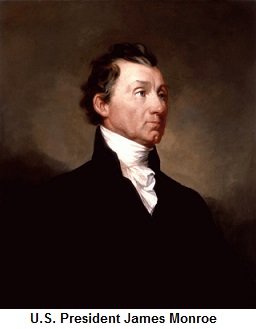
The Monroe Doctrine was a United States policy of opposing European colonialism in The Americas beginning in 1823. It stated that further efforts by European nations to take control of any independent state in North or South America would be viewed as “the manifestation of an unfriendly disposition toward the United States.”[1] At the same time, the doctrine noted that the U.S. would recognize and not interfere with existing European colonies nor meddle in the internal concerns of European countries. The Doctrine was issued in 1823 at a time when nearly all Latin American colonies of Spain and Portugal had achieved or were at the point of gaining independence from the Portuguese and Spanish Empires.

President James Monroe first stated the doctrine during his seventh annual State of the Union Address to Congress. The term “Monroe Doctrine” itself was coined in 1850.[2] By the end of the 19th century, Monroe’s declaration was seen as a defining moment in the foreign policy of the United States and one of its longest-standing tenets. It would be invoked by many U.S. statesmen and several U.S. presidents, including Ulysses S. GrantTheodore RooseveltJohn F. Kennedy, and Ronald Reagan. The intent and impact of the Monroe Doctrine persisted with only minor variations for more than a century. Its stated objective was to free the newly independent colonies of Latin America from European intervention and avoid situations which could make the New World a battleground for the Old World powers, so that the U.S. could exert its own influence undisturbed. The doctrine asserted that the New World and the Old World were to remain distinctly separate spheres of influence, for they were composed of entirely separate and independent nations.[3]

After 1898, Latin American lawyers and intellectuals reinterpreted the Monroe doctrine in terms of multilateralism and non-intervention. In 1933, under President Franklin D. Roosevelt, the U.S. went along with the new reinterpretation, especially in terms of the Organization of American States.[4]

Source: Retrieved July 19, 2017 from: https://en.wikipedia.org/wiki/Monroe_Doctrine

——

Reference Title Organization of American States
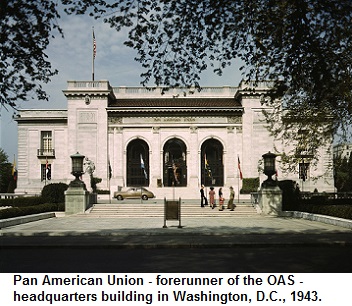
The Organization of American States (SpanishOrganización de los Estados AmericanosPortugueseOrganização dos Estados AmericanosFrenchOrganisation des États américains), or the OAS or OEA, is a continental organization founded on 30 April 1948, for the purposes of regional solidarity and cooperation among its member states. Headquartered in the US Capital of] Washington, D.C.,[1] the OAS’s members are the 35 independent states of the Americas.

CU Blog - State of the Union - Americana - Photo 2

CU Blog - State of the Union - Americana - Photo 3

As of 26 May 2015, the Secretary General of OAS is Luis Almagro.[2]

The member-states are as follows:

Antigua Argentina Bahamas Barbados Belize
Bolivia Brazil Canada Chile Colombia
Costa Rica Cuba (Suspended) Dominica Dominican Republic Ecuador
El Salvador Grenada Guatemala Guyana Haiti
Honduras Jamaica Mexico Nicaragua Panama
Paraguay Peru St. Kitts St. Lucia St. Vincent
Suriname Trinidad United States Uruguay Venezuela (Withdrew)

Source: Retrieved July 19, 2017 from: https://en.wikipedia.org/wiki/Organization_of_American_States
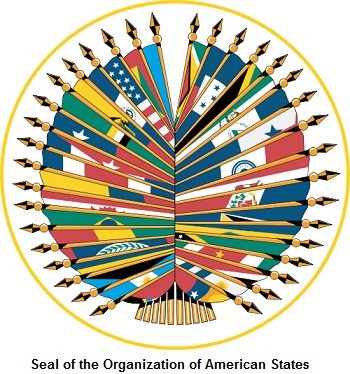
As depicted in the foregoing, the Monroe Doctrine is alive and well. Today, it is expressed through the American tutelage for the modern expression of multilateralism with the “Organization of the American States” (OAS). Since the purpose of the OAS is regional solidarity and cooperation, it automatically assumes a defensive posture. There is no active cross-border war in the Americas at this time; (there was only a Civil War / Domestic Terrorism campaign in Colombia). The US is using its BIG DOG status to force international peace in this hemisphere. This exercise of the American security mandates is casually referred to as “Pax Americana”.

But, the reality of living in the shadows of America means that we have to be aware of American self-interest and what it means to our hemispheric community – Resistance is Futile. Scanning the landscape of the region’s economic, security and governing engines, we see these obvious expressions of American self-interest … conveyed in previous blog-commentaries:

Economics

According to the Go Lean book, the CU is designed to be a technocratic intergovernmental entity that shepherds the Caribbean region’s economic interest. As the “800-pound gorilla” in the hemisphere, the evidence of American self-interest cannot be ignored. Notice the samples-examples in these scenarios:

Security

Depending on Pax Americana means ignoring many security best practices in the region. The US works to ensure security on their homeland, while ignoring the Caribbean. See how this thesis is presented in these sample blog-commentaries here:

Governance

There are a lot of expressions of American governance that is evident that American self-interest overrides common sense and the Greater Good. Consider these samples-examples:

———-

The movement behind the Go Lean book wants to help reform and transform the Caribbean. But we recognize that there will be no chance for success in the Caribbean region if our efforts go against American economic/security/foreign-policy interest.

The Go Lean/CU roadmap employs a tactic of a “Separation-of-Powers between CU federal agencies and Caribbean member-state governments”; so the limitations of national laws in a member-state does not have to override the CU. The CU constitution would apply to the installation of Exclusive Economic Zones (EEZ) and Self-Governing Entities (SGE) that operate in controlled bordered territories like campuses, industrial parks, research labs and industrial plants. Lastly, there is the power of “peer pressure” where progress by one Caribbean state would incline others to follow suit. In total, the Go Lean/CU roadmap will employ strategies, tactics and implementations to impact its prime directives; identified with the following 3 statements:

The Go Lean roadmap seeks to prepare the Caribbean region to be a protégé of Americana, not a parasite. While this is easier said than done, it is conceivable, believable and achievable. This quest, optimizing the entire Caribbean economic/security/governance eco-system, was the motivation of the Go Lean movement. This vision is defined early in the book (Page 12) in the following pronouncements in the Declaration of Interdependence:

x. Whereas we are surrounded and allied to nations of larger proportions in land mass, populations, and treasuries, elements in their societies may have ill-intent in their pursuits, at the expense of the safety and security of our citizens. We must therefore appoint “new guards” to ensure our public safety and threats against our society, both domestic and foreign. The Federation must employ the latest advances and best practices of criminology and penology to assuage continuous threats against public safety. …

xi. Whereas all men are entitled to the benefits of good governance in a free society, “new guards” must be enacted to dissuade the emergence of incompetence, corruption, nepotism and cronyism at the peril of the people’s best interest. The Federation must guarantee the executions of a social contract between government and the governed.

xii. Whereas the legacy in recent times in individual states may be that of ineffectual governance with no redress to higher authority, the accedence of this Federation will ensure accountability and escalation of the human and civil rights of the people for good governance, justice assurances, due process and the rule of law. As such, any threats of a “failed state” status for any member state must enact emergency measures on behalf of the Federation to protect the human, civil and property rights of the citizens, residents, allies, trading partners, and visitors of the affected member state and the Federation as a whole.

The Go Lean book posits that dysfunctional Caribbean communities can be reformed and transformed if they adopt the community ethos, strategies, tactics, implementations and advocacies as depicted in the Go Lean roadmap. The book provides 370-pages of turn-by-turn instructions on “how” so as to turnaround the societal engines of Caribbean society. For one, the recommendation is to reform and transform Caribbean foreign-policy – i.e. 10 Foreign Policy Initiatives at Start-up on Page 102 of the book. – from parasite to protégé.

The Caribbean can succeed in our efforts to improve our dependence of Americana. Consider this sample of previous blog-commentaries that delve into aspects of transforming the Caribbean region to a protégé status, away from a parasite status:

https://goleancaribbean.com/blog/?p=11759 Understand the Market, Plan the … Change
https://goleancaribbean.com/blog/?p=10216 Waging A Successful War Against Societal Defects – A Series
https://goleancaribbean.com/blog/?p=10043 Integration Plan for Greater Caribbean Prosperity
https://goleancaribbean.com/blog/?p=9595 Vision and Values for a ‘New’ Caribbean
https://goleancaribbean.com/blog/?p=7646 Going from ‘Good to Great’
https://goleancaribbean.com/blog/?p=7628 ‘A Change Is Gonna Come’
https://goleancaribbean.com/blog/?p=6993 Forging Change: ‘Something to Lose’
https://goleancaribbean.com/blog/?p=1596 Transforming to where we can ‘Prosper where Planted’

This commentary completes the 5-part series on the subject of the State of the Caribbean Union, (notwithstanding future sequels). Our region is really hurting! We are near-Failed-State status now. Our societal defects abound, whether we are among the big islands (Cuba, D.R. and/or P.R.) with the big populations, or whether we are among the small volcano islands, waiting for the next eruption. All in all, the Caribbean status quo is not successful and what little societal cohesion we have cannot be sustained, alone … for long. We must act now and seek refuge, but that refuge is not Americana, as our Caribbean interest is not American interest. 🙁

The reality of Americana is that “there will always be winners and losers” … in their society.

This sounds so familiar! This was the lyrics of the Rock-n-Roll song – Pink Houses  – by John Cougar Mellancamp, where he scorched the hypocrisy of the American eco-system – see VIDEO and Song Lyrics in the Appendices below; with this sample here:

And there’s winners and there’s losers
But they ain’t no big deal
‘Cause the simple man, baby
Pays for thrills
The bills the pills that kill

American self-interest dictates making the winners from some American special interest groups, at the expense of the Greater Good. It is hard for the winners to be foreigners, or the Black-and-Brown of the Caribbean. No, the American “game is rigged”; the winners represent the Crony-Capitalists in American society. In the Caribbean, we can … and must do better. We urge all Caribbean stakeholders – governments, citizens, residents and Diaspora – and all those who love the Caribbean region to lean-in to this vision described within this Go Lean roadmap.

The vision for a new Caribbean is one that is not a parasite of the US; but rather a protégé!

Yes, we can … stand tall and make our homeland a better place to live, work and play. 🙂

Download the free e-Book of Go Lean … Caribbean – now!

Sign the petition to lean-in for this roadmap for the Caribbean Union Trade Federation.

————-

Appendix VIDEO  – John Mellencamp – Pink Houses – https://youtu.be/qOfkpu6749w

Published on Oct 5, 2009 – Music video by John Mellencamp performing Pink Houses. (C) 1983 John Mellencamp under exclusive license to the Island Def Jam Music Group.

  • Category: Music
  • License: Standard YouTube License

————-

Appendix – John Mellencamp – “Pink Houses” Lyrics

There’s a black man with a black cat
Livin’ in a black neighborhood
He’s got an interstate
Runnin’ through his front yard
You know he thinks that he’s got it so good
And there’s a woman in the kitchen
Cleanin’ up the evenin’ slop
And he looks at her and says, hey darlin’
I can remember when you could stop a clock

CHORUS:
Oh, but ain’t that America
For you and me
Ain’t that America
Something to see, baby
Ain’t that America
Home of the free, yeah
Little pink houses
For you and me
Oooh, yeah
For you and me

Well, there’s a young man in a t-shirt
Listenin’ to a rockin’ rollin’ station
He’s got greasy hair, greasy smile
He says, Lord this must be my destination
‘Cause they told me when I was younger
Said boy, you’re gonna be president
But just like everything else
Those old crazy dreams
Just kinda came and went

[CHORUS]

[Instrumental Interlude]

Well, there’s people and more people
What do they know, know, know
Go to work in some high rise
And vacation down at the Gulf of Mexico
Ooh, yeah
And there’s winners and there’s losers
But they ain’t no big deal
‘Cause the simple man, baby
Pays for thrills
The bills the pills that kill

[CHORUS]
Ooooh, yeah…

Source: Retrieved July 19, 2019 from: http://www.azlyrics.com/lyrics/johnmellencamp/pinkhouses.html
Share this post:
, , ,

State of the Union: Unstable ‘Volcano States’

Go Lean Commentary

Picture this …

… a duck swimming on a tranquil pond; calm and peaceful on the surface, but underneath the duck is paddling ferociously. Tranquility above; eruption below.

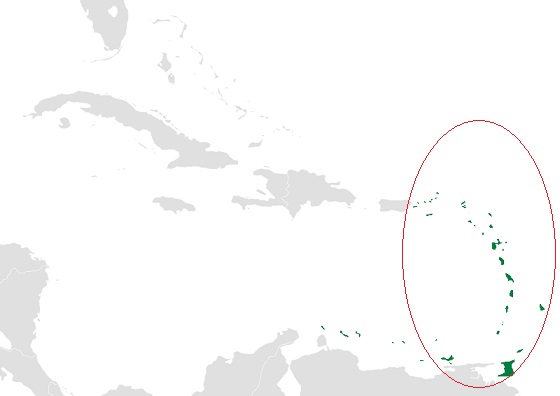
This visual also describes life in many Caribbean member-states – stable above; unstable below. Among the Lesser Antillean islands, the natural beauty is idyllic, while under the surface there are bubbling volcanoes, that periodically result in raging eruptions – see Appendix below.

CU Blog - State of the Union - Volcano States - Photo 1
These Lesser Antilles are the group of islands edging the Caribbean Sea. Most form a long, partly volcanic island arc between the Greater Antilles to the north-west and the continent of South America.[1] The islands form the eastern boundary of the Caribbean Sea with the Atlantic Ocean. Together, the Lesser Antilles and the Greater Antilles compose the Antilles (or the Caribbean in its narrowest definition). 

The Lesser Antilles region is a volcano zone – this is not just academic theory; this is a fact – most of the islands are of volcanic origins with extremely rich soil; this is the good history of the region’s volcanic past. There is bad history too; there have been devastating volcanic eruptions in the past – in modern times – and some volcanoes are active … now; think Montserrat where 2/3 of the island is now an Exclusion Zone.

There are volcanic activities on other islands as well; some are dormant; some are active, in particular on Martinique and St. Vincent. Will they erupt in the next few …?

The surety of an imminent volcano eruption is not known; but it is among the seismic threats – volcanoes, earthquakes and tsunamis – that must be accounted for. Economic engines can be disrupted with these seismic activities; even the threat of volcano can compromise economic security. This is the unstable reality; this is the State of the Union, for the following Caribbean islands; (click on any name for encyclopedic details of that island):

CU Blog - State of the Union - Volcano States - Photo 2

Dominica Guadeloupe Jamaica Martinique Montserrat Nevis
Providencia Saba St. Eustatius St. Kitts St. Lucia St. Vincent

This discussion aligns with the book Go Lean…Caribbean. The book presents a roadmap to optimize the region’s security apparatus in conjunction with economic and governmental empowerments. This assertion – that regional stakeholders must be ready for any emergency – is introduced in the Go Lean book as follows under the title of “Crap Happens” (Page 23):

Economic security is tied to the community quest to reboot the Caribbean region to ensure a better place to live, work and play. To ensure economic security, the economic engines must be protected to ensure their continuous operations despite natural or man-made deterrents. Bad things do happen to good people, so we cannot be caught unprepared. We must institute the process and provisions to respond, react, restore and recover. Any and everyone may need to dial “911”.

The Caribbean community ethos is to consider the facts and realities:

  1. climate change cannot be dismissed – tropical storms are now more common and more ferocious;
  2. there are two geologic fault-lines that run through the Caribbean region;
  3. there is an active volcano on Montserrat.

It is not a matter of “if” but “when” emergencies will strike. The security principle therefore is to be prepared for all incidents, big and small, that involve all aspects of society: islands, institutions, companies, families and individuals.

The subject of emergency management is analyzed in the Go Lean book; this is presented as a required function of a technocratic governmental administration. This book – available to download for free – serves as a roadmap for the introduction and implementation of the technocratic Caribbean Union Trade Federation (CU), for the elevation of Caribbean society – for all member-states. This CU/Go Lean roadmap endorses a system of better stewardship, with these 3 prime directives:

  • Optimization of economic engines in order to grow the regional economy to $800 Billion and create 2.2 million new jobs.
  • Establishment of a security-disaster apparatus to ensure public safety and protect the resultant economic engines.
  • Improve Caribbean governance to support these engines, including a true separation-of-powers between the member-states and CU federal agencies. This dictates a regional response for natural disaster emergencies.

The book stresses that reforming and transforming the Caribbean societal engines must be a regional pursuit. This was an early motivation for the roadmap, as pronounced in the opening Declaration of Interdependence (Pages 11 – 13):

ii. Whereas the natural formation of the landmass for our lands constitutes some extreme seismic activity, it is our responsibility and ours alone to provide, protect and promote our society to coexist, prepare and recover from the realities of nature’s occurrences.

xi. Whereas all men are entitled to the benefits of good governance in a free society, “new guards” must be enacted to dissuade the emergence of incompetence, corruption, nepotism and cronyism at the peril of the people’s best interest. The Federation must guarantee the executions of a social contract between government and the governed.

xvi. Whereas security of our homeland is inextricably linked to prosperity of the homeland, the economic and security interest of the region needs to be aligned under the same governance. Since economic crimes … can imperil the functioning of the wheels of commerce for all the citizenry, the accedence of this Federation must equip the security apparatus with the tools and techniques for predictive and proactive interdictions.

xxiv. Whereas a free market economy can be induced and spurred for continuous progress, the Federation must install the controls to better manage aspects of the economy: jobs, inflation, savings rate, investments and other economic principles. Thereby attracting direct foreign investment because of the stability and vibrancy of our economy.

This commentary is 4 of 5 in an occasional series on the State of the Caribbean Union. Surely, a volcano subduction zone throughout the Lesser Antilles must have a common sense of urgency. This threat has been assessed in the Go Lean book and the technocratic solutions provided there-in. The full entries of all the blog-commentaries in this series is as follows:

  1. State of the Caribbean Union – Lacking Hope and Change
  2. State of the Caribbean Union – Dysfunctional Spanish Caribbean
  3. State of the Caribbean Union – Deficient Westminster States
  4. State of the Caribbean Union – Unstable Volcano States
  5. State of the Caribbean Union – Self-Interest of Americana

As related in the first submission in this series, the young people in the region need the vision of “something better” or Hope and Change in order to be inspired to participate in the future of this homeland. We cannot have a future without these young people, so these solutions – strategies, tactics and implementations – are not optional.

Remember Montserrat? It is hard to have “hope for the future” if you live there; (2/3 of the island is now an Exclusion Zone). The reality of threatening conditions is a consistent theme from the Go Lean movement. Consider these previous blog-commentaries chronicling the pain and suffering of natural disasters in the region:

https://goleancaribbean.com/blog/?p=7449 ‘Crap Happens’ – So What Now?
https://goleancaribbean.com/blog/?p=6189 A Lesson in History – ‘Hurricane Katrina’ is helping today’s crises
https://goleancaribbean.com/blog/?p=5002 Managing a ‘Clear and Present Danger’
https://goleancaribbean.com/blog/?p=4360 Dreading the Inadequate ‘Caribbean Basin Security Initiative’
https://goleancaribbean.com/blog/?p=4185 Montserrat – A Post Volcano Ghost Town
https://goleancaribbean.com/blog/?p=2614 The ‘Great ShakeOut’ Earthquake Drill / Planning / Preparations
https://goleancaribbean.com/blog/?p=87 6.5M Earthquake Shakes Eastern Caribbean

The Go Lean book provides 370-pages of turn-by-turn instructions on “how” to adopt new community ethos, plus the strategies, tactics, implementations and advocacies to execute so as to reboot, reform and transform the societal engines of Caribbean society. For one, the recommendation is to reform and transform Caribbean governance, to better manage disaster-emergency situations – i.e. 10 Ways to Improve Emergency Management on Page 196 of the book.

Yes, there is the Caribbean Disaster Emergency Management Agency (CDEMA) already established in the region, and this organization represents a “good start” for a collaborative effort to monitor, mitigate and manage disaster situations. But CDEMA is undermanned, underfunded and under-appreciated. Embedding a security-disaster apparatus into a regional empowerment roadmap along with economic efforts allows the right people, right tools and right techniques for mitigating the threats of volcanoes … and earthquakes.

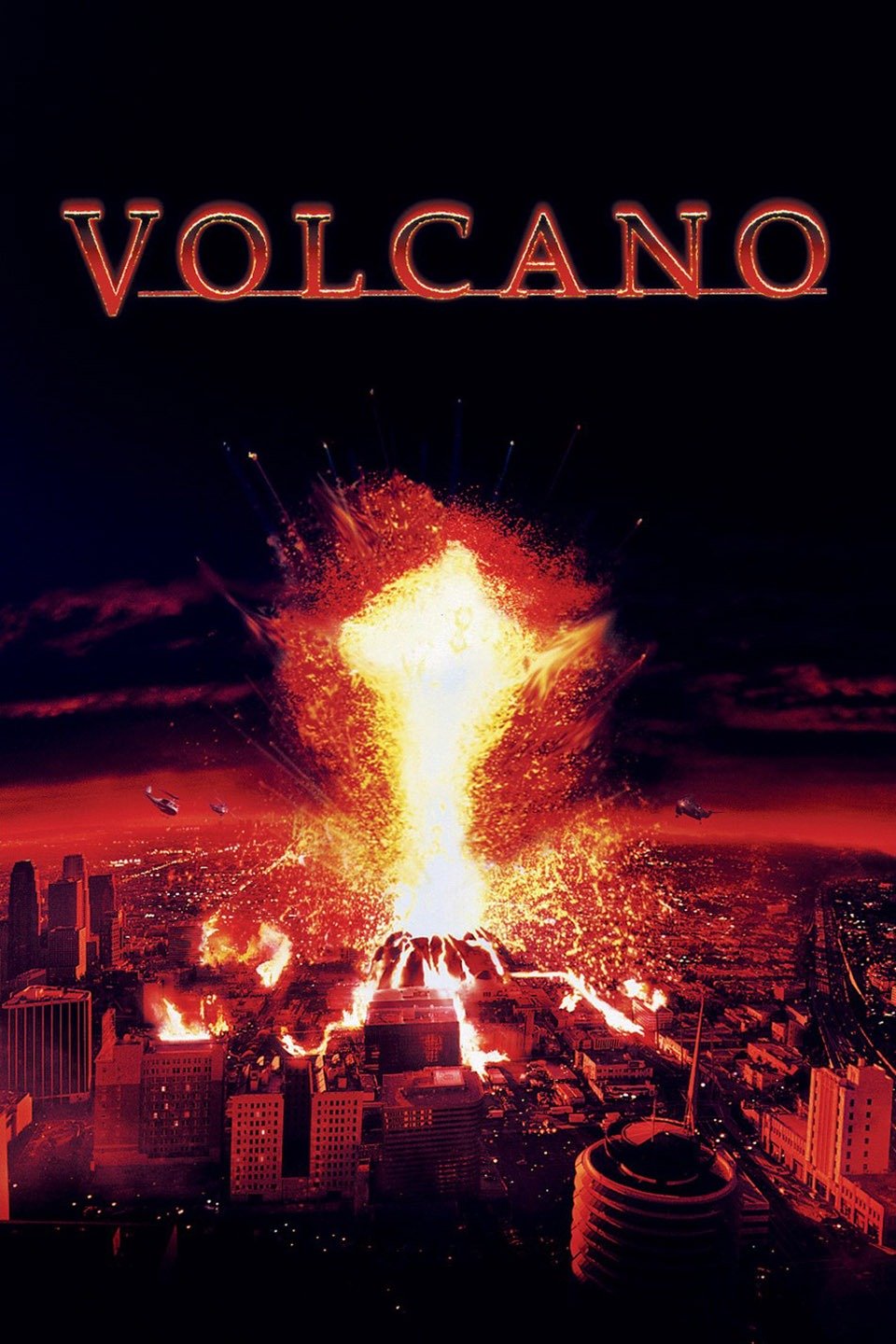
Many times, the same geological phenomena that fosters earthquakes – a constant threat in the Caribbean – also drives volcanoes. Considering  that “art imitates life”, see the fictionalized account of volcanoes and emergency management response in this Movie Trailer, in this related VIDEO:

VIDEO – Movie: Volcano – “The Coast is Toast” (1997) – https://youtu.be/QhS9X8H51A8  

CU Blog - State of the Union - Volcano States - Photo 3Published on Mar 8, 2008 – When a massive earthquake rocks the city of Los Angeles, Emergency Management department head Mike Roark (Tommy Lee Jones) returns from his vacation to help with the city’s response. After geologist Dr. Amy Barnes (Anne Heche) warns that a volcano may be forming in sewer tunnels, another severe earthquake unleashes the lava flowing underfoot, threatening to destroy the whole city. As the fiery molten rock runs through the streets, Roark and Barnes must figure out how to divert it.

Release dateApril 25, 1997 (USA)
DirectorMick Jackson
Budget90 million USD
Box office122.8 million USD

In the Appendix below, within the encyclopedia “scientific” data, it was asserted that …

“… typically the islanders [of these volcanic member-states] do not have access to scientific journals and international meetings. The data included here is of value to them in understanding their islands and the volcanic hazards present on them.”

This assertion is true … and sad! The Go Lean movement declares “Enough already!” No more immature administration of our homeland! It is time; actually it is past time to grow-up and optimize the stewardship of these unstable islands.

For the Caribbean’s future, we must do better! Our youth deserves every opportunity to live at home in a technocratic society, in communities where we monitor, mitigate and manage the risks of known threats. We encourage all regional stakeholders to lean-in to this Go Lean roadmap – the strategies, tactics and implementation – to make the Caribbean homeland, even the Volcano States, better places to live, work and play. 🙂

Download the free e-Book of Go Lean … Caribbean – now!

Sign the petition to lean-in for this roadmap for the Caribbean Union Trade Federation.

—————

Appendix – A [Scientific] Study of the Volcanoes of the Caribbean

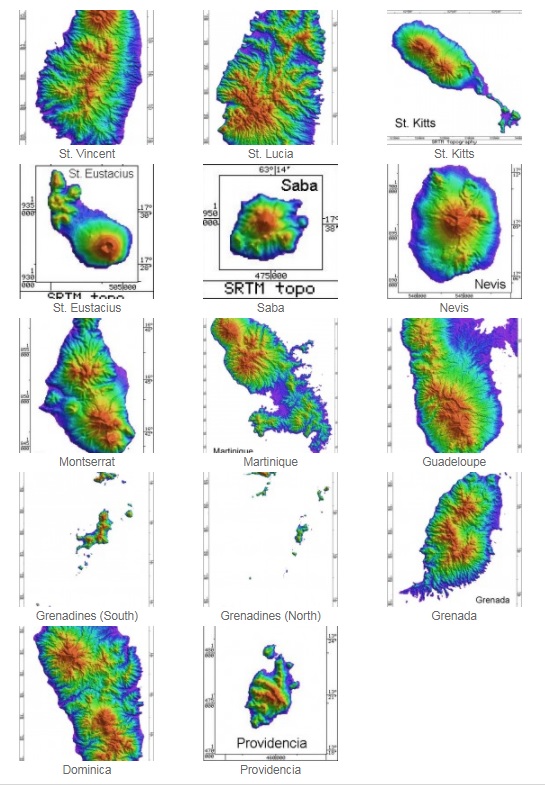
Radar TopographyIn [the year] 2000 radar data was acquired by the space shuttle which enabled virtually complete mapping of the Earth’s topography to be achieved between latitudes 56 o S to 60 o N. A nominal 30 m grid was obtained at an absolute accuracy of 16m, although in flat non-vegetated areas the vertical accuracy may approach 3 m. While data at the full resolution is available in some regions, such as North America , elsewhere the Shuttle Radar Topography Mission (SRTM) data is only provided on an approximately 90m grid, obtained by averaging the 30 m grid data. The new data is a vast improvement in resolution and accuracy over previous global topographic models, such as ETOPO30, and provides a significant new amount of information of use in geological and other studies.

For the Caribbean islands the SRTM data which is available on a geographic grid at a nominal 90-m cell size was converted to a UTM grid in Zone 20, using the WGS84 spheroid. A grid interval of 50 m was used to retain as much detail as possible, and minor gaps in the data were filled in using special routines. The data were fenced using coastline data obtained from NOAA, and it should be noted that the coastline data set for each island was displaced by up to a kilometre from its location relative to the SRTM grid. This is a reflection on the accuracy of the original geographic information and resulting data sets rather than that of the SRTM data, which is extremely accurately located. Hence the coastline for each island was bulk shifted until it appeared to fit the SRTM data, and was then used to create the final outline shown in these plots. The positions of the coastlines are probably accurate to within about 100 m. The SRTM grids are shown as raster images, with artificial shading by illumination from the northeast, and both UTM and geographic coordinates are included. Non-linear colour scales are used for optimum colour stretch, where low values are purple and high values are red.

Green Volcanoes – Green tropical jungle-covered volcanoes standing out of warm blue seas in balmy Trade Winds, surrounded by palm-lined white coral sand beaches and reefs may be the ideal of the tourist trade and the eco-tourist seeking unspoiled tropical rain forest, but they can be a headache for the geologist looking for rocks. In a review of the geology and hazards of the Commonwealth of Dominica, in the center of the Lesser Antilles volcanic arc we encountered this problem. The two volcanoes that make up the northern end of the island – Morne aux Diables in the far north, and to its south Morne Diablotins (1421m the highest point on the island) – are both very green. Exposures in the sea cliffs and along the coastal roads show that both volcanoes are made up of older foundations (3.7 to 1.8 million years for Morne Diablotins and 2.0 to 1.7 million years for Morne aux Diables) that have been deeply dissected by erosion. Both are capped by very young deposits that were probably erupted in the past 100,000 years, which overlie the older deposits on the coasts. …

About Caribbean Volcanoes This website on Caribbean volcanoes represents the cooperative work of the two authors over thirty years, [John Roobol and Alan Smith, two geologists both from South Wales in the UK who following Ph.D. studies at the Universities of London and California met on Mt. Pelee, Martinique in 1971 and have since worked together on most Caribbean volcanoes]. The views expressed and almost all of the photographs are those of the authors and do not necessarily agree with the views of other scientists. The site is aimed foremost at the populations and administrations of the volcanic islands. Typically the islanders do not have access to scientific journals and international meetings. The data included here is of value to them in understanding their islands and the volcanic hazards present on them. …

CU Blog - State of the Union - Volcano States - Photo 4

(Click to Enlarge)

Source: Retrieved July 18, 2017 from: http://caribbeanvolcanoes.com/

———

Additional Scientific VIDEO:

VIDEO – NatGeo Wild: A Volcanic Surprise | Caribbean’s Deadly Underworld  – https://youtu.be/5yuBSb7wPQE


Share this post:
, , , ,
[Top]

Accede the Caribbean Arrest Treaty

Go Lean Commentary

CU Blog - Accede the Caribbean Arrest Treaty - Photo 1

The major problems in the Caribbean are not all due to external factors out of our control – i.e. global economy, international travel and tourism. No, we have some internal issues as well; for example, Crime.

Every Caribbean member-state has an atrocious crime problem that needs to be mitigated and remediated.

“We cannot control what other people do; but we can control how we react” – standard Common Sense wisdom.

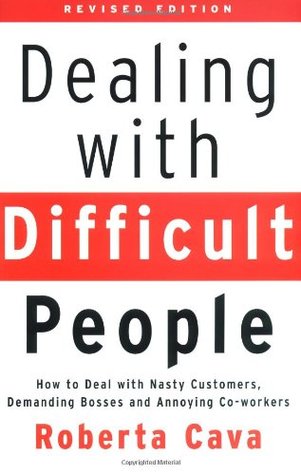
“You can’t control other people’s behaviour, but you can control your responses to it.” ― Roberta CavaDealing with Difficult People – How to deal with nasty customers, demanding bosses and uncooperative colleagues – See Photo in the Appendix.

This assessment was paramount in the motivation for the 2013 book Go Lean…Caribbean. There was/is a need to consider strategies, tactics and implementations to address the region’s crime problems. This goal is detailed in the book as it serves as a roadmap for the introduction of the technocratic Caribbean Union Trade Federation (CU). While the CU is set to optimize Caribbean society through economic empowerment, we must accept the established truth that the security dynamics of the region are inextricably linked to economic endeavors. Therefore the Go Lean roadmap has these 3 prime directives:

All in all, the book recognizes that the quest of these prime directives involves heavy-lifting; they are not easy.

The Go Lean roadmap details a goal to confederate a unified security apparatus for the region’s crime-fighting stakeholders; this will empower a regional Homeland Security technocracy. But Homeland Security for the Caribbean has a different meaning than for our North American or European counterparts. As disclosed in a recent blog-commentary, while the security apparatus must be on defense against military intrusions like terrorism & piracy, it must mostly contend with “bad actors” and threats that may imperil the region’s economic engines. This includes concerns like narco-terrorism and enterprise corruption, plus natural and man-made disasters like hurricanes, earthquakes, oil/chemical spills, etc..

So the Go Lean security goal is mostly for public safety!

If/when a “bad actor” is arrested, there needs to be the full force of the law in enforcing the tenants of the arrest across member-states; (many Caribbean islands are short distances apart, island hopping is a viable option for suspects to avoid justice institutions). This is the point of the Caribbean Arrest Treaty. See more information in this news article here:

News Title: Saint Lucia signs Caribbean arrest treaty
ST. GEORGE’S, Grenada, July 7 – Saint Lucia is among five Caribbean Community (CARICOM) countries to have signed the Caribbean Arrest Treaty, one of the regional security instruments that was formulated to enhance cooperation between member states in the fight against crime.

Guyana, Dominica, Grenada, Guyana, St. Kitts-Nevis, and St. Lucia signed the accord at the 38th Heads of Government summit that ended here on Thursday night.

The objective of the treaty is to establish within the Caribbean Community a system of arrest and surrender of requested persons for the purposes of conducting a criminal prosecution for an applicable offence; or executing a custodial sentence where the requested persons have fled from justice after being sentenced for an applicable offence.

It was first presented in draft form in Guyana earlier this year when that country hosted the CARICOM Inter-Sessional summit in February.

The treaty is one of the regional security instruments that was formulated to enhance cooperation between member states in the fight against crime and to reduce the complexity, cost and delays in the existing extradition arrangements inherent in the region.

Source: Retrieved July 7, 2017 from The St. Lucia Times Daily Newspaper: https://stluciatimes.com/2017/07/07/saint-lucia-signs-caribbean-arrest-treaty

——-

VIDEO – CARICOM TO SET UP ARREST TREATY – https://youtu.be/O32MYfCVy7Q

Published on Jul 8, 2016 – Member-states have agreed to work much closer in the area of security, as part of that effort by CARICOM to introduce a regional arrest treaty. Dominica’s Prime Minister, Roosevelt Skeritt, when asked how this treaty would work; explained the process.

Mr. Roosevelt Skeritt told a media briefing on Wednesday evening that the treaty would enhance cooperation between and among law enforcement authorities in the community. Suriname has serious problems constitutionally, where this arrest treaty is concerned. Dominica’s Prime Minister Roosevelt Skeritt explains.

Know that the arrest warrant treaty when it is set up would enhance law enforcement ability to address matters of cross – border crimes. The issue of security held much interest during the life of the Conference because of the important role it played in protecting the society from danger. Mr. Skeritt said…

This foregoing article and VIDEO describes a treaty that will take more than just words to accede regionally; there will also have to be action, heavy-lifting action that would require a full measure of devotion and commitment; it will require time, talent and treasuries of the member-states.

The book Go Lean…Caribbean – available to download for free – details this commitment. It stresses that reforming and transforming the Caribbean societal engines must be a regional pursuit. This was an early motivation for the roadmap, as pronounced in the opening Declaration of Interdependence (Pages 12 – 13):

x.   Whereas we are surrounded and allied to nations of larger proportions in land mass, populations, and treasuries, elements in their societies may have ill-intent in their pursuits, at the expense of the safety and security of our citizens. We must therefore appoint “new guards” to ensure our public safety and threats against our society, both domestic and foreign. The Federation must employ the latest advances and best practices … to assuage continuous threats against public safety.

xi. Whereas all men are entitled to the benefits of good governance in a free society, “new guards” must be enacted to dissuade the emergence of incompetence, corruption, nepotism and cronyism at the peril of the people’s best interest. The Federation must guarantee the executions of a social contract between government and the governed.

xvi. Whereas security of our homeland is inextricably linked to prosperity of the homeland, the economic and security interest of the region needs to be aligned under the same governance. Since economic crimes … can imperil the functioning of the wheels of commerce for all the citizenry, the accedence of this Federation must equip the security apparatus with the tools and techniques for predictive and proactive interdictions.

The Go Lean book provides 370-pages of turn-by-turn instructions on “how” to adopt new community ethos, plus the strategies, tactics, implementations and advocacies to execute so as to reboot, reform and transform the societal engines of Caribbean society.

In addition to this regional treaty in the foregoing, there are these other treaties that are urged for promotion and accedence:

The Go Lean movement has previously described (in a commentary) the motivations for crime: 1. Need, 2. Greed and 3. Justice. That commentary related, as follows:

So the CU/Go Lean roadmap addresses the issue of more jobs; this will lower the “need” factor for crime; (there is no expectation that these efforts would fully eliminate violent crime; but this start will mitigate the risks). The book relates that with the emergence of new economic drivers, that “bad actors” will also emerge thereafter to exploit the opportunities, with good, bad and evil intent. The second factor, “greed” is tied to opportunities. The executions of the Go Lean roadmap (Page 23) are specifically designed to minimize opportunities for crime with these security mandates:

  • Adapt the Ethos: Public Protection over Privacy
  • Embrace Electronic Payment Systems – Carry less cash
  • Whistleblower Protection – Consider all allegation, anonymous and overt
  • Witness Security & Protection – Ensure Justice Process
  • Youth Crime Awareness & Prevention; Anti-Bullying and Mitigation – “Nip it in the bud
  • Intelligence Gathering – Universal Video Surveillance
  • Light Up the Dark Places – Eliminate the figurative and literal “shadows”
  • Prison Industrial Complex – Engage to reduce recidivism

The third contributor, justice, is tied to street riots, civil unrest and other outbursts against perceived injustices. The marching call of many of these movements is “No Justice; No Peace”.

There is therefore the need to do heavy-lifting to mitigate and remediate the Caribbean’s high crime rate. This has been a consistent theme for the Go Lean movement; consider these previous blogs-commentaries:

Want Better Security? ’Must Love Dogs’
Boston Bombing Anniversary – Learning Lessons
Managing the ‘Strong versus the Weak’ Series – Model of Hammurabi
Funding the Caribbean Security Pact
Security Intelligence Series – On the Ground, Sea and Air
Interpersonal Violence Series – Domestic and Honor Issues
Interpersonal Violence Series – Street Crimes
Ten Puerto Rico Police Accused of Criminal Network
Violent Crime Warnings to Tourists in the Bahamas
Justice Strategy: Special Prosecutors … et al
Role Model for Law, Order and Justice – The Pinkertons
Economic Crime Enforcement – The Criminalization of American Business
Jamaica to receive World Bank funds to help in crime fight
10 Things We Don’t Want from the US: #5 – Organized Crime

A regional treaty to enforce and apprehend suspects – those who evade arrest – among a few Eastern Caribbean member-states is a good start …

… the next step must be expanding this to a comprehensive treaty for a regional security apparatus for all 30 member-states; (including the plan to pay for it). This has been identified as a:

Bingo! There it is! This is how it is done! This is the comprehensive plan for the Go Lean roadmap, integrating and consolidating the stewardship for economics, security and governance.

Yes, we can make our homeland a better, safer, place to live, work and play. 🙂

Download the free e-book of Go Lean … Caribbean – now!

Sign the petition to lean-in for this roadmap for the Caribbean Union Trade Federation. 

——–

Appendix – Book Cover: Dealing with Difficult People – How to deal with nasty customers, demanding bosses and uncooperative colleagues

CU Blog - Accede the Caribbean Arrest Treaty - Photo 2


Share this post:
,
[Top]

Commerce of the Seas – Book Review: ‘Sea Power’

Go Lean Commentary 

70% of the earth is covered by water
70% of the human body is made up by water

CU Blog - Lessons from China - South China Seas - Exclusive Economic Zone - Photo 3It seems that water is pretty important in managing the affairs of people and their community.

The quest of the movement behind the book Go Lean… Caribbean is to confederate, collaborate and convene the 30 member-states of the Caribbean region into a Single Market; this would include the territorial homelands and aligning seas. How, where, when ‘Sea Power’ is managed becomes a major consideration in this quest. A lesson we have learned from Economic History is that a people who wield ‘Sea Power’ can control the economic prospects of its people.

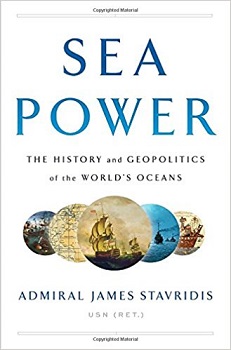
We learn this lesson even more succinctly now, thanks to the new book by Admiral James Stavridis entitled: Sea Power: The History and Geopolitics of the World’s Oceans. See a summary-review of the book here and listen to an AUDIO-Podcast interview with the Author:

 Sea Power - Photo 1

Book Review for Book: Sea Power: The History and Geopolitics of the World’s Oceans By: Admiral James Stavridis

From one of the most admired admirals of his generation – and the only admiral to serve as Supreme Allied Commander at NATO – comes a remarkable voyage through all of the world’s most important bodies of water, providing the story of naval power as a driver of human history and a crucial element in our current geopolitical path. 

From the time of the Greeks and the Persians clashing in the Mediterranean, sea power has determined world power.  To an extent that is often underappreciated, it still does. No one understands this better than Admiral Jim Stavridis. In Sea Power, Admiral Stavridis takes us with him on a tour of the world’s oceans from the admiral’s chair, showing us how the geography of the oceans has shaped the destiny of nations, and how naval power has in a real sense made the world we live in today, and will shape the world we live in tomorrow.

Not least, Sea Power is marvelous naval history, giving us fresh insight into great naval engagements from the battles of Salamis and Lepanto through to Trafalgar, the Battle of the Atlantic, and submarine conflicts of the Cold War. It is also a keen-eyed reckoning with the likely sites of our next major naval conflicts, particularly the Arctic Ocean, Eastern Mediterranean, and the South China Sea. Finally, Sea Power steps back to take a holistic view of the plagues to our oceans that are best seen that way, from piracy to pollution.

When most of us look at a globe, we focus on the shape of the of the seven continents. Admiral Stavridis sees the shapes of the seven seas.  After reading Sea Power, you will too. Not since Alfred Thayer Mahan’s legendary The Influence of Sea Power upon History have we had such a powerful reckoning with this vital subject.

Sea Power makes a great Father’s Day gift!

Source: Amazon Online Bookstore-Portal; retrieved June 9, 2017 from: https://www.amazon.com/Sea-Power-History-Geopolitics-Worlds/dp/073522059X/

———–

Appendix AUDIO-Podcast – Stavridis’ Book ‘Sea Power’ Explains Why Oceans Matter In Global Politics – http://www.npr.org/2017/06/06/531701056/stavridis-book-sea-power-explains-why-oceans-matter-in-global-politics

Published June 6, 2017 – NPR’s Morning Edition’s Steve Inskeep talks to retired Admiral James Stavridis, former supreme allied commander for NATO, about his new book: Sea Power: The History and Geopolitics of the World’s Oceans.

Listen to an extended NPR Podcast here: http://www.npr.org/podcasts/510053/on-point-with-tom-ashbrook

The theme of this new book aligns with the book Go Lean…Caribbean in explaining the significance of ‘Sea Power’ in any plan to elevate the Caribbean region’s societal engines. This commentary is 2 of 4 in a series considering the Lessons in Economic History related to “Commerce of the Seas”, the good, bad and ugly (think Crony-Capitalism) strategies and practices around the maritime eco-system in the United States … and other countries. The full series is as follows:

  1. Commerce of the Seas – Stupidity of the Jones Act
  2. Commerce of the Seas – Book Review: ‘Sea Power’
  3. Commerce of the Seas – Shipbuilding Model of Ingalls
  4. Commerce of the Seas – Lessons from Alang (India)

The previous commentary in this series relates how “Commerce” refers to the economic interest of the 30 member-states in the Caribbean region. Admiral Stavridis book has a heavy focus on naval military power; he posits that a strong Navy paves the way for and protects the continuation of maritime commerce. From the book Sea Power and the Go Lean book we see this consistent Lesson in Economic History:

Around the world, countries that have access to control of the “Sea” have a distinct advantage economically versus countries that are land-locked; i.e. England versus Austria.

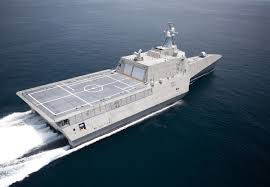
CU Blog - America's Navy - 100 Percent - Model for Caribbean - Photo 4As stated previously, the United States have wielded its ‘Sea Power’ to promote profit for its maritime industrial stakeholders at the expense of the residents of off-shore territories, like Puerto Rico and the US Virgin Islands in the Caribbean.

There is therefore a need to reboot, reform and transform the Caribbean region’s stewardship of the Seas. This is the purpose of the book Go Lean … Caribbean, to help empower and elevate the societal engines of the 30 member-states of the Caribbean region and their waterscapes. The Go Lean book serves as a roadmap for the introduction and implementation of the Caribbean Union Trade Federation (CU). This would be the inter-governmental entity for a regional Single Market that covers the land territories of the 30 member-states, and their aligning seas; (including the 1,063,000 square miles of the Caribbean Sea in an Exclusive Economic Zone). The Go Lean/CU roadmap features this prime directive, as defined by these 3 statements:

  • Optimization of the economic engines to grow the regional economy to $800 Billion & create 2.2 million new jobs.
  • Establishment of a security apparatus to protect public safety and ensure the economic engines of the region, including the seas.
  • Improvement of Caribbean governance to support these engines in local governments and in the Exclusive Economic Zone, including a separation-of-powers between the member-states and CU federal agencies.

This Go Lean roadmap envisioned a wide-ranging, fully-encompassing treaty for all Caribbean member-states to deputize a technocratic agency to better administer the affairs (economic, security and governance) of the waterscapes in the region. It was recognized that this quest was “out-of-scope” and too big for any one Caribbean member-state alone, but rather, acknowledging their regional interdependence, these stakeholders would be able to engage a new inter-governmental administration for better regional stewardship. This, regionalism, was the original intent of the Go Lean book, which commenced with a Declaration of Interdependence, pronouncing the need for regional coordination and integration so as to reform and transform Caribbean society. See a sample of relevant stanzas here (Page 11 – 12) as related to the Caribbean ‘Sea Power’:

v. Whereas the natural formation of our landmass and coastlines entail a large portion of waterscapes, the reality of management of our interior calls for extended oversight of the waterways between the islands. The internationally accepted 12-mile limits for national borders must be extended by International Tribunals to encompass the areas in between islands. The individual states must maintain their 12-mile borders while the sovereignty of this expanded area, the Exclusive Economic Zone, must be vested in the accedence of this Federation.

vi. Whereas the finite nature of the landmass of our lands limits the populations and markets of commerce, by extending the bonds of brotherhood to our geographic neighbors allows for extended opportunities and better execution of the kinetics of our economies through trade. This regional focus must foster and promote diverse economic stimuli.

x. Whereas we are surrounded and allied to nations of larger proportions in land mass, populations, and treasuries, elements in their societies may have ill-intent in their pursuits, at the expense of the safety and security of our citizens. We must therefore appoint “new guards” to ensure our public safety and threats against our society, both domestic and foreign. The Federation must employ the latest advances and best practices … to assuage continuous threats against public safety. …

xi. Whereas all men are entitled to the benefits of good governance in a free society, “new guards” must be enacted to dissuade the emergence of incompetence, corruption, nepotism and cronyism at the peril of the people’s best interest. The Federation must guarantee the executions of a social contract between government and the governed.

xvi. Whereas security of our homeland is inextricably linked to prosperity of the homeland, the economic and security interest of the region needs to be aligned under the same governance. Since economic crimes, including piracy and other forms of terrorism, can imperil the functioning of the wheels of commerce for all the citizenry, the accedence of this Federation must equip the security apparatus with the tools and techniques for predictive and proactive interdictions.

The foregoing book, Sea Power, aligns with the Go Lean book references to strategies, tactics and implementations for the Exclusive Economic Zone (EEZ). The Go Lean book provides 370-pages of turn-by-turn directions on “how” this EEZ can impact and benefit Caribbean society. Consider the Chapter excerpts and headlines from this sample on Page 104:

The Bottom Line on the United Nations Convention on the Law of the Sea (UNCLOS)
The UNCLOS is the international agreement that resulted from the third United Nations Conference on the Law of the Sea which took place between 1973 and 1982. This Convention defines the rights and responsibilities of nations in their use of the world’s oceans, establishing guidelines for businesses, the environment, and the management of marine natural resources. As of October 2012, 164 countries and the European Union have joined in the Convention. The convention introduced a number of provisions. The most significant issues covered were setting limits, navigation, archipelagic status and transit regimes, exclusive economic zones (EEZs), continental shelf jurisdiction, deep seabed mining, the exploitation regime, protection of the marine environment, scientific research, and settlement of disputes. EEZs extend from the edge of the territorial sea out to 200 nautical miles (230 miles) from the 12-mile baseline. Within this area, the coastal nation has sole exploitation rights over all natural resources, including the continental shelf. EEZs were introduced to halt the increasingly heated clashes over fishing rights, although oil was also becoming important. The success of an offshore oil platform in the Gulf of Mexico in 1947 was soon repeated elsewhere in the world, and by 1970 it was technically feasible to operate in waters 4000 meters deep. Foreign nations still have freedoms of navigation and over-flights for the EEZ, subject to the regulation of the coastal states. Foreign states may also lay submarine pipes and cables.

CU independent UNCLOS member-states include: Antigua, Jamaica, Suriname, Dominican Republic, Guyana, Barbados, Saint Vincent, Saint Kitts, Trinidad, Grenada, Saint Lucia, Cuba, Bahamas & Belize.

 10 Start-up Benefits from the EEZ

1

Lean-in for Caribbean Integration
The CU treaty unifies the Caribbean region into one single market of 42 million people across 30 member-states, thereby empowering the economic engines in and on behalf of the region. Integral to CU roadmap, is the territory between the island states. The CU will petition the United Nations for rights under the UN Convention on the Law of the Sea for acquisition of an Exclusive Economic Zone (EEZ). This will facilitate both economic empowerment (including Fisheries management) and security assurances for the region. (This effort was started by the Association of Caribbean States).

2

Funding by Selling Exploration Rights

3

Off-shore Wind Turbines

4

Pipelines

5

Extractions – Economic & Security

6

Security – Anti-Piracy
The CU has the mission to defend the homeland against enemies: foreign, domestic, and in the Exclusive Economic Zone of the Caribbean Seas. There is still a threat of piracy in modern times, and these “bad actors” hide behind jurisdictional confusions of one territorial waters after another. But the CU, with its regional oversight, can be more effective in bringing these ones to justice. Piracy is a form of terrorism, and cruise ships (smaller vessels catering to a High Net Worth – One Percent – market) and leisure crafts can be vulnerable to these threats.

7

Security – Interdictions
There is the need to be on alert for seaborne drug smuggling activities, as these can have corrupting influences on the local community. This would be the direct responsibilities of the CU Naval Operations for the jurisdiction of the EEZ. Today the US Coast Guard conducts patrols in the Caribbean Seas with impunity. There is no plan in the CU roadmap to curtail any of this activity; instead the CU will better coordinate their routes and maneuvers with CU Naval Operations.

8

Security – Search & Rescue

9

Security Monitoring
The CU will embrace many cutting-edge technological options to “keep eyes” on the Caribbean Seas. This includes satellite (visual & GPS), drones (unmanned airborne vehicles & dirigibles or blimps. Boaters will be incentivized tocooperate and install location beacons.

10

Security – Defense Pact (Naval Maneuvers)
The US, France, Netherlands, UK and some European trading partners have declared a “War Against Terrorism”; those battles will surely come to Caribbean shores. The CU therefore invites the Navies of allied nations to train, visit and conduct operations in our Caribbean waters, especially in the EEZ.

The issue of managing marine resources for commerce and security in the Caribbean has been a frequent subject for previous blog-commentaries; consider this list of sample entries:

https://goleancaribbean.com/blog/?p=11544 Forging Change in the Cruise Industry with Collective Bargaining
https://goleancaribbean.com/blog/?p=10566 Funding the Caribbean Security Pact
https://goleancaribbean.com/blog/?p=8819 Lessons from China – South China Seas: Exclusive Economic Zones
https://goleancaribbean.com/blog/?p=5210 Cruise Ship Commerce – Getting Ready for Change
https://goleancaribbean.com/blog/?p=3594 Better Fisheries Management for Queen Conch
https://goleancaribbean.com/blog/?p=1965 America’s Navy – 100 Percent – Model for Caribbean
https://goleancaribbean.com/blog/?p=673 Ghost ships – Autonomous cargo vessels without a crew
https://goleancaribbean.com/blog/?p=273 10 Things We Want from the US – # 4: Pax Americana

All Caribbean members are islands or coastal territories. The subject of ‘Sea Power’ and security of the waterscapes matters to us. Rather than 70 percent, we have to be concerned with 100 percent of the issues, challenges and opportunities.

There is a need to reform our maritime eco-system, for commerce and security. ‘Sea Power’ determines world power, so there is also a need to have a “seat at the table” among the big nations and sea-faring empires. As one small island alone, there is no chance for that consideration; but as a Single Market entity of 42 million people and 30 separate countries (and territories), the Caribbean can now have a Voice … and a Vote (in international forums) so as to shape the destiny of our homeland … and maybe even the whole world of commerce & security.

We hereby urge all Caribbean stakeholders – governments and citizens – to lean-in to this Go Lean roadmap to better wield our ‘Sea Power’, so that our region can be a better homeland (and waterscapes) to live, work and play. 🙂

Download the free e-book of Go Lean … Caribbean – now!

Sign the petition to lean-in for this roadmap for the Caribbean Union Trade Federation. 

Share this post:
, , , , , ,
[Top]

Want Better Security? ’Must Love Dogs’

Go Lean Commentary

So you want to secure your homeland against terror and other threats? Here’s a key requirement:

‘Must Love Dogs’

This is so true; man’s best friend can also be our best partner for mitigating threats of terroristic acts in public places. This is common sense … now that we have seen how devious the terrorists can be, exploiting soft targets right outside any hard target zones.

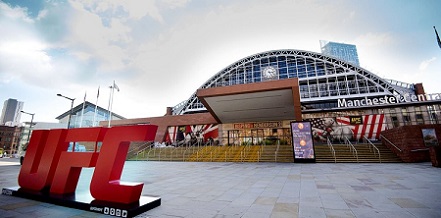
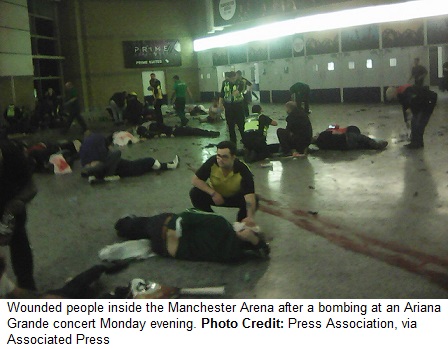
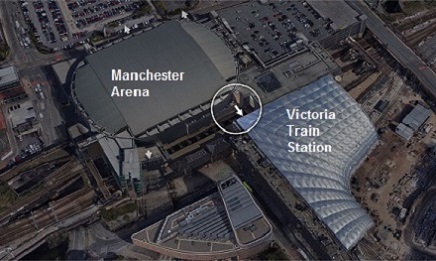
This is a fresh concern as there was a terrorist attack at the Manchester Arena in Manchester, England last night (May 22, 2017). The attacker was an ISIS-backed suicide bomber who positioned himself among the exiting concert-goers for a show at the Arena. (The artist is American teen pop-sensation Ariana Grande, a fan-favorite among teenage girls and boys). He detonated his “Improvised Explosive Device” (IED) right outside the security zone while people were exiting to leave. So far, the death toll is 22, with 59 injuries. See full details on the story, aftermath and investigation here:

ISIS Claims Responsibility for Manchester Concert Attack; 22 Dead

Manchester Arena – Situation Normal
CU Blog - 'Must Love Dogs' - Photo 4

CU Blog - 'Must Love Dogs' - Photo 3

CU Blog - 'Must Love Dogs' - Photo 2

Manchester Arena – Monday Night May 22, 2017

CU Blog - 'Must Love Dogs' - Photo 1

CU Blog - 'Must Love Dogs' - Photo 5

Expect more revelations of the motives and bitter consequences of this attack against “innocence”.

This is a matter of serious concern for planners of a new Caribbean. This is Terrorism 101; this is affecting the whole world and our world. Though this attack was far away from the Caribbean islands, it was not far away from Caribbean people, as related in a previous blog-commentary from the promoters of the book Go Lean…Caribbean, there is a large Caribbean Diaspora in Manchester.

The book Go Lean…Caribbean – available to download for free – serves as a roadmap for the introduction and implementation of the technocratic Caribbean Union Trade Federation (CU), for the elevation of Caribbean society – for all member-states. The book asserts that the needed security apparatus to better defend against the modern threats of terrorism is too much for any one Caribbean member-state alone. There must be a regional integrated and confederated solution. This CU/Go Lean roadmap has these 3 prime directives:

  • Optimization of the economic engines in order to grow the regional economy and create new jobs.
  • Establishment of a security apparatus to ensure public safety and protect the resultant economic engines.
  • Improve Caribbean governance to support these engines, including a separation-of-powers between the member-states and CU federal agencies.

The book stresses that reforming and transforming the Caribbean societal engines must be a regional pursuit. This was an early motivation for the roadmap, as pronounced in the opening Declaration of Interdependence (Pages 12 – 13):

x. Whereas we are surrounded and allied to nations of larger proportions in land mass, populations, and treasuries, elements in their societies may have ill-intent in their pursuits, at the expense of the safety and security of our citizens. We must therefore appoint “new guards” to ensure our public safety and threats against our society, both domestic and foreign. The Federation must employ the latest advances and best practices of criminology and penology to assuage continuous threats against public safety. …

xi. Whereas all men are entitled to the benefits of good governance in a free society, “new guards” must be enacted to dissuade the emergence of incompetence, corruption, nepotism and cronyism at the peril of the people’s best interest. The Federation must guarantee the executions of a social contract between government and the governed.

xvi. Whereas security of our homeland is inextricably linked to prosperity of the homeland, the economic and security interest of the region needs to be aligned under the same governance. Since economic crimes … can imperil the functioning of the wheels of commerce for all the citizenry, the accedence of this Federation must equip the security apparatus with the tools and techniques for predictive and proactive interdictions.

Is there anything more that could have been done to prevent this Manchester Terrorist Attack? Let the post-trauma analysis begin! For one, the planners of the new Caribbean security apparatus have always presented this ingredient to the recipe for security success:

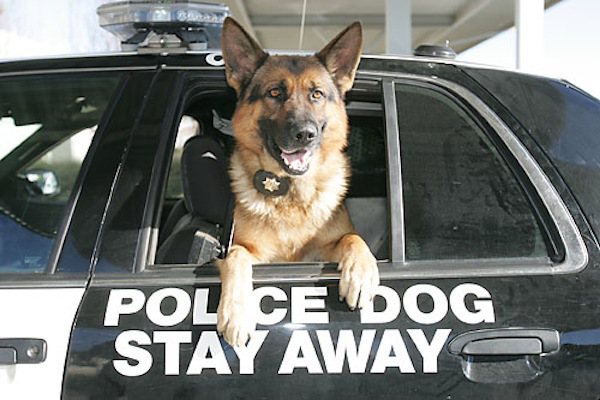
Must love dogs!

- Photo 6

In a previous blog-commentary, it was related how specially-trained canines can help to better secure the Caribbean homeland. Consider this quotation:

The subject of animals and animal companionship is also pivotal in the roadmap for elevating Caribbean society, especially for the security engines. The Go Lean book posits (Page 185) that better command of Animal Husbandry can facilitate better security around the region’s economic engines. Dogs feel a lot less intrusive and less intimidating than formal security screening, or personnel patrolling with AK47 automatic rifles.  Imagine a beautiful Caribbean beach scene with a plain clothes “officer” walking along with specialty dogs, or more exactly:

  • Drug Sniffing Dogs
  • Bomb Sniffing Dogs
  • Service/Therapy Dogs

This is one implementation that could have been deployed to mitigate the terrorism threat in Manchester … and everyday here in the Caribbean. Yes, this is in hindsight; this is “Monday Morning Quarterbacking“. This is not fair to the 22 lives lost in Manchester, but this is most importantly a pledge, not to let those lives die in vain. Let’s apply the lessons-learned.

This implementation with service dogs is just one “how”. The Go Lean book provides 370-pages of turn-by-turn instructions on “how” to adopt new community ethos, plus the strategies, tactics, implementations and advocacies to execute so as to better ensure homeland security in the Caribbean region.

Consider this one chapter (and Case Study) … where the Go Lean book fully detailed the advocacy of Animal Husbandry; see  these headlines from Page 185:

Case Study: Trikos K9 Warriors
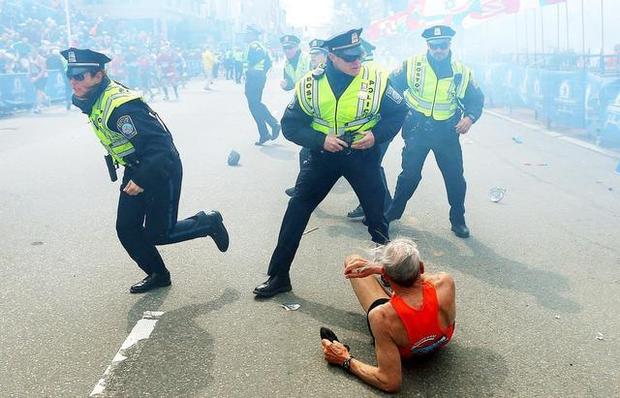
When the bombs went off at the Boston Marathon [in April 2013], highly trained dogs were rushed to the scene to search for more explosives. Boston Police have said dogs swept the streets in the morning and a second time just an hour before the first marathoners crossed the finish line. It’s considered likely that the bombers planted their devices well after the dogs finished sweeping the area. Since 9/11, dogs have been used more than ever because nothing has proven more effective against hidden bombs than the nose of a working dog. The best of them serve with U.S. Special Operations, so much of what they do is classified, but by looking at the trainers, Trikos K9 Warriors (www.trikos.com) – on a 20-acre ranch in rural Cooper, Texas – one gets a rare glimpse inside the secretive world of these elite dogs. Most of them are from one breed, Belgian Malinois.
Dogs and their handlers work as a team, train as a team, and they go through so much together their bond is as strong as a band of brothers. In Afghanistan, they led their units and protected them in battlefields littered with hidden bombs. Per former Navy SEAL and Trikos Founder Mike Ritland: “same thing that they do for [the troops] overseas, detect explosives, they can do on American streets; plus they can run faster than 30 miles an hour so they can help take down suspects”.
See Appendix below for VIDEO from CBS News Magazine “60 Minutes”.


10 Ways to Improve Animal Husbandry

1 Lean-in for Caribbean Integration
The CU treaty allows for the unification of the region into one market, thereby impaneling a federal layer for oversight of the economy and security of the 30 member-states and 42 million people. One CU mission is to facilitate better security around the region’s economic engines. Another mission is to make the Caribbean a better place to live, work and play. In considering the needs of the 42-million population, there must be some consideration for their animals. Beyond the CU overseeing food-supply regulations and spearheading the security benefits of employing specially trained service animals, the CU will spur philanthropy for more animal husbandry efforts, such as foundations advocating Spay/Neuter goals for dogs/cats. Lastly, the CU will coalesce with local authorities to ensure “dog parks” in urban/suburban areas.
2 Plantations for Bomb Sniffing Dogs
The CU assumes the responsibility to assuage systemic risks and economic crimes. This includes marshaling defensive support for events/festivals, against terrorism and cross border gangs. The US model of Trikos K9 Warriors will be adopted with Belgian Malinois dogs, to breed them on plantations and train them to detect and interdict explosives.
3 Cadaver Dogs / Drug Sniffing Dogs / Drug Sniffing Pigs
The CU will install plantations for dogs and pigs (Vietnamese Potbellies are especially acute) to train them to detect drugs/contraband and cadavers. The CU will maintain animals on-the-ready for acquisition by local and federal police.
4 Police K9 Units
Each member-state may currently have a platoon of K9 police dogs, but their average service life is less than 10 years. So there is always a constant need for service animals. These needs will henceforth be fulfilled locally within the region.
5 Horses for Mounted Police
Many polices forces have a Mounted Police Squad. These are especially critical for patrols at events and crowded locales. The CU will facilitate the acquisition and training of horses for the region’s Mounted Police units. These breeding and training plantations are ideal for rural area development, thus spurning an economic benefit.
6 Water Focus – Seals and Dolphins
Service animals are not only the land variety. There are aquatic mammals as well: seals and dolphins. These species are excellent for securing maritime and naval operations – the CU are all islands and coastal states. The best practice is to mount mobile cameras on these mammals and have them patrol a specified grid. The economies of scale of the CU will allow for the deployment of these creative solutions while any one member-state alone cannot justify the investment.
These deployments should not be secretive, but rather exposed to local/foreign media for image promotion.
7 Service Dogs for the Blind / Disabled – Domestic and Tourists
8 Comfort Animals for Therapies and Treatment
9 Bio-Medical Farms (Pigs, Baboons)
10 Agricultural Considerations – Animals for Foods

The Go Lean movement (book and preceding blog-commentaries) relate that security is not automatic, innate nor natural – Freedom is not Free. There is heavy-lifting involved in protecting the homeland for Caribbean stakeholders: residents and visitors. This point was detailed in these previous blog-commentaries:

https://goleancaribbean.com/blog/?p=11332 Boston Bombing Anniversary – Learning Lessons
https://goleancaribbean.com/blog/?p=10959 See Something, Say Something … Do Something
https://goleancaribbean.com/blog/?p=10566 Funding the Caribbean Security Pact
https://goleancaribbean.com/blog/?p=10222 Waging a Successful War on Terrorism
https://goleancaribbean.com/blog/?p=9072 Securing the Homeland – On the Ground
https://goleancaribbean.com/blog/?p=6103 Sum of All Fears – ‘On Guard’ Against Deadly Threats
https://goleancaribbean.com/blog/?p=5307 8th Violent Crime Warning to Bahamas Tourists
https://goleancaribbean.com/blog/?p=5002 Managing a ‘Clear and Present Danger’
https://goleancaribbean.com/blog/?p=1965 America’s Navy – 100 Percent – Model for Caribbean Regional Security
https://goleancaribbean.com/blog/?p=1832 American Drug-arrested inmates to be deported – Look-out Caribbean
https://goleancaribbean.com/blog/?p=1554 Status of Forces Agreement for Regional Security Pact
https://goleancaribbean.com/blog/?p=1487 Here come the Drones … and the Concerns
https://goleancaribbean.com/blog/?p=392 Jamaica received World Bank funds to help in crime fight

The quest of the Go Lean roadmap is to make the Caribbean homeland, a better place to live, work and play. This means measurable reduction (mitigating and remediation) of crime, interpersonal violence and systemic threats in the region. The Go Lean book presents a regional solution to remediate and mitigate crime and terrorism in the Caribbean, featuring details of strategies, tactics and implementations designed based on best-practices from around the world. The book’s vision is quite simple:

If we fail to plan, then we plan to fail.

The premise in the Go Lean book is that “bad actors” will always emerge, from internal and external origins. We must be prepared and on-guard to defend our homeland against all threats, foreign and domestic, including terrorism and interpersonal violence. Plus, we must accomplish this goal with maximum transparency, accountability, and commitment to due-process and the rule-of-law. Thusly, there is a place for many tools and techniques, think: closed-circuit TV (CCTV), dashboard and body cameras.

The title on this commentary – ‘Must Love Dogs’ – puns the title of the 2005 Movie of the same name. That movie was not about Terrorism nor about dogs. (It was about a couple who met through an internet dating site that matched their dog-loving profiles).

See a review of the movie here: http://www.rogerebert.com/reviews/must-love-dogs-2005.
CU Blog - 'Must Love Dogs' - Photo 0

Yes, we can – with our “love for dogs” – make our homeland a better-safer place to live, work and play. 🙂

Download the free e-Book of Go Lean … Caribbean – now!

Sign the petition to lean-in for this roadmap for the Caribbean Union Trade Federation.

—————

Appendix VIDEO – Sniffing Out Bombs: America’s most elite dogs – https://youtu.be/FsnPAQ137fY

Published on Apr 21, 2013 – Lara Logan gets a rare look into the secretive world of working dogs — some of whose capabilities are military secrets — and their handlers.

Share this post:
, , , ,
[Top]

Caribbean Roots: Al Roker – ‘Climate Change’ Defender

Go Lean Commentary

Al Roker - Photo 1Make us proud ‘My Brother’; go fight our battles.

This is the message the Caribbean needs to send to one of its own, Al Roker, the on-air meteorologist for NBC and co-host of the morning newscast The Today Show.

Al Roker has Caribbean roots, as a legacy of parents from the Bahamas (and Jamaica; see Appendix A). He, himself has spent a lot of time there and reflect a lot of its values. Right now, he is being a Champion for a cause that is dear to the Bahamas, and all Caribbean for that matter:

Climate Change.

See how this Caribbean Champion battled prominent Climate Change deniers in this TV broadcast here. What’s sad is the actual denier in this case is Scott Pruitt, the Head of the American federal government environmental Watch-Dog, the EPA (Environmental Protection Agency).

America may have the luxury of “sticking its head in the sand” and not deal with Climate Change, but for those of us in the Caribbean, we do not have that luxury – we have a Clear-and-Present Danger right now.

See the news article and VIDEO of this champion’s defense:

Title: Al Roker Debunks EPA Head Scott Pruitt’s Stunning Denial On Human-Caused Climate Change
Sub-title: Roker: “No Credible Science Or Scientist” Would Support Pruitt’s Assertion CO2 Is Not A Primary Contributor To Global Warming
By: Media Matters Staff

NBC weatherman Al Roker debunked EPA head Scott Pruitt’s false claim that carbon dioxide is not a primary contributor to global warming during an appearance on MSNBC Live, explaining that there is “no credible science or scientist” to support Pruitt’s statement.

During the March 10 segment, Roker addressed Pruitt’s comments on the March 9 edition CNBC’s Squawk Box in which Pruitt said “I would not agree” that CO2 is “a primary contributor to the global warming that we see” — a statement completely at odds with the consensus among climate scientists that human activity is the primary cause of climate change.

To rebut Pruitt’s statements, Roker referenced an interview he recently conducted with climate scientist Dr. Marshall Shepherd, who explained that “greenhouse gases are in fact the primary forcing function on a warming climate system. … their fingerprint is there on our naturally varying climate in the same way steroids were on the naturally varying cycle of home runs during the Major League Baseball era.”

Roker also stated “there is no credible science or scientist” that would back up Pruitt’s assertion. Indeed, a number of climate scientists have weighed in on Pruitt’s statement, stating Pruitt’s denial “demonstrated that he is unqualified to run the EPA or any agency” and suggesting that Pruitt “talk with his own scientists and read the National Climate Assessment.”

Notably, however, NBC did not address Pruitt’s climate denial on the widely viewed Today show the same day, nor NBC Nightly News air a segment on Pruitt’s climate denial on March 9 — even though Pruitt’s denial received widespread attention across mainstream media.

————-

See full transcript of the interview between Al Roker and the MSNBC Host Katy Tur in Appendix B below.

————-

VIDEO – From the March 10 edition of MSNBC Livehttps://mediamatters.org/embed/clips/2017/03/10/52688/msnbc-msnbclive-20170310-alrokerpruitt

This issue of monitoring, messaging and managing the stakeholders for Climate Change is an important mission for the movement behind the book Go Lean … Caribbean. The book presents the Caribbean region a roadmap to elevate its societal engines – economics, security and governance – and to be prepared for the Agents of Change impacting daily life in the Caribbean homeland. In total, the book identified these 4 Change Agents:

  • Technology
  • Globalization
  • Aging Diaspora
  • Climate Change

As a region, we are able to employ mitigations and remediation for all of these agents except for Climate Change. We are all small countries, nowhere on the list of “Big Polluters”, like the US (#2) and China (#1). We have neither a voice nor a vote in those countries, yet we need them to take the issue of Climate Change remediation seriously. Messaging is key! We need people like “Al Roker” – daily audience of 4 to 9 million people – speaking truth to power … on our behalf.

This advocacy – to proclaim impending danger to life and limb – is part of a new effort to elevate the societal engines of the Caribbean. This started with the Go Lean…Caribbean book and is being followed up by this and many other blog-commentaries. See here a sample of previous submissions heralding the need for the Caribbean region to be “on guard” for the imminent threats from Climate Change:

https://goleancaribbean.com/blog/?p=9455 Fix ‘Climate Change’ – Yes, We Can
https://goleancaribbean.com/blog/?p=7103 COP21 – ‘Climate Change’ Acknowledged
https://goleancaribbean.com/blog/?p=6893 A Meteorologist’s View On Climate Change
https://goleancaribbean.com/blog/?p=4673 Merchants of Doubts – Dynamics of Climate Change Deniers
https://goleancaribbean.com/blog/?p=2465 Book Review: ‘This Changes Everything: Capitalism vs. the Climate’
https://goleancaribbean.com/blog/?p=2276 Climate Change May Affect Food Supply Within a Decade
https://goleancaribbean.com/blog/?p=2119 Cooling Effect – Oceans and the Climate
https://goleancaribbean.com/blog/?p=1883 Climate Change May Bring More Kidney Stones

The Go Lean book serves as a roadmap for the introduction and implementation of the Caribbean Union Trade Federation (CU) as an inter-government agency for 30 regional member-states. This confederation will provide a technocratic stewardship for all the societal engines in the Caribbean. In fact, the prime directives of the roadmap includes the following 3 statements:

  • Optimization of the economic engines in order to grow the regional economy to $800 Billion & create 2.2 million new jobs.
  • Establishment of a security apparatus to ensure public safety and to protect the resultant economic engines  – including an Emergency Management functionality.
  • Improve Caribbean governance to support these engines, including a separation-of-powers mantra between the member-states and CU federal agencies.

Overall, the Go Lean book stresses the community ethos, strategies, tactics, implementations and advocacies to reboot, reform and transform the economic engines of Caribbean society.

What do we do now?

While we hope, pray and lobby the big polluting nations to do more, we have to prepare our Caribbean communities for the imminent onslaughts.

In previous blogs, this commentary cautioned the stakeholders in the Caribbean region, as follows:

  • Crap Happens! Prepare – The peril of a Climate Change-fueled hurricane is now a constant threat for Caribbean life, for all 30 member-states. It is assured that some Caribbean location will be impacted every year. While there is no guarantee for a strike “here or there”, there is a guarantee that there will be a strike somewhere.
  • Do Not be Hypocritical – Go ‘Green’ – If excessive carbon in the atmosphere by the Big Polluters is the culprit for infusing Greenhouse Gases, then we, as a region of small countries, need to do our share and set a good example of lowering our carbon footprint. Though our numbers are too small to make an impact, it does send the message that we are willing to “swallow the hard pill/take the medicine” ourselves that we are asking the Big Polluting nations to endure.

The global crisis of Climate Change is impacting all aspects of Caribbean life: economics, security (disaster preparation and response) and governance. A comprehensive view of the challenges befalling our region is the charge of the Go Lean roadmap, opening with these pronouncements in the Declaration of Interdependence (Page 11 and 12):

i.  Whereas the earth’s climate has undeniably changed resulting in more severe tropical weather storms, it is necessary to prepare to insure the safety and security of life, property and systems of commerce in our geographical region. As nature recognizes no borders in the target of its destruction, we also must set aside border considerations in the preparation and response to these weather challenges.

viii. Whereas the population size is too small to foster good negotiations for products and commodities from international vendors, the Federation must allow the unification of the region as one purchasing agent, thereby garnering better terms and discounts.

x. Whereas we are surrounded and allied to nations of larger proportions in land mass, populations, and treasuries, elements in their societies may have ill-intent in their pursuits, at the expense of the safety and security of our citizens. We must therefore appoint “new guards” to ensure our public safety and threats against our society, both domestic and foreign. …

Now is the time for all stakeholders – residents, governments, Diaspora, scientists, disaster planners, etc. – in the Caribbean to lean-in for the empowerments described here-in and in the book Go Lean … Caribbean. Climate Change is the Number One threat for our society; for the whole world actually, but we are on the frontlines. “We must protect this house”. We must be better and do better and help to make our homelands better places to live, work and play. 🙂

Download the free e-book of Go Lean … Caribbean – now!

Sign the petition to lean-in for the roadmap for the Caribbean Union Trade Federation.

———-

Appendix A – Al Roker’s Earliy Life

Al Roker was born in Queens, New York,[4] the son of Isabel, of Jamaican descent, and Albert Lincoln Roker, Sr.,[5] a bus driver of Bahamian descent.[6] Roker initially wanted to be a cartoonist.[5] He was raised Catholic[5] (in the faith of his mother) and graduated from Xavier High School in Manhattan.[7] He worked on several projects as a member of the school’s Cartooning & Illustration Club. He attended the State University of New York at Oswego where he received a B.A. in communications in 1976.

According to the July 2011 issue of Us Weekly in “25 Things You Did Not Know About Me”, Roker is the first cousin once removed of the late actress Roxie Roker, who was most notable for her role as Helen Willis on the sitcom The Jeffersons and the mother of popular rock musician Lenny Kravitz. That makes Kravitz Roker’s second cousin.[8]
Source: Retrieved April 21, 2017 from: https://en.wikipedia.org/wiki/Al_Roker#Early_life

———-

Appendix B – Transcript: Al Roker Interview by Host Katy Tur

KATY TUR (HOST): The head of the Environment Protection Agency stunned many when he denied carbon dioxide is a primary contributor to global warming.

[…]

TUR: Today show host and weatherman, a man who needs no introduction, Al Roker joins me now. “Stunned many” is a bit of an understatement, said most almost all, gosh, CO2 is not a factor when it comes to climate change. Was all of the schooling that I had as a child and into my adult life completely wrong, Al Roker?

AL ROKER: No, it wasn’t wrong and there is no credible science or scientist who will tell you the contrary. The fact is, carbon dioxide, the greenhouse gases is responsible for climate change.

TUR: No scientist will say this, but we’re having the EPA head say this?

ROKER: Well, look, this is America and you can make whatever statements you want to, but everybody will pretty much agree — in fact, just about an hour ago I interviewed one of the leading climate scientists in this country, Dr. Marshall Shepherd, and here’s what he had to say about it.

[BEGIN VIDEO CLIP]

MARSHALL SHEPHERD (DIRECTOR FOR UNIVERSITY OF GEORGIA’S PROGRAM IN ATMOSPHERIC SCIENCES): The basic physics of the atmosphere suggest that greenhouse gases are in fact the primary forcing function on a warming climate system. Greenhouse gases and the impacts post-industrial age or –– industrial revolution are certainly — their fingerprint is there on our naturally varying climate in the same way steroids were on the naturally varying cycle of home runs during the Major League Bbaseball era.

[END VIDEO CLIP]

ROKER: I think that pretty much sums it it up.

TUR: Yeah, so where — if the EPA head is saying there needs to be more research, but the EPA is losing money to do research, give me the consequences. How important is it and how significant is it to have the EPA head deny something like this?

ROKER: Well I think hopefully cooler heads will prevail upon him to say we need to continue to research this. We need to continue what we’ve been doing because if you look, we’ve got a graphic that basically right around the industrial revolution, we had — there’s been no time in this history of our planet where CO2, even naturally occurring or not, was above 290 parts per million. Alright, now you look at the temperature, we put the temperature on top of that, you can see from the 1880s into the 1940s, temperatures are below average, below the global average, but once we really start to see that red line go up, as the CO2 starts to increase, you can see those average global temperatures continue to rise, and they peaked last year, the warmest temperature ever on record for this planet. So as we continue to add those greenhouse gases — now, that’s not to say that — the greenhouse gases allow us to live on this planet. Without them completely, we would freeze to death. At night we would die. So there has to be some small amount of greenhouse gases. We’re just adding too much.
Source: Retrieved 04-21-2017 from: https://mediamatters.org/blog/2017/03/10/al-roker-debunks-epa-head-scott-pruitt-s-stunning-denial-human-caused-climate-change/215635


Share this post:
, , , ,
[Top]

ENCORE: Boston Bombing Anniversary – Learning Lessons

Go Lean Commentary

It has been 4 years already! The hope now is for an incident-free Boston Marathon today, April 17, 2017.

But hope is not the only emotion at work in Boston. There is also fear, concern, anticipation and preparation. The City of Boston has learned important lessons from that terrible attack at the Patriots Day Marathon in 2013. See highlights from this VIDEO here:

VIDEO – New security plans in place for the Boston Marathon
– http://wwlp.com/2017/04/14/new-security-plans-in-place-for-the-boston-marathon/

How about the Caribbean? Have we learned lessons? Are we engaging the needed remediation and mitigation?

We have events – think Carnival in  the Caribbean member-states or in  the Diaspora – on our calendar that could also be victimized by attacks, assaults and incidents (terrorism or just plain street-crime). It is very important that we do better to present our participants, spectators, guests and tourists a more secure environment.

More than economic interests are at stake. It could be life-or-death.

Notice some of the headlines here describing the security dynamics of some Caribbean events (around the Caribbean and the world):

Also, see the Encore of the previous blog-commentary that considered lessons learned from the Boston Marathon terrorist attack; this review was published on the 1-year anniversary in 2014. See it again here-now:

—————–

ENCORE – Original Commentary: Remembering and learning from Boston

Boston BombingApril 15 [2014] is the one year anniversary of the Boston Marathon bombing. 3 people died directly, and countless others were maimed and injured. From any perspective this was a tragedy! To the families that lost loved ones on that date, our deepest condolences.

There are many lessons for the Caribbean to learn from this experience.

The book Go Lean … Caribbean serves as a roadmap for the introduction and implementation of the Caribbean Union Trade Federation (CU). This CU is proffered to provide economic, security and governing solutions for the 30 member Caribbean states. This book posits that the Caribbean is not immune to similar experiences like Boston; that terrorism requires mitigation beyond the member-states; there needs to be a regional solution. The CU will furnish such a focus. There will be proactive and reactive measures to monitor, interdict, and marshal terroristic threats in the Caribbean. Most of the Caribbean has legacy affiliation with European/US countries that have been victims of terrorism. Though we have not had the tragedies of backpacks exploding at marathons, or chemical weapons used in subways, or airplanes crashing into our buildings, we must still hold a constant vigilance. The roadmap posits that “bad actors” always emerge where there is economic successes. See a related news article here:

Title: Year after Boston bombing, it’s clear that threat of homegrown terrorism overhyped
By: David Schanzer and Charles Kurzman

In the aftermath of the Boston Marathon bombing one year ago Tuesday, many commentators and public officials called this tragedy a harbinger of more homegrown terrorist attacks to come.

“We’re going to see an explosion in this radicalization and recruitment,” predicted Congressman Frank Wolf. “We are less secure than we were 12 years ago,” claimed think-tank terrorism expert Michael Swetnam. Former Attorney General Michael Mukasey told Americans to “worry – a lot.

”To many, the Boston attack demonstrated the potency of the Islamist extremist ideology, the difficulty of detecting individuals radicalized through social media and the Internet, and the ease with which amateurs could cause massive harm in our open society. The Tsarnaev brothers, they claimed, had paved the way for more terrorism.

While only one year has passed, much of this concern appears to have been hyperbole.

No one has been killed by homegrown terrorists in the past year, and there have been no copycat attacks. To put this in context, over the same period there have been 14,000 murders in the United States, including 46 murders in Boston.

There also has been no epidemic of al-Qaida-inspired extremist behavior directed at American civilians. Our research shows that in the year since the marathon bombing, there have been 15 arrests of Muslim-Americans for terrorism-related offenses, below the average of 20 arrests per year since 9/11. Almost all of these arrests were for attempting to join a foreign terrorist organization abroad, not for planning attacks in the homeland, and were motivated by sympathies with rebels in Syria and elsewhere rather than by al-Qaida’s call for Muslims to attack the West.

Our law enforcement agencies have a far more balanced understanding of the nature of the extremist threat than many of those providing public commentary after the Boston attacks. A nationwide survey of law enforcement agencies we are conducting in collaboration with the Police Executive Research Forum shows that more than half of the agencies report little or no threat from al-Qaida-inspired extremism. Only 2 percent report the threat as “severe.” Agencies from large metropolitan areas reported somewhat higher levels of concern (27 percent reporting a low threat and 7 percent reporting a severe threat). Overall, law enforcement agencies are treating this as a serious, but manageable, issue rather than the existential crisis that many have feared.

Law enforcement agencies have embraced community outreach as an effective strategy to counter violent extremism. Almost every large metropolitan police force surveyed collaborates with Muslim-American communities that are targeted for recruitment by al-Qaida and related extremists. Most of these agencies report they have established a high level of trust with the community, and two-thirds say these relationships have helped develop actionable information. This track record contradicts claims by Congressman Peter King, a New York Republican, and others that Muslim-Americans have failed to cooperate with law enforcement.

One year after two individuals inflicted pain and suffering on the streets of Boston, we should not be overly fearful or cavalier about the threat of violent extremism. The low levels of violent conduct both before and after the Boston Marathon show that no matter how many extremist videos are posted on the Internet, the baseless ideas these videos propagate appeal to only a tiny fraction of our populace. Yet, since small numbers of people can do so much harm, law enforcement agencies and the communities they serve must be constantly vigilant and continue to work together to prevent the next atrocity.

David Schanzer is a Professor at Duke University’s Sanford School of Public Policy and Director of the Triangle Center on Terrorism and Homeland Security.

Charles Kurzman is a Professor of Sociology at the University of North Carolina, Chapel Hill.

Source: News Observer Newspaper – a Raleigh, North Carolina Daily – Retrieved 04/15/2014 from: http://www.newsobserver.com/2014/04/14/3784842/year-after-boston-bombing-its.html

How can we apply lessons from this foregoing article in the stewardship of the Caribbean Homeland Security?

First, we have the direct lessons of the scourge of piracy in the Caribbean for centuries. The “after-effects” of this legacy still remain, even today. As Caribbean society traversed over the centuries, the attitudes that tolerated piracy, described in the book as “community ethos”, evolved to tolerate, incubate and even promote other lawless activities; (shipwrecking, bootlegging, drug smuggling). So with this history in mind, and the prime directive to elevate Caribbean society, the Go Lean economic empowerment mission is coupled with appropriate security provisions. This mandate is detailed early on in the book’s Declaration of Interdependence, with the following pronouncements (Page 12):

x. Whereas we are surrounded and allied to nations of larger proportions in land mass, populations, and treasuries, elements in their societies may have ill-intent in their pursuits, at the expense of the safety and security of our citizens. We must therefore appoint “new guards” to ensure our public safety and threats against our society, both domestic and foreign. The Federation must employ the latest advances and best practices of criminology and penology to assuage continuous threats against public safety. The Federation must allow for facilitations of detention for convicted felons of federal crimes, and should over-build prisons to house trustees from other jurisdictions.

xvi. Whereas security of our homeland is inextricably linked to prosperity of the homeland, the economic and security interest of the region needs to be aligned under the same governance. Since economic crimes, including piracy and other forms of terrorism, can imperil the functioning of the wheels of commerce for all the citizenry, the accedence of this Federation must equip the security apparatus with the tools and techniques for predictive and proactive interdictions.

Gun ComicThere are many other lessons for us to learn from Boston. But there are other tragedies that appear to have gotten less attention in the past year since the marathon bombings. In Boston alone, there have been 46 murders since April 15, 2013. In total, there have been 14,000+ murders in the entire Unites States in that time. See the foregoing news article/commentary.

These have not gone unnoticed! Especially terrorism’s junior partner-in-crime, bullying; such incidents also call for mitigations.

The Go Lean roadmap therefore comes BIG, in its offering to effectuate change in the Caribbean. Notice these strategies, tactics, implementations, and advocacies detailed in the book related to Caribbean security:

10 Ways to Improve Sharing Page 35
10 Foreign Policy Initiatives at Start-up Page 102
10 Security Initiatives at Start-up Page 103
10 Ways to Impact Justice Page 177
10 Ways to Reduce Crime Page 178
10 Ways to Improve for Gun Control Page 179
10 Ways to Improve Homeland Security Page 180
10 Ways to Mitigate Terrorism Page 181
10 Ways to Improve Intelligence [Gathering] Page 182
10 Ways to Improve Animal Husbandry Page 185
10 Ways to Impact the Prison-Industrial Complex Page 211
10 Ways to Impact Youth Page 227

Further, the Go Lean roadmap portrays the need for public messaging to encourage adoption of better community ethos for the Greater Good (Page 37). We must not allow those innocent lives in Boston to pass without positive lessons for our society.

Download the book Go Lean … Caribbean – now!

Sign the petition to lean-in for the roadmap for the Caribbean Union Trade Federation.


Share this post:
, ,
[Top]

‘To Live and Die in L.A.’ …

Go Lean Commentary

CU Blog - 'To Live and Die in L.A.' - Photo 1b

“… live so fast and die so young…”
“… it’s like a jungle, sometimes it makes me wonder how I keep from going under…” – Rap Song: The Message – Grandmaster Flash & The Furious Five

Considering the edict of “life imitating art and art imitating life”, this has always been a subject of sharp debate and contrast. Is it better to live “fast & furious”, even though there might be a shorter mortality, or is it better to go slow and last longer, as far away from risky propositions as possible?

Shockingly, this is also a Caribbean debate: is it better to emigrate to L.A., New York, Miami, Toronto, London, Paris or any other foreign destination for faster success, or prosper where planted in the Caribbean homeland?

From an American perspective, this debate is best personified with a comparison of California versus the rest of the US. Los Angeles (L.A.) is the principal metropolis of the State of California and all of the West Coast for that matter.

But this debate is bigger than just a consideration of L.A. or California – see Appendix below – it spans the test of time. Even ancient philosopher Aesop presented this dilemma in the fable of “The Tortoise and The Hare”, in which the nimble jack-rabbit lost out to the slow-and-methodical tortoise in a race – this fable is universally accepted as a metaphor for the race of life.

Poets, songwriters, historians, and philosophers have all chimed in on this profound debate. Some claim that it is better to “live large”, make the “world your oyster”, even if that means having a short lifespan than to live a quiet ignoble life where the joys of life are rationed out for longevity instead.

Whenever a celebrity dies young, this debate rages anew. Consider some of the philosophical headlines:

The book Go Lean … Caribbean discusses this contrast; it draws reference to the American Dream versus the California Dream. Consider this excerpt from Page 223:

The Bottom Line on the American Dream
The American Dream is a national ethos of the United States, a set of ideals in which freedom includes the opportunity for prosperity and success, and an upward social mobility achieved through hard work. This idea of the American Dream is rooted in the US Declaration of Independence which proclaims that “all men are created equal… endowed by their Creator with certain inalienable rights” including “Life, Liberty and the pursuit of Happiness.” The meaning of the “American Dream” has changed over history, and includes components as home-ownership and upward mobility. A lot of people followed the American Dream to achieve a greater chance of becoming rich. For example, the discovery of gold in California in 1849 brought in 100,000 men looking for their fortune overnight—and a few did find it. Thus was born the California Dream of instant success. Historian H. W. Brands noted that in the years after the Gold Rush, the California Dream spread across the nation:

  • “The old American Dream … was the dream of the Puritans, of Benjamin Franklin’s “Poor Richard” … of men and women content to accumulate their modest fortunes a little at a time, year by year by year. The new dream was the dream of instant wealth, won in a twinkling by audacity and good luck. [This] golden dream . . . became a prominent part of the American psyche”. Today, some posit that the ease of achieving this Dream changes with technological advances, available infrastructure, regulations, state of the economy, and the evolving cultural values of the US demographics.

The Go Lean book serves as a roadmap to introduce the technocratic Caribbean Union Trade Federation (CU) to elevate the region’s societal engines – economics, homeland security and governance – of the 30 Caribbean member-states. In fact, the prime directives of the roadmap includes the following 3 statements:

  • Optimization of the economic engines in order to grow the regional economy to $800 Billion & create 2.2 million new jobs.
  • Establishment of a security apparatus to ensure public safety and protect the resultant economic engines.
  • Improve Caribbean governance for all people, even visiting tourists, to support these engines.

CU Blog - 'To Live and Die in L.A.' - Photo 2The quest is to minimize the paradox of future-planning/decision-making for Caribbean citizens. We want to make the Caribbean region better places to live, work and play; this way our citizens would not have to leave … to ‘live and die in L.A., or NYC, or Miami, or any other American, Canadian or European city. The truth of the matter is people die more readily in America due to gun-violence, and automobile accidents than they die in the Caribbean.

No doubt!

  • Visualizing gun deaths: Comparing the U.S. to rest of the world
    Whenever a mass shooting occurs, a debate about gun violence ensues. An often-cited counter to the point about the United States’ high rates of gun homicides is that people in other countries kill one another at the same rate using different types of weapons. It’s not true.
    Compared to other countries with similar levels of development or socioeconomic status, the United States has exceptional homicide rates, and it’s driven by gun violence.
    CU Blog - 'To Live and Die in L.A.' - Photo 3
    Another issue that gets less attention is how many people die from firearms accidentally. Again, the U.S. has much higher rates of unintentional death from firearms compared to other countries.
    CU Blog - 'To Live and Die in L.A.' - Photo 4
  • U.S. has highest car crash death rate, despite progress, CDC says
    More people die in car crashes each year in the United States than in other high-income countries, the Centers for Disease Control and Prevention said in a report …
    In 2013, more than 32,000 people died on U.S. roads, roughly 90 fatalities a day, according to the CDC.
    The U.S. has seen a 31% reduction in its motor vehicle death rate per capita over the past 13 years. But compared with 19 other wealthy countries, which have declined an average of 56% during the same period, the U.S. has the slowest decrease.

A previous Go Lean blog-commentary highlighted other statistics of premature deaths (and disability) in the US due to societal defects:

But the truth is a two-sided coin …

… on the flipside, life in America is more prosperous than in any Caribbean member-state.

The Go Lean book introduces the Caribbean Union Trade Federation (CU) as an inter-governmental agency for the 30 member-states, to provide a better – technocratic – stewardship for Caribbean life, to make it more prosperous … at home. The book identifies that we have a crisis – our failing societal engines – but asserts that this crisis would be a terrible thing to waste. We can use the urgency to introduce and implement effective community ethos, strategies, tactics, implementations and advocacies to reboot, reform and transform the engines of Caribbean society.

We do not want our people to ‘live and die in L.A. …’. We want them to prosper right here in the Caribbean. How sad when our families do move to the US (and other countries) and fall victim to fatalities. Consider these headlines:

There are good and bad people everywhere. Bad things happen to good people … everywhere. The Bible declares that “time and unforeseen occurrences befall us all” (Ecclesiastes 9:11). Yet still, post-mortem analyses (crash investigations and autopsies) are always necessary to ascertain the root-causes and the lessons-learned:

What could have been done to prevent the loss of life?

This commentary is not asserting that Caribbean people will not be hurt if they remain in the Caribbean. There are car accidents, murders, robberies, rapes and other assaults in the 30 member-states as well.

But follow the numbers!

We are not #1 for either gun violence or auto deaths, like our American counterparts. This is just a matter odds, probabilities and trends; the preponderance for fatalities cannot be ignored.

The Go Lean book contends that as a people, we must be prepared for accidents, emergencies and security risks (Page 196). It asserts that bad actors will emerge just as a result of economic successes in the region. This point is pronounced early in the book with the Declaration of Interdependence (Page 12) that claims:

x. Whereas we are surrounded and allied to nations of larger proportions in land mass, populations, and treasuries, elements in their societies may have ill-intent in their pursuits, at the expense of the safety and security of our citizens. We must therefore appoint “new guards” to ensure our public safety and threats against our society, both domestic and foreign. The Federation must employ the latest advances and best practices … to assuage continuous threats against public safety.

xvi. Whereas security of our homeland is inextricably linked to prosperity of the homeland, the economic and security interest of the region needs to be aligned under the same governance. Since economic crimes, including piracy and other forms of terrorism, can imperil the functioning of the wheels of commerce for all the citizenry, the accedence of this Federation must equip the security apparatus with the tools and techniques for predictive and proactive interdictions.

There is this expression of wisdom, commonly referred to as the Serenity Prayer; it is a prayer written by the American theologian Reinhold Niebuhr[1][2] (1892–1971). The best-known form is:

  • God, grant me the serenity to accept the things I cannot change,
  • Courage to change the things I can,
  • And wisdom to know the difference.

The Go Lean book describes the need for the Caribbean to appoint “new guards” to apply this wisdom – to change the things we can change. The purpose of this security pact is to ensure public safety as a comprehensive endeavor, encapsulating the needs of all Caribbean stakeholders: residents and visitors alike.

We cannot impact Los Angeles, the US or any other foreign city, more than messaging to our Diaspora there. But we can forge change in our Caribbean homeland.

Applying the edict of “life imitating art and art imitating life”, let’s ‘live and die’ here in the Caribbean. Let’s apply the wisdom from the fictional character Spock (the Vulcan Commander on the TV Show/films Star Trek):

May we live long and prosper.

Now is the time for all of the Caribbean – the people and leaders – to lean-in for the empowerments described here in the book Go Lean…Caribbean. It is conceivable, believable and achievable to prosper where planted here in the region; to make the Caribbean a better place to live, work and play. 🙂

Download the free e-book of Go Lean … Caribbean – now!

Sign the petition to lean-in for the roadmap for the Caribbean Union Trade Federation.

————-
Appendix Review – Book/Movie: To Live and Die in L.A.

Sub-title: A 1984 novel by former Secret Service agent Gerald Petievich is the basis for the 1985 movie of the same name.

CU Blog - 'To Live and Die in L.A.' - Photo 1

A harrowing tale of the dark underside of America’s West Coast metropolis. Two U.S. Treasury agents, partners and antagonists, are drawn into a matrix of violence and corruption, southern California-style, that becomes a journey through a sunlit hell – at the end of which they become experts on the thin line between what it takes to live – and die – in L.A. – Source: Retrieved 04-10-2017 from: https://www.amazon.com/Live-Die-L-A-Gerald-Petievich/dp/1466219645

The action thriller film was directed by William Friedkin and based on the novel by Petievich, and co-written by the both men. The film features William Petersen, Willem Dafoe and John Pankow among others. The film tells the story of the lengths to which two Secret Service agents go to arrest a counterfeiter. – Source: Retrieved 04-10-2017 from: https://en.wikipedia.org/wiki/To_Live_and_Die_in_L.A._(film)

See Trailer in the Appendix VIDEO below.

Storyline
Working largely in cases of counterfeiting, L.A. based Secret Service agent Richie Chance exhibits reckless behavior which according to his longtime and now former partner Jimmy Hart will probably land him in the morgue before he’s ready to retire. That need for the thrill manifests itself in his personal life by his love of base jumping. Professionally, it is demonstrated by the fact that he is sextorting a parolee named Ruth Lanier, who feeds him information in return for him not sending her back to prison for some trumped up parole violation. With his new partner John Vukovich, Chance is more determined than ever, based on recent circumstances, to nab known longtime counterfeiter Ric Masters, who is more than willing to use violence against and kill anyone who crosses him. Masters is well aware that the Secret Service is after him. Masters’ operation is somewhat outwardly in disarray, with Chance being able to nab his mule, Carl Cody, in the course of moving some of the fake money , and one of his associates, a lawyer named Max Waxman, probably stealing money from him. Partly with information from Ruth, Chance is trying to find and exploit the weaknesses in Masters’ operation. To accomplish his goal, Chance takes more and more unethical and illegal measures, which may be problematic for Vukovich, who comes from a family of police officers who are sworn to uphold the law. Written by Huggo

————-
VIDEO – To Live and Die in L.A. – http://www.imdb.com/videoplayer/vi1755645209

A fearless Secret Service agent will stop at nothing to bring down the counterfeiter who killed his partner.

Stars: William Petersen, Willem Dafoe, John Pankow


Share this post:
, ,
[Top]

Managing the ‘Strong versus the Weak’ – Bullying in Schools

Go Lean Commentary

“I believe that children are the future, teach them well and let them lead the way …” – Song Lyrics – The Greatest Love  Of All

The need to secure the community against threats and ‘bad actors’ must start with young people, school age children: High School, Middle School and Elementary.

Why so early? Because the tendency for strong individuals in a group to abuse the weak individuals starts early. Its an animalistic instinct to emerge as an Alpha Male or Alpha Female.

Bullying - Photo 5But we are not animals, despite any natural instincts. Societies come together to form a civilization with civil treatment of neighbors and fellow citizens. In the previous blog-commentary on the Model of Hammurabi it was detailed how that ancient King established laws to ensure that the “strong in society would not abuse the weak”. That blog concluded that the governmental authorities (the State) should provide the stewardship as specified in a Social Contract – where citizens surrender some of their freedoms and submit to the authority of the State in exchange for protection of remaining natural and legal rights – with all citizens in society, the strong ones and the weak ones. This commentary is the 3rd of 4 in a series on “Managing the Strong versus the Weak”. The other commentaries detailed in this series are as follows:

  1. Managing the Strong versus the Weak – Model of Hammurabi
  2. Managing the Strong versus the Weak – Mental Disabilities
  3. Managing the Strong versus the Weak – Bullying in Schools: “Teach them well and let them lead the way”
  4. Managing the Strong versus the Weak – Book Review: Sold-Out!

All of these commentaries relate to nation-building, stressing the community ethos necessary to forge a society where all the people are protected all the time. Since “children are the future”, it is important to mitigate and remediate bad behavior of the strong children that may trample on the “weak” children – bullying; if we teach them well when they are young and impressionable, that will allow them to lead the way for future societal cohesion. (See the personification of these words – song lyrics – in the Music VIDEO in the Appendix below).

The United States, as a model of an advanced democracy in our region, provides us lessons in how effective programs can be that are designed to mitigate bullying. We get to see the progress and regression. See this report-news article here:

Title: School Bullying, Cyberbullying Continue to Drop

Bullying - Photo 1

Sub-Title: School bullying is at its lowest rate since 2005, but girls are still bullied at higher rates.
By:
Allie Bidwell

The percentage of students who reported being bullied or cyberbullied reached a record low in 2013, but female students are still victimized at higher rates, according to new data from the Department of Education.

The department on Friday released the results of the latest School Crime Supplement to the National Crime Victimization Survey, which showed that in 2013, the percentage of students ages 12-18 who reported being bullied dropped to 21.5 percent. That’s down from 27.8 percent in 2011, and a high of 31.7 percent in 2007. The percentage of students who reported being cyberbullied also fell to 6.9 percent in 2013, down from 9 percent in 2011.

The department’s National Center on Education Statistics began surveying students on bullying in 2005.

“As schools become safer, students are better able to thrive academically and socially,” Education Secretary Arne Duncan said in a statement. “Even though we’ve come a long way over the past few years in educating the public about the health and educational impacts that bullying can have on students, we still have more work to do to ensure the safety of our nation’s children.”

Despite the overall drop in bullying and cyberbullying, reporting rates remain low – just more than one-third of students who were victims of traditional bullying and fewer than one-quarter of cyberbullying victims reported the incident to an adult, the data show.

Female students also still consistently experience higher-than-average rates of victimization – 23.7 percent of female students said they had been bullied in 2013, and 8.6 percent said they had been cyberbullied. By comparison, 19.5 percent and 5.2 percent of male students in 2013 said they had been bullied and cyberbullied, respectively.

While there aren’t noticeable gender gaps in the location of bullying, female students were significantly more likely than male students to be made fun of, called names or insulted (14.7 percent compared with 12.6 percent), to be the subject of rumors (17 percent compared with 9.6 percent) and to be excluded from activities on purpose (5.5 percent compared with 3.5 percent). Male students who were bullied were more likely than female students to be pushed, shoved, tripped or spit on (7.4 percent compared with 4.6 percent).

Overall, bullied students were most likely to be made fun of, called names or insulted (13.6 percent) or to be the subject of rumors (13.2 percent). The most common forms of cyberbullying were unwanted contact via text messaging and posting hurtful information on the Internet.

Among students who were cyberbullied, female students were more likely to have hurtful information about them posted on the Internet (4.5 percent compared with 1.2 percent), to receive unwanted contact via instant messaging (3.4 percent compared with 1 percent) and unwanted contact via text messaging (4.9 percent compared with 1.6 percent).

Traditional bullying and cyberbullying also impact the behaviors of the affected students.
Among students who were victims of traditional bullying, more than 1 in 10 said they feared being attacked or harmed at school. That fear was slightly more frequent among victims of cyberbullying: about 1 in 8 students who had been cyberbullied said they feared attack or harm at school.

Generally, being the victim of cyberbullying appeared to affect students’ behavior more than traditional bullying – students who were cyberbullied were more likely to skip school, to avoid school activities, to avoid specific places at school and to carry a weapon to school.

Allie Bidwell is an education reporter for U.S. News & World Report.

[MORE: Social Combat: Bullying Risk Increases With Popularity]

[ALSO: Cyberbullied Teens Can Connect Online, In Person to Get Help]

Bullying - Photo 2

Bullying - Photo 3

Source: US News & World Report – Posted May 15, 2015; retrieved 04/01/2017 from: https://www.usnews.com/news/blogs/data-mine/2015/05/15/school-bullying-cyber-bullying-continue-to-drop

The book Go Lean…Caribbean describes empowerments to target the economic, security and governing engines of society to ensure an adherence to the principle of the Greater Good. The book defines this principle as follows (Page 37):

“The greatest good to the greatest number of people which is the measure of right and wrong”. –  Jeremy Bentham (1748-1832)

The Go Lean book serves as a roadmap for the introduction and implementation of the Caribbean Union Trade Federation (CU); it posits (Page 23) that whatever the circumstances, “bad actors” will always emerge to exploit opportunities, with good, bad and evil intent….

The CU‘s security apparatus must defend against regional threats, including domestic terrorism. This includes gangs and their junior counterparts, bullies. The community must accept that young ones will go astray, so Juvenile Justice programs should be centered on the goal to rehabilitate them into good citizens, before it’s too late. Community messaging (life-coaching and school-mentoring programs) must be part of the campaign for anti-bullying and mitigations.

The Go Lean book continues (Page 181) on the subject of “Junior Terrorism” with the quotation here:

The CU wants to “leave no child behind”. So bullying will be managed under a domestic terrorism and Juvenile Justice jurisdiction. The CU will conduct media campaigns for anti-bullying, life-coaching, and school-mentoring programs. The problem with teen distress is that violence can ensue from bullying perpetrators or in response to bullying.

Bullying - Photo 4We were all children at one point, and may have experienced the dynamics of bullying, either as a victor or a victim, but trust the facts here, the subject of bullying today is different; there is the New Media element; there is cyber-bullying.

Cyberbullying or cyberharassment is a form of bullying or harassment using electronic forms of contact. Cyberbullying has become increasingly common, especially among teenagers.[1] Awareness in the United States has risen in the 2010s, due in part to high-profile cases.[2][3] Bullying or harassment can be identified by repeated behavior and an intent to harm.[4] Harmful bullying behavior can include posting rumors about a person, threats, sexual remarks, disclose victims’ personal information, or pejorative labels (i.e., hate speech).[5]

Several US states and other countries have laws specific to regulating cyberbullying.[6] These laws are designed to specifically target teen cyberbullying, while others use laws extending from the scope of physical harassment.[7] In cases of adult cyberharassment, these reports are usually filed beginning with local police.[8] Research has demonstrated a number of serious consequences of cyberbullying victimization.[9] Victims may have lower self-esteem, increased suicidal ideation, and a variety of emotional responses, retaliating, being scared, frustrated, angry, and depressed.[10] Individuals have reported that cyberbullying can be more harmful than traditional bullying.[11]

Internet trolling is a common form of bullying over the Internet in an online community (such as social media) in order to elicit a reaction, disruption, or for their own personal amusement.[12][13] Cyberstalking is another form of bullying or harassment that uses electronic communications to stalk a victim may pose a credible threat to the safety of the victim.[14]
Source: Retrieved April 2, 2017 from: https://en.wikipedia.org/wiki/Cyberbullying

The Go Lean book describes the eco-system of Internet & Communications Technology (ICT) and strategizes to use ICT as a great equalizer in the world markets. Big countries and small countries can equally and evenly compete. So ICT can be beneficial, if …

… the downsides – like cyber-bullying – can be assuaged or mitigated.

The point of fostering and policing ICT has been previously elaborated on in prior blog-commentaries; see sample list here:

https://goleancaribbean.com/blog/?p=8823 Lessons from China – WeChat: Model for Caribbean Social Media
https://goleancaribbean.com/blog/?p=5435 China Internet Policing – Model for Caribbean
https://goleancaribbean.com/blog/?p=4793 Truth in Commerce – Learning from Yelp
https://goleancaribbean.com/blog/?p=3881 Intelligence Agencies to Up Cyber Security Cooperation

According to the foregoing article, bullying is on the decline. This is a direct product of the effective messaging and school-based coaching. We need to model this in the Caribbean.

Girl Mocking Clever Kid In Glasses Teenage Bully Demonstrating Mischievous Uncontrollable Delinquent Behavior Cartoon Illustration

But also according to the foregoing article, the subject matters in the bullying eco-system that need the most attention are the girl-bullies, as opposed to boy-bullies. The messaging for girls – think: Mean Girls – must be customized as opposed to the messaging for boys. The art and science of this advocacy is just plain technocratic! This is a mission of the Go Lean/CU roadmap. The Go Lean book actually conveys that there are many empowerments for Caribbean stewards to implement to help the youth (boys and girls) of the region. This sends the right message that we will not allow the weak in society to be trampled on by the strong. Consider this advocacy here:

10 Ways to Impact Youth – Page 227

1 Lean-in for the CU to address regional problems! Of 42 million population, more than half below age 30; need jobs and security empowerments.
2 Infant Mortality
3 Health Care Neutralization – Trauma Centers, as injuries are the leading causes of death
4 Work Ethic – Youth assimilate well to ICT, so the CU will foster schemes to create and produce ICT, not just consume.
5 Juvenile Crime and the DARE Model
Addressing the mission to remediate youth crime, the CU will implement specific programs to engage and mitigate youth crime, this is similar to DARE (Drug-Alcohol-Resistance-Endeavors) in the US for drug and gang anti-crime. Also, the Juvenile Justice solution will have vertical institutions for judiciary, corrections & probation, applying best practices of criminology/penology for youthful offenders.
6 Education Dynamics
The CU will identify students early who display high aptitude in the areas of Science, Technology, Engineering and Mathematics; then develop them thru academies and e-learning. The CU will offer forgive-able loans for college. With the CU mission to stop the brain drain, every inducement will be extended to encourage graduates to stay in the region.
7 Sports Prospects
The CU will encourage professional sports pursuits for many disciplines, incentivizing Sport Academies to foster the talent with proper risk mitigations.
8 Artist Development & Colonies
9 Music and Art (Performance & Visual) Appreciation
10 Repatriation – Family Reunification

The book Go Lean, serving as a roadmap, describes formal institutions to improve security like a regional Police and Military forces (including “Intelligence Gathering and Analysis”). There is the need to be on guard so that …

“… the strong should not harm the weak.”

This is the Code of Hammurabi, and despite having originated thousands of years ago, there is urgency to apply the principle today to counteract “bad actors”. The Go Lean book makes this revelation (Page 23):

… with the emergence of new economic engines, “bad actors” will also emerge thereafter to exploit the opportunities, with good, bad and evil intent.

This roadmap for Caribbean integration declares that peace, security and public safety is tantamount to economic prosperity. This is why an advocacy for the Greater Good must be championed as a community ethos. A prime precept is that it is “better to know than to not know” – this implies that privacy is secondary to security. A secondary precept is that bad things will happen to good people and so the community needs to be prepared to contend with the risks that can imperil the homeland.

The Go Lean roadmap details strategies, tactics, implementations and advocacies to impact this region in the cause against bullying. Consider this sample:

Community Ethos – Security Principles – Fully comprehensive empowerments Page 22
Ways to Impact the Future – Count on the Greedy to be Greedy; [expect bullies to emerge] Page 27
Ways to Foster Genius – Anti-Bullying Campaign – “Revenge of the Nerds” Page 28
Security Initiatives at Start-up Page 103
Ways to Improve Education Page 159
Ways to Mitigate Black Markets – Prosecute economic crimes: Extortion and Intimidation Page 165
Ways to Impact Justice – Juvenile Justice will have vertical institutions Page 177
Ways to Reduce Crime – Youth Crime Awareness and Prevention Page 178
Ways to Improve for Gun Control – Public Relations / Anti-Bullying Campaign Page 179
Ways to Improve Homeland Security Page 180
Ways to Mitigate Terrorism – Bullying Page 181
Ways to Improve Intelligence Gathering & Analysis – Internet/Cyber Crimes Monitoring Page 182
Ways to Impact the Prison-Industrial Complex – Monitoring of Parolees Page 211

The CU‘s efforts relate to our Prime Directives; as exemplified by these 3 statements:

  • Optimization of the economic engines in order to grow the regional economy and create new jobs.
  • Establishment of a security apparatus to protect the resultant economic engines and mitigate internal and external threats.
  • Improve Caribbean governance to support these engines.

The purpose of these prime directives is to elevate all of Caribbean society, all 30 member-states. This is a Big Deal – too big for any one member-state alone. We must confederate, collaborate and convene together. We can succeed with an interdependence within the region. See these statements from the formal Declaration of Interdependence, at the start of the book (Page 12):

x.  Whereas we are surrounded and allied to nations of larger proportions in land mass, populations, and treasuries, elements in their societies may have ill-intent in their pursuits, at the expense of the safety and security of our citizens. We must therefore appoint “new guards” to ensure our public safety and threats against our society, both domestic and foreign. The Federation must employ the latest advances and best practices … to assuage continuous threats against public safety.

xvi. Whereas security of our homeland is inextricably linked to prosperity of the homeland, the economic and security interest of the region needs to be aligned under the same governance. Since economic crimes, including … forms of terrorism [like bullying], can imperil the functioning of the wheels of commerce for all the citizenry, the accedence of this Federation must equip the security apparatus with the tools and techniques for predictive and proactive interdictions.

The points of security mitigation have been previously elaborated on in these prior blog-commentaries; see sample list here:

https://goleancaribbean.com/blog/?p=10959 See Something, Say Something … Do Something
https://goleancaribbean.com/blog/?p=10566 Funding the Caribbean Security Pact
https://goleancaribbean.com/blog/?p=10222 Waging a Successful War on Terrorism – (Junior Partner of ‘Bullying’)
https://goleancaribbean.com/blog/?p=9072 Securing the Homeland – On the Ground
https://goleancaribbean.com/blog/?p=7485 A Lesson in the History of Interpersonal Violence – Street Crimes
https://goleancaribbean.com/blog/?p=7179 SME Declaration: ‘Change Leaders in Crime Fight’
https://goleancaribbean.com/blog/?p=392 Jamaica received World Bank funds to help in crime fight

We must learn from the American lessons on mitigating bullying. Our society, every society has “weak (physical and mental) members” that must be protected from the “strong” members, even in the schools. We can assuage any abuse; we can teach the children … well … and let them lead the way.

We would hate to think that bullying may “push” citizens away from their Caribbean homelands. So we must reform and transform our societal engines. If we do this, we will make the Caribbean a better place to live, work, learn and play for all citizens “strong or weak”. 🙂

Download the book Go Lean … Caribbean – now!

Sign the petition to lean-in for the roadmap for the Caribbean Union Trade Federation.

—————-

Appendix VIDEO – Whitney Houston – Greatest Love Of All – https://youtu.be/IYzlVDlE72w

Uploaded on Sep 27, 2010 – Whitney Houston’s official music video for ‘Greatest Love Of All’. Click to listen to Whitney Houston on Spotify: http://smarturl.it/WhitneyHSpotify?IQ…

Click to buy the track or album via iTunes: http://smarturl.it/WhitneyGreatestHit…
Google Play: http://smarturl.it/GLOGPlay?IQid=Whit…
Amazon: http://smarturl.it/WGHAmazon?IQid=Whi…

Follow Whitney Houston
Website: http://www.whitneyhouston.com
Facebook: https://www.facebook.com/WhitneyHouston

Subscribe to Whitney Houston on YouTube: http://smarturl.it/WhitneyHoustonSub?…

Share this post:
, , , , ,
[Top]

Managing the ‘Strong versus the Weak’ – Mental Disabilities

Go Lean Commentary

“Are you an idiot?”

“No, I’m a moron”

Imagine this exchange. Funny isn’t it! But truth be told the etymology of the words “idiot” and “moron” is that they represent scales in the range of intellectual disability.

There is a 3rd classification: “Imbecile”, to represent the mid-range. In total, the following is the full range, from higher (better) to lower (intellectually disabled):

3.  Moron – is a term once used in Psychology to denote mild intellectual disability.[1] This term was coined in 1910 by psychologist Henry H. Goddard[3] from the Ancient Greek word  moros, which meant “dull”[4] and used to describe a person with a mental age in adulthood of between 8 and 12 on the Binet scale.[5]

2.  Imbecile – is a term for people with moderate to severe intellectual disability.[1][2] The term arises from the Latin word imbecillus, meaning weak, or weak-minded. It included people with an IQ of 26–50, between “idiot” (IQ of 0–25) and “moron” (IQ of 51–70).[3]

1.  Idiot – is a term for a person perceived to be lacking intelligence. In Psychology, it is a historical term for a person so mentally deficient as to be incapable of ordinary reasoning.

All of these terms were closely tied with the American Eugenics Movement[2] (where they attempted to sterilize and colonize the mentally disabled in society so as to control the risks of procreating further). Once the terms became popularized, they fell out of use by the Psychological community, and were used more commonly as insults rather than as psychological classifications.

Note: We have “Idiots”, “Imbeciles” and “Morons” in every community in the Caribbean. People with congenital mental weaknesses are everywhere!

This backdrop allows us to better appreciate a societal defect that exists in much of the New World. From the beginning of time, there have always been people who suffered from congenital mental weakness or intellectual disability. These persons need protection in society, not abuse and insults. Accordingly, from the Enlightenment Age (between 1650 and 1700), the concept of a Social Contract emerged; this is the implied arrangement where citizens surrender some of their freedoms and submit to the authority of the State in exchange for protection of remaining natural and legal rights. By extension the assumption is that as all societies have both “strong” and “weak” constituents, so there must always be some societal protections for the weak – physically weak and mentally weak.

In addition to congenital mental weakness, we find that that are other categories of people that at one time or another fall under the category of the mentally “weak”. There are those with:

  • Transactional Mental Weakness – PTSD, Family/Marriage/Divorce counseling, Bereavement, Addiction and Alcoholism. (“Transactional” is not a clinical term, but rather an adjective). People can and do recover-rehabiltate from these disorders.
  • Adult Onset Illnesses – Schizophrenia and Bi-Polar Disorders that emerge in the late 20’s / early 30’s
  • Degenerative Illnesses – Alzheimer’s, Dementia and other age-induced neural disorders

In the previous blog-commentary on the Model of Hammurabi it was detailed how that ancient King established laws to ensure that the “strong in society did not abuse the weak”. That blog concluded that New World societies need to do better in applying the sage advice from a 3,800-year-old regent. This point aligns with the book Go Lean…Caribbean, which seeks to reform and transform the 30 member-states of the Caribbean region, to ensure better stewardship of the Social Contract for all citizens in our homeland, strong and weak.

The Go Lean book describes empowerments to target the economic, security and governing engines of Caribbean society to ensure an adherence to the principle of the Greater Good. This commentary is the 2nd of 4 in a series on “Managing the Strong versus the Weak”. The other commentaries detailed in this series are as follows:

  1. Managing the Strong versus the Weak – Model of Hammurabi
  2. Managing the Strong versus the Weak – Mental Disabilities
  3. Managing the Strong versus the Weak – Bullying in Schools: “Teach them well and let them lead the way”
  4. Managing the Strong versus the Weak – Book Review: Sold-Out!

All of these commentaries relate to nation-building, stressing the community ethos necessary to forge a society where all the people are protected all the time. This has not always been the case in the Caribbean nor has it been in the US – the “city on the hill” – the model of advanced democracy in our region. We must do better!

There is a lesson in American history in which they abused the rights (life, liberty and pursuit of happiness) of 70,000 people. We can observe-and-report on this bad experience and commit to effect change here in our Caribbean homeland. See-listen to the AUDIO Podcast here, relating this sad history based on the following book:

Mental Photo 2

Book Cover

AUDIO Podcast – The Supreme Court Ruling That Led To 70,000 Forced Sterilizations – Heard on Fresh Air

Mental Photo 4In the early 20th century, American eugenicists used forced sterilization to “breed out” traits considered undesirable. Adam Cohen tells the story in Imbeciles. Originally broadcast March 7, 2016.

This foregoing AUDIO report reviews the new paperback book Imbeciles by writer-lawyer Adam Cohen. Here is a representative sound-bite:

One of the worst Supreme Court decisions in US history … was the 1927 decision upholding a state’s right to forcibly sterilize a person considered unfit to procreate – unfit because they were deemed to be mentally deficient. That decision is part of a larger chapter of American history in which the eugenics movement was behind preventing so-called mentally deficient people from procreating through not allowing them to marry, sterilizing them and segregating them in special colonies.

The Nazis borrowed some ideas from American eugenicists. The eugenics movement also influenced the 1924 Immigration Act, which was designed in part to keep out Italians and Eastern European Jews. Adam Cohen’s book titled “Imbeciles” is about the eugenics movement in the early 20th century and the Supreme Court case legalizing sterilization.

This true history of the United States exposes what is embedded in this country’s DNA – a propensity for the “strong to abuse the weak”. And yet, the Caribbean suffers from an atrocious emigration rate of our citizens fleeing our homeland to go to the US. Surely, this history is unknown among these expatriates.  Surely, a rich education to the next generation of Caribbean citizens would deter some of them from setting their sights on US shores as the panacea for all Caribbean ills.

The reasons why people leave in the first place have been identified as “push and pull”:

“Push” refers to the reasons people who feel compelled to leave, to seek refuge in a foreign land. “Refuge” is an appropriate word; because of societal defects – like the “strong abusing the weak” – many from the Caribbean must leave as refugees – think DisabilityDomestic-abuseMedically-challenged and LGBT – for their life, liberty and pursuit of happiness.

“Pull”, on the other hand refers to the lure of a more safer life abroad; many times our people are emigrating to communities where they perceive that there are protections for the “weak against the abusive strong”.

It has been a consistent theme from the promoters of the Go Lean book, that we can dull the bright lights on any flashing American “Welcome Signs” so as to dissuade the “Pull” factor. Indeed, the consistent messaging of these Go Lean blogs has been that it takes less effort to reform and transform our Caribbean society than abandoning our home and trying to succeed in a Diasporic life.

Surely, the truth of American history will hurt … any false impressions that Caribbean people may have about American life and culture. Consider this sample of previous blog-commentaries:

https://goleancaribbean.com/blog/?p=10933 White is Right – Not!
https://goleancaribbean.com/blog/?p=10895 Trump’s Vision of the Caribbean: Yawn
https://goleancaribbean.com/blog/?p=10654 Stay Home! Immigration Realities in the US
https://goleancaribbean.com/blog/?p=10629 Stay Home! Remembering the Societal Defects of McCarthyism
https://goleancaribbean.com/blog/?p=10532 Learning from American Stereotypes – Good and Bad
https://goleancaribbean.com/blog/?p=10336 A Lesson in History: Haiti’s Reasonable Doubt of America
https://goleancaribbean.com/blog/?p=10052 Fake News? Welcome to America
https://goleancaribbean.com/blog/?p=9974 Lessons Learned from Pearl Harbor
https://goleancaribbean.com/blog/?p=9626 ‘Time to Go’ – America Marginalizes the Black-n-Brown Vote
https://goleancaribbean.com/blog/?p=9214 ‘Time to Go’ – Spot-on for Protest
https://goleancaribbean.com/blog/?p=8431 A Caribbean State Issued US Travel Advisory Citing Police Violence
https://goleancaribbean.com/blog/?p=7221 Street naming for Martin Luther King unveils a ‘Climate of Hate’
https://goleancaribbean.com/blog/?p=5733 Better than America? Yes, We Can!
https://goleancaribbean.com/blog/?p=5529 American Defects: Inventory of Crony-Capitalism
https://goleancaribbean.com/blog/?p=5527 American Defects: Racism – Is It Over?

Still some may conclude that the American ethos of yesteryear no longer applies today. Yet, the foregoing AUDIO Podcast relates that the landmark 1927 Supreme Court decision is still the law of the land in the US, and that there have been many times – including a recent 2001 Sterilization case – where provisions of this law is still being applied.

Mental Photo 3

America is very much troubled with their management of [transactional and degenerative] mental weakness:

The Go Lean book serves as a roadmap for the introduction and implementation of the technocratic Caribbean Union Trade Federation (CU) to “weed out” our own bad practices of the “strong abusing the weak” in our society. We want to pursue the Greater Good (greatest good to the greatest number of people which is the measure of right and wrong). And this includes help for people who are mentally weak.  The Go Lean/CU roadmap includes many strategies, tactics, implementations and advocacies to impact Caribbean society and our treatment of the weak, including the mentally weak due to congenital, transactional, adult-onset and degenerative causes.

“Persons with Disabilities” are still people. They can still contribute to society. Even in the US, people with disorders like Bi-Polar and Schizophrenia have been extremely impactful in their communities – consider the example of Nobel Prize Winner Dr. John Nash.

These previous Go Lean blog-commentaries have detailed mental health challenges in communities:

https://goleancaribbean.com/blog/?p=7659 Pre-Fab Housing and Elder-Care Conjunction
https://goleancaribbean.com/blog/?p=5901 The Demographic Theory of Elderly Suicide
https://goleancaribbean.com/blog/?p=5720 Role Model advocates for ‘Reasonable Accommodations’
https://goleancaribbean.com/blog/?p=2633 Book Review: ‘The Protest Psychosis’
https://goleancaribbean.com/blog/?p=2602 Guyana and Suriname Wrestle With High Rates of Suicides
https://goleancaribbean.com/blog/?p=2105 Recessions and Public Physical and Mental Health
https://goleancaribbean.com/blog/?p=1751 New Hope in the Fight against Alzheimer’s Disease

We must learn from this lesson … that the “weak (physical and mental) must be protected from the strong” that may have malice towards them. If we can assuage such abuses, we would mitigate the “push and pull” factors that have previously befallen our territories. Let’s do better in reforming and transforming our societal engines in the Caribbean homeland in regards to mental healthcare. If we do this, we will make the Caribbean a better place to live, work, heal and play for all citizens, “strong or weak”. 🙂

Download the free e-Book of Go Lean … Caribbean – now!

Sign the petition to lean-in for the roadmap for the Caribbean Union Trade Federation.


Share this post:
, , ,
[Top]