Category: Ethos

Managing the ‘Strong versus the Weak’ – Book Review: Sold-Out!

Go Lean Commentary

George Carlin speaks from the grave about an American societal defect:

“The real owners of this country, the big wealthy business interest that controls everything and makes all the important decisions….
They spent billions of dollars every year lobbying to get what they want. And what is it that they want: ‘more for themselves and less for everybody else’.” —

George D. P. Carlin[1] (May 12, 1937 – June 22, 2008) was an American stand-up comedian, social critic, actor and author. In 2008, he was posthumously awarded the Mark Twain Prize for American Humor. In 2017, Rolling Stone magazine ranked him second (behind Richard Pryor) on its list of the 50 best stand-up comics of all time.[4] – Source: Wikipedia.
Sold-Out - Photo 3

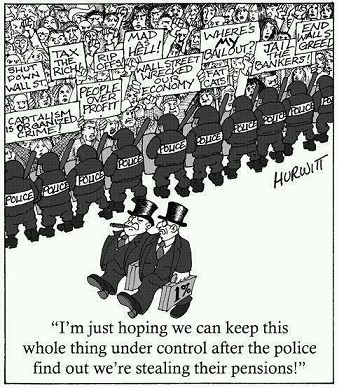
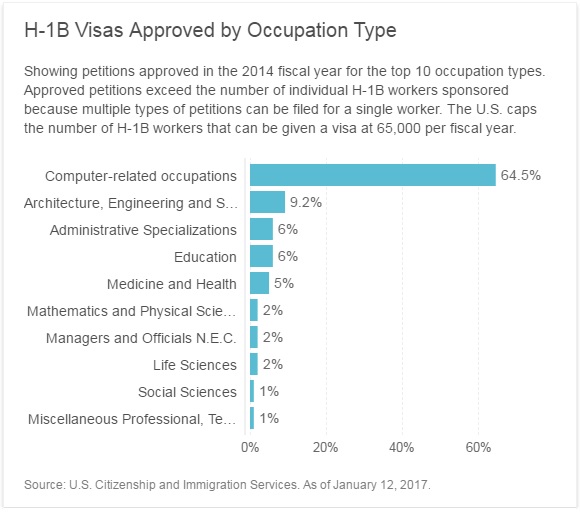
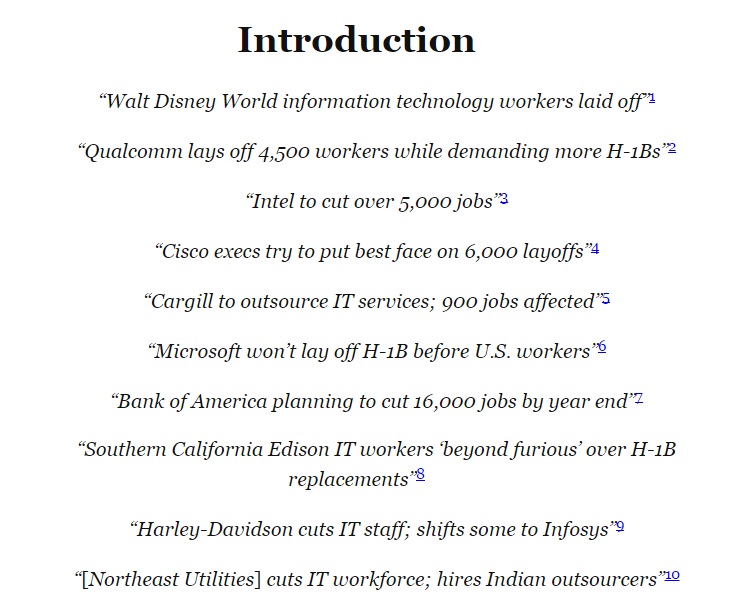
For millions of people affected with declining job options and under-employment, these words by George Carlin are spot on. The people stand back and see a trend with more and more (hundreds of thousands) of highly sought STEM (Science,  Technology, Engineering & Math) jobs being created but not going to Americans, rather going to foreigners – on American soil – at below market prices. This is the drama of H-1B Visas discussed in the VIDEO in the Appendix below.
CU Blog - Immigration Realities in the US - Photo 5

Something is wrong with this picture!

The United States has known societal defects. The movement behind the book Go Lean…Caribbean have delved into the most prominent ones; they were identified as:

This discussion – and the accompanying VIDEO in the Appendix below – allows us to better appreciate the community ethos – the fundamental spirit of a culture – that breathes these societal defects. There is a similarity with these two defects:

“The strong inflicts harm on the weak”

This commentary posits that this problem in America was imbrued as part of a New World experiment that deviated from the Old World values.

In the previous blog-commentary on the Model of Hammurabi it was detailed how that ancient King established laws to ensure that the “strong in society did not abuse the weak”. That blog concluded that New World societies need to do better in applying the sage advice from a 3,800-year-old regent. This point aligns with the book Go Lean…Caribbean, which seeks to reform and transform the 30 member-states of the Caribbean region, to ensure better stewardship of the Social Contract – implied arrangement where all citizens (strong and weak) surrender some of their freedoms and submit to the authority of the State in exchange for protection of remaining natural and legal rights.

The Go Lean book describes empowerments to target the economic, security and governing engines of society to ensure an adherence to the principle of the Greater Good; (greatest good to the greatest number of people which is the measure of right and wrong). This commentary is 4 of 4 in a series on “Managing the Strong versus the Weak”. The other commentaries in this series all considered the security and governmental deficiencies of American society – the model-advanced democracy that “pulls” so many of our Caribbean Diaspora. This commentary here focuses on economic abuses. The full details in this series are as follows:

  1. Managing the Strong versus the Weak – Model of Hammurabi
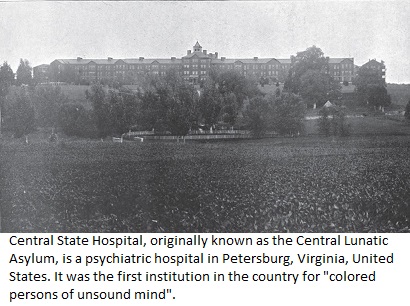
  2. Managing the Strong versus the Weak – Mental Disabilities
  3. Managing the Strong versus the Weak – Bullying in Schools: “Teach them well and let them lead the way”
  4. Managing the Strong versus the Weak – Book Review: Sold-Out!

All of these commentaries relate to nation-building, stressing the community ethos necessary to forge a society where all the people are protected all the time. Looking at the American model, we clearly discern that “all that glitters is not Gold”. There are obvious abuses and deficiencies that should deter Caribbean citizens from setting their hopes-and-dreams on America as a land of refuge.

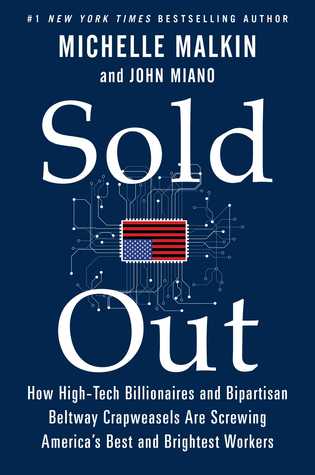
There is a similar theme in the book – Sold-Out! – by syndicated columnist Michelle Malkin. She scorches the American Crony-Capitalism associated with labor-certified immigration. She asserts that laws of supply-and-demand in the STEM fields are being distorted so that corporations can profit at the expense of American and foreign workers.

So sad! See the review of her book here:
 Sold-Out - Photo 1

Book Review for Book: Sold Out: How High-Tech Billionaires & Bipartisan Beltway Crapweasels Are Screwing America’s Best & Brightest Workers
Book Authors:
Michelle MalkinJohn Miano

The #1 New York Times bestselling author and firebrand syndicated columnist Michelle Malkin sets her sights on the corrupt businessmen, politicians, and lobbyists flooding our borders and selling out America’s best and brightest workers.

In Sold Out, Michelle Malkin and John Miano reveal the worst perpetrators screwing America’s high-skilled workers, how and why they’re doing it—and what we must do to stop them. In this book, they will name names and expose the lies of those who pretend to champion the middle class, while aiding and abetting massive layoffs of highly skilled American workers in favor of cheap foreign labor. Malkin and Miano will explode some of the most commonly told myths spread in the media like these:

Lie #1: America is suffering from an apocalyptic “shortage” of science, technology, engineering, and math workers.

Lie #2: US companies cannot function without an unlimited injection of the most “highly skilled” and “highly educated” foreign workers, who offer intellectual capital and entrepreneurial energy that American workers can’t match.

Lie #3: America’s best and brightest talents are protected because employers are required to demonstrate that they’ve made every effort to hire American citizens before resorting to foreign labor.

For too long, open-borders tech billionaires and their political enablers have escaped tough public scrutiny of their means and motives. Sold Out is an indictment of not only political corruption in Washington, but also the journalistic malpractice that enables it. It’s time to trade the whitewash for solvent. American workers deserve better and the public deserves the unvarnished truth.
Source: Good Reads – Online Bookstore-Portal; retrieved April 3, 2017 from: http://www.goodreads.com/book/show/25246754-sold-out
Sold-Out - Photo 2

We can and must do better than this in the Caribbean. While the problem in the foregoing is an American drama, our region can learn so many lessons from the developments and executions of this blatant example of the “strong abusing the weak”. Keep this summary in mind, from Sold-Out  (“Introduction” – Page viii):

  • With very few exceptions, the purported shortages of American workers don’t exist.
  • There is nothing special about the hundreds of thousands of H-1B visa holders flooding the workforce.
  • Most H-1B workers are sponsored by companies that specialize in offshore outsourcing of U.S. jobs.
  • Abuse of guest workers by both offshoring companies and their U.S. tech giant partners is rampant.
  • Enforcement is a joke.
  • The promises of U.S. worker protections were big fat whoppers.

This exposure of the exploitation in the American immigration eco-system reveals what is embedded in this country’s DNA – a propensity for the “strong to abuse the weak”; in this case it’s an economic abuse – manipulating market forces to keep salaries low. And yet, the Caribbean suffers from an atrocious emigration rate of our citizens fleeing to the American homeland. Verily, even this defective American labor market is better than the Caribbean status quo.

The reasons why people leave the Caribbean in the first place have been identified as “push and pull”:

“Push” refers to the reasons people who feel compelled to leave, to seek refuge in a foreign land. “These ones suffer from the abuse of the “strong over the weak”. Many from the Caribbean had to flee as refugees related to qualifiers like DisabilityDomestic-abuseMedically-challenged and LGBT.

“Pull”, on the other hand refers to the lure of a more prosperous life abroad; many times our people are emigrating to communities where they perceive that there are more protections for the “weak against the abusive strong “.

The movement behind the Go Lean book has consistently urged Caribbean authority figures to work to dull the bright lights on American “Welcome Signs”. Our people need to know that the “grass is not necessarily greener on the other side”. The Go Lean book and blogs asserts that it is easier to reform and transform Caribbean society than abandoning our home and trying to fix the American eco-system. There is no much resistance due to the acute greed and adherence to a profit-seeking culture. Consider these sample blog-commentaries previous published:

https://goleancaribbean.com/blog/?p=10052 Fake News? Welcome to America
https://goleancaribbean.com/blog/?p=9038 Fallacy of American Charity Altruism for Caribbean Causes
https://goleancaribbean.com/blog/?p=8966 American For-Profit Education – Plenty of Profit; Little Education
https://goleancaribbean.com/blog/?p=7430 Big Pharma and Zika – Too Much Profit Motivation
https://goleancaribbean.com/blog/?p=6819 The Academic Downside of ‘Western’ Diets
https://goleancaribbean.com/blog/?p=6580 Capitalism of Drug Patents
https://goleancaribbean.com/blog/?p=5733 Better than America? Yes, We Can!
https://goleancaribbean.com/blog/?p=5529 American Defects: Inventory of Crony-Capitalism

The Go Lean book serves as a roadmap for the introduction and implementation of the technocratic Caribbean Union Trade Federation (CU) to elevate Caribbean societal engines. We want to be a better society than we have been in the past, and even better than our American counterparts.

We want to pursue the Greater Good. This means promoting values that do NOT benefit the strong by abusing the weak. While this definitely applies to a security and governance mandate, it includes economic policies as well.

We can learn from the American experience. If we can assuage the “strong-weak” power abuses in our society, this will mitigate the “push and pull” factors for why people abandon our territories.

Yes, America is flawed!

… but we have to do better at home before we can condemn another country. Though we must deter our young people from “jumping out of the frying pan and into the fire”.

So let’s just be better and do better here … in reforming and transforming our societal engines. Let’s lean-in to the Go Lean roadmap and work to make the Caribbean a better place to live, work and play for all citizens, “strong or weak”. 🙂

Download the free e-book of Go Lean … Caribbean – now!

Sign the petition to lean-in for the roadmap for the Caribbean Union Trade Federation.

————

Appendix VIDEO – How H-1B visas have been abused since the beginning – http://www.cbsnews.com/videos/h-1b-creator-1998-loophole-in-law-is-a-travesty

Published March 19, 2017 – The H-1B visa [program] creator says the program has been “hijacked” to take American jobs. But a 1993 60 Minutes piece shows the visas had problems from the start

Share this post:
, , ,

Managing the ‘Strong versus the Weak’ – Bullying in Schools

Go Lean Commentary

“I believe that children are the future, teach them well and let them lead the way …” – Song Lyrics – The Greatest Love  Of All

The need to secure the community against threats and ‘bad actors’ must start with young people, school age children: High School, Middle School and Elementary.

Why so early? Because the tendency for strong individuals in a group to abuse the weak individuals starts early. Its an animalistic instinct to emerge as an Alpha Male or Alpha Female.

Bullying - Photo 5But we are not animals, despite any natural instincts. Societies come together to form a civilization with civil treatment of neighbors and fellow citizens. In the previous blog-commentary on the Model of Hammurabi it was detailed how that ancient King established laws to ensure that the “strong in society would not abuse the weak”. That blog concluded that the governmental authorities (the State) should provide the stewardship as specified in a Social Contract – where citizens surrender some of their freedoms and submit to the authority of the State in exchange for protection of remaining natural and legal rights – with all citizens in society, the strong ones and the weak ones. This commentary is the 3rd of 4 in a series on “Managing the Strong versus the Weak”. The other commentaries detailed in this series are as follows:

  1. Managing the Strong versus the Weak – Model of Hammurabi
  2. Managing the Strong versus the Weak – Mental Disabilities
  3. Managing the Strong versus the Weak – Bullying in Schools: “Teach them well and let them lead the way”
  4. Managing the Strong versus the Weak – Book Review: Sold-Out!

All of these commentaries relate to nation-building, stressing the community ethos necessary to forge a society where all the people are protected all the time. Since “children are the future”, it is important to mitigate and remediate bad behavior of the strong children that may trample on the “weak” children – bullying; if we teach them well when they are young and impressionable, that will allow them to lead the way for future societal cohesion. (See the personification of these words – song lyrics – in the Music VIDEO in the Appendix below).

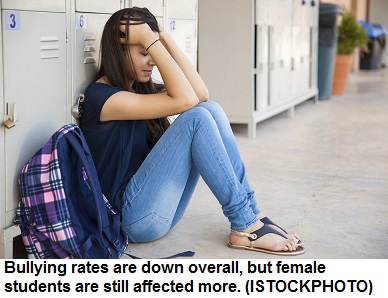
The United States, as a model of an advanced democracy in our region, provides us lessons in how effective programs can be that are designed to mitigate bullying. We get to see the progress and regression. See this report-news article here:

Title: School Bullying, Cyberbullying Continue to Drop

Bullying - Photo 1

Sub-Title: School bullying is at its lowest rate since 2005, but girls are still bullied at higher rates.
By:
Allie Bidwell

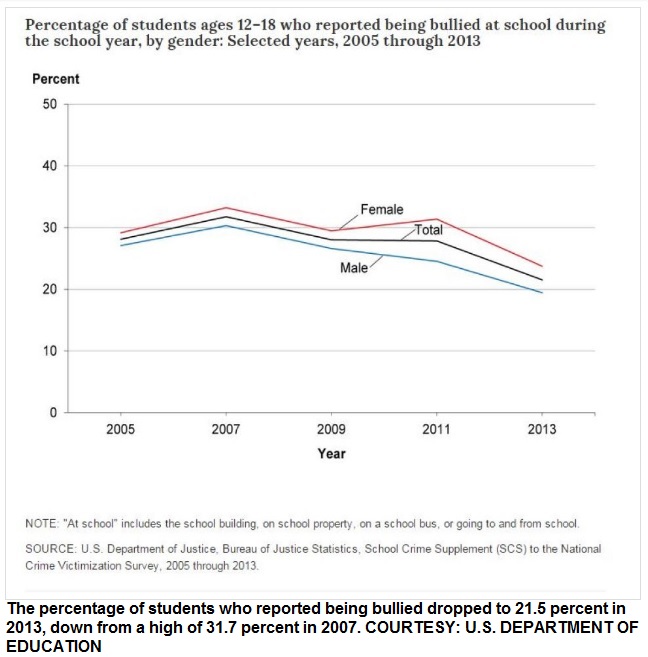
The percentage of students who reported being bullied or cyberbullied reached a record low in 2013, but female students are still victimized at higher rates, according to new data from the Department of Education.

The department on Friday released the results of the latest School Crime Supplement to the National Crime Victimization Survey, which showed that in 2013, the percentage of students ages 12-18 who reported being bullied dropped to 21.5 percent. That’s down from 27.8 percent in 2011, and a high of 31.7 percent in 2007. The percentage of students who reported being cyberbullied also fell to 6.9 percent in 2013, down from 9 percent in 2011.

The department’s National Center on Education Statistics began surveying students on bullying in 2005.

“As schools become safer, students are better able to thrive academically and socially,” Education Secretary Arne Duncan said in a statement. “Even though we’ve come a long way over the past few years in educating the public about the health and educational impacts that bullying can have on students, we still have more work to do to ensure the safety of our nation’s children.”

Despite the overall drop in bullying and cyberbullying, reporting rates remain low – just more than one-third of students who were victims of traditional bullying and fewer than one-quarter of cyberbullying victims reported the incident to an adult, the data show.

Female students also still consistently experience higher-than-average rates of victimization – 23.7 percent of female students said they had been bullied in 2013, and 8.6 percent said they had been cyberbullied. By comparison, 19.5 percent and 5.2 percent of male students in 2013 said they had been bullied and cyberbullied, respectively.

While there aren’t noticeable gender gaps in the location of bullying, female students were significantly more likely than male students to be made fun of, called names or insulted (14.7 percent compared with 12.6 percent), to be the subject of rumors (17 percent compared with 9.6 percent) and to be excluded from activities on purpose (5.5 percent compared with 3.5 percent). Male students who were bullied were more likely than female students to be pushed, shoved, tripped or spit on (7.4 percent compared with 4.6 percent).

Overall, bullied students were most likely to be made fun of, called names or insulted (13.6 percent) or to be the subject of rumors (13.2 percent). The most common forms of cyberbullying were unwanted contact via text messaging and posting hurtful information on the Internet.

Among students who were cyberbullied, female students were more likely to have hurtful information about them posted on the Internet (4.5 percent compared with 1.2 percent), to receive unwanted contact via instant messaging (3.4 percent compared with 1 percent) and unwanted contact via text messaging (4.9 percent compared with 1.6 percent).

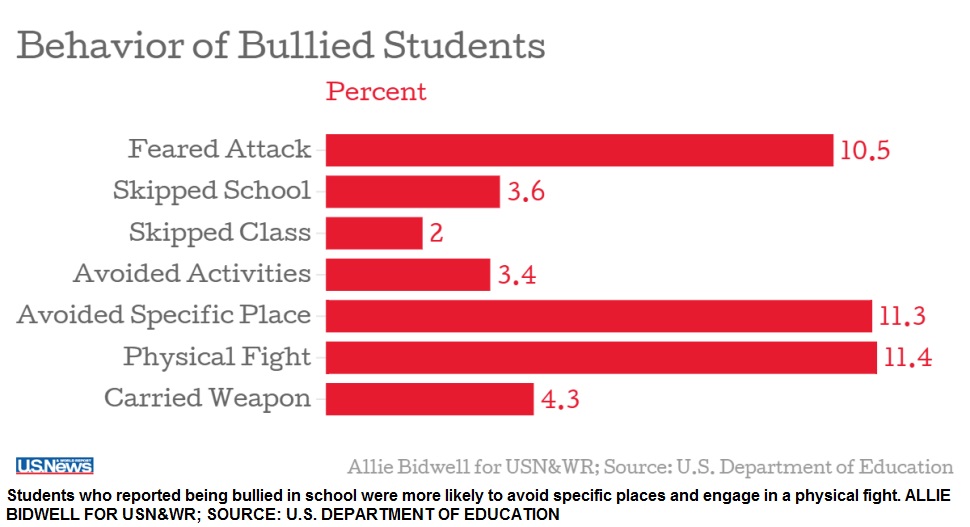
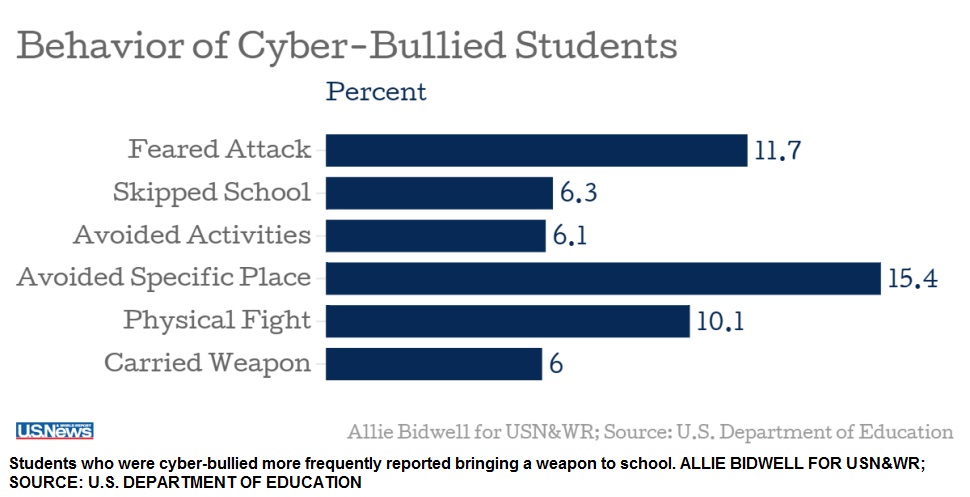
Traditional bullying and cyberbullying also impact the behaviors of the affected students.
Among students who were victims of traditional bullying, more than 1 in 10 said they feared being attacked or harmed at school. That fear was slightly more frequent among victims of cyberbullying: about 1 in 8 students who had been cyberbullied said they feared attack or harm at school.

Generally, being the victim of cyberbullying appeared to affect students’ behavior more than traditional bullying – students who were cyberbullied were more likely to skip school, to avoid school activities, to avoid specific places at school and to carry a weapon to school.

Allie Bidwell is an education reporter for U.S. News & World Report.

[MORE: Social Combat: Bullying Risk Increases With Popularity]

[ALSO: Cyberbullied Teens Can Connect Online, In Person to Get Help]

Bullying - Photo 2

Bullying - Photo 3

Source: US News & World Report – Posted May 15, 2015; retrieved 04/01/2017 from: https://www.usnews.com/news/blogs/data-mine/2015/05/15/school-bullying-cyber-bullying-continue-to-drop

The book Go Lean…Caribbean describes empowerments to target the economic, security and governing engines of society to ensure an adherence to the principle of the Greater Good. The book defines this principle as follows (Page 37):

“The greatest good to the greatest number of people which is the measure of right and wrong”. –  Jeremy Bentham (1748-1832)

The Go Lean book serves as a roadmap for the introduction and implementation of the Caribbean Union Trade Federation (CU); it posits (Page 23) that whatever the circumstances, “bad actors” will always emerge to exploit opportunities, with good, bad and evil intent….

The CU‘s security apparatus must defend against regional threats, including domestic terrorism. This includes gangs and their junior counterparts, bullies. The community must accept that young ones will go astray, so Juvenile Justice programs should be centered on the goal to rehabilitate them into good citizens, before it’s too late. Community messaging (life-coaching and school-mentoring programs) must be part of the campaign for anti-bullying and mitigations.

The Go Lean book continues (Page 181) on the subject of “Junior Terrorism” with the quotation here:

The CU wants to “leave no child behind”. So bullying will be managed under a domestic terrorism and Juvenile Justice jurisdiction. The CU will conduct media campaigns for anti-bullying, life-coaching, and school-mentoring programs. The problem with teen distress is that violence can ensue from bullying perpetrators or in response to bullying.

Bullying - Photo 4We were all children at one point, and may have experienced the dynamics of bullying, either as a victor or a victim, but trust the facts here, the subject of bullying today is different; there is the New Media element; there is cyber-bullying.

Cyberbullying or cyberharassment is a form of bullying or harassment using electronic forms of contact. Cyberbullying has become increasingly common, especially among teenagers.[1] Awareness in the United States has risen in the 2010s, due in part to high-profile cases.[2][3] Bullying or harassment can be identified by repeated behavior and an intent to harm.[4] Harmful bullying behavior can include posting rumors about a person, threats, sexual remarks, disclose victims’ personal information, or pejorative labels (i.e., hate speech).[5]

Several US states and other countries have laws specific to regulating cyberbullying.[6] These laws are designed to specifically target teen cyberbullying, while others use laws extending from the scope of physical harassment.[7] In cases of adult cyberharassment, these reports are usually filed beginning with local police.[8] Research has demonstrated a number of serious consequences of cyberbullying victimization.[9] Victims may have lower self-esteem, increased suicidal ideation, and a variety of emotional responses, retaliating, being scared, frustrated, angry, and depressed.[10] Individuals have reported that cyberbullying can be more harmful than traditional bullying.[11]

Internet trolling is a common form of bullying over the Internet in an online community (such as social media) in order to elicit a reaction, disruption, or for their own personal amusement.[12][13] Cyberstalking is another form of bullying or harassment that uses electronic communications to stalk a victim may pose a credible threat to the safety of the victim.[14]
Source: Retrieved April 2, 2017 from: https://en.wikipedia.org/wiki/Cyberbullying

The Go Lean book describes the eco-system of Internet & Communications Technology (ICT) and strategizes to use ICT as a great equalizer in the world markets. Big countries and small countries can equally and evenly compete. So ICT can be beneficial, if …

… the downsides – like cyber-bullying – can be assuaged or mitigated.

The point of fostering and policing ICT has been previously elaborated on in prior blog-commentaries; see sample list here:

https://goleancaribbean.com/blog/?p=8823 Lessons from China – WeChat: Model for Caribbean Social Media
https://goleancaribbean.com/blog/?p=5435 China Internet Policing – Model for Caribbean
https://goleancaribbean.com/blog/?p=4793 Truth in Commerce – Learning from Yelp
https://goleancaribbean.com/blog/?p=3881 Intelligence Agencies to Up Cyber Security Cooperation

According to the foregoing article, bullying is on the decline. This is a direct product of the effective messaging and school-based coaching. We need to model this in the Caribbean.

Girl Mocking Clever Kid In Glasses Teenage Bully Demonstrating Mischievous Uncontrollable Delinquent Behavior Cartoon Illustration

But also according to the foregoing article, the subject matters in the bullying eco-system that need the most attention are the girl-bullies, as opposed to boy-bullies. The messaging for girls – think: Mean Girls – must be customized as opposed to the messaging for boys. The art and science of this advocacy is just plain technocratic! This is a mission of the Go Lean/CU roadmap. The Go Lean book actually conveys that there are many empowerments for Caribbean stewards to implement to help the youth (boys and girls) of the region. This sends the right message that we will not allow the weak in society to be trampled on by the strong. Consider this advocacy here:

10 Ways to Impact Youth – Page 227

1 Lean-in for the CU to address regional problems! Of 42 million population, more than half below age 30; need jobs and security empowerments.
2 Infant Mortality
3 Health Care Neutralization – Trauma Centers, as injuries are the leading causes of death
4 Work Ethic – Youth assimilate well to ICT, so the CU will foster schemes to create and produce ICT, not just consume.
5 Juvenile Crime and the DARE Model
Addressing the mission to remediate youth crime, the CU will implement specific programs to engage and mitigate youth crime, this is similar to DARE (Drug-Alcohol-Resistance-Endeavors) in the US for drug and gang anti-crime. Also, the Juvenile Justice solution will have vertical institutions for judiciary, corrections & probation, applying best practices of criminology/penology for youthful offenders.
6 Education Dynamics
The CU will identify students early who display high aptitude in the areas of Science, Technology, Engineering and Mathematics; then develop them thru academies and e-learning. The CU will offer forgive-able loans for college. With the CU mission to stop the brain drain, every inducement will be extended to encourage graduates to stay in the region.
7 Sports Prospects
The CU will encourage professional sports pursuits for many disciplines, incentivizing Sport Academies to foster the talent with proper risk mitigations.
8 Artist Development & Colonies
9 Music and Art (Performance & Visual) Appreciation
10 Repatriation – Family Reunification

The book Go Lean, serving as a roadmap, describes formal institutions to improve security like a regional Police and Military forces (including “Intelligence Gathering and Analysis”). There is the need to be on guard so that …

“… the strong should not harm the weak.”

This is the Code of Hammurabi, and despite having originated thousands of years ago, there is urgency to apply the principle today to counteract “bad actors”. The Go Lean book makes this revelation (Page 23):

… with the emergence of new economic engines, “bad actors” will also emerge thereafter to exploit the opportunities, with good, bad and evil intent.

This roadmap for Caribbean integration declares that peace, security and public safety is tantamount to economic prosperity. This is why an advocacy for the Greater Good must be championed as a community ethos. A prime precept is that it is “better to know than to not know” – this implies that privacy is secondary to security. A secondary precept is that bad things will happen to good people and so the community needs to be prepared to contend with the risks that can imperil the homeland.

The Go Lean roadmap details strategies, tactics, implementations and advocacies to impact this region in the cause against bullying. Consider this sample:

Community Ethos – Security Principles – Fully comprehensive empowerments Page 22
Ways to Impact the Future – Count on the Greedy to be Greedy; [expect bullies to emerge] Page 27
Ways to Foster Genius – Anti-Bullying Campaign – “Revenge of the Nerds” Page 28
Security Initiatives at Start-up Page 103
Ways to Improve Education Page 159
Ways to Mitigate Black Markets – Prosecute economic crimes: Extortion and Intimidation Page 165
Ways to Impact Justice – Juvenile Justice will have vertical institutions Page 177
Ways to Reduce Crime – Youth Crime Awareness and Prevention Page 178
Ways to Improve for Gun Control – Public Relations / Anti-Bullying Campaign Page 179
Ways to Improve Homeland Security Page 180
Ways to Mitigate Terrorism – Bullying Page 181
Ways to Improve Intelligence Gathering & Analysis – Internet/Cyber Crimes Monitoring Page 182
Ways to Impact the Prison-Industrial Complex – Monitoring of Parolees Page 211

The CU‘s efforts relate to our Prime Directives; as exemplified by these 3 statements:

  • Optimization of the economic engines in order to grow the regional economy and create new jobs.
  • Establishment of a security apparatus to protect the resultant economic engines and mitigate internal and external threats.
  • Improve Caribbean governance to support these engines.

The purpose of these prime directives is to elevate all of Caribbean society, all 30 member-states. This is a Big Deal – too big for any one member-state alone. We must confederate, collaborate and convene together. We can succeed with an interdependence within the region. See these statements from the formal Declaration of Interdependence, at the start of the book (Page 12):
x.  Whereas we are surrounded and allied to nations of larger proportions in land mass, populations, and treasuries, elements in their societies may have ill-intent in their pursuits, at the expense of the safety and security of our citizens. We must therefore appoint “new guards” to ensure our public safety and threats against our society, both domestic and foreign. The Federation must employ the latest advances and best practices … to assuage continuous threats against public safety.

xvi. Whereas security of our homeland is inextricably linked to prosperity of the homeland, the economic and security interest of the region needs to be aligned under the same governance. Since economic crimes, including … forms of terrorism [like bullying], can imperil the functioning of the wheels of commerce for all the citizenry, the accedence of this Federation must equip the security apparatus with the tools and techniques for predictive and proactive interdictions.

The points of security mitigation have been previously elaborated on in these prior blog-commentaries; see sample list here:

https://goleancaribbean.com/blog/?p=10959 See Something, Say Something … Do Something
https://goleancaribbean.com/blog/?p=10566 Funding the Caribbean Security Pact
https://goleancaribbean.com/blog/?p=10222 Waging a Successful War on Terrorism – (Junior Partner of ‘Bullying’)
https://goleancaribbean.com/blog/?p=9072 Securing the Homeland – On the Ground
https://goleancaribbean.com/blog/?p=7485 A Lesson in the History of Interpersonal Violence – Street Crimes
https://goleancaribbean.com/blog/?p=7179 SME Declaration: ‘Change Leaders in Crime Fight’
https://goleancaribbean.com/blog/?p=392 Jamaica received World Bank funds to help in crime fight

We must learn from the American lessons on mitigating bullying. Our society, every society has “weak (physical and mental) members” that must be protected from the “strong” members, even in the schools. We can assuage any abuse; we can teach the children … well … and let them lead the way.

We would hate to think that bullying may “push” citizens away from their Caribbean homelands. So we must reform and transform our societal engines. If we do this, we will make the Caribbean a better place to live, work, learn and play for all citizens “strong or weak”. 🙂

Download the book Go Lean … Caribbean – now!

Sign the petition to lean-in for the roadmap for the Caribbean Union Trade Federation.

—————-

Appendix VIDEO – Whitney Houston – Greatest Love Of All – https://youtu.be/IYzlVDlE72w

Uploaded on Sep 27, 2010 – Whitney Houston’s official music video for ‘Greatest Love Of All’. Click to listen to Whitney Houston on Spotify: http://smarturl.it/WhitneyHSpotify?IQ…

Click to buy the track or album via iTunes: http://smarturl.it/WhitneyGreatestHit…
Google Play: http://smarturl.it/GLOGPlay?IQid=Whit…
Amazon: http://smarturl.it/WGHAmazon?IQid=Whi…

Follow Whitney Houston
Website: http://www.whitneyhouston.com
Facebook: https://www.facebook.com/WhitneyHouston

Subscribe to Whitney Houston on YouTube: http://smarturl.it/WhitneyHoustonSub?…

Share this post:
, , , , ,
[Top]

Managing the ‘Strong versus the Weak’ – Mental Disabilities

Go Lean Commentary

“Are you an idiot?”

“No, I’m a moron”

Imagine this exchange. Funny isn’t it! But truth be told the etymology of the words “idiot” and “moron” is that they represent scales in the range of intellectual disability.

There is a 3rd classification: “Imbecile”, to represent the mid-range. In total, the following is the full range, from higher (better) to lower (intellectually disabled):

3.  Moron – is a term once used in Psychology to denote mild intellectual disability.[1] This term was coined in 1910 by psychologist Henry H. Goddard[3] from the Ancient Greek word  moros, which meant “dull”[4] and used to describe a person with a mental age in adulthood of between 8 and 12 on the Binet scale.[5]

2.  Imbecile – is a term for people with moderate to severe intellectual disability.[1][2] The term arises from the Latin word imbecillus, meaning weak, or weak-minded. It included people with an IQ of 26–50, between “idiot” (IQ of 0–25) and “moron” (IQ of 51–70).[3]

1.  Idiot – is a term for a person perceived to be lacking intelligence. In Psychology, it is a historical term for a person so mentally deficient as to be incapable of ordinary reasoning.

All of these terms were closely tied with the American Eugenics Movement[2] (where they attempted to sterilize and colonize the mentally disabled in society so as to control the risks of procreating further). Once the terms became popularized, they fell out of use by the Psychological community, and were used more commonly as insults rather than as psychological classifications.

Note: We have “Idiots”, “Imbeciles” and “Morons” in every community in the Caribbean. People with congenital mental weaknesses are everywhere!

This backdrop allows us to better appreciate a societal defect that exists in much of the New World. From the beginning of time, there have always been people who suffered from congenital mental weakness or intellectual disability. These persons need protection in society, not abuse and insults. Accordingly, from the Enlightenment Age (between 1650 and 1700), the concept of a Social Contract emerged; this is the implied arrangement where citizens surrender some of their freedoms and submit to the authority of the State in exchange for protection of remaining natural and legal rights. By extension the assumption is that as all societies have both “strong” and “weak” constituents, so there must always be some societal protections for the weak – physically weak and mentally weak.

In addition to congenital mental weakness, we find that that are other categories of people that at one time or another fall under the category of the mentally “weak”. There are those with:

  • Transactional Mental Weakness – PTSD, Family/Marriage/Divorce counseling, Bereavement, Addiction and Alcoholism. (“Transactional” is not a clinical term, but rather an adjective). People can and do recover-rehabiltate from these disorders.
  • Adult Onset Illnesses – Schizophrenia and Bi-Polar Disorders that emerge in the late 20’s / early 30’s
  • Degenerative Illnesses – Alzheimer’s, Dementia and other age-induced neural disorders

In the previous blog-commentary on the Model of Hammurabi it was detailed how that ancient King established laws to ensure that the “strong in society did not abuse the weak”. That blog concluded that New World societies need to do better in applying the sage advice from a 3,800-year-old regent. This point aligns with the book Go Lean…Caribbean, which seeks to reform and transform the 30 member-states of the Caribbean region, to ensure better stewardship of the Social Contract for all citizens in our homeland, strong and weak.

The Go Lean book describes empowerments to target the economic, security and governing engines of Caribbean society to ensure an adherence to the principle of the Greater Good. This commentary is the 2nd of 4 in a series on “Managing the Strong versus the Weak”. The other commentaries detailed in this series are as follows:

  1. Managing the Strong versus the Weak – Model of Hammurabi
  2. Managing the Strong versus the Weak – Mental Disabilities
  3. Managing the Strong versus the Weak – Bullying in Schools: “Teach them well and let them lead the way”
  4. Managing the Strong versus the Weak – Book Review: Sold-Out!

All of these commentaries relate to nation-building, stressing the community ethos necessary to forge a society where all the people are protected all the time. This has not always been the case in the Caribbean nor has it been in the US – the “city on the hill” – the model of advanced democracy in our region. We must do better!

There is a lesson in American history in which they abused the rights (life, liberty and pursuit of happiness) of 70,000 people. We can observe-and-report on this bad experience and commit to effect change here in our Caribbean homeland. See-listen to the AUDIO Podcast here, relating this sad history based on the following book:

Mental Photo 2

Book Cover

AUDIO Podcast – The Supreme Court Ruling That Led To 70,000 Forced Sterilizations – Heard on Fresh Air

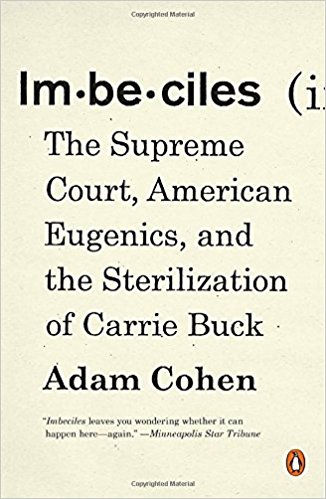
Mental Photo 4In the early 20th century, American eugenicists used forced sterilization to “breed out” traits considered undesirable. Adam Cohen tells the story in Imbeciles. Originally broadcast March 7, 2016.

This foregoing AUDIO report reviews the new paperback book Imbeciles by writer-lawyer Adam Cohen. Here is a representative sound-bite:

One of the worst Supreme Court decisions in US history … was the 1927 decision upholding a state’s right to forcibly sterilize a person considered unfit to procreate – unfit because they were deemed to be mentally deficient. That decision is part of a larger chapter of American history in which the eugenics movement was behind preventing so-called mentally deficient people from procreating through not allowing them to marry, sterilizing them and segregating them in special colonies.

The Nazis borrowed some ideas from American eugenicists. The eugenics movement also influenced the 1924 Immigration Act, which was designed in part to keep out Italians and Eastern European Jews. Adam Cohen’s book titled “Imbeciles” is about the eugenics movement in the early 20th century and the Supreme Court case legalizing sterilization.

This true history of the United States exposes what is embedded in this country’s DNA – a propensity for the “strong to abuse the weak”. And yet, the Caribbean suffers from an atrocious emigration rate of our citizens fleeing our homeland to go to the US. Surely, this history is unknown among these expatriates.  Surely, a rich education to the next generation of Caribbean citizens would deter some of them from setting their sights on US shores as the panacea for all Caribbean ills.

The reasons why people leave in the first place have been identified as “push and pull”:

“Push” refers to the reasons people who feel compelled to leave, to seek refuge in a foreign land. “Refuge” is an appropriate word; because of societal defects – like the “strong abusing the weak” – many from the Caribbean must leave as refugees – think DisabilityDomestic-abuseMedically-challenged and LGBT – for their life, liberty and pursuit of happiness.

“Pull”, on the other hand refers to the lure of a more safer life abroad; many times our people are emigrating to communities where they perceive that there are protections for the “weak against the abusive strong”.

It has been a consistent theme from the promoters of the Go Lean book, that we can dull the bright lights on any flashing American “Welcome Signs” so as to dissuade the “Pull” factor. Indeed, the consistent messaging of these Go Lean blogs has been that it takes less effort to reform and transform our Caribbean society than abandoning our home and trying to succeed in a Diasporic life.

Surely, the truth of American history will hurt … any false impressions that Caribbean people may have about American life and culture. Consider this sample of previous blog-commentaries:

https://goleancaribbean.com/blog/?p=10933 White is Right – Not!
https://goleancaribbean.com/blog/?p=10895 Trump’s Vision of the Caribbean: Yawn
https://goleancaribbean.com/blog/?p=10654 Stay Home! Immigration Realities in the US
https://goleancaribbean.com/blog/?p=10629 Stay Home! Remembering the Societal Defects of McCarthyism
https://goleancaribbean.com/blog/?p=10532 Learning from American Stereotypes – Good and Bad
https://goleancaribbean.com/blog/?p=10336 A Lesson in History: Haiti’s Reasonable Doubt of America
https://goleancaribbean.com/blog/?p=10052 Fake News? Welcome to America
https://goleancaribbean.com/blog/?p=9974 Lessons Learned from Pearl Harbor
https://goleancaribbean.com/blog/?p=9626 ‘Time to Go’ – America Marginalizes the Black-n-Brown Vote
https://goleancaribbean.com/blog/?p=9214 ‘Time to Go’ – Spot-on for Protest
https://goleancaribbean.com/blog/?p=8431 A Caribbean State Issued US Travel Advisory Citing Police Violence
https://goleancaribbean.com/blog/?p=7221 Street naming for Martin Luther King unveils a ‘Climate of Hate’
https://goleancaribbean.com/blog/?p=5733 Better than America? Yes, We Can!
https://goleancaribbean.com/blog/?p=5529 American Defects: Inventory of Crony-Capitalism
https://goleancaribbean.com/blog/?p=5527 American Defects: Racism – Is It Over?

Still some may conclude that the American ethos of yesteryear no longer applies today. Yet, the foregoing AUDIO Podcast relates that the landmark 1927 Supreme Court decision is still the law of the land in the US, and that there have been many times – including a recent 2001 Sterilization case – where provisions of this law is still being applied.

Mental Photo 3

America is very much troubled with their management of [transactional and degenerative] mental weakness:

The Go Lean book serves as a roadmap for the introduction and implementation of the technocratic Caribbean Union Trade Federation (CU) to “weed out” our own bad practices of the “strong abusing the weak” in our society. We want to pursue the Greater Good (greatest good to the greatest number of people which is the measure of right and wrong). And this includes help for people who are mentally weak.  The Go Lean/CU roadmap includes many strategies, tactics, implementations and advocacies to impact Caribbean society and our treatment of the weak, including the mentally weak due to congenital, transactional, adult-onset and degenerative causes.

“Persons with Disabilities” are still people. They can still contribute to society. Even in the US, people with disorders like Bi-Polar and Schizophrenia have been extremely impactful in their communities – consider the example of Nobel Prize Winner Dr. John Nash.

These previous Go Lean blog-commentaries have detailed mental health challenges in communities:

https://goleancaribbean.com/blog/?p=7659 Pre-Fab Housing and Elder-Care Conjunction
https://goleancaribbean.com/blog/?p=5901 The Demographic Theory of Elderly Suicide
https://goleancaribbean.com/blog/?p=5720 Role Model advocates for ‘Reasonable Accommodations’
https://goleancaribbean.com/blog/?p=2633 Book Review: ‘The Protest Psychosis’
https://goleancaribbean.com/blog/?p=2602 Guyana and Suriname Wrestle With High Rates of Suicides
https://goleancaribbean.com/blog/?p=2105 Recessions and Public Physical and Mental Health
https://goleancaribbean.com/blog/?p=1751 New Hope in the Fight against Alzheimer’s Disease

We must learn from this lesson … that the “weak (physical and mental) must be protected from the strong” that may have malice towards them. If we can assuage such abuses, we would mitigate the “push and pull” factors that have previously befallen our territories. Let’s do better in reforming and transforming our societal engines in the Caribbean homeland in regards to mental healthcare. If we do this, we will make the Caribbean a better place to live, work, heal and play for all citizens, “strong or weak”. 🙂

Download the free e-Book of Go Lean … Caribbean – now!

Sign the petition to lean-in for the roadmap for the Caribbean Union Trade Federation.


Share this post:
, , ,
[Top]

Managing the ‘Strong versus the Weak’ – Model of Hammurabi

Go Lean Commentary

Time for a lesson from history; a very old history; going back-back-back to the year 1754 BC.

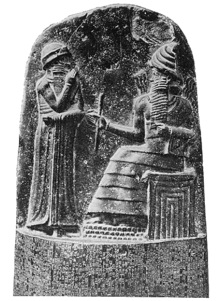
Hammurabi - Photo 1This is when the Code of Hammurabi was enacted within the Babylonian Empire, a Super Power in the ancient world; see Appendix reference and VIDEO below. Despite the passage of 3,800 years, there is a lesson to glean from this ancient legal precept for us today. Despite the irrelevance of so many of the 282 statutes, there in the preface of the codified Law is this statement:

“So that the strong should not harm the weak”

Despite how much advances we have made in the millennia since King Hammurabi of Babylon reigned, this concept seems to be void in so many societies; this concept …

  • … is not in the Caribbean.
  • … is not in the United States.
  • … is not in the New World.

There is an obvious “ignorance or negligence of this concept” in the New World. Consider the experience in the United States, where the American DNA seems to be based on a consistent pattern of the “strong abusing the weak” and the long civil rights struggle to overcome the abuse. This is American History and the American Experience. Consider these examples of the “weak” that were harmed:

  • Native American / Indigenous people – The Ameri-Indians were mostly eradicated. Those who survived where corralled onto limited territorial grounds called “reservations”.
  • Slavery of Africans – After the indigenous people of the New World could not be sustained in servitude, their replacements – native African tribes people proved more enduring.
  • Civil Rights Movement – After international forces and pressure ended the “Slave Trade“, then abolition of slavery, the emancipated people were suppressed, repressed and oppressed as 2nd class citizens for 100 years in the country they helped build.
  • Indentured Servants (East Indians & Irish) – As replacement labor sources, these desperate groups were hoarded to the New World where their labors and cultures were exploited as an under-class.
  • Labor Movement – After a “long train of abuses” in factories and industrial plants, the common worker was subjected to forceful resistance to unionization and collective bargaining.
  • McCarthyism – Congressional “Witch-hunts” and industry blacklisting anyone with a dissenting thought in the capitalism -vs- communism debate.
  • Farm Migrant Labor – Immigrants were subjected to a form of “slavery under a different name” to harvest crops on Big Agra farms.

The American creed of “In God We Trust” seems to indicate that the country would be based on religious principles. But the actuality of the abuses of the “strong against the weak” belie any religious predisposition. The US and all New World territories claim to be a nation based on Judeo-Christian principles; but the Bible’s Old Testament (Hebrew Scriptures) states:

Job 29:12 – “because I rescued the poor who cried for help, and the fatherless who had none to assist them.”

… and the Bible’s New Testament (Christian Greek Scriptures) states:

James 1:27 – “[the form of] religion that God our Father accepts as pure and faultless is this: to look after orphans and widows in their distress and to keep oneself from being polluted by the world.”

So the abuse of the “strong against the weak” is clearly an unabashed societal defect in the New World. History teaches that with the emergence of any new economic engines, “bad actors” will also emerge thereafter to exploit the opportunities – the weak – with good, bad and evil intent.

The New World needs to apply this lesson-learned from the “Old World of 1754 BC” to protect the “poor, sick and huddled masses yearning to be free”.

This lesson from history aligns with the book Go Lean…Caribbean, which seeks to reform and transform the 30 member-states of the Caribbean region; the book describes empowerments to target the economic, security and governing engines of society to ensure an adherence to the principle of the Greater Good. While we can observe-and-report on the other countries, we can only effect change here in our Caribbean homeland. This commentary is the first, 1 of 4 on a series on “Managing the Strong versus the Weak”. The other commentaries detailed in this series are as follows:

  1. Managing the Strong versus the Weak – Model of Hammurabi
  2. Managing the Strong versus the Weak – Mental Disabilities
  3. Managing the Strong versus the Weak – Bullying in Schools: “Teach them well and let them lead the way”
  4. Managing the Strong versus the Weak – Book Review: Sold-Out!

All of these commentaries relate to nation-building, stressing the community ethos necessary to forge a society where all the people are protected all the time. This has not always been the case in the Caribbean nor in the US. We must do better. The Code of Hammurabi gives us a great model:

  • The code has been seen as an early example of a fundamental law, regulating a government — i.e., a primitive constitution.[14][15]
  • The copying [of the code] in subsequent generations indicates that it was used as a model of legal and judicial reasoning.[17]
  • The Code focuses on justice, following the three classes of Babylonian society: 1. property owners, 2. freed men, and 3. Slaves.[18]. This is a good model for considering today’s contrast for the Rich, Middle Class and the Poor.

The Go Lean book serves as a roadmap for the introduction and implementation of the technocratic Caribbean Union Trade Federation (CU) to provide better stewardship for the region’s economic, security and governing eco-systems. The book actually conveys that there are many opportunities for the Caribbean to implement some “reasonable accommodations” so that the weak in society are not trampled on by the strong. Consider these two missions: Organ Transplantation & Disabilities:

10 Ways to Improve Organ Transplantation – Page 214

0 The Bottom Line on Organ Trade – Organ trade is the trade involving inner organs (heart, liver, kidneys, cornea, etc.) of a human for transplantation. In the 1970s pharmaceuticals that prevent organ rejection were introduced. This along with a lack of medical regulation helped foster the organ market. The problem of organ trafficking is widespread, although data on the exact scale of the organ market is difficult to obtain. (Most organ trade involves kidney or liver transplants). There is a worldwide shortage of organs available for transplantation, yet trade in human organs is illegal in all countries, except Iran.WHO states that, “Payment for…organs is likely to take unfair advantage of the poorest and most vulnerable groups, undermining altruistic donation and leads to profiteering and human trafficking.”
1 Leverage the full population – 42 million people – of the Caribbean Union Trade Federation.
2 Diaspora Matching
3 Medical Tourism
4 Self-Governing Entities
5 Xeno-transplantation and Artificial Organs
6 Trauma Centers
7 Tissue Bank
8 Intelligence Analysis / Post Op – Data Analysis
9 Health Insurance Cooperation
10 Public Health Mandates – Pre (Vaccinations/Immunizations) and Post-op (mental & physical) challenges

10 Ways to Impact Persons with Disabilities – Page 228

0 The Bottom Line on the American with Disabilities Act (ADA) – This Act is a law that was enacted by the U.S. Congress in 1990. It was signed into law on July 26, 1990, by President George H. W. Bush, and later amended with changes effective January 1, 2009. The ADA is a wide-ranging civil rights law that prohibits, under certain circumstances, discrimination based on disability. It affords similar protections against discrimination to Americans with disabilities as the Civil Rights Act of 1964, which made discrimination based on race, religion, sex, national origin, and other characteristics illegal. Disability is defined by the ADA as “…a physical or mental impairment that substantially limits a major life activity.” The determination of whether any particular condition is considered a disability is made on a case by case basis. Certain specific conditions are excluded as disabilities, such as current substance abuse and visual impairment that is correctable by prescription lenses.[ADA is based on the premise of] reasonable accommodation – an adjustment made in a system to “accommodate” or make fair the same system for an individual based on a proven need. Accommodations can be religious, academic, or employment related. This provision is also prominent in international law as the United Nations has codified the principle in the Convention on the Rights of Persons with Disabilities. [There are many international signatories to these principles and resolutions].
1 Leverage the full population – 42 million people – of the region for a Caribbean Persons With Disabilities Act.
2 Cruise Ships and Disability Tourism
3 Public Transportation and Public Accommodations – Assurance on CU facilities
4 Government Buildings and Proceedings
5 Mental Disabilities and Gun Control
6 Tele-type Call Center Access
7 Autism Awareness – Opt-Out Accommodations
8 Braille Websites
9 Closed Captioning … for Television
10 Public Awareness Campaign – Improve Image

The Go Lean movement (book and blogs) have identified the foregoing defect of the “strong abusing the weak”. The consequences and repercussions of this defect are:

Death or Diaspora

The Caribbean region needs to “weed out” this bad practice in our community ethos and instead, pursue the Greater Good. The book defines this attribute as follows (Page 37):

“The greatest good to the greatest number of people which is the measure of right and wrong”. –  Jeremy Bentham (1748-1832)

Our Caribbean Diaspora grows with every passing day – Ghost Towns are viable possibilities in some countries. People who love their homeland abandon it for foreign shores. As a result, we have a sad state of affairs. The reasons why people leave in the first place have been identified as “push and pull”:

“Push” refers to the reasons people who feel compelled to leave, to seek refuge in a foreign land. “Refuge” is an appropriate word; because of societal defects – like the “strong abusing the weak” – many from the Caribbean must leave as refugees – think DisabilityDomestic-abuseMedically-challenged and LGBT – for their life, liberty and pursuit of happiness.

“Pull”, on the other hand refers to the lure of a more safer life abroad; many times our people are emigrating to communities where there are protections for the “weak against the abusive strong”.

If only we can mitigate these “push and pull” factors, then we can dissuade our societal abandonment and have a chance of elevating (reforming and transforming) our societal engines in the homeland. But there is a need for due caution to all those in the Caribbean desiring to emigrate to the US, we urge you to take heed: the “grass is not greener” on that other side. The American propensity is for the “strong to abuse the weak”; maybe even more so than in your home country.

The Go Lean book and movement wants to help reform and transform the Caribbean. We see the defects throughout the New World, we perceive the harmful effects, but only the Caribbean is within scope for our remediation efforts. While we want to dissuade our people from fleeing, it is our quest to apply best-practices to improve our homeland, to make the Caribbean a better place to live, work and play. 🙂

Download the free e-Book of Go Lean … Caribbean – now!

Sign the petition to lean-in for the roadmap for the Caribbean Union Trade Federation.

——————

Appendix – Code of Hammurabi

Hammurabi - Photo 2The Code of Hammurabi is a well-preserved Babylonian law code of ancient Mesopotamia, dating back to about 1754 BC. It is one of the oldest deciphered writings of significant length in the world. The sixth Babylonian king, Hammurabi, enacted the code, and partial copies exist on a seven and a half foot stone stele and various clay tablets. The code consists of 282 laws, with scaled punishments, adjusting “an eye for an eye, a tooth for a tooth” (lex talionis)[1] as graded depending on social status, of slave versus free man.[2] Nearly one-half of the code deals with matters of contract, establishing, for example, the wages to be paid to an ox driver or a surgeon. Other provisions set the terms of a transaction, establishing the liability of a builder for a house that collapses, for example, or property that is damaged while left in the care of another. A third of the code addresses issues concerning household and family relationships such as inheritance, divorce, paternity, and sexual behavior. Only one provision appears to impose obligations on an official; this provision establishes that a judge who reaches an incorrect decision is to be fined and removed from the bench permanently.[3] A few provisions address issues related to military service.

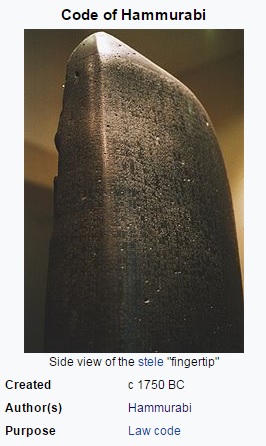
The code was discovered by modern archaeologists in 1901, and its editio princeps translation published in 1902 by Jean-Vincent Scheil. This nearly complete example of the code is carved into a basalt stele in the shape of a huge index finger,[4] 2.25 m (7.4 ft) tall. The code is inscribed in the Akkadian language, using cuneiform script carved into the stele. It is currently on display in the Louvre [Museum in Paris], with exact replicas in the Oriental Institute at the University of Chicago, the Clendening History of Medicine Library & Museum at the University of Kansas Medical Center, the library of the Theological University of the Reformed Churches (Dutch: Theologische Universiteit Kampen voor de Gereformeerde Kerken) in the Netherlands, the Pergamon Museum of Berlin, and the National Museum of Iran in Tehran.

Hammurabi ruled for nearly 42 years, from about 1792 to 1749 BC according to the Middle chronology. In the preface to the law, he states, “Anu and Bel called by name me, Hammurabi, the exalted prince, who feared God, to bring about the rule of righteousness in the land, to destroy the wicked and the evil-doers; so that the strong should not harm the weak; so that I should rule over the black-headed people like Shamash, and enlighten the land, to further the well-being of mankind.”[5] On the stone slab are 44 columns and 28 paragraphs that contained 282 laws. Some of these laws follow along the rules of ‘an eye for an eye’.[6]

Source: Retrieved March 29, 2017 from: https://en.wikipedia.org/wiki/Code_of_Hammurabi

—————

VIDEO – Hammurabi’s Code Explained: World History Review – https://youtu.be/BsPbqmYwxso

Published on Jan 7, 2015 – A 5 minute fun overview of Hammurabi’s Code, one of the earliest and most influential legal documents to be pounded out by Mesopotamia. Check out the real doc here http://www.commonlaw.com/Hammurabi.html

  • Category: Education

  • License: Standard YouTube License

Share this post:
, ,
[Top]

ENCORE: US Warnings on Low-cost Dominican Surgeries

UPDATE – Go Lean Commentary

The warning was sounded 3 years ago, today. What is the status now? Have the warnings been heeded?

Surely, we have paid attention and we have put in the risk mitigations so as to preserve life-and-limb in the activities of cosmetic surgeries in the Dominican Republic.

Sad to report, but the answer is “No”.

The risks continue; the disfigurements continue; the deaths continue.

Say it ain’t so!

See the news article in the Appendix relating the details of a fresh warning from the US Center for Disease Control and Prevention (CDC).

In this previous Go Lean blog-commentary – being ENCORED below – the prospects of Medical Tourism were heralded, with the caution for proper regulatory control. The appeal was made for the new Caribbean Union Trade Federation (CU) to serve as that regulator, under the guise of a Self-Governing Entity. That appeal is echoed again here-now. There is too much …

… money at stake.

… jobs at stake.

… lives at stake.

But while this original blog-commentary below published on April 1, 2014 related the death of Beverly Brignoni (28), there have been other deaths; as with these women:

See the related October 3, 2016 story: Pretty Hurts – Dishing on the dangers of Plastic Surgery 

CU Blog - US Warnings on Low-cost Dominican Surgeries - Photo 2
———–

ENCORE Title: Low-cost Dominican surgeries spark warnings by US

CU Blog - Low-cost Dominican surgeries spark warnings by US - PhotoTo the family of Beverly Brignoni, according to the foregoing news article, the publishers of the book Go Lean … Caribbean, SFE Foundation, extend condolences for the loss of their dearly departed loved one. This article – as follows – shows the down-side of medical tourism, an accidental death from an apparent lax oversight in a cosmetic surgery clinic.

By: Ben Fox and Ezequiel Abiu Lopez
Beverly Brignoni was a young New Yorker seeking a less expensive way to enhance her appearance and she did what many other people are now doing: travel to the Dominican Republic for cosmetic surgery; (see undated “selfie” photo posted to her Instagram account, courtesy of the Brignoni family).

It went horribly wrong. The 28-year-old died Feb. 20 from what the doctor told her family was a massive pulmonary embolism while getting a tummy tuck and liposuction at a clinic in the Dominican capital recommended by friends. Family members want local authorities to investigate.

“We want to know exactly what happened,” said Bernadette Lamboy, Brignoni’s godmother. “We want to know if there was negligence.”

The district attorney’s office for Santo Domingo says it has not yet begun an investigation because it has not received a formal complaint from Brignoni’s relatives. Family members say they plan to make one.

Shortly after Brignoni’s death, the Health Ministry inspected the Vista del Jardin Medical Center where she was treated and ordered the operating room temporarily closed, citing the presence of bacteria and violations of bio-sanitary regulations. The doctor who performed the procedure and the clinic have not responded to requests for comment.

Brignoni’s death is unusual, but it is not isolated. Concerns about the booming cosmetic surgery business in the Dominican Republic are enough of an issue that the State Department has posted a warning on its page for travel to that country, noting that in several cases U.S. citizens have suffered serious complications or died.

The U.S. Centers for Disease Control issued an alert March 7 after health authorities in the United States reported that at least 19 women in five states had developed serious mycobacterial wound infections over the previous 12 months following cosmetic procedures in the Dominican Republic such as liposuction, tummy tucks and breast implants.

There were no reported deaths in those cases, but treatment for these types of infections, which have been caused in the past by contaminated medical equipment, tend to involve long courses of antibiotics and can require new surgery to remove infected tissue and drain fluid, said Dr. Douglas Esposito, a CDC medical officer.

“Some of these patients end up going through one or more surgeries and various travels through the medical system,” Esposito said. “They take a long time typically to get better.”

The Dominican Republic, like countries such as Mexico, Costa Rica and Thailand, has promoted itself as a destination for medical tourism, so-called because people will often tack on a few days at a resort after undergoing surgery. The main allure is much lower costs along with the promise that conditions will be on par with what a patient

would encounter at home.

In 2013, there were more than 1,000 cosmetic procedures performed in the Dominican Republic, 60 percent of them on foreigners, according to the country’s Plastic Surgery Society.

The Internet is flooded with advertisements and testimonials from people who say they have had successful procedures in the Dominican Republic, and an industry of “recovery houses” has sprung up to serve clients, along with promoters who canvass for clients in the United States. The price is often about a third of the cost in the United States.

Dr. Braun Graham, a plastic surgeon in Sarasota, Florida, says he done corrective surgery on people for what he says were inferior procedures abroad. He warns that even if a foreign doctor is talented, nurses and support staff may lack adequate training.

“Clearly, the cost savings is certainly not worth the increased risk of a fatal complication,” said Graham, past president for Florida Society of Plastic Surgeons.

Brignoni was referred to the Vista del Jardin Medical Center by several acquaintances in the New York borough of the Bronx where she lived, said Lamboy and Lenny Ulloa, the father of the 4-year-old daughter she left behind.

“Supposedly, it was a high-end clinic, one of the best in the city,” Ulloa said.

The doctor who performed Brignoni’s procedure, Guillermo Lorenzo, is certified by the Plastic Surgery Society, but there

are at least 300 surgeons performing cosmetic procedures who are not, said Dr. Severo Mercedes, the organization’s director. He said the government knows about the problem but has not taken any action. “We complain but we can’t go after anyone because we’re not law enforcement,” Mercedes said.

The number of people pursuing treatment in the Dominican Republic doesn’t seem to have been affected by negative reports, including a previous CDC warning about a cluster of 12 infections in 2003-04.

In one recent case, the Dominican government in February closed a widely advertised clinic known as “Efecto Brush,” for operating without a license. Prosecutors opened a criminal case after at least six women accused the clinic of fraud and negligence. The director, Franklin Polanco, is free while awaiting trial. He denies wrongdoing.

There was also the case of Dr. Hector Cabral. New York prosecutors accused him of conducting examinations of women in health spas and beauty parlors in that state in 2006-09 without a license, then operating on them in the Dominican Republic, leaving some disfigured. Cabral pleaded guilty to one count of unauthorized practice of medicine in October 2011 and returned to the Dominican Republic, where he still practices.

In 2009, Dominican authorities charged Dr. Johan Tapia Bueno with illegally practicing plastic surgery at his apartment after several women, including a local television personality, accused him of malpractice that left them with infections. Awaiting trial, he has pleaded innocent to charges that include fraud.

Juan Linares, a lawyer hired by Brignoni’s boyfriend, said he is still awaiting an autopsy report.

Because she arrived in the country late at night on a delayed flight and was on the operating table early the next morning, a main concern is whether she received an adequate medical evaluation before the procedure. Graham, the Florida surgeon, said sitting on a plane for several hours can cause blood to stagnate in the legs and increase the risk of an embolism.

Brignoni paid the Dominican clinic $6,300 for a combination of liposuction, tummy tuck and breast surgery. Lamboy said she had decided not to have the work done on her breasts and was expecting a partial refund. The woman, who worked as a property manager, had lost about 80 pounds about a year earlier after gastric bypass surgery.

Brignoni was clearly excited about the procedure. Her final post on Facebook was a photo she took of her hands holding her passport and boarding pass for the flight from New York to Santo Domingo.

“She wanted it so bad,” her godmother said. “It felt like she was going to have a better outlook on life, getting this done.”

Associated Press writer Ben Fox reported this story from Miami and Ezequiel Abiu Lopez reported in Santo Domingo.

Source: Associated Press (AP); retrieved 03/31/2014 from: http://news.yahoo.com/low-cost-dominican-surgeries-spark-warnings-us-042418398.html

This is a very important issue for the planning and execution of the new inter-governmental agency: Caribbean Union Trade Federation (CU). First of all, someone died – life is too precious to skim over this issue with indifference. The Go Lean book serves as a roadmap to introduce and implement the CU, so as to re-boot the region’s economic engines, including avenues of medical tourism.

There are also peripheral issues associated with this news story, many of which are examined, as missions, in great details in the Go Lean book. The issues/missions are:

  • Image: Confidence in the competence of service providers is sometimes based on reputation and branding. This is para-mount in medical fields. While the Caribbean is home to many excellent medical schools, facilities and practitioners, there is no regional “sentinel” role-player. The CU mandate is to zealously protect and promote the image and branding for industrial developments. So now when the media portrays “negative” depiction of Caribbean life, culture and people, there is no formal response mechanism. But with the CU’s implementation, there will be an entity to effectuate an anti-defamation response and better manage the region’s image.
  • Health Administration: The Go Lean roadmap recognizes healthcare as a basic need for the people of the Caribbean. As such, there is the acknowledgement that health delivery systems generate excessive costs and risks for a community. As a planning tool, the roadmap commences with a Declaration of Interdependence, pronouncing regional integration (Page 11) as the strategy for optimized benefits:
      IX.   Whereas the realities of healthcare and an aging population cannot be ignored and cannot be afforded without some advanced mitigation, the Federation must arrange for health plans to consolidate premiums of both healthy and sickly people across the wider base of the entire Caribbean population. The mitigation should extend further to disease management, wellness, obesity and smoking cessation programs. The Federation must proactively anticipate the demand and supply of organ transplantation as developing countries are often exploited by richer neighbors for illicit organ trade.
  • Self-Government Entities: The foregoing news story involves a clinic regulated by a Caribbean member-state, the Dominican Republic. The Go Lean roadmap institutes an arrangement for medical/research campuses as SGE’s (Self-Governing Entities) that are only regulated by the CU federal authorities. Had this tragedy occurred on such a facility, the response would have been immediate and comprehensive, employing best-practices of trauma medicine arts and sciences, thusly requiring a post-mortem lessons-learned process that would be fully transparent and accountable.
  • Lean Government: The Go Lean roadmap also extends optimizations to the member-states governments, requiring a separation-of-powers dictum to transfer oversight and administration of certain state functions to federal authorities. This includes standards, licensing and administration of healthcare facilities. The application of best-practices would most assuredly minimize the risk of medical negligence.
  • US Exceptionalism: The Go Lean roadmap maintains that other countries have their own version of the American Dream. The quest for life, liberty and the pursuit of happiness is not exclusively American. Whereas there are millions of negligent deaths in the US hospitals/clinics every year, one American dying in a Caribbean facility does not constitute an exceptional event; bad things do happen to good people … everywhere, in the US, in the Caribbean and in the Dominican Republic. Having a tourism-based regional economy means we always want to extend hospitality to our American guests, but embarking on medical tourism, also means assuming some degree of risks, for the facilities, the doctors and most importantly the patients.

The foregoing article crystalizes the need for the CU Trade Federation, a super-national administration to regulate, protect, promote and foster quality delivery of the most vital public services. The publishers of the Go Lean roadmap will hereby “sit back”, observe-and-report on the manifestations of this case, hoping for the quest for justice and accountability to be fulfilled. And remembering the unconscionable loss of the beautiful 28-year-old woman, Beverly Brignoni; RIP.

Download the book Go Lean … Caribbean – now!

Sign the petition to lean-in for the roadmap for the Caribbean Union Trade Federation.

———–

Appendix – CDC warns of dangers of plastic surgery in Dominican Republic

(HealthDay) — U.S. health officials are warning about the dangers of “medical tourism” after at least 18 women from the East Coast became infected with a disfiguring bacteria following plastic surgery procedures they had in the Dominican Republic.

The infections, caused by a type of germ called mycobacteria, can be difficult to treat. At least several of the women had to be hospitalized, undergo surgery to treat the infection and take antibiotics for months, according to the report from the U.S. Centers for Disease Control and Prevention.

One expert said the effects can be devastating.

“It’s a very mutilating infection. They’re going for cosmetic surgery, and they will be scarred. It’s a terrible scenario for people to go down there, get surgery and come back worse than they imagined they could be,” said Dr. Charles Daley. He is a Denver infectious disease physician whose clinic has seen patients infected after undergoing these kinds of procedures in the Dominican Republic.

According to the CDC, 21 women from six Northeast and Mid-Atlantic states appear to have been affected by mycobacterial infections after visiting five plastic surgery clinics in the Dominican Republic, a nation in the Caribbean. (Eighteen of the cases are confirmed, and three are considered probable.)

Mycobacteria, which are found worldwide in the environment, “usually infect the skin or lungs, and are responsible for chronic and recurrent infections that are notoriously resistant to antibiotics and difficult to treat,” said report co-author Dr. Douglas Esposito. He is a medical officer and epidemiologist with the CDC’s Travelers’ Health Branch.

More than 80 percent of the infected women reported swelling, pain and scarring. Daley, who works at the National Jewish Health respiratory hospital in Denver, said infected people often need to undergo reconstructive surgery.

It’s not clear how the women were infected, although Daley said it’s possible the bacteria entered their plastic surgery wounds through tap water or instruments used in surgery. Most underwent liposuction and at least one other surgery, such as procedures to expand the size of the breasts and buttocks, or breast reduction.

Daley said his clinic has seen two patients infected after plastic surgery and consulted on a third case. It’s not clear how many, if any, are among those in the CDC report.

The risk of this kind of infection is higher in countries like the Dominican Republic and Brazil, he noted, but patients have become infected in the United States, too. “We are definitely seeing more of these postoperative infections, particularly ones that are related to cosmetic surgery,” Daley said.

The CDC report warns about the risks of medical tourism, a term that describes leaving the United States for medical procedures to save money. According to the report, many of the women—most of whom were born in the Dominican Republic—said they went to the country for plastic surgery to save money.

People who have undergone plastic surgery in the Dominican Republic should talk to their doctor about getting tested, Daley suggested. And, people who plan to go there for a procedure should ask the clinic whether they’ve had infections, he added.

“I would never go to one of those places,” he said. “I know too many stories about what’s happened to people. It has ruined people’s lives.”

The study was published online July 13 in Emerging Infectious Diseases.

Reporting by: Randy Dotinga, Healthday Reporter

Source: Posted July 14, 2016; retrieved March 30, 2017 from: https://medicalxpress.com/news/2016-07-cdc-dangers-plastic-surgery-dominican.html#jCp

Share this post:
, , , ,
[Top]

Funding the Russell Family Memorial – RIP

Go Lean Commentary

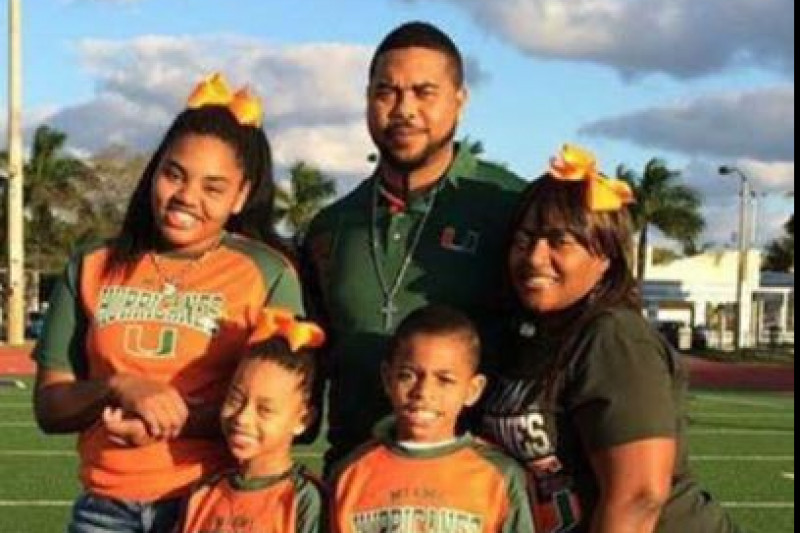
A family of 5 die in a horrific car crash on an American highway.

CU Blog - Funding the Russell Family Memorial - RIP - Photo 1

There is no other way to look at this drama – it is sad. The Bible says “Death rules as King” (Romans 5:17).

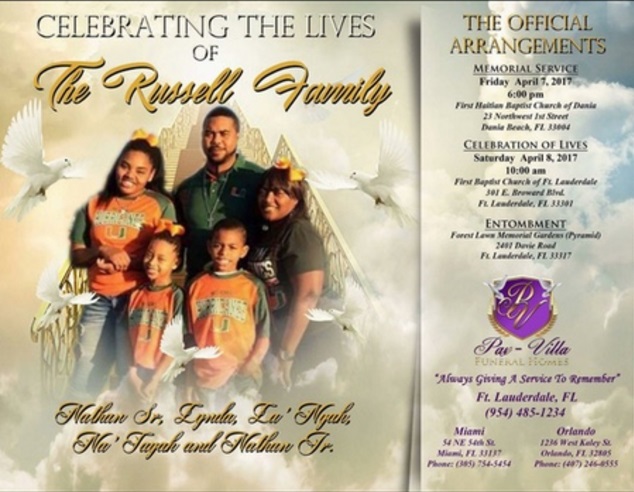
The Caribbean Diaspora community in South Florida is now mourning this sad tragedy. We send condolences to all the surviving family and loved-ones of the Russell family, reported in this news story here:

Title: Entire family killed in crash on Florida highway
By: Alex Harris, Miami Herald Staff Reporter

After more than 12 hours in the hospital, a 10-year-old boy succumbed to his injuries, leaving an entire family dead after a horrific car wreck in North Florida on Sunday [March 19].

The Russell family, of Hollywood, was loaded into their 2016 Chrysler 200 and headed home from a trip to Georgia, according to a memorial fundraiser. They were driving south on Interstate 75 when the sedan swerved off the road and into a tractor-trailer stopped on the side of the highway.

Nathan Russell, 37; his 35-year-old wife, Lynda; his 15-year-old daughter, La’Nyah; and one of his twins, 10-year-old Natayah, were killed in the crash. The other twin, 10-year-old Nathan Russell Jr. died hours later at ShandsHospital, according to a Florida Highway Patrol report.

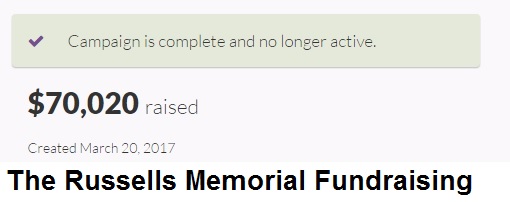
Relatives are raising money for five funerals on GoFundMe and mourning on social media.

Nicole Narae, who said she is Nathan Russell’s cousin, wrote on Facebook that “tomorrow is not promised to anyone.”

“This one hurts. From the Bahamas to Haiti to South Florida…our hearts are broken,” she wrote. “It’s too much for anyone who know them and their household. So unreal to me right now.”

A vigil is was planned at the family’s Coral Springs home, at 9040 Royal Palm Blvd, at 7:30 p.m. on Friday.

CU Blog - Funding the Russell Family Memorial - RIP - Photo 3

———————–

VIDEO – 5 from Hollywood killed in I-75 crash near Gainesville – http://launch.newsinc.com/share.html?trackingGroup=90045&siteSection=90045_pp&videoId=32152391

CU Blog - Funding the Russell Family Memorial - RIP - Photo 2What is a community to do? In this case, what is the Caribbean community to do? (The father is of Bahamian descent and the mother is of Bahamian-Haitian descent).

We cannot bring back the dead, but we can console, support and remember. This is the exact experience for the Caribbean community in South Florida today; they have “come together” and covered this family with love, prayers and the necessary financial support. Advocates for the family created a GoFundMe account for crowd-sourcing to raise $50,000. The end-result: $70,020 was raised … over 4 days.

CU Blog - Funding the Russell Family Memorial - RIP - Photo 4

This shows the power and effectiveness of crowd-funding.

This is not the first tragedy to befall the Caribbean community; and I guarantee you this will not be the last. But notice the alternative fundraising response. Instead of a ‘Bake Sale’ or ‘Car Wash’, advocates for the family conducted a Social Media outreach and raised $70,020 on a crowd-sourcing site.

This fact right here could be a great legacy that comes from this tragic story. The embrace of Internet & Communications Technologies so as to foster the Greater Good.

This objective aligns with the movement behind the book Go Lean… Caribbean. The book and a previous blog-commentary have identified crowd-sourcing as an effective strategy for funding Caribbean projects, especially addressing the Diaspora of the Caribbean communities. These ones have been identified as a potential resources for their time, talent and treasuries. There is only the need for a good delivery system.

The Go Lean book details that delivery. The book serves as a roadmap for the introduction and implementation of the technocratic Caribbean Union Trade Federation (CU) with the charter to facilitate optimization of the region’s societal engines. Imagine not just funding the charitable causes for assuaging family tragedies – like the foregoing news article – but facilitating investment and entrepreneurship as well. Imagine the job-creation!

Early in the Go Lean book, the responsibility to attract investments (funding) and create jobs was identified as an important function for the CU with these pronouncements in the opening Declaration of Interdependence (Pages 14):

xxiv.  Whereas a free market economy can be induced and spurred for continuous progress, the Federation must install the controls to better manage aspects of the economy: jobs, inflation, savings rate, investments and other economic principles. Thereby attracting direct foreign investment because of the stability and vibrancy of our economy.

xxvi.  Whereas the Caribbean region must have new jobs to empower the engines of the economy and create the income sources for prosperity, and encourage the next generation to forge their dreams right at home, the Federation must therefore foster the development of new industries… In addition, the Federation must invigorate the enterprises related to existing industries … – impacting the region with more jobs.

xxvii. Whereas the region has endured a spectator status during the Industrial Revolution, we cannot stand on the sidelines of this new economy, the Information Revolution. Rather, the Federation must embrace all the tenets of Internet Communications Technology (ICT) to serve as an equalizing element in competition with the rest of the world. The Federation must bridge the digital divide and promote the community ethos that research/development is valuable and must be promoted and incentivized for adoption.

The book Go Lean…Caribbean posits that the Caribbean region needs unconventional thinking to overcome the obstacles – the societal defects – that befall our communities. We have an atrocious rate of human flight (reported at 70 percent of the professional classes); so many of our people have left their island homes to now live (and die) in the big-bad United States (and other countries, like Canada and Western Europe). Our citizens leave and we have to accept whatever unforeseen occurrences that befall them.

Crowd-funding is an unconventional funding method – see Appendix – there are benefits for thinking unconventionally and we need to start thinking unconventionally to impact all aspects of Caribbean society – all the engines. This is the charter for the Go Lean book, to effectuate change in the region’s societal engines, allowing for these 3 prime directives:

  • Optimization of the economic engines in order to grow the regional economy to $800 Billion GDP and create 2.2 million new jobs.
  • Establishment of a security apparatus to protect the resultant economic engines.
  • Improve Caribbean governance/administration/oversight to support these engines.

The Go Lean book/roadmap subscribes to crowd-funding and crowd-sourcing as “unconventional thinking” to attract unconventional funding for Caribbean philanthropy and empowerment causes (think entrepreneurial endeavors):

  • The book advocates for cooperatives…
  • The book advocates for incubators… helping/coaching entrepreneurs …
  • The book advocates for the full exploration and exploitation of social media, identifying www.myCarribbean.gov  …

Beyond crowd-funding, there is another compelling lesson to glean from the sad drama in the foregoing news article. As a result of attending the “Vigil” on Friday (March 24), it was disclosed that the cause of the car crash was due to driver fatigue or human error: the father – Nathan Russell – fell asleep behind the wheel.

So now we see that this tragedy was also preventable.

TM BlogMany automakers have now committed to providing technical solutions to transcend human error; they have introduced Self-Driving cars (fully autonomous) and have rolled-out Driver-Assist features, such as lane violation detection. These advancements would have been life-saving for this family of 5. Consider this list of features that help drivers avoid or mitigate collisions:

Title: Cars With Advanced Safety Systems

Key active safety systems include:

  • Automatic emergency braking (AEB) – Brakes are automatically applied to prevent a collision or reduce collision speed.
  • Forward-collision warning (FCW) – Visual and/or audible warning intended alert the driver and prevent a collision.
  • Blind-spot warning (BSW) – Visual and/or audible notification of vehicle in blind spot. The system may provide an additional warning if you use your turn signal when there is a car next to you in another lane.
  • Rear cross-traffic warning – Visual, audible, or haptic notification of object or vehicle out of rear camera range, but could be moving into it.
  • Rear Automatic Emergency Braking (Rear AEB) – Brakes are automatically applied to prevent backing into something behind the vehicle. This could be triggered by the rear cross-traffic system, or other sensors on the vehicle.
  • Lane-departure warning (LDW) – Visual, audible, or haptic warning to alert the driver when they are crossing lane markings.
  • Lane-keeping assist (LKA) – Automatic corrective steering input or braking provided by the vehicle when crossing lane markings.
  • Lane Centering Assist – Continuous active steering to stay in between lanes (active steer, autosteer, etc.)
  • Adaptive Cruise Control – Adaptive cruise uses lasers, radar, cameras, or a combination of these systems to keep a constant distance between you and the car ahead, automatically maintaining a safe following distance. If highway traffic slows, some systems will bring the car to a complete stop and automatically come back to speed when traffic gets going again, allowing the driver to do little more than pay attention and steer.

Source: Posted March 08, 2017; retrieved March 28, 2017 from: http://www.consumerreports.org/car-safety/cars-with-advanced-safety-systems/

The proper motivation and inspiration from this car crash in the foregoing – and the lost of life of the Russell Family – should be a commitment for Research-and-Development of these and other highway safety automation initiatives, and then their deployment in the Caribbean.

This is the commitment of the Go Lean movement.

Previously, these innovations were detailed as being impactful to this roadmap to elevate the Caribbean. See this sample list of previous blog-commentaries that delved into the details and the resultant issues:

https://goleancaribbean.com/blog/?p=10869 Bill Gates: ‘Tax the Robots’
https://goleancaribbean.com/blog/?p=8650 Now it’s Detroit’s turn to rescue Silicon Valley
https://goleancaribbean.com/blog/?p=8294 ‘Olli’ – The Self-Driving Public Transit Vehicle
https://goleancaribbean.com/blog/?p=3384 Plea to Detroit: Less Tech, Please
https://goleancaribbean.com/blog/?p=1277 The need for highway safety innovations – here comes Google
https://goleancaribbean.com/blog/?p=673 Ghost ships – Autonomous cargo vessels without a crew

Martyrs

No one wanted to lose a family like this. This is just an unforeseen occurrence that proves that “bad things happen to good people”; (this point coincides with the Bible’s edict at Ecclesiastes 9:11) But can we use this tragedy as inspiration to power the Caribbean community for progress.

Indeed we can!

The Go Lean book asserts that “a crisis is a terrible thing to waste” (Page 8).

We can memorialize this family, and their tragedy, as stimuli to double-down on the Research-and-Development community ethos, to innovate collision avoidance systems as described above. The Go Lean book defines community ethos as …

… “the fundamental character or spirit of a culture; the underlying sentiment that informs the beliefs, customs, or practices of a group or society; dominant assumptions of a people or period practices of a group or society; dominant assumptions of a people or period”.

The book proceeds to identify a number of community ethos (and related strategies) that the Caribbean region needs to adopt. Consider this sample list:

  • Impact Research & Development (Page 30)
  • Promote Intellectual Property (Page 29)
  • Bridge the Digital Divide (Page 31)
  • Impact Social Media ((Page 111)
  • Foster Technology (Page 197)
  • Improve Transportation (Page 205)
  • Develop a Caribbean Auto Industry (Page 206)

The Russell Family can be “martyrs” for progress … and innovation!

Rest in Peace Nathan, Lynda, La’Nyah, Natayah, and Nathan Jr.. You will not be forgotten!

🙁

Download the free e-Book Go Lean … Caribbean – now!

Sign the petition to lean-in for the roadmap for the Caribbean Union Trade Federation.

——————–

Appendix – Crowdfunding

Crowdfunding is the practice of funding a project or venture by raising monetary contributions from a large number of people. Crowdfunding is a form of crowdsourcing and of alternative finance. In 2015, it was estimated that worldwide over US$34 billion was raised this way.[1][2]

Although the concept can also be executed through mail-order subscriptions, benefit events, and other methods, it is now often performed via Internet-mediated registries.[3] This modern crowdfunding model is generally based on three types of actors: the project initiator who proposes the idea and/or project to be funded, individuals or groups who support the idea, and a moderating organization (the “platform”) that brings the parties together to launch the idea.[4]

Crowdfunding has been used to fund a wide range for-profit entrepreneurial ventures such as artistic and creative projects, medical expenses, travel, or community-oriented social entrepreneurship projects.[5]
Source: Retrieved March 28, 2017 from: https://en.wikipedia.org/wiki/Crowdfunding


Share this post:
, , , , , ,
[Top]

ENCORE – Legacy of the ‘Buffalo Soldier’ Song

Go Lean Commentary

“Now” is always the right time for great Reggae Music.

The world misses Bob Marley. Not only was he a great musician and entertainer, but a great educator as well. How many people in the Caribbean knew about the ‘Buffalo Soldiers’ in America before he recorded this song?

(Interesting tidbit: the song was released in 1983, after his death in 1981).

This Caribbean family got to stretch our knowledge and appreciation of American History and the Buffalo Soldier in our recent summer vacation to Washington, D.C.. We enjoyed this monument to the original segregated African-American fighting men in the US Army.
CU Blog - Legacy of Buffalo Soldier - Photo 1

CU Blog - Legacy of Buffalo Soldier - Photo 2

Related blog-commentary – A Lesson in History – During the Civil War: Principle over Principal

CU Blog - A Lesson in History - During the Civil War - Principle not Principal - Photo 2

This consideration is presented with an ENCORE of this previous blog-commentary from March 28, 2016 – exactly 1 year ago today. See the previous submission here-now:

————-

Title: A Lesson in History: Buffalo Soldier

Welcome to the New World.

Fighting on arrival; fighting for survival“. – Lyrics from song  Buffalo Soldier by Bob Marley.

CU Blog - A Lesson in History - Buffalo Soldiers - Photo 1This is the experience of the Pan-African Diaspora in all of the Americas. Truly a sad origin history, “Coming to America” as slaves. And yet, the African race has proliferated in much of the Americas, most notably in the Caribbean, where the one-time slaves emerged as the majority population in 29 of the 30 member-states; (the only other New World non-Caribbean country with a majority Black population is Brazil). After a few turns in world political developments, these majorities now run the governments in most of these Caribbean countries.

It took “blood, sweat and tears” to reach this accomplishment. This connotes military action, warfare and sacrifice. The most prominent of Black fighting men in the history of the New World is the Buffalo Soldier.

Caribbean Music legend Bob Marley is to be credited for educating much of the world with this history. In his landmark song Buffalo Soldier; he sang their praises – see lyrics in Appendix A.

See the VIDEO-AUDIO of the song here:

VIDEO-AUDIO – Bob Marley Buffalo Soldier – https://youtu.be/IEpSBsUjY-0

Uploaded on May 2, 2011 – This song was released post humorously in 1983, after Bob Marley’s death.

Just who were the Buffalo Soldiers and what are their connections to the Caribbean? See  this encyclopedia reference here:

From 1863 to the early 20th century, African American units were utilized by the Army to combat the Native Americans during the Indian Wars.[14] The most noted among this group were the Buffalo Soldiers:

This nickname was given to the “Negro Cavalry” by the Native American tribes they fought in the Indian Wars. The term eventually became synonymous with all of the African American regiments formed in 1866. At the end of the U.S. Civil War the army reorganized and authorized the formation of two regiments of black cavalry (the 9th and 10th US Cavalry). Four regiments of infantry (the 38th, 39th, 40th and 41st US Infantry) were formed at the same time. In 1869, the four infantry regiments were merged into two new ones (the 24th and 25th US Infantry). These units were composed of black enlisted men commanded by white officers such as Benjamin Grierson, and occasionally, an African-American officer such as Henry O. Flipper. The “Buffalo Soldiers” served a variety of roles along the frontier from building roads to guarding the U.S. mail.[15]

CU Blog - A Lesson in History - Buffalo Soldiers - Photo 2These regiments served at a variety of posts in the southwest United States and Great Plains regions. During this period they participated in most of the military campaigns in these areas and earned a distinguished record. Thirteen enlisted men and six officers from these four regiments earned the Medal of Honor during the Indian Wars.[16]

After the Indian Wars ended in the 1890s, the regiments continued to serve and participated in the Spanish–American War (including the Battle of San Juan Hill in Cuba), where five more Medals of Honor were earned.[17] 

Source: https://en.wikipedia.org/wiki/Military_history_of_African_Americans#Indian_Wars retrieved March 28, 2019.

All of the New World , despite their European colonizers – Dutch, English, French, Portuguese or Spanish – was developed on the same economic policy: slavery!

This ugly institution was so entrenched that only a model war would effectuate its abolition permanently. That war was waged in the United States (1861 – 1865) as a proxy to all the New World territories. Shortly thereafter, the institution was abolished in the remaining countries that still maintained it in the region, i.e. Brazil. (The US was not the first; that distinction belong to Haiti, which endured a slave rebellion and battles for emancipation; the Spanish colonies followed shortly there-after, then the French, then the British).

The Buffalo Soldiers are most noteworthy because they fought for dignity for all the African race in the New World, though this was not pronounced in their commission, only now gleaned from their legacy. See Trailer below for one of the many movies.

The movement and underlying book Go Lean … Caribbean asserts that Caribbean people must now consider the weight of history and re-assign these islands and coastal states as their only homeland. As a people, the African Diaspora have fought and paid for these lands; they have shed “blood, sweat and tears” for their New World homelands. The ancestral home of Africa is no longer relevant. We now need to “prosper where we are planted” here in the Caribbean. Bob Marley said it best:

I mean it, when I analyze the stench –
To me it makes a lot of sense:
How the Dreadlock Rasta was the Buffalo Soldier,
And he was taken from Africa, brought to America,
Fighting on arrival, fighting for survival.

The freedoms we enjoy today, were not free!

They cost our ancestors and predecessors all they had to offer: a full measure of sacrifice and devotion. They gave of their sons and daughters. This is the important lesson to learn in considering the history of these American fighting men. As our ancestors and predecessors, they paid a steep price – “they punched our tickets” – for progress. We must regard their sacrifice.

This is one reason why we must adopt a National Sacrifice community ethos. This vital quality has been missing for far too long. This is why the region has such a deplorable abandonment rate: no [perception of] pain, no gain; no comprehension of sacrifice, no sense of value.

As a region, we must do better. We must discourage the emigration, brain drain and further societal abandonment.

The book Go Lean…Caribbean and accompanying blogs provide lessons from history in considering the fighting men of the American Civil War. The Caribbean region’s debilitating societal abandonment rate – 70 percent of college educated had fled for foreign shores – is proof positive of the absence and lack of this National Sacrifice ethos.

Early in the Go Lean book, this need for careful review of the history of slavery was acknowledged and then placed into perspective with this pronouncement (Declaration of Interdependence – Page 10):

As the history of our region and the oppression, suppression and repression of its indigenous people is duly documented, there is no one alive who can be held accountable for the prior actions, and so we must put aside the shackles of systems of repression to instead formulate efficient and effective systems to steer our own destiny.

As the colonial history of our region was initiated to create economic expansion opportunities for our previous imperial masters, the structures of government instituted in their wake have not fostered the best systems for prosperity of the indigenous people.

So the consideration of the Go Lean book, is to identify and correct all bad community ethos – the fundamental spirit of our culture – and to foster positive community ethos (such as National Sacrifice and deferred gratification). This point was also pronounced in the opening Declaration of Interdependence (Page 13) with this statement:

xix. Whereas our legacy in recent times is one of societal abandonment, it is imperative that incentives and encouragement be put in place to first dissuade the human flight, and then entice and welcome the return of our Diaspora back to our shores. This repatriation should be effected with the appropriate guards so as not to imperil the lives and securities of the repatriated citizens or the communities they inhabit. The right of repatriation is to be extended to any natural born citizens despite any previous naturalization to foreign sovereignties.

This book  Go Lean…Caribbean serves as a roadmap for the introduction and implementation of the technocratic Caribbean Union Trade Federation (CU) to spearhead the elevation of Caribbean society. The book advocates learning lessons from many events and concepts in history, covering all societal engines: economics, security and governance. The roadmap seeks to reboot these engines to ensure that all Caribbean stakeholders have the opportunity for life, liberty and the pursuit of happiness with no abusive exploitation of any ethnic group; no suppression, repression or oppression of any people: African or not!

The Go Lean roadmap seeks to employ “best-practices” to impact the CU prime directives; identified with the following 3 statements:

  • Optimization of the economic engines in order to grow the regional economy to $800 Billion & create 2.2 million new jobs.
  • Establishment of a security apparatus to protect the resultant economic engines and ensure the respect of human rights and public safety.
  • Improve Caribbean governance to support these engines.

The Go Lean book stresses the community ethos, strategies, tactics, implementations and advocacies to reboot, reform and transform the eco-systems of Caribbean society. These points are detailed in the book as follows:

Community Ethos – Deferred Gratification Page 21
Community Ethos – Economic Principles – People Choose Page 21
Community Ethos – Economic Principles – People Respond to Incentives in Predictable Ways Page 21
Community Ethos – Economic Systems Influence Individual Choices Page 21
Community Ethos – Economic Principles – The Consequences of Choices Lie in the Future Page 21
Community Ethos – Governing Principles – Lean Operations Page 24
Community Ethos – Governing Principles – Cooperatives Page 25
Community Ethos – Ways to Impact the Future Page 26
Community Ethos – Ways to Impact a Turn-Around Page 33
Community Ethos – Ways to Promote Happiness Page 36
Community Ethos – Ways to Impact the Greater Good Page 37
Strategy – Vision – Confederate 30 Member-States Page 45
Strategy – Mission – Enact a Defense Pact with Militia and Naval Forces Page 45
Strategy – Mission – Keep the next generation at home Page 46
Tactical – Confederating a Permanent Union Page 63
Tactical – Fostering a Technocracy Page 64
Implementation – Assemble – Incorporating all the existing regional military organizations Page 96
Implementation – Ways to Pay for Change Page 101
Implementation – Security Initiatives at Start-up Page 103
Implementation – Ways to Deliver Page 109
Implementation – Reasons to Repatriate to the Caribbean Page 118
Planning – 10 Big Ideas for the Caribbean – Confederation Without Sovereignty Page 127
Planning – Ways to Make the Caribbean Better Page 131
Advocacy – Ways to Grow the Economy Page 151
Advocacy – Ways to Create Jobs Page 152
Advocacy – Ways to Better Manage the Social Contract Page 170
Advocacy – Ways to Improve Homeland Security Page 181
Advocacy – Ways to Impact the Diaspora Page 217
Advocacy – Ways to Preserve Caribbean Heritage Page 218
Advocacy – Ways to Protect Human Rights Page 220

There are other lessons for the Caribbean to learn from considering history; the following previous blog/commentaries apply:

https://goleancaribbean.com/blog/?p=7682 Frederick Douglass: Role Model for Single Cause – Abolition
https://goleancaribbean.com/blog/?p=6722 A Lesson in History – After the Civil War: Birthright Mandates
https://goleancaribbean.com/blog/?p=6720 A Lesson in History – During the Civil War: Principle over Principal
https://goleancaribbean.com/blog/?p=6718 A Lesson in History – Before the Civil War: Compromising Human Rights
https://goleancaribbean.com/blog/?p=5695 Repenting, Forgiving and Reconciling the Past
https://goleancaribbean.com/blog/?p=5333 A Lesson in History – Legacies: Cause and Effect
https://goleancaribbean.com/blog/?p=5183 A Lesson in History – Cinco De Mayo
https://goleancaribbean.com/blog/?p=5123 A Lesson in History – Royal Charter: Zimbabwe -vs- South Africa
https://goleancaribbean.com/blog/?p=4971 A Lesson in History – Royal Charter: Truth & Consequence
https://goleancaribbean.com/blog/?p=4935 A Lesson in History: the ‘Grand Old Party’ Abolition Roots
https://goleancaribbean.com/blog/?p=2480 A Lesson in History: Community Ethos of WW II
https://goleancaribbean.com/blog/?p=2297 A Lesson in History: Booker T versus Du Bois
https://goleancaribbean.com/blog/?p=1531 A Lesson in History: 100 Years Ago Today – World War I
https://goleancaribbean.com/blog/?p=789 A Lesson in History: America’s War on the Caribbean

The concepts in this commentary are more profound than just the lyrics of a reggae song. It is bigger than music, it relates to life and legacy. The recent legacy of the Afro-Caribbean community is one of dysfunction and abandonment. But the ancient history – Buffalo Soldiers in particular – should give us pause and cause to reflect and reform our commitment to a National Sacrifice ethos.

No appreciation, no sacrifice; no sacrifice, no victory!

The Go Lean roadmap seeks to reform and transform the Caribbean societal engines, urging the adoption of new positive community ethos, such as National Sacrifice. This is an expression of deferred gratification, choosing to focus more on the future than on the present. The Go Lean book relates that the “African Diaspora experience in the New World is one of future gratification, as the generations that sought freedom from slavery knew that their children, not them, would be the beneficiaries of that liberty. This ethos continued with subsequent generations expecting that their “children” would be more successful in the future than the parents may have been”. Deferred gratification is a form of sacrifice.

We should value this sacrifice. Such gratitude makes our community better, more resilient and more long suffering.

Now is the time for all stakeholders in the Caribbean to show proper appreciation for the sacrifices by leaning-in to this roadmap for Caribbean empowerment. All the empowerments in this roadmap require people to fight for their homeland. We can learn so much from the Buffalo Soldiers:

Fighting on arrival, fighting for survival;
Driven from the mainland to the heart of the Caribbean.

If you know your history,
Then you would know where you coming from,
Then you wouldn’t have to ask me,
Who the ‘eck do I think I am.

The Go Lean quest is simple, learn from history and work to make the Caribbean region a better place to live, work and play. 🙂

Download the book Go Lean … Caribbean – now!

Sign the petition to lean-in for the roadmap for the Caribbean Union Trade Federation.

———–

Appendix A – Song Buffalo Soldier Lyrics – Sang by Bob Marley

Buffalo Soldier, Dreadlock Rasta:
There was a Buffalo Soldier in the heart of America,
Stolen from Africa, brought to America,
Fighting on arrival, fighting for survival.

I mean it, when I analyze the stench –
To me it makes a lot of sense:
How the Dreadlock Rasta was the Buffalo Soldier,
And he was taken from Africa, brought to America,
Fighting on arrival, fighting for survival.

Said he was a Buffalo Soldier, Dreadlock Rasta –
Buffalo Soldier in the heart of America.

If you know your history,
Then you would know where you coming from,
Then you wouldn’t have to ask me,
Who the ‘eck do I think I am.

I’m just a Buffalo Soldier in the heart of America,
Stolen from Africa, brought to America,
Said he was fighting on arrival, fighting for survival;
Said he was a Buffalo Soldier win the war for America.

Dreadie, woy yoy yoy, woy yoy-yoy yoy,
Woy yoy yoy yoy, yoy yoy-yoy yoy!
Woy yoy yoy, woy yoy-yoy yoy,
Woy yoy yoy yoy, yoy yoy-yoy yoy!
Buffalo Soldier troddin’ through the land, wo-ho-ooh!
Said he wanna ran, then you wanna hand,
Troddin’ through the land, yea-hea, yea-ea.

Said he was a Buffalo Soldier win the war for America;
Buffalo Soldier, Dreadlock Rasta,
Fighting on arrival, fighting for survival;
Driven from the mainland to the heart of the Caribbean.

Singing, woy yoy yoy, woy yoy-yoy yoy,
Woy yoy yoy yoy, yoy yoy-yoy yoy!
Woy yoy yoy, woy yoy-yoy yoy,
Woy yoy yoy yoy, yoy yoy-yoy yoy!

Troddin’ through San Juan in the arms of America;
Troddin’ through Jamaica, a Buffalo Soldier# –
Fighting on arrival, fighting for survival:
Buffalo Soldier, Dreadlock Rasta.

Woy yoy yoy, woy yoy-yoy yoy,
Woy yoy yoy yoy, yoy yoy-yoy yoy!
Woy yoy yoy, woy yoy-yoy yoy,
Woy yoy yoy yoy, yoy yoy-yoy yoy! [fadeout]
———–

Appendix B – VIDEO – Buffalo Soldiers Trailer 1997 – https://youtu.be/Om_BrJhu4gQ

Published on Mar 9, 2015 – Buffalo Soldiers Trailer 1997; Director: Charles Haid; Starring: Danny Glover, Bob Gunton, Carl Lumbly, Tom Bower, Gabriel Casseus.
Official Content From Warner Home Video

Share this post:
, ,
[Top]

See Something, Say Something … Do Something

The conventional wisdom – advice to the public – for counter-terrorism is “See Something, Say Something”.

For all innocent victims, a 3rd step would be greatly appreciated, though not recommended, it is truly beneficial if that advice can be extended to “See Something, Say Something, Do Something”.

This was definitely the experience recently in the Caribbean island-state of St. Lucia when a couple of tourists were accosted-mugged by a crook-bully-nefarious-character and people in the general public came to their aid. See the story here:

Title: Citizens arrest man who attacks visitor
CU Blog - See Something, Say Something ... Do Something - Photo 1Concerned citizens today arrested a man who attacked a visitor on Jeremie Street near the Castries market, according to an eyewitness report.

The eyewitness told the Times that the incident occurred at around noon.

It is reported that the female visitor was in the company of her husband when she was attacked by a man, said to be in his thirties, in an apparent robbery attempt.

According to the eyewitness, a local man who witnessed the incident intervened and grabbed hold of the attacker who managed to free himself and flee.

However, according to the eyewitness, other citizens gave chase and eventually held the attacker.

The eyewitness said he was part of the group that effected the arrest and eventually handed the attacker over to the police.

Source: Saint Lucia Times Daily Newspaper – Posted 03-12-2017; retrieved 03/22/2017 from: https://stluciatimes.com/2017/03/12/citizens-arrest-man-who-attacks-visitor 

Photos of the Indoor & Outdoor Castries Market:

CU Blog - See Something, Say Something ... Do Something - Photo 1b

CU Blog - See Something, Say Something ... Do Something - Photo 3

CU Blog - See Something, Say Something ... Do Something - Photo 7

CU Blog - See Something, Say Something ... Do Something - Photo 6

CU Blog - See Something, Say Something ... Do Something - Photo 5

CU Blog - See Something, Say Something ... Do Something - Photo 4

This foregoing article belies a serious point of concern: never under-estimate a robber; they may have a gun and can inflict harm on “wanna-be-heroes”. This is why the bravery of that “one local man” in the foregoing story is even more impressive. The unnamed heroes in this case extended protection with no regard for their own safety. But despite this benevolence, it is out of place for civilians to put themselves in harm’s way to ensure public safety. That is the job of the country’s security forces.

The book Go Lean … Caribbean explains the Social Contract as where citizens surrender some of their freedoms and submit to the authority of the State in exchange for protection of remaining natural and legal rights. The formal institutions of the State (Police and Militia) are expected to deliver the security solutions, not some Good Samaritans. So under this Social Contract, it is expected that the people will “See Something, Say Something”, and then the State’s security apparatus would “Do Something”.

There is dysfunction in the Caribbean in the delivery of the Social Contract. So there is the need for many of the best-practices here-in for Caribbean people and institutions to apply to improve this experience.

There is the need to reform and transform the societal engines, the economic, security and governing eco-systems. The Go Lean book (Page 23) details many economic empowerments; and then makes this revelation:

… with the emergence of new economic engines, “bad actors” will also emerge thereafter to exploit the opportunities, with good, bad and evil intent.

This roadmap for Caribbean integration declares that peace, security and public safety is tantamount to economic prosperity. This is why an advocacy for the Greater Good must be championed as a community ethos. A prime precept is that it is “better to know than to not know” – this implies that privacy is secondary to security. A secondary precept is that bad things will happen to good people and so the community needs to be prepared to contend with the risks that can imperil the homeland.

The book Go Lean … Caribbean serves as a roadmap for the introduction and implementation of the Caribbean Union Trade Federation (CU). The branding Trade Federation emphasizes the economic mandate of the CU; but there must also be a security apparatus enveloping the economic engines. Tourism is the primary economic driver in the region. So muggings-robberies of tourists are unbecoming. The communities must mitigate the risks and assuage all threats against tourists. What strategies, tactics and implementations does the Go Lean/CU roadmap envision for this quest? Consider this sample:

Community Ethos – Security Principles Page 22
Ways to Improve Sharing – Mobile Command Centers Page 35
Security Initiatives at Start-up Page 103
Ways to Impact Justice Page 177
Ways to Reduce Crime Page 178
Ways to Improve for Gun Control Page 179
Ways to Improve Homeland Security Page 180
Ways to Mitigate Terrorism – Bullying Page 181
Ways to Improve Intelligence Gathering & Analysis Page 182
Ways to Improve Animal Husbandry – Security Dogs et al Page 185
Ways to Enhance Tourism – Tourist Hate Crimes Sentences Page 190
Ways to Impact the Prison-Industrial Complex Page 211

The CU‘s efforts will be supplemental to the individual member-states, like St. Lucia in the foregoing news story. These states will deputize the CU‘s security agencies – i.e. CariPol and the Naval Authority – to aid-abet the police and military forces to better deliver on the security mandates in the Social Contract. This intent was among the motivation for the Go Lean book in the first place. This is related as the Prime Directives, with these 3 statements:

  • Optimization of the economic engines in order to grow the regional economy and create new jobs.
  • Establishment of a security apparatus to protect the resultant economic engines and mitigate internal and external threats.
  • Improve Caribbean governance to support these engines.

The purpose of these prime directives is to elevate Caribbean society. We cannot do this alone. The challenges befalling the Caribbean region are too big for any one member-state alone. We have an interdependence within the region. See these statements from the formal Declaration of Interdependence, at the start of the book (Page 12):
x. Whereas we are surrounded and allied to nations of larger proportions in land mass, populations, and treasuries, elements in their societies may have ill-intent in their pursuits, at the expense of the safety and security of our citizens. We must therefore appoint “new guards” to ensure our public safety and threats against our society, both domestic and foreign. The Federation must employ the latest advances and best practices of criminology and penology to assuage continuous threats against public safety. The Federation must allow for facilitations of detention for convicted felons of federal crimes, and should over-build prisons to house trustees from other jurisdictions.

xvi. Whereas security of our homeland is inextricably linked to prosperity of the homeland, the economic and security interest of the region needs to be aligned under the same governance. Since economic crimes, including piracy and other forms of terrorism, can imperil the functioning of the wheels of commerce for all the citizenry, the accedence of this Federation must equip the security apparatus with the tools and techniques for predictive and proactive interdictions.

The Go Lean book provides exact details for this roadmap. Consider these points from Page 178 – headlines only here, except for #5 and #8 – from this section, entitled:

10 Ways to Remediate and Mitigate Crime

1 Lean-in for the Caribbean Single Market to leverage for Regional Threats
2 Deploy the Caribbean Police (CariPol)
3 Deploy a Regional Security Intelligence Bureau
4 Install an optimized Prison Industrial Complex
5 Equip local police with advanced technologies
The CU will provide grants to equip local police with advanced technologies, including video (dashboard cameras) and audio transmission, GPS tracking, and mobile computing systems to optimize community policing. The advanced systems also include anklet monitoring systems for non-violent offenders and suspects out on bail.
6 Provide Witness Protection at the Regional Level
7 Enable the Private Industry of First Responders and Bounty Hunters
8 Add Hate Crime Qualifiers on Sentencing
Criminal offences against “special” protected classes get extended sentences. This could include senior citizens, race-based crime, sexual biases, and even crimes against tourists, and the repatriates. Though not necessarily preventing crime, this provision sends the message to perpetrators that undermining the Greater Good is dealt with severely.
9 Roll-out a regional Youth Crime Awareness and Prevention
10 Reform the Dynamics of the Death Penalty – introduce Lethal Injection

Whatever the motivation for the crimes …

1. Need; 2. Greed; 3. Honor; 4. Justice; 5. Terrorism

… the Go Lean roadmap anticipates a forthright response and solution.

This point has been previously elaborated on in these prior blog-commentaries; see sample list here:

https://goleancaribbean.com/blog/?p=10566 Funding the Caribbean Security Pact
https://goleancaribbean.com/blog/?p=10222 Waging a Successful War on Terrorism – (Junior Partner of ‘Bullying’)
https://goleancaribbean.com/blog/?p=9072 Securing the Homeland – On the Ground
https://goleancaribbean.com/blog/?p=7485 A Lesson in the History of Interpersonal Violence – Street Crimes
https://goleancaribbean.com/blog/?p=7179 SME Declaration: ‘Change Leaders in Crime Fight’
https://goleancaribbean.com/blog/?p=5307 8th Violent Crime Warning to Bahamas Tourists
https://goleancaribbean.com/blog/?p=5002 Managing a ‘Clear and Present Danger’
https://goleancaribbean.com/blog/?p=4308 911 Emergency Telephone Systems: Art, Science, Issues
https://goleancaribbean.com/blog/?p=3713 Model of Regional Border Control
https://goleancaribbean.com/blog/?p=2782 Red Light Traffic Cameras: Art, Science, Issues
https://goleancaribbean.com/blog/?p=1965 America’s Navy – 100 Percent – Model for Caribbean Regional Security
https://goleancaribbean.com/blog/?p=1832 American Drug-arrested inmates to be deported – Look-out Caribbean
https://goleancaribbean.com/blog/?p=1554 Status of Forces Agreement for Regional Security Pact
https://goleancaribbean.com/blog/?p=1487 Here come the Drones … and the Concerns
https://goleancaribbean.com/blog/?p=535 Remembering and learning from Boston’s Terror Attack
https://goleancaribbean.com/blog/?p=392 Jamaica received World Bank funds to help in crime fight

The quest of the Go Lean movement is to protect the economic engines from any “bad actors”. These ones will always emerge; we must always be ready. This is the very essence of the Greater Good as a community ethos. This is a BIG motivation for the planners of this new Caribbean eco-system. The Go Lean book (Page 37) defines it as:

“… the greatest good to the greatest number of people which is the measure of right and wrong”. – Jeremy Bentham (1748-1832)

This … Greater Good philosophy also synchronizes with a principle from the Bible (Judges Chapter 4:17-22) with the actions of Jael to save her village rather than give refuge to Canaanite Army Commander Sisera. Her actions were celebrated by the prophetess Deborah, and esteemed as an example of a godly woman executing judgment for the Greater Good, even though at the expense of one person.

Tourism, at present, is the primary economic driver that feeds the Caribbean communities in general and St. Lucia in particular. (See the promotion VIDEO in the Appendix below). We need to not undermine it with selfish, felonious actions by a few “bad actors” imperiling the livelihoods and well-being of the greater community.

So now imagine the foregoing scenario at the Castries Market with the Go Lean/CU empowerments in place:

Being prepared – the goal of the Go Lean/CU roadmap – helps us to make our Caribbean communities better places to live, work and play.  We urge everyone in the Caribbean to lean-in to this plan; if you see something, say something, and then do something; leaning-in will be doing something. 🙂

Download the book Go Lean … Caribbean – now!

Sign the petition to lean-in for the roadmap for the Caribbean Union Trade Federation.

————–

Appendix VIDEO – St Lucia Top Ten Things To Do, by Donna Salerno Travel – https://youtu.be/ulNDWzJcRlE

Published on Nov 27, 2013 – St Lucia Top Ten Things To Do, is a tour of the most popular activities and highlights.
St. Lucia is the type of island that travelers dream about ~ a small, lush tropical gem that is still relatively unknown. In natural beauty, St. Lucia seems like an island plucked from the South Pacific and set down in the Caribbean.
Top Ten Things To Do on Vacation:
1) The Pitons
2) National Rain Forest
3) Sulphur Springs
4) Scuba and Snorkel
5) Jazz Festival
6) Pigeon Island National Park
7) Anse Chastanet Beach
8) Duty Free Shopping (i.e. Castries Market)
9) Horseback Riding on the Beach
10) Rodney Bay and Gros Islet

Share this post:
, ,
[Top]

White is Right – Not!

Go Lean Commentary

White Supremacy has been “weighed in the balance and found to be wanting“, invalid and fallacious.

US-RACE-PROTEST

Yet still, in many circles around the world in general and the Caribbean in particular, there is the impression that “White is Right“.

Why does this fallacy proliferate and how can we dispel this false notion?

The origins are tied to a religious orthodoxy. In a previous blog-commentary, it was related that the Universal Catholic Church …

… permitted trade with Barbary merchants, in which foodstuffs would be given in exchange for slaves who could then be converted to Christianity.[11] This was the de jure authorization of the Slave Trade.

From this origin, the foundation of the New World was established.

All stakeholders have now renounced this history. It is accepted that “Whiteness” is only a social construct, a product of a bad history in social development;  (see the AUDIO-PODCAST in the Appendix below). Though it is a different world today, some things still linger; think Colorism where “White is Right” on one end of the spectrum, while all things non-White is … “Less Than“.

One more lingering item is language. The 5 major languages in the New World are English, Dutch, French, Portuguese and Spanish – all from previous European colonizers. One other language not listed above but that held sway over the New World was the “dead language” of Latin. This was the ancient language of the Roman Empire, as described here:

Undoubtedly, Latin is the language that has the most longevity in the Roman Liturgy: It has been in use for over sixteen centuries, that is to say, from the time when the official liturgical language of the Church went from Greek to Latin – a change completed under Pope Damasus (+384). The official liturgical books of the Roman Rite are still published in Latin today (editio typica). – Vatican Office of Liturgical Celebrations
CU Blog - White is Right - Not! - Photo 1

So “White is Right” was a natural extension from all the religious activities that transpired in the dead language of a European culture, White Romans. To the simple mind, this logic flowed:

Language is White

God is White

White must be Right

This orthodoxy or liturgy continued, with Latin as the only language of the Roman Catholic Church … until 1963.

What happened then and why is it deemed that this change actually changed the world? See the full article here on the Second Vatican Council, informally known as “Vatican II”; this addressed relations between the Catholic Church and the modern world[3]:

Title: Vatican II Changed The Catholic Church — And The World
By: John Pope, Religion News Service

CU Blog - White is Right - Not! - Photo 3Fifty years ago on Thursday (Oct. 11), hundreds of elaborately robed leaders strode into St. Peter’s Basilica in a massive display of solemn ecclesiastical pomp. It signaled the start of a historic three-year assembly that would change the way members of the world’s largest Christian denomination viewed themselves, their church and the rest of the world.
It was the first day of the Second Vatican Council, more popularly known as Vatican II, which was designed to assess the church’s role in a rapidly changing world. Leading the prelates was Pope John XXIII, who said frequently that he convened the council because he thought it was time to open the windows and let in some fresh air.

For many Catholics, the air came in at gale force.

As a result of Vatican II, priests started celebrating Mass in the language of the countries in which they lived, and they faced the congregation, not only to be heard and seen but also to signal to worshippers that they were being included because they were a vital component of the service.

“It called for people not to have passive participation but active participation,” said New Orleans Archbishop Gregory Aymond, who chairs the Committee on Divine Worship for the U.S. Conference of Catholic Bishops. “Prayer is not supposed to be a performance. We’re supposed to be actively participating.”

CU Blog - White is Right - Not! - Photo 2The changes didn’t stop when Mass ended. As time went by, many nuns shucked their voluminous habits in favor of clothes similar to those worn by the people they served. And men and women in religious orders started taking on causes, even risking arrest, when they spoke out in favor of civil rights and workers’ rights and against the war in Vietnam.

Such changes represented an about-face from the church’s defensive approach to the world before Vatican II, said Christopher Baglow, a theology professor at Notre Dame Seminary in New Orleans.

“It wasn’t that the church wasn’t committed to human dignity before Vatican II,” he said. “With Vatican II, the church began to look closely at the ways with which modern thinkers tended to promote human dignity and showed how they and the Gospels are complementary.”

With Vatican II, the Catholic Church sent out the message that it was part of the modern world, said Thomas Ryan, director of the Loyola Institute for Ministry. “Not against, not above, not apart, but in the modern world,” he said. “The church sought to engage, not condemn.”

The council documents say there must be a conversation between the church and the world, Aymond said.

    “The church, by its teaching and by its discipleship, has something to say to the world. At the same time, the world is saying something to the church.”
    “We can’t just say we’re not going to be involved in these conversations,” he said. “As the church, we have to be in conversation with others who agree and disagree with us.”

This shift included the Catholic Church’s attitude toward other religions. Before Vatican II, Catholics weren’t supposed to visit other denominations’ houses of worship. “Catholics looked down on other religions and thought of them as condemned to hell,” Ryan said.

But one document from the council acknowledged that these disparate faiths had a common belief in God, said Ryan, who described it as nothing less than “a revolutionary approach.”

Perhaps the biggest of these changes came in the church’s approach to Judaism. Before Vatican II, Jews were stigmatized as the people who killed Jesus Christ. That changed with the council, when the Catholic Church acknowledged its Jewish roots and Jews’ covenant with God, Ryan said.

    “It had the effect that the sun has when it comes up and interrupts the night,” said Rabbi Edward Cohn of New Orleans’ TempleSinai, whose best friend as a child had to get permission from the archbishop to attend Cohn’s bar mitzvah. “It was no less dramatic than that. It provided an entirely new day. It changed everything.”

Not all the changes brought about by Vatican II have been welcomed, and many would say there haven’t been enough changes regarding the status of women. This spring, the Vatican orthodoxy watchdog launched a full-scale overhaul of the largest umbrella group of American nuns, accusing the group of taking positions that undermine church teaching and promoting several “radical feminist themes” that are incompatible with Catholic teachings.

Although Vatican II was a catalyst for a great deal of change, it didn’t happen in a bubble, Aymond said. The 1960s was a decade of change, with protests against racism, war, sexual behavior, the status quo and authority in general.

    “If that’s going on in the world and in society, that’s bound to affect the church because we’re both a divine and a human institution,” Aymond said.
    “Vatican II isn’t about replacing what the church is,” said Baglow, the theologian at Notre Dame Seminary. “It’s about helping it be more vitally what God intended it to be in the first place.”

(John Pope writes for The Times-Picayune in New Orleans.)

Source: HuntingtonPost Posted Oct 12, 2012; retrieved March 19, 2017 from: http://www.huffingtonpost.com/2012/10/11/vatican-ii-catholic-church-changes_n_1956641.html

Accordingly, it took something drastic to force this change on Christian (Catholic) society. Such an entrenched society would need a revolution to change.

As detailed in the book Go  Lean…Caribbean (Page 241Bottom Line on European Colonialism) the revolutionary event was World War II – upheaval of the European continent (mostly Christian nations), plus 55 million deaths. That global war was a watershed event that led to revolutionary change amongst the European powers – and their overseas territories – including their religious institutions. The changes included:

  • Decolonization
  • Human Rights Empowerments
  • Religious Orthodoxy Neutralization

These changes brought implementation challenges; many of which we are still contending with. These efforts belie Caribbean society. Our focus in this commentary is the historicity of the Second Vatican Council and its effect on the “White is Right” fallacy. See this excerpt here from Wikipedia:

The Vatican II formally opened under the pontificate of Pope John XXIII on 11 October 1962 and closed under Pope Paul VI on the Feast of the Immaculate Conception on 8 December 1965.

CU Blog - White is Right - Not! - Photo 4 the most important and essential message of the council is “the Paschal Mystery as the center of what it is to be Christian and therefore of the Christian life, the Christian year, the Christian seasons”.[5] Other changes which followed the council included the widespread use of vernacular languages in the Mass instead of Latin, the subtle disuse of ornate clerical regalia, the revision of Eucharistic prayers, the abbreviation of the liturgical calendar, the ability to celebrate the Mass versus populum (with the officiant facing the congregation), as well as ad orientem (facing the “East” and the Crucifix), and modern aesthetic changes encompassing contemporary Catholic liturgical music and artwork. Many of these changes remain divisive among the Catholic faithful.[6]

Of those who took part in the council’s opening session, four have become popes: Giovanni Battista Cardinal Montini, who on succeeding John XXIII took the name Pope Paul VI; Bishop Albino Luciani, the future John Paul I; Bishop Karol Wojtyła, who became John Paul II; and Joseph Ratzinger, present as a theological consultant, who became Benedict XVI.[7][8][9]

The consequences from Vatican II were impactful!

Consider this one quotation regarding the Second Vatican Council recommendation henceforth related to the horrors of war:

In addition to general spiritual guidance, the Second Vatican Council produced very specific recommendations, such as in the document Gaudiem et Spes: “Any act of war aimed indiscriminately at the destruction of entire cities of extensive areas along with their population is a crime against God and man himself. It merits unequivocal and unhesitating condemnation.”[48]

The concept or fallacy of “White is Right” was never an agenda item of Vatican II. The same as White Supremacy was never an official doctrine of the Church, only a bad community ethos among its adherents. The Go Lean book defines “community ethos” as …

… the fundamental character or spirit of a culture; the underlying sentiment that informs the beliefs, customs, or practices of a group or society; the dominant assumptions of a people or period.

It is possible to “weed out” bad community ethos and debunk societal fallacies. Notice here, how these previous blog-commentaries have detailed how to “weed out” some identified bad community ethos:

https://goleancaribbean.com/blog/?p=10629 Learning from the Bad Ethos of McCarthyism
https://goleancaribbean.com/blog/?p=10532 Learning from Bad Stereotypes
https://goleancaribbean.com/blog/?p=10222 Waging a Successful War on ‘Terrorism’
https://goleancaribbean.com/blog/?p=10220 Waging a Successful War on Rent
https://goleancaribbean.com/blog/?p=10218 Waging a Successful War on Stupidity
https://goleancaribbean.com/blog/?p=10216 Waging a Successful War on Orthodoxy
https://goleancaribbean.com/blog/?p=5529 American Defects: Inventory of Crony-Capitalism
https://goleancaribbean.com/blog/?p=5527 American Defects: Racism – Not Over!
https://goleancaribbean.com/blog/?p=3780 No Sacrifice; No Victory

Debunking fallacies has also been a frequent past-time for the Go Lean movement; consider these previous blog-commentaries depicting this theme:

https://goleancaribbean.com/blog/?p=8381 Economic Fallacy – Casino Currency – US Dollars?
https://goleancaribbean.com/blog/?p=8379 Economic Fallacy – Self-regulation of the Centers of Economic Activity
https://goleancaribbean.com/blog/?p=8377 Economic Fallacy – Phillips Curve: Fallacy of Minimum Wage
https://goleancaribbean.com/blog/?p=8373 Economic Fallacy – Student Loans As Investments
https://goleancaribbean.com/blog/?p=8370 Economic Fallacy – Austerity: Dangerous Idea?
https://goleancaribbean.com/blog/?p=8351 Economic Fallacy – Independence: Hype or Hope

There are a lot of manifestations from the bad “White is Right” ethos.

Two momentous expressions are presented here: 1. Housing Discrimination and 2. White Flight.

  • Housing Discrimination – Many urban communities suffered from a legacy of racial segregation; as those patterns started to breakdown after World War II and minorities integrated previous White neighborhoods, there were many upheavals and protests. See this sample blog-commentary highlighting the bad trend in American northern cities. In addition, the experience was the same for many Caribbean immigrants to European cities; see a previous blog-commentary here with that theme.
  • White Flight – Decolonization meant a lot of countries that were previously ruled by White minorities came suddenly under a Black-or-Brown majority rule. Many dysfunctions ensued. See this sample blog-commentary highlighting the lessons-learned from Zimbabwe and South Africa. Zimbabwe ascended to majority-rule in 1980; there was an immediate movement of nationalization – forfeiting and seizing commercial farms and mines. This turned out disastrously for this country. Next door in South Africa, the strategy, tactics and implementation was different. This latter country ascended to majority rule in 1994; the first President there, Nelson Mandela saw the futility of this nationalization strategy amongst the precedent African nations that sought independence, so he pursued an alternate approach to assuage White Flight and keep the capital and skilled labor in the country. But the continuation of the status quo of the White minority permeated the White is Right ethos. This sample blog-commentary depicted how majority rule therefore brought no revolutionary change for the average man there in South Africa.

Considering these case studies, we see lessons from history; we get a new appreciation for best-practices in “weeding out” bad community ethos … in the Caribbean region. This is the quest of the Go Lean book, to serve as a roadmap for the introduction and implementation of the technocratic Caribbean Union Trade Federation (CU); to spearhead the elevation of Caribbean society. The book seeks to reboot the region’s economic, security and governing engines, hypothesizing that the European colonial stewards did not have societal efficiency in mind when they structure administrations of the individual “overseas territories” in this region; (many times, their attitudes reflected the defective White Supremacy fallacy).

In general, the Go Lean/CU will employ better strategies, tactics and implementations to impact its prime directives; identified with the following 3 statements:

  • Optimization of the economic engines in order to grow the regional economy to $800 Billion & create 2.2 million new jobs.
  • Establishment of a security apparatus to protect the resultant economic engines and mitigate internal and external threats.
  • Improve Caribbean governance to support these engines.

The Go Lean book, all 370 pages, stresses key community ethos, strategies, tactics, implementations and advocacies necessary to transform and turn-around the eco-systems of Caribbean society. Imagine the messaging campaigns.

The Go Lean roadmap seeks to empower and elevate Caribbean societal engines. It is out-of-scope to impact the Vatican and the religious orthodoxy of Europe; our focus is only here at home in the Caribbean. Already we are advocating for the Greater Good ethos as opposed to orthodoxy. Our former European colonial masters now realize the futility of the actions of their ancestors and predecessors who advocated for White Supremacy and White is Right; They are now battling to try and weed-out the last vestiges of racism and ethnic supremacy in their society.

In conclusion, “White is NOT Right“. There is good and bad in every ethnicity.

The quest of the Go Lean movement is just to move forward, not to prosecute any “bad actors” from previous generations. We cannot go back in time, so we do not want to be shackled to the past. Instead, we want to move forward. Our 21st century quest is to do the heavy-lifting to “weed out” the bad, and bring on the good – the Greater Good – to make our Caribbean region a better place to live, work and play.  We urged everyone in the Caribbean to lean-in to this roadmap for change. 🙂

Download the book Go Lean … Caribbean – now!

Sign the petition to lean-in for the roadmap for the Caribbean Union Trade Federation.

————-

Appendix AUDIO-VIDEO – What Is Whiteness? –  https://the1a.org/segments/2017-02-27-what-is-whiteness/

 What Is Whiteness?

Posted Feb 27 2017 – Biological races do not exist. So why do we continue to rely on race as a key defining factor in our society? A new crop of scholars and artists have turned their attention to examinations of those who identify as white. We talk with some of them about what “whiteness” is — and isn’t — and what the dangers are in the context of a renewed call for white supremacy in America.

Guests

  • Sandra Kim founder of Everyday Feminism and Compassionate Activism.
  • Tim Wise anti-racism activist; author, “Dear White America: Letter to a New Minority” and “White Like Me: Reflections on Race from a Privileged Son.”
  • Mat Johnson associate professor of English at the University of Houston; author of “Pym” and “Loving Day.”
  • Carol Anderson professor of African-American Studies at Emory University; author of “White Rage: The Unspoken Truth of Our Nation’s Divide.”
  • LeRonn P. Brooks Assistant Professor of Africana Studies at Lehman College and Curator for Claudia Rankine’s The Racial Imaginary Institute.
Share this post:
, , ,
[Top]

Day of Happiness – Music-style; Miami-style; JITG-style – ENCORE

Go Lean Commentary

Welcome to Miami – English

Bienvenido a Miami – Español

Bienvenue à Miami – Français

Welkom in Miami – Langue Néerlandaise

Welcome to a ‘Day of Happiness’, the International Day of Happiness to be exact, a few days early. (The International Day of Happiness is celebrated every March by the United Nations; this year on March 20th). The celebration in this commentary is being presented a few days early to correspond with the annual Jazz in the Gardens (JITG) Music Festival in Miami Gardens, Florida.

As previously related, Miami is a frontier city in the United States that draws its success from the impact of Caribbean cultures. This event is a music festival that appeals more to the African-American community from around the US and the Caribbean region. This allows us to celebrate the “Joy, Pain, Sunshine and Rain” of music and Miami. A good time is to be had by all attendees – a ‘Day of Happiness’ for each day in this elated weekend. The event, in its 12th year now in 2017, has proven to be one of the most growing music festivals in the world – the 2015 event saw a record 73,000 attendees. See the music-artist line-up here for just one day (Saturday) of the 3-day JITG festival:

JITG 2017 - Photo 1

Click on photo to Enlarge

In many previous years, the musical artist/group Frankie Beverly and Maze performed as the final performer of the festival; their classic anthem – “Joy. Pain. Sunshine. Rain.” – is the theme of this previous blog from March 20, 2016 (for last year’s International Day of Happiness); it is being Encored here:

============

Encore Title: Joy. Pain. Sunshine. Rain.

The movement behind the book Go Lean…Caribbean strives to make the Caribbean a better place to live, work and play. Having success in this quest would mean more joy (happiness) for the stakeholders (residents and visitors alike) of the tropical sunshine. We also try to soften the pain of day-to-day life, for “in every life, a little rain must fall”.

“Joy, Pain, Sunshine and Rain” – Sounds familiar, right? It is the title and chorus of a popular Rhythm & Blues song by the Grammy Award winning band Frankie Beverly and Maze; see the VIDEO-AUDIO here:

VIDEO-AUDIO: Frankie Beverly And Maze – Joy And Pain – https://youtu.be/KNuKMPeOdfM

Uploaded on Oct 31, 2011 – {DISCLAIMER}
No Copyright Intended. This Song Belongs To It Respective Owners.
Please Support The Artist By Buying Their Songs/Album – “Joy and Pain” by Maze Listen ad-free with YouTube Red

Art imitates life and life imitates art …

Music is a viable approach for forging change in society. Consider these popular quotations:

“Music soothes the savage beast”.

“A great song can change the world”.

There are a lot of famous quotes alluding to the power of music, but here’s an old favorite:

“Music is a moral law. It gives soul to the universe, wings to the mind, flight to the imagination, and charm and gaiety to life and to everything.” — Plato

Consider this list where music (songs & concerts) has changed the world in past campaigns:

1

Bob Dylan: Times They Are A-Changin’ – 1960’s Civil Rights Anthem

2

Hope for Haiti Now: A Global Benefit for Earthquake Relief – Telethon on Jan 22, 2010

3

“Sun City” – 1985 Anti-Apartheid Group Song and Album

4

Bob Marley and the Wailers: “Them Belly Full (But We Hungry)” – 1975 song

5

K’naan: “Wavin’ Flag” – 2010 Soccer World Cup anthem advocating rights for refugees

6

Live Aid – 1985 “simul”-concerts in London & Philadelphia for famine relief in Ethiopia

7

46664 Concerts – (Mandela’s Prison #) – 2003 advocacy against HIV/AIDS in South Africa

8

John Lennon: “Imagine” – 1971 iconic song for world peace

9

Tsunami Aid: Concert of Hope – 2004 Benefit for Indian Ocean Earthquake & Tsunami

10

The Concert for Bangladesh – 1971 Benefit for refugees from (then) East Pakistan

11

Live 8 – 2005 series of concerts in the G8 member-states for foreign aid to poorest countries

12

Patti Smith: “People Have the Power” – 1988 song condemning war and human rights abuses

13

Farm Aid – Annual concerts starting in 1985 advocating  Family Farms

14

Marvin Gaye: “What’s Going On” – 1971 album against the Vietnam war, drugs and poverty

15

Concert in celebration of “It Takes Two” – 2014 effort tackling high teenage pregnancy in Uganda

16

Joni Mitchell: “Big Yellow Taxi” – 1970 hit song addresses environmental concerns

[17]

[“We Are the World” – 1985 super-group (most famous music artists) song by USA for Africa]

Source: https://www.globalcitizen.org/en/content/music-that-has-changed-the-world/ by Christina Nuñez on July 27, 2015. The [] represent this blog’s addition – Number 17 – to the list.

The Go Lean book identifies the art and science of the music business among the strategies, tactics, implementations and advocacies of the roadmap to elevate the Caribbean’s societal engines. The book serves as a roadmap for the introduction and implementation of the Caribbean Union Trade Federation (CU), an initiative to elevate and empower the region, to make the homelands better and happier. From the outset, the book recognized the significance of music and happiness in this roadmap with these statements in the opening Declaration of Interdependence (Page 12 & 14):

Preamble. We hold these truths to be self-evident, that all men are created equal, that they are endowed by their Creator with certain unalienable rights, that among these are life, liberty and the pursuit of happiness

xxi.   Whereas the preparation of our labor force can foster opportunities and dictate economic progress for current and future generations, the Federation must ensure that educational and job training opportunities are fully optimized for all residents of all member-states, with no partiality towards any gender or ethnic group. The Federation must recognize and facilitate excellence in many different fields of endeavor, including sciences, languages, arts, music and sports. This responsibility should be executed without incurring the risks of further human flight, as has been the past history.

xxxii.  Whereas the cultural arts and music of the region are germane to the quality of Caribbean life, and the international appreciation of Caribbean life, the Federation must implement the support systems to teach, encourage, incentivize, monetize and promote the related industries for arts and music in domestic and foreign markets. These endeavors will make the Caribbean a better place to live, work and play.

The purpose of the Go Lean roadmap is not music, but rather to make the Caribbean region a better homeland, a happier place to live, work and play. Music can be an effective tool for campaigns … to convey the important message of happiness, to pronounce that “Joy, Pain, Sunshine and Rain” is part-and-parcel of any happiness advocacy.

This Go Lean roadmap calls for heavy-lifting in shepherding important aspects of Caribbean life. In fact, the empowerment roadmap has 3 prime directives that are critical for forging a happy society; they are identified as follows:

  • Optimization of the economic engines in order to grow the regional economy to $800 Billion & create 2.2 million new jobs.
  • Establishment of a security apparatus to protect the resultant economic engines.
  • Improve Caribbean governance to support these engines.

The book describes the CU as a hallmark of a technocracy, with a commitment to efficiency and effectiveness in these societal engines, while still not ignoring principles of fun such as music, arts, heritage and overall happiness. In fact, one of  the 144 different missions of the Go Lean/CU roadmap is to promote happiness (10 Ways to Promote Happiness – Page 36).

Happiness is the focus of this commentary…

CU Blog - Joy. Pain. Sunshine. Pain - Photo 1

CU Blog - Joy. Pain. Sunshine. Pain - Photo 2

CU Blog - Joy. Pain. Sunshine. Pain - Photo 3

 CU Blog - Joy. Pain. Sunshine. Pain - Photo 4

CU Blog - Joy. Pain. Sunshine. Pain - Photo 5

… thousands of people all around the world took action to support the International Day of Happiness on March 20, 2016. (This is celebrated in March every year). See a related alternate commentary of this year’s advocacy in the Appendix below.

What more can we do?

First, we encourage all to take this “Action for Happiness” pledge:

“I will try to create more happiness in the world around me”.

… this Go Lean/CU effort is “our” attempt to do more … for the Caribbean. The Go Lean/CU roadmap was constructed with the community ethos in mind to make the region more happy, plus the execution of related strategies, tactics, implementations and advocacies to forge permanent happiness. The following is a sample of these specific details of the roadmap from the book:

Community Ethos – Deferred Gratification Page 21
Community Ethos – Economic Principles – People Choose Page 21
Community Ethos – Economic Principles – People Respond to Incentives in Predictable Ways Page 21
Community Ethos – Economic Principles – The Consequences of Choices Lie in the Future Page 21
Community Ethos – Governing Principles – Lean Operations Page 24
Community Ethos – Ways to Impact the Future Page 26
Community Ethos – Ways to Foster Genius Page 27
Community Ethos – Ways to Promote Intellectual Property Page 29
Community Ethos – Ways to Impact Research & Development Page 30
Community Ethos – Ways to Bridge the Digital Divide Page 31
Community Ethos – Ways to Impact Turn-Around Page 33
Community Ethos – Ways to Promote Happiness Page 36
Community Ethos – Ways to Impact the Greater Good Page 37
Strategy – Vision – Confederate 30 Member-States Page 45
Strategy – Mission – Celebrate the Music, Sports, Art, People and Culture of the Caribbean Page 46
Tactical – Confederating a Permanent Union Page 63
Tactical – Fostering a Technocracy Page 64
Implementation – Ways to Pay for Change Page 101
Implementation – Ways to Deliver Page 109
Planning – 10 Big Ideas for the Caribbean Region – Cyber-Caribbean Page 127
Planning – Ways to Make the Caribbean Better Page 136
Planning – Reasons Why the CU Will Succeed Page 137
Advocacy – Ways to Grow the Economy Page 151
Advocacy – Ways to Create Jobs Page 152
Advocacy – Ways to Improve Communications Page 186
Advocacy – Ways to Preserve Caribbean Heritage Page 218
Advocacy – Ways to Improve the Arts Page 230
Advocacy – Ways to Promote Music Page 231
Appendix – Case Study Managing Copyright Infringements Page 351

The Go Lean/CU roadmap is optimistic, but it is realistic and pragmatic too. There is the acknowledgement that while music is powerful, the music business on the other hand, not so much. This industry has changed in the light of modern dynamics (technology and globalization), particularly due to Internet & Communications Technologies. The industry needs to adapt accordingly – we need a fully functional music industry. To spur more development in the industrial dimensions of the music business, this roadmap seeks to secure the economic, security and governing engines of the Caribbean region. This point was detailed in these previous Go Lean blog/commentaries:

https://goleancaribbean.com/blog/?p=6310 Farewell to ‘Sábado Gigante’
https://goleancaribbean.com/blog/?p=5648 Taylor Swift withholds Album from Apple Music
https://goleancaribbean.com/blog/?p=5251 Post-Mortem of Inaugural Bahamas Junkanoo Carnival
https://goleancaribbean.com/blog/?p=3641 ‘We Built This City …’
https://goleancaribbean.com/blog/?p=2415 How ‘The Lion King’ productions roared into history
https://goleancaribbean.com/blog/?p=1909 Music Role Model Berry Gordy – Reflecting & Effecting Change

We need a fully functional music industry because we need music, and the effects of music: the power to reach, soothe and move people. This point was previously detailed in other Go Lean blog/commentaries; a sample follows:

https://goleancaribbean.com/blog/?p=7628 ‘A Change Is Gonna Come’
https://goleancaribbean.com/blog/?p=3568 Forging Change: Music Moves People
https://goleancaribbean.com/blog/?p=2291 Forging Change: The Fun Theory
https://goleancaribbean.com/blog/?p=866 Music Man Bob Marley: The legend lives on!

This quest to elevate the Caribbean region is heavy-lifting; more is involved than just saying “Don’t Worry Be Happy“. It is more complex than just playing or listening to music. Though this is serious, it should also be fun; it should be  “Joy, Pain, Sunshine and Rain”.

Let’s create a happier world together; a happy world filled with laughter and music –  “Joy, Pain, Sunshine and Rain”. And if not the world, then maybe just the Caribbean. 🙂

Download the book Go Lean … Caribbean – now!

Sign the petition to lean-in for the roadmap for the Caribbean Union Trade Federation.

————

Appendix – Title: The best habits to practice to feel happy every day
By: Dr. Christine Brown
Sourcehttp://www.news.com.au/lifestyle/health/mind/the-best-habits-to-practice-to-feel-happy-every-day/news-story/bd7d414a2b5da7f6f0bd138f0af2c7fc . Posted and retrieved March 20, 2016.

HAPPY International Day of Happiness!

I have a question for you: How often do you feel like a ‘room without a roof’? According to Pharrell Williams, this “space without limit” feeling is universally achievable. But for many of us, limitless happiness takes a little work. So, what are some of the best habits to practice for feeling happy every day?

MANAGE THE DOWN DAYS

You know the days. Those days when you’re telling yourself the ‘I’m not good enough’ story (which we all have, by the way). The days where things seem to go from bad to worse.

It’s very easy to get trapped at this point because many of us start feeling bad for feeling bad. There are enough external pressures to always be ‘up’ and cheerful, without applying internal pressure too. Acknowledge you’re feeling suboptimal, and do a quick stocktake.

If you can change things, take action. If not, do something that helps to calm you, comfort you or cheer you up (even a little bit).

Be gentle with yourself and don’t splatter your down day over your bystanders. Remember, no-one can ‘make’ you feel anything. You have all the controls. Which reminds me …
DON’T BELIEVE EVERYTHING YOU THINK

Much unhappiness is caused by paying way too much attention to our thoughts. Our minds are constantly telling us stories to explain the world around us. Many times these stories are accurate, but unfortunately, whenever we don’t have enough data, our mind just fills in the gaps.

Let’s face it, we really don’t know why they didn’t say hello to us this morning. We really don’t.

As soon as we hear our minds saying things like, “They ALWAYS let me down” or “She NEVER keeps her promises” we need to reach for the metaphorical handbrake.

Get in the habit of asking yourself if that’s strictly true. Remember it’s just a story you’re telling yourself. You can even give the story a name: “Oh, it’s the ‘I do everything around here’ story”. It is very unlikely that things NEVER or ALWAYS happen. There are always exceptions. Remembering to look for (and recognise) the exceptions means much happier states of mind.

KEEP WHAT ‘SPARKS JOY’

In her book, The Life-Changing Magic of Tidying Up, Marie Kondo recommends a (once-off) festival of tidying where you gather categories of belongings into ginormous piles, pick items up one-by-one and ask a simple question: “Does it spark joy?”

If it does, you keep it. If it doesn’t, you can let it go.

Just imagine how it would be if every item around you had a happy association. Out would go that hideous fondue set from Aunt Bertha or those pyjamas from your ex. Because, according to Marie Kondo, a gift has done its job once it’s received. The freedom!

Oh, and on a side note, this totally applies to the humans in your life too.

EVERYONE’S DOING BETTER THAN ME

The International Day of Happiness website has a great downloadable resource containing 10 keys to happier living. Each key strategy has been inspired by the latest scientific happiness research and there are some excellent quotes.

The one that I recognised most from working with many different clients is “Don’t compare your insides with other people’s outsides”. This is easy to do.

I remember consulting at a very high-end corporate where everyone was incredibly polished and successful looking. One by one, they would come in and say, “Everyone else is doing okay, but I’m falling apart”.

The thing is, you can’t know what is going on inside someone else, especially if you only have their outside as your guide. Chances are, if you’re finding something difficult or challenging, other people are too. I’m talking work, parenting, studying, teaching, being single, being in a relationship …

WHAT WENT WELL?

One of the pioneers of positive psychology, Martin Seligman, outlines some quick and easy strategies that raise your wellbeing and lower your depression in his book, Flourish.

A simple exercise to do in the 10 minutes before you go to sleep every night is the ‘what-went-well’ exercise. Every night, you write down three things that went well and why they went well (e.g. I finished most of my important tasks today because I took time to plan in the morning or I didn’t yell at my partner this morning because I got up a little earlier and made sure I ate breakfast). This will greatly improve your mood over time.

ROOFLESS ROOMS

According to Sonja Lyubomirsky in The How of Happiness, up to 40 per cent of our happiness is within our power to change.

Being grateful, taking responsibility, blaming less, learning to forgive and yes, even practising random acts of kindness, all predictably increase our happiness.

Have a happy day and go well everyone!

———-

Dr. Christine Brown is an Inventiologist, Psychologist and Executive Coach.

Share this post:
, , , ,
[Top]