Category: Social

Caribbean Jobs – Attitudes & Images of the Diaspora

Go Lean Commentary

“Make fun of our work ethic. I dare you. I double dare you.”

The experience of new Caribbean Diaspora members is that their work ethic is appreciated by employers. So if an employer has a tie in decision-making to fill a job with Caribbean candidate or an African American candidate, the Caribbean prospects wins out. [a]

CU Blog - Caribbean Jobs - Attitudes - Images of the Diaspora - Photo 1The foregoing VIDEO/TV show from the 1990’s was a production by African Americans (Wayans brothers of Keenen, Damon, Kim, Shawn and others) for an African American audience. They laughed at Caribbean immigrants in Urban America. This is a population that have no basis to berate others. They have suffered since the 2008 Great Recession with a 21% unemployment rate [b]; even worse among Black youth where the unemployment rate is 49% [c].

This following video harmonizes with the book Go Lean…Caribbean which posits that Caribbean image should be monitored and guarded against defamation and disparaging stereotypes. While the VIDEO/TV show was produced in 1990, this Go Lean effort is recent, composed November 2013. The negative image aside, the following VIDEO is funny:

The sketch comedy television show In Living Color debuted on FOX-TV in September 1990. This skit emerged in Season 1 Episode 7 depicting a hardworking West Indian family (Father, Mother, Son and Daughter) all with multiple jobs.


The underlying issue in this consideration is jobs.  There is the need for more jobs – in the US urban communities and in the Caribbean. But there are more issues in consideration of this book. A compelling mission of the Go Lean book is to lower the “push and pull” factors that lead many to abandon the Caribbean homeland for American shores. The book posits that the region must create jobs so that its citizens do not have to leave to become aliens in a foreign land, to be ridiculed for their accents, hairstyles (dreadlocks) and work ethic. This goal is detailed in the Go Lean book as it serves as a roadmap for the introduction and implementation of the technocratic Caribbean Union Trade Federation (CU). So the CU would be set to optimize Caribbean society, starting with economic empowerment. In fact, the Go Lean roadmap has 3 prime directives:

  • Optimization of the economic engines in order to grow the regional economy to $800 Billion & create 2.2 million new jobs.
  • Establishment of a security apparatus to protect the resultant economic engines.
  • Improve Caribbean governance to support these engines.

The Go Lean roadmap calls for many changes and empowerments. One such example is the infrastructure of Self-Governing Entities (SGE), to allow for industrial developments in a controlled environment. There is so much that can be accomplished with the right climate, entrepreneurial spirit, access to capital and willing work force.

There are so many other defects of Caribbean life that need to be addressed. We do not want to be the “laughing stock” of the developed world. We want to be recognized as protégés, not parasites! This point is pronounced early in the book with the Declaration of Interdependence (Page 12) with many statements that demonstrate the need to remediate Caribbean communities and enhance the Caribbean world-wide image:

xix.      Whereas our legacy in recent times is one of societal abandonment, it is imperative that incentives and encouragement be put in place to first dissuade the human flight, and then entice and welcome the return of our Diaspora back to our shores. This repatriation should be effected with the appropriate guards so as not to imperil the lives and securities of the repatriated citizens or the communities they inhabit. The right of repatriation is to be extended to any natural born citizens despite any previous naturalization to foreign sovereignties.

xx.      Whereas the results of our decades of migration created a vibrant Diaspora in foreign lands, the Federation must organize interactions with this population into structured markets. Thus allowing foreign consumption of domestic products, services and media, which is a positive trade impact. These economic activities must not be exploited by others’ profiteering but rather harnessed by Federation resources for efficient repatriations.

xxi.      Whereas the preparation of our labor force can foster opportunities and dictate economic progress for current and future generations, the Federation must ensure that educational and job training opportunities are fully optimized for all residents of all member-states, with no partiality towards any gender or ethnic group. The Federation must recognize and facilitate excellence in many different fields of endeavor, including sciences, languages, arts, music and sports. This responsibility should be executed without incurring the risks of further human flight, as has been the past history.

xxiv.      Whereas a free market economy can be induced and spurred for continuous progress, the Federation must install the controls to better manage aspects of the economy: jobs, inflation, savings rate, investments and other economic principles. Thereby attracting direct foreign investment because of the stability and vibrancy of our economy.

xxv.      Whereas the legacy of international democracies had been imperiled due to a global financial crisis, the structure of the Federation must allow for financial stability and assurance of the Federation’s institutions. To mandate the economic vibrancy of the region, monetary and fiscal controls and policies must be incorporated as proactive and reactive measures. These measures must address threats against the financial integrity of the Federation and of the member-states.

xxvi.      Whereas the Caribbean region must have new jobs to empower the engines of the economy and create the income sources for prosperity, and encourage the next generation to forge their dreams right at home, the Federation must therefore foster the development of new industries, like that of ship-building, automobile manufacturing, pre-fabricated housing, frozen foods, pipelines, call centers, and the prison industrial complex. In addition, the Federation must invigorate the enterprises related to existing industries like tourism, fisheries and lotteries – impacting the region with more jobs.
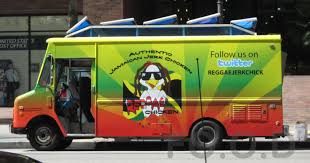
CU Blog - Caribbean Jobs - Attitudes - Images of the Diaspora - Photo 2It is the strong urging of every Caribbean empowerment plan to minimize the size of the Diaspora. We would prefer to keep our people and our educated work force “home” in the homeland. But it is what it is. Wishing alone will not accomplish this goal – there must be real solutions. This is the purpose of the Go Lean…Caribbean roadmap: to compose, communicate and compel solutions back in the Caribbean homeland. How, what, when? The Go Lean book also details a series of community ethos, strategies, tactics, implementations and advocacies to impact the region, member-states, cities and communities economic prospects:

Community Ethos – Deferred Gratification Page 21
Community Ethos – Economic Principle – Economic Systems Influence Choices & Incentives Page 21
Community Ethos – Economic Principle – Voluntary Trade Creates Wealth Page 21
Community Ethos – Job Multiplier Page 22
Community Ethos – Lean Operations Page 24
Community Ethos – Ways to Impact the Future Page 26
Community Ethos – Ways to Foster Genius Page 27
Community Ethos – Ways to Help Entrepreneurship Page 28
Community Ethos – Ways to Impact Research & Development Page 30
Community Ethos – Ways to Promote Happiness Page 36
Community Ethos – Ways to Impact the Greater Good Page 37
Strategy – Mission – Facilitate Job-Creating Industries Page 46
Tactical – Fostering a Technocracy Page 64
Tactical – Tactics to Forge an $800 Billion Economy – High Multiplier Industries Page 70
Tactical – Separation of Powers – Self-Governing Entities Page 80
Implementation – Ways to Pay for Change Page 101
Implementation – Steps to Implement Self-Governing Entities Page 105
Implementation – Ways to Deliver Page 109
Implementation – Reasons to Repatriate to the Caribbean Page 118
Planning – Ways to Make the Caribbean Better Page 131
Planning – Ways to Better Manage Caribbean Image Page 133
Advocacy – Ways to Grow the Economy Page 151
Advocacy – Ways to Create Jobs Page 152
Advocacy – Ways to Improve Emergency Management Processes and Systems Page 196
Advocacy – Ways to Foster Technology Page 197
Advocacy – Ways to Impact Hollywood Page 203
Advocacy – Ways to Impact the Diaspora Page 217
Appendix – Job Multipliers Page 259

With some measure of success, we should be able to reduce the size of the Diaspora, repatriating many to return to the homeland. Even more so, we should reduce the “push and pull” factors that lead many to abandon the region in the first place. We want North America (and Europe) laughing with us, not at us!

Other subjects related to job empowerments (and job losses) for the region have been blogged in other Go Lean…Caribbean commentary, as sampled here:

https://goleancaribbean.com/blog/?p=2003 Where the Jobs Are – One Scenario for Creating Caribbean Jobs
https://goleancaribbean.com/blog/?p=1698 STEM Jobs Are Filling Slowly
https://goleancaribbean.com/blog/?p=1683 British public sector workers (Afro-Caribbeans) strike over ‘poverty pay’
https://goleancaribbean.com/blog/?p=1596 Book Review: ‘Prosper Where You Are Planted’
https://goleancaribbean.com/blog/?p=1433 Caribbean loses more than 70 percent of tertiary educated to brain drain
https://goleancaribbean.com/blog/?p=1256 Traditional 4-year Colleges – Terrible Investment for Region and Jobs
http://goleancaribbean.com/blog/?p=857   Caribbean Image: Dreadlocks
https://goleancaribbean.com/blog/?p=398 Self-employment on the rise in the Caribbean
https://goleancaribbean.com/blog/?p=273 10 Things We Don’t Want from the US – Discrimination of New Immigrations

CU Blog - Caribbean Jobs - Attitudes - Images of the Diaspora - Photo 3The purpose of this roadmap is to make the Caribbean homeland, a better place to live, work and play. Comedy falls under the “Play” category. With all the emphasis on jobs, work ethic, image and opportunities, there is room for fun too, or better stated: funny. This dialogue from the skit in the foregoing VIDEO is just plain funny:

Father: “What happened to that boy you were dating with those 100 jobs?”
Daughter: “Him dead now”
Father/Mother: “What?! That means there are 100 jobs open”.
Father: “Where’s my newspaper?”

If only we were not the “butt” of the joke!

Download the free e-Book of Go Lean … Caribbean – now!

—————————————————————————

Appendix – Cited References

a. Posted September 26, 2012; retrieved August 17, 2014 from:
http://m.ibtimes.com/caribbean-americans-invisible-minority-seeking-identity-affirmation-795709

b. Posted August 6, 2013; retrieved August 17, 2014 from: http://newsone.com/2662081/black-unemployment-rate-2/

c. Posted November 2013; retrieved August 17, 2014 from: http://www.laprogressive.com/african-american-teen-unemployment/
 

Share this post:
, , , ,

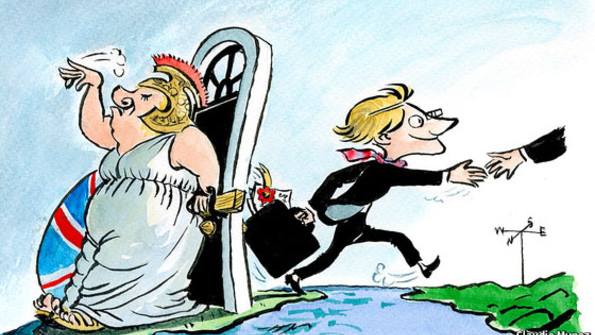
Britain’s Neglected Diaspora

Go Lean Commentary

Oh, how the mighty has fallen!

It is not only the Third World that struggles with brain drain. According to the foregoing news article, Great Britain, one of the world’s richest economies, also has a problem keeping their highly skilled workers as home. Accordingly, the article reports that there are over 5 million British expatriates living abroad.

Title: Message to the British Diaspora: “… and don’t come back”

CU Blog - Britain's neglected diaspora - Photo 1

Sub-title: Some 5 million Britons live abroad. The country could do far more to exploit its high-flying expats

When British politicians talk about winning the “global economic race” (as they often do) they have athletes like Gregor Wilson in mind. Mr. Wilson taught himself to code as a child. He started and built his first company while at university and sold it on graduating. His second venture, a software firm, is booming and will soon be ready to take on more staff. He is also preparing to leave Britain for good.

In the popular imagination, British expats are leathery retirees in the Mediterranean. But from 2006 onwards the weak pound, the bursting of Spain’s property bubble and rising taxes in France made the costas less attractive. The number of old Britons emigrating annually has more than halved since then. Dean Blackburn, head of HSBC Expat, part of the high-street bank, says that a different breed of emigrant is now on the march: the ambitious graduate bound for North America or Asia.

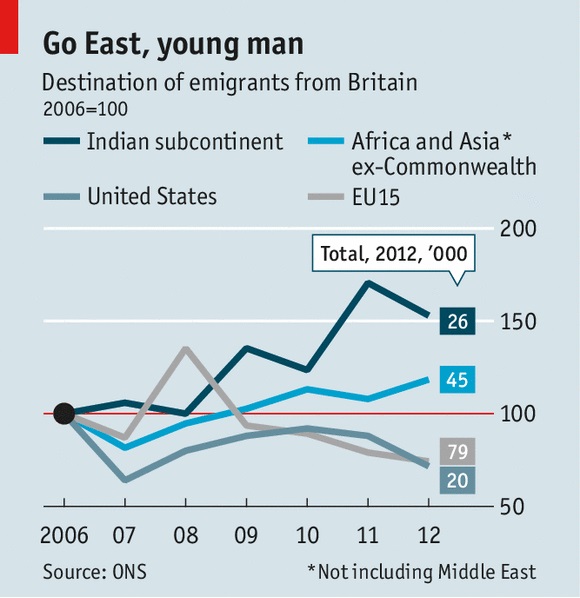
CU Blog - Britain's neglected diaspora - Photo 2The sharpest rise has been among those moving to the glittering East (see chart). Mr Wilson will build his business in Hong Kong. The web, along with the reach of the English language and the cachet of a British degree, gives young people like him opportunities undreamed-of by their parents’ generation. They are also un-tethered for longer: on average, they buy a house and form a family later in life than did previous generations. Figures from the Office for National Statistics show that, since the eve of the economic crisis, emigration is down by 19% overall but up by 8% among 15- to 24-year-olds.

High housing costs help to drive young folk abroad. For the monthly rent on a rabbit hutch anywhere near central London, graduates live grandly elsewhere. “We can afford to travel around Australia, rent an apartment with a sea view and save some money,” explains Emma, a publisher and recent Oxford graduate who moved to Melbourne last year. Those with advanced degrees are especially likely to leave for countries where pay and research facilities are better.

This is regrettable. Britain’s productivity rate is puny; firms and factories badly need such skilled employees. But it is also an opportunity—which the country is squandering.

According to the World Bank, the British diaspora (at nearly 5m people, roughly the size of Scotland) is the largest of any rich country and the eighth biggest overall. Britain’s many expats could strengthen its trading links, channel investment into its economy and generally burnish the national brand. But Britain’s government seems to have “no coherent strategy” for engaging with them, says Alan Gamlen of the Oxford Diasporas Programme, a research unit at OxfordUniversity.

Of 193 UN member states, 110 have formal programmes to build links with citizens abroad. Britain is not one of them. The Foreign and Commonwealth Office’s database of Britons abroad is patchy. Of all the high-flying expats with British passports your correspondent asks, only one—Danny Sriskandarajah, a migration expert based in South Africa—has had any contact with local embassies or with UKTI, Britain’s trade-promotion body. And his Indian friend has received much more attention from his consulate.

Indeed, India is a trailblazer in this field. It has an entire ministry for its emigrants. Mr. Gamlen says it partly has this to thank for the success of its IT industry, built by Indians lured home from Silicon Valley and Europe. Other countries are similarly welcoming. Italy and France even reserve parliamentary seats for their diasporas.

The British government would probably have to work harder than most to sustain ties with the country’s expats. Britons are relatively good at melting into other countries without trace. They are a individualistic bunch, have Commonwealth links and a native language that often makes it easy to integrate.

Kiwi seeds
New Zealand offers a good model for Britain’s hands-off diplomats to emulate. Wellington has spent 30 years encouraging firms and philanthropists to root out Kiwis abroad. Its proudest achievement is the Kiwi Expat Association, a public-private partnership that supports and connects overseas New Zealanders through social media and networking events, and helps them return home if they so wish. Britain might also make it easier to bring spouses into the country. Expats who want to move back with their non-British partners often collide with their home country’s ever-tougher immigration regime.

If Britain does not want its talented globetrotters, others do. Germany actively recruits Britons to take apprenticeships there. Middle Eastern governments tour British universities doling out visas. Mr. Wilson was contacted out of the blue by the Chinese authorities, who invited him to relocate his firm and offered to pay for his flight. “America and China seem really keen to attract us,” he says. “Britain just doesn’t seem that interested.”
The Economist Magazine – (Posted 08/09/2014) –
http://www.economist.com/news/britain/21611102-some-5m-britons-live-abroad-country-could-do-far-more-exploit-its-high-flying-expats-and?fsrc=nlw

The analysis is straight forward, this is Globalization 101. In a global economy, the economic rules of supply and demand are magnified globally. Highly skilled individuals are a commodity that is in demand, customers for that commodity emerged from all corners of the earth.

For the Caribbean, the lessons are very pointed, the exacerbated brain drain, estimated at 70%, with one country Guyana registering a 81% ratio, will not go away on its own. There must be a concerted effort of mitigations and solutions to remediate the problem. The book Go Lean…Caribbean is the concerted mitigation effort on behalf of the Caribbean region. The book Go Lean…Caribbean serves as a roadmap for the introduction and implementation of the technocratic Caribbean Union Trade Federation (CU).

This roadmap is for the elevation of Caribbean society, including the Diaspora. There is no laissez-faire attitude toward this population, there are specific missions to impact the Diaspora into the effort to empower the Caribbean. In fact, the prime directives of the CU are presented as the following 3 statements:

  • Optimization of the economic engines in order to grow the regional economy to $800 Billion & create 2.2 million new jobs.
  • Establishment of a security apparatus to protect the resultant economic engines.
  • Improve Caribbean governance to support these engines.

The book posits that, just like Great Britain in the foregoing article, the Caribbean is in crisis with this brain drain problem. This point is stressed early in the book (Page 13) in the following pronouncements in the Declaration of Interdependence:

 xix.   Whereas our legacy in recent times is one of societal abandonment, it is imperative that incentives and encouragement be put in place to first dissuade the human flight, and then entice and welcome the return of our Diaspora back to our shores. This repatriation should be effected with the appropriate guards so as not to imperil the lives and securities of the repatriated citizens or the communities they inhabit. The right of repatriation is to be extended to any natural born citizens despite any previous naturalization to foreign sovereignties.

xx.   Whereas the results of our decades of migration created a vibrant Diaspora in foreign lands, the Federation must organize interactions with this population into structured markets. Thus allowing foreign consumption of domestic products, services and media, which is a positive trade impact. These economic activities must not be exploited by others’ profiteering but rather harnessed by Federation resources for efficient repatriations.

This commentary previously related details of the vibrant Caribbean Diaspora, such as the causes of emigration, efforts to reduce the “push-and-pull” factors and the region’s continuous interaction with the “exile community”, in these earlier Go Lean blogs:

https://goleancaribbean.com/blog/?p=1896 American “Pull” Factors – Crisis in Black Homeownership
https://goleancaribbean.com/blog/?p=1698 American “Pull” Factors – STEM Jobs Are Filling Slowly
https://goleancaribbean.com/blog/?p=1683 British public sector workers strike over ‘poverty pay’
https://goleancaribbean.com/blog/?p=1596 Book Review: ‘Prosper Where You Are Planted’
https://goleancaribbean.com/blog/?p=1433 Caribbean loses more than 70 percent of tertiary educated to brain drain
https://goleancaribbean.com/blog/?p=1350 PayPal expands payment services to 10 markets
https://goleancaribbean.com/blog/?p=1296 Remittances to Caribbean Increased By 3 Percent in 2013
https://goleancaribbean.com/blog/?p=1256 Traditional 4-year College Degree are Terrible Investments for the Caribbean Region
https://goleancaribbean.com/blog/?p=841 Having Less Babies is Bad for the   Economy
https://goleancaribbean.com/blog/?p=740 Trade/Foreign Mission Offices – Why not … a profit center?

Losing a portion of  any population is bad for any economy. But losing large portions of a skilled population, is worst still as it creates a debilitating brain drain.

So how do we, in the Caribbean, find success when even John Bull (metonym referring to England) has failed? The foregoing article identifies a best practice: Diaspora outreach. This plan requires capturing a database of all Caribbean Diaspora and their legacies, a natural feature of the myCaribbean.gov social media site.

The Go Lean roadmap spells out the full details of the plan to engage the Diaspora residing, working, and studying in foreign lands. (Many students study abroad and never return “home”). The goal is to expand trade and absolutely-positively encourage a repatriation to their Caribbean homelands.

The CU will surely not abandon their Caribbean expatriates, even though these ones may have abandoned the Caribbean.

In line with the foregoing article, the Go Lean book details a series of community ethos, strategies, tactics, implementations and advocacies to foster the best practices in Diaspora outreach, thus furthering interaction with far-flung Caribbean stakeholders:

Community Ethos – Deferred Gratification Page 21
Community Ethos – People Respond to Incentives Page 21
Community Ethos – Economic Systems Influences Choices & Incentives Page 21
Community Ethos – The Consequences of Choice Lie in the Future Page 21
Community Ethos – Job Multiplier Page 22
Community Ethos – Lean Operations Page 24
Community Ethos – Return on Investments Page 24
Community Ethos – Ways to Impact the Future Page 26
Community Ethos – Ways to Help Entrepreneurship Page 28
Community Ethos – Ways to Impact Research & Development Page 30
Community Ethos – Ways to Manage Reconciliations Page 34
Community Ethos – Ways to Impact the Greater Good Page 37
Strategy – Mission – Repatriate Diaspora Page 46
Strategy – Customers – Diaspora Page 47
Tactical – Separation of Powers – Department of State – Foreign Affairs Page 80
Implementation – Year 1 / Assemble Phase Page 96
Implementation – Year 4 / Repatriate Phase Page 98
Implementation – Improve Mail Services – e-Mail for Diaspora Page 108
Implementation – Ways to Deliver Page 109
Implementation – Ways to Impact Social Media Page 111
Implementation – Trade Mission   Objectives Page 117
Implementation – Reasons to Repatriate Page 118
Implementation – Ways to Benefit from Globalization Page 119
Planning – Ways to Improve Trade Page 128
Advocacy – Ways to Grow the Economy Page 151
Advocacy – Ways to Create Jobs Page 152
Advocacy – Ways to Improve Education Page 159
Advocacy – Ways to Foster Technology Page 197
Advocacy – Ways to Impact the Diaspora Page 217
Advocacy – Ways to Impact British Territories Page 245
Appendix – Analysis of Caribbean Diaspora by Country of Residence Page 267
Appendix – Analysis of Caribbean Remittances Page 268
Appendix – Analysis of Caribbean Emigration Page 269
Appendix – Alternative Remittance Modes Page 270
Appendix – Puerto Rican Diaspora Population in the US Page 304

This roadmap focuses on the Caribbean, arguably the world’s best address, not Great Britain, a less than tropical, less than paradisiacal land . Now is the time for all of the Caribbean, the people and governing institutions, to lean-in for the changes in this Go Lean … Caribbean roadmap.

This is a big deal for the region. This roadmap is not just a plan, its a prescription for what ails the region; it advocates for the CU to serve as a delivery vehicle to carry the hopes and dreams of generations of Caribbean residents…and Diaspora.

The region needs this delivery; the region needs this cure. The region needs this roadmap to be a better place to live, work and play.

Download the book Go Lean … Caribbean – now!


Share this post:
, , , ,
[Top]

Role Model Berry Gordy – No Town Like Motown

Go Lean Commentary

CU Blog - Role Model Berry Gordy - No Town Like Motown - PhotoThis is a memorable dialogue:

Berry Gordy: You went from singing love songs to now anti-war songs. I understand you want to reflect change in society…

Marvin Gaye (interrupting): I don’t want to reflect change, I want to effect change.

Thus the alignment of the Broadway play Motown, The Musical and the book Go Lean…Caribbean. It is an established fact that any difficult subject can be more easily communicated if backed-up by a catchy melody and rhyming words. An underlying theme of the above-cited play, based on the autobiographical story of Motown founder Berry Gordy, is that music effected change in America and forged integration and elevation of society.

By: Robert Simonson

Title: No Town Like Motown: Navigating the Life, Times and Tunes of Starmaker Berry Gordy

First-time Broadway director Charles Randolph-Wright is at the helm of one of the more pulse-quickening titles of the season, Motown: The Musical, about record producer Berry Gordy’s heyday.

In terms of backstage politics, Charles Randolph-Wright may have the trickiest job of any director working on Broadway this spring. He is staging Motown: The Musical, a musically overflowing new show about the life and career of recording mogul Berry Gordy.

One of his producers is Berry Gordy as well. Gordy completes his hat trick by having written the libretto for the piece.

“Sometimes I’ll forget the person I’m talking to is the same person that is depicted on stage,” said Randolph-Wright.

One imagines such waters are difficult to navigate. What if Producer Gordy tells the director not to interfere with Writer Gordy’s work? “It’s something we talked about from the beginning,” said Randolph-Wright. “He’s very open as to what the story is.”

The show, which is playing at the Lunt-Fontanne Theatre, is largely based on Gordy’s 1995 memoir “To Be Loved: The Music, the Magic, the Memories of Motown.”

“He wrote the book 20 years ago,” Randolph-Wright explained. “Now he has an even different perspective on that. You have to ask, ‘How do we tell the story of this big character, who is based on this real person, and yet that person is involved with the creation of the show, and is working on it?’ It’s a challenge, but the way we have worked is a very open process.”

Randolph-Wright recalled one particular moment when Gordy confided in him an episode from his past when he was at his most vulnerable. “We were walking around and he told me this story. I couldn’t believe it. I said, ‘You want that on stage?’ I thought it was very brave. But at this point at his life, what does he have to prove?”

Randolph-Wright added that Gordy, now 83, has no trouble juggling his many roles. After all, it is something he’s been doing for decades. “In most cases that would be a challenge,” he said. “But he spent his whole career wearing so many different hats. When I’m with the writer, that’s who I’m with. The producer is a different person. I am always with the person who’s doing all those things, but in each separate instance I’m with who Berry is at that moment.”

Charles Randolph-Wright was one of several directors who interviewed with Gordy. From the start, he thought he was right for the project. “This is in my DNA,” he said. He doesn’t mean that he grew up with Motown’s music (as many of us did) — though that is part of it. His connection to the material is more complex. “I’ve done every angle of this story. I’ve been in a music group. I’ve danced to the music. I’ve sung it. And I’ve lived in all those worlds he did, though not the same way he did.”

When the marquee was hung on the Lunt-Fontanne, Randolph-Wright glanced down the street and noticed he was only yards away from the Imperial Theatre. In the early 1980s he passed through the stage door of that theatre every night as a member of the original cast of Dreamgirls — the fictional account of the rise of The Supremes, a group Gordy helped found. “What’s happened in those years from that show to this show, it’s been an amazing journey,” he mused. “From the Broadway musical version of this story to the real story.”

Motown‘s greatest asset is the iconic song­book the Detroit-based record label produced; and they’ll get ample helpings of that hit parade, including songs made famous by Smokey Robinson and The Miracles (“Shop Around”), Diana Ross and The Supremes (“Stop! In the Name of Love”), Marvin Gaye (“What’s Going On”), Stevie Wonder, The Temptations, and Michael Jackson and The Jackson Five (“I Want You Back”).

Randolph-Wright said it was hard, given the rich catalogue, deciding which songs to keep in the show and which to leave out. “Every song you hear in this show, you want to hear,” he said. “But how do you put this journey into two and a half hours? There’s so much, so many people. They’re all part of this story. But we found out how to take the story and condense what could easily have been a miniseries.” He said he wouldn’t know the exact song count until opening night, but promised the show would contain more numbers than does your average musical.

To sing the classic pop hits, the director has assembled a large cast, including Valisia LeKae as Diana Ross and Charl Brown as Smokey Robinson — both particular Gordy favorites. Brandon Victor Dixon will play Gordy himself.

Randolph-Wright said he didn’t want note-by-note recreations of their numbers, “I want [the actors] to evoke these artists, not copy them, not be an impersonator. But it has to be the Motown sound. The actors have been tremendous in finding those things that make them seem real as those people.”

The tunes will be used in various ways. Some will be presented as straightforward performances; others will be used as narrative tissue, to further along the story. In addition, the score will include three or four new songs, written by Gordy expressly for the musical.

The director has found it a particular delight to see Gordy returning to his songwriting roots. “We forget that he wrote a lot of those early hits. Over the years, as Motown grew, he became less about being an artist, and more about being a businessman. It’s thrilling to see him become completely creative again.”

(This feature appears in the March 2013 issue of Playbill magazine.)
Play Bill Broadway Magazine/Web Site (Posted March 10, 2013; Retrieved 08-06-2014) – http://www.playbill.com/news/article/175778-No-Town-Like-Motown-Navigating-the-Life-Times-and-Tunes-of-Starmaker-Berry-Gordy

Like Berry Gordy, the prime directive of the Go Lean book is also to elevate society, but in the Caribbean, not in America, by integrating a confederated brotherhood. In fact, the declarative statements are as follows:

  • Optimization of the economic engines in order to grow the regional economy to $800 Billion & create 2.2 million new jobs.
  • Establishment of a security apparatus to protect the resultant economic engines.
  • Improve Caribbean governance to support these engines.

Berry Gordy accomplished his mission through music/song and entertainment. The book Go Lean…Caribbean strives to accomplish its mission with the introduction and implementation of the technocratic Caribbean Union Trade Federation (CU). Berry Gordy is hereby recognized as a role model that the Caribbean can emulate. He has provided a successful track record of forging change, overcoming incredible odds, managing crises to successful conclusions and rebooting failing institutions. The Go Lean book, serving as a roadmap, initiates with a “Prologue” that identifies community ethos that must be embraced for any chance of success and permanent change. This list of ethos from the book corresponds with the history of Berry Gordy, as portrayed in the Motown, The Musical Broadway play:

Go Lean…Caribbean Berry Gordy Role Modeling
Job Multipliers Economic Opportunities
Future Focus Crossover / Integration
Foster Genius Producing Artists
Help Entrepreneurship New Record Labels, Movies
Promote Intellectual Property Music Business Excellence
Research & Development New Artists Development
Bridge the Digital Divide Embrace of New Media
Improve Negotiations Hollywood Interactions
Impact Turn-Around Move from Detroit
Manage Reconciliations Motown Reunions
Improve Sharing Common Studios/Producers
Promote Happiness Music Essential to Life
Greater Good Impact Society

“No town like Motown” is the title of the foregoing article from the PlayBill magazine. But the Berry Gordon legacy is not the town of Detroit, but rather the musical contributions of his movement. It should be noted that Gordy moved the record company, Motown, out of the failed-city of Detroit, early in the 1970’s. So Gordy’s legacy is really how he grew in his management of change!

According to the opening dialogue, Berry Gordy was a reluctant advocate of change; he tried to be a businessman first. In the end, he conducted a lot of business, but he effected change as well. Thank you Marvin Gaye for that inspiration, for impacting Berry Gordy with the lesson that “one man, and his music” can make difference.

The Go Lean book accepts that the business of music can have a major impact on Caribbean society and the world. Already, this commentary has analyzed how a Caribbean music artist has made an impact on the world scene, with this post:

https://goleancaribbean.com/blog/?p=866 Bob Marley: The legend lives   on!

In the Go Lean roadmap to elevate the Caribbean, the eco-systems of music get due respect. This point is detailed in the  Declaration of Interdependence at the outset of the book, pronouncing this need for regional solutions (Page 14):

xxxii. Whereas the cultural arts and music of the region are germane to the quality of Caribbean life, and the international appreciation of Caribbean life, the Federation must implement the support systems to teach, encourage, incentivize, monetize and promote the related industries for arts and music in domestic and foreign markets. These endeavors will make the Caribbean a better place to live, work and play.

The Go Lean roadmap accepts that change has come to the music business. It is no longer the same world that was dominated by Berry Gordy, and his cast of musical geniuses. Now, there is the need for some technocratic facilitations. The book posits that this burden is too big for any one Caribbean member-state, and thus the collaboration efforts of the CU is necessary, as the strategy is to confederate all the 30 member-states of the Caribbean despite their language and legacy, into an integrated “single market”. This will allow for better leverage of the consumer market for the consumption of music. From this eco-system, should emerge our own generations of Berry Gordy’s in the Caribbean to impact the world with their art, music, and contributions.

Today, most music is consumed digitally with a lot of retailing via the world wide web. This changed landscape now requires new tools and protections, like electronic payment systems, digital rights management and Performance Rights Organizations. The Go Lean/CU roadmap details these solutions. With these efforts and investments, the returns will be undeniable. The CU is designed to do the heavy-lifting of organizing Caribbean society, and interacting with the wide-world to better reap the benefits of music and related eco-systems. The following list details the strategies, tactics, implementations and advocacies to foster the next Motown movement, Caribbean style:

Community   Ethos – Forging Change Page 20
Community Ethos – Lean Operations Page 24
Community   Ethos – Return on Investments Page 24
Strategy –   Strategy – Caribbean Vision Page 45
Strategy –   Agents of Change – Globalization Page 57
Tactical –   Growing the Caribbean Economy to $800   Billion Page 67
Separation   of Powers – Central Bank – Electronic Payment Deployments Page 73
Tactical –   Separation of Powers – Patents & Copyrights Page 78
Separation   of Powers – Culture Administration Page 81
Planning –   Ways to Make the Caribbean Better Page 131
Planning    – Lessons Learned from Detroit Page 140
Advocacy   – Ways to Grow the Economy Page 151
Advocacy   – Ways to Create Jobs Page 152
Advocacy –   Reforms for Banking Regulations Page 199
Advocacy –   Ways to Impact Hollywood Page 203
Advocacy –   Ways to Promote Music Page 231
Appendix –   Caribbean Music Genres Page 347
Appendix –   Protecting Music Copyrights Page 351

The Go Lean roadmap has simple motives: enable the Caribbean to be a better place to live, work and play. One man, or woman, can make a difference in this quest. We want to foster the next generation of “stars’ in music and other fields of endeavor.

According to his autobiography and the Broadway musical, Berry Gordy was inspired by other role models in his youth, i.e. Joe Louis. Now the world in general, the Caribbean is particular, is being inspired by Berry Gordy.

This is how to reflect and effect change in society. That opening dialogue with Marvin Gaye and Berry Gordy is captured for our inspiration. The end result:

Mother, mother
There’s too many of you crying
Brother, brother, brother
There’s far too many of you dying
You know we’ve got to find a way
To bring some lovin’ here today

Father, father
We don’t need to escalate
You see, war is not the answer
For only love can conquer hate
You know we’ve got to find a way
To bring some lovin’ here today

Download the book Go Lean … Caribbean – now!

Share this post:
, , , , ,
[Top]

The Crisis in Black Homeownership

Go Lean Commentary:

The United States of America has been the best economic manifestation in the history of mankind, (as declared in the book Go Lean…Caribbean Page 67), yet the experience has not been the same for all of its citizens. This definitely applies to the “black and brown” populations. The Caribbean Diaspora fits this classification and their experience fits 100% to the events related in the below news article.

The US is the “land of the free and the home of the brave”, but some restrictions apply. This reality is not new, as racial disparities have long existed in the history of America. But after a major social revolution in the 1960’s, positive change came to American minorities, following by decades of progress.

Then 2008 happened …

That year saw the crisis of the Great Recession where American society lost $11 Trillion in net worth; then later regained $13.5 Trillion; (Go Lean book Page 69). According to the foregoing article, the Great Recession losses were not evenly distributed; nor was the subsequent recovery – those who lost the net worth (Middle Class) were not the ones who recovered (One Percent).

How the recession turned owners into renters and obliterated Black American wealth.

By: Jamelle Bouie

CU Blog - The Crisis in Black Homeownership - PhotoIn 2005, three years before the Great Recession, the median black household had a net worth of $12,124. Yes, this was far behind the median white household—which had a net worth of $134,992—but it was a huge improvement from previous decades, in which housing discrimination made wealth accumulation difficult (if not impossible) for the large majority of African-American families.

By the official end of the recession in 2009, median household net worth for blacks had fallen to $5,677—a generation’s worth of hard work and progress wiped out. (The number for whites, by comparison, was $113,149.) Overall, from 2007 to 2010, wealth for blacks declined by an average of 31 percent, home equity by an average of 28 percent, and retirement savings by an average of 35 percent. By contrast, whites lost 11 percent in wealth, lost 24 percent in home equity, and gained 9 percent in retirement savings. According to a 2013 report [a] by researchers at BrandeisUniversity, “half the collective wealth of African-American families was stripped away during the Great Recession.”

It was a startling retrenchment, creating the largest wealth, income, and employment gaps since the 1990s. And, if a new study [b] from researchers at CornellUniversity and RiceUniversity is any indication, these gaps are deep, persistent, and difficult to eradicate.

In the study, called “Emerging Forms of Racial Inequality in Homeownership Exit, 1968–2009,” sociologist Gregory Sharp and demographer Matthew Hall examine the relationship between race and risk in homeownership. Simply put, African-Americans are much more likely than whites to switch from owning homes to renting them.

“The 1968 passage of the Fair Housing Act outlawed housing market discrimination based on race,” explained Sharp in a press release. “African-American homeowners who purchased their homes in the late 1960s or 1970s were no more or less likely to become renters than were white owners. However, emerging racial disparities over the next three decades resulted in black owners who bought their homes in the 2000s being 50 percent more likely to lose their homeowner status than similar white owners.”

This wasn’t a matter of personal irresponsibility. Even after adjusting for socio-economic characteristics, debt loads, education, and life-cycle traits like divorce or job loss, blacks were more likely to lose their homes than whites.

If you’re familiar with American history and housing policy, this shouldn’t come as a surprise. The explicit housing discrimination of the mid-20th century has left a mark—arguably a scar—on the landscape of American homeownership. The combination of red-lining, block-busting, racial covenants, and other discriminatory measures means that, even now, a majority of blacks live in neighborhoods with relatively poor access to capital and mortgage loans. What’s more, this systematic discrimination has left many black households unable to afford down payments or other housing costs, even if loans are available.

And in the event that black households are able to save and afford a home, they aren’t as financially secure as their white counterparts. To wit, middle-class African-Americans are more likely to belong to the lower middle class of civil servants and government workers—professions that, in the last five years, have been slashed as a consequence of mass public-sector downsizing [c]. All else being equal, a black schoolteacher who loses her job to budget cuts is less likely to have savings—and thus a safety net—than her white counterpart.

But this isn’t just a story of legacies and effects. In addition to showing the consequences of past discrimination, Sharp and Hall argue that African-Americans have been victimized by a new system of market exploitation. Banks like Wells Fargo steered [d] blacks and other minorities into the worst subprime loans, giving them less favorable terms than whites and foreclosing on countless homes. In a 2012 lawsuit [e], the ACLU and National Consumer Law Center alleged that the now-defunct New Century Financial, working with Morgan Stanley, pushed thousands of black borrowers into the riskiest loans, leaving many in financial ruin. As early as 2005, the Wall Street Journal reported [f] that blacks were twice as likely to receive subprime loans. And in a New York University study published last year [g], researchers found that black and Hispanic families making more than $200,000 a year were more likely to receive subprime loans than white families making less than $30,000.

Together, all of this means that—according to Sharp and Hall—African-Americans are 45 percent more likely than whites to lose their homes. That means they’re more likely to lose their accumulated wealth and to slide down the income ladder, and less likely to pass the advantages of status and mobility to their children.

Apropos of that observation, recent data from the Bureau of Labor Statistics [h] shows an incredible level of youth unemployment for blacks and Latinos. More than 21 percent of African-Americans aged 16 to 24 are out of work, compared with a national average of 14.2 percent. For black teenagers in particular, joblessness soars to nearly 40 percent. It’s a catastrophe with serious economic consequences. The Center for American Progress estimates [i] that the young adults who experienced long-term unemployment during the worst of the recession will lose more than $20 billion in earnings over the next 10 years. And given the slow recovery, odds are good they’ll never recover those lost earnings.

It’s tempting to treat these as subsets of broader problems: poor assistance to homeowners and too much austerity. But they’re not. Even during the boom economy of the 1990s, black employment lagged behind the national average. And the racial wealth gap is a persistent fact of American life.

Likewise, the challenges of black homeownership are a function of discriminatory housing policy [j], as are a whole host of other problems, from mass incarceration and overly punitive policing to poor air quality [k] and food access. These challenges are heavily location-dependent, which is another way to say they are heavily racialized and most prevalent in the segregated, working-class or low-income communities that characterize life for most African-Americans [l], even those with middle-class incomes.

For reasons both political and ideological, it’s nearly verboten in mainstream conversation to argue that racialized problems require race-conscious solutions. Knowing what we know about the demographics of foreclosures, for example, we should ensure any program to help underwater homeowners includes a specific measure to assist black victims of predatory lending, who may need additional help to get on sure footing.

For more than anyone else, this is a message for liberals and progressives, who—for all of their racial sensitivity—are still reluctant to tackle the economic dimensions of racism, even as they represent the vast majority of nonwhite voters and draw critical support from African-American constituencies. It’s how Elizabeth Warren could give “11 Commandments for Progressives” [m] —and receive huge applause—without mentioning the deep problems of racial inequality. One of her commandments is “that no one should work full-time and still live in poverty, and that means raising the minimum wage.” But solving this problem for African-Americans and Latinos—who tend to live in areas that are segregated from job opportunities—is very different than solving it for whites.

While conservatives and Republicans can play a role here, it’s Democrats who are committed to reducing income inequality and bringing balance to our lopsided economic system. Success on those fronts requires a return to race-conscious policymaking, from programs to increase the geographic mobility of low-income workers—relocation grants for individuals or transportation grants for communities with a spatial mismatch between jobs and housing—to public works programs aimed at low-income minority communities, to race-based affirmative action as a way to boost a flagging black middle class.

There’s little in American life that escapes the still-powerful pull of past and present racism, and effective policymaking—to say nothing of effective problem-solving—requires a response to that racism. Otherwise, we entrench the same disparities for a new generation.

——–

Jamelle Bouie is a Slate staff writer covering politics, policy, and race.
The Slate – Daily Magazine for the Web – Posted 07-24-2014; retrieved 08-04-2014
http://www.slate.com/articles/news_and_politics/politics/2014/07/black_homeownership_how_the_recession_turned_owners_into_renters_and_obliterated.html

The points of this foregoing article aligns with the Go Lean book and the collection of blogs/commentaries. The book posits that the crisis persists for the Caribbean and their Diaspora in North America and Europe. What’s more, this movement asserts that this crisis, any crisis, is a terrible thing to waste.

800px-Statue_of_Liberty,_NYThe Caribbean Diaspora have fled their Caribbean homelands over past decades in search of better economic opportunities. It is now the conclusion that many of these “lands of refuge” are rigged in favor of certain ethnic groups; those groups do not include the “black and brown” of the Caribbean. This commentary has relayed, repeatedly, that this Caribbean-bred demographic can do better at home … in the Caribbean. The following are related previous posts:

Unfortunately for the Caribbean, this societal abandonment has continued. Analysis by the Inter-American Development Bank asserts that the Caribbean continues to endure a brain drain of 70% among the college educated population; (https://goleancaribbean.com/blog/?p=1433).

This blog entry depicted how the Caribbean Diaspora that fled to Great Britain has not fared well; (https://goleancaribbean.com/blog/?p=1683)

In addition to economics, there is the concern for security and justice. This blog entry (https://goleancaribbean.com/blog/?p=546) related the dual standards of justice in the US, where all men are treated as equals (wink-wink), just some are more equal than others.

Yes, as the old adage relates: “the grass is not greener on the other side”. See this VIDEO here (Part 1 of 2):

(Click on first continuation video for Part 2 of 2 or click here: https://www.youtube.com/watch?v=gOS3BBmUxvs)

The assertion of the book Go Lean…Caribbean is that once the proposed empowerments are put in place, the Caribbean Diaspora should consider repatriating to their ancestral homelands.

Social Scientists maintain that when animals/mammals are confronted with threats, they have to choose between (stand and) fight or flight. For 50 years, the Caribbean citizens have defaulted to flight. Change has now come to the Caribbean. The book Go Lean…Caribbean serving as a roadmap for the introduction and implementation of the technocratic Caribbean Union Trade Federation (CU), hereby presents “stand and fight” options. This roadmap will spearhead the elevation of Caribbean society. The prime directives of the CU are presented as the following 3 statements:

  • Optimization of the economic engines in order to grow the regional economy & create 2.2 million new jobs at home.
  • Establishment of a security apparatus to protect the resultant economic engines.
  • Improve Caribbean governance to support these engines.

The book posits that the improved conditions projected over the 5 years of the roadmap will neutralize the impetus for Caribbean citizens to flee, identified as “push and pull” factors. This point is stressed early in the book (Page 13) in the following pronouncements in the Declaration of Interdependence:

xix.      Whereas our legacy in recent times is one of societal abandonment, it is imperative that incentives and encouragement be put in place to first dissuade the human flight, and then entice and welcome the return of our Diaspora back to our shores. This repatriation should be effected with the appropriate guards so as not to imperil the lives and securities of the repatriated citizens or the communities they inhabit. The right of repatriation is to be extended to any natural born citizens despite any previous naturalization to foreign sovereignties.

xx.   Whereas the results of our decades of migration created a vibrant Diaspora in foreign lands, the Federation must organize interactions with this population into structured markets. Thus allowing foreign consumption of domestic products, services and media, which is a positive trade impact. These economic activities must not be exploited by others’ profiteering but rather harnessed by Federation resources for efficient repatriations.

This foregoing article highlights the new realities ushered into the world as a result of the events of the Year 2008. The Go Lean book focuses heavy on this subject, even identifying this as a motivation in the same Declaration of Interdependence early in the book (Page 13):

xxv.   Whereas the legacy of international democracies had been imperiled due to a global financial crisis, the structure of the Federation must allow for financial stability and assurance of the Federation’s institutions. To mandate the economic vibrancy of the region, monetary and fiscal controls and policies must be incorporated as proactive and reactive measures. These measures must address threats against the financial integrity of the Federation and of the member-states.

The Go Lean roadmap proposes a community ethos in which economic principles are recognized as playing a crucial role in the chain-of-events that led to fight-or-flight decisions for Caribbean Diaspora. (These principles were always the reality, just not professionally managed as such). These principles are identified and qualified (Page 21) as follows:

1. People Choose
2. All Choices Involve Costs
3. People Respond to Incentives in Predictable Ways
4. Economic Systems Influence Individual Choices and Incentives
5. Voluntary Trade Creates Wealth
6. The Consequences of Choices Lie in the Future

These principles cannot be glossed over or handled lightly; this is why the Go Lean book contains 370 pages of finite details for managing economic change in the region. In addition to the assessments of the region’s standings, the book contains the following sample of community ethos, strategies, tactics, implementations and advocacies to impact the Caribbean homeland:

Community Ethos – Job Multiplier Page 22
Community Ethos – Lean Operations Page 24
Community Ethos – Return on Investments Page 24
Community Ethos – Ways to Impact the Future Page 26
Strategy – Competition – Remain Home –vs- Emigrate Page 49
Strategy – Agents of Change – Aging Diaspora Page 57
Tactical – Growing the Caribbean Economy to $800 Billion Page 67
Tactical – Separation of Powers – Versus Member-States Governments Page 71
Implementation – Year 1 / Assemble Phase Page 96
Implementation – Ways to Deliver Page 109
Implementation – Ways to Better Manage Debt Page 114
Implementation – Trade Mission Objectives Page 116
Implementation – Reasons to Repatriate Page 118
Anecdote – Experiences of a Repatriated Resident Page 126
Planning – 10 Big Ideas for the Caribbean Region Page 127
Planning – Lessons Learned from 2008 Page 136
Advocacy – Ways to Grow the Economy Page 151
Advocacy – Ways to Create Jobs Page 152
Advocacy – Ways to Improve Credit Ratings Page 155
Advocacy – Ways to Improve Housing Page 161
Advocacy – Ways to Impact Wall Street Page 200
Anecdote – Experiences of Diaspora Member Living Abroad Page 216
Advocacy – Ways to Impact the Diaspora Page 217
Advocacy – Ways to Help the Middle Class Page 223
Appendix – Caribbean Emigration Statistics Page 269
Appendix – Credit Ratings Agencies Role in 2008 Page 276

The Go Lean roadmap has simple motives: fix the problems in the homeland to make the Caribbean a better place to live, work and play. We want to keep Caribbean citizens in the Caribbean. There should be no need to go abroad and try to foster an existence in a foreign land. There is heavy-lifting wherever a person resides. Let’s do the “lifting” here, where at least we are at home and we are treated equitably.

Too many people left, yet have too little to show for it. Now is the time for all of the Diaspora (those in the US, and other countries) to lean-in for the empowerments described in the book Go Lean … Caribbean. We understand your pain, we have been impacted too. (The publishers of the book were entrenched in the Wall Street culture in 2008). This Big Idea now is to use the same energy and innovation to create solutions for Main Street – but not Main Street USA, rather Main Street Caribbean.

This is a dramatic change for the Caribbean, one that is overdue, an invitation to build an elevated society in the Caribbean that many had fled to find elsewhere, yet failed. We can make the Caribbean a better place to live, work and play. We can succeed here.

Download the book Go Lean … Caribbean – now!

———————————————————————————————–

Appendices:

a. Retrieved from https://www.evernote.com/shard/s4/sh/2f378f98-d21b-4f5b-89d4-c3a47419b0ad/479f14e61917697b135246e01d20f85f

b. Retrieved from http://news.rice.edu/2014/07/22/african-american-homeownership-increasingly-less-stable-and-more-risky-2/

c. Retrieved from http://www.epi.org/publication/public-sector-job-losses-unprecedented-drag/

d. Retrieved from http://articles.baltimoresun.com/2012-07-12/news/bs-md-ci-wells-fargo-20120712_1_mike-heid-wells-fargo-home-mortgage-subprime-mortgages

e. Retrieved from http://www.citylab.com/housing/2012/10/did-big-banks-subprime-mortgage-crisis-violate-civil-rights-law/3598/

f. Retrieved from http://online.wsj.com/news/articles/SB111318092881303093

g. Retrieved from http://www.citylab.com/housing/2013/08/blacks-really-were-targeted-bogus-loans-during-housing-boom/6559/

h. Retrieved from http://www.npr.org/blogs/codeswitch/2014/07/21/329864863/the-youth-unemployment-crisis-hits-african-americans-hardest

i. Retrieved from http://www.americanprogress.org/issues/labor/report/2013/04/05/59428/the-high-cost-of-youth-unemployment/

j. Retrieved from http://www.thedailybeast.com/articles/2014/03/13/how-we-built-the-ghettos.html

k. Retrieved from http://grist.org/climate-energy/before-repairing-the-climate-well-have-to-repair-the-impacts-of-racism/

l. Retrieved from http://www.slate.com/articles/news_and_politics/politics/2014/04/desean_jackson_richard_sherman_and_ black_american_economic_mobility_why.html

m. Retrieved from http://www.vox.com/2014/7/21/5918063/elizabeth-warrens-11-commandments-for-progressives-show-democrats


Share this post:
, , , , , ,
[Top]

Climate Change May Bring More Kidney Stones

Go Lean Commentary:

CU Blog - Climate Change May Bring More Kidney Stones - PhotoThe subject in the foregoing news article just cannot be ignored: Climate Change and personal health.

While this report was published by undisputed technocratic professionals, the Children’s Hospital of Philadelphia (CHOP), the publishers of the book Go Lean…Caribbean had engaged a similar analysis methodology: assessments based on hard evidence – number crunching (Big Data) and anecdotes – to reach their conclusions in the book that the Caribbean is in a state of crisis.

Both analyses are now aligned!

This subject of damaging health effects deriving from Climate Change aligns with Go Lean … Caribbean, as it posits that there are agents of change, including Climate Change, that the region is struggling to contend with, and that the negative consequences are already manifesting themselves in everyday Caribbean life, but the region as a whole and individual member-states, are not able, willing or equipped to mitigate the associated risks. The book portrays that the appropriate response requires heavy-lifting, and therefore proposes the Caribbean Union Trade Federation (CU) as a technocratic solution. The book serves as a roadmap for the introduction and implementation of the CU. This Go Lean roadmap describes the CU as the best solution for a concerted Caribbean response.

The CHOP research is published as follows:

CHOP-Led Research Finds Link between Hotter Days, Kidney Stones in U.S. Adults and Children
Contact: Ashley Moore, The Children’s Hospital of Philadelphia, 267-426-6071 or MooreA1@email.chop.edu

As daily temperatures increase, so does the number of patients seeking treatment for kidney stones. In a study that may both reflect and foretell a warming planet’s impact on human health, a research team found a link between hot days and kidney stones in 60,000 patients in several U.S. cities with varying climates.

“We found that as daily temperatures rise, there is a rapid increase in the probability of patients presenting over the next 20 days with kidney stones,” said study leader Gregory E. Tasian, MD, MSc, MSCE, a pediatric urologist and epidemiologist at The Children’s Hospital of Philadelphia (CHOP), who is on the staff of the Hospital’s Kidney Stone Crenter as well as the Hospital’s Center for Pediatric Clinical Effectiveness (CPCE).

Tasian, senior author Ron Keren, MD, MPH, also of CHOP and CPCE, and colleagues from other centers published their results today in Environmental Health Perspectives, the journal of the National Institute of Environmental Health Sciences. The Urologic Diseases in America Project, supported by the National Institute of Diabetes and Digestive and Kidney Diseases, sponsored the study.

The study team analyzed medical records of more than 60,000 adults and children with kidney stones between 2005 and 2011 in Atlanta, Chicago, Dallas, Los Angeles and Philadelphia, in connection with weather data. Tasian and colleagues described the risk of stone presentation for the full range of temperatures in each city. As mean daily temperatures rose above 50 F (10 C), the risk of kidney stone presentation increased in all the cities except Los Angeles. The delay between high daily temperatures and kidney stone presentation was short, peaking within three days of exposure to hot days.

Link between kidney stones and high temperatures
“These findings point to potential public health effects associated with global climate change,” said Tasian. “However,” cautions Tasian, “although 11 percent of the U.S. population has had kidney stones, most people have not. It is likely that higher temperatures increase the risk of kidney stones in those people predisposed to stone formation.” Higher temperatures contribute to dehydration, which leads to a higher concentration of calcium and other minerals in the urine that promote the growth of kidney stones.

A painful condition that brings half a million patients a year to U.S. emergency rooms, kidney stones have increased markedly over the world in the past three decades. While stones remain more common in adults, the numbers of children developing kidney stones have climbed at a dramatically high rate over the last 25 years. The factors causing the increase in kidney stones are currently unknown, but may be influenced by changes in diet and fluid intake. When stones do not pass on their own, surgery may be necessary.

The study team also found that very low outdoor temperatures increased the risk of kidney stones in three cities: Atlanta, Chicago and Philadelphia. The authors suggest that as frigid weather keeps people indoors more, higher indoor temperatures, changes in diet and decreased physical activity may raise their risk of kidney stones.

The researchers argue that the number of hot days in a given year may better predict kidney stone risk than the mean annual temperature. Atlanta and Los Angeles share the same annual temperature (63 F, or 17 C), but Atlanta has far more hot days than Los Angeles, along with nearly twice the prevalence of kidney stones.

Tasian added that while the five U.S. cities have climates representative of those found throughout the world, future studies should explore how generalizable the current findings are. Other studies should analyze how risk patterns vary in different populations, including among children, represented by a small sample size in the current study.

Global warming trend and kidney stone prevalence
The study’s broader context is in patterns of global warming. The authors note that other scientists have reported that overall global temperatures between 2000 and 2009 were higher than 82 percent of temperatures over the past 11,300 years. Furthermore, increases in greenhouse gas emissions are projected to raise earth’s average temperatures by 2 to 8 F (1 to 4.5 C) by 2100. “Kidney stone prevalence has already been on the rise over the last 30 years, and we can expect this trend to continue, both in greater numbers and over a broader geographic area, as daily temperatures increase,” concluded Tasian. “With some experts predicting that extreme temperatures will become the norm in 30 years, children will bear the brunt of climate change.”

More information:
Funds from the National Institutes of Health (grants HD060550 and DK70003), supported this study, along with a research fellowship from the Medical Research Council, U.K. In addition to their CHOP titles, Tasian and Keren are on the faculty of the Perelman School of Medicine at the University of Pennsylvania.

Co-authors of the study are Christopher Saigal, MD, MPH, of UCLA who is a co-principal investigator of the Urologic Diseases in America Project; Antonio Gasparrini, PhD, of the London School of Hygiene and Tropical Medicine; Benjamin Horton, PhD, of Rutgers University; Rodger Madison, MA, of the RAND Corporation; and Jose Pulido, MD, and J. Richard Landis, PhD, both of the University of Pennsylvania.

Taisan GE et al, “Daily Mean Temperature and Clinical Kidney Stone Presentation in Five U.S. Metropolitan Areas: A Time Series Analysis,” Environmental Health Perspectives, published July 10, 2014.
Children’s Hospital of Philadelphia Web Site – Retrieved 07-28-2014
http://www.chop.edu/news/climate-change-may-bring-more-kidney-stones.html

Considering the evidence published in the foregoing article, this is the immediate response that comes to mind:

It is what it is!

While there continues to be deniers and detractors of Climate Change, these first responders treating the ailments in hospitals do not have the luxury of “burying their head in the sand”, especially when a suffering patient (many times a child) is begging for relief. They must simply provide care and count the tally later. The foregoing article is that tally.

Debate over!

The same applies to the Caribbean. The region is arguably the best address on the planet, but there are constant climate-driven threats, especially during the annual hurricane seasons. After each storm’s landfall, there are repercussions and consequences in which commerce systems get disrupted and economic engines are curtailed. The end result, after consistent periods of “famine”, many residents seek to flee because of these challenging economic conditions.

Something is clearly wrong climate-wise and must be addressed. According to the foregoing article, patients (including children) in the United States are not spared from Climate Change. The Caribbean is not spared either. While the Caribbean itself cannot unilaterally fix the problems of Climate Change, we can better prepare for the negative consequences:

Respond
Rebuild
Recover

The Go Lean roadmap specifies where we are as a region (losing 70% brain drain among the college educated; no preparation for spikes in health crises like kidney stones), where we want to go (elevation of Caribbean society in the homeland for all citizens to dissuade migration and provide public health mitigations) and how we plan to get there – confederating as a Single Market entity. While the Go Lean book strategizes a roadmap for economic empowerment, it clearly relates that healthcare and disaster management are germane to the Caribbean quest for health, wealth and happiness. At the outset of the Go Lean book, in the Declaration of Interdependence (Page 11), these points are pronounced:

i.     Whereas the earth’s climate has undeniably changed resulting in more severe tropical weather storms, it is necessary to prepare to insure the safety and security of life, property and systems of commerce in our geographical region. As nature recognizes no borders in the target of its destruction, we also must set aside border considerations in the preparation and response to these weather challenges.

ix.      Whereas the realities of healthcare and an aging population cannot be ignored and cannot be afforded without some advanced mitigation, the Federation must arrange for health plans to consolidate premiums of both healthy and sickly people across the wider base of the entire Caribbean population. The mitigation should extend further to disease management, wellness, obesity and smoking cessation programs. The Federation must proactively anticipate the demand and supply of organ transplantation as developing countries are often exploited by richer neighbors for illicit organ trade.

The Caribbean Union Trade Federation has the prime directive of optimizing the economic, security and governing engines of the region. The foregoing article/VIDEO depicts the Big Data analysis that needs to be performed on behalf of Caribbean society. The roadmap specifies both a Commerce Department (Econometrics) and a Health Department in the Separation-of-Power dictum.

There is also the priority on Research & Development (R&D) placed in the foregoing article. The roadmap describes this focus as a community ethos. Then it goes on to stress that the CU must promote the community ethos that R&D is valuable and must be incentivized for adoption. The following list details additional ethos, strategies, tactics, implementations and advocacies to optimize the region’s health deliveries:

Community   Ethos – Economic Systems Influence Individual Choices Page 21
Community   Ethos – The Consequences of Choices Lie in the Future Page 21
Community   Ethos – “Crap” Happens Page 23
Community   Ethos – Cooperatives Page 25
Community   Ethos – Non-Government Organizations Page 25
Community   Ethos – Ways to Impact Research & Development (R&D) Page 30
Community   Ethos – 10 Ways to Promote Happiness Page 36
Community   Ethos – Ways to Impact the Greater Good Page 37
Strategy – Integrate   and unify region in a Single Market Page 45
Strategy – Agents of   Change – Climate Change Page 57
Tactical – Fostering a   Technocracy Page 64
Tactical – Separation   of Powers – Commerce Department – Econometrics Page 79
Tactical – Separation   of Powers – Health Department Page 86
Implementation   – Ways to Pay for Change Page 101
Implementation   – Ways to Implement   Self-Government Entities – R&D Page 105
Implementation   – Ways to Deliver Page 109
Planning –    Ways to Make the Caribbean Better Page 131
Advocacy –   Ways to Improve Healthcare Page 156
Advocacy –   Ways to Better Manage the Social Contract Page 170
Advocacy –   Ways Foster Cooperatives Page 176
Advocacy –   Ways to Improve for Natural Disasters Page 184
Advocacy –   Ways to Improve Emergency Management Page 196
Advocacy –   Ways to Impact Foundations Page 219
Advocacy –   Ways to Improve Elder-Care Page 225
Advocacy –   Ways to Impact Youth – Healthcare Page 227
Advocacy –   Ways to Impact Persons with Disabilities Page 228
Appendix – Emergency Management – Trauma Centers Page 336

In fact, the foregoing news/VIDEO story depicted analysis administered by the Children’s Hospital of Philadelphia (CHOP).  This institution has undisputed credentials and credibility, being ranked, by US News & World Report magazine, as the #1 Children’s Hospital in the country [a]. This recognition means that they, CHOP, must be doing things right!

This is a great model for Caribbean society – we too, must do things right.

Technocratic = doing things right!

The Go Lean roadmap posits that more analysis will emerge as a direct result of the CU prioritization on science, technology, engineering and medical (STEM) activities on Caribbean R&D campuses and educational institutions.

This is the heavy-lifting that the CU is designed to bear. Anyone can be afflicted with kidney stones – a painful disorder. Now, obviously, with indisputable Climate Change, these afflictions are becoming more commonplace; the CU, and all Caribbean institutions, must now do things right. This is the Greater Good.

Download the book Go Lean … Caribbean – now!

——————————————————————————————————————————–

Appendix a – Citation References:

Ranked #1 in the United   States – U.S. News & World Report

An important measure of the quality of children’s hospitals in the U.S. is the yearly rankings provided by a magazine called U.S. News & World Report. For the 2014-15 rankings, the magazine surveyed 183 pediatric centers for data about 10 specialties and asked 150 pediatric specialists in each specialty where they would send the sickest children.

The Children’s Hospital of Philadelphia (CHOP) shared the number one spot on the U.S. News Honor Roll, and ranked in the top four in the nation for every pediatric specialty evaluated.

CHOP was recognized for excellence in the following specialties:

Cancer
Cardiology and Heart Surgery
Diabetes and Endocrinology
Gastroenterology
Orthopedics
Neonatology
Nephrology and Kidney Diseases
Neurology and Neurosurgery
Pulmonology
Urology

Source: The Children’s Hospital of Philadelphia – About Us. Retrieved from http://www.chop.edu/service/international-medicine/international-patient-services/about-chop/home.html


Share this post:
, ,
[Top]

Cuban Cigars – Declared “Among the best in the world”

Go Lean Commentary

Cuban Cigars PhotoThis is something good to hear: “your product is considered among the best in the world”.

The product in this case is a cigar…Cuban cigars from local cultivation.

The book Go Lean…Caribbean recognizes and honors the core competence of the Caribbean, the “things that we do best in the world”.

The book serves as a roadmap for the introduction and implementation of the Caribbean Union Trade Federation (CU), a technocratic federal government to administer and optimize the economic/security/governing engines of the region’s 30 member-states – including Cuba.

Despite that Cuba has been largely ignored for the last 50 years, due to the 1959 Revolution, expansion of communism, US trade embargo and 50 years of isolation, the legacy of Cuban cigar quality has been preserved. That “best in the world” designation is contemporary. This is evidenced by the adoration being placed on the First Family of Cuban Tobacco as Hirochi Robaina makes his first US visit, as depicted in the foregoing news article. See this article here and the accompanying appendix and VIDEO below:

By: Caribbean News Now Contributor

Title: Cuban cigar legend visits US

OLDE NAPLES, USA — For the first time in history, Hirochi Robaina, head of the legendary Robaina family tobacco plantation, established in 1845 in Cuba, will visit the United States to meet with fellow cigar connoisseurs in Olde   Naples, Florida.

Hirochi, grandson of the late Alejandro Robaina[a], who was known as the most famous Cuban tobacco grower of all time, will be in Olde Naples on Friday and Saturday [July 25 & 26, 2014].

This momentous occasion will give Robaina fans the unique opportunity to spend time with Hirochi to discuss the finer side of cigars, the Robaina family traditions, and his vision for the future.
Caribbean News Now – Online Regional Source  (Posted 07-25.2014) –
http://www.caribbeannewsnow.com/topstory-Cuban-cigar-legend-visits-US-22141.html

See VIDEO here of interview with Hirochi Robaina on his early hit-and-miss with Cigar Critic James Suckling. (Source: https://www.youtube.com/watch?v=8MxI_2rgChc):

The Caribbean is the “best in the world” in a number of endeavors; (i.e. the current world record-holder for the 100 meter dash – Usain Bolt – is from Jamaica). Thanks to this Cuban (Robaina) family’s legacy, cigars are also recognized as one of those “best” contributions. The United Nations cultural institutions have even recognized the physical region around the Robaina’s plantation – Vinales Valley in Pinar del Río Province – as a World Heritage Site – one of the listed 21 for the Caribbean region.  These facts are not ignored in the Go Lean…Caribbean book. In fact, Cuba is not ignored at all. This island is the largest population base in the Caribbean, with 11,236,444 people (as of 2010). This Go Lean empowerment effort for the region contemplates all that Cuba has to offer. There are many positives.

There are negatives too.

Go Lean…Caribbean is not a dream; it does not “white-wash” the region with broad strokes. It acknowledges the historicity of Cuba; there is a current trade embargo with the US and there are US$ 6 Billion of unsettled civil judgments against the Cuban government. The book admits that confederating with Cuba into the rest of the region is a “Big Idea” for the Caribbean. This roadmap therefore does the heavy-lifting in a detailed, turn-by-turn plan for reconciling the 55 year-old rift in US-Cuban relations.

This commentary has previously highlighted topics and dimensions of an eventual Cuban integration into the Caribbean brotherhood, as sampled here:

https://goleancaribbean.com/blog/?p=1609 Cuba mulls economy in Parliament session
https://goleancaribbean.com/blog/?p=789 America’s War on the Caribbean
https://goleancaribbean.com/blog/?p=554 Cuban cancer medication registered in 28 countries
https://goleancaribbean.com/blog/?p=436 Cuba Approves New “Law on Foreign Investment”

At the outset, the Go Lean roadmap recognizes the significance of Cuban reconciliation into any Caribbean integration with this statement in the Declaration of Interdependence (Page 12):

xiii.   Whereas the legacy of dissensions in many member-states (for example: Haiti and Cuba) will require a concerted effort to integrate the exile community’s repatriation, the Federation must arrange for Reconciliation Commissions to satiate a demand for justice.

A lot of people (their time, talent and treasuries) fled Cuba over the decades because of their political and ideological differences with the Castro government there. But now, the Castro regime is coming to an end – Raul Castro, the current President, and brother of founding revolutionary Fidel Castro, has announced that he will relinquish power in the year 2017.

What will become of Cuba then?
What of its economy?
What of its production of the “world’s finest” cigars?

It is more than just hope to preserve and elevate Cuba’s agriculture production. This book presents a comprehensive roadmap for doing so. The roadmap encourages the fostering of “genius” in the region, as has been the legacy of the Robaina family. If they have survived these past decades despite the oppressive conditions of Cuba’s revolution and US trade sanctions, imagine how much more they will thrive under a new CU regime.

So the planning must start now. The Caribbean is hereby urged to lean-in to the following community ethos, strategies, tactics, implementations and advocacies to re-boot Cuba; as detailed in the book Go Lean … Caribbean sampled here:

Community   Ethos – Deferred Gratification Page 21
Communimty   Ethos – Economic Systems Influence Individual Choices & Incentives Page 21
Community   Ethos – Lean Operations Page 24
Community   Ethos – Ways to Impact the Future Page 26
Community   Ethos – Ways to Foster Genius Page 27
Community   Ethos – Ways to Manage Reconciliations Page 34
Community   Ethos – Ways to Impact the Greater Good Page 37
Strategic   – Vision – Integrating Region in to a   Single Market Page 45
Strategic   – Core Competence – Specialty Agriculture Page 58
Tactical –   Fostering a Technocracy Page 64
Tactical –   Separation of Powers – Federal Courts – Truth & Reconciliation   Commissions Page 90
Tactical –   Separation of Powers – Department of Agriculture – Licensing / Inspections Page 88
Implementation – Assemble & Create Super-Regional Organs to represent all Caribbean Page 96
Implementation – Ways to Pay for Change Page 101
Implementation – Foreign Policy Initiatives at Start-up Page 102
Implementation – Ways to Deliver Page 109
Implementation – Ways to Benefit from Globalization Page 119
Planning – 10 Big Ideas – Cuba Page 127
Advocacy – Ways to Grow the Economy Page 151
Advocacy – Ways to Preserve Caribbean Heritage Page 218
Advocacy – Ways to Re-boot Cuba Page 236
Advocacy – Ways to Promote World-Heritage-Sites Page 248
Appendix – World Heritage Sites – #21 Cuba’s Vinales Valley & Pinar del Río Province Page 332

The foregoing article addresses the issue of legacy preservation. This subject impacts economics, security and governance. The Go Lean book focuses heavy on these issues, but also on important non-financial issues – cultural identity and image. The Go Lean roadmap addresses the specific cultural issues such as music, sports, art, education, repatriation and heritage. It is unfortunate that most of Cuba’s history has been neutralized since 1959, because this island nation has so much to offer. They have a vibrant past. According to the foregoing article, they have preserved some of that past, right into the present.

The Go Lean roadmap maintains that change is coming to the Caribbean in general and Cuba in particular, so that they will also have a vibrant future.

Cuba será libre! Cuba can … and will become a better place to live, work and play.

Download the book Go Lean … Caribbean – now!

————————————————————————————————————————————

Appendix a: Alejandro Robaina (March 20, 1919 – April 17, 2010)

Robaina, was known as a Cuban tobacco grower; he was born in Alquízar in La Habana Province of Cuba but grew up and lived most of his life in the renowned tobacco-growing Vuelta Abajo district of Pinar del Río Province where his family had been growing tobacco since 1845. He became involved with his family’s tobacco growing business at the age of ten, having smoked his first cigar just shortly before then. He took over the operations of the plantation after the death of his father Maruto Robaina—also an acclaimed tobacco grower—in 1950 and remained an independent grower even after the 1959 Cuban Revolution when plantations were often absorbed into cooperative organizations. In a 2006 interview with Cigar Aficionado magazine, Robaina stated that he spoke with Castro and that he “told Fidel I did not like cooperatives or state farms and that the best way to grow tobacco was through family production. He wanted me to join a cooperative and I told him no.”

The tobacco leaves from Robaina’s plantations are often considered among the best in the world and have been used by high quality cigars brands such as Cohiba and Hoyo de Monterrey. Robaina himself has been dubbed the “Godfather of Cuban tobacco.”

During the 1990s, Robaina was recognized by the Cuban government as the country’s best tobacco grower. In 1997, Vegas Robaina cigar brand was created by the Cuban government-owned company Habanos S.A. to honour Robaina’s accomplishments in the industry, although cigar experts have had a hard time detecting Robaina’s tobacco in the cigar and Robaina himself never provided a definitive answer. Robaina is the only tobacco grower with a Cuban cigar named after himself and has spent several decades travelling the world as Cuba’s unofficial tobacco and cigar ambassador. His travelling subsided as he got older and he received visits at his home and plantation by thousands of cigar enthusiasts and tourists annually.

[Today, a box of 25 of the Vegas Robaina brand cigars can go for between $300 and nearly $500. Hirochi Robaina said his grandfather always said the most important element in growing top tobacco is not the seed or the climate, but the soil. “The land is everything,” he said].

Alejandro Robaina was diagnosed with cancer in 2009 and died on April 17, 2010 in his home on his tobacco plantation near San Luis, Pinar del Río. He handed over the majority of the day-to-day operations of the plantation to his grandson Hirochi several years before his death. – Source: Wikipedia Online Encyclopedia; retrieved July 24, 2014 from: http://en.wikipedia.org/wiki/Alejandro_Robaina

Share this post:
, , ,
[Top]

Miami’s Caribbean Marketplace Re-opens

Go Lean Commentary

Make no mistake: having a warm welcome in a City of Refuge is not as good as being safe and secure at home. Yet, when conditions mandate that one take flight, a warm welcome is greatly appreciated.

According to the foregoing article, the City of Miami now extends a warm welcome … to the Caribbean Diaspora. While Miami profits from this embrace, the benefits for the Caribbean are not so great.

This is the American Immigrant experience, one of eventual celebration, but only after a “long train of abuses”: rejection, anger, protest, bargaining, toleration and eventual acceptance. The experience in Miami today is one of celebration.

The book Go Lean…Caribbean champions the cause of retaining Caribbean citizens in the Caribbean, even inviting the Diaspora back to their homelands. So the idea of celebrating a cultural contribution at a center in a foreign land is a paradox. Yes, we want the positive image, but no, we do not want to encourage more assimilation in the foreign land.

However, the book declares: It is what it is!

The book serves as a roadmap for the introduction and implementation of the Caribbean Union Trade Federation (CU), a technocratic federal government to administer and optimize the economic/security/ governing engines in the homeland of the region’s 30 member-states. The CU strives to elevate Caribbean image at home and abroad. There are many empowerments in the roadmap for the far-flung Diaspora to improve the interaction with the Caribbean community. So the cultural center in the foregoing article is germane to the Go Lean discussion.

The entire article is listed as follows:

CU Blog - Miami's Caribbean Marketplace Re-opens - Photo 1 Sub-title: The Caribbean Marketplace has become a cultural icon in the Little Haiti community and re-opens with much fanfare….

By: Fabiola Fleuranvil | Noire Miami

The long awaited re-opening of the Caribbean Marketplace (CMP) is back as a cultural marker in the vibrant Little Haiti community. For years, the venue has been a strong figure along Little Haiti’s main corridor and has been easily identified by its bright colors and vibrant activity of vendors as well as Haitian and Caribbean culture. After undergoing a lengthy renovation to transform this cultural gem into a community staple for unique arts and crafts, Caribbean culture, special events, and community events, the highly anticipated reopening positions the Caribbean Marketplace as a vibrant addition to the Little Haiti Cultural Center next door and the burgeoning arts and culture spirit in Little Haiti.

The re-establishment of this Marketplace is a collaborative effort of the City of Miami in partnership with the Miami-Dade Department of Cultural Affairs, the Little Haiti Cultural Complex (LHCC), the Northeast Second Avenue Partnership (NE2P) and District 5 Commissioner Keon Hardemon.

The 9,500-square-foot space includes a refreshment and concession area, gift shops, arts and crafts, retail vendors and space available for private events. The renovations reflect the beautiful diversity of the Caribbean. Low rates, technical and marketing assistance will be provided to all vendors. It is anticipated that new businesses will be created in this cultural hub, resulting in employment opportunities for the local community.

Physical Address for the Caribbean Marketplace: 5925   NE 2nd Ave, Miami (Besides the Little Haiti Cultural Center) Hours: Thursday – Sunday, 11AM – 11PM
Miami Herald Daily Newspaper  (Retrieved 07-16-2014) –
http://www.miami.com/little-haiti039s-caribbean-marketplace-reopens-article

The Miami community is doing even more to embrace the exile populations in its metropolis, (including jurisdictions up to West Palm Beach). They have declared an entire month (June) for celebrating Caribbean communities; the term “month” is a loose definition, it starts in the Spring and forwards deep into the Summer. The following is a sample of events planned for this year (2014).

Caribbean-American Heritage “Month” events around South Florida:

CU Blog - Miami's Caribbean Marketplace Re-opens - Photo 2

3rd Annual Colors of the Caribbean

Saturday, June 14, 4PM – 11PM – Hollywood Arts Park – Hollywood Blvd & US1

What do you get when you blend the diverse, authentic ingredients of the Caribbean? You get a Caribbean inspired day of food, arts and culture, entertainment and irie vibes. Colors of the Caribbean features: Junkanoo procession, Moko Jumbies (Stilt walkers), Steelpan music, and live performances by Wayne Wonder (Jamaica), Midnite (Virgin Islands), Kevin Lyttle (St Vincent), Harmoniq (Haiti), music by DJ Majestic (DC/Trinidad & Tobago), and more.

AllSpice: Flavors of the Caribbean

Friday, June 20, 6PM – 10PM – Borland Center, 4885PGABlvd,Palm BeachGardens

The Caribbean Democratic Club of Palm Beach County presents a Taste of the Caribbean in celebration of Caribbean American Month.

Caribbean Style Week

June 23-29 – Westfield Mall Broward, 8000 West Broward Blvd, Plantation

The Caribbean American Heritage Foundation hosts a week-long showcase featuring both popular and upcoming Caribbean fashion designers and brands. Fashion pieces will be available for purchase during the fashion expo.

Caribbean Heritage Month Travel Experience/Travel Expo

June 28-29 – Westfield Mall Broward, 8000 West Broward Blvd, Plantation

The Caribbean Travel Expo celebrates and promotes each individual as a destination for your next vacation. The expo experience will also showcase live music, cultural performances, and special surprise giveaways over the weekend.

Caribbean: Crossroads of the World Exhibit

April 18 – Aug 17 – PerezArt MuseumMiami (PAMM), 1103 Biscayne Blvd, Miami

Highlighting over two centuries of rarely seen works — from paintings and sculptures to prints, photographs, installations, films, and videos — dating from the Haitian Revolution to the present, this exhibition advances our understanding of the Caribbean and its artistic heritage and contemporary practices.
http://www.miami.com/caribbean-american-heritage-month-events-around-south-florida-article)

The Go Lean…Caribbean clearly recognizes the historicity of Cuban and Afro-Caribbean (Haitian, Jamaican, Dominican, Bahamian, etc) exiles in Miami. They went through the “long train of abuses”. But today, their communities dominate the culture of South Florida, resulting in a distinctive character that has made Miami unique as a travel/tourist destination; see VIDEO below. The expression “take my talents to South Beach” now resonates in American society.

This commentary previously featured subjects related to the Caribbean Diaspora in South Florida. The following here is a sample:

https://goleancaribbean.com/blog/?p=1433 Caribbean loses more than 70 percent of tertiary educated to brain drain
https://goleancaribbean.com/blog/?p=1148 Sports Bubble – Franchise values in basketball
https://goleancaribbean.com/blog/?p=689 eMerge conference aims to jump-start Miami   tech hub
https://goleancaribbean.com/blog/?p=235 Tourism’s changing profile

At the outset, the Go Lean roadmap recognizes the value and significance of Cuban and Haitian exile communities in the pantheon of Caribbean life. Any serious push for Caribbean integration must consider Diaspora communities, like the Cuban/Haitian exiles in Miami. This intent was pronounced early in the book with these statements in the Declaration of Interdependence (Pages 12 & 13):

xiii.      Whereas the legacy of dissensions in many member-states (for example: Haiti and Cuba) will require a concerted effort to integrate the exile community’s repatriation, the Federation must arrange for Reconciliation Commissions to satiate a demand for justice.

xix.      Whereas our legacy in recent times is one of societal abandonment, it is imperative that incentives and encouragement be put in place to first dissuade the human flight, and then entice and welcome the return of our Diaspora back to our shores. This repatriation should be effected with the appropriate guards so as not to imperil the lives and securities of the repatriated citizens or the communities they inhabit. The right of repatriation is to be extended to any natural born citizens despite any previous naturalization to foreign sovereignties.

xx.      Whereas the results of our decades of migration created a vibrant Diaspora in foreign lands, the Federation must organize interactions with this population into structured markets. Thus allowing foreign consumption of domestic products, services and media, which is a positive trade impact. These economic activities must not be exploited by others’ profiteering but rather harnessed by Federation resources for efficient repatriations.

It was commonly accepted that Cuban exiles and other Caribbean Diaspora were sitting, waiting in Miami for change in their homelands; then they would return to claim their earned positions of respect. Along the way, the Survive-then-Thrive strategy was supplanted with a new Thrive-in-America strategy – credited to the next generation’s assimilation of the American Dream and the long duration of Caribbean dysfunctions, i.e. the Castros still reign after 55 years. Miami subsequently emerged as the trading post for the Caribbean and all of Latin America. The Caribbean is now hereby urged to lean-in to the community ethos, strategies, tactics, implementations and advocacies to finally re-boot Caribbean society; as detailed in the book Go Lean … Caribbean sampled here:

Community   Ethos – Economic Systems Influence Individual Choices & Incentives Page 21
Community   Ethos – Voluntary Trade Creates Wealth Page 21
Community   Ethos – Anti-Bullying and Mitigation Page 23
Community   Ethos – Minority Equalization Page 24
Community   Ethos – Lean Operations Page 24
Community   Ethos – Return on Investments Page 24
Community   Ethos – Ways to Impact Turn-Arounds Page 33
Community   Ethos – Ways to Manage Reconciliations Page 34
Community   Ethos – Ways to Impact the Greater Good Page 37
Strategic – Vision – Integrating Region in to a Single Market Page 45
Strategic – Agents of Change – Globalization Page 57
Tactical – Fostering a Technocrary Page 64
Tactical – Separation of Powers – State Department – Culture Administration Page 81
Tactical – Separation of Powers – Federal Courts – Truth & Reconciliation Commissions Page 90
Implementation – Ways to Pay for Change Page 101
Implementation – Foreign Policy Initiatives at Start-up Page 102
Implementation – Ways to Deliver Page 109
Implementation – Trade Mission Objectives Page 117
Implementation – Reasons to Repatriate Page 118
Implementation – Ways to Benefit from Globalization Page 119
Planning – 10 Big Ideas – Cuba/Haiti Page 127
Planning – Ways to Make the Caribbean Better Page 131
Advocacy – Ways to Grow the Economy Page 151
Advocacy – Ways to Impact the Diaspora Page 217
Advocacy – Ways to Preserve Caribbean Heritage Page 218
Advocacy – Ways to Improve the Arts Page 230
Advocacy – Ways to Promote Music Page 231
Advocacy – Ways to Re-boot Cuba Page 236
Advocacy – Ways to Re-boot Haiti Page 238

The foregoing article addresses the story of the Caribbean Marketplace facility to promote Caribbean culture in the South Florida market, and even provide some economic benefits (trade, job, import/export options). The Go Lean book focuses on these economic issues to the Nth degree, and also addresses the important issues regarding Caribbean societal elevation: music, sports, art, education, repatriation and heritage. This cultural center in the foregoing article aligns with the Go Lean roadmap.

Just like Miami grew, and prospered so much over the last 50 years, with help from our people, the Caribbean can also be a better place to live, work and play. This is a new day for the Caribbean!

It’s time now for change; not just change for change sake, but the elevations that were identified, qualified and proposed in the book Go Lean…Caribbean. It’s time to lean-in. Then we can move from celebrating the Diaspora in a foreign land to celebrating their return to the Caribbean, the best address in the world.

Download the book Go Lean…Caribbean now!

Share this post:
, , , , , , ,
[Top]

The World as 100 People – Showing the Gaps

Go Lean Commentary

Blood, sweat and tears…

These are the triumvirate ingredients that forged many movements in the history of mankind.

Now comes the book Go Lean…Caribbean, serving as a roadmap for the introduction and implementation of the Caribbean Union Trade Federation (CU) to elevate Caribbean society. This movement calls for a new triumvirate: time, talent and treasury, to effect change in the Caribbean region. The book posits that all Caribbean stakeholders (residents, institutions, students, Diaspora) have to devote a measure of these three ingredients.

But not a full measure… this is not war; this is social change…and philanthropy.

The Go Lean book asserts a roadmap for economic/security/governing empowerment; but it also clearly relates that many social aspects of Caribbean life will be un-addressed by the CU. There will be voids and gaps that NGO’s (Non-Government Organizations) are called on to fill. This accompanying chart shows the “World as 100 People”, a picturesque presentation of the significant categories of factors present (and absent) in the world “as a whole”:

CU Blog - The World as 100 People - Photo 1

Click on Image to Enlarge.

This chart was published by the Bill & Melinda Gates Foundation, one of the NGO’s that the CU should solicit for Caribbean participation. This foundation was instituted by Information Technology Innovator and Microsoft founder Bill Gates. His foundation sets out to make a permanent impact on the world; guided by the belief that every life has equal value; this foundation works to help all people lead healthy, productive lives. The successful execution of this charter would fill the voids/gaps in the Caribbean social contract.

The Gates Foundation has a specific charter for education/libraries, health-advocacies, children, women, the elderly and the disabled. See the foundation Profile in the photo here. CU Blog - The World as 100 People - Photo 2

The Go Lean roadmap invites NGO’s, like the Gates Foundation, to impact the Caribbean according to their charters. While forging change in the Caribbean is the responsibility of the Caribbean, we must be open to ask for help, to accept the help, and respond to the help being offered. This is a mission of the CU.

Under the Go Lean roadmap, the structure is put in place to include the contributions of the time, talent, and treasuries of NGOs/foundations. One feature of the Go Lean roadmap involves Self-Governing Entities (SGE’s); some of which may be structured as NGO’s. The following list details other community ethos, strategies, tactics, implementations and advocacies to optimize the region’s public/private cooperation and endeavors:

Community Ethos – Deferred Gratification Page 21
Community Ethos – People Respond to Incentives in Predictable Ways Page 21
Community Ethos – “Crap” Happens Page 23
Community Ethos – Return on Investments Page 24
Community Ethos – Cooperatives Page 25
Community Ethos – Non-Government Organizations Page 25
Community Ethos – Ways to Bridge the Digital Divide Page 31
Community Ethos – Ways to Improve Sharing Page 35
Community Ethos – Ways to Promote Happiness Page 36
Community Ethos – Ways to Impact the Greater Good Page 37
Strategy – Customers – Non-Government Organizations are Stakeholders Page 48
Strategy – Competition – Attention to Caribbean as Opposed to Other 3rd World Page 56
Separation of Powers – State Department – Registrar/Liaison of NGO’s Page 80
Implementation – Ways to Pay for Change Page 101
Implementation – Ways to Implement Self-Government Entities Page 105
Implementation – Ways to Deliver Page 109
Implementation – Ways to Foster International Aid Page 115
Advocacy – Ways to Improve Education Page 159
Advocacy – Ways to Better Manage the Social Contract Page 170
Advocacy – Ways to Foster Cooperatives Page 176
Advocacy – Ways to Improve Libraries Page 187
Advocacy – Ways to Impact Foundations Page 219
Advocacy – Ways to Impact the One Percent Page 224
Advocacy – Ways to Improve Elder-Care Page 225
Advocacy – Ways to Impact Youth – Not-for-Profit Youth Fair Model Page 227
Advocacy – Ways to Impact Persons with Disabilities Page 228
Appendix – Giving Pledge Signatories – 113 Super Rich Benefactors Page 292

The Go Lean book clearly depicts that Not-For-Profit charities, foundations and NGO’s are also stakeholders for the effort to make the Caribbean better. Many members of the “One Percent” want to help “change the world”; they want to give of their time, talent and treasuries. The CU will help facilitate their vision. This is win-win!

Welcome to the Caribbean, Mr. Gates et al. The Bill (and Melinda) Gates Foundation is one; the Go Lean book identifies 112 more billionaires and their “war chests”.

We will accept all genuine help to make the Caribbean a better place to live, work, learn, heal and play.

Download the book Go Lean … Caribbean – now!

Share this post:
, , , ,
[Top]

Google and Novartis to develop ‘smart’ contact lens

Go Lean Commentary

This foregoing article presses the point about innovation in diabetes care and maintenance – qualifying the great need that we have in the Caribbean.

CU Blog - Novartis and Google to develop 'smart' contact lens - Photo 1 By: Caroline Copley, Kate Kelland in London and by Katharina Bart and Paul Arnold in Zurich

ZURICH (Reuters) – Swiss drug-maker Novartis has struck an agreement with Google to develop “smart” contact lenses that would help diabetics track their blood glucose levels or restore the eye’s ability to focus.

The device for diabetics would measure glucose in tear fluid and send the data wirelessly to a mobile device, Novartis said. The technology is potentially life-changing for many diabetics, who prick their fingers as many as 10 times daily to check their body’s production of the sugar.

Success would allow Novartis to compete in a global blood-sugar tracking market that is expected to be worth over $12 billion by 2017, according to research firm GlobalData. Diabetes afflicts an estimated 382 million people worldwide.

The second approach is for presbyopia, in which aging eyes have trouble focusing on close objects. Novartis hopes the lens technology will help restore the eye’s ability to focus, almost like the autofocus on a camera.

Non-invasive sensors, microchips and other miniaturized electronics would be embedded into the contact lenses.

Under the deal with Google, Novartis’s Alcon eye-care unit will further develop and commercialize the lens technologies designed by Google[x], the American company’s development team.

Financial details were not disclosed.

The alliance comes as drug-makers explore ways for technology to reshape healthcare, helping patients monitor their own health and lowering the costs of managing chronic diseases.

In turn, technology firms such as Apple Inc, Samsung Electronics Co and Google are trying to find health-related applications for wearable devices.

CU Blog - Novartis and Google to develop 'smart' contact lens - Photo 2Novartis Chief Executive Joe Jimenez said he hoped a product could be on the market in about five years’ time.

“This really brings high-technology and combines it with biology and that’s a very exciting combination for us,” Jimenez told Reuters.

“I think you’re going to see more and more areas of unmet medical need where companies like Novartis are going to take a non-traditional approach to addressing those unmet needs.”

Although the licensing deal is just for the eye, Jimenez said the drug-maker was also thinking about how technology could be applied in other areas, such as remote patient monitoring in heart failure.
Reuters News Wire (Retrieved 07-15-2014) –
http://news.yahoo.com/novartis-hopes-commercialise-smart-lens-within-five-years-091941956–finance.html

There is a high rate of occurrence of diabetes in the Caribbean region – it is one of the primary causes of death – one in five people are afflicted. This is a crisis, and a crisis is a terrible thing to waste! This is the declaration of the book Go Lean…Caribbean.

There is also a race to create technological solutions in response to dealing with this crisis. This book’s assertion is that innovations will spurn new economic activity.

While the Go Lean book is not a Medical Journal, (see Medical Journal Article Summary below [Appendix]), it does advocate for a culture of innovation and a solution-minded focus. This is described in the book as community ethos. The book then strategizes a roadmap for economic empowerment, it clearly relates that healthcare and disease management are germane to the Caribbean quest for health, wealth and happiness.

This book purports that a new industrial revolution is emerging in which the Caribbean people and society must engage. This is  pronounced at the outset of the Go Lean book in the Declaration of Interdependence (Pages 12 & 14), with these opening statements:

ix.   Whereas the realities of healthcare and an aging population cannot be ignored and cannot be afforded without some advanced mitigation, the Federation must arrange for health plans to consolidate premiums of both healthy and sickly people across the wider base of the entire Caribbean population. The mitigation should extend further to disease management, wellness, obesity and smoking cessation programs.

xxvii.   Whereas the region has endured a spectator status during the Industrial Revolution, we cannot stand on the sidelines of this new economy, the Information Revolution. Rather, the Federation must embrace all the tenets of Internet Communications Technology (ICT) to serve as an equalizing element in competition with the rest of the world. The Federation must bridge the digital divide and promote the community ethos that research/development is valuable and must be promoted and incentivized for adoption.

This book Go Lean… Caribbean, serves as a roadmap for the introduction and implementation of the technocratic Caribbean Union Trade Federation (CU). This effort will marshal the region to avail the opportunities associated with technology and healthcare. There is the need to better care for our citizens and a plan to foster a local disease management industry, so that we may invite the aging Diaspora back to their ancestral homelands. In fact The CU/Go Lean roadmap has these 3 prime directives:

  • Optimization of the economic engines in order to grow the regional economy.
  • Establishment of a security apparatus to protect the resultant economic engines.
  • Improve Caribbean governance to support these engines.

There is a lot at stake for the Caribbean in considering this subject area. According to the foregoing article diabetes afflicts an estimated 382 million people worldwide. Those who live-work-and-play in the Caribbean have crossed paths with many afflicted ones. Many of these are loved ones (young and old) and we would want to do anything/everything to help them. The Go Lean book dictates that an “anything/everything” attitude should be reflected in our Research-and-Development community ethos. In a previous blog entry (https://goleancaribbean.com/blog/?p=554  “Cuban cancer/diabetes medication registered in 28 countries”), some great R&D progress from Cuba was highlighted. We are urged to do more than just mourn the passing of our loved ones, but also foster the climate, environment and atmosphere to forge change in healthcare deliveries. Engaging this ethos early can result in many new jobs, and most importantly, many new opportunities to save lives and impact the Greater Good.

The book details other ethos to adopt, plus the executions of the following strategies, tactics, implementations and advocacies to forge research-and-development and industrial growth in Caribbean communities:

Community Ethos – Deferred Gratification Page 21
Community Ethos – People Respond to Incentives Page 21
Community Ethos – Job Multiplier Page 22
Community Ethos – “Crap” Happens Page 23
Community Ethos – Lean Operations Page 24
Community Ethos – Return on Investments (ROI) Page 24
Community Ethos – Ways to Impact the Future Page 26
Community Ethos – Ways to Help Entrepreneurship Page 28
Community Ethos – Ways to Impact Research & Development Page 30
Community Ethos – Impact the Greater Good Page 37
Strategy – Agents of Change – Technology Page 57
Strategy – Agents of Change – Aging Diaspora Page 57
Tactical – Fostering a Technocracy Page 64
Tactical – Growing Economy – New High Multiplier Industries Page 68
Separation of Powers – Patent, Standards, & Copyrights Office Page 82
Separation of Powers – Health Department Page 86
Separation of Powers – Drug [and Medical Devices] Administration Page 87
Implementation – Ways to Pay for Change Page 101
Ways to   Implement Self-Government Entities Page 105
Implementation – Ways to Deliver Page 109
Advocacy – Ways to Grow the Economy Page 151
Advocacy – Ways to Create Jobs Page 152
Advocacy – Ways   to Improve Healthcare Page 156
Advocacy – Ways to Impact Entitlements Page 158
Advocacy – Ways to Foster Technology Page 197
Advocacy – Ways to Improve Elder-Care Page 225
Appendix – Healthways Model – Disease Management Page 300

Historically, the Caribbean is quick to adapt to technological ubiquity – cable TV, internet and mobile phones proliferate in the region. But this is only true for consumption, not creation. So the management of change in the Caribbean now must include the attitude that we must also “contribute a verse” to the ongoing stage play that is modern life.

Some communities in the Caribbean have started, like Cuba discussed in the previously cited blog.

We now entreat the rest of the Caribbean to join in, to lean-in.

Download the book Go Lean…Caribbean now!

—————————————————————————————————————————-

APPENDIX – Medical Journal Article Summary: Diabetes in a Caribbean population: epidemiological profile and implications

By: Anselm Hennis [a][b][c],  Suh-Yuh Wu [c], Barbara Nemesure [c], Xiaowei Li [c], M Cristina Leske [c] and for The Barbados Eye Studies Group [b][c][d],

Published: International Journal of Epidemiology (2002) Volume 31 – 01

Accepted: July 11, 2001.

Objective: To examine the distribution and impact of diabetes, glycaemic status, and related factors, in a predominantly black adult Caribbean population.

Methods: The study included 4709 people, or 84% of a simple random sample of Barbadian-born citizens aged 40–84 years, examined between 1988 and 1992 and re-assessed 4 years later. Diabetes was evaluated according to physician-diagnosis and glycosylated haemoglobin (GHb). Associations were assessed by logistic regression analyses, cumulative mortality by product-limit methods and death-rate ratios by Cox proportional hazards regression.

Results: Among the 4314 black participants, the prevalence of known diabetes, predominantly type 2, was 9.1% at 40–49 years of age and increased to 24.0% at 70–79 years. The overall prevalence was 17.5%, while it was 12.5% in mixed (black/ white; n = 184) and 6.0% in white/other participants (n = 133), only 0.3% had younger-onset. Additionally, 2% had GHb >10% (>2 SD over the mean) without diabetes history. Sulphonylureas were the most frequent treatment, while insulin use was infrequent. In black participants, diabetes was positively associated with age (OR = 1.03 per year; 95% CI : 1.02–1.04), diabetes family history (OR = 2.85, 95% CI : 2.39–3.40), hypertension (OR = 1.71, 95% CI : 1.42–2.05), obesity (BMI ≥25 kg/m2; OR = 1.74, 95% CI : 1.44–2.10), and high waist-hip ratio (WHR ≥0.92; OR = 1.29, 95% CI : 1.09–1.53). Ocular co-morbidities were increased among people with diabetes, as was 4-year-mortality (death rate ratio = 1.42, 95% CI : 1.10–1.83). There was a 9% increase in mortality for each 1% increase in GHb (death rate ratio = 1.09, 95% CI : 1.04–1.15).

Conclusions: A markedly high prevalence of diabetes existed in the adult black population, affecting almost one in five people and increasing morbidity and mortality. Prevention strategies are urgently needed to reduce the adverse implications of diabetes in this and similar populations.

Download the entire Medical Journal article here: http://ije.oxfordjournals.org/content/31/1/234.full.pdf+html

Citation Sources:

a. School of Clinical Medicine & Research, University of the West Indies.

b. Ministry of Health, Barbados, West Indies.

c. University Medical Center at Stony Brook, Stony Brook, NY, USA.

M Cristina Leske, Department of Preventive Medicine, University Medical Center at Stony Brook, HSC L3 086, Stony Brook, NY 11794–8036, USA. E-mail: cleske@notes.cc.sunysb.edu

d. The Johns Hopkins University School of Medicine, Baltimore, MD, USA.

Share this post:
, , ,
[Top]

Lebronomy – Economic Impact of the Return of the NBA Great

Go Lean Commentary

The commentaries of the Go Lean…Caribbean blogs have often addressed sports issues. But mostly from the point-of-view as the business of sports, and its impact on the communities’ economic engines.

This commentary continues that pattern, plus it couples one more assignment: Mea Culpa.

CU Blog - Lebronomy - Economic Impact of the Return of the NBA GreatWe were wrong! The publishers of the Go Lean book (dated November 2013) included an anecdote on the Miami Heat (Page 42), stressing the “Not one, not two, not three, not four…” quotation from superstar free agent LeBron James when he joined the team in 2010. The Mea Culpa, (Latin verbiage for “My Bad”), obviously applies in that, there would only be 2 championships. Everything else of that anecdote applies, but a technocratic approach, different than previous Caribbean administrations, requires that we learn lessons from successes and failures. Already this commentary has congratulated the 2014 winner of the NBA Finals, San Antonio Spurs, who went on to beat the Miami Heat; as follows:

https://goleancaribbean.com/blog/?p=1508 St   Croix’s Tim Duncan to Return to Spurs For Another Season

What are the lessons that we learn from our failure to prognosticate the winning basketball team? Number one: Don’t bet!

The Bible words are correct: “Time and unforeseen occurrences befall us all” (Ecclesiastes 9:11). That’s what we got wrong, but what we got right is so much more impactful, the economic impact of sports on the local community:

By: ABC News

Title: Lebronomy: Economic Impact of the Return of NBA Great LeBron James

A ticket to the Cleveland Cavalier’s season opener used to go for $40, now goes for as much as $600.

Yahoo Video Sharing Site (Retrieved 07/14/2014) –
http://news.yahoo.com/video/lebronomy-economic-impact-return-nba-030818278.html

This discussion of sports and the basketball team in Cleveland is not just academic. Community pride, jobs, and the growth of the regional economy is involved; the foregoing VIDEO summarized that LeBron James’ absence was worth $50 million a season for this metropolitan area. This point aligns with the objections of the book Go Lean…Caribbean. This book serves as a roadmap for the introduction and implementation of the technocratic Caribbean Union Trade Federation (CU). This effort harnessed the individual abilities so as to elevate the athletes (micro) and also economic impact for their related communities (macros). Modern sports cannot be analyzed without considering the impact on “dollars and cents” for the community. In his essay to the people of Cleveland, announcing his return, after taking his talents to South Beach, this was the exact point LeBron James made:

“My relationship with Northeast Ohio is bigger than basketball. I didn’t realize that four years ago. I do now.”

“Before anyone ever cared where I would play basketball, I was a kid from Northeast Ohio. It’s where I walked,” James told SI (Sports Illustrated). “It’s where I ran. It’s where I cried. It’s where I bled. It holds a special place in my heart. People there have seen me grow up. I sometimes feel like I’m their son. Their passion can be overwhelming. But it drives me.

“I want to give them hope when I can. I want to inspire them when I can.”
(http://www.journalgazette.net/article/20140711/SPORTS20/140719891/-1/sports12)

These words in this eloquently written essay could have been concurred by so many of the Caribbean Diaspora that had taken their talents to “South Beach, South Toronto or South London”. The economic impact of their absence has been duly noted in research and analysis and the conclusion is bad:

https://goleancaribbean.com/blog/?p=1433 Caribbean loses over 70% of tertiary educated citizens to the   brain drain

The Go Lean roadmap attempts to impact change in the region, by elevating Caribbean society. The CU, using all the economic benefit that can be derived from sports in the region, will pursue a charter that is bigger than basketball, football, baseball or any other sport. Rather the CU will employ strategies, tactics and implementations to impact its prime directives; identified with the following 3 statements:

  • Optimization of the economic engines in order to grow the regional economy to $800 Billion & create 2.2 million new jobs.
  • Establishment of a security apparatus to protect the resultant economic engines.
  • Improve Caribbean governance to support these engines.

The Go Lean book identified this vision early in the book (Page 13 & 14) in the following pronouncements in the Declaration of Interdependence:

xix.   Whereas our legacy in recent times is one of societal abandonment, it is imperative that incentives and encouragement be put in place to first dissuade the human flight, and then entice and welcome the return of our Diaspora back to our shores…

xxi.   Whereas the preparation of our labor force can foster opportunities and dictate economic progress for current and future generations, the Federation must ensure that educational and job training opportunities are fully optimized for all residents of all member-states, with no partiality towards any gender or ethnic group. The Federation must recognize and facilitate excellence in many different fields of endeavor, including sciences, languages, arts, music and sports. This responsibility should be executed without incurring the risks of further human flight, as has been the past history.

xxxi.   Whereas sports have been a source of great pride for the Caribbean region, the economic returns from these ventures have not been evenly distributed as in other societies. The Federation must therefore facilitate the eco-systems and vertical industries of sports as a business, recreation, national pastime and even sports tourism – modeling the Olympics.

Now is the time for all of the Caribbean to lean-in to the following community ethos, strategies, tactics, implementations and advocacies detailed in the book Go Lean … Caribbean to foster the elevation and industrialization of sports in the Caribbean region:

Community   Ethos – People Respond to Incentives in Predictable Ways Page 21
Community   Ethos – Return on Investments Page 24
Community   Ethos – Ways to Foster Genius Page 27
Community   Ethos – Ways to Promote Happiness Page 36
Community   Ethos – Ways to Impact the Greater Good Page 37
Strategic   – Vision – Integrating Region in to a Single Market Page 45
Strategic   – Staffing – Sporting Events at Fairgrounds Page 55
Tactical   – Fostering a Technocracy Page 64
Tactical   – Separation of Powers – Sports & Culture Administration Page 81
Tactical   – Separation of Powers – Fairgrounds Administration Page 83
Implementation   – Steps to Implement Self-Governing Entities (Fairgrounds) Page 105
Implementation   – Ways to Deliver Page 109
Planning   – 10 Big Ideas for the Caribbean Region Page 127
Planning   – Ways to Make the Caribbean Better Page 131
Advocacy   – Ways to Grow the Economy Page 151
Advocacy   – Ways to Create Jobs Page 152
Advocacy   – Ways to Improve Local Government – Parks & Recreation Page 169
Advocacy   – Ways to Impact Events Page 191
Advocacy   – Ways to Promote Fairgrounds Page 192
Advocacy   – Ways to Foster Technology Expositions Page 197
Advocacy   – Ways to Improve Sports Page 229
Advocacy   – Ways to Impact Urban Living – Sports Leagues Page 234

Now is the time for all of the Caribbean, the people and governing institutions, to lean-in for the empowerments described in the book Go Lean…Caribbean. This is a big deal for regional sports. This book provides the turn-by-turn directions for how to get from Point A, where we can only hope and dream about foreign sports stars, to Point B, where we can finally celebrate our own sports stars.

Download the book Go Lean … Caribbean – now!

Share this post:
, , , ,
[Top]