Category: Planning

‘Good Hair’ and the Strong Black Woman

Go Lean Commentary

“[A] comedian and daytime talk-show host apologized for suggesting that kinky hair was worthless.”

Those words were not perceived as funny; they were hurtful…but very much en vogue; (this was back in 2013). The overall consensus in the African-American community is that “Black Hair” is … not preferred.

Nappy head, kinky head, picky head, peasy head…

For a non-Black person to refer to a Black person as such, it is a curse word, beyond an insult.

Enough already …

“Say it loud, I’m Black and I’m proud” – James Brown song 1968

This scenario depicts a dichotomy in the Black community, especially among women. The ethnic group prides itself on it proud heritage of Strong Black Women, and yet there is this unspoken rejection of Black Hair. This is sad!

Yet, it is what it is!

The book Go Lean … Caribbean makes an assessment of the economic, security and government issues of the Caribbean, then presents strategies, tactics and implementations to elevate these engines. But one might argue:

“The issue of hair styles and hair texture is not economics”.

Or is it? See this quotation here:

“The Black Hair business is a $9 Billion business” – Movie Good Hair (2009) – see Appendix VIDEO below.

The issue of Black Hair is an issue of image. The Go Lean book depicts that image is very impactful in the management of Caribbean economic and cultural affairs (Page 133). (29 of the 30 Caribbean member-states have a majority non-White population – Saint Barthélemy is the sole exception).

Caribbean image is in crisis! Already, Go Lean blog-commentary have addressed the image issues related to the Dreadlocks hairstyle and the default assumption of a person sporting this hairstyle is that they are from the Caribbean, and of a “lesser statue”.

The issues raised in this news article about Sheryl Underwood shows that Black Hair, in general and in specific is an “open festering wound” that needs to be assuaged in all the African New World Diaspora. See the article here (from the site Root.com*):

Title: Sheryl Underwood on Her Natural-Hair Comments: I Understand Why I Was Called an Uncle Tom
Sub-title: The comedian and daytime talk-show host apologized for suggesting that kinky hair was worthless.
By: Diana Ozemebhoya Eromosele

CU Blog - Hair and the Strong Black Woman - Photo 1Posted September 17 2015 – It’s not often that someone says she completely understands why she was called an Uncle Tom and a coon. People usually try to flip the script and suggest that African Americans—the ones usually lobbing those insults—are playing the race card and being hypersensitive about issues.

Comedian Sheryl Underwood did no such thing on Monday’s episode of the talk show The Talk, where she is a co-host. Back in 2013, she made a joke about how she didn’t understand why Heidi Klum saved her biracial children’s hair. Underwood was suggesting that kinky hair was bad, had no value and wouldn’t be of any use—so why save it?

“Why would you save Afro hair? You can’t weave in Afro hair!” Underwood joked. She got dragged through these Internet streets—badly.

On Monday’s episode, she debuted her own kinky hair—a short, curly Afro—and apologized profusely for her earlier comments.

“I made some statements that were not only wrong, but they hurt our community […] black people are very sensitive about a discussion about our hair,” Underwood said. She said she felt especially bad because she identifies as a “very proud black woman.”

“The way the joke came out offended my people and my community, which was not my intent,” she continued.

Underwood went on to describe the reaction she got from black people about her comments: “There was a lot of backlash. A lot of people said that I was an Uncle Tom […] I was a coon. I could understand that kind of language being used because people were hurt.”

Underwood explained that she’s very aware of how insensitive her comments were, given the negative stereotypes about kinky hair and the fact that black women are not encouraged to rock their natural coils.

“There is a responsibility to being on TV. There’s a cultural responsibility. The way we got images out there—there’s no need for me to do something that causes more damage to us,” she said.

The entire ordeal compelled Underwood to go on a journey of self-discovery for a year. “I cut my hair off. I cut the perm out. I still wear wigs because I like variety, but what I really wanted to do was engage women,” she said. Underwood said she also reached out to natural-hair bloggers to continue the conversations that the incident sparked.

Diana Ozemebhoya Eromosele is a staff writer at The Root and the founder and executive producer of Lectures to Beats, a Web series that features video interviews with scarily insightful people. Follow Lectures to Beats on Facebook and Twitter.
Source: The Root* – Online Site for African-American News, Opinion and Culture – Retrieved 09-18-2015 from: http://www.theroot.com/blogs/the_grapevine/2015/09/watch_sheryl_underwood_on_her_natural_hair_comments_i_understand_why_i_was.html

VIDEO – Sheryl Underwood Apologizes For Black Hair Remarks – https://youtu.be/lcZklCaWDd4

Published on Sep 18, 2015 – The Talk co-host explains why she feels ready to display her real hair, as well as her need to apologize to her community and to viewers.

The book Go Lean … Caribbean recognizes that image is an important intangible factor that must be managed to optimize value of Caribbean contributions – Black and Brown. As such the book is submitted as a complete roadmap to advance the Caribbean economy and culture with the introduction and implementation of the Caribbean Union Trade Federation (CU). The CU will be the sentinel for Caribbean “Image”. While the African-American community is out-of-scope for Go Lean planners, we accept that the US is home to a vast majority of our own Diaspora. And despite the history of North-South pressure on styles-taste-trends, the Caribbean has been successful to forge style-taste-trends in a South-North manner. Just consider the life work of these Caribbean role models:

The CU strives to improve the community ethos of the Caribbean people. This is described as:

“the fundamental character or spirit of a culture; the underlying sentiment that informs the beliefs, customs, or practices of a group or society; dominant assumptions of a people or period; practices of a group or society; dominant assumptions of a people or period” – Go Lean…Caribbean Page 20.

Natural Black Hair - GirlA discounted view of Black Hair is a bad ethos – plain and simple! This should not be tolerated, especially coming from the Black community itself. Look at this photo here; there is no way this is not beautiful!

Alas, the Go Lean book presents role models, samples and examples of single issue advocacies and advocates. This roadmap (Page 122) shows that one person and/or one cause can be impactful and change society.

In the Black community, the issue of Black Hair has transformed society before. Remember the Afro, Black Power, Afrocentrism? All of these values were ubiquitous at one point (1970’s) and then slowly, the style-taste-trend shifted. Perhaps its time now to shift it again. We have strong reasons to do so:

$9 Billion!

That is the “why”. As for the “how” …

The CU/Go Lean roadmap strives to improve image & impressions that the world gets of Caribbean life/people. The roadmap has a heavy focus on media. The plan calls for consolidating the 42 million residents of the region, despite the 4 languages, into a Single Market. This size allows for some leverage and economies-of-scale, fostering a professional media industry, and allowing the CU to electronically send our culture (and values) to the rest of the world. Our target first would be the 10 million-strong Caribbean Diaspora; then eventually the rest of the world. We must control the image and impressions that the world gets of Caribbean life and people.

The Go Lean … Caribbean book introduces the CU to assume the Sentinel role, to take oversight of much of the Caribbean economic, security and governing functionality. This roadmap will definitely promote the Caribbean as a better place to live, work and play. As a result, the opinions of the world towards Caribbean hair – dreadlocks, Afro hair, nappy head, kinky head, picky head, peasy head – will heightened.

In the end, this is about more than image, as jobs and trade are at stake; jobs in the Caribbean homeland, jobs in the foreign locations for the Diaspora, and trade of hard-earned currency for vanity products like fake hair and styling-products.

Change has come to the Caribbean. The people, institutions and governance of region are all urged to “lean-in” to this roadmap for change. We need to educate and persuade people – everywhere –that there is excellence among Caribbean people, despite their hairstyle.

The art-and-science of image management is among the community ethos, strategy, implementations and advocacies the the CU must master to elevate the Caribbean community. These individual roles-and-responsibilities are detailed in the book; see this sample listing here:

Community Ethos – Ways to Impact the Future Page 26
Community Ethos – Ways to Foster Genius Page 27
Community Ethos – Ways to Impact Turn-Arounds Page 33
Community Ethos – Ways to Manage Reconciliations Page 34
Community Ethos – Impact the Greater Good Page 37
Strategy – Caribbean Core Competence Page 58
Tactical – Forging an $800 Billion Economy – Trade and Globalization Page 70
Tactical – Separation of Powers – Tourism and Film Promotion Page 78
Tactical – Separation of Powers – Communications and Media Page 79
Tactical – Separation of Powers – Truth & Reconciliation   Commissions Page 90
Implementation – Ways to Impact Social Media – Managing Image Online Page 111
Implementation – Trade Mission Objectives – World Outreach Page 116
Implementation – Ways to Benefit from Globalization – Exporting Media Productions Page 119
Anatomy of Advocacies – Models of Individuals Making an Impact to their Community Page 122
Advocacy – Ways to Better Manage Image Page 133
Advocacy – Improve Failed-State Indices – Assuaging the Negatives Page 134
Advocacy – Ways to Grow the Economy Page 151
Advocacy – Ways to Improve Leadership Page 171
Advocacy – Ways to Improve Communications Page 186
Advocacy – Ways to Enhance Tourism – Creating a Demand, Not Dread of Caribbean Culture Page 190
Advocacy – Ways to Market Southern California – A Critical Market for Image Page 194
Advocacy – Ways to Impact Hollywood Page 203
Advocacy – Ways to Preserve Caribbean Heritage Page 218
Advocacy – Ways to Ways to Protect Human Rights – Weeding-out Prejudices Page 220
Advocacy – Ways to Improve the Arts – Humanities Affect the Heart Page 230

These previous blog/commentaries drilled deeper on this quest to forge change in a community … through image and media; consider these cases:

https://goleancaribbean.com/blog/?p=6202 ‘Concussions’ – The Movie; The Cause
https://goleancaribbean.com/blog/?p=5964 Movie Review: ‘Tomorrowland’ – ‘Feed the right wolf’
https://goleancaribbean.com/blog/?p=5733 Better than America? Yes, We Can!
https://goleancaribbean.com/blog/?p=5098 Forging Change – ‘Food’ for Thought
https://goleancaribbean.com/blog/?p=4506 Colorism in Cuba, the Caribbean … and Beyond
https://goleancaribbean.com/blog/?p=3999 Sir Sidney Poitier – ‘Breaking New Ground’
https://goleancaribbean.com/blog/?p=3568 Forging Change: Music Moves People
https://goleancaribbean.com/blog/?p=3512 Forging Change: The Sales Process
https://goleancaribbean.com/blog/?p=2726 Caribbean Role Model for the Arts/Fashion – Oscar De La Renta: RIP
https://goleancaribbean.com/blog/?p=2291 Forging Change: The Fun Theory
https://goleancaribbean.com/blog/?p=1909 Role Model Berry Gordy – Changing more than just “Motown”
https://goleancaribbean.com/blog/?p=1037 Humanities Advocate – Maya Angelou – Reaching the Heart
https://goleancaribbean.com/blog/?p=866 Caribbean Music Man: Bob Marley – The legend lives on!
https://goleancaribbean.com/blog/?p=857 Considering the Image Issues of the Dreadlocks Hairstyle

The beauty of the Strong Black Woman should be their strength, and their femininity, and their blackness. There is no need to be ashamed or to mask this. Afro is not bad. Afro is just a diverse option among a diverse people.

The “Afro” is not the quest and the cause of the CU/Go Lean roadmap. But if/when we succeed at our quest – whose prime directives are listed here – all social-cultural dictates will be easier to institute. The directives are summarized as follows:

  • Optimization of the economic engines in order to grow the regional economy to $800 Billion & create 2.2 million new jobs.
  • Establishment of a security apparatus to protect the resultant economic engines.
  • Improvement of Caribbean governance to support these engines.

Once “we” fix home, then we can reach out to fix the world. There is the need to change the image of “Black Hair” on the world stage; not the change of hairstyles, but rather changes to the world’s impression of the hairstyle. It is Good Hair.

There is reason to believe that these empowerment efforts can be successful. The Go Lean roadmap conveys how single causes/advocacies have successfully been forged throughout the world (Page 122). We, in the Caribbean, can do the same; we can succeed in improving the Caribbean image and the image of Black Hair. 🙂

Download the book Go Lean … Caribbean – now!

———

P.S.  Full Disclosure: This blogger has two daughters with Black Hair.

———

Appendix – * The Root.com

“The Root” is the premier news, opinion and culture site for African-American influencers. Founded in 2008, under the leadership of Dr. Henry Louis Gates Jr., The Root provides smart, timely coverage of breaking news, thought-provoking commentary and gives voice to a changing, more diverse America. Visit us at www.theroot.com, on Twitter @TheRoot247 and on Facebook.

See other references to other works by Dr. Henry Louis Gates in Appendix B of this commentary: https://goleancaribbean.com/blog/?p=2907

———

Appendix VIDEO – Movie Trailer Good Hairhttp://www.imdb.com/video/imdb/vi3611230745/?ref_=tt_ov_vi

Comedian Chris Rock explores the wonders of African-American hairstyles.
“Chris Rock, a man with two daughters, asks about good hair, as defined by Black Americans, mostly Black women. He visits Bronner Brothers’ annual hair convention in Atlanta. He tells us about sodium hydroxide, a toxin used to relax hair. He looks at weaves, and he travels to India where tonsure ceremonies produce much of the hair sold in America. A weave is expensive: he asks who makes the money. We visit salons and barbershops, central to the Black community. Rock asks men if they can touch their mates’ hair – no, it’s decoration. Various talking heads (many of them women with good hair) comment. It’s about self-image. Maya Angelou and Tracie Thoms provide perspective”. – Written by <jhailey@hotmail.com>
Share this post:
, , , , ,

A Lesson in History – ‘Katrina’ is helping today’s crises

Go Lean Commentary

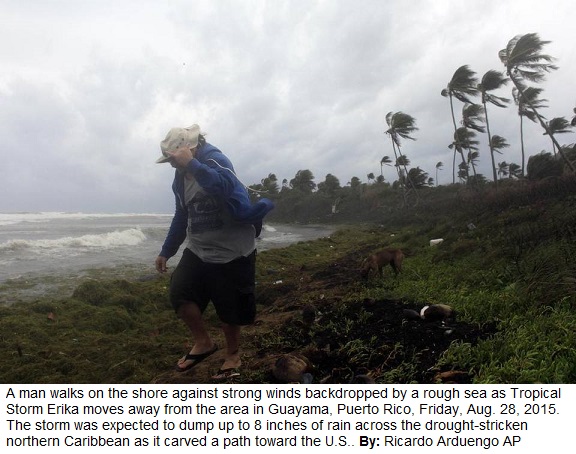
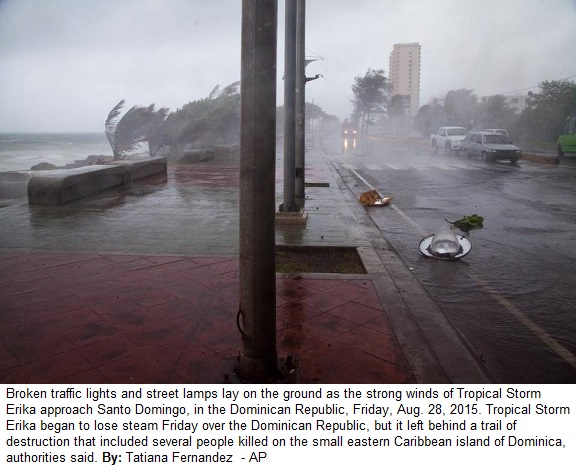
As of this moment (August 28 – 29, 2015), there is a Tropical Storm – Erika – barreling through the Caribbean. So far, it has been deadly, with reports of fatalities in the islands of Dominica and Puerto Rico. See story/VIDEO here:

VIDEO 1: Tropical storm Erika nears US, destruction in its wake

Posted Friday Aug 28, 2015 from: http://www.today.com/video/tropical-storm-erika-nears-us-destruction-in-its-wake-514916419548

The effects of tropical storm Erika are already being felt in Puerto Rico, after the storm left four people dead and more missing on the Caribbean island of Dominica. Janet Shamlian reports and TODAY’s Al Roker takes us through the storm’s projected path.

s crisis - Photo 1

s crisis - Photo 2

This storm is not done yet, more damage to persons and property is expected – it is expected to elevate to hurricane status by Sunday.

Welcome to the Caribbean 2015 …
… the greatest address on the planet?!?!

Why would anyone campaign to assume the stewardship of this archipelago of islands?

This is the “siren song” of the book Go Lean … Caribbean. The publishers and underlying Foundation are petitioning for a leadership role in the economic, security and governing engines of the region. Why?

There is no insanity! This is an expression of love for the homeland. The 30 member-states of the Caribbean are home to 42 million people, and a Diaspora of 10 million; plus 80 million visitors annually.

This is the greatest address on the planet!

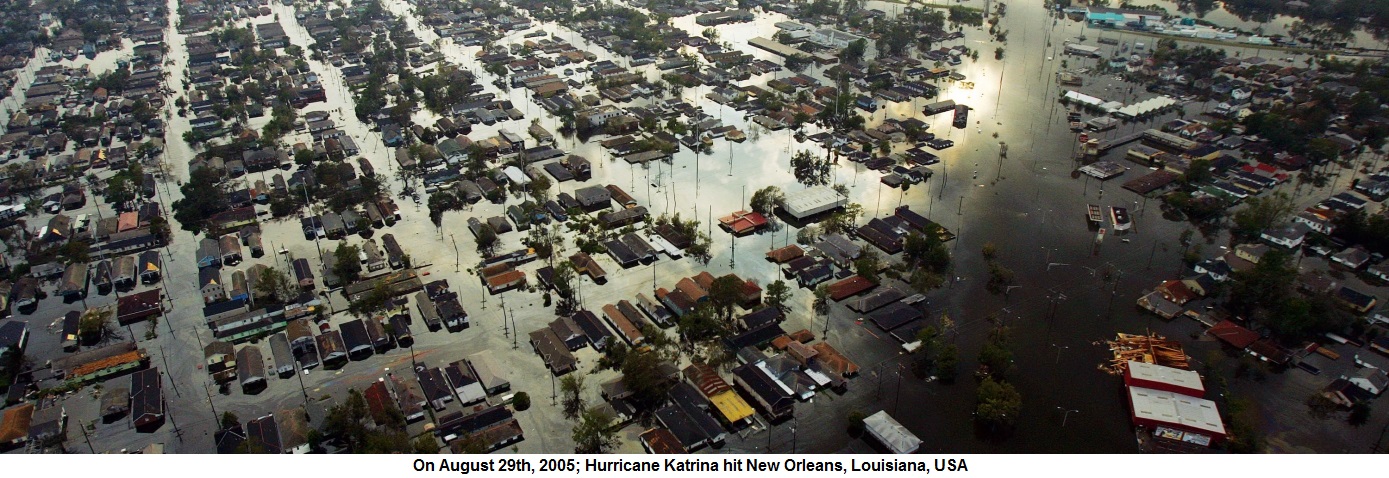
Plus, everywhere has natural disasters to contend with. This fact relates to rich countries and poor alike. For example, take the United States; they are the richest Single Market economy in the world and yet their coastal city of New Orleans Louisiana (NOLA) was devastated by Hurricane Katrina 10 years ago … to the day (August 29, 2005). Their riches did not spare their devastation, nor did the riches facilitate best-practices in terms of response, relief and rebuilding. New Orleans is marking the anniversary of Katrina’s devastation and the lessons learned from the aftermath. See story/VIDEO here:

VIDEO 2: Both Progress and Stumbling Blocks Linger a Decade After Katrina

Posted Friday, Aug 28, 2015 from: http://www.nbcnews.com/nightly-news/video/both-progress-and-stumbling-blocks-linger-a-decade-after-katrina-515371587753

Ten years later, after Hurricane Katrina many of those who left have returned and while tourist sections of the city have been rebuilt, recovery in areas like the Lower Ninth ward is slow.

There is a lesson for the Caribbean in considering the history of ‘Katrina’: There is a parallel cause-and-effect to Tropical Storm Erika and all subsequent storms: Climate Change.

In the last few decades, major devastating storms have proliferated every year … somewhere … in the Northern Hemisphere. This commentary has detailed other cases; see sample here:

https://goleancaribbean.com/blog/?p=4741 Vanuatu and Tuvalu – Inadequate response to post-storm suffering
https://goleancaribbean.com/blog/?p=2465 Book Review: ‘This Changes Everything: Capitalism vs. the Climate’
https://goleancaribbean.com/blog/?p=1817 Caribbean grapples with intense new cycles of flooding & drought

These commentaries, and the Go Lean book, all assert that Climate Change cannot be ignored. Even though there be deniers of any man-made causes, the reality of these storms challenge the realities of Caribbean life.

It is what it is!

The region has been warned: Prepare!

The book Go Lean … Caribbean delved into details of the Katrina lessons in application to the Caribbean. This is an excerpt from Page 184:

The Bottom Line on Hurricane Katrina
Katrina was the deadliest and most destructive hurricane of the 2005 Atlantic hurricane season. It was the costliest natural disaster, as well as one of the five deadliest hurricanes, in the history of the US. At least 1,833 people died in the hurricane and subsequent floods; total property damage was estimated at $81 billion. The hurricane strengthened to a Category 5 hurricane over the warm Gulf water, but weakened before making its landfall as a Category 3 hurricane on the morning of Monday, August 29 in southeast Louisiana. It caused severe destruction along the Gulf coast from central Florida to Texas, much of it due to the storm surge. The most significant number of deaths occurred in New Orleans, Louisiana, which flooded as the levee system catastrophically failed, 53 different breaches, in the hours after the storm had moved inland. Eventually 80% of the city and large tracts of neighboring parishes became flooded, and the floodwaters lingered for weeks.

The economic effects of the storm were far-reaching. The Administration of President George W. Bush sought $105 billion for repairs and reconstruction in the region, which did not account for damage to the economy caused by interruption of the oil & natural gas supply, destruction of the GulfCoast’s highway infrastructure, and exports of commodities such as forestry and grain. Plus, hundreds of thousands of local residents were left unemployed, Before the hurricane, the region supported over one million non-farm jobs, with 600,000 of them in New Orleans. It is estimated that the total economic impact in Louisiana and Mississippi exceeded $150 billion, as Katrina redistributed over one million people from the central Gulf coast elsewhere across the United States, which became the largest Diaspora in the history of the US.

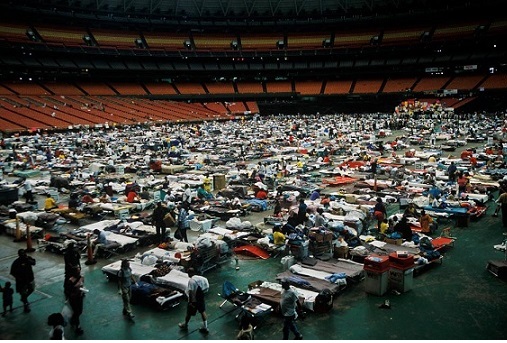
Within days of Katrina’s August 29, 2005 landfall, public debate arose about the local, state and federal governments’ role in the preparations for and response to the hurricane. Criticism was initially prompted by televised images of visibly shaken and frustrated political leaders, and of residents who remained stranded by flood waters without water, food or shelter. Deaths from thirst, exhaustion, and violence, days after the storm had passed, fueled the criticism, as did the dilemma of the evacuees at ill-prepared shelter facilities (i.e. the Super Dome, LouisArmstrongInternationalAirport). Some alleged that race, class, and other factors could have contributed to delays in response. President Bush later called the criticism, directed towards him, (particularly by Hip-Hop recording artist Kanye West), the worst moment in his presidency, being unjustly accused of racism.

s crisis - Photo 3

 Katrina Photo 4

The Super Dome in New Orleans – The aftermath of Hurricane Katrina

s crisis - Photo 5

This is the purpose of the Go Lean roadmap. It introduces the technocratic Caribbean Union Trade Federation (CU) to prepare Caribbean society for the eventual devastation of these Climate-Change-induced weather systems, such as Katrina was for New Orleans, Louisiana. We do not have the luxury of “sticking our head in the sand” and pretending that these problems will simply go away – the conclusion of many observers of the Katrina Crisis on NOLA. This point is pronounced early in the book with this Declaration of Interdependence (Page 11), with this opening statement:

i.  Whereas the earth’s climate has undeniably changed resulting in more severe tropical weather storms, it is necessary to prepare to insure the safety and security of life, property and systems of commerce in our geographical region. As nature recognizes no borders in the target of its destruction, we also must set aside border considerations in the preparation and response to these weather challenges.

The CU will implement optimized Emergency Management schemes to provide better stewardship for the region’s preparation and response to natural disasters; (in addition to hurricanes, there is the need to monitor earthquakes, volcanoes, floods and droughts in the regions).  In addition, the CU will assume jurisdiction for the Caribbean Sea, the 1,063,000 square-mile international waters, as an Exclusive Economic Zone. These preparations and mitigations will allow for better cooperation, collaboration and equalization in the region. The CU/Go Lean roadmap has these 3 prime directives:

  • Optimization of the economic engines in order to grow the regional economy to $800 Billion and create 2.2 million new jobs.
  • Establishment of a security apparatus to protect the resultant economic engines, including the Emergency Management apparatus.
  • Improvement of Caribbean governance to support these engines.

The Go Lean book details the community ethos, strategies, tactics, implementations and advocacies necessary to impact the homeland in this age of Climate Change. Consider the list as follows:

Profile – Who We Are: SFE Foundation Page 8
Economic Principles – People Choose because Resources are Limited Page 21
Economic Principles – All Choices Involve Costs Page 21
Economic Principles – People Respond to Incentives Page 21
Economic Principles – Economic Systems Influence Individual Choices Page 21
Economic Principles – Consequences of Choices Lie in the Future Page 21
Community Ethos – Job Multiplier Page 22
Community Ethos – “Crap” Happens Page 23
Community Ethos – Lean Operations Page 24
Community Ethos – Return on Investments (ROI) Page 24
Community Ethos – Ways to Impact the Future Page 26
Community Ethos – Ways to Improve Sharing Page 35
Community Ethos – Impact the Greater Good Page 37
Anecdote – Pipeline Transport – Strategies, Tactics & Implementations Page 43
Strategy – Vision – Confederating 30 Member-states in a Union Page 45
Strategy – Agents of Change – Technology Page 57
Strategy – Agents of Change – Globalization Page 57
Strategy – Agents of Change – Climate Change Page 57
Tactical – Fostering a Technocracy Page 64
Tactical – Growing Economy – Quicker Recoveries; Less Economic Bubbles Page 69
Separation of Powers – Homeland Security Department – Emergency Management Agency Page 76
Separation of Powers – Interior Department – Exclusive Economic Zone Page 82
Assemble – Consolidating Disaster Preparation & Response Page 96
Implementation – Ways to Pay for Change – Homeland Security – Hurricane Insurance Fund Page 101
Implementation – Benefits from the Exclusive Economic Zone Page 104
Implementation – Ways to Develop a Pipeline Industry – To Mitigate Natural Disaster Effects Page 107
Implementation – Ways to Deliver Page 109
Planning – 10 Big Ideas – Integrated Homeland Security efforts Page 127
Advocacy – Ways to Grow the Economy – Quick Recovery from Natural Disasters Page 151
Advocacy – Ways to Create Jobs Page 152
Advocacy – Ways to Better Manage the Social Contract – Infrastructure Page 170
Advocacy – Ways to Ways to Impact Public Works – Inter-State Pipelines Page 175
Advocacy – Ways to Foster Cooperatives Page 176
Advocacy – Ways to Improve for Natural Disasters – Hurricane Katrina Case Study Page 184
Advocacy – Ways to Impact Extractions – Inter-State Pipeline Strategy Alignment Page 195
Advocacy – Ways to Improve Emergency Management Page 196
Advocacy – Ways to Foster Technology Page 197
Advocacy – Ways to Ways to Improve Monopolies – Foster Cooperatives for Better Recoveries Page 202
Advocacy – Ways to Improve Transportation – Pipeline Options Page 205

It is time for change in the Caribbean! It is time to change our preparations and our responses to these natural disasters. The strategies, tactics and implementations proposed in the book Go Lean…Caribbean are conceivable, believable and achievable. We must do these! We must do better.

Everyone in the Caribbean are hereby urged to lean-in for this Go Lean roadmap.  🙂

Download the free e-Book of Go Lean … Caribbean – now!

Share this post:
, , , ,
[Top]

Lesson from Japan: Aging Populations

Go Lean Commentary

The Bible says “to honor your father and mother so that your days may be long” – Exodus 20:12. This is presented in one of the 10 Commandments as a law and a promise. This is best explained at Ephesians 6: 1-3 (New International Version or NIV):

1 Children, obey your parents in the Lord, for this is right. 2 HONOR YOUR FATHER AND MOTHER (which is the first commandment with a promise), 3 SO THAT IT MAY BE WELL WITH YOU, AND THAT YOU MAY LIVE LONG ON THE EARTH …

So caring for aging parents brings honor to them and to us.  Some places do a better job of this than others. One such example is Japan.

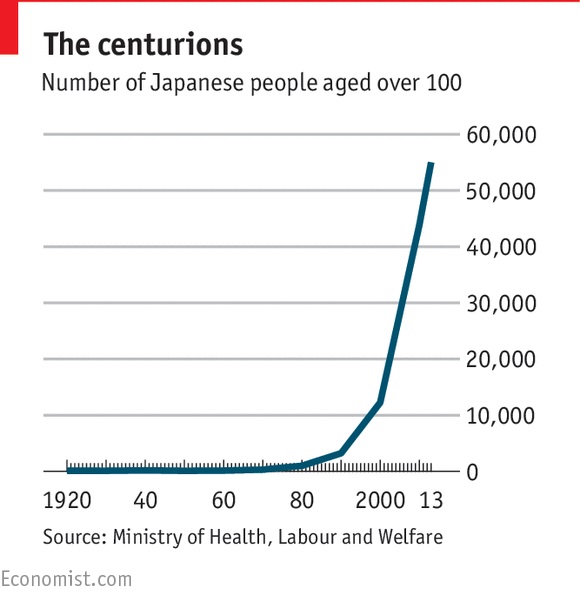
There are around 55,000 centenarians in Japan

This purpose of this commentary is to highlight the currency of this serious issue. The book Go Lean … Caribbean calls for the elevation of the economic, security and governing engines in the Caribbean region. The end-result is not just on societal engines, but also on people; in this case, the elderly. This Go Lean book is not a public health guide for gerontology, to enjoy optimum treatment towards our seniors, but rather a roadmap for impacting change in our community. This news article on the experiences in Japan is presented here; also consider a related story in the AUDIO podcast below:

Title: Japan is home to the world’s oldest population — and the world’s oldest man
By: Daniel Gross, Audrey Adam

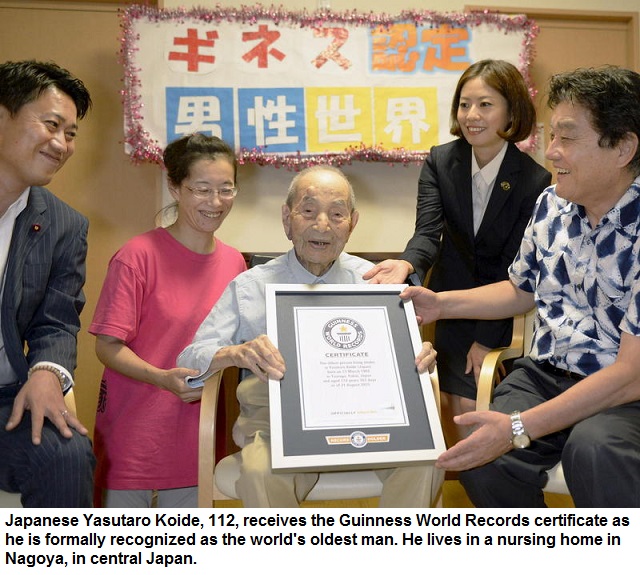
Koide receives the Guinness World Records certificate as he is formally recognized as the world's oldest man, at a nursing home in NagoyaThe world’s oldest man lives in the country with the world’s oldest population. Yasutaro Koide is 112 years old and was just recognized by Guiness World Records as oldest man on Earth.

Japan’s remarkable longevity is cause for celebration. But it’s also creating challenges for a government dealing with a population that keeps getting older.

According to Naoko Muramatsu, a scientist who studies Japan’s aging population at the University of Illinois, Chicago, one-quarter of the country’s residents are already above 65.

There are many costs associated with an aging population, starting with the familiar challenges of social security and health care. But there’s also the cost of an odd Japanese tradition: giving a silver sake dish to centenarians, or people who reach 100 years of age.

Thanks to a new decision by the Japanese government, that practice — which is currently government-funded — may end soon. They say the total cost of the dishes, which are about $60 each, is simply too high. There are around 55,000 centenarians in Japan, according to 2013 statistics.

Muramatsu says there are several reasons that help explain the age of Japan’s population. “Life expectancy in Japan is the highest in the world,” she points out. “People try to eat well, try to do exercise well.”

Another reason is that ever since a brief postwar baby boom, Japan’s birth rate has remained extremely low. A aging baby from that baby boom will turn 65 soon, and many haven’t had very many children, or any at all — leaving more seniors living alone or in nursing homes.

Japan has started to respond to the challenge. In 2000, Japan started long-term care insurance. “You start paying into the system at the age of 40,” says Muramatsu. “And at the age of 65, you’re entitled to receive long-term care, homecare or nursing home care.”

Muramatsu has a personal connection to the study of aging. She remembers that during her childhood, her mother looked after both the older and younger generations. But the tradition of caregiving has been transformed by Japan’s new demographics.

When Muramatsu’s father died a few years ago, she saw first-hand some of the challenges of growing old in Japan. “In Japan, cremation is the custom,” she explains. But cremation has become difficult in cities whose populations spiked in the postwar years. Many elderly people haven’t left urban areas, which means the death rate has risen. “I couldn’t reserve a cremation facility for my father, in the city that we live in.”

Those sorts of challenges may take decades to overcome. But with them come the fact that in Japan, women can expect to live almost 90 years. And Men live well past 80, on average.

And if they’re like Yasutaro Koide, they might even live to 112.

Source: “The World” by Public Radio International; posted August 21, 2015; retrieved 08-23-2015 from: http://kosu.org/post/japan-home-worlds-oldest-population-and-worlds-oldest-man#stream/0

———

AUDIO – “The Challenges Posed by an Aging Global Population” – http://n.pr/1IqdCHV

Uploaded on June 22, 2015 – One-fifth of the U.S. population will be 65 or older in 15 years. NPR’s Ina Jaffe talks with NPR’s Scott Simon about the aging of the population worldwide and the challenges it presents.

The book and previous blog/commentaries posit that socio- economic factors must be accounted for in the roadmap to optimize and improve this society. In fact, the book lists 144 missions for the imminent Caribbean Union Trade Federation (CU); one of them is an advocacy for improved Elder-Care. This is identified on Page 225 under the title:

10 Ways to Improve Elder-Care … in the Caribbean Region

The Go Lean book posits that there is a deficiency in the regional institutions for caring, supporting and planning for the elderly. How do we go about improving on the Social Contract for the senior citizens in our community? What happens if/when we are successful for elevating life for our seniors?

The Go Lean book answers the “how”; it serves as a roadmap for introducing and implementing the CU. In its scope, it features the curative measures for the exact societal deficiencies, highlighted by the CU’s prime directives, as follows:

  • Optimization of the economic engines in order to grow the regional economy to $800 Billion & create 2.2 million new jobs.
  • Establishment of a security apparatus to protect the resultant economic engines and mitigate challenges/threats to ensure public safety for the region’s stakeholders, including the elderly.
  • Improvement of Caribbean governance, including a separation-of-powers with member-states, to support these economic/security engines.

Where as the book addresses the “how”, this commentary features the “when” for succeeding in the improvement of the lives and longevity of the elderly population of the Caribbean. When people live longer, there is a dramatic effect on the socio-economics of a community. This is the lesson from Japan.
CU Blog - Lesson from Japan - Aging Populations - Photo 2

In Japan, the improvements in the societal engines (economics, security and governance) have resulted in improved livelihood and longevity for their people. This has resulted in demographic shifts: there are more senior citizens, more centenarians, compared to the rest of the population.

The problem:

Seniors do not work; nor contribute to the public “pools”; they only draw from it. Too many “takers”, compared to the “givers” is bad economics. So while we love our elderly, we must also prepare for the reality of their longevity.

From the Caribbean perspective there is another reality: societal abandonment of the younger generations – this Go Lean movement has fully defined the excessive abandonment rates in the 70% to 90% range for the college-educated populations in the region. This has the same negative effects on the public “pools”: the numbers of the “givers” shrink, while the proportion of the “takers” remains static, or worse, increase.

It is what it is!

This is a matter of heavy-lifting. Serious solutions must be sought to mitigate the risks of communities getting this challenge wrong. In a previous commentary, the socio-economic issues associated with the rising number of seniors in society were fully explored; the dread of elderly suicides was detailed.

The Go Lean roadmap does not ignore the needs of the elderly, nor the actuarial realities being contended in the region. Rather, the roadmap calls for mitigations to dissuade further emigration and also the inducements for the Caribbean Diaspora to return – back to the homeland – and bring their hard-earned entitlements with them. The CU organization structure features the establishment of regional sentinels and advocacy groups to intervene on behalf of local seniors to optimize their benefits from any foreign programs they may have previously participated in. These SME’s will work for the CU’s Special Liaison Group at the CU’s Headquarters or in Trade Mission Offices.

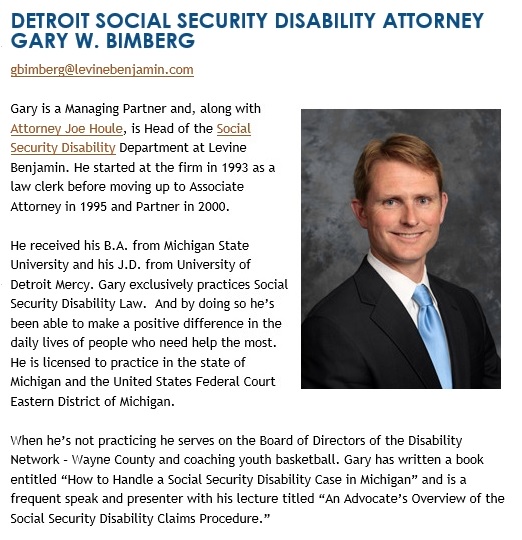
CU Blog - Lesson from Japan - Aging Populations - Photo 3This Win-Win scenario is a prominent feature in the US, with lawyers advocating for Social Security benefits for their clients, for a fee; see this sample Advertisement from a Detroit-area law firm. For stakeholders of the CU, there is no need to pay this fee – normally extracted from future benefits – as the CU Subject Matter Experts (SME) will advocate for the Aging Diaspora returning to the Caribbean. (The Go Lean roadmap calls for funding law degrees for students but binding their services for a few years to impact their communities, as in working for this advocacy).

This is a classic example of the field of socio-economics. The goal of any socio-economic study is generally to bring about socio-economic development, usually by improvements in metrics such as GDP, life expectancy, literacy, levels of employment, etc.  In many cases, socio-economists focus on the social impact of some sort of economic change. But this is about more than just numbers, this is about people.

The Go Lean … Caribbean roadmap constitutes a change for the region, a plan to consolidate 30 member-states into a Trade Federation with the tools/techniques to bring immediate change to the region to benefit many stakeholders. The book details the community ethos that must be adopted plus the executions of the following strategies, tactics, implementations and advocacies to prepare for an aging society … in the Caribbean; see a sample list here:

Community Ethos – Deferred Gratification Page 21
Community Ethos – Ways to Impact the Future Page 26
Community Ethos – Ways to Impact Turn-Arounds Page 33
Community Ethos – Ways to Promote Happiness Page 36
Community Ethos – Ways to Impact the Greater Good Page 37
Strategy – Repatriating Caribbean Diaspora & Entitlements Page 47
Strategy – Non-Government Organizations Page 48
Strategy – Agents of Change – Aging Diaspora Page 57
Tactical – Confederating a Permanent Union Page 63
Tactical – Fostering a Technocracy Page 64
Tactical – Growing the Economy – Lessons from Japan Page 69
Tactical – Separation of Powers – Department of State – Special Liaison Groups Page 80
Tactical – Separation of Powers – Department of   Health Page 86
Implementation – Assemble all Member-States Page 96
Implementation – Ways to Pay for Change Page 101
Implementation – Trade Mission Office Objectives Page 117
Implementation – Reasons to Repatriate Page 118
Planning – Lessons Learned from 2008 Page 136
Planning – Ways to Make the Caribbean Better Page 133
Advocacy – Ways to Grow the Economy Page 151
Advocacy – Ways to Create Jobs Page 152
Advocacy – Ways to Improve Healthcare Page 156
Advocacy – Ways to Impact Entitlements Page 158
Advocacy – Ways to Improve Education – Brain Drain Case Page 159
Advocacy – Ways to Improve Student Loans – Forgive-able Page 160
Advocacy – Better Manage the Social Contract Page 170
Advocacy – Ways to Foster Cooperatives Page 176
Advocacy – Impact the Diaspora Page 217
Advocacy – Ways to Preserve Caribbean Heritage Page 218
Advocacy – Ways to Impact Retirement Page 221
Advocacy – Ways to Help the Middle Class Page 223
Advocacy – Ways to Improve Elder-Care Page 225
Appendix – Disease Management – Healthways Model Page 300

This Go Lean book asserts that there is a direct correlation of population growth/contraction with the economy. This viewpoint has been previously detailed in Go Lean blog/commentaries, as sampled here:

Bad Model: Pressed by Debt Crisis, Doctors Leave Greece in Droves
Demographic Trend: Immigrants account for 1 in 11 Blacks in USA
Businesses Try to Stave-off Brain Drain as Boomers Retire
Retirement Planning – Getting Rich Slowly … in the Caribbean
Book Review: ‘Chasing Youth Culture and Getting It Right’
Having Less Babies is Bad for the Economy
10 Things We Don’t Want from the US: # 8 Senior Abandonment

As this commentary opened with a Biblical quotation, it is even more fitting to conclude with one, a Proverb, as follows:

The glory of young men is their strength, [but] gray hair [is] the splendor of the old. – Proverbs 20:29 NIV.

Without a doubt, there is value to keeping senior citizens around in our communities; their “grey hair” – poetic for wisdom – is greatly valued … and needed. As a society, we have made too many mistakes, that with some far-sighted wisdom and best-practice adherence, we could have done better and been better.

We must turn-around, reboot and prepare!

We must listen to the wisdom of the experienced/wise ones. They can help us to make our homelands better places to live, work, and play – for all: young and old.  🙂

Download the book Go Lean…Caribbean now!

Share this post:
, , , , , , ,
[Top]

Hotter than July – Still ‘Third World’

Go Lean Commentary

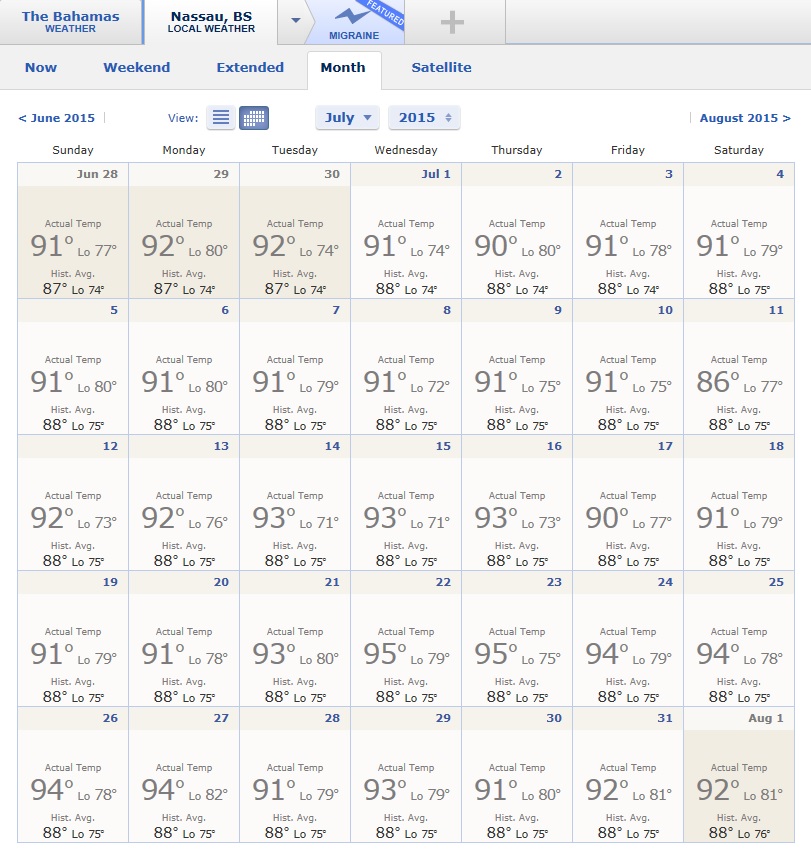
- Photo 5

(Source: http://www.accuweather.com/en/bs/nassau/30072/july-weather/30072)

In the Caribbean, this time of the year, it is “hot, hot, hot”.

While that is a hit song by “The Merrymen” of Barbados (see Appendix below), unfortunately, it is also the weather report.

“I just flew back from the Caribbean and boy are my arms tired…from fanning … for relief from the heat” – Old joke-new twist

This is not good! In fact, the hot weather, and the lack of infrastructure to mitigate and remediate the discomfort, is identified as one of the reasons for the brain drain/societal abandonment. (This commentary is an appeal for cooperative refrigeration).

The issue of Caribbean citizens abandoning their homelands is one of the more dire threats to societal life in the region. Why do they do it?

“Push and Pull” reasons!

Push
Conditions at home drive Caribbean citizens to take flight and find refuge elsewhere. Many times these conditions are economic (jobs and entrepreneurial opportunities), security and governance related, but there are other reasons too; consider discriminations due to ethnic diversity or other lifestyle choices.

Lastly, there is the new threat of Climate Change. While this is a threat for the whole world, the Caribbean is on the frontline. Though there is some debate as to the causes of climate change, there is no question as to its outcome: temperatures are rising, droughts prevail, and most devastating, hurricanes are now more threatening. A Caribbean elevation plan must address the causes of climate change and most assuredly its consequences.

Early in the book Go Lean…Caribbean, a roadmap to elevate the Caribbean region, the pressing need to be “on guard” of climate change is pronounced in the Declaration of Interdependence (Page 11), with these words, (the first of many “causes of complaints”):

i.  Whereas the earth’s climate has undeniably changed resulting in more severe tropical weather storms, it is necessary to prepare to insure the safety and security of life, property and systems of commerce in our geographical region. As nature recognizes no borders in the target of its destruction, we also must set aside border considerations in the preparation and response to these weather challenges.

The Go Lean…Caribbean book serves as a roadmap for the introduction and implementation of the Caribbean Union Trade Federation (CU). The CU must advocate for systems and schemes for a lower carbon footprint so as not to contribute further to green-house gases. Plus, the CU must implement recovery measures to respond, and react to the ever-threatening climatic conditions. While this means hurricanes at the extreme, it also includes daily factors that must be dealt with, like excessive heat and frequent power black-outs … during summer months. (The elderly are more susceptible to heat stroke and other ailments).

“Growing up in the Caribbean, summer extended from Easter Monday to Columbus Day” – Recollection of a Caribbean/Bahamas Diaspora Member.

Now, the anecdotal experience is that there is a need to mitigate excessive heat in the region for an even longer season. How do we mitigate excessive heat?

Air conditioning!

But this cure may at times be worse than the disease.

Air conditioning requires even greater energy consumption, (the Caribbean has among the highest energy costs in the Western Hemisphere); the Go Lean book posits that the average costs of energy can be decreased from an average of US$0.35/kWh to US$0.088/kWh in the course of the 5-year term of this roadmap; (Page 100).

In addition, the release of Chlorofluorocarbons (CFC’s) in the air-conditioning process is a contributor of greenhouse gases into the atmosphere.

The status quo needs remediation!

Pull
In addition to these climatic “push” factors, there are also climatic pull considerations.

These factors, as related in the Go Lean roadmap, posit that North American and European destinations have been more inviting to Caribbean citizens. Weather-wise, everywhere has “mean seasons”, but it is easier to stay warm during a wintry “mean season” in the North, than it is to stay cool in the “mean season” in the South. Plus with pronounced Climate Change effects on northern communities, the “mean seasons” in the north have been shorter and easier to endure.

This issue refers to an environment – the weather – that maybe outside of human control. But when humans do grab some control – climate control – the northern communities (US, Canada and Europe) do a better job of mitigating and remediating the new acute effects of climate change.

Consider again, the location for the composition for the Go Lean book, Omaha, Nebraska. That community in the American Midwest is notorious as a “land of 4 seasons” and all of them extreme. In May 2013, it snowed on May 1st then the temperature hit 100 degrees (Fahrenheit) on May 15th. Omaha is provided in the Go Lean book (Page 138) as a model for Caribbean communities to emulate. How does Omaha mitigate the extreme climate conditions they have to contend with?

  • Infrastructure
  • Economies-of-Scale

Consider this one example of how a cooling/heating scheme provides the needed air-conditioning for the entire Downtown District:

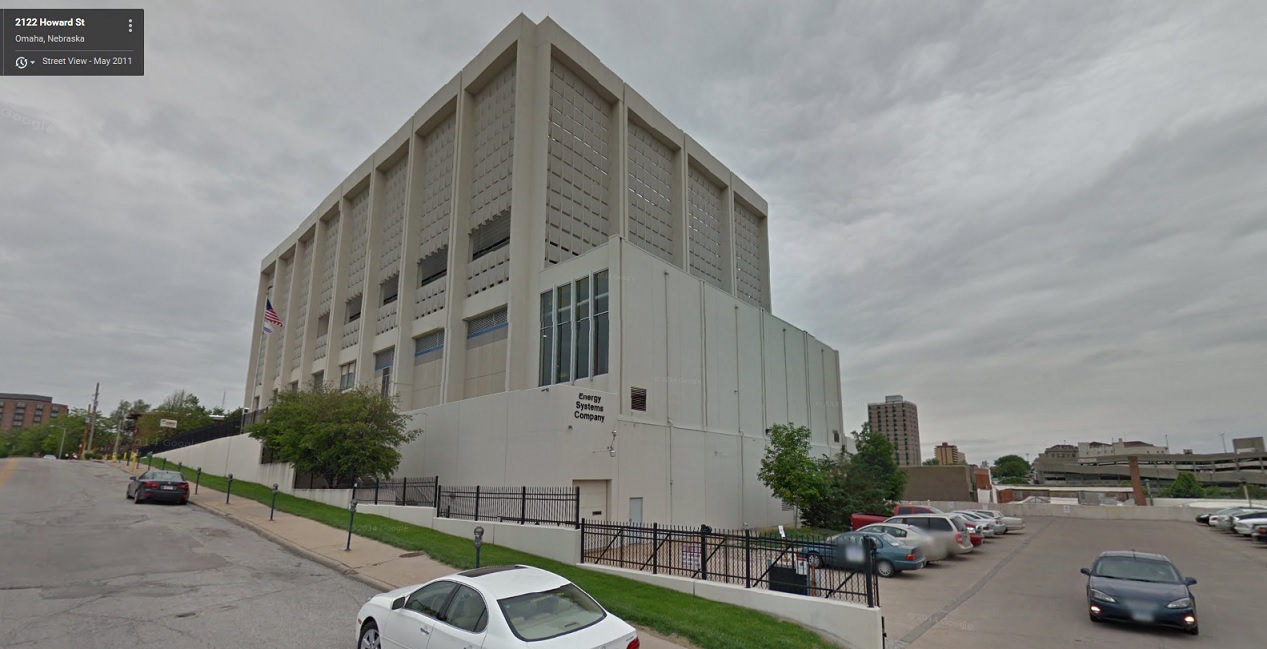
Company ProfileNRG Energy Center Omaha
(Source: http://www.nrg.com/business/large-business/distributed-generation/district-heating-cooling/omaha/)

- Photo 1

NRG Energy Center Omaha provides energy-efficient and environmentally sound district heating and cooling for the business district of downtown Omaha, including Woodman Tower, Creighton University, the Joslyn Art Museum, Creighton University Medical Center and more than 70 percent of all other public and commercial buildings in the downtown area.

NRG Energy Center Omaha has established a reliability history of “Six-Nines” (99.9999%) for its chilled-water service. Our steam service reliability history is equally impressive.

NRG Energy Center Omaha leverages a variety of conventional fuels, depending on which is most cost-competitive at a given time, and it has also incorporated cogeneration technology – a highly efficient combination of heat and mechanical power –to reduce the amount of energy lost up the smokestack. This kind of technology and fuel flexibility keeps costs down, preserves valuable natural resources and reduces emissions. We also provide the buildings we serve with free energy audits, budget assistance and historical use and cost data on request.

Recent developments linked to NRG Energy Center Omaha include the Hruska Federal Courthouse, First National Bank of Omaha Technology Center, Creighton University expansion, the First National Bank Office Tower, World Herald’s Freedom Center, Qwest Arena and Convention Center, the Omaha Performing Arts Center, and the Lasting Hope and MidCity Centers.

System Profile
Area served: Downtown Omaha
Services Provided: Steam heating and chilled water cooling
Total system capacity: 29,250 tons of chilled water and 735,000 lbs/hr of steam
Buildings on system: Woodman Tower, Creighton University, the Joslyn Art Museum, Creighton University Medical Center and more than 70 percent of all other public and commercial buildings in the downtown area.

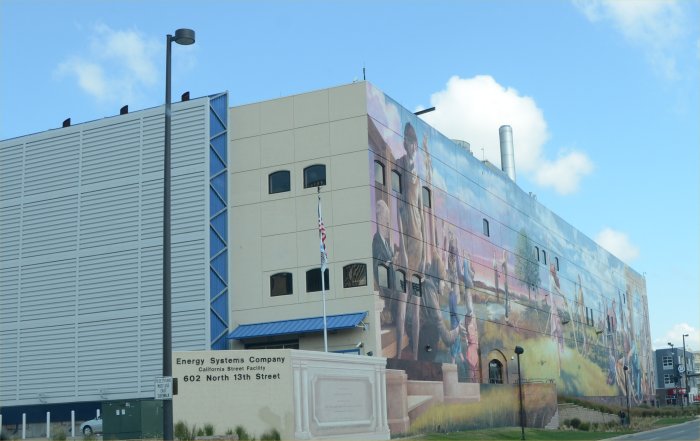
- Photo 2- Photo 3- Photo 3b- Photo 4

Consider the photos above; (the building with the mural is a refrigerated warehouse). Imagine this Omaha Downtown model deployed in Caribbean communities. This “District Heating and Cooling” scheme provides economies-of-scale, efficiency and lower costs. The design is a “plant” to produce steam, hot water and/or chilled water at a central location and then pipe the steam and water underground to individual buildings within a specific district. This process is energy efficient and reliable, typically requiring less capital investment, risk and operational costs than systems where each building must maintain its own boiler or air conditioner. The destinations/buildings only need air handlers – much cheaper than full air-conditioning – to blow and control preferred temperature settings.

This is a model of a technocracy. Without these types of infrastructure the Caribbean is just … ‘Third World’.

The Go Lean/CU roadmap recognizes that modern life has expanded the definition of basic needs to now include food, clothing, shelter and energy. And thusly the book proposes many solutions for the region to optimize energy generation, distribution and consumption. There are many lessons to learn from other more-efficient communities. This is the prime directive of the Go Lean roadmap, to apply these lessons and best-practices so as to impact the Caribbean in these 3 ways:

  • Optimization of the economic engines in order to grow the regional economy to $800 Billion GDP and create 2.2 million new jobs.
  • Establishment of a security apparatus to protect the resultant economic engines.
  • Improvement of Caribbean governance, including Self-Governing Entities, to support these engines.

As for energy, the Go Lean book posits that the average costs of energy can be decreased from an average of US$0.35/kWh to US$0.088/kWh in the course of the 5-year term of this roadmap. (Page 100). This is a 75% savings!  Cooperative refrigeration allows for even more savings!

These initiatives will take some effort on the part of the community and governmental institutions. This is heavy-lifting! The Go Lean roadmap details a series of community ethos, strategies, tactics, implementations and advocacies to foster the progress in the wide fields of energy optimization and cooperative refrigeration. The following list applies:

Economic Principles – Economic Systems Influence Individual Choices/Incentives Page 21
Community Ethos – Lean Operations Page 24
Community Ethos – Return on Investments Page 24
Community Ethos – Cooperatives Page 25
Community Ethos – Model: Regional Taxi Commissions Page 25
Community Ethos – Non-Government Organizations Page 25
Community Ethos – Ways to Impact the Future Page 26
Community Ethos – Ways to Improve Negotiations Page 32
Community Ethos – Ways to Improve Sharing – Economies of Scale Page 35
Community Ethos – Ways to Impact the Greater Good Page 37
Anecdote – Pipeline Transport – Strategies, Tactics & Implementations Page 43
Strategy – Harness the power of the sun/winds Page 46
Strategy – Agents of Change – Technology Page 57
Strategy – Agents of Change – Aging Diaspora Page 57
Strategy – Agents of Change – Climate Change Page 57
Tactical – Fostering a Technocracy Page 82
Tactical – Separation of Powers – Public Works and Infrastructure Page 82
Tactical – Separation of Powers – Energy Commission Page 82
Anecdote – “Lean” in Government – Energy Permits Page 93
Anecdote – Caribbean Energy Grid Implementation Page 100
Implementation – Ways to Develop Pipeline Industry Page 107
Implementation – Ways to Improve Energy Usage Page 113
Implementation – Reasons to Repatriate to the Caribbean – Gerontology Initiatives Page 118
Planning – Lessons Learned from Omaha Page 138
Advocacy – Ways to Impact Public Works – Air Chillers Utilities Page 175
Advocacy – Ways to Foster Cooperatives – Refrigerated Warehouses Model Page 176
Advocacy – Ways to Impact Monopolies – Empower Municipal Authorities Page 202
Advocacy – Ways to Develop a Frozen Foods Industry – Need for Refrigerated Warehouses Page 208
Advocacy – Ways to Battle Poverty – Third World Realities Page 222

The phrase “Hotter than July” should only be a song, not a way of life in the Caribbean.

Energy needs are undeniable. Air-conditioning needs to be readily available and affordable during the “mean season”. This should not be open to any compromise.

Fulfilling these needs is a great target for lean, agile operations, perfect for the CU technocracy. Any failure in this regards results in heightened abandonment.

Now is the time for all of the Caribbean, the people, businesses, institutions and governments, to lean-in for the optimizations and opportunities described in the book Go Lean … Caribbean.

Stay cool people! 🙂

Download the book Go Lean … Caribbean – now!

—————

Appendix MUSIC – The Merrymen – Feeling Hot Hot Hot – https://youtu.be/rbc_LxfhSoY


Uploaded on Dec 21, 2011 – The Merrymen recorded this song in 1983 originally on thier album “No Big Ting”, however this version was recorded in 1988 on their album “Hot Hot Soca”. http://www.facebook.com/themerrymenfr…

Music: “Hot Hot Hot” by The Merrymen (Google PlayAmazonMP3eMusiciTunes)

Share this post:
, , , ,
[Top]

Pressed by Debt Crisis, Doctors Leave Greece in Droves

Go Lean Commentary

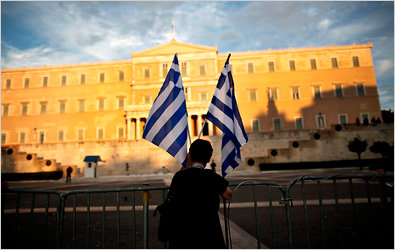
CU Blog - Pressed by Debt Crisis, Doctors Leave Greece in Droves - Photo 3Poor economic conditions are forcing a brain drain among a country’s professionals. Yes, we understand all too well.

This is the crisis for Greece! This is the crisis for the Caribbean, as well!

This is a consistent theme in the book Go Lean…Caribbean. The book posits that the events in Greece are relevant for the Caribbean, North America and the world economy as a whole. What’s worse is that many Caribbean member-states are in the same situation.

Greece is the weak link in the Eurozone; it is inching closer to defaulting on its debt. The country has been in a long standoff with its European creditors on the terms of a multibillion-dollar bailout. If the country goes bankrupt or decides to leave the 19-nation Eurozone, the Greek debt crisis could create instability in the region and reverberate around the globe. (Since this debt crisis began in 2010, most international banks and foreign investors have sold their Greek bonds and other holdings; they are not as vulnerable to what happens in Greece now).

CU Blog - Pressed by Debt Crisis, Doctors Leave Greece in Droves - Photo 1“A crisis is a terrible thing to waste” – states the Go Lean book quoting noted Economist Paul Romer. The opportunity therefore exists to forge change in the economic, security and governing engines of communities, in response to crises.

This story (see VIDEO below) shows that the rest of the world are all paying attention to this crisis in Greece, but few are thinking of the impact on the professional classes. This is of paramount interest to the planners of a new Caribbean, the publishers of the Go Lean book. The purpose of the book is to position the region at the corner of preparation and opportunity, so as to benefit from change. The issue from this article is more pressing for the Caribbean, as we share, as a region, a very high brain drain/emigration rate, estimated at 70%. See article here and VIDEO below:

Title: Pressed by Debt Crisis, Doctors Leave Greece in Droves
By: Erik Olsen, Contributor, New York Times Online Site; posted July 1, 2015; retrieved from: http://mobile.nytimes.com/2015/07/01/world/europe/pressed-by-debt-crisis-doctors-leave-greece-in-droves.html

Greece is in the midst of the worst brain drain in modern history, experts say.

“This is unprecedented in terms of the numbers of educated people that are leaving,” said Lois Labrianidis, a professor of economic geography at the University of Macedonia in Thessaloniki.

The country is hemorrhaging talent, as professionals in medicine, engineering and academics flee for a better economic climate and more stable employment. The pain has been particularly severe in the health care sector of Greece: Many of the country’s doctors have left or are making plans to do so.

“I don’t feel safe and secure for the future of my family here,” said Spyridon Kotsaris, an Athens orthopedic surgeon who has been planning for months to leave Greece with his wife and two daughters, preferably to Germany or Switzerland.

“We want a better life,” he said. “A better life means we are all together and feel more secure.”

In all, nearly 300,000 people have left Greece since 2010, nearly 3 percent of the country’s population before the crisis, according to government statistics. That includes as many as 5,000 doctors, with about 3,500 of them ending up in Germany, where Europe’s financial crisis has had less impact.

“It’s not that big of a concern for me financially, because I work in Germany,” said Alexios Theodorou, a Greek general surgeon working at a hospital in Gummersbach in North Rhine-Westphalia. Mr. Theodorou left Greece five years ago, as the crisis was beginning.

“My paycheck is secured,” he said. “But that doesn’t make my concern about the future any less, as I have much family in Greece. Greece is where I still call home.”

In some ways, the loss of so much young talent may be more devastating to Greece in the long term than abandoning the euro, if that happens. That has left some who sought a better life feeling increasingly bittersweet about the decision to leave.

“I feel sad seeing my country going through this rough time,” Mr. Theodorou said. “We, the people who left, are not to blame for the situation, but we sometimes feel guilty that we are leaving, that we left the people there to handle their problems.”

The book Go Lean…Caribbean serves as a roadmap for the introduction and implementation of the Caribbean Union Trade Federation (CU), a super-national institution with federal powers to forge change in the Caribbean region. One mission is incentivizing the return of the far-flung Caribbean Diaspora. Another mission is to dissuade further human flight/brain drain. The numbers don’t lie: we need population growth not population contraction.

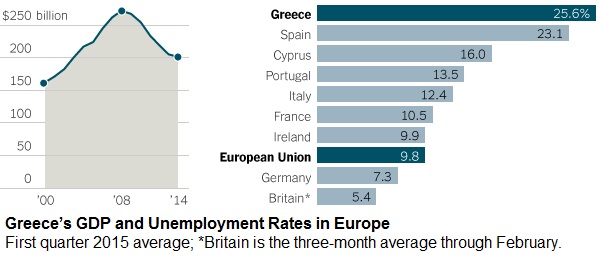
CU Blog - Pressed by Debt Crisis, Doctors Leave Greece in Droves - Photo 2The CU recognizes that the population numbers must work in favor of societal progress. Greece has lost 3% of its population since the start of this crisis in 2010, so this negative trend cannot be understated. There are many social safety nets that depend of the actuarial fact of population expansion, not contraction. Consider unemployment and pensions: for unemployment, workers pay into a fund and the temporarily unemployed file claims against that fund. Likewise with pensions: young workers pay into a fund, and the older-retired workers draw claims against that fund.

Thus, population contractions are definitely among the indices for a Failed-State status (Page 271).

The confederation of the CU is a reversal of the unfortunate trends inflicted on the Caribbean. The vision is to forge a Single Market of 42 million people in the 30 Caribbean member-states. Then the Go Lean roadmap provides the details for the creation of 2.2 million new jobs and GDP growth to accumulate to $800 Billion. This vision is at the root of the Go Lean roadmap, embedded in the opening Declaration of Interdependence (Page 13):

xxiv. Whereas a free market economy can be induced and spurred for continuous progress, the Federation must install the controls to better manage aspects of the economy: jobs, inflation, savings rate, investments and other economic principles. Thereby attracting direct foreign investment because of the stability and vibrancy of our economy.

xxv. Whereas the legacy of international democracies had been imperiled due to a global financial crisis, the structure of the Federation must allow for financial stability and assurance of the Federation’s institutions. To mandate the economic vibrancy of the region, monetary and fiscal controls and policies must be incorporated as proactive and reactive measures. These measures must address threats against the financial integrity of the Federation and of the member-states.

According to the foregoing New York Times article and the VIDEO below, Greece is in “hot water”. They need a remediation plan. Go Lean is the plan … for the Caribbean, not Greece. But we get to apply lessons learned from the experiences in Greece.

The following details from the book Go Lean … Caribbean are the community ethos, strategies, tactics, implementations and advocacies prescribed to manifest the reboot and empowerment efforts for the Caribbean economy, society and life in general:

Who We Are – SFE Foundation and 2008 Role Page 8
Anecdote: Puerto Rico – The Greece of the Caribbean Page 18
Community Ethos – Economic Systems Influence Individual Choices Page 21
Community Ethos – Economic Principles – Money Multiplier Page 21
Community Ethos – Governing Principles – Lean Operations Page 24
Community Ethos – Ways to Impact the Future Page 26
Community Ethos – Ways to Impact Turn-Arounds Page 33
Community Ethos – Ways to Impact the Greater Good Page 37
Strategy – Vision – Confederate all 30 Member-States into a Single   Market Page 47
Strategy – Mission – Repatriating Caribbean Diaspora Page 46
Strategy – Mission – Dissuade further Brain Drain Page 46
Tactical – Confederating a Permanent Union Page 63
Tactical – Fostering a Technocracy – Greek Sovereign Debt Case Study Page 64
Implementation – Assemble all Member-States Page 96
Implementation – Ways to Pay for Change Page 101
Implementation – Reasons to Repatriate Page 118
Planning – Ways to Model the European Union (EU) Page 130
Planning – Ways to Improve Failed-State Indices Page 134
Planning – Lessons Learned from 2008 Page 136
Planning – Lessons Learned from East Germany – Eventuality of Failed-States Page 139
Planning – Lessons Learned from Detroit – The Need for Turn-around Page 140
Advocacy – Ways to Grow the Economy Page 151
Advocacy – Ways to Create Jobs Page 152
Advocacy – Ways to Impact Entitlements – Austerity Lessons Page 158
Advocacy – Ways to Improve Governance – Euro-Zone Budget Deficits Model Page 168
Advocacy – Better Manage the Social Contract Page 170
Advocacy – Impact the Diaspora Page 217
Advocacy – Ways to Preserve Caribbean Heritage Page 218
Advocacy – Ways to Help the Middle Class – Enforce the Social Contract Page 223
Appendix – Failed-State Indicators and Definitions Page 271

Broken economies can be fixed!

This is not the first economic crisis to be observed-and-reported on by Go Lean planners. The Go Lean book is a product of 2008 Financial Crisis and Great Recession. From this fallout, this roadmap was composed, by individuals intimate with the details of the crisis … and its causes; (Page 8). Their motivation: love of homeland.

While love of the Caribbean homeland is a strong motivator – as Greek expatriates in the below VIDEO express love of their homeland – the realities of a broken economy will still cause a brain drain. These flight-abandonment realities creates the need for a societal reboot in economics, security and governance. This is the quest of Go Lean…Caribbean roadmap, to reboot the region’s societal engines; employing best-practices and better strategies, tactics and implementations to impact its prime directives, identified with these statements:

  • Optimization of the economic engines in order to grow the regional economy to $800 Billion & create 2.2 million new jobs.
  • Establishment of a security apparatus to protect the resultant economic engines and mitigate challenges/threats to the region’s public safety.
  • Improvement of Caribbean governance to support these engines.

There are many Go Lean blog/commentaries that have echoed these points of societal abandonment. Here is a sample of related commentaries:

https://goleancaribbean.com/blog/?p=5088 Immigrants account for 1 in 11 Blacks in USA
https://goleancaribbean.com/blog/?p=4613 A Lesson in History: – Emigration from Ireland in History
https://goleancaribbean.com/blog/?p=4185 Caribbean Ghost Towns: It Could Happen…Again
https://goleancaribbean.com/blog/?p=2809 A Lesson in History: Economics of East Berlin – A Failed-State
https://goleancaribbean.com/blog/?p=2025 Caribbean Jobs – Attitudes & Images of the Diaspora
https://goleancaribbean.com/blog/?p=1596 Book Review: ‘Prosper Where You Are Planted’
https://goleancaribbean.com/blog/?p=1433 Caribbean loses more than 70 percent of tertiary educated to brain drain
https://goleancaribbean.com/blog/?p=841 Having less babies (and people) is bad for the Caribbean economy
https://goleancaribbean.com/blog/?p=599 Ailing Puerto Rico open to radical economic fixes

From the cradle-to-the-grave, the needs of a community – whether it is in the Caribbean, Greece or anywhere – cannot be casually dismissed. A crisis ensues, people respond, they make a choice: fight or flight.

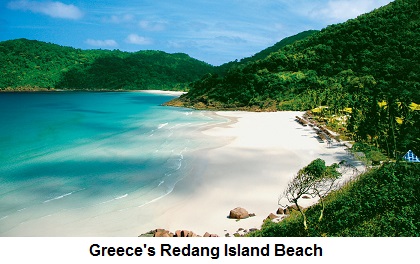
In Greece, despite this great beauty, they are choosing flight:

CU Blog - Pressed by Debt Crisis, Doctors Leave Greece in Droves - Photo 4

In the Caribbean too!

caribbean_view

We can do better! We must do better. Though success is not guaranteed, it can be forged with the adoption and application of best-practices. This requires the full participation – time, talent and treasuries – of all stakeholders: residents and Diaspora alike. This effort is not easy, but rather strenuous; the Go Lean book calls it “heavy-lifting”.

Strenuous, heavy-lifting – Yes – but the returns are worth the effort: making the Caribbean a better place to live, work and play.

This is the goal of the Go Lean roadmap. Everyone is urged to lean-in! 🙂

Download the book Go Lean … Caribbean – now!

———

Appendix VIDEOGreece’s Doctor Brain Drain http://video1.nytimes.com/video/2015/06/30/33813_1_greece-doctors-leaving_wg_240p.mp4

playbutton-300x300

In part of a large brain drain that could affect Greece for decades, thousands of doctors have left the nation for Germany since the financial crisis began five years ago.


Share this post:
, , , , , , ,
[Top]

A Lesson in History – Royal Charters: Truth & Consequence

Go Lean Commentary

“This is my island in the sun, willed to me by my Father’s hand” – Iconic Calypso song: Island in the Sun

No one doubts the historicity of this expression. Even the Bible lays the premise for the granting of an inheritance by the Declaration of a Father; consider this verse: “A good person leaves an inheritance for their children’s children”. – Proverbs 13:22 – New International Version

So without a doubt a “Last Will & Testament” is a decree/charter that grants property to a beneficiary, just by words; no exchange of capital or valuables. This is perhaps the simplest form of a charter or decree.

CU Blog - A Lesson in History - Royal Charter - Truth and Consequence - Photo 2They get more complex, like with Papal Bulls, Royal Charters and/or Royal Decrees. See Photo here.

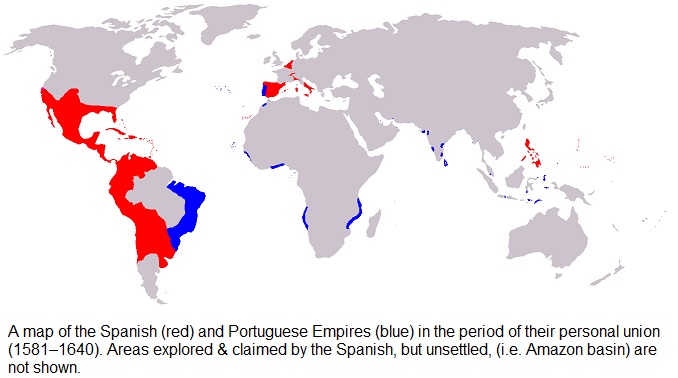
Consider first the Papal Bull – “letters patent” or charter issued by a Pope, the Head of the Roman Catholic Church; see Appendix A below. The most iconic of all the Papal Bulls was the Inter caetera (Latin for “Among other [works]”) a Papal Bull  by Pope Alexander VI on 4 May 1493, which set a demarcation between the New Lands to Portugal and Spain; this granted to Spain (the Crowns of Castile and Aragon) all lands to the “west and south” of a pole-to-pole line 100 leagues west and south of any of the islands of the Azores or the Cape Verde islands.[1] All new lands to the East of this pole remained assigned to Portugal. CU Blog - A Lesson in History - Royal Charter - Truth and Consequence - Photo 3

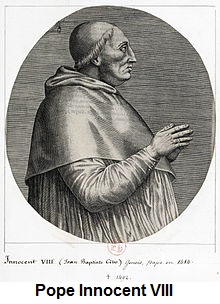
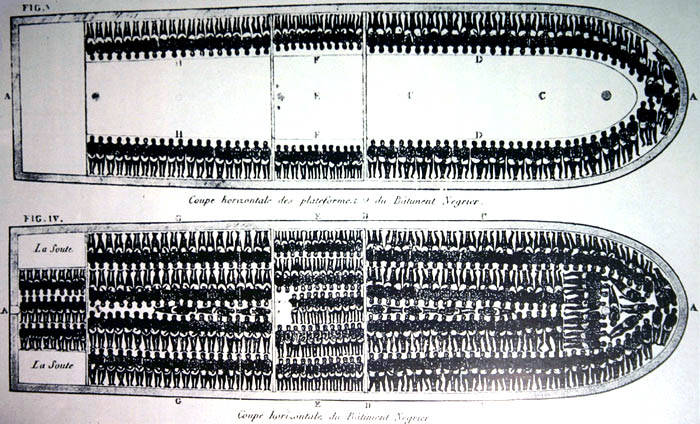
Just before this world-changing decree, there was an earlier Papal Bull that sealed the fate and would prejudice the African Diaspora for 500 years. The African Slave Trade and institution of “Slavery” was legally predicated on a Papal Bull from Pope Innocent VIII (Giovanni Battista Cybo) in 1491; just months before Christopher Columbus’s historic first voyage. Consider this encyclopedic reference:

In his book “Black Africans in Renaissance Europe”, principal author N. H Minnich* described how the position of Renaissance popes towards slavery, a common institution in contemporary cultures, varied. The book states that those who allowed the slave trade did so in the hope of gaining converts to Christianity.[11] But in the case of Pope Innocent VIII, he permitted trade with Barbary # merchants, in which foodstuffs would be given in exchange for slaves who could then be converted to Christianity.[11]

CU Blog - A Lesson in History - Royal Charter - Truth and Consequence - Photo 1

This was the de jure authorization of the Slave Trade.

One early adopter of this new commerce was King Ferdinand of Aragon (co-sponsor along with Castile’s Queen Isabella of the initial voyage of Christopher Columbus); he gave Pope Innocent VIII 100 Moorish slaves who shared them out with favored Cardinals.[12]

From this origin, the foundation of the New World was established … with the stroke of a pen.

Any monarchy, democracy, aristocracy, stratocracy, timocracy or theocracy that emerged subsequently in the New World stemmed from this genesis of Papal or Royal Charters. All of these forms of rulership are analyzed in the book and accompanying blogs for Go Lean…Caribbean. This book provides an assessment of the Caribbean today, drawing reference to its historic past. From the origins of slavery, the region traversed the historic curves of social revolution and evolution. In the 1500, the Protestant movement took hold. As other European powers deviated from Catholicism, Papal Bulls carried no significance to them and compliance was ignored. England and Holland established their own Protestant Churches with their own monarchs as head of Church and State; Papal decrees were replaced with Royal Decrees and Charters; see Appendix B below. The intent and end-result was still the same: territories and lands awarded (colonized) with the stroke of a pen by one European power after another. The Royal Decrees and Charters were then reinforced with a strong military presence and many battles. This point was detailed in the Go Lean book on Page 241:

The Bottom Line on European Colonialism
The European colonial period was the era from the 1500s to the mid-1900s when several European powers (Spain, Britain, the Netherlands, France and Portugal) established colonies in the Americas, in a Space Race to dominate the New World. The Northern Coast of South America became a typical New World battleground for conflict and pushing between these powers, and many military campaigns and diplomatic initiatives (treaties) ensued. Through the contact period following the 1498 discovery by Christopher Columbus, the term “Guiana” was used to refer to all this area, between the Orinoco, the Rio Negro, and the Amazon rivers; it was seen as a unified, isolated entity that it was often referred to as the “Island of Guiana”. The real interest in the exploration and colonization of the Guianas did not begin until the end of the sixteenth century when the other European powers developed interest in the Guianas. When did this European Colonial “push-shove-match” end? Not until almost 500 years later, after World War II, after the effects of that war left all these European powers drained – of finances and the will to continue.

Early in the Go Lean book, this need for careful review of the history of European domination on the Caribbean was acknowledged and then placed into perspective with this pronouncement (Declaration of Interdependence – Page 10):

As the history of our region and the oppression, suppression and repression of its indigenous people is duly documented, there is no one alive who can be held accountable for the prior actions, and so we must put aside the shackles of systems of repression to instead formulate efficient and effective systems to steer our own destiny.

As the colonial history of our region was initiated to create economic expansion opportunities for our previous imperial masters, the structures of government instituted in their wake have not fostered the best systems for prosperity of the indigenous people.

So the consideration of the Go Lean book, as related to this subject is one of governance, the need for technocratic stewardship of the regional Caribbean society. This point was also pronounced in the opening Declaration of Interdependence (Page 12) with these acknowledgements and statements:

xi.   Whereas all men are entitled to the benefits of good governance in a free society, “new guards” must be enacted to dissuade the emergence of incompetence, corruption, nepotism and cronyism at the peril of the people’s best interest. The Federation must guarantee the executions of a social contract between government and the governed.

xii. Whereas the legacy in recent times in individual states may be that of ineffectual governance with no redress to higher authority, the accedence of this Federation will ensure accountability and escalation of the human and civil rights of the people for good governance, justice assurances, due process and the rule of law. As such, any threats of a “failed state” status for any member state must enact emergency measures on behalf of the Federation to protect the human, civil and property rights of the citizens, residents, allies, trading partners, and visitors of the affected member state and the Federation as a whole.

xiii. Whereas the legacy of dissensions in many member-states (for example: Haiti and Cuba) will require a concerted effort to integrate the exile community’s repatriation, the Federation must arrange for Reconciliation Commissions to satiate a demand for justice.

Let’s add one more option to the forms of rulership that prevailed in the Caribbean: Oligarchy!

The use of the term oligarchy is a synonym for rule by the rich,[4] for which another term commonly used today is plutocracy. (This commentary had previously detailed the dynamics of plutocracies in the corporate arena).

The etymology of the word “oligarchy” (from Greek olígos, meaning “few”, and arkho, meaning “to rule or to command”)[1][2][3] is a form of power structure in a state where power effectively rests with a small number of people. These people could be distinguished by royalty, wealth, family ties, education, corporate, religious or military control.

In this discussion of oligarchy, focus is given to powerful families. There are encyclopedic references that relate that oligarchy structures are often controlled by a few prominent families, who typically pass their influence/wealth from one generation to the next, even though inheritance alone is not a necessary condition for oligarchies to prevail.

The islands of the Caribbean fit the story-line in the opening song lyrics: “Islands in the sun; willed to me by my father’s hand”.

This is the challenge that belies Caribbean society. Most of the property and indigenous wealth of the Caribbean region is concentrated amongst the rich, powerful and yet small elite; an oligarchy. Many times these families received their property, corporate rights and/or monopolies by Royal Charter from the European monarchs of ancient times. These charters thus lingered in legacy from one generation to another … until …

World War II.

According to the initial quotation above (Bottom Line on European Colonialism) from the Go Lean book, World War II was the “watershed event” that led to revolutionary change among the European powers. The “Decolonization” movement thusly proceeded to eradicate the “colonialism disease”. Most Caribbean member-states that now feature an independent status obtained this disposition during this time period since WW II; (i.e. Jamaica in 1962, Bahamas in 1973). The European direct rule was gone, but the oligarchs remained; many times negotiated in initial constitutions as a compromise for peace assurances.

The subject of oligarchs is very familiar on the African continent. This has been a real issue there. In many countries after colonialism, like Zimbabwe (1980), the cure for the oligarch disease was nationalization – forfeiting and seizing commercial farms and mines. This turned out disastrously for this country; the cure was worse than the disease. But, next door in South Africa, the strategy, tactics and implementation was different. This country did not ascend to majority rule until 1994; the first President there, Nelson Mandela saw the futility of this nationalization strategy amongst the precedent African nations that sought independence, so he pursued an alternate approach to assuage White Flight and keep the capital and skilled labor in the country. But the continuation of the oligarchs’ ill-gained, and public-perceived-stolen assets forged problems in the reality of economic/wealth inequality. Majority rule therefore brought no revolutionary change for the average man.

Considering these case studies, we see a lesson in this history, an obvious appreciation for best-practices … to apply in the Caribbean. We derive best-practices and prudence by applying these lessons from history, as reflected in the Go Lean book.

This is the quest of the Go Lean…Caribbean book; to serve as a roadmap for the introduction and implementation of the technocratic Caribbean Union Trade Federation (CU); to spearhead the elevation of Caribbean society. The book advocates learning lessons from many events and concepts in history, from as far back as the patriarchal Bible times, to as recent as the Great Recession of 2008. The roadmap simply seeks to reboot the region’s economic, security and governing engines, hypothesizing that the European colonial stewards did not have societal efficiency in mind when they structured administrations of the individual countries/island-states in this region; (they didn’t even apply the best practices that they employed in Europe).

In general, the CU will employ better strategies, tactics and implementations to impact its prime directives; identified with the following 3 statements:

  • Optimization of the economic engines in order to grow the regional economy to $800 Billion & create 2.2 million new jobs.
  • Establishment of a security apparatus to protect the resultant economic engines and mitigate internal and external threats.
  • Improve Caribbean governance to support these engines.

The Go Lean book stresses key community ethos, strategies, tactics, implementations and advocacies necessary to transform and turn-around the eco-systems of Caribbean society. These points are detailed in the book as follows:

Community Ethos – Economic Principles – Economic Systems Influence Individual Choices Page 21
Community Ethos – Economic Principles – Consequences of Choices Lie in the Future Page 21
Community Ethos – Governing Principles – Lean Operations Page 24
Community Ethos – Ways to Impact the Future Page 26
Community Ethos – Ways to Manage Reconciliations Page 34
Community Ethos – Ways to Impact the Greater Good Page 37
Strategy – Vision – Confederate all 30 member-states/ 4 languages into a Single Market Page 45
Strategy – Mission – Build and foster local economic engines Page 45
Tactical – Ways to Foster a Technocracy Page 64
Tactical – Growing the Economy – Post WW II European Marshall Plan Model Page 68
Tactical – Separation-of-Powers – CU Federal Government versus Member-State Governance Page 71
Implementation – Assemble All Regionally-focus Organizations of All Caribbean Communities Page 96
Implementation – Ways to Better Manage Debt Page 114
Planning – 10 Big Ideas – Single Market / Currency Union Page 127
Planning – Ways to Model the new European Union Page 130
Planning – Ways to Make the Caribbean Better Page 131
Planning – Ways to Improve Failed-State Indices – Minority and Human Rights Page 134
Planning – Lessons Learned from the previous West Indies Federation Page 135
Planning – Lessons Learned from 2008 – Optimizing Economic-Financial-Monetary Engines Page 136
Planning – Lessons Learned New York City – Managing as a “Frienemy” Page 137
Planning – Lessons Learned from Omaha – Human Flight Mitigations Page 138
Planning – Lessons Learned from East Germany – Bad Examples for Trade & Security Page 139
Planning – Lessons Learned from Detroit – Turn-around from Failure Page 140
Planning – Lessons Learned from Indian Reservations – See Photo here Page 141
Planning – Lessons Learned from the American West – How to Win the Peace Page 142
Advocacy – Ways to Grow the Economy Page 151
Advocacy – Ways to Create Jobs Page 152
Advocacy – Ways to Improve Governance Page 168
Advocacy – Ways to Better Manage the Social Contract Page 170
Advocacy – Ways to Improve Homeland Security Page 180
Advocacy – Ways to Better Manage Natural Resources Page 183
Advocacy – Ways to Preserve Caribbean Heritage Page 218
Appendix – Failed-State Index for Uneven Economic Development Page 272
Appendix – European Shuffling in the Guianas – Historic Timeline Page 307

Henry Ford Quote - Vanity of Government Entitlements

There are other lessons for the Caribbean to learn from considering history; the following previous blog/commentaries apply:

https://goleancaribbean.com/blog/?p=4935 A Lesson in History: the ‘Grand Old Party’ of American Politics
https://goleancaribbean.com/blog/?p=4720 A Lesson in History: SARS in Hong Kong
https://goleancaribbean.com/blog/?p=4166 A Lesson in History: Panamanian Balboa
https://goleancaribbean.com/blog/?p=2809 A Lesson in History: Economics of East Berlin
https://goleancaribbean.com/blog/?p=2670 A Lesson in History: Rockefeller’s Pipeline
https://goleancaribbean.com/blog/?p=2585 A Lesson in History: Concorde SST
https://goleancaribbean.com/blog/?p=2480 A Lesson in History: Community Ethos of WW II
https://goleancaribbean.com/blog/?p=2297 A Lesson in History: Booker T versus Du Bois
https://goleancaribbean.com/blog/?p=1531 A Lesson in History: 100 Years Ago Today – World War I
https://goleancaribbean.com/blog/?p=789 A Lesson in History: America’s War on the Caribbean

The Go Lean roadmap seeks to empower and elevate Caribbean societal engines. It is out-of-scope to impact Europe; our focus is only here at home. Besides, the former European colonial masters all realize the futility of the actions of their ancestors and predecessors. They are now battling to try and weed-out the last vestiges of racism and ethnic supremacy in their society. Though there is a movement to extract reparations from these former colonizers, that effort is not supported by the Go Lean movement.

Our quest is simple, a 21st century effort to make the Caribbean region a better place to live, work and play. 🙂

Download the e-Book of Go Lean … Caribbean – free … now!

———–

Appendix A – Letters Patent

Letters patent are a type of legal instrument in the form of a published written order issued by a monarch or president, generally granting an office, right, monopoly, title, or status to a person or corporation. They are so named from the Latin verb pateo, to lie open, exposed, accessible.[1] The originator’s seal was attached pendent from the document, so that it did not have to be broken in order for the document to be read.

They are called “letters” (plural) from their Latin name litterae patentes, used by medieval and later scribes when the documents were written in Latin, in the ancient sense of a collection of letters of the alphabet arranged to be read rather than in the modern sense of an “epistle” or item of correspondence: thus no singular form exists.[2]

Letters patent can be used for the creation of corporations or government offices, or for the granting of city status or a “coat of arms”. A particular form of letters patent has evolved into the modern patent (referred to as a utility patent or design patent in United States patent law) granting exclusive rights in an invention (or a design in the case of a design patent). Clearly in this case it is essential that the written grant should be in the form of a public document so other inventors can consult it to avoid infringement.

Source: http://en.wikipedia.org/wiki/Letters_patent

———–

Appendix B – Royal Charter

A royal charter is a formal document issued by a monarch as letters patent, granting a right or power to an individual or a corporate entity.

The British monarchy has issued over 980 royal charters.[1] Of these about 750 remain in existence.

The Royal Decree is the equivalent in Belgium of a Royal Charter.

Consider some examples:

Source: http://en.wikipedia.org/wiki/Royal_charter

———–

Appendix * – Book Reference: Black Africans in Renaissance Europe”, N. H Minnich, Thomas Foster Earle, K. J. P. Lowe, Cambridge University Press, 2005, ISBN 0-521-81582-7

———–

Appendix # – Reference: Barbary Pirates

These are the “pirates” referred to in the Bob Marley’s Redemption Song with these lyrics:

Old pirates, yes, they rob I;
Sold I to the merchant ships,
Minutes after they took I
From the bottomless pit.
But my hand was made strong
By the ‘and of the Almighty.
We forward in this generation
Triumphantly.

Slave Ship

Bob Marley - Uprising

VIDEO – Bob Marley – Redemption Song (from the Legend album, with lyrics) –  https://youtu.be/QrY9eHkXTa4

No copyright infringement intended; this is a “fan” video that assembled together public-domain photo-stills.

Music: “Redemption Song” by Bob Marley & The Wailers (Google Play • iTunes • AmazonMP3)

Share this post:
, , , ,
[Top]

Net Neutrality: It Matters Here …

Go Lean Commentary

The world has changed! Much of the world’s media content is now being delivered via internet protocols (IP). In 1999, the telephone company Qwest Communications* ran a television commercial depicting that soon every movie ever made would be available on the internet for easy retrieval – see VIDEO below in Appendix A. The world is not at this point … just yet. But it will be for our children.

A pro-net neutrality Internet activist attends a rally in the neighborhood where U.S. Barack Obama attended a fundraiser in Los AngelesThis commentary is a melding of ICT (Internet & Communications Technology), media, television, economics, competition and future forecasting – this is a big deal for the US … and the Caribbean. With the internet as the delivery vehicle, there must now be oversight of the information super-highway. Too much  – as in the future for our children – is at stake.

One aspect of that oversight is the principle of net neutrality, allowing all internet traffic to be managed uniformly; (see Appendix B below). This has been the standard since the emergence of the commercial internet. The possibility of abolishing net neutrality has been of great debate as of late, with the American authorities – the Federal Communications Commission (FCC) – ruling on the continuation of the net neutrality policy. The ruling demonstrates that the two decades of laissez-faire policy by the FCC is now being supplanted with a more broad authority over the Internet.

Title: US Internet providers hit with tougher rules, plan challenges
By: Alina Selyukh

WASHINGTON (Reuters) – U.S. regulators on Thursday approved the strictest-ever rules on Internet providers, who in turn pledged to battle the new restrictions in the courts and Congress, saying they would discourage investment and stifle innovation.

Federal Communications Commission Chairman Tom Wheeler greets commissioners Mignon Clyburn and Jessica Rosenworcel at the FCC Net Neutrality hearing in Washington The rules, which will go into effect in coming weeks, are expected to face legal challenges from multiple parties such as wireless, cable and other broadband companies and trade groups that represent them.

Experts expect the industry to seek a stay of the rules, first at the FCC and then in courts, though the chances for success of such an appeal is unclear.

The new regulations come after a year of jostling between cable and telecom companies and net neutrality advocates, which included web startups. It culminated in the FCC receiving a record 4 million comments and a call from President Barack Obama to adopt the strongest rules possible.

The agency’s new policy, approved as expected along party lines, reclassifies broadband, both fixed and mobile, as a more heavily regulated “telecommunications service,” more like a traditional telephone service.

In the past, broadband was classified as a more lightly regulated “information service,” which factored into a federal court’s rejection of the FCC’s previous set of rules in January 2014.

The shift gives the FCC more authority to police various types of deals between providers such as Comcast Corp and content companies such as Netflix Inc to ensure they are just and reasonable for consumers and competitors.

Internet providers will be banned from blocking or slowing any traffic and from striking deals with content companies, known as paid prioritization, for smoother delivery of traffic to consumers.

The FCC also expands its oversight power to so-called interconnection deals, in which content companies pay broadband providers to connect with their networks. The FCC would review complaints on a case-by-case basis.

Republican FCC commissioners, who see the new rules as a government power grab, delivered lengthy dissents. Their colleagues in Congress hope to counter the new rules with legislation. All five FCC members are expected to testify in the Senate on March 18.

Large Internet providers say they support the no-blocking and no-discrimination principles of the new rules but that the FCC’s regulatory path will discourage investment by lowering returns and limiting experimentation with services and business plans.

Some smaller telecoms, such as Sprint Corp and T-Mobile US Inc , have argued new rules will have little impact on investments. FCC Chairman Tom Wheeler on Thursday agreed.

“The (Internet service providers’) revenue stream will be the same tomorrow as it was yesterday,” he said at the FCC meeting.

“I have spent a lot of time in public policy, and today is the proudest day of my public policy life,” he later told reporters.

Legal experts and industry lobbyists say corporate lawyers are waiting for the FCC to publish the specifics of the rules, a document more than 300 pages long. Lawsuits can be filed after the rules are recorded in the Federal Register, likely days later.

Wheeler sought to address in the new rules some Internet providers’ concerns, proposing no price regulations, tariffs or requirements to give competitors access to networks.

Cable and telecom shares saw muted reactions on Thursday. They had jumped earlier this month when Wheeler confirmed long-bubbling expectations that he would seek a tougher regulatory regime, with some adjustments to the network needs.

(Reporting by Alina Selyukh; Additional reporting by Malathi Nayak and Andrew Chung; Editing by Christian Plumb and Ken Wills)
Source: Reuters News Wire Service – Retrieved February 26, 2015 from:
http://news.yahoo.com/tougher-internet-rules-hit-cable-telecoms-companies-060527764–finance.html

Related Stories

VIDEO: Net Neutrality: How Open-Internet Activists Won Big – http://www.nbcnews.com/tech/internet/net-neutrality-how-open-internet-activists-won-big-n313406

This article aligns with the book Go Lean…Caribbean. We learn a lot of lessons from this discussion. It reflects the regional oversight that the book envisions for the Caribbean region. Will there be the need for net neutrality discussions and reform for the Caribbean? Will competition policy be set to cater to private or corporate special interests? The book serves as a roadmap for the introduction and implementation of the technocratic Caribbean Union Trade Federation (CU) to navigate issues like these for the Greater Good. This CU roadmap is designed to elevate Caribbean society by these three prime directives:

  • Optimization of the economic engines; growing the regional economy to $800 Billion and creating 2.2 million new jobs.
  • Establishment of a security apparatus to protect the resultant economic engines.
  • Improvement of Caribbean governance to support these engines, utilizing a separation-of-powers with member-states.

All 3 of these directives of the Go Lean roadmap have deliveries on the internet, as this covers telephone, cable, broadband, Wifi and satellite. Offering some of these services to a regional market would garner extended competition, better pricing and more offerings. This is why the book posits that some issues are too big for any one member-state to manage alone – especially with such close proximities – there are times when there must be a cross-border, multilateral coordination. Such an important attribute affects our youth, more so than any other stakeholders. This vision is defined early in the book (Pages 11 – 14) with these statements in the  opening Declaration of Interdependence:

viii.  Whereas the population size is too small to foster good negotiations for products and commodities from international vendors, the Federation must allow the unification of the region as one purchasing agent, thereby garnering better terms and discounts.

xi.  Whereas all men are entitled to the benefits of good governance in a free society, “new guards” must be enacted to dissuade the emergence of incompetence, corruption, nepotism and cronyism at the peril of the people’s best interest. The Federation must guarantee the executions of a social contract between government and the governed.

xii. Whereas the legacy in recent times in individual states may be that of ineffectual governance with no redress to higher authority, the accedence of this Federation will ensure accountability and escalation of the human and civil rights of the people for good governance, justice assurances, due process and the rule of law…

xxvi.  Whereas the region has endured a spectator status during the Industrial Revolution, we cannot stand on the sidelines of this new economy, the Information Revolution. Rather, the Federation must embrace all the tenets of Internet Communications Technology (ICT) to serve as an equalizing element in competition with the rest of the world. The Federation must bridge the digital divide and promote the community ethos that research/development is valuable and must be promoted and incentivized for adoption.

xxvii.  Whereas intellectual property can easily traverse national borders, the rights and privileges of intellectual property must be respected at home and abroad. The Federation must install protections to ensure that no abuse of these rights go with impunity, and to ensure that foreign authorities enforce the rights of the intellectual property registered in our region.

xxx.   Whereas the effects of globalization can be felt in every aspect of Caribbean life, from the acquisition of food and clothing, to the ubiquity of ICT, the region cannot only consume, it is imperative that our lands also produce and add to the international community, even if doing so requires some sacrifice and subsidy.

The Go Lean roadmap calls for the market organizations and community investments to garner economic benefits from the single market that could not be derived otherwise. The roadmap posits that having a larger market allows more leverage and more impetus to facilitate the roadmap’s quest to make the Caribbean region a better place to live, work and play.

One tenant of a free market economy is the emergence of a “better mousetrap”. This idiom asserts that the world would beat a path to the door of that mousetrap. But if the cable companies get their way, they would be able to enter the “room of business opportunity”, then “lock the door behind them” to ensure no one else could enter. This paradox would be unproductive for future growth with the internet and the attendant functions of electronic commerce.

The subject of net neutrality in the US is just another example of American crony-capitalism where public policy is often hijacked to benefit private parties. Consider this chart of well-documented cases of bad corporate behavior:

Big Media Cable companies conspire to keep rates high; textbook publishers practice price gouging; Hollywood insists on big tax breaks/ subsidies for on-location shooting.
Big Oil While lobbying for continuous tax subsidies, the industry have colluded to artificially keep prices high and garner rocket profits ($38+ Billion every quarter).
Big Box Retail chains impoverish small merchants on Main Street with Antitrust-like tactics, thusly impacting community jobs.
Big Pharma Chemo-therapy cost $20,000+/month; and the War against Cancer is imperiled due to industry profit insistence.
Big Tobacco Cigarettes are not natural tobacco but rather latent with chemicals to spruce addiction.
Big Agra Agribusiness concerns bully family farmers and crowd out the market; plus fight common sense food labeling efforts.
Big Data Brokers for internet and demographic data clearly have no regards to privacy concerns.
Big Banks Wall Street’s damage to housing and student loans are incontrovertible.
Big Weather Overblown hype of “Weather Forecasts” to dictate commercial transactions.
Big Real Estate Preserving MLS for Real Estate brokers only, forcing 6% commission rates, when the buyers and sellers can meet without them.

The Go Lean roadmap places a lot of focus on ICT, electronic commerce, and the landscape to incentivize youth participation in a Caribbean future.

Now is the time for all of the Caribbean to lean-in to the following community ethos, strategies, tactics, implementations and advocacies detailed in the book Go Lean…Caribbean to deliver the solutions to elevate the Caribbean region through ICT and electronic commerce: as follows:

Community Ethos – People Respond to Incentives Page 21
Community Ethos – Economic Systems Influence Individual Choices Page 21
Community Ethos – Governing Principle – Lean Operations Page 24
Community Ethos – Governing Principle – Return on Investments Page 24
Community Ethos – Ways to Foster Genius Page 27
Community Ethos – Promote Intellectual Property Page 29
Community Ethos – Ways to Bridge the Digital Divide Page 31
Community Ethos – Ways to Improve Sharing Page 35
Community Ethos – Ways to Impact the Greater Good Page 37
Strategy – Confederate into a Single Market Page 45
Strategy – Mission – Embrace the Advances of Technology Page 46
Strategy – Agents of Change – Technology Page 57
Strategy – Agents of Change – Climate Change Page 57
Tactical – Fostering a Technocracy Page 64
Tactical – Separation of Powers – Communications and Media Authority Page 79
Implementation – Foreign Policies at Start-up Page 102
Implementation – Ways to Deliver Page 109
Implementation – Ways to Benefit from Globalization – Technology Equalization Page 119
Planning – Big Ideas – 10 Big Ideas – #8 Cyber Caribbean Page 127
Advocacy – Ways to Grow the Economy Page 151
Advocacy – Ways to Create Jobs Page 152
Advocacy – Ways to Improve Education – Promotion of e-Learning Page 159
Advocacy – Ways to Improve Governance – e-Government & e-Delivery Deployments Page 168
Advocacy – Ways to Better Manage the Social Contract – Technology/Efficiencies Page 170
Advocacy – Ways to Improve Communications – Regulate Media Industrial Complex Page 186
Advocacy – Ways to Foster Technology – Intellectual Property Protections Page 197
Advocacy – Ways to Foster e-Commerce – e-Payments & Wifi Facilitations Page 198
Advocacy – Ways to Impact Main Street – Wifi & Mobile Apps: Time and Place Page 201
Advocacy – Ways to Improve Monopolies – Utilities to Oversee ICT/New Media Page 202
Advocacy – Ways to Impact the Youth – Foster Work Ethic for ICT Page 227
Advocacy – Ways to Impact Urban Living – Broadband for Work-at-Home Page 234
Advocacy – Ways to Impact Rural Living – e-Learning to Mitigate Relocations Page 235
Appendix – Copyright Infringement – Enforcing Intellectual Property Rights Page 351

The book Go Lean…Caribbean, and aligning blog-commentaries assert that the region can be a better homeland, improving on economic, security and governing engines. The region can be elevated by embracing ICT and forging more industrial development in cyber-space. This is essential to project to the Caribbean youth that they can prosper where they are planted here at home, because of the regional, technocratic efforts/successes.

Previous blogs/commentaries also exclaimed societal benefits from pursuits in regional coordination; consider this sample of previous blogs:

https://goleancaribbean.com/blog/?p=4308 Regional Coordination for Emergency Telephone Number, like “911”
https://goleancaribbean.com/blog/?p=3974 Model for Regional Internet Excellence: Google
https://goleancaribbean.com/blog/?p=3881 Regional Coordination for Cyber Security
https://goleancaribbean.com/blog/?p=3090 Model of Regionalism: Europe – All Grown Up
https://goleancaribbean.com/blog/?p=2887 Caribbean Region Must Work Together to Address Rum Subsidies
https://goleancaribbean.com/blog/?p=2171 Regional Sports Role Model for Broadcast Networks
https://goleancaribbean.com/blog/?p=888 e-Government: Taking the Town Square Digital to Reinvent Government
https://goleancaribbean.com/blog/?p=308 CARCIP – Regional Effort Foster Technology Innovations

The Go Lean book posits that the internet can level the playing field (Page 119), allowing small institutions to compete with larger ones; and small states to compete with larger ones. The assertion is that ICT must be regulated – as a utility- at the regional level for the Caribbean Greater Good, as there are too many instances with overlapping radio spectrum. Instead of managing this process with bilateral treaties – the status quo – the Go Lean approach is a confederation treaty with all 30 member-states; the CU would regulate internet broadband providers as public utilities in a separation-of-power structure with the federal agency versus member-states.

The region needs the delivery of this Go Lean roadmap. More innovation will emerge with the internet; and we need some of that innovation locally in the Caribbean. Without the equalizing effects of technology/ICT, we will be rendered even more inconsequential for the future. Then our youth will not be inspired to invest in their homeland. This is sad for the youth and even more sad for the homeland.

The quest of Go Lean/CU is to do the heavy-lifting to make the Caribbean homeland a better place to live, work and play. This is conceivable, believable and achievable!

🙂

Download the free e-Book of Go Lean … Caribbean – now!

———–

APPENDICES:

A. VIDEO: Qwest TV Commercial 1999http://youtu.be/xAxtxPAUcwQ

Uploaded on January 30, 2012 – Remember how absurd this seemed in 1999 before the internet really took off? When the weary traveler asked the front desk what entertainment was available, the response was: “all rooms have every movie ever made in any language anytime, day or night.”

* Qwest Communications International, Inc. is now superseded as a corporate entity; it was acquired in 2010 and continues as CenturyLink, Inc.

———–

B. Net Neutrality

This is the principle that Internet service providers and governments should treat all data on the Internet equally, not discriminating or charging differentially by user, content, site, platform, application, type of attached equipment, or mode of communication. The term was coined by Columbia University media law professor Tim Wu in 2003 as an extension of the longstanding concept of a common carrier.[1][2][3][4]

There has been extensive debate about whether net neutrality should be required by law, particularly in the United States. Debate over the issue of net neutrality predates the coining of the term. Advocates of net neutrality such as Lawrence Lessig have raised concerns about the ability of broadband providers to use their last mile infrastructure to block Internet applications and content (e.g. websites, services, and protocols), and even to block out competitors.[5] On the contrary, opponents claim net neutrality regulations would deter investment into improving broadband infrastructure and try to fix something that isn’t broken.[6][7]

Net neutrality proponents claim that telecom companies seek to impose a tiered service model in order to control the pipeline and thereby remove competition, create artificial scarcity, and oblige subscribers to buy their otherwise noncompetitive services.[8] Many believe net neutrality to be primarily important for the preservation of current internet freedoms; a lack of net neutrality would allow Internet service providers, such as Comcast, to extract payment from content providers like Netflix, and these charges would ultimately be passed on to consumers.[9][10] Prominent supporters of net neutrality include Vinton Cerf, co-inventor of the Internet Protocol, Tim Berners-Lee, creator of the Web, law professor Tim Wu, Netflix CEO Reed Hastings, Tumblr founder David Karp, and Last Week Tonight host John Oliver.[11][12][13][14] (See John Oliver VIDEO in Appendix C). Organizations and companies that support net neutrality include the American Civil Liberties Union, the Electronic Frontier Foundation, Greenpeace, Tumblr, Kickstarter, Vimeo, Wikia, and others.[8][15][16]

Net neutrality opponents from the likes of IBM, Intel, Juniper, Qualcomm, and Cisco claim that net neutrality would deter investment into broadband infrastructure, saying that “shifting to Title II means that instead of billions of broadband investment driving other sectors of the economy forward, any reduction in this spending will stifle growth across the entire economy. Title II is going to lead to a slowdown, if not a hold, in broadband build out, because if you don’t know that you can recover on your investment, you won’t make it.” [17][18] Prominent opponents also include Netscape founder and venture capitalist Marc Andreessen, co-inventor of the Internet Protocol Bob Kahn, PayPal founder and Facebook investor Peter Thiel, Internet engineer and former Chief Technologist for the FCC David Farber, Broadcast.com founder Mark Cuban, and Nobel Prize economist Gary Becker.[19][20][21][22][23]

Examples of net neutrality violations include when the Internet service provider Comcast intentionally slowed peer-to-peer communications.[27]

(Source: http://en.wikipedia.org/wiki/Net_neutrality)

————

C. VIDEO – Last Week Tonight with John Oliver: Net Neutrality (HBO) – http://youtu.be/fpbOEoRrHyU

Published on June 1, 2014 – Cable companies are trying to create an unequal playing field for internet speeds, but they’re doing it so boringly that most news outlets aren’t covering it.
John Oliver explains the controversy and lets viewers know how they can voice their displeasure to the FCC. (Content warning: Some profanity!)

Share this post:
, ,
[Top]

‘Change the way you see the world; you change the world you see’

Go Lean Commentary

- Photo 1

Drawing reference to this quotation:

“No flying cars, no dinners in a pill, and certainly no cool rocketing off to space cities in the required outfit of the future. We seem to have failed the expectations of the most wild-eyed seers from the past – futurologists who were for the most part in love with a supercharged, technologically sexy future where science would free us from the daily grind, for holidays on the moon or underseas. But here we remain, plodding along … in a familiar world that is neither utopia nor dystopia.” – Go Lean…Caribbean (Page 26)

As evident in the above quotation, the Go Lean book focuses heavily on the future. But now that it is 2015, many people are disappointed that the future they had envisioned has not materialized. “The future ain’t what it used to be” – the book quotes this phrase as originating from Yogi Berra, the iconic Baseball Hall-of-Famer known for his eclectic phraseology.

There are many organizations that are focusing on future innovations, one of them is computer software giant Microsoft. As follows is a VIDEO featuring the company’s new hologram offering. This will change the way we see the world and with it we can change the world we see.

This quest aligns with the Go Lean book, in its mission to change the Caribbean, to elevate its society by optimizing the economic, security and governing engines. See this related VIDEO:

VIDEO – Microsoft HoloLens Review, mind blowing Augmented Reality! – https://youtu.be/ihKUoZxNClA

Published on Jul 21, 2016 – Microsoft HoloLens review, AR- mind blowing! By James Mackey!

My expectations were already high, but when I tried the HoloLens, my mind was blown at how outrageously good it is.

I show you Microsoft Office 365 running through my HoloLens, accessing Excel and Word as Holograms. I then access Microsoft Edge for web browsing plus YouTube, just incredible; AR for business.

I run some extremely cool HoloLens apps such as LSrD (wow, imagine the DMT trips you could simulate on this!) and then Galaxy Explorer to see our Solar System including the Sun and Saturn at very close up range.

I then run a Beta 3D simulation of a shark, once again, absolutely incredible. I zoom into the shark hologram whilst it’s swimming around my living room.

It’s without doubt the hand gestures need some work as it’s hard to manipulate objects when at a distance. The only other problem is the field of view is small, but once this has been resolved through future iterations of the HoloLens, AR is set to change the world.

Then, to go a step further with my futurist hat on, consider the Softcell Lens (AR in a contact Lens) and the EyeTap and the future really looks exciting, I see AR impacting every part of our lives. If we want it to of course.

I also link to my blog in the video where I discuss AR street dating, volumetrically captured video conferencing, AR shopping, facial and emotion recognition, and much more; http://www.mackie.xyz/james-mackie-pu…

I discuss emails, text messages and phone calls delivered through AR, the replacement / death of mobile phones and the personal computer. Death of the mouse & keyboard, eye-tracking, field of view, Adaptive Focus (Magic Leap) and even, imaginary friends!

AR | HoloLens | Microsoft HoloLens | Augmented Reality | futurist

The book Go Lean…Caribbean champions the cause of building and optimizing the Caribbean eco-system. There are a lot of expectations for technology in the region, to aid and assist with all aspects of the Go Lean prime directives, defined as follows:

  • Optimization of the economic engines in order to grow the regional economy to $800 Billion & create 2.2 million new jobs.
  • Establishment of a security apparatus to protect the resultant economic engines.
  • Improve Caribbean governance to support these engines.

The book serves as a roadmap for the introduction and implementation of the Caribbean Union Trade Federation (CU), a technocratic federal government to administer and optimize the economic/security/governing engines in the homeland of the region’s 30 member-states. The CU strives to elevate all of Caribbean society and culture. The Go Lean…Caribbean clearly recognizes that holograms will contribute to cultural development of any society. The Caribbean does not only want to be on the consuming end of these developments; we want to create, develop and contribute to the innovations. This starts by fostering genius in Caribbean stakeholders who demonstrate competence in Science, Technology, Engineering and Mathematics (STEM). This may apply more to the youth markets.

At the outset, the Go Lean roadmap recognizes the value of harnessing STEM career options. This intent was pronounced early in the book with these statements in the Declaration of Interdependence (Page 12 & 14):

xiii.   Whereas the preparation of our labor force can foster opportunities and dictate economic progress for current and future generations, the Federation must ensure that educational and job training opportunities are fully optimized for all residents of all member-states, with no partiality towards any gender or ethnic group. The Federation must recognize and facilitate excellence in many different fields of endeavor, including sciences, languages, arts, music and sports. This responsibility should be executed without incurring the risks of further human flight, as has been the past history.

xxvi.  Whereas the Caribbean region must have new jobs to empower the engines of the economy and create the income sources for prosperity, and encourage the next generation to forge their dreams right at home, the Federation must therefore foster the development of new industries, like that of ship-building, automobile manufacturing, prefabricated housing, frozen foods, pipelines, call centers, and the prison industrial complex. In addition, the Federation must invigorate the enterprises related to existing industries like tourism, fisheries and lotteries – impacting the region with more jobs.

xxvii. Whereas the region has endured a spectator status during the Industrial Revolution, we cannot stand on the sidelines of this new economy, the Information Revolution. Rather, the Federation must embrace all the tenets of Internet Communications Technology (ICT) to serve as an equalizing element in competition with the rest of the world. The Federation must bridge the digital divide and promote the community ethos that research/development is valuable and must be promoted and incentivized for adoption.

xxviii. Whereas intellectual property can easily traverse national borders, the rights and privileges of intellectual property must be respected at home and abroad. The Federation must install protections to ensure that no abuse of these rights go with impunity, and to ensure that foreign authorities enforce the rights of the intellectual property registered in our region.

xxx.   Whereas the effects of globalization can be felt in every aspect of Caribbean life, from the acquisition of food and clothing, to the ubiquity of ICT, the region cannot only consume, it is imperative that our lands also produce and add to the international community, even if doing so requires some sacrifice and subsidy.

The hologram system in the foregoing VIDEO is a combination of hardware and software, an appliance from Microsoft. But according to their press release, Independent Software Vendors will be partnering with Microsoft to develop and deploy software solutions. The Go Lean roadmap posits that the Caribbean must contribute software solutions for applications in this industry space. We cannot only consume; so a recommended community ethos for the region to adapt, “Return on Investments” (Page 24), calls for embedding incentives and inducements to encourage students and apprenticeships in this field. Imagine forgive-able student loans, on-the-job training employment contracts, paid internships, signing bonuses, etc. This ethos also translates into governing principles for federally sponsored business incubators, R&D initiatives, grants, entrepreneurship programs and the regional implementation of Self-Governing Entities (SGE).

The book estimates 64,000 new direct and indirect technology/software jobs in the Caribbean marketplace.

The Go Lean roadmap was constructed with the community ethos in mind to forge change and build up communities, plus the execution of related strategies, tactics, implementations and advocacies to make the change permanent. The following is a sample of these specific details from the book:

Community Ethos – Deferred Gratification Page 21
Community Ethos – Economic Principles – People Choose Page 21
Community Ethos – Economic Principles – People Respond to Incentives in Predictable Ways Page 21
Community Ethos – Economic Principles – The Consequences of Choices Lie in the Future Page 21
Community Ethos – Economic Principles – Job Multiplier Page 22
Community Ethos – Governing Principles – Lean Operations Page 24
Community Ethos – Ways to Impact the Future Page 26
Community Ethos – Ways to Foster Genius Page 27
Community Ethos – Ways to Promote Intellectual Property Page 29
Community Ethos – Ways to Impact Research & Development Page 30
Community Ethos – Ways to Bridge the Digital Divide Page 31
Community Ethos – Ways to Impact Turn-Around Page 33
Community Ethos – Ways to Promote Happiness Page 36
Community Ethos – Ways to Impact the Greater Good Page 37
Strategy – Vision – Confederate 30 Member-States Page 45
Strategy – Vision – Invite Diaspora Back to the Caribbean Homeland Page 46
Strategy – Mission – Exploit the benefits and opportunities of globalization Page 46
Tactical – Confederating a Permanent Union Page 63
Tactical – Fostering a Technocracy Page 64
Implementation – Ways to Pay for Change Page 101
Implementation – Steps to Implement Self-Governing Entities Page 105
Implementation – Trends in Implementing Data Centers – Creating the ‘Cloud’ Page 106
Implementation – Ways to Deliver Page 109
Implementation – Ways to Impact Social Media – Caribbean Cloud Page 111
Implementation – Reasons to Repatriate to the Caribbean Page 118
Planning – 10 Big Ideas for the Caribbean Region – Cyber-Caribbean Page 127
Planning – Ways to Make the Caribbean Better Page 136
Advocacy – Ways to Grow the Economy Page 151
Advocacy – Ways to Create Jobs Page 152
Advocacy – Ways to Improve Education – STEM Promotion Page 159
Advocacy – Ways to Improve Governance – e-Government & e-Delivery Page 168
Advocacy – Ways to Improve Communications Page 186
Advocacy – Ways to Enhance Tourism – Internet Marketing Page 190
Advocacy – Ways to Foster Technology Page 197
Advocacy – Ways to Foster e-Commerce Page 198
Advocacy – Ways to Impact Main Street Page 201
Advocacy – Ways to Impact Youth Page 227
Advocacy – Ways to Improve the Arts Page 230
Appendix – CU Job Creations Page 257
Appendix – Copyright Infringement – Protecting Intellectual Businesses Page 351

This Go Lean roadmap calls for the heavy-lifting to build-up Caribbean communities, to shepherd important aspects of Caribbean life, so as to better prepare for the future, dissuade emigration and encourage repatriation.

These goals were previously featured in Go Lean blogs/commentaries, as sampled here:

https://goleancaribbean.com/blog/?p=3641 ‘We Built This City … on Music, Entertainment and Leisure Businesses’
https://goleancaribbean.com/blog/?p=3490 How One Internet Entrepreneur Can Rally a Whole Community
https://goleancaribbean.com/blog/?p=3384 Plea to Detroit: Less Tech, Please
https://goleancaribbean.com/blog/?p=3187 Robots help Amazon tackle Cyber Monday
https://goleancaribbean.com/blog/?p=2953 Funding Caribbean Entrepreneurs – The ‘Crowdfunding’ Way
https://goleancaribbean.com/blog/?p=2126 Where the Jobs Are – Computers Reshaping Global Job Market
https://goleancaribbean.com/blog/?p=1698 STEM Jobs Are Filling Slowly
https://goleancaribbean.com/blog/?p=1487 Here come the Drones … and the Concerns
https://goleancaribbean.com/blog/?p=1416 Amazon’s new FIRE Smartphone
https://goleancaribbean.com/blog/?p=1277 The need for highway safety innovations – here comes Google
https://goleancaribbean.com/blog/?p=673 Ghost Ships Emergence – Autonomous cargo vessels without a crew
https://goleancaribbean.com/blog/?p=308 CARCIP Urges Greater Innovation

The Go Lean book focuses primarily on economic issues, and it recognizes that computer hardware, software and appliances, like the hologram system in the foregoing VIDEO, is the future direction for industrial developments. This is where the jobs are to be found. The Go Lean roadmap describes the heavy-lifting for people, organizations and governments to forge these innovations here at home in the Caribbean. The Caribbean is no Silicon Valley nor Silicon Beach, but a nascent industry can still be fostered and nurtured into fruition.

A Big Dream? No, this is a conceivable, believable and achievable business plan. The Go Lean book offers the turn-by-turn directions for strategies, tactics and implementations. With the right commitment of time, talent and treasuries, we can make the region a better place to live, work and play. 🙂

Download the free e-Book of Go Lean … Caribbean – now!

Share this post:
, , , , ,
[Top]

Intelligence Agencies to Up Cyber Security Cooperation

Go Lean Commentary

Cyber Security has been all the rage in the news as of late, affecting governments (both sides of the Atlantic and Pacific Oceans), corporations and regular citizens. Consider these recent headlines*:

N.S.A. tapped into North Korean networks before Sony attack
China suspected of cyber-attack on Microsoft
19,000 French websites suffered cyber attacks
North Korea’s official news website serves malware
Sony hack – by North Korea – corporate cyberwar game changer

It is therefore not surprising that governments are ramping up their cyber-security defenses. The following news story relates a bilateral effort by the US and the UK. This is of importance to Caribbean stakeholders as there are 2 US Territories in the region (Puerto Rico & Virgin Islands) and 18 British affiliates (Overseas Territories and Commonwealth nations). The article is as follows:

Title: UK and U.S. intelligence agencies to up cyber security cooperation
Reporting by: Kylie MacLellan; Editing by: Dominic Evans

Britain's Prime Minister David Cameron speaks at a debate to promote the EU-US trade deal, in BrusselsLONDON (Reuters) – Britain and the United States will increase cooperation on cyber security, Prime Minister David Cameron said, setting up “cyber cells” to share intelligence and conduct simulated attacks to test the defences of organisations such as banks.

Cameron is on a two-day visit to Washington focused on the economy and security, and is due to have a second meeting with President Barack Obama on Friday at the White House.

“We have got hugely capable cyber defences, we have got the expertise and that is why we should combine as we are going to, set up cyber cells on both sides of the Atlantic to share information,” Cameron told the BBC in an interview aired on Friday.

The cooperation between Britain’s GCHQ eavesdropping agency and the U.S. National Security Agency will include joint war games, with the first exercise later this year to involve the Bank of England and commercial banks in both the City of London and Wall Street, the BBC reported.

“This is a real signal it is time to step up the efforts and to do more,” said Cameron.

The British leader said he also planned to discuss with Obama how the two countries could work more closely with big Internet companies such as Facebook and Google to monitor communications between terror suspects.

The overriding theme of the foregoing news article is the cyber-security is not automatic; it takes heavy-lifting on behalf of stakeholders to ensure the appropriate protections.
Reuters News Wire Service (Posted January 16, 2015; retrieved January 23, 2015) –
http://news.yahoo.com/uk-u-intelligence-agencies-cyber-security-cooperation-090538081–finance.html

What are the Caribbean protections? Are we prepared?

These questions are being considered in connection of the new book Go Lean…Caribbean. The book calls for the elevation of Caribbean society by means of economic optimizations, security provisions and enhanced governance. The issues in the foregoing article are all security related; but this cyber-security is a new battleground, so everything is different: the weapons, tools, and even the enemies are different. This is a changed, scary world!

But this new world must be embraced and mastered. The Go Lean book hails the advantages that technology can bring to small countries. The book relates (Page 127) how Internet & Communications Technologies (ICT) can be a great equalizer in competition with the rest of the world. This embrace of ICT must include e-Government and e-Delivery (outsourcing and in-sourcing for member-states systems), Mobile, Social Media, Postal/Electronic Mail, e-Learning and wireline/wireless/satellite initiatives. Technology brings good, bad and ugly repercussions.

The book Go Lean…Caribbean posits that the region must prepare its own security apparatus for its own security needs, including cyber-security. So the request is that all 30 Caribbean member-states confederate and create the technocratic Caribbean Union Trade Federation (CU), complete with the authority to establish and execute a security apparatus. In fact, this Go Lean book serves as a roadmap for the introduction and implementation of the CU and 3 prime directives:

  • Optimization of the economic engines in order to grow the regional economy to $800 Billion & create 2.2 million new jobs.
  • Establishment of a security apparatus, authorized by a Status of Forces Agreement (SOFA), to protect the resultant economic engines.
  • Improve Caribbean governance, including a separation-of-powers between CU federal agencies and member-states’ governments, to support these engines.

The book contends, and the recent news reports confirm, that bad actors will also emerge to exploit any economic successes in the world. This point is pronounced early in the book with the Declaration of Interdependence (Page 12) that claims:

x.   Whereas we are surrounded and allied to nations of larger proportions in land mass, populations, and treasuries, elements in their societies may have ill-intent in their pursuits, at the expense of the safety and security of our citizens. We must therefore appoint “new guards” to ensure our public safety and threats against our society, both domestic and foreign. The Federation must employ the latest advances and best practices … to assuage continuous threats against public safety.

xvi. Whereas security of our homeland is inextricably linked to prosperity of the homeland, the economic and security interest of the region needs to be aligned under the same governance. Since economic crimes, including piracy and other forms of terrorism, can imperil the functioning of the wheels of commerce for all the citizenry, the accedence of this Federation must equip the security apparatus with the tools and techniques for predictive and proactive interdictions.

So while the CU is set to optimize Caribbean society through economic empowerment, with a heavy emphasis of technology, the Go Lean roadmap posits that the security dynamics (and cyber-security) of the region must be linked to this same endeavor.

The strategy is to confederate under a unified entity made up of the Caribbean to provide homeland security and intelligence gathering-and-analysis for the Caribbean. But this Homeland Security for the Caribbean will have a different meaning than for our American and British counterparts. Though we must be on defense against military intrusions like terrorism and piracy, we mostly have to contend with threats that may imperil the region’s economic engines, like tourism. This includes online fraud scheme and breaches that may undermine the integrity of our institutions and establishments. Imagine a “hack” that harvests credit card account numbers used at area hotels; if those fall into the wrong hands, the experience could tarnish the goodwill of the Caribbean brand.

There is also the need for vigilance against natural and man-made concerns like hurricanes, earthquakes, oil/chemical spills, enterprise corruption and narco-terrorism. These episodes create the need for intelligence gathering-and-analysis to manage the right resource for the right time and right place. All in all, the goal of CU intelligence must be public safety and economic security!

The Go Lean roadmap thusly calls for permanent professional Naval and Marine expeditionary forces, plus a robust Intelligence Agency (including Cyber-security). The CU Trade Federation will lead, fund and facilitate these entities. This effort will be “Step One, Day One” in the Go Lean roadmap, with the full facilitation and accountability.

This effort is defined in the book and blog commentaries as Unified Command-and-Control (UCC). The Go Lean book details a series of community ethos, strategies, tactics, implementations and advocacies necessary to establish and succeed with UCC structures in the Caribbean region:

Economic Principle – Consequences of Choices Lie in Future Page 21
Community Ethos – Privacy –vs- Public Protection Page 23
Community Ethos – Intelligence Gathering Page 23
Community Ethos – “Crap” Happens Page 23
Community Ethos – Cooperatives Page 25
Community Ethos – Ways to Foster Genius Page 27
Community Ethos – Ways to Improve Sharing Page 35
Community Ethos – Ways to Impact the Greater Good Page 37
Tactical – Confederating a non-sovereign union Page 63
Tactical – Fostering a Technocracy Page 64
Tactical – Separation of Powers – Homeland Security Page 75
Tactical – Separation of Powers – Emergency Management Page 76
Implementation – Ways to Pay for Change Page 101
Implementation – Start-up Foreign Policy Initiatives Page 102
Implementation – Start-up Security Initiatives Page 103
Implementation – 10 Trends in Implementing Data Centers Page 106
Implementation – Ways to Impact Social Media – www.myCaribbean.gov Page 111
Implementation – Ways to Foster International Aid – Military Aid Page 115
Implementation – Ways to Benefit from Globalization Page 119
Planning – 10 Big Ideas – #3: Homeland Security Pact Page 127
Planning – 10 Big Ideas – #8: Cyber Caribbean Efforts Page 127
Planning – Ways to Model the EU – Sharing Page 130
Planning – Ways to Make the Caribbean Better Page 131
Planning – Ways to Improve Failed-State Indices – Intelligence Page 134
Planning – Lessons from East Germany – Regional Security Page 139
Planning – Lessons from the American West – Law & Order Page 142
Advocacy – Ways to Grow the Economy Page 151
Advocacy – Ways to Improve Governance Page 168
Advocacy – Ways to Better Manage the Social Contract Page 170
Advocacy – Ways to Improve Leadership Page 171
Advocacy – Ways   to Impact Justice Page 177
Advocacy – Ways   to Reduce Crime Page 178
Advocacy – Ways to Improve for Gun Control Page 179
Advocacy – Ways to Improve Homeland Security Page 180
Advocacy – Ways to Mitigate Terrorism Page 181
Advocacy – Ways to Improve Intelligence Gathering/Analysis Page 182
Advocacy – Ways to Improve for Natural Disasters Page 184
Advocacy – Ways to Protect Human Rights Page 220
Appendix – Failed-State Definition: Security Apparatus Oversight Page 273

Other subjects related to security empowerments and UCC for the region have been blogged in other Go Lean…Caribbean commentaries, as sampled here:

https://goleancaribbean.com/blog/?p=3713 NEXUS: Facilitating Detroit-Windsor Border Security & Commerce
https://goleancaribbean.com/blog/?p=3662 Migrant flow from Caribbean spikes and threaten US Border Security
https://goleancaribbean.com/blog/?p=2684 Role Model for Justice-Intelligence-Security: The Pinkertons
https://goleancaribbean.com/blog/?p=1965 America’s Navy – 100 Percent – Model for Caribbean
https://goleancaribbean.com/blog/?p=1554 Status of Forces Agreement = Security Pact
https://goleancaribbean.com/blog/?p=1531 A Lesson in History: 100 Years Ago – World War I
https://goleancaribbean.com/blog/?p=1487 Here come the Drones … and the Concerns
https://goleancaribbean.com/blog/?p=1076 Trinidad Muslims travel to Venezuela for jihadist training
https://goleancaribbean.com/blog/?p=960 NSA records all phone calls in Bahamas, according to Snowden
https://goleancaribbean.com/blog/?p=809 Muslim officials condemn abductions of Nigerian girls
https://goleancaribbean.com/blog/?p=789 America’s War on the Caribbean
https://goleancaribbean.com/blog/?p=535 Remembering and learning from Boston
https://goleancaribbean.com/blog/?p=392 Jamaica to receive World Bank funds to help in crime fight
https://goleancaribbean.com/blog/?p=273 10 Things We Want from the US: #4 – Pax Americana

Cyber-security is now en vogue; everyone understands the complexity and necessity to secure personal data, data centers and online privacy. “Art is now imitating life” in this regards, as a new television show is about to be launched in the US on the CBS network; see VIDEO below.

This fact mandates that the Social Contract between Caribbean citizens and their governments now automatically assumes that data protections are in place. Yet, the foregoing article helps to appreciate the cutting-edge advances being promulgated on both sides, benevolent and malevolent. The Go Lean roadmap posits that the challenges for the Caribbean to compete, even in the fields of cyber-security, may be too big for any one Caribbean member-state to tackle alone, rather, shifting the responsibility to a region-wide, professionally-managed, deputized technocracy will result in greater production and greater accountability. This deputized agency is the Caribbean Union Trade Federation.

Underlying to the prime directives of elevating the economics, security and governing engines of the Caribbean, is the desire to make the Caribbean homeland, a better place to live, work and play. We do not want a few “bad actors”, high-tech or low-tech, disrupting the peace and integrity of Caribbean institutions. Therefore all Caribbean stakeholders – residents, Diaspora, visitors, businesses and governments – are hereby urged to lean-in to the Go Lean roadmap, this plan for confederacy, collaboration and convention. 🙂

Download the book Go Lean … Caribbean – now!

——

Appendix  *Source Reference: http://www.telos.com/news-and-events/cybersecurity-news/

——

APPENDIX  VIDEO: Trailer of new CBS TV Show: CSI Cyber – https://youtu.be/cWMcSiRcbC8

Published on Jan 9, 2015CSI Cyber premieres March 4th, 2015 at 10pm on CBS.
Property of CBS ©. No copyright infringement intended or implied.


Share this post:
, ,
[Top]

State of the Caribbean Union

Go Lean Commentary

You are invited to watch the State of the Union address that President Barack Obama delivered to the US Congress on Tuesday night (January 20, 2015). You are urged to listen carefully and count the number of times the Caribbean is referred to. The answer:

Once!

The reference to the restoration of diplomatic relations with Cuba.

That’s it!

(The Guantanamo Bay Naval Base is a perpetual leased US territory; so it will not count as Caribbean-specific).

No reference to the US Territories (Puerto Rico and the Virgin Islands); no reference to the Dutch Caribbean; nor to the French Caribbean; and especially not to the English-speaking Caribbean member-states.

The truth of the matter is that the Caribbean is out-of-scope for Obama. It was the State of the Union of the United States of America. Not the State of the Caribbean Union. Even the US territories have to be concerned. They have a voice in the US Congress, but no vote. (A lesson in American Civics teaches that territories have Congressional representation that can vote in committees, but not vote in full Congress).

So all the President’s focus on job creation, energy independence, growing the economy, controlling healthcare costs, securing the homeland, and optimizing government was directed to his American constituency and not to the Caribbean member-states.

VIDEO Title: The State of the Union (SOTU) 2015 – http://youtu.be/cse5cCGuHmE
Watch President Obama’s 1-hour remarks during his 6th SOTU address and learn more below.

Published on Jan 20, 2015
President Barack Obama delivers his sixth State of the Union address, at the United States Capitol, January 20, 2015.

CU Blog - State of the Caribbean Union - Photo 1

CU Blog - State of the Caribbean Union - Photo 2

CU Blog - State of the Caribbean Union - Photo 3

CU Blog - State of the Caribbean Union - Photo 4

We, the Caribbean, are required to focus on the State of our own Union.

The people, the 320 million Americans, elect a President to pursue their best interest, not the world’s best interest. Though the US tries to be a Good Neighbor, there may be times when the priorities of the US conflict with the priorities of the Caribbean, or the rest of the world. In those scenarios, the President is under charge to pursue the American best option.

The 42 million people of the Caribbean homeland are not in his scope!

The foregoing VIDEO and this commentary is being brought into focus in a consideration of the book Go Lean … Caribbean. The book serves as a roadmap for the introduction and implementation of the technocratic Caribbean Union Trade Federation (CU), for the elevation of Caribbean society. This CU/Go Lean roadmap has these 3 prime directives:

  • Optimization of the economic engines in order to grow the regional economy to $800 Billion and create 2.2 million new jobs.
  • Establishment of a security apparatus to protect the resultant economic engines.
  • Improve Caribbean governance to support these engines.

The Go Lean book (Page 3) makes a simple assertion regarding the State of our Union: the Caribbean is in crisis. The book details that there is something wrong in the homeland, that while it is the greatest address in the world, instead of the world “beating a path” to these doors, the people of the Caribbean have “beat down their doors” to get out.

Why do people leave? The book identifies a number of reasons, classified as “push-and-pull”. There are economic (jobs and entrepreneurial opportunities), security and governance issues.

One mission of the Go Lean roadmap is to minimize these “push-and-pull” factors that contribute to this alarmingly high abandonment rate of Caribbean citizens – one report reflects a 70% brain drain rate.

Considering “pull” factors, the roadmap posits that the United States of America should not be viewed as the panacea for Caribbean ailments; that when the choice of any challenge is “fight or flight” that Caribbean society must now consider anew, the “fight” options. (No violence is implied, but rather a strenuous effort, heavy-lifting, to compete and win economic battles). One strong reason for cautioning Caribbean emigrants is that America is not so welcoming a society for the “Black and Brown” populations from the Caribbean. This was not addressed by Obama; he has to address the needs of all Americans – not just “Black and Brown” – racial discrimination have not been as high a priority among his initiatives, to the chagrin of many in the African-American communities, including the Caribbean Diaspora.

On the other hand, the Go Lean book does not ignore the “push” factors that cause many Caribbean people to flee. The book stresses (early at Pages 12 – 13) the need to be on-guard for “push” factors in these pronouncements in the Declaration of Interdependence:

xii.     Whereas the legacy in recent times in individual states may be that of ineffectual governance with no redress to higher authority, the accedence of this Federation will ensure accountability and escalation of the human and civil rights of the people for good governance, justice assurances, due process and the rule of law. As such, any threats of a “failed state” status for any member state must enact emergency measures on behalf of the Federation to protect the human, civil and property rights of the citizens, residents, allies, trading partners, and visitors of the affected member state and the Federation as a whole.

xix.    Whereas our legacy in recent times is one of societal abandonment, it is imperative that incentives and encouragement be put in place to first dissuade the human flight, and then entice and welcome the return of our Diaspora back to our shores. This repatriation should be effected with the appropriate guards so as not to imperil the lives and securities of the repatriated citizens or the communities they inhabit. The right of repatriation is to be extended to any natural born citizens despite any previous naturalization to foreign sovereignties.

xx.    Whereas the results of our decades of migration created a vibrant Diaspora in foreign lands, the Federation must organize interactions with this population into structured markets. Thus allowing foreign consumption of domestic products, services and media, which is a positive trade impact. These economic activities must not be exploited by others’ profiteering but rather harnessed by Federation resources for efficient repatriations.

xxi.    Whereas the preparation of our labor force can foster opportunities and dictate economic progress for current and future generations, the Federation must ensure that educational and job training opportunities are fully optimized for all residents of all member-states, with no partiality towards any gender or ethnic group. The Federation must recognize and facilitate excellence in many different fields of endeavor, including sciences, languages, arts, music and sports. This responsibility should be executed without incurring the risks of further human flight, as has been the past history.

xxvi.  Whereas the Caribbean region must have new jobs to empower the engines of the economy and create the income sources for prosperity, and encourage the next generation to forge their dreams right at home, the Federation must therefore foster the development of new industries, like that of ship-building, automobile manufacturing, prefabricated housing, frozen foods, pipelines, call centers, and the prison industrial complex. In addition, the Federation must invigorate the enterprises related to existing industries like tourism, fisheries and lotteries – impacting the region with more jobs.

This commentary previously related details of Caribbean emigration and their experiences (Diaspora), the “push-and-pull” factors in the US, and our region’s own job-creation efforts – State of Our Own Union. Here is a sample of earlier blogs:

https://goleancaribbean.com/blog/?p=3780 National Sacrifice: The Missing Ingredient – Caribbean people not willing to die or live in sacrifice to their homeland
https://goleancaribbean.com/blog/?p=3694 Jamaica-Canada employment program pumps millions into local economy
https://goleancaribbean.com/blog/?p=3662 Migrant flow into US from Caribbean spikes
https://goleancaribbean.com/blog/?p=3446 Forecast for higher unemployment in Caribbean in 2015
https://goleancaribbean.com/blog/?p=3050 Obama’s immigration tweaks – Bad for the Caribbean
https://goleancaribbean.com/blog/?p=2547 Miami’s Success versus Caribbean Failure
https://goleancaribbean.com/blog/?p=2251 What’s In A Name? Plight of “Black and Brown” in the US
https://goleancaribbean.com/blog/?p=1896 American “Pull” Factors – Crisis in Black Homeownership
https://goleancaribbean.com/blog/?p=1698 American “Pull” Factors – STEM Jobs Are Filling Slowly
https://goleancaribbean.com/blog/?p=1596 Book Review: ‘Prosper Where You Are Planted’
https://goleancaribbean.com/blog/?p=1433 Caribbean loses more than 70 percent of tertiary educated to Brain-Drain
https://goleancaribbean.com/blog/?p=1296 Remittances to Caribbean Increased By 3 Percent in 2013
https://goleancaribbean.com/blog/?p=1256 Traditional 4-year College Degree are Terrible Investments for the Caribbean Region Due to Brain-Drain

The Go Lean book and accompanying blogs posit that for the Caribbean Diaspora, fleeing from their homelands to reside in the US is akin to “jumping from the frying pan into the fire” in terms of effort to succeed and thrive in a community. The message of the Go Lean movement is that it takes less effort to remediate the Caribbean than to fix a new adopted homeland. While the Go Lean planners may not be able to change American society, we can – no, we must – impact our own society. This is the charge of the Go Lean…Caribbean roadmap, to do the heavy-lifting, to implement the organization dynamics to impact Caribbean society here and now. The following are the community ethos, strategies, tactics and operational advocacies to effectuate this goal:

Community Ethos – People Respond to Incentives Page 21
Community Ethos – Economic Systems Influences Choices & Incentives Page 21
Community Ethos – The Consequences of Choice Lie in the Future Page 21
Community Ethos – Job Multiplier Page 22
Community Ethos – Minority Equalization Page 24
Community Ethos – Lean Operations Page 24
Community Ethos – Ways to Foster Genius Page 27
Community Ethos – Ways to Improve Negotiations Page 32
Community Ethos – Ways to Impact the Greater Good Page 37
Strategy – Vision – Make the Caribbean the Best Address on Planet Page 45
Strategy – Mission – Repatriate Diaspora Page 46
Strategy – Mission – Dissuade Human Flight/“Brain Drain” Page 46
Tactical – Separation of Powers – Union versus Member-States Page 71
Implementation – Assemble CariCom, Dutch, French, Cuba and US Territories Page 95
Implementation – Enact Territorial Compacts for PR & the Virgin Islands Page 96
Implementation – Foreign Policy Initiatives at Start-up Page 102
Implementation – Ways to Deliver Page 109
Implementation – Reasons to Repatriate Page 118
Implementation – Ways to Benefit from Globalization Page 119
Implementation – Ways to Promote Independence Page 120
Planning – 10 Big Ideas for the Caribbean Page 127
Planning – Lessons from the US Constitution Page 145
Advocacy – Ways to Grow the Economy Page 151
Advocacy – Ways to Create Jobs Page 152
Advocacy – Ways to Improve Governance Page 168
Advocacy – Ways to Improve Homeland Security Page 180
Advocacy – Ways to Impact the Diaspora Page 217
Advocacy – Ways to Preserve Caribbean Heritage Page 218
Advocacy – Ways to Re-boot Cuba Page 236
Advocacy – Ways to Impact US Territories Page 244
Appendix – Interstate Compacts Page 278

This Go Lean book accepts that the current State of Our Own Union is not a permanent disposition. We can do better. This roadmap is a 5-year plan to effect change, to make our homeland a better place to live, work and play. From Day One/Step One, positive change emerges. The roadmap therefore serves as turn-by-turn directions for what-how-when-where-why to apply the needed remediation, mitigations and empowerments.

The scope of this roadmap is change for the Caribbean, not change for American society – though there is the need for some lobbying of American authorities for Interstate/Foreign Compacts (Page 278).

That’s lobbying, not begging

As for the Caribbean US territories – the great American Empire – having a voice, but no vote is disadvantageous. A Congressman from Nebraska would not negotiate with a Congressman from Puerto Rico because there is no vote to offer, compromise or “horse-trade”. American territories are therefore just traditional colonies, parasites and subjective to their imperial masters.

The Caribbean strives to be protégés, not parasites! We can be the world’s best address. How glorious the day when we can declare that as the State of the Caribbean Union!

Now is the time for all of the Caribbean, the people and governing institutions, to lean-in to this Go Lean … Caribbean roadmap. 🙂

Download the book Go Lean … Caribbean – now!

Share this post:
, , , , ,
[Top]