Category: Government

Petition to Lean-in for the ‘Caribbean Union Trade Federation’

Go Lean Commentary

The movement behind the book Go Lean … Caribbean wants to effect change in the Caribbean region.

  • We are not the government.
  • We are not the region’s Big Business apparatus.
  • We are not representative of the security forces.

Yet, we want to optimize all these societal engines.

How can we lead, despite our lack of status?

We can be a Drum Major.

CU Blog - Lean-in for the Caribbean Union Trade Federation - Photo 1

Sounds familiar?

Yes, if you want to say that I was a drum major, say that I was a drum major for justice. Say that I was a drum major for peace. I was a drum major for righteousness. And all of the other shallow things will not matter. – Martin Luther King, February 4, 1968

Assuming the stance of a Drum Major, this movement now presents this Change.org petition to urge the Caribbean to lean-in to this quest to elevate the societal engines in our communities.

Consider the actual petition here and the Letter to the government leaders in the Appendix below:

There is something wrong in the Caribbean. It is the greatest address on the planet, but instead of the world “beating a path” to our doors, the people of the Caribbean have “beat down their doors” to get out. Our societal abandonment rates have technically been reported as high as 60 – 89 percent of our tertiary-educated populations.

These are desperate times, calling for desperate measures.

We hereby urge all Caribbean stakeholders to lean-in to a roadmap to introduce and implement the Caribbean Union Trade Federation (CU) among the 30 member-states of the region. This is presented as a technocratic federal government with powers to optimize the region’s societal engines with these prime directives:

  • Optimize the economic engines in order to grow the regional economy; there is a potential to create 2.2 million new jobs and to grow the regional GDP to $800 Billion. The deficiency of jobs is one of the reasons that Caribbean people have emigrated.
  • Establish a security apparatus to protect the economic engines, mitigate threats and ensure public safety.
  • Improve Caribbean governance to support these above engines, including a separation-of-powers between member-state governments and CU federal agencies.

We must do something and this roadmap for the CU – modeled after the European Union (EU) – has addressed the issues, strategies, tactics and implementations to effect change in our homelands.

Many people love our region – residents, Diaspora and visitors alike – and yet we understand why and how people have left. It is time now to work to elevate our communities. The timing of this effort is urgent, as our youth, the next generation for the Caribbean, may not be inspired to participate in the future workings of our communities. We cannot have a future without our youth.

We must therefore do “this” (lean-in = pursue these goals with gusto) … and do it now.

Sign this petition.

This petition – along with the below letter – will be delivered to:

  • Caribbean Community (CARICOM) Secretariat
    CARICOM (15 heads of Caribbean nations and 5 Affiliates)
  • United Kingdom Minister of State for the Commonwealth and the UN
  • Republic of Cuba
  • Dominican Republic
  • Government of the Commonwealth of Puerto Rico
  • Government of the United States Virgin Islands
  • Kingdom of the Netherlands – Minister Plenipotentiary of Aruba, Minister Plenipotentiary of Curaçao, Minister Plenipotentiary of Sint Maarten
  • Republic of France – for the Departments of Guadaloupe and Martinique, the Collectivity of Saint Martin and the Collectivity of Saint-Barthélemy.
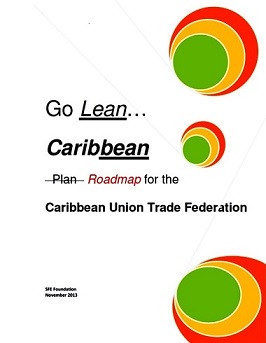
Caribbean Union Trade Federation Book Cover - SMALLThe book Go Lean … Caribbean serves as a roadmap for the introduction and implementation of the Caribbean Union Trade Federation (CU), a technocratic federal government to optimize the economic-security-governing engines of all 30 member-states. The quest is to streamline the direct stewardship, applying lessons-learned from global best practices.

There is the need for our region to elevate the societal engines of our communities. Fulfilling this need is the underlying theme behind this Go Lean movement, to “appoint new guards” to make the Caribbean homeland a better place to live, work and play. This Declaration of Interdependence is pronounced at the outset of the Go Lean book (Page 11):

xi. Whereas all men are entitled to the benefits of good governance in a free society, “new guards” must be enacted to dissuade the emergence of incompetence, corruption, nepotism and cronyism at the peril of the people’s best interest. The Federation must guarantee the executions of a social contract between government and the governed.

The Go Lean book declares that the Caribbean is in crisis, but posits that a “crisis is a terrible thing to waste” (Page 8). The book asserts that the solution for the Caribbean crisis is within reach:

The Go Lean movement is … a plan to re-boot the Caribbean. This movement was bred from the frustrations of the Diaspora, longing to go home, to lands of opportunities. But this is not a call for a revolt against the governments, agencies or institutions of the Caribbean region, but rather a petition for a peaceful transition and optimization of the economic, security and governing engines in the region.

The Go Lean book details a 5-year roadmap, with turn-by-turn directions, for reforming and transforming our homeland. This 370-page manuscript features the community ethos that the region needs to adopt, plus strategies, tactics, implementations and advocacies to execute in order to impact the Caribbean region for the needed turnaround.

This petition is addressed to a number of stakeholders, starting with the CariCom, which includes the English-speaking member-states plus Dutch-speaking Suriname and French/Creole-speaking Haiti. Additional addressees include the governments of the Netherlands and France. There is also the need to integrate the US Territories into the fold; so the Go Lean book details the process of Interstate Compacts under US federal law that allows their participation legally. The Dominican Republic is also requested to lean-in to this collaboration as well as they already cooperate with other Caribbean member-states in the CariFORUM economic dialogue with the European Union.

Lastly, there is Cuba. While this country’s participation may have been unlikely in the recent past, today there is a normalization of relations with the United States, the dominant regional power. This paves the way for a full cooperative among all regional Caribbean neighbors; in effect the roadmap calls for the establishment of a Single Market economy among the member-states – 30 in total with 42 million people. They all share the same dysfunctional disposition; they should share in the fight to assuage the crisis.

The efforts to elevate the Caribbean societal engines have been a frequent theme in messaging from the Go Lean movement. Consider the details from these previous blog-commentaries:

https://goleancaribbean.com/blog/?p=10629 Stay Home! A Series Highlighting Reasons to Stay in the Caribbean
https://goleancaribbean.com/blog/?p=10585 Two Pies: Economic Plan for a New Caribbean
https://goleancaribbean.com/blog/?p=10554 Welcoming the French
https://goleancaribbean.com/blog/?p=9595 Vision and Values for a ‘New’ Caribbean
https://goleancaribbean.com/blog/?p=9214 Time to Go! A Series Highlighting Reasons to Repatriate
https://goleancaribbean.com/blog/?p=8530 Tired Waiting! Ready for Change
https://goleancaribbean.com/blog/?p=7151 The Caribbean is Looking for Heroes … ‘to Return’
https://goleancaribbean.com/blog/?p=5759 Bad Example of Greece – Crisis leading to abandonment of Doctors
https://goleancaribbean.com/blog/?p=5733 Better than America? Yes, We Can!
https://goleancaribbean.com/blog/?p=2547 Miami’s Success versus Caribbean Failure
https://goleancaribbean.com/blog/?p=1433 Caribbean loses more than 70 percent of professionals to brain drain

The Caribbean: the greatest address in the world, and yet such an alarming abandonment rate. This must stop … now!

Why do we think that this Go Lean roadmap will be successful? It is modeled on time-tested best-practices. Remember dysfunctional East Germany? Remember how easily they were integrated into West Germany and a bigger, better society emerged – detailed in the Go Lean book on Pages 132 & 139.

Don’t remember?

That’s because it was seamless, technocratic and drama-free … in terms of international vistas; see Appendix VIDEO below. The prime directives of the Go Lean/CU roadmap is similarly modeled, as a technocratic stewardship for our region, identified with these 3 statements:

  • Optimization of the economic engines in order to grow the regional economy to a $800 Billion GDP & create 2.2 million new jobs. The deficiency of jobs is one of the reasons Caribbean people have emigrated.
  • Establishment of a security apparatus to protect the resultant economic engines and mitigate internal and external threats.
  • Improvement of Caribbean governance to support these above engines, including a separation-of-powers between member-state governments and CU federal agencies.

Let’s do this!

Our people have a simple request, they only want a better homeland, a better place to live, work and play. 🙂

Download the book Go Lean … Caribbean – now!

———

Appendix VIDEOThe Cost of Reunification | Made in Germanyhttps://youtu.be/A4v3zeDKjNM

Published on Nov 5, 2014 – Reunification came with a hefty price tag – about 2 trillion euros. More than half that went into social services and programs. About 300 billion euros went into renewing infrastructure and transportation. The massive transfer of funds from West to East spurred an economic boom in Western Germany as well as in the former East.
More Made in Germany on: http://www.dw.de/program/made-in-germ…

————–

Appendix – Actual Open Letter to Caribbean Governments Decision-Makers:

To the Honourable ___________________________________,

We, the undersigned are representative of the views of persons and organizations with an affinity for the Caribbean; we are residents, expatriates, trading-partners and visitors of these communities in the Caribbean region. We present you this petition, reflecting our love for the people and places there-in. But we recognize this reality:

There is something wrong in the Caribbean. It is the greatest address on the planet, but instead of the world “beating a path” to their doors, the people of the Caribbean have “beat down their doors” to get out. Our societal abandonment rates have technically been reported as high as 60 – 89 percent of our tertiary-educated populations.

These facts manifest that these are desperate times, and therefore call for desperate measures.

We hereby urge you to “lean-in” to this roadmap to introduce and implement the Caribbean Union Trade Federation (CU). This is presented as an inter-governmental federation with powers to optimize the region’s societal engines with this prime directives:

  • Optimize the economic engines in order to grow the regional economy; there is a potential to create 2.2 million new jobs and to grow the regional GDP to $800 Billion. The deficiency of jobs is one of the reasons that Caribbean people have emigrated.
  • Establish a security apparatus to protect the economic engines, mitigate threats and ensure public safety.
  • Improve Caribbean governance to support these above engines, including a separation-of-powers between member-state governments and CU federal agencies.

We must do something and this roadmap for the CU addresses the issues, strategies, tactics and implementations to effect change in these Caribbean homelands.

The timing of this petition is urgent. When is the right time to address a crisis? The answer is always NOW. We cannot have a future without the youth, and these young people – the next generation for the Caribbean – are not inspired to engage in the status quo. We must impact change in our region, even if it is only for their benefit.

We urge you to lean-in – pursue these goals with gusto – now!

The source reference can be located and downloaded here at: http://www.goleancaribbean.com/

Thank You for your service,


Go Lean … Caribbean Movement
Share this post:
, ,

Stay Home! Outreach to the Diaspora – Doubling-down on Failure

Go Lean Commentary

How to survive being on fire? Stop-Drop-and-Roll.

What not to do? Dose yourself with alcohol. That would be ‘Doubling-down on Failure’.

This latter visual is the Caribbean dependence on their Diaspora.

CU Blog - Outreach to Diaspora - Doubling-Down on Failure - Photo 1

The Caribbean is in crisis – “on fire”; over 70% of college educated citizens flee the region, looking for better opportunities. This is the harsh reality. This is also an economic fact as many Caribbean states get 4 to 7 percent of their GDP as remittances back to the homeland from the Diaspora living abroad, mostly in North America and Western Europe. But a strategy to stimulate the remittance side of the Diaspora equation is dysfunctional. The community would do better to encourage 100 percent of their citizens economic output rather than just 4 to 7 percent.

This latter scenario is just ‘Doubling-down on Failure’. This is a losing proposition for the Caribbean – the Inter-American Development Bank reported that Caribbean member-states lose about 10 to 11 percent of GDP from emigration and spent cost of education on those expatriates. Focusing on remittance is just a bad strategy for Diaspora dynamics; rather the focus should be on reducing the Diaspora by dissuading future generations from leaving.

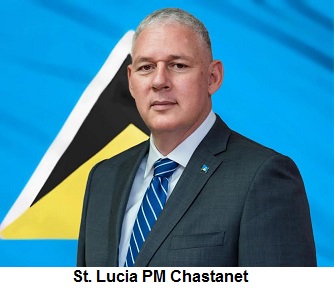
This is why the messaging in this VIDEO is so distressing. It is like the subtle message to the Caribbean population is that they need to leave their homeland, go get success and then please remember to invest in us afterwards. This is the jump-off-the-page thought of this address from the Prime Minister of St. Lucia last month. See here:

VIDEOPM 38th Independence Message to Diaspora https://youtu.be/R_eqKr32BQA

Published on Feb 4, 2017 – St. Lucia’s Prime Minister, the Honourable Allen M. Chastanet’s formal address to the Diaspora on the occasion of Independence Day 2017.
o  Category: News & Politics
o  License: Standard YouTube License

Say it ain’t so!

It is so unfortunate that the people in the Caribbean are beating down the doors to get out of their Caribbean homeland, to seek refuge in these places like the US, Canada and Western Europe. And yet it seems like the Chief Executive of this Caribbean country is encouraging more of it – there is a similar sentiment in the rest of the Caribbean member-states. As a result, we have such a sad state of affairs for our Caribbean eco-system as we are suffering from a bad record of societal abandonment. The reasons why people leave have been identified as “push and pull”:

“Push” refers to people who feel compelled to leave, to seek refuge in a foreign land. “Refuge” is an appropriate word; because of societal defects, many from the Caribbean must leave as refugees – think LGBTDisabilityDomestic-abuseMedically-challenged – for their life, liberty and pursuit of happiness. For these people, they are “on fire” and need to stop-drop-and-roll.

“Pull”, on the other hand refers to the lure of a more prosperous life abroad; many times our people are emigrating for economics solely.

If only we can mitigate these “push and pull” factors, then we can dissuade our people from leaving in the first place. If only we can go from ‘good to great‘ here in the Caribbean homeland. This would be the ideal. But this is not our reality. Considering the messaging from the current Prime Minister of St. Lucia, it is obvious that we cannot depend on the right roadmap to come from the region’s governance.

The alternate strategy being proposed here is to prosper where we’re planted in the Caribbean. But this goal requires heavy-lifting. It is easier said than done. This is the focus of the book Go Lean…Caribbean, to elevate the Caribbean economy so that there would be optimal opportunities at home and no need to supplant to another land.

One of the missions of the book Go Lean…Caribbean is to lower the “pull” attraction of life in foreign lands. This is part 3 of 3 in a series on “Why Caribbean people need to Stay Home“, positing that the “grass is not necessarily greener on the other side”; definitely not for the communities they leave behind. The complete series is as follows:

  1.  Stay Home! Remembering ‘High Noon’ and its Back-Story
  2.  Stay Home! Immigration Realities in the US
  3.  Stay Home! Outreach to the Diaspora – Doubling-down on Failure

From a community perspective, it would be better for Caribbean people to work to remediate the problems in their homeland, rather than flee and send monies back home. But it turns out that this true individual-wise as well. Research shows that it is more advantageous for individuals to invest in their homelands or in themselves (as in advanced education) than to do the heavy-lift of migrating abroad. It turns out this strategy is an Economic Fallacy, that first generation immigrants do not really prosper in their foreign lands – they only survive; it takes their next generation to really thrive. Consider this US example, they usually make less money than legacy Americans:

On average, most Caribbean immigrants obtain lawful permanent residence in the United States (also known as receiving a green card) through three main channels: They qualify as immediate relatives of U.S. citizens, through family-sponsored preferences, or as refugees and asylees. Compared to the total foreign-born population, Caribbean immigrants are less likely to be Limited English Proficient (LEP), but have lower educational attainment, lower median incomes, and higher poverty rates. – Migration Policy Institute, 2016.
CU Blog - Outreach to Diaspora - Doubling-Down on Failure - Photo 4

Then the problem with next generation success is that at that point in the timeline the stakeholders are not Diaspora anymore, their allegiance has shifted to their new homeland. We have so many immigrant experiences that relate this: Chinese, Italian, Irish, Cuban, etc.. Yes, the reality of Cubans in America is that many of their expatriates fled to exile hoping for a quick return. But now, by the second-and-third generations, their offspring really consider America as their home and Cuba as just their heritage. There will be no prospering back in Cuba.

So how do we in the Caribbean prosper where we are planted in the Caribbean? While this is a simple question (based on the Bible principle of Psalms 1:3), the answer is more complex.

They are like trees planted along the riverbank, bearing fruit each season. Their leaves never wither, and they prosper in all they do. – New Living Translation

The book Go Lean…Caribbean concurs with this mission, to prosper where planted in the Caribbean. It serves as a roadmap for the introduction and implementation of the technocratic Caribbean Union Trade Federation (CU) to do the heavy-lifting of optimizing the societal engines in the region. This Go Lean roadmap uses cutting-edge delivery of best practices to employ strategies, tactics and implementations to impact its prime directives; identified with the following 3 statements:

  • Optimization of the economic engines in order to grow the regional economy to $800 Billion & create 2.2 million new jobs.
  • Establishment of a security apparatus to protect the resultant economic engines.
  • Improve Caribbean governance to support these engines.

The successful execution of these directives will allow Caribbean stakeholders to prosper, while remaining as residents in their homeland. The Go Lean book seeks to optimize the entire Caribbean economic/security/governance eco-system to reach this goal. This vision is defined early in the book (Page 13 & 14) in the following pronouncements in the Declaration of Interdependence:

xix. Whereas our legacy in recent times is one of societal abandonment, it is imperative that incentives and encouragement be put in place to first dissuade the human flight, and then entice and welcome the return of our Diaspora back to our shores. This repatriation should be effected with the appropriate guards so as not to imperil the lives and securities of the repatriated citizens or the communities they inhabit. The right of repatriation is to be extended to any natural born citizens despite any previous naturalization to foreign sovereignties.

xxvi. Whereas the Caribbean region must have new jobs to empower the engines of the economy and create the income sources for prosperity, and encourage the next generation to forge their dreams right at home, the Federation must therefore foster the development of new industries… In addition, the Federation must invigorate the enterprises related to existing industries … – impacting the region with more jobs.

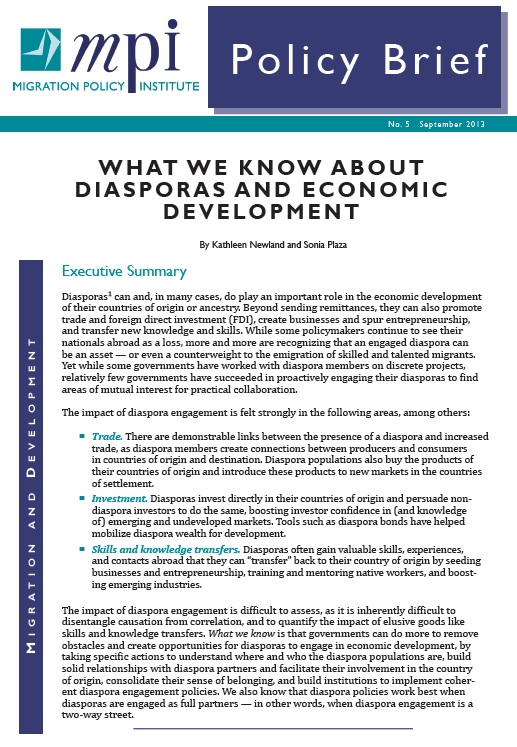
CU Blog - Outreach to Diaspora - Doubling-Down on Failure - Photo 3To be fair to the Prime Minister of St. Lucia, the Honourable Allen Chastanet, there is some concurrence to his contention, this Economic Fallacy; other PM’s in the region have made the same appeal. It is an assumption by many pundits in economic circles, though a minority opinion, that a country’s Diaspora community can be a great source for economic elevation. These pundits posit that the status quo in these developing countries would not lead to the sought-after elevation; it would take “new blood” and the Diaspora are considered candidates for bringing these 3 ingredients:

  • Trade
  • Investments
  • Skills and Knowledge Transfers

See the full report – www.migrationpolicy.org/pubs/Diasporas-EconomicDevelopment.pdf – by the Migration Policy Institute (MPI), an  independent, nonpartisan, nonprofit think tank in Washington, DC dedicated to analysis of the movement of people worldwide. See the Executive Summary in the Photo here:

CU Blog - Outreach to Diaspora - Doubling-Down on Failure - Photo 2

(Click on Image to Enlarge)

This opinion is not shared by the movement behind the Go Lean book. The full MPI Report identifies countries where Diaspora outreach has yielded positive  results, like Peru, India and Somalia. A prime difference of these countries versus the Caribbean member-states is the National Sacrifice community ethos, it is undoubtedly missing in the Caribbean – member-states do not even have (work-free) holidays to honor the sacrifices of those that fought, bled and/or died for their country. Caribbean people normally do not show the same level of patriotism. Once Caribbean citizens leave their homeland, they rarely invest back in their ancestral homeland. They normally just send money back to their families. As for investment, they have better choices; think Wall Street.

In summary, the Caribbean Diaspora do not invest back in their homelands because they are not ready, willing nor able. This is the honest assessment of the Caribbean status quo. Thusly, an outreach to the Diaspora is doubling-down on failure!

The Go Lean book details features of assessments, community ethos, strategies, tactics, implementations and advocacies to plant and exploit local opportunities in the Caribbean region. See this sample here:

Community Ethos – Deferred Gratification Page 21
Community Ethos – Economics Influence Choices Page 21
Community Ethos – Privacy versus Public Protection Page 23
Community Ethos – “Crap” Happens Page 23
Community Ethos – Lean Operations Page 24
Community Ethos – Cooperatives Page 24
Community Ethos – Non-Government Organizations Page 25
Community Ethos – Ways to Impact Turn-Arounds Page 33
Community Ethos – Ways to Improve Sharing Page 35
Community Ethos – Ways to Promote Happiness Page 36
Community Ethos – Impact the Greater Good Page 37
Strategy – Vision – Confederate 30 Member-States Page 45
Strategy – Mission – Dissuade Next Generation from Emigrating Page 47
Strategy – Agents of Change – Globalization Page 57
Tactical – Fostering a Technocracy Page 64
Separation of Powers – Between Member-states -vs- CU Agencies Page 71
Implementation – Ways to Deliver Page 109
Planning – Ways to Model the EU Page 130
Planning – Ways to Make the Caribbean Better Page 131
Planning – Ways to Measure Progress Page 148
Advocacy – Ways to Grow the Economy Page 151
Advocacy – Ways to Create Jobs Page 152
Advocacy – Ways to Impact Cancer Page 157
Advocacy – Ways to Better Manage the Social Contract Page 170
Advocacy – Ways to Foster Cooperatives Page 176
Advocacy – Ways to Improve Emergency Management – Deal with Disasters! Page 196

Advocacy – Ways to Preserve Caribbean Heritage Page 218
Appendix – Education and Economic Growth – Each add’l year = 10% more $$$ Page 258

Now is the time for all of the Caribbean, the people and governing institutions, to lean-in for the empowerments described here in this book Go Lean … Caribbean. It is time for the region to prosper right here where we are planted.

The Caribbean can succeed in this effort to improve the Caribbean as a place to live, work and play. The strategies and tactics of this quest have been detailed in many previous Go Lean blog-commentaries. Consider this sample:

https://goleancaribbean.com/blog/?p=10585 Two Pies: Economic Plan for a New Caribbean
https://goleancaribbean.com/blog/?p=10043 Integration Plan for Greater Caribbean Prosperity
https://goleancaribbean.com/blog/?p=9595 Vision and Values for a ‘New’ Caribbean
https://goleancaribbean.com/blog/?p=8351 A 6-part Series on Economic Fallacies
https://goleancaribbean.com/blog/?p=7646 Going from ‘Good to Great’
https://goleancaribbean.com/blog/?p=7221 Street naming for Martin Luther King unveils a ‘Climate of Hate’
https://goleancaribbean.com/blog/?p=5733 Better than America? Yes, We Can!
https://goleancaribbean.com/blog/?p=5527 American Defects: Racism – Is It Over?

An outreach to successful citizens living in the Diaspora is futile; it says this is what you have to do – leave – to prosper and be successful.

The alternative messaging for elevating the Caribbean should be: “Let’s double-down on … ”

  • job creation …
  • incubators for entrepreneurship …
  • bridging the Digital Divide
  • regional collaboration
  • e-Learning for At-Home education
  • and so on … (see Go Lean book Page 45 for full list of strategies).

This is what is needed to prosper where planted in the Caribbean. We need a turnaround. It must start in the head (thoughts, visions, etc.), penetrate the heart (feelings, motivations, etc.) and then manifest in speech and actions.

To the Prime Minister of St Lucia and all the other Heads of Government in the Caribbean region: Do better!

We will help. We hereby urge you to lean-in to the Go Lean roadmap.

To the residents on St. Lucia and all the other Caribbean communities, we urge: Stay Home! The grass is not greener on the other side. The effort to impact any change is easier here in the Caribbean than abroad in some foreign country. 🙂

Download the book Go Lean … Caribbean – now!

Share this post:
, ,
[Top]

Stay Home! Immigration Realities in the US

Go Lean Commentary

When conditions are dysfunctional at home, people leave … period.

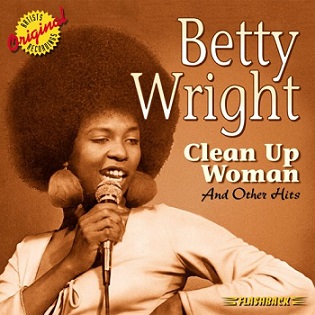
“… we are just making it easy for the clean-up woman” – Classic R&B song by Betty Wright
See Appendix VIDEO below.

CU Blog - Immigration Realities in the US - Photo 6

This is not good for a family nor for a community. The truth of the matter is that communities need their populations to grow, not recede. So any human flight incidences would create havoc on the functionality of societal engines: economics, security and governance.

This is our status in the Caribbean, but it is not just an incident, not a trickle; it is a flood. The people are beating down the doors to get out of their Caribbean homeland, to seek refuge in places like the US, Canada and Western Europe. We have a sad state of affairs for our Caribbean eco-system so we are suffering from a bad record of societal abandonment – averaging a 70 percent brain drain rate. The reasons why people leave have been identified as “push and pull”:
“Push” refers to people who feel compelled to leave, to seek refuge in a foreign land. “Refuge” is an appropriate word; because of societal defects, many from the Caribbean must leave as refugees – think LGBTDisabilityDomestic-abuseMedically-challenged – for their life, liberty and pursuit of happiness. This is making it easy for the “clean-up woman”.

“Pull”, on the other hand refers to the lure of a more prosperous life in the US (and other destinations); many times our people are emigrating for economics solely.

If only we can mitigate these “push and pull” factors, then we can dissuade our people from leaving in the first place. If only we can go from ‘good to great‘ here in the Caribbean homeland. This would be the ideal. But this is not our reality.

What is a point of contention is where our emigrants are going. Let’s consider the realities of one such destination: the United States. While things are bad for our residents in their Caribbean homeland, many minority immigrants in America (Black-and-Brown, Muslim, etc.) have to contend with less than welcoming conditions there.

The movement behind the book Go Lean … Caribbean has consistently related that the United States of America functions as a Great Society but it has two societal defects: Institutional Racism and Crony-Capitalism. These societal defects can easily create a ‘Climate of Hate‘ that causes people to haze and blame-game the immigrant community.

CU Blog - Immigration Realities in the US - Photo 4

In a previous blog-commentary, it was conveyed that America treats immigrants unappreciatedly – they are inflicted with a “long train of abuses”. The long-term Americans start towards the immigrants with hate and then eventually tolerate. After some decades they may then integrate with the immigrant community. But only after generations do they appreciate and celebrate the minority group. Think of the American experience of the Chinese, Italians, Jewish and Cuban populations.

This is also the reality of the Caribbean Black-and-Brown that has emigrated to the US, while they can more easily survive, the quest to thrive is more perplexing. They have to live in this environment filled with these societal defects. Consider this news article and these aligning VIDEO’s:

News Article Title: GPS device-maker Garmin reeling after workers gunned down
By: Jim Suhr

CU Blog - Immigration Realities in the US - Photo 1

OLATHE, Kan. (AP) — GPS device-maker Garmin long has revered diversity in its workforce, even when the locale of its ever-sprawling operational headquarters — a largely white Kansas City suburb — didn’t reflect it.

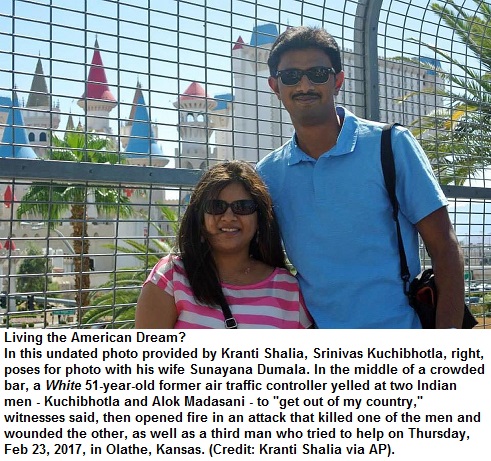
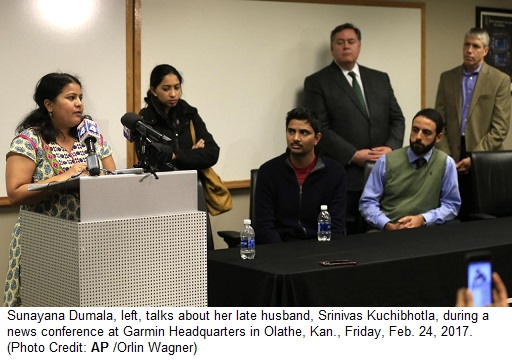
It’s the place 32-year-old Srinivas Kuchibhotla came to work a few years ago. By his wife’s account Friday he willingly spent long hours on an aviation systems engineering team alongside Alok Madasani, a friend and colleague also 32 and from India.

Kuchibhotla’s trek led him to have a kinship with his boss, Lebanese native Didier Popadopoulos, who says he moved to America at Kuchibhotla’s age and once held the same Garmin job.

But Garmin — a billion-dollar tech giant launched in Kansas as a startup by two men nearly three decades ago — now is reeling, trying to digest Kuchibhotla’s shooting death Wednesday at a tavern just a mile down the road from work. Madasani was wounded, along with a stranger who tried to help.

Witnesses say the gunman, Adam Purinton, yelled at the two Indian men to “get out of my country” and opened fire. Purinton, who was arrested hours later at a bar in Missouri, remains jailed on murder and attempted murder charges.

The shooting happened at a time when many have concerns about the treatment of immigrants in the U.S., some of whom feel targeted by the current administration. President Donald Trump has promised to ban certain travelers and been especially vocal about the threat posed by Islamic terrorist groups.

CU Blog - Immigration Realities in the US - Photo 2On Friday, Garmin tried to comfort grieving employees at a closed-door vigil inside the auditorium on its campus in Olathe, Kansas. Kuchibhotla’s widow, Sunayana Dumala, addressed the group of about 200 workers that included Madasani, who was released from the hospital Thursday.

Laurie Minard, Garmin’s vice president of human resources, doesn’t believe the shooting will jeopardize its recruitment of workers from overseas.

“We tend to be a family here,” she said at the Garmin campus, which is waging a $200 million expansion, with plans announced last August for a new manufacturing and distribution center. “We want people to feel safe. We embrace it. We encourage it. We support it. It’s extremely important to us about acceptance.”

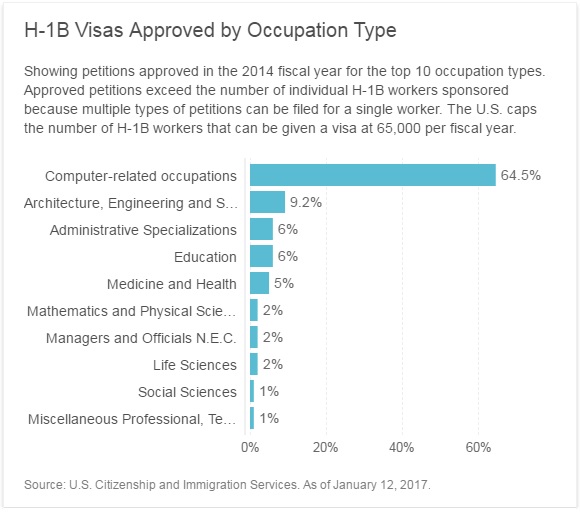
At any given time, she said, more than 100 Garmin employees are in the H-1B program, which lets American companies bring foreigners with technical skills to the U.S. for three to six years.

CU Blog - Immigration Realities in the US - Photo 5

In an eight-year period until fiscal year 2016, Garmin on average obtained 49 certifications for foreign labor — a prerequisite for hiring with an H-1B visa — for an average of 70 positions, according to the U.S. Department of Labor. During that time, 81 percent of the certified positions were in Olathe, the Labor Department says.

Olathe, whose name means “beautiful” in the Shawnee language, is a well-to-do Kansas City suburb where the median household income is above $77,000 a year.

CU Blog - Immigration Realities in the US - Photo 3Worldwide, Switzerland-based Garmin Ltd. — the Kansas operation’s corporate parent — has more than 11,400 workers in 60 offices and last year logged $3.02 billion in revenue. Roughly 2,800 workers are at the Kansas headquarters, which Greater Kansas City Chamber of Commerce spokeswoman Pam Whiting cast as regionally “one of our entrepreneurial success stories” and biggest employers.

Recruiting from overseas isn’t at all unusual in the tech industry, which contends there aren’t enough Americans with specialized skills the companies need.

Indian immigrants in the U.S. has spiked from about 200,000 in the 1980s to more than 2 million today, as Indian-born scientists and engineers fueled the American tech boom. India received more H-1B visas in the U.S. for its temporary high-skilled workers, about 70 percent, than any other country in 2014.

Stunned by Kuchibhotla’s death, Popadopoulos, the Lebanese native who was the man’s boss, said he plans to stay the course.

“When this happened, one of the things I started to think about with my wife (was) ‘Is it time to leave?'” he said.

Then he thought: “Leave where? I’m from here. I really think Srinivas would want us to stick together and stand up for what’s right.”

U.S. Sen. Jerry Moran said he left a message with Olathe’s mayor, offering to help assure people from India who live in Kansas that the actions leading to Kuchibhotla’s death are “not the norm.”

“This is not the nature of Kansas, and we welcome people to the United States, particularly a company like Garmin and many others,” the Kansas Republican said.

___

AP Data Journalist Larry Fenn in New York and AP writers Martha Mendoza in Bangkok and John Hanna in Topeka, Kansas, contributed to this report.
Source: Associated Press – posted February 25, 2017; retrieved February 27, 2017 from: https://www.yahoo.com/news/gps-device-maker-garmin-reeling-workers-gunned-down-013731087.html

—————-

VIDEO #1 What would America’s Tech industry be like without immigrants? – https://youtu.be/QODK-9-mImg

Published on Feb 3, 2017 – In the recent hate-crime in Olathe, Kansas the gunman exclaimed that he wanted the country back. Consider the words of this deranged killer and ask “What would America’s Tech industry be like without immigrants?”
But maybe, the American people are not so inviting, even though American companies may seek immigrants.
http://global-gathering.com

—————-

VIDEO #2 Trump Said Immigration Is Bad for the Economy, But Is it? – https://youtu.be/7PHfJ8HY-Ds

Published on Feb 12, 2017 – The new President, Donald Trump, has expressed that immigration is bad for the American economy and society in general. This is just another example of his “alternate facts”. It is not the truth. But it does project that his American administration is not welcoming to immigrants.
The question to the Caribbean: Do you want to go to a party that you’re not invited to or welcomed?
Category: News & Politics
License: Standard YouTube License

This foregoing article relates a hate-crime against immigrants (engineers) from India. They were not Muslims; they were not Mexican; they were not affiliated with the Black-and-Brown populations from Latin America or the Caribbean. But they were non-White and spoke with foreign accents; they therefore were subject to standard American hate-speech, bullying and in this case, a random act of violence; one was murdered.

This commentary is one of the missions of the book Go Lean…Caribbean, to lower the “pull” attraction of life in the US. This is not being done with “smoke and mirrors” but rather this is just the truth. This is part 2 of 3 in a series on “Why Caribbean people need to Stay Home“, positing that the “grass is not greener on the other side”. The complete series is as follows:

  1.  Stay Home! Remembering ‘High Noon’ and its Back-Story
  2.  Stay Home! Immigration Realities in the US
  3.  Stay Home! Outreach to the Diaspora – Doubling-down on Failure

The truth of the matter is that immigrants are better able to survive in America – there is an abundance of minimum wage jobs – but to thrive is more of a challenge; consider the experiences in the foregoing news article. It would seem better for Caribbean people to work to remediate the problems in their homeland, rather than work to become immigrants in the US. But this is no easy task; and despite being necessary, it is hereby defined as heavy-lifting.

The book Go Lean … Caribbean seeks to optimize the societal engines of Caribbean life; it serves as a roadmap for the introduction and implementation of the technocratic Caribbean Union Trade Federation (CU). The CU must employ better strategies, tactics and implementations to impact the regional homelands to reform and transform the societal engines. The prime directives of the Go Lean/CU roadmap for technocratic stewardship is identified with the following 3 statements:

  • Optimization of the economic engines in order to grow the regional economy to $800 Billion & create 2.2 million new jobs. The deficiency of jobs is one  of the reasons Caribbean people have emigrated.
  • Establishment of a security apparatus to protect the resultant economic engines and mitigate internal and external threats.
  • Improvement of Caribbean governance to support these above engines, including a separation-of-powers between member-state governments and CU federal agencies.

Early in the Go Lean book, this need for careful technocratic stewardship of the region’s societal engines was pronounced (Declaration of Interdependence – Page 12 – 13) with these acknowledgements and statements:

xi.   Whereas all men are entitled to the benefits of good governance in a free society, “new guards” must be enacted to dissuade the emergence of incompetence, corruption, nepotism and cronyism at the peril of the people’s best interest. The Federation must guarantee the executions of a social contract between government and the governed.

xii.  Whereas the legacy in recent times in individual states may be that of ineffectual governance with no redress to higher authority, the accedence of this Federation will ensure accountability and escalation of the human and civil rights of the people for good governance, justice assurances, due process and the rule of law. As such, any threats of a “failed state” status for any member state must enact emergency measures on behalf of the Federation to protect the human, civil and property rights of the citizens, residents, allies, trading partners, and visitors of the affected member state and the Federation as a whole.

xxiv. Whereas a free market economy can be induced and spurred for continuous progress, the Federation must install the controls to better manage aspects of the economy: jobs, inflation, savings rate, investments and other economic principles. Thereby attracting direct foreign investment because of the stability and vibrancy of our economy.

xxvi.  Whereas the Caribbean region must have new jobs to empower the engines of the economy and create the income sources for prosperity, and encourage the next generation to forge their dreams right at home, the Federation must therefore foster the development of new industries … In addition, the Federation must invigorate the enterprises related to existing industries … impacting the region with more jobs.

Our Caribbean community, no community for that matter, can survive a constant drain against our population and human capital. This is a crisis! This point was crystalized in a previous blog/commentary with this quotation:

We tend to think economic growth comes from working harder and smarter. But economists attribute up to a third of it to more people joining the workforce each year than leaving it. The result is more producing, earning and spending.

This is a consistent theme in the book Go Lean…Caribbean. The book posits that the most serious threat to Caribbean prosperity is the high abandonment rate among its citizens, especially its highly educated, skilled-labor classes.

“A crisis is a terrible thing to waste” – states the book quoting noted Economist Paul Romer.

The opportunity therefore exists to forge change in the economic, security and governing engines of the Caribbean, in response to this crisis. This is the advocacy of the Go Lean book, to position the region at the corner of preparation and opportunity, so as to better compete on the world stage. Our job creation engines have failed to keep pace with the population, therefore fewer and fewer jobs are at home. Thus this region has had a higher and higher emigration rate as the decades pass. If we want our citizens to “Stay Home” then we must provide job options.

How?

First, the region already has a mature tourism product so we now need jobs in other industries.

The following details from the book Go Lean … Caribbean are the community ethos, strategies, tactics, implementations and advocates prescribed to create non-tourism jobs and elevate the Caribbean economy:

Community Ethos – Deferred Gratification Page 21
Community Ethos – new Economic Principles Page 21
Community Ethos – Job Multiplier Page 22
Community Ethos – new Security Principles Page 22
Community Ethos – new Governing Principles Page 24
Community Ethos – Ways to Impact the Future Page 26
Community Ethos – Ways to Impact Turn-Arounds Page 33
Community Ethos – Ways to Promote Happiness Page 36
Community Ethos – Ways to Impact the Greater Good Page 37
Strategy – Repatriating Caribbean Diaspora Page 47
Strategy – Non-Government Organizations Page 48
Tactical – Confederating a Permanent Union Page 63
Tactical – Fostering a Technocracy Page 64
Implementation – Assemble all Member-States Page 96
Implementation – Ways to Pay for Change Page 101
Implementation – Reasons to Repatriate Page 118
Planning – Ways to Make the Caribbean Better Page 131
Advocacy – Ways to Grow the Economy Page 151
Advocacy – Ways to Create Jobs Page 152
Advocacy – Better Manage the Social Contract Page 170
Advocacy – Ways to Foster Empowering Immigration Page 174
Advocacy – Impact the Diaspora Page 217
Advocacy – Ways to Preserve Caribbean Heritage Page 218
Advocacy – Ways to Help the Middle Class Page 223

The Go Lean roadmap is a product of the Diaspora, from those residing in the US – looking at Caribbean residents and longing to go home. The Go Lean book and blog-commentaries assert that the “grass is not greener on the other side”. But we rightfully know that the quest for economic opportunities is the “pull” factor that attracts Caribbean people.

How to create jobs at home? This point – and accompanying lessons – has been exhausted in previous blog/commentaries; consider this sample:

https://goleancaribbean.com/blog/?p=9751 Where the Jobs Are – Animation and Game Design
https://goleancaribbean.com/blog/?p=9203 Where the Jobs Are – Employer Models in the United States
https://goleancaribbean.com/blog/?p=8262 Creating Job Opportunities with UberEverything – An African Model
https://goleancaribbean.com/blog/?p=8328 Creating Job Opportunities as YouTube Millionaires
https://goleancaribbean.com/blog/?p=7806 Skipping School to become Tech Giants
https://goleancaribbean.com/blog/?p=6129 Innovative Partnership Aids Farm Workers/Agricultural Jobs
https://goleancaribbean.com/blog/?p=6089 Where the Jobs Are – Futility of Minimum Wage
https://goleancaribbean.com/blog/?p=5759 Pressed by Debt Crisis, Doctors Leave Greece in Droves for New Jobs
https://goleancaribbean.com/blog/?p=2857 Where the Jobs Are – Entrepreneurism in Junk
https://goleancaribbean.com/blog/?p=2126 Where the Jobs Are – Computers Reshaping Global Job Market
https://goleancaribbean.com/blog/?p=2025 Where the Jobs Are – Attitudes & Images of the Diaspora
https://goleancaribbean.com/blog/?p=2003 Where the Jobs Are – One Scenario: Ship-breaking
https://goleancaribbean.com/blog/?p=1698 Where the Jobs Are – STEM Jobs Are Filling Slowly

These previous blogs report that this Go Lean roadmap is a hope for change in the Caribbean region. Its a plan that is conceivable, believable and achievable for making the Caribbean homeland a better place to live, work and play. Everyone in the region is hereby urged to lean-in to this roadmap. 🙂

Download the book Go Lean … Caribbean – now!

———–

Appendix VIDEO – Betty Wright – Clean Up Woman – https://youtu.be/vh-2_kdVcyA

Uploaded on May 27, 2009 Lyrics:

“Clean Up Woman”
A clean up woman is a woman who
Gets all the love we girls leave behind
The reason I know so much about her
Is because she picked up a man of mine

Chumpin’ slick was my ruin
‘Cause, I found out all I was doin’
Was making it easy for the clean up woman
To get my man’s love, oh yeah
Just making it easy for the clean up woman
To get my baby’s love, uh-huh, um-hum

I took this man’s love and put it a shelf
And like a fool I thought I had him all to myself

When you needed love I was out having fun
But I found out that all I had done
Was made it easy for the clean up woman
To get my man’s love, uh-huh
Yeah, that’s what I did, I made it easy for the clean up woman
To steal my baby’s love, oh yeah

The clean up woman will wipe his blues away
She’ll give him plenty lovin’ 24 hours a day
The clean up woman, she’ll sweep him off his feet
She’s the one who’ll take him in when you dump him in the street
So take a tip, you better get hip
To the clean up woman ’cause she’s tough
I mean, she really cleans up


Share this post:
, , ,
[Top]

Two Pies: Economic Plan for a New Caribbean

Go Lean Commentary

“Get your hands out of my pocket!” – Term used by another man in the room to cause a disturbance and distraction during the killing of Malcolm X in New York on February 21, 1965 – 52 years ago this week. See VIDEO in the Appendix below.
CU Blog - Two Pies - Economic Plan for a New Caribbean - Photo 4

The words above that were shouted to cause a disturbance are riot-inducing and can cause alarm for many communities. No one wants to think that someone unauthorized and unworthy may be pilfering hard-earned funds from innocent victims.

No one wants to be that victim!

CU Blog - Two Pies - Economic Plan for a New Caribbean - Photo 2This was a point of consideration in the conception of the book Go Lean…Caribbean. There was the inspiration to conceive an economic empowerment plan for all the Caribbean that would NOT take money out of one person’s pockets and give to another … unauthorized and unworthy. The solution?

Two pockets … or two pies.

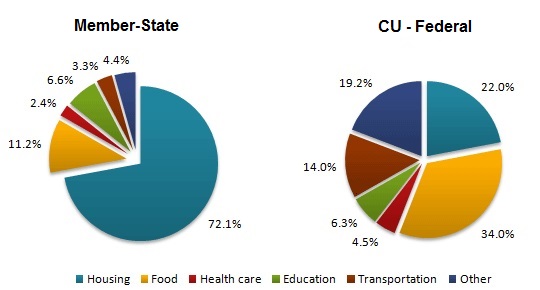
… pie as in a pie-chart; this is the graphical representation of the distribution of a budget. Pie-charts are very effective in expressing one amount in comparison to another amount. So when there are two pie-charts, it undoubtedly expresses that there are two different funds, no intermingling. That is the economic plan for the new Caribbean:

Two Pies.

CU Blog - Two Pies - Economic Plan for a New Caribbean - Photo 3b

This means that there are two different funds. The Go Lean book serves as a roadmap for the introduction and implementation of the technocratic Caribbean Union Trade Federation (CU). This is a regional integration effort to benefit the 30 member-states of the Caribbean. There are a lot of money issues to contend with – but no one person’s hands are in another person’s pockets. So all the money issues for CU are exclusive to the CU. This is true of money-economics and other facets of Caribbean life: security and governance. In total, these 3 prime directives explore the full dimensions of the roadmap:

  • Optimization of the economic engines in order to grow the regional economy to $800 Billion & create 2.2 million new jobs.
  • Establishment of a security apparatus to ensure justice institutions and protect the resultant economic engines.
  • Improve Caribbean governance including a separation-of-powers between the member-states and CU federal agencies to support the economic and security engines.

In order to reboot the societal engines there must be these Two Pies. The CU Trade Federation is designed to lead, fund and facilitate regional empowerment plans. But the plan is NOT for the individual member-states to write checks to the CU so as to share one state’s treasuries with another state. Rather, the CU Trade Federation creates its own funding – from regionalized services – and then encumbers the funds for each member-state to deliver the economic, security and governing  mandates. This is analogized as Two Pies:

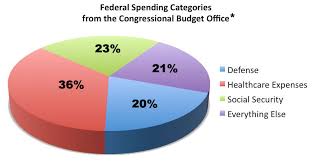
  • One ‘pie‘ to represent the existing budgets of the member-states and how they distribute their government funding between government services (education, healthcare, etc.), security measures (Police, Coast Guards)
  • One ‘pie‘ to represent the CU funding from exclusive activities (Spectrum Auctions, Lottery, Exploration Rights, Licenses, Foreign-Aid, etc.).

All in all, the book, and accompanying blogs, declare that the proposed CU Trade Federation is a new governmental layer, and thusly creates a new government budget. This is a confederation; designed to enhance the governmental deliveries for the 30 member-states. This necessity is expressed as a pronouncement in the opening Declaration of Interdependence, (Pages 10 – 11) with the following statement:

Preamble: While our rights to exercise good governance and promote a more perfect society are the natural assumptions among the powers of the earth, no one other than ourselves can be held accountable for our failure to succeed if we do not try to promote the opportunities that a democratic society fosters.

xi. Whereas all men are entitled to the benefits of good governance in a free society, “new guards” must be enacted to dissuade the emergence of incompetence, corruption, nepotism and cronyism at the peril of the people’s best interest. The Federation must guarantee the executions of a social contract between government and the governed.

CU Blog - Two Pies - Economic Plan for a New Caribbean - Photo 1The vision of a confederation is an integrated Single Market for the 30 member-states of the Caribbean; this means the Dutch, English, French and Spanish speaking territories. This also includes the US territories of Puerto Rico and the US Virgin Islands. Tactically, the CU allows for a separation-of-powers between the member-state governments and the new federal agencies.

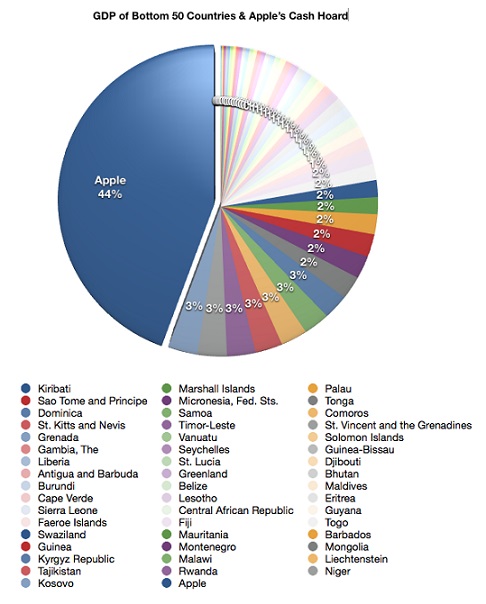
Currently the Caribbean member-states pockets are bare – these are all Third World destinations – even the US Territories of Puerto Rico and the Virgin Islands. Consider this First World comparison; consider Apple Corporation – the firm behind the iPhone, iPad, iTunes, etc. – due to their success in technology and business, they have a lot of money (cash on hand); a lot more than many Caribbean member-states … combined.

We need this CU roadmap to impact a turn-around for this region; we need the new “Pie” of the CU Single Market. The member-state’s economic engines – their “Pies” – are in crisis, but since a crisis would be a terrible thing to waste, we need to transform these economic engines for a new Caribbean by introducing the CU “Pie”, as follows:

  • Regional Capital Markets with a regional currency – Caribbean Dollar – would increase liquidity and lower the cost of capital. Rather than international debt, member-state governments and corporate institutions can avail themselves of lower financing costs, sometimes as low as 2% interest rates.
    Notice a glimpse of this vision in this previous blog-commentary:
    https://goleancaribbean.com/blog/?p=372 |  Dominica raises EC$20 million on regional securities market
  • Municipal financing – Debt by any governmental entity does not only reflect on the past, but impacts the future as well. Excessive debt can be so bad that at times the providers … and collectors of debt may be derisively called “vultures”. The CU pledges to re-purchase existing municipal debt and convert them to Caribbean Dollar instruments.
    Notice this portrayal in this previous blog-commentary:
    https://goleancaribbean.com/blog/?p=7601 |  Beware of Vulture Capitalists Commercial banking enhancements
  • Individual finance: Student Loans – Many Caribbean students obtained loans from their home countries, matriculated abroad and then never returned home. There was no return on investment and many times, no loan repayment. The CU pledges to buy outstanding loans (new, active and default) and enforce cross-border collections.
    Notice the details of this student loan crisis in this previous blog-commentary:
    https://goleancaribbean.com/blog/?p=8373 |  A Lesson in Economic Fallacies – Student Loans As Investments
  • Individual finance: Mortgages – Housing can be a great stimuli on the economy, but it is difficult for banks to recycle the capital that is tied up for 30 years without a Secondary Market. The CU pledges to deploy a Mortgage Secondary Market across the entire region (Go Lean book Page 83 and 199). This strategy will re-enforce banking within the region.
    Notice the issues associated with a dysfunctional mortgage eco-system in this previous blog-commentary:
    https://goleancaribbean.com/blog/?p=10187 |  Day of Reckoning for NINJA Loans
  • Individual finance: Retirement – Growing old in the Caribbean has become strained due to the high abandonment rate. National Pension plans depend on a macro structure where young people pay into the fund while the elderly withdraws from the fund. With so much emigration, the actuarial tables are distorted.
    Consider this previous blog-commentary that depicts a failing pension system in one member-state:
    https://goleancaribbean.com/blog/?p=2830 |  Jamaica’s Public Pension Under-funded
    … and one blog-commentary that describes how best to prosper:
    https://goleancaribbean.com/blog/?p=4222 |  Getting Rich Slowly in the Caribbean
  • Self-Governing Entities (SGE) – The Go Lean/CU roadmap features the installation of SGE’s as job-creating engines in many communities; these sites are ideal for technology laboratories, medical campuses, corporate parks, industrial sites, educational facilities and other forms of establishments situated inside bordered facilitates. They allow for an efficient process to launch and manage industrial efforts in the region. These types of installations will thrive under the strategies and tactics of the Go Lean roadmap. SGE’s do require governmental concurrence and maybe even public approvals – referendums – but only at the initiation. Beyond that, they are not a concern, or an expense, for local governments – they bring their own economic “Pie“.
    Consider this previous blog-commentary that details the dynamics of SGE’s:
    https://goleancaribbean.com/blog/?p=5921 |  Socio-Economic Change: Impact Analysis of SGE’s
  • Exclusive Economic Zones (EEZ) – The Go Lean/CU roadmap calls for the strategy of petitioning the United Nations Convention on the Law of the Sea (UNCLOS) for expanded territory in the Caribbean Sea for the CU to develop, explore, protect and exploit for the benefit to the Caribbean en-masse only. This means the CUPie” for revenues-and-expenses and not individual member-states.
    Consider this previous blog-commentary that details the dynamics of the EEZ:
    https://goleancaribbean.com/blog/?p=8819 |  Lessons from China – South China Seas: Exclusive Economic Zones

The Go Lean book details the series of community ethos, strategies, tactics, implementations and advocacies designed to create a federal “Pie” in the Caribbean region; see here:

Anecdote – Caribbean Single Market & Economy Page 15
Community Ethos – Money Multiplier Page 22
Community Ethos – Job Multiplier Page 22
Community Ethos – Lean Operations Page 24
Community Ethos – Ways to Impact the Future Page 26
Community Ethos – Ways to Impact the Greater Good Page 37
Strategic – Vision – Integrated Region in a Single Market Page 45
Strategic – Vision – Agents of Change Page 57
Tactical – Confederating a Non-sovereign Union Page 63
Tactical – Fostering a Technocracy Page 64
Tactical – Growing to $800 Billion Regional Economy Page 67
Tactical – Separation-of-Powers Page 71
Anecdote – “Lean” in Government – Optimizing Societal Engines Page 93
Implementation – Ways to Pay for Change Page 101
Implementation – Start-up Benefits from the Exclusive Economic Zone Page 104
Implementation – Steps to Implement Self-Governing Entities Page 105
Implementation – Ways to Better Manage Debt Page 114
Planning – Big Ideas for the Caribbean Region Page 127
Planning – Ways to Model the EU Page 130
Advocacy – Ways to Grow the Economy Page 151
Advocacy – Ways to Improve Governance Page 168
Advocacy – Ways to Better Manage the Social Contract Page 170
Advocacy – Reforms for Banking Regulations Page 199
Advocacy – Ways to Impact Wall Street Page 199

While the Caribbean needs its people, these people need a better Caribbean society – more prosperous. The region status quo is that “they got it bad”! Due to the many failures in the region, many people have fled to find refuge in foreign countries, resulting in a debilitating brain drain in the Caribbean, and thusly less people-less potential-less profits; so even more failure on top of failure.

The Go Lean roadmap for the CU stresses the need for this new “Pie“, the economics of a Caribbean Single Market. This theme was previously blogged on in so many previous Go Lean blog-commentaries; see sample here:

https://goleancaribbean.com/blog/?p=10043 Integration Plan for Greater Caribbean Prosperity
https://goleancaribbean.com/blog/?p=9595 Vision and Values for a ‘New’ Caribbean
https://goleancaribbean.com/blog/?p=8813 Lessons from China – Size Does Matter
https://goleancaribbean.com/blog/?p=841 Having Less Babies is Bad for the Economy
https://goleancaribbean.com/blog/?p=833 European Integration Currency Model: One Currency
https://goleancaribbean.com/blog/?p=599 Ailing Puerto Rico open to radical economic fixes
https://goleancaribbean.com/blog/?p=364 Time Value of Money
https://goleancaribbean.com/blog/?p=360 How to Create Money from Thin Air

Now is the time for all of the Caribbean – the people and governing institutions – to lean-in for the Caribbean integration re-boot, this Caribbean Union Trade Federation. We need the “Two Pies“. We need better engines to make our region more prosperous, to make it a better homeland to live, work and play. 🙂

Download the book Go Lean … Caribbean – now!

———

Appendix VIDEO – Malcolm X: Get your hand out my pocket – https://youtu.be/zHM8lAIFoU4

Uploaded on Jan 26, 2011 – Classic scene from a classic movie.


Share this post:
, ,
[Top]

Funding the Caribbean Security Pact

Go Lean Commentary

CU Blog - Funding the Caribbean Security Pact - Photo 1The Caribbean has societal problems: our economics, security and governing engines are all defective. How do we fix these?

The book Go Lean…Caribbean prescribes a detailed, complex plan for effecting change in our society. The goal is to confederate under a unified entity made up of the region’s stakeholders to empower the economics and optimize Homeland Security. But Homeland Security for the Caribbean has a different meaning than for our North American or European counterparts. Though we too must be on defense against military intrusions like terrorism & piracy, we mostly have to contend with threats that may imperil the region’s economic engines, like our tourism products. This includes concerns like narco-terrorism and enterprise corruption, plus natural and man-made disasters like hurricanes, earthquakes, oil/chemical spills, etc..

So the Go Lean security goal is mostly for public safety! This goal is detailed in the book as it serves as a roadmap for the introduction of the technocratic Caribbean Union Trade Federation (CU). While the CU is set to optimize Caribbean society through economic empowerment, we must accept the established truth that the security dynamics of the region are inextricably linked to economic endeavors. Therefore the Go Lean roadmap has these 3 prime directives:

  • Optimization of the economic engines in order to grow the regional economy to $800 Billion & create 2.2 million new jobs.
  • Establishment of a security apparatus to ensure public safety and protect the resultant economic engines.
  • Improve Caribbean governance to support these engines.

All in all, the quest of these prime directives involves heavy-lifting.

Anything described as heavy-lifting requires a full measure of devotion and commitment; it requires time, talent and treasuries. But just how much time? How much talent? How much of our treasuries?

These are all good questions and the consensus is that the answer is all qualitative and subjective, except for the last one: how much money to spend on security initiatives can be quantitative. There are existing formulas for this determination, that are universally accepted. The formula comes from the North Atlantic Treaty Organization (NATO), which has been presented in the Go Lean book as the example/role-model for the Caribbean to emulate. NATO was formed in 1949 as a collective response to security threats in the European region; member-states came together and confederated this inter-governmental security force to enjoy economies-of-scale of “many hands making a big job a smaller effort collectively”. See the relevant Appendix VIDEO below.

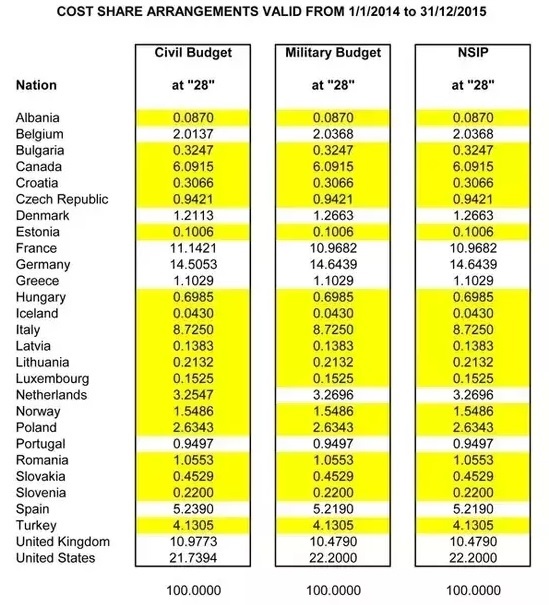
(The subject of NATO is en vogue right now as the new US President – Donald Trump – has voiced reservations about the other member-states (the US is 1 of 28) paying their “fair” share of NATO’s expenses. He had falsely related that the US was supplying 73% of NATO funds.)

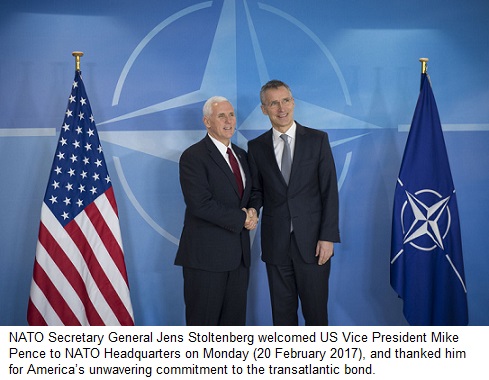
The Vice President of the United States of America visits NATO

CU Blog - Funding the Caribbean Security Pact - Photo 4

In the Caribbean, we have a similar quest – fostering a security apparatus for our own needs – as was Europe’s original plan. The Go Lean book asserts these CU security mandates for a unified region at Page 103:

10 Security Initiatives at Start-up
1. Lean-in for the Caribbean Single Market & Economy initiative: CU Trade Federation.
The CU treaty integrates 30 member-states in the Caribbean region into a single market of 42 million people so as to reboot the economic engines of the region. The CU posits that whenever there is economic prosperity that “bad actors” would emerge to exploit the peace for their own illicit gains. This was the case with the Pirates of the Caribbean in the 17th & 18th centuries, and the Gold Rush / Outlaws of 19th century Old West. So at the outset, the CU must tie a security apparatus to its economic rebooting activities. There is a need to assuage current threats and abate crime, so the Trade Federation must implement security/defense initiatives and enhance law-and-order institutions to better “serve and protect” the region.

  • The Bottom Line on NATO
    The North Atlantic Treaty Organization is an inter-governmental military alliance based on the North Atlantic Treaty which was signed on 4 April 1949. The organization constitutes a system of collective defense whereby its member states agree to mutual defense in response to an attack by any external party. For its first few years, NATO was not much more than a political association. However, the Korean War galvanized the member states, and an integrated military structure was built up, [and remains to this day]. During the Cold War, NATO was intended to be a credible defense against a Soviet/Warsaw Pact threat. Starting with 11 member-states, there are 28 today.

2. Unified Command & Control with State Militias and Police

3. Intelligence Agencies Collaboration

4. Border Security – Immigration / Emigration Tracking; Data Capture & Big Data Analysis

5. Satellite Surveillance Contracts

6. Closed Circuit Camera Installations

7. US Aid – Air Support

8. UK/Dutch Aid – Naval Ships

9. Recruitment & Repatriation of Diaspora

10.  Israeli Defense Force Modeling

The ‘T’ in the acronym for NATO means Treaty. A ratified treaty is the premise of this alliance between European and North American countries. It is also the premise for the Security Pact for the Caribbean, in which we have CU military forces and the host countries. The treaty is considered a Status of Forces Agreement; an agreement between a host country and a “foreign” stationing military force in that country. SOFA’s are often included, along with other types of military agreements, as part of a comprehensive security arrangement. The SOFA does not constitute the actual security arrangement, it establishes the rights and privileges of foreign personnel present in a host country in support of the larger security arrangement.

The book Go Lean…Caribbean posits that the region must prepare its own security apparatus – a NATO-styled inter-governmental military alliance – for our own security arrangement, to execute a limited scope on their sovereign territories. The limited scope reflects the separation-of-powers between the member-state governments and the CU Homeland Security agencies. So the request is that all Caribbean member-states welcome this foreign military force – foreign as in from the neighboring countries, from the confederated authority.

Some CU Homeland Security activities include:

  • A Naval Authority for the Exclusive Economic Zone (EEZ) for the Caribbean Sea
  • A robust Intelligence Gathering and Analysis apparatus
  • A Group Purchasing Organization, for armament procurement

The book contends that this confederated authority is the best way to prepare for the bad actors that will emerge just as a result of new economic successes in our region. This point is pronounced early in the book with the Declaration of Interdependence (Page 12) that claims:

x.   Whereas we are surrounded and allied to nations of larger proportions in land mass, populations, and treasuries, elements in their societies may have ill-intent in their pursuits, at the expense of the safety and security of our citizens. We must therefore appoint “new guards” to ensure our public safety and threats against our society, both domestic and foreign. The Federation must employ the latest advances and best practices … to assuage continuous threats against public safety.

xvi. Whereas security of our homeland is inextricably linked to prosperity of the homeland, the economic and security interest of the region needs to be aligned under the same governance. Since economic crimes, including piracy and other forms of terrorism, can imperil the functioning of the wheels of commerce for all the citizenry, the accedence of this Federation must equip the security apparatus with the tools and techniques for predictive and proactive interdictions.

The Caribbean appointing “new guards”, or a security pact to ensure public safety is intended to be a comprehensive endeavor; the funding should follow the NATO model of 2-percent – see Appendix below – the US has the largest NATO economy so they pay a much larger share of the funding. This 2-percent approach would dictate the following budget (in $millions) for the Caribbean Security Pact; using 2010 GDP numbers from the Go Lean book Page 66:

Member-State

2010 GDP

2% Defense

Anguilla

0.108

$0.00

Antigua and Barbuda

1,646

$32.92

Aruba

2,400

$48.00

Bahamas

9,228

$184.56

Barbados

5,244

$104.88

Belize

2,525

$50.50

Bermuda

5,085

$101.70

British Virgin Islands

84

$1.68

Cayman Islands

1,939

$38.78

Cuba

111,000

$2,220.00

Dominica

720

$14.40

Dominican Republic

76,304

$1,526.08

Grenada

1,153

$23.06

Guadeloupe

6,169

$123.38

Guyana

3,082

$61.64

Haiti

11,562

$231.24

Jamaica

20,958

$419.16

Martinique

9,610

$192.20

Montserrat

29

$0.58

Netherlands Antilles

2,450

$49.00

Puerto Rico

67,870

$1,357.40

Saint Barthélemy

255

$5.10

Saint Kitts and Nevis

750

$15.00

Saint Lucia

1,839

$36.78

Saint Martin

599

$11.98

Saint Vincent

1,086

$21.72

Suriname

4,436

$88.72

Trinidad and Tobago

27,038

$540.76

Turks and Caicos Islands

845

$16.90

US Virgin Islands

2,679

$53.58

$378,585.11

$7,571.70

$7.6 billion in spending to assure the regional defense? That would be nice!

The CU Trade Federation is designed to lead, fund and facilitate regional security forces. But the plan is NOT for the individual member-states to write checks to the CU. Rather, the CU Trade Federation creates its own funding – from regionalized services – and then encumbers the funds for each member-state to earmark the security initiatives, at the above rates. This is analogized as 2 Pies:

  • One ‘pie’ to represent the existing budgets of the member-states and how they distribute their government funding between government services (education, healthcare, etc.), security measures (Police, Coast Guards)
  • One ‘pie’ to represent the CU funding from exclusive activities (Spectrum Auctions, Lottery, Exploration Rights, Licenses, Foreign-Aid, etc.).

The concept of Foreign-Aid requires more than just a quick mention; this could be a significant source of CU security funding. We have the example-model of the US giving aid to Egypt; this is documented (circa November 2013) further in the Go Lean book on Page 103:

The Bottom Line on US Aid to Egypt
Annually, the U.S. funds 20% of Egypt’s military budget (US$1.3 billion) and gives another US$250 million in economic aid. The US is now being pressured to suspend aid to [the] Egyptian military because the military has overturned the vote of the people and executed a coup d’état; [this is a violation of US law to support such a regime]. US Senator John McCain asserts that once a timetable is arranged for a new election and a new constitution “we should evaluate whether to continue with aid or not.” He was the first US politician to refer to the events as a coup. But as of August 31, 2013, the US was still set to go ahead with the delivery of F-16 jets promised to Egypt.

The foregoing SOFA is “Step One, Day One” in the Go Lean roadmap for Homeland Security, covering the need for adequate funding, accountability and control. The Go Lean book details this along with a series of community ethos, strategies, tactics, implementations and advocacies to provide increased public safety & security in the Caribbean region:

Economic Principle – Consequences of Choices Lie in Future Page 21
Community Ethos – Privacy –vs- Public Protection Page 23
Community Ethos – Intelligence Gathering Page 23
Community Ethos – “Crap” Happens Page 23
Community Ethos – Minority Equalization Page 24
Community Ethos – Cooperatives Page 25
Community Ethos – Ways to Manage Reconciliations Page 34
Community Ethos – Ways to Improve Sharing Page 35
Community Ethos – Ways to Impact the Greater Good Page 37
Tactical – Confederating a non-sovereign union Page 63
Tactical – Fostering a Technocracy Page 64
Tactical – Separation of Powers – Homeland Security – Naval Authority Page 75
Tactical – Separation of Powers – Homeland Security – Militias Page 75
Tactical – Separation of Powers – Homeland Security – Emergency Management Page 76
Implementation – Ways to Pay for Change – Source of funds Page 101
Implementation – Start-up Foreign Policy Initiatives Page 102
Implementation – Start-up Security Initiatives Page 103
Implementation – Ways to Foster International Aid Page 115
Implementation – Reasons to Repatriate Page 118
Planning – Ways to Model the EU … and NATO Page 130
Planning – Ways to Make the Caribbean Better Page 131
Planning – Ways to Improve Failed-State Indices Page 134
Planning – Lessons Learned from the West Indies Federation Page 135
Planning – Lessons from East Germany – Mitigating Threats Page 139
Planning – Lessons from the American West – Need for Law & Order Page 142
Planning – Lessons from Egypt Page 143
Advocacy – Ways to Grow the Economy Page 151
Advocacy – Ways to Improve Governance Page 168
Advocacy – Ways to Better Manage the Social Contract Page 170
Advocacy – Ways to Improve Leadership Page 171
Advocacy – Ways to Impact Justice Page 177
Advocacy – Ways to Reduce Crime Page 178
Advocacy – Ways to Improve for Gun Control Page 179
Advocacy – Ways to Improve Homeland Security Page 180
Advocacy – Ways to Mitigate Terrorism Page 181
Advocacy – Ways to Improve Intelligence Gathering/Analysis Page 182
Advocacy – Ways to Improve for Natural Disasters Page 184
Advocacy – Ways to Protect Human Rights Page 220

Other subjects related to security and governing empowerments for the region have been blogged in previous Go Lean…Caribbean commentaries, as sampled here:

https://goleancaribbean.com/blog/?p=10336 Lesson in History: Haiti’s Reasonable Doubt of American Security
https://goleancaribbean.com/blog/?p=10222 Waging a Successful War on ‘Terrorism’
https://goleancaribbean.com/blog/?p=9974 Lessons Learned from the Pearl Harbor Attack
https://goleancaribbean.com/blog/?p=9072 Securing the Homeland – On the Ground
https://goleancaribbean.com/blog/?p=9070 Securing the Homeland – From the Seas
https://goleancaribbean.com/blog/?p=9068 Securing the Homeland – From the Air
https://goleancaribbean.com/blog/?p=8819 Lessons from China – South China Seas: Exclusive Economic Zones
https://goleancaribbean.com/blog/?p=7345 ISIS reaches the Caribbean Region
https://goleancaribbean.com/blog/?p=6720 Lesson in History – During the Civil War: Fighting Our Own Battle
https://goleancaribbean.com/blog/?p=6103 Sum of All Fears – ‘On Guard’ Against Deadly Threats
https://goleancaribbean.com/blog/?p=5183 Lesson in History – Cinco De Mayo and Mexico’s Security Failures
https://goleancaribbean.com/blog/?p=5002 Managing a ‘Clear and Present Danger’
https://goleancaribbean.com/blog/?p=4531 ‘Crony-Capitalism’ of Big Defense
https://goleancaribbean.com/blog/?p=4360 Dreading the ‘Caribbean Basin Security Initiative’
https://goleancaribbean.com/blog/?p=1965 America’s Navy – 100 Percent – Model for Caribbean
https://goleancaribbean.com/blog/?p=1554 Status of Forces Agreement = Security Pact
https://goleancaribbean.com/blog/?p=1487 Managing the Advance of Drones … and the Concerns
https://goleancaribbean.com/blog/?p=1076 Trinidad Muslims travel to Venezuela for jihadist training
https://goleancaribbean.com/blog/?p=960 NSA records all phone calls in Bahamas, according to Snowden
https://goleancaribbean.com/blog/?p=789 America’s War on the Caribbean
https://goleancaribbean.com/blog/?p=535 Remembering and learning from Boston
https://goleancaribbean.com/blog/?p=392 Jamaica to receive World Bank funds to help in crime fight
https://goleancaribbean.com/blog/?p=273 10 Things We Want from the US: #4 – Pax Americana

The movement behind the Go Lean roadmap wants to make the Caribbean homeland a better-safer place to live, work and play; this means optimizing the societal engines of economics, security and governance.

We do not have to wage a World War, only ensure protections for our people and trading partners. It is unfortunate, but true, that domestic and foreign “bad actors” will always emerge as societal threats. The Caribbean has this experience. So we do not want to play catch-up with our security needs, we want to proactively enable this security apparatus from Day One of this new Caribbean empowerment roadmap. As related: We must therefore appoint “new guards” to ensure our public safety …

Appointing is one thing; funding it is another, thusly the thorough Go Lean roadmap, detailing the required strategies and tactics to fund the  Security Pact. This roadmap is therefore conceivable, believable and achievable. All of the Caribbean are hereby urged to lean-in to this roadmap. 🙂

Download the book Go Lean … Caribbean – now!

———-

Appendix Title: Funding NATO
CU Blog - Funding the Caribbean Security Pact - Photo 2
Member countries make direct and indirect contributions to the costs of running NATO and implementing its policies and activities.

Highlights

  • Indirect – or national – contributions are the largest and come, for instance, when a member volunteers equipment or troops to a military operation and bears the costs of the decision to do so.
  • Direct contributions are made to finance requirements of the Alliance that serve the interests of all 28 members – and are not the responsibility of any single member – such as NATO-wide air defence or command and control systems. Costs are borne collectively, often using the principle of common funding.
  • Within the principle of common funding, all 28 members contribute according to an agreed cost-share formula, based on Gross National Income, which represents a small percentage of each member’s defence budget.
  • Common funding arrangements are used to finance NATO’s principal budgets: the civil budget (NATO HQ running costs), the military budget (costs of the integrated Command Structure) and the NATO Security Investment Programme (military capabilities).
  • Projects can also be jointly funded, which means that the participating countries can identify the requirements, the priorities and the funding arrangements, but NATO provides political and financial oversight. The funding process is overseen by the North Atlantic Council, managed by the Resource Policy and Planning Board, and implemented by the Budget Committee and the Investment Committee.
  • In 2014, at the Wales Summit, NATO leaders tasked further work in the areas of delivery of common funded capabilities, reform governance and transparency and accountability, especially in the management of NATO’s financial resources.


The 2% defence investment guideline

In 2006, NATO member countries agreed to commit a minimum of two per cent of their Gross Domestic Product (GDP) to spending on defence. This guideline principally served as an indicator of a country’s political will to contribute to the Alliance’s common defence efforts. Additionally, the defence capacity of each member country has an important impact on the overall perception of the Alliance’s credibility as a politico-military organisation.

The combined wealth of the non-US Allies, measured in GDP, exceeds that of the United States. However, non-US Allies together spend less than half of what the United States spends on defence. This imbalance has been a constant, with variations, throughout the history of the Alliance and more so since the tragic events of 11 September 2001, after which the United States significantly increased its defence spending. The gap between defence spending in the United States compared to Canada and European members combined has therefore increased.

Today, the volume of the US defence expenditure effectively represents 72 per cent of the defence spending of the Alliance as a whole. This does not mean that the United States covers 72 per cent of the costs involved in the operational running of NATO as an organisation, including its headquarters in Brussels and its subordinate military commands, but it does mean that there is an over-reliance by the Alliance as a whole on the United States for the provision of essential capabilities, including for instance, in regard to intelligence, surveillance and reconnaissance; air-to-air refuelling; ballistic missile defence; and airborne electronic warfare.

The effects of the financial crisis and the declining share of resources devoted to defence in many Allied countries have exacerbated this imbalance and also revealed growing asymmetries in capability among European Allies. France, Germany and the United Kingdom together represent more than 50 per cent of the non-US Allies defence spending, which creates another kind of over-reliance within Europe on a few capable European Allies. Furthermore, their defence spending is under increasing pressure, as is that of the United States, to meet deficit and indebtedness reduction targets. At the Wales Summit in 2014, NATO leaders agreed to reverse the trend of declining defence budgets and decided:

  • Allies currently meeting the 2% guideline on defence spending will aim to continue to do so;
  • Allies whose current proportion of GDP spent on defence is below this level will halt any decline; aim to increase defence expenditure as GDP grows; and will move toward the 2% guideline within a decade.

While the 2% of GDP guideline alone is no guarantee that money will be spent in the most effective and efficient way to acquire and deploy modern capabilities, it remains, nonetheless, an important indicator of the political resolve of individual Allies to devote to defence a relatively small, but still significant, level of resources at a time of considerable international uncertainty and economic adversity.
Source: North Atlantic Treaty Organization – Official Website; posted January 19, 2017; retrieved 02/21/2017 from: http://www.nato.int/cps/en/natohq/topics_67655.htm?

———-

Appendix VIDEO – NATO chief comments on Russia, defence funding in first official address – https://youtu.be/6Rf7gi81zPk

Published on Aug 3, 2015 – NATO’s new secretary-general said Tuesday that only a strong Western alliance can negotiate better ties with Russia.
Jens Stoltenberg said his experience as Norway’s prime minister was that robust defence capabilities and a strong trans-Atlantic bond were fundamental to bring about constructive relations with Russia.
In his first policy speech since taking office Oct. 1, Stoltenberg said there was no contradiction between wanting to keep NATO strong and continuing to attempt to engage with the leadership of Russian President Vladimir Putin.
“NATO is here to stay. Russia is here to stay. So we’re going to have some kind of relationship,” Stoltenberg said. The question, he said, is “what kind.”
Stoltenberg also spoke about the threats facing NATO in the south, where Islamic State group extremists have seized large parts of Iraq and Syria and declared a self-styled caliphate, or Islamic empire.
The group launched its offensive on the Syrian border town of Kobani and nearby villages in mid-September.
The fighting has killed more than 800 people, according to activists.
Kobani borders the Turkish town of Mursitpınar.
He said NATO had already deployed Patriot batteries to Turkey and had pushed ahead with a missile defence system.
“This sends a strong signal of solidarity and a strong signal of deterrence,” he said, adding “we must be prepared to use military force when necessary.”
Stoltenberg said defence budgets that were trimmed after the end of the Cold War needed to be replenished due new security threats.
“We are moving into more uncertain times, more uncertain security environment and therefore there are strong arguments of increasing defence spending again after a long period of reducing them.”
The NATO chief spoke in Brussels at an event organised by the German Marshall Fund of the United States.


Share this post:
,
[Top]

Transforming ‘Money’ Countrywide

Go Lean Commentary

CU Blog - Transforming Money Countrywide - Photo 2Big changes are coming with electronic money (e-Money). The countrywide deployments will be transformative!

There are so many benefits:

  • Security – Smartchips and PIN options can ensure against unauthorized use.
  • Risk-aversive – The informal economy and Black Markets are mitigated, thereby fostering tax revenues.
  • Portability – e-Money can be used in Cyberspace and in the real world (merchant POS, ATMs).
  • Functional – Payroll and Government Benefits can be easily loaded; credit programs can also be added.
  • Far-reaching – Benefits outside of the payment transaction; the scheme increases M1, which increases available bank capital for community investments. (M1 is the measurement of currency/money in circulation – M0 – plus overnight bank deposits. As M1 values increase, there is a dynamic to create money “from thin-air”, called the money multiplier. The more money in the system, the more liquidity for investment and industrial expansion.)

The actuality of e-Money is not just academic, it is ubiquitous in the role-model country of India, and their “rupee” currency. This emerging economy of 1.2 billion people forcibly transformed the money supply in their market this past year (November 8), with good, bad and ugly results. See the full story of the designs and developments here:

Title: What the U.S. can learn from India’s move toward a cashless society
By: Vivek Wadhwa, Distinguished Fellow at Carnegie Mellon University

CU Blog - Transforming Money Countrywide - Photo 1

Silicon Valley fancies itself the global leader in innovation. Its leaders hype technologies such as bitcoin and blockchain, which some claim are the greatest inventions since the Internet. They are so complex that only a few mathematicians can understand them, and they require massive computing resources to operate — yet billions of dollars are invested in them.

India may have leapfrogged the U.S. technology industry with simple and practical innovations and massive grunt work. It has built a digital infrastructure that will soon process billions more transactions than bitcoin ever has. With this, India will skip two generations of financial technologies and build something as monumental as China’s Great Wall and America’s interstate highways.

A decade ago, India had a massive problem: nearly half its people did not have any form of identification. When you are born in a village without hospitals or government services, you don’t get a birth certificate. If you can’t prove who you are, you can’t open a bank account or get a loan or insurance; you are doomed to be part of the informal economy — whose members live in the shadows and don’t pay taxes.

In 2009, the government launched a massive project, called Aadhar, to solve this problem by providing a digital identity to everyone based on an individual’s fingerprints and retina scans. As of 2016, the program had issued 12-digit identification numbers to 1.1 billion people. This was the largest and most successful I.T. project in the world and created the foundation for a digital economy.

India’s next challenge was to provide everyone with a bank account. Its government sanctioned the opening of 11 institutions called payment banks, which can hold money but don’t do lending. To motivate people to open accounts, it offered free life insurance with them and made them a channel for social-welfare benefits. Within three years, more than 270 million bank accounts were opened, with $10 billion in deposits.

And then India launched its Unified Payment Interface (UPI), a way for banks to transfer money directly to one another based on a single identifier, such as the Aadhar number.

Take the way that credit-card payments are processed: When you present your card to a store, the cashier verifies your signature and transmits your credit-card information to a billing processor such as Visa, American Express or MasterCard — which works with the sending and receiving banks. The billing processors act as a custodian and clearing house. In return for this service, they charge the merchants a fee of 2 to 3 percent of the transaction. This is a tax that is indirectly passed on to the customer.

With a system such as UPI, the billing processor is eliminated, and transaction costs are close to zero. The mobile phone and a personal identification number take the place of the credit card as the authentication factor. All you do is to download a free app and enter your identification number and bank PIN, and you can instantly transfer money to anyone — regardless of which bank he or she uses.

There is no technology barrier to prevent a UPI from working in the United States. Transfers would happen within seconds, even faster than the 10 minutes that a bitcoin transaction takes.

India has just introduced another innovation called India Stack. This is a series of secured and connected systems that allow people to store and share personal data such as addresses, bank statements, medical records, employment records and tax filings, and it enables the digital signing of documents. The user controls what information is shared and with whom, and electronic signature occurs through biometric authentication.

Take the example of opening a mobile-phone account. It is cumbersome everywhere, because the telecom carriers need to verify the user’s identity and credit history. In India, it often took days to produce all the documents that the government required. With the new “know-your-customer” procedures that are part of India Stack, all that is needed is a thumb print or retina scan, and an account can be opened within minutes. The same can be done for medical records. Imagine being able to share these with doctors and clinics as and when necessary. This is surely possible for us in the United States, but we aren’t doing it because no trusted central authority has stepped up to the task.

India Stack will also transform how lending is done. The typical villager currently has no chance of getting a small-business loan, because he or she lacks a credit history and verifiable credentials. Now people can share information from their digital lockers, such as bank statements, utility bill payments and life insurance policies, and loans can be approved almost instantaneously on the basis of verified data. This is a more open system than the credit0scoring services that U.S. businesses use.

In November, in a move to curb corruption and eliminate counterfeit bills, Indian Prime Minister Narendra Modi shocked the country by announcing the discontinuation of all 500- and 1,000-rupee (about $7 and $14) notes — which account for roughly 86 percent of all money in circulation. The move disrupted the entire economy, caused pain and suffering, and was widely criticized. Yet it was a bold move that will surely produce long-term benefit, because it will accelerate the push to digital currency and the modernization of the Indian economy.

Nobel Prize-winning economist Joseph Stiglitz said at the World Economic Forum meeting in Davos, Switzerland, that the United States should follow Modi’s lead in phasing out currency and moving toward a digital economy, because it would have “benefits that outweigh the cost.” Speaking of the inequity and corruption that is becoming an issue in the United States and all over the world, he said: “I believe very strongly that countries like the United States could and should move to a digital currency so that you would have the ability to trace this kind of corruption. There are important issues of privacy, cybersecurity, but it would certainly have big advantages.”

We are not ready to become a cashless society, but there are many lessons that Silicon Valley and the United States can learn from the developing world.
Source: Linked-in Business Social Media – Posted February 14; retrieved February 16, 2017 from:  https://www.linkedin.com/pulse/what-us-can-learn-from-indias-move-toward-cashless-society-wadhwa?trk=eml-email_feed_ecosystem_digest_01-hero-0-null&midToken=AQEaD9txxg6Yyw&fromEmail=fromEmail&ut=2MfxBMnV48eDE1

CU Blog - Transforming Money Countrywide - Photo 4Studying the lessons from other societies and deploying cutting-edge payment systems are missions of the movement behind the book Go Lean … Caribbean; it serves as a roadmap for the introduction and implementation of the Caribbean Union Trade Federation (CU) and the aligning Caribbean Central Bank (CCB). This Go Lean/CU/CCB roadmap depicts e-Money as a hallmark of technocratic efficiency, with agility to keep pace of technology and market changes.

To be ubiquitous – the capacity of being everywhere, especially at the same time – requires coordination of all engines of society. This is the quest of the Go Lean roadmap, to optimize these engines, as stated with these 3 prime directives:

  • Optimization of the economic engines in order to grow the regional economy to $800 Billion & create 2.2 million new jobs.
  • Establishment of a security apparatus to protect the resultant economic engines.
  • Improvement of Caribbean governance to support these engines.

The Go Lean/CU/CCB roadmap anticipated an e-Money scheme, one for cruise lines using smartchips payment-identity cards. This is part-and-parcel of the plan for a regional currency for the Caribbean Single Market, the Caribbean Dollar (C$), to be used primarily as an electronic currency. (A regional currency model exists with the Euro currency for 19 European states and 337 million people). These cashless schemes will impact the growth of the regional economy in both the domestic and tourist markets. Consider this one CU scheme to incentivize more spending among cruise line passengers:

The cruise industry needs the Caribbean more than the Caribbean needs the industry. But the cruise lines have embedded rules/regulations designed to maximize their revenues at the expense of the port-side establishments. The CU solution is to deploy a scheme for smartcards (or smart-phone applications) that function on the ships and at the port cities. This scheme will also employ NFC technology – (Near Field Communications; defined fully at Page 193 – so as to glean the additional security benefits of shielding private financial data of the guest and passengers.

This is an example of an electronic money scheme facilitating more commerce (e-Commerce). So the CCB will settle all C$ electronic transactions – cashless or accounting currency – in a credit card-style interchange / clearinghouse system.

There are a lot of details to “sweat out” – this is heavy-lifting. So the same as the U.S. can learn many lessons from India’s cashless moves in the foregoing article, the Caribbean can benefit too. A cashless society is the prize that mature economies want. It would be a win-win. See the portrayal of this Indian model in this Appendix VIDEO below.

The Go Lean book asserts that the Caribbean should keep their “eyes on the same prize” of a cashless society. If India can, then so can we; this Third World country is now considered an “emerging” economy for elevating more of their citizens to middle class status. The book posits that to thrive in the new global marketplace there must be an agile technocratic administration for the region’s currencies. This is the charge – economics, security and governance – of the Go Lean roadmap, opening with these pronouncements; Declaration of Interdependence (Page 13 and 14):

xxiv. Whereas a free market economy can be induced and spurred for continuous progress, the Federation must install the controls to better manage aspects of the economy: jobs, inflation, savings rate, investments and other economic principles. Thereby attracting direct foreign investment because of the stability and vibrancy of our economy.

xxv. Whereas the legacy of international democracies had been imperiled due to a global financial crisis, the structure of the Federation must allow for financial stability and assurance of the Federation’s institutions. To mandate the economic vibrancy of the region, monetary and fiscal controls and policies must be incorporated as proactive and reactive measures. These measures must address threats against the financial integrity of the Federation and of the member-states.

xxvii. Whereas the region has endured a spectator status during the Industrial Revolution, we cannot stand on the sidelines of this new economy, the Information Revolution. Rather, the Federation must embrace all the tenets of Internet Communications Technology (ICT) to serve as an equalizing element in competition with the rest of the world. The Federation must bridge the digital divide and promote the community ethos that research/development is valuable and must be promoted and incentivized for adoption.

The Go Lean book details a series of community ethos, strategies, tactics, implementations and advocacies to foster the proper controls for electronic/mobile payments in the Caribbean region:

Community Ethos – Economic Principles Page 21
Community Ethos – Money Multiplier Principle Page 22
Community Ethos – Security Principles Page 23
Community Ethos – Governing Principles – Lean Operations Page 24
Community Ethos – Governing Principles – Cooperatives Page 25
Community Ethos – Ways to Bridge the Digital Divide Page 31
Strategy – Mission – Fortify the monetary needs through a Currency Union Page 45
Tactical – Separation of Powers – Central Banking Page 73
Implementation – Assemble Central Bank Cooperative Page 96
Implementation – Ways to Deliver Page 109
Planning – 10 Big Ideas – #2: Currency Union / Single Currency Page 127
Anecdote – Caribbean Currencies Page 149
Advocacy – Ways to Grow the Economy Page 151
Advocacy – Ways to Create Jobs Page 152
Advocacy – Ways to Mitigate Black Markets Page 165
Advocacy – Ways to Foster Cooperatives Page 176
Advocacy – Ways to Impact Cruise Tourism – Smartcard scheme Page 193
Advocacy – Ways to Foster Technology Page 197
Advocacy – Ways to Foster e-Commerce Page 198
Advocacy – Reforms for Banking Regulations – Central Banking Efficiencies Page 199
Advocacy – Ways to Impact Main Street Page 201

The points of effective, technocratic currency stewardship were further elaborated upon in previous blog/commentaries. Consider this sample:

https://goleancaribbean.com/blog/?p=8381 A Lesson in Economic Fallacies – Casino Currency – US Dollars?
https://goleancaribbean.com/blog/?p=7140 Central Bank of Azerbaijan sets its currency on free float
https://goleancaribbean.com/blog/?p=7034 The Future of Money
https://goleancaribbean.com/blog/?p=6800 Venezuela sues black market currency website in US
https://goleancaribbean.com/blog/?p=6635 New Security Chip in Credit Cards Unveiled
https://goleancaribbean.com/blog/?p=5668 Move over Mastercard/Visa
https://goleancaribbean.com/blog/?p=4425 Cash, Credit or iPhone …
https://goleancaribbean.com/blog/?p=3889 RBC EZPay – Ready for Change
https://goleancaribbean.com/blog/?p=3881 The Need for Regional Cooperation to Up Cyber-Security
https://goleancaribbean.com/blog/?p=2074 MetroCard – Model for the Caribbean Dollar
https://goleancaribbean.com/blog/?p=1350 PayPal expands payment services to 10 markets
https://goleancaribbean.com/blog/?p=906 Bitcoin virtual currency needs regulatory framework to change image
https://goleancaribbean.com/blog/?p=833 One currency, divergent economies

There are things that we in the Caribbean want from India … and things we do not want.

We want their lessons learned so that we can get more impact in our society, like:

  • more cruise tourism spending
  • foster more e-Commerce
  • increase M1 money supply in our region
  • mitigate the informal economy and Black Markets,
  • steer oversight for technology engagements
  • grow the economy
  • create jobs
  • enhance security
  • optimize governance

India has to feed 1.2 billion people. We do not want that population! India has a large Diaspora scattered throughout the world. We do not want that either. We simply want our people to prosper where they are planted in our Caribbean homeland. This means we have to better compete, adjust and adapt to this ever-changing world.

Now is the time for all stakeholders of the Caribbean to lean-in for the empowerments described in the book Go Lean … Caribbean. This change can help to make the Caribbean a better place to live, work and play. 🙂

Download the book Go Lean … Caribbean – now!

—————

Appendix VIDEO – Digital payment providers cash in on India’s currency crunch – https://youtu.be/BvnL7ZjBfkk

Published on Dec 2, 2016 – Paytm and other digital payment providers in India are mobilising an army of workers to enrol small merchants and customers to permanently change their historic reliance on cash as they reap the benefits of the severe currency crunch affecting the country.

CU Blog - Transforming Money Countrywide - Photo 3Paytm and other digital payment providers in India are on an intensive campaign to woo small merchants and customers to permanently change their historic reliance on cash as they reap the benefits of the government’s currency clampdown.

From front page ads in national dailies to quirky social media posts, digital players including Paytm and MobiKwik have left no stones unturned to sign up people for mobile payments since Indian Prime Minister Narendra Modi’s announcement to ditch high value bank notes.

However getting shops and customers to go digital and shun their dependence on hard cash still remains a herculean task.

“The problem we face is that we are not educated enough to operate it (digital payment apps). We don’t have that smart phone that is why there are some problems,” said Lal Singh, a betel shop owner in one of New Delhi’s bustling markets, who uses a feature phone.

Around 65 percent of the mobile phones in India are feature phones which are used only for simpler calling and texting purposes.

Sales of cheap smartphones have boomed in recent years, but internet networks remain patchy, especially in rural India.

Credit Suisse estimates more than 90 percent of consumer purchases are made in cash, as millions still do not have bank accounts. Those who do have bank cards mainly use them to withdraw from cash machines. Financial literacy and technology usage also remains low, and many fear getting duped.

Modi’s push against black money has given digital payment providers an once-in-a-lifetime opportunity to expand their user base and the results have been promising so far, sparking widespread optimism.

MobiKwik, whose backers include U.S. venture capital firm Sequoia Capital and American Express, has added 150,000 merchants since the curb for a total of 250,000, and co-founder Upasana Taku said there has been a sea change in the modes of payment since the November 8 announcement.

“We look at it as a tectonic shift in user behaviour where people are now willing to adopt digital payments because the government has incentivised them. In many ways, this is the best marketing campaign any mobile wallet company could have ever wanted,” said Taku.

She is expecting a user base of around 150 million by next year.

Meanwhile, Paytm, India’s largest mobile payment and commerce platform and backed by Chinese Internet giant Alibaba Group Holding Ltd, has deployed a 10,000-strong sales force, and nearly doubled the number of small merchants signed up to its services to 1.5 million.

“So we were targeting 500 million users by 2020. Now, we are targeting them by 2018. So, we have fast forwarded that plan by two years and similarly, one lakh crore (1,000 billion) that’s the volume of dollar transaction volume that we were talking about, if we were targeting it in 2020, we are targeting it in 2018,” said Chief executive of Paytm, Vijay Shekhar Sharma.

There were concerns as well that once the cash crunch subsides, merchants and customers will go back to business as usual, using notes to pay for transactions but Sharma said the convenience value provided by the online payments will prevail over it.
Paytm now has 158 million clients, 8 million more since the note ban.

One of the factors which have prompted mom and pop stores and people to turn to Paytm and other e-wallet companies is that the new 2,000 rupee introduced by the government has turned out to be a blessing in disguise for the common man.

The hype regarding the new 2,000 rupee note was short lived as people were unable to use it to buy products for domestic purposes due to the non-availability of small money in the hands of shopkeepers and vendors at large.

The lack of 500 and 100 rupee bills in the market paved the way for e-wallet companies to become the way out for such vendors.
“This will give us a lot of relief. Exchange of change is a big issue. Some people have notes of higher denomination like 2,000 rupee notes, then how will we give the change for it,” said a roadside restaurant owner in Gurgaon, Bhuvan Kumar.

The move to demonetise the large bills is designed to bring billions of dollars’ worth of cash in unaccounted wealth into the mainstream economy, as well as dent the finances of Islamist militants who target India and are suspected of using fake 500 rupee notes to fund operations.

Share this post:
, , , ,
[Top]

A Lesson In History – Ending the Military Draft

Go Lean Commentary

Do you remember the draft?

CU Blog - A Lesson in History - Military Draft Ends - Photo 2

If you were born after 1953, then probably not. The draft or conscription – see Appendix A below – ended in America in June 1973; see the full historic details in Appendix B below.

This was an American issue, but the shadow loomed large over other countries in the region, including the Caribbean. A most amazing observation – a learned lesson – is made based on the date of the draft ending: it saw the beginning of the end of Caribbean cohesion as we knew it.

The end of the American draft was the “first domino” in the Caribbean downfall. Societal abandonment has been all the rage ever since. (According to a 2012 report, the Migration Policy Institute detailed that the Caribbean Diaspora in the US amount to 22 million with the vast majority arriving in the last 2 decades of the 20th Century).

For the most part, Caribbean people had opposed military conscriptions, but only with passive voice, while other communities protested with vocal demonstrations and distributed various opposition publications. Consider this example:

The Masses was a graphically innovative magazine of socialist politics published monthly in the United States from 1911 until 1917, when federal prosecutors brought charges against its editors for conspiring to obstruct conscription. It was succeeded by The Liberator and then later The New Masses.
CU Blog - A Lesson in History - Military Draft Ends - Photo 1

CU Blog - A Lesson in History - Military Draft Ends - Photo 4Considering that the majority of the Caribbean were of an African heritage and the “pre-Civil Rights” American homeland was not welcoming for Black people, it is understandable that no Caribbean mother would have wanted to sacrifice their sons on the altar of war for racist America.

Sacrifice is the key word …

… the term National Sacrifice has been proclaimed to be a new community ethos that must be fostered in the Caribbean by the movement behind the book Go Lean…Caribbean. Community ethos is defined as the underlying spirit-attitude-sentiment that informs the beliefs, customs, or practices of society.

As an ethos, National Sacrifice defines a “willingness to die” for a cause. But the fuller definition presented by the Go Lean book and movement means a “willingness to live” for a cause. The Go Lean movement wants to forge change in the Caribbean, we want to change the attitudes for the entire region. We want to bring a National Sacrifice ethos to the Caribbean. This spirit is undoubtedly missing, as evidenced by the fact that the region suffers from an alarming rate of societal abandonment: 70% of the college-educated population have left in a brain drain.

This is the bad disposition now. This is the end-product of those dominoes; with no draft in the US – permanent residents with a “Green Card” were eligible for the draft – then the American homeland became more inviting. There are two reasons why Caribbean people have fled:

The book Go Lean…Caribbean serves as a roadmap for the introduction and implementation of the Caribbean Union Trade Federation (CU); a confederation to bring change and empowerment to the Caribbean region; to make the region a better place to live, work and play for all Caribbean people.

The book Go Lean…Caribbean opens with the acknowledgement that despite having the “greatest address in the world… the people of the Caribbean have beat down their doors to get out”, (Page 5). So the purpose of this roadmap is to mitigate this abandonment threat. How?

  • Dissuade the high emigration rates of Caribbean citizens to the American homeland.
  • Encourage the Caribbean Diaspora to repatriate back to their ancestral homeland.

The truth of the matter is America is not the panacea for Caribbean ills. This commentary has long asserted that it is better for the Black-and-Brown of the Caribbean to prosper where planted in their homeland than to emigrate to foreign countries, like the United States.

But no one wants the status quo. We all want the elevation/empowerment as related in the Go Lean roadmap. In total, the roadmap has these 3 prime directives:

  • Optimization of the economic engines in order to grow the regional economy to $800 Billion & create 2.2 million new jobs.
  • Establishment of a security apparatus to protect the resultant economic engines.
  • Improve Caribbean governance and industrial policies to support these engines.

The roadmap details the following community ethos, plus the execution of these strategies, tactics, implementation and advocacies to effect a turn-around in the region to improve our societal abandonment experiences:

Community Ethos – Deferred Gratification Page 21
Community Ethos – Economic Principles – People Choose Page 21
Community Ethos – Economic Principles – People Respond to Incentives in Predictable Ways Page 21
Community Ethos – Economic Principles – The Consequences of Choices Lie in the Future Page 21
Community Ethos – Governing Principles – Lean Operations Page 24
Community Ethos – Governing Principles – Cooperatives Page 25
Community Ethos – Ways to Impact the Future Page 26
Community Ethos – Ways to Impact a Turn-Around Page 33
Community Ethos – Ways to Promote Happiness Page 36
Community Ethos – Ways to Impact the Greater Good Page 37
Strategy – Vision – Confederate 30 Member-States Page 45
Strategy – Mission – Enact a Defense Pact to Defend the Homeland Page 45
Strategy – Mission – Keep the next generation at home Page 46
Tactical – Confederating a Permanent Union Page 63
Tactical – Fostering a Technocracy Page 64
Implementation – Assemble – Incorporating all the existing regional organizations Page 96
Implementation – Ways to Pay for Change Page 101
Implementation – Security Initiatives at Start-up Page 103
Implementation – Ways to Deliver Page 109
Planning – 10 Big Ideas for the Caribbean – Defense / Homeland Security Pact Page 127
Planning – Ways to Make the Caribbean Better Page 131
Advocacy – Ways to Grow the Economy Page 151
Advocacy – Ways to Create Jobs Page 152
Advocacy – Ways to Better Manage the Social Contract Page 170
Advocacy – Ways to Improve Homeland Security Page 181
Advocacy – Ways to Improve Communications Page 186
Advocacy – Ways to Preserve Caribbean Heritage Page 218
Advocacy – Ways to Impact US Territories Page 244

CU Blog - A Lesson in History - Grand Old Party - Photo 7

So Richard M. Nixon, the 37th President of the United States, is the one that ended the draft that started the Caribbean dominoes …

… is he to blame for the Caribbean’s atrocious societal abandonment rate?

No! Though he turned out to be a “bad actor” in his own rite, he is not directly responsible for Caribbean dysfunctions; “we” did that on our own. (Nixon was fulfilling a campaign promise to end the universally unpopular Vietnam War in which there were organized protests for all of the 1960′s and 1970′s to date; see Appendix C VIDEO). But the US did not work in the Caribbean’s best interest; they rarely do. This is the running theme of so many previously Go Lean blog/commentaries; they have detailed how Caribbean priorities are rarely American priorities. See this sample list here:

https://goleancaribbean.com/blog/?p=10336 A Lesson in History – Haiti’s Reasonable Doubt of US Intentions
https://goleancaribbean.com/blog/?p=9214 Time to Go: Spot-on for Protest
https://goleancaribbean.com/blog/?p=9216 Time to Go: No Respect for our Hair
https://goleancaribbean.com/blog/?p=9626 Time to Go: Marginalizing Our Vote
https://goleancaribbean.com/blog/?p=9646 Time to Go: American Vices; Don’t Follow
https://goleancaribbean.com/blog/?p=9648 Time to Go: Public Schools for Black-and-Brown
https://goleancaribbean.com/blog/?p=8724 American Dysfunction with Marcus Garvey
https://goleancaribbean.com/blog/?p=5733 Better than America? Yes, We Can!
https://goleancaribbean.com/blog/?p=4551 US Territories – Between a ‘rock and a hard place’
https://goleancaribbean.com/blog/?p=4360 Dreading the ‘Caribbean Basin Security Initiative’
https://goleancaribbean.com/blog/?p=789 America’s War on the Caribbean

So President Nixon ended the draft as a campaign promise; see Appendix B below. Had he, and subsequent presidents, left it in place, Caribbean people may have stayed home. Our lack of a National Sacrifice ethos would dictate this decision-making.

CU Blog - A Lesson in History - Military Draft Ends - Photo 5


CU Blog - A Lesson in History - Military Draft Ends - Photo 3

We cannot go back in time …

… but we can go forward and foster a National Sacrifice ethos of our own. Not by messaging a devotion for a “cause to die for”, but rather messaging a “cause to live for”. We already have the greatest address considering island terrain, fauna/flora, hospitality, festivities, food, rum and cigars. If only we can optimize our societal engines (economics, security and governance).

Yes, we can … foster the national pride and love of culture. It takes heavy-lifting so this is the charter for the Go Lean/CU roadmap. We had that ethos before …

… the same Black-and-Brown populations have had to endure change over the years, decades and centuries to get the progress they have now. The Go Lean book identified the ethos of “deferred gratification” as having a focus on the future. Accentuating this ethos is how we forge patriotism and love of homeland. As related in a previous blog, public servants are required to show a sacrificial spirit now. Many times these public servants (school teachers and administrators) are lowly paid; their service to their country is a great sacrifice. Yet respect for this group is so lacking now – see this previous blog that relates the under-funding of a pension plan in one Caribbean member-state.

This is among the building blocks for fostering National Sacrifice. This point was detailed in these 2 previous blogs:

https://goleancaribbean.com/blog/?p=2809 National Sacrifice – The Missing Ingredient
https://goleancaribbean.com/blog/?p=3929 Success Recipe: Add Bacon to Eggs

The Caribbean is arguably “the greatest address on the planet”. This beauty should be valued; we should be willing to die for our homeland, but the Go Lean roadmap is only asking that we live for it … and live in it. Everyone in the Caribbean is urged to lean-in to this roadmap for Caribbean empowerment. 🙂

Download the book Go Lean … Caribbean – now!

——————-

Appendix A – Conscription (or drafting)

This is the compulsory enlistment of people in some sort of National Service, most often military service.[2] Conscription dates back to antiquity and continues in some countries to the present day under various names. The modern system of near-universal national conscription for young men dates to the French Revolution in the 1790s, where it became the basis of a very large and powerful military. Most European nations later copied the system in peacetime, so that men at a certain age would serve 1–8 years on active duty and then transfer to the reserve force.

Conscription is controversial for a range of reasons, including conscientious objection to military engagements on religious or philosophical grounds; political objection, for example to service for a disliked government or unpopular war; and ideological objection, for example, to a perceived violation of individual rights. Those conscripted may evade service, sometimes by leaving the country.[4] Some selection systems accommodate these attitudes by providing alternative service outside combat-operations roles or even outside the military, such as civil service in Austria and Switzerland.

As of the early 21st century, many states no longer conscript soldiers, relying instead upon professional militaries with volunteers enlisted to meet the demand for troops. The ability to rely on such an arrangement, however, presupposes some degree of predictability with regard to both war-fighting requirements and the scope of hostilities. Many states that have abolished conscription therefore still reserve the power to resume it during wartime or times of crisis.[5]
Source: Retrieved January 15, 2015 from: http://en.wikipedia.org/wiki/Conscription

——————-

Appendix B – End of Conscription

During the 1968 presidential election, Richard Nixon campaigned on a promise to end the draft.[57] He had first become interested in the idea of an all-volunteer army during his time out of office, based upon a paper by Martin Anderson of Columbia University.[58] Nixon also saw ending the draft as an effective way to undermine the anti-Vietnam war movement, since he believed affluent youths would stop protesting the war once their own probability of having to fight in it was gone.[59] There was opposition to the all-volunteer notion from both the Department of Defense and Congress, so Nixon took no immediate action towards ending the draft early in his presidency.[58]

Instead, the Gates Commission was formed, headed by Thomas S. Gates, Jr., a former Secretary of Defense in the Eisenhower administration. Gates initially opposed the all-volunteer army idea, but changed his mind during the course of the 15-member commission’s work.[58] The Gates Commission issued its report in February 1970, describing how adequate military strength could be maintained without having conscription.[57][60] The existing draft law was expiring at the end of June 1971, but the Department of Defense and Nixon administration decided the draft needed to continue for at least some time.[60] In February 1971, the administration requested of Congress a two-year extension of the draft, to June 1973.[61][62]

Senatorial opponents of the war wanted to reduce this to a one-year extension, or eliminate the draft altogether, or tie the draft renewal to a timetable for troop withdrawal from Vietnam;[63] … After a prolonged battle in the Senate, in September 1971 the draft renewal bill was approved.[65] Meanwhile, military pay was increased as an incentive to attract volunteers, and television advertising for the U.S. Army began.[57] With the end of active U.S. ground participation in Vietnam, December 1972 saw the last men conscripted, who were born in 1952[66] and who reported for duty in June 1973.
Source: Wikipedia Online Encyclopedia – Retrieved 02/13/2017 from: https://en.wikipedia.org/wiki/Conscription_in_the_United_States#End_of_conscription

——————-

Appendix C VIDEOOpposition to the Vietnam War in the United Stateshttps://youtu.be/vVNUlOUlMeo

Published on Oct 21, 2015 – As opposition to the Vietnam War grew, protests erupted in communities and college campuses across the United States. In May of 1970, four students were killed by Ohio National Guard troops on the campus of Kent State University in Ohio during a protest. The deaths shocked the nation and brought attention to the unrest of the times. This segment from Iowa Public Television’s Iowans Remember Vietnam documentary includes archival footage and and first-person accounts from a news reporter, protester, and draft resistor from the era. Source: http://iptv.org


Share this post:
, , ,
[Top]

Science of Sustenance – CLT Housing

Go Lean Commentary

Believe it or not, the Caribbean is the “best of times and the worst of times”. – Charles Dickens.

We have the greatest address on the planet – in terms of terrain, fauna/flora, hospitality, festivities, food, rum and cigars – but we have near-Failed-States as well, to the point that 70 percent of the educated classes have fled the region. The above Dickensian quote emerges as a strong parallel:

This phrase has been taken from the famous opening paragraph of Charles Dickens’ novel, A Tale of Two Cities. The novel opens as, “It was the best of times, it was the worst of times, it was the age of wisdom, it was the age of foolishness, it was the epoch of belief, it was the epoch of incredulity. – LiteraryDevices.com

This age of radical opposites in the Caribbean must be assuaged. But how? How do we implement a reboot and turn-around?

The book Go Lean … Caribbean asserts that we re-focus on basic needs – food, clothing, shelter and energy – and their required delivery systems. The book quotes that we must:

  • Feed Ourselves
  • Clothe Ourselves
  • House Ourselves – in the US, the National Association of Realtors® trumpets that “housing creates jobs”.

A consideration of the science of housing solutions, is therefore important and apropos for rebooting societal engines as housing requires local jobs and building materials. So it is a study in economics, security and governance.

But rebooting the delivery of housing in this year 2017 must dictate at least one additional criteria:

Adherence to Green principles.

Enter CLT for meeting housing- shelter needs; CLT = Cross Latinate Timber. Green building practices have helped CLT’s popularity, with its combination of environmental performance, sustainability, design flexibility, cost-competitiveness and structural integrity.

CU Blog - Science of Sustenance - CLT Housing - Photo 7

CU Blog - Science of Sustenance - CLT Housing - Photo 6

The Timber label discloses that the based material is wood; naturally grown on trees. This is as green as green gets; every tree cut down can be replaced with seedling for a new tree. But CLT is driven by forces in emerging science – see Appendix.

This is the focus of this commentary: science for rebooting the delivery of basic needs. This is 4 of 4 in this series covering: energy, food, clothing and shelter-housing. It is possible to deliver all basic needs without science. But for our modern world, the advances of science make a positive impact on daily life. So the full series for our consideration follows this pattern:

  1.    Science of Sustenance: Energy
  2.    Science of Sustenance: Food
  3.    Science of Sustenance: Clothing
  4.    Science of Sustenance: Shelter

The book Go Lean…Caribbean promotes advanced science and technology for Caribbean housing solutions, specifically trumpeting Smart Homes – home automation for security, communications, energy optimization, and house work.

CLT is also a Smart Home option, in that its a smart building material. It is strong, safe and flexible. With CLT as building blocks, structures can actually be built tall … maybe even  skyscrapers. See a related new article here:

Title: Why a Wooden Office Tower may Symbolize the Future of Multi Story Construction
By: Patrick Sisson

CU Blog - Science of Sustenance - CLT Housing - Photo 1

“Office building goes up in Minneapolis” isn’t exactly a headline built to blow up Twitter. But the seven-story, 210,000-square-foot T3 commercial structure that broke ground at the end of July in the city’s North Loop neighborhood isn’t just any office.  A new home for the Hines development firm, T3 (Timber, Technology and Transit) will be the first tall-timber building of its type in the United States, a new spin on architecture utilizing a material that’s been a bedrock of construction for millennia. According to architect Michael Green, when it’s finished in late 2016, T3 will challenge assumptions many hold about wooden structures, and represent a massive technological leap beyond the old-school timber warehouses that surround it. Green, one of a number of architects worldwide specializing in tall-timber construction, sees buildings like this as part of a vanguard of sustainable construction technology that will be called upon to create taller and taller buildings going forward. With so much of our energy footprint going towards constructing and maintaining buildings, it only makes sense to move away from resource-intensive steel.

“It’s the beauty of what we’re doing here, incorporating modern technology with good, old ideas,” he says. “We’re not reinventing the wheel, we’re bringing back a very good wheel.

CU Blog - Science of Sustenance - CLT Housing - Photo 2

CU Blog - Science of Sustenance - CLT Housing - Photo 3

Green’s eponymous Canadian firm is perhaps best known for the seven-story Wood Innovation and Design Centre in Prince George, British Columbia, currently the tallest timber building in North America. For the T3 project, he’s been forced to start with a concrete foundation to meet code requirements, and the skeleton will be steel, but the vast majority of the structure will be wood sourced from the West Coast. The core and floorplates will be made from huge panels of engineered lumber that have been nailed and glued together, with support provided by engineered wooden columns (pressed together to replicate the load-bearing abilities previously provided by massive beams cut from old growth timber). The panels’ density actually means they won’t burn through completely, instead forming a protective layer of charcoal. It’s a marriage of old and new techniques, he says, that will provide a much more energy-efficient building due to the natural source materials. And, as opposed to concrete-and-steel structures that often draw in the cold, this wooden structure will provide insulation, a godsend in a cold climate such as Minneapolis.

While Europe has traditionally been the leader in re-developing timber as a building material for tall structures—The Stadthaus, a nine-story building in London built in 2008 with cross-laminated timber, was one of the forerunners of the modern wooden building boom—Green feels North America is starting to catch up.

“Height is happening, but it’s a slow process,” he says.  “There are a few projects in the U.S. being considered, and you’re starting to see innovation creep up.”

CU Blog - Science of Sustenance - CLT Housing - Photo 4

CU Blog - Science of Sustenance - CLT Housing - Photo 5

While there are scores of projects utilizing cross-laminated timber and heavy wood construction, one of the projects Green is most excited about is the recent $60M forestry school expansion at Oregon State University dedicated to advancing the technology behind timber construction. The concept reinforces the main ecological and economical advantages of the practice, the ability to harvest renewable resources for construction while concurrently redeveloping rural economies. As timber buildings get higher in cities across the country, different areas, such as the seismic West Coast or windy Midwest, will require unique systems and designs to start rising above 20 floors. Developing and sharing regional knowledge between builders, regulators and architects will be key to future acceptance, still a barrier to more widespread adoption.

“The U.S. government investment in building science technology represents .0001 percent of total innovation investment,” he says. “That’s a statistic that needs to be shouted from the roof tops.”

While the industry is just starting to get off the ground here, Green and his firm are aiming skyward. A perfect example is their recent proposal for a 35-story tower in Paris. Set to be submitted after the contentious battle over the Herzog & de Meuron tower, the first tall building of any type approved in Paris in decades, the MGA plan was abandoned. But that was because it was tall and in Paris, not tall and made of wood.

“We have a new means of building that can help us realize a new era of architecture, a post-climate era,” he says. “As this develops, we’ll see how this changes the look of our cities and buildings.

Related stories:

Source: Curbed.com – Urban Design Online Site – (Posted 08-12-2017; retrieved 02-02-2017) from: http://www.curbed.com/2015/8/12/9931212/minneapolis-t3-timber-construction-michael-green

———-

Appendix – About Curbed.com

Since 2004, Curbed has been an integral part of the online housing industry, and by providing analysis, coverage, and insight, we apply an editorial lens to the onslaught of information. Unlike a glossy shelter magazine, we see homes, architecture, interior design, cities, neighborhoods, and properties for sale as related points on a spectrum. An artfully styled home shoot isn’t the be-all-end-of-all in the life of a residence: It’s one station along a continuously evolving timeline.
Source: Retrieved February 3, 2017 from http://www.curbed.com/pages/about-curbed

A consideration of CLT raises a lot of questions:

  • What would CLT Housing mean for the Caribbean region?
  • Are CLT-made homes strong-safe for the tropical zone’s threat of hurricanes?
  • Are they strong-safe for earthquake threats?
  • Do they fit in with the traditional decor of Caribbean neighborhoods?

Answers:

  • CLT Housing in the Caribbean – This region is not known for tall skyscrapers, so 20 – 30 maximum stories would be ideal for urban areas.
  • Strong-safe for hurricanes – The options for 3, 5 or 7 layered timber blocks are just as strong as concrete and steel. These structures have been tested and graded for Category 4 storms.
  • Strong-safe for earthquakes – Wood is energy-absorbent; this flexibility allows buildings to withstand quakes better than concrete, brick or steel.
  • Traditional Caribbean Decor – The classic-colonial look of the region featured wooded homes and sharp colors; this is ideal for CLT.

The book Go Lean … Caribbean serves as a roadmap for the introduction and implementation of the technocratic Caribbean Union Trade Federation (CU), with a charter to elevate Caribbean society by optimizing the delivery of the region’s basic needs. With 144 missions, the dynamics of housing is identified specifically as one of the missions for the Go Lean/CU roadmap; so too the quest for Pre-Fab housing. The book highlights the CU’s prime directives, as described by these statements:

  • Optimization of the economic engines – including housing solutions – in order to grow the regional economy to $800 Billion & create 2.2 million new jobs.
  • Establishment of a security apparatus to protect the resultant economic engines.
  • Improvement of Caribbean governance to support these engines.

There are a lot of economic issues associated with the subject of building materials; this subject reflects heavily on the local availability of natural resources. The Caribbean member-states – many of them small islands – do not have a lot of iron ore for steel and limited quarry areas for concrete-cement. But trees are an inexhaustible resource. So a confederated union in the region or a cooperative could be a good solution for installing a factory to produce CLT products. See the manufacturing process  in the Appendix VIDEO below.

The Go Lean roadmap, and the foregoing article, calls for the region to double-down its efforts to ensure a quality delivery for housing and building materials. This need was identified early in the Go Lean book, in the opening pronouncement in the Declaration of Interdependence (Page 14), as follows:

xxvi. Whereas the Caribbean region must have new jobs to empower the engines of the economy and create the income sources for prosperity, and encourage the next generation to forge their dreams right at home, the Federation must therefore foster the development of new industries, like prefabricated housing .

The Go Lean … Caribbean roadmap constitutes a change for the region, a plan to consolidate 30 member-states into a Trade Federation with the tools/techniques to bring immediate change to the region to benefit one and all member-states. The roadmap calls for collaboration of the region’s housing needs at a CU federal agency. Though there is a separation-of-powers mandate between the member-states and federal agencies, the CU can still wield influence in this area by consolidating the purchasing of raw materials and equipment – think Group Purchasing Organizations. The CU empowerments would also allow for better coordination with commercial entities, non-governmental organizations (NGOs) and international stakeholders.

The book details the community ethos needed to effect change in this area, plus the executions of the following strategies, tactics, implementations and advocacies to impact the region’s housing solutions:

Community Ethos – Deferred Gratification Page 21
Community Ethos – People Choose For Greatest Benefits Despite Scarcity Page 21
Community Ethos – All Choices Involve Costs Page 21
Community Ethos – Economic Systems Influence Individual Choices Page 21
Community Ethos – Voluntary Trade Creates Wealth Page 21
Community Ethos – Lean Operations – Group Purchase Organization Page 24
Strategy – Vision – Confederate 30 Member-States Page 45
Strategy – Mission – Build and foster local economic engines Page 45
Strategy – Mission – Embrace the advances of technology Page 46
Strategy – Agents of Change – Globalization Page 57
Tactical – Fostering a Technocracy Page 64
Separation of Powers – Department of Housing and Urban Authority Page 83
Implementation – Ways to Deliver Page 109
Planning – Ways to Make the Caribbean Better – Housing solutions Page 131
Planning – Ways to Mitigate Failed-States Page 134
Advocacy – Ways to Create Jobs Page 152
Advocacy – Ways to Improve Housing – Smart Homes Page 161
Advocacy – Ways to Better Manage the Social Contract Page 170
Advocacy – Ways to Foster Cooperatives Page 176
Advocacy – Ways to Better Manage Natural Resources Page 183
Advocacy – Ways to Foster Technology Page 197
Advocacy – Ways to Develop a Pre-Fab Housing Industry Page 207
Appendix – Housing Solution: Pre-Fab Homes Page 289

This Go Lean book asserts that there is a direct correlation between housing and the economy. This viewpoint has been previously detailed in Go Lean blog/commentaries, as sampled here:

https://goleancaribbean.com/blog/?p=10140 Lessons Learned: Detroit demolishes thousands of structures
https://goleancaribbean.com/blog/?p=7659 Pre-Fab Housing and Elder-Care Conjunction
https://goleancaribbean.com/blog/?p=5155 Tesla unveils super-battery to power homes
https://goleancaribbean.com/blog/?p=4337 Study: Homes Marketed via the MLS Sell for More
https://goleancaribbean.com/blog/?p=1896 The Crisis in Black Homeownership
https://goleancaribbean.com/blog/?p=709 Student debt holds back many would-be home buyers

CLT methodology is a scientific advance for green building materials. Green is important for the Caribbean region. Among the benefits are the consequences, the mitigations for Climate Change. Some of the threats for this region are hurricanes; as of late, with global warming the storms have been more destructive. A 1 to 2 degree difference in ocean temperature can mean the difference of a Category 2 storm versus Category 3. So CLT buildings will help to assuage greenhouse gases and protect the homes from destructive storms. These are better protections for earthquakes too.

Win – Win! This is the effect of advancing the science of sustenance, for all our basic needs: energy, food, clothing & shelter.

All of these scientific solutions are the new best-practices. They make this Go Lean/CU roadmap conceivable, believable and achievable.

Everyone in Caribbean – residents, homeowners, home-builders, governments – are hereby urged to lean-in to the Go Lean roadmap for regional, societal empowerment. 🙂

Download the book Go Lean … Caribbean – now!

————

Appendix VIDEO – CLT production line from Kallesoe Machinery – https://youtu.be/BikISh6F1wo

Published on Apr 15, 2015 – This massive high frequency press from Kallesoe Machinery represents the most efficient installation on the marked for the production of CLT elements. The press is a highly efficient production unit with high capacity and very short pressing times.

This CLT press can press endless CLT elements up to 20 meters long and 3.2 meters wide.

  • Category – Science & Technology
  • License – Standard YouTube License
Share this post:
, , , ,
[Top]

Science of Sustenance – Green Batteries

Go Lean Commentary

Monkey see, monkey do …

CU Blog - Science of Sustenance - Green Batteries - Photo 0This is the expression; but this is science too: zoology, anthropology, animal husbandry. Monkeys are amazing creatures. They are in the same species as humans – primates. Monkeys are social creatures that live in family groups. Like many other animal species,  they adhere to an Alpha-Herd social order. Despite the fact that monkeys are generally considered to be intelligent, they tend to mimic the actions of their leaders more so than creating their own destinies. It is true, monkeys see, monkeys do.

If only the highest order of primates, us humans, worked the same way, then it would be easy to reform and transform society. To the contrary, the observation is that humans follow a different process:

Monkey see, monkey feel, monkey do. Sorry, make that “humans see, humans feel, humans do”.

As free moral agents, the human experience is that there must be a motivation to do something, like “change”, that we see others doing.

This point is developed more fully in the book Go Lean…Caribbean. It narrates the experience of smoking cessation. The book relates (Page 20):

Change is not easy …

Just ask anyone attempting to quit smoking. Not only are there physiological challenges, but psychological ones as well, to the extent that it can be stated with no uncertainty that “change begins in the head”. In psycho-therapy the approach to forge change for an individual is defined as “starting in the head (thoughts, visions), penetrating the heart (feelings, motivations) and then finally manifesting in the hands (actions).

There are a lot of things that Caribbean people and communities must change; there is the need to reform and transform. We must first develop the right attitudes and motivations for fostering our changes. We must penetrate the heart. The people of the Caribbean must change their feelings about elements of our society – elements that are in place and elements missing. The Go Lean book refers to this as “community ethos”, defined as:

the fundamental character or spirit of a culture; the underlying sentiment that informs the beliefs, customs, or practices of a group or society; dominant assumptions of a people or period.”

The Caribbean is in desperate straits. We have many societal dysfunctions and defects. We have challenges fulfilling even our basic needs. This is the focus of this commentary; it is 1 of 4 in a series on the modern advances in science for delivering basic needs. No one doubts that the inventory of basic needs include “food, clothing and shelter”. But modernity has forced us to add another entry: “energy”. In fact, the availability and affordability of energy can impact the deliveries of these order basic needs. The full series for our consideration will therefore follow this pattern:

  1.     Science of Sustenance: Energy
  2.     Science of Sustenance: Food
  3.     Science of Sustenance: Clothing
  4.     Science of Sustenance: Shelter

It is possible to deliver all basic needs without science. But for our modern world, the advances of science make a positive impact on daily life. In fact, one Anthropology study has concluded that the greatest scientific accomplishment for 20th Century society had been the invention, deployment and advances of the washing machine. Wow, remember the process to clean clothes before modern laundry equipment; it took all day. Women of the house had to be fulltime homemakers to satisfy this family need. This fact depicts the gravity of science in sustaining our modern life. Let’s consider all of the basic needs from this perspective.

Discussions about energy must consider a discussion on batteries. Battery = Stored Energy …

… despite all the scientific definitions, that is all it means, plain and simple. According to one source:

Batteries come in many shapes and sizes, from miniature cells used to power hearing aids and wristwatches to small, thin cells used in smartphones, to large lead acid batteries used in cars and trucks, and at the largest extreme, huge battery banks the size of rooms that provide standby or emergency power for telephone exchanges and computer data centers.

According to a 2005 estimate, the worldwide battery industry generates US$48 billion in sales each year,[5] with 6% annual growth. – Wikipedia.

Batteries traditionally store energy for later use. When we need it, we absolutely need it. Imagine a flashlight, when we “click” it on, we expect it to work. We spend a lot of money to ensure this functionality – according to the foregoing reference, $48 Billion/year.

But while batteries entail a lot of complicated chemicals – alkaline, lead-acid, lithium-ion, etc. – the underlying principle is to store the kinetic energy for future generation of electricity. There is a new recognition in this equation. The fact is that power grids create more power than they need at certain times; this creates the need for batteries; see here:

That’s the first reason we need batteries on the electrical grid: to even out the supply-and-demand, to time-shift the availability of power from nighttime to daytime.

But reason number two is even more important to our future: Power-plant batteries would eliminate the biggest problem with solar power and wind power, which is that they are both intermittent. “Clouds come over on a sunny day and, all of a sudden, it’s gone,” said Hopkins. “Wind stops blowing, all of a sudden, it’s gone. You need a way to store it.”

See full story in the VIDEO here:

Many experts in electricity are truly JUICED these days. They’re pursuing the “Search For The Super Battery” — the title of this Wednesday night’s [(February 1, 2017)] episode of “Nova” on PBS, hosted by our own David Pogue of Yahoo Tech.  Here is a preview:

VIDEO Making a better batteryhttp://www.cbsnews.com/videos/engineers-attempt-to-create-better-batteries

The science is progressing …

… green options are emerging; (green refers to natural, non-chemical solutions). According to the foregoing, green options  for storing energy include:

  • Gravity
  • Melting Ice
  • Magnetic Levitation

CU Blog - Science of Sustenance - Green Batteries - Photo 1

We need to consider these options in the Caribbean. In our region, energy costs are among the highest in the world. The book Go Lean… Caribbean relates (Page 100) how the Caribbean has among the most expensive energy costs in the world, despite having abundant alternative energy natural resources (solar, wind, tidal, geo-thermal). The Caribbean eco-system focuses on imported petroleum to provide energy options and as a result retail electricity rates in the Caribbean average US$0.35/kWh, when instead it could be down to US$0.088/kWh. A previous blog-commentary identified the societal defect that drives the regional governance for energy generation: rent-seeking. The local authorities depend on the fuel tax revenues to finance government operations. But alas, change is coming! The momentum for this change is big and getting bigger.

With such a 75% savings, we need the foregoing process: Monkey see, monkey feel, monkey do.

There is definitely the need to adapt some of the scientific best practices for energy generation and consumption. In a previous blog-commentary, it was confessed that one of the reasons why people flee the Caribbean region, is the discomforts during the summer months; (the Caribbean region has 8 – 10 warm months of the year) …

… hot weather, and the lack of infrastructure to mitigate and remediate the discomfort, is identified as one of the reasons for the brain drain/societal abandonment. (This previous blog-commentary appealed for cooperative refrigeration). If only we can turn on the air-conditioner – if we can afford the energy cost –  there would be the need to keep it running most of the time.

Many people find the current lack of energy options unbearable to live in their Caribbean ancestral homeland and thusly flee the region for North American and European destinations. The numbers are bad! We reported a 70 percent brain drain rate among the tertiary educated populations. (These are the ones who can best afford to leave; but the community can least afford to lose them).

Energy needs are undeniable 24-7-365; all the time. There is the need to deliver energy all of these times.

The delivery or fulfillment of these needs is a great target for lean, agile operations. Efficiency and technocratic executions will save a lot of money for the people and institutions of the Caribbean. But fossil fuels should not be the solution for the Caribbean.

  • First, with so many small islands, we do not have much natural resources.
  • Secondly, and most important, there is the matter of burning fossil fuels (oil, coal, wood pulp) and contributing to global warming and Climate Change.

The Go Lean book posits that the embrace of alternative energy generation sources to be more impactful on the quest to minimize the threats on the environment. Early in the book, the pressing need to be aware of Climate Change is pronounced in the Declaration of Interdependence (Page 11), with these words, (the first of many “causes of complaints”):

i. Whereas the earth’s climate has undeniably changed resulting in more severe tropical weather storms, it is necessary to prepare to insure the safety and security of life, property and systems of commerce in our geographical region. As nature recognizes no borders in the target of its destruction, we also must set aside border considerations in the preparation and response to these weather challenges.

With the innovative offering of Green Batteries, the quest to adapt to more clean/green energy options can be practical and more cost effective. Power generation from the sun or wind (free & renewable sources) is far cheaper that generation based on fossil fuels.

The book Go Lean… Caribbean serves as a roadmap for the introduction and implementation of the Caribbean Union Trade Federation (CU). This roadmap has 3 prime directives:

  • Optimization of the economic engines in order to grow the regional economy to $800 Billion GDP and create 2.2 million new jobs.
  • Establishment of a security apparatus to protect the resultant economic engines.
  • Improvement of Caribbean governance to support these engines.

This Go Lean/CU roadmap details a series of community ethos, strategies, tactics, implementations and advocacies to be early adopters of cutting-edge energy solutions, like Green Battery systems. The following list applies:

Community Ethos – Deferred Gratification Page 21
Community Ethos – Lean Operations Page 24
Community Ethos – Return on Investments Page 24
Community Ethos – Cooperatives Page 25
Community Ethos – Ways to Impact the Future Page 26
Community Ethos – Ways to Impact the Greater Good Page 37
Strategy – Harness the power of the sun/winds Page 46
Tactical – Fostering a Technocracy Page 82
Tactical – Separation of Powers – Energy Commission Page 82
Anecdote – “Lean” in Government – Energy Permits Page 93
Anecdote – Caribbean Energy Grid Implementation Page 100
Implementation – Ways to Develop Pipeline Industry Page 107
Implementation – Ways to Improve Energy Usage Page 113
Advocacy – Ways to Impact Public Works Page 175
Advocacy – Ways to Foster Cooperatives Page 176
Advocacy – Ways to Impact Monopolies Page 202

The Go Lean movement (book and blogs) asserts that we should fully embrace Green Energy solutions; its not a want, but a need for the region. This need had been further elaborated upon in these previous blog/commentaries:

https://goleancaribbean.com/blog/?p=7056 Electric Cars: ‘Necessity is the Mother of Invention’
https://goleancaribbean.com/blog/?p=6016 Hotter than July – A case for ‘Cooperative Refrigeration’
https://goleancaribbean.com/blog/?p=5155 Tesla unveils super-battery to power homes
https://goleancaribbean.com/blog/?p=4897 US Backs Natural Gas (LNG) Distribution Base in Jamaica
https://goleancaribbean.com/blog/?p=4294 Ambassadors to Caribbean discuss PetroCaribe-Energy, Security
https://goleancaribbean.com/blog/?p=2465 Book Review: ‘This Changes Everything: Capitalism vs. the Climate’
https://goleancaribbean.com/blog/?p=2338 Lessons: How Best to Welcome the Dreaded American ‘Plutocracy’
https://goleancaribbean.com/blog/?p=926 Conservative heavyweights have solar industry in their ‘kill’ sights
https://goleancaribbean.com/blog/?p=915 Go ‘Green’ … Caribbean

A focus of the Go Lean book is the economics of the Caribbean region. But the issues presented in this commentary – and the entire 4-part series – relate to Home Economics. Home Economics is an old field of study. At one point, this was a course in school systems for all levels, K through 12 and even in college curricula. The purpose of the formal “Home-Ec” education was to teach best practices in efficiency and effectiveness for  basic needs. Students learned more about food (cooking & nutrition), clothing (sewing & textiles) and housing (decorating, draperies and upholstery). Home-Ec lessons highlighted the technology of the day (before the 1980’s). Go back and re-visit those schools; the disposition will be that all those programs have been replaced with courses in Science, Technology, Engineering and Mathematics (STEM).

CU Blog - Science of Sustenance - Green Batteries - Photo 2

CU Blog - Science of Sustenance - Green Batteries - Photo 3

The Green Battery is an example of science guiding the future of the delivery of basic needs, in this case energy needs. Science is improving the delivery of all basic needs, all means of sustenance. There are many mountainous islands in the Caribbean; anyone of them can be a great candidate for the “pumped hydro” solution in the foregoing VIDEO. This will call for installing a dam and two reservoirs. During the periods when energy is abundant – mid day from solar panels – the water can be pumped uphill, then during the “off” times the water would flow downhill, using gravity to spin turbines and generate electricity.

CU Blog - Science of Sustenance - Green Batteries - Photo 8

CU Blog - Science of Sustenance - Green Batteries - Photo 5

CU Blog - Science of Sustenance - Green Batteries - Photo 4

CU Blog - Science of Sustenance - Green Batteries - Photo 7

Also consider that with the Caribbean hot-hot-hot summers, there is no doubt there is a need for air-conditioning. The energy hogging of the air-conditioning process is the compression to make refrigerated air. The approach in the foregoing VIDEO of making ice when energy is abundant – mid day from solar panels – then blowing the air from the “melting ice” is a technocratic solution – the simple science is depicted in these photos above. A solution based on this science – see sample product in photo below – can be deployed anywhere, everywhere.

CU Blog - Science of Sustenance - Green Batteries - Photo 6

These Green Battery deployments would be examples of the lean, agile operations, designed for the CU technocracy.

This and other innovations, once executed, would make the Caribbean a better place to live, work and play.

Now is the time for all of the Caribbean, the people, business, institutions and governments, to lean-in for the innovations and optimizations of the Go Lean roadmap. 🙂

Download the book Go Lean … Caribbean – now!


Share this post:
, , ,
[Top]

A Lesson in History: Haiti’s Reasonable Doubt

Go Lean Commentary

There are important lessons to learn from history … regarding the ongoing theme of America’s War on the Caribbean.

Consider Haiti … again. America has a long and abusive history with Haiti, its oldest and poorest neighbor.

In 1915, more than a century after having eradicated slavery from their country, the people of Haiti suddenly find themselves the victims of a brutal American occupation, reigniting an all too familiar past for the proud, independent nation. – Documentary Synopsis

CU Blog - A Lesson in History - Haiti's Reasonable Doubt - Photo 1

There is a very important point of consideration: Haiti and the Haitian people have a legitimate case of reasonable doubt for expecting regional leadership from the US. This commentary is also within the consistent theme for the movement behind the book Go Lean…Caribbean, whose goal and aspiration is for Caribbean people to take their own lead for Caribbean elevation. This applies doubly for Haiti.

Consider the full article here:

Title: The Forgotten Occupation
The Forgotten Occupation recounts the 19-year period during which the United States of America subjugated Haiti to a brutal occupation. From 1915 to 1934, the Haitian people found themselves under the rule of a system that was in large part influenced and pushed for by the National City Bank of New York (now Citibank), and that initially found support amongst many Haitians in the country.

The Forgotten Occupation is about Jim Crow, which was imported to Haiti by way of the American marines, whose perceptions of the Haitians they were occupying were rooted in the racist consciousness of the United States South from which most of them came. It is that consciousness that made it easy for the occupiers to kidnap innumerable men, take them away from their homes, and constrain them to forced labor. This process eventually ignited a mass rebellion.

The Forgotten Occupation is about those who resisted and paid for that resistance with their lives. It is about Charlemagne Peralte, the leader of the Cacos (the rebel group formed mainly of Haitian peasants) who, despite being outgunned, outmanned, and having little to no chance of a significant retaliation against the unstoppable force who now claimed their land, fought on as best as they could.

The Forgotten Occupation is about those who were displaced from their land, which was forcibly seized and handed over to corporations, including the Haitian-American Sugar Company and Dole: the American Pineapple Company.

The Forgotten Occupation is also about the rebirth of Haiti. For, due to the rabid racism it suffered under the US presence, Haiti was forced to reevaluate its identity as an extension of French culture and began to develop a deep appreciation for its African roots.

There are a large number of people, including many Haitians, who know nothing of these 19 years. The Forgotten Occupation seeks to shed a light on this significant chapter of Haiti’s history, which has long since faded from the collective mind, but still affects the country to this day.
Source: Retrieved February 4, 2017 from: http://www.theforgottenoccupation.com/

———-

VIDEO – The Forgotten Occupation (Trailer) https://youtu.be/n7HjC8n_PsM

Published on Jun 18, 2015 – In 1915, more than a century after having eradicated slavery from their country, the people of Haiti suddenly find themselves the victims of a brutal American occupation, reigniting an all too familiar past for the proud, independent nation.

  • Category: Film & Animation
  • License: Standard YouTube License

The reasonable doubt the Haitian people may have toward America is not just 100 years old. It was also relevant 100 days ago; just a few months ago, during the Presidential Election in the US, in the race between Republican Donald Trump and Democrat Hillary Clinton. Universally in the US, the African-American population supported Hillary Clinton, but there was exception with the Haitian Intelligentsia … and the Haitian right-wing wealthy elite.

Yes, there is a Haitian Intelligentsia!

They have a low regard for Bill and Hillary Clinton … after their Clinton Foundation development initiatives. This regard was shared – make that exploited – by Donald Trump and his camp during the campaign. See here:

CU Blog - A Lesson in History - Haiti's Reasonable Doubt - Photo 2Trump’s team glommed onto the possibility that Haitian Americans—generally black, generally Democratic-leaning voters who make up roughly 2 percent of the population of Florida, where Trump and Hillary Clinton are separated by less than a point—might be persuaded to vote against the former Secretary of State (Hillary). The irony of a nativist pandering to thousands of immigrants and refugees aside, there was a logic to this. Many people rightly identify Clinton with failures of humanitarianism and development in Haiti. The Trump team has folded that perception into a half-true narrative in which Haiti—like Whitewater and Benghazi before it—becomes a synecdoche for all the ills, real and imagined, of the Clintons themselves.

There are good reasons the world’s first black Republic has been an island-sized headache for Clinton as she seeks the presidency. Haiti is a place where some of the darkest suppositions that lurk on the left and right about her and her husband take form. Here is an island country of 10 million people where America’s ultimate power couple invested considerable time and reputation. Here is a fragile state where each took turns implementing destructive policies whose highlights include overthrowing a presidential election. Bill Clinton in particular mixed personal relationships, business, and unaccountable power in ways that, if never exactly criminal, arouse the kind of suspicion that erodes public trust. No two individuals, including Haiti’s own leaders, enjoyed more power and influence than the Clintons in the morass of the failed reconstruction following the deadly Jan. 12, 2010, earthquake, when a troubled country managed to go from catastrophe to worse.

The reality is a lot more complicated (and interesting) than that, [the conspiracy theory that the Clinton stole billions of dollars from Haiti’s post-earthquake relief funds]. The United States and Haiti were the first two independent republics in the Americas, and our often blood-soaked relationship goes back a lot further than the meeting of a silky Arkansan and an ambitious Illinoisan at YaleLawSchool.

… wealthy Haitians openly loathe Bill Clinton, who ordered the U.S. invasion that put down the [right-wing military] junta and restored Aristide to power [in the 1990’s].

Source: Posted September 22, 2016; retrieved February 4, 2017 from: http://www.slate.com/articles/news_and_politics/politics/2016/09/the_truth_about_the_clintons_and_haiti.html

Haiti has had to endure American dysfunction for a long time. The Go Lean movement has previously detailed the American societal defects – institutional racism and Crony-Capitalism – and how Caribbean communities have been impacted. There is cause-and-effect of these American dysfunctions in the Caribbean region in general and Haiti in particular. Reflect back on the 1915 Occupation:

“The reason it’s critical to understand the US Occupation is because many of the problems that Haiti has today, are actually of much more recent origin, they’re 20th century problems” – Laurent Dubois

See  Appendix B below for more on Citibank – the instigator for American action – and their abusive behavior towards Haiti.

The review of these historic events are more than just an academic discussion, the book Go Lean…Caribbean aspires to economic principles that dictate that “consequences of choices lie in the future”. The book serves as a roadmap for the introduction and implementation of the technocratic Caribbean Union Trade Federation (CU). Haiti – the poorest country in the Western Hemisphere – is one of the 30 member-states for this Caribbean confederacy. This poor status is a direct result of American and European (French) dysfunction over 300 years. Yet, the book asserts that we should not leave it up to these colonial masters to assuage our problems. We need our own expression of governance.

The Go Lean roadmap seeks to optimize the Caribbean governance. This vision is defined early in the book (Pages 10 – 12) in the following pronouncements in the Declaration of Interdependence:

Preamble: As the history of our region and the oppression, suppression and repression of its indigenous people is duly documented, there is no one alive who can be held accountable for the prior actions, and so we must put aside the shackles of systems of repression to instead formulate efficient and effective systems to steer our own destiny.

xi. Whereas all men are entitled to the benefits of good governance in a free society, “new guards” must be enacted to dissuade the emergence of incompetence, corruption, nepotism and cronyism at the peril of the people’s best interest.  The Federation must guarantee the executions of a social contract between government and the governed.

xii. Whereas the legacy in recent times in individual states may be that of ineffectual governance with no redress to higher authority, the accedence of this Federation will ensure accountability and escalation of the human and civil rights of the people for good governance, justice assurances, due process and the rule of law. As such, any threats of a “failed state” status for any member state must enact emergency measures on behalf of the Federation to protect the human, civil and property rights of the citizens, residents, allies, trading partners, and visitors of the affected member state and the Federation as a whole.

The purpose of the Go Lean roadmap is to turn-around the downward trends for the Caribbean in general – Haiti included – to reverse course and finally elevate Caribbean society. The CU, applying lessons from the last 100 years, has prime directives proclaimed as follows:

  • Optimization of the economic engines in order to grow the regional economy to $800 Billion & create 2.2 million new jobs.
  • Establishment of a security apparatus to ensure public safety and protect the resultant economic engines.
  • Improve Caribbean governance to support these engines.

All of the focus on Haiti is not just history, there is currency as well; consider these developments that are en vogue right now:

CU Blog - A Lesson in History - Haiti's Reasonable Doubt - Photo 3

The Go Lean/CU book and accompanying blog-commentaries all present a new vision and new values for Haiti’s future.

The Go Lean book details a series of assessments, community ethos, strategies, tactics, implementations and advocacies to optimize the societal engines for Haiti … and other locales in the Caribbean region:

Community Ethos – Deferred Gratification Page 21
Community Ethos – Economic Systems Influence Choices & Incentives Page 21
Community Ethos – Consequences of Choices Lie in the Future Page 21
Community Ethos – “Crap” Happens Page 23
Community Ethos – Minority Equalization Page 24
Community Ethos – Ways to Impact the Future Page 26
Community Ethos – Ways to Manage Reconciliations Page 34
Community Ethos – Ways to Improve Sharing Page 35
Community Ethos – Ways to Impact the Greater Good Page 37
Strategy – Vision –  Integrate region for Economics & Security Page 45
Tactical – Separation of Powers – Department of Homeland Security Page 75
Tactical – Separation of Powers – Department of Justice Page 77
Implementation – Assemble Existing Super-national Institutions Page 96
Implementation – Ways to Pay for Change Page 101
Implementation – Foreign Policy Initiatives at Start-up Page 102
Implementation – Security Initiatives at Start-up Page 103
Implementation – Ways to Deliver Page 109
Implementation – Ways to Foster International Aid – Case Study: Haiti’s Earthquakes Page 115
Implementation – Ways to Impact [Regional] Elections Page 116
Implementation – Ways to Promote Independence Page 120
Planning – Ways to Make the Caribbean Better Page 131
Planning – Ways to Improve Failed-State Indices Page 134
Advocacy – Ways to Grow the Economy Page 151
Advocacy – Ways to Create Jobs Page 152
Advocacy – Ways to Improve Governance Page 168
Advocacy – Ways to Better Manage the Social Contract Page 170
Advocacy – Ways to Impact Justice Page 177
Advocacy – Ways to Improve Homeland Security Page 180
Advocacy – Battles in the War on Poverty Page 222
Advocacy – Ways to Re-boot Haiti Page 238

There have been a number of blog-commentaries by the Go Lean promoters that have developed related topics of lessons from history of race relations. See a sample list here:

https://goleancaribbean.com/blog/?p=8767 A Lesson in History – Haiti 1804
https://goleancaribbean.com/blog/?p=7738 A Lesson in History – Buffalo Soldiers
https://goleancaribbean.com/blog/?p=5183 A Lesson in History – France and Mexico’s Dysfunctional Past
https://goleancaribbean.com/blog/?p=5695 A Lesson in History – Repenting, Forgiving and Reconciling the Past
https://goleancaribbean.com/blog/?p=5123 A Lesson in History – Royal Charters: Zimbabwe -vs- South Africa
https://goleancaribbean.com/blog/?p=4971 A Lesson in History – Royal Charters: Truth & Consequence
https://goleancaribbean.com/blog/?p=451 CariCom position on Slavery/Colonization Reparations

Let’s learn from this history of Haiti’s past; and from the repercussions and consequences from those events. See a full related documentary in the Appendix A below. In many ways, Haiti has not moved. Also, America has not moved.

Our goal is to reform and transform Haiti and the Caribbean, not America. We hereby urge everyone in the Caribbean – people, institutions and governments – to lean-in to this Go Lean roadmap. It is time now to reboot Haiti. We must do the heavy-lifting ourselves, and not leave it up to any American elites – like the Clintons. We have reason for reasonable doubt for their aid and others’ aid.

This is what we all want: Caribbean facilitating a new Caribbean that is a better homeland to live, work and play. 🙂

Download the book Go Lean … Caribbean – now!

———

Appendix A – Documenting the U.S. Occupation of Haitihttps://youtu.be/nhPNU8aR2Co

Published on Feb 22, 2016 – A discussion with historian and archivist J. Michael Miller about the rich sources housed in the Marine Corps Library at Quantico surrounding the U.S. Occupation of Haiti from 1915-1934. Miller recently made possible the donation of a remarkable and rare text, the Monograph of Haiti, to Duke Libraries, and speaks about this and other sources he has found through his research.

More info: https://fsp.trinity.duke.edu/projects/documenting-us-occupation-haiti

Category: Education

License: Standard YouTube License

———-

Appendix B – Where Does Haiti Fit in Citigroup’s Corporate History?

Citigroup’s history in Haiti is remembered as both among the most spectacular episodes of U.S. dollar diplomacy in the Caribbean and as an egregious example of officials in Washington working at the behest of Wall Street. It’s also a story marked by military intervention, violations of national sovereignty and the deaths of thousands.

In the early 20th century, the National City Bank of New York, as Citigroup was then called, embarked on an ambitious and pioneering era of overseas expansion. Haiti emerged as one of National City’s first international projects. …

Source: Posted June 12, 2012; retrieved February 4, 2017 from: https://www.bloomberg.com/view/articles/2012-06-13/on-citigroup-s-anniversary-don-t-forget-its-brutal-past


Share this post:
, , , ,
[Top]