Category: Industries

Lessons Learned from the American Airlines merger

Go Lean Commentary – Lessons on Delivery Arts & Sciences

Lessons Learned 1Tourism is the number one economic driver in the Caribbean region. But the eco-system has cracks …

More and more tourists are travelling to the Caribbean…by cruise ships. Less and less are travelling to the region by airplane. Therefore no air-flights, no hotels, no restaurants, no taxi cabs, no job multipliers, and no full economic “chain-link”.

The 2008 financial crisis placed a heavy strain on the US’s largest carrier: American Airlines. On July 2, 2008, American announced furloughs of up to 950 flight attendants, in addition to the furlough of 20 MD-80 aircraft. American’s hub at Luiz Muñoz Marin Airport in San Juan, Puerto Rico (PR) was truncated from 38 to 18 daily inbound flights. The holding company, AMR Corporation, filed for Chapter 11 bankruptcy protection on November 29, 2011, and the airline made cuts in July 2012 due to the grounding of several aircraft associated with its bankruptcy and lack of pilots due to retirements. American Eagle, the regional carrier, (the Caribbean’s largest), was to retire 35 to 40 regional jets as well as its entire Saab turboprop fleet. [b] American Eagle PR ceased operation in March 2013. This status created dysfunction for the entire Eastern Caribbean region.

This dysfunction has created the urgency for permanent change. This is a prime directive of the book Go Lean … Caribbean, to optimize the region’s economic engines, including enhancements for Caribbean tourism, cruise and “long stay” visitors.

The delivery story continues…

By summer 2012, American Airlines considered merging with another airline as part of a restructuring plan.

On February 14, 2013, AMR Corporation and US Airways Group officially announced that the two companies would merge to form the largest airline (and airline holding company) in the world, with bondholders of American Airlines parent AMR owning 72% of the new company and US Airways shareholders owning the remaining 28%. The combined airline would carry the American Airlines name and branding, while US Airways’ management team, including CEO Doug Parker, would retain most operational management positions, and the headquarters would be consolidated at American’s current headquarters in Fort Worth, Texas. The merger would create the world’s largest airline, which, along with United and Delta Air Lines, would control three-quarters of the US market. US Federal Bankruptcy judge Sean Lane approved the merger in March 2013.

The United States Department of Justice filed a lawsuit in August 2013 seeking to block the merger, arguing that it would mean less competition and higher prices. On November 12, the airlines reached a settlement (eliminating certain routes and hubs) with the US Justice Department to settle the lawsuit and allow the merger to be finalized. Thus restoring the public “trusts”.

AMR and US Airways Group completed the merger on December 9, 2013, with the new holding company American Airlines Group, Inc. being listed on NASDAQ that day. [b]

In a January 2014 letter [a] to frequent flyers of both airlines, it was announced: “It’s an exciting time at American Airlines, and we’re kicking off the new year with you — our most loyal customers in mind. For now, we’ll continue to maintain our separate loyalty programs — Dividend Miles and AAdvantage® — with rules and benefits of each program still applying, but rest assured your mileage balance and elite status are safe, secure and will continue to be honored”.

There remains a lot of work to do as both airlines are combined, and since the close of the merger, the two airlines have been working to deliver the first phases of enhanced benefits to their customers … and communities. Here are some highlights:

1. Pick “low-hanging fruit”

Lessons Learned 2Earning and redeeming miles – Members can now earn and redeem Dividend Miles (US Airways) when flying on American or US Airways with their Dividend Miles number. All miles and segments earned when flying on either airline will count toward elite status qualification in the program of your choice.

Elite benefits – Elite members of each airline can now enjoy select reciprocal benefits when flying on either airline, including First and Business Class check-in, complimentary checked bags, priority security and boarding, and many more.

More lounge access – In addition to the US Airways Clubs, club members can now access 35 Admirals Club® locations in major airports worldwide.

2. Intermediate goals and plans

On March 30, US Airways exited the competing Star Alliance. The initiation with the oneworld® alliance started on March 31, giving customers opportunities to access the widest array of destinations around the globe. More and more benefits will emerge as the merger (and the oneworld alliance) consummates. Coming soon, customers will enjoy access to an enhanced network through the American/US Airways code-share, allowing for the seamlessly booking of travel on either airline.

3. Long-term objectives

The actual integration of the airlines under a single air operator’s certificate will not be completed until a much later date. The combined airline will carry the American Airlines name and branding, and will maintain the existing US Airways hubs in Charlotte, Philadelphia, Phoenix, and Washington DC for a period of at least five years under the terms of a settlement with the US Department of Justice.

4. End Game

The resultant single-branded airline will operate an extensive international and domestic network, with scheduled flights throughout North America, the Caribbean, South America, Europe, and Asia. Its route network will center around the five American “cornerstone” hubs in Dallas/Fort Worth, New York, Los Angeles, Miami, and Chicago; plus some US Airways hubs.

oneworld Alliance

What exactly is an airline alliance? It’s an agreement among multiple airlines to streamline, make customers travel experience more seamless. The oneworld alliance is particularly good at this. So much so that it’s been named the Best Airline Alliance by Global Traveler magazine’s 2013 Reader Survey for the fourth year in a row. A passenger can be checked (boarding passes and luggage) right through to the final destination when traveling on oneworld carriers. Other benefits include airport lounge access, priority check-in and priority boarding, and of course, a large number of destination choices.

The new alliance means more ways to get to top destinations. Here are the summary options…by the numbers:

981 destinations served
151 countries
14,244 daily departures
3,283 aircrafts in the fleet
474,825 million passengers flown annually

The oneworld Alliance Member Airlines:

Airline Base Country / Region
Airberlin Germany – Central Europe
American Airlines USA – North America
British Airways United Kingdom, Western Europe
Cathay Pacific Airways Hong Kong (China), Far East Asia
Finnair Finland – North Europe
Iberia Spain / Portugal – Southern Europe
Japan Airlines Japan – Far East Asia
LAN Airlines Chile/Peru – South America
Malaysia Airlines Malaysia – Southeast Asia
Qantas Australia – Austra-Asia
Qatar Airways Middle East
Royal Jordanian Middle East
S7 Airlines Russia – Siberia
TAM Airlines Brazil – South America
US Airways USA – North America

Go Lean Commentary … cont’d

Considering one specific country, there is now something wrong in Barbados. [d] In July 2013, Barbados recorded the lowest number of long stay visitors (47,953) during the same period for 13 consecutive years. This is thusly expected to affect the traffic for the annual festival of Crop Over (a traditional harvest celebration connected with Barbados sugar cane plantation culture) [e] for 2014. Long stay visitors usually travel by airplane. This is the issue; there is a supply problem with air travel in the Eastern Caribbean and there is a demand problem. The end result: airline dysfunction and higher prices.

The issue of declining tourism spending is tied to dysfunction in the airline industry. Has the Crop Over event become less attractive or is the blame on the higher airfares that has resulted due to the airline (American Airlines) dysfunction? The analytical conclusion is the problem is with the airline industry.

The 2008 Financial Crisis continues to wreak havoc on the economy of the Caribbean. This is a consistent theme in the book Go Lean … Caribbean; it serves as a roadmap for the introduction and implementation of the Caribbean Union Trade Federation (CU), an alliance of 30 Caribbean member-states.

The Go Lean roadmap calls for regulating and promoting the Caribbean’s aviation industry. We need American Airline and US Airways to deliver on their merger, and then deliver on facilitating air passengers to the Caribbean region.

This is how the CU will optimize the region’s economic engines. This is change!

The Go Lean book presents a series of community ethos that must be adapted to forge this change. In addition, there are these specific strategies, tactics, implementation and advocacies to apply:

Community Ethos – Job Multiplier Page 22
Community Ethos – Lean Operations Page 24
Community Ethos – Cooperatives Page 25
Community Ethos – Ways to Help Entrepreneurship Page 28
Community Ethos – Impacting the Greater Good Page 37
Strategy – Customers – Visitors Page 47
Strategy – Competitive Analysis –  Event Patrons Page 55
Strategy – Core Competence – Tourism Page 58
Strategy – Anecdote – Caribbean Hotel & Tourism Assoc. Page 60
Tactical – Fostering a Technocracy Page 64
Tactical – Commerce – Tourism Promotion Page 78
Tactical – Aviation Administration & Promotion Page 84
Implementation – Ways to Deliver Page 109
Implementation – Trade Mission Objectives Page 116
Planning – Ways to Improve Trade Page 128
Planning – Lessons Learned from 2008 Page 136
Planning – Lessons from Egypt Page 143
Advocacy – Ways to Enhance Tourism Page 190
Advocacy – Ways to Impact Events Page 191
Advocacy – Ways to Market Southern California Page 194
Advocacy – Ways to Promote World-Heritage-Sites Page 248

There are lessons from the evolution and delivery of the American Airlines / US Airways merger in considering the quest for Caribbean optimization:

• When possible, Caribbean solutions should come from the Caribbean.

• When not possible, Caribbean solutions should be serviced by alternate sources, with no one player holding more than 50% of market share.

• Many Caribbean islands have close proximity, so there must always be alternative transportation modes, like ferry-boats.

• Do not “bite the hand that feeds you”; the Caribbean region must protect the engines that drive the economy.

Now is the time to lean-in to this roadmap for Caribbean change, as depicted in the book Go Lean…Caribbean. We cannot afford another American corporate giant, (i.e. Lehman Brothers) mishandling their public trusts. The Caribbean can – and must – be less elastic to American woes.

The Caribbean should be less of an American parasite and more of a protégé.

Download the book Go Lean … Caribbean – now!

————————-

References:

a. Andrew Nocella, American Airlines Senior Vice President and Chief Marketing Officer. AAdvantage Frequent Flyer Status Email. Retrieved January 5, 2014.

b. Wikipedia treatment on American Airlines. Retrieved May 6, 2014 from: https://en.wikipedia.org/wiki/American_Airlines

c. Titcombe, Tara. “The World at your fingertips”. US Airways Magazine. Retrieved May 6, 2014 from: http://tjt0325no2pencil.files.wordpress.com/2014/04/aprilfeature_oneworld_final.pdf

d. “Commentary: Tourism Matters: A better analysis is needed”. Caribbean News Now Online Magazine. Retrieved May 6, 2014 from: http://www.caribbeannewsnow.com/topstory-Commentary%3A-Tourism-Matters%3A-A-better-analysis-is-needed-20985.html

e. Wikipedia treatment on American Airlines. Retrieved May 6, 2014 from: https https://en.wikipedia.org/wiki/Crop_Over

 

Share this post:
, , , , , , ,

Student debt holds back many would-be home buyers

Go Lean Commentary

Diploma 1This point from the foregoing news article is most poignant: “Of the many factors holding back young home buyers … none looms larger than the recent explosion of college debt”.

The book Go Lean … Caribbean serves as a roadmap for the introduction and implementation of the Caribbean Union Trade Federation (CU), for the economic optimization in the region. If the target of the book is the Caribbean, why does this article about American student loans weigh so heavy in a consideration of Caribbean economics?

There are lessons to be learned here! Not just for student loans, but also regarding education policy. This issue is pivotal to the economics of the Caribbean region. This point is made early in the book’s Declaration of Interdependence (Page 13):

xxi. Whereas the preparation of our labor force can foster opportunities and dictate economic progress for current and future generations, the Federation must ensure that educational and job training opportunities are fully optimized for all residents of all member-states, with no partiality towards any gender or ethnic group. The Federation must recognize and facilitate excellence in many different fields of endeavor, including sciences, languages, arts, music and sports. This responsibility should be executed without incurring the risks of further human flight, as has been the past history.

Classic economic policy promotes that education has a direct effect on a community’s economy and the standard-of-living, quantified as each increased-grade-level, raises GDP by 3 percent (Appendix C2Page 258). But, the Go Lean roadmap posits that this rule is not true for the Caribbean, because of the debilitating emigration rate, the brain drain in which our educated population flees for foreign shores, or worse, students that do not return after matriculating – despite using funding from their Caribbean homeland. These are all investments with no return. In short, the economy of the Caribbean can be impacted by the activity of this recent-student population, when they repatriate; but when they emigrate, they hurt the economy.

By: Tim Logan
LOS ANGELES – Sarah Luna wants to buy a home in up-and-coming northeast Los Angeles before it’s too late.

At 31, she has a master’s degree and earns more than $70,000 as a court reporter and freelance editor. She daydreams about trading the Glendale apartment she shares for a little condo, maybe in Echo Park or Highland Park….

Just one thing holds her back: The $700 she’s paid every month since 2008, after she graduated from the University of Southern California — with $75,000 in student debt. With about half that total left to pay, buying that condo seems a long way off.

“Honestly, I don’t know if it’ll ever happen,” she said. “Barring some sort of awesome miracle, a down payment is hard to wrap my head around right now.”

Of the many factors holding back young home buyers — rising prices, tougher lending standards, a still-shaky job market — none looms larger than the recent explosion of college debt.

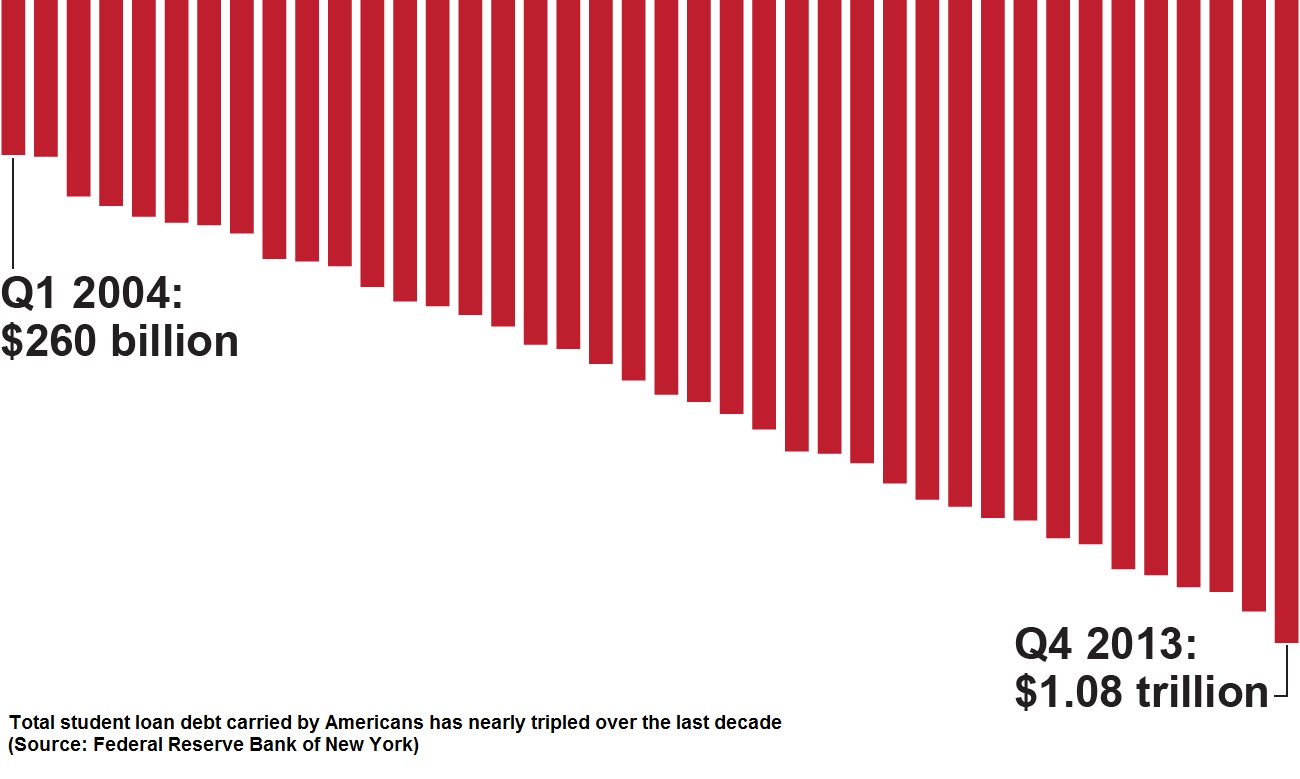
The amount owed on student loans has tripled in a decade, to nearly $1.1 trillion, according to the Federal Reserve Bank of New York. People in their 20s and 30s — often the best-educated and highest-earning among them — owe most of that tab. That is keeping a crucial segment of home buyers on the sidelines, deferring one of the traditional markers of adult success.

The National Assn. of Realtors recently identified student debt as a key factor in soft demand for home-buying this spring. A recent study by the trade group identified student loans as the top reason many home buyers delayed their purchase. Many more didn’t buy at all.

Surveys show today’s adults value homeownership just as much as their parents did. But the shaky job market, higher debt loads, and the roller-coaster market of recent years is keeping many from pulling the trigger, said Selma Hepp, senior economist with the California Assn. of Realtors.

“They’re just postponing,” she said. “It’s the economy and the recession and what that generation has gone through.”

The share of buyers who are first-timers has dropped well below historical averages — 28% of California buyers last year, compared with 38% typically, according to CAR surveys. The absence of a new generation of customers could become a long-term problem for the industry, said Dustin Hobbs, spokesman for the California Mortgage Bankers Assn.

“You have to have that swath of first-time buyers who will eventually be your move-up buyers,” he said. “When you take that out, it damages the whole chain.”

Traditionally, student borrowers were more likely than most people to buy a house, experts say, because college graduates tend to earn more. But that’s flipped since 2008, according to researchers at the New York Fed. Today, the share of 30-year-old homeowners who have student debt is lower than that of 30-year-old homeowners without it.

It’s a sign that skilled, educated workers are getting pushed out of the housing market.

“When people have less money to commit to housing, they don’t buy a house,” Hobbs said.

Jay Stewart Samilin sees that all the time. He’s an agent at Rodeo Realty in Beverly Hills and runs a tax preparation business on the side. Many of his younger clients are skipping the house until they pay down their debt.

“They’re maxed out on student loans, and there’s nothing else they want to think about until they pay that down,” he said.

Some who do start shopping quickly realize they can’t afford as much house as their income suggests. The more they pay each month on student loans, the less the bank will lend them to buy a house, said Natalie Lohrenz, director of counseling at Consumer Credit Counseling Services of Orange County. In a pricey market such as Southern California, that can severely limit a buyer’s options.

“You have to think about your quality of life after you purchase this home,” she said. “It’s OK to rent for awhile.”

That’s not to say some people don’t make it work.

Marco Manansala is starting to shop for a house, maybe a two-bedroom in Long Beach or on the Eastside, close to a freeway. When he began to think about it, the 28-year-old got preapproved for a loan — but only for $180,000.

“That gets you a shack,” he said. “I asked, how do I get more? They said I need to pay down debt.”

So he started aggressively paying off his car, and he’s worked his student loan balance down to $6,000, from $10,000. With a good job as a creative director for a Venice marketing agency, he has cut his spending to save up for a down payment. He’s getting close.

“I have a goal of buying something by June,” Manansala said. “I’m gearing up for it.”

But many others, like Luna, are forced to take a much longer view.

She graduated into the worst job market in decades. Although she eventually found work that enabled her to keep up with loan payments, it’s been hard to save much. In six years, she’s paid down nearly half of her original tab. When she borrowed the money for a master’s in professional writing, Luna acknowledges, she was an “idealistic” 22-year-old, and the numbers didn’t seem real.

Now the reality of a $700-a-month student loan payment makes it hard to get ahead, house or no house, even with a good salary. And she’s worried she’ll get priced out of the city she loves.

“It’s frustrating,” she said. “I think by the time I get a chance to get together that money and find a house, it’ll be unattainable.”

Source: Los Angeles Times – Online News Source – April 19, 2014 –http://www.latimes.com/business/realestate/la-fi-0420-student-debt-house-2-20140420,0,7975649.story#ixzz30Iw7x8Hz

Diploma 2The foregoing news article relates that education funding policies adversely affect major areas of the economy, in this case home-buying. The cause-and-effect paradigm is direct, within 5 to 10 years after graduation; a former student should be planning to buy a house. Apparently the macro economy is dependent on this relationship. According to the foregoing article, the National Association of Realtors (NAR) identified student debt as a key factor in soft demand for home-buying this spring (2014).

The Go Lean roadmap also identified that the 2008 financial crisis still deeply impacts the Caribbean economy; that it was not just the housing finance dysfunction alone that contributed to the crisis, but educational loans as well. This point is declared in Appendix IH on Page 286. This foregoing news article pronounces that the US economy continues to be impacted by a defective and dysfunctional student loan policy.

In the Caribbean, we do not want to follow this American model.

The economic solutions to effect change in the region are detailed in this book Go Lean … Caribbean as community ethos, strategies, tactics, implementations and advocates; as follows:

Community Ethos – Foster Genius Page 27
Community Ethos – Impact R & D Page 30
Community Ethos – Valedictorian è Diaspora Page 38
Strategy – Study: At home –vs- Abroad Page 50
Tactical – Education for a $800 Billion Economy Page 70
Separation of Powers – Education Department Page 85
Separation of Powers – Labor Training Oversight Page 89
Ways to Better Manage Debt Page 114
Reasons to Repatriate – Educational Inducements Page 118
Lessons Learned from 2008 Page 136
Ways to Improve Education Page 159
Ways to Impact Student Loans Page 160
Improve Local Government – Education Reforms Page 169
Better Manage the Social Contract: e-Learning Page 170
Federal Civil Service: Education Payback Schemes Page 173
Foster Cooperatives: Mutual Education Alternative Page 176
Ways to Improve Libraries Page 187
Ways to Impact the Diaspora – Education Reform Page 217
Ways to Impact Foundations – e-Learning Focus Page 219
Battles in the War on Poverty – e-Learning Solution Page 222
Help the Middle Class – Educational Stimuli Page 223
Ways to Impact Youth – Education Dynamics Page 227
Appendix C2 – Education and Economic Growth Page 258

The goal of the Go Lean roadmap is to make the Caribbean a better place to live work, learn and play. To elevate our economy, we must continue to place a high priority on education, thus the roadmap features our own student loan solution (Page 160) and numerous reforms and optimizations. But we need to be prepared for many of the same pitfalls that have befallen the US. We especially want to learn from these American mistakes:

It’s not the cost of the loan that’s the problem; it’s the principal – the appallingly high tuition costs that have been soaring at two to three times the rate of inflation, an irrational upward trajectory eerily reminiscent of skyrocketing housing prices in the years before 2008. – Ripping Off Young America: The College – Loan Scandal By Matt Taibbi, Rolling Stones Magazine; August 15, 2013. (Appendix IH – Page 286).

For the past 40 – 50 years, we have pushed too hard on college education, just for the sake of the “best practice” in economic elevation. We have suffered as a result, with a brain drain and excessive debt.

As a region, we cannot risk losing any more of our young adults and their contribution to their communities. Plus, we do not want to saddle them with overbearing student loans; this “paints them in a corner” where they must flee to earn enough money to repay the loans; (but so often, they have simply defaulted – which imperils the next generation).

We want to learn from our past mistakes!

We want to learn from America’s mistakes!

So we must deliver quality affordable education at home, without predatory lending habits. For the Caribbean, we do not want to be America. We want to be better!

Download the free e-book of Go Lean … Caribbean – now!

Share this post:
, , , , ,
[Top]

eMerge conference aims to jump-start Miami tech hub

Go Lean Commentary

Master BrokersPositive Change!

It doesn’t just happen. It takes people forging it, guiding it and fostering it. The below news article speaks of the effort in South Florida (from Miami north to West Palm Beach) to establish an economic engine of a “tech hub”.

This is a noble, yet strategic undertaking. Success in this “industry space” would mean more jobs, investment capital, and more technology students remaining in South Florida after matriculating in the area’s colleges. These 3 objectives align this story with the advocacies of the book Go Lean … Caribbean.

The book serves as a roadmap for the introduction and implementation of the Caribbean Union Trade Federation (CU). The prime directive of this organization is to optimize the economic engines of the Caribbean region. We also want to increase jobs and investment capital, plus retain more of our young people aspiring for careers in high technology fields. But the CU wants to harvest these activities in the Caribbean, for the Caribbean and by the people of the Caribbean.

South Florida is germane to the Caribbean conscience. It is the Number One destination for the Caribbean Diaspora, featuring large populations of Cubans, Jamaicans, Dominicans (DR), Puerto Ricans, Bahamians, and Haitians. The book relates this association by declaring the NBA basketball team, Miami Heat, as the “home team” of the Caribbean; (Page 42).

Right time, right place!

The eMerge Americas Techweek is this week. Also, the Miami Heat has just started the playoffs in defense of their consecutive World Championships.

By: Marcia Heroux Pounds and Doreen Hemlock

A movement to make South Florida a technology hub for the Americas kicks off its first conference this week, aiming to draw more than 3,000 people from entrepreneurs to investors to students — from Broward and Palm Beach counties and from around the world.

Organizers want to build on South Florida’s success as a gateway to Latin America for trade, banking and services, extending that prowess into technology, entrepreneurship and capital for startups. They hope the event — eMerge Americas Techweek — can do for tech what the annual Art Basel event in Miami Beach has done for art: put South Florida on the world map.

It’s an exciting chance for entrepreneurs like Boca Raton’s Dan Cane, chief executive of Boca Raton-based Modernizing Medicine, which developed an iPad application for specialty physicians. He’s among influencers named to the event’s “Techweek100” — South Florida leaders who have had a significant impact on business and technology. He will speak at the conference.

“We jumped at the opportunity,” said Cane, whose 3-year-old company had $17.5 million in sales last year. “We hope to find contacts and connections and begin to develop the right ecosystem in the Latin American market” to export south starting next year.

The eMerge push doesn’t strive to make South Florida into Silicon Valley. It aims instead for a tech center specialized in multinationals looking south, Latin American companies moving north, local startup companies, as well as universities and investors.

That’s why Citi Latin America, the regional headquarters for financial giant Citi, is taking part in what is planned as an annual event. The division employs about 750 people in Miami-Dade and Broward counties and is sponsoring the event, sending speakers and bringing clients, said Jorge Ruiz, who heads digital banking.

“This event is a great example of the things we should do more of,” Ruiz said. It showcases the importance of technology to a range of industries, promotes what South Florida already offers and highlights South Florida’s ability to unite from across the Americas for tech business, he said.

“As people come together, they’re going to realize this is the space to invest in,” Ruiz said.

Universities that train talent for tech jobs are eager to participate too.

“We’re going to bring as many students as possible,” said Eric Ackerman, dean and associate professor of the Graduate School of Computer and Information Sciences at Nova Southeastern University, who also is on the Techweek100 list. Nova has more than 500 students studying information technology.

Ackerman said tech graduates often leave South Florida, figuring they will have better job opportunities in larger hubs known for innovation.

“That’s one of the things we are trying to change — to become an innovation zone for new technology, new products and new services,” Ackerman said. “An event like this says, ‘Look what’s here in our own back yard. Why should I go somewhere else?’ ”

Kimberly Gramm, assistant dean and director of FAU’s Adams Center for Entrepreneurship, is taking winners of FAU’s recent business plan competition to eMerge’s Startup Village.

Some of South Florida’s largest tech companies also will exhibit at eMerge. Those include Citrix Systems of Fort Lauderdale, C3 Cloud Computing Concepts of Delray Beach and TriNet Group of Boca Raton, said Lonnie Maier, president of the South Florida Technology Alliance, a group that promotes local tech.

Investors and consultants to startups also are heading to eMerge to network and build business.

New World Angels, a Boca Raton-based group of investors, will share a booth with the Miami Innovation Fund to offer entrepreneurs advice on launching or growing their ventures, said Rhys Williams, executive director of New World Angels and a Techweek 100 leader.

“Technology investing is a contact sport. There are few textbooks or classes of relevance, so this conference is a timely way to keep current on your knowledge base and pick up new knowledge, skills and contacts,” said Williams, who also is a judge in the eMerge Launch competition where more than 200 companies will compete for $150,000 in prizes.

Of course, South Florida faces hurdles in its quest, tech leaders said.

The area needs to overcome a long-time image based on sun and fun. And it needs to show critical mass in tech, especially success stories of entrepreneurs that grew startups to global players — much as conference organizer Manny Medina did, starting Miami-based Terremark and selling it for more than $1.4 billion to Verizon.

Enterprise Development Corp. President Rob Strandberg, whose group works with startups from Boca Raton to Miami, will be busy making introductions between entrepreneurs and potential investors at the conference. He’s also a judge in the Launch competition.

EDC executive director Linda Gove will participate with the Boca Raton incubator’s startup companies.

“Investors are taking notice of South Florida companies to a far greater extent than they were,” Strandberg said.

Joe Levy, CEO of Fort Lauderdale-based startup ClearCi and also named to the Techweek 100, said the perception of the area as a tech hub is changing.

“Folks used to ask me, ‘Why aren’t you in Silicon Valley?’ ” Levy said. “We don’t get that anymore.”

South Florida’s Sun Sentinel Daily Newspaper – April 27, 2014 – http://www.sun-sentinel.com/business/careers/fl-emerge-broward-palm-beach-20140427,0,1252077.story

The Go Lean roadmap calls for agencies within the CU to champion technological start-up endeavors, much like this week’s eMerge initiative.

There is much for the CU’s planners to glean by the observation of the planned events this week. The Go Lean/CU approach, in the absence of the actual establishment of the Trade Federation is simply to:

1. Look
2. Listen
3. Learn
4. Lend-a-hand
5. Lead

This approach is codified in the book, with details of community ethos, strategies, tactics, implementations and advocates; as follows:

Community Ethos – Impact the Future Page 26
Community Ethos – Foster Genius Page 27
Community Ethos – Help Entrepreneurship Page 28
Community Ethos – Promote Intellectual Property Page 29
Community Ethos – Impact R & D Page 30
Community Ethos – Bridge the Digital Divide Page 31
Strategy – Agents of Change: Technology Page 57
Separation of Powers – Patents & Copyrights Page 78
Implementation –  Self-Governing Entities Page 105
Implementation –  Impact Social Media Page 111
Ways to Better Manage Image Page 133
Industries – Ways to Foster Technology Page 197
Industries – Foster e-Commerce Page 198

We hope for success for eMerge Americas Techweek. We hope our Caribbean brothers living and working in South Florida participate, engage in and benefit from this initiative. Then we hope that they would repatriate some of this passion, knowledge, and experience back to their Caribbean homelands.

Lastly, we cheer for further basketball dominance. Go Heat!

Basketball shot

Download the book – Go Lean…Caribbean now!!!

Share this post:
, , , , , ,
[Top]

PM Christie responds to critics of Bahamian ‘Carnival’

Go Lean Commentary

Carnival 1Head –> Heart –> Hands.

This is the physiological process to forge change, described in the book Go Lean … Caribbean (Page 20). As experienced on a daily basis by people attempting to “quit smoking”, change is near impossible without engaging those three body parts. The book, serving as a roadmap for the introduction and implementation of the Caribbean Union Trade Federation (CU) describes the linked application of those three symbolic body parts, as follows:

  • Head – Plans, Models and Strategies
  • Heart – Community Ethos
  • Hands – Actions, Implementations, Advocacies

According to the below news article, the Prime Minister of the Bahamas wants to forge change in his homeland. He wants to incorporate a new festival, based on the model of Carnival and Madri Gras, so as to glean some of the massive economic harvests around those events in the Caribbean and other Western Hemisphere destinations.

Since initiating this plan in Spring 2013, cyber-space and public commentary have been awash with feedback: some in favor; most opposed.

Albeit he is inspired by good motives, the publishers declare that something is missing in the Prime Minister’s plans: Best practices.

By: Erica Wells, Managing Editor
Prime Minister Perry Christie has assured critics of the Government’s plan to create a Bahamian Carnival or Mardi Gras that the festival will be “essentially” Bahamian and that a special committee will be appointed to prepare the country and the world for the initiative.

Addressing the MP’s in his 2013/2014 budget wrap up, Christie said many people rushed to judgement after he made the announcement last month. The week-long festival is slated for a 2015 start-up and the government will spend $1 million to help with its development, which may incorporate a cultural village, public processions and song and costume competition. The $1 million will be allocated to the festival next year and will be a joint effort between the public and private sector, he said.

The government, Christie says, sees the festival as both a major economic intervention and a cultural expansion.

“It will be essentially Bahamian but also include thousands of visitors who will be attracted by what will be an absolutely fabulous affair,” said Christie.

Anthropologist and author Dr. Nicolette Bethel, who is also a former director of culture, has been one of the biggest critics of the proposed festival.

Bethel told Guardian Arts&Culture before Christie’s communication earlier this week that she did not have a problem with the idea per se, and that it was long overdue, but the timing and title were both “awful”.

“As a result I don’t think it’s feasible,” she said. “I have no idea what consultation, if any, was done with the relevant community. It falls during the Junkanoo downtime and I do not think that the practitioners will seriously be able to prepare for it, and in fact many of the most serious (Junkanooers) are out of the country attending the real carnivals that take place all around our region at that time — New Orleans, Rio de Janeiro, and of course Port-of-Spain.”

Bethel said she did not see that it would have any real effect on the current Junkanoo parades.

She also criticized the government’s $1 million allocation to the festival.

“One million dollars according to our data is nowhere near enough money to fund something of this kind,” said Bethel. “Annual Junkanoo parades take up to $3 million of the government’s money — $2 million at least. If that money were invested in creating a Junkanoo festival at the normal Junkanoo time it would go far further, but I do not see any way that we can hope to compete with the real carnivals by introducing something fake like this. It’s a total waste of a good idea.”

Christie noted that many critics questioned why The Bahamas should copy Trinidad or Brazil, and why the country would move away from Junkanoo, which is “spectacularly Bahamian”.

“Let me say at the outset that prior to making my announcement, I consulted with several icons in the world of Junkanoo and without exception they were fully supportive of the idea and immediately confirmed their willingness to work with the committee, which will be appointed to prepare The Bahamas and the world for this new festival,” said the prime minister.

The government will shortly appoint the committee, said Christie.

Paul Major, a former banker and Junkanoo participant, has been invited to chair the committee. Robert Sands and Ed Fields, and other major figures in the cultural field — in painting, music, drama all of which are a part of this new enterprise — will also be invited to sit on the committee, he said.

“I expect the committee to hold full consultations with all of the major personalities of Junkanoo, and associates. “I will, for my part, advise the committee that I do not wish them to interfere with Junkanoo.

This is a separate and different activity,” Christie explained. He noted that the major Junkanoo groups and their leaders will be advised that the government does not propose to licence those groups, unless there is overwhelming evidence of general acceptance by the rank and file.

Prime Minister Christie said for the groups to be licensed, they would have to form themselves into a company and operate as a business.

“This is a massive undertaking which will receive very careful consideration of the government,” he said.

“This is very necessary as the corporate groups will be advertising abroad and inviting persons to purchase costumes online as well as from store fronts in a cultural village or elsewhere.”

The Prime Minister said the committee would ultimately move recommendations to the government for its consideration.

Christie also noted that he has met with Sarkis Izmirlian of Baha Mar and advised him that the festival was one of the major promotions the government was putting in place in view of his introducing 2,200 new hotel rooms in December 2014.

“He liked the idea. The committee will recommend whether there should be a preferred resort destination or leave it to the choice of visitors,” said Christie.

Carnival worldwide industry

The prime minister said carnival is part of a worldwide masquerade industry.

He said the industry has been successful in attracting costume makers, wire benders, painters, designers and performers at some of the largest festivals in the world.

“It has an export dimension. We know of major festivals in Trinidad, Brazil, Toronto, Barbados, New York, Miami and London. Carnival in the diaspora generates hundreds of millions of dollars and creates many jobs and entrepreneurial opportunities.

“It is big business and it requires business planning, management, marketing of products and organizational structure,” said Christie.

Prime Minister Christie said costumes from carnival inspired designers show up in New York, Toronto, Notting Hill, London, Miami and many other centers in the U.S.

“The committee will be briefed and have the opportunity to visit carnival enterprises in Brazil, Trinidad and even Toronto, where carnival has become arguably the largest festival in the world,” he said.
Source: The Nassau Guardian Online. Posted 06/22/2013. (Retrieved 04/24/2014) –http://www.thenassauguardian.com/index.phpoption=com_content&view=article&id=40021&Itemid=59

The Go Lean roadmap is different! It employs best practices for assessing, strategizing and implementing change. The book commences with the practice to assess current landscapes; this is what strategists call “Understand the market / Plan the business”. Page 44 presents these questions:

• Who are our customers and what exactly do they want?

• Who are our competitors; how do we stack up against them?

The book then proceeds to answer these and other strategy queries, accordingly.

carnival 2Events/festivals are paramount in the Go Lean roadmap: the optimization of existing events and the introduction of new events. This advocacy is detailed on Page 191 as being supplemental to the goal of enhancing tourism (Page 190).

What are the prospects for this new Bahamas Carnival/Lenten festival?

On the surface, it seems far-fetched, as the Bahamas does not have a Lenten ethos. All the competitive destinations (Rio De Janeiro, New Orleans and Trinidad) have elevated lent habits (Ash Wednesday to Good Friday), so that Mardi Gras/Fat Tuesday actually has significance in preparation of this hallowed Lenten season. Without this ethos, it is hard, though not impossible, to forge a new tradition, festival or business model. But the mediocre financial investment, announced in the foregoing article – $1 million as opposed to $3 million, makes the success of initiating and promoting a new event an insurmountable obstacle.

The publishers of the Go Lean roadmap wish the Prime Minister good fortune with his plans, but this execution does not appear to be lean, within “best practices”. More is needed; much more! There should be more focus on “Head, Heart & Hands” principles. As a contrast, notice the detailed strategies, tactics, actions and advocacies for new events in the Go Lean roadmap:

Community Ethos – Lean Operations Page 24
Community Ethos – Return on Investments Page 24
Community Ethos – Cooperatives Page 25
Community Ethos – Non Government Org’s. Page 25
Impact the Future Page 26
Foster Genius – Performance Excellence Page 27
Ways to Improve Sharing Page 35
Ways to Promote Happiness Page 36
Ways to Impact the Greater Good Page 37
Strategy – Customers – Business Community Page 47
Strategy – Customers – Visitors / Tourists Page 47
Strategy – Competitors – Event Patrons Page 55
Separation of Powers – Emergency Mgmt. Page 76
Separation of Powers – Tourism Promotion Page 78
Separation of Powers – Sports & Culture Page 81
Separation of Powers – Fairgrounds Admin. Page 83
Separation of Powers – Turnpike Operations Page 84
Steps to Implement Self-Governing Entities Page 105
Ways to Foster Cooperatives Page 176
Ways to Improve Intelligence Gathering Page 182
Ways to Improve [Service] Animal Husbandry Page 185
Ways to Enhance Tourism Page 190
Ways to Impact Events Page 191
Ways to Promote Fairgrounds Page 192
Ways to Improve Emergency Management Page 196
Ways to Impact Hollywood [& Media Industry] Page 203
Ways to Preserve Caribbean Heritage Page 218
Ways to Improve the Arts Page 230
Ways to Promote Music Page 231

In summary, festivals/events are important, so they require lean administration and executions. They empower economics and fortify cultural pride. In all, they make the Bahamas, by extension the entire Caribbean, a better place to live, work, and play.

Download the book Go Lean … Caribbean – now!

Share this post:
, , , , , ,
[Top]

Ghost ships – Autonomous cargo vessels without a crew

Go Lean Commentary

Ghost ships - Autonomous cargo vessels without a crewLife imitates art! Art imitates life!

The forgoing article gives the impression of science fiction: The Matrix movie trilogy or The Terminator movie series. Imagine an industrial development with a heavy concentration of robotic installations. This is the future that is being planned, developed and tested now. The experience of the last 100 years is that those doing the planning, developing and testing for futuristic technologies are the ones that profit most from the economic gains. This has been true for both Japan and Silicon Valley.

The book, Go Lean … Caribbean, extolls this principle that R&D (research and development) activities are necessary to profit from advantages in technology. We want to do R&D here in the Caribbean. This is a mandate for the Caribbean Union Trade Federation (CU). This book serves as a roadmap for the introduction and implementation of the CU. This technocracy will assume oversight to optimize the region in the areas of:

(1) economics

(2) security

(3) lean government

This vision of an autonomous maritime eco-system, as depicted in the foregoing article, cannot be considered without a super-national infrastructure for these above 3 areas. The Go Lean roadmap presents the CU’s prime directives, which in total will provide comprehensive solutions for economic incentives, a security apparatus (Naval Authority and Intelligence Gathering), and lean governmental coordination to launch these initiatives.

*** Autonomous cargo vessels could set sail without a crew under the watchful eye of captains in shore-based simulators ***

Military drones already fly frequent missions and civilian operations using unmanned aircraft are coming. Driverless cars are clocking up thousands of test miles. So why not let remote-controlled ships set sail without a crew? Indeed, the maritime industry has started to think about what would be required to launch a latter-day Marie Céleste.

Ships, like aircraft and cars, are increasingly controlled by electronic systems, which makes automation easier. The bridges of some modern vessels are now more likely to contain computer screens and joysticks than engine telegraphs and a giant ship’s wheel. The latest supply ships serving the offshore oil and gas industry in the North Sea, for instance, use dynamic positioning systems which collect data from satellites, gyrocompasses, and wind and motion sensors to automatically hold their position when transferring cargo (also done by remote control) to and from platforms, even in the heaviest of swells.

However, as is also the case with pilotless aircraft and driverless cars, it is not so much a technological challenge that has to be overcome before autonomous ships can set sail, but regulatory and safety concerns. As in the air and on the road, robust control systems will be needed to conform to existing regulations.

The maritime industry is interested in crewless ships for two reasons. The first is safety. Most accidents at sea are the result of human error, just as they are in cars and planes. So, if human operators are replaced by sophisticated sensors and computer systems, autonomous vessels should, in theory, make shipping safer.

The second reason is, of course, cost. It is becoming increasingly difficult to sign up competent crew prepared to spend months away at sea. Moreover, some voyages are likely to get even longer for ships carrying non-urgent cargo. By some accounts, a 30% reduction in speed by a bulk carrier can save around 50% in fuel. This means slower steaming could provide big savings in fuel costs, but it would be at the expense of increased expenditure on crew for these longer voyages, both in wages and for the “hotel” facilities required on board. Removing the crew, though, also removes the need for their accommodation and its associated equipment, like heating and plumbing. And that provides room to carry more cargo.

Ahoy there!

The transition to unmanned ships could take place in steps, says Oskar Levander, head of engineering and technology for the marine division of Rolls-Royce. Crews would be reduced as some functions are moved onshore, such as monitoring machinery. (The engines on jet aircraft are already overseen by ground stations.) This could be followed by some watch-keeping and navigation duties. Experienced crew might be put on board when ships leave or enter port, just as pilots are to navigate. And a small maintenance crew could be kept for the voyage until remote-control systems prove themselves. A fleet of autonomous ships could also sail in convoy with a manned vessel in the lead (as illustrated above).

The onshore control rooms would keep an eye on ships thanks to live data transmitted from vessels, including video and infra-red images. Object-recognition software, combined with radar, would further automate the process. If an alarm was raised the skeleton crew on board could be alerted or the control room take charge, probably from a bridge in a simulator. Rolls-Royce already operates virtual ships’ bridges, with 360º views, for the training of officers and crew. These are realistic enough to make landlubbers feel seasick.

Using onshore control rooms and simulators a team of ten land-based captains could operate 100 or so ships, reckons Mr. Levander. The captains could commute from home for their shifts just as the pilots who fly military drones do. Passenger ships are likely to remain crewed, however. Trained personnel are needed to manage evacuation procedures, and in any case passengers are unlikely to want robots and vending machines attending to their needs.

The slower-sailing bulk carriers could be the first ships to be automated, according to the Maritime Unmanned Navigation through Intelligence in Networks (MUNIN) project, a European Union initiative backed by a number of industrial organisations. Like others, it says the ability of drone ships to detect other vessels and take avoiding action will be crucial, but possible with advanced technology and improved backup systems.

Rules of the sea

With a captain technically in command—even though he is based in an onshore control room—MUNIN thinks the legal and practical challenges of meeting maritime rules could be met. Radio messages from other ships, along with those from coastguards and port authorities, could be automatically routed to the shore captain. Something similar is being proposed for autonomous civil drones, with ground-based pilots responding to communications and air-traffic control instructions as if they were in the cockpit.

In many ways automating a ship should be a lot easier than automating aircraft, Mr. Levander believes. For a start, if something did go wrong, instead of falling out of the sky a drone ship could be set by default to cut its engines and drop anchor without harming anyone. As for piracy, with no crew to be taken hostage it would be much easier for the armed forces to intervene. Of course, more modern pirates might try to hack their way into the controls of an autonomous ship to take command. Which is why encrypted data communication is high on the maritime industry’s list of things to do before ghostly vessels ply the trade routes.

Firstly, the Caribbean Sea is 1,063,000 square miles. This landscape, except for forecasted tropical storms, allows for the perfect testing grounds. The geography of the CU’s 30 member-states thereby includes thousands of islands, (the Bahamas alone advertises 700 islands in their archipelago). The Go Lean roadmap calls for establishing an Exclusive Economic Zone (EEZ) for these seas.

Secondly, the CU has the human capital to engage this type of endeavor. There are many well-trained professionals in the maritime arts and sciences. Plus, this endeavor transmits the “siren call” to youthful aspirants, empowering immigrants and, skilled repatriates. This will grow the labor pool for this industry.

Thirdly, the CU already envisions a massive deployment of ship-building prowess with its incubation of shipyards and related industries (Page 209). Plus, with federally regulated ferry boats, part of the Union Atlantic Turnpike system, the required model (funding/investments/capital) and eco-system will be in place.

Though not written with this particular initiative in mind, the Go Lean roadmap anticipates such opportunities, as pronounced in the Declaration of Interdependence, (Pages 12 & 14):

xvi. Whereas security of our homeland is inextricably linked to prosperity of the homeland, the economic and security interest of the region needs to be aligned under the same governance. Since economic crimes, including piracy and other forms of terrorism, can imperil the functioning of the wheels of commerce for all the citizenry, the accedence of this Federation must equip the security apparatus with the tools and techniques for predictive and proactive interdictions.

xxvii. Whereas the region has endured a spectator status during the Industrial Revolution, we cannot stand on the sidelines of this new economy, the Information Revolution. Rather, the Federation must embrace all the tenets of Internet Communications Technology (ICT) to serve as an equalizing element in competition with the rest of the world. The Federation must bridge the digital divide and promote the community ethos that research/development is valuable and must be promoted and incentivized for adoption.

xxx. Whereas the effects of globalization can be felt in every aspect of Caribbean life, from the acquisition of food and clothing, to the ubiquity of ICT, the region cannot only consume, it is imperative that our lands also produce and add to the international community, even if doing so requires some sacrifice and subsidy.

The CU mission is to implement the complete eco-system to deliver on market opportunities as sampled in the foregoing article. There are many strategies, tactics, implementations and advocacies that will facilitate this readiness; detailed here:

Community Ethos – Money Multiplier Page 22
Community Ethos – Job Multiplier Page 22
Community Ethos – Lean Operations Page 24
Community Ethos – Return on Investments Page 24
Impact the Future Page 26
Help Entrepreneurship Page 28
Promote Intellectual Property Page 29
Impact Research and Development Page 30
Ways to Improve Negotiations Page 32
Separation of Powers – Naval Authority Page 75
Separation of Powers – Emergency Mgmt. Page 76
Security Initiatives at Start-up Page 103
Start-up Benefits from the EEZ Page 104
Steps to Implement Self-Governing Entities Page 105
Reasons to Repatriate to the Caribbean Page 118
Ways to Benefit from Globalization Page 119
Ways to Improve Trade Page 128
Ways to Create Jobs Page 152
Ways to Improve Governance Page 168
Foster Empowering Immigration Page 174
Foster Cooperatives Page 176
Improve Homeland Security Page 180
Ways to Mitigate Terrorism Page 181
Improve Intelligence Gathering & Analysis Page 182
Better Manage Natural Resources Page 183
Ways to Improve for Natural Disasters Page 184
Ways to Foster Technology Page 197
Ways to Improve Transportation Page 205
Ways to Develop Ship-Building Page 209

The world is preparing for the change of more autonomous systems to do the heavy-lifting of industrial engagements. A new ethos to prepare for change has now come to the Caribbean. The people of the region are urged to “lean-in” for this change. As described in the book Go Lean … Caribbean, the benefits of this roadmap are too alluring to miss out: emergence of an $800 Billion single market economy, 2.2 million new jobs and relevance on the world scene for R&D.

Download the Book- Go Lean…Caribbean Now!!!

Share this post:
, , , ,
[Top]

Real Estate Investment Trusts explained

Real Estate Investment Trusts (REITs) are one way you can invest in real estate while enjoying a level of liquidity synonymous with the stock market[a]. Learn more here, from this VIDEO:

VIDEO – Real Estate Investment Trust REIT Definition Investopedia – https://youtu.be/UnKqUKZ1K1A

The book Go Lean … Caribbean serves as a roadmap for the introduction and implementation of the Caribbean Union Trade Federation (CU) and the Caribbean Central Bank (CCB). One prime directive of the roadmap is facilitating the return of the far-flung Diaspora to their Caribbean homelands. This does not mean returning to the same houses they may have abandoned decades ago. Thusly, there is the need for new housing solutions; and new housing financing schemes. The CU is proffered to provide economic optimizations to better manage the region’s basic needs: food, clothing, energy and shelter.

REITREITs are prominent in the Go Lean roadmap to satisfy the shelter mandate for Caribbean repatriates; (Page 217).

This mandate is detailed early on in the book’s Declaration of Interdependence (DOI), as follows (Page 13):

xxiv. Whereas a free market economy can be induced and spurred for continuous progress, the Federation must install the controls to better manage aspects of the economy: jobs, inflation, savings rate, investments and other economic principles. Thereby attracting direct foreign investment because of the stability and vibrancy of our economy.

The roadmap posits that there are no capital/security markets in the Caribbean that offer the liquidity options of Wall Street – Page 200. (Wall Street is #1 globally). However the book describes an optimization of the existing financial markets that can still take place with the introduction of the Caribbean Dollar – managed by a technocratic Caribbean Central Bank – and elevation of the current 9 Stock Exchanges.

The “dominoes” thusly begin to fall. So with the liquidity of a vibrant capitals market, comes funding, with funding comes housing “starts”, followed by construction activity. All of this creates market kinetics.

So facilitating this eco-system of the CU/CCB will ultimately create … jobs. This is the rallying cry in the US for the National Association of Realtors®. They estimate that one job is generated for every two home sales. Using that ratio, 1,000 home sales generate 500 jobs [b]. So after the basic need of food, clothing, energy and shelter, the next mandate is … jobs, (DOI – Page 14).

xxvi. Whereas the Caribbean region must have new jobs to empower the engines of the economy and create the income sources for prosperity, and encourage the next generation to forge their dreams right at home, the Federation must therefore foster the development of new industries, like that of ship-building, automobile manufacturing, pre-fabricated housing, frozen foods, pipelines, call centers, and the prison industrial complex. In addition, the Federation must invigorate the enterprises related to existing industries like tourism, fisheries and lotteries – impacting the region with more jobs.

The Go Lean roadmap portrays the community ethos to encourage savings/investments. The roadmap also calls for stronger oversight from an institutional perspective, with economic principles in place to increase the money multiplier; (Page 21 & 22).

This constitutes change for the Caribbean: a new plan, new products, services, opportunities oversight. In truth, a new future!

Download the book Go Lean … Caribbean – now!

————

References

a. Investopedia – http://www.investopedia.com/video/play/real-estate-investment-trust/

b. National Association of Realtors: http://www.realtor.org/topics/home-ownership-matters/jobs-impact-of-an-existing-home-purchase


Share this post:
, , , ,
[Top]

Facebook plans to provide mobile payment services

Facebook PicGo Lean Commentary

The jockeying for position has begun!

The foregoing article highlights the planning, development and deployment activities around the issue of mobile payments. This is germane for the Caribbean, as the World Bank reports that this region is #1 for homeland remittances from expatriated citizens.

This is a matter of supply and demand. The Caribbean Diaspora demands to send money; tools like Western Union, MoneyGram and these new solutions, identified here, supply the services.

But change is coming!

Reuters: Soham Chatterjee & Abhirup Roy (Bangalore)

Facebook Inc. is preparing to join the mobile-payments race with remittances and electronic-money services on the social network, the Financial Times reported on Sunday, citing several people involved in the process.

The company is close to obtaining approval from the Central Bank of Ireland to start a service that would allow users to store money on Facebook and use it to pay and exchange with others, the people told the FT. See: http://link.reuters.com/dag58v

The Irish Central Bank declined to comment.

Facebook was not immediately available for comment.

The company has also had partnership talks with at least three London start-ups — TransferWise, Moni Technologies and Azimo — that offer online and mobile international money transfer services, three people involved in the discussions told FT.

Telecom groups, retailers and banks are all trying to secure a [slice of the pie] of global mobile payments, which is predicted to grow rapidly in the next few years.

Vodafone brought its mobile money transfer service M-Pesa to Romania last month, following its success in Africa, and is likely to expand the service in eastern and central Europe.

Facebook’s rival Google Inc.’s head of payments recently reiterated commitment to the struggling Google Wallet and mobile payments service. The company had allowed users to send money last year as an email attachment.

Related Articles:

Google Wallet now lets you send money as an attachment in Gmail: http://link.reuters.com/wyf58v

Google exec reiterates commitment to mobile payments: http://link.reuters.com/xyf58v

Apple Chief Executive Tim Cook said in January the company’s interest in mobile payments was a reason for creating the Touch ID fingerprint sensor in its iPhone 5S smartphone – http://link.reuters.com/sag58v

Piggie Bank PicGlobal mobile transactions are expected to grow at an average 35 percent per year between 2012 and 2017, according to a report by research firm Gartner. The June 2013 report forecast a $721 billion market with more than 450 million users by 2017 – http://link.reuters.com/nyf58v.

Yahoo Online News Source (Retrieved 04/14/2014) –http://news.yahoo.com/facebook-plans-mobile-payment-services-ft-133451646–sector.html

The book, Go Lean…Caribbean, serving as a roadmap for the introduction and implementation of the Caribbean Union Trade Federation (CU), identified that new methods are needed to facilitate remittances. A lot of money is remitted back to the Caribbean (over $9 Billion dollars in 2010; sometimes 10% of GDP), and too many foreign entities are profiting on the backs of hard-working Caribbean people. The book lists a series of new alternatives that will be pursued in the Go Lean roadmap, some of which are identified in the foregoing news article.

This article also raises other issues, such as globalization, ICT, Social Media and Mobile Application development. All of these are covered in exhaustive details in the Go Lean book.

The premise is that the CU is chartered so that the Caribbean can have a hand in its own self-determination. There should be home-grown (Caribbean-based) solutions for Caribbean problems.

This point is pronounced early in the book, in the opening Declaration of Interdependence – (Page 14):

xxvii. Whereas the region has endured a spectator status during the Industrial Revolution, we cannot stand on the sidelines of this new economy, the Information Revolution. Rather, the Federation must embrace all the tenets of Internet Communications Technology (ICT) to serve as an equalizing element in competition with the rest of the world. The Federation must bridge the digital divide and promote the community ethos that research/development is valuable and must be promoted and incentivized for adoption.

In line with the foregoing article, the Go Lean book advocates some infrastructural enhancements so that the region can play a role in the development/deployment of this important industry. The book references are as follows:

• Research & Development (Page 30)

• Caribbean Central Bank (Page 73)

• Impact Social Media (Page 111)

• Benefit from Globalization (Page 119)

• Fostering e-Commerce (Page 198)

• Banking Reforms (Page 199)

• Impacting the Diaspora (Page 217)

• Alternative Remittance Modes (Page 270)

Who will win the “space race” between all the big Information Technology providers (Facebook, Google, Apple or Vodafone as depicted in the foregoing articles)? It is not known yet! But for the Caribbean, we must not be spectators only. Not this time!

With the CU / Go Lean roadmap in place, we can declare: Change has come to the Caribbean.

Download the book – Go Lean…Caribbean Now!!!


Share this post:
, , , ,
[Top]

What Usain Bolt can teach banks about financial risk

Go Lean Commentary

Runner GuyThere were 465 US bank failures between 2008 and 2012.[a]

Joke: “The bank returned a check to me this morning, stamped: ‘insufficient funds.’ Is it them or me?”

The foregoing article shows the type of functions that technocrats do: evaluating risk. Any risk that can imperil the complete financial system must be monitored and mitigated. The “extreme value theory” is a model for evaluating risk and predicting future performance; and while not perfect, it is better than doing nothing.

There was no one performing this role in the Caribbean in 2008.

The foregoing article and its reliance on calculus, quantitative methods and econometric modeling is an example of the required technocratic oversight in managing an economy. Usain Bolt is used here as an allegory, a fable. The Economist magazine thusly explains how complex issues can be taught with simplified analogies and illustrations. Banking is more complex than track-and-field; but the pursuit of excellence is similar. Just like any world-class athletic pursuit, this goal is hard to master.

The Economist explains…

THE banking industry did a bad job in the run-up to the financial crisis of assessing “tail risks”, extreme events that represent the least likely of a range of probable outcomes. The Basel Committee on Banking Supervision, which is the international standard-setter for bank capital, has proposed changes in the internal risk models that financial institutions use. In particular, it wants banks to shift from a technique called “value-at-risk” (VaR) to one called “expected shortfall” (ES).

VaR is a way of measuring a firm’s risk of suffering really big losses over a certain period (a day, a week, a month) to a certain level of “confidence”. A daily VaR of $1m at 1% probability means that there is a 99% chance that you will not lose more than $1 [million] on any one day. The problem is that if you have that one bad day in 100, the potential losses could go much higher than $1 [million]. VaR doesn’t have much to say about what those losses might be. The expected-shortfall approach is meant to provide an answer to that question. Instead of asking, “What are the chances that things get so bad that we lose $1 [million]?” it asks, “If things do get that bad, how much would we actually lose?”

To do this, it uses a statistical method called “extreme value theory”, which looks specifically at what happens in the tail of distributions. To take a more trivial example of where extreme-value theory has been used, a 2011 paper by two researchers at Tilburg University collected data on the personal bests of elite athletes between 1991 and 2008, in order to try and calculate the “ultimate world record” for 100m sprints—the absolute edge of human performance given the times, equipment and drugs-policies that then prevailed. For the 100[meter] for men, the boffins (British slang for technical expert) put the ultimate world record at 9.51 seconds, compared with the record that then prevailed of 9.72, and a current world best of 9.58, set by Usain Bolt in 2009. That looks pretty good: the model came up with a number that was well inside the mark that then prevailed, and is still a hefty improvement on the current record. If extreme-value theory is meant to help banks think through the extremes, this is encouraging.

But like every model in history, expected shortfall cannot predict the future. In an earlier 2006 paper, researchers from the same university tried to calculate ultimate world records for a wider range of events, including the men’s marathon. The researchers reckoned back in 2006 that the best possible running of that distance would yield a time of two hours, four minutes and six seconds. Yet the world record today stands at two hours, three minutes and 23 seconds (Wilson Kipsang in 2013). To be fair to the researchers, they did not claim that their ultimate record could not be broken. But whether bankers will remember that reality can be worse than expected is a different question. Expected shortfall is an improvement on VaR; it is not a crystal ball.
The Economist (Retrieved 04/09/2014) – http://www.economist.com/blogs/economist-explains/2014/04/economist-explains-4

EquasionThe book, Go Lean…Caribbean, serves as a roadmap for the implementation of the Caribbean Union Trade Federation (CU). The book presents the CU as a technocracy, to ensure economic failures of the past do not re-occur. From the outset, the book identified that the Caribbean is in crisis, with the pronouncement that a “crisis is a terrible thing to waste”. The prime directive of the CU is to optimize economic, security and governing engines to impact the Caribbean’s Greater Good, for residents … and bank depositors. This was pronounced in the Declaration of Interdependence – (Page 13):

xxv. Whereas the legacy of international democracies had been imperiled due to a global financial crisis, the structure of the Federation must allow for financial stability and assurance of the Federation’s institutions. To mandate the economic vibrancy of the region, monetary and fiscal controls and policies must be incorporated as proactive and reactive measures. These measures must address threats against the financial integrity of the CU and of the member-states.

In line with the foregoing article, the Go Lean book details some infrastructural enhancements/advocacies to the region’s financial eco-system; to facilitate efficient management of the economy:

  • Fostering a Technocracy (Page 64)
  • Caribbean Central Bank (Page 73)
  • Deposit Insurance Regulations (Page 73)
  • Securities Regulatory Authority (Page 74)
  • Modeling the European Union / Central Bank (Page 130)
  • Lessons from 2008 (Page 136)
  • Banking Reforms (Page 199)

The mis-management of the economy has led to many episodes of “fight-or-flight” among Caribbean society. For many member-states, their Diaspora is more than half their population; i.e. Jamaica and Puerto Rico.

While there is no crystal ball, according to the foregoing article, there is much that can be done. Now is the time for the CU!

The purpose of this roadmap is to make the Caribbean, a better place to live, work and play. No more flight! Now we stand and fight with these technocratic weapons of modern economics.

Download the book Go Lean … Caribbean – now!

———-

Appendix Reference:
[a]. https://news.yahoo.com/facts-numbers-us-bank-failures-183852568.html

Share this post:
, , , , ,
[Top]

Florida’s Snowbirds Chilly Welcome

Go Lean Commentary

Florida's Snowbird Chilly Welcome - PhotoTo the Canadian Snowbirds, looking for warm climates and a warm welcome, we say:

“Be our guest”.

To the Caribbean Diaspora, living in Canada and other northern countries, we say:

“Come in from the cold”.

The book Go Lean…Caribbean aligns with the news story in the below article. While the US may be retracting the Welcome Mats from Canadian snowbirds, after 180 days, the islands of the Caribbean extend the invitation for them to pass the wintry months here. They are invited to bring their time, talent and treasuries; (according to the article: billions of dollars).

  • Need an extra month? No problem.
  • Need access to cutting-edge medical treatment? Got it.
  • Need protection from crime and harassment? Got you covered.
  • Need video communications to interact with Embassy and government officials? Sure thing.
  • Need access to your Canadian dollar bank accounts? No problem.

The source news article is embedded here as follows:

Title: “Congress protects America from Canadian pensioners”
Gulfport, Florida – A chore combining carpentry with diplomacy awaits Gordon Bennett, a retired Canadian soldier, after his move to a larger mobile home near Florida’s Gulf coast. As commander of an overseas post of the Royal Canadian Legion, he likes to fly his national flag from a handy palm tree. But as a respectful guest—one of about half a million Canadian “snowbirds” who own winter homes in Florida, using special visas good for a total of 180 days in any 12-month period—he knows to follow strict protocol when mounting his flags, or face complaints from American neighbours. His Canadian flag cannot be flown on its own but must be paired with the Stars and Stripes (though never on the same pole). The American flag may not be smaller or fly lower, and must be flown in the position of honour (the right, as you emerge from a doorway).

Mr. Bennett, a genial octogenarian, does not resent the fussing. In his winter home of Pinellas County—an unflashy region of mobile home parks, “senior living” complexes, golf courses and strip malls—the welcome is mostly warm for Canadian snowbirds, who pump billions of dollars into Florida’s economy each year. His post shares premises with the American Legion, and has introduced local veterans to Moose Milk, a lethal Canuck eggnog-variant involving maple syrup. He routinely brings 50 or 60 Canadians to ex-servicemen’s parades, picnics or dinner-dances.

But once issues of sovereignty are raised, America’s welcome can chill. Visa rules force Canadian pensioners to count each day after they cross the border, typically in late October. They are enforced ferociously: overstayers may be barred from re-entry for five years. Some members of Congress have been trying to ease the rules for Canadian pensioners since the late 1990s. A law allowing Canadians over 55 to spend up to eight months in America each year, as long as they can show leases for property down south and do not work, passed the Senate in 2013 as part of a comprehensive immigration bill, but like the bigger bill, it has now stalled. In the House of Representatives an extension for Canadian snowbirds has been tucked into the JOLT Act, a tourism-promotion law introduced by Joe Heck, a Nevada Republican.

Canadian pensioners are not an obviously threatening group—few Americans report being mugged by elderly Ottawans armed with ice-hockey sticks. They pay property and sales taxes in America. They must cover their own health-care costs while down south, through the Canadian public health-care system and private top-up policies. If allowed to stay for eight months, most would stay only seven, predicts Dann Oliver, president of the Canadian Club of the Gulf Coast (staying longer would complicate their health cover and their tax status). They just want a few more weeks in the sun.

Yet even something this easy is proving hard. Mr. Heck is willing to tweak his bill to focus on two reforms: the Canadian extension and visa interviews by video-conference for Chinese, Brazilian and Indian would-be visitors, who currently face long journeys to American consulates. But many members of the House “are reluctant to do anything with the word immigration in it,” says Mr. Heck. Optimists hope the bill might come up for a vote this year. For Mr. Bennett and his wife, Evelyn, Canadians whose “bones ache” in their homeland’s cold, it can’t come too soon.
Source: The Economist (Retrieved 03/08/2014) –http://www.economist.com/news/united-states/21598680-congress-protects-america-canadian-pensioners-chilly-welcome

Florida's Snowbird Chilly Welcome - Photo 2The book, Go Lean…Caribbean, serves as a roadmap for the implementation of the Caribbean Union Trade Federation (CU) over a 5 year period. The book posits that tourism products can be further extended to attract, accommodate and harvest the market of Snowbirds. These ones bring more than they take, and therefore should be viewed as low-hanging fruit for tourism’s economic harvest. While some CU member-states may target a High-Net-Worth clientele, there is room too for the hordes of retirees who may seek more modest accommodations. In the end, billions of dollars of economic output from the Snowbird market are still … billions of dollars.

From the outset, the book defined that the purpose of the CU is to optimize economic, security and governing engines to impact Caribbean society, for residents and visitors. This was pronounced in Verse IV (Page 11) of the opening Declaration of Interdependence:

Whereas the natural formation of the landmass is in a tropical region, the flora and fauna allows for an inherent beauty that is enviable to peoples near and far. The structures must be strenuously guarded to protect and promote sustainable systems of commerce paramount to this reality.

In line with the foregoing article, the Go Lean book details some applicable infrastructure enhancements and advocacies to facilitate more Snowbird traffic:

  • Ferries – Union Atlantic Turnpike (Page 205)
  • Self-Governing Entities/Fairgrounds (Pages 105, 192)
  • Optimized Medical Deliveries (Page 156)
  • Marshalling Economic Crimes (Page 178)
  • Improve Elder-Care (Page 239)

The purpose of this roadmap is to make the Caribbean, a better place to live, work and play; for snowbirds too! This way we can benefit from their presence.

Download the book Go Lean … Caribbean – now!

Share this post:
, , , , ,
[Top]

Book Review: ‘The Sports Gene’

Go Lean Commentary

Evolution AthleteSuccess is found at the intersection between talent and practice. Or so it seems…

These words are appropriate in reviewing the new book by David Epstein, The Sports Gene. He asserts that certain ethnicities have advantages for excelling in certain sports, but they must still put in the work to excel. These words are equally appropriate for assessing Caribbean life, prospects and cultures.

The forgoing news article in the Washington Times is a Review of the above-cited book; it takes a physiological, cultural and sociological look at the subject of sports and the athletes more inclined to excel at it. In fact the back cover photo features Jamaican Sprinter Usain Bolt, and the book prominently features an anecdote about Bahamian High Jumper Donald Thomas. So this author recognizes that Caribbean people are identified with excellence in sports; maybe even defined as geniuses[a].

The world recognizes that the Caribbean has gifted athletes, but unfortunately these participants must leave their beloved homeland to maximize their talents and earn a living from them. (Even to matriculate as student-athletes)

Book Review: By Robert VerBruggen – Special to the Washington Times, August 26, 2013

Subject: ‘The Sports Gene’ by David Epstein
Why are some people more athletic than others? Why is it that many sports are dominated by players of specific ethnicities?

These are questions that occur to many of us, sports fans and non-fans alike. Unfortunately, academia and the media have stubbornly refused to deal with them in an honest manner, keeping to simple, feel-good answers.

David Epstein’s “The Sports Gene” is a welcome exception. While the book’s title is unfortunate — no single gene could explain something so complex as athleticism — Mr. Epstein provides a careful and nuanced discussion of how nature, nurture and sports interact.

Mr. Epstein proves that genes exert a powerful influence on athleticism, and that ethnic physical differences can affect performance in many sports. Yet he does not shortchange the effects of practice and culture. This is a significant accomplishment.

There’s been much discussion in the popular press about the “10,000-hour rule” — the argument, formulated by journalist Malcolm Gladwell, that one masters a task not by having the right genes, but simply by practicing it for a total of 10,000 hours. This theory does not survive a close inspection by Mr. Epstein.

For starters, the drive needed to practice something for 10,000 hours might itself be genetic. For example, it’s possible to breed dogs and mice that have an insatiable desire to run, and twin studies suggest that genes contribute to the amount of physical activity that people get.

More to the point, the “rule” is based on flawed statistical reasoning. Yes, on average, a person who achieves elite status in a field does so after practicing for about 10,000 hours — but an average is not a rule for individuals to follow. Some people achieve elite status in as little as 3,000 hours, while others take more than twice the average. Every one of these studies has found an immense amount of variation.

Mr. Epstein illustrates this concept by comparing two high jumpers. Stefan Holm of Sweden has had a lifelong love of the sport, and through training, he very gradually improved his performance. Donald Thomas of the Bahamas, meanwhile, managed to clear a seven-foot bar on his first day. At the 2007 World Championships, just a year-and-a-half after his first high jump, Mr. Thomas beat Mr. Holm.

Mr. Epstein details many of the physical differences that give some athletes an advantage. Mr. Thomas benefited from unusually spring-like Achilles tendons. Basketball players are tall and have wide wingspans. Baseball players, who must look at a ball leaving a pitcher’s hand at 90 mph and instantly know whether and how to swing, have amazing vision. And so on.

None of this means that training doesn’t matter. For example, in addition to having great vision, baseball players must build an elaborate mental database of how different pitches look. They’re useless without this database. In one anecdote, Mr. Epstein tells of a professional softball pitcher who easily struck out some of Major League Baseball’s finest hitters. All the time they’d spent watching overhand fastballs had not prepared them for an underhand pitch.

What this does mean is that genetic qualities matter in sports. Which raises a question: Are some of these qualities more common in some ethnic groups than in others?

Much of academia swears that the phenomenon we refer to as “race” is merely a “social construct” with no biological significance whatsoever, but actual genetic research reveals otherwise: As humans spread out across the globe and encountered widely varying environment, each population evolved a little differently.

One difference that emerged is body structure. For example, the Kalenjin — a Kenyan ethnic group that is dramatically over represented in long-distance running accomplishments — tend to have thin lower legs, which is an advantage because weight there dramatically reduces running efficiency.

Further, in general, Africans of a given height have longer limbs than Europeans, and also have a higher center of mass. There are differences in average height among ethnic groups as well.

As with Mr. Epstein’s arguments regarding individual athletic achievement, his arguments about racial differences don’t imply that environment and culture are irrelevant. As Mr. Epstein notes, sometimes an ethnic group can dominate simply because they care about the sport more than their competitors — see the (now fading) pre-eminence of Japanese sumo wrestlers, or the stellar German record in dressage. The Kalenjin, in addition to their physical advantages, are raised in an environment where constant running is the norm.

That is what makes “The Sports Gene” such a worthy read: While the book’s purpose is to push back against the widespread denial that genes matter, Mr. Epstein avoids taking too strident a stance in the opposite direction. Human reality, he explains, isn’t the result of nature or nurture. It’s the result of both.

Washington Times Online –Book Review – Retrieved 04-09-2014 –http://www.washingtontimes.com/news/2013/aug/26/book-review-the-sports-gene/#ixzz2yRDgikdC

Horseback ridingThis subject matter aligns with the publication Go Lean … Caribbean, which serves as a roadmap for the introduction and implementation of the Caribbean Union Trade Federation (CU). The Go Lean roadmap only has one interest in this subject of sports, fostering the economic opportunities that can be forged from it[b].

This Go Lean roadmap first assesses that the Caribbean is in crisis; among the issues: athletes with any ability must seek refuge and opportunities in foreign lands. So this roadmap provides solutions to optimize the region’s economic, security and governing engines. The roadmap provides the facilitation to grow a professional, collegiate and amateur sports eco-system. Many times, the missing ingredients for organized sports are the facilities: stadia, arenas and playing fields. A study of this void, is bigger than just sports, it is “life and death”. But the roadmap posits that sports, even though it is just “extra-curricular”, does bring benefits. In fact, Go Lean quotes the Bible scripture at 1 Timothy 4:8 “For bodily exercise is profitable for a little …”[c]

The source book by David Epstein asserts that the rule that anyone can excel at any sport endeavor with 10,000 hours of practice and nurturing is a fallacy. Consider sports like Sumo wrestling and jockeying a horse; there’s no doubt that nature or physiology plays a role for success in these activities, despite the amount of practice. (There’s no way, a jockey will beat a Sumo Wrestler or vice-versa). But most importantly, the source book empathetically establishes that genes alone will never yield the sought-after result, there is the need for skilled training, coaching with best-practices and an internal drive. In so many ways, this parallels the current effort to reboot the Caribbean economic engines: nature (birth-right) is critical, but training, experience, coaching and the technocratic application of best-practices are also needed to forge change. The most important ingredient though is the internal drive; first and foremost, this is identified in the roadmap as “community ethos”.

The Go Lean roadmap recognizes many different kinds of athletics, team sports and individual events. The unique “genius” qualifier is highlighted at the outset of the Go Lean book, in the Declaration of Interdependence (Page 13 – 14), as follows:

xxi. Whereas the preparation of our labor force can foster opportunities and dictate economic progress for current and future generations, the Federation must ensure that educational and job training opportunities are fully optimized for all residents of all member-states, with no partiality towards any gender or ethnic group. The Federation must recognize and facilitate excellence in many different fields of endeavor, including sciences, languages, arts, music and sports. This responsibility should be executed without incurring the risks of further human flight, as has been the past history.

xxxi. Whereas sports have been a source of great pride for the Caribbean region, the economic returns from these ventures have not been evenly distributed as in other societies. The Federation must therefore facilitate the eco-systems and vertical industries of sports as a business, recreation, national pastime and even sports tourism – modeling the Olympics.

Similar to the publication by David Epstein, Go Lean … Caribbean highlights lessons that are learned from flawed ideologies, as in the case that education (abroad) elevates a society. (The Caribbean experience is that of a brain drain). While Epstein’s book prescribed strategies, tactics and implementation to optimize sport performance, Go Lean performs the same exercise for Caribbean economic empowerment.

Now is the time for the Caribbean region to lean-in for the changes described in the book Go Lean … Caribbean. Success is to be found at the intersection between opportunity and preparation.

The benefits of this roadmap are too alluring to ignore: emergence of an $800 Billion economy, 2.2. million new jobs, new industries, services and opportunities for the sports-playing youth of the Caribbean and even an invitation to the Diaspora (and their legacies) to repatriate from North American and European countries so as to preserve Caribbean culture in the Caribbean[d].

Download the book Go Lean … Caribbean – now!

—————–

Appendix – ‘Go Lean’ Book References

a. 10 Ways to Foster Genius – Page 27
b. Separations of Powers – Sports & Culture – Page 81
c. 10 Ways to Improve Sports – Page 229
d. 10 Ways to Preserve Caribbean Heritage – Page 218

Share this post:
, , , ,
[Top]