Tag: Transform

European Reckoning – China seeks to de-Americanize the world’s economy

Go Lean Commentary

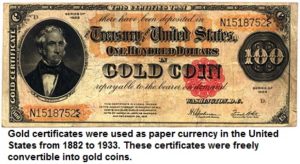
How did the world measure money and wealth in the past? Simple: Gold.

Then in 1971, the US changed from the Gold Standard … to a Non-Gold Standard or Fiat money. (The Gold Standard refers to the monetary system in which the standard economic unit of account is based on a fixed quantity of gold. Most nations abandoned the gold standard as the basis of their monetary systems at some point in the 20th century). Now the value of American money is measured by “American money” (declared value). But wait, wait: the rest of the world’s money is also now measured by American money – the world measures money and wealth by US Dollars! (See the Appendix VIDEO below).

Even in Europe; when the Euro currency was launched in 1999, it was pegged close to the US dollar 1-to-1.17. Today, the world’s economy is measured by US Dollars (USD) and the Euro, which continue to be the primary reserve currency of most commercial and central banks[54]. The Dollar is first and the Euro is the second most widely held international reserve currency. As of August 2018, with more than €1.2 trillion in circulation, the Euro has one of the highest combined values of banknotes and coins in circulation in the world, having surpassed the U.S. dollar.[13]
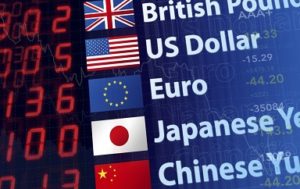
Now the rest of the world – China most definitely – wants to de-Americanize the world’s economy. The world’s population is nearly 7 billion people, while the combined populations of the US and the EU is a little less than 1 billion; (340 million + 508 million respectively). There are some Big countries and Big economies at stake: think China with their 1.3 Billion people or India with their 1.2 Billion.  It is therefore logical to contemplate de-Americanizing the world’s economy – it makes so much sense. In addition, at the time of this writing, the US is in the midst of a federal government shutdown … again.

It is therefore plausible, viable and prudent for non-American stakeholders to want to be shielded from American chaos. See this reasoning in this White Paper here; published by the Government of Canada:

Title: Chimerica – The Beginnings of a New Regional Reserve

What is it?
Chinese concerns over the ability of the U.S. to manage its debt have led to recent calls by China to “de-Americanize” the world economy and seek an alternative to the U.S. dollar as the international reserve currency.1 As far back as 2008, China proposed the need for a new international currency reserve which would limit the importance of any one national currency.2

In recent times, the U.S. economy has avoided a debt crisis by raising the debt ceiling level. Any adjustment has the potential to impact the Chinese economy, given the level of exposure to U.S. securities. The People’s Bank of China (PBOC) has amassed US$3.5 trillion in foreign reserves – largely U.S. Treasury securities. The fact that a single institution wields so much influence over global macroeconomic stability has caused considerable anxiety, with doomsayers predicting that doubts about U.S. debt sustainability will force China to sell off its holdings of U.S. debt. This would drive up interest rates in the U.S. and ultimately could trigger the dollar’s downfall.

However, selling off U.S. Treasury securities may not be in China’s interest, as it would drive up the renminbi’s (RMB) exchange rate against the U.S. dollar, diminishing the domestic value of China’s reserves and undermining the export sector’s competitiveness. Indeed, a U.S. Defense Department report last year on the national security implications of China’s holdings of U.S. debt concluded that “attempting to use U.S. Treasury securities as a coercive tool would have limited effect and likely would do more harm to China than to the [U.S.].”3

U.S. debt is only one side of the coin. Economist Robert Shiller believes that the real estate bubble is a serious problem in China.4 According to Shiller, people are buying apartments in the expectation that house prices will continue to rise. This gambling mentality is leading them to make completely irrational buying decisions. Slowing economic growth and exports has the potential to expose a serious financial bubble in the Chinese housing sector. The banking sector in China would need to be recapitalized should the Chinese housing bubble burst.

Why is it important?
The symbiotic relationship between Chinese export-led growth and U.S. consumption is such that should one economy falter the other will follow. Both of these disruptors exist against a backdrop of rising bilateral trade using national currencies and a call by the International Monetary Fund for a new global currency to replace the U.S. dollar.5

Research by AMRO-Asia, the chief economists of ASEAN+3, finds that while the U.S. remains the anchor currency in the Asian region, the U.S. dollar has “seemingly lost its dominating status.”6 At the same time, the weight of the RMB in regional currency baskets has been increasing since 2005.7  8 The rise of the RMB as the Asian regional reserve has implications for regional trade and global growth. In the long run, the success of the U.S. economic pivot to Asia is likely to be slowed by the rise of the RMB and the corresponding decline in U.S. economic power. Over the last decade, U.S. growth has been facilitated by Chinese holdings of U.S. securities. Questions remain as to whether a decoupling in the long run will have a positive outcome for China and the U.S. as well as global growth.

References

  1. Puzzanghera, J. “Upset over U.S. Fiscal Crisis, China Urges a ‘de-Americanized World’.” Los Angeles Times. October 2013. http://www.latimes.com/business/money/la-fi-mo-china-debt-limit-shutdown-de-americanized-economy-20131014,0,1990632.story#ixzz2mwhEb6II(link is external)
  2. Landler, M. “Seeing its Own Money at Risk, China Rails at U.S.” The New York Times. October 2013. http://www.nytimes.com/2013/10/16/us/politics/china-rails-over-us-fiscal-crisis-seeing-its-own-money-at-risk.html?_r=0(link is external)
  3. Morrison, W. and M. Labonte. “China’s Holdings of U.S. Securities: Implications for the U.S. Economy.” (CRS Report for Congress.) Congressional Research Service. August 2013. http://www.fas.org/sgp/crs/row/RL34314.pdf(link is external)
  4. “2013 Nobel Prize winner: China’s real estate bubble is serious.” People’s Daily Online. October 2013. http://english.people.com.cn/business/8427784.html(link is external)
  5. Snyder, M. “Shift From U.S. Dollar As World Reserve Currency Underway – What Will This Mean For America?” munKnee. http://www.munknee.com/shift-from-u-s-dollar-as-world-reserve-currency-underway-what-will-this-mean-for-america/(link is external)
  6. Chen, C., R. Siregar and M Yiu. “RMB as an Anchor Currency in ASEAN, China, Japan and Korea Region.” ASEAN+3 Macroeconomic Research Office. April 2013. https://www.cb.cityu.edu.hk/ef/doc/Conference%20on%20Renminbi%20and%20the%20Global%20Economy/papers/Chuling%20Chen.pdf(link is external)
  7. Chong, F. “Is RMB Approaching Safe Haven Status?” Asia Today International. June 2013. http://asiatoday.com.au/content/rmb-approaching-safe-haven-status(link is external)
  8. Irwin, N. “This one number explains how China is taking over the world.” Washington Post. December 2013. http://www.washingtonpost.com/blogs/wonkblog/wp/2013/12/03/this-one-number-explains-how-china-is-taking-over-the-world/

Source: Government of Canada – Posted September 28, 2018; retrieved January 17, 2019 from: http://www.horizons.gc.ca/en/content/chimerica-%E2%80%93-beginnings-new-regional-reserve

This commentary continues a 5-part series on European Reckoning. This entry is 2 of 5 in this series from the movement behind the book Go Lean … Caribbean in consideration of the past, present and future of European interactions. While the Caribbean were all settled and organized by European powers, the lack of organizational efficiency for our benefit is a glaring concern. We have 30 member-states in the Caribbean region and yet, there is no coordinated regional stewardship of the economic, fiscal and monetary affairs of our communities. The other commentaries in the series are cataloged as follows:

  1. European Reckoning: IMF Apologies
  2. European Reckoning: China seeks to de-Americanize the world’s economy
  3. European Reckoning: Settlers -vs- Immigrants
  4. European Reckoning: Christianity’s Indictment
  5. European Reckoning: Black “Greco-Roman” Wrestler victimized for his hair

In the first submission of this series, the European Great Powers were also identified as the Western Alliance. It’s comprised of only White/Christian European nations and North America (US & Canada). It is understandable therefore if Asian, African or Latin American people do not feel adequately represented in the governance of the world’s economy. Yes this status quo is flawed. The US, being the dominant currency in global trade has proven fraught with deficiencies. The aft-mentioned “shutdown” – when Congress fails to pass sufficient appropriation bills or continuing resolutions to fund federal government operations and agencies, or when the President refuses to sign such bills or resolutions into law – is not the first one. In fact, there have been these previous shutdowns in the last 40+ years:

Since 1976, when the current budget and appropriations process was enacted, there have been 22 gaps in budget funding, 10 of which led to federal employees being furloughed. – Source: Wikipedia

The world must not wait for the US to get their political house in order before we can do business. China is a strong advocate for this de-Americanizing effort. Does this mean they want to supplant the US Dollar for their own Renminbi? (This is the currency of the People’s Republic of China, the basic unit of which is the yuan). If the answer to this question is Yes, then that would be China’s prerogative to address the needs of their economy.

Our focus in the Caribbean, must be first and foremost the Caribbean.

The advocacy of the movement behind the Go Lean book is to implement the institutional solutions to do the heavy-lifting ourselves to manage our own economic, fiscal and monetary affairs.

  • Not to be a parasite of the United States of America or Europe.
  • Not to be a parasite of China.

The proposed solution is the Caribbean Central Bank (CCB); this is structured as a formal “cooperative” among the region’s existing Central Banks. The CCB is modeled upon the European Central Bank (ECB), the same as the Caribbean Union is modeled upon the European Union. This CCB institutional strategy also calls for the introduction of a regional currency, the Caribbean Dollar (C$). The CCB will therefore be the sole controlling agent of the monetary policies of this regional C$ currency.

Introducing and implementing a new currency is a Big Deal. But yes, we can succeed! We have a proven track record – the Euro – to model and learn from. This theme of technocratic monetary and currency stewardship has been detailed in many previous Go Lean commentaries; see a sample list here:

https://goleancaribbean.com/blog/?p=15923 Industrial Reboot – Payment Cards 101
https://goleancaribbean.com/blog/?p=14248 Leading with Money Matters – Almighty Dollar
https://goleancaribbean.com/blog/?p=13744 Failure to Launch – Economics: The Quest for a ‘Single Currency’
https://goleancaribbean.com/blog/?p=13365 West African Case Study: ECOWAS to Launch ‘Single Currency’
https://goleancaribbean.com/blog/?p=10585 Two Pies: Economic Plan for a New Caribbean
https://goleancaribbean.com/blog/?p=10513 Transforming ‘Money’ Countrywide – Lessons Learned from India
https://goleancaribbean.com/blog/?p=8704 Lessons Learned from NYC’s Transit Currency: MetroCard
https://goleancaribbean.com/blog/?p=8381 Caribbean Economic Fallacy: Casino Currency US Dollars Only
https://goleancaribbean.com/blog/?p=7034 The Future of our Money – C$ Currency & Mobile Payment Systems
https://goleancaribbean.com/blog/?p=4425 Caribbean Dollar Reality: Cash/Coin, Payment Cards and iPhone
https://goleancaribbean.com/blog/?p=3814 Lesson Learned from the Swiss Currency Management
https://goleancaribbean.com/blog/?p=906 Implementing a Regulatory framework to dissuade ‘risky’ currecy
https://goleancaribbean.com/blog/?p=833 One currency, divergent economies
https://goleancaribbean.com/blog/?p=360 Why need local/regional currency? To Create Money from Thin Air

Having the American Dollar regulate the world economy has not been good … for anyone but America, when “they” are operating in a Situation Normal. But today, and 22 times in the last 43 years that they have had government shutdowns, it is Situation Normal All Foul Up (SNAFU). Moving that currency functionality to the Euro may be more of the same: there is also discord in the Euro lands – think Brexit and the Greece Sovereign Debt crisis.

What about moving the “world currency” functionality to China, or India, or Japan? Again, while these moves may be good for those countries, they may not necessarily be as good for the rest of the world, or our world in the Caribbean. This is what independence should mean to us: taking care of our own economic, fiscal and monetary needs. Even better than independence would be a regional interdependence among just our Caribbean neighbors.

Now is the time for the Caribbean region to lean-in for this roadmap for the Caribbean Union Trade Federation and the Caribbean Central Bank, as described in the book Go Lean … Caribbean. The benefits of this roadmap are vast and varied, but first we stop being a parasite of these European-North American (White) World Powers; not parasites, we become protégés instead.

Yes, we can … make the Caribbean, our homeland, a better place to live, work and play. 🙂

About the Book
The book Go Lean…Caribbean serves as a roadmap for the introduction and implementation of the technocratic Caribbean Union Trade Federation (CU), for the elevation of Caribbean society – for all member-states. This CU/Go Lean roadmap has these 3 prime directives:

  • Optimization of the economic engines in order to grow the regional economy to $800 Billion and create 2.2 million new jobs.
  • Establishment of a security apparatus to ensure public safety and protect the resultant economic engines.
  • Improve Caribbean governance to support these engines, including a separation-of-powers between the member-states and CU federal agencies.

The Go Lean book provides 370-pages of turn-by-turn instructions on “how” to adopt new community ethos, plus the strategies, tactics, implementations and advocacies to execute so as to reboot, reform and transform the societal engines of Caribbean society.

Download the free e-Book of Go Lean … Caribbean – now!

Who We Are
The movement behind the Go Lean book – a non-partisan, apolitical, religiously-neutral Community Development Foundation chartered for the purpose of empowering and re-booting economic engines – stresses that reforming and transforming the Caribbean societal engines must be a regional pursuit. This was an early motivation for the roadmap, as pronounced in the opening Declaration of Interdependence (Pages 12 – 13):

xi. Whereas all men are entitled to the benefits of good governance in a free society, “new guards” must be enacted to dissuade the emergence of incompetence, corruption, nepotism and cronyism at the peril of the people’s best interest. The Federation must guarantee the executions of a social contract between government and the governed.

xii. Whereas the legacy in recent times in individual states may be that of ineffectual governance with no redress to higher authority, the accedence of this Federation will ensure accountability and escalation … for good governance, justice assurances, due process and the rule of law. As such, any threats of a “failed state” status for any member state must enact emergency measures on behalf of the Federation to protect the … member states and the Federation as a whole.

xxiii. Whereas many countries in our region are dependent Overseas Territory of imperial powers, the systems of governance can be instituted on a regional and local basis, rather than requiring oversight or accountability from distant masters far removed from their subjects of administration. The Federation must facilitate success in autonomous rule …

xxiv. Whereas a free market economy can be induced and spurred for continuous progress, the Federation must install the controls to better manage aspects of the economy: jobs, inflation, savings rate, investments and other economic principles. Thereby attracting direct foreign investment because of the stability and vibrancy of our economy.

xxv. Whereas the legacy of international democracies had been imperiled due to a global financial crisis, the structure of the Federation must allow for financial stability and assurance of the Federation’s institutions. To mandate the economic vibrancy of the region, monetary and fiscal controls and policies must be incorporated as proactive and reactive measures. These measures must address threats against the financial integrity of the Federation and member-states.

Sign the petition to lean-in for this roadmap for the Caribbean Union Trade Federation.

—————–

Appendix VIDEO – How The U.S. Dollar Shaped The World Economy – https://youtu.be/EbJk1za74kE

NBC News
Published on Dec 21, 2014 – The official currency of the United States, the Federal Reserve Note, marks 100 years since it was first printed. Matt Rivera tracks the rise of the world’s reserve currency.

» Subscribe to NBC News: http://nbcnews.to/SubscribeToNBC

» Watch more NBC video: http://bit.ly/MoreNBCNews

NBC News is a leading source of global news and information. Here you will find clips from NBC Nightly News, Meet The Press, and our original series Debunker, Flashback, Nerdwatch, and Show Me. Subscribe to our channel for news stories, technology, politics, health, entertainment, science, business, and exclusive NBC investigations.

Connect with NBC News Online! Visit NBCNews.Com: http://nbcnews.to/ReadNBC

Find NBC News on Facebook: http://nbcnews.to/LikeNBC

Follow NBC News on Twitter: http://nbcnews.to/FollowNBC

Follow NBC News on Google+: http://nbcnews.to/PlusNBC

Follow NBC News on Instagram: http://nbcnews.to/InstaNBC

Follow NBC News on Pinterest: http://nbcnews.to/PinNBC

How The U.S. Dollar Shaped The World Economy | Long Story Short | NBC News

—————–
See an alternative yet relevant VIDEO here: https://youtu.be/CQMiNu6FI4M

Share this post:
, , ,

European Reckoning – Reconciling the IMF’s Past, Present and Future

Go Lean Commentary

If you had a benefactor – think scholarship for your college education – and your benefactor files for bankruptcy, should you be concerned, weary and/or pessimistic that future monies will continue to flow?

That would be stupid!

It is only logical that you would be expected to find another benefactor. (This is not just academic – in 1991 when the Soviet Union dissolved, the Caribbean country of Cuba was left out in the cold).

Europe, the continent, the countries and the people have been the Caribbean’s benefactor for many years in our history. It is time now to reckon with that! We must review, reflect and reconcile this past, present and our future interactions, especially when it comes to economic crises, escalations and bailouts.

When we refer to reconciling Europe’s past, we refer to the Imperial Conquests, Slave Trade, Slavery, Colonialism and Post-Colonialism.

When we refer to Europe’s present, we refer to all the recent developments in modern day Europe, as in the events of the recent economic crises; think Sovereign Debt Crisis with Greece and others.

When we refer to Europe’s future, we are referring to the tenuous status in their integration movements – think European Union (EU), IMF, and the resultant unrest on the European mainland.

This commentary opens a 5-part series on European Reckoning. This entry is 1 of 5 in this series from the movement behind the book Go Lean … Caribbean in consideration of root history of Caribbean colonialism and how modern reconciliation developments are exacerbating our communities. We are all mostly independent and sovereign countries in the Caribbean, so it is expected that we would now be mature and responsible; we must now be protégés not parasites of the European world. The other commentaries in the series are cataloged as follows:

  1. European Reckoning: IMF Apologies
  2. European Reckoning: China seeks to de-Americanize the world’s economy
  3. European Reckoning: Settlers -vs- Immigrants
  4. European Reckoning: Christianity’s Indictment
  5. European Reckoning: Black “Greco-Roman” Wrestler victimized for his hair

In this series, reference is made to the Great Powers of the Western Hemisphere, sometimes called the Western Alliance. This refers to the White/Christian European nations and North America (US & Canada). In fact, sometimes the Western Alliance is cross-labeled with the North Atlantic Treaty Organization (NATO) also called the North Atlantic Alliance; this is an intergovernmental military alliance between 29 North American and European countries.

While none of the 29 NATO members include any Caribbean independent states, 16 Caribbean Overseas Territories are thusly aligned as dependents of the American (2), British (6), Dutch (6) and French (4) imperial powers. Plus with the Caribbean Basin Security Pact, the full Caribbean – except Cuba – is aligned with NATO members: United States and Canada.
The reference to Europe in this series of commentaries is to “White Westerners”. This special sub-group had wielded absolute power on the planet. It is time now to look back at that history and “call a spade a spade”!

In this first submission of this series, the overt favoritism of economic bailouts toward White Westerners was exposed and commiserated. This reflects the need for reconciliation. For the Caribbean, considering our European history, presence and future, we need to participate in this reconciliation. See this article here addressing the flawed favoritism of the International Monetary Fund (IMF), (the intergovernmental financial institution composed of 189 countries working to foster global monetary cooperation, secure financial stability, facilitate international trade, promote high employment and sustainable economic growth, and reduce poverty around the world”[1]). It appears that the ‘International’ in the brand IMF has not been as global as they claimed. The full article is presented here:

Title: IMF admits disastrous love affair with the euro and apologises for the immolation of Greece
By:
Ambrose Evans-Pritchard
The International Monetary Fund’s top staff misled their own board, made a series of calamitous misjudgments in Greece, became euphoric cheerleaders for the euro project, ignored warning signs of impending crisis, and collectively failed to grasp an elemental concept of currency theory.

This is the lacerating verdict of the IMF’s top watchdog on the fund’s tangled political role in the eurozone debt crisis, the most damaging episode in the history of the Bretton Woods institutions.

It describes a “culture of complacency”, prone to “superficial and mechanistic” analysis, and traces a shocking breakdown in the governance of the IMF, leaving it unclear who is ultimately in charge of this extremely powerful organisation.

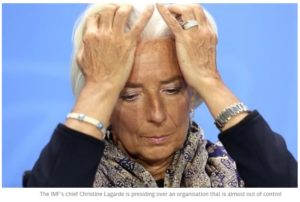
The report by the IMF’s Independent Evaluation Office (IEO) goes above the head of the managing director, Christine Lagarde. It answers solely to the board of executive directors, and those from Asia and Latin America are clearly incensed at the way European Union insiders used the fund to rescue their own rich currency union and banking system.

The three main bailouts for Greece, Portugal and Ireland were unprecedented in scale and character. The trio were each allowed to borrow over 2,000pc of their allocated quota – more than three times the normal limit – and accounted for 80pc of all lending by the fund between 2011 and 2014.

In an astonishing admission, the report said its own investigators were unable to obtain key records or penetrate the activities of secretive “ad-hoc task forces”. Mrs Lagarde herself is not accused of obstruction.

“Many documents were prepared outside the regular established channels; written documentation on some sensitive matters could not be located. The IEO in some instances has not been able to determine who made certain decisions or what information was available, nor has it been able to assess the relative roles of management and staff,” it said.

The report said the whole approach to the eurozone was characterised by “groupthink” and intellectual capture. They had no fall-back plans on how to tackle a systemic crisis in the eurozone – or how to deal with the politics of a multinational currency union – because they had ruled out any possibility that it could happen.

“Before the launch of the euro, the IMF’s public statements tended to emphasise the advantages of the common currency,” it said. Some staff members warned that the design of the euro was fundamentally flawed but they were overruled.

“After a heated internal debate, the view supportive of what was perceived to be Europe’s political project ultimately prevailed,” it said.

This pro-EMU bias continued to corrupt their thinking for years. “The IMF remained upbeat about the soundness of the European banking system and the quality of banking supervision in euro-area countries until after the start of the global financial crisis in mid-2007. This lapse was largely due to the IMF’s readiness to take the reassurances of national and euro area authorities at face value,” it said.

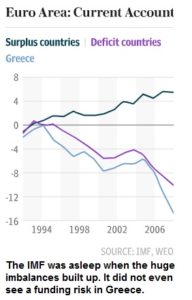
The IMF persistently played down the risks posed by ballooning current account deficits and the flood of capital pouring into the eurozone periphery, and neglected the danger of a “sudden stop” in capital flows.

“The possibility of a balance of payments crisis in a monetary union was thought to be all but non-existent,” it said. As late as mid-2007, the IMF still thought that “in view of Greece’s EMU membership, the availability of external financing is not a concern”.

At root was a failure to grasp the elemental point that currency unions with no treasury or political union to back them up are inherently vulnerable to debt crises. States facing a shock no longer have sovereign tools to defend themselves. Devaluation risk is switched into bankruptcy risk.

“In a monetary union, the basics of debt dynamics change as countries forgo monetary policy and exchange rate adjustment tools,” said the report. This would be amplified by a “vicious feedback between banks and sovereigns”, each taking the other down. That the IMF failed to anticipate any of this was a serious scientific and professional failure.

In Greece, the IMF violated its own cardinal rule by signing off on a bailout in 2010 even though it could offer no assurance that the package would bring the country’s debts under control or clear the way for recovery, and many suspected from the start that it was doomed.

The organisation got around this by slipping through a radical change in IMF rescue policy, allowing an exemption (since abolished) if there was a risk of systemic contagion. “The board was not consulted or informed,” it said. The directors discovered the bombshell “tucked into the text” of the Greek package, but by then it was a fait accompli.

The IMF was in an invidious position when it was first drawn into the Greek crisis.  The Lehman crisis was still fresh. “There were concerns that such a credit event could spread to other members of the euro area, and more widely to a fragile global economy,” said the report.

The eurozone had no firewall against contagion, and its banks were tottering. The European Central Bank had not yet stepped up to the plate as lender of last resort. It was deemed too dangerous to push for a debt restructuring in Greece.

While the fund’s actions were understandable in the white heat of the crisis, the harsh truth is that the bailout sacrificed Greece in a “holding action” to save the euro and north European banks. Greece endured the traditional IMF shock of austerity, without the offsetting IMF cure of debt relief and devaluation to restore viability.

A sub-report on the Greek saga said the country was forced to go through a staggering squeeze, equal to 11pc of GDP over the first three years. This set off a self-feeding downward spiral. The worse it became, the more Greece was forced to cut – what ex-finance minister Yanis Varoufakis called “fiscal water-boarding”.

“The automatic stabilisers were not allowed to operate, thus aggravating the pro-cyclicality of the fiscal policy, which exacerbated the contraction,” said the report.

The attempt to force through an “internal devaluation” of 20pc to 30pc by means of deflationary wage cuts was self-defeating since it necessarily shrank the economic base and sent the debt trajectory spiralling upwards. “A fundamental problem was the inconsistency between attempting to regain price competitiveness and simultaneously trying to reduce the debt to nominal GDP ratio,” it said.

The IMF thought the fiscal multiplier was 0.5 when it may in reality have been five times as high, given the fragility of the Greek system. The result is that nominal GDP ended 25pc lower than the IMF’s projections, and unemployment soared to 25pc instead of 15pc as expected. “The magnitude of Greece’s growth forecast errors looks extraordinary,” it said.

The strategy relied on forlorn hopes that the “confidence fairy” would lift Greece out of this policy-induced nose-dive. “Highly optimistic” plans to raise $50bn from privatisation sales came to little. Some assets did not even have clear legal ownership. The chronic “lack of realism” lasted until late 2011. By then the damage was done.

The injustice is that the cost of the bailouts was switched to ordinary Greek citizens  – the least able to support the burden  – and it was never acknowledged that the true motive of EU-IMF Troika policy was to protect monetary union. Indeed, the Greeks were repeatedly blamed for failures that stemmed from the policy itself. This unfairness – the root of so much bitterness in Greece – is finally recognised in the report.

“If preventing international contagion was an essential concern, the cost of its prevention should have been borne – at least in part – by the international community as the prime beneficiary,” it said.

Better late than never.

Source: Posted July, 29 2016 ; retrieved January 10, 2019 from: https://www.telegraph.co.uk/business/2016/07/28/imf-admits-disastrous-love-affair-with-euro-apologises-for-the-i/

The foregoing article highlights: “Asian and Latin American stakeholders are clearly incensed at the way European Union insiders used the [IMF] fund to rescue their own rich currency union and banking system”. Maybe just maybe, Europeans are not as egalitarian and pluralistic as they claim. Maybe just maybe, when push comes to shove they first look after their own before supporting others, even though they are contractually obligated to do so.

This is Tribalism 101

Tribalism is the state of being organized by, or advocating for, tribes or tribal lifestyles. Human evolution has primarily occurred in small groups, as opposed to mass societies, and humans naturally maintain a social network.
In popular culture, tribalism may also refer to a way of thinking or behaving in which people are loyal to their social group above all else,[1] or, derogatorily, a type of discrimination or animosity based upon group differences.[2]

This ‘Tribalism’ is the reckoning that Europe is doing right now regarding the IMF. They are reconciling their past, present and future and recognizing that they now have to build trust, anew – see the Appendix VIDEO below.

This is also the reckoning that we, in the Caribbean, must do. How should we deal with fiscal/monetary escalations – rescues of our currency and banking systems? The conclusion from this commentary is that we need to do the heavy-lifting ourselves and facilitate our own solutions for economic and fiscal management. The proposed solution: the Caribbean Central Bank (CCB) as a formal “cooperative” among the region’s Central Banks. The CCB will be the sole controlling agent of the monetary policies of a regional currency union: Caribbean Dollar. When there is economic dysfunction and a need for “receivership”. That role would be assumed by the CCB, not the IMF.

This theme of technocratic monetary stewardship aligns with previous Go Lean commentaries; see a sample list here:

https://goleancaribbean.com/blog/?p=16210 In Defense of Trade – Currency Assassins: Real Threat
https://goleancaribbean.com/blog/?p=15796 Lessons Learned from 2008: Righting The Wrong
https://goleancaribbean.com/blog/?p=15787 Lessons Learned from 2008: Too Big to Fail –vs- Too Small to Thrive
https://goleancaribbean.com/blog/?p=14248 Leading with Money Matters – Almighty Dollar
https://goleancaribbean.com/blog/?p=13744 Failure to Launch – Economics: The Quest for a ‘Single Currency’
https://goleancaribbean.com/blog/?p=6563 Lessons from Iceland – Model of Banking Recovery
https://goleancaribbean.com/blog/?p=3858 European Central Bank unveils 1 trillion Euro stimulus program
https://goleancaribbean.com/blog/?p=3814 Lesson Learned from the Swiss unpegging their currency: Franc
https://goleancaribbean.com/blog/?p=3582 For Canadian Banks: Caribbean is a ‘Bad Bet’
https://goleancaribbean.com/blog/?p=833 One currency, divergent economies
https://goleancaribbean.com/blog/?p=467 Barbados Central Bank records $3.7m loss in 2013

Now is the time for the Caribbean region to lean-in for this roadmap described here-in the book Go Lean … Caribbean. The benefits of this roadmap are too alluring to ignore: emergence of an $800 Billion economy, with solid technocratic management of a regional currency union. Finally, we will have the opportunity to stand-up as a protégé to our North American and European counterparts. We will not be looking to them to bail-us-out; we will forge our own growth and clean-up and own mess. We will be mature … finally.

Yes, we can … make the Caribbean, our homeland, a better place to live, work and play. 🙂

About the Book
The book Go Lean…Caribbean serves as a roadmap for the introduction and implementation of the technocratic Caribbean Union Trade Federation (CU) and the aligning Caribbean Central Bank (CCB), for the elevation of Caribbean society – for all member-states. This CU/Go Lean roadmap has these 3 prime directives:

  • Optimization of the economic engines in order to grow the regional economy to $800 Billion and create 2.2 million new jobs.
  • Establishment of a security apparatus to ensure public safety and protect the resultant economic engines.
  • Improve Caribbean governance to support these engines, including a separation-of-powers between the member-states and CU federal agencies.

The Go Lean book provides 370-pages of turn-by-turn instructions on “how” to adopt new community ethos, plus the strategies, tactics, implementations and advocacies to execute so as to reboot, reform and transform the societal engines of Caribbean society.

Download the free e-Book of Go Lean … Caribbean – now!

Who We Are
The movement behind the Go Lean book – a non-partisan, apolitical, religiously-neutral Community Development Foundation chartered for the purpose of empowering and re-booting economic engines – stresses that reforming and transforming the Caribbean societal engines must be a regional pursuit. This was an early motivation for the roadmap, as pronounced in the opening Declaration of Interdependence (Pages 12 – 13):

xi. Whereas all men are entitled to the benefits of good governance in a free society, “new guards” must be enacted to dissuade the emergence of incompetence, corruption, nepotism and cronyism at the peril of the people’s best interest. The Federation must guarantee the executions of a social contract between government and the governed.

xii. Whereas the legacy in recent times in individual states may be that of ineffectual governance with no redress to higher authority, the accedence of this Federation will ensure accountability and escalation … for good governance, justice assurances, due process and the rule of law. As such, any threats of a “failed state” status for any member state must enact emergency measures on behalf of the Federation to protect the … member states and the Federation as a whole.

xxiii. Whereas many countries in our region are dependent Overseas Territory of imperial powers, the systems of governance can be instituted on a regional and local basis, rather than requiring oversight or accountability from distant masters far removed from their subjects of administration. The Federation must facilitate success in autonomous rule …

xxiv.  Whereas a free market economy can be induced and spurred for continuous progress, the Federation must install the controls to better manage aspects of the economy: jobs, inflation, savings rate, investments and other economic principles. Thereby attracting direct foreign investment because of the stability and vibrancy of our economy.

xxv.   Whereas the legacy of international democracies had been imperiled due to a global financial crisis, the structure of the Federation must allow for financial stability and assurance of the Federation’s institutions. To mandate the economic vibrancy of the region, monetary and fiscal controls and policies must be incorporated as proactive and reactive measures. These measures must address threats against the financial integrity of the Federation and member-states.

Sign the petition to lean-in for this roadmap for the Caribbean Union Trade Federation.

—————–

Appendix VIDEO – IMF’s Christine Lagarde: Truth and transparency are key to rebuilding trust – https://youtu.be/0Iia6FUzVc4


CNBC International TV
Published on Apr 22, 2018 – The International Monetary Fund (IMF) welcomed calls from the U.S. that it should push for more transparency in global trade and lending, the Fund’s boss said Sunday.

IMF Managing Director Christine Lagarde said she’s “delighted” U.S. Treasury Secretary Mnuchin wants the Fund to increase transparency on trade imbalances and debt sustainability in countries like China, an effort she said is already underway. “It’s clearly a project that we have been working on, that we will continue to work on, and I’m delighted that he’s supporting us,” Lagarde said in an interview with CNBC’s Elizabeth Schulze at the IMF Spring Meetings [2018] in Washington.

—–

Subscribe to CNBC Life: http://cnb.cx/2wAkfMv

Subscribe to CNBC International: http://cnb.cx/2gft82z

Like our Facebook page https://www.facebook.com/cnbcinternat…

Follow us on Instagram https://www.instagram.com/cnbcinterna…

Follow us on Twitter https://twitter.com/cnbci

Share this post:
, , ,
[Top]

Transforming Hindus versus Women – What it means for us?

Go Lean Commentary

The responsibility to assuage these bad behaviors must lie first with the religious institutions. But any failure to deliver protection by these institutions would truly mandate that the “State” (government) step in and deliver.
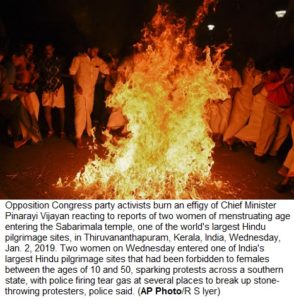
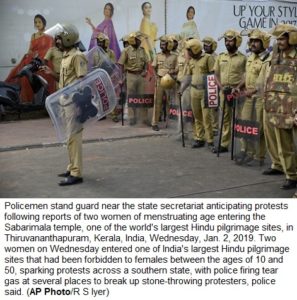

Separation of Church and State be damned!

Separation of Church and State has been the standard for governments ever since the Enlightenment Age. In fact, the governing standard – the Social Contract – is a concept that was codified during that period. That contract states:

Citizens surrender some of their freedoms and submit to the authority of the State in exchange for protection of remaining natural and legal rights. – Book  Go Lean…Caribbean Page 170.

Christianity! Islam! Guilty … of failing to protect their congregants and adherents from the bad orthodoxies in their communities!

Now its Hinduism time to secede to civil “protections of natural rights”. There are abuses that are victimizing segments of their population. It is no longer acceptable to tolerate such abuse.

Change has come to the world, Separation of Church and State is now suspect! Sometimes the “Church” is the problem; so the State is therefore expected to step in and break that Separation shield. See how this is playing out in India right now. See the full news article here:

Title: Hindu hardliners clash with police over women at shrine

NEW DELHI (AP) — Hindu hardliners vandalized shops, shut businesses and clashed with police in a southern state Thursday to protest the entry of two women in one of India’s largest Hindu pilgrimage sites, police said.

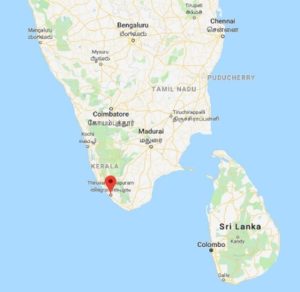
Police used water cannons and tear gas to disperse the protesters who also blocked roads by placing burning tires and concrete blocks in key towns, including Kozhikode, Kannur, Malappuram, Palakkad and Thiruvananthapuram.

Pinarayi Vijayan, the state’s top elected official, accused supporters of Prime Minister Narendra Modi’s Bharatiya Janata Party of triggering violence that reportedly claimed one life.

Most state-run buses kept off roads after several were damaged by protesters.

Supporters of Modi’s party held protest marches in the state as part of a strike call by Sabarimala Karma Samithi, an umbrella organization of Hindu groups.

The two women entered the temple to pray early Wednesday, triggering protests. They were escorted by police because it is “the government’s constitutional responsibility to give protection to women,” Vijayan said.

Women of menstruating age were forbidden to pray at the temple until the Supreme Court lifted the ban in September. The ban was informal for many years but became law in 1972.

Some devotees have filed a petition saying the court decision revoking the ban was an affront to the celibate deity Ayyappa.

Vijayan said Thursday that 39 police officers were injured while trying to control the protesters, who damaged 79 state-run buses in the state.

The Press Trust of India news agency reported that a 55-year-old passer-by died after being injured amid rock throwing by protesters in Pandalam.

Source: Associated Press posted January 3, 2019; retrieved January 5, 2019 from: https://news.yahoo.com/hindu-hard-liners-paralyze-indian-state-over-women-090122760.html

The concept is simple for “States“, while they must allow for Freedom of Religion, they cannot allow religious intimidation of their citizens. No More!

This is an issue of Orthodoxy and it is not only a concern in India. Even here in the Caribbean we have to make progress. Clearly we understand the oppression, suppression and repression experienced in India prohibiting women to pray in the Temple, and so there is the acceptance that it is right for that State to act against continued abuse. There has always been a need for States to legislate morality in society over the years; consider these examples:

  • Slavery – The Pope approved African Slavery in 1491; but it took the Protestant and Enlightenment movements to unravel the end of the Slave Trade and eventually the institution of Slavery itself. By the mid-1800’s all European Powers ended slavery in their New World territories.
  • Indian Widows – As detailed in a previous blog-commentary, the “Hindu Widows’ Remarriage Act of 1856” legalized the remarriage of Hindu widows in all jurisdictions of India under British rule. Upper-caste Hindu society had long disallowed the remarriage of widows, even child and adolescent ones, all of whom were expected to live a life of austerity and abnegation. The law provided legal safeguards against loss of certain forms of inheritance for remarrying a Hindu widow.
    See the Appendix VIDEO below.
  • Drunk Driving – A classic example is that in France where Evan’s Law regulated alcohol advertising; advertising affected alcohol demand; so the end result on alcohol consumption was that in 1960, the average adult in France consumed 30 liters of alcohol while that figure is down to 13.5 liters today. Drunk Driving incidences naturally declined.

The assertion of the movement behind the book Go Lean … Caribbean (Page 20) is that there must be a new regime for our region; one that is apolitical and religiously-neutral. The community ethos – underlying sentiment that informs the beliefs, customs, or practices – that must be pursued by this new Caribbean regime is that of the Greater Good; that it can be pursued despite any religiosity. This book defines this Greater Good community ethos as follows:

“It is the greatest good to the greatest number of people which is the measure of right and wrong”. Jeremy Bentham (1748-1832)

In the Caribbean, we have adherents to many religions: Christianity, Islam, Hindu and indigenous animism. We must insist on a clear “Separation of Church and State” in order to mold the behavior and character development we want to see in our communities. Seeing the default orthodoxy in these religions, it is obvious that our ideals must be Greater.

For one, we must protect and promote women in our communities. This is a charge that we must execute whether it is popular or not. This theme – protecting and promoting women in society – aligns with previous Go Lean commentaries; see a sample list here:

https://goleancaribbean.com/blog/?p=16408 Bad Ethos on Home Violence leads to more “Stranger” Abuse
https://goleancaribbean.com/blog/?p=14482 UN’s International Women’s Day – Protecting Rural Women
https://goleancaribbean.com/blog/?p=13664 High Profile Sexual Harassment Accusers – Finally Believed?
https://goleancaribbean.com/blog/?p=13063 Gender Equity without a ‘Battle of the Sexes’
https://goleancaribbean.com/blog/?p=8306 Women Get Ready for New Lean-In Campaign
https://goleancaribbean.com/blog/?p=6937 Women in Politics – Yes, They Can!
https://goleancaribbean.com/blog/?p=2709 Caribbean Study: 58% Of Boys Agree to Female ‘Discipline’

This is the Year 2019 and we are still talking about women being suppressed, oppressed and repressed in society. Change just doesn’t happen because the ‘clock is ticking’. No, people have to forge change, overcome the obstacles and embed the needed new value systems to get improvements institutionalized instead of just a passing trend. Change takes heavy-lifting.
This is what the lessons from India mean to us here-now in the Caribbean.

So many women in our communities flee due to the lack of protections and promotions for them. We want that bad trend to now end, so we must do the heavy-lifting ourselves. We must lower the “Push and Pull” factors that have plagued our society and caused abandonment.

We must do this! Women are half of our population; and they are beloved. This is how we can make our homeland a better place to live, work and play for all.  🙂

About the Book
The book Go Lean…Caribbean serves as a roadmap for the introduction and implementation of the technocratic Caribbean Union Trade Federation (CU), for the elevation of Caribbean society – for all member-states. This CU/Go Lean roadmap has these 3 prime directives:

  • Optimization of the economic engines in order to grow the regional economy to $800 Billion and create 2.2 million new jobs.
  • Establishment of a security apparatus to ensure public safety and protect the resultant economic engines.
  • Improve Caribbean governance to support these engines, including a separation-of-powers between the member-states and CU federal agencies.

The Go Lean book provides 370-pages of turn-by-turn instructions on “how” to adopt new community ethos, plus the strategies, tactics, implementations and advocacies to execute so as to reboot, reform and transform the societal engines of Caribbean society.

Download the free e-Book of Go Lean … Caribbean – now!

Who We Are
The movement behind the Go Lean book – a non-partisan, apolitical, religiously-neutral Community Development Foundation chartered for the purpose of empowering and re-booting economic engines – stresses that reforming and transforming the Caribbean societal engines must be a regional pursuit. This was an early motivation for the roadmap, as pronounced in the opening Declaration of Interdependence (Pages 12 – 13):

xi. Whereas all men are entitled to the benefits of good governance in a free society, “new guards” must be enacted to dissuade the emergence of incompetence, corruption, nepotism and cronyism at the peril of the people’s best interest. The Federation must guarantee the executions of a social contract between government and the governed.

xvi. Whereas security of our homeland is inextricably linked to prosperity of the homeland, the economic and security interest of the region needs to be aligned under the same governance. Since economic crimes … can imperil the functioning of the wheels of commerce for all the citizenry, the accedence of this Federation must equip the security apparatus with the tools and techniques for predictive and proactive interdictions.

xxiv. Whereas a free market economy can be induced and spurred for continuous progress, the Federation must install the controls to better manage aspects of the economy: jobs, inflation, savings rate, investments and other economic principles. Thereby attracting direct foreign investment because of the stability and vibrancy of our economy.

Sign the petition to lean-in for this roadmap for the Caribbean Union Trade Federation.

—————-

Appendix VIDEO – The Horrible Plight of India’s Widows – https://youtu.be/CS8euwO4o8k

Published on Aug 20, 2007 – India Widows (2007): In many conservative Indian families, widows are seen as a liability. Cast out of the family home, they live the rest of their lives in poverty and isolation.

For downloads and more information visit http://journeyman.tv/57526/short-film…

“She becomes a zero and all her powers are lost”, states Dr Giri, explaining how some women’s status change when their husband dies. With no where else to go, thousands come to Vrindavan, city of widows. It was the childhood home of Hindu God, Krishna, who championed downtrodden women. “They come here in search of death”, explains Dr Giri, in the hope they will have a better afterlife” – ABC Australia – Ref. 3587

Journeyman Pictures is your independent source for the world’s most powerful films, exploring the burning issues of today. We represent stories from the world’s top producers, with brand new content coming in all the time. On our channel you’ll find outstanding and controversial journalism covering any global subject you can imagine wanting to know about.

Share this post:
, , , ,
[Top]

The Caribbean – A People or A Place?

Go Lean Commentary

Is your Caribbean homeland “a People or a Place?

Let’s deliberate…

If you love your homeland and you are a proud citizen, your allegiance should continue even though you no longer live there, right? This is the argument that your Caribbean homeland is a people, not just a place.

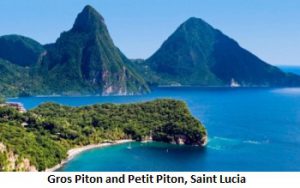
But place/terrain is of utmost importance to our culture; think: beaches, mountains (i.e. Pitons in St. Lucia), etc:

Song:
Oh, island in the sun
Willed to me by my father’s hand
All my days I will sing in praise
Of your forest, waters, your shining sand
– “Island in the Sun” – Harry Belafonte – AZLyrics.com

————

VIDEO – Song: “Island in the Sun” – https://youtu.be/Oi8fS0jkX84

Published on Dec 8, 2008 – 1957 hit song of Harry Belafonte.

Licensed to YouTube by: SME, WMG, Golden Dynamic (on behalf of ToCo Asia Ltd); Abramus Digital, CMRRA, SOLAR Music Rights Management, UBEM, BMG Rights Management, AdRev Publishing, Reservoir Media (Publishing), ASCAP, EMI Music Publishing, União Brasileira de Compositores, ARESA, and 11 Music Rights Societies

———— 

Even the name of our region comes from the 1,063,000 square miles of the Caribbean Sea.

Don’t get it twisted! Ours is the best address on the planet. The “place” is paramount to our identity.

This question “A People or A Place?” was asked of many Caribbean people. Here are their responses:

Caribbean Quotations
Is your Caribbean homeland “a People or a Place”?

  • Bahamas – Dr Donald McCartney, Educator: The Bahamas is a place, but its essence is found in the people who inhabit the place. In this regard, The Bahamas is both the place and the people. On the other hand, if the saying, a house is not a home is accepted, then one can conclude that The Bahamas, as place, cannot be construed to be a people. In the final analysis, The Bahamas is both the people and the place.
  • Bahamas – Anonymous – Diaspora – California Resident: In my personal opinion, the Bahamas is a place. Yes, i am a Bahamian, a proud one…It is a place where people with their culture reside, however the Bahamas is not a place that embrace and celebrate many of it’s people. Gays for one, and the poor is another… My allegiance will only go so far. My country does not accept my sexuality, for me that’s a big deal because my sexuality is a part of my life and I should not be discriminated against, in any form on a national level because of it. As a result, if I have an opportunity to seek citizenship elsewhere, of which I am pursuing I will embrace it. Although there are aspects of my background I want to continue throughout my life wherever I go, there are also aspects that I want to be a distant memory or forgotten.
  • Haiti – Louby Georges – Bahamian Resident of Haitian heritage: My personal take is the country should be a people. But for persons of other descendency, this country of the Bahamas has the characteristic that the culture is more of a place than it is the people. This country has it bad; they make it hard for anyone with an apparent foreign ancestry; they treat them like they do not belong, because they are not from this place. So the country has a warp sense that “home” is only for the people with long lineage of this place. So for me, I am forced to accept the realistic view that the Bahamas is a place.
  • Barbados – Florence Cheeks, Diaspora Member Pennsylvania Resident It’s both; it’s a place in that it identifies my spot on this earth, it’s also a people in that it expresses a history and a way of experiencing life. Barbados is my home. Even though I don’t live here, Barbados inhabits my psyche and I am always looking for opportunities to contribute to the continued growth of the nation. Ironically, I am writing this from my sister’s home in Barbados.
  • Jamaica – Pauline James, Diaspora Member Florida Resident: Jamaica is a people. Whenever you go in the world and Jamaicans are there, they are a force to be reckoned with. We do not hide the fact that we are Jamaican. “When we are good we are very good; when we are bad, we are very bad”.
  • Puerto Rico – Anonymous – Legacy – Florida Resident I would say PR is a place. I do have family there and they say Commonwealth and want all the benefits from the USA without wanting to become a State. I do not consider myself Puerto Rican since I do not live there. I consider myself North American. I can only claim that I have family from PR.

This is more than just an academic question. There is an actuality associated with the people of the Caribbean. The book Go Lean…Caribbean – available to download for free – addresses the reality of the Caribbean Diaspora (Page 26), identifying that when people continue to abandon their communities, the Diaspora pool gets bigger and bigger.

Ways to Impact the Future – Need People Too – Not All About Money, or is it?
The quality of life for the citizenry is very important, otherwise, people leave, and take their time, talents and treasuries elsewhere. Family, cultural pride is more important than economics, and yet when the economics are bad, people leave. This is evident by the large Caribbean Diaspora in foreign lands – where they re-assembled their culture and civic pride.

The Go Lean book laments this status quo but considers the Diaspora as stakeholders in the Caribbean experience, though they are not physically in the homeland. The hope of the Go Lean movement is to reduce the Diaspora and dissuade future societal abandonment. This is pronounced in the opening Declaration of Interdependence  (Pages 13) with these statements:

xix. Whereas our legacy in recent times is one of societal abandonment, it is imperative that incentives and encouragement be put in place to first dissuade the human flight, and then entice and welcome the return of our Diaspora back to our shores. This repatriation should be effected with the appropriate guards so as not to imperil the lives and securities of the repatriated citizens or the communities they inhabit. The right of repatriation is to be extended to any natural born citizens despite any previous naturalization to foreign sovereignties.

There are many opportunities to engage the Diaspora population in more and better ways. This quest was also an original motivation for the Go Lean book and for the proposed Caribbean Union Trade Federation (CU). The Declaration of Interdependence continues:

xx. Whereas the results of our decades of migration created a vibrant Diaspora in foreign lands, the Federation must organize interactions with this population into structured markets. Thus allowing foreign consumption of domestic products, services and media, which is a positive trade impact. These economic activities must not be exploited by others’ profiteering but rather harnessed by Federation resources for efficient repatriations.

The Go Lean book serves as a roadmap for the introduction and implementation of the technocratic CU Trade Federation, for the elevation of Caribbean society – for all member-states. This CU/Go Lean roadmap has these 3 prime directives:

  • Optimization of the economic engines in order to grow the regional economy to $800 Billion and create 2.2 million new jobs.
  • Establishment of a security apparatus to ensure public safety and protect the resultant economic engines.
  • Improve Caribbean governance to support these engines, including a separation-of-powers between the member-states and CU federal agencies.

The Go Lean book provides 370-pages of turn-by-turn instructions on “how” to adopt new community ethos, plus the strategies, tactics, implementations and advocacies to execute so as to reboot, reform and transform the societal engines of Caribbean society. Dynamics of the Diaspora have been elaborated in previous blog-commentaries; see Appendix A below.

To stop the brain drain and abandonment, we must fix the Caribbean homeland. This is the only way to improve our bad emigration trends, but despite being heavy-lifting, “Yes, we can“…make our homeland a better place to live, work and play. 🙂

Download the free e-book of Go Lean … Caribbean – now!

Sign the petition to lean-in for this roadmap for the Caribbean Union Trade Federation.

————–

Appendix A – Previous Go Lean commentaries on the Diaspora:

https://goleancaribbean.com/blog/?p=15126 ‘Time to Go’ – States must have ‘population increases’
This is part 11-of-11 of a long series urging the Caribbean Diaspora to consider repatriating. There are solid arguments that the “grass is not greener on the foreign side”. It will take less effort to reform and transform the Caribbean homeland than to make a better life abroad.
https://goleancaribbean.com/blog/?p=14911 Art Imitating Life – Was ‘Thanos’ Right?
Its a fallacy to think that if a society suffers from famine and poverty, then by eliminating half of the population that there will be plenty of resources left for the remaining people. The Caribbean situation has proven this again and again. With our Diaspora gone, our population resemble half, yet still we are failing. Truthfully, we need more, not less!
https://goleancaribbean.com/blog/?p=14746 Calls for Repatriation Strategy
There are some in Caribbean governance that “see the light”. They know that the region have suffered from acute societal abandonment and there is the need to reverse the trend and urge people to return, to repatriate.
https://goleancaribbean.com/blog/?p=13472 Future Focused – College, Caribbean Style
College
is good and college is bad! if a person emigrates while in college abroad, all the micro and macro benefits from advanced education transfer to the new country. We must therefore try to deliver college-education within the region.
·      https://goleancaribbean.com/blog/?p=13438

·https://goleancaribbean.com/blog/?p=13288

·https://goleancaribbean.com/blog/?p=13105

·https://goleancaribbean.com/blog/?p=13040

·https://goleancaribbean.com/blog/?p=12911

·https://goleancaribbean.com/blog/?p=10657

·   Grenada Diaspora – Not the Panacea

·   Dominica Diaspora – Not the Panacea

·   Haiti Diaspora – Not the Panacea

·   Jamaica Diaspora – Not the Panacea

·   Bahamas Diaspora – Not the Panacea

·   St. Lucia Diaspora – Not the Panacea

https://goleancaribbean.com/blog/?p=12369 Canada @ 150 – Happy Canada Day
There are many Caribbean people in Canada; it is the Number 3 destination for our Diaspora (behind the US and the UK). Why do they live in Canada and what can we learn from that experience?What can we gather for the Pros and Cons of Canadian life?There are “push and pull” reasons why Caribbean citizens have emigrated to places like Canada. We must lower these factors.
https://goleancaribbean.com/blog/?p=11989 The Dynamics of Diaspora Voting
Many in the Diaspora would still like to vote in their abandoned homeland, even though they may no longer be contributing to the society. That is “representation without taxation”. Once people divorce the homeland, it is hard to still try and dictate its governance.
·      https://goleancaribbean.com/blog/?p=11420

·      https://goleancaribbean.com/blog/?p=8099

·   ‘Black British’ and ‘Less Than’

·   Caribbean Image: ‘Less Than’?

https://goleancaribbean.com/blog/?p=11244 ‘To Live and Die in L.A.’ …
This has always been a subject of sharp debate and contrast. Is it better to live “fast & furious”, even though there might be a shorter mortality, or is it better to go slow and last longer, as far away from risky propositions as possible? Shockingly, this is also a Caribbean debate: is it better to emigrate to L.A., New York, Miami, Toronto, London, Paris or any other foreign destination for faster success, or prosper where planted in the Caribbean homeland?
If only we can prosper where planted in the Caribbean.
https://goleancaribbean.com/blog/?p=10820 Miami: Dominican’s ‘Home Away from Home’
One-fifth of the population of those with Dominican heritage live in the US. There appears to be no progress in any movement for repatriation to the island, rather there is progress in movement to the South, to Florida. Of the Top 7 US states that the Dominican Diaspora lives in, Florida is the only one in the Sunbelt. The tropical landscapes in Greater Miami is reminiscent of the DR for many people.
https://goleancaribbean.com/blog/?p=10654 Stay Home! Immigration Realities in “foreign lands”
This 3-part series relates that many foreign lands, like the US, have societal defects of “Institutional Racism” and “Crony-Capitalism“. These societal defects create a ‘Climate of Hate‘ that causes people to haze and blame-game the “Black-and-Brown” immigrants from the Caribbean.
https://goleancaribbean.com/blog/?p=9352 Courting Caribbean Votes – ‘Jamericans’

Caribbean people leaving their homeland is like the “genie leaving the bottle” – there is no returning. Now we see the ‘Jamaican-Americans’ doubling-down on this legacy, even trying to influence US federal elections for more liberal immigration policies to bring more “homies“. This is part 2 of 3 from this series:

·   Part 1 – Courting the Caribbean Votes – Puerto Ricans

·   Part 3 – Courting the Caribbean Votes – Cuban-Americans

https://goleancaribbean.com/blog/?p=2547 Miami’s Success versus Caribbean Failure
Greater Miami area has benefited from societal failures in the Caribbean region. Miami has increased in population, economy, culture and prestige while the Caribbean states have limped along.
https://goleancaribbean.com/blog/?p=1433 Caribbean loses more than 70 percent of tertiary educated to brain drain
According to the analysis by the Inter-American Development Bank, the people in the “Caribbean 6” countries of Bahamas, Barbados, Guyana, Jamaica, Suriname, and Trinidad & Tobago have wasted money on educating their populations, especially tertiary education. This is due to the fact that after the citizens leave, very little comes back fro the societal investments.


Share this post:
, ,
[Top]

5 Years Later – Aging Diaspora: Finding Home … anywhere

Go Lean Commentary

Which would you rather do:

Move your aging parents in with you … or move in with them?

This is a perplexing question that face most families … eventually; see the aligning VIDEO in the Appendix below.

This is especially true in the Caribbean as it is our practice to care for our elderly ourselves, not warehouse them in a Senior Care facility; cared for by strangers and professionals.

This Elder-Care preponderance was detailed in a previous Go Lean blog-commentary on March 24, 2014 – one of the first ones – entitled: 10 Things We Want from the US and 10 Things We Don’t Want from the US. That blog, and the hundreds since, all draw attention to the 2013 book Go Lean…Caribbean – available to download for free. The book serves as a roadmap for the introduction and implementation of the technocratic Caribbean Union Trade Federation (CU), for the elevation of Caribbean society – for all member-states. That previous blog actually stated:

Family Abandonment
Senior Living Facilities are a big industry in the US. This is due to the family habit of abandoning elderly parents to the care of professional strangers. The Caribbean way traditionally is to house their Senior Citizens with families, whether the economics apply or not.

The CU has a prime directive to encourage repatriation back to the Caribbean homeland and assuage societal abandonment. Frankly, senior citizens should avoid the cold climates of North American and EU Diaspora cities.

The care of our seniors is presented in the Go Lean book as paramount – supreme importance. In fact, the book relates the challenges befalling Caribbean society and identifies the needs of our Aging Diaspora as one of the 4 impossible-to-deal-with-alone Agents of Change – Globalization, Climate Change, Technology and the Aging Diaspora. The book declared that we were failing miserably in our societal engines, but the opportunity now exists for re-approachment to the Diaspora that left their homeland 50, 40, 30 and 20-plus years ago. This should have been a economic boon for our communities!

But worse has happened: since the 2013 publication; our societal engines have failed even more. Rather than returning to the Caribbean homeland for retirement, families are now more prone to expatriate their elderly, rather than repatriate. 🙁

Our people are simply securing their seniors in a home … anywhere!

Such a declining trend is not true of all the Agents of Change, like Technology; we have actually improved there. In fact, the catalog of other Agents of Change commentaries in this series, cataloged here:

  1. 5 Years Later: New Post Office Eco-system – Globalization issues ‘loud and clear’ now.
  2. 5 Years Later: Climate Change – Coming so fast, so furious.
  3. 5 Years Later: Technology – Caribbean fully on board.
  4. 5 Years Later: Aging Diaspora – Finding Home … anywhere.

So now, Caribbean families have been finding homes abroad for their elderly loved one; in contrast to the past, now they have started to bring these aged ones to their Diasporic destinations.

Ouch!

The cold! And the abandonment of their beloved homeland and culture. Surely there must be home-sickness.

We must do better … going forward.

This dreadful trend has been depicted in previous Go Lean commentaries, most notably a submission from September 28, 2016:

‘Time to Go’ – Logic of Senior Emigration
It is a shame-and-a-disgrace – 70 percent of out tertiary-educated – gone! Now we have the report of a 104-year old woman [Jamaica-born May Garcia] who [had] just naturalized to become a US citizen. Just as much as this is a good story for her and America, this is an indictment for us – the Caribbean – and our failures as individual states. …

Ms. Garcia is an inspiration. She plainly demonstrates to the planners of a new Caribbean how acute our failures are. This [104 birthday] celebration should have been in her Caribbean homeland, Jamaica. This is our quest!

She should have been like a tree …

… planted by streams of water, which yields its fruit in season and whose leaf does not wither – whatever they do prospers. – The Bible; Psalms 1:3 – New International Version

A “planted tree” analogy relates that she would be firmly established … and others – her children and grandchildren – would come to her.

The theme of this current blog series is “5 Years Later and what is the condition now?“. That theme is to be supplemented with subsequent questions:

  • “Have the problems lessened, or have they intensified?”
  • “What can we do to mitigate the problems going forward?”

During this 5 year tenure, a blog-commentary was presented in March 4, 2016 highlighting an Elder-Care solution for the region. A summary of that submission follows:

Pre-Fab Housing and Elder-Care Conjunction
Every community needs housing … for their seniors. This is just a basic fact of life: old age and illness … befall us all.

Just because an abled-bodied person has a house, it does not make it ideal when the circumstances change to “less than able”, or disabled, or differently-abled. Yet, disabilities are a reality … everyday: Just keep living.

This consideration is very appropriate for the Caribbean. We have some societal defects: consider our abandonment rate, especially among the younger generation, due mainly to a lack of economic opportunities, at home. Assuredly, they emigrate for refuge abroad, and then remit funds back to their Caribbean homelands, often to support their aging parents. These ones have the need for Elder-Care; but Elder-Care consists of more than remittances; many times, it includes nursing.

Providing housing, Elder-Care and nursing can be an economic conjunction, an activity at an intersection. The book Go Lean … Caribbean asserts that “luck” is the intersection of preparation and opportunity; that economic growth can be gained simply by positioning at that intersection and exploiting the opportunities.

Pre-fab housing solutions are conceivable, believable and achievable. … The Caribbean can and must foster our own solutions. But we have the constant threats of hurricanes, so our pre-fab structures must feature mitigations for storm resistance. The plausible options are depicted in great details in the Go Lean book (Page 207).

The Go Lean book does provide an advocacy for prefab housing (Page 207) and one for Elder-Care (Page 225). In fact, the book/roadmap presents the 3 prime directives to address all Caribbean societal engines:

  • Optimization of the economic engines in order to grow the regional economy to $800 Billion and create 2.2 million new jobs.
  • Establishment of a security apparatus to ensure public safety and protect the resultant economic engines.
  • Improve Caribbean governance to support these engines, including a separation-of-powers between the member-states and CU federal agencies.

The book stresses that reforming and transforming the Caribbean societal engines must be a regional pursuit. This was an early motivation for the roadmap, as pronounced in the opening Declaration of Interdependence (Pages 11 – 13):

ix. Whereas the realities of healthcare and an aging population cannot be ignored and cannot be afforded without some advanced mitigation, the Federation must arrange for health plans to consolidate premiums of both healthy and sickly people across the wider base of the entire Caribbean population. The mitigation should extend further to disease management, wellness, mental health, obesity … programs.

xi. Whereas all men are entitled to the benefits of good governance in a free society, “new guards” must be enacted to dissuade the emergence of incompetence, corruption, nepotism and cronyism at the peril of the people’s best interest. The Federation must guarantee the executions of a social contract between government and the governed.

xvi. Whereas security of our homeland is inextricably linked to prosperity of the homeland, the economic and security interest of the region needs to be aligned under the same governance. Since economic crimes … can imperil the functioning of the wheels of commerce for all the citizenry, the accedence of this Federation must equip the security apparatus with the tools and techniques for predictive and proactive interdictions.

xxiv. Whereas a free market economy can be induced and spurred for continuous progress, the Federation must install the controls to better manage aspects of the economy: jobs, inflation, savings rate, investments and other economic principles. Thereby attracting direct foreign investment because of the stability and vibrancy of our economy.

The Go Lean book provides 370-pages of turn-by-turn instructions on “how” to adopt new community ethos, plus the strategies, tactics, implementations and advocacies to execute so as to reboot, reform and transform the societal engines of Caribbean society. These empowerments include the basic needs for our Aging Diaspora to seriously consider a return home; the book quote (Page 226):

Aging Population
The CU will facilitate the Caribbean region to be the world’s best address for senior citizens. (The presumed security protection being in place first). This will send the invite to retirees (Caribbean Diaspora and foreign) to welcome their participation and contributions to CU society. This follows the model of Florida and Arizona – a “welcome mat” …

In the last 5 years, the Caribbean has missed out on the great economic and social opportunities to better cater to the Aging Diaspora. We must do better going forward. Yes, we can make our homeland a better place to live, work and play. 🙂

Download the free e-book of Go Lean … Caribbean – now!

Sign the petition to lean-in for this roadmap for the Caribbean Union Trade Federation.

—————-

Appendix VIDEO – Moving In Your Elderly Parents | This Morning – https://youtu.be/U4iHQMDZDuk

This Morning

Published on Oct 14, 2016 – Tessa Cunningham shares her story of moving in her 95 year old father to live with her.
Share this post:
, ,
[Top]

5 Years Later – Technology: Caribbean countries fully on board

Go Lean Commentary

You will be assimilated! Strength is irrelevant. Resistance is futile. …
We will add your biological and technological distinctiveness to our own.– Movie Quote: Star Trek – The Next Generation (TV Series).

Change happens … ready or not here it comes. Agents of Change will overrun you and transform you into its mold.

In a previous Go Lean commentary from May 12, 2018, this commentary confessed this actuality:

Today, it is clear that mainstream society has been assimilated by the counter-culture revolution with previously debated New Morals. Some people even claim that this New Morality is the same Old Immorality. For instance, consider recreational drugs, marijuana in particular; counter-culturists have always “pushed” for the freedom of marijuana use; … Despite all the efforts to outlaw it, authority figures are now starting to just accept, tolerate and legitimize its usage.

Technology has also pounced on the modern world, the Caribbean included; what started as a counter-culture revolution – nerds, geeks and techies – has become mainstream and normal. People today are walking around with a computer in their pockets (smart-phones) that far exceeds Big Mainframe systems (Big Iron) from 30 years ago; think 1 terabyte of memory-storage; 3.5 GigaHertz processor chips; global communication networks with interconnected devices around the world.
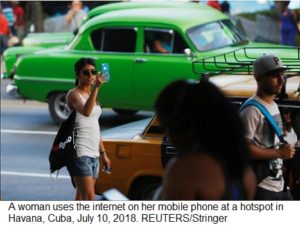
This change is not all bad! The whole world – the people, media and information – is now accessible at our finger tips!

There are only a few small groupings of people even attempting to “live off the grid”. Everyone else has fully embraced the grid and is living their life in kind – waiting for the next technological advances – they have been assimilated.

There used to be a Caribbean exception, Cuba! Due to the 1959 Revolution, Cuba had previously rejected Western technology advances; choosing to freeze their technological consumption at 1959.

But based of the summary of this news article, that actuality is no more:

Title: Communist-run Cuba starts rolling out internet on mobile phones
By:
Sarah Marsh

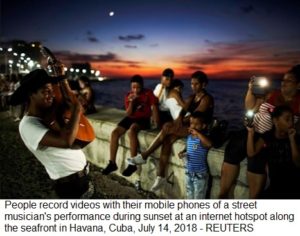
HAVANA (Reuters) – Communist-run Cuba has started providing internet on the mobile phones of select users as it aims to roll out the service nationwide by year-end, in a further step toward opening one of the Western Hemisphere’s least connected countries.

Journalists at state-run news outlets were among the first this year to get mobile internet, provided by Cuba’s telecoms monopoly, as part of a wider campaign for greater internet access that new President Miguel Diaz-Canel has said should boost the economy and help Cubans defend their revolution.

Analysts said broader web access will also ultimately weaken the government’s control of what information reaches people in the one-party island state that has a monopoly on the media. Cuba frowns on public dissent and blocks access to dissident websites.

“It’s been a radical change,” said Yuris Norido, 39, who reports for several state-run news websites and the television. “I can now update on the news from wherever I am, including where the news is taking place.”

Certain customers, including companies and embassies, have also been able to buy mobile data plans since December, according to the website of Cuban telecoms monopoly ETECSA, which has not broadly publicized the move.

ETECSA has said it will expand mobile internet to all its 5 million mobile phone customers, nearly half of Cuba’s population, by the end of this year. ETECSA did not reply to a request for more details for this story.

Whether because of a lack of cash, a long-running U.S. trade embargo or concerns about the flow of information, Cuba has lagged behind in web access. Until 2013, internet was largely only available to the public at tourist hotels in Cuba.

But the government has since then made increasing connectivity a priority, introducing cybercafes and outdoor Wi-Fi hotspots and slowly starting to hook up homes to the web.

Long before he took office from Raul Castro in April, 58-year-old Diaz-Canel championed the cause.

“We need to be able to put the content of the revolution online,” he told parliament last July as vice president, adding that Cubans could thus “counter the avalanche of pseudo-cultural, banal and vulgar content.”

Cuba could use subsidies to encourage the use of government-sponsored applications, analysts said. Last month, ETECSA launched a free Cuba-only messaging application, Todus, while Cuba’s own intranet with a handful of government-approved sites and email is much cheaper to access than the wider internet.

In a 2015 document about its internet strategy that leaked, the Cuban government said it aimed to connect at least half of homes by 2020 and 60 percent of phones.

But many Cubans are skeptical. ETECSA President Mayra Arevich told state-run media in December it had connected just 11,000 homes last year.

“I’ve been many times to the ETECSA shop to ask if they can give us home access,” said Yuneisy Galindo, 28, at a Wi-Fi hotspot on one of Havana’s thoroughfares. “But they tell us they still aren’t ready and will call us.”

Most mobile phone owners have smartphones, although Cuba is only now installing 3G technology, even as most of Latin America has moved onto 4G, with 5G in its final testing phase.

“This rollout will expand slowly at first and then more quickly, if the government is increasingly confident that it can control any political fallout,” said Cuba expert Ted Henken at Baruch College in the United States.

The price could prove the biggest restriction for many, though. Hotspots currently charge $1 an hour, compared with an average state monthly wage of $30.

It was not clear what most Cubans will pay for mobile internet, but ETECSA is charging companies and embassies $45 a month for four gigabytes.

Additional reporting by Nelson Acosta, Editing by Rosalba O’Brien

Source: Reuters News Service – Posted July 16, 2018; retrieved December 20, 2018 from: https://www.reuters.com/article/us-cuba-internet/communist-run-cuba-starts-rolling-out-internet-on-mobile-phones-idUSKBN1K62U7

The conclusion from this commentary is that the Caribbean member-states are now all ready to embrace this Technology Agent of Change confronting our world. The 2013 book Go Lean…Caribbean – available to download for free – prepared the region for this eventuality. The book serves as a roadmap for the introduction and implementation of the technocratic Caribbean Union Trade Federation (CU), for the elevation of Caribbean society – for all member-states. The book identified these 4 Agents of Change – Globalization, Climate Change, Technology and the Aging Diaspora – and declared that we were failing to compete because of our inability to adopt and thrive in this changed environment.

Adopt, compete and thrive …

While it has been 5 years since the publication of the Go Lean book, the pronouncements are more important now than before. It was asserted that the entire Caribbean region – all 30 member-states, Cuba included – must unite in order to adopt, compete and thrive in this new technological world. In the book’s opening, and early motivation, there was this Declaration of Interdependence that, among other things, proclaimed (Page 14) the following:

xxx. Whereas the effects of globalization can be felt in every aspect of Caribbean life, from the acquisition of food and clothing, to the ubiquity of ICT, the region cannot only consume, it is imperative that our lands also produce and add to the international community, even if doing so requires some sacrifice and subsidy.

The Go Lean book declares that our lives and livelihoods are at stake. Our societal engines – jobs, education, healthcare, governance, etc. – all depend on how well we adopt, compete and thrive with today’s technology. So the Go Lean/CU roadmap presents these 3 prime directives:

  • Optimization of the economic engines in order to grow the regional economy to $800 Billion & create 2.2 million new jobs.
  • Establishment of a security apparatus to ensure public safety and protect the resultant economic engines.
  • Improve Caribbean governance to support these engines, including a separation-of-powers between the member-states and CU federal agencies.

The Go Lean book provides 370-pages of turn-by-turn instructions on “how” to adopt new community ethos, plus the strategies, tactics, implementations and advocacies to execute so as to reboot, reform and transform the societal engines of Caribbean society.

Community ethos; what is community ethos? The book defines it as “the fundamental character or spirit of a culture; the underlying sentiment that informs the beliefs, customs, or practices of a group or society”.

The Go Lean book presents new community ethos that must be adopted in order to compete and thrive with the world with regards to technology:

  • Lean Operations
  • Return on Investments
  • A quest to respect and Promote Intellectual Property
  • A quest to Impact Research & Development
  • A quest to Bridge the Digital Divide

In addition to the ethos, one notable advocacy that is presented, on Page 197, is entitled: 10 Ways to Foster Technology. Notice the summaries, plans, excerpts and headlines from the book here:

1 Lean-in for the Treaty for a Caribbean Single Market
This treaty allows for the unification of the region into one market of 42 million people, across 30 member-states and an economic impact for a GDP of over $800 Billion (circa 2010). The CU will lead the industry efforts to create economies-of-scale to deploy technological investments, (such as Libraries and other Community Technology Centers), and generate justifiable benefits. The CU governance also provides the intellectual property protections such as patents and copyrights, and ensures their enforcement both locally and abroad. The technology initiatives are designed to include everyone in the region: the technically-savvy and the technically-ignorant. In addition to the CU providing community education services like the CTC’s, the CU incentivizes Not-For-Profit agencies, NGOs and Foundations to help the community efforts.
2 e-Learning Facilities and Industries
3 STEM Charter Schools and STEM Teacher Recognitions
4 e-Government Services
The CU Trade Federation will provide government services. Where ever possible, these services will be delivered with the embrace of Internet and Communications Technologies (ICT). Therefore, Caribbean citizens can request and interact with CU government services via web & phone portals (contact centers), and when personal visits are mandated, service level agreements (SLA) will be implemented to set expectations for quality and timely response.
5 Public Access Wi-Fi
Regional ISP’s will be regulated at the federal level, and encourage to provided free Wi-Fi to the public. Successful business models can be facilitated thru ads-supported browsers and videos.
6 Incubators, Venture Capitalists Funds and IPO’s
7 Tax Credits for Technological Investments
8 Technology Expositions
9 Centers of Excellence
10 Whistleblower Protections

The Go Lean book was written 5 years ago as a 5 Year Plan to reform and transform the Caribbean region. Had the plan been adopted by the regional stakeholders then, the Agents of Change would have been better addressed all the while. But instead, this plan, or roadmap, to introduce and implement the Caribbean Union Trade Federation is still reeling; still not even started.

The embrace of technology must not be optional. This technology factor is analogous to a vessel/ship that can take “us” to a better destination.

Adopting, thriving and competing with technology advances is the answer for reforming and transforming the Caribbean. In these 5 short years since the publication of the Go Lean book, technology has escalated the region further and now all the member-states are fully “on board” this vessel for change, empowerment and improvement.

While the other Agents of Change are equally import, this Technology cause is perhaps the one Agent of Change that we have made the most progress with. This disposition is presented in the other commentaries in this series, cataloged here:

  1. 5 Years Later: New Post Office Eco-system – Globalization issues ‘loud and clear’ now.
  2. 5 Years Later: Climate Change – Coming so fast, so furious.
  3. 5 Years Later: Technology – Caribbean fully on board.
  4. 5 Years Later: Aging Diaspora – Finding Home … anywhere.

At least now we have a more receptive environment for the embrace of the Go Lean roadmap in Cuba, than we did 5 years ago. Back then, Fidel Castro, though retired as President, still ruled as the Chairman of the Communist Party; his brother Raul ruled as President. Today, Fidel is dead; and Raul is retired – though now the Chairman of the Party. Cuba is now ready for change. The foregoing news article has conveyed that Cuba is ready for mobile Internet and Communications Technologies.

This is the start that we need. This allow us the opportunity to adopt, compete and thrive. Let’s lean-in to the Go Lean/CU roadmap now. We have more to do; more to accomplish; more people to impact; more jobs to create; and more lives to improve.

At 5 years in, though its a late start, it is still not too late to succeed in making our homeland a better place to live, work and play.  🙂

Download the free e-book of Go Lean … Caribbean – now!

Sign the petition to lean-in for this roadmap for the Caribbean Union Trade Federation.

Share this post:
, , ,
[Top]

5 Years Later – Climate Change: Coming so fast, so furious

Go Lean Commentary

A little less conversation, a little more action – Elvis Presley song

3 years ago – Paris COP21 – the world came together and devised a plan to tackle the global threat of Climate Change. This year, many of the same players came back together to implement the actions.

So we went from “planning the plan” to now “planning the action”.

This is a slow-motion response to a fast-moving threat.

This commentary is the second of a 4-part series – 2 of 4 – from the movement behind the Go Lean book in consideration of the 5 year anniversary of the book’s publication. The theme on these 4 submissions is “5 Years Later and what is the condition now“. The focus here is on the Agents of Change that the book identified: Globalization, Climate Change, Technology and the Aging Diaspora.

The first entry in this series asked the question: “Have the problems lessened, or have they intensified?

The answer is so emphatic! Climate Change has been all the rage in these 5 short years. The fast-and-furious threat is more than just academic; this is real-life and real-bad; especially for us in the Caribbean.

The other commentaries in the series are cataloged as follows:

  1. 5 Years Later: New Post Office Eco-system – Globalization issues ‘loud and clear’ now.
  2. 5 Years Later: Climate Change – Coming so fast, so furious.
  3. 5 Years Later: Technology – Caribbean fully on board.
  4. 5 Years Later: Aging Diaspora – Finding Home … anywhere.

The Go Lean book was written 5 years ago as a 5 Year Plan to reform and transform the Caribbean region. Had the plan been adopted by the regional stakeholders, then the Agents of Change would have been better addressed. The plan, or roadmap, to introduce and implement the Caribbean Union Trade Federation is still rearing to start; and while we cannot single-handedly solve Climate Change, we can better prepare the region for the heavy-lifting involved. The book describes the community ethos to adopt plus the many strategies, tactics and implementation that need to be executed.
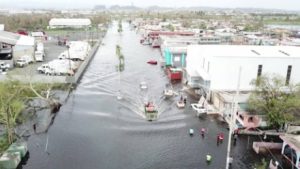

After the 2013 publication of the Go Lean book, many countries came together for COP21 (December 2015), also known as the Paris Accords. As alluded to above, this year’s follow-up, Katowice (Poland) 2018 had a few less participants for this “put speech into action” plan. See the news article about COP24 here:

News Title: Nations agree on rules for implementing Paris climate agreement
Sub-title: Nations dragged a deal over the line Saturday to implement the landmark 2015 Paris climate treaty after marathon UN talks that failed to match the ambition the world’s most vulnerable countries need to avert dangerous global warming.

Katowice, Poland – Delegates from nearly 200 states finalised a common rule book designed to deliver the Paris goals of limiting global temperature rises to well below two degrees Celsius (3.6 Fahrenheit).

“Putting together the Paris agreement work programme is a big responsibility,” said COP24 president Michal Kurtyka as he gavelled through the manual following the talks in Poland that ran deep into overtime.

“It has been a long road. We did our best to leave no-one behind.”

But environmental groups said the package agreed in the Polish mining city of Katowice lacked the bold ambition needed to protect states already dealing with devastating floods, droughts and extreme weather made worse by climate change.

“We continue to witness an irresponsible divide between the vulnerable island states and impoverished countries pitted against those who would block climate action or who are immorally failing to act fast enough,” executive director of Greenpeace Jennifer Morgan said.

The final decision text was repeatedly delayed as negotiators sought guidelines that are effective in warding off the worst threats posed by our heating planet while protecting the economies of rich and poor nations alike.

“Without a clear rulebook, we won’t see how countries are tracking, whether they are actually doing what they say they are doing,” Canada’s Environment Minister Catherine McKenna told AFP.

At their heart, negotiations were about how each nation funds action to mitigate and adapt to climate change, as well as how those actions are reported.

Developing nations wanted more clarity from richer ones over how the future climate fight will be funded and pushed for so-called “loss and damage” measures.

This would see richer countries giving money now to help deal with the effects of climate change many vulnerable states are already experiencing.

Another contentious issue was the integrity of carbon markets, looking ahead to the day when the patchwork of distinct exchanges — in China, the Europe Union, parts of the United States — may be joined up in a global system.

“To tap that potential, you have to get the rules right,” said Alex Hanafi, lead counsel for the Environmental Defense Fund in the United States.

“One of those key rules — which is the bedrock of carbon markets — is no double counting of emissions reductions.”

The Paris Agreement calls for setting up a mechanism to guard against practices that could undermine such a market, but finding a solution has proved so problematic that the debate has been kicked down the road to next year.

‘System needs to change’

One veteran observer told AFP Poland’s presidency at COP24 had left many countries out of the process and presented at-risk nations with a “take it or leave it” deal.

Progress had “been held up by Brazil, when it should have been held up by the small islands. It’s tragic.”

One of the largest disappointments for countries of all wealths and sizes was the lack of ambition to reduce emissions shown in the final COP24 text.

Most nations wanted the findings of the Intergovernmental Panel on Climate Change (IPCC) to form a key part of future planning.

It highlighted the need for carbon pollution to be slashed to nearly half by 2030 in order to hit the 1.5C target.

But the US, Saudi Arabia, Russia and Kuwait objected, leading to watered-down wording.

The final statement from the Polish COP24 presidency welcomed “the timely conclusion” of the report and invited “parties to make use of it” — hardly the ringing endorsement many nations had called for.

“There’s been a shocking lack of response to the 1.5 report,” Morgan told AFP. “You can’t come together and say you can’t do more!”

With UN talks well into their third decade sputtering on as emissions rise remorselessly, activists have stepped up grassroots campaigns of civil disobedience to speed up action on climate.

“We are not a one-off protest, we are a rebellion,” a spokesman for the Extinction Rebellion movement, which disrupted at least one ministerial event at the COP, told AFP.

“We are organising for repeated disruption, and we are targeting our governments, calling for the system change needed to deal with the crisis that we are facing.”

Source: AFP – France24 News Service – Posted December 16, 2018; retrieved December 18, 2018 from: https://www.france24.com/en/20181215-cop24-poland-climate-summit-deal-paris-climate-agreement-negotiations-un-environment

—————-

VIDEO # 1 – Nations agree on rules for implementing Paris climate agreement – https://youtu.be/SBUZS3cl2X0

FRANCE 24 English
Published on Dec 17, 2018 – Nations dragged a deal over the line Saturday to implement the landmark 2015 Paris climate treaty after marathon UN talks that failed to match the ambition the world’s most vulnerable countries need to avert dangerous global warming.

Visit our website: http://www.france24.com

FRANCE 24 live news stream: all the latest news 24/7 http://f24.my/YTliveEN

———————

VIDEO # 2 – UN climate talks: ‘A transition to a greener economy is possible’ – https://youtu.be/qqbQ1hyWc_Y

FRANCE 24 English
Uploaded on Dec 15, 2018

Subscribe to France 24 now: http://f24.my/youtubeEN

FRANCE 24 live news stream: all the latest news 24/7 http://f24.my/YTliveEN

Visit our website: http://www.france24.com

One notable absentee from Katowice has been the United States of America. This is due to the sad fact that the “Leader of the Free World” – a moniker assigned to the US President – is a Climate Change denier. Donald Trump campaigned on his denial and has manifested his dismay with subsequent actions. His blatant disregard was previously detailed in a prior Go Lean commentary from June 1, 2017, as follows:

Its June 1st, the start of the Hurricane season. According to Weather Authorities, it is going to be a tumultuous season, maybe even more destructive than last year….

Thanks Climate Change.

What hope is there to abate the threats from Climate Change?

Thanks to the Paris Accord, there is now hope; (we remember the effectiveness of the accord to abate “Acid Rain”).

But wait! The American President – Donald Trump – announces that he is withdrawing the United States from the Paris Accord. WTH?!?!

The Caribbean status quo is unsustainable under the real threats of Climate Change. The region must reboot, reform and transform. We must do the heavy-lifting ourselves; we cannot expect relief and refuge from others, like the American Super-Power. We must find and “sail” under our own power. 🙂

The Caribbean is more on the frontlines of Climate Change distress than the US – think hurricanes. We do not have the luxury to deny, defer and dispute. We must “batten down the hatches” and prepare for the worst. (Many claim this is also the disposition of many American destinations, think California forest fires). So we must take the lead ourselves for our own relief!

The Caribbean frontlines have been depicted in many previous Go Lean blog-commentaries. Consider the sample – as follows – highlighting some of the many Climate Change-infused storms that have impacted our region and others over the short timeframe – 5 years – since the publication of the Go Lean book:

https://goleancaribbean.com/blog/?p=15996 Good Governance: Stepping Up in an Emergency
October 2018 Trinidad heavy rains – not associated with a hurricane.
https://goleancaribbean.com/blog/?p=14925 ‘Climate Change’ Reality!? Numbers Don’t Lie
There is no longer any doubt, the Numbers don’t lie: the earth has had 400 straight warmer-than-average months.
https://goleancaribbean.com/blog/?p=13391 After Maria, Failed-State Indicators: Destruction and Defection
Hurricane Maria devastated Puerto Rico and other Caribbean islands. 1 year and a half later, recovery is still slow and frustrating. Islands like Dominica, are still struggling to recover; Ross University fled there to go to Barbados.
https://goleancaribbean.com/blog/?p=12996 After Irma, Failed-State Indicators: Destruction and Defection 
Hurricane Irma devastated Caribbean islands, like Saint Martin.
https://goleancaribbean.com/blog/?p=12977 After Irma, Barbuda Becomes a ‘Ghost Town’
Climate Change threats are real for the twin-island nation of Antigua and Barbuda. Barbuda is no more, after Hurricane Irma.
https://goleancaribbean.com/blog/?p=12924 Hurricane Categories – The Science
Category 5 Hurricanes – Once rare; now normal and common.
https://goleancaribbean.com/blog/?p=12879 Disaster Preparation: ‘Rinse and Repeat’
Hurricane Harvey proved that even the advanced democracy of the USA is not ready.
https://goleancaribbean.com/blog/?p=12834 Hurricane Andrew – 25 Years of Hoopla
Climate Change disasters are not new; 1992 storm was an eye-opener.
https://goleancaribbean.com/blog/?p=7896 The Logistics of Disaster Relief
Preparing for the worst” means being more efficient and technocratic.
https://goleancaribbean.com/blog/?p=7449 ‘Crap Happens’ – So What Now?
Hurricane Wilma brought chaos to this city’s economic engines in 2004.
https://goleancaribbean.com/blog/?p=6189 A Lesson in History – ‘Katrina’ is helping today’s crises
There are many lessons learned from this 2005 American disaster.
https://goleancaribbean.com/blog/?p=4741 Vanuatu and TuvaluInadequate response to human suffering
Lessons learned from these small Pacific Islands climate failures.

So it has been 5 years since the publication of the Go Lean book. Climate Change was identified as an Agent of Change that the region was struggling with and losing. Since then, conditions have worsened. The book asserts that the entire region must unite in order to “hope for the best and prepare for the worst”. The “hope” is really a call to action, that the regional neighbors would confederate and join in to the global campaign of mitigating and abating Climate Change. This aligns with the first pronouncement (Page 11) of the opening Declaration of Interdependence:

i. Whereas the earth’s climate has undeniably changed resulting in more severe tropical weather storms, it is necessary to prepare to insure the safety and security of life, property and systems of commerce in our geographical region. As nature recognizes no borders in the target of its destruction, we also must set aside border considerations in the preparation and response to these weather challenges.

The Go Lean book – a roadmap for the introduction and implementation of the technocratic Caribbean Union Trade Federation (CU) – presents a 370-page roadmap for re-booting the economic, security and governmental institutions of the 30 member-states in the Caribbean region, especially in light of the realities of Climate Change. While this is a global battle, we, the Caribbean member-states, are on the frontlines, so we must be doubly prepared for the surety of destruction from this threat. We must do our share and “Go Green” to arrest our own carbon footprint. We must not be hypocritical as we call on the Big Polluting nations to reform – we must reform ourselves, so as to have moral authority.

As detailed in a previous blog-commentary, the dire effects of Climate Change may be irreversible after the next 12 years, if we do not work to abate this disaster. So we must fight!

This is an inconvenient truth: We must fight like our lives depend on it. A product of these COP24 Katowice Accords, is now definitive plans and rules for implementing abatements around the world; carbon footprints must be reduced … globally, now!

A change has now come to the Caribbean region. This is Climate Change and it is not a good thing. Now is the time for a permanent union to provide efficient stewardship for our economic, security and governing engines. All regional stakeholders – the people and governing institutions – are hereby urged to lean-in to the empowerments described in the book Go Lean … Caribbean. Yes, we can … make our region, these islands and coastal states, better places to live, work and play.

There is the successful track record of abating environment pollution: remember Acid Rain in the 1990’s. So despite the doom and gloom, mitigation and abatement of Climate Change is conceivable, believable and achievable. 🙂

Sign the petition to lean-in for this roadmap for the Caribbean Union Trade Federation. 

Download the free e-book of Go Lean … Caribbean – now!

Share this post:
, ,
[Top]

5 Years Later – They can hear you now about the Post Office – ENCORE

5 years ago, the book Go Lean … Caribbean was introduced; the publication date was November 2013.

The book scanned the landscape in the Caribbean and found a lot of deficiencies in the economics, security and governance in the region. For example, for those 5 years the movement behind the Go Lean book have been telling people that there is an overriding need for a technocratic postal solution in the Caribbean region. This is how to keep up with the demands of globalization.

People – the audience – have only yawned.

Now the Caribbean member-state of The Bahamas has a crisis with their postal facility. The people there should now be ready, willing and able to consider alternatives and improvements to their regional governance.

Title: Wells confirms “undeliverable” mail was shredded
NASSAU, BAHAMAS – Addressing allegations that mail at the General Post Office had been shredded, Minister responsible for the post office, Renward Wells, confirmed on Thursday that the most recent and deliberate destruction of “undeliverable” mail was on November 1 and 2, upon the authorization of the Postmaster General.

The Bahamas has membership in the United Postal Union (UPU) and it is therefore required to ensure that delivery of mail among countries follows consistent rules and standards.

The General Post Office is in the process of being relocated to the Town Centre Mall in early 2019.

Wells outlined in his statement that the standards of the Post Office will be restored to one that will regain the respect of international partners.

“Postal workers and the Bahamian public have been in excess of three years without an adequate means for providing this essential service,” he said.

Source: Posted December 14, 2018; retrieved December 15, 2018 from: https://ewnews.com/wells-confirms-undeliverable-mail-was-shredded

This commentary is the first of a 4-part series from the movement behind the Go Lean book in consideration of the 5 year anniversary of the book’s publication. The theme on these 4 submissions is “5 Years Later and what is the condition now“. The focus here is on the Agents of Change that the book identified: Globalization, Climate Change, Technology and the Aging Diaspora.

Have the problems lessened, or have they intensified? The other commentaries in the series are cataloged as follows:

  1. 5 Years Later: New Post Office Eco-system – Globalization issues ‘loud and clear’ now.
  2. 5 Years Later: Climate Change – Coming so fast, so furious.
  3. 5 Years Later: Technology – Caribbean fully on board.
  4. 5 Years Later: Aging Diaspora – Finding Home … anywhere.

The Go Lean book was written 5 years ago as a 5 Year Plan to reform and transform the Caribbean region. Had the plan been adopted by the regional stakeholders, then the Agents of Change would have been mostly assuaged. The plan, or roadmap, to introduce and implement the Caribbean Union Trade Federation is still outstanding to even start. We now need to push the leaders – Top Down – and the subjects – Bottoms’s Up – to execute the strategies, tactics and implementation prescribed in this book.

This approach – rebooting the postal eco-system – had been relayed in a previous blog-commentary from January 23, 2018; it  is appropriate to Encore that blog-commentary here-now:

——————–

Go Lean CommentaryFirst Steps – A Powerful C.P.U.

The movement behind the book Go Lean … Caribbean wants to deploy an “apolitical technocracy” in the Caribbean. What is an apolitical technocracy?

Quite simply, an organizational structure designed to just deliver.

Sounds familiar? Frankly, the Post Office is a powerful example of an apolitical technocracy:

They just deliver the mail …

… “Neither snow nor rain nor heat nor gloom of night stays these couriers from the swift completion of their appointed rounds”.

(While the Postal Service has no official motto, the popular belief is that these words are tribute to America’s postal workers).

Technocracies are supposed to be automatons, a machine that just chugs-and-chugs. Think computers; think C.P.U.. But in the case of this Go Lean scheme, C.P.U. does not mean Central Processing Unit, no, it means Caribbean Postal Union.

The book Go Lean book – available to download for free – serves as a roadmap for the introduction and implementation of the technocratic Caribbean Union Trade Federation (CU) and the Caribbean Postal Union, for the elevation of Caribbean society – for all member-states. This CU/Go Lean roadmap has these 3 prime directives:

  • Optimization of the economic engines in order to grow the regional economy and create new jobs.
  • Establishment of a security apparatus to ensure public safety and protect the resultant economic engines.
  • Improve Caribbean governance to support these engines, including a separation-of-powers between the member-states and CU federal agencies.

This commentary is Part 6 of 6-parts; it completes the series from the movement behind the book Go Lean … Caribbean in consideration of the First Steps for instituting a new regime in governance for the Caribbean homeland. The other commentaries in the series are cataloged as follows:

  1. First Steps: EU: Free European Money – To Start at Top
  2. First Steps: UK: Dignified and Efficient
  3. First Steps: US: Congressional Interstate Compact – No Vote; No Voice
  4. First Steps: CariCom: One Man One Vote Defects 
  5. First Steps: Deputize ‘Me’! 
  6. First Steps: A Powerful C.P.U.

All of these commentaries relate to “how” the Caribbean can finally get started with adapting the organizational structures to optimize the region’s societal engines. Whereas all the previous submissions addressed the need for reform at the Top. This commentary addressed the automation, the technocratic C.P.U.. This is designed to affect every man-woman-child in the Caribbean region, to just deliver. This simple functionality will do wonders for the quest of this roadmap: make the Caribbean member-states better places to live, work and play.

The Go Lean book stresses that reforming and transforming the Caribbean societal and postal engines must be a regional pursuit. This was an early motivation for the roadmap, as pronounced in the opening Declaration of Interdependence (Pages 12 – 13):

xi. Whereas all men are entitled to the benefits of good governance in a free society, “new guards” must be enacted to dissuade the emergence of incompetence, corruption, nepotism and cronyism at the peril of the people’s best interest. The Federation must guarantee the executions of a social contract between government and the governed.

xv. Whereas the business of the Federation and the commercial interest in the region cannot prosper without an efficient facilitation of postal services, the Caribbean Union must allow for the integration of the existing mail operations of the governments of the member-states into a consolidated Caribbean Postal Union, allowing for the adoption of best practices and technical advances to deliver foreign/domestic mail in the region.

xvi. Whereas security of our homeland is inextricably linked to prosperity of the homeland, the economic and security interest of the region needs to be aligned under the same governance. Since economic crimes … can imperil the functioning of the wheels of commerce for all the citizenry, the accedence of this Federation must equip the security apparatus with the tools and techniques for predictive and proactive interdictions.

xxiv. Whereas a free market economy can be induced and spurred for continuous progress, the Federation must install the controls to better manage aspects of the economy: jobs, inflation, savings rate, investments and other economic principles. Thereby attracting direct foreign investment because of the stability and vibrancy of our economy.

The Go Lean book provides 370-pages of turn-by-turn instructions on “how” to adopt new community ethos, plus the strategies, tactics, implementations and advocacies to execute so as to reboot, reform and transform the societal engines of Caribbean society. One advocacy in the book is entitled “10 Ways to Improve Mail Service … in the Caribbean Region“; this detailed the best practices for postal mail and logistics; (Page 108). See this Bottom Line introduction:

The Bottom Line for the Caribbean Postal Union
Without a regional hub-and-spoke system, mail from one island to another can take weeks – such a business climate cannot breathe success with this lack of efficiency. The purpose of the CU is to facilitate the economic engines of the region. Therefore postal communications between individuals, households, businesses and governmental institutions must be efficient and effective – establishments must be able to connect with their customers and governments to its constituents. The Caribbean Postal Union (CPU) will operate as a private business, a multi-national corporation, owned by CU member-states, chartered to employ best practices and world class methods in the execution of the fulfillment side of the e-Delivery model. A mark of success: delivery of first-class mail in 3 – 5 days.

Improving the postal mail eco-system in the Caribbean can have a transformative effect on regional society. CPU is mostly an e-Logistics enterprise. Imagine the following (global) trends that wait in the balance:

Imagine a Caribbean reality with flat-rate envelopes and flat-rate boxes. Imagine the automation, the robotic technologies, the scanning and sorting. The brand CPU would really be apropos – more software, e-Commerce and Internet Communications Technology – as opposed to the neighborhood mail-carrier. See this industrial shift in the related news article in the Appendix below. In fact, the company www.Stamps.com provides a model for the CPU to emulate. See this Introductory VIDEO here:
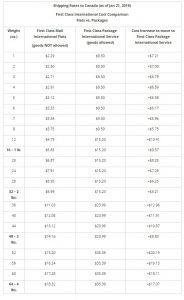
VIDEO – Welcome to Stamps.com, USPS Postage Software Overview – https://youtu.be/wCCAkRkUWE0

Stamps.com

Published on Apr 23, 2013 – Welcome to Stamps.com, USPS Postage Software Overview This video shows new customers how Stamps.com software works. Highlights include how to buy and print postage stamps and shipping labels, e-commerce shipping features, postage spending reports plus many more features.

In addition, previous Go Lean blog-commentaries detailed the width-and-breadth of the mail-logistics business model for the Caribbean; see these prior submissions here:

https://goleancaribbean.com/blog/?p=13627 Amazon as a Role Mode: Then and Now
https://goleancaribbean.com/blog/?p=9839 Alibaba Cloud stretches global reach with four new facilities
https://goleancaribbean.com/blog/?p=7991 Transformations: Caribbean Postal Union – Delivering the Future
https://goleancaribbean.com/blog/?p=3187 Amazon Role Model – Robots helping tackle Cyber Monday
https://goleancaribbean.com/blog/?p=2488 Alibaba – A Chinese Role Model for the C.P.U.
https://goleancaribbean.com/blog/?p=1416 Amazon – An American Role Model for the C.P.U.

Forging change is heavy-lifting for the CU/Go Lean roadmap, but conceivable, believable and achievable? Why because so many other entities have executed these action plans before. We do not need to “re-invent the wheel”; we only need to conform to the published best-practices. This applies to the Caribbean Postal Union and all other societal engines.

Yes, we can succeed in forging change and assuaging the crises in the Caribbean. We have the existing organizations constructs of the CariCom, British Overseas Territories, US Territories and the EU. We can use these to “touch” every country-establishment-person in the region. This will lead to the success of our goals, to make the Caribbean a better place to live, work and play. 🙂

Download the free e-Book of Go Lean … Caribbean – now!

Sign the petition to lean-in for this roadmap for the Caribbean Union Trade Federation.

———–

Appendix Title: Important: USPS making changes to First-Class Mail International Flats

January 21, 2018 Update: Stamps.com has launched a new International Flat service.  Get more info on how to ship merchandise with International Flats.

Merchandise No Longer Allowed in First Class Mail International Flats
If you ship merchandise abroad using USPS First Class Mail International Flats, there’s a new rule going into effect soon that you need to know about. Effective Sunday, January 21, 2018, First Class Mail International Large Envelope/Flat service for merchandise will NO LONGER be available from the USPS. First Class Mail International Flats will only be approved for use when sending documents. This change is occurring to comply with Universal Postal Union requirements.

Here are some examples of what USPS considers a document (still OK to ship using First Class Mail International Flats):

  • Audit and business records
  • Personal correspondence
  • Circulars
  • Pamphlets
  • Advertisements
  • Written instruments not intended to be resold
  • Money orders, checks, and similar items that cannot be negotiated or converted into cash without forgery.

Here are examples of items that will NO LONGER be allowed to be shipped as First Class Mail International Flats, effective Jan. 21, 2018:

  • CDs, DVDs, flash drives, video and cassette tapes, and other digital and electronic storage media (regardless of whether they are blank or contain electronic documents or other prerecorded media)
  • Artwork
  • Collector or antique document items
  • Books
  • Periodicals
  • Printed music
  • Printed educational or test material
  • Player piano rolls
  • Commercial photographs, blueprints and engineering drawings
  • Film and negatives
  • X-rays
  • Separation negatives

These goods are dutiable and must be must be shipped using First Class Package International Service. Once this change goes into effect, shippers will need to include Customs Forms and the recipient could pay a duty or tax to receive the product.

Cost Savings Using First Class Mail International Flats
Moving from First Class Mail International Flats to First Class Package International Service will have a big impact on shippers.

Source: Posted December 26th, 2017; retrieved January 21, 2018 from: http://blog.stamps.com/2017/12/26/important-usps-making-changes-first-class-mail-international-flats/ 

Share this post:
, ,
[Top]

Remembering George H.W. Bush and ADA

Go Lean Commentary

Old age is justice; it is when able-bodied people and disabled people become equally disabled.

We are being reminded of this sad reality of aging by the life-and-death of the 41st President of United States of America. At the end of his life, this able-bodied man (former war hero) was bound to a wheelchair.


The United States is mourning the death of its ex-president (1989 – 1993), George H. W. Bush. Wednesday December 5, 2018 is set-aside as the National Day of Mourning.

“The best 1 term president in the history of the country” – as declared by George W. Bush, the eldest son and subsequent president (#43 2001 – 2009).

Who’s best? Who’s the greatest? These are all questions for historians to consider. But for one group of Americans – Persons with Disabilities – they will surely concur with the “best” and “greatest” tag to George H.W. Bush because of one reason, his passage of the Americans with Disabilities Act (ADA).

The book Go Lean…Caribbean – available to download for free – presents this landmark ADA legislation as a model for emulation and adoption in the Caribbean. The book provided this ADA summary (Page 228):

The Bottom Line on the American with Disabilities Act (ADA)
This Act is a law that was enacted by the U.S. Congress in 1990. It was signed into law on July 26, 1990, by President George H. W. Bush, and later amended with changes effective January 1, 2009. The ADA is a wide-ranging civil rights law that prohibits, under certain circumstances, discrimination based on disability. It affords similar protections against discrimination to Americans with disabilities as the Civil Rights Act of 1964, which made discrimination based on race, religion, sex, national origin, and other characteristics illegal. Disability is defined by the ADA as “…a physical or mental impairment that substantially limits a major life activity.” The determination of whether any particular condition is considered a disability is made on a case by case basis. Certain specific conditions are excluded as disabilities, such as current substance abuse and visual impairment that is correctable by prescription lenses. [ADA is based on the premise of] reasonable accommodation – an adjustment made in a system to “accommodate” or make fair the same system for an individual based on a proven need. Accommodations can be religious, academic, or employment related. This provision is also prominent in international law as the United Nations has codified the principle in the Convention on the Rights of Persons with Disabilities. [There are many international signatories to these principles and resolutions].

The ADA allows private plaintiffs to receive only injunctive relief (a court order requiring the public accommodation to remedy violations of the accessibility regulations) and attorneys’ fees, and does not provide monetary rewards to private plaintiffs who sue non-compliant businesses. Unless a state law provides for monetary damages to private plaintiffs, qualified claimants do not obtain direct financial benefits from suing entities that violate the ADA. [Thus, no “professional plaintiffs”!]

Listen to this relevant AUDIO Podcast from today (December 3, 2018):

AUDIO Podcast – Americans With Disabilities Act Signed By George H.W. Bush Expanded Rights Of Millions –  https://www.wbur.org/hereandnow/2018/12/03/americans-with-disabilities-george-hw-bush

Published December 3, 2018 – President George H.W. Bush signed the Americans with Disabilities Act into law in 1990. It was landmark legislation that expanded rights and protections for millions of people. Bush, who died Friday at age 94, played a key role in its passage.

Here & Now‘s Jeremy Hobson talks with Marian Vessels, director of the Mid-Atlantic ADA Center in Maryland, who was at the ADA’s signing.

Unfortunately, the Caribbean has a terrible track record for accommodating Persons with Disabilities. The Go Lean book serves as a roadmap for the introduction and implementation of the technocratic Caribbean Union Trade Federation (CU), for the elevation of Caribbean society – for all member-states. This CU/Go Lean roadmap has these 3 prime directives:

  • Optimization of the economic engines in order to grow the regional economy to $800 Billion and create 2.2 million new jobs.
  • Establishment of a security apparatus to ensure public safety and protect the resultant economic engines for all citizens and visitors.
  • Improve Caribbean governance to support these engines, including a separation-of-powers between the member-states and CU federal agencies.

The book stresses that reforming and transforming the Caribbean societal engines must be a regional pursuit. This was an early motivation for the roadmap, as pronounced in the opening Declaration of Interdependence (Pages 12 – 13):

ix. Whereas the realities of healthcare and an aging population cannot be ignored and cannot be afforded without some advanced mitigation, the Federation must arrange for health plans to consolidate premiums of both healthy and sickly people across the wider base of the entire Caribbean population. The mitigation should extend further to disease management, wellness, mental health, obesity and smoking cessation programs. …

xi. Whereas all men are entitled to the benefits of good governance in a free society, “new guards” must be enacted to dissuade the emergence of incompetence, corruption, nepotism and cronyism at the peril of the people’s best interest. The Federation must guarantee the executions of a social contract between government and the governed.

xviii. Whereas all citizens in the Federation member-states may not have the same physical abilities, reasonable accommodations must be made so that individuals with physical and mental disabilities can still access public and governmental services so as to foster a satisfactory pursuit of life’s liberties and opportunities for happiness.

The Go Lean book provides 370-pages of turn-by-turn instructions on “how” to adopt new community ethos, plus the strategies, tactics, implementations and advocacies to execute so as to reboot, reform and transform the societal engines of Caribbean society – to benefit all people, able-bodied and the disabled. One specific advocacy addresses the needs of Persons with Disabilities. See the sample plans, excerpts and headlines from the book on Page 228 entitled:

10 Ways to Impact Persons with Disabilities

1 Lean-in for Treaty for a Caribbean Single Market
This treaty allows for the unification of the region into one market, thereby expanding to an economy of 26 countries, 42 million people and a GDP of over $800 Billion (per 2010). The CU will empower and enhance the economic engines for the participation and benefit of all people; this includes the number of citizens that may have some physical (deaf, blind, lame, etc.) or mental challenges. The CU’s vision is that this sector represents a critical talent pool that is underserved and underutilized. They will be included in this CU movement, with a Caribbean [Persons] with Disabilities (CDA) provision embedded in the treaty. In addition, to the economic missions, the treaty also establishes a security pact, with the mission to fortify homeland security and to mitigate regional threats including a strategic gun control policy.
2 Cruise Ships and Disability Tourism
Since most western democracies have Reasonable Accommodation provisions for their citizenry, many disabled people in the US, Canada and EU countries live full-functioning lives with jobs, disposable income and the manifestation of vacation needs. The CU will incentivize the Cruise industry and tourism properties to make their own “reasonable accommodations” to cater to persons with disabilities. This also applies to the Elder-Care population.
3 Public Transportation and Public Accommodations – Assurance on CU facilities
4 Government Buildings and Proceedings
5 Mental Disabilities and Gun Control
6 Tele-type Call Center Access
The CU advocates e-Government and e-Delivery of government services, therefore call centers will be a primary feature for service delivery. To accommodate deaf residents, guests and trading partners, the CU call centers will be equipped with “Tele-type” terminals and agents with related certifiable skills (including 911).
7 Autism Awareness – Opt-Out Accommodations
8 Braille Websites
9 Closed Captioning … for Television
As the regulator for cross-border radio spectrum, the CU’s Media Regulatory Authority will mandate that all broadcasters provide a closed-captioning option on their channels. This enables the hearing-impaired to have full access.
10 Public Awareness Campaign – Improve Image

The Go Lean movement (book and blogs) have maintained that there must always be the empowerments for Persons with Disabilities. This cannot be left to chance; it must be enacted in law. Thank you for this model President George H.W. Bush. The need for Caribbean empowerments for Persons with Disabilities has been alluded to in many previous blog-commentaries; consider this sample:

https://goleancaribbean.com/blog/?p=14480 Repairing the Breach: Mental Health Realities

Mental Health is a real concern for the population in general and for men in particular. One of the biggest problems is that men rarely want to admit to any problems or seek any help. Yet, the evidence of dysfunction is there: 1. Substance Abuse (Drugs and Alcohol) 2. Suicide

https://goleancaribbean.com/blog/?p=11052 Managing the ‘Strong versus the Weak’ – Mental Disabilities

The creed to protect the Weak from being abused by the Strong is age-old as an honor code. All societies have those that are mentally weak; the Social Contract must allow for protection and remediation of these ones.

https://goleancaribbean.com/blog/?p=11048 Managing the ‘Strong versus the Weak’ – Model of Hammurabi

In every society, there are those that are able-bodied and those that are disabled. so there is the need for the authorities to ensure that the “strong should not harm the weak”. This is the legacy of the 3,800 year-old Hammurabi Code.

https://goleancaribbean.com/blog/?p=6836 Role Model – #FatGirlsCan

The Go Lean movement campaigns for reasonable accommodations so that persons in the Caribbean that are differently-abled can live a full and engaging life … and help to elevate their communities. This difference also includes those who are “fat”, overweight or obese.

https://goleancaribbean.com/blog/?p=5901 The Demographic Theory of Elderly Suicide

Failures in health delivery results in suicides. Among senior citizens, this prevalence is due to the fact that they may not consider themselves as relevant in modern society. We can learn from others on health remediation and solutions for Caribbean senior citizens.

https://goleancaribbean.com/blog/?p=5720 Role Model of a Disability Advocate: Reasonable Accommodations

With just a reasonable accommodation, persons with disabilities can live a full and engaging life … and help to elevate their communities and make “home” better places to live, work and play.

https://goleancaribbean.com/blog/?p=2105 Recessions and Public Physical and Mental Health

Mental Health disorders can spark when the economy sours. Public Health officials need to be “on guard” for Mental Health fallout during periods of economic recession.

https://goleancaribbean.com/blog/?p=1751 New Hope in the Fight against Alzheimer’s Disease

Everyone ages, and so Alzheimer’s disease is a guaranteed risk in every community. This is a Mental Health reality that must be planned for, so as to ensure the best outcomes for communities.

As related above, American society is at the matured level now in their Social Contract deliveries. They now expect the standard to be “reasonable accommodations” so that Persons with Disabilities can participate in and contribute to society. This was not always the case, and then George H.W. Bush came along and forge change in American society. This is not the standard in the Caribbean member-states … yet. But part of this reboot effort – the quest of the Go Lean roadmap – is to reform and transform the societal engines to benefit all members of the community, able-bodied or not.

President Bush’s motives with the ADA efforts where not selfish; his legacy of public service is being lauded today leading up to his National Hero’s Funeral. But lo and behold, at the end of his life, he needed the reasonable accommodations he enshrined into law.

In the Caribbean, we need to apply this same lesson: even able-bodied people become disabled; therefore reasonable accommodations need to be ensured in society. Yes, we can benefit ourselves from such empowerments. This will make our homeland a better place to live, work and play. 🙂

Download the free e-Book of Go Lean … Caribbean – now!

Sign the petition to lean-in for this roadmap for the Caribbean Union Trade Federation.

Share this post:
, , ,
[Top]

In Defense of Trade – India’s Business Process Outsourcing

Go Lean Commentary

Pay more than the usual attention to Trade

… this is the urging of this series of commentaries. Why?

Trade may be the panacea (cure all) for the ills of the Caribbean. Let’s consider one example, BPO.
BPO = Business Process Outsourcing

Individually, these 3 words are very common in our daily life: Business, Process and Outsourcing. Put together and most people … have no clue.

BPO is not just an informal association of these 3 letters. Rather it’s a formal business model; see this encyclopedic reference:

Business process outsourcing (BPO) is a subset of outsourcing that involves the contracting of the operations and responsibilities of a specific business process to a third-party service provider. Originally, this was associated with manufacturing firms, such as Coca-Cola that outsourced large segments of its supply chain.[1]

BPO is typically categorized into back office outsourcing, which includes internal business functions such as human resources or finance and accounting, and front office outsourcing, which includes customer-related services such as contact center (customer care) services.[2]

BPO that is contracted outside a company’s country is called offshore outsourcing. BPO that is contracted to a company’s neighbouring (or nearby) country is called nearshore outsourcing.

Often the business processes are information technology-based, and are referred to as ITES-BPO, where ITES stands for Information Technology Enabled Service.[3] Knowledge process outsourcing (KPO) and legal process outsourcing (LPO) are some of the sub-segments of business process outsourcing industry.

Benefits
The main advantage of any BPO is the way in which it helps increase a company’s flexibility. However, several sources have different ways in which they perceive organizational flexibility. In early 2000s BPO was all about cost efficiency, which allowed a certain level of flexibility at the time. Due to technological advances and changes in the industry (specifically the move to more service-based rather than product-based contracts), companies who choose to outsource their back-office increasingly look for time flexibility and direct quality control.[4] Business process outsourcing enhances the flexibility of an organization in different ways:

  • … transforming fixed into variable costs.[7]
  • … focus on its core competencies, without being burdened by the demands of bureaucratic restraints.[9]
  • … increasing the speed of business processes.
  • … allows firms to retain their entrepreneurial speed and agility, which they would otherwise sacrifice in order to become efficient as they expanded.

Source: Retrieved November 23, 2018 from: https://en.wikipedia.org/wiki/Business_process_outsourcing

The most common BPO in the US is payroll-processing. Most companies have specific missions, they are not in the payroll business, but payroll – every week, bi-week, fortnight, or monthly – is a necessary evil for operations. BPO for this HR-Accounting functionality allows the firm to concentrate on its mission and enjoy greater functionality and sometimes better cost savings.

Here’s another: have you gotten a Passport lately? Then chances are you are familiar with the subject. You show up with a completed application and a photo; a clerk receives you and inspects your form for completeness; they package your submissions into a bundled folder and send it off for processing (Black-box). 2 weeks, 3 weeks or 5 weeks later (according to the Service Level Agreement or SLA), a finished passport is ready for pick-up. That Black-box is classic BPO.
Worldwide, the BPO market is estimated at about US$140 billion for 2016 – from the BPO Services Global Industry Almanac 2017.[27]  One country has double-down on this strategy that they can provide jobs, entrepreneurial opportunities and economic growth to their citizens by pursuing more and more BPO.

This is India. See the related VIDEO in Appendix B below.

The foregoing encyclopedic reference continues:

India, China and the Philippines are major powerhouses in the industry. In 2017, in India the BPO industry generated US$30 billion in revenue according to the national industry association.[28] The BPO industry is a small segment of the total outsourcing industry in India. The BPO industry and IT services industry in combination are worth a total of US$154 billion in revenue in 2017.[29] The BPO industry in the Philippines generated $22.9 billion in revenues in 2016.[30] In 2015, official statistics put the size of the total outsourcing industry in China, including not only the BPO industry but also IT outsourcing services, at $130.9 billion.[31]

Lessons learned from India is not unfamiliar to this movement behind the book Go Lean…Caribbean. Here we go again!

We can benefit from the consideration of trade with other countries; we previously considered China and now we are looking at India. This commentary is the 3rd of the 5-part series (3 of 5) from the movement behind the book Go Lean…Caribbean in consideration of the subject “In Defense of Trade“. The focus here is that Trade must be prioritized in the Caribbean region if we want a new economic regime. The other commentaries in the series are cataloged as follows:

  1. In Defense of Trade: China Realities
  2. In Defense of Trade: Macy’s Thanksgiving Parade Model – ENCORE
  3. In Defense of Trade: India BPO’s
  4. In Defense of Trade: Bilateral Tariffs – No one wins
  5. In Defense of Trade: Currency Assassins – Real Threat

The Go Lean movement asserts that Trade is pivotal for Caribbean growth. It does not only affect the region’s economics, but the security and governing engines as well. In the case of BPO, the trade product is intellectual: human services. India has benefited greatly from Wall Street’s BPO jobs; this Asia region now boasts 10 percent of all the jobs servicing Wall Street banks; see Appendix A below for a full article of how Wall Street firm Goldman Sachs employ professional functions in their Bangalore BPO facility, including Quantitative Analysts. We need to pay more than the usual attention to this model. We can copy some of the BPO functionality and bring jobs here to the Caribbean.

The Go Lean book serves as a roadmap for the introduction and implementation of the technocratic Caribbean Union Trade Federation (CU). The CU seeks to optimize the region’s economic systems to better deliver on the prime directives of the Go Lean roadmap. The prime directives are pronounced as the following statements:

  • Optimization of the economic engines in order to grow the regional economy to $800 Billion & create 2.2 million new jobs.
  • Establishment of a security apparatus to protect the resultant economic engines and mitigate challenges/threats to ensure public safety for the region’s stakeholders.
  • Improvement of Caribbean governance to support these economic/security engines, including a separation-of-powers between member-states and CU federal agencies.

So the CU Trade Federation vision is to provide the stewardship for the region’s economic engines, to optimize trade so as to succeed in the goals of the roadmap.

The Go Lean/CU roadmap details how to drive change for the 30 member-states and their economic, security and governing engines. The Go Lean book – within its 370 pages – describes the new community ethos, strategies, tactics, implementations and advocates that must be executed to manifest this roadmap.

BPO’s are affiliated with Contact Centers …

… this commentary had previously identified the economic benefits that can come to a community that invest in BPO’s:

With modern Internet Communications Technology (ICT) – think Voice-over-IP – a phone call can originate or terminate around the globe, but feel/sound like it is next door. The premise of this business model for the Caribbean is simple: Why not make those calls / answer the phone here in the Caribbean?

Jobs are at stake.

Direct and indirect jobs at physical and virtual call centers: 12,000.

In addition to these industry jobs; there is also the reality of indirect jobs – unrelated service and attendant functions – at a 3.75 multiplier rate would add another 45,000 jobs.

The subject of banking jobs have been thoroughly elaborated upon in these previous Go Lean blog-commentaries:

https://goleancaribbean.com/blog/?p=15923 Industrial Reboot – Payment Cards 101
https://goleancaribbean.com/blog/?p=15479 ‘Lean Is’ as ‘Lean Does’ – Good Bank Project Management
https://goleancaribbean.com/blog/?p=14242 Leading with Money Matters – Follow the Jobs
https://goleancaribbean.com/blog/?p=11184 JPMorganChase spent $10 billion on ‘Fintech’ for 1 year

In summary, while the Caribbean is arguably the best address on the planet, we have a deficiency in job creation. We need more trade. There is the opportunity to double-down on trade … in services – BPO’s await us – this will create more jobs.

India did this – mastering trade and globalization – so can we.

This is the Go Lean roadmap. This plan is conceivable, believable and achievable.

We urge everyone in the Caribbean – bankers et al – to lean-in to this roadmap to make the Caribbean a better place to live, work and play. 🙂

Download the free e-Book of Go Lean … Caribbean – now!

Sign the petition to lean-in for this roadmap for the Caribbean Union Trade Federation.

———————-

Appendix A – Title: The new back office: inside Goldman Sachs’ Bangalore hub 
Sub-title:
Quants are hired in India as economics, politics and tech shape the banking industry
By: Andrew Hill

When Goldman Sachs opened its wholly owned Bangalore operation in 2004, it was a typical back office. Just under 300 full-time staff supported a front line of revenue-generating bankers worldwide. They worked in limited areas such as information technology, finance and accounting.

The group put no cap on Bangalore’s ambitions, says Bunty Bohra, who heads the office, but “we didn’t envisage anything like the scale and complexity” of the current operation — let alone what is now planned for the group.

Goldman now employs about 5,000 staff in Bangalore, 4,000 of them full-time, across almost every division of the bank, including revenue-generating “front office” roles. In 2019, it expects to open a $250m campus on Bangalore’s traffic-clogged outer ring road that will be able to accommodate 9,000 people in two buildings, across 1m sq ft.

The evolution of Goldman’s presence in Bangalore is one example of how economics, technology and politics have shaped the back office over the past 15 years. Companies have started to look at back offices not just as low-cost support centres, but sources of skills for the rest of the organisation. At the same time, they have learnt to flex the mixture and location of their own staff, and of outsourced teams, to meet customer needs.

In the mid-1990s, multinationals strove to cut the cost of support functions such as handling payroll, or dealing with customer queries. Moving them to cheaper countries such as India was the obvious solution. Since then, however, the response to the question of how, where and with whom to carry out back-office functions has become more complex, and more strategic.

Goldman is a case in point. Its Bangalore-based staff now represent 14 activities — from compliance and legal services to investment banking, though the most senior client-handling vice-presidents still operate out of Mumbai. “It really is a talent story, not ‘Where are there people and office space that’s inexpensive?’” says Mr Bohra. Last year, for instance, the bank hired 150 “quants” in Bangalore. These mathematicians and scientists work on the bank’s quantitative investment strategies, but also analyse big data in areas such as risk management or human resources.

The bank’s plans for its new campus would allow it to expand to become the biggest office outside New York. But at the same time, the bank does not have to take up the option to lease the second of two buildings. At the moment, it expects headcount to remain flat. Mr Bohra uses an analogy with a potentially uncontrollable family pet: “We don’t want to have a ‘golden retriever’ problem. We want the intellect, maturity and seasoning to exist at the same time.”

This is only one way in which companies are reviewing their back-office strategy. For instance, growth in the use of “captive” centres, serving the whole company, has accelerated. Ilan Oshri of Loughborough University found that between 1990 and 2009, the world’s largest 250 companies established 367 captive centres worldwide. There are now an estimated 2,000 such hubs.

Outsourcing companies have also become more agile. Susir Kumar, chairman of Intelenet Global Services, says outsourcers have moved from carrying out processes to making more judgments for clients. Intelenet’s agents have long had the responsibility for deciding, say, whether to grant a loan or approve an insurance claim. “The ability to manage change in a fast-changing environment is the key,” he says. Often, contract workers are used in a blend with in-house back-office staff.

Even Goldman’s Bangalore operation, which prides itself on propagating a “Goldman culture”, now outsources certain functions — such as accounting — to multiple contractors.

Prof Oshri says the trend of companies moving their offshored back offices to the next cheapest location as labour costs increase has also changed.

One factor for large companies that have expanded overseas is political pressure to “bring jobs home”. That could be a particular issue for US retail banks. They are potentially in president Donald Trump’s line of fire, although they argue they need to support front offices round the clock, and therefore round the world.

Other sectors have, over the past five years, also started to trim earlier policies to offshore customer service operations. In the UK, Santander, the bank, United Utilities, the water company, and BT all “reshored” call-centre work from India in 2011. Vodafone UK recently announced it would create 2,100 jobs across the UK, essentially by relocating customer service roles currently carried out, via an external agency, in South Africa. Last year’s Brexit vote could accelerate the trend, as outsourcers and insourcers adapt to a more nationalistic popular tone.

In the case of call centres, location is highly dependent on customers’ perception of quality — bluntly, whether they can understand the call-centre staff. But there are other advantages to having support staff closer to headquarters, including control over recruitment, rewards and training. Strategic support functions, like risk management, may be better handled by a “middle office”, based closer to the main revenue-generating activities.

The cost and skills combination needed for back offices still tilts the choices heavily towards emerging markets, though. Vodafone UK’s IT shared services are still in Bangalore and Pune in India, where it uses a blend of captive operations and third parties, often dealing with enterprise customers.

Campbell Harvey of Duke University’s Fuqua School of Business says cost is still companies’ main motivation and technology will be a more important influence than politics on future back-office decisions. “People traditionally doing back-office functions in New York and London were disrupted by offshoring and that’s a sideshow compared with what’s coming,” he says.

That said, while the rise of machine learning sounds like a threat to back-office jobs, when Prof Oshri asked 150 corporate buyers of outsourced services how much they had spent on cognitive computing, the answer averaged out at £350,000 per enterprise over the past five years — barely enough to cover a pilot project.

Leslie Willcocks of London School of Economics says he is “staggered how slow” big organisations are to introduce basic automation, let alone artificial intelligence.

Intelenet’s Mr Kumar is equally sanguine, both about the US political pressure, to which he thinks the industry will adapt, and the rise of the robots. He believes the same number of employees will work with machines to do more sophisticated jobs for clients. But Prof Harvey has a warning for institutions that do not plan ahead. “It’s a race to the bottom and the bottom is not a human, it’s a machine.”

Source: The Financial Times – Posted April 13, 2017; retrieved November 23, 2018 from: https://www.ft.com/content/6c1481ea-185d-11e7-9c35-0dd2cb31823a

———————-

Appendix B VIDEO – The Transformation Of India’s BPO Industry – https://youtu.be/44RlATt7S2w


NDTV

Published on Nov 19, 2017 –
India’s BPO industry first caught our imagination over a decade ago with its world-class offices and relatively high starting salaries. But with the downsides of strange shift timings and stranger accents. How has it changed since then? As it lost its novelty value, the BPO world fell out of the headlines. Is the industry still flourishing in India or have protectionism, automation and competition from other countries hurt the famous Indian outsourcing industry?

NDTV is one of the leaders in the production and broadcasting of un-biased and comprehensive news and entertainment programmes in India and abroad. NDTV delivers reliable information across all platforms: TV, Internet and Mobile.

Share this post:
, , ,
[Top]