Tag: STEM

Cuba to Expand Internet Access

Go Lean Commentary

News Flash: The Caribbean member-states are not as advanced as other North American locations (US & Canada) or many Western European countries.

Duh! Obvious, right?!

We (the Caribbean) have not all fully embraced all that is modern, like the internet in its many modes … broadband, Wi-Fi, satellite and mobile utilities. Some countries are worse than others in this regards. In some places, there may be no internet access at all.

The assertion in the book Go Lean…Caribbean, is that any plan to reboot Caribbean economics, security and governance must include promotion and regulation of Internet and Communications Technologies (ICT) as well. This Go Lean book serves as a roadmap for the introduction and implementation of the technocratic Caribbean Union Trade Federation (CU) to facilitate the growth, stewardship and oversight of ICT and electronic commerce in a regional Single Market.
CU Blog - Cuba to Expand Internet Access - Photo 1

This ad-supported news VIDEO here reports on one of our worst cases, Cuba:

VIDEOhttps://screen.yahoo.com/cuba-expand-internet-access-112000709.html

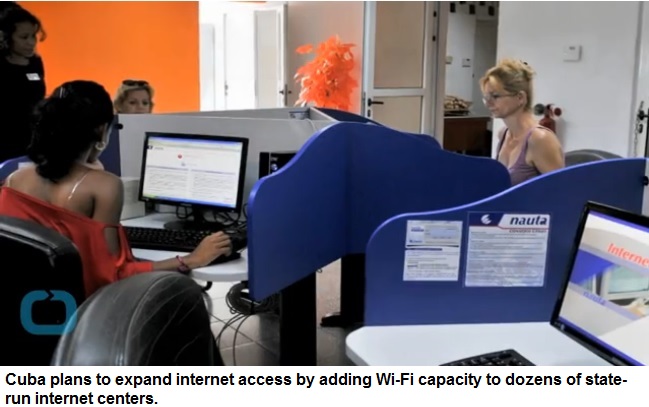
Posted on October 12, 2015 – Cuba has announced plans to expand internet access by adding Wi-Fi capacity to dozens of state-run internet centers and more than halving the cost that users pay for an hour online.

(Press || PAUSE || to STOP the continuous VIDEO).

Cuba’s lack of ICT infrastructure is understandable, considering the historicity of that island nation. (Though change is imminent!)

What’s frightening though is that ALL of the Caribbean is just a natural disaster away from also “going dark” on the internet. Imagine a hurricane, or an earthquake, or even a volcano! And yet different Caribbean member-states have been affected by these disasters … just recently.

This commentary is therefore a melding of ICT, economics, security and governance. This is a big deal for the Caribbean, as the internet is being pitched in the Go Lean roadmap as an equalizing element for the Caribbean region in competition with the rest of the world. So the internet is slated to deliver more than just email messages, but rather, to deliver the Caribbean’s future.

With the internet as the delivery vehicle, there must now be oversight and promotion for this information super-highway. Too much – as in the future for our children – is at stake.

This Go Lean roadmap calls for the heavy-lifting of building Caribbean communities, of shepherding important aspects of Caribbean life, including telecommunication policies across member-state borders. In fact, the roadmap has these 3 prime directives:

  • Optimization of the economic engines in order to grow the regional economy to $800 Billion & create 2.2 million new jobs.
  • Establishment of a security apparatus – including an emergency management apparatus – to protect the resultant economic engines.
  • Improvement of Caribbean governance to support these engines, utilizing a separation-of-powers with member-states.

These prime directives will elevate Caribbean society, above and beyond what any one member-state can do alone. This is the prospect of a unified effort, a leveraged Single Market. This reality was identified early in the Go Lean book (Pages 13 & 14) in the in the following pronouncements in the Declaration of Interdependence:

xvi.    Whereas security of our homeland is inextricably linked to prosperity of the homeland, the economic and security interest of the region needs to be aligned under the same governance. … [The] accedence of this Federation must equip the security apparatus with the tools and techniques for predictive and proactive interdictions.

xxvii. Whereas the region has endured a spectator status during the Industrial Revolution, we cannot stand on the sidelines of this new economy, the Information Revolution. Rather, the Federation must embrace all the tenets of Internet Communications Technology (ICT) to serve as an equalizing element in competition with the rest of the world. The Federation must bridge the digital divide and promote the community ethos that research/development is valuable and must be promoted and incentivized for adoption.

So what exactly can be promoted here and now to elevate the Caribbean region’s ICT infrastructure above and beyond what the member-states can do themselves, independently? Or more so, what can be accomplished for ICT infrastructure during times of distress?

This following news article identifies an effort by the social media giant Facebook, to employ internet access by satellite when land-lines are unavailable, or not even installed. See the story here, considering that this solution would be perfect for the Caribbean:

Title: Facebook to launch satellite to expand Internet access in Africa

(Source retrieved October 12, 2015 from: http://news.yahoo.com/facebook-launch-satellite-expand-internet-access-africa-224718015–finance.html)

(Reuters) – Facebook Inc said it would launch a satellite in partnership with France’s Eutelsat Communications to bring Internet access to large parts of sub-Saharan Africa.

A Facebook logo is displayed on the side of a tour bus in New York's financial districtThe satellite, part of Facebook’s Internet.org platform to expand internet access mainly via mobile phones, is under construction and will be launched in 2016, the companies said on Monday. (http://on.fb.me/1JPiTZC)

The satellite, called AMOS-6, will cover large parts of West, East and Southern Africa, Facebook Chief Executive Mark Zuckerberg said in a Facebook post.

“To connect people living in remote regions, traditional connectivity infrastructure is often difficult and inefficient, so we need to invent new technologies,” Zuckerberg said.

The Internet.org platform offers free access to pared-down web services, focused on job listings, agricultural information, healthcare and education, as well as Facebook’s own social network and messaging services.

Growth in the number of people with access to the Internet is slowing, and more than half the world’s population is still offline, the United Nations Broadband Commission said last month.

Facebook has nearly 20 million users in major African markets Nigeria and Kenya, statistics released by it showed last month, with a majority using mobile devices to access their profiles.

The company opened its first African office in Johannesburg in June.

Tech news website The Information reported in June that Facebook had abandoned plans to build a satellite to provide Internet service to continents such as Africa. (http://bit.ly/1JPiVkn)

(Reporting by Sai Sachin R in Bengaluru; Editing by Don Sebastian)

Related: Facebook Will Help To Bring Internet Access To U.N. Refugee Camps, Mark Zuckerberg Says

This issue of internet deployment and governance has been a frequent topic for Go Lean commentaries. Other blog-commentaries on this subject have detailed the full width-and-breath of preparing Caribbean society for the diverse economic, security and governing issues of managing ICT as a utility in this new century. See sample blogs here:

https://goleancaribbean.com/blog/?p=6385 Wi-Fi Hot Spots Run By Hackers Are Targeting Tourists
https://goleancaribbean.com/blog/?p=6341 The Need for Online Tourism Marketing Stewardship
https://goleancaribbean.com/blog/?p=5435 China Internet Policing – Model for Caribbean
https://goleancaribbean.com/blog/?p=5353 US Presidential Politics and the Internet
https://goleancaribbean.com/blog/?p=4793 Online reviews – like Yelp and Angie’s List – can wield great power for services marketed, solicited and contracted online.
https://goleancaribbean.com/blog/?p=4381 Net Neutrality – The need for Caribbean Administration of the Issue.
https://goleancaribbean.com/blog/?p=4337 Crony-Capitalism Among the Online Real Estate Industry
https://goleancaribbean.com/blog/?p=3881 European and North American Intelligence Agencies to Ramp-up Cyber Security Cooperation
https://goleancaribbean.com/blog/?p=906 Bitcoin e-Payments needs regulatory framework to manage ‘risky’ image
https://goleancaribbean.com/blog/?p=308 Caribbean Communications Infrastructure Program (CARCIP) and the Caribbean Telecommunications Union (CTU) urges greater innovation and protection.

These commentaries demonstrate that there is the need for a technocratic governing body to better facilitate and promote the internet in the Caribbean, for commerce, security and government applications. The CU is designed to provide that governance and promotion. Successful execution of the CU/Go Lean roadmap will result a surge in internet/online activity and transactions; as there is the plan to deploy schemes for e-Commerce (Central Bank adoption of Electronic Payment systems) and a Facebook-style social media network www.myCaribbean.gov; (administered by the regional Caribbean Postal Union).

The Go Lean book details the community ethos, plus the execution of related strategies, tactics, implementations and advocacies to facilitate this ICT vision. The following is a sample of these specific details from the book:

Community Ethos – Deferred Gratification Page 21
Community Ethos – Economic Principles – People Choose Page 21
Community Ethos – Economic Principles – People Respond to Incentives in Predictable Ways Page 21
Community Ethos – Economic Principles – The Consequences of Choices Lie in the Future Page 21
Community Ethos – Governing Principles – Lean Operations Page 24
Community Ethos – Governing Principles – Return on Investments Page 24
Community Ethos – Ways to Impact the Future Page 26
Community Ethos – Ways to Foster Genius Page 27
Community Ethos – Ways to Promote Intellectual Property Page 29
Community Ethos – Ways to Impact Research & Development Page 30
Community Ethos – Ways to Bridge the Digital Divide Page 31
Community Ethos – Ways to Improve Sharing Page 35
Community Ethos – Ways to Impact the Greater Good Page 37
Strategy – Vision – Confederate 30 Member-States into a Single Market Page 45
Strategy – Mission – Embrace the Advances of Technology Page 46
Strategy – Agents of Change – Technology Page 57
Strategy – Agents of Change – Climate Change Page 57
Tactical – Fostering a Technocracy Page 64
Tactical – Separation of Powers – Caribbean Central Bank Page 73
Tactical – Separation of Powers – Caribbean Postal Union Page 78
Tactical – Separation of Powers – Communications and Media Authority Page 79
Implementation – Ways to Pay for Change Page 101
Implementation – Ways to Deliver Page 109
Implementation – Reasons to Repatriate to the Caribbean Page 118
Planning – 10 Big Ideas for the Caribbean Region – Cyber-Caribbean Page 127
Planning – Ways to Make the Caribbean Better Page 136
Planning – Reasons Why the CU Will Succeed Page 137
Advocacy – Ways to Grow the Economy Page 151
Advocacy – Ways to Create Jobs Page 152
Advocacy – Ways to Improve Education – Promotion of   e-Learning Page 159
Advocacy – Ways to Improve Governance – e-Government & e-Delivery Deployments Page 168
Advocacy – Ways to Better Manage the Social Contract – Technology/Efficiencies Page 170
Advocacy – Ways to Improve Communications – Regulate Cross-Border Broadband and WiFi Modes Page 186
Advocacy – Ways to Foster Technology – Intellectual Property Protections Page 197
Advocacy – Ways to Foster e-Commerce – e-Payments & Wifi Facilitations Page 198
Advocacy – Ways to Impact Main Street – Wifi & Mobile Apps: Time and Place Page 201
Advocacy – Ways to Improve Monopolies – Utilities to Oversee ICT/New Media Page 202
Advocacy – Ways to Impact the Youth – Foster Work Ethic for ICT Page 227
Advocacy – Ways to Impact Urban Living – Broadband for Work-at-Home Page 234
Advocacy – Ways to Impact Rural Living – Ideal for Satellite Deployment Page 235

While the Go Lean book focuses primarily on economic issues, it also recognizes that technology is paramount.

We must nurture growth in this industry space – Cyber Space – for the Caribbean’s present and future dispositions.

The returns on our investments will be garnered by our children.

For example:

Imagine no need to go abroad to college because access is enabled for any college/university of choice by logging on to the internet.

We must welcome this change!

The Go Lean book describes the effort to create this reality as heavy-lifting, and then urges all to lean-in to this roadmap.

This urging is repeated here again. All Caribbean stakeholders (people, organizations and governments) are urged to lean-in to this roadmap. This is conceivable, believable and achievable. We can do this … and make the region a better place to live, work and play.  🙂

Download the book Go Lean…Caribbean now!

Share this post:
, , , ,

Capitalism of Drug Patents

Go Lean Commentary:

While “Greed maybe good” for incentivizing innovation, it “sucks” to apply massive increases to existing products because … well just because.

This appears to be the scenario in the following news article and VIDEO; a former Hedge Fund Manager buys the rights (patents) to an older drug and then increases the price … 5500 percent. See the story here:

Title: Ex-hedge funder buys rights to AIDS drug and raises price from $13.50 to $750 per pill
By: Tom Boggioni

A former hedge fund manager turned pharmaceutical businessman has purchased the rights to a 62-year-old drug used for treating life-threatening parasitic infections and raised the price overnight from $13.50 per tablet to $750.

CU Blog - Capitalism of Drug Patents - Photo 1According to the New York Times, Martin Shkreli, 32, the founder and chief executive of Turing Pharmaceuticals, purchased the rights to Daraprim for $55 million on the same day that Turing announced it had raised $90 million from Shkreli and other investors in its first round of financing.

Daraprim is used for treating toxoplasmosis — an opportunistic parasitic infection that can cause serious or even life-threatening problems in babies and for people with compromised immune systems like AIDS patients and certain cancer patients — that sold for slightly over $1 a tablet several years ago.  Prices have increased as the rights to the drug have been passed from one pharmaceutical company to the next, but nothing like the almost 5,500 percent increase since Shkreli acquired it.

Worrying that the cost of treatment could devastate some patients, Dr. Judith Aberg, the chief of the division of infectious diseases at the Icahn School of Medicine at Mount Sinai asked, “What is it that they are doing differently that has led to this dramatic increase?”

According to Shkreli, Turing will use the money it earns to develop better treatments for toxoplasmosis, with fewer side effects.

“This isn’t the greedy drug company trying to gouge patients, it is us trying to stay in business,” Shkreli explained, saying that many patients use the drug for far less than a year and that the new price is similar to other drugs used for rare diseases.

Shrkeli also defended his small pharmaceutical company saying, “It really doesn’t make sense to get any criticism for this.”

This is not the first time the fledgling pharmaceutical executive has come under scrutiny.

He started the hedge fund MSMB Capital while in his 20’s and was accused of urging the FDA to not approve certain drugs made by companies whose stock he was shorting.

In 2011, Shkreli helped form Retrophin, which also acquired old drugs and immediately raised their prices. Retrophin’s board fired Shkreli a year ago and has filed a complaint in Federal District Court, accusing him of using Retrophin as a personal fund to pay back angry investors in his hedge fund.

As for Shrkeli’s claim that he will put the excess profits back into research, doctors say that isn’t needed in this case.

“I certainly don’t think this is one of those diseases where we have been clamoring for better therapies,” said Dr. Wendy Armstrong, professor of infectious diseases at EmoryUniversity in Atlanta.

——-

VIDEO Title: Ex-hedge funder who hiked AIDS pill cost by 5,500 percent says drug ‘still underpriced’ https://youtu.be/bCIMUn_WNz0

UPDATE: ‘Pharma Bro’ backs down: Martin Shkreli will roll back outrageous Daraprim price gouge

According to the Person of Interest in the foregoing article and VIDEO, 32 year-old ex-Hedge Fund Manager Martin Shkreli, “Drugs need a profit motive to sponsor innovation”. He posits that the process of research and development for new drugs require the appeal of capitalism, where people invest hoping to get a BIG return later.

To argue with this business logic is to argue with the tenets of capitalism.

So be it! Let the argument begin!

“This is what happens when you turn over healthcare to the capitalist” – says one patient and sufferer of Multiple Sclerosis, Dionne Sarden, of Greater Detroit.

Drugs and healthcare should pursue the motives of the Greater Good, not the “greater profit”. If you do not agree with this statement, just re-visit the Hippocratic Oath, here,  that every doctor is required to vow at the start of their medical career:

I swear to fulfill, to the best of my ability and judgment, this covenant:

I will respect the hard-won scientific gains of those physicians in whose steps I walk, and gladly share such knowledge as is mine with those who are to follow.

I will apply, for the benefit of the sick, all measures which are required, avoiding those twin traps of overtreatment and therapeutic nihilism.

I will remember that there is art to medicine as well as science, and that warmth, sympathy, and understanding may outweigh the surgeon’s knife or the chemist’s drug.

I will not be ashamed to say “I know not,” nor will I fail to call in my colleagues when the skills of another are needed for a patient’s recovery.

I will respect the privacy of my patients, for their problems are not disclosed to me that the world may know. Most especially must I tread with care in matters of life and death. If it is given me to save a life, all thanks. But it may also be within my power to take a life; this awesome responsibility must be faced with great humbleness and awareness of my own frailty. Above all, I must not play at God.

I will remember that I do not treat a fever chart, a cancerous growth, but a sick human being, whose illness may affect the person’s family and economic stability. My responsibility includes these related problems, if I am to care adequately for the sick.

I will prevent disease whenever I can, for prevention is preferable to cure.

I will remember that I remain a member of society, with special obligations to all my fellow human beings, those sound of mind and body as well as the infirm.

If I do not violate this oath, may I enjoy life and art, respected while I live and remembered with affection thereafter. May I always act so as to preserve the finest traditions of my calling and may I long experience the joy of healing those who seek my help.

Written in 1964 by Louis Lasagna, Academic Dean of the School of Medicine at Tufts University, and used in many medical schools today. Source: https://en.wikipedia.org/wiki/Hippocratic_Oath retrieved September 23, 2015.

Alas, the Person of Interest in this consideration is not a medical doctor, he is a Hedge Fund Manager. Some would consider his actions to be just “par for the course” … for a Crony-Capitalist. (Consider this sample of his “immature” Twitter messages).

This consideration is in conjunction with the book Go Lean…Caribbean which asserts that Crony-Capitalism is the scorn of American life that reaches into every fabric of society; in this case the life-and-death decisions for healthcare. The book urges the Caribbean region not to follow the American example in this regard. (Previously Go Lean blogs have cited the good non-profit-motive example of Cuba. While Cuba is a Failed-State in so many other areas, in this one case, drug-pricing, they get it right; “even a broken clock is right twice a day”).

The Go Lean book is focused on economics primarily, but also considers the realities of security and governance. For the background on economics, the book relates the historicity of the father of modern macro-economics Adam Smith.

Adam Smith, the 18th century Scottish political economics pioneer, is best known for his classic work: “An Inquiry into the Nature and Causes of the Wealth of Nations (1776)“. Through reflection over the economics at the beginning of the Industrial Revolution the book touches upon broad topics as the division of labor, productivity, free markets and the division of incomes into profit, wage, and rent [4]. While Smith attacked most forms of government interference in the economic process, he advocated that government should remain active in certain sectors of society not suited for profit-seekers. These sectors included public education, mitigations for poor adults, the judiciary, a standing army, and healthcare. He posited that these institutional systems may/should never be directly profitable for private industries.

Hedge Funds and Crony-Capitalist obviously hold a dissenting view.

Beyond Adam Smith, the field of Economics features public choice theory – the application of economic thinking to political issues. This field asserts that “rent-seeking” is the more appropriate labeling for certain activities. This “rent” refers to seeking to increase one’s share of existing wealth without creating new wealth. The demonstrated  effects of these efforts are reduced economic efficiency [in the community] through poor allocation of resources, reduced actual wealth creation, lost government revenue, and increased income inequality,[1] and, potentially, national decline. (The word “rent” does not refer here to payment on a lease but refers to gaining control of land or other natural resources).

So why is the cost of drugs so high in the US? Based on these experiences, it is not just the motivation for profit, but for rent!

This theory was detailed further in a recent Go Lean blog that related that Big Pharma, the Pharmaceutical industry, dictates standards of care in the field of medicine, more so than may be a best-practice. The blog painted a picture of a familiar scene where Pharmaceutical Sales “Reps” slip in the backdoor to visit doctors to showcase their latest product lines; but relates that there are commission kick-backs, rebates and “spiffs” in these arrangements, to incentivize the doctors to order these drugs for their patients. The Go Lean book posits that the Caribbean must take its own lead in the battle for health, wellness and pharmaceuticals because this US eco-system is motivated by such a bad ethos: profit and even worst, rent.

The Go Lean book strategizes a roadmap for economic empowerment in the Caribbean region, even including the indisputable need for healthcare and pharmaceutical drugs. Clearly any quest to elevate the region must detail a comprehensive plan for healthcare. The Go Lean book proves this; it goes beyond a plan and provides a roadmap … to make the Caribbean a better place to live, work, heal and play. At the outset of the Go Lean book, in the Declaration of Interdependence (Page 11), these points are pronounced:

viii. Whereas the population size is too small to foster good negotiations for products and commodities from international vendors, the Federation must allow the unification of the region as one purchasing agent, thereby garnering better terms and discounts.

ix.  Whereas the realities of healthcare and an aging population cannot be ignored and cannot be afforded without some advanced mitigation, the Federation must arrange for health plans to consolidate premiums of both healthy and sickly people across the wider base of the entire Caribbean population. The mitigation should extend further to disease management, wellness, mental health, obesity and smoking cessation programs.

The Go Lean serves as a roadmap for the implementation and introduction of the technocratic Caribbean Union Trade Federation (CU). The CU‘s prime directives are identified with the following 3 statements:

  • Optimization of the economic engines in order to grow the regional economy to $800 Billion & create 2.2 million new jobs.
  • Establishment of a security apparatus to protect the resultant economic engines.
  • Improve Caribbean governance to support these engines.

Previous blog/commentaries addressed issues of capitalistic conflicts in American medical practices, compared to other countries, and the Caribbean. The following sample applies:

Book Review – ‘Thimerosal: Let The Science Speak’
Detroit-area Judge to Decide if Kids Need Vaccines
Good American Model – Shaking Up the World of Cancer With a Good ROI
Bad American Model – The Cost of Cancer Drugs
Racism in Medicine? Look at Ebola’s Historicity
Antibiotics Misuse Linked to Obesity in the US
CHOP Research: Climate Change May Bring More Kidney Stones
Big Pharma & Criminalization of American Business
New Research and New Hope in the Fight against Alzheimer’s Disease
Health-care fraud in America; criminals take $272 billion a year
New Cuban Cancer medication registered in 28 countries

The foregoing news article and VIDEO provides an inside glimpse of American Crony-Capitalism as it touches on vital areas like healthcare. Obviously, the innovators and developers of drugs have the right to glean the economic returns of their research. The Go Lean roadmap posits that there is a better way, a scheme in which more innovations can emerge and investors can get their Return on Investment (ROI).

The Caribbean Union Trade Federation has the prime directive of optimizing the economic, security and governing engines of the region. The foregoing VIDEO depicts that research is very important to identify and qualify best practices in health management for the public. This is the manifestation and benefits of Research & Development (R&D). The roadmap describes this focus as a community ethos to promote R&D in the areas of science, technology, engineering and medicine (STEM).

The following list details additional ethos, strategies, tactics, implementations and advocacies to optimize the region’s health deliveries and R&D investments, especially on Caribbean campuses and educational institutions:

Community Ethos – Deferred Gratification Page 21
Community Ethos – Economic Systems Influence Individual Choices and Incentives Page 21
Community Ethos – The Consequences of Choices Lie in the Future Page 21
Community Ethos – Governing Principles – Lean Operations – GPO’s; Ideal for Healthcare Page 24
Community Ethos – Governing Principles – Return on Investments (ROI) Page 24
Community Ethos – Governing Principles – Cooperatives Page 25
Community Ethos – Non-Government Organizations Page 25
Community Ethos – Ways to Impact Research & Development (R&D) Page 30
Community Ethos – 10 Ways to Promote Happiness Page 36
Community Ethos – Ways to Impact the Greater Good Page 37
Strategy – Integrate and unify region in a Single Market Page 45
Strategy – Agents of Change – Globalization Page 57
Tactical – Fostering a Technocracy Page 64
Tactical – Growing to a $800 Billion Economy – Case Study of Adam Smith Page 67
Tactical – Separation of Powers – Health Department Page 86
Tactical – Separation of Powers – Drug Administration Page 87
Implementation – Ways to Pay for Change Page 101
Implementation – Ways to Implement Self-Government Entities – R&D Campuses Page 105
Implementation – Ways to Deliver Page 109
Planning –  Ways to Improve Trade Page 128
Planning –  Ways to Make the Caribbean Better Page 131
Advocacy – Ways to Improve Healthcare Page 156
Advocacy – Ways to Better Manage the Social Contract Page 170
Advocacy – Ways Foster Cooperatives Page 176
Advocacy – Ways to Improve Emergency Management Page 196
Advocacy – Ways to Impact Foundations Page 219
Advocacy – Ways to Impact Persons with Disabilities Page 228
Appendix – Emergency Management – Medical Trauma Centers Page 336

The Go Lean roadmap does not purport to be an authority on medical or pharmaceutical research best practices. This economic-security-governance empowerment plan should not direct the course of direction for medical research and/or treatment. But something is wrong here, as portrayed in the foregoing article and VIDEO. The pharmaceutical industry cannot claim any adherence to any “better nature” in their practices.

This is not economics, which extols principles like the “law of diminishing returns”, or “competition breathes lower prices and higher quality”. No, the American pharmaceutical industry, at this juncture, is just a pure evil version of Crony Capitalism. Just … rent!

This is not the role model we want to build Caribbean society on.

Capitalism versus Socialism …
Many people feel this type of discussion in this commentary is really a clear indictment of the premise of the American Healthcare system, based on capitalism (right-leaning). Opponents of this status quo advocate for a more socialistic approach (left-leaning). Socialized medicine is the premise for Canada, the UK, and all the 27 EU countries. So the alternative to the American system is not so radical. Alas, even America’s capitalized healthcare schemes are not as far-right as in times past; with the implementation MediCare (in the 1960’s), VA hospitals, and Affordable Care Act (ObamaCare) Health Insurance mandates; these are now reflections of socialism in the US system.

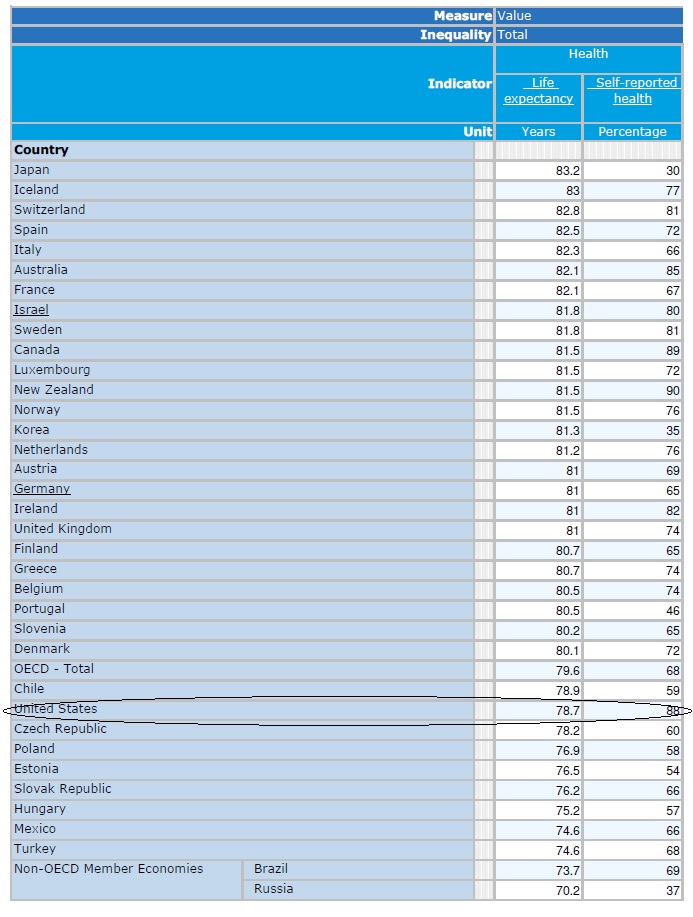
CU Blog - Capitalism of Drug Patents - Photo 2How do we measure the effectiveness of success of left-leaning versus right-leaning healthcare schemes? While most “Well-being” measurements are obviously subjective, there is one exception: life expectancy. Life expectancy calculation is all binary, 1 versus 0, On versus Off, Life versus Death. The Organization of Economic Cooperation and Development maintains a Better Life Index that measures “Well-being” in the 34 OECD Countries. The following details apply:

There is more to life than the cold numbers of GDP and economic statistics – This Index allows you to compare well-being across countries, based on 11 topics the OECD has identified as essential, in the areas of material living conditions and quality of life.

One of the 11 topics measure “Health”, with considerations to the binary Life Expectancy and the subjective Self-Reported Health. On this chart related to Life Expectancy (based on when the average age for non-trauma deaths), the US appears on the list in position 27. See chart here.

The Go Lean movement asserts that the US should not be our model for healthcare. We can do better in the Caribbean; we have done better (Cuba), and must do better throughout the region. We can impact the Greater Good and still preserve economic realities. This means life-or-death. 🙂

Download the book Go Lean … Caribbean – now!

———-

Related: When blacks get equal medical care, they don’t just live longer — they live longer than whites

Share this post:
, , , ,
[Top]

Private Airplanes For All

Go Lean Commentary

Private Airplanes 1The airplane is not a new invention. It goes back to the days of the Wright Brothers of Dayton, Ohio – Orville and Wilbur – and their Kitty Hawk, North Carolina test flight on December 17, 1903. Yet, after 112 years, there is still room for a lot of invention and innovation in the field of aerospace. As the old adage relates “Necessity, is the ‘mother’ of invention”.

This commentary asserts that while the United States of America was front-and-center with the initial developments in man-flights, the Caribbean region now needs to be more prominent with the innovations of flight for this new century in aviation. Why?

Necessity, is STILL the ‘mother’ of invention.

There is the need for a lot more innovative airplane transportation solutions for any region featuring an archipelago – a chain of islands. This new product here – the ICON A5* – is perhaps an ideal solution for Caribbean deployment, as it can better reach the masses and become ubiquitous for private owners-operators; see the following VIDEO:

VIDEO Title: Private airplanes for all? One company hopes so

Private planes have long been the domain of the very rich, but now one company wants to change that. ICON wants to do for air travel what Apple did for computers – demystify and make them approachable. They see a future where lots of people like me and you are soaring through the sky in a plane like this. TODAY’s Craig Melvin reports.

Private Airplanes 2This vision of ubiquitous owners-operators of amphibious airplanes – that can touchdown on land or water – portray a more efficient aviation environment for island-hoping; these vehicles would make island living more appealing to live, work and play. This commentary asserted that “our region must participate in these developments, not just spectate on them”. This aligns with the mandate for a more nimble environment to develop, test and deploy cutting-edge transportation solutions. This is the benefit of lean governmental coordination, to be able to launch initiatives like this as portrayed in the foregoing VIDEO.

Canada is a good model for the Caribbean to emulate in this regards. They have vast rural territories, not easily accessible by roads. In these far-out territories, seaplanes, floatplanes and bush planes proliferate. In addition, this ubiquity in Canada is not necessarily affiliated with the wealthy, but rather ordinary citizens; sometimes, these transportation options even become a small business opportunity.

Needless to say, a proliferation of small aircrafts raises a lot of security issues; think September 11, 2011 Terror Attacks on New York City. The aircraft in the above VIDEO, also feature the additional safety mitigation of a built-in parachute, to allow for an easy landing of any aircraft that may go into distress. (This safety feature is ingenious!).

The book, Go Lean … Caribbean, extols the principle that R&D (research and development) activities are necessary to profit from advantages in technology. We want to do R&D here in the Caribbean; manufacturing/assembly too. Since we have the demand; we should facilitate supply as well!  This is a mandate for the Caribbean Union Trade Federation (CU). This book serves as a roadmap for the introduction and implementation of the CU. This technocracy will assume oversight to optimize the region in the areas of:

      (1) economics
      (2) security
      (3) lean government

This ethos of adapting to change has now come to the Caribbean.

The status quo of the Caribbean’s transportation eco-systems is badly flawed. The region boasts transportation and fuel costs (including taxes) that are among the highest in the world.

Private Airplanes 4The Go Lean strategy is to confederate the 30 member-states of the Caribbean region to form the technocratic CU Trade Federation. Tactically, the roadmap calls for a separation-of-powers, allowing the Caribbean member-states to deputize authority of the Caribbean airspace to the one unified CU agency. Operationally, there is the need to regulate these aircrafts and the owners-operators, for their monitoring, training, licensing, maintenance compliance, search-and-rescue, incident management and everyday functionality. (Consider the risk mitigation example in the Appendix VIDEO below).

Things will go wrong! Bad things do happen to good people.

This blog-commentary touches on many related issues and subjects that affect planning for Caribbean empowerment in the aviation and  transportation industry-spaces. Many of these issues were elaborated upon in these previous blog-commentaries:

https://goleancaribbean.com/blog/?p=5376 Drones to be used for Insurance Damage Claims
https://goleancaribbean.com/blog/?p=3533 No Fear of Failure – Case Study: Bahamasair
https://goleancaribbean.com/blog/?p=3326 M-1 Rail: Alternative Motion in the Motor City
https://goleancaribbean.com/blog/?p=3225 Caribbean less competitive due to increasing aviation taxes
https://goleancaribbean.com/blog/?p=2769 DC Streetcars/Rail – Model For Caribbean Re-development
https://goleancaribbean.com/blog/?p=798 Lessons Learned from the American Airlines merger
https://goleancaribbean.com/blog/?p=673 Ghost ships – Autonomous cargo vessels without a crew
https://goleancaribbean.com/blog/?p=254 Air Antilles Launches St. Maarten Service

Though not written with this particular initiative in mind, the Go Lean roadmap anticipates the foregoing VIDEO‘s opportunities and challenges, as pronounced in the Declaration of Interdependence, (Pages 12 & 14):

xvi.    Whereas security of our homeland is inextricably linked to prosperity of the homeland, the economic and security interest of the region needs to be aligned under the same governance. Since economic crimes … can imperil the functioning of the wheels of commerce for all the citizenry, the accedence of this Federation must equip the security apparatus with the tools and techniques for predictive and proactive interdictions.

xxvii. Whereas the region has endured a spectator status during the Industrial Revolution, we cannot stand on the sidelines of this new economy, the Information Revolution. Rather, the Federation must embrace all the tenets of Internet Communications Technology (ICT) to serve as an equalizing element in competition with the rest of the world. The Federation must bridge the digital divide and promote the community ethos that research/development is valuable and must be promoted and incentivized for adoption.

xxx.   Whereas the effects of globalization can be felt in every aspect of Caribbean life, from the acquisition of food and clothing, to the ubiquity of ICT, the region cannot only consume, it is imperative that our lands also produce and add to the international community, even if doing so requires some sacrifice and subsidy.

The Go Lean book was written with the future of the Caribbean in mind. There was a certain anticipated future – with a proliferation of private aircraft owners-operators – that hasn’t really materialized … yet. But maybe now, finally, that future view is coming into focus. This is the direct quotation from the book (Page 26):

The Bottom Line on the Millennium
In the words of Yogi Berra – iconic American Baseball Hall-of-Famer: “The future ain’t what it used to be”.

This is according to a 2007 news analysis by Michael Fitzpatrick, Science Writer for The Guardian (UK) newspaper:

    No flying cars, no dinners in a pill, and certainly no cool rocketing off to space cities in the required outfit of the future. We seem to have failed the expectations of the most wild-eyed seers from the past – futurologists who were for the most part in love with a supercharged, technologically sexy future where science would free us from the daily grind, for holidays on the moon or underseas. But here we remain, plodding along … in a familiar world that is neither utopia nor dystopia. What the futurologists did get right were some of the more prosaic details such as mobile phones and digital technologies.

Private Airplanes 3The aircraft depicted in the foregoing VIDEO (see Appendix below),  feature functionality where every single-family home could have a plane in their garage – this is the ubiquity in the earlier references. North American society could now be that close to this future view. Better still, the Caribbean should be that close to this reality:

… planes being towed from home garages to boat ramps to launch flight. Then while in flight the aircraft cruises below 15,000 feet and operate at good speed, but slower than 150 miles an hour.

The CU mission is to implement the complete eco-system to deliver on market opportunities for these ubiquitous aircraft owners-operators. There are many strategies, tactics, implementations and advocacies in the book that will facilitate this readiness; a sample is detailed here:

Economic Principles – Economic Systems Influence Individual Choices Page 21
Economic Principles – People Choose because Resources are Limited Page 21
Economic Principles – All Choices Involve Costs Page 21
Economic Principles – People Respond to Incentives Page 21
Economic Principles – Economic Systems Influence Individual Choices Page 21
Economic Principles – Consequences of Choices Lie in the Future Page 21
Community Ethos – Money Multiplier Page 22
Community Ethos – Job Multiplier Page 22
Community Ethos – Lean Operations Page 24
Community Ethos – Return on Investments Page 24
Community Ethos – Ways to Impact the   Future Page 26
Community Ethos – Ways to Help   Entrepreneurship Page 28
Community Ethos – Ways to Promote   Intellectual Property Page 29
Community Ethos – Ways to Impact Research   and Development Page 30
Community Ethos – Ways to Ways to Improve   Negotiations Page 32
Tactical – Separation of Powers – Emergency Management Page 76
Tactical – Separation of Powers – Department of Transportation – Aviation Regulator Page 84
Implementation – Security Initiatives at   Start-up – Command-and-Control Page 103
Implementation – Start-up Benefits from the EEZ Page 104
Implementation – Steps to Implement Self-Governing Entities Page 105
Implementation – Ways to Improve Energy Usage – Electrified Buses/Trains Page 113
Implementation – Ways to Benefit from Globalization Page 119
Planning – Ways to Improve Trade Page 128
Planning – Lessons Learned from Canada’s History Page 146
Advocacy – Ways to Grow the Economy Page 151
Advocacy – Ways to Create Jobs Page 152
Advocacy – Ways to Improve Governance Page 168
Advocacy – Ways to Better Manage the Social Contract – Technology and Efficiency Page 170
Advocacy – Ways to Foster Empowering Immigration Page 174
Advocacy – Ways to Improve Homeland Security Page 180
Advocacy – Ways to Mitigate Terrorism Page 181
Advocacy – Ways to Foster Technology Page 197
Advocacy – Ways to Improve Transportation Page 205
Advocacy – Ways to Impact Urban Living – Transit Options Page 234
Advocacy – Ways to Impact Rural Living – Optimizing Transportation Options Page 235

As described in the Go Lean book, change is imminent, for the world and for the Caribbean. The world is preparing for the change for more efficient transit options and also to deploy more autonomous systems to help owner-operators auto-pilot and navigate around the Caribbean region. This commentary calls for a new ethos … to prepare for change. This ethos has now come to the Caribbean, among the Go Lean/CU planners. The people of the region are urged to also “lean-in” to this empowerment. The benefits of this roadmap are very alluring: emergence of an $800 Billion single market economy and 2.2 million new jobs.

These developments are taking place … elsewhere. We need “in” on this.

We need this here, these types of innovative products, systems, companies and specialists to help us in our quest to make the Caribbean a better place to live, work and play.  🙂

————

Appendix * ICON A5

ICON Aircraft is a privately held American aircraft design and production company.[2] It is currently working on the production of the ICON A5, an amphibious light sport aircraft[3] that began customer deliveries in July 2015.[4][5] The company was founded in response to the 2004 Federal Aviation Administration establishment of the light-sport aircraft (LSA) class of aircraft and Sport Pilot certificate class of pilot.[6][7][8]

This first ICON Aircraft’s  model, the ICON A5, is an amphibious two-seat, light-sport aircraft to be priced at approximately $189,000. Its folding wings facilitate transportation and storage,[8] and it will have a range of approximately 300 nautical miles (560 km) and a top speed of 105 knots (120 mph).[18]

ICON Aircraft positions the A5 with a recreational focus, stating that the aircraft competes with powersports vehicles such as ATVs, motorcycles, watercraft, and snowmobiles, rather than other airplanes.

The company’s headquarters are located in Vacaville, California where all manufacturing, engineering, design, training, sales, and service functions are consolidated.[21]
Source:
https://en.wikipedia.org/wiki/ICON_Aircraft; retrieved September 21, 2015.

————

Appendix – VIDEO – Sea Plane Takes Off from Truck Trailer –  https://youtu.be/-JDogTLtels

Title: Creative Sea Plane Pilot Displays Incredible Take Off Technique From a Moving Truck Trailer – Published on May 8, 2013 – For licensing/usage please contact: licensing@liveleak.com.
Though not as widely used as they once were, seaplanes still serve a few key purposes today including providing access to roadless areas. But the downside of a seaplane is that it can’t land or take off on solid ground. Or can it? This video proves that only one of those disadvantages holds true (landing). As you will see in the video, with a truck moving fast enough, a seaplane can actually take off from an attached trailer.

Share this post:
, , , ,
[Top]

Microsoft Pledges $75 million for Kids in Computer Science

Go Lean Commentary

CU Blog - Microsoft pledges $75 million for kids in computer science - Photo 2Microsoft pledges support to young children learning the science of computers … $75 million worth.

… on behalf of a grateful region, we accept.

While $75 million is not a lot for a global program, consider the source of the benefactor – Microsoft – and it is the spirit that counts. We will take it Microsoft; we want your time, talents and treasuries.

These three resources, are what the book Go Lean…Caribbean asks for from the philanthropic community in terms of gifts to the Caribbean. This is so important, that the book prepares a comprehensive plan for organizing the interactions with charitable foundations and gift-giving organizations. We need and want all the help we can garner!

The Go Lean book serves as a roadmap for the introduction and implementation of the Caribbean Union Trade Federation (CU) to elevate Caribbean society. This movement asserts that to effect change in the region, all Caribbean stakeholders (residents, institutions, students, Diaspora) have to devote a measure of time, talents and treasuries.

The Go Lean book strategizes a roadmap to elevate the economic, security, and governing engines. It clearly relates that these prime directives do not cover every social aspect of Caribbean life. We need the resultant void to be filled by Non-Government Organizations (NGO’s). The following news article/Press Release relates the community empowering and philanthropic efforts from one such entity, computer software giant Microsoft:

Title: Microsoft expands global YouthSpark initiative to focus on computer science
Sub-Title: Microsoft invests $75 million in community programs to increase access to computer science education for all youth and build greater diversity into the tech talent pipeline.

CU Blog - Microsoft pledges $75 million for kids in computer science - Photo 1

SAN FRANCISCO, Sept. 16, 2015 /PRNewswire/ — Microsoft Corp. announced on Wednesday a new commitment of $75 million in community investments over the next three years to increase access to computer science education for all youth, and especially for those from under-represented backgrounds. Through the company’s global YouthSpark initiative, scores of nonprofit organizations around the world will receive cash donations and other resources to provide computer science education to diverse populations of young people in their communities and prepare them with the computational-thinking and problem-solving skills necessary for success in an increasingly digital world.

“If we are going to solve tomorrow’s global challenges, we must come together today to inspire young people everywhere with the promise of technology,” said Microsoft CEO Satya Nadella. “We can’t leave anyone out. We’re proud to make this $75 million investment in computer science education to create new opportunities for students across the spectrum of diverse youth and help build a tech talent pipeline that will spark new innovations for the future.”

Over the next three years, Microsoft will deliver on this commitment through cash grants and nonprofit partnerships as well as unique program and content offerings to increase access to computer science education and build computational thinking skills for diverse populations of youth. One of the flagship programs is Technology Education and Literacy in Schools (TEALS), which pairs tech professionals from across the industry with classroom educators to team-teach computer science in U.S. high schools. TEALS aims to grow fivefold in the next three years, with the goal of working with 2,000 tech industry volunteers to reach 30,000 students in nearly 700 schools across 33 states. A key objective of TEALS is to support classroom educators as they learn the computer science coursework, preparing them to teach computer science independently after two years of team-teaching.

Nadella reinforced the company’s commitment to computer science education today during the annual Dreamforce conference hosted by Salesforce where he called upon thousands of tech professionals to serve as TEALS volunteers and help broaden the opportunity for students of all backgrounds to learn computer science in high school.

“Computer science is a foundational subject — like algebra, chemistry or physics — for learning how the world works, yet it’s offered in less than 25 percent of American high schools,” said Microsoft President Brad Smith. “We need to increase access to computer science and computational thinking for all students, especially those from diverse populations, by partnering across the industry and with teachers and schools to turn this situation around and change the paradigm for developing a more diverse tech talent pipeline.”

There are three additional key elements of Microsoft’s global commitment to increasing access for all youth to the full range of computing skills, from digital literacy to computer science.

  • Global philanthropic investments with nonprofits in 80 countries, including the Center for Digital Inclusion in Latin America, Silatech in the Middle East and Africa, CoderDojo Foundation in Europe, YCAB Foundation in Asia, and many others, will deliver a range of computing skills from digital literacy to computer science education to youth in local communities around the world.
  • Microsoft Imagine connects students with the tools, resources and experiences they need to turn their innovative ideas into reality. Whether it’s building a game or designing an app, Microsoft Imagine makes learning to code easy and accessible for students and educators, no matter their age or skill level and at no cost. Whether it’s free cloud services like Azure, online competitions via Imagine Cup that educators can incorporate into their curriculum, or fun self-serve learning tutorials, Microsoft Imagine helps bring a student’s technology passion to life through computer science.
  • YouthSpark Hub resources are designed to inspire youth about the full spectrum of computing skills, ranging from digital literacy to computer science engineering. In addition to providing access to the Microsoft Imagine tools, the YouthSpark Hub brings together opportunities to participate in activities such as DigiGirlz and YouthSpark Live, attend free YouthSpark Camps at the Microsoft Stores, and access training through nonprofit organizations supported by Microsoft around the world.

Since 2012, Microsoft YouthSpark has created new opportunities for more than 300 million youth around the world, offering technology skills training and connections to employment, entrepreneurship, and continued education or training.

More information about YouthSpark and access to tools and resources can be found at http://YouthSparkHub.com and http://imagine.microsoft.com.

Those wanting more information on the TEALS program and to learn more about how they can get involved should visit http://TEALSK12.org.

Microsoft (Nasdaq “MSFT” @microsoft) is the leading platform and productivity company for the mobile-first, cloud-first world, and its mission is to empower every person and every organization on the planet to achieve more.
Source: PR Newswire Service; retrieved September 17, 2015 from: http://www.prnewswire.com/news-releases/microsoft-expands-global-youthspark-initiative-to-focus-on-computer-science-300144592.html

——
VIDEO – Microsoft YouthSpark: Opportunity for Youth – https://youtu.be/ZRKYTQ6_UEs

Published by Microsoft – http://www.microsoft.eu
YOUTH INFOGRAPHIC: http://www.microsoft.eu/Portals/0/Doc

There’s $75,000,000 and then there’s $75,000,000 from Microsoft.

A $75,000,000 charitable gift from Microsoft is more than just money; it’s an invitation to explore the future: the future of Information Technology.

This is BIG! As it also builds a technology talent pipeline, especially for the under-represented female population; so future jobs are at stake.

Microsoft founder and largest shareholder, Bill Gates, is now retired from the CEO’s office. (Though he continues as non-executive Chairman of the Board of Directors). He is a certifiable billionaire – a member of the One Percent – in which his riches came from this company. He is a great role model for all the youth of the Caribbean.

A great role model for the adults, too!

This innovator’s latest effort is the Bill & Melinda Gates Foundation, which sets out to make a permanent impact on the world. According to a previous blog detailing this foundation’s efforts, his belief is that every life has equal value. So his Foundation works to help all people lead healthy, productive lives. Now we see his hallmark company following this lead so as to also promote hi-technology values among the more disadvantaged youth populations in the world.

We absolutely appreciate those leading and following in this path.

The book Go Lean…Caribbean champions the cause of building and optimizing the Caribbean eco-system. There are a lot of expectations for technology in the region, to aid and assist with all aspects of the Go Lean prime directives, defined as follows:

  • Optimization of the economic engines in order to grow the regional economy to $800 Billion & create 2.2 million new jobs.
  • Establishment of a security apparatus to protect the resultant economic engines.
  • Improve Caribbean governance to support these engines.

The CU/Go Lean roadmap clearly recognizes that the love and curiosity for technology must be ingrained as early as possible. Since the Caribbean does not only want to be on the consuming end of technological developments, we want to create, produce and contribute to the world of innovations. So we need to foster genius qualifiers in our Caribbean youth for careers and occupations – at home – involving Science, Technology, Engineering and Mathematics (STEM).

This point was pronounced at the outset of the Go Lean book with these opening Foreword (Page 3) and the subsequent Declaration of Interdependence (Page 12 & 14) with these statements:

Foreword:  Our youth, the next generation, may not be inspired to participate in the future workings of their country; they may measure success only by their exodus from their Caribbean homeland.

xiii.     Whereas the preparation of our labor force can foster opportunities and dictate economic progress for current and future generations, the Federation must ensure that educational and job training opportunities are fully optimized for all residents of all member-states, with no partiality towards any gender or ethnic group. The Federation must recognize and facilitate excellence in many different fields of endeavor, including sciences, languages, arts, music and sports. This responsibility should be executed without incurring the risks of further human flight, as has been the past history.

xxvi.   Whereas the Caribbean region must have new jobs to empower the engines of the economy and create the income sources for prosperity, and encourage the next generation to forge their dreams right at home, the Federation must therefore foster the development of new industries, like that of ship-building, automobile manufacturing, prefabricated housing, frozen foods, pipelines, call centers, and the prison industrial complex. In addition, the Federation must invigorate the enterprises related to existing industries like tourism, fisheries and lotteries – impacting the region with more jobs.

xxvii.  Whereas the region has endured a spectator status during the Industrial Revolution, we cannot stand on the sidelines of this new economy, the Information Revolution. Rather, the Federation must embrace all the tenets of Internet Communications Technology (ICT) to serve as an equalizing element in competition with the rest of the world. The Federation must bridge the digital divide and promote the community ethos that research/development is valuable and must be promoted and incentivized for adoption.

xxx.    Whereas the effects of globalization can be felt in every aspect of Caribbean life, from the acquisition of food and clothing, to the ubiquity of ICT, the region cannot only consume, it is imperative that our lands also produce and add to the international community, even if doing so requires some sacrifice and subsidy.

The Go Lean book seeks a quest to create 64,000 new direct and indirect technology/software jobs in the Caribbean marketplace. It will be a good start to use the grants and support of Microsoft, The Bill & Melinda Gates Foundation and other philanthropic groups and NGO’s to foster this campaign.

The Go Lean roadmap was constructed with the community ethos in mind to forge the needed change to adopt technology. Plus with the execution of these related strategies, tactics, implementations and advocacies it will help build up our communities. The following is a sample of these specific details from the book:

Community Ethos – Deferred Gratification Page   21
Community Ethos – Economic Principles – People Choose Page   21
Community Ethos – Economic Principles – People Respond to Incentives in Predictable Ways Page   21
Community Ethos – Economic Principles – The Consequences of Choices Lie in the   Future Page   21
Community Ethos – Economic Principles – Job Multiplier Page   22
Community Ethos – Governing Principles – Lean Operations Page   24
Community Ethos – Governing Principles – Cooperatives Page   25
Community Ethos – Governing Principles – Non-Government Organizations Page   25
Community Ethos – Ways to Impact the Future Page   26
Community Ethos – Ways to Foster Genius – Anti-Bullying Campaigns Page   27
Community Ethos – Ways to Promote Intellectual Property Page   29
Community Ethos – Ways to Impact Research & Development Page   30
Community Ethos – Ways to Bridge the Digital Divide Page   31
Community Ethos – Ways to Impact Turn-Around Page   33
Community Ethos – Ways to Promote Happiness Page   36
Community Ethos – Ways to Impact the Greater Good Page   37
Strategy – Vision – Confederate 30 Member-States Page   45
Strategy – Vision – Prepare the Youth with the skills to compete in the modern world Page   46
Strategy – Mission – Exploit the benefits and opportunities of globalization Page   46
Tactical – Confederating a Permanent Union Page   63
Tactical – Fostering a Technocracy Page   64
Tactical – Separation of Powers – State Department – Registrar/Liaison of NGO’s Page   80
Implementation – Ways to Pay for Change Page   101
Implementation – Trends in Implementing Data Centers – Creating the ‘Cloud’ Page   106
Implementation – Ways to Deliver Page   109
Implementation – Ways to Impact Social Media – Caribbean Cloud Page   111
Implementation – Ways to Foster International Aid Page   115
Planning – 10 Big Ideas for the Caribbean Region – Cyber-Caribbean Page   127
Planning – Ways to Make the Caribbean Better Page   136
Advocacy – Ways to Grow the Economy Page   151
Advocacy – Ways to Create Jobs Page   152
Advocacy – Ways to Improve Education – STEM Promotion Page   159
Advocacy – Ways to Improve Governance – e-Government & e-Delivery Page   168
Advocacy – Ways to Better Manage the Social Contract Page   170
Advocacy – Ways to Foster Cooperatives Page 176
Advocacy – Ways to Improve Communications Page   186
Advocacy – Ways to Improve Libraries Page 187
Advocacy – Ways to Enhance Tourism – Internet Marketing Page   190
Advocacy – Ways to Foster Technology Page   197
Advocacy – Ways to Foster e-Commerce Page   198
Advocacy – Ways to Impact Main Street Page   201
Advocacy – Ways to Impact Foundations Page 219
Advocacy – Ways to Impact the One-Percent Page   224
Advocacy – Ways to Impact Youth Page   227
Advocacy – Ways to Improve the Arts Page   230
Appendix – CU Job Creations Page   257
Appendix – Giving Pledge Signatories – 113 Super Rich – One Percent – Benefactors Page   292

This Go Lean roadmap calls for the heavy-lifting to build-up Caribbean communities, to shepherd important aspects of Caribbean life, so as to better prepare for the future, dissuade emigration and optimize the ICT eco-systems here at home.

These goals were previously featured in Go Lean blogs/commentaries, as sampled here:

https://goleancaribbean.com/blog/?p=6341 Tourism Digital Marketing & Stewardship — What’s Next?
https://goleancaribbean.com/blog/?p=6269 Education & Economics: Lessons from Detroit
https://goleancaribbean.com/blog/?p=6151 3D Printing: Here Comes Change
https://goleancaribbean.com/blog/?p=3974 Google and Mobile Phones – Here comes Change
https://goleancaribbean.com/blog/?p=3915 ‘Change the way you see the world; you change the world you see’
https://goleancaribbean.com/blog/?p=3490 How One Internet Entrepreneur Can Rally a Whole Community
https://goleancaribbean.com/blog/?p=2126 Where the Jobs Are – Computers Reshaping Global Job Market
https://goleancaribbean.com/blog/?p=1698 STEM Jobs Are Filling Slowly
https://goleancaribbean.com/blog/?p=1416 Amazon – A Role Model for Caribbean Logistics
https://goleancaribbean.com/blog/?p=1277 The need for highway safety innovations – here comes Google
https://goleancaribbean.com/blog/?p=476 CARICOM Urged on ICT
https://goleancaribbean.com/blog/?p=308 CARCIP Urges Greater Innovation

The Go Lean book focuses primarily on economic issues, and it recognizes that computer technology is the future direction for industrial developments. (See the foregoing VIDEO). This is where the jobs are to be found. The Go Lean roadmap describes the heavy-lifting for people, organizations and governments to forge these innovations here at home in the Caribbean. Clearly philanthropic organizations, Not-For-Profit charities, foundations and NGO’s are also stakeholders for the effort to make the Caribbean better.

So the Go Lean roadmap invites NGO’s to impact the Caribbean – to plant seeds – according to their charters. We are open to ask for their help. But we assure these benefactors that their help is really an investment. Our young people have the will, passion and integrity to grow the seeds into fine fruit.

We want more … such organizations. We will be pursuing other NGO’s … especially for the under-represented female population, such as:

Black Girls Code –  Their Vision: To increase the number of women of color in the digital space by empowering girls of color ages 7 to 17 to become innovators in STEM fields, leaders in their communities, and builders of their own futures through exposure to computer science and technology.

Women in Technology – A premier professional association for women in the technology industry, we understand the unique challenges you face. No matter where you are in your professional development, or what technology-related field you’re in, our community offers a broad range of support, programs and resources to advance women in technology from the classroom to the boardroom.

Women in STEM – The Office of Science and Technology Policy, in collaboration with the White House Council on Women and Girls, is dedicated to increasing the participation of women and girls — as well as other underrepresented groups — in the fields of science, technology, engineering, and mathematics by increasing the engagement of girls with STEM subjects in formal and informal environments, encouraging mentoring to support women throughout their academic and professional experiences, and supporting efforts to retain women in the STEM workforce.

This is an invitation to the world to help us help ourselves. It is not just a dream. This is a conceivable, believable and achievable business plan. With the right commitment of time, talent and treasuries from domestic and foreign sources, we can succeed in making the region a better place to live, work, learn and play.  🙂

Download the book Go Lean … Caribbean – now!

Share this post:
, , , , , , , ,
[Top]

3D Printing: Here Comes Change

Go Lean Commentary

Quick survey: 30 years ago – 1985 – did you have a smartphone or did you envision a smartphone – with such processing power, functionality and storage – being available to carry around in your pocket?

If your answer to this question is ”No”, then congratulations, you are an ordinary everyday “man/woman on the street”. You, like most people, didn’t envision that this technology would change “us” so dynamically that it would transform our lives and render obsolete, so many ordinary appliances (and industries); think: camera, watch, pager, map, address book, calculator, books, and more.

Take note:

This transformative change is about to happen again!

CU Blog - 3D Printing - Here Comes Change - Photo 3

An acute transformation – major change in a short period of time – is about to occur again. This time with 3D Printing. This change will affect the fabrication of so many ‘chattel’ goods. Imagine fabricating your own car!

Consider first, what 3D Printing refers to:

3D Printing (also called additive manufacturing) is any of various processes used to make a three-dimensional object.[1] In 3D printing, additive processes are used, in which successive layers of material are laid down under computer control.[2] These objects can be of almost any shape or geometry, and are produced from a 3D model or other electronic data source. A 3D Printer is a type of industrial robot.
3D Printing in the term’s original sense refers to processes that sequentially deposit material onto a powder bed with inkjet printer heads. More recently the meaning of the term has expanded to encompass a wider variety of techniques such as extrusion and sintering based processes. Technical standards generally use the term additive manufacturing for this broader sense. (Source: https://en.wikipedia.org/wiki/3D_printing)

This VIDEO here depicts a simple 3D Printing demonstration:

VIDEO – Timelapse of Hyperboloid Print – https://youtu.be/1213kMys6e8
Time-lapse video of a hyperboloid object made of Polylactic Acid (PLA) using a RepRap “Prusa Mendel” 3 printer for molten polymer deposition.

The hypothesis in this commentary is not just theoretical; this acute transformation is happening in real life. Consider this story/VIDEO here of an actual car being made using the 3D Printing process (assembly methods and sourcing):

VIDEO  The First 3D-Printed Supercar – https://youtu.be/o8wFs1aipaE

Published on Jun 24, 2015 – Meet Blade – a super-light sports car with a 3D printed chassis, designed as an alternative to traditional car manufacturing. Through 3D printing, entrepreneur Kevin Czinger has developed a radical new way to build cars with a much lighter footprint.
Read More On Forbes: http://onforb.es/1fBjCqt

Traditionally, fabrication methodologies involve subtraction. This strategy calls for starting with a block/lump of raw material (wood, stone, etc.) and cutting away excess materials to keep the desired structure. The alternate fabrication methodology involves molding pliable materials (iron/steel/aluminum) to a desired shape. 3D Printing or additive manufacturing (AM) is a game-changer! As the name suggests, the approach is to add, build up to the design/mold that is intended. The encyclopedic reference continues:

The umbrella term additive manufacturing gained wider currency in the decade of the 2000’s[12] as the various additive processes matured and it became clear that soon metal removal would no longer be the only metalworking process done under that type of control (a tool or head moving through a 3D work envelope transforming a mass of raw material into a desired shape layer by layer). It was during this decade that the term subtractive manufacturing appeared as a retronym (new name) for the large family of machining processes with metal removal as their common theme. However, at the time, the term 3D Printing still referred only to the polymer technologies in most minds, and the term AM was likelier to be used in metalworking contexts than among polymer/inkjet/stereolithography enthusiasts. The term subtractive has not replaced the term machining, instead complementing it when a term that covers any removal method is needed.

Based on the above descriptions, the term Printer is only vaguely similar to traditional printing of ink on to paper. The similar movement of inkjet print heads versus the “head” movement of 3D Printers is what dominates the branding, and thus for the foreseeable future, the fabrication devices would probably be called “printers”, for both industrial and consumer uses; (see Appendix – 3D Printers).

The new reality of 3D Printing is now changing business models. Imagine distributed manufacturing where the additive manufacturing process would be combined with cloud computing technologies to allow for decentralized and geographically independent distributed production.[74] For example, make a car, with parts sourced from different locations by different 3D Printers. Under this new scheme, the creation of chattel goods will be a product of intellectual property.

The future is exciting!

Here comes change! Consider the governmental consequences:

If Caribbean governments depend on ‘Customs Duties’ of manufactured goods for a revenue source, they are hereby put on notice that this revenue stream will dry up. In many countries, (the Bahamas for example), the duty rates for automobiles are on a sliding scale from the high of 85% down to 55%. With an average costs of US$25,000, that is a lot of lost revenue for a member-state to adjust to.

The future is scary!

The book Go Lean…Caribbean focuses heavily on the future, and how to manage, monitor, and mitigate the changes (good and bad) that the future will bring. This acute transformation of 3D Printing is a good model of the type of innovation the Go Lean book anticipates. The book posits that the Caribbean region must not only be on the consuming end of these developments; we must create, develop and contribute to the innovations. This means jobs!

The job-creating initiatives start by fostering genius in Caribbean stakeholders who demonstrate competence in Science, Technology, Engineering and Mathematics (STEM). This will eventually apply to government revenue officials, but initially the focus will be more on the youth markets, as these ones adapt more readily to acute transformations.

This vision was pronounced early in the book with these statements in the opening Declaration of Interdependence (Pages 12 – 14) about the need for the Caribbean Union Trade Federation:

xiv. Whereas government services cannot be delivered without the appropriate funding mechanisms, “new guards” must be incorporated to assess, accrue, calculate and collect revenues, fees and other income sources for the Federation and member-states. The Federation can spur government revenues directly through cross-border services and indirectly by fostering industries and economic activities not possible without this Union.

xxii.   Whereas the preparation of our labor force can foster opportunities and dictate economic progress for current and future generations, the Federation must ensure that educational and job training opportunities are fully optimized for all residents of all member-states, with no partiality towards any gender or ethnic group. The Federation must recognize and facilitate excellence in many different fields of endeavor, including sciences, languages, arts, music and sports. This responsibility should be executed without incurring the risks of further human flight, as has been the past history.

xxvi.  Whereas the Caribbean region must have new jobs to empower the engines of the economy and create the income sources for prosperity, and encourage the next generation to forge their dreams right at home, the Federation must therefore foster the development of new industries, like that of ship-building, automobile manufacturing, prefabricated housing, frozen foods, pipelines, call centers, and the prison industrial complex. In addition, the Federation must invigorate the enterprises related to existing industries like tourism, fisheries and lotteries – impacting the region with more jobs.

xxvii. Whereas the region has endured a spectator status during the Industrial Revolution, we cannot stand on the sidelines of this new economy, the Information Revolution. Rather, the Federation must embrace all the tenets of Internet Communications Technology (ICT) to serve as an equalizing element in competition with the rest of the world. The Federation must bridge the digital divide and promote the community ethos that research/development is valuable and must be promoted and incentivized for adoption.

xxviii. Whereas intellectual property can easily traverse national borders, the rights and privileges of intellectual property must be respected at home and abroad. The Federation must install protections to ensure that no abuse of these rights go with impunity, and to ensure that foreign authorities enforce the rights of the intellectual property registered in our region.

xxx.   Whereas the effects of globalization can be felt in every aspect of Caribbean life, from the acquisition of food and clothing, to the ubiquity of ICT, the region cannot only consume, it is imperative that our lands also produce and add to the international community, even if doing so requires some sacrifice and subsidy.

The Go Lean book serves as a roadmap for the introduction and implementation of this Caribbean Union Trade Federation (CU), a technocratic federal government to administer and optimize the region’s eco-systems. In fact the book identifies the prime directives of the CU with these statements:

  • Optimization of the economic engines in order to grow the regional economy to $800 Billion & create 2.2 million new jobs.
  • Establishment of a security apparatus to protect the resultant economic engines.
  • Improvement of Caribbean governance to support these engines.

The CU strives to elevate all of Caribbean society and culture. A recommended community ethos for the region to adapt, “Return on Investments” (Page 24). This calls for embedding incentives and inducements to encourage students and apprenticeships in these STEM fields. These incentives can resemble forgive-able student loans, on-the-job training employment contracts, paid internships, signing bonuses, etc. This ethos also translates into governing principles for CU-sponsored business incubators, R&D initiatives, grants, entrepreneurship programs and the regional implementation of Self-Governing Entities (SGE).

The book estimates that the technology job-creating effect can amount to 64,000 new direct and indirect technology/software jobs in the region. This is just one ethos. The Go Lean roadmap was constructed with more community ethos in mind to forge change and build anticipation and excitement for technological transformative changes. The book lists the following samples, plus the execution of related strategies, tactics, implementations and advocacies:

Community Ethos – Deferred Gratification Page 21
Community Ethos – Economic Principles – People Choose Page 21
Community Ethos – Economic Principles – People Respond to Incentives in Predictable Ways Page 21
Community Ethos – Economic Principles – The Consequences of Choices Lie in the Future Page 21
Community Ethos – Economic Principles – Job Multiplier Page 22
Community Ethos – Governing Principles – Lean Operations Page 24
Community Ethos – Ways to Impact the Future Page 26
Community Ethos – Ways to Foster Genius Page 27
Community Ethos – Ways to Promote Intellectual Property Page 29
Community Ethos – Ways to Impact Research & Development Page 30
Community Ethos – Ways to Bridge the Digital Divide Page 31
Community Ethos – Ways to Promote Happiness Page 36
Community Ethos – Ways to Impact the Greater Good Page 37
Strategy – Vision – Confederate 30 Member-States Page 45
Strategy – Vision – Invite Diaspora Back to the Caribbean Homeland Page 46
Strategy – Mission – Exploit the benefits and opportunities of globalization Page 46
Tactical – Confederating a Permanent Union Page 63
Tactical – Fostering a Technocracy Page 64
Implementation – Ways to Pay for Change Page 101
Implementation – Steps to Implement Self-Governing Entities Page 105
Implementation – Trends in Implementing Data Centers – Creating the ‘Cloud’ Page 106
Implementation – Ways to Deliver Page 109
Implementation – Ways to Impact Social Media – Caribbean Cloud Page 111
Planning – 10 Big Ideas for the Caribbean Region – Cyber-Caribbean Page 127
Planning – Ways to Make the Caribbean Better Page 136
Advocacy – Ways to Grow the Economy Page 151
Advocacy – Ways to Create Jobs Page 152
Advocacy – Ways to Improve Education – STEM Promotion Page 159
Advocacy – Ways to Improve Governance – Managing Changes of e-Government & e-Delivery Page 168
Advocacy – Ways to Foster Technology Page 197
Advocacy – Ways to Foster e-Commerce Page 198
Advocacy – Ways to Develop the Automobile Industry Page 206
Advocacy – Ways to Impact Youth Page 227
Appendix – CU Job Creations Page 257

This Go Lean roadmap calls for the heavy-lifting to transform Caribbean society. As conveyed in the foregoing VIDEOs, technological change is coming anyway; consider the imagery of a freight train coming down the track, the force and momentum cannot be stopped. The roadmap advocates getting ahead of the change, to shepherd and navigate important aspects of Caribbean life through these “seas of change”. These goals were previously featured in Go Lean blogs/commentaries, as sampled here:

https://goleancaribbean.com/blog/?p=5435 China Internet Policing – Model for Transforming the Caribbean
https://goleancaribbean.com/blog/?p=5376 Drones to be used to Transform Insurance Damage Claims
https://goleancaribbean.com/blog/?p=5155 Transformative Tesla unveils super-battery to power homes
https://goleancaribbean.com/blog/?p=5034 Patents: The Guardians of Innovation
https://goleancaribbean.com/blog/?p=4381 Net Neutrality – This Matters … For Transformation & Innovation
https://goleancaribbean.com/blog/?p=3915 Change the way you see the world; you change the world you see
https://goleancaribbean.com/blog/?p=3490 How One Internet Entrepreneur Can Rally a Whole Community
https://goleancaribbean.com/blog/?p=3187 Robots help Amazon tackle Cyber Monday
https://goleancaribbean.com/blog/?p=2953 Funding Caribbean Entrepreneurs – The ‘Crowdfunding’ Way
https://goleancaribbean.com/blog/?p=2126 Where the Jobs Are – Computers Reshaping Global Job Market
https://goleancaribbean.com/blog/?p=1698 Where the Jobs Are – STEM Jobs Are Filling Slowly
https://goleancaribbean.com/blog/?p=1487 Here come the Drones … and the Concerns
https://goleancaribbean.com/blog/?p=1416 Amazon’s new FIRE Smartphone
https://goleancaribbean.com/blog/?p=308 CARCIP Urges Greater Innovation

The Go Lean book focuses primarily on economic issues, and it recognizes that computer hardware and software like 3D Printing systems – as portrayed in the foregoing VIDEOs – are the future direction for industrial developments. This is where the jobs are to be found. The Go Lean roadmap describes the heavy-lifting for people, organizations and governments to forge these innovations here at home in the Caribbean. The Caribbean consumes manufactured goods now. What an acute transformation that much of the manufacturing maybe here at “home”; not just in the homeland, but also in home garages, family rooms and study desks.

Do-It-Yourself manufacturing may be a reality!  (See Appendix of 3D Printed Perpetual Engine).

Is this science fiction? (Consider a “Replicator” on the Starship Enterprise).

No, this is now! This is conceivable, believable and achievable; consider the foregoing VIDEOs. The Go Lean book offers the turn-by-turn directions for strategies, tactics and implementations so that our communities may not only be consuming these innovations, but be innovators as well. With the right commitment of time, talent and treasuries, we can forge our own future of inclusion and progress.  🙂

Download the free e-Book of Go Lean … Caribbean – now!

———–

Appendix VIDEO – 3D Printed Motor Runs Almost Like a Perpetual Machine – https://youtu.be/6m73MaNoSIM

Published on Jan 3, 2015 – This is a 3D printed EZ Spin Motor. It turned out being a very clean and nice running build. I also explain how to properly wire up an EZ Spin Motor. This thing would run for a very long time on a 5v super capacitor.
LaserSaber online store at: http://teslamaker.com/

———–

Appendix – 3D Printers

Industrial Use

CU Blog - 3D Printing - Here Comes Change - Photo 1

As of May 2011, the company Ultimaker now sells additive manufacturing systems that range from $1,300 to $2,750 in price and are employed in several industries: aerospace, architecture, automotive, defense, and medical replacements, among many others. For example, General Electric uses the high-end model to build parts for turbines.[41]

Consumer Use 

CU Blog - 3D Printing - Here Comes Change - Photo 2

Several projects and companies are making efforts to develop affordable 3D printers for home desktop use. Much of this work has been driven by and targeted at Do-It-Yourself-(DIY)/enthusiast/early_adopter communities, with additional ties to the academic and hacker communities.[42]

RepRap is one of the longest running projects in the desktop category. The RepRap project aims to produce a free and open source hardware (FOSH) 3D printer, whose full specifications are released under the GNU General Public License, and which is capable of replicating itself by printing many of its own (plastic) parts to create more machines.[43][44] RepRaps have already been shown to be able to print circuit boards[45] and metal parts.[46][47]

Because of the FOSH aims of RepRap, many related projects have used their design for inspiration, creating an ecosystem of related or derivative 3D printers, most of which are also open source designs…

The cost of 3D printers has decreased dramatically since about 2010, with machines that used to cost $20,000 now costing less than $1,000.[50] For instance, as of 2013, several companies and individuals are selling parts to build various RepRap designs, with prices starting at about €400 / US$500.[51] The open source Fab@Home project[52] has developed printers for general use with anything that can be squirted through a nozzle, from chocolate to silicone sealant and chemical reactants. Printers following the project’s designs have been available from suppliers in kits or in pre-assembled form since 2012 at prices in the US$2000 range.[51] The Kickstarter funded Peachy Printer is designed to cost $100[53] and several other new 3D printers are aimed at the small, inexpensive market including the mUVe3D and Lumifold. Rapide 3D has designed a professional grade crowdsourced 3D-printer costing $1499 which has no fumes nor constant rattle during use.[54] The 3Doodler, “3D printing pen”, raised $2.3 million on Kickstarter with the pens selling at $99,[55] though the 3D Doodler has been criticised for being more of a crafting pen than a 3D printer.[56]

As the costs of 3D printers have come down they are becoming more appealing financially to use for self-manufacturing of personal products.[57] In addition, 3D printing products at home may reduce the environmental impacts of manufacturing by reducing material use and distribution impacts.[58]

(Source: https://en.wikipedia.org/wiki/3D_printing)

Share this post:
, , , ,
[Top]

Where the Jobs Are – Futility of Minimum Wage

Go Lean Commentary

There are laws and there are absolutes.

Gravity is an absolute: what goes up must come down!

Minimum wage is a law, not an absolute.

The book Go Lean…Caribbean, which calls for the elevation of Caribbean economics, asserts that the Caribbean has to better managed the realities of minimum wage jobs. The book examined the anatomy of minimum wages (Page 152) and its effect on a community’s eco-system. This classic case study on this subject is quoted as flows:

A minimum wage is the lowest hourly, daily or monthly remuneration that employers may legally pay to workers. Equivalently, it is the lowest wage at which workers may sell their labor. Although minimum wage laws are in effect in many jurisdictions, differences of opinion exist about the benefits and drawbacks of a minimum wage.

The minimum wage is generally acknowledged to increase the standard of living of workers, reduces poverty, reduces inequality, boosts morale and forces businesses to be more efficient. Critics of the minimum wage, predominantly followers of neo-classical economic theory, contend that a minimum wage increases unemployment, particularly among workers with very low productivity due to inexperience or handicap, thereby harming less skilled workers and possibly excluding some groups from the labor market; additionally it may be less effective and more damaging to businesses than other methods of reducing poverty.
Source: Black, John (September 18, 2003). Oxford Dictionary of Economics. OxfordUniversity Press. p. 300.

The reality of minimum wage, helping some workers while harming others, has been bantered about in the news as of late, consider the following news articles:

Title #1: Fast Food Workers Win A Historic Raise
By: Cole Stangler, International Business Times

New York made shockwaves on Wednesday when a specially-convened state wage board called for a hike in the minimum pay for fast food workers to $15 an hour. Assuming it’s approved by Gov. Andrew Cuomo –and no signs suggest otherwise– the new rate will be, at once, a jaw-dropping victory for labor activists, a rare political setback for name-brand restaurant chains, and the latest piece of fodder for a national debate about the value of fair pay. It also can’t come soon enough for David Ramirez.

CU Blog - Where the Jobs Are - Futility of Minimum Wage - Photo 1“We need that raise, my man,” says Ramirez, 52, an employee at the same Subway restaurant in midtown Manhattan for the past 10 years, where he earns the state minimum, now $8.75. “We bust our a– up in here.”

On most days, Ramirez wakes well before dawn in downtown Brooklyn, where he splits monthly rent of $1300 with his mother who receives Social Security benefits. He usually starts work at 5 in the morning. When his shift ends at 3 in the afternoon, he heads to a different Subway in Woodmere, Queens –about an hour and a half away by train– and works another 4 hours. It makes for an exhausting 60 hour work week. Since he divides the time over two jobs, neither tallying more than 40 hours per week, Ramirez doesn’t earn any overtime. In New York City, he says, those annual earnings of about $21,000 are hard to get by on. A raise of $6 would go a long way.

“It would make a big difference, not just to me,” he says, “but other families too.”

Unchartered Waters
That was also the thinking of the Fast Food Wage Board, which voted unanimously in support of the $15 rate. The pay hike would apply to fast food chains with 30 or more locations nationwide, and be phased in over time, becoming mandatory in New York City by 2019, and the rest of the state by July 2021. Backed with enthusiasm by Gov. Cuomo, the raise can proceed without legislative approval: a New Deal era law allows state regulators to boost wages for specific industries and occupations where they deem pay “insufficient to provide for the life and health” of workers. The raise comes after two and a half years of high-visibility protests from the so-called Fight For 15, a movement of low-wage workers and labor activists backed by the powerful Service Employees International Union that demands higher wages in fast food and other low-paying sectors.

Amid pressure from these activists, other major cities have already approved $15 minimum wages –Seattle, San Francisco and both the city and county of Los Angeles– but New York’s looming pay hike is unique for a couple of reasons. For one, it’s the only one to apply to a single industry. It also would take effect across the entire state, whereas the other ambitious wage hikes have all been limited to cities.

Jay Holland, government affairs coordinator for the New York State Restaurant Association, blasted the state’s decision to single out the fast food industry. “This is an economic policy that’s never been tried before,” he says of the sector-wide wage. “The idea that an EMT worker or a home care aide should make less than a fast food worker flies in the face of reason.”

“Most restaurants operate under really thin margins,” he adds. “You’re gonna have to raise prices, lay people off or come up with some creative scheduling practices to save money.”

Anna agrees with Holland. She earns $9.75 an hour and works 32 hours a week, scrubbing tables and mopping floors at a McDonald’s in midtown Manhattan. Like many low-wage workers, she lacks job protections and did not provide her last name. “It sounds good,” she says of $15 an hour, “but you know they’re gonna cut hours. That’s what they’re already doing.”

James Sherk, labor policy expert at the conservative Heritage Foundation, says the pay mandates will accelerate the industry’s turn toward automation — self-service tablets, for example, that replace the need for cashiers. Such technologies are already being developed, but are not yet widely used.

“The main barrier to implementation is the up-front cost and then maintenance,” Sherk says. “But with the minimum wage going up it will make a lot more sense for McDonald’s to do this. It changes the financial calculus.”

Tsedeye Gebreselassie, staff attorney at the left-leaning National Employment Law Project, shrugs off the criticism. Businesses always tend to complain when the wage floor rises, she says, and this is no exception. Plus, the hike is staggered over time, giving the firms –which include some of the largest corporations in the nation– plenty of time to adjust.

The boost will also deliver broader benefits to the economy, as workers find themselves with more spending power than before. That bottom tier of the labor force is in despearate need of economic gains. “Part of why there has to be such a dramatic increase is that wages have fallen so dramatically,” Gebreselassie says. “This is about playing catch up.”

It’s also about setting high standards for an increasingly large part of the labor force, she says. More than 4 million people work in the fast food sector nationwide; 180,000 of them are in New York.

As the recovery continues to inch forward, lingering myths of fast food as a temporary gig for teens simply don’t reflect the new economic reality. A New   York survey found 87.5 percent of the state’s fast food workers are aged 19 and older. “Because this is such a growing industry, more and more adults are going to be spending their careers in it,” she says. It makes sense that decent pay should follow.

Another benefit of the wage hike is that it remains largely immune to a common threat of employers confronted with mounting high labor costs: relocation. Unlike the sorts of manufacturing jobs that companies can easily ship to cheaper states or countries — say, General Electric’s ongoing relocation from a unionized capacitor plant in Fort Edward, New York to non-union Clearwater, Florida — fast food restaurants aren’t about to up and leave the state en masse. “You need to be where your customers are, where the demand is,” says Gebreselassie.

“Everything’s Rising Except For The Pay”
For many workers, business concerns don’t change the fact that current pay practices verge on the nightmarish.

“Everything’s rising except for the pay — rents, food, transportation” says Filiberto Carrillo, who, like David Ramirez, has to work at two different New York City Subways to make ends meet. He’s worked at Subway for 6 years, he says, and earns $10 an hour. “Right now, when you ask for more pay, they just give you more hours.”

Physically, he cannot tolerate much more. Carrillo says he usually works 15 to 16 hour days, or 75 hours a week. A $15 wage would be a relief, he says, before going to fix coffee for an anxious customer in line.

Meanwhile, for David Ramirez, a pay raise might resolve his MetroCard dilemma. Right now, he uses a weekly pass. He knows it’s cheaper to get the monthly one, but it’s especially prone to malfunction if it bends a lot — it’s happened before and takes far too long to get fixed. The monthly cost difference between the two passes is about 7 dollars. He would rather not make such calculations.

Source: International Business Times Web News – Posted 07-23-2015; retrieved from:
http://www.msn.com/en-us/money/markets/fast-food-workers-win-a-historic-raise/ar-AAdnvse?ocid=HPCDHP
————
VIDEO – New York City Gives Fast Food Workers a Raise to a Minimum $15 an Hour – https://youtu.be/2QaFCrhFLjg

Published on Jul 22, 2015 – New York City fast food workers are getting a pay raise after the state’s wage board approved a new minimum hourly pay of $15, up from $8.75 which would take effect by 2018 and 2021 for the rest of the state. The wage hike applies to fast food workers — whether at big corporations like McDonald’s (MCD) and Burger King

Poor McDonalds!

No wait … the foregoing article highlights:

… the pay mandates will accelerate the industry’s turn toward automation — self-service tablets, for example, that replace the need for cashiers. Such technologies are already being developed, but are not yet widely used.

This is the theme of this commentary, minimum wage is a law, not an absolute; technology will simply be deployed to mitigate the high costs of labor. See this subsequent article, posted earlier, during the 4th Quarter of 2014:

Title #2: McDonald’s has joined the list of food chains looking to put more machines to work
By: Patrick Thibodeau, ComputerWorld Magazine Contributor

Oct 24, 2014 – McDonald’s this week told financial analysts of its plans to install self-ordering kiosks and mobile ordering at its restaurants. It isn’t the only food chain doing this.

The company that owns Chili’s Grill & Bar also said this week it will complete a tablet ordering system rollout next month at its U.S. restaurants. Applebee’s announced last December that it would deliver tablets to 1,800 restaurants this year.

The pace of self-ordering system deployments appears to be gaining speed. But there’s a political element to this and it’s best to address it quickly.

The move toward more automation comes at the same time pressure to raise minimum wages is growing. A Wall Street Journal editorial this week, “Minimum Wage Backfire,” said that while it may be true for McDonald’s to say that its tech plans will improve customer experience, the move is also “a convenient way…to justify a reduction in the chain’s global workforce.”

The Journal faulted those who believe that raising fast food wages will boost stagnant incomes. “The result of their agitation will be more jobs for machines and fewer for the least skilled workers,” it wrote.

The elimination of jobs because of automation will happen anyway. Gartner says software and robots will replace one third of all workers by 2025, and that includes many high-skilled jobs, too.

Automation is hardly new to retail. Banks rely on ATMs, and grocery stores, including Walmart, have deployed self-service checkouts. But McDonald’s hasn’t changed its basic system of taking orders since its founding in the 1950s, said Darren Tristano, executive vice president of Technomic, a research group focused on the restaurant industry.

The move to kiosk and mobile ordering, said Tristano, is happening because it will improve order accuracy, speed up service and has the potential of reducing labor cost, which can account for about 30% of costs. But automated self-service is a convenience that’s now expected, particularly among younger customers, he said.

“It’s keeping up with the times, and the (McDonald’s) franchises are going to clamor for it,” said Tristano, who said any labor savings is actually at the bottom of the list of reasons restaurants are putting in these self-service systems.

McDonald’s is already deploying mobile ordering in other countries. In France, you can order a McDonald’s hamburger from a mobile device, tablet or desktop and pick it up later at a restaurant, said Thomas Husson, a Forrester analyst in a report.

“By reducing the stress of the ordering, McDonald’s has significantly increased the average revenue per order,” wrote Husson of the experience in France.

Chili’s has deployed some 45,000 tablets from Ziosk, which makes the system. Ziosk CEO Austen Mulinder says the tablets are used for ordering drinks, appetizers and desserts and for making payments, but they remain optional for customers. The waitstaff will take the first drink and entrée orders, which are often modified by people at the table.

Mulinder said there’s no capital cost to installation, and the multi-year subscription price for the system is more than offset by increased revenues it generates.

The tablet also includes games and an opportunity for people to give feedback, and to join a loyalty program. That creates the potential for increased sales, because customers aren’t necessarily waiting to catch an employee’s attention to refill a drink. It also avoids the frustration of waiting for the check, said Mulinder.

“Restaurants want to speak the language of the millennials and the language of millennials is digital,” said Mulinder.

Wyman Roberts, the CEO of Chili’s parent company, Brinker International, spoke to financial analysts this week in a conference call about the new system. “We’re excited about the potential this has to create a stronger connection and smarter interactivity between us and our guests,” said Roberts, according to a transcript by Seeking Alpha.

Patrick Thibodeau – Senior Editor – covers cloud computing and enterprise applications, outsourcing, government IT policies, data centers and IT workforce issues for Computerworld.
Source:
http://www.computerworld.com/article/2837810/automation-arrives-at-restaurants-but-dont-blame-rising-minimum-wages.html

The current Federal minimum wage is $7.25/hour; a change to $15 is considered by some: Extreme!

Needless to say, this issue is highly charged politically.

There are forces on the “left” that want to elevate many in poverty by mandating a higher minimum wage, setting a higher entitlement benefit. Then there are forces on the “right” that want the Free Market to reign, despite any suffering by those at the lowest rungs of society’s economic ladder. Consider this right-leaning commentary here in the following article:

Title #3: McDonald’s Announces Its Answer to $15 an Hour Minimum Wage – Touch-Screen Cashiers
By: Jim Hoft, June 15th, 2015

This is exactly what the left pushed for… Fast Food chains were never meant to be a place for someone to raise a family of 6, they were to be part time positions with some full-time advancements. Mostly the fast food restaurants were for school aged kids to learn how to interact with people, with a job, to offer spending money, and to begin responsibility learning for their future.

The part time position was not intended to pay for a house, it is a stepping stone to move on.

$15.00/hr x 8 hrs= $120/day x 5 days= $600/week x 52 weeks = $31,200/year!!

Of course when this happens, like it did today in Los Angeles, the poor and unskilled workers will go on Welfare, and cost American workers more to support them.

McDonald’s recently came out with their answer to those that want $15/hr pay:

Robots.

This month in Europe McDonald’s hired 7,000 touch-screen cashiers. See a related article here:http://www.cnet.com/news/mcdonalds-hires-7000-touch-screen-cashiers/
CU Blog - Where the Jobs Are - Futility of Minimum Wage - Photo 2

From a Caribbean perspective, neither extreme – “left” nor “right” – is acceptable!

The $31,200 annual salary for New York proposed minimum wage is higher than the average income for all Caribbean member-states, except the states with bloated figures from residing expatriates and offshore banking activity (Bermuda, BVI, Caymans & St. Barths). This new $31,200 minimum wage development would therefore lure even more Caribbean citizens away, as those minimum wage jobs in New York would be higher than their normal income/experiences at home. The Caribbean crisis will therefore deepen.

These ‘Agents of Change’ (Technology and Globalization/Mobilization of Labor Force) align with the book Go Lean … Caribbean. The book calls for the elevation of Caribbean economics, asserting that the Caribbean region has been losing the battle of technology and globalization. The consequence of our defeat is the sacrifice of our most precious treasures: our people, especially our youth. The assessment of all 30 Caribbean member-states is that every community has lost human capital to emigration. Some communities, like Puerto Rico (and the US Virgin Islands) have suffered with an abandonment rates of more than 50% , thus the term “Nuyorican”. Other states have watched as more than 70% of their college-educated citizens flee their homelands for foreign shores.

These ‘Agents of Change’ are affecting everyone, everywhere. The Go Lean book therefore posits that there is a need to re-focus, re-boot, and optimize the engines of commerce – fix the broken eco-systems – so as to make the Caribbean a better place to live, work and play. We need jobs; though our focus is on higher-paying jobs, the minimum wage variety, must not be ignored. The foregoing news articles therefore are very relevant … and fear-inspiring.

The book Go Lean… Caribbean, serves as a roadmap for the introduction and implementation of the technocratic Caribbean Union Trade Federation (CU) with the charter to facilitate jobs in the region. The book posits that ICT (Internet & Communications Technology) can be a great equalizer for the Caribbean to better compete with the rest of the world. This job-creation focus is among these 3 prime directives of CU/Go Lean roadmap:

  • Optimization of economic engines in order to grow the regional economy to $800 Billion and create 2.2 million new jobs.
  • Establishment of a security apparatus to protect the resultant economic.
  • Improvement of Caribbean governance to support these engines.

Early in the Go Lean book, the responsibility to create jobs was identified as an important function for the CU with these pronouncements in the Declaration of Interdependence (Pages 14):

xxvi.     Whereas the Caribbean region must have new jobs to empower the engines of the economy and create the income sources for prosperity, and encourage the next generation to forge their dreams right at home, the Federation must therefore foster the development of new industries, like that of ship-building, automobile manufacturing, prefabricated housing, frozen foods, pipelines, call centers, and the prison industrial complex. In addition, the Federation must invigorate the enterprises related to existing industries tourism, fisheries and lotteries – impacting the region with more jobs.

xxvii.    Whereas the region has endured a spectator status during the Industrial Revolution, we cannot stand on the sidelines of this new economy, the Information Revolution. Rather, the Federation must embrace all the tenets of Internet Communications Technology (ICT) to serve as an equalizing element in competition with the rest of the world. The Federation must bridge the digital divide and promote the community ethos that research/development is valuable and must be promoted and incentivized for adoption.

xxviii.   Whereas intellectual property can easily traverse national borders, the rights and privileges of intellectual property must be respected at home and abroad. The Federation must install protections to ensure that no abuse of these rights go with impunity, and to ensure that foreign authorities enforce the rights of the intellectual property registered in our region.

According to a previous blog/commentary, computers are reshaping the global job market; now the foregoing articles relate that the impact is also affecting the low-end Fast-Food industry’s jobs. Nothing is safe! Consider these other blog/commentaries related to the current state of the job market:

https://goleancaribbean.com/blog/?p=5597 Wage-Seeking: Market Forces -vs- Collective Bargaining
https://goleancaribbean.com/blog/?p=5210 Cruise Ship Labor/Commerce: Getting Ready for Change
https://goleancaribbean.com/blog/?p=4278 Businesses Try to Stave-off Brain Drain as Boomers Retire
https://goleancaribbean.com/blog/?p=3446 Forecast for higher unemployment in Caribbean in 2015
https://goleancaribbean.com/blog/?p=2857 Where the Jobs Are – Entrepreneurism in Junk
https://goleancaribbean.com/blog/?p=2025 Where the Jobs Are – Attitudes & Images of the Diaspora
https://goleancaribbean.com/blog/?p=2003 Where the Jobs Are – One Scenario: Shipbreaking
https://goleancaribbean.com/blog/?p=1698 Where the Jobs Are – STEM Jobs Are Filling Slowly
https://goleancaribbean.com/blog/?p=242 The Erosion of the Middle Class

The book Go Lean…Caribbean details the creation of 2.2 million new jobs for the Caribbean region, many embracing ICT/STEM (Science, Technology, Engineering and Mathematics/Medicine) skill-sets. How? By adoption of certain community ethos, plus the executions of key strategies, tactics, implementations and advocacies. The following is a sample from the book:

Community Ethos – Deferred Gratification Page 21
Community Ethos – Economic Principle – Economic Systems Influence Choices & Incentives Page 21
Community Ethos – Consequences of Choices Lie in the Future Page 21
Community Ethos – Job Multiplier Page 22
Community Ethos – Lean Operations Page 24
Community Ethos – Return on Investments Page 24
Community Ethos – Ways to Impact the Future Page 26
Community Ethos – Ways to Help Entrepreneurship Page 28
Community Ethos – Ways to Promote Intellectual Property Page 29
Community Ethos – Ways to Impact Research & Development Page 30
Community Ethos – Ways to Bridge the Digital Divide Page 31
Strategy – Mission   – Education Without Further Brain Drain Page 46
Tactical – Fostering a Technocracy Page 64
Tactical – Tactics to Forge an $800 Billion Economy – High Multiplier Industries Page 70
Tactical – Separation of Powers – Commerce Department – Patents & Copyrights Page 78
Implementation – Ways to Pay for Change Page 101
Implementation – Ways to Deliver Page 109
Implementation – Ways to Impact ICT and Social Media Page 111
Planning – Ways to Improve Trade Page 128
Advocacy – Ways to Create Jobs Page 152
Advocacy – Ways to Improve Education Page 159
Advocacy – Ways to Better Manage Food Consumption – Reality of Quick Serve Restaurants Page 162
Advocacy – Ways to Impact Labor Markets and Unions Page 164
Advocacy – Ways to Foster Technology Page 197
Advocacy – Ways to Foster e-Commerce Page 198
Advocacy – Ways to Battle Poverty – Third World Realities Page 222
Advocacy – Ways to Help the Middle Class Page 223
Advocacy – Ways to Impact Youth – Usual Candidates for Fast-Food Jobs Page 227
Appendix – Growing 2.2 Million Jobs in 5 Years Page 257
Appendix – Job Multipliers Page 259
Appendix – Nuyorican Movement Page 303

The CU must foster job-creating developments for above minimum-wage jobs, by incentivizing many high-tech start-ups and incubating viable companies. The primary ingredient for CU success must be Caribbean people, so we must foster and incite participation of many young people into STEM fields.

The automation trend will continue. We cannot be on the receiving end of these monumental changes; we must help foster the change as well. These previous commentaries highlighted how the Go Lean roadmap is preparing the region for engagement with autonomous systems:

https://goleancaribbean.com/blog/?p=5376 Drones to be used for Insurance Damage Claims
https://goleancaribbean.com/blog/?p=3187 Robots help Amazon tackle Cyber Monday
https://goleancaribbean.com/blog/?p=1487 Here come the Drones … and the Concerns
https://goleancaribbean.com/blog/?p=1277 The need for highway safety innovations – here comes Google
https://goleancaribbean.com/blog/?p=673 Ghost ships – Autonomous cargo vessels without a crew

The Caribbean must not be parasites, we must be protégés!

The Caribbean is arguably the best address on the planet, but jobs are obviously missing. Everyone is hereby urged to lean-in to this Go Lean roadmap, so that we can create the high-paying, community-impacting jobs. This roadmap provides the turn-by-turn directions to get the region to its desired destination: a better place to live, work and play. 🙂

Download the free e-Book of Go Lean … Caribbean – now!

Share this post:
, , , , , , , ,
[Top]

Pressed by Debt Crisis, Doctors Leave Greece in Droves

Go Lean Commentary

CU Blog - Pressed by Debt Crisis, Doctors Leave Greece in Droves - Photo 3Poor economic conditions are forcing a brain drain among a country’s professionals. Yes, we understand all too well.

This is the crisis for Greece! This is the crisis for the Caribbean, as well!

This is a consistent theme in the book Go Lean…Caribbean. The book posits that the events in Greece are relevant for the Caribbean, North America and the world economy as a whole. What’s worse is that many Caribbean member-states are in the same situation.

Greece is the weak link in the Eurozone; it is inching closer to defaulting on its debt. The country has been in a long standoff with its European creditors on the terms of a multibillion-dollar bailout. If the country goes bankrupt or decides to leave the 19-nation Eurozone, the Greek debt crisis could create instability in the region and reverberate around the globe. (Since this debt crisis began in 2010, most international banks and foreign investors have sold their Greek bonds and other holdings; they are not as vulnerable to what happens in Greece now).

CU Blog - Pressed by Debt Crisis, Doctors Leave Greece in Droves - Photo 1“A crisis is a terrible thing to waste” – states the Go Lean book quoting noted Economist Paul Romer. The opportunity therefore exists to forge change in the economic, security and governing engines of communities, in response to crises.

This story (see VIDEO below) shows that the rest of the world are all paying attention to this crisis in Greece, but few are thinking of the impact on the professional classes. This is of paramount interest to the planners of a new Caribbean, the publishers of the Go Lean book. The purpose of the book is to position the region at the corner of preparation and opportunity, so as to benefit from change. The issue from this article is more pressing for the Caribbean, as we share, as a region, a very high brain drain/emigration rate, estimated at 70%. See article here and VIDEO below:

Title: Pressed by Debt Crisis, Doctors Leave Greece in Droves
By: Erik Olsen, Contributor, New York Times Online Site; posted July 1, 2015; retrieved from: http://mobile.nytimes.com/2015/07/01/world/europe/pressed-by-debt-crisis-doctors-leave-greece-in-droves.html

Greece is in the midst of the worst brain drain in modern history, experts say.

“This is unprecedented in terms of the numbers of educated people that are leaving,” said Lois Labrianidis, a professor of economic geography at the University of Macedonia in Thessaloniki.

The country is hemorrhaging talent, as professionals in medicine, engineering and academics flee for a better economic climate and more stable employment. The pain has been particularly severe in the health care sector of Greece: Many of the country’s doctors have left or are making plans to do so.

“I don’t feel safe and secure for the future of my family here,” said Spyridon Kotsaris, an Athens orthopedic surgeon who has been planning for months to leave Greece with his wife and two daughters, preferably to Germany or Switzerland.

“We want a better life,” he said. “A better life means we are all together and feel more secure.”

In all, nearly 300,000 people have left Greece since 2010, nearly 3 percent of the country’s population before the crisis, according to government statistics. That includes as many as 5,000 doctors, with about 3,500 of them ending up in Germany, where Europe’s financial crisis has had less impact.

“It’s not that big of a concern for me financially, because I work in Germany,” said Alexios Theodorou, a Greek general surgeon working at a hospital in Gummersbach in North Rhine-Westphalia. Mr. Theodorou left Greece five years ago, as the crisis was beginning.

“My paycheck is secured,” he said. “But that doesn’t make my concern about the future any less, as I have much family in Greece. Greece is where I still call home.”

In some ways, the loss of so much young talent may be more devastating to Greece in the long term than abandoning the euro, if that happens. That has left some who sought a better life feeling increasingly bittersweet about the decision to leave.

“I feel sad seeing my country going through this rough time,” Mr. Theodorou said. “We, the people who left, are not to blame for the situation, but we sometimes feel guilty that we are leaving, that we left the people there to handle their problems.”

The book Go Lean…Caribbean serves as a roadmap for the introduction and implementation of the Caribbean Union Trade Federation (CU), a super-national institution with federal powers to forge change in the Caribbean region. One mission is incentivizing the return of the far-flung Caribbean Diaspora. Another mission is to dissuade further human flight/brain drain. The numbers don’t lie: we need population growth not population contraction.

CU Blog - Pressed by Debt Crisis, Doctors Leave Greece in Droves - Photo 2The CU recognizes that the population numbers must work in favor of societal progress. Greece has lost 3% of its population since the start of this crisis in 2010, so this negative trend cannot be understated. There are many social safety nets that depend of the actuarial fact of population expansion, not contraction. Consider unemployment and pensions: for unemployment, workers pay into a fund and the temporarily unemployed file claims against that fund. Likewise with pensions: young workers pay into a fund, and the older-retired workers draw claims against that fund.

Thus, population contractions are definitely among the indices for a Failed-State status (Page 271).

The confederation of the CU is a reversal of the unfortunate trends inflicted on the Caribbean. The vision is to forge a Single Market of 42 million people in the 30 Caribbean member-states. Then the Go Lean roadmap provides the details for the creation of 2.2 million new jobs and GDP growth to accumulate to $800 Billion. This vision is at the root of the Go Lean roadmap, embedded in the opening Declaration of Interdependence (Page 13):

xxiv. Whereas a free market economy can be induced and spurred for continuous progress, the Federation must install the controls to better manage aspects of the economy: jobs, inflation, savings rate, investments and other economic principles. Thereby attracting direct foreign investment because of the stability and vibrancy of our economy.

xxv. Whereas the legacy of international democracies had been imperiled due to a global financial crisis, the structure of the Federation must allow for financial stability and assurance of the Federation’s institutions. To mandate the economic vibrancy of the region, monetary and fiscal controls and policies must be incorporated as proactive and reactive measures. These measures must address threats against the financial integrity of the Federation and of the member-states.

According to the foregoing New York Times article and the VIDEO below, Greece is in “hot water”. They need a remediation plan. Go Lean is the plan … for the Caribbean, not Greece. But we get to apply lessons learned from the experiences in Greece.

The following details from the book Go Lean … Caribbean are the community ethos, strategies, tactics, implementations and advocacies prescribed to manifest the reboot and empowerment efforts for the Caribbean economy, society and life in general:

Who We Are – SFE Foundation and 2008 Role Page 8
Anecdote: Puerto Rico – The Greece of the Caribbean Page 18
Community Ethos – Economic Systems Influence Individual Choices Page 21
Community Ethos – Economic Principles – Money Multiplier Page 21
Community Ethos – Governing Principles – Lean Operations Page 24
Community Ethos – Ways to Impact the Future Page 26
Community Ethos – Ways to Impact Turn-Arounds Page 33
Community Ethos – Ways to Impact the Greater Good Page 37
Strategy – Vision – Confederate all 30 Member-States into a Single   Market Page 47
Strategy – Mission – Repatriating Caribbean Diaspora Page 46
Strategy – Mission – Dissuade further Brain Drain Page 46
Tactical – Confederating a Permanent Union Page 63
Tactical – Fostering a Technocracy – Greek Sovereign Debt Case Study Page 64
Implementation – Assemble all Member-States Page 96
Implementation – Ways to Pay for Change Page 101
Implementation – Reasons to Repatriate Page 118
Planning – Ways to Model the European Union (EU) Page 130
Planning – Ways to Improve Failed-State Indices Page 134
Planning – Lessons Learned from 2008 Page 136
Planning – Lessons Learned from East Germany – Eventuality of Failed-States Page 139
Planning – Lessons Learned from Detroit – The Need for Turn-around Page 140
Advocacy – Ways to Grow the Economy Page 151
Advocacy – Ways to Create Jobs Page 152
Advocacy – Ways to Impact Entitlements – Austerity Lessons Page 158
Advocacy – Ways to Improve Governance – Euro-Zone Budget Deficits Model Page 168
Advocacy – Better Manage the Social Contract Page 170
Advocacy – Impact the Diaspora Page 217
Advocacy – Ways to Preserve Caribbean Heritage Page 218
Advocacy – Ways to Help the Middle Class – Enforce the Social Contract Page 223
Appendix – Failed-State Indicators and Definitions Page 271

Broken economies can be fixed!

This is not the first economic crisis to be observed-and-reported on by Go Lean planners. The Go Lean book is a product of 2008 Financial Crisis and Great Recession. From this fallout, this roadmap was composed, by individuals intimate with the details of the crisis … and its causes; (Page 8). Their motivation: love of homeland.

While love of the Caribbean homeland is a strong motivator – as Greek expatriates in the below VIDEO express love of their homeland – the realities of a broken economy will still cause a brain drain. These flight-abandonment realities creates the need for a societal reboot in economics, security and governance. This is the quest of Go Lean…Caribbean roadmap, to reboot the region’s societal engines; employing best-practices and better strategies, tactics and implementations to impact its prime directives, identified with these statements:

  • Optimization of the economic engines in order to grow the regional economy to $800 Billion & create 2.2 million new jobs.
  • Establishment of a security apparatus to protect the resultant economic engines and mitigate challenges/threats to the region’s public safety.
  • Improvement of Caribbean governance to support these engines.

There are many Go Lean blog/commentaries that have echoed these points of societal abandonment. Here is a sample of related commentaries:

https://goleancaribbean.com/blog/?p=5088 Immigrants account for 1 in 11 Blacks in USA
https://goleancaribbean.com/blog/?p=4613 A Lesson in History: – Emigration from Ireland in History
https://goleancaribbean.com/blog/?p=4185 Caribbean Ghost Towns: It Could Happen…Again
https://goleancaribbean.com/blog/?p=2809 A Lesson in History: Economics of East Berlin – A Failed-State
https://goleancaribbean.com/blog/?p=2025 Caribbean Jobs – Attitudes & Images of the Diaspora
https://goleancaribbean.com/blog/?p=1596 Book Review: ‘Prosper Where You Are Planted’
https://goleancaribbean.com/blog/?p=1433 Caribbean loses more than 70 percent of tertiary educated to brain drain
https://goleancaribbean.com/blog/?p=841 Having less babies (and people) is bad for the Caribbean economy
https://goleancaribbean.com/blog/?p=599 Ailing Puerto Rico open to radical economic fixes

From the cradle-to-the-grave, the needs of a community – whether it is in the Caribbean, Greece or anywhere – cannot be casually dismissed. A crisis ensues, people respond, they make a choice: fight or flight.

In Greece, despite this great beauty, they are choosing flight:

CU Blog - Pressed by Debt Crisis, Doctors Leave Greece in Droves - Photo 4

In the Caribbean too!

caribbean_view

We can do better! We must do better. Though success is not guaranteed, it can be forged with the adoption and application of best-practices. This requires the full participation – time, talent and treasuries – of all stakeholders: residents and Diaspora alike. This effort is not easy, but rather strenuous; the Go Lean book calls it “heavy-lifting”.

Strenuous, heavy-lifting – Yes – but the returns are worth the effort: making the Caribbean a better place to live, work and play.

This is the goal of the Go Lean roadmap. Everyone is urged to lean-in! 🙂

Download the book Go Lean … Caribbean – now!

———

Appendix VIDEOGreece’s Doctor Brain Drain http://video1.nytimes.com/video/2015/06/30/33813_1_greece-doctors-leaving_wg_240p.mp4

playbutton-300x300

In part of a large brain drain that could affect Greece for decades, thousands of doctors have left the nation for Germany since the financial crisis began five years ago.


Share this post:
, , , , , , ,
[Top]

Extracurricular Music Programs Boost Students

Go Lean Commentary

“Reading, ‘Riting and ‘Rithmetic” – The 3 R’s of Education.

If only everybody learned these basic skills at the same level of competence.

The truth is, not everyone is as gifted as others. While some may display genius abilities with these literary and/or computational skills, others show genius qualifiers for art, dance, athleticism … and music!

The book Go Lean…Caribbean declares: “That’s OK”!

The book identifies that there are 8 different genius qualifiers and plots to include the contribution of all these participants in the quest to elevate Caribbean society. The 8 genius qualifiers are stated in the book (Page 27) as follows:

1. Linguistic
2. Logical-Mathematics
3. Musical, Sound, Rhythm
4. Bodily-Kinesthetic-Body Movement Control
5. Spatial – Shapes/Figures Aptitude
6. Interpersonal – Other People’s Feelings – Leadership
7. Intrapersonal and Naturalistic – Self-Awareness
8. Existential – Moral Intelligence

Some genius skills are innate, natural abilities; but some genius qualifiers have to be taught, learned and fostered. The same as everyone benefits from literary and computational skills – genius or not – the same can be said of music, sound and rhythm. Those who can make music can contribute greatly to society. But on the other hand, even those not enabled with great musical abilities can become appreciative music consumers. So the benefits of music education are extended far-and-wide. In fact, this below news article posits that Extracurricular Music programs have benefits for all students, boosting their grades and graduation rates.

Wow, the research and findings – as follows – should not be ignored:

Title: Extracurricular Music Program Boosts Students’ Grades and Graduation Rates
By: Corey Whelan

(This article is presented in partnership with the California Lottery. The California Lottery proceeds provides supplemental funding to State Education & Music programs)

CU Blog - Extracurricular Music Programs Boost Students - Photo 1

Music is one of the most powerful motivators human beings have. Music can calm an anxious toddler, energize a sleepy teenager and elicit every human emotion known. According to MUSICSTAR, a California public school music program, it can also generate better math scores and higher rates of graduation among public school students. As reported in a recent Gallop Poll, most parents, including those raising children in California, agree that children can benefit from music programs and want them to be available at their child’s school.

The Sound of Learning
In general, music education and learning how to play a musical instrument, have been consistently resulted in developing a myriad of skills and abilities among children. In addition to acquiring mastery of an instrument many come to love, according to MUSICSTAR, the following benefits also occur:

  • Creativity development
  • Team-building skills, particularly if they play in an orchestra or band
  • Increased levels of academic and personal achievement
  • Higher sense of self-esteem
  • Increased levels of self-discipline
  • Higher rates of school spirit
  • Decreased rates of behavioral issues
  • Decreased levels of depression and anxiety

Music programs in school can also support better relationships between teachers and students, and between the school and parent community.

The Power of MUSICSTAR Learning
MUSICSTAR is an educational program which is offered in a variety of California’s public schools, both during the school day and as an after-school program. “We’re providing a solution for many of California’s schools, from elementary through to high school, by providing all of the music education components needed, from the equipment to the instruments, plus the curriculum, trained teaching staff and program support,” says Eckart Seeber, the director of the MUSICSTAR program. “There’s no limit as to what instruments the children can use. They can access and explore band instruments, guitar, drums, marching band or rock band or the violin.”

As an award-winning composer, Seeber knows firsthand what the power of musical learning can do. “MUSICSTAR ran our own internal research and also accessed third-party research which compared students in the same socioeconomic locations. Consistently it was shown that music education learners excelled in many areas over students who were not studying music, in ways which surprised some parents and educators. Music students consistently displayed higher test scores in mathematics than their non-music studying counterparts,” he explains.

The Benefit to Students and Their Community
Students are welcome to explore a wide range of musical instruments and techniques, including multicultural music, music technology, mariachi, choir, glee and hand-drumming. Program options can be suited to all levels of musical ability and the student’s age. Several themes run through all of the programs and provide high levels of musicianship and aesthetics, music literacy and an in-depth comprehension of music as it has been applied throughout various historical periods as an art form.

The programs are geared towards acquiring performance and public speaking skills, both confidence builders. Students involved in the programs long term have the opportunity to take their music into the community. With the support of school-based professionals, many students go on to play with groups at community centers and senior citizen facilities, providing a well-deserved respite for others and an incredible self-growth opportunity for themselves.
——-
Corey Whelan is a freelance writer in New York. Her work can be found at Examiner.com.

Source: CBS Los Angeles – News Site of Local Affiliate (Posted March 18, 2015; retrieved 5/28/2015) –
http://losangeles.cbslocal.com/top-lists/extracurricular-music-program-boosts-students-grades-and-graduation-rates/

The focus of this commentary is on education. (This has proven to be a pivotal subject for the Go Lean movement: the book and accompanying blogs). The focus on this commentary is also on music, and the intersection of these two dynamics: music education.

The book Go Lean…Caribbean serves as a roadmap for the introduction and implementation of the Caribbean Union Trade Federation (CU), an initiative to bring change and empowerment to the Caribbean region; to make the region a better place to live, work and play. From the outset, the book recognized the significance of music in the Caribbean change/empowering plan with these statements in the opening Declaration of Interdependence (Page 12 & 14):

xxi.  Whereas the preparation of our labor force can foster opportunities and dictate economic progress for current and future generations, the Federation must ensure that educational and job training opportunities are fully optimized for all residents of all member-states, with no partiality towards any gender or ethnic group. The Federation must recognize and facilitate excellence in many different fields of endeavor, including sciences, languages, arts, music and sports. This responsibility should be executed without incurring the risks of further human flight, as has been the past history.

xxxii.  Whereas the cultural arts and music of the region are germane to the quality of Caribbean life, and the international appreciation of Caribbean life, the Federation must implement the support systems to teach, encourage, incentivize, monetize and promote the related industries for arts and music in domestic and foreign markets. These endeavors will make the Caribbean a better place to live, work and play.

The purpose of the Go Lean roadmap is to foster change, to elevate Caribbean society. Music can play a major role in that endeavor; (there is the acknowledgement that music can help forge change). Education is also pivotal. Therefore music education must be a priority.

This Go Lean roadmap calls for the heavy-lifting in shepherding change in Caribbean life. In fact, the empowerment roadmap has these 3 prime directives:

  • Optimization of the economic engines in order to grow the regional economy to $800 Billion & create 2.2 million new jobs.
  • Establishment of a security apparatus to protect the resultant economic engines.
  • Improvement of Caribbean governance to support these engines.

While the Go Lean book describes the CU as a hallmark of a technocracy, with a commitment to efficiency and effectiveness, there is still a commitment to concepts of fun, such as music, arts, sports, film/media, heritage and overall happiness. There is the 3rd rail of this Caribbean optimization roadmap: 1. Live, 2. Work and 3. Play.

The Go Lean book declares that before any real change takes root in the Caribbean that we must reach the heart of people, to ready them to adopt new community ethos – the national spirit that drives the character and identity of its people. This is easier said than done! But, Music helps.

This Go Lean movement has previously detailed how society can be transformed through music; consider prior Go Lean blog/commentaries:

https://goleancaribbean.com/blog/?p=5251 Bahamas Attempts to Transform Society with Inaugural Carnival
https://goleancaribbean.com/blog/?p=3641 Building a City on ‘Rock and Roll’
https://goleancaribbean.com/blog/?p=3568 Forging Change: Music Moves People
https://goleancaribbean.com/blog/?p=2415 How ‘The Lion King’ Music/Play roared into history
https://goleancaribbean.com/blog/?p=2291 Forging Change: The Fun Theory
https://goleancaribbean.com/blog/?p=1909 Music Role Model Berry Gordy: Transformed America
https://goleancaribbean.com/blog/?p=866 Music Role Model Bob Marley: Legend Transformed the World
https://goleancaribbean.com/blog/?p=273 10 Things We Do Not Want From the US – #9: Cultural Neutralizations

Our world is in constant flux. The region has not always kept pace with change; as a result, we have often fallen behind and lost many battles in the war of globalization. We have stood on the sidelines and watched the taste and interest of our young people, and many times our youth themselves, shift to life in foreign shores. Change need not be scary! We can win many of the battles of globalization; we do not have to lose this war.

To win, or if only to survive, we must first outfit ourselves in a complete suit of armor. This is a Biblical reference (Ephesians 6:10-18). It stresses that a foremost piece of armor is a “helmet”, referring to the need to protect/prepare mental processes.

This means education!

Yes, the need to better teach our youth is a God-given mandate. Music can be an offensive and defensive tool (weapon). Since most educational administrations in the Caribbean are overwhelmed with just the delivery of the basic “3 R’s” – defined above – music is mostly deemed an extracurricular activity. The Go Lean roadmap was constructed with the approach that change and new empowerments are needed for the Caribbean “community ethos”; plus the execution of new strategies, tactics, implementations and advocacies to impact our society. The following list from the book provides a sample of the community ethos, strategies, tactics, implementations and advocacies for the region to Go Lean:

Community Ethos – Deferred Gratification Page 21
Community Ethos – Economic Principles – People Respond to Incentives in Predictable Ways Page 21
Community Ethos – Economic Principles – The Consequences of Choices Lie in the Future Page 21
Community Ethos – Ways to Impact the Future Page 26
Community Ethos – Ways to Foster Genius Page 27
Community Ethos – Ways to Promote Intellectual Property Page 29
Community Ethos – Ways to Impact Research & Development Page 30
Community Ethos – Ways to Bridge the Digital Divide Page 31
Community Ethos – Ways to Impact Turn-Around Page 33
Community Ethos – Ways to Promote Happiness – Promotion of Domestic Culture Page 36
Community Ethos – Ways to Impact the Greater Good Page 37
Strategy – Vision – Confederate 30 Member-States Page 45
Strategy – Mission – Celebrate the Music, Sports, Art, People and Culture of the Caribbean Page 46
Tactical – Fostering a Technocracy Page 64
Tactical – Growing Economy to $800 Billion – Education Empowerments Page 70
Tactical – Separation-of-Powers – Educational Empowerment from Federation   to Member-States Page 85
Implementation – Ways to Pay for Change Page 101
Implementation – Ways to Deliver Page 109
Planning – 10 Big Ideas for the Caribbean Region – Four Languages in Unison Page 127
Planning – Ways to Make the Caribbean Better – Music/Media/Arts for better PLAY Page 131
Advocacy – Ways to Grow the Economy Page 151
Advocacy – Ways to Create Jobs Page 152
Advocacy – Ways to Improve Communications Page 186
Advocacy – Ways to Impact Hollywood Page 202
Advocacy – Ways to Impact Beauty Pageants Page 203
Advocacy – Ways to Preserve Caribbean Heritage Page 218
Advocacy – Ways to Improve the Arts Page 230
Advocacy – Ways to Promote Music Page 231
Appendix – Job Creations – Music and Art Related Jobs: 12,600 Page 257
Appendix – Caribbean Musical Genres for all 30 Member States Page 347

The quest to change the Caribbean is conceivable, believable and achievable. But it is more than just playing or listening to music. It is heavy-lifting. Yes, it does include a lot of skill-sets of those that master the Reading, ‘Riting and ‘Rithmetic subject matters; but it also has a role for those with genius qualifiers in music and the other arts. Plus, according to the foregoing news article, education in music makes students of Science, Technology, Engineering and Mathematics (STEM) better at their perspective STEM professions.

This is a win-win all-around. Even for those who fail to excel, master or display any genius abilities, their ventures into music will never be wasted, for at least they would have had fun consuming it. This will make them lifelong music patrons.

Life imitating art; art imitating life. This thought was dramatically illustrated in the 2003 Movie School of Rock; see Appendix and VIDEO below.

The Go Lean roadmap was composed with the theme that one man or woman can make a difference in transforming society. The cited movie below is renowned for the quotation:

“One great rock concert can change the world”.

Yes, according to one Bahamian Music Artist and Music Educator extraordinaire Sonovia “Novie” Pierre: Make Love; Make Peace; Make Music.

This aligns with the clarion call for the Go Lean…Caribbean book: A better place to live. A better place to work. A better place to Play. Music is tied to all of these activities.

This is the mandate of the Go Lean roadmap. Everyone is hereby encouraged to lean-in to this roadmap.

🙂

————

Appendix – Movie: School of Rock (2003)

Summary: When struggling musician Dewey Finn finds himself out of work, he takes over his roommate’s job as an elementary school substitute teacher and turns [his] class into a rock band.

Storyline: Down and out rock star Dewey Finn gets fired from his band, and he faces a mountain of debts and depression. He takes a job as a 4th grade substitute teacher at an uptight private school where his attitude and hijinks have a powerful effect on his students. He also meets Zack, a 10-year-old guitar prodigy, who could help Dewey win a “battle of the bands” competition, which would solve his financial problems and put him back in the spotlight. – Written by Anonymous

Director: Richard Linklater
Writer: Mike White
Stars: Jack Black, Mike White, Joan Cusack

VIDEOSchool Of Rock – Epic Scenehttps://youtu.be/x_-4d8YBojo

The Journey: The Teacher discovering the genius talents in his midst.
Category: Music. License: Standard YouTube License

VIDEO – School Of Rock -Zach’s Song [HD] “OFFICIAL VIDEO” – https://youtu.be/oP7kExN8LFA

The Big Show: The culmination of all the effort, teamwork and genius.

Share this post:
, , , , , ,
[Top]

Patents: The Guardians of Innovation

Go Lean Commentary

As evident in the following quotation regarding patent offices, the book Go Lean…Caribbean focuses heavily on the promotion and protection of Intellectual Property:

“A patent office is a governmental or intergovernmental organization which controls the issue of patents & trademarks. Patent offices may grant a patent or reject the patent based on whether or not the application fulfils the requirements for patent-ability. The World Intellectual Property Organization (WIPO) is 1 of the 17 specialized agencies of the United Nations. WIPO was created in 1967 “to encourage creative activity, to promote the protection of Intellectual Property throughout the world.” [But international coordination did not only begin in 1967 as] the predecessor to WIPO was the United International Bureau for the Protection of Intellectual Property established in 1893 to administer the Berne Convention for the Protection of Literary & Artistic Works (1886). WIPO currently has 185 member states and administers 24 treaties..” – Go Lean…Caribbean (Page 29)

The book posits that this strategy of facilitating patent offices to promote Intellectual Property can help grow economies. Yet, the book relates that this strategy is not new. Looking back on history, the book asserts (Page 29) that this strategy was adopted as a pivotal right for citizens in the early days of the United States of America. Even still, patents pre-dated the birth of the US, as they were awarded as Royal charters and decrees before hand. While the American Revolution was a rejection of the monarchy, the principles of patents continued. So the legal basis for the US Patent system, was embedded in the US Constitution at the start – Article 1 Section 8 – back in 1789. That clause states that …

the Congress shall have Power … to promote the Progress of Science and useful Arts, by securing for limited Times to Authors and Inventors the exclusive Right to their respective Writings and Discoveries.

On 31 July 1790, the first patent was issued to inventor Samuel Hopkins and signed by then-President George Washington.

CU Blog - Patents - The Guardians of Innovation - Photo 1

CU Blog - Patents - The Guardians of Innovation - Photo 1b

What a fine start!

But where did the road turn?

There are now organizations that go out and buy patents, then look for anyone that may consume the concepts similar to those patents. These Patent Trolling parties are not focused on future innovations, rather just litigation. The following is a VIDEO, using comedy and buffoonery, to highlight the abuse of this practice:

VIDEOhttps://youtu.be/3bxcc3SM_KA – Last Week Tonight with John Oliver: Patents (HBO)

Published on Apr 19, 2015For inventors, patents are an essential protection against theft. But when Patent Trolls abuse the system by stockpiling patents and threatening lawsuits, businesses are forced to shell out tons of money.
Content warning: Some profanity!

This issue is part-and-parcel of the recognition that American leadership may not always pursue the Greater Good. There are times, as reflected in this VIDEO, where Crony Capitalism may hi-jack good policies. This is an example of Big Legal where lawyers are quick to litigate a civil case just for a quick gain, as opposed to a pursuit of justice. See related news articles here:

CU Blog - Patents - The Guardians of Innovation - Photo 3

CU Blog - Patents - The Guardians of Innovation - Photo 2

Number of Patent Violation Lawsuits

There seems to be conflicting community ethos: the production of lawyers versus the production of engineers; (see Appendices below). In this case, it is the conclusion of this commentary that Patent Trolls stifle technical innovation through predatory litigation.

This issue of Patent Trolling aligns with the Go Lean book, in its mission to provide proper stewardship for the patent process in the Caribbean. The book posits that efficient management – technocratic – of this vital area is essential for the elevation of regional society by optimizing the economic, security and governing engines here in the Caribbean.

The book Go Lean…Caribbean champions the cause of building and optimizing the Caribbean eco-system. There is a lot of expectations for Intellectual Property (technology, music, film, art and literature)  in the region, to aid and assist with all aspects of the Go Lean prime directives; defined as follows:

  • Optimization of the economic engines in order to grow the regional economy to $800 Billion & create 2.2 million new jobs.
  • Establishment of a security apparatus to protect the resultant economic engines.
  • Improve Caribbean governance to support these engines.

The book serves as a roadmap for the introduction and implementation of the technocratic Caribbean Union Trade Federation (CU), a federal government to administer and optimize the economic/security/governing engines in the homeland of the region’s 30 member-states. The book Go Lean…Caribbean clearly recognizes that promoting and protecting Intellectual Property will contribute to industrial and cultural development of any society. The Caribbean does not only want to be on the consumption end of Intellectual Property; we want to create, develop and contribute to innovation. This starts by fostering genius in Caribbean stakeholders who demonstrate competence in Science, Technology, Engineering and Mathematics (STEM). Since Intellectual Property apply to more than STEM endeavors, we need the proper oversight – not too lax, as in the current Caribbean, and not trolling, as in the foregoing VIDEO. We need the proper oversight for music, film, art and literary copyrights as well.

At the outset, the Go Lean roadmap recognizes the value of harnessing careers related to Intellectual Property (IP). This intent was pronounced early in the book with these statements in the Declaration of Interdependence (Page 12 & 14):

xiii.  Whereas the preparation of our labor force can foster opportunities and dictate economic progress for current and future generations, the Federation must … recognize and facilitate excellence in many different fields of endeavor, including sciences, languages, arts, music and sports. This responsibility should be executed without incurring the risks of further human flight, as has been the past history.

xxvi.  Whereas the Caribbean region must have new jobs to empower the engines of the economy and create the income sources for prosperity, and encourage the next generation to forge their dreams right at home, the Federation must therefore foster the development of new industries, like that of ship-building, automobile manufacturing, prefabricated housing, frozen foods, pipelines, call centers, and the prison industrial complex. In addition, the Federation must invigorate the enterprises related to existing industries like tourism, fisheries and lotteries – impacting the region with more jobs.

xxvii.  Whereas the region has endured a spectator status during the Industrial Revolution, we cannot stand on the sidelines of this new economy, the Information Revolution. Rather, the Federation must embrace all the tenets of Internet Communications Technology (ICT) to serve as an equalizing element in competition with the rest of the world. The Federation must bridge the digital divide and promote the community ethos that research/development is valuable and must be promoted and incentivized for adoption.

xxviii.  Whereas Intellectual Property can easily traverse national borders, the rights and privileges of Intellectual Property must be respected at home and abroad. The Federation must install protections to ensure that no abuse of these rights go with impunity, and to ensure that foreign authorities enforce the rights of the Intellectual Property registered in our region.

xxx.  Whereas the effects of globalization can be felt in every aspect of Caribbean life, from the acquisition of food and clothing, to the ubiquity of ICT, the region cannot only consume, it is imperative that our lands also produce and add to the international community, even if doing so requires some sacrifice and subsidy.

xxxii.  Whereas the cultural arts and music of the region are germane to the quality of Caribbean life, and the international appreciation of Caribbean life, the Federation must implement the support systems to teach, encourage, incentivize, monetize and promote the related industries for arts and music in domestic and foreign markets. These endeavors will make the Caribbean a better place to live, work and play.

The Go Lean book presents the promotion and protection of Intellectual Property as a community ethos, a fundamental character/spirit that the Caribbean must adopt. This spirit must reflect an underlying sentiment that would inform the beliefs, customs, or practices of the Caribbean people. Community ethos would therefore cover strategies, tactics and implementations. This roadmap was constructed with this and other community ethos in mind, plus the execution of related strategies, tactics, implementations and advocacies to impact our society. The following is a sample of these specific details from the book:

Community Ethos – Deferred Gratification Page 21
Community Ethos – Economic Principles – People Respond to Incentives in Predictable Ways Page 21
Community Ethos – Economic Principles – The Consequences of Choices Lie in the Future Page 21
Community Ethos – Economic Principles – Job Multiplier Page 22
Community Ethos – Security Principles – Anti-Bullying and Mitigation Page 23
Community Ethos – Governing Principles – Lean Operations Page 24
Community Ethos – Governing Principles – Return on Investments Page 24
Community Ethos – Ways to Impact the Future Page 26
Community Ethos – Ways to Foster Genius Page 27
Community Ethos – Ways to Promote Intellectual Property Page 29
Community Ethos – Ways to Impact Research & Development Page 30
Community Ethos – Ways to Bridge the Digital Divide Page 31
Community Ethos – Ways to Impact the Greater Good Page 37
Strategy – Vision – Confederate 30 Member-States Page 45
Strategy – Mission – Exploit the benefits and opportunities of Intellectual Property Page 46
Tactical – Fostering a Technocracy Page 64
Tactical – Separation of Powers – Patent, Standards, and Copyrights Office – One for entire Region Page 78
Tactical – Separation of Powers – Communications and Media Regulatory Authority Page 80
Implementation – Steps to Implement Self-Governing Entities Page 105
Implementation – Ways to Deliver Page 109
Implementation – Ways to Impact Social Media – Caribbean Cloud Page 111
Implementation – Ways to Benefit from Globalization Page 119
Planning – 10 Big Ideas for the Caribbean Region – Cyber-Caribbean Page 127
Planning – Ways to Make the Caribbean Better Page 136
Advocacy – Ways to Grow the Economy Page 151
Advocacy – Ways to Create Jobs Page 152
Advocacy – Ways to Foster Technology Page 197
Advocacy – Ways to Foster e-Commerce Page 198
Advocacy – Ways to Impact Main Street Page 201
Advocacy – Ways to Improve the Arts Page 229
Advocacy – Ways to Promote Music Page 231
Appendix – Copyright Infringement – Protecting Intellectual Property Businesses Page 351

This Go Lean roadmap calls for the heavy-lifting to build-up Caribbean communities, to shepherd important aspects of Caribbean life, so as to better prepare for the future, dissuade skilled-labor emigration and encourage repatriation. Promotion of industries related to Intellectual Property (IP) is vital for this quest.

These goals were previously featured in blog/commentaries, as sampled here:

https://goleancaribbean.com/blog/?p=4913 The City of Ann Arbor, Michigan: Model for Communiies Promoting IP Start-ups
https://goleancaribbean.com/blog/?p=4126 Small town IP Innovator: Daktronics – Makes the largest video displays
https://goleancaribbean.com/blog/?p=3974 IP Innovator Google and Mobile Phones – Here comes Change
https://goleancaribbean.com/blog/?p=3915 ‘Change the way you see the world; you change the world you see’
https://goleancaribbean.com/blog/?p=3641 ‘We Built This City on Music, Entertainment and Leisure Businesses’
https://goleancaribbean.com/blog/?p=3490 How One IP Entrepreneur Can Rally a Whole Community
https://goleancaribbean.com/blog/?p=3384 Plea to Detroit: Less Tech, Please
https://goleancaribbean.com/blog/?p=3187 Robotic Innovation helps Amazon tackle Cyber Monday
https://goleancaribbean.com/blog/?p=2953 Funding Caribbean IP Entrepreneurs – The ‘Crowdfunding’ Way
https://goleancaribbean.com/blog/?p=2126 Where the Jobs Are – Computers & IP Reshaping Global Job Market
https://goleancaribbean.com/blog/?p=1698 STEM Jobs Are Filling Slowly
https://goleancaribbean.com/blog/?p=1416 IP Innovator Amazon’s new FIRE Smartphone
https://goleancaribbean.com/blog/?p=1277 The need for highway safety innovations – here comes Google
https://goleancaribbean.com/blog/?p=673 Innovative Autonomous cargo vessels without crews
https://goleancaribbean.com/blog/?p=308 CARCIP Urges Greater IP Innovation

The Go Lean book focuses primarily on economic issues; it recognizes that engineered products, computer hardware, software and appliances (innovative hybrid products combining hardware and software) are the future direction for job growth. As conveyed in the foregoing VIDEO, these initiatives will require IP protections. This is where new jobs will be found. The foregoing VIDEO also conveys how IP rights can be easily abused, with too little enforcement or too much application; (too wide an interpretation).

The Go Lean roadmap describes the heavy-lifting for people, organizations and governments to forge innovations here at home in the Caribbean, and to protect the scientists, artists and the public.

We can do this; we must make the Caribbean region a better place to live, work and play. 🙂

Download the free e-book of Go Lean … Caribbean – now!

————-

Appendix – Newspaper Letter-to-Editor: Commentary on adding more Law Schools in Florida – August 11, 1999

Title: Lawyers Vs. Engineers

I get a real hoot out of our Florida schools of higher learning wanting to add law schools. Especially when you consider we have a lawyer for every 450 people in our country as opposed to Japan’s one lawyer per 30,000 people. Furthermore, Japan has half of our population but graduates twice as many engineers.

Japan may be leaving us in the dust as far as technology is concerned but if we ever get them in court, well make monkeys out of them.

Sometimes I wonder.

Chic Volturno, Hollywood, Florida

(Source: http://articles.sun-sentinel.com/1999-08-11/news/9908100847_1_florida-schools-japan-lawyer)

————-

AppendixJOKE: Three lawyers and three engineers are traveling on a train…

Three lawyers and three engineers are traveling by train to a conference.

At the station, the three lawyers each buy tickets and watch as the three engineers buy only a single ticket.

“How are three people going to travel on only one ticket?” asks a lawyer.

“Watch and you’ll see,” answers an engineer.

They all board the train. The lawyers take their respective seats but all three engineers cram into a restroom and close the door behind them. Shortly after the train has departed, the conductor comes around collectingtickets. He knocks on the restroom door and says, “Ticket, please.” The door opens just a crack and a single arm emerges with a ticket in hand.  The conductor takes it and moves on.

The lawyers see this and agree that it is quite a clever idea so, after the conference, they decide to copy the engineers on the return trip and save  some money (recognizing the engineers’ superior intellect).

When they get to the station, they buy a single ticket for the return trip.  To their astonishment, the engineers don’t buy a ticket at all.

“How are you going to travel without a ticket?” says one perplexed lawyer.

“Watch and you’ll see,” answers an engineer.

When they board the train the three lawyers cram into a restroom and the three engineers cram into another one nearby.

The train departs.

Shortly afterward, one of the engineers leaves his restroom and walks over to the restroom where the lawyers are hiding. He knocks on the door and  says, “Ticket, please.”

(Source: http://www.ebaumsworld.com/jokes/read/80430977/)

Share this post:
, , ,
[Top]

Study: Homes Marketed via the MLS Sell for More

Go Lean Commentary

Change has come to the world of real estate. According to many sources, the real estate brokerage industry will be one of the next industries to become obsolete due to the ubiquity of the internet. If you doubt this statement, just think of travel agents, record stores, book retailers, video rental, etc. Enough said…

CU Blog - Aereo Founder and CEO Chet Kanojia on the future of TV - Photo 1

This subject is pivotal in the roadmap for elevation of the Caribbean economy, which maintains that internet/electronic commerce business models are critical in creating jobs and growing the region’s GDP. The publishers of the book Go Lean…Caribbean project that 2.2 million new jobs hang in the balance.

This commentary is also about managing change!

CU Blog - Study - Homes Marketed via the MLS Sell for More - Photo 3At the heart of a real estate transaction is a buyer and a seller, looking for each other. This is a perfect application for social media networks; think online dating. But instead of social media, the industry has MLS or Multiple Listing Services (see Appendix* below). Now come the internet and all the application developers. Here’s the problem, for the MLS world: the buyer or seller is not the end consumer, but rather the buyer’s agent and the seller’s agent. The commission money involved, normally 6% of selling price, is split between the two agents. This applies on small transactions (think: $50,000) and large $million transactions. Yet now, the internet allows buyers and sellers to get together without the brokerage agents; one major player in this online race is Zillow (see Appendix# below); an online real estate database that was founded in 2005 by former Microsoft executives.

Change is afoot…
If the internet option continues to gain more and more market share, this will neutralize the role of agents, and their industry-exclusive MLS options. Zillow reported more than 24 million unique visitors in September 2011, representing year-over-year growth of 103 percent.[23][24] (Zillow has data on 110 million homes across the United States, not just those homes currently for sale).

VIDEO – Zillow: “Lake House” Commercial – http://youtu.be/WZk__l8yCHo

Published on February 20, 2015 – “Lake House” is Zillow’s fifth TV spot, the latest in the company’s highly successful first-ever national advertising campaign, “Find Your Way Home.” The spot was produced by Deutsch LA and features the single “Atlas Hands” by Benjamin Francis Leftwich. See all of Zillow’s TV spots at http://www.zillow.com/tv/.

Most MLS systems restrict membership and access to real estate brokers (and their agents) who are appropriately licensed by the state/province, and are members of industry association (e.g., NAR or CREA). But access is becoming more open as Internet sites offer the public the ability to view portions of MLS listings. (There still remains some limitation to access to information within MLS’s; generally, only agents who are compensated proportional to the value of the sale have uninhibited access to the MLS database). Many public Web forums have a limited ability in terms of reviewing comparable properties, past sales prices or monthly supply statistics.

A person selling his/her own property – acting as a For Sale By Owner (or FSBO) seller – cannot generally put a listing for the home directly into an MLS. (An example of an exception to this general practice is the national MLS for Spain, AMLASpain, where FSBO listings are allowed.[3] Similarly, a licensed broker who chooses to neither join the trade association nor operate a business within the association’s rules, cannot join most MLS’s.) However, there are brokers and many online services which offer FSBO sellers the option of listing their property in their local MLS database by paying a flat fee or another non-traditional compensation method.[4]

In Canada, CREA has come under scrutiny and investigation by the Competition Bureau and litigation by former CREA member and real estate brokerage Realtysellers (Ontario) Ltd., for the organization’s control over the Canadian MLS system.[5] In 2001, Realtysellers (Ontario) Ltd., a discount real-estate firm was launched that reduced the role of agents and the commissions they collect from home buyers and sellers. The brokerage later shut down and launched a $100 million lawsuit against CREA and TREB, alleging that they breached an earlier out-of-court settlement that the parties entered into in 2003.

The Empire Strikes Back…
In January (2015), Zillow and ListHub, a subsidiary of Move, Inc. the operator of Realtor.com, ended their agreement for Zillow to receive listings through ListHub. This will take effect on April 6, 2015. Earlier this month (February 16), Zillow closed on its acquisition of Trulia, forming the new Zillow Group. As a result, ListHub announced that it ended its relationship with Trulia; giving a 5 day transition period before it stops sending listings to Trulia.

The actions and conflicts between the online real estate portals and MLS’s are continuing to escalate. One of the major industry players TREND, the exclusive MLS for the Greater Philadelphia-area (Pennsylvania) sent out a communications to their broker clients on February 20, openingly acknowledging the jockeying taking place; with their commitment to stay engaged:

TREND has been in discussions to determine how we can best help our members protect their interests and easily distribute their listings to portals they choose. We plan to continue these discussions.

The issues presented in this commentary is the cornerstone of several ongoing arguments about the current health of the real-estate market, which are centered on free and open information being necessary for both the buying and selling parties to ensure fair prices are negotiated during closing, ultimately allowing a stable and less volatile market.

No doubt, there is some collusion between MLS’s and the brokerage industry to maintain the status quo. But the industry claims to still bring added-value. According to this article, the MLS systems hold sway over the industry, impacting its customers (real estate brokers and agents) with optimized sales and profits; they claim that the homes they market sell for more money. See story here:

Title: Study Finds Homes Marketed via the Cooperative Brokerage Community on the MLS Sell for More
Posted: December 5, 2014, Philadelphia, Pennsylvania; retrieved February 24, 2015 from: http://www.trendmls.com/Guest/News/ShowDoc.aspx?id=7425#.VoybLp0o673

CU Blog - Study - Homes Marketed via the MLS Sell for More - Photo 1Earlier this year, TREND, the Multiple Listing Service (MLS) for the Philadelphia Metropolitan Area, studied the percent of sales marketed on the MLS. The study found that in the last 3 years more than 80% of sales were marketed on the MLS, and that properties marketed on the MLS had a higher median sold price compared to properties that were marketed off the MLS.

To perform this study, TREND examined 13 years of MLS and Public Records data, comparing each Public Records sale record to MLS sale records to determine which sales were marketed on the MLS.

“Our goal with this study was to see how many sales that would typically involve a real estate professional were listed on the MLS. Knowing there are various ways and reasons real estate is transacted in the market, we wanted to focus the study on the ‘bread and butter’ market segment of the brokerage community. To do this we honed in on residential, single-family resale properties over 50 thousand dollars,” Vice President of Product Management, Ken Schneider said.

Due to the quantity of data accessible, as an MLS and Public Records provider, TREND was able to determine that the percent of sales marketed on the MLS across the Philadelphia Metropolitan Area has grown over the last 13 years. It also remains strong, with an average of 82% of sales in 2013 marketed on the MLS, and many communities posting even higher numbers.

CU Blog - Study - Homes Marketed via the MLS Sell for More - Photo 2The study also uncovered a quantifiable benefit to marketing a property on the MLS: higher sold prices. For example, in 2013, properties marketed on the MLS had a 21% higher median sold price compared to properties marketed off the MLS.

“These numbers showed that over the years and through various market conditions, it is in a consumer’s best interest to work with a real estate professional that will expose their property to the cooperative brokerage community,” Vice President of Product Management, Ken Schneider said.

Ultimately, the study showed when properties are advertised in a competitive marketplace to the cooperative brokerage community on the MLS, they command the highest prices.

“The results of this study are a testament to the historical and ongoing integrity, commitment, cooperation and collaboration of the brokers and brokerages in the Philadelphia Metropolitan Area, which ultimately benefits their clients”, Vice President of Product Management, Ken Schneider said.

For more information on this study, view the complete report. View the Full Report.

About TREND
The TREND community encompasses approximately 27,000 real estate brokers and agents in Delaware, New Jersey and Pennsylvania. As partners in the business of real estate information and technology, TREND members guide the evolution of our MLS and Public Records systems, and contribute to the MLS database of approximately 2.9 million listings. TREND also provides member access to public records for over 5.1 million properties, appointment management tools, valuable industry and market information, and personalized customer service. Together, the TREND community facilitates the sale of more than 70,000 properties a year at a value of over 18 billion dollars. For more information, visit www.trendmls.com.

The issues of MLS versus online portals affect the Caribbean as well. The book Go Lean… Caribbean, serves as a roadmap for the introduction and implementation of the Caribbean Union Trade Federation (CU). The CU/Go Lean roadmap has 3 prime directives:

  • Optimization of the economic engines to grow the regional economy to $800 Billion GDP & create 2.2 million new jobs.
  • Establishment of a security apparatus to protect the resultant economic engines and marshal against economic crimes.
  • Improvement of Caribbean governance to support these engines.

The roadmap envisions a robust social media network, www.myCaribbean.gov, and e-Government insourcing of property registrations in the region. Early in the book, the benefits of technology empowerment is pronounced in the Declaration of Interdependence (Page 14), with these opening statements:

xxvi.     Whereas the Caribbean region must have new jobs to empower the engines of the economy and create the income sources for prosperity, and encourage the next generation to forge their dreams right at home, the Federation must therefore foster the development of new industries… In addition, the Federation must invigorate the enterprises related to existing industries … impacting the region with more jobs.

xxvii.   Whereas the region has endured a spectator status during the Industrial Revolution, we cannot stand on the sidelines of this new economy, the Information Revolution. Rather, the Federation must embrace all the tenets of Internet Communications Technology (ICT) to serve as an equalizing element in competition with the rest of the world. The Federation must bridge the digital divide and promote the community ethos that research/development is valuable and must be promoted and incentivized for adoption.

xxviii.  Whereas intellectual property can easily traverse national borders, the rights and privileges of intellectual property must be respected at home and abroad. The Federation must install protections to ensure that no abuse of these rights go with impunity, and to ensure that foreign authorities enforce the rights of the intellectual property registered in our region.

CU Blog - Study - Homes Marketed via the MLS Sell for More - Photo 4The Caribbean has the eco-system of Multiple Listing Services, and real estate brokers and agents. But where there are buyers and sellers, the marketplace will always find a way to complete transactions. In the US, change has come, the stakeholders will simply adapt. With Zillow’s 24 million unique website visitors, individual brokerage firms will have to negotiate direct feeds to Zillow – a trend already started – and agents will simply upload their listings directly. The status quo now is for selling-agents to promote properties on up to 160 different websites. The photo here and foregoing VIDEO of Zillow Advertising – designed to generate even more consumer traffic to designated web site – demonstrate the changing landscape for the real estate brokerage industry.

There is much for the Caribbean to glean from observing the developments of this American industry. The Go Lean book already details best-practices for the full embrace of Internet Communications Technologies (ICT). Imagine the www.myCaribbean.gov site with 150 million unique profiles (residents, visitors, Diaspora, businesses, trading partners, etc.). Then add new profiles, a single property site with property address as the URL, for every house that is “For Sale”.

Electronic introduction: buyers meet sellers; sellers meet buyers. That opening “prophecy” manifested: real estate brokerage – a next industry to become obsolete due to the ubiquity of the internet.

The book details the community ethos to adapt to the changed ICT landscape, plus the executions of the following strategies, tactics, implementations and advocacies to forge best practices:

Community Ethos – Economic Principle – People Respond to Incentives Page 21
Community Ethos – Job   Multiplier Page 22
Community Ethos – Lean Operations Page 24
Community Ethos – Return on Investments (ROI) Page 24
Community Ethos – Ways to Impact the Future Page 26
Community Ethos – Ways to Help Entrepreneurship Page 28
Community Ethos – Promote Intellectual Property Page 29
Community Ethos – Impact Research & Development Page 30
Community Ethos – Bridge the Digital Divide Page 31
Strategy – Integrate Region in a Single Market Page 45
Strategy – Agents of Change – Technology Page 57
Tactical – Fostering a Technocracy Page 64
Tactical – Minimizing Bubble – Countering 2008 Housing Crisis Page 69
Tactical – Growing to $800 Billion Economy – New High Multiplier Industries Page 70
Separation of Powers – Patent, Standards, and Copyrights Office Page 78
Separation of Powers – Communications and Media Authority Page 79
Separation of Powers –Housing and Urban   Authority Page 83
Implementation – Integrate – Deploy www.myCaribbean.gov Portal Page 97
Implementation – Ways to Deliver Page 109
Implementation – Ways to Impact Social Media Page 111
Planning – 10 Big Ideas – #8: Caribbean Cloud Page 127
Planning – Lessons Learned from 2008 – Housing-born Crisis; Lax Oversight Page 136
Advocacy – Ways to Grow the Economy Page 151
Advocacy – Ways to Create Jobs Page 152
Advocacy – Ways to Improve Housing – e-Government for Registrations Page 161
Advocacy – Ways to Improve Communications Page 186
Advocacy – Ways to Foster Technology Page 197
Advocacy – Ways to Foster e-Commerce Page 198
Advocacy – Ways to Impact Main Street Page 201
Advocacy – Ways to Develop a Pre-Fab Housing Industry & eco-System Page 207
Advocacy – Ways to Impact Urban Living Page 234

This subject of managing the changing ICT landscape has been detailed in previous Go Lean blogs/commentaries, as sampled here:

https://goleancaribbean.com/blog/?p=3974 Google and Mobile Phones – Here comes Change
https://goleancaribbean.com/blog/?p=3915 ‘Change the way you see the world; you change the world you see’
https://goleancaribbean.com/blog/?p=3490 How One Internet Entrepreneur Can Rally a Whole Community
https://goleancaribbean.com/blog/?p=2953 Funding Caribbean Entrepreneurs – The ‘Crowdfunding’ Way
https://goleancaribbean.com/blog/?p=1634 ICT Book Review: ‘Chasing Youth Culture and Getting It Right’
https://goleancaribbean.com/blog/?p=1416 Amazon’s new FIRE Smartphone – Transforming e-Commerce
https://goleancaribbean.com/blog/?p=528 Social Media Model – Facebook planning to provide mobile payments
https://goleancaribbean.com/blog/?p=308 CARCIP Urges Greater ICT Innovation

The CU implementation is necessary to regulate and oversee many of the developments that are occurring because of our changing world. The world will continue to change whether we want it to or not. The smart move is to exploit the changes. The Go Lean book concludes in exhortation to the region:

Get moving … now is the time. Opportunities abound; even if there is only little commerce to exploit now, there is opportunity enough in the preparation for the coming change. So act now! Get moving to that place, the “corner” of preparation and opportunity.

Now is the time to lean-in for the changes and empowerments in the Go Lean roadmap. Now is the time to make the Caribbean a better homeland to live, work and play.  🙂
———–

APPENDIX * – MLS or Multiple Listing Service/System

A MLS is a suite of services that enables real estate brokers to establish contractual offers of compensation (among brokers), facilitates cooperation with other broker participants, accumulates and disseminates information to enable appraisals, and is a facility for the orderly correlation and dissemination of listing information to better serve broker’s clients, customers and the public. A multiple listing service’s database and software is used by real estate brokers in real estate, representing sellers under a listing contract to widely share information about properties with other brokers who may represent potential buyers or wish to cooperate with a seller’s broker in finding a buyer for the property or asset. The listing data stored in a multiple listing service’s database is the proprietary information of the broker who has obtained a listing agreement with a property’s seller. (Source: http://en.wikipedia.org/wiki/Multiple_listing_service)

———–

APPENDIX #: Additional “home” work – July 28, 2014 News Report: Zillow Buying Trulia

Video Direct Link: http://abcnews.go.com/Business/video/zillow-buying-trulia-35-billion-24748326


Share this post:
, , , , , ,
[Top]