Tag: Transform

Blog # 500 – Vision and Values for a ‘New’ Caribbean

Go Lean Commentary

“Do what you have always done…get what you always got”.

This Old Adage is consistent with so many other wise proverbs:

“A fool does the same thing over again and again expecting a different result”.

“One cannot get blood out of  stone”.

“Whatever one sows, that will he also reap.” – Galatians 6:7

“Whoever sows sparingly will also reap sparingly, and whoever sows bountifully will also reap bountifully.” – 2 Corinthians 9:6

Those last two are from the Bible. That reference source should give these proverbs, and this line of reasoning some validity and a claim to authority.

Book CoverThe book Go Lean … Caribbean – available to download for free – asserts a similar position, that the Caribbean is in crisis, due to a continuation of the same bad values, practices and vision. It is high time now for a new vision and new values.

“A crisis is a terrible thing to waste” – Go Lean book Page 8.

This crisis can be used to reform and transform the region.

This commentary in support of the Go Lean book is a milestone; this is blog-commentary # 500.

All of these previous commentaries and the underlying book posits that the Caribbean is in crisis; that the region of 42 million people in the 30 member-states is dysfunctional … to the point of flirting with Failed-State status. There is a need for reform.

Failed-States? How do we measure failure?

For one, our region has an atrocious societal abandonment rate, one of the worst in the world, according to the World Bank. Our failing brain drain rate is reported as 70 percent of our tertiary-educated citizens having fled the homeland for foreign shores; some lands report as high as 89%.

70% … this is no way to nation-build. Why did they leave? For “push and pull” reasons. This has been communicated to the governments and leaders of the region and yet still, the problem persists. They have not taken action to curb the problem. There is thusly, the need for a new vision…

VISION

cu-blog-vision-and-values-for-a-new-caribbean-photo-1The Go Lean book serves as a roadmap for the technocratic Caribbean Union Trade Federation (CU). The CU constitutes a new vision for the Caribbean; a confederation of the 30 member-states into a Single Market. This technocratic structure allows for the execution of the following prime directive:

  • Optimization of the economic engines in order to grow the regional economy to $800 Billion & create 2.2 million new jobs.
  • Establishment of a security apparatus to ensure public safety and protect the resultant economic engines.
  • Improvement of Caribbean governance to support these engines.

This is a different vision than anything the Caribbean region has seen manifested before. But there was a previous dream of an integrated Caribbean entity, the ill-fated West Indies Federation of 1958 – 1962. That previous plan only considered the British colonies at that time. This new vision, the CU, is a roadmap for all regional neighbors, despite their colonial legacies. So the 30 member-states include all British, French, Dutch and American territories, plus the independent states (including Spanish-speaking.

The previous 499 blogs identified, qualified and proposed details of this new vision; see a sample as follows:

https://goleancaribbean.com/blog/?p=9480 Benefiting from the Destinations of our Diaspora – A Series
https://goleancaribbean.com/blog/?p=9455 Fixing Climate Change
https://goleancaribbean.com/blog/?p=9068 Securing the Homeland – A Series
https://goleancaribbean.com/blog/?p=9038 A New Vision for Charity Management
https://goleancaribbean.com/blog/?p=8669 A New Vision for College Education
https://goleancaribbean.com/blog/?p=8590 Building Caribbean Infrastructure – A Series
https://goleancaribbean.com/blog/?p=8379 Fostering Centers of Economic Activity
https://goleancaribbean.com/blog/?p=8045 How Local Economies Benefit From Small Businesses
https://goleancaribbean.com/blog/?p=7977 Economic Transformations: A Series
https://goleancaribbean.com/blog/?p=7963 Being a Good Neighbor for Puerto Rico
https://goleancaribbean.com/blog/?p=7920 How to Jump-start Technology Hubs
https://goleancaribbean.com/blog/?p=7866 A New Vision for a Profitable Sports Eco-System
https://goleancaribbean.com/blog/?p=7646 Going from ‘Good to Great’
https://goleancaribbean.com/blog/?p=7449 ‘Crap Happens’ – A Vision of Planning and Response
https://goleancaribbean.com/blog/?p=7412 Restoring Cuba
https://goleancaribbean.com/blog/?p=6867 A Viable Plan to Address High Consumer Prices
https://goleancaribbean.com/blog/?p=6341 A New Vision for Tourism Stewardship
https://goleancaribbean.com/blog/?p=6089 Where the Jobs Are – Beyond Minimum Wage
https://goleancaribbean.com/blog/?p=833 A New Currency Regime

Why will this new vision succeed while the old plans failed? For one…

VALUES

… new values in particular.

These new values are presented in the Go Lean book as community ethos. This is defined as …

… the fundamental spirit of a culture; the underlying sentiment that informs the beliefs, customs, or practices of a society.

Unfortunately, the old community ethos were part-and-parcel of the societal defects in the Caribbean. Many members of the Diaspora left the region because they were “pushed” by the bad values. Now after assimilating the culture and values of the more advanced economy countries, they see the need to reform and transform their original homeland. Consider this example:

In a recent Facebook (FB) Survey, this one question was asked of the Diaspora and FB Friends in different Caribbean countries:

If an undocumented women is a victim of domestic violence, should she be offered protective services from the police and courts? Capturing 100 responses, the Yes/No answers were as follows:

  • Diaspora: 100% Yes
  • Bahamas: 60% Yes
  • Jamaica: 85% Yes
  • Barbados: 90% Yes
  • Turks and Caicos Islands: 92% Yes

Consider this reality, civil and human rights should not be conditional on immigration status; right is right. The woman is a victim, in need of protection; this is the tenants of any “Social Contract“; defined as the implied covenant where citizens surrender some of their freedoms and submit to the authority of the State in exchange for protection of remaining natural and legal rights. – Go Lean book, Page 170.

This above drama depicts the need for new community ethos.

The previous 499 blogs identified, qualified and proposed details of new values the region needs to adapt; see a sample here:

https://goleancaribbean.com/blog/?p=8815 Harvesting Organs: Being Prepared with the Right Values
https://goleancaribbean.com/blog/?p=8200 Respect for Minorities: Climate of Hate – A Series
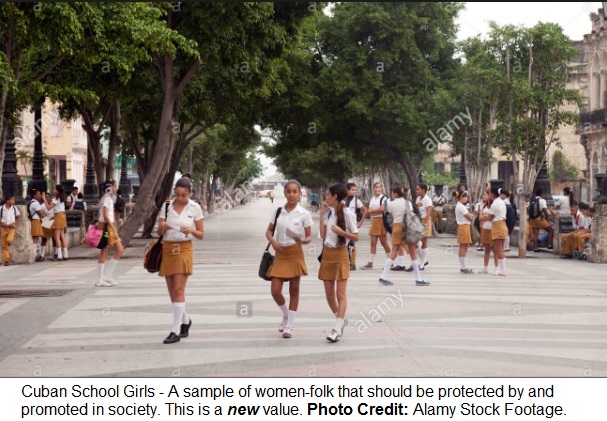
https://goleancaribbean.com/blog/?p=8155 Gender Inequality => ‘Brain Drain’
https://goleancaribbean.com/blog/?p=6937 Women in Politics – Yes, They Can!
https://goleancaribbean.com/blog/?p=6836 Role Model – #FatGirlsCan
https://goleancaribbean.com/blog/?p=6718 Lessons on Values from the US Civil War – A Series
https://goleancaribbean.com/blog/?p=6434 Strong Black Women – Weak Values on Hair
https://goleancaribbean.com/blog/?p=5901 Mitigating Elderly Suicide
https://goleancaribbean.com/blog/?p=5784 Proper View of LGBT Rights
https://goleancaribbean.com/blog/?p=5733 Better than America? Yes, We Can!
https://goleancaribbean.com/blog/?p=5720 Disability Advocacy: Reasonable Accommodations
https://goleancaribbean.com/blog/?p=5529 Mitigating American Crony-Capitalism Defects
https://goleancaribbean.com/blog/?p=5304 Mitigating the Eventual ‘Abuse of Power’
https://goleancaribbean.com/blog/?p=5287 Making the Right Decision Between Life -vs- Profit
https://goleancaribbean.com/blog/?p=7490 Mitigating Interpersonal Violence – A Series
https://goleancaribbean.com/blog/?p=3078 Mitigating Sexual Assaults; Protecting the Victims
https://goleancaribbean.com/blog/?p=2522 The Cost of Life-or-Death Cancer Drugs
https://goleancaribbean.com/blog/?p=1020 No Toleration of Racism in Sports
https://goleancaribbean.com/blog/?p=789 Why Take Our Own Lead? America’s War on the Caribbean

The Go Lean…Caribbean book is a 370-page publication that presents the solutions for all of the Caribbean region, all the 4 language groups (Dutch, English, French and Spanish) by describing 144 different missions to elevate the economic, security and governing engines of the region. This is a serious answer to a serious crisis.

cu-blog-vision-and-values-for-a-new-caribbean-photo-2This book is published by a community development foundation made up of mostly Caribbean Diaspora. These ones left their beloved homeland, but didn’t leave their love for the homeland. They long to return! But not to the same lands they left; but rather they want the Caribbean to reform and transform.

For this goal, they are willing to devote their time, talents and treasuries. But they need help; they cannot do it all themselves. They need the other stakeholders (residents, governments, tourists and trading partners) to wake up and join this movement, this quest to elevate the Caribbean to a better place to live, work and play.

Wake Up … all you people.

Sounds familiar?

This was a familiar cry in the 1975 song – embedded here; (see the lyrics in the Appendix below). This song promotes a new vision and new values for society. See the AUDIO-VIDEO here:

AUDIO-VIDEOWake Up Everybody – Original Version (Teddy Pendergrass, Harold Melvin & the Blue Notes) – https://youtu.be/-TDfPgd3Kyc

Uploaded on Sep 23, 2011 – The original full-length song recorded in 1975. It’s a classic.

The Caribbean Diaspora – living abroad in the US, Canada, the UK and Western Europe – were always taught that the Caribbean is the greatest address on the planet, and yet it was essential that they leave to forge their existence elsewhere. They left for “push and pull” reasons.

“Push and pull” is tied to vision and values.

Many of this Diaspora have endured, flourished and thrived in these foreign lands, but it is not home; they are still only alien residents.  They need, want and deserve their homeland, but as a better destination, as a “New” Caribbean.

The Go Lean book assert that this quest – to make the Caribbean a better place to live, work and play – is conceivable, believable and achievable; providing that we bring the new vision and new values.

Wake Up …. everybody!

🙂

Download the book Go Lean … Caribbean – now!

————-

Appendix – Lyrics: Wake Up Everybody” by Harold Melvin & the Blue Notes

Wake up everybody no more sleepin’ in bed
No more backward thinkin’ time for thinkin’ ahead
The world has changed so very much
From what it used to be
There is so much hatred war an’ poverty
Wake up all the teachers time to teach a new way
Maybe then they’ll listen to whatcha have to say
‘Cause they’re the ones who’s coming up and the world is in their hands
When you teach the children teach em the very best you can

The world won’t get no better if we just let it be
The world won’t get no better we gotta change it yeah, just you and me

Wake up all the doctors make the ol’ people well
They’re the ones who suffer an’ who catch all the hell
But they don’t have so very long before the Judgment Day
So won’t cha make them happy before they pass away
Wake up all the builders time to build a new land
I know we can do it if we all lend a hand
The only thing we have to do is put it in our mind
Surely things will work out they do it every time

The world won’t get no better if we just let it be
The world won’t get no better we gotta change it yeah, just you and me

Change it yeah, change it yeah, just you and me
Change it yeah, change it yeah
Can’t do it alone, need some help y’all
Can’t do it alone
Can’t do it alone yeah, yeah
Wake up everybody, wake up everybody
Need a little help y’all
Need a little help
Need some help y’all

Change the world
What it used to be
Can’t do it alone, need some help
Wake up everybody
Get up , get up, get up, get up
Wake up, come on, come on
Wake up everybody

Songwriters: Jonathan Howsman Davis, James Christian Shaffer, David Randall Silveria, Reginald Arvizu, Brian Welch
Source: Retrieved November 2, 2016 from: http://www.metrolyrics.com/wake-up-everybody-lyrics-harold-melvin-the-blue-notes.html


Share this post:
, , ,

Forging Change: Herd Mentality

Go Lean Commentary

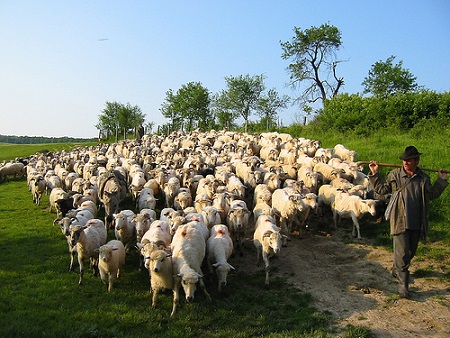
This is an accepted fact about communities, taken from the science of Anthropology and Sociology: in any grouping, there are only a few leaders but a large number of followers. This is the principle of the Alpha Male or Female; see Appendix. It turns out that this fact is a key strategy for forging change:

“Everyone knows that we are sheep. It takes only the strong to break out from the herd mentality” – Published YouTube comment on the below VIDEO.

cu-blog-forging-change-herd-mentality-photo-1

The movement behind the book Go Lean…Caribbean wants to forge change in the Caribbean. We have consider many different strategies, tactics and tools for forging change. Here’s another: skip the Alpha Male-Female and target the herd.

So is it that easy? We simply need to exploit the herd mentality and we can get hordes of people to conform, reform and transform. That is an exciting prospect, especially considering the positive value when leaders in a community want to pursue the Greater Good.

See as this is portrayed in this VIDEO here:

VIDEO – Social experiment – most people are sheep – https://youtu.be/MEhSk71gUCQ

Published on Aug 31, 2016 – Hidden camera…

This experiment is very thought-provoking. Sheep, goats and other animals follow a herd mentality. Apparently, humans too!

cu-blog-forging-change-herd-mentality-photo-3

The motives of the movement behind the book Go Lean…Caribbean is to forge change in the Caribbean. Plain and simple! The strategies, tactics and implementations from the book is designed to elevate the Caribbean for all stakeholders, to make the homeland a better place to live, work and play. This is conceivable, believable and achievable if we bypass the Alpha Males and target the rest of the herd. These ones can be led and influenced to adopt new community ethos. This is defined as:

“the fundamental character or spirit of a culture; the underlying sentiment that informs the beliefs, customs, or practices of a group or society”.

The Go Lean book asserts that with strenuous efforts, new community ethos can be adopted. The book cites samples, examples and Role Models:

  • Smoking Cessation – Page 20 – At one point in the 1960’s, 67 percent of American adults smoked cigarettes. Today, smokers are a fringed segment of society, almost as “outlaws”. The cessation efforts are identified as an approach to forge change for an individual, “starting in the head (thoughts, visions), penetrating the heart (feelings, motivations) and then finally manifesting in the hands (actions). Role Model – Alpha Male-Female: Surgeon General.
  • Civil Rights – Page 122 –  Even though the slaves were emancipated in America in 1865, the African-American population did not enjoy the freedom, justice and equality of full citizenship. The effort to bring Civil Rights to the Southern US succeeded only with millions of people protesting in a non-violent movement. Eventually the government leaders complied and made changes to laws guaranteeing equal protection. Role Model – Alpha Male: Martin Luther King.
  • Farm Migrant Labor – Page 122 – The Latino American farm workers’ struggle was presented as a moral cause with nationwide support by Labor and Civil Rights leaders. By the 1970’s, the strategies and tactics of this movement had forced agricultural businesses and growers to grant respect to migrant workers, which helped to improve conditions for 50,000 field workers in California & Florida. Role Model – Alpha Male: Cesar Chavez.
  • Drunk Driving – Page 122 – The values and attitudes of drunk-driving needed to change in America. Families endured heartache and pain because of the tragic loss of innocents due to negligence by inebriated drivers. Change was forged in this advocacy by challenging acceptance, laws and enforcement. Eventually the general attitudes – bars, passengers and drivers – changed for the good.  Role Model – Alpha Female: Candice Lightner, Mothers Against Drunk Driving or MADD.

The Go Lean book presents a plan to reboot economic engines (jobs, educational and entrepreneurial opportunities), optimize the security apparatus (anti-crime and public safety) and accountable governance (regional alliances) for all citizens … including many minority factions. The majority of the population must acquiesce and accept the new ethos in order to allow the societal empowerments to take hold.

Caribbean society have traditionally featured a parasite disposition – to their European colonial masters, or the American SuperPower, in effect an Alpha Male. As a region, we have been drawn to the “shadows”, gleaning opportunities from the leftovers from the host countries, think tourism-hospitality, off-shore banking, and the business of vices: cigar and rum production. The quest now  is a turn-around, to be a protégé, rather than just a parasite.

The Go Lean book serves as a roadmap for the introduction and implementation of the technocratic Caribbean Union Trade Federation (CU) to make the region a better place to live, work and play. This is a roadmap to forge a Single Market of the 30 member-states of 4 language groups and 42 million people. If the region is to “herd”, they should be led to this elevated destination.

The challenge and alternate strategies for forging change have been identified in a series; see these previous Go Lean blog-commentaries, published over the past 2 years:

  1.       Forging Change – The Fun Theory (September 9, 2014)
  2.       Forging Change – The Sales Process (December 22, 2014)
  3.       Forging Change – Music Moves People (December 30, 2014)
  4.       Forging Change – ‘Food’ for Thought (April 29, 2015)
  5.       Forging Change – ‘Something To Lose’ (November 18, 2015)
  6.       Forging Change – Herd Mentality (Today)

This commentary – Number 6 – is urging the herding the people of the Caribbean to a new protégé destination – that sounds unnerving. But there is nothing nefarious or malevolent about this Go Lean roadmap. As detailed in this previous blogs, the efforts to forge change in the region are not intended for any one person or organization to wrestle power or the elevation of any one leader. The roadmap features only one objective: the Greater Good. This is defined in the book (Page 37) by Jeremy Bentham (1748-1832), a British philosopher, jurist, and social reformer as …

… “the greatest good to the greatest number of people which is the measure of right and wrong”.

The Go Lean book and accompanying blogs all accept that forging this change in the Caribbean will be hard, heavy-lifting. There may not be just one strategy; we may have to employ all 6. This would be worth it in the end, with these sought-after prime directives:

  • Optimization of the economic engines, creating 2.2 million new jobs and growing the regional economy to $800 Billion GDP.
  • Establishment of a security apparatus to protect the resultant economic engines and ensure better public safety for stakeholders of the Caribbean.
  • Improvement of Caribbean governance – with a separation-of-powers between member-states and the CU federal agencies – to support these engines.

As depicted in the foregoing VIDEO, “most people are sheep”; they can be cajoled and persuaded to change, to improve their habits and practices. The act of cajoling and persuading implies messaging campaigns. With campaigns from the technocratic leadership of the CU, the Caribbean as a region can be reformed and transformed to becoming a new destination: a better place to live, work and play.

The Go Lean book presented the roadmap for reach the people, to herd them effectively and efficiently. The roadmap details the new community ethos to adopt, plus the execution of strategies, tactics, implementation and advocacies to forge change in the region. The following is a sample of these specific details from the book:

Community Ethos – Deferred Gratification Page 21
Community Ethos – Economic Principles – People Choose Page 21
Community Ethos – Economic Principles – People Respond to Incentives in Predictable Ways Page 21
Community Ethos – Economic Principles – Economic Systems Influence Individual Choices Page 21
Community Ethos – Economic Principles – The Consequences of Choices Lie in the Future Page 21
Community Ethos – Governing Principles – Minority Equalization Page 23
Community Ethos – Governing Principles – Lean Operations Page 24
Community Ethos – Governing Principles – Cooperatives Page 25
Community Ethos – Ways to Impact the Future Page 26
Community Ethos – Ways to Help Entrepreneurship Page 28
Community Ethos – Ways to Promote Intellectual Property Page 29
Community Ethos – Ways to Impact Research & Development – Social Experiments Page 30
Community Ethos – Ways to Bridge the Digital Divide Page 31
Community Ethos – Ways to Impact Turn-Arounds Page 33
Community Ethos – Ways to Improve Sharing Page 35
Community Ethos – Ways to Promote Happiness Page 36
Community Ethos – Ways to Impact the Greater Good Page 37
Strategy – Vision – Confederate 30 Member-States Page 45
Strategy – Mission – Celebrate the Music, Sports, Art, People and Culture of the Caribbean Page 46
Tactical – Confederating a Permanent Union Page 63
Tactical – Fostering a Technocracy Page 64
Implementation – Ways to Pay for Change Page 101
Implementation – Ways to Deliver Page 109
Planning – 10 Big Ideas for the Caribbean Region Page 127
Planning – Ways to Make the Caribbean Better Page 136
Planning – Reasons Why the CU Will Succeed Page 137
Advocacy – Ways to Grow the Economy Page 151
Advocacy – Ways to Create Jobs Page 152
Advocacy – Ways to Improve Communications – Community Messaging Page 186
Advocacy – Ways to Improve Libraries Page 187
Advocacy – Ways to Impact Hollywood – Mastery of Visual Arts & Storytelling Page 202
Advocacy – Ways to Preserve Caribbean Heritage Page 218
Advocacy – Ways to Impact Youth – Impressionable Age for New Work Ethic Page 227
Advocacy – Ways to Improve the Arts Page 230

The quest to change the Caribbean will require convincing people through messaging campaigns. We have seen the effectiveness of this strategy with movies; we have influential actor – of Caribbean heritage (Bahamas) – Sidney Poitier as a fitting Role Model:

Movies are an amazing business model. People give money to spend a couple of hours watching someone else’s creation and then leave the theater with nothing to show for the investment; except perhaps a different perspective. That is all!

But no one wants to live in a world without this art-form, without movies. Those few hours can entertain, engage and transform; sometimes even “break new ground” and change the world. So movies and movie stars can be extremely influential in modern society. This is the power of the arts, and this art-form in particular. – Blog: How Sidney Poitier changed cinema by demanding and deserving a difference

The empowerments in the Go Lean book calls for permanent change. This is possible. The people of the Caribbean only want opportunities; they want to be able to provide for their families, and offer a future of modernity to their children. It is an “easy sell” to convince people that the best-practices in the roadmap will bring benefits. Especially with reporting of the success of the same best practices in other locations. This point was pronounced in the opening Declaration of Interdependence (Page 14) in the book with this statement:

xxxiii. Whereas lessons can be learned and applied from the study of the recent history of other societies, the Federation must formalize statutes and organizational dimensions to avoid the pitfalls of communities like East Germany, Detroit, Indian (Native American) Reservations, Egypt and the previous West Indies Federation. On the other hand, the Federation must also implement the good examples learned from developments/communities like New York City, Germany, Japan, Canada, the old American West and tenants of the US Constitution.

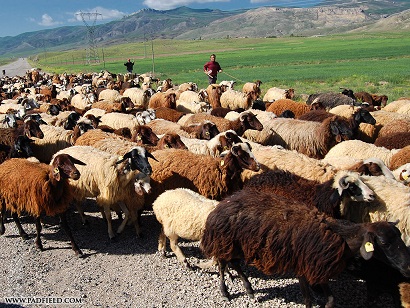
cu-blog-forging-change-herd-mentality-photo-2In general, being called sheep is not “derisive”. It is a complement when the comparison is made to goats – (The Bible; Matthew 25: 31–46). While this is a reference to a grouping of benevolence versus malevolence, for this commentary, there is similarity in sheep and goats as they both display a herd mentality; they follow the lead and assimilate the habits, practices and ethos of the Alpha Male-Female.

The CU/Go Lean seeks to assume the role of the Alpha Male-Female. We encourage all Caribbean stakeholders – residents, institutions and governments – to lean-in now, to the Go Lean roadmap. 🙂

Download the book Go Lean … Caribbean – now!

————-

Appendix – Alpha Males-Females

In studies of social animals, the highest ranking individual is sometimes designated as the alpha. Males, females, or both, can be alphas, depending on the species. Where one male and one female fulfill this role together, they are sometimes referred to as the alpha pair. Other animals in the same social group may exhibit deference or other species-specific subordinate behaviours towards the alpha or alphas.

Alpha animals usually gain preferential access to food and other desirable items or activities, though the extent of this varies widely between species. Male or female alphas may gain preferential access to sex or mates; in some species, only alphas or an alpha pair reproduce.

Alphas may achieve their status by superior physical strength and aggression, or through social efforts and building alliances within the group.[1]

Source: https://en.wikipedia.org/wiki/Alpha_(ethology) retrieved October 10, 2016.

Share this post:
, ,
[Top]

Courting Caribbean Votes – Puerto Ricans

Go Lean Commentary

Dateline: Miami, Florida – Voting is a hallmark of democracy!

CU Blog - Lessons from Regional Elections - Photo 2Every Caribbean member-state is a democracy; (Even Cuba, but with only the one Communist Party).

So any quest to elevate the Caribbean’s societal engines – economics, security and governance – must consider the strategies of voting, and courting votes.

Right now, it is election season in the United States. There are many members of the Caribbean Diaspora living in the US – some figures project up to 22 million; many of them are eligible to vote on November 8, 2016.

  • Who will they vote for? Who should they vote for?
  • What if the criterion for the vote is benevolence to Caribbean causes?

This commentary is 1 of 3 of a series from the movement behind the book Go Lean … Caribbean, in consideration of Courting the Caribbean Votes for the American federal elections – President (Donald Trump -vs- Hillary Clinton), Vice-President and Congress (Senate & US House of Representatives). This and the other commentaries detail different ethnic communities within the Caribbean Diaspora and their voting trends; the series is as follows:

  1.       Courting the Caribbean Votes – Puerto Ricans
  2.       Courting the Caribbean Votes – ‘Jamericans’
  3.       Courting the Caribbean Votes – Cuban-Americans

All of these commentaries relate to governance, the election of the leaders of the American federal government. The Go Lean movement (book and blog-commentaries) asserts that Caribbean stakeholders need to take their own lead for their Caribbean destiny, but it does acknowledge that we have a dependency to the economic, security and governing eco-systems of the American SuperPower. This dependency is derisively called a parasite status, with the US as the host.

CU Blog - Puerto Rico Bondholders Coalition Launches Ad Campaign - Photo 1This accurately describes Puerto Rico.

Not only is the island of Puerto Rico a parasite of the US, but a near-Failed-State as well. While this has been a consistent theme of the Go Lean movement, it is no secret. Washington and Puerto Rico readily admit to this disposition. In fact this failing condition has driven many Puerto Ricans out of Puerto Rico. This has been within that consistent Go Lean theme, that “push-and-pull” factors drive Caribbean citizens away from their beloved homeland. Greater Orlando has become a new destination.

They are gone from Puerto Rico, but have not forgotten home. This year they are looking to impact their homeland with their vote. They seek to support candidates for federal offices that can help to reform and transform the island. See the  AUDIO Podcast here and related news article:

AUDIO – Puerto Ricans Could Sway Florida for Trump or Clinton – http://www.marketplace.org/2016/09/29/world/puerto-ricans-could-sway-florida-trump-or-clinton/

———————–

News Article Title: Puerto Ricans, in Florida, could be a political catch
By: Andy Uhler

There’s a new, growing population of American citizens in Florida who might be able to vote for president for the first time – Puerto Ricans. And a lot of those leaving the island’s broken economy end up in Central Florida. Thousands of Puerto Ricans have settled over the past couple of decades in a town south of Orlando, near Disney World, called Kissimmee.

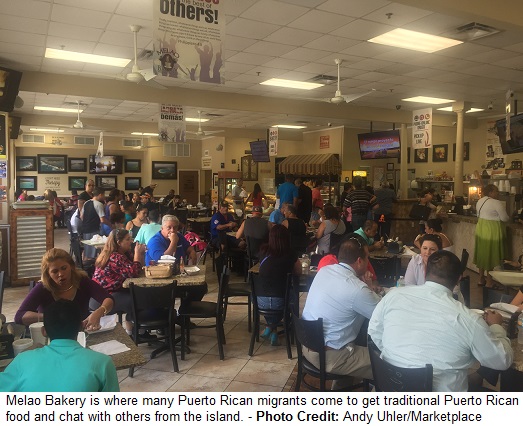
One of the main Puerto Rican hubs in the town is Melao Bakery. Wilfredo Ramirez stood outside most of the day asking people in Spanish if they’re registered to vote. It’s not normally the first thing a new acquaintance asks, but Wilfredo’s on a mission. He moved here from Puerto Rico a few months ago and has a job registering people. He said the electoral system on the mainland is tough for some new arrivals to figure out.

cu-blog-courting-caribbean-votes-puerto-ricans-photo-1

“It’s a bit confusing. Puerto Ricans are considered U.S. citizens, but it’s not the same as being born in the U.S.” mainland,  he said. “And that is the ultimate motive, for Puerto Ricans to register and give their vote.”

Puerto Ricans are U.S. citizens, but because of its territory status, those on the island can’t vote for president. Puerto Rico holds a presidential primary, but that’s where it ends. If they come to Florida and establish residency, though, Puerto Ricans can vote in November.

Wilfredo had been at the bakery for a couple of hours and had talked to more than 150 people. His contract will have him in Central Florida through November. The group he’s with, Hispanic Federation, isn’t affiliated with any party but has been vocal about Donald Trump’s immigration statements – calling them “misleading, demeaning and unfounded.”

But unlike in Florida, the island’s dominant parties aren’t Democrats and Republicans, and the main issue is whether Puerto Rico should stay a territory, become a state, or assert independence.

Carlos Vargas-Ramos is a researcher at the Center for Puerto Rican Studies at HunterCollege. He said the Puerto Rican migration to Florida wouldn’t affect the election if groups weren’t out there explaining what’s happening.

“In general, were it anywhere else, where there’s not a mobilization effort, those Puerto Ricans would be less likely to turn out to vote,” he said. “But because, precisely, they’re going to be targets, they will be in play.”

The presidential campaigns know that. Florida is a battleground state, and apart from spending on TV, the Clinton campaign has been focused on trying to get people registered to vote. What they’re finding is that recent migrants aren’t necessarily as Democratic as once assumed.

Mark Oxner, Republican chairman in OsceolaCounty, where 60 percent of the Hispanic population identify as Puerto Rican, said he’s pleasantly surprised that they’re seeing the same thing

“The big thing is, they’re not coming all Democrats, most of them come over and sign as no party affiliation,” he said. “So they’re not, specifically tied to the Democratic party.”

That could make it a little more difficult for Democrats and Republicans to directly identify supporters. Which means it’ll probably be more expensive to get those independent voters to pick a side.

But in this part of Central Florida the community’s biggest concerns are extremely local. Newly arrived Puerto Ricans need teachers in the schools who can help their children transition to living on the mainland. That means, teachers who are bilingual.

Pablo Caceres, director of the Puerto Rican Federal Affairs Administration, a Puerto Rican governmental arm with an office in Kissimmee, said that’s what he hears all the time.

“The issues that are most important for us, the Puerto Rican community, that we need to obviously start talking about is having good quality education for our kids,” he said. “And there are also other big issues like immigration.”

At the same time, a lot of Puerto Ricans left the island and came to Florida because things were so bad. Unemployment is twice that of the mainland, almost half the population is living under the poverty line, hospitals have to limit hours because they can’t pay for electricity and schools are closing because teachers aren’t getting paid.

Now some migrants feel like they might have an impact on what Washington does about their home’s crippling debt crisis.

Jose Rivera moved here from the island in 1994. He’s an engineer in favor of independence.

“It’s about time we own our own destiny,” he said. “We are the 32-year-old guy that still lives with mom and dad and we’re expecting mom and dad to fix all our broken plates.”

Independence would come with a complete financial break from the federal government and a complete rethinking of the economy of the island.
Source: http://www.marketplace.org/2016/09/29/world/puerto-ricans-could-sway-florida-trump-or-clinton Posted September 30, 2016; retrieved October 4, 2016

The experience in the US is that the politicians do not always represent the majority of the people, but rather the majority of the passionate ones in their constituency – those who turn out to vote. According to the foregoing story, it is obvious that passion for the Caribbean homeland is resulting in passion for the voting booth. Therefore, there is a jockeying to win these votes for the different parties this election year. The Puerto Rican numbers are so impactful that they can swing the vote in this swing state of Florida. (Legally, Puerto Ricans need only establish legal residence for 6 months in a US state – Florida in this case – and then they can vote).

The Go Lean book serves as a roadmap for the introduction and implementation of the technocratic Caribbean Union Trade Federation (CU). It advocates optimizing the societal engines of economics, security and governance in the Caribbean, not in Florida or any other jurisdiction in the US. But it is what it is. The Diaspora is here-now. We must succeed in this Caribbean reboot to dissuade further migration and hopefully to facilitate a subsequent repatriation.

We must do better than our past. We must be an American protégé, rather than just an American parasite. This is the quest of the Go Lean/CU roadmap, to elevate the Caribbean’s economic-security-governing engines. The roadmap recognizes that the changes the region needs must start first with convening, collaborating, confederating the regional neighborhood into a Single Market, no matter the ethnicity, language or colonial legacy of the member-states. This need was pronounced early in the book, in the opening Declaration of Interdependence (Pages 12 & 13) with these statements:

xi.  Whereas all men are entitled to the benefits of good governance in a free society, “new guards” must be enacted to dissuade the emergence of incompetence, corruption, nepotism and cronyism at the peril of the people’s best interest. The Federation must guarantee the executions of a social contract between government and the governed.

xii. Whereas the legacy in recent times in individual states may be that of ineffectual governance with no redress to higher authority, the accedence of this Federation will ensure accountability and escalation … for good governance, justice assurances, due process and the rule of law. As such, any threats of a “failed state” status for any member state must enact emergency measures on behalf of the Federation to protect the human, civil and property rights of the citizens, residents, allies, trading partners, and visitors of the affected member state and the Federation as a whole.

xxiii. Whereas many countries in our region are dependent OverseasTerritory of imperial powers, the systems of governance can be instituted on a regional and local basis, rather than requiring oversight or accountability from distant masters far removed from their subjects of administration. The Federation must facilitate success in autonomous rule by sharing tools, systems and teamwork within the geographical region.

The Go Lean book, and previous blog/commentaries, stressed the key community ethos, strategies, tactics, implementation and advocacies necessary to effect change in the region, to improve the oversight of the governing process. They are detailed as follows:

Community Ethos – Economic Principles – Economic Systems Influence Individual Choices Page 21
Community Ethos – Governing Principles – Minority Equalization Page 24
Community Ethos – Governing Principles – Lean Operations Page 24
Community Ethos – Security Principles – Cooperatives Page 25
Community Ethos – Ways to Impact the Future – Give the Youth a Voice & Vote Page 26
Community Ethos – Ways to Impact Turn-around Page 33
Community Ethos – Ways to Improve Sharing Page 35
Community Ethos – Ways to Impact the Greater Good Page 37
Strategy – Vision – Confederate all 30 Member-states into a Single Market Page 45
Strategy – CU Stakeholders to Protect – Diaspora Page 47
Tactical – Separation-of-Powers – CU Federal -vs- Member-state governments Page 71
Anecdote – Turning Around CARICOM – Regional oversight Page 92
Implementation – Assemble Caribbean Election Oversight as Cooperative Page 96
Implementation – Assemble Constitutional Convention – Start of federal elections Page 97
Implementation – Ways to Impact Elections Page 116
Implementation – Reasons to Repatriate to the Caribbean Page 118
Planning – 10 Big Ideas – Confederate a Single Market of 4 language groups Page 127
Planning – Ways to Improve Failed-State Indices – Election Outsourcing Page 134
Planning – Lessons Learned from US Constitution – Progress over generations Page 145
Advocacy – Ways to Grow the Economy Page 151
Advocacy – Ways to Preserve Caribbean Heritage Page 218
Advocacy – Ways to Impact US Territories Page 244
Appendix – Interstate Compacts for Puerto Rico & US Virgin Islands Page 278
Appendix – Nuyorican Movement Page 303
Appendix – Puerto Rican Population in the US (2010 Census) Page 304

The points of effective, technocratic oversight and stewardship for Puerto Rico were further elaborated upon in these previous blog/commentaries:

https://goleancaribbean.com/blog/?p=7963 ‘Like a Good Neighbor’ – Being there for Puerto Rico
https://goleancaribbean.com/blog/?p=6693 Ten Puerto Rico Police Accused of Criminal Network
https://goleancaribbean.com/blog/?p=6260 Puerto Rico Bondholders Coalition Launches Ad Campaign
https://goleancaribbean.com/blog/?p=4551 US Territories – Between a ‘rock and a hard place’
https://goleancaribbean.com/blog/?p=4185 Caribbean Ghost Towns: It Could Happen … in Puerto Rico
https://goleancaribbean.com/blog/?p=1325 Puerto Rico Governor Signs Bill on SME’s
https://goleancaribbean.com/blog/?p=599 Ailing Puerto Rico open to radical economic fixes

We want to make Puerto Rico and other places in our Caribbean homeland, better places to live, work and play. So we must engage the political process in Washington, DC as they are a major stakeholder for Puerto Rico. The island is bankrupt, it depends on federal bailouts just to execute even the basic functions in the Social Contract. Personally, many residents on the island depend on federal subsidies to survive: benefits like veterans, social security (disability & pension) and welfare. Many Puerto Ricans have understandably abandoned the island – this is both “push” and “pull”.

The Go Lean movement advocates being a protégé of America, not just a parasite. This is a turn-around from the status quo. We must now seek out solutions that encourage participation of Puerto Ricans in the nation-building process, as a territory, a new US State or an independent nation; (as alluded to in the foregoing story). If we want to stop the abandonment – a quest of the Go Lean roadmap – then we have no other choice; we must present the opportunities for citizens to prosper where planted in the Caribbean.

The choice for president should consider these needs.

We need Washington’s help. But the only way to impact Washington is through voting. This is why the Puerto Rican vote – for those in the Diaspora – is being courted. Which presidential candidate best extols the vision and values for a new Caribbean?

Hillary Clinton or Donald Trump.

This is the question being considered. These two camps are the ones courting Puerto Ricans in the Diaspora.

The purpose of the Go Lean roadmap is to provide the turn-by-turn directions to accomplish the needed turn-round. The Go Lean roadmap does not seek to change America; our only focus is to change the Caribbean, to make it better to live, work and play. 🙂

Download the book Go Lean … Caribbean – now!

Share this post:
, , , ,
[Top]

Hurricane Categories – The Science

Go Lean Commentary

Category 5

… that term has become one of the most dreaded phases in modern times in the Western Hemisphere, and especially in the Caribbean.

A Category 5 Hurricane – with its maximum sustained winds in excess of 156 miles per hour – is the Sum of All of Our Fears and a Clear & Present Danger. (See the full list of their historicity in the Appendix below). The most powerful one on record featured 215 mph winds – Hurricane Patricia – was just recently in October 2015 off the coast of Mexico.

Hurricanes – tropical cyclones in the Atlantic Ocean and Eastern Pacific Ocean – are the exclusive brand for the Northern Hemisphere. Considering the rotation of the earth, the majority travel East to West, from Africa over to North America. That’s the majority; but the minority is nothing to ignore either.  These can start in the Caribbean Sea or the Gulf of Mexico and travel at will: north, south, east, or west.

Welcome to our Caribbean, the greatest address on the planet!

Hurricanes are our reality. A hurricane is a meteorological phenomena that cannot be ignored; its science is a marvel.

Hurricanes are scientifically measured by the Saffir–Simpson scale. This scale was developed in 1971 by civil engineer Herbert Saffir and meteorologist Robert Simpson, who at the time was director of the U.S. National Hurricane Center (NHC).[1] The scale was introduced to the general public in 1973,[2] and saw widespread use after a new Director Neil Frank replaced Mr. Simpson in 1974 at the helm of the NHC, as a tribute to Mr. Simpson.[3]

See full details on this hurricane scale here:

Title: Saffir–Simpson Scale
The Saffir–Simpson hurricane wind scale, formerly the Saffir–Simpson hurricane scale (SSHS), classifies hurricanes –Western Hemisphere tropical cyclones that exceed the intensities of tropical depressions, and tropical storms – into five categories distinguished by the intensities of their sustained winds. To be classified as a hurricane,  a tropical cyclone must have maximum sustained winds of:

  • 74–95 mph –  Category 1.

cu-blog-hurricane-categories-the-science-photo-1

  • 96–110 mph – Category 2.

cu-blog-hurricane-categories-the-science-photo-2

  • 111–129 mph – Category 3.

cu-blog-hurricane-categories-the-science-photo-3

  • 130–156 mph – Category 4.

cu-blog-hurricane-categories-the-science-photo-4

  • ≥ 157 mph – Category 5.

cu-blog-hurricane-categories-the-science-photo-5
So the highest classification in the scale, Category 5, is reserved for storms with winds exceeding 156 mph (70 m/s; 136 kn; 251 km/h). [There have been a number of these since 1924. See full list in the Appendix below].

The classifications can provide some indication of the potential damage and flooding a hurricane will cause upon landfall.

Officially, the Saffir–Simpson hurricane wind scale is used only to describe hurricanes forming in the Atlantic Ocean and northern Pacific Ocean east of the International Date Line. Other areas use different scales to label these storms, which are called “cyclones” or “typhoons“, depending on the area.

There is some criticism of the SSHS for not taking rain, storm surge, and other important factors into consideration, but SSHS defenders say that part of the goal of SSHS is to be straightforward and simple to understand.
Source: Wikipedia Online Reference – Retrieved October 7, 2016 from: https://en.wikipedia.org/wiki/Saffir%E2%80%93Simpson_scale

We are thankful to these two pioneering scientists, Mr. Saffir and Mr. Simpson; they lived full and impactful lives – R.I.P..

Mr. Simpson died on December 18, 2014 at age 102.

Mr. Saffir died on November 21, 2007 at age 90.

These scientists have given us the numbers 1 through 5 to indicate an extent of our misery. But misery is more than just a number. Misery is an experience; an unpleasant one. See here the VIDEO visually depicting damage along the Saffir-Simpson scale:

VIDEO – Why Hurricane Categories Make a Difference – https://youtu.be/lqfExHpvLRY

Published on Aug 8, 2013 – During a hurricane you usually hear meteorologists refer to its intensity by categories. If you don’t know the difference between a category 1 and a category 5 hurricane, The Weather Channel meteorologist Mark Elliot breaks it down for you.

Hurricanes are reminders that “Crap Happens“. They affect the everyday life for everyday people. This discussion is presented in conjunction with the book Go Lean … Caribbean. It addresses the challenges facing life in the Caribbean and then presents strategies, tactics and implementations for optimizing the regional community.

Hurricanes are a product of ‘Mother Nature’ – natural disasters – but communities can be more efficient and effective in mitigating the risks associated with these natural disasters (hurricanes, earthquakes, volcanoes, floods, forest fires, etc.). In addition, there are bacterial & viral pandemics. Lastly, there are industrial incidents (chemical & oil spills) and other man-made disasters: i.e. terrorism-related events.

The Go Lean book asserts that bad things (and bad actors), like hurricanes, will always emerge to disrupt the peace and harmony in communities. Crap Happens … therefore all Caribbean member-states need to be “on guard” and prepared for this possibility. The Go Lean book (Page 23) prepares the Caribbean for many modes of “bad things/actors” with proactive and reactive mitigations. This point is pronounced early in the book with the opening Declaration of Interdependence (Page 12) that claims:

i. Whereas the earth’s climate has undeniably changed resulting in more severe tropical weather storms, it is necessary to prepare to insure the safety and security of life, property and systems of commerce in our geographical region. As nature recognizes no borders in the target of its destruction, we also must set aside border considerations in the preparation and response to these weather challenges.

ii. Whereas the natural formation of the landmass for our lands constitutes some extreme seismic activity, it is our responsibility and ours alone to provide, protect and promote our society to coexist, prepare and recover from the realities of nature’s occurrences.

x. Whereas we are surrounded and allied to nations of larger proportions in land mass, populations, and treasuries, elements in their societies may have ill-intent in their pursuits, at the expense of the safety and security of our citizens. We must therefore appoint “new guards” to ensure our public safety and threats against our society, both domestic and foreign. The Federation must employ the latest advances and best practices … to assuage continuous threats against public safety.

xii. Whereas the legacy in recent times in individual states may be that of ineffectual governance with no redress to higher authority, the accedence of this Federation will ensure accountability and escalation of the human and civil rights of the people for good governance, justice assurances, due process and the rule of law. As such, any threats of a “failed state” status for any member state must enact emergency measures on behalf of the Federation to protect the human, civil and property rights of the citizens, residents, allies, trading partners, and visitors of the affected member state and the Federation as a whole.

xvi. Whereas security of our homeland is inextricably linked to prosperity of the homeland, the economic and security interest of the region needs to be aligned under the same governance. Since economic crimes, including piracy and other forms of terrorism, can imperil the functioning of the wheels of commerce for all the citizenry, the accedence of this Federation must equip the security apparatus with the tools and techniques for predictive and proactive interdictions.

So the Go Lean book relates that the Caribbean must appoint “new guards”, or a security apparatus, to ensure public safety and to include many strategies, tactics and implementations considered “best-practices” for Emergency Management (Preparation and Response). We must be on a constant vigil against these “bad actors”, man-made or natural. The Go Lean book serves as a roadmap for the introduction and implementation of the technocratic Caribbean Union Trade Federation (CU).

The Go Lean/CU roadmap has a focus of optimizing Caribbean society through economic empowerment, and homeland security. Emergency preparedness and response is paramount for this quest. In fact, the Go Lean roadmap has the following 3 prime directives:

  • Optimization of the economic engines in order to grow the regional economy to $800 Billion & create 2.2 million new jobs.
  • Establishment of a security apparatus – a new guard – to protect the resultant economic engines and the Caribbean homeland.
  • Improvement of Caribbean governance to support these engines.

The CU would serve as the “new guard“, a promoter and facilitator of all the Emergency Management agencies in the region. The strategy is to provide a Unified Command and Control for emergency operations to share, leverage and collaborate the “art and science” of this practice across the whole region.

The regional vision is that all Caribbean member-states empower a CU Homeland Security force to execute a limited scope on their sovereign territories. The legal basis for this empowerment is a Status of Forces Agreement (SOFA), embedded in the CU treaty from Step One/Day One. The CU Trade Federation would lead, fund and facilitate the Emergency Management functionality under the oversight of a regionally elected Commander-in-Chief for the CU.

As cited above, the Caribbean is the “greatest address on the planet”, but there is risk associated with living deep in a tropical zone. With the reality of Climate Change, we must not be caught unprepared.

In our immediate past, the Caribbean region has failed at the need for readiness and response. We have even failed to properly coordinate the “cry for help” and the collection of international-charitable support. We have suffered dire consequences as a result: loss of life, damage to property, disruption to economic systems, corruption … and abandonment. Many of our citizens have fled their Caribbean homeland, as a result, after each natural disaster. We have even created Ghost Towns.

We want something better, something more. We want our people to prosper where they are planted in the Caribbean. So as a community, we must provide assurances. No assurance that there will be no hurricanes, but rather the assurance that we can respond, recover, repair and rebuild:

“Yes, we can … “.

The Go Lean book details the series of community ethos, strategies, tactics, implementations and advocacies to provide the proactive and reactive public safety/security in the Caribbean region:

Community Ethos – Economic Systems Influence Individual Choices Page 21
Community Ethos – Consequences of Choices Lie in Future Page 21
Community Ethos – “Crap” Happens Page 23
Community Ethos – Cooperatives Page 25
Community Ethos – Ways to Impact the Future Page 26
Community Ethos – Ways to Improve Sharing Page 35
Community Ethos – Ways to Promote Happiness Page 36
Community Ethos – Ways to Impact the Greater Good Page 37
Strategy – Vision – Confederating a non-sovereign permanent union Page 45
Strategy – Agents of Change – Climate Change Page 57
Tactical – Fostering a Technocracy Page 64
Tactical – How to Grow the Economy – Recover from Disasters Page 70
Tactical – Separation of Powers – Homeland Security Department Page 75
Tactical – Separation of Powers – Emergency Management Agency Page 76
Tactical – Separation of Powers – Meteorological and Geological Service Page 79
Implementation – Ways to Pay for Change Page 101
Implementation – Start-up Homeland Security Initiatives Page 103
Implementation – Ways to Re-boot Freeport Page 112
Implementation – Ways to Foster International Aid Page 115
Planning – 10 Big Ideas – #3: Consolidated Homeland Security Pact Page 130
Planning – Ways to Make the Caribbean Better Page 131
Planning – Ways to Improve Failed-State Indices – Escalation Role Page 134
Advocacy – Ways to Grow the Economy – Quick Disaster Recovery Page 151
Advocacy – Ways to Improve Governance Page 168
Advocacy – Ways to Better Manage the Social Contract Page 170
Advocacy – Ways to Improve Homeland Security Page 180
Advocacy – Ways to Improve Intelligence Gathering & Analysis Page 182
Advocacy – Ways to Improve for Natural Disasters Page 184
Advocacy – Ways to Improve for Emergency Management Page 196
Advocacy – Ways to Impact Wall Street – Adopt Advanced Recovery Products Page 200

Other subjects related to Emergency Management, Homeland Security and governing empowerments for the region have been blogged in other Go Lean…Caribbean commentaries, as sampled here:

https://goleancaribbean.com/blog/?p=9070 Securing the Homeland – From the Seas
https://goleancaribbean.com/blog/?p=9038 Doing Better with Charity Management
https://goleancaribbean.com/blog/?p=7896 The Logistics of Disaster Relief
https://goleancaribbean.com/blog/?p=7449 The Art and Science of Emergency Management
https://goleancaribbean.com/blog/?p=7327 Zika – An Epidemiology Crisis – A 4-Letter Word
https://goleancaribbean.com/blog/?p=7235 Flint, Michigan – A Cautionary Tale
https://goleancaribbean.com/blog/?p=6893 A Meteorologist’s View On Climate Change
https://goleancaribbean.com/blog/?p=6563 Lessons from Iceland – Model of Recovery
https://goleancaribbean.com/blog/?p=6189 A Lesson in History – Hurricane ‘Katrina’ is helping today’s crises
https://goleancaribbean.com/blog/?p=4741 Vanuatu and Tuvalu Cyclone – Inadequate response to human suffering
https://goleancaribbean.com/blog/?p=2614 The ‘Great ShakeOut’ Earthquake Drill / Planning / Preparations
https://goleancaribbean.com/blog/?p=2397 Stopping a Clear and Present Danger: Ebola
https://goleancaribbean.com/blog/?p=1817 Caribbean grapples with intense new cycles of flooding & drought

The Caribbean is on the frontline of this battle: man versus Climate Change. While we are not the only ones, we have to be accountable and responsible for our own people and property. The book Go Lean…Caribbean posits that this “Agent of Change” is too big for just any one member-state to tackle alone, that there must be a regional solution; and presents this roadmap.

Climate Change has produced winners (consider northern cities with milder than normal winters) and losers. The Caribbean has found itself on the losing side. This means life-and-death for the people and the economic engines of the Caribbean communities.

While hurricanes are our reality, there is a science to these meteorological phenomena, and an art to our response. We can plan, monitor, alert, prepare and recover. We can do it better than in the recent past. We can provide assurances that “no stone” will be unturned in protecting people, property and systems of commerce. The watching world – our trading partners – needs this assurance!

The people and institutions of the region are therefore urged to lean-in to this Go Lean roadmap to make the Caribbean a better, safer, place to live, work and play. This plan is conceivable, believable and achievable. Yes, we can. 🙂

Download the book Go Lean … Caribbean – now!

————–

Appendix – List of Category 5 Atlantic Hurricanes

Storm
name

Season

Dates as a
Category 5

Time as a
Category 5 (hours)

Peak one-minute
sustained winds

Pressure

mph

km/h

hPa

inHg

Matthew 2016 September 30 – October 1 6 160 260

934

27.58

Felix 2007 September 3–4† 24 175 280

929

27.43

Dean 2007 August 18–21† 24 175 280

905

26.72

Wilma 2005 October 19 18 185 295

882

26.05

Rita 2005 September 21–22 24 180 285

895

26.43

Katrina 2005 August 28–29 18 175 280

902

26.64

Emily 2005 July 16 6 160 260

929

27.43

Ivan 2004 September 9–14† 60 165 270

910

26.87

Isabel 2003 September 11–14† 42 165 270

915

27.02

Mitch 1998 October 26–28 42 180 285

905

26.72

Andrew 1992 August 23–24† 16 175 280

922

27.23

Hugo 1989 September 15 6 160 260

918

27.11

Gilbert 1988 September 13–14 24 185 295

888

26.22

Allen 1980 August 5–9† 72 190 305

899

26.55

David 1979 August 30–31 42 175 280

924

27.29

Anita 1977 September 2 12 175 280

926

27.34

Edith 1971 September 9 6 160 260

943

27.85

Camille 1969 August 16–18† 30 175 280

900

26.58

Beulah 1967 September 20 18 160 260

923

27.26

Hattie 1961 October 30–31 18 160 260

920

27.17

Carla 1961 September 11 18 175 280

931

27.49

Janet 1955 September 27–28 18 175 280

914

27.0

Carol 1953 September 3 12 160 260

929

27.43

“New England” 1938 September 19–20 18 160 260

940

27.76

“Labor Day” 1935 September 3 18 185 295

892

26.34

“Tampico” 1933 September 21 12 160 260

929

27.43

“Cuba–Brownsville” 1933 August 30 12 160 260

930

27.46

“Cuba” 1932 November 5–8 78 175 280

915

27.02

“Bahamas” 1932 September 5–6 24 160 260

921

27.20

San Felipe II-“Okeechobee” 1928 September 13–14 12 160 260

929

27.43

“Cuba” 1924 October 19 12 165 270

910

26.87

Reference=[1] †= Attained Category 5 status more than once

Source: Retrieved October 7, 2016 from https://en.wikipedia.org/wiki/List_of_Category_5_Atlantic_hurricanes

Share this post:
, , , ,
[Top]

‘Time to Go’ – Logic of Senior Emigration

Go Lean Commentary

“Twenty million American Negroes unpacked.” – Comedian and Activist Dick Gregory, on November 27, 1963 when President Lyndon Johnson announced at a Joint-Session of Congress that he would continue with the recently assassinated John Kennedy’s Civil Rights agenda.

This was 1963, 100 years after President’s Abraham Lincoln’s Emancipation Proclamation, and the subsequent Civil War. Finally after 350 years of the African Slave Trade, African-American people could start to think of America as “home”. Wow, they could unpack. There was no need to consider any other destination.

It didn’t end there!

This was also the start of other African-ethnic people – in Africa and in the Americas – to start the thinking that America may be OK to emigrate to. They started to pack, while African-Americans unpacked.

One step forward for American civilization, but two steps backwards for Caribbean society.

Our brain-drain and societal abandonment to the US began there-then, and continued unabated down to this day.

Where we are now is a shame-and-a-disgrace – 70 percent of out tertiary-educated – gone! Now we have the report of a 104-year old woman who just naturalized to become a US citizen. Just as much as this is a good story for her and America, this is an indictment for us – the Caribbean – and our failures as individual states.

See the news story here:

Title: Woman at 104 proves it’s never too late to become an American citizen
By: David J. Neal

cu-blog-time-to-go-logic-of-senior-emigration-photo-1
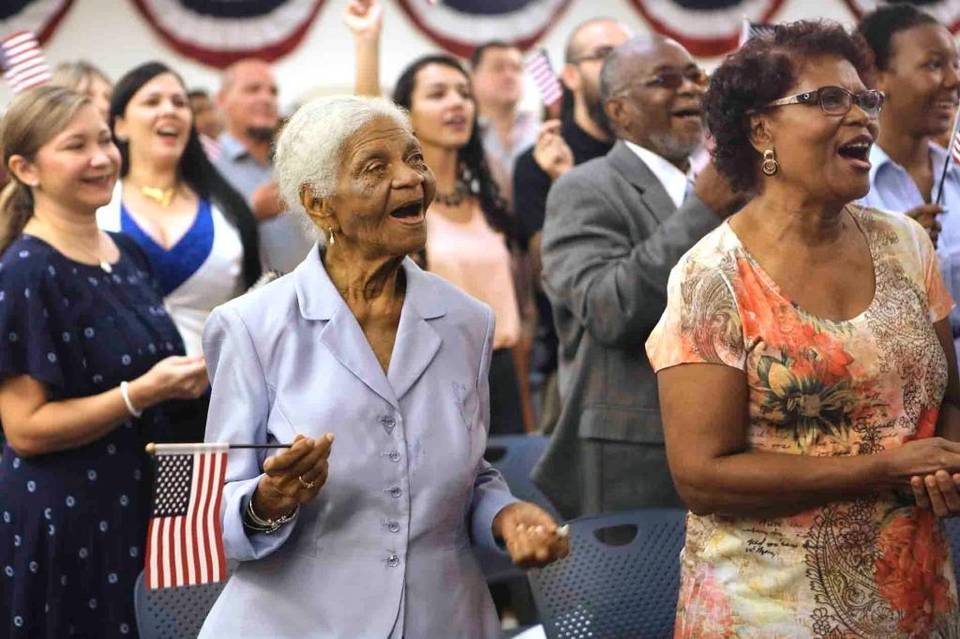
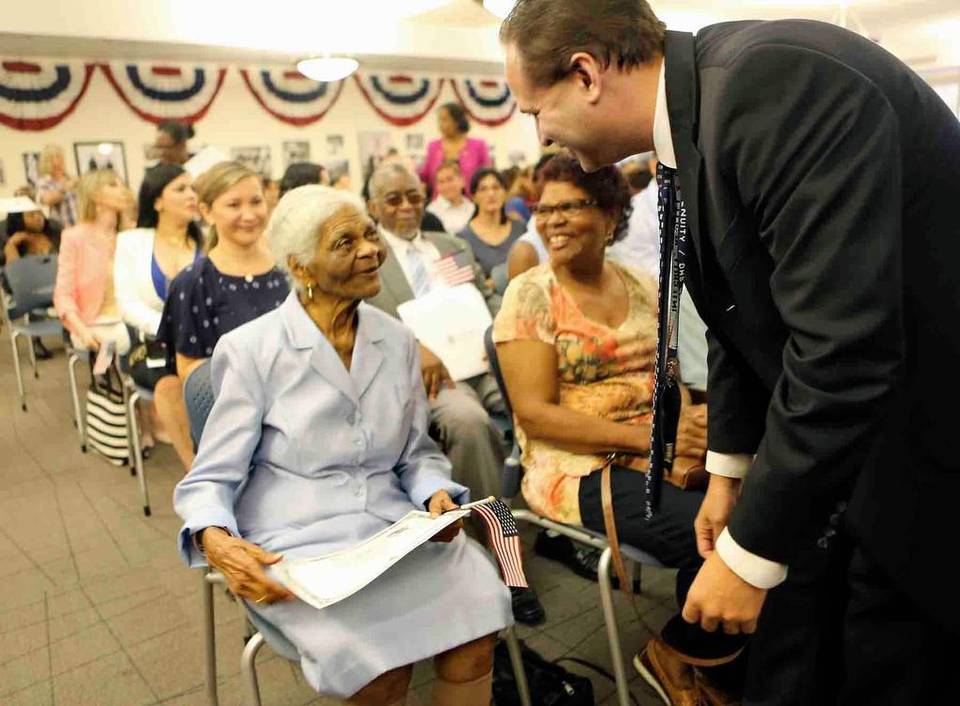
May Garcia, 104, center, sings “America the Beautiful” after she took the Oath of Allegiance and was sworn in as a U.S. citizen on Friday, Aug. 26, 2016. Garcia attended the ceremony with her daughter, Faye Rochester, right, and son-in-law Denis Rochester. Garcia lives with them in Lauderhill. She passed her citizenship exam early Friday, then was sworn in as a United States citizen at the USCIS Oakland Park Field Office in Oakland Park. Garcia was born on July 15, 1912 in Kingston, Jamaica. She moved to the U.S. in 1993 to be closer to her family and take care of her grandchildren. Garcia has four children, 12 grandchildren, 18 great-grandchildren and eight great-great-grandchildren.
Photo Credit: Marsha Halper.

Jamaica-born May Garcia decided to become a U.S. citizen after 23 years in this country and 104 years on this Earth for the most bedrock element of democracy.

“She had been watching the election coverage and said, ‘I’d love to vote,’ ” Garcia’s daughter Fay Rochester said.

So Garcia, born in Kingston in 1912, 50 years before Jamaica’s independence from Great Britain, started the naturalization process. That path ended Friday for Garcia and more than 100 others from 36 nations who took their oath of citizenship at a naturalization ceremony at the U.S. Citizenship and Immigration Services building in west Broward.

Afterward, she waved her arm back and forth in celebration as Pharrell’s “Happy” played in the Ceremony Room. Several other new U.S. citizens or their relatives stopped by Garcia’s chair to shake her hand.

Garcia, who lives in Lauderhill with Rochester and son-in-law Denis Rochester, said she had no problem with studying for the citizenship exam or taking the exam itself. Then again, activity keeps the mind sharp and as Garcia said, “I’m a busy person. I’m not a lazy one.”

She raised her four children in Jamaica by doing others’ laundry by hand. She came to the U.S. in 1993 at 81 to help take care of some of her 12 grandchildren (who gave her 18 great grandchildren, who gave her eight great-great grandchildren). Now, with her family spread all around the United States, she spends her days at the Sadkin Senior Community Center, where she does Zumba classes.

Saturday, she still does laundry by hand.

“We’re so happy and proud of her,” Rochester said. “At her age, she’s still going strong. She does everything for herself.”

Asked how she has extended her life so long, Garcia said, “I wasn’t a wild person. I like everything that’s nice. I don’t do things that aren’t right. I don’t like anything that’s out of the way.”
Source: Posted August 23, 2016; retrieved September 26, 2016 from: http://www.miamiherald.com/news/local/community/broward/article98197142.html

cu-blog-time-to-go-logic-of-senior-emigration-photo-2

Congratulations May Garcia! May you have all that you desire.

This commentary is 3 of 3 from the movement behind the book Go Lean … Caribbean, in consideration of the reasons to consider repatriation back to the Caribbean homeland. The other commentaries detailed in this series are as follows:

  1.   Time to Go: Spot-on for Protest
  2.   Time to Go: No Respect for our Hair
  3.   Time to Go: Logic of Senior Emigration

The Go Lean book was composed with people like May Garcia in mind. In its epilogue, the book makes valedictions to people like Ms. Garcia, on Page 252:

To the Caribbean Resident: Count your blessings, while you work for improvement.
To the Caribbean Diaspora: Come in from the cold.

To the Caribbean Senior Citizen: Thank you for your service. We’ll take it from here.

No one expects a 104-year woman to contribute to her society, to be a mover-and-a-shaker, to forge change in her community and set the path for new advocacies, technologies or systems of commerce. But Ms. Garcia is an inspiration. She plainly demonstrates to the planners of a new Caribbean how acute our failures are. This celebration should have been in her Caribbean homeland, Jamaica. This is our quest!

She should have been like a tree …

… planted by streams of water, which yields its fruit in season and whose leaf does not wither – whatever they do prospers. – The Bible; Psalms 1:3 – New International Version

A “planted tree” analogy relates that she would be firmly established … and others – her children and grandchildren – would come to her.

This scenario paints the picture of “prospering where planted“. This is the underlying vision of the Go Lean book. Emotionally, this is in direct contrast to the psychological trauma of “Longing for Home“. This is a real problem for people in exile communities; normally this scarring bears on a subject’s emotional and physical well-being. The experiences of the subject in the foregoing article is very unique, Ms. Garcia seems to have all of her 4 children, 12 grandchildren, 18 great-grandchildren and 8 great-great grandchildren all in the same country. Assuredly, in most other cases, some of the offspring are in the home country and some are in the exile country. There tends to be two moving targets, itinerant children with an iterant parent. This is the opposite of planted.

This lack of planting can create a sense of urgency to reform and transform. Many Diaspora find that urgency expressed in the statement:

Time to Go … home”.

To satisfy the wishes of a special person like Ms. Garcia could be motivation enough to forge change in the Caribbean, to allow these seniors the opportunity to prosper where they were planted all their lives. This is the quest of the Go Lean book.

The Go Lean book and movement serves as a roadmap for the introduction of the technocratic Caribbean Union Trade Federation (CU). The CU is set to optimize Caribbean society through economic elevation, security empowerment and governing engagements. Therefore the Go Lean roadmap has these 3 prime directives:

  • Optimization of the economic engines in order to grow the regional economy to $800 Billion & create 2.2 million new jobs.
  • Establishment of a security apparatus to ensure public safety and protect the economic engines.
  • Improve Caribbean governance to support these engines.

The Go Lean book presents a plan of hope for the senior citizens of the Caribbean.

But this is not just an altruistic dream; it accepts the reality that the economic, security and governing optimizations must be enabled, not just hoped for. It is Time to Go; our aging parents and grandparents are waiting on us to execute; they may not have as much time to wait, to see this quest fulfilled.  The book (Page 225) described the urgent commitment to the Caribbean Seniors as follows in this advocacy: 10 Ways to Improve Elder-Care:

1. Lean-in for the Caribbean Single Market & Economy (CSME) initiative: Caribbean Union Trade Federation. The Caribbean Union Trade Federation (CU) will allow for the unification of the region into one market, thereby creating an entity (42 million) big and consequential enough to negotiate Treaties with the US, Canada, and Europe for more consideration for the needs of the Caribbean’s baby boomers in the Diaspora. In addition, while the US enjoyed its Baby Boom during the 2nd half of the 20th century, the Caribbean region kept pace. So now there will be an enlarged single market needing CU elder-care and support services, plus public-private initiatives as the pool of contributors/benefactors will now be maximized. The end result is a reversing of the “brain and capital drain” that plagued the Caribbean recently. There are no labor issues for this age group, as they are in retirement and not competing for jobs in the local market.
2. Tax Benefit of Dependents in Family Trusts Many Caribbean ex-patriots emigrate to earn more money to send back for their aging parents. Yet the foreign taxing authorities (i.e. IRS) do not give dependent tax credit if the dependents are still in the Caribbean. Therefore, many Caribbean ex-patriots try to relocate their aging parents back to their new home – this further exacerbates the “brain and capital drain”. The CU will lobby to grant a dependent care credit for up to 4 living parents per couple with a Tax ID Number in an organized Family Trust “vehicle”. The CU will disclose all death certificates back to the Sourcing Countries, much like the Social Security Administration does in the US today.
3. Repatriate Retirement Benefits The CU wants their former citizens to return “home” and many senior “baby boomer” ex-patriots want to spend their golden years “back home”. The CU Banking system will allow for (free) direct deposit of retirement and pension benefit payments to the repatriated Caribbean residents. Social Workers will be trained to advocate and engage the “Source Countries” bureaucracies to remediate disputes and optimize services on behalf of the participants.
4. Repatriate MediCare Benefits The decision to return/repatriate “home” is more complicated for those with health issues as they fear the lost of medical benefits from their National Health plans in their emigrated countries. With licensed and accredited Caribbean doctors and facilities meeting the standards of the Sourcing Countries, repatriated Caribbean [seniors] will have access to their medical benefits even though they are abroad. This will increase the revenue base of the medical establishments and advance the standard of care for all.
5. Medical Training, Accreditation, Advocacy and Quality Assurance of Gerontology Support Services Promote and incentivize medical careers for doctors, nurses, therapists and CNA’s (Certified Nurse Assistants) with scholarships, grants and forgive-able student loans. Plus the CU will license, accredit and facilitate the Continuous Education requirement for the industry participants. For ongoing operations, patient advocacy, Quality Assurance programs and mediation/ arbitration/dispute resolution will facilitate world-class service delivery.
6. Deploy Disease Management Programs for Gerontology Afflictions Disease management programs can be implemented specifically for gerontology ailments like Alzheimer’s, Parkinson’s, Degenerative Eye Diseases and other chronic afflictions. The goal is to identify, educate, and treat patients with ailments that tend to have no cure, but the afflicted could prosper with proper management.
7. Caribbeans with Disabilities Many times seniors become challenged in their mobility or disabled requiring aid and transportation services. Most Caribbean public buses (Jitney) do not allow for wheelchair/scooter access. The CU will overseer the Taxi Commissions, to include Para-transit services for non-ambulance transport. The Caribbean [persons] with Disabilities Act, modeled after Americans with Disability Act, will allow CU residents (and seniors) with physical and mental disabilities to have equal access rights/provisions of “reasonable accommodations” by CU institutions and establishments.
8. Public Health Extension The CU will prioritize vaccinations (flu shots) for seniors, and regulate easy access at clinics, and pharmacies. One strategy is to grant credits and discounts for senior participants.
The data associated with flu shots and vaccinations will be collected and mined, then aggregately published by the CU.
9. Wellness, Nutrition, and Fitness Programs A successful deployment of a Government Wellness program calls for a reboot of cultural habits in terms of nutrition, physical therapies and exercise in Senior Centers, Rehabilitation facilities and Nursing Homes. Programs like “Silver Sneakers” (walking clubs) and bicycle paths to encourage more exercise will be implemented at the CU level. Where air-conditioned shopping malls may be minimal, the ideal island climate allow for tree-lined walking paths to be identified, developed, maintained and policed-enforced by CU institutions.
10. First Responders Regulated by the CU Emergency Management operations will factor in the needs of Seniors during Disaster Response (Hurricanes) and normal day-to-day operations. Hurricane Shelters will prioritize seniors first. Medical Alert Notifications via bracelets or home monitoring equipment require a monitoring industry on the “other end of the line” and physical First Responders.

Fixing the Caribbean eco-system has always been a mission of the Go Lean/CU roadmap, to dissuade the propensity for so many Caribbean people who flee from their Caribbean homelands to foreign destinations like the US. In addition, there is a mission to invite many Diaspora members to repatriate, to declare that it is Time to Go . The book contends that the Caribbean must prepare for the eventual return of these native sons and daughters back to our shores. This point is pronounced early in the book with the Declaration of Interdependence (Pages 12 & 13) that claims:

xi.   Whereas all men are entitled to the benefits of good governance in a free society, “new guards” must be enacted to dissuade the emergence of incompetence, corruption, nepotism and cronyism at the peril of the people’s best interest. The Federation must guarantee the executions of a social contract between government and the governed.

xiii. Whereas the legacy of dissensions in many member-states … will require a concerted effort to integrate the exile community’s repatriation, the Federation must arrange for Reconciliation Commissions to satiate a demand for justice.

xviii.  Whereas all citizens in the Federation member-states may not have the same physical abilities, reasonable accommodations must be made so that individuals with physical and mental disabilities can still access public and governmental services so as to foster a satisfactory pursuit of life’s liberties and opportunities for happiness.

xix. Whereas our legacy in recent times is one of societal abandonment, it is imperative that incentives and encouragement be put in place to first dissuade the human flight, and then entice and welcome the return of our Diaspora back to our shores. This repatriation should be effected with the appropriate guards so as not to imperil the lives and securities of the repatriated citizens or the communities they inhabit. The right of repatriation is to be extended to any natural born citizens despite any previous naturalization to foreign sovereignties.

xx.  Whereas the results of our decades of migration created a vibrant Diaspora in foreign lands, the Federation must organize interactions with this population into structured markets. Thus allowing foreign consumption of domestic products, services and media, which is a positive trade impact. These economic activities must not be exploited by others’ profiteering but rather harnessed by Federation resources for efficient repatriations.

Preparing the Caribbean region for the return of the aging Diaspora, means fixing the regional defects to make our homeland a better place to live, work and play for everyone. This quest must first be in our hearts – the seats of motivation. The book explains (Page 20):

… the approach to forge change for an individual is defined as “starting in the head (thoughts, visions), penetrating the heart (feelings, motivations) and then finally manifesting in the hands (actions). This same body analogy is what is purported in this [Go Lean] book for how the Caribbean is to embrace change – following this systematic flow:

Head – Plans, models and constitutions
o  Heart – Community Ethos
o  Hands – Actions, Reboots, and Turn-arounds

The book details that first, there must be the adoption of new community ethos – fundamental spirit of a culture; the underlying sentiment that informs the beliefs, customs, or practices of a society. In addition to these new ethos below, the executions of the following strategies, tactics, implementations and advocacies are needed to impact the region’s elevation hopes:

Community Ethos – Deferred Gratification Page 21
Community Ethos – Economics Influence Choices Page 21
Community Ethos – Privacy versus Public Protection Page 23
Community Ethos – “Crap” Happens Page 23
Community Ethos – Lean Operations Page 24
Community Ethos – Cooperatives Page 24
Community Ethos – Non-Government Organizations Page 25
Community Ethos – Ways to Impact Turn-Arounds Page 33
Community Ethos – Ways to Improve Sharing Page 35
Community Ethos – Ways to Promote Happiness Page 36
Community Ethos – Impact the Greater Good Page 37
Strategy – Vision – Confederate 30 Member-States Page 45
Strategy – Mission – Reform our Health Care Response Page 47
Strategy – Agents of Change – Aging Diaspora Page 57
Tactical – Fostering a Technocracy Page 64
Separation of Powers – Department of Health Page 86
Implementation – Ways to Deliver Page 109
Planning – Ways to Model the EU Page 130
Planning – Ways to Make the Caribbean Better Page 131
Planning – Ways to Measure Progress Page 148
Advocacy – Ways to Grow the Economy Page 151
Advocacy – Ways to Improve Healthcare Page 156
Advocacy – Ways to Impact Cancer Page 157
Advocacy – Ways to Better Manage the Social Contract Page 170
Advocacy – Ways to Foster Cooperatives Page 176
Advocacy – Ways to Improve Emergency Management Page 196
Advocacy – Ways to Preserve Caribbean Heritage Page 218
Advocacy – Ways to Improve Elder-Care Page 225
Advocacy – Ways to Empower Women – Aging Population Page 226

This Go Lean book asserts that family dynamics will always be placed ahead of any nationalistic objectives. It is simply the fact that people’s priorities are consistent: self, family, and then community. Any societal elevation plan, must consider this reality. This viewpoint – re-uniting the family with a return of the aging Diaspora – has been previously detailed in Go Lean blog/commentaries, as sampled here:

https://goleancaribbean.com/blog/?p=7659 Pre-Fab Housing and Elder-Care Conjunction
https://goleancaribbean.com/blog/?p=6175 Lesson from Japan: Aging Populations
https://goleancaribbean.com/blog/?p=5901 Socio-Economic Change: The Demographic Theory of Elderly Suicide
https://goleancaribbean.com/blog/?p=4278 Businesses Try to Stave-off Brain Drain as Boomers Retire
https://goleancaribbean.com/blog/?p=4222 Getting Rich Slowly … in the Caribbean
https://goleancaribbean.com/blog/?p=2830 Jamaica’s Public Pension Under-funded
https://goleancaribbean.com/blog/?p=2522 Public Health Economics – The Cost of Cancer Drugs
https://goleancaribbean.com/blog/?p=2105 Recessions and Public Health in the Caribbean Region
https://goleancaribbean.com/blog/?p=949 Managing Inflation for the “Golden Years” of Retirement
https://goleancaribbean.com/blog/?p=273 10 Things We Don’t Want from the US – #8 Family Abandonment

The Caribbean has a lot to work with now! It is arguably the best address on the planet. So we are NOT discussing repatriating to places like the Middle-Eastern desert (Syria, Iraq, Afghanistan, etc) or Siberia. We have the best terrain, fauna & flora; just think of our beaches. Culturally, we have the best cuisine, rums, cigars and festivals (think Carnival, Junkanoo, Crop-Over, etc.). We also have the best in hospitality, just think of our luxurious hotel-resorts and cruise ships. Longing for any these features of Caribbean life is perfectly healthy. It is Time to Go.

But we are defective and deficient … in economics (high costs of living, investments, jobs and entrepreneurial opportunities); in security (crime and emergency preparation & response); and in governance (education, healthcare and government financing). We need to reform and transform. So underlying to the Go Lean/CU prime directive of elevating the economics, security and governing engines of the Caribbean, is the desire to make the Caribbean homeland, a better place to live, work and play for all, young and old.

Without a doubt, there is value to keeping senior citizens in their communities for these “golden years”; their “grey hair” – poetic for wisdom – is greatly valued for the next generations. There is value for the community and value for the senior citizens. And as related in the introduction, their time-urgency can be an inspiration for change.

We need to spend time with our aging parents and they need to spend time with their children and grandchildren. Fulfilling this simple mission should not be location agnostic, it should be at home, in the Caribbean. As related in the old Calypso song by Harry Belafonte – Island in the Sun:

Oh, island in the sun
Willed to me by my father’s hand
All my days I will sing in praise
Of your forest, waters,
Your shining sand …

This theme synchronizes with the Bible’s precept – Psalms 137: 1 – 4 – of refugees longing for their homeland while in exile:

1 By the rivers of Babylon, There we sat down and wept, When we remembered Zion.
2 Upon the willows in the midst of it We hung our harps.
3 For there our captors demanded of us songs, And our tormentors mirth, saying, “Sing us one of the songs of Zion.”
4 How can we sing the LORD’S song In a foreign land?

This Bible verse is better appreciated as a song. See the VIDEO in the Appendix below.

This commentary posits that it is a psychological torture for elderly people to “ride out” their days in exile. They will constantly long for their homeland; there is the old adage:

When a man longs for the town of his boyhood, it is not the town alone that he longs for; it’s also his boyhood.

Yet still, the longing for home – homesickness – is reason enough to declare: It’s Time to Go.

For this reason, all Caribbean stakeholders – governmental leaders, citizens, residents and Diaspora – are hereby urged to lean-in to this Go Lean/CU roadmap to elevate the Caribbean to dissuade emigration and encourage repatriation. Our senior Caribbean citizens have suffered enough; let’s make their golden years … golden. 🙂

Download the free e-Book of Go Lean … Caribbean – now!

———

Appendix VIDEO – By the Rivers of Babylon ( with lyrics) – https://youtu.be/vYK9iCRb7S4

Published on Jul 27, 2012 – By the rivers of Babylon by Boney M.

Share this post:
, , , ,
[Top]

Securing the Homeland – On the Ground

CU Blog - Suit Over Red Light Traffic Cameras Could Impact Millions - Photo 1

Go Lean Commentary

The issue of security in the Caribbean homeland is fully encompassing, it covers region-wide issues from military intrusions down to 911 emergencies. Yes, the concern is not World War III, but when someone’s security is threatened, the urgency is always life-and-death. So any efforts to improve homeland security must consider the emphatic view of the beholder:

Just like “beauty is in the eye of the beholder”, so too is the perception of security.

Continuing with the series on Security Intelligence, this commentary – 3 of 3 from the movement behind the book Go Lean … Caribbean – focuses on the urgency of security threats. The consideration is given for the need to communicate urgent-emergent situations, proactively and reactively. How can we optimize Security Intelligence (military episodes, border-encroachments and police-crime scenarios) on the ground so as to better secure our Caribbean homeland? All the other commentaries in the series covered these details:

  1.    Securing the Homeland – From the Air
  2.    Securing the Homeland – From the Seas
  3.    Securing the Homeland – On the Ground

Each commentary relates to the Caribbean security apparatus being promoted in the Go Lean regional empowerment effort.

There is no doubt that the subject of Security Intelligence needs a fresh look in the Caribbean. Among the “push and pull” reasons why people have emigrated away from the region, personal security has been listed as a high rationale. As communicated in previous blog-commentaries (see list below), our concern for homeland security is not communism or terrorism – as is the case for our American neighbors – but rather it is the risks and threats of crime and the dread of emergencies. Remediation and mitigation for the Caribbean homeland must focus more on the micro, than on the macro.

For the macro, we are fortunate to be within the border vicinity of the United States. They are a militarized society – boasting the biggest, most equipped Armed Forces in the history of mankind – so we benefit from Pax Americana. This feature was previously detailed as follows:

Pax Americana is not a “de jure” policy of the US government, but rather a “de facto” policy. The spirit of the Monroe Doctrine is still imbued in US foreign policy. This implies that any European aggression in the Americas is an affront to the US. Practically, the US strong military ensures peace in the region. There is no need for massive military output by Caribbean states… Previous expressions of Pax Americana have resulted in a trade embargo for Cuba.

Pax Americana will not address all of our security needs. The American priority is America. We need our own resources to prioritize our needs and our solutions. How many satellites does the US have pointing to Caribbean neighborhoods? How many “Persons of Interest” are being surveilled for unbecoming activities? These are good questions, and the answers correspond with this point made in a previous blog-commentary:

[The US has a] security commitment to their Caribbean neighbors, but the amount they devote is such a piddling – they prioritize 0.1968% of the total security budget towards the region – that the Caribbean should not be lulled into complacency. We need our own security solutions!

For the micro, we see the need to remediate and mitigate crime; accepting that this challenge is both an “Art” and a “Science”. We have to rely on security professionals – Soldiers, Sailors and Police – to do this job. When there are failures in these executions, we all feel the pressure in society. This is not just academic, this is life-and-death. The result could be an alarming crime problem that draws the attention of local, regional and international stakeholders. This attention can dissuade inter-trade activities for our Caribbean region.

For the micro, we also see the need to optimize ‘Emergency Management’; this too is defined in the book Go Lean…Caribbean as both an “Art” and a “Science”. The book embarks on the strategy to integrate Emergency Management (Preparation and Response) into the regional homeland security efforts. Therefore the issue of Security Intelligence is of serious concern, requiring serious solutions if we want to ensure that all our stakeholders – residents, tourists, trading partners – are safe and secure within our borders.

This quest is not just a desire, it is also a job description, as related in the first submission in this series. According to the implied Social Contract between citizens and their governments, citizens are required to surrender some of their natural rights and submit to the authority of the State in exchange for added protection of their remaining legal rights. This Social Contract authorizes the State to raise a militia and establish police forces to ensure public safety and protections against all enemies, foreign and domestic.

Fulfilling this job responsibility is a BIG deal; and very expensive, where some governmental entities spend the lion-share of their budgets on their security fulfillments. This is all due to the one ingredient that is most expensive: Personnel.

The Go Lean book presents a strategy for better securing the homeland by employing new Security Intelligence tools to optimize the investment in people. While the approach is to ensure homeland security by confederating a regional force – military and police – under the guise of the Caribbean Union Trade Federation (CU), most of the Security Intelligence initiatives considered here are on the State-side of the Federation/member-state separation-of-powers line. The Go Lean/CU approach is to leverage the size of the CU to deploy investments too big, out-of-reach for anyone one member-state alone.

Consider these Security Intelligence solutions that will bring great benefits, protections, to any community:

Shots Fire Monitoring There is a myth that gun crime doesn’t matter unless it results in a homicide or a gunshot wound. But the truth of the matter is that for every homicide committed with a gun, there are more than 100 gunfire incidents.  So as to make neighborhoods safe, it is essential to employ a system that delivers an accurate and real-time picture of gun crime. The US provides a fitting model with deployments in many citiesSee full details on the ShotSpotter product and VIDEO 1 in the Appendix below.
Traffic Cams Road traffic is a sore subject in many communities; it is usually the Number One killer of young people. Yet, the solution for dangerous driving is so simple: stick a police officer on the scene; everyone slows down and drives more cautiously and safely. Now technology allows this disposition all the time, without the human police officer; with the deployment of Traffic Cameras. The realities of these implementation have been detailed in a prior Go Lean blog: https://goleancaribbean.com/blog/?p=2782
Crowd-Control Drones Drones are here to stay. There has been countless blog-commentaries depicting the tactical benefits of aerial drones (UAV’s) and the vantage point they provide for a Unified Command & Control structure. As the technology advances, the benefits of drone deployments increase accordingly. This does not only apply to UAV’s, but robotic tanks for crowd-control, hostage stand-offs, bomb-mine removals and infantry ground support. See the Photos here and embedded VIDEO 2 and VIDEO 3 in the Appendix.
Helmet & Body Cams There are undeniable benefits when military and police personnel dawn helmet and/or body cameras. There isn’t just the accountability for justice assurance, but also the elevation of more intelligence during tactical missions. This is the benefit of Unified Command & Control. See sample Photos here.

cu-blog-securing-the-homeland-on-the-ground-photo-2

cu-blog-securing-the-homeland-on-the-ground-photo-1

cu-blog-securing-the-homeland-on-the-ground-photo-4

cu-blog-securing-the-homeland-on-the-ground-photo-5

cu-blog-securing-the-homeland-on-the-ground-photo-3

These solutions reflect the need for regional oversight, as envisioned in the book Go Lean…Caribbean. The book serves as a roadmap for the introduction and implementation of the technocratic entire Caribbean Union Trade Federation (CU). This CU roadmap is designed to elevate Caribbean society by these prime directives:

  • Optimization of the economic engines; growing the regional economy.
  • Establishment of a security apparatus to ensure public safety and protect the resultant economic engines.
  • Improvement of Caribbean governance to support these engines.

CU Blog - Suit Over Red Light Traffic Cameras Could Impact Millions - Photo 2All of these foregoing features relate to this topic of Unified Command & Control. The Go Lean book stressed the effectiveness and efficiency of this strategy, for protecting life and property of all Caribbean stakeholders: residents and visitors alike. This is why the book posits that some deployments are too big for any one member-state to manage alone – especially with such close proximities of one island nation versus another – there are times when there must be a cross-border multi-lateral coordination. This vision is defined early in the book (Pages 12 – 14) with these statements in the opening Declaration of Interdependence:

x. Whereas we are surrounded and allied to nations of larger proportions in land mass, populations, and treasuries, elements in their societies may have ill-intent in their pursuits, at the expense of the safety and security of our citizens. We must therefore appoint “new guards” to ensure our public safety and threats against our society, both domestic and foreign. The Federation must employ the latest advances and best practices of criminology … to assuage continuous threats against public safety.

xi. Whereas all men are entitled to the benefits of good governance in a free society, “new guards” must be enacted to dissuade the emergence of incompetence, corruption, nepotism and cronyism at the peril of the people’s best interest. The Federation must guarantee the executions of a social contract between government and the governed.

xii. Whereas the legacy in recent times in individual states may be that of ineffectual governance with no redress to higher authority, the accedence of this Federation will ensure accountability and escalation of the human and civil rights of the people for good governance, justice assurances, due process and the rule of law. As such, any threats of a “failed state” status for any member state must enact emergency measures on behalf of the Federation to protect the human, civil and property rights of the citizens, residents, allies, trading partners, and visitors of the affected member state and the Federation as a whole.

xvi. Whereas security of our homeland is inextricably linked to prosperity of the homeland, the economic and security interest of the region needs to be aligned under the same governance. Since economic crimes … can imperil the functioning of the wheels of commerce for all the citizenry, the accedence of this Federation must equip the security apparatus with the tools and techniques for predictive and proactive interdictions.

xxvii. Whereas the region has endured a spectator status during the Industrial Revolution, we cannot stand on the sidelines of this new economy, the Information Revolution. Rather, the Federation must embrace all the tenets of Internet Communications Technology (ICT) to serve as an equalizing element in competition with the rest of the world. The Federation must bridge the digital divide and promote the community ethos that research/development is valuable and must be promoted and incentivized for adoption.

Unified Command & Control requires an efficient collaboration of the regional stakeholders delivering security solutions in the Caribbean. The Go Lean book describes this effort as heavy-lifting and the required oversight as agile or “lean”. The concept of “lean” is very prominent in the Go Lean book (and movement), even adapting the title, Go Lean, for this quest.

The focus of the Go Lean book has been towards economics and security from the start. While there is no plan to amass any great Army or Navy, there is the plan to “double-down” on efficient, agile, lean coordination for the homeland’s security. Notice this quotation from the book (Page 103):

Unified Command & Control with State Militias and Police
The CU is not waging a Cold War against a Super-Power, so there is no need for a military-industrial complex. There is only the need to secure the economic engines in the region, and to assuage against the regional threats that arise. As such, most CU homeland security initiatives will be targeting regional policing needs. So the CU security institutions will lock-step with the police & militias of the member-states. The CU will enhance this collaborative effort with advanced monitoring systems, crime laboratories and tactical response units – a complete unified command & control eco-system.

Previous blogs/commentaries also exclaimed societal benefits from pursuits in regional coordination for homeland security; consider this sample of previous blogs, and the submissions on drones:

https://goleancaribbean.com/blog/?p=8431 Bahamas Issues a Proactive Advisory Citing American Police Violence
https://goleancaribbean.com/blog/?p=7485 A Lesson in the History of Interpersonal Violence – Street Crimes
https://goleancaribbean.com/blog/?p=7449 ‘Crap Happens’ – So What Now?
https://goleancaribbean.com/blog/?p=7179 SME Declaration: ‘Change Leaders in Crime Fight’
https://goleancaribbean.com/blog/?p=7119 Security Role Model: African Standby Force
https://goleancaribbean.com/blog/?p=6103 Sum of All Fears – ‘On Guard’ Against Deadly Threats
https://goleancaribbean.com/blog/?p=5376 Drones to be used for Insurance Damage Claims
https://goleancaribbean.com/blog/?p=5002 Managing a ‘Clear and Present Danger’
https://goleancaribbean.com/blog/?p=3881 Regional Coordination: Cyber Security Cooperation
https://goleancaribbean.com/blog/?p=3834 State of the Caribbean Union’s Regional Society
https://goleancaribbean.com/blog/?p=3713 Model of Regional Border Control
https://goleancaribbean.com/blog/?p=1965 America’s Navy – 100 Percent – Model for Caribbean Regional Security
https://goleancaribbean.com/blog/?p=1554 Status of Forces Agreement for Regional Security Pact
https://goleancaribbean.com/blog/?p=1487 Here come the Drones … and the Concerns

The Go Lean book details a series of community ethos, strategies, tactics, implementations and advocacies to better secure the Caribbean homeland and foster better regional coordination. The list is as follows:

Community Ethos – People Respond to Incentives Page 21
Community Ethos – Economic Systems Influence Individual Choices Page 21
Community Ethos – Security Principle – Privacy versus Public Protection Page 23
Community Ethos – Governing Principle – Lean Operations Page 24
Community Ethos – Ways to Impact Research and Development Page 30
Community Ethos – Ways to Bridge the Digital Divide Page 31
Community Ethos – Ways to Improve Sharing Page 35
Community Ethos – Ways to Impact the Greater Good Page 37
Strategy – Provide Emergency Management Arts and Sciences for Disasters Page 45
Strategy – Mission – Embrace the Advances of Technology Page 46
Strategy – Agents of Change – Technology Page 57
Strategy – Agents of Change – Climate Change Page 57
Tactical – Fostering a Technocracy Page 64
Tactical – Separation of Powers – Homeland Security – Emergency Management Page 76
Tactical – Separation of Powers – CariPol: Marshals and Investigations Page 77
Implementation – Security Initiatives at Start-up – Intelligence Collaboration Page 103
Implementation – Ways to Foster International Aid – Natural Disaster Relief Page 115
Planning – Big Ideas – Homeland Security Pact Page 127
Advocacy – Ways to Grow the Economy Page 151
Advocacy – Ways to Create Jobs Page 152
Advocacy – Ways to Improve Governance Page 168
Advocacy – Ways to Better Manage the Social Contract Page 170
Advocacy – Ways to Foster Cooperatives Page 176
Advocacy – Ways to Remediate and Mitigate Crime Page 178
Advocacy – Ways to Improve Gun Control Page 179
Advocacy – Ways to Improve Homeland Security Page 180
Advocacy – Ways to Mitigate Terrorism Page 181
Advocacy – Ways to Improve Intelligence Gathering & Analysis Page 182
Advocacy – Ways to Improve for Natural Disasters – Emergency Management Page 184
Advocacy – Ways to Improve Emergency Management – Trauma Medicine Page 196
Advocacy – Ways to Foster Technology Page 197
Advocacy – Ways to Protect Human Rights Page 220

Security in the Caribbean requires proactive and reactive measures on the regional level. The CU – with an agency within the Homeland Security Department – also doubles as the regional Emergency Management entity. Our delivery of security cannot resemble a sledgehammer, but rather it must model the precision execution of a surgical scalpel. This is demonstrated with the heavy emphasis on Intelligence Gathering & Analysis.

The promoters of the Go Lean … Caribbean book has only one goal: to make this homeland a better place to live, work and play. While the Caribbean is arguably the best address of the planet, there are societal defects as well. Our security mitigations must therefore be executed in a smart – intelligent – manner so as not to dissuade our primary economic driver: tourism, while still ensuring a safe homeland. This is important for how we live, how we work, and how we and others play here in the Caribbean.

So the issues raised in this series on Homeland Security, and the proposed Intelligence Gathering & Analysis solutions are all of serious concern. These allow for our vision of an elevated society to be fully manifested today and in the future. 🙂

Download the free e-Book of Go Lean … Caribbean – now!

————

Appendix: ShotSpotter Overview

Title: Is reducing gun violence a priority in your city?

cu-blog-securing-the-homeland-on-the-ground-photo-6

The communities most affected by gunfire are least likely to call it in. With fewer than 1 in 5 shooting incidents reported to 9-1-1 [Emergency Reporting], gun crime is vastly underreported. When 9-1-1 calls are made, unfortunately the information provided is typically inaccurate. Without knowing exactly where to respond, police waste valuable time and resources driving block by block looking for evidence as criminals escape the scene. Dispatching officers to an active shooting without all available intelligence is a threat to officer safety and needlessly places the public at risk.

Intelligence-Led Policing
ShotSpotter gunfire data enables intelligent analysis. With that, law enforcement can move from the reactive to the proactive. ShotSpotter has been called “a force multiplier” because it provides critical information for better, more timely resource allocation — especially important as agencies are being asked to do more with less.

cu-blog-securing-the-homeland-on-the-ground-photo-7ShotSpotter Flex instantly notifies officers of gunshot crimes in progress with real-time data delivered to dispatch centers, patrol cars and even smart phones. This affordable, subscription-based service enhances officer safety and effectiveness through:

  • Real-time access to maps of shooting locations and gunshot audio,
  • Actionable intelligence detailing the number of shooters and the number of shots fired,
  • Pinpointing precise locations for first responders aiding victims, searching for evidence and interviewing witnesses.

Source: Retrieved September 14, 2016 from: http://www.shotspotter.com/law-enforcement

————

Appendix VIDEO 1 – ShotSpotter in San Francisco – https://youtu.be/1MiKY1ADAAU

Published on Oct 8, 2014ShotSpotter gunfire data enables intelligent analysis. With that, law enforcement can move from the reactive to the proactive. ShotSpotter has been called “a force multiplier” because it provides critical information for better, more timely resource allocation.

————

Appendix VIDEO 2Top 5 Drone Inventions you Must Havehttps://youtu.be/_l6CQRHIGyg

Published on Jun 22, 2015 – Drone Inventions you never knew about …

————

Appendix VIDEO 3ROBOT TANK DRONE: Unmanned Ground Vehicle | RUN FOR YOUR LIVES!  – https://youtu.be/HpECV7wGZwI

Published on Feb 24, 2016 – Estonian defense company Milrem took the wraps off its robotic Tracked Hybrid Modular Infantry System (THeMIS) – a “first-of-its-kind modular hybrid Unmanned Ground Vehicle (UGV)” that acts as a multi-mission vehicle platform to assist or replace soldiers on the battlefield.


Share this post:
, ,
[Top]

Securing the Homeland – From the Seas

Go Lean Commentary

Continuing with the series on Security Intelligence, this commentary – 2 of 3 from the movement behind the book Go Lean … Caribbean – focuses on the Caribbean Sea and adjoining waterways. It addresses how we can optimize Security Intelligence (Naval/Coast Guard and police-crime issues) emanating from the seas so as to better secure our Caribbean homeland. All the other commentaries in the series covered these details:

  1.   Securing the Homeland – From the Air
  2.    Securing the Homeland – From the Seas
  3.   Securing the Homeland – On the Ground

Each commentary relates to the Caribbean security apparatus being promoted in the Go Lean regional empowerment effort. They consider the short-term, mid-term and long-term needs of our communities.

cu-blog-securing-the-homeland-from-the-seas-photo-4The 1,063,000 square miles of the Caribbean Sea are very important to our economic wellbeing, in addition to the banks and straits surrounding other islands in the Atlantic Ocean like the Bahamas, Bermuda and Turks & Caicos Island. There are fishery issues, commercial shipping, mineral extraction, pipelines, cruise lines and personal boat-based tourism (yachting, sailboats, etc.) issues. Island-hopping is an important activity for visitors.

The promoters of the book Go Lean … Caribbean wants to protect these activities and the homeland in general. We want to ensure that all our stakeholders – residents, tourists, trading partners – are safe and secure within our borders, on our waterways and within our Exclusive Economic Zone. This would fulfill our implied Social Contract, where citizens surrender some of their natural rights in exchange for additional protections from the State. The normal Social Contract would authorize the Caribbean member-states to deploy Naval operations and Coast Guards. The Go Lean roadmap extends the Social Contract further, empowering the Caribbean Union Trade Federation (CU) and its security apparatus … for a CU Navy.

cu-blog-securing-the-homeland-from-the-seas-photo-5For Security Intelligence related to the seas, the focus is not only on human “bad actors”; sometimes the nemesis is Mother Nature.  As related previously, the Caribbean region must be ready for when “Crap Happens“. The qualifying incidences include events and hazards that pose a ‘clear and present danger’ to everyday life for Caribbean communities. So in addition to terrorism-related events like piracy and economic crimes like fishery encroachments, the Caribbean security apparatus must also include an Emergency Management operation. This covers the communities for “911 dangers” like “Search and Rescue” plus regional catastrophes; which includes natural disasters (hurricanes, earthquakes/tsunamis, volcanoes, floods, etc.), industrial incidents (chemical & oil spills), and sea-bourn bacterial & viral pandemics; think “red tides”.

The Go Lean book serves as a roadmap for the introduction and implementation of the technocratic Caribbean Union Trade Federation. This implementation would allow for the establishment of a technical efficient Navy – bleeding with cutting-edge systems and technologies – incorporating the existing Navies and Coast Guards of all the member-states. This allows for greater leverage and economies-of-scale.

Naval operations are costly to maintain; it is prudent to spread this large cost across the wider (wholesale) base of 42 million people in the 30 member-states. In addition to the pure economic metrics, the Go Lean roadmap also allows for smart, efficient and agile deployments; (lean = agile). But the focus of this commentary is not so much on naval hardware (ships, sub-marines, piers and docks), as it is a focus on software: Intelligence Gathering & Analysis, un-manned vessels, positioning and surveillance systems, like radar, GPS and e-LORAN.

These executions are a BIG deal, not just for the world of nautical arts  & sciences, but also for the Caribbean historicity. Nautical failures have always plagued Caribbean maritime operations. In a previous blog-commentary, the practice of “Shipwrecking” was exposed, reflecting a bad community ethos that permeated the region at the time. The encyclopedic details are as follow:

Shipwrecking was the practice of taking valuables (cargo) from a shipwreck which has floundered close to shore; this evolved into what is now known as “marine salvage”. While wrecking is no longer economically significant, this practice was in itself an industry as recently as the 19th century in some parts of the world, and a mainstay in many Caribbean economies. The Caribbean islands, waterways and ports have to contend with a lot of hidden water hazards, like reefs. So this industry thrived on the uncertainty of shipping, (before better navigational tools and systems), but also created their own pro-wrecking incidents and threats, like false lighting and sabotage.

This history helps us to appreciate the need for good nautical intelligence.

  • Where are the ships/vessels?
  • Where are they going?
  • How do they plan to get there?

These simple questions can mean life-or-death. We have the unfortunate experience, just this past year, of the cargo ship El Faro, that sank of the coast of the Bahamas in the middle of a quickly developed storm, Hurricane Joaquin. See details of the incident in the VIDEO here and the full news story in the Appendix below:

cu-blog-securing-the-homeland-from-the-seas-photo-2

cu-blog-securing-the-homeland-from-the-seas-photo-1

VIDEO – Search for survivors of cargo ship that disappeared during Hurricane Joaquin – http://www.miamiherald.com/latest-news/article37787241.html

Posted on October 5, 2015 – U.S. Coast Guard Captain Mark Fedor addresses journalists about the search for survivors of El Faro, the cargo ship that disappeared during Hurricane Joaquin. The Coast Guard now believes the ship has sunk, but the search continues for survivors. Video by Walter Michot (wmichot@miamiherald.com).

This type of incident should NEVER happen again under the CU regime. Modeling the Air Traffic Control eco-system, the CU mandate is to know the geo-position of every vessel (of a certain tonnage) in the Exclusive Economic Zones of the Caribbean Seas.

How?

How do we gather this intelligence from the Caribbean Seas? Considering that maritime satellites are already in place, and weather forecasting is already a mature ‘Art & Science’, here are 3 additional deployments embedded in the Go Lean roadmap slated for the Caribbean Seas region:

Lighthouses This 300 year old technology of a physical lighthouse is now anachronistic. With satellite-based GPS, there is no need for a flashing light to distinguish a coastal destination. This is not the case for virtual lighthouses, where a unique radio signal may constantly ping so as to establish the location. The location is established by triangulating 3 distinct signals. The CU will install e-LORAN virtual lighthouses all along coastlines in every Caribbean member-state. These sites will identify their locations and also gather radar & surveillance data of all passing vessels, then report the data back to the Unified Command & Control Centers for Maritime Operations. See encyclopedia details on e-LORAN in the Appendix below.
Buoys Modeling the successes of the National Oceanic and Atmospheric Administration in the US, the CU will deploy advanced buoys that broadcast atmospheric data in short range burst to nearby vessels, plus transmit the data back to Maritime Operations Centers. The American example provides for dynamic data from these buoys to be uploaded to searchable websites, like this example here: http://www.ndbc.noaa.gov/station_page.php?station=44013. See Photo of Buoy website below.
Unmanned vessels While there is a jockeying for position in the race for unmanned self-driving cars on land and unmanned aerial drones in the air, there is also an “arms race” for autonomous ships. A strategy of a wide network of connected unmanned boats conducting continuous surveillance on the Caribbean Seas will enable tactical management within the Unified Command & Control structure. See Photo of Ghost Ships below.

cu-blog-securing-the-homeland-from-the-seas-photo-3

Ghost ships - Autonomous cargo vessels without a crew

Gathering nautical intelligence does not have to be a covert activity. This could simply be the law: every vessel – over a certain tonnage – must register with Caribbean maritime authorities when entering our waters. We must have a physical or virtual transponder to recognize them on regional radar and surveillance systems.

The previous submission in this blog series describes that the regional security pact must be instituted with a legal treaty – Status of Forces Agreement – at the launch of the Caribbean Union Trade Federation. This treaty also enables the establishment of the CU Navy and an accompanying Marine Expeditionary Force to facilitate the region’s security interest. In addition, the roadmap details the width-and-breadth of a complete Intelligence Gathering & Analysis Apparatus. Nautical data – of every ship/vessel in the area – adds to the intelligence gathering.

Imagine the presence – on radar – of a ship that has not registered its transponder – suspicious.

The Go Lean book asserts there is a constant ‘clear and present danger’ on the Caribbean waters. There is the need for remediation and mitigation. This point is pronounced early in the Go Lean book with the opening Declaration of Interdependence (Pages 11 – 12) that claims:

v.    Whereas the natural formation of our landmass and coastlines entail a large portion of waterscapes, the reality of management of our interior calls for extended oversight of the waterways between the islands. The internationally accepted 12-mile limits for national borders must be extended by International Tribunals to encompass the areas in between islands. The individual states must maintain their 12-mile borders while the sovereignty of this expanded area, the Exclusive Economic Zone, must be vested in the accedence of this Federation.

x.    Whereas we are surrounded and allied to nations of larger proportions in land mass, populations, and treasuries, elements in their societies may have ill-intent in their pursuits, at the expense of the safety and security of our citizens. We must therefore appoint “new guards” to ensure our public safety and threats against our society, both domestic and foreign. The Federation must employ the latest advances and best practices … to assuage continuous threats against public safety.

xii.   Whereas the legacy in recent times in individual states may be that of ineffectual governance with no redress to higher authority, the accedence of this Federation will ensure accountability and escalation of the human and civil rights of the people for good governance, justice assurances, due process and the rule of law. As such, any threats of a “failed state” status for any member state must enact emergency measures on behalf of the Federation to protect the human, civil and property rights of the citizens, residents, allies, trading partners, and visitors of the affected member state and the Federation as a whole.

xvi.  Whereas security of our homeland is inextricably linked to prosperity of the homeland, the economic and security interest of the region needs to be aligned under the same governance. Since economic crimes, including piracy and other forms of terrorism, can imperil the functioning of the wheels of commerce for all the citizenry, the accedence of this Federation must equip the security apparatus with the tools and techniques for predictive and proactive interdictions.

The CU Security/Defense Pact establishes the Homeland Security Department with jurisdiction over the 30 member-states and the Exclusive Economic Zone. Even though there will be the need for collaboration with the formal Armed Forces of the US and their Coast Guard, the CU must take the lead for the region’s security apparatus, in support and defense of the region’s economic engines. In fact, the Go Lean roadmap stresses its prime directives with these 3 statements:

  • Optimization of the economic engines in order to grow the regional economy and create new jobs.
  • Establishment of a security apparatus to protect the resultant economic engines and the Caribbean homeland.
  • Improvement of Caribbean governance to support these engines.

The requirement for the Status of Forces Agreement, to empower our security apparatus, is “Step One, Day One” in the Go Lean roadmap. The Go Lean book details the series of community ethos, strategies, tactics, implementations and advocacies to provide the proactive and reactive public safety/security in the region and the Caribbean Seas:

Community Ethos – Economic Systems Influence Individual Choices Page 21
Community Ethos – Consequences of Choices Lie in Future Page 21
Community Ethos – Privacy –vs- Public Protection Page 23
Community Ethos – Intelligence Gathering Page 23
Community Ethos – “Crap” Happens Page 23
Community Ethos – Cooperatives Page 25
Community Ethos – Ways to Improve Sharing Page 35
Community Ethos – Ways to Impact the Greater Good Page 37
Strategy – Vision – Confederating a non-sovereign permanent union Page 45
Tactical – Fostering a Technocracy Page 64
Tactical – Separation of Powers – Coast Guard & Naval Authorities Page 75
Tactical – Separation of Powers – Ground Militia Forces Page 75
Tactical – Separation of Powers – Emergency Management Agency Page 76
Tactical – Separation of Powers – Department of Agriculture and Fisheries Page 88
Implementation – Ways to Pay for Change Page 101
Implementation – Start-up Foreign Policy Initiatives Page 102
Implementation – Start-up Security Initiatives Page 103
Implementation – Start-up Benefits from the EEZ Page 104
Implementation – Ways to Foster International Aid Page 115
Planning – 10 Big Ideas – #3: Consolidated Homeland Security Pact Page 130
Planning – Ways to Make the Caribbean Better – Safer Page 131
Planning – Ways to Improve Failed-State Indices – Escalation Role Page 134
Planning – Lessons from the American West – Needed Law & Order Page 142
Planning – Lessons from Egypt – Law & Order for Tourism Page 143
Advocacy – Ways to Grow the Economy – Quick Disaster Recovery Page 151
Advocacy – Ways to Improve Governance Page 168
Advocacy – Ways to Better Manage the Social Contract Page 170
Advocacy – Ways to Impact Justice – Piracy & Terrorism Enforcement Page 177
Advocacy – Ways to Reduce Crime – Regional Security Intelligence Page 178
Advocacy – Ways to Improve Homeland Security Page 180
Advocacy – Ways to Mitigate Terrorism – Combat Piracy Page 181
Advocacy – Ways to Improve Intelligence Gathering & Analysis Page 182
Advocacy – Ways to Improve for Natural Disasters Page 184
Advocacy – Ways to Improve for Emergency Management Page 196
Advocacy – Ways to Foster Technology Page 197
Advocacy – Ways to Develop Ship-Building Page 209
Advocacy – Ways to Improve Fisheries Page 210

Other subjects related to security and governing empowerments for the region’s defense have been blogged in other Go Lean…Caribbean commentary, as sampled here:

https://goleancaribbean.com/blog/?p=8819 Lesson from China – SouthChinaSeas: Exclusive Economic Zones
https://goleancaribbean.com/blog/?p=7449 ‘Crap Happens’ – So What Now?
https://goleancaribbean.com/blog/?p=6893 Meteorology Realities for Modern Tropical Life
https://goleancaribbean.com/blog/?p=6103 Sum of All Fears – ‘On Guard’ Against Deadly Threats
https://goleancaribbean.com/blog/?p=5396 ‘Significant’ oil deposits changes Exclusive Economic Zone Security Needs
https://goleancaribbean.com/blog/?p=5002 Managing a ‘Clear and Present Danger’
https://goleancaribbean.com/blog/?p=4360 Dreading the ‘CaribbeanBasin Security Initiative’
https://goleancaribbean.com/blog/?p=3881 Intelligence Agencies to Up Cyber Security Cooperation
https://goleancaribbean.com/blog/?p=1965 America’s Navy – 100 Percent – Model for Caribbean
https://goleancaribbean.com/blog/?p=1554 Status of Forces Agreement = Security Pact
https://goleancaribbean.com/blog/?p=273 10 Things We Want from the US – #4: Pax Americana

The promoters of the Go Lean … Caribbean book has only one goal: to make this homeland a better place to live, work and play. This also means stability and safety on our waterways.

The Caribbean is arguably the best address of the planet, with some of the best waterscapes; but there are societal defects as well. These must be remediated and mitigated. Our primary economic driver is tourism, including cruise tourism. There have been incidents in the past within the cruise industry, where the implementations of this Go Lean/CU roadmap would have helped to maintain business continuity. See samples/examples of previous incidences in the link here: http://www.usatoday.com/picture-gallery/travel/2016/02/09/cruise-ship-incidents/80049070/

To succeed in the region’s execution of Homeland Security on the waterways, we must lead first with nautical intelligence.

To succeed in the region’s execution of Emergency Management, we must lead first with nautical intelligence.

A safe, secure homeland and a safe, secure Caribbean Sea is important for how we live, how we work, and how we and others play here in the Caribbean. So the issues in this Homeland Security series is of serious concern. This allows for our vision of an elevated society to be fully manifested in good times and bad. 🙂

Download the book Go Lean … Caribbean – now!

———–

Appendix eLORAN

Loran or “long range navigation” was a hyperbolic radio navigation system developed in the United States during World War II. After some evolution, Loran-C was the navigation standard for a number of decades. This system allowed a receiver to determine its position by listening to low frequency radio signals transmitted by fixed land-based radio beacons. [It has now been mostly de-commissioned] due to the expense of the equipment needed to interpret the signals, compared to civilian satellite navigation – GPS – systems introduced in the 1990s.

With the perceived vulnerability of global navigation satellite system (GNSS),[47] and their own propagation and reception limitations, renewed interest in LORAN applications and development has appeared.[48] Enhanced LORAN, also known as eLORAN or E-LORAN, comprises an advancement in receiver design and transmission characteristics which increase the accuracy and usefulness of traditional LORAN. With reported accuracy as good as ± 8 meters,[49] the system becomes competitive with unenhanced GPS. eLORAN also includes additional pulses which can transmit auxiliary data such as DGPS corrections. eLORAN receivers now use “all in view” reception, incorporating signals from all stations in range, not solely those from a single GRI, incorporating time signals and other data from up to 40 stations. These enhancements in LORAN make it adequate as a substitute for scenarios where GPS is unavailable or degraded.[50]

United Kingdom eLORAN implementation
On 31 May 2007, the UK Department for Transport (DfT), via the General Lighthouse Authorities (GLA), awarded a 15-year contract to provide a state-of-the-art enhanced LORAN (eLORAN) service to improve the safety of mariners in the UK and Western Europe.
Source: Retrieved September 13, 2016 from: https://en.wikipedia.org/wiki/Loran-C#eLORAN

———–

Appendix – News Article: Despite warnings, lost Florida ship steamed into Hurricane Joaquin

By: Alex Harris and David Ovalle

OCTOBER 5, 2015 – When the cargo ship El Faro left Jacksonville for its regular run to Puerto Rico, its owners considered a tropical storm named Joaquin drifting near the Bahamas nothing that the rugged 790-foot vessel and its experienced 33-member crew couldn’t handle.

The forecast changed as soon as the massive ship set sail but its course — the shortest, straightest shot across the Atlantic to offload containers — never did.

In the face of increasingly ominous warnings about Hurricane Joaquin from the NationalHurricaneCenter, tracking data shows that the El Faro steered almost directly into the strengthening eye of a major hurricane, a decision that appears to have contributed to one of the worst cargo-ship accidents off the U.S. coast in decades.

On Monday, the U.SCoast Guard confirmed the worst fears of families awaiting word in the ship’s homeport of Jacksonville: The massive ship, missing since a last communication Thursday, sank. Its hull spewed so much Styrofoam packing debris from within its bowels that a Coast Guard officer said the waters off the Bahamas resembled a golf course driving range dotted with balls.

One corpse was found Sunday night, as well as an empty and badly damaged 43-seat lifeboat. There were unidentifiable human remains inside a “survival suit,” which helps crew members float and avoid hypothermia.

Despite the Coast Guard’s grim discoveries, the search will continue for possible survivors. The questions about what happened to the ship have only begun.

While much remained unclear, some commercial shipping experts said federal investigators, who will produce the final report on the El Faro’s fate, will almost certainly focus on the call to risk navigating through a hurricane rather than the captain or company deciding to take the safer, but longer route down along the more protected Florida coast.

“He was going to cross the storm at some point. In my opinion, it makes no sense to do that. When you’re a ship, you want to avoid the storm at all costs,” said Capt. Sam Stephenson, who teaches emergency ship handling at Fort Lauderdale’s ResolveMaritimeAcademy.

“A lot of questions will be about what the company and the captain knew and when, and what action was taken,” Basil Karatzas, of Karatzas Marine Advisors & Co., told the Wall Street Journal.

The 790-foot ship departed from Jacksonville on Tuesday when Joaquin was still a tropical storm. The American-flagged El Faro, which means The Lighthouse in Spanish, had a crew of 33 — 28 Americans and 5 from Poland. The captain, Michael Davidson of Maine, was a veteran. The ship was due to arrive in San Juan on Friday.

In a statement on its website, TOTE Maritime Puerto Rico, which owns the ship, said that when the crew set sail on Tuesday, the weather called for a tropical storm, not a hurricane.

“Our crew are trained to deal with unfolding weather situations and are best prepared and equipped to respond to emerging situations while at sea,” the company wrote. “TOTE Maritime Puerto Rico authorized the sailing knowing that the crew are more than equipped to handle situations such as changing weather.”

But by 11 p.m. that night, with the El Faro still not far from Jacksonville, forecasters warned that Joaquin had already hit 70 mph and would become a hurricane by the next morning. Forecasters also noted that Bahamian waters were warm and wind shear was mild, conditions that can fuel intensification. Some computer models saw Joaquin growing fiercer fast. “It should be noted, that the UKMET, GFS, and ECMWF models all significantly deepen Joaquin during the next few days, and the NHC forecast could be somewhat conservative.”

That’s exactly what happened. By 8 a.m. Wednesday, with the ship still hours from the northern Bahamas according to data from Marinetraffic.com, the NHC declared Joaquin a hurricane with 75 mph winds. Forecasters also cautioned that additional strengthening was expected. Over the next 12 hours, Joaquin exploded, wind speed leaping with every NHC advisory. By 11 p.m. Wednesday, it was a Category 3 storm with 115 mph winds.

At least one crew member expressed concern. “Not sure if you’ve been following the weather at all,” crew member Danielle Randolph wrote in an e-mail to her mother, according to the Washington Post, “but there is a hurricane out here and we are heading straight into it.”

By 7:30 a.m. Thursday — about when the ship would have been hitting the hurricane wind field of a storm on the cusp of Cat 4 — the El Faro reported losing power and taking on water. According to TOTE, the company that owns the ship, the crew reported successfully pumping the water out. The weather conditions kept the ship leaning a “manageable” 15 degrees to the side, according to TOTE. That was the last communication from the ship.

At a Monday press conference, Coast Guard Capt. Mark Fedor said that would have left the ship, unable to make headway, at the mercy of 100-knot winds and waves estimated at 50-feet high. Hulls can crack when suspended between waves. Container ships, which can be top-heavy, also are prone to capsizing. Unless the hull is found, how the El Faro went down may always be a speculation.

It’s unclear if that will happen. The ship, packed with 391 containers above deck and 294 below, sank in an area where the Atlantic runs 15,000 feet deep.

The conditions of a major hurricane — where wind and waves can be blinding — also make the process of abandoning ship dangerous. But Coast Guard rescue teams haven’t given up hope of finding survivors. Fedor said a person could survive four to five days in the 80 degree water.

“These are trained mariners,” he said. “We’re not going to discount someone’s will to survive.”

Because El Faro is an American-flagged vessel, the investigation into the sinking will be led by the National Transportation Safety Board and aided by the Coast Guard. Fedor said the Coast Guard will likely launch an independent investigation as well.

U.S. Rep. Corrine Brown of Jacksonville, a senior member of the House Transportation and Infrastructure Committee, also called for a congressional inquiry. She planned to meet with El Faro family members Monday afternoon.

TOTE Maritime Puerto Rico did not respond to calls for comment. But in a statement released Monday, President Tim Nolan expressed gratitude to the Coast Guard and dismay at the situation. “We continue to hold out hope for survivors,” he said. “Our prayers and thoughts go out to the family members and we will continue to do all we can to support them.”

But some commercial shipping experts question whether there was a push to try to cut it too close around a developing storm. The Marinetraffic.com data shows El Faro steaming along toward the Bahamas at 18 to near 20 knots — close to its maximum speed.

Giving Joaquin a wider berth and traveling south down the Florida coast might have added 200 miles, and anywhere between six and 10 hours of travel time, Stephenson said. “Prudence plays a large role in this situation.”

Capt. Mark Rupert, who worked the Jacksonville-to-Puerto Rico route for over a decade on cargo ships, agreed the route nearer to Florida was the safest option. Trying to outrun the storm by heading east could lead a ship right into the system’s nastier side.

Rupert and Stephenson said a loss of power would have led to cascading problems, breaking cargo free, worsening violent lurching in waves and adding to any list from taking on water.

“When you don’t have propulsion, you can’t do anything. You’re at the mercy of the sea,” said Rupert, a veteran shipping captain who now works as a harbor pilot in Fort Lauderdale. “It’s kind of terrifying to think of what the crew would have went through in their final minutes.”

Stephenson said the fact that the remains of a crew member were found in a survival suit also tells a story. “They knew the ship was going down.”

In the Bahamas, meanwhile, donations continued to pour as officials worked to assess the extent of the damage in its southern and central islands from Hurricane Joaquin. The government still has not confirmed any deaths from the storm. But Rev. Keith Cartwright of the Anglican Diocese of the Bahamas and the Turks and Caicos Islands told the Miami Herald that according to Bahamian officials, a man died when the roof of his home on Long Island collapsed as a result of high winds

Downed utility poles and flooded runways continue to pose challenges, though Police Commissioner Ellison Greenslade and his team were able to land in Acklins and CrookedIslands Monday as they traveled to assess the situation.

“Please help the people at ColonelHillAirport to get to Nassau before sunset. They need airlift. 46 persons and counting,” Greenslade Twitter account read. Colonel Hill is in CrookedIsland.

Prime Minister Perry Christie also continued his tour of the devastation and his appeal for assistance. He pledged that no resources would be spared in providing assistance in the Joaquin’s aftermath but said the country cannot do it alone.

“We are going to need help,” Christie told the government news station ZNS Sunday after his second visit to Long Island in 24 hours. “We made a commitment to go all out, to bring relief in the shortest possible time, to bring restoration in the shortest possible time. We have now spread our teams around the affected areas.”

MIAMI HERALD STAFF WRITER JACQUELINE CHARLES CONTRIBUTED TO THIS STORY.

Source: Retrieved September 13, 2016 from: http://www.miamiherald.com/news/weather/hurricane/article37779879.html

Share this post:
, , , ,
[Top]

Securing the Homeland – From the Air

Go Lean Commentary

cu-blog-securing-the-homeland-from-the-air-photo-4The movement behind the book Go Lean … Caribbean wants to protect the Caribbean homeland. We want to ensure that all our stakeholders – residents, tourists, trading partners – are safe and secure within our borders.

This quest is not just a desire, it is also a job description. According to the implied Social Contract, citizens surrender some of their freedoms and submit to the authority of the State in exchange for protection of remaining natural and legal rights. This Social Contract authorizes the State to raise a militia and establish police forces to ensure public safety and protections against all enemies, foreign and domestic.

This job responsibility is a BIG deal; and very expensive. For some governmental administrations – think local municipalities – security fulfillment is the lion-share of their budgets. This is because of the one ingredient that is most expensive:

Personnel.

The Go Lean book presents a strategy for better securing the homeland by optimizing the investment in people. The approach is to ensure homeland security by confederating a regional force – police and military – under the guise of the Caribbean Union Trade Federation (CU). This allows for greater leverage and economies-of-scale.

Security is costly; both on the macro and the micro (price per citizen/capita). So it is prudent to spread the large cost of security across a wider base; think wholesale versus retail. The bigger the confederation, the cheaper the cost per capita. This strategy allows us to attain our objectives while confronting the reality of Caribbean life, that the 30 member-states are mostly all Third World countries; they hover near the poverty line; we do not have money to field a Big-Bulky military or police force.

If a community wants to have the protections without the expense, then there is the need to be smart, efficient and agile: “Jack be nimble; Jack be quick”.

Agile or nimble? These are descriptors synonymous with “lean”.

Just the name of the book – Go Lean … Caribbean – is a clue to this strategy: to provide a nimble, agile security solution in conjunction with economic empowerments. So when we think of lean security, do not think sledgehammer, think scalpel, or surgical precision.

There is a primary functionality that the CU can provide that is surgical? Intelligence.

The Go Lean book provide comprehensive details on Intelligence Gathering and Analysis. See this sample here from Page 182:

  • The [enlarged] size of the CU market will allow it to afford cutting edge equipment, systems and training to facilitate the intelligence gathering functionality for all CU defense initiatives.
  • The CU’s law enforcement agencies will work in conjunction with the Homeland Security apparatus. Even though the CU jurisdiction extends to economic crimes and regional threats, the CU will provide intelligence gathering and analysis for domestic and foreign security entities. The CU will also extend grants to local agencies to acquire and maintain surveillance equipment: CATV, dashboard cameras for police cars and helmet “cams” on tactical (SWAT) team members.

Security Intelligence is the focus of this series of commentaries. There is the need to optimize military intelligence and police-crime intelligence to better secure the Caribbean homeland. This commentary is 1 of 3 from the movement behind the book Go Lean … Caribbean, in consideration of Security Intelligence. The other commentaries detailed in this series are as follows:

  1.   Securing the Homeland – From the Air
  2.   Securing the Homeland – From the Seas
  3.   Securing the Homeland – On the Ground

All of these commentaries relate to the Caribbean security apparatus being promoted in the Go Lean regional empowerment effort. They consider the short-term, mid-term and long-term needs of our communities.

As related in previous commentaries – see list below – there is the need for overt and covert security in the region. These previous submissions describe that the regional security pact must be instituted with a legal treaty – Status of Forces Agreement – at the launch of the Caribbean Union Trade Federation (CU). The Go Lean book therefore serves as a roadmap for the introduction and implementation of the CU. The security apparatus within the CU would be established by all sovereign powers of the 30 Caribbean member-states to empower the region with this Security / Defense Pact (Armed Forces) with a fully-empowered Naval Force and adequately manned Expeditionary Marine Forces to facilitate the region’s security interest. For covert empowerments, the book details the width-and-breadth of an Intelligence Gathering & Analysis Apparatus to fully round-out the security efforts.

For this consideration, we should answer the question: how can we secure the Caribbean homeland from the air?

Hardware and software…

So hardware refers to the following military equipment (satellites, planes, air-ships, etc). While software refers to intelligence, communications and computer applications. Today’s military establishment is part-soldier, part-sailor, part-aviator and part-computer-programmer!

Satellites

cu-blog-securing-the-homeland-from-the-air-photo-1The Caribbean owns no satellites! Yet, the Go Lean book details that Security Intelligence can still be fulfilled by engaging other satellite solutions providers:

The Bottom Line on DigitalGlobe
In addition to skilled people, overt intelligence gathering is accomplished by systems architecture (hardware, software & communications) and applications. The combination of DigitalGlobe and GeoEye creates a global leader in earth imagery architecture and the means by which to perform geospatial analysis. They now boast 5 advanced satellites with harmonized collection programs, a collection capability of 3 million square kilometers per day. This provides a worldwide infrastructure for optimized data upload/offload operations and shorter delivery timeframes. A partner client of DigitalGlobe is the Washington, DC-based non-government organization (NGO) Fund For Peace Institute that performs threat assessment and conflict analysis. (Annually, they publish the FSI – Failed State Index). The following is their published statement (Fundforpeace.org):
“As part of our quest to find new and innovative methods for conflict analysis, we have begun working with DigitalGlobe’s Analysis Center, which has access to real-time and archival satellite imagery captured by DigitalGlobe’s own fleet of satellites that have been made famous for their role in the Satellite Sentinel Project over Sudan and South Sudan. We are exploring these new forms of data to watch human patterns change and understand the impact on potential for conflict, or how a change in patterns may be an indicator of conflict. We also want to see how digital imagery – and data generated from the analysis of it – can be integrated into our data, both that used for the high-level FSI and other more granular analysis”. Go Lean book Page 182.

See the VIDEO here on the GeoEye system:

VIDEO – GeoEye – https://youtu.be/oUhYndAfKyA

Uploaded on Jan 13, 2009 – Learn about GeoEye 1 – the world’s highest resolution commercial earth imaging satellite.

Continuing the theme of “Other People’s Satellites”, the Go Lean roadmap also identified the reality that many Caribbean member-states are overseas territories of major military powers, with their own array of satellite offerings. Consider this list:

Military Power Dependent Territory
USA Puerto Rico
US Virgin Islands
United Kingdom Anguilla, Bermuda, Cayman Islands, Montserrat
Turks & Caicos, British Virgin Islands
Netherlands Aruba, Bonaire, Curaçao, Sint Maarten, Saba
Sint Eustatius
France Guadeloupe, Martinique, Saint Martin, Saint Barthélemy

Planes

cu-blog-securing-the-homeland-from-the-air-photo-2There is no need for the Caribbean to deploy or maintain intercontinental ballistic missiles, long-range bombers and fighter jets. But still, many of our allies – see above list – maintain such a readiness. We would welcome their placement in the Caribbean region, whether from ground-bases or aboard aircraft carriers. The Go Lean roadmap allows for a role of these above-identified Military powers in securing the Caribbean homeland from the air. The book implies this at (individually at Pages 245, 246, 247, 248):

The CU Security Pact will allow American/UK/France/NATO forces to patrol, train and visit Caribbean waters [, airspace] and CU ports.

The primary responsibility then for the CU Security Pact in securing the homeland from the air will be the Unified Command and Control of all the intelligence activities from these other powers. This point was stressed in the book on Page 180 – Ways to Improve Homeland Security:

CU Defense Pact
The CU region has enemies, examples being narco-terrorists, and sworn enemies of the CU‘s allies and legacy nations (US, Britain, France, and Netherlands). As a result, the collective security agreement will create a Homeland Security Department, to defend the member states against all enemies, foreign and domestic. This Department will coalesce with the US/British, French and Dutch military liaisons to coordinate the public safety needs of the region against systemic threats. The CU, by the sheer size of the market, will fund the acquisition of cutting edge equipment and defensive weapons – i.e. Un-manned Aviation Vehicles (Drones), anti-aircraft systems, and Attack helicopters.

The Go Lean roadmap does not only call for use of other people’s planes for communications and surveillance, we can and should deploy some of our own as well. How about cutting-edge Un-manned Aerial Vehicles (drones) designed to stay aloft for weeks, months, years at a time. This is now reality…

… see the VIDEO here of a sample UAV, developed with support from Facebook, designed to remain aloft for indefinite periods of time.  (In addition, see this related news article here on this breakthrough accomplishment; retrieved September 13, 2016 from: https://www.theguardian.com/business/2016/jul/21/facebook-solar-powered-internet-plane-test-flight-aquila):

VIDEO – Facebook’s drone Aquila project tries to bring internet to the rest of the world  – https://youtu.be/v5_kGZS3yr8

Published on Jul 31, 2015 –

Mark Zuckerberg the CEO of facebook on his facebook shares this:

I’m excited to announce we’ve completed construction of our first full scale aircraft, Aquila, as part of our Internet.org effort.

Aquila is a solar powered unmanned plane that beams down internet connectivity from the sky. It has the wingspan of a Boeing 737, but weighs less than a car and can stay in the air for months at a time.

We’ve also made a breakthrough in laser communications technology. We’ve successfully tested a new laser that can transmit data at 10 gigabits per second. That’s ten times faster than any previous system, and it can accurately connect with a point the size of a dime from more than 10 miles away.

This effort is important because 10% of the world’s population lives in areas without existing internet infrastructure. To affordably connect everyone, we need to build completely new technologies.

Using aircraft to connect communities using lasers might seem like science fiction. But science fiction is often just science before its time. Over the coming months, we will test these systems in the real world and continue refining them so we can turn their promise into reality. Here’s a video showing the building of Aquila.

For more information, see website: http://www.hackindo.com

——–

First flight – June 28, 2016 …

“We’re proud to announce the successful first test flight of Aquila, the solar airplane we designed to bring internet access to people living in remote locations. We look forward to the rest of the journey toward making the world more open and connected.”

Accompanying VIDEO: https://youtu.be/lKdmLbxK5dQ

Air-ships

cu-blog-securing-the-homeland-from-the-air-photo-3The Caribbean is an ideal market for modern air-ships.

Gone are the days of the Hindenburg – the German hydrogen-powered air-ship that crashed in the US state of New Jersey in 1937. Now the “lighter than air” class of dirigibles feature stable and secure operations – powered by safe helium – with solar-paneled embedded frames/coverings to enable continuous high-end electronic surveillance. They can remain afloat for weeks at a time. Imagine an inter-connected network of constantly flying air-ships circum-navigating the Caribbean skies-and-waters, always watching, always on guard to protect the homeland from the skies. See a sample air-ship here in this VIDEO:

VIDEO – Lockheed Martin – P-791 Hybrid Airship – https://youtu.be/isJRgEu7DQo

Uploaded on Sep 10, 2010 – Success in the war on terrorism depends on knowing where the enemy is hiding and having resources in place to act on that knowledge quickly. In a war where the adversaries of freedom can strike at any time and from any point, our servicemen and women need the most sophisticated intelligence, surveillance and reconnaissance assets available. Their lives and the lives of innocent civilians may hang in the balance.

—————

Considering the foregoing solutions to secure Caribbean intelligence from the air, there is one consistent adjective: not labor-intensive.

  • Yes, we want the advanced security options.
  • No, we do not want high maintenance costs. We want lean, technocratic options … only.

There is the need to reform and transform the societal engines of the Caribbean. This refers to economics, security and governing aspects in the homeland of the 30 member-states of the Caribbean region: all the Caribbean islands, plus the 2 member-states on the South American mainland (Guyana and Suriname) and 1 member-state on the Central American isthmus (Belize). Despite our difference, “we are all in the same boat” and must band together to ensure our homeland is protected.

We know that “bad actors” abound now; and we expect even more … to come.

The Go Lean book asserts that once we remediate and mitigate our broken economic engines, we most assuredly should expect more security challenges, as economic success brings “bad actors” looking to exploit the environment for their own illicit gains; (Page 23). This point is pronounced early in the Go Lean book with the Declaration of Interdependence (Page 12) that claims:

x.   Whereas we are surrounded and allied to nations of larger proportions in land mass, populations, and treasuries, elements in their societies may have ill-intent in their pursuits, at the expense of the safety and security of our citizens. We must therefore appoint “new guards” to ensure our public safety and threats against our society, both domestic and foreign. The Federation must employ the latest advances and best practices … to assuage continuous threats against public safety.

xii. Whereas the legacy in recent times in individual states may be that of ineffectual governance with no redress to higher authority, the accedence of this Federation will ensure accountability and escalation of the human and civil rights of the people for good governance, justice assurances, due process and the rule of law. As such, any threats of a “failed state” status for any member state must enact emergency measures on behalf of the Federation to protect the human, civil and property rights of the citizens, residents, allies, trading partners, and visitors of the affected member state and the Federation as a whole.

xvi. Whereas security of our homeland is inextricably linked to prosperity of the homeland, the economic and security interest of the region needs to be aligned under the same governance. Since economic crimes, including piracy and other forms of terrorism, can imperil the functioning of the wheels of commerce for all the citizenry, the accedence of this Federation must equip the security apparatus with the tools and techniques for predictive and proactive interdictions.

The CU Security/Defense Pact would be established by the 30 member-states to empower the region, above and beyond any offerings from our neighboring Super-Power, the US. We are responsible for our economic engines, and must also be responsible for our own security apparatus. In fact, the Go Lean roadmap stresses these 3 statements in the Go Lean/CU prime directives:

  • Optimization of the economic engines in order to grow the regional economy and create new jobs.
  • Establishment of a security apparatus to protect the resultant economic engines and the Caribbean homeland.
  • Improvement of Caribbean governance to support these engines.

The requirement for the Status of Forces Agreement, to empower our security apparatus, is “Step One, Day One” in the Go Lean roadmap. The Go Lean book details the series of community ethos, strategies, tactics, implementations and advocacies to provide the proactive and reactive public safety/security in the Caribbean region:

Community Ethos – Economic Systems Influence Individual Choices Page 21
Community Ethos – Consequences of Choices Lie in Future Page 21
Community Ethos – Privacy –vs- Public Protection Page 23
Community Ethos – Intelligence Gathering Page 23
Community Ethos – “Crap” Happens Page 23
Community Ethos – Cooperatives Page 25
Community Ethos – Ways to Improve Sharing Page 35
Community Ethos – Ways to Promote Happiness Page 36
Community Ethos – Ways to Impact the Greater Good Page 37
Strategy – Vision – Confederating a non-sovereign permanent union Page 45
Tactical – Fostering a Technocracy Page 64
Tactical – Separation of Powers – Coast Guard & Naval Authorities Page 75
Tactical – Separation of Powers – Ground Militia Forces Page 75
Tactical – Separation of Powers – Emergency Management Agency Page 76
Implementation – Ways to Pay for Change Page 101
Implementation – Start-up Foreign Policy Initiatives Page 102
Implementation – Start-up Security Initiatives Page 103
Implementation – Ways to Foster International Aid Page 115
Planning – 10 Big Ideas – #3: Consolidated Homeland Security Pact Page 130
Planning – Ways to Make the Caribbean Better – Safer Page 131
Planning – Ways to Improve Failed-State Indices – Escalation Role Page 134
Planning – Lessons from the American West – Needed Law & Order Page 142
Planning – Lessons from Egypt – Law & Order for Tourism Page 143
Advocacy – Ways to Grow the Economy – Quick Disaster Recovery Page 151
Advocacy – Ways to Improve Governance Page 168
Advocacy – Ways to Better Manage the Social Contract Page 170
Advocacy – Ways to Impact Justice – Policing the Police Page 177
Advocacy – Ways to Reduce Crime – Regional Security Intelligence Page 178
Advocacy – Ways to Improve Homeland Security Page 180
Advocacy – Ways to Mitigate Terrorism Page 181
Advocacy – Ways to Improve Intelligence Gathering & Analysis Page 182
Advocacy – Ways to Improve for Emergency Management Page 196
Advocacy – Ways to Foster Technology Page 197

Other subjects related to security and governing empowerments for the region’s defense have been blogged in other Go Lean…Caribbean commentary, as sampled here:

https://goleancaribbean.com/blog/?p=8819 Lesson from China – South China Seas: Exclusive Economic Zones
https://goleancaribbean.com/blog/?p=7449 ‘Crap Happens’ – So What Now?
https://goleancaribbean.com/blog/?p=7345 ISIS and Terrorism reaches the Caribbean Region
https://goleancaribbean.com/blog/?p=7119 Security Role Model: African Standby Force
https://goleancaribbean.com/blog/?p=6720 A Lesson in History – During the Civil War: Principle over Principal
https://goleancaribbean.com/blog/?p=6103 Sum of All Fears – ‘On Guard’ Against Deadly Threats
https://goleancaribbean.com/blog/?p=5183 A Lesson in History – Cinco De Mayo and Mexico’s Security Lapses
https://goleancaribbean.com/blog/?p=5002 Managing a ‘Clear and Present Danger’
https://goleancaribbean.com/blog/?p=4360 Dreading the ‘Caribbean Basin Security Initiative’
https://goleancaribbean.com/blog/?p=3881 Intelligence Agencies to Up Cyber Security Cooperation
https://goleancaribbean.com/blog/?p=1965 America’s Navy – 100 Percent – Model for Caribbean
https://goleancaribbean.com/blog/?p=1554 Status of Forces Agreement = Security Pact
https://goleancaribbean.com/blog/?p=535 Remembering and learning from Boston
https://goleancaribbean.com/blog/?p=273 10 Things We Want from the US – #4: Pax Americana

The promoters of the Go Lean … Caribbean book has only one goal: to make this homeland a better place to live, work and play. This also means stronger and safer!

The Caribbean is arguably the best address on the planet; but there are societal defects that must be remediated and mitigated. Our primary economic driver is tourism, and tourists do not visit “hot-spots” with civil war, genocides, active terrorism and rampant crime. We cannot allow these threats to arise and must be prepared to mitigate them at the earliest signs of trouble.

We must lead first with intelligence … gathering and analysis.

A safe, secure homeland is important for how we live, how we work, and how we and others play here in the Caribbean. So the issues in this discussion is of serious concern. We are not preparing for war; we are preparing for peace; preparing to secure our homeland. 🙂

Download the free e-Book of Go Lean … Caribbean – now!

Share this post:
, , ,
[Top]

Charity Management: Grow Up Already!

cu-blog-charity-management-grow-up-already-photo-7

Go Lean Commentary

“Don’t be a stock on the shelf” – Bob Marley: Pimpers Paradise – Album: Uprising – 1980.

What does the lyrics of this song mean? (See VIDEO here). The analysis is that it is poetic and prophetic. The song has a personal indictment and a community indictment. The lyrics directly address a young girl who stumbles into a party lifestyle; being victimized by abusers or “pimps”. The warning is that she would be considered nothing more than a commodity – to be counted on for illicit profits – rather than a real human with hopes and dreams. As for the community indictment, this submission on SongMeanings.com conveys an insightful point:

General Comment
I’ve always had the impression that this song is about Jamaica, Bob’s mother-country, and its contradictions, described through the technique of personification. If this were the case, most of the girl’s attributes and actions would refer to the whole community of Jamaicans and not to a single person, as it first appears. What makes this song so beautiful is the sadness, tenderness and pride of Marley’s lyrics and voice, as he describes his people’s use and abuse of drugs, its innate tendency to smile, have fun and carry on in spite of the poverty, violence and harshness which characterizes life in that country, and above all its vulnerability to the lies, deception and empty promises of politicians and elites in general, a vulnerability which forces most people into a lifelong submission and which gives this song its title.
By: dettawalker on April 19, 2015

There is a vulnerability to lies, deception and empty promises in the Caribbean. Other people have raised money under the guise of helping our region, but then only kept the monies for themselves … mostly. There is the need for philanthropy, charitable donations and community development, but we need to take the lead for this ourselves, rather than the potential of being victimized by others.

This is not a theory; this is a fact! Remember the $500 million raised by the American Red Cross to benefit Haiti after the 2010 Earthquake; the money mostly disappeared with little manifestation in Haiti. 🙁

Perhaps this is a by-product of the attitude of depending on “other peoples money”; this is so familiar in the Caribbean. For the past 50 years of Caribbean integration movements (West Indies Federation, Organization of Eastern Caribbean States and Caribbean Community or CariCom), the focus had been on soliciting aid – begging – from the richer North American and European nations.

Today, our message to Caribbean stakeholders is: Grow Up Already!

Truly, at what point is it expected that we would mature and take care of our own responsibilities?

Answer: Now! Half-pass now!

This point was eloquently conveyed in a previous blog-commentary, where it related how Caribbean member-states use “development funds” (International Aid) for budgetary support for the governments to fulfill their responsibilities in the Social Contract. As a reminder, this implied Social Contract refers to the arrangement where citizens surrender some of their freedoms and submit to the authority of the State in exchange for protection of remaining natural and legal rights. This contract authorizes the State to raise revenues from taxes and fees, but “one cannot get blood from a stone”. The 30 Caribbean member-states are mostly all Third World countries; they hover near the poverty line.

Yet still, the book Go Lean … Caribbean asserts it is high-time for this region to grow up and adapt best-practices to elevate our society. We can improve all societal engines: economics, security and governance. This theme is weaved throughout the Go Lean book which serves as a roadmap for the introduction and implementation of the technocratic Caribbean Union Trade Federation (CU). This Go Lean/CU roadmap has the vision of elevating Caribbean society by optimizing these engines. Observe the prime directives as published in the book:

  • Optimization of the economic engines in order to grow the regional economy to $800 Billion & create 2.2 million new jobs.
  • Establishment of a security apparatus to protect the resultant engines and mitigate internal and external “bad actors”.
  • Improvement of Caribbean governance to support these engines, including a separation-of-powers between the CU federal government and the member-states.

The Bible states …

… “anyone with ears to hear should listen and understand!” – Matthew 11:15; New Living Translation.

This does not mean that gleaning the wisdom of the fallacy of other people taking the lead for our development will eliminate our poverty. No; we are still a region of Third Word countries; that same Bible translation continues that “you will always have the poor among you” –  Matthew 26:11. We simply need to take the lead ourselves of soliciting aid, collecting the aid and managing the distribution of that aid and the resultant accountability. This is no “rocket science”; in fact, it is no science at all. It is mostly an art, and there are competent role models who perform these functions well; we only need to adapt their best-practices.

Consider this company Brewco Marketing; they consider themselves “the marketing vehicle for America’s most trusted brands”. This is a fitting analysis as this company currently conducts marketing campaigns to raise money to benefit impoverished people in several Caribbean countries, the Dominican Republic for example.

cu-blog-charity-management-grow-up-already-photo-9

cu-blog-charity-management-grow-up-already-photo-2

cu-blog-charity-management-grow-up-already-photo-1

cu-blog-charity-management-grow-up-already-photo-3

cu-blog-charity-management-grow-up-already-photo-8

cu-blog-charity-management-grow-up-already-photo-4

cu-blog-charity-management-grow-up-already-photo-6Brewco Marketing Group – see Appendix VIDEO below – is a leading experiential marketing company specializing in strategy, design, in-house fabrication, activation and program management. They provide these marketing services for other companies: for-profit corporations and not-for-profit charities. One such client is Compassion International, a Christian child sponsorship organization dedicated to the long-term development of children living in poverty around the world. They are headquartered in the US city of Colorado Springs, Colorado; but they function in 26 countries such as Bolivia, Colombia, Mexico, Haiti, Kenya, India and the Dominican Republic. According to the Wikipedia page on this charity, (retrieved September 12, 2016), this organization provides aid to more than 1,700,000 children.

Bravo Compassion International! See an example here of the type of faith-based advocacy Compassion International is conducting in our Caribbean region; in this case, the Dominican Republic: http://changetour.compassion.com/experience-dominican-republic/    

But, consider that Compassion International outsources to a for-profit marketing firm – Brewco – to solicit funding. What is Brewco’s motivation? Simple: Profit.

While not impugning any bad motives to Brewco or Compassion International, this commentary asserts for self-sufficiency, that “charity begins at home”. This is a basic prerequisite for a mature society.

This consideration aligns with the strategies, tactics, implementations and advocacies of the book Go Lean…Caribbean. The declaration is that the Caribbean must be front-and-center in providing for our own solutions. The alternative of someone else taking the lead for our solution, despite how altruistic the motives, seems to be lacking…every time! Consider this encyclopedia detail on criticism of “Child Sponsorship” charities:

Critics have argued that child sponsorship could alienate the relatively privileged sponsored children from their peers and may perpetuate harmful stereotypes about third-world citizens being helpless. They also claim that child sponsorship causes cultural confusion and unrealistic aspirations on the part of the recipient, and that child sponsorship is expensive to administer.[8][9] This latter problem has led some charities to offer information about a “typical” child to sponsors rather than one specifically supported by the sponsor. In some cases charities have been caught sending forged updates from deceased children.[10]

The Effective Altruism community – social movement that applies evidence and reason to determining the most effective ways to improve the world – generally opposes child sponsorship as a type of donor illusionGivewell – American non-profit charity evaluator – describes sponsorship thusly:[11]

  • Illusion: through an organization such as “Save the Children“, your money supports a specific child.
  • Reality: as “Save the Children” now discloses: “Your sponsorship contributions are not given directly to a child. Instead, your contributions are pooled with those of other sponsors to provide community-based programming for all eligible children in the area.”

Source: https://en.wikipedia.org/wiki/Child_sponsorship retrieved September 12, 2016

cu-blog-charity-management-grow-up-already-photo-5

This – reality of Big Charity – is just another example of Crony-Capitalism. See the running inventory list of all the Crony-Capitalism models that proliferate in the US, here at https://goleancaribbean.com/blog/?p=5529.
Considering this reality, we exclaim to the Caribbean: Grow up already!

The Go Lean book declares (Page 115) that:

“Haiti [in particular and the Caribbean in general] – should not be a perennial beggar; the Caribbean should not be perennial beggars, but we do need capital/money, especially to get started”.

The Go Lean movement (book and blogs) posits that the Caribbean must not be vulnerable to these American Crony-Capitalistic forces.

We do not need some external entity fleecing the public in our name – under the guise of charities but retain vast majorities of the funding as administrative costs – executive salary and bonuses – rather than the intended benefactors.

The Caribbean must do better!

The book Go Lean…Caribbean pursues the quest to elevate the Caribbean region through economic, security and governing empowerments. This includes oversight and guidance for Non-Governmental Organizations (NGO’s) in the region. The Go Lean/CU roadmap provides for better stewardship for the Caribbean homeland; and it describes NGO’s as additional Caribbean stakeholders. Governance to this vital area is part of the maturity our region must show; it is not about independence, but rather it conveys the community ethos of interdependence. This point was pronounced early in the Go Lean book, in the opening Declaration of Interdependence (Pages 11 & 14) with these acknowledgements and statements:

xi.   Whereas all men are entitled to the benefits of good governance in a free society, “new guards” must be enacted to dissuade the emergence of incompetence, corruption, nepotism and cronyism at the peril of the people’s best interest. The Federation must guarantee the executions of a social contract between government and the governed.

xii. Whereas the legacy in recent times in individual states may be that of ineffectual governance with no redress to higher authority, the accedence of this Federation will ensure accountability and escalation of the human and civil rights of the people for good governance, justice assurances, due process and the rule of law. As such, any threats of a “failed state” status for any member state must enact emergency measures on behalf of the Federation to protect the human, civil and property rights of the citizens, residents, allies, trading partners, and visitors of the affected member state and the Federation as a whole.

xxxiii. Whereas lessons can be learned and applied from the study of the recent history of other societies, the Federation must formalize statutes and organizational dimensions to avoid the pitfalls of [other] communities.

This is the quest of CU/Go Lean roadmap: to provide new guards for a more competent Caribbean administration … by governmental organizations and non-governmental organizations. Under this roadmap, NGO’s would be promoted, audited and overseen by CU administrators. The CU would be legally authorized as “deputies” of the member-state governments.

The Go Lean book stresses key community ethos, strategies, tactics, implementations and advocacies necessary to turn-around the eco-systems of Caribbean governance. These points are detailed in the book as follows:

Community Ethos – Deferred Gratification Page 21
Community Ethos – Economic Principles – Respond to Incentives in Predictable Ways Page 21
Community Ethos – Economic Principles – Economic Systems Influence Individual Choices Page 21
Community Ethos – Economic Principles – Consequences of Choices Lie in the Future Page 21
Community Ethos – Security Principles – Intelligence Gathering Page 23
Community Ethos – Security Principles – “Crap” Happens Page 23
Community Ethos – Governing Principles – Cooperatives Page 25
Community Ethos – Ways to Impact the Future Page 26
Community Ethos – Ways to Impact Turn-Arounds Page 33
Community Ethos – Ways to Improve Sharing – Emergency Response Page 35
Community Ethos – Ways to Impact the Greater Good Page 37
Strategy – Vision – Confederate all 30 member-states/ 4 languages into a Single Market Page 45
Strategy – Mission – Prepare for the eventuality of natural disasters Page 45
Strategy – Agents of Change – Climate Change Page 57
Tactical – Ways to Foster a Technocracy Page 64
Tactical – Growing the Economy – Post WW II European Marshall Plan/Recovery Model Page 68
Tactical – Separation-of-Powers – CU Federal Government versus Member-State Governance Page 71
Tactical – Separation-of-Powers – Treasury Department – Shared Property Recording Systems Page 74
Tactical – Separation-of-Powers – State Department – Liaison/Oversight for NGO’s Page 80
Tactical – Separation-of-Powers – Interior Department – Housing & Urban Authority Page 83
Implementation – Assemble All Regionally-focus Organizations of All Caribbean Communities Page 96
Implementation – Ways to Pay for Change Page 101
Implementation – Ways to Foster International Aid Page 115
Planning – 10 Big Ideas – Cuba & Haiti Marshall Plans Page 127
Planning – Ways to Make the Caribbean Better Page 131
Planning – Ways to Improve Failed-State Indices – Governance and the Social Contract Page 134
Advocacy – Ways to Grow the Economy Page 151
Advocacy – Ways to Create Jobs Page 152
Advocacy – Ways to Improve Housing – Optimizing Property Registration Process Page 152
Advocacy – Ways to Improve Governance Page 168
Advocacy – Ways to Better Manage the Social Contract Page 170
Advocacy – Ways to Improve Homeland Security Page 180
Advocacy – Ways to Improve for Natural Disasters – Enhanced local response and recovery Page 184
Advocacy – Ways to Develop a Pre-Fab Housing Industry – One solution ideal for Slums Page 207
Advocacy – Ways to Impact the Dominican Republic Page 237
Advocacy – Ways to Re-boot Haiti Page 238

These subjects – Charity Management, Philanthropy and International Aid – have been a source of consistent concern for the Go Lean movement. Consider the details from these previous blog-commentaries:

https://goleancaribbean.com/blog/?p=8243 Facebook Founder’s Philanthropy Project Makes First Major Investment
https://goleancaribbean.com/blog/?p=7989 ‘Getting over’ with ‘free money’ for societal transformations
https://goleancaribbean.com/blog/?p=7896 The Logistics of Disaster Relief
https://goleancaribbean.com/blog/?p=6129 Innovative Partnership Aids Farm Workers
https://goleancaribbean.com/blog/?p=3432 OECS diplomat has dire warning for Caribbean countries
https://goleancaribbean.com/blog/?p=1763 Bill & Melinda Gates Foundation Philanthropy Efforts

So the Caribbean experience with Charity Management in the past and at present is not ideal. How do we apply this insight to impact our future executions?

The primary strategy for improving Charity Management is to keep the administration local; this includes the fund development and the decision-making.

Looking at the great models and samples from Compassion International and Brewco Marketing, can we deploy mobile trailers and immersive exhibits? Can we deploy smart phone apps or tablets with walk-along narration to convey the desperate need for international aid in the Caribbean? Can we foster an eco-system with monthly billing, credit card transactions, or text-message billing?

Yes, we can …

… and this is the “grown up” thing to do, after being burned so often by outsiders.

When I was a child, I spoke and thought and reasoned as a child. But when I grew up, I put away childish things. – 1 Corinthians 13:11 – New Living Translation

The Go Lean roadmap seeks to empower and elevate Caribbean societal engines. We have a lot to do, the Go Lean book describes it as heavy-lifting. We see the American Crony-Capitalism in action. We do not want to follow their lead. We want to learn from their good and bad examples and models. (It is out-of-scope for the Go Lean movement to fix America). We simply want to fix our Caribbean society to be more self-reliant, both proactively and reactively.

Our quest is simple, a regional effort to make the Caribbean homeland a better place to live, work and play. 🙂

Download the free e-Book of Go Lean … Caribbean – now!

———–

Appendix VIDEO – Brewco Marketing Group – https://vimeo.com/101107626

The company’s offerings: from long-term experiential brand strategy to overall program execution and management. Engaging audiences where they work, live and play.

———–

Appendix VIDEO – Interactive Tour Immerses Visitors Into Daily Life in a Foreign Country – http://vimeo.com/73958461

Preview of The Compassion Experience from The Compassion Experience on Vimeo.

Retrieved September 12, 2016 – A self-guided tour will immerse visitors in the lives of the children. Through the use of an iPod, a headset and over 1,700 square feet of interactive space, visitors will see the children’s homes, walk through schools and markets, and hear life-changing stories of hope—all from the perspective of a child whose life began in poverty. This free event is appropriate for all ages and is an excellent opportunity for anyone who has never had the chance to travel outside the U.S. to get a small glimpse of what life can be like in developing countries. See more at http://changetour.compassion.com/


Share this post:
, , ,
[Top]

ENCORE: For-Profit Education – ‘Another one bites the dust’

The ‘Evil Empire‘ – For-Profit Educational firms and institutions – is finally facing resistance from governmental authorities. Companies in this industry have come under fire for their bad practices and abuse of their customers: young students.

… and now, today, ITT Educational Services, one of the largest operators of for-profit technical schools, ended operations at all of its ITT Technical Institutes. See a summary of the story here:

CU Blog - ENCORE - For-Profit Education - 'Another one bites the dust' - Photo 1

Title: ITT Technical Institutes shuts down after 50 years in operation
ITT Educational Services … ended operations at all of its ITT Technical Institutes on Tuesday, citing government action to curtail the company’s access to millions of dollars in federal loans and grants, a critical source of revenue.

The move to shut down the chain of career schools after 50 years arrives two weeks after the Education Department said ITT would no longer be allowed to enroll new students who rely on federal loans and grants, award raises, pay bonuses or make severance payments to its executives without government approval. The department’s unprecedented move sent shares of the publicly traded company tumbling to an all-time low and raised questions about the future of the company.

See the full  article here at: https://www.washingtonpost.com/news/grade-point/wp/2016/09/06/itt-technical-institutes-shut-down-after-50-years-in-operations/ posted & retrieved September 6, 2016.

Previously, on June 8, 2015, this commentary detailed the similar case against Corinthian Colleges; see an ENCORE of that commentary here:

——————————-

Go Lean Commentary

Follow the money…

This is a familiar plot-line in Hollywood Police dramas. Its “life imitating art” because this is the same eventuality for the American For-Profit education industry. There is a lot of money available in the US for post-secondary education of American students. Federal Student Loans are available to any American citizen regardless of credit or income. This constitutes a fertile ground for abuse.

According to the following news article, this one education company Corinthian College – see Appendix A below – is a bad example of For-Profit schools making a lot of profit but providing very little education to its customers: students.

“Scratch a liar, catch a thief”.

The article is presented here:

1. Title: My college degree is worthless
CU Blog - For-Profit Education - Plenty of Profit; Little Education - Photo 1
Sub-title:
Students across the country are shelling out tens of thousands of dollars for degrees that end up being completely worthless.

CU Blog - For-Profit Education - Plenty of Profit; Little Education - Photo 2Rosalyn Harris, an unemployed single mother who had never gone to college, thought getting a degree would be the ticket to a new life. So at age 23, she enrolled in a two-year criminal justice program at for-profit Everest College in Chesapeake, Va.

But the wealth of job opportunities the school had touted never transpired, and all she ended up with was more than $22,000 in student loan debt. She said classes were terrible, she didn’t receive any of the training she needed, and as a result, she spent months after graduation searching for criminal justice jobs without ever getting a call back.

Desperate to start paying some of her bills, Harris eventually applied for any entry-level job she could find. A full year after she graduated, she finally found a minimum wage job stocking shelves at Victoria’s Secret.

“My sole purpose of going to school was bettering my life for me and my son,” she said. “But now I wish I had never gone.”

Everest is a member of for-profit behemoth Corinthian Colleges, which has been accused by federal agencies of operating a predatory lending scheme, preying on low-income students and falsely inflating job placement numbers. Corinthian is currently closing and selling its schools, leaving thousands of graduates on the hook for loans they took out.

A Corinthian spokesman confirmed that Harris graduated in good standing, but it was unable to place her in a job. He said the school did provide her with career assistance and claims the criminal justice program has a 75% job placement rate, which he said is “a strong outcome for any educational program.”

He also disputed the allegations against the school, noting that Corinthian’s student loan default rate (of up to 27% for its EverestCollege campuses) is lower than other community colleges and its graduation and job placement rates are higher.

And while Corinthian has a particularly bad reputation, the for-profit college industry as a whole is often criticized for luring low-income students with false promises and failing to provide educations that qualify students for jobs.

Not only that but for-profit schools are generally double or triple the cost of public institutions like community colleges, and the default rate (19% last year) was the highest of all sectors.

CU Blog - For-Profit Education - Plenty of Profit; Little Education - Photo 3Vantrell Echols, a 36-year-old from Georgia, wishes he never received a phone call from for-profit Lincoln College of Technology back in 2008. He said the school spent six months convincing him to enroll — promising to provide all the training and help he needed to find a high-paying computer science job. He had been unemployed for more than a year and he was desperate, so he gave it a shot.

But upon enrolling in the computer science program, he said the quality of education “was a complete joke” and job assistance was nonexistent.

“They sold many of us dreams about helping us, getting us qualified to work, to help us with jobs, [but] I had to ask fellow students to help me because the teachers wouldn’t. Many of us graduated with honors but didn’t learn anything in our fields,” he said.

Lincoln Educational Services president Scott Shaw defended the school’s reputation to CNNMoney, touting its 75% job placement rate and pointing to examples of successful graduates like the CEO of VMWare (who graduated in 1979).

But Echols said that after accumulating more than $20,000 in debt to attend the one-year program, he wasn’t able to find a single job in computer science. He’s still unemployed, is now homeless — and he is convinced he’d be better off without the degree even listed on his resume.

He says multiple employers have told him that they don’t view his degree as credible because of the for-profit industry’s reputation and because other people they’ve hired from the school haven’t had the necessary skills for the job.

“They’ve ruined my life and the lives of many of my classmates,” he said.

Shaw said extensive career assistance was provided to Echols and that he isn’t sure why Echols couldn’t find a job. “There’s only so much we can do — at some point the student has to partake,” he said.

But these kinds of stories are popping up so often that even the Obama Administration took action this week. Going forward, for-profit colleges will risk losing federal student aid if average loan payments of graduates exceed 20% of discretionary income or 8% of total earnings.

“Too many hard-working students find themselves buried in debt with little to show for it,” Secretary of Education Arne Duncan said in a statement.

Senators Jeff Merkley of Oregon and Tom Harkin of Iowa are pushing for legislation that goes a step further. They argue that a loophole in federal laws allow some institutions to offer programs that aren’t licensed or accredited at the state or federal level. That means graduates end up with degrees that may sound legitimate but are meaningless to many employers.

The two senators introduced legislation last month aimed at cracking down on these “worthless degrees.” The legislation would require courses to be licensed before allowing schools to accept federal money like student loan dollars or financial aid.

“Passing this bill will ensure that a college can no longer charge thousands of dollars for a degree that does not prepare them to work in the field they were promised‎,” according to a statement about the bill.

Related: U.S. sues Corinthian Colleges
2. Title: Embattled for-profit education behemoth Corinthian Colleges is facing yet another legal fight: This time, from the Consumer Financial Protection Bureau.

The consumer agency announced Tuesday it is suing Corinthian for “illegal predatory lending” and is demanding that the school forgive more than $500 million in private loans it has given to students since July of 2011.

According to the CFPB’s complaint, Corinthian convinced students to enroll in the school by inflating its job placement rates. It even paid employers to hire graduates for at least one day in order to boost its numbers.

Meanwhile, Corinthian’s tuition and fees — which can climb to as high as $75,000 for a bachelor’s degree — are higher than what federal loans generally cover, forcing many students to take out private loans from the school. These loans, called “Genesis loans,” came with origination fees of 6% and interest rates of around 15% as of 2011 — much higher than the 3% and 7% charged on federal loans.

CNNMoney (New York); posted September 16, 2014 from: http://money.cnn.com/2014/09/16/pf/college/cfpb-corinthian-lawsuit/index.html?iid=EL

The references to “low-income students” in the foregoing article are most commonly the “Black and Brown” of the American population. This is a frequent demographic for victimization in American life.

This issue in the article is just another example of Crony-Capitalism and institutional racism. The book Go Lean…Caribbean and subsequent blogs posit that the Caribbean must not be vulnerable to these negative American forces.

The dread of Crony-Capitalism and institutional racism have been highlighted and detailed in many previous blog commentaries; see the many Crony-Capitalism models in Appendix B below. Now we have to add the reality of Big Education to the discussion. The issue underpinning this dilemma is the easy availability of guaranteed student loans from the US federal government. Unfortunately this is not just an issue for For-Profit institutions, many not-for-profit colleges and university also exploit the federal student loan funds to garner revenues at the expense of innocent students. The Crony in this case is a direct consequence of a rich pool of federal monies.

Rich pool? This brings to mind the visual of an isolated pool/pond on the African Plain, a watering hole on the Serengeti where many animals seek hydration and refuge, but the terrain is endangered with predators: lions, crocodiles, hyenas, cheetahs, etc.. Yes, in the American commercial eco-system, “follow the money”, and you will find many “bad actors” looking to exploit the situation for unfair gain and quick profits.
CU Blog - For-Profit Education - Plenty of Profit; Little Education - Photo 4

VIDEO – Is the cost of college crippling? – http://money.cnn.com/video/news/2013/09/03/n-cost-of-college-rising-education-middle-class-jobs.cnnmoney/


The Caribbean must do better! We must also dissuade our citizens from emigrating to this American eco-system.

The consideration of Crony-Capitalism in the For-Profit Education industry aligns with the book Go Lean…Caribbean, a roadmap to elevate the economic, security and governing engines of the Caribbean. The Caribbean wants to model many of the good examples of the United States, and learn from the many bad models. Education is one such model. While optimization of education can systemically raise a country’s economy, the Caribbean experience has been more negative than positive. Too many of our students have left … to study abroad; then refused to return home, taking with them the return on community investments and repayment of their student loans. The Go Lean book has reported in detail on how traditional college career paths have been disastrous policies for the Caribbean in whole, and each specific country in particular.

This Go Lean book serves as a roadmap for the introduction and implementation of the technocratic Caribbean Union Trade Federation (CU). The CU has a complete education agenda, applying lessons learned from the consideration of the American models. This roadmap represents a big change for the region. The CU/Go Lean roadmap has 3 prime directives:

  • Optimization of the economic engines in order to grow the regional economy to $800 Billion & create 2.2 million new jobs..
  • Establishment of a security apparatus to police “bad actors” and protect the resultant economic engines.
  • Improvement of Caribbean governance, including a separation-of-powers, to support these engines.

The Go Lean roadmap provides turn-by-turn directions on how to reform the Caribbean tertiary education systems, economy, governance and Caribbean society as a whole. There is a plan for a regional student loan pool, where we mitigate the dangers that are so evident in the American eco-system. Our primary threat now is the constant abandonment rate among the college-educated populations. So as a planning tool, the roadmap commences with a Declaration of Interdependence, pronouncing the dread of societal threats and the Caribbean brain drain (Page 12):

xvi.  Whereas security of our homeland is inextricably linked to prosperity of the homeland, the economic and security interest of the region needs to be aligned under the same governance. Since economic crimes … can imperil the functioning of the wheels of commerce for all the citizenry, the accedence of this Federation must equip the security apparatus with the tools and techniques for predictive and proactive interdictions.

xix.  Whereas our legacy in recent times is one of societal abandonment, it is imperative that incentives and encouragement be put in place to first dissuade the human flight, and then entice and welcome the return of our Diaspora back to our shores

xxi.  Whereas the preparation of our labor force can foster opportunities and dictate economic progress for current and future generations, the Federation must ensure that educational and job training opportunities are fully optimized for all residents of all member-states, with no partiality towards any gender or ethnic group This responsibility should be executed without incurring the risks of further human flight, as has been the past history.

The Go Lean book posits that education is a vital consideration for Caribbean economic empowerment. The vision of the CU is a confederation of the 30 member-states of the Caribbean to do the heavy-lifting of championing better educational policies.  The book details those policies; and other ethos to adopt, plus the executions of the following strategies, tactics, implementations and advocacies to impact tertiary education in the region:

Community Ethos – Deferred Gratification Page 21
Community Ethos – Economic Systems Influence Individual Choices and Incentives Page 21
Community Ethos – Job Multiplier Page 22
Community Ethos – Lean Operations Page 24
Community Ethos – Return on Investments (ROI) Page 24
Community Ethos – Ways to Impact the Future – Apply Lessons of American Lax Oversight Page 26
Community Ethos – Ways to Foster Genius Page 27
Community Ethos – Ways to Help Entrepreneurship – Training & Mentoring Page 28
Tactical – Separation of Powers – Education Department Page 85
Tactical – Separation of Powers – Labor Department – On-the-Job-Training Regulator Page 89
Implementation – Ways to Better Manage Debt – Lessons of American Student Loan Crisis Page 114
Advocacy – Ways to Grow the Economy – Essential Role of Tertiary Education Page 151
Advocacy – Ways to Create Jobs – Vital Need for Better STEM Education Empowerments Page 152
Advocacy – Ways to Improve Education – Mitigating the Brain Drain Page 159
Advocacy – Ways to Impact Student Loans – Regional Pools for Cross-Border Enforcements Page 160
Advocacy – Ways to Improve Governance Page 169
Appendix – Education and Economic Growth Page 258
Appendix – Measuring Education Progress and Success Criteria Page 266
Appendix – New American Student Loan Debt Crisis – Now Over $1 Trillion in Debt Page 286

The American Tertiary Education Student Loan eco-system is badly broken; (tuition has increased 500% since 1985). The large pools of money has attracted “bad actors” or predators. The party in the foregoing news article – Corinthian Colleges – has been charged and adjudicated with predatory lending violations. Their victims: poor students who would have to repay these non-dischargeable federally-insured student loans. How sad? All of that time, talent and treasury and nothing to show for it. No wonder the economic effects of this affected population are now showing in other aspects of the economy, such as retarded home-buying output among the younger generations.

The Caribbean is urged to do better.

The people, educational and governing institutions in the region are urged to lean-in for the empowerments described in the book Go Lean … Caribbean. Education reform can suceed in elevating Caribbean society; we can make our Caribbean homeland a better place to live, work, learn and play. 🙂

Download the free e-Book of Go Lean … Caribbean – now!

———-

Appendix A – Corinthian Colleges, Inc.
(Source: http://en.wikipedia.org/wiki/Corinthian_Colleges)

Corinthian Colleges, Inc. (CCi) was a large for-profit post-secondary education company in North America. Its subsidiaries offered career-oriented diploma and degree programs in health care, business, criminal justice, transportation technology and maintenance, construction trades, and information technology.[1]

At its largest, CCi had over 100 Everest, Heald and WyoTech campuses throughout the United States and Canada.[2]

Corinthian’s campuses in Canada closed on February 19, 2015 after the Ontario government suspended their operation license. After a series of legal challenges by state and federal agencies, on April 26, 2015 Corinthian Colleges announced that they would cease operations at all remaining US locations effective April 27, 2015. The closure affected more than 16,000 students and employees.

Corinthian Colleges was founded in February 1995.[3] The five founders — David Moore, Paul   St. Pierre, Frank McCord, Dennis Devereux, and Lloyd Holland — were executives at National Education Centers, Inc. (NECI), a for-profit operator of vocational schools based in Irvine, California. The founders planned to acquire schools that were fundamentally sound, but which for one reason or another were performing below their potential.[4]

Historically, CCi grew rapidly through acquisitions and through organic growth, including opening new branch campuses, remodeling, expanding or relocating existing campuses, and adopting curricula into existing colleges.[3]

Acquired Schools
The following institutes and colleges were acquired [through the years]:[5]

  • American Motorcycle Institute
  • AshmeadCollege
  • Blair College
  • Bryman College
  • Bryman Institute
  • Duff’s Business Institute
  • Florida Metropolitan University
  • Georgia Medical Institute
  • Kee Business College
  • Las Vegas College
  • National Institute of Technology
  • National School of Technology
  • Olympia Career Training Institute
  • Olympia College
  • Parks College
  • Rochester Business Institute
  • Tampa College
  • Western Business College

Corinthian Colleges faced numerous investigations and lawsuits, including a federal criminal investigation.[6]

Financial Aid Financing
The Higher Education Act provides that a private, for-profit institution, such as CCi’s institutions, may derive no more than 90% of its revenue from the Title IV federal student aid programs.[39] In 2010, CCi reported that it received 81.9% of revenue from Title IV federal student aid programs. [40] Corinthian Colleges (CCI) acquired QuickStart Intelligence in summer 2012, an Irvine, California-based, privately held technology training company. As a B2B revenue stream; CCI acquired QuickStart Intelligence to leverage the 10%, non-government funding essential to back the additional student loans for CCi’s core adult learning programs.

Student Loan Default Rate
A significant requirement imposed by Congress is a limitation on participation in Title IV programs by institutions whose former students default on the repayment of federal student loans in excess of specified rates (“Cohort Default Rates”).[41] On March 25, 2013, CCi received a draft three-year Cohort Default Rates from the U.S. Department of Education for students who entered repayment during the federal fiscal year ending September 30, 2010 (the “2010 Cohort”), measured over three federal fiscal years of borrower repayment. The weighted average of CCi’s institutions was 19.0%, a 9.0 percentage point decrease from the 28.0% weighted average for the three-year cohort default rate for students who entered repayment during the prior fiscal year.[42] For the 2010 Cohort, none of CCi’s institutions exceeded the default threshold set by the U.S. Department of Education.[42]

———-

Appendix B – Models of American Crony-Capitalism

Big Defense Many theorists indicate that the “follow the money” approach reveals the Military Industrial Complex work to undermine peace, so as to increase defense spending for military equipment, systems and weapons.
Big Media Cable companies conspire to keep rates high; kill net neutrality; textbook publishers practice price gouging; Hollywood insists on big tax breaks/ subsidies for on-location shooting.
Big Oil While lobbying for continuous tax subsidies, the industry have colluded to artificially keep prices high and garner rocket profits ($38+ Billion every quarter).
Big Box Retail chains impoverish small merchants on Main Street with Antitrust-like tactics, thusly impacting community jobs. e-Commerce, an area of many future prospects, is the best hope of countering these bad business tactics.
Big Pharma Chemo-therapy cost $20,000+/month; and the War against Cancer is imperiled due to industry profit insistence.
Big Tobacco Cigarettes are not natural tobacco but rather latent with chemicals to spruce addiction.
Big Agra Agribusiness concerns bully family farmers and crowd out the market; plus fight common sense food labeling efforts.
Big Data Brokers for internet and demographic data clearly have no regards to privacy concerns.
Big Banks Wall Street’s damage to housing and student loans are incontrovertible.
Big Weather Overblown hype of “Weather Forecasts” to dictate commercial transactions.
Big Real Estate Preserving MLS for Real Estate brokers only, forcing 6% commission rates, when the buyers and sellers can meet without them.
Big Salt Despite the corrosiveness of salt on roads and the environment, it is the only tactic   used to de-ice roads. Immediately after the weather warms, the roads must be re-constructed, thus ensuring a continuous economic cycle.
Big Energy The For-Profit utility companies always lobby against regulations to “clean-up” fossil-fuel (coal) power plants or block small “Green” start-ups from sending excess power to the National Grid. Their motive is to preserve their century-long monopoly and their profits.
Big Legal Even though it is evident that the promotion of Intellectual Property can help   grow economies, the emergence of Patent Trolling parties (mostly lawyers) is squashing innovation. These ones are not focused on future innovations, rather just litigation. They go out and buy patents, then look for anyone that may consume any concepts close to those patents, then sue for settlements, quick gains.
Big Cruise Cruise ships are the last bastion of segregation with descriptors like “modern-day-slavery” and “sweat-ships”. Working conditions are poor and wages are far below anyone’s standards of minimum. Many ship-domestic staff are “tip earners”, paid only about US$50 a month and expected to survive on the generosity of the passengers’ gratuity. The industry staff with personnel from Third World countries, exploiting those with desperate demands. Nowhere else in the modern world is this kind of job discrimination encouraged, accepted or tolerated.
Big Jails The private prison industry seem motivated more by profit than by public safety. They attempt to sue state governments when their occupancy levels go too low; a reduction in crime is bad for business.
Big Housing The American legacy is one of the institutional segregation in American cities. The practice was administered by real estate agents and housing officials executing policies to elevate property values and generational wealth for White families at the expense of a life of squalor for Non-Whites.
Big Charities Big Not-For-Profit organizations that fleece the public under the guise of charities but retain vast majorities of the funding as administrative costs, thusly benefiting mostly the charities’ executives and staff rather than the intended benefactors.
Share this post:
, , , ,
[Top]