Caribbean proposes new US-Caribbean trade initiative

Go Lean Commentary

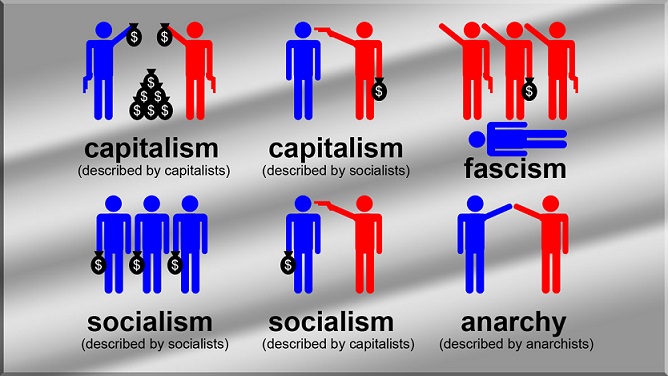
The problem with socialism is that you eventually run out of other peoples’ money. – Margaret Thatcher CU Blog - Caribbean Island proposes new US-Caribbean trade initiative - Photo 1

Many Caribbean member-states feature a governmental structure of democratic socialism; (see Appendix below).

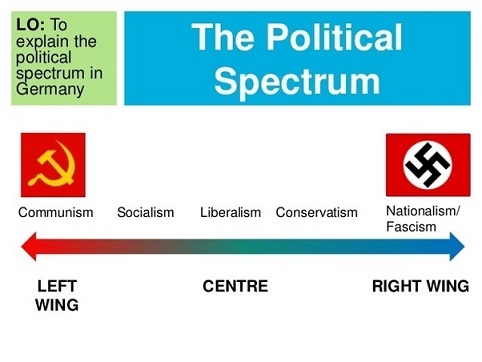
In some places, socialism is a bad word – think Venezuela – but other states feature an advanced prosperous country despite the socialism tag – think Canada. In general, socialism can be depicted as a scale with leftist communism on one end and right-wing capitalism on the other end. The observation and analysis of these varying states during good times and bad times is that the left-leaning socialism countries tend to suffer from a lot of societal abandonment, especially when things go bad, for the reason as described by Margaret Thatcher above. (Consider for example, the Caribbean island of Barbuda, before their recent disaster, there was no private land-ownership).

So many Caribbean member-states have “run out of other people’s money”, thus ensuring a crisis. Alas, this …

… crisis is a terrible thing  to waste – American Economist Paul Romer

The crisis in the Caribbean region right now is in response to Hurricanes Irma and Maria in September 2017 that have devastated many islands – think Puerto Rico, Barbuda and Dominica. It is a good time to re-think the affinity for democratic socialism. These natural disasters are forcing our region to re-think one of the hallmarks of capitalism; our policies on …

… Trade; American Trade to be exact.

Yet still, it becomes obvious what the problem is for so many Caribbean member-states, they seem to “just” want to spend other people’s money rather than do the heavy-lifting – Big Deal – of growing their own economy/wealth. Notice this theme in the news article here from the St. Lucia Times daily newspaper regarding the urgings of their Prime Minister Allen Chastanet:

Title: Prime Minister Chastanet proposes new US-Caribbean trade initiative

CU Blog - Caribbean Island proposes new US-Caribbean trade initiative - Photo 2On the side-lines of the UN General Assembly in New York, Prime Minister Allen Chastanet has been speaking to the American business network CNBC.

Prime Minister Chastanet discussed the recent hurricanes that have devastated parts of the Caribbean, rebuilding the Caribbean and Caribbean – US relations.

He said recent events have showed that the Caribbean needs to diversify in terms of its sources of food, pointing to a shutdown of the American hub for several days.

“The support has had to come from the south because while we were going through this, you had two hurricanes heading up north. And literally Miami was on a shutdown. So unfortunately the American hub got shutdown almost for ten days out of Miami.  And so it really has shown us that we need to diversify ourselves a bit and maybe look a bit more to Panama in terms of supplies of food,” Chastanet.

Chastanet said the resilience of the Caribbean is very strong and the region will band together to recover from the disasters.

Chastanet proposed the establishment of a new private sector led initiative what would allow US companies to invest in St Lucia tax free and have their resources sent back home without facing heavy US government taxes.

He said there are great investment opportunities in the Caribbean for American companies.

“Can we not get an incentive, and that’s what we’re in discussions with the US about, that if US companies invest into the Caribbean, that those investments in our books are always tax free that the US allow those funds to be repatriated back into the US tax-free, only on those investments. So 1, it accomplishes getting the funds back into the United States of America. It creates an avenue for the private sector to participate in this growth and brings a lot of money to the table, Chastanet said.

Prime Minister Chastanet is expected to address the UN General Assembly today.

Source: Posted September 21, 2017; retrieved October 11, 2017 from: https://stluciatimes.com/2017/09/21/prime-minister-chastanet-proposes-new-us-caribbean-trade-initiative
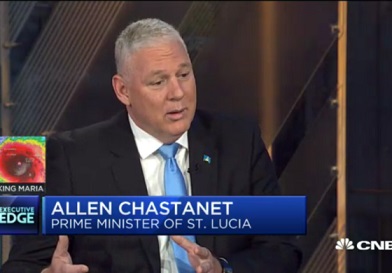
As related, the Prime Minister of St. Lucia – also Chairman of the Organization of Eastern Caribbean States and a governing stakeholder of CariCom – wants to “count America’s money”! He is lobbying for a law – in the US – in which American investors will have tax concessions on their tax obligations to the US Treasury. (There would be no benefit to the US in this scheme).

He is the Chief Executive of a Caribbean member-state urging the US government to skip on their revenue collections so as to benefit the Caribbean; in effect he is “counting” America’s government revenues. See the full interview in the Appendix VIDEO below.

It should be noted that there is no such bill in the US Congress proposing these measures; so this is not lobbying. Rather the imagery of this whole appeal is just that of a foreign Head of Government begging for money with a sign that reads:

“Will NOT work for food”.

CU Blog - OECS diplomat has dire warning for Caribbean countries - Photo 3

No, this is not the branding or image we should want to project to the watching world. But rather, the Honorable Prime Minister’s earlier words reflect the ethos we really need to portray:

Chastanet said the resilience of the Caribbean is very strong and the region will band together to recover from the disasters.

Rather than looking to the US to solve our problems, we want to band together – an interdependence – and work for our own remediation. This is the theme of the book Go Lean…Caribbean and the accompanying blog-commentaries. “Band together” should have been the only appeal at the United Nations. These words should have been echoed in public forums and private discussions with other Caribbean leaders. The Go Lean movement describes this “banding” as a confederation of the 30 Caribbean member-states, including the 2 US Territories of Puerto Rico and the US Virgin Islands. This formation of a Single Market and accompanying Security Pact would usher in the economic empowerments and security/emergency optimization that the region needs.

The book Go Lean…Caribbean – available to download for free – serves as a roadmap for the introduction and implementation of this confederation, the technocratic Caribbean Union Trade Federation (CU). This complex organization structure is designed for the elevation of Caribbean society – for all member-states. This CU/Go Lean roadmap has these 3 prime directives:

  • Optimization of the economic engines in order to grow the regional economy to $800 Billion and create 2.2 million new jobs.
  • Establishment of a security apparatus to ensure public safety and protect the resultant economic engines.
  • Improve Caribbean governance to support these engines, including a separation-of-powers between the member-states and CU federal agencies. This includes Self-Governing Entities, bordered campuses that practice pure capitalism.

The book stresses that reforming and transforming the Caribbean societal engines can be successful, but only if it is a regional pursuit – all the member-states band together. This was an early motivation for the roadmap, as pronounced in the opening Declaration of Interdependence (Pages 12 – 13):

i.   Whereas the earth’s climate has undeniably changed resulting in more severe tropical weather storms, it is necessary to prepare to insure the safety and security of life, property and systems of commerce in our geographical region. As nature recognizes no borders in the target of its destruction, we also must set aside border considerations in the preparation and response to these weather challenges.

xi. Whereas all men are entitled to the benefits of good governance in a free society, “new guards” must be enacted to dissuade the emergence of incompetence, corruption, nepotism and cronyism at the peril of the people’s best interest. The Federation must guarantee the executions of a social contract between government and the governed.

xvi. Whereas security of our homeland is inextricably linked to prosperity of the homeland, the economic and security interest of the region needs to be aligned under the same governance. Since economic crimes … can imperil the functioning of the wheels of commerce for all the citizenry, the accedence of this Federation must equip the security apparatus with the tools and techniques for predictive and proactive interdictions.

xxiv. Whereas a free market economy can be induced and spurred for continuous progress, the Federation must install the controls to better manage aspects of the economy: jobs, inflation, savings rate, investments and other economic principles. Thereby attracting direct foreign investment because of the stability and vibrancy of our economy.

Our appeal to the PM of St. Lucia and to the leaders of all the other member-states:

This is not our first hurricane nor will it be our last. We must recover from these ones and be prepared for others, a lot more of them. “Begging” should not be our recovery plan!

On the other hand, the Go Lean book provides 370-pages of turn-by-turn instructions on “how” to adopt new community ethos, plus the strategies, tactics, implementations and advocacies to execute so as to reboot, reform and transform the societal engines of Caribbean society.

The branding of the CU is a Trade federation, so there is emphasis for optimizing trade for the Caribbean region. Yes, there is tactical plan to establish trade routes beyond Miami-to-the-Caribbean. The Go Lean roadmap posits that with the close proximity of Trinidad to the South American country of Venezuela (7 miles), there could be an elaborate network of transportation options to facilitate the shipment of goods (and passengers) into the Singe Market.

This roadmap is a Big Deal / Big Idea for the Caribbean region; in many ways, the community commitment for the Caribbean may be similar to the American commitment in the 1960’s to Go to the Moon. The Go Lean book relates this on Page 127:

The Bottom Line on Kennedy’s Quest for the MoonOn 25 May 1961, US President John F. Kennedy announced his support for the American Space program’s “Apollo” missions and redefined the ultimate goal of the Space Race in an address to a special joint session of Congress:

  • “I believe that this nation should commit itself to achieving the goal, before this decade is out, of landing a man on the moon and returning him safely to the earth”.

His justification for the Moon Race was both that it was vital to national security and that it would focus the nation’s energies in other scientific and social fields.

This quest was succeeded. At 10:56 pm EDT, on 20 July 1969, the first human (American Astronaut Neil Armstrong) ventured out of the Apollo 11 landing craft and set foot on the Moon declaring: “one small step for man, one giant leap for mankind“.

Other countries have had subsequent moon landings.

Can we get the support of the Prime Minister of St. Lucia and the other Heads of Government throughout the whole region for our “Moon Shot” equivalent, our Big Deal / Big Idea? This is the actual title of one advocacy in the Go Lean book. Consider the specific plans, excerpts and headlines here from Page 127, entitled:

10 Big Ideas … in the Caribbean Region

1

Lean-in for the Caribbean Single Market
The CU is a big idea for the Caribbean, our parallel of the American “moon quest”, allowing for the unification of theregion into one market of 42 million people. This creates the world’s 29th largest economy, based on 2010 figures.The pre-ascension GDP figures are actually less that $800 Billion, but the aggregation into a Single Market willmanifest the economic “catch-up” principle, in 5 years. Further, after 10 years the CU’s GDP should double andrank among the Top 20 or G20 nations.

2

Currency Union / Single Currency

3

Defense / Homeland Security Pact

4

Confederation Without Sovereignty

5

Four Languages in Unison

6

Self-Governing Entities (SGE)

7

Virtual “Union Atlantic Turnpike” Operations
Ferries, Causeways/Bridges, Pipelines, Tunnels, Railways and limited access highways will function as “blood vessels to connect all the organs” within the region, thus allowing easier transport of goods and people among the islands and the mainland states (Belize, Guyana or Suriname) – See Appendix IC Alaska Marine Highway [on Page 280].

8

Cyber Caribbean
Forge electronic commerce industries so that the Internet Communications Technology (ICT) can be a great equalizer in economic battles of global trade. This includes e-Government (outsourcing and in-sourcing for member-states systems) and e-Delivery, Postal Electronic Last Leg mail, e-Learning and wireline/wireless/satellite initiatives.

9

e-Learning – Versus – Studying Abroad

10

Cuba & Haiti

There have been a number of blog-commentaries by the Go Lean movement that highlighted the art and science of optimizing our eco-system for “Trade and Transport”. See a sample list here:

https://goleancaribbean.com/blog/?p=13140 Region-wide Industrial Reboot of Caribbean Pipelines
https://goleancaribbean.com/blog/?p=12322 Ferries 101 – Launch of a Region-wide Inter-Island Ferry System
https://goleancaribbean.com/blog/?p=9179 The Vision of Ferries for Snowbirds to Head South
https://goleancaribbean.com/blog/?p=4897 Plan for Natural Gas Distribution for Caribbean Consumption
https://goleancaribbean.com/blog/?p=3225 Caribbean is Less Competitive Due to Increasing Aviation Taxes
https://goleancaribbean.com/blog/?p=829 Facilitating Trade with Trucks and Trains
https://goleancaribbean.com/blog/?p=673 Future Model: Ghost Ships – Autonomous Cargo Vessels

In summary, it is only logical to expect any stewards of society to “corral” the resources, assets and people of the community to effect change, to elevate. On the other hand, it is not logical to expect others to do it for us. This is a child’s expectation for his/her parents. This is inappropriate for independent Caribbean member-states. The aforementioned Economist, Paul Romer, asserted the appropriate strategic plan:

“Economic growth occurs whenever people take resources and re-arrange them in ways that are more valuable”.

Obviously, this economist was advocating a capitalist agenda, in contrast to the democratic socialism practice in the region.

There is only a 7-mile strait between the Caribbean island Trinidad of and its southern neighbor. It is only logical to consider that trade route when the northern route – Miami – is impeded. Such a tactical plan will allow for resiliency for post-disaster scenarios. A potpourri of transportation options – Union Atlantic Turnpike – to facilitate interstate commerce among the islands and coastal states is a better plan than begging for other people’s money.

To all you Caribbean leaders: Do not be surprised when a hurricane hits. Count on it! There will be more … such scenario’s. Climate Change is undeniable! Destructive storms will manifest! Bad actors will emerge. There is a need for security empowerments along with economic empowerments. The economic solution for the Caribbean cannot be: Counting other people’s money.

Now is the time for all of the Caribbean – the leaders and the people – to lean-in for the empowerments described here in the book Go Lean…Caribbean. It is conceivable, believable and achievable to prosper ourselves where planted here in the region; to reform and transform and make our own homeland a better place to live, work and play. 🙂

Download the free e-Book of Go Lean … Caribbean – now!

Sign the petition to lean-in for this roadmap for the Caribbean Union Trade Federation.

———–

Appendix VIDEO – Saint Lucia PM Allen Chastanet: Caribbean Needs To Diversify Search For Relief | CNBC – https://youtu.be/asg87s29c4E

Published on Sep 20, 2017 – Allen Chastanet, Prime Minister of Saint Lucia, talks about rebuilding the hard-hit Caribbean after recent storms left the islands devastated. Also Prime Minister Chastanet addresses insurance coverage.

———–

Appendix – Democratic Socialism

Democratic socialism is a political ideology that advocates political democracy alongside social ownership of the means of production, often with an emphasis on democratic management of enterprises within a socialist economic system.

Democratic socialists see capitalism as inherently incompatible with the democratic values of liberty, equality and solidarity; and believe that the issues inherent to capitalism can only be solved by superseding private ownership with some form of social ownership. Ultimately, democratic socialists believe that reforms aimed at addressing the economic contradictions of capitalism will only cause more problems to emerge elsewhere in the economy, that capitalism can never be sufficiently “humanized” and that it must therefore ultimately be replaced with socialism.[1][2]

Democratic socialism is distinguished from both the Soviet model of centralized socialism and from social democracy, where “social democracy” refers to support for political democracy; the nationalization and public ownership of key industries but otherwise preserving and strongly regulating, private ownership of the means of production; regulated markets in a mixed economy; and a robust welfare state.[3] The distinction with the former is made on the basis of the authoritarian form of government and centralized economic system that emerged in the Soviet Union during the 20th century,[4] while the distinction with the latter is made on the basis that democratic socialism is committed to systemic transformation of the economy while social democracy is not.[5]

The term “democratic socialism” is sometimes used synonymously with “socialism” and the adjective “democratic” is often added to distinguish it from the LeninistStalinist and Maoist types of socialism, which are widely viewed as being non-democratic in practice.[6]

Democratic socialism is not specifically revolutionary or reformist, as many types of democratic socialism can fall into either category, with some forms overlapping with social democracy, supporting reforms within capitalism as a prelude to the establishment of socialism.[7] Some forms of democratic socialism accept social democratic reformism to gradually convert the capitalist economy to a socialist one using pre-existing democratic institutions, while other forms are revolutionary in their political orientation and advocate for the overthrow of the bourgeoisie and the transformation of the capitalist economy to a socialist economy.[8]

Relation to economics

Democratic socialists have espoused a variety of different socialist economic models. Some democratic socialists advocate forms of market socialism where socially-owned enterprises operate in competitive markets and in some cases are self-managed by their workforce. On the other hand, other democratic socialists advocate for a non-market participatory economy based on decentralized economic planning.[38]

Democratic socialism has historically been committed to a decentralized form of economic planning opposed to Stalinist-style command planning, where productive units are integrated into a single organization and organized on the basis of self-management.[39]

Contemporary proponents of market socialism have argued that the major reasons for the failure (economic shortcomings) of Soviet-type planned economies was the totalitarian nature of the political systems they were combined with, lack of democracy and their failure to create rules for the efficient operation of state enterprises.[40]

Source: Retrieved October 11, 2017 from: https://en.wikipedia.org/wiki/Democratic_socialism
CU Blog - Caribbean Island proposes new US-Caribbean trade initiative - Photo 3

CU Blog - Caribbean Island proposes new US-Caribbean trade initiative - Photo 4


Share this post:
, , ,

‘Pulled’ – Despite American Guns

Go Lean Commentary

“Can’t see the forest for the trees” – Famous Quotation
This is an expression used for someone who is too involved in the details of a problem to look at the situation as a whole: “The congressman became so involved in the wording of his bill that he couldn’t see the forest for the trees; he did not realize that the bill could never pass.”

CU Blog - 'Pulled' to American Guns - Photo 1This concept is true for communities too!

The United States of America presents itself as the “City on the Hill“, the richest, most powerful model democracy in the history of the world. But this country has some societal defects – i.e. Institutional Racism & Crony-Capitalism – that are so acute that they distort the American reality as a Great Society. One defect in particular is the American gun culture, gun deaths and mass shootings.

Still, America draws – or pulls – a lot of immigrants from around the world, including the Caribbean, despite the voluminous deaths. Just how many deaths are there?

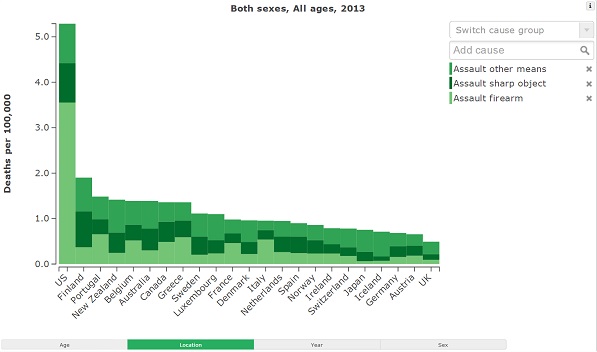
First, the US has far more gun deaths than most other advanced economy countries.

Title: Visualizing gun deaths: Comparing the U.S. to the rest of the world
Whenever a mass shooting occurs, a debate about gun violence ensues. An often-cited counter to the point about the United States’ high rates of gun homicides is that people in other countries kill one another at the same rate using different types of weapons. It’s not true.

Compared to other countries with similar levels of development or socioeconomic status, the United States has exceptional homicide rates, and it’s driven by gun violence.

Here is the data:

CU Blog - 'To Live and Die in L.A.' - Photo 3

Source: Posted June 12, 2016; retrieved October 9, 2017 from: Global Burden of Disease Study. Access the data visualization here: http://ihmeuw.org/3oi4

Just how many mass shootings are there?

See this encyclopedic reference:

Title: Mass shootings in the United States by year

These are the number of shootings (incidents) that transpired during the applicable year. For the last 2 years (2017-to-date & 2016), the actual shooting events are detailed.

Year Incidents Details
2017 13 Partial Year – As of October 1, 2017
    Bronx-Lebanon Hospital attack
    Burnette Chapel shooting
    Clovis library shooting
    Congressional baseball shooting
    Fort Lauderdale airport shooting
    Freeman High School shooting
    Las Vegas Strip shooting
    Little Rock nightclub shooting
    Mississippi shootings
    Orlando shooting
    Plano shooting
    UPS shooting in San Francisco
    Weis Markets shooting
2016 14  
    Baton Rouge shooting of police officers
    Cascade Mall shooting
    Citronelle homicides
    shooting of Dallas police officers
    FreightCar America shooting
    Hesston shooting
    Kalamazoo shootings
    Madison High School shooting
    Mukilteo shooting
    Orlando nightclub shooting
    Pike County, Ohio, shootings
    Pablo Antonio Serrano-Vitorino
    St. Joseph courthouse shooting
    Wilkinsburg shooting
2015 9  
2014 5  
2013 6  
2012 11  
2011 7  
2010 5  
2009 8  

Source: Retrieved October 9, 2017:  https://en.wikipedia.org/wiki/Category:Mass_shootings_in_the_United_States_by_year

In a previous blog-commentary, the thesis was presented that for Caribbean citizens, it is NOT better to live “fast & furious” in the US, but rather it is better to prosper where planted in the Caribbean homeland. Life in the US may experience a shorter mortality due to the risky gun culture.

And yet, our Caribbean communities are losing people more and more with our atrocious societal abandonment rates – estimated by one report at 70 percent of the professional classes –  to destinations like the United States. Why are they leaving? Two reasons:

  • “Push” refers to people who feel compelled to leave, to seek refuge in a foreign land. “Refuge” is an appropriate word; because of societal defects, many from the Caribbean must leave as refugees – think LGBTDisabilityDomestic-abuseMedically-challenged – for their life, liberty and pursuit of happiness.
  • “Pull”, on the other hand refers to the lure of a more prosperous life abroad; many times our people are emigrating for economics solely.

Is life really so prosperous in the US with such a track record of gun violence?

CU Blog - Must Love Dogs ENCORE - Photo 1

CU Blog - 'Pulled' to American Guns - Photo 2

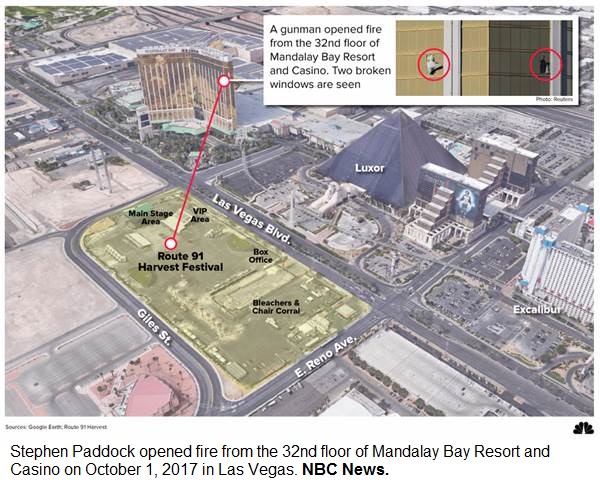
On October 1, 2017 a shooter – Stephen Paddock – used 23 guns (mostly automatic rifles) perched in a 32nd floor hotel room rained down bullets on a Country Music concert in an adjacent park. He killed 58 innocent people and injured more than 500.

The repeated incidences of mass shooters – with no gun control remediation – makes American life defective; see VIDEO in the Appendix below.

This commentary aligns with the charter of the book Go Lean … Caribbean to make the countries of the Caribbean region better places to live, work and play. The goal is to be Better Than America; to be a protégé without the ignominious Second Amendment; to exercise better governance. A previous blog-commentary entitled 10 Things We Want from the US and 10 Things We Don’t Want from the US detailed:

The “right to bear arms” has a personal application beyond the country’s entitlement to maintain a militia. This “right” has been interpreted in a manner in which any normal “man” can get possession of guns and other armament. This proliferation of guns in society results in the highest rate of gun violence in the world, even an unconscionable rate of school shootings.

The Go Lean roadmap purports that this status has also caused discord – a gross abuse and availability of illegal guns – in bordering communities of Mexico, and Caribbean states of the Bahamas, and the DR. This propels our gun-related crime.

The Go Lean book serves as a roadmap for the introduction and implementation of the technocratic Caribbean Union Trade Federation (CU) to elevate the region’s societal engines – economics, homeland security and governance – for all 30 Caribbean member-states in the region. In fact, the prime directives of the roadmap includes the following 3 statements:

  • Optimization of the economic engines in order to grow the regional economy to $800 Billion & create 2.2 million new jobs.
  • Establishment of a security apparatus to ensure public safety and protect the resultant economic engines with proactive and reactive measures.
  • Improvement of Caribbean governance to support these engines, including a separation-of-powers between the member-states and CU federal agencies.

The quest is to minimize the paradox of future-planning/decision-making for Caribbean citizens. We want to make the Caribbean region better places to live, work and play; this way our citizens would not have to leave … for American shores. Above and beyond mass shootings, the truth of the matter is people die more readily in America due to gun-violence than they die in the Caribbean, or anywhere else.

The planners for a new Caribbean should be able to lower the “pull” factors for Caribbean citizens. Caribbean life is in competition with American life and we should be able to sell the lower risk of being killed by American guns.

The Go Lean book contends that bad actors will always emerge just as a result of economic successes in society. Once the prospects of guns are factored it, the inevitable “bad guy with a gun” can do more damage than ordinary. There must be remediation and mitigation. This point is pronounced early in the book with the Declaration of Interdependence (Page 12) that claims:

x. Whereas we are surrounded and allied to nations of larger proportions in land mass, populations, and treasuries, elements in their societies may have ill-intent in their pursuits, at the expense of the safety and security of our citizens. We must therefore appoint “new guards” to ensure our public safety and threats against our society, both domestic and foreign. The Federation must employ the latest advances and best practices … to assuage continuous threats against public safety.

xi. Whereas all men are entitled to the benefits of good governance in a free society, “new guards” must be enacted to dissuade the emergence of incompetence, corruption, nepotism and cronyism at the peril of the people’s best interest. The Federation must guarantee the executions of a social contract between government and the governed.
xvi. Whereas security of our homeland is inextricably linked to prosperity of the homeland, the economic and security interest of the region needs to be aligned under the same governance. Since economic crimes, including piracy and other forms of terrorism, can imperil the functioning of the wheels of commerce for all the citizenry, the accedence of this Federation must equip the security apparatus with the tools and techniques for predictive and proactive interdictions.

The Go Lean book provides 370 pages of details on the economic principles and community ethos to adopt, plus the executions of strategies, tactics, implementations and advocacies to better secure the Caribbean homeland. Just “how” can the Caribbean region reboot, reform and transform their societal engines to provide better protections and gun control. This is the actual title of one advocacy in the Go Lean book. Consider the specific plans, excerpts and headlines here from Page 179, entitled:
10 Ways to Improve Gun Control

1

Lean-in for the Caribbean Single Market
The [CU] treaty allows for the unification of the region into one market of 42 million people across 30 member-states, thereby creating an economic zone to promote and protect the interest of the member-states. In addition, the treaty calls for a collective security pact to ensure homeland security and assuage against systemic threats. The CU will elevate and consolidate the registration, gun-permitting process to regional oversight. The goal is to apply learned-lessons from the US example. For Third World countries, as most of the CU apply, undisciplined gun use affect the Failed-State indicator: Criminalization / De-Legitimization of the State. The CU’s mandate is to manage the image and reality of Failed-States.

2

Background Checks
It’s a best practice to restrain certain aspects of the population access to guns (felons, defendants on bail, targets of restraining orders). This includes gun purchasing and ownership. So the CU Gun Registration regulation (within CariPol) will enforce strict background checks for ALL purchases: retail, wholesale and private-party. This regulation will also be post-reactive in the event a CU resident becomes a subject of legal/police action so as to suspend their gun rights.

3

Ballistics Testing
The CU will extend gun registration/regulation beyond our American neighbors. To facilitate subsequent investigation of gun crimes, every registered gun must complete ballistic tests and the results must be on (computer) file at CariPol.

4

Mental Illness Data

5

Intelligence Gathering and Big Data Analysis

6

United States (FBI / ATF) Coordination

7

Private Security Bodyguards

8

Private First Responders / Bounty Hunters

9

Gun BuybacksThe CU will maintain a constant program for anonymous gun “buybacks”. These endeavors will be funded with CU funds and coordinated with not-for-profit foundations. The acquired guns will all be registered, for serial numbers and ballistic testing results, and then destroyed; unless needed for legal prosecutions.

10

Public Relations / Anti-Bullying Campaign

There have been a number of blog-commentaries by the Go Lean movement that highlighted the eco-system of crime-domestic terrorism; this is part-and-parcel of the regional homeland security initiatives. See a sample list here:

https://goleancaribbean.com/blog/?p=13126 “Must Love Dogs”  – Providing K9 Solutions for Better Security
https://goleancaribbean.com/blog/?p=12400 Accede the Caribbean Arrest Treaty
https://goleancaribbean.com/blog/?p=11332 Boston Bombing Anniversary – Learning Lessons
https://goleancaribbean.com/blog/?p=11048 Managing the ‘Strong versus the Weak’ Series – Model of Hammurabi
https://goleancaribbean.com/blog/?p=9072 Model: Shots-Fired Monitoring – Securing the Homeland on the Ground
https://goleancaribbean.com/blog/?p=7485 Mitigating Interpersonal Violence Series – Street Crimes
https://goleancaribbean.com/blog/?p=2684 Role Model for Law, Order and Justice – The Pinkertons

In summary, it is only logical that any stewards of society to remediate any known risks and threats; yet this is not the case for guns in America.

This is stupid … for this to continue unimpeded … for so long. (The American rationale is the 2nd Amendment of the US Constitution; one original motivation in 1791 was to suppress insurrection, allegedly including slave revolts [60][61][62]).

In a previous blog-commentary, it was related that when stupidity persists in society it is because someone is getting paid. Who are the financial benefactors in the case of guns in America: The Firearms Manufacturers!

Stock prices of firearms manufacturers rose the day after the shooting, as has happened after similar incidents. Investors expect gun sales will increase over concerns that such an event could lead to more stringent gun-control legislation and a rush of customers wishing to defend themselves against future attacks. – MarketWatch[83]  / Bloomberg[84]

In fact, the National Rifle Association (NRA) now has the reputation of being a Chamber of Commerce-like organization rather than a consumer protection/advocacy group as was its original charter.

Enough already! Too many innocent lives have been lost; see the VIDEO in the Appendix belowSurely, we can be better here in the Caribbean … going forward. Surely we can convince our Caribbean people to Stay Home and not be lured to this madness in the first place.

And for those of the Diaspora in the US: you are in harm’s way, just living an ordinary life. It is Time to Go … back home!

Now is the time for all of the Caribbean – the leaders and the people – to lean-in for the empowerments described here in the book Go Lean…Caribbean. It is conceivable, believable and achievable to prosper where planted here in the region; to make the Caribbean a better place to live, work and play. 🙂

Download the free e-book of Go Lean … Caribbean – now!

Sign the petition to lean-in for the roadmap for the Caribbean Union Trade Federation.

————-

APPENDIX VIDEO – Reassessing the Same Old Debate on Gun Control: The Daily Show – https://youtu.be/U0UUrMmoPME

The Daily Show with Trevor Noah

Published on Oct 9, 2017 – In the aftermath of a mass shooting in Las Vegas, Neal Brennan explains why the debate over gun control in the U.S. needs to change.

The Daily Show with Trevor Noah airs weeknights at 11/10c on Comedy Central.

  • Category: Comedy
  • License: Standard YouTube License
Share this post:
, ,
[Top]

Industrial Reboot – Frozen Foods 101

Go Lean Commentary

We gotta eat!

In that fact lies a key business model for growing the Caribbean industrial landscape: Jobs and entrepreneurial opportunities can be created by fostering peripheral industries for food distribution that is under-represented currently.

What kind of new jobs? What kind of new industries? Try:

Frozen Foods

CU Blog - Industrial Reboot - Frozen Food 101 - Photo 2c

CU Blog - Industrial Reboot - Frozen Food 101 - Photo 2d

CU Blog - Industrial Reboot - Frozen Food 101 - Photo 2a

CU Blog - Industrial Reboot - Frozen Food 101 - Photo 2b

The Bottom Line on Flash Freezing
Flash freezing (blast freezing) is used in the food industry to quickly freeze perishable food items. In this case, food items are subjected to temperatures well below water’s melting/freezing point (cryogenic temperatures), causing the water inside the foods to freeze in a very short period without forming large crystals, thus avoiding damage to cell membranes. Freezing food preserves it from the time it is prepared to the time it is eaten. CU Blog - Industrial Reboot - Frozen Food 101 - Photo 1This process slows down decomposition by turning residual moisture into ice, inhibiting the growth of most bacterial species. Frozen products do not require any added preservatives because microorganisms do not grow when the temperature of the food is below -9.5°C (14.9ºF); this is sufficient to prevent food spoilage. But Carboxymethyl-cellulose (CMC) or cellulose gum (a cellulose derivative) is often used as a viscosity modifier or thickener, and to stabilize emulsions in various products, including ice cream. It is often used as its sodium salt. CMC is a tasteless/odorless stabilizer, typically added to frozen food as it does not adulterate the quality.

American inventor Clarence Birdseye developed the quick freezing process of food preservation in the early 20th century. This process was further developed by American inventor Daniel Tippmann by producing a vacuum and drawing the cold air through palletized food. His process has been sold and installed under the trade name “Quick-Freeze” and enables blast freezing of palletized food in 35% less time than conventional blast freezing.
Source: Book Go Lean…Caribbean Page 208

A venture into Frozen Foods is about more than just food, it is about culture. Consider the proliferation of Frozen Foods in these cultures:

  • Italian
  • Mexican
  • Chinese

It is the assessment of this commentary that the Caribbean is the greatest destination on the planet; this applies to the terrain, fauna and flora; just think of our paradasaic beaches. Culturally, we have the best cuisinerumscigars and festivals. We also have the best in hospitality, just think of our luxurious hotel-resorts and cruise ships. Now to mix all of this greatness into a frozen entree and export it to the rest of the world. See here this VIDEO on the basics of Frozen Foods versus Fresh Food.

VIDEO – Fresh vs Frozen Food – https://youtu.be/zjsOOT347cA

AsapSCIENCE

Published on Nov 7, 2013 – Which is more nutritious – Fresh or Frozen?

Written and created by Mitchell Moffit (twitter @mitchellmoffit) and Gregory Brown (twitter @whalewatchmeplz).

Further Reading — Overview on Fresh vs Frozen: http://www.livestrong.com/article/710…

Comparing Multiple Nutrional Factors: http://onlinelibrary.wiley.com/doi/10…http://onlinelibrary.wiley.com/doi/10… Vitamin C Comparison: http://www.sciencedirect.com/science/… Antioxidant Content: http://www.sciencedirect.com/science/…

How do we go about doing this, developing a Frozen Foods industry so as to reboot the Caribbean industrial landscape and create the new jobs our region needs for future growth?

The movement behind the book Go Lean … Caribbean asserts that it is possible to reboot the business eco-system of the region so as to create jobs and has presented a roadmap for the goal of 2.2 million new jobs. But the book warns that this task is heavy-lifting to be successful. The entire industrial landscape must be rebooted. There is now a catalog for this Industrial Reboot 101. This commentary is 4 of 4 in the occasional series considering the Industrial Reboots. The full series is as follows:

  1. Industrial Reboot – Ferries 101 – Published June 27, 2017
  2. Industrial Reboot – Prisons 101 – Published October 4, 2017
  3. Industrial Reboot – Pipeline 101 – Published October 6, 2017
  4. Industrial Reboot – Frozen Foods 101

In a previous blog-commentary, it detailed how diverse food delivery systems can contribute to the economy of a new Caribbean; many new jobs are to be created. The summarized quotation states:

This roadmap projected these jobs for food-related industries: 30,000 in direct agriculture; 4,000 in direct Fisheries; and 2,000 related to Frozen Foods.

Yes, fostering an industry for Frozen Foods can allow Caribbean stewards to reboot the industrial landscape. Imagine a network of self-regulated, resilient refrigerated warehouses.

But refrigeration requires steady-reliable power, right? Hurricanes are now more prevalent and more disruptive, right?

Since landfalls of hurricanes in a Caribbean island can easily wipe out electricity distribution systems – the 2 recent hurricanes of Irma and Maria in September 2017 caused total devastation in some member-states, i.e. Barbuda – it seems vain to introduce a Frozen Foods business eco-system …

… unless remediation and mitigation is first put in place to optimize power-energy solutions.

The Go Lean book presents a complex plan for energy optimizations. Many solutions were presented in these Go Lean blog-commentaries:

We need an inter-island power grid The Go Lean roadmap proposes many solutions for a regional grid to optimize energy:

  • generation – Green options (solar, wind turbines, hydro, tidal and natural gas)
  • distribution – Underwater cables to connect individual islands
We need alternative energy Rather than just limiting power to come from the grid, the Caribbean industrial landscape needs to embrace “Green” alternative on-site options (solar, wind and tidal), efficient battery back-ups, fuel cells and generators.
We need collective refrigeration This refers to the leveraging of a cooling/heating scheme that provides the needed refrigeration for a limited district, not just one building.
We need pipelines Over-ground, underground and underwater pipelines can help sustained refrigerated warehouses during natural disasters … and can help to quickly restore power and the systems of commerce.
We need cheaper energy costs The roadmap promotes natural gas as the preferred fuel for power generation; it is much cheaper than petroleum or coal options.
We need Self-Governing Entities SGE’s are bordered campuses that designates the exclusivity of the commercial, security and administration to federal governance, above-and-beyond the member-states.

The book Go Lean … Caribbean purports that a new technology-enhanced industrial revolution is emerging, in which there is more efficiency for power generation, distribution and storm recovery. This is a vision of economic resiliency. This vision was pronounced early in the book with this Declaration of Interdependence (Pages 11 – 14), with these statements:

i. Whereas the earth’s climate has undeniably changed resulting in more severe tropical weather storms, it is necessary to prepare to insure the safety and security of life, property and systems of commerce in our geographical region. As nature recognizes no borders in the target of its destruction, we also must set aside border considerations in the preparation and response to these weather challenges.

xxvi. Whereas the Caribbean region must have new jobs to empower the engines of the economy and create the income sources for prosperity, and encourage the next generation to forge their dreams right at home, the Federation must therefore foster the development of new industries, like that of … frozen foods … impacting the region with more jobs.

xxx. Whereas the effects of globalization can be felt in every aspect of Caribbean life, from the acquisition of food and clothing, to the ubiquity of ICT, the region cannot only consume, it is imperative that our lands also produce and add to the international community, even if doing so requires some sacrifice and subsidy.

xxxii. Whereas the cultural arts … of the region are germane to the quality of Caribbean life, and the international appreciation of Caribbean life, the Federation must implement the support systems to teach, encourage, incentivize, monetize and promote the related industries … These endeavors will make the Caribbean a better place to live, work and play.

This Go Lean book serves as a roadmap for the introduction and implementation of the technocratic Caribbean Union Trade Federation (CU) to elevate the 30 Caribbean member-states. This Federation will assume jurisdiction for the Exclusive Economic Zone (EEZ) and all Self-Governing Entities (SGE’s). This approach allows for effective and efficient management of bordered campuses where facilities can be deployed for refrigerated warehouses – with their own power-energy eco-systems. This CU/Go Lean roadmap has these 3 prime directives:

  • Optimization of the economic engines in order to grow the regional economy to $800 Billion and create 2.2 million new jobs.
  • Establishment of a security apparatus to ensure public safety and protect the resultant economic engines, even for emergencies.
  • Improvement of Caribbean governance to support these engines, including a separation-of-powers between the member-states and CU federal agencies.

The facilitations for Caribbean food can lead to a reboot of the industrial landscape. The above referenced 36,000 new jobs can lead to additional indirect jobs: 135,000. That makes for a total of 171,000 new jobs. We should all welcome this Industrial Reboot.

Bad Model: There is one Jamaican transnational company that distributes Frozen Foods, but all of their processes is done in their US home, in New Jersey. 🙁

The subject of Caribbean Food has also been addressed and further elaborated upon in these previous blog/commentaries:

https://goleancaribbean.com/blog/?p=10369 Science of Sustenance – Temperate Foods
https://goleancaribbean.com/blog/?p=8982 GraceKennedy: A Caribbean Transnational “Food” Company
https://goleancaribbean.com/blog/?p=5098 Forging Change: ‘Food’ for Thought
https://goleancaribbean.com/blog/?p=3594 Lessons Learned from Queen Conch – A Caribbean Delicacy

The Go Lean book provides 370 pages of details on the economic principles and community ethos to adopt, plus the executions of strategies, tactics, implementations and advocacies to develop this industry and product offering in the Caribbean. The economic principles of the Frozen Foods pipelines are sound.

How” would the Caribbean region reboot, reform and transform their societal engines to develop a Frozen Foods industry. This is the actual title of one advocacy in the Go Lean book. Consider the specific plans, excerpts and headlines here from Page 208, entitled:

10 Ways to Develop a Frozen Foods Industry

1

Lean-in for the Caribbean Single Market The CU will allow for the unification of the region into one market, thereby creating a single economy of 30 member-states, 42 million people (plus a Diaspora of 8 million) and a GDP of over $800 Billion. The CU will take the lead in facilitating the food supply and distribution systems to ensure the region can feed itself, more from local production and less from trade. Modeling Omaha-based ConAgra Foods, the CU will work to shift the Balance of Trade to where more food supplies are exported and less imported. Where as many North American and EU countries place restrictions on Caribbean fresh produce (for example, no citrus), if foods are already prepared and frozen (or canned), those restrictions no longer apply.

2

Adopt Co-ops for Freezer WarehousesThe CU will sponsor cooperatives and condominium associations to construct and maintain refrigerated warehouses, with power alternatives, to facilitate the logistics of frozen products – for trading partners in agriculture and fisheries.

3

Ensure Energy SecurityThe CU will deploy a regional power grid, which would not have been feasible without the unified market. This advance configuration will supply supplemental power to each member state, on demand as the need arises. This proliferation of energy will foster the business environment to promote and develop freezer warehouses, thereby mitigating risks.

4

Supply Needs for Fisheries

5

Encourage Incubators & EntrepreneurshipA lot of the infrastructure to supply the demand for Caribbean-flavored frozen foods does not currently exist. The CU will incentivize private enterprises to develop this industry. Business incubators, and entrepreneur development programs are sure-fire ways to build this industry, support their development through an array of support resources and services. The CU will spur interest with an appropriate tax policy, rebates, loans, and access to credit.

6

Capital Markets & IPOs

7

Nouvelle Caribbean CuisineThe Caribbean Cuisine is part of the charm of island life, but there is the need for reform to promote a healthier lifestyle and foster local economies. Frozen foods are effective for this strategy. There is minimal lost of freshness for the produce that is unique to the Caribbean (i.e. Ackee, Sugar-Apple). These foods, with lower fat/salt – from frozen sources – will be promoted in the local media for their benefits and adherence to Caribbean style, so as to grow the demand.

8

Food Shows – Creating Demand Locally and in the Diaspora

9

Diaspora Exports – Caribbean Fruits & VegetablesMany fruits and vegetables in the Caribbean are tropical and unique to the region. The far flung Diaspora maintains their taste and demand for Caribbean food products. By preparing and freezing foods it will bypass many of the agricultural restrictions that foreign governments impose. Exporting to the Diaspora market adds a sizeable volume.

10

Optimizing Imports – Labeling – RepackagingThe Frozen Foods strategy also has bearing on food imports. The CU labeling requirement may be different than the host country – the CU will mandate food labeling regulation to identify all active ingredients and their nutritional content. (The US plays “games”). The practice of blast freezing palletized foods may have to be used, for local re-packaging.

In summary, we need jobs; our Caribbean job creation dysfunction is acute. New jobs in the Frozen Foods industry can be stable, reliable and providential to facilitate growth in the economy. The infrastructural enhancements for refrigerated warehouses through out the Caribbean region would help us to expand our food exports and help us to expand our industrial landscape for other industries and other job-creating initiatives.

There is a viable export market for our Caribbean Frozen Food providers: 10 to 25 million Caribbean people in the Diaspora.

Yes, we can … reboot our industrial landscape and expand our food productions and exports. We can create new jobs – and other economic opportunities – that the Caribbean region needs. We urge all Caribbean stakeholders – governments, companies and consumers – to lean-in to this roadmap for economic empowerment. We can make all of the Caribbean homeland better places to live, work and play. 🙂

Download the free e-Book of Go Lean … Caribbean – now!

Sign the petition to lean-in for this roadmap for the Caribbean Union Trade Federation.

Share this post:
, , , ,
[Top]

Industrial Reboot – Pipelines 101

Go Lean Commentary 

CU Blog - Industrial Reboot - Pipelines 101 - Photo 0There is the need to create jobs in the Caribbean. Where and how do we proceed?

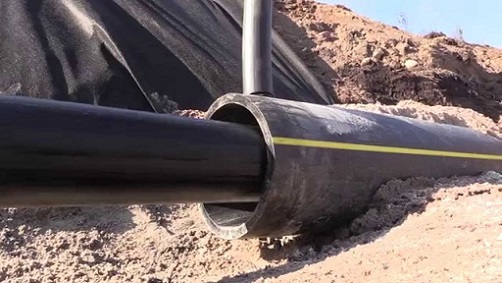
First, we must reboot our industrial landscape; and the “art and science” of pipelines can be pivotal, especially in light of the recent eruptions in natural disasters. There were 2 major hurricanes in September 2017 – Irma and Maria – and the devastation in some member-states has been almost complete – i.e. remember Barbuda. A great benefit of over-ground, underground and underwater pipelines is that they can be sustained during hurricanes…and can help to quickly restore power and the systems of commerce.

The movement behind the book Go Lean … Caribbean posits that it is possible to create the required jobs that we need and has presented a roadmap for 2.2 million jobs. But the book warns that for this task to be successful, it is heavy-lifting. The entire industrial landscape must be rebooted. There is now a full catalog for this Industrial Reboot 101 effort and this commentary is 3 of 4 in this occasional series. The full series is as follows:

  1. Industrial Reboot – Ferries 101
  2. Industrial Reboot – Prisons 101
  3. Industrial Reboot – Pipelines 101
  4. Industrial Reboot – Frozen Foods 101

Continuing with pipelines, a recent blog-commentary detailed how diverse pipeline technologies can help restore post-storm normality in quick order:

  • Flood Control drainage pipelines
    CU Blog - Industrial Reboot - Pipelines 101 - Photo 3b
    CU Blog - Industrial Reboot - Pipelines 101 - Photo 3a
    CU Blog - Industrial Reboot - Pipelines 101 - Photo 3c
  • Underground-piped and underwater-piped electrical cables – see specifications sample in Appendix A
    CU Blog - After Irma, the Science of Power Restoration - Photo 1

CU Blog - Industrial Reboot - Pipelines 101 - Photo 4The book Go Lean … Caribbean details more; it asserts that pipelines can be strategic, tactical and operationally efficient for building community wealth in the Caribbean region. Yes, they can mitigate challenges from Mother Nature, create jobs and grow the economy at the same time. The book purports that a new technology-enhanced industrial revolution is emerging, in which there is more efficiency for installing-monitoring-maintaining pipelines. Caribbean society must participate in these developments, in order to “survive with the fittest”. This point is pronounced early in the book with this Declaration of Interdependence (Page 14), with these statements:

xxvi. Whereas the Caribbean region must have new jobs to empower the engines of the economy and create the income sources for prosperity, and encourage the next generation to forge their dreams right at home, the Federation must therefore foster the development of new industries, like that of … pipelines

xxvii. Whereas the region has endured a spectator status during the Industrial Revolution, we cannot stand on the sidelines of this new economy, the Information Revolution. Rather, the Federation must embrace all the tenets of Internet Communications Technology (ICT) to serve as an equalizing element in competition with the rest of the world. The Federation must bridge the digital divide and promote the community ethos that research/development is valuable and must be promoted and incentivized for adoption.

This Go Lean book serves as a roadmap for the introduction and implementation of the technocratic Caribbean Union Trade Federation (CU) to elevate the 30 Caribbean member-states. This Federation will assume jurisdiction for the 1,063,000 square-mile Caribbean Sea, in an Exclusive Economic Zone (EEZ). This approach allows for cooperation and coordination for pipelines among the member-states, The Go Lean book specifically identifies that pipelines can impact these societal engines (Page 96):

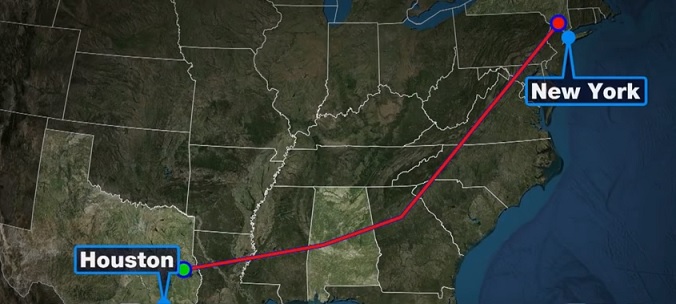
  • Economics – Pipelines bring resources from the source to the destination in a steady consistency, thereby fulfilling the economic supply-demand conundrum. This is vital for resources like water, energy elements (oil, gas, & minerals) – see Appendix B –  electricity, and telecommunications lines. There are newer innovations planned for pipelines, like Pneumatic Capsules, to allow for the transport of cargo, and even the far-reaching testing for high-speed passenger travel.
  • Governance – Administration to include a separation-of-powers between the member-states and CU federal agencies.
  • Security – This category does not refer to some military application, but rather public safety/security provisions. Pipelines can be erected in web design formations to allow transport from source to destination via alternate routes if ever extraordinary conditions (storms) impact normal flow – see model in Appendix C – this is modeled after the internet’s worldwide-web. There is also an element of economic security with the emergence of pipeline maintenance jobs to engineer, maintain and monitor installations.
    • Emergency – Tourism is the region’s primary industry driver so pipeline spills/accidents may have a major impact on the fauna/flora of the islands. But there are “best practices” to apply to mitigate the risks associated with pipelines. The web design approach also facilitates a recovery plan for emergencies. So when a Hurricane Watch is declared anywhere in the region, (normal 3 days from landfall), the mandate is that all pipeline flow must cease.

The subject of pipelines has also been addressed and further elaborated upon in these previous blog/commentaries:

https://goleancaribbean.com/blog/?p=6867 Pipelines can address high consumer prices
https://goleancaribbean.com/blog/?p=2670 A Lesson in History – Rockefeller’s Pipeline
https://goleancaribbean.com/blog/?p=1817 Caribbean grapples with intense new cycles of flooding & drought
https://goleancaribbean.com/blog/?p=1516 Floods in Minnesota, Drought in California – Why Not Share?

The Go Lean book provides 370 pages of details on the economic principles and community ethos to adopt, plus the executions of strategies, tactics, implementations and advocacies to forge pipelines and industrial growth in the Caribbean:

Economic Principles – Economic Systems Influence Individual Choices Page 21
Community Ethos – Job Multiplier Page 22
Community Ethos – “Crap” Happens – So we must be prepared Page 23
Community Ethos – Lean Operations Page 24
Community Ethos – Return on Investments (ROI) Page 24
Community Ethos – Cooperatives Page 25
Community Ethos – Ways to Impact the Future Page 26
Community Ethos – Ways to Help Entrepreneurship Page 28
Community Ethos – Ways to Promote Intellectual Property Page 29
Community Ethos – Ways to Impact Research & Development Page 30
Community Ethos – Ways to Improve Sharing Page 35
Community Ethos – Impact the Greater Good Page 37
Anecdote – Pipeline Transport – Strategies, Tactics & Implementations Page 43
Strategy – Agents of Change – Technology Page 57
Tactical – Fostering a Technocracy Page 64
Tactical – Growing Economy – New High Multiplier Industries Page 68
Separation of Powers – Interstate Commerce Administration Page 79
Separation of Powers – Interior Department – Exclusive Economic Zone Page 82
Implementation – Assemble – Pipeline as a Focused Activity Page 96
Implementation – Ways to Pay for Change Page 101
Implementation – Benefits from the Exclusive Economic Zone Page 104
Implementation – Ways to Develop a Pipeline Industry Page 107
Implementation – Ways to Deliver Page 109
Planning – 10 Big Ideas – Pipeline Projects Page 127
Planning – Ways to Improve Interstate Commerce Page 129
Planning – Lessons from New York City Page 137
Planning – Lessons from Omaha Page 138
Advocacy – Ways to Grow the Economy Page 151
Advocacy – Ways to Create Jobs Page 152
Advocacy – Ways to Better Manage the Social Contract – Infrastructure Page 170
Advocacy – Ways to Ways to Impact Public Works – Ideal for Pipelines Page 175
Advocacy – Ways to Foster Cooperatives Page 176
Advocacy – Ways to Better Manage Natural Resources – Water Resources Page 183
Anecdote – Caribbean Industrialist & Entrepreneur Role Model Page 189
Advocacy – Ways to Impact Extractions – Pipeline Strategy Alignment Page 195
Advocacy – Ways to Improve Emergency Management Page 196
Advocacy – Ways to Foster Technology Page 197
Advocacy – Ways to Improve Monopolies – Foster Cooperatives Page 202
Advocacy – Ways to Improve Transportation – Pipeline Options Page 205
Appendix – Interstate Compacts – Needed for Pipelines in US Territories Page 278
Appendix – Pipeline Maintenance Robots Page 283
Appendix – North Dakota Example – Oil Drilling Economic-Societal Effects Page 334

The economic principles of pipelines are sound.

The Go Lean book details that the Caribbean can create …

2,000 direct jobs building/maintaining pipelines, tunnels, and the regional power grid

These are direct jobs; there is also the reality of indirect jobs – unrelated service and attendant functions – at a 3.75 multiplier rate would add another 7,500 jobs. That makes a total of 9,500 jobs.

Hurricanes are so dire and disruptive that they need to be mitigated. We need pipelines and we need them NOW!

How” would the Caribbean region reboot, reform and transform their societal engines to develop a Pipeline industry. This is the actual title of one advocacy in the Go Lean book. Consider the specific plans, excerpts and headlines here from Page 107, entitled:

10 Ways to Develop a Pipeline Industry

1

Lean-in for the Caribbean Single Market
The CU will allow for the unification of the region into one market, thereby creating a single economy of 30 member-states, 42 million people and a GDP of over $800 Billion. The CU envisions applications to connect the member states with a network of pipelines/tunnels/cables; facilitated at the federal level due to cross-border implications and oversight of the region’s energy/environment missions. Another dimension that aligns with the CU is fostering hi-technology jobs.

2

Pneumatic Cargo TubesThe CU is ideal for the implementation of PCP systems to handle containers and trailers through underwater, underground and above-ground pipelines powered by magnetic levitation systems (ILM). There are some pre-defined sites well-fitted for PCP: 7 miles between Venezuela & Trinidad; Nassau’s cruise/cargo port to an intermodal exchange site, etc..

3

Underwater Tunnels

4

Underwater Pipes and CablesThe CU will employ the best practices, arts and sciences to install underwater pipelines and underwater cables. (Cables are flexible and can be inserted in/out of pipes). All pipes can be treated with an epoxy to withstand salt-water erosion.

5

Fresh WaterSome CU islands have water resource challenges (i.e. Antigua). They installed desalination as a solution. An alternate solution is now water pipelines. The CU will install the infrastructure to transport water from source to target via pipelines.

6

Oil-to-Oil RefineryThere are oil-producing states with the CU. (Plus, a lot of oil explorations engagements). There are also a number of oil refineries. The CU envisions above-ground/undersea pipelines to connect refineries to oil sources/shipping terminals.

7

High Intensity Power LinesThe CU will deploy a regional power grid, which is now feasible with the unified market. With the reality of island chains, and the reality of new technologies (like HVDC), the high intensity power lines can be mounted underground or underwater, (see Appendix below), in a solo fashion or in other CU built/maintained tunnels/pipelines.

8

Natural Gas on Land

9

Emergency ManagementThe CU treaty grants jurisdiction of strategic pipelines to federal governing authorities. The CU will apply the world’s best-in-breed tools, best-practice techniques and systems for ensuring the viability and integrity of pipelines:

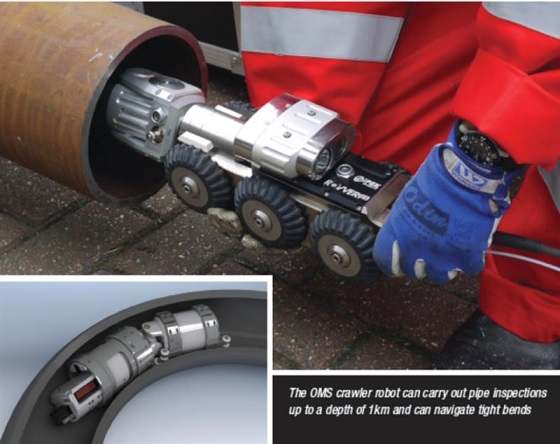
  • Maintenance – The CU will engage pipe crawlers (robots) for inspections to assuage pipeline risks (Appendix IF).
  • Incidents – Every incident must be rated for severity: Stratification 1 (leakage); “Strat” 2 (shutdown). While all incidents will be reported and published on the CU portal, Strat 3 (property damage) and 4 (loss of life) must have public hearings.
  • Disasters – The CU region have seasonal threats of hurricanes, and these dictate extraordinary measures and disaster recovery plans for Emergency Managers. The CU will mandate remediation & pipeline shutdown during storm warnings.

10

Tourism / Eco ImpactThe primary economic engine for the Caribbean is tourism. The CU will always promote and protect this industry. But pipelines can co-exist, and the natural/pristine environs can be protected! The CU envisions underground pipeline in urban/suburban areas, above ground pipelines in rural areas and underwater pipeline to connect the islands.

In summary, we need jobs; our Caribbean job creation dysfunction is acute. Jobs in the Pipeline industry are stable, reliable and providential to facilitate growth in other industries and to assure business continuity. These infrastructural enhancements would help us to make our homeland a better place to live, work and play.

Pipeline = Infrastructure! A region-wide pipeline deployment = Industrial Reboot!

CU Blog - Industrial Reboot - Pipelines 101 - Photo 1

Yes, we can … reboot our industrial landscape and deploy our own web of pipelines; consider the US model in Appendix C. We can create new jobs – and other economic opportunities – that the Caribbean region needs. We urge all Caribbean stakeholders – governments and citizens – to lean-in to this roadmap for economic empowerment. We can make all of the Caribbean homeland better places to live, work and play. 🙂

Download the free e-Book of Go Lean … Caribbean – now!

Sign the petition to lean-in for this roadmap for the Caribbean Union Trade Federation.

———–

Appendix A Title: Underwater High Intensity Power Lines

High-Voltage Direct Current (HVDC) Light technology is designed to transmit power over long distances in both underground and under-water settings. HVDC Light technology, offered by ABB – the German Industrial powerhouse, leading in the development and implementation of HVDC technology.

Buried HVDC is a feasible technology for the Caribbean Union Regional Power Grid. Its feasibility is based upon several factors that include it being a time-tested technology, having suitable cable capacity, utilizing efficient and small footprint converter stations.

A classical HVDC transmission has a power of more than 100 Megawatts (MW) and many are in the 1,000 – 3,000 MW range. There are classical HVDC transmissions that use overhead lines (OHL) and some that use undersea (and underground) cables (or combinations of cables and lines). ABB’s HVDC Light technology uses underground or submarine cables with an economical upper power range now reaching 1,200 MW and ±500 kV.

HVDC can be used to span OHL routes with a length of 1,000 km (about 600 miles) or more and undersea routes (submarine cables) from a length of 60 km (about 40 miles) upwards more economically than with alternating current (AC). Direct current has the advantage over alternating current that it does not cause eddy currents and can thus make use of the full cross section of the cable. Heat losses are lower because of the lower resistance for the same cross-section. Incidentally: Power losses with AC voltage are higher under water than in the air or underground because with deep sea cables it is not possible to use compensating elements (coils, capacitors) against inductive and capacitive losses.

The modern form of HVDC transmission uses technology developed extensively in the 1930s in Sweden at ASEA (a founding company of ABB). More specific to this document, buried HVDC has been employed in land and submarine transmission settings for many decades. This technology has been used most extensively in Europe, and is now being proposed for long distance high-voltage transmission lines in the northeast and eastern areas of the USA. The Champlain Hudson Power Express, a 333 mile-long transmission line from the U.S. – Canadian border to New York City, is currently in the EIS preparation stage. The transmission system will consist of two 5 inch diameter cables to be laid under water and on land. The proposed route will start at the U.S. – Canadian border, travel south through Lake Champlain and along railroad right of ways, and then enter the Hudson River south of Albany. The power will ultimately go to a converter station in Astoria Queens.

Working examples of HVDC buried land and underwater lines include: Cross Sound, across 42 kilometers of the Long Island Sound (New York); the Trans-Bay HVDC cable project under construction in California connecting Pittsburg in East Bay to San Francisco; a large number of working HVDC submarine cables transporting power between Europe and Scandinavia, between the UK and France, between the islands of New Zealand, and between Italy and Greece.

HVDC requires terminals, or converter stations, at the line ends. A significant feature of the HVDC Light transmission system is that an HVDC Light converter station has a much smaller size than even a classical HVDC converter station, and certainly is much smaller in size than an AC substation. A significant characteristic of HVDC Light cable is its excellent ability to stabilize AC voltage at the terminals. This is especially important for wind parks, where the variation in wind speed can cause severe voltage fluctuations. Additional technical aspects of this cable include: 1) if the cable is damaged, HVDC protection reduces the current and voltage to zero in a fraction of a second so there is no possibility of damage to persons and infrastructure, 2) the HVDC transmission system uses underwater and underground cables that are solid, are made from non-flammable materials, are well insulated, and contain no liquids or gels.

The burial of HVDC Light cable is similar to that of fiber-optic cables because the equipment used for trenching and the depths at which the cables are laid are comparable (1 to 1.5 m below the surface). In some relevant projects, underground cables are installed using modified pipeline installation equipment. The strength and flexibility of HVDC Light cables make them suitable for submarine use. They can be laid in deeper waters and on rough bottoms.

CU Blog - Industrial Reboot - Pipelines 101 - Photo 2

Source: ABB Technical Specification documents

———–

Appendix B VIDEO – Key US gasoline pipeline now ready to carry more fuel, just days after Harvey – https://youtu.be/NOG4j6PHv10

CBS North Carolina
Published on Aug 31, 2017 – Key US gasoline pipeline aims to carry more fuel by Sunday; Cooper urges caution.

———–

Appendix C VIDEO – Animated map of the major oil and gas pipelines in the US – https://youtu.be/MEIerHQ9IAw

Business Insider
Published on Dec 31, 2015 – The United States is the world’s largest consumer of oil, using over 19 million barrels a day in 2014. This high level of consumption wouldn’t be possible without the 2.5 million mile network of pipeline used to transport the fuel from its source to the market.

Business Insider is the fastest growing business news site in the US. Our mission: to tell you all you need to know about the big world around you. The BI Video team focuses on technology, strategy and science with an emphasis on unique storytelling and data that appeals to the next generation of leaders – the digital generation.

See a related VIDEO here at https://youtu.be/JXRFIqtCMzM that showcases pipeline safety, disaster and recovery dimensions.


Share this post:
, , ,
[Top]

Industrial Reboot – Prisons 101

Go Lean Commentary

Want to create jobs? “Go to jail; go directly to jail”.

The book Go Lean … Caribbean (Page 23) makes this realistic disclosure:

“Bad Actors” will [always] emerge … to exploit the opportunities, with good, bad and evil intent.

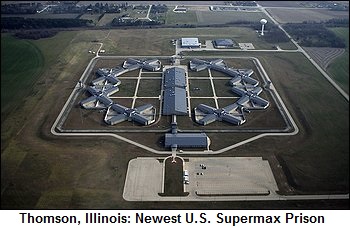
The book continues this theme and relates that there can be economic benefits if communities foster the industries around prisons – consider the SuperMax in the Appendix below – and incarcerating “bad actors”, especially “bad actors” that are the responsibility of other jurisdictions. This is a business model, a Prison Industrial Complex, in which the landlord-host gets paid from the responsible jurisdictions. Business model refers to jobs, entrepreneurial opportunities, trade transactions, etc.

CU Blog - Industrial Reboot - Prisons 101 - Photo 1The Go Lean book details that the Caribbean can create …

12,000 direct jobs for prison guards, administrators, supply logistics, and private protection

While these are direct jobs, there is also the reality of indirect jobs – unrelated service and attendant functions – that at a 3.75 multiplier rate would add another 45,000 jobs.

The book Go Lean…Caribbean – available to download for free – serves as a roadmap for the introduction and implementation of the technocratic Caribbean Union Trade Federation (CU); this is a confederation of all 30 member-states to execute a reboot of the Caribbean eco-system. This CU/Go Lean roadmap has these 3 prime directives:

  • Optimization of the economic engines in order to grow the regional economy to $800 Billion and create 2.2 million new jobs.
  • Establishment of a security apparatus to ensure public safety and protect the resultant economic engines.
  • Improvement of Caribbean governance to support these engines, including a separation-of-powers between the member-states and CU federal agencies.

There is the need for this reboot right now! In the last weeks – September 2017 – the Caribbean region has been beset by 2 major hurricanes, Irma and Maria. The devastation in some member-states has been so complete – i.e. remember Barbuda – that they have had to send their prisoners to foreign facilities, (still within the Caribbean). Consider the news article here, relating this actuality:

Title: St Lucia willing to accept up to 40 foreign prisoners: National Security Minister

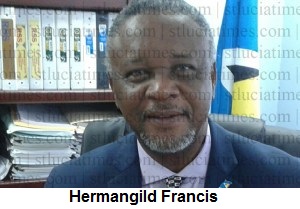
CU Blog - Industrial Reboot - Prisons 101 - Photo 2The National Security Minister, Senator Hermangild Francis has sought to downplay reports that the prisoners brought to St Lucia from the hurricane-ravaged Caribbean islands are high risk.

“People are saying high risk. I have not seen anything indicating that they are high risk. All I’ve been told is that they’re prisoners that needs shelter. So we have accepted to house as many as we could,” Francis asserted.

Seven prisoners from the British Virgin Islands arrived in St Lucia Tuesday along with three others from the Turks and Caicos Islands, bringing to 17 the total number of criminals currently being jailed on the island from the BritishOverseasTerritories, the National Security Minister confirmed.

The first group of seven prisoners arrived at the HewanorraInternationalAirport onboard a British military aircraft on Monday.

It’s unclear what crimes the prisoners were convicted of in their countries or how long will they be kept in St Lucia.

Francis could not confirm whether that would be the final batch.

He said St Lucia is willing to accommodate up to 40 prisoners given that the current low occupancy level at Bordelais Correctional Facility.

The National Security Minister said Tuesday’s transfer of prisoners was carried out “better” than the day before.

The men are being housed in a segregated unit of the Bordelais Correctional Facility, away from local prisoners, Francis said.

The Minister said he plans to visit the prison on Friday.

Source: Posted September 27, 2017; retrieved October 3, 2017 from: https://stluciatimes.com/2017/09/27/st-lucia-willing-accept-40-foreign-prisoners-national-security-minister

Related Story: “Most dangerous” BVI prisoners transferred to St Lucia; reports – Posted September 29, 2017; retrieved October 3, 2017 from: https://stluciatimes.com/2017/09/29/dangerous-bvi-prisoners-transferred-st-lucia-reports

CU Blog - Industrial Reboot - Prisons 101 - Photo 3

Hurricanes are “bad actors” too.

Having a Caribbean Prison Industrial Complex fully functional at this time would have impacted the region’s societal engines: economic, security apparatus and governing administrations. We need this Go Lean/CU roadmap NOW!

The Go Lean book stresses that reforming and transforming the Caribbean societal engines must be a regional pursuit. This was an early motivation for the roadmap, as pronounced in the opening Declaration of Interdependence (Pages 12 – 13):

x. Whereas we are surrounded and allied to nations of larger proportions in land mass, populations, and treasuries, elements in their societies may have ill-intent in their pursuits, at the expense of the safety and security of our citizens. We must therefore appoint “new guards” to ensure our public safety and threats against our society, both domestic and foreign. The Federation must employ the latest advances and best practices of criminology and penology to assuage continuous threats against public safety. The Federation must allow for facilitations of detention for convicted felons of federal crimes, and should over-build prisons to house trustees from other jurisdictions.

xi. Whereas all men are entitled to the benefits of good governance in a free society, “new guards” must be enacted to dissuade the emergence of incompetence, corruption, nepotism and cronyism at the peril of the people’s best interest. The Federation must guarantee the executions of a social contract between government and the governed.

xvi. Whereas security of our homeland is inextricably linked to prosperity of the homeland, the economic and security interest of the region needs to be aligned under the same governance. Since economic crimes … can imperil the functioning of the wheels of commerce for all the citizenry, the accedence of this Federation must equip the security apparatus with the tools and techniques for predictive and proactive interdictions.

xxiv.  Whereas a free market economy can be induced and spurred for continuous progress, the Federation must install the controls to better manage aspects of the economy: jobs, inflation, savings rate, investments and other economic principles. Thereby attracting direct foreign investment because of the stability and vibrancy of our economy.

xxvi.  Whereas the Caribbean region must have new jobs to empower the engines of the economy and create the income sources for prosperity, and encourage the next generation to forge their dreams right at home, the Federation must therefore foster the development of new industries, like that of … the prison industrial complex. In addition, the Federation must invigorate the enterprises related to existing industries like tourism, fisheries and lotteries – impacting the region with more jobs.

Accordingly, the CU will facilitate the eco-system for Self-Governing Entities (SGE), an ideal concept for prisons, with its exclusive federal regulation/promotion activities. Imagine a bordered campus – with a combination of fencing, walls and/or moats/canals – that designates the exclusivity of the commercial, security and administration to superlative governance above the member-states. With an approved “Action Plan”, the comings-and-goings would not be up to debate of local authorities.

The Go Lean movement (book and blogs) details the principles of SGE’s and job multipliers, how certain industries are better than others for generating multiple indirect jobs down the line (or off-campus) for each direct job on the SGE’s payroll. In a previous blog-commentary, it was related how one industry – shipbuilding – was perfectly suited for the Caribbean, as long as the structure was an independent “Shipyard”/SGE. That commentary asserted how 60,000 new jobs can easily be facilitated.

This is transforming! This is the vision of an industrial reboot! This is where and how the jobs are to be created.

But do the exploitations of the Prison Industrial Complex put security at risk for Caribbean communities?

No. Not if the deployments are done right!
(See the reality of “Life in a SuperMax” Prison facility in the Appendix VIDEO below).

The Go Lean book provides 370-pages of turn-by-turn instructions on “how” to adopt new community ethos, plus the strategies, tactics, implementations and advocacies to execute so as to reboot, reform and transform the societal engines of Caribbean society. One advocacy in rebooting the industrial landscape is to foster a Prison Industrial Complex; consider the  specific plans, excerpts and headlines from the book on Page 211 entitled:

10 Ways to Impact the Prison Industrial Complex

1

Lean-in for the Caribbean Single Market
This will allow for the unification of the region into one market of 42 million people across 30 member-states with a GDP of $800 Billion (2010 figures). In addition, the treaty calls for a collective security pact allowing the implementation of a prison system to detain convicts of CU federal offenses (i.e. economic and military crimes). The CU will over-build these facilities for more than just federal prisoners, but also to house inmates for other jurisdictions. Directly, there is a huge economic impact, starting with jobs (law enforcement and support personnel), and the construction industry to build the prisons. Indirectly, the spin-off in the local communities has a multiplier effect. This industry will generate direct income for the CU.

2

Invite and Repatriate Prisoners
The CU will petition host countries to return incarcerated members of the Caribbean Diaspora – for a fee – since they are guilty of crimes committed in those host countries. But the cost of incarceration can be lower in the CU region compared to North American and European venues, because of the ideal weather. The next leap is to offer to house other prisoners in an outsourcing arrangement for the foreign host countries – this is classic Prison Industrial Complex.

3

Impact Rural Communities

4

In-source for Local Governments
The member-states can embrace the CU’s Prison Industrial Complex to satisfy their own needs, both penal and labor. With economies-of-scale, they can out-source their own trustees to the CU to minimize their direct costs. In addition, the CU will manage the process of providing prison labor for public endeavors, i.e. license plates and document scanning.

5

Supply Prison Labor Needs

6

Build Employable Skill-Sets

7

Reduce Recidivism

8

Gathering Intelligence on Probation Trustees and Parolees

9

Prepare for Escalations and Emergencies
The security needs of the region are paramount, even in the case of emergencies. The CU region must allow for the systemic risks of natural disasters (hurricanes and earthquakes) in the vicinity of maximum security prisons. The risk mitigation plan must allow for tactical response/SWAT units, riot squads, and military readiness to suppress uprisings.

10

Learn from Peonage Past and Ensure Corporate Governance

There have been a number of blog-commentaries by the Go Lean movement that highlighted economic opportunities embedded in regional homeland security initiatives. See a sample list here:

https://goleancaribbean.com/blog/?p=13126 “Must Love Dogs”  – Providing K9 Solutions for Better Security
https://goleancaribbean.com/blog/?p=12400 Accede the Caribbean Arrest Treaty
https://goleancaribbean.com/blog/?p=9072 Model: Shots-Fired Monitoring – Securing the Homeland on the Ground
https://goleancaribbean.com/blog/?p=2782 Model: ‘Red Light Traffic Cameras’ for Public Safety & Profits
https://goleancaribbean.com/blog/?p=1832 Model: Opportunities as US Deports More Drug-arrested Inmates
https://goleancaribbean.com/blog/?p=1674 Model: $3.7 Billion for US Detention Centers

In summary, we need jobs; our Caribbean job creation dysfunction is acute. While not glamorous, Prison Industrial Complex jobs are stable, reliable and providential. They would help us to make our homeland a better place to live, work and play.

But this is only 57,000 (12,000 + 45,000) jobs. The Go Lean/CU vision is for 2.2 million new jobs. Where and how can this new technocracy expect to create those jobs, while the existing regimes of the Caribbean region cannot accomplish this now?

Industrial Reboot!

But the Go Lean book describes the process as “difficult”, no ABC-123. Rather it is heavy-lifting! Yet there are some basics that must be embraced; these basics can be catalogued as an “Industrial Reboot 101”. This commentary is 2 of 4 in an occasional series considering Industrial Reboots. The full series is as follows:

  1. Industrial Reboot – Ferries 101
  2. Industrial Reboot – Prisons 101
  3. Industrial Reboot – Pipeline 101
  4. Industrial Reboot – Frozen Foods 101

Yes, we can … reboot our industrial landscape. It is possible to create the new jobs – and other economic opportunities – that the Caribbean region needs. We urge all Caribbean stakeholders – governments and citizens – to lean-in to this roadmap for economic empowerment. We can make all of the Caribbean homeland better places to live, work and play. 🙂

Download the free e-book of Go Lean … Caribbean – now!

Sign the petition to lean-in for this roadmap for the Caribbean Union Trade Federation.

————

Appendix Title: SuperMax Prison

Supermax (short for: super-maximum security) is a primarily U.S. English term used to describe “control-unit” prisons, or units within prisons, which represent the most secure levels of custody in the prison systems of certain countries. The objective is to provide long-term, segregated housing for inmates classified as the highest security risks in the prison system—the “worst of the worst” criminals—and those who pose a threat to both national and global security.[1]

CU Blog - Industrial Reboot - Prisons 101 - Photo 4a

CU Blog - Industrial Reboot - Prisons 101 - Photo 4b

History
CU Blog - Industrial Reboot - Prisons 101 - Photo 5
The United States Penitentiary Alcatraz Island, opened in 1934, has been considered a prototype and early standard for a supermax prison.[5]

An early form of supermax-style prison unit appeared in Australia in 1975, when “Katingal” was built inside the Long Bay Correctional Centre in Sydney. Dubbed the “electronic zoo” by inmates, Katingal was a super-maximum security prison block with 40 prison cells having electronically operated doors, surveillance cameras, and no windows. It was closed down two years later over human rights concerns.[6] Since then, some maximum-security prisons have gone to full lockdown as well, while others have been built and dedicated to the supermax standard.

Supermax prisons began to proliferate within the United States after 1984. Prior to 1984 only one prison in the U.S. met “supermax” standards: the Federal Penitentiary in Marion, Illinois. By 1999, the United States contained at least 57 supermax facilities, spread across 30–34 states.[3] The push for this type of prison came after two correctional officers at Marion, Merle Clutts and Robert Hoffman, were stabbed to death in two separate incidents by …. This prompted Norman Carlson, director of the Federal Bureau of Prisons, to call for a new type of prison to isolate uncontrollable inmates. In Carlson’s view, such a prison was the only way to deal with inmates who “show absolutely no concern for human life”.[7]

Source: Retrieved from Wikipedia October 4, 2017 from: https://en.wikipedia.org/wiki/Supermax_prison

See related Appendix VIDEO of Life in a SuperMax Prison below.

————

Appendix VIDEO – Life in a SuperMax Prison – CNN Video – http://www.cnn.com/videos/us/2015/05/13/inside-supermax-prison-orig.cnn/video/playlists/inside-prison-cells/

Published May 143, 2015 – Life in a SuperMax Prison

If [Boston Marathon Bomber] Dzhokhar Tsarnaev is sent to the United States Penitentiary Administrative-Maximum Facility in Florence, Colorado, he’ll be cut off from the world. See what life is like for inmates inside a Supermax prison. Source: CNN


Share this post:
, , ,
[Top]

ENCORE: The Requirement for Better Security – ‘Must Love Dogs’

One Minute Las Vegas Was Rocking; the Next It Was ‘World War III’ – Report of October 1, 2017 attack at a Country Music Festival
CU Blog - Must Love Dogs ENCORE - Photo 1

It is obvious that tourism and terrorism do not “make good dance partners”. Las Vegas enjoys 47 million tourists year, but with last night’s terrorist attack, there may be the need for some security enhancements at tourist and festival venues.

This is the similar awareness after the May 2017 attack at the Ariana Grande concert in Manchester, England

… and the June 2016 Pulse Night Club shooting in Orlando, Florida.

The advocacy from the lessons-learned from all of these events is “Want Better Security? Must Love Dogs“. There are opportunities for bomb-sniffing and gun-sniffing dogs at venues and surrounding areas. This is the exact theme of a previous blog-commentary. Here is an ENCORE of that commentary:

———————

Go Lean Commentary – Want Better Security? Must Love Dogs

So you want to secure your homeland against terror and other threats? Here’s a key requirement:

‘Must Love Dogs’

This is so true; man’s best friend can also be our best partner for mitigating threats of terroristic acts in public places. This is common sense … now that we have seen how devious the terrorists can be, exploiting soft targets right outside any hard target zones.

This is a fresh concern as there was a terrorist attack at the Manchester Arena in Manchester, England last night (May 22, 2017). The attacker was an ISIS-backed suicide bomber who positioned himself among the exiting concert-goers for a show at the Arena. (The artist is American teen pop-sensation Ariana Grande, a fan-favorite among teenage girls and boys). He detonated his “Improvised Explosive Device” (IED) right outside the security zone while people were exiting to leave. So far, the death toll is 22, with 59 injuries. See full details on the story, aftermath and investigation here:

ISIS Claims Responsibility for Manchester Concert Attack; 22 Dead

Manchester Arena – Situation Normal
CU Blog - 'Must Love Dogs' - Photo 4

CU Blog - 'Must Love Dogs' - Photo 3

CU Blog - 'Must Love Dogs' - Photo 2

Manchester Arena – Monday Night May 22, 2017

CU Blog - 'Must Love Dogs' - Photo 1

CU Blog - 'Must Love Dogs' - Photo 5

Expect more revelations of the motives and bitter consequences of this attack against “innocence”.

This is a matter of serious concern for planners of a new Caribbean. This is Terrorism 101; this is affecting the whole world and our world. Though this attack was far away from the Caribbean islands, it was not far away from Caribbean people, as related in a previous blog-commentary from the promoters of the book Go Lean…Caribbean, there is a large Caribbean Diaspora in Manchester.

The book Go Lean…Caribbean – available to download for free – serves as a roadmap for the introduction and implementation of the technocratic Caribbean Union Trade Federation (CU), for the elevation of Caribbean society – for all member-states. The book asserts that the needed security apparatus to better defend against the modern threats of terrorism is too much for any one Caribbean member-state alone. There must be a regional integrated and confederated solution. This CU/Go Lean roadmap has these 3 prime directives:

  • Optimization of the economic engines in order to grow the regional economy and create new jobs.
  • Establishment of a security apparatus to ensure public safety and protect the resultant economic engines.
  • Improve Caribbean governance to support these engines, including a separation-of-powers between the member-states and CU federal agencies.

The book stresses that reforming and transforming the Caribbean societal engines must be a regional pursuit. This was an early motivation for the roadmap, as pronounced in the opening Declaration of Interdependence (Pages 12 – 13):

x. Whereas we are surrounded and allied to nations of larger proportions in land mass, populations, and treasuries, elements in their societies may have ill-intent in their pursuits, at the expense of the safety and security of our citizens. We must therefore appoint “new guards” to ensure our public safety and threats against our society, both domestic and foreign. The Federation must employ the latest advances and best practices of criminology and penology to assuage continuous threats against public safety. …

xi. Whereas all men are entitled to the benefits of good governance in a free society, “new guards” must be enacted to dissuade the emergence of incompetence, corruption, nepotism and cronyism at the peril of the people’s best interest. The Federation must guarantee the executions of a social contract between government and the governed.

xvi. Whereas security of our homeland is inextricably linked to prosperity of the homeland, the economic and security interest of the region needs to be aligned under the same governance. Since economic crimes … can imperil the functioning of the wheels of commerce for all the citizenry, the accedence of this Federation must equip the security apparatus with the tools and techniques for predictive and proactive interdictions.

Is there anything more that could have been done to prevent this Manchester Terrorist Attack? Let the post-trauma analysis begin! For one, the planners of the new Caribbean security apparatus have always presented this ingredient to the recipe for security success:

Must love dogs!

- Photo 6

In a previous blog-commentary, it was related how specially-trained canines can help to better secure the Caribbean homeland. Consider this quotation:

The subject of animals and animal companionship is also pivotal in the roadmap for elevating Caribbean society, especially for the security engines. The Go Lean book posits (Page 185) that better command of Animal Husbandry can facilitate better security around the region’s economic engines. Dogs feel a lot less intrusive and less intimidating than formal security screening, or personnel patrolling with AK47 automatic rifles.  Imagine a beautiful Caribbean beach scene with a plain clothes “officer” walking along with specialty dogs, or more exactly:

  • Drug Sniffing Dogs
  • Bomb [and Gun] Sniffing Dogs
  • Service/Therapy Dogs

This is one implementation that could have been deployed to mitigate the terrorism threat in Manchester … and everyday here in the Caribbean. Yes, this is in hindsight; this is “Monday Morning Quarterbacking“. This is not fair to the 22 lives lost in Manchester, but this is most importantly a pledge, not to let those lives die in vain. Let’s apply the lessons-learned.

This implementation with service dogs is just one “how”. The Go Lean book provides 370-pages of turn-by-turn instructions on “how” to adopt new community ethos, plus the strategies, tactics, implementations and advocacies to execute so as to better ensure homeland security in the Caribbean region.

Consider this one chapter (and Case Study) … where the Go Lean book fully detailed the advocacy of Animal Husbandry; see  these headlines from Page 185:

Case Study: Trikos K9 Warriors
When the bombs went off at the Boston Marathon [in April 2013], highly trained dogs were rushed to the scene to search for more explosives. Boston Police have said dogs swept the streets in the morning and a second time just an hour before the first marathoners crossed the finish line. It’s considered likely that the bombers planted their devices well after the dogs finished sweeping the area. Since 9/11, dogs have been used more than ever because nothing has proven more effective against hidden bombs than the nose of a working dog. The best of them serve with U.S. Special Operations, so much of what they do is classified, but by looking at the trainers, Trikos K9 Warriors (www.trikos.com) – on a 20-acre ranch in rural Cooper, Texas – one gets a rare glimpse inside the secretive world of these elite dogs. Most of them are from one breed, Belgian Malinois.
Dogs and their handlers work as a team, train as a team, and they go through so much together their bond is as strong as a band of brothers. In Afghanistan, they led their units and protected them in battlefields littered with hidden bombs. Per former Navy SEAL and Trikos Founder Mike Ritland: “same thing that they do for [the troops] overseas, detect explosives, they can do on American streets; plus they can run faster than 30 miles an hour so they can help take down suspects”.
See Appendix below for VIDEO from CBS News Magazine “60 Minutes”.


10 Ways to Improve Animal Husbandry

1 Lean-in for Caribbean Integration
The CU treaty allows for the unification of the region into one market, thereby impaneling a federal layer for oversight of the economy and security of the 30 member-states and 42 million people. One CU mission is to facilitate better security around the region’s economic engines. Another mission is to make the Caribbean a better place to live, work and play. In considering the needs of the 42-million population, there must be some consideration for their animals. Beyond the CU overseeing food-supply regulations and spearheading the security benefits of employing specially trained service animals, the CU will spur philanthropy for more animal husbandry efforts, such as foundations advocating Spay/Neuter goals for dogs/cats. Lastly, the CU will coalesce with local authorities to ensure “dog parks” in urban/suburban areas.
2 Plantations for Bomb Sniffing Dogs
The CU assumes the responsibility to assuage systemic risks and economic crimes. This includes marshaling defensive support for events/festivals, against terrorism and cross border gangs. The US model of Trikos K9 Warriors will be adopted with Belgian Malinois dogs, to breed them on plantations and train them to detect and interdict explosives.
3 Cadaver Dogs / Drug Sniffing Dogs / Drug Sniffing Pigs
The CU will install plantations for dogs and pigs (Vietnamese Potbellies are especially acute) to train them to detect drugs/contraband and cadavers. The CU will maintain animals on-the-ready for acquisition by local and federal police.
4 Police K9 Units
Each member-state may currently have a platoon of K9 police dogs, but their average service life is less than 10 years. So there is always a constant need for service animals. These needs will henceforth be fulfilled locally within the region.
5 Horses for Mounted Police
Many polices forces have a Mounted Police Squad. These are especially critical for patrols at events and crowded locales. The CU will facilitate the acquisition and training of horses for the region’s Mounted Police units. These breeding and training plantations are ideal for rural area development, thus spurning an economic benefit.
6 Water Focus – Seals and Dolphins
Service animals are not only the land variety. There are aquatic mammals as well: seals and dolphins. These species are excellent for securing maritime and naval operations – the CU are all islands and coastal states. The best practice is to mount mobile cameras on these mammals and have them patrol a specified grid. The economies of scale of the CU will allow for the deployment of these creative solutions while any one member-state alone cannot justify the investment.
These deployments should not be secretive, but rather exposed to local/foreign media for image promotion.
7 Service Dogs for the Blind / Disabled – Domestic and Tourists
8 Comfort Animals for Therapies and Treatment
9 Bio-Medical Farms (Pigs, Baboons)
10 Agricultural Considerations – Animals for Foods

The Go Lean movement (book and preceding blog-commentaries) relate that security is not automatic, innate nor natural – Freedom is not Free. There is heavy-lifting involved in protecting the homeland for Caribbean stakeholders: residents and visitors. This point was detailed in these previous blog-commentaries:

https://goleancaribbean.com/blog/?p=11332 Boston Bombing Anniversary – Learning Lessons
https://goleancaribbean.com/blog/?p=10959 See Something, Say Something … Do Something
https://goleancaribbean.com/blog/?p=10566 Funding the Caribbean Security Pact
https://goleancaribbean.com/blog/?p=10222 Waging a Successful War on Terrorism
https://goleancaribbean.com/blog/?p=9072 Securing the Homeland – On the Ground
https://goleancaribbean.com/blog/?p=6103 Sum of All Fears – ‘On Guard’ Against Deadly Threats
https://goleancaribbean.com/blog/?p=5307 8th Violent Crime Warning to Bahamas Tourists
https://goleancaribbean.com/blog/?p=5002 Managing a ‘Clear and Present Danger’
https://goleancaribbean.com/blog/?p=1965 America’s Navy – 100 Percent – Model for Caribbean Regional Security
https://goleancaribbean.com/blog/?p=1832 American Drug-arrested inmates to be deported – Look-out Caribbean
https://goleancaribbean.com/blog/?p=1554 Status of Forces Agreement for Regional Security Pact
https://goleancaribbean.com/blog/?p=1487 Here come the Drones … and the Concerns
https://goleancaribbean.com/blog/?p=392 Jamaica received World Bank funds to help in crime fight

The quest of the Go Lean roadmap is to make the Caribbean homeland, a better place to live, work and play. This means measurable reduction (mitigating and remediation) of crime, interpersonal violence and systemic threats in the region. The Go Lean book presents a regional solution to remediate and mitigate crime and terrorism in the Caribbean, featuring details of strategies, tactics and implementations designed based on best-practices from around the world. The book’s vision is quite simple:

If we fail to plan, then we plan to fail.

The premise in the Go Lean book is that “bad actors” will always emerge, from internal and external origins. We must be prepared and on-guard to defend our homeland against all threats, foreign and domestic, including terrorism and interpersonal violence. Plus, we must accomplish this goal with maximum transparency, accountability, and commitment to due-process and the rule-of-law. Thusly, there is a place for many tools and techniques, think: closed-circuit TV (CCTV), dashboard and body cameras.

The title on this commentary – ‘Must Love Dogs’ – puns the title of the 2005 Movie of the same name. That movie was not about Terrorism nor about dogs. (It was about a couple who met through an internet dating site that matched their dog-loving profiles).

See a review of the movie here: http://www.rogerebert.com/reviews/must-love-dogs-2005.
CU Blog - 'Must Love Dogs' - Photo 0

Yes, we can – with our “love for dogs” – make our homeland a better-safer place to live, work and play. 🙂

Download the free e-Book of Go Lean … Caribbean – now!

Sign the petition to lean-in for this roadmap for the Caribbean Union Trade Federation.

—————

Appendix VIDEO – Sniffing Out Bombs: America’s most elite dogs – https://youtu.be/FsnPAQ137fY

Published on Apr 21, 2013 – Lara Logan gets a rare look into the secretive world of working dogs — some of whose capabilities are military secrets — and their handlers.

Share this post:
, , , ,
[Top]

Fixing Haiti – Can the Diaspora be the Answer?

Go Lean Commentary

Make no mistake; Haiti needs all the help it can get. At this moment, there are many initiatives hoping to impact this country:

CU Blog - Haitian Diaspora - Not the Panacea - Photo 1Despite all of these efforts, Haiti continues to be the poorest country in the Western Hemisphere. They boast bad dysfunction!

Many people may argue – and they would be correct – that the reformation and transformation of Haiti should come from Haiti and Haitians first.

Do what you have always done; get what you have always got.

But can Haiti’s Diaspora be their “panacea” – the cure-all for all its societal ills?

Haiti’s problems have been too tumultuous for Haitians on the island to assuage on their own. Consider the news article in  Appendix A below; as a poor country with a far-flung Diaspora, there is some hope for Diaspora financing. So the people within this community continue to hope that their panacea – solution, cure-all for their ills – may come from their Diaspora.

Here we go again. We have seen how one Caribbean country after another put their hope and faith in their young people that they send off to the “mainland”. This precept was communicated brilliantly in the Broadway musical “Hamilton“ with this featured Hip-Hop song What’s Your Name? Alexander Hamilton; consider these lyrics:

When the word got around, they said “this kid is insane, man”
Took up a collection just to send “him” to the mainland
“Get your education, don’t forget from whence you came”
And the world gonna know your name …
———-
VIDEO – Lin-Manuel Miranda Performs at the White House Poetry Jam – https://youtu.be/WNFf7nMIGnE

The Obama White House
Published on Nov 2, 2009Writer and star of the Broadway musical In the Heights, Lin-Manuel Miranda performs “The Hamilton Mixtape” at the White House Evening of Poetry, Music, and the Spoken Word on May 12, 2009. Accompanied by Alex Lacamoire. (public domain)

This song/VIDEO is relevant to this discussion. Alexander Hamilton was born and raised among the Caribbean islands of Nevis and St. Croix; then he emigrated to colonial New York and became a “Founding Father” of the United States of America, along-side George Washington et al. But one legacy of Hamilton is that he never returned his attention to the Caribbean.

When will “our” Caribbean people learn? A trip (relocation) from the Caribbean to the mainland, tends to be One-Way.

In many of the Caribbean homelands, there is such a high societal abandonment rate that the population of the citizenry is approaching a distribution where half of the citizens live in the homeland and the other half live abroad – in the Diaspora. When this is not the case – as in Haiti – then a majority of the educated population have fled. One report presents that abandonment rate of 70 percent.

As related in a previous blog-commentary, those who live in the Diaspora know “both sides of the coin”, as most of them have lived in the ancestral lands at one point. But the other half, those who still live in the homeland may have never lived abroad.

They do not know what they do not know!

Being a visitor to some North American or European city is different than being a resident, as visitors do not have the interactions of applying for jobs, housing, government benefits, paying taxes, co-existing with neighbors, etc.. These ones in the homeland may naturally assume that the “grass is greener on the other side”. Here’s the truth:

    It is not! (The grass in the northern cities may not even be green at all; it may be covered with autumn foliage or snow).

The movement behind the book Go Lean … Caribbean has been consistent in urging the governments of the Caribbean member-states to NOT put their hope and faith in their Diaspora to look back to their homelands and be the panacea that their societies need. There is preponderance for one government administrations after another to pursue this strategy. This movement has been consistent in this theme. Just recently we published commentaries on this Caribbean pre-occupation, with these entries relating these homelands:

The premise for the criticism of this Diaspora strategy is that these ones have fled the region for a reason; they have been “pushed” or “pulled” away from their homeland. They would be less inclined to invest back in their country; and the historicity is that they have not! All of these previous commentaries relate this basic message about catering to the Diaspora:

The subtle message to the Caribbean population is that they need to leave their homeland, go get success and then please remember to invest in us afterwards.

… It is so unfortunate that the people in the Caribbean are beating down the doors to get out of their Caribbean homeland, to seek refuge in these places like the US, Canada and Western Europe. And yet it seems like the Chief Executive of this Caribbean country is encouraging more of it – there is a similar sentiment in the rest of the Caribbean member-states. As a result, we have such a sad state of affairs for our Caribbean eco-system as we are suffering from a bad record of societal abandonment.

Yes, the problem of this Diaspora-outreach strategy is that it double-downs on the failure of why the Diaspora left in the first place. When we look at Haiti and see the many failures of that country, we realize that the Haitians on the island and the Haitians in the Diaspora cannot, single-handedly or collectively, solve the problems on that homeland. No, something bigger and better is needed.

Enter the Caribbean Union Trade Federation (CU). This is presented as the organizational solution for Haiti; this is the panacea. We need people to stay in their Caribbean homelands, not flee. We need them to prosper where planted. Governments cannot expect to derive revenues from the emigrated Diaspora; this is equivalent to demanding alimony after a divorce. This is unrealistic and impractical as a government policy. There needs to be a better system of governance.

The book Go Lean…Caribbean – available to download for free – serves as a roadmap for the introduction and implementation of the technocratic CU, for the elevation of Caribbean societal engines – economic, security and governance for all member-states. The book asserts that the region must work to hold on to its populations – especially the professional classes – not see them leave for foreign shores. To accomplish this objective, this CU/Go Lean roadmap presents these 3 prime directives:

  • Optimization of the economic engines in order to grow the regional economy to $800 Billion and create 2.2 million new jobs.
  • Establishment of a security apparatus to ensure public safety and protect the resultant economic engines.
  • Improvement of Caribbean governance to support these engines, including a separation-of-powers between the member-states and CU federal agencies. Improved governance allows for better revenue options for member-states; in fact there are the options for Two Pies – revenues for the federal government – see Appendix B – and revenues for the member-states.

The Go Lean book – and many previous blog-commentary – asserts that while conditions may be bad for Caribbean (i.e. Haitian) residents in their homeland, Black-and-Brown immigrants to other countries often have to contend with less than welcoming conditions in those countries. It is only with the second generation that prosperity is achieved, but by then, the children of the Caribbean Diaspora is not considered Caribbean anymore; they assume their residential citizenship. (Previously we related how Afro-Caribbean people in the UK preferred to be identified as “Black British“).

It would be better for Haitian people, and people of all the Caribbean for that matter, to work to remediate the problems in their homeland, rather than emigrate and become aliens in a foreign land. But there is no doubt that such work would be heavy-lifting; it requires a reboot of the entire Haitian eco-system. The Go Lean roadmap calls for a technocratic reboot, to do things differently.

This roadmap is not for the Diaspora to come to the rescue, but rather a Caribbean confederacy, constituted by all 30 member-states. This position leverages the Caribbean as a Single Market (42 million people); it asserts that this is better than catering to the Diaspora of just one country; (Haiti’s Diaspora is estimated at 1 million). This is the panacea that the Caribbean needs to assuage its defects and dysfunction. Plus, it also includes the Diaspora, but of all the Caribbean nations combined – estimated at 10 to 25 million. This is a plan for interdependence! This was the motivation for the CU/Go Lean roadmap, as pronounced in the opening Declaration of Interdependence (Pages 12 – 13) of the book:

xi. Whereas all men are entitled to the benefits of good governance in a free society, “new guards” must be enacted to dissuade the emergence of incompetence, corruption, nepotism and cronyism at the peril of the people’s best interest. The Federation must guarantee the executions of a social contract between government and the governed.

xix. Whereas our legacy in recent times is one of societal abandonment, it is imperative that incentives and encouragement be put in place to first dissuade the human flight, and then entice and welcome the return of our Diaspora back to our shores. This repatriation should be effected with the appropriate guards so as not to imperil the lives and securities of the repatriated citizens or the communities they inhabit. The right of repatriation is to be extended to any natural born citizens despite any previous naturalization to foreign sovereignties.

xx.  Whereas the results of our decades of migration created a vibrant Diaspora in foreign lands, the Federation must organize interactions with this population into structured markets. Thus allowing foreign consumption of domestic  products, services and media, which is a positive trade impact. These economic activities must not be exploited by others’ profiteering but rather harnessed by Federation resources for efficient repatriations.

xxiv. Whereas a free market economy can be induced and spurred for continuous progress, the Federation must install the controls to better manage aspects of the economy: jobs, inflation, savings rate, investments and other economic principles. Thereby attracting direct foreign investment because of the stability and vibrancy of our economy.

The goal of the Go Lean roadmap is for Caribbean people to prosper where planted; the book therefore provides 370-pages of turn-by-turn instructions on “how” to adopt new community ethos, plus the strategies, tactics, implementations and advocacies to execute so as to reboot Haiti (and the rest of the Caribbean). One advocacy for a Way Forward is the plan to optimize government revenues collections (Page 172): 10 Revenues Sources for Caribbean Administration; see Appendix B below.

In addition, there is a specific plan in the roadmap to impact Haiti. Consider the Chapter excerpts and headlines here from this sample on Page 238 entitled: 10 Ways to Reboot Haiti. But first, understand the concept of the Marshall Plan:

The Bottom Line on the Marshall Plan
By the end of World War II much of Europe was devastated. The Marshall Plan, (officially the European Recovery Program, ERP), named after the then Secretary of State and retired general George Marshall, was the American program to aid Europe where the United States gave monetary support to help rebuild European economies after the end of the war. During the four years (1948 – 1952) that the plan was operational, US $13 billion in economic and technical assistance was given to help the recovery of the European countries. The plan looked to the future, and did not focus on the destruction caused by the war. Much more important were efforts to modernize European industrial and business practices using high-efficiency American models, reduce artificial trade barriers, and instill a sense of hope and self-reliance.By 1952 as the funding ended, the economy of every participant state had surpassed pre-war levels; for all Marshall Plan recipients, output in 1951 was at least 35% higher than in 1938. Over the next two decades, Western Europe enjoyed unprecedented growth and prosperity. Generally, economists agree that the Marshall Plan was one of the first elements of European integration, as it erased trade barriers and set up institutions to coordinate the economy on a continental level – that is, it stimulated the total political reconstruction of Western Europe. Today, the European Union, the latest successor of the integration effort, is the world largest integrated economy.

CU Blog - A Lesson in History - Haiti 1804 - Photo 3

10 Ways to Reboot Haiti

1

Lean-in for the Caribbean Single Market
This regional re-boot will allow for the unification of the region into one market, thereby creating a single economy of 30 member-states, 42 million people and a GDP of over $800 Billion. Following the model of  European integration, the CU will be the representative and negotiating body for Haiti and the entire region for all trade and security issues.

2

Marshall Plan for Haiti
Haiti is the poorest nation in the Western Hemisphere. But what they have is impassioned human capital as opposed to financial capital or valuable minerals. The CU is a total economic reboot for this country, one that involves developing internally and not thru emigration. To reboot Haiti will require a mini-Marshall Plan. The infrastructure, for the most part, is archaic compared to modern societies. The engines of the CU will enable a rapid upgrade of the infra-structure and some “low hanging fruit” for returns on the investment.

3

Leap Frog Philosophy
There is no need to move Haiti’s technology infrastructure baseline from the 1960’s, then to the 1970’s, and so on. Rather, the CU’s vision is to move Haiti to where technology is going, not coming from. This includes advanced urban planning concepts like electrified light-rail, prefab house constructions, alternative energies and e-delivery of governmental services and payment systems.

4

Repatriation and Reconciliation of the Haitian Diaspora
The goal will be to extend the “Welcome Mat” to people that may have left Haiti over the decades and want to return. The return the CU advocates is for the Diaspora’s time, talents and treasuries. In terms of time, the encouragement will be to have ex-patriots at least have a vacation home on the island. The CU will provide the re-patriots with special status to assuage any victimization. In addition, the CU will convene a Truth and Reconciliation Commission to bring resolution to many issues from previous coup d’état, coup attempts and the Duvalier dictatorship days.

5

Access to Capital Markets
Rebooting Haiti will require access to capital. The CU capital markets will allow for municipal and corporate financial options. The Caribbean Central Bank will manage Haiti’s monetary affairs with the global currency of Caribbean dollars.

6

National Historic Places

7

World Heritage Sites

8

Labor, Immigration and Movement of People
The recovery plan for Haiti would discourage the emigration of the population. Haiti has a population base (10 million) that can imperil other islands if too many Haitians relocate within the Caribbean. As a result, the CU will expend the resources and facilitate the campaign to dissuade relocation for the first 10 years of the ascension of the CU. During these first 10 years, Haitians visiting other CU member states, with Visa’s, will careful monitoring to ensure compliance.

9

Educational Mandates
Whereas the CU educational facilitation is satisfied at the secondary level, there will be a greater need for Adult Education in Haiti. Because of the decades of poverty, illiteracy is more dire in Haiti than in other CU state. There will be no age limitation for the educational opportunities. The macro-economic principle is “every year of education raises a country’s GDP”; this will allow for easy pickings of the economic “low hanging fruit”.

10

Language Neutrality of the Union

There have been a number of blog-commentaries by the Go Lean promoters that have detailed Haiti’s historicity and the Way-Forward – the best hope for a new eco-system for Haiti. See a sample list here:

https://goleancaribbean.com/blog/?p=10336 A Lesson in History: Haiti’s Reasonable Doubt
https://goleancaribbean.com/blog/?p=8767 A Lesson in History – Haiti 1804
https://goleancaribbean.com/blog/?p=8508 Support sought for kids left behind by UN troops in Haiti
https://goleancaribbean.com/blog/?p=7896 Lesson Learned from Haiti’s Disaster: The Logistics of Relief
https://goleancaribbean.com/blog/?p=5462 Charity Dysfunction: The Red Cross’ $500 Million In Haiti Relief
https://goleancaribbean.com/blog/?p=3473 Way Forward: Expansion of CaracolIndustrial Park

In summary, growing Haiti’s Diaspora is bad for Haiti and bad for their Diaspora. Haiti needs more revenue sources and the Go Lean roadmap details the Way-Forward for state finances. Any official policy to extract revenue from people who have fled a homeland is a flawed policy. There is no divorce clause in the citizenship arrangement. There can be no expectations of any kind of “alimony payments” from expatriates.

It is better to have citizens in the homeland. They can help to build up the country and they can be taxed.

So any policy that double-downs on the Diaspora, double-downs on failure. We should never want people to have to leave then hope they remember us so that our communities can have some chance of success. No, we want and need opportunities for success right at home. We need to be able to prosper where planted.

We strongly urge everyone to lean-in to this roadmap to make our homeland – Haiti et al – a better place to live, work and play. 🙂

Download the free e-book of Go Lean … Caribbean – now!

Sign the petition to lean-in for this roadmap for the Caribbean Union Trade Federation.

————

Appendix A Title: Haiti denies reports of plans to tax returning nationals

Government minister says reports are false

Haiti has denied reports that it intends to impose a tax on nationals returning to the country.

On Tuesday, Minister of Haitians Living Abroad (MHAVE), Stéphanie Auguste, told reporters there was no truth to the reports circulating in the diaspora that all Haitians abroad would be required to pay US$86 and a flat-rate income tax of 10,000 gourdes.

Auguste also dismissed suggestions that the new fiscal measures were included in the draft budget for 2017-2018.

Speaking in the presence of Economy and Finance Minister, Jude Alix Patrick, Auguste said “there is no question of paying $86  on arrival in Haiti, neither to the Consulates nor to the Embassies of Haiti for the request of a public service.

“The question of the income tax does not refer particularly to the diaspora, it concerns all Haitian or any national of other countries undertaking transactions in Haiti that involve income, importing goods, selling land, buying / selling a vehicle, or claiming the issuance of a passport…”

The authorities said that citizens whose annual income is less than 60,000 gourdes are not subjected to the payment of the tax.

However, they said it is necessary to present the certificate of filing of final declaration to conclude certain transactions.

They warned that any citizen not in a position to present it, at the time of a transaction or a public service which requires this document, will have to pay the lump sum of 10,000 gourdes, as provided for in the draft budget for 2017-2018.

“It would, therefore, be in the interest of citizens to make their final tax return annually at the prescribed time,” the minister said.

Source: Posted August 31, 2017 and retrieved September 28, 2017 from: https://www.caribbeannationalweekly.com/news/caribbean-news/haiti-news/haiti-denies-reports-plans-tax-returning-nationals/

————

Appendix B Title: 10 Revenue Sources … for Caribbean Administration

1.   CU Services and Infrastructural Returns – Think toll roads, tunnels and bridges

2.   e-Payment Settlements

3.   e-Government Services

4.   Property Tax Surcharges

5.   Income / Sales Tax Add-Ons

6.   Industry Licensing

7.   Regional Services i.e. Radio Spectrum Auctions

8.   Prison Industrial Complex

9.   Natural Disaster Insurance Fund

10. Capital Markets for Treasury Bonds

Source: Book: Go Lean … Caribbean Page 172

Share this post:
, ,
[Top]

Amazon Opens Search for HQ2

Go Lean Commentary

Amazon 2Amazon is not just a giant on the internet, in the areas of electronic commerce. No they are emerging as a giant in the real world as well. The company has over 380,000 employees worldwide and 40,000+ at their Seattle, Washington USA headquarters. That is a BIG corporate presence. In fact, economic analysts had tabulated Amazon’s Gross Domestic Product (GDP) contribution to Seattle at $US 38 Billion. Wow!

Now, the company has decided to open a new supplemental headquarters facility – with the promise of another 50,000 job opportunities. Where will they place this second HQ facility – HQ2? They are open to offers.

Let the bidding begin …

See the Press Release in the Appendix below and the related VIDEO here:

VIDEO – American cities vie to be site of Amazon’s second headquarters – https://www.today.com/video/american-cities-vie-to-be-site-of-amazon-s-second-headquarters-1055053379904

Many U.S cities are competing fiercely to show Amazon why they should become home to the online giant’s second headquarters. NBC business correspondent Jo Ling Kent reports for TODAY from one of them: Los Angeles.

As related in this VIDEO, Amazon HQ2 would be a “serious jolt to any local economy”. Consider these prospective cities that are lining up:

Atlanta El Paso, TX Nashville, TN
Baltimore Gary, Indiana Pittsburgh, PA
Birmingham, AL Houston, TX Phoenix, AZ
Boston, MA Las Vegas, NV Portland, OR
Chicago Los Angeles St Louis, MO
Cincinnati, OH Miami, FL Toronto, Canada
Denver, CO Minneapolis, MN Tucson, AZ

The Caribbean is not represented on that list; notwithstanding the frontier city of Miami. (Miami thrives due to the presence of the Caribbean Diaspora).

But that’s OK…this time. We have our own plans.

CU Blog - Amazon Opens Search for for HQ2 - Photo 1As related in previous blog-commentaries by the movement behind the book Go Lean … Caribbean, Amazon is a model for the Caribbean’s own venture into electronic commerce. We have the design for www.myCaribbean.gov web-portal and the Caribbean Postal Union to perform a lot of the same functionality that Amazon does in the USA.

The book Go Lean…Caribbean serves as a roadmap for the introduction and implementation of the technocratic Caribbean Union Trade Federation (CU) and the Caribbean Postal Union (CPU). These entities are designed to address the “Agents of Change“ in modern society, but for a Caribbean scope only.  The “Agents of Change” at play in the foregoing news source are as follows:

  • Technology
  • Globalization

As related in the foregoing VIDEO, the business dynamics of Amazon will have a huge impact on some local community. That American city that lands HQ2 will have a lot to celebrate, as their societal engines will be elevated. An enterprise that can create that many high-paying direct jobs – 50,000 – will have a stimulating effect on the rest of the economy. This too is a feature of Amazon that “we” want to model in the Caribbean. The Go Lean/CU roadmap is designed to elevate the Caribbean’s societal engines starting first with economics (jobs, industrial development and entrepreneurial opportunities). In fact, the following 3 statements are identified as the prime directives of the CU:

  • Optimization of the economic engines in order to grow the regional economy to $800 Billion & create 2.2 million new jobs.
  • Establishment of a security apparatus to protect the resultant economic engines.
  • Improve Caribbean governance to support these other engines. Governance will not grow the economy, commerce will.

One addition feature of Amazon that bears disclosing is their effect on stimulating other businesses. According to these words from the Press Release below, the home community of Amazon’s current headquarters – Seattle, Washington – has incubated many other Fortune 500 companies in the wake of Amazon’s rise and dominance:

Increase in Fortune 500 companies with engineering/R&D centers in Seattle: From 7 in 2010 to 31 in 2017

Incubation is a primary tactic addressed in the Go Lean book. It is explained (Page 28) as follows:

The Bottom Line on Incubators
Business incubators are programs designed to support the successful development of entrepreneurial companies through an array of business support resources and services, developed and orchestrated by incubator management. Incubators vary in the way they deliver their services, in their organizational structure, and in the types of clients they serve. Successful completion of a business incubation program increases the likelihood that a startup company will stay in business for the long term: studies found 87% of incubator graduates stayed in business, in contrast to 44% of all firms. [Incubators are common in the US, Canada and Europe]. In 2005 alone, North American incubation programs assisted more than 27,000 firms that provided employment for more than 100,000 workers and generated annual revenues of $17 billion.

Incubators differ from research and technology parks in their dedication to startup and early-stage companies. Incubators also differ from the U.S. Small Business Administration’s Small Business Development Centers in that they serve only selected clients. Most common incubators provide these services:

1. Help with business basics

2. Networking activities

3. Marketing assistance

4. Help with accounting/financial management

5. Access to bank loans, loan funds and guarantee programs

6. Help with presentation skills

7. Links to higher education resources

8. Links to strategic partners

9. Access to angel investors or venture capital

10. Advisory boards and mentors

11. Technology commercialization assistance

12. Help with regulatory compliance

13. Intellectual property management.

CU Blog - Retail Enemy - Amazon - Photo 1Amazon’s modus operandi is not to be an incubator, though they have invested in many other tech-related companies. No, the Seattle incubation resulted from more community synergy than direct planning. This is what is defined in the Go Lean book as “community ethos”:

1. The fundamental character or spirit of a culture; the underlying sentiment that informs the beliefs, customs, or practices of a group or society; dominant assumptions of a people or period.

2. The character or disposition of a community, group, person, etc.

We need this community ethos in the Caribbean!

Overall, in its 370-pages, the Go Lean book stresses the community ethos, strategies, tactics, implementations and advocacies to reform and transform the economic engines of Caribbean society. The required technocratic stewardship for the region’s economic engines was presented early in the book with these opening pronouncements in the Declaration of Interdependence (Page 13 and 14):

xxiv. Whereas a free market economy can be induced and spurred for continuous progress, the Federation must install the controls to better manage aspects of the economy: jobs, inflation, savings rate, investments and other economic principles. Thereby attracting direct foreign investment because of the stability and vibrancy of our economy.

xxvii. Whereas the region has endured a spectator status during the Industrial Revolution, we cannot stand on the sidelines of this new economy, the Information Revolution. Rather, the Federation must embrace all the tenets of Internet Communications Technology (ICT) to serve as an equalizing element in competition with the rest of the world. The Federation must bridge the digital divide and promote the community ethos that research/development is valuable and must be promoted and incentivized for adoption.

The points of effective, technocratic stewardship were further elaborated upon in previous blog-commentaries. Consider this sample:

https://goleancaribbean.com/blog/?p=12291 Amazon – The Retailers’ Enemy
https://goleancaribbean.com/blog/?p=8823 Lessons from China – WeChat: Model for Caribbean Social Media
https://goleancaribbean.com/blog/?p=7991 Transformations: Caribbean Postal Union – Delivering the Future
https://goleancaribbean.com/blog/?p=3187 Robots help Amazon tackle Cyber Monday
https://goleancaribbean.com/blog/?p=2488 Model of an E-Commerce Fulfillment Company: Alibaba
https://goleancaribbean.com/blog/?p=1416 Model of an E-Commerce Fulfillment Company: Amazon
https://goleancaribbean.com/blog/?p=528 Facebook’s advances for e-Commerce payments

Congratulation to the selected city – whoever is selected – for Amazon’s HQ2.

For the Caribbean, let’s pay attention to this bidding process. Let’s lean-in and learn how the economic incentives were structured by the winning city to attract this “whale” of a corporate investor – Amazon commits to spending $5 Billion to enhance local infrastructure in the selected city. This chosen city will make great progress in their attempts to elevate their city … to live, work and play.

The lessons learned can help the Caribbean in our solicitations of Direct Foreign Investors. We can learn so much from this process, since it is also our desire to make our homelands better places to live, work and play. 🙂

Download the free e-book of Go Lean … Caribbean – now!

Sign the petition to lean-in for the roadmap for the Caribbean Union Trade Federation.

————-

Appendix Title: Amazon Opens Search for Amazon HQ2 A Second Headquarters City in North America

New headquarters will be a full equal to Amazon’s headquarters in Seattle, and is expected to grow to 50,000 employees as part of the company’s ongoing job creation

Amazon plans to invest over $5 billion in construction and operation of Amazon HQ2

In addition to Amazon’s direct hiring and investment, construction and operation of Amazon HQ2 is expected to create tens of thousands of jobs in construction and related industries, and generate tens of billions of dollars in additional investment in the city where Amazon HQ2 is located

SEATTLE — (BUSINESS WIRE)

(NASDAQ: AMZN) — Amazon today announced plans to open Amazon HQ2, a second company headquarters in North America. Amazon expects to invest over $5 billion in construction and grow this second headquarters to include as many as 50,000 high-paying jobs. In addition to Amazon’s direct hiring and investment, construction and ongoing operation of Amazon HQ2 is expected to create tens of thousands of additional jobs and tens of billions of dollars in additional investment in the surrounding community. Amazon is opening the Amazon HQ2 Request for Proposal (“RFP”) now, and local and state government leaders interested in learning more about how they can bring Amazon to their community can visit www.amazon.com/amazonHQ2.

Amazon estimates its investments in Seattle from 2010 through 2016 resulted in an additional $38 billion to the city’s economy – every dollar invested by Amazon in Seattle generated an additional 1.4 dollars for the city’s economy overall.

Details of Amazon’s Seattle Headquarters:

Direct1 Number of buildings 33
Square feet 8.1 million
Local retail within Amazon headquarters 24 restaurants/cafes + 8 other services
Amazon employees 40,000+
Capital investment (buildings & infrastructure) $3.7 billion
Operational expenditures (utilities & maintenance) $1.4 billion
Compensation to employees $25.7 billion
Number of annual hotel nights by visiting Amazonians and guests 233,000 (2016)
Amount paid into the city’s public transportation system as employees’ transportation benefit $43 million
Indirect2 Additional jobs created in the city as a result of Amazon’s direct investments 53,000
Additional investments in the local economy as a result of Amazon’s direct investments $38 billion
Increase in personal income by non-Amazon employees as a result of Amazon’s direct investments $17 billion
Other Increase in Fortune 500 companies with engineering/R&D centers in Seattle From 7 in 2010 to 31 in 2017

1 From 2010 (when Amazon moved its headquarters to downtown Seattle) to June 2017.

2 From 2010-2016. Calculated using Input-Output methodology and multipliers developed by the U.S. Bureau of Economic Analysis.

With more than 380,000 employees worldwide, Amazon ranks #1 on Fast Company’s Most Innovative Companies, #2 on Fortune’s World’s Most Admired Companies, #1 on The Harris Poll’s Corporate Reputation survey, and #2 on LinkedIn’s U.S. most desirable companies list. Amazon was also recently included in the Military Times’ Best for Vets list of companies committed to providing opportunities for military veterans.

“We expect HQ2 to be a full equal to our Seattle headquarters,” said Jeff Bezos, Amazon founder and CEO. “Amazon HQ2 will bring billions of dollars in up-front and ongoing investments, and tens of thousands of high-paying jobs. We’re excited to find a second home.”

In choosing the location for HQ2, Amazon has a preference for:

  • Metropolitan areas with more than one million people
  • A stable and business-friendly environment
  • Urban or suburban locations with the potential to attract and retain strong technical talent
  • Communities that think big and creatively when considering locations and real estate options

HQ2 could be, but does not have to be:

  • An urban or downtown campus
  • A similar layout to Amazon’s Seattle campus
  • A development-prepped site. We want to encourage states and communities to think creatively for viable real estate options, while not negatively affecting our preferred timeline.

Amazon HQ2 will be a complete headquarters for Amazon – not a satellite office. Amazon expects to hire new teams and executives in HQ2, and will also let existing senior leaders across the company decide whether to locate their teams in HQ1, HQ2 or both. The company expects that employees who are currently working in HQ1 can choose to continue working there, or they could have an opportunity to move if they would prefer to be located in HQ2.

To learn more about Amazon’s current Seattle headquarters, plans for Amazon HQ2, and to submit a proposal, visit www.amazon.com/amazonHQ2.

———-

About Amazon

Amazon is guided by four principles: customer obsession rather than competitor focus, passion for invention, commitment to operational excellence, and long-term thinking. Customer reviews, 1-Click shopping, personalized recommendations, Prime, Fulfillment by Amazon, AWS, Kindle Direct Publishing, Kindle, Fire tablets, Fire TV, Amazon Echo, and Alexa are some of the products and services pioneered by Amazon. For more information, visit www.amazon.com/about and follow @AmazonNews.

Forward-Looking Statements

This press release contains forward-looking statements that are inherently difficult to predict. Actual results could differ materially for a variety of reasons, including, in addition to the factors discussed above, the amount that Amazon.com invests in new business opportunities and the timing of those investments, the mix of products and services sold to customers, the mix of net sales derived from products as compared with services, the extent to which we owe income taxes, competition, management of growth, potential fluctuations in operating results, international growth and expansion, the outcomes of legal proceedings and claims, fulfillment, sortation, delivery, and data center optimization, risks of inventory management, seasonality, the degree to which the Company enters into, maintains, and develops commercial agreements, acquisitions and strategic transactions, payments risks, and risks of fulfillment throughput and productivity. Other risks and uncertainties include, among others, risks related to new products, services, and technologies, system interruptions, government regulation and taxation, and fraud. In addition, the current global economic climate amplifies many of these risks. More information about factors that potentially could affect Amazon.com’s financial results is included in Amazon.com’s filings with the Securities and Exchange Commission (“SEC”), including its most recent Annual Report on Form 10-K and subsequent filings.

———-

View source version on businesswire.com: http://www.businesswire.com/news/home/20170907005717/en/

Amazon.com, Inc.
Media Hotline
Amazon-pr@amazon.com
www.amazon.com/pr

Copyright Business Wire 2017

———-

Source: Posted September 7, 2017; retrieved September 26, 2017 from: http://www.nbc-2.com/story/36308962/amazon-opens-search-for-amazon-hq2-a-second-headquarters-city-in-north-america

Share this post:
, , , , ,
[Top]

ENCORE: America’s Race Relations – Spot-on for Protest

The protest action of “Kneeling during the National Anthem” has become huge.

CU Blog - ENCORE - Spot on for Protest - Photo 1

See the full news article here: https://www.nytimes.com/2017/09/25/sports/football/cowboys-cardinals-anthem-protest.html?mcubz=3

This issue was also huge this day last year – with the below blog-commentary – when NFL quarterback Colin Kaepernick began this protest. What is different now? A lot! Starting with the President of the United States, Donald J. Trump. He seems to want to take America backwards by asserting that NFL players who take a knee should be fired.

CU Blog - ENCORE - Spot on for Protest - Photo 2 CU Blog - ENCORE - Spot on for Protest - Photo 3

Well, now whole teams are taking the knee and the league is universally blasting the President.

The President? This is the Leader of the Free World?

This commentary asserted then on September 26, 2016 and is presented here as an ENCORE now, “It is Time To Go! America is not home for Caribbean people”. See here:

——–

Go Lean Commentary – Time To Go – Spot-on for Protest

Here’s an interesting little-known tidbit about Abraham Lincoln – the liberator and emancipator of the American slaves:

Initially, he felt that the freed slaves needed to leave America. He felt that they would never be treated as equals in the land that had previously held them as slaves for 250 years. He advocated for places like the Caribbean (Haiti & British colonies), Central America (Belize & Panama), South America (Guyana) or Africa (Liberia).
Source Book: Colonization After Emancipation: Lincoln and the Movement for Black Resettlement.
CU Blog - A Lesson in History - Before the Civil War - Human Right Not Compromise - Photo 3

Now, 150 years later, perhaps his thinking was “spot-on”.

These 150 years since the formal emancipation has seen a continuous suppression, repression and oppression of the Black race in America. Could they have had a better disposition in the Caribbean, with its Black majority rule?

This commentary asserts that it is easier for the Black-and-Brown populations in the Caribbean to prosper where planted in the Caribbean, rather than emigrating to foreign countries, like the United States.

We agree with Abraham Lincoln’s gut instinct; he was “spot on”.

This point aligns with the book Go Lean…Caribbean, which states that while the blatant racist attitudes and actions may now be considered politically incorrect, the foundations of institutional racism in the US have become even more entrenched. The book supports the notion that the Caribbean can be an even better place to live for the Caribbean’s Black-and-Brown populations, once we make the homeland a better place to live, work and play.

There is the need to optimize the economic, security and governing engines in the Caribbean region. This commentary is 1 of 3 from the movement behind the book Go Lean … Caribbean, in consideration of the rhymes-and-reasons to repatriate back to the Caribbean homeland. The other commentaries detailed in this series are as follows:

  1.   Time to Go – Spot-on for Protest
  2.   Time to Go – No respect for our Hair
  3.   Time to Go – Logic of Senior Emigration

All of these commentaries relate to the Caribbean image and disposition as a majority Black region. No racial supremacy is advocated in this book nor by this movement. The motivation is simply for the Greater Good. This is defined as …

the greatest good to the greatest number of people which is the measure of right and wrong.” – Jeremy Bentham (1748-1832).

The Go Lean book and movement serves as a roadmap for the introduction of the technocratic Caribbean Union Trade Federation (CU). The CU is set to optimize Caribbean society through economic empowerment, yes, but there are security and governing dynamics as well. Therefore the Go Lean roadmap has 3 prime directives:

  • Optimization of the economic engines in order to grow the regional economy to $800 Billion & create 2.2 million new jobs.
  • Establishment of a security apparatus to ensure public safety, justice assurances and protect the economic engines.
  • Improve Caribbean governance to support these engines.

The Go Lean roadmap posits that the Caribbean region is in crisis now, and so many are quick to flee for refuge in foreign countries. But the “grass is not necessarily greener on the other side”; life in the US, for example, is definitely not optimized for the Caribbean’s Black-and-Brown. It is “spot-on” that there is need for protest, anguish and outright fear for the interactions of Black men and the American police/law enforcement establishment.

The Go Lean book asserts that every community has bad actors. The Caribbean has bad actors; and the US has bad actors. But because of the obvious need for reform and to transform the region, it may be easier to effect change at home, than in the foreign country of the US.

Besides, many (non-Black) people in the US, don’t even think they need to change anything. They think there is no problem – everything is fine – notwithstanding the proliferation of Cop-On-Black killings. See a related news article here regarding legendary NFL Head Coach Mike Ditka; (despite these developments, Mr. Ditka continues to be honored and esteemed in the Caribbean):

Title: Mike Ditka to Colin Kaepernick: ‘Get the hell out’ if you don’t like America
By: Bryan Armen Graham
Sub-title: Mike Ditka spared no criticism of Colin Kaepernick’s national anthem protest.

cu-blog-time-to-go-spot-on-for-protest-photo-1

Hall of Fame coach Mike Ditka has leveled blistering criticism at Colin Kaepernick’s decision to kneel during the national anthem, saying he has “no respect” for the San Francisco 49ers quarterback whose protest has sparked a national discussion over racial injustice, inspired dozens of NFL players to follow suit and landed him on the cover of Time magazine.

“I think it’s a problem, anybody who disrespects this country and the flag,” the longtime NFL coach said in a radio interview on KRLD-FM in Dallas. “If they don’t like the country, if they don’t like our flag, get the hell out. That’s what I think.

“I have no respect for Colin Kaepernick. He probably has no respect for me, that’s his choice. My choice is that I like this country, I respect our flag, and I don’t see all the atrocities going on in this country that people say are going on.

“I see opportunities if people want to look for opportunity. Now if they don’t want to look for them, then you can find problems with anything, but this is the land of opportunity because you can be anything you want to be if you work. Now if you don’t work, that’s a different problem.”

The 76-year-old Ditka, who was inducted into the Pro Football Hall of Fame in 1988, is one of two people in NFL history to win a league title as a player, an assistant coach and a head coach. He graduated from local hero to Chicago icon during an 11-year coaching stint with the Bears that included the team’s only Super Bowl win during the 1985 season, then retired permanently after a failed comeback with the New Orleans Saints in 1999.

A well-known conservative, Ditka publicly flirted with running against Democratic candidate Barack Obama, then a state senator, for the open seat in the US Senate vacated by Illinois senator Peter Fitzgerald in 2004. No one then could have imagined how the election would ultimately propel Obama to the presidency in four years’ time.

“Biggest mistake I’ve ever made,” he told the Dickinson Press in 2013. “Not that I would have won, but I probably would have and he wouldn’t be in the White House.”

In March, Ditka called Obama “the worst president we’ve ever had”.

“Barack Obama is a fine man,” he added. “He’s pleasant, he’d be great to play golf with. He’s not a leader.”
Source: The Guardian Daily Newspaper Online Site; Posted September 23, 2016; retrieved September 25, 2016:
https://www.theguardian.com/sport/2016/sep/23/mike-ditka-colin-kaepernick-get-the-hell-out-anthem-protest
cu-blog-time-to-go-spot-on-for-protest-photo-2

Photograph: Jordan Strauss/Invision/AP

The protagonist in this drama is NFL Quarterback Colin Kaepernick; he has started a protest against the treatment of African-Americans in the US. He asserts that too many unarmed Black Men has died, as of recent, by the hands of White Police Officers. While others share this view, including the African-American President of the US Barack Obama, Mr. Kaepernick is voicing his protest by refusing to stand during the singing of the national anthem at the start of his NFL football games. This protest has fostered a lot of attention … and discord to this issue.

The underlying injustice of Cop-on-Black killings is acute. There is a need for community outrage; it is “spot-on” that anyone would protest. Kudos to Colin Kaepernick! Since he started his protest stance on August 26, 2016, at least 15 more “Black men have been killed by law enforcement officers” as of September 20, 2016; (but there has been 2 more highly publicized killings since this posting: Keith Lamont Scott in Charlotte, North Carolina, and Terence Crutcher in Tulsa, Oklahoma).

The foregoing article gives the instruction for people to leave who do not agree with the American status quo. But can they really? Could the liberated slaves in Lincoln’s day leave for elsewhere? How about the countless cries over the centuries and decades for Black American Nationalism; (as in Marcus Garvey)? Was there an alternative homeland for their consideration? This reminds us of the movie dialogue from the 1982 movie An Officer and a Gentlemen. Remember this exchange:

Foley: You can forget it! You’re out!

Mayo: Don’t you do it! Don’t! You… I got nowhere else to go! I got nowhere else to g… I got nothin’ else.

Seriously, for the majority of Black America, they have no where else to go. The Caribbean Diaspora who represent 1 in 11 Blacks in the US, on the other hand, have the option of repatriating home.

We welcome them! We declare that it is “Time to Go“. We are hereby preparing for their return – fixing our defects – monitoring our “bad actors”.

We have to consider that police officers can also be “bad actors”. The book contends that the Caribbean must better prepare for bad actors, that we will see more of them. With the plan for economic success, comes the eventuality of even more bad actors, just as a result of economic success. This point is pronounced early in the book with the Declaration of Interdependence (Page 12) that claims:

x.   Whereas we are surrounded and allied to nations of larger proportions in land mass, populations, and treasuries, elements in their societies may have ill-intent in their pursuits, at the expense of the safety and security of our citizens. We must therefore appoint “new guards” to ensure our public safety and threats against our society, both domestic and foreign. The Federation must employ the latest advances and best practices of criminology and penology to assuage continuous threats against public safety. The Federation must allow for facilitations of detention for [domestic and foreign] convicted felons of federal crimes, and should over-build prisons to house trustees from other jurisdictions.

xvi. Whereas security of our homeland is inextricably linked to prosperity of the homeland, the economic and security interest of the region needs to be aligned under the same governance. Since economic crimes, including piracy and other forms of terrorism, can imperil the functioning of the wheels of commerce for all the citizenry, the accedence of this Federation must equip the security apparatus with the tools and techniques for predictive and proactive interdictions.

The Caribbean appointing “new guards”, or a security pact to ensure public safety and justice assurance is a comprehensive endeavor, that will encapsulate the needs of all Caribbean stakeholders: governments, institutions and residents.

An important mission of the Go Lean roadmap is to dissuade the high emigration rates of Caribbean citizens to the American homeland. Secondly, there is a mission to encourage the repatriation of the Caribbean Diaspora back to their ancestral homeland.

This means being conscious of why people flee – “push” and “pull” reasons – and monitoring the societal engines to ensure improvement – optimization. (“Push” refers to the societal defects in the Caribbean that moves people to want to get way; and “pull” factors refer to the impressions and perceptions that America is better).

An increased perception that “one would be shoot by a White police officer” should lower the “pull” factor. We would think …
See VIDEO here:

VIDEO – I Am Afraid I Will Be Killed By Police – https://youtu.be/9DD64urEx28

Published on Jul 7, 2016 by Kevin OnStage. See more from this commentator here:
http://kevonstage.com/store
http://kevonstage.com/booking

The Go Lean book details a series of community ethos, strategies, tactics, implementations and advocacies to better optimize our Caribbean life (economic and security concerns):

Community Ethos – Consequences of Choices Lie in Future Page 21
Community Ethos – Economic Principle – Consequences of Choices Lie in Future Page 21
Community Ethos – Whistleblower Protection Page 23
Community Ethos – Anti-Bullying and Mitigation Page 23
Community Ethos – Minority Equalization Page 24
Community Ethos – Return on Investments Page 24
Community Ethos – Cooperatives Page 25
Community Ethos – Ways to Manage Reconciliations Page 34
Community Ethos – Ways to Improve Sharing Page 35
Community Ethos – Ways to Impact the Greater Good Page 37
Tactical – Confederating a non-sovereign union Page 63
Tactical – Fostering a Technocracy Page 64
Tactical – Separation of Powers – CU Federal Agencies -vs- Member-states Page 75
Implementation – Ways to Pay for Change Page 101
Implementation – Start-up Foreign Policy Initiatives Page 102
Implementation – Start-up Security Initiatives Page 103
Implementation – Reasons to Repatriate Page 118
Planning – Big Ideas – Regional Single Market Page 127
Planning – Ways to Make the Caribbean Better Page 131
Planning – Ways to Better Manage the Caribbean Image Page 133
Advocacy – Ways to Grow the Economy Page 151
Advocacy – Ways to Create Jobs Page 152
Advocacy – Ways to Improve Governance Page 168
Advocacy – Ways to Better Manage the Social Contract Page 170
Advocacy – Ways to Improve Leadership Page 171
Advocacy – Ways to Impact Justice Page 177
Advocacy – Ways to Reduce Crime Page 178
Advocacy – Ways to Improve Homeland Security Page 180
Advocacy – Ways to Improve Intelligence Gathering/Analysis Page 182
Advocacy – Ways to Improve for Natural Disasters – Many flee after disasters Page 184
Advocacy – Ways to Impact the Diaspora Page 217
Advocacy – Ways to Preserve Caribbean Heritage Page 218
Advocacy – Ways to Protect Human Rights Page 220
Advocacy – Ways to Impact Urban Living Page 234
Advocacy – Ways to Impact US Territories Page 244

This subject of “push and pull” has been frequently blogged on in other Go Lean commentaries; as sampled here with these entries relating American “pull” factors:

https://goleancaribbean.com/blog/?p=8431 Bahamas Issued US Travel Advisory Citing Police Violence
https://goleancaribbean.com/blog/?p=8202 Respect for Minorities: Lessons Learned from American Dysfunction
https://goleancaribbean.com/blog/?p=8200 Respect for Minorities: Climate of Hate
https://goleancaribbean.com/blog/?p=8099 Caribbean Image: ‘Less Than’?
https://goleancaribbean.com/blog/?p=7221 Street naming for Martin Luther King unveils the real America
https://goleancaribbean.com/blog/?p=7204 ‘The Covenant with Black America’ – Ten Years Later
https://goleancaribbean.com/blog/?p=6189 A Lesson in History – Hurricane ‘Katrina’ exposed a “Climate of Hate”
https://goleancaribbean.com/blog/?p=5733 Better than America? Yes, We Can!
https://goleancaribbean.com/blog/?p=5527 American Defects: Racism – Is It Over?
https://goleancaribbean.com/blog/?p=5333 Racial Legacies: Cause and Effect
https://goleancaribbean.com/blog/?p=1020 Also a European Sports Problem
https://goleancaribbean.com/blog/?p=546 American Model: Book Review – ‘The Divide’ – … Injustice in the Age of the Wealth Gap
https://goleancaribbean.com/blog/?p=341 Hypocritical US slams Caribbean human rights practices
https://goleancaribbean.com/blog/?p=273 10 Things We Don’t Want from the US: Racism against minorities

Underlying to the Go Lean/CU prime directive of elevating the economics, security and governing engines of the Caribbean, is the desire to make the Caribbean homeland, a better place to live, work and play. We know “bad actors” will emerge – even as law enforcement officers – so we need to be “on guard”.

We want proactive and reactive mitigations for abuse of power. We want to ensure our Caribbean communities are safe for our stakeholders (residents and visitors). We entreat the American forces to work towards remediating their own defects. But fixing the US is not within our scope; fixing the Caribbean is our only mission.

Saying that it is “Time to Go“, must mean that we are ready to receive our oft-scattered Caribbean Diaspora. Are we ready, now?

Frankly, no …

… but were are ready, willing and able to start the change process, to reform and transform. This was the intent of the book Go Lean … Caribbean. The book contends that the Caribbean must prepare for the return of all of our people, back to these shores. This means people in a good disposition and bad (sick, aged, unemployed, destitute, imprisoned, etc.). This point is pronounced early in the book with the Declaration of Interdependence (Pages 12 & 13) that claims:

xiii. Whereas the legacy of dissensions in many member-states … will require a concerted effort to integrate the exile community’s repatriation, the Federation must arrange for Reconciliation Commissions to satiate a demand for justice.

xviii. Whereas all citizens in the Federation member-states may not have the same physical abilities, reasonable accommodations must be made so that individuals with physical and mental disabilities can still access public and governmental services so as to foster a satisfactory pursuit of life’s liberties and opportunities for happiness.

xix. Whereas our legacy in recent times is one of societal abandonment, it is imperative that incentives and encouragement be put in place to first dissuade the human flight, and then entice and welcome the return of our Diaspora back to our shores. This repatriation should be effected with the appropriate guards so as not to imperil the lives and securities of the repatriated citizens or the communities they inhabit. The right of repatriation is to be extended to any natural born citizens despite any previous naturalization to foreign sovereignties.

xxvi. Whereas the Caribbean region must have new jobs to empower the engines of the economy and create the income sources for prosperity, and encourage the next generation to forge their dreams right at home, the Federation must therefore foster the development of new industries, like that of ship-building, automobile manufacturing, prefabricated housing, frozen foods, pipelines, call centers, and the prison industrial complex. In addition, the Federation must invigorate the enterprises related to existing industries like tourism, fisheries and lotteries – impacting the region with more jobs.

The book details the needed security provisions that need to be put in place to optimize Caribbean life. See this quotation here (Page 118):

“New Guards” for Public Safety
The CU implements the anti-crime measures and provides special protections for classes of repatriates and retirees. Crimes against these special classes are marshaled by the CU, superseding local police. Since the CU will also install a penal system, with probation and parole, the region can institute prisoner exchange programs and in-source detention for foreign governments, especially for detainees of Caribbean heritage.

This subject of improving the conditions for successful Caribbean repatriation has been blogged in previous Go Lean commentaries; as sampled here:

https://goleancaribbean.com/blog/?p=5304 Mitigating the Eventual Abuse of Power
https://goleancaribbean.com/blog/?p=5002 Managing a ‘Clear and Present Danger’
https://goleancaribbean.com/blog/?p=4360 Dreading the American: ‘CaribbeanBasin Security Initiative’
https://goleancaribbean.com/blog/?p=4308 911 – Emergency Response: System in Crisis

The Go Lean roadmap was composed with the community ethos of the Greater Good foremost; for all peoples – Black, Brown, White, Yellow, Red. We advocate for a color-blind society …

… and justice for all.

This is an American concept … in words only. In practice, America has always fallen short in its delivery of justice and opportunities for its Black-and-Brown populations. There is so much that America does right, that we want to model; there is so much that America does poorly, that we want to mitigate. The “grass is not greener on the other side”. Effort is needed anywhere, everywhere, to improve society. But for the Black-and-Brown of the Caribbean, more success from less effort can be expected in the Caribbean than in the US; the underlying foundation of racism in America may be just too hard to unseat.

All Caribbean stakeholders are hereby urged to lean-in to this Go Lean/CU roadmap to elevate the Caribbean; to make our homeland a better place to live, work and play. 🙂

Download the free e-Book of Go Lean … Caribbean – now!

Share this post:
, , ,
[Top]

Gender Equity without a ‘Battle of the Sexes’

Go Lean Commentary

CU Blog - Gender Equity without a 'Battle of the Sexes' - Photo 1A lot of societal reforms – human and civil rights – only come about as a result of advocates fighting for change.

Some battles are so important that they must be fought, even if the proponents were to lose. These proponents must not tire in these battles; but they must accept that change will only come as a result of a struggle.

This commentary has previously asserted that despite the fact that his advocacy was 150 years ago, African-American Abolitionist Frederick Douglass is a role model for the Caribbean today; he is quoted as saying:

“Those who profess to favor freedom, yet deprecate agitation, are men who want crops without plowing up the ground. They want rain without thunder and lightening. They want the ocean without the awful roar of its many waters. This struggle may be a moral one; or it may be a physical one; or it may be both moral and physical; but it must be a struggle. Power concedes nothing without a demand. It never did and it never will.”

So “change is gonna come“; it would be wiser for opponents to just concede that fact. This is a lesson for the Caribbean to learn from military strategies: if combatants know that the end result of a fight would be imminent defeat, they should not fight; rather they should just concede and negotiate favorable terms of surrender.

Let’s consider gender equality …

… there have actually been real ‘Battles of the Sexes’, where the end results have benefited women – to the victor goes the spoils. Consider these American experiences:

  • World War I waged between 1918 and 1918, bringing monumental change to society. Women pressed hard in this era and secured the right to vote, starting in 1920, but most women’s careers still only revolved around the home and family.
  • World War II waged between 1939 and 1945 bringing even more changes to society; as men went off to war, many jobs were assumed by women. After this war, they did not relinquish those advances. More opportunities were forged in the industrial and educational arena.
  • Title IX, the 1972 landmark federal gender legislation that emerged after the 1960’s Civil Rights era force educational institutions that receive federal monies to mandate equal opportunities for women. The law states (in part) that:
      “No person in the United States shall, on the basis of sex, be excluded from participation in, be denied the benefits of, or be subjected to discrimination under any education program or activity receiving Federal financial assistance.”

Ah, the 1970’s; in addition, there was another ‘Battle of the Sexes’ that dominated American consciousness. This was the media spectacle of the tennis match featuring female star – and Wimbledon Champion – Billie Jean King versus male star – and Wimbledon Champion – Bobby Riggs. This is a big week for the memories of that 1973 ‘Battle of the Sexes’ tennis match as a new movie is being released on Friday (September 29, 2017) to chronicle the drama of those events. See this Profile VIDEO here:

VIDEO Billie Jean King’s victories, on and off the courthttps://youtu.be/MgcfWTGcnNY

“If you’re old enough to remember it, in 1973, you probably watched it: Billie Jean King vs. Bobby Riggs — man vs. woman — a spectacle that captivated the nation.
More than 30,000 attended the match held in the Houston Astrodome. …”

Lee Cowan catches up with the tennis legend and advocate for gender equality, whose 1973 exhibition match against Bobby Riggs was promoted as the “Battle of the Sexes” (and is now dramatized in a new movie starring Emma Stone and Steve Carell).

See the full transcript of the VIDEO here: https://www.cbsnews.com/news/billie-jean-king-battle-of-the-sexes/

Billie Jean King, Bobby RiggsAlso see the Movie Trailer in the Appendix below.

As related in the movie, this 1973 event in Houston, Texas USA sparked a global conversation on gender equality, spurring on the feminist movement. As the USA goes, so does the rest of the world … eventually. The American Hegemony – the political, economic, or military predominance or control of one state over others – is real for its impact on Caribbean life. Each one of these advances in Women’s Rights in the US had a parallel effect on Caribbean member-states … eventually. In a previous Go Lean commentary, the Caribbean’s journey in Gender Equality was detailed and presented as a needed advocacy to reform and transform our society.

Yes, in the Caribbean, we can have Gender Equity without a ‘Battle of the Sexes’. Notice, we want equity, more so than equality! We recognize that there is and will always be differences between men and women – think maternity. Each gender have different needs, the solution is not the “same” for everyone, but rather the relevant empowerments, so that everyone can “be all they can be”.

CU Blog - Gender Equity without a 'Battle of the Sexes' - Photo 3Since the Caribbean needs … all the help we can get, we need more women in government, local administration and regional stewardship. That previous blog-commentary related …

… this is not just a case for feminism. The issues relate to policy-making participation and optimization, more than they relate to feminism. This story is being brought into focus in a consideration of the book Go Lean … Caribbean. The book serves as a roadmap for the introduction and implementation of the technocratic Caribbean Union Trade Federation (CU), for the societal elevation in the region. This roadmap calls for a fuller participation from women as stakeholders. …

With 50% of the population, there is the need for 50% of the representation; (this is the target). …

Among the crises that the region contends with is human flight, the brain drain or abandonment of the highly educated citizenry. Why do they leave? For “push-and-pull” reasons!

“Push” refers to deficient conditions at home that makes people want to flee. “Pull” refers to better conditions abroad that appeals to Caribbean residents. They want that better life.

[So] an underlying mission of the CU is to dissuade this human flight.

The title ‘Battle of the Sexes’ refers to a movie, yes, but an advocacy as well. (Any discussion about Billie Jean King must also consider her advocacy for LGBT rights; we need those empowerments in the Caribbean too; we need our local opposition to concede – without a battle – that they cannot win in abusing others). This is why we need movies; as an art form, they can be a powerful source of messaging to impress new theories, doctrines and practices on the masses of people. This is what is meant by “life imitating art”. In a previous blog-commentary regarding Caribbean Diaspora member and Hollywood great, Sidney Poitier, it was declared that …

“Movies are an amazing business model. People give money to spend a couple of hours watching someone else’s creation and then leave the theater with nothing to show for the investment; except perhaps a different perspective”.

This is the assertion of the book Go Lean … Caribbean, that different artistic endeavors can be used for effective messaging to forge change – elevate the community – in the Caribbean’s societal engines. The book – available to download for free –presents the prime directives of the Go Lean roadmap:

The Caribbean region needs to include more women in leadership roles in business, government and all security institutions. We need to do this without a Battle.

You Caribbean men, just concede:

We need the full participation of all able-bodied women for the successful outworking of our communities.

This theme was pronounced early in the Go Lean book with this Declaration of Interdependence (Pages 12 – 14), with these opening statements:

xi. Whereas all men are entitled to the benefits of good governance in a free society, “new guards” must be enacted to dissuade the emergence of incompetence, corruption, nepotism and cronyism at the peril of the people’s best interest. The Federation must guarantee the executions of a social contract between government and the governed.

xxi. Whereas the preparation of our labor force can foster opportunities and dictate economic progress for current and future generations, the Federation must ensure that educational and job training opportunities are fully optimized for all residents of all member-states, with no partiality towards any gender or ethnic group. The Federation must recognize and facilitate excellence in many different fields of endeavor, including sciences, languages, arts, music and sports. This responsibility should be executed without incurring the risks of further human flight, as has been the past history.

xxvi. Whereas the Caribbean region must have new jobs to empower the engines of the economy and create the income sources for prosperity, and encourage the next generation to forge their dreams right at home, the Federation must therefore foster the development of new industries …

The subject of fostering gender equity, equal access and equal protections for women have been directly addressed and further elaborated upon in previous blog/commentaries; consider this sample:

https://goleancaribbean.com/blog/?p=12035 Lean-in for ‘Wonder Woman Day’
https://goleancaribbean.com/blog/?p=8306 Women Get Ready for New Lean-In Campaign
https://goleancaribbean.com/blog/?p=8155 Bahamas Referendum Outcome: Impact on the ‘Brain Drain’
https://goleancaribbean.com/blog/?p=7490 Push Factor: Interpersonal Violence / Domestic
https://goleancaribbean.com/blog/?p=6937 Women in Politics – Yes, They Can!
https://goleancaribbean.com/blog/?p=6836 Role Model – #FatGirlsCan – Empowering Women
https://goleancaribbean.com/blog/?p=6434 ‘Good Hair’ and the Strong Black Woman
https://goleancaribbean.com/blog/?p=6422 Getting More Women Interested in Science/Technology Careers
https://goleancaribbean.com/blog/?p=2709 Caribbean Study: 58% Of Boys Agree to Female ‘Discipline’
https://goleancaribbean.com/blog/?p=2201 Students developing nail polish to detect date rape drugs
https://goleancaribbean.com/blog/?p=809 Muslim officials condemn abductions of Nigerian girls
https://goleancaribbean.com/blog/?p=695 Help for Abused Women Depicts Societal Defects

The Go Lean book posits that every woman has a right to work towards making her community a better place to live, work and play. This should be the default thinking, without a battle … especially here in the Caribbean where we need their participation. So the book provides 370-pages of turn-by-turn instructions on “how” to adopt new community ethos, plus the strategies, tactics, implementations and advocacies to execute so as to help women to impact the homeland.

This quest to elevate our regional society requires heavy-lifting! It is a battle. But this quest, this goal is conceivable, believable and achievable. With the right commitment of time, talent and treasuries from women – and the men that support them – we can succeed in making the Caribbean region a better place to live, work and play. 🙂

Download the free e-Book of Go Lean … Caribbean – now!

Sign the petition to lean-in for this roadmap for the Caribbean Union Trade Federation.

———

Appendix VIDEO – Battle of the Sexes I Official Trailer – https://youtu.be/o5ykcuAS1F4

The electrifying 1973 tennis match between World number one Billie Jean King (Emma Stone) and ex-champ and serial hustler Bobby Riggs (Steve Carell) was billed as THE BATTLE OF THE SEXES and became one of the most watched televised sports events of all time. The match caught the zeitgeist and sparked a global conversation on gender equality, spurring on the feminist movement. Trapped in the media glare, King and Riggs were on opposite sides of a binary argument, but off-court each was fighting more personal and complex battles. With a supportive husband urging her to fight the Establishment for equal pay, the fiercely private King was also struggling to come to terms with her own sexuality, while Riggs gambled his legacy and reputation in a bid to relive the glories of his past. Together, Billie and Bobby served up a cultural spectacle that resonated far beyond the tennis courts and animated the discussions between men and women in bedrooms and boardrooms around the world.

Visit THE BATTLE OF THE SEXES on our WEBSITE: www.battleofthesexes-movie.com

Like THE BATTLE OF THE SEXES on FACEBOOK: https://www.facebook.com/BattleoftheS…

Follow THE BATTLE OF THE SEXES on TWITTER: https://twitter.com/billievsbobby

Follow THE BATTLE OF THE SEXES on INSTAGRAM:

https://www.instagram.com/battleofthe… #BattleoftheSexes

Connect with Fox Searchlight Online

Visit the Fox Searchlight WEBSITE: http://foxsearchlight.com/

Like Fox Searchlight on FACEBOOK: https://www.facebook.com/foxsearchlight

Follow Fox Searchlight on TWITTER: https://twitter.com/foxsearchlight

FOX Searchlight https://www.youtube.com/user/FoxSearc…

Share this post:
, ,
[Top]