Category: Economics

Commerce of the Seas – Lessons from Alang (India)

Go Lean Commentary

Despite our beautiful vistas in the Caribbean – with our sun, sand and sea – not everywhere is paradisiac. Some locations are just plain ordinary, or even Less-Than. Tourism is the region’s Number 1 economic activity, but there are certain areas where tourists should not venture. This is true for agricultural areas and certain industrial zones.

The movement behind the book Go Lean…Caribbean wants to add another type of “not for tourists” industrial zone to the Caribbean landscape: Ship-breaking Yards.

Just that combination of words – “Ship” + “Breaking” – connotes some negative images. The lessons we learned from the Indian port city of Alang is that Ship-breaking is dirty; see the encyclopedic reference here:

Reference Title: Alang,  Indian State of Gujarat. 

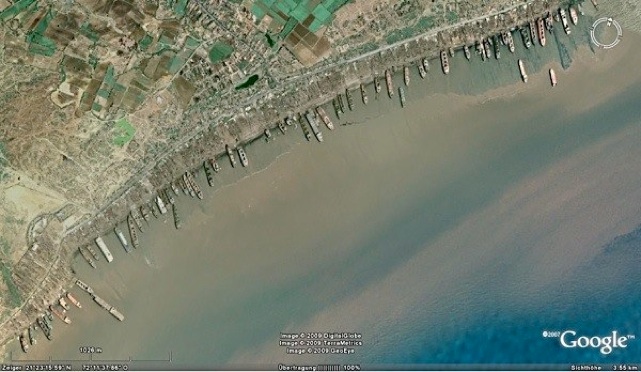
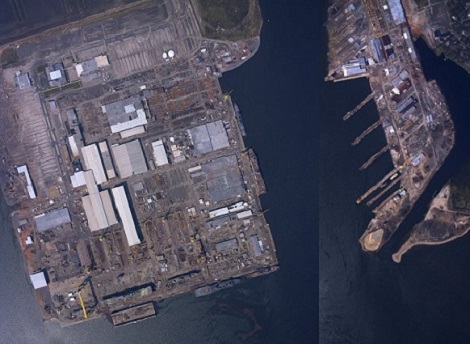
CU Blog - Commerce of the Seas - Lessons from Alang - Photo 5Alang is a census town in Bhavnagar district in the Indian state of Gujarat. In the past three decades, its beaches have become a major worldwide centre for ship breaking. The longest ship ever built, Seawise Giant, was sailed to and beached here for demolition in December 2009. [1]

Marine salvage industry
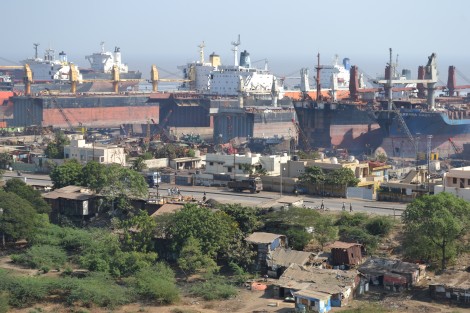
The shipyards at Alang recycle approximately half of all ships salvaged around the world.[2] It is considered the world’s largest graveyard of ships.[3] The yards are located on the Gulf of Khambat, 50 km (31 mi) southeast of Bhavnagar. Large supertankerscar ferriescontainer ships, and a dwindling number of ocean liners are beached during high tide, and as the tide recedes, hundreds of manual laborers move onto the beach to dismantle each ship, salvaging what they can and reducing the rest to scrap.

The salvage yards at Alang have generated controversy about working conditions, workers’ living conditions, and the impact on the environment. One major problem is that despite many serious work-related injuries, the nearest full service hospital is 50 km (31 mi) away in Bhavnagar.

Alang - Photo 1

Alang - Photo 2

Alang - Photo 4

Future
Japan and the Gujarat government have joined hands to upgrade the existing Alang shipyard. The two parties have signed a Memorandum of Understanding, which focuses on technology transfer and financial assistance from Japan to assist in the upgrading of operations at Alang to meet international standards. This is a part of the Delhi Mumbai Industrial Corridor, a larger partnership between the Japanese and Gujarat government. Under this plan, Japan will address the environmental implications of ship breaking in Alang, and will develop a .marketing strategy. The project is to be carried out as a public-private partnership. The project’s aim is to make this shipyard the largest International Maritime Organisation-compliant ship recycling yard in the world.

Source: Retrieved June 8, 2017 from: https://en.wikipedia.org/wiki/Alang

The dirty nature of these industrial endeavors, as depicted in Alang, provides a negative lesson that we want to learn from to avoid all perilous consequences of doing this business in a “wrong” manner.

Another lesson we learn from Alang is that Ship-breaking work (jobs) is consistent and steady. There are many ships that have lived out their usefulness and now need to be dismantled for scrap; the more labor available, the more ships to break. This is such a positive lesson for us to learn right now, as the Caribbean region is badly in need of jobs. The economic engine involves salvaging the scrap metal (and other materials) for recycling.

The challenge is to embrace the commerce of Ship-breaking for the positives, while avoiding the negatives.

Challenge accepted! (The foregoing relates the welcoming support from Japan for clean ship-breaking).

The book Go Lean…Caribbean serves as a roadmap for the introduction and implementation of the Caribbean Union Trade Federation (CU). This would be the governmental entity for a regional Single Market that covers the land territories of the 30 member-states, and their aligning seas; (including the 1,063,000 square miles of the Caribbean Sea). The Go Lean/CU roadmap features this prime directive, as defined by these 3 statements:

  • Optimization of the economic engines to grow the regional economy to $800 Billion & create 2.2 million new jobs.
  • Establishment of a security apparatus to protect public safety and ensure the economic engines of the region, including the seas.
  • Improvement of Caribbean governance to support these engines in local governments and in Self-Governing Entities, including a separation-of-powers between the member-states and CU federal agencies.

This commentary posits that there are opportunities for the Caribbean to better explore the “Commerce of the Seas”, to deploy International Maritime Organisation-compliant shipyards. There are so many lessons that we can learn from the Economic History of other communities’ exploitation of the high seas. This commentary is 4 of 4 in a series considering the Lessons in Economic History related to “Commerce of the Seas”. The full series is as follows:

  1. Commerce of the Seas – Stupidity of the Jones Act
  2. Commerce of the Seas – Book Review: ‘Sea Power’
  3. Commerce of the Seas – Shipbuilding Model of Ingalls
  4. Commerce of the Seas – Lessons from Alang (India)

The reference to “Commerce” refers to the economic interest of the 30 member-states in the Caribbean region. There is the need for more commercial opportunities that would impact the community with job and entrepreneurial empowerments. Ship-breaking could be providential!

Ship-breaking can provide high tech, mid tech and low tech jobs; especially if the salvage operation is executed in a technocratic manner. The Art & Science of technocratic ship-breaking versus dirty-breaking (i.e. Alang) was previously detailed in a blog-commentary on August 14, 2014. See some highlights from that blog in the excerpt here:

… ship-breaking activities in Third World countries, like Bangladesh, pose harm to the environment, workers and remaining systems of commerce. But when executed correctly, as in Brownsville-Texas, ship-breaking can be all positive. There are benefits in applying the appropriate best practices in handling hazardous materials. The tons of toxic waste (asbestos) can be properly managed and disposed of, with the proper eco-system surrounding the industry. The CU will facilitate the eco-system, especially with the Self-Governing Entities (SGE) concept for shipyards. This is covered in the Go Lean book under the auspices of “turn-around” industries, a federally regulated/promoted activity.

So there is a way to perform ship-breaking – one expression of maritime commerce – in a lean, clean manner while guaranteeing safety for the workers and profit for the investors.

This is the win-win … of the Go Lean roadmap.

The Go Lean book/roadmap was published in November 2013 with a vision for a new industrialization for the region. The quest is for the region to cooperate, collaborate and convene so as to accomplish more as a unified Single Market than may be possible alone. Not one of the Caribbean member-states – all Third World – can do ship-breaking right. It would quickly denigrate to the Alang and Bangladesh models. But together, leveraging the interdependence – so much more can be accomplished. This was the vision of the opening Declaration of Interdependence in the book. Here, the need for regional coordination and integration was pronounced as the basis of reforming and transforming Caribbean society.

See a sample of relevant stanzas from the Declaration here (Page 11 – 13):

xi. Whereas all men are entitled to the benefits of good governance in a free society, “new guards” must be enacted to dissuade the emergence of incompetence, corruption, nepotism and cronyism at the peril of the people’s best interest. The Federation must guarantee the executions of a social contract between government and the governed.

xxvi. Whereas the Caribbean region must have new jobs to empower the engines of the economy and create the income sources for prosperity, and encourage the next generation to forge their dreams right at home, the Federation must therefore foster the development of new industries, like that of ship-building…. In addition, the Federation must invigorate the enterprises related to existing industries like … fisheries … – impacting the region with more jobs.

Reforming and transforming the Caribbean is the quest. The Go Lean book explains “how”, providing 370-pages of turn-by-turn instructions on “how” to adopt new community ethos for economic regionalism, and “how” to execute the right strategies, tactics, and implementations to reboot, reform and transform the maritime commerce to benefit Caribbean society.

The issue of fostering industrial developments in the Art-and-Science of the salvage industry has been a frequent subject for previous blog-commentaries; consider this list of sample entries:

https://goleancaribbean.com/blog/?p=10140 Lessons Learned: Detroit demolishes thousands of structures
https://goleancaribbean.com/blog/?p=6760 A Lesson in ‘Garbage’
https://goleancaribbean.com/blog/?p=2953 Funding Caribbean Entrepreneurs – The ‘Crowdfunding’ Way
https://goleancaribbean.com/blog/?p=2857 Where the Jobs Are – Entrepreneurism in Junk

All Caribbean member-states are islands or coastal territories – they can all be candidates for maritime salvaging (ship-breaking) operations – even all at the same time. While there is a large footprint of “cheap” ship-breakers in Asia, not as many proliferate in the Western Hemisphere. It is a perfect time to explore these opportunities.

This is not tourism! Ship-breaking activities are not paradisiac nor inviting so they should be limited to shipyards, not beaches.

Alang - Photo 3Imagine: towing an old ship from the Americas to the Caribbean, rather than across the Atlantic and Indian Oceans; see the experience of salvaging the “Love Boat” in the Appendix VIDEO below.

This is commerce!

There is a need to transform maritime commerce for the Caribbean region; we can get more economic activity from this sector; the Go Lean book projects 15,000 new direct jobs in the shipbuilding and/or ship-breaking activities. The possibility of these new jobs is hope-inspiring. At last we can arrest the societal abandonment where men and women leave the community looking for any kind of work.

This is Commerce of the Seas; we saw how previous generations of Caribbean people lived off the sea; we can again, with these creative expressions of maritime commerce.

This plan is conceivable, believable and achievable. We urge all Caribbean stakeholders – governments, business owners and workers – to lean-in to this roadmap for economic empowerment. We can make the Caribbean homeland and seas better places to live, work and play. 🙂

Download the free e-book of Go Lean … Caribbean – now!

Sign the petition to lean-in for this roadmap for the Caribbean Union Trade Federation.

————–

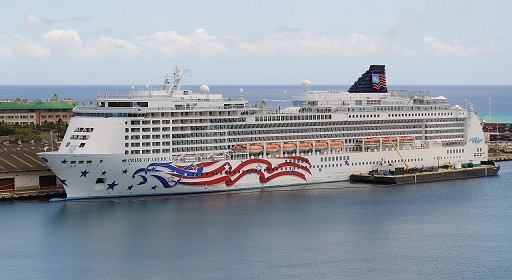
Appendix VIDEO – The End of The Love Boat – https://youtu.be/lauAeMtzMYM

Published on Nov 5, 2016English Captions Available!!!
MS Pacific Princess is a voyage send possessed by Princess Cruises and worked by Princess Cruises and P&O Cruises Australia. She was inherent 1999 by the Chantiers de l’Atlantique shipyard in Saint-Nazaire, France as MS R Three for Renaissance Cruises.

The vessel initially entered operation in 1999, with Renaissance Cruises. The ship was not claimed by the organization, ownership rather living with a gathering of French speculators, who rented the ship to the organization. In late 2001, the whole Renaissance armada was seized by lenders.

Pacific Princess in Yalta inlet.

In late 2002, Princess Cruises sanctioned the R Three, alongside sister transport R Four (now Ocean Princess). Both vessels entered operation before the end of 2002. The contract ended toward the end of 2004, at which time both vessels were acquired by Princess Cruises. Gabi Hollows renamed the ship Pacific Princess in Sydney on 8 December 2002.
This ship has been the subject of a state help choice by the European Commission: Decision 2006/219.

Princess Cruise Line Youtube channel: youtube.com/user/princesscruises
Cruise Ships Info Youtube channel: youtube.com/cruiseshipsinfo
Cruise Ships Info Facebook Page: facebook.com/cruiseshipsinfo
Cruise Ships Info Twitter Page: twitter.com/cruiseship_info
Cruise Ships Info Pinterest Page: pinterest.com/cruiseshipinfo

————–

Additional VIDEO – Jobs of Workers in Ship-breaking Industry –  https://www.youtube.com/watch?v=wOGjYfBltZc

Share this post:
, , , , ,

Commerce of the Seas – Shipbuilding Model of Ingalls

Go Lean Commentary

The ‘Law of Supply-and-Demand’ is almost as natural as the ‘Law of Gravity’; leave it alone and it will pre-determine what will happen … in the marketplace. But just like the ‘Law of Gravity’ can bend and be defied (think airplanes and rockets), so too the ‘Law of Supply-and-Demand’ can bend and be defied. A great example of defying ‘Supply-and-Demand’ is the Crony-Capitalism (subsidies and protectionist schemes) in the highly-protected Ship-Building industry. (See the Appendix below regarding OECD Ship-Building Industry monitoring efforts).

CU Blog - Commerce of the Seas - Model of Ingalls - Photo 1

CU Blog - Commerce of the Seas - Model of Ingalls - Photo 2

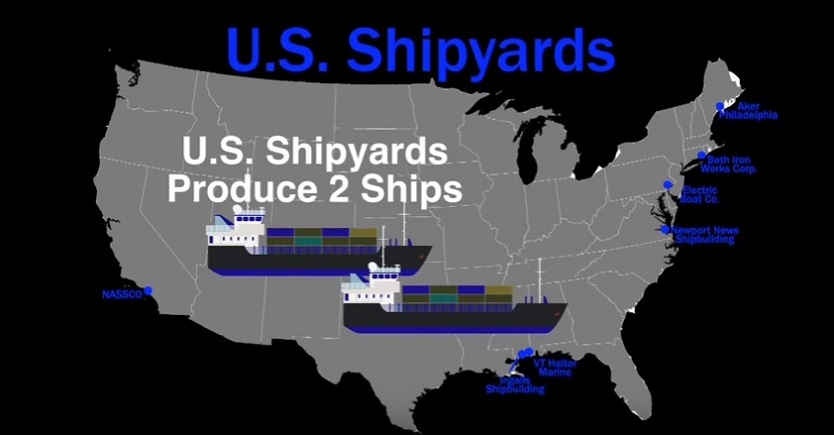
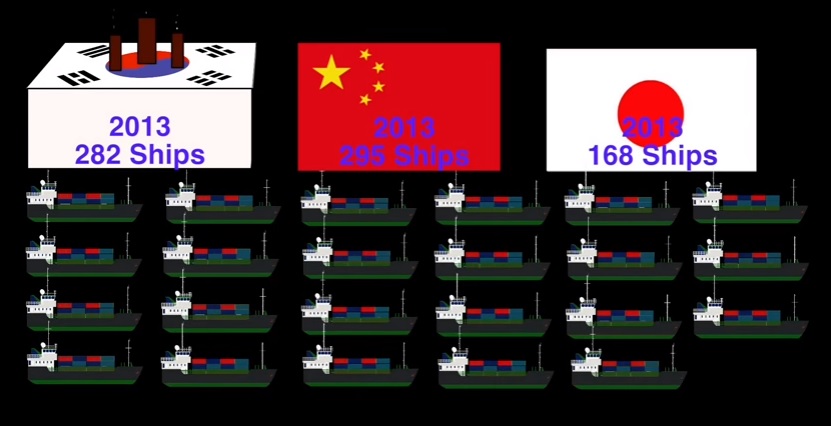
Look at the numbers in the 2 photos above. It is apparent that the US distorts the Supply-and-Demand factors for Ship-Building in its market; their protectionist laws prevent the international market from supplying domestic shipping needs. This is bad! Though there is the need for some government-aid, to protect jobs and defense options,  the US model of Crony-Capitalism is a blatant distortion – Source: https://youtu.be/GpwzoDGDGAQ.

Ship-Building can be a strategic industry! The book Go Lean…Caribbean asserts that 15,000 new direct jobs can be created with strategic endeavors for the Ship-Building industry in the region. (Even more indirect jobs applies – multiplier rate of 3-to-1).  The Go Lean book calls for the elevation of Caribbean economics, positing that governmental entities must stimulate and incubate this industry. The book surveyed the world looking for industrial opportunities that could be fully explored in the Caribbean region where the natural resources of the region could be considered; the region is known for sun, sand and sea.

Tourism is a natural assumption for utilizing these “sun, sand and sea“ resources, but with the recent inadequacies of this industry, there needs to be more diversity in our commercial offerings; ship-building – which needs the sea – was identified as an ideal supplement and alternative for regional commerce. This reference to “regional commerce” refers to the economic interest that the 30 member-states in the Caribbean have to consider to provide job and entrepreneurial opportunities for its people. So this Ship-Building focus prioritizes the “Commerce of the Seas” concept. This commentary is 3 of 4 in a series considering the Lessons in Economic History related to “Commerce of the Seas”, the Crony-Capitalism in laws and practices around the maritime eco-system in the United States … and other countries. The full series is as follows:

  1. Commerce of the Seas – Stupidity of the Jones Act
  2. Commerce of the Seas – Book Review: ‘Sea Power’
  3. Commerce of the Seas – Shipbuilding Model of Ingalls
  4. Commerce of the Seas – Lessons from Alang (India)

There are many Lessons in Economic History for the Caribbean to glean by considering the actuality of this industry. Let’s consider the role model of just one American shipbuilding entity: Ingalls Shipbuilding Company in Pascagoula, Mississippi. See the reference source here, describing the business model for building ships to ‘Supply’ any open ‘Demand’ in the commercial market:

Title: Ingalls Shipbuilding 

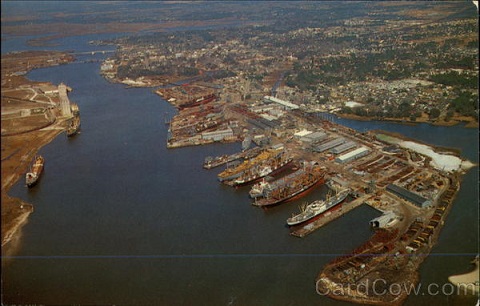
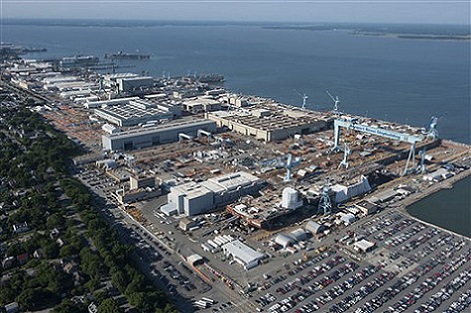
Ingalls Shipbuilding is a shipyard located in Pascagoula, Mississippi, United States, originally established in 1938, and is now part of Huntington Ingalls Industries. It is a leading producer of ships for the United States Navy, and at 12,500 employees, the largest private employer in Mississippi.

CU Blog - Commerce of the Seas - Model of Ingalls - Photo 3

Pascagoula River and Ingalls Shipyard

CU Blog - Commerce of the Seas - Model of Ingalls - Photo 5

History

In 1938, Ingalls Shipbuilding Corporation was founded by Robert Ingersoll Ingalls, Sr. (1882–1951) of Birmingham, Alabama, on the East Bank of the PascagoulaRiver in Mississippi.[1] Ingalls was located where the Pascagoula River runs into the Gulf of Mexico. It started out building commercial ships including the USS George Clymer (APA-27), which took part in Liberty Fleet Day 27 September 1941. In the 1950s Ingalls started bidding on Navy work, winning a contract in 1957 to build 12 nuclear-powered attack submarines.

Litton Industries acquired Ingalls in 1961, and in 1968 expanded its facilities to the other side of the river. Ingalls reached a high point of employment in 1977, with 27,280 workers. In April 2001, Litton was acquired by the Northrop Grumman Corporation.[2]

On August 29, 2005, Ingalls facilities were damaged by Hurricane Katrina; most of the ships in dock and construction escaped serious harm. While shipbuilding was halted for a while due to the destruction of many buildings, most vehicles, and the large overhead cranes, the facility continues to operate today.

On March 31, 2011, Northrop Grumman spun off its shipbuilding sector (including Ingalls Shipbuilding) into a new corporation, Huntington Ingalls Industries.

In 2015, Ingalls Shipbuilding Company signed a contract with US Navy for new destroyers, littoral combat ships and new landing craft. USS John Finn (DDG-113) was one of the first destroyers was launched on March 28. Company also is building Ralph Johnson (DDG 114), Paul Ignatius (DDG 117) and Delbert D. Black (DDG 119).

On March 21, 2015, the new San Antonio LPD 17-class amphibious ship John P. Murtha (LPD 26) was ceremonially christened. The vessel having been launched on October 30 and scheduled to be delivered in 2016.

On March 27, 2015, the shipyard received construction contracts for their next destroyers. Ingalls Shipbuilding Company was awarded a $604.3 million contract modification to build the yet-to-be-named DDG 121.

On March 31, 2015, the shipyard also received another contract with a $500 million fixed price to build the eighth National Security Cutter (NSC) for the US Coast Guard. Most of them will be under construction until 2019. The cutters are the most advanced ships ever built for the Coast Guard. [3]

On June 30, 2016, Ingalls Shipbuilding signed a contract with US Navy to build the U.S. Navy’s next large-deck amphibious assault warship. The contract included planning, advanced engineering and procurement of long-lead material, is just over $272 million. If options are exercised, the cumulative value of the contract would be $3.1 billion.[4]

Ships built

Source: Retrieved 06-11-2017 from Wikipedia: https://en.wikipedia.org/wiki/Ingalls_Shipbuilding

———–

VIDEO – Ingalls Shipbuilding Promotional Video – https://youtu.be/EFl8Tl0ImJo

Published on Jan 10, 2017 – Ingalls Shipbuilding is located in Pascagoula, Mississippi on 800 acres of the most important real estate in America. With 11,000 employees, Ingalls is the largest manufacturing employer in Mississippi and a major contributor to the economic growth of both Mississippi and Alabama. Our 77-year legacy has continuously proven we have the talent, experience and facilities to simultaneously build more classes of ships than any other shipyard in America.

We are the builder-of-record for 35 Aegis DDG 51 class guided missile destroyers, LHA 6 class large deck amphibious ships, National Security Cutters for the U.S. Coast Guard and the sole builder of the Navy’s fleet of San Antonio (LPD 17) class amphibious assault ships. Ingalls Shipbuilding has what it takes to build the capital ships that keep America and our allies safe.

Additional VIDEO consideration: https://youtu.be/0pak_gKglqo – Ingalls shows ‘Shipyard of the Future’.

Considering that 90% of all trade transports by water, there is natural demand for shipbuilding. There is a lot of supply as well.

Ingalls Shipbuilding Company is a definite beneficiary of government-aided commerce in the US; most of their shipbuilding engagements are government contracts. They are a leading producer of ships for the US Navy or Coast Guard, and at 12,500 employees, the largest private employer in Mississippi. As related in the first commentary in this series, the Jones Act has protected maritime commerce and shipbuilding for American stakeholders like Ingalls.

It is ‘high tide’ for the Caribbean to engage some protectionism strategies. Considering that the Caribbean region is the #1 market for the Cruise Line industry, collective bargaining should be prioritized to direct some shipbuilding business to local entities in this industry. The book Go Lean… Caribbean posits that as a unified region – a Single Market – the power of collective bargaining is possible. The book serves as a roadmap for the introduction and implementation of the technocratic Caribbean Union Trade Federation (CU) with the charter to facilitate jobs in the region. We should explore the benefits of the shipbuilding (and ship-breaking) industry. This aligns with the CU charter; as defined by these 3 prime directives:

  • Optimization of economic engines in order to grow the regional economy to $800 Billion and create 2.2 million new jobs.
  • Establishment of a security apparatus to protect the resultant economic.
  • Improve Caribbean governance to support these engines.

Early in the Go Lean book, this responsibility to create jobs was identified as an important function for the CU with this pronouncement in the Declaration of Interdependence (Pages 14):

xxiv.  Whereas a free market economy can be induced and spurred for continuous progress, the Federation must install the controls to better manage aspects of the economy: jobs, inflation, savings rate, investments and other economic principles. Thereby attracting direct foreign investment because of the stability and vibrancy of our economy.

xxvi.  Whereas the Caribbean region must have new jobs to empower the engines of the economy and create the income sources for prosperity, and encourage the next generation to forge their dreams right at home, the Federation must therefore foster the development of new industries, like that of ship-building…. In addition, the Federation must invigorate the enterprises related to existing industries tourism, fisheries and lotteries – impacting the region with more jobs.

Accordingly, the CU will facilitate the eco-system for Self-Governing Entities (SGE), an ideal concept for shipyards, with its exclusive federal regulation/promotion activities.

The Go Lean movement (book and blogs) also details the principle of job multipliers, how certain industries are better than others for generating multiple indirect jobs down the line for each direct job on a company’s payroll. In a previous blog-commentary, it was related that the shipbuilding industry has a job-multiplier rate of 3.0. So once the job-multiplier rate is applied to the 15,000 direct shipbuilding jobs, generating 45,000 indirect jobs, the full economic impact is 60,000. This is transforming!

The Go Lean book provides 370-pages of turn-by-turn instructions on “how” to reform and transform the Caribbean, starting first with how to adopt new community ethos, plus the strategies, tactics, implementations and advocacies to execute so as to transform the maritime commerce to benefit Caribbean society. Consider the Chapter excerpts and headlines from this sample on Page 209 related to Ship-Building:

10 Ways to Develop Ship-Building

1

Lean-in for Caribbean Integration
The CU will allow for the unification of the region into one market, creating an economy of 30 member-states, 42 million people and 2010 GDP over $800 Billion. All of the member-states are either islands or coastal, therefore there are lots of coastline and harbors. Boats, yachts and ships are therefore plentiful in the region. Consistent with the CU’s mission for globalization, the region cannot just consume these vessels; we must create and build as well. There is a history of boat-building in the islands (slopes, schooners, clippers), but what had been missing to forge a formidable industry is the capital and the community “will”. The CU will now fill those gaps. The CU will tap the capital markets to secure long-term funding (stocks/bonds), prepare the labor force for advanced skill-sets, and negotiate treaties with “mature” EU states (i.e. Holland, Ireland) for master-apprentice labor-coaching. Boats, yachts and ships are considered durable goods, the opposite of planned obsolescence. …

2

Cooperatives Movement – “Many hands make heavy job light

3

Ferry Operations – Demand & Supply
The CU envisions a fleet of ferries, to service the individual islands, in a scheme dubbed “Union Atlantic Turnpike”. The proliferation of scheduled ferries, synchronized with trains and trucks will depict a continuous logistic network. This constitutes the demand for ferries. The CU will henceforth award the contracts for building and maintaining the ferries to local industry players – this constitutes the supply. The CU will therefore foster a ship-building “incubator”.

4

Spin-off Strategy – Low-risk Contracts
The CU vision is to deploy a “spin-off” strategy for ship-owning patrons. The CU region needs ships. Therefore, the CU will incentivize patrons to “go local” with their ship-building/maintenance needs. A domestic ship-building industry is a great source of skilled/high-wage jobs. So there are many ways to exploit the cost-benefit equation for a win-win.

5

Cruise Ship Dry-Dock – Let’s Make-A-Deal
The Caribbean region is the Number One market for the Cruise Line industry. Big expenses for Cruise Lines are port charges and landing fees. The CU will offer rebates and incentives for the Cruise Lines to use local dry-docks for retro-fittings and refurbishing.

6

Yacht Development – Catering to a Special Market

7

Sailboats – For Every Man
The history of Caribbean boat building is rich with sailing crafts; cruise ships evolved from local Banana-Boats. The CU will channel that history, passion and ethos for the region to design/develop best-inbred sailboats, big and small.

8

Boat Shows and Open Houses – Show and Tell

9

Regattas – More than Just Winning a Race
The history of the region has highlighted ships, boats and boat building. There is the tradition of Regattas, used to showcase the islands boat building prowess. [199] The CU now intends to feature Regattas in the same manner that automakers feature auto racing (NASCAR, IndyCar, Formula-One), as a demonstration platform for their art and science.

10

Maritime Emergencies – Professional Response
The CU will deploy the necessary equipment and training for the ship-building industry to respond to maritime emergencies in the region. Therefore a disabled cruise ship will have the rapid response of “support-barges”, tug boats, dredging equipment, portable generators. This effort will be marshaled by the CU Emergency Management Agency.

The CU will foster shipbuilding as an industrial supplement and alternative to tourism. We have the resources (waterscapes, ports and harbors), the skills and the passionate work-force. We only need the Commerce of the Seas. The Caribbean people are now ready for this industrial empowerment. But we need to be cautious as to which role model we emulate. The US does provide material support and subsidies to their shipbuilding industry, but their protection laws – i.e. the Jones Act – have nullifies the positive effects of a Free Market. While other countries build and launch hundreds of ships every year, the US model only produce 2. That’s a lot of missing jobs, and artificially induced high prices.

In the Caribbean, we must do better. Fortunately, we do not have the Crony-Capitalism of the Jones Act to deter us. We can follow other – better – models to progress our societal investments in this industry. This is the assertion of the Go Lean roadmap.

We hereby urge all Caribbean stakeholders – governments and citizens – to lean-in to this Go Lean roadmap to foster this industrial development, so that our region can be a better homeland and seas to live, work and play. 🙂

Download the free e-book of Go Lean … Caribbean – now!

Sign the petition to lean-in for this roadmap for the Caribbean Union Trade Federation.

———–
Appendix – The OECD Council Working Party on Shipbuilding

(OECD = Organization of Economic Cooperation and Development)

The OECD Council Working Party on Shipbuilding (WP6) seeks to progressively establish normal competitive conditions in the industry. It encourages transparency through data collection and analysis, and seeks to expand policy dialogue with non-OECD economies that have significant shipbuilding industries. WP6 is the only international body that can influence and guide government policies by identifying and, where possible, eliminating factors that distort the shipbuilding market.

The Working Party is chaired by Ambassador Elin Østebø Johansen, Permanent Representative of Norway to the OECD. Participating OECD members are: Denmark, Finland, Germany, Italy, Japan, Korea, Netherlands, Norway, Poland, Portugal, Sweden and Turkey. Croatia and Romania are full participants in the Working Party, and the Russian Federation participates as an observer. The European Commission, representing the European Union, also participates in WP6 meetings.

What does the Working Party on Shipbuilding do?
The WP6 has placed a high priority on encouraging policy dialogues, and on establishing close working relationships with non-OECD economies. In particular, these economies were invited to participate on an equal footing with OECD members in the negotiations on a shipbuilding agreement that ran from 2002 until 2005, and Brazil, China, Croatia, the Philippines, Romania, the Russian Federation, Chinese Taipei and Ukraine participated in those negotiations. Although the negotiations were eventually halted, a close working relationship has continued with all of these economies.

The WP6 organizes regular workshops aimed at facilitating the exchange of information on policy and industry developments, and as well as the economies already mentioned, other participants have come from India, and Indonesia, amongst others.

The WP6 has also worked closely with industry groups representing shipbuilders, ship owners, ship operators and trade union interests, so that a wide range of perspectives can be taken into account by WP6 members during their formulation of policy responses to address issues and challenges faced by the global shipbuilding sector.

What is the relevance of the Working Party to non-OECD economies and industry?

While the world’s shipbuilding industry has been through a period of record production, it was severely affected by the 2008 global financial crisis, and recent years have seen very low levels of new orders received by virtually all shipyards. The global industry now faces a number of challenges, most notably global excess capacity, which will place the economic viability of the industry under pressure in some parts of the world.

Persistent worldwide overcapacity may encourage governments to provide support through subsidies and other measures, as well as spur other market distorting practices, which can create major structural problems even in the most efficient shipbuilding industries. But potential market distortions can be addressed through close co-operation among economies with significant shipbuilding sectors and the active involvement of industry.

———-

INVENTORY OF GOVERNMENT SUPPORT MEASURES

The Inventory of Government Subsidies and Other Support Measures is a regular exercise for the WP6. The main aim of this exercise is to provide transparency and continuity of data on support measures for the shipbuilding industry. As well as WP6 participants, the Inventory provides some information on the support measures in Partner economies.


Share this post:
, , , ,
[Top]

Commerce of the Seas – Book Review: ‘Sea Power’

Go Lean Commentary 

70% of the earth is covered by water
70% of the human body is made up by water

CU Blog - Lessons from China - South China Seas - Exclusive Economic Zone - Photo 3It seems that water is pretty important in managing the affairs of people and their community.

The quest of the movement behind the book Go Lean… Caribbean is to confederate, collaborate and convene the 30 member-states of the Caribbean region into a Single Market; this would include the territorial homelands and aligning seas. How, where, when ‘Sea Power’ is managed becomes a major consideration in this quest. A lesson we have learned from Economic History is that a people who wield ‘Sea Power’ can control the economic prospects of its people.

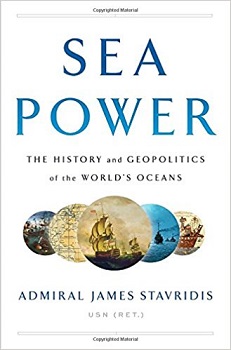
We learn this lesson even more succinctly now, thanks to the new book by Admiral James Stavridis entitled: Sea Power: The History and Geopolitics of the World’s Oceans. See a summary-review of the book here and listen to an AUDIO-Podcast interview with the Author:

 Sea Power - Photo 1

Book Review for Book: Sea Power: The History and Geopolitics of the World’s Oceans By: Admiral James Stavridis

From one of the most admired admirals of his generation – and the only admiral to serve as Supreme Allied Commander at NATO – comes a remarkable voyage through all of the world’s most important bodies of water, providing the story of naval power as a driver of human history and a crucial element in our current geopolitical path. 

From the time of the Greeks and the Persians clashing in the Mediterranean, sea power has determined world power.  To an extent that is often underappreciated, it still does. No one understands this better than Admiral Jim Stavridis. In Sea Power, Admiral Stavridis takes us with him on a tour of the world’s oceans from the admiral’s chair, showing us how the geography of the oceans has shaped the destiny of nations, and how naval power has in a real sense made the world we live in today, and will shape the world we live in tomorrow.

Not least, Sea Power is marvelous naval history, giving us fresh insight into great naval engagements from the battles of Salamis and Lepanto through to Trafalgar, the Battle of the Atlantic, and submarine conflicts of the Cold War. It is also a keen-eyed reckoning with the likely sites of our next major naval conflicts, particularly the Arctic Ocean, Eastern Mediterranean, and the South China Sea. Finally, Sea Power steps back to take a holistic view of the plagues to our oceans that are best seen that way, from piracy to pollution.

When most of us look at a globe, we focus on the shape of the of the seven continents. Admiral Stavridis sees the shapes of the seven seas.  After reading Sea Power, you will too. Not since Alfred Thayer Mahan’s legendary The Influence of Sea Power upon History have we had such a powerful reckoning with this vital subject.

Sea Power makes a great Father’s Day gift!

Source: Amazon Online Bookstore-Portal; retrieved June 9, 2017 from: https://www.amazon.com/Sea-Power-History-Geopolitics-Worlds/dp/073522059X/

———–

Appendix AUDIO-Podcast – Stavridis’ Book ‘Sea Power’ Explains Why Oceans Matter In Global Politics – http://www.npr.org/2017/06/06/531701056/stavridis-book-sea-power-explains-why-oceans-matter-in-global-politics

Published June 6, 2017 – NPR’s Morning Edition’s Steve Inskeep talks to retired Admiral James Stavridis, former supreme allied commander for NATO, about his new book: Sea Power: The History and Geopolitics of the World’s Oceans.

Listen to an extended NPR Podcast here: http://www.npr.org/podcasts/510053/on-point-with-tom-ashbrook

The theme of this new book aligns with the book Go Lean…Caribbean in explaining the significance of ‘Sea Power’ in any plan to elevate the Caribbean region’s societal engines. This commentary is 2 of 4 in a series considering the Lessons in Economic History related to “Commerce of the Seas”, the good, bad and ugly (think Crony-Capitalism) strategies and practices around the maritime eco-system in the United States … and other countries. The full series is as follows:

  1. Commerce of the Seas – Stupidity of the Jones Act
  2. Commerce of the Seas – Book Review: ‘Sea Power’
  3. Commerce of the Seas – Shipbuilding Model of Ingalls
  4. Commerce of the Seas – Lessons from Alang (India)

The previous commentary in this series relates how “Commerce” refers to the economic interest of the 30 member-states in the Caribbean region. Admiral Stavridis book has a heavy focus on naval military power; he posits that a strong Navy paves the way for and protects the continuation of maritime commerce. From the book Sea Power and the Go Lean book we see this consistent Lesson in Economic History:

Around the world, countries that have access to control of the “Sea” have a distinct advantage economically versus countries that are land-locked; i.e. England versus Austria.

CU Blog - America's Navy - 100 Percent - Model for Caribbean - Photo 4As stated previously, the United States have wielded its ‘Sea Power’ to promote profit for its maritime industrial stakeholders at the expense of the residents of off-shore territories, like Puerto Rico and the US Virgin Islands in the Caribbean.

There is therefore a need to reboot, reform and transform the Caribbean region’s stewardship of the Seas. This is the purpose of the book Go Lean … Caribbean, to help empower and elevate the societal engines of the 30 member-states of the Caribbean region and their waterscapes. The Go Lean book serves as a roadmap for the introduction and implementation of the Caribbean Union Trade Federation (CU). This would be the inter-governmental entity for a regional Single Market that covers the land territories of the 30 member-states, and their aligning seas; (including the 1,063,000 square miles of the Caribbean Sea in an Exclusive Economic Zone). The Go Lean/CU roadmap features this prime directive, as defined by these 3 statements:

  • Optimization of the economic engines to grow the regional economy to $800 Billion & create 2.2 million new jobs.
  • Establishment of a security apparatus to protect public safety and ensure the economic engines of the region, including the seas.
  • Improvement of Caribbean governance to support these engines in local governments and in the Exclusive Economic Zone, including a separation-of-powers between the member-states and CU federal agencies.

This Go Lean roadmap envisioned a wide-ranging, fully-encompassing treaty for all Caribbean member-states to deputize a technocratic agency to better administer the affairs (economic, security and governance) of the waterscapes in the region. It was recognized that this quest was “out-of-scope” and too big for any one Caribbean member-state alone, but rather, acknowledging their regional interdependence, these stakeholders would be able to engage a new inter-governmental administration for better regional stewardship. This, regionalism, was the original intent of the Go Lean book, which commenced with a Declaration of Interdependence, pronouncing the need for regional coordination and integration so as to reform and transform Caribbean society. See a sample of relevant stanzas here (Page 11 – 12) as related to the Caribbean ‘Sea Power’:

v. Whereas the natural formation of our landmass and coastlines entail a large portion of waterscapes, the reality of management of our interior calls for extended oversight of the waterways between the islands. The internationally accepted 12-mile limits for national borders must be extended by International Tribunals to encompass the areas in between islands. The individual states must maintain their 12-mile borders while the sovereignty of this expanded area, the Exclusive Economic Zone, must be vested in the accedence of this Federation.

vi. Whereas the finite nature of the landmass of our lands limits the populations and markets of commerce, by extending the bonds of brotherhood to our geographic neighbors allows for extended opportunities and better execution of the kinetics of our economies through trade. This regional focus must foster and promote diverse economic stimuli.

x. Whereas we are surrounded and allied to nations of larger proportions in land mass, populations, and treasuries, elements in their societies may have ill-intent in their pursuits, at the expense of the safety and security of our citizens. We must therefore appoint “new guards” to ensure our public safety and threats against our society, both domestic and foreign. The Federation must employ the latest advances and best practices … to assuage continuous threats against public safety. …

xi. Whereas all men are entitled to the benefits of good governance in a free society, “new guards” must be enacted to dissuade the emergence of incompetence, corruption, nepotism and cronyism at the peril of the people’s best interest. The Federation must guarantee the executions of a social contract between government and the governed.

xvi. Whereas security of our homeland is inextricably linked to prosperity of the homeland, the economic and security interest of the region needs to be aligned under the same governance. Since economic crimes, including piracy and other forms of terrorism, can imperil the functioning of the wheels of commerce for all the citizenry, the accedence of this Federation must equip the security apparatus with the tools and techniques for predictive and proactive interdictions.

The foregoing book, Sea Power, aligns with the Go Lean book references to strategies, tactics and implementations for the Exclusive Economic Zone (EEZ). The Go Lean book provides 370-pages of turn-by-turn directions on “how” this EEZ can impact and benefit Caribbean society. Consider the Chapter excerpts and headlines from this sample on Page 104:

The Bottom Line on the United Nations Convention on the Law of the Sea (UNCLOS)
The UNCLOS is the international agreement that resulted from the third United Nations Conference on the Law of the Sea which took place between 1973 and 1982. This Convention defines the rights and responsibilities of nations in their use of the world’s oceans, establishing guidelines for businesses, the environment, and the management of marine natural resources. As of October 2012, 164 countries and the European Union have joined in the Convention. The convention introduced a number of provisions. The most significant issues covered were setting limits, navigation, archipelagic status and transit regimes, exclusive economic zones (EEZs), continental shelf jurisdiction, deep seabed mining, the exploitation regime, protection of the marine environment, scientific research, and settlement of disputes. EEZs extend from the edge of the territorial sea out to 200 nautical miles (230 miles) from the 12-mile baseline. Within this area, the coastal nation has sole exploitation rights over all natural resources, including the continental shelf. EEZs were introduced to halt the increasingly heated clashes over fishing rights, although oil was also becoming important. The success of an offshore oil platform in the Gulf of Mexico in 1947 was soon repeated elsewhere in the world, and by 1970 it was technically feasible to operate in waters 4000 meters deep. Foreign nations still have freedoms of navigation and over-flights for the EEZ, subject to the regulation of the coastal states. Foreign states may also lay submarine pipes and cables.

CU independent UNCLOS member-states include: Antigua, Jamaica, Suriname, Dominican Republic, Guyana, Barbados, Saint Vincent, Saint Kitts, Trinidad, Grenada, Saint Lucia, Cuba, Bahamas & Belize.

 10 Start-up Benefits from the EEZ

1

Lean-in for Caribbean Integration
The CU treaty unifies the Caribbean region into one single market of 42 million people across 30 member-states, thereby empowering the economic engines in and on behalf of the region. Integral to CU roadmap, is the territory between the island states. The CU will petition the United Nations for rights under the UN Convention on the Law of the Sea for acquisition of an Exclusive Economic Zone (EEZ). This will facilitate both economic empowerment (including Fisheries management) and security assurances for the region. (This effort was started by the Association of Caribbean States).

2

Funding by Selling Exploration Rights

3

Off-shore Wind Turbines

4

Pipelines

5

Extractions – Economic & Security

6

Security – Anti-Piracy
The CU has the mission to defend the homeland against enemies: foreign, domestic, and in the Exclusive Economic Zone of the Caribbean Seas. There is still a threat of piracy in modern times, and these “bad actors” hide behind jurisdictional confusions of one territorial waters after another. But the CU, with its regional oversight, can be more effective in bringing these ones to justice. Piracy is a form of terrorism, and cruise ships (smaller vessels catering to a High Net Worth – One Percent – market) and leisure crafts can be vulnerable to these threats.

7

Security – Interdictions
There is the need to be on alert for seaborne drug smuggling activities, as these can have corrupting influences on the local community. This would be the direct responsibilities of the CU Naval Operations for the jurisdiction of the EEZ. Today the US Coast Guard conducts patrols in the Caribbean Seas with impunity. There is no plan in the CU roadmap to curtail any of this activity; instead the CU will better coordinate their routes and maneuvers with CU Naval Operations.

8

Security – Search & Rescue

9

Security Monitoring
The CU will embrace many cutting-edge technological options to “keep eyes” on the Caribbean Seas. This includes satellite (visual & GPS), drones (unmanned airborne vehicles & dirigibles or blimps. Boaters will be incentivized tocooperate and install location beacons.

10

Security – Defense Pact (Naval Maneuvers)
The US, France, Netherlands, UK and some European trading partners have declared a “War Against Terrorism”; those battles will surely come to Caribbean shores. The CU therefore invites the Navies of allied nations to train, visit and conduct operations in our Caribbean waters, especially in the EEZ.

The issue of managing marine resources for commerce and security in the Caribbean has been a frequent subject for previous blog-commentaries; consider this list of sample entries:

https://goleancaribbean.com/blog/?p=11544 Forging Change in the Cruise Industry with Collective Bargaining
https://goleancaribbean.com/blog/?p=10566 Funding the Caribbean Security Pact
https://goleancaribbean.com/blog/?p=8819 Lessons from China – South China Seas: Exclusive Economic Zones
https://goleancaribbean.com/blog/?p=5210 Cruise Ship Commerce – Getting Ready for Change
https://goleancaribbean.com/blog/?p=3594 Better Fisheries Management for Queen Conch
https://goleancaribbean.com/blog/?p=1965 America’s Navy – 100 Percent – Model for Caribbean
https://goleancaribbean.com/blog/?p=673 Ghost ships – Autonomous cargo vessels without a crew
https://goleancaribbean.com/blog/?p=273 10 Things We Want from the US – # 4: Pax Americana

All Caribbean members are islands or coastal territories. The subject of ‘Sea Power’ and security of the waterscapes matters to us. Rather than 70 percent, we have to be concerned with 100 percent of the issues, challenges and opportunities.

There is a need to reform our maritime eco-system, for commerce and security. ‘Sea Power’ determines world power, so there is also a need to have a “seat at the table” among the big nations and sea-faring empires. As one small island alone, there is no chance for that consideration; but as a Single Market entity of 42 million people and 30 separate countries (and territories), the Caribbean can now have a Voice … and a Vote (in international forums) so as to shape the destiny of our homeland … and maybe even the whole world of commerce & security.

We hereby urge all Caribbean stakeholders – governments and citizens – to lean-in to this Go Lean roadmap to better wield our ‘Sea Power’, so that our region can be a better homeland (and waterscapes) to live, work and play. 🙂

Download the free e-book of Go Lean … Caribbean – now!

Sign the petition to lean-in for this roadmap for the Caribbean Union Trade Federation. 

Share this post:
, , , , , ,
[Top]

Commerce of the Seas – Stupidity of the Jones Act

Go Lean Commentary

CU Blog - Commerce of the Seas - Stupidity of the Jones Act - Photo 1In the Caribbean, we are surrounded by water (straits, banks, Atlantic Ocean, Caribbean Sea, etc); if you stare upon the waters in the middle of a sunny day, you start to see a mirage – a distortion in reality. In the Caribbean, we are also surrounded by a lot of stupidity. Make no mistake, this is not a mirage; it is mercantilism*.

In a previous blog, this commentary asserted that the historicity of a lot of stupidity in society is due to Crony-Capitalism:

Someone is getting paid!

This applies in so many areas of American life that Caribbean people can learn lessons from this history and distortion in reality. This commentary is 1 of 4 in a series considering the Lessons in Economic History related to “Commerce of the Seas”, the Crony-Capitalism in laws and practices around the maritime eco-system in the United States … and other countries. The full series is as follows:

  1. Commerce of the Seas – Stupidity of the Jones Act
  2. Commerce of the Seas – Book Review: ‘Sea Power’
  3. Commerce of the Seas – Shipbuilding Model of Ingalls
  4. Commerce of the Seas – Lessons from Alang (India)

The reference to “Commerce” refers to the economic interests of the 30 member-states in the Caribbean region. There are so many Lessons in Economic History for us to glean:

Around the world, countries that had access to the “Sea” have a distinct advantage economically versus countries that were land-locked; i.e. England versus Austria.

Mercantilism dictated that empires force rules and laws to preserve commerce for their home countries. This was also the case for the United States. One prominent law that was instituted was the Jones Act; see more in Appendix B below.

The Jones Act mandates that for a ship to go from one US port to another US port it must be American-made and American flagged. Also, for foreign ships to trade in US Territories, they must first journey to a foreign port before they could journey to another American port to transport goods. This seems “stupid”; but the adherence to this law keeps American maritime commerce options afloat; this means someone is getting paid; see VIDEO in Appendix A below, highlighting a distortion in the reality of Puerto Rico-to US Mainland trade.

How about the Caribbean, do we have or need maritime “protectionism” in the laws of the member-states of our region? The answer is affirmative for the dysfunctional US Territories; there is a need for economic regionalism, not protectionism.

The US Territories of Puerto Rico and the US Virgin Islands are also regulated by the Jones Act. According to the encyclopedic reference (in Appendix B below), this is not good; it hinders economic development!

In March 2013, the Government Accountability Office (GAO) released a study of the effect of the Jones Act on Puerto Rico that noted “freight rates are set based on a host of supply and demand factors in the market, some of which are affected directly or indirectly by Jones Act requirements.” The report further concludes … [that] freight rates between the United States and Puerto Rico are affected by the Jones Act.” The report also addresses what would happen “under a full exemption from the Act, the rules and requirements that would apply to all carriers would need to be determined.” The report continues that “while proponents of this change expect increased competition and greater availability of vessels to suit shippers’ needs” …

The American territories in the Caribbean are in the middle of the Caribbean geography, rimming the Caribbean Sea. The “Laws of the Sea” need to reflect this reality and not just political alignments. This is the purpose of the book Go Lean … Caribbean, to help reform and transform the societal engines for the 30 member-states of the Caribbean region. The book specifically addresses customization to the “Laws of the Sea” to benefit the Caribbean region. The book serves as a roadmap for the introduction and implementation of the Caribbean Union Trade Federation (CU). This would be the governmental entity for a regional Single Market that covers the land territories of the 30 member-states, and their aligning seas; (including the 1,063,000 square miles of the Caribbean Sea in an Exclusive Economic Zone). The Go Lean/CU roadmap features this prime directive, as defined by these 3 statements:

  • Optimization of the economic engines to grow the regional economy to $800 Billion & create 2.2 million new jobs.
  • Establishment of a security apparatus to protect public safety and ensure the economic engines of the region, including the seas.
  • Improvement of Caribbean governance to support these engines in local governments and in the Exclusive Economic Zone, including a separation-of-powers between the member-states and CU federal agencies.

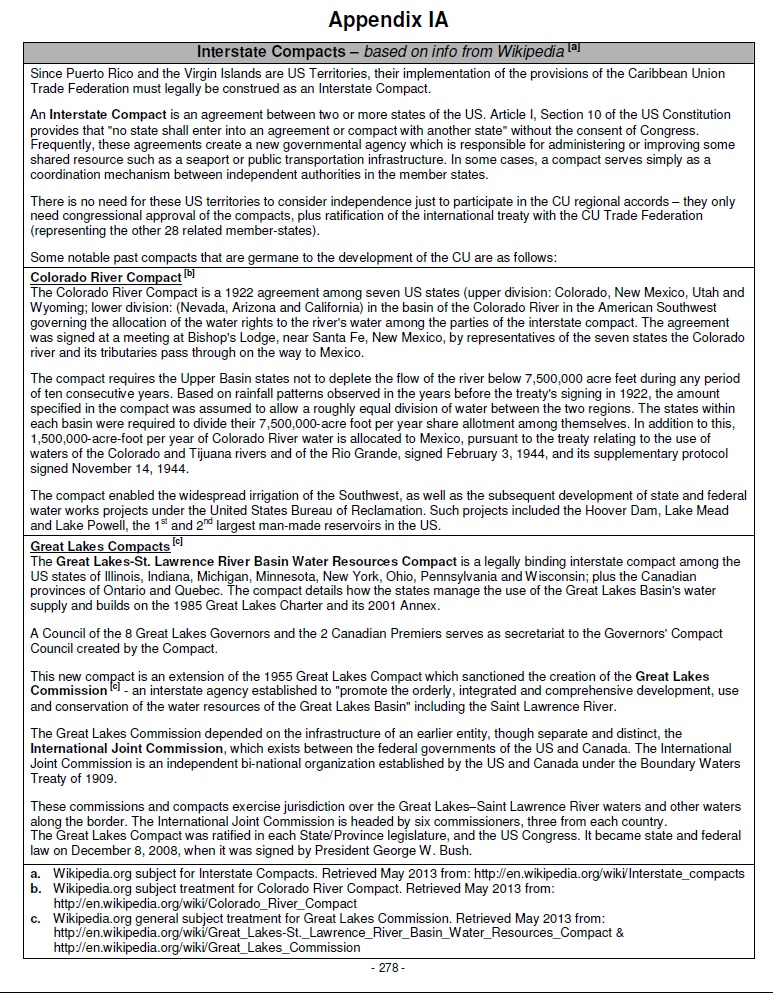
The Go Lean roadmap allows for the regional stewardship and administration of the commerce on the Caribbean Seas in collaboration, conjunction and cooperation with US legal jurisdiction and foreign entities. The legal premise for this strategy is an Interstate Compact & Treaty – see details in the Go Lean book (Page 278) or the photo-excerpt in Appendix IA below  – legislated by the US Congress, independent Caribbean governments (17) and the colonial masters for the existing overseas territories:

  • France (Guadeloupe, Martinique, St. Martin, St. Barthélemy)
  • The Netherlands (Aruba, Bonaire, Curaçao, Saba, Sint Eustatius, Sint Maarten)
  • United Kingdom (Anguilla, Bermuda, Cayman Islands, Montserrat, Turks & Caicos and the British Virgin Islands)

Such a wide-ranging, fully-encompassing Compact-Treaty was an original intent of the Go Lean book – economic regionalism. The publication (published in November 2013) commenced with a Declaration of Interdependence, pronouncing the need for regional coordination and integration so as to reform and transform Caribbean society. See a sample of relevant stanzas here (Page 11 – 13):

v. Whereas the natural formation of our landmass and coastlines entail a large portion of waterscapes, the reality of management of our interior calls for extended oversight of the waterways between the islands. The internationally accepted 12-mile limits for national borders must be extended by International Tribunals to encompass the areas in between islands. The individual states must maintain their 12-mile borders while the sovereignty of this expanded area, the Exclusive Economic Zone, must be vested in the accedence of this Federation.

vi. Whereas the finite nature of the landmass of our lands limits the populations and markets of commerce, by extending the bonds of brotherhood to our geographic neighbors allows for extended opportunities and better execution of the kinetics of our economies through trade. This regional focus must foster and promote diverse economic stimuli.

xi. Whereas all men are entitled to the benefits of good governance in a free society, “new guards” must be enacted to dissuade the emergence of incompetence, corruption, nepotism and cronyism at the peril of the people’s best interest. The Federation must guarantee the executions of a social contract between government and the governed.

xxiii. Whereas many countries in our region are dependent Overseas Territory of imperial powers, the systems of governance can be instituted on a regional and local basis, rather than requiring oversight or accountability from distant masters far removed from their subjects of administration. The Federation must facilitate success in autonomous rule by sharing tools, systems and teamwork within the geographical region.

The foregoing Jones Act is an American legislation that probably needs to be repealed or revised to reflect the actuality of a globalized economy; (there are some good provisions related to injury of seamen). Consider this recent experience recorded by a commentator on a news site, below an article regarding the efforts to repeal the Jones Act:

John David Oct 25, 2016 at 7:38 pm

The Act does not Protect the Ports and Waterways, that task is left to the US Navy and US Coast Guard. We have Significant Ports on the US Mainland. None of them have had any security issues with Foreign Flagged Vessels. Trade is restrictive to and from places like Puerto Rico, Hawaii, Guam Etc.

Therefore business that could be entertained and cultivated providing a boost in their respective economies, those areas economically are suppressed. The United States has a significant Naval and Coast Guard presence in each of these areas. An example of how this stifles the economy would be to take a guitar manufacturer located on the Big Island of Hawaii. The Big Island has an abundance of Koa wood, a highly sought after wood for the manufacture of wooden guitars. However if they wanted to ship their guitars to a distributor in Australia, they have to first ship it to the USA mainland. They then Offload it and re-ship it to Australia, The interesting part of this story is that many times the costs for shipping it to Australia are less than it was to ship it to the US Mainland on the initial leg. So as you can see this stifles any possible USA productivity. And maybe that is why no one in Hawaii is Mfg guitars, or hardly anything else for that matter.

Original News Article: The Triton – Nautical News – Published January 26, 2015; retrieved June 8, 2017 from: http://www.the-triton.com/2015/01/mccain-repeal-jones-act/

CU Blog - Commerce of the Seas - Stupidity of the Jones Act - Photo 3

Reforming America is out-of-scope for the Go Lean movement, notwithstanding Puerto Rico and the US Virgin Islands. Our quest is to reform and transform the Caribbean … only. The Go Lean book provides 370-pages of turn-by-turn instructions on “how” to adopt new community ethos for economic regionalism, plus the strategies, tactics, implementations and advocacies to execute so as to reboot, reform and transform the maritime commerce to benefit Caribbean society.

The issue of rebooting maritime commerce has been a frequent subject for previous blog-commentaries; consider this list of sample entries:

https://goleancaribbean.com/blog/?p=11544 Forging Change in the Cruise Industry with Collective Bargaining
https://goleancaribbean.com/blog/?p=5210 Cruise Ship Commerce – Getting Ready for Change
https://goleancaribbean.com/blog/?p=4639 Tobago: A Model for Cruise Tourism
https://goleancaribbean.com/blog/?p=4037 One mission for Maritime Commerce: Expanding Shipbuilding
https://goleancaribbean.com/blog/?p=3594 Better Fisheries Management for Queen Conch
https://goleancaribbean.com/blog/?p=2003 Where the Jobs Are in Maritime Commerce? Consider Shipbreaking
https://goleancaribbean.com/blog/?p=673 Ghost ships – Autonomous cargo vessels without a crew

All Caribbean members are islands or coastal territories. There is a need to reform maritime commerce for the Caribbean region; we can get more economic activity from this sector; the Go Lean book projects 15,000 new direct jobs in the shipbuilding industry, 4000 in fisheries and 800 jobs by reforming payment systems for cruise passengers. The possibility of new jobs are positive economic fruitage from considering a reboot of maritime eco-system; it would be stupid not to try.

Previous generations in the Caribbean lived off the sea; we can again; it would be stupid not to try. This plan is conceivable, believable and achievable. We urge all Caribbean stakeholders – seafarers and land-lovers – to lean-in to this roadmap for economic empowerment. We can make the Caribbean homeland and seas better places to live, work and play. 🙂

Download the free e-book of Go Lean … Caribbean – now!

Sign the petition to lean-in for this roadmap for the Caribbean Union Trade Federation. 

————-

Appendix A VIDEO – The Jones Act And The Debt Crisis https://youtu.be/PFnrGcP1OyE

Published on Sep 27, 2016 – Nelson Denis talks about the Jones Act.

In addition, see the FULL Documentary on the Jones Act Explanation: https://youtu.be/GpwzoDGDGAQ

————-

Appendix B: Merchant Marine Act of 1920 aka Jones Act

The Merchant Marine Act of 1920 (P.L. 66-261), also known as the Jones Act, is a United States federal statute that provides for the promotion and maintenance of the American merchant marine.[1] Among other purposes, the law regulates maritime commerce in U.S. waters and between U.S. ports. Section 27 of the Jones Act deals with cabotage and requires that all goods transported by water between U.S. ports be carried on U.S.-flag ships, constructed in the United States, owned by U.S. citizens, and crewed by U.S. citizens and U.S. permanent residents.[2] The act was introduced by Senator Wesley Jones.

Laws similar to the Jones Act date to the early days of the nation. In the First Congress, on September 1, 1789, Congress enacted Chapter XI, “An Act for Registering and Clearing Vessels, Regulating the Coasting Trade, and for other purposes”, which limited domestic trades to American ships meeting certain requirements.[3]

The Merchant Marine Act of 1920 has been revised a number of times; the most recent revision in 2006 included recodification in the U.S. Code.[2] In early 2015 Senator John McCain filed for an amendment that would essentially annul the Act.[4] [The amendment failed].

The Jones Act is not to be confused with the Death on the High Seas Act, another United States maritime law that does not apply to coastal and in-land navigable waters.

Objectives and purpose
The intention of Congress to ensure a vibrant United States maritime industry is stated in the preamble to the Merchant Marine Act of 1920.[5]

Cabotage
Cabotage is the transport of goods or passengers between two points in the same country, alongside coastal waters, by a vessel or an aircraft registered in another country. Originally a shipping term, cabotage now also covers aviation, railways, and road transport. Cabotage is “trade or navigation in coastal waters, or the exclusive right of a country to operate the air traffic within its territory”.[6] In the context of “cabotage rights”, cabotage refers to the right of a company from one country to trade in another country. In aviation terms, for example, it is the right to operate within the domestic borders of another country. Most countries enact cabotage laws for reasons of economic protectionism or national security.[citation needed]

The cabotage provisions relating to the Jones Act restrict the carriage of goods or passengers between United States ports to U.S.-built and flagged vessels. It has been codified as portions of 46 U.S.C. [7] Generally, the Jones Act prohibits any foreign-built, foreign-owned or foreign-flagged vessel from engaging in coastwise trade within the United States. A number of other statutes affect coastwise trade and should be consulted along with the Jones Act. These include the Passenger Vessel Services Act, 46 USC section 289 which restricts coastwise transportation of passengers and 46 USC section 12108 restricts the use of foreign vessel to commercially catch or transport fish in U.S. waters.[8] These provisions also require at least three-fourths of the crewmembers to be U.S. citizens. Moreover, the steel of foreign repair work on the hull and superstructure of a U.S.-flagged vessel is limited to ten percent by weight.

Effects
The Jones Act prevents foreign-flagged ships from carrying cargo between the US mainland and noncontiguous parts of the US, such as Puerto Rico, Hawaii, Alaska, and Guam.[11] Foreign ships inbound with goods cannot stop any of these four locations, offload goods, load mainland-bound goods, and continue to US mainland ports. Instead, they must proceed directly to US mainland ports, where distributors break bulk and then send goods to US places off the mainland by US-flagged ships.[11] Jones Act restrictions can be circumvented by making a stop in a foreign country between two US ports, e.g., Anchorage–Vancouver–Seattle.

Puerto Rico
Studies by the World Economic Forum and Federal Reserve Bank of New York have concluded that the Jones Act hinders economic development in Puerto Rico.[12]

In March 2013, the Government Accountability Office (GAO) released a study of the effect of the Jones Act on Puerto Rico that noted “[f]reight rates are set based on a host of supply and demand factors in the market, some of which are affected directly or indirectly by Jones Act requirements.” The report further concludes, however, that “because so many other factors besides the Jones Act affect rates, it is difficult to isolate the exact extent to which freight rates between the United States and Puerto Rico are affected by the Jones Act.” The report also addresses what would happen “under a full exemption from the Act, the rules and requirements that would apply to all carriers would need to be determined.” The report continues that “[w]hile proponents of this change expect increased competition and greater availability of vessels to suit shippers’ needs, it is also possible that the reliability and other beneficial aspects of the current service could be affected.” The report concludes that “GAO’s report confirmed that previous estimates of the so-called ‘cost’ of the Jones Act are not verifiable and cannot be proven.”[13]

In the Washington Times, Rep. Duncan Hunter spoke to the need for the Jones Act and why it is not to blame for the island’s debt crisis. “With or without such an effort, it’s imperative not to conflate the unrelated issues of Puerto Rico’s debt and the Jones Act, and to fully grasp the importance of ensuring the safe transport of goods between American ports. There must also be acknowledgment of the dire consequences of exposing ports and waterways to foreign seafarers.”[14]

[See VIDEO in Appendix A above].

US shipbuilding
Because the Jones Act requires all transport between US ports be carried on US-built ships, the Jones Act supports the domestic US shipbuilding industry.[15][16]Critics of the act describe it as protectionist, harming the overall economy for the sake of benefiting narrow interests.[17][18] Other criticism argues that the Jones Act is an ineffective way to achieve this goal, claiming it drives up shipping costs, increases energy costs, stifles competition, and hampers innovation in the U.S. shipping industry[19] – however, multiple GAO reports have disputed these claims.[20]

Source: Retrieved June 8, 2017 from: https://en.wikipedia.org/wiki/Merchant_Marine_Act_of_1920

[See the FULL Documentary on the Jones Act Explanation: https://youtu.be/GpwzoDGDGAQ]

————-

Appendix IA – Interstate Compacts

Since Puerto Rico and the Virgin Islands are US Territories, their implementation of the provisions of the Caribbean Union Trade Federation must legally be construed as an Interstate Compact.

An Interstate Compact is an agreement between two or more states of the US. Article I, Section 10 of the US Constitution provides that “no state shall enter into an agreement or compact with another state” without the consent of Congress. Frequently, these agreements create a new governmental agency which is responsible for administering or improving some shared resource such as a seaport or public transportation infrastructure. In some cases, a compact serves simply as a coordination mechanism between independent authorities in the member states.

CU Blog - Commerce of the Seas - Stupidity of the Jones Act - Photo 2

Click on photo to enlarge

————-

Footnote Reference – * Mercantilism

A system of political and economic policy, evolving with the modern national state and seeking to secure a nation’s political and economic supremacy in its rivalry with other states. According to this system, money was regarded as a store of wealth, and the goal of a state was the accumulation of precious metals, by exporting the largest possible quantity of its products and importing as little as possible, thus establishing a favorable balance of trade.
Source: Retrieved June 8, 2017 from: http://www.dictionary.com/browse/mercantile-system

Share this post:
, , , , , ,
[Top]

R.I.P. Noriega – Lessons Learned from Panama – ENCORE

Noriega RIP - Photo 1The world is acknowledging the passing of Manuel Noriega (1934-2017), the General and former Military Dictator of Panama (1983–1989), the Central American country with a Caribbean coastline. His life experience is one of highs and lows, ascending to great heights and depressing depths. There is so much for the planners of the new Caribbean to learn considering the historicity of Noriega.

… and the historicity of Panama.

One lesson – from Panama – was presented before in a previous Go Lean blog-commentary from February 10, 2015, encored here.

This previous blog-commentary, and the life of Noriega, portrays the duplicity and complexity of operating in the shadows of/for the United States of America. The theme is consistent:

American interest is not always Caribbean interest.

“From the 1950s until shortly before the [1989] U.S. invasion, Noriega worked closely with the U.S. Central Intelligence Agency. Noriega was one of the CIA’s most valued intelligence sources, as well as one of the primary conduits for illicit weapons, military equipment and cash destined for U.S.-backed counter-insurgency forces throughout Central and South America. Noriega was also a major cocaine trafficker, something which his U.S. intelligence handlers were aware of for years, but allowed because of his usefulness for their covert military operations in Latin America.”[4][5][6][7]

See the full blog-commentary regarding the Panamanian currency – Balboa – here:

————-

Go Lean Commentary – A Lesson in History – Panamanian Balboa

America has surely changed over the past century!

The people, institutions and governance of the US are now more tolerant of minorities and their communities. As such, there are no more American complexities in overthrowing Latin American & Caribbean governments.

Wink-wink

This hypothesis is validated with the lesson in history from 1941 in the Republic of Panama. This Central American country is a young nation; they were formed in 1903 after seceding from the Republic of Colombia, with US backing. The new country immediately signed a treaty with the US to allow the construction of the Panama Canal, by the US Army Corps of Engineers, and a perpetual lease* for its operations. The country’s separation from Colombia also included changing from the Colombian Peso currency. So in 1904 the Panamanian Balboa currency was launched, but as coins only; the country used the US Dollar as banknotes.

A basic tenant of macro-economics is that countries should issue their own currency and banknotes so as to better influence the economic engines in their communities. By manipulating the banknote quantity and the “Discount Rate” in a Fractional Central Banking System, monetary supply can be regulated, interest rates controlled; credit markets tamed; and yes, money can be created from “thin air”. Panama had none of this control, due to its lack of banknotes.

In 1941, the then-President Dr. Arnulfo Arias pushed the government to create the Central Bank and to issue paper currency. [2] The bank was authorized, constitutionally, to issue up to 6 million Balboas worth of paper notes, but only 2.7 million Balboas were issued on 2 October 1941. Seven days later, Arias was deposed in a military coup – supported by the United States – and replaced by Dr. Ricardo Adolfo de la Guardia Arango as President. The new government immediately closed the bank, withdrew the issued notes, and burned all unissued money stock. In the 74 years since then, the country has never re-attempted to issue its own paper money currency; they continue to use US Dollars, even today.

A bit extreme?

This lesson in history is presented in a consideration of the book Go Lean…Caribbean; it serves as a roadmap for the introduction and implementation of the technocratic Caribbean Union Trade Federation (CU) and Caribbean Central Bank (CCB) to provide better stewardship in ensuring that the currency and economic failures of the past, in the Caribbean and other regions, do not re-occur here in the homeland. The book posits that we must NOT fashion ourselves as an American parasite economy, but rather pursue a status as a protégé.

The full details of the Panamanian Balboa history is provided here:

Title: Panamanian Balboa
(Source: Wikipedia Online Encyclopedia (Retrieved 02/09/2015) – http://en.wikipedia.org/wiki/Panamanian_balboa)

The Balboa (sign: B/.; ISO 4217: PAB) is, along with the United States dollar, one of the official currencies of Panama. It is named in honor of the Spanish explorer / conquistador Vasco Núñez de Balboa. The Balboa is subdivided into 100 centésimos.

The history of the Panamanian Balboa

The Balboa replaced the Colombian Peso in 1904 following the country’s independence. The Balboa has been tied to the United States dollar (which is legal tender in Panama) at an exchange rate of 1:1 since its introduction and has always circulated alongside dollars.

Coins

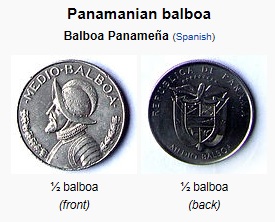
In 1904, silver coins in denominations of 2½, 5, 10, 25, and 50 centésimos were introduced. These coins were weight-related to the 25 gram 50 centésimos, making the 2½ centésimos coin 1¼ grams. Its small size led to it being known as the “Panama pill” or the “Panama pearl”. In 1907, copper-nickel ½ and 2½ centésimos coins were introduced, followed by copper-nickel 5 centésimos in 1929. In 1930, coins for 110, ¼, and ½ Balboa were introduced, followed by 1 balboa in 1931, which were identical in size and composition to the corresponding U.S. coins. In 1935, bronze 1 centésimo coins were introduced, with 1¼ centésimo pieces minted in 1940.

CU Blog - A Lesson in History - Panamanian Balboa - Photo 1

In 1966, Panama followed the U.S. in changing the composition of their silver coins, with copper-nickel clad 110 and ¼ Balboa, and .400 fineness ½ Balboa. 1 balboa coins, at .900 fineness silver, were issued that year for the first time since 1947. In 1973, copper-nickel clad ½ Balboa coins were introduced. 1973 also saw the revival of the 2½ centésimos coin, which had a size similar to that of the U.S. half dime, but these were discontinued two years later due to lack of popular demand. In 1983, 1 centésimo coins followed their U.S. counterpart by switching from copper to copper plated zinc. Further issues of the 1 Balboa coins have been made since 1982 in copper-nickel without reducing the size.

Modern 1 and 5 centésimos and 110, ¼, and ½ balboa coins are the same weight, dimensions, and composition as the U.S. cent, nickel, dime, quarter, and half-dollar, respectively. In 2011, new 1 and 2 balboa bi-metal coins were issued.[1]

In addition to the circulating issues, commemorative coins with denominations of 5, 10, 20, 50, 75, 100, 150, 200, and 500 Balboas have been issued.

Banknotes

In 1941, President Dr. Arnulfo Arias pushed the government to enact Article 156 to the constitution, authorizing official and private banks to issue paper money. As a result, on 30 September 1941, El Banco Central de Emission de la Republica de Panama was established.[2]

CU Blog - A Lesson in History - Panamanian Balboa - Photo 2

The bank was authorized to issue up to 6,000,000 Balboas worth of paper notes, but only 2,700,000 balboas were issued on 2 October 1941. A week later, Dr. Ricardo Adolfo de la Guardia Arango replaced Arias as president in a coup supported by the United States. The new government immediately closed the bank, withdrew the issued notes, and burned all unissued stocks of same. Very few of these so-called “Arias Seven Day” notes escaped incineration.

Reference Notes:
1. http://worldcoinnews.blogspot.com/search/label/panama
2. Linzmayer, Owen (2012). “Panama”. The Banknote Book. San Francisco, CA: www.BanknoteNews.com.

Panama is out-of-scope of this Go Lean empowerment roadmap. They are not a member-state that caucuses with the Caribbean Community (CariCom), and they do not even have an “Observer” representation/status within the trade bloc. But since a part of their territory-coastline is on the Caribbean Sea, their dealings should generate review and monitoring from Caribbean planners. There are many issues for the Caribbean to consider  – from an academic point-of-view – about this history of Panama: an obvious failed-state as recent as the 1980’s.

Is the American manipulations in Panama’s past reflective of the same America today? The assumption is No! The US no longer draws such “hard lines” in their interactions with peoples of different ethnicity. The country has endured deep soul-searching and reconciliation of its racial past, (Civil Rights Movement, Affirmative Action, etc.), and now even the President of the United States is a Black Man. On the surface today, America is a color-blind society.

On the surface!

Behind the scenes, under the covers, there is another reality. The current American experience is that Black-and-Brown is still institutionally disadvantaged and Wall Street, and by extension “Big American Business”, wields uncanny power over the socio-economic-political affairs of the country. For this and other reasons, the Go Lean movement advocates for Caribbean people and institutions to take their own lead for their own determination. We want to be a protégé of the US, not a parasite.

The roadmap calls for a cooperative entity of the existing regional Central Banks to foster interdependence for the regional Greater Good. We must issue Caribbean banknotes, branded Caribbean Dollars (C$). The totality of the regional market, 42 million people in 30 member-states, is large enough to allow for streamlining of the marketplace, creating the right climate for viable currency/financial/securities markets. While there might be some reticence for liberal currency operations, considering that so many Caribbean member-states had to learn hard lessons on currency over the decades – painful devaluations – the CU is to be structured as a technocracy, with the right mix of skilled talent, gifted genius and independent oversight to allow regional C$ currency markets to soar.

The strategy is not a pro-American stance, no pegging to the US Dollar, therefore no losses will be experienced when the US dollar drops value compared to other international currencies, a far too frequent an occurrence in the last 50 years. The US Dollar planners (Federal Reserve) do not have the Caribbean best-interest in mind for their technocratic decisions regarding their currency management; they have American self-interest in mind. Therefore the Caribbean region must overcome any “fear of math” because the C$ may become stronger, (see VIDEO below), in comparison to the US$. This is why e-Commerce and e-Payments schemes are strongly urged within the CU/Go Lean roadmap.

In general, the CU will employ strategies, tactics and implementations to impact its prime directives; identified with the following 3 statements:

  • Optimization of the economic engines in order to grow the regional economy to $800 Billion & create 2.2 million new jobs.
  • Establishment of a security apparatus to protect the resultant economic engines and mitigate internal and external threats.
  • Improve Caribbean governance to support these engines.

Early in the Go Lean book, this need for careful technocratic stewardship of the regional Caribbean economy was pronounced (Declaration of Interdependence – Page 12 – 13) with these acknowledgements and statements:

xi.   Whereas all men are entitled to the benefits of good governance in a free society, “new guards” must be enacted to dissuade the emergence of incompetence, corruption, nepotism and cronyism at the peril of the people’s best interest. The Federation must guarantee the executions of a social contract between government and the governed.

xii.   Whereas the legacy in recent times in individual states may be that of ineffectual governance with no redress to higher authority, the accedence of this Federation will ensure accountability and escalation of the human and civil rights of the people for good governance, justice assurances, due process and the rule of law. As such, any threats of a “failed state” status for any member state must enact emergency measures on behalf of the Federation to protect the human, civil and property rights of the citizens, residents, allies, trading partners, and visitors of the affected member state and the Federation as a whole.

xxiv.   Whereas a free market economy can be induced and spurred for continuous progress, the Federation must install the controls to better manage aspects of the economy: jobs, inflation, savings rate, investments and other economic principles. Thereby attracting direct foreign investment because of the stability and vibrancy of our economy.

xxv.   Whereas the legacy of international democracies had been imperiled due to a global financial crisis, the structure of the Federation must allow for financial stability and assurance of the Federation’s institutions. To mandate the economic vibrancy of the region, monetary and fiscal controls and policies must be incorporated as proactive and reactive measures. These measures must address threats against the financial integrity of the Federation and of the member-states.

The Go Lean book, and previous blog/commentaries, stressed the key community ethos, strategies, tactics, implementations and advocacies necessary to regulate and manage the regional financial eco-system for the Caribbean currency. These points are detailed in the book as follows:

Community Ethos – Economic Principles – Economic Systems Influence Individual Choices Page 21
Community Ethos – Economic Principles – Consequences of Choices Lie in the Future Page 21
Community Ethos – Economic Principles – Money Multiplier Page 23
Community Ethos – Governing Principles – Lean Operations Page 24
Community Ethos – Ways to Impact the Future Page 26
Community Ethos – Ways to Impact the Greater Good Page 37
Strategy – Mission – Fortify the Stability of the Banking Institutions Page 45
Strategy – Provide Proper Oversight and Support for the Depository Institutions Page 46
Tactical – Ways to Foster a Technocracy Page 64
Tactical – Growing the Economy – Minimizing Bubbles Page 69
Tactical – Separation-of-Powers – Caribbean Central Bank Page 73
Tactical – Separation-of-Powers – Depository Institutions Regulatory Agency Page 73
Anecdote – Turning Around CARICOM – Effects of 2008 Financial Crisis Page 92
Implementation – Assemble Caribbean Central Bank as a Cooperative Page 96
Implementation – Ways to Better Manage Debt Page 114
Planning –10 Big Ideas – Single Market / Currency Union Page 127
Planning – Ways to Improve Failed-State Indices Page 134
Planning – Lessons Learned from 2008 Page 136
Planning – Ways to Measure Progress Page 147
Anecdote – Caribbean Currencies Page 149
Advocacy – Ways to Grow the Economy Page 151
Advocacy – Ways to Control Inflation Page 153
Advocacy – Reforms for Banking Regulations Page 199
Advocacy – Ways to Impact Wall Street Page 200
Advocacy – Ways to Impact Main Street Page 201
Appendix – Controlling Inflation – Technical Details Page 318
Appendix – Jamaica’s International Perception – “High inflation and currency dysfunction” Page 297

The points of effective, technocratic banking/economic stewardship of regional currencies, were further elaborated upon in these previous blog/commentaries:

https://goleancaribbean.com/blog/?p=3889 RBC EZPay – Ready for Change
https://goleancaribbean.com/blog/?p=3858 ECB unveils 1 trillion Euro stimulus program
https://goleancaribbean.com/blog/?p=3814 Lessons from the Swiss unpegging the franc
https://goleancaribbean.com/blog/?p=3743 Trinidad cuts 2015 budget as oil prices tumble
https://goleancaribbean.com/blog/?p=3582 For Canadian Banks: Caribbean is a ‘Bad Bet’
https://goleancaribbean.com/blog/?p=3090 Lessons Learned – Europe Sovereign Debt Crisis of 2009
https://goleancaribbean.com/blog/?p=2930 ‘Too Big To Fail’ – Caribbean Version
https://goleancaribbean.com/blog/?p=949 Inflation Matters
https://goleancaribbean.com/blog/?p=833 One currency, divergent economies
https://goleancaribbean.com/blog/?p=518 Analyzing the Data – What Banks learn about financial risks
https://goleancaribbean.com/blog/?p=378 US Federal Reserve Releases Transcripts from 2008 Meetings/Stimulus
https://goleancaribbean.com/blog/?p=273 10 Things We Don’t Want from the US – #3: Quantitative Easing

Similar to Panama, there are a number of Caribbean member-states that use the US dollar as their sole paper currency:

  • British Virgin Island
  • Turks & Caicos Islands
  • Dutch Caribbean Territories: Bonaire, Sint Eustatius and Saba
  • US Territories of Puerto Rico & US Virgin Islands

The Go Lean book reports that previous Caribbean administrations have failed miserably in managing regional currencies. Consider Jamaica for example, despite being pegged 1-to-1 with the US dollar in 1960’s, the J$ was trading at 87-to-1 with the US$ at press time for the book (November 2013). Other countries (like Trinidad, Dominican Republic, and the Eastern Caribbean Currency Union states) experienced similar turmoil, though at lesser rates of devaluation. The book opens with the declaration that the Caribbean is in crisis because of episodes like these currency failings. In every case, the direct after-effect was increased societal abandonment, and now the reported brain-drain rate is estimated at 70%, with some countries even reporting up to 81%. This disposition is symptomatic of a Failed-State status.

Currency management includes details of more than just the paper-money people carry in their wallets. The book describes the 4 basic functions of money:

  • a medium of exchange
  • a unit of account
  • a store of value
  • a standard of deferred payment

These dynamics have an effect on inflation/deflation and trade facilitation with other countries. So Central Banks must strenuously manage currency issues to ensure economic progress and avoid financial dysfunction. This point is conveyed in the following VIDEO, as regards the Central Bank management of the Chinese Yuan.

VIDEO: Pegging the Yuan – http://youtu.be/S-9iY1OgbDE

Uploaded on Oct 25, 2010 – How the Chinese Central Bank could peg the Yuan to the dollar by printing Yuan and buying dollars (building up a dollar reserve). This lesson in macro-economics can be applied to any Central Bank, any other currency.

There are so many currency issues that have to be coordinated that the Go Lean book describes the effort as heavy-lifting. The roadmap (Page 5) declares that change has come to the Caribbean, and that new technocrats are ready to assume oversight of regional currency issues:

Please swallow your pride
If I have things you need to borrow
For no one can fill those of your needs
That you won’t let show
You just call on me brother, when you need a hand

(Chorus)
We all need somebody to lean on
I just might have a problem that you’d understand
We all need somebody to lean on

(Lyrics of song: Lean On Me, by Singer/Songwriter: Bill Withers)

This is not the same world as 1941 Panama, but still there are many lessons to learn and apply in the Caribbean. The goal is simple, to move the region to a new destination: a better homeland to live, work and play. Now is the time for all of the Caribbean, the people, banking establishments and the governing institutions, to lean-in for the changes described in the book Go Lean … Caribbean.

🙂

Download the free e-Book of Go Lean … Caribbean – now!

———

* Appendix Footnote: Subsequent treaties added an expiration date for 1999; the Canal is now fully Panamanian.

Share this post:
, , , , ,
[Top]

ENCORE: ‘Concussions’ hit home

Miami, Florida – If you’re a fan of American football (NFL or the National Football League) then you know how impactful it is to go undefeated from the beginning to the end of the season, playoffs included. Only one team has done it … ever: the 1972 Miami Dolphins. The 50 players on that team became heroes to every football-loving kid anywhere near the broadcast waves of Miami.

There was a time when these guys were my heroes.

But “time and unforeseen occurrences befall us all” – The Bible (Ecclesiastes 9:11).

There is a connection between Miami and the Caribbean; the city has become much more than a shopping destination; it has redefined itself as the financial, political and sports capital of the Caribbean and Latin America.

So this news is shocking to receive, as the Miami Herald newspaper reports that many of the players on the 1972 Dolphins team now suffer from CTE (Chronic Traumatic Encephalopathy).

Say it ain’t so …

CU Blog - UPDATE - Concussions Come Home - Photo 1

CU Blog - UPDATE - Concussions Come Home - Photo 1b

CU Blog - UPDATE - Concussions Come Home - Photo 3

It seemed like this CTE disease was so far-off; an affliction on people “over there” … somewhere. But to hit the 1972 Dolphins players means that this disease has come home…to our local heroes.

🙁

See the story here in this recent Miami Herald article:

Title: Football’s toll: At least eight members of 1972 Dolphins affected by cognitive impairment

CU Blog - UPDATE - Concussions Come Home - Photo 2They called him Captain Crunch, and the name was fitting. Mike Kolen packed a punch.

Now, 45 years after the Dolphins’ No-Name Defense ran through the 1972 season undefeated, Kolen and his perfect teammates are tied together again. But instead of celebration, there’s heartache.

South Florida’s most legendary team has become a cautionary tale, a poignant symbol of the concussion saga that threatens the future of America’s favorite sport.

“Within the last month or so, I’ve been diagnosed with the initial stages of Alzheimer’s,” Kolen, a starting linebacker on Miami’s two Super Bowl-winning teams, told the Miami Herald.

And was football the cause?

“I think that’s about the only way I’d have cognitive issues,” replied Kolen, 69, who has no family history of dementia.

Kolen’s story is not unique for Miami’s most historic team.

Earlier this week, Sports Illustrated detailed how Kolen’s better-known 1972 teammates Nick Buoniconti and Jim Kiick have both deteriorated mentally in the past few years.

After quarterback Earl Morrall’s death in 2014, an autopsy revealed he had Stage 4 chronic traumatic encephalopathy, a degenerative brain disease more commonly known as CTE that researchers have linked to football.

Bill Stanfill, the Dolphins’ first sack king, suffered from dementia and Parkinson’s disease when he died last fall at age 69.

Three others from that famed roster — cornerback Lloyd Mumphord, defensive back Tim Foley and running back Hubert Ginn — have quietly dealt with cognitive impairment in recent years, teammates tell the Herald.

That makes at least eight members of a roster of roughly 50 men who have experienced loss of acuity. And that figure includes only those who keep in regular contact with the organization; several do not.

Roughly a quarter of the ’72 team has passed away, including five from cancer. Manny Fernandez, a defensive lineman who was the star of Super Bowl VII, has had eight surgeries on his back alone. Center Jim Langer, 68, said his “legs are bad and my knees are shot” after six operations.

Even the NFL acknowledges – see VIDEO below – that there is a link between football-related head trauma and neurological diseases like CTE after denying any such connection for years. …

Continue reading the full article here; (it is lengthy):

http://www.miamiherald.com/sports/nfl/miami-dolphins/article150311157.html retrieved 05-11-2017.

———

VIDEO – NFL acknowledges link between football and brain disease CTEhttp://www.dailymail.co.uk/news/article-4503362/Seven-members-72-Dolphins-suffered-brain-injuries.html#v-6189767714419658422

Relating Miami to the Caribbean makes this story relatable to the movement behind the book Go Lean … Caribbean. One purpose of this movement is to engage business models so that Caribbean communities can better take advantage of the economic benefits of sports. There are few expressions of professional sports in the Caribbean now – there is no eco-system for collegiate athletics at all. Due to the territorial status and the border proximity, there are 3 member-states with organized American Football league play in the Caribbean: Puerto Rico, US Virgin Islands and the Bahamas.

With the advantages of professional sports (money from ticket sales & broadcast rights, pride, athletic fitness, etc.), come disadvantages as well. CTE, as one, is only now begrudgingly been accepted as a direct consequence of the often times brutal game of American Football.

This was the warning from this previous blog-commentary that marked the release of the movie “Concussion”, chronicling the David-versus-Goliath-like advocacy of the Pathology Doctor who “blew the whistle” on the systemic “willful” ignorance and Crony-Capitalistic abuse in the NFL. This excerpt highlights some main points from that blog:

Yes, movies help us to glean a better view of ourselves … and our failings; and many times, show us a way-forward.

These descriptors actually describe the latest production from Hollywood icon Will Smith (the former Fresh Prince of Bel-Air). This movie, the film “Concussion”, in the following news article, relates the real life drama of one man, Dr. Bennet Omalu, a Nigerian-born medical doctor – a pathologist – who prepared autopsies of former players that suffered from football-related concussions. He did not buckle under the acute pressure to maintain the status quo, and now, he is celebrated for forging change in his adopted homeland. This one man made a difference. (The NFL is now credited for a Concussion awareness and prevention protocol so advanced that other levels of the sport – college, high schools and Youth – are being urged to emulate).

Beyond the excerpt, see the entire blog-commentary from August 31, 2015 on the movie ‘Concussion‘ and the dreaded CTE disease being encored here:

—————-

Go Lean Commentary – ‘Concussions’ – The Movie; The Cause

“Are you ready for some football?” – Promotional song by Hank Williams, Jr. for Monday Night Football on ABC & ESPN networks for 22 years (1989 – 2011). See Appendix below.

This iconic song (see Appendix) and catch-phrase is reflective of exactly how popular the National Football League (NFL) is in the US:

“They own an entire day of the week”.

- The Movie; The Cause - Photo 2So says the new movie ‘Concussions’, starring Will Smith, referring to the media domination of NFL Football on Sundays during the Autumn season. The movie’s script is along a line that resonates well in Hollywood’s Academy Award balloting: “David versus Goliath”; “a small man speaking truth to power”.

In the case of the NFL, it is not just about power, it is about money, prestige and protecting the status quo; the NFL is responsible for the livelihood of so many people. The book Go Lean … Caribbean recognized the importance of the NFL in the American lexicon of “live, work and play”; it featured a case study (Page 32) of the NFL and it’s collective bargaining successes (and failures) in 2011. An excerpt from the book is quoted as follows:

Football is big business in the US, $9 billion in revenue, and more than a business; emotions – civic pride, rivalries, and fanaticism – run high on both sides.

Previous Go Lean commentaries presents the socio-economic realities of much of the American football eco-system. Consider a sample here:

Socio-Economic Impact Analysis of [Football] Sports Stadiums
Watch the Super Bowl … Commercials
Levi’s® NFL Stadium: A Team Effort
Sports Role Model – College Football – Playing For Pride … And More
Sports Role Model – Turn On the SEC Network
Collegiate Sports in the Caribbean – Model of NCAA
10 Things We Want from the US: #10 – Sports Professionalism
10 Things We Don’t Want from the US: #10 – ‘Win At All Costs’ Ethos

While football plays a big role in American life, so do movies. Their role is more unique; they are able to change society. In a previous blog / commentary regarding Caribbean Diaspora member and Hollywood great, Sidney Poitier, it was declared that …

“Movies are an amazing business model. People give money to spend a couple of hours watching someone else’s creation and then leave the theater with nothing to show for the investment; except perhaps a different perspective”.

Yes, movies help us to glean a better view of ourselves … and our failings; and many times, show us a way-forward.

These descriptors actually describe the latest production from Hollywood icon Will Smith (the former Fresh Prince of Bel-Air). This movie, the film “Concussion”, in the following news article, relates the real life drama of one man, Dr. Bennet Omalu, a Nigerian-born medical doctor – a pathologist – who prepared autopsies of former players that suffered from football-related concussions. He did not buckle under the acute pressure to maintain the status quo, and now, he is celebrated for forging change in his adopted homeland. This one man made a difference. (The NFL is now credited for a Concussion awareness and prevention protocol so advanced that other levels of the sport – college, high schools and Youth – are being urged to emulate).

See news article here on the release of the movie:

Title: ‘Concussion’: 5 Take-a-ways From Will Smith’s New Film

Will Smith, 46, is definitely going to get a ton of Oscar buzz portraying Dr. Bennet Omalu in the new film “Concussion.” NFL columnist Peter King of Sports Illustrated got an exclusive first peek at the trailer and it has been widely shared on social media since. And it’s very chilling.

- The Movie; The Cause - Photo 1

Here are five take-aways and background you need to know before checking out the clip:

1 – It’s Based on a True Story

Omalu is the forensic pathologist and neuropathologist who discovered chronic traumatic encephalopathy in football players who got hit in the head over and over again, according to the Washington Post.

In the clip, he says repetitive “head trauma chokes the brain.”

Omalu was one of the founding members of the Brain Injury Research Institute in 2002. He conducted the autopsy of Pittsburgh Steelers center Mike Webster, played by David Morse in the film, which led to this discovery.

2 – Smith’s Version of Omalu’s Accent Is Spot On

Omalu is from Nigeria and Smith has been known to transform completely for a role. He was nominated for an Oscar for 2011’s “Ali,” playing the legendary Muhammad Ali.

For comparison, here’s Omalu’s PBS interview from 2013.

3 – Smith Is a Reluctant Hero

“If you don’t speak for them, who will,” Gugu Mbatha-Raw, who plays Prema Mutiso in the film, tells Smith’s character.

He admits he idolized America growing up and “was the wrong person to have discovered this.”

4 – Alec Baldwin and Luke Wilson

“Concussion” brought in some heavyweights for this movie. Baldwin plays Dr. Julian Bailes, who advises Omalu, and Wilson, who will reportedly play NFL Commissioner Roger Goodell, according to IMDB. There’s no official word on this. He’s seen at a podium in the trailer, but doesn’t speak.

5 – “Tell the Truth”

Smith captures Omalu’s passion to have the truth told about this injury and disease.

“I was afraid of letting Mike [Webster] down. I was afraid. I don’t know. I was afraid I was going to fail,” Omalu told PBS a couple years back.

———-

VIDEO Link: http://www.imdb.com/title/tt3322364/?ref_=nv_sr_1


Will Smith stars in the incredible true David vs. Goliath story of Dr. Bennet Omalu, the brilliant forensic neuropathologist who made the first discovery of CTE, a football-related brain trauma, in a pro player.

The subject of concussions is serious – life and death. Just a few weeks ago (August 8), an NFL Hall-of-Fame inductee was honored for his play on the field during his 20-year professional career, but his family, his daughter in particular, is the one that made his acceptance / induction speech. He had died, in 2012; he committed suicide after apparently suffering from a brain disorder – chronic traumatic encephalopathy (CTE), a type of chronic brain damage that has also been found in other deceased former NFL players[4] – sustained from his years of brutal head contacts in organized football in high school, college and in his NFL career. This player was Junior Seau.

- The Movie; The Cause - Photo 3a

- The Movie; The Cause - Photo 3b

Why would there be a need for “David versus Goliath”; “a small man speaking truth to power”? Is not the actuality of an acclaimed football player committing suicide in this manner – he shot himself in the chest so as to preserve his brain for research – telling enough to drive home the message for reform?

No. Hardly. As previously discussed, there is too much money at stake.

These stakes bring out the Crony-capitalism in American society.

The book Go Lean…Caribbean (and subsequent blog/commentaries) relates many examples of cronyism in the American eco-system. There is a lot of money at stake. Those who want to preserve the status quo or not invest in the required mitigations to remediate concussions will fight back against any Advocate promoting the Greater Good. The profit motive is powerful. There are doubters and those who want to spurn doubt. “Concussions in Football” is not the first issue these “actors” have promoted doubt on. The efforts to downplay concussion alarmists are from a familiar playbook, used previously by Climate Change deniers, Big Tobacco, Toxic Waste, Acid Rain, and other dangerous chemicals.

This Go Lean book serves as a roadmap for the introduction and implementation of the technocratic Caribbean Union Trade Federation (CU). Sports are integral to the Go Lean/CU roadmap. While sports can be good and promote positives in society, even economically, the safety issues must be addressed upfront. This is a matter of community security. Thusly, the prime directives of the CU are described as:

  • Optimize the economic engines of the Caribbean to elevate the regional economy to grow to $800 Billion and create 2.2 million new jobs, including sports-related industries with a projection of 21,000 direct jobs at Fairgrounds and sports enterprises.
  • Establish a security apparatus to protect the people and economic engines.
  • Improvement of Caribbean governance to support these economic and security engines.

The CU/Go Lean sports mission is to harness the individual abilities of athletes to not just elevate their performance, but also to harness the economic impact for their communities. So modern sports endeavors cannot be analyzed without considering the impact on “dollars and cents” for stakeholders. This is a fact and should never be ignored. There is therefore the need to carefully assess and be on guard for crony-capitalistic influences entering the decision-making of sports stakeholders. The Go Lean book posits that with the emergence of new economic engines, “bad actors” will also emerge thereafter to exploit the opportunities, with good, bad and evil intent”. These points were pronounced early in the opening Declaration of Interdependence (Page 12 &14):

x. Whereas we are surrounded and allied to nations of larger proportions in land mass, populations, and treasuries, elements in their societies may have ill-intent in their pursuits, at the expense of the safety and security of our citizens. We must therefore appoint “new guards” to ensure our public safety and threats against our society, both domestic and foreign. The Federation must employ the latest advances and best practices of criminology and penology to assuage continuous threats against public safety.

xi. Whereas all men are entitled to the benefits of good governance in a free society, “new guards” must be enacted to dissuade the emergence of incompetence, corruption, nepotism and cronyism at the peril of the people’s best interest. The Federation must guarantee the executions of a social contract between government and the governed.

xvi. Whereas security of our homeland is inextricably linked to prosperity of the homeland, the economic and security interests of the region needs to be aligned under the same governance. Since economic crimes … can imperil the functioning of the wheels of commerce for all the citizenry, the accedence of this Federation must equip the security apparatus with the tools and techniques for predictive and proactive interdictions.

xxxi. Whereas sports have been a source of great pride for the Caribbean region, the economic returns from these ventures have not been evenly distributed as in other societies. The Federation must therefore facilitate the eco-systems and vertical industries of sports as a business, recreation, national pastime and even sports tourism …

The Go Lean book envisions the CU – a confederation of the 30 member-states of the Caribbean chartered to do the heavy-lifting of empowering and elevating the Caribbean economy – as the landlord of many sports facilities (within the Self-Governing Entities design), and the regulator for inter-state sport federations. The book details the economic principles and community ethos to adopt, plus the executions of strategies, tactics, implementations and advocacies to optimize sports enterprises in the Caribbean:

Community Ethos – Deferred Gratification Page 21
Economic Principles – People Respond to Incentives in Predictable Ways Page 21
Economic Principles – Economic Systems Influence Individual Choices / Incentives Page 21
Economic Principles – The Consequences of Choices Lie in the Future Page 21
Economic Principles – Job Multiplier Page 22
Community Ethos – Security Principles – Whistleblower Protection Page 23
Community Ethos – Security Principles – Light-Up the Dark Places Page 23
Community Ethos – Security Principles – “Crap” Happens Page 23
Community Ethos – Governing Principles – Lean Operations Page 24
Community Ethos – Ways to Impact the Future Page 26
Community Ethos – Ways to Promote Happiness – Mitigate Suicide Threats Page 36
Community Ethos – Impact the Greater Good Page 37
Strategy – Vision – Confederating 30 Member-States into a Single Market Page 45
Strategy – Vision – Foster Local Economic Engines for Basic Needs Page 45
Strategy – Mission – Prepare for Natural Disasters Page 45
Strategic – Staffing – Sporting Events at Fairgrounds Page 55
Strategy – Agents of Change – Climate Change Page 57
Strategy – Agents of Change – Globalization Page 57
Tactical – Confederating a Permanent Union Page 63
Tactical – Fostering a Technocracy Page 64
Tactical – Separation of Powers – Sports & Culture Administration Page 81
Tactical – Separation of Powers – Fairgrounds Administration Page 83
Tactical – Separation of Powers – Health Department – Disease Management Page 86
Implementation – Assemble Regional Organs into a Single Market Economy Page 96
Implementation – Steps to Implement Self-Governing Entities – Sports Stadia Page 105
Implementation – Security Initiatives at Start-up – Unified Command & Control Page 103
Implementation – Industrial Policy for CU Self Governing Entities Page 103
Implementation – Ways to Deliver – Project Management/Accountabilities Page 109
Anatomy of Advocacies – Examples of Individuals Who Made Impact Page 122
Planning – Ways to Make the Caribbean Better Page 131
Advocacy – Ways to Grow the Economy Page 151
Advocacy – Ways to Create Jobs Page 152
Advocacy – Ways to Improve Governance Page 168
Advocacy – Ways to Better Manage the Social Contract Page 170
Advocacy – Ways to Promote Fairgrounds Page 192
Advocacy – Ways to Improve Emergency Management – Trauma Arts & Sciences Page 196
Advocacy – Ways to Improve Sports Page 229
Advocacy – Ways to Impact Urban Living – Sports Leagues Page 234

The Go Lean book and accompanying blogs declare that the Caribbean needs to learn lessons from other communities, especially when big money is involved in pursuits like sports. These activities should be beneficial to health, not detrimental. So the admonition is to be “on guard” against the “cronies”; they will always try to sacrifice public policy – the Greater Good – for private gain: profit.

Let’s do better. Yes, the Caribbean can be better than the American experiences.

The design of Self-Governing Entities allow for greater protections from Crony-Capitalistic abuses. While this roadmap is committed to availing the economic opportunities of sports and accompanying infrastructure, as demonstrated in the foregoing movie trailer, sport teams and owners can be plutocratic “animals” in their greed. We must learn to mitigate plutocratic abuses. While an optimized eco-system is good, there is always the need for an Advocate, one person to step up, blow the whistle and transform society. The Go Lean roadmap encourages these role models.

Bravo Dr. Bennet Omalu. Thank you for this example … and for being a role model for all of the Caribbean.

RIP Junior Seau.

Now is the time for all of the Caribbean, the people and governing institutions, to lean-in for the empowerments described in the book Go Lean … Caribbean. This roadmap will result in more positive socio-economic changes throughout the region; it will make the Caribbean a better place to live, work and play. 🙂

Download the free e-book of Go Lean … Caribbean – now!

Sign the petition to lean-in for this roadmap for the Caribbean Union Trade Federation.

——-

Appendix VIDEO: Hank Williams Jr. – Are You Ready for Some Footballhttps://youtu.be/dKPZEMu7Mno

Uploaded on Jan 28, 2019 – Official Music Video

Share this post:
, , , , , , ,
[Top]

State of the American Union – Housing Segregation – ENCORE

There is income and then there is wealth.

Income refers to wages, salaries, interest, rent and dividends while wealth refers to equity in assets. Those assets relate to stocks, bonds and most notably real estate, as in home ownership.

S&P Index Reports Record Drop In U.S. Home Prices

The US has a long bad history of racial discrimination. This allowed many Whites to build wealth through home equity, while this privilege and trend was not available (or extended) to Black-and-Brown Americans.

For much of the past century, the differing privileges were tied to a de jure segregation, but surprisingly, the patterns, trending and habits continue to this day mostly because of a de facto segregation ― through individual prejudices, income differences, or the actions of private institutions like banks and real estate agencies.

This is the claim of the new book The Color of Law: A Forgotten History of How Our Government Segregated America – by author Richard Rothstein. This is the America today. See the review of this book here:

Book Review: The Color of Law: A Forgotten History of How Our Government Segregated America – 1st Edition By Author: Richard Rothstein

“Rothstein has presented what I consider to be the most forceful argument ever published on how federal, state, and local governments gave rise to and reinforced neighborhood segregation.” ― William Julius Wilson

In this groundbreaking history of the modern American metropolis, Richard Rothstein, a leading authority on housing policy, explodes the myth that America’s cities came to be racially divided through de facto segregation―that is, through individual prejudices, income differences, or the actions of private institutions like banks and real estate agencies. Rather, The Color of Law incontrovertibly makes clear that it was de jure segregation―the laws and policy decisions passed by local, state, and federal governments―that actually promoted the discriminatory patterns that continue to this day.

CU Blog - UPDATE - State of the American Union - Housing Segregation - Photo 2Through extraordinary revelations and extensive research that Ta-Nehisi Coates has lauded as “brilliant” (The Atlantic), Rothstein comes to chronicle nothing less than an untold story that begins in the 1920s, showing how this process of de jure segregation began with explicit racial zoning, as millions of African Americans moved in a great historical migration from the south to the north.

As Jane Jacobs established in her classic The Death and Life of Great American Cities, it was the deeply flawed urban planning of the 1950s that created many of the impoverished neighborhoods we know. Now, Rothstein expands our understanding of this history, showing how government policies led to the creation of officially segregated public housing and the demolition of previously integrated neighborhoods. While urban areas rapidly deteriorated, the great American suburbanization of the post–World War II years was spurred on by federal subsidies for builders on the condition that no homes be sold to African Americans. Finally, Rothstein shows how police and prosecutors brutally upheld these standards by supporting violent resistance to black families in white neighborhoods.

The Fair Housing Act of 1968 prohibited future discrimination but did nothing to reverse residential patterns that had become deeply embedded. Yet recent outbursts of violence in cities like Baltimore, Ferguson, and Minneapolis show us precisely how the legacy of these earlier eras contributes to persistent racial unrest. “The American landscape will never look the same to readers of this important book” (Sherrilyn Ifill, president of the NAACP Legal Defense Fund), as Rothstein’s invaluable examination shows that only by relearning this history can we finally pave the way for the nation to remedy its unconstitutional past.

Source: Ret’d 05-11-2017 from: https://www.amazon.com/Color-Law-Forgotten-Government-Segregated/dp/1631492853

The author was a guest on a radio-talk show NPR’s 1A, where he articulated a lot of  these fine points from his book; he was joined by other guests that  are Subject Matter Experts in this American drama. See-listen to the PODCAST here:

AUDIO-PODCASTThe Long History And Lasting Legacy Of Housing Segregationhttp://the1a.org/audio/#/shows/2017-05-10/the-long-history-and-lasting-legacy-of-housing-segregation/110861/@00:00

 What Is Whiteness?

Posted May 10, 2017 – How more than a century of housing segregation has left the nation starkly divided by race.

This is the America that many Caribbean citizens – our Black-and-Brown – flee to looking for refuge from Caribbean life. The book Go Lean…Caribbean posits that these ones jump from the “frying-pan into the fire”.

What’s more the Go Lean book asserts – in the quest to lower the rate of societal abandonment – that it is easier to remediate social defects like these in the Caribbean homeland than to “Come to America” thinking that the “grass is greener”.

It is not!

This was the declaration from this previous blog-commentary from the movement behind the book Go Lean…Caribbean. This quotation from that previous blog is spot on:

The Caribbean Diaspora have fled their Caribbean homelands over past decades in search of better economic opportunities. It is now the conclusion that many of these “lands of refuge” are rigged in favor of certain ethnic groups; those groups do not include the “Black-and-Brown” of the Caribbean. This commentary has relayed, repeatedly, that this Caribbean-bred demographic can do better at home … in the Caribbean.

Rather than just this excerpt, the entire blog-commentary from August 5, 2014 is encored here:

——————–

Go Lean Commentary – The Crisis in Black Homeownership

The United States of America has been the best economic manifestation in the history of mankind, (as declared in the book Go Lean…Caribbean Page 67), yet the experience has not been the same for all of its citizens. This definitely applies to the “black and brown” populations. The Caribbean Diaspora fits this classification and their experience fits 100% to the events related in the foregoing news article.

The US is the “land of the free and the home of the brave”, but some restrictions apply. This reality is not new, as racial disparities have long existed in the history of America. But after a major social revolution in the 1960’s, positive change came to American minorities, following by decades of progress.

Then 2008 happened …

That year saw the crisis of the Great Recession where American society lost $11 Trillion in net worth; then later regained $13.5 Trillion; (Go Lean book Page 69). According to the foregoing article, the Great Recession losses were not evenly distributed; nor was the subsequent recovery – those who lost the net worth (Middle Class) were not the ones who recovered (One Percent).

How the recession turned owners into renters and obliterated Black American wealth.

By: Jamelle Bouie

CU Blog - The Crisis in Black Homeownership - PhotoIn 2005, three years before the Great Recession, the median black household had a net worth of $12,124. Yes, this was far behind the median white household—which had a net worth of $134,992—but it was a huge improvement from previous decades, in which housing discrimination made wealth accumulation difficult (if not impossible) for the large majority of African-American families.

By the official end of the recession in 2009, median household net worth for blacks had fallen to $5,677—a generation’s worth of hard work and progress wiped out. (The number for whites, by comparison, was $113,149.) Overall, from 2007 to 2010, wealth for blacks declined by an average of 31 percent, home equity by an average of 28 percent, and retirement savings by an average of 35 percent. By contrast, whites lost 11 percent in wealth, lost 24 percent in home equity, and gained 9 percent in retirement savings. According to a 2013 report [a] by researchers at BrandeisUniversity, “half the collective wealth of African-American families was stripped away during the Great Recession.”

It was a startling retrenchment, creating the largest wealth, income, and employment gaps since the 1990s. And, if a new study [b] from researchers at CornellUniversity and RiceUniversity is any indication, these gaps are deep, persistent, and difficult to eradicate.

In the study, called “Emerging Forms of Racial Inequality in Homeownership Exit, 1968–2009,” sociologist Gregory Sharp and demographer Matthew Hall examine the relationship between race and risk in homeownership. Simply put, African-Americans are much more likely than whites to switch from owning homes to renting them.

“The 1968 passage of the Fair Housing Act outlawed housing market discrimination based on race,” explained Sharp in a press release. “African-American homeowners who purchased their homes in the late 1960s or 1970s were no more or less likely to become renters than were white owners. However, emerging racial disparities over the next three decades resulted in black owners who bought their homes in the 2000s being 50 percent more likely to lose their homeowner status than similar white owners.”

This wasn’t a matter of personal irresponsibility. Even after adjusting for socio-economic characteristics, debt loads, education, and life-cycle traits like divorce or job loss, blacks were more likely to lose their homes than whites.

If you’re familiar with American history and housing policy, this shouldn’t come as a surprise. The explicit housing discrimination of the mid-20th century has left a mark—arguably a scar—on the landscape of American homeownership. The combination of red-lining, block-busting, racial covenants, and other discriminatory measures means that, even now, a majority of blacks live in neighborhoods with relatively poor access to capital and mortgage loans. What’s more, this systematic discrimination has left many black households unable to afford down payments or other housing costs, even if loans are available.

And in the event that black households are able to save and afford a home, they aren’t as financially secure as their white counterparts. To wit, middle-class African-Americans are more likely to belong to the lower middle class of civil servants and government workers—professions that, in the last five years, have been slashed as a consequence of mass public-sector downsizing [c]. All else being equal, a black schoolteacher who loses her job to budget cuts is less likely to have savings—and thus a safety net—than her white counterpart.

But this isn’t just a story of legacies and effects. In addition to showing the consequences of past discrimination, Sharp and Hall argue that African-Americans have been victimized by a new system of market exploitation. Banks like Wells Fargo steered [d] blacks and other minorities into the worst subprime loans, giving them less favorable terms than whites and foreclosing on countless homes. In a 2012 lawsuit [e], the ACLU and National Consumer Law Center alleged that the now-defunct New Century Financial, working with Morgan Stanley, pushed thousands of black borrowers into the riskiest loans, leaving many in financial ruin. As early as 2005, the Wall Street Journal reported [f] that blacks were twice as likely to receive subprime loans. And in a New York University study published last year [g], researchers found that black and Hispanic families making more than $200,000 a year were more likely to receive subprime loans than white families making less than $30,000.

Together, all of this means that—according to Sharp and Hall—African-Americans are 45 percent more likely than whites to lose their homes. That means they’re more likely to lose their accumulated wealth and to slide down the income ladder, and less likely to pass the advantages of status and mobility to their children.

Apropos of that observation, recent data from the Bureau of Labor Statistics [h] shows an incredible level of youth unemployment for blacks and Latinos. More than 21 percent of African-Americans aged 16 to 24 are out of work, compared with a national average of 14.2 percent. For black teenagers in particular, joblessness soars to nearly 40 percent. It’s a catastrophe with serious economic consequences. The Center for American Progress estimates [i] that the young adults who experienced long-term unemployment during the worst of the recession will lose more than $20 billion in earnings over the next 10 years. And given the slow recovery, odds are good they’ll never recover those lost earnings.

It’s tempting to treat these as subsets of broader problems: poor assistance to homeowners and too much austerity. But they’re not. Even during the boom economy of the 1990s, black employment lagged behind the national average. And the racial wealth gap is a persistent fact of American life.

Likewise, the challenges of black homeownership are a function of discriminatory housing policy [j], as are a whole host of other problems, from mass incarceration and overly punitive policing to poor air quality [k] and food access. These challenges are heavily location-dependent, which is another way to say they are heavily racialized and most prevalent in the segregated, working-class or low-income communities that characterize life for most African-Americans [l], even those with middle-class incomes.

For reasons both political and ideological, it’s nearly verboten in mainstream conversation to argue that racialized problems require race-conscious solutions. Knowing what we know about the demographics of foreclosures, for example, we should ensure any program to help underwater homeowners includes a specific measure to assist black victims of predatory lending, who may need additional help to get on sure footing.

For more than anyone else, this is a message for liberals and progressives, who—for all of their racial sensitivity—are still reluctant to tackle the economic dimensions of racism, even as they represent the vast majority of nonwhite voters and draw critical support from African-American constituencies. It’s how Elizabeth Warren could give “11 Commandments for Progressives” [m] —and receive huge applause—without mentioning the deep problems of racial inequality. One of her commandments is “that no one should work full-time and still live in poverty, and that means raising the minimum wage.” But solving this problem for African-Americans and Latinos—who tend to live in areas that are segregated from job opportunities—is very different than solving it for whites.

While conservatives and Republicans can play a role here, it’s Democrats who are committed to reducing income inequality and bringing balance to our lopsided economic system. Success on those fronts requires a return to race-conscious policymaking, from programs to increase the geographic mobility of low-income workers—relocation grants for individuals or transportation grants for communities with a spatial mismatch between jobs and housing—to public works programs aimed at low-income minority communities, to race-based affirmative action as a way to boost a flagging black middle class.

There’s little in American life that escapes the still-powerful pull of past and present racism, and effective policymaking—to say nothing of effective problem-solving—requires a response to that racism. Otherwise, we entrench the same disparities for a new generation.

——–

Jamelle Bouie is a Slate staff writer covering politics, policy, and race.
The Slate – Daily Magazine for the Web – Posted 07-24-2014; retrieved 08-04-2014
http://www.slate.com/articles/news_and_politics/politics/2014/07/black_homeownership_how_the_recession_turned_owners_into_renters_and_obliterated.html

The points of this foregoing article aligns with the Go Lean book and the collection of blogs-commentaries. The book posits that the crisis persists for the Caribbean and their Diaspora in North America and Europe. What’s more, this movement asserts that this crisis, any crisis, is a terrible thing to waste.

800px-Statue_of_Liberty,_NYThe Caribbean Diaspora have fled their Caribbean homelands over past decades in search of better economic opportunities. It is now the conclusion that many of these “lands of refuge” are rigged in favor of certain ethnic groups; those groups do not include the “Black-and-Brown” of the Caribbean. This commentary has relayed, repeatedly, that this Caribbean-bred demographic can do better at home … in the Caribbean. The following are related previous posts:

Unfortunately for the Caribbean, this societal abandonment has continued. Analysis by the Inter-American Development Bank asserts that the Caribbean continues to endure a brain drain of 70% among the college educated population; (https://goleancaribbean.com/blog/?p=1433).

This blog entry depicted how the Caribbean Diaspora that fled to Great Britain has not fared well; (https://goleancaribbean.com/blog/?p=1683)

In addition to economics, there is the concern for security and justice. This blog entry (https://goleancaribbean.com/blog/?p=546) related the dual standards of justice in the US, where all men are treated as equals (wink-wink), just some are more equal than others.

Yes, as the old adage relates: “the grass is not greener on the other side”. See this VIDEO here (Part 1 of 2):

(Click on first continuation VIDEO for Part 2 of 2 or click here: https://www.youtube.com/watch?v=gOS3BBmUxvs)

The assertion of the book Go Lean…Caribbean is that once the proposed empowerments are put in place, the Caribbean Diaspora should consider repatriating to their ancestral homelands.

Social Scientists maintain that when animals/mammals are confronted with threats, they have to choose between (stand and) fight or flight. For 50 years, the Caribbean citizens have defaulted to flight. Change has now come to the Caribbean. The book Go Lean…Caribbean serving as a roadmap for the introduction and implementation of the technocratic Caribbean Union Trade Federation (CU), hereby presents “stand and fight” options. This roadmap will spearhead the elevation of Caribbean society. The prime directives of the CU are presented as the following 3 statements:

  • Optimization of the economic engines in order to grow the regional economy & create 2.2 million new jobs at home.
  • Establishment of a security apparatus to protect the resultant economic engines.
  • Improve Caribbean governance to support these engines.

The book posits that the improved conditions projected over the 5 years of the roadmap will neutralize the impetus for Caribbean citizens to flee, identified as “push and pull” factors. This point is stressed early in the book (Page 13) in the following pronouncements in the Declaration of Interdependence:

xix.      Whereas our legacy in recent times is one of societal abandonment, it is imperative that incentives and encouragement be put in place to first dissuade the human flight, and then entice and welcome the return of our Diaspora back to our shores. This repatriation should be effected with the appropriate guards so as not to imperil the lives and securities of the repatriated citizens or the communities they inhabit. The right of repatriation is to be extended to any natural born citizens despite any previous naturalization to foreign sovereignties.

xx.   Whereas the results of our decades of migration created a vibrant Diaspora in foreign lands, the Federation must organize interactions with this population into structured markets. Thus allowing foreign consumption of domestic products, services and media, which is a positive trade impact. These economic activities must not be exploited by others’ profiteering but rather harnessed by Federation resources for efficient repatriations.

This foregoing article highlights the new realities ushered into the world as a result of the events of the Year 2008. The Go Lean book focuses heavy on this subject, even identifying this as a motivation in the same Declaration of Interdependence early in the book (Page 13):

xxv.   Whereas the legacy of international democracies had been imperiled due to a global financial crisis, the structure of the Federation must allow for financial stability and assurance of the Federation’s institutions. To mandate the economic vibrancy of the region, monetary and fiscal controls and policies must be incorporated as proactive and reactive measures. These measures must address threats against the financial integrity of the Federation and of the member-states.

The Go Lean roadmap proposes a community ethos in which economic principles are recognized as playing a crucial role in the chain-of-events that led to fight-or-flight decisions for Caribbean Diaspora. (These principles were always the reality, just not professionally managed as such). These principles are identified and qualified (Page 21) as follows:

1. People Choose
2. All Choices Involve Costs
3. People Respond to Incentives in Predictable Ways
4. Economic Systems Influence Individual Choices and Incentives
5. Voluntary Trade Creates Wealth
6. The Consequences of Choices Lie in the Future

These principles cannot be glossed over or handled lightly; this is why the Go Lean book contains 370 pages of finite details for managing economic change in the region. In addition to the assessments of the region’s standings, the book contains the following sample of community ethos, strategies, tactics, implementations and advocacies to impact the Caribbean homeland:

Community Ethos – Job Multiplier Page 22
Community Ethos – Lean Operations Page 24
Community Ethos – Return on Investments Page 24
Community Ethos – Ways to Impact the Future Page 26
Strategy – Competition – Remain Home –vs- Emigrate Page 49
Strategy – Agents of Change – Aging Diaspora Page 57
Tactical – Growing the Caribbean Economy to $800 Billion Page 67
Tactical – Separation of Powers – Versus Member-States Governments Page 71
Implementation – Year 1 / Assemble Phase Page 96
Implementation – Ways to Deliver Page 109
Implementation – Ways to Better Manage Debt Page 114
Implementation – Trade Mission Objectives Page 116
Implementation – Reasons to Repatriate Page 118
Anecdote – Experiences of a Repatriated Resident Page 126
Planning – 10 Big Ideas for the Caribbean Region Page 127
Planning – Lessons Learned from 2008 Page 136
Advocacy – Ways to Grow the Economy Page 151
Advocacy – Ways to Create Jobs Page 152
Advocacy – Ways to Improve Credit Ratings Page 155
Advocacy – Ways to Improve Housing Page 161
Advocacy – Ways to Impact Wall Street Page 200
Anecdote – Experiences of Diaspora Member Living Abroad Page 216
Advocacy – Ways to Impact the Diaspora Page 217
Advocacy – Ways to Help the Middle Class Page 223
Appendix – Caribbean Emigration Statistics Page 269
Appendix – Credit Ratings Agencies Role in 2008 Page 276

The Go Lean roadmap has simple motives: fix the problems in the homeland to make the Caribbean a better place to live, work and play. We want to keep Caribbean citizens in the Caribbean. There should be no need to go abroad and try to foster an existence in a foreign land. There is heavy-lifting wherever a person resides. Let’s do the “lifting” here, where at least we are at home and we are treated equitably.

Too many people left, yet have too little to show for it. Now is the time for all of the Diaspora (those in the US, and other countries) to lean-in for the empowerments described in the book Go Lean … Caribbean. We understand your pain, we have been impacted too. (The publishers of the book were entrenched in the Wall Street culture in 2008). This Big Idea now is to use the same energy and innovation to create solutions for Main Street – but not Main Street USA, rather Main Street Caribbean.

This is a dramatic change for the Caribbean, one that is overdue, an invitation to build an elevated society in the Caribbean that many had fled to find elsewhere, yet failed. We can make the Caribbean a better place to live, work and play. We can succeed here.

Download the free e-Book of Go Lean … Caribbean – now!

Sign the petition to lean-in for the roadmap for the Caribbean Union Trade Federation. 

———————————————————————————————–

Appendices:

a. Retrieved from https://www.evernote.com/shard/s4/sh/2f378f98-d21b-4f5b-89d4-c3a47419b0ad/479f14e61917697b135246e01d20f85f

b. Retrieved from http://news.rice.edu/2014/07/22/african-american-homeownership-increasingly-less-stable-and-more-risky-2/

c. Retrieved from http://www.epi.org/publication/public-sector-job-losses-unprecedented-drag/

d. Retrieved from http://articles.baltimoresun.com/2012-07-12/news/bs-md-ci-wells-fargo-20120712_1_mike-heid-wells-fargo-home-mortgage-subprime-mortgages

e. Retrieved from http://www.citylab.com/housing/2012/10/did-big-banks-subprime-mortgage-crisis-violate-civil-rights-law/3598/

f. Retrieved from http://online.wsj.com/news/articles/SB111318092881303093

g. Retrieved from http://www.citylab.com/housing/2013/08/blacks-really-were-targeted-bogus-loans-during-housing-boom/6559/

h. Retrieved from http://www.npr.org/blogs/codeswitch/2014/07/21/329864863/the-youth-unemployment-crisis-hits-african-americans-hardest

i. Retrieved from http://www.americanprogress.org/issues/labor/report/2013/04/05/59428/the-high-cost-of-youth-unemployment/

j. Retrieved from http://www.thedailybeast.com/articles/2014/03/13/how-we-built-the-ghettos.html

k. Retrieved from http://grist.org/climate-energy/before-repairing-the-climate-well-have-to-repair-the-impacts-of-racism/

l. Retrieved from http://www.slate.com/articles/news_and_politics/politics/2014/04/desean_jackson_richard_sherman_and_ black_american_economic_mobility_why.html

m. Retrieved from http://www.vox.com/2014/7/21/5918063/elizabeth-warrens-11-commandments-for-progressives-show-democrats


Share this post:
, ,
[Top]

Robots Building Houses – More than Fiction

Go Lean Commentary

Robotic Builder - Photo 2What do you want to do when you grow up?

This is the familiar career planning question that is asked of young ones. Today, the responders may answer with noble careers like: doctor, lawyer, accountant, computer programmer, engineer, etc. Rarely, do we hear answers like bricklayer, mason or carpenter; though these too are noble professions. But food, clothing and shelter are basic needs that everyone must make provision for. So if our young people are not yearning for those jobs, how will the needs be fulfilled?

In the US, there is the sarcastic joke that the country brings in “immigrants” to do the jobs Americans don’t want to do; think migrant farmers, sweat shops and construction sites. But “now” … emerges a new option:

Robots!

Robotic Builder - Photo 3

Yes, the word “now” is appropriate. The idea of robots building houses is not so science fiction; not so far-fetch in the future; and not so unlikely. This is happening now! See the news article & VIDEO’s here:

Title: Meet The Robots That Will Build Your Next House
By: Tyler Durden

The U.S. residential construction industry employs 100’s of thousands of people each year in various skilled trades that earn hourly pay rates ranging from minimum wage to $100 per hour, or more.

Per BLS statistics, the residential housing space employed over 1 million people at the height of the housing bubble and now accounts for nearly 750,000 jobs.

Of course, just like the auto industry, many of those jobs can be done at a fraction of the cost and with much greater precision by industrial robots.  Moreover, those robots work inside a warehouse where they’re immune from the negative consequences of weather and can work 365 days per year without compromising construction integrity.

As Blueprint Robotics’ CEO, Jerry Smalley, points out, nearly 60% of a custom home can be built inside a warehouse and shipped on a standard flatbed truck to its destination for installation. [(See Blueprint Robotics VIDEO below.)]

Production starts with the most precise robot in our factory, the WBZ-160 beam-center. This saw cuts the top and bottom plates for our wall, and pre-drills for the installation of plumbing, venting and electrical rough-in that is soon to be installed.

It’s all pre-determined by the plans you provide. Everything in our factory is pre-cut: drilled, trimmed, fastened and routed with CNC precision.

Once we’ve got the lumber cut, we move to the Framing Station. This machine produces 40 linear feet of framed wall in about 11 minutes. Because robots are executing the nail pattern, it’s incredibly precise. The nail will never be outside of the stud: no misses here.

The wall comes out of the framing station and moves to our Drywall Bridge Station. Here we put a layer of OSB on the frame followed by a layer of drywall. The OSB is nailed to the stud, while the drywall is glued to the OSB and screwed to the stud. The Drywall Bridge Station is also where any openings in the wall, doors, windows, outlets and switches are precisely cut to perfectly square dimensions.

As Bloomberg notes, modular houses, at least in the U.S., used to be reserved for smaller, cheaper homes and that stigma restricted the industry from taking market share in the high-end McMansion neighborhoods.  But, that is all gradually changing as modern technology allows companies like Blueprint to manufacture far more complicated custom homes rather than the simple ‘boxes’ of the past.

Today’s plants are capable of producing bigger buildings with more elaborate designs. The Blueprint factory in Baltimore – see VIDEO #1 below – is one of the first in the U.S. to use robots, Fleisher said. Taller multifamily buildings, dorms and hotels are increasingly being manufactured indoors. And so are mansions that sell for millions.

“Some builders won’t even advertise they work with modular companies like us,” said Myles Biggs, general manager of Ritz-Craft Corp.’s Pennsylvania construction facility. “You could be driving past a modular home and not even know it, because it looks just like one next door.”

Ritz-Craft can deliver a single-family house in six to eight weeks, on average. Having an indoor facility means weather delays are rarely a factor. Each worker is given a narrow concentration, like tiling floors or sanding drywall, which increases production speed. People without any background in construction can become skilled laborers in two weeks, according to Biggs.

There doesn’t seem to be any stigma for customers of Connecticut Valley Homes, a builder that assembles factory-made components on lots in New England, including near the stately mansions of Greenwich. The East Lyme-based firm is “booming at moment,” with deposits for 42 houses, up about 50 percent from the same time last year, said Dave Cooper, senior building consultant. The company built only eight homes in 2011, when the housing market was hitting bottom.

Looks like Bill Gates will soon have a lot more robots to tax in the residential construction space.

Source: Posted April 17, 2017; retrieved May 9, 2017 from: http://www.zerohedge.com/news/2017-04-17/meet-robots-will-build-your-next-house

———-

VIDEO # 1 – Blueprint Robotics – https://youtu.be/1Rx04wVn7vM

Uploaded on Jul 21, 2016 – A better way to build.

———-

VIDEO # 2 – Robot bricklayer can build a whole house in two days – https://youtu.be/V72Hm3PIM3Q

Published on Jun 26, 2015 – Robot bricklayer can build a whole house in two days

An Australian engineer has built a robot that can build houses in two hours, and could work every day to build houses for people.
Human house-builders have to work for four to six weeks to put a house together, and have to take weekends and holidays. The robot can work much more quickly and doesn’t need to take breaks.

Hadrian could take the jobs of human bricklayers. But its creator, Mark Pivac, told PerthNow that it was a response to the lack of available workers — the average age of the industry is getting much higher, and the robot might be able to fill some of that gap.

“People have been laying bricks for about 6000 years and ever since the industrial revolution, they have tried to automate the bricklaying process,” Pivac told PerthNow, which first reported his creation. But despite the thousands of years of housebuilding, most bricklaying is still done by hand.
Hadrian works by laying 1000 bricks an hour, letting it put up 150 houses a year.

It takes a design of the house and then works out where all of the bricks need to go, before cutting and laying each of them. It has a 28-foot arm, which is used to set and mortar the brick, and means that it doesn’t need to move during the laying.
Pivac will now work to commercialise the robot, first in West Australia but eventually globally.

http://www.independent.co.uk/life-sty…

The subjects of robots building houses and 3-D Printing of construction materials are just part of the “joys and pains” of modern life: one step forward; two steps backwards.

Yes, this news is not all positive; there are a lot of downsides with developments like robotic fabrication. For instance:

Jobs

The foregoing article referred to the eventually – the transformative change – depicted in this photo here and a related AUDIO-Podcast from National Public Radio (NPR):

Robotic Builder - Photo 1

AUDIO-Podcast Title: Robots and Our Automated Future – http://www.npr.org/podcasts/510053/on-point-with-tom-ashbrook

Posted May 8, 2017 – Will your next home be built by robots? We’ll look at the growing robot boom and American jobs.

So the planners of the societal engines must consider this eventually. They must “understand the market and plan the business [economy]”. This is the charter of planning organizations. There must be such a role for the Caribbean, so declares the book Go Lean…Caribbean. It warns (Page 126) of the dreaded prophecy from the Bible:

Where there is no vision, the people perish – Proverbs 29:18 (King James Version)

As noted in the foregoing, robotic fabrication can be deemed the “Robot Apocalypse”; it is a matter of serious concern for a lot of communities. The fear is NOT that robots will take over the planet and annihilate the humans, but rather take the jobs.

This is no long-range forecast; this is the current threat. Notice the systems being tested and deployed in the Appendices below; this acute transformation is happening now in real life. The Go Lean book also asserted (Page 260) that construction industry jobs have a job multiplier factor of up to 9.1, where each direct job would indirectly support 9.1 other jobs. All of this would be at risk with the Robot Apocalypse hitting the construction-homebuilding industry. 🙁

The book Go Lean…Caribbean serves as a roadmap for the introduction and implementation of the technocratic Caribbean Union Trade Federation (CU). The book acknowledges that “Agents of Change” have now impacted the Caribbean region so negatively that the communities are now in crisis. Alas, the book declares that this “crisis is a terrible thing to waste”.

The book seeks to prepare the region for 4 Agents of Change, identifying these 2 (Page 57) as related to this commentary:

  • Technology
  • Globalization

The underlying issue with the Robot Apocalypse or robotic fabrication is that the technological systems and end-products can be developed anywhere around the world and shipped to our region for deployment. The threat is that these changes will undermine the societal engines in the process. Imagine the trade deficit with foreign countries that develop, manufacture and ship these systems and end-products – this fact affects our foreign currency reserves. Imagine too, our communities’ security needs, because of the preponderance of hurricanes and earthquakes in our region. Lastly the shock to the national tax rolls (no payroll-pension contributions) will impact the governing apparatus as well. This would truly be apocalyptic as these 3 societal engines – economic, security and governance – constitute the foundations of our society. This corresponds with the prime directives of the Go Lean/CU roadmap, which declares the quest as follows:

  • Optimization of the economic engines in order to grow the regional economy to $800 Billion & create 2.2 million new jobs.
  • Establishment of a security apparatus to ensure public safety (i.e. building standards) and protect the resultant economic engines.
  • Improvement of Caribbean governance – remembering that robots do not pay income taxes – to support these engines.

The changes, challenges and opportunities of robotic fabrication equipment had been previously detailed in August 2015 in a blog-commentary related to 3D Printing. This quotation here succinctly foretells the future societal “apocalypse”:

The new reality of 3D Printing is now changing business models. Imagine distributed manufacturing where the additive manufacturing process would be combined with cloud computing technologies to allow for decentralized and geographically independent distributed production.[74] For example, make a car, with parts sourced from different locations by different 3D Printers. Under this new scheme, the creation of chattel goods will be a product of intellectual property.

The future is exciting!

Here comes change! Consider the governmental consequences:

    If Caribbean governments depend on ‘Customs Duties’ of manufactured goods for a revenue source, they are hereby put on notice that this revenue stream will dry up. In many countries, (the Bahamas for example), the duty rates for automobiles are on a sliding scale from the high of 85% down to 55%. With an average costs of US$25,000, that is a lot of lost revenue for a member-state to adjust to.

The future is scary!

The book Go Lean…Caribbean focuses heavily on the future, and how to manage, monitor, and mitigate the changes (good and bad) that the future will bring. This acute transformation of 3D Printing is a good model of the type of innovation the Go Lean book anticipates. The book posits that the Caribbean region must not only be on the consuming end of these developments; we must create, develop and contribute to the innovations. This means jobs!

The job-creating initiatives start by fostering genius in Caribbean stakeholders who demonstrate competence in Science, Technology, Engineering and Mathematics (STEM). This will eventually apply to government revenue officials, but initially the focus will be more on the youth markets, as these ones adapt more readily to acute transformations.

This vision was pronounced early in the book with these statements in the opening Declaration of Interdependence (Pages 12 – 14) about the need for the Caribbean Union Trade Federation:

xiv. Whereas government services cannot cannot be delivered without the appropriate funding mechanisms, “new guards” must be incorporated to assess, accrue, calculate and collect revenues, fees and other income sources for the Federation and member-states. The Federation can spur government revenues directly through cross-border services and indirectly by fostering industries and economic activities not possible without this Union.

xxii. Whereas the preparation of our labor force can foster opportunities and dictate economic progress for current and future generations, the Federation must ensure that educational and job training opportunities are fully optimized for all residents of all member-states, with no partiality towards any gender or ethnic group. The Federation must recognize and facilitate excellence in many different fields of endeavor, including sciences, languages, arts, music and sports. This responsibility should be executed without incurring the risks of further human flight, as has been the past history.

xxvi. Whereas the Caribbean region must have new jobs to empower the engines of the economy and create the income sources for prosperity, and encourage the next generation to forge their dreams right at home, the Federation must therefore foster the development of new industries, like that of ship-building, automobile manufacturing, prefabricated housing, frozen foods, pipelines, call centers, and the prison industrial complex. In addition, the Federation must invigorate the enterprises related to existing industries like tourism, fisheries and lotteries – impacting the region with more jobs.

xxvii. Whereas the region has endured a spectator status during the Industrial Revolution, we cannot stand on the sidelines of this new economy, the Information Revolution. Rather, the Federation must embrace all the tenets of Internet Communications Technology (ICT) to serve as an equalizing element in competition with the rest of the world. The Federation must bridge the digital divide and promote the community ethos that research/development is valuable and must be promoted and incentivized for adoption.

xxviii. Whereas intellectual property can easily traverse national borders, the rights and privileges of intellectual property must be respected at home and abroad. The Federation must install protections to ensure that no abuse of these rights go with impunity, and to ensure that foreign authorities enforce the rights of the intellectual property registered in our region.

xxx. Whereas the effects of globalization can be felt in every aspect of Caribbean life, from the acquisition of food and clothing, to the ubiquity of ICT, the region cannot only consume, it is imperative that our lands also produce and add to the international community, even if doing so requires some sacrifice and subsidy.

The changes being anticipated with robotic fabrication and robot-aided construction dictates that our region explore the possibilities of Prefabricated Housing. The Caribbean region – all 30 member-states – has a constant need to rebuild, renew and restore our housing deliveries. This is mostly due to the preponderance of natural disasters in our region; think hurricanes and earthquakes. The Go Lean book fully detailed the eco-system of Prefabricated Homes; see  the headlines here of this advocacy from Page 207:

10 Ways to Develop a Pre-Fab Housing Industry

1 Leverage the Single Market
This calls for the need to supply the full population of 42 million people in all 30 member-states; the CU would be able to Research-and-Develop varying pre-fabricated housing options. Pre-Fab homes are becoming popular in the EU and North America as they are cheaper compared to many existing homes on the market.
2 Fashionable Design
3 Energy Optimizations
4 Raw Materials
Houses are normally built with the raw material that is abundant in the area; lands with red dirt, produce a lot of brick houses, while forest areas build wooden houses. The CU will apply the same strategies, but with the consideration of the need to withstand hurricanes. As such, components of homes (walls) built from concrete blocks may be prevalent.
5 Assembly Plants
Prefabricated buildings consist of several factory-built components or units that are assembled on-site to complete the unit. The prefab house requires much less (on-site) labor as compared to conventional houses. But there is the need for much skilled/creative labor in the design and manufacturing cycles/sites – thus a boon to CU job-creation efforts. Where to erect the assembly plants will be a subject of “community will”. The CU will allow for an open bidding process.
6 Supply Chain Solutions (Contractors)
7 Transport/Logistics
8 Showrooms and Marketing
9 Mortgages – Retail and Secondary Markets
10 Homeowners Casualty Insurance

Overall, the Go Lean book stresses the community ethos, strategies, tactics, implementations and advocacies to reboot, reform and transform the societal engines of Caribbean society, so as to benefit from changes coming due to this Robot Apocalypse. Though not directly mentioned in the book, the Robot Apocalypse is planned for in the Go Lean book. A comprehensive view of  the technocratic stewardship for the region’s societal engines, including the industrial policy to foster basic needs (in this case housing), is presented in the book. The points of effective, technocratic industrial stewardship were further elaborated upon in previous blog/commentaries. Consider this sample:

https://goleancaribbean.com/blog/?p=11358 Retail Apocalypse – Preparing for the Inevitable
https://goleancaribbean.com/blog/?p=10869 Bill Gates: ‘Tax the Robots’
https://goleancaribbean.com/blog/?p=8294 ‘Olli’ – The Self-Driving Public Transit Vehicle
https://goleancaribbean.com/blog/?p=5376 Drones to be used for Insurance Damage Claims
https://goleancaribbean.com/blog/?p=3384 Pleas to Detroit on Technology in Cars
https://goleancaribbean.com/blog/?p=1487 Here come the Drones … and the Concerns
https://goleancaribbean.com/blog/?p=1277 The need for Google’s highway safety innovations
https://goleancaribbean.com/blog/?p=673 Autonomous Ghost Ships

Warning to all building-construction stakeholders in the Caribbean: Change is coming!

The Caribbean is arguably the best address on the planet, but the ability to adapt and stay ahead of changes is definitely missing. This Go Lean roadmap is conceivable, believable and achievable for turning around our dire disposition.

Now is the time for all stakeholders of Caribbean – homeowners, home builders, bankers and governments (income tax revenues are greatly impacted) – to lean-in for the empowerments for technological assimilation described here-in and in the book Go Lean … Caribbean. This is where industry is going, not soon, but now today. Everyone is hereby urged to lean-in to this guidance to get to the region to its desired destination: a better place to live, work and play. 🙂

Download the free e-Book of Go Lean … Caribbean – now!

Sign the petition to lean-in for the roadmap for the Caribbean Union Trade Federation. 

—————–

Appendix VIDEO’s


Share this post:
, , ,
[Top]

UPDATE: Bad Week for Bahamas Events

Update – Go Lean Commentary

When it rains, it pours!

Event planners put on 2 events in the Bahamas this past weekend where things went from ‘bad to worse’ … fast. See the details in these news articles:

  • CU Blog - UPDATE - Bad Week for Bahamas Events - Photo 4Bahamas Junkanoo Carnival opening event in Freeport experienced poor turn-out, 1/10th the support of previous years – This commentary had related how the flawed decision-making for the 2017 event called for a postponement of the event, but then the government rescinded and returned to the original dates, except for in Freeport where they did delay the event 1 week, for this past weekend (April 28/29). Instead of the usual 5,000 in attendance, the numbers reported in near 500.
  • Fyre Festival Chaos In Exuma – The inaugural music event, dubbed the Fyre (diverse spelling of the word “fire”) Festival went up in flames, at the expense of the Bahamas brand/image. This event was an “Epic Fail” with media outlets internationally jumping on the pile in lambasting Bahamas Tourism officials and event planning. This event priced ticket and travel packages up to $12,000 for the April 28 – 30th weekend and all the country has to show for it now is a “Black Eye” – see Appendix VIDEO’s below.
    Fyre Festival Organisers Apologise And Praise Bahamian Government – An old adage relates that “you do not get a 2nd chance for a first impression”. Yet still, the Fyre Festival organizers plan to do the heavy-lifting to reboot their unique music festival event; only this time, they will do it in the US. This means no chance for redemption for the Bahamas. See the press statement here:
    “Then something amazing happened: venues, bands, and people started contacting us and said they’d do anything to make this festival a reality and how they wanted to help. The support from the musical community has been overwhelming and we couldn’t be more humbled or inspired by this experience. People were rooting for us after the worst day we’ve ever had as a company. After speaking with our potential partners, we have decided to add more seasoned event experts to the 2018 Fyre Festival, which will take place at a United States beach venue.”
    CU Blog - UPDATE - Bad Week for Bahamas Events - Photo 2

    CU Blog - UPDATE - Bad Week for Bahamas Events - Photo 1b

    CU Blog - UPDATE - Bad Week for Bahamas Events - Photo 1

As noted in these published reports, the Bahamas is getting slammed in the international press and on social media. This is a consequence of the emergence of New Media, the world of Internet & Communications Technology (ICT), where one celebrity – dubbed “influencers” – may have millions of followers.

CU Blog - UPDATE - Bad Week for Bahamas Events - Photo 3On the surface, onlookers consider Event Tourism to be so easy, but truth be told, it requires heavy-lifting. It requires the coordination of the economic, security and governing engines of a society. This was the declaration from this previous blog-commentary from the movement behind the book Go Lean…Caribbean. The assessment was that touristic events appear to be lucrative, but there was so much heavy-lifting involved with an implementation, that unless there was a whole-souled commitment by the full community, it would be very hard to find success; chaos ensues.

The movement behind the Go Lean book has repeatedly related that there is a need for new stewardship of the Caribbean tourism apparatus. The world has changed. There is no longer the need for tourism stewards to just “rub shoulders” with travel agents, but rather, now they must write computer programming code, optimize Search Engines and execute events with technocratic deliveries.

Out with the old, in with the new.
This previous blog-commentary (from September 15, 2015) related these details:

The book Go Lean…Caribbean calls for the elevation of Caribbean society, to re-focus, re-boot, and optimize all the engines of commerce so as to make the Caribbean a better place to live, work and play.  The category of “play” covers the full scope of tourism, which is the primary economic driver for our Caribbean region; the book estimates 80 million visitors among the region. (Since that number includes cruise passengers that may visit multiple Caribbean islands on one itinerary, each port is counted separately; without cruise passengers, a figure of 68 – 69 million is perhaps more accurate).
This commentary is a consideration of tourism, not travel. Tourism is a subset of the travel eco-system, so any Agent of Change in the world of travel must be carefully considered on tourism, on Caribbean tourism. …

The Go Lean book considers these Agents of Change (Page 57) that have dynamically affected the Caribbean economic eco-systems:

  • Technology
  • Globalization
  • Aging Diaspora
  • Climate Change

This first one, technology, has had a most shocking effect on this travel/tourism industry. We can conclude that the days of [Travel Agent] Thomas Cook are over. It is no longer convenient for tourism industry stakeholders (transportation lines, resort properties, etc.) to acquiesce to travel agents; they are no longer needed to find passengers-guests-travelers-tourists.

(The industry for travel agents has now effectively disappeared [in importance]).

Technology, the Internet-Communications-Technology (ICT) in particular has furnished alternative and better options for travel enterprises to find passengers-guests-travelers-tourists…. Travel agents are now inconsequential….

The book Go Lean…Caribbean and the underlying movement seeks to re-boot the strategies and tactics of tourism marketing for the entire Caribbean region. The book asserts Caribbean member-states must expand and optimize their tourism outreach but that the requisite investment of the resources (time, talent, treasuries) for this goal may be too big for any one Caribbean member-state … alone. Rather, shifting the responsibility to a region-wide, professionally-managed, deputized technocracy will result in greater production and greater accountability. This deputized agency is the Caribbean Union Trade Federation (CU). The book thereafter introduces the CU and provides a roadmap for its implementation into a Single Market for the Caribbean economy … and tourism marketing.

The goal of the CU is to bring the proper tools and techniques to the Caribbean region to optimize the stewardship of the economic, security and governing engines.  The book posits that the economy can be induced and spurred for continuous progress, with technocratic management and stewardship better than the status quo. While the goal of the roadmap is to pursue a diversification strategy, the reality is that tourism will continue to be the primary economic driver in the region for the foreseeable future. The publisher of the book Go Lean…Caribbean convenes the talents and skill-sets of movers-and-shakers in electronic commerce [and project management] so as to forge the best tools and techniques for this new ICT-based marketing.

Lessons need to be learned from the abominable planning and execution of this weekend’s events. The lesson: Event Tourism is not easy; but still, the heavy-lifting tasks must be mastered. This is the charter of the Go Lean roadmap, to deploy the technocratic administration to optimize Caribbean tourism. The Go Lean specifically details the community ethos that the region needs to adopt to consistently be successful in these types of events, plus the strategies, tactics, implementations and advocacies to ensure successful deployments; see a sample list here:

Community Ethos – Deferred Gratification Page 21
Community Ethos – Economic Principles – The Consequences of Choices Lie in the Future Page 21
Community Ethos – Governing Principles – Lean Operations Page 24
Community Ethos – Governing Principles – Cooperatives Page 25
Community Ethos – Ways to Promote Intellectual Property Page 29
Community Ethos – Ways to Bridge the Digital Divide Page 31
Community Ethos – Ways to Impact Turn-Arounds Page 33
Community Ethos – Ways to Promote Happiness Page 36
Community Ethos – Ways to Impact the Greater Good Page 37
Strategy – Vision – Confederate 30 Member-States Page 45
Strategy – Mission – Celebrate the Music, Sports, Art and Culture of the Caribbean Page 46
Tactical – Fostering a Technocracy Page 64
Tactical – Separation-of-Powers – CU Federal Agencies versus Member-State Governments Page 71
Implementation – Steps to Implement Self-Governing Entities – Ideal for Events Page 105
Implementation – Ways to Deliver Page 109
Planning – 10 Big Ideas for the Caribbean Region Page 127
Planning – Ways to Make the Caribbean Better Page 131
Planning – Lessons from Omaha – College World Series Model Page 138
Advocacy – Ways to Enhance Tourism Page 190
Advocacy – Ways to Impact Events Page 191
Advocacy – Ways to Promote Fairgrounds Page 192
Advocacy – Ways to Preserve Caribbean Heritage Page 218
Advocacy – Ways to Improve the Arts Page 230
Advocacy – Ways to Promote Music Page 231
Appendix – Case Study: Sturgis Summer Festival – By the Numbers Page 288

So now what? There are repercussions and consequences …

Fyre Festival Organizers Sued in $100 Million Fraud, Breach of Contract Suit. http://www.rollingstone.com/music/news/fyre-festival-organizers-sued-for-fraud-breach-of-contract-w479666

Expect more fallout … legally, socially (butt of the joke), commercially (marketing other events) and maybe too …

… politically, as these events are transpiring only days before the parliamentary elections  in the Bahamas on May 10 (2017).

When a community puts all its “eggs in one basket”, as in Caribbean tourism, any failures tied to event planning weighs heavily on the economic output for that society. This is not fair … to the community, to the people that need optimized economic engines to support their livelihood.

The Go Lean roadmap is different … and better.

It seeks to diversify the regional economy to create new jobs – 2.2 million in total, with only 30,000 direct jobs in direct touristic activities; see Go Lean book Page 257.

Yet still, project delivery is very important as an “art and a science”. Applying advanced project management methodologies does help with the execution of event tourism … and many other industrial endeavors.

These issues are not just important for the Bahamas, but instead for the entire Caribbean region, since the economic structure is the same for most of the 30 member-states. The book relates this in the opening overview (Page 3):

The Caribbean has tried, strenuously, over the decades, to diversify their economy away from the mono-industrial trappings of tourism, and yet tourism is still the primary driver of the economy. Prudence dictates that the Caribbean nations expand and optimize their tourism products, but also look for other opportunities for economic expansion. The requisite investment of the resources (time, talent, treasuries) for this goal may be too big for any one Caribbean member-state. Rather, shifting the responsibility to a region-wide, professionally-managed, deputized technocracy will result in greater production and greater accountability. This deputized agency is the Caribbean Union Trade Federation (CU).

Now is the time for all stakeholders in the Caribbean – governments, residents, event planners, participants and tourists – to lean-in to this Go Lean roadmap. We can do better; we can make the Caribbean homeland a better place to live, work and play. This quest is conceivable, believable and achievable. 🙂

Download the free e-book of Go Lean … Caribbean – now!

Sign the petition to lean-in for the roadmap for the Caribbean Union Trade Federation.

————

Appendix VIDEO 1 – Luxury music festival turns to chaos – https://youtu.be/kzRMCEP3OIU

Published on Apr 29, 2017 – Inaugural Fyre Festival in the Bahamas postponed after attendees reported dilapidated accommodations, and top-billed performers pulled out.
To read more: http://cbc.ca/1.4090271

————

Appendix VIDEO 2 – Announcing Fyre Festival – https://youtu.be/mz5kY3RsmKo

Published on Jan 12, 2017 – This is the original Promotional Advertising.

Share this post:
, , , , ,
[Top]

Forging Change: Collective Bargaining

Go Lean Commentary

Want to re-negotiate? You must be prepared to  give the other party something they don’t currently have:

To the Caribbean Cruise industry, we present you: a Single Market of 42 million consumers.

CU Blog - Forging Change - Consuming Cruises - Photo 1

These 42 million people were always there, just not considered potential customers for the Cruise Line Industry. But money is money; it still spends the same way.

This seems so familiar!

This feels like the Southern US during the days of Jim Crow Racial Segregation. The US States practicing these policies where the “best place to live” if you were White. The Black people were there, facilitating and supporting commerce and industry, but were not supposed to be seen; they were 2nd Class citizens … in their own country. The Merchants wanted their money, just not their presence.

If you were Black and wanted to get lunch from a cafeteria, you had to “Go outback and get brown bag food from the kitchen”, while White customers got the hospitality of in-store dining.

Same money; different respect. The protests against this blatant wrong practice galvanized the US and the Civil Rights movement. See photos here:

CU Blog - Forging Change - Consuming Cruises - Photo 3

CU Blog - Forging Change - Consuming Cruises - Photo 2

CU Blog - Forging Change - Consuming Cruises - Photo 4

See the news article in the Appendix below, commemorating the 50th Anniversary of the Civil Rights Struggles of the early 1960’s. It has been 53 years now, since the abolition of this bad policy with the Civil Rights Act of 1964. This history is sitting here as a teaching moment for us in the Caribbean:

Has our region learned any lessons from this history?

It can be concluded that the answer is “No”! We have tolerated an unjust system here in our region in which the 42 million residents in the Caribbean have been treated as 2nd Class citizens … in their own countries regarding local cruise consumption.

Fact:
If you’re a Caribbean citizen and you want to take a Caribbean cruise, you have to fly to Miami, Ft. Lauderdale, Tampa, Port Canaveral, Baltimore, New York or Puerto Rico to originate the cruise, even though the ships itinerary may come right to your Caribbean port. This means you Nassau, Montego Bay, Grand Cayman, St Thomas, St. Martin and others.

Welcome to 1960’s … redux!

There is the need to forge change in the Caribbean; the same as there was the need to forge change in 1960’s America. Consuming cruises is just one of the challenges that we have to contend with in our region. This is reflective of the disrespect that exists in our society. We have dysfunctions in our economics, security and governing engines. We are 2nd class citizens on the world stage! We have the greatest address on the planet – demonstrated in that 80 million tourists consume our marketplace every year, 10 million via cruises – and yet our own people have to break down the doors to get out to find the respectful life that they need, want and deserve in foreign countries.

Enough! Time to change … here … now! But how?

This is the quest of the movement behind the book Go Lean…Caribbean. It presents a roadmap to change – to elevate – Caribbean society by rebooting the economic, security and governing engines in the 30 member-states that constitute the Caribbean. The book opens with the thesis (Page 3) that the problems of the Caribbean are too big for any one member-state to tackle alone. Cruise vacations are not one of our biggest problems, but the issues here-in are indicative of the lack of respect we have in our region and as a region of 30 separate entities. We need the change of being considered one entity; we need Collective Bargaining. Yes, it makes us more formidable in our negotiations with the Cruise Lines, but as stated in the opening, it also brings something new to the table that the Cruise Lines do not currently have: our 42 million local consumers.

According to a previous Go Lean blog-commentary, this could be a win-win for all stakeholders connected to the cruise tourism eco-system:

Some of the most popular cruise destinations include the Bahamas, Jamaica, Cayman Islands and Saint Martin. Alone, these port cities/member states cannot effect change on this cruise line industry. But together, as one unified front, the chances for success improves exponentially. The unified front is the Caribbean Union Trade Federation (CU). The term Union is more than a coincidence; it was branded as such by design. The Go Lean book serves as a roadmap for the introduction and implementation of the CU.

The vision of this integration movement is for the region to function as a Single Market. The quotation from the Go Lean book continues in advocating that the Caribbean member-states (independent & dependent) lean-in to this plan for confederacy, convention and collaboration. This is Collective Bargaining 101. From the outset, the book recognized the significance of our exercising authority over the Caribbean Seas. This point was pronounced in the opening Declaration of Interdependence (Page 11):

    v. Whereas the natural formation of our landmass and coastlines entail a large portion of waterscapes, the reality of management of our interior calls for extended oversight of the waterways between the islands. The internationally accepted 12-mile limits for national borders must be extended by International Tribunals to encompass the areas in between islands. The individual states must maintain their 12-mile borders while the sovereignty of this expanded area, the Exclusive Economic Zone, must be vested in the accedence of this Federation.

The confederacy goal entails accepting that there is interdependence among the Caribbean member-states. Implementation-wise, this shifts the responsibility for cruise line negotiations to a region-wide, professionally-managed, deputized technocracy that can result in greater production and greater accountability.

So this is one strategy for forging change in our region, in this case: collective bargaining, on behalf of the 42 million consumers in the Caribbean. This is a continuation of the various strategies, tactics and implementations that have been considered for forging change here in the homeland. These have been identified in a series of previous Go Lean blog-commentaries over the past 2 & 1/2 years, this is the tenth submission. These were presented as follows, in reverse chronological order:

  1. Forging Change – Collective Bargaining (Today)
  2. Forging Change – Addicted to Home (April 14, 2017)
  3. Forging Change – Arts & Artists (December 1, 2016)
  4. Forging Change – Panem et Circenses (November 15, 2016)
  5. Forging Change – Herd Mentality (October 11, 2016)
  6. Forging Change – ‘Something To Lose’ (November 18, 2015)
  7. Forging Change – ‘Food’ for Thought (April 29, 2015)
  8. Forging Change – Music Moves People (December 30, 2014)
  9. Forging Change – The Sales Process (December 22, 2014)
  10. Forging Change – The Fun Theory (September 9, 2014)

This commentary is urging Caribbean stakeholders to come together – to collaborate, convene and confederate – to better negotiate with Third Parties to forge change and impact the people that live, work and play here in the Caribbean.

This quest is conceivable, believable and achievable. Look at this news article here that depicts that one Cruise Line (Tropicana Cruises) and one port city (Port Castries, St. Lucia) who have implemented a strategy of local consumption. (The arrangement exists for other ports as well, as in Trinidad).

Title: New cost effective way for St. Lucians to cruise the Caribbean 

Saint Lucians now have a cost effective way to cruise the Caribbean.

Minister in the Office of the Prime Minister with responsibility for tourism, Hon. Dominic Fedee, was on hand to greet the crew of the MV Adriana for its maiden call to Port Castries.

Accompanied by the Executive Chairperson of the Saint Lucia Tourist Board (SLTB) Agnes Francis, the minister said he was pleased at what this new development means for the people of Saint Lucia.

“Saint Lucians will now have a chance to board a cruise from Port Castries without having to fly to any destination or any other home port but right here from Saint Lucia,” he said.

Owner of the MV Adriana Captain Sergey Poniatovsky gave a background to the rationale of the visa-free Caribbean cruise.

“This ship is very unique, it is not like any other cruise ship. The ship is specifically for Caribbean islands, it is like a discovery vessel, with a family and private yacht atmosphere. We have an incredible itinerary which allows people living within these West Indies to have a synergy between islands. We have the opportunity to show each island nation as a destination and bring families together.”

In addition to touring the ship, the minister and the ship captain exchanged gifts to mark the momentous occasion.

Information on the MV Adriana Caribbean cruise can be found at the Saint Lucia Tourist Board and local travel agents.
Source: St Lucia Times Daily Newspaper – Posted March 30, 2017; retrieved April 27, 2017 from: https://stluciatimes.com/2017/03/30/new-cost-effective-way-st-lucians-cruise-caribbean

CU Blog - Forging Change - Consuming Cruises - Photo 0

This quest for collective bargaining (negotiations) is both an art and a science. The Go Lean book describes this fact in a chapter on negotiations entitled  (Page 32):

10 Ways to Improve Negotiations

#2 – Bargain from Position of Strength
For the CU, negotiation is an art and a science. As a technocratic institution representing the economic integration of the region, we must project the Single Market as bigger than initial appearances. The CU represents 42 million people in 30 member-states, with a GDP of over $800 Billion, but also some 8 million [to 20 million] engaged members of the Caribbean Diaspora, scattered throughout the US, Canada and EU countries. There are also many visitors, one estimate is at 80 million yearly. The economic opportunities, catering to this market, can be quite enormous, once properly exploited.

What is the art?

The fact that different people get different results from negotiations is indicative of the fact that not all people are Negotiating Artist.

Sounds familiar?

This was the campaign line from Donald J. Trump, the 45th President of the United States. Previously as a successful business man and media star, he was proud of his artistic accomplishment in the arena of negotiations. His co-wrote this book to this effect:

Book title: “The Art of the Deal”

President Donald J. Trump lays out his professional and personal worldview in this classic work—a firsthand account of the rise of America’s foremost deal-maker.

CU Blog - Forging Change - Consuming Cruises - Photo 5

“I like thinking big. I always have. To me it’s very simple: If you’re going to be thinking anyway, you might as well think big.”—Donald J. Trump

Here is Trump in action—how he runs his organization and how he runs his life—as he meets the people he needs to meet, chats with family and friends, clashes with enemies, and challenges conventional thinking. But even a maverick plays by rules, and Trump has formulated time-tested guidelines for success. He isolates the common elements in his greatest accomplishments; he shatters myths; he names names, spells out the zeros, and fully reveals the deal-maker’s art. And throughout, Trump talks—really talks—about how he does it. Trump: The Art of the Deal is an unguarded look at the mind of a brilliant entrepreneur—the ultimate read for anyone interested in the man behind the spotlight.
Source: Amazon.com retrieved April 27, 2017 from: https://www.amazon.com/Trump-Art-Deal-Donald-J/dp/0399594493

What about the science?

Nobel Prize Winner John F. Nash (1928 – 2015) is best known for his landmark work in applying science to the process of collective bargaining and negotiations (Game Theory). He was the subject character in the Hollywood movie: A Beautiful Mind; see Movie Trailer in the Appendix VIDEO. These encyclopedia details relate:

He was a mathematician who made fundamental contributions to game theorydifferential geometry, and the study of partial differential equations.[2][3] Nash’s work has provided insight into the factors that govern chance and decision-making inside complex systems found in everyday life.

His theories are widely used in Economics. Serving as a Senior Research Mathematician at Princeton University during the latter part of his life, he shared the 1994 Nobel Memorial Prize in Economic Sciences with game theorists Reinhard Selten and John Harsanyi. …

Nash earned a Ph.D. degree in 1950 with a 28-page dissertation on Non-cooperative Games.[13][14] His thesis contained the definition and properties of the [now widely accepted] Nash Equilibrium.

—–

The Nash equilibrium – a subset of game theory – is a solution concept of a non-cooperative game involving two or more players in which each player is assumed to know the equilibrium strategies of the other players, and no player has anything to gain by changing only his or her own strategy.[1] If each player has chosen a strategy and no player can benefit by changing strategies while the other players keep theirs unchanged, then the current set of strategy choices and the corresponding payoffs constitutes a “Nash Equilibrium”. The Nash equilibrium is one of the foundational concepts in game theory. The reality of the Nash Equilibrium of a game can be tested using experimental economics methods.

Stated simply, Amy and Phil are in Nash Equilibrium if Amy is making the best decision she can, taking into account Phil’s decision while Phil’s decision remains unchanged, and Phil is making the best decision he can, taking into account Amy’s decision while Amy’s decision remains unchanged. Likewise, a group of players are in Nash equilibrium if each one is making the best decision possible, taking into account the decisions of the others in the game as long as the other party’s decision remains unchanged.

Applications
Game theorists use the Nash equilibrium concept to analyze the outcome of the strategic interaction of several decision makers. In other words, it provides a way of predicting what will happen if several people or several institutions are making decisions at the same time, and if the outcome depends on the decisions of the others. The simple insight underlying John Nash’s idea is that one cannot predict the result of the choices of multiple decision makers if one analyzes those decisions in isolation. Instead, one must ask what each player would do, taking into account the decision-making of the others.

Nash equilibrium has been used to analyze hostile situations like war and arms races[2] (see prisoner’s dilemma), and also how conflict may be mitigated by repeated interaction (see tit-for-tat). It has also been used to study to what extent people with different preferences can cooperate (see battle of the sexes), and whether they will take risks to achieve a cooperative outcome (see stag hunt). It has been used to study the adoption of technical standards,[citation needed] and also the occurrence of bank runs and currency crises (see coordination game). Other applications include traffic flow (see Wardrop’s principle), how to organize auctions (see auction theory), the outcome of efforts exerted by multiple parties in the education process,[3] regulatory legislation such as environmental regulations (see tragedy of the Commons),[4] analysing strategies in marketing[5] and even penalty kicks in football [(soccer)] (see matching pennies).[6]
Source: Retrieved April 27, 2017 from https://en.wikipedia.org/wiki/John_Forbes_Nash_Jr.; https://en.wikipedia.org/wiki/Nash_equilibrium

The Caribbean Union Trade Federation (CU) is presented in the Go Lean book as a technocratic organization, where best-practices (art) and scientific methods are the norm. The book features the following chapter (Page 64):

Fostering a Technocracy

#1 – Lean-in for the Caribbean Single Market.
This treaty calls for a technocratic confederation of the Caribbean region into a single market of 30 member-states and 42 million people. The term technocracy was originally used to designate the application of the scientific method to solving social & economic problems, in counter distinction to the traditional political or philosophic approaches. The CU must start as a technocratic confederation – a Trade Federation – rather than evolving to this eventuality due to some failed-state status or insolvency.

The art-and-science of negotiation is part-and-parcel of the heavy-lifting the Go Lean movement envisions for the Caribbean technocracy. Considering the natural law: “Reap what you sow”, we should be able to generate the benefits anticipated in the stated prime directives, identified with the following 3 statements:

  • Optimization of the economic engines in order to grow the regional economy to $800 Billion & create 2.2 million new jobs.
  • Establishment of a security apparatus to protect the resultant economic engines.
  • Improvement of Caribbean governance to support these engines.

Underlying to this issue of collective bargaining and negotiation is the quest to forge changes in the cruise industry – jobs and commerce are at stake. The Go Lean movement has frequently blogged on issues and efforts related to improving the cruise eco-system for the region. Consider these samples:

https://goleancaribbean.com/blog/?p=6635 New Security Chip in Credit Cards Unveiled
https://goleancaribbean.com/blog/?p=5993 Carnival to ban carry-on bottled beverages
https://goleancaribbean.com/blog/?p=5307 Cruise Passengers and Violent Crime Warnings
https://goleancaribbean.com/blog/?p=5210 Cruise Ship Commerce – Getting Ready for Change
https://goleancaribbean.com/blog/?p=4639 Tobago: A Model for Cruise Tourism
https://goleancaribbean.com/blog/?p=3889 Electronic Payments– Ready for Change in Cruise Commerce
https://goleancaribbean.com/blog/?p=3225 Regional aviation dysfunction leading to more cruise traffic

The elevation of cruise commerce in the region is one of 144 missions within the Go Lean roadmap. The book details the applicable community ethos, strategies, tactics, implementation and advocacies to succeed in these efforts. The Go Lean book explains that the benefits of this roadmap will not just happen, we must act; we must change and adapt to the changing world. The Cruise Line industry must also change, but we must present the end-result of these changes as win-win for all regional stakeholders.

In the end, the changes will be for the better; for the Greater Good and to promote a better partnership for all cruise industry stakeholders. These efforts will make Caribbean ports-of-call a better destination to live, work and play. 🙂

Download the free e-book of Go Lean … Caribbean – now!

Sign the petition to lean-in for the roadmap for the Caribbean Union Trade Federation.

————-

Appendix Title: Key Clubs and the Slow Death of Restaurant Segregation

Soon after President Johnson signed the Civil Rights Act of 1964 into law on July 2, hundreds of restaurants across the South integrated.

I wrote about some of them in a recent Garden & Gun feature:

On July 3, Cafe du Monde, the coffee and beignet stand in the French Quarter of New Orleans, served its first black customers without incident. On July 5, the Sun and Sand motel in Jackson, Mississippi, served its first black dining room client, but closed the swimming pool.

Dozens more refused to desegregate. In the years after, the names of those restaurant owners became infamous:  McClung in Alabama. Bessinger in South Carolina. Boyd in Georgia.

Their stories of defiance have long fascinated me.

One of the longest-running standoffs occurred in Shaw, Mississippi, where Dinty Moore owned and operated the Shady Nook. Over the course of a fifty-two year career, Dinty Moore, who died in 1984, never served a black man or woman in his restaurant’s dining room.

For an Oxford American column, published in 2000, I spoke with his son, Dana Moore:

“I talked to daddy about that back when the law was passed,” Dana told me. “I was serving in the legislature then and it seemed like everybody was looking for a way around the law. Things were different then. Daddy was thinking about making the café into a private club like some places were doing. I advised him that if he did, he needed to do it legally, to incorporate and get chartered as a bona fide private club. Next thing I knew, he was selling keys to the place for a dollar apiece and calling it the Shady Nook Key Club.”

Soon thereafter, the front door to the green masonry building was locked for good and a one-way mirror was installed so that Dinty Moore could see out but no one could see in. A door key or a smiling white face became the coin of the realm for those seeking admittance to the Shady Nook.

In this moment when we justly celebrate how far we have come since 1964, it’s also important to recognize that the struggle for equal access to public accommodations didn’t end on July 2 of that year.
Source: Posted July 1, 2014; retrieved April 27, 2017 from: https://www.southernfoodways.org/directors-cut-key-clubs-and-the-slow-death-of-restaurant-segregation/

—————

Appendix VIDEO – A Beautiful Mind Movie (2001) Official Trailerhttps://youtu.be/YWwAOutgWBQ

Share this post:
, , , ,
[Top]