Category: Economics

Inflation Matters

Go Lean Commentary

Inflation 1Money matters in modern life.

So if money matters, then inflation is a consistent consideration for money matters. Think of a Union collective bargaining negotiations; it may be important to peg wage increases to the rate of inflation. The same consideration would apply to pensions and other national safety nets.

The book Go Lean… Caribbean, serves as a roadmap for the introduction and implementation of the Caribbean Union Trade Federation (CU). The CU is to take oversight of much of the region’s inflation monitoring/metering. In fact, Go Lean roadmap has 3 prime directives:

  • Optimization of the economic engines in order to grow the regional economy.
  • Establishment of a security apparatus to protect the resultant economic engines.
  • Improve Caribbean governance to support these engines.

This book is written with the approach that “we manage what we measure”. The CU will measure all aspects of Caribbean inflation and manage the consequential implications. According to the foregoing encyclopedia reference, the measurement method of a Consumer Price Index (CPI) needs a regional administrator, as there can be regional deviations from city-to-city, island-to-island. The CU oversight is a professional, technocratic administration of this important economic metric. This point is detailed in the Go Lean book (Page 153), identifying “Ways to Control Inflation”.

Encyclopedia Definition

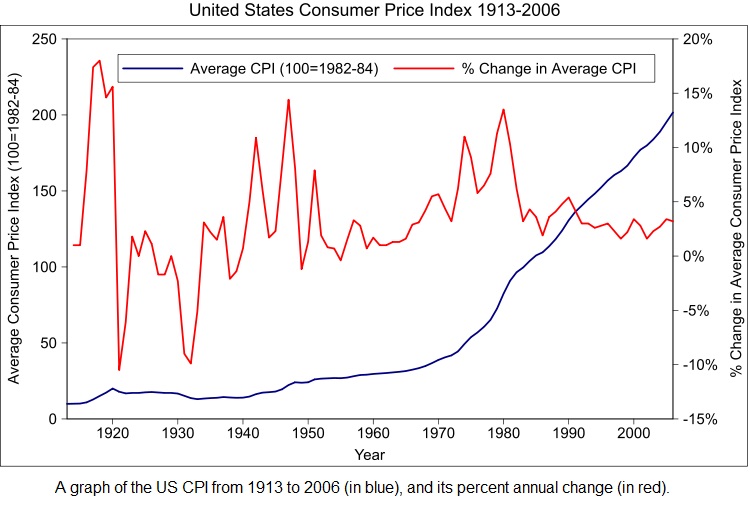
In economics, inflation is a sustained increase in the general price level of goods and services in an economy over a period of time. When the general price level rises, each unit of currency buys fewer goods and services. Consequently, inflation reflects a reduction in the purchasing power per unit of money – a loss of real value in the medium of exchange and unit of account within the economy. A chief measure of price inflation is the inflation rate, the annualized percentage change in a general price index (normally the consumer price index) over time.[a]

Consumer Price Index

The consumer price index (CPI) measures changes in the price level of a market basket of consumer goods and services purchased by households. The CPI in the United States is defined by the Bureau of Labor Statistics (a unit of the Labor Department) as “a measure of the average change over time in the prices paid by urban consumers for a market basket of consumer goods and services.”[b]

The CPI is a statistical estimate constructed using the prices of a sample of representative items whose prices are collected periodically. Sub-indexes and sub-sub-indexes are computed for different categories and sub-categories of goods and services, being combined to produce the overall index with weights reflecting their shares in the total of the consumer expenditures covered by the index. It is one of several price indices calculated by most national statistical agencies. The annual percentage change in a CPI is used as a measure of inflation. A CPI can be used to index (i.e., adjust for the effect of inflation) the real value of wages, salaries, pensions, for regulating prices and for deflating monetary magnitudes to show changes in real values. In most countries, the CPI is, along with the population census and the USA National Income and Product Accounts, one of the most closely watched national economic statistics.

Is the CPI a cost-of-living index?

The CPI frequently is called a cost-of-living index, but it differs in important ways from a complete cost-of-living measure. BLS has for some time used a cost-of-living framework in making practical decisions about questions that arise in constructing the CPI. A cost-of-living index is a conceptual measurement goal, however, and not a straightforward alternative to the CPI. A cost-of-living index would measure changes over time in the amount that consumers need to spend to reach a certain utility level or standard of living. Both the CPI and a cost-of-living index would reflect changes in the prices of goods and services, such as food and clothing that are directly purchased in the marketplace; but a complete cost-of-living index would go beyond this role to also take into account changes in other governmental or environmental factors that affect consumers’ well-being. It is very difficult to determine the proper treatment of public goods, such as safety and education, and other broad concerns, such as health, water quality, and crime, that would constitute a complete cost-of-living framework.

What goods and services does the CPI cover?

Inflation 2The CPI represents all goods and services purchased for consumption by the reference population (U or W) BLS has classified all expenditure items into more than 200 categories, arranged into eight major groups. Major groups and examples of categories in each are as follows:

  • FOOD AND BEVERAGES (breakfast cereal, milk, coffee, chicken, wine, full service meals, snacks)
  • HOUSING (rent of primary residence, owners’ equivalent rent, fuel oil, bedroom furniture)
  • APPAREL (men’s shirts and sweaters, women’s dresses, jewelry)
  • TRANSPORTATION (new vehicles, airline fares, gasoline, motor vehicle insurance)
  • MEDICAL CARE (prescription drugs and medical supplies, physicians’ services, eyeglasses and eye care, hospital services)
  • RECREATION (televisions, toys, pets and pet products, sports equipment, admissions);
  • EDUCATION AND COMMUNICATION (college tuition, postage, telephone services, computer software and accessories);
  • OTHER GOODS AND SERVICES (tobacco and smoking products, haircuts and other personal services, funeral expenses).

Also included within these major groups are various government-charged user fees, such as water and sewerage charges, auto registration fees, and vehicle tolls. In addition, the CPI includes taxes (such as sales and excise taxes) that are directly associated with the prices of specific goods and services. However, the CPI excludes taxes (such as income and Social Security taxes) not directly associated with the purchase of consumer goods and services.

Chained CPI in the United States

In the United States, several different consumer price indices are routinely computed by the Bureau of Labor Statistics (BLS). These include the CPI-U (for all urban consumers), CPI-W (for Urban Wage Earners and Clerical Workers), CPI-E (for the elderly), and C-CPI-U (chained CPI for all urban consumers). These are all built in two stages. First, the BLS collects data to estimate 8,018 separate item-area indices reflecting the prices of 211 categories of consumption items in 38 geographical areas. In the second stage, weighted averages are computed of these 8,018 item-area indices. The different indices differ only in the weights applied to the different 8,018 item-area indices. The weights for CPI-U and CPI-W are held constant for 24 months, changing in January of even-numbered years.

The weights for C-CPI-U are updated each month to reflect changes in consumption patterns in the last month.

In January of each year, Social Security (America’s Old Age Pension) recipients receive a cost of living adjustment (COLA) “to ensure that the purchasing power of Social Security and Supplemental Security Income (SSI) benefits is not eroded by inflation. It is based on the percentage increase in the Consumer Price Index for Urban Wage Earners and Clerical Workers (CPI-W)”[f]. The use of CPI-W conflicts with this purpose, because the elderly consume substantially more health care goods and services than younger people. [d] In recent years, inflation in health care has substantially exceeded inflation in the rest of the economy. Since the weight on health care in CPI-W is much less than the consumption patterns of the elderly, this COLA does not adequately compensate them for the real increases in the costs of the items they buy. [g]

The BLS does track a consumer price index for the elderly (CPI-E). But it is not used, in part because the social security trust fund is forecasted to run out of money in roughly 40 years, and using the CPI-E instead of CPI-W would shorten that by roughly 5 years.[h]

Wikipedia Online Encyclopedia – Retrieved 05-20-2014 http://en.wikipedia.org/wiki/Inflation

Citation References:

a. Mankiw, N. Gregory (2002). Macroeconomics (5th Ed.). Worth Publications. ISBN 978-0716752370. Retrieved May 2014.

b. Consumer Price Index. Bureau of Labor Statistics. Retrieved September 10, 2010 from: http://www.bls.gov/cpi/cpifaq.htm.

c. Losey, Stephen (31 December 2012). “Chained CPI proposal off table for now, lawmakers say”. Federal Times. Retrieved 3 January 2013 from: http://www.federaltimes.com/article/20121231/BENEFITS02/312310001/Chained-CPI-proposal-off-table-now-lawmakers-say?odyssey=tab%7Ctopnews%7Ctext%7CCongress.

d. Robert, Reich (April 4, 2013). “What’s the ‘Chained CPI,’ Why It’s Bad for Social Security and Why the White House Shouldn’t Be Touting It (VIDEO)”. Huffington Post. Retrieved April 11, 2013: http://www.huffingtonpost.com/robert-reich/chained-cpi_b_3016471.html

e. Gibson, Ginger (April 9, 2013). “Republicans applaud chained CPI in Obama budget”. Politico. Retrieved April 11, 2013 from: http://www.politico.com/story/2013/04/republicans-applaud-chained-cpi-in-obama-budget-89831.html.

f. “Cost-Of-Living Adjustment (COLA) Information For 2013”. Cost-Of-Living Adjustment (Social Security Administration). Retrieved April 11, 2013 from: http://www.ssa.gov/cola/

g. Wikipedia treatment for the Consumer Price Index. Retrieved May 20, 2014 from: http://en.wikipedia.org/wiki/Consumer_price_index

h. Hobijn, Bart; Lagakos, David (May 2003). “Social Security and the Consumer Price Index for the Elderly”. Current Issues in Economics and Finance (Federal Reserve Bank of New York) 9 (5): 1–6. Retrieved April 11, 2013 from: http://www.newyorkfed.org/research/current_issues/ci9-5/ci9-5.html.

The approach of a CPI (or a Retail Price Index) is not exclusively American; other societies use the same methodology. But the American model is one from which the Caribbean should apply learned lessons; we would NOT want to fall into the American pitfalls of purposefully eliminating significant items from measurement because of political leanings. For example, the US does not include health care in the measurement of the official CPI, even though it may amount to 40% of some families’ spending. This point is highlighted in this article:

Former White House Chief of Staff Erskine Bowles and former U.S. Senator Alan K. Simpson suggested a transition to using a “chained CPI” in 2010, when they headed the White House’s deficit-reduction commission.[c] They stated that it was a more accurate measure of inflation than the current system and switching from the current system could save the government more than $290 billion over the decade following their report.[c] “The chained CPI is usually 0.25 to 0.30 percentage points lower each year, on average, than the standard CPI measurements.”[c]

However, the National Active and Retired Federal Employees Associations said that the chained CPI does not account for seniors citizens’ health care costs.[c] Robert Reich, former United States Secretary of Labor under President Clinton, noted that typical seniors spend between 20 and 40 percent of their income on health care, far more than most Americans. “Besides, Social Security isn’t in serious trouble. The Social Security trust fund is flush for at least two decades. If we want to ensure it’s there beyond that, there’s an easy fix – just lift the ceiling on income subject to Social Security taxes, which is now $113,700.”[d]

Replacing the current cost-of-living adjustment calculation with the chained CPI was considered, but not adopted, as part of a deficit-reduction proposal to avert the sequestration cuts, or fiscal cliff, in January 2013,[c] but President Obama included it in his April 2013 budget proposal.[e]

Go Lean … Caribbean introduces the CU to take oversight of much of the Caribbean economic, security and governing functionality, covering the realities of healthcare and inflation issues. In summary, this roadmap promotes the Caribbean as a better place to live, work and play for residents and retirees alike. In fact the Go Lean roadmap advocates inviting the aging Diaspora to return to the Caribbean for their “golden years”, this means proactively anticipating pension/medical needs of senior citizens.

Change has come to the Caribbean. The people, institutions and governance of the region are all urged to “lean-in” to this roadmap for change. We need to accurately measure inflation and the stressors that impact it. Rather than “hiding” the facts, as the Americans do, the CU will “manage what we measure”. There are effective tools available to mitigate the risks of inflation, and the integrity of social safety nets (like increasing retirement age or the income ceiling for pension taxes).

The benefits of this roadmap, emergence of an $800 Billion regional economy and 2.2 million new jobs, become imperiled if we ignore important economic indicators, and hide-away from effective solutions. Ignorance and avoidance are not traits of a solution-oriented ethos; they are not technocratic. On the other hand, the CU purports to be a true technocracy!

The following list details the strategies, tactics, implementations and advocacies to impact the CU technocracy:

Community Ethos – Lean Operations Page 24
Community Ethos – Impact the Greater Good Page 37
Strategy – Customers/Stakeholders – Diaspora Page 47
Strategy – Agents of Change – Aging Diaspora Page 57
Tactical – Fostering a Technocracy Page 64
Separation of Powers – Commerce Department Page 78
Separation of Powers – MediCare Administration Page 86
Advocacy – Ways to Measure Progress Page 133
Advocacy – Ways to Grow the Economy Page 151
Advocacy – Ways to Control Inflation Page 153
Advocacy – Ways to Improve Healthcare Page 156
Advocacy – Ways to Impact Entitlements Page 158
Advocacy – Ways to Improve Governance Page 168
Advocacy – Ways to Manage the Social Contract Page 170
Advocacy – Ways to Impact the Diaspora Page 217
Advocacy – Ways to Impact Retirement Page 221
Advocacy – Ways to Improve Elder-Care Page 225
Appendix – Controlling Inflation – Technical Details Page 318

The foregoing encyclopedic source conveys that much depends on accurate measurement of inflation indices. Inflation is what it is!  Measurement and management of inflation (and its effects) is an art and a science for the CU to master. The Go Lean roadmap “leaves no stone un-turned” for the optimization of the economic elevation of the Caribbean.

Inflation does matter! A prudent, lean, economic stewardship matters more!

Download the Book- Go lean…Caribbean Now!!!

Share this post:
, , ,

Bitcoin needs regulatory framework to change ‘risky’ image

Go Lean Commentary

Bitcoin PhotoElectronic Payments / Virtual Money schemes are very important in the strategy for elevating the Caribbean economy.

Bitcoin can be good for the Caribbean, but we need the regulatory framework in place to change any “risky” image of such schemes.

This point is detailed in the book Go Lean…Caribbean, a roadmap for the introduction of the Caribbean Union Trade Federation (CU) and the Caribbean Central Bank (CCB). This Go Lean roadmap has 3 prime directives:

  • Optimization of the economic engines in order to grow the regional economy to $800 Billion & create 2.2 million new jobs.
  • Establishment of a security apparatus to protect the resultant economic engines.
  • Improve Caribbean governance to support these engines.

This Go Lean/CU/CCB roadmap looks to employ electronic payments / virtual money schemes to impact the growth of the regional economy. Similar to Bitcoin, there are two CU schemes that relate to this foregoing news story:

  • Cruise Passenger Smartcards – The Go Lean roadmap posits that the cruise industry needs the Caribbean more than the Caribbean needs the industry. But the cruise lines have embedded rules/ regulations designed to maximize their revenues at the expense of the port-side establishments. The CU solution is to deploy a scheme for smartcards that function on the ships and at the port cities (Page 193).
  • e-Commerce Facilitation – The Go Lean roadmap defines that the Caribbean Dollar (C$) will be mostly cashless, an accounting currency. So the Caribbean Central Bank (CCB) will settle all C$ electronic transactions (MasterCard-Visa style or ACH style) and charge interchange/clearance fees (Page 198). This scheme allows for the emergence of full-throttle e-Commerce activities.

These electronic payments provides the impetus for M1, the measurement of currency/money in circulation (M0) plus overnight bank deposits (like demand deposits, travelers’ checks & other checkable deposits). As M1 values increase, there is a dynamic to create money “from thin-air”, called the money multiplier. The more money in the system, the more liquidity for investment and industrial expansion opportunities.

By: Clare Hutchison

LONDON (Reuters) – Regulators should create a framework of rules to help to make virtual currencies such as bitcoin more attractive to ordinary consumers, a lawyer from the Bitcoin Foundation said on Tuesday.

Bitcoin made headlines earlier this year when Tokyo-based bitcoin exchange Mt. Gox filed for bankruptcy after saying it might have lost some 750,000 bitcoins in hacking attack.

Patrick Murck, general counsel at the Bitcoin Foundation, said cooperation was needed between authorities to create rules that would support those using the digital currency responsibly.

“There’s an opportunity to work together to stop people saying it’s scary and risky,” he said. “The challenge is just to get a framework out there that makes sense for people,” said Murck, speaking at an event on the state of digital economy.

Launched in 2009, bitcoin offers a way for people to conduct transactions over the Internet. Supporters say the anonymity that bitcoin offers lowers the risk of fraud, while critics say that same anonymity and lack of central oversight make it easier to commit crimes.

The Bitcoin Foundation aims to standardise the currency, protect it from theft or counterfeiting and provide education.

Some companies involved in bitcoin, including investment firms and those providing services for the currency’s users, have also called for regulation to ensure their customers feel more comfortable about virtual money.

A number of regulators, including the U.S. Securities and Exchange Commission, have warned investors about the risks of scams related to virtual currencies.

Murck said there were a handful of well-funded companies working towards making bitcoin more attractive and safer for ordinary consumers by trying to insure bitcoin holdings and to reduce the currency’s volatility.

Those companies have learned from the collapse of Mt. Gox and have more knowledge about how the industry works that was not available before, he said.

Bitcoin could be ready for the mass market by the end of the year, Murck added. “I feel much more confident today than I did 12 months ago. The wind is definitely blowing at our backs.”

The banking industry also has a role to play in opening the bitcoin market up, Murck said, by providing finance to companies involved in bitcoin or integrating bitcoin services into its own products.

Reuters News Source (Retrieved 05/13/2014) –http://news.yahoo.com/bitcoin-needs-regulatory-framework-change-risky-image-163727371–sector.html

Cruise shipOverall, the Bitcoin concept is in crisis; the dissolution of the Mt. Gox exchange dealt this industry a near-fatal blow. With virtual money, there is no association with hard currency, commodity or chattel goods. It is just the “good faith” and credit of the currency – eWallet – issuer. A bankruptcy filing undermines that “faith”.

The people and institutions of the Caribbean understand this plight all too well. There is little faith in Caribbean monetary institutions either. All interstate trade in the region must take place in US dollars, British pounds or Euros. There is no faith in indigenous Caribbean currencies. The roadmap commences with the statement that the Caribbean also is in crisis, and that this “crisis is a terrible thing to waste”. The region is devastated from external factors: global economic recession, globalization and rapid technology changes. The book then posits that to adapt, there must be a new internal optimization of the region’s strengths. This is defined in Verse XXIV (Page 13) of the Declaration of Interdependence, with these words:

Whereas a free market economy can be induced and spurred for continuous progress, the Federation must install the controls to better manage aspects of the economy: jobs, inflation, savings rate, investments and other economic principles…

Creating the CU/CCB governance is “Step One, Day One” in the Go Lean roadmap. Implementing this, the appropriate regulatory framework, as requested in the foregoing news article, allows rock-solid monetarily integrity for the local financial systems. This would provide the foundation, so that the regional society can be elevated, economically and governmentally.

The Go Lean book details a series of community ethos, strategies, tactics, implementations and advocacies to foster the proper controls for electronic payments/virtual money in the Caribbean region:

Community Ethos – Money Multiplier Principle Page 22
Community Ethos – “Light Up the Dark Places” Page 23
Community Ethos – Lean Operations Page 24
Community Ethos – Cooperatives Page 25
Community Ethos – Promote Intellectual Property Page 29
Community Ethos – Ways to Bridge the Digital Divide Page 31
Tactical – Separation of Powers – Central Banking Page 73
Implementation – Assemble Central Bank Cooperative Page 96
Implementation – Ways to Deliver Page 109
Implementation – Ways to Impact Social Media Page 111
Planning – Ways to Better Manage Image Page 129
Anecdote – Caribbean Currencies Page 149
Advocacy – Ways to Mitigate Black Markets Page 165
Advocacy – Ways to Foster Cooperatives Page 176
Advocacy – Ways to Foster Technology Page 197
Advocacy – Ways to Foster e-Commerce Page 198
Advocacy – Reforms for Banking Regulations Page 199
Appendix – Alternative Remittance Modes Page 270

Now is the time for all of the Caribbean, the people and governing institutions, to lean-in for the changes described in the book Go Lean … Caribbean. The benefits are too alluring, a better place to live, work and play.

Download the free e-book of Go Lean … Caribbean – now!

Share this post:
, ,
[Top]

Having Less Babies is Bad for the Economy

Go Lean Commentary

Little GirlsMore fallout from the year 2008…

This is a consistent theme in the book Go Lean…Caribbean. The book posits that the events of that year were a crisis for the Caribbean, North America and the world economy as a whole. What’s worst is the Caribbean is still reeling from those events.

“A crisis is a terrible thing to waste”

… so states the book quoting noted Economist Paul Romer. The opportunity therefore exists to forge change in the economic, security and governing engines of the Caribbean, in response to this crisis.

The below news-story (or click on VIDEO icon below) shows that the rest of the world, those with astute eyes/ears to look, listen and learn, will be using this crisis to prepare for change. This is the advocacy of the Go Lean book, to position the region at the corner of preparation and opportunity, so as to benefit from change. The issue from the article is more pressing for the Caribbean than the rest of North America; this is because the region has a very high emigration rate (brain drain). This point is crystalized with this quotation:

We tend to think economic growth comes from working harder and smarter. But economists attribute up to a third of it to more people joining the workforce each year than leaving it. The result is more producing, earning and spending.

The book Go Lean…Caribbean serves as a roadmap for the introduction and implementation of the Caribbean Union Trade Federation (CU), a super-national institution with federal powers to forge change in the Caribbean community. One mission is incentivizing the return of the far-flung Caribbean Diaspora. Another mission is to dissuade further human flight/brain drain. The numbers don’t lie: we need population growth not population contraction.

NEW YORK (AP) — Nancy Strumwasser, a high school teacher from Mountain Lakes, New Jersey, always thought she’d have two children. But the layoffs that swept over the U.S. economy around the time her son was born six years ago helped change her mind. Though she and her husband, a market researcher, managed to keep their jobs, she fears they won’t be so fortunate next time.

“After we had a kid in 2009, I thought, ‘This is not happening again,'” says Strumwasser, 41, adding, “I never really felt comfortable about jobs, how solid they can be.”

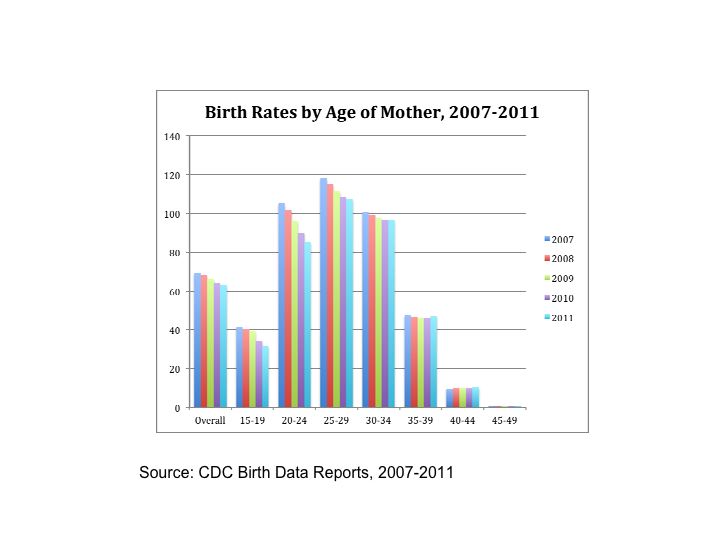
The 2008 financial crisis did more than wipe out billions in wealth and millions of jobs. It also sent birth rates tumbling around the world as couples found themselves too short of money or too fearful about their finances to have children. Six years later, birth rates haven’t bounced back.

For those who fear an overcrowded planet, this is good news. For the economy, not so good.

We tend to think economic growth comes from working harder and smarter. But economists attribute up to a third of it to more people joining the workforce each year than leaving it. The result is more producing, earning and spending.

Now this secret fuel of the economy, rarely missing and little noticed, is running out.

“For the first time since World War II, we’re no longer getting a tailwind,” says Russ Koesterich, chief investment strategist at BlackRock, the world’s largest money manager. “You’re going to create fewer jobs. … All else equal, wage growth will be slower.”

Births are falling in China, Japan, the United States, Germany, Italy and nearly all other European countries. Studies have shown that births drop when unemployment rises, such as during the Great Depression of the 1930s. Birth rates have fallen the most in some regions that were hardest hit by the financial crisis.

In the United States, three-quarters of people surveyed by Gallup last year said the main reason couples weren’t having more children was a lack of money or fear of the economy.

The trend emerges as a gauge of future economic health — the growth in the pool of potential workers, ages 20-64 — is signaling trouble ahead. This labor pool had expanded for decades, thanks to the vast generation of baby boomers. Now the boomers are retiring, and there are barely enough new workers to replace them, let alone add to their numbers.

Growth in the working-age population has halted in developed countries overall. Even in France and the United Kingdom, with relatively healthy birth rates, growth in the labor pool has slowed dramatically. In Japan, Germany and Italy, the labor pool is shrinking.

“It’s like health — you only realize it exists until you don’t have it,” says Alejandro Macarron Larumbe of Demographic Renaissance, a think tank in Madrid.

The drop in birth rates is rooted in the 1960s, when many women entered the workforce for the first time and couples decided to have smaller families. Births did begin rising in many countries in the new millennium. But then the financial crisis struck. Stocks and home values plummeted, blowing a hole in household finances, and tens of millions of people lost jobs. Many couples delayed having children or decided to have none at all.

Couples in the world’s five biggest developed economies — the United States, Japan, Germany, France and the United Kingdom — had 350,000 fewer babies in 2012 than in 2008, a drop of nearly 5 percent. The United Nations forecasts that women in those countries will have an average 1.7 children in their lifetimes. Demographers say the fertility rate needs to reach 2.1 just to replace people dying and keep populations constant.

The effects on economies, personal wealth and living standards are far reaching:

— A return to “normal” growth is unlikely: Economic growth of 3 percent a year in developed countries, the average over four decades, had been considered a natural rate of expansion, sure to return once damage from the global downturn faded. But many economists argue that that pace can’t be sustained without a surge of new workers. The Congressional Budget Office has estimated that the U.S. economy will grow 3 percent or so in each of the next three years, then slow to an average 2.3 percent for next eight years. The main reason: Not enough new workers.

— Reduced pay and lifestyles: Slower economic growth will limit wage gains and make it difficult for middle-class families to raise their living standards, and for those in poverty to escape it. One measure of living standards is already signaling trouble: Gross domestic product per capita — the value of goods and services a country produces per person — fell 1 percent in the five biggest developed countries from the start of 2008 through 2012, according to the World Bank.

— A drag on household wealth: Slower economic growth means companies will generate lower profits, thereby weighing down stock prices. And the share of people in the population at the age when they tend to invest in stocks and homes is set to fall, too. All else equal, that implies stagnant or lower values. Homes are the biggest source of wealth for most middle-class families.

___

AP researcher Fu Ting in Shanghai and AP writers Frank Jordans in Berlin, Colleen Barry in Milan and Youkyung Lee in Seoul, South Korea, contributed to this report.

Huffington Post – Online News – May 8, 2014 http://www.huffingtonpost.com/2014/05/07/birth-rate-economy_n_5281597.html

The CU recognizes that the numbers must work in favor of societal progress. The next steps after Look-Listen-Learn is to Lend-a-hand and then Lead. (This is referred to as the 5 L Progression). So to lend-a-hand, the Go Lean roadmap advocates that population leveling can be accomplished with a regional integration. There are many social safety nets that depend of this actuarial exercise. Consider unemployment and pensions: for unemployment, workers pay into a fund and the temporarily unemployed file claims against that fund. Likewise with pensions: young workers pay into a fund, and the older-retired workers draw claims against that fund.

The CU is structured to lead … for the economic elevation of the region of 42 million people in the 30 member-states. The Go Lean roadmap provides the details for the creation of 2.2 million new jobs and GDP growth to accumulate to $800 Billion. This commission to lead is at the root of the Go Lean effort, embedded in the opening Declaration of Interdependence (Page 13):

xxiv. Whereas a free market economy can be induced and spurred for continuous progress, the Federation must install the controls to better manage aspects of the economy: jobs, inflation, savings rate, investments and other economic principles. Thereby attracting direct foreign investment because of the stability and vibrancy of our economy.

xxv. Whereas the legacy of international democracies had been imperiled due to a global financial crisis, the structure of the Federation must allow for financial stability and assurance of the Federation’s institutions. To mandate the economic vibrancy of the region, monetary and fiscal controls and policies must be incorporated as proactive and reactive measures. These measures must address threats against the financial integrity of the Federation and of the member-states.

Currency 2According to the foregoing article, America needs to have more babies. While this disposition varies from country to country, the Caribbean needs to furnish the environment for families to make their own family-planning decisions based on their own personal motivations, not economic realities. Broken economies can (and will) be fixed! Love for the Caribbean homeland should therefore be the primary motivation for the CU effort. From the cradle-to-the-grave, we need love to be the principal motivation, not fear or economic metrics, for making the Caribbean a better place to live, work and play.

Taking the lead for this goal takes real work, heavy-lifting on the part of the stewards of the Caribbean economy. This is the charter for the CU, as started in the Declaration of Interdependence (Page 13), a direct quotation from the US Declaration of Independence, as follows:

… that to secure these rights (life, liberty and the pursuit of happiness), governments are instituted among men, deriving their just powers from the consent of the governed. … [It] is the right of the people to … institute new government, laying its foundation on such principles and organizing its powers in such form, as to them shall seem most likely to effect their safety and happiness.

The following details from the book Go Lean … Caribbean are the community ethos, strategies, tactics, implementations and advocacies prescribed to manifest the elevation of Caribbean economy, society and life:

Who We Are – SFE Foundation Page 8
Community Ethos – Deferred Gratification Page 21
Community Ethos – new Economic Principles Page 21
Community Ethos – new Security Principles Page 22
Community Ethos – new Governing Principles Page 24
Community Ethos – Ways to Impact the Future Page 26
Community Ethos – Ways to Impact Turn-Arounds Page 33
Community Ethos – Ways to Promote Happiness Page 36
Community Ethos – Ways to Impact the Greater Good Page 37
Strategy – Repatriating Caribbean Diaspora Page 47
Strategy – Non-Government Organizations Page 48
Strategy – Agents of Change – Aging Diaspora Page 57
Tactical – Confederating a Permanent Union Page 63
Tactical – Fostering a Technocracy Page 64
Implementation – Assemble all Member-States Page 96
Implementation – Ways to Pay for Change Page 101
Implementation – Reasons to Repatriate Page 118
Planning – Lessons Learned from 2008 Page 136
Advocacy – Ways to Grow the Economy Page 151
Advocacy – Ways to Create Jobs Page 152
Advocacy – Better Manage the Social Contract Page 170
Advocacy – Ways to Foster Empowering Immigration Page 174
Advocacy – Impact the Diaspora Page 217
Advocacy – Ways to Preserve Caribbean Heritage Page 218
Advocacy – Ways to Impact Retirement Page 221
Advocacy – Ways to Help the Middle Class Page 223
Advocacy – Ways to Improve Elder-Care Page 225

The Go Lean roadmap is a product of 2008. From this fallout, this plan was composed, by individuals intimate with the details of the crisis … and its causes.

The goal is to learn from the Year 2008 and spread new benefits across the Caribbean region. This roadmap identifies where we are as a region currently, where we want to go, and most importantly, how we plan to get there (turn-by-turn directions). It is time for us to move now to that place, that corner of opportunity and preparation.

playbutton-300x300

Download the book Go Lean … Caribbean – now!

Share this post:
, , ,
[Top]

One currency, divergent economies

Go Lean Commentary

CurrencyThe global financial crisis is not over. Some countries, like in Europe, are doing better while some places are not. This quotation from the foregoing article stands out in significance:

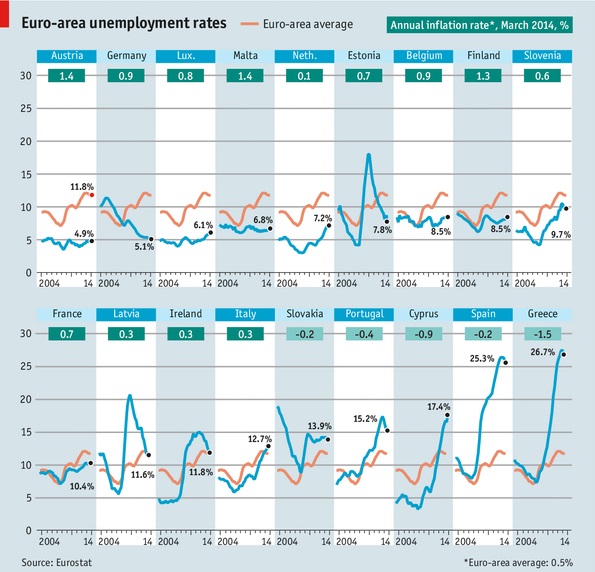
Whereas joblessness has fallen in Germany, from 10.1% to 5.1%, it has soared in Spain, from 11.1% to 25.3%.

The experiences have also been similar in the United States. In 2008, California’s unemployment rate exceeded 10%, while Nebraska enjoyed a 4% rate. Why do some member-states dive, some survive and others thrive? This is the scope of the social science of economics. But it is not a perfect science. A joke lampooning the folly of economists states that “an economist is an expert who will know tomorrow why the things he predicted yesterday didn’t happen today”.

By: Staff Reporting.

One thing that the European Central Bank (ECB) does not lack is advice on tackling low inflation. This week the OECD added its voice to that of the IMF in April in urging prompt action, calling for a cut in the bank’s main lending rate, from the already low 0.25% reached in November to zero. The ECB’s governing council, meeting on May 8th (after The Economist had gone to press), was not expected to respond to this plea any more than it did to the IMF’s.

The difficulty facing the 24-strong council is highlighted by the euro zone’s differing labour-market trajectories over the past decade (a period during which it expanded from 12 to 18 countries). Whereas joblessness has fallen in Germany, from 10.1% to 5.1%, it has soared in Spain, from 11.1% to 25.3%.

High unemployment has contributed to the onset of deflation in parts of southern Europe. But even in northern countries inflation is low, and though it has risen in the euro zone as a whole from 0.5% in March to 0.7% in April, that is still a long way off the ECB’s target of close to 2%. The main reasons why the council prefers to wait and see are that the recovery is strengthening and bond investors are falling over themselves to lend to southern Europe, even without any further policy stimulus.

The Economist Magazine – Online Edition – May 10th, 2014 http://www.economist.com/news/finance-and-economics/21601878-one- currency-divergent-economies

Europe’s and the US experience is different than that of the Caribbean. For us, it’s some countries are doing bad, others worse.

The best practice for effective stewards of an economy is the recovery, to bounce back quickly. In the US, the economy lost $11 Trillion in the 2008 Great Recession, but recovered $13.5 Trillion back a few years later, by December 2012 (Page 69).

Europe has the safety net of the economies-of-scale of 508 million people and a GDP of $15 Trillion in 28 member-states in the EU; (the Eurozone subset is 18 states, 333 million people and $13.1 Trillion GDP). The US has 50 states and 320 million people. Shocks and dips can therefore be absorbed and leveraged across the entire region .The EU is still the #1 economy in the world; the US is #2.

The Caribbean has no safety-net, no shock absorption, and no integration. This is the quest of the book Go Lean…Caribbean; it urges the introduction and implementation of the Caribbean Union Trade Federation. The book serves as a roadmap for this goal, with turn-by-turn directions to integrate the 30 member-states of the region and forge an $800 Billion economy.

This is a big idea for the small Caribbean!

At the outset, the roadmap identified an urgent need to contend with, since the Caribbean is still in the throes of the financial crisis (commenced in 2008). This is pronounced in this clause in the opening Declaration of Interdependence (Page 13):

xxv. Whereas the legacy of international democracies had been imperiled due to a global financial crisis, the structure of the Federation must allow for financial stability and assurance of the Federation’s institutions. To mandate the economic vibrancy of the region, monetary and fiscal controls and policies must be incorporated as proactive and reactive measures. These measures must address threats against the financial integrity of the Federation and of the member-states.

The Go Lean roadmap signals change for the region. It introduces new measures, new opportunities and new recoveries. Economies will rise and fall; the recovery is key. Prices will inflate and deflate; as depicted in the foregoing article, there are curative measures to manage these indices. The roadmap calls for the establishment of the allied Caribbean Central Bank (CCB) to manage the monetary affairs of this region. The book describes the breath-and-width of the CCB, modeled in many ways after the ECB.

The foregoing news article is short (3 paragraphs), but like most topics in economics, a quick phrase on the surface connotes a deep field of study underneath. This field of study in this article is inflation and deflation.

CU Blog - One curreny, divergent economies - Photo 2 (1)In economics, inflation is a sustained increase in the general price level of goods and services in an economy over a period of time. When the general price level rises, each unit of currency buys fewer goods and services. Consequently, inflation reflects a reduction in the purchasing power per unit of money – a loss of real value in the medium of exchange and unit of account within the economy. [a] Deflation is a decrease in the general price level of goods and services. Deflation occurs when the inflation rate falls below 0% (a negative inflation rate). [b]

Stewardship of the economy was envisioned and pronounced in the roadmap’s Declaration of Interdependence (Page 13):

xxiv. Whereas a free market economy can be induced and spurred for continuous progress, the Federation must install the controls to better manage aspects of the economy: jobs, inflation, savings rate, investments and other economic principles. Thereby attracting direct foreign investment because of the stability and vibrancy of our economy.

The role of central banking and commercial banking is pivotal to the CU roadmap. The Caribbean Central Bank will manage the monetary policy and reserves of the Caribbean Dollar single currency – shepherding inflation, deflation and foreign currency matters for the region. On the other hand, commercial banks operate with the simultaneous goal of providing credit/holding deposits for the public and maximizing shareholder value for their investors. A conflict of these two goals can endanger the macro-economy. The CU/CCB structure, a cooperative among existing member-state central banks, constitutes a new administration for the regional economy’s monetary and currency concerns.

If there is the need to spur or suppress inflation/deflation, the CCB will have the required tools. As depicted in the foregoing article, this can affect unemployment and the general performance of local economies.

We therefore need good stewards or shepherds.

The CU roadmap drives change among the economic, security and governing engines. These solutions are as new community ethos, strategies, tactics, implementations and advocacies; as follows:

Community Ethos – Money Multiplier Page 22
Community Ethos – Job Multiplier Page 22
Community Ethos – Cooperatives Page 25
Community Ethos – Impact the Greater Good Page 37
Strategy – CU Vision and Mission Page 45
Strategy – Recruiting Foreign Direct Investors Page 48
Tactical – Fostering a Technocracy Page 64
Tactical – $800 Billion Economy – How and When Page 67
Tactical – Recovering from Economic Bubbles Page 69
Tactical – Separation-of-Powers – Central Bank Page 73
Implementation – Assemble Caribbean Central Bank Page 96
Implementation – Ways to Better Manage Debt Page 114
Planning – Ways to Model the EU Page 119
Planning – Lessons Learned from 2008 Page 136
Anecdote – Caribbean Currencies Page 149
Advocacy – Ways to Grow the Economy Page 151
Advocacy – Ways to Create Jobs Page 152
Advocacy – Ways to Control Inflation Page 153
Advocacy – Ways to Better Manage Foreign Exchange Page 154
Advocacy – Reforms for Banking Regulations Page 199
Advocacy – Battles in the War on Poverty Page 222
Advocacy – Ways to Help the Middle Class Page 223
Appendix –  Optimizing Remittances Page 270

We must protect Caribbean value, monetarily and culturally, from past investments and for future prospects.

Shepherding the economy is no simple task. It requires the best practices of skilled technocrats…and a measure of luck. It’s time to get lucky! The CU roadmap equals preparation. That’s how luck is created, by preparation meeting opportunity.

References:

a. Paul H. Walgenbach, Norman E. Dittrich and Ernest I. Hanson, (1973), Financial Accounting, New York: Harcourt Brace Javonovich, Inc. Page 429.

b. Robert J. Barro and Vittorio Grilli (1994), European Macroeconomics, chap. 8, p. 142. ISBN 0-333-57764-7

 Download the Book- Go Lean…Caribbean Now!!!

Share this post:
, , ,
[Top]

Open the Time Capsule: The Great Recession of 2008

Go Lean Commentary

Time Capsule Pic 1Picture this: one week after the greatest threats to the global financial system, since the Great Depression. You cut out and store – for safe keeping in a “virtual time capsule”, (see Appendix A) – a newspaper commentary and subsequent review/analysis of that crisis. It’s time now to open that capsule! Why so early? Why only after 6 years? So that this analysis would serve as a course correction. Those placing the time-capsule, hoped for a different result.

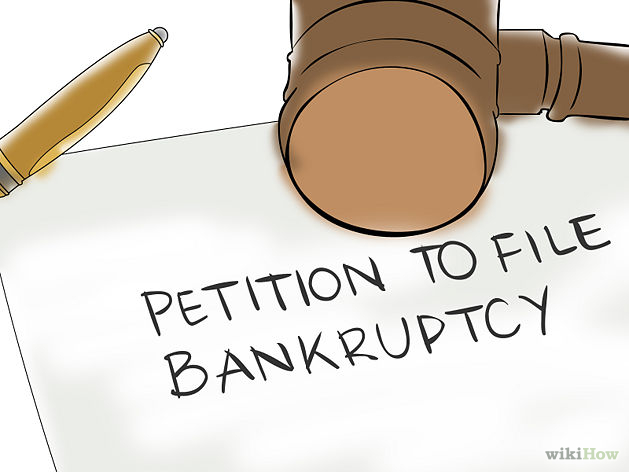
This is the scenario depicted in the foregoing news article. It was published on September 23 in 2008; 8 days after Lehman Brothers filed the largest Bankruptcy in world history – signaling the peak of the financial crisis, the precipice of a total system failure. The book Go Lean … Caribbean is based on that premise, declaring that a crisis is a terrible thing to waste”, quoting noted Economist Paul Romer’s assessment that the Great Recession would be a crisis for the modern world. The book posits that the Caribbean, with its parasite economy, is still in that crisis – no noticeable recovery.

A joke lampooning economists declares “that an economist is an expert who will know tomorrow why the things he predicted yesterday didn’t happen today”.CU Blog - Open the Time Capsule - The Great Recession of 2008 - Photo

So now, this review/analysis of a 6 year old newspaper editorial from a Guest Columnist, the focus of which was to an audience in the Bahamas; (but this is equally representative of the entire Caribbean):

It is the assessment by the publishers of Go Lean that the foregoing analysis was spot on!

It describes the new normal, a term cementing the truths that the economic realities that suddenly emerged in 2008 would thereafter remain as the norm. This has proven to be the case. The foregoing writer lamented that his government appeared to be using the same set of tools to fix a new vehicle with all different parts, and they pondered why the vehicle would not repair (recover) and get going. The writer concluded that the stewards of the economy needed to prepare a 20 year plan to navigate his country among the new realities facing the world. But he doubted that such a plan would emerge.

By: Craig Butler

I know what you must be thinking. ‘The new normal’, what in heaven’s name is he talking about? Well, the other day I was in Florida listening to talk radio.

There was a director from the International Monetary Fund, an economics professor, and a few others. They were talking about the global economy and what the future holds. The professor was the one who used the ‘new normal’ phrase and he did so in reference to the high prices that we are experiencing worldwide.

He said that, as he did not expect a significant strengthening of the dollar any time soon; coupled with the fact that the price of oil was likely to remain high and the war in Iraq was ongoing, he believed that the current high prices are going to be the norm.

Most of the panelists agreed that some experts have given folks a false sense of security by suggesting that prices will come back down once the price of oil drops. But all on the panel were of the view that the price of oil will never again be under $90 to $100 per barrel.

This was partly based on the weak dollar and partly on our dependency on fossil fuels and the lack of resolve shown by politicians to fully develop alternatives. They also noted that the oil lobby was one of the most powerful in Washington, which was a leading factor in the stalled development of renewable energy.

And the price of breadbasket items and other basics has not been helped by climatic change, which has led to falls in wheat and rice production over the last few years. Add to this the diversion of corn for use as a fuel (ethanol), and we have the new normal.

My views tend to be conservative so my first reaction was that these are some leftwing liberal nuts talking. However, on reflection much of what was said is correct.

Why should we expect to see a reduction in the price of oil? Producers are making so much money it’s not realistic to think they would relinquish that. And the high price affects so many other industries that have had to pass on these increases to the consumer. Just look at the airlines. And all the solutions being put forward to wean us off our dependency on oil will take at least five years to have any kind of impact.

The panel went on to say that there will be a widening of the income gap – something we are already seeing in the Bahamas. Many people who I know in the middle class are struggling so much that they can now be classified as the working poor.

I say that because they are now living from pay cheque to pay cheque. All their savings have been depleted; and things that they once could afford are out of the question now.

Think about it – how many of the people you know around you have their houses in foreclosure; have lost their car to the bank; have had to take their children out of private school; or have been unable to take a vacation this year?

Look in the newspaper this week and I’m sure one of the leading commercial banks will have a double page ad featuring distressed properties. The other week two banks had ads back to back.

I have written before about misguided priorities and how, despite all that is going on, we still prefer the materialistic rather than seek what is important.

I remember from my youth a song by Eddie Minnis called the ‘Finance Man’. I loved that song, and the words to one of the verses bears repeating: ‘See him there he poor as me and you but he driving round in Malibu. His car sleeps in the road at night, Lord you know that just ain’t right, He is living in the hands of the finance man…’

I apologize to brother Eddie if I did the lyrics an injustice. But it demonstrates how we have lived on credit for a long time. We have maintained a lifestyle well beyond our means without a thought as to what might happen in hard times.

As a lawyer I can see first hand what has happened to many in the middle class. You see, it was important for them to have the grand house with the two European cars parked in the garage, kids in the best schools and all the trappings that went along with it. And I will be the first to say that there is nothing wrong with wanting to attain your desires.

However, the bank loans were in many instances predicated on both the husband and wife maintaining $50,000 a year salaries, as well as some creative financing to help the couple get the loan.

Now that many offshore companies have closed or downsized, one of those pay cheques has disappeared and so has the dream, because the severance package is not going to last long and there is a distinct shortage of similar jobs available.

So what we are facing here is now being experienced all over the world. The radio panel noted that there will have to be a reclassification of the status of many people as the poor are going to be poorer, the middle class are going to be the new poor and only the very rich will be able to sustain themselves.

Dark days are ahead, and this means we need our politicians to get their collective heads out of their rear ends and devise a comprehensive plan for the next 25 years that takes all of the current factors into consideration and ensures our viability.

But there I go dreaming again – most of the time they can hardly get out of their own way let alone see past the next general election. So lets wait for the eventual anarchy that is to follow.

*****

Craig Butler studied law at the University of Wolverhampton, England, and at the Norman Manley Law School in Jamaica. He also has a degree in economics from Rollins College in Florida. Mr Butler’s column runs in the Nassau Guardian, the Bahamas, on Mondays and he also hosts a weekly political talk show on Bahamas’ Island FM.

He is the grandson of Sir Milo Butler, the first governor-general of an independent Bahamas. He blogs at Bahamapundit and can be reached at cfmilobutler@hotmail.com.

The New Black Magazine – Online Source – Tuesday, September 23, 2008 –http://www.thenewblackmagazine.com/view.aspx?index=1596 

Flash forward 6 years later; lo and behold, the book Go Lean … Caribbean is proffered as that plan, a roadmap to navigate today’s troubling economic waters and offer solutions. The book calls for the introduction and implementation of the Caribbean Union Trade Federation (CU), a super-national administration, for the 30 member-states that constitute the Caribbean region. The book posits that the problems of the Caribbean are too big for any one member-state to tackle alone. That rather, there needs to be a methodical leveraging of the 42 million people that populate these island/coastal states. With such numbers come economies-of-scale, and the benefits of these 3 prime directives:

• Optimization of the economic engines so as to grow the regional economy to $800 Billion and create 2.2 million new jobs.

• Establishment of a security apparatus (with prosecutorial powers for economic crimes) so as to mitigate the eventual emergence of “bad actors”.

• Improve Caribbean governance.

These prime directives recognize that the change the region needs starts first with re-thinking community ethos and economic engines. Early in the book, an economic interdependence is pronounced, (Declaration of Interdependence – Page 13) with these statements:

xxiv. Whereas a free market economy can be induced and spurred for continuous progress, the Federation must install the controls to better manage aspects of the economy: jobs, inflation, savings rate, investments and other economic principles. Thereby attracting direct foreign investment because of the stability and vibrancy of our economy.

xxv. Whereas the legacy of international democracies had been imperiled due to a global financial crisis, the structure of the Federation must allow for financial stability and assurance of the Federation’s institutions. To mandate the economic vibrancy of the region, monetary and fiscal controls and policies must be incorporated as proactive and reactive measures. These measures must address threats against the financial integrity of the Federation and of the member-states.

The book identifies a number of new community ethos to forge change in the region and to harvest the benefits of the new global marketplace. From the ethos, comes the solutions – for example, sharing!

Six years ago, the columnist in the foregoing article could only envision his country, Bahamas, seeking solutions alone. This roadmap, on the other hand, seeks solutions as a confederated region, a group of partners. This will mean speaking with one voice, acting together as the CU; the 30 member-states will have far greater weight and influence than acting individually. Benefits will flow from this economies-of-scale, like a Group Purchasing Organization (GPO) to negotiate value and savings.

The CU roadmap drives change among the economic, security and governing engines. These solutions are as new community ethos, strategies, tactics, implementations and advocates; as follows:

Community Ethos – Lean Operations – GPO’s Page 24
Community Ethos – Ways to Improve Negotiations Page 32
Community Ethos – Ways to Impact Turn-arounds Page 33
Community Ethos – Ways to Improve Sharing Page 35
Strategy – Agents of Change – Globalization Page 57
Strategy – Agents of Change – Climate Change Page 57
Tactical – Confederating a permanent union Page 63
Implementation – Ways to Pay for Change – GPO’s Page 101
Implementation – Foreign Policy Start-up Initiatives Page 102
Implementation – Ways to Improve Energy Usage Page 113
Implementation – Ways to Better Manage Debt Page 114
Implementation – Ways to Benefit from Globalization Page 119
Planning – Ways to Improve Trade – GPO’s Page 128
Planning – Lessons Learned from 2008 Page 136
Advocacy – Ways to Grow the Economy Page 151
Advocacy – Ways to Create Jobs Page 152
Advocacy – Ways to Control Inflation Page 153
Advocacy – Ways to Better Manage ForEx Page 154
Advocacy – Reforms for Banking Regulations Page 199
Advocacy – Battles in the War on Poverty Page 222
Advocacy – Ways to Help the Middle Class Page 223

Change has come to the Caribbean; the world is different. It’s not the world before 2008, but rather a new world shaped by 2008. This is illustrated as a moving freight train. It cannot – must not – be stopped. Everyone must get “on board”, or get “run over”.

Appendix A: How to Create a Time Capsule

A time capsule can be as simple as a shoe box full of items reserved (or even forgotten) somewhere. Other time capsules may need to last a very long time, in which case a strong stainless steel container is recommended, with a proper seal. Keep in mind that creating a capsule for unveiling at some future date is really a two sided adventure involving both you and those who will uncover it once again. Make sure that the items you select will add the element of surprise and discovery for those who open this curious treasure chest of history. Learn how to make a time capsule that will be sure to please and surprise whoever opens it. (http://www.wikihow.com/Create-a-Time-Capsule; retrieved May 5, 2014).

Download the book Go Lean … Caribbean – now!!!

Share this post:
, , , ,
[Top]

Grenada accountant defeats PM in BK court motion

Go Lean Commentary

Grenada BK 2“He who does nothing makes no mistakes” – Old Adage.

The contrast of this “Old Adage” is also true: “No risk, no reward”. So “he who does a lot, risks a lot”. These truisms bear to ask the questions:

• When the risky endeavors fail, who is it that pays?

• Who should be held accountable?

The answers to these questions align with the foregoing news article; this is the subject matter of bankruptcy (BK).

The book Go Lean … Caribbean delves deep into the matter of bankruptcy processing for the Caribbean region. This book is a roadmap for the introduction and implementation of the Caribbean Union Trade Federation (CU), for the economic optimization of the 30 member-states constituting the Caribbean region. The CU is proffered as a super-national administration, a federal government for these states. Strategically there are 3 prime directives of the CU:

1. Optimize the economic engines so as to grow the regional economy to $800 Billion and create 2.2 million new jobs.

2. Establish a security apparatus (including emergency management) around the economic engines so as to mitigate the eventual emergence of “bad actors”.

3. Improve Caribbean governance.

The tactical plan for this roadmap is a separation-of-powers for this federal government versus the governmental administrations of the member-states. Based on anecdotes similar to the foregoing news story, there should be little objection to elevating bankruptcy processing away from local control. It is obvious that locally, there is too much temptation for favoritism, cronyism and corruption.

(We are not levelling any accusation of corruption towards Grenada’s Prime Minister Dr. Keith Mitchell. This is just an acknowledgement that bankruptcy processing exposes different vantage points and priorities).

By: Caribbean News Now contributor

ST GEORGE’S, Grenada — Prime minister of Grenada Dr. Keith Mitchell has lost his bid before the High Court in Grenada to have local chartered certified accountant Garvey Louison removed as liquidator of the Grenada Today newspaper.

Mitchell had argued before that court that Louison had failed to comply with his duties, failed to indicate the location of assets, lost interest in the matter, and had caused undue delay in bringing the matter to a close.

In his defence, Louison argued that Mitchell had no evidence to support his claim, that Mitchell hid behind the frock of a legal secretary at a law firm to bring his allegations before the court, that the legal secretary had no standing before the court and that he had complied with the duties set out in the liquidation order and that of the Companies Act.

Justice Mohammed held that to remove the liquidator the applicant must have good standing, good grounds, and provide sufficient evidence to move to court.

The judge questioned the legal standing of the secretary, one Uthlyn George, to make the accusations that she filed by way of affidavit. The law is clear regarding the production of an affidavit. An affidavit is supposed to contain facts that are within the deponent’s own knowledge and belief and where it is not, it must set out the source of the information and belief or it would be hearsay.

The deponent failed to set out who informed her or what was the source of her information and belief in making allegations that were not in her direct knowledge. In particular regarding the allegations of delay, she failed to set out the details of such delay.

In addition, Mitchell did not provide a reason why he could not file the affidavit himself and had to use Uthlyn George.

It was held that, whereas the court can remove a liquidator in the circumstances where it was satisfied that the liquidator was inefficient, lacked vigour or was biased in the discharge of his duties, there was no evidence in this case to support the removal of the liquidator.

Local observers had claimed that, at some point, Mitchell was expected to move against Louison based on several articles the business consultant and former Auditor General, Accountant General and Permanent Secretary, Finance [Ministry] had been writing in the media.

Grenada Today was put into liquidation in 2009 as a result of two charges of criminal libel brought against the managing editor, George Worme, in connection with a letter published by the newspaper accusing Mitchell of bribing voters in the 1999 general election.

Caribbean News Now – Online News Source – April 19, 2014 –http://www.caribbeannewsnow.com/topstory-Grenada-accountant-defeats-prime-minister-in-court-20784.html

Grenada BK 1The foregoing news article relates that the issue of receivership of the insolvent Grenada Today Newspaper is a “touchy” subject, requiring checks-and-balances. In this case, the Grenada High Court became involved to adjudicate the matter.

While there is already a process for bankruptcy in all Caribbean member-states, the need to elevate this processing to a federal level is undeniable; to bring balance/fairness to creditors and avoid abuse by debtors. This is alluded to in the foregoing article.

The Go Lean roadmap envisions federal bankruptcy courts, with branches throughout the region, having exclusive jurisdiction.

These CU entities will manage bankruptcies for individuals, firms (for profit & not-for-profits), election campaigns and even governmental agencies (municipalities, public-private consortiums and central/national governments).

The CU will be the relief of last resort, the bail-out provider. Also, the first responder for encroachments of Failed-State indicators.

The CU mandate for bankruptcies is to lean towards reorganization, rather than outright dismissal of legitimate debt. Creditors may have to take a “hair-cut” (minor loss). The federal courts will then appoint direct receivership to Trustees (usually accountants and/or lawyers) to facilitate the processing of the bankruptcy obligations.

An efficient process for bankruptcy is vital to attract Foreign Direct Investments (FDI) – these stakeholders require protection and accountability. The definition of FDI is risk. With risky efforts come success … and failure. This requirement is pronounced early in the book’s Declaration of Interdependence (Page 13) with these statements:

xxi. Whereas the legacy in recent times in individual states may be that of ineffectual governance with no redress to higher authority, the accedence of this Federation will ensure accountability and escalation … to protect the human, civil and property rights of the citizens, residents, allies, trading partners, and visitors of the affected member state and the Federation as a whole.

xxiii. Whereas many countries in our region are dependent Overseas Territory of imperial powers, the systems of governance can be instituted on a regional and local basis, rather than requiring oversight or accountability from distant masters far removed from their subjects of administration. The Federation must facilitate success in autonomous rule … within the geographical region.

The goal of the CU is to elevate Caribbean life, culture and economy. This requires a new community ethos: investment in our people, by our people. There will be hits-and-misses, successes and failures. The CU roadmap is to hope (and build) for the best, but also plan for the worst. We will provide support services (incubators, shared systems, “cooperatives”, angel investors) to aid the entrepreneurial hopes and dreams. But we must facilitate the failures as well. We must methodically “wine down” failed enterprises and failed endeavors, so as to dissuade any fear of failure, rather to promote the “audacity of hope”.

So the subject matter of bankruptcy affects economics, security and governance. The solutions to effect change in the region are detailed in this book Go Lean … Caribbean as community ethos, strategies, tactics, implementations and advocates; as follows:

Community Ethos – Lean Operations Page 24
Community Ethos – Return on Investments Page 24
Community Ethos – Ways to Help Entrepreneurship Page 28
Community Ethos – Ways to Impact Turn-arounds Page 33
Strategy – Inviting Foreign Direct Investments Page 48
Tactical – Fostering a Technocracy Page 64
Separation of Powers – Federal Bankruptcy Courts Page 90
Implementation – Ways to Better Manage Debt Page 114
Implementation – Ways to Impact Elections Page 117
Implementation – Ways to Promote Independence Page 120
Planning – Ways to Improve Failed-State Indices Page 134
Planning – Lessons Learned from 2008 Page 136
Planning – Lessons from Detroit Page 140
Advocacy – Ways to Improve Credit Ratings Page 155
Advocacy – Ways to Impact Student Loans Page 160
Advocacy – Ways to Improve Governance Page 168
Advocacy – Reforms for Banking Regulations Page 199
Advocacy – Ways to Preserve Caribbean Heritage Page 218
Advocacy – Ways to ImpactBritishTerritories Page 245
Advocacy – Ways to ImpactDutchTerritories Page 246
Advocacy – Ways to ImpactFrenchTerritories Page 247

The Go Lean roadmap will make the Caribbean a better place to live work, and play. Caribbean stakeholders will make mistakes; but when we fall down, we will not stay down. We will get up, turn-around, reboot and recover. Our people deserve this continuous effort.

Download the Book- Go Lean…Caribbean Now!!!

Share this post:
, ,
[Top]

Student debt holds back many would-be home buyers

Go Lean Commentary

Diploma 1This point from the foregoing news article is most poignant: “Of the many factors holding back young home buyers … none looms larger than the recent explosion of college debt”.

The book Go Lean … Caribbean serves as a roadmap for the introduction and implementation of the Caribbean Union Trade Federation (CU), for the economic optimization in the region. If the target of the book is the Caribbean, why does this article about American student loans weigh so heavy in a consideration of Caribbean economics?

There are lessons to be learned here! Not just for student loans, but also regarding education policy. This issue is pivotal to the economics of the Caribbean region. This point is made early in the book’s Declaration of Interdependence (Page 13):

xxi. Whereas the preparation of our labor force can foster opportunities and dictate economic progress for current and future generations, the Federation must ensure that educational and job training opportunities are fully optimized for all residents of all member-states, with no partiality towards any gender or ethnic group. The Federation must recognize and facilitate excellence in many different fields of endeavor, including sciences, languages, arts, music and sports. This responsibility should be executed without incurring the risks of further human flight, as has been the past history.

Classic economic policy promotes that education has a direct effect on a community’s economy and the standard-of-living, quantified as each increased-grade-level, raises GDP by 3 percent (Appendix C2Page 258). But, the Go Lean roadmap posits that this rule is not true for the Caribbean, because of the debilitating emigration rate, the brain drain in which our educated population flees for foreign shores, or worse, students that do not return after matriculating – despite using funding from their Caribbean homeland. These are all investments with no return. In short, the economy of the Caribbean can be impacted by the activity of this recent-student population, when they repatriate; but when they emigrate, they hurt the economy.

By: Tim Logan
LOS ANGELES – Sarah Luna wants to buy a home in up-and-coming northeast Los Angeles before it’s too late.

At 31, she has a master’s degree and earns more than $70,000 as a court reporter and freelance editor. She daydreams about trading the Glendale apartment she shares for a little condo, maybe in Echo Park or Highland Park….

Just one thing holds her back: The $700 she’s paid every month since 2008, after she graduated from the University of Southern California — with $75,000 in student debt. With about half that total left to pay, buying that condo seems a long way off.

“Honestly, I don’t know if it’ll ever happen,” she said. “Barring some sort of awesome miracle, a down payment is hard to wrap my head around right now.”

Of the many factors holding back young home buyers — rising prices, tougher lending standards, a still-shaky job market — none looms larger than the recent explosion of college debt.

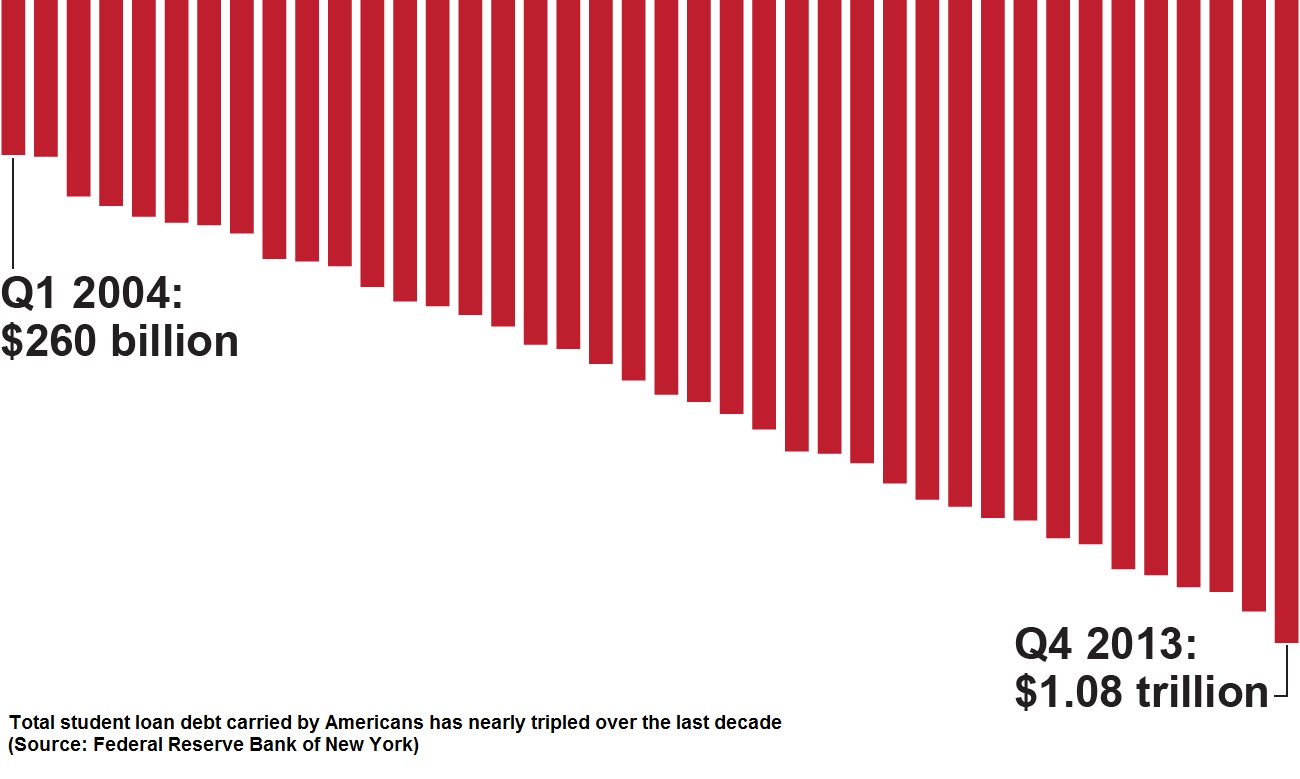
The amount owed on student loans has tripled in a decade, to nearly $1.1 trillion, according to the Federal Reserve Bank of New York. People in their 20s and 30s — often the best-educated and highest-earning among them — owe most of that tab. That is keeping a crucial segment of home buyers on the sidelines, deferring one of the traditional markers of adult success.

The National Assn. of Realtors recently identified student debt as a key factor in soft demand for home-buying this spring. A recent study by the trade group identified student loans as the top reason many home buyers delayed their purchase. Many more didn’t buy at all.

Surveys show today’s adults value homeownership just as much as their parents did. But the shaky job market, higher debt loads, and the roller-coaster market of recent years is keeping many from pulling the trigger, said Selma Hepp, senior economist with the California Assn. of Realtors.

“They’re just postponing,” she said. “It’s the economy and the recession and what that generation has gone through.”

The share of buyers who are first-timers has dropped well below historical averages — 28% of California buyers last year, compared with 38% typically, according to CAR surveys. The absence of a new generation of customers could become a long-term problem for the industry, said Dustin Hobbs, spokesman for the California Mortgage Bankers Assn.

“You have to have that swath of first-time buyers who will eventually be your move-up buyers,” he said. “When you take that out, it damages the whole chain.”

Traditionally, student borrowers were more likely than most people to buy a house, experts say, because college graduates tend to earn more. But that’s flipped since 2008, according to researchers at the New York Fed. Today, the share of 30-year-old homeowners who have student debt is lower than that of 30-year-old homeowners without it.

It’s a sign that skilled, educated workers are getting pushed out of the housing market.

“When people have less money to commit to housing, they don’t buy a house,” Hobbs said.

Jay Stewart Samilin sees that all the time. He’s an agent at Rodeo Realty in Beverly Hills and runs a tax preparation business on the side. Many of his younger clients are skipping the house until they pay down their debt.

“They’re maxed out on student loans, and there’s nothing else they want to think about until they pay that down,” he said.

Some who do start shopping quickly realize they can’t afford as much house as their income suggests. The more they pay each month on student loans, the less the bank will lend them to buy a house, said Natalie Lohrenz, director of counseling at Consumer Credit Counseling Services of Orange County. In a pricey market such as Southern California, that can severely limit a buyer’s options.

“You have to think about your quality of life after you purchase this home,” she said. “It’s OK to rent for awhile.”

That’s not to say some people don’t make it work.

Marco Manansala is starting to shop for a house, maybe a two-bedroom in Long Beach or on the Eastside, close to a freeway. When he began to think about it, the 28-year-old got preapproved for a loan — but only for $180,000.

“That gets you a shack,” he said. “I asked, how do I get more? They said I need to pay down debt.”

So he started aggressively paying off his car, and he’s worked his student loan balance down to $6,000, from $10,000. With a good job as a creative director for a Venice marketing agency, he has cut his spending to save up for a down payment. He’s getting close.

“I have a goal of buying something by June,” Manansala said. “I’m gearing up for it.”

But many others, like Luna, are forced to take a much longer view.

She graduated into the worst job market in decades. Although she eventually found work that enabled her to keep up with loan payments, it’s been hard to save much. In six years, she’s paid down nearly half of her original tab. When she borrowed the money for a master’s in professional writing, Luna acknowledges, she was an “idealistic” 22-year-old, and the numbers didn’t seem real.

Now the reality of a $700-a-month student loan payment makes it hard to get ahead, house or no house, even with a good salary. And she’s worried she’ll get priced out of the city she loves.

“It’s frustrating,” she said. “I think by the time I get a chance to get together that money and find a house, it’ll be unattainable.”

Source: Los Angeles Times – Online News Source – April 19, 2014 –http://www.latimes.com/business/realestate/la-fi-0420-student-debt-house-2-20140420,0,7975649.story#ixzz30Iw7x8Hz

Diploma 2The foregoing news article relates that education funding policies adversely affect major areas of the economy, in this case home-buying. The cause-and-effect paradigm is direct, within 5 to 10 years after graduation; a former student should be planning to buy a house. Apparently the macro economy is dependent on this relationship. According to the foregoing article, the National Association of Realtors (NAR) identified student debt as a key factor in soft demand for home-buying this spring (2014).

The Go Lean roadmap also identified that the 2008 financial crisis still deeply impacts the Caribbean economy; that it was not just the housing finance dysfunction alone that contributed to the crisis, but educational loans as well. This point is declared in Appendix IH on Page 286. This foregoing news article pronounces that the US economy continues to be impacted by a defective and dysfunctional student loan policy.

In the Caribbean, we do not want to follow this American model.

The economic solutions to effect change in the region are detailed in this book Go Lean … Caribbean as community ethos, strategies, tactics, implementations and advocates; as follows:

Community Ethos – Foster Genius Page 27
Community Ethos – Impact R & D Page 30
Community Ethos – Valedictorian è Diaspora Page 38
Strategy – Study: At home –vs- Abroad Page 50
Tactical – Education for a $800 Billion Economy Page 70
Separation of Powers – Education Department Page 85
Separation of Powers – Labor Training Oversight Page 89
Ways to Better Manage Debt Page 114
Reasons to Repatriate – Educational Inducements Page 118
Lessons Learned from 2008 Page 136
Ways to Improve Education Page 159
Ways to Impact Student Loans Page 160
Improve Local Government – Education Reforms Page 169
Better Manage the Social Contract: e-Learning Page 170
Federal Civil Service: Education Payback Schemes Page 173
Foster Cooperatives: Mutual Education Alternative Page 176
Ways to Improve Libraries Page 187
Ways to Impact the Diaspora – Education Reform Page 217
Ways to Impact Foundations – e-Learning Focus Page 219
Battles in the War on Poverty – e-Learning Solution Page 222
Help the Middle Class – Educational Stimuli Page 223
Ways to Impact Youth – Education Dynamics Page 227
Appendix C2 – Education and Economic Growth Page 258

The goal of the Go Lean roadmap is to make the Caribbean a better place to live work, learn and play. To elevate our economy, we must continue to place a high priority on education, thus the roadmap features our own student loan solution (Page 160) and numerous reforms and optimizations. But we need to be prepared for many of the same pitfalls that have befallen the US. We especially want to learn from these American mistakes:

It’s not the cost of the loan that’s the problem; it’s the principal – the appallingly high tuition costs that have been soaring at two to three times the rate of inflation, an irrational upward trajectory eerily reminiscent of skyrocketing housing prices in the years before 2008. – Ripping Off Young America: The College – Loan Scandal By Matt Taibbi, Rolling Stones Magazine; August 15, 2013. (Appendix IH – Page 286).

For the past 40 – 50 years, we have pushed too hard on college education, just for the sake of the “best practice” in economic elevation. We have suffered as a result, with a brain drain and excessive debt.

As a region, we cannot risk losing any more of our young adults and their contribution to their communities. Plus, we do not want to saddle them with overbearing student loans; this “paints them in a corner” where they must flee to earn enough money to repay the loans; (but so often, they have simply defaulted – which imperils the next generation).

We want to learn from our past mistakes!

We want to learn from America’s mistakes!

So we must deliver quality affordable education at home, without predatory lending habits. For the Caribbean, we do not want to be America. We want to be better!

Download the free e-book of Go Lean … Caribbean – now!

Share this post:
, , , , ,
[Top]

Real Estate Investment Trusts explained

Real Estate Investment Trusts (REITs) are one way you can invest in real estate while enjoying a level of liquidity synonymous with the stock market[a]. Learn more here, from this VIDEO:

VIDEO – Real Estate Investment Trust REIT Definition Investopedia – https://youtu.be/UnKqUKZ1K1A

The book Go Lean … Caribbean serves as a roadmap for the introduction and implementation of the Caribbean Union Trade Federation (CU) and the Caribbean Central Bank (CCB). One prime directive of the roadmap is facilitating the return of the far-flung Diaspora to their Caribbean homelands. This does not mean returning to the same houses they may have abandoned decades ago. Thusly, there is the need for new housing solutions; and new housing financing schemes. The CU is proffered to provide economic optimizations to better manage the region’s basic needs: food, clothing, energy and shelter.

REITREITs are prominent in the Go Lean roadmap to satisfy the shelter mandate for Caribbean repatriates; (Page 217).

This mandate is detailed early on in the book’s Declaration of Interdependence (DOI), as follows (Page 13):

xxiv. Whereas a free market economy can be induced and spurred for continuous progress, the Federation must install the controls to better manage aspects of the economy: jobs, inflation, savings rate, investments and other economic principles. Thereby attracting direct foreign investment because of the stability and vibrancy of our economy.

The roadmap posits that there are no capital/security markets in the Caribbean that offer the liquidity options of Wall Street – Page 200. (Wall Street is #1 globally). However the book describes an optimization of the existing financial markets that can still take place with the introduction of the Caribbean Dollar – managed by a technocratic Caribbean Central Bank – and elevation of the current 9 Stock Exchanges.

The “dominoes” thusly begin to fall. So with the liquidity of a vibrant capitals market, comes funding, with funding comes housing “starts”, followed by construction activity. All of this creates market kinetics.

So facilitating this eco-system of the CU/CCB will ultimately create … jobs. This is the rallying cry in the US for the National Association of Realtors®. They estimate that one job is generated for every two home sales. Using that ratio, 1,000 home sales generate 500 jobs [b]. So after the basic need of food, clothing, energy and shelter, the next mandate is … jobs, (DOI – Page 14).

xxvi. Whereas the Caribbean region must have new jobs to empower the engines of the economy and create the income sources for prosperity, and encourage the next generation to forge their dreams right at home, the Federation must therefore foster the development of new industries, like that of ship-building, automobile manufacturing, pre-fabricated housing, frozen foods, pipelines, call centers, and the prison industrial complex. In addition, the Federation must invigorate the enterprises related to existing industries like tourism, fisheries and lotteries – impacting the region with more jobs.

The Go Lean roadmap portrays the community ethos to encourage savings/investments. The roadmap also calls for stronger oversight from an institutional perspective, with economic principles in place to increase the money multiplier; (Page 21 & 22).

This constitutes change for the Caribbean: a new plan, new products, services, opportunities oversight. In truth, a new future!

Download the book Go Lean … Caribbean – now!

————

References

a. Investopedia – http://www.investopedia.com/video/play/real-estate-investment-trust/

b. National Association of Realtors: http://www.realtor.org/topics/home-ownership-matters/jobs-impact-of-an-existing-home-purchase


Share this post:
, , , ,
[Top]

Advocates push for junk-food tax

Go Lean Commentary

Junk FoodThe forgoing article focuses on an important issue for the Caribbean. Diabetes is a scourge to the region; it is among the leading causes of death. Though death is the final destination of all humans, quality of life is a fitting goal for optimization. Diabetes is a degenerative disease; it grievously affects the quality of life; over time, its sufferers are afflicted with ailments like kidney failures, amputations and blindness. In addition to the personal discomforts, these treatments exact a huge toll on a community’s economics. For this matter, this subject is in scope for the Caribbean Union Trade Federation (CU).

The book, Go Lean … Caribbean, serves as a roadmap for the introduction and implementation of the CU. This technocratic agency will assume oversight to optimize the region’s:

(1) economy,

(2) security apparatus, and

(3) governing engines.

The subject of diabetes disease management is in scope for all 3 of these prime directives. The importance and linkage of the topics for diabetes, healthcare and economics are undeniable. But there are security threats as well, as advanced diabetes dispositions increase the need for organ transplantations, inducing many to venture into the illegal organ trade markets. Finally, the strain on governments to service this population and develop mitigation plans is a constant priority – or should be.

By: FELICIA FONSECA

Flagstaff, Arizona — Facing a high prevalence of diabetes, many American Indian tribes are returning to their roots with community and home gardens, cooking classes that incorporate traditional foods, and running programs to encourage healthy lifestyles.

The latest effort on the Navajo Nation, the country’s largest reservation, is to use the tax system to push people to ditch junk food.

Navajo President Ben Shelly earlier this year vetoed measures to enact a 2 percent sales tax on tax on chips, cookies and sodas, and to eliminate the tax on fresh fruit and vegetables. This week, tribal lawmakers have a chance to resurrect the proposals, and supporters are optimistic they’ll be among the first in the country to succeed.

Elected officials across the U.S. have taken aim at sugary drinks with proposed bans, size limits, tax hikes and warning labels, though their efforts have not gained widespread traction. In Mexico, lawmakers approved a junk food tax and a tax on soft drinks last year as part of that government’s campaign to fight obesity.

Shelly said he supports the intent of the proposals on the Navajo Nation but questioned how the higher tax on snacks high in fat, sugar and salt would be enacted and regulated. Supporters of the tax say it is another tool in their fight for the health of the people.

“If we can encourage our people to make healthier choices and work on the prevention side, we increase the life span of our children, we improve their quality of life,” said professional golfer Notah Begay III, who is among supporters.

American Indians and Alaska Natives as a whole have the highest age-adjusted prevalence of diabetes among U.S. racial and ethnic groups, according to the American Diabetes Association. They are more than twice as likely as non-Hispanic whites to have the disease that was the fourth leading cause of death in the Navajo area from 2003 to 2005, according to the Indian Health Service.

Native children ages 10 to 19 are nine times as likely to be diagnosed with Type 2 diabetes, the IHS said.

The proposed Navajo Nation tax wouldn’t add significantly to the price of junk food, but buying food on the reservation presents obstacles that don’t exist in most of urban America. The reservation is a vast 27,000 square miles with few grocery stores and a population with an unemployment rate of around 50 percent. Thousands of people live without electricity and have no way of storing perishable food items for too long.

“They have a tendency to purchase what’s available, and it’s not always the best food,” said Leslie Wheelock, director of tribal relations for the U.S. Department of Agriculture.

Wheelock said the diabetes issue in tribal communities is one that has been overlooked in the past or not taken as seriously as it could be. It has roots in the federal government taking over American Indian lands and introducing food that tribal members weren’t used to, she said.

To help remedy that, the USDA runs a program that distributes nutritional food to 276 tribes. Grants from the agency have gone toward gardening lessons for children within the Seneca Nation of Indians in New York, culturally relevant exercise programs for the Spirit Lake Tribe in North Dakota and food demonstrations using fresh fruit and vegetables on the Zuni reservations in New Mexico.

The Dine Community Advocacy Alliance, which has been pushing for the Navajo Nation junk food tax, estimates it will result in at least $1 million a year in revenue that could go toward wellness centers, community parks, walking trails and picnic grounds in tribal communities in Utah, New Mexico and Arizona. It would expire at the end of 2018.

Tribal lawmakers will vote this week on overturning Shelly’s vetoes. Regardless of whether that legislation passes, “we have to keep stepping up to the plate,” alliance member Gloria Begay said.

No other sales tax on the Navajo Nation specifically targets the spending habits of consumers. Alcohol is sold in a few places on the reservation but isn’t taxed. Retailers and distributors pay a tobacco tax.

Opponents of the junk food tax argue it would burden customers and drive revenue off the reservation. Mike Gardner, executive director of the Arizona Beverage Association, said the lack of specifics in the legislation as to what exactly will be taxed could mean fruit juice and nutritional shakes would be lumped in the same category as sodas.

“I don’t think they mean that, but that’s what will happen,” Gardner said. “It’s a little loose, a little vague. It’s going to create problems for retailers and … it doesn’t solve the problem.”

a. By the numbers:

Total population of Navajo Nation: 250,000

Unemployment rate: 44%

Families living in poverty: 30.5%

People living with diabetes: 55,000

Source: Partners In Health (PIH), a 501(c)(3) nonprofit corporation headquartered in Boston, Massachusetts. (http://www.pih.org/country/navajo-nation/about)

Associated Press (AP) News Wire Service (Retrieved 04/22/2014) –
http://news.yahoo.com/advocates-push-junk-food-tax-navajo-nation-155642994.html

The roadmap commences with a Declaration of Interdependence. In Verse IX (Page 11) it pronounces:

Whereas the realities of healthcare and an aging population cannot be ignored and cannot be afforded without some advanced mitigation, the Federation must arrange for health plans to consolidate premiums of both healthy and sickly people across the wider base of the entire Caribbean population. The mitigation should extend further to disease management, wellness, obesity and smoking cessation programs. The Federation must proactively anticipate the demand and supply of organ transplantation as developing countries are often exploited by richer neighbors for illicit organ trade.

The foregoing article highlights diabetes disease management in the controlled population of the Native American Reservation for the Navajo Nation in Arizona [a]. In fact, Go Lean posits that the Caribbean can benefit greatly from a consideration of the examples, samples and lessons from Native American tribes and their experiences. This is included in the book as “10 Lessons from Indian Reservations” (Page 141). As for this issue, Go Lean also recognizes that food choices and the preponderance of junk food could imperil community wellness; (Page 162). We must therefore take heed to these lessons.

The CU mission is to implement the complete eco-system to re-boot health delivery in the region. Applying strategies to win the battles of globalization, the Go Lean roadmap urges the Caribbean region to not only consume; we must create and contribute as well. In that vein, there are many tactics, implementations and advocacies to facilitate the vision for R&D, incubation, entrepreneurship and many other areas related to medical tourism. These are detailed here:

Community Ethos – Deferred Gratification Page 21
Community Ethos – Intelligence Gathering Page 23
Community Ethos – “Bad Things” Happen Page 23
Community Ethos – Lean Operations Page 24
Community Ethos – Return on Investments Page 24
Community Ethos – Non-Government Org’s. Page 25
Help Entrepreneurship Page 28
Impact Research and Development Page 30
Promote Happiness Page 36
Impact the Greater Good Page 37
Separation of Powers – Health Department Page 86
Steps to Implement Self-Governing Entities Page 105
Ways to Benefit from Globalization Page 119
Improve Healthcare Page 155
Impact Entitlements Page 158
Better Manage Food Consumption Page 162
Better Manage the Social Contract Page 170
Foster Cooperatives Page 176
Ways to Improve Organ Transplantations Page 214
Impact Foundations Page 219
Improve Elder-Care Page 225
Impact Persons with Disabilities Page 228

The roadmap addresses the obstacles for full implementation of the CU objectives. Like most communities, there are cost constraints, as the foregoing article reports on a special tax to fund junk food mitigations. How will the CU pay for its strategic and tactical initiatives?

The book addresses this issue in full detail in these advocacies:

Ways to Pay for Change Page 101
10 Revenue Sources for Administration Page 172

Change has come to the Caribbean. Both the people and institutions of the region are urged to “lean-in” for this change. As described in the book Go Lean … Caribbean, the benefits of this roadmap are too important; improving health deliveries is not just economic, more important, it’s about saving lives.

Download the Book- Go Lean…Caribbean Now!!!

Share this post:
, , , , ,
[Top]

‘Only at the precipice, do they change’

Go Lean Commentary

Keanu Nanu

“Life imitating Art”; “Art imitating life”.

This is more than a cliché; it is also factual for describing how people finally get the will to change.

The movie The Day the Earth Stood Still (2008) – demonstrates “Art imitating Life” – is a remake of the classic 1951 sci-fi film of the same name; see Trailer VIDEO in the Appendix below. These films are about an alien visitor and his giant robot counterpart who visit Earth.

The character Professor Jacob Barnhardt, in the 2008 version, was played by John Cleese, the English actor of some repute, known for his start with the Mighty Python players.

The counter character in this dialogue, Klaatu, was played by American mega-star Keanu Reeves.

The storyline proceeds that the character Klaatu is a spokesman that preceded the robot sent to destroy human life on earth. And thus this quotation from the Movie Dialogue:

Professor Barnhardt: There must be alternatives. You must have some technology that could solve our problem.

Klaatu: Your problem is not technology. The problem is you. You lack the will to change.

Professor Barnhardt: Then help us change.

Klaatu: I cannot change your nature. You treat the world as you treat each other.

Professor Barnhardt: But every civilization reaches a crisis point eventually.

Klaatu: Most of them don’t make it.

Professor Barnhardt: Yours did. How?

Klaatu: Our sun was dying. We had to evolve in order to survive.

Professor Barnhardt: So it was only when your world was threatened with destruction that you became what you are now.

Klaatu: Yes.

Professor Barnhardt: Well that’s where we are. You say we’re on the brink of destruction and you’re right. But it’s only on the brink that people find the will to change. Only at the precipice do we evolve. This is our moment. Don’t take it from us. We are close to an answer.

(Source: Internet Movie Database – Movie: The Day the Earth Stood Still (2008). Retrieved 04/21/2014 – http://www.imdb.com/character/ch0012790/quotes)

This foregoing dialogue from the movie The Day the Earth Stood Still (2008) is symbolic of the crisis facing the Caribbean. The problem in the Caribbean is not technology, but rather the will to change. This is a consistent theme in the book Go Lean … Caribbean, it asserts that the changes necessary to preserve Caribbean heritage, culture and economies must first be preceded by an evolution in the community ethos. This pronouncement is as follows from Page 20:

The people of the Caribbean must change their feelings about elements of their society – elements that are in place and elements missing. This is referred to as “Community Ethos”, defined as:

    “the fundamental character or spirit of a culture; the underlying sentiment that informs the beliefs, customs, or practices of a group or society; dominant assumptions of a people or period.

This book serves as a roadmap for the introduction and implementation of the Caribbean Union Trade Federation (CU), a technocratic agency seen as the Caribbean’s best hope to avert the current path of disaster, human flight and brain drain, and grant the Caribbean a meaningful future for its youth.

This movie dialogue synchronizes with the exact details of the book. On Page 21, Go Lean presents a series of community ethos that must be adapted to forge change in the Caribbean. In addition, there are specific advocacies to:

  • Impact the Future (Page 26)
  • Impact Turn-Around (Page 33)
  • Impact the Greater Good (Page 37)
  • Grow the Economy (Page 151)
  • Preserve Caribbean Heritage (Page 218)

As a roadmap, this book provides the turn-by-turn guidance to optimize the Caribbean economy, security apparatus and governing engines.

With the assessment that many Caribbean states have lost more than 50% of their population to foreign shores (Pages 18 & 303), the region is now at that “precipice”.

“It is only at the precipice, do they change!”

Now is the time to lean-in to this roadmap for change, the book Go Lean … Caribbean, and the Caribbean Union Trade Federation. Our society/civilization is at the crisis point.

Download the book Go Lean … Caribbean – now!

————-

Appendix VIDEO – The Day The Earth Stood Still 2008 Official Trailer  – https://youtu.be/rcSJ-6354-A

Published on Aug 5, 2012 – A remake of the 1951 classic sci-fi film about an alien visitor and his giant robot counterpart who visit Earth.
Keanu Reeves & Jennifer Connelly http://www.keanureeves.us/movie/the-d…
Share this post:
, , ,
[Top]