Tag: Transform

Plea to Philanthropists: Give us your Time, Talent and Treasuries

Go Lean Commentary 

Who is Sandy Weill? And why is his name important … to our cause for reforming and transforming the Caribbean?

The question relates not just to Mr. Sanford Weill, but to his wife – Joan – as well. So the question is “Who are Sandy and Joan Weill?

CU Blog - Philanthropist - Give us your Time, Talent and Treasuries - Photo 1

Accordingly, the publishers of the book, Go Lean…Caribbean know of them … well.  They are featured in the book; they are listed on Page 292 on the list of Billionaire Philanthropists. (That’s Billionaire with a ‘B’). These ones – 113 Billionaires as of July 2013 – had signed the “Giving Pledge”; they have committed to giving more than half of their wealth to charitable causes. See this explanation from the book (and the list) here:

The Bottom Line on Philanthropy
The “Occupy Wall Street” movement emerged in 2011 and proclaimed the slogan “We are the 99%”, referring to income inequality and wealth distribution in the US between the wealthiest One Percent and the rest of the population. But there is more than what “meets the eye” about this One Percent.

As governments around the world pull back, due to austerity and sequestration (US version in 2013), the philanthropic sector will be a critical force in meeting global needs. In what is called the “Giving Pledge” 113 billionaires have committed to give more than half of their wealth to charitable organizations. This level of philanthropy, over $37 billion by Warren Buffett alone, is historically unprecedented. Warren Buffett most lasting contribution will not be his money; rather that he has successfully leveraged his social network and the media to inspire other billionaires to give extraordinary wealth for charitable good. He is reshaping the way the rich think about money and giving, [and the way the rest of the world thinks about the rich]. Some notable names to sign the pledge: Microsoft founder Bill Gates, Richard Branson, Home Depot cofounder Arthur Blank and Hedge Fund mogul Bill Ackman, (see Appendix N [on Page 292]) – Forbes.com.

 CU Blog - Philanthropist - Give us your Time, Talent and Treasuries - Photo 2

(Click to Enlarge)

Some of these billionaires have pledged to go even further than just giving of their treasuries (money), but also pledge to give their time and talents. This is the familiarity with Sandy and Joan Weill. See the article here from the CNBC TV network. This Opinion-Editorial was written directly by them. See here:

Title: Philanthropy isn’t just about money
By: Joan and Sandy Weill
We both hail from Brooklyn and when we got married 58 years ago our goal in life was very simple. We wanted to do well enough to be able to afford a deep fryer. This is the honest truth. Sandy worked as a runner on Wall Street making $150 a month, while Joan earned more than Sandy working only two days a week as a teacher.

As a result of compound interest over the years, Joan is adamant that Sandy still owes her money from these early days!

Through much hard work and determination, we were able to buy that deep fryer and, as they say, the rest is history. We have been blessed beyond our wildest imaginations, and we plan to spend the years we have left doing what we have been passionate about for almost four decades now, giving back to a world that has been very good to us.

For us, philanthropy is much more than just writing a check. It’s donating your time, energy, experience, and intellect to the causes and organizations you are passionate about. In the early days, we used to say that Joan took care of the streets and Sandy took care of culture. We look at a nonprofit the same way we look at a company—investing in a nonprofit is like buying stock in that organization and we are always looking for the greatest return on our investment.

Education and partnership are at the heart of everything we do philanthropically, and we make long term commitments to the organizations we lead: Sandy is the founder and chairman of the National Academy Foundation (since 1982); chairman of Carnegie Hall (since 1991); chairman of Weill Cornell Medical College (since 1995); chairman of the Green Music Center at Sonoma State University (since 2011); and active with the Lang Lang International Music Foundation; Hospital for Special Surgery; University of California, San Francisco Medical Center; Committee Encouraging Corporate Philanthropy; Sidra Medical and Research Center in Qatar; and Rambam Hospital in Israel.

Joan is chair of Alvin Ailey American Dance Theater (since 2000); co-chair of the New York Presbyterian/Weill Cornell Medical Center Women’s Health Symposium (since 2000); remains chair emeritus of Paul Smith’s College in the Adirondacks; and is active with Citymeals-On-Wheels, Carnegie Hall, National Academy Foundation, Green Music Center at Sonoma State University and the Lang Lang International Music Foundation. Joan really has a passion for making a difference in people’s lives one at a time.

Given the various hats we wear with different nonprofit organizations that span the entire United States, we see a new paradigm emerging. It is no secret that federal, state and local budgets are shrinking because of today’s challenging economic environment. As a result, the public sector does not have the capital to support education, health care, music and the arts at the level it has been able to do for the last 100 years. The new paradigm we see is the importance of public-private partnerships. The public sector needs the money, and the private sector is going to demand results that will create new, higher standards to benefit everyone. This translates to the need for more philanthropy, and our private sector must answer the call by getting its employees involved and contributing not just financially, but with their time, enthusiasm and experience.

The National Academy Foundation is an example of a public-private partnership model that works. Sandy founded the organization back in 1982 in partnership with the New York City Board of Education, the teachers union and the private sector. The first Academy of Finance opened its doors at John Dewey High School in Brooklyn. Today, the National Academy Foundation has over 500 academies of finance; hospitality and tourism; information technology; engineering; and health sciences that educate more than 60,000 high school students across the country at a very low cost of less than $500 per student. The program has a 97-percent graduation rate with 84 percent of these graduates going on to college, often the first in their family to do so. Employees of more than 2,500 companies volunteer in classrooms, act as mentors, engage National Academy Foundation students in paid internships and serve on local advisory boards.

From our own experiences in philanthropy over the last almost four decades, we have found the following lessons very useful:

  1. Don’t be afraid to make mistakes.
  2. Don’t be afraid to hire people smarter than you.
  3. The busiest people can always do more.
  4. You can run a better private business if you help run philanthropic enterprises.
  5. Whatever you do, be passionate about it.
  6. Keep it focused, you can’t do everything.
  7. If you don’t understand something, don’t do it.
  8. Teams win.
  9. Be a pragmatic dreamer.
  10. Maintain a good sense of humor and never take yourself too seriously.

Philanthropy has been a large part of our lives for many years and is something we are deeply passionate about and enjoy doing together. We would encourage you to set goals, and as you come close to achieving those goals, push them out a little further. You will be really amazed at what you can achieve. After all, we began our journey just trying to get our hands on a deep fryer!
—By Sandy and Joan Weill for CNBC.
Source: CNBC – Consumer and Business News Channel – Posted 09/09/2013; retrieved 05/02/2017 from: http://www.cnbc.com/id/101019341

Related Articles:

Consuming this information, we learn an important factoid about Sandy and Joan Weill – more on Sandy the “Banker” in the Appendix below – and all private philanthropists for that matter:

“the private [funding] sector [(all philanthropists)] is going to demand results that will create new, higher standards to benefit everyone.”

In the Caribbean, we now welcome these higher standards, as we welcome the contributions from these philanthropists.

This message we now send to these 113 Billionaires on the Giving Pledge List – and all other philanthropists for that matter:

Give us your time, talent, treasuries and whatever higher standards. We will equally pledge to you, to ‘give and take’. We will take your contributions and give to you the needed accountability and corporate governance.

This is a familiar topic for this movement behind the book Go Lean … Caribbean. We have frequently observed-and-reported on the efforts of philanthropists and NGO’s in their efforts to reform and transform society. We have seen their successes … and failures. Consider the highlights of this previous effort by another “Giving Pledge Billionaire”, Facebook’s Mark Zuckerberg; where he struggled with trying to remediate the inner city school system in Newark, New Jersey (USA):

The issues of education reform, best practices, and funding options are stressed in the book Go Lean…Caribbean, even though these are not the primary focus of the book. Rather this book serves as a roadmap for the introduction and implementation of the Caribbean Union Trade Federation (CU), with the focus being on these following 3 prime directives:

  • Optimization of the economic engines in order to grow the regional economy to $800 Billion & create 2.2 million new jobs.
  • Establishment of a security apparatus to protect the resultant economic engines.
  • Improve Caribbean governance to support these engines.

Yet, the book posits that education is a vital consideration for economic empowerment; so too are non-government organizations, like Zuckerberg’s foundation. The book specifically highlights an important role that foundations execute in the sphere of foreign aid, sometimes even better than national governments (Page 219):

    One major argument against federally funded foreign aid is that the money is often lost to governmental corruption in the countries it was supposed to help. In 2003, a top university in Bangladesh claimed that at least 75% of all foreign aid given to that government was lost because of corruption. Since faith-based foreign aid focuses on churches or organizations operating independently of the government, funding has a better chance of being used effectively.

The [featured] news article though, highlights an onshore example, in the US, with multi-level governmental support, plenty of money, and yet still: failure! [So the solution for a lot of social problems is not just money alone].

So reforming and transforming the Caribbean takes more than just money; we need wisdom (best-practices and know-how) as well. The Go Lean roadmap provides the step-by-step plan to invite and engage philanthropists in the cause to elevate Caribbean society, to actually get them to give of their time and talent. It does not matter that these philanthropists (members of the One Percent class) may not be Caribbean-based. While many may be physically in the US, Canada and/or Europe, we know that they use the Caribbean as their playground. They are therefore identified as stakeholders of this regional empowerment plan.

The Go Lean roadmap is designed to cater to this One Percent group. See the headlines of this advocacy from the book here:

10 Ways to Impact the One PercentPage 224

1 Lean-in for the Caribbean Single Market This will allow for the unification of the region into one market, thereby expanding to an economy of 30 countries, 42million people and a GDP of over $800 Billion (c. 2010). The CU will foster the development for the entire region to aspire for a better life, filled with opportunities for greater prosperity. Those already across the prosperity thresholds, the One Percent, are also included in the “dream” for a more integrated society. So the CU will not penalize the rich for being rich; on the contrary, the region wants to respond to any invitation from rich philanthropists to engage. The CU will therefore invite more participation from this population, by soliciting direct foreign investments, incentivizing industrial initiatives and promoting activities appealing to the upper classes, like art, music, sports and culture.
2 Oversight for Non-for-Profit Foundations Many of the members of the One Percent facilitate charitable contributions by means of their personal or otherwise aligned foundations. The CU will therefore facilitate the eco-system for not-for-profit foundations.The CU Department of State will facilitate incorporations, administration and oversight. The CU will mandate accountability, transparency, financial integrity, and quality/risk management. In fact these foundations will qualify to utilize a lot of the CU’s e-Delivery methods, systems and resources.
3 Solicit Charitable Contributions Many of the CU advocacies align with the not-for-profit foundations of the billionaires and millionaires included in the One Percent. The CU will establish Special [Liaison] Groups with the organization structure to cater to this “crowd”. The goal will be to solicit their charitable contributions ($ Billions pledged) to CU regional targets. The CU member-states are all considered Third World countries that “need” a helping hand. The CU Special [Liaison] Group will promote the required image, proposals and supportive services.
4 Job Creators Inducements
5 Simplified Tax Code
6 Security Pact – Law Enforcement Provisions
7 Intelligence Gathering and Analysis – Special Victims
8 Maritime Emergency Management
9 Paparazzi Protections
10 High-end Tourism

The points of effective, technocratic stewardship of Non-Government Organizations (NGO’s), social & civic agencies and not-for-profits have been elaborated upon in previous blog/commentaries. Consider this sample:

https://goleancaribbean.com/blog/?p=10449 Mike Ilitch: Profile of a good Rich Man in his Community
https://goleancaribbean.com/blog/?p=9038 Plan to Improve Charity Management
https://goleancaribbean.com/blog/?p=8243 Zuckerberg’s Philanthropy Project Makes First Major Investment
https://goleancaribbean.com/blog/?p=7822 Sean Parker – Doing More for Cancer
https://goleancaribbean.com/blog/?p=6422 Microsoft’s Corporate Philanthropy for Kids in Computer Science
https://goleancaribbean.com/blog/?p=5462 Bad Charity Model: Red Cross’ $500 Million In Haiti Relief
https://goleancaribbean.com/blog/?p=4037 How to Better Manage Rich Foreign Direct Investors
https://goleancaribbean.com/blog/?p=3760 Concerns about ‘Citizenship By Investment Programs’
https://goleancaribbean.com/blog/?p=3432 Balanced Attitude about Begging (Soliciting Aid)
https://goleancaribbean.com/blog/?p=1763 Gates Foundation: Changing the World with Time, Talent & Treasuries

Overall, the Go Lean book stresses the community ethos, strategies, tactics, implementations and advocacies to reform and transform the economic, security and governing engines of Caribbean society. This effort will be egalitarian towards all men (and women), but we understand that some people – the One Percent – are better equipped to help our transformation goals. We must not fail to extend the needed hospitality to this group.

But there is a need for caution! We do not want the customary corruption that can come from Crony-Capitalists and Plutocrats. This warning was urged in the beginning of the Go Lean book, opening with these pronouncements in the Declaration of Interdependence (Page 12):

x. Whereas we are surrounded and allied to nations of larger proportions in land mass, populations, and treasuries, elements in their societies may have ill-intent in their pursuits, at the expense of the safety and security of our citizens. We must therefore appoint “new guards” to ensure our public safety and threats against our society, both domestic and foreign. …

xi. Whereas all men are entitled to the benefits of good governance in a free society, “new guards” must be enacted to dissuade the emergence of incompetence, corruption, nepotism and cronyism at the peril of the people’s best interest.  The Federation must guarantee the executions of a social contract between government and the governed.

Now is the time for all stakeholders – Rich Man, Poor Man, Beggar Man … – in the Caribbean to lean-in for the empowerments described here-in and in the book Go Lean … Caribbean. We must engage all parties willing to help. If rich people (the One Percent) want to give away half of their wealth, then it will be foolish not to join the queue to receive it.

The Go Lean book urges this wise course for the Caribbean region. We should welcome the resources of the One Percent, their time, talents and treasuries, to help make our homeland a better place to live, work and play. 🙂

Download the free e-book of Go Lean … Caribbean – now!

Sign the petition to lean-in for the roadmap for the Caribbean Union Trade Federation.

————

Note: In the interest of full disclosure, this blog-writer is a “Citi” alumnus.

————

Appendix – Sanford I. Weill’s Corporate Biography Summary

Born March 16, 1933, Sanford (Sandy) Weill is an American banker, financier and philanthropist.[2][3][4][5][6][7][8][9][10] He is a former chief executive and chairman of Citigroup. He served in those positions from 1998 until October 1, 2003, and April 18, 2006, respectively.

Early life

Weill was born in the Bensonhurst section of Brooklyn, New York, to Polish Jewish immigrants, Etta Kalika and Max Weill.[11][12] He attended P.S. 200 in Bensonhurst. He also attended Peekskill Military Academy in Peekskill, New York, then enrolled at Cornell University where he was active in the Air Force ROTC and the “Alpha Epsilon Pi” Fraternity. Weill received a Bachelor of Arts degree in government from Cornell in 1955.[11]

Weill married Joan Mosher on June 20, 1955. The couple lives in Greenwich, Connecticut. They have two adult children….

Business career

Weill, shortly after graduating from Cornell University, got his first job on Wall Street in 1955 – as a runner for Bear Stearns. In 1956, Weill became a licensed broker at Bear Stearns.[14] Rather than making phone calls or personal visits to solicit clients, Weill found he was far more comfortable sitting at his desk, poring through companies’ financial statements and disclosures made to the U.S. Securities and Exchange Commission. [His other career positions].

Building Shearson (1960–1981)

Founder of different entities that evolved to Shearson Loeb Rhoades.

American Express (1981–1985)

In 1981, Weill sold Shearson Loeb Rhoades to American Express for about $930 million in stock. Weill began serving as president of American Express Co. in 1983 and as chairman and CEO of American Express’s insurance subsidiary, Fireman’s Fund Insurance Company.

Before Citigroup (1986–1998)

Weill resigned from American Express in August 1985 at age 52. After an attempt to become the CEO of BankAmerica Corp. (and “take over” Merrill Lynch, according to a Jamie Dimon interview in 2002), he persuaded Minneapolis-based Control Data Corporation to spin off a troubled subsidiary, Commercial Credit, a consumer finance company. In 1986, with $7 million of his own money invested in the company, Weill took over as CEO of Commercial Credit. After a period of layoffs and reorganization, the company completed a successful IPO.

In 1987, he acquired Gulf Insurance. The next year, he paid $1.5 billion for Primerica, the parent company of Smith Barney and the A. L. Williams insurance company. In 1989 he acquired Drexel Burnham Lambert‘s retail brokerage outlets. In 1992, he paid $722 million to buy a 27 percent share of Travelers Insurance, which had gotten into trouble because of bad real estate investments.

Post-Citigroup

In 2002, the company was hit by the wave of Wall Street managerial restructuring that followed the stock market downturn of 2002Charles Prince replaced Weill as the CEO of Citigroup on October 1, 2003.

Advocate for bank break-up

On July 25, 2012, Weill apparently reversed course on the financial supermarket and stated “What we should probably do is go and split up investment banking from banking, have banks be deposit takers, have banks make commercial loans and real estate loans, have banks do something that’s not going to risk the taxpayer dollars, that’s not too big to fail,” Weill said on CNBC. “If they want to hedge what they’re doing with their investments, let them do it in a way that’s going to be mark-to-market so they’re never going to be hit.”[18][19][20]

Source: Retrieved May 2, 2017 from Wikipedia at: https://en.wikipedia.org/wiki/Sanford_I._Weill

————

Appendix VIDEO – Big banks don’t need to be split up: Sandy Weillhttp://video.cnbc.com/gallery/?video=3000197127

Posted Sep 10, 2013 – The big banks don’t have to be split if the “right regulation” is in place, Sandy Weill, former chairman and CEO at Citigroup, told CNBC on Tuesday, a year after he shocked the financial world by calling for the breakup of the investment banking and commercial banking operations.
 

Share this post:
, ,

Forging Change: Collective Bargaining

Go Lean Commentary

Want to re-negotiate? You must be prepared to  give the other party something they don’t currently have:

To the Caribbean Cruise industry, we present you: a Single Market of 42 million consumers.

CU Blog - Forging Change - Consuming Cruises - Photo 1

These 42 million people were always there, just not considered potential customers for the Cruise Line Industry. But money is money; it still spends the same way.

This seems so familiar!

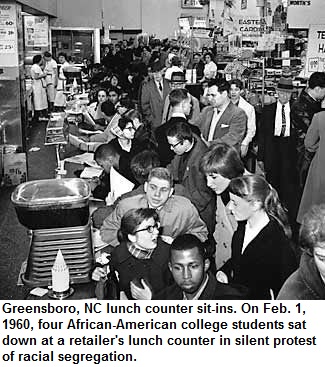
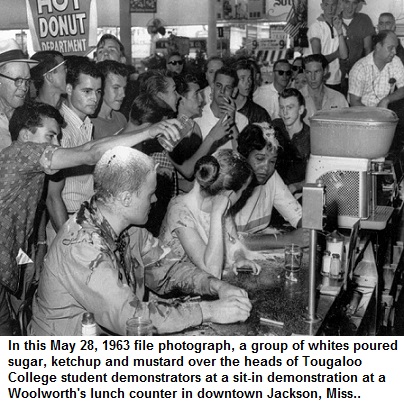
This feels like the Southern US during the days of Jim Crow Racial Segregation. The US States practicing these policies where the “best place to live” if you were White. The Black people were there, facilitating and supporting commerce and industry, but were not supposed to be seen; they were 2nd Class citizens … in their own country. The Merchants wanted their money, just not their presence.

If you were Black and wanted to get lunch from a cafeteria, you had to “Go outback and get brown bag food from the kitchen”, while White customers got the hospitality of in-store dining.

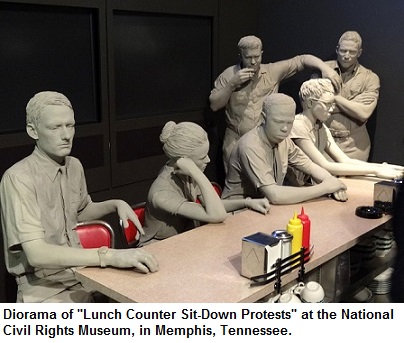
Same money; different respect. The protests against this blatant wrong practice galvanized the US and the Civil Rights movement. See photos here:

CU Blog - Forging Change - Consuming Cruises - Photo 3

CU Blog - Forging Change - Consuming Cruises - Photo 2

CU Blog - Forging Change - Consuming Cruises - Photo 4

See the news article in the Appendix below, commemorating the 50th Anniversary of the Civil Rights Struggles of the early 1960’s. It has been 53 years now, since the abolition of this bad policy with the Civil Rights Act of 1964. This history is sitting here as a teaching moment for us in the Caribbean:

Has our region learned any lessons from this history?

It can be concluded that the answer is “No”! We have tolerated an unjust system here in our region in which the 42 million residents in the Caribbean have been treated as 2nd Class citizens … in their own countries regarding local cruise consumption.

Fact:
If you’re a Caribbean citizen and you want to take a Caribbean cruise, you have to fly to Miami, Ft. Lauderdale, Tampa, Port Canaveral, Baltimore, New York or Puerto Rico to originate the cruise, even though the ships itinerary may come right to your Caribbean port. This means you Nassau, Montego Bay, Grand Cayman, St Thomas, St. Martin and others.

Welcome to 1960’s … redux!

There is the need to forge change in the Caribbean; the same as there was the need to forge change in 1960’s America. Consuming cruises is just one of the challenges that we have to contend with in our region. This is reflective of the disrespect that exists in our society. We have dysfunctions in our economics, security and governing engines. We are 2nd class citizens on the world stage! We have the greatest address on the planet – demonstrated in that 80 million tourists consume our marketplace every year, 10 million via cruises – and yet our own people have to break down the doors to get out to find the respectful life that they need, want and deserve in foreign countries.

Enough! Time to change … here … now! But how?

This is the quest of the movement behind the book Go Lean…Caribbean. It presents a roadmap to change – to elevate – Caribbean society by rebooting the economic, security and governing engines in the 30 member-states that constitute the Caribbean. The book opens with the thesis (Page 3) that the problems of the Caribbean are too big for any one member-state to tackle alone. Cruise vacations are not one of our biggest problems, but the issues here-in are indicative of the lack of respect we have in our region and as a region of 30 separate entities. We need the change of being considered one entity; we need Collective Bargaining. Yes, it makes us more formidable in our negotiations with the Cruise Lines, but as stated in the opening, it also brings something new to the table that the Cruise Lines do not currently have: our 42 million local consumers.

According to a previous Go Lean blog-commentary, this could be a win-win for all stakeholders connected to the cruise tourism eco-system:

Some of the most popular cruise destinations include the Bahamas, Jamaica, Cayman Islands and Saint Martin. Alone, these port cities/member states cannot effect change on this cruise line industry. But together, as one unified front, the chances for success improves exponentially. The unified front is the Caribbean Union Trade Federation (CU). The term Union is more than a coincidence; it was branded as such by design. The Go Lean book serves as a roadmap for the introduction and implementation of the CU.

The vision of this integration movement is for the region to function as a Single Market. The quotation from the Go Lean book continues in advocating that the Caribbean member-states (independent & dependent) lean-in to this plan for confederacy, convention and collaboration. This is Collective Bargaining 101. From the outset, the book recognized the significance of our exercising authority over the Caribbean Seas. This point was pronounced in the opening Declaration of Interdependence (Page 11):

    v. Whereas the natural formation of our landmass and coastlines entail a large portion of waterscapes, the reality of management of our interior calls for extended oversight of the waterways between the islands. The internationally accepted 12-mile limits for national borders must be extended by International Tribunals to encompass the areas in between islands. The individual states must maintain their 12-mile borders while the sovereignty of this expanded area, the Exclusive Economic Zone, must be vested in the accedence of this Federation.

The confederacy goal entails accepting that there is interdependence among the Caribbean member-states. Implementation-wise, this shifts the responsibility for cruise line negotiations to a region-wide, professionally-managed, deputized technocracy that can result in greater production and greater accountability.

So this is one strategy for forging change in our region, in this case: collective bargaining, on behalf of the 42 million consumers in the Caribbean. This is a continuation of the various strategies, tactics and implementations that have been considered for forging change here in the homeland. These have been identified in a series of previous Go Lean blog-commentaries over the past 2 & 1/2 years, this is the tenth submission. These were presented as follows, in reverse chronological order:

  1. Forging Change – Collective Bargaining (Today)
  2. Forging Change – Addicted to Home (April 14, 2017)
  3. Forging Change – Arts & Artists (December 1, 2016)
  4. Forging Change – Panem et Circenses (November 15, 2016)
  5. Forging Change – Herd Mentality (October 11, 2016)
  6. Forging Change – ‘Something To Lose’ (November 18, 2015)
  7. Forging Change – ‘Food’ for Thought (April 29, 2015)
  8. Forging Change – Music Moves People (December 30, 2014)
  9. Forging Change – The Sales Process (December 22, 2014)
  10. Forging Change – The Fun Theory (September 9, 2014)

This commentary is urging Caribbean stakeholders to come together – to collaborate, convene and confederate – to better negotiate with Third Parties to forge change and impact the people that live, work and play here in the Caribbean.

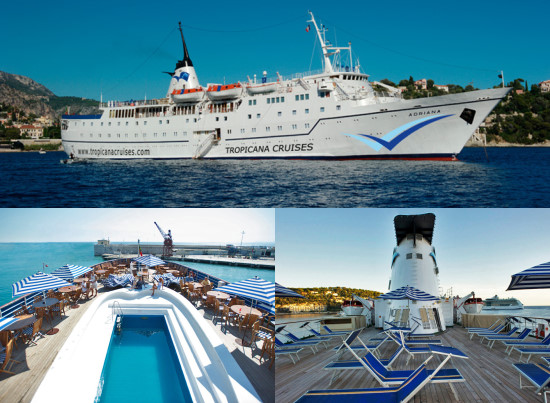
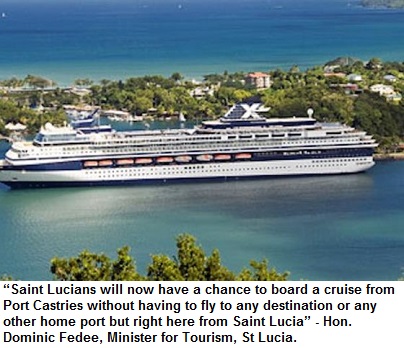
This quest is conceivable, believable and achievable. Look at this news article here that depicts that one Cruise Line (Tropicana Cruises) and one port city (Port Castries, St. Lucia) who have implemented a strategy of local consumption. (The arrangement exists for other ports as well, as in Trinidad).

Title: New cost effective way for St. Lucians to cruise the Caribbean 

Saint Lucians now have a cost effective way to cruise the Caribbean.

Minister in the Office of the Prime Minister with responsibility for tourism, Hon. Dominic Fedee, was on hand to greet the crew of the MV Adriana for its maiden call to Port Castries.

Accompanied by the Executive Chairperson of the Saint Lucia Tourist Board (SLTB) Agnes Francis, the minister said he was pleased at what this new development means for the people of Saint Lucia.

“Saint Lucians will now have a chance to board a cruise from Port Castries without having to fly to any destination or any other home port but right here from Saint Lucia,” he said.

Owner of the MV Adriana Captain Sergey Poniatovsky gave a background to the rationale of the visa-free Caribbean cruise.

“This ship is very unique, it is not like any other cruise ship. The ship is specifically for Caribbean islands, it is like a discovery vessel, with a family and private yacht atmosphere. We have an incredible itinerary which allows people living within these West Indies to have a synergy between islands. We have the opportunity to show each island nation as a destination and bring families together.”

In addition to touring the ship, the minister and the ship captain exchanged gifts to mark the momentous occasion.

Information on the MV Adriana Caribbean cruise can be found at the Saint Lucia Tourist Board and local travel agents.
Source: St Lucia Times Daily Newspaper – Posted March 30, 2017; retrieved April 27, 2017 from: https://stluciatimes.com/2017/03/30/new-cost-effective-way-st-lucians-cruise-caribbean

CU Blog - Forging Change - Consuming Cruises - Photo 0

This quest for collective bargaining (negotiations) is both an art and a science. The Go Lean book describes this fact in a chapter on negotiations entitled  (Page 32):

10 Ways to Improve Negotiations

#2 – Bargain from Position of Strength
For the CU, negotiation is an art and a science. As a technocratic institution representing the economic integration of the region, we must project the Single Market as bigger than initial appearances. The CU represents 42 million people in 30 member-states, with a GDP of over $800 Billion, but also some 8 million [to 20 million] engaged members of the Caribbean Diaspora, scattered throughout the US, Canada and EU countries. There are also many visitors, one estimate is at 80 million yearly. The economic opportunities, catering to this market, can be quite enormous, once properly exploited.

What is the art?

The fact that different people get different results from negotiations is indicative of the fact that not all people are Negotiating Artist.

Sounds familiar?

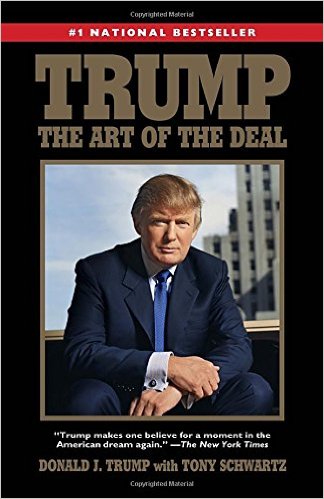
This was the campaign line from Donald J. Trump, the 45th President of the United States. Previously as a successful business man and media star, he was proud of his artistic accomplishment in the arena of negotiations. His co-wrote this book to this effect:

Book title: “The Art of the Deal”

President Donald J. Trump lays out his professional and personal worldview in this classic work—a firsthand account of the rise of America’s foremost deal-maker.

CU Blog - Forging Change - Consuming Cruises - Photo 5

“I like thinking big. I always have. To me it’s very simple: If you’re going to be thinking anyway, you might as well think big.”—Donald J. Trump

Here is Trump in action—how he runs his organization and how he runs his life—as he meets the people he needs to meet, chats with family and friends, clashes with enemies, and challenges conventional thinking. But even a maverick plays by rules, and Trump has formulated time-tested guidelines for success. He isolates the common elements in his greatest accomplishments; he shatters myths; he names names, spells out the zeros, and fully reveals the deal-maker’s art. And throughout, Trump talks—really talks—about how he does it. Trump: The Art of the Deal is an unguarded look at the mind of a brilliant entrepreneur—the ultimate read for anyone interested in the man behind the spotlight.
Source: Amazon.com retrieved April 27, 2017 from: https://www.amazon.com/Trump-Art-Deal-Donald-J/dp/0399594493

What about the science?

Nobel Prize Winner John F. Nash (1928 – 2015) is best known for his landmark work in applying science to the process of collective bargaining and negotiations (Game Theory). He was the subject character in the Hollywood movie: A Beautiful Mind; see Movie Trailer in the Appendix VIDEO. These encyclopedia details relate:

He was a mathematician who made fundamental contributions to game theorydifferential geometry, and the study of partial differential equations.[2][3] Nash’s work has provided insight into the factors that govern chance and decision-making inside complex systems found in everyday life.

His theories are widely used in Economics. Serving as a Senior Research Mathematician at Princeton University during the latter part of his life, he shared the 1994 Nobel Memorial Prize in Economic Sciences with game theorists Reinhard Selten and John Harsanyi. …

Nash earned a Ph.D. degree in 1950 with a 28-page dissertation on Non-cooperative Games.[13][14] His thesis contained the definition and properties of the [now widely accepted] Nash Equilibrium.

—–

The Nash equilibrium – a subset of game theory – is a solution concept of a non-cooperative game involving two or more players in which each player is assumed to know the equilibrium strategies of the other players, and no player has anything to gain by changing only his or her own strategy.[1] If each player has chosen a strategy and no player can benefit by changing strategies while the other players keep theirs unchanged, then the current set of strategy choices and the corresponding payoffs constitutes a “Nash Equilibrium”. The Nash equilibrium is one of the foundational concepts in game theory. The reality of the Nash Equilibrium of a game can be tested using experimental economics methods.

Stated simply, Amy and Phil are in Nash Equilibrium if Amy is making the best decision she can, taking into account Phil’s decision while Phil’s decision remains unchanged, and Phil is making the best decision he can, taking into account Amy’s decision while Amy’s decision remains unchanged. Likewise, a group of players are in Nash equilibrium if each one is making the best decision possible, taking into account the decisions of the others in the game as long as the other party’s decision remains unchanged.

Applications
Game theorists use the Nash equilibrium concept to analyze the outcome of the strategic interaction of several decision makers. In other words, it provides a way of predicting what will happen if several people or several institutions are making decisions at the same time, and if the outcome depends on the decisions of the others. The simple insight underlying John Nash’s idea is that one cannot predict the result of the choices of multiple decision makers if one analyzes those decisions in isolation. Instead, one must ask what each player would do, taking into account the decision-making of the others.

Nash equilibrium has been used to analyze hostile situations like war and arms races[2] (see prisoner’s dilemma), and also how conflict may be mitigated by repeated interaction (see tit-for-tat). It has also been used to study to what extent people with different preferences can cooperate (see battle of the sexes), and whether they will take risks to achieve a cooperative outcome (see stag hunt). It has been used to study the adoption of technical standards,[citation needed] and also the occurrence of bank runs and currency crises (see coordination game). Other applications include traffic flow (see Wardrop’s principle), how to organize auctions (see auction theory), the outcome of efforts exerted by multiple parties in the education process,[3] regulatory legislation such as environmental regulations (see tragedy of the Commons),[4] analysing strategies in marketing[5] and even penalty kicks in football [(soccer)] (see matching pennies).[6]
Source: Retrieved April 27, 2017 from https://en.wikipedia.org/wiki/John_Forbes_Nash_Jr.; https://en.wikipedia.org/wiki/Nash_equilibrium

The Caribbean Union Trade Federation (CU) is presented in the Go Lean book as a technocratic organization, where best-practices (art) and scientific methods are the norm. The book features the following chapter (Page 64):

Fostering a Technocracy

#1 – Lean-in for the Caribbean Single Market.
This treaty calls for a technocratic confederation of the Caribbean region into a single market of 30 member-states and 42 million people. The term technocracy was originally used to designate the application of the scientific method to solving social & economic problems, in counter distinction to the traditional political or philosophic approaches. The CU must start as a technocratic confederation – a Trade Federation – rather than evolving to this eventuality due to some failed-state status or insolvency.

The art-and-science of negotiation is part-and-parcel of the heavy-lifting the Go Lean movement envisions for the Caribbean technocracy. Considering the natural law: “Reap what you sow”, we should be able to generate the benefits anticipated in the stated prime directives, identified with the following 3 statements:

  • Optimization of the economic engines in order to grow the regional economy to $800 Billion & create 2.2 million new jobs.
  • Establishment of a security apparatus to protect the resultant economic engines.
  • Improvement of Caribbean governance to support these engines.

Underlying to this issue of collective bargaining and negotiation is the quest to forge changes in the cruise industry – jobs and commerce are at stake. The Go Lean movement has frequently blogged on issues and efforts related to improving the cruise eco-system for the region. Consider these samples:

https://goleancaribbean.com/blog/?p=6635 New Security Chip in Credit Cards Unveiled
https://goleancaribbean.com/blog/?p=5993 Carnival to ban carry-on bottled beverages
https://goleancaribbean.com/blog/?p=5307 Cruise Passengers and Violent Crime Warnings
https://goleancaribbean.com/blog/?p=5210 Cruise Ship Commerce – Getting Ready for Change
https://goleancaribbean.com/blog/?p=4639 Tobago: A Model for Cruise Tourism
https://goleancaribbean.com/blog/?p=3889 Electronic Payments– Ready for Change in Cruise Commerce
https://goleancaribbean.com/blog/?p=3225 Regional aviation dysfunction leading to more cruise traffic

The elevation of cruise commerce in the region is one of 144 missions within the Go Lean roadmap. The book details the applicable community ethos, strategies, tactics, implementation and advocacies to succeed in these efforts. The Go Lean book explains that the benefits of this roadmap will not just happen, we must act; we must change and adapt to the changing world. The Cruise Line industry must also change, but we must present the end-result of these changes as win-win for all regional stakeholders.

In the end, the changes will be for the better; for the Greater Good and to promote a better partnership for all cruise industry stakeholders. These efforts will make Caribbean ports-of-call a better destination to live, work and play. 🙂

Download the free e-book of Go Lean … Caribbean – now!

Sign the petition to lean-in for the roadmap for the Caribbean Union Trade Federation.

————-

Appendix Title: Key Clubs and the Slow Death of Restaurant Segregation

Soon after President Johnson signed the Civil Rights Act of 1964 into law on July 2, hundreds of restaurants across the South integrated.

I wrote about some of them in a recent Garden & Gun feature:

On July 3, Cafe du Monde, the coffee and beignet stand in the French Quarter of New Orleans, served its first black customers without incident. On July 5, the Sun and Sand motel in Jackson, Mississippi, served its first black dining room client, but closed the swimming pool.

Dozens more refused to desegregate. In the years after, the names of those restaurant owners became infamous:  McClung in Alabama. Bessinger in South Carolina. Boyd in Georgia.

Their stories of defiance have long fascinated me.

One of the longest-running standoffs occurred in Shaw, Mississippi, where Dinty Moore owned and operated the Shady Nook. Over the course of a fifty-two year career, Dinty Moore, who died in 1984, never served a black man or woman in his restaurant’s dining room.

For an Oxford American column, published in 2000, I spoke with his son, Dana Moore:

“I talked to daddy about that back when the law was passed,” Dana told me. “I was serving in the legislature then and it seemed like everybody was looking for a way around the law. Things were different then. Daddy was thinking about making the café into a private club like some places were doing. I advised him that if he did, he needed to do it legally, to incorporate and get chartered as a bona fide private club. Next thing I knew, he was selling keys to the place for a dollar apiece and calling it the Shady Nook Key Club.”

Soon thereafter, the front door to the green masonry building was locked for good and a one-way mirror was installed so that Dinty Moore could see out but no one could see in. A door key or a smiling white face became the coin of the realm for those seeking admittance to the Shady Nook.

In this moment when we justly celebrate how far we have come since 1964, it’s also important to recognize that the struggle for equal access to public accommodations didn’t end on July 2 of that year.
Source: Posted July 1, 2014; retrieved April 27, 2017 from: https://www.southernfoodways.org/directors-cut-key-clubs-and-the-slow-death-of-restaurant-segregation/

—————

Appendix VIDEO – A Beautiful Mind Movie (2001) Official Trailerhttps://youtu.be/YWwAOutgWBQ

Share this post:
, , , ,
[Top]

Location Matters, Even in a Virtual World

Go Lean Commentary 

CU Blog - Location Still Matters in a Virtual World - Photo 1Location, location, location …

Despite the direct references to the physical world, it turns out that ‘location’ is equally important in the virtual world.

The consideration of location is the most important factor in the Art-and-Science of Marketing. That field has these 4 charters, considered the 4 P’s, but location rises to the front of the priorities:

  • Place – Location, location, location… (See Appendix below).
    Can also refer to distribution; the destination and activities that make the product available to consumers.
  • Product – The goods and/or services offered by a company to its customers.
  • Price – The amount of money paid by customers to purchase the product
  • Promotion – The activities that communicate the product’s features and benefits and persuade customers to purchase the product.
    Source: Marketing Online Journal

But for the virtual world – or electronic commerce – the discussion of location considers “community” more so than buildings. “Community” as in community ethos; this is defined as the fundamental character of a culture, that informs the beliefs, customs, or practices of a group or society.

So where – which community – an e-Commerce company is located in really matters … for access to the right ethos, skilled talent, support services and capital. Is the Caribbean a good location for electronic commerce? No, we are not!

Can we be a good location for electronic commerce? Yes, we can!

We must simply adopt the appropriate community ethos; then execute the proper strategies, tactics and implementations to foster the industrial policies, entrepreneurial opportunities and jobs.

There is a model for us to follow:

Ann Arbor, Michigan.

In a previous blog-commentary on April 16, 2015 by the movement behind the book Go Lean … Caribbean, the college-town of Ann Arbor was examined as part of a year-long tour of the economic anatomy of City of Detroit and surrounding Michigan cities. The book identified the Detroit metropolitan area (Page 140) as a Failed-City that parallels many Caribbean communities. Yet still, out of the “ashes of decay”, a few positive innovations were observed-and-reported on, such as the impactful community of Ann Arbor. That previous blog quoted the following:

The idea of impactful cities aligns with the book Go Lean…Caribbean in stressing the elevation of the societal engines through entrepreneurial endeavors. The book asserts that Caribbean society can be elevated by improving the eco-system to live, work, learn and play. This is the example of Ann Arbor.

The Go Lean roadmap accepts that change has come to the global marketplace, due mostly to the convergence of Internet & Communications Technology (ICT). The book posits that size no longer matters, that from any location – like Ann Arbor … – innovative solutions can be developed and promoted to an appreciative audience. What matters most is the innovation, not the location; so any Caribbean member-state, large or small can be impactful. The first requirement is the community ethos of valuing intellectual property. This ethos would be new for the Caribbean market; it is therefore a mission of the CU to forge.

The Go Lean roadmap asserts that one individual or community can make a difference in the quest to elevate Caribbean society – the promoters of Go Lean have come to Ann Arbor to observe and report on their progress. We want the same outcomes by fostering genius qualifiers in our region; we therefore need impactful college-towns in the Caribbean.

Consider this example of a world renowned company, based in Ann Arbor, that embraced that city’s spirit and most-assuredly rebooted their company, culture and fortunes. That company is Domino’s Pizza. Yes, a pizza company with more staff in Information Technology than any other department in the corporate headquarters. They place a huge emphasis on developing- deploying technology-based solutions, while also improving their underlying product, Pizza. This story is portrayed in this VIDEO here:

VIDEOBehind Domino’s Pizza’s recipe for successhttp://www.cbsnews.com/videos/dominos-pizzas-recipe-for-success

Published on Mar 25, 2017 – Domino’s Pizza is hotter than ever.
One big reason has to do with marketing seven years ago that helped save the day when the flat-bread company was flatlining… .
“In 2009, we decided that technology was going to be a big deal,” CEO Patrick Doyle said. Domino’s has more people working in IT than anywhere else in the company, at its Ann Arbor, Michigan, headquarters. CBS News correspondent Michelle Miller reports.
(Read the full transcript here: http://www.cbsnews.com/videos/dominos-pizzas-recipe-for-success)

CU Blog - Location Still Matters in a Virtual World - Photo 2

See a related VIDEO here: Domino’s® Pizza Turnaround by Domino’s Pizza on YouTube

The book Go Lean…Caribbean strategizes technology as well; in fact that Internet & Communications Technologies (ICT) – e-Commerce is one such economic activity – is presented as a great equalizer for Small Country-States versus Big States on the world stage. The book stresses this point early (on Page 14) in the opening Declaration of Interdependence:

xxvii. Whereas the region has endured a spectator status during the Industrial Revolution, we cannot stand on the sidelines of this new economy, the Information Revolution. Rather, the Federation must embrace all the tenets of Internet Communications Technology (ICT) to serve as an equalizing element in competition with the rest of the world. The Federation must bridge the digital divide and promote the community ethos that research/development is valuable and must be promoted and incentivized for adoption.

The Go Lean book details technology and other strategies, tactics, implementations and advocacies to forge a cyber-friendly community ethos in the Caribbean. The book presents one such advocacy on Page 127, entitled:

10 Big Ideas … in the Caribbean Region

8 Cyber Caribbean
Forge electronic commerce industries so that the internet communications technology (ICT) can be a great equalizer in economic battles of global trade. This includes e-Government (outsourcing and in-sourcing for member-states systems) and e-Delivery, Postal Electronic Last Leg mail, e-Learning and wireline/wireless/satellite initiatives.

The opening Declaration of Interdependence also stressed the need for entrepreneurship and job creation. The book relates that the right community ethos can be – must be – forged, especially if we want to create jobs … in this new economy; (we want those jobs). See that pronouncement here also in the opening Declaration of Interdependence on Page 14:

xxvi. Whereas the Caribbean region must have new jobs to empower the engines of the economy and create the income sources for prosperity, and encourage the next generation to forge their dreams right at home, the Federation must therefore foster the development of new industries, like … frozen foods …. In addition, the Federation must invigorate the enterprises related to existing industries like tourism… – impacting the region with more jobs.

The Go Lean book serves as a roadmap for the introduction and implementation of the technocratic Caribbean Union Trade Federation (CU), for the elevation of all 30 member-states of the Caribbean. This CU/Go Lean roadmap has these 3 prime directives:

  • Optimization of the economic engines in order to grow the regional economy to $800 Billion and create 2.2 million new jobs.
  • Establishment of a security apparatus to protect the resultant economic engines.
  • Improve Caribbean governance to support these engines.

This commentary examined many other companies and many other cities, detailing their successes and failures in transforming their communities. Consider this sample of earlier blogs:

https://goleancaribbean.com/blog/?p=10449 Model of an ‘empowering’ family/company empowering a city: Detroit
https://goleancaribbean.com/blog/?p=10140 Lessons Learned from Detroit demolishing thousands of structures
https://goleancaribbean.com/blog/?p=8982 GraceKennedy: Profile of a Caribbean Transnational Corporation
https://goleancaribbean.com/blog/?p=8669 Detroit makes Community College free
https://goleancaribbean.com/blog/?p=7586 Company Blink Health: The Cure for High Drug Prices
https://goleancaribbean.com/blog/?p=7235 Flint, Michigan – A Cautionary Tale
https://goleancaribbean.com/blog/?p=5155 Tesla unveils super-battery to power homes
https://goleancaribbean.com/blog/?p=4587 Burlington, Vermont: First city to be powered 100% by renewables
https://goleancaribbean.com/blog/?p=3152 Making a Great Place to Work®
https://goleancaribbean.com/blog/?p=3490 How One Entrepreneur Can Rally a Whole Community
https://goleancaribbean.com/blog/?p=2488 Role Model Jack Ma brings Alibaba to America
https://goleancaribbean.com/blog/?p=1416 Role Model Amazon’s new FIRE Smartphone

The Go Lean book and these accompanying blogs posit that the economic failure in the Caribbean in the past in general is the result of the lack of diversity in our industrial development. The region depends too heavily on tourism. We need to be prepared for the new economy – with the tenants of ICT. While location does not matter online, when it comes to e-Commerce, location does matter for having a community that fosters the right attitudes and achievements.

The Go Lean book asserts that the Caribbean nations must do better! We must look for these ICT opportunities for economic expansion; consider “10 Ways to Foster e-Commerce” (Page 198).

The requisite investment of the resources (time, talent, treasuries) for this goal may be too big for any one Caribbean member-state alone, so shifting the responsibility to a region-wide, professionally-managed, deputized technocracy will result in greater production and greater accountability.

The Go Lean roadmap is designed to facilitate economic growth and job creation, by modeling companies like Domino’s and cities like Ann Arbor. We want to be their protégés … and definitely not their parasites.

Now is the time for all of the Caribbean, the people, entrepreneurs, business establishments and even the governing institutions, to lean-in to this Go Lean roadmap to make the Caribbean homeland a better place to live, work and play. 🙂

Download the free e-book of Go Lean … Caribbean – now!

Sign the petition to lean-in for the roadmap for the Caribbean Union Trade Federation.

———-

Appendix Title: Who coined the phrase ‘location, location, location’?

Language expert William Safire searches for who came up with the phrase “location, location, location” in the Times Magazine this weekend after a colleague working on a wedding announcement said the phrase was attributed to a British real estate tycoon named Lord Harold Samuel. Lord Samuel’s 1987 obituary names him as the phrase coiner, but the editor of the “Yale Book of Quotations” found the phrase used in a real estate classified ad in the Chicago Tribune in 1926.

Lord Samuel was 14 years old at the time. Safire said the context of the 1926 ad suggests it was already a familiar phrase in Chicago and phrasal etymologists are not yet finished with this challenge.
Source: The Real Deal – South Florida Real Estate News – Posted June 9, 2009; retrieved April 24, 2017 from: http://bit.ly/2jyEzbD


Share this post:
, , , ,
[Top]

Building Better Cities

Go Lean Commentary

Truth be told, it is hard to fix (reform) the broken processes of a whole country.

It is easier to fix a broken family; and easier to fix/reform just a broken neighborhood.

So a formula for success would be to reform broken neighborhoods (and broken families) one after another, and just like that, the country is transformed.

CU Blog - Building Better Cities - Photo 3

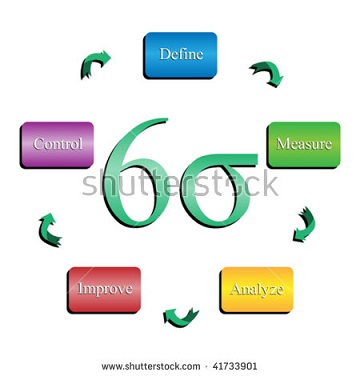
This “bottoms-up” approach is also the premise of the Six Sigma Quality Management concept (see Appendix below):

Do not try to perform 1 million perfect iterations; rather try to perform 1 iteration perfectly; then repeat it 1,000,000 times.

The book Go Lean…Caribbean presents the quest to elevate the 30 member-states in the Caribbean region. It does not limit the focus to the state governments; it drills down to a subset level: the cities. The book asserts that reforming and transforming cities would be integral to reforming and transforming entire countries.

Fix the cities; fix the world!

This is the theme of these many source materials. Consider the AUDIO Podcast, VIDEO and magazine column/article here:

AUDIO Podcast – Building Better Cities – http://www.npr.org/programs/ted-radio-hour/462178064/building-better-cities?showDate=2017-03-31


Posted March 31, 2017 – Cities are among our greatest experiments in human co-habitation. Do they also hold the answers to some of our biggest problems? This hour, TED speakers explore how cities can change the world. Listen to the full hour here: http://www.npr.org/programs/ted-radio-hour/462178064/building-better-cities?showDate=2017-03-31

———-

VIDEO – Atlanta’s Kasim Reed: How Are Mayors Better Poised to ‘Get Things Done’?https://youtu.be/semT61CCNEE


Published on Oct 20, 2014 – “Cities are where hope meets the streets,” says Kasim Reed, mayor and son of Atlanta. In this powerful talk, he argues that transformation is really possible at the municipal level. Reforming the city he loves was not just a matter of tough financial calls, but of really listening to the wisdom within the community.

See more: tedcity2.org

  • Category: Nonprofits & Activism
  • License:   Standard YouTube License

———-

Title: The Issues That Drive America’s Mayors
Sub-Title: Whether they’re Democrats or Republicans, a new survey shows that poverty and wealth inequality are what concern them most.
By: Bob Annibale, Mick Cornett

CU Blog - Building Better Cities - Photo 1

Before he died in 2014, Thomas Menino, a visionary urban leader who served as mayor of Boston for more than two decades, declared that we are living in “the era of the city.” This has never been truer than it is today.

As the world continues to urbanize at an unprecedented rate, cities and their surrounding areas wield more power than ever. Currently over half of the world’s population lives in cities, and that is expected to grow to 70 percent by 2050. In the United States, 82 percent of Americans live in metropolitan areas, an increase of 12 percent just since 2000.

Cities are rich with diversity and serve as vital hubs of innovation, culture and commerce. The world’s top 10 cities by GDP, five of which are in the United States, have economies rivaling all but the 10 most prosperous countries. But while the populations, capital and political power of many cities is enormous, so are the scale and complexity of their challenges — making insight into their leadership important.

Motivated by the belief that “the era of the city” is upon us, Boston University’s Initiative on Cities, with support from Citi, recently published the findings of its 2016 Menino Survey of Mayors to understand the important challenges facing these cities’ leaders. Named for the great Boston mayor, the survey gathered the perspectives of more than 100 sitting mayors from 41 states on contemporary issues through a series of one-on-one interviews conducted last summer.

The survey’s findings reveal that despite remarkable societal advancements in urban centers, new and more complex problems are cropping up or increasing in severity. The environment, infrastructure, public services and household financial security are presenting challenges at a level that cities have never experienced before.

Not surprisingly, the survey found that two of the central issues in the 2016 presidential campaign – wealth inequality and the shrinking middle class — were also of deep concern to mayors of cities throughout the country. Nearly half of those surveyed ranked poverty as their most pressing economic concern. In fact, 48 percent of mayors feel that those living in or near poverty are the most excluded group in their cities; when asked which constituency they need to do more to help, nearly a quarter named poor residents.

What is slightly more surprising is the level of agreement on the top issues regardless of mayors’ party affiliation or city size. Mayors from cities big and small are highly attuned to the plight of their most vulnerable residents, and even in this polarized political climate the focus on poverty is shared by both Democratic and Republican mayors. That’s also true of the benefits of diversity. While issues of economic inclusion and diversity illuminated deep divisions among the presidential candidates, the country’s mayors were united in the goal of building more inclusive cities that are welcoming to all.

The Menino Survey provides a window into how our nation’s mayors think, act and perceive their world. By gathering and synthesizing the priorities and challenges of our cities from the perspective of their leaders, the survey offers a roadmap of opportunities for civic innovation.

It also provides stakeholders in the nonprofit and private sectors with valuable insights that can inform the development of new programs, policies and partnerships, such as universal youth savings accounts in San Franciscocommunity land trusts in Washington, D.C., or a small-business support program for public-housing residents in New York City.

These types of innovations, often forged through public-private partnerships, enable us to tackle complex urban challenges such as poverty and economic insecurity and build more inclusive cities — ones where residents can fulfill their potential and contribute to thriving urban economies.

About the Authors: 

  • Bob Annibale – Leader of CitiGroup’s partnerships with global, national and local organizations to support inclusive finance and community development
  • Mick Cornett – Mayor of Oklahoma City and president of the U.S. Conference of Mayors

Related: 

It is important to glean these main points from the foregoing source media/articles:

  • This is “the era of the city”.
  • Cities are where hope meets the streets.
  • Currently, over half of the world’s population lives in cities, and that is expected to grow to 70 percent by 2050. In the United States, 82 percent of Americans live in metropolitan areas, an increase of 12 percent just since 2000.
  • Cities are rich with diversity and serve as vital hubs of innovation, culture and commerce. The world’s top 10 cities by GDP, five of which are in the United States, have economies rivaling all but the 10 most prosperous countries.

Reform the cities; reform the country!

The Go Lean book studies the good, bad and ugly lessons from a number of cities (New York City; Omaha, Nebraska; Detroit, Michigan; Los Angeles City-County, California); the book then proceeds to detail strategies, tactics and implementation to fix one particular Caribbean city (Freeport, Bahamas).

The Go Lean book presents a plan to grow the regional economy and create jobs. The Go Lean book asserts that this effort is too big a task for just one Caribbean member-state or city alone; all the 30 member-states and their cities must convene, confederate and collaborate in order to effect change. As such, the Go Lean book serves as a roadmap for the introduction and implementation of the technocratic Caribbean Union Trade Federation (CU), for the elevation of Caribbean society – for all member-states, and all cities. This CU/Go Lean roadmap has these 3 prime directives:

  • Optimization of the economic engines in order to grow the regional economy to $800 Billion and create 2.2 million new jobs. Caribbean cities need jobs and entrepreneurial opportunities. This roadmap calls for mini-cities, referred to as Self-Governing Entities, as a solution to optimize industrial policy. See a model/example here.
    CU Blog - Disney World - Role Model for a Self Governing Entity - Photo 1
  • Establishment of a security apparatus to ensure public safety and protect the resultant economic engines. The origins of cities were for protective walls around the city perimeters.
    CU Blog - Building Better Cities - Photo 2
  • Improve Caribbean governance to support these engines, including a separation-of-powers between the member-states and CU federal agencies. See a model/example here.
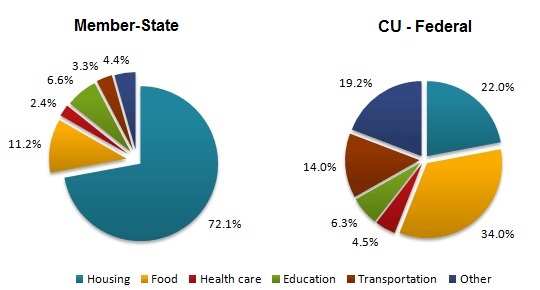
    CU Blog - Two Pies - Economic Plan for a New Caribbean - Photo 3

A mission of the Go Lean roadmap is to reboot urban communities – defining a concerted effort in a concentrated area – with empowerments like:

  • Transportation – “Out of the box” thinking to transport people to places; i.e. Streetcars.
  • Mixed-use Developments – Optimize communities with one building for retail, office and residences.
  • Healthcare … on controlled campuses – Facilitating hands-off administration for advanced medical R&D.
  • Improving Local Government – Connecting citizens online for more and more electronic delivery.
  • Public Works – Infrastructure projects elevate cities … economically.
  • Libraries – These are for more than just reading books in this New Economy.
  • Events/Festivals – Culture, community pride and revenues cannot be ignored.
  • Main Street – Local Downtowns can be tranformed for the Greater Good.
  • Sports – These Big Business activities can impact more than just the fans and players.

The book stresses that reforming and transforming Caribbean urban communities must be a regional pursuit. This was an early motivation for the roadmap, as pronounced in the opening Declaration of Interdependence (Pages 11 – 14):

vi. Whereas the finite nature of the landmass of our lands limits the populations and markets of commerce, by extending the bonds of brotherhood to our geographic neighbors allows for extended opportunities and better execution of the kinetics of our economies through trade. This regional focus must foster and promote diverse economic stimuli.

vii. Whereas our landmass is finite and therefore limited as to population growth potential, it is imperative that prudent growth management be practiced so as to protect our legacy and still foster future opportunities for the hopes and fulfillment of a prosperous future for our children.

viii. Whereas the population size is too small to foster good negotiations for products and commodities from international vendors, the Federation must allow the unification of the region as one purchasing agent, thereby garnering better terms and discounts.

xi.  Whereas all men are entitled to the benefits of good governance in a free society, “new guards” must be enacted to dissuade the emergence of incompetence, corruption, nepotism and cronyism at the peril of the people’s best interest. The Federation must guarantee the executions of a social contract between government and the governed.

xvi. Whereas security of our homeland is inextricably linked to prosperity of the homeland, the economic and security interest of the region needs to be aligned under the same governance. Since economic crimes … can imperil the functioning of the wheels of commerce for all the citizenry, the accedence of this Federation must equip the security apparatus with the tools and techniques for predictive and proactive interdictions.
xxvi. Whereas the Caribbean region must have new jobs to empower the engines of the economy and create the income sources for prosperity, and encourage the next generation to forge their dreams right at home, the Federation must therefore foster the development of new industries, like that of ship-building, automobile manufacturing, prefabricated housing, frozen foods, pipelines, call centers, and the prison industrial complex. In addition, the Federation must invigorate the enterprises related to existing industries like tourism… – impacting the region with more jobs.

This commentary previously related details of city life – elevating society at the urban level – that can be applied directly in the Caribbean. Here is a sample of previous blogs:

https://goleancaribbean.com/blog/?p=11244 ‘To Live and Die in L.A.’ … City/County …
https://goleancaribbean.com/blog/?p=4587 Burlington, Vermont: First city to be powered 100% by renewables
https://goleancaribbean.com/blog/?p=3641 ‘We Built This City …’
https://goleancaribbean.com/blog/?p=3326 M-1 Rail: Alternative Motion in the MotorCity
https://goleancaribbean.com/blog/?p=1918 Philadelphia Freedom – We can Look, Listen and Learn
https://goleancaribbean.com/blog/?p=1596 Book Review: ‘Prosper Where You Are Planted’

The Go Lean book and these accompanying blogs posit that the economic failures in the Caribbean in general and in cities in particular are the direct result of the lack of diversity in industrial development, and the subsequent societal abandonment. The region depends too heavily on one industry: tourism.

The roadmap asserts that this strategy is flawed; that while prudence dictates that the Caribbean nations expand and optimize their tourism products, the Caribbean must also look for other opportunities for economic expansion. Cities can be laboratories in urban civilization, but the requisite investment of the resources (time, talent, treasuries) for this goal may be too big for any one city alone. So rather, this roadmap shifts the responsibility to a region-wide, professionally-managed, deputized technocracy that will result in greater production and greater accountability. The end result of these “urban laboratories” will facilitate economic diversity and job creation.

This is the charge of the Go Lean…Caribbean roadmap, to do the heavy-lifting, to implement the organization dynamics to impact Caribbean society here and now. The following are the community ethos, strategies, tactics and operational advocacies to effectuate this goal:

Community Ethos – People Respond to Incentives Page 21
Community Ethos – Economic Systems Influences Choices & Incentives Page 21
Community Ethos – Job Multiplier Page 22
Community Ethos – Lean Operations Page 24
Community Ethos – Ways to Impact the Greater Good Page 37
Strategy – Vision – Make the Caribbean the Best Address on Planet Page 45
Strategy – Mission – Protect our residents, visitors and repatriates Page 45
Strategy – Mission – Fix the broken systems of governance Page 46
Tactical – Separation of Powers – Union versus Member-States Page 71
Implementation – Implement Self-Governing Engines Page 105
Implementation – Ways to Deliver Page 109
Implementation – Ways to Re-boot Freeport – Sample City Page 114
Implementation – Ways to Promote Independence – Autonomous Cities Page 120
Planning – 10 Big Ideas for the Caribbean Page 127
Planning – Ways to Make the Caribbean Better Page 131
Planning – Lessons from New York City Page 137
Planning – Lessons from Omaha Page 138
Planning – Lessons from Detroit Page 140
Advocacy – Ways to Grow the Economy Page 151
Advocacy – Ways to Create Jobs Page 152
Advocacy – Ways to Improve Local Governance Page 169
Advocacy – Ways to Enhance Tourism Page 190
Advocacy – Ways to Market Southern California – Learning from L.A. City Page 194
Advocacy – Ways to Impact Main Street Page 201
Advocacy – Ways to Improve Urban Living Page 234

This Go Lean book accepts that the current State of the Cities does not have to be a permanent disposition. Under the Go Lean roadmap, cities can do better; all of the Caribbean can do better. This roadmap is a 5-year plan to effect change, to make our homeland a better place to live, work and play.

Now is the time to build better Caribbean cities; the people and governing institutions are urged to lean-in to this Go Lean … Caribbean roadmap. 🙂

Sign the petition to lean-in for this roadmap for the Caribbean Union Trade Federation.

Download the free e-book of Go Lean … Caribbean – now!

————-

Appendix – The Bottom Line on Six Sigma

CU Blog - Building Better Cities - Photo 4

Six Sigma is a set of tools and strategies for process improvement originally developed by Motorola in 1985, but popularized in 1995 by General Electric’s Jack Welch as his central business strategy. Today it is used in different sectors of industry. Six Sigma seeks to improve the quality of process outputs by identifying and removing the causes of defects (errors). It uses a set of quality management methods, including statistical methods, and creates a special infrastructure of people within the organization (Champions, Black Belts, Green Belts, Orange Belts, etc.) who are experts in these very complex methods.

With Six Sigma the maturity of a manufacturing process can be described by a sigma rating indicating its yield or the percentage of defect-free products it creates. A six sigma process is one in which 99.9999998% of products manufactured are statistically expected to be free of defects (3.4 defects per million). According to Wikipedia, Six Sigma projects follow a methodology, aimed at improving existing business processes, composed of five phases, bearing the acronyms DMAIC:

  • Define the problem, the voice of the customer, and the project goals, specifically.
  • Measure key aspects of the current process and collect relevant data.
  • Analyze the data to investigate and verify cause-and-effect relationships. Determine what the relationships are, and attempt to ensure that all factors have been considered. Seek out root cause of the defect under investigation.
  • Improve or optimize the current process based upon data analysis.
  • Control the future state process to ensure that any deviations from target are corrected before they result in defects.

Source: Go Lean … Caribbean (Page 147)

Share this post:
, , , ,
[Top]

Retail Apocalypse – Preparing for the Inevitable

Go Lean Commentary

Remember the dream … of 7 Fat Cows and 7 Skinny Cows?

The articulation of the dream was that the 7 Fat Cows represented 7 prosperous years while the 7 Skinny Cows represented 7 years of famine with poverty and distress. – The Bible; Genesis Chapter 41.
CU Blog - Retail Apocalypse - Preparing for the Inevitable - Photo 0

In that Bible drama of Joseph in ancient Egypt, those circumstances were more than just in a dream; it was a prophecy of prosperity and famine. It came true!

Joseph was able to use the foresight to prepare that kingdom for adversity, after first exploiting the opportunities.

Here it comes again.

There is feast and famine “in the cards” as related to the retail eco-system. On one end of the spectrum , there will be prosperity for electronic commerce stakeholders, but on the other end, for brick-and-mortar establishments, there will be a Retail Apocalypse.

Will be? Actually, the threat has already manifested!

This is the assertion in this news article by the financial-economic magazine Business Insider:

CU Blog - Retail Apocalypse - Preparing for the Inevitable - Photo 1

Title: The retail apocalypse has officially descended on America
By: Hayley Peterson

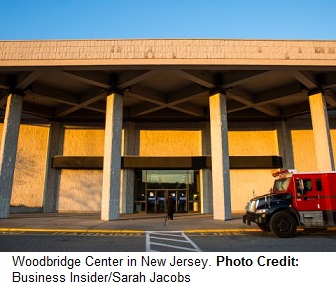
Thousands of mall-based stores are shutting down in what’s fast becoming one of the biggest waves of retail closures in decades.

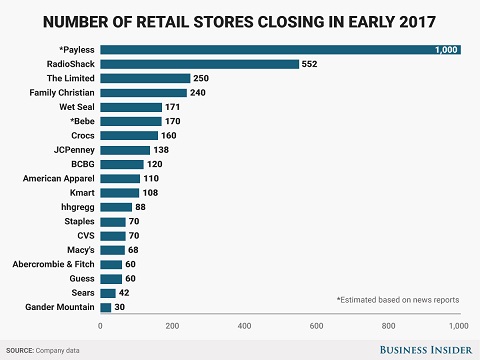
More than 3,500 stores are expected to close in the next couple of months.

Department stores like JCPenney, Macy’s, Sears, and Kmart are among the companies shutting down stores, along with middle-of-the-mall chains like Crocs, BCBG, Abercrombie & Fitch, and Guess.

CU Blog - Retail Apocalypse - Preparing for the Inevitable - Photo 2

Some retailers are exiting the brick-and-mortar business altogether and trying to shift to an all-online model.

For example, Bebe is closing all its stores — about 170 — to focus on increasing its online sales, according to a Bloomberg report.

Some are going out of business altogether, like The Limited which recently shut down all 250 of its stores.

Others, such as Sears and JCPenney, are aggressively paring down their store counts to unload unprofitable locations and try to stanch losses.

CU Blog - Retail Apocalypse - Preparing for the Inevitable - Photo 3Sears is shutting down about 10% of its Sears and Kmart locations, or 150 stores, and JCPenney is shutting down about 14% of its locations, or 138 stores.

According to many analysts, the retail apocalypse has been a long time coming in the US, where stores per capita far outnumber that of any other country.

The US has 23.5 square feet of retail space per person, compared with 16.4 square feet in Canada and 11.1 square feet in Australia, the next two countries with the most retail space per capita, according to a Morningstar Credit Ratings report from October.

Visits to shopping malls have been declining for years with the rise of e-commerce and titanic shifts in how shoppers spend their money. Visits declined by 50% between 2010 and 2013, according to the real-estate research firm Cushman & Wakefield.

And people are now devoting bigger shares of their wallets to restaurants, travel, and technology than ever before, while spending less on apparel and accessories.

As stores close, many shopping malls will be forced to shut down as well.

When an anchor store like Sears or Macy’s closes, it often triggers a downward spiral in performance for shopping malls.

Not only do the malls lose the income and shopper traffic from that store’s business, but the closure often triggers “co-tenancy clauses” that allow the other mall tenants to terminate their leases or renegotiate the terms, typically with a period of lower rents, until another retailer moves into the anchor space.

To reduce losses, malls must quickly find a replacement tenant for the massive retail space that the anchor store occupied, which is difficult — especially in malls that are already financially strapped — when major department stores are reducing their retail footprints.

That can have grave consequences for shopping malls, especially in markets where it’s harder to transform vacant mall space into non-retail space like apartments, according to analysts.

The nation’s worst-performing malls — those classified in the industry as C- and D-rated — will be hit the hardest by the store closures.

The real-estate research firm Green Street Advisors estimates that about 30% of all malls fall under those classifications. That means that nearly a third of shopping malls are at risk of dying off as a result of store closures.

Source: Business Insider e-Zine. Posted 03/21/2017; retrieved 04/17/2017 from: http://www.businessinsider.com/the-retail-apocalypse-has-officially-descended-on-america-2017-3

CU Blog - Retail Apocalypse - Preparing for the Inevitable - Photo 4

Related:

1. Monday Market Mayhem – The Retail Apocalypse – Look out Wall Street

2. Dollar General is defying the retail apocalypse and opening 1,000 stores

See the related AUDIO Podcast below here:

———–

AUDIO Podcast – Wal-Mart battles Amazon with discounts for online ordering and store pickup – https://www.marketplace.org/2017/04/14/business/its-battle-amazon-walmart-offers-discounts-ordering-online-and-picking-store

Published April 14, 2017 – Big Box giant Wal-Mart battling e-Commerce giant Amazon for New Economy fulfillment.

As noted in the foregoing, the Retail Apocalypse is affecting the news in the United States. It’s only the news today, tomorrow will be jobs, the next day the finance apparatus holding the debt (mortgages and security instruments on Wall Street) for the many shopping malls and then soon, the rest of the economy will be impacted.

This is so familiar. Remember the housing-real estate bubble in 2003 to 2010. This previous blog-commentary identified the following 5 steps of a bubble:

1.   Displacement

2.   Boom

3.   Euphoria

4.   Profit Taking

5.   Panic

Here we go again! Sounds like a crisis is imminent.

The book Go Lean…Caribbean serves as a roadmap for the introduction and implementation of the technocratic Caribbean Union Trade Federation (CU) and Caribbean Central Bank (CCB); it declares that a crisis is a terrible thing to waste – quoting famed American Economist Paul Romer. Though the impending crisis is slated for the US, the actuality of economic contagions mean that the Caribbean member-states will be affected as well.

Where do the tourists come from that drive the Caribbean region’s primary economic driver?

The question is rhetorical; the answer is obvious!

The Go Lean book seeks to prepare the Caribbean region for the change dynamics impacting the world. The “Agents of Change” at play in the foregoing news source are as follows:

  • Technology
  • Globalization

The underlying issue with the Retail Apocalypse is not the demand for retail products, it is the supply. Consumers are still demanding and consuming fashion and commodities, just not at shopping malls; e-Commerce is “all the rage”.

Consider the experience of this commentator:

I went to buy 3 pairs of slacks.

I was only able to find one – with the brand, make, size and color – at a Big Box retail store. So then I went home and matched the brand, model, size with the e-Commerce merchant Amazon.com and acquired the same pants in 2 divergent colors that the Big Box retailer did not have in inventory. 3 days later, the whole shopping expedition was over; I acquired 3 pairs of slacks, primarily from the online merchant and delivered by the shipping company United Parcel Service (UPS).

The quest of the Go Lean/CU roadmap is to elevate the Caribbean’s societal engines – not the US – starting first with economics (jobs, commercial developments and entrepreneurial opportunities). In fact, the following 3 statements are identified as the prime directives of the CU:

  • Optimization of the economic engines in order to grow the regional economy to $800 Billion & create 2.2 million new jobs.
  • Establishment of a security apparatus to protect the resultant economic engines.
  • Improve Caribbean governance – as e-Commerce alters sales & border taxes – to support these engines.

The changes taking place in the US with the Retail Apocalypse will eventually traverse the Caribbean member-states as well. This is the parallel with the opening Bible Drama. A crisis is coming and we have the opportunity to exploit the prosperous years and prepare for the famine. The Caribbean region – all 30 member-states – needs to better exploit e-Commerce. There are so missing ingredients, fully detailed in the Go Lean book; see  this sample advocacy on Page 198:

10 Ways to Foster e-Commerce

1 Leverage the full population – 42 million people in all 30 member-states to deploy the CU and the CCB.
2 Regional Currency (Caribbean Dollar or C$)
3 Card Culture
The CU will seek to foster the eco-system for e-payments beyond government activity. To assimilate this change, a card culture, on Main Street, will entail utilizing debit/credit cards, benefits pay cards, and even smart cards on cruise ships.
The CU will collectively bargain with the cruise lines to deploy C$ electronic “purses” to facilitate port-side and onboard retail commerce. All of these changes will garner a better monetary multiplier on the CU economy, by expanding M1.
4 CU Social Media
The CU web portal www.myCaribbean.gov will grant free access, email, IM, and profile pages for CU stakeholders, even normalizing communications thru social media sites. This will facilitate internet commerce activities in the region, as the CU will have hot data on profiles, habits and previous activities, thereby creating opportunities for measured marketing.
5 A Market for the Downloads of Intellectual Properties
6 Remittance Methods (Card & Email)
7 Mobile Apps – Hi-Density Wi-Fi
8 Regional Postal Services – CPU
The CU will assume the responsibility for mail services in the region; (all member-state postal employees will become federal civil servants). The embrace of the Caribbean Postal Union allows for parcel mail to be optimally shipped and delivered throughout the region, with Customs considerations in place. The CPU will therefore ensure the fulfillment side of e-commerce, even allowing for computer applications for printing electronic stamps/barcodes for value savings.
9 Turnpike Logistics
10 Customs and Import Optimizations

The missing ingredients for this new marketplace – electronic commerce – are not just banking-related, the full eco-system must be enabled: electronic (technology), commerce (trade) and fulfillment (logistics). The implementation of these provisions will constitute a New Day for the region. Overall, the Go Lean book stresses the community ethos, strategies, tactics, implementations and advocacies to reboot, reform and transform the economic engines of Caribbean society, so as to benefit from changes coming due to the Retail Apocalypse, this New Day.

Though not directly mentioned in the Go Lean book, this Retail Apocalypse is planned for in the roadmap. A comprehensive view of  the technocratic stewardship for the region’s economic engines, including the banking eco-system, is presented early in the book with these opening pronouncements in the Declaration of Interdependence (Page 13 and 14):

xxiv. Whereas a free market economy can be induced and spurred for continuous progress, the Federation must install the controls to better manage aspects of the economy: jobs, inflation, savings rate, investments and other economic principles. Thereby attracting direct foreign investment because of the stability and vibrancy of our economy.

xxvii. Whereas the region has endured a spectator status during the Industrial Revolution, we cannot stand on the sidelines of this new economy, the Information Revolution. Rather, the Federation must embrace all the tenets of Internet Communications Technology (ICT) to serve as an equalizing element in competition with the rest of the world. The Federation must bridge the digital divide and promote the community ethos that research/development is valuable and must be promoted and incentivized for adoption.

The points of effective, technocratic banking and retail stewardship were further elaborated upon in previous blog/commentaries. Consider this sample:

https://goleancaribbean.com/blog/?p=11184 Big Bank investing $Billion on ‘Fintech’ for e-Commerce positioning
https://goleancaribbean.com/blog/?p=8823 Lessons from China – WeChat: Model for Caribbean Social Media
https://goleancaribbean.com/blog/?p=8704 Lesson from MetroCard
https://goleancaribbean.com/blog/?p=7991 Transformations: Caribbean Postal Union – Delivering the Future
https://goleancaribbean.com/blog/?p=7034 The Future of Money
https://goleancaribbean.com/blog/?p=6635 New Security Chip in Credit Cards Unveiled
https://goleancaribbean.com/blog/?p=5668 Move over Mastercard/Visa – Time for Local Banking Cards
https://goleancaribbean.com/blog/?p=4425 Cash, Credit or iPhone …
https://goleancaribbean.com/blog/?p=3889 Royal Bank of Canada’s EZPay – Ready for Change
https://goleancaribbean.com/blog/?p=3881 The Need for Regional Cooperation for Cyber-Security & e-Security
https://goleancaribbean.com/blog/?p=3858 Model of Central Banking Technocracy: ECB 1 trillion Euro stimulus
https://goleancaribbean.com/blog/?p=2488 Model of an E-Commerce Fulfillment Company: Alibaba
https://goleancaribbean.com/blog/?p=1416 Model of an E-Commerce Fulfillment Company: Amazon
https://goleancaribbean.com/blog/?p=1350 PayPal’s model to pay for e-Commerce
https://goleancaribbean.com/blog/?p=906 Bitcoin model to pay for e-Commerce
https://goleancaribbean.com/blog/?p=528 Facebook to pay for e-Commerce

Warning to all retail stakeholders – buyers, sellers and governments: Change is coming!

This is a familiar stance – preparing for the inevitable – for the Go Lean movement; there have been previous warnings of disruptive changes; see this sample here:

https://goleancaribbean.com/blog/?p=7847 To the Personal Computer industry: Cloud Computing, Smartphones and Tablets are making actual laptop and desktop computers inconsequential.
https://goleancaribbean.com/blog/?p=6151 To the regional government’s Revenue Officials: 3-D Printing is coming and will change fabrication to local rather than import. This will disrupt border taxes revenue expectations.

https://goleancaribbean.com/blog/?p=6016 To the Infrastructure Planners: Climate Change is making Caribbean summers hot-hot-hot and northern winters milder; there must be cooperative refrigeration to provide relief, otherwise people will leave for northern destinations.
https://goleancaribbean.com/blog/?p=5784 To Jamaica’s Public Safety Officials: Human Rights protections must be extended to people who identify as LGBT. Whether you agree or not, the international community will force you to respect their rights for life, liberty and the pursuit of happiness.
https://goleancaribbean.com/blog/?p=5210 To the Cruise Line industry: The Caribbean region’s collective bargaining will extract greater benefits and protections for port city commerce.
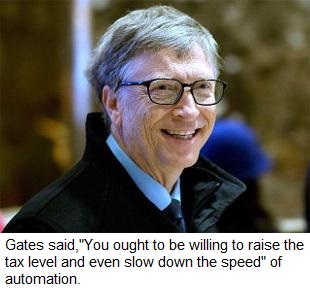
https://goleancaribbean.com/blog/?p=5155 To the Caribbean Power Grip: Home-based batteries will allow for successful deployments of solar/wind power generation and require less power from the grid.
https://goleancaribbean.com/blog/?p=4767 To the regional government’s Revenue Officials: Under the WTO regime, customs duties must eventually be eliminated; same too with conditional property taxes. VAT or Sales Taxes are OK.

As for the Retail Apocalypse, now is the time for all stakeholders of Caribbean banking, retail and governments to lean-in for the empowerments for e-Commerce described here-in and in the book Go Lean … Caribbean. This is where the marketplace is going, not just tomorrow, but already here today. We can do this; we can elevate our communities and our retail eco-systems. We can be a better place to live, work and play. 🙂

Download the free e-book of Go Lean … Caribbean – now!

Sign the petition to lean-in for the roadmap for the Caribbean Union Trade Federation.


Share this post:
, , , , ,
[Top]

Forging Change: Home Addiction

Go Lean Commentary

CU Blog - Forging Change - Home Addiction - Photo 1

If only we can get people addicted to ‘home’ then they would want to stay ‘here’ or come back home.

We can! We can tease, tempt and program people to become addicted to being ‘home’, and homesick whenever they are away from home.

This would be similar to getting people addicted to …

drugs, sex, Rock-n-Roll, games, alcohol, cigarettes, gambling and other vices.

This refers to a scientific process involving brain chemistry. The brain chemistry is dopamine. It is possible to make people addicted to different elements, whether they be physical and conceptual. See the details in the encyclopedic Appendix below.

This is an important issue. The movement behind the book Go Lean … Caribbean – wants to forge change in the Caribbean. We want to dissuade the bad trend of our people abandoning their homeland – fleeing – and pursuing life in the Diaspora abroad. We need our people at home. We need them to be addicted to their homeland and love it, and to miss it when separated. This describes …

Homesickness
… the distress or impairment caused by an actual or anticipated separation from home.[1] Its cognitive hallmark is preoccupying thoughts of home and attachment objects.[2] Sufferers typically report a combination of depressive and anxious symptoms, withdrawn behavior and difficulty focusing on topics unrelated to home.[3][4][5]

Homesickness is defined so similarly to withdrawal symptoms! And the reward-motivated behavior is powerfully addictive; think of a slot-machine in a casino.

Drug abuse = Bad! Casino gambling = Bad! Homesickness = Good.

The Go Lean book describes the effort of dissuading Caribbean residents from societal abandonment as heavy-lifting. The book explains that there are 2 reasons why people leave their beloved homelands – “Push” and “Pull” factors:

  • “Push” refers to people who feel compelled to leave, to seek refuge in a foreign land. “Refuge” is an appropriate word; because of societal defects, many from the Caribbean must leave as refugees – think LGBTDisabilityDomestic-abuseMedically-challenged – for their life, liberty and pursuit of happiness. For these people, it is like “they are on fire” and need to stop-drop-and-roll.
  • “Pull”, on the other hand refers to the lure of a more prosperous life abroad; many times our people are emigrating on the false perception that they can have a better “home” abroad. They have a deficient longing for their homeland.

In order to neutralize the “Push and Pull” factors, the heavy-lift of reforming and transforming Caribbean society must be done. This movement has identified many previous strategies, tactics and implementations (8 in total) for forging change in the region. These require technocratic deliveries and best-practices. The Go Lean book details the efforts to change the minds (head), hearts and hands (actions) of Caribbean people. This commentary describes one way to forge change, getting the people addicted to their homeland.

Yes, this is possible; it is scientific, and not science fiction. This approach is at work right now in the smart-phone industry; they employ strategies, tactics and operational efficiency to compel people to engage their devices … continuously. They make people addicted.

CU Blog - Forging Change - Home Addiction - Photo 2

How can we introduce this addiction in our homeland, to forge change? Fortunately, the devices are already there; we only need to brain hack, to customize the content, for addiction.

See this Art-and-Science portrayed in this news story VIDEO here, from 60 Minutes:

VIDEO – Brain Hacking – http://www.cbsnews.com/videos/brain-hacking

Published April 9, 2017 – Why can’t we stop looking at our smartphones? And are the designers of the apps and content on them using brain science to keep us hooked? Anderson Cooper reports.

Various strategies, tactics and implementations for forging change have been identified in a series of previous Go Lean blog-commentaries over the past 2 & 1/2 years, this is the ninth submission. These were presented as follows, in reverse chronological order:

  1.      Forging Change – Addicted to Home (Today)
  2.      Forging Change – Arts & Artists (December 1, 2016)
  3.      Forging Change – Panem et Circenses (November 15, 2016)
  4.      Forging Change – Herd Mentality (October 11, 2016)
  5.      Forging Change – ‘Something To Lose’ (November 18, 2015)
  6.      Forging Change – ‘Food’ for Thought (April 29, 2015)
  7.      Forging Change – Music Moves People (December 30, 2014)
  8.      Forging Change – The Sales Process (December 22, 2014)
  9.      Forging Change – The Fun Theory (September 9, 2014)

This commentary is urging Caribbean stakeholders to customize the content on smart-phones and media (social website www.myCaribbean.gov) to forge addiction for the people that live, work and play there.

There is an art-and-science to this quest:

#addictionbydesign
CU Blog - Forging Change - Home Addiction - Photo 4

The stakeholders in the smart-phone and social media industries have a proven track record. According to the foregoing VIDEO, whether they want to or not, these ones are “shaping the thoughts, feelings and actions of people [consuming their products]; they are programming people”.

We – the Go Lean movement – want to shape the “thoughts, feelings and actions” of Caribbean people. Understanding the science of Dopamine, allows us to structure the appeal and messaging to create an addiction – home-sickness – among Caribbean residents.

This quest will require a genius application of Art-and-Science to make this effort successful. The Go Lean book (Page 27) describes the process of starting early to identify Caribbean youth with genius qualifiers for the Arts and Science – we need them now. We need them to compete like “Drug Dealers” to get people in the community hooked on the content of Caribbean life: expressions of arts, music, dance, stories, drama, news, information, films, movies, TV shows and other media portrayals. While the actual content creators and curators may only be a handful of professionals, those with genius qualifiers, the impact, the addiction, can be felt on the whole community. This is an expression of the Greater Good. This is defined in the Go Lean book (Page 37) as:

“The greatest good to the greatest number of people which is the measure of right and wrong”. – Jeremy Bentham (1748-1832, a British philosopher, jurist, and social reformer.

This is why the Go Lean book, while commencing as an economic empowerment plan, devotes so many pages to the arts, music, media, social media, technology and communications.

The Go Lean book serves as a roadmap for the introduction and implementation of the technocratic Caribbean Union Trade Federation (CU). The CU is set to optimize Caribbean society through economic, security and governing empowerments. Therefore the Go Lean roadmap has 3 prime directives:

  • Optimization of the economic engines in order to grow the regional economy to $800 Billion & create 2.2 million new jobs.
  • Establishment of a security apparatus to ensure public safety and protect the economic engines.
  • Improve Caribbean governance to support these engines.

The Go Lean/CU roadmap asserts that forging change in the Caribbean will be a hard, heavy-lift task and many alternate strategies – the 9 from above – may have to be engaged. Any one person – artists or technologists – can make a difference and positively impact society; such a person can be a champion for our Caribbean cause . We can all work to make our homeland a better place to live, work and play. This is why fostering the genius ability in Caribbean citizens is presented in the book (Page 27) as a community ethos.

The Go Lean book presents this and other (new) community ethos for the region to adopt, plus new strategies, tactics, implementation and advocacies to execute to forge change in the region. The following is a sample of these specific details from the book:

Community Ethos – Deferred Gratification Page 21
Community Ethos – Economic Principles – People Choose Page 21
Community Ethos – Economic Principles – People Respond to Incentives in Predictable Ways Page 21
Community Ethos – Economic Principles – Economic Systems Influence Individual Choices Page 21
Community Ethos – Economic Principles – The Consequences of Choices Lie in the Future Page 21
Community Ethos – Governing Principles – Lean Operations Page 24
Community Ethos – Governing Principles – Cooperatives Page 25
Community Ethos – Ways to Foster Genius Page 27
Community Ethos – Ways to Help Entrepreneurship – Case Study of Incubators Page 28
Community Ethos – Ways to Promote Intellectual Property Page 29
Community Ethos – Ways to Impact Research and Development Page 30
Community Ethos – Ways to Close the Digital Divide Page 31
Community Ethos – Ways to Impact the Greater Good Page 37
Strategy – Vision – Confederate 30 Member-States Page 45
Strategy – Mission – Celebrate the Music, Sports, Art and Culture of the Caribbean Page 46
Tactical – Confederating a Permanent Union Page 63
Tactical – Fostering a Technocracy Page 64
Tactical – Separation-of-Powers – Communications and Media Authority Page 79
Implementation – Year 1 / Assemble Phase – Establish CPU Page 96
Implementation – Ways to Pay for Change – Spectrum Auctions for Mobile Deployments Page 101
Implementation – Ways to Optimize Mail Service & myCaribbean.gov Marketplace Page 108
Implementation – Ways to Deliver Page 109
Implementation – Ways to Impact Social Media Page 111
Planning – 10 Big Ideas for the Caribbean Region Page 127
Planning – Ways to Make the Caribbean Better Page 131
Planning – Reasons Why the CU Will Succeed Page 132
Advocacy – Ways to Grow the Economy Page 151
Advocacy – Ways to Create Jobs Page 152
Advocacy – Ways to Improve Homeland Security Page 180
Advocacy – Ways to Improve Communications – Community Messaging Page 186
Advocacy – Ways to Foster Technology Page 197
Advocacy – Ways to Foster e-Commerce Page 198
Advocacy – Ways to Preserve Caribbean Heritage Page 218
Advocacy – Ways to Improve the Arts Page 230
Advocacy – Ways to Promote Music Page 231
Appendix – Various Genres of Caribbean Music Page 347

The Go Lean roadmap offers the technocratic execution of these deliverables. Imagine identifying and fostering the genius abilities of technologists (programmers, coders, designers, project managers and behaviorists) and artists (singers, actors, dancers, musicians, performers, etc.). The end-product of their genius may be Caribbean residents longing to stay home and foreign-based residents (Diaspora) being/becoming homesick. From the outset, the Go Lean book recognized the significance of our Diaspora and successful careers in these cutting-edge fields, with these statements in the opening Declaration of Interdependence (Page 13 & 14):

xix. Whereas our legacy in recent times is one of societal abandonment, it is imperative that incentives and encouragement be put in place to first dissuade the human flight, and then entice and welcome the return of our Diaspora back to our shores. This repatriation should be effected with the appropriate guards so as not to imperil the lives and securities of the repatriated citizens or the communities they inhabit. The right of repatriation is to be extended to any natural born citizens despite any previous naturalization to foreign sovereignties.

xx. Whereas the results of our decades of migration created a vibrant Diaspora in foreign lands, the Federation must organize interactions with this population into structured markets. Thus allowing foreign consumption of domestic products, services and media, which is a positive trade impact. These economic activities must not be exploited by others’ profiteering but rather harnessed by Federation resources for efficient repatriations.

xxi.  Whereas the preparation of our labor force can foster opportunities and dictate economic progress for current and future generations, the Federation must ensure that educational and job training opportunities are fully optimized for all residents of all member-states, with no partiality towards any gender or ethnic group. The Federation must recognize and facilitate excellence in many different fields of endeavor, including sciences, languages, arts, music and sports. This responsibility should be executed without incurring the risks of further human flight, as has been the past history.

xxxii. Whereas the cultural arts and music of the region are germane to the quality of Caribbean life, and the international appreciation of Caribbean life, the Federation must implement the support systems to teach, encourage, incentivize, monetize and promote the related industries for arts and music in domestic and foreign markets. These endeavors will make the Caribbean a better place to live, work and play.

The Go Lean roadmap seeks to foster the eco-system for developing and deploying smart-phone arts-and-sciences. There is a lot of progress to be garnered from this field. The more lucrative the industry, the more participation from technologists and artists, the more impactful the content addiction can have on our society. We simply need to foster the regional industry and participation.

This quest – fostering the economic opportunities from smart-phones/social media – has been addressed in many previous Go Lean commentaries; see sample here:

https://goleancaribbean.com/blog/?p=11184 Banks spending $Billions on ‘Financial Technologies’ for Smart-phones
https://goleancaribbean.com/blog/?p=10750 Smart-phones causing more People to abandon Newspapers
https://goleancaribbean.com/blog/?p=9751 Where the Jobs Are – Animation and Game Design
https://goleancaribbean.com/blog/?p=8823 Lessons from China – WeChat: Model for Caribbean Social Media
https://goleancaribbean.com/blog/?p=8817 Lessons from China – Mobile Game Apps: The New Playground
https://goleancaribbean.com/blog/?p=8328 Case Study: Caribbean-bred YouTube Millionaire: ‘Tipsy Bartender’
https://goleancaribbean.com/blog/?p=7991 Transformations: www.myCaribbean.com – Delivering the Future
https://goleancaribbean.com/blog/?p=7920 eMerge Miami’s conference aims to jump-start tech hub for the Caribbean
https://goleancaribbean.com/blog/?p=7806 Skipping School to become Tech Giants
https://goleancaribbean.com/blog/?p=7034 The Future of Electronic Money – Mobile Phones are Key
https://goleancaribbean.com/blog/?p=6921 A Rewards Program for the Caribbean
https://goleancaribbean.com/blog/?p=6341 Tourism Stewardship — In the Information Age
https://goleancaribbean.com/blog/?p=5034 Patents: The Guardians of Innovation
https://goleancaribbean.com/blog/?p=3974 Google and Mobile Phones – Here comes Change
https://goleancaribbean.com/blog/?p=2953 Funding Caribbean Entrepreneurs – The Online ‘Crowdfunding’ Way
https://goleancaribbean.com/blog/?p=2126 Where the Jobs Are – Computers Reshaping Global Job Market
https://goleancaribbean.com/blog/?p=1416 Amazon’s new FIRE Smartphone Eco-system
https://goleancaribbean.com/blog/?p=486 Venture Capital Firm backs Taxi-Cab booking app for Smart-phones
https://goleancaribbean.com/blog/?p=476 New Urgings on ICT for CARICOM

This Go Lean roadmap is committed to optimizing Caribbean societal engines – economic, security and governance – by means of initiatives in the industry for Internet & Communications Technologies (ICT) – including smart-phones and social media applications. But this roadmap is bigger than just smart-phones; its a concerted effort to elevate life in Caribbean communities – to make our society worthy of homesickness.

The Caribbean needs to be successful in keeping their citizens at home; we need our people to want to stay home or to long to come back. We can do this; we can make people homesick – by lowering the “push-and-pull” factors. We must forge change here. And we can; this quest is conceivable, believable and achievable. We can make the Caribbean a better place to live, work and play. 🙂 

Download the book Go Lean … Caribbean – now!

Sign the petition to lean-in for the roadmap for the Caribbean Union Trade Federation.

—————

Appendix Reference – Dopamine

Dopamine (DA, contracted from 3,4-dihydroxyphenethylamine) is an organic chemical of the catecholamine and phenethylamine families that plays several important roles in the brain and body. It is an amine synthesized by removing a carboxyl group from a molecule of its precursor chemical L-DOPA, which is synthesized in the brain and kidneys. Dopamine is also synthesized in plants and most multicellular animals.

Brain

In the brain, dopamine functions as a neurotransmitter—a chemical released by neurons (nerve cells) to send signals to other nerve cells. The brain includes several distinct dopamine pathways, one of which plays a major role in reward-motivated behavior. Most types of rewards increase the level of dopamine in the brain, and many addictive drugs increase dopamine neuronal activity. Other brain dopamine pathways are involved in motor control and in controlling the release of various hormones. These pathways and cell groups form a dopamine system which is neuromodulatory.

Outside the central nervous system, dopamine functions primarily as a local chemical messenger. In blood vessels, it inhibits norepinephrine release and acts as a vasodilator (at normal concentrations); in the kidneys, it increases sodium excretion and urine output; in the pancreas, it reduces insulin production; in the digestive system, it reduces gastrointestinal motility and protects intestinal mucosa; and in the immune system, it reduces the activity of lymphocytes. With the exception of the blood vessels, dopamine in each of these peripheral systems is synthesized locally and exerts its effects near the cells that release it.

Cocainesubstituted amphetamines (including methamphetamine), Adderall, methylphenidate (marketed as Ritalin or Concerta), MDMA (ecstasy) and other psychostimulants exert their effects primarily or partly by increasing dopamine levels in the brain by a variety of mechanisms.[84] Cocaine and methylphenidate are dopamine transporter blockers or reuptake inhibitors; they non-competitively inhibit dopamine reuptake, resulting in increased dopamine concentrations in the synaptic cleft.[85][86]:54–58 Like cocaine, substituted amphetamines and amphetamine also increase the concentration of dopamine in the synaptic cleft, but by different mechanisms.[24][86]

The effects of psychostimulants include increases in heart rate, body temperature, and sweating; improvements in alertness, attention, and endurance; increases in pleasure produced by rewarding events; but at higher doses agitation, anxiety, or even loss of contact with reality.[84] Drugs in this group can have a high addiction potential, due to their activating effects on the dopamine-mediated reward system in the brain.[84]

Source: Retrieved April 14, 2017 from: https://en.wikipedia.org/wiki/Dopamine


Share this post:
, ,
[Top]

Funding the Russell Family Memorial – RIP

Go Lean Commentary

A family of 5 die in a horrific car crash on an American highway.

CU Blog - Funding the Russell Family Memorial - RIP - Photo 1

There is no other way to look at this drama – it is sad. The Bible says “Death rules as King” (Romans 5:17).

The Caribbean Diaspora community in South Florida is now mourning this sad tragedy. We send condolences to all the surviving family and loved-ones of the Russell family, reported in this news story here:

Title: Entire family killed in crash on Florida highway
By: Alex Harris, Miami Herald Staff Reporter

After more than 12 hours in the hospital, a 10-year-old boy succumbed to his injuries, leaving an entire family dead after a horrific car wreck in North Florida on Sunday [March 19].

The Russell family, of Hollywood, was loaded into their 2016 Chrysler 200 and headed home from a trip to Georgia, according to a memorial fundraiser. They were driving south on Interstate 75 when the sedan swerved off the road and into a tractor-trailer stopped on the side of the highway.

Nathan Russell, 37; his 35-year-old wife, Lynda; his 15-year-old daughter, La’Nyah; and one of his twins, 10-year-old Natayah, were killed in the crash. The other twin, 10-year-old Nathan Russell Jr. died hours later at ShandsHospital, according to a Florida Highway Patrol report.

Relatives are raising money for five funerals on GoFundMe and mourning on social media.

Nicole Narae, who said she is Nathan Russell’s cousin, wrote on Facebook that “tomorrow is not promised to anyone.”

“This one hurts. From the Bahamas to Haiti to South Florida…our hearts are broken,” she wrote. “It’s too much for anyone who know them and their household. So unreal to me right now.”

A vigil is was planned at the family’s Coral Springs home, at 9040 Royal Palm Blvd, at 7:30 p.m. on Friday.

CU Blog - Funding the Russell Family Memorial - RIP - Photo 3

———————–

VIDEO – 5 from Hollywood killed in I-75 crash near Gainesville – http://launch.newsinc.com/share.html?trackingGroup=90045&siteSection=90045_pp&videoId=32152391

CU Blog - Funding the Russell Family Memorial - RIP - Photo 2What is a community to do? In this case, what is the Caribbean community to do? (The father is of Bahamian descent and the mother is of Bahamian-Haitian descent).

We cannot bring back the dead, but we can console, support and remember. This is the exact experience for the Caribbean community in South Florida today; they have “come together” and covered this family with love, prayers and the necessary financial support. Advocates for the family created a GoFundMe account for crowd-sourcing to raise $50,000. The end-result: $70,020 was raised … over 4 days.

CU Blog - Funding the Russell Family Memorial - RIP - Photo 4

This shows the power and effectiveness of crowd-funding.

This is not the first tragedy to befall the Caribbean community; and I guarantee you this will not be the last. But notice the alternative fundraising response. Instead of a ‘Bake Sale’ or ‘Car Wash’, advocates for the family conducted a Social Media outreach and raised $70,020 on a crowd-sourcing site.

This fact right here could be a great legacy that comes from this tragic story. The embrace of Internet & Communications Technologies so as to foster the Greater Good.

This objective aligns with the movement behind the book Go Lean… Caribbean. The book and a previous blog-commentary have identified crowd-sourcing as an effective strategy for funding Caribbean projects, especially addressing the Diaspora of the Caribbean communities. These ones have been identified as a potential resources for their time, talent and treasuries. There is only the need for a good delivery system.

The Go Lean book details that delivery. The book serves as a roadmap for the introduction and implementation of the technocratic Caribbean Union Trade Federation (CU) with the charter to facilitate optimization of the region’s societal engines. Imagine not just funding the charitable causes for assuaging family tragedies – like the foregoing news article – but facilitating investment and entrepreneurship as well. Imagine the job-creation!

Early in the Go Lean book, the responsibility to attract investments (funding) and create jobs was identified as an important function for the CU with these pronouncements in the opening Declaration of Interdependence (Pages 14):

xxiv.  Whereas a free market economy can be induced and spurred for continuous progress, the Federation must install the controls to better manage aspects of the economy: jobs, inflation, savings rate, investments and other economic principles. Thereby attracting direct foreign investment because of the stability and vibrancy of our economy.

xxvi.  Whereas the Caribbean region must have new jobs to empower the engines of the economy and create the income sources for prosperity, and encourage the next generation to forge their dreams right at home, the Federation must therefore foster the development of new industries… In addition, the Federation must invigorate the enterprises related to existing industries … – impacting the region with more jobs.

xxvii. Whereas the region has endured a spectator status during the Industrial Revolution, we cannot stand on the sidelines of this new economy, the Information Revolution. Rather, the Federation must embrace all the tenets of Internet Communications Technology (ICT) to serve as an equalizing element in competition with the rest of the world. The Federation must bridge the digital divide and promote the community ethos that research/development is valuable and must be promoted and incentivized for adoption.

The book Go Lean…Caribbean posits that the Caribbean region needs unconventional thinking to overcome the obstacles – the societal defects – that befall our communities. We have an atrocious rate of human flight (reported at 70 percent of the professional classes); so many of our people have left their island homes to now live (and die) in the big-bad United States (and other countries, like Canada and Western Europe). Our citizens leave and we have to accept whatever unforeseen occurrences that befall them.

Crowd-funding is an unconventional funding method – see Appendix – there are benefits for thinking unconventionally and we need to start thinking unconventionally to impact all aspects of Caribbean society – all the engines. This is the charter for the Go Lean book, to effectuate change in the region’s societal engines, allowing for these 3 prime directives:

  • Optimization of the economic engines in order to grow the regional economy to $800 Billion GDP and create 2.2 million new jobs.
  • Establishment of a security apparatus to protect the resultant economic engines.
  • Improve Caribbean governance/administration/oversight to support these engines.

The Go Lean book/roadmap subscribes to crowd-funding and crowd-sourcing as “unconventional thinking” to attract unconventional funding for Caribbean philanthropy and empowerment causes (think entrepreneurial endeavors):

  • The book advocates for cooperatives…
  • The book advocates for incubators… helping/coaching entrepreneurs …
  • The book advocates for the full exploration and exploitation of social media, identifying www.myCarribbean.gov  …

Beyond crowd-funding, there is another compelling lesson to glean from the sad drama in the foregoing news article. As a result of attending the “Vigil” on Friday (March 24), it was disclosed that the cause of the car crash was due to driver fatigue or human error: the father – Nathan Russell – fell asleep behind the wheel.

So now we see that this tragedy was also preventable.

TM BlogMany automakers have now committed to providing technical solutions to transcend human error; they have introduced Self-Driving cars (fully autonomous) and have rolled-out Driver-Assist features, such as lane violation detection. These advancements would have been life-saving for this family of 5. Consider this list of features that help drivers avoid or mitigate collisions:

Title: Cars With Advanced Safety Systems

Key active safety systems include:

  • Automatic emergency braking (AEB) – Brakes are automatically applied to prevent a collision or reduce collision speed.
  • Forward-collision warning (FCW) – Visual and/or audible warning intended alert the driver and prevent a collision.
  • Blind-spot warning (BSW) – Visual and/or audible notification of vehicle in blind spot. The system may provide an additional warning if you use your turn signal when there is a car next to you in another lane.
  • Rear cross-traffic warning – Visual, audible, or haptic notification of object or vehicle out of rear camera range, but could be moving into it.
  • Rear Automatic Emergency Braking (Rear AEB) – Brakes are automatically applied to prevent backing into something behind the vehicle. This could be triggered by the rear cross-traffic system, or other sensors on the vehicle.
  • Lane-departure warning (LDW) – Visual, audible, or haptic warning to alert the driver when they are crossing lane markings.
  • Lane-keeping assist (LKA) – Automatic corrective steering input or braking provided by the vehicle when crossing lane markings.
  • Lane Centering Assist – Continuous active steering to stay in between lanes (active steer, autosteer, etc.)
  • Adaptive Cruise Control – Adaptive cruise uses lasers, radar, cameras, or a combination of these systems to keep a constant distance between you and the car ahead, automatically maintaining a safe following distance. If highway traffic slows, some systems will bring the car to a complete stop and automatically come back to speed when traffic gets going again, allowing the driver to do little more than pay attention and steer.

Source: Posted March 08, 2017; retrieved March 28, 2017 from: http://www.consumerreports.org/car-safety/cars-with-advanced-safety-systems/

The proper motivation and inspiration from this car crash in the foregoing – and the lost of life of the Russell Family – should be a commitment for Research-and-Development of these and other highway safety automation initiatives, and then their deployment in the Caribbean.

This is the commitment of the Go Lean movement.

Previously, these innovations were detailed as being impactful to this roadmap to elevate the Caribbean. See this sample list of previous blog-commentaries that delved into the details and the resultant issues:

https://goleancaribbean.com/blog/?p=10869 Bill Gates: ‘Tax the Robots’
https://goleancaribbean.com/blog/?p=8650 Now it’s Detroit’s turn to rescue Silicon Valley
https://goleancaribbean.com/blog/?p=8294 ‘Olli’ – The Self-Driving Public Transit Vehicle
https://goleancaribbean.com/blog/?p=3384 Plea to Detroit: Less Tech, Please
https://goleancaribbean.com/blog/?p=1277 The need for highway safety innovations – here comes Google
https://goleancaribbean.com/blog/?p=673 Ghost ships – Autonomous cargo vessels without a crew

Martyrs

No one wanted to lose a family like this. This is just an unforeseen occurrence that proves that “bad things happen to good people”; (this point coincides with the Bible’s edict at Ecclesiastes 9:11) But can we use this tragedy as inspiration to power the Caribbean community for progress.

Indeed we can!

The Go Lean book asserts that “a crisis is a terrible thing to waste” (Page 8).

We can memorialize this family, and their tragedy, as stimuli to double-down on the Research-and-Development community ethos, to innovate collision avoidance systems as described above. The Go Lean book defines community ethos as …

… “the fundamental character or spirit of a culture; the underlying sentiment that informs the beliefs, customs, or practices of a group or society; dominant assumptions of a people or period practices of a group or society; dominant assumptions of a people or period”.

The book proceeds to identify a number of community ethos (and related strategies) that the Caribbean region needs to adopt. Consider this sample list:

  • Impact Research & Development (Page 30)
  • Promote Intellectual Property (Page 29)
  • Bridge the Digital Divide (Page 31)
  • Impact Social Media ((Page 111)
  • Foster Technology (Page 197)
  • Improve Transportation (Page 205)
  • Develop a Caribbean Auto Industry (Page 206)

The Russell Family can be “martyrs” for progress … and innovation!

Rest in Peace Nathan, Lynda, La’Nyah, Natayah, and Nathan Jr.. You will not be forgotten!

🙁

Download the free e-Book Go Lean … Caribbean – now!

Sign the petition to lean-in for the roadmap for the Caribbean Union Trade Federation.

——————–

Appendix – Crowdfunding

Crowdfunding is the practice of funding a project or venture by raising monetary contributions from a large number of people. Crowdfunding is a form of crowdsourcing and of alternative finance. In 2015, it was estimated that worldwide over US$34 billion was raised this way.[1][2]

Although the concept can also be executed through mail-order subscriptions, benefit events, and other methods, it is now often performed via Internet-mediated registries.[3] This modern crowdfunding model is generally based on three types of actors: the project initiator who proposes the idea and/or project to be funded, individuals or groups who support the idea, and a moderating organization (the “platform”) that brings the parties together to launch the idea.[4]

Crowdfunding has been used to fund a wide range for-profit entrepreneurial ventures such as artistic and creative projects, medical expenses, travel, or community-oriented social entrepreneurship projects.[5]
Source: Retrieved March 28, 2017 from: https://en.wikipedia.org/wiki/Crowdfunding


Share this post:
, , , , , ,
[Top]

See Something, Say Something … Do Something

The conventional wisdom – advice to the public – for counter-terrorism is “See Something, Say Something”.

For all innocent victims, a 3rd step would be greatly appreciated, though not recommended, it is truly beneficial if that advice can be extended to “See Something, Say Something, Do Something”.

This was definitely the experience recently in the Caribbean island-state of St. Lucia when a couple of tourists were accosted-mugged by a crook-bully-nefarious-character and people in the general public came to their aid. See the story here:

Title: Citizens arrest man who attacks visitor
CU Blog - See Something, Say Something ... Do Something - Photo 1Concerned citizens today arrested a man who attacked a visitor on Jeremie Street near the Castries market, according to an eyewitness report.

The eyewitness told the Times that the incident occurred at around noon.

It is reported that the female visitor was in the company of her husband when she was attacked by a man, said to be in his thirties, in an apparent robbery attempt.

According to the eyewitness, a local man who witnessed the incident intervened and grabbed hold of the attacker who managed to free himself and flee.

However, according to the eyewitness, other citizens gave chase and eventually held the attacker.

The eyewitness said he was part of the group that effected the arrest and eventually handed the attacker over to the police.

Source: Saint Lucia Times Daily Newspaper – Posted 03-12-2017; retrieved 03/22/2017 from: https://stluciatimes.com/2017/03/12/citizens-arrest-man-who-attacks-visitor 

Photos of the Indoor & Outdoor Castries Market:

CU Blog - See Something, Say Something ... Do Something - Photo 1b

CU Blog - See Something, Say Something ... Do Something - Photo 3

CU Blog - See Something, Say Something ... Do Something - Photo 7

CU Blog - See Something, Say Something ... Do Something - Photo 6

CU Blog - See Something, Say Something ... Do Something - Photo 5

CU Blog - See Something, Say Something ... Do Something - Photo 4

This foregoing article belies a serious point of concern: never under-estimate a robber; they may have a gun and can inflict harm on “wanna-be-heroes”. This is why the bravery of that “one local man” in the foregoing story is even more impressive. The unnamed heroes in this case extended protection with no regard for their own safety. But despite this benevolence, it is out of place for civilians to put themselves in harm’s way to ensure public safety. That is the job of the country’s security forces.

The book Go Lean … Caribbean explains the Social Contract as where citizens surrender some of their freedoms and submit to the authority of the State in exchange for protection of remaining natural and legal rights. The formal institutions of the State (Police and Militia) are expected to deliver the security solutions, not some Good Samaritans. So under this Social Contract, it is expected that the people will “See Something, Say Something”, and then the State’s security apparatus would “Do Something”.

There is dysfunction in the Caribbean in the delivery of the Social Contract. So there is the need for many of the best-practices here-in for Caribbean people and institutions to apply to improve this experience.

There is the need to reform and transform the societal engines, the economic, security and governing eco-systems. The Go Lean book (Page 23) details many economic empowerments; and then makes this revelation:

… with the emergence of new economic engines, “bad actors” will also emerge thereafter to exploit the opportunities, with good, bad and evil intent.

This roadmap for Caribbean integration declares that peace, security and public safety is tantamount to economic prosperity. This is why an advocacy for the Greater Good must be championed as a community ethos. A prime precept is that it is “better to know than to not know” – this implies that privacy is secondary to security. A secondary precept is that bad things will happen to good people and so the community needs to be prepared to contend with the risks that can imperil the homeland.

The book Go Lean … Caribbean serves as a roadmap for the introduction and implementation of the Caribbean Union Trade Federation (CU). The branding Trade Federation emphasizes the economic mandate of the CU; but there must also be a security apparatus enveloping the economic engines. Tourism is the primary economic driver in the region. So muggings-robberies of tourists are unbecoming. The communities must mitigate the risks and assuage all threats against tourists. What strategies, tactics and implementations does the Go Lean/CU roadmap envision for this quest? Consider this sample:

Community Ethos – Security Principles Page 22
Ways to Improve Sharing – Mobile Command Centers Page 35
Security Initiatives at Start-up Page 103
Ways to Impact Justice Page 177
Ways to Reduce Crime Page 178
Ways to Improve for Gun Control Page 179
Ways to Improve Homeland Security Page 180
Ways to Mitigate Terrorism – Bullying Page 181
Ways to Improve Intelligence Gathering & Analysis Page 182
Ways to Improve Animal Husbandry – Security Dogs et al Page 185
Ways to Enhance Tourism – Tourist Hate Crimes Sentences Page 190
Ways to Impact the Prison-Industrial Complex Page 211

The CU‘s efforts will be supplemental to the individual member-states, like St. Lucia in the foregoing news story. These states will deputize the CU‘s security agencies – i.e. CariPol and the Naval Authority – to aid-abet the police and military forces to better deliver on the security mandates in the Social Contract. This intent was among the motivation for the Go Lean book in the first place. This is related as the Prime Directives, with these 3 statements:

  • Optimization of the economic engines in order to grow the regional economy and create new jobs.
  • Establishment of a security apparatus to protect the resultant economic engines and mitigate internal and external threats.
  • Improve Caribbean governance to support these engines.

The purpose of these prime directives is to elevate Caribbean society. We cannot do this alone. The challenges befalling the Caribbean region are too big for any one member-state alone. We have an interdependence within the region. See these statements from the formal Declaration of Interdependence, at the start of the book (Page 12):

x. Whereas we are surrounded and allied to nations of larger proportions in land mass, populations, and treasuries, elements in their societies may have ill-intent in their pursuits, at the expense of the safety and security of our citizens. We must therefore appoint “new guards” to ensure our public safety and threats against our society, both domestic and foreign. The Federation must employ the latest advances and best practices of criminology and penology to assuage continuous threats against public safety. The Federation must allow for facilitations of detention for convicted felons of federal crimes, and should over-build prisons to house trustees from other jurisdictions.

xvi. Whereas security of our homeland is inextricably linked to prosperity of the homeland, the economic and security interest of the region needs to be aligned under the same governance. Since economic crimes, including piracy and other forms of terrorism, can imperil the functioning of the wheels of commerce for all the citizenry, the accedence of this Federation must equip the security apparatus with the tools and techniques for predictive and proactive interdictions.

The Go Lean book provides exact details for this roadmap. Consider these points from Page 178 – headlines only here, except for #5 and #8 – from this section, entitled:

10 Ways to Remediate and Mitigate Crime

1 Lean-in for the Caribbean Single Market to leverage for Regional Threats
2 Deploy the Caribbean Police (CariPol)
3 Deploy a Regional Security Intelligence Bureau
4 Install an optimized Prison Industrial Complex
5 Equip local police with advanced technologies
The CU will provide grants to equip local police with advanced technologies, including video (dashboard cameras) and audio transmission, GPS tracking, and mobile computing systems to optimize community policing. The advanced systems also include anklet monitoring systems for non-violent offenders and suspects out on bail.
6 Provide Witness Protection at the Regional Level
7 Enable the Private Industry of First Responders and Bounty Hunters
8 Add Hate Crime Qualifiers on Sentencing
Criminal offences against “special” protected classes get extended sentences. This could include senior citizens, race-based crime, sexual biases, and even crimes against tourists, and the repatriates. Though not necessarily preventing crime, this provision sends the message to perpetrators that undermining the Greater Good is dealt with severely.
9 Roll-out a regional Youth Crime Awareness and Prevention
10 Reform the Dynamics of the Death Penalty – introduce Lethal Injection

Whatever the motivation for the crimes …

1. Need; 2. Greed; 3. Honor; 4. Justice; 5. Terrorism

… the Go Lean roadmap anticipates a forthright response and solution.

This point has been previously elaborated on in these prior blog-commentaries; see sample list here:

https://goleancaribbean.com/blog/?p=10566 Funding the Caribbean Security Pact
https://goleancaribbean.com/blog/?p=10222 Waging a Successful War on Terrorism – (Junior Partner of ‘Bullying’)
https://goleancaribbean.com/blog/?p=9072 Securing the Homeland – On the Ground
https://goleancaribbean.com/blog/?p=7485 A Lesson in the History of Interpersonal Violence – Street Crimes
https://goleancaribbean.com/blog/?p=7179 SME Declaration: ‘Change Leaders in Crime Fight’
https://goleancaribbean.com/blog/?p=5307 8th Violent Crime Warning to Bahamas Tourists
https://goleancaribbean.com/blog/?p=5002 Managing a ‘Clear and Present Danger’
https://goleancaribbean.com/blog/?p=4308 911 Emergency Telephone Systems: Art, Science, Issues
https://goleancaribbean.com/blog/?p=3713 Model of Regional Border Control
https://goleancaribbean.com/blog/?p=2782 Red Light Traffic Cameras: Art, Science, Issues
https://goleancaribbean.com/blog/?p=1965 America’s Navy – 100 Percent – Model for Caribbean Regional Security
https://goleancaribbean.com/blog/?p=1832 American Drug-arrested inmates to be deported – Look-out Caribbean
https://goleancaribbean.com/blog/?p=1554 Status of Forces Agreement for Regional Security Pact
https://goleancaribbean.com/blog/?p=1487 Here come the Drones … and the Concerns
https://goleancaribbean.com/blog/?p=535 Remembering and learning from Boston’s Terror Attack
https://goleancaribbean.com/blog/?p=392 Jamaica received World Bank funds to help in crime fight

The quest of the Go Lean movement is to protect the economic engines from any “bad actors”. These ones will always emerge; we must always be ready. This is the very essence of the Greater Good as a community ethos. This is a BIG motivation for the planners of this new Caribbean eco-system. The Go Lean book (Page 37) defines it as:

“… the greatest good to the greatest number of people which is the measure of right and wrong”. – Jeremy Bentham (1748-1832)

This … Greater Good philosophy also synchronizes with a principle from the Bible (Judges Chapter 4:17-22) with the actions of Jael to save her village rather than give refuge to Canaanite Army Commander Sisera. Her actions were celebrated by the prophetess Deborah, and esteemed as an example of a godly woman executing judgment for the Greater Good, even though at the expense of one person.

Tourism, at present, is the primary economic driver that feeds the Caribbean communities in general and St. Lucia in particular. (See the promotion VIDEO in the Appendix below). We need to not undermine it with selfish, felonious actions by a few “bad actors” imperiling the livelihoods and well-being of the greater community.

So now imagine the foregoing scenario at the Castries Market with the Go Lean/CU empowerments in place:

Being prepared – the goal of the Go Lean/CU roadmap – helps us to make our Caribbean communities better places to live, work and play.  We urge everyone in the Caribbean to lean-in to this plan; if you see something, say something, and then do something; leaning-in will be doing something. 🙂

Download the book Go Lean … Caribbean – now!

Sign the petition to lean-in for the roadmap for the Caribbean Union Trade Federation.

————–

Appendix VIDEO – St Lucia Top Ten Things To Do, by Donna Salerno Travel – https://youtu.be/ulNDWzJcRlE

Published on Nov 27, 2013 – St Lucia Top Ten Things To Do, is a tour of the most popular activities and highlights.
St. Lucia is the type of island that travelers dream about ~ a small, lush tropical gem that is still relatively unknown. In natural beauty, St. Lucia seems like an island plucked from the South Pacific and set down in the Caribbean.
Top Ten Things To Do on Vacation:
1) The Pitons
2) National Rain Forest
3) Sulphur Springs
4) Scuba and Snorkel
5) Jazz Festival
6) Pigeon Island National Park
7) Anse Chastanet Beach
8) Duty Free Shopping (i.e. Castries Market)
9) Horseback Riding on the Beach
10) Rodney Bay and Gros Islet

Share this post:
, ,
[Top]

Trump’s Vision of the Caribbean: Yawn

Go Lean Commentary

Advice: When people tell you who they are, listen to them.

CU Blog - Trump's Vision of the Caribbean - Photo 1The new American President, Donald Trump, has announced, proclaimed and repeated that he is “for America First”. Yet the rest of the world seems to be surprised when he promotes policies that ignores, disregards and denigrates foreign people and countries; i.e. banning travel from 7 Muslim countries.

Come on people, the man said who he was and what is important to him. Why are we now surprised with stories like this, it is like he “yawns” at previous American empowerments that affected us in the Caribbean and Latin America – see the following article:

Title: Trump’s Big F-U To The Caribbean, Latin American
By:NAN Editorial Team

News Americas, NEW YORK, NY, Fri. Mar. 17, 2017: Donald Trump released his first “budget blueprint” Thursday morning, providing the clearest glimpse yet at his administration’s war on the so-called “administrative state.” He once again proved his administration cares nothing about the Americas – Latin America or the Caribbean – or the world for that matter. Here are a few big F-U’s from Trump that will see drastic cuts if this budget ever gets green lighted.

1: Cuts to fighting drug trafficking in Latin America & the Caribbean

The administration’s budget proposal calls for some US $1.3 billion in cuts to the US Coast Guard to eliminate its top counter-terrorism unit, the Maritime Security Response Team, and all of its regional Maritime Safety and Security Teams. This means fewer assets to interdict all suspected smuggling boats and to disrupt drug trafficking at sea in the Caribbean, especially.

2: The Inter-American Foundation

Donald Trump has sliced away US $22 million from The Inter-American Foundation which funds grass-roots groups and nongovernmental organizations (NGOs) in Latin America and the Caribbean.

3: The U.S. Trade and Development Agency

Some $60 million is being cut from the U.S. Trade and Development Agency, which works atpromoting U.S. exports in the Americas and the world and works to do things such as improve transportation infrastructure and otherwise facilitate trade in dozens of countries.

4: The Overseas Private Investment Corporation

The Overseas Private Investment Corporation promotes U.S. economic investment in the Americas and other developing nations by working with private partners but its budget of $83 million has been swiped away.

5: The Global Climate Change Initiative

The Global Climate Change Initiative that was aimed at supporting climate change fight globally per the Paris climate agreement has been wiped away.

6: The Emergency Refugee and Migration Assistance Fund

Gone in the wind will be the US $70 million that allows the US President to “provide humanitarian assistance for unexpected and urgent refugee and migration needs worldwide.”

7: Cuts To The State Department’s Bureau of International Organization Affairs

There is a 50 percent cut to the U.S. funding for the State Department’s Bureau of International Organization Affairs, which pays U.S. dues to the United Nations, the OAS and other international and regional groups, according to news reports disclosed by Foreign Policy magazine. The United States currently contributes $50 million a year to the OAS budget which will now mean a drastic cut to that organization’s budget.

Source: News America Now – posted-retrieved March 17, 2017 from: http://www.newsamericasnow.com/trumps-big-f-u-to-the-caribbean-latin-american/

———

About News America Now

News Americas Now is a daily newswire covering the Americas  – the Caribbean and Latin America and its Diasporas – whose content is syndicated across 21 plus news sites including on the Caribbean Today in Florida and on Irie Jam radio in New York City – the media company’s headquarters.

It is owned by Hard Beat Communications, a global media company with over a decade of experience on the Caribbean, Caribbean Diaspora and Latin American markets.

News Americas Now  and its 20 affiliated sites is the largest dedicated Caribbean news network covering the Caribbean, Caribbean Diaspora and Latin America news, business, travel, politics and executive interviews.

So Donald Trump’s America has it’s own priorities, and its not the Caribbean.

Charity begins at home – Old Adage

The policies of Donald Trump is consistent in being nonchalant towards other causes, not just Caribbean issues. He “yawns” at more than just our priorities. Consider this headline:

Trump To Planet: Drop Dead – see excerpt in the Appendix below.
CU Blog - Trump's Vision of the Caribbean - Photo 2

The days of a Good Neighbor policy emanating from Washington towards Latin America and the Caribbean appears to be over, at least for this administration.

This foregoing article relates to the ongoing theme from the publishers of the book Go Lean…Caribbean, that of America’s War on the Caribbean. Our goal and aspiration is for Caribbean people to take the lead ourselves for Caribbean elevation.

America has problems and challenges. It is only understandable that political leaders may be focusing on empowerments to help the American homeland first. This commentary had previously detailed some of the societal  threats; see this list that corresponds with Donald Trump’s 2016 campaign platform:

Jobs Loss of Jobs-Taxes to ‘Robots’ and Automation
Trade An Ode to Detroit – Good Luck on Trade!
Making America Great Going from ‘Good to Great’
Incomes Mitigating Income Inequality
ISIS Americans arrested for aiding ISIS
Climate Denial Capitalism -vs- the Climate
Winning Again The Erosion of the Middle Class

In addition, the Go Lean movement has previously detailed the American societal defects – institutional racism and Crony-Capitalism. Donald Trump, had previously been known to instigate racial hatred and business-wise, to be an abusive capitalist himself.

Therefore his first budget proposal, laying out his priorities, should be no surprise.

Expecting a liberal immigration policy for Caribbean people into the US?

Don’t count on it!

Really don’t! The US should not be the panacea for Caribbean ills. We have our own issues, problems and challenges that we need to deal with. This has been a consistent theme for the Go Lean book, which posits that one of the greatest threats to Caribbean society is the atrocious emigration rates. We have a high abandonment rate of our citizens to countries in North America (US & Canada) and Western Europe – especially among our professional classes.

Unfortunately, the leanings of Caribbean people to emigrate is still acute. The reasons why our people leave are identified as “Push” and “Pull”; they are fleeing from “home” and seeking “refuge” in countries like the US. “Refuge” is a good word; because of the many societal defects – the issues, problems and challenges referred above – many in the Caribbean must leave as refugees – think LGBTDisabilityDomestic-abuseMedically-challenged – for their life, liberty and pursuit of happiness. On the other hand, the lure of a more prosperous life in foreign countries, drive the “pull” side of the equation; these ones “pulled” are to be considered economic refugees.

See the VIDEO in the Appendix below regarding Caribbean expectations for immigration to the American mainland.

What parasites we are in the Caribbean!

The book Go Lean…Caribbean aspires to economic principles that dictate that “consequences of choices lie in the future”. America has to deal with the consequences of its electoral choice; and we in the Caribbean have to deal with ours – we must have our own vision … and values. This book serves as a roadmap for the introduction and implementation of the technocratic Caribbean Union Trade Federation (CU). The goal is to confederate the 30 member-states in the region to form a federal government and effect a turn-around in our  region. We should not leave it up to our colonial masters – or the American Super Power – to assuage our problems. We need our own expression of governance, to “formulate efficient and effective systems to steer our own destiny” (Page 10).

The Go Lean roadmap seeks to optimize the Caribbean governance. This vision is defined early in the book (Page 12) in the following pronouncements in the Declaration of Interdependence:

xi. Whereas all men are entitled to the benefits of good governance in a free society, “new guards” must be enacted to dissuade the emergence of incompetence, corruption, nepotism and cronyism at the peril of the people’s best interest.  The Federation must guarantee the executions of a social contract between government and the governed.

xii. Whereas the legacy in recent times in individual states may be that of ineffectual governance with no redress to higher authority, the accedence of this Federation will ensure accountability and escalation of the human and civil rights of the people for good governance, justice assurances, due process and the rule of law. As such, any threats of a “failed state” status for any member state must enact emergency measures on behalf of the Federation to protect the human, civil and property rights of the citizens, residents, allies, trading partners, and visitors of the affected member state and the Federation as a whole.

The purpose of the Go Lean roadmap is to turn-around the Caribbean in general; we have our own threats and societal defects. The CU thusly has these 3 prime directives, proclaimed as follows:

  • Optimization of the economic engines in order to grow the regional economy to $800 Billion & create 2.2 million new jobs.
  • Establishment of a security apparatus to ensure public safety and protect the resultant economic engines.
  • Improve Caribbean governance to support these engines.

Yes, empowerments in the security and governing spheres are equally important as economic ones. This focus is wise in the era of Donald Trump as he has expressed – and so far followed through on – an intent to deport our emigrants more readily that run afoul of “the law”. We now have to be prepared “for some bad hombres” coming back home involuntarily.

We repeat the opening “Advice”: When people tell you who they are, listen to them. Prepare accordingly!

The Go Lean book details the community ethos to adopt, plus the strategies, tactics, implementations and advocacies to execute to empower all the factions in the Caribbean region. Consider this sample:

Community Ethos – Ways to Impact the Future Page 26
Community Ethos – Ways to Impact the Greater Good Page 37
Strategy – Vision –  Integrate region for Economics & Security Page 45
Implementation – Security Initiatives at Start-up Page 103
Implementation – Ways to Deliver Page 109
Implementation – Ways to Promote Independence Page 120
Planning – Ways to Make the Caribbean Better Page 131
Advocacy – Ways to Mitigate Terrorism Page 181
Advocacy – Ways to Preserve Caribbean Heritage Page 218

Caribbean people do not have a voice nor a vote in Washington. We are only spectators!

The Go Lean/CU goal is to reform and transform our own society, not America. We no longer want to be considered parasites of the American eco-system, we want to be protégés. In fact, we want to be better than America. Yes, we can.

We hereby urge everyone in the Caribbean – people, institutions and governments – to lean-in to this Go Lean roadmap. It is time now to reboot our society. We must do the heavy-lifting ourselves, and not leave it up to any American decision-maker. This is what we all want: a new Caribbean that is a better homeland to live, work and play. 🙂

Download the book Go Lean … Caribbean – now!

Sign the petition to lean-in for the roadmap for the Caribbean Union Trade Federation.

——————

Appendix – Climate Schmimate – Trump To Planet: Drop Dead 😀

By: Doktor Zoom –  November 10, 2016

Donald Trump has big plans for America. He’s going to make all of us who are already rich even richer and more prosperous, and the only price we have to pay is four to eight more years of delay in doing something about global warming, which isn’t merely a Chinese plot to keep America from competing, but is also a complete hoax perpetrated by scientists for nefarious motives. What, you never heard of evil scientists who want to rule the world? There’s one bit of good news in all this: The rest of the nations who have signed on to the Paris Climate Agreement still plan to go ahead with reducing their carbon outputs, even as the nation that supposedly leads the world in science turns itself over to leadership by a party that doesn’t believe in science anymore — at least, not in science that you can’t drop from fighter jets on some “ay-rabs”.

Read more at https://wonkette.com/608451/trump-to-planet-drop-dead-d#rXqky6KLulRg7UiG.99

——————

Appendix VIDEO – In-Depth Trump and Caribbean Immigration – https://youtu.be/tKvfVQFkY30

Published on Jan 31, 2017 – CEEN Caribbean News discusses with Immigration Attorney, Wayne Golding on US President Donald’s Trumps Policy and its impact on Caribbean Immigration


Share this post:
, ,
[Top]

Bill Gates: ‘Tax the Robots’

Go Lean Commentary

There is a fear – fueled by Hollywood – of a Robot Apocalypse. This is where the machines become self-aware – see Appendix VIDEO below – and ascertain that humans are a threat to their existence and so they seek to destroy all biological humans. This theme has been frequented  in movies like “The Terminator“, “The Matrix“, “I, Robot“, “West World“, “Avengers – Age of Ultron” and more.

CU Blog - Bill Gates - 'Tax the Robots' - Photo 2While enmity between humans and robots (Artificial Intelligence) may NOT be a legitimate fear today, one thing for sure, many robots, robotic systems, autonomous systems and automation systems are responsible for taking a lot of jobs IN REAL LIFE; there is no need for Hollywood make-believe with this threat.

From a governance perspective, this is bad! Humans pay taxes, social security, national insurance, pensions, healthcare and other community benefits. Robots do not!

Or should they?

Bill Gates, a billionaire whose fortunes were forged from the computer software industry asserts that robots should pay taxes. See the related news articles or editorials here:

Title #1: Robots that steal human jobs should pay taxes: Bill Gates

WASHINGTON: Robots that steal human jobs should pay taxes, Microsoft co-founder and philanthropist Bill Gates has said.

CU Blog - Bill Gates - 'Tax the Robots' - Photo 1“Certainly there will be taxes that relate to automation. Right now, the human worker who does, say, USD 50,000 worth of work in a factory, that income is taxed and you get income tax, social security tax, all those things,” Gates told Quartz website.

“If a robot comes in to do the same thing, you’d think that we’d tax the robot at a similar level,” said Gates, one of the world’s richest men.

Gates said he believes that governments should tax companies’ use of robots, as a way to at least temporarily slow the spread of automation and to fund other types of employment.

The 61-year-old philanthropist said a robot tax could finance jobs taking care of elderly people or working with kids in schools, for which needs are unmet and to which humans are particularly well suited.

He argued that governments must oversee such programmes rather than relying on businesses, in order to redirect the jobs to help people with lower incomes.

“If you can take the labour that used to do the things automation replaces, and financially and training-wise and fulfilment-wise have that person go off and do these other things, then you’re net ahead,” said Gates, one of the leading players in artificial-intelligence technology.

“But you can’t just give up that income tax, because that’s part of how you’ve been funding that level of human workers,” he said.

The web portal reported that the idea is not totally theoretical as EU lawmakers considered a proposal to tax robot owners to pay for training for workers who lose their jobs, though on February 16 the legislators ultimately rejected it.

“You ought to be willing to raise the tax level and even slow down the speed” of automation, Gates said.

“Exactly how you’d do it, measure it, you know, it’s interesting for people to start talking about now,” Gates said.

Talking about the tax on robots, Gates said, “Some of it can come on the profits that are generated by the labour- saving efficiency there. Some of it can come directly in some type of robot tax. I don’t think the robot companies are going to be outraged that there might be a tax. It’s OK.”

Source: Economic Times Magazine – Posted February 20, 2017; retrieved March 15, 2017 from:
http://economictimes.indiatimes.com/news/international/business/robots-that-steal-human-jobs-should-pay-taxes-bill-gates/articleshow/57234194.cms

—————

Title #2: What’s Wrong With Bill Gates’ Robot Tax
By: Noah Smith

Microsoft Corp. founder Bill Gates made a splash in a recent interview, when he suggested that robots should be taxed in order to help humans keep their jobs:

    “Right now, the human worker who does, say, $50,000 worth of work in a factory, that income is taxed and you get income tax, social security tax, all those things. If a robot comes in to do the same thing, you’d think that we’d tax the robot at a similar level.”

Gates is only one of many people in the tech world who have worried about automation and its threat to workers. YCombinator founder Sam Altman, for instance, is conducting an experiment with basic income — a regular cash payment to all households. That policy has gained popularity across Silicon Valley, if not in the rest of the country.

It’s easy to see why the tech world is worried. The rise of machine learning has increased the fear that many humans could simply become obsolete — for example, 3.5 million American truck drivers might soon find their jobs threatened by driverless trucks. Though in the past, technology usually complemented workers instead of replacing them, there’s no law of nature saying the technology of the future will work the same. A few economists even claim that cheap automation has already diverted income from workers to company owners.

The fear isn’t that all humans will become obsolete, but that automation will increase inequality among humans. Company owners and high-skilled workers — people who tell machines what to do — would be vastly enriched, while everyone else either works low-skilled jobs for meager wages or goes on welfare.

Another fear is that even if the mass of humanity ultimately does find new ways to add value by complementing new technology — to “race with the machines,” as economist Erik Brynjolfsson puts it — this transition could take a long time and hurt a lot of people. As Bloomberg View’s Tyler Cowen has noted, wages in Britain fell for four decades at the start of the Industrial Revolution. More recently, we’ve seen very slow and painful adjustment to the impact of globalization. If the machine learning revolution hurts workers for 40 years before ultimately helping them, it might be worth it to slow that revolution down and give them time to adjust.

The main argument against taxing the robots is that it might impede innovation. Growth in rich countries has slowed markedly in the past decade, suggesting that it’s getting harder and harder to find new ways of doing things. Stagnating productivity, combined with falling business investment, suggests that adoption of new technology is currently too slow rather than too fast — the biggest problem right now isn’t too many robots, it’s too few. Taxing new technology, however it’s done, could make that slowdown worse.

The problem with Gates’ basic proposal is that it’s very hard to tell the difference between new technology that complements humans and new technology that replaces them. This is especially true over the long term. Power looms replaced human weavers back in the Industrial Revolution, but people eventually became more productive, by learning to operate those looms. If taxes had slowed the development of power looms, the eventual improvements would have come later.

This is a powerful argument against the taxation of automation. Gates is right to say that we should start thinking ahead of time about how to use policy to mitigate the disruptions of automation. But given the importance of sustaining innovation, we should look at alternative policies.

One idea is a wage subsidy for low-income workers. This basically puts a thumb on the scale in the human-robot struggle, by making human workers cheaper. The easiest way to do that is to cut payroll taxes, which disproportionally fall on low earners. That would mean paying for Medicare and even Social Security out of other revenue sources, such as higher income taxes on the rich or a value-added tax.

Another idea is to simply redistribute capital income more broadly. Income from capital gains, land rents and dividends now is highly concentrated among the wealthy. But policy could change that. One idea, suggested by economist Miles Kimball, is a sovereign-wealth fund. The government could use tax revenue to buy stocks and real estate, and distribute the profits to the populace. This would essentially redistribute some of the income produced by the robots, giving every citizen a stake in the new automation economy. The wealth fund could be split into many smaller funds, each with different managers, in order to prevent concentration of ownership.

So there are probably better ways than taxing robots to help humans avoid the harms of automation. Instead of slowing innovation, the government should think about taxing humans less and redistributing the income of robots more.

This column does not necessarily reflect the opinion of the editorial board or Bloomberg LP and its owners.

Related story: Driverless Cars

About the Author: Noah Smith is a Bloomberg View columnist. He was an assistant professor of finance at Stony Brook University, and he blogs at Noahpinion.

Source: Posted February 28, 2017; retrieved March 15, 2017 from: https://www.bloomberg.com/view/contributors/AR3OYuAmvcU/noah-smith

This drama is aligned with the book Go Lean…Caribbean, which calls for the elevation of Caribbean economics, asserting that the region needs to better prepare and contribute in the fields of Science, Technology, Engineering and Mathematics (STEM) plus related fields of Internet & Communications Technologies (ICT). The book examines strategies, tactics, implementations and advocacies to foster more technologies and grow the economy. This quotation – from Page 57 – is most representative of the focus on technology:

Technological change is more than just internet & communications (ICT); though this field is dynamically shifting the world. There are also industrial changes taking place, as in more efficient manufacturing methods, automation/robotics, and transportation options

There are specific CU agencies will manage the other areas of technological change. The community ethos is no not just to consume technology products but to produce them as well. This allows us to better compete with the rest of the world, having both an “offense and on defense”.

But according to the foregoing articles, the raised concerns are our reality: there is no plan to tax robots-automation above and beyond to replace the lost human tax incomes.

Consider this simple scenario of self-driving/autonomous vehicles; the foregoing articles identified how truck drivers could be displaced by self-driving vehicles. The Go Lean movement have addressed these advances many times; consider this sample:

‘Olli’ – The Self-Driving Public Transit Vehicle
Drones to be used for Insurance Damage Claims
Pleas to Detroit on Technology in Cars
Here come the Drones … and the Concerns
The need for Google’s highway safety innovations
Autonomous Ghost Ships

Ah, the art and science of autonomous vehicles.

This is not science fiction; this is today’s science. It will take a technocratic administration to shepherd these advances through Caribbean society. The book Go Lean … Caribbean serves as a roadmap for the introduction and implementation of the technocratic Caribbean Union Trade Federation (CU). This book  is a complete roadmap, turn-by-turn guide for elevating Caribbean society. There is a plan for adapting government revenue options and for creating jobs to these global changes. Early in the Go Lean book, these responsibilities were identified as important functions for the CU with these pronouncements in the Declaration of Interdependence (Pages 12 & 14):

xiv. Whereas government services cannot be delivered without the appropriate funding mechanisms, “new guards” must be incorporated to assess, accrue, calculate and collect revenues, fees and other income sources for the Federation and member-states. The Federation can spur government revenues directly through cross-border services and indirectly by fostering industries and economic activities not possible without this Union.

xxvi.  Whereas the Caribbean region must have new jobs to empower the engines of the economy and create the income sources for prosperity, and encourage the next generation to forge their dreams right at home, the Federation must therefore foster the development of new industries, like that of ship-building, automobile manufacturing, prefabricated housing, frozen foods, pipelines, call centers, and the prison industrial complex. In addition, the Federation must invigorate the enterprises related to existing industries tourism, fisheries and lotteries – impacting the region with more jobs.

xxvii.  Whereas the region has endured a spectator status during the Industrial Revolution, we cannot stand on the sidelines of this new economy, the Information Revolution. Rather, the Federation must embrace all the tenets of Internet Communications Technology (ICT) to serve as an equalizing element in competition with the rest of the world. The Federation must bridge the digital divide and promote the community ethos that research/development is valuable and must be promoted and incentivized for adoption.

xxviii. Whereas intellectual property can easily traverse national borders, the rights and privileges of intellectual property must be respected at home and abroad. The Federation must install protections to ensure that no abuse of these rights go with impunity, and to ensure that foreign authorities enforce the rights of the intellectual property registered in our region.

The Caribbean fully understands the effect of losing large swaths of tax-paying citizens. We have an atrocious rate of societal abandonment, especially among our college-educated citizens; that figure has been reported at 70%. Even before talk of a Robot Apocalypse, the Caribbean region had suffered this dysfunction. We have fallen behind with all the ‘Agents of Change’ in society.

These ‘Agents of Change’ are affecting everyone, everywhere. The Go Lean book therefore posits that there is a need to re-focus, re-boot, and optimize the engines of commerce – fix the broken eco-systems – so as to make the Caribbean a better place to live, work and play. We need jobs; we need tax revenues (normally based on wages). The foregoing news articles therefore are very relevant … and fear-inspiring.

The book Go Lean/CU roadmap posits that ICT (Internet & Communications Technology) can be a great equalizer for the Caribbean to better compete with the rest of the world. This technology-job-creation focus is among these 3 prime directives of CU/Go Lean:

  • Optimization of economic engines in order to grow the regional economy to $800 Billion and create 2.2 million new jobs.
  • Establishment of a security apparatus to protect the resultant economic.
  • Improvement of Caribbean governance, including revenue systems, to support these engines.

According to previous blog/commentaries, computers are reshaping the global job market; also there is a great demand for STEM-related jobs. So we cannot just “stick our head in the sand” and ignore these issues. We are already affected. There are other communities that have already prepared themselves for tax revenues from other sources. The Go Lean book considers (Page 194) the example of Southern California (Los Angeles County). That one municipality collects tax revenues from real property (land) and personal property, and in 2007 they enjoyed a gross revenue stream of over $1 Trillion – see Appendix.

The book Go Lean…Caribbean details the effort of optimizing government revenue sources. It features the community ethos to adopt, plus the executions of key strategies, tactics, implementations and advocacies. Consider this preview (Page 172) of 10 Revenue Sources for the CU federal administration – the CU will generate-collect its own revenue streams – as follows:

  1. The Caribbean Single Market adds a new federal Economic Pie for distribution back to member-states.
  2. E-Payments Settlement
  3. In-sourcing e-Government Services
  4. Property Tax Surcharge
  5. Income/Sales Tax Add-ons
  6. Industry Licensing (Security, e-Learning, Health Care Monitoring, Postal)
  7. Regional Services: GPO, Lottery, Spectrum Auctions, Underwater Cables, Mining/Drilling Rights
  8. Prison Industrial Complex
  9. Natural Disaster Insurance Fund
  10. Capital Markets for Treasury Bonds

The primary ingredient for success in the Go Lean/CU roadmap will be Caribbean people, not Caribbean machines – robots have no personage or tax expectation in this roadmap. This community attitude would lead to fostering more development and growth with automated solutions in the region and for the rest of the world (export).

This is new for us. The Caribbean is arguably the best address on the planet, but jobs and government revenues are obviously missing. This Go Lean roadmap is conceivable, believable and achievable for turning around our dire disposition. Everyone is hereby urged to lean-in to this Go Lean roadmap. This provides the guidance to get to the region to its desired destination: a better place to live, work and play. 🙂

Download the book Go Lean … Caribbean – now!

Sign the petition to lean-in for the roadmap for the Caribbean Union Trade Federation.

—————–

Appendix – The Bottom Line on ‘$1 Trillion Dollar Budget’

CU Blog - Bill Gates - 'Tax the Robots' - Photo 3

The Los Angeles County Assessor Office establishes a taxable value for all property [real and personal] subject to property taxation. The 2007 Roll value in Los AngelesCounty was over $1 trillion dollars. That’s correct, 1 trillion dollars. This amount was greater than the gross national product (GNP) of all but 9 countries in the world. – www.assessor.lacounty.gov

Los Angeles County is commonly associated with the entertainment industry; all six major film studios—Paramount Pictures, 20th Century Fox, Sony, Warner Bros., Universal Pictures, and Walt Disney Studios—are located within the county. Beyond motion picture and television program production, other major industries of Los Angeles County are international trade supported by the Port of Los Angeles and the Port of Long Beach, music recording and production, aerospace, and professional services such as law and medicine.

—————–

Appendix VIDEO – Amazing Robot Becomes Self-Aware (Explained) – https://youtu.be/jx6kg0ZfhAI

Published on Jul 18, 2015 – Roboticists at the RPI in New York have built a trio of robots that were put through the classic ‘wise men puzzle’ test of self-awareness – and one of them passed.

Further details here: http://bit.ly/1HxmZrN

Video via: RAIR Lab

Music via: Ultimate Relax Club

Share this post:
, , ,
[Top]