Category: Government

State of the American Union – Housing Segregation – ENCORE

There is income and then there is wealth.

Income refers to wages, salaries, interest, rent and dividends while wealth refers to equity in assets. Those assets relate to stocks, bonds and most notably real estate, as in home ownership.
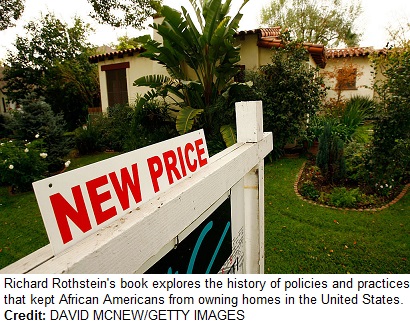
S&P Index Reports Record Drop In U.S. Home Prices

The US has a long bad history of racial discrimination. This allowed many Whites to build wealth through home equity, while this privilege and trend was not available (or extended) to Black-and-Brown Americans.

For much of the past century, the differing privileges were tied to a de jure segregation, but surprisingly, the patterns, trending and habits continue to this day mostly because of a de facto segregation ― through individual prejudices, income differences, or the actions of private institutions like banks and real estate agencies.

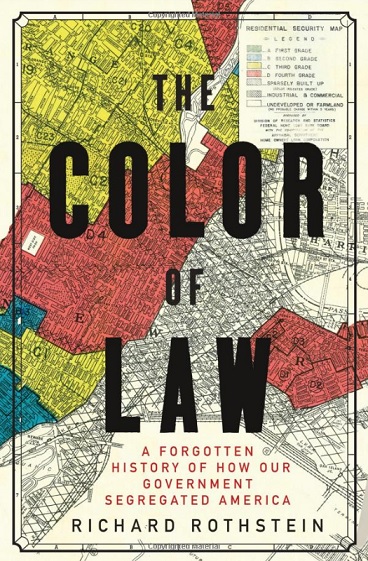
This is the claim of the new book The Color of Law: A Forgotten History of How Our Government Segregated America – by author Richard Rothstein. This is the America today. See the review of this book here:

Book Review: The Color of Law: A Forgotten History of How Our Government Segregated America – 1st Edition By Author: Richard Rothstein

“Rothstein has presented what I consider to be the most forceful argument ever published on how federal, state, and local governments gave rise to and reinforced neighborhood segregation.” ― William Julius Wilson

In this groundbreaking history of the modern American metropolis, Richard Rothstein, a leading authority on housing policy, explodes the myth that America’s cities came to be racially divided through de facto segregation―that is, through individual prejudices, income differences, or the actions of private institutions like banks and real estate agencies. Rather, The Color of Law incontrovertibly makes clear that it was de jure segregation―the laws and policy decisions passed by local, state, and federal governments―that actually promoted the discriminatory patterns that continue to this day.

CU Blog - UPDATE - State of the American Union - Housing Segregation - Photo 2Through extraordinary revelations and extensive research that Ta-Nehisi Coates has lauded as “brilliant” (The Atlantic), Rothstein comes to chronicle nothing less than an untold story that begins in the 1920s, showing how this process of de jure segregation began with explicit racial zoning, as millions of African Americans moved in a great historical migration from the south to the north.

As Jane Jacobs established in her classic The Death and Life of Great American Cities, it was the deeply flawed urban planning of the 1950s that created many of the impoverished neighborhoods we know. Now, Rothstein expands our understanding of this history, showing how government policies led to the creation of officially segregated public housing and the demolition of previously integrated neighborhoods. While urban areas rapidly deteriorated, the great American suburbanization of the post–World War II years was spurred on by federal subsidies for builders on the condition that no homes be sold to African Americans. Finally, Rothstein shows how police and prosecutors brutally upheld these standards by supporting violent resistance to black families in white neighborhoods.

The Fair Housing Act of 1968 prohibited future discrimination but did nothing to reverse residential patterns that had become deeply embedded. Yet recent outbursts of violence in cities like Baltimore, Ferguson, and Minneapolis show us precisely how the legacy of these earlier eras contributes to persistent racial unrest. “The American landscape will never look the same to readers of this important book” (Sherrilyn Ifill, president of the NAACP Legal Defense Fund), as Rothstein’s invaluable examination shows that only by relearning this history can we finally pave the way for the nation to remedy its unconstitutional past.

Source: Ret’d 05-11-2017 from: https://www.amazon.com/Color-Law-Forgotten-Government-Segregated/dp/1631492853
The author was a guest on a radio-talk show NPR’s 1A, where he articulated a lot of  these fine points from his book; he was joined by other guests that  are Subject Matter Experts in this American drama. See-listen to the PODCAST here:

AUDIO-PODCASTThe Long History And Lasting Legacy Of Housing Segregationhttp://the1a.org/audio/#/shows/2017-05-10/the-long-history-and-lasting-legacy-of-housing-segregation/110861/@00:00

 What Is Whiteness?

Posted May 10, 2017 – How more than a century of housing segregation has left the nation starkly divided by race.

This is the America that many Caribbean citizens – our Black-and-Brown – flee to looking for refuge from Caribbean life. The book Go Lean…Caribbean posits that these ones jump from the “frying-pan into the fire”.

What’s more the Go Lean book asserts – in the quest to lower the rate of societal abandonment – that it is easier to remediate social defects like these in the Caribbean homeland than to “Come to America” thinking that the “grass is greener”.

It is not!

This was the declaration from this previous blog-commentary from the movement behind the book Go Lean…Caribbean. This quotation from that previous blog is spot on:

The Caribbean Diaspora have fled their Caribbean homelands over past decades in search of better economic opportunities. It is now the conclusion that many of these “lands of refuge” are rigged in favor of certain ethnic groups; those groups do not include the “Black-and-Brown” of the Caribbean. This commentary has relayed, repeatedly, that this Caribbean-bred demographic can do better at home … in the Caribbean.

Rather than just this excerpt, the entire blog-commentary from August 5, 2014 is encored here:

——————–

Go Lean Commentary – The Crisis in Black Homeownership

The United States of America has been the best economic manifestation in the history of mankind, (as declared in the book Go Lean…Caribbean Page 67), yet the experience has not been the same for all of its citizens. This definitely applies to the “black and brown” populations. The Caribbean Diaspora fits this classification and their experience fits 100% to the events related in the foregoing news article.

The US is the “land of the free and the home of the brave”, but some restrictions apply. This reality is not new, as racial disparities have long existed in the history of America. But after a major social revolution in the 1960’s, positive change came to American minorities, following by decades of progress.

Then 2008 happened …

That year saw the crisis of the Great Recession where American society lost $11 Trillion in net worth; then later regained $13.5 Trillion; (Go Lean book Page 69). According to the foregoing article, the Great Recession losses were not evenly distributed; nor was the subsequent recovery – those who lost the net worth (Middle Class) were not the ones who recovered (One Percent).

How the recession turned owners into renters and obliterated Black American wealth.

By: Jamelle Bouie

CU Blog - The Crisis in Black Homeownership - PhotoIn 2005, three years before the Great Recession, the median black household had a net worth of $12,124. Yes, this was far behind the median white household—which had a net worth of $134,992—but it was a huge improvement from previous decades, in which housing discrimination made wealth accumulation difficult (if not impossible) for the large majority of African-American families.

By the official end of the recession in 2009, median household net worth for blacks had fallen to $5,677—a generation’s worth of hard work and progress wiped out. (The number for whites, by comparison, was $113,149.) Overall, from 2007 to 2010, wealth for blacks declined by an average of 31 percent, home equity by an average of 28 percent, and retirement savings by an average of 35 percent. By contrast, whites lost 11 percent in wealth, lost 24 percent in home equity, and gained 9 percent in retirement savings. According to a 2013 report [a] by researchers at BrandeisUniversity, “half the collective wealth of African-American families was stripped away during the Great Recession.”

It was a startling retrenchment, creating the largest wealth, income, and employment gaps since the 1990s. And, if a new study [b] from researchers at CornellUniversity and RiceUniversity is any indication, these gaps are deep, persistent, and difficult to eradicate.

In the study, called “Emerging Forms of Racial Inequality in Homeownership Exit, 1968–2009,” sociologist Gregory Sharp and demographer Matthew Hall examine the relationship between race and risk in homeownership. Simply put, African-Americans are much more likely than whites to switch from owning homes to renting them.

“The 1968 passage of the Fair Housing Act outlawed housing market discrimination based on race,” explained Sharp in a press release. “African-American homeowners who purchased their homes in the late 1960s or 1970s were no more or less likely to become renters than were white owners. However, emerging racial disparities over the next three decades resulted in black owners who bought their homes in the 2000s being 50 percent more likely to lose their homeowner status than similar white owners.”

This wasn’t a matter of personal irresponsibility. Even after adjusting for socio-economic characteristics, debt loads, education, and life-cycle traits like divorce or job loss, blacks were more likely to lose their homes than whites.

If you’re familiar with American history and housing policy, this shouldn’t come as a surprise. The explicit housing discrimination of the mid-20th century has left a mark—arguably a scar—on the landscape of American homeownership. The combination of red-lining, block-busting, racial covenants, and other discriminatory measures means that, even now, a majority of blacks live in neighborhoods with relatively poor access to capital and mortgage loans. What’s more, this systematic discrimination has left many black households unable to afford down payments or other housing costs, even if loans are available.

And in the event that black households are able to save and afford a home, they aren’t as financially secure as their white counterparts. To wit, middle-class African-Americans are more likely to belong to the lower middle class of civil servants and government workers—professions that, in the last five years, have been slashed as a consequence of mass public-sector downsizing [c]. All else being equal, a black schoolteacher who loses her job to budget cuts is less likely to have savings—and thus a safety net—than her white counterpart.

But this isn’t just a story of legacies and effects. In addition to showing the consequences of past discrimination, Sharp and Hall argue that African-Americans have been victimized by a new system of market exploitation. Banks like Wells Fargo steered [d] blacks and other minorities into the worst subprime loans, giving them less favorable terms than whites and foreclosing on countless homes. In a 2012 lawsuit [e], the ACLU and National Consumer Law Center alleged that the now-defunct New Century Financial, working with Morgan Stanley, pushed thousands of black borrowers into the riskiest loans, leaving many in financial ruin. As early as 2005, the Wall Street Journal reported [f] that blacks were twice as likely to receive subprime loans. And in a New York University study published last year [g], researchers found that black and Hispanic families making more than $200,000 a year were more likely to receive subprime loans than white families making less than $30,000.

Together, all of this means that—according to Sharp and Hall—African-Americans are 45 percent more likely than whites to lose their homes. That means they’re more likely to lose their accumulated wealth and to slide down the income ladder, and less likely to pass the advantages of status and mobility to their children.

Apropos of that observation, recent data from the Bureau of Labor Statistics [h] shows an incredible level of youth unemployment for blacks and Latinos. More than 21 percent of African-Americans aged 16 to 24 are out of work, compared with a national average of 14.2 percent. For black teenagers in particular, joblessness soars to nearly 40 percent. It’s a catastrophe with serious economic consequences. The Center for American Progress estimates [i] that the young adults who experienced long-term unemployment during the worst of the recession will lose more than $20 billion in earnings over the next 10 years. And given the slow recovery, odds are good they’ll never recover those lost earnings.

It’s tempting to treat these as subsets of broader problems: poor assistance to homeowners and too much austerity. But they’re not. Even during the boom economy of the 1990s, black employment lagged behind the national average. And the racial wealth gap is a persistent fact of American life.

Likewise, the challenges of black homeownership are a function of discriminatory housing policy [j], as are a whole host of other problems, from mass incarceration and overly punitive policing to poor air quality [k] and food access. These challenges are heavily location-dependent, which is another way to say they are heavily racialized and most prevalent in the segregated, working-class or low-income communities that characterize life for most African-Americans [l], even those with middle-class incomes.

For reasons both political and ideological, it’s nearly verboten in mainstream conversation to argue that racialized problems require race-conscious solutions. Knowing what we know about the demographics of foreclosures, for example, we should ensure any program to help underwater homeowners includes a specific measure to assist black victims of predatory lending, who may need additional help to get on sure footing.

For more than anyone else, this is a message for liberals and progressives, who—for all of their racial sensitivity—are still reluctant to tackle the economic dimensions of racism, even as they represent the vast majority of nonwhite voters and draw critical support from African-American constituencies. It’s how Elizabeth Warren could give “11 Commandments for Progressives” [m] —and receive huge applause—without mentioning the deep problems of racial inequality. One of her commandments is “that no one should work full-time and still live in poverty, and that means raising the minimum wage.” But solving this problem for African-Americans and Latinos—who tend to live in areas that are segregated from job opportunities—is very different than solving it for whites.

While conservatives and Republicans can play a role here, it’s Democrats who are committed to reducing income inequality and bringing balance to our lopsided economic system. Success on those fronts requires a return to race-conscious policymaking, from programs to increase the geographic mobility of low-income workers—relocation grants for individuals or transportation grants for communities with a spatial mismatch between jobs and housing—to public works programs aimed at low-income minority communities, to race-based affirmative action as a way to boost a flagging black middle class.

There’s little in American life that escapes the still-powerful pull of past and present racism, and effective policymaking—to say nothing of effective problem-solving—requires a response to that racism. Otherwise, we entrench the same disparities for a new generation.

——–

Jamelle Bouie is a Slate staff writer covering politics, policy, and race.
The Slate – Daily Magazine for the Web – Posted 07-24-2014; retrieved 08-04-2014
http://www.slate.com/articles/news_and_politics/politics/2014/07/black_homeownership_how_the_recession_turned_owners_into_renters_and_obliterated.html

The points of this foregoing article aligns with the Go Lean book and the collection of blogs-commentaries. The book posits that the crisis persists for the Caribbean and their Diaspora in North America and Europe. What’s more, this movement asserts that this crisis, any crisis, is a terrible thing to waste.

800px-Statue_of_Liberty,_NYThe Caribbean Diaspora have fled their Caribbean homelands over past decades in search of better economic opportunities. It is now the conclusion that many of these “lands of refuge” are rigged in favor of certain ethnic groups; those groups do not include the “Black-and-Brown” of the Caribbean. This commentary has relayed, repeatedly, that this Caribbean-bred demographic can do better at home … in the Caribbean. The following are related previous posts:

Unfortunately for the Caribbean, this societal abandonment has continued. Analysis by the Inter-American Development Bank asserts that the Caribbean continues to endure a brain drain of 70% among the college educated population; (https://goleancaribbean.com/blog/?p=1433).

This blog entry depicted how the Caribbean Diaspora that fled to Great Britain has not fared well; (https://goleancaribbean.com/blog/?p=1683)

In addition to economics, there is the concern for security and justice. This blog entry (https://goleancaribbean.com/blog/?p=546) related the dual standards of justice in the US, where all men are treated as equals (wink-wink), just some are more equal than others.

Yes, as the old adage relates: “the grass is not greener on the other side”. See this VIDEO here (Part 1 of 2):

(Click on first continuation VIDEO for Part 2 of 2 or click here: https://www.youtube.com/watch?v=gOS3BBmUxvs)

The assertion of the book Go Lean…Caribbean is that once the proposed empowerments are put in place, the Caribbean Diaspora should consider repatriating to their ancestral homelands.

Social Scientists maintain that when animals/mammals are confronted with threats, they have to choose between (stand and) fight or flight. For 50 years, the Caribbean citizens have defaulted to flight. Change has now come to the Caribbean. The book Go Lean…Caribbean serving as a roadmap for the introduction and implementation of the technocratic Caribbean Union Trade Federation (CU), hereby presents “stand and fight” options. This roadmap will spearhead the elevation of Caribbean society. The prime directives of the CU are presented as the following 3 statements:

  • Optimization of the economic engines in order to grow the regional economy & create 2.2 million new jobs at home.
  • Establishment of a security apparatus to protect the resultant economic engines.
  • Improve Caribbean governance to support these engines.

The book posits that the improved conditions projected over the 5 years of the roadmap will neutralize the impetus for Caribbean citizens to flee, identified as “push and pull” factors. This point is stressed early in the book (Page 13) in the following pronouncements in the Declaration of Interdependence:

xix.      Whereas our legacy in recent times is one of societal abandonment, it is imperative that incentives and encouragement be put in place to first dissuade the human flight, and then entice and welcome the return of our Diaspora back to our shores. This repatriation should be effected with the appropriate guards so as not to imperil the lives and securities of the repatriated citizens or the communities they inhabit. The right of repatriation is to be extended to any natural born citizens despite any previous naturalization to foreign sovereignties.

xx.   Whereas the results of our decades of migration created a vibrant Diaspora in foreign lands, the Federation must organize interactions with this population into structured markets. Thus allowing foreign consumption of domestic products, services and media, which is a positive trade impact. These economic activities must not be exploited by others’ profiteering but rather harnessed by Federation resources for efficient repatriations.

This foregoing article highlights the new realities ushered into the world as a result of the events of the Year 2008. The Go Lean book focuses heavy on this subject, even identifying this as a motivation in the same Declaration of Interdependence early in the book (Page 13):

xxv.   Whereas the legacy of international democracies had been imperiled due to a global financial crisis, the structure of the Federation must allow for financial stability and assurance of the Federation’s institutions. To mandate the economic vibrancy of the region, monetary and fiscal controls and policies must be incorporated as proactive and reactive measures. These measures must address threats against the financial integrity of the Federation and of the member-states.

The Go Lean roadmap proposes a community ethos in which economic principles are recognized as playing a crucial role in the chain-of-events that led to fight-or-flight decisions for Caribbean Diaspora. (These principles were always the reality, just not professionally managed as such). These principles are identified and qualified (Page 21) as follows:

1. People Choose
2. All Choices Involve Costs
3. People Respond to Incentives in Predictable Ways
4. Economic Systems Influence Individual Choices and Incentives
5. Voluntary Trade Creates Wealth
6. The Consequences of Choices Lie in the Future

These principles cannot be glossed over or handled lightly; this is why the Go Lean book contains 370 pages of finite details for managing economic change in the region. In addition to the assessments of the region’s standings, the book contains the following sample of community ethos, strategies, tactics, implementations and advocacies to impact the Caribbean homeland:

Community Ethos – Job Multiplier Page 22
Community Ethos – Lean Operations Page 24
Community Ethos – Return on Investments Page 24
Community Ethos – Ways to Impact the Future Page 26
Strategy – Competition – Remain Home –vs- Emigrate Page 49
Strategy – Agents of Change – Aging Diaspora Page 57
Tactical – Growing the Caribbean Economy to $800 Billion Page 67
Tactical – Separation of Powers – Versus Member-States Governments Page 71
Implementation – Year 1 / Assemble Phase Page 96
Implementation – Ways to Deliver Page 109
Implementation – Ways to Better Manage Debt Page 114
Implementation – Trade Mission Objectives Page 116
Implementation – Reasons to Repatriate Page 118
Anecdote – Experiences of a Repatriated Resident Page 126
Planning – 10 Big Ideas for the Caribbean Region Page 127
Planning – Lessons Learned from 2008 Page 136
Advocacy – Ways to Grow the Economy Page 151
Advocacy – Ways to Create Jobs Page 152
Advocacy – Ways to Improve Credit Ratings Page 155
Advocacy – Ways to Improve Housing Page 161
Advocacy – Ways to Impact Wall Street Page 200
Anecdote – Experiences of Diaspora Member Living Abroad Page 216
Advocacy – Ways to Impact the Diaspora Page 217
Advocacy – Ways to Help the Middle Class Page 223
Appendix – Caribbean Emigration Statistics Page 269
Appendix – Credit Ratings Agencies Role in 2008 Page 276

The Go Lean roadmap has simple motives: fix the problems in the homeland to make the Caribbean a better place to live, work and play. We want to keep Caribbean citizens in the Caribbean. There should be no need to go abroad and try to foster an existence in a foreign land. There is heavy-lifting wherever a person resides. Let’s do the “lifting” here, where at least we are at home and we are treated equitably.

Too many people left, yet have too little to show for it. Now is the time for all of the Diaspora (those in the US, and other countries) to lean-in for the empowerments described in the book Go Lean … Caribbean. We understand your pain, we have been impacted too. (The publishers of the book were entrenched in the Wall Street culture in 2008). This Big Idea now is to use the same energy and innovation to create solutions for Main Street – but not Main Street USA, rather Main Street Caribbean.

This is a dramatic change for the Caribbean, one that is overdue, an invitation to build an elevated society in the Caribbean that many had fled to find elsewhere, yet failed. We can make the Caribbean a better place to live, work and play. We can succeed here.

Download the free e-Book of Go Lean … Caribbean – now!

Sign the petition to lean-in for the roadmap for the Caribbean Union Trade Federation. 

———————————————————————————————–

Appendices:

a. Retrieved from https://www.evernote.com/shard/s4/sh/2f378f98-d21b-4f5b-89d4-c3a47419b0ad/479f14e61917697b135246e01d20f85f

b. Retrieved from http://news.rice.edu/2014/07/22/african-american-homeownership-increasingly-less-stable-and-more-risky-2/

c. Retrieved from http://www.epi.org/publication/public-sector-job-losses-unprecedented-drag/

d. Retrieved from http://articles.baltimoresun.com/2012-07-12/news/bs-md-ci-wells-fargo-20120712_1_mike-heid-wells-fargo-home-mortgage-subprime-mortgages

e. Retrieved from http://www.citylab.com/housing/2012/10/did-big-banks-subprime-mortgage-crisis-violate-civil-rights-law/3598/

f. Retrieved from http://online.wsj.com/news/articles/SB111318092881303093

g. Retrieved from http://www.citylab.com/housing/2013/08/blacks-really-were-targeted-bogus-loans-during-housing-boom/6559/

h. Retrieved from http://www.npr.org/blogs/codeswitch/2014/07/21/329864863/the-youth-unemployment-crisis-hits-african-americans-hardest

i. Retrieved from http://www.americanprogress.org/issues/labor/report/2013/04/05/59428/the-high-cost-of-youth-unemployment/

j. Retrieved from http://www.thedailybeast.com/articles/2014/03/13/how-we-built-the-ghettos.html

k. Retrieved from http://grist.org/climate-energy/before-repairing-the-climate-well-have-to-repair-the-impacts-of-racism/

l. Retrieved from http://www.slate.com/articles/news_and_politics/politics/2014/04/desean_jackson_richard_sherman_and_ black_american_economic_mobility_why.html

m. Retrieved from http://www.vox.com/2014/7/21/5918063/elizabeth-warrens-11-commandments-for-progressives-show-democrats

 

Share this post:
, ,

UPDATE: Understand the Market, Plan the …

Update – Go Lean Commentary

“The Prime Minister bet his administration on the prospect of Carnival and now, its election time.” – Previous Go Lean commentary.

It’s official, that bet has failed! The Prime Minister (PM) of the Bahamas and leader of the Progressive Liberal Party (PLP) – Perry G. Christie – has been defeated. See full story here (posted 05/11/2017):

PLP Feel The Heat In FNM Landslide Win

CU Blog - UPDATE - PM Christie and Bahamas Junkanoo Carnival - Photo 1

CU Blog - Understand the Market, Plan the ... - Photo 2

New Prime Minister Dr. Hubert Minnis

Out with the old, in with the new!

This commentary has observed-and-reported on the Bahamas for the last 5 years and the “bet” that the PM made was related to more than just Carnival; he also bet on:

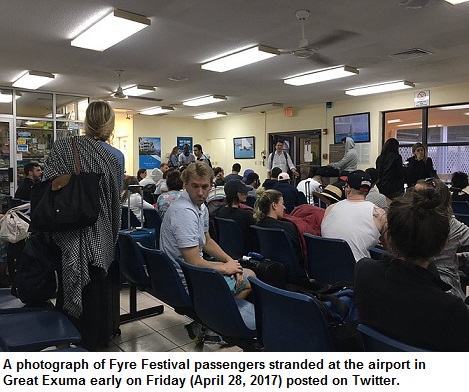
  • Music Festival-Event – The Fyre Festival event was a fiasco; it went up in flames on April 28, 2017 after getting government permissions and support beforehand. The mass population of Bahamian stakeholders – other than the government – knew nothing of this event until it was an international embarrassment – a “Black-eye”.
  • Value-Added Tax – New 7.5% Sales & Use tax implementation increased the tax burden on the poor more than the rich.
  • Baha Mar Resort & Casino – $2 Billion Resort & Casino stalled due to government meddling in the Developer-Banker conflict.
  • Grand Bahama (Freeport) – 2nd City economic progress stalled; decisions on extending Investment Tax Credits were inexplicably stalled and extended for 6-month intervals, until it was finally granted for a reasonable period.

So when the outgoing PM dissolved Parliament on April 11, 2017 and called elections for May 10, it was the only chance for the people to vocalize their displeasure. They shouted an almost unanimous veto of Christie’s policies and administration, giving the Opposition Party (Free National Movement) 35 of the 39 seats in the House of Assembly – see Polling Results in Appendix B below. (We wish all success to the new government of Dr. Hubert Minnis, but our plan is different, better, as it relates to the full region of all 30 Caribbean member-states, not just the Bahamas alone.)

It is obvious that the outgoing PM also failed in the primary functionality of any Planning apparatus:

Understand the Market; Plan the … [Enterprise]

This point is detailed in the book Go Lean…Caribbean as a necessary responsibility for the new Caribbean Union Trade Federation (CU).  The CU is presented as a technocratic solution to the societal defects for the Bahamas and the rest of the Caribbean – 30 member-states in total. The book quotes (Page 57):

What are the Agents of Change that will affect our customers [citizens] and our competitors in the future?

Shakespeare described change as “an undiscovered country”. No one knows exactly what will happen next and when. The best practice is to monitor the developments in the marketplace, adapt and adjust as soon as possible. This description of a nimble response is the purpose behind “Agile” project management and other Lean management methodologies.

The CU will be lean.

Assuming a role to “understand the market and plan the business” requires looking at the business landscape today and planning the strategic, tactical, and operational changes to keep pace with the market and ahead of competitors. Strategic changes that must be accounted for now, includes: Technology, Aging Diaspora, Globalization and Climate Change.

Understanding the market means taking an accurate assessment of the status quo. What truly are the needs and wants of the community; and how much solution can we really provide, so as to balance our promises? This is Planning 101; understanding the market and planning the business, planning the security apparatus, planning the government, planning the Federation.

Federation?

This is the quest for the movement behind the book Go Lean…Caribbean. The book serves as a roadmap for the introduction and implementation of the Caribbean Union Trade Federation (CU). This Federation is an initiative to bring change and empowerment to the Caribbean region; to make the region a better place to live, work and play. This Go Lean roadmap has these 3 prime directives:

  • Optimization of the economic engines in order to grow the regional economy to $800 Billion & create 2.2 million new jobs.
  • Establishment of a security apparatus to ensure public safety for all Caribbean stakeholders and protect the resultant economic engines.
  • Improvement of Caribbean governance to support these engines.

The book features 144 different missions; all centered on a technocracy to elevate the societal engines of economics, security and governance. This is not easy; in fact the book describes this quest – unifying of the region of 42 million people into one Single Market – as heavy-lifting; paralleling the CU effort as a Caribbean version of the American Moon Shot in the 1960’s (Page 127). See this quote here:

The Bottom Line on Kennedy’s Quest for the Moon
On 25 May 1961, US President John F. Kennedy announced his support for the American Space program’s “Apollo” missions and redefined the ultimate goal of the Space Race in an address to a special joint session of Congress: “I believe that this nation should commit itself to achieving the goal, before this decade is out, of landing a man on the moon and returning him safely to the earth”. His justification for the Moon Race was both that it was vital to national security and that it would focus the nation’s energies in other scientific and social fields. [10] This quest was succeeded. At 10:56 pm EDT, on 20 July 1969, the first human (American Astronaut Neil Armstrong) ventured out of the Apollo 11 landing craft and set foot on the Moon declaring: “one small step for man, one giant leap for mankind“. [11]

Other countries have had subsequent moon landings. See VIDEO here:

VIDEO – The History of: The Apollo Space Program – https://youtu.be/kAxWaqM5M80

Published on Apr 27, 2014 – The History Of series intends to inform and entertain viewers about recorded events in human history.

Support this channel: http://www.patreon.com/RobertDavis

For more information about the Apollo Space Program visit the Wikipedia page here: http://en.wikipedia.org/wiki/Apollo_p…
Music: Hans Zimmer – What Are You Going To Do When You Are Not Saving The World (Man of Steel Soundtrack) https://www.youtube.com/watch?v=qpBnx…

Thanks for watching.

  • Category: Education
  • License: Standard YouTube License

This commentary is all about the functionality of planning. Drawing reference to the Go Lean book’s treatment of planning, Page 125 listed this preface:

Planning
The Caribbean Union Trade Federation roadmap catalogs where we are as a region and where we plan to go. This section drills down on the advocacies important for planning the future of the Caribbean.

The issues identified in this section will be incorporated in the CU Treaty with member-states and then in the subsequent constitution, (after an organized Constitution Convention).

Scriptural Quotation – Proverbs 29:18 (King James Version):

    Where there is no vision, the people perish …

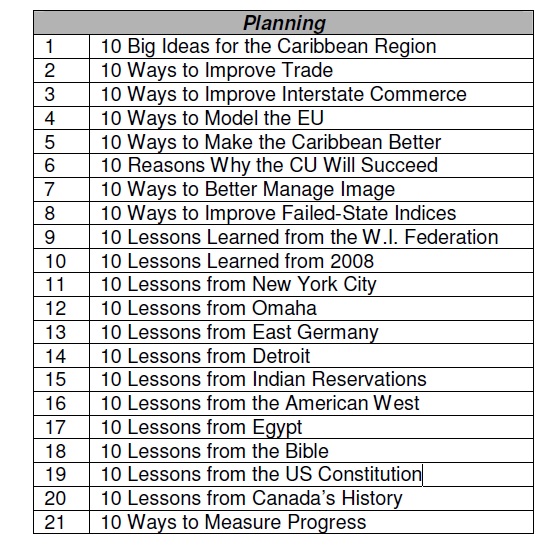
The book then proceeds to list these chapters on planning for the Caribbean stakeholders to consider:

CU Blog - Understand the Market, Plan the ... - Photo 1

The topics in the photo depict a community ethos – the national spirit that drives the character and identity of its people – of learning from other societies who have succeeded and failed at the planning-governing process. This vision was anticipated from the beginning of the Go Lean book, opening with these pronouncements in the Declaration of Interdependence (Pages 12 – 14):

xi. Whereas all men are entitled to the benefits of good governance in a free society, “new guards” must be enacted to dissuade the emergence of incompetence, corruption, nepotism and cronyism at the peril of the people’s best interest.  The Federation must guarantee the executions of a social contract between government and the governed.

xii. Whereas the legacy in recent times in individual states may be that of ineffectual governance with no redress to higher authority, the accedence of this Federation will ensure accountability and escalation of the human and civil rights of the people for good governance, justice assurances, due process and the rule of law. As such, any threats of a “failed state” status for any member state must enact emergency measures on behalf of the Federation to protect the human, civil and property rights of the citizens, residents, allies, trading partners, and visitors of the affected member state and the Federation as a whole.

xxxiii. Whereas lessons can be learned and applied from the study of the recent history of other societies, the Federation must formalize statutes and organizational dimensions to avoid the pitfalls of communities like East Germany, Detroit, Indian (Native American) Reservations, Egypt and the previous West Indies Federation. On the other hand, the Federation must also implement the good examples learned from developments/communities like New York City, Germany, Japan, Canada, the old American West and tenants of the US Constitution.

There is planning first … and then there is delivery.

Planning and delivery are 2 separate and distinct functionalities, but one drives the other. The Go Lean movement, with the branding of Lean in the name is all about the art-and-science of project delivery. The book explains (Page 4) that the Caribbean Union Trade Federation considers the word lean to be a noun, a verb and an adjective. It considers lean as a “core idea to maximize value while minimizing waste. Simply [put], lean means creating more value for stakeholders with fewer resources. A lean organization understands value and focuses its key processes to continuously increase it. The ultimate goal is to provide perfect value to the customer/constituent/beneficiary through a perfect value creation process that has zero waste.”

With confidence we can declare that the CU will “understand the market and plan the delivery”. Truly, then …

… “a Change Is Gonna Come”!

The Go Lean book declares that for permanent change to take place there must first be an adoption of new community ethos. The roadmap was constructed with the new community ethos in mind (see Page 20), plus the execution of strategies, tactics, implementation and advocacies to deliver on the plans for an elevated Caribbean.

Yes, this plan, the Go Lean roadmap is conceivable, believable and achievable. We can make the Caribbean region – all 30 member-states – better homelands to live, work and play. 🙂

Download the free e-Book of Go Lean … Caribbean – now!

Sign the petition to lean-in for the roadmap for the Caribbean Union Trade Federation. 

————-

Appendix A – Cited Footnote References

10 – Kennedy, John F. (25 May 1961). “Special Message to the Congress on Urgent National Needs”. Historical Resources. John F. Kennedy Presidential Library and Museum. p. 4. Retrieved 16 August 2010.

11 – Murray, Charles; Catherine Bly Cox (1990). Apollo: The Race to the Moon. New York: Touchstone (Simon & Schuster). ISBN 0-671-70625-X.

————-

Appendix B – General Election 2017

Commonwealth of The Bahamas – *OFFICIAL RESULTS*

Note: Her Excellency Dame Marguerite Pindling, Governor-General of The Bahamas, has invited Prime Minister-elect Hubert Minnis to be sworn in at Government House at 5 pm [on May 11, 2017].

—–
Free National Movement (35 seats)
✔Hubert Minnis (Killarney)
✔K. Peter Turnquest (East Grand Bahama)
✔Adrian Gibson (Long Island)
✔Brensil Rolle (Garden Hills)
✔Brent Symonette (St. Anne’s)
✔Carlton Bowleg Jr. (North Andros & the Berry Islands)
✔Desmond Bannister (Carmichael)
✔D. Halson Moultrie (Nassau Village)
✔Darren Allan Henfield (North Abaco)
✔Dionisio D’Aguilar (Freetown)
✔Donald L. Saunders (Tall Pines)
✔Duane Sands (Elizabeth)
✔Elsworth Johnson (Yamacraw)
✔Frankie Campbell (Southern Shores)
✔Frederick McAlpine (Pineridge)
✔Hank Johnson (Central & South Eleuthera)
✔Iram Lewis (Central Grand Bahama)
✔James Albury (Central &a South Abaco)
✔Jeffrey Lloyd (South Beach)
✔Lanisha Tolle (Sea Breeze)
✔Mark Humes (Fort Charlotte)
✔Marvin Dames (Mount Moriah)
✔Michael Foulkes (Golden Gates)
✔Michael Pintard (Marco City)
✔Miriam Reckly-Emmanuel (MICAL)
✔Pakeisha Parker-Edgecombe (West Grand Bahama & Bimini)
✔Reece Chipman (Centreville)
✔Renward Wells (Bamboo Town)
✔Reuben Rahming (Pinewood)
✔Rickey Mackey (North Eleuthera)
✔Romauld “Romi” Ferreira (Marathon)
✔Shenendon Cartwright (St. Barnabas)
✔Shonel Ferguson (Fox Hill)
✔Travis Robinson (Bain’s & Grant’s Town)
✔Vaughn Miller (Golden Isles)

—–
Progressive Liberal Party (4 seats)
✔Phillip Davis (Cat Island, Rum Cay and San Salvador)
✔Picewell Forbes (Mangrove Cay & South Andros)
✔Glenys Hanna-Martin (Englerston)
✔Chester Cooper (Exumas & Ragged Island)

Share this post:
, ,
[Top]

Robots Building Houses – More than Fiction

Go Lean Commentary

Robotic Builder - Photo 2What do you want to do when you grow up?

This is the familiar career planning question that is asked of young ones. Today, the responders may answer with noble careers like: doctor, lawyer, accountant, computer programmer, engineer, etc. Rarely, do we hear answers like bricklayer, mason or carpenter; though these too are noble professions. But food, clothing and shelter are basic needs that everyone must make provision for. So if our young people are not yearning for those jobs, how will the needs be fulfilled?

In the US, there is the sarcastic joke that the country brings in “immigrants” to do the jobs Americans don’t want to do; think migrant farmers, sweat shops and construction sites. But “now” … emerges a new option:

Robots!

Robotic Builder - Photo 3

Yes, the word “now” is appropriate. The idea of robots building houses is not so science fiction; not so far-fetch in the future; and not so unlikely. This is happening now! See the news article & VIDEO’s here:

Title: Meet The Robots That Will Build Your Next House
By: Tyler Durden

The U.S. residential construction industry employs 100’s of thousands of people each year in various skilled trades that earn hourly pay rates ranging from minimum wage to $100 per hour, or more.

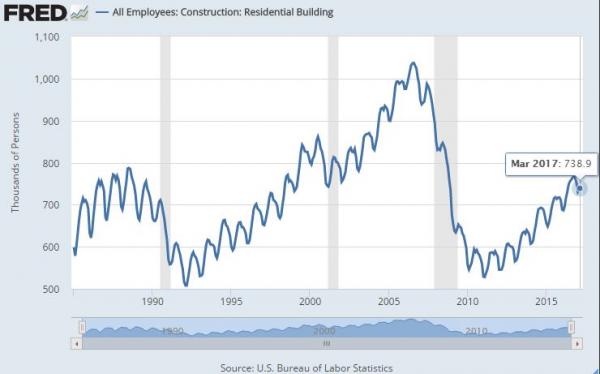
Per BLS statistics, the residential housing space employed over 1 million people at the height of the housing bubble and now accounts for nearly 750,000 jobs.

Of course, just like the auto industry, many of those jobs can be done at a fraction of the cost and with much greater precision by industrial robots.  Moreover, those robots work inside a warehouse where they’re immune from the negative consequences of weather and can work 365 days per year without compromising construction integrity.

As Blueprint Robotics’ CEO, Jerry Smalley, points out, nearly 60% of a custom home can be built inside a warehouse and shipped on a standard flatbed truck to its destination for installation. [(See Blueprint Robotics VIDEO below.)]

Production starts with the most precise robot in our factory, the WBZ-160 beam-center. This saw cuts the top and bottom plates for our wall, and pre-drills for the installation of plumbing, venting and electrical rough-in that is soon to be installed.

It’s all pre-determined by the plans you provide. Everything in our factory is pre-cut: drilled, trimmed, fastened and routed with CNC precision.

Once we’ve got the lumber cut, we move to the Framing Station. This machine produces 40 linear feet of framed wall in about 11 minutes. Because robots are executing the nail pattern, it’s incredibly precise. The nail will never be outside of the stud: no misses here.

The wall comes out of the framing station and moves to our Drywall Bridge Station. Here we put a layer of OSB on the frame followed by a layer of drywall. The OSB is nailed to the stud, while the drywall is glued to the OSB and screwed to the stud. The Drywall Bridge Station is also where any openings in the wall, doors, windows, outlets and switches are precisely cut to perfectly square dimensions.

As Bloomberg notes, modular houses, at least in the U.S., used to be reserved for smaller, cheaper homes and that stigma restricted the industry from taking market share in the high-end McMansion neighborhoods.  But, that is all gradually changing as modern technology allows companies like Blueprint to manufacture far more complicated custom homes rather than the simple ‘boxes’ of the past.

Today’s plants are capable of producing bigger buildings with more elaborate designs. The Blueprint factory in Baltimore – see VIDEO #1 below – is one of the first in the U.S. to use robots, Fleisher said. Taller multifamily buildings, dorms and hotels are increasingly being manufactured indoors. And so are mansions that sell for millions.

“Some builders won’t even advertise they work with modular companies like us,” said Myles Biggs, general manager of Ritz-Craft Corp.’s Pennsylvania construction facility. “You could be driving past a modular home and not even know it, because it looks just like one next door.”

Ritz-Craft can deliver a single-family house in six to eight weeks, on average. Having an indoor facility means weather delays are rarely a factor. Each worker is given a narrow concentration, like tiling floors or sanding drywall, which increases production speed. People without any background in construction can become skilled laborers in two weeks, according to Biggs.

There doesn’t seem to be any stigma for customers of Connecticut Valley Homes, a builder that assembles factory-made components on lots in New England, including near the stately mansions of Greenwich. The East Lyme-based firm is “booming at moment,” with deposits for 42 houses, up about 50 percent from the same time last year, said Dave Cooper, senior building consultant. The company built only eight homes in 2011, when the housing market was hitting bottom.

Looks like Bill Gates will soon have a lot more robots to tax in the residential construction space.

Source: Posted April 17, 2017; retrieved May 9, 2017 from: http://www.zerohedge.com/news/2017-04-17/meet-robots-will-build-your-next-house

———-

VIDEO # 1 – Blueprint Robotics – https://youtu.be/1Rx04wVn7vM

Uploaded on Jul 21, 2016 – A better way to build.

———-

VIDEO # 2 – Robot bricklayer can build a whole house in two days – https://youtu.be/V72Hm3PIM3Q

Published on Jun 26, 2015 – Robot bricklayer can build a whole house in two days

An Australian engineer has built a robot that can build houses in two hours, and could work every day to build houses for people.
Human house-builders have to work for four to six weeks to put a house together, and have to take weekends and holidays. The robot can work much more quickly and doesn’t need to take breaks.

Hadrian could take the jobs of human bricklayers. But its creator, Mark Pivac, told PerthNow that it was a response to the lack of available workers — the average age of the industry is getting much higher, and the robot might be able to fill some of that gap.

“People have been laying bricks for about 6000 years and ever since the industrial revolution, they have tried to automate the bricklaying process,” Pivac told PerthNow, which first reported his creation. But despite the thousands of years of housebuilding, most bricklaying is still done by hand.
Hadrian works by laying 1000 bricks an hour, letting it put up 150 houses a year.

It takes a design of the house and then works out where all of the bricks need to go, before cutting and laying each of them. It has a 28-foot arm, which is used to set and mortar the brick, and means that it doesn’t need to move during the laying.
Pivac will now work to commercialise the robot, first in West Australia but eventually globally.

http://www.independent.co.uk/life-sty…

The subjects of robots building houses and 3-D Printing of construction materials are just part of the “joys and pains” of modern life: one step forward; two steps backwards.

Yes, this news is not all positive; there are a lot of downsides with developments like robotic fabrication. For instance:

Jobs

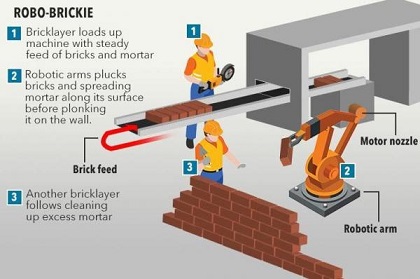
The foregoing article referred to the eventually – the transformative change – depicted in this photo here and a related AUDIO-Podcast from National Public Radio (NPR):

Robotic Builder - Photo 1

AUDIO-Podcast Title: Robots and Our Automated Future – http://www.npr.org/podcasts/510053/on-point-with-tom-ashbrook

Posted May 8, 2017 – Will your next home be built by robots? We’ll look at the growing robot boom and American jobs.

So the planners of the societal engines must consider this eventually. They must “understand the market and plan the business [economy]”. This is the charter of planning organizations. There must be such a role for the Caribbean, so declares the book Go Lean…Caribbean. It warns (Page 126) of the dreaded prophecy from the Bible:

Where there is no vision, the people perish – Proverbs 29:18 (King James Version)

As noted in the foregoing, robotic fabrication can be deemed the “Robot Apocalypse”; it is a matter of serious concern for a lot of communities. The fear is NOT that robots will take over the planet and annihilate the humans, but rather take the jobs.

This is no long-range forecast; this is the current threat. Notice the systems being tested and deployed in the Appendices below; this acute transformation is happening now in real life. The Go Lean book also asserted (Page 260) that construction industry jobs have a job multiplier factor of up to 9.1, where each direct job would indirectly support 9.1 other jobs. All of this would be at risk with the Robot Apocalypse hitting the construction-homebuilding industry. 🙁

The book Go Lean…Caribbean serves as a roadmap for the introduction and implementation of the technocratic Caribbean Union Trade Federation (CU). The book acknowledges that “Agents of Change” have now impacted the Caribbean region so negatively that the communities are now in crisis. Alas, the book declares that this “crisis is a terrible thing to waste”.

The book seeks to prepare the region for 4 Agents of Change, identifying these 2 (Page 57) as related to this commentary:

  • Technology
  • Globalization

The underlying issue with the Robot Apocalypse or robotic fabrication is that the technological systems and end-products can be developed anywhere around the world and shipped to our region for deployment. The threat is that these changes will undermine the societal engines in the process. Imagine the trade deficit with foreign countries that develop, manufacture and ship these systems and end-products – this fact affects our foreign currency reserves. Imagine too, our communities’ security needs, because of the preponderance of hurricanes and earthquakes in our region. Lastly the shock to the national tax rolls (no payroll-pension contributions) will impact the governing apparatus as well. This would truly be apocalyptic as these 3 societal engines – economic, security and governance – constitute the foundations of our society. This corresponds with the prime directives of the Go Lean/CU roadmap, which declares the quest as follows:

  • Optimization of the economic engines in order to grow the regional economy to $800 Billion & create 2.2 million new jobs.
  • Establishment of a security apparatus to ensure public safety (i.e. building standards) and protect the resultant economic engines.
  • Improvement of Caribbean governance – remembering that robots do not pay income taxes – to support these engines.

The changes, challenges and opportunities of robotic fabrication equipment had been previously detailed in August 2015 in a blog-commentary related to 3D Printing. This quotation here succinctly foretells the future societal “apocalypse”:

The new reality of 3D Printing is now changing business models. Imagine distributed manufacturing where the additive manufacturing process would be combined with cloud computing technologies to allow for decentralized and geographically independent distributed production.[74] For example, make a car, with parts sourced from different locations by different 3D Printers. Under this new scheme, the creation of chattel goods will be a product of intellectual property.

The future is exciting!

Here comes change! Consider the governmental consequences:

    If Caribbean governments depend on ‘Customs Duties’ of manufactured goods for a revenue source, they are hereby put on notice that this revenue stream will dry up. In many countries, (the Bahamas for example), the duty rates for automobiles are on a sliding scale from the high of 85% down to 55%. With an average costs of US$25,000, that is a lot of lost revenue for a member-state to adjust to.

The future is scary!

The book Go Lean…Caribbean focuses heavily on the future, and how to manage, monitor, and mitigate the changes (good and bad) that the future will bring. This acute transformation of 3D Printing is a good model of the type of innovation the Go Lean book anticipates. The book posits that the Caribbean region must not only be on the consuming end of these developments; we must create, develop and contribute to the innovations. This means jobs!

The job-creating initiatives start by fostering genius in Caribbean stakeholders who demonstrate competence in Science, Technology, Engineering and Mathematics (STEM). This will eventually apply to government revenue officials, but initially the focus will be more on the youth markets, as these ones adapt more readily to acute transformations.

This vision was pronounced early in the book with these statements in the opening Declaration of Interdependence (Pages 12 – 14) about the need for the Caribbean Union Trade Federation:

xiv. Whereas government services cannot cannot be delivered without the appropriate funding mechanisms, “new guards” must be incorporated to assess, accrue, calculate and collect revenues, fees and other income sources for the Federation and member-states. The Federation can spur government revenues directly through cross-border services and indirectly by fostering industries and economic activities not possible without this Union.

xxii. Whereas the preparation of our labor force can foster opportunities and dictate economic progress for current and future generations, the Federation must ensure that educational and job training opportunities are fully optimized for all residents of all member-states, with no partiality towards any gender or ethnic group. The Federation must recognize and facilitate excellence in many different fields of endeavor, including sciences, languages, arts, music and sports. This responsibility should be executed without incurring the risks of further human flight, as has been the past history.

xxvi. Whereas the Caribbean region must have new jobs to empower the engines of the economy and create the income sources for prosperity, and encourage the next generation to forge their dreams right at home, the Federation must therefore foster the development of new industries, like that of ship-building, automobile manufacturing, prefabricated housing, frozen foods, pipelines, call centers, and the prison industrial complex. In addition, the Federation must invigorate the enterprises related to existing industries like tourism, fisheries and lotteries – impacting the region with more jobs.

xxvii. Whereas the region has endured a spectator status during the Industrial Revolution, we cannot stand on the sidelines of this new economy, the Information Revolution. Rather, the Federation must embrace all the tenets of Internet Communications Technology (ICT) to serve as an equalizing element in competition with the rest of the world. The Federation must bridge the digital divide and promote the community ethos that research/development is valuable and must be promoted and incentivized for adoption.

xxviii. Whereas intellectual property can easily traverse national borders, the rights and privileges of intellectual property must be respected at home and abroad. The Federation must install protections to ensure that no abuse of these rights go with impunity, and to ensure that foreign authorities enforce the rights of the intellectual property registered in our region.

xxx. Whereas the effects of globalization can be felt in every aspect of Caribbean life, from the acquisition of food and clothing, to the ubiquity of ICT, the region cannot only consume, it is imperative that our lands also produce and add to the international community, even if doing so requires some sacrifice and subsidy.

The changes being anticipated with robotic fabrication and robot-aided construction dictates that our region explore the possibilities of Prefabricated Housing. The Caribbean region – all 30 member-states – has a constant need to rebuild, renew and restore our housing deliveries. This is mostly due to the preponderance of natural disasters in our region; think hurricanes and earthquakes. The Go Lean book fully detailed the eco-system of Prefabricated Homes; see  the headlines here of this advocacy from Page 207:

10 Ways to Develop a Pre-Fab Housing Industry

1 Leverage the Single Market
This calls for the need to supply the full population of 42 million people in all 30 member-states; the CU would be able to Research-and-Develop varying pre-fabricated housing options. Pre-Fab homes are becoming popular in the EU and North America as they are cheaper compared to many existing homes on the market.
2 Fashionable Design
3 Energy Optimizations
4 Raw Materials
Houses are normally built with the raw material that is abundant in the area; lands with red dirt, produce a lot of brick houses, while forest areas build wooden houses. The CU will apply the same strategies, but with the consideration of the need to withstand hurricanes. As such, components of homes (walls) built from concrete blocks may be prevalent.
5 Assembly Plants
Prefabricated buildings consist of several factory-built components or units that are assembled on-site to complete the unit. The prefab house requires much less (on-site) labor as compared to conventional houses. But there is the need for much skilled/creative labor in the design and manufacturing cycles/sites – thus a boon to CU job-creation efforts. Where to erect the assembly plants will be a subject of “community will”. The CU will allow for an open bidding process.
6 Supply Chain Solutions (Contractors)
7 Transport/Logistics
8 Showrooms and Marketing
9 Mortgages – Retail and Secondary Markets
10 Homeowners Casualty Insurance

Overall, the Go Lean book stresses the community ethos, strategies, tactics, implementations and advocacies to reboot, reform and transform the societal engines of Caribbean society, so as to benefit from changes coming due to this Robot Apocalypse. Though not directly mentioned in the book, the Robot Apocalypse is planned for in the Go Lean book. A comprehensive view of  the technocratic stewardship for the region’s societal engines, including the industrial policy to foster basic needs (in this case housing), is presented in the book. The points of effective, technocratic industrial stewardship were further elaborated upon in previous blog/commentaries. Consider this sample:

https://goleancaribbean.com/blog/?p=11358 Retail Apocalypse – Preparing for the Inevitable
https://goleancaribbean.com/blog/?p=10869 Bill Gates: ‘Tax the Robots’
https://goleancaribbean.com/blog/?p=8294 ‘Olli’ – The Self-Driving Public Transit Vehicle
https://goleancaribbean.com/blog/?p=5376 Drones to be used for Insurance Damage Claims
https://goleancaribbean.com/blog/?p=3384 Pleas to Detroit on Technology in Cars
https://goleancaribbean.com/blog/?p=1487 Here come the Drones … and the Concerns
https://goleancaribbean.com/blog/?p=1277 The need for Google’s highway safety innovations
https://goleancaribbean.com/blog/?p=673 Autonomous Ghost Ships

Warning to all building-construction stakeholders in the Caribbean: Change is coming!

The Caribbean is arguably the best address on the planet, but the ability to adapt and stay ahead of changes is definitely missing. This Go Lean roadmap is conceivable, believable and achievable for turning around our dire disposition.

Now is the time for all stakeholders of Caribbean – homeowners, home builders, bankers and governments (income tax revenues are greatly impacted) – to lean-in for the empowerments for technological assimilation described here-in and in the book Go Lean … Caribbean. This is where industry is going, not soon, but now today. Everyone is hereby urged to lean-in to this guidance to get to the region to its desired destination: a better place to live, work and play. 🙂

Download the free e-Book of Go Lean … Caribbean – now!

Sign the petition to lean-in for the roadmap for the Caribbean Union Trade Federation. 

—————–

Appendix VIDEO’s


Share this post:
, , ,
[Top]

Righting a Wrong: Takata Air-Bags

Go Lean Commentary

“To whomever much is given, of him will much be required” – The Bible @ Luke 12:48 (World English Bible)

The burden on automobiles is to do more than just transport a rider from Point A to Point B. There are also environmental concerns; and safety concerns. We expect a lot from automakers.

In turn, automakers expect a lot from their parts suppliers.

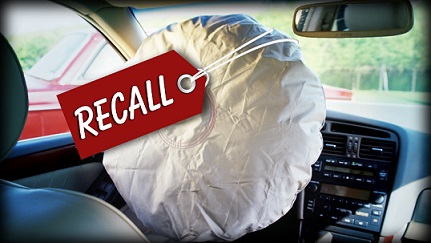
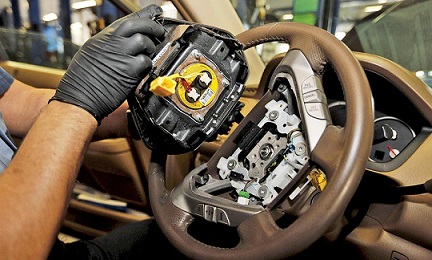
There is a huge burden on one auto parts manufacturer Takata; they dominate the market on auto parts intended for rider safety: seatbelts and air-bags; (they hold 20 percent for the air-bags market). They have quite a responsibility to keep us safe, and at times they have failed in that delivery. They have committed some “Wrongs”, and thus give the watching world an important lesson on how to “Right a Wrong”.

In the case of a car crash, an air-bag can really save a person’s life. This is good!

In the case of a faulty air-bag, it can take a life, in the case of an accident, or none. (Imagine a situation normal and an air-bag deploys-explodes and impacts a child … or a small frame adult). Thus the tragedy! While faulty seatbelts are only an issue in an accident, faulty air-bags could be an issue anytime.

CU Blog - Righting a Wrong - Takata Air Bags - Photo 2

Notice the experiences in this Reference article here:

Reference Title: Takata Corporation
Takata Corporation is an automotive parts company based in Japan. The company has production facilities on four continents, with its European headquarters located in Germany, where it also has nine production facilities.[3] In 2013, A series of deaths and injuries associated with defective Takata airbag inflators had led Takata to initially recall 3.6 million cars equipped with such airbags. Further fatalities caused by the airbags have led the National Highway Traffic Safety Administration (NHTSA) to order an ongoing, nationwide recall of more than 42 million cars, the largest automotive recall in U.S. history.[4][a]

History
CU Blog - Righting a Wrong - Takata Air Bags - Photo 1
Takata was founded in 1933 in Shiga Prefecture, Japan, by Takezo Takada and started to produce lifelines for parachutes, and other textiles. In the early 1950s, the company started to research seat belts. Later they incorporated as “Takata”. In the 1960s, Takata started to sell seat-belts and built the world’s first crash test plant for testing seat-belts under real world conditions.

In the 1970s, Takata developed child restraint systems. In the 1980s, the company changed its name to “Takata Corporation” and expanded to Korea, the United States, and later to Ireland, to sell seat-belts. In the 1990s, Takata expanded internationally.

In 2000, Takata Corporation acquired German competitor Petri AG, forming the European subsidiary Takata-Petri, renamed Takata AG in early 2012.[5] Takata AG makes steering wheels and plastic parts, not only for the automotive industry.

1995 seat belt recall
In May 1995, a recall in the U.S. affecting 8,428,402 predominantly Japanese built vehicles made from 1986 to 1991 with seat belts manufactured by the Takata Corporation of Japan, was begun. It was called at the time the “second largest recall in the 30 year history of the Department of Transportation (DOT)”. The recall was prompted by an investigation (PE94-052) carried out by the National Highway Traffic Safety Administration (NHTSA) on Takata-equipped Honda vehicles, after many of their owners complained of seat belt buckles either failing to latch, latching and releasing automatically, or releasing in accidents. It revealed that potentially faulty Takata seat belts were not limited only to Honda vehicles, but to other Japanese imports as well…. NHTSA concluded that the cause of the defect was that the buckles were made of ABS plastic. Through exposure to ultraviolet light over a period of time, the plastic became brittle and pieces fell off, causing a jamming of the release button mechanism.

CU Blog - Righting a Wrong - Takata Air Bags - Photo 3

The manufacturers involved agreed to a voluntary recall, though this did not go smoothly, with only 18% of the 8.9 million cars and trucks with the Takata belt buckle having been repaired two years after the recall had begun. In addition, NHTSA assessed a $50,000 civil penalty against both Honda and Takata for failing to notify the agency about the seat belt defect in a timely manner.

Defective airbag recalls (2013–present)

Takata began making airbags in 1988 and, as of 2014, holds 20 percent of the market. During 2013, several automakers began large recalls of vehicles due to Takata-made airbags. Reports state that the problems may have begun a decade before.[7]

Honda stated they knew of more than 100 injuries and eight deaths (seven in the United States plus one in Malaysia) that were related to Takata airbags.[7][8][9][10]

In April and May 2013, a total of 3.6 million cars were recalled due to defective Takata airbags.[7] All of those airbags were made at, or otherwise used inflator units manufactured by, Takata’s Monclova Plant[11] in Coahuila, Mexico, operated by Takata’s North American/Mexican subsidiary, TK Holdings Inc.[12] In November 2014, BMW announced they will move any orders from the Mexican plant to a Takata plant in Germany.[13]

CU Blog - Righting a Wrong - Takata Air Bags - Photo 4

In June 2014, Takata admitted their Mexican subsidiary had mishandled the manufacture of explosive propellants and improperly stored chemicals used in airbags. Identifying vehicles with defective airbags was made more difficult by the failure of TK Holdings Inc. to keep proper quality control records. That prompted another round of recalls in June 2013.[7]

In their statement the company said, “We take this situation seriously, will strengthen our quality control and make a concerted effort to prevent a recurrence”.[7]

On June 23, 2014, auto manufacturers BMW, Chrysler, Ford, Honda, Mazda, Nissan, and Toyota announced they were recalling over three million vehicles worldwide due to Takata Corporation-made airbags. The reason was that they could rupture and send flying debris inside the vehicle. This was in response to a National Highway Traffic Safety Administration (NHTSA) investigation that was initiated after the NHTSA received three injury complaints.[7]

In a statement on June 23, 2014, Takata said they thought excessive moisture was the cause of the defect. Haruo Otani, an official at the vehicle recall section of the Japanese Ministry of Land, Infrastructure, Transport and Tourism, said that moisture and humidity could be seeping inside inflators, destabilizing the volatile propellant inside.[7]

In July 2014, a pregnant Malaysian woman was killed in a collision involving her 2003 Honda “City” which contained the defective airbag. The woman, aged 42, died when a metal fragment from a ruptured driver’s airbag sliced into her neck in the accident in which she was driving at around 30 km/h when another vehicle hit her at a junction, according to a lawsuit filed by her father at a Miami federal court. Her daughter, delivered after the mother’s death, died three days later.[14][15]

On November 18, 2014, the NHTSA ordered Takata to initiate a nationwide airbag recall. The action came as 10 automakers in the U.S. recalled hundreds of thousands of cars equipped with potentially faulty air bags manufactured by Takata.[16]

As of May 19, 2015, Takata is now responsible for the largest auto recall in history. Takata has already recalled 40 million vehicles across 12 vehicle brands for “Airbags that could explode and potentially send shrapnel into the face and body of both the driver and front seat passenger”.[17] This recall will bring the number up to about 53 million automobiles eligible for this recall. In November 2015, Takata was fined $200 million ($70 million paid upfront) by U.S. federal regulators in response to Takata admittance of a default.[18] Toyota, Mazda and Honda have said that they will not use ammonium nitrate-based inflators.[19][20]

On May 4, 2016, the NHTSA announced recall campaigns of an additional estimated 35-40 million inflators, adding to the already 28.8 million inflators previously recalled.[21]

On Aug 22, 2016, a truck transporting Takata airbag parts was involved in a crash in Quemado, Texas that caused the cargo to explode, destroying a house and killing a woman inside.[22]

On Jan 13, 2017, the United States charged three Takata executives, Shinichi Tanaka, Hideo Nakajima and Tsueno Chikaraishi for Takata’s exploding airbags.[23]The company agreed to plead guilty and to pay $1 billion to resolve the investigation, which includes a $25 million fine, $125 million for victim compensation and $850 million to compensate automobile manufacturers. At least 16 deaths are linked to the defective airbags.[24]

Cars affected
The NHTSA received notification from BMW, Chrysler, Ford, Honda, Mazda, Nissan, and Toyota that they were conducting limited regional recalls to address a possible safety defect involving Takata brand air bag inflators.[25]

In May 2014, General Motors expanded their earlier recall of their 2012 Chevrolet Cruze sedan and other models because of an electrical problem with the Takata airbags. The recall also included the Buick Verano, the Chevrolet Sonic and the Chevrolet Camaro.[26]

On June 25, 2014, General Motors told their North American dealers to stop selling their 2013 and 2014 model Chevrolet Cruze sedans. GM stated, “Certain vehicles may be equipped with a suspect driver’s air bag inflator module that may have been assembled with an incorrect part.” The airbags involved were made by Takata Corporation.[26] On June 11, 2014, Toyota recalled 2.3 million vehicles, many for the second time.[7]

On July 17, 2015, Ferrari issued a recall for their lineup from the 2014-15 model years due to the driver’s side airbags being improperly installed and the leather covering them improperly glued.[27] This was discovered when the company was conducting tests on a 458 Italia and the airbags would deploy at a rotated orientation, potentially causing injuries.[28] This recall isn’t related to the explosive airbags that have caused injuries and fatalities when deployed.

The issue itself has only shown to affect vehicles in hot and humid locations, however all potentially affected vehicles have been recalled as a precaution. No evidence of the issue has been seen in the UK and Europe. Nearly all reported injuries (both fatal and minor) had been recorded in Honda vehicles, something which is undergoing investigation. But Ford added certain models to the list after the 10th death occurred when the airbag in a 2006 Ford Ranger pickup driven by a Georgia man ruptured violently in South Carolina, in late December of 2015. [29]

As of December 9, 2016, car manufacturers affected by this recall include Acura, Audi, BMW, Cadillac, Chevrolet, Chrysler, Daimler Trucks North America, Daimler Vans USA LLC, Dodge/Ram, Ferrari, Fisker, Ford, GMC, Honda, Infiniti, Jaguar, Jeep, Land Rover, Lexus, Lincoln, Mazda, McLaren, Mercedes-Benz, Mercury, Mitsubishi, Nissan, Pontiac, Saab, Saturn, Scion, Subaru, Tesla, Toyota, and Volkswagen.[30]

Source: Retrieved May 8, 2017 from: https://en.wikipedia.org/wiki/Takata_Corporation

———–

VIDEO – Takata to plead guilty, fined $1 Billion penalty over air-bag scandal – http://wapo.st/2jfvNP3?tid=ss_mail

Published January 13, 2017 – Japan’s Takata agreed to plead guilty to criminal wrongdoing and pay $1 billion to resolve a Justice Department investigation into ruptures of its air-bag inflaters linked to deaths worldwide. (Reuters).

As related in the foregoing, Takata has mostly been responsive to all safety concerns:

In their statement the company said, “We take this situation seriously, will strengthen our quality control and make a concerted effort to prevent a recurrence”.

(This is refreshingly honest, after some period of hiding the truth).

Many of their problems were tied to environmental differences (temperature, humidity, altitude pressure, etc.). An important lesson we, the observers and reporters, learned is their eventual willingness to own up to the problem and work towards remediation. This is a familiar concern for the movement behind the book Go Lean…Caribbean. There are a lot of issues that have been successfully dealt with by stakeholders, but only after first accepting-acknowledging the fault-defect, then dealing with the fall-out.

But despite Takata’s “Mea Culpa”, people are dead – at least 16 deaths are linked to the defective air-bags [24] – so someone has to be held to account. For this reason, the judgments and fines in the foregoing are appropriate.

Takata may have a long road of recovery, but they now have shown the right community ethos – the fundamental character or spirit of a culture that informs their beliefs and practices – to reform and transform their company.

This commentary is 4 of 4 in a series considering how to “Right a Wrong”. Surely, a mal-functioning air-bag is a “Wrong”. This type of “Wrong” affects life-and-limb of car riders. We have our own car riders to protect in our region, so we need to also tune in to these developments and lessons; we need to glean from the “Righting of these Wrongs”. The full entries of all the blog-commentaries in this series is as follows:

  1. Righting a Wrong: 2008 Housing Crisis
  2. Righting a Wrong: Puerto Rico’s Bankruptcy
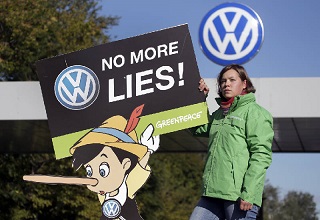
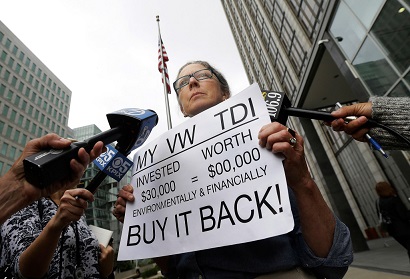
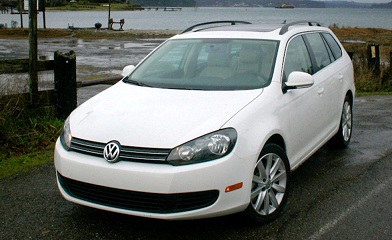
  3. Righting a Wrong: Volkswagen Emissions Crisis
  4. Righting a Wrong: Takata Air-Bags

As related in the first submission in this series, these “Wrongs” relate to bad actions and inaction by different actors. The image and reputations of Takata “took a hit” since 2015. But “Righting this Wrong” can override the bad image and the “comeback” or recovery could be their lasting legacy.

In the Caribbean, we have a different climate than many of the First World countries in this Takata drama. Who would test-certify safety conditions for air-bags in our region?

Lives are involved!

Had the CU been in force when this Takata air-bags manufacturing defects issue emerged, the CU’s technocratic deliveries would have really made a difference … on protecting the people of the Caribbean.

The book Go Lean…Caribbean presents a plan to elevate the Caribbean societal eco-systems; it also addresses the eco-system of the transportation safety and motor vehicles in the Caribbean region. The book details this on Page 205. Consider some of the headlines here:

10 Ways to Improve Transportation – Page 205

# 6: Transportation (Aviation, Shipping & Automobiles) Coordination, Promotion and Safety Regulations
The CU mandate is to facilitate the region’s economics through transportation solutions. Aviation plays a key role, and so there is the need for regional coordination and promotion of the region’s domestic and foreign air carriers. The CU will execute these functions along with Air Traffic Control and Safety regulations, thus mirroring both the FAA & National Transportation Safety Board (NTSB) in the US. The CU will be vested with subpoena and prosecutorial powers.

Image the impact on lives, having a local entity to test-certify transportation delivery entities in our region. This is a bigger issue than just cars, this is about life-and-death.

This is the purpose of the book Go Lean…Caribbean, to help reform and transform the societal engines in the 30 member-states of the Caribbean region. The book serves as a roadmap for the introduction and implementation of the Caribbean Union Trade Federation (CU). The Go Lean/CU roadmap applies best-practices to protect the community and features these 3 prime directives, proclaimed as follows:

  • Optimization of the economic engines to grow the regional economy to $800 Billion – including developing an automotive industry in the region.
  • Establishment of a security apparatus to protect public safety and ensure the economic engines of the region.
  • Improvement of Caribbean governance – including a separation-of-powers between CU federal agencies and member-state governments – to support these engines.

The points of effective, technocratic stewardship for protecting the public (from industrial and natural threats) have been elaborated upon in previous blog-commentaries. Consider this sample:

https://goleancaribbean.com/blog/?p=9334 Protecting the Public: The Science of Hurricane Categories
https://goleancaribbean.com/blog/?p=8650 Auto Industry – Now it’s Detroit’s turn to rescue Silicon Valley
https://goleancaribbean.com/blog/?p=7896 The Logistics of Disaster Relief
https://goleancaribbean.com/blog/?p=7449 ‘Crap Happens’ – So What Now?
https://goleancaribbean.com/blog/?p=5840 Computer Glitches Disrupt Business As Usual
https://goleancaribbean.com/blog/?p=5002 Managing a ‘Clear and Present Danger’
https://goleancaribbean.com/blog/?p=3384 Auto Industry – Plea to Detroit: Less Tech, Please

Overall, the Go Lean book stresses the community ethos, strategies, tactics, implementations and advocacies to reform and transform the economic, security and governing engines of Caribbean society. This effort will be technocratic! It will “plan do and review”. We must properly administer the testing and certifying of automobile safety features. This vision was anticipated from the beginning of the Go Lean book, opening with these pronouncements in the Declaration of Interdependence (Page 12 – 14):

x. Whereas we are surrounded and allied to nations of larger proportions in land mass, populations, and treasuries, elements in their societies may have ill-intent in their pursuits, at the expense of the safety and security of our citizens. We must therefore appoint “new guards” to ensure our public safety and threats against our society, both domestic and foreign. The Federation must employ the latest advances and best practices … to assuage continuous threats against public safety.

xi. Whereas all men are entitled to the benefits of good governance in a free society, “new guards” must be enacted to dissuade the emergence of incompetence, corruption, nepotism and cronyism at the peril of the people’s best interest.  The Federation must guarantee the executions of a social contract between government and the governed.

xii. Whereas the legacy in recent times in individual states may be that of ineffectual governance with no redress to higher authority, the accedence of this Federation will ensure accountability and escalation of the human and civil rights of the people for good governance, justice assurances, due process and the rule of law. As such, any threats of a “failed state” status for any member state must enact emergency measures on behalf of the Federation to protect the human, civil and property rights of the citizens, residents, allies, trading partners, and visitors of the affected member state and the Federation as a whole.

xvi. Whereas security of our homeland is inextricably linked to prosperity of the homeland, the economic and security interest of the region needs to be aligned under the same governance. Since economic crimes, including piracy and other forms of terrorism, can imperil the functioning of the wheels of commerce for all the citizenry, the accedence of this Federation must equip the security apparatus with the tools and techniques for predictive and proactive interdictions.

xxxiii. Whereas lessons can be learned and applied from the study of the recent history of other societies, the Federation must formalize statutes and organizational dimensions to avoid the pitfalls of communities like East Germany, Detroit, Indian (Native American) Reservations, Egypt and the previous West Indies Federation. On the other hand, the Federation must also implement the good examples learned from developments/communities like New York City, Germany, Japan, Canada, the old American West and tenants of the US Constitution.

The Go Lean roadmap presents the CU as the “new guard” to monitor, mitigate and manage threats and risks for cars-and-drivers in our Caribbean region.

Though there is a plan to develop an automotive industry here in the Caribbean homeland, there is a need to protect people in their cars whether the cars are locally produced or imported.

Since the Go Lean roadmap specifies a separation-of-powers between federal agencies and member-state governments, the CU applicable entity (Department of Transportation) would deploy a Caribbean version of the US’s National Highway Traffic Safety Administration (NHTSA) entity in the foregoing news reports.

As previously identified, this is a Big Deal for this Caribbean elevation plan. But this Big Deal is conceivable, believable and achievable.

The purpose of this commentary is to learn from other people, companies and communities that have had to “Right Wrongs”. We want to learn those lessons and apply them in our homeland, so that we can be a safer society. Transportation Safety policy must be affected – lives are involved – our Caribbean administration needs to be better at protecting our citizens.

Now is the time for all stakeholders – governments, residents and car riders – in the Caribbean to lean-in for the empowerments described here-in so as to have a regional automotive safety administration. We must do better than previous generations in monitoring for safety defects. This will make our Caribbean a better-safer place to live, work and play. 🙂

This is the end of this 4-part series on “Righting Wrongs”; we have established that the Caribbean is known for its own defects – we repeatedly make mistakes, we endanger people, oppress them and suppress their rights. We need to “Right our own Wrongs”. There have been so much wisdom for us to glean by considering how others have had to contend with their own “Wrongs”. Just consider the lessons from this recap here of these 4 scenarios and the excessive loss-penalties that resulted:

  • 2008 Housing Crisis – The stock market plunged 40%, wiping out tens of trillions of dollars in wealth; (some estimates tallying $11 Trillion).
  • Puerto Rico’s Bankruptcy – a Caribbean island with $123 Billion in municipal bonds and unfunded pensions.
  • VW Clean Diesel Emissions Scandal – $5.5 Billion in federal fines and court-approved settlements.
  • Takata Air-bags – $1 Billion in federal fines and penalties.

A word to the wise is sufficient!

Download the free e-Book of Go Lean … Caribbean – now!

Sign the petition to lean-in for the roadmap for the Caribbean Union Trade Federation.


Share this post:
, ,
[Top]

Righting a Wrong: Volkswagen Emissions Crisis

Go Lean Commentary

On the surface, computer hacking appears to be a victimless crime. But truth be told, hacking does have victims, who can lose their careers, fortunes and lives. So manipulating computer software for malevolent reasons is an absolute “wrong”.

CU Blog - Righting a Wrong - Volkswagen Emissions Crisis and US Dealers - Photo 1bThe visual of a hacker does not only apply for some anti-social geek operating in his mother’s basement. No, sometimes, hackers are well kneeled, professional engineers, taking and executing orders from company executives.

Case in point: Volkswagen … and their computer programmers for their Engine Control Units (ECU). These individuals were instructed to manipulate these automotive computer devices to deceive emission testing equipment that their Clean Diesel engine was actually clean as advertised.

It was not!

The concept of Clean Diesel was the prize, the “Holy Grail” of the automotive industry. (The Holy Grail refers to a vessel that serves as an important motif in Arthurian literature. Different traditions describe it as a cup, dish or stone with miraculous powers that provide happiness, eternal youth or sustenance in infinite abundance.)

There are two kinds of internal combustion engines for modern automobiles: gasoline and diesel. Gasoline engines run cleaner while averaging 20 – 30 miles per gallon (mpg), but diesel is more efficient, fuel-economy-wise, averaging 50 – 60 mpg. Clean Diesel would be the best of both worlds – the Holy Grail.

Germany’s Volkswagen (VW) was the #1 automaker … in the world, ahead of Japan’s Toyota, America’s General Motors and others. They were the leader and champion in the race for diesel-based passenger vehicles. (VW owns 12 principal vehicle manufacturers including Audi, Porsche, Citroen, Bentley, Lamborghini, Bugatti, Ducati, Scania, MAN, Skoda, and others).

Apparently, they maintained that lead with some innovation … and some deceit.

CU Blog - Righting a Wrong - Volkswagen Emissions Crisis and US Dealers - Photo 4

APTOPIX Volkswagen Emissions Deal

Starting in 2015, the “walls came tumbling down” – the wrong was exposed. See the timeline here:

Title: Volkswagen emissions scandal

On Friday, 18 September 2015, the United States Environmental Protection Agency (EPA) said beginning in 2008 the automaker improperly installed engine control unit (ECU) software determined to be a “defeat device”, in violation of the Clean Air Act to circumvent environmental regulations of emissions of nitrogen oxides produced during combustion (NOx) by diesel engine 2009-2015 model year Volkswagen and Audi cars. The software detects when the cars were being subject to emissions testing, and then fully enabled ECU emission controls to successfully pass.[119][120] However, during normal driving conditions, emission control software was shut off in order to attain greater fuel economy and additional power, resulting in as much as 40 times more pollution than allowed by law.[121]Consumer Reports tested a 2011 Jetta SportWagen TDI [(see photo below)] and found in emissions mode its 0-60 mph time increased by 0.6 seconds and its highway fuel economy dropped from 50 mpg to 46 mpg.[122] Volkswagen admitted to using the defeat device, and has been ordered to recall approximately 482,000 cars with four-cylinder 2.0-liter TDI engines.[123]United States federal penalties may include fines ranging up to US$18 billion, and possibly criminal charges.[124] On June 28, 2016, Volkswagen agreed to pay a settlement of $15.3 billion, the largest auto-related consumer class-action lawsuit in the United States history.[125]

CU Blog - Righting a Wrong - Volkswagen Emissions and US Dealers - Photo 2

The EPA was first alerted to the issue by the International Council on Clean Transportation (ICCT), reporting results of research commissioned for them by West Virginia University‘s Center for Alternative Fuels, Engines and Emissions (CAFEE).[126][127] In May 2014, CAFEE published their ICCT sponsored research.[128] After 15 months of denying the emissions control systems were deliberately gamed and instead claiming discrepancies due to “technical” reasons, on August 21 Volkswagen acknowledged to the EPA and California Air Resources Board (CARB) their emission controls systems were rigged. This was followed by a formal announcement of admission to regulators on September 3 which took place immediately after the EPA threatened to withhold approval for their 2016 cars.[129] Volkswagen’s initial public response came on 20 September, when a spokesman said they would stop all US sales of the diesel models affected. Chairman Martin Winterkorn issued an apology and said Volkswagen would cooperate with investigators.[130] Since emission standards in Canada are close to those in the US, Volkswagen Canada also halted sales of the affected diesel models.[131] Tuesday, 22 September Volkswagen spokesman admit that the defeat device is installed in ~11 million vehicles with Type EA 189 diesel engines worldwide.[132]

On the first business day after the news, Volkswagen’s stock price declined 20% and declined another 17% on Tuesday, that same day a social media advertisement with Wired about “how diesel was re-engineered” was removed as well as a series of YouTube ads titled “Diesel Old Wives’ Tales”.[133][134][135] On Wednesday, 23 September, Volkswagen chief executive officer Martin Winterkorn resigned.[136] Volkswagen hired Kirkland & Ellis law firm for defense, the same firm that defended BP during the Deepwater Horizon oil spill.[137]

On November 2, the EPA issued a second notice of violation (NOV) pertaining to certain diesel 3.0-liter V6 equipped Audi, Volkswagen Touareg and Porsche Cayenne vehicles.[138] The EPA found beginning with the 2009 model year all vehicles powered by the V6 were non-compliant.[139] During testing the EPA, CARB and Transport Canada discovered software that activates pollution reduction systems when the automobiles are being driven under federal test conditions, otherwise during real world driving these devices are inactive.[140][141] Volkswagen disputed the EPA’s findings stating their software is legally permitted,[142] however shortly after Volkswagen issued a stop-sale for the EPA’s disputed vehicles and additional models the EPA did not question.[143] In November 2016, Volkswagen and its labour unions agreed to reduce the workforce by 30,000 people until 2021 as a result of the costs from the violations. However, 9,000 new jobs would come by producing more electric cars.[144] Volkswagen also announced plans to become the world leader in electric cars, producing 1 million VW-EVs by 2025 and 3 million by the group,[145] and a VW manager stated that its diesel cars would not become available in USA.[146]

On Wednesday, 11 January 2017, Volkswagen agreed to plead guilty to the emissions-cheating scandal and to pay $4.3 billion in penalties. Six Volkswagen executives were charged.[147][148] The following day, one of the indicted executives was ordered to be held without bail pending trial as it was feared that he would flee to Germany and extradition would be impossible.[149][150] For this reason, senior VW management staff were warned not to travel to the US.[151] On 23 January 2017, a US judge approved a $1.2 billion settlement in which 650 American dealers, “who, like consumers, were blindsided by the brazen fraud that VW perpetrated,” would receive an average of $1.85 million.[152]

Source: Retrieved May 5, 2017 from: https://en.wikipedia.org/wiki/Volkswagen#Diesel_emission_violations

———–

VIDEO – Volkswagen emissions scandal: A timeline – https://youtu.be/Y5TvFY7xRDM

Published on Jun 28, 2016 – Volkswagen rigged 11 million vehicles to cheat on emissions tests, costing the company billions in fines and fixes. Here’s a breakdown of the scandal.

As related in the foregoing, after a long period of denial, excusing and shifting the blame, the leadership of VW finally accepted the inevitable:

Truth and consequence.

This is a familiar concern for the movement behind the book Go Lean…Caribbean. There are a lot of issues – right here in the Caribbean – that have been dealt with by stakeholders first accepting-acknowledging the truth – and then dealing with the painful fall-out.

Consider for example the Abolition of Slavery in the British Empire; after 60 years of advocacy the Empire finally acknowledged the “wrong” of slavery of African people. They accepted the truth and “bit the bullet” in 1834; they then compensated every slave-owner in the Empire for  the lost of their “property”. Though this was painful – economically and socially – this move gave the United Kingdom moral authority on the issue of slavery for perpetuity.

Now VW’s focus is on the long road of recovery – “righting the wrong”. According to this article in the Appendix below:

  • They have set-up a fund to compensate victims (car buyers and dealers)
  • Despite being the “butt of the jokes” – see Appendix VIDEO  the impact on the company’s reputation with car-buyers has been less severe than predicted: sales and profits have stayed strong.
  • The relationship with their dealers – especially the ones in the US – needs a lot of mending. Though they have now agreed on a settlement and is compensating them for lost of goodwill and sales – see story here:
    http://www.businessinsider.com/volkswagen-settles-us-dealers-emissions-cheating-scandal-2016-8
    “We believe this agreement in principle with Volkswagen dealers is a very important step in our commitment to making things right for all our stakeholders in the United States” – Volkswagen North American Region CEO Hinrich J. Woebcken said in a statement on August 25, 2016.

This commentary is 3 of 4 in a series considering how to “Right a Wrong”. Surely, lying about Clean Diesel is a “Wrong”. This type of “Wrong” affected the value of the assets for all the car owners and especially damage the viability (new customers and loyalty of existing customers) of the dealership (plus their franchise values). So there are lessons that we need to glean from the “Righting of these Wrongs”. The full series is as follows:

  1. Righting a Wrong: 2008 Housing Crisis
  2. Righting a Wrong: Puerto Rico’s Bankruptcy
  3. Righting a Wrong: Volkswagen Emissions Crisis
  4. Righting a Wrong: Takata Air-Bags

As related in the first submission in this series, these “Wrongs” relate to bad actions and inaction by different actors. The image and reputations of VW “took a hit” since 2015. “Righting this Wrong” can override the bad image and the “comeback” or recovery could be their lasting legacy.

The book Go Lean…Caribbean presents a plan to elevate the Caribbean societal eco-systems; it also addresses the eco-system of the automobile industry; the quest is to incentivize an automaker – or two – to locate a plant somewhere in the Caribbean region. The book details this on Page 206. Consider some of the headlines here:

10 Ways to Develop an Automotive Industry  – Page 206

1 Lean-in for the Caribbean Single Market. The CU will allow for the unification of the region into one market, thereby creating a single economy of 30 member-states, 42 million people and a GDP of over $800 Billion. The people of the region have cars, and will continue to need cars. There is no demand shortages for the region…. The CU will take the lead in facilitating the vertical industries to supply the needs of a domestic auto industry. The CU’s economic engines allows for investment capital to finance the supply mechanisms and a media complex to forge a constant demand.
2 Do It Yourself – Domestic Manufacturer A domestic auto industry is a great source for jobs for a skilled and high-wage labor force. Fulfilling the automotive needs of the CU market will create a lot of economic spin-off activity. In the US, the Detroit 3 maintains 240,000 jobs, but impact an additional 3 million jobs in related communities; see Appendix C3. By continuing to buy cars from the US, then Detroit gets the multiplier benefits of CU auto purchases rather than the CU; the same for Germany, Japan, etc. The CU will foster the local manifestation of the global auto industry to grow the domestic economy and deduct from the trade deficit. Invitations will be made to entities like Ford, GM, Volkswagen, Fiat, Toyota, Nissan, etc to deploy a local assembly plant in a CU member-state. After one company thrives from this foothold, other firms will definitely follow.
3 Bring on the future – “Lego” – Modular PlatformsAuto manufacturing disciplines are changing. Companies, like Volkswagen (VW) have adopted a modular platform approach that allows multiple brands and models (VW: includes Audi, Citroen, Bentley, Lamborghini, etc.) to share base components: engines, transmissions, ventilation systems, etc. [185] This allows for the global distribution of plug compatible parts to be assembled for models servicing different markets. Assembly plants can be erected anywhere.
4 Embrace Alternative Energy & Hybrids
5 Optimize the Logistics Industry
6 Exploit Service and Maintenance
7 Don’t forget “After-Market” Parts
8 Help Regional Businesses Find Foreign Markets – Export
9 Promote Auto Shows
10 Re-capture Recycled Materials

VW would have been a good candidate for a local assembly plant. Upon “righting this wrong”, they would be a good suitor.

Image the jobs … and the indirect economic activity.

This is the purpose of the book Go Lean…Caribbean, to help reform and transform the societal engines in the 30 member-states of the Caribbean region. The book serves as a roadmap for the introduction and implementation of the Caribbean Union Trade Federation (CU). The Go Lean/CU roadmap applies best-practices for community empowerment and features these 3 prime directives, proclaimed as follows:

  • Optimization of the economic engines to grow the regional economy to $800 Billion & create 2.2 million new jobs.
  • Establishment of a security apparatus to protect public safety and ensure the economic engines of the region.
  • Improvement of Caribbean governance to support these engines.

Had the CU been in force when this VW Emissions Cheating scandal popped, the technocratic deliveries would have really made a difference … on protecting the people of the Caribbean.

The points of effective, technocratic stewardship of industrial enterprises have been elaborated upon in previous blog-commentaries. Consider this sample:

https://goleancaribbean.com/blog/?p=8982 GraceKennedy: Profile of a Caribbean Transnational Industrial Firm
https://goleancaribbean.com/blog/?p=8650 Auto Industry – Now it’s Detroit’s turn to rescue Silicon Valley
https://goleancaribbean.com/blog/?p=7847 PC Industry swoons in the face of new trends
https://goleancaribbean.com/blog/?p=5034 Patents: The Guardians of Innovation
https://goleancaribbean.com/blog/?p=4240 Immigration Policy Exacerbates Worker Productivity Crisis
https://goleancaribbean.com/blog/?p=3384 Auto Industry – Plea to Detroit: Less Tech, Please

Overall, the Go Lean book stresses the community ethos, strategies, tactics, implementations and advocacies to reform and transform the economic, security and governing engines of Caribbean society. This effort will be technocratic! It will “plan do and review”. We must properly administer the testing and certifying our “polluting” industrial endeavors. This vision was anticipated from the beginning of the Go Lean book, opening with these pronouncements in the Declaration of Interdependence (Page 12 – 14):

xi. Whereas all men are entitled to the benefits of good governance in a free society, “new guards” must be enacted to dissuade the emergence of incompetence, corruption, nepotism and cronyism at the peril of the people’s best interest.  The Federation must guarantee the executions of a social contract between government and the governed.

xii. Whereas the legacy in recent times in individual states may be that of ineffectual governance with no redress to higher authority, the accedence of this Federation will ensure accountability and escalation of the human and civil rights of the people for good governance, justice assurances, due process and the rule of law. As such, any threats of a “failed state” status for any member state must enact emergency measures on behalf of the Federation to protect the human, civil and property rights of the citizens, residents, allies, trading partners, and visitors of the affected member state and the Federation as a whole.

xxiv. Whereas a free market economy can be induced and spurred for continuous progress, the Federation must install the controls to better manage aspects of the economy: jobs, inflation, savings rate, investments and other economic principles. Thereby attracting direct foreign investment because of the stability and vibrancy of our economy.

xxvii. Whereas the region has endured a spectator status during the Industrial Revolution, we cannot stand on the sidelines of this new economy, the Information Revolution. Rather, the Federation must embrace all the tenets of Internet Communications Technology (ICT) to serve as an equalizing element in competition with the rest of the world. The Federation must bridge the digital divide and promote the community ethos that research/development is valuable and must be promoted and incentivized for adoption.

xxxiii. Whereas lessons can be learned and applied from the study of the recent history of other societies, the Federation must formalize statutes and organizational dimensions to avoid the pitfalls of communities like East Germany, Detroit, Indian (Native American) Reservations, Egypt and the previous West Indies Federation. On the other hand, the Federation must also implement the good examples learned from developments/communities like New York City, Germany, Japan, Canada, the old American West and tenants of the US Constitution.

Yes, the book Go Lean … Caribbean asserts that we can have our own automotive industry here in the Caribbean homeland.

This is a Big Deal! But this plan is conceivable, believable and achievable.

The purpose of this commentary is to learn from other people, companies and communities that have had to “Right Wrongs”. We want to learn those lessons and apply them in our homeland, so that we can be a better society. Industrial policy could be affected – jobs are involved – our Caribbean society needs to be better at reforming and transforming our industrial eco-system.

Now is the time for all stakeholders – governments, industry and car-buyers – in the Caribbean to lean-in for the empowerments described here-in for our own regional automotive industry. We must do better with promoting industrial developments – being a partner – than our predecessors. This will make all of the Caribbean a better place to live, work and play. 🙂

Download the free e-book of Go Lean … Caribbean – now!

Sign the petition to lean-in for the roadmap for the Caribbean Union Trade Federation.

———–

Appendix Title: Volkswagen – A long road to recovery
Sub-title: The carmaker’s efforts to move on from its emissions scandal are thwarted

THERE are two ways of dealing with a worrying problem in a car engine. One is a complete overhaul; the other is to tinker under the bonnet and hope the trouble goes away. Volkswagen’s efforts to deal with an emissions-cheating scandal that emerged in September 2015 are of the tinkering type. The German carmaker is desperate to draw a line under its ill-fated decision to fit software to 11m diesel cars that detected emissions tests and artificially reduced the amount of nitrogen oxide pumped out. But the disconcerting rumbles continue.

The latest setback came on November 6th, when VW said that a German investigation of market manipulation was examining the role of Hans Dieter Pötsch, chairman of its supervisory board. The probe, which began in June, is looking at whether Martin Winterkorn, VW’s former chief executive, and Herbert Diess, who oversees the core VW brand, should have disclosed the emissions cheating before the company publicly admitted wrongdoing. This is deeply uncomfortable for both VW and Mr Pötsch, who used to be the chief financial officer and was nominated to become chairman on the day the crisis began. It is also a reminder that questions linger about who at the firm knew what.

Adding to VW’s woes, a German newspaper reported on the same day that American regulators had found that another variety of cheating software, which artificially lowered emissions of carbon dioxide, was still being fitted to several models of Audi luxury cars until May 2016. This may expose VW to further compensation, fines and legal entanglements.

The share price has fallen by 24% since the scandal broke, and VW has had to set aside €18.2bn ($19.9bn) to cover the cost of compensating owners and fixing affected cars. Yet the damage is less than many people expected. The impact on the company’s reputation with car-buyers has been less severe than predicted: sales and profits have stayed strong.

But VW now badly needs to put the diesel affair firmly behind it. Coping with the storm has claimed management resources that should have been dedicated to the urgent task of improving the performance of the mass-market VW brand, says Patrick Hummel of UBS, a bank. The costs of making cars bearing the core brand (as opposed to those at Skoda, SEAT and other marques) are sky-high, partly because VW makes so much in Germany, and profit margins are slender.

Investors will surely look more kindly on VW when all the risks, including those at Audi, are plain, and they can better gauge the likely financial consequences. But that will take a while. Despite agreeing on fixes and compensation deals in America, and pledging to rectify vehicles in Europe, VW still has to satisfy American authorities that it will do the same for larger diesel engines that were also affected. It must also resolve the matter of criminal fines in America and fight a lawsuit brought by disgruntled shareholders in Germany.

Meanwhile many in the car industry are questioning whether VW is letting its crisis go to waste by mostly carrying on as normal, without making radical changes to its culture. Matthias Müller, the current chief executive, is giving local managers more leeway to tweak car designs and other product features: that is a good thing, according to Citigroup, another bank. This sort of freedom would have been unthinkable under Mr Winterkorn but is essential in a business where tastes vary so widely in different markets. But Mr Müller’s commitment to making the savings that VW needs is unclear. Granted, in a few weeks he will conclude a “future pact” with workers at the carmaker’s core brand. It will govern cuts in costs, employees’ productivity and overall strategy. However, few expect it to go far enough.

If it does fall short, that will be partly because Mr Müller is a long-serving insider picked by the Porsche and Piëch families, who control over half of VW’s voting shares. Even if the families had been bold enough to bring in someone from outside, minded to act more decisively, such a boss would have met resistance from trade unions and from the state of Lower Saxony, where VW is based and which has a 20% stake in the company. Both wield much influence on its powerful supervisory board. In time, the failure to rebuild thoroughly may come to be seen as a mistake.

Source: Posted November 10, 2016; retrieved May 5, 2017 from: http://www.economist.com/news/business/21710009-carmakers-efforts-move-its-emissions-scandal-are-thwarted-long-road-recovery

———–

Appendix VIDEO – John Oliver: Volkswagen – https://youtu.be/Cdif-zK4z14

Published on Sep 28, 2015 – From HBO’s Last Week Tonight with John Oliver. WARNING: Adult Language.
All rights belong to HBO. Check out the official channel here: https://www.youtube.com/user/LastWeek…

  • Category: Comedy
  • License: Standard YouTube License
Share this post:
, ,
[Top]

Righting a Wrong: Puerto Rico’s Bankruptcy

Go Lean Commentary

How do you measure success … or failure?

In school, there is a simple measurement: there is the perfect “A”; everything else – B, C and D – was less desirable. But the actual grade “F” means you fail.

How can we measure success and failure for our community’s societal engines: economics, security and governance? There are so many approaches, but just like in school, there is a definitive “F” grade, a Failed-State status. In the case of a municipal entity, there is no doubt that a Bankruptcy filing is an “F”, a failure!

This is Puerto Rico today.

CU Blog - Righting a Wrong - Puerto Rico Bankruptcy - Photo 0

Their Governor, Ricky Rossellójust announced (May 3, 2017) that the US territory will invoke the bankruptcy-like powers that were extended to them by Congress last year. This was designed to bring an end to their intractable crisis, despite the assurances that they had given to investors that bankruptcy-style “haircuts” could not be considered. There are so many issues afoot with this move:

Can other American states/territories push lawmakers (Congress) for this same legal recourse – Chapter III of the Bankruptcy Code, the Promesa Provision – that has been ceded to Puerto Rico if they are ever at the end of their financial ropes?

(Chapter 9 Bankruptcies are allowed for municipalities, but not state governments).

This is a slippery slope!

“If Puerto Rico can achieve this level of debt relief through Promesa as the initial plan suggested, it will only make sense for Virgin Islands to attempt the same” – Wall Street Analyst

This commentary is 2 of 4 in a series considering how to “Right a Wrong”. Surely, reneging on a pledge to repay debts is a “Wrong”. This type of move could affect every other community seeking to raise funds on the capital markets (bonds). So there are lessons that we need to glean from the “Righting of these Wrongs”. The full series is as follows:

  1. Righting a Wrong: 2008 Housing Crisis
  2. Righting a Wrong: Puerto Rico’s Bankruptcy
  3. Righting a Wrong: Volkswagen Emissions Crisis
  4. Righting a Wrong: Takata Air-Bags

As related in the first submission in this series, these “Wrongs” relate to bad actions and inaction by different actors. The image and reputations of stakeholders “take a hit” while these issues are fresh. This is definitely the case for Puerto Rico right now. “Righting the Wrong” can override the bad image and the “comeback” or recovery could be the lasting legacy.

The book Go Lean…Caribbean addressed Puerto Rico from the beginning; starting with the opening assessment of the State of the Caribbean region. The book identified Puerto Rico on Page 18 as:

The Greece of the Caribbean
Puerto Rico’s population is declining. Faced with a deteriorating economy, increased poverty and a swelling crime rate, many citizens are fleeing the island for the U.S. mainland. …

Puerto Rico has been through austerity and made tough decisions: It has cut government jobs, privatized a couple of highways, and is in the process of privatizing the international airport. But unlike the case of Greece, the economic mess is on America’s hands. For U.S. citizens on the mainland who have a 401(k) account or pension for retirement, it’s possible that they have money invested in Puerto Rican bonds, which are now no longer worth much. So citizens in the states could feel the pain if Puerto Rico’s economy collapses.

This book was published in November 2013, projecting verbiage like “if Puerto Rico’s economy collapses”. According to the latest developments and this news article here (and VIDEO), that collapse is now a reality:

Title: Puerto Rico Declares a Form of Bankruptcy
By: Mary Williams Walsh

CU Blog - Righting a Wrong - Puerto Rico Bankruptcy - Photo 1

With its creditors at its heels and its coffers depleted, Puerto Rico sought what is essentially bankruptcy relief in federal court on Wednesday, the first time in history that an American state or territory had taken the extraordinary measure.

The action sent Puerto Rico, whose approximately $123 billion in debt and pension obligations far exceeds the $18 billion bankruptcy filed by Detroit in 2013, to uncharted ground.

While the court proceedings could eventually make the island solvent for the first time in decades, the more immediate repercussions will likely be grim: Government workers will forgo pension money, public health and infrastructure projects will go wanting, and the “brain drain” the island has been suffering as professionals move to the mainland could intensify.

Puerto Rico is “unable to provide its citizens effective services” because of the crushing weight of its debt, according to a filing on Wednesday by the federal board that has supervised the island’s financial affairs since last year.

The total includes about $74 billion in bond debt and $49 million in unfunded pension obligations.

While many of Puerto Rico’s circumstances are unique, its case is also a warning sign for many American states and municipalities — such as Illinois and Philadelphia — that are facing some of the same strains, including rising pension costs, crumbling infrastructure, departing taxpayers and credit downgrades that make it more expensive to raise money. Historically, Puerto Rico was barred from declaring bankruptcy. In the end, however, financial reality trumped the statutes, and Congress enacted a law last year allowing bankruptcy-like proceedings.

Puerto Rico has been in a painful recession since 2006, and previous governments dug it deeper into debt by borrowing to pay operating expenses, year after year. For the last two years, officials have been seeking assistance from Washington, testifying before stern congressional committees and even making fast-track oral arguments before the United States Supreme Court.

At the same time, Puerto Rico’s efforts to coax its creditors to agree to concessions have gone nowhere. Now the coming court proceedings will give Puerto Rico extraordinary powers to impose losses on holdout creditors unilaterally.

The island’s many creditors — whose lawsuits filed against Puerto Rico on Tuesday prompted the island’s request for court relief on Wednesday — are likely to receive far less of their money back than they want. Their predicament may turn out to be a cautionary tale for bond holders of other troubled states and cities. Puerto Rico’s case could show public workers and retirees that seemingly inviolate pension systems can be changed, too.

The next step is for the Supreme Court — specifically, Chief Justice John G. Roberts Jr. — to designate a bankruptcy judge to handle the case.

The island’s lawyers may view some bankruptcy courts as more likely to be favorable to them than others. Some creditors fear Puerto Rico will seek to have the case handled in the Southern District of New York.

Puerto Rico’s governor, Ricardo Rosselló, issued a statement Wednesday aiming to offer some reassurance, even as he sought the federal court’s protection. “We remain committed to holding good-faith negotiations to reach agreements with our creditors,” he said, adding that he hoped the court proceedings would “accelerate the process.” He appeared to be referring to the extraordinary power Puerto Rico will now have in court to unilaterally impose big losses on creditors.

Some of those creditors are furious.

“The Commonwealth’s proposal is not a credible starting point for negotiations,” Andrew Rosenberg of Paul, Weiss, Rifkind, Wharton and Garrison, an adviser to the Ad Hoc Group of Puerto Rico General Obligation Bondholders, said in a statement. He said that moving the proceedings to bankruptcy court would put the situation in “free-fall.”

The creditors got a shock this year when Mr. Rosselló issued a five-year fiscal plan that allowed only about $800 million a year to pay principal and interest on Puerto Rico’s bond debt, far less than the roughly $3.5 billion a year it would cost to make those payments on time. The prospect of losses on that scale prompted some creditors to argue that most of the $800 million was rightfully theirs.

“That things are starting out in such a highly adversarial way strongly suggests this will be a long and contentious journey for Puerto Rico,” said Matt Fabian, a partner at Municipal Market Analytics who closely tracks activity in the municipal bond market.

Puerto Rico’s case will be the first ever heard under a federal law for insolvent territories, called Promesa, which was enacted last summer; the Obama administration had warned that a “humanitarian crisis” would ensue if Puerto Rico were not given extraordinary powers to abrogate debt. There is no existing body of court precedent for Promesa, but the island’s creditors — who range from hedge fund managers to mom-and-pop investors — are bracing for a titanic battle.

Despite the depth of the island’s troubles, many Republicans in Congress have opposed debt relief, saying that the island has long received big federal subsidies for its health system, public housing and other works. They said Puerto Rico should explain what it had done with that money before it got any more help.

Last week President Trump suddenly added fuel to those fires, saying on Twitter that there should be no “bailout” for Puerto Rico.

On the island, Washington is not seen as a helper but as an unsympathetic colonial overlord. The step toward bankruptcy-like proceedings, under a federal judge, intensified complaints that Puerto Rico has lost all control of its own future.

But at the same time, some Puerto Ricans say quietly that if the court proceedings really do allow their government to cancel debt, their island may finally get the fresh start it needs.

The coming court proceedings will not be formally called a bankruptcy, since Puerto Rico remains legally barred from using Chapter 9, the bankruptcy route normally taken by insolvent local governments. Instead, Mr. Rosselló petitioned for relief under Title III of the Promesa law, which contains certain Chapter 9 bankruptcy provisions but also recognizes that, unlike the cities and counties that use Chapter 9, Puerto Rico is not part of any state and must in some ways be treated as a sovereign.

Bankruptcy lawyers and public finance experts are watching Puerto Rico’s case closely, to see if it shows a path that financially distressed states like Illinois might also one day take. States, like United States territories, currently cannot declare bankruptcy.

The only creditors who reached an agreement with Puerto Rico were the holders of a class of bonds, about $9 billion worth, that were sold to raise money for the island’s public power utility. Those creditors gave concessions that the governor pointed to Wednesday as a good example for other creditors to follow.

The governor’s fiscal plan also calls for shifting all current government workers from pensions into 401(k)-style retirement plans. Current retirees will continue to receive their traditional monthly pensions, but the amounts are to be reduced by about 10 percent on average.

The governor’s hand was forced by the expiration on Monday, at midnight, of a court stay that had been keeping Puerto Rico’s creditors from suing. On Tuesday, as soon as the stay expired, bondholder groups and at least one bond insurer sued. Wednesday’s actions by the governor and the federal supervisory board effectively blocked the lawsuits from proceeding.
Source: Posted May 3, 2017; retrieved May 4, 2017 from: https://mobile.nytimes.com/2017/05/03/business/dealbook/puerto-rico-debt.html

————-

VIDEOMiller Buckfire MD Says Title III Will Help Puerto Ricohttps://www.bloomberg.com/news/videos/2017-05-04/miller-buckfire-md-title-iii-will-help-puerto-rico-video


Published on May 3, 2017 – Puerto Rico made the decision to use a U.S. court to escape from its debts. This casts a few ripples in the state and local bond market. But this action — once inconceivable for a territory that didn’t have authority to file for bankruptcy — sets a precedent that could resonate with struggling states in the decades ahead. See the full article here: https://www.bloomberg.com/news/articles/2017-05-04/puerto-rico-collapse-shows-debts-seen-as-iron-clad-may-not-be-so

What will Puerto Rico do now?

The recommendation of the movement behind the Go Lean book is to pay the debt … eventually. (Though bankruptcy filings usually involve “haircuts” where creditors will get “pennies on the dollar”).

CU Blog - Righting a Wrong - Puerto Rico Bankruptcy - Photo 2

This is the purpose of the book Go Lean…Caribbean, to help reform and transform the societal engines in the 30 member-states of the Caribbean region. The book serves as a roadmap for the introduction and implementation of the Caribbean Union Trade Federation (CU) and the Caribbean Central Bank (CCB). The Go Lean/CU/CCB roadmap applies best-practices for community empowerment and features these 3 prime directives, proclaimed as follows:

  • Optimization of the economic engines to grow the regional economy to $800 Billion & create 2.2 million new jobs.
  • Establishment of a security apparatus to protect public safety and ensure the economic engines of the region.
  • Improvement of Caribbean governance to support these engines.

Had the CU/CCB been in force now, we would not look to Washington for answers!

The Go Lean movement asserts that Caribbean communities need to resolve their challenges together. One Go Lean mission describes the process of consolidating legacy debt and refinancing them to ease the burden on local governmental finances. Imagine a personal household that just incurred a BIG BILL for repair – think a new roof. The best strategy is to refinance and add it to the 30-year mortgage, therefore only enduring “bite-size” payments for now. The book relates this:

10 Ways to Better Manage Debt  – Page 114

1 Lean-in for the Caribbean Single Market, Caribbean Dollar & Caribbean Central Bank.
This treaty allows for the unification of the region into one market, thereby creating a single economy of 30 member-states, 42 million people and a GDP of over $800 Billion, according to 2010 figures. The CU will reboot the economic engines of the region with investments in infra-structure and business inducements.Many times these projects require up-front capital but the returns will be garnered slowly over time. These projects therefore require debt, from the capital or lending markets. The issue of debt not only concerns governments, but individuals as well. The CU will impact this dynamic by mastering credit ratings and offering to buy back foreign debt for local C$ financing and CCB controls. This tactic lets the CCB function as a local IMF, fostering a new regime for the economy.
2 M1 & The Interest Economy
The CU seeks to consolidate the currency of each member-state around the Caribbean Dollar (C$); then by inducing more electronic transactions as opposed to paper currency, there will be more lendable funds in the money supply (M1). Plus having viable capital markets will allow governments, institutions and businesses to get the capital they need, and investors/lenders can garner interest income for the use of their funds. Most Pension funds depend on this model.
3 Public Financing
Every independent country in the Caribbean is a member of the IMF, only the OverseasTerritories are not engaged in this arrangement. Why not? Their host countries (US, UK, France and the Netherlands) provide the capital access that the island territories need. The CU quest is to shift this dependency to a Caribbean source, not European or American.
4 Bonds & Add-on’s (Warrants)
Rather than international loans, the CU strategizes bond issues in C$ capital markets for government financing. There are a number of ways to make bonds more attractive to investors, like adding warrants as “sweeteners” (premiums on sale price, leverage, expirations and exercise restrictions). Warrants are often detachable and tradable in markets.
5 CU Federal Bankruptcies
6 Credit Reporting – Sharpening the Tool
7 Retail Credit Reboot and New Engines
8 Student Loans Sensible Dynamics
9 Mortgage Loan Sensible Dynamics
10 Crowd Sourcing – Community Capital Sharing Mitigates Debt

The points of effective, technocratic stewardship of Public Debt have been elaborated upon in previous blog/commentaries. Consider this sample:

https://goleancaribbean.com/blog/?p=7989 Transformations: Money Matters – ‘Getting over’ with ‘free money’
https://goleancaribbean.com/blog/?p=7601 Beware of Vulture Capitalists
https://goleancaribbean.com/blog/?p=7268 Detroit’s ‘debt reality’ giving schools their ‘Worst Shot’
https://goleancaribbean.com/blog/?p=7235 Flint, Michigan – A Cautionary Tale for bad debt management
https://goleancaribbean.com/blog/?p=6563 Lessons from Iceland – Model of Recovery
https://goleancaribbean.com/blog/?p=5818 Greece: From Bad to Worse
https://goleancaribbean.com/blog/?p=5759 Pressed by Debt Crisis, Doctors Leave Greece in Droves
https://goleancaribbean.com/blog/?p=3582 For Canadian Banks: Caribbean is a ‘Bad Bet’
https://goleancaribbean.com/blog/?p=3311 Detroit’s Municipal Bankruptcy – Lessons Learned

Overall, the Go Lean book stresses the community ethos, strategies, tactics, implementations and advocacies to reform and transform the economic, security and governing engines of Caribbean society. This effort will be technocratic! It will make “sure all ends meet”. We must properly administer the finances of our communities. This vision was anticipated from the beginning of the Go Lean book, opening with these pronouncements in the Declaration of Interdependence (Page 12):

xi. Whereas all men are entitled to the benefits of good governance in a free society, “new guards” must be enacted to dissuade the emergence of incompetence, corruption, nepotism and cronyism at the peril of the people’s best interest.  The Federation must guarantee the executions of a social contract between government and the governed.

xii. Whereas the legacy in recent times in individual states may be that of ineffectual governance with no redress to higher authority, the accedence of this Federation will ensure accountability and escalation of the human and civil rights of the people for good governance, justice assurances, due process and the rule of law. As such, any threats of a “failed state” status for any member state must enact emergency measures on behalf of the Federation to protect the human, civil and property rights of the citizens, residents, allies, trading partners, and visitors of the affected member state and the Federation as a whole.

xiv. Whereas government services cannot be delivered without the appropriate funding mechanisms, “new guards” must be incorporated to assess, accrue, calculate and collect revenues, fees and other income sources for the Federation and member-states. The Federation can spur government revenues directly through cross-border services and indirectly by fostering industries and economic activities not possible without this Union.

xix. Whereas our legacy in recent times is one of societal abandonment, it is imperative that incentives and encouragement be put in place to first dissuade the human flight, and then entice and welcome the return of our Diaspora back to our shores. This repatriation should be effected with the appropriate guards so as not to imperil the lives and securities of the repatriated citizens or the communities they inhabit. The right of repatriation is to be extended to any natural born citizens despite any previous naturalization to foreign sovereignties.

xxiv. Whereas a free market economy can be induced and spurred for continuous progress, the Federation must install the controls to better manage aspects of the economy: jobs, inflation, savings rate, investments and other economic principles. Thereby attracting direct foreign investment because of the stability and vibrancy of our economy.

xxv. Whereas the legacy of international democracies had been imperiled due to a global financial crisis, the structure of the Federation must allow for financial stability and assurance of the Federation’s institutions. To mandate the economic vibrancy of the region, monetary and fiscal controls and policies must be incorporated as proactive and reactive measures. These measures must address threats against the financial integrity of the Federation and of the member-states.

Yes, the purpose of this commentary is to project the better plan for reforming and transforming Caribbean municipal financing. But it is also about reforming and transforming Puerto Rico. An agenda for Puerto Rico has always been a priority for the Go Lean roadmap. This island is just sitting there in the middle of the Caribbean region. No effort to reboot the Caribbean neighborhood could reasonably ignore this island.

“But they are an American Territory, a subset of the richest, most powerful nation on the planet”.

And yet … they are a Failed-State!

In a previous blog-commentary from the Go Lean movement, it was declared that “Puerto Rico needs the strategies, tactics, implementations and advocacies of the CU. [And] the CU needs Puerto Rico!” This is true now more than ever!

Now is the time for all stakeholders – state and municipal governments and their citizens – in the Caribbean to lean-in for the empowerments described here-in and in the book Go Lean … Caribbean. We must do better with public finance than our predecessors. They tried to “go for it alone” – this is why Puerto Rico always failed – let try this different approach of “going for it together”. This is guaranteed to make Puerto Rico and all of the Caribbean a better place to live, work and play. 🙂

Download the free e-Book of Go Lean … Caribbean – now!

Sign the petition to lean-in for the roadmap for the Caribbean Union Trade Federation.

Share this post:
, , , ,
[Top]

Righting a Wrong: The 2008 Housing Crisis

Go Lean Commentary

Have you ever made a mistake?

“Let him that is without sin, cast the first stone” – Jesus Christ (The Bible @ John 8:7)

Since everyone makes mistakes, a good measure of a good character is how we “Right the Wrongs” that we may have caused to others. This could be the measurement of a good man (or woman), a good company and a good community. People want to be associated with goodness. They will travel great lengths and at great cost to associate with good people, affiliate with good companies and live in a good community.

CU Blog - Righting a Wrong - 2008 Housing Crisis - Photo 1

There are lessons to be learned when people, companies and communities make mistakes and then make concerted efforts to “Right the Wrongs”. These are lessons that can be applied right here in the Caribbean so as to supplement our efforts to elevate our society, to make the Caribbean homeland a better place to live, work and play.

This is more than just an academic discussion for the Caribbean; we are known to have our defects – we repeatedly make mistakes, we endanger people, oppress them, suppress their rights and then carry on unrepentant – this all results in “pushing” people away, causing societal abandonment. We must recognize these defects and repent, reconcile, reform and “Right the Wrongs” of our society.

This is the purpose of the book Go Lean…Caribbean, to help reform and transform the societal engines in the 30 member-states of the Caribbean region. The book serves as a roadmap for the introduction and implementation of the Caribbean Union Trade Federation (CU). The Go Lean/CU roadmap applies best-practices for community empowerment and features these 3 prime directives, proclaimed as follows:

  • Optimization of the economic engines to grow the regional economy to $800 Billion & create 2.2 million new jobs.
  • Establishment of a security apparatus to protect public safety and ensure the economic engines of the region.
  • Improvement of Caribbean governance to support these engines.

What “Wrongs” exactly can we consider to glean lessons-learned for our community empowerment? This commentary is 1 of 4 in a series considering how to “Right a Wrong”. The full series is as follows:

  1. Righting a Wrong: 2008 Housing Crisis
  2. Righting a Wrong: Puerto Rico’s Bankruptcy
  3. Righting a Wrong: Volkswagen Emissions Crisis
  4. Righting a Wrong: Takata Air-Bags

These “Wrongs” relate to bad actions and inaction by different actors. The image and reputations of stakeholders “take a hit” while the issue is fresh. But eventually the recovery – Righting the Wrong – can override and became the lasting legacy. This first wrong – 2008 Housing Crisis – was one of the episodes of the recent Great Recession. The Go Lean book sought to catalog the cause-and-effect of many 2008 developments from an inside perspective. The book identifies its authority to comment on these developments. See this “Who We Are” quotation (Page 8) and the VIDEO in the Appendix below:

This book is published by the SFE Foundation, a community development foundation chartered for the purpose of empowering and re-booting economic engines. …

2008 – The peak day of the recent global financial crisis was September 15, 2008. On this day, Wall Street giant Lehman Brothers filed for bankruptcy protection, and eventual dissolution, after succumbing to the weight of over-leverage in mortgage-backed securities. There is an old observation/expression that states that “there are 3 kinds of people in the world, those who make things happen, those who watch things happen and those who wonder ‘what happened?’“
Principals of the SFE Foundation were there in 2008 … engaged with Lehman Brothers; on the inside looking out, not the outside looking in. Understanding the anatomy of the modern macro economy, allows the dissection of the processes and the creation of viable solutions.

Omaha – The book was initially composed in Omaha, Nebraska, the home of one of the world’s richest men, Warren Buffet – the “Oracle of Omaha” – CEO of corporate giant Berkshire Hathaway. While the United States experienced boom and bust during the Great Recession, Omaha remained a stable, consistent model of prosperity (in March 2008 the unemployment rate in Omaha was 3.9 percent). This was no accident. This community embraces a certain ethos that is fundamental for stability and vibrancy: good corporate citizenship. Omaha is home to other corporate movers-shakers in addition to Berkshire Hathaway; (see Appendix A [on Page 254]). This community example is purported as a model for assimilation by the Caribbean region.

The Go Lean book, though composed in 2013, set the pattern for the Caribbean region to look-listen-learn from models, samples and examples like these. This allows for the regional stewards and administrators to structure policies and procedures so as to apply the lessons learned in their jurisdictions. This was an original intent. As a planning tool, the Go Lean book commenced with a Declaration of Interdependence, pronouncing the need for regional integration so as to improve our society based on lessons learned from other societies. See a stanza here (Page 14):

xxxiii. Whereas lessons can be learned and applied from the study of the recent history of other societies, the Federation must formalize statutes and organizational dimensions to avoid the pitfalls of communities like East Germany, Detroit, Indian (Native American) Reservations, Egypt and the previous West Indies Federation. On the other hand, the Federation must also implement the good examples learned from developments/communities like New York City, [Omaha,] Germany, Japan, Canada, the old American West and tenants of the US Constitution.

So here is the Wrong … and here is the “Righting of the Wrong” associated with the 2008 Housing Crisis:

The Wrong:
In 2008 a perfect storm of economic disasters hit the US and indeed the entire world. The most serious began with the collapse of housing bubbles in California and Florida, and the collapse of housing prices and the construction industries. Millions of mortgages (averaging about $200,000 each) had been bundled into securities called collateralized debt obligations that were re-sold worldwide. Many banks and hedge funds had borrowed hundreds of billions of dollars to buy these securities, which were now “toxic” because unknown values and no buying markets.

A series of the largest banks in the US and Europe collapsed; some went bankrupt, such as Lehman Brothers with $690 billion in assets; others such as Citigroup, the leading insurance company AIG, and the two largest mortgage companies (Fannie Mae, Freddie Mac) were bailed out by the US government. Congress voted $700 billion in bailout money, and the Treasury and Federal Reserve committed trillions of dollars to shoring up the financial system. But the measures did not reverse the declines – banks drastically tightened their lending policies, despite infusions of federal money. The government, for the first time, took major ownership positions in some banks. The stock market plunged 40%, wiping out tens of trillions of dollars in wealth (estimates tallying $11 Trillion); housing prices fell 20% nationwide wiping out trillions more. By late 2008 distress was spreading beyond the financial and housing sectors, especially as the “Big Three” of the automobile industry (General Motors, Ford and Chrysler) were on the verge of bankruptcy, and the retail sector showed major weaknesses. Critics of the $700 billion Troubled Assets Relief Program (TARP) expressed anger that much of the TARP money that had been distributed to banks was seemingly unaccounted for, with banks being secretive on the issue.[45] [See this portrayal in these photos or the VIDEO at https://youtu.be/N9YLta5Tr2A.]

CU Blog - Righting a Wrong - 2008 Housing Crisis - Photo 2

CU Blog - Righting a Wrong - 2008 Housing Crisis - Photo 3

CU Blog - Righting a Wrong - 2008 Housing Crisis - Photo 4

CU Blog - Righting a Wrong - 2008 Housing Crisis - Photo 5

Righting the Wrong:
In February 2009, [the newly inaugurated] President Barack Obama signed the American Recovery and Reinvestment Act; the bill provided $787 billion in stimulus through a combination of spending and tax cuts. The plan was largely based on the Keynesian theory that government spending should offset the fall in private spending during an economic downturn; otherwise the fall in private spending would perpetuate itself and productive resources, such as the labor hours of the unemployed, will be wasted.[46] Critics at the time claimed that government spending cannot offset a fall in private spending because government must borrow money from the private sector in order to add money to it. However, most economists do not think such “crowding out” is an issue when interest rates are near zero and the economy is stagnant.

The recession period officially expended only 6 quarters (Q4-2007 to Q1-2009), but the effects were longer lasting. This was deemed the Great Recession because of the fundamental shifts the economy made. For example, in the US, jobs paying between $14 and $21 per hour made up about 60% those lost during the recession, but such mid-wage jobs have comprised only about 27% of jobs gained during the recovery through mid-2012. In contrast, lower-paying jobs constituted about 58% of the jobs regained.

As of December 2012, the US Federal Reserve Bank reported that the net worth of US households recovered by $1.7 trillion to $65 trillion during Q3-2012. It was still below the record high of $67 trillion during Q3-2007, but up $13.5 trillion since its recent cyclical low during Q1-2009.[47]

Source: Book Go Lean…Caribbean Page 69 – 70

None of the Boom-and-Bust homes in this drama were in the Caribbean; (though Puerto Rico and US Virgin Islands are American territories and did have crises, their home pricing were only mildly affected, going up or going down only a little).

While this was a crisis for continental America, due to inaction on the part of Caribbean regional stewards, this 2008 crisis brought devastation to our region. In some cases, we are still reeling from it; they are near Failed-State status as a result.

There were bad actors in this crisis. They had their Day of Reckoning as well. See these previous blog-commentaries that detailed the aftershocks of the 2008 economic crisis:

https://goleancaribbean.com/blog/?p=10187 Day of Reckoning for NINJA Loans
https://goleancaribbean.com/blog/?p=8379 Economic Fallacy: Self-regulation of the Centers of Economic Activity
https://goleancaribbean.com/blog/?p=6531 A Lesson in History – Book Review of the ‘Exigency of 2008’
https://goleancaribbean.com/blog/?p=1896 The Crisis in Black Homeownership
https://goleancaribbean.com/blog/?p=1309 5 Steps of a Bubble
https://goleancaribbean.com/blog/?p=353 Book: Wrong Economic Policy Disasters and What We Can Learn

One mission of this Go Lean roadmap is to apply the lessons from this American Drama in the stewardship of our Caribbean homeland. Since we also had financial upheavals in our region, many things these were due to contagions of the American crisis. So we needed remediation of our financial institutions as well. This point was detailed in this previous blog-commentary from November 14, 2014:

‘Too Big To Fail’ – Caribbean Version

There were [financial] crises on 2 levels: the Global Financial Crisis of 2007 – 2009 and regional financial banking dysfunctions. See here:

Global – The banks labeled “Too Big To Fail” impacted the world’s economy during the Global Financial Crisis. Though the epi-center was on Wall Street, the Caribbean was not spared; it was deeply impacted with onslaughts to every aspect of Caribbean life (think: Tourism decline). In many ways, the crisis has still not passed.

Regional – The Caribbean region has not been front-and-center to many financial crises in the past, compared to the 465 US bank failures between 2008 and 2012. But over the past few decades, there have been some failures among local commercial banks and affiliated insurance companies where the institutions could not meet demands from depositors for withdrawal. Consider these examples from Jamaica and Trinidad:

  • There was a banking crisis in Jamaica in the 1990s. In January 1997, the decision was made to establish the Financial Sector Adjustment Company (FINSAC) with a mandate to take control and restructure the financial sector. FINSAC took control of 5 of the 9 commercial banks, 10 merchant banks, 21 insurance companies, 34 securities firms and 15 hotels. It was also involved in the re-capitalization and restructuring of 2 life insurance companies, with the requirement that they relinquish their shares in 2 commercial banks.[48]
  • For Trinidad, the notable failure was the holding company CL Financial, with subsidiaries Colonial Life Insurance Company and the CLICO Investment Bank (CIB). In mid-January 2009, this group approached the Central Bank of Trinidad and Tobago requesting financial assistance due to persistent liquidity problems. The global financial events of 2008 combined with other factors placed tremendous strain on the group’s Balance Sheet. The CL Financial lines of business ranged from the areas of finance and energy to manufacturing and real estate services. The group’s assets were estimated at US$16 billion at year-end 2007, and it had a presence in at least thirty countries worldwide, including Barbados. Most significantly, the company held investments in real estate in Trinidad and the United States of America, and in the world’s largest methanol plant prior to its difficulties.

Going forward, there needs to be a solution to mitigate systemic threats that may plague the Caribbean region.

This is the quest of the Go Lean roadmap. The book first presents the community ethos that the region needs to adopt; then it presents detailed strategies, tactics, implementations and advocacies for the economic stewards to deploy. These constitute Big Ideas for the Caribbean region.

For one, there is the plan for a Caribbean Central Bank!

Among the Big Ideas of the Caribbean Union Trade Federation is the introduction and assimilation of the Caribbean Central Bank (CCB) and the Caribbean Dollar. The CCB is actually a cooperative among the region’s Central Banks. All the existing Central Banks, at the time of ascension, will cede their monetary powers to the CCB and continue their participation using well-established cooperative principles. – Go Lean…Caribbean book Page 73

Secondly, there is the tactic of a separation-of-powers between the CU/CCB entities and the member-states in the region. This directive allows for the transfer of oversight and administration of certain state functions to the CU federal authorities. This is modeled after the European Union and the European Central Bank.

This is how the Go Lean roadmap proposes to “Right the Wrongs” of the recent financial crises: to incorporate the organizational structure with the mandate to administer and shepherd the region’s monetary and banking eco-system. This intent was pronounced at the outset, in the opening Declaration of Interdependence, enshrining the need for regional integration on monetary matters for Caribbean society. See the related stanzas here (Pages 12, 13):

xi. Whereas all men are entitled to the benefits of good governance in a free society, “new guards” must be enacted to dissuade the emergence of incompetence, corruption, nepotism and cronyism at the peril of the people’s best interest. The Federation must guarantee the executions of a social contract between government and the governed.

xxiv. Whereas a free market economy can be induced and spurred for continuous progress, the Federation must install the controls to better manage aspects of the economy: jobs, inflation, savings rate, investments and other economic principles. Thereby attracting direct foreign investment because of the stability and vibrancy of our economy.

xxv. Whereas the legacy of international democracies had been imperiled due to a global financial crisis, the structure of the Federation must allow for financial stability and assurance of the Federation’s institutions. To mandate the economic vibrancy of the region, monetary and fiscal controls and policies must be incorporated as proactive and reactive measures. These measures must address threats against the financial integrity of the Federation and of the member-states.

Now is the time for the Caribbean to embrace change. From an economic perspective, we have done wrong … in the past – at a minimum, we are guilty of inaction. We now need to “right those wrongs” or especially to develop the defenses to ensure no future damage to our economy by dysfunctional administration of the region’s monetary and economic engines. It is time for new stewards of the Caribbean economy, security and governing engines. It’s time for the CU/CCB. We must prove that we have learned from our past and that of our trading partners. We must do better and be better.

A lot is at stake: the hopes and dreams of our people, young and old. They all want; we all want a better Caribbean; better places to live, work and play. 🙂

Download the free e-Book of Go Lean … Caribbean – now!

Sign the petition to lean-in for the roadmap for the Caribbean Union Trade Federation.

————

Footnote References

45 – Holt, Jeff. “A Summary of the Primary Causes of the Housing Bubble and the Resulting Credit Crisis: A Non-Technical Paper”. 2009, 8, 1, 120-129. The Journal of Business Inquiry. Retrieved 15 February 2013.

46 – Congressional Budget Office – “Estimated Impact of the American Recovery and Reinvestment Act on Employment and Economic Output from October 2011 Through December 2011”. February 2012; retrieved June 2013.

47 – American Enterprise Institute – Retrieved December 2012 from: www.aei-ideas.org/…/u-s-net-worth-hasrecovered-13-5-trillion-but-still- below-2007-peak/

48 – Retrieved November 14, 2014 from: http://www.centralbank.org.bb/WEBCBB.nsf/WorkingPapers/DB0CF759B9E97FB9042579D70047F645/$FILE/Exploring%20Liquidity%20Linkages%20among%20CARICOM%20Banking%20Systems.pdf

————

Appendix VIDEOThe 2008 Financial Crisis: Crash Course Economicshttps://youtu.be/GPOv72Awo68

Published on Oct 21, 2015 – Today on Crash Course Economics, Adriene and Jacob talk about the 2008 financial crisis and the US Goverment’s response to the troubles. So, all this starts with home mortgages, and the use of mortgages as an investment instrument. For years, it seemed like the US housing market would go up and up. Like a bubble or something. It turns out it was a bubble. But not the good kind. And the government response was…interesting. Anyway, why are you reading this? Watch the video!
More Financial Crisis Resources:
Financial Crisis Inquiry Report: http://www.gpo.gov/fdsys/pkg/GPO-FCIC…
TAL: Giant Pool of Money: http://www.thisamericanlife.org/radio…
Timeline of the crisis: https://www.stlouisfed.org/financial-…
http://www.economist.com/news/schools…


Share this post:
, ,
[Top]

UPDATE: Bad Week for Bahamas Events

Update – Go Lean Commentary

When it rains, it pours!

Event planners put on 2 events in the Bahamas this past weekend where things went from ‘bad to worse’ … fast. See the details in these news articles:

  • CU Blog - UPDATE - Bad Week for Bahamas Events - Photo 4Bahamas Junkanoo Carnival opening event in Freeport experienced poor turn-out, 1/10th the support of previous years – This commentary had related how the flawed decision-making for the 2017 event called for a postponement of the event, but then the government rescinded and returned to the original dates, except for in Freeport where they did delay the event 1 week, for this past weekend (April 28/29). Instead of the usual 5,000 in attendance, the numbers reported in near 500.
  • Fyre Festival Chaos In Exuma – The inaugural music event, dubbed the Fyre (diverse spelling of the word “fire”) Festival went up in flames, at the expense of the Bahamas brand/image. This event was an “Epic Fail” with media outlets internationally jumping on the pile in lambasting Bahamas Tourism officials and event planning. This event priced ticket and travel packages up to $12,000 for the April 28 – 30th weekend and all the country has to show for it now is a “Black Eye” – see Appendix VIDEO’s below.
    Fyre Festival Organisers Apologise And Praise Bahamian Government – An old adage relates that “you do not get a 2nd chance for a first impression”. Yet still, the Fyre Festival organizers plan to do the heavy-lifting to reboot their unique music festival event; only this time, they will do it in the US. This means no chance for redemption for the Bahamas. See the press statement here:
    “Then something amazing happened: venues, bands, and people started contacting us and said they’d do anything to make this festival a reality and how they wanted to help. The support from the musical community has been overwhelming and we couldn’t be more humbled or inspired by this experience. People were rooting for us after the worst day we’ve ever had as a company. After speaking with our potential partners, we have decided to add more seasoned event experts to the 2018 Fyre Festival, which will take place at a United States beach venue.”
    CU Blog - UPDATE - Bad Week for Bahamas Events - Photo 2

    CU Blog - UPDATE - Bad Week for Bahamas Events - Photo 1b

    CU Blog - UPDATE - Bad Week for Bahamas Events - Photo 1

As noted in these published reports, the Bahamas is getting slammed in the international press and on social media. This is a consequence of the emergence of New Media, the world of Internet & Communications Technology (ICT), where one celebrity – dubbed “influencers” – may have millions of followers.

CU Blog - UPDATE - Bad Week for Bahamas Events - Photo 3On the surface, onlookers consider Event Tourism to be so easy, but truth be told, it requires heavy-lifting. It requires the coordination of the economic, security and governing engines of a society. This was the declaration from this previous blog-commentary from the movement behind the book Go Lean…Caribbean. The assessment was that touristic events appear to be lucrative, but there was so much heavy-lifting involved with an implementation, that unless there was a whole-souled commitment by the full community, it would be very hard to find success; chaos ensues.

The movement behind the Go Lean book has repeatedly related that there is a need for new stewardship of the Caribbean tourism apparatus. The world has changed. There is no longer the need for tourism stewards to just “rub shoulders” with travel agents, but rather, now they must write computer programming code, optimize Search Engines and execute events with technocratic deliveries.

Out with the old, in with the new.

This previous blog-commentary (from September 15, 2015) related these details:

The book Go Lean…Caribbean calls for the elevation of Caribbean society, to re-focus, re-boot, and optimize all the engines of commerce so as to make the Caribbean a better place to live, work and play.  The category of “play” covers the full scope of tourism, which is the primary economic driver for our Caribbean region; the book estimates 80 million visitors among the region. (Since that number includes cruise passengers that may visit multiple Caribbean islands on one itinerary, each port is counted separately; without cruise passengers, a figure of 68 – 69 million is perhaps more accurate).

This commentary is a consideration of tourism, not travel. Tourism is a subset of the travel eco-system, so any Agent of Change in the world of travel must be carefully considered on tourism, on Caribbean tourism. …

The Go Lean book considers these Agents of Change (Page 57) that have dynamically affected the Caribbean economic eco-systems:

  • Technology
  • Globalization
  • Aging Diaspora
  • Climate Change

This first one, technology, has had a most shocking effect on this travel/tourism industry. We can conclude that the days of [Travel Agent] Thomas Cook are over. It is no longer convenient for tourism industry stakeholders (transportation lines, resort properties, etc.) to acquiesce to travel agents; they are no longer needed to find passengers-guests-travelers-tourists.

(The industry for travel agents has now effectively disappeared [in importance]).

Technology, the Internet-Communications-Technology (ICT) in particular has furnished alternative and better options for travel enterprises to find passengers-guests-travelers-tourists…. Travel agents are now inconsequential….

The book Go Lean…Caribbean and the underlying movement seeks to re-boot the strategies and tactics of tourism marketing for the entire Caribbean region. The book asserts Caribbean member-states must expand and optimize their tourism outreach but that the requisite investment of the resources (time, talent, treasuries) for this goal may be too big for any one Caribbean member-state … alone. Rather, shifting the responsibility to a region-wide, professionally-managed, deputized technocracy will result in greater production and greater accountability. This deputized agency is the Caribbean Union Trade Federation (CU). The book thereafter introduces the CU and provides a roadmap for its implementation into a Single Market for the Caribbean economy … and tourism marketing.

The goal of the CU is to bring the proper tools and techniques to the Caribbean region to optimize the stewardship of the economic, security and governing engines.  The book posits that the economy can be induced and spurred for continuous progress, with technocratic management and stewardship better than the status quo. While the goal of the roadmap is to pursue a diversification strategy, the reality is that tourism will continue to be the primary economic driver in the region for the foreseeable future. The publisher of the book Go Lean…Caribbean convenes the talents and skill-sets of movers-and-shakers in electronic commerce [and project management] so as to forge the best tools and techniques for this new ICT-based marketing.

Lessons need to be learned from the abominable planning and execution of this weekend’s events. The lesson: Event Tourism is not easy; but still, the heavy-lifting tasks must be mastered. This is the charter of the Go Lean roadmap, to deploy the technocratic administration to optimize Caribbean tourism. The Go Lean specifically details the community ethos that the region needs to adopt to consistently be successful in these types of events, plus the strategies, tactics, implementations and advocacies to ensure successful deployments; see a sample list here:

Community Ethos – Deferred Gratification Page 21
Community Ethos – Economic Principles – The Consequences of Choices Lie in the Future Page 21
Community Ethos – Governing Principles – Lean Operations Page 24
Community Ethos – Governing Principles – Cooperatives Page 25
Community Ethos – Ways to Promote Intellectual Property Page 29
Community Ethos – Ways to Bridge the Digital Divide Page 31
Community Ethos – Ways to Impact Turn-Arounds Page 33
Community Ethos – Ways to Promote Happiness Page 36
Community Ethos – Ways to Impact the Greater Good Page 37
Strategy – Vision – Confederate 30 Member-States Page 45
Strategy – Mission – Celebrate the Music, Sports, Art and Culture of the Caribbean Page 46
Tactical – Fostering a Technocracy Page 64
Tactical – Separation-of-Powers – CU Federal Agencies versus Member-State Governments Page 71
Implementation – Steps to Implement Self-Governing Entities – Ideal for Events Page 105
Implementation – Ways to Deliver Page 109
Planning – 10 Big Ideas for the Caribbean Region Page 127
Planning – Ways to Make the Caribbean Better Page 131
Planning – Lessons from Omaha – College World Series Model Page 138
Advocacy – Ways to Enhance Tourism Page 190
Advocacy – Ways to Impact Events Page 191
Advocacy – Ways to Promote Fairgrounds Page 192
Advocacy – Ways to Preserve Caribbean Heritage Page 218
Advocacy – Ways to Improve the Arts Page 230
Advocacy – Ways to Promote Music Page 231
Appendix – Case Study: Sturgis Summer Festival – By the Numbers Page 288

So now what? There are repercussions and consequences …

Fyre Festival Organizers Sued in $100 Million Fraud, Breach of Contract Suit. http://www.rollingstone.com/music/news/fyre-festival-organizers-sued-for-fraud-breach-of-contract-w479666

Expect more fallout … legally, socially (butt of the joke), commercially (marketing other events) and maybe too …

… politically, as these events are transpiring only days before the parliamentary elections  in the Bahamas on May 10 (2017).

When a community puts all its “eggs in one basket”, as in Caribbean tourism, any failures tied to event planning weighs heavily on the economic output for that society. This is not fair … to the community, to the people that need optimized economic engines to support their livelihood.

The Go Lean roadmap is different … and better.

It seeks to diversify the regional economy to create new jobs – 2.2 million in total, with only 30,000 direct jobs in direct touristic activities; see Go Lean book Page 257.

Yet still, project delivery is very important as an “art and a science”. Applying advanced project management methodologies does help with the execution of event tourism … and many other industrial endeavors.

These issues are not just important for the Bahamas, but instead for the entire Caribbean region, since the economic structure is the same for most of the 30 member-states. The book relates this in the opening overview (Page 3):

The Caribbean has tried, strenuously, over the decades, to diversify their economy away from the mono-industrial trappings of tourism, and yet tourism is still the primary driver of the economy. Prudence dictates that the Caribbean nations expand and optimize their tourism products, but also look for other opportunities for economic expansion. The requisite investment of the resources (time, talent, treasuries) for this goal may be too big for any one Caribbean member-state. Rather, shifting the responsibility to a region-wide, professionally-managed, deputized technocracy will result in greater production and greater accountability. This deputized agency is the Caribbean Union Trade Federation (CU).

Now is the time for all stakeholders in the Caribbean – governments, residents, event planners, participants and tourists – to lean-in to this Go Lean roadmap. We can do better; we can make the Caribbean homeland a better place to live, work and play. This quest is conceivable, believable and achievable. 🙂

Download the free e-book of Go Lean … Caribbean – now!

Sign the petition to lean-in for the roadmap for the Caribbean Union Trade Federation.

————

Appendix VIDEO 1 – Luxury music festival turns to chaos – https://youtu.be/kzRMCEP3OIU

Published on Apr 29, 2017 – Inaugural Fyre Festival in the Bahamas postponed after attendees reported dilapidated accommodations, and top-billed performers pulled out.
To read more: http://cbc.ca/1.4090271

————

Appendix VIDEO 2 – Announcing Fyre Festival – https://youtu.be/mz5kY3RsmKo

Published on Jan 12, 2017 – This is the original Promotional Advertising.

Share this post:
, , , , ,
[Top]

Forging Change: Collective Bargaining

Go Lean Commentary

Want to re-negotiate? You must be prepared to  give the other party something they don’t currently have:

To the Caribbean Cruise industry, we present you: a Single Market of 42 million consumers.

CU Blog - Forging Change - Consuming Cruises - Photo 1

These 42 million people were always there, just not considered potential customers for the Cruise Line Industry. But money is money; it still spends the same way.

This seems so familiar!

This feels like the Southern US during the days of Jim Crow Racial Segregation. The US States practicing these policies where the “best place to live” if you were White. The Black people were there, facilitating and supporting commerce and industry, but were not supposed to be seen; they were 2nd Class citizens … in their own country. The Merchants wanted their money, just not their presence.

If you were Black and wanted to get lunch from a cafeteria, you had to “Go outback and get brown bag food from the kitchen”, while White customers got the hospitality of in-store dining.

Same money; different respect. The protests against this blatant wrong practice galvanized the US and the Civil Rights movement. See photos here:

CU Blog - Forging Change - Consuming Cruises - Photo 3

CU Blog - Forging Change - Consuming Cruises - Photo 2

CU Blog - Forging Change - Consuming Cruises - Photo 4

See the news article in the Appendix below, commemorating the 50th Anniversary of the Civil Rights Struggles of the early 1960’s. It has been 53 years now, since the abolition of this bad policy with the Civil Rights Act of 1964. This history is sitting here as a teaching moment for us in the Caribbean:

Has our region learned any lessons from this history?

It can be concluded that the answer is “No”! We have tolerated an unjust system here in our region in which the 42 million residents in the Caribbean have been treated as 2nd Class citizens … in their own countries regarding local cruise consumption.

Fact:
If you’re a Caribbean citizen and you want to take a Caribbean cruise, you have to fly to Miami, Ft. Lauderdale, Tampa, Port Canaveral, Baltimore, New York or Puerto Rico to originate the cruise, even though the ships itinerary may come right to your Caribbean port. This means you Nassau, Montego Bay, Grand Cayman, St Thomas, St. Martin and others.

Welcome to 1960’s … redux!

There is the need to forge change in the Caribbean; the same as there was the need to forge change in 1960’s America. Consuming cruises is just one of the challenges that we have to contend with in our region. This is reflective of the disrespect that exists in our society. We have dysfunctions in our economics, security and governing engines. We are 2nd class citizens on the world stage! We have the greatest address on the planet – demonstrated in that 80 million tourists consume our marketplace every year, 10 million via cruises – and yet our own people have to break down the doors to get out to find the respectful life that they need, want and deserve in foreign countries.

Enough! Time to change … here … now! But how?

This is the quest of the movement behind the book Go Lean…Caribbean. It presents a roadmap to change – to elevate – Caribbean society by rebooting the economic, security and governing engines in the 30 member-states that constitute the Caribbean. The book opens with the thesis (Page 3) that the problems of the Caribbean are too big for any one member-state to tackle alone. Cruise vacations are not one of our biggest problems, but the issues here-in are indicative of the lack of respect we have in our region and as a region of 30 separate entities. We need the change of being considered one entity; we need Collective Bargaining. Yes, it makes us more formidable in our negotiations with the Cruise Lines, but as stated in the opening, it also brings something new to the table that the Cruise Lines do not currently have: our 42 million local consumers.

According to a previous Go Lean blog-commentary, this could be a win-win for all stakeholders connected to the cruise tourism eco-system:

Some of the most popular cruise destinations include the Bahamas, Jamaica, Cayman Islands and Saint Martin. Alone, these port cities/member states cannot effect change on this cruise line industry. But together, as one unified front, the chances for success improves exponentially. The unified front is the Caribbean Union Trade Federation (CU). The term Union is more than a coincidence; it was branded as such by design. The Go Lean book serves as a roadmap for the introduction and implementation of the CU.

The vision of this integration movement is for the region to function as a Single Market. The quotation from the Go Lean book continues in advocating that the Caribbean member-states (independent & dependent) lean-in to this plan for confederacy, convention and collaboration. This is Collective Bargaining 101. From the outset, the book recognized the significance of our exercising authority over the Caribbean Seas. This point was pronounced in the opening Declaration of Interdependence (Page 11):

    v. Whereas the natural formation of our landmass and coastlines entail a large portion of waterscapes, the reality of management of our interior calls for extended oversight of the waterways between the islands. The internationally accepted 12-mile limits for national borders must be extended by International Tribunals to encompass the areas in between islands. The individual states must maintain their 12-mile borders while the sovereignty of this expanded area, the Exclusive Economic Zone, must be vested in the accedence of this Federation.

The confederacy goal entails accepting that there is interdependence among the Caribbean member-states. Implementation-wise, this shifts the responsibility for cruise line negotiations to a region-wide, professionally-managed, deputized technocracy that can result in greater production and greater accountability.

So this is one strategy for forging change in our region, in this case: collective bargaining, on behalf of the 42 million consumers in the Caribbean. This is a continuation of the various strategies, tactics and implementations that have been considered for forging change here in the homeland. These have been identified in a series of previous Go Lean blog-commentaries over the past 2 & 1/2 years, this is the tenth submission. These were presented as follows, in reverse chronological order:

  1. Forging Change – Collective Bargaining (Today)
  2. Forging Change – Addicted to Home (April 14, 2017)
  3. Forging Change – Arts & Artists (December 1, 2016)
  4. Forging Change – Panem et Circenses (November 15, 2016)
  5. Forging Change – Herd Mentality (October 11, 2016)
  6. Forging Change – ‘Something To Lose’ (November 18, 2015)
  7. Forging Change – ‘Food’ for Thought (April 29, 2015)
  8. Forging Change – Music Moves People (December 30, 2014)
  9. Forging Change – The Sales Process (December 22, 2014)
  10. Forging Change – The Fun Theory (September 9, 2014)

This commentary is urging Caribbean stakeholders to come together – to collaborate, convene and confederate – to better negotiate with Third Parties to forge change and impact the people that live, work and play here in the Caribbean.

This quest is conceivable, believable and achievable. Look at this news article here that depicts that one Cruise Line (Tropicana Cruises) and one port city (Port Castries, St. Lucia) who have implemented a strategy of local consumption. (The arrangement exists for other ports as well, as in Trinidad).

Title: New cost effective way for St. Lucians to cruise the Caribbean 

Saint Lucians now have a cost effective way to cruise the Caribbean.

Minister in the Office of the Prime Minister with responsibility for tourism, Hon. Dominic Fedee, was on hand to greet the crew of the MV Adriana for its maiden call to Port Castries.

Accompanied by the Executive Chairperson of the Saint Lucia Tourist Board (SLTB) Agnes Francis, the minister said he was pleased at what this new development means for the people of Saint Lucia.

“Saint Lucians will now have a chance to board a cruise from Port Castries without having to fly to any destination or any other home port but right here from Saint Lucia,” he said.

Owner of the MV Adriana Captain Sergey Poniatovsky gave a background to the rationale of the visa-free Caribbean cruise.

“This ship is very unique, it is not like any other cruise ship. The ship is specifically for Caribbean islands, it is like a discovery vessel, with a family and private yacht atmosphere. We have an incredible itinerary which allows people living within these West Indies to have a synergy between islands. We have the opportunity to show each island nation as a destination and bring families together.”

In addition to touring the ship, the minister and the ship captain exchanged gifts to mark the momentous occasion.

Information on the MV Adriana Caribbean cruise can be found at the Saint Lucia Tourist Board and local travel agents.
Source: St Lucia Times Daily Newspaper – Posted March 30, 2017; retrieved April 27, 2017 from: https://stluciatimes.com/2017/03/30/new-cost-effective-way-st-lucians-cruise-caribbean

CU Blog - Forging Change - Consuming Cruises - Photo 0

This quest for collective bargaining (negotiations) is both an art and a science. The Go Lean book describes this fact in a chapter on negotiations entitled  (Page 32):

10 Ways to Improve Negotiations

#2 – Bargain from Position of Strength
For the CU, negotiation is an art and a science. As a technocratic institution representing the economic integration of the region, we must project the Single Market as bigger than initial appearances. The CU represents 42 million people in 30 member-states, with a GDP of over $800 Billion, but also some 8 million [to 20 million] engaged members of the Caribbean Diaspora, scattered throughout the US, Canada and EU countries. There are also many visitors, one estimate is at 80 million yearly. The economic opportunities, catering to this market, can be quite enormous, once properly exploited.

What is the art?

The fact that different people get different results from negotiations is indicative of the fact that not all people are Negotiating Artist.

Sounds familiar?

This was the campaign line from Donald J. Trump, the 45th President of the United States. Previously as a successful business man and media star, he was proud of his artistic accomplishment in the arena of negotiations. His co-wrote this book to this effect:

Book title: “The Art of the Deal”

President Donald J. Trump lays out his professional and personal worldview in this classic work—a firsthand account of the rise of America’s foremost deal-maker.

CU Blog - Forging Change - Consuming Cruises - Photo 5

“I like thinking big. I always have. To me it’s very simple: If you’re going to be thinking anyway, you might as well think big.”—Donald J. Trump

Here is Trump in action—how he runs his organization and how he runs his life—as he meets the people he needs to meet, chats with family and friends, clashes with enemies, and challenges conventional thinking. But even a maverick plays by rules, and Trump has formulated time-tested guidelines for success. He isolates the common elements in his greatest accomplishments; he shatters myths; he names names, spells out the zeros, and fully reveals the deal-maker’s art. And throughout, Trump talks—really talks—about how he does it. Trump: The Art of the Deal is an unguarded look at the mind of a brilliant entrepreneur—the ultimate read for anyone interested in the man behind the spotlight.
Source: Amazon.com retrieved April 27, 2017 from: https://www.amazon.com/Trump-Art-Deal-Donald-J/dp/0399594493

What about the science?

Nobel Prize Winner John F. Nash (1928 – 2015) is best known for his landmark work in applying science to the process of collective bargaining and negotiations (Game Theory). He was the subject character in the Hollywood movie: A Beautiful Mind; see Movie Trailer in the Appendix VIDEO. These encyclopedia details relate:

He was a mathematician who made fundamental contributions to game theorydifferential geometry, and the study of partial differential equations.[2][3] Nash’s work has provided insight into the factors that govern chance and decision-making inside complex systems found in everyday life.

His theories are widely used in Economics. Serving as a Senior Research Mathematician at Princeton University during the latter part of his life, he shared the 1994 Nobel Memorial Prize in Economic Sciences with game theorists Reinhard Selten and John Harsanyi. …

Nash earned a Ph.D. degree in 1950 with a 28-page dissertation on Non-cooperative Games.[13][14] His thesis contained the definition and properties of the [now widely accepted] Nash Equilibrium.

—–

The Nash equilibrium – a subset of game theory – is a solution concept of a non-cooperative game involving two or more players in which each player is assumed to know the equilibrium strategies of the other players, and no player has anything to gain by changing only his or her own strategy.[1] If each player has chosen a strategy and no player can benefit by changing strategies while the other players keep theirs unchanged, then the current set of strategy choices and the corresponding payoffs constitutes a “Nash Equilibrium”. The Nash equilibrium is one of the foundational concepts in game theory. The reality of the Nash Equilibrium of a game can be tested using experimental economics methods.

Stated simply, Amy and Phil are in Nash Equilibrium if Amy is making the best decision she can, taking into account Phil’s decision while Phil’s decision remains unchanged, and Phil is making the best decision he can, taking into account Amy’s decision while Amy’s decision remains unchanged. Likewise, a group of players are in Nash equilibrium if each one is making the best decision possible, taking into account the decisions of the others in the game as long as the other party’s decision remains unchanged.

Applications
Game theorists use the Nash equilibrium concept to analyze the outcome of the strategic interaction of several decision makers. In other words, it provides a way of predicting what will happen if several people or several institutions are making decisions at the same time, and if the outcome depends on the decisions of the others. The simple insight underlying John Nash’s idea is that one cannot predict the result of the choices of multiple decision makers if one analyzes those decisions in isolation. Instead, one must ask what each player would do, taking into account the decision-making of the others.

Nash equilibrium has been used to analyze hostile situations like war and arms races[2] (see prisoner’s dilemma), and also how conflict may be mitigated by repeated interaction (see tit-for-tat). It has also been used to study to what extent people with different preferences can cooperate (see battle of the sexes), and whether they will take risks to achieve a cooperative outcome (see stag hunt). It has been used to study the adoption of technical standards,[citation needed] and also the occurrence of bank runs and currency crises (see coordination game). Other applications include traffic flow (see Wardrop’s principle), how to organize auctions (see auction theory), the outcome of efforts exerted by multiple parties in the education process,[3] regulatory legislation such as environmental regulations (see tragedy of the Commons),[4] analysing strategies in marketing[5] and even penalty kicks in football [(soccer)] (see matching pennies).[6]
Source: Retrieved April 27, 2017 from https://en.wikipedia.org/wiki/John_Forbes_Nash_Jr.; https://en.wikipedia.org/wiki/Nash_equilibrium

The Caribbean Union Trade Federation (CU) is presented in the Go Lean book as a technocratic organization, where best-practices (art) and scientific methods are the norm. The book features the following chapter (Page 64):

Fostering a Technocracy

#1 – Lean-in for the Caribbean Single Market.
This treaty calls for a technocratic confederation of the Caribbean region into a single market of 30 member-states and 42 million people. The term technocracy was originally used to designate the application of the scientific method to solving social & economic problems, in counter distinction to the traditional political or philosophic approaches. The CU must start as a technocratic confederation – a Trade Federation – rather than evolving to this eventuality due to some failed-state status or insolvency.

The art-and-science of negotiation is part-and-parcel of the heavy-lifting the Go Lean movement envisions for the Caribbean technocracy. Considering the natural law: “Reap what you sow”, we should be able to generate the benefits anticipated in the stated prime directives, identified with the following 3 statements:

  • Optimization of the economic engines in order to grow the regional economy to $800 Billion & create 2.2 million new jobs.
  • Establishment of a security apparatus to protect the resultant economic engines.
  • Improvement of Caribbean governance to support these engines.

Underlying to this issue of collective bargaining and negotiation is the quest to forge changes in the cruise industry – jobs and commerce are at stake. The Go Lean movement has frequently blogged on issues and efforts related to improving the cruise eco-system for the region. Consider these samples:

https://goleancaribbean.com/blog/?p=6635 New Security Chip in Credit Cards Unveiled
https://goleancaribbean.com/blog/?p=5993 Carnival to ban carry-on bottled beverages
https://goleancaribbean.com/blog/?p=5307 Cruise Passengers and Violent Crime Warnings
https://goleancaribbean.com/blog/?p=5210 Cruise Ship Commerce – Getting Ready for Change
https://goleancaribbean.com/blog/?p=4639 Tobago: A Model for Cruise Tourism
https://goleancaribbean.com/blog/?p=3889 Electronic Payments– Ready for Change in Cruise Commerce
https://goleancaribbean.com/blog/?p=3225 Regional aviation dysfunction leading to more cruise traffic

The elevation of cruise commerce in the region is one of 144 missions within the Go Lean roadmap. The book details the applicable community ethos, strategies, tactics, implementation and advocacies to succeed in these efforts. The Go Lean book explains that the benefits of this roadmap will not just happen, we must act; we must change and adapt to the changing world. The Cruise Line industry must also change, but we must present the end-result of these changes as win-win for all regional stakeholders.

In the end, the changes will be for the better; for the Greater Good and to promote a better partnership for all cruise industry stakeholders. These efforts will make Caribbean ports-of-call a better destination to live, work and play. 🙂

Download the free e-book of Go Lean … Caribbean – now!

Sign the petition to lean-in for the roadmap for the Caribbean Union Trade Federation.

————-

Appendix Title: Key Clubs and the Slow Death of Restaurant Segregation

Soon after President Johnson signed the Civil Rights Act of 1964 into law on July 2, hundreds of restaurants across the South integrated.

I wrote about some of them in a recent Garden & Gun feature:

On July 3, Cafe du Monde, the coffee and beignet stand in the French Quarter of New Orleans, served its first black customers without incident. On July 5, the Sun and Sand motel in Jackson, Mississippi, served its first black dining room client, but closed the swimming pool.

Dozens more refused to desegregate. In the years after, the names of those restaurant owners became infamous:  McClung in Alabama. Bessinger in South Carolina. Boyd in Georgia.

Their stories of defiance have long fascinated me.

One of the longest-running standoffs occurred in Shaw, Mississippi, where Dinty Moore owned and operated the Shady Nook. Over the course of a fifty-two year career, Dinty Moore, who died in 1984, never served a black man or woman in his restaurant’s dining room.

For an Oxford American column, published in 2000, I spoke with his son, Dana Moore:

“I talked to daddy about that back when the law was passed,” Dana told me. “I was serving in the legislature then and it seemed like everybody was looking for a way around the law. Things were different then. Daddy was thinking about making the café into a private club like some places were doing. I advised him that if he did, he needed to do it legally, to incorporate and get chartered as a bona fide private club. Next thing I knew, he was selling keys to the place for a dollar apiece and calling it the Shady Nook Key Club.”

Soon thereafter, the front door to the green masonry building was locked for good and a one-way mirror was installed so that Dinty Moore could see out but no one could see in. A door key or a smiling white face became the coin of the realm for those seeking admittance to the Shady Nook.

In this moment when we justly celebrate how far we have come since 1964, it’s also important to recognize that the struggle for equal access to public accommodations didn’t end on July 2 of that year.
Source: Posted July 1, 2014; retrieved April 27, 2017 from: https://www.southernfoodways.org/directors-cut-key-clubs-and-the-slow-death-of-restaurant-segregation/

—————

Appendix VIDEO – A Beautiful Mind Movie (2001) Official Trailerhttps://youtu.be/YWwAOutgWBQ

Share this post:
, , , ,
[Top]

Managing the ‘Strong versus the Weak’ – Lower Ed.

Go Lean Commentary

“A fool and his money are soon parted” – Ancient British proverb that gleans inspiration from The Bible book of Proverbs 26:1-11, with the meaning of:
1.   It is easy to get money from foolish people.
2.  It is difficult or unlikely that foolish people maintain their hold on acquired wealth.

Lower Ed - Photo 4

What’s ironic is there are similar colloquial expressions that are even more shocking for the prevalence of financial abuse of the unwise. Consider:

So who is more abominable? The fool who loses out on his new found fortune or the shrewd person that schemes to take advantage of that fool? (It should be noted in this case that the fortune is only rights and credits; every American citizen qualify for a need-based Student Loan from the federal government – that loan is non-dischargeable).

One commentator pushes this thesis even further, positing that:

“The ‘fools’ I think of are all rather harmless creatures, basically well-intentioned and innocent. All of them evoke a certain sense of pity, mixed with amusement.”

So imagine that one who exploits the “fool”! Imagine, if instead of an individual, it is a “system”, a government program, that does the exploiting. This is the actuality of Student Loan financing for Private, For-Profit Schools and Colleges in the US.

This is truly abominable; and yet this is the United States of America.

Say it ain’t so!

In a previous blog-commentary, the “abominable” judgment was even more direct:

The ‘Evil Empire‘ – For-Profit Educational firms and institutions – is finally facing resistance from governmental authorities. Companies in this industry have come under fire for their bad practices and abuse of their customers: young students.

… and now, today, ITT Educational Services, one of the largest operators of for-profit technical schools, ended operations at all of its ITT Technical Institutes.
Source: For-Profit Education – ‘Another one bites the dust’; posted September 6, 2016; retrieved April 26, 2017.

Lower Ed - Photo 3This commentary asserts that there is a need for the Caribbean communities to reform and transform our education deliveries, yet still, we do NOT want to model the American system. This point aligns with the book Go Lean…Caribbean, which seeks to reboot the 30 member-states of the Caribbean region, to ensure better stewardship of the Social Contract for all citizens in our homelands, strong and weak. The Go Lean book petitions the Caribbean region to do better! It describes the necessary empowerments to optimize the economic, security and governing engines of Caribbean society to ensure a better adherence to the principle of the Greater Good.

In a previous 5-part series of blog-commentaries on the “Strong versus the Weak”, the pattern from the Code of Hammurabi was detailed and presented as an Old World model that is being ignored in the US. The one place we would expect to find mitigations for foolishness – to turn the foolish one wise – would be the education arena. Yet this is where we are finding a consistent pattern of the “Strong abusing the Weak”.

This commentary is an addition submission to that already completed series; we are adding this 6th entry. The full series is now as follows:

  1.  Managing the Strong versus the Weak – Model of Hammurabi
  2.  Managing the Strong versus the Weak – Mental Disabilities
  3.  Managing the Strong versus the Weak – Bullying in Schools
  4.  Managing the Strong versus the Weak – Book Review: Sold-Out!
  5.  Managing the Strong versus the Weak – An American Sickness
  6.  Managing the Strong versus the Weak – Book Review: Lower Ed!

Lower Ed - Photo 1The need for this 6h entry was spurred by the release of this new book on February 28, 2017 entitled: Lower Ed – The Troubling Rise of For-Profit Colleges in the New Economy by Dr. Tressie McMillan Cottom (Ph.D. Sociology who teaches at Virginia Commonwealth University). It is ‘spot-on’ for the judgment of the pattern of abuse of the ‘Weak’ in American society who are innocently looking for “pull themselves up by the boot strap”. See the review-synopsis of this book here following by an PODCAST-interview with the Author:

Book Review: Lower Ed: The Troubling Rise of For-Profit Colleges in the New Economy
“With great compassion and analytical rigor, Cottom questions the fundamental narrative of American education policy, that a postsecondary degree always guarantees a better life.” – The New York Times Book Review

More than two million students are enrolled in for-profit colleges, from the small family-run operations to the behemoths brandished on billboards, subway ads, and late-night commercials. These schools have been around just as long as their bucolic not-for-profit counterparts, yet shockingly little is known about why they have expanded so rapidly in recent years —during the so-called Wall Street era of for-profit colleges.

In Lower Ed Tressie McMillan Cottom — a bold and rising public scholar, herself once a recruiter at two for-profit colleges—expertly parses the fraught dynamics of this big-money industry to show precisely how it is part and parcel of the growing inequality plaguing the country today. McMillan Cottom discloses the shrewd recruitment and marketing strategies that these schools deploy and explains how, despite the well-documented predatory practices of some and the campus closings of others, ending for-profit colleges won’t end the vulnerabilities that made them the fastest growing sector of higher education at the turn of the twenty-first century. And she doesn’t stop there.

With sharp insight and deliberate acumen, McMillan Cottom delivers a comprehensive view of post-secondary for-profit education by illuminating the experiences of the everyday people behind the shareholder earnings, congressional battles, and student debt disasters. The relatable human stories in Lower Ed—from mothers struggling to pay for beauty school to working class guys seeking “good jobs” to accomplished professionals pursuing doctoral degrees—illustrate that the growth of for-profit colleges is inextricably linked to larger questions of race, gender, work, and the promise of opportunity in America.

Drawing on more than one hundred interviews with students, employees, executives, and activists, Lower Ed tells the story of the benefits, pitfalls, and real costs of a for-profit education. It is a story about broken social contracts; about education transforming from a public interest to a private gain; and about all Americans and the challenges we face in our divided, unequal society.

Source: Posted and Retrieved 04-26-2017 from: https://www.amazon.com/Lower-Ed-Troubling-Profit-Colleges/dp/1620970600/

Lower Ed - Photo 2

————-

AUDIO Podcast – Terry Gross with Tressie McMillan Cottom – Heard on Fresh Air

Mental Photo 4March 27, 2017 – For-profit colleges have faced federal and state investigations in recent years for their aggressive recruiting tactics — accusations that come as no surprise to author Tressie McMillan Cottom.
Cottom worked as an enrollment officer at two different for-profit colleges, but quit because she felt uncomfortable selling students an education they couldn’t afford. Her new book, Lower Ed, argues that for-profit colleges exploit racial, gender and economic inequality.
Cottom tells Fresh Air’s Terry Gross that for-profit institutions tend to focus their recruiting on students who qualify for the maximum amount of student aid. “That happens to be the poorest among us,” she says. “And because of how our society is set up, the poorest among us tend to be women and people of color.”

Notice this small sample of the book’s revelations and disclosures, symptomatic of Crony-Capitalism:

  • A peer-reviewed analysis, with over 100 interviews – with students, employees, executives, and activists – the story is consistently reflective of a sad, abusive American eco-system.
  • Big-money industry using shrewd recruitment and marketing strategies to tempt the most vulnerable in society.
  • Despite well-documented predatory practices and some well-publicized campus closings, ending for-profit colleges won’t end the vulnerabilities that made them the fastest growing sector of higher education.
  • The weakest in American society – single mothers, systematically poor, underserved and under-privilege – are the ones targeted, exploited and abused – again and again.
  • The growth of for-profit colleges is inextricably linked to larger questions of race, gender, work, and the promise of opportunity in America.

This commentary and the previous 5 commentaries in this series all relate to nation-building, stressing the community ethos necessary to forge a society where all the people are protected all the time. Who really is the fool in these scenarios? The person being abused by the American eco-system or the ones abandoning home to join that society. The premise in the Go Lean book and subsequent blog-commentaries is that the people of the Caribbean can more easily “proper where planted” in their homeland than to emigrate to the American foreign shores for relief. It is foolish to think that America cares about “us”, when they undoubtedly do not care about the “weak” in their own society.

We need more education in our region; because we need economic growth. Economists have established the relationship between economic growth and education:

“For individuals this means that for every additional year of schooling they increase their earnings by about 10%. This is a very impressive rate of return.” (Go Lean book Page 258).

A lot of Caribbean students do matriculate in American colleges and universities. But this commentary is hereby declaring that we must assuredly look beyond the American model to fulfill our educational needs. According to the foregoing book and AUDIO Podcast, only a fool would invest in American For-Profit private educational institutions.

The word “invest” seems so misplaced. No wonder we have such a poor “Return on our Investment” from our Caribbean students studying abroad. (So many times, they do not even return “home”.)

This is already a familiar thesis for the Go Lean movement – a roadmap for the introduction and implementation of the Caribbean Union Trade Federation (CU) – as the Go Lean book advocates establishing local educational options mostly in response to the failings of the “study abroad model”. We have problems with the American quality education in the For-Profit institutions and we have problems with the threat of further brain-drain. See more details from the book here:

10 Ways to Improve Education – Page 159.
# 2 – Promote Industries for e-Learning
For 50 years the Caribbean has tolerated studying abroad; unfortunately many students never returned home. The CU’s focus will now be on facilitating learning without leaving. There have emerged many successful models for remote learning using electronic delivery or ICT. The CU will foster online/home school programs, for secondary education, to be licensed at the CU level so as to sanction, certify, and oversee the practice, especially for rural areas/islands. At  the tertiary level, the CU will sponsor College Fairs for domestic and foreign colleges that deliver online education options.

We need more e-Learning options in our Caribbean homeland, for all education levels: K-12 and college. There are many successful models and best practices to adopt. We are in position to pick, choose and refuse products and services from all our foreign trading partners, including from the US. (We must assuredly avoid their societal defects).

One successful model is “iReady” – see more in the Appendix below.

The US, despite its advanced democracy status, has definite societal defects in the education arena. Overcoming the defects – particularly Crony-Capitalism or exploiting public resources for private gains – make depending on American solutions, foolish.

The Go Lean roadmap seeks to transform the Caribbean education deliveries There are so many successful role models to emulate. Yet still, this will be hard. So many in our society hold the default view:

White is Right

Therefore these one may rather spend their education monies abroad in the US than to engage in a local empowerment plan. That is so foolish!

So yes, the transformation will be hard, heavy-lifting, but not foolish! It will engage all 3 societal engines: economic, security and governance. In fact, the prime directives of the Go Lean/CU roadmap includes the following 3 statements:

  • Optimization of the economic engines in order to grow the regional economy to $800 Billion & create 2.2 million new jobs.
  • Establishment of a security apparatus – including emergency management – to ensure public safety and protect the resultant economic.
  • Improve Caribbean governance for all people – with empowerments like education – to support these engines.

This comprehensive view – economics, security and governance – is the charge of the Go Lean roadmap, opening with these pro-education pronouncements in the Declaration of Interdependence (Page 13):

xix. Whereas our legacy in recent times is one of societal abandonment, it is imperative that incentives and encouragement be put in place to first dissuade the human flight, and then entice and welcome the return of our Diaspora back to our shores …

xxi. Whereas the preparation of our labor force can foster opportunities and dictate economic progress for current and future generations, the Federation must ensure that educational and job training opportunities are fully optimized for all residents of all member-states, with no partiality towards any gender or ethnic group… This responsibility should be executed without incurring the risks of further human flight, as has been the past history.

So any tertiary education plan for the Caribbean must address the preponderance to exacerbate the brain drain. Going to an American For-Profit institution would just be foolish. We, as a community, would be spending good money, but getting bad returns. What’s worst, imaging getting student loans to finance that education? How likely would there be a “Return on Investment”?

Overall, the Go Lean book stresses the community ethos, strategies, tactics, implementations and advocacies to reboot, reform and transform tertiary education delivery in the Caribbean; see this expressed in this one advocacy here:

10 Ways to Impact Student Loans – Page 160

1 Embrace the advent of the CU Single Market to leverage across the 42 million people in the 30 member-states.
2 Buy Existing Loans
3 Loan Forgiveness
4 Deferments / Postponements
5 Non-Dischargeable with Bankruptcy
6 Forgivable with Death and Organ Transplantation Dynamics
7 Diaspora Eligibility for CU Institutions
8 Grace Periods
9 Public – Private servicers
10 Lessons from Occupy Wall Street (OWS) The OWS protest movement highlighted some legitimate issues with the student loan industry. The US Federal government provides guarantees on student loans (direct and indirect), and the loans are non-dischargeable in any Bankruptcy process, so private loan issuers were assured a profit. The issuers would therefore drive the industry to lend more and more to less capable students at high interest rates. As a result of the protest, the Obama Administration eliminated the indirect channel for student loan, taking the profit motive out of the process; (See more in Appendix IH of the Go Lean book on Page 286). The CU [model] will only direct lend.

The points of effective, technocratic stewardship of tertiary education and student loans were further elaborated upon in previous blog/commentaries. Consider this sample:

https://goleancaribbean.com/blog/?p=9724 “Why”, “How”  and “When” to Transform Caribbean Universities
https://goleancaribbean.com/blog/?p=8669 A Model from Failing Detroit – Make Community Colleges free
https://goleancaribbean.com/blog/?p=8373 A Lesson in Economic Fallacies – Student Loans As Investments
https://goleancaribbean.com/blog/?p=5482 For-Profit Education: Plenty of Profit; Little Education
https://goleancaribbean.com/blog/?p=4487 FAMU – Finally, A Model for Facilitating Economic Opportunity
https://goleancaribbean.com/blog/?p=1256 Is a Traditional 4-year Degree a Terrible Investment?
https://goleancaribbean.com/blog/?p=709 Student debt holds back many would-be home buyers

There is an absolute abomination of the “strong abusing the weak” in the American eco-system. We must avoid this American pattern; it may even be necessary to avoid America when it comes to our tertiary education needs.

“We can do bad all by ourselves”.

We have so many options elsewhere. The Go Lean plan is to create the better options here in the Caribbean; if not in your homeland, then perhaps in the next one, to the left or to the right.

It is not hard to do better than the American For-Profit model. Since many times in the past American abuse has proliferated, for those weaker physically, mentally and economically. The movement behind the Go Lean/CU roadmap wants us, in the Caribbean, to do better. Yes, let’s be wise!

Education can be so beneficial to our communities. But let’s not be the fool! Let’s keep “it” here at home and let’s “weed out” any bad practices of Crony-Capitalism in our tertiary education delivery system. Let’s pursue the Greater Good (greatest good to the greatest number of people which is the measure of right and wrong).

Now is the time to lean-in to this Go Lean roadmap to reboot, reform and transform Caribbean education. If we do this, we will make the Caribbean a better place to live, work, learn and play. 🙂

Download the free e-book of Go Lean … Caribbean – now!

Sign the petition to lean-in for the roadmap for the Caribbean Union Trade Federation.

———–

Appendix VIDEO – Intro to/Login for iReady – https://youtu.be/rhNO2-DQMCU


Published December 15, 2016 – iReady Teacher providing instructions for logging on.
See Video recording of a sample lesson here: https://youtu.be/_xoxdLaudDY


Share this post:
, , , ,
[Top]