Tag: Jobs

Lessons from Colorado: Common Sense of Eco-Tourism

Go Lean Commentary

Tourism is both give and take!

To visually depict this, imagine a “well of water”. In the Caribbean we take from that well with our voluminous tourism activities – many guests partake of our hospitality with stay-overs and cruises. And then, periodically, our Caribbean stakeholders “give back” by visiting other destinations.

This is the theme of this series of commentaries. There are lessons that have been learned from visiting a tourist destination that is foreign to the Caribbean. That destination is the US State of Colorado.

CU Blog - Lessons from Colorado - Common Sense of Eco-Tourism - Photo 0a

We have so much in common and so much in contrast. One commonality to consider is how Colorado structures its tourism around the natural terrain of its mountains: the Rocky Mountains range; see Appendix VIDEO. This is also true in the Caribbean, where we structure our tourism around our natural terrain: sun, sand and sea.

This commentary opens a 5-part series on the subject of Lessons from Colorado. There are so many lessons that we must consider from this land-locked US State; good ones and bad ones. In fact, the full list of 5 entries are detailed as follows:

  1. Lessons from Colorado – Common Sense of Eco-Tourism
  2. Lessons from Colorado – Legalized Marijuana: Heavy-lifting!
  3. Lessons from Colorado – How the West Was Won
  4. Lessons from Colorado – Water Management Art & Science
  5. Lessons from Colorado – Black Ghost Towns – “Booker T. turning in his grave”

The book Go Lean…Caribbean calls for the elevation of Caribbean society, to re-focus, re-boot, and optimize all the engines of commerce so as to make the Caribbean a better place to live, work and play.  The category of “play” covers the full scope of tourism, which is the primary economic driver for our Caribbean region – and a lot of American communities; see Appendix below – the book estimates 80 million visitors among the Caribbean member-states. (Since that number includes cruise passengers that may visit multiple Caribbean islands on one itinerary, each port is counted separately; without cruise passengers, a figure of 68 – 69 million is perhaps more accurate).

There are a number of specific categories of tourism. In the course of time, this commentary have considered these globally –accepted definitions:

  • Resort Tourism – Hospitality tied to destinations and attractions; think Disney World, Beaches.
  • Cruise Tourism – The destination is the ship (luxuries & amenities) and the ports-of-call.
  • Event Tourism – The focus is to attend cultural events; the capacity for accommodation can determine success.
  • Sports Tourism – Participants and spectators for sports tournaments.
  • Medical Tourism – Patients traveling for standard, alternative and experimental treatments.
  • Eco-Tourism – Structured around natural terrain and/or monuments, with minimal infrastructural enhancements (i.e. roads, docks, lifts, zip lines, etc.).

Our focus here is on eco-tourism.

ec·o·tour·ism
noun
1. tourism directed toward exotic, often threatened, natural environments, especially to support conservation efforts and observe wildlife. – Oxford.

2. a form of tourism involving visiting fragile, pristine, and relatively undisturbed natural areas, intended as a low-impact and often small scale alternative to standard commercial mass tourism. – Wikipedia

In terms of give-and-take, this category is all “take”. Visitors consume the territory and take nothing away but memories. This business model is masterfully administered in the State of Colorado; they feature two “crown jewels”: Rocky Mountain National Park and the Garden of the Gods:

Rocky Mountain National Park is a United States national park located approximately 76 mi (122 km) northwest of Denver International Airport[4] in north-central Colorado, within the Front Range of the Rocky Mountains. The park is situated between the towns of Estes Park to the east and Grand Lake to the west. The eastern and westerns slopes of the Continental Divide run directly through the center of the park with the headwaters of the Colorado River located in the park’s northwestern region.[5] The main features of the park include mountains, alpine lakes and a wide variety of wildlife within various climates and environments, from wooded forests to mountain tundra.

The Rocky Mountain National Park Act was signed by then–President Woodrow Wilson on January 26, 1915, establishing the park boundaries and protecting the area for future generations.[2] The Civilian Conservation Corps built the main automobile route, named Trail Ridge Road, in the 1930s.[2] In 1976, UNESCO designated the park as one of the first World Biosphere Reserves.[6] In 2016, more than four and a half million recreational visitors entered the park, which is an increase of about nine percent from the prior year.[7] [The actual number is 4,517,585 (in 2016)[3]]

CU Blog - Lessons from Colorado - Common Sense of Eco-Tourism - Photo 0

CU Blog - Lesson from Colorado - Common Sense of Eco-Tourism - Photo 0f

CU Blog - Lesson from Colorado - Common Sense of Eco-Tourism - Photo 0g

CU Blog - Lesson from Colorado - Common Sense of Eco-Tourism - Photo 0i

(Photo Credit: Camille Lorraine, vacationing Bahamian student)

The park has a total of five visitor centers[8] with park headquarters…  – Source: Wikipedia

To allow for the full consumption of this Rocky Mountain National Park, the authorities only had to invest in infrastructure for these visitor centers and roads. Ditto for the “Garden of the Gods” attraction; see details of this example here:

Garden of the Gods is a public park located in Colorado Springs, Colorado, US. It was designated a National Natural Landmark in 1971.[1]

CU Blog - Lesson from Colorado - Common Sense of Eco-Tourism - Photo 0b

CU Blog - Lesson from Colorado - Common Sense of Eco-Tourism - Photo 0c

CU Blog - Lesson from Colorado - Common Sense of Eco-Tourism - Photo 0d

CU Blog - Lesson from Colorado - Common Sense of Eco-Tourism - Photo 0e

(Photo Credit: Camille Lorraine, vacationing Bahamian student)

The Garden of the Gods Park is popular for hiking, technical rock climbing, road and mountain biking and horseback riding. It attracts more than two million visitors a year, making it the city’s most visited park. There are more than 15 miles of trails with a 1.5-mile trail running through the heart of the park that is paved and wheelchair accessible. Annual events including two summer running races, recreational bike rides and Pro Cycling Challenge Prologue also take place in this park.[9]

The main trail in the park, Perkins Central Garden Trail, is a paved, wheelchair-accessible 1.1-mile trail, “through the heart of the park’s largest and most scenic red rocks”. The trail begins at the North Parking lot, the main parking lot off of Juniper Way Loop.[10]

Because of the unusual and steep rock formations in the park, it is an attractive destination for rock climbers. Rock climbing is permitted, with annual permits obtained at the City of Colorado Springs’ website.

The Garden of the Gods Visitor and Nature Center is located at 1805 N. 30th Street and offers a view of the park. The center’s information center and 30 educational exhibits are staffed by Parks, Recreation and Culture employees of the City of Colorado Springs.  – Source: Wikipedia

The common sense of it all!

The book Go Lean…Caribbean – available to download for free – serves as a roadmap for the introduction and implementation of the technocratic Caribbean Union Trade Federation (CU), for the elevation of Caribbean society – for all member-states. This CU/Go Lean roadmap has these 3 prime directives:

  • Optimization of the economic engines in order to grow the regional economy to $800 Billion and create 2.2 million new jobs.
  • Establishment of a security apparatus to ensure public safety and protect the resultant economic engines.
  • Improve Caribbean governance to support these engines, including a separation-of-powers between the member-states and CU federal agencies.

The book stresses that reforming and transforming the Caribbean societal engines must be a regional pursuit. This was an early motivation for the roadmap, as pronounced in the opening Declaration of Interdependence (Pages 11 – 13):

iii. Whereas the natural formation of the landmass for our society is that of an archipelago of islands, inherent to this nature is the limitation of terrain and the natural resources there in. We must therefore provide “new guards” and protections to ensure the efficient and effective management of these resources.

iv. Whereas the natural formation of the landmass is in a tropical region, the flora and fauna allows for an inherent beauty that is enviable to peoples near and far. The structures must be strenuously guarded to protect and promote sustainable systems of commerce paramount to this reality.

xi. Whereas all men are entitled to the benefits of good governance in a free society, “new guards” must be enacted to dissuade the emergence of incompetence, corruption, nepotism and cronyism at the peril of the people’s best interest. The Federation must guarantee the executions of a social contract between government and the governed.

xvi. Whereas security of our homeland is inextricably linked to prosperity of the homeland, the economic and security interest of the region needs to be aligned under the same governance. Since economic crimes … can imperil the functioning of the wheels of commerce for all the citizenry, the accedence of this Federation must equip the security apparatus with the tools and techniques for predictive and proactive interdictions.

xxiv. Whereas a free market economy can be induced and spurred for continuous progress, the Federation must install the controls to better manage aspects of the economy: jobs, inflation, savings rate, investments and other economic principles. Thereby attracting direct foreign investment because of the stability and vibrancy of our economy.

The Go Lean book provides 370-pages of turn-by-turn instructions on “how” to adopt new community ethos, plus the strategies, tactics, implementations and advocacies to execute so as to reboot, reform and transform the societal engines of Caribbean society.

Eco-tourism is just common sense. We should not miss out on these benefits.

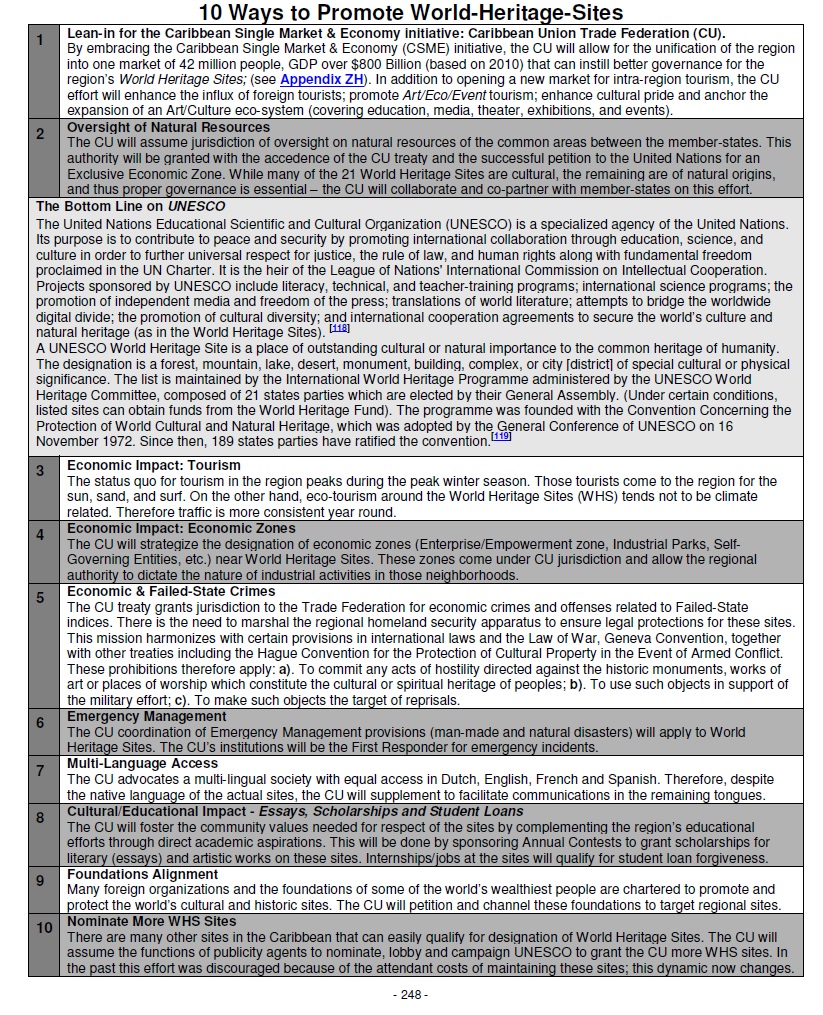
Yes, there is the need for some investment (roads, trails, lifts and visitor centers), but the returns are quantifiable, undeniable and irresistible. This is how Caribbean communities can grow their economic engines. This is the quest of the Go Lean movement. This was anticipated from the beginning of the Go Lean movement with the focus on UNESCO World Heritage Sites for the Caribbean region. See this Page (248) from the book:
CU Blog - Lessons from Colorado - Common Sense of Eco-Tourism - Photo 3

Click on Photo to Enlarge

The Go Lean details that 1,000 additional jobs can be created by fostering the promotion and development of UNESCO World Heritage Sites in the region. This is just common sense.

Thank you Colorado, for your fine role model.

We can do the same; we can make our Caribbean homeland a better place to live, work and play. 🙂

Download the free e-Book of Go Lean … Caribbean – now!

Sign the petition to lean-in for this roadmap for the Caribbean Union Trade Federation. 

———-

Appendix VIDEO – Rocky Mountain National Park, Colorado, USA in 4K (Ultra HD) – https://youtu.be/tdWV2xEyOfE

Published on Sep 23, 2016 – 

Rocky Mountain National Park in Colorado is one of the most popular and scenic National Parks in the United States, famous for its high mountain peaks, alpine lakes, abundant wildlife. The main sightseeing road in the park, and some of the hiking trails cross over the 12,000 feet/3,600 m altitude line;

Locations in the video:
Sprague Lake (0:01), Nymph Lake (0:17), Dream Lake (0:38), Emerald Lake (0:59), Lake Haiyaha (1:12), The Loch (1:26), Timberline Falls (1:51), Sky Pond (2:24), Mills Lake (2:57), Alberta Falls (3:05), Multiple viewpoints along the Trail Ridge Road (3:108:12), Chasm Lake Trail (4:03), Chasm Lake (4:54), Mt Ida Hike (6:39), Horseshoe Falls (8:58), Chasm Falls (9:26), Old Fall River Road (9:31).

Recorded August 2016 in 4K (Ultra HD) with Sony AX100.

Music:
Mystic Crock – Difference – The Difference (Part II)
http://mysticcrock.bandcamp.com
Licensed via ilicensemusic.com

If you enjoyed this video please like, share, comment, favorite, subscribe!
Visit my channel for more Amazing Places on Our Planet:
https://www.youtube.com/milosh9k

———-

APPENDIX – American Tourism Statistics

CU Blog - Lessons from Colorado - Common Sense of Eco-Tourism - Photo 1

(Click on Photo to Enlarge)


Share this post:
, , , ,

Where the Jobs Are – A.I.: Subtraction, not Addition

Go Lean Commentary

Artificial Intelligence or A.I. … this is “where the jobs are”.

TIME Summit On Higher Education

When you hear the phrase “where the jobs are”, it most certainly connotes addition: the industries, places or circumstances where new employment can be located – “where the jobs are … coming from”. However in this case, the phraseology connotes “where the jobs are … going to”.

It is that serious! This is the charter of the movement behind the book Go Lean … Caribbean. The book – available to download for free – serves as a roadmap for the introduction and implementation of the technocratic Caribbean Union Trade Federation (CU), to optimize the societal engines for all 30 member-states. The roadmap starts the focus with economics first – jobs, entrepreneurial opportunities, direct foreign investments, education and occupational training. The movement asserts:

Frankly, selling economic empowerment to the public is easy…

… just show up with a boat-load of jobs and people will “cow tail” and cooperate; (the heavy-lifting is involved in selling industry stakeholders). Security and governing changes on the other hand require much more heavy-lifting: consensus-building, convincing and compromise of existing institutions and officials.

So this Go Lean/CU roadmap joins in chorus in declaring:

“It’s the economy, Stupid” – James Carville coined this phrase as a campaign strategist of Bill Clinton‘s successful 1992 presidential campaign against sitting president George H. W. Bush.
CU Blog - Where the Jobs Are - A.I. - Subtraction, not Addition - Photo 2

The Go Lean/CU roadmap complies with this strategy by adhering to these 3 prime directives:

  • Optimization of the economic engines in order to grow the regional economy to $800 Billion and create 2.2 million new jobs.
  • Establishment of a security apparatus to ensure public safety and protect the resultant economic engines.
  • Improve Caribbean governance to support these engines, including a separation-of-powers between the member-states and CU federal agencies.

So the CU presents a functionality to monitor the eco-system of job creation; this means considering where the jobs are “coming from” and “going to”. A.I. is all the rage, as it pronounces that it does affect jobs … by subtraction; think: 3.5 million truck drivers in the US.

  • This is not soon; this is now!
  • This is not tomorrow; this is today.

That is the topic in this AUDIO Podcast from NPR’s show “The 1A” (1A = First Amendment). Listen to the show here:

AUDIO Podcast – Getting Really Smart About Artificial Intelligence – https://the1a.org/segments/2017-07-19-getting-real-smart-about-artificial-intelligence/

 Getting Really Smart About Artificial Intelligence

Chances are, you’ve already encountered artificial intelligence today.

Did your email spam filter keep junk out of your inbox? Did you find this site through Google? Did you encounter a targeted ad on your way?

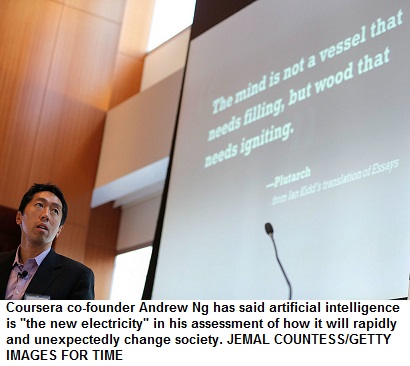
We constantly hear that we’re on the verge of an AI revolution, but the technology is already everywhere. And Coursera co-founder Andrew Ng predicts that smart technology will help humans do even more. It will drive our cars, read our X-rays and affect pretty much every job and industry. And this will happen soon.

As AI rises, concerns grow about the future of humans. So how can we make sure our economy and our society are ready for a technology that could soon dominate our lives?

So the CU/Go Lean roadmap calls for fostering job-creating developments, incentivizing many high-tech start-ups and incubating viable companies. These career options now proliferate:

  • Big Data Analysis
  • Search Engines
  • Online Advertising
  • Realtime Credit Decision Engines
  • Machine Learning
  • Interactive Voice Response (IVR)
  • Self-Driving Cars, etc.

Accepting that technology start-ups can be disruptive to legacy businesses means that we have to be prepared for subtractions and not just additions. This is “why“ the Go Lean plan to create 2.2 million new jobs is such heavy-lifting: we have to hit a moving target while our society is moving itself. Whew!

Welcome to transformational change!

The Go Lean roadmap also provides the “how”. The book presents a 370-page turn-by-turn guide on “how” to adopt new community ethos, plus the strategies, tactics, implementations and advocacies to execute so as to reboot, reform and transform the societal engines of Caribbean society.

The “why’s and how’s” were detailed in previous blog-commentaries; consider this sample:

https://goleancaribbean.com/blog/?p=9751 Where the Jobs Are – Animation and Game Design
https://goleancaribbean.com/blog/?p=9203 Where the Jobs Are – Employer Models in the United States
https://goleancaribbean.com/blog/?p=6089 Where the Jobs Are – Futility of Minimum Wage
https://goleancaribbean.com/blog/?p=2857 Where the Jobs Are – Entrepreneurism in Junk
https://goleancaribbean.com/blog/?p=2126 Where the Jobs Are – Computers Reshaping Global Job Market
https://goleancaribbean.com/blog/?p=2025 Where the Jobs Are – Attitudes & Images of the Diaspora
https://goleancaribbean.com/blog/?p=2003 Where the Jobs Are – One Scenario: Ship-breaking
https://goleancaribbean.com/blog/?p=1698 Where the Jobs Are – STEM Jobs Are Filling Slowly

The primary ingredient for the “job creation” roadmap for the Caribbean must be Caribbean people. The book therefore stresses the process to reform and transform the region’s societal engines. This was an early motivation for the roadmap, as pronounced in the opening Declaration of Interdependence (Pages 12 – 13):

xi. Whereas all men are entitled to the benefits of good governance in a free society, “new guards” must be enacted to dissuade the emergence of incompetence, corruption, nepotism and cronyism at the peril of the people’s best interest. The Federation must guarantee the executions of a social contract between government and the governed.

xvi. Whereas security of our homeland is inextricably linked to prosperity of the homeland, the economic and security interest of the region needs to be aligned under the same governance. Since economic crimes … can imperil the functioning of the wheels of commerce for all the citizenry, the accedence of this Federation must equip the security apparatus with the tools and techniques for predictive and proactive interdictions.

xxi.  Whereas the preparation of our labor force can foster opportunities and dictate economic progress for current and future generations, the Federation must ensure that educational and job training opportunities are fully optimized for all residents of all member-states, with no partiality towards any gender or ethnic group. The Federation must recognize and facilitate excellence in many different fields of endeavor, including sciences, languages, arts, music and sports. This responsibility should be executed without incurring the risks of further human flight, as has been the past history.

xxiv. Whereas a free market economy can be induced and spurred for continuous progress, the Federation must install the controls to better manage aspects of the economy: jobs, inflation, savings rate, investments and other economic principles. Thereby attracting direct foreign investment because of the stability and vibrancy of our economy.

xxvii. Whereas the region has endured a spectator status during the Industrial Revolution, we cannot stand on the sidelines of this new economy, the Information Revolution. Rather, the Federation must embrace all the tenets of Internet Communications Technology (ICT) to serve as an equalizing element in competition with the rest of the world. The Federation must bridge the digital divide and promote the community ethos that research/development is valuable and must be promoted and incentivized for adoption.

The subject of automation is a familiar theme for the Go Lean movement. Consider this sample:

Robots Building Houses – More than Fiction
Bill Gates: ‘Tax the Robots’
‘Olli’ – The Self-Driving Public Transit Vehicle
Drones to be used for Insurance Damage Claims
Here come the Drones … and the Concerns
The need for Google’s highway safety innovations
Autonomous Ghost Ships

Heavy-lifting, yes! But still, this plan is conceivable, believable and achievable. This is the track record of technology-innovations emerging from many corners of the world. Where there’s a will – community ethos for fostering innovation – there is a way.

The Go Lean book details the special focus of this advocacy on Page 197:

10 Ways to Foster Technology

Yes, we can … make our homeland a better place to live, work and play. 🙂

Download the free e-Book of Go Lean … Caribbean – now!

Sign the petition to lean-in for this roadmap for the Caribbean Union Trade Federation.

Share this post:
, , , ,
[Top]

JPMorganChase spent $10 billion on ‘Fintech’ for 1 year

Go Lean Commentary

Looking for a job? Where are the jobs to be created for the 21 Century?

JPMorgan - Photo 2Try banking! Financial/Banking technology to be exact. This sub-industry sector is referred to as ‘Fintech’; see the definition in the Appendix below.

So rather than the individual, if a community wants to foster job creation, ‘Fintech’ offers attractive options.

What’s more, according to this news article, one New York-based bank, JPMorganChase, spent almost $10 Billion on Fintech … last year alone. The CEO, Jaime Dimon, announced that there will be even more investment in this vital area. See the full story here:

Title: Jamie Dimon – JPMorgan spent nearly $10 billion on tech last year
By: Ari Levy

JPMorgan CEO Jamie Dimon said the bank spent $9.5 billion on technology in 2016 and has plans this year to introduce products for digital banking, online investment advice and electronic trading.

JPMorgan - Photo 1In his annual letter to shareholders on Tuesday, Dimon said the bank is also “collaborating with some excellent fintech companies to dramatically improve our digital and other customer offerings.”

Among the leading bank executives, Dimon has established himself as the biggest presence in San Francisco and Silicon Valley, making regular trips West to meet with tech executives and venture capitalists. He made headlines in his shareholder letter two years ago, warning investors that “Silicon Valley is coming.”

Rather than view potential banking disruption as a threat to JPMorgan, Dimon has embraced new technologies. About $3 billion, or almost one-third, of last year’s investment went to “new initiatives,” including $600 million on fintech solutions and projects.

Dimon highlighted partnerships with emerging tech companies like Zelle for consumer payments, Roostify for online mortgages, TrueCar for auto finance and On Deck Capital, which provides loans to small businesses.

The JPMorgan CEO also took a swipe at the U.S. immigration system and how it hurts this country’s ability to compete globally. Dimon said that about 40 percent of people receiving advanced degrees in science, technology engineering and math at American universities are from other countries. Yet they have no legal way to stay when they’re finished with school.

“We are forcing great talent overseas by not allowing these young people to build their dreams here,” Dimon wrote.

Source: CNBC – Business & Finance TV Channel; posted 04/04/2017; retrieved 04/05/2017) from: http://www.cnbc.com/2017/04/04/jamie-dimon-letter-jpmorgan-spent-9-5b-on-tech-last-year.html

So where are the jobs to be found? According to the foregoing, this industry – Fintech – is one of the options.

In general, this has been a frequent question for the movement behind the book Go Lean … Caribbean. The book presents the Caribbean region a roadmap to elevate its societal engines, starting first with economics (jobs, industrial development and entrepreneurial opportunities). In fact, the prime directives of the roadmap includes the following 3 statements:

  • Optimization of the economic engines in order to grow the regional economy to $800 Billion & create 2.2 million new jobs.
  • Establishment of a security apparatus to protect the resultant economic.
  • Improve Caribbean governance to support these engines.

The Go Lean book introduces the Caribbean Union Trade Federation (CU) as a federal government for 30 regional member-states, plus the Caribbean Central Bank (CCB) as a cooperative for the existing Central Banks. Together, these new entities will provide stewardship for the region’s banks.

Banking is very familiar to the Caribbean. This industry has proven to be the secondary industrial driver for many Caribbean communities, trailing only tourism. The Go Lean book explains (Page 58):

Core Competence – What are we best at doing?
There are features of Caribbean life that work very well now. We are currently the “best address” in the world. If one has the resources, there is no better place to call home – imagine a lottery winner relocating to a Caribbean paradise. Further, if someone has the resources for only a short time-frame, there is no better place to vacation. And thus, as a regional community, the Caribbean is best at servicing:

  • Tourism
  • Cruise Operations
  • Offshore Banking – The Caribbean colonial heritage created the ideal climate for offshore banking. Many of the European expatriates administering the colonies didn’t want to burden themselves with aggressive tax policies or strenuous financial compliance, and so inadvertently created a climate for tax sheltering and avoidance. Though the industry is professionally managed today, with best-of-class oversight and compliance requirements, the reputations and image is still deep-rooted based on this history. Consider Bermuda, Cayman Islands and Nassau’s proliferation with hundreds of offshore banks. When a celebrity in North America or Europe is labeled with “deposits in the Caymans or Bermuda”, there is an immediate public’s reaction. This was the case for US Presidential Candidate Mitt Romney in the 2012 Presidential election.
  • Specialty Agriculture.

Overall, the Go Lean book stresses the community ethos, strategies, tactics, implementations and advocacies to reboot, reform and transform the economic engines of Caribbean society.

How many jobs are to be impacted?

In general the roadmap projects 2.2 million new jobs across the 30 Caribbean member states. But for the Financial/Banking industry, the plan calls for:

Banking – New jobs from Banking reform, and adoption of e-payments, & card products  –  6,000

The Caribbean technology industry projects even more new jobs to be created in the region; the count was published at:

Technology – Direct:    Products and services for IT architecture, application and administration  –  20,000

Technology – Indirect: Service jobs for technology support and logistics  –  44,000

In total, the projection is for 70,000 new jobs.

Considering the experience of JPMorganChase Bank in the foregoing article – spending $10 Billion – and the projections in the Go Lean roadmap, it must be concluded that Fintech is one area “where the jobs are”.

The Go Lean book asserts that to thrive in the new global marketplace there must be an agile technocratic administration for the region’s banking; it will affect all aspects of Caribbean life. This comprehensive view – economics, security and governance – is the charge of the Go Lean roadmap, opening with these pronouncements in the Declaration of Interdependence (Page 13 and 14):

xxiv. Whereas a free market economy can be induced and spurred for continuous progress, the Federation must install the controls to better manage aspects of the economy: jobs, inflation, savings rate, investments and other economic principles. Thereby attracting direct foreign investment because of the stability and vibrancy of our economy.

xxvii. Whereas the region has endured a spectator status during the Industrial Revolution, we cannot stand on the sidelines of this new economy, the Information Revolution. Rather, the Federation must embrace all the tenets of Internet Communications Technology (ICT) to serve as an equalizing element in competition with the rest of the world. The Federation must bridge the digital divide and promote the community ethos that research/development is valuable and must be promoted and incentivized for adoption.

The points of effective, technocratic banking stewardship were further elaborated upon in previous blog/commentaries. Consider this sample:

https://goleancaribbean.com/blog/?p=10585 Two Pies: Economic Plan for a New Caribbean
https://goleancaribbean.com/blog/?p=10513 Transforming ‘Money’ Countrywide – Model of India
https://goleancaribbean.com/blog/?p=7140 Central Bank of Azerbaijan sets its currency on free float
https://goleancaribbean.com/blog/?p=7034 The Future of Money
https://goleancaribbean.com/blog/?p=6800 Venezuela sues black market currency website in US
https://goleancaribbean.com/blog/?p=6635 New Security Chip in Credit Cards Unveiled
https://goleancaribbean.com/blog/?p=5668 Move over Mastercard/Visa – Time for Local Banking Cards
https://goleancaribbean.com/blog/?p=4425 Cash, Credit or iPhone …
https://goleancaribbean.com/blog/?p=3889 Royal Bank of Canada’s EZPay – Ready for Change
https://goleancaribbean.com/blog/?p=3881 The Need for Regional Cooperation for Cyber-Security & e-Security
https://goleancaribbean.com/blog/?p=3858 Model of Central Banking Technocracy: ECB 1 trillion Euro stimulus
https://goleancaribbean.com/blog/?p=3582 For Canadian Banks: Caribbean is a ‘Bad Bet’
https://goleancaribbean.com/blog/?p=1350 PayPal’s Fintech model: Expand payment services to 10 markets
https://goleancaribbean.com/blog/?p=906 Bitcoin virtual currency needs regulatory framework to change image
https://goleancaribbean.com/blog/?p=528 Facebook plans to provide Fintech – Mobile payment services
https://goleancaribbean.com/blog/?p=467 Barbados Central Bank records $3.7m loss in 2013

In a previous blog-commentary, the question was asked:

Who will win the [Fintech] “space race” between all the big Information Technology companies (like Facebook, Google, Apple, Paypal, etc.)? It is not known yet! But for the Caribbean, we must not be spectators only in this “space race”. Not this time!

————-

VIDEO – What is a ‘Robo-Advisor’ – http://www.investopedia.com/terms/r/roboadvisor-roboadviser.asp

playbutton-300x300

Now is the time for all stakeholders of Caribbean banking to lean-in for the empowerments described here-in and in the book Go Lean … Caribbean. This is where the jobs are, today and tomorrow. We can elevate our communities and our banking eco-systems. We can be a better place to live, work and play. 🙂

Sign the petition to lean-in for the roadmap for the Caribbean Union Trade Federation.

Download the free e-book of Go Lean … Caribbean – now!

———

Appendix – What is ‘Fintech’

CU Blog - Transforming Money Countrywide - Photo 2Fintech is a portmanteau – a word derived from a blending of two or more distinct forms as smog from smoke and fog) – of financial technology that describes an emerging financial services sector in the 21st century. Originally, the term applied to technology applied to the back-end of established consumer and trade financial institutions. Since the end of the first decade of the 21st century, the term has expanded to include any technological innovation in the financial sector, including innovations in financial literacy and education, retail banking, investment and even crypto-currencies like bitcoin.

BREAKING DOWN ‘Fintech’
The term financial technology can apply to any innovation in how people transact business, from the invention of money to double-entry bookkeeping. Since the internet revolution and the mobile internet revolution, however, financial technology has grown explosively, and fintech, which originally referred to computer technology applied to the back office of banks or trading firms, now describes a broad variety of technological interventions into personal and commercial finance.

Fintech’s Expanding Horizons
Already technological innovation has up-ended 20th century ways of trading and banking. The mobile-only stock trading app Robinhood charges no fees for trades, and peer-to-peer lending sites like Prosper and Lending Club promise to reduce rates by opening up competition for loans to broad market forces. Technologies being designed that should reach fruition by 2020 include mobile banking, mobile trading on commodities exchanges, digital wallets (like Apple (AAPL) and Google’s (GOOG) developing mobile wallet systems), financial advisory and robo-advisor sites like LearnVest and Betterment, and all-in-one money management tools like Mint and Level.

New Tech in Fintech
In the olden days, individuals and institutions used the invisible hand of the market – represented by the signaling function of price – to make financial decisions. New technologies, like machine learning, predictive behavioral analytics and data-driven marketing, will take the guess work and hocus pocus out of financial decisions. “Learning” apps will not only learn the habits of users, often hidden to themselves, but will engage users in learning games to make their automatic, unconscious spending and saving decisions better. On the back end, improved data analytics will help institutional clients further refine their investment decisions and open new opportunities for financial innovation.

Fintech Users
Who uses fintech? There are four broad categories: 1) B2B for banks and 2) their business clients; and 3) B2C for small businesses and 4) consumers. Trends toward mobile banking, increased information, data and more accurate analytics and decentralization of access will create opportunities for all four groups to interact in heretofore unprecedented ways.

Source: Retrieved 04-05-2017 from: http://www.investopedia.com/terms/f/fintech.asp

————-

VIDEO – What is ‘FinTech’ – http://www.investopedia.com/terms/f/fintech.asp

playbutton-300x300

Share this post:
, , ,
[Top]

Bill Gates: ‘Tax the Robots’

Go Lean Commentary

There is a fear – fueled by Hollywood – of a Robot Apocalypse. This is where the machines become self-aware – see Appendix VIDEO below – and ascertain that humans are a threat to their existence and so they seek to destroy all biological humans. This theme has been frequented  in movies like “The Terminator“, “The Matrix“, “I, Robot“, “West World“, “Avengers – Age of Ultron” and more.

CU Blog - Bill Gates - 'Tax the Robots' - Photo 2While enmity between humans and robots (Artificial Intelligence) may NOT be a legitimate fear today, one thing for sure, many robots, robotic systems, autonomous systems and automation systems are responsible for taking a lot of jobs IN REAL LIFE; there is no need for Hollywood make-believe with this threat.

From a governance perspective, this is bad! Humans pay taxes, social security, national insurance, pensions, healthcare and other community benefits. Robots do not!

Or should they?

Bill Gates, a billionaire whose fortunes were forged from the computer software industry asserts that robots should pay taxes. See the related news articles or editorials here:

Title #1: Robots that steal human jobs should pay taxes: Bill Gates

WASHINGTON: Robots that steal human jobs should pay taxes, Microsoft co-founder and philanthropist Bill Gates has said.

CU Blog - Bill Gates - 'Tax the Robots' - Photo 1“Certainly there will be taxes that relate to automation. Right now, the human worker who does, say, USD 50,000 worth of work in a factory, that income is taxed and you get income tax, social security tax, all those things,” Gates told Quartz website.

“If a robot comes in to do the same thing, you’d think that we’d tax the robot at a similar level,” said Gates, one of the world’s richest men.

Gates said he believes that governments should tax companies’ use of robots, as a way to at least temporarily slow the spread of automation and to fund other types of employment.

The 61-year-old philanthropist said a robot tax could finance jobs taking care of elderly people or working with kids in schools, for which needs are unmet and to which humans are particularly well suited.

He argued that governments must oversee such programmes rather than relying on businesses, in order to redirect the jobs to help people with lower incomes.

“If you can take the labour that used to do the things automation replaces, and financially and training-wise and fulfilment-wise have that person go off and do these other things, then you’re net ahead,” said Gates, one of the leading players in artificial-intelligence technology.

“But you can’t just give up that income tax, because that’s part of how you’ve been funding that level of human workers,” he said.

The web portal reported that the idea is not totally theoretical as EU lawmakers considered a proposal to tax robot owners to pay for training for workers who lose their jobs, though on February 16 the legislators ultimately rejected it.

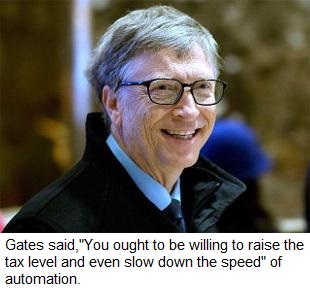
“You ought to be willing to raise the tax level and even slow down the speed” of automation, Gates said.

“Exactly how you’d do it, measure it, you know, it’s interesting for people to start talking about now,” Gates said.

Talking about the tax on robots, Gates said, “Some of it can come on the profits that are generated by the labour- saving efficiency there. Some of it can come directly in some type of robot tax. I don’t think the robot companies are going to be outraged that there might be a tax. It’s OK.”

Source: Economic Times Magazine – Posted February 20, 2017; retrieved March 15, 2017 from:
http://economictimes.indiatimes.com/news/international/business/robots-that-steal-human-jobs-should-pay-taxes-bill-gates/articleshow/57234194.cms

—————

Title #2: What’s Wrong With Bill Gates’ Robot Tax
By: Noah Smith

Microsoft Corp. founder Bill Gates made a splash in a recent interview, when he suggested that robots should be taxed in order to help humans keep their jobs:

    “Right now, the human worker who does, say, $50,000 worth of work in a factory, that income is taxed and you get income tax, social security tax, all those things. If a robot comes in to do the same thing, you’d think that we’d tax the robot at a similar level.”

Gates is only one of many people in the tech world who have worried about automation and its threat to workers. YCombinator founder Sam Altman, for instance, is conducting an experiment with basic income — a regular cash payment to all households. That policy has gained popularity across Silicon Valley, if not in the rest of the country.

It’s easy to see why the tech world is worried. The rise of machine learning has increased the fear that many humans could simply become obsolete — for example, 3.5 million American truck drivers might soon find their jobs threatened by driverless trucks. Though in the past, technology usually complemented workers instead of replacing them, there’s no law of nature saying the technology of the future will work the same. A few economists even claim that cheap automation has already diverted income from workers to company owners.

The fear isn’t that all humans will become obsolete, but that automation will increase inequality among humans. Company owners and high-skilled workers — people who tell machines what to do — would be vastly enriched, while everyone else either works low-skilled jobs for meager wages or goes on welfare.

Another fear is that even if the mass of humanity ultimately does find new ways to add value by complementing new technology — to “race with the machines,” as economist Erik Brynjolfsson puts it — this transition could take a long time and hurt a lot of people. As Bloomberg View’s Tyler Cowen has noted, wages in Britain fell for four decades at the start of the Industrial Revolution. More recently, we’ve seen very slow and painful adjustment to the impact of globalization. If the machine learning revolution hurts workers for 40 years before ultimately helping them, it might be worth it to slow that revolution down and give them time to adjust.

The main argument against taxing the robots is that it might impede innovation. Growth in rich countries has slowed markedly in the past decade, suggesting that it’s getting harder and harder to find new ways of doing things. Stagnating productivity, combined with falling business investment, suggests that adoption of new technology is currently too slow rather than too fast — the biggest problem right now isn’t too many robots, it’s too few. Taxing new technology, however it’s done, could make that slowdown worse.

The problem with Gates’ basic proposal is that it’s very hard to tell the difference between new technology that complements humans and new technology that replaces them. This is especially true over the long term. Power looms replaced human weavers back in the Industrial Revolution, but people eventually became more productive, by learning to operate those looms. If taxes had slowed the development of power looms, the eventual improvements would have come later.

This is a powerful argument against the taxation of automation. Gates is right to say that we should start thinking ahead of time about how to use policy to mitigate the disruptions of automation. But given the importance of sustaining innovation, we should look at alternative policies.

One idea is a wage subsidy for low-income workers. This basically puts a thumb on the scale in the human-robot struggle, by making human workers cheaper. The easiest way to do that is to cut payroll taxes, which disproportionally fall on low earners. That would mean paying for Medicare and even Social Security out of other revenue sources, such as higher income taxes on the rich or a value-added tax.

Another idea is to simply redistribute capital income more broadly. Income from capital gains, land rents and dividends now is highly concentrated among the wealthy. But policy could change that. One idea, suggested by economist Miles Kimball, is a sovereign-wealth fund. The government could use tax revenue to buy stocks and real estate, and distribute the profits to the populace. This would essentially redistribute some of the income produced by the robots, giving every citizen a stake in the new automation economy. The wealth fund could be split into many smaller funds, each with different managers, in order to prevent concentration of ownership.

So there are probably better ways than taxing robots to help humans avoid the harms of automation. Instead of slowing innovation, the government should think about taxing humans less and redistributing the income of robots more.

This column does not necessarily reflect the opinion of the editorial board or Bloomberg LP and its owners.

Related story: Driverless Cars

About the Author: Noah Smith is a Bloomberg View columnist. He was an assistant professor of finance at Stony Brook University, and he blogs at Noahpinion.

Source: Posted February 28, 2017; retrieved March 15, 2017 from: https://www.bloomberg.com/view/contributors/AR3OYuAmvcU/noah-smith

This drama is aligned with the book Go Lean…Caribbean, which calls for the elevation of Caribbean economics, asserting that the region needs to better prepare and contribute in the fields of Science, Technology, Engineering and Mathematics (STEM) plus related fields of Internet & Communications Technologies (ICT). The book examines strategies, tactics, implementations and advocacies to foster more technologies and grow the economy. This quotation – from Page 57 – is most representative of the focus on technology:

Technological change is more than just internet & communications (ICT); though this field is dynamically shifting the world. There are also industrial changes taking place, as in more efficient manufacturing methods, automation/robotics, and transportation options

There are specific CU agencies will manage the other areas of technological change. The community ethos is no not just to consume technology products but to produce them as well. This allows us to better compete with the rest of the world, having both an “offense and on defense”.

But according to the foregoing articles, the raised concerns are our reality: there is no plan to tax robots-automation above and beyond to replace the lost human tax incomes.

Consider this simple scenario of self-driving/autonomous vehicles; the foregoing articles identified how truck drivers could be displaced by self-driving vehicles. The Go Lean movement have addressed these advances many times; consider this sample:

‘Olli’ – The Self-Driving Public Transit Vehicle
Drones to be used for Insurance Damage Claims
Pleas to Detroit on Technology in Cars
Here come the Drones … and the Concerns
The need for Google’s highway safety innovations
Autonomous Ghost Ships

Ah, the art and science of autonomous vehicles.

This is not science fiction; this is today’s science. It will take a technocratic administration to shepherd these advances through Caribbean society. The book Go Lean … Caribbean serves as a roadmap for the introduction and implementation of the technocratic Caribbean Union Trade Federation (CU). This book  is a complete roadmap, turn-by-turn guide for elevating Caribbean society. There is a plan for adapting government revenue options and for creating jobs to these global changes. Early in the Go Lean book, these responsibilities were identified as important functions for the CU with these pronouncements in the Declaration of Interdependence (Pages 12 & 14):

xiv. Whereas government services cannot be delivered without the appropriate funding mechanisms, “new guards” must be incorporated to assess, accrue, calculate and collect revenues, fees and other income sources for the Federation and member-states. The Federation can spur government revenues directly through cross-border services and indirectly by fostering industries and economic activities not possible without this Union.

xxvi.  Whereas the Caribbean region must have new jobs to empower the engines of the economy and create the income sources for prosperity, and encourage the next generation to forge their dreams right at home, the Federation must therefore foster the development of new industries, like that of ship-building, automobile manufacturing, prefabricated housing, frozen foods, pipelines, call centers, and the prison industrial complex. In addition, the Federation must invigorate the enterprises related to existing industries tourism, fisheries and lotteries – impacting the region with more jobs.

xxvii.  Whereas the region has endured a spectator status during the Industrial Revolution, we cannot stand on the sidelines of this new economy, the Information Revolution. Rather, the Federation must embrace all the tenets of Internet Communications Technology (ICT) to serve as an equalizing element in competition with the rest of the world. The Federation must bridge the digital divide and promote the community ethos that research/development is valuable and must be promoted and incentivized for adoption.

xxviii. Whereas intellectual property can easily traverse national borders, the rights and privileges of intellectual property must be respected at home and abroad. The Federation must install protections to ensure that no abuse of these rights go with impunity, and to ensure that foreign authorities enforce the rights of the intellectual property registered in our region.

The Caribbean fully understands the effect of losing large swaths of tax-paying citizens. We have an atrocious rate of societal abandonment, especially among our college-educated citizens; that figure has been reported at 70%. Even before talk of a Robot Apocalypse, the Caribbean region had suffered this dysfunction. We have fallen behind with all the ‘Agents of Change’ in society.

These ‘Agents of Change’ are affecting everyone, everywhere. The Go Lean book therefore posits that there is a need to re-focus, re-boot, and optimize the engines of commerce – fix the broken eco-systems – so as to make the Caribbean a better place to live, work and play. We need jobs; we need tax revenues (normally based on wages). The foregoing news articles therefore are very relevant … and fear-inspiring.

The book Go Lean/CU roadmap posits that ICT (Internet & Communications Technology) can be a great equalizer for the Caribbean to better compete with the rest of the world. This technology-job-creation focus is among these 3 prime directives of CU/Go Lean:

  • Optimization of economic engines in order to grow the regional economy to $800 Billion and create 2.2 million new jobs.
  • Establishment of a security apparatus to protect the resultant economic.
  • Improvement of Caribbean governance, including revenue systems, to support these engines.

According to previous blog/commentaries, computers are reshaping the global job market; also there is a great demand for STEM-related jobs. So we cannot just “stick our head in the sand” and ignore these issues. We are already affected. There are other communities that have already prepared themselves for tax revenues from other sources. The Go Lean book considers (Page 194) the example of Southern California (Los Angeles County). That one municipality collects tax revenues from real property (land) and personal property, and in 2007 they enjoyed a gross revenue stream of over $1 Trillion – see Appendix.

The book Go Lean…Caribbean details the effort of optimizing government revenue sources. It features the community ethos to adopt, plus the executions of key strategies, tactics, implementations and advocacies. Consider this preview (Page 172) of 10 Revenue Sources for the CU federal administration – the CU will generate-collect its own revenue streams – as follows:

  1. The Caribbean Single Market adds a new federal Economic Pie for distribution back to member-states.
  2. E-Payments Settlement
  3. In-sourcing e-Government Services
  4. Property Tax Surcharge
  5. Income/Sales Tax Add-ons
  6. Industry Licensing (Security, e-Learning, Health Care Monitoring, Postal)
  7. Regional Services: GPO, Lottery, Spectrum Auctions, Underwater Cables, Mining/Drilling Rights
  8. Prison Industrial Complex
  9. Natural Disaster Insurance Fund
  10. Capital Markets for Treasury Bonds

The primary ingredient for success in the Go Lean/CU roadmap will be Caribbean people, not Caribbean machines – robots have no personage or tax expectation in this roadmap. This community attitude would lead to fostering more development and growth with automated solutions in the region and for the rest of the world (export).

This is new for us. The Caribbean is arguably the best address on the planet, but jobs and government revenues are obviously missing. This Go Lean roadmap is conceivable, believable and achievable for turning around our dire disposition. Everyone is hereby urged to lean-in to this Go Lean roadmap. This provides the guidance to get to the region to its desired destination: a better place to live, work and play. 🙂

Download the book Go Lean … Caribbean – now!

Sign the petition to lean-in for the roadmap for the Caribbean Union Trade Federation.

—————–

Appendix – The Bottom Line on ‘$1 Trillion Dollar Budget’

CU Blog - Bill Gates - 'Tax the Robots' - Photo 3

The Los Angeles County Assessor Office establishes a taxable value for all property [real and personal] subject to property taxation. The 2007 Roll value in Los AngelesCounty was over $1 trillion dollars. That’s correct, 1 trillion dollars. This amount was greater than the gross national product (GNP) of all but 9 countries in the world. – www.assessor.lacounty.gov

Los Angeles County is commonly associated with the entertainment industry; all six major film studios—Paramount Pictures, 20th Century Fox, Sony, Warner Bros., Universal Pictures, and Walt Disney Studios—are located within the county. Beyond motion picture and television program production, other major industries of Los Angeles County are international trade supported by the Port of Los Angeles and the Port of Long Beach, music recording and production, aerospace, and professional services such as law and medicine.

—————–

Appendix VIDEO – Amazing Robot Becomes Self-Aware (Explained) – https://youtu.be/jx6kg0ZfhAI

Published on Jul 18, 2015 – Roboticists at the RPI in New York have built a trio of robots that were put through the classic ‘wise men puzzle’ test of self-awareness – and one of them passed.

Further details here: http://bit.ly/1HxmZrN

Video via: RAIR Lab

Music via: Ultimate Relax Club

Share this post:
, , ,
[Top]

Stay Home! Immigration Realities in the US

Go Lean Commentary

When conditions are dysfunctional at home, people leave … period.

“… we are just making it easy for the clean-up woman” – Classic R&B song by Betty Wright
See Appendix VIDEO below.

CU Blog - Immigration Realities in the US - Photo 6

This is not good for a family nor for a community. The truth of the matter is that communities need their populations to grow, not recede. So any human flight incidences would create havoc on the functionality of societal engines: economics, security and governance.

This is our status in the Caribbean, but it is not just an incident, not a trickle; it is a flood. The people are beating down the doors to get out of their Caribbean homeland, to seek refuge in places like the US, Canada and Western Europe. We have a sad state of affairs for our Caribbean eco-system so we are suffering from a bad record of societal abandonment – averaging a 70 percent brain drain rate. The reasons why people leave have been identified as “push and pull”:

“Push” refers to people who feel compelled to leave, to seek refuge in a foreign land. “Refuge” is an appropriate word; because of societal defects, many from the Caribbean must leave as refugees – think LGBTDisabilityDomestic-abuseMedically-challenged – for their life, liberty and pursuit of happiness. This is making it easy for the “clean-up woman”.

“Pull”, on the other hand refers to the lure of a more prosperous life in the US (and other destinations); many times our people are emigrating for economics solely.

If only we can mitigate these “push and pull” factors, then we can dissuade our people from leaving in the first place. If only we can go from ‘good to great‘ here in the Caribbean homeland. This would be the ideal. But this is not our reality.

What is a point of contention is where our emigrants are going. Let’s consider the realities of one such destination: the United States. While things are bad for our residents in their Caribbean homeland, many minority immigrants in America (Black-and-Brown, Muslim, etc.) have to contend with less than welcoming conditions there.

The movement behind the book Go Lean … Caribbean has consistently related that the United States of America functions as a Great Society but it has two societal defects: Institutional Racism and Crony-Capitalism. These societal defects can easily create a ‘Climate of Hate‘ that causes people to haze and blame-game the immigrant community.

CU Blog - Immigration Realities in the US - Photo 4

In a previous blog-commentary, it was conveyed that America treats immigrants unappreciatedly – they are inflicted with a “long train of abuses”. The long-term Americans start towards the immigrants with hate and then eventually tolerate. After some decades they may then integrate with the immigrant community. But only after generations do they appreciate and celebrate the minority group. Think of the American experience of the Chinese, Italians, Jewish and Cuban populations.

This is also the reality of the Caribbean Black-and-Brown that has emigrated to the US, while they can more easily survive, the quest to thrive is more perplexing. They have to live in this environment filled with these societal defects. Consider this news article and these aligning VIDEO’s:

News Article Title: GPS device-maker Garmin reeling after workers gunned down
By: Jim Suhr

CU Blog - Immigration Realities in the US - Photo 1

OLATHE, Kan. (AP) — GPS device-maker Garmin long has revered diversity in its workforce, even when the locale of its ever-sprawling operational headquarters — a largely white Kansas City suburb — didn’t reflect it.

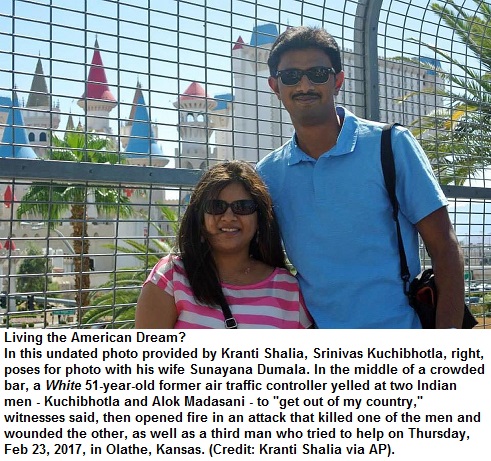
It’s the place 32-year-old Srinivas Kuchibhotla came to work a few years ago. By his wife’s account Friday he willingly spent long hours on an aviation systems engineering team alongside Alok Madasani, a friend and colleague also 32 and from India.

Kuchibhotla’s trek led him to have a kinship with his boss, Lebanese native Didier Popadopoulos, who says he moved to America at Kuchibhotla’s age and once held the same Garmin job.

But Garmin — a billion-dollar tech giant launched in Kansas as a startup by two men nearly three decades ago — now is reeling, trying to digest Kuchibhotla’s shooting death Wednesday at a tavern just a mile down the road from work. Madasani was wounded, along with a stranger who tried to help.

Witnesses say the gunman, Adam Purinton, yelled at the two Indian men to “get out of my country” and opened fire. Purinton, who was arrested hours later at a bar in Missouri, remains jailed on murder and attempted murder charges.

The shooting happened at a time when many have concerns about the treatment of immigrants in the U.S., some of whom feel targeted by the current administration. President Donald Trump has promised to ban certain travelers and been especially vocal about the threat posed by Islamic terrorist groups.

CU Blog - Immigration Realities in the US - Photo 2On Friday, Garmin tried to comfort grieving employees at a closed-door vigil inside the auditorium on its campus in Olathe, Kansas. Kuchibhotla’s widow, Sunayana Dumala, addressed the group of about 200 workers that included Madasani, who was released from the hospital Thursday.

Laurie Minard, Garmin’s vice president of human resources, doesn’t believe the shooting will jeopardize its recruitment of workers from overseas.

“We tend to be a family here,” she said at the Garmin campus, which is waging a $200 million expansion, with plans announced last August for a new manufacturing and distribution center. “We want people to feel safe. We embrace it. We encourage it. We support it. It’s extremely important to us about acceptance.”

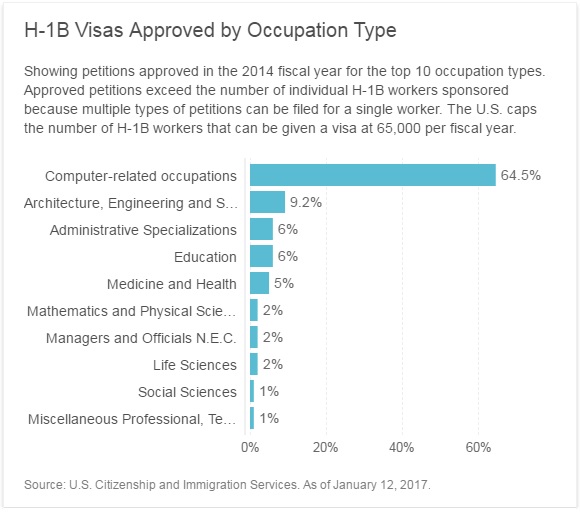
At any given time, she said, more than 100 Garmin employees are in the H-1B program, which lets American companies bring foreigners with technical skills to the U.S. for three to six years.

CU Blog - Immigration Realities in the US - Photo 5

In an eight-year period until fiscal year 2016, Garmin on average obtained 49 certifications for foreign labor — a prerequisite for hiring with an H-1B visa — for an average of 70 positions, according to the U.S. Department of Labor. During that time, 81 percent of the certified positions were in Olathe, the Labor Department says.

Olathe, whose name means “beautiful” in the Shawnee language, is a well-to-do Kansas City suburb where the median household income is above $77,000 a year.

CU Blog - Immigration Realities in the US - Photo 3Worldwide, Switzerland-based Garmin Ltd. — the Kansas operation’s corporate parent — has more than 11,400 workers in 60 offices and last year logged $3.02 billion in revenue. Roughly 2,800 workers are at the Kansas headquarters, which Greater Kansas City Chamber of Commerce spokeswoman Pam Whiting cast as regionally “one of our entrepreneurial success stories” and biggest employers.

Recruiting from overseas isn’t at all unusual in the tech industry, which contends there aren’t enough Americans with specialized skills the companies need.

Indian immigrants in the U.S. has spiked from about 200,000 in the 1980s to more than 2 million today, as Indian-born scientists and engineers fueled the American tech boom. India received more H-1B visas in the U.S. for its temporary high-skilled workers, about 70 percent, than any other country in 2014.

Stunned by Kuchibhotla’s death, Popadopoulos, the Lebanese native who was the man’s boss, said he plans to stay the course.

“When this happened, one of the things I started to think about with my wife (was) ‘Is it time to leave?'” he said.

Then he thought: “Leave where? I’m from here. I really think Srinivas would want us to stick together and stand up for what’s right.”

U.S. Sen. Jerry Moran said he left a message with Olathe’s mayor, offering to help assure people from India who live in Kansas that the actions leading to Kuchibhotla’s death are “not the norm.”

“This is not the nature of Kansas, and we welcome people to the United States, particularly a company like Garmin and many others,” the Kansas Republican said.

___

AP Data Journalist Larry Fenn in New York and AP writers Martha Mendoza in Bangkok and John Hanna in Topeka, Kansas, contributed to this report.
Source: Associated Press – posted February 25, 2017; retrieved February 27, 2017 from: https://www.yahoo.com/news/gps-device-maker-garmin-reeling-workers-gunned-down-013731087.html

—————-

VIDEO #1 What would America’s Tech industry be like without immigrants? – https://youtu.be/QODK-9-mImg

Published on Feb 3, 2017 – In the recent hate-crime in Olathe, Kansas the gunman exclaimed that he wanted the country back. Consider the words of this deranged killer and ask “What would America’s Tech industry be like without immigrants?”
But maybe, the American people are not so inviting, even though American companies may seek immigrants.
http://global-gathering.com

—————-

VIDEO #2 Trump Said Immigration Is Bad for the Economy, But Is it? – https://youtu.be/7PHfJ8HY-Ds

Published on Feb 12, 2017 – The new President, Donald Trump, has expressed that immigration is bad for the American economy and society in general. This is just another example of his “alternate facts”. It is not the truth. But it does project that his American administration is not welcoming to immigrants.
The question to the Caribbean: Do you want to go to a party that you’re not invited to or welcomed?
Category: News & Politics
License: Standard YouTube License

This foregoing article relates a hate-crime against immigrants (engineers) from India. They were not Muslims; they were not Mexican; they were not affiliated with the Black-and-Brown populations from Latin America or the Caribbean. But they were non-White and spoke with foreign accents; they therefore were subject to standard American hate-speech, bullying and in this case, a random act of violence; one was murdered.

This commentary is one of the missions of the book Go Lean…Caribbean, to lower the “pull” attraction of life in the US. This is not being done with “smoke and mirrors” but rather this is just the truth. This is part 2 of 3 in a series on “Why Caribbean people need to Stay Home“, positing that the “grass is not greener on the other side”. The complete series is as follows:

  1.  Stay Home! Remembering ‘High Noon’ and its Back-Story
  2.  Stay Home! Immigration Realities in the US
  3.  Stay Home! Outreach to the Diaspora – Doubling-down on Failure

The truth of the matter is that immigrants are better able to survive in America – there is an abundance of minimum wage jobs – but to thrive is more of a challenge; consider the experiences in the foregoing news article. It would seem better for Caribbean people to work to remediate the problems in their homeland, rather than work to become immigrants in the US. But this is no easy task; and despite being necessary, it is hereby defined as heavy-lifting.

The book Go Lean … Caribbean seeks to optimize the societal engines of Caribbean life; it serves as a roadmap for the introduction and implementation of the technocratic Caribbean Union Trade Federation (CU). The CU must employ better strategies, tactics and implementations to impact the regional homelands to reform and transform the societal engines. The prime directives of the Go Lean/CU roadmap for technocratic stewardship is identified with the following 3 statements:

  • Optimization of the economic engines in order to grow the regional economy to $800 Billion & create 2.2 million new jobs. The deficiency of jobs is one  of the reasons Caribbean people have emigrated.
  • Establishment of a security apparatus to protect the resultant economic engines and mitigate internal and external threats.
  • Improvement of Caribbean governance to support these above engines, including a separation-of-powers between member-state governments and CU federal agencies.

Early in the Go Lean book, this need for careful technocratic stewardship of the region’s societal engines was pronounced (Declaration of Interdependence – Page 12 – 13) with these acknowledgements and statements:

xi.   Whereas all men are entitled to the benefits of good governance in a free society, “new guards” must be enacted to dissuade the emergence of incompetence, corruption, nepotism and cronyism at the peril of the people’s best interest. The Federation must guarantee the executions of a social contract between government and the governed.

xii.  Whereas the legacy in recent times in individual states may be that of ineffectual governance with no redress to higher authority, the accedence of this Federation will ensure accountability and escalation of the human and civil rights of the people for good governance, justice assurances, due process and the rule of law. As such, any threats of a “failed state” status for any member state must enact emergency measures on behalf of the Federation to protect the human, civil and property rights of the citizens, residents, allies, trading partners, and visitors of the affected member state and the Federation as a whole.

xxiv. Whereas a free market economy can be induced and spurred for continuous progress, the Federation must install the controls to better manage aspects of the economy: jobs, inflation, savings rate, investments and other economic principles. Thereby attracting direct foreign investment because of the stability and vibrancy of our economy.

xxvi.  Whereas the Caribbean region must have new jobs to empower the engines of the economy and create the income sources for prosperity, and encourage the next generation to forge their dreams right at home, the Federation must therefore foster the development of new industries … In addition, the Federation must invigorate the enterprises related to existing industries … impacting the region with more jobs.

Our Caribbean community, no community for that matter, can survive a constant drain against our population and human capital. This is a crisis! This point was crystalized in a previous blog/commentary with this quotation:

We tend to think economic growth comes from working harder and smarter. But economists attribute up to a third of it to more people joining the workforce each year than leaving it. The result is more producing, earning and spending.

This is a consistent theme in the book Go Lean…Caribbean. The book posits that the most serious threat to Caribbean prosperity is the high abandonment rate among its citizens, especially its highly educated, skilled-labor classes.

“A crisis is a terrible thing to waste” – states the book quoting noted Economist Paul Romer.

The opportunity therefore exists to forge change in the economic, security and governing engines of the Caribbean, in response to this crisis. This is the advocacy of the Go Lean book, to position the region at the corner of preparation and opportunity, so as to better compete on the world stage. Our job creation engines have failed to keep pace with the population, therefore fewer and fewer jobs are at home. Thus this region has had a higher and higher emigration rate as the decades pass. If we want our citizens to “Stay Home” then we must provide job options.

How?

First, the region already has a mature tourism product so we now need jobs in other industries.

The following details from the book Go Lean … Caribbean are the community ethos, strategies, tactics, implementations and advocates prescribed to create non-tourism jobs and elevate the Caribbean economy:

Community Ethos – Deferred Gratification Page 21
Community Ethos – new Economic Principles Page 21
Community Ethos – Job Multiplier Page 22
Community Ethos – new Security Principles Page 22
Community Ethos – new Governing Principles Page 24
Community Ethos – Ways to Impact the Future Page 26
Community Ethos – Ways to Impact Turn-Arounds Page 33
Community Ethos – Ways to Promote Happiness Page 36
Community Ethos – Ways to Impact the Greater Good Page 37
Strategy – Repatriating Caribbean Diaspora Page 47
Strategy – Non-Government Organizations Page 48
Tactical – Confederating a Permanent Union Page 63
Tactical – Fostering a Technocracy Page 64
Implementation – Assemble all Member-States Page 96
Implementation – Ways to Pay for Change Page 101
Implementation – Reasons to Repatriate Page 118
Planning – Ways to Make the Caribbean Better Page 131
Advocacy – Ways to Grow the Economy Page 151
Advocacy – Ways to Create Jobs Page 152
Advocacy – Better Manage the Social Contract Page 170
Advocacy – Ways to Foster Empowering Immigration Page 174
Advocacy – Impact the Diaspora Page 217
Advocacy – Ways to Preserve Caribbean Heritage Page 218
Advocacy – Ways to Help the Middle Class Page 223

The Go Lean roadmap is a product of the Diaspora, from those residing in the US – looking at Caribbean residents and longing to go home. The Go Lean book and blog-commentaries assert that the “grass is not greener on the other side”. But we rightfully know that the quest for economic opportunities is the “pull” factor that attracts Caribbean people.

How to create jobs at home? This point – and accompanying lessons – has been exhausted in previous blog/commentaries; consider this sample:

https://goleancaribbean.com/blog/?p=9751 Where the Jobs Are – Animation and Game Design
https://goleancaribbean.com/blog/?p=9203 Where the Jobs Are – Employer Models in the United States
https://goleancaribbean.com/blog/?p=8262 Creating Job Opportunities with UberEverything – An African Model
https://goleancaribbean.com/blog/?p=8328 Creating Job Opportunities as YouTube Millionaires
https://goleancaribbean.com/blog/?p=7806 Skipping School to become Tech Giants
https://goleancaribbean.com/blog/?p=6129 Innovative Partnership Aids Farm Workers/Agricultural Jobs
https://goleancaribbean.com/blog/?p=6089 Where the Jobs Are – Futility of Minimum Wage
https://goleancaribbean.com/blog/?p=5759 Pressed by Debt Crisis, Doctors Leave Greece in Droves for New Jobs
https://goleancaribbean.com/blog/?p=2857 Where the Jobs Are – Entrepreneurism in Junk
https://goleancaribbean.com/blog/?p=2126 Where the Jobs Are – Computers Reshaping Global Job Market
https://goleancaribbean.com/blog/?p=2025 Where the Jobs Are – Attitudes & Images of the Diaspora
https://goleancaribbean.com/blog/?p=2003 Where the Jobs Are – One Scenario: Ship-breaking
https://goleancaribbean.com/blog/?p=1698 Where the Jobs Are – STEM Jobs Are Filling Slowly

These previous blogs report that this Go Lean roadmap is a hope for change in the Caribbean region. Its a plan that is conceivable, believable and achievable for making the Caribbean homeland a better place to live, work and play. Everyone in the region is hereby urged to lean-in to this roadmap. 🙂

Download the book Go Lean … Caribbean – now!

———–

Appendix VIDEO – Betty Wright – Clean Up Woman – https://youtu.be/vh-2_kdVcyA

Uploaded on May 27, 2009 Lyrics:

“Clean Up Woman”
A clean up woman is a woman who
Gets all the love we girls leave behind
The reason I know so much about her
Is because she picked up a man of mine

Chumpin’ slick was my ruin
‘Cause, I found out all I was doin’
Was making it easy for the clean up woman
To get my man’s love, oh yeah
Just making it easy for the clean up woman
To get my baby’s love, uh-huh, um-hum

I took this man’s love and put it a shelf
And like a fool I thought I had him all to myself

When you needed love I was out having fun
But I found out that all I had done
Was made it easy for the clean up woman
To get my man’s love, uh-huh
Yeah, that’s what I did, I made it easy for the clean up woman
To steal my baby’s love, oh yeah

The clean up woman will wipe his blues away
She’ll give him plenty lovin’ 24 hours a day
The clean up woman, she’ll sweep him off his feet
She’s the one who’ll take him in when you dump him in the street
So take a tip, you better get hip
To the clean up woman ’cause she’s tough
I mean, she really cleans up


Share this post:
, , ,
[Top]

More ‘Bad News’ for Freeport

Go Lean Commentary

Change has come to tropical resorts – hotels with casinos. They do not seem to work anymore. It is a failing business model. This is Bad News for some communities.

CU Blog - Sunwing vacates Memories Grand Bahama - Photo 4

CU Blog - Sunwing vacates Memories Grand Bahama - Photo 5

Casinos are especially failing. Why so?  Well, for the many resort guests that come from North America (US & Canada), they now have abundant access to gambling – lotteries, casinos and pari-mutuel betting (horse racing, greyhound racing and Jai Alai). These establishments, especially casinos as of late, have popped up in many cities all over the region, plus on many Native American reservations. Plus there is the eco-system of Casino Riverboats and Cruise Ships leaving major US ports; many of them heading to the Caribbean.

Lastly, the ubiquity of the internet has furnished endless online gambling options.

The previous casino hot spots of Las Vegas and Atlantic City have thusly had to reform and transform their product offering.

Somehow, the Caribbean region “has not gotten the memo”.

This is sad, as one community after another in the Caribbean are having to endure the “bumps and bruises” of a failing economic engine in their neighborhood.

“It’s a beautiful day in the neighborhood …” NOT!

See this reality – Bad News for one city – in this Press Release statement here:

Corporate Statement: Sunwing vacates Memories Grand Bahama 

CU Blog - Sunwing vacates Memories Grand Bahama - Photo 1

February 1, 2017 – In 2013, the Sunwing Travel Group forged a partnership with the Government of The Bahamas and in 2014 began to operate the Memories Grand Bahama Beach & Casino Resort on Grand Bahama Island. Concurrently with Sunwing’s opening of the Memories Resort, Sunwing began weekly flight service from eight cities in Canada and daily flights from a variety of U.S. cities in the ensuing summer. The opening of the 492-room Resort coupled with Sunwing’s tour operator and airlift support, led to the revitalization of the Grand Bahama tourist economy, over 100,000 incremental tourists annually arriving on new flying programs from Canada and the Eastern United States, the creation of over 1500 jobs on the Island, and an annual economic contribution exceeding US $140 Million.

On October 6th of 2016, Hurricane Matthew caused significant damage to the Memories Resort and forced its closure. Despite an immediate response from Sunwing Travel Group and the Government of The Bahamas to secure alternative accommodations, protect flying, and expedite the necessary repairs, the Hotel’s owner, Hong Kong-based Hutchison Whampoa, did not agree to requests to restore the Memories.

Since this event, the Sunwing Travel Group has taken on the significant financial burden of compensating and re-protecting customers as well as running an air program with limited accommodation options as a demonstration of goodwill and commitment to the people of Grand Bahama Island.

In January, it was reported in the Bahamian press that the Government and Sunwing had agreed to co-invest sums to restore the Memories and secure its earliest reopening. Sunwing sought the hotel Owner’s consent for such restoration but regrettably, the Owner attempted to impose exorbitant conditions that were totally unacceptable to Sunwing and would be to any other potential tenant.

The Sunwing Travel Group is very proud of the partnership it has forged with the Government and the people of Grand Bahama and very saddened to report that we were required to vacate the Memories Resort premises on January 29, 2017. Accordingly, we are making arrangements to pay out applicable redundancy pay for our employees and will be reaching out to our employees in the coming days.

Sunwing intends to continue supporting Grand Bahama Island and its tourism economy, including its hotels, through its tour operators, Sunwing Vacations and US-based Vacation Express as well as by continuing its airlift programs from Canada and from the United States in the summer, subject to conditions we are discussing with Government.

We are also pleased to advise that as part of our ongoing commitment to Grand Bahama and its people, we are already developing plans in concert with the Government to return to Grand Bahama Island as a hotel operator and are optimistic that we will be in a position to announce details shortly.

We are very appreciative for the support we’ve received from the Government and the wonderful people of Grand Bahama. Thank you for your continued support and understanding,

Sunwing Travel Group.

————-

Source: The “Bahamas Weekly” News Source; posted Feb 3, 2017; retrieved Feb 8, 2017 from: http://www.thebahamasweekly.com/publish/grand-bahama-bahamas/Sunwing_vacates_Memories_Grand_Bahama52338.shtml

CU Blog - Sunwing vacates Memories Grand Bahama - Photo 2

CU Blog - Sunwing vacates Memories Grand Bahama - Photo 3

————-

VIDEO – Memories Grand Bahama Beach & Casino Resort – Grand Bahama, The Bahamas | Sunwing.ca – https://youtu.be/qLo3puqnIis

Published on Apr 15, 2014 – Memories Grand Bahama Beach and Casino Resort offers the perfect vacation escape for all types of travelers. Guests can indulge in a variety of first-class amenities, gourmet dining, unlimited beverages, onsite golf and non-stop activities.

The foregoing press release – about Freeport, the 2nd city in the Bahamas – aligns with the book Go Lean…Caribbean, which calls for the elevation of Caribbean economics. This quest means first accepting the reality of the current assessments; then forging the necessary change.

What is the assessment? The region is in crisis!

Alas, the Go Lean book declares “a crisis is a terrible thing to waste”. It serves as a roadmap for the introduction and implementation of the technocratic Caribbean Union Trade Federation (CU) with the charter to effectuate change in the region with these 3 prime directives:

  • Optimization of the economic engines in order to grow the regional economy to $800 Billion and create 2.2 million new jobs.
  • Establishment of a security apparatus to protect the resultant economic engines and marshal against economic crimes.
  • Improve Caribbean governance to support these engines.

Looking at the foregoing news story, Freeport has a crisis. There is a need to re-focus, re-boot, and optimize the engines of commerce so as to make Freeport, Grand Bahama, the whole Bahamas and the entire Caribbean, better places to live, work and play. This news story relates that the tourism product in Freeport, the mainstay of Caribbean economy, is in turmoil. The Go Lean book asserts that this is where the region must start in the effort for turn-around: the region can no longer afford to be a “one-trick pony”. The opening page of the book states:

The Caribbean has tried, strenuously, over the decades, to diversify their economy away from the mono-industrial trappings of tourism, and yet tourism is still the primary driver of the economy. Prudence dictates that the Caribbean nations expand and optimize their tourism products, but also look for other opportunities for economic expansion. The requisite investment of the resources (time, talent, treasuries) for this goal may be too big for any one Caribbean member-state. Rather, shifting the responsibility to a region-wide, professionally-managed, deputized technocracy will result in greater production and greater accountability. This deputized agency is the … CU.

The CU Trade Federation is a technocracy, empowered to reboot the economic engines of the member-states, by fostering new industries (new “purse”) across the entire region and deploying solutions to better exploit the opportunities of the global trade market. Thus generating all new revenues; with no need to re-distribute any existing “purse” among the member-states.

There is an apropos proverb: “if you fail to plan, you plan to fail”. Starting here and now, the Caribbean starts its planning for success; to snatch “victory out of the jaws of defeat”. Failure is just too familiar. Already we have member-states … on the verge of a Failed-State status… These states are not contending with the challenges of modern life: changing weather patterns, ever-pervasive technology, and the “flat world” of globalization. To reverse the fortunes of these failing states, and guide others in the opposite direction to a destination of prosperity, the Caribbean must re-boot the regional economy and systems of commerce.

Early in this book, the responsibility to monitor, manage, and mitigate the risks and threats of job killing developments, (such as the reporting in the foregoing press release), was identified as an important function for the CU with this pronouncement in the Declaration of Interdependence (Pages 13):

xxvi.  Whereas the Caribbean region must have new jobs to empower the engines of the economy and create the income sources for prosperity, and encourage the next generation to forge their dreams right at home, the Federation must therefore foster the development of new industries… In addition, the Federation must invigorate the enterprises related to existing industries like tourism… – impacting the region with more jobs.

So what is next for Freeport?

CU Blog - Sunwing vacates Memories Grand Bahama - Photo 6

The urging to this community is to “be afraid; be very afraid of maintaining the status quo”. It is past time to reboot Freeport. (See the foregoing VIDEO advertising the Memories Grand Bahama Resort).

This commentary previously related details of the status quo for Freeport and the strong recommendations to forge change. Consider this list of previous blogs:

https://goleancaribbean.com/blog/?p=10309 Time to consider “Secession”
https://goleancaribbean.com/blog/?p=10140 Lessons Learned from Detroit: Demolish abandoned structures!
https://goleancaribbean.com/blog/?p=7528 A Vision of Freeport as a Self-Governing Entity
https://goleancaribbean.com/blog/?p=7449 ‘Crap Happens’ – So What Now?
https://goleancaribbean.com/blog/?p=5542 Freeport’s Bad Ethos of Rent-Seeking
https://goleancaribbean.com/blog/?p=4185 Freeport: A Ghost Town Happening
https://goleancaribbean.com/blog/?p=4037 How to Train Your ‘Dragon’ – Freeport Version
https://goleancaribbean.com/blog/?p=3641 Freeport’s Musical Roots: A City ‘Built on Rock-n-Roll’
https://goleancaribbean.com/blog/?p=2585 Parallel of Freeport’s History: Concorde Supersonic Transport
https://goleancaribbean.com/blog/?p=300 Freeport’s Failing Status: ’10,000 Bahamians Living in Darkness’

The problems in Freeport are indicative of many other failing Caribbean communities, especially those overly dependent on tourism. Tourism can be a great economic engine, if managed properly … and diversified to hedge risk.

But, the executions have been faulty. Many communities have been plagued with “economic sores” for inadequate management of their tourism products. The issue of declining growth or failing business models is an important discussion for this roadmap. This commentary previously related details of these dysfunctions in these earlier Go Lean blogs:

https://goleancaribbean.com/blog/?p=8381 A Lesson in Economic Fallacies – Casino Currencies
https://goleancaribbean.com/blog/?p=7082 The Art and Science of ‘Play’
https://goleancaribbean.com/blog/?p=6680 Vegas Casinos Place Bets on Video Games
https://goleancaribbean.com/blog/?p=6341 Tourism Dysfunctional Stewardship — What’s Next?
https://goleancaribbean.com/blog/?p=4145 A Better Model for ‘Art’ Tourism
https://goleancaribbean.com/blog/?p=3225 Caribbean tourism less competitive due to increasing aviation taxes
https://goleancaribbean.com/blog/?p=2571 Sharing Economy: There is a winning model for Caribbean Tourism
https://goleancaribbean.com/blog/?p=2207 Hotels are making billions from Resort Fees; Bad Model for Caribbean
https://goleancaribbean.com/blog/?p=1984 Casinos Failing Business Model
https://goleancaribbean.com/blog/?p=1943 The Fading Future of Golf; Vital for Tourism?
https://goleancaribbean.com/blog/?p=798 Lessons Learned from the American Airlines Delivery Arts & Sciences
https://goleancaribbean.com/blog/?p=235 Tourism’s changing profile

According to the foregoing press release, the closing of this one property, Memories Grand Bahama, will directly impact over 600 jobs. In economics, there is the study of in-direct jobs that are facilitated by an economic engine. The Go Lean book details (Page 260) the principle of job multipliers, how certain industries are better than others for generating multiple indirect jobs down the line for each direct job on a company’s payroll. (Tourism’s job multiplier may be in the 2.0 to 3.0 range, while other industries, like automotive manufacturing, have a job-multiplier rate of 11.0)

The closing of this one property is more dire for Freeport; it’s an island with only few other non-tourism economic options. This city should be desperate to reform/reboot. Their economy needs to diversify … to industries with high job-multiplier ratios. (The Go Lean book suggest an automotive manufacturing business model for some communities in the Caribbean region; and a shipbuilding focus for Freeport). In order to “dream such a dream”, there must first be the adoption of specific community ethos to diversify the economy. (This is defined as the underlying spirit-attitude-sentiment that informs the beliefs, customs, or practices of society).

Is Freeport ready to start the journey for a new destiny with the adoption of the new community ethos? How about the rest of the Caribbean?

The book details the community ethos, plus the strategies, tactics, implementations and advocacies to foster a diversified economy:

Community Ethos – Deferred Gratification Page 21
Community Ethos – Economic Principle – People Respond to Incentives Page 21
Community Ethos – Economic Principle – Economic Systems Influence Individual Choices Page 21
Community Ethos – Economic Principle – Voluntary Trade Creates Wealth Page 21
Community Ethos – Economic Principle – Consequences of Choices Lie in the Future Page 21
Community Ethos – Job Multiplier Page 22
Community Ethos – “Crap” Happens – Anticipate Natural Disasters Page 23
Community Ethos – Lean Operations Page 24
Community Ethos – Return on Investments (ROI) Page 24
Community Ethos – Ways to Impact the Future Page 26
Community Ethos – Ways to Foster Genius Page 27
Community Ethos – Ways to Help Entrepreneurship Page 28
Community Ethos – Ways to Impact Research & Development Page 30
Community Ethos – Ways to Improve Sharing Page 35
Community Ethos – Ways to Impact the Greater Good Page 37
Strategy – Integrate Region in a Single Market Page 45
Tactical – Fostering a Technocracy Page 64
Tactical – Tactics to Forge an $800 Billion Economy Page 67
Tactical – Separation of Powers – Regional Tourism Promotion Page 78
Implementation – Ways to Deliver Page 109
Implementation – Ways to Reboot Freeport – Only City identified in Roadmap Page 112
Planning – Ways to Make the Caribbean Better – Better Job Options Page 131
Planning – Lessons Learned from Detroit – Example of a Failing City Page 140
Advocacy – Ways to Grow the Economy Page 151
Advocacy – Ways to Create Jobs Page 152
Advocacy – Ways to Improve Governance Page 169
Advocacy – Ways to Better Manage the Social Contract Page 170
Advocacy – Ways to Enhance Tourism Page 190
Advocacy – Ways to Help the Middle Class Page 223
Advocacy – Ways to Impact Urban Living Page 234

The Go Lean/CU roadmap is designed to foster industrial developments to diversify communities from tourism. We do not want to “abandon” tourism, just diversify it.

“Abandon” is a good word, because abandonment is what is happening in these failing Caribbean communities that have not diversified nor grown their economies. The disposition is so bad that the region sports a 70 percent abandonment rate among the educated classes.

This is truly a crisis; but one not to be wasted. All Caribbean stakeholders in the region – residents, institutions, businesses, Diaspora and trading partners – are urged to lean-in to this Go Lean roadmap. This plan is conceivable, believable and achievable.

Yes, we can … make the Caribbean a better place to live, work and play. 🙂

Download the book Go Lean … Caribbean – now!


Share this post:
, , , , ,
[Top]

Alibaba Cloud stretches global reach with four new facilities

Go Lean Commentary

For hundreds of years, empires expanded their reach by establishing colonies on foreign shores. The book Go Lean … Caribbean chronicles (Page 307) the pushing-and-shoving between European powers in the development of the Caribbean. But in 1960, after the atrocities of World War II were inventoried – credited to the complexities of colonialism in World War I and the period between the wars, the United Nations made a declaration that colonialism needed to be disbanded:

cu-blog-alibaba-cloud-stretches-global-reach-with-four-new-facilities-photo-4The “Declaration on the Granting of Independence to Colonial Countries and Peoples” was adopted by the UN General Assembly by resolution on 14 December 1960. Though some countries had already started their independence process (i.e. Ireland, Australia, India, Pakistan, Indonesia, etc.), this resolution established the standard for all dependent countries – even small ones – to become autonomous. – Source: UN-Wikisource

This is now the 21st Century. While colonialism is not dead … entirely, there is a new brand of colonies for trade. Colonies have gone from the physical world to the virtual world, referring to cyber-space or online communities. Chinese trading market-place Alibaba is providing us a model of colonizing their digital footprint in foreign countries. See the story here of Alibaba’s deployment of 4 new data centers in a potpourri of countries:

BEIJING (Reuters) – Alibaba Cloud plans to open four new data facilities outside China, the cloud unit of Alibaba Holdings Ltd said on Monday, as it seeks to grab global market share from leading players Amazon.com Inc and Microsoft.

cu-blog-alibaba-cloud-stretches-global-reach-with-four-new-facilities-photo-1

The data facilities in Dubai, Germany, Japan and Australia will extend the reach of China’s leading cloud computing service provider to every major continent, and marks the latest step in the unit’s $1 billion infrastructure investment drive.

Also known as Aliyun, the unit has flourished domestically thanks to Beijing’s strategic emphasis on building homegrown cloud technology, while foreign firms have grappled with stringent licensing restrictions in the country.

However, it accounts for a much smaller slice of the global market for cloud computing, defined as the storage of data on remote networks rather than local servers, which is expected to reach $135 billion by 2020, according to research firm Canalys.

Alibaba Cloud is forecast to take 7.8 percent of that market, while leading players Amazon.com Inc, Microsoft, International Business Machines Corp and Alphabet Inc are expected to account for 69.1 percent.

Yu Sicheng, general manager of Alibaba Cloud’s international business, said the unit’s strength in China was a significant advantage and a lynchpin in the company’s globalization plans.

“We have the U.S., Europe plus China, which is quite difficult,” he told Reuters in an interview.

The new additions bring Alibaba Cloud’s total number of foreign cloud facilities to eight, surpassing the six within China, though the majority of the company’s data volume remains squarely within China.

It will launch the data facilities through partnerships with Vodafone in Europe, Softbank Group Corp in Japan and YVOLV in Dubai, a joint venture between Alibaba Cloud and Meraas Holdings LLC.

Yu, however, declined to comment on when the unit will likely post a profit, even as it has seen six quarters of consecutive triple-digit growth, to become Alibaba’s fastest growing business sector.

“Our focus is to keep expanding our market leadership and presence and this is our priority for now,” he said.

(Corrects title of Alibaba Cloud executive Yu Sicheng)
(Reporting by Catherine Cadell; Editing by Stephen Coates)
Source: Yahoo News Source. Posted 11-21-2016; retrieved 11-28-2016 from: https://www.yahoo.com/news/alibaba-cloud-stretches-global-reach-four-facilities-061614009–finance.html?ref=gs

This commentary takes another look at colonialism; there is the need for a cyber footprint in countries where “you” may want to conduct online business – this is a feature of globalization. In the effort to deploy the Caribbean Postal Union (CPU)  as a logistics solution for delivering modern commerce, this commentary takes another look at the Alibaba Group; a company that had previously been identified as an excellent role model for the CPU. (American company Amazon was also identified as a fitting role model).

The book Go Lean…Caribbean serves as a roadmap for the introduction and implementation of the Caribbean Union Trade Federation (CU) and the CPU. The book describes a business model for the CPU in facilitating electronic commerce in the region. But it presents this business model as heavy-lifting; there is the need for data centers to power the cyber-functions and applications for online & mobile commerce. The Go Lean roadmap describes the need for 6 data centers strategically placed across the Caribbean region; we want to colonize our own region, following a similar business model to Alibaba’s plans to deploy its colonies throughout the world – in these 4 foreign countries.

More dynamic data centers deployed in a foreign country would mean more business-to-business commerce, including features like web portals, online retail, mobile functionality, payment services, a shopping search engine and data-centric cloud computing services.

cu-blog-alibaba-cloud-stretches-global-reach-with-four-new-facilities-photo-3

cu-blog-alibaba-cloud-stretches-global-reach-with-four-new-facilities-photo-2

As detailed in the previous blog-commentary, Alibaba is not just a China focused company. They also have a Caribbean footprint. In September 2014, the company held an Initial Public Offering (IPO) in the United States on the New York Stock Exchange (NYSE) – Ticker symbol “BABA.N” – looking to raise US$25 billion. The NYSE corporate entity is actually a shell corporation based in the Cayman Islands. So Alibaba extending their global business operations is actually benefiting a Caribbean corporate citizen.

The Go Lean roadmap (Page 106) presented an advocacy that described the trends in data center design and functionality; they are needed for the Cyber-Caribbean strategy. A trend depicted in the book is the Case Study of Hydrogen Fuel Cells as a reliable back-up power-battery source. This Case Study sets the stage for understanding Data Center trends:

Case Study – Bottom Line on Hydrogen Fuel Cells: A fuel cell is a device that converts the chemical energy from a fuel into electricity thru a chemical reaction with oxygen or another oxidizing agent. Hydrogen is the most common fuel. Hydrogen is not in and of itself an energy source, because it is not naturally occurring as a fuel. It is, however widely regarded as an ideal energy storage medium, due to the ease with which electric power can convert water into its hydrogen and oxygen components through electrolysis. Hydrogen technologies relate to the production and use of hydrogen. Hydrogen technologies are applicable for many uses. Some hydrogen technologies are carbon neutral and could have a role in preventing climate change and a possible future hydrogen economy. Fuel cells are different from batteries in that they require a constant source of fuel and oxygen/air to sustain the chemical reaction, they can however produce electricity continually for as long as these inputs are supplied.

There are a handful of US data center facilities that are powered either partially or fully by hydrogen fuel cells; see Appendix IG on Page 285.

The advocacy, branded 10 Trends in Implementing Data Centers, is detailed here:

1. Lean-in for the Caribbean Single Market & Economy (CSME) initiative: Caribbean Union Trade Federation. The CU treaty unifies the Caribbean region into one single market of 42 million people across 30 member-states, thereby empowering the economic engines in and on behalf of the region. The CU embraces the cutting, “bleeding” edge concepts, systems and methodologies for data centers and computer server farms, as in high density computing, facilitating the maximum computing power with the least about of space and power. The prerequisite for any serious data center deployment is power…stable, reliable electricity, with primary, secondary and tertiary solutions. The CU roadmap calls for deployment of a regional power grid, with above ground, underground & underwater cabling. Though data centers must launch now, power costs will be expected to decline with the grid; hydrogen fuel cells will fill the void..
2. Fiber-Optics / Pipeline Optical fibers are widely used in fiber-optic communications, which permits transmission over longer distances and at higher bandwidths (data rates) than other forms of communication. Fibers are used instead of metal wires because signals travel along them with less loss and are also immune to electromagnetic interference. The transparent fiber are made of high quality extruded glass, silica or plastic. The CU as a new Federation can apply a leap-frog approach to implement communication networks without having to contend with older methods or investments. Further the CU will embrace the strategy of installing elaborate pipelines thru out the region, enabling fiber-optics to traverse the network.
3. IP Convergence Internet Protocol (IP) is now ubiquitous for data, voice, and video communications – they all operate on the same type of fiber. This indicates that data centers also function as telecom hubs – central switching offices are now bygones.
4. Cloud Computing  The CU will embrace cloud computing for many operational systems, thereby requiring optimal continuous processing. The roadmap calls for citizens to interact with their federal government via web portals, kiosks or phone contact centers.
5. High Availability (HA) HA is a system design approach (hardware, software and networking) that ensures operational performance will be met, like parallel processing or mirroring. There are systems (i.e. hospitals, banking, electrical grid) that must maximize availability and minimize downtime. Recovery time or estimated time of repair is closely related to availability, optimizing the time to recover from planned or unplanned outages. A CU mission is to facilitate quick recoveries after hurricanes.
6. Colocation Data Centers A colocation center (colo, or coloc) is a type of data center where equipment space and bandwidth are available for rental to retail customers. Colocation facilities provide space, power, cooling, and physical security for the server, storage, and networking equipment of other firms—and connect them to a variety of telecommunications and network service providers—with a minimum of cost and complexity. Colocation has become a popular option for companies as it allows the company to focus its IT staff on the actual work being done, instead of the logistical. Significant benefits of scale (large power and mechanical systems) result in large colocation facilities, typically 50,000 to 100,000 square feet.
7. Caves as Data Centers There is a growing trend of building underground data bunkers. A market leader placed a coloc data center in a huge facility 220 feet underground in a limestone cave outside Pittsburgh-Pennsylvania. There are other limestone cave installations in places like Mammoth, Kentucky and Lenexa, Kansas. The advantage is cost savings, driven by cooling dynamics of an underground facility, where cooler temperature allows for saving money on air conditioning. The CU will identify limestone caverns, plentiful in the region, appropriate to construct data centers – the region needs 6 centers.
8. Storage Solutions – No need for humans Old data center models needed people to load/unload data storage devices (tapes, disk drives). Now with the low costs of storage, the CU can implement storage libraries for primary and back-up purposes. Plus with tools/techniques like Deep Store archive systems [51], it allows for cost-efficient solutions for data/records that are rarely retrieved.
9. Security Issues Modern data centers require minimal human interaction, therefore physical security tend to be very restrictive. In some firms, even the CEO is not allowed access. The CU will implement biometric systems like fingerprints and iris scanning.
10. Unified Command & Control The data center may be void of humans, but there is still the need for many professional analysis, programmers and engineers. These are normally stationed in command centers to facilitate monitoring and cyber-security functions.

Is a discussion of data center trends appropriate for a societal elevation plan for the Caribbean? Absolutely! How the world has changed! The Go Lean book posits that this technology-tinged eco-system is a winning strategy for creating jobs here in the 21st Century. The book explains that Internet & Communications Technologies (ICT) can serve as an equalizing element in competition with the rest of the world. The roadmap projects that 64,000 new jobs – 20,000 Direct & 44,000 Indirect – can be created with this strategy. This strategy is among the keys for elevating Caribbean society. In fact the prime directives of the roadmap is identified with the following 3 statements:

  • Optimization of the economic engines in order to grow the regional economy to $800 Billion & create 2.2 million new jobs.
  • Establishment of a security apparatus to protect the resultant economic engines.
  • Improve Caribbean governance to support these engines.

The foregoing article and the quotation from the Go Lean book depicts a vision of a new Caribbean industrial landscape. This vision was defined early in the book (Page 14) in the opening Declaration of Interdependence:

xxvi. Whereas the Caribbean region must have new jobs to empower the engines of the economy and create the income sources for prosperity, and encourage the next generation to forge their dreams right at home, the Federation must therefore foster the development of new industries, like that of ship-building, automobile manufacturing, prefabricated housing, frozen foods, pipelines, call centers, and the prison industrial complex. In addition, the Federation must invigorate the enterprises related to existing industries like tourism, fisheries and lotteries – impacting the region with more jobs.

xxvii. Whereas the region has endured a spectator status during the Industrial Revolution, we cannot stand on the sidelines of this new economy, the Information Revolution. Rather, the Federation must embrace all the tenets of Internet Communications Technology (ICT) to serve as an equalizing element in competition with the rest of the world. The Federation must bridge the digital divide and promote the community ethos that research/development is valuable and must be promoted and incentivized for adoption.

Beyond data centers, “where are the new jobs for the 21st Century”? This is a familiar question for the Go Lean movement (book and blogs). This question was examined in these previous blog-commentaries:

https://goleancaribbean.com/blog/?p=9751 Where the Jobs Are – Animation and Game Design
https://goleancaribbean.com/blog/?p=9203 Where the Jobs Are – Employer Models in the United States
https://goleancaribbean.com/blog/?p=6089 Where the Jobs Are – Futility of Minimum Wage
https://goleancaribbean.com/blog/?p=2857 Where the Jobs Are – Entrepreneurism in Junk
https://goleancaribbean.com/blog/?p=2126 Where the Jobs Are – Computers Reshaping Global Job Market
https://goleancaribbean.com/blog/?p=2003 Where the Jobs Are – One Scenario: Ship-breaking
https://goleancaribbean.com/blog/?p=1698 Where the Jobs Are – STEM Jobs Are Filling Slowly

ICT is a prominent feature of the Caribbean empowerment plan; creating a Caribbean Cloud is “Step One, Day One” in the Go Lean roadmap. This will facilitate electronic commerce and allow modern day colonies – data centers –  in foreign countries.

The Go Lean book details a series of community ethos, strategies, tactics, implementations and advocacies to foster the best practices for Data Centers in the Caribbean region:

Community Ethos – Economic Principles – Voluntary Trade Creates Wealth Page 21
Community Ethos – Economic Principles – The Consequence of Choice Lie in Future Page 21
Community Ethos – Job Multiplier Page 22
Community Ethos – Lean Operations Page 24
Community Ethos – Ways to Impact the Future Page 26
Community Ethos – Ways to Help Entrepreneurship – Incubators Page 28
Community Ethos – Promote Intellectual Property Page 29
Community Ethos – Ways to Bridge the Digital Divide – e-Government Services Page 31
Community Ethos – Ways to Improve Sharing – e-Government Scheme Page 35
Strategy – Mission – Embrace the Advances of Technology Page 46
Strategy – Competitors – Governments – Shared Systems –vs- Premise-based Page 51
Tactical – Fostering a Technocracy Page 64
Tactical – How to Grow the Economy to $800 Billion – Trade and Globalization Page 70
Tactical – Separation of Powers – Union Revenue Administration – e-Government for Revenue Systems Page 74
Implementation – Year 1 / Assemble Phase – Deploy Data Centers Page 96
Implementation – 10 Trends in Implementing Data Centers Page 106
Implementation – Ways to Deliver Page 109
Implementation – Ways to Impact Social Media Page 111
Implementation – Ways to Benefit from Globalization Page 119
Planning – Ways to Improve Trade – Electronic Commerce Page 128
Advocacy – Ways to Grow the Economy Page 151
Advocacy – Ways to Create Jobs Page 152
Ways to Foster Cooperatives – Co-located Data Centers for e-Government Page 176
Advocacy – Ways to Foster Technology – Incubators Strategy Page 197
Advocacy – Ways to Foster e-Commerce Page 198
Advocacy – Ways to Impact Main Street – e-Commerce as competition for Big-Box Page 201

This VIDEO here – Google’s Data Center – demonstrates a theme from the Go Lean book, that data center trends will influence the ICT eco-system; also see the VIDEO tour for Facebook and Microsoft in the Appendix below:

VIDEO – Inside a Google data center – https://youtu.be/XZmGGAbHqa0

Published on Dec 16, 2014 – Joe Kava, VP of Google’s Data Center Operations, gives a tour inside a Google data center, and shares details about the security, sustainability and the core architecture of Google’s infrastructure.

According to the foregoing article and VIDEOs, data centers are important business infrastructure for the new economy. As demonstrated by Alibaba’s example, these data centers are colonies in the virtual world. The CU/Go Lean plan is to foster and incubate such key industrial installations for the goal of elevating the region economic engines.

Now is the time for all of the Caribbean, the people and governing institutions, to lean-in for the changes in the book Go Lean … Caribbean. This is a Big Idea for the region, that of a Cyber Caribbean effort (Page 127), in which data centers play a major role. Welcome to 21st Century colonies. This is how we build a better future: a better place to live, work and play. 🙂

Download the book Go Lean … Caribbean – now!

————-

Appendix VIDEOs:

Facebook Data Center: https://www.youtube.com/watch?v=Y8Rgje94iI0
Microsoft Data Center: https://www.youtube.com/watch?v=0uRR72b_qvc


Share this post:
, , , , ,
[Top]

Model of the Macy’s Thanksgiving Day Parade – By The Numbers

Go Lean Commentary

“We are giving this for free as a gift to America” – CNBC Newscast: Amy Kule, Executive Producer, 2014 Macy’s Thanksgiving Parade*.

Free?

Hardly! There is nothing free about American Thanksgiving. This is just another example of American Crony-Capitalism. Consider the facts in this VIDEO here of the Macy’s Thanksgiving Day Parade, by the numbers:

VIDEOMacy’s Thanksgiving Day Parade by the Numbers – http://www.aol.com/video/channel/news/582e4599134aa15f420ded1a/

playbutton-300x300

Click on the Photo to Play VIDEO 

This discussion is promoting the idea of the Caribbean modeling the best-practices of American commerce – there are a lot of economic returns from events. The Macy’s Thanksgiving Day Parade, in the foregoing, is an event – one of the biggest on the calendar for New York City. So the focus of this commentary is the impact that one event can have on the societal engines of a community: economics, security and governance.

One person – or company – can make a difference.

Notice how this parade is mostly administered by one private company: Macy’s Department Stores.

Reference Title: Macy’s Department Store
Macy’s, originally R. H. Macy & Co., is a department store owned by Macy’s, Inc. It is one of two divisions owned by the company, with the other being Bloomingdale’s. As of January 2014, the Macy’s division operates 789 department store locations in the continental United States, Hawaii, Puerto Rico, and Guam, including the prominent Herald Square flagship location in Midtown Manhattan, New York City.[2]:35

cu-blog-macys-thanksgiving-day-parade-by-the-numbers-photo-2Macy’s has conducted the annual Macy’s Thanksgiving Day Parade in New York City since 1924 and has sponsored the city’s annual Fourth of July fireworks display since 1976. Macy’s Herald Square is the largest department store in the world. The flagship store covers almost an entire New York City block, features about 1.1 million square feet of retail space, includes additional space for offices and storage, and serves as the endpoint for Macy’s annual Thanksgiving Day parade. It is estimated that the value of Herald Square is under $3 billion to more than $4 billion.[3]

As of 2015, Macy’s is the largest U.S. department store company by retail sales and is the 15th-largest retailer in the United States for 2014 in terms of revenue.[4][5]
Source: Retrieved November 25, 2016 from: https://en.wikipedia.org/wiki/Macy%27s

The focus of the book Go Lean…Caribbean is to elevate the Caribbean economic disposition, based on the existing infrastructure and new implementations. So we would want to look-listen-learn from this American model and then apply the lessons here in the Caribbean. Events are integral to the touristic experience; this is why the Go Lean book, serving as a roadmap for the introduction and implementation of the technocratic Caribbean Union Trade Federation (CU), details so many dimensions of eco-system for events. The book prominently highlights that even small towns can get in on the economic buoyancy of events by detailing the role model of the City of Sturgis (population 6,600) in the US State of South Dakota – Page 191. Their annual event – Sturgis Motorcycle Rally in August – generates about $800 million in community revenues.

Successful management of events is a mission of Go Lean roadmap. The region needs the jobs. These events – think Carnival or Junkanoo in the Bahamas – create permanent and temporary jobs. This is part-and-parcel of the Go Lean/CU prime directives, as identified with the following 3 statements:

  • Optimization of the economic engines in order to grow the regional economy to $800 Billion & create 2.2 million overall new jobs; 9,000 jobs are attributed to Events.
  • Establishment of a security apparatus to protect the resultant economic engines.
  • Improve Caribbean governance to support these engines.

The Go Lean book presented the roadmap to imbrue the Caribbean region with new community ethos, plus new strategies, tactics, implementation and advocacies to improve event-job creation in the region. The following is a sample of these specific details from the book:

Community Ethos – Deferred Gratification Page 21
Community Ethos – Economic Principles – People Choose Page 21
Community Ethos – Economic Principles – People Respond to Incentives in Predictable Ways Page 21
Community Ethos – Economic Principles – Economic Systems Influence Individual Choices Page 21
Community Ethos – Economic Principles – The Consequences of Choices Lie in the Future Page 21
Community Ethos – Governing Principles – Lean Operations Page 24
Community Ethos – Governing Principles – Cooperatives Page 25
Community Ethos – Ways to Impact the Future Page 26
Community Ethos – Ways to Foster Genius – Consider Artists, Musicians and Performers Page 27
Community Ethos – Ways to Help Entrepreneurship Page 28
Community Ethos – Ways to Promote Happiness Page 36
Community Ethos – Ways to Impact the Greater Good Page 37
Strategy – Vision – Confederate 30 Member-States Page 45
Strategy – Mission – Celebrate the Music, Sports, Art and Culture of the Caribbean Page 46
Tactical – Confederating a Permanent Union Page 63
Tactical – Fostering a Technocracy Page 64
Tactical – Separation-of-Powers – CU Federal Agencies versus Member-State Governments Page 71
Implementation – Ways to Pay for Change Page 101
Implementation – Ways to Deliver Page 109
Planning – 10 Big Ideas for the Caribbean Region Page 127
Planning – Ways to Make the Caribbean Better Page 131
Planning – Lessons from New York City Page 137
Planning – Lessons from Omaha – College World Series Model Page 138
Advocacy – Ways to Grow the Economy Page 151
Advocacy – Ways to Create Jobs Page 152
Advocacy – Ways to Enhance Tourism Page 190
Advocacy – Ways to Impact Events Page 191
Advocacy – Ways to Promote Fairgrounds Page 192
Advocacy – Ways to Preserve Caribbean Heritage Page 218
Advocacy – Ways to Improve Sports – Fairgrounds as Sport Venues Page 229
Advocacy – Ways to Improve the Arts Page 230
Advocacy – Ways to Promote Music Page 231

The empowerments in the Go Lean book calls for permanent change to ensure that Caribbean people have opportunities; they only want to be able to provide for their families and preserve their unique Caribbean culture.

The Go Lean roadmap offers the technocratic execution of these deliverables. Imagine the expansion of the existing events in the region. Plus, imagine the artistic expressions and entertainment (singers, dancers, musicians, performers, etc.). Just like for the Macy’s Parade in the foregoing, economic gains await. This is the business model of “events”. From the outset, the Go Lean book recognized the significance of events and festivities in the roadmap with these statements in the opening Declaration of Interdependence (Page 12 & 14):

xxi.  Whereas the preparation of our labor force can foster opportunities and dictate economic progress for current and future generations, the Federation must … recognize and facilitate excellence in many different fields of endeavor, including sciences, languages, arts, music and sports. This responsibility should be executed without incurring the risks of further human flight, as has been the past history.

xxxii. Whereas the cultural arts and music of the region are germane to the quality of Caribbean life, and the international appreciation of Caribbean life, the Federation must implement the support systems to teach, encourage, incentivize, monetize and promote the related industries for arts and music in domestic and foreign markets. These endeavors will make the Caribbean a better place to live, work and play.

There are many other communities that have flourished in this strategy – business model of fun and festivities – as depicted with the example of the Macy’s Thanksgiving Parade. Success is possible; we need only to look, listen and learn.

Many previous Go Lean blog-commentaries have focused on the business of events. See samples-examples detailed in these previous blogs:

https://goleancaribbean.com/blog/?p=9712 Forging Change: Panem et Circenses
https://goleancaribbean.com/blog/?p=5251 Post-Mortem of Inaugural Junkanoo Carnival
https://goleancaribbean.com/blog/?p=4879 Model of a Sports Event: Martinique Surfing
https://goleancaribbean.com/blog/?p=3292 Model of an Artistic Event: Art Basel Miami
https://goleancaribbean.com/blog/?p=2152 Model of a Sports Event: Little League World Series
https://goleancaribbean.com/blog/?p=1341 College World Series Time – Lessons from Omaha
https://goleancaribbean.com/blog/?p=1214 Landlord of Temporary Stadiums
https://goleancaribbean.com/blog/?p=535 Event Security: Remembering and learning from Boston
https://goleancaribbean.com/blog/?p=318 Collegiate Sports in the Caribbean

Now is the time for all of the Caribbean, the people and governing institutions, to lean-in for the empowerments in the book Go Lean … Caribbean. This is a Big Idea for the region; that of expanding Caribbean events for greater economic throughput. We have the foundations in place already, the many artistic, cultural and sporting events for locals and visitors.

We can employ the strategies, tactics and implementations from models like the Macy’s Thanksgiving Parade to make our Caribbean region a better place to live, work and play. 🙂

Download the book Go Lean … Caribbean – now!

———

Appendix * – Source References:

https://youtu.be/61kyIsEBuUA posted Published on Nov 26, 2014; (retrieved November 25, 2016).

Executive producer of the Macy’s Thanksgiving Day Parade, Amy Kule, provides insight to the numbers behind tomorrow’s big parade and reveals some new characters.

———

Appendix VIDEO7 Macy’s Thanksgiving Day Parade Facts You Never Knew!https://youtu.be/zOtWeyh1aRs


Share this post:
, , ,
[Top]

Where the Jobs Are – Animation and Game Design

Go Lean Commentary

Live, work and play…

These are three activities that we heavily focus on in the Caribbean. But with modernity, we have to now adjust to the new reality that some of these expressions may be digital as opposed to physical.

cu-blog-where-the-jobs-are-animation-and-game-design-photo-1The below embedded article asserts that a round of new jobs are to be found in the executions for this digital world; this is becoming a new playground. This is a glimpse of industrial growth for the 21st Century; this is the sphere of Internet & Communications Technologies (ICT).

The book Go Lean…Caribbean recognizes the emergence of this new playground; it seeks to make the Caribbean homeland a better place to live, work and play. It makes the claim that innovation and economic growth can result from a progressive community ethos. The book defines this “community ethos” as the fundamental character or spirit of a culture; the underlying sentiment that informs the beliefs, customs, or practices of society; dominant assumptions of a people or period. The book thereafter recommends the ethos of Fostering Genius (Page 27), so as to not only consume this industry’s product offering, but facilitating development and production. The skills to participate in the art and science of this development may not apply to just everyone; it may be limited to a “gifted few”, a “talented tenth”. This is why all the other attendant functions must also be facilitated to engage this activity, such as Helping Entrepreneurship (Page 28), Promoting Intellectual Property (Page 29), Impacting Research and Development or R&D (Page 30) and Bridging the Digital Divide (Page 31).

The landscape for Animation and Game Design is not an easy one; there is heavy-lifting for all stakeholders (government, educators, entrepreneurs, and students). For the “champions” that endure and traverse the obstacles and deliver, they will reap what they sow: a slice of a US$332 Billion pie. Consider the story here, from an engaged Jamaica-focused blogger:

Title: Jamaica’s US$332 billion dollar Industry heralded in CXC’s Animation and Game Design
By: Blogger Lindsworth Deer; posted October 3, 2016; retrieved November 18, 2016 from: https://lindsworthdeer.wordpress.com/2016/10/03/cxcs-animation-and-game-design/

cu-blog-where-the-jobs-are-animation-and-game-design-photo-2“Part of the thrust for CXC is that students should be able to leave school with some employable skills, so instead of leaving school and applying for a job, you can leave school and create jobs for yourselves and other people. This is where the world is going and part of CXC’s mandate is to assure the global human competitiveness of the Caribbean region” – Quotation from the Assistant Registrar, Public Information and Customer Service at the Caribbean Examinations Council (CXC), Cleveland Sam as he commented on the introduction of Animation and Video Game Design to CAPE.

2016 is going to be an amazing year for the Animation and Video Game Design Community in Jamaica.

This as the CXC (Caribbean Examination Council) is now introducing the Animation and Game Design as a subject (Gunn, 2016, September 8) for the CAPE (Caribbean Advanced Proficiency Examination) Exams.

Launched on Saturday 12 March 2016 at the KingstOOn Festival in Jamaica (CXC, 2016, March 8), this course is set to be a blast. You can download the Animation and Game Design syllabus free from the CXC Website once you follow the procedure (Deer, 2015, November 18) to get a free syllabus.

The new subject will be made up of two (2) units:

  • The Fundamentals of Animation and Game Design
  • Interactive Design and Game Development

Modules that are a part of these Units are as follows:

  • Understanding Animation
  • Game Design
  • Drawing and Layouts
  • Story and Character Development

It’s also a part of the move towards e-Testing (Murdoch, 2016, August 13) by the CXC in January 2017 beginning with CSEC multiple choice (Paper 01) exams only. By 2018, all subjects (Spence, 2016, May 19) will be taken via e-Testing in all territories offering the exams.

The Exams for the subject will be administered online and has no written component, making them geared more towards Kinesthetic (Bucknell University, 2014) and Visual (Carleton University, 2012, May 15) learners and to a lesser extend Auditory and Tactile or Read/Write learners (Saint Leo University, 2015, August 4).

So far, CXC’s e-Testing bandwidth requirements seem a bit much for the small island of Antigua and Barbuda (Murdoch, 2016, September 20), prompting a delay in testing until the bandwidth available at High School is improved following the passing of their Telecommunication Bill 2016.

Jamaica will soon follow suit with e-Testing for CXC Exams.

Animation and Game Design – Making Jamaica a producer of original Animation and Video Game Content
Animation and Game Design is the second subject to go paperless and online since Digital Media, which was launched in 2013. Interestingly, the course will not require the training of new teachers, as Teachers of Visual Arts or IT (Information Technology) can basically use the syllabus and do workshops (The Jamaica Observer, 2016, September 11) to make the transition to teach the subject.

Animation and Game Design is part of a raft of new subjects that have been launched as far back as 2014.

  • Agricultural Science
  • Tourism
  • Entrepreneurship
  • Performing Arts
  • Physical Education and Sport

Effectively students will be learning a practical skill by the time they leave High School, which will make it easier for them to become entrepreneurs (Deer, 2016, May 6) in the budding Animation and Video Game Design Industry in Jamaica.

In the long run, it’ll also make Jamaica a producer of animated content instead of a consumer as pointed out by Assistant Registrar, Public Information and Customer Service at the Caribbean Examinations Council (CXC), Cleveland Sam, quote: “This is where the world is going and part of CXC’s mandate is to assure the global human competitiveness of the Caribbean region”.

Student Entrepreneurs – Animation and Video Game Design a US$332 billion dollars per annum Industry
These students, who can become animators and Game Designers straight out of high school, may even become producers of content for the Education Sector (Deer, 2014, October 20), tapping into the US$112 Billion Video Global Gaming Industry as Dr. Joseph Saulter had envisioned.

Potentially Jamaicans can also tap into the US$69 million of the US$220 billion annual Global Animation Industry over a five (5) year period (Deer, 2014, August 2) according to the World Bank.

That’s a total of US$332 billion dollars annually from both the Animation and Video Gaming industries combined up for grabs by student Animators and Video Game Designers. This potential means that a rethink of education may be necessary, especially as Animation and Video Games can be used effectively to teach Primary School Children (Deer, 2016, June 23) under the Tablets in School Program.

There is even evidence that Tablet usage, with the right type of content might be effective in jumpstarting the fine motor skills (Deer, 2016, October 2) of toddlers. Having fine motor skills is key towards developing Kinesthetic (Bucknell University, 2014) and Visual (Carleton University, 2012, May 15)learning in children.

This could make Animation and Video Games for Education is itself a rapidly growing area, especially if you can code apps in multiple languages (Deer, 2016, July 19), tapping into a global marketplace seeking Jamaican Animation and Video Game design content.

So the Minister of Education, Youth and Information, Senator the Hon. Ruel Reid is seeking to re-align the entire Education sector towards the idea of Animation and Video Game design playing a part in the Education Sector, quote: “The entire education training system has to be re-aligned to labour market demands, due to these emerging trends in terms of occupations. We have to reorganise our school training programme and curriculum in that regard”.

So re-align the Ministry of Education must, as Animation and Video Game Design is a US$332 billion dollars per annum low hanging fruit. That is, once you have the right equipment and software (Deer, 2013, September 3) to get your content produced, marketed and sold into the Global marketplace online!

Here’s the link:

Animation and Game Design syllabus

References:

  1. BucknellUniversity. (2014). Kinesthetic Learning in the Classroom. Retrieved from http://www.facstaff.bucknell.edu/jvt002/Docs/ASEE-2008b.pdf
  2. CarletonUniversity. (2012, May 15). Why Use Media to Enhance Teaching and Learning. Retrieved from http://serc.carleton.edu/sp/library/media/why.html
  3. Deer, L. (2013, September 3).  Animation after Kingstoon – How to make a Video Game for PC, Smartphone and Tablet. Retrieved from http://mythoughtsontechnologyandjamaica.blogspot.com/2013/09/animation-after-kingstoon-how-to-make.html
  4. Deer, L. (2014, August 2). Animation after KingstOON – World Bank Invests US$20 million in Jamaican Animation BPO Brother from another Mother with Great Expectations. Retrieved from  http://mythoughtsontechnologyandjamaica.blogspot.com/2014/08/animation-after-kingstoon-world-bank.html
  5. Deer, L. (2014, October 20). Prof. Joseph Saulter’s Digital Game Design and Development Conference – US$112 Billion Video Gaming Industry may be Jamaicans Next BPO. Retrieved from http://mythoughtsontechnologyandjamaica.blogspot.com/2014/10/prof-joseph-saulters-digital-game.html
  6. SaintLeoUniversity. (2015, August 4). The 3 Types of Learning Styles & How to Use Them for College Success. Retrieved from http://blog.centers.saintleo.edu/blog/the-3-types-of-learning-styles-how-to-use-them-for-college-success
  7. Deer, L. (2015, November 18). How to download CSEC, CCSLC and CAPESyllabuses for Free from CXC. Retrieved from https://lindsworthdeer.wordpress.com/2015/11/18/how-to-download-csec-ccslc-and-cape-syllabuses-for-free-from-cxc/
  8. CXC. (2016, March 8). CXC Launching CAPEAnimation and Game Design Syllabus. Retrieved from http://www.cxc.org/cxc-launching-cape-animation-and-game-design-syllabus/
  9. Deer, L. (2016, May 6). How 9-y-o and Millennials in Jamaica are becoming CEO Entrepreneurs to avoid the Cubicle Rat Race. Retrieved from http://mythoughtsontechnologyandjamaica.blogspot.com/2016/05/millennials-CEO-Entrepreneurs.html
  10. Spence, M. (2016, May 19). CXC to complete e-test phase in by 2018. Retrieved from http://www.caymanreporter.com/2016/05/19/cxc-to-complete-e-test-phase-in-by-2018/
  11. Deer, L. (2016, June 23). Why Tablet in School Rollout in September 2016 means Contractors and Kinesthetic Content coming. Retrieved from http://mythoughtsontechnologyandjamaica.blogspot.com/2016/06/Tablet-in-School-Rollout-September-2016-Kinesthetic-Content.html
  12. Deer, L. (2016, July 19). Why Coding in HTML and CSS3 and speaking Spanish needed in Jamaica. Retrieved from https://lindsworthdeer.wordpress.com/2016/07/19/coding-html-css3-spanish/
  13. Murdoch, K. (2016, August 13).CXC to move to full e-marking and introduces e-testing. http://antiguaobserver.com/cxc-to-move-to-full-e-marking-and-introduces-e-testing/
  14. Gunn, T. (2016, September 8). CAPEStudents to do Animation and Game Design. Retrieved from http://jis.gov.jm/cape-students-animation-game-design/
  15. The Jamaica Observer. (2016, September 11). CAPE offers animation, game design. Retrieved from http://www.jamaicaobserver.com/magazines/career/CAPE-offers-animation–game-design_73483
  16.  Murdoch, K. (2016, September 20). Minister promises increased bandwidth as CXC e-testing delayed. Retrieved from http://antiguaobserver.com/minister-promises-increased-bandwidth-as-cxc-e-testing-delayed/
  17. Deer, L. (2016, October 2). University of London and King’s College London Research indicates toddlers love touchscreens. Retrieved from https://lindsworthdeer.wordpress.com/2016/10/02/toddlers-love-touchscreens/

The theme of this article aligns with the book Go Lean…Caribbean which calls for the elevation of Caribbean economics. The book asserts that the Caribbean region has been losing the battle of globalization and technology. The consequences of our defeat is the sacrifice of our most precious treasures, our people. The assessment of all 30 Caribbean member-states is that every community has lost human capital to the brain drain. Some communities, like Puerto Rico and the US Virgin Islands have suffered with an abandonment rate of more than 50% and others have had no choice but to stand on the sideline and watch as more than 70% of college-educated citizens flee their homelands for foreign shores.

If there is a Caribbean champion in the field of Animation and Game Design, the expectation would be that he/she would take “his” talents to South Beach … or Southern California or Southern New York or Southern Canada or Southern England, etc. (This relates to the drama of basketball superstar LeBron James relocating from his beloved hometown of Cleveland, Ohio to the Caribbean Diasporic city of Miami, Florida in the Summer of 2010; see the anecdote and application in the Go Lean book Page 42).

Yes, there are both “push and pull” factors as to why these ones leave, but the destination countries, North America and Western Europe, may not be such ideal alternatives. Their middle-class is shrinking; everything has changed…everywhere! These communities are all struggling to sow-reap economic opportunities from ICT, in which size does not matter. Innovation does. Innovation, inspiration, creativity and software development. This can emerge from any corner of the globe: Silicon Valley or a Silicon Beach in the Caribbean. (As of late, China has become a center of activity for this Animation and Game Design industry). All that is needed is the community will; (community ethos). We can compete with them (China, North America, Europe, anyone) by reforming and transforming our Caribbean homeland to employ the community will.

Consideration for the Animation and Game Design industry is not just all about fantasy, there is a sober sense of reality as well; a US$332 Billion industry is sober enough. Video and electronic games – including for smart phones – are very popular among children and adults alike. See Appendix A below for a trailer for the movie “Angry Birds“,  which is based on the video game popular among children. Also see Appendix B for a glimpse of a popular game among adults, “Grand Theft Auto“.

The Go Lean book posits that there is a need to re-focus, re-boot, and optimize the engines of commerce so as to make the Caribbean a better place to live, work and play. Considering the foregoing article, there is the opportunity to create jobs in the industry space for Animation and Game Design. We  welcome the initiatives of the Caribbean Examinations Council (CXC).

imagesCXC is familiar to the Go Lean movement. In a previous blog-commentary, the Council’s role in fostering Math and Science competence (STEM) in the English-speaking Caribbean was examined. Now the focus is on fostering education for Animation and Game Design; this is one step further up the STEM/ICT food chain. This is where education and economics (jobs and entrepreneurship) converge.

The book Go Lean… Caribbean, serves as a roadmap for the introduction and implementation of the technocratic Caribbean Union Trade Federation (CU) with the charter to facilitate jobs in the region. The book posits that ICT can be a great equalizer for the Caribbean to better compete with the rest of the world, relating the experiences of Japan – the #3 global economy – who have competed successfully with great strategies and technocratic execution despite being a small country of only 120+ million people. This modeling of Japan, and other successful communities, aligns with this CU charter; as defined by these 3 prime directives:

  • Optimization of economic engines in order to grow the regional economy to $800 Billion and create 2.2 million new jobs.
  • Establishment of a security apparatus to protect the resultant economic.
  • Improve Caribbean governance to support these engines.

Early in the Go Lean book, the responsibility to create jobs was identified as an important function for the CU with these pronouncements in the Declaration of Interdependence (Pages 14):

xxvi.  Whereas the Caribbean region must have new jobs to empower the engines of the economy and create the income sources for prosperity, and encourage the next generation to forge their dreams right at home, the Federation must therefore foster the development of new industries, like that of ship-building, automobile manufacturing, prefabricated housing, frozen foods, pipelines, call centers, and the prison industrial complex. In addition, the Federation must invigorate the enterprises related to existing industries tourism, fisheries and lotteries – impacting the region with more jobs.

xxvii. Whereas the region has endured a spectator status during the Industrial Revolution, we cannot stand on the sidelines of this new economy, the Information Revolution. Rather, the Federation must embrace all the tenets of Internet Communications Technology (ICT) to serve as an equalizing element in competition with the rest of the world. The Federation must bridge the digital divide and promote the community ethos that research/development is valuable and must be promoted and incentivized for adoption.

xxviii. Whereas intellectual property can easily traverse national borders, the rights and privileges of intellectual property must be respected at home and abroad. The Federation must install protections to ensure that no abuse of these rights go with impunity, and to ensure that foreign authorities enforce the rights of the intellectual property registered in our region.

xxx.  Whereas the effects of globalization can be felt in every aspect of Caribbean life, from the acquisition of food and clothing, to the ubiquity of ICT, the region cannot only consume, it is imperative that our lands also produce and add to the international community, even if doing so requires some sacrifice and subsidy.

According to the foregoing article, Animation and Game Design is emerging in the Caribbean. The regional educational institutions (schools and testing agencies) have recognized the need to foster development in this industry space.

The Go Lean roadmap goes further. We assert that the 42 million people of the Caribbean region can become better consumers of this industry and promoters too. We need some attendant functions, like banking support (with an electronic payment scheme) and infrastructure governance. In addition to the book, previously Go Lean blog-commentaries detailed benefits, issues and challenges of a comprehensive ICT strategy. See this sample here of previous blog-commentaries:

https://goleancaribbean.com/blog/?p=8823 Lessons from China – WeChat: Model for Caribbean Social Media
https://goleancaribbean.com/blog/?p=8817 Lessons from China – Mobile Game Apps: The New Playground
https://goleancaribbean.com/blog/?p=8704 MetroCard – Model for the Caribbean Dollar
https://goleancaribbean.com/blog/?p=8262 Uber App: UberEverything in Africa
https://goleancaribbean.com/blog/?p=7806 Skipping School to become Tech Giants
https://goleancaribbean.com/blog/?p=5668 Move over Mastercard/Visa
https://goleancaribbean.com/blog/?p=5435 China Internet Policing – Model for the Caribbean
https://goleancaribbean.com/blog/?p=4793 Truth in Commerce – Learning from Yelp and India’s Model
https://goleancaribbean.com/blog/?p=4381 Net Neutrality: It Matters Here …
https://goleancaribbean.com/blog/?p=1416 Amazon’s new FIRE Smartphone and Apps
https://goleancaribbean.com/blog/?p=486 Temasek firm backs Southeast Asia cab booking app

This CU/Go Lean roadmap posits that the Caribbean must incubate a software development industry – for games and other functionality – thereby forging entrepreneurial incentives and facilitating the infrastructure upgrades so that software innovations – including Animation and Game Design – can thrive.

This means a lot for the community, not just the direct designer-programmer jobs, but the indirect ones as well. The Go Lean book detailed the principle of job multipliers, how certain industries are better than others for generating multiple indirect jobs down the line for each direct job on a company’s payroll. Industries relating to STEM (Science, Technology, Engineering and Mathematics/Medicine) and ICT fields have demonstrated high job-multiplier rates of 3.0 to 4.1 factors (Page 260).

The Go Lean… Caribbean book details the creation of 2.2 million new jobs for the Caribbean region, many embracing ICT skill-sets. How? By adoption of certain community ethos, plus the executions of key strategies, tactics, implementations and advocacies. The following is a sample from the book:

Community Ethos – Deferred Gratification Page 21
Community Ethos – Economic Principle – Economic Systems Influence Choices & Incentives Page 21
Community Ethos – Economic Principle – Voluntary Trade Creates Wealth Page 21
Community Ethos – Consequences of Choices Lie in the Future Page 21
Community Ethos – Job Multiplier Page 22
Community Ethos – Anti-Bullying and Mitigation – Geniuses tend to be bullied early Page 23
Community Ethos – Lean Operations Page 24
Community Ethos – Return on Investments Page 24
Community Ethos – Ways to Impact the Future Page 26
Community Ethos – Ways to Foster Genius Page 27
Community Ethos – Ways to Help Entrepreneurship Page 28
Community Ethos – Ways to Promote Intellectual Property Page 29
Community Ethos – Ways to Impact Research & Development Page 30
Community Ethos – Ways to Bridge the Digital Divide Page 31
Strategy – Mission – Education Without Further Brain Drain Page 46
Tactical – Fostering a Technocracy Page 64
Tactical – Tactics to Forge an $800 Billion Economy – Japanese Model Page 69
Tactical – Tactics to Forge an $800 Billion Economy – High Multiplier Industries Page 70
Tactical – Separation of Powers – Commerce Department – Patents & Copyrights Page 78
Tactical – Separation of Powers – Labor Department – On-the-job Training Page 89
Implementation – Ways to Pay for Change Page 101
Implementation – Trends in Implementing Data Centers Page 106
Implementation – Ways to Deliver Page 109
Implementation – Ways to Impact ICT and Social Media Page 111
Planning – Ways to Improve Trade Page 128
Advocacy – Ways to Grow the Economy Page 151
Advocacy – Ways to Create Jobs Page 152
Advocacy – Ways to Improve Education Page 159
Advocacy – Ways to Impact Labor Markets and Unions Page 164
Advocacy – Ways to Foster Empowering Immigration – STEM Resources Page 174
Advocacy – Ways to Foster Technology Page 197
Advocacy – Ways to Foster e-Commerce Page 198
Advocacy – Ways to Impact Youth Page 227
Appendix – Growing 2.2 Million Jobs in 5 Years Page 257
Appendix – Job Multipliers Page 259

So the CU/Go Lean roadmap calls for fostering job-creating developments, incentivizing many high-tech start-ups and incubating viable companies. This plan is to create 2.2 million new jobs; but from where? Previous blog-commentaries detailed options … as follows:

https://goleancaribbean.com/blog/?p=9203 Where the Jobs Are – Employer Models in the United States
https://goleancaribbean.com/blog/?p=6089 Where the Jobs Are – Futility of Minimum Wage
https://goleancaribbean.com/blog/?p=2857 Where the Jobs Are – Entrepreneurism in Junk
https://goleancaribbean.com/blog/?p=2126 Where the Jobs Are – Computers Reshaping Global Job Market
https://goleancaribbean.com/blog/?p=2025 Where the Jobs Are – Attitudes & Images of the Diaspora
https://goleancaribbean.com/blog/?p=2003 Where the Jobs Are – One Scenario: Ship-breaking
https://goleancaribbean.com/blog/?p=1698 Where the Jobs Are – STEM Jobs Are Filling Slowly

The primary ingredient for this roadmap’s success  recipe must be Caribbean people. This means we need to foster and incite participation for our young people into STEM fields “early and often”. A second ingredient will be the support of the community – the “community will” – while not everyone will be a direct participant, everyone will be impacted. We must encourage and spur any future “achiever”. This is a consistent theme in the Go Lean book, that one person can make a difference.

The Caribbean can be the best address on the planet, with solutions for our deficiencies – like jobs. Let’s get started, by leaning-in to the turn-by-turn directions of the Go Lean roadmap.

Yes, we can make our homeland a better place to live, work and play. 🙂

Download the book Go Lean … Caribbean – now!

—————–

Appendix A VIDEO – The Angry Birds Movie – Official Theatrical Trailer – https://youtu.be/QRmKa7vvct4

Published on Jan 26, 2016

In the 3D animated comedy, The Angry Birds Movie, we’ll finally find out why the birds are so angry.

The movie takes us to an island populated entirely by happy, flightless birds – or almost entirely. In this paradise, Red (Jason Sudeikis, We’re the Millers, Horrible Bosses), a bird with a temper problem, speedy Chuck (Josh Gad in his first animated role since Frozen), and the volatile Bomb (Danny McBride, This is the End, Eastbound and Down) have always been outsiders. But when the island is visited by mysterious green piggies, it’s up to these unlikely outcasts to figure out what the pigs are up to.

Featuring a hilarious, all-star voice cast that includes Bill Hader (Trainwreck, Inside Out), Maya Rudolph (Bridesmaids, Sisters), and Peter Dinklage (Game of Thrones), as well as Kate McKinnon (Saturday Night Live, Ghostbusters), Keegan-Michael Key (Key & Peele), Tony Hale (Veep, Arrested Development), Tituss Burgess (Unbreakable Kimmy Schmidt), Ike Barinholtz (Neighbors, Sisters), Hannibal Buress (Daddy’s Home, Broad City), Jillian Bell (22 Jump Street), Danielle Brooks (Orange is the New Black), Latin music sensation Romeo Santos, YouTube stars Smosh (Ian Hecox and Anthony Padilla), and country music superstar Blake Shelton, who writes and performs the original song “Friends,” the Columbia Pictures/Rovio Entertainment film is directed by Fergal Reilly and Clay Kaytis and produced by John Cohen and Catherine Winder. The screenplay is by Jon Vitti, and the film is executive produced by Mikael Hed and David Maisel.

——————-

Appendix B VIDEO – Grand Theft Auto V: The Official Launch Trailer – https://youtu.be/hBvMSP7cI-Q

Published on Nov 10, 2014 – Grand Theft Auto V was launched on November 18, 2014 for on PlayStation®4.
A player can transfer from previous Grand Theft Auto Online characters and progression from PlayStation®3 or Xbox 360 to PlayStation®4. See more here: http://www.rockstargames.com/v
Intense Violence, Blood and Gore, Nudity, Mature Humor, Strong Language, Strong Sexual Content, Use of Drugs and Alcohol.
©2008-2014 Rockstar Games, Inc. Rockstar Games, Rockstar North, Grand Theft Auto, the GTA Five, and the Rockstar Games R* marks and logos are trademarks and/or registered trademarks of Take-Two Interactive Software, Inc. in the U.S.A. and/or foreign countries.


Share this post:
, , , ,
[Top]

Courting Caribbean Votes – ‘Jamericans’

Go Lean Commentary

What is Jamerican?

cu-blog-courting-caribbean-votes-jamericans-photo-1In a previous blog-commentary, the term was defined as the Jamaican – American sub-culture that now thrives in many American urban communities; think Brooklyn’s Flatbush in New York City, or Kingston Hill in the Broward County (Florida) community of Lauderhill. These communities feature a thriving Jamaican Diaspora with empowered business leaders, elected politicians and cultural expressions. That previous blog even introduced the musical artists-duo ‘Born Jamericans’; (see them here at http://youtu.be/t4iRnETnmtw). It concluded with the analogy of a “genie leaving a bottle”, that there is no returning. Now we see the ‘Jamericans’ doubling-down on this legacy, even trying to influence US federal elections for more liberal immigration policies – to bring in more Jamaicans and grow the Jamerican population even more.

This commentary from the movement behind the book Go Lean … Caribbean differs in strategies, tactics and implementation from the Jamerican movement. We want to build up Jamaica – in conjunction with the other Caribbean member-states – not some American population group.

Our motives are simple: we think the Caribbean is the greatest address on the planet!

We recognize and accept that there are many defects in the region – in the economic, security and governing engines – but assert that it is easier to remediate Caribbean defects than trying to fix America. Therefore, the Go Lean book posits that Jamaicans in particular, and Caribbean people in general, need to engage the democratic process to appoint leaders that will be more benevolent towards the Caribbean.

This commentary is 2 of 3 of a series from the Go Lean movement, in consideration of Courting the Caribbean Votes for the American federal elections – President (Donald Trump -vs- Hillary Clinton), Vice-President and Congress (Senate & US House of Representatives). This and the other commentaries detail different ethnic communities within the Caribbean Diaspora and their voting trends; the series is as follows:

  1.      Courting the Caribbean Votes – Puerto Ricans
  2.      Courting the Caribbean Votes – ‘Jamericans’
  3.      Courting the Caribbean Votes – Cuban-Americans

All of these commentaries relate to governance, the election of the leaders of the American federal government. The Go Lean movement (book and blog-commentaries) asserts that Caribbean stakeholders need to take their own lead for the Caribbean destiny, but it does acknowledge that we have a dependency to the economic, security and governing eco-systems of the American SuperPower. So the quest to elevate the Caribbean’s societal economics, governance and governing engines must consider the strategies of voting, and courting votes.

Most of the Jamaican Diaspora in the US – 61 percent – are American citizens; their tactic has always been to “naturalize” as soon as possible so that they can sponsor other family members. The number of the Jamaican Diaspora was estimated at 706,000 – an amazing statistic considering that the population in the Jamaican homeland is just 2.8 million (in 2010).

So many members of the Caribbean Diaspora living in the US are eligible to vote on November 8, 2016.

  • Who will they vote for? Who should they vote for?
  • What if the criterion for the vote is benevolence to Caribbean causes?

Hands-down, without a doubt, the Jamerican population – and other Caribbean groups (587K Haitians, 879K Dominicans & 500K Other*) – lean towards the Democratic Party – “they are with her: Hillary Clinton”. In fact, as prominent Jamerican personalities emerged in support of the opposing candidate, Donald Trump, they have received scorn and ridicule. See this drama here in these 2 VIDEO’s:

cu-blog-courting-caribbean-votes-jamericans-photo-2

cu-blog-courting-caribbean-votes-jamericans-photo-3

VIDEO # 1 – Etana Tells Anthony Miller – Yes, I am a Trump Supporter – https://youtu.be/I-413phYSjo

Published on Sep 24, 2016Reggae artist Etana is interviewed by Jamaican Media Personality Anthony Miller.

———————-

VIDEO # 2 – Dr Sexy-Ann talks about Etana – https://youtu.be/OlGKFMC7t9o

Published on Sep 24, 2016 – Reggae artist Etana says she will vote for Donald Trump, had some criticisms for Jamaican life and other things… Dr Sexy-Ann – Sex Educator and Media Personality Shelly-Ann Weeks – gives her thoughts on her comments.

These foregoing stories depict a consistent disposition for Jamaica; there are economic, security and governing defects there that are so acute that it is understandable if Jamaicans want to flee. Reference is made to Jamaica’s minimum wage of J$5000 per week; at today’s exchange rate of J$127.44 to US$1, that is less than US$40 a week; ($39.23 exactly). This menial amount is impossible to sustain life in the US, and not much better in Jamaica. Reference is also made to the lack of mitigations for crime and inadequate governing response. No wonder that many Jamaicans view a migration to the US as a measurement of success in their life – America is a refuge. These describe the “push and pull” factors contributing to Caribbean abandonment.

Fears of changes to the American “refuge” status are troubling. There have been times during this American election season when the polls showed some surging by Donald Trump, the Republican Anti-Immigration Candidate. The Jamerican community became nervous. See here in this editorial submission in a newspaper that appeals to the Jamaican Diaspora in South Florida:

Editorial Title: Fear of the unknown
Concern continues to mount in the Caribbean American community about the stance being taken on immigration  by the Republican Party’s presidential nominee, Donald Trump.

Weston Immigration attorney, Caroly Pedersen believes Trump, is causing alarm within the Caribbean-American community.

“I’ve had a growing number of calls daily from immigrants in distress, scrambling to find any path to legal immigration status before a possible Trump Presidency,” she told the National Weekly.

Pedersen, who has a large Caribbean-American clientele, has urged

“those still on the fence” about voting in this presidential election to consider Trump’s words as a foreshadowing of what may occur in his administration.

“He speaks of an ideological test for admission to the U.S., admission of only those who love our country and our people and  (the) extreme vetting of immigrants. These could virtually halt most legal immigration, for starters. Those of us who see the danger must vote to keep our country safe –by keeping Trump out of the Oval Office.”

Pedersen believes the Republican nominee is actually targeting innocent immigrants for political purposes by  “fanning the flames of nativist ignorance and fear to turn against America’s immigrant communities.”

“His inflammatory comments go directly against American values and straight to the heart of what makes our country great –immigrants, diversity, new ideas, innovation and inspiration,” she said.

Pedersen’s sentiments have been endorsed by Florida Immigration Coalition advocate Norma Downer, who says Trump, unlike his rival Hilary Clinton, “continues to stoke fear in the Caribbean-American community”.

“Hillary Clinton has consistently assured Caribbean-American and other immigrant communities of efforts towards immigration reform if elected, she has been consistent in her support for a path to citizenship for the millions of undocumented immigrants living in the US, citing,” said Downer via a posting on twitter.

He added that Clinton favors the “humane, targeted and effective” application of the nation laws against illegal immigration, but states that those who commit crimes while living in American illegally should be deported.

Throughout his presidential campaign Trump has adapted a strong anti-immigration stand especially against Mexicans and Muslims.

Clinton sees any proposals to ban Muslim immigration as offensive and counterproductive.

Clinton has been quoted as saying that “America is strongest when we all believe we have a stake in our country and our future,” adding that engaging in “inflammatory, anti-Muslim rhetoric” against immigrants made America less safe.

Since Trumps rise to relevance in the 2016 presidential elections, his anti-immigration stance has driven qualified immigrants to seek US citizenship, and increased voter registration in South Florida. “There’s a definite noticeable trend in voting Democrat by Haitian-Americans, other Caribbean-Americans, and Hispanic-Americans ever since January,” said Downer.

Gabby Fairweather, a 24 year-old Jamaican-American, is among several Caribbean-American volunteers involved in Clinton’s South Florida campaign. “My priority is to ensure young people turn out to vote. As an immigrant American I have genuine fears should Clinton not win in November.”
Source: http://www.caribbeannationalweekly.com/featured/fear-of-the-unknown/ Posted September 23, 2016; retrieved October 7, 2016

The experience in the US is that the politicians do not always represent the majority of the people, but rather the majority of the passionate – those who turn out to vote. According to the foregoing stories, there is a lot of passion in the Jamerican community for the American election this year. The Go Lean movement wants “to bottle that passion” and direct it towards the Caribbean.

The Go Lean book serves as a roadmap for the introduction and implementation of the technocratic Caribbean Union Trade Federation (CU). It advocates optimizing the societal engines of economics, security and governance in the Caribbean, not in the US. But the Jamaican Diaspora is here-now; (and we fear that they will not seek to return). So we must succeed in this Caribbean reboot to dissuade the next generation of any further migration. And then maybe, at retirement, we can hopefully incentivize the Jamericans to consider repatriation for their “golden years”.

cu-blog-courting-caribbean-votes-jamericans-photo-4

To succeed at this quest, we must do better than our past. We must emerge as an American protégé, rather than just an American parasite – the status our region holds now. The Go Lean roadmap starts with the recognition that first we need to convene, collaborate and confederate the regional neighborhood into a Single Market despite differences in colonial heritage. This need was pronounced in the opening Declaration of Interdependence (Pages 12 & 13) in the book with these statements:

xi.  Whereas all men are entitled to the benefits of good governance in a free society, “new guards” must be enacted to dissuade the emergence of incompetence, corruption, nepotism and cronyism at the peril of the people’s best interest. The Federation must guarantee the executions of a social contract between government and the governed.

xii. Whereas the legacy in recent times in individual states may be that of ineffectual governance with no redress to higher authority, the accedence of this Federation will ensure accountability and escalation … for good governance, justice assurances, due process and the rule of law. As such, any threats of a “failed state” status for any member state must enact emergency measures on behalf of the Federation to protect the human, civil and property rights of the citizens, residents, allies, trading partners, and visitors of the affected member state and the Federation as a whole.

xix. Whereas our legacy in recent times is one of societal abandonment, it is imperative that incentives and encouragement be put in place to first dissuade the human flight, and then entice and welcome the return of our Diaspora back to our shores. This repatriation should be effected with the appropriate guards so as not to imperil the lives and securities of the repatriated citizens or the communities they inhabit. The right of repatriation is to be extended to any natural born citizens despite any previous naturalization to foreign sovereignties.

xx. Whereas the results of our decades of migration created a vibrant Diaspora in foreign lands, the Federation must organize interactions with this population into structured markets. Thus allowing foreign consumption of domestic products, services and media, which is a positive trade impact. These economic activities must not be exploited by others’ profiteering but rather harnessed by Federation resources for efficient repatriations.

The Go Lean roadmap seeks to optimize the eco-systems for Jamaica and the entire Caribbean. The problems for Jamaica is bigger than just Jamaica alone; it’s a regional problem, requiring a regional solution. The book stresses new community ethos, strategies, tactics, implementations and advocacies necessary to transform and turn-around the eco-systems of the regional society. These points are detailed in the book as follows:

Community Ethos – Economic Principles – Economic Systems Influence Individual Choices Page 21
Community Ethos – Governing Principles – Minority Equalization Page 24
Community Ethos – Governing Principles – Lean Operations Page 24
Community Ethos – Security Principles – Cooperatives Page 25
Community Ethos – Ways to Impact the Future – Give the Youth a Voice & Vote Page 26
Community Ethos – Ways to Impact Turn-around Page 33
Community Ethos – Ways to Improve Sharing Page 35
Community Ethos – Ways to Impact the Greater Good Page 37
Strategy – Vision – Confederate all 30 member-states into a Single Market Page 45
Strategy – Mission – Build and foster local economic engines Page 45
Strategy – Mission – Repatriate the Diaspora Page 46
Strategy – CU Stakeholders to Protect – Diaspora Page 47
Tactical – Ways to Foster a Technocracy Page 64
Tactical – Growing the Economy to $800 Billion GDP Page 68
Tactical – Separation-of-Powers – CU Federal -vs- Member-state governments Page 71
Implementation – Ways to Impact Elections Page 116
Implementation – Reasons to Repatriate to the Caribbean Page 118
Planning – 10 Big Ideas – Confederate a Single Market of 4 language groups Page 127
Planning – Ways to Make the Caribbean Better Page 131
Advocacy – Ways to Grow the Economy Page 151
Advocacy – Ways to Create Jobs Page 152
Advocacy – Ways to Improve Governance – For All Citizens Page 168
Advocacy – Ways to Better Manage the Social Contract – Security against “Bad Actors” Page 170
Advocacy – Ways to Impact Justice Page 177
Advocacy – Ways to Remediate and Mitigate Crime – Better 911 Response Page 178
Advocacy – Ways to Improve Homeland Security Page 180
Advocacy – Ways to Mitigate Terrorism – Consider Bullying as Junior Terrorism Page 181
Advocacy – Ways to Preserve Caribbean Heritage Page 218
Advocacy – Ways to Impact Youth – Collaborating with Foundations Page 227
Advocacy – Ways to Reboot Jamaica Page 239

The points of effective, technocratic oversight and stewardship for Jamaica were further elaborated upon in these previous blog/commentaries:

https://goleancaribbean.com/blog/?p=8982 GraceKennedy: Profile of a Jamaican Transnational Corporation
https://goleancaribbean.com/blog/?p=8724 Remembering Jamaican Marcus Garvey: Still Relevant Today
https://goleancaribbean.com/blog/?p=7866 Switching Allegiances: Jamaican sprinters representing other countries
https://goleancaribbean.com/blog/?p=5784 Jamaican “Push” Factor: Archaic Buggery Values
https://goleancaribbean.com/blog/?p=5055 A Lesson in History – Empowering Jamaican Families
https://goleancaribbean.com/blog/?p=4840 Jamaican Poll: ‘Bring back the British!’
https://goleancaribbean.com/blog/?p=3694 Jamaica-Canada employment program remits millions
https://goleancaribbean.com/blog/?p=2830 Jamaica’s Public Pension Under-funded
https://goleancaribbean.com/blog/?p=392 Jamaica to receive World Bank funds to help in crime fight
https://goleancaribbean.com/blog/?p=313 What’s Holding Back Jamaica’s Reforms

Jamaica has a large Diaspora…

… most of this Diaspora that has abandoned the island now lives in the US, Canada or the UK. Their new homes, feature optimization of the societal engines. We want that in Jamaica …

… we want to make Jamaica and other places in our Caribbean homeland, better places to live, work and play. We must use cutting-edge delivery of best practices to execute the strategies, tactics and implementations to impact the Go Lean prime directives; identified with the following 3 statements:

  • Optimization of the economic engines in order to grow the regional economy to $800 Billion & create 2.2 million new jobs.
  • Establishment of a security apparatus to protect public safety and assure the economic engines.
  • Improvement of Caribbean governance to support these engines.

So we must engage the political process in Washington, DC (and Ottawa and London) as the disposition of the Diaspora – the Jamericans et al, is important for exporting progress back to the homeland. As Jamaicans in their homeland, these ones had no “voice nor vote” in Washington. Now they do. They can impact Washington through voting. This is why the Jamerican vote is being courted. Which presidential candidate best extols the vision and values to help forge a new Caribbean?

Hillary Clinton or Donald Trump.

This is the question being debated.

The Go Lean movement advocates this turn-around for the Caribbean, being a protégé, not just a parasite. We want to stop the abandonment – a quest of the Go Lean roadmap – we want our citizens to prosper where planted in their homelands.

This is the purpose of the Go Lean roadmap, to provide a turn-by-turn direction to accomplish the needed turn-round. Despite urging the Jamericans to vote, we are not seeking to change America; we seek to change the Caribbean. 🙂

Download the book Go Lean … Caribbean – now!

————–

Reference Footnote * – Other Caribbean includes Anguilla, Antigua and Barbuda, Aruba, Bahamas, Barbados, British Virgin Islands, Cayman Islands, Dominica, Grenada, the former country of Guadeloupe (including St. Barthélemy and Saint-Martin), Martinique, Montserrat, the former country of the Netherlands Antilles (including Bonaire, Curaçao, Saba, Sint Eustatius, and Sint Maarten), St. Kitts and Nevis, St. Lucia, St. Vincent and the Grenadines, Trinidad and Tobago, and Turks and Caicos Islands. – http://www.census.gov/prod/2011pubs/acsbr10-15.pdf posted September 2011; retrieved June 12, 2016.

Share this post:
, , ,
[Top]